Article

Effects of Pre-Storage Methods and Storage Temperatures on Chemical Composition and Colour Development of Canarium (Canarium indicum) Kernels

1
Centre for Bioinnovation, University of the Sunshine Coast, Maroochydore DC, QLD 4558, Australia
2
School of Biology and Environmental Sciences, Faculty of Science, Queensland University of Technology, Brisbane, QLD 4000, Australia
3
School of Environment and Science, Griffith University, Nathan, QLD 4111, Australia
4
National Agricultural Research Institute, Islands Regional Centre, Keravat, P.O. Box 204, Kokopo 613, Papua New Guinea
5
Australian Research Centre for Human Evolution, Griffith University, Brisbane, QLD 4111, Australia
*
Author to whom correspondence should be addressed.
Horticulturae 2026, 12(7), 902; https://doi.org/10.3390/horticulturae12070902
Submission received: 7 May 2026 / Revised: 10 July 2026 / Accepted: 15 July 2026 / Published: 22 July 2026

Highlights

What are the main findings?
  • Freezing accelerated lipid oxidation and reduced canarium kernel quality.
  • Refrigerated storage at 4 °C preserved kernel quality and colour better than 25 °C storage.
What are the implications of the main findings?
  • Avoid freezing high oil tropical tree nut kernels before storage.
  • Process fresh high oil kernels promptly and store at 4 °C to maximise kernel quality.

Abstract
Nut quality is of great economic concern because nuts are rich in oil, which can be rapidly oxidised if the nuts are not properly handled. Tree nuts are often maintained in-shell after harvest so that they can be processed later and marketed out of season. Poor handling procedures prior to kernel storage, and suboptimal temperatures during storage, may compromise quality and lead to colour development, particularly for tree nuts with high oil content that are susceptible to oxidative rancidity. However, there is limited information on the effects of in-shell handling procedures or kernel storage temperatures on the quality and colour development of tree nuts during long-term storage. We determined how the freezing of kernels from the tropical tree, canarium (Canarium indicum), affected their subsequent kernel quality when stored at 25 °C for up to 9 months. Pre-frozen kernels had significantly higher peroxide values than non-frozen kernels (3.90 and 0.35 meq O2/kg oil, respectively) after 3 months of storage. However, pre-frozen kernels had significantly lower peroxide values than non-frozen kernels after 9 months of storage, most likely due to degradation of peroxides to secondary compounds over time. We also evaluated how the prolonged maintenance of nuts-in-shell prior to processing affected kernel quality, oil composition and colour development during storage at 4 °C or 25 °C for up to 15 months. Storage at 25 °C led to higher free fatty acid levels from 9 months onwards than storage at 4 °C, both for the kernels that had been maintained previously in-shell and for the fresh kernels. Nonetheless, peroxide values and free fatty acid levels of the previously stored in-shell and of the fresh kernels were still below the acceptable quality limits for tree nuts. The concentrations of palmitic, stearic and linoleic acid in fresh kernels stored at 4 °C or 25 °C did not differ between the storage temperatures. However, the oleic acid concentration was higher in refrigerated kernels than unrefrigerated kernels. Kernels stored in-shell had lower reflectance at 25 °C than those stored at 4 °C at 12 months of storage. Our findings demonstrate that freezing of canarium kernels accelerates lipid oxidation and quality loss, but that refrigeration suppresses lipid oxidation. Kernels stored at room temperature were still below the maximum acceptable limits for peroxide values and free fatty acid levels, although they would likely develop rancidity if stored for more than 15 months. We recommend that the kernels of tropical tree nuts with high oil content like canarium not be frozen, but should be freshly processed, kept at 4 °C if shelled, and stored immediately, to ensure high quality.

Graphical Abstract

1. Introduction

The quality of tree nuts after storage is often influenced by procedures applied during their postharvest handling [1,2,3,4,5]. Handling procedures such as freezing of kernels prior to storage, or in-shell storage of nuts prior to shelling and processing, are commonly applied by processors prior to long-term storage [6,7,8,9,10,11]. Kernels are typically either dried and packed, or dried, roasted and packed, for long-term storage under various temperatures [8,12,13]. Nuts are rich in oil and, hence, are susceptible to oil oxidation, particularly under high storage temperatures [8]. Postharvest handling procedures that rupture cells in the kernels and expose the oil to oxygen may shorten their shelf life [14,15,16]. However, it is uncertain the extent to which postharvest handling procedures influence the subsequent shelf life of kernels.
A broad range of chemical factors such as antioxidant capacity, water activity, moisture concentration, hexanal concentration, peroxide value, free fatty acid levels and fatty acid composition are used as indicators of quality and shelf life of crops [17,18]. Peroxide value and free fatty acid levels are two of the key indicators of oxidation and are commonly used to develop models for shelf life and kernel quality prediction [7,8]. The majority of chemical changes are temperature dependent [7]. Storage temperatures influence the rate of deteriorative reactions in tree nut kernels [14,19,20], with kernels stored above 20 °C often having higher peroxide values and free fatty acid levels than kernels stored at lower temperatures [21,22,23,24]. Macadamia, walnut and Brazil nuts produce kernels with oil concentrations ranging from 60 to 80% [25]. These high oil concentrations present challenges for maintaining quality postharvest and during long-term storage, often resulting in significant financial losses for nut industries [26,27,28]. Postharvest food losses remain a significant challenge for global nut supply chains with up to 11% loss occurring at the storage stage [29]. Therefore, identifying appropriate storage conditions is critical for maintaining nut quality. However, there is limited information on the effects of storage temperature on the quality of tree nuts, particularly during long-term storage.
Fatty acid composition and colour development are also used commonly to measure the quality of nuts [30,31,32,33]. There are three categories of fatty acids that impact nut quality and shelf life: (i) saturated fatty acids such as stearic acid and palmitic acid (C18:0 and C16:0, respectively), (ii) monounsaturated fatty acids such as oleic acid (C18:1), and (iii) polyunsaturated fatty acids such as linoleic acid (C18:2 cis) [34]. High concentrations of unsaturated fatty acids increase the susceptibility of nuts to oxidation [31,35,36,37]. Colour development may decrease marketability of nuts and is also a sign of kernel quality decline [3,15]. Analysis of the fatty acid profile and colour development of nuts throughout storage can be useful for monitoring nut quality [38].
Canarium indicum, commonly referred to as canarium, is a rainforest timber tree from the Pacific that also produces edible nuts [12,13,14,18] and is used widely as a shade tree for cash crops such as cocoa and coffee [39]. The high oil content of canarium, and the tropical conditions under which it is grown, make the kernels susceptible to oxidative rancidity [14,20]. Canarium kernels are either pre-stored-in-shell for up to 6 months, or they are immediately shelled and stored at low temperature, before being dried and packed for retail outlets [12,14]. Canarium processors sometimes also pre-store the kernels in freezers before drying and packing [40]. A 2-week freezing period does not affect oil oxidation in canarium kernels immediately after defrosting, but the effects of kernel freezing on long-term kernel quality and oil stability remain unknown [40]. Canarium kernels are packed and stored either in refrigerators or at room temperature before distribution to retail outlets, but the effects of these pre-storage treatments on kernel quality, oil stability and colour development also remain unknown.
We aimed to test how pre-storage practices and storage temperatures affect the shelf life and oil stability of canarium kernels. Firstly, we examined how freezing of kernels prior to long-term storage at 25 °C affects their kernel quality. Secondly, we examined how the prolonged maintenance of kernels in-shell before shelling, compared with the use of kernels from freshly harvested nuts, affects kernel quality, oil stability and colour development during long-term storage at either 4 °C or 25 °C. The results of this study are being used to optimise storage conditions and decrease losses for canarium and other nuts with high oil content.

2. Materials and Methods

2.1. Nut Collection and Preparation

Ripe canarium fruits were sourced from a nut processing factory in Keravat (4°21′ S 152°2′ E), East New Britain, Papua New Guinea (PNG) in December 2015. The fruits possess a soft pulp that covers a hard shell, which protects the kernel. The fruits were soaked in warm water for 5 min to soften the pulp, which was then manually removed by squeezing to release the nut from the pulp. The kernels in-shell were then dried to a moisture content of ~2.5%. The nuts were shelled manually, the kernels were blanched in water at 100 °C for 90 s, and the testa was removed manually as described previously [13]. Low-density polyethylene (LDPE) packages were used in all experiments, and all packages were sealed by a heat sealer to ensure moisture was not reabsorbed. The packages were sealed without any controlled air input, following industry practice. The packages were 10 cm × 10 cm and stored under dark conditions throughout the experiments.

2.2. Experimental Design and Storage Conditions

2.2.1. Experiment 1: Effects of Freezing Before Storage on Kernel Quality

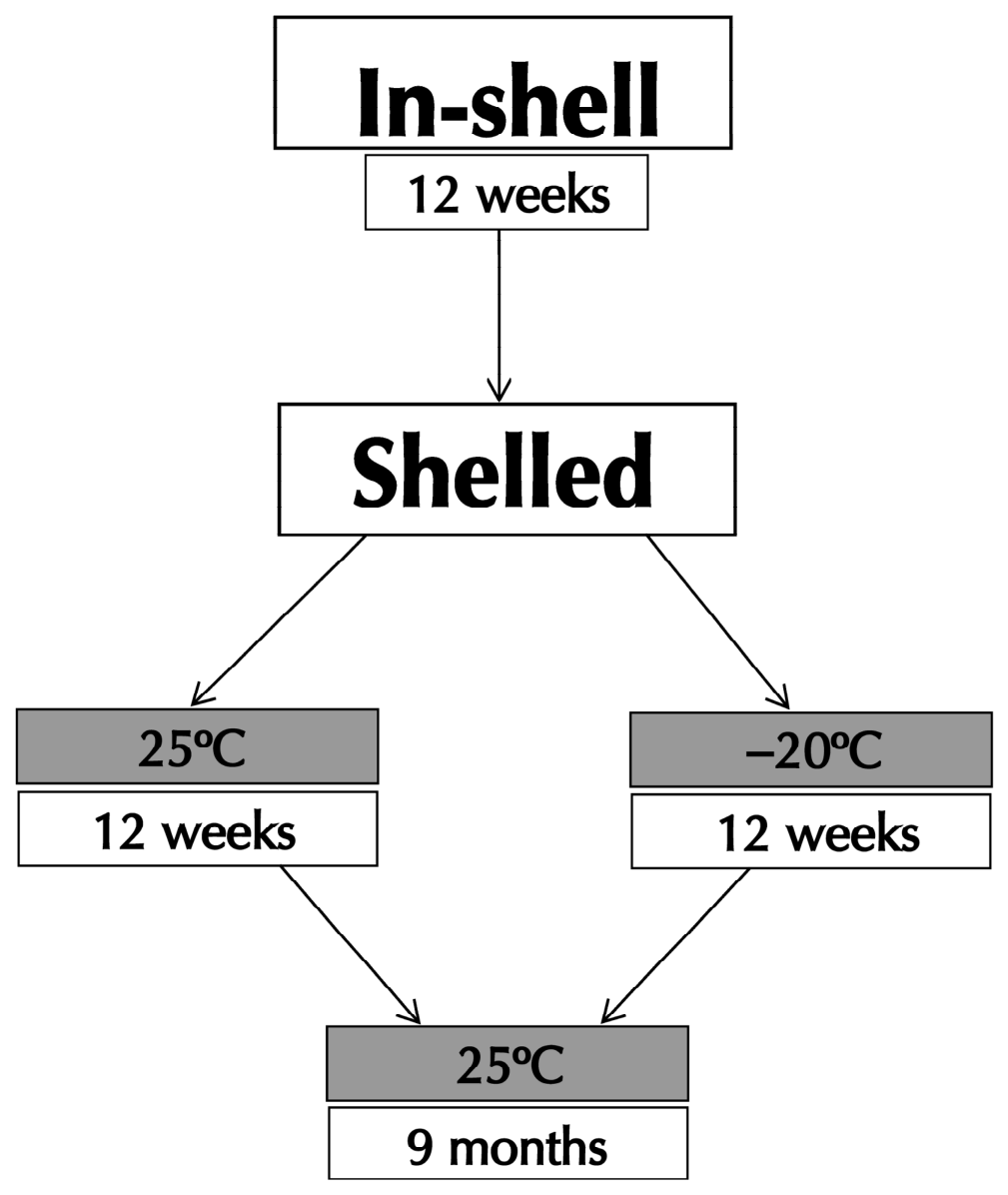
Canarium kernels that had been maintained in-shell for 12 weeks at ambient temperature in Keravat were shelled and dried to a moisture content of 2.5%. One batch was packed after drying and stored at 25 °C for 12 weeks, while the other batch was frozen for 12 weeks. The frozen batch was removed from the freezer, thawed at ambient temperature, and then redried to ensure the moisture concentration was reduced to 2.5% prior to packing and commencement of the experiment. The kernels were sealed in LDPE bags, each containing six kernels, and the bags were assigned randomly to one of two treatments: (i) control, kept at 25 °C for 12 weeks; or (ii) pre-frozen, kept at −20 °C for 12 weeks (Figure 1). The kernels were then randomly stored at 25 °C for up to 9 months. Peroxide values and free fatty acid levels were determined after 1 month, 3 months and 9 months of storage. Five replicate bags of kernels were used to measure peroxide values and free fatty acid levels at each time point.

2.2.2. Experiment 2: Effects of Storage Temperature on Kernel Quality

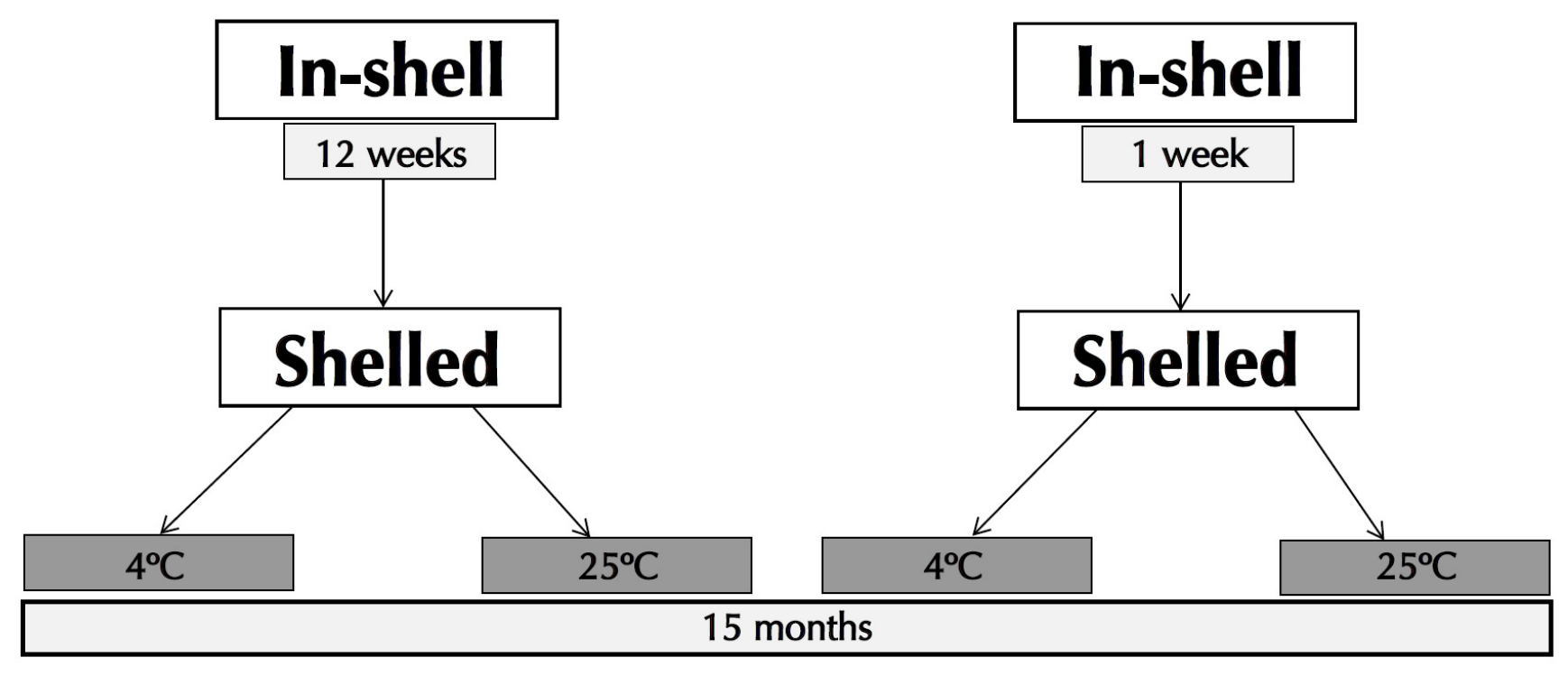
Two types of kernels were used in this experiment: (i) kernels from nuts that had been pre-stored-in-shell for 12 weeks prior to the experiment, i.e., pre-stored-in-shell kernels, and (ii) kernels from nuts that had been stored in-shell for 1 week at ambient temperature before processing, i.e., fresh kernels. Both types of kernels were then stored at either 4 °C or 25 °C for 15 months (Figure 2). Peroxide values, free fatty acid levels and fatty acid composition were determined at the beginning of the experiment and after 3, 6, 9, 12 or 15 months of storage. Five replicates of pre-stored-in-shell kernels and seven replicates of fresh kernels, with each replicate comprising six kernels, were used for all measurements at each time point. Each replicate was sealed in an individual polythene bag.
Colour development of the samples was examined using hyperspectral imaging, as described previously [41]. The acquired images contained spectral data from 380 nm to 1000 nm. Spectral bands at 450 nm, 550 nm and 650 nm were extracted, representing the red–green–blue (RGB) range. The images were collected after 9, 12 and 15 months of storage.

2.3. Oil Extraction

All six kernels from each replicate sample were ground to constitute a bulk sample per replicate and pentane was added. The solution was centrifuged and the supernatant placed in a round-bottom flask. Pentane was evaporated from the collected supernatant under vacuum using a Rotavapor® model R-205 (Büchi, Labortechnik AG, Flawil, Switzerland) [3]. The oil remained in the flask and was collected into glass vials for analysis [3]. The oil was analysed immediately after extraction.

2.4. Determination of Peroxide Values, Free Fatty Acid Levels and Fatty Acid Composition

Peroxide values and free fatty acid levels were determined using the OxiTester method [5]. An OxiTester Touch Analyser (Olive OxiTester, Sw version 1.22, CDR, Ginestra Fiorentina, Italy) for edible oils was used. The corresponding reagents were placed into single-usage prefilled cuvettes (peroxide value kit catalogue number F33 and free fatty acid kit catalogue number F300128; CDR FoodLab®, Ginestra Fiorentina, Florence, Italy). The oil was injected directly into the prefilled cuvettes and the OxiTester was calibrated against a blank sample. The colour intensity was measured at 505 nm for peroxide values and at 630 nm for free fatty acid levels [5]. Fatty acid concentrations were expressed as a percentage of the total fatty acids in each oil sample. Fatty acid composition was determined by preparing fatty acids methyl esters (FAMEs) and analysing them using GC-MS/FID (PerkinElmer Clarus 580 Gas Chromatograph and PerkinElmer Clarus SQ8S Mass Spectrometer; PerkinElmer, Shelton, CT, USA) [38].

2.5. Data Analysis

Data for the pre-frozen and control kernels in Experiment 1 were compared within each time point, i.e., after 1, 3 and 9 months, using Mann–Whitney U tests (p < 0.05). Data for the pre-stored-in-shell and fresh kernels in Experiment 2 were analysed separately because the nuts were not necessarily from the same origin. Two-way analysis of variance (ANOVA) was performed to investigate the main effects of storage time and storage temperature, and their interactions, on peroxide values and free fatty acid levels. The interactions were significant (Supplementary Table S1) and, as a result, data from the two storage temperatures, 4 °C and 25 °C, were compared within each time point, i.e., after 0, 3, 6, 9, 12 and 15 months, using Mann–Whitney U tests (p < 0.05) to understand storage temperature effects on the shelf life of kernels. The effects of a main factor must be investigated within each level of the other factor if the interaction between factors is significant [42]. A two-way ANOVA was performed for colour development data of the pre-stored-in-shell and fresh kernels separately, with storage time and storage temperature being the factors. The interactions were significant (p < 0.10) and therefore Mann–Whitney U tests were used to investigate the effect of storage temperature at each storage time.

3. Results

3.1. Effects of Freezing Before Storage at 25 °C on Peroxide Values and Free Fatty Acid Levels

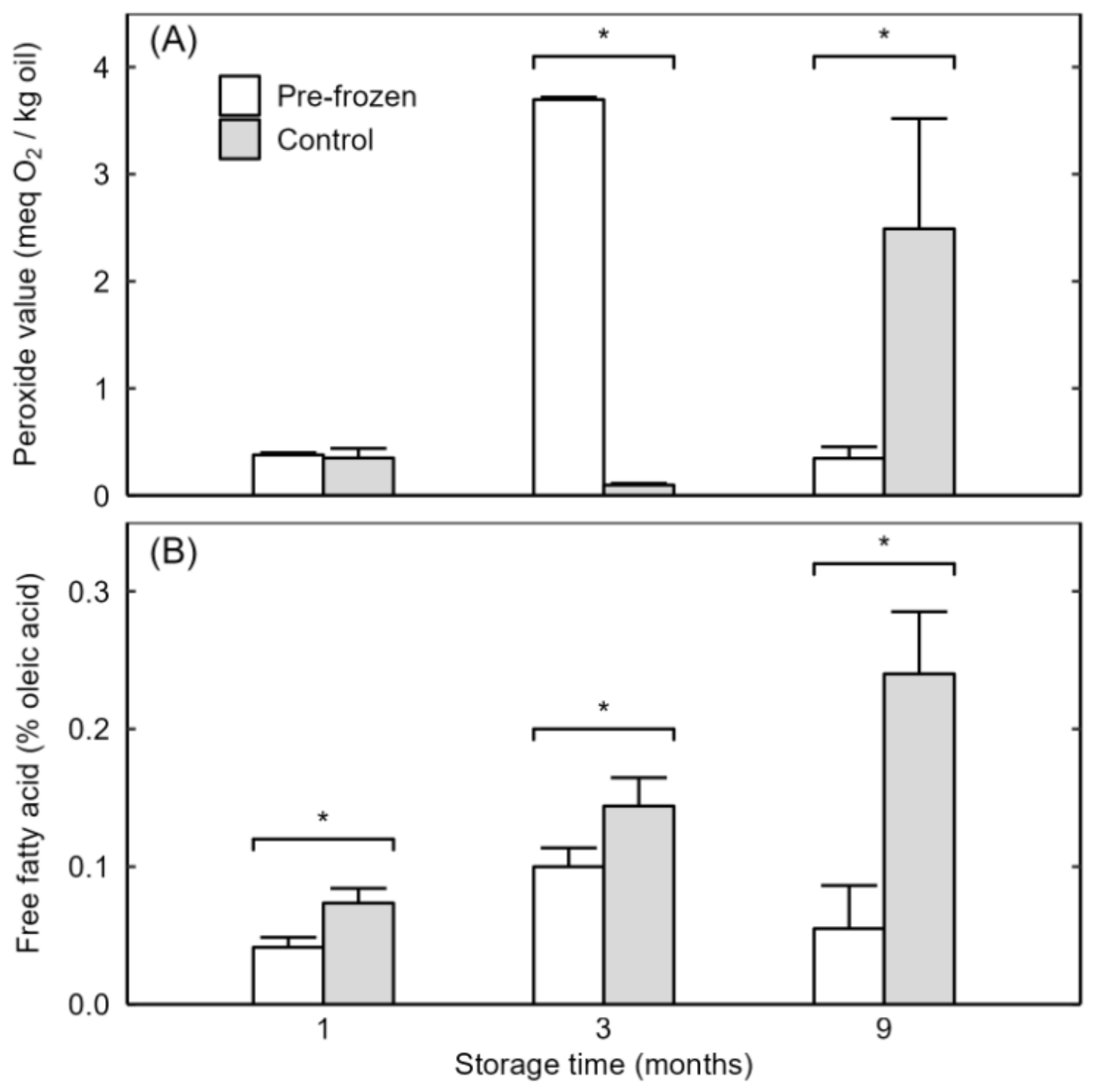
Pre-frozen and control canarium kernels had low peroxide values (0.39 and 0.30 meq O2/kg oil, respectively) after 1 month of storage (Figure 3A). However, peroxide values of the pre-frozen kernels rose sharply by 3 months of storage to above 3.5 meq O2/kg oil but were lower than those of control kernels at 9 months of storage (Figure 3A). Free fatty acid levels of pre-frozen kernels were lower than the levels in control kernels throughout the storage period (Figure 3B).

3.2. Effects of Storage at 4 °C or 25 °C on Peroxide Values and Free Fatty Acid Levels of Fresh and Pre-Stored-in-Shell Kernels

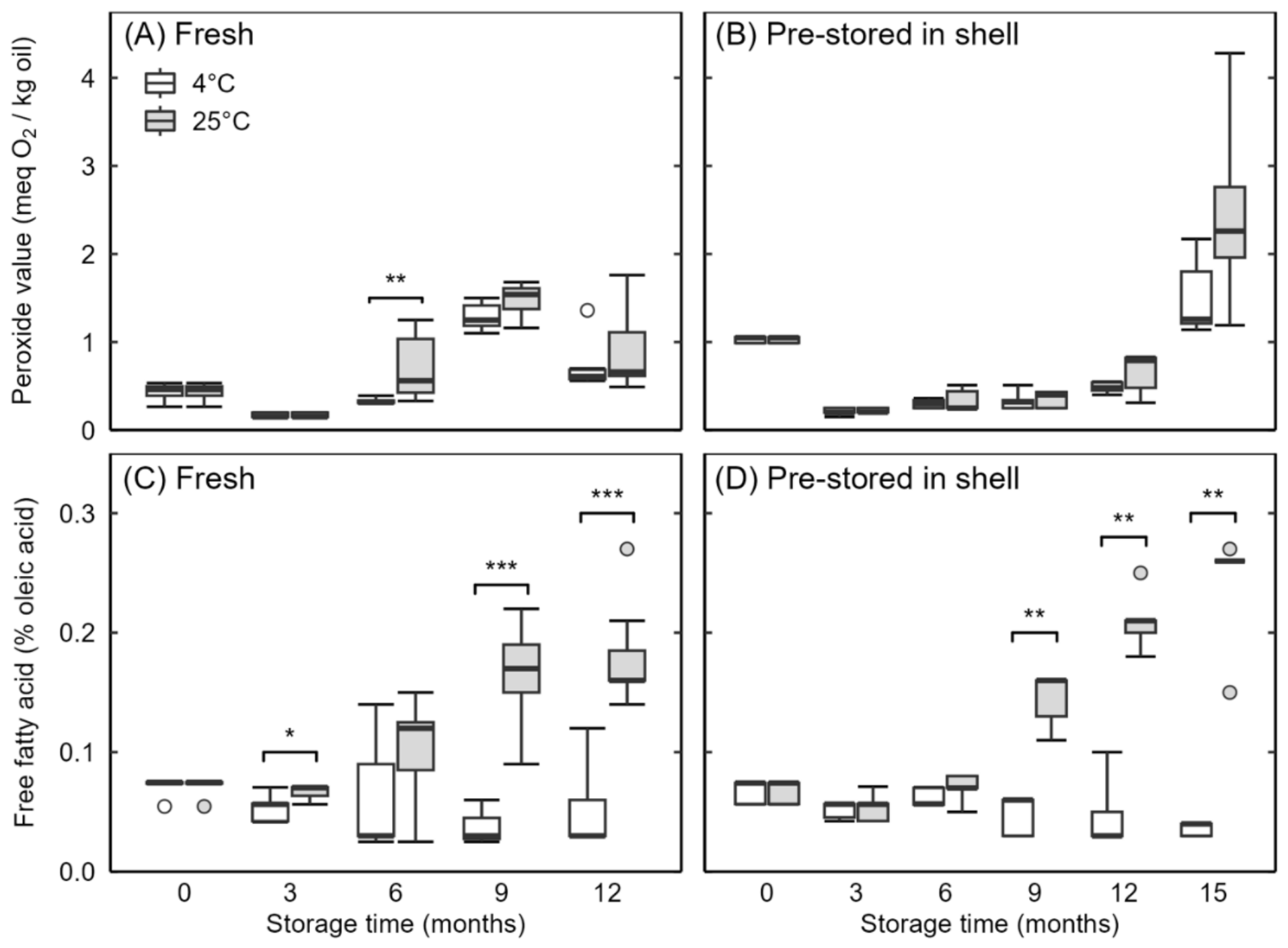
Peroxide values of fresh canarium kernels were low at the start of the experiment (0.46 meq O2/kg oil) (Figure 4A). Peroxide values of either the fresh or the pre-stored-in-shell kernels were similar between the two long-term storage temperatures of 4 °C or 25 °C (Figure 4A,B), except that fresh kernels stored at 25 °C for 6 months had higher values (0.72 meq O2/kg oil) than kernels stored at 4 °C (0.33 meq O2/kg oil) (Figure 4A). Free fatty acid levels of the fresh kernels after 3, 9 and 12 months of storage at 25 °C, and of the pre-stored-in-shell kernels after 9, 12 and 15 months of storage at 25 °C, were higher than the levels of kernels stored for the same durations at 4 °C (Figure 4C,D).

3.3. Effects of Storage at 4 °C or 25 °C on Fatty Acid Composition of Fresh and Pre-Stored-in-Shell Kernels

The concentrations of the major fatty acids, palmitic, stearic and linoleic acid, in fresh canarium kernels stored at 4 °C or 25 °C did not differ significantly during 12 months of storage, but the oleic acid concentration was higher in the refrigerated kernels than the unrefrigerated kernels at 9 months (Table 1). There were very few significant differences in the concentrations of the minor fatty acid components of fresh or pre-stored-in-shell kernels stored at 4 °C versus 25 °C throughout the storage period (Table 1 and Table 2).

3.4. Colour Development

No significant difference in colour development was found in fresh kernels between the two storage temperatures of 4 °C and 25 °C (Table 3). Pre-stored-in-shell kernels had consistently higher reflectance when stored at 4 °C than when stored at 25 °C at 12 months of storage (Table 3).

4. Discussion

Our results show that pre-frozen canarium kernels would need to be consumed within 3 months of storage at 25 °C, or else discarded. Pre-frozen kernels had elevated peroxide values by this stage, much higher than those of non-frozen kernels, and above the maximum peroxide value for kernel quality of 3.0 meq O2/kg oil that has been adopted by the canarium industry [20,40]. The high peroxide values observed in pre-frozen kernels were possibly due to lipid oxidation, because freezing causes cell membrane damage to plant tissues, resulting in the release of cellular contents [27]. The peroxide values of pre-frozen kernels declined by 9 months of storage, presumably because peroxides are degraded over time to secondary products such as saturated aldehydes and monounsaturated 2-alkenals [20,28,29]. Control kernels, which had not been frozen prior to storage at 25 °C, mostly remained below the maximum peroxide value for kernel quality for the duration of the 9-month storage period.
There was some indication of developing rancidity, evident as elevated free fatty acid levels, in both the pre-stored-in-shell and the fresh canarium kernels that were stored at 25 °C. Free fatty acid formation is driven by accelerated oil hydrolysis [30]. All packaging types allow some degree of permeability, and permeability is temperature-dependent [43]. However, moisture concentrations are similar across three packaging types, LDPE, aluminium laminate (ALL), and polymeric laminate (PML), when the storage temperature ranges between 25 °C and 35 °C [43]. Moisture concentration does not change across 12 months of storage in cashew nuts when packaging materials are used including polythene, polythene-lined polypropylene, paper-lined polyethylene, polythene-lined carton and paper-lined carton, with polythene-lined polypropylene identified as the most suitable packaging method for maintaining moisture of cashew kernels [44]. In our study, polyethylene packaging was used and the packages were heat-sealed to minimise moisture absorption or loss during storage. Room-temperature storage appeared to accelerate the hydrolysis of oils, which might be an indication of moisture reabsorption. However, the free fatty acid levels were still below the acceptable limit of 0.60% (oleic acid) [8] after 12 or 15 months of storage, suggesting that moisture reabsorption was not significant. The production of free fatty acids remained low, an indication of preserved kernel quality.
Nonetheless, higher peroxide values or free fatty acid levels were often detected at 25 °C, presumably due to higher rates of enzymatic reactions at this higher temperature [31,32,35,38]. Our results support previous findings of higher free fatty acid levels during higher-temperature storage of canarium and almond kernels [14,31]. Free fatty acid levels in the canarium kernels stored at 25 °C (0.24% oleic acid) were similar to those reported previously (0.29% oleic acid) in canarium kernels after 11 months of storage at ambient temperature [14]. Temperatures above 20 °C lead to increased free fatty acid levels due to increased activity of lipase and other enzymes [32,35]. Higher storage temperatures also result in accelerated lipid oxidation in other tree nuts such as walnuts and pistachios [33,35]. Metabolic and quality-deterioration reactions are retarded at lower storage temperatures, and so keeping the kernels at low temperatures extends their shelf life [33].
Chemical rancidity markers and sensory analysis measures are often correlated [45]. For example, consumers often reject samples with peroxide values > 18 meq O2/kg oil [45]. The peroxide values in our study were substantially < 18 meq O2/kg oil. We did not record sensory data but we examined colour development in the stored kernels at 12 months of storage. The higher storage temperature of 25 °C reduced the reflectance of pre-stored-in-shell kernels compared with those stored at 4 °C at 12 months of storage. Decreased reflectance indicates that the kernel surface was absorbing more light and was darker than kernels with higher reflectance [46]. Colour changes are related to first-order decay, implying oxidation, and these changes are not favoured by consumers at retail outlets [47,48]. Colour development beyond 12 months of storage requires monitoring to ensure that the colour of canarium kernels remains acceptable to consumers over a longer period of storage.
Ambient storage temperature did not result in the breakdown of fatty acids in kernels in any of the treatments. Lack of changes in unsaturated fatty acids suggests that canarium oil is chemically stable when stored at 25 °C. Storage of almond at ambient temperature accelerates oil oxidation when compared with storage at 4 °C [35]. Almonds have a higher concentration of unsaturated fatty acids than canarium and are, therefore, more susceptible to oil oxidation at elevated temperature [35]. Generally, fatty acid breakdown occurs due to a combination of elevated temperatures and low antioxidant content, with unsaturated fatty acids particularly susceptible to rapid breakdown [7,8,49]. Canarium kernels contain high levels of antioxidant and phenolic compounds, which might help to increase their oil stability under elevated temperatures [40,50]. Preservation of fatty acid concentrations including oleic acid and polyunsaturated fatty acids such as linoleic and α-linolenic acids is particularly important for maintaining the shelf life and nutritional value of kernels [8,36]. Fresh and pre-stored-in-shell canarium kernels can both be stored for up to 15 months at 4 °C or 25 °C without major changes in their fatty acid composition, indicating that both these temperatures are acceptable for kernel storage.
It should be noted that the origin of kernel samples differed between fresh and pre-stored-in-shell kernels and so we could not compare data directly between the two origins. However, storage at the low temperature of 4 °C was more effective in preserving kernel quality by slowing enzymatic activity, as measured by free fatty acid levels. Peroxide values and free fatty acid levels were indicative of good product quality. However, increased peroxide values lead to development of off-flavour and, hence, sensory tests need to be considered in future studies. In addition to chemical composition, future studies need to be coupled with microbial tests despite evidence from a 12-month study showing that microbial concentrations in cashew nuts remain at acceptable levels [44]. In the current study, colour changes and elevated peroxide values and free fatty acid levels observed at 12 months of storage at 25 °C may also suggest that kernel quality had commenced deterioration. Thus, we recommend that products stored for more than 12 months undergo microbial testing before sale to ensure they are safe for consumption.

5. Conclusions

Freezing of canarium kernels prior to storage is not recommended as it accelerates lipid oxidation and quality loss. However, refrigeration extends kernel quality. Kernels stored at room temperature were still below the maximum acceptable limits for peroxide values and free fatty acid levels after 12–15 months, but they displayed increasing free fatty acid levels, indicative of developing rancidity. Pre-storage of kernels in-shell led to colour changes, particularly under the higher storage temperature of 25 °C, which might affect their marketability. We recommend that kernels of this tropical tree nut be refrigerated to extend their kernel quality beyond 12 months and maintain their nutritional quality.

Supplementary Materials

The following supporting information can be downloaded at: https://www.mdpi.com/article/10.3390/horticulturae12070902/s1, Table S1: Probability of two-way ANOVA assessing the effects of storage time (ST), storage temperature (STP), and their interaction (ST × STP) on peroxide value (PV), free fatty acids (FFA), and colour development at three wavelengths of 450 nm, 550 nm and 650 nm.

Author Contributions

Conceptualization, S.H.-B.; methodology, S.H.-B., M.B.F. and D.H.; formal analysis, T.G.; data curation, T.G. and D.H.; writing—original draft preparation, T.G. and S.H.-B.; writing—review and editing, H.M.W., S.J.T., M.B.F., B.B.E., D.H. and S.H.-B.; supervision, H.M.W., S.H.-B. and S.J.T.; funding acquisition, H.M.W. All authors have read and agreed to the published version of the manuscript.

Funding

This research was funded by Australian Centre for International Agricultural Research (ACIAR) projects FST/2014/099 and FST/2017/038.

Data Availability Statement

The original contributions presented in this study are included in the article/Supplementary Material. Further inquiries can be directed to the corresponding author.

Acknowledgments

We thank Kim Jones, Peter Brooks, Bruce Randall and Ian Darby for their assistance in the laboratory.

Conflicts of Interest

The authors declare no conflicts of interest.

References

  1. Kader, A.A.; Heintz, C.; Labavitch, J.; Rae, H. Description and evaluation of pistachio nut quality. J. Am. Soc. Hortic. Sci. 1982, 107, 812–816. [Google Scholar] [CrossRef] [Scilit]
  2. Walton, D.A.; Wallace, H.M. Postharvest dropping of macadamia nut in shell causes kernel damage. Postharvest Biol. Technol. 2008, 49, 140–146. [Google Scholar]
  3. Bai, S.H.; Darby, I.; Nevenimo, T.; Hannet, G.; Hannet, D.; Poienou, M.; Grant, E.; Brooks, P.; Walton, D.; Randall, B.; et al. Effects of roasting on kernel peroxide value, free fatty acid, fatty acid composition and crude protein content. PLoS ONE 2017, 12, e0184279. [Google Scholar] [CrossRef] [Scilit] [PubMed]
  4. Gavilán-CuiCui, G.; Lagos-Muñoz, R.; Ellena, F.M.; Di Matteo, A.; Morina, F.; Meriño-Gergichevich, C. Unraveling mechanisms of enzymatic browning in nuts and their relationship with pre- and post-harvest factors: Management strategies for mitigation. Molecules 2025, 30, 3866. [Google Scholar] [CrossRef] [Scilit] [PubMed]
  5. Hosseini Bai, S.; Gama, R.; Jones, K.; Hannet, D.; Hannet, G.; Komolong, B.; Brooks, P.; Grant, E.; Elliott, B.; Wallace, H.M. Presence of testa and shell maintains oil stability in almond and Canarium nuts. Horticulturae 2023, 9, 1003. [Google Scholar] [CrossRef] [Scilit]
  6. Aung, M.M.; Chang, Y.S. Temperature management for the quality assurance of a perishable food supply chain. Food Control 2014, 40, 198–207. [Google Scholar] [CrossRef] [Scilit]
  7. Gama, T.; Wallace, H.M.; Trueman, S.J.; Bai, S.H. Quality and shelf life of tree nuts: A review. Sci. Hortic. 2018, 242, 116–126. [Google Scholar] [CrossRef] [Scilit]
  8. Phatanayindee, S.; Borompichaichartkul, C.; Srzednicki, G.; Craske, J.; Wootton, M. Changes in macadamia nut quality during hybrid drying. Dry. Technol. 2012, 30, 1870–1880. [Google Scholar] [CrossRef] [Scilit]
  9. Rong, A.; Akkerman, R.; Grunow, M. Optimisation of fresh food quality in supply chains. Int. J. Prod. Econ. 2011, 131, 421–429. [Google Scholar] [CrossRef] [Scilit]
  10. Stonehouse, G.G.; Evans, J.A. Supercooling for fresh foods: A review. J. Food Eng. 2015, 148, 74–79. [Google Scholar] [CrossRef] [Scilit]
  11. Wei, Y.; Xu, W.; Fu, J.; Ma, S.; Yang, Y.; Huang, K.; Lan, X.; He, X.; Guo, G. Quality damage and control measures of macadamia nuts during primary processing. J. Food Process. Preserv. 2025, 2025, 1205390. [Google Scholar] [CrossRef] [Scilit]
  12. Wallace, H.M.; Randall, B.; Grant, E.; Jones, K.; Walton, D.; Poienou, M.; Nevenimo, T.; Moxon, J.; Pauku, R. Processing methods for canarium nuts in the Pacific. Acta Hortic. 2016, 1128, 145–150. [Google Scholar] [CrossRef] [Scilit]
  13. Wallace, H.M.; Hannet, D.; Hannet, G.; Hosseini Bai, S.; Jones, K.; Komolong, B. Commercialising an indigenous agroforestry tree: Processing methods for Canarium indicum. Acta Hortic. 2022, 1355, 345–350. [Google Scholar] [CrossRef] [Scilit]
  14. Walton, D.A.; Randall, B.W.; Poienou, M.; Nevenimo, T.; Moxon, J.; Wallace, H.M. Shelf life of tropical canarium nut. Horticulturae 2017, 3, 24. [Google Scholar] [CrossRef] [Scilit]
  15. Christopoulos, M.; Tsantili, E. Effects of temperature and packaging atmosphere on total antioxidants and colour of walnut kernels during storage. Sci. Hortic. 2011, 131, 49–57. [Google Scholar] [CrossRef] [Scilit]
  16. Christopoulos, M.V.; Tsantili, E. Oil composition in stored walnut cultivars: Quality and nutritional value. Eur. J. Lipid Sci. Technol. 2015, 117, 338–348. [Google Scholar]
  17. Li, X.; Wang, S.C. Shelf life of extra virgin olive oil and its prediction models. J. Food Qual. 2018, 2018, 1639260. [Google Scholar] [CrossRef] [Scilit]
  18. Bai, S.H.; Hannet, D.; Hannet, G.; Grant, E.; Komolong, B.; Jones, K.; Wallace, H.M. Effects of fruit depulping on kernel quality of Canarium indicum. Acta Hortic. 2021, 1340, 145–148. [Google Scholar]
  19. Jensen, P.N.; Sørensen, G.; Brockhoff, P.; Bertelsen, G. Packaging systems for shelled walnuts using oxygen absorbers. J. Agric. Food Chem. 2003, 51, 4941–4947. [Google Scholar] [CrossRef] [Scilit] [PubMed]
  20. Maestri, D.; Cittadini, M.C.; Bodoira, R.; Martínez, M. Tree nut oils: Chemical profiles, extraction, stability, and quality concerns. Eur. J. Lipid Sci. Technol. 2020, 122, 1900450. [Google Scholar] [CrossRef] [Scilit]
  21. Shahidi, F.; John, J. Oxidative rancidity in nuts. In Improving the Safety and Quality of Nuts; Harris, L.J., Ed.; Elsevier: Amsterdam, The Netherlands, 2013; pp. 198–229. [Google Scholar]
  22. Food and Agriculture Organization of the United Nations (FAO). Food Loss and Waste Database; FAO: Rome, Italy, 2024; Available online: https://www.fao.org/platform-food-loss-waste/flw-data/en/ (accessed on 22 April 2026).
  23. Miraliakbari, H.; Shahidi, F. Lipid class compositions, tocopherols and sterols of tree nut oil sextracted with different solvents. J. Food Lipids 2008, 15, 81–98. [Google Scholar] [CrossRef] [Scilit]
  24. Yanti, S.; Saputri, D.; Lin, H.Y.; Chou, Y.C.; Agrawal, D.; Chien, C. Fatty acid evaluation of seeds and nuts by spectroscopy and chromatography. Food Sci. Technol. 2021, 9, 58–68. [Google Scholar] [CrossRef] [Scilit]
  25. Arena, E.; Ballistreri, G.; Fallico, B. Effect of postharvest storage temperatures on quality parameters of pistachio nuts. Czech J. Food Sci. 2013, 31, 467–473. [Google Scholar] [CrossRef] [Scilit]
  26. Li, D.; Zhu, Z.; Sun, D.W. Effects of freezing on cell structure of fresh foods: A review. Trends Food Sci. Technol. 2018, 75, 46–55. [Google Scholar] [CrossRef] [Scilit]
  27. Özdemir, M.; Açkurt, F.; Yıldız, M.; Biringen, G.; Gürcan, T.; Löker, M. Effect of roasting on hazelnut nutrients. Food Chem. 2001, 73, 185–190. [Google Scholar] [CrossRef] [Scilit]
  28. Grebenteuch, S.; Kroh, L.W.; Drusch, S.; Rohn, S. Formation of secondary and tertiary volatile compounds from lipid oxidation of rapeseed oil. Foods 2021, 10, 2417. [Google Scholar] [CrossRef] [Scilit] [PubMed]
  29. Mahboubifar, M.; Yousefinejad, S.; Alizadeh, M.; Hemmateenejad, B. Prediction of acid and peroxide values in edible oils by FTIR-ATR chemometrics. J. Iran. Chem. Soc. 2016, 13, 2291–2299. [Google Scholar] [CrossRef] [Scilit]
  30. Lin, X.; Wu, J.; Zhu, R.; Chen, P.; Huang, G.; Li, Y.; Ye, N.; Huang, B.; Lai, Y.; Zhang, H. California almond shelf life: Lipid deterioration during storage. J. Food Sci. 2012, 77, C583–C593. [Google Scholar] [CrossRef] [Scilit] [PubMed]
  31. Tavakolipour, H. Postharvest operations of pistachio nuts. J. Food Sci. Technol. 2015, 52, 1124–1130. [Google Scholar] [PubMed]
  32. Bakkalbaşı, E.; Yılmaz, Ö.M.; Javidipour, I.; Artık, N. Effects of packaging materials, storage conditions and variety on oxidative stability of shelled walnuts. Food Sci. Technol. 2012, 46, 203–209. [Google Scholar] [CrossRef] [Scilit]
  33. Ghirardello, D.; Bertolino, M.; Belviso, S.; Dal Bello, B.; Giordano, M.; Rolle, L.; Gerbi, V.; Zeppa, G. Phenolic composition, antioxidant capacity and hexanal content of hazelnuts as affected by storage conditions. Postharvest Biol. Technol. 2016, 112, 95–104. [Google Scholar] [CrossRef] [Scilit]
  34. Raisi, M.; Ghorbani, M.; Mahoonak, A.S.; Kashaninejad, M.; Hosseini, H. Effect of storage atmosphere and temperature on the oxidative stability of almond kernels during long-term storage. J. Stored Prod. Res. 2015, 62, 16–21. [Google Scholar] [CrossRef] [Scilit]
  35. Bai, S.H.; Brooks, P.; Gama, R.; Nevenimo, T.; Hannet, G.; Hannet, D.; Randall, B.; Walton, D.; Grant, E.; Wallace, H.M. Nutritional quality of almond, canarium, cashew and pistachio and their oil photo-oxidative stability. J. Food Sci. Technol. 2019, 56, 792–798. [Google Scholar] [PubMed]
  36. Kaur, N.; Chugh, V.; Gupta, A.K. Essential fatty acids as functional components of foods—A review. J. Food Sci. Technol. 2014, 51, 2289–2303. [Google Scholar] [PubMed]
  37. Hamilton, K.; Brooks, P.; Holmes, M.; Cunningham, J.; Russell, F.D. Evaluation of omega-3 fatty acid composition in dietary oil supplements. Nutr. Diet. 2010, 67, 182–189. [Google Scholar] [CrossRef] [Scilit]
  38. Mexis, S.F.; Kontominas, M.G. Effect of gamma irradiation on physicochemical and sensory properties of peanuts and pistachios. J. Sci. Food Agric. 2009, 89, 867–875. [Google Scholar] [CrossRef] [Scilit]
  39. Hosseini-Bai, S.; Wilson, R.; Hannet, G.; Keller, A.; Shapcott, A.; Nass-Komolong, B.; Farrar, M.B.; Wallace, H. Tree root interactions revealed by metabarcoding in agroforestry systems. Acta Hortic. 2022, 125–132. [Google Scholar] [CrossRef] [Scilit]
  40. Hosseini Bai, S.; Nevenimo, T.; Hannet, G.; Hannet, D.; Jones, K.; Trueman, S.J.; Grant, E.; Walton, D.; Randall, B.; Wallace, H.M. Impacts of freezing, roasting and salt dipping on oil quality of nut kernels. Acta Hortic. 2019, 1256, 71–75. [Google Scholar] [CrossRef] [Scilit]
  41. Gama, T.; Farrar, M.B.; Tootoonchy, M.; Wallace, H.M.; Trueman, S.J.; Tahmasbian, I.; Bai, S.H. Hyperspectral imaging predicts free fatty acid levels, peroxide values, and linoleic acid and oleic acid concentrations in tree nut kernels. LWT 2024, 199, 116068. [Google Scholar] [CrossRef] [Scilit]
  42. Tolve, R.; Sportiello, L.; Rainero, G.; Pelattieri, A.; Trezzi, M.; Favati, F. A sensory shelf-life study for the evaluation of new eco-sustainable packaging of single-portion croissants. Foods 2024, 13, 1390. [Google Scholar] [CrossRef] [Scilit] [PubMed]
  43. Kaur, G.; Sidhu, G.K.; Kaur, P. Moisture sorption isotherms characteristics for shelf-life prediction of peanuts (Arachis hypogaea L.). J. Sci. Food Agric. 2023, 103, 3077–3092. [Google Scholar] [CrossRef] [Scilit] [PubMed]
  44. Olagbaju, A.R.; Afolayan, S.S.; Aina, J.A.; Okusami, A.T.; Ashonibare, R.A.; Kurah, A.; Rahman, M.O.; Alimi, J.P. Effects of different packaging methods on the shelf life of cashew nuts and kernels. Asian Food Sci. J. 2023, 22, 141–148. [Google Scholar] [CrossRef] [Scilit]
  45. Zajdenwerg, C.; Branco, G.F.; Alamed, J.; Decker, E.A.; Castro, I.A. Correlation between sensory and chemical markers in the evaluation of Brazil nut oxidative shelf-life. Eur. Food Res. Technol. 2011, 233, 109–116. [Google Scholar] [CrossRef] [Scilit]
  46. Farrar, M.B.; Martinez, M.; Jones, K.; Omidvar, N.; Wallace, H.M.; Chen, T.; Hosseini Bai, S. The potential for hyperspectral imaging and machine learning to classify internal quality defects in macadamia nuts. Horticulturae 2024, 10, 1129. [Google Scholar] [CrossRef] [Scilit]
  47. Wang, S.; Adhikari, K.; Hung, Y.C. Acceptability and preference drivers of freshly roasted peanuts. J. Food Sci. 2017, 82, 174–184. [Google Scholar] [PubMed]
  48. Prabhakar, H.; Bock, C.H.; Kerr, W.L.; Kong, F. Pecan color change during storage: Kinetics and modeling of the processes. Curr. Res. Food Sci. 2022, 5, 261–271. [Google Scholar] [CrossRef] [Scilit] [PubMed]
  49. Shahidi, F.; Ambigaipalan, P. Phenolics and polyphenolics in foods, beverages and spices: Antioxidant activity and health effects—A review. J. Funct. Foods 2015, 18, 820–897. [Google Scholar] [CrossRef] [Scilit]
  50. Indrianingsih, A.W.; Rosyida, V.T.; Apriyana, W.; Darsih, C.; Angwar, M.; Windarsih, A.; Batrisya. The antioxidant and antibacterial study of Canarium indicum L. latex extract. IOP Conf. Ser. Mater. Sci. Eng. 2021, 1011, 012051. [Google Scholar] [CrossRef] [Scilit]
Figure 1. Schematic overview of the experimental treatments showing storage conditions examined during Experiment 1. Samples were initially stored in-shell for 12 weeks, then shelled and divided into two storage conditions (25 °C or −20 °C) for a further 12 weeks. All samples were subsequently stored at 25 °C for up to 9 months.
Horticulturae 12 00902 g001
Figure 2. Schematic overview of the experimental treatments showing storage conditions examined during Experiment 2. Samples were initially stored in-shell for either 12 weeks (left) or 1 week (right), after which they were shelled and divided into two storage conditions (4 °C or 25 °C). All samples were subsequently stored for up to 12 or 15 months.
Horticulturae 12 00902 g002
Figure 3. (A) Peroxide values (meq O2/kg oil) and (B) levels of free fatty acids (% oleic acid equivalent) of canarium kernels that were pre-frozen at −20 °C or kept at 25 °C for 12 weeks prior to storage at 25 °C for 9 months. Two means within a time point marked with an asterisk (*) are significantly different (Mann–Whitney U test, p < 0.05, n = 5).
Horticulturae 12 00902 g003
Figure 4. (A,B) Peroxide values (meq O2/kg oil) and (C,B) levels of free fatty acids (% oleic acid equivalent) of canarium kernels during storage at 4 °C or 25 °C ((A,C): fresh kernels; (B,D): pre-stored-in-shell kernels). Boxes represent the 25th to 75th percentiles, with medians indicated by bold horizontal lines. Whiskers extend to the 10th and 90th percentiles, and outliers are shown as dots. Two medians within a time point marked with asterisks (*) are significantly different (Mann–Whitney U test, n = 7 for fresh kernels, n = 5 for pre-stored-in-shell kernels, * p < 0.05, ** p < 0.01, *** p < 0.001).
Horticulturae 12 00902 g004
Table 1. The relative abundances of fatty acids in fresh canarium kernels during 12 months of storage at 4 °C or 25 °C.
Fatty AcidStorage Time
(Months)
Percentage of Total Fatty Acids (%) During Storage
4 °C25 °C
C14:0 (Myristic acid)00.04 ± 0.030.04 ± 0.03
30.10 ± 0.030.18 ± 0.05
60.08 ± 0.030.07 ± 0.02
90.00 ± 0.000.00 ± 0.00
120.00 ± 0.000.00 ± 0.00
C16:0 (Palmitic acid)027.90 ± 0.6027.90 ± 0.60
326.02 ± 0.6624.75 ± 0.78
627.36 ± 0.4427.62 ± 0.44
933.06 ± 3.5530.24 ± 0.45
1230.38 ± 0.6829.9 ± 0.34
C16:1 (Palmitoleic acid)00.20 ± 0.020.20 ± 0.02
30.25 ± 0.040.22 ± 0.03
60.22 ± 0.040.23 ± 0.05
90.17 ± 0.020.15 ± 0.02
120.19 ± 0.02 a0.52 ± 0.10 b
C18:0 (Stearic acid)018.57 ± 0.3318.57 ± 0.33
317.50 ± 0.4019.23 ± 0.26
617.25 ± 0.3718.11 ± 0.28
918.28 ± 2.1416.42 ± 0.24
1217.15 ± 1.1116.50 ± 0.20
C18:1 c (Oleic acid)044.90 ± 1.1844.90 ± 1.18
349.15 ± 0.7647.97 ± 0.71
647.29 ± 0.9745.89 ± 0.58
947.40 ± 0.57 a45.41 ± 0.64 b
1244.60 ± 0.8445.07 ± 0.58
C18:1 t (Elaidic acid)00.95 ± 0.220.95 ± 0.22
30.40 ± 0.14 a1.00 ± 0.22 b
61.14 ± 0.231.19 ± 0.15
91.04 ± 0.240.92 ± 0.03
121.35 ± 0.081.35 ± 0.03
C18:2 (Linoleic acid)06.95 ± 0.406.95 ± 0.40
35.81 ± 0.155.87 ± 0.24
66.17 ± 0.396.44 ± 0.30
96.72 ± 0.906.70 ± 0.50
126.12 ± 0.466.32 ± 0.40
C20:0 (Arachidic acid)00.32 ± 0.020.32 ± 0.02
30.41 ± 0.040.52 ± 0.13
60.28 ± 0.060.28 ± 0.04
90.18 ± 0.010.15 ± 0.01
120.19 ± 0.010.26 ± 0.03
C20:1 (Gandoleic acid)00.15 ± 0.050.15 ± 0.05
30.27 ± 0.09 a0.13 ± 0.04 b
60.11 ± 0.030.08 ± 0.02
90.00 ± 0.000.00 ± 0.00
120.01 ± 0.000.02 ± 0.00
C22:0 (Behenic acid)00.01 ±< 0.010.01 ± 0.002
30.10 ± 0.040.14 ± 0.05
60.10 ± 0.040.09 ± 0.05
90.00 ± 0.000.00 ± 0.00
120.00 ± 0.000.01 ±< 0.01
Means (±SE) with bold font and different letters in the same row are significantly different (Mann–Whitney U test, p < 0.05, n = 5).
Table 2. The relative abundances of fatty acids in pre-stored-in-shell canarium kernels during 15 months of storage at 4 °C or 25 °C.
Fatty AcidStorage Time
(Months)
Percentage of Total Fatty Acids (%) During Storage
4 °C25 °C
C14:0 (Myristic acid)00.06 ± 0.030.06 ± 0.03
30.07 ± 0.03 a0.26 ± 0.10 b
60.12 ± 0.080.24 ± 0.06
90.05 ± 0.050.03 ± 0.03
120.00 ± 0.000.00 ± 0.00
150.00 ± 0.000.00 ± 0.00
C16:0 (Palmitic acid)029.60 ± 0.2929.60 ± 0.29
325.60 ± 0.5626.77 ± 0.48
625.0 ± 0.2024.70 ± 1.12
926.19 ± 4.0629.38 ± 0.17
1231.74 ± 0.3131.52 ± 0.35
1531.42 ± 0.2931.01 ± 0.36
C16:1 (Palmitoleic acid)00.16 ± 0.030.16 ± 0.03
30.40 ± 0.070.40 ± 0.10
60.29 ± 0.03 a0.52 ± 0.07 b
90.19 ± 0.02 a0.65 ± 0.19 b
120.19 ± 0.01 a0.26 ± 0.01 b
150.21 ± 0.020.19 ± 0.02
C18:0 (Stearic acid)015.38 ± 0.4815.38 ± 0.48
315.65 ± 0.3917.19 ± 0.51
617.21 ± 0.6916.06 ± 0.55
912.20 ± 2.4114.29 ± 0.25
1215.64 ± 0.4814.96 ± 0.20
1514.65 ± 0.3614.39 ± 0.32
C18:1 c (Oleic acid)047.67 ± 0.6147.67 ± 0.61
349.35 ± 1.0747.19 ± 0.57
650.11 ± 0.7447.28 ± 2.22
951.49 ± 3.5748.59 ± 0.29
1244.21 ± 1.0144.84 ± 0.38
1545.92 ± 0.4146.50 ± 0.34
C18:1 t (Elaidic acid)01.42 ± 0.181.42 ± 0.18
32.42 ± 0.561.35 ± 0.17
60.77 ± 0.191.16 ± 0.28
91.28 ± 0.211.23 ± 0.07
121.58 ± 0.071.66 ± 0.05
151.72 ± 0.081.56 ± 0.04
C18:2 (Linoleic acid)05.53 ± 0.225.53 ± 0.22
35.65 ± 0.486.06 ± 0.42
65.73 ± 0.135.48 ± 0.13
95.01 ± 0.845.61 ± 0.23
126.45 ± 0.446.53 ± 0.25
C20:0 (Arachidic acid)155.91 ± 0.326.20 ± 0.13
00.15 ± 0.020.15 ± 0.02
30.54 ± 0.150.34 ± 0.05
60.41 ± 0.030.36 ± 0.05
90.49 ± 0.380.18 ± 0.03
120.17 ± 0.010.18 ± 0.00
C20:1 (Gandoleic acid)150.15 ± 0.010.14 ± 0.01
00.03 ± 0.010.03 ± 0.01
30.13 ± 0.050.32 ± 0.16
60.24 ± 0.060.21 ± 0.06
90.01 ± 0.010.01 ± 0.01
120.01 ±< 0.010.05 ± 0.03
150.01 ±< 0.010.01 ±< 0.01
C22:0 (Behenic acid)00.01 ± 0.010.01 ± 0.01
30.29 ± 0.250.12 ± 0.04
60.04 ± 0.01 a0.12 ± 0.06 b
90.00 ± 0.000.00 ± 0.00
120.00 ± 0.000.00 ± 0.00
150.01 ±< 0.010.01 ±< 0.01
Means (±SE) with bold font and different letters in the same row are significantly different (Mann-Whitney U test, p < 0.05, n = 5).
Table 3. Mean reflectance values at 450 nm, 550 nm and 650 nm wavelengths for fresh canarium kernels after 9 or 12 months of storage and for pre-stored-in-shell canarium kernels after 9, 12 or 15 months of storage stored at 4 °C or 25 °C.
Treatment Wavelengths
(nm)
Storage Time (Months)Storage Temperature (°C)
4 °C25 °C
Fresh45093640 ± 40.03544 ± 92.0
123490 ± 44.33637 ± 72.1
55096073 ± 57.25857 ± 90.3
125770 ± 55.15870 ± 79.2
65097345 ± 68.67090 ± 97.1
126935 ± 66.47050 ± 89.8
Pre-stored-in-shell45093776 ± 57.63714 ± 71.8
123876 ± 45.9 a3497 ± 37.1 b
153732 ± 64.43591 ± 104.8
55096245 ± 66.16095 ± 87.3
126320 ± 60.5 a5801 ± 37.8 b
156144 ± 82.15911 ± 130.8
65097568 ± 63.57410 ± 89.5
127621 ± 64.8 a7046 ± 38.5 b
157366 ± 111.67190 ± 136.1
Means (±SE) with bold font and different letters in the same row are significantly different (Mann–Whitney U test, p < 0.05, n = 7 for fresh kernels, n = 5 for pre-stored-in-shell kernels).
Disclaimer/Publisher’s Note: The statements, opinions and data contained in all publications are solely those of the individual author(s) and contributor(s) and not of MDPI and/or the editor(s). MDPI and/or the editor(s) disclaim responsibility for any injury to people or property resulting from any ideas, methods, instructions or products referred to in the content.