Article

Dissecting Temperature-Dependent Variations in Cell Wall Metabolism and Firmness Loss During Postharvest Storage of Two Melting-Type Prunus persica Cultivars


by
Isabel Lara
1,* and
Abel Ortiz
2
1
Departament de Química, Física, Ciències Ambientals i del Sól (DQFAS), Universitat de Lleida, 25198 Lleida, Spain
2
Servei Científico-Tècnic d’Assaig en Planta Pilot de Processament d′Aliments, Universitat de Lleida, Parc Agrobiotech, 25003 Lleida, Spain
*
Author to whom correspondence should be addressed.
Horticulturae 2026, 12(7), 864; https://doi.org/10.3390/horticulturae12070864
Submission received: 11 June 2026 / Revised: 10 July 2026 / Accepted: 14 July 2026 / Published: 16 July 2026
(This article belongs to the Section Postharvest Biology, Quality, Safety, and Technology)

Highlights

What are the main findings?
  • The preservation of pectins bound covalently to the cell wall was identified as the main factor associated with fruit firmness retention in two melting-type peach and nectarine cultivars.
  • Enzyme activities involved in pectin sidechain removal, particularly α-L-arabinofuranosidase (AFase), emerged as key drivers of postharvest firmness loss.
What are the implications of the main findings?
  • Distinct patterns in cell wall disassembly were observed between both melting-type Prunus persica genotypes, which may underlie differences in postharvest storage performance.
  • Data support the need to develop cultivar-tailored postharvest strategies to optimize storage procedures and to extend commercial life.

Abstract
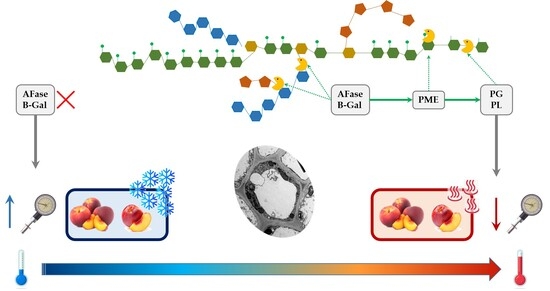
Postharvest modifications in cell wall metabolism as affected by storage temperature were assessed in two Prunus persica cultivars (‘Rich Lady’ peach and ‘Big Top’ nectarine). Commercially mature fruit were stored for up to 5 weeks at 20, 12, 4 or −1 °C to induce a wide range of softening dynamics, including near-freezing conditions. All analyses were done in triplicate and data integrated in a partial least squares regression (PLSR) model for postharvest firmness loss, which was delayed significantly in refrigerated fruit. The decline in the content of covalently bound pectins was strongly associated with progressive firmness loss in both cultivars. The results suggest that enzyme activities involved in pectin sidechain removal, particularly α-L-arabinofuranosidase, may be early drivers of cell wall disassembly by enhancing substrate accessibility for enzymes involved in the degradation of the pectin backbone. While the role of pectin sidechain removal was a common feature, the relative contribution of other cell wall-modifying proteins appeared to be cultivar-dependent. These findings provide a biochemical basis that may inform prospective cultivar-specific storage protocols aimed at optimizing postharvest life in peach and nectarine.

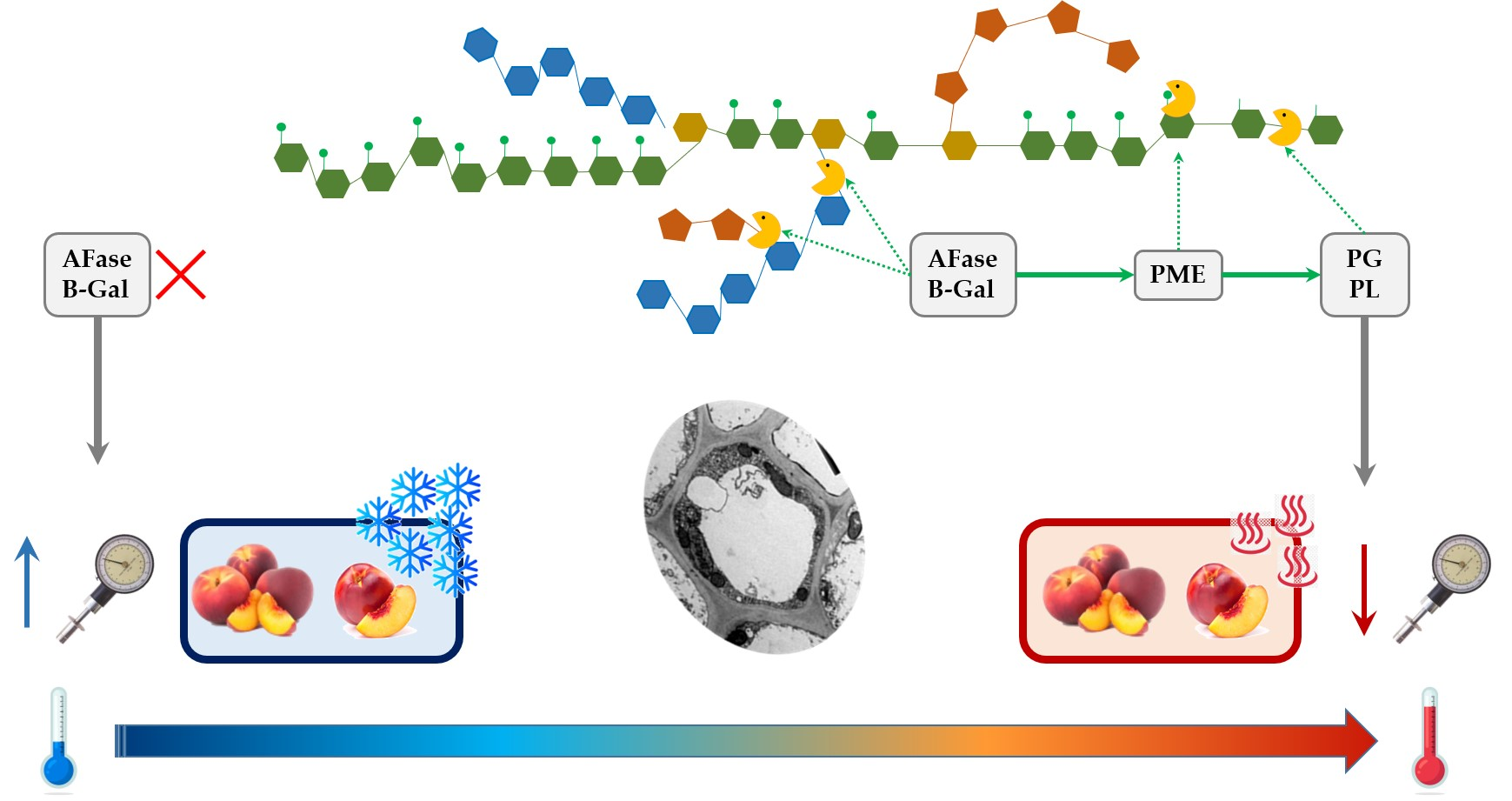
Graphical Abstract
Persica… pretiosissima tunc cum vilescunt, brevissimae ex omnibus vitae: decerpta biduo duran
Gaius Plinius Secundus, a.k.a. Pliny the Elder
Naturalis Historia, Book XV, AD 77-79

1. Introduction

Although peach (Prunus persica L. Batsch.) and nectarine (P. persica L. Batsch. var. nectarina) display excellent organoleptic properties, these fruits are highly perishable, which drastically restricts storage potential and marketing possibilities. Postharvest deterioration is due mainly to rapid firmness loss, with associated susceptibility to mechanical bruises and infections. This attribute is thus regarded by growers and supply chain dealers as a major factor determining fruit handling options, even though flavour and sweetness are more important for sensory quality and consumer satisfaction [1,2]. There is wide consensus that ripening-related firmness loss arises largely from modifications in cell wall composition and structure, driven by the cooperative action of numerous related proteins. Yet profound differences appear to exist in the extent and enzyme regulation of ripening-related modifications of cell wall polysaccharides, both among fruit species and among cultivars [3,4].
While the most conspicuous difference between peaches and nectarines is the glabrous skin of the latter, less obvious differential aspects also include firmness, colour, aroma, flavour and postharvest performance [5]. Refrigeration is the most widely used strategy for extending the commercial life of these fruits, as low temperature delays postharvest deterioration by slowing down firmness loss, respiration and ethylene production rates. Yet peach fruit is cold-sensitive, and inappropriate storage temperatures often lead to a range of chilling-induced disorders such as flesh browning or mealiness, which significantly impair commercial quality [6]. Recent research indicates that near-freezing temperatures (around −1 °C) can effectively enhance cold tolerance and maintain fruit quality, apparently by regulating proline metabolism and antioxidant defences, which in turn delay flesh browning and increase storage potential (reviewed in [7]) while high soluble solid content depresses the tissue freezing point below this temperature. Conversely, any disruption in the cold chain may trigger premature ripening, leading to intensified cell wall degradation and a rapid decline in firmness [8].
The complexity of the softening process is further heightened by significant cultivar-dependent variations. Critical uncertainty remains regarding how different storage temperatures modulate the specific coordinated action of cell wall-modifying enzymes, and how these thermal responses differ between closely related peach and nectarine genotypes. Recent comparative studies emphasize that even within melting-type cultivars, the regulation of cell wall-modifying enzymes and the resulting changes in polysaccharide architecture can differ substantially [9], a fact that remains a central focus of recent postharvest research. Understanding these temperature-dependent metabolic shifts in individual cultivars is therefore essential for predicting postharvest firmness changes and hence for optimizing storage protocols and predicting shelf life accurately. It is thus of interest to assess the thermal dependence of metabolic events underlying firmness loss in different cultivars, including the fate of different cell wall fractions or of enzyme activities involved in cell wall rearrangements.
In this work, fruit of two red-skinned, yellow-fleshed P. persica cultivars (‘Rich Lady’ peach and ‘Big Top’ nectarine) were stored under four different temperatures (20, 12, 4, and −1 °C). The selected temperature range spanned standard shelf life (20 °C), short-term cool storage (12 °C), common commercial refrigeration (4 °C) and near-freezing storage (−1 °C) as a prospective strategy to enhance cold tolerance [7] in the cultivars considered herein. This experimental design aimed at (a) clarifying the thermal dependence of cell wall fraction rearrangements, (b) identifying key biochemical drivers of early firmness loss, and (c) revealing how cultivar-specific regulatory mechanisms respond to near-freezing vs. standard refrigeration temperatures.

2. Materials and Methods

2.1. Plant Material, Postharvest Storage, and Determination of Standard Quality Parameters

Uniform, defect-free fruit samples of ‘Rich Lady’ peach and ‘Big Top’ nectarine were harvested from commercial orchards located respectively in Aitona (41°29′40″ N, 0°27′34″ E; 110 m altitude) and Massalcoreig (41°27′40″ N, 0°21′37″ E; 94 m altitude) (Segrià, NE Spain). Harvest took place at commercial maturity, which was established based on size and surface colour according to the usual practice in the producing area (Table 1). Commercial harvest date was July 1st and June 25th 2008 for ‘Rich Lady’ and ‘Big Top’ fruit, respectively, and fruit were transported immediately thereafter to the ETSEAFiV-UdL campus. The IAD index (index of absorbance difference = A670 − A720) [10] was determined using a portable spectrophotometer (CM-2500d, Konica Minolta, Tokyo, Japan) to non-destructively sort fruit samples into homogeneous maturity classes. Fruit within the main maturity category according to IAD values (Table 1) were selected for this study. After classification, a total of 1046 (‘Rich Lady’) and 1278 (‘Big Top’) fruit were distributed randomly into four batches and then stored in experimental chambers (20 m3) at 20, 12, 4 or −1 °C for up to 5 weeks. Temperature at each chamber was monitored continuously during the experimental time, and a humidifier was used to maintain relative humidity at 92%. Fruit samples (45 fruit) were taken weekly for each temperature. At each analysis date, fruit flesh (2 fruit/replicate × 3 replicates) samples were frozen in liquid nitrogen, freeze-dried, and powdered. Weight loss after lyophilisation was consistently around 85%. Fruit firmness was measured on opposite sides of 15 fruit using a hand-held Effegi penetrometer (Model FT 327; Milan, Italy) equipped with an 8 mm diameter convex tip; results are expressed in N. Soluble solid content (SSC) and titratable acidity (TA) were assessed in juice pressed from the whole fruit. SSC was determined using a digital hand refractometer (Atago, Tokyo, Japan), and results are expressed as ° Brix. TA was measured by titration of 10 mL of juice with 0.1 N NaOH to pH 8.1 with 1% (v/v) phenolphthalein as the indicator, and data are given as g malic acid L−1. Surface colour was determined on two opposite sides of fruit equatorial area (sun-exposed side and shaded side) using a portable tristimulus colorimeter (Chroma Meter CR-400, Konica Minolta, Tokyo, Japan) using CIE illuminant D65 and an 8 mm aperture measuring diameter. Hue angles (°) at both sides were calculated from a* and b* parameters as arctan (b*/a*).

2.2. Extraction, Fractionation and Analysis of Cell Wall Materials

The phenol:acetic acid:water (2:1:1, w/v/v) (PAW) method was used for the extraction of cell wall materials (CWM) from lyophilised tissue (3 g) according to ref. [11], with some modifications, as explained elsewhere [12]. The pellet obtained after PAW extraction was resuspended in water and centrifuged again. The PAW and water wash supernatants were combined (henceforth, PAW-soluble fraction; PAWsf), dialysed at 4 °C (mol. wt. cut-off 7000) against Milli-Q and centrifuged again. The PAWsf so obtained was lyophilised and weighed. The insoluble pellet was washed in acetone, filtered, lyophilised and weighed. The yield of both fractions was expressed as % (w/w) FW. The insoluble residue (100 mg/replicate) was then subjected to sequential extraction to recover different cell wall fractions [13]. For the fractionation procedure, the pellets of the previous step were stirred successively in 0.05 M cyclohexane-trans-1,2-diamine tetra-acetate (CDTA) for 24 h at room temperature, in 0.05 M Na2CO3 for 24 h at 4 °C, and in 4 M KOH for 2 h at room temperature. For the Na2CO3 and KOH extraction steps, 10 mM NaBH4 was added as an antioxidant. This sequential procedure allowed the recovery of cell wall fractions enriched respectively in chelator-soluble pectins, in covalently bound pectins and in hemicellulosic polymers. The supernatants of each extraction step were centrifuged (10,000× g, 20 min), filtered, dialyzed at 4 °C (mol. wt. cut-off 7000) against Milli-Q water, lyophilised and weighed. Yields are expressed as % (w/w) CWM.
Samples (30–35 mg) of the CDTA- and Na2CO3-soluble fractions were hydrolysed with 12 M sulfuric acid for further analysis, as described previously [14]. Uronic acid content in the hydrolysate was measured by the m-hydroxydiphenyl method [15] using galacturonic acid as a standard. Total neutral sugars were estimated at 490 nm by the phenol–sulfuric acid assay [16] with galactose as the standard. Results are given as % (w/w) fraction.

2.3. Extraction and Assay of Cell Wall-Modifying Enzyme Activities

A 10% (w/v) pulp homogenate was prepared by homogenizing 100 mg of freeze-dried pulp tissue in extraction buffer prepared as described in ref. [14]. Supernatants were set on ice as the crude extracts and used for the determination of polygalacturonase (exo-PG; EC 3.2.1.67 and endo-PG; EC 3.2.1.15), pectinmethylesterase (PME; EC 3.1.1.11), pectate lyase (PL; EC 4.2.2.2), endo-1,4-β-D-glucanase (EGase; EC 3.2.1.4), β-galactosidase (β-Gal; EC 3.2.1.23), β-xylosidase (β-Xyl; EC 3.2.1.37) and α-L-arabinofuranosidase (AFase; EC 3.2.1.55) activities under the appropriate reaction conditions in each case (ref. [14] and references therein). Briefly, PG activity was determined as the liberation of galacturonic acid (GalUA) from apple pectin (d.e. 70–75%). PME activity was measured spectrophotometrically at 620 nm with apple pectin as the substrate, following medium acidification as indicated by the protonation of a pH indicator (bromothymol blue). PL activity was determined from polygalacturonic acid (PGA, 1% w/v) following the increase in A235 as an indicator of unsaturated groups liberated from PGA. For AFase, β-Gal, and β-Xyl, enzyme activity was determined spectrophotometrically at 405 nm as the release of p-nitrophenol from the corresponding p-nitrophenyl-glycoside substrate (p-NP-α-L-arabinofuranoside, p-NP-β-D-galactopyranoside, and p-NP-β-D-xylopyranoside, respectively). EGase activity was assayed by the dinitrosalicylic acid (DNS) method, following the release of reducing sugars from carboxymethylcellulose.
The Bradford assay [17] was used for the determination of total protein content in the crude extracts, with bovine serum albumin as a standard. One activity unit (AU) was defined for each assay as a specified change in the monitored parameter per minute under the specific assay conditions. All determinations were done in triplicate, and results are expressed as specific activity (AU mg−1 protein).

2.4. Statistical and Multivariate Analysis

A multifactorial design with storage temperature and duration as the factors was used for the analysis of variance of data (GLM-ANOVA) with the SAS version 9.2 software package (SAS Institute, Cary, NC, USA). Least significant difference (LSD) values were calculated and used to assess the statistical significance of differences between mean values at p ≤ 0.05 (Fisher’s test). Partial least squares regression (PLSR) was also used as a predictive method to relate a matrix of dependent variables (Y) to a set of explanatory variables (X) in a single estimation procedure, using the Unscrambler version 9.1.2 software (CAMO ASA, Oslo, Norway). Data were weighed by the inverse of the standard deviation of each variable to avoid dependence on measured units, and full cross-validation was run as a validation procedure.

3. Results and Discussion

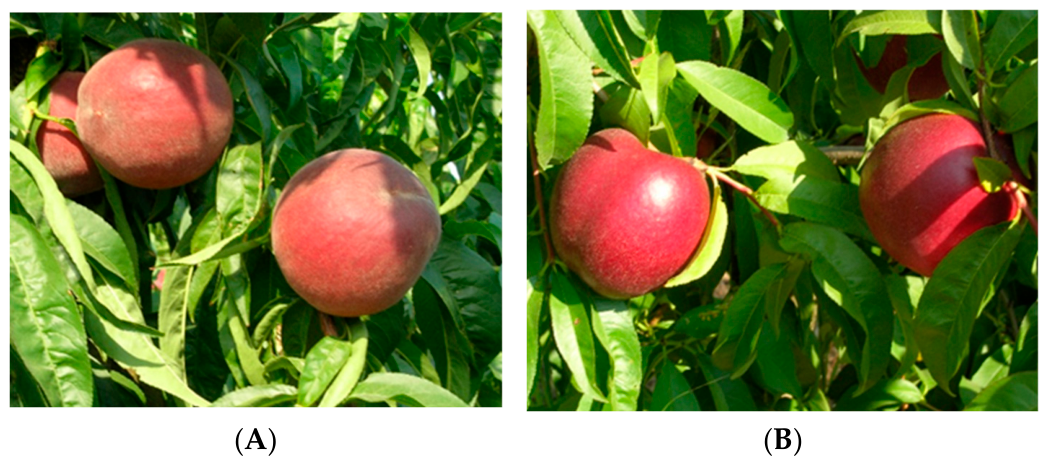
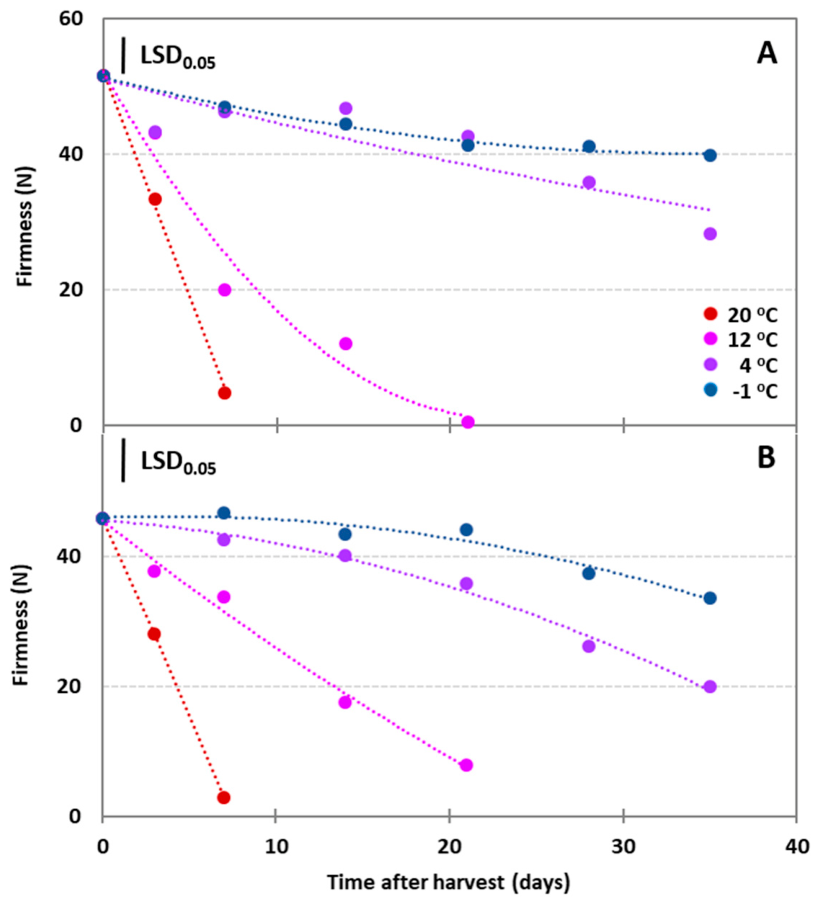
Harvest date was decided according to size and surface colour according to the usual practice at the producing area (Figure 1). To further favour initial homogeneity, fruit samples used for the storage experiment were sorted according to the IAD index [10]. Data show higher SSC/TA ratios in ‘Big Top’ nectarine in comparison with those in ‘Rich Lady’ peach, arising from lower TA values (Table 1), consistent with previous reports [18]. Firmness levels of ‘Rich Lady’ fruit at commercial harvest were slightly higher than those for ‘Big Top’ (Table 1). Both cultivars displayed a typical melting-like softening pattern when kept at 20 °C, with dramatic drops in firmness after harvest, which were delayed or largely suppressed in fruit stored at lower temperatures (Figure 2). Firmness loss at 12 °C was more pronounced in ‘Rich Lady’ than in ‘Big Top’ samples, consistent with common reports of lower softening rates in the latter as compared with other P. persica genotypes [19]. ‘Rich Lady’ fruit stored at 4 and −1 °C retained similarly high firmness levels until about five weeks after harvest, when samples kept at 4 °C began a slow decline (Figure 2A). In contrast, ‘Big Top’ nectarines stored at 4 °C separated from those kept at −1 °C much earlier (Figure 2B), indicating different postharvest performance and response to storage conditions. For both cultivars, flesh samples were taken weekly during storage and used to dissect the biochemical mechanisms involved in the melting phase of softening.

3.1. Insoluble Cell Wall Materials Rearranged During Storage

CWM yields decreased steadily after harvest in both cultivars, but this decrease was significantly delayed at lower temperatures (Table 2). For ‘Rich Lady’ peaches, no significant differences were found between fruit stored at 4 and −1 °C, whereas ‘Big Top’ nectarines stored at −1 °C had higher CWM yields than those kept at 4 °C, maybe in connection with higher firmness levels at that temperature (Figure 2B). The yield of solubilised materials, represented by the PAWsf fraction, was higher for fruit kept at higher temperatures, indicative of delayed cell wall disassembly under refrigerated storage, although its time course did not show a uniform trend in all cases. For ‘Big Top’ nectarines, PAWsf yields increased after harvest both at 12 and at 4 °C, whereas no changes were observed at −1 °C. PAWsf yields also increased in ‘Rich Lady’ peaches during storage at 12 °C, but in contrast no clear trend was found for samples kept at lower temperatures (Table 2).
When insoluble materials (CWM) were further fractionated, significant differences were also found. Yields of CDTAsf, indicative of the content of non-covalently bound pectins, showed different trends according to cultivar, temperature and keeping period (Table 3). For ‘Rich Lady’ peaches, CDTAsf levels were generally higher in samples kept at lower temperatures for 14 days or longer. For fruit stored during only one week, the opposite was observed, except for samples held at 4 °C, for which similar yields in comparison with fruit kept at 20 °C were found. The time-course change in CDTAsf yields was also different at 4 °C, with a steady decrease throughout the experimental period, in contrast with the progressive increase observed both at 12 and −1 °C. The question arises whether the dissimilar evolution at 4 °C may be symptomatic of chilling injury taking place in the tissues, since this temperature is within the so-called “killing temperature range” reported to induce these symptoms in susceptible fruit during ripening after cold storage [6]. It has been reported that the depolymerization of chelator-soluble polyuronides from mealy ‘O’Henry’ peaches during cold storage did not resemble that in juicy fruit, and that yields of this pectin fraction did not show the characteristic increase found in non-mealy samples [20]. CDTAsf yields in ‘Big Top’ nectarines were also higher at higher temperatures for short (up to two weeks) storage periods but, similarly to observations for ‘Rich Lady’ peaches, for longer periods the levels of this cell wall fraction were higher in fruit held at −1 °C (Table 3). This also agrees with previous observations [20] of lower contents of chelator-soluble polymers in fruit that would develop chilling injury upon subsequent ripening at 20 °C. However, no post-storage period at ambient temperature was considered in this work and hence no evaluation of chilling injury symptoms was done. Therefore, the above discussion should be viewed as hypothetical.
In contrast to CDTAsf yields, those of the Na2CO3sf, enriched in pectins bound covalently to the cell wall, showed the same trend irrespective of cultivar or keeping temperature. Levels decreased throughout storage, and were always higher at lower temperatures, associated with better firmness retention, as observed in previous studies on ‘Tardibelle’ peach [21] and ‘Snow Queen’ nectarine [22]. This is also consistent with recent reports that firmness retention during on-tree development of ‘Fenghuang’ peach fruit was closely linked to the preservation of specific pectin fractions [23], particularly those bound to the cell wall matrix. Decreased Na2CO3sf yields were parallel to lowered contents of uronic acids and neutral sugars in this fraction throughout storage (Table 4), indicative of polysaccharide solubilisation during softening. Accordingly, both uronic acid and neutral sugar contents in the Na2CO3sf were higher at lower temperatures, with concomitantly delayed firmness loss (Figure 2). This contrasts with the observations for the CDTAsf, for which increasing levels of uronic acids and neutral sugars were found both at 4 and −1 °C during the experimental period (Table 4), and suggests that materials lost from the Na2CO3sf were reallocated transiently in the CDTAsf as observed in previous reports [22], consistent with the idea that a large part of the polysaccharides solubilised during ripening of peaches and nectarines remain linked to the cell wall by ionic bonds [24,25]. Yet, in the absence of experimental evidence this idea remains an inference based on indirect data.
The depolymerization of matrix glycans, mostly xyloglucan polymers, is also believed to contribute substantially to fruit softening, although in peach fruit this event has been suggested to contribute mainly to the onset of the softening process rather than to extensive firmness loss at more advanced ripening stages [25]. This view agrees with the apparent lack of any relationship between the yields of the KOH-soluble fraction and firmness levels observed for ‘Rich Lady’ peaches: although KOHsf yields decreased along storage (Table 3), no significant differences were found in general according to keeping temperature, unlike the observations for firmness (Figure 2A). However, the evolution of this fraction was rather different for ‘Big Top’ fruit. In these samples, lower yields were observed in fruit stored at 4 and −1 °C in comparison with those kept at 20 or 12 °C (Table 3) for three weeks or less. Similarly, yields increased throughout storage at 4 and −1 °C, while firmness decreased (Figure 2B), in agreement with previous work on ‘Tardibelle’ peaches, for which higher KOHsf levels were found in softer fruit [21]. In contrast, for storage periods longer than three weeks, no temperature-related differences in the yields of this fraction were observed (Table 3). This wide variation may be indicative of either low relevance of this fraction for the softening process, or of differences in the biochemical mechanisms underlying firmness loss in different cultivars. Additionally, fraction yields are not a direct indicator of the degree of polymerization; compositional and molecular mass analyses would be required to support or to discard these conclusions.

3.2. Pectolytic and Non-Pectolytic Enzyme Activities During Storage

Several pectolytic activities, acting on the pectin backbone (PG, PL, PME) or on the pectin sidechains (β-Gal, AFase), were assessed along storage in each case. PG and PL disrupt α(1→4) links between D-galacturonic acid residues through hydrolysis and β-elimination, respectively, which require previous PME-catalyzed demethylation. In ‘Rich Lady’ samples, PME activity levels varied widely in response to the factors considered. Temperature effects on this enzyme activity appeared to be strongly dependent on storage period: while cold-stored fruit displayed higher levels than those kept at 12 or 20 °C after one-week storage, the opposite was found for longer storage times. In contrast to the observations for fruit kept at 12 °C, activity levels decreased during storage at 4 and −1 °C (Table 5), consistent with the increasing content of uronic acids in the CDTAsf during the experimental period (Table 4), and indeed a good linear correlation (r = −0.82) was found between these two variables (n = 16).
PME activity causes an increase in free, negatively charged carboxyl groups, which may lead to a dual effect on cell wall integrity. On the one hand, it may facilitate polyuronide retention in the cell walls through non-covalent interactions mediated by calcium ions, thus promoting the formation of calcium pectate gels that would stabilize the matrix. This mechanism might be particularly relevant for ‘Rich Lady’ peaches stored at near-freezing temperatures (−1 °C), for which significantly higher PME levels were observed after one-week storage in comparison with fruit stored at higher temperatures (Table 5), concomitantly with higher firmness retention (Figure 2A). On the other hand, PME activity is required for subsequent PG- and PL-catalyzed action on polyuronides. In the present study, lower PME activity levels at 4 °C as compared to higher temperatures may have been associated with delayed firmness loss despite the presence of detectable PG and PL levels (Table 5). Additionally, although these two activities increased during storage, they were partially inhibited at lower temperatures, further limiting the extent of pectin depolymerization.
Temperature effects on PME, PG and PL activities were different for ‘Big Top’ fruit. A decreasing trend for PME activity over storage was observed during storage at 4 °C uniquely, associated likewise with higher content of uronic acids in the CDTAsf (Table 4). For storage periods up to three weeks, partial suppression of PME activity was observed for fruit kept at 4 or −1 °C. No general trend was found for PG or PL activities despite clear temperature effects on firmness levels, suggesting that these two activities do not play a key role in firmness loss in fruit of this cultivar.
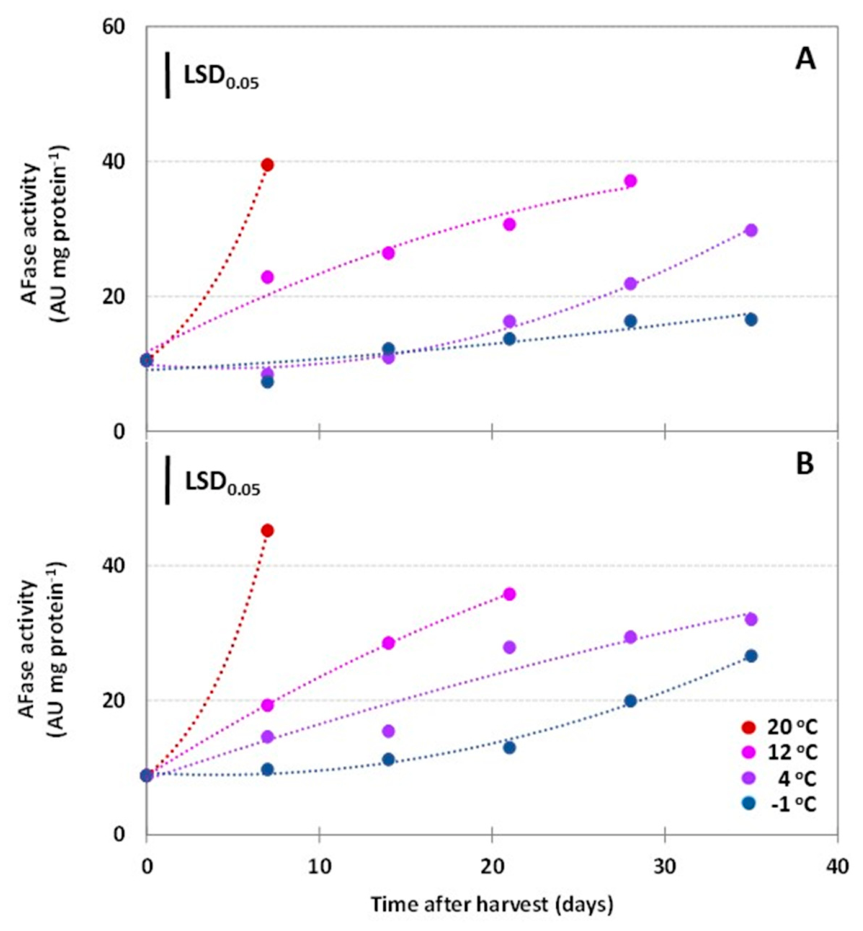
In contrast to the pectin backbone-modifying activities, those acting on pectin sidechains and matrix glycans displayed clearer associations with firmness evolution. In both cultivars considered herein, β-Gal activity was significantly higher in fruit kept at 20 °C in comparison with those stored at lower temperatures. Activity levels increased during cold storage, paralleling firmness loss dynamics (Figure 2; Table 5), but the increase was delayed with lower storage temperatures, suggesting that the removal of galactosyl residues from pectin sidechains may contribute substantially to the melting phase of softening under non-refrigerated conditions. Such trend was even more pronounced for AFase activity (Figure 3), whose time-course changes during storage were in good accordance with firmness loss dynamics (Figure 2). Arabinose- and galactose-rich sidechains are thought to modulate pectin–cellulose interactions and cell wall porosity, and hence their enzyme-mediated rearrangements could facilitate subsequent depolymerization and solubilization events. Data suggest that the removal of arabinosyl and galactosyl residues from pectin sidechains may be an early event associated with the onset of the softening syndrome in these cultivars. By de-branching the pectin matrix, AFase and β-Gal activities may increase the accessibility of the polygalacturonate backbone to depolymerizing enzymes such as PG and PL. This interpretation agrees with the observation of dramatically decreased yields (Table 3) and neutral sugar contents (Table 4) of the Na2CO3-soluble fraction during postharvest storage. It should be pointed out, however, that the phenol–sulfuric acid assay [15] used in this work provides information on the total content of neutral sugars, not on the specific monosaccharide composition. Therefore, the above discussion on the removal of arabinosyl and galactosyl residues should be regarded as a speculative inference based on AFase and β-Gal activity data. Compositional analysis of individual sugars in cell wall fractions would be required to check an actual decline in the content of arabinose and galactose and thus to verify this hypothesis.
Similar trends were observed for non-pectolytic activities in ‘Rich Lady’ peach, with EGase and β-Xyl activity levels being significantly arrested in cold-stored fruit in comparison with those kept at 20 °C (Table 6), and displaying a sustained increase over storage for up to 5 weeks, potentially contributing to textural changes under specific storage regimes. Some discrepancies with this general trend were, however, observed for ‘Big Top’ fruit at particular storage temperatures, with decreasing activity levels over time being found for EGase and β-Xyl in samples stored at 12 °C and −1 °C, respectively. These particularities may be cultivar-specific, reflect differential regulation of xyloglucan remodelling in nectarine fruit in general, or conceivably indicate differences in chilling-injury susceptibility [26]. Despite the observation of a generally good association, in general terms, between these enzyme activities and firmness loss trends, correlation coefficients were weaker than those observed for pectin-degrading enzymes, supporting the view that pectin framework rearrangement or disassembly may be a major driver of the melting-type softening syndrome.

3.3. Multivariate Analysis of Firmness and Cell Wall Metabolism

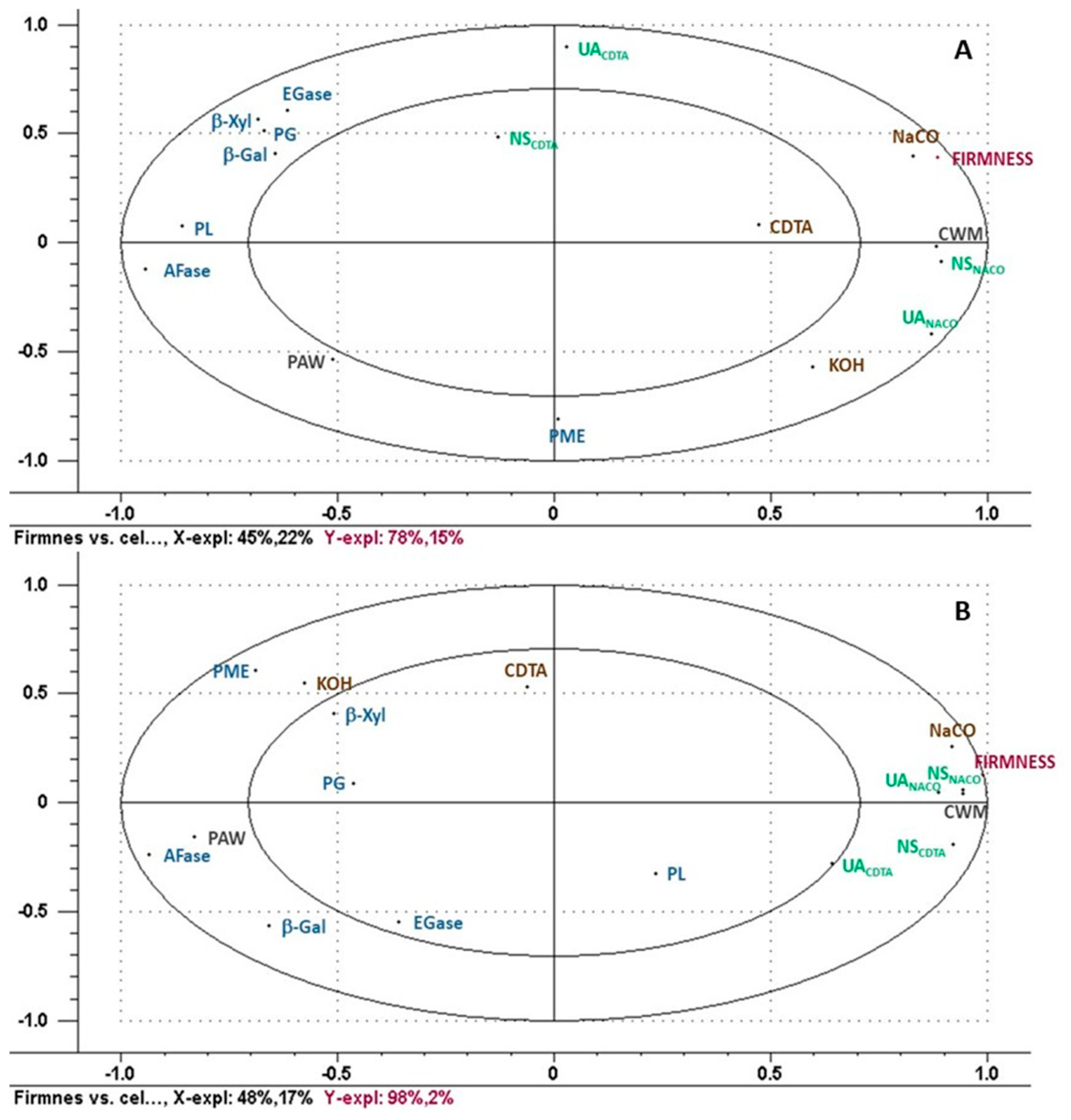
To integrate the biochemical variables considered and to aid in identifying major determinants of postharvest firmness loss, a PLSR analysis was carried out with firmness as the dependent variable (Y) and cell wall metabolism-related variables as the set of potentially explanatory variables (X), with full cross-validation as the validation method. The variables included in the model explained over 90% of total variability in fruit firmness, with the first component alone explaining 78% and 98% of total variance in ‘Rich Lady’ and ‘Big Top’ samples, respectively (Figure 4).
The correlation loadings plots are shown to facilitate the visualization of relationships among variables. For both genotypes, firmness was strongly associated with Na2CO3sf and CWM yields, with higher neutral sugar and uronic acid contents in the Na2CO3sf and with lower levels of AFase activity. Fruit firmness also showed significant inverse correlations with PAWsf yields and β-Gal activity. These observations suggest that firmness retention was closely linked to the delayed solubilization of cell wall polymers and to the preservation of covalently bound pectins. Data are consistent with the idea that the removal of arabinosyl- and galactosyl-rich pectin sidechains may be a key contributor to backbone degradation and solubilization and to subsequent firmness loss. A major role of sidechain removal from pectic polymers in facilitating the access of pectin backbone-acting enzymes to their substrates and hence in favouring cell wall disassembly has also been pointed out for other peach and nectarine cultivars [21,22,23,27,28,29,30].
However, some discrepancies were also found between the two cultivars. For instance, while PME activity correlated inversely with uronic acid and neutral sugar contents in the CDTAsf, neither of these variables was related with firmness in ‘Rich Lady’ (Figure 4A), in contrast with observations for ‘Big Top’ (Figure 4B). Moreover, EGase and β-Xyl activities correlated inversely with KOHsf in ‘Rich Lady’ (Figure 4A) but not in ‘Big Top’ (Figure 4B). Another noticeable disparity refers to the role of PG and PL, two enzyme activities requiring previous PME-mediated demethylation of their polyuronide substrate. PL activity was strongly associated with AFase activity and firmness loss in ‘Rich Lady’ fruit (Figure 4A), suggesting a close interplay in the onset and development of cell wall rearrangements leading to fruit softening, as reported for other peach cultivars [31]. An intimate association was also found in these samples between PG and β-Gal activities, which in turn correlated inversely with neutral sugar and uronic acid contents in the Na2CO3sf. This observation is consistent with previous findings that the suppression of PpβGal gene expression delayed fruit softening in ‘Qian jian bai’ peaches through the reduction in PG and PME activity [28], which clearly points out to the relevance of pectin sidechain removal as an early event involved in the onset of firmness loss. Contrarily, weak associations were observed among these variables for ‘Big Top’ samples, for which PME activity emerged as a relevant factor contributing to firmness loss (Figure 4B).
Fruit used in this study were harvested from different orchards, this being a factor which may have had some incidence on results. Even so, both orchards are geographically close and have very similar climate conditions. Additionally, the initial maturity of fruit samples was carefully selected to match the commercial practice. Therefore, data shown herein are likely to reflect actual firmness loss dynamics during commercial fruit storage and local distribution. The divergent patterns observed in the PLSR plots are suggestive of cultivar-specific differences in ripening-related cell wall disassembly, even among melting-type cultivars. The results support the idea that cultivar-specific regulation of pectin modifications imposes differences in the coordination or timing of particular events. The role of additional cell wall-related proteins also requires further exploration. For example, there is some experimental evidence that expansins, which are non-enzymatic proteins contributing substantially to the loosening of hydrogen bonds between cell wall polymers, may play a major role in fruit softening in peach [27,32] as well as in other Prunus fruit species [33]. The role of these proteins in firmness loss over postharvest storage and shelf life should be explored in future studies.

4. Conclusions

Postharvest firmness loss in ‘Rich Lady’ peaches and ‘Big Top’ nectarines was associated with the progressive disassembly of pectic polymers, which was effectively modulated by storage temperature. The preservation of covalently bound pectins was identified as the main factor associated with firmness retention in both cultivars. Enzyme activities involved in pectin sidechain removal, particularly AFase, emerged as key biochemical indicators associated with postharvest firmness loss, likely by enhancing substrate accessibility to pectin backbone-acting enzymes, thus facilitating subsequent backbone degradation.
In contrast, cultivar-specific regulation differences were observed for other cell wall-related enzymes, especially regarding PME and matrix glycan modifications. The existence of such variations indicates that, even within melting-type cultivars, cell wall disassembly follows distinct temporal and coordinated patterns which may underlie cultivar-to-cultivar variability in postharvest storage performance. These findings underscore the limitations of generalized storage protocols and emphasize the need for cultivar-tailored postharvest strategies. The integration of specific biochemical indicators into these strategies could provide a robust framework for optimizing storage procedures and extending the commercial life of peach and nectarine fruit. To achieve this goal, future studies will need to consider a wider variety of genotypes.

Author Contributions

I.L.: Conceptualization, data curation, formal analysis, methodology, project administration, supervision, visualization, and writing—original draft. A.O.: Conceptualization, data curation, formal analysis, investigation, and writing—review and editing. All authors have read and agreed to the published version of the manuscript.

Funding

A.O. was the recipient of a FPU grant from the Ministerio de Ciencia e Innovación (MICINN) of Spain. This work was supported through the ISAFRUIT project (FP6-FOOD-CT-2006-016279), funded by the European Commission under the Thematic Priority 5–Food Quality and Safety of the 6th Framework Programme of RTD. The views and opinions expressed in this publication are purely those of the writers and may not in any circumstances be regarded as stating an official position of the European Commission.

Data Availability Statement

Data discussed in this study are included in the main text. Further inquiries can be directed at the corresponding author.

Acknowledgments

The authors are indebted to E. Comabella for technical assistance.

Conflicts of Interest

The authors declare no conflicts of interest.

References

  1. Bruhn, C.M. Consumer and retailer satisfaction with the quality and size of California peaches and nectarines. J. Food Qual. 1995, 18, 241–256. [Google Scholar] [CrossRef] [Scilit]
  2. Ortiz, A.; Echeverría, G.; Graell, J.; Lara, I. Overall quality of ‘Rich Lady’ peach fruit after air- or CA storage. The importance of volatile emission. LWT–Food Sci. Technol. 2009, 42, 1520–1529. [Google Scholar] [CrossRef] [Scilit]
  3. Goulao, L.F.; Oliveira, C.M. Cell wall modifications during fruit ripening: When a fruit is not the fruit. Trends Food Sci. Technol. 2008, 19, 4–25. [Google Scholar] [CrossRef] [Scilit]
  4. Wang, X.; Zhang, D.; Liu, T.; Yan, Z.; Ji, X.; Li, Y.; Wu, Y.; Cheng, H.; Wang, Y.; Cui, J.; et al. Advances in cell wall dynamics and gene expression in postharvest fruit softening. Plants 2025, 14, 2831. [Google Scholar] [CrossRef] [Scilit] [PubMed]
  5. Dagar, A.; Weksler, A.; Friedman, H.; Ogundiwin, E.A.; Crisosto, C.H.; Ahmad, R.; Lurie, S. Comparing ripening and storage characteristics of ‘Oded’ peach and its nectarine mutant ‘Yuval’. Postharvest Biol. Technol. 2011, 60, 1–6. [Google Scholar] [CrossRef] [Scilit]
  6. Lurie, S.; Crisosto, C.H. Chilling injury in peach and nectarine. Postharvest Biol. Technol. 2005, 37, 195–208. [Google Scholar] [CrossRef] [Scilit]
  7. Cao, S.; Zhang, G.; Luo, Y.; Qiu, J.; Ba, L.; Xu, S.; Zhao, Z.; Luo, D.; Dong, G.; Ren, Y. Recent advances in postharvest physiology and preservation technology of peach fruit: A systematic review. Horticulturae 2025, 11, 1007. [Google Scholar] [CrossRef] [Scilit]
  8. Xu, Q.; Chen, G.; Guo, M.; Cheng, S.; Cao, J.; Yang, W.; Zhang, W. Flat nectarine cold chain breakage accelerates postharvest ripening and fruit flesh cell wall degradation. Postharvest Biol. Technol. 2026, 234, 114078. [Google Scholar] [CrossRef] [Scilit]
  9. Wang, H.; Li, A.; Zeng, W.; Yao, Z.; Badrunnesa, A.; Meng, J.; Miao, Y.; Niu, L.; Pan, L.; Cui, G.; et al. Comparative cell wall polysaccharide analyses and transcriptome profiling during fruit ripening reveal the molecular basis of mealiness in peach. Horticulturae 2024, 10, 615. [Google Scholar] [CrossRef] [Scilit]
  10. Ziosi, V.; Noferini, M.; Fiori, G.; Tadiello, A.; Trainotti, L.; Casadoro, G.; Costa, G. A new index based on Vis spectroscopy to characterize the progression of ripening in peach fruit. Postharvest Biol. Technol. 2008, 49, 319–329. [Google Scholar] [CrossRef] [Scilit]
  11. Redgwell, R.J.; Melton, L.D.; Brasch, D.J. Cell wall dissolution in ripening kiwifruit (Actinidia deliciosa). Plant Physiol. 1992, 98, 71–81. [Google Scholar] [CrossRef] [Scilit] [PubMed]
  12. Lara, I.; García, P.; Vendrell, M. Modifications in cell wall composition after cold storage of calcium-treated strawberry (Fragaria × ananassa Duch.) fruit. Postharvest Biol. Technol. 2004, 34, 331–339. [Google Scholar] [CrossRef] [Scilit]
  13. Selvendran, R.R.; O’Neill, M.A. Isolation and analysis of cell walls from plant material. In Methods of Biochemical Analysis; Glick, D., Ed.; John Wiley Interscience: New York, NY, USA, 1987; Volume 32, pp. 25–153. [Google Scholar] [CrossRef] [Scilit] [PubMed]
  14. Ortiz, A.; Graell, J.; Lara, I. Preharvest calcium applications inhibit some cell wall-modifying enzyme activities and delay cell wall disassembly at commercial harvest of ‘Fuji Kiku-8’ apples. Postharvest Biol. Technol. 2011, 62, 161–167. [Google Scholar] [CrossRef] [Scilit]
  15. Blumenkrantz, N.; Asboe-Hansen, G. New method for quantitative determination of uronic acids. Anal. Biochem. 1973, 54, 484–489. [Google Scholar] [CrossRef] [Scilit] [PubMed]
  16. Dubois, M.; Gilles, K.A.; Hamilton, J.K.; Rebers, P.A.; Smith, F. Colorimetric method for determination of sugars and related substances. Anal. Chem. 1956, 28, 350–356. [Google Scholar] [CrossRef] [Scilit]
  17. Bradford, M.M. A rapid and sensitive method for the quantitation of microgram quantities of protein utilizing the principle of protein dye binding. Anal. Biochem. 1976, 72, 248–254. [Google Scholar] [CrossRef] [PubMed]
  18. Ognjanov, V.; Ljubojević, M.; Barać, G.; Dulić, J.; Miodragović, M.; Narandžić, T. Modern peach and nectarine production. J. Pomol. 2018, 52, 15–26. Available online: https://www.cabidigitallibrary.org/doi/pdf/10.5555/20183361602 (accessed on 7 July 2026).
  19. Manganaris, G.A.; Drogoudi, P.; Goulas, V.; Tanou, G.; Georgiadou, E.C.; Pantelidis, G.E.; Paschalidis, K.A.; Fotopoulos, V.; Manganaris, A. Deciphering the interplay among genotype, maturity stage and low-temperature storage on phytochemical composition and transcript levels of enzymatic antioxidants in Prunus persica fruit. Plant Physiol. Biochem. 2017, 119, 189–199. [Google Scholar] [CrossRef] [Scilit] [PubMed]
  20. Brummell, D.A.; Dal Cin, V.; Lurie, S.; Crisosto, C.H.; Labavitch, J.M. Cell wall metabolism during the development of chilling injury in cold-stored peach fruit: Association of mealiness with arrested disassembly of cell wall pectins. J. Exp. Bot. 2004, 55, 2041–2052. [Google Scholar] [CrossRef] [Scilit] [PubMed]
  21. Ortiz, A.; Vendrell, M.; Lara, I. Softening and cell wall metabolism in late-season peach in response to controlled atmosphere and 1-MCP treatment. J. Hortic. Sci. Biotechnol. 2011, 86, 175–181. [Google Scholar] [CrossRef] [Scilit]
  22. Ortiz, A.; Seymour, G.B.; Tucker, G.A.; Lara, I. Cell wall disassembly during the melting phase of softening in ‘Snow Queen’ nectarines. Postharvest Biol. Technol. 2010, 58, 88–92. [Google Scholar] [CrossRef] [Scilit]
  23. Jiang, Y.; Ye, J.; Zhou, L.; Chen, M.; Wei, Y.; Jiang, S.; Chen, Y.; Shao, X. Cell wall metabolism during the growth of peach fruit: Association of hardness with cell wall pectins. Sci. Hortic. 2024, 330, 113058. [Google Scholar] [CrossRef] [Scilit]
  24. Dawson, D.M.; Melton, L.D.; Watkins, C.B. Cell wall changes in nectarines (Prunus persica). Solubilization and depolymerization of pectic and neutral polymers during ripening and in mealy fruit. Plant Physiol. 1992, 100, 1203–1210. [Google Scholar] [CrossRef] [Scilit] [PubMed]
  25. Brummell, D.A.; Dal Cin, V.; Crisosto, C.H.; Labavitch, J.M. Cell wall metabolism during maturation, ripening and senescence of peach fruit. J. Exp. Bot. 2004, 55, 2029–2039. [Google Scholar] [CrossRef] [Scilit] [PubMed]
  26. Crisosto, C.H.; Mitchell, F.G.; Ju, Z. Susceptibility to chilling injury of peach, nectarine, and plum cultivars grown in California. HortScience 1999, 34, 1116–1118. [Google Scholar] [CrossRef] [Scilit]
  27. Lee, J.G.; Lee, J.H.; Chang, M.S.; Baek, D.R.; Yang, H.; Eum, H.L. Exploring ripening suppression in peach fruit during controlled atmosphere storage with transcriptome insights. Sci. Rep. 2025, 15, 14178. [Google Scholar] [CrossRef] [Scilit] [PubMed]
  28. Liu, H.; Qian, M.; Song, C.; Li, J.; Zhao, C.; Li, G.; Wang, A.; Han, M. Down-regulation of PpBGAL10 and PpBGAL16 delays fruit softening in peach by reducing polygalacturonase and pectin methylesterase activity. Front. Plant Sci. 2018, 9, 1015. [Google Scholar] [CrossRef] [Scilit] [PubMed]
  29. Li, J.; Guo, T.; Guo, M.; Dai, X.; Xu, X.; Li, Y.; Song, Z.; Liang, M. Exogenous BR delayed peach fruit softening by inhibiting pectin degradation enzyme genes. Front. Plant Sci. 2023, 14, 1226921. [Google Scholar] [CrossRef] [Scilit] [PubMed]
  30. Xu, J.; Ye, J.; Li, C.; Guo, Y.; Jiang, W.; Yang, X.; Wei, Y.; Jiang, S.; Chen, Y.; Shao, X. Characterization and formation process analysis of peach fruit woolliness under low-temperature storage. Food Chem. 2025, 492, 145597. [Google Scholar] [CrossRef] [Scilit] [PubMed]
  31. Xu, Z.; Dai, J.; Kang, T.; Shah, K.; Li, Q.; Liu, K.; Xing, L.; Ma, J.; Zhang, D.; Zhao, C. PpePL1 and PpePL15 are the core members of the pectate lyase gene family involved in peach fruit ripening and softening. Front. Plant Sci. 2022, 13, 844055. [Google Scholar] [CrossRef] [Scilit] [PubMed]
  32. Lu, D.; Xu, M.; Li, Y.; He, X.; Cao, J.; Zhu, C.; Sun, C.; Jia, H.; Li, S. PpGATA4 mediates fruit softening and transcriptionally regulates PpEXPA1 in peach (Prunus persica). Plant Sci. 2025, 352, 112341. [Google Scholar] [CrossRef] [Scilit] [PubMed]
  33. Belge, B.; Goulao, L.F.; Comabella, E.; Graell, J.; Lara, I. Refrigerated storage and calcium dips of ripe ‘Celeste’ sweet cherry fruit: Combined effects on cell wall metabolism. Sci. Hortic. 2017, 219, 182–190. [Google Scholar] [CrossRef] [Scilit]
Figure 1. ‘Rich Lady’ (A) and ‘Big Top’ (B) fruit at harvest date.
Horticulturae 12 00864 g001
Figure 2. Firmness loss in ‘Rich Lady’ (A) and ‘Big Top’ (B) fruit during postharvest storage at different temperatures. Values represent means of 15 individual fruit. Vertical bars indicate LSD0.05.
Horticulturae 12 00864 g002
Figure 3. α-L-Arabinofuranosidase (AFase) activity in the flesh of ‘Rich Lady’ (A) and ‘Big Top’ (B) fruit during postharvest storage at different temperatures. Values represent means of three biological replicates. Vertical bars indicate LSD0.05.
Horticulturae 12 00864 g003
Figure 4. Correlation loadings plot of PC1 vs. PC2 corresponding to a PLSR model for firmness (Y variable) vs. cell wall metabolism-related variables in the flesh of ‘Rich Lady’ (A) and ‘Big Top’ (B) fruit during postharvest storage at different temperatures (CDTA, CDTA-soluble fraction; NaCO, sodium carbonate-soluble fraction; KOH, potassium hydroxide-soluble fraction; UA, uronic acid content; NS, neutral sugar content; AFase, β-Gal, β-Xyl, EGase, PG, PL and PME, α-L-arabinofuranosidase, β-galactosidase, β-xylosidase, endo-1,4-β-D-glucanase, polygalacturonase, pectate lyase and pectin methylesterase activities, respectively).
Horticulturae 12 00864 g004
Table 1. Maturity indicators of ‘Rich Lady’ peaches and ‘Big Top’ nectarines at harvest.
‘Rich Lady’‘Big Top’
Weight (g)179.9 ± 25.7171.4 ± 13.8
Hue (SS) (°)49.4 ± 13.445.5 ± 2.8
Hue (ES) (°)25.6 ± 4.323.1 ± 3.2
Firmness (N)51.4 ± 6.545.8 ± 5.0
SSC (° Brix)10.6 ± 1.410.2 ± 1.1
TA (g L−1)11.4 ± 1.25.6 ± 0.5
SSC/TA ratio0.931.83
IAD0.26–0.310.12–0.14
Values are the means of 15 replicates ± SD (SS, shaded side; ES, exposed side; SSC, soluble solid content; TA, titratable acidity; IAD, index of absorbance difference).
Table 2. Yield of insoluble and soluble cell wall materials (g·100 g−1 FW) in the flesh of ‘Rich Lady’ peaches and ‘Big Top’ nectarines during postharvest storage at different temperatures.
‘Rich Lady’‘Big Top’
HDAH20 °C12 °C4 °C−1 °CHDAH20 °C12 °C4 °C−1 °C
CWM2.6672.16 C2.76 Ba2.90 Aa2.96 Aa1.4271.15 C1.35 Ba1.43 Ba1.61 Aa
14-1.91 Bb2.78 Aa2.59 Ab 14-1.40 Ba1.43 Ba1.53 Aab
21-1.92 Bb2.24 Ab2.39 Ac 21-1.18 Cb1.34 Ba1.50 Ab
28-2.05 Bb2.37 Ab2.39 Ac 28--1.27 Bab1.46 Ac
35--2.22 Ab2.36 Ac 35--1.22 Bb1.39 Ac
PAWsf0.2070.80 A0.27 Bb0.30 Bb0.20 Cc0.0670.26 A0.03 Bc0.07 Bc0.06 Ba
14-0.49 Aa0.43 ABa0.37 Ba 14-0.20 Ab0.12 Bb0.07 Ba
21-0.47 Aa0.32 Bb0.28 Bb 21-0.33 Aa0.17 Ba0.07 Ca
28-0.45 Aa0.39 Ba0.21 Cc 28--0.14 Aab0.05 Ba
35--0.14 Ac0.23 Bc 35--0.18 Aa0.04 Ba
Ratio13.1672.7210.339.5414.9324.7774.4939.8920.2626.32
14-3.926.396.99 14-6.9212.4421.05
21-4.127.068.42 21-3.608.0222.68
28-4.576.0411.49 28--9.0431.95
35--15.3710.35 35--6.8440.17
Values are the means of three biological replicates (-, not determined). Different capital letters within the same row for a given cultivar, and different small letters within the same column for a given fraction, indicate significant differences at p ≤ 0.05 (LSD test) (H, at harvest; DAH, days after harvest; CWM, PAW-insoluble residue; PAWsf, PAW-soluble fraction; Ratio, CWM:PAWsf ratio).
Table 3. Yield of fractions (g·100 g−1 CWM) obtained from insoluble cell wall materials in flesh of ‘Rich Lady’ peaches and ‘Big Top’ nectarines during postharvest storage at different temperatures.
‘Rich Lady’‘Big Top’
HDAH20 °C12 °C4 °C−1 °CHDAH20 °C12 °C4 °C−1 °C
CDTAsf33.48735.34 A17.14 Cb34.49 Aa30.97 Bcd23.72719.19 B26.98 Aa15.37 Ca9.47 Dd
14-18.80 Bb31.79 Ab29.47 Ad 14-21.99 Ab14.81 Bab11.04 Cc
21-23.09 Ba24.06 Bc31.99 Ac 21-14.90 Bc16.19 Ba25.65 Aa
28-22.73 Ba18.59 Cd35.25 Ab 28--16.18 Ba22.92 Aa
35--18.86 Bd40.29 Aa 35--12.46 Bb22.69 Ab
Na2CO3sf25.65717.01 C20.62 Ba26.81 Aa28.73 Aa32.8779.20 D19.15 Ca25.18 Ba30.06 Aa
14-14.63 Bb27.73 Aa25.73 Ab 14-16.65 Cb24.33 Ba28.43 Aab
21-8.91 Bc27.27 Aa25.66 Ab 21-13.45 Cc19.61 Bb26.36 Ab
28-7.84 Cc27.51 Ba22.52 Ac 28--18.94 Bb21.52 Ac
35--21.61 Ab23.04 Ac 35--17.60 Bb20.41 Ac
KOHsf8.9774.52 B8.57 Aa8.68 Aa10.70 Aa6.2975.36 B6.81 Aa2.59 Cb1.37 Cb
14-9.86 Aa9.34 Aa10.92 Aa 14-5.42 Ab2.96 Bb1.38 Cb
21-6.22 ABb5.77 Bb8.01 Ab 21-4.42 Ab3.33 Ab1.58 Bb
28-7.61 Ab6.45 Ab6.81 Ab 28--3.40 Aab3.10 Aa
35--4.69 Ab4.17 A 35--4.58 Aa3.83 Aa
Values are the means of three biological replicates (-, not determined). Different capital letters within the same row for a given cultivar, and different small letters within the same column for a given fraction, indicate significant differences at p ≤ 0.05 (LSD test) (H, at harvest; DAH, days after harvest; CDTAsf; CDTA-soluble fraction; Na2CO3sf, sodium carbonate-soluble fraction; KOHsf, potassium hydroxide-soluble fraction).
Table 4. Uronic acid and neutral sugar contents (g·100 g−1 fraction) in pectin-containing fractions isolated from the flesh of ‘Rich Lady’ peaches and ‘Big Top’ nectarines during postharvest storage at different temperatures.
‘Rich Lady’‘Big Top’
CDTAsfHDAH20 °C12 °C4 °C−1 °CHDAH20 °C12 °C4 °C−1 °C
Uronic acids35.93737.04 B41.28 ABa28.48 Ce44.82 Ad67.72741.88 B66.99 Aa62.94 Ac63.30 Aa
14-41.51 Ba41.80 Bd50.66 Ac 14-65.00 Aa66.79 Abc64.89 Aa
21-33.49 Cb50.63 Bc56.04 Ab 21-52.97 Bb66.44 Abc67.30 Aa
28-33.90 Cb57.24 Bb71.86 Aa 28--70.71 Aab67.17 Aa
35--67.09 Ba71.15 Aa 35--73.72 Aa67.46 Ba
Neutral sugars10.33712.87 B14.97 Aa10.27 Cb11.40 BCc17.23710.42 B17.10 Aa18.75 Aab18.04 Aa
14-14.57 Aa13.24 ABa11.93 Bc 14-15.38 Bb19.51 Aa19.64 Aa
21-11.46 Bb13.88 Aa14.63 Ab 21-13.03 Bc19.22 Aa18.64 Aa
28-12.40 Bb13.13 Ba15.50 Ab 28--16.64 Bb19.24 Aa
35--12.69 Ba17.42 Aa 35--15.25 Bb19.39 Aa
Na2CO3sfHDAH20 °C12 °C4 °C−1 °CHDAH20 °C12 °C4 °C−1 °C
Uronic acids72.32757.87 C66.91 Ba71.58 Aa75.87 Aa69.97742.23 B54.79 Ba66.30 Aa69.25 Aa
14-56.31 Cb68.00 Ba73.23 Aa 14-45.97 Cb61.61 Bb67.69 Aab
21-46.57 Cc54.54 Bb60.20 Ab 21-46.28 Cb60.93 Bb68.09 Aa
28-46.85 Bc49.10 Bc56.50 Ab 28--61.74 Ab63.22 Ab
35--44.69 Bc51.69 Ac 35--54.72 Bc59.42 Ac
Neutral sugars25.09713.45 B21.84 Aa22.40 Aa22.62 Aa27.67715.98 C21.65 Ba30.11 Aa28.70 Aa
14-19.00 Bb19.94 Bb22.86 Aa 14-18.52 Bab30.32 Aa29.00 Aa
21-16.97 Cc19.15 Bbc21.79 Aa 21-17.89 Bb25.24 Ab27.53 Aa
28-15.53 Bc18.76 Abc18.92 Ab 28--21.60 Bc26.04 Aab
35--17.28 Ac19.11 Ab 35--19.14 Bc23.20 Ab
Values are the means of three biological replicates (-, not determined). Different capital letters within the same row for a given cultivar, and different small letters within the same column for a given parameter indicate significant differences at p ≤ 0.05 (LSD test) (H, at harvest; DAH, days after harvest; CDTAsf; CDTA-soluble fraction; Na2CO3sf, sodium carbonate-soluble fraction).
Table 5. Pectolytic enzyme activities (AU·mg−1 protein) in the flesh of ‘Rich Lady’ and ‘Big Top’ fruit during postharvest storage at different temperatures.
‘Rich Lady’‘Big Top’
HDAH20 °C12 °C4 °C−1 °CHDAH20 °C12 °C4 °C−1 °C
PG0.7571.86 A1.40 Bb0.87 Cd0.88 Cb1.4772.99 A2.13 Bb2.33 Ba2.25 Bab
14-1.41 Ab1.41 Ac0.89 Bb 14-2.40 Aab2.25 Aa2.45 Aa
21-2.11 Aa1.42 Bc0.79 Cb 21-2.76 Aa1.66 Cb2.06 Bb
28-2.28 Ba3.76 Ab1.54 Ca 28--1.64 Ab1.45 Ac
35--4.00 Aa1.56 Ba 35--1.68 Ab1.53 Ac
PL0.2670.39 A0.21 Bb0.26 Bb0.27 Ba0.3170.41 AB0.36 Bb0.39 ABb0.42 Ac
14-0.28 Ab0.25 Ab0.25 Aa 14-0.35 Cb0.59 Aa0.52 Bb
21-0.43 Aa0.26 Bb0.24 Ba 21-0.45 Ba0.62 Aa0.61 Aa
28-0.42 Aa0.32 Bb0.28 Ba 28--0.45 Ab0.36 Bd
35--0.44 Aa0.29 Ba 35--0.40 Ab0.31 Bd
PME 28.77724.70 C25.06 Cb36.05 Ba41.31 Aa53.75796.11 A38.95 Bb25.60 Ca26.94 Cb
14-42.43 Aa28.25 Bb41.83 Aa 14-45.29 Aa24.98 Bab24.14 Bb
21-43.50 Aa28.11 Bb25.46 Bb 21-46.65 Aa19.91 Bab22.78 Bb
28-42.72 Aa12.31 Cc25.59 Bb 28--22.03 Aab26.49 Ab
35--15.10 Ac17.42 Ac 35--19.13 Bb35.45 Aa
β-Gal0.4870.67 A0.48 Bb0.48 Bb0.49 Bc0.1070.32 A0.19 Bb0.19 Bb0.18 Bb
14-0.52 Bb0.58 ABb0.70 Ab 14-0.29 Aa0.18 Bb0.21 Bb
21-0.97 Aa0.51 Cb0.73 Bb 21-0.35 Aa0.22 Bb0.23 Bb
28-1.08 Aa0.58 Cb0.89 Ba 28--0.32 Aa0.34 Aa
35--1.13 Aa0.94 Ba 35--0.34 Aa0.35 Aa
Values are the means of three biological replicates (-, not determined). Different capital letters within the same row for a given cultivar, and different small letters within the same column for a given activity indicate significant differences at p ≤ 0.05 (LSD test) (H, at harvest; DAH, days after harvest; PG, PL, PME and β-Gal, polygalacturonase, pectate lyase, pectin methyl esterase and β-galactosidase activities, respectively).
Table 6. Non-pectolytic enzyme activities (AU·mg−1 protein) in the flesh of ‘Rich Lady’ peaches and ‘Big Top’ nectarines during postharvest storage at different temperatures.
‘Rich Lady’‘Big Top’
HDAH20 °C12 °C4 °C−1 °CHDAH20 °C12 °C4 °C−1 °C
EGase0.1770.44 A0.29 Bc0.21 Bc0.28 Bbc0.4470.77 AB0.99 Aa0.69 Bb0.60 Bb
14-0.30 Ac0.32 Ac0.22 Ac 14-0.83 Aab0.63 Ab0.61 Ab
21-0.44 Ab0.32 Ac 0.38 Aab 21-0.69 Ab0.73 Ab0.51 Ab
28-0.59 Aa0.50 ABb0.45 Ba 28--1.25 Aa1.02 Aa
35--1.17 Aa0.46 Ba 35--1.20 Aa0.97 Aa
β-Xyl9.07713.72 A10.27 Bb9.58 Bc8.91 Bd41.59739.08 A29.54 Bb17.92 Cd30.10 Ba
14-17.48 Aa15.31 ABb12.95 Bc 14-31.61 Ab22.07 Bc31.91 Aa
21-17.22 Aa19.57 Aa12.97 Bc 21-41.31 Aa26.09 Cb33.29 Ba
28-17.87 ABa19.17 Aa16.38 Bb 28--29.03 Ab26.15 Bb
35--21.44 Aa19.54 Aa 35--36.31 Aa21.44 Bc
Values are the means of three biological replicates (-, not determined). Different capital letters within the same row for a given cultivar, and different small letters within the same column for a given activity indicate significant differences at p ≤ 0.05 (LSD test) (H, at harvest; DAH, days after harvest; EGase and β-Xyl, endo-1,4-β-D-glucanase and β-xylosidase activities, respectively).
Disclaimer/Publisher’s Note: The statements, opinions and data contained in all publications are solely those of the individual author(s) and contributor(s) and not of MDPI and/or the editor(s). MDPI and/or the editor(s) disclaim responsibility for any injury to people or property resulting from any ideas, methods, instructions or products referred to in the content.