Article

Salicylic Acid in the Mitigation of Salinity Stress in Early Dwarf Cashew: Cellular Damage, Physiological Indices, and Growth
by
Thiago Filipe de Lima Arruda
1,*,
Geovani Soares de Lima
2,
Carlos Alberto Vieira de Azevedo
1,
André Alisson Rodrigues da Silva
3,
Hans Raj Gheyi
1,
Lauriane Almeida dos Anjos Soares
2,
Rosany Duarte Sales
1,
Thaimara Ramos Angelino de Souza
1,
Kheila Gomes Nunes
1,
Denis Soares Costa
1,
Albertino Antônio dos Santos
1,
Vitória Dantas de Sousa
1,
Larissa Fernanda Souza Santos
1,
Edilene Daniel de Araújo
1,
Allesson Ramos de Souza
1 and
Lucyelly Dâmela Araujo Borborema
1
1
Academic Unit of Agricultural Engineering, Federal University of Campina Grande, Campina Grande 58429-900, Paraíba, Brazil
2
Academic Unit of Agrarian Sciences, Federal University of Campina Grande, Pombal 58840-000, Paraíba, Brazil
3
Academic Unit of Agronomy, Universidade Federal do Oeste do Pará, Juruti 68170-000, Pará, Brazil
*
Author to whom correspondence should be addressed.
Horticulturae 2026, 12(7), 823; https://doi.org/10.3390/horticulturae12070823
Submission received: 28 May 2026 / Revised: 1 July 2026 / Accepted: 3 July 2026 / Published: 5 July 2026
(This article belongs to the Section Biotic and Abiotic Stress)

Highlights

What are the main findings?
  • Water salinity of 3.6 dS m−1 impaired water relations, photosynthetic performance, and growth of early dwarf cashew plants;
  • Salicylic acid (1.4–2.5 mM) improved leaf water status, CO2 assimilation, and PSII efficiency under saline conditions;
  • Salicylic acid is a viable management tool to enhance cashew tolerance to saline water irrigation.
What are the implications of the main findings?
  • Exogenous foliar application of salicylic acid is a promising strategy to mitigate salinity-induced physiological damage and growth limitations in early dwarf cashew cultivated under semi-arid conditions;
  • Optimized salicylic acid management may promote the sustainable use of saline water resources, contributing to the expansion of irrigated cashew production in good quality water-scarce regions.

Abstract
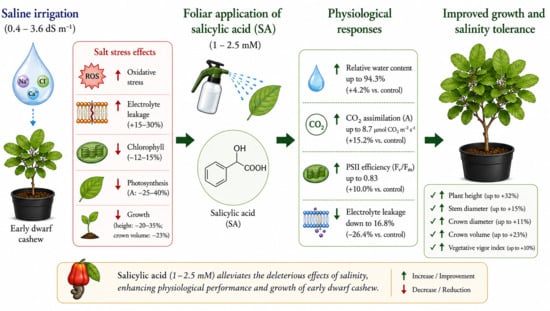
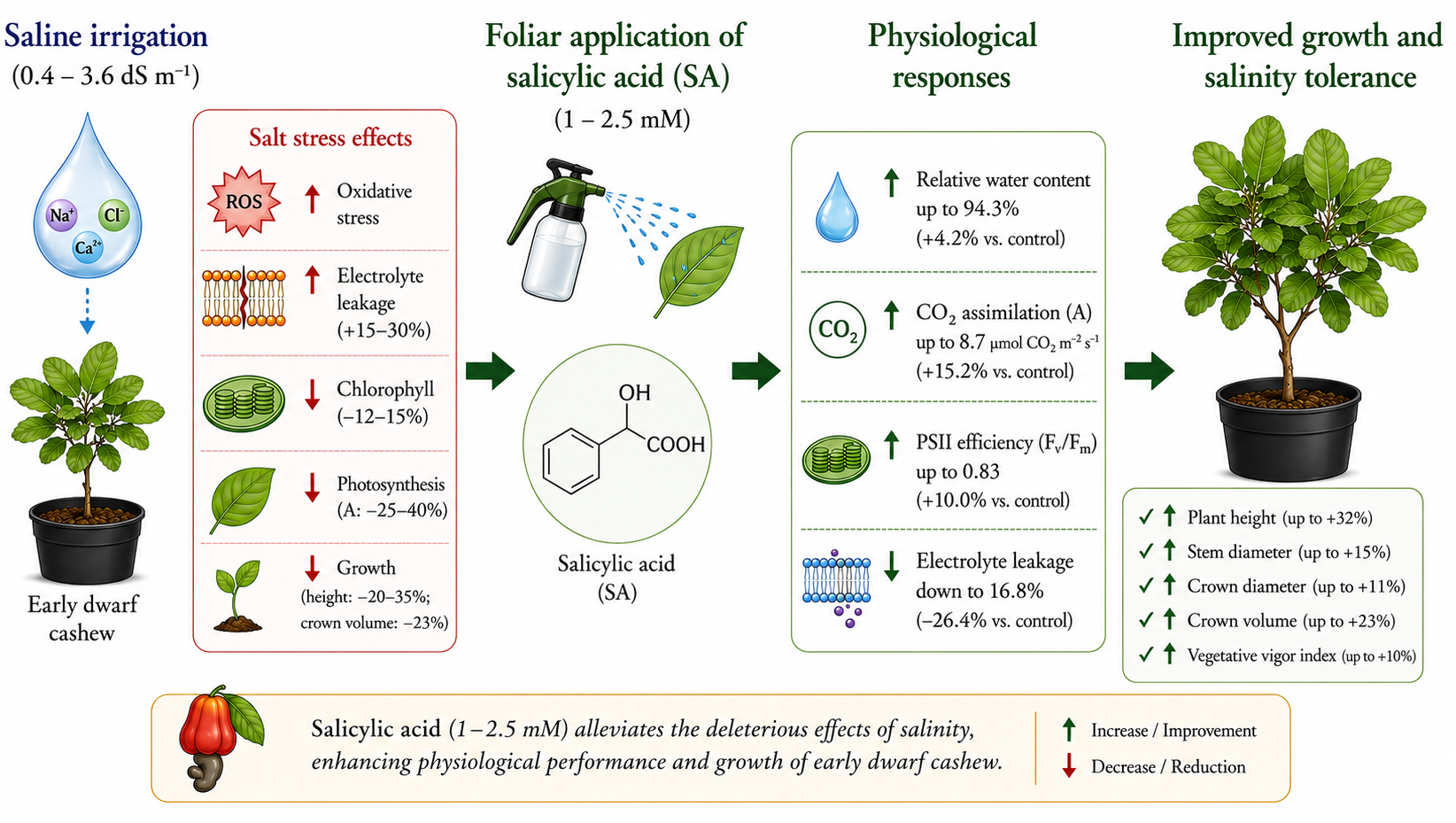
The aim of study was to investigate the effects of foliar application of salicylic acid on cellular damage, physiological indices, and growth of dwarf cashew cultivated under salt stress. A 5 × 4 factorial scheme, resulting from the combination of five ECiw levels (0.4, 1.2, 2.0, 2.8, and 3.6 dS m−1) and four salicylic acid concentrations (control—0, 1, 2, and 3 mM), with three replications. Irrigation water salinity of 3.6 dS m−1 inhibited the synthesis of photosynthetic pigments, gas exchange, chlorophyll a fluorescence, and the growth of dwarf cashew plants. Foliar application of salicylic acid at concentrations ranging from 0.1 to 2.5 mM mitigated the effects of salt stress on relative water content, stomatal conductance, internal CO2 concentration, CO2 assimilation rate, instantaneous carboxylation efficiency, variable fluorescence, quantum efficiency of photosystem II, stem diameter at the grafting point, and plant height, while also reducing electrolyte leakage and initial fluorescence in dwarf cashew plants at 180 days after transplanting. Salicylic acid (SA), when applied at appropriate concentrations, alleviates the deleterious effects of salt stress on the growth and physiological performance of dwarf cashew plants.

Graphical Abstract

1. Introduction

Fruit growing is an activity of great relevance in the socioeconomic scenario of the Brazilian Northeast, as it contributes to job creation and the maintenance of the national market, especially in irrigated cashew cultivation [1]. In Brazil, cashew cultivation is a characteristic activity of the Northeast, with a cultivated area of approximately 441.892 hectares, with the main producing states being Ceará, Rio Grande do Norte, and Piauí, with average productions of 63.258, 32.072, and 20.992 tons in the 2023 growing season, respectively [2]. However, the Brazilian Northeast has characteristics of young soils, a dry climate, and irregular rainfall distribution, together with high evapotranspiration rates, which limit agricultural productivity in this region, leading producers to resort to irrigation to meet crop water requirements [3].
In the Brazilian Northeast, water sources containing high concentrations of dissolved salts are frequently found. The use of these waters can induce osmotic and ionic stress in plants, limiting water absorption and, consequently, reducing nutrient uptake. These conditions intensify metabolic disturbances and stimulate the excessive generation of reactive oxygen species (ROS), which can damage enzymes, nucleic acids, and lipids, limit gas exchange, damage cellular integrity, and inhibit the synthesis of photosynthetic pigments [4,5]. In cashew plants, disorders directly related to high salt concentrations in irrigation water and/or in soil affect crop development, modify physical and metabolic structures, reduce plant growth, negatively affect plant physiology, and consequently lead to reductions in yield [6]. Reductions in plant height, stem diameter, leaf area, and leaf number of early dwarf cashew plants irrigated with saline water with electrical conductivity of irrigation water (ECiw) ranging from 0.38 to 4.8 dS m−1 were reported by [7], evidencing the deleterious effect of salts on the physical structure of cashew plants. Similarly, ref. [8] observed that cashew genotypes irrigated with water containing up to 100 mM L−1 showed reduced relative water content and increased electrolyte leakage, confirming that excess salts cause physiological damage by inhibiting water uptake, reducing leaf turgidity, and increasing cell membrane degradation.
Therefore, the adoption of practices capable of reducing the harmful effects of salinity on plants is essential for the development and expansion of irrigated fruit production in the semi-arid region of Northeastern Brazil. Among the available management strategies, foliar spraying with salicylic acid (SA) has emerged as a promising alternative [9]. Salicylic acid is a plant hormone that, at low concentrations, can stimulate the activity of antioxidant enzymes. These enzymes play a key role in mitigating oxidative stress caused by the overaccumulation of reactive oxygen species, thereby helping to preserve cell membrane integrity and protect cellular structures from damage [10]. In addition, SA acts as an activator of defense systems, improving photosynthesis, increasing chlorophyll content, preventing the accelerated degradation caused by salt, improving PSII performance, reducing damage to chloroplasts, increasing the production of auxins and gibberellins, reducing the excessive accumulation of abscisic acid (ABA), and contributing to the maintenance of growth under adverse stress conditions [11]. However, the beneficial effect of this phytohormone depends on its concentration, mode of application, and the crop species [12].
The use of this phytohormone has gained prominence in agriculture due to its beneficial effects observed on plant growth responses under abiotic stress conditions [11]. Several studies have highlighted the positive effects of salicylic acid, as observed in colored cotton [13], sour passion fruit [14], and guava [15] under saline water irrigation.
Thus, the hypothesis of this research is based on the impacts of saline water irrigation on the morphophysiological components of grafted early dwarf cashew plants. In addition, it is hypothesized that foliar application of salicylic acid (SA) may attenuate the deleterious effects of salts by catalyzing antioxidant enzymatic activity. Accordingly, this research was conducted to investigate the influence of foliar-applied salicylic acid on cellular integrity, physiological responses, and growth of early dwarf cashew plants subjected to salt stress under semi-arid conditions.

2. Materials and Methods

2.1. Description of the Experimental Site and Growth Conditions

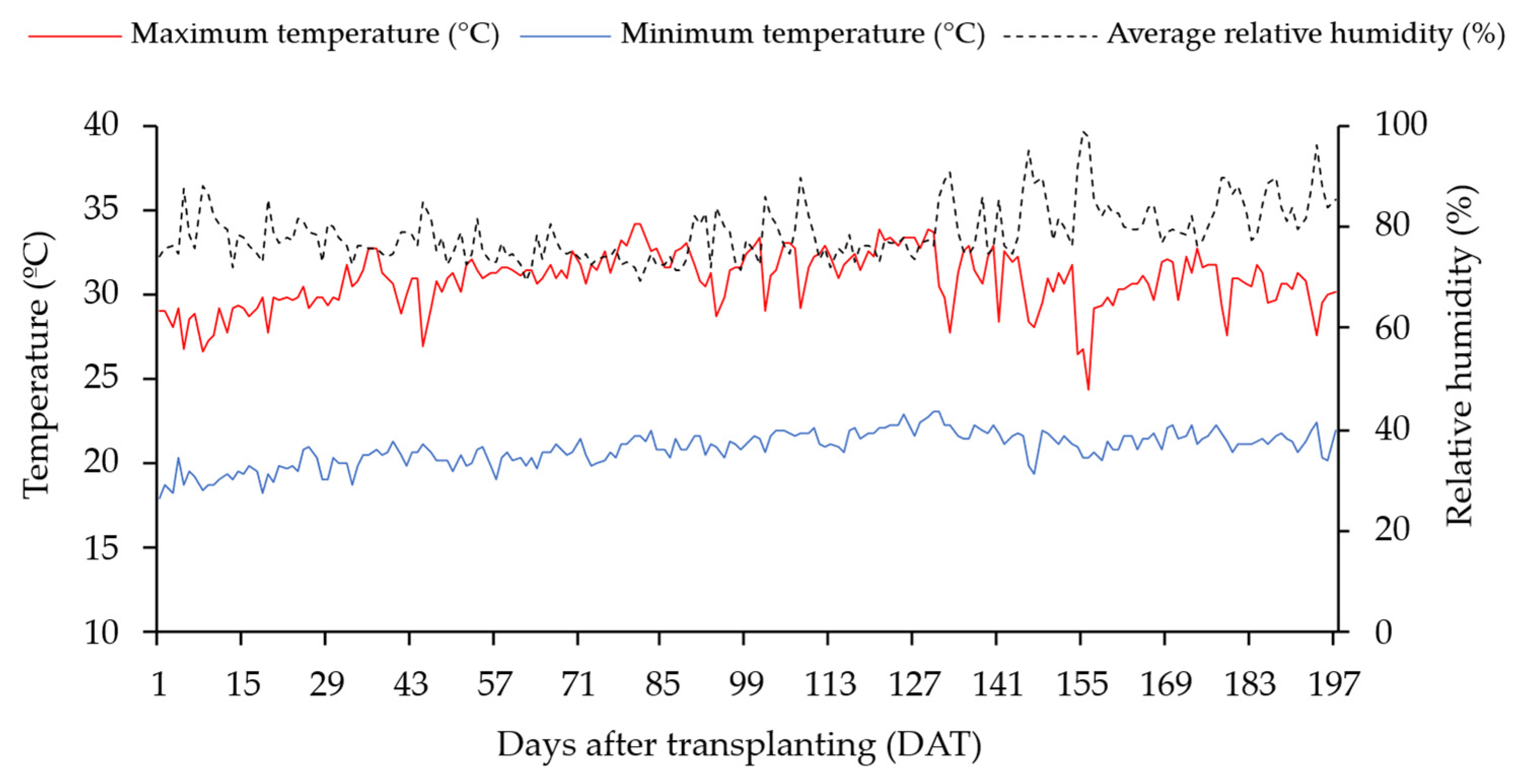
The experiment was carried out between September 2024 and March 2025 in a greenhouse of the Academic Unit of Agricultural Engineering at the Federal University of Campina Grande, situated in Campina Grande, Paraíba, Brazil. The experimental area is located at 07°15′18″ S and 35°52′28″ W, with an average elevation of 550 m above sea level. The mean temperatures observed during the experimental period ranged from 20.88 °C to 30.83 °C, while relative humidity ranged from 69.2% to 98.5% (Figure 1).

2.2. Design of the Experiment and Treatment Description

The treatments were distributed in a randomized complete block design, following 5 × 4 factorial scheme, resulting from the combination of five ECiw levels (0.4, 1.2, 2.0, 2.8, and 3.6 dS m−1) and four salicylic acid concentrations (control—0, 1, 2, and 3 mM), with three replications. The experiment consisted of 60 experimental plots, each containing a single plant. The selected ECiw levels and salicylic acid doses were based on the recommendations [6], in research conducted with soursop (Annona muricata L.) cv. Morada Nova.

2.3. Plant Material and Seedling Production

The seedlings were grown in 0.5 L (15 cm × 20 cm) polyethylene bags and grafted using the full cleft grafting method. The Embrapa 51 and BRS 226 Planalto clones were used as rootstock and scion, respectively. Transplanting to lysimeters was carried out when the seedlings were 150 days after grafting. From transplanting until 65 days after transplanting (DAT), all plants received irrigation water from the local supply system (ECiw: 0.4 dS m−1).

2.4. Crop Establishment and Management and Soil Characterization

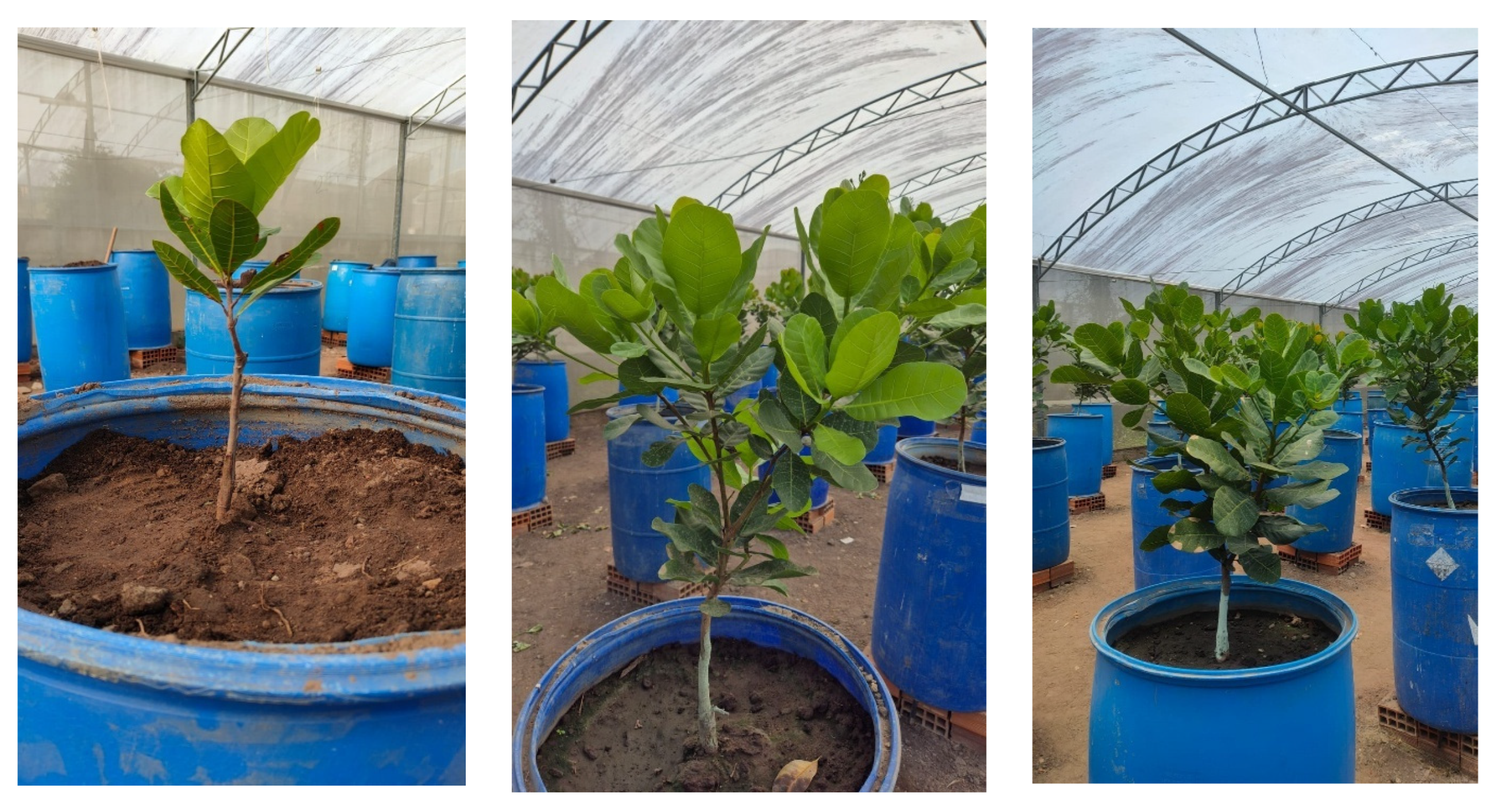
Drainage lysimeters were constructed using plastic containers measuring 59 cm in diameter and 90 cm in length, with a total capacity of 250 L (Figure 2). To facilitate the removal of excess water, two polyethylene drains (20 mm in diameter and 15 cm long) were installed at the bottom of each lysimeter. The parts of the drains positioned inside the containers were covered with nylon mesh to prevent displacement and soil loss during the drainage process. The drained volume was collected in plastic bottles placed under each drain, enabling the determination of crop water consumption. A 500 g layer of gravel was placed over the nylon mesh, followed by soil classified as Neosol–Entisol [16]. Samples were collected from the surface soil layer (0 to 30 cm) in Lagoa Seca, Paraíba State, Brazil. The determination of the soil’s chemical and physical properties was performed according to the procedures established by [17]. The soil characteristics were as follows: pH = 5.0; organic matter = 7.95 g dm−3; phosphorus (P) = 9.25 mg dm−3; potassium (K) = 89.9 mg dm−3, sodium (Na) = 0.01 cmolc kg−1, calcium (Ca2+) = 1.24 cmolc kg−1, and magnesium (Mg2+) = 2.39 cmolc kg−1. Acidity-related elements were aluminum (Al3+) = 0.60 cmolc kg−1 and hydrogen plus aluminum (H+ + Al3+) = 3.71 cmolc kg−1. Regarding the soil physical properties, the soil contained 727 g kg−1 of sand, 211 g kg−1 of silt, and 62 g kg−1 of clay. In addition, the soil exhibited an electrical conductivity of the saturation extract (ECse) of 0.09 dS m−1 and a cation exchange capacity of 7.57 cmolc kg−1.
Fertilization was performed according to [18], with the application of 60 g N, 200 g P2O5, and 40 g K2O per plant, split into 24 applications at 15-day intervals. The sources of nitrogen, phosphorus, and potassium used were urea (45% N), monoammonium phosphate (61% P2O5 and 11% N), and potassium chloride (60% K2O), respectively. Micronutrients were supplied through foliar fertilization carried out biweekly with a backpack sprayer. The spray solution consisted of Dripsol Micro® at a concentration of 1.0 g L−1, containing Mg, Zn, B, Fe, Mn, Cu, and Mo at concentrations of 1.1%, 4.2%, 0.85%, 3.4%, 3.2%, 0.5%, and 0.05%, respectively.

2.5. Irrigation System and Salicylic Acid and Management

The ECiw levels were prepared using a 7:2:1 equivalent ratio of NaCl, CaCl2·2H2O, and MgCl2·6H2O, respectively, using low salinity water 0.4 dS m−1. The amount of salts to be added was determined according to [19]. The electrical conductivity of the irrigation water was checked before each irrigation event using a laboratory conductivity meter, and adjustments were made whenever deviations from the target ECiw values were detected. Saline irrigation commenced at 80 DAT, following a two-day irrigation schedule. Prior to transplanting, the soil was brought to field-capacity moisture conditions. Thereafter, the amount of water supplied at each irrigation was estimated from the root-zone water balance.
The methodology used for the preparation and application of salicylic acid was based on the study conducted by Silva et al. [13].

2.6. Plant Physiological and Growth Analyses

At 180 days after transplanting (DAT), evaluations were performed to determine relative water content (RWC), electrolyte leakage (EL), leaf gas exchange, photosynthetic pigment concentrations, chlorophyll a fluorescence, and plant growth. Relative water content (RWC) and electrolyte leakage (EL) were determined according to [20,21], respectively.
The physiological parameters related to leaf gas exchange were determined using a portable infrared gas analyzer (IRGA, model LCPro+, ADC BioScientific Ltd., Hoddesdon, UK)). Measurements were performed at room temperature, with photosynthetic photon flux density (PPFD) set at 1200 μmol m−2 s−1 and an air flow rate of 200 mL min−1. The variables recorded included the net CO2 assimilation rate (A, μmol CO2 m−2 s−1), the transpiration rate (E, mol H2O m−2 s−1), the stomatal conductance (gs, mol H2O m−2 s−1), and the internal CO2 concentration (Ci, μmol CO2 m−2 s−1). Furthermore, these data were used to estimate the instantaneous water use efficiency (iWUE, A/E) and the instantaneous carboxylation efficiency (iCE, A/Ci). Measurements were taken on mature leaves from the middle third of the plant, fully expanded from the shoot apex. Young and older leaves were avoided to prevent possible errors in the readings. All 60 plants from the experiment were evaluated.
To quantify photosynthetic pigments, a mature and intact leaf was collected from each experimental unit in the mid-region of the plant. A disc with an area of 113 mm2 was removed from each leaf using a cutting instrument. The disc was weighed on a semi-analytical balance and then placed in a glass container, totaling 60 containers. Each container was filled with 5 mL of dimethyl sulfoxide. This was used for pigment extraction, according to the adapted methodology described by [22] and modified by [23]. The containers were placed in a styrofoam box and kept in the absence of light, at room temperature, for a period of 48 h to prevent pigment degradation. After this period, chlorophyll a, chlorophyll b, and carotenoids were quantified using a UV/VIS Digital Spectrophotometer at wavelengths of 480, 649, and 665 nm.
Chlorophyll a fluorescence was determined using a pulse-modulated fluorometer, model OS5p (Opti-Sciences), employing the Fv/Fm protocol to determine the variables initial fluorescence (F0), maximum fluorescence (Fm), variable fluorescence (Fv), and the quantum efficiency of photosystem II (Fv/Fm). This protocol was performed after dark adaptation of the leaves for a period of 30 min, using a clip from the equipment, in order to ensure that all electron acceptors were oxidized, that is, with the reaction centers open. The measurements were performed across all 60 experimental units, using fully expanded mature leaves while strictly avoiding any leaves with visual injuries.
The growth performance of the plants was assessed using biometric variables, including plant height (PH, cm), stem diameter measured below (Dbg, mm), at (Dgp, mm), and above (Dag, mm) the graft union, crown diameter (Dcrown, cm), crown volume (Vcrown, cm3), and vegetative vigor index (VVI, %). Plant height was recorded from the collar region to the apical meristem insertion point. Stem diameter measurements were obtained at three positions: 5.0 cm above the soil surface (below the graft union), directly at the graft union, and 5.0 cm above the grafting site, using a digital caliper. Crown diameter was calculated as the mean of measurements taken along the row and interrow directions. Crown volume was estimated from crown height (CH) and crown dimensions, whereas VVI was determined according to the methodology described by [24]. Growth measurements were taken in all experimental units.

2.7. Statistical Methods

The data were subjected to the Shapiro–Wilk normality test. Analysis of variance (ANOVA) was performed, and treatment effects were evaluated using the F-test (p ≤ 0.05). When significant effects were detected, polynomial regression models were fitted for irrigation water salinity levels and salicylic acid concentrations [25]. In cases of significant interaction between salinity levels and salicylic acid concentrations (ECiw × SA), response surface plots were generated using SigmaPlot software (version 14.5).
Subsequently, Pearson’s correlation analysis (p ≤ 0.05) was performed among the evaluated variables, followed by principal component analysis (PCA). Only variables with correlation coefficients greater than 0.60 were included in the PCA. These analyses were conducted using RStudio software (version 2026.05.1) with the packages metan v. 1.19.0, corrplot v. 0.95 and mclust v. 6.1.2.

3. Results

3.1. Relative Water Content and Membrane Integrity

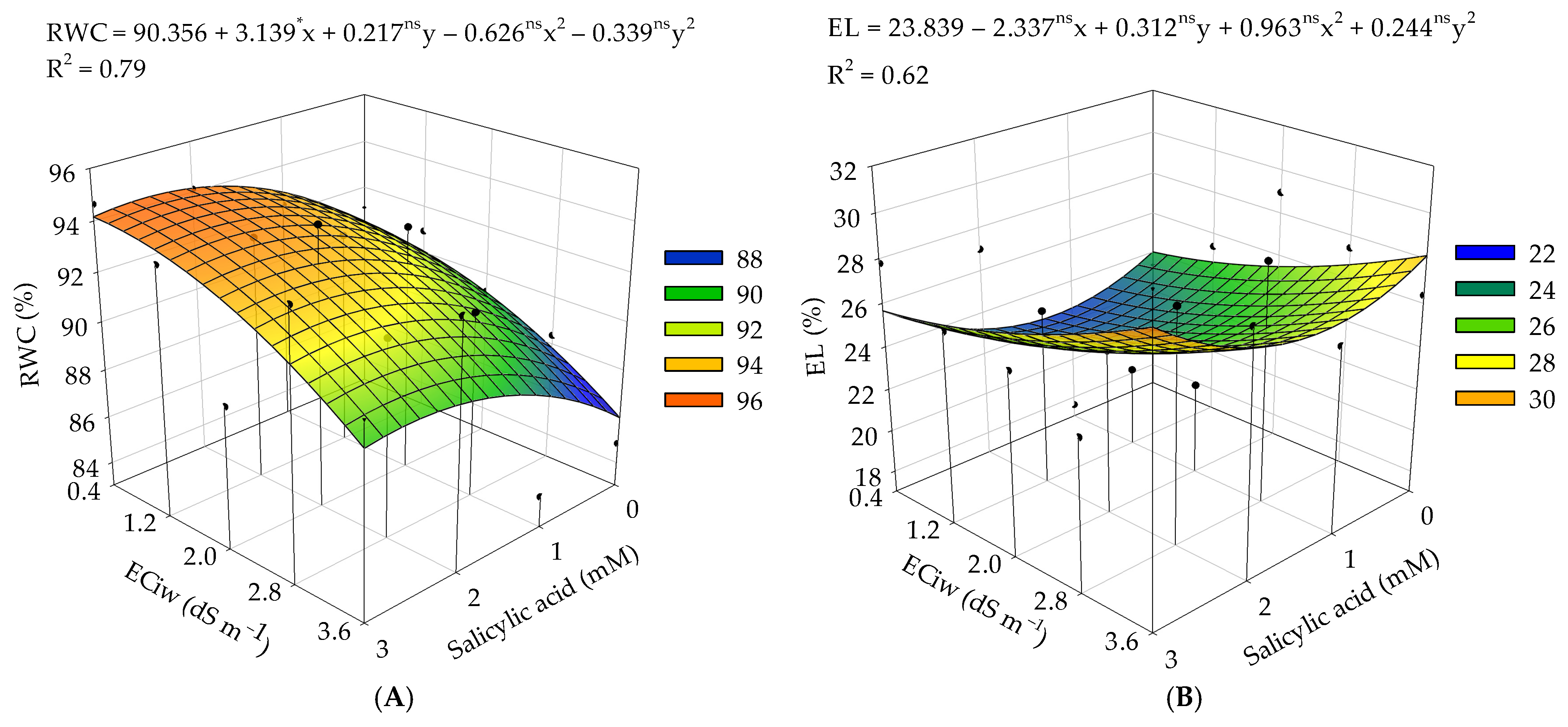
The combined effects of irrigation water salinity levels and salicylic acid concentrations significantly (p ≤ 0.01) influenced relative water content and electrolyte leakage in cashew leaves at 180 DAT (Table S1).
Regarding RWC (Figure 3A), it is observed that plants that received irrigation with water of 0.4 dS m−1 and subjected to SA concentrations of up to 2.5 mM showed the highest value (94.33%), corresponding to an increase of 4.17% relative to the control treatment (0 mM) subjected to the same irrigation water salinity. However, salicylic acid concentrations higher than 2.5 mM, associated with ECiw levels of up to 3.6 dS m−1, promoted reduction in RWC.
In relation to electrolyte leakage of the leaf blade (Figure 3B), foliar application of 1.2 mM salicylic acid promoted beneficial effects by reducing EL in plants subjected to irrigation using ECiw of 0.4 dS m−1. In contrast, the maximum observed EL level (29.78%) was observed in the water of 3.6 dS m−1 under a concentration of 3.0 mM. Furthermore, increasing SA concentrations beyond 1.2 mM aggravated the negative impacts of salt stress on plant performance.

3.2. Gas Exchange

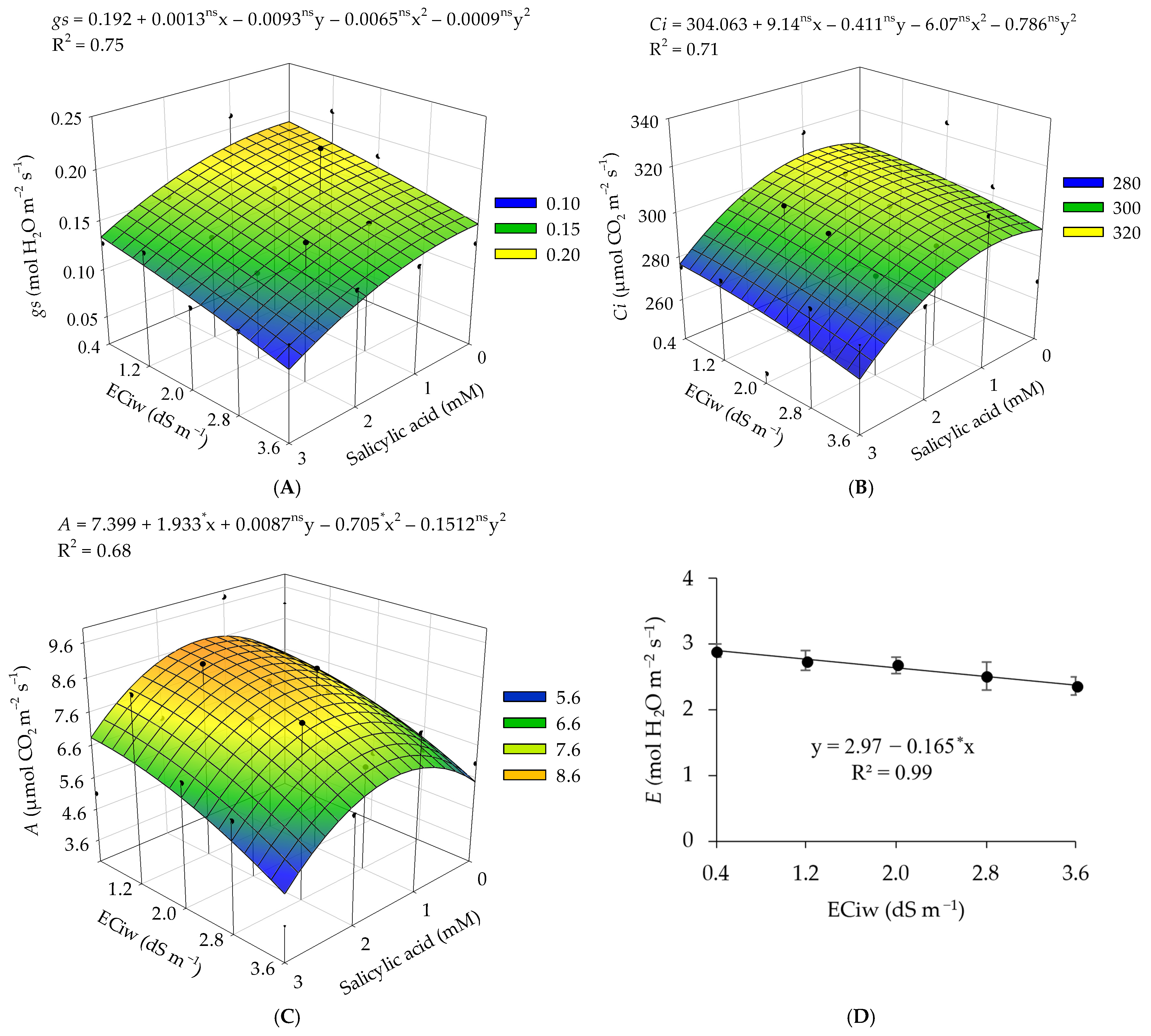
A significant interaction between the analyzed factors (ECiw × SA) was observed for all evaluated variables, except transpiration and instantaneous water use efficiency, which were significantly affected (p ≤ 0.01) only by the electrical conductivity levels of the irrigation water (Table S2).
Stomatal conductance (Figure 4A) of early dwarf cashew plants was negatively affected by increasing salinity levels of the irrigation water. However, it was observed that the highest values were observed in plants treated with 0.1 mM salicylic acid, indicating beneficial effects at this concentration (0.1882 mol H2O m−2 s−1) obtained in plants subjected to an ECiw of 0.4 dS m−1. A similar behavior was observed for internal CO2 concentration (Figure 4B), in which SA at a concentration of 0.6 mM provided the highest Ci (308.16 µmol CO2 m−2 s−1) in cashew plants irrigated with 0.4 dS m−1. In contrast, SA concentrations above 0.1 mM for gs and 0.6 mM for Ci amplified the effects of salt stress on gs and Ci, respectively.
The CO2 assimilation rate (Figure 4C) was also reduced with increasing salinity levels of the irrigation water; however, salicylic acid foliar application at a concentration of 1.4 mM resulted in higher A values (8.71 µmol CO2 m−2 s−1), representing an elevation of 15.22% (1.32 µmol CO2 m−2 s−1) compared with plants irrigated with 0.4 dS m−1 ECiw without salicylic acid application. The lowest CO2 assimilation rate was observed in plants irrigated with the highest salinity level (3.6 dS m−1) and treated with 3.0 mM salicylic acid, the observed responses were more pronounced. In contrast, SA concentrations above 1.4 mM intensified the adverse effects of salt stress on the CO2 assimilation rate.
Transpiration (E) decreased in a linear manner as irrigation water salinity increased, with a reduction of 5.56% for each unit increase in ECiw (Figure 4D). Plants irrigated with ECiw of 3.6 dS m−1 showed a reduction in E of 18.62% compared with those subjected to the lowest salinity level of the irrigation water (0.4 dS m−1), in relative terms.
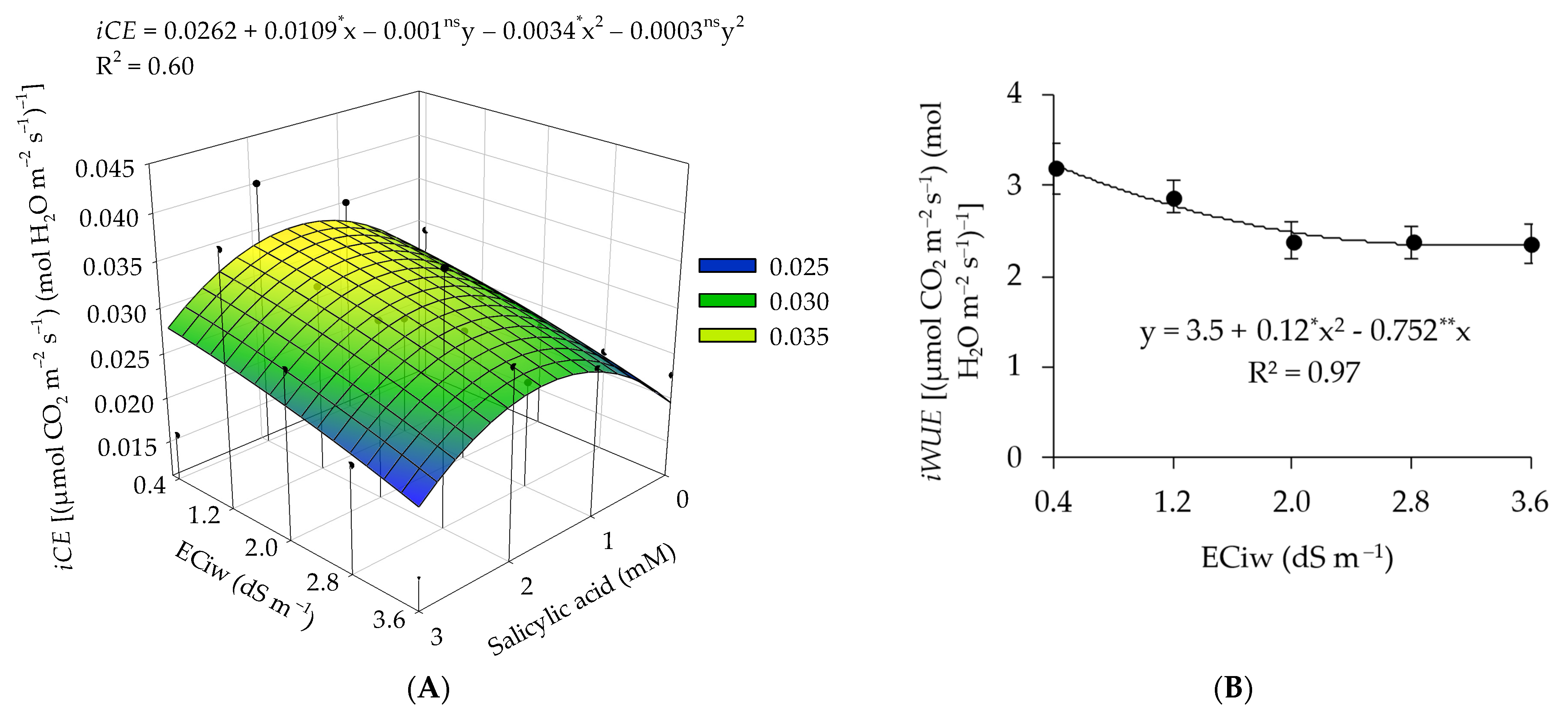
Instantaneous carboxylation efficiency (iCE) decreased with increasing salinity levels (Figure 5A). However, the highest iCE value (0.03449 [µmol CO2 m−2 s−1 (mol H2O m−2 s−1) −1] was observed in plants that received an SA concentration of 1.6 mM, indicating a beneficial effect of SA under low salinity conditions. In contrast, the lowest iCE value [0.01871 µmol CO2 m−2 s−1 (mol H2O m−2 s−1) −1] was detected in plants grown under 3.6 dS m−1 irrigation conditions without SA application.
For instantaneous water use efficiency (iWUE) (Figure 5B), the maximum estimated value occurred in plants cultivated under 0.4 dS m–1 irrigation water, with an iWUE of 3.20 [µmol CO2 m−2 s−1 (mol H2O m−2 s−1) −1]. In contrast, irrigation with water of 3.6 dS m−1 resulted in the lowest estimated value (2.37 [µmol CO2 m−2 s−1 (mol H2O m−2 s−1) −1]).

3.3. Photosynthetic Pigments

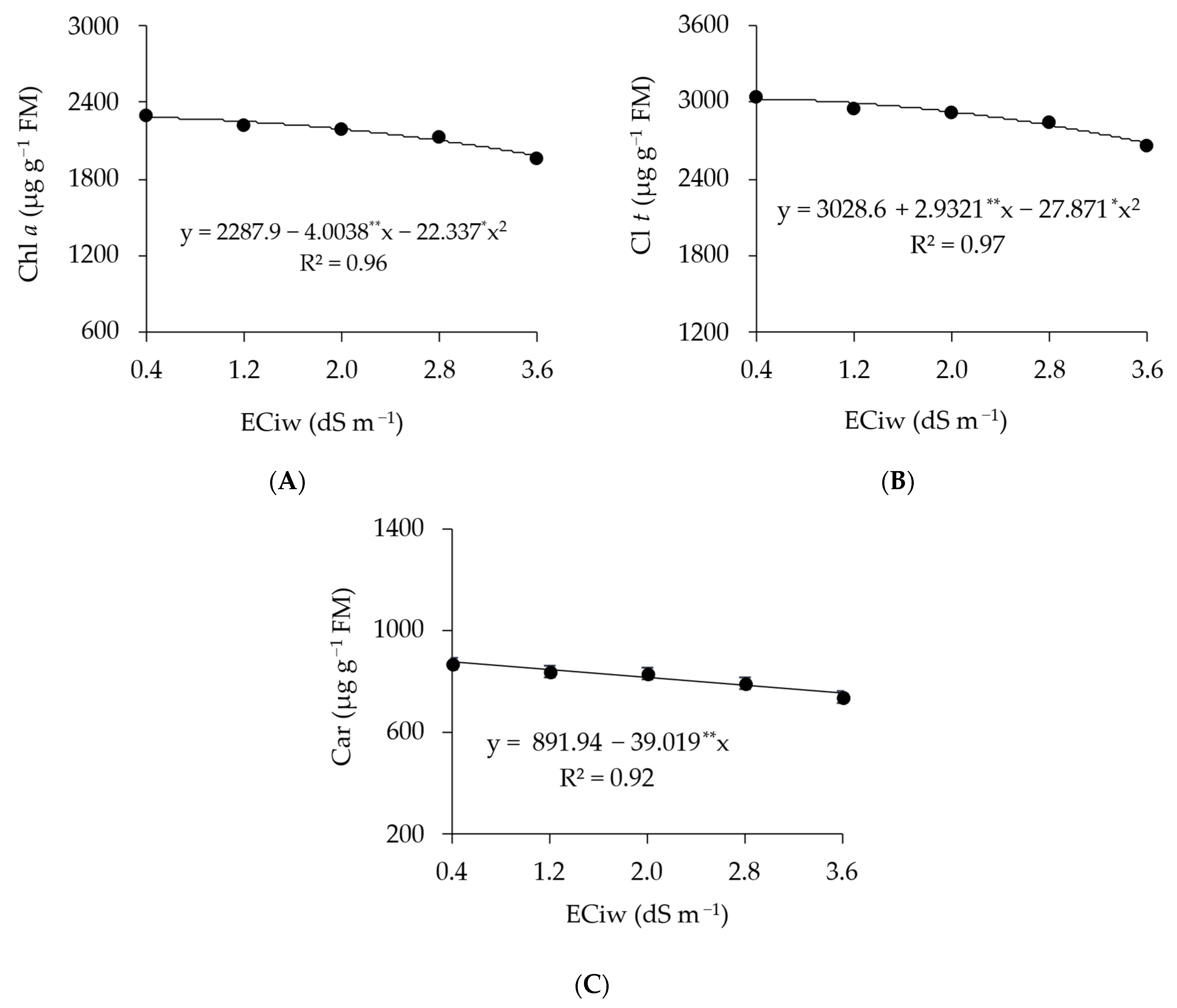
A significant effect (p ≤ 0.01) of irrigation water electrical conductivity levels was observed on chlorophyll a, chlorophyll total, and carotenoid contents of early dwarf cashew plants (Table S3) at 180 DAT. There was no significant effect of salicylic acid concentrations or of the interaction between factors (SL × SA) for the evaluated variables.
Chlorophyll a (Chl a) and chlorophyll total (Chl t) contents were negatively affected by increasing salinity levels of the irrigation water up to an ECiw of 3.6 dS m−1 (Figure 6A,B). Reductions of 14.38% and 12.45% were observed, corresponding to 330.56 and 378.60 µg g−1 FM, respectively, compared with the highest value observed for chlorophyll a (2297.94 µg g−1 FM) at 0.4 dS m−1 and the lowest value (1967.38 µg g−1 FM) at 3.6 dS m−1. Similarly, chlorophyll total content decreased from 3040.88 µg g−1 FM at an ECiw of 0.4 dS m–1 to 2662.28 µg g−1 FM at 3.6 dS m−1 (Figure 6B). Carotenoid (Car) contents decreased linearly by 4.37% per unit increase in ECiw (Figure 6C). A total reduction of 15.49% (134.83 µg g−1 FM) in carotenoid content was observed in relative terms.

3.4. Chlorophyll a Fluorescence

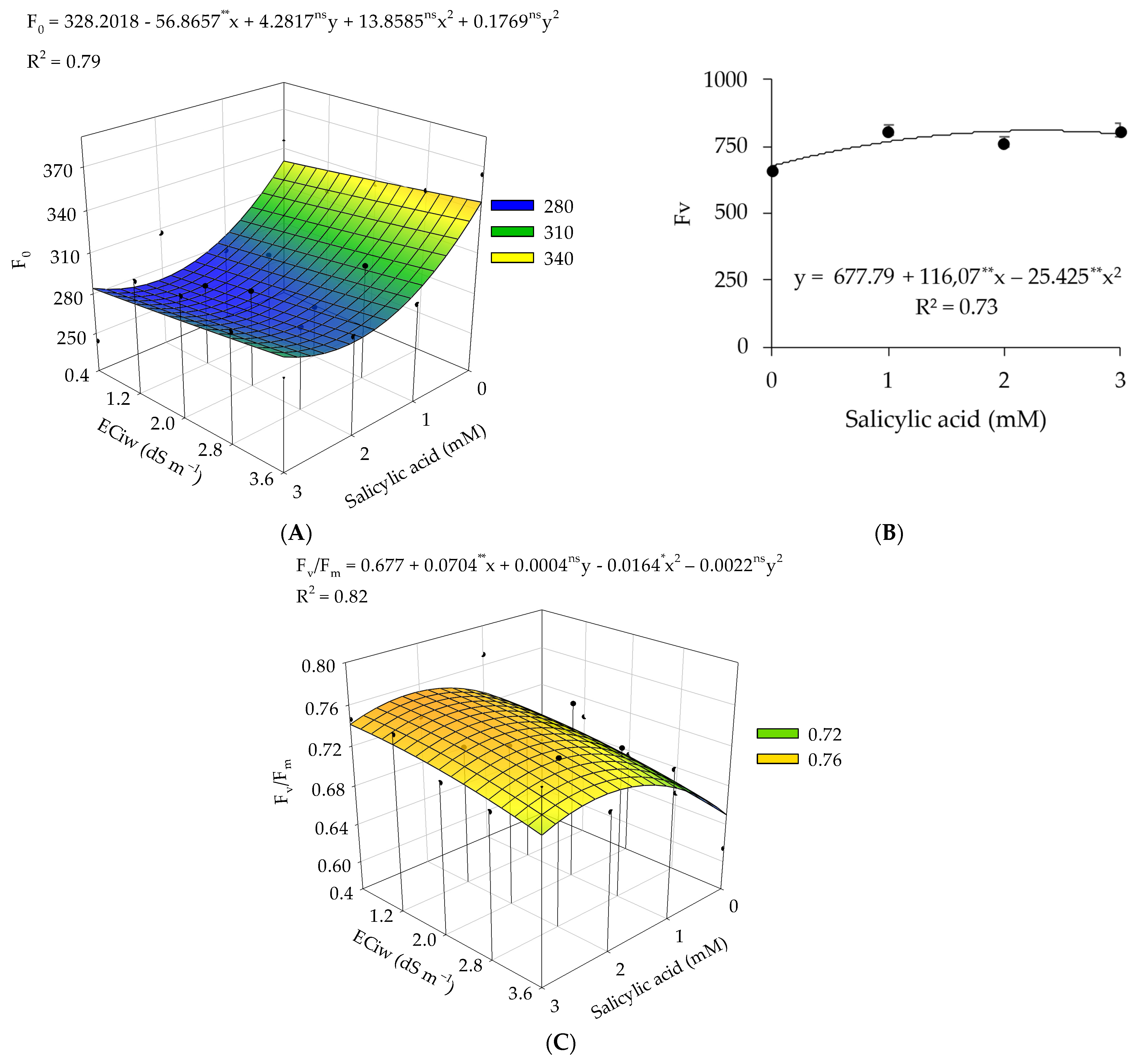
A significant interaction effect (p ≤ 0.01) of SL and SA was observed on initial fluorescence and the quantum efficiency of photosystem II (Table S4). Salicylic acid concentrations significantly affected (p ≤ 0.01) variable fluorescence of early dwarf cashew plants at 180 days after transplanting.
Irrigation water salinity increased initial fluorescence (F0) (Figure 7A). In plants irrigated with water of 0.4 dS m−1, foliar application of salicylic acid of 2.2 mM resulted in lower F0. However, SA concentrations exceeding 2.2 mM intensified salt stress effects in plants, leading to increased F0. For variable fluorescence (Fv), the highest value was obtained under foliar application of 2.3 mM salicylic acid (Figure 7B), whereas the lowest estimated value (677.8) was detected in plants subjected to the control treatment (0 mM).
In contrast to F0, an opposite behavior was observed for the quantum efficiency of photosystem II (Fv/Fm) (Figure 7C). Salinity levels exerted adverse effects on this variable, reducing it up to an ECiw of 3.6 dS m−1. The SA concentration of 2.1 mM under a salinity level of 0.4 dS m−1 increased the Fv/Fm ratio of cashew plants by 10.04% (0.0755) compared with the control (0.4 dS m−1 and 0 mM). Furthermore, at the concentration of 2.1 mM onward, PSII quantum efficiency decreased up to the concentration of 3.0 mM, reaching a value of 0.7135.

3.5. Plant Growth

A significant effect of the ECiw × SA interaction was observed, which significantly influenced stem diameter below the graft point, stem diameter at the graft point, and plant height (Table S5). Irrigation water electrical conductivity levels independently affected stem diameter above the graft point, crown diameter, crown volume, and vegetative vigor index (p ≤ 0.01).
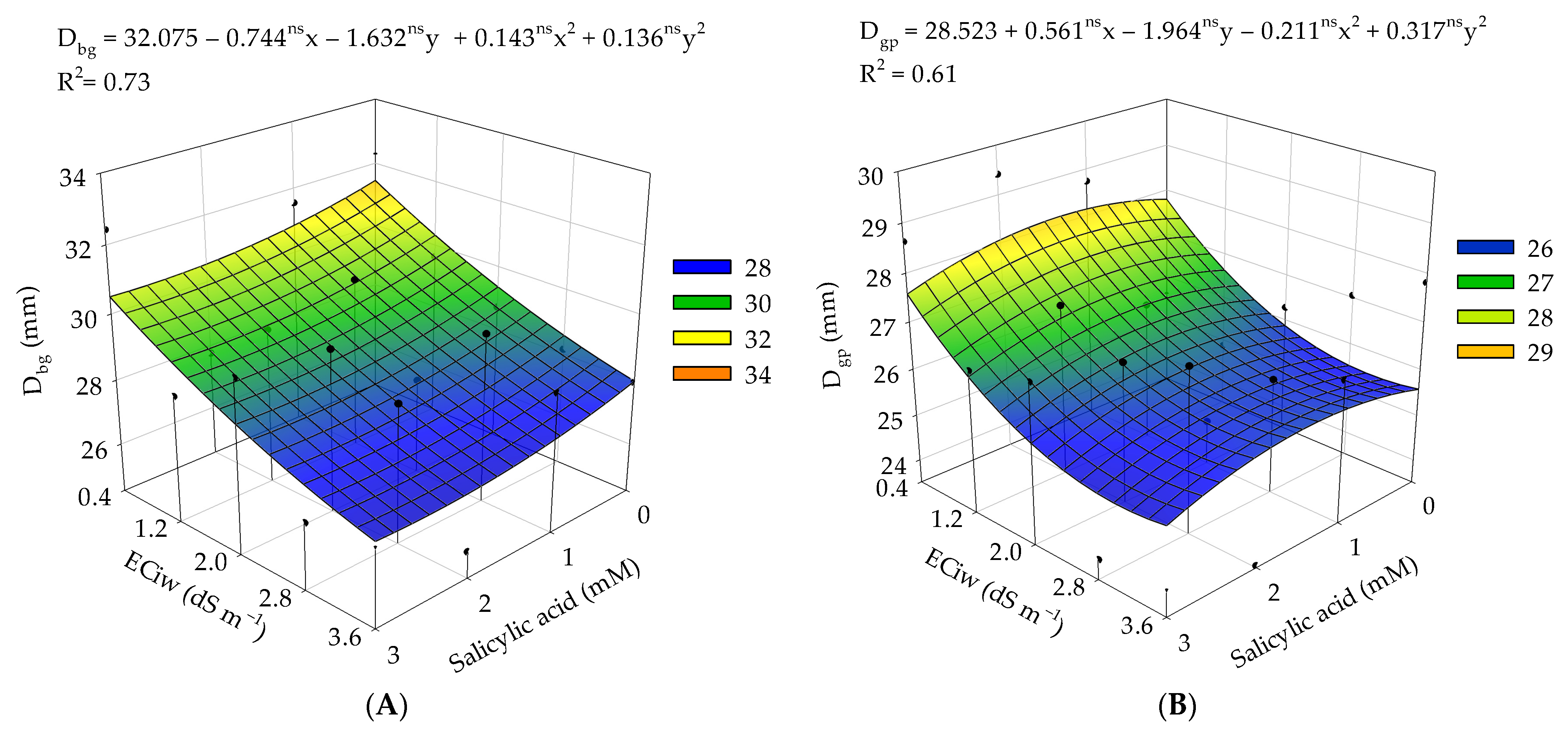
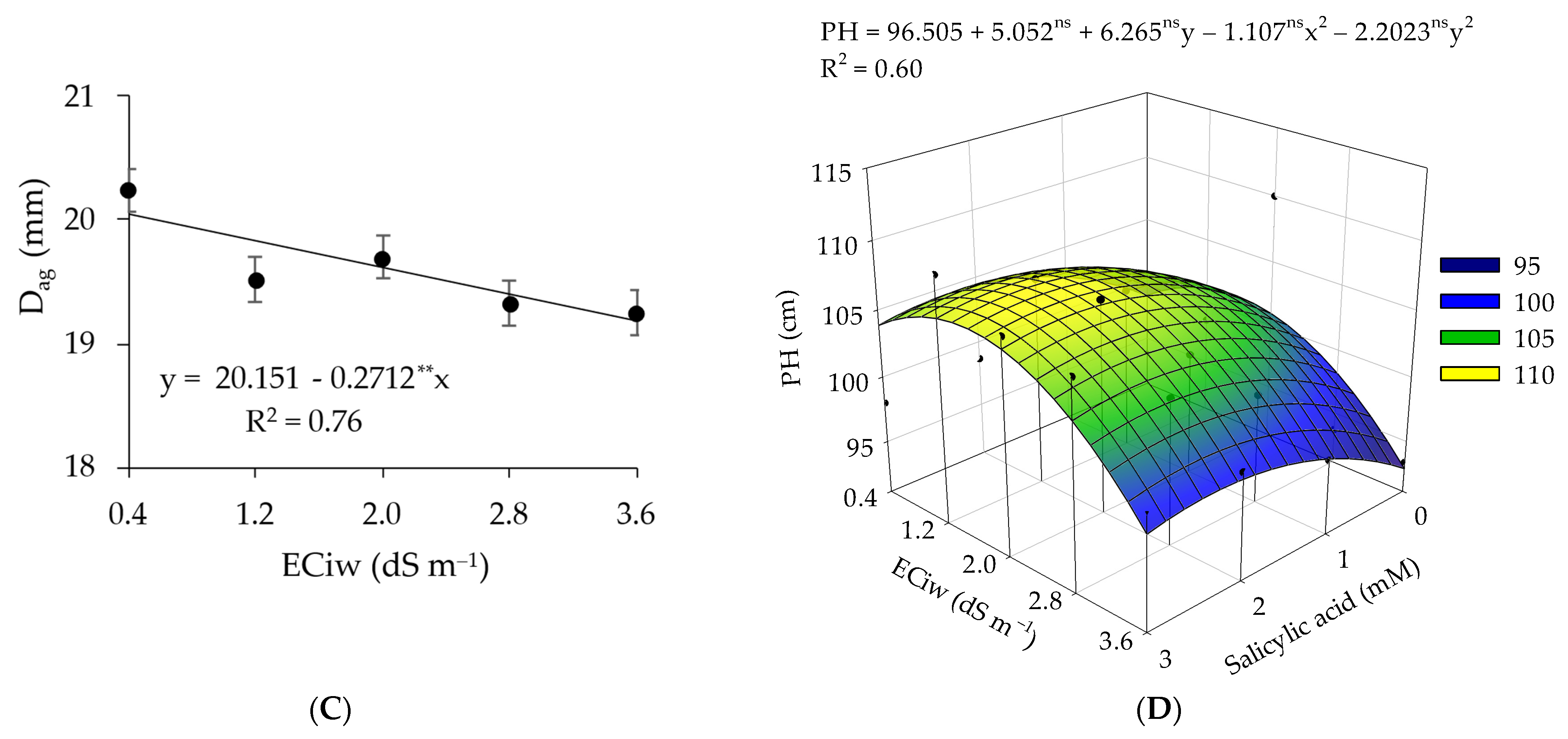
Irrigation water salinity inhibited stem diameter below the graft union (Dbg), at the graft point (Dgp), above the graft point (Dag), and plant height (PH) of dwarf cashew plants (Figure 8A–D). SA application did not reduce the adverse effects of salts on Dbg (Figure 8A), with a reduction of 14.07% (4.43 mm) compared with the highest mean observed at 0 mM salicylic acid (31.44 mm) under 0.4 dS m−1, and the lowest value of 27.01 mm recorded at 3.6 dS m−1 with 3 mM SA. On the other hand, concentrations of 1.3 mM and 2.3 mM (Figure 8B,D) promoted increases of 1.33 and 5.41% (0.37 and 5.76 mm) when were used water salinities of 0.4 and 1.5 dS m−1 in stem diameter at the graft union and plant height, respectively. Stem diameter above the graft union (Figure 8C) decreased linearly with increasing irrigation water electrical conductivity up to 3.6 dS m−1. This reduction corresponded to 1.35% per unit increase in ECiw, corresponding to a total relative reduction of 4.89%.
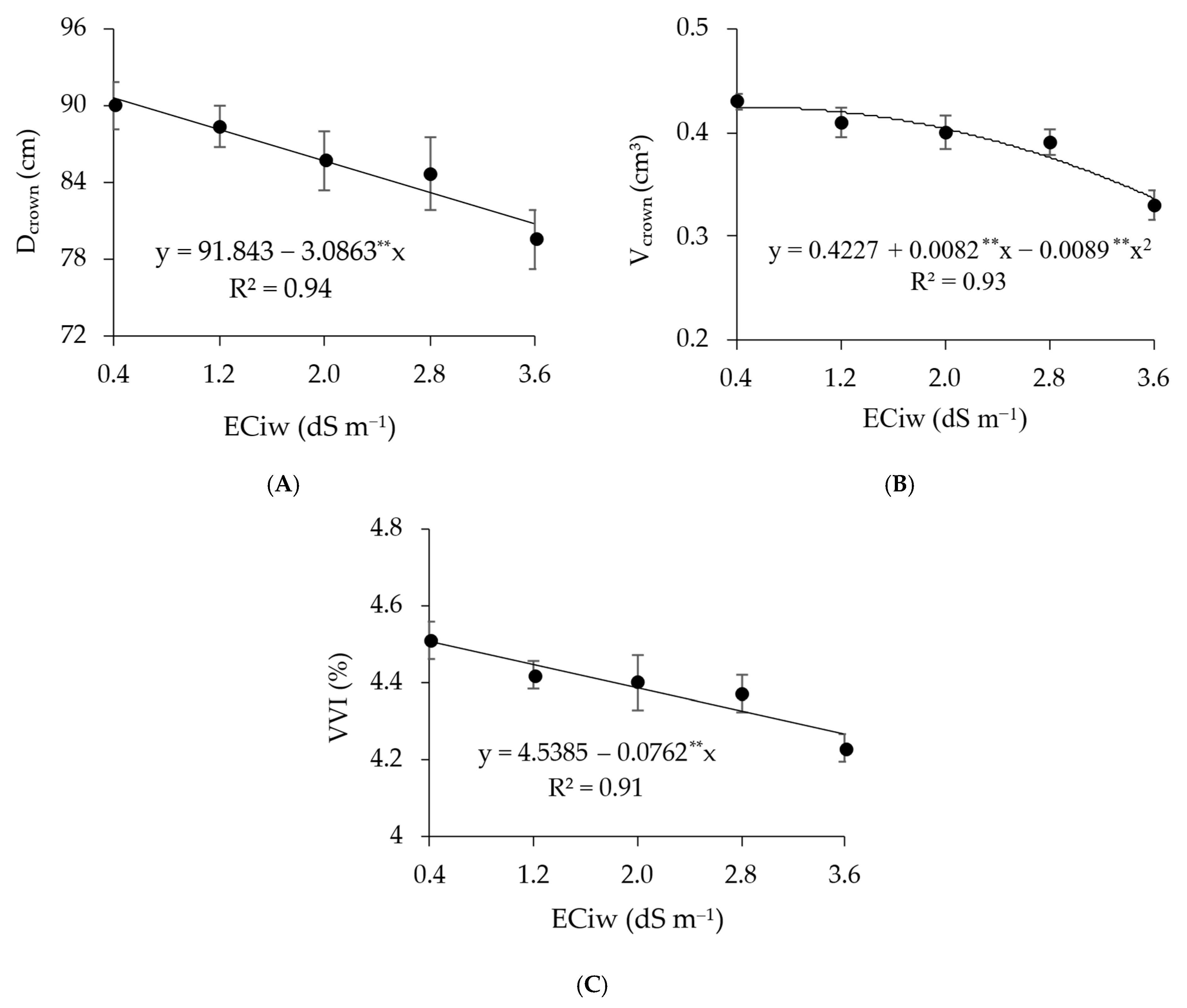
Crown diameter, crown volume, and vegetative vigor index decreased with increasing irrigation water salinity reaching up to 3.6 dS m−1 (Figure 9A–C). A reduction of 23.25% (0.1 m3) was observed for crown volume, with the highest mean value (0.44 m3) recorded at 0.4 dS m−1 and the lowest (0.34 m3) when irrigation water with 3.6 dS m−1 was used. For crown diameter and vegetative vigor index, linear reductions of 3.36 and 1.68% per unit increase in ECiw were observed, respectively. In relative terms, irrigation water salinity inhibited these variables by 11.47 and 4.89%, respectively.

3.6. Best Salicylic Acid Concentrations for Each Variable

Overall, the variables showed distinct responses to the application of salicylic acid (SA) at the concentrations analyzed, demonstrating that effects on physiological and growth variables depend on the sensitivity of the parameter evaluated (Table 1) and the mechanisms involved.
Relative water content increased up to a concentration of 2.5 mM, whereas the lowest electrolyte leakage was observed at 1.2 mM SA. Regarding gas exchange variables, maximum responses were observed at intermediate concentrations—ranging from 0.6 to 1.6 mM SA—with notable results for the CO2 assimilation rate and instantaneous carboxylation efficiency. Concerning chlorophyll a fluorescence parameters, the highest values for variable fluorescence and photosystem II quantum efficiency occurred between 2.1 and 2.3 mM SA. As for plant growth, the greatest plant height was estimated at 1.3 mM, while the largest stem diameter above the graft union was observed near 2.3 mM SA.
Overall, in this study, although plant responses varied across the evaluated characteristics, intermediate SA concentrations between 1.2 and 2.0 mM promoted the best balance among water status maintenance, cellular integrity, photosynthetic efficiency, and plant growth; this range can be considered the most suitable for maximizing the physiological and vegetative performance of the dwarf cashew plant under the conditions evaluated. However, it should be noted that some concentrations associated with the best results fell at the limits of the experimental range (0 to 3 mM), which may indicate that the true optima lie outside the tested interval.

3.7. Analysis of Principal Components and Pearson Correlation

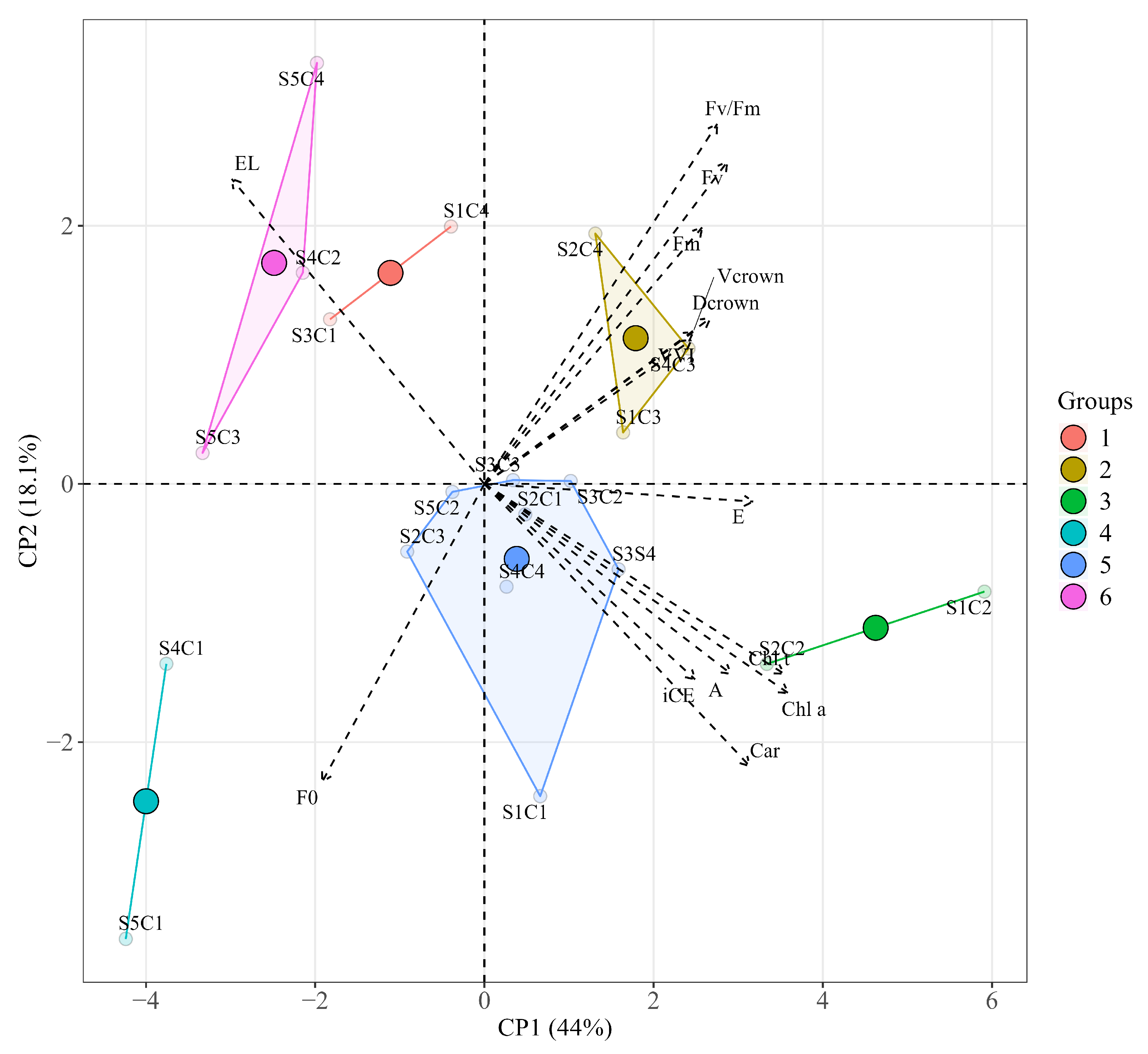
Principal component analysis (PCA) clustering synthesized the relationships among the evaluated variables, revealing response patterns of cashew plants to the effects of the studied factors. This study evaluated the interaction between irrigation water salinity levels (SL) and salicylic acid concentrations (C) could be observed through PCA (Figure 10). The first two extracted components (PC1 and PC2) jointly accounted for 62.1% of the total variance, with PC1 explaining the largest proportion of variance (44%), whereas PC2 contributed 18.1% of the total variance.
The variables included in the PCA were: Chl a, Chl t, Car, F0, Fm, Fv, Fv/Fm, Dcrown, Vcrown, and VVI. The first principal component comprised the variables Chl a, Chl t, Car, Fm, Dcrown, Vcrown, and VVI, whereas the second principal component included the variables F0, Fv, and Fv/Fm. Negative correlations greater than 0.60 were observed for almost all variables (−0.80, −0.80, −0.69, −0.61, −0.60, −0.63, −0.61, −0.63), respectively, for Chl a, Chl t, Car, F0, Fm, Fv, Fv/Fm, Dcrown, Vcrown, and VVI. Group 5 showed lower statistical relevance and was composed of the treatments S3C3, S3C2, S3C4, S2C1, S4C4, S1C1, S5C2, and S2C3. On the other hand, groups 2 (S2C4, S4C3, and S1C3) and 3 (S2C2 and S1C2) showed greater statistical relevance, indicating better responses related to gas exchange, photosynthetic pigments, chlorophyll a fluorescence, and plant growth. Groups 1 (S3C1 and S1C4), 4 (S4C1 and S5C1), and 6 (S5C4, S5C3, and S4C2) were favored only by initial fluorescence and electrolyte leakage.
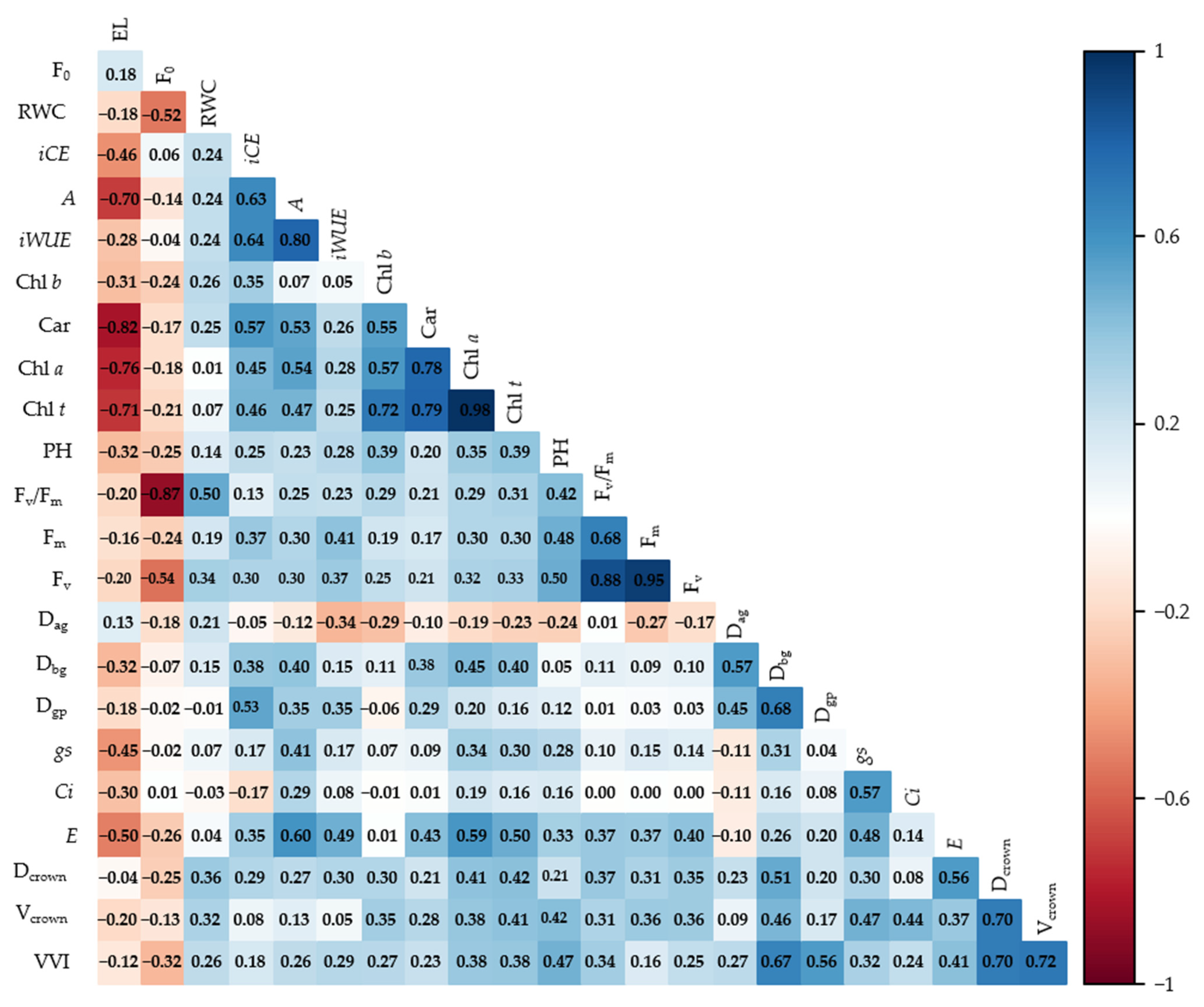
Pearson’s correlation matrix analysis (Figure 11) shows interactions among the morphological and physiological variables of dwarf cashew plants under irrigation with saline water and salicylic acid concentrations. The correlation matrix revealed relevant associations, with the strongest being observed between Fm and Fv, showing a positive correlation of r = 0.98, followed by Chl a and Chl t (0.92), and Car and Chl a (0.78). A very strong negative correlation was observed between F0 and Fv/Fm (−0.87), followed by EL with Car, Chl a, Chl t, and A (−0.82, −0.76, −0.71, and −0.70, respectively). Other correlations observed included gs and Ci (0.57), E and Dcrown (0.56), A and iWUE (0.80), and Dbg and VVI (0.66). Moderate correlations were observed between Dbg and VVI (0.56), A and E (0.60), Chl a and E (0.59), and iCE and Dgp (0.53). Moderate negative correlations were also highlighted between F0 and RWC (−0.52).

4. Discussion

4.1. Salt Stress and Potential Mitigators in Semi-Arid Environments

In regions characterized by a semiarid climate, irregular rainfall patterns, combined with high air temperatures and elevated evapotranspiration rates, result in limited water availability throughout most of the year [26]. Consequently, irrigation has been widely adopted in semiarid regions to meet crop water requirements; however, these water sources often contain dissolved salts that may induce a range of morphophysiological alterations in plants [3]. Salt stress is considered one of the major abiotic constraints limiting agricultural production, particularly in the semiarid regions of Northeastern Brazil [5].
In this context, strategies that enable the use of brackish water and/or mitigate its deleterious effects are essential for the sustainability of agricultural production [27]. Among these strategies, the application of osmoprotective compounds such as salicylic acid (SA) has emerged as a promising approach, as it can contribute to the mitigation of physiological damage and the induction of tolerance mechanisms against abiotic stresses, including salt stress [28].

4.2. Membrane Stability and Electrolyte Leakage Under Environmental Stress

The increase in salt concentration within the root zone reduced root water potential, leading to a decline in relative water content (RWC) (Figure 3A). This response may be associated with the increase in soil osmotic pressure, which limits water availability for plant uptake [29]. In addition, high salt concentrations in the soil restrict the ability of roots to absorb water and nutrients [30].
However, these effects were mitigated by the application of salicylic acid (SA). This response may be related to the SA-induced accumulation of osmoprotective compounds, which contribute to osmotic homeostasis and improved plant water status under saline conditions [31]. Evaluating the effects of salicylic acid application on dwarf cashew plants irrigated with brackish water, Silva et al. [13] reported that the application of 1.0 mM SA alleviated the deleterious effects of irrigation water with an electrical conductivity of 1.2 dS m−1, resulting in the highest leaf relative water content (93.5%).
As a consequence of reduced leaf turgor, cells become more susceptible to lipid peroxidation, thereby promoting ion leakage. Furthermore, excessive concentrations of salts such as Na+ and Cl can cause cellular disturbances due to the overproduction of reactive oxygen species (ROS) [32], as evidenced in the present study by the increase in electrolyte leakage (Figure 3B). Supporting these findings, a negative correlation was observed between RWC and electrolyte leakage (EL) (Figure 11), reinforcing the hypothesis that leaf water status directly influences cellular membrane integrity.
Nevertheless, this effect was attenuated when SA was applied at a concentration of 1.2 mM. This response may be attributed to the role of SA in maintaining membrane stability and ionic homeostasis [33]. Salicylic acid participates in ROS signaling and regulates the antioxidant defense system, balancing the production and scavenging of reactive molecules and thereby reducing lipid peroxidation, even under irrigation with saline water [34]. In the present study, the observed EL values indicated the absence of severe cellular damage, since, according to [35], cellular injury is generally considered to occur only when EL exceeds 50%.

4.3. Photosynthetic Performance and Carbon Assimilation Rates

Salinity reduced leaf water status (Figure 3A) and increased EL (Figure 3B), which likely contributed to the reductions observed in stomatal conductance (Figure 4A) and transpiration (Figure 4D). These effects directly impaired carbon assimilation by limiting CO2 diffusion into the substomatal chambers [36], thereby affecting internal CO2 concentration (Figure 4B). Notably, these variables exhibited negative correlations (Figure 11), indicating an inverse relationship and highlighting their sensitivity to increasing salinity levels in the irrigation water.
The accumulation of salts in the root zone intensifies osmotic stress and restricts water and nutrient uptake by plants, stimulating abscisic acid (ABA) synthesis and inducing partial stomatal closure, which limits atmospheric CO2 uptake [37,38]. Consequently, the reduction in CO2 availability within the substomatal chambers affects the activity of ribulose-1,5-bisphosphate carboxylase/oxygenase (RuBisCO), decreasing photosynthetic carbon fixation and favoring photorespiration [39].
As a consequence, instantaneous carboxylation efficiency was reduced (Figure 5A). This response may be associated with metabolic limitations in the Calvin cycle caused by reduced RuBisCO activity and a lower supply of ATP and NADPH, ultimately impairing carbon fixation [40]. Under saline conditions, plants also reduce water consumption as an acclimation strategy. This response is reflected by decrease in instantaneous water use efficiency (Figure 5B), which may be associated with disturbances in water balance and gas exchange induced by osmotic stress. Partial stomatal closure limits atmospheric CO2 uptake, reduces net photosynthetic rate, and alters transpiration control, resulting in lower efficiency of water use for carbon fixation [41].
In contrast, the beneficial effects of salicylic acid (SA) on stomatal conductance (gs) and internal CO2 concentration (Ci) (Figure 4A,B) may be attributed to its antioxidant properties, which reduce the accumulation of H2O2 and O2 and consequently minimize damage to membrane proteins and phospholipids through improvements in the K+/Na+ ratio [11]. In the present study, SA effectively mitigated the deleterious effects of salinity by increasing relative water content (Figure 3A) and enhancing stomatal conductance (Figure 4A). These responses are likely associated with the strong positive correlation observed between these variables.
The improvements in gs (Figure 4A) and Ci (Figure 4B) promoted an increase in CO2 assimilation rate (Figure 4C) under SA application. This result may be related to enhanced CO2 utilization efficiency by RuBisCO [11], indicating a greater prevalence of carboxylation over photorespiration. Similar findings were reported by [14] in sour passion fruit plants irrigated with saline water (ECiw ranging from 0.4 to 3.6 dS m–1), where the application of 1.2 mM SA alleviated the adverse effects of salt stress on gas exchange. Furthermore, salicylic acid improved photosynthetic performance, indicating greater efficiency in CO2 fixation. This effect may be associated with the antioxidant properties of SA, which contribute to maintaining the balance between the production and scavenging of reactive oxygen species (ROS) [42].

4.4. Photosynthetic Pigment Degradation

Irrigation with saline water negatively affected the photosynthetic pigments of dwarf cashew plants. This result indicates that salts present in the irrigation water impaired the functional integrity of photosystem II, as evidenced by the reductions observed in chlorophyll a (Chl a), chlorophyll total (Chl t), and carotenoid (Car) contents (Figure 6A–C). Similar reductions in the synthesis of photosynthetic pigments were reported in grafted dwarf cashew clones (CCP 76 and BRS 226) subjected to increasing salinity levels ranging from 0.4 to 3.6 dS m–1 [13]. These reductions are likely associated with the intensification of salt-induced oxidative toxicity, which damages chloroplast membranes, destabilizes pigment–protein complexes, and inhibits pigment biosynthesis [43].
In addition, chloroplast degradation and increased chlorophyllase activity may promote chlorophyll photooxidation, thereby reducing the efficiency of the light harvesting antenna complex [44]. Under salt stress conditions, reductions in the activity of both photosystem I (PSI) and photosystem II (PSII) may also occur, impairing electron transport and the generation of primary electron acceptors. Under normal conditions, electrons are transferred from the primary acceptor of PSII to PSI and subsequently to NADP+ via ferredoxin (Fd) [45].
Therefore, the reductions imposed by irrigation water salinity may impair photochemical activity and decrease the production of ATP and NADPH required for the biochemical phase of photosynthesis [40]. This response may explain the limitations observed in gas exchange (Figure 4A–D), particularly in instantaneous carboxylation efficiency (Figure 5A), as this variable exhibited a clustering pattern similar to that of the photosynthetic pigments, as evidenced by the principal component analysis (Figure 10).

4.5. Photosystem II Efficiency

Corroborating the results obtained for photosynthetic pigments affected by salt stress, an increase in initial chlorophyll a fluorescence (F0) (Figure 7A) and reductions in the quantum efficiency of photosystem II (Figure 7B) were observed as irrigation water salinity increased. Under saline conditions, excessive production of reactive oxygen species (ROS) occurs, intensifying the degradation of proteins and cell wall components and causing damage to the photosynthetic apparatus [46].
When evaluating cashew plants irrigated with water of different electrical conductivity levels, Fatima et al. [47] reported that irrigation water salinity levels above 2.1 dS m−1 reduced the photochemical efficiency of photosystem II, directly impairing the photosynthetic apparatus. This response may be associated with a reduction in the activity of the oxygen-evolving complex on either the donor or acceptor side of PSII, resulting in the transfer of excess electrons to oxygen at PSI and the consequent generation of oxygen singlet (1O2), which may compromise chloroplast integrity [48].
However, the application of salicylic acid (SA) exerted beneficial effects on F0, Fv, and Fv/Fm (Figure 7A–C), reducing initial fluorescence while increasing variable fluorescence and the quantum efficiency of photosystem II. Salicylic acid is known to stimulate electron transport, facilitating the dissipation of excess energy generated under abiotic stresses such as salinity [11]. This dissipation stabilizes PSII and PSI supercomplexes, improves plant metabolism, promotes ROS scavenging, and consequently reduces F0 while increasing Fm in plants [49].
Furthermore, SA enhances the activity of antioxidant enzymes, contributing to the maintenance of redox homeostasis and the prevention of cellular damage. These effects favor membrane integrity, thereby preserving the functionality of the photosystems and promoting greater photosynthetic efficiency [50], even under conditions of increased chlorophyllase activity.

4.6. Morphological Development

Regarding the growth of dwarf cashew plants, reductions were observed in all evaluated variables as irrigation water salinity increased. The decline in plant water status, gas exchange, and photosynthetic pigments, together with the increase in electrolyte leakage, compromised the energy supply required for the regulation of plant metabolism, promoting the redistribution of resources toward the maintenance of cellular homeostasis [51]. This process limits cell expansion and division, thereby directly impairing plant growth [52,53].
Dwarf cashew is classified as moderately sensitive to irrigation water salinity during the pre-flowering stage, with 1.6 dS m−1 being considered the salinity threshold for this phenological stage [54]. Similarly, Capitulino et al. [55], evaluating the effects of saline water irrigation on soursop cv. Morada Nova, reported that increasing ECiw from 0.8 to 3.2 dS m−1 inhibited stem diameter growth and plant height.
On the other hand, these deleterious effects were mitigated by the application of salicylic acid (SA). According to Xin et al. [56], SA increases chlorophyll contents and enhances the efficiency of ribulose-1,5-bisphosphate carboxylase/oxygenase (RuBisCO), thereby improving photosynthetic performance and, consequently, plant growth through enhanced cell expansion and division. In addition, SA treatment may induce the expression of genes involved in melatonin biosynthesis, promoting higher endogenous melatonin levels [57], which may contribute to plant growth even under abiotic stress conditions.
Overall, irrigation with saline water caused significant damage to the morphophysiological structure of dwarf cashew plants under the conditions imposed in this study. These findings support the general hypothesis proposed herein. In this context, when applied at appropriate concentrations (Table 1), salicylic acid can stimulate nutrient uptake and improve nutrient use efficiency, resulting in enhanced antioxidant defense responses and the modulation of morphophysiological processes, such as cell elongation [58]. Therefore, SA represents a promising strategy for cashew cultivation in semiarid regions.

5. Conclusions

Irrigation water salinity up to 3.6 dS m−1 inhibits the synthesis of photosynthetic pigments, gas exchange, chlorophyll a fluorescence, and growth of dwarf cashew plants. Foliar application of salicylic acid at concentrations ranging from 0.1 to 2.5 mM attenuates the effects of salt stress on relative water content, stomatal conductance, internal CO2 concentration, CO2 assimilation rate, instantaneous carboxylation efficiency, variable fluorescence, quantum efficiency of photosystem II, stem diameter at the graft union, and plant height, in addition to reducing electrolyte leakage and initial fluorescence of dwarf cashew plants at 180 days after transplanting.
The hypothesis initially formulated was corroborated by the experimental data obtained in this study. The results demonstrated a significant impact of irrigation water salinity levels on dwarf cashew plants. However, it is assumed that salicylic acid (SA), when applied at appropriate doses, mitigates the deleterious effects of salts on the growth and physiology of cashew plants. It should also be emphasized that high SA concentrations potentiate significant reductions, thereby acting as an intensifier of damage caused by salt ions.
For future studies with dwarf cashew plants, it is recommended to evaluate the long-term effects of foliar SA application up to the productive phase, using concentrations less than 3 mM. It is also advisable to include smaller intervals between salinity levels, allowing better characterization of the maximum salinity tolerance of this crop. Furthermore, it is essential to conduct further research focused on the molecular mechanisms involved in the accumulation of compounds under controlled salt stress conditions, as well as the economic feasibility studies to support and validate the adoption of these practices on a commercial scale, especially in semi-arid regions where family farming predominates.

Supplementary Materials

The following supporting information can be downloaded at: https://www.mdpi.com/article/10.3390/horticulturae12070823/s1, Table S1: Summary of the analysis of variance for relative water content (RWC) and electrolyte leakage (EL) of early dwarf cashew trees cultivated under saline irrigation water and foliar application of salicylic acid at 180 days after transplanting, Table S2: Analysis of variance for stomatal conductance (gs), internal carbon concentration (Ci), transpiration (E), CO2; assimilation rate (A), instantaneous carboxylation efficiency (iCE), and instantaneous water use efficiency (iWUE) of early dwarf cashew trees cultivated under saline irrigation water and foliar application of salicylic acid at 180 days after transplanting; Table S3: Summary of the analysis of variance for chlorophyll a (Chl a), chlorophyll b (Chl b), total chlorophyll (Chl t), and carotenoids (Car) of early dwarf cashew trees cultivated under saline irrigation water and foliar application of salicylic acid at 180 days after transplanting; Table S4: Analysis of variance for initial fluorescence (F0), maximum fluorescence (Fm), variable fluorescence (Fv), and quantum efficiency of photosystem II (Fv/Fm) of early dwarf cashew trees under saline irrigation water and foliar application of salicylic acid at 180 days after transplanting. Table S5: Summary of the analysis of variance for stem diameter below the graft union (Dbg), stem diameter at the graft union (Dgp), stem diameter above the graft union (Dag), plant height (PH), canopy diameter (Dcrown), canopy volume (Vcrown), and vegetative vigor index (VVI) of dwarf cashew trees cultivated under saline water conditions with foliar application of salicylic acid at 180 days after transplanting.

Author Contributions

Conceptualization, T.F.d.L.A., G.S.d.L. and C.A.V.d.A.; methodology, A.A.R.d.S. and L.F.S.S.; validation, L.A.d.A.S.; formal analysis, R.D.S., A.R.d.S., L.D.A.B., T.R.A.d.S., K.G.N., D.S.C., V.D.d.S., A.A.d.S. and E.D.d.A.; investigation, T.F.d.L.A. and H.R.G.; resources, G.S.d.L. and C.A.V.d.A.; writing—original draft preparation, G.S.d.L.; writing—review and editing, C.A.V.d.A., A.A.R.d.S. and H.R.G.; visualization, T.F.d.L.A.; supervision, G.S.d.L. and C.A.V.d.A.; funding acquisition, G.S.d.L. and C.A.V.d.A. All authors have read and agreed to the published version of the manuscript.

Funding

Funding was acquired from the National Council for Scientific and Technological Development—CNPq (Process 406570/022-1), Coordination for the Improvement of Higher Education Personnel—CAPES (Code 001).

Data Availability Statement

The original contributions presented in this study are included in the article. Further inquiries can be directed to the corresponding author.

Acknowledgments

To the National Institute in Science and Technology in Sustainable Agriculture in the Tropical Semi-Arid Region—INCTAgriS, National Council for Scientific and Technological Development—CNPq, Coordination for the Improvement of Higher Education Personnel—CAPES, and Ceará Foundation for Support to Scientific and Technological Development for the financial support to conduct the research.

Conflicts of Interest

The authors declare no conflicts of interest.

References

  1. Oliveira, N.N.; Mothé, C.G.; Mothé, M.G.; de Oliveira, L.G. Cashew nut and cashew apple: A scientific and technological monitoring worldwide review. J. Food Sci. Technol. 2020, 57, 12–21. [Google Scholar] [PubMed]
  2. IBGE. Produção de Castanha-de-Caju (Cultivo) no Brasil. Available online: https://www.ibge.gov.br/explica/producao-agropecuaria/castanha-de-caju-cultivo/br (accessed on 22 June 2025).
  3. Berríos, P.; Temnani, A.; Zapata-García, S.; Sánchez-Navarro, V.; Zornoza, R.; Pérez-Pastor, A. Effect of deficit irrigation and mulching on the agronomic and physiological response of mandarin trees as strategies to cope with water scarcity in a semi-arid climate. Sci. Hortic. 2024, 324, 112572. [Google Scholar] [CrossRef] [Scilit]
  4. Li, Z.; Zhu, L.; Zhao, F.; Li, J.; Zhang, X.; Kong, X.; Wu, H.; Zhang, Z. Plant salinity stress response and nano-enabled plant salt tolerance. Front. Plant Sci. 2022, 13, 843994. [Google Scholar] [CrossRef] [Scilit] [PubMed]
  5. Chen, A.; Feng, Y.; Yang, Y.; Kong, Y.; Wang, H.; Rehman, M.; Maqbool, Z.; Fahad, X.; Deng, G.; Wang, H. Enhancing potato (Solanum tuberosum L.) resilience: The role of selenium in modulating growth, antioxidant capacity and tuber quality under salinity stress. J. Agric. Food Res. 2025, 23, 102259. [Google Scholar] [CrossRef] [Scilit]
  6. da Silva, A.A.R.; de Lima, G.S.; de Azevedo, C.A.V.; Gheyi, H.R.; Soares, L.A.d.A.; Veloso, L.L.d.S.A. Salicylic acid improves physiological indicators of soursop irrigated with saline water. Rev. Bras. Eng. Agric. Ambient. 2022, 26, 412–419. [Google Scholar] [CrossRef] [Scilit]
  7. Pereira, A.L.; da Costa, T.A.R.; Sousa, V.F.d.O.; de Medeiros, N.C.L.; de Souza, N.P.; Nobre, R.G.; Soares, L.A.d.A. Morphophysiology of early dwarf cashew under salt stress and nitrogen and potassium fertilization. Rev. Caatinga. 2025, 38, e12727. [Google Scholar] [CrossRef] [Scilit]
  8. Sousa, V.F.d.O.; dos Santos, G.L.; Maia, J.M.; Maia Júnior, S.d.O.; Santos, J.P.d.O.; Costa, J.E.; da Silva, A.F.; Dias, T.J.; Ferreira-Silva, S.L.; Taniguchi, C.A.K. Salinity-tolerant dwarf cashew rootstock has better ionic homeostasis and morphophysiological performance of seedlings. Rev. Bras. Eng. Agric. Ambient. 2023, 27, 92–100. [Google Scholar] [CrossRef] [Scilit]
  9. Gohari, H.; Farhadi, H.; Panahirad, S.; Zareei, E.; Labib, P.; Jafari, H.; Mahdavinia, G.; Hassanpouraghdam, M.B.; Ioannou, A.; Kulak, M.; et al. Mitigation of salinity impact in spearmint plants through the application of engineered chitosan-melatonin nanoparticles. Int. J. Biol. Macromol. 2023, 224, 893–907. [Google Scholar] [CrossRef] [Scilit] [PubMed]
  10. Kumar, S.; Ahanger, M.A.; Alshaya, H.; Jan, B.L.; Yerramilli, V. Salicylic acid mitigates salt induced toxicity through the modifications of biochemical attributes and some key antioxidants in Capsicum annuum. Saudi J. Biol. Sci. 2022, 29, 1337–1347. [Google Scholar] [CrossRef] [Scilit] [PubMed]
  11. Song, W.; Shao, H.; Zheng, A.; Zhao, L.; Xu, Y. Advances in roles of salicylic acid in plant tolerance responses to biotic and abiotic stresses. Plants 2023, 12, 3475. [Google Scholar] [CrossRef] [Scilit] [PubMed]
  12. Jahan, S.; Anjali, K.; Panwar, M.; Mishra, R.; Shankhdhar, S.C.; Shankhdhar, D. Integrative impacts of salicylic acid and water stress on physiological processes of the medicinal herb Bacopa monnieri (L.). Plant Physiol. Rep. 2024, 29, 65–75. [Google Scholar] [CrossRef] [Scilit]
  13. da Silva, A.A.R.; de Lima, G.S.; de Azevedo, C.A.V.; Arruda, T.F.d.L.; Gheyi, H.R.; Soares, L.A.d.A. Salicylic acid attenuates the harmful effects of salt stress on the morphophysiology of early dwarf cashew. Cienc. Agrotec. 2023, 47, e015622. [Google Scholar] [CrossRef] [Scilit]
  14. Galvão Sobrinho, T.; da Silva, A.A.R.; de Lima, G.S.; de Lima, V.L.A.; Borges, V.E.; Nunes, K.G.; Soares, L.A.d.A.; Saboya, L.M.F.; Gheyi, H.R.; Gomes, J.P.; et al. Foliar applications of salicylic acid on boosting salt stress tolerance in sour passion fruit in two cropping cycles. Plants 2023, 12, 2023. [Google Scholar] [CrossRef] [Scilit] [PubMed]
  15. Lacerda, C.N.; de Lima, G.S.; Soares, L.A.d.A.; de Fátima, R.T.; Gheyi, H.R.; Azevedo, C.A.V. Morphophysiology and production of guava as a function of water salinity and salicylic acid. Rev. Bras. Eng. Agric. Ambient. 2022, 26, 451–458. [Google Scholar] [CrossRef] [Scilit]
  16. United States. Soil Survey Staff. In Keys to Soil Taxonomy, 12th ed.; USDA Natural Resources Conservation Service: Washington, DC, USA, 2014. Available online: https://www.nrcs.usda.gov/wps/portal/nrcs/main/soils/survey/ (accessed on 26 June 2025).
  17. Teixeira, P.C.; Donagemma, G.K.; Fontana, A.; Teixeira, W.G. Manual de Métodos de Análise de Solo, 3rd ed.; Embrapa: Brasília, Brasil, 2017; 573p. [Google Scholar]
  18. Oliveira, V.H. Cultivo do Cajueiro Anão Precoce; Embrapa Agroindústria Tropical: Fortaleza, Brasil, 2008; 42p. [Google Scholar]
  19. Richards, L.A. Diagnosis and Improvement of Saline and Alkali Soils; U.S. Department of Agriculture: Washington, DC, USA, 1954; 160p. [Google Scholar] [CrossRef] [Scilit]
  20. Weatherley, P.E. Studies in the water relations of the cotton plant. I. The field measurement of water deficits in leaves. New Phytol. 1950, 49, 81–97. [Google Scholar] [CrossRef] [Scilit]
  21. Scotti-Campos, P.; Pham-Thi, A.-T.; Semedo, J.N.; Pais, I.P.; Ramalho, J.C.; Matos, M.C. Physiological responses and membrane integrity in three Vigna genotypes with contrasting drought tolerance. Emir. J. Food Agric. 2013, 25, 1002–1013. [Google Scholar] [CrossRef] [Scilit]
  22. Barnes, J.D.; Balaguer, L.; Manrique, E.; Elvira, S.; Davison, A.W. A reappraisal of the use of DMSO for the extraction and determination of chlorophylls a and b in lichens and higher plants. Environ. Exp. Bot. 1992, 32, 85–100. [Google Scholar] [CrossRef] [Scilit]
  23. Cruz, A.C.F.; Santos, R.P.; Iarema, L.; Fernandes, K.R.G.; Kuki, K.N.; Araújo, R.F.; Otoni, W.C. Métodos comparativos na extração de pigmentos foliares de três híbridos de Bixa orellana L. Rev. Bras. Biosci. 2007, 5, 777–779. [Google Scholar]
  24. Portella, C.R.; Marinho, C.S.; Amaral, B.D.; Carvalho, W.S.G.; Campos, G.S.; Silva, M.P.S.D.; Sousa, M.C.D. Desempenho de cultivares de citros enxertadas sobre o trifoliateiro ‘Flying Dragon’ e limoeiro ‘Cravo’ em fase de formação do pomar. Bragantia 2016, 75, 70–75. [Google Scholar] [CrossRef] [Scilit]
  25. Ferreira, D.F. SISVAR: A computer analysis system to fixed effects split-plot type designs. Rev. Bras. Biom. 2019, 37, 529–535. [Google Scholar] [CrossRef] [Scilit]
  26. El-Hendawy, S.; Mohammed, N.; Al-Suhaibani, N. Enhancing wheat growth, physiology, yield, and water use efficiency under deficit irrigation by integrating foliar application of salicylic acid and nutrients at critical growth stages. Plants 2024, 13, 1490. [Google Scholar] [CrossRef] [Scilit] [PubMed]
  27. Mahmoud, N.E.; Abdel-Gawad, H.; Abdelhameed, R.M. Post-synthetic modification of nano-chitosan using gibberellic acid: Foliar application on sorghum under salt stress conditions. Plant Physiol. Biochem. 2024, 5, 108655. [Google Scholar] [CrossRef] [Scilit] [PubMed]
  28. Khan, M.I.; Poór, P.; Janda, T. Salicylic acid: A versatile signaling molecule in plants. J. Plant Growth Regul. 2022, 41, 1887–1890. [Google Scholar] [CrossRef] [Scilit]
  29. Liu, C.; Jiang, X.; Yuan, Z. Plant responses and adaptations to salt stress: A review. Horticulturae 2024, 10, 1221. [Google Scholar] [CrossRef] [Scilit]
  30. Najafi, R.; Rezaei, A.; Mozafarian, M. Physiological and biochemical responses of okra (Abelmoschus esculentus) under salinity stress in Iran. J. Agric. Food Res. 2024, 18, 101322. [Google Scholar] [CrossRef] [Scilit]
  31. Zafar, Z.; Rasheed, F.; Mushtaq, N.; Khan, M.U.; Mohsin, M.; Irshad, M.A.; Summer, M.; Raza, Z.; Gailing, O. Exogenous application of salicylic acid improves physiological and biochemical attributes of Morus alba saplings under soil water deficit. Forests 2023, 14, 236. [Google Scholar] [CrossRef] [Scilit]
  32. Koç, İ.; Nzokou, P.; Cregg, B. Biomass allocation and nutrient use efficiency in response to water stress: Insight from experimental manipulation of balsam fir, concolor fir and white pine transplants. New For. 2022, 53, 915–933. [Google Scholar] [CrossRef] [Scilit]
  33. Kashif, U.H.; Feng, J.; Dai, R.; Fan, Y.; Xia, Y.; Liu, Z. Salicylic acid-mediated alleviation of salt stress: Insights from physiological and transcriptomic analysis in Asarum sieboldii Miq. Chemosphere 2024, 362, 142604. [Google Scholar] [CrossRef] [Scilit] [PubMed]
  34. Alam, P.; Karabulut, F.; Iqbal, J.; Sharma, R.; Fathi, A.; Bagci, E.; Faizan, M. Role of jasmonic acid and salicylic acid in salinity stress mitigation in plants. Front. Plant Sci. 2026, 17, 1824082. [Google Scholar] [CrossRef] [Scilit] [PubMed]
  35. Sullivan, C.Y. Mechanisms of heat and drought resistance in grain sorghum and methods of measurement. In Sorghum in the Seventies; Rao, N.G.P., House, L.R., Eds.; Oxford and IBH Publishing: New Delhi, India, 1972; pp. 247–264. [Google Scholar]
  36. Qiao, M.; Hong, C.; Jiao, Y.; Hou, S.; Gao, H. Impacts of drought on photosynthesis in major food crops and the related mechanisms of plant responses to drought. Plants 2024, 13, 1808. [Google Scholar] [CrossRef] [Scilit] [PubMed]
  37. Soni, S.; Kumar, A.; Sehrawat, N.; Kumar, A.; Kumar, N.; Lata, C.; Mann, A. Effect of saline irrigation on plant water traits, photosynthesis and ionic balance in durum wheat genotypes. Saudi J. Biol. Sci. 2021, 28, 2510–2517. [Google Scholar] [CrossRef] [Scilit] [PubMed]
  38. Fernandes, C.d.S.; Ferreira-Neto, M.; Dias, N.d.S.; Reges, L.B.L.; Silva, L.d.A.; Moreira, R.C.L.; de Silva, A.A.; de Paiva, E.P.; Fernandes, P.D.; Sá, F.V.d.S. The appropriate source of nitrogen for Italian zucchini under salt stress conditions. J. Soil Sci. Plant Nutr. 2022, 22, 560–570. [Google Scholar] [CrossRef] [Scilit]
  39. Saeedi, R.; Seyedi, A.; Esmaeilizadeh, M.; Seyedi, N.; Zahedi, S.M. Efficiency of chitosan-selenium-containing nanostructures in grafted citrus seedlings under salinity stress: Element uptake, biochemical and morphological changes. J. Soil Sci. Plant Nutr. 2025, 25, 1813–1829. [Google Scholar] [CrossRef] [Scilit]
  40. Xavier, A.V.O.; de Lima, G.S.; Gheyi, H.R.; da Silva, A.A.R.; Soares, L.A.d.A.; de Lacerda, C.N. Gas exchange, growth and quality of guava seedlings under salt stress and salicylic acid. Ambiente Água. 2022, 17, e2816. [Google Scholar] [CrossRef] [Scilit]
  41. Hou, J.; Liu, X.; Zhang, J.; Wei, Z.; Ma, Y.; Wan, H.; Liu, F. Combined application of biochar and partial root-zone drying irrigation improves water relations and water use efficiency of cotton plants under salt stress. Agric. Water Manag. 2023, 290, 108584. [Google Scholar] [CrossRef] [Scilit]
  42. Hasanuzzaman, M.; Ahmed, N.; Saha, T.; Rahman, M.; Rahman, K.; Alam, M.M.; Rohman, M.M.; Nahar, K. Exogenous salicylic acid and kinetin modulate reactive oxygen species metabolism and glyoxalase system to confer waterlogging stress tolerance in soybean (Glycine max L.). Plant Stress 2022, 3, e100057. [Google Scholar] [CrossRef] [Scilit]
  43. Soares, L.A.d.A.; de Oliveira, S.G.; de Lima, G.S.; Fernandes, P.D.; Araújo, R.H.C.R.; Fernandes, E.A. Physiological changes of pomegranate seedlings under salt stress and nitrogen fertilization. Rev. Bras. Eng. Agric. Ambient. 2021, 25, 453–459. [Google Scholar] [CrossRef] [Scilit]
  44. Nedjimi, B. Selenium as a powerful trace element for mitigation of plant salt stress: A review. J. Trace Elem. Miner. 2024, 8, e100123. [Google Scholar] [CrossRef] [Scilit]
  45. Sun, C.; Sida, M.; Baofeng, W.; Siting, Z.; Yulong, L.; Mingfang, Q.; Zhenqi, W.; Zepeng, Y.; Tianlai, L. Exogenous melatonin enhances tomato heat resistance by regulating photosynthetic electron flux and maintaining ROS homeostasis. Plant Physiol. Biochem. 2023, 196, 197–209. [Google Scholar] [CrossRef] [Scilit] [PubMed]
  46. Arruda, T.F.d.L.; de Lima, G.S.; da Silva, A.A.R.; de Azevedo, C.A.V.; de Souza, A.R.; Soares, L.A.d.A.; Gheyi, H.R.; de Lima, V.L.A.; Fernandes, P.D.; da Silva, F.d.A.; et al. Salicylic acid as a salt stress mitigator on chlorophyll fluorescence, photosynthetic pigments, and growth of precocious-dwarf cashew in the post-grafting phase. Plants 2023, 12, 2783. [Google Scholar] [CrossRef] [Scilit] [PubMed]
  47. de Fatima, R.T.; Nobre, R.G.; Lima, G.S.d.; Figueiredo, F.R.A.; Souza, L.d.P.; Pimenta, T.A. Photochemical efficiency of cashew rootstocks under salt stress and foliar application of potassium silicate. Comun. Sci. 2022, 13, 1. [Google Scholar] [CrossRef] [Scilit]
  48. Iqbal, W.; Afridi, M.Z.; Jamal, A.; Mihoub, A.; Saeed, M.F.; Székely, Á.; Pompelli, M.F. Canola seed priming and its effect on gas exchange, chlorophyll photobleaching, and enzymatic activities in response to salt stress. Sustainability 2022, 14, 9377. [Google Scholar] [CrossRef] [Scilit]
  49. Lotfi, R.; Ghassemi-Golezani, K.; Pessarakli, M. Salicylic acid regulates photosynthetic electron transfer and stomatal conductance of mung bean (Vigna radiata L.) under salinity stress. Biocatal. Agric. Biotechnol. 2020, 26, 101635. [Google Scholar] [CrossRef] [Scilit]
  50. Aires, E.S.; Ferraz, A.K.L.; Ribera, L.; Teixeira, F.P.; Carvalho, B.L.; Silva, D.M.R.; Freschi, L.; Rodrigues, J.D.; Ono, E.O. The application of salicylic acid minimizes the deleterious effects of water deficit in tomato through metabolic and ABA adjustments. Plant Physiol. Biochem. 2025, 229, 110417. [Google Scholar] [CrossRef] [Scilit] [PubMed]
  51. Wu, P.; Li, B.; Liu, Y.; Bian, Z.; Xiong, J.; Wang, Y.X.; Zhu, B. Multiple physiological and biochemical functions of ascorbic acid in plant growth, development, and abiotic stress response. Int. J. Mol. Sci. 2024, 25, 1832. [Google Scholar] [CrossRef] [Scilit] [PubMed]
  52. Isayenkov, S.V.; Maathuis, F.J.M. Plant salinity stress: Many unanswered questions remain. Front. Plant Sci. 2019, 10, 80. [Google Scholar] [CrossRef] [Scilit] [PubMed]
  53. Nóbrega, J.S.; Figueiredo, F.R.d.A.; da Silva, T.I.; de Fátima, R.T.; Ferreira, J.T.A.; Ribeiro, J.E.d.S.R.; Bruno, R.d.L.A. Ecophysiology of Mesosphaerum suaveolens (L.) Kuntze (Lamiaceae) under saline stress and salicylic acid. Ciênc. Rural. 2022, 52, e20210389. [Google Scholar] [CrossRef] [Scilit]
  54. Carneiro, P.T.; Cavalcanti, M.L.; Brito, M.E.; Gomes, A.H.; Fernandes, P.D.; Gheyi, H.R. Sensibilidade do cajueiro anão precoce ao estresse salino na pré-floração. Rev. Bras. Cienc. Agrar. 2007, 2, 150–155. [Google Scholar] [CrossRef] [Scilit]
  55. Capitulino, J.D.; de Lima, G.S.; de Azevedo, C.A.V.; da Silva, A.A.R.; Arruda, T.F.d.L.; de Souza, A.R.; Soares, L.A.d.A.; Nascimento, R.d. Hydrogen peroxide in attenuating salt stress in soursop. Rev. Caatinga 2024, 37, e11876. [Google Scholar] [CrossRef] [Scilit]
  56. Xin, L.; Wang, J.; Yang, Q. Exogenous salicylic acid alleviates water deficit stress by protecting photosynthetic system in maize seedlings. Agronomy 2023, 13, 2443. [Google Scholar] [CrossRef] [Scilit]
  57. Guo, W.; Zhang, C.; Yang, R.; Zhao, S.; Han, X.; Wang, Z.; Li, S.; Gao, H. Endogenous salicylic acid mediates melatonin-induced stress tolerance in kiwifruit. Postharvest Biol. Technol. 2023, 201, 112341. [Google Scholar] [CrossRef] [Scilit]
  58. Alam, P.; Balawi, T.A.; Faizan, M. Salicylic acid’s impact on growth, photosynthesis, and antioxidant enzyme activity of Triticum aestivum when exposed to salt. Molecules 2023, 28, 100. [Google Scholar] [CrossRef] [Scilit] [PubMed]
Figure 1. Meteorological data recorded during the trial included maximum and minimum air temperatures, as well as the average atmospheric relative humidity.
Horticulturae 12 00823 g001
Figure 2. Early dwarf cashew plants at different growth stages.
Horticulturae 12 00823 g002
Figure 3. Relative water content (RWC) (A) and electrolyte leakage (EL) (B) in early dwarf cashew plants subjected to the interaction between irrigation water electrical conductivity levels (ECiw) and salicylic acid concentrations (SA) at 180 days after transplanting. X–ECiw; Y–SA; *—significant at p ≤ 0.05; ns—not significant by the F test; error bars represent the standard error of the mean (n = 3).
Horticulturae 12 00823 g003
Figure 4. Stomatal conductance (gs) (A), internal CO2 concentration (Ci) (B), and CO2 assimilation rate (A) (C) of early dwarf cashew plants subjected to the interaction between irrigation water electrical conductivity levels (ECiw) and salicylic acid concentrations (SA), as well as transpiration (E) (D) as a function of ECiw levels, at 180 days after transplanting. X–ECiw; Y–SA; *—significant at p ≤ 0.05; ns—not significant by the F test; error bars represent the standard error of the mean (n = 3).
Horticulturae 12 00823 g004
Figure 5. Instantaneous carboxylation efficiency (iCE) (A) of early dwarf cashew plants as a function of the interaction between irrigation water electrical conductivity levels (ECiw) and salicylic acid concentrations (SA), and instantaneous water use efficiency (iWUE) (B) as a function of ECiw levels, at 180 days after transplanting. X–ECiw Y–SA; **—significant at p ≤ 0.01; *—significant at p ≤ 0.05; ns—not significant by the F test; error bars represent the standard error of the mean (n = 3).
Horticulturae 12 00823 g005
Figure 6. Chlorophyll a (Chl a) (A), chlorophyll total (Chl t) (B), and carotenoid (Car) (C) contents in dwarf cashew plants as a function of irrigation water electrical conductivity (ECiw) at 180 days after transplanting. **—significant at p ≤ 0.01; *—significant at p ≤ 0.05 by the F test; error bars represent the standard error of the mean (n = 3).
Horticulturae 12 00823 g006
Figure 7. Initial fluorescence (F0) (A) and maximum quantum efficiency of photosystem II (Fv/Fm) (C) in early dwarf cashew plants as a function of the interaction between irrigation water electrical conductivity (ECiw) and salicylic acid concentrations (SA), and variable fluorescence (Fv) (B) as a function of SA concentrations, at 180 days after transplanting. X–ECiw; Y–SA; **—significant at p ≤ 0.01; *—significant at p ≤ 0.05; ns—not significant by the F test; error bars represent the standard error of the mean (n = 3).
Horticulturae 12 00823 g007
Figure 8. Stem diameter below the graft point (Dbg) (A), stem diameter at the graft point (Dgp) (B), and plant height (PH) (D) of dwarf cashew plants as a function of the interaction between irrigation water electrical conductivity (ECiw) and salicylic acid concentrations (SA), and stem diameter above the graft point (Dag) (C) as a function of ECiw levels at 180 days after transplanting. X–ECiw; Y–SA; **—significant at p ≤ 0.01; ns—not significant by the F test; error bars represent the standard error of the mean (n = 3).
Horticulturae 12 00823 g008aHorticulturae 12 00823 g008b
Figure 9. Crown diameter (Dcrown) (A), crown volume (Vcrown) (B), and vegetative vigor index (VVI) (C) of dwarf cashew plants as a function of irrigation water salinity levels (ECiw) at 180 days after transplanting. **—Significant at p ≤ 0.01 by the F test, the vertical bars indicate the standard error (n = 3).
Horticulturae 12 00823 g009
Figure 10. Two-dimensional projection of principal components derived from irrigation water salinity levels (S) and salicylic acid concentrations (C), as well as from the evaluated variables within the first two principal components PC1 and PC2.
Horticulturae 12 00823 g010
Figure 11. Pearson’s correlation matrix among morphological and physiological variables of dwarf cashew plants subjected to saline water irrigation and salicylic acid application.
Horticulturae 12 00823 g011
Table 1. Optimal salicylic acid concentrations for the evaluated physiological and growth variables.
VariablesBest Concentrations (mM)
Relative water content2.5
Electrolyte leakage 1.2
CO2 assimilation rate 1.4
Stomatal conductance 0.1
Internal CO2 concentration0.6
Instantaneous carboxylation efficiency 1.6
Initial fluorescence 2.2
Variable fluorescence 2.3
Quantum efficiency of photosystem II 2.1
Plant height 1.3
Stem diameter measured above the grafting point2.3
Disclaimer/Publisher’s Note: The statements, opinions and data contained in all publications are solely those of the individual author(s) and contributor(s) and not of MDPI and/or the editor(s). MDPI and/or the editor(s) disclaim responsibility for any injury to people or property resulting from any ideas, methods, instructions or products referred to in the content.