


Highlights
What are the main findings?
- Fifteen DIR genes were identified in Dendrobium lindleyi, classified into five subfamilies, with DIR-b/d containing the most members (9).
- DlDIR8 expression was significantly downregulated by ABA, and the encoded protein localized to the nucleus.
What are the implications of the main findings?
- This work provides a genomic and transcriptomic resource for functional studies of DIR genes involved in hormone signaling in D. lindleyi.
Abstract
Dendrobium lindleyi is an orchid species valued for both ornamental and medicinal purposes; its secondary metabolites possess heat-clearing and fluid-generating properties. Dirigent (DIR) proteins play a key regulatory role in plant lignin polymerization and responses to abiotic and biotic stresses; however, systematic studies of DIR family genes in D. lindleyi are lacking. The objective of this study was to systematically characterize the DIR gene family in D. lindleyi. To achieve this, bioinformatics methods were used to identify DIR genes genome-wide, followed by analyses of their post-translational modifications, gene and protein structures, phylogeny, promoter cis-regulatory elements, expression patterns, and subcellular localization. The results show that 15 DIR family genes were identified in the D. lindleyi genome. The DIR family is divided into five subfamilies: DIR-a, DIR-b/d, DIR-c, DIR-e, and DIR-g, among which DIR-b/d has the most members (9), and DlDIR2 and DlDIR4 exhibit a fragment duplication event. The promoter regions are rich in light-responsive, ABA, MeJA, MYB, MYC, WRKY, and oxidative stress-related elements, suggesting that DIR genes in D. lindleyi may be involved in multiple signaling pathways. Transcriptomic and qRT-PCR analyses revealed that DlDIR8 exhibits a strong response to ABA treatment, with ABA inducing its downregulation. Subcellular localization studies revealed that the DlDIR8 protein is localized to the nucleus. These findings provide a foundation for the functional characterization of the DIR gene family in D. lindleyi and highlight DlDIR8 as a candidate in the ABA-mediated stress response, offering a theoretical basis for the potential genetic improvement of this species.
Keywords:
Dendrobium lindleyi; dirigent; phylogeny; transcriptome; qRT-PCR; subcellular localization 1. Introduction
Dendrobium lindleyi (D. lindleyi) is a perennial epiphytic herb belonging to the genus Dendrobium in the family Orchidaceae. It is primarily distributed in the tropical and warm subtropical regions of China, South Asia, and Southeast Asia, and is commonly found on forest edges or the trunks of sparse forests at elevations of 500–2000 m [1]. The plant is small and compact, with densely clustered pseudobulbs that are laterally compressed and segmented, each bearing a single leathery leaf at the apex. It is a spring-flowering Dendrobium species with typical tropical characteristics and serves as an important parental material for dwarfing breeding programs in Dendrobium orchids [2]. In traditional taxonomy, D. lindleyi is often classified within the Chrysotoxae section; however, recent molecular studies indicate that it is phylogenetically distant from some species within the same section, supporting the view that it should be established as a new section to reflect the species’ phylogenetic uniqueness [3,4]. Medicinally, the whole plant of D. lindleyi possesses properties that nourish yin, clear heat, benefit the stomach, and promote fluid production; it is commonly used in folk medicine to treat conditions such as coughs and bronchitis [5,6]. Studies on its chemical constituents have revealed the presence of various secondary metabolites, including benzoquinones, phenanthrenes, and anthraquinones. Some of these compounds exhibit immunomodulatory and other bioactive properties, suggesting significant potential for medicinal development [7,8]. Currently, research on D. lindleyi has covered taxonomy, chemistry, and cultivation biology; however, understanding of its genetic background remains relatively limited and requires further systematic exploration. In particular, the regulatory mechanisms of hormone-responsive genes and their roles in secondary metabolite biosynthesis in this species remain poorly characterized. Identifying hormone-responsive gene families such as DIRs represents an essential first step toward filling this gap.
Dirigent (DIR) proteins are a class of key regulatory proteins widely distributed in vascular plants; their name derives from the Latin word “dirigere”, meaning “to guide”. Since its initial identification in Forsythia intermedia, research has revealed that this protein lacks enzymatic catalytic activity but precisely regulates the stereoselective polymerization of lignin monomers, thereby guiding the formation of polymers with specific spatial conformations [9,10]. DIR proteins are ubiquitous in ferns, gymnosperms, and angiosperms, and typically evolve as multigene families [11]. Based on phylogenetic relationships, the DIR family is primarily divided into several subfamilies, including DIR-a, DIR-b/d, DIR-c, DIR-e, DIR-f, and DIR-g. Among these, the DIR-a subfamily has been shown to be directly involved in the biosynthesis of lignin and lignans, while other subfamilies (such as DIR-b) have been found to potentially participate in the formation of secondary metabolites such as gossypol [12]. Extensive research indicates that DIR genes play a central role in plants’ responses to biotic stress. By promoting cell wall lignification or accumulating disease-resistant lignans, they significantly enhance plant resistance to pathogens such as verticillium wilt and late blight [13,14,15,16]. Many DIR members can respond to various abiotic stresses, such as salinity and drought, as well as signaling molecules, and participate in the plant’s stress adaptation process [17,18,19]. Consequently, the DIR gene family has become an important research focus for elucidating plant secondary metabolite regulatory networks and stress resistance mechanisms and holds potential application value in the genetic improvement of crop resistance [20].
Currently, there are few reports on DIR family genes in D. lindleyi. In light of this, this study identified DIR genes in the D. lindleyi genome using bioinformatics methods and analyzed their post-translational modifications, gene and protein structures, phylogeny, and promoter cis-acting regulatory elements. Furthermore, transcriptomic techniques and quantitative real-time PCR (qRT-PCR) were used to analyze their expression levels following treatment with abscisic acid (ABA) and gibberellic acid (GA3), and to examine their subcellular localization via transient expression in Nicotiana benthamiana. The aim is to investigate the response of DIR genes in D. lindleyi to hormones such as ABA and GA3, thereby providing a theoretical foundation for understanding the biological functions of the DIR gene family and their roles in hormonal responses.
2. Materials and Methods
2.1. Materials and Treatment
Mature plants of the Thai ecotype of D. lindleyi (6–8 cm in height, 26 months after sprouting from basal buds) were selected as experimental material in this study. The experiment was conducted in a climate-controlled growth chamber (RXZ-380D, Ningbo Jiangnan Instrument Factory, Ningbo, China) at Lishui University, with a photoperiod of 14 h/10 h, LED (ODT518B, Zhongshan Odeer Electronics Lighting Co., Ltd., Zhongshan, China) light intensity of 200 μmol·m−2·s−1 ± 20 μmol·m−2·s−1, and day/night temperatures set at 28 °C/22 °C. To precisely control the dosage and timing, plants were treated by foliar spraying with 0.2 μmol·L−1 ABA or 0.1 μmol·L−1 GA3 [21,22]. At 0, 3, 6, and 12 h after treatment, stem segments were taken from the second internode below the shoot apex of D. lindleyi; the epidermis was removed, and only the inner flesh tissue of the stem was used. Subsequently, they were rapidly frozen in liquid nitrogen and stored at −80 °C.
2.2. RNA Extraction, Transcriptome Sequencing, and Data Analysis
Powdered stem segments of D. lindleyi, ground after cryopreservation in liquid nitrogen, were used to extract total RNA using the RNAprep Pure Polysaccharide and Polyphenol Plant Total RNA Extraction Kit. mRNA was enriched from the total RNA using Oligo dT magnetic beads; after removing genomic DNA, first-strand cDNA was synthesized using random hexamer primers, followed by second-strand cDNA synthesis. Subsequent steps included end repair, A-tailing, adapter ligation, size selection, PCR amplification, and purification. After quality control, the library was sequenced using the Illumina platform (Illumina NovaSeq X Plus, Illumina, Inc., San Diego, USA). Additionally, first-strand cDNA for qRT-PCR was synthesized using the M5 Sprint qRT-PCR Kit with gDNA Remover from Mei5 Biotechnology®. RNA extraction, cDNA library construction, and high-throughput sequencing were performed by Beijing Novogene Technology Co., Ltd. The sequencing data have been submitted to NCBI under accession number: PRJNA1467120.
Two biological replicates per condition were used for RNA-seq. The raw transcriptomic sequencing data for D. lindleyi were quality-assessed with fastQC (v0.12.1) and filtered with fastP (v0.24.0). The transcriptomics quality metrics are summarized in Table S1. Subsequently, sequence alignment was performed using Hisat2 (v2.2.1), and gene expression quantification was conducted using featureCounts (v2.0.8) [23]. Differential expression analysis was performed using the DESeq2 package (v1.46.0) within the R software (v4.4.1) [24]. Differentially expressed genes (DEGs) were defined as those with |log2(fold change)| ≥ 1 and adjusted p-value < 0.05 (up-regulated if log2FC ≥ 1, down-regulated if log2FC ≤ −1) (listed in Table S2). Expression heatmaps were generated using the pheatmap package (v1.0.12).
2.3. Identification of the DIR Gene Family in D. lindleyi
Genomic data for D. lindleyi, Dendrobium officinale, Phalaenopsis equestris, Vanilla planifolia, and Apostasia shenzhenica were obtained from relevant literature [25,26,27,28]. The Dirigent domain model file (PF03018) was downloaded from the Pfam database (https://www.ebi.ac.uk/interpro/) (accessed on 4 February 2026). HMMER 3.4 was used to screen for DIR family candidate genes in the above Orchidaceae genomes (E-value < 1 × 10⁻¹⁰). Subsequently, the NCBI CD-Search tool (https://www.ncbi.nlm.nih.gov/Structure/bwrpsb/bwrpsb.cgi) (accessed on 6 February 2026) and the SMART database (http://smart.embl-heidelberg.de/) (accessed on 6 February 2026) were used to analyze conserved dirigent domain features in the aforementioned candidate DIR protein sequences, ultimately identifying members of the Orchidaceae DIR gene family. Each identified DIR family gene from each orchid species was renamed using a combination of the Latin name abbreviation, “DIR”, and a number; the results are shown in Table S3.
2.4. Sequence Alignment and Phylogenetic Analysis of DIR Proteins in D. lindleyi
Arabidopsis DIR protein sequences were obtained from TAIR (https://www.arabidopsis.org/) (accessed on 6 February 2026), rice DIR protein sequences were downloaded from the Rice Genome Annotation Project (https://rice.uga.edu/) (accessed on 6 February 2026), and spruce (Picea spp.) DIR genes were sourced from previous studies [12]. The DIR proteins from the three outgroup species mentioned above were combined with those from D. lindleyi, D. officinale, P. equestris, V. planifolia, and A. shenzhenica. Multiple sequence alignment was performed using the MUSCLE algorithm in MEGA 11 software, and a phylogenetic tree was constructed using the neighbor-joining (NJ) method with 1000 bootstrap repetitions [29], followed by visualization via iTOL (https://itol.embl.de/) (accessed on 9 June 2026) [30]. Classification statistics for DIR members were generated based on phylogenetic relationships (listed in Table S4). Additionally, to investigate the internal evolutionary relationships within the D. lindleyi DIR protein, a separate phylogenetic tree was constructed for its 15 DIR proteins using the same methods described above.
2.5. Chromosomal Localization of DIR Genes in D. lindleyi
Chromosomal localization information for DIR genes was extracted from the gene annotation files of D. lindleyi, and MapChat (v2.32) was used to plot the chromosomal distribution of these genes [31].
2.6. Analysis of DIR Gene Structure and Protein Structure in D. lindleyi
CDS, UTR, and intron structural information for DIR genes were obtained from gene annotation data of D. lindleyi. The local MEME software (v5.5.7) [32] was used to predict conserved protein motifs, with 10 motifs selected. The online protein domain prediction website (https://www.ebi.ac.uk/interpro/search/sequence/) (accessed on 7 May 2026) was used to predict the domains of DIR proteins in D. lindleyi, screening for signal peptide, dirigent, and jacalin domains. Visualization was performed using the BioVizSeq package (v1.0.4) in R software, integrating the phylogenetic tree, gene structure, conserved protein motifs, and protein domains of the DIR protein of D. lindleyi [33].
2.7. Post-Translational Modification of DIR Protein in D. lindleyi
The NetNGlyc online tool (https://services.healthtech.dtu.dk/services/NetNGlyc-1.0/) (accessed on 9 May 2026) was used to predict potential N-glycosylation sites of the DIR protein sequence of D. lindleyi [34]. When the predicted “Potential” threshold was ≥0.5, the site (N-X-S/T) was identified as an N-glycosylation site. The SignalP 6.0 software (https://services.healthtech.dtu.dk/services/SignalP-6.0/) (accessed on 9 May 2026) was used to predict the protein signal peptide (SP) and its cleavage site [35]. The post-translational modifications and signal peptide cleavage sites of the DIR genes in D. lindleyi are summarized in Table S5.
2.8. Analysis of Cis-Acting Regulatory Elements of the DIR Gene Promoters in D. lindleyi
The promoter sequence upstream of the start codon of DIR genes (2000 bp) in D. lindleyi was extracted, and transcriptional regulatory elements were predicted using the PlantCARE database (http://www.dna.affrc.go.jp/PLACE/) (accessed on 8 May 2026) [36]. The distribution of promoter cis-acting regulatory elements was visualized using the R package BioVizSeq (v1.0.4) [34]. Cis-acting regulatory elements with similar functions were grouped (listed in Table S6).
2.9. Collinearity Analysis of DIR Genes in D. lindleyi
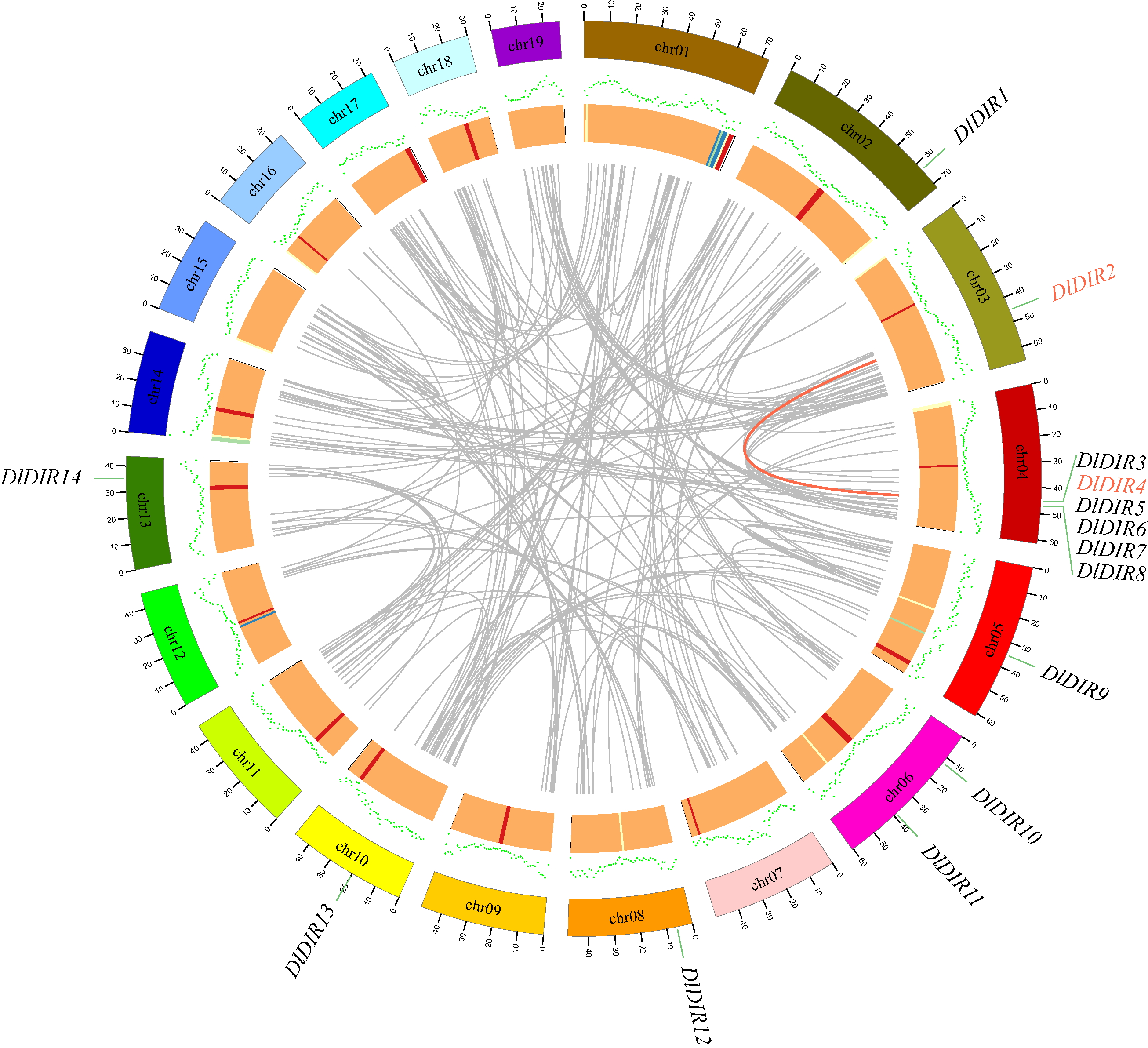
To visualize the genomic features of D. lindleyi, a collinearity analysis was first performed. The MCScanX software (v1.0.0) was used to perform BLAST (v2.16.0) alignments of genomic CDS sequences, identify collocated gene pairs, and extract collinearity associations for DIR genes in D. lindleyi [37]. Using the ‘sliding’ subcommand of Seqkit (v2.8.2), with a sliding window size of 1 Mb and a step size of 1 Mb, the average GC content within each chromosomal window was calculated in D. lindleyi. Bedtools (v2.27.1) was used to count gene frequencies in the genome annotation file using 1 Mb windows in D. lindleyi. Finally, a Circos diagram (v0.69-8) was generated. collinearity genes were connected by gray lines; collinearity among D. lindleyi DIR members was indicated by red lines; GC content was displayed as a heatmap; and gene density was presented as a scatter-plot [38].
2.10. Synteny Analysis of DIR Genes Between D. lindleyi and Other Plants
Using the JCVI software (v1.4.16), whole-genome alignments were performed between the CDS sequences of the D. lindleyi genome and those of Arabidopsis thaliana, Oraza sativa, D. officinale, and V. planifolia, respectively [39]. Homologous gene pairs were identified by setting a C-score threshold of 0.7, and colinearity blocks were identified by requiring a minimum gene interval of 10 genes. Homologous gene pairs associated with the DIR gene were extracted from the above pairwise alignments. The results were visualized using JCVI, with genomic colinearity blocks represented by gray lines and connections between DIR genes represented by dark lines.
2.11. Expression Analysis of DIR Genes by Using qRT-PCR in D. lindleyi
Primers of qRT-PCR were designed using Primer Premier 6 software (listed in Table S7). Three biological replicates were analyzed for each sample, and each biological replicate was assessed in duplicate technical replicates. The PCR program was as follows: an initial denaturation step of 30 s at 95 °C, followed by 40 cycles, each consisting of 10 s of denaturation at 95 °C and 30 s of annealing/extension at 60 °C; finally, a melting curve analysis was performed over a temperature range of 65 °C to 95 °C with a 0.5 °C ramp to assess amplification specificity. Relative gene expression levels were calculated using the 2−ΔΔCT method [40]. Statistical analysis was performed for each gene by one-way ANOVA in R (v4.5.1), and bar charts were generated using the ggplot2 package in R (v4.5.1) [41].
2.12. Subcellular Localization of DlDIR8
The CDS sequence of the DlDIR8 gene was synthesized by Qingke Biotechnology. Utilizing the NcoI and SpeI restriction sites on the plasmid, the aforementioned fragment was cloned into the pCAMBIA1302 plasmid via homologous recombination, yielding the recombinant expression plasmid pCAMBIA1302-35S::DlDIR8-GFP. The recombinant expression plasmid and the pCAMBIA1302-35S::GFP empty vector plasmid (control) were transformed into E. coli, respectively. Positive clones were verified by sequencing and then transformed into Agrobacterium competent cells. Single colonies were picked for overnight shaking culture; after harvesting, the cells were resuspended in induction medium and induced for 4 h, then resuspended in permeabilization medium and adjusted to an OD600 of approximately 0.5. Using a 1 mL syringe, the bacterial suspension was injected into 4-week-old tobacco leaves, which were then placed in a light-controlled incubator for dark treatment for 48 h. Subsequently, the lower epidermis of the tobacco leaves was peeled off to prepare temporary slides, which were observed and photographed under a Zeiss LSM 900 (Carl Zeiss AG, Oberkochen, Germany) confocal laser scanning microscope.
3. Results
3.1. Phylogenetic Analysis of DIR Genes in D. lindleyi
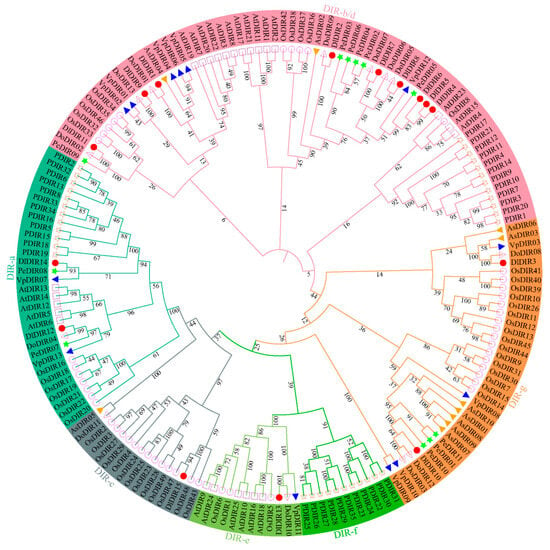
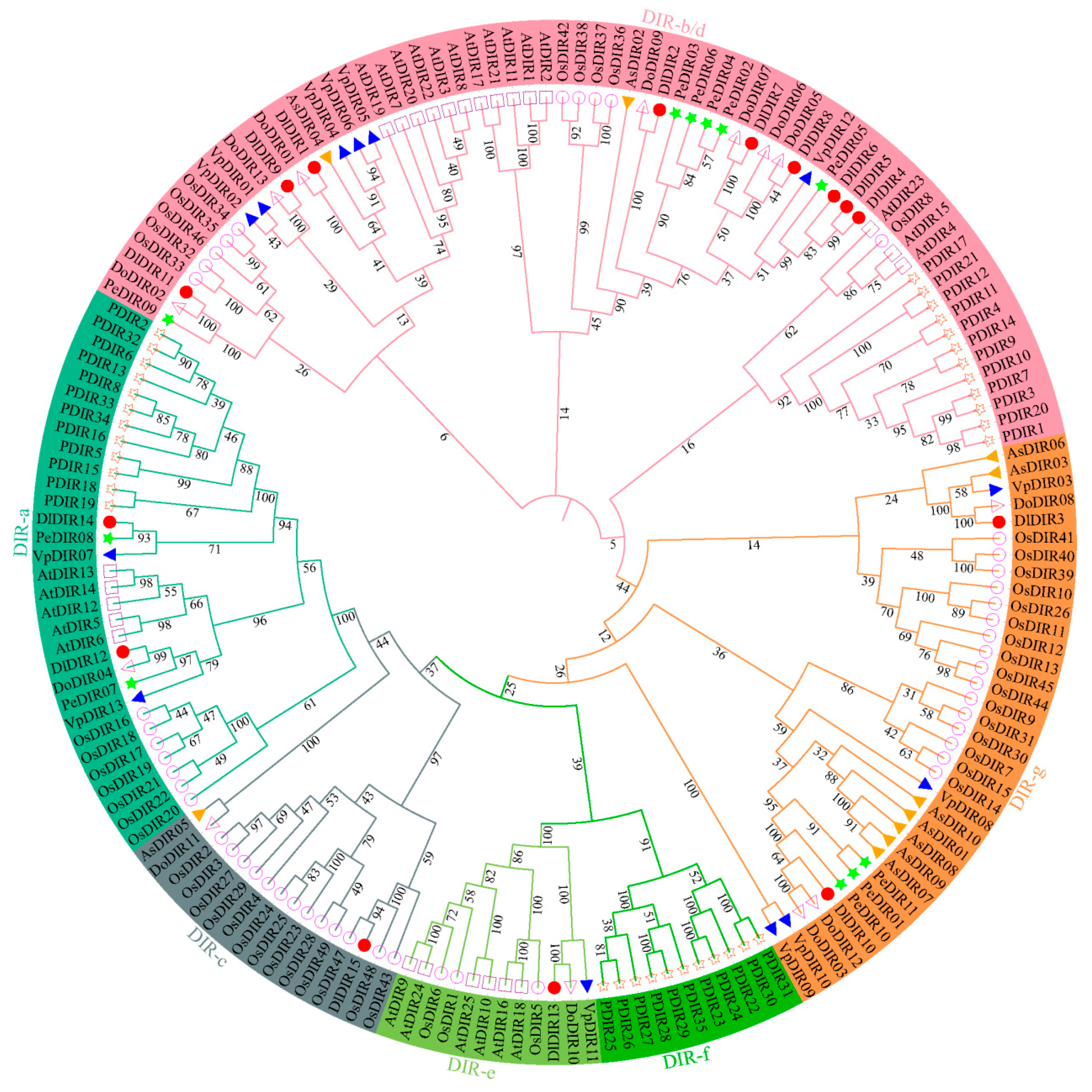
To elucidate the evolutionary relationships within the Orchidaceae DIR gene family, we analyzed DIR protein sequences from five orchid species. These included D. lindleyi, D. officinale, P. equestris, V. planifolia, and A. shenzhenica, which were compared with those from three outgroup species (A. thaliana, O. sativa, and Picea spp.) to construct a phylogenetic tree (Figure 1). Based on this phylogenetic tree, the DIR genes were classified into distinct subfamilies, and the number of members in each subfamily was summarized for all species examined (Table S4). The results showed that D. lindleyi contains 15 DIR genes. This number is comparable to other Orchidaceae species, with D. officinale having 13, P. equestris 11, V. planifolia 13, and A. shenzhenica 10. In contrast, rice and Arabidopsis have significantly more DIR genes, with 49 and 25, respectively, indicating an overall trend of gene reduction in orchids. At the subfamily level, D. lindleyi and D. officinale are the only orchids that retain one copy each of DIR-e and DIR-c, whereas P. equestris and A. shenzhenica lack DIR-e, and V. planifolia and P. equestris lack DIR-c. The Orchidaceae generally lack the DIR-f subfamily, which has 11 members in spruce. The DIR-g subfamily shows interspecific variation: it is expanded in A. shenzhenica (7 members) and V. planifolia (4 members), but relatively scarce in D. lindleyi (2 members), D. officinale (3 members), and P. equestris (3 members). Notably, D. lindleyi has the largest DIR-b/d subfamily with 9 members, accounting for 60% of its total DIR genes, followed by D. officinale with 7 members (54%). These two species have the highest numbers of DIR-b/d members among all orchids examined. The genes in this branch are distributed alongside those of various seed plants and have not formed an orchid-specific clade. In summary, DIR genes in Orchidaceae have undergone overall contraction with differential subfamily loss and limited expansion.
Figure 1.
Phylogenetic analysis of dirigent (DIR) proteins from Dendrobium lindleyi (Dl), Dendrobium officinale (Do), Phalaenopsis equestris (Pe), Vanilla planifolia (Vp), and Apostasia shenzhenica (As), together with those from Arabidopsis thaliana (At), Oryza sativa (Os), and Picea spp. (P). The branches and the colored ranges share the same color scheme for distinguishing DIR subfamilies, with DIR-a in teal, DIR-b/d in pink, DIR-c in gray, DIR-e in yellow-green, DIR-g in green, and DIR-f in orange. Leaf nodes are marked with different colors and shapes and combinations to distinguish species, with D. lindleyi as solid red circles, D. officinale as open triangles, P. equestris as solid bright green five-pointed stars, V. planifolia as solid blue triangles, A. shenzhenica as solid orange triangles, A. thaliana as open squares, O. sativa as open circles, and Picea spp. as open five-pointed stars.
3.2. Chromosomal Distribution of DIR Genes in D. lindleyi
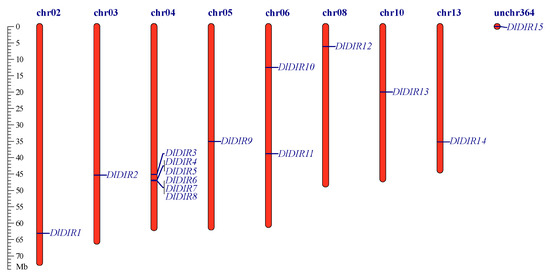
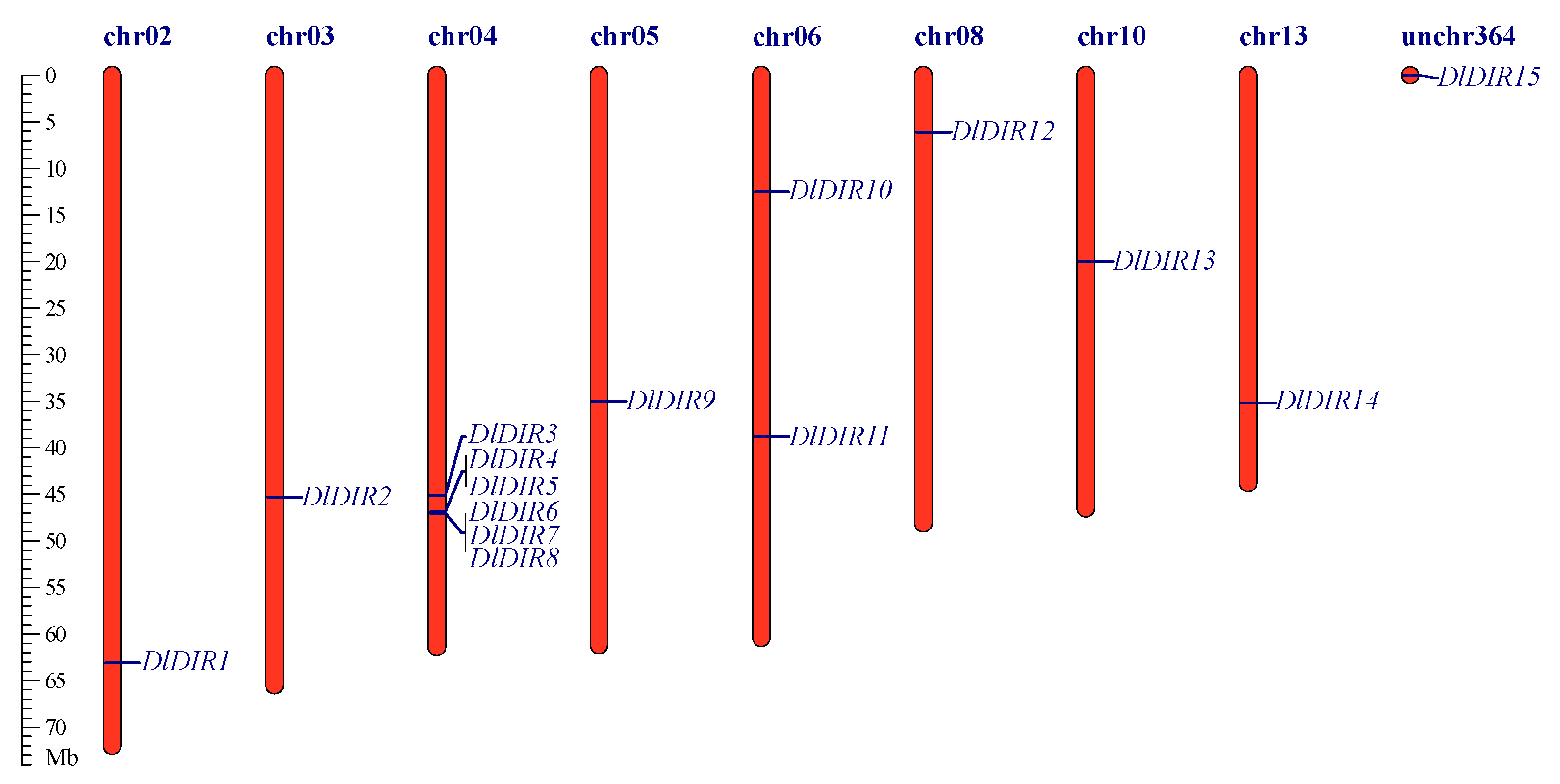
The chromosomal distribution of the 15 DIR genes in D. lindleyi is shown in Figure 2. These genes are unevenly distributed across seven chromosomes (chr02, chr03, chr04, chr05, chr06, chr08, chr10, chr13) and an unchromosomally located scaffold (unchr364). Among these, chromosome chr04 hosts the largest number of genes (DlinDIR3–DlinDIR8, totaling 6), which are highly concentrated in a specific region (45.1–47.1 Mb) and exhibit a distinct tandem clustering pattern; the remaining chromosomes typically contain only 1–2 genes. The unlocalized scaffold (unchr364) contains only DlinDIR15. This distribution pattern suggests that the DIR genes on chr04 may have undergone a localized tandem duplication in D. lindleyi.
Figure 2.
Chromosomal locations of DIR genes in D. lindleyi.
3.3. Prediction of DIR Gene and Protein Structure in D. lindleyi
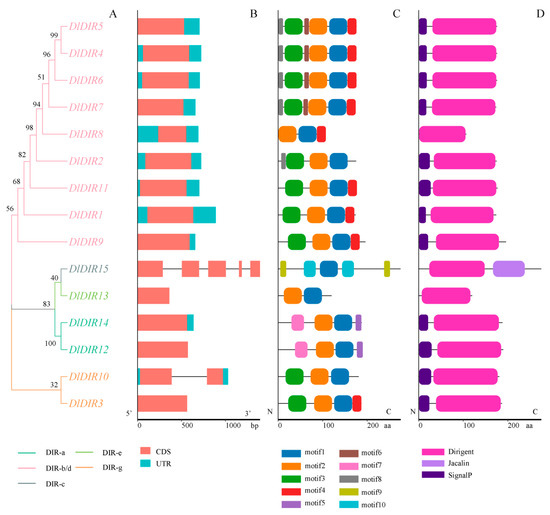
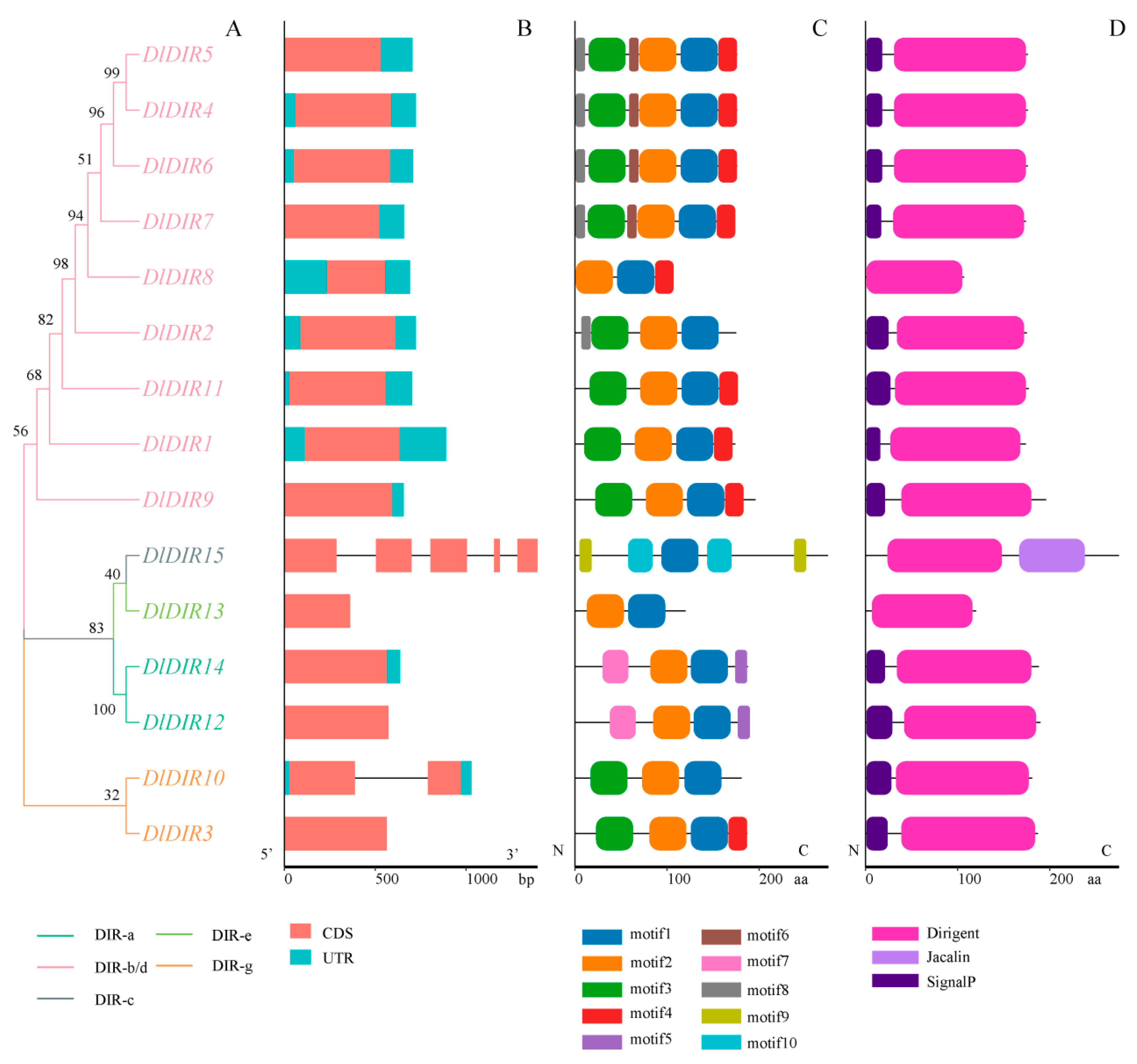
Phylogenetic analysis (Figure 3A) and gene structure analysis (Figure 3B) of the DIR family in D. lindleyi revealed that 13 of the 15 DIR genes possess a relatively simple structure consisting of a single exon. DlDIR10 contains two exons, while DlDIR15, a member of the DIR-c subfamily, has the most complex structure with five exons, suggesting that this gene may have undergone a more intricate evolutionary process. This structural variation may be related to gene function or regulatory mechanisms. Analysis of conserved motifs of DIR proteins in D. lindleyi (Figure 3C) indicates that these proteins contain 2 to 6 motifs, with motif 1 present in all 15 members. Except for DlDIR15, motif 2 is present in the other 14 members. Notably, motifs 9 and 10 are found exclusively in the DlDIR15 protein of the DIR-c subfamily, indicating significant differences in conserved motifs among subfamilies. As shown in Figure 3D, all 15 DIR proteins in D. lindleyi conservatively contain a dirigent domain, suggesting functional commonality. Furthermore, 12 members contain a signal peptide (SP), whereas DlDIR8, DlDIR13, and DlDIR15 lack one. Notably, the DlDIR15 protein contains both the dirigent and jacalin domains.
Figure 3.
Structural features of DIR genes and proteins in D. lindleyi. (A) Phylogenetic tree of DIR protein of D. lindleyi; branches of the same color represent members of the same subfamily; (B) DIR gene structure of D. lindleyi; CDS and UTR are represented by differently colored blocks, and introns are indicated by black lines; (C) Conserved motifs distribution of DIR genes in D. lindleyi; different motifs are indicated by different colored blocks; (D) Conserved domains in DIR genes of D. lindleyi; different domains are indicated by different colored blocks.
3.4. Post-Translational Modifications Analysis of DIR Proteins in D. lindleyi
The results in Table S5 showed that all DIR proteins in D. lindleyi contain 1–3 N-glycosylation sites, with DlDIR3 containing only one site (Asn53). SignalP 6.0 signal peptide prediction results indicate that 12 members of this family contain signal peptides (SP). Among these 12 members, DlDIR10 has a predicted confidence score of 0.7286, while the remaining 11 members all have scores above 0.97, suggesting they may be localized to the endomembrane system. Conversely, members lacking a signal peptide (such as DlDIR8, DlDIR13, and DlDIR15) may localize to other subcellular regions. These differences in properties reflect the diverse biological functions that DIR genes in D. lindleyi may perform within the genus, and the signal peptide prediction results are consistent with those shown in Figure 3D.
3.5. Cis-Acting Regulatory Elements Analysis of DIR Genes in D. lindleyi
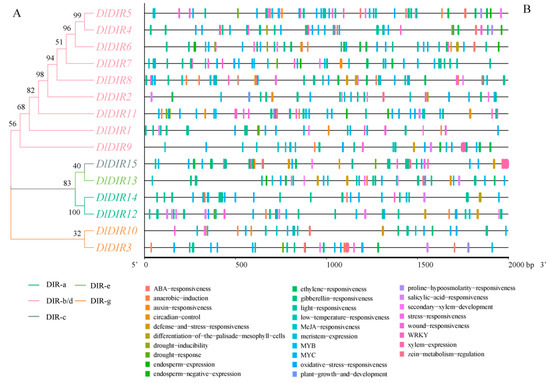
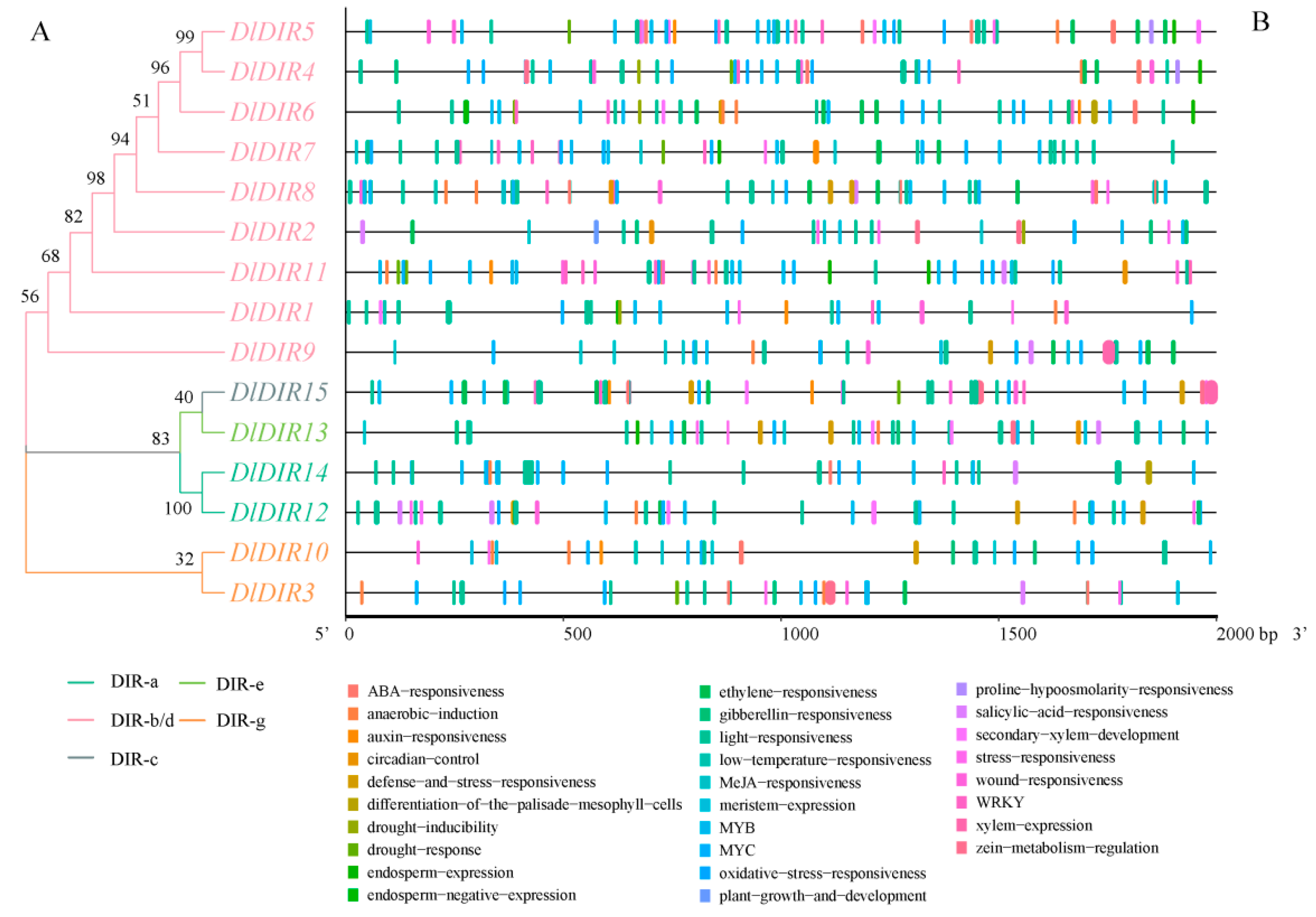
The distribution of transcriptional regulatory elements of DIR gene promoters in D. lindleyi (Figure 4) and the statistical analysis (Table S6) reveal that light-responsive elements are the most abundant (156) among the transcriptional regulatory elements of DIR gene in D. lindleyi, indicating that this family is generally regulated by light signals. Among hormone response elements, methyl jasmonate (MeJA) response elements were the most abundant (64), followed by abscisic acid (ABA, 23) and ethylene (28), suggesting that DIR genes in D. lindleyi may be involved in jasmonate-mediated defense responses and ABA/ethylene-regulated stress adaptation. A diverse range of abiotic-stress-related elements was identified, including oxidative stress (32), drought response (22), wounding response (23), and anaerobic induction (17), reflecting the potential role of this family in adapting to multiple stress conditions. Among the transcription factor binding sites, MYB binding sites were the most abundant (112), covering the vast majority of genes, suggesting that MYB is the central upstream regulator of this family’s expression; furthermore, MYC (59) and WRKY (26) sites were also widely present, further corroborating their integrative roles in hormone and stress signaling networks. The distribution of cis-acting regulatory elements varied significantly among genes in the DIR family of D. lindleyi (Table S6), with the total number of elements ranging from 31 to 64 across the 15 genes. DlDIR8 had the highest number (64), followed by DlDIR5 (62) and DlDIR11 (58). DlDIR8 contains a relatively high number of cis-acting elements associated with light response (17), MeJA response (10), MYB binding (8), oxidative stress (5), and ABA response (4), indicating its potential involvement in multiple signaling pathways, including light, hormone, and stress responses. DlDIR5 is enriched in light response (12), MYB (12), and secondary xylem development (3) elements, suggesting a potential role in vascular tissue development. DlDIR11, on the other hand, possesses a higher number of light response (8), MYB (14), and wound response (3) elements. In contrast, genes such as DlDIR1, DlDIR2, DlDIR3, and DlDIR10 have fewer total elements (31–40), suggesting relatively limited regulatory potential. In summary, the cis-acting regulatory element composition of the DIR genes in D. lindleyi exhibits both commonalities in light response and MYB regulation, as well as distinct intra-family specialization.
Figure 4.
Phylogenetic tree of DIR protein and cis-acting regulatory elements in the DIR gene promoter sequence in D. lindleyi. (A) Phylogenetic tree of DIR protein of D. lindleyi; (B) Cis-acting regulatory elements in the DIR gene promoter sequence in D. lindleyi. Rectangles of different colors represent various cis-acting regulatory elements, and their positions are annotated based on their distribution within the promoter.
3.6. Gene Duplication Analysis of DIR in D. lindleyi
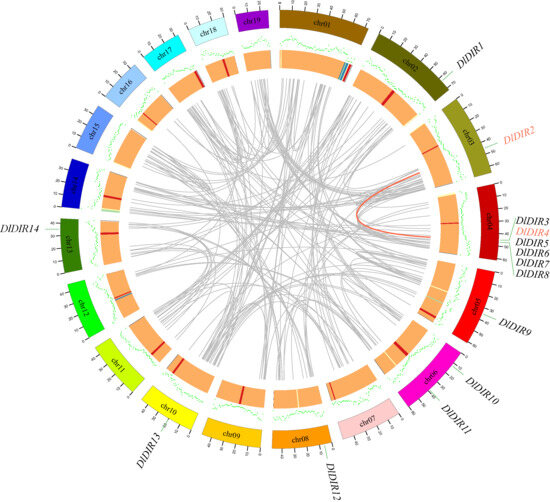
This study analyzed the GC content across the entire genome of D. lindleyi, with the results shown in Figure 5. The GC content of D. lindleyi is generally stable, with most regions ranging between 34% and 37%, indicating a relatively uniform genomic base composition. However, locally anomalous high- or low-GC regions were identified across multiple chromosomes, suggesting heterogeneity in the genome’s functional structure. The distribution of genes on chromosomes in D. lindleyi exhibits significant heterogeneity. Most chromosomes exhibit distinct gene-rich and gene-poor regions. Certain regions on chromosomes 2, 9, and 12 lack colinearity with other chromosomes, while the colinearity observed between DlDIR2 and DlDIR4 indicates that gene duplication has occurred. No gene duplication was detected in other DIR genes of D. lindleyi.
Figure 5.
Intra-species colinearity analysis of genes in D. lindleyi. From outermost to innermost: DIR gene names of D. lindleyi, chromosome numbers, gene density (scatter-plot), GC content (heatmap), and gene duplication events highlighted in red.
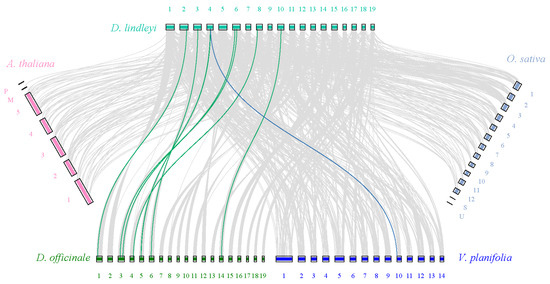
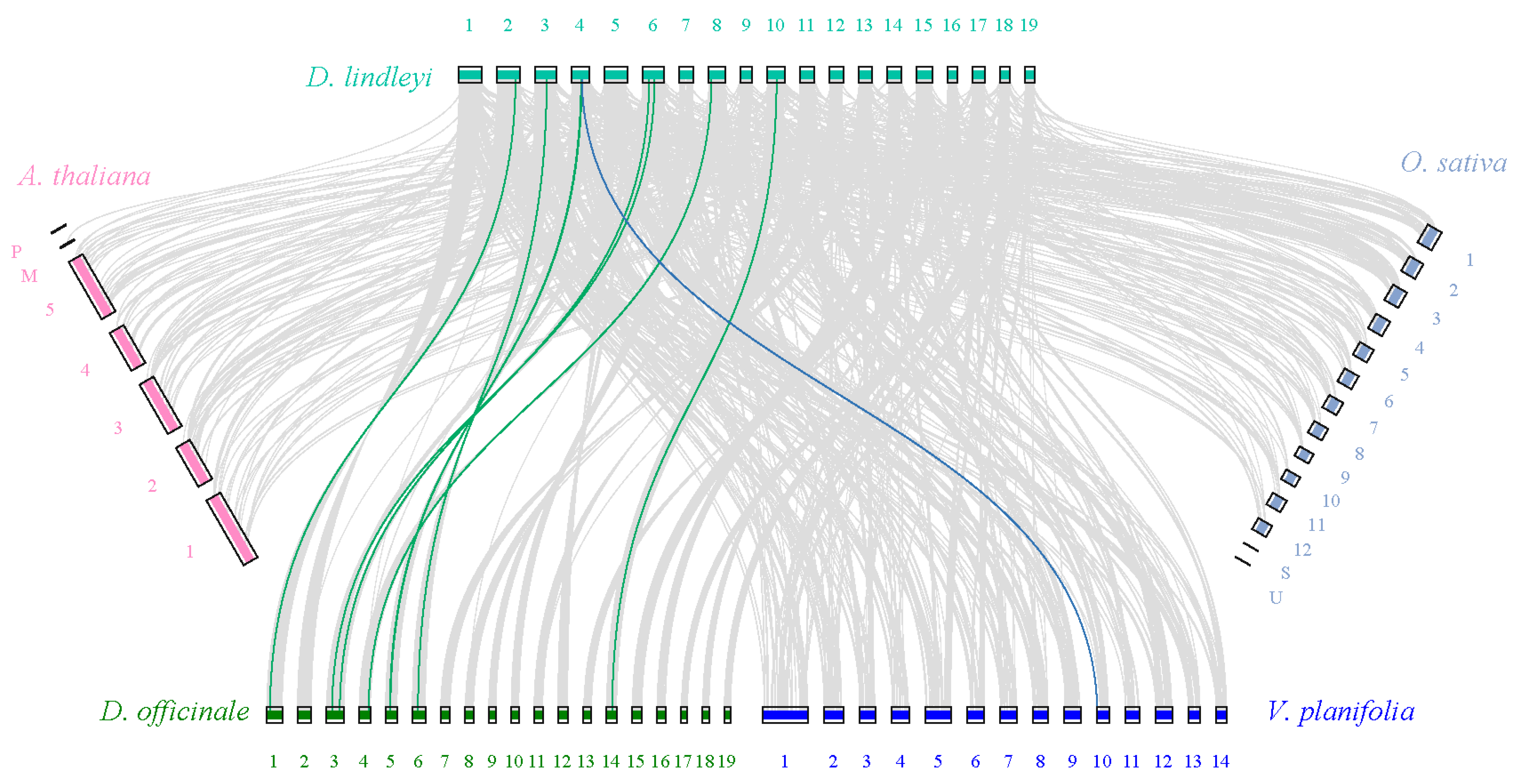
To further investigate the evolution of DIR genes in D. lindleyi, we performed synteny analyses between DIR genes in D. lindleyi and the other DIR genes in D. officinale, V. planifolia, A. thaliana, O. sativa, respectively (Figure 6). The results revealed a large number of homologous genes between D. lindleyi and D. officinale, among which 8 pairs of DIR genes exhibited colinearity (DlDIR1 and DoDIR01, DlDIR2 and DoDIR09, DlDIR3 and DoDIR08, DlDIR7 and DoDIR07, DlDIR10 and DoDIR03, DlDIR11 and DoDIR02, DlDIR12 and DoDIR04, DlDIR13 and DoDIR10); Co-dominant genes were found to be sporadically distributed between the D. lindleyi and V. planifolia chromosomes, with one pair of DIR genes exhibiting colinearity (DlDIR7 and VpDIR12); this indicates that the DIR genes of D. lindleyi share a closer evolutionary relationship with those of D. officinale than with those of V. planifolia.
Figure 6.
Analysis of DIR gene linkage pairs between D. lindleyi and A. thaliana, D. lindleyi and O. sativa, D. lindleyi and D. officinale, and D. lindleyi and V. planifolia. Chromosomes of D. lindleyi, A. thaliana, D. officinale, V. planifolia, and O. sativa are colored in light green, pink, green, blue, and light blue, respectively. Green lines represent collinear gene pairs between D. lindleyi and D. officinale. Blue lines represent collinear gene pairs between D. lindleyi and V. planifolia.
3.7. Transcriptomic Analysis of DIR Gene Expression in D. lindleyi
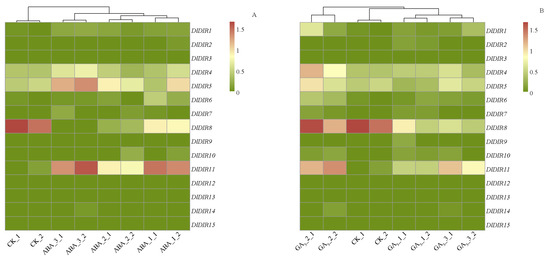
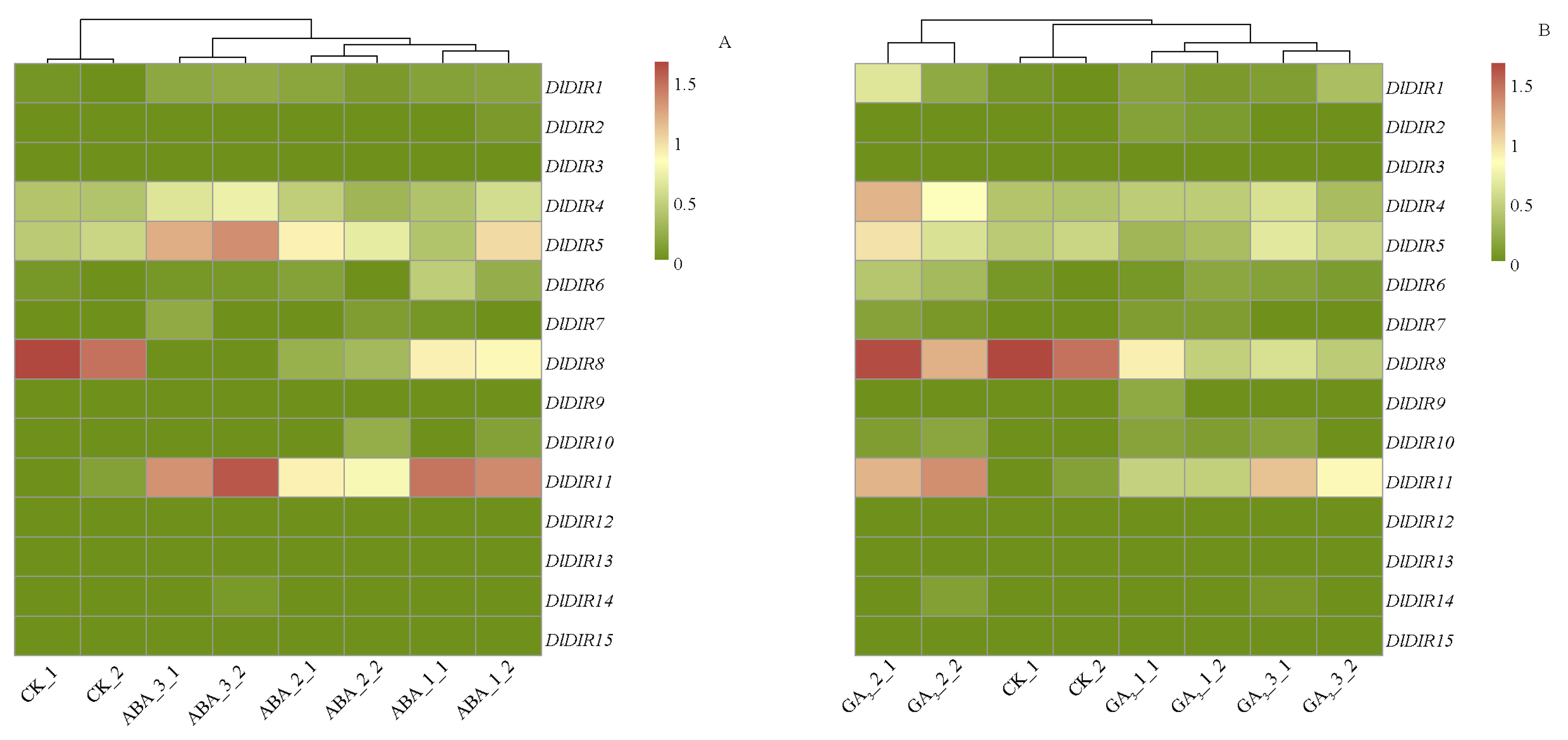
As shown in Figure 7 and Table S7, during ABA treatment, the expression levels of DlDIR4 and DlDIR5 in the stem increased, while the expression level of DlDIR8 decreased significantly throughout the period, and the expression of DlDIR11 increased significantly overall. In contrast, during GA3 treatment, the expression levels of DlDIR5 and DlDIR8 first decreased, then increased, and then decreased again, whereas only DlDIR8 expression decreased significantly. The expression level of DlDIR11 gradually increased. Therefore, DlDIR8 is a gene that responds simultaneously to ABA or GA3 treatment. The highly expressed genes mentioned above all belong to the DIR-b/d subfamilies, whereas DIR-a, DIR-c, DIR-e, and DIR-g exhibit subfamily-specific expression patterns, with DlDIR3 exhibiting extremely low expression levels.
Figure 7.
Expression profiles of DIR genes in stems of D. lindleyi under ABA and GA3 treatment. (A) The expression patterns of DIR genes under ABA treatment in D. lindleyi; CK_1, CK_2 were two replicates of the untreated control collected at 0 h, ABA_1_1 and ABA_1_2 were two repetitions of ABA treatment for 3 h, ABA_2_1 and ABA_2_2 were two repetitions of ABA treatment for 6 h; ABA_3_1 and ABA_3_2 were two repetitions of ABA treatment for 12 h. (B) The expression patterns of DIR genes under GA3 treatment in D. lindleyi; CK_1, CK_2 were two replicates of the untreated control collected at 0 h, GA3_1_1 and GA3_1_2 were two repetitions of GA3 treatment for 3 h; GA3_2_1 and GA3_2_2 were two repetitions of GA3 treatment for 6 h; GA3_3_1 and GA3_3_2 were two repetitions of GA3 treatment for 12 h.
3.8. Expression Analysis of the DIR Gene by Using qRT-PCR in D. lindleyi
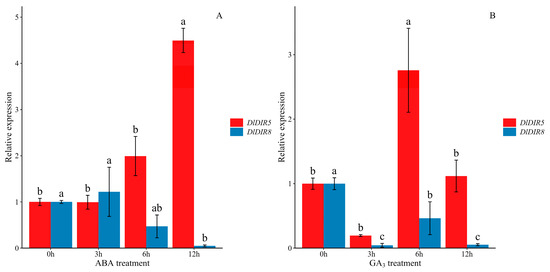
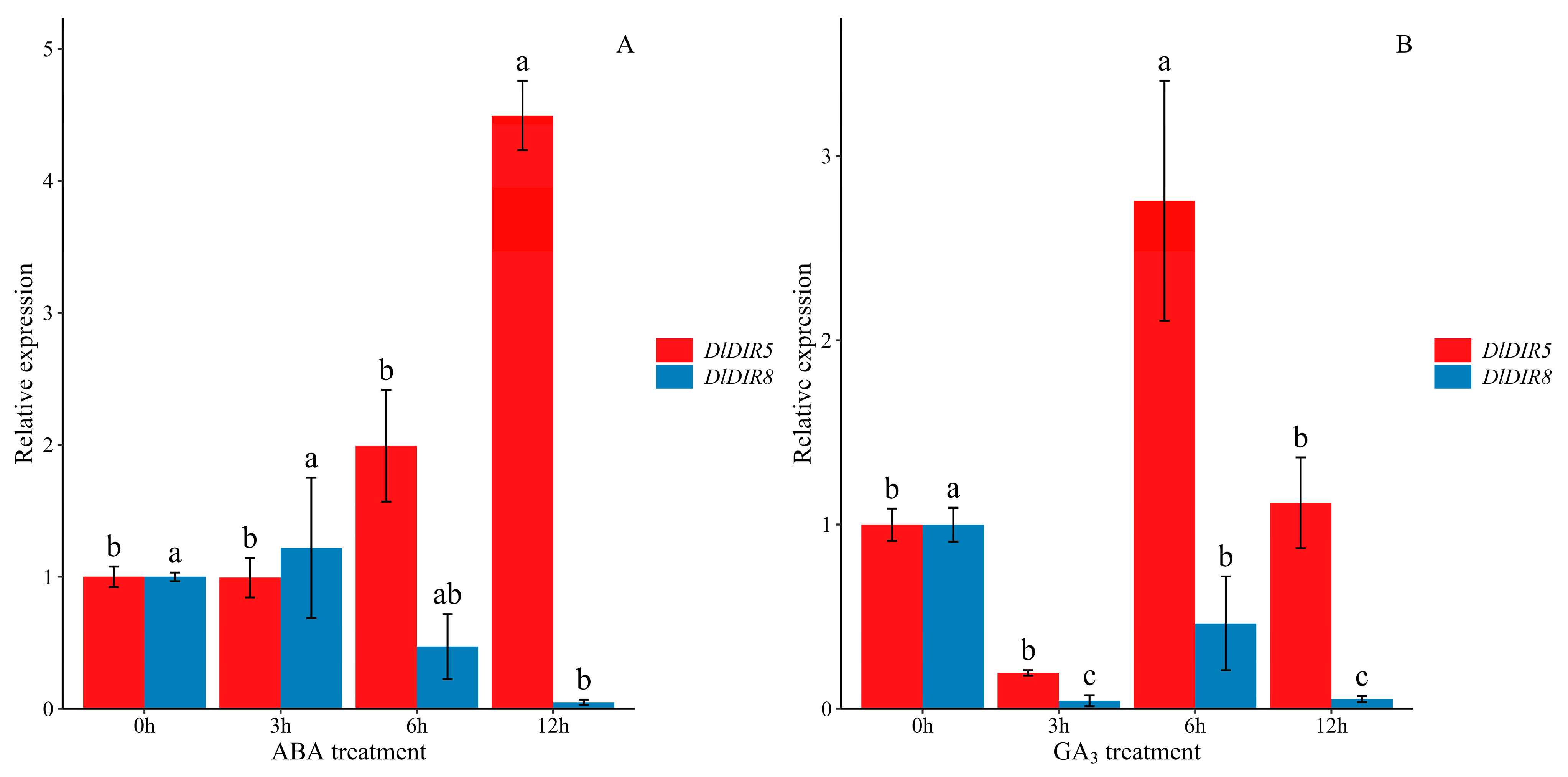
The qRT-PCR validation included both an ABA-induced gene, DlDIR5, and an ABA-repressed gene, DlDIR8 (Figure 8). The other genes that maintained consistently low expression across all samples were not prioritized due to the inherent unreliability of quantifying very low-abundance transcripts by qRT-PCR. The expression level of DlDIR5 gradually increased during ABA treatment, reaching a level at 12 h that was significantly higher than that at 0 h (p < 0.05). In contrast, the expression level of DlDIR8 gradually decreased during ABA treatment and was significantly lower at 12 h than that at 0 h (p < 0.05). Under GA3 treatment, the expression level of DlDIR5 increased significantly at 3 h (p < 0.05) and remained relatively stable at 6 and 12 h. In contrast, the expression level of DlDIR8 decreased significantly at 3 h (p < 0.05) under GA3 treatment and remained relatively stable at 6 and 12 h.
Figure 8.
Relative expression levels of DIR genes in D. lindleyi under different durations of ABA and GA3 treatment. (A). ABA treatment; (B). GA3 treatment. A one-way analysis of variance (ANOVA) followed by the least significant difference (LSD) test was used to assess differences among treatment means at the 95% confidence level (p < 0.05). 0 h, 3 h, 6 h, and 12 h represent the four time points for ABA or GA3 treatment, respectively. Letters on bars of the same color indicate significant differences within the same gene across different time points.
3.9. Subcellular Localization of DlDIR8 in D. lindleyi
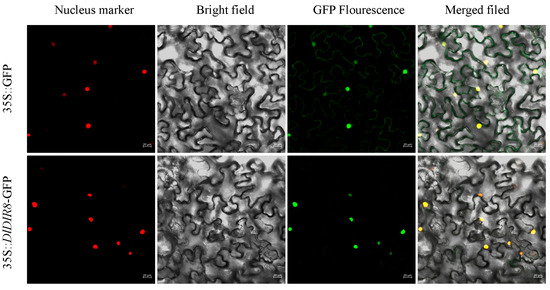
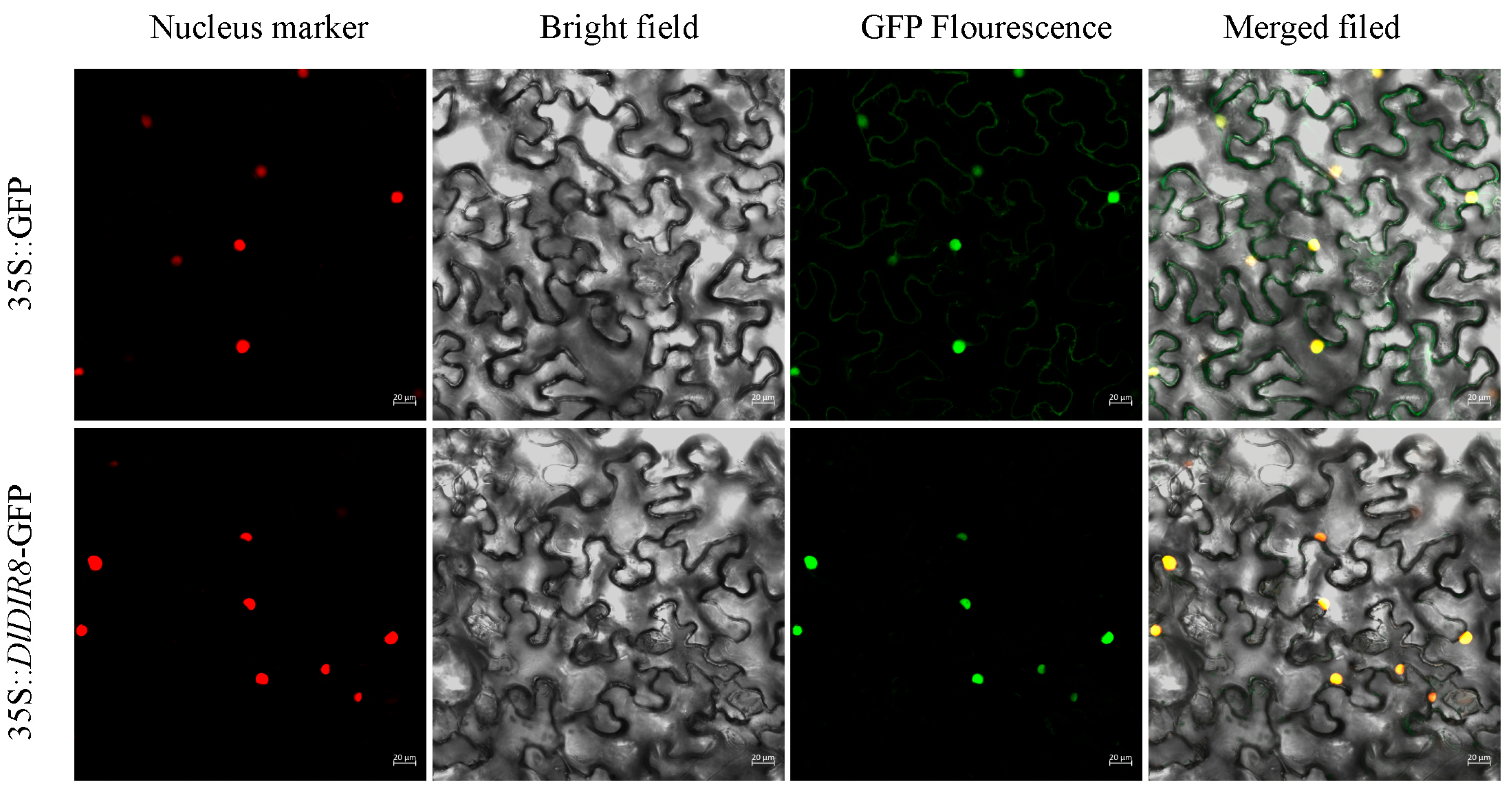
Based on DIR gene expression patterns in D. lindleyi under ABA and GA3 treatments, the DlDIR8 gene, which showed the highest expression level and was differentially expressed, was selected for further analysis. Moreover, DlDIR8 lacks a predicted canonical signal peptide (Table S5), unlike most DIR members, including DlDIR5. This atypical feature raised the hypothesis that DlDIR8 may not follow the classical secretory pathway and was therefore considered a more informative candidate for subcellular localization studies. A 35S promoter-driven DlDIR8-green fluorescent protein (GFP) fusion expression vector was constructed, and transient expression was detected in tobacco leaves. As shown in Figure 9, the GFP fluorescence signal of the DlDIR8 protein was distributed in the cell nucleus, indicating that DIR is expressed in the nucleus of a specific tobacco cell. But it may have other patterns in the other cell types.
Figure 9.
Subcellular localization of the DlDIR8-GFP fusion protein. GFP was used as a control. Red fluorescence represents the mCherry protein, green fluorescence represents the GFP protein, and the yellow signal in the merged image arises from the colocalization of the red and green channels.
4. Discussion
The genes and protein structures of most DIR family members in D. lindleyi are relatively simple, consisting of a single exon and a single dirigent domain. Among them, DlDIR15 has the most complex structure, comprising five exons and a dirigent-jacalin double domain, consistent with the double domain reported in rice, which is considered a chimeric protein unique to the Poaceae family [42,43,44]. Regarding post-translational modifications, all 15 DIR proteins in D. lindleyi contain varying numbers of N-glycosylation sites, whereas 3 of the 31 DIR proteins in tomato lack these sites [45], suggesting that DIR proteins in D. lindleyi may rely on significant post-translational modifications to regulate their activity or stability [46]. These characteristics are consistent with predictions for secreted proteins; despite the significant reduction in the number of DIR genes in D. lindleyi, all members retain the basic secreted protein functions. Most DIR members in D. lindleyi contain typical signal peptides, suggesting they are targeted to exosomes or the cell wall via the classical secretory pathway, which is highly consistent with the core functional model of DIR proteins directing the extracellular deposition of phenolic polymers such as lignin and lignans [13,47]. However, some members, such as DlDIR8, lack a discernible signal peptide and localize to the nucleus [48], consistent with nuclear proteins not utilizing the secretory pathway. DlDIR8 also lacks a predictable classical NLS, suggesting it may enter the nucleus via non-canonical NLS sequences, passive diffusion, or protein–protein interactions. The precise mechanism remains to be determined experimentally.
From a phylogenetic perspective, the D. lindleyi (15 DIRs) and the D. officinale (13 DIRs) both contain the five subfamilies DIR-a, DIR-b/d, DIR-c, DIR-e, and DIR-g, whereas P. equestris, A. shenzhenica, and V. planifolia each lack 1–2 subfamilies. This indicates that the Orchidaceae ancestor already possessed a five-subfamily framework, with subsequent independent losses occurring within lineages. The fact that D. lindleyi and D. officinale retain all five subfamilies may be related to growth adaptations. The composition of these five subfamilies is consistent with that of rice (45 DIRs), suggesting that the monocot ancestor possessed these five subfamilies prior to the divergence of the Orchidaceae and Poaceae; however, Sorghum bicolor (53 DIRs) comprises DIR-a, DIR-b/d, DIR-c, DIR-e, and DIR-f (lacking DIR-g), and since DIR-f and DIR-g belong to the same evolutionary clade, it is inferred that a “DIR-g/ DIR-f replacement” occurred in the Poaceae. The rice lineage lost DIR-f and retained DIR-g, while the S. bicolor lineage lost DIR-g and retained DIR-f [49]; thus, the monocot ancestor likely possessed a complete six-subfamily pattern including DIR-f and DIR-g, and the current distribution results from loss at the family/genus level. Compared to eudicots, Cajanus cajan (25 DIRs) contains all six DIR subfamilies [50], supporting the hypothesis that the angiosperm ancestor possessed all six DIR subfamilies; however, phylogenetically specific losses have occurred across different groups. For example, Solanaceae species such as tobacco (57) and potato (33) retain only DIR-a, DIR-b/d, and DIR-e [51]; Schima superba retains DIR-a, DIR-b/d, DIR-c, and DIR-e [52]; Fragaria vesca retains DIR-a, DIR-b/d, DIR-e, and DIR-g [53], indicating that DIR families underwent multiple independent and differential losses during the radiation of core eudicots. Collinearity analysis reveals evolutionary drivers, extensive DIR collinearity exists between D. lindleyi and D. officinale, while only limited collinearity is observed with the more distantly related orchid V. planifolia, and no collinearity is found with A. thaliana or O. sativa; DIRs from tobacco and potato also lack colinearity with those in Arabidopsis [51], whereas Sorghum bicolor or Citrullus lanatus share 2–4 pairs of colinearity with Arabidopsis. These differences, combined with drastic variations in DIR gene numbers, reflect that different lineages have undergone gene expansion and contraction in a highly species-specific manner [49,54]. No colinearity was detected between the DIR-c subfamily of D. lindleyi and D. officinale, indicating that different subfamilies have undergone differential selective pressures; intraspecific colinearity analysis revealed a fragment duplication relationship between DlDIR2 and DlDIR4 within DIR-b/d, demonstrating that gene duplication is a key mechanism driving the increase in gene number and functional diversification. Overall, DIR-a and DIR-b/d are present in all species and constitute the most conserved core subfamily in angiosperms. Within the Orchidaceae, independent loss of DIR-c and DIR-e is characteristic, while DIR-b/d has expanded through duplication (9 in D. lindleyi and 7 in D. officinale). D. lindleyi and D. officinale retain relatively complete subfamily compositions and patterns of synteny, providing ideal samples for elucidating the evolution of cell walls in the Orchidaceae and the dual driving forces of “differential loss and specific duplication.” Further studies on physiological functions, including lignan and lignin biosynthesis, disease resistance, and abiotic stress tolerance, using gene expression analysis, are still needed to deepen our understanding of the specific roles of DIR genes in biotic and abiotic stress adaptation [55].
Analysis of promoter cis-acting regulatory elements revealed that the DIR promoter regions in D. lindleyi are enriched for various environmental and endogenous signal-response elements, with light-responsive elements being the most abundant. This suggests that light may be a key factor regulating DIR expression and phenolic metabolism in D. lindleyi [56]. Hormone treatment experiments showed that DlDIR5 and DlDIR8 respond to ABA and GA3, respectively, with opposite patterns. This contrasting response may be attributed to the complexity of their genetic backgrounds, particularly the differences in promoter cis-acting regulatory elements. The presence of multiple ABA-responsive elements in both promoters (five in DlDIR5, four in DlDIR8) suggests direct regulation, while ABA may also act indirectly via MYB, MYC, and WRKY transcription factors. Neither promoter contains canonical GA-responsive elements; thus, GA3 likely regulates these genes indirectly via MYB and WRKY factors. This direct and indirect regulatory model remains hypothetical and requires experimental validation.
Furthermore, in P. leptostachya, MeJA, SA, and ethylene significantly induce PlDIR1 expression, linking it to phenoxy radical metabolism and lignin accumulation [57], while in pear, PbDIRs respond to ABA, SA, and MeJA and may participate in sclereid formation and lignin polymerization [58]. In the resurrection plant B. hygrometrica, BhDIR1 is strongly induced during dehydration and rehydration, likely through drought-triggered ABA accumulation, and may modulate lignin acid solubility to dynamically adjust cell wall properties [59]. These findings align with the ABA-induced expression of DlDIR5 observed in this study. In contrast, the repression of DlDIR8 by ABA may stem from structural or regulatory differences that remain to be elucidated. Notably, MeJA and ethylene response elements were also highly enriched in DIR promoters (64 MeJA elements, with 10 in DlDIR8), consistent with the involvement of DIR genes in defense responses reported in other species [54,60]; however, as no MeJA treatment was conducted here, this remains a hypothesis. DIR-mediated lignan metabolism may also be relevant to the edible quality of D. lindleyi stems. These hypotheses require further experimental investigation.
This study found that the DIR-a, DIR-c, DIR-e, and DIR-g subfamilies in D. lindleyi appear silent under normal conditions, similar to GhDP1_D1 and GhDP1_D2 in cotton [14], whereas the DIR-b/d subfamily is the largest and shows basal expression. These patterns suggest that the former subfamilies may require specific developmental or stress signals for activation, while the latter perform more conserved, fundamental functions. However, due to the technical limitations of bulk RNA-seq and qRT-PCR, we cannot exclude the possibility that opposite expression trends in distinct cell types within the stem may mask cell-type-specific regulation and contribute to the observed stable average values. Future studies using in situ spatial cell biology methods [61] and single-cell RNA-seq are needed to resolve cell-type-specific DIR expression and refine these functional inferences. Future studies should also examine how DIR-mediated lignification affects stem quality and the functional specialization of subfamilies in stress adaptation, with the aim of improving both quality and stress tolerance in D. lindleyi.
5. Conclusions
This study systematically identified 15 DIR genes in the D. lindleyi genome, which belong to five conserved evolutionary subfamilies and are phylogenetically closer to those of monocotyledons. These genes exhibit diversity in gene and protein structures, as well as in the composition of promoter cis-acting regulatory elements, including abundant light-responsive, ABA, MeJA, MYB, MYC, WRKY, and oxidative stress-related elements. These features suggest that DIR genes in D. lindleyi may participate in multiple signaling pathways. Hormone treatment experiments showed that DlDIR5 was induced by both ABA and GA3, whereas DlDIR8 was repressed by both hormones. Subcellular localization analysis revealed that the DlDIR8 protein is localized to the nucleus, consistent with its lack of a canonical signal peptide. These results provide a foundation for future functional studies of the DIR gene family in D. lindleyi and offer a theoretical basis for its potential genetic improvement.
Supplementary Materials
The following supporting information can be downloaded at: https://www.mdpi.com/article/10.3390/horticulturae12070789/s1, Table S1: Transcriptomic sequencing quality metrics of D. lindleyi after filtering with fastP; Table S2: DESeq2 differential expression analysis of DIR genes in D. lindleyi following separate treatments with ABA and GA3; Table S3: Correlation table of DIR gene IDs and gene names in the Orchid family; Table S4: Number of DIR subfamily members in D. lindleyi, D. officinale, P. equestris, V. planifolia, and A. shenzhenica, with those from A. thaliana, O. sativa, and spruce (Picea spp.); Table S5: Post-translational modifications of the DIR gene in D. lindleyi; Table S6: Number of cis-acting regulatory elements in the DIR gene promoter sequence of D. lindleyi; Table S7: List of primer used for qRT-PCR.
Author Contributions
The authors confirm contribution to the paper as follows: Draft manuscript preparation and figure preparation: Y.Y. and L.Z. Data analysis: Y.Y. Study conception and design, and methodology supervision: L.Z. Manuscript revision and data collection: F.C. and Z.W. All authors have read and agreed to the published version of the manuscript.
Funding
This research was funded by the National Natural Science Foundation of China (grant number 31801306) and the Lishui Key Research and Development Project (grant number 2023zdyf09).
Data Availability Statement
The data presented in this study are openly available in [NCBI Sequence Read Archive (SRA)] [https://www.ncbi.nlm.nih.gov/sra] (accessed on 15 May 2026) [PRJNA1467120].
Conflicts of Interest
The authors declare no conflicts of interest.
Abbreviations
The following abbreviations are used in this manuscript:
| qRT-PCR | quantitative real-time PCR |
| MeJA | methyl jasmonate |
| ABA | abscisic acid |
| GA | gibberellic acid |
| ETH | ethylene |
References
- The Editorial Committee of Flora of China; Chinese Academy of Sciences. Flora of China; Science Press: Beijing, China, 1999. (In Chinese) [Google Scholar]
- Wang, Y.; Zhou, J.C.; Zheng, B.Q.; Chen, Z.H.; Huang, Z.H. Dendrobium; China Forestry Pub. House: Beijing, China, 2015. (In Chinese) [Google Scholar]
- Xiang, X.G.; Schuiteman, A.; Li, D.Z.; Huang, W.C.; Chung, S.W.; Li, J.W.; Zhou, H.L.; Jin, W.T.; Lai, Y.J.; Li, Z.Y.; et al. Molecular systematics of Dendrobium (Orchidaceae, Dendrobieae) from mainland Asia based on plastid and nuclear sequences. Mol. Phylogenetics Evol. 2013, 69, 950–960. [Google Scholar] [CrossRef] [Scilit]
- Sun, C.B.; Li, Y.B.Q.; Ma, Y.S.; Zhao, Q. Interspecific relationships among Dendrobium huoshanense and its related species based on ITS sequences. Chin. J. Appl. Environ. Biol. 2021, 27, 472–477, (In Chinese with English abstract). [Google Scholar]
- Dai, H.F. Medicinal Plants of the Li Ethnic Group; Science and Technology Press: Beijing, China, 2010. (In Chinese) [Google Scholar]
- Ye, H.G.; Zeng, F.Y.; Ye, Y.S.; Liu, N. Medicinal Plants of South China; Huazhong University of Science and Technology Press: Wuhan, China, 2013. (In Chinese) [Google Scholar]
- Shang, Z.; Li, X.; Xiao, S. Two new bibenzyl compounds from Dendrobium lindleyi. Rec. Nat. Prod. 2020, 14, 420. [Google Scholar] [CrossRef] [Scilit]
- Qin, M.L.; Chen, Y.P.; Wu, H.; Yu, J.D.; Zheng, J.R.; Li, Y.P.; Li, S.H. Phytochemical and chemotaxonomic study on Dendrobium lindleyi Stendel. Biochem. Syst. Ecol. 2022, 102, 104412. [Google Scholar] [CrossRef] [Scilit]
- Davin, L.B.; Wang, H.B.; Crowell, A.L.; Bedgar, D.L.; Martin, D.M.; Sarkanen, S.; Lewis, N.G. Stereoselective bimolecular phenoxy radical coupling by an auxiliary (dirigent) protein without an active center. Science 1997, 275, 362–366. [Google Scholar] [CrossRef] [Scilit] [PubMed]
- Burlat, V.; Mi, K.; Davin, L.B.; Lewis, N.G. Dirigent proteins and dirigent sites in lignifying tissues. Phytochemistry 2001, 57, 883–897. [Google Scholar] [CrossRef] [Scilit] [PubMed]
- Davin, L.B.; Jourdes, M.; Patten, A.M.; Kim, K.W.; Vassão, D.G.; Lewis, N.G. Dissection of lignin macromolecular configuration and assembly: Comparison to related biochemical processes in allyl/propenyl phenol and lignan biosynthesis. Nat. Prod. Rep. 2008, 25, 1015–1090. [Google Scholar] [CrossRef] [Scilit] [PubMed]
- Ralph, S.G.; Jancsik, S.; Bohlmann, J. Dirigent proteins in conifer defense II: Extended gene discovery, phylogeny, and constitutive and stress-induced gene expression in spruce (Picea spp.). Phytochemistry 2007, 68, 1975–1991. [Google Scholar] [CrossRef] [Scilit] [PubMed]
- Paniagua Correas, C.M.; Pačínková, A.; Jackson, P.A.P.; Dabravolski, S.; Riber, W.S.; Didi, V.; Houser, J.; Gigli-Bisceglia, N.; Wimmerova, M.; Budínská, E.; et al. Dirigent proteins in plants: Modulating cell wall metabolism during abiotic and biotic stress exposure. J. Exp. Bot. 2017, 68, 3287–3301. [Google Scholar] [CrossRef] [Scilit]
- Lin, J.L.; Wu, W.K.; Nie, G.B.; Li, J.X.; Fang, X.; Sheng, Y.G.; Wang, M.M.; Zheng, Q.Y.; Guo, X.X.; Huang, J.F.; et al. A dirigent protein redirects extracellular terpenoid metabolism for defense against biotic challenges. Nat. Commun. 2025, 16, 9270. [Google Scholar] [CrossRef] [Scilit] [PubMed]
- Lin, J.L.; Fang, X.; Li, J.X.; Chen, Z.; Wu, W.; Guo, X.; Liu, N.J.; Huang, J.F.; Chen, F.-Y.; Wang, L.J.; et al. Dirigent gene editing of gossypol enantiomers for toxicity-depleted cotton seeds. Nat. Plants 2023, 9, 605–615. [Google Scholar] [CrossRef] [Scilit] [PubMed]
- Zhang, L.; Sun, M.; Zhang, H. Comprehensive genome wide analysis of the dirigent (DIR) gene family in Arabidopsis thaliana and Brassica species: Evolutionary dynamics and abiotic stress response mechanisms. Genet. Resour. Crop Evol. 2025, 72, 9291–9311. [Google Scholar]
- Wang, Y.; Cao, Y.; Liang, X.; Zhuang, J.; Wang, X.; Qin, F.; Jiang, C. A dirigent family protein confers variation of Casparian strip thickness and salt tolerance in maize. Nat. Commun. 2022, 13, 2222. [Google Scholar] [CrossRef] [Scilit] [PubMed]
- Ma, Y.L.; Wang, X.T.; Li, X.H.; Yang, J.H.; Li, S.X. Identification and analysis of members of the DIR gene family in alfalfa. Pratacultural Sci. 2025, 42, 3069–3085. [Google Scholar]
- Ma, Q.H.; Liu, Y.C. TaDIR13, a dirigent protein from wheat, promotes lignan biosynthesis and enhances pathogen resistance. Plant Mol. Biol. Rep. 2015, 33, 143–152. [Google Scholar]
- Li, N.; Zhao, M.; Liu, T.; Dong, L.; Cheng, Q.; Wu, J.; Wang, L.; Chen, X.; Zhang, C.; Lu, W.; et al. A novel soybean dirigent gene GmDIR22 contributes to promotion of lignan biosynthesis and enhances resistance to Phytophthora sojae. Front. Plant Sci. 2017, 8, 1185. [Google Scholar] [CrossRef] [Scilit] [PubMed]
- Zhang, L.; Li, C.; Yang, D.; Wang, Y.; Yang, Y.; Sun, X. Genome-wide analysis of the TCP transcription factor genes in Dendrobium catenatum Lindl. Int. J. Mol. Sci. 2021, 22, 10269. [Google Scholar] [CrossRef] [Scilit] [PubMed]
- Chen, J.; Yan, B.; Tang, Y.; Xing, Y.; Li, Y.; Zhou, D.; Guo, S. Symbiotic and asymbiotic germination of Dendrobium officinale (Orchidaceae) respond differently to exogenous gibberellins. Int. J. Mol. Sci. 2020, 21, 6104. [Google Scholar] [CrossRef] [Scilit] [PubMed]
- Liao, Y.; Smyth, G.K.; Wei, S. featureCounts: An efficient general purpose program for assigning sequence reads to genomic features. Bioinformatics 2014, 30, 923–930. [Google Scholar] [PubMed]
- Love, M.I.; Huber, W.; Anders, S. Moderated estimation of fold change and dispersion for RNA-seq data with DESeq2. Genome Biol. 2014, 15, 550. [Google Scholar] [CrossRef] [Scilit] [PubMed]
- Li, Y.; Zhang, B.; Zhang, S.; Wong, C.E.; Liang, Q.; Pang, S.; Wu, Y.; Zhao, M.; Yu, H. Pangeneric genome analyses reveal the evolution and diversity of the orchid genus Dendrobium. Nat. Plants 2025, 11, 421–437. [Google Scholar] [CrossRef] [Scilit] [PubMed]
- Cai, J.; Liu, X.; Vanneste, K.; Proost, S.; Tsai, W.C.; Liu, K.W.; Chen, L.J.; He, Y.; Xu, Q.; Bian, C.; et al. The genome sequence of the orchid Phalaenopsis equestris. Nat. Genet. 2015, 47, 65–72. [Google Scholar] [CrossRef] [Scilit] [PubMed]
- Zhang, G.Q.; Liu, K.W.; Li, Z.; Lohaus, R.; Hsiao, Y.Y.; Niu, S.C.; Wang, J.Y.; Lin, Y.C.; Xu, Q.; Chen, L.J.; et al. The Apostasia genome and the evolution of orchids. Nature 2017, 549, 379–383. [Google Scholar] [CrossRef] [Scilit] [PubMed]
- Hasing, T.; Tang, H.; Brym, M.; Khazi, F.; Huang, T.; Chambers, A.H. A phased Vanilla planifolia genome enables genetic improvement of flavour and production. Nat. Food 2020, 1, 811–819. [Google Scholar] [CrossRef] [Scilit] [PubMed]
- Tamura, K.; Stecher, G.; Kumar, S. MEGA11: Molecular evolutionary genetics analysis version 11. Mol. Biol. Evol. 2021, 38, 3022–3027. [Google Scholar] [CrossRef] [Scilit] [PubMed]
- Letunic, I.; Bork, P. Interactive Tree of Life (iTOL) v6: Recent updates to the phylogenetic tree display and annotation tool. Nucleic Acids Res. 2024, 52, W78–W82. [Google Scholar] [CrossRef] [Scilit] [PubMed]
- Hall, B.; Leahy, M. Design and implementation of a map-centred synchronous collaboration tool using open source components: The MapChat project. In Open Source Approaches in Spatial Data Handling; Hall, B., Leahy, M., Eds.; Springer: Berlin/Heidelberg, Germany, 2008. [Google Scholar]
- Bailey, T.L.; Johnson, J.; Grant, C.E.; Noble, W.S. The MEME Suite. Nucleic Acids Res. 2015, 43, W39–W49. [Google Scholar] [CrossRef] [Scilit] [PubMed]
- Zhao, S.; Zhang, R.; He, M.; Shui, B.; Zhang, Y. BioVizSeq: An R package for visualization the element on bio-sequences. Front. Plant Sci. 2025, 16, 1645004. [Google Scholar] [PubMed]
- Gupta, R.; Brunak, S. Prediction of glycosylation across the human proteome and the correlation to protein function. Biocomputing 2002, 2001, 310–322. [Google Scholar]
- Teufel, F.; Almagro Armenteros, J.J.; Johansen, A.R.; Gíslason, M.H.; Pihl, S.I.; Tsirigos, K.D.; Winther, O.; Brunak, S.; von Heijne, G.; Nielsen, H. SignalP 6.0 predicts all five types of signal peptides using protein language models. Nat. Biotechnol. 2022, 40, 1023–1025. [Google Scholar] [CrossRef] [Scilit] [PubMed]
- Lescot, M.; Déhais, P.; Thijs, G.; Marchal, K.; Moreau, Y.; Van de Peer, Y.; Rouzé, P.; Rombauts, S. PlantCARE, a database of plant cis-acting regulatory elements and a portal to tools for in silico analysis of promoter sequences. Nucleic Acids Res. 2002, 30, 325–327. [Google Scholar] [CrossRef] [Scilit] [PubMed]
- Wang, Y.; Tang, H.; DeBarry, J.D.; Tan, X.; Li, J.; Wang, X.; Lee, T.H.; Jin, H.; Marler, B.; Guo, H.; et al. MCScanX: A toolkit for detection and evolutionary analysis of gene synteny and collinearity. Nucleic Acids Res. 2012, 40, e49. [Google Scholar] [CrossRef] [Scilit] [PubMed]
- Krzywinski, M.; Schein, J.; Birol, I.; Connors, J.; Gascoyne, R.; Horsman, D.; Jones, S.J.; Marra, M.A. Circos: An information aesthetic for comparative genomics. Genome Res. 2009, 19, 1639–1645. [Google Scholar] [CrossRef] [Scilit] [PubMed]
- Tang, H.; Krishnakumar, V.; Zeng, X.; Xu, Z.; Taranto, A.; Lomas, J.S.; Zhang, Y.; Huang, Y.; Wang, Y.; Yim, W.C.; et al. JCVI: A versatile toolkit for comparative genomics analysis. Imeta 2024, 3, e211. [Google Scholar] [CrossRef] [Scilit] [PubMed]
- Livak, K.J.; Schmittgen, T.D. Analysis of relative gene expression data using real-time quantitative PCR. Methods 2001, 25, 402–408. [Google Scholar] [CrossRef] [Scilit] [PubMed]
- Wickham, H. ggplot2: Elegant Graphics for Data Analysis; Springer-Verlag: New York, NY, USA, 2016. [Google Scholar]
- Duan, W.; Xue, B.; He, Y.; Liao, S.; Li, X.; Li, X.; Liang, Y.-K. Genome-wide identification and expression pattern analysis of dirigent members in the genus Oryza. Int. J. Mol. Sci. 2023, 24, 7189. [Google Scholar] [CrossRef] [Scilit] [PubMed]
- Liao, Y.R.; Liu, S.B.; Jiang, Y.Y.; Hu, C.Q.; Zhang, X.W.; Cao, X.F.; Xu, Z.; Gao, X.; Li, L.; Zhu, J.; et al. Genome-wide analysis and environmental response profiling of dirigent family genes in rice (Oryza sativa). Genes Genom. 2017, 39, 47–62. [Google Scholar]
- Esch, L.; Kirsch, C.; Vogel, L.; Kelm, J.; Huwa, N.; Schmitz, M.; Classen, T.; Schaffrath, U. Pathogen resistance depending on Jacalin-Dirigent chimeric proteins is common among Poaceae but absent in the dicot Arabidopsis as evidenced by analysis of homologous single-domain proteins. Plants 2023, 12, 67. [Google Scholar]
- Saddique, M.A.B.; Guan, G.; Hu, B.; Khan, M.; Amjad, M.D.; Abbas, S.; Hussain, Z.; Maqsood, M.F.K.; Luo, X.; Ren, M. Genome-wide computational analysis of the dirigent gene family in Solanum lycopersicum. Proteome Sci. 2024, 22, 10. [Google Scholar] [CrossRef] [Scilit] [PubMed]
- Wu, H.; Wan, L.; Liu, Z.; Jian, Y.; Zhang, C.; Mao, X.; Wang, Z.; Wang, Q.; Hu, Y.; Xiong, L.; et al. Mechanistic study of SCOOPs recognition by MIK2–BAK1 complex reveals the role of N-glycans in plant ligand–receptor–coreceptor complex formation. Nat. Plants 2024, 10, 1984–1998. [Google Scholar] [PubMed]
- Li, H.; Hu, F.; Zhou, J.; Yang, L.; Li, D.; Zhou, R.; Zhou, T.; Zhang, Y.; Wang, L.; You, J. Genome-wide characterization of the DIR gene family in sesame reveals the function of SiDIR21 in lignan biosynthesis. Plant Physiol. Biochem. 2024, 217, 109282. [Google Scholar] [PubMed]
- Dong, Q.; Yang, Q.; Wang, Z.; Zhao, Y.; Guo, S.; Peng, Y.; Li, Q.; Han, Y. Genome-wide identification and pollen-specific promoter analysis of the DIR gene family in Rosa chinensis. Horticulturae 2025, 11, 717. [Google Scholar]
- Liu, S.; Jing, T.; Liang, S.; Wang, H.; Guo, X.; Ma, Q.; Wang, J.; Wang, K.; He, X.; Zhao, H.; et al. Genome-wide identification of the dirigent gene family and expression pattern analysis under drought and salt stresses of Sorghum bicolor (L.). Genes 2025, 16, 973. [Google Scholar] [CrossRef] [Scilit] [PubMed]
- Dokka, N.; Tyagi, S.; Ramkumar, M.K.; Rathinam, M.; Senthil, K.; Sreevathsa, R. Genome-wide identification and characterization of DIRIGENT gene family (CcDIR) in pigeonpea (Cajanus cajan L.) provide insights on their spatial expression pattern and relevance to stress response. Gene 2024, 914, 148417. [Google Scholar] [CrossRef] [Scilit] [PubMed]
- Li, T.; Luo, W.; Du, C.; Lin, X.; Lin, G.; Chen, R.; He, H.; Wang, R.; Lu, L.; Xie, X. Functional and evolutionary comparative analysis of the DIR gene family in Nicotiana tabacum L. and Solanum tuberosum L. BMC Genom. 2024, 25, 671. [Google Scholar] [CrossRef] [Scilit]
- Chen, C.; Cai, Y.; He, B.; Zhang, Q.; Liang, D.; Wang, Y.; Chen, H.; Yao, J. Genome-wide identification, evolution, and expression analysis of the DIR gene family in Schima superba. Int. J. Mol. Sci. 2024, 25, 7467. [Google Scholar] [CrossRef] [Scilit] [PubMed]
- Shi, Y.; Shen, Y.; Ahmad, B.; Yao, L.; He, T.; Fan, J.; Liu, Y.; Chen, Q.; Wen, Z. Genome-wide identification and expression analysis of dirigent gene family in strawberry (Fragaria vesca) and functional characterization of FvDIR13. Sci. Hortic. 2022, 297, 110913. [Google Scholar] [CrossRef] [Scilit]
- Yadav, V.; Wang, Z.; Yang, X.; Wei, C.; Changqing, X.; Zhang, X. Comparative analysis, characterization and evolutionary study of dirigent gene family in Cucurbitaceae and expression of novel dirigent peptide against powdery mildew stress. Genes 2021, 12, 326. [Google Scholar] [CrossRef] [Scilit] [PubMed]
- Khan, A.; Li, R.J.; Sun, J.T.; Ma, F.; Zhang, H.X.; Jin, J.H.; Ali, M.; Haq, S.U.; Wang, J.-E.; Gong, Z.-H. Genome-wide analysis of dirigent gene family in pepper (Capsicum annuum L.) and characterization of CaDIR7 in biotic and abiotic stresses. Sci. Rep. 2018, 8, 5500. [Google Scholar] [PubMed]
- Koyama, K.; Ikeda, H.; Poudel, P.R.; Goto-Yamamoto, N. Light quality affects flavonoid biosynthesis in young berries of Cabernet Sauvignon grape. Phytochemistry 2012, 78, 54–64. [Google Scholar] [CrossRef] [Scilit] [PubMed]
- Pei, Y.; Cao, W.; Yu, W.; Peng, C.; Xu, W.; Zuo, Y.; Wu, W.; Hu, Z. Identification and functional characterization of the dirigent gene family in Phryma leptostachya and the contribution of PlDIR1 in lignan biosynthesis. BMC Plant Biol. 2023, 23, 291. [Google Scholar] [CrossRef] [Scilit] [PubMed]
- Cheng, X.; Su, X.; Muhammad, A.; Li, M.; Zhang, J.; Sun, Y.; Li, G.; Jin, Q.; Cai, Y.; Lin, Y. Molecular characterization, evolution, and expression profiling of the dirigent (DIR) family genes in chinese white pear (Pyrus bretschneideri). Front. Genet. 2018, 9, 136. [Google Scholar] [CrossRef] [Scilit] [PubMed]
- Wu, R.; Wang, L.; Wang, Z.; Shang, H.; Liu, X.; Zhu, Y.; Qi, D.; Deng, X. Cloning and expression analysis of a dirigent protein gene from the resurrection plant Boea hygrometrica. Prog. Nat. Sci. 2009, 19, 347–352. [Google Scholar] [CrossRef] [Scilit]
- Deng, J.; Guan, R.; Liang, T.; Su, L.; Ge, F.; Cui, X.; Liu, D. Dirigent gene family is involved in the molecular interaction between Panax notoginseng and root rot pathogen Fusarium solani. Ind. Crops Prod. 2022, 178, 114544. [Google Scholar] [CrossRef] [Scilit]
- Pasternak, T.; Yaroshko, O. Molecular biology needs a map: Spatial in situ approaches in plant science. Plant Biol. J. 2026, 28, 323–327. [Google Scholar] [CrossRef] [Scilit]
Disclaimer/Publisher’s Note: The statements, opinions and data contained in all publications are solely those of the individual author(s) and contributor(s) and not of MDPI and/or the editor(s). MDPI and/or the editor(s) disclaim responsibility for any injury to people or property resulting from any ideas, methods, instructions or products referred to in the content. |
© 2026 by the authors. Licensee MDPI, Basel, Switzerland. This article is an open access article distributed under the terms and conditions of the Creative Commons Attribution (CC BY) license.