Article

Phenolic Compounds from Houpoea officinalis Flowers: Optimization Extraction, Phenolic Profiling, and Exploration of Potential Antioxidant Mechanisms Based on Network Pharmacology and Molecular Docking

1
Department of Forestry, Faculty of Forestry, Sichuan Agricultural University, Chengdu 611130, China
2
School of Life Science and Engineering, Southwest Jiaotong University, Chengdu 611756, China
3
Tianfu Yongxing Laboratory, Chengdu 610213, China
4
Forest Ecology and Conservation in the Upper Reaches of the Yangtze River Key Laboratory of Sichuan Province & Mt. Emei Forest Ecosystem National Observation and Research Station, Sichuan Agricultural University, Chengdu 611130, China
*
Authors to whom correspondence should be addressed.
Horticulturae 2026, 12(7), 787; https://doi.org/10.3390/horticulturae12070787 (registering DOI)
Submission received: 16 May 2026 / Revised: 19 June 2026 / Accepted: 24 June 2026 / Published: 27 June 2026

Abstract

The Houpoea officinalis flower (HOF) represents an underutilized sustainable bio-resource. This study systematically evaluated its potential using an ethanol-based green extraction process optimized by Response Surface Methodology, with the optimal conditions consisting of approximately 50% ethanol, a solvent-to-solid ratio of 54 mL/g, and an extraction time of 31 min. Chemical profiling across four developmental stages—S1 (Bud), S2 (Bud swelling), S3 (Initial flowering), and S4 (Full bloom)—suggested magnolol and honokiol as the major phenolic compounds, showing a trend of decline during early development followed by an increase at the S4 stage. A significant positive correlation was observed between total phenolic content and antioxidant activity, and the S1 stage extract displayed the strongest antioxidant capacity in multiple in vitro assays. Network pharmacology analysis predicted oxidative stress-related targets and pathways, with TP53, AKT1, IL6, BCL2, and CASP3 recognized as key hub genes. Molecular docking further predicted favorable binding interactions between major HOF phenolics and these target proteins. Collectively, these findings reveal the multi-target antioxidant potential of HOF and provide evidence supporting its potential role in antioxidant-related traditional applications based on predicted mechanisms. Moreover, HOF, particularly at the S1 developmental stage, shows promise as a sustainable source of natural antioxidants and functional ingredients, promoting the high-value utilization of agricultural by-products.

1. Introduction

Sustainable utilization of forest resources has attracted increasing attention as a strategy to balance economic development with ecological conservation [1]. In addition to timber, non-timber forest products, including flowers, fruits, leaves, and seeds, represent renewable sources of bioactive compounds with considerable application potential. For instance, phenolic-rich extracts from Camellia sinensis, Bauhinia variegata L., and Moringa oleifera have demonstrated remarkable antioxidant and anti-inflammatory activities, attracting considerable interest as natural functional ingredients. These findings highlight the potential of underutilized plant resources as sustainable sources of bioactive phenolic compounds and support their high-value utilization in food and health-related applications [2,3,4]. The valorization of these underutilized plant materials can increase resource-use efficiency while reducing harvesting pressure on traditionally exploited tissues. Among these bioactive constituents, phenolic compounds (PCs) have attracted particular interest because of their potent antioxidant properties and broad pharmacological activities [5]. PCs from underutilized plant resources are increasingly recognized as promising candidates for natural antioxidants and functional food ingredients in food-related applications. Therefore, exploring sustainable sources of phenolic compounds from renewable forest resources remains an important research objective.
PCs, a class of bioactive phytochemical constituents from forest resources, represent a potentially exploitable reservoir of natural products [6]. Structurally, PCs represent a class of diverse secondary metabolites defined by hydroxylated aromatic rings [7]. These chemical constituents possess a broad spectrum of pharmacological properties, including potent antioxidant, anti-inflammatory, and antibacterial effects, which highlight their substantial practical utility [8]. Considering the pivotal role of oxidative stress in multiple pathological conditions, such as cardiovascular ailments, diabetes mellitus, neurodegenerative diseases, and malignant tumors [9,10,11], the antioxidant potential of PCs is of particular relevance. An overproduction of free radicals and ROS sets off a self-perpetuating cycle, which in turn exacerbates the progression of pathological conditions and the degree of cellular damage [12]. PCs can directly scavenge reactive oxygen species and modulate cellular defense pathways, offering promising therapeutic potential against oxidative stress-related pathologies, thereby attracting considerable scientific interest [13,14]. To elucidate their complex mechanisms, network pharmacology provides a powerful framework for systematic, multi-target investigation [15,16], complemented by molecular docking, which offers atomic-level insights into ligand–target interactions. Despite this potential, the sustainable development of forest-based PCs faces significant challenges. These include a lack of clarity regarding their spatiotemporal accumulation patterns across different sites and developmental stages, which can disrupt natural regeneration cycles if harvested unsustainably, and scalability limitations in green extraction technologies that hinder efficient resource conversion. Addressing these issues is pivotal for realizing the sustainable utilization of forest phytochemical resources.
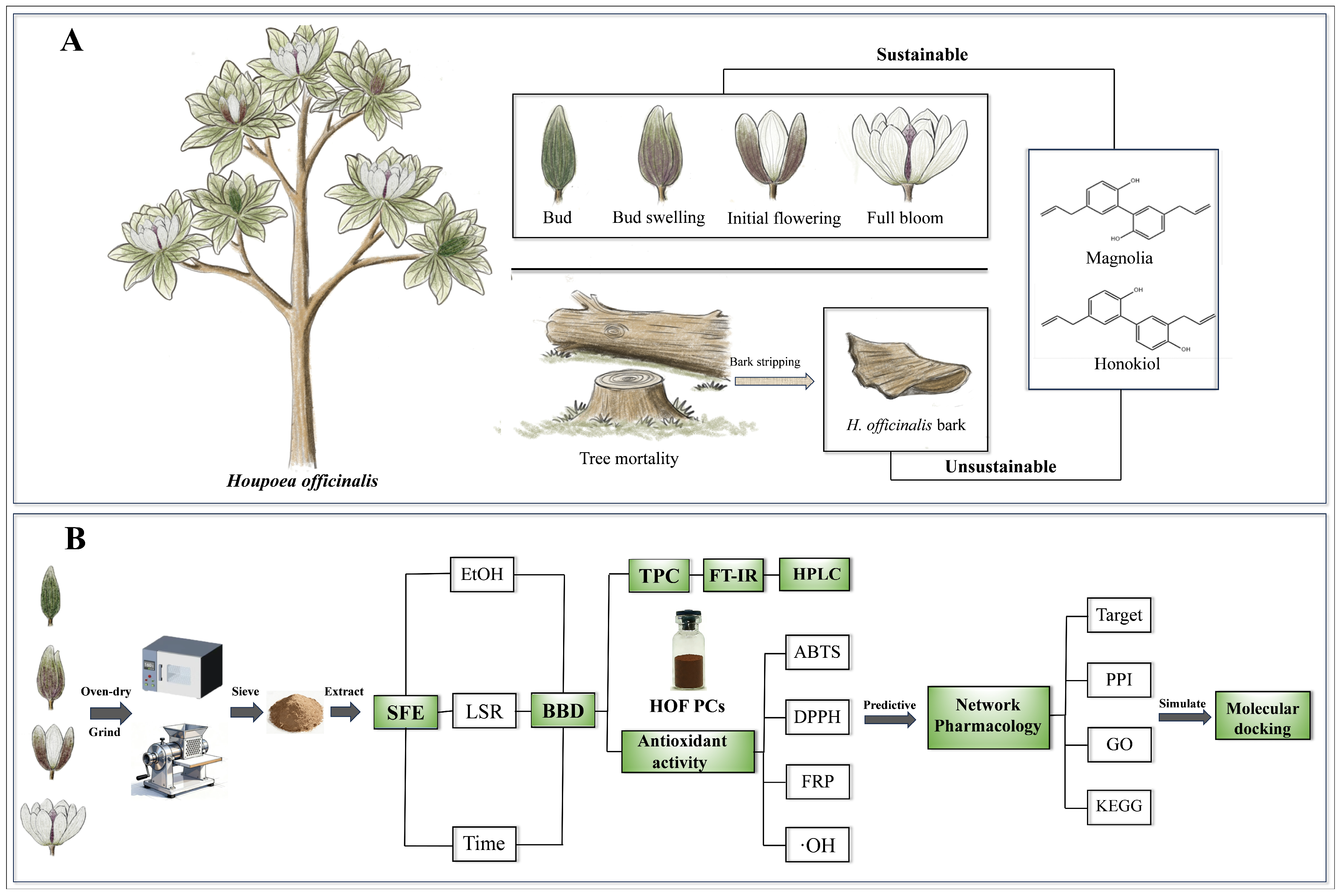
Houpoea officinalis (H. officinalis) is a medicinal tree valued for its rich phytochemical composition, including alkaloids, flavonoids, lignans, neolignans, and terpenoids, which contribute to its well-documented antioxidant, anti-inflammatory, and other pharmacological activities [17]. In East Asian traditional medicine, its bark, particularly the characteristic neolignans magnolol and honokiol, has been widely used to treat gastrointestinal and respiratory disorders [18,19,20]. However, bark harvesting typically requires felling mature trees after a long growth cycle of 12–15 years, limiting the long-term availability of this resource [21]. Therefore, identifying alternative plant materials containing similar bioactive compounds is of considerable interest. H. officinalis flowers (HOF), an underutilized agricultural by-product, contain bioactive constituents analogous to those found in the bark, including magnolol and honokiol (Figure 1A), and have demonstrated antioxidant and other biological activities; with more than 700,000 acres of cultivation in China and an estimated annual production of approximately 300,000 tons, HOF represents an abundant but insufficiently utilized plant resource [22,23]. HOF are not commonly used as a dietary material but are being investigated in this study as a potential source of bioactive phenolic compounds for further exploration in food-related research. However, existing investigations have mainly focused on the identification of individual compounds or the evaluation of selected bioactivities, whereas information regarding developmental-stage-dependent changes in phenolic composition remains limited. In particular, the accumulation patterns of phenolic compounds during flower development and their relationship with antioxidant activity have not been systematically characterized. A key challenge in the utilization of plant-derived phenolic compounds is their dynamic variation during growth and development, as the composition and abundance of these metabolites are influenced by developmental stage and environmental conditions [24,25,26]. Therefore, systematically profiling the temporal changes in PCs across HOF developmental stages is essential for identifying stages with enhanced accumulation of target constituents and for improving the utilization of this resource. Such information may also provide a scientific basis for the selection of appropriate harvesting stages and the development of HOF-derived natural antioxidant products.
To address these interconnected research gaps, we established a standardized protocol for the sustainable harvesting and efficient conversion of HOF PCs. By systematically analyzing the chemical profiles and antioxidant activity patterns of extracts across different developmental stages, and the integration of network pharmacology with molecular docking techniques, we have explored the potential mechanisms underlying their antioxidant stress response.

2. Materials and Methods

2.1. Plant Materials and Reagents

HOF samples representing four seasonal stages were collected from H. officinalis in Longchi Town, Dujiangyan, Chengdu, China (103.59° E, 30.03° N) in April 2024 (spring), July 2024 (summer), October 2024 (autumn), and January 2025 (winter). All trees were healthy, aged 8–10 years, and grown under uniform field conditions. For each season, three biological replicates were obtained, each consisting of pooled material from five randomly selected trees. Samples were collected between 9:00 and 11:00 a.m. under clear weather conditions. The plant material was collected from naturally cultivated populations and was identified in the field based on morphological characteristics consistent with standard botanical descriptions of H. officinalis. Specifically, after collection, samples were immediately subjected to enzyme inactivation at 105 °C for 30 min to rapidly inactivate endogenous oxidative enzymes and prevent post-harvest enzymatic degradation of PCs, dried at 65 °C to constant weight, ground into powder, passed through an 80-mesh sieve, and stored under dry conditions at room temperature until analysis (Figure 1B). Folin–Ciocalteu reagent (Sigma-Aldrich, St. Louis, MO, USA), gallic acid and salicylic acid (Aladdin Biochemical Technology Co., Ltd., Shanghai, China), phenolic standards including rutin, quercetin, chlorogenic acid (CA), hyperin, magnolol and honokiol (purity ≥98%, Yuanye Biological Technology Co., Ltd., Shanghai, China), ABTS, potassium persulfate, and DPPH (Sigma-Aldrich, St. Louis, MO, USA; TCI Chemicals, Tokyo, Japan), potassium bromide (Macklin Biochemical Co., Ltd., Shanghai, China). All remaining reagents were of analytical grade and employed without further purification.

2.2. Single-Factor Experiment (SFE)

In the SFE, three variables were adjusted individually—ethanol concentration (Factor A, 0–80%), liquid-to-solid ratio (Factor B, LSR), and extraction time (Factor C, 10–50 min)—to assess their respective impacts on the extraction efficiency of HOF. The LSR was tested at five levels (20:1–100:1 mL/g) to investigate how solvent volume influences mass transfer and to identify an appropriate range for subsequent optimization. All SFE were conducted at a constant temperature of 25 °C. Each condition was run in triplicate, adopting procedures described by Fan et al. [27] and Qian et al. [28], with minor modifications applied. The extraction process was carried out using a magnetic thermostatic stirrer (SCI1280-Pro, Scilogex, Rocky Hill, CT, USA) operated at 600 rpm. Following the extraction process, the mixtures underwent centrifugation (8000 rpm, 5 min, 4 °C), after which the obtained supernatants were gathered and stored at −20 °C prior to analytical procedures. The TPC served as the response indicator to evaluate the impact of each variable and to define suitable parameter ranges for further optimization. A mixed HOF powder consisting of equal proportions of S1–S4 samples was used for extraction optimization to establish a unified extraction protocol for subsequent comparative analyses across developmental stages.

2.3. Box–Behnken Design (BBD)

A three-factor, three-level BBD within the framework of RSM was constructed based on the preliminary single-factor results [29]. Ethanol concentration (A), LSR (B), and extraction time (C) were defined as independent variables, with each being assigned three coded levels (−1, 0, +1); in contrast, TPC was designated as the response variable for this experiment (Table S1). All experimental runs were performed in a randomized order to minimize systematic bias. Each design point was carried out in triplicate as an independent technical replicate. For the purpose of determining the optimal parameters for extracting PCs from HOF, the obtained data were modeled with a quadratic regression equation employing Design-Expert software (version 13.0.5.0). Subsequent validation and scale-up extractions were then conducted under these optimized conditions to produce the extracts for further analysis.

2.4. TPC Determination

The Folin–Ciocalteu assay is based on a redox reaction and is not completely specific to phenolic compounds, as other reducing substances in plant extracts may also contribute to the measured response. It is widely applied for the estimation of TPC. TPC was quantified following a modified Folin–Ciocalteu assay [30]. Briefly, 0.2 g of the dried powder was extracted with 3 mL of 80% ethanol in a boiling water bath for a duration of 30 min. Following cooling, the mixture was subjected to centrifugation at 5000 rpm for a 15 min duration, with the resulting supernatant subsequently collected. This extraction procedure was performed twice, and the combined supernatants were made up to a fixed volume. In the color development process, 2 mL of deionized water, 1.2 mL of 7.5% sodium carbonate solution, and 0.4 mL of Folin–Ciocalteu reagent were added to 0.4 mL of the prepared extract, and the mixture was allowed to react. Following a 30 min incubation period in the dark, absorbance was determined at a wavelength of 765 nm. Quantification was performed using a gallic acid standard curve, with results expressed as milligrams of gallic acid equivalents per gram of dry weight (mg GAE/g dw).

2.5. Fourier-Transform Infrared (FT-IR) Scanning

FT-IR spectra were acquired using a Nicolet iS5 Fourier-transform infrared spectrometer (Thermo Fisher Scientific, Santa Clara, CA, USA) equipped with a KBr beam splitter, using the potassium bromide (KBr) pellet method [31]. Prior to analysis, a blank KBr pellet was prepared and stored in a desiccator. For sample preparation, the HOF extracts were thoroughly mixed with KBr and compressed into transparent pellets. Spectral scanning measurements were carried out over the range of 400–4000 cm−1, with a spectral resolution of 4 cm−1, 32 co-added scans, and an aperture diameter of 10 mm to ensure optimal signal clarity and a high signal-to-noise ratio.

2.6. HPLC Analysis

The concentrations of magnolol, honokiol, hyperin, CA, rutin, and quercetin were determined by HPLC based on a previously established method [32]. An Agilent 1200 series system (Agilent Technologies, Santa Clara, CA, USA), operated via OpenLAB CDS ChemStation software (version A.02.03), was employed for the analysis. Following dilution with HPLC-grade methanol, samples were separated on a Compass C18 reversed-phase column (250 mm × 4.6 mm, 5 μm, Supelco, Bellefonte, PA, USA) maintained at 30 °C. Two solvents constituted the mobile phase: (A) ultrapure water containing 0.1% acetic acid and (B) acetonitrile containing 0.1% acetic acid. The separation was performed using the gradient detailed below: 10% B (0–2 min), linearly increased to 30% B at 27 min, then linearly increased to 90% B by 50 min, and finally increased linearly to 100% B at 60 min. The system then reverted to the initial 10% B over 3 min and underwent re-equilibration for 5 min. The chromatographic analysis was conducted at a constant flow rate of 1.0 mL/min and an injection volume fixed at 5 μL. Calibration curves for each compound were constructed for quantification, with detailed parameters listed in Table S2.

2.7. In Vitro Antioxidant Activity Assessment

2.7.1. ABTS Radical Scavenging Activity

Assessment of ABTS radical scavenging activity was carried out following the method reported by Hu et al. [33]. To generate the ABTS radical solution, equal volumes of 7 mM ABTS and 2.45 mM potassium persulfate were combined, followed by a 12 h incubation period in the dark. For the assay, 0.2 mL of extract was combined with 3 mL of the diluted ABTS working solution. After the reaction was allowed to proceed for 6 min, absorbance readings were taken at 734 nm (A1). A control group was included, in which deionized water was used instead of the extract in the reaction system (A0). Trolox and vitamin C (Vc) served as positive controls. The half-maximal inhibitory concentration (IC50, mg/mL) was used to represent the scavenging activity, and this value is defined as the extract concentration needed to achieve 50% inhibition of ABTS radicals. The scavenging percentage was derived from formula (1). Dose–response curves were plotted to determine IC50 values, which are presented as mean ± SD (n = 3).
ABTS radical scavenging activity (%) = (1 − A1/A0) × 100%

2.7.2. DPPH Radical Scavenging Capacity

Evaluation of DPPH radical scavenging capacity was carried out following the protocol reported by Fan et al. [34]. Briefly, the reaction mixture was formulated by mixing 0.1 mL of the prepared extract, 2 mL of 0.1 mM DPPH solution, and 0.9 mL of 50 mM Tris-HCl buffer (pH 7.4). This mixture was subsequently incubated in the dark at 25 °C for 30 min, after which its absorbance was measured at a wavelength of 517 nm (A1). A corresponding control was prepared with deionized water in place of the extract (A0). Vitamin C (Vc) and Trolox were employed as positive reference standards. The scavenging percentage was calculated according to formula (2). Based on dose–response curves, the half-maximal inhibitory concentration (IC50, mg/mL) for DPPH radical scavenging was determined and is expressed as mean ± SD (n = 3).
DPPH radical scavenging capacity (%) = [1 − A1/A0] × 100%

2.7.3. Ferric Reducing Power (FRP)

The ferric reducing power (FRP) was performed according to the method by Ren et al. [35]. Briefly, 1 mL of extract was mixed with 1 mL of 1% potassium ferricyanide and 1 mL of 0.2 M phosphate buffer (pH 6.6), followed by incubation at 50 °C for 20 min. The mixture was cooled on ice first, followed by the addition of 1 mL of 10% trichloroacetic acid; it was then centrifuged at 5000 r/min for 10 min at 25 °C. Subsequently, 1 mL of the supernatant was reacted sequentially with 1 mL of deionized water and 0.2 mL of 0.1% ferric chloride solution. After the reaction proceeded for 10 min, absorbance was measured at a wavelength of 700 nm. Vitamin C (Vc) and Trolox were used as positive controls, with all measurements conducted in triplicate to ensure data reliability. The IC50 value (mg/mL), corresponding to an absorbance of 0.5 at 700 nm, was calculated from the dose–response curve and expressed as mean ± SD (n = 3).

2.7.4. ·OH Scavenging Capacity

Measurement of ·OH scavenging activity was carried out with an adapted protocol reported by [36]. The reaction mixture contained equal volumes of the extract, 3 mM FeSO4, 6 mM salicylic acid, and 3 mM H2O2. The mixture was incubated at 37 °C for 15 min, after which absorbance was measured at 510 nm (A1). A blank (A0) was prepared by substituting the extract with deionized water, while a sample background (A2) was obtained by excluding H2O2. Positive controls were established using Vitamin C (Vc) and Trolox for comparative analysis. The ·OH scavenging rate (%) was derived from Formula (3). The IC50 values (mg/mL) were obtained from dose–response curves and are expressed as mean ± SD (n = 3).
·OH radical scavenging capacity (%) = [1 − (A1A2)/A0] × 100%
Concentration gradients were established to ensure that the calculated IC50 values (DPPH, ABTS and ·OH) and IC50 values (FRP) fell within the tested concentration ranges (lower values indicate stronger antioxidant activity). The concentration ranges were 0.05–0.8 mg/mL for S1, 0.1–1.6 mg/mL for S2, 0.2–3.2 mg/mL for S3 and S4, and 0.01–0.3 mg/mL for Vc and Trolox. Each concentration was tested in triplicate. Dose–response curves were fitted using a four-parameter logistic nonlinear regression model based on the logarithm of concentration versus the corresponding antioxidant activity (R2 > 0.99).

2.8. Network Pharmacology

For a systematic investigation into the potential multi-target mechanisms underlying the antioxidant activity of PCs, we adopted an integrated approach that combines network pharmacology with molecular docking techniques. This computational strategy was used as a hypothesis-generating approach to explore potential compound–target interactions and signaling pathways associated with the antioxidant activity of PCs, reducing reliance on extensive experimental resources while offering a systematic platform for analyzing multi-component interactions [15,16]. Initially, oxidative stress-associated targets were extracted from the MSigDB database (https://www.gsea-msigdb.org/, accessed on 2 February 2026) using the gene set “GOBP_RESPONSE_TO_OXIDATIVE_STRESS.v2025.1.Hs.gmt”. Next, the Venn Diagram package in R 4.1.3 was employed to determine the overlapping targets between the five key PCs and the aforementioned oxidative stress-related targets. Subsequently, a protein–protein interaction (PPI) network was constructed via the STRING database (https://string-db.org/, accessed on 5 February 2026), and topological analysis was conducted in Cytoscape 3.9.1 to identify hub targets based on degree centrality. The clusterProfiler package in R 4.1.3 was utilized for functional enrichment analysis, and Gene Ontology (GO) as well as Kyoto Encyclopedia of Genes and Genomes (KEGG) pathway analyses were implemented through a hypergeometric test corrected by the Benjamini–Hochberg method (p < 0.05). Cytoscape 3.9.1 was employed to visualize all resultant networks, aiming to illustrate the compound–target relationships.
The identified targets and pathways were derived from public databases and computational predictions. Therefore, the proposed mechanisms require further validation through cellular and molecular experiments.

2.9. Molecular Docking

Molecular docking simulations were performed to predict the potential interactions between the active compounds and their corresponding hub target proteins [37]. The two-dimensional (2D) structures of the compounds were acquired in SDF format from the PubChem database (https://pubchem.ncbi.nlm.nih.gov/, accessed on 10 February 2026). These structures were subsequently transformed into their 3D configurations using ChemBio3D Ultra 14.0. Protein structures were obtained from the Protein Data Bank based on UniProt IDs (https://www.uniprot.org/, accessed on 10 February 2026), and the corresponding PDB IDs were TP53 (PDB ID: 4MZI), AKT1 (PDB ID: 3O96), BCL2 (PDB ID: 1G5M), CASP3 (PDB ID: 1NMS), and IL6 (PDB ID: 1ALU). Water molecules and ligands were removed using PyMOL, version 2.5.0. Because the binding sites of the selected phytochemicals on these targets have not been experimentally established, a blind docking strategy was employed. A cubic docking box (90 × 90 × 90 Å; grid spacing = 0.375 Å) was defined to fully encompass each protein structure, allowing ligand exploration across the entire receptor surface. Docking was performed with AutoDock Vina, version 1.2.0, using an exhaustiveness value of 32 and 20 docking runs for each ligand–target pair. The conformation exhibiting the minimum binding energy was chosen for interaction analysis using Discovery Studio 2016 Client, with results visualized as 2D structures, 3D structures, and binding energy heatmaps. This computational approach supports sustainable drug discovery by prioritizing candidates virtually before experimental validation.

2.10. Statistical Analysis

All measurements were performed in triplicate. Data normality was assessed using the Shapiro–Wilk test, and homogeneity of variance was evaluated prior to statistical analysis. One-way ANOVA followed by Duncan’s multiple comparison test was used to determine statistical significance. Differences were considered statistically significant at p < 0.05 and highly significant at p < 0.01. Statistical analyses were performed using SPSS 27.0, and graphs were generated using Excel 2019 and Origin 2024b.

3. Results and Discussion

3.1. Optimize Extraction

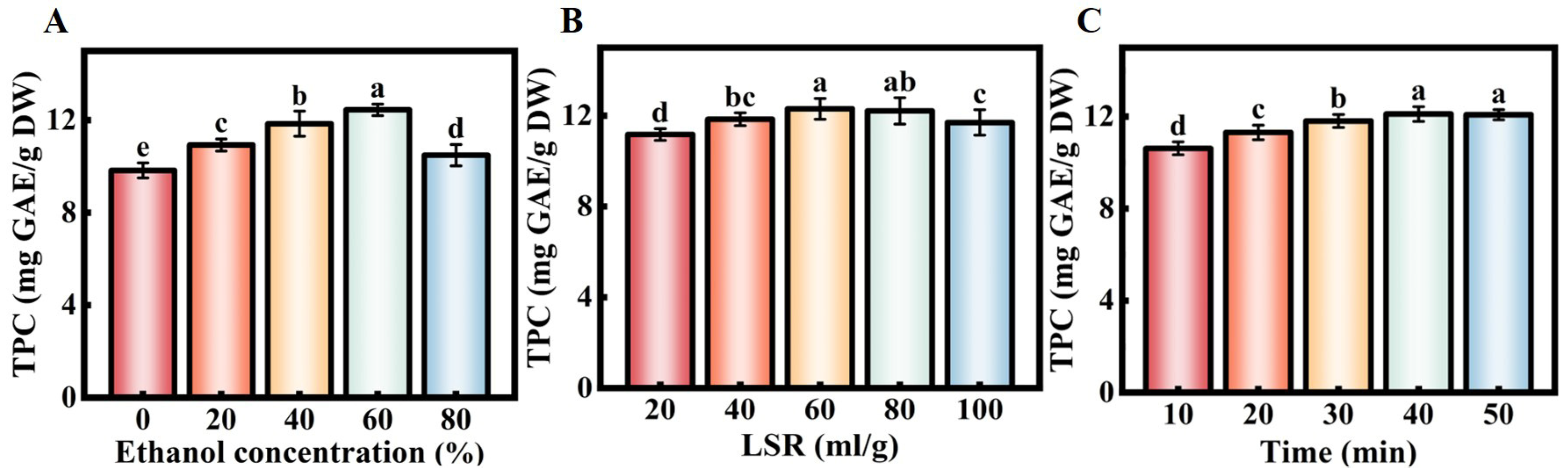
TPC is governed by three critical parameters: ethanol concentration, LSR, and extraction time [38]. Polar solvents, including methanol, ethanol, acetone, and their aqueous mixtures, are commonly employed due to their efficacy in extracting PCs and antioxidants [39,40]. Ethanol, a food-grade and environmentally friendly solvent, has been widely used for efficient recovery of PCs and antioxidants from plant materials [41]. Ethanol–water mixtures are commonly used in industrial extraction and have been shown to be more effective than pure solvents for phenolic compound recovery. Ethanol concentration, in particular, significantly influences the release rate of phytochemicals from plant materials [42]. As shown in Figure 2A, TPC yield initially increased with increasing ethanol concentration but declined beyond a certain point, reaching a maximum of 12.45 mg/g at 60% ethanol. Similar trends have been reported for other medicinal plants, such as Prunus spinosa, Lonicera japonica, and Lonicera macranthoides, with optimal ethanol concentrations ranging between 50% and 60% [42,43]. Such discrepancies probably arise from differences in the functional groups, molecular weights, and polarity of PCs derived from different plant organs. Under low ethanol concentrations, the hydroethanolic medium disrupts interactions between PCs and other cellular constituents like proteins and polysaccharides, thus promoting their extraction. However, as ethanol concentration continues to rise, the reduced polarity of the solution becomes less favorable for polyphenol solubility [44]. Based on these observations, a concentration range of 20–80% ethanol was selected to conduct follow-up optimization studies.
An appropriate LSR is crucial for achieving high extraction yields of bioactive compounds while minimizing energy consumption and operational costs [45]. As shown in Figure 2B, TPC yield initially increased with higher LSR, reaching a maximum of 12.3 mg/g at an LSR of 60:1 mL/g. Beyond this point, further increases in LSR resulted in a gradual decline in TPC extraction efficiency. Similar trends have been documented for other plant-derived materials in relevant studies, such as Ficus carica and Punica granatum, in which TPC yields were significantly influenced by LSR, with optimal extraction observed at 60:1 mL/g [46,47]. This pattern can be attributed to improved contact between the solvent and plant matrix at moderate LSR, which enhances the concentration gradient and facilitates the dissolution and mass transfer of polyphenols [45]. However, excessively high LSR may increase the diffusion path length for PCs within the plant tissue, slowing the extraction rate [48]. Moreover, once the solution approaches saturation with PCs, further increasing the LSR could promote the co-extraction of other substances, thereby reducing the relative yield of target PCs. Based on these observations, an LSR range of 20:1–80:1 mL/g was selected for subsequent optimization studies.
Extraction duration significantly influenced the TPC from HOF. As depicted in Figure 2C, the yield of TPC increased significantly as the extraction time was prolonged from 10 to 40 min. However, extending the extraction time to 50 min resulted in a plateau in TPC (12.11 mg/g), likely due to near-complete polyphenol extraction and potential oxidation or hydrolysis of PCs [38]. Prior research has demonstrated that insufficient extraction duration leads to the partial release of PCs, whereas excessively long extraction does not considerably improve yield and only increases time-related costs [49]. Thus, we chose an extraction time span of 10–40 min for subsequent optimization, aiming to enhance the efficiency of phenolic extraction from plant materials.
Although advanced extraction techniques such as ultrasound-assisted extraction, microwave-assisted extraction, and deep eutectic solvent systems have been reported to improve the extraction efficiency of PCs, the ethanol–water system employed in this study is widely used in the food and pharmaceutical industries owing to its operational simplicity, food-grade safety, environmental compatibility, and ease of scale-up. Therefore, the optimized conditions obtained herein provide a practical and applicable strategy for PC extraction from plant materials. Drawing on the findings of single-factor experiments, a three-factor, three-level RSM was utilized [50]. A total of 17 experimental combinations were listed in supplementary Table S4. Design-Expert 13 software was employed for multiple regression fitting to construct a mathematical model, yielding the quadratic polynomial regression equation as follows (4): Y = 12.75 0.49 A + 0.72 C + 0.59 A C 3.26 A 2 0.54 B 2 0.88 C 2 , where Y represents the predicted TPC yield, and A, B, and C denote the coded values corresponding to ethanol concentration, LSR, and extraction time. The F-values revealed that the relative influence of the extraction parameters on TPC yield followed the order C (extraction time) > A (ethanol concentration) > B (LSR), indicating that extraction time emerged as the most influential factor [51].
The ANOVA results demonstrated the high significance of the quadratic regression model (p < 0.0001) as well as a non-significant lack of fit (Table 1, p > 0.05), demonstrating good model reliability and adequate fitting of the regression equation. A coefficient of determination (R2) of 0.9911, an adjusted R2 of 0.9798, and a predicted R2 of 0.8840 were obtained for the model, demonstrating that 97.98% of the variation in the experimental data could be explained by this model [52]. A small difference (<0.2) was observed between R2 and adjusted R2, which further verified the good consistency between experimental and predicted values. A coefficient of variation of 2.62% demonstrated the model’s high precision and reproducibility, thereby validating its utility in predicting TPC yield from HOF.
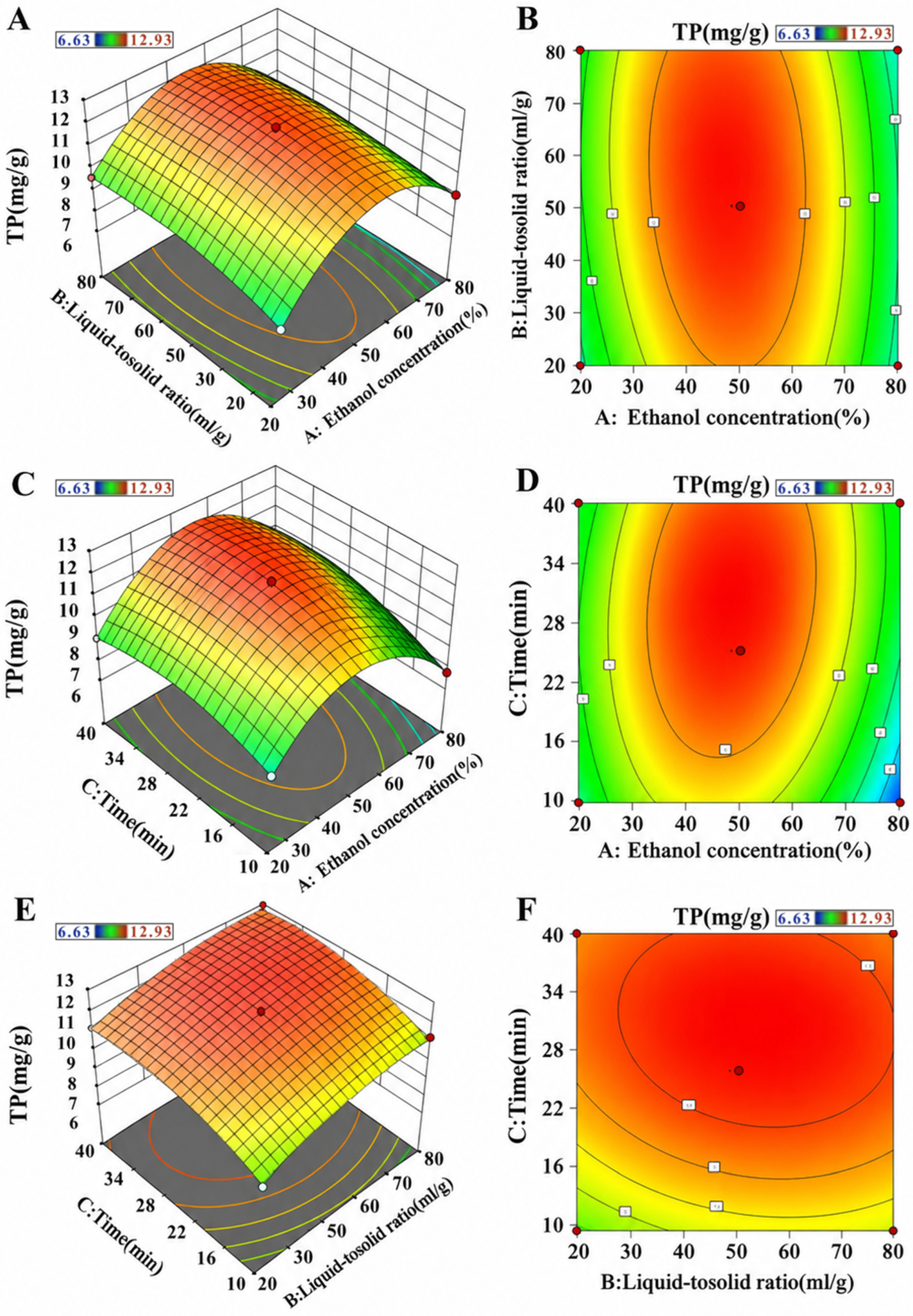
RSM-generated three-dimensional response surface plots and their corresponding contour maps demonstrate the individual and interactive effects of each extraction factor pair on TPC yield (Figure 3). A steeper surface in the 3D plots indicated stronger interactive effects between parameters, while elliptical contours suggest significant mutual influence on TPC extraction efficiency. During extraction, TPC yield initially increased with rising values of the three factors but gradually plateaued or declined beyond certain thresholds. The RSM model determined the optimal extraction conditions as listed below: 48.6% ethanol, 54.4 mL/g LSR, and 30.8 min extraction time.
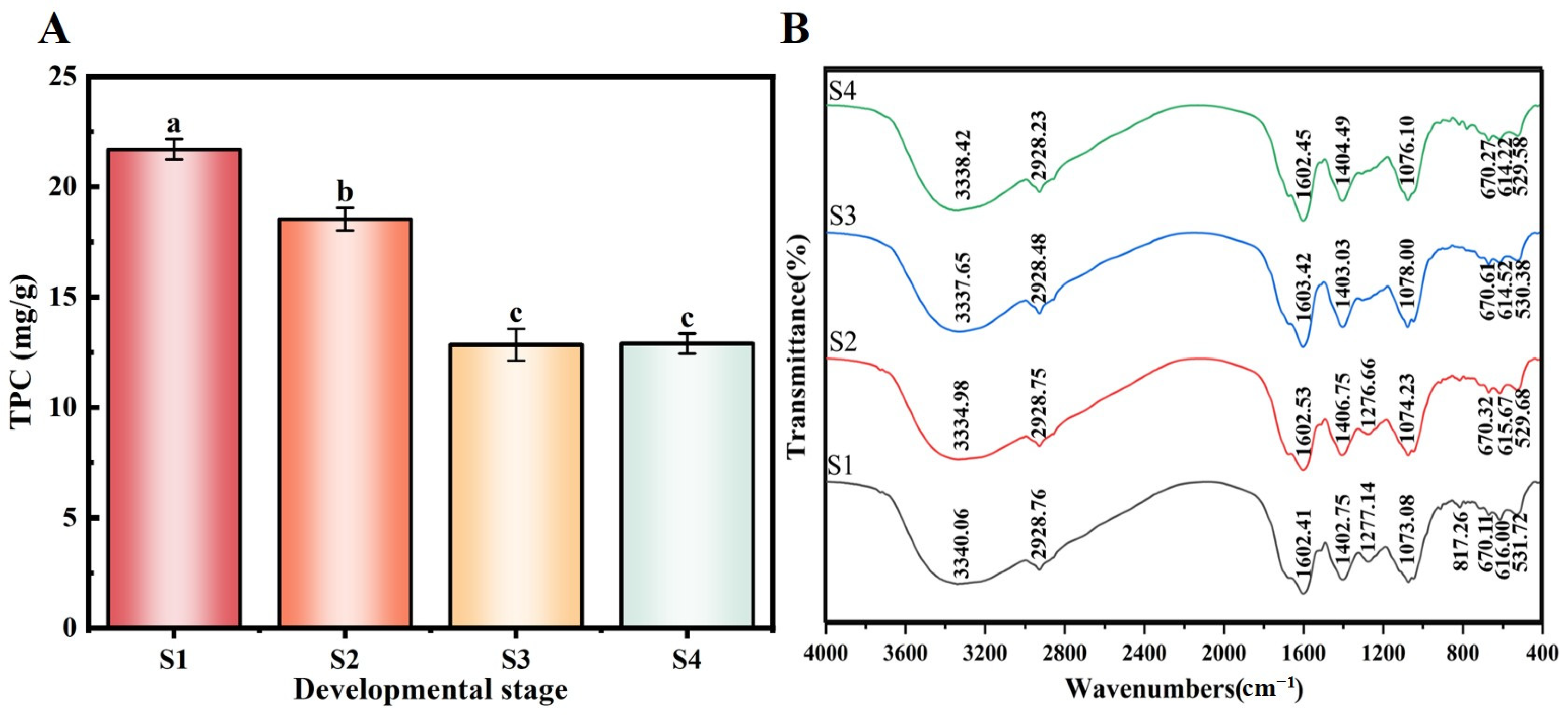
Under the optimized extraction conditions, triplicate parallel experiments were conducted using a 1 g mixed sample of HOF. The predicted TPC yield was 12.75 mg/g, while the measured value was 12.55 ± 0.12 mg/g, differing by less than 5%. Furthermore, when the sample mass was scaled up to 10 g, the measured TPC yield was 12.43 ± 0.22 mg/g, also within 5% of the predicted value (12.75 mg/g). The results presented herein demonstrate that the optimized extraction process possesses robustness and reproducibility and is well suited for the scale-up extraction of HOF. The optimized extraction conditions were subsequently applied to HOF collected at four developmental stages (Figure 4A). The resulting TPC yields across four developmental stages ranged from 12.83 to 21.70 mg/g, with values decreasing progressively from S1 to S4, indicating substantial differences in phenolic accumulation during flower development [53].

3.2. FT-IR Characterization of HOF

FT-IR spectroscopy was employed as a supplementary technique to characterize the major functional groups present in HOF extracts and to evaluate compositional changes during flower development [34]. As shown in Figure 4B, extracts from the four developmental stages exhibited similar FT-IR profiles, with characteristic absorption bands around 3340 cm−1, 1602 cm−1, 1276 cm−1, and 1076 cm−1, indicating the presence of common functional groups throughout flower development. The broad absorption band at approximately 3340 cm−1 was assigned to O–H stretching vibrations of alcohols and phenols [54]. The absorption band near 1602 cm−1 corresponded to aromatic C=C stretching vibrations, which are characteristic of PCs containing aromatic ring structures. In addition, the bands at 1276 cm−1 and 1076 cm−1 were attributed to C–O stretching vibrations commonly found in alcohols, ethers, and phenols [55]. As flower development progressed, the absorption band near 1276 cm−1 gradually weakened and became indistinct in S3 and S4. This trend was consistent with the decrease in TPC observed during flower development, suggesting changes in the abundance of PCs containing C–O functional groups. Overall, the FT-IR results provided evidence for the presence of functional groups commonly associated with PCs and reflected compositional changes occurring during flower development.

3.3. HPLC Quantification of PCs

It has been reported that harvesting time significantly influences the chemical composition and antioxidant potential of plants [56]. Therefore, to understand the temporal variations in the phytochemical composition and antioxidant activity of HOF, a systematic analysis of phenolic dynamics across developmental stages is essential. The phenolic profiles of HOF from four harvesting stages were analyzed using HPLC with six phenolic standards (magnolol, honokiol, hyperin, CA, rutin, and quercetin). As presented in Figure S1, Table S3 and Table 2, the relevant results are detailed herein. Major PCs in the HOF were quantified. The TPC across all samples ranged from 2202.88 to 6126.86 μg/g (Table 2) whereas quercetin was not detected. As shown in Table 2, magnolol (1032.74–2846.10 μg/g) and honokiol (679.51–2684.20 μg/g) were present at significantly higher concentrations than other compounds. This finding is consistent with the results reported by Liu et al. [57]. Magnolol showed the highest overall content, whereas hyperin was the least abundant, with magnolol levels exceeding those of hyperin by 117.0 to 470.7-fold. During stages S1–S4, magnolol, CA, and honokiol exhibited an initial decline followed by a subsequent increase, with lower levels in S1–S3 and a rise in S4. In contrast, hyperin increased during S1–S2 and then decreased in S3–S4. Notably, rutin was the only compound that exhibited a consistent declining trend. This finding is consistent with the results reported by Maina et al. [58]. The highest levels of most phenolic compounds are typically observed during the initial developmental phase. For instance, extracts from Magnolia kobus flower collected at the bud stage exhibit the greatest phenolic acid content, while Magnolia denudate flower demonstrates elevated phenolic concentrations in early maturation phases. This pattern can be attributed to the metabolic conversion of PCs such as chlorogenic acid into anthocyanins during fruit development, coinciding with increases in fruit weight and soluble solid content [59,60]. These results furnish important insights into the dynamic accumulation patterns of PCs in HOF. It should be noted that the lower total content of HPLC-quantified phenolics compared with the Folin–Ciocalteu TPC values is expected, as only six PCs were quantified and the Folin–Ciocalteu assay may also respond to other reducing substances present in the extracts.

3.4. Determination of In Vitro Antioxidant Activity

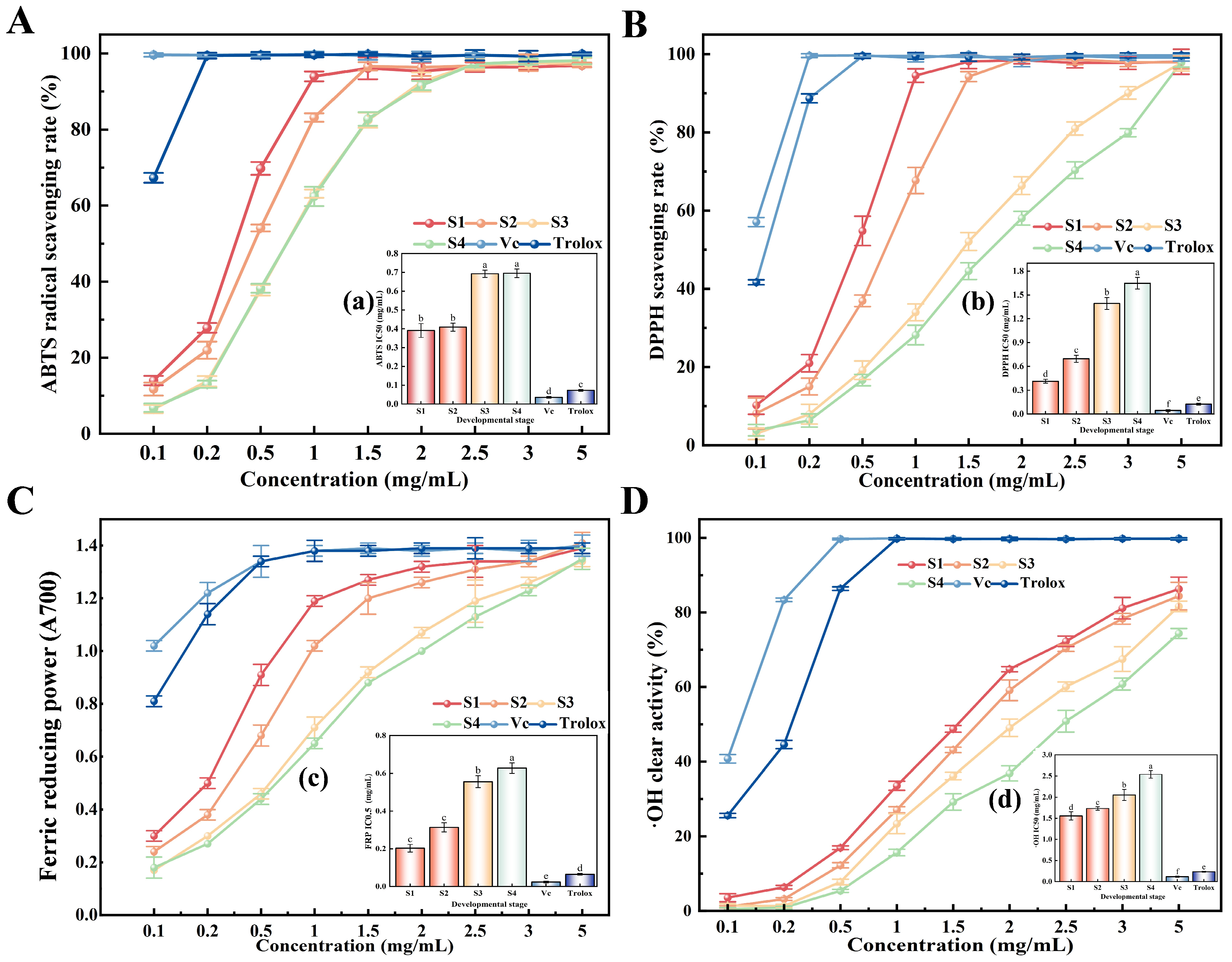
A systematic assessment of the relationship between phenolic composition and antioxidant activity in HOF extracts was conducted to explore their intrinsic correlation across four growth stages (S1–S4), which formed the core of this study and contributed to its sustainable valorization. The assessment employed four in vitro assays: ABTS, DPPH, ·OH radical scavenging and FRP. Previous studies have established that harvesting time significantly influences in vitro antioxidant capacity in plants [10], as observed in Rhododendron flowers and Casuarina leaves [32,61]. Across all developmental stages, the data showed a persistent positive correlation between TPC and antioxidant activity (based on 1/IC50 values). As shown in Figure 5 and Table S5, S1 stage extracts exhibited the strongest antioxidant activity: IC50 for ABTS was determined to be 0.3904 ± 0.0366 mg/mL, IC50 for DPPH was determined to be 0.4125 ± 0.0246 mg/mL, and the data showed that the extract had a FRP IC0.5 of 0.2025 ± 0.0198 mg/mL and exhibited ·OH radical scavenging activity with an IC50 value of 1.5565 ± 0.0972 mg/mL. A continuous decline in these parameters was recorded throughout the developmental progression, with a recovery occurring at the S4 stage, with S4 showing 0.6952 ± 0.0228 mg/mL (ABTS), 1.6472 ± 0.0731 mg/mL (DPPH), 0.6272 ± 0.0276 mg/mL (FRP), and 2.5381 ± 0.0904 mg/mL (·OH). The stronger antioxidant activity observed in the S1 stage may be associated with the higher accumulation of PCs during early flower development [62]. The overall decline in antioxidant defenses, including enzymatic scavenging systems, during the open flowering stage may be associated with an increased risk of ROS accumulation [63]. Although ABTS, DPPH, ·OH radical scavenging and FRP are widely used for evaluating antioxidant potential, these methods primarily reflect in vitro radical-scavenging and electron-transfer capacities under controlled chemical conditions. Therefore, the results should be interpreted as indicators of potential antioxidant capacity rather than direct evidence of antioxidant effects under physiological conditions. Further cell-based and in vivo studies are required to validate the biological relevance of these findings.
For correlation analysis, IC50 values were converted to their reciprocal form (1/IC50), where higher values indicate stronger antioxidant activity, to ensure consistent directional interpretation. Based on this transformation, correlation analysis revealed significant positive relationships among all antioxidant activities (except ·OH radical scavenging) and among most PCs (Figure S2). The three major antioxidant indicators showed significant positive correlations with four PCs (magnolol, hyperin, CA, and rutin), suggesting that these compounds may be associated with antioxidant activity [10]. Notably, ·OH radical scavenging capacity was positively correlated with reducing power, hyperin, CA, and rutin, while honokiol only demonstrated significant correlation with magnolol. Although honokiol reached its highest concentration at the S4 stage, it did not show significant correlations with the major antioxidant indicators. In contrast, magnolol, hyperin, CA, and rutin exhibited stronger associations with antioxidant activity, suggesting that the antioxidant potential of HOF may be influenced by the combined effects of multiple PCs rather than the abundance of a single constituent. PCA further characterized these relationships (Tables S6 and S7). PC1 accounted for 78.49% of variance, primarily driven by antioxidant activities and PCs (except magnolol and honokiol), while PC2 explained 17.94%, strongly influenced by ·OH scavenging capacity, magnolol, and honokiol. The distinct distribution of developmental stages across quadrants reflected significant differences in phenolic composition and antioxidant profiles, with S1 and S2 stages showing similar characteristics, consistent with observations in other medicinal flowers [64,65]. These comprehensive results suggest that HOF at early developmental stages, particularly S1, possesses superior antioxidant potential, providing a useful reference for selecting appropriate harvesting stages in future utilization studies. It should be noted that all samples were collected from a single geographical location, and environmental variability among different growing regions was not evaluated in the present study. Therefore, further investigations involving multiple locations and biological validation models would help to further assess the general applicability of the observed patterns.

3.5. Network Pharmacology Analysis

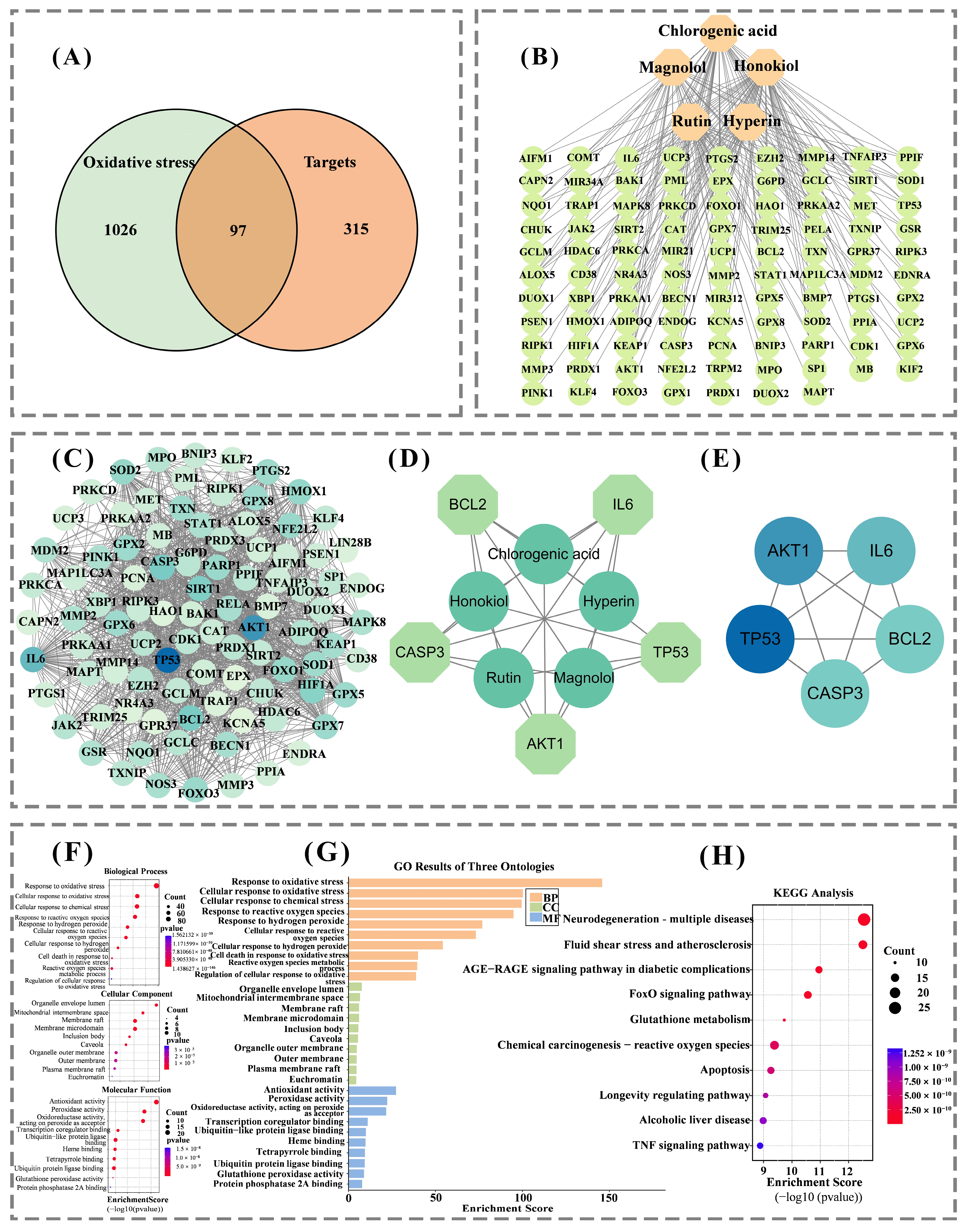
Based on the observed patterns of TPC and antioxidant activity in HOF extracts across four developmental stages, this study further investigated the underlying mechanisms using network pharmacology. A total of 412 oxidative stress-related targets were retrieved, and 97 overlapping targets were identified through intersection with the regulatory targets of five key HOF PCs (magnolol, honokiol, hyperin, rutin, and CA) (Figure 6A). Compound–target network analysis revealed extensive many-to-many interactions between these PCs and their targets (Figure 6B), reflecting the typical multi-component, multi-target synergistic characteristics of plant polyphenols [66]. Five hub genes were identified through PPI network analysis: TP53, AKT1, IL6, BCL2, and CASP3, all of which exhibited close interactions with the five PCs (Figure 6C–E). These hub genes play central roles in key biological processes, including cell cycle regulation, cellular differentiation, and apoptosis [67,68,69]. Notably, the high centrality of apoptosis-related proteins such as BCL2 in the network supports their relevance as core targets through which HOF PCs may regulate oxidative stress. Functional enrichment analysis further confirmed the critical role of these targets in oxidative stress regulation. Significant enrichment of biological processes linked to oxidative stress response and ROS metabolism regulation was identified via GO analysis. Cellular components were mainly localized in organelle membrane lumens and mitochondrial intermembrane spaces, consistent with the subcellular localization of TP53 [70], while molecular functions were enriched in antioxidant activity and peroxidase activity (Figure 6F–H). KEGG pathway analysis indicated enrichment in pathways associated with oxidative stress and cellular homeostasis. These processes are closely associated with cellular redox balance, which is a key determinant of antioxidant potential in food-derived bioactive compounds. Accordingly, the observed network relationships suggest that HOF-derived PCs may contribute to antioxidant-related biological effects through multi-target interactions involved in oxidative stress regulation. These findings align with the observed positive correlations between TPC and antioxidant activity, further supporting the role of HOF as a potential source of natural antioxidant ingredients. Additionally, the well-characterized crystal structures of core targets offer a fundamental basis for molecular docking studies to confirm the binding modes of HOF-derived PCs.

3.6. Molecular Docking

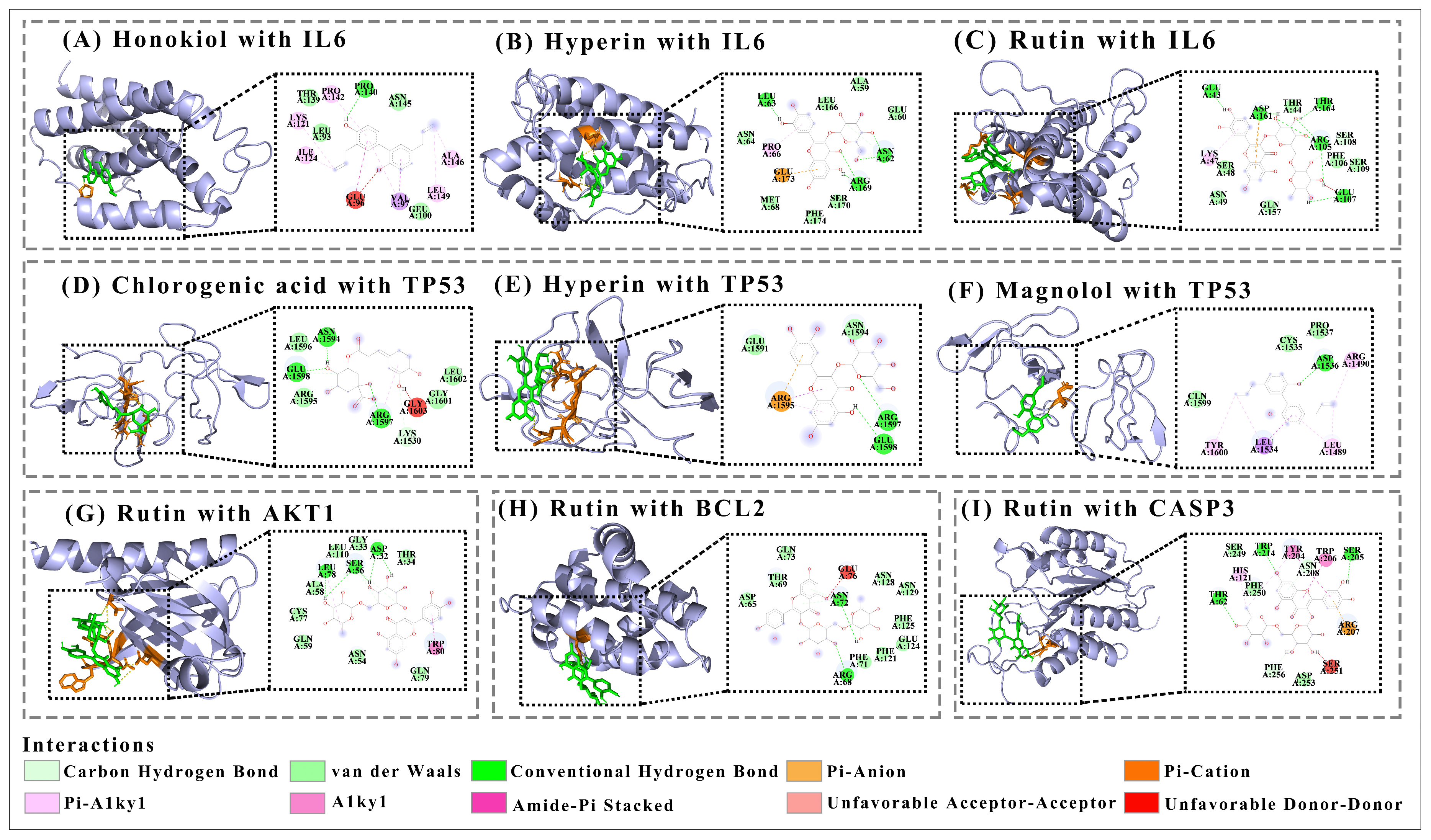
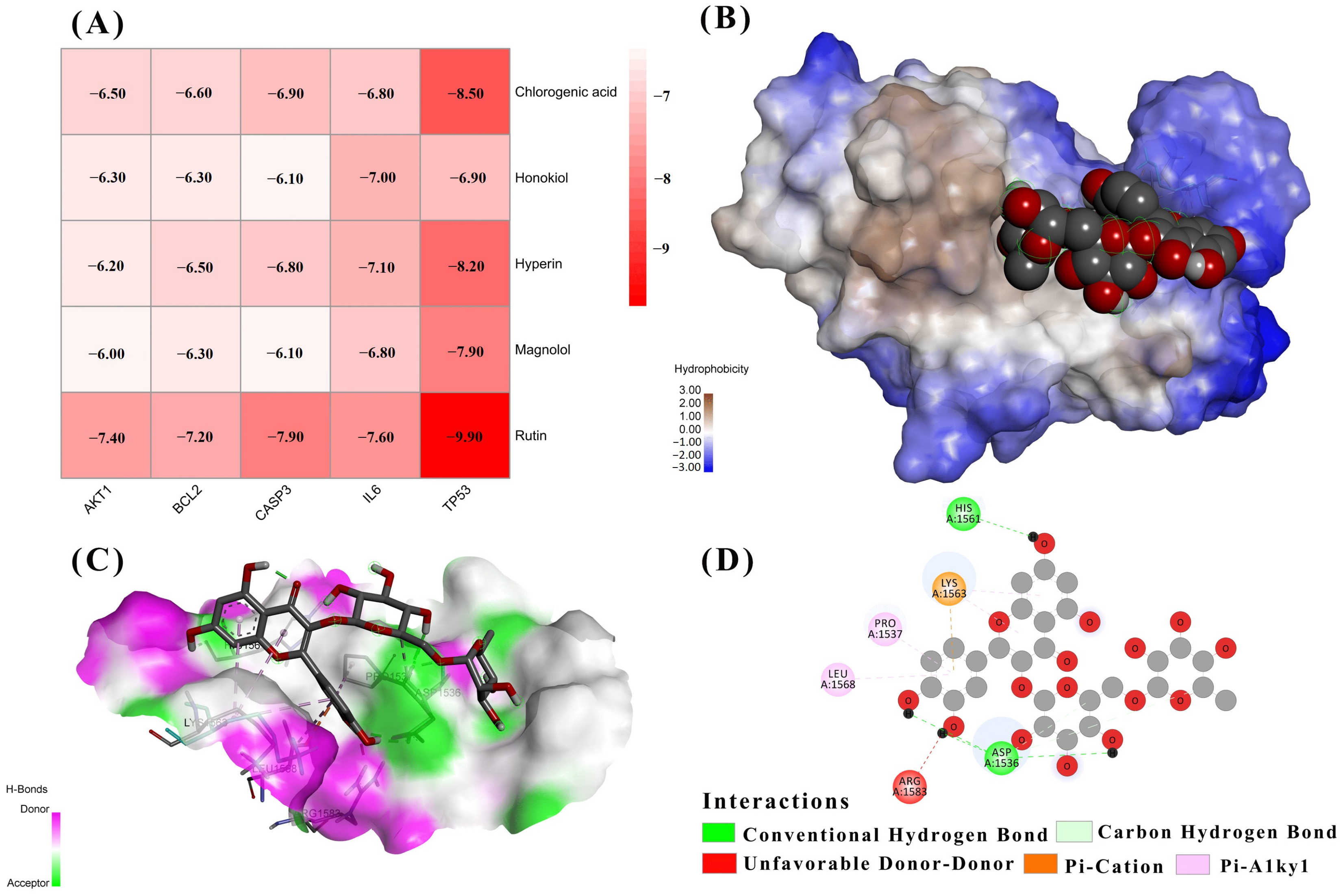
The current study revealed that the five major PCs in HOF exhibited higher abundance during the S1 and S2 developmental stages: magnolol and CA were highest at S1, while honokiol, hyperin, and rutin peaked at S2 (Table 2). Consistent with this, in vitro antioxidant assays confirmed that extracts from S1 and S2 exhibited significantly stronger antioxidant activity than those from S3 and S4. To explore the molecular basis of these observations, molecular docking was performed. A total of 25 docking experiments produced 500 models. Based on a binding energy threshold of below −7.0 kcal/mol, the best poses were selected and visualized in 2D and 3D protein structures (Figure 7). Among these, 11 ligand–target pairs exhibited binding energies below −7.0 kcal/mol and were therefore selected for further visualization and interaction analysis, and all selected models showed favorable predicted interactions with their respective targets. Overall, these results provide a systematic characterization of the predicted binding patterns between HOF PCs and key oxidative stress-related targets, offering structural insights that may help explain their traditional use and suggesting a possible association between developmental stage-dependent chemical variations and antioxidant activity at the molecular level. Docking analysis suggested that the predicted binding affinity trends of the five PCs with core target proteins (TP53, AKT1, IL6, BCL2, and CASP3) were generally consistent with their antioxidant profiles (Figure 8A). All complexes showed binding energies below −5.0 kcal/mol, suggesting favorable binding, with values under −7.0 kcal/mol generally considered indicative of relatively strong predicted binding affinity in molecular docking studies [71]. Mechanistic analysis revealed that these PCs primarily engage in non-covalent interactions, such as hydrogen bonds and hydrophobic forces with key residues in the active sites, forming stable complexes [72]. Notably, rutin exhibited the strongest binding stability with TP53, achieving the lowest binding energy (−9.90 kcal/mol), making the rutin–TP53 pair a noteworthy candidate for further investigation regarding its potential involvement in oxidative stress-related processes (Figure 8B–D). The favorable docking score observed for the rutin–TP53 complex is consistent with previous reports describing the antioxidant properties of rutin, although direct mechanistic relationships require further experimental validation [73]. Furthermore, the higher levels of magnolol, rutin, and honokiol in the S1 and S2 stages were associated with stronger antioxidant activity observed at these stages, suggesting a potential contribution of these compounds to the antioxidant effects. Molecular docking results do not represent direct evidence of antioxidant activity in foods or biological systems. Therefore, further validation using cellular antioxidant assays and bioavailability studies is required to confirm the biological relevance of these computational predictions.

4. Conclusions

An integrated research methodology for the sustainable resource utilization of magnolol, honokiol, and related phenolic compounds from HOF was established, covering extraction process optimization, compositional analysis, and bioactivity evaluation. Through RSM, an efficient extraction process was developed with optimal parameters of 48.6% ethanol concentration, 54.4 mL/g LSR, and 30.8 min extraction time. Under these conditions, the yield of TPC attained 21.70 mg/g, showing excellent reproducibility. Subsequent compositional analysis revealed stage-specific accumulation patterns of key phenolic compounds: magnolol and CA peaked at stage S1, hyperin and rutin showed highest enrichment at stage S2, while honokiol reached its maximum content at stage S4. Based on these findings, antioxidant activity evaluation demonstrated that S1-stage extracts exhibited the strongest activity, which showed significant positive correlations with the contents of magnolol, hyperin, CA, and rutin. To further elucidate the bioactivity mechanisms, network pharmacology identified TP53, AKT1, IL6, BCL2, and CASP3 as core targets interacting with major PCs. Molecular docking further suggested potential binding affinities between these PCs and the core targets, with the rutin–TP53 complex showing the lowest binding energy and the most stable binding conformation. The present studies provided a scientific foundation for transforming HOF into a sustainable resource of functional PCs. It effectively bridges the value chain between agricultural by-product resource management and natural product development.

Supplementary Materials

The following supporting information can be downloaded at https://www.mdpi.com/article/10.3390/horticulturae12070787/s1: Figure S1: HPLC chromatograms of HOF extracts at four developmental stages; Figure S2: Correlation between HOF PCs and antioxidant activity, and PCA. (A) Correlation analysis. (B) PCA; Table S1: BBD factors, actual values, and coding levels; Table S2: Condition parameters of HPLC; Table S3: BBD and experimental results; Table S4: BBD and experimental results; Table S5: TPC content of HOF extract at four development stages; Table S6: Eigenvalues and contribution rates of the top 4 PCs; Table S7: Loadings of TPC and antioxidant activity on PC1 and PC2.

Author Contributions

Writing—review and editing, writing—original draft, software, methodology, investigation, formal analysis, data curation, L.H.; writing—review and editing, visualization, methodology, formal analysis, S.F.; writing—review and editing, visualization, investigation, J.Z.; writing—review and editing, investigation, data curation, J.Y.; writing—review and editing, visualization, investigation, M.C.; writing—review and editing, visualization, methodology, formal analysis, T.Y.; writing—review and editing, supervision, H.H.; writing—review and editing, writing—original draft, supervision, project administration, funding acquisition, conceptualization, G.Z. and S.G. All authors have read and agreed to the published version of the manuscript.

Funding

This research was funded by the National Key Research and Development Program of China (No. 2023YFD1600400).

Data Availability Statement

The original contributions presented in the study are included in the article/Supplementary Materials; further inquiries can be directed to the corresponding authors.

Acknowledgments

We are grateful to all the group members and workers for their assistance in the field experiment.

Conflicts of Interest

The authors declare no conflicts of interest.

References

  1. Barrios, N.; Marquez, R.; McDonald, J.D.; Hubbe, M.A.; Venditti, R.A.; Pal, L. Innovation in lignocellulosics dewatering and drying for energy sustainability and enhanced utilization of forestry, agriculture, and marine resources—A review. Adv. Colloid. Interface Sci. 2023, 318, 102936. [Google Scholar] [CrossRef] [PubMed]
  2. Mueed, A.; Shibli, S.; Al-Quwaie, D.A.; Ashkan, M.F.; Alharbi, M.; Alanazi, H.; Binothman, N.; Aljadani, M.; Majrashi, K.A.; Huwaikem, M.; et al. Extraction, characterization of polyphenols from certain medicinal plants and evaluation of their antioxidant, antitumor, antidiabetic, antimicrobial properties, and potential use in human nutrition. Front. Nutr. 2023, 10, 1125106. [Google Scholar] [CrossRef] [PubMed]
  3. Tungmunnithum, D.; Thongboonyou, A.; Pholboon, A.; Yangsabai, A. Flavonoids and other phenolic compounds from medicinal plants for pharmaceutical and medical aspects: An overview. Medicines 2018, 5, 93. [Google Scholar] [CrossRef] [PubMed]
  4. Kisiriko, M.; Anastasiadi, M.; Terry, L.A.; Yasri, A.; Beale, M.H.; Ward, J.L. Phenolics from medicinal and aromatic plants: Characterisation and potential as biostimulants and bioprotectants. Molecules 2021, 26, 6343. [Google Scholar] [CrossRef] [PubMed]
  5. Lin, H.-Y.; Chang, T.-C.; Chang, S.-T. A review of antioxidant and pharmacological properties of phenolic compounds in Acacia confusa. J. Tradit. Complement. Med. 2018, 8, 443–450. [Google Scholar] [CrossRef] [PubMed]
  6. Geana, E.-I.; Ciucure, C.-T.; Tamaian, R.; Marinas, I.-C.; Gaboreanu, D.-M.; Stan, M.; Chitescu, C.-L. Antioxidant and wound healing bioactive potential of extracts obtained from bark and needles of softwood species. Antioxidants 2023, 12, 1383. [Google Scholar] [CrossRef] [PubMed]
  7. El-Saadony, M.T.; Yang, T.; Saad, A.M.; Alkafaas, S.S.; Elkafas, S.S.; Eldeeb, G.S.; Mohammed, D.M.; Salem, H.M.; Korma, S.A.; Loutfy, S.A.; et al. Polyphenols: Chemistry, bioavailability, bioactivity, nutritional aspects and human health benefits: A review. Int. J. Biol. Macromol. 2024, 277, 134223. [Google Scholar] [CrossRef] [PubMed]
  8. Cano-Gonzalez, C.N.; Aguirre-Loredo, R.Y.; Aguilar, C.N.; Rodriguez-Herrera, R.; Soriano-Melgar Lde, A.A. Microwave-assisted extraction of phenolic compounds from broccoli waste with antioxidant and antihyperglycemic activities: A sustainable approach. Bioresour. Technol. Rep. 2025, 32, 102432. [Google Scholar] [CrossRef]
  9. Gao, Y.-Z.; Liu, K.; Wu, X.-M.; Shi, C.-N.; He, Q.-L.; Wu, H.-P.; Yang, J.-J.; Yao, H.; Ji, M.-H. Oxidative stress-mediated loss of hippocampal parvalbumin interneurons contributes to memory precision decline after acute sleep deprivation. Mol. Neurobiol. 2025, 62, 5377–5394. [Google Scholar] [CrossRef] [PubMed]
  10. Golmakani, M.-T.; Alavi, S.N.; Sabet Sarvestani, F.; Shaabani, S.; Ibáñez, E. Seaweed phenolic compounds: Relationship with antioxidant activity and application in different food products. Food Chem. X 2025, 32, 103242. [Google Scholar] [CrossRef] [PubMed]
  11. Iqbal, M.J.; Kabeer, A.; Abbas, Z.; Siddiqui, H.A.; Calina, D.; Sharifi-Rad, J.; Cho, W.C. Interplay of oxidative stress, cellular communication and signaling pathways in cancer. Cell Commun. Signal. 2024, 22, 7. [Google Scholar] [CrossRef] [PubMed]
  12. Chaudhary, P.; Janmeda, P.; Docea, A.O.; Yeskaliyeva, B.; Abdull Razis, A.F.; Modu, B.; Calina, D.; Sharifi-Rad, J. Oxidative stress, free radicals and antioxidants: Potential crosstalk in the pathophysiology of human diseases. Front. Chem. 2023, 11, 1158198. [Google Scholar] [CrossRef] [PubMed]
  13. Hernández-Ruiz, R.G.; Olivares-Ochoa, X.C.; Salinas-Varela, Y.; Guajardo-Espinoza, D.; Roldán-Flores, L.G.; Rivera-Leon, E.A.; López-Quintero, A. Phenolic compounds and anthocyanins in legumes and their impact on inflammation, oxidative stress, and metabolism: Comprehensive review. Molecules 2025, 30, 174. [Google Scholar] [CrossRef] [PubMed]
  14. Liu, P.; Wang, Y.; Chen, D.; Li, Z.; Wu, D.; Zhang, Z.; Chen, W.; Li, W.; Yang, Y. Isolation and antioxidant mechanism of polyphenols from Sanghuangporous vaninii. Antioxidants 2024, 13, 1487. [Google Scholar] [CrossRef] [PubMed]
  15. Xiao, C.; Wang, P.; Wang, Y.; Zhu, J.; Zhu, H.; Li, X.; Wang, R. Network pharmacology prediction and experimental validation to explore the potential mechanism of Danggui Shaoyao San against acute kidney injury. J. Ethnopharmacol. 2026, 354, 120540. [Google Scholar] [CrossRef] [PubMed]
  16. Zhou, C.-L.; Dong, S.-M.; Zhang, Y.-P.; Li, Z.-Y.; Jiang, S.-X.; Xu, W.-F.; Li, B.; Tong, S.-Q.; Lv, G.-Y.; Chen, S.-H. Network pharmacology and experimental validation uncover how Shoutai pills improve ovarian function in postpartum depression following a secondary birth. J. Ethnopharmacol. 2026, 355, 120668. [Google Scholar] [CrossRef] [PubMed]
  17. Phan, N.H.T.; Huyen, P.V.; Hanh, T.T.N.; Hien, N.T.T.; Duyen, N.H.H.; Thuan, N.T.D. Secondary metabolites of Magnolia lamdongensis leaves and their chemotaxonomic significance. Biochem. Syst. Ecol. 2025, 122, 105058. [Google Scholar] [CrossRef]
  18. Baumann, A.; Freutsmiedl, V.; Jelleschitz, J.; Staltner, R.; Brandt, A.; Schachner, D.; Dirsch, V.M.; Bergheim, I. Honokiol, a neolignan from Magnolia officinalis, attenuated fructose-induced hepatic fat accumulation by improving intestinal barrier function in mice. J. Nutr. 2025, 155, 1173–1182. [Google Scholar] [CrossRef] [PubMed]
  19. Luo, H.; Wu, H.; Yu, X.; Zhang, X.; Lu, Y.; Fan, J.; Tang, L.; Wang, Z. A review of the phytochemistry and pharmacological activities of Magnoliae officinalis cortex. J. Ethnopharmacol. 2019, 236, 412–442. [Google Scholar] [CrossRef] [PubMed]
  20. Niu, L.; Hou, Y.; Jiang, M.; Bai, G. The rich pharmacological activities of Magnolia officinalis and secondary effects based on significant intestinal contributions. J. Ethnopharmacol. 2021, 281, 114524. [Google Scholar] [CrossRef] [PubMed]
  21. Chen, X.; Hu, J.-F.; Jiang, C.-X.; Xie, Y.-N.; Wan, J.; Yang, Z.-D. Neolignans from the endangered medicinal plant Magnolia officinalis and their chemotaxonomic significance. Biochem. Syst. Ecol. 2025, 123, 105080. [Google Scholar] [CrossRef]
  22. Xiao, L.; Zhao, A.; Qiu, J.; Liu, A.; Chen, S.; Jiang, J.; Zhang, J.; Guo, C.; Di, J.; Cheng, J.; et al. Comprehensive reutilization of herbal waste: Coproduction of magnolol, honokiol, and β-amyrin from Magnolia officinalis residue. Green. Energy Environ. 2024, 9, 403–412. [Google Scholar] [CrossRef]
  23. Zhong, M.; Zhang, Y.; Guo, X.; Zhang, B.; Tan, C.; Xu, Z.; Hu, X.; Feng, D.; Xi, Z.; Wang, Q.; et al. Identification and expression analysis of AP2/ERF gene family members in different growth periods of Magnolia officinalis. Phyton 2025, 94, 3061–3084. [Google Scholar] [CrossRef]
  24. Xiao, Y.; Gu, T.; Hu, S.; Kong, Y.; Huang, J.; Sun, Y.; Yu, T.; Zhuang, G.; Gao, S. Assessment of nutritional components, mineral profiles, and aroma compounds in Zanthoxylum armatum fruit from different harvest times, tree age and fruiting position. Horticulturae 2025, 11, 1028. [Google Scholar] [CrossRef]
  25. Yang, Y.; Zhu, M.-Y.; Zhao, S.-M.; Fan, Y.-T.; Huang, J.-W.; Yu, T.; Zhuang, G.-Q.; Gao, S. Variations in the mineral composition of Houpoea officinalis flowers at different stages of development. Horticulturae 2025, 11, 387. [Google Scholar] [CrossRef]
  26. Zagoskina, N.; Zubova, M.; Nechaeva, T.; Kazantseva, V.V.; Goncharuk, E.A.; Katanskaya, V.M.; Baranova, E.N.; Aksenova, M. Polyphenols in plants: Structure, biosynthesis, abiotic stress regulation, and practical applications (review). Int. J. Mol. Sci. 2023, 24, 13874. [Google Scholar] [CrossRef] [PubMed]
  27. Fan, S.-J.; Zhang, X.-Y.; Cheng, Y.; Qiu, Y.-X.; Hu, Y.-Y.; Yu, T.; Qian, W.-Z.; Zhang, D.-J.; Gao, S. Extraction optimization of phenolic compounds from Triadica sebifera leaves: Identification, characterization and antioxidant activity. Molecules 2024, 29, 3266. [Google Scholar] [CrossRef] [PubMed]
  28. Qian, W.; Zhang, X.; Cheng, Y.; Ye, Y.; Fan, S.; Hu, Y.; Chung, T.-W.; Gao, S. Ultrasonic-assisted extraction of flavonoids from Abelmoschus manihot flowers: RSM-ANN optimization, characteristics analysis, antioxidant activities, and molecular simulation. Alex. Eng. J. 2025, 120, 487–504. [Google Scholar] [CrossRef]
  29. Jyolsna, P.; Gowthami, V.; Hajeera Aseen, A. Bio-synthesised nanoparticles employment for eliminating metals from wastewater via implementation of a three level Box-Behnken technique. Appl. Water Sci. 2025, 15, 37. [Google Scholar] [CrossRef]
  30. Durán-Aranguren, D.D.; Villabona, L.C.; López, G.D.; Carazzone, C.; Sierra, R.; Posada, J.A.; Mussatto, S.I. Recovery of essential oils, polyphenols, fermentable sugars, and pectin from orange residues: Evaluation of extraction methodologies and characterization of value-added bioactive compounds. Sep. Purif. Technol. 2025, 359, 130590. [Google Scholar] [CrossRef]
  31. Blindheim, F.H.; Ruwoldt, J. The effect of sample preparation techniques on lignin fourier transform infrared spectroscopy. Polymers 2023, 15, 2901. [Google Scholar] [CrossRef] [PubMed]
  32. Awasthi, A.; Sandal, A.; Mahajan, R.; Kaundal, R.; Sharma, N.; Sharma, S. Fermentation induced changes in physicochemical properties, antioxidant activity, total sugars, and comprehensive polyphenolic profiles of the rhododendron-infused wine blends. Food Chem. 2025, 496, 146743. [Google Scholar] [CrossRef] [PubMed]
  33. Hu, T.; Wang, F.; Zhao, Z.; Hu, K.; Zhou, C. Optimization, purification and antioxidant potential of polyphenol ultrasonic-assisted extraction from pecan “Shaoxing” green husk. Food Prod. Process Nutr. 2025, 7, 20. [Google Scholar] [CrossRef]
  34. Fan, S.; Qian, W.; Xiao, Y.; Hu, Y.; Jiang, M.; Chen, J.; Zhang, D.; Gao, S. Comparative analysis of Zanthoxylum armatum essential oils from four cultivars: Chemical compositions, antioxidant activities, and antibacterial activities. Food Chem. X 2025, 30, 103005. [Google Scholar] [CrossRef] [PubMed]
  35. Ren, H.-Y.; Qian, W.-Z.; Yi, L.; Ye, Y.-L.; Gu, T.; Gao, S.; Cao, G.-X. Nutrient composition and antioxidant activity of Cercis chinensis flower in response to different development stages. Horticulturae 2023, 9, 961. [Google Scholar] [CrossRef]
  36. Pavithra, K.; Vadivukkarasi, S. Evaluation of free radical scavenging activity of various extracts of leaves from Kedrostis foetidissima (Jacq.) Cogn. Food Sci. Hum. Wellness 2015, 4, 42–46. [Google Scholar] [CrossRef]
  37. Wang, W.-Y.; Song, Y.-M.; Zhang, J.-N.; Zhao, M.-Y.; Pei, W.; Zhang, H.; Yin, H.-B.; Xu, Z.-L.; Xin, G.-Z.; Xie, M.; et al. Comprehensive exploration of a traditional Chinese medicinal plant of Magnolia officinalis based on high-coverage mass spectrometry and multidimensional chemical-biological analysis. J. Chromatogr. B Anal. Technol. Biomed. Life Sci. 2024, 1246, 124290. [Google Scholar] [CrossRef] [PubMed]
  38. Sai-Ut, S.; Kingwascharapong, P.; Mazumder, M.A.R.; Rawdkuen, S. Optimization of extraction of phenolic compounds and antioxidants from passion fruit and rambutan seeds using response surface methodology. J. Agric. Food Res. 2023, 14, 100888. [Google Scholar] [CrossRef]
  39. Fadil, M.; Lebrazi, S.; Aboulghazi, A.; El Baakili, A.; Es-safi, N.E.; Rais, C.; Slimani, C.; Farah, A. Enhancement of ultrasonic-assisted extraction and antioxidant potential of phenolic compounds from Moroccan Cannabis sativa: A green intelligent approach integrating optimal mixture process design and artificial neural networks. Sustain. Chem. Pharm. 2024, 37, 101359. [Google Scholar] [CrossRef]
  40. Herrera-Rocha, K.M.; Rocha-Guzmán, N.E.; Gallegos-Infante, J.A.; González-Laredo, R.F.; Larrosa-Pérez, M.; Moreno-Jiménez, M.R. Phenolic acids and flavonoids in acetonic extract from quince (Cydonia oblonga Mill.): Nutraceuticals with antioxidant and anti-inflammatory potential. Molecules 2022, 27, 2462. [Google Scholar] [CrossRef] [PubMed]
  41. García-Martín, J.F.; Feng, C.-H.; Domínguez-Fernández, N.-M.; Álvarez-Mateos, P. Microwave-assisted extraction of polyphenols from bitter orange industrial waste and identification of the main compounds. Life 2023, 13, 1864. [Google Scholar] [CrossRef] [PubMed]
  42. Liao, J.; Xue, H.; Li, J. Extraction of phenolics and anthocyanins from purple eggplant peels by multi-frequency ultrasound: Effects of different extraction factors and optimization using uniform design. Ultrason. Sonochem. 2022, 90, 106174. [Google Scholar] [CrossRef] [PubMed]
  43. Hu, S.; Wang, B.-T.; Li, T.; Bu, S.; Jin, C.-Z.; Jin, L.; Ruan, H.-H.; Shin, K.-S.; Jin, F.-J. Successional patterns of microbial communities across various stages of leaf litter decomposition in poplar plantations. Front. Microbiol. 2025, 16, 1628355. [Google Scholar] [CrossRef] [PubMed]
  44. Drăghici-Popa, A.-M.; Boscornea, A.C.; Brezoiu, A.-M.; Tomas Ștefan, T.; Pârvulescu, O.C.; Stan, R. Effects of extraction process factors on the composition and antioxidant activity of blackthorn (Prunus spinosa L.) fruit extracts. Antioxidants 2023, 12, 1897. [Google Scholar] [CrossRef] [PubMed]
  45. Vo, T.P.; Nguyen, L.N.H.; Le, N.P.T.; Mai, T.P.; Nguyen, D.Q. Optimization of the ultrasonic-assisted extraction process to obtain total phenolic and flavonoid compounds from watermelon (Citrullus lanatus) rind. Curr. Res. Food Sci. 2022, 5, 2013–2021. [Google Scholar] [CrossRef] [PubMed]
  46. Kim, H.J.; Yoon, K.Y. Optimization of ultrasound-assisted deep eutectic solvent extraction of bioactive compounds from pomegranate peel using response surface methodology. Food Sci. Biotechnol. 2023, 32, 1851–1860. [Google Scholar] [CrossRef] [PubMed]
  47. Traoré, L.; Monyn-Kouamé, E.D.; Dougourikoye, A.R.H.; Mabéa, K.W.H.; Mamyrbekova-Békro, A.J.; Békro, Y.-A. Ultrasonic extraction of phenolic compounds from Ficus lutea trunk bark: Impact of solid–liquid ratio. World J. Adv. Res. Rev. 2025, 26, 6–13. [Google Scholar] [CrossRef]
  48. Ying, Z.; Han, X.; Li, J. Ultrasound-assisted extraction of polysaccharides from mulberry leaves. Food Chem. 2011, 127, 1273–1279. [Google Scholar] [CrossRef] [PubMed]
  49. Qu, W.; Pan, Z.; Ma, H. Extraction modeling and activities of antioxidants from pomegranate marc. J. Food Eng. 2010, 99, 16–23. [Google Scholar] [CrossRef]
  50. Moghddam, S.R.M.; Ahad, A.; Aqil, M.O.H.D.; Imam, S.S.; Sultana, Y. Formulation and optimization of niosomes for topical diacerein delivery using 3-factor, 3-level box-behnken design for the management of psoriasis. Mater. Sci. Eng. C 2016, 69, 789–797. [Google Scholar] [CrossRef] [PubMed]
  51. Jha, A.K.; Sit, N. Comparison of response surface methodology (RSM) and artificial neural network (ANN) modelling for supercritical fluid extraction of phytochemicals from Terminalia chebula pulp and optimization using RSM coupled with desirability function (DF) and genetic algorithm (GA) and ANN with GA. Ind. Crops Prod. 2021, 170, 113769. [Google Scholar] [CrossRef]
  52. Carpentieri, S.; Ferrari, G.; Pataro, G. Optimization of pulsed electric fields-assisted extraction of phenolic compounds from white grape pomace using response surface methodology. Front. Sustain. Food Syst. 2022, 6, 854968. [Google Scholar] [CrossRef]
  53. Yeo, H.J.; Park, C.H.; Park, Y.E.; Hyeon, H.; Kim, J.K.; Lee, S.Y.; Park, S.U. Metabolic profiling and antioxidant activity during flower development in Agastache rugosa. Physiol. Mol. Biol. Plants 2021, 27, 445–455. [Google Scholar] [CrossRef] [PubMed]
  54. Webber, V.; de Siqueira Ferreira, D.; Barreto, P.L.M.; Weiss-Angeli, V.; Vanderlinde, R. Preparation and characterization of microparticles of β-cyclodextrin/glutathione and chitosan/glutathione obtained by spray-drying. Food Res. Int. 2018, 105, 432–439. [Google Scholar] [CrossRef] [PubMed]
  55. Nejad, A.; Li, X.; Zhu, T.; Liu, Y.; Duan, C. Mid-infrared laser spectroscopy of jet-cooled formic acid trimer: Mode-dependent line broadening in the C–O stretching region. J. Phys. Chem. Lett. 2023, 14, 7795–7801. [Google Scholar] [CrossRef] [PubMed]
  56. Ghimire, B.K.; Seo, J.-W.; Kim, S.-H.; Ghimire, B.; Lee, J.-G.; Yu, C.-Y.; Chung, I.-M. Influence of harvesting time on phenolic and mineral profiles and their association with the antioxidant and cytotoxic effects of Atractylodes japonica Koidz. Agronomy 2021, 11, 1327. [Google Scholar] [CrossRef]
  57. Liu, W.; Zhu, X. Simultaneous determination of magnolol and honokiol by amino acid ionic liquid synchronous fluorescence spectrometry. Spectrochim. Acta A Mol. Biomol. Spectrosc. 2018, 196, 141–147. [Google Scholar] [CrossRef] [PubMed]
  58. Maina, S.; Ryu, D.H.; Bakari, G.; Misinzo, G.; Nho, C.W.; Kim, H.-Y. Variation in phenolic compounds and antioxidant activity of various organs of African cabbage (Cleome gynandra L.) accessions at different growth stages. Antioxidants 2021, 10, 1952. [Google Scholar] [CrossRef] [PubMed]
  59. Choi, M.; Kim, J.K.; Yoon, J.; Lim, J.; Kim, K.; Kim, B.; Park, C.H.; Sathasivam, R.; Kwon, S.-J.; Park, S.-U. Identification of metabolite changes and evaluation of biological activities in edible flowers of Magnolia kobus at different developmental stages. Chem. Biol. Technol. Agric. 2024, 11, 98. [Google Scholar] [CrossRef]
  60. Yoon, H. Effects of aging on the phenolic content and antioxidant activities of magnolia (Magnolia denudata) flower extracts. Food Sci. Biotechnol. 2014, 23, 1715–1718. [Google Scholar] [CrossRef]
  61. Aroua, N.; Boukhris, M.; Saadi, F.; Salem, R.B.; Rigane, G. Chemical composition and pharmacological applications of Casuarina equisetifolia Linn.: A comprehensive review. Pharmacol. Res.-Nat. Prod. 2025, 6, 100193. [Google Scholar] [CrossRef]
  62. Önder, D. Variation in antioxidant capacity, antioxidant activity and mineral composition during flower development of oil-bearing rose (Rosa damascena mill.). Sci. Rep. 2023, 13, 17255. [Google Scholar] [CrossRef] [PubMed]
  63. Han, M.; Zhao, Y.; Meng, J.; Yin, J.; Li, H. Analysis of physicochemical and antioxidant properties of Malus spp. petals reveals factors involved in flower color change and market value. Sci. Hort. 2023, 310, 111688. [Google Scholar] [CrossRef]
  64. Shu, P.; Wang, N.; Meng, Y.; Fan, S.; Liu, S.; Fan, X.; Hu, D.; Yin, H.; Wang, H.; Wang, X.; et al. Ultrasound-assisted deep eutectic solvent extraction of polysaccharides from Cercis chinensis bark: Optimization, kinetics and antioxidant activities. Ultrason. Sonochem. 2025, 121, 107535. [Google Scholar] [CrossRef] [PubMed]
  65. Wu, J.; Du, X.; Tong, F.; Zhang, S.; Guo, J.; Zhu, C.; Cui, R.; Bai, Q.; Chen, M.; Meng, L.; et al. Chemical profiling, discriminant analysis, antioxidants, and anti-inflammatory activities of Lonicerae japonicae Flos tea varieties. Future Foods 2025, 11, 100642. [Google Scholar] [CrossRef]
  66. Zeng, Z.; Xu, L.; Xu, J.; Tian, X.; Zhao, L.; Liao, X. In-depth profiling of phenolics in strawberries and their potential modulatory effects on the oxidative stress-disease axis: Insights from UHPLC-QTOF-MS-based untargeted metabolomics, network pharmacology, and molecular docking. Food Chem. 2025, 489, 145044. [Google Scholar] [CrossRef] [PubMed]
  67. Dïrïcan, O.; Kaygin, P.; Kaplan, B.; Sarialtin, S.Y.; Şïmşek, G.G.; Oğuztüzün, S.; Buluş, H.; Baydar, S.Y.; Husseini, A.A.; Öğüt, S. Immunohistochemical investigation of GST-M, GST-P, and TP53 gene expression in obesity patients under laparoscopic sleeve gastrectomy. Tissue Cell 2026, 98, 103143. [Google Scholar] [CrossRef] [PubMed]
  68. Gheibi, M.; Sadeghi, S.; Hessami, A.; Erfani, Z.; Ghadirzadeh, E.; Moosazadeh, M. The prevalence of TP53, APC, and PIK3CA gene mutations in colorectal cancer patients: A systematic review and meta-analysis. Cancer Genet. 2025, 298–299, 198–207. [Google Scholar] [CrossRef]
  69. Qiu, J.; Xu, J.; Zhang, J.; He, H.; Lin, J. Exploring the mechanism by which BXSD decoction treats cervical cancer through the combination of network pharmacology and molecular docking analysis: Molecular mechanism of AKT1 and CASP3 protein. Int. J. Biol. Macromol. 2025, 317, 144818. [Google Scholar] [CrossRef] [PubMed]
  70. Blandino, G.; Valenti, F.; Sacconi, A.; Di Agostino, S. Wild type- and mutant p53 proteins in mitochondrial dysfunction: Emerging insights in cancer disease. Semin. Cell Dev. Biol. 2020, 98, 105–117. [Google Scholar] [CrossRef] [PubMed]
  71. Noshad, M.; Alizadeh Behbahani, B.; Nikfarjam, Z. Chemical composition, antibacterial activity and antioxidant activity of Citrus bergamia essential oil: Molecular docking simulations. Food Biosci. 2022, 50, 102123. [Google Scholar] [CrossRef]
  72. Sun, Y.-B.; Ni, Y.; Fan, X.-S.; Zhou, L.-P.; Yue, Q.-F.; Shang, E.-X. Effect of Houpo-Mahuang Decoction on aggravated asthma induced by cigarette smoke and the expression of TRPA1 and tight junctions in mice. J. Ethnopharmacol. 2022, 293, 115217. [Google Scholar] [CrossRef] [PubMed]
  73. Sun, X.; Sarteshnizi, R.A.; Udenigwe, C.C. Recent advances in protein–polyphenol interactions focusing on structural properties related to antioxidant activities. Curr. Opin. Food Sci. 2022, 45, 100840. [Google Scholar] [CrossRef]
Figure 1. Practice comparison and experimental procedure of H. officinalis resource utilization. (A) Comparison between sustainable and unsustainable practices. (B) Experimental procedure.
Horticulturae 12 00787 g001
Figure 2. Effect of extraction parameters on TPC extraction yield from HOF. (A) Ethanol concentration. (B) LSR. (C) Time. Lowercase letters indicate significant differences among tested levels (p < 0.05).
Horticulturae 12 00787 g002
Figure 3. Three-dimensional surface and contour plots depicting the effects of extraction variables on the TPC yield from HOF. (A,B) Ethanol concentration and LSR. (C,D) Ethanol concentration and extraction time. (E,F) Extraction time and LSR.
Horticulturae 12 00787 g003
Figure 4. Developmental stage-dependent chemical fingerprints of HOF extracts. (A) TPC extractions. (B) FT-IR spectra. Lowercase letters indicate significant differences among tested levels (p < 0.05).
Horticulturae 12 00787 g004
Figure 5. Dose–response curves (AD) and corresponding IC50/IC0.5 values (ad) for DPPH, ABTS, hydroxyl radical scavenging activities, and FRP of HOF extracts. Lowercase letters indicate significant differences among tested levels (p < 0.05).
Horticulturae 12 00787 g005
Figure 6. Network pharmacology analysis of the oxidative stress regulatory properties of five major PCs from HOF. (A) Intersection of targets and target genes. (B) Phenolic compound-target interaction network. (C) Intersection target primary protein network. (D) Core target protein network. (E) Core target-active component network. (F) Analysis of biological processes, cellular components, and molecular functions. (G) GO enrichment analysis. (H) KEGG pathway enrichment analysis.
Horticulturae 12 00787 g006
Figure 7. Molecular docking of honokiol, hyperin, rutin, CA, and magnolol with the active sites of IL6 (AC), TP53 (DF), AKT1 (G), BCL2 (H), and CASP3 (I). Each panel from left to right illustrates the 3D structure and the 2D interaction diagram. In the 3D view, proteins are depicted as light blue cartoon models, and ligands are represented as stick models. In the 2D diagrams, hydrogen bonds are indicated by green dashed lines, while hydrophobic interactions are shown with pink and purple dashed lines. (For interpretation of the color references in this figure legend, the reader is referred to the web version of this article).
Horticulturae 12 00787 g007
Figure 8. Molecular docking of rutin with TP53 active sites. (A) Heatmap of binding energy statistics for molecular docking models. (B) Global 3D visualization of TP53–rutin docking. (C) 3D visualization of the docking site between TP53 and rutin. (D) 2D visualization of TP53 and rutin docking sites and amino acid residues. The colors in the figure follow the default visualization settings of the molecular docking software and are presented as shown in the original figure legend.
Horticulturae 12 00787 g008
Table 1. ANOVA for RSM and regression analysis for BBD.
SourceSum of SquaresDfMean SquareF-Valuep-Value
Model60.0396.6787.07<0.0001
A-Ethanol concentration1.8911.8924.690.0016
B-LSR0.24510.2453.20.1168
C-Time4.1914.1954.710.0001
AB0.390610.39065.10.0585
AC1.3711.3717.870.0039
BC0.027210.02720.35540.5698
A244.75144.75584.2<0.0001
B21.2211.2215.880.0053
C23.2613.2642.570.0003
Residuals0.536270.0766
Missing item0.428430.14285.30.0705
Pure error0.107840.0269
Sum60.5616
Std. Dev.0.2768
Mean10.5488
C.V. %2.62
R20.9911
Adj R20.9798
Predict R20.8840
Adeq precision27.9602
Table 2. Quantification of PCs in HOF extracts at four development stages.
IDCompoundMolecular FormulaS1 (μg/g)S2 (μg/g)S3 (μg/g)S4 (μg/g)
1MagnololC18H18O22846.10 ± 25.39 a2481.82 ± 12.92 b1032.74 ± 17.00 d2250.07 ± 10.17 c
2HonokiolC18H18O21708.42 ± 16.47 c1814.41 ± 2.21 b679.51 ± 17.86 d2684.20 ± 28.61 a
3HyperinC21H20O1217.33 ± 1.46 b21.21 ± 0.76 a4.92 ± 0.22 c4.77 ± 0.08 c
4CAC16H18O9392.92 ± 7.34 a301.35 ± 11.62 b56.86 ± 2.81 d96.01 ± 4.01 c
5RutinC27H30O161162.09 ± 1.98 b1291.65 ± 11.08 a428.85 ± 7.58 c307.20 ± 5.57 d
Mean ± SD (n = 3). Different lowercase letters indicate significant differences (p < 0.05).
Disclaimer/Publisher’s Note: The statements, opinions and data contained in all publications are solely those of the individual author(s) and contributor(s) and not of MDPI and/or the editor(s). MDPI and/or the editor(s) disclaim responsibility for any injury to people or property resulting from any ideas, methods, instructions or products referred to in the content.