


Abstract
Red raspberry fruit is highly perishable, and raspberry plants are sensitive to drought and low-temperature stress because of their shallow root system, which limits production and postharvest utilization in cold regions. In this study, RiACO1 was cloned from red raspberry (‘Polka’) and analyzed by bioinformatics, subcellular localization, tissue-specific expression, heterologous overexpression in Arabidopsis thaliana, and transient overexpression in white-stage raspberry fruit. The full-length RiACO1 coding sequence was 963 bp and encoded a 320-amino-acid protein that localized to the cytoplasm and nucleus. RiACO1-overexpressing Arabidopsis lines showed higher survival rates under drought and low-temperature stress, accompanied by increased proline content, chlorophyll retention, and antioxidant enzyme activities, as well as reduced Malondialdehyde (MDA) and Reactive Oxygen Species (ROS) accumulation. In raspberry fruit, transient RiACO1 overexpression increased RiACO1 transcript levels, ACO activity, and ethylene production and was associated with accelerated softening, anthocyanin accumulation, and chlorophyll degradation. These results indicate that RiACO1 is involved in ethylene-associated fruit ripening and may contribute to abiotic-stress responses; however, its direct breeding value in raspberry requires further validation through stable raspberry transformation or targeted loss-of-function approaches.
1. Introduction
Red raspberry (Rubus idaeus L.) is an economically important small fruit valued for its flavor, nutritional quality, and bioactive compounds. However, its delicate texture, rapid postharvest decay, and poor storability limit fresh-market distribution. Raspberry plants also have shallow root systems and are vulnerable to abiotic stresses, particularly drought and low-temperature conditions in cold-region production. Therefore, clarifying the molecular basis of raspberry fruit ripening and stress tolerance is important for improving fruit quality, storability, and environmental adaptability.
Ethylene is a ubiquitous gaseous hormone that modulates plant growth, development, and stress responses [1]. Its biosynthesis initiates from methionine and proceeds via the sequential action of S-adenosylmethionine synthetase (SAMS), 1-aminocyclopropane-1-carboxylate synthase (ACS), and 1-aminocyclopropane-1-carboxylate oxidase (ACO), with ACS and ACO serving as rate-limiting enzymes. Ethylene signaling is mediated by endoplasmic reticulum-localized receptors and the CTR1/EIN2/EIN3 transcriptional cascade. Under stress conditions, plants produce so-called stress ethylene, but the effect of ethylene on abiotic-stress tolerance is species- and context-dependent [2,3]. For instance, ethylene alleviates chilling injury in peach and ‘Huangguan’ pear fruits but negatively regulates freezing tolerance in Arabidopsis thaliana [4,5,6]. Under drought stress, ethylene-related pathways enhance resistance in Poncirus trifoliata and sugarcane, while ethylene can inhibit drought tolerance in wheat seedlings [7,8]. Ethylene is also involved in responses to chromium ion stress in Arabidopsis [9] and high-temperature stress in rice (Oryza sativa) [10].
Fleshy fruits are classified as climacteric or non-climacteric based on their respiratory patterns and ethylene biosynthesis modes. Climacteric fruits employ both system-I and system-II ethylene production, whereas non-climacteric fruits rely solely on system-I. Ethylene modulates the ripening of both fruit types through multiple metabolic pathways, influencing color development, firmness, flavor, and other quality attributes [11]. Beyond ripening, ethylene participates in diverse processes such as seed germination, cell division, root and flower development, senescence, and abscission, with its synthetic and action regulators (ethephon, 1-MCP) being widely used in agricultural practice [12].
ACO has been characterized in a wide range of plant species and is recognized as a key enzyme catalyzing the final step of ethylene biosynthesis [13]. ACO is encoded by a multigene family and exhibits tissue-specific and spatiotemporally regulated expression patterns, implicating different family members in fruit ripening, floral development, and abiotic stress responses (including drought, low-temperature, salinity, and heavy metals) in a species- and stress-dependent manner.
Previous studies have shown that ACO genes participate in ripening regulation in several fruit crops. In tomato, pear, banana, apple, peach, and other fruit crops, ethylene-biosynthesis-related genes, including ACO genes, have been associated with ethylene production, fruit softening, pigment metabolism, and postharvest shelf-life regulation [14,15,16,17,18,19,20,21,22,23,24,25]. For example, SlACO1 mutants in tomato display reduced ethylene production and delayed softening [14], while pear ACO expression is suppressed by 1-MCP treatment during ripening [15]. Brassinosteroids have also been reported to suppress ethylene biosynthetic genes in pear, apple, and banana, although the regulatory targets differ among species [16,17]. Therefore, the biological role of a specific ACO gene needs to be experimentally validated in the target species and developmental context.
Beyond ripening, ACO genes are also involved in abiotic-stress responses. Under drought and osmotic stress, ethylene-biosynthesis-related genes and ACO-associated regulation have been reported in petunia, wheat, and tomato [26,27,28]. Under low-temperature stress, ACO-related genes show stress-responsive expression patterns in grapevine and banana [29,30]. Genome-wide analysis of the cotton ACO family further revealed stress-responsive cis-elements in several promoters, suggesting a potential role of cotton ACO genes in abiotic-stress responses [31]. These studies indicate that ACO-mediated ethylene metabolism participates in abiotic-stress responses in a species- and stress-dependent manner.
Raspberry fruit quality traits, including taste, aroma, color, and texture, are progressively established during development and ripening. Chlorophyll degradation and anthocyanin biosynthesis drive color changes; cell-wall component breakdown alters texture; and the accumulation of monosaccharides and volatile compounds contributes to flavor formation [32]. Ethylene is produced mainly in the raspberry receptacle, and its production increases during ripening; this process is associated with relatively high RiACO1 and RiACS1 expression in the receptacle compared with drupelets at ripening stages [33]. Exogenous ABA has also been reported to influence raspberry fruit quality formation [34].
Red raspberry fruits possess desirable flavor and rich bioactive components but suffer from poor storability. Moreover, raspberry plants have shallow root systems and weak stress resistance. Therefore, breeding cultivars with enhanced storability and robust stress tolerance is an important objective of raspberry breeding programs in cold regions. Most functional studies of ACO genes involved in ethylene synthesis have focused on other horticultural crops and black raspberries, with relatively few investigations addressing red raspberries. In this study, the red raspberry cultivar ‘Polka’ was used to clone the ripening-upregulated RiACO1 gene. The function of RiACO1 in stress resistance and fruit ripening was explored using heterologous overexpression in Arabidopsis and transient transformation in raspberry fruit. These approaches provide preliminary functional evidence and a basis for future raspberry-specific genetic validation.
2. Materials and Methods
2.1. Raspberry Tissue Collection
The primocane-bearing raspberry cultivar ‘Polka’ was grown at Xiangyang Farm of Northeast Agricultural University and sampled from August to October 2022. Fruits were collected at the green, white, color-transition, and mature stages. For the large-green (LG) and mottled (M) stages, five whole fruits with receptacles were collected per biological replicate, sealed, kept at room temperature in the dark for 2 h, and then used for subsequent analyses. For the white (W) stage, raspberry fruits with similar size and developmental status were randomly assigned to three groups: WT fruits without infiltration, empty-vector (UL)-transformed fruits, and RiACO1-overexpressing fruits. For each treatment, at least three biological replicates were used, with five fruits included in each biological replicate. The WT group was used to monitor natural fruit ripening under the experimental conditions, whereas the empty-vector group was included to account for possible effects of vacuum infiltration, Agrobacterium-mediated transformation, and fruit handling. For the ripe stage, light-red fruits (R I; slight force required for receptacle-drupelet separation) and bright-red fruits (R II; easy receptacle-drupelet separation) were sampled separately. For each ripe sub-stage, five whole fruits with receptacles and another five fruits separated into drupelets and receptacles were collected per biological replicate and sealed separately before analysis. Unless otherwise stated, three independent biological replicates were used. Arabidopsis thaliana (Columbia ecotype) and Nicotiana benthamiana used for genetic transformation and subcellular localization were maintained in the laboratory.
2.2. Extraction of Total RNA and Synthesis of cDNA
Total RNA was extracted from mature raspberry fruits using a plant RNA extraction kit (Kangweishiji, Beijing, China), and first-strand cDNA was synthesized using a reverse-transcription kit (TransGen Biotech, Beijing, China), both according to the manufacturers’ instructions. RNA quality was evaluated by agarose-gel electrophoresis and spectrophotometric measurement before reverse transcription.
2.3. Cloning and Sequence Analysis of RiACO1 Gene
Specific primers were designed based on the reported CDS sequence of raspberry ACO deposited in GenBank under accession number KP125887. The RiACO1 CDS cloned in this study was verified by sequencing and is provided in Supplementary Table S1. PCR amplification was performed using cDNA as the template under the following program: 94 °C for 2 min; 35 cycles of 94 °C for 30 s, 57 °C for 30 s, and 72 °C for 2 min. After purification, PCR products were ligated into the pEASY-T5 zero cloning vector (TransGen Biotech, Beijing, China) and transformed into Trans-T1 Phage Resistant Chemically Competent Cells (TransGen Biotech, Beijing, China). Positive clones were sequenced by Beijing Genomics Institute (BGI). The nucleotide sequence was translated using DNAMAN. Homologous sequences were identified using NCBI BLASTP against the database (https://www.ncbi.nlm.nih.gov/blast/ accessed on 15 December 2025). MEGA7.0 software was used to construct a phylogenetic tree by the neighbor-joining method after ClustalW alignment; protein physicochemical properties, conserved domains, and structural features were predicted using ExPASy ProtParam (https://web.expasy.org/protparam/ accessed on 12 April 2026), SMART (http://smart.embl-heidelberg.de/ accessed on 12 April 2026), and SWISS-MODEL (https://swissmodel.expasy.org/ accessed on 13 April 2026), respectively. The predicted DIOX_N and 2OG-FeII_Oxy domain coordinates are listed in Supplementary Table S2.
2.4. Transient Expression of RiACO1 in Nicotiana benthamiana and Subcellular Localization Analysis Subcellular Localization Analysis of RiACO1 Protein
Nicotiana benthamiana seeds were surface-sterilized with 75% ethanol for 30 s and 10% sodium hypochlorite solution for 5 min, then rinsed three times with sterile water. After drying on sterile filter paper, the seeds were inoculated onto half-strength MS rooting medium containing 15 g/L sucrose and 7.5 g/L agar, followed by incubation at low temperature for 48 h. Seedlings with two true leaves were transplanted into soil and grown at 25 °C under a 16 h light/8 h dark photoperiod for 5–6 weeks. Agrobacterium cultures were prepared by inoculating 100 μL of bacterial suspension into sterilized YEB liquid medium supplemented with 50 mg/L kanamycin and 50 mg/L rifampicin, followed by incubation at 28 °C with shaking at 200 rpm for 16 h. After centrifugation at 5000 rpm and 4 °C for 10 min, the pellets were washed 3–5 times with 10 mM MgCl2 and resuspended in infiltration buffer containing 10 mM MgCl2, 1% sucrose, 10 mM MES, and 200 μM acetosyringone to a final OD600 of approximately 0.5. The suspension was incubated at 25 °C for 3–4 h before infiltration. Healthy tobacco leaves were gently wounded on the abaxial epidermis and infiltrated using a 1 mL syringe, with infiltrated regions marked. After 24 h of dark incubation, leaves were cultured for another 24–48 h under a 16 h light/8 h dark cycle at 25 °C. Leaf discs were prepared in 0.9% NaCl solution, and the subcellular localization of RiACO1 protein was observed under laser confocal microscopy.
2.5. Temporal and Spatial Expression Analysis of Raspberry RiACO1 Gene
Specific primers were designed for RiACO1 and the internal reference gene Ri18S. Primer sequences were as follows: RiACO1-qPCR-F, GATGGGAAATGGGTTGATGTG; RiACO1-qPCR-R, GAGTTGGTGCTGGGTGGAT; Ri18S-F, CTACCTATTGTAAGGAATGGTGCCT; and Ri18S-R, TTCTGCATCCGAGATATCAAGTAGT. Ri18S was selected as the internal reference because it showed stable amplification in the tested raspberry tissues and fruit-development samples in preliminary assays. Primer specificity was confirmed by a single melting-curve peak and agarose-gel electrophoresis. qRT-PCR was performed in a 20 μL reaction system containing 2 μL cDNA, 2 μL each of forward and reverse primers, 4 μL 5×BlazeTaq SYBR Green qPCR Mix 2.0 (iGene Biotechnology, Guangzhou, China), and 10 μL ddH2O. Amplification was conducted at 95 °C for 30 s, followed by 40 cycles of 95 °C for 10 s and 60 °C for 30 s. Relative expression was calculated using the 2−ΔΔCt method, with root transcript level as the calibrator. Three biological replicates and three technical replicates were analyzed for each sample.
2.6. Construction of RiACO1 Overexpression Vector and Transformation of Arabidopsis thaliana
The verified RiACO1 fragment was amplified with homologous-recombination primers and inserted into the pCAMBIA1300s vector. Plasmid DNA was extracted using the EasyPure Plasmid MiniPrep Kit (TransGen Biotech, Beijing, China). The vector was linearized with BamHI and SalI, separated by agarose-gel electrophoresis, and purified. The seamless cloning reaction contained 1.5 μL linearized vector, 1 μL insert fragment, 6 μL 2×Basic Assembly Mix (Vazyme, Nanjing, China), and 1.5 μL ddH2O, and was incubated at 50 °C for 15 min. The recombinant plasmid was transformed into Trans5α chemically competent cells (TransGen Biotech, Beijing, China), verified, and then introduced into Agrobacterium tumefaciens GV3101 (WEIDI, Shanghai, China) by heat shock. Positive Agrobacterium colonies were selected on YEP solid medium containing kanamycin and rifampicin and inoculated into YEB liquid medium. For floral-dip transformation, the activated Agrobacterium suspension was centrifuged at 5000 rpm and 4 °C for 10 min, washed twice with liquid MS medium, resuspended, adjusted to OD600 approximately 0.8, and supplemented with 200 μL/L Silwet L-77. Arabidopsis thaliana inflorescences were treated with the bacterial suspension after opened flowers and pods were removed. Plants were kept in the dark for 24 h and then transferred to 25 °C under a 16 h light/8 h dark photoperiod. Infiltration was performed three times. T1 seeds were collected, disinfected, and screened on medium containing 2.289 g/L 1/2 MS, 15 g/L sucrose, 7.5 g/L agar, and 30 mg/L hygromycin. Resistant seedlings were transplanted after two true leaves developed, and T2 plants were screened by PCR. Positive lines were selfed to obtain T3 homozygous seeds.
2.7. Stress Treatment and Physiological Index Determination of Transgenic Arabidopsis
WT, empty-vector (UL), and T3 homozygous RiACO1-overexpressing Arabidopsis lines were subjected to drought and low-temperature stress. For drought stress, plants were fully watered and then withheld from watering for 10 d. For low-temperature stress, plants were exposed to −4 °C for 24 h and then allowed to recover under normal growth conditions. Phenotypes were recorded after treatment and recovery. The following physiological indices were measured: free proline content (sulfosalicylic acid method), POD activity (guaiacol method), MDA content (thiobarbituric acid method), H2O2 content (ultraviolet spectrophotometry), CAT activity (potassium permanganate titration method), O2− content (hydroxylamine oxidation method), chlorophyll content (acetone extraction method), and relative conductivity (conductivity meter). ROS accumulation was visualized using DAB and NBT staining. For DAB staining, leaves were immersed in 1 mg/mL DAB solution prepared in PBS buffer (pH 3.8) and incubated in the dark. For NBT staining, leaves were immersed in 0.5 mg/mL NBT solution prepared in PBS buffer (pH 7.2) and incubated in the dark until blue staining appeared. After staining, chlorophyll was removed by heating leaves in ethanol, lactic acid and glycerol (3:1:1), and the stained leaves were photographed. The expression levels of drought- and low-temperature-stress-responsive genes in Arabidopsis were analyzed by qRT-PCR using the method described in Section 2.5.
2.8. Transient Transformation of Raspberry Fruits and Determination of Physiological Indices
Agrobacterium cultures harboring the 35S-GFP-1300 empty vector or the RiACO1 overexpression construct were inoculated into YEB medium supplemented with 50 mg/L kanamycin and 50 mg/L rifampicin and incubated overnight at 20 °C with shaking at 200 rpm. Bacterial cells were collected by centrifugation, washed, and resuspended in MgCl2 infiltration buffer, and OD600 was adjusted to approximately 0.8. White-stage raspberry fruits were randomly assigned to WT (non-infiltrated), empty-vector (UL), and RiACO1-overexpression groups. For each treatment, at least three biological replicates were used, with five fruits per biological replicate. Fruits were vacuum-infiltrated for 20 min, air-dried, and maintained at ambient temperature. Fruit phenotype was recorded every 5 h, and samples were collected for RiACO1 expression, ACO activity, ethylene production, and ripening-related physiological indices. Ethylene production was determined by sealing fruits in airtight containers and analyzing headspace gas using a Shimadzu GC-2010 gas chromatograph. ACO activity was assayed by gas chromatography after incubation with ACC substrate. Fruit firmness was measured using a GY-4 fruit hardness tester; respiration rate was determined with a SYS-GH30A respirometer; titratable acidity was measured using a PAL-BX/ACID2 sugar-acid meter (ATAGO CO., LTD., Tokyo, Japan); anthocyanin content was determined by the hydrochloric acid-methanol method, and chlorophyll content was determined by the acetone method; soluble sugar content was assayed by the anthrone colorimetric method; and soluble pectin and protopectin contents were quantified using the carbazole colorimetric method. Because vacuum infiltration and Agrobacterium infection may induce stress responses, comparisons were interpreted relative to both WT and empty-vector controls.
2.9. Data Analysis Method
Data are presented as mean ± standard deviation (SD). Unless otherwise stated, each experiment included three independent biological replicates; for qRT-PCR, each biological replicate was analyzed with three technical replicates. Independent transgenic Arabidopsis lines (S2, S3, and S5) were treated as separate genetic lines rather than pooled as a single transgenic group. Normality and homogeneity of variance were assessed using the Shapiro–Wilk test and Levene’s test, respectively. For single-factor comparisons, one-way ANOVA (GraphPad Prism 9.4.1). was used. For datasets involving treatment and time factors, two-way ANOVA was used, followed by Tukey’s HSD test. For time-course fruit-transformation data, statistical comparisons were performed among treatments at the same time point unless otherwise stated. p < 0.05 was considered statistically significant. Prism software (GraphPad Prism 9.4.1) was used for graphing and data visualization. In all figure legends, error bars indicate SD, and different lowercase letters indicate significant differences among groups at p < 0.05.
3. Results
3.1. Cloning and Sequence Analysis of the RiACO1 Gene from Raspberry
The full-length RiACO1 sequence was successfully cloned by PCR amplification, gel purification, cloning, and sequencing. The full-length CDS was 963 bp and encoded a protein of 320 amino acids. Physicochemical-property analysis showed that RiACO1 had a theoretical isoelectric point (pI) of 5.20, a theoretical molecular weight of 36.243 kDa, and a grand average hydropathicity (GRAVY) value of −0.411, indicating a hydrophilic protein. Glu, Leu, Lys, and Val were the most abundant amino acids, accounting for 10.3%, 10.3%, 9.4%, and 6.9% of total residues, respectively. Multiple sequence alignment showed that RiACO1 shared high sequence similarity with ACO homologs from 11 plant species, including RcACO1 from Rosa chinensis. Conserved-domain analysis predicted typical ACO family motifs, including DIOX_N and 2OG-FeII_Oxy domains. Phylogenetic analysis indicated that RiACO1 was most closely related to RrACO1 from Rosa rugosa and most distant from PeACO1 from Populus euphratica. Secondary-structure prediction indicated that RiACO1 consisted of 41.88% alpha helices, 35.31% random coils, 17.50% extended strands, and 5.31% beta turns. Tertiary-structure modeling further suggested that RiACO1 had a spatial conformation similar to that of typical ACO family proteins.
3.2. Subcellular Localization Analysis of the RiACO1 Protein
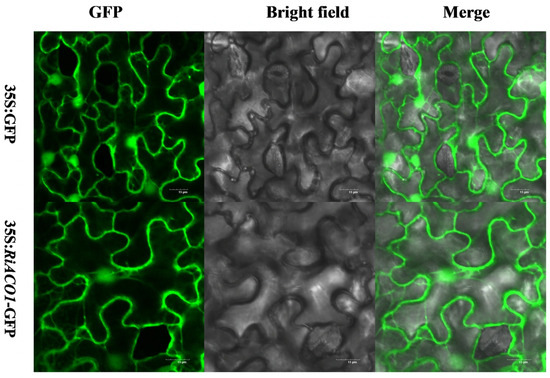
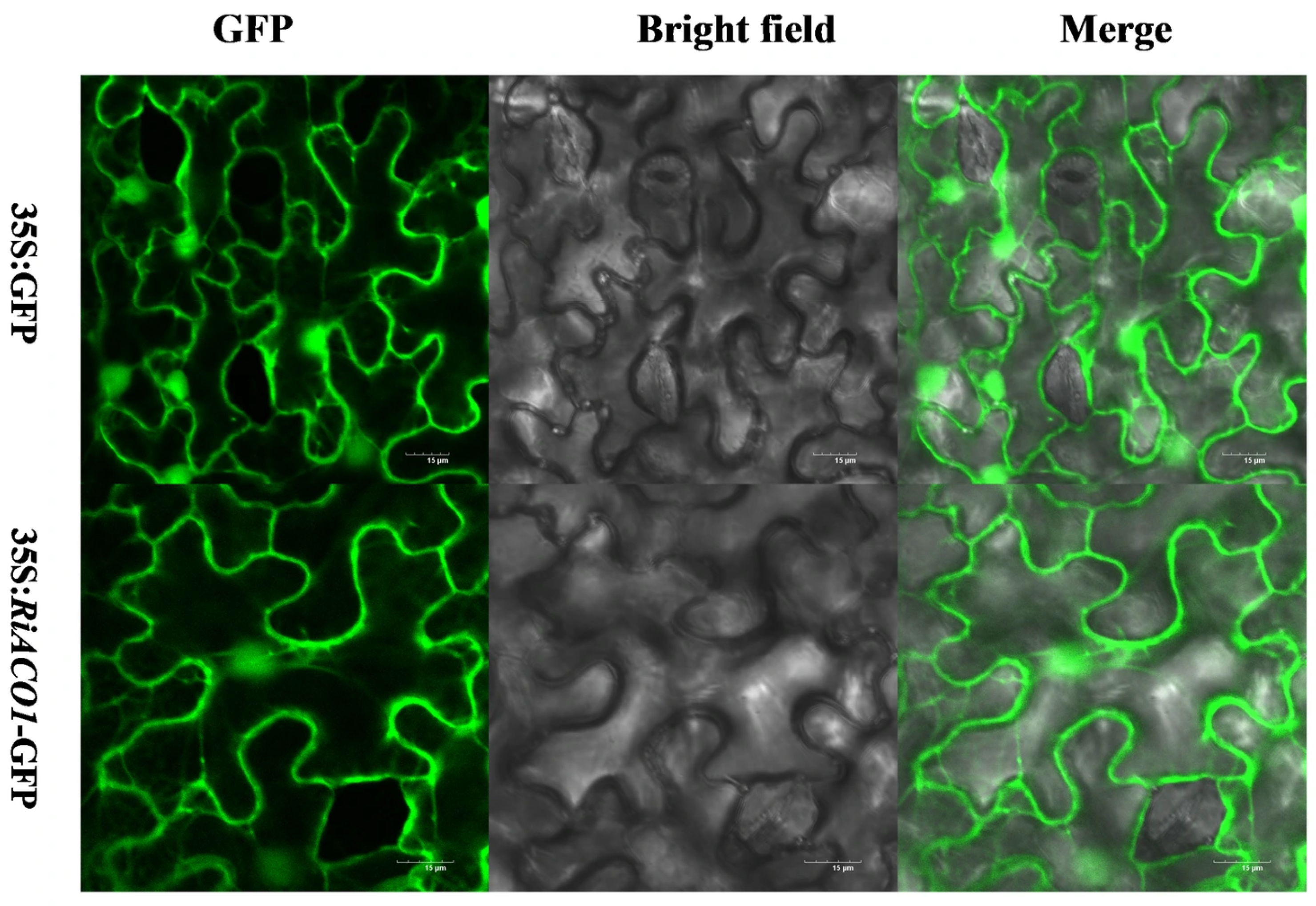
The RiACO1-GFP fusion construct was transiently expressed in healthy Nicotiana benthamiana leaves using Agrobacterium-mediated infiltration. After 48 h of incubation, fluorescence was observed in lower-epidermal leaf cells by confocal microscopy. The 35S:GFP control signal was distributed throughout the cell, whereas the 35S:RiACO1-GFP fusion signal was mainly detected in the cytoplasm and nucleus, indicating that RiACO1 localizes to both compartments (Figure 1).
Figure 1.
Subcellular localization analysis of RiACO1 in tobacco leaves. GFP: green fluorescent protein. Merge: fusion image of green fluorescence and bright-field channels.
3.3. Expression Analysis of the RiACO1 Gene in Raspberry
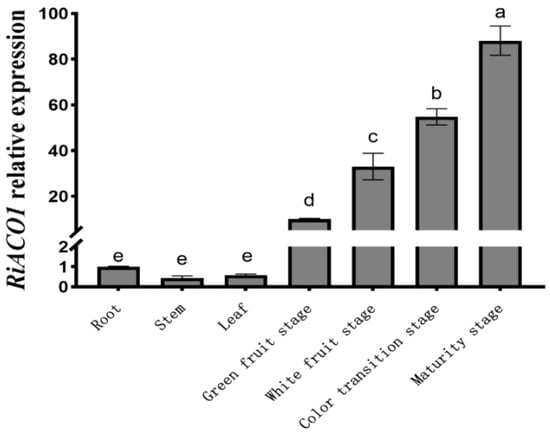
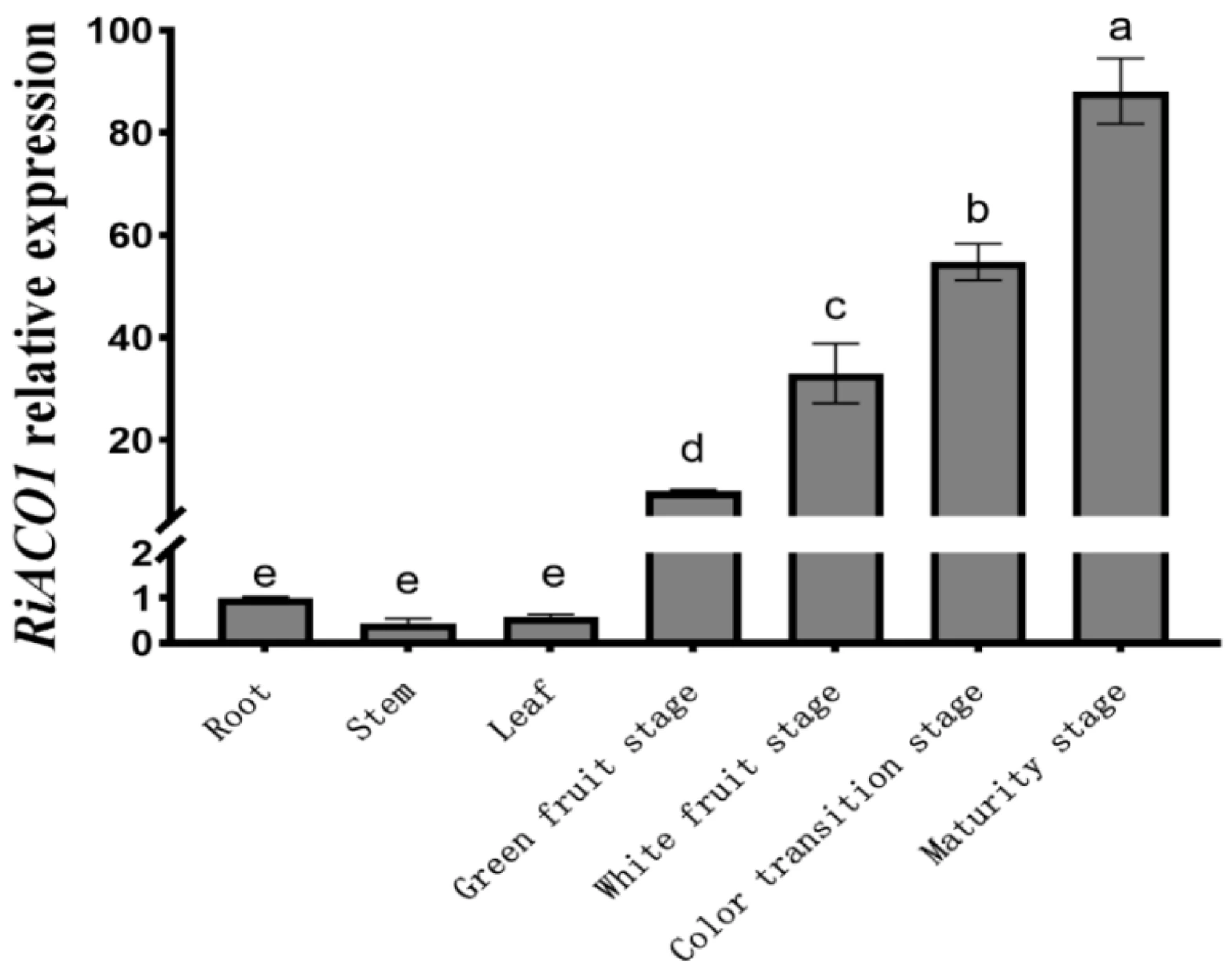
To investigate the expression pattern of RiACO1 in raspberry, quantitative real-time PCR (qRT-PCR) analysis was performed. The results demonstrated that RiACO1 was ubiquitously expressed in raspberry roots, stems, leaves, and fruits at different ripening stages, but with distinct expression levels across tissues and developmental stages. Notably, the expression level of RiACO1 in fruits was significantly higher than that in other vegetative tissues (roots, stems, and leaves). Furthermore, as raspberry fruits ripened, the transcript abundance of RiACO1 increased rapidly, peaking in fully mature fruits. In contrast, the lowest expression levels of RiACO1 were detected in stems and leaves (Figure 2).
Figure 2.
Expression pattern of RiACO1 in raspberry tissues and fruit-development stages. Values are shown as mean ± SD from three biological replicates. Different lowercase letters indicate significant differences at p < 0.05.
3.4. Functional Analysis of RiACO1 Gene Overexpression in Arabidopsis thaliana
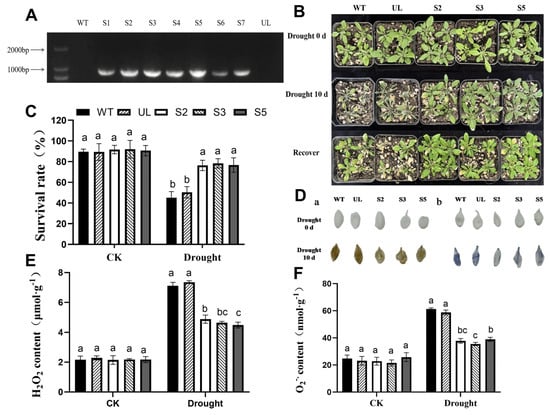
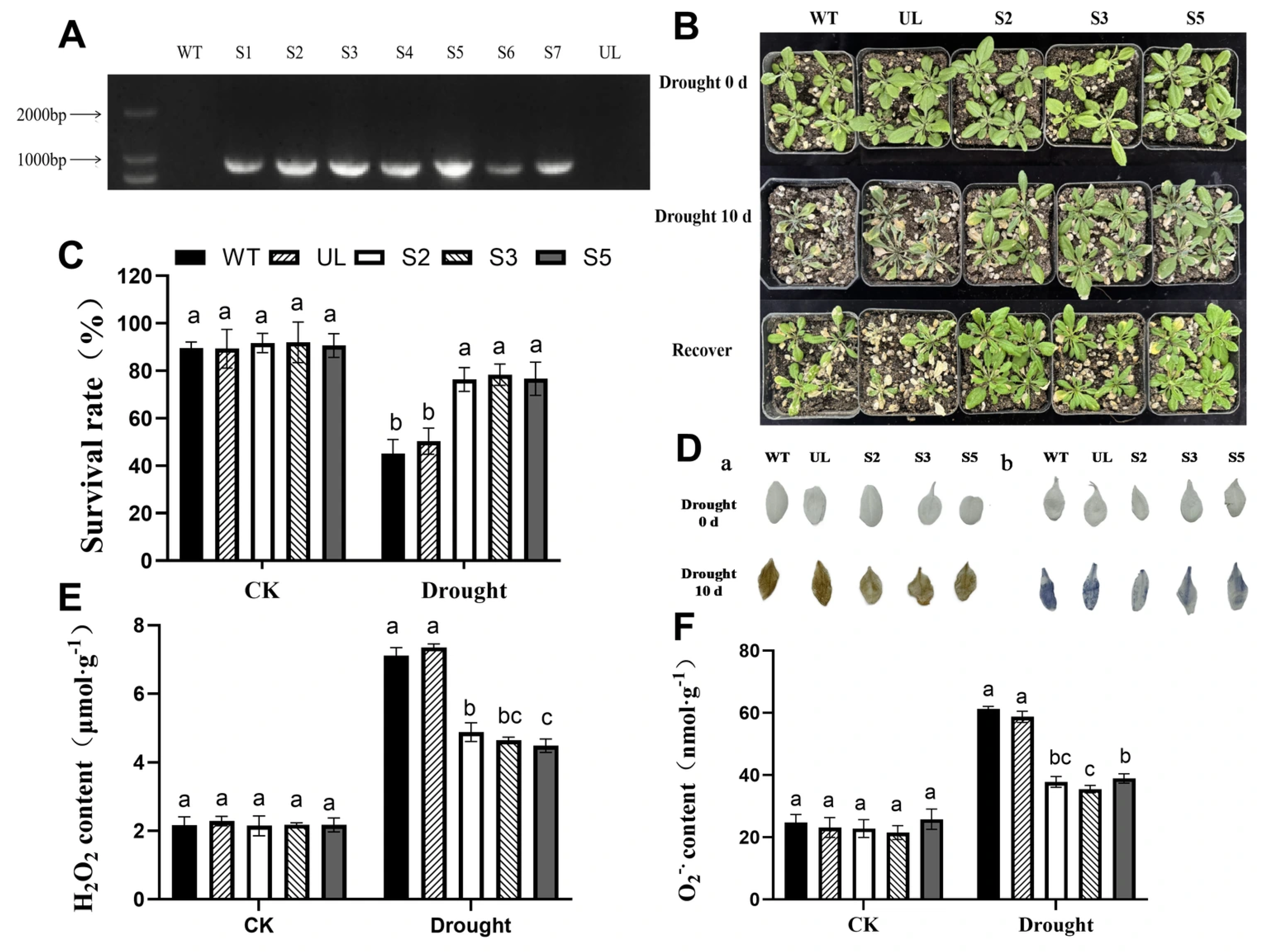
To elucidate the biological role of RiACO1, transgenic Arabidopsis thaliana lines were generated using the floral-dip transformation method. Following resistance screening and PCR-based molecular identification, stable integration of RiACO1 into the Arabidopsis genome was confirmed (Figure 3A). Three T3 homozygous transgenic lines, S2, S3, and S5, which showed high RiACO1 transcript levels, were selected for drought-tolerance analysis. After water was withheld for 10 d at 25 °C, the transgenic plants exhibited less severe drought-induced injury than the wild-type (WT) and empty-vector (UL) controls. After rehydration, the survival rates of the transgenic lines ranged from 76.3% to 78.3%, whereas those of WT and UL plants were 45.0% and 50.3%, respectively (Figure 3B,C). DAB and NBT staining showed weaker staining intensity in the transgenic lines under drought stress, indicating lower ROS accumulation. Consistently, quantitative analysis showed that H2O2 and O2− contents were significantly lower in the transgenic lines than in WT and UL controls under drought stress (Figure 3D–F). These results indicate that RiACO1 overexpression alleviates drought-induced ROS accumulation and improves drought tolerance in Arabidopsis.
Figure 3.
Drought tolerance and ROS homeostasis in transgenic Arabidopsis lines. (A) PCR identification of WT, empty-vector control (UL), and RiACO1-overexpressing lines S1–S7. (B) Phenotypes before drought treatment, after 10 d of drought treatment, and after rehydration recovery. (C) Survival rate after drought treatment. CK represents unstressed plants of each genotype, and Drought represents plants subjected to drought stress. (D) ROS staining of Arabidopsis thaliana leaves under drought stress: (a), DAB staining; (b), NBT staining. (E) H2O2 content. (F) O2− content. Values are shown as mean ± SD from three biological replicates. Different lowercase letters indicate significant differences at p < 0.05.
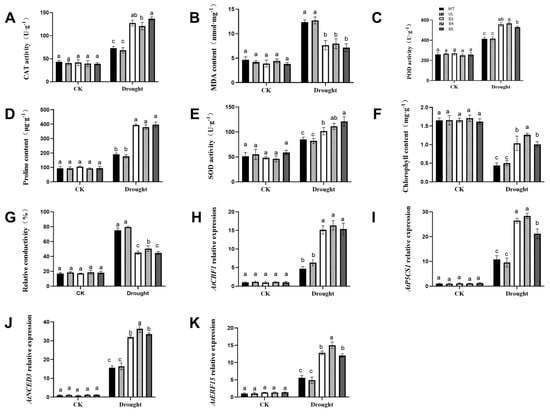
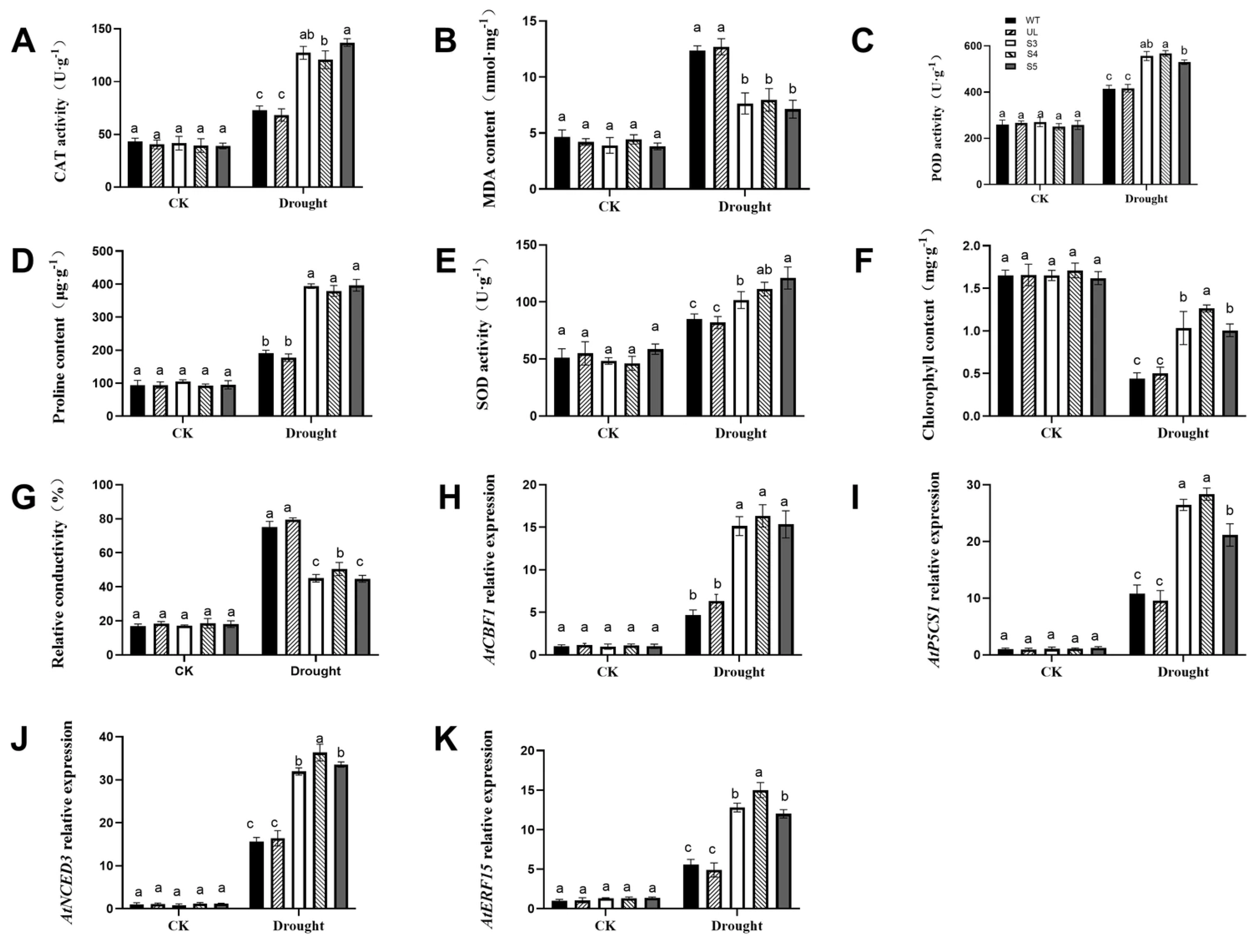
Other stress-related physiological indices showed that the transgenic lines had lower MDA content and relative conductivity, slower chlorophyll degradation, higher proline content, and higher antioxidant enzyme activities than controls (Figure 4A–G). To further examine potential stress-response pathways, the expression levels of AtCBF1, AtP5CS1, AtERF15, and AtNCED3 were detected by qRT-PCR. These genes were selected because they are representative markers of cold/drought-responsive transcriptional regulation (AtCBF1), proline biosynthesis and osmotic adjustment (AtP5CS1), ethylene-response regulation (AtERF15), and ABA biosynthesis (AtNCED3). The transcript levels of these genes were significantly higher in the transgenic lines than in controls after drought stress (Figure 4H–K).
Figure 4.
Analysis of physiological indices and stress-responsive gene expression in transgenic Arabidopsis lines under drought stress. (A) Catalase activity. (B) Malondialdehyde content. (C) Peroxidase activity. (D) Proline content. (E) Superoxide dismutase activity. (F) Chlorophyll content. (G) Relative conductivity. (H) AtCBF1 expression. (I) AtP5CS1 expression. (J) AtNCED3 expression. (K) AtERF15 expression. Values are shown as mean ± SD from three biological replicates. Different lowercase letters indicate significant differences at p < 0.05.
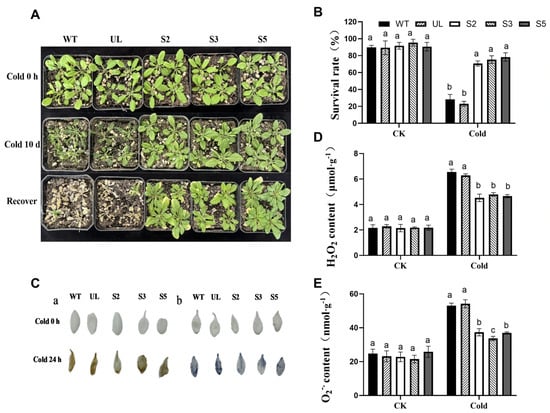
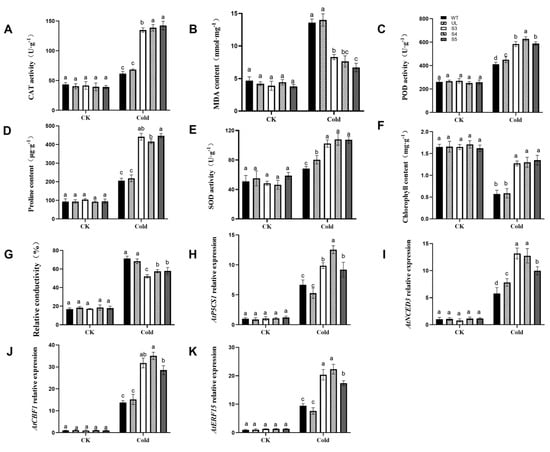
Under low-temperature stress (−4 °C for 24 h), transgenic lines also exhibited less damage than controls, with survival rates of 71.6–78.3% after recovery, which were significantly higher than those of WT (28.3%) and UL (23.0%) (Figure 5A,B). DAB and NBT staining (Figure 5C) revealed lower ROS accumulation in transgenic lines. Quantitative analysis of oxidative-damage indicators (Figure 5D,E) further showed that transgenic lines accumulated less H2O2 and O2− under low-temperature stress than controls. Consistent with these results, RiACO1-overexpressing lines displayed slower chlorophyll degradation, higher proline content and antioxidant enzyme activities (SOD, POD, and CAT), and lower MDA content and relative conductivity than WT and UL after low-temperature stress (Figure 6A–G). These results indicate that heterologous RiACO1 expression is associated with enhanced low-temperature tolerance in Arabidopsis.
Figure 5.
Phenotypic and ROS-homeostasis analysis of transgenic Arabidopsis lines under low-temperature stress. (A) Phenotypes before low-temperature treatment, after −4 °C treatment for 24 h, and after recovery. (B) Survival rate before and after low-temperature treatment. WT, UL, and S2/S3/S5 represent wild-type, empty-vector control, and RiACO1-overexpressing Arabidopsis lines, respectively. CK represents unstressed plants of each genotype, and Cold represents plants subjected to low-temperature stress. (C) ROS staining of Arabidopsis thaliana leaves under low-temperature stress: (a), DAB staining; (b), NBT staining. (D) H2O2 content. (E) O2− content. Values are shown as mean ± SD from three biological replicates. Different lowercase letters indicate significant differences at p < 0.05.
Figure 6.
Analysis of physiological indices and stress-responsive gene expression in transgenic Arabidopsis lines under low-temperature stress. (A) Catalase activity. (B) Malondialdehyde content. (C) Peroxidase activity. (D) Proline content. (E) Superoxide dismutase activity. (F) Chlorophyll content. (G) Relative conductivity. (H) AtP5CS1 expression. (I) AtNCED3 expression. (J) AtCBF1 expression. (K) AtERF15 expression. Values are shown as mean ± SD from three biological replicates. Different lowercase letters indicate significant differences at p < 0.05.
To further investigate the transcriptional responses associated with low-temperature stress, the expression levels of stress-responsive genes were measured by qRT-PCR. As shown in Figure 6H–K, the transcript levels of AtP5CS1, AtNCED3, AtCBF1, and AtERF15 were significantly higher in the RiACO1-overexpressing lines than in the WT and empty-vector controls after low-temperature treatment. Together with the phenotypic and physiological results, these data indicate that heterologous expression of RiACO1 improves drought and low-temperature tolerance in Arabidopsis, which is associated with enhanced osmotic adjustment, antioxidant capacity, and activation of stress-responsive gene expression.
3.5. Transient Overexpression of RiACO1 Accelerates Ripening-Associated Changes in Raspberry Fruit
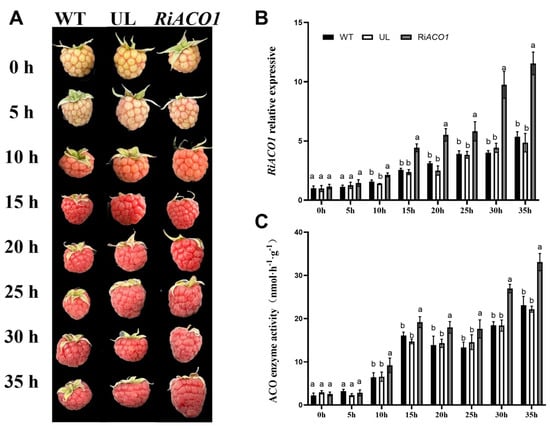
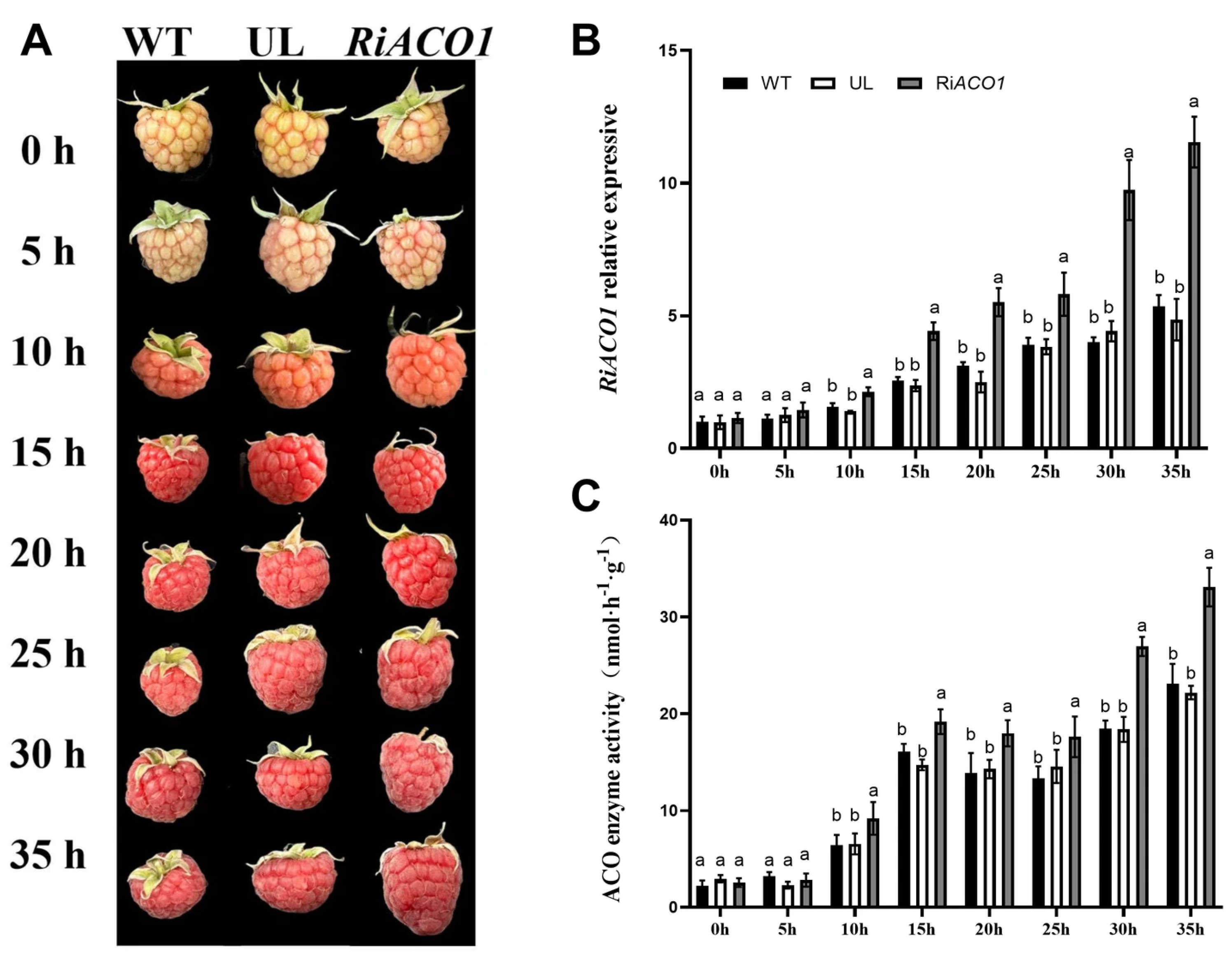
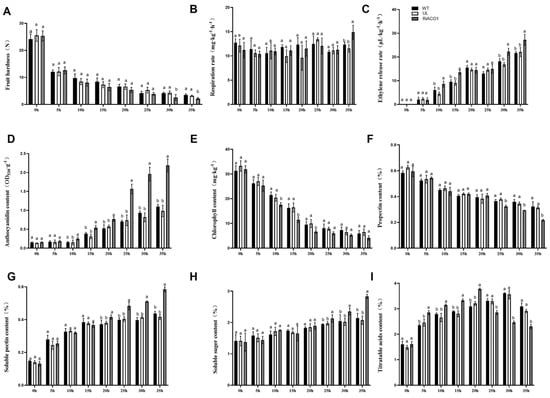
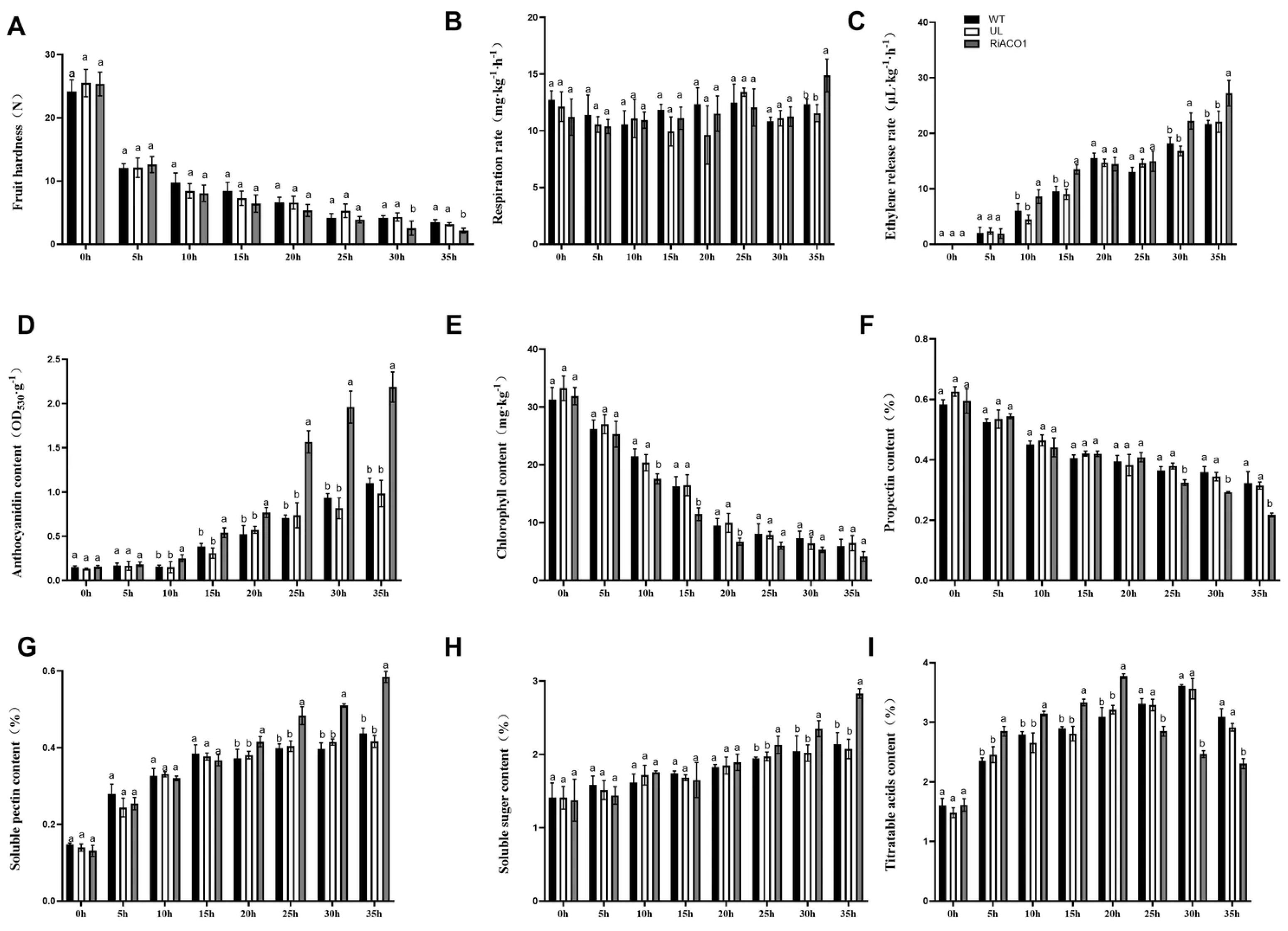
To determine whether RiACO1 is involved in raspberry fruit ripening, transient overexpression was performed in white-stage raspberry fruits. WT fruits and empty-vector (UL)-transformed fruits were used as controls. Phenotypic changes and ripening-related physiological parameters were monitored at 5 h intervals under ambient conditions. Because mold growth and partial fruit decay were observed in some samples after 35 h, only data collected within the first 35 h were used for statistical analysis. Phenotypic observation showed that transient overexpression of RiACO1 accelerated early fruit coloration compared with WT and UL controls (Figure 7A). Both RiACO1 transcript abundance and ACO activity increased with treatment duration and were significantly higher than those in the control groups from 10 h onward (Figure 7B,C), indicating successful transient overexpression. Physiological measurements further showed that RiACO1-overexpressing fruits exhibited lower firmness at 30–35 h, a higher respiration rate at 35 h, and increased ethylene production at 10, 15, 30, and 35 h (Figure 8). In addition, RiACO1 overexpression promoted anthocyanin accumulation and chlorophyll degradation and affected the dynamics of pectin, soluble sugar, and titratable acidity. These results indicate that transient overexpression of RiACO1 accelerates multiple ripening-associated physiological changes in raspberry fruit.
Figure 7.
Effects of transient overexpression of RiACO1 on ripening and ACO enzyme activity in raspberry fruits. (A) Phenotypic changes in raspberry fruits after transient transformation. (B) RiACO1 gene expression level. (C) ACO enzyme activity. Values are shown as mean ± SD from three biological replicates. Different lowercase letters indicate significant differences among treatments at the same time point at p < 0.05.
Figure 8.
Physiological indicators of raspberry fruits after transient transformation. (A) Fruit firmness. (B) Respiration rate. (C) Ethylene release rate. (D) Anthocyanin content. (E) Chlorophyll content. (F) Protopectin content. (G) Soluble pectin content. (H) Soluble sugar content. (I) Titratable acidity. Values are shown as mean ± SD from three biological replicates. Different lowercase letters indicate significant differences among treatments at the same time point at p < 0.05.
4. Discussion
Ethylene plays an essential role in plant growth, development, and stress responses [11,13]. ACC oxidase (ACO), a key enzyme catalyzing the final step of ethylene biosynthesis, converts 1-aminocyclopropane-1-carboxylic acid (ACC) into ethylene and has been characterized in various plant species, including tomato and pear [13,14,35]. In the present study, RiACO1 was cloned from red raspberry (Rubus idaeus L.) ‘Polka’ by polymerase chain reaction (PCR). Sequence homology analysis showed that RiACO1 contains the conserved 2OG-FeII_Oxy and DIOX_N domains, which are characteristic of ACO proteins and are consistent with the domain structure of blueberry VcACO2. These conserved structural features suggest that RiACO1 may function as a typical member of the ACO family and may be involved in ethylene-related processes, including fruit ripening and stress responses. Phylogenetic analysis further revealed that RiACO1 was most closely related to RrACO1 from rose (Rosa rugosa), indicating a close evolutionary relationship with ACO proteins from other Rosaceae species. Subcellular localization analysis showed that RiACO1 was distributed in both the nucleus and cytoplasm, similar to several previously reported ACO proteins. The observed localization pattern provides supportive information, but the functional annotation of RiACO1 is mainly based on conserved ACO domains and the increased ACO activity observed in transiently overexpressed raspberry fruits.
Ethylene and ACO-mediated ethylene biosynthesis have been implicated in plant responses to abiotic stresses [36,37]. In the present study, stable Arabidopsis thaliana transgenic RiACO1-overexpressing lines were generated to evaluate its potential role in stress tolerance. Under drought and low-temperature stress, RiACO1-overexpressing lines showed milder phenotypic injury and higher survival rates than WT and empty-vector controls. Physiological analysis after stress treatment showed that the transgenic lines maintained higher chlorophyll content, accumulated more proline, and exhibited enhanced antioxidant enzyme activities. Meanwhile, lower MDA content, reduced relative conductivity, and decreased ROS accumulation indicated that RiACO1 overexpression alleviated membrane damage and oxidative injury under stress conditions. These results support an association between RiACO1 heterologous expression and improved drought and low-temperature tolerance in Arabidopsis.
To further clarify the molecular responses associated with RiACO1-mediated stress tolerance, several stress-responsive marker genes were analyzed. AtCBF1 was selected because CBF transcription factors are central regulators of cold- and drought-responsive signaling pathways [38,39,40,41]. AtNCED3 was used as a marker gene for ABA biosynthesis, whereas AtP5CS1 was used to indicate proline biosynthesis and osmotic adjustment [42,43,44]. AtERF15 was selected because ERF transcription factors are closely associated with ethylene-responsive and stress-responsive regulation [45,46,47,48,49]. In RiACO1-overexpressing Arabidopsis lines, the transcript levels of AtCBF1, AtNCED3, AtP5CS1, and AtERF15 were significantly higher than those in WT and empty-vector plants after drought and low-temperature treatments. These transcriptional changes were consistent with the improved stress phenotype and physiological responses observed in the transgenic lines. Therefore, the physiological and molecular data together support that RiACO1 contributes to drought and low-temperature stress tolerance in association with CBF-related signaling, ABA/proline-associated osmotic adjustment, and ERF-mediated stress responses.
In addition to its role in abiotic-stress responses, RiACO1 appears to be involved in raspberry fruit ripening. Tissue-specific expression analysis showed that RiACO1 was expressed in all examined raspberry tissues, with the highest transcript abundance detected in mature fruits, suggesting its close association with fruit ripening. This expression pattern is consistent with observations in pear, where PuACO2 is highly expressed in fruits [35]. To further evaluate its function in raspberry fruit ripening, RiACO1 was transiently overexpressed in white-stage raspberry fruits. Compared with WT and empty-vector controls, RiACO1-overexpressing fruits showed significantly higher RiACO1 transcript levels, increased ACO activity, and enhanced ethylene production. These molecular and enzymatic changes were accompanied by coordinated ripening-associated physiological responses, including accelerated anthocyanin accumulation, chlorophyll degradation, fruit softening, soluble sugar accumulation, and pectin transformation. Although WT and empty-vector controls were included, a mock-infiltration control was not used. Therefore, the transient overexpression results were interpreted conservatively relative to both controls. Therefore, the consistency among developmental expression patterns, transient overexpression results, ACO activity, ethylene production, and multiple ripening-related physiological indicators supports that RiACO1 functions as a positive regulator of raspberry fruit ripening, likely by promoting ethylene biosynthesis and downstream ripening processes.
The role of RiACO1 in raspberry fruit ripening is also consistent with previous studies showing that ACO genes are widely associated with ethylene production and ripening-related processes in fruit crops. In tomato, SlACO1 is essential for fruit development and ripening, and SlACO1 mutants exhibit reduced ethylene production and delayed softening [14]. In pear, ACO upregulation is associated with climacteric ripening, whereas 1-MCP treatment suppresses ACO expression and delays ripening [15]. In banana, apple, peach, pear, and tomato, ethylene-biosynthesis-related genes, including ACO genes, respond to developmental and hormonal signals and participate in ethylene production, fruit softening, and ripening regulation [16,20,21,22,23,24,25]. These studies indicate that ACO genes act as important components of ethylene biosynthesis and fruit-ripening regulation, although their regulatory patterns may differ among species, hormone types, and developmental stages. The present results extend this understanding to red raspberry by showing that RiACO1 expression, ACO activity, ethylene production, and ripening-associated physiological changes are closely coordinated during raspberry fruit ripening.
Taken together, these findings are consistent with recent studies showing that ethylene metabolism and ethylene-biosynthesis genes function in a species-, organ-, and genotype-dependent manner in horticultural crops. In Rosaceae fruits, ethylene produced through ACS- and ACO-associated pathways in strawberry achenes may influence receptacle growth and ripening, providing a relevant background for interpreting raspberry fruit development [50]. Genome-wide analysis of the ACS gene family in peach also showed that upstream ethylene-biosynthesis genes exhibit stage-specific expression during fruit development [51]. In carnation, differences in ethylene sensitivity and ethylene-biosynthetic gene expression are associated with postharvest performance among cultivars [52]. In Rubus, recent genome-wide comparative analysis in black raspberry and red raspberry provides a genomic reference framework for gene-family studies [53]. Moreover, functional overexpression analysis of BcACS6 in Wucai linked an ethylene-biosynthesis gene to the accumulation of quality-related amino acids [54]. These reports provide a broader horticultural context for interpreting the present RiACO1 results. Within this context, the cloning, expression profiling, heterologous overexpression, and raspberry fruit transient-overexpression results obtained in this study provide consistent evidence supporting the involvement of RiACO1 in raspberry fruit ripening and its association with stress-response regulation.
5. Conclusions
In conclusion, this study cloned RiACO1 from primocane-bearing raspberry ‘Polka’. The full-length CDS of RiACO1 was 963 bp and encoded a protein of 320 amino acids. Sequence and structural analyses showed that RiACO1 shared high homology with ACO proteins from other plant species and contained the conserved DIOX_N and 2OG-FeII_Oxy domains, confirming that it belongs to the ACO protein family. Subcellular localization analysis indicated that RiACO1 was localized in the cytoplasm and nucleus. Expression analysis showed that RiACO1 was highly expressed in mature raspberry fruits, suggesting its close association with fruit ripening. Heterologous overexpression of RiACO1 in Arabidopsis thaliana improved drought and low-temperature tolerance, as reflected by higher survival rates, reduced membrane injury, enhanced antioxidant enzyme activities, increased proline accumulation, and upregulated expression of stress-responsive marker genes, including AtCBF1, AtP5CS1, AtNCED3, and AtERF15. In white-stage raspberry fruits, transient overexpression of RiACO1 increased RiACO1 transcript levels, ACO activity, and ethylene production and promoted ripening-related physiological changes, including fruit softening, anthocyanin accumulation, chlorophyll degradation, soluble sugar accumulation, and pectin transformation. Overall, these results support the involvement of RiACO1 in raspberry fruit ripening and suggest that RiACO1 is associated with stress-response regulation in a heterologous Arabidopsis system.
Supplementary Materials
The following supporting information can be downloaded at: https://www.mdpi.com/article/10.3390/horticulturae12060735/s1, Table S1: Full CDS sequence of RiACO1; Table S2: Conserved-domain prediction of RiACO1.
Author Contributions
Conceptualization, T.L., R.W. and G.Y.; software, F.W.; validation, T.L. and R.W.; formal analysis, T.L. and R.W.; investigation, D.H.; resources, Y.Z.; data curation, T.L. and R.W.; writing—original draft preparation, R.W.; writing—review and editing, G.Y. and T.L.; visualization, T.L.; supervision, G.Y.; project administration, G.Y.; funding acquisition, T.L. All authors have read and agreed to the published version of the manuscript.
Funding
This research was funded by the National Key R&D Program of China (2022YFD1600500).
Data Availability Statement
The original contributions presented in this study are included in the article and Supplementary Tables S1 and S2. Further inquiries can be directed to the corresponding author.
Acknowledgments
During the preparation of this manuscript, the authors used Deepseek V3.2 for the purposes of language polish and translation, but the overall structure and writing of the paper did not involve the use of GenAI.
Conflicts of Interest
The authors declare no conflicts of interest.
References
- Chang, C. Q&A: How Do Plants Respond to Ethylene and What Is Its Importance? BMC Biol. 2016, 14, 7. [Google Scholar] [CrossRef] [Scilit]
- Chen, H.; Bullock, D.A.; Alonso, J.M.; Stepanova, A.N. To Fight or to Grow: The Balancing Role of Ethylene in Plant Abiotic Stress Responses. Plants 2022, 11, 33. [Google Scholar] [CrossRef] [Scilit]
- Husain, T.; Fatima, A.; Suhel, M.; Singh, S.; Sharma, A.; Prasad, S.M.; Singh, V.P. A Brief Appraisal of Ethylene Signaling under Abiotic Stress in Plants. Plant Signal. Behav. 2020, 15, 1782051. [Google Scholar] [CrossRef] [Scilit] [PubMed]
- Zhu, Y.; Wang, K.; Wu, C.; Zhao, Y.; Yin, X.; Zhang, B.; Grierson, D.; Chen, K.; Xu, C. Effect of Ethylene on Cell Wall and Lipid Metabolism during Alleviation of Postharvest Chilling Injury in Peach. Cells 2019, 8, 1612. [Google Scholar] [CrossRef] [Scilit] [PubMed]
- Wei, C.; Ma, L.; Cheng, Y.; Guan, Y.; Guan, J. Exogenous Ethylene Alleviates Chilling Injury of “Huangguan” Pear by Enhancing the Proline Content and Antioxidant Activity. Sci. Hortic. 2019, 257, 108671. [Google Scholar] [CrossRef] [Scilit]
- Shi, Y.; Tian, S.; Hou, L.; Huang, X.; Zhang, X.; Guo, H.; Yang, S. Ethylene Signaling Negatively Regulates Freezing Tolerance by Repressing Expression of CBF and Type-A ARR Genes in Arabidopsis. Plant Cell 2012, 24, 2578–2595. [Google Scholar] [CrossRef] [Scilit]
- Zhang, D.; Xia, R.; Cao, X.; Shu, B.; Chen, C. Root Hair Development of Poncirus trifoliata Grown in Different Growth Cultures and Treated with 3-Indolebutyric Acid and Ethephon. Sci. Hortic. 2013, 160, 389–397. [Google Scholar] [CrossRef] [Scilit]
- Rahman, M.A.; Wu, W.; Yan, Y.; Bhuiyan, S.A. Overexpression of TERF1 in Sugarcane Improves Tolerance to Drought Stress. Crop Pasture Sci. 2021, 72, 268–279. [Google Scholar] [CrossRef] [Scilit]
- Wakeel, A.; Ali, I.; Wu, M.; Kkan, A.R.; Jan, M.; Ali, A.; Liu, Y.; Ge, S.; Wu, J.; Liu, B.; et al. Ethylene Mediates Dichromate-Induced Oxidative Stress and Regulation of the Enzymatic Antioxidant System-Related Transcriptome in Arabidopsis thaliana. Environ. Exp. Bot. 2019, 161, 166–179. [Google Scholar] [CrossRef] [Scilit]
- Wu, Y.-S.; Yang, C.-Y. Ethylene-Mediated Signaling Confers Thermotolerance and Regulates Transcript Levels of Heat Shock Factors in Rice Seedlings under Heat Stress. Bot. Stud. 2019, 60, 23. [Google Scholar] [CrossRef] [Scilit]
- Iqbal, N.; Khan, N.A.; Ferrante, A.; Trivellini, A.; Francini, A.; Khan, M.I.R. Ethylene Role in Plant Growth, Development and Senescence: Interaction with Other Phytohormones. Front. Plant Sci. 2017, 8, 475. [Google Scholar] [CrossRef] [Scilit]
- Mou, W.; Kao, Y.-T.; Michard, E.; Simon, A.A.; Li, D.; Wudick, M.M.; Lizzio, M.A.; Feijo, J.A.; Chang, C. Ethylene-Independent Signaling by the Ethylene Precursor ACC in Arabidopsis Ovular Pollen Tube Attraction. Nat. Commun. 2020, 11, 4082. [Google Scholar] [CrossRef] [Scilit]
- Houben, M.; Van de Poel, B. 1-Aminocyclopropane-1-Carboxylic Acid Oxidase (ACO): The Enzyme That Makes the Plant Hormone Ethylene. Front. Plant Sci. 2019, 10, 695. [Google Scholar] [CrossRef] [Scilit] [PubMed]
- Brisou, G.; Piquerez, S.J.M.; Minoia, S.; Marcel, F.; Cornille, A.; Carriero, F.; Boualem, A.; Bendahmane, A. Induced Mutations in SIE8 and SIACO1 Control Tomato Fruit Maturation and Shelf-Life. J. Exp. Bot. 2021, 72, 6920–6932. [Google Scholar] [CrossRef] [Scilit]
- Busatto, N.; Farneti, B.; Tadiello, A.; Oberkofler, V.; Cellini, A.; Biasioli, F.; Delledonne, M.; Cestaro, A.; Noutsos, C.; Costa, F. Wide Transcriptional Investigation Unravel Novel Insights of the On-Tree Maturation and Postharvest Ripening of “Abate Fetel” Pear Fruit. Hortic. Res. 2019, 6, 32. [Google Scholar] [CrossRef] [Scilit]
- Guo, Y.; Shan, W.; Liang, S.; Wu, C.; Wei, W.; Chen, J.; Lu, W.; Kuang, J. MaBZR1/2 Act as Transcriptional Repressors of Ethylene Biosynthetic Genes in Banana Fruit. Physiol. Plant. 2019, 165, 555–568. [Google Scholar] [CrossRef] [Scilit] [PubMed]
- Ji, Y.; Qu, Y.; Jiang, Z.; Yan, J.; Chu, J.; Xu, M.; Su, X.; Yuan, H.; Wang, A. The Mechanism for Brassinosteroids Suppressing Climacteric Fruit Ripening. Plant Physiol. 2021, 185, 1875–1893. [Google Scholar] [CrossRef] [Scilit] [PubMed]
- Schaffer, R.J.; Friel, E.N.; Souleyre, E.J.F.; Bolitho, K.; Thodey, K.; Ledger, S.; Bowen, J.H.; Ma, J.-H.; Nain, B.; Cohen, D.; et al. A Genomics Approach Reveals That Aroma Production in Apple Is Controlled by Ethylene Predominantly at the Final Step in Each Biosynthetic Pathway. Plant Physiol. 2007, 144, 1899–1912. [Google Scholar] [CrossRef] [Scilit]
- Hao, P.-P.; Wang, G.-M.; Cheng, H.-Y.; Ke, Y.-Q.; Qi, K.-J.; Gu, C.; Zhang, S.-L. Transcriptome Analysis Unravels an Ethylene Response Factor Involved in Regulating Fruit Ripening in Pear. Physiol. Plant. 2018, 163, 124–135. [Google Scholar] [CrossRef] [Scilit]
- Tatsuki, M.; Nakajima, N.; Fujii, H.; Shimada, T.; Nakano, M.; Hayashi, K.; Hayama, H.; Yoshioka, H.; Nakamura, Y. Increased Levels of IAA Are Required for System 2 Ethylene Synthesis Causing Fruit Softening in Peach (Prunus persica L. Batsch). J. Exp. Bot. 2013, 64, 1049–1059. [Google Scholar] [CrossRef] [Scilit]
- Yue, P.; Lu, Q.; Liu, Z.; Lv, T.; Li, X.; Bu, H.; Liu, W.; Xu, Y.; Yuan, H.; Wang, A. Auxin-Activated MdARF5 Induces the Expression of Ethylene Biosynthetic Genes to Initiate Apple Fruit Ripening. New Phytol. 2020, 226, 1781–1795. [Google Scholar] [CrossRef] [Scilit]
- Li, T.; Xu, Y.; Zhang, L.; Ji, Y.; Tan, D.; Yuan, H.; Wang, A. The Jasmonate-Activated Transcription Factor MdMYC2 Regulates ETHYLENE RESPONSE FACTOR and Ethylene Biosynthetic Genes to Promote Ethylene Biosynthesis during Apple Fruit Ripening. Plant Cell 2017, 29, 1316–1334. [Google Scholar] [CrossRef] [Scilit] [PubMed]
- Zhang, M.; Yuan, B.; Leng, P. The Role of ABA in Triggering Ethylene Biosynthesis and Ripening of Tomato Fruit. J. Exp. Bot. 2009, 60, 1579–1588. [Google Scholar] [CrossRef] [Scilit]
- Shi, H.-Y.; Zhang, Y.-X. Pear ACO Genes Encoding Putative 1-Aminocyclopropane-1-Carboxylate Oxidase Homologs Are Functionally Expressed during Fruit Ripening and Involved in Response to Salicylic Acid. Mol. Biol. Rep. 2012, 39, 9509–9519. [Google Scholar] [CrossRef] [Scilit] [PubMed]
- Ding, C.K.; Wang, C.Y. The Dual Effects of Methyl Salicylate on Ripening and Expression of Ethylene Biosynthetic Genes in Tomato Fruit. Plant Sci. 2003, 164, 589–596. [Google Scholar] [CrossRef] [Scilit]
- Naing, A.H.; Campol, J.R.; Kang, H.; Xu, J.; Chung, M.Y.; Kim, C.K. Role of Ethylene Biosynthesis Genes in the Regulation of Salt Stress and Drought Stress Tolerance in Petunia. Front. Plant Sci. 2022, 13, 844449. [Google Scholar] [CrossRef] [Scilit]
- Dalal, M.; Sahu, S.; Tiwari, S.; Rao, A.R.; Gaikwad, K. Transcriptome Analysis Reveals Interplay between Hormones, ROS Metabolism and Cell Wall Biosynthesis for Drought-Induced Root Growth in Wheat. Plant Physiol. Biochem. 2018, 130, 482–492. [Google Scholar] [CrossRef] [Scilit]
- Jia, H.; Chen, S.; Liu, D.; Liesche, J.; Shi, C.; Wang, J.; Ren, M.; Wang, X.; Yang, J.; Shi, W.; et al. Ethylene-Induced Hydrogen Sulfide Negatively Regulates Ethylene Biosynthesis by Persulfidation of ACO in Tomato Under Osmotic Stress. Front. Plant Sci. 2018, 9, 1517. [Google Scholar] [CrossRef] [Scilit]
- Londo, J.P.; Kovaleski, A.P.; Lillis, J.A. Divergence in the Transcriptional Landscape between Low Temperature and Freeze Shock in Cultivated Grapevine (Vitis vinifera). Hortic. Res. 2018, 5, 10. [Google Scholar] [CrossRef] [Scilit]
- Choudhury, S.R.; Roy, S.; Senguptaa, D.N. Characterization of Transcriptional Profiles of MaACS1 and MaACO1 Genes in Response to Ethylene, Auxin, Wounding, Cold and Different Photoperiods during Ripening in Banana Fruit. J. Plant Physiol. 2008, 165, 1865–1878. [Google Scholar] [CrossRef] [Scilit]
- Wei, H.; Xue, Y.; Chen, P.; Hao, P.; Wei, F.; Sun, L.; Yang, Y. Genome-Wide Identification and Functional Investigation of 1-Aminocyclopropane-1-Carboxylic Acid Oxidase (ACO) Genes in Cotton. Plants 2021, 10, 1699. [Google Scholar] [CrossRef] [Scilit]
- Shi, J.; Xiao, Y.; Jia, C.; Zhang, H.; Gan, Z.; Li, X.; Yang, M.; Yin, Y.; Zhang, G.; Hao, J.; et al. Physiological and Biochemical Changes during Fruit Maturation and Ripening in Highbush Blueberry (Vaccinium corymbosum L.). Food Chem. 2023, 410, 135299. [Google Scholar] [CrossRef] [Scilit]
- Fuentes, L.; Monsalve, L.; Morales-Quintana, L.; Valdenegro, M.; Martinez, J.-P.; Defilippi, B.G.; Gonzalez-Aguero, M. Differential Expression of Ethylene Biosynthesis Genes in Drupelets and Receptacle of Raspberry (Rubus idaeus). J. Plant Physiol. 2015, 179, 100–105. [Google Scholar] [CrossRef] [Scilit]
- Yang, G.; Li, H.; Xin, Y.; Yu, H.; Chen, L.; Li, L.; Han, D. Effect of Abscisic Acid on Expression of Its Key Enzyme Synthesis Genes, RiNCED1 and RiCYP707A1, and Quality of Raspberry (Rubus idaeus) Fruits. Int. J. Agric. Biol. 2020, 23, 269–278. [Google Scholar] [CrossRef] [Scilit]
- Yuan, H.; Yue, P.; Bu, H.; Han, D.; Wang, A. Genome-Wide Analysis of ACO and ACS Genes in Pear (Pyrus ussuriensis). In Vitro Cell. Dev. Biol.-Plant 2020, 56, 193–199. [Google Scholar] [CrossRef] [Scilit]
- Zhang, Z.; Huang, R. Enhanced Tolerance to Freezing in Tobacco and Tomato Overexpressing Transcription Factor TERF2/LeERF2 Is Modulated by Ethylene Biosynthesis. Plant Mol. Biol. 2010, 73, 241–249. [Google Scholar] [CrossRef] [Scilit]
- Ramadoss, N.; Gupta, D.; Vaidya, B.N.; Joshee, N.; Basu, C. Functional Characterization of 1-Aminocyclopropane-1-Carboxylic Acid Oxidase Gene in Arabidopsis thaliana and Its Potential in Providing Flood Tolerance. Biochem. Biophys. Res. Commun. 2018, 503, 365–370. [Google Scholar] [CrossRef] [Scilit] [PubMed]
- Wang, K.; Guo, H.; Yin, Y. AP2/ERF Transcription Factors and Their Functions in Arabidopsis Responses to Abiotic Stresses. Environ. Exp. Bot. 2024, 222, 105763. [Google Scholar] [CrossRef] [Scilit]
- Novillo, F.; Alonso, J.M.; Ecker, J.R.; Salinas, J. CBF2/DREB1C Is a Negative Regulator of CBF1/DREB1B and CBF3/DREB1A Expression and Plays a Central Role in Stress Tolerance in Arabidopsis. Proc. Natl. Acad. Sci. USA 2004, 101, 3985–3990. [Google Scholar] [CrossRef] [Scilit] [PubMed]
- Xue, Y.; Wang, Y.Y.; Peng, R.H.; Zhen, J.L.; Zhu, B.; Gao, J.J.; Zhao, W.; Han, H.J.; Yao, Q.H. Transcription Factor MdCBF1 Gene Increases Freezing Stress Tolerance in Transgenic Arabidopsis thaliana. Biol. Plant. 2014, 58, 499–506. [Google Scholar] [CrossRef] [Scilit]
- Catala, R.; Salinas, J. The Arabidopsis Ethylene Overproducer Mutant eto1-3 Displays Enhanced Freezing Tolerance. Plant Signal. Behav. 2015, 10, e989768. [Google Scholar] [CrossRef] [Scilit]
- Xia, H.; Wu, S.; Ma, F. Cloning and Expression of Two 9-Cis-Epoxycarotenoid Dioxygenase Genes during Fruit Development and under Stress Conditions from Malus. Mol. Biol. Rep. 2014, 41, 6795–6802. [Google Scholar] [CrossRef] [Scilit]
- Sharma, S.; Villamor, J.G.; Verslues, P.E. Essential Role of Tissue-Specific Proline Synthesis and Catabolism in Growth and Redox Balance at Low Water Potential. Plant Physiol. 2011, 157, 292–304. [Google Scholar] [CrossRef] [Scilit] [PubMed]
- Yamchi, A.; Jazii, F.R.; Mousavi, A.; Karkhane, A.A. Proline Accumulation in Transgenic Tobacco as a Result of Expression of Arabidopsis Δ1-Pyrroline-5-Carboxylate Synthetase (P5CS) during Osmotic Stress. J. Plant Biochem. Biotechnol. 2007, 16, 9–15. [Google Scholar] [CrossRef] [Scilit]
- Lu, C.; Li, Y.; Chen, A.; Li, L.; Zuo, J.; Tian, H.; Luo, Y.; Zhu, B. LeERF1 Improves Tolerance to Drought Stress in Tomato (Lycopersicon esculentum) and Activates Downstream Stress-Responsive Genes. Afr. J. Biotechnol. 2010, 9, 6294–6300. [Google Scholar]
- Li, J.; Guo, X.; Zhang, M.; Wang, X.; Zhao, Y.; Yin, Z.; Zhang, Z.; Wang, Y.; Xiong, H.; Zhang, H.; et al. OsERF71 Confers Drought Tolerance via Modulating ABA Signaling and Proline Biosynthesis. Plant Sci. 2018, 270, 131–139. [Google Scholar] [CrossRef] [Scilit] [PubMed]
- Wu, L.; Chen, X.; Ren, H.; Zhang, Z.; Zhang, H.; Wang, J.; Wang, X.-C.; Huang, R. ERF Protein JERF1 That Transcriptionally Modulates the Expression of Abscisic Acid Biosynthesis-Related Gene Enhances the Tolerance under Salinity and Cold in Tobacco. Planta 2007, 226, 815–825. [Google Scholar] [CrossRef] [Scilit]
- Muller, M. Foes or Friends: ABA and Ethylene Interaction under Abiotic Stress. Plants 2021, 10, 448. [Google Scholar] [CrossRef] [Scilit]
- Lee, S.; Lee, S.; Kim, S.Y. AtERF15 Is a Positive Regulator of ABA Response. Plant Cell Rep. 2015, 34, 71–81. [Google Scholar] [CrossRef] [Scilit]
- Chen, H.; Li, D.; Chen, K. Spark to Blaze: The Role of Ethylene in Achenes and the Ripple Influences on Strawberry Fruit Growth and Ripening. Fruit Res. 2024, 4, e015. [Google Scholar] [CrossRef] [Scilit]
- Wang, X.; Dong, K.; Cheng, J.; Tan, B.; Zheng, X.; Ye, X.; Wang, W.; Zhang, L.; Feng, J.; Wang, X.; et al. Genome-Wide Identification and Expression Pattern Analysis of the ACS Gene Family during Fruit Development in Peach. Fruit. Res. 2024, 4, e004. [Google Scholar] [CrossRef] [Scilit]
- Wang, M.; Wang, M.; Ni, C.; Feng, S.; Wang, Y.; Zhong, L.; Cheng, Y.; Bao, M.; Zhang, F.; Wang, M.; et al. Differences in Ethylene Sensitivity, Expression of Ethylene Biosynthetic Genes and Vase Life among Carnation Varieties. Ornam. Plant Res. 2024, 4, e004. [Google Scholar] [CrossRef] [Scilit]
- Lin, X.; Huang, M.; He, J.; Min, A.; Zhou, Y.; Ma, W.; Liu, X.; Wang, X.; Tang, H.; Chen, Q.; et al. Heterodimeric Interaction of the C/S1 Basic Leucine Zipper Transcription Factors in Black Raspberry: A Genome-Wide Identification and Comparative Analysis. Fruit Res. 2024, 4, e008. [Google Scholar] [CrossRef] [Scilit]
- Zhang, W.; Li, G.; Xiong, M.; Chen, Q.; Gao, X.; Wang, K.; Zhao, Z.; Zhou, L.; Liu, Y.; Hou, J.; et al. BcACS6 Overexpression Promotes the Accumulation of L-Cysteine and L-Tyrosine and Improves the Quality of Wucai. Veg. Res. 2025, 5, e008. [Google Scholar] [CrossRef] [Scilit]
Disclaimer/Publisher’s Note: The statements, opinions and data contained in all publications are solely those of the individual author(s) and contributor(s) and not of MDPI and/or the editor(s). MDPI and/or the editor(s) disclaim responsibility for any injury to people or property resulting from any ideas, methods, instructions or products referred to in the content. |
© 2026 by the authors. Licensee MDPI, Basel, Switzerland. This article is an open access article distributed under the terms and conditions of the Creative Commons Attribution (CC BY) license.