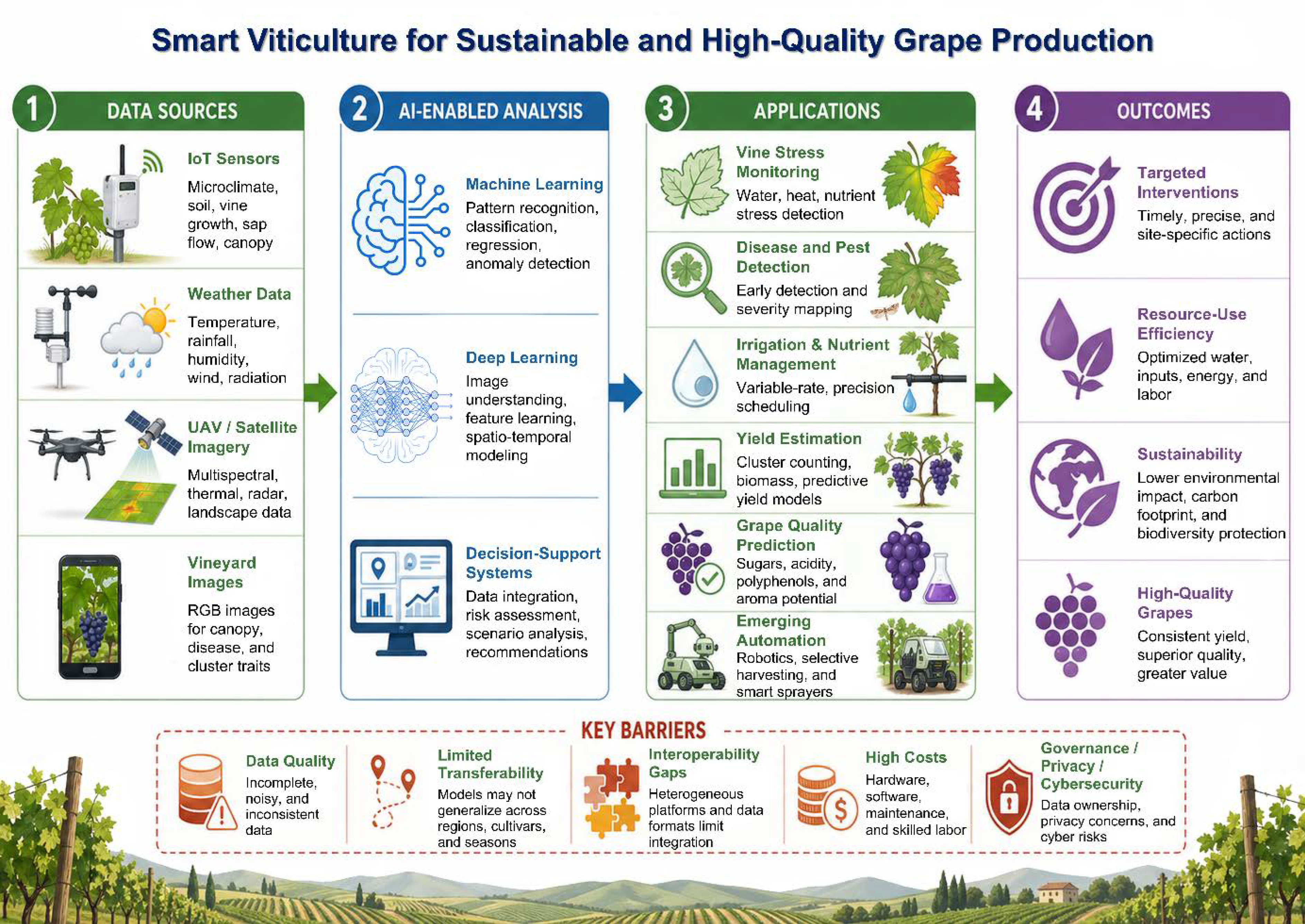
Smart Technologies and Artificial Intelligence in Sustainable Viticulture: Applications, Benefits, Barriers and Governance for High-Quality Grape Production


Abstract
1. Introduction
Literature Search and Review Approach
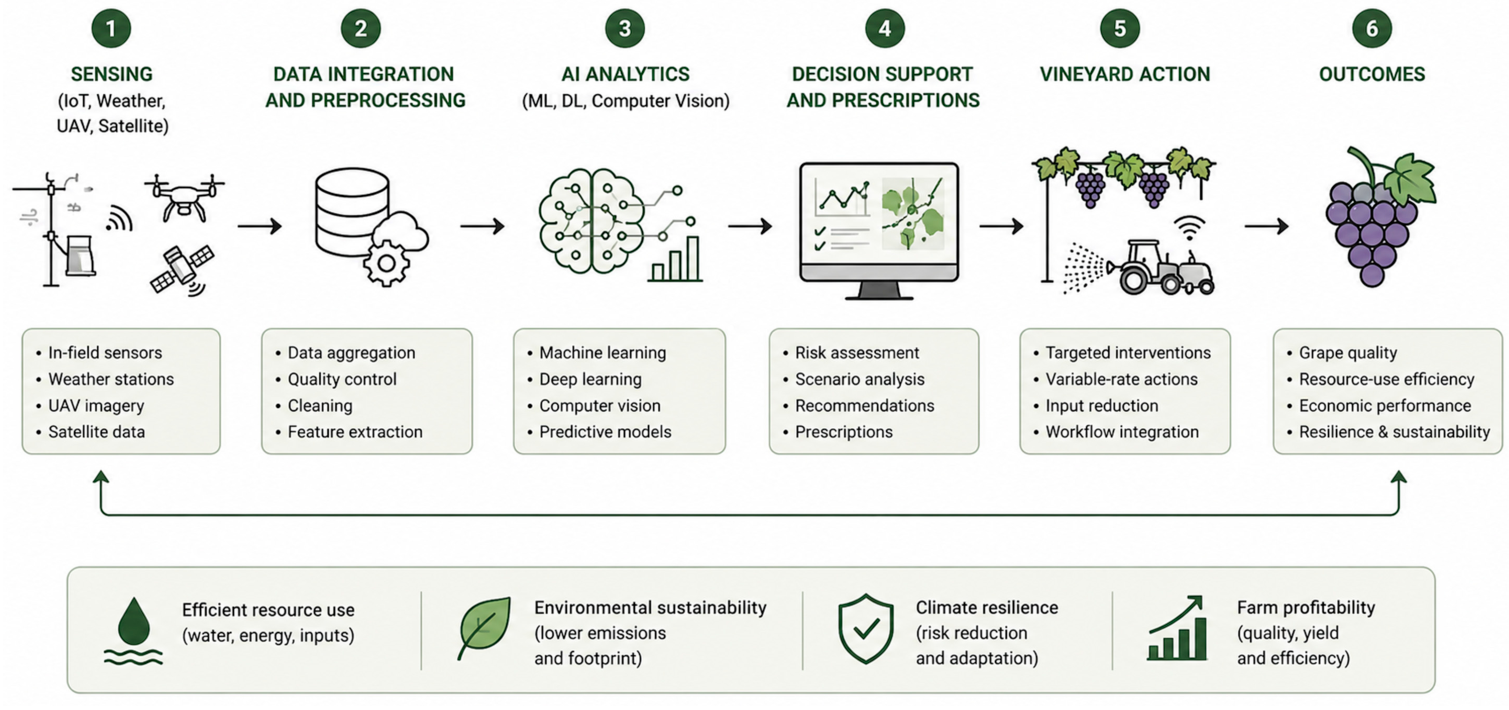
2. Smart Technologies Underpinning the Modern Vineyard
3. AI Applications Supporting Sustainable and High-Quality Grape Production
4. Contributions to Sustainability and Grape Quality
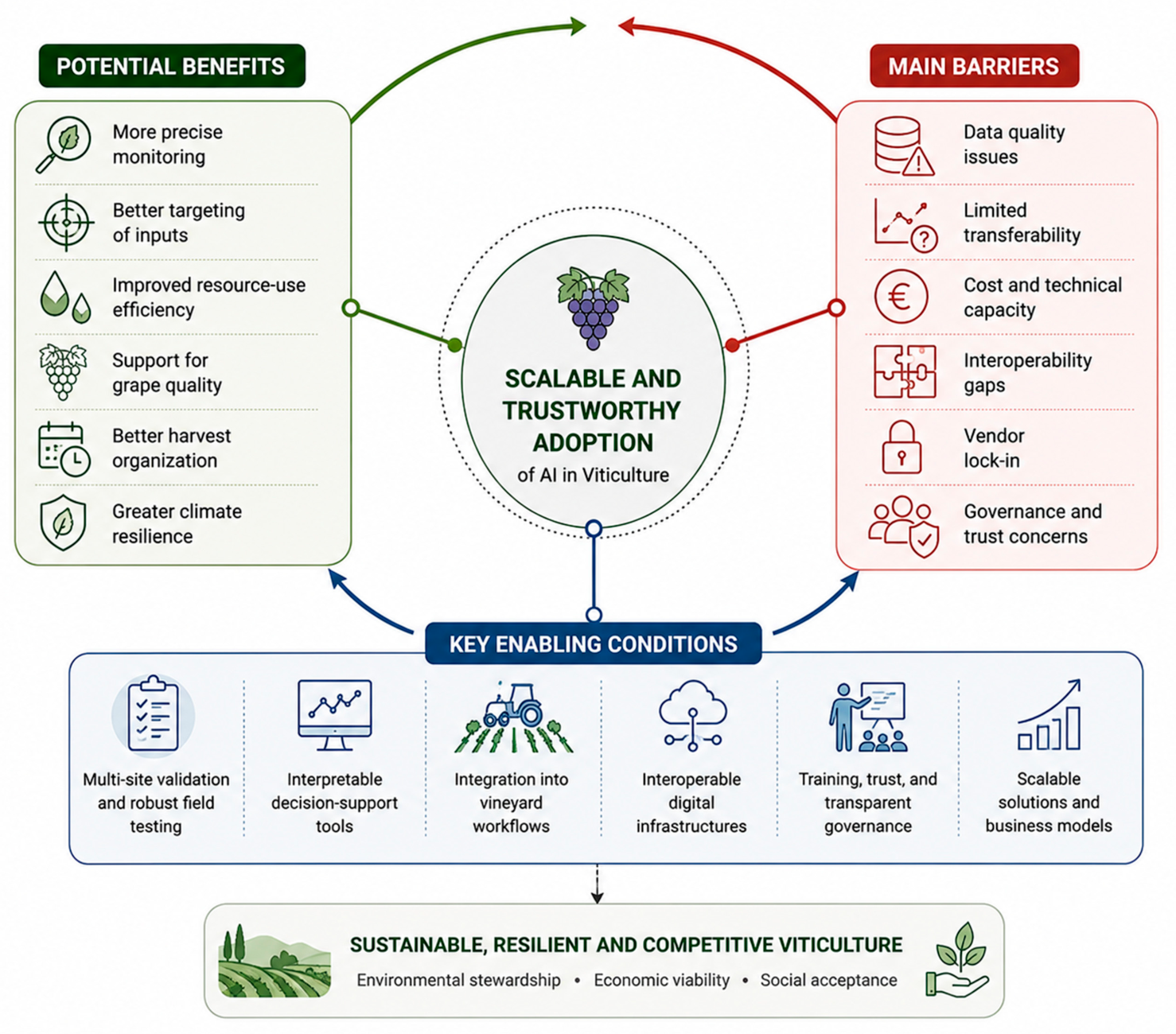
5. Barriers, Risks and Field-Ready Adoption Challenges
5.1. Data Quality and Reliability Issues
5.2. Limited Transferability Across Vineyard Contexts
5.3. Economic and Organizational Constraints
5.4. Interoperability, Governance and Ethical Considerations
6. Toward Trustworthy and Scalable Smart Viticulture
7. Conclusions
Author Contributions
Funding
Data Availability Statement
Conflicts of Interest
Abbreviations
| AI | Artificial Intelligence |
| ANN | Artificial Neural Network |
| CNN | Convolutional Neural Network |
| DSS | Decision-Support System |
| IoT | Internet of Things |
| ML | Machine Learning |
| NRMSE | Normalized Root Mean Square Error |
| R2 | Coefficient of Determination |
| RGB | Red–Green–Blue |
| RMSE | Root Mean Square Error |
| ROI | Return on Investment |
| UAV | Unmanned Aerial Vehicle |
References
- Tardaguila, J.; Stoll, M.; Gutiérrez, S.; Proffitt, T.; Diago, M.P. Smart applications and digital technologies in viticulture: A review. Smart Agric. Technol. 2021, 1, 100005. [Google Scholar] [CrossRef]
- Newlands, N.K. Artificial Intelligence and Big Data Analytics in Vineyards: A Review; IntechOpen: London, UK, 2021. [Google Scholar]
- Ferro, M.V.; Catania, P. Technologies and innovative methods for precision viticulture: A comprehensive review. Horticulturae 2023, 9, 399. [Google Scholar] [CrossRef]
- Ammoniaci, M.; Kartsiotis, S.-P.; Perria, R.; Storchi, P. State of the art of monitoring technologies and data processing for precision viticulture. Agriculture 2021, 11, 201. [Google Scholar] [CrossRef]
- Mucalo, A.; Matić, D.; Morić-Španić, A.; Čagalj, M. Satellite solutions for precision viticulture: Enhancing sustainability and efficiency in vineyard management. Agronomy 2024, 14, 1862. [Google Scholar] [CrossRef]
- Terribile, F.; Bonfante, A.; D’Antonio, A.; De Mascellis, R.; De Michele, C.; Langella, G.; Manna, P.; Mileti, F.A.; Vingiani, S.; Basile, A. A geospatial decision support system for supporting quality viticulture at the landscape scale. Comput. Electron. Agric. 2017, 140, 88–102. [Google Scholar] [CrossRef]
- Tziolas, E.; Karapatzak, E.; Kalathas, I.; Karampatea, A.; Grigoropoulos, A.; Bajoub, A.; Pachidis, T.; Kaburlasos, V.G. Assessing the economic performance of multipurpose collaborative robots toward skillful and sustainable viticultural practices. Sustainability 2023, 15, 3866. [Google Scholar] [CrossRef]
- Passias, A.; Tsakalos, K.-A.; Kleitsiotis, G.; Tsipas, E.; Rallis, K.; Fyrigos, I.-A.; Pantazi, X.E.; Sirakoulis, G.C. Recent Advances in Precision Viticulture: A Review. IEEE Trans. AgriFood Electron. 2025, 3, 308–319. [Google Scholar] [CrossRef]
- Yang, S.; Feng, X.; Huang, D. Case Study on Precision Viticulture: Implementing Technology for High Yields and Sustainability. Tree Genet. Mol. Breed. 2024, 14, 304–312. [Google Scholar] [CrossRef]
- Bastard, A.; Chaillet, A. Digitalization from vine to wine: Successes and remaining challenges—A review. In Proceedings of the BIO Web of Conferences; EDP Sciences: Les Ulis, France, 2023; p. 01034. [Google Scholar]
- Fuentes, S.; Tongsonand, E.; Gonzalez Viejo, C. How artificial intelligence (AI) is helping winegrowers to deal with adversity from climate change. In Proceedings of the IVES Conference Series; Enoforum: Zaragoza, Spain, 2021. [Google Scholar]
- Sapaev, J.; Fayziev, J.; Sapaev, I.; Abdullaev, D.; Nazaraliev, D.; Sapaev, B. Viticulture and wine production: Challenges, opportunities and possible implications. In Proceedings of the E3S Web of Conferences; EDP Sciences: Les Ulis, France, 2023; p. 01037. [Google Scholar]
- Simeunović, M.; Ratković, K.; Kovač, N.; Racković, T.; Fernandes, A. A Knowledge-Driven Framework for a Decision Support Platform in Sustainable Viticulture: Integrating Climate Data and Supporting Stakeholder Collaboration. Sustainability 2025, 17, 1387. [Google Scholar] [CrossRef]
- Pascoal, D.; Silva, N.; Adao, T.; Lopes, R.D.; Peres, E.; Morais, R. A technical survey on practical applications and guidelines for IoT sensors in precision agriculture and viticulture. Sci. Rep. 2024, 14, 29793. [Google Scholar] [CrossRef]
- Ozdemir, G.; Sessiz, A.; Pekitkan, F.G. Precision Viticulture tools to production of high quality grapes. Sci. Pap. Ser. B Hortic. 2017, 61. [Google Scholar]
- Rivera Chavez, Z.B.; Porcaro, A.; De Simone, M.C.; Guida, D. Improving Sustainable Viticulture in Developing Countries: A Case Study. Sustainability 2025, 17, 5338. [Google Scholar] [CrossRef]
- Fuentes, S.; Gago, J. Modern approaches to precision and digital viticulture. In Improving Sustainable Viticulture and Winemaking Practices; Elsevier: Amsterdam, The Netherlands, 2022; pp. 125–145. [Google Scholar]
- Sassu, A.; Gambella, F.; Ghiani, L.; Mercenaro, L.; Caria, M.; Pazzona, A.L. Advances in Unmanned Aerial System Remote Sensing for Precision Viticulture. Sensors 2021, 21, 956. [Google Scholar] [CrossRef] [PubMed]
- Matese, A.; Filippo Di Gennaro, S. Technology in precision viticulture: A state of the art review. Int. J. Wine Res. 2015, 2015, 69–81. [Google Scholar] [CrossRef]
- Sofia, S.; Agosta, M.; Asciuto, A.; Crescimanno, M.; Galati, A. Unleashing profitability of vineyards through the adoption of unmanned aerial vehicles technology systems: The case of two Italian wineries. Precis. Agric. 2025, 26, 41. [Google Scholar] [CrossRef]
- Moganapathi, B.; Kavitha, P.; Muthuvel, I.; Senthil, A.; Balachandar, D.; Mahendran, P. The AI-viticulture nexus: Robotics and precision technologies for sustainable vineyards. Plant Sci. Today 2025, 12, 1–11. [Google Scholar] [CrossRef]
- Gebresenbet, G.; Bosona, T.; Patterson, D.; Persson, H.; Fischer, B.; Mandaluniz, N.; Chirici, G.; Zacepins, A.; Komasilovs, V.; Pitulac, T. A concept for application of integrated digital technologies to enhance future smart agricultural systems. Smart Agric. Technol. 2023, 5, 100255. [Google Scholar] [CrossRef]
- Adamashvili, N.; Zhizhilashvili, N.; Tricase, C. The integration of the internet of things, artificial intelligence, and blockchain technology for advancing the wine supply chain. Computers 2024, 13, 72. [Google Scholar] [CrossRef]
- Seng, K.P.; Ang, L.-M.; Schmidtke, L.M.; Rogiers, S.Y. Computer vision and machine learning for viticulture technology. IEEE Access 2018, 6, 67494–67510. [Google Scholar] [CrossRef]
- Poblete-Echeverría, C.; Hernández, I.; Gutiérrez, S.; Iñiguez, R.; Barrio, I.; Tardaguila, J. Using artificial intelligence (AI) for grapevine disease detection based on images. In Proceedings of the BIO Web of Conferences; EDP Sciences: Les Ulis, France, 2023; p. 01021. [Google Scholar]
- Izquierdo-Bueno, I.; Moraga, J.; Cantoral, J.M.; Carbú, M.; Garrido, C.; González-Rodríguez, V.E. Smart viniculture: Applying artificial intelligence for improved winemaking and risk management. Appl. Sci. 2024, 14, 10277. [Google Scholar] [CrossRef]
- Kang, C.; Diverres, G.; Karkee, M.; Zhang, Q.; Keller, M. Decision-support system for precision regulated deficit irrigation management for wine grapes. Comput. Electron. Agric. 2023, 208, 107777. [Google Scholar] [CrossRef]
- Adam-Blondon, A.F.; Alaux, M.; Pommier, C.; Cantu, D.; Cheng, Z.M.; Cramer, G.R.; Davies, C.; Delrot, S.; Deluc, L.; Di Gaspero, G.; et al. Towards an open grapevine information system. Hortic. Res. 2016, 3, 16056. [Google Scholar] [CrossRef]
- Barriguinha, A.; de Castro Neto, M.; Gil, A. Vineyard yield estimation, prediction, and forecasting: A systematic literature review. Agronomy 2021, 11, 1789. [Google Scholar] [CrossRef]
- Oliveira, R.C.d.; Silva, R.D.d.S.e. Artificial intelligence in agriculture: Benefits, challenges, and trends. Appl. Sci. 2023, 13, 7405. [Google Scholar] [CrossRef]
- Gatou, P.; Tsiara, X.; Spitalas, A.; Sioutas, S.; Vonitsanos, G. Artificial Intelligence Techniques in Grapevine Research: A Comparative Study with an Extensive Review of Datasets, Diseases, and Techniques Evaluation. Sensors 2024, 24, 6211. [Google Scholar] [CrossRef]
- Pero, C.; Bakshi, S.; Nappi, M.; Tortora, G. IoT-driven machine learning for precision viticulture optimization. IEEE J. Sel. Top. Appl. Earth Obs. Remote Sens. 2023, 17, 2437–2447. [Google Scholar] [CrossRef]
- Kerkech, M.; Hafiane, A.; Canals, R. Vine disease detection in UAV multispectral images using optimized image registration and deep learning segmentation approach. Comput. Electron. Agric. 2020, 174, 105446. [Google Scholar] [CrossRef]
- Younas, M.; Akhtar, M.N.; Batool, S.; Owais, M.; Sahar, S.; Anum, W. The Integration of Artificial Intelligence in Agriculture: Emerging Trends, Benefits and Challenges. J. Asian Dev. Stud. 2025, 14, 1316–1333. [Google Scholar] [CrossRef]
- Balafoutis, A.T.; Koundouras, S.; Anastasiou, E.; Fountas, S.; Arvanitis, K. Life cycle assessment of two vineyards after the application of precision viticulture techniques: A case study. Sustainability 2017, 9, 1997. [Google Scholar] [CrossRef]
- Mirás-Avalos, J.M.; Araujo, E.S. Optimization of vineyard water management: Challenges, strategies, and perspectives. Water 2021, 13, 746. [Google Scholar] [CrossRef]
- Finco, A.; Bentivoglio, D.; Chiaraluce, G.; Alberi, M.; Chiarelli, E.; Maino, A.; Mantovani, F.; Montuschi, M.; Raptis, K.G.C.; Semenza, F.; et al. Combining precision viticulture technologies and economic indices to sustainable water use management. Water 2022, 14, 1493. [Google Scholar] [CrossRef]
- Ortuani, B.; Facchi, A.; Mayer, A.; Bianchi, D.; Bianchi, A.; Brancadoro, L. Assessing the effectiveness of variable-rate drip irrigation on water use efficiency in a Vineyard in Northern Italy. Water 2019, 11, 1964. [Google Scholar] [CrossRef]
- Mohimont, L.; Alin, F.; Rondeau, M.; Gaveau, N.; Steffenel, L.A. Computer vision and deep learning for precision viticulture. Agronomy 2022, 12, 2463. [Google Scholar] [CrossRef]
- Passias, A.; Kleitsiotis, G.; Tompris, I.; Stavroulakis, E.; Tsipas, E.; Tsakalos, K.-A.; Rallis, K.; Fyrigos, I.-A.; Pantazi, X.E.; Sirakoulis, G.C. A holistic approach to grapevine cultivation with precision viticulture. In Proceedings of the 2024 IEEE 2nd Conference on AgriFood Electronics (CAFE); IEEE: New York, NY, USA, 2024; pp. 1–5. [Google Scholar]
- Palacios, F.; Diago, M.P.; Melo-Pinto, P.; Tardaguila, J. Early yield prediction in different grapevine varieties using computer vision and machine learning. Precis. Agric. 2023, 24, 407–435. [Google Scholar] [CrossRef]
- Pérez-Pérez, C.A.; Viejo, C.G.; Fuentes, S.; Valiente-Banuet, J.I. Vineyard proximal sensing using multispectral imaging to evaluate grape ripening and quality traits using artificial neural networks modeling. J. Agric. Food Res. 2025, 23, 102252. [Google Scholar] [CrossRef]
- Mărculescu, S.-I.; Badea, A.; Teodorescu, R.I.; Begea, M.; Frîncu, M.; Bărbulescu, I.D. Application of artificial intelligence technologies in viticulture. Sci. Pap. Ser. Manag. Econ. Eng. Agric. Rural. Dev. 2024, 24. [Google Scholar]
- Silwal, A.; Yandun, F.; Nellithimaru, A.; Bates, T.; Kantor, G. Bumblebee: A Path Towards Fully Autonomous Robotic Vine Pruning. Field Robot. 2022, 2, 1661–1696. [Google Scholar] [CrossRef]
- Laroche-Pinel, E.; Cianciola, V.; Singh, K.; Vivaldi, G.A.; Brillante, L. Assessing the spatial-temporal performance of machine learning in predicting grapevine water status from Landsat 8 imagery via block-out and date-out cross-validation. Agric. Water Manag. 2024, 306, 109163. [Google Scholar] [CrossRef]
- Brillante, L.; Mathieu, O.; Leveque, J.; Bois, B. Ecophysiological Modeling of Grapevine Water Stress in Burgundy Terroirs by a Machine-Learning Approach. Front Plant Sci. 2016, 7, 796. [Google Scholar] [CrossRef]
- MacPherson, J.; Voglhuber-Slavinsky, A.; Olbrisch, M.; Schobel, P.; Donitz, E.; Mouratiadou, I.; Helming, K. Future agricultural systems and the role of digitalization for achieving sustainability goals. A review. Agron. Sustain. Dev. 2022, 42, 70. [Google Scholar] [CrossRef]
- Galati, A.; Sofia, S.; Crescimanno, M. Economics and barriers of precision viticulture technologies: A comprehensive systematic literature review. Inf. Process. Agric. 2025, 12, 487–500. [Google Scholar] [CrossRef]
- Panero, M.; De Bernardi, P.; Moggi, S.; Pierce, P. Unveiling digitalisation in Italian viticulture: A field study on drivers and barriers. Br. Food J. 2025, 127, 500–516. [Google Scholar] [CrossRef]
- Kudryashova, E.; Casetti, M. The internet of things-the nearest future of viticulture. AGRIS-Line Pap. Econ. Inform. 2021, 13, 79–86. [Google Scholar] [CrossRef]
- Seyedzadeh, Z.; Jabalameli, M.S.; Dehghani, E. Towards a sustainable viticultural supply chain under uncertainty: Integration of data envelopment analysis, artificial neural networks, and a multi-objective optimization model. Sci. Total Environ. 2025, 970, 178980. [Google Scholar] [CrossRef] [PubMed]
- Punt, T.; Snijkers, G. Exploring precision farming data: A valuable new data source? A first orientation. In Proceedings of the UNECE Workshop on Statistical Data Collection’New Sources and New Technologies, Geneva, Switzerland, 14–16 October 2019; pp. 14–16. [Google Scholar]
- Mansouri, T.; Sadeghi Moghadam, M.R.; Monshizadeh, F.; Zareravasan, A. IoT data quality issues and potential solutions: A literature review. Comput. J. 2023, 66, 615–625. [Google Scholar] [CrossRef]
- Abdipourchenarestansofla, M.; Schroth, C. The Importance of Data Quality Assessment for Machinery Data in the Field of Agriculture; VDI-Berichte; VDI Wissensforum GmbH: Düsseldorf, Germany, 2022; p. 2395. [Google Scholar] [CrossRef]
- Šestak, M.; Copot, D. Towards trusted data sharing and exchange in agro-food supply chains: Design principles for agricultural data spaces. Sustainability 2023, 15, 13746. [Google Scholar] [CrossRef]
- Soussi, A.; Zero, E.; Sacile, R.; Trinchero, D.; Fossa, M. Smart Sensors and Smart Data for Precision Agriculture: A Review. Sensors 2024, 24, 2647. [Google Scholar] [CrossRef]
- Horstmann, L.P.; Wagner, M.; Scheffel, R.M.; Fröhlich, A.A. Dealing with incomplete datasets with a confidence attribution algorithm. Measurement 2022, 199, 111509. [Google Scholar] [CrossRef]
- Haseeb, K.; Ud Din, I.; Almogren, A.; Islam, N. An Energy Efficient and Secure IoT-Based WSN Framework: An Application to Smart Agriculture. Sensors 2020, 20, 2081. [Google Scholar] [CrossRef]
- Alahe, M.A.; Wei, L.; Chang, Y.; Gummi, S.R.; Kemeshi, J.; Yang, X.; Won, K.; Sher, M. Cyber security in smart agriculture: Threat types, current status, and future trends. Comput. Electron. Agric. 2024, 226, 109401. [Google Scholar] [CrossRef]
- Catelani, M.; Ciani, L.; Bartolini, A.; Del Rio, C.; Guidi, G.; Patrizi, G. Reliability Analysis of Wireless Sensor Network for Smart Farming Applications. Sensors 2021, 21, 7683. [Google Scholar] [CrossRef]
- Patrizi, G.; Bartolini, A.; Ciani, L.; Catelani, M. System reliability of fault-tolerant Wireless Sensor Network for precision agriculture. In Proceedings of the 2024 IEEE International Symposium on Systems Engineering (ISSE), Perugia, Italy, 16–18 October 2024; pp. 1–6. [Google Scholar]
- Kandel, G.P.; Poláková, J.; Hamouz, P.; Hruška, A.; Varvaris, I.; Manikas, I. The role of digitalization in supporting farmers and strategic policies for food security and sustainability in Europe: A review. Sustain. Futur. 2025, 11, 101702. [Google Scholar] [CrossRef]
- Gong, R.; Zhang, H.; Li, G.; He, J. Edge Computing-Enabled Smart Agriculture: Technical Architectures, Practical Evolution, and Bottleneck Breakthroughs. Sensors 2025, 25, 5302. [Google Scholar] [CrossRef]
- Wang, T.; Guo, J.; Zhang, B.; Yang, G.; Li, D. Deploying AI on Edge: Advancement and Challenges in Edge Intelligence. Mathematics 2025, 13, 1878. [Google Scholar] [CrossRef]
- Íñiguez, R.; Wolela, F.; Gonzalez Pavez, M.I.; Barrio Fernández, I.; Tardáguila, J.; Venter, T.; Poblete-Echeverría, C. Artificial intelligence-driven classification method of grapevine major phenological stages using conventional RGB imaging. OENO One 2025, 59, 9306. [Google Scholar] [CrossRef]
- Mohanty, S.P.; Hughes, D.P.; Salathe, M. Using Deep Learning for Image-Based Plant Disease Detection. Front. Plant Sci. 2016, 7, 1419. [Google Scholar] [CrossRef]
- Khan, K.H.; Aljaedi, A.; Ishtiaq, M.S.; Imam, H.; Bassfar, Z.; Jamal, S.S. Disease detection in grape cultivation using strategically placed cameras and machine learning algorithms with a focus on powdery mildew and blotches. IEEE Access 2024, 12, 139505–139523. [Google Scholar] [CrossRef]
- Cividino, S.R.S.; Cappelli, A.; Belluco, P.; Rinaldi, F.; Avramovic, L.; Zaninelli, M. Preliminary Study of Vision-Based Artificial Intelligence Application to Evaluate Occupational Risks in Viticulture. Sensors 2025, 25, 6749. [Google Scholar] [CrossRef]
- Íñiguez, R.; Palacios, F.; Barrio, I.; Hernández, I.; Gutiérrez, S.; Tardaguila, J. Impact of leaf occlusions on yield assessment by computer vision in commercial vineyards. Agronomy 2021, 11, 1003. [Google Scholar] [CrossRef]
- Mark, R. Ethics of using AI and big data in agriculture: The case of a large agriculture multinational. ORBIT J. 2019, 2, 1–27. [Google Scholar] [CrossRef]
- Guth, F.A.; Ward, S.; McDonnell, K. From lab to field: An empirical study on the generalization of convolutional neural networks towards crop disease detection. Eur. J. Eng. Technol. Res. 2023, 8, 33–40. [Google Scholar] [CrossRef]
- Fenu, G.; Malloci, F.M. Evaluating impacts between laboratory and field-collected datasets for plant disease classification. Agronomy 2022, 12, 2359. [Google Scholar] [CrossRef]
- Adão, T.; Chojka, A.; Pascoal, D.; Silva, N.; Morais, R.; Peres, E. Synthetic Data-Driven Methods to Accelerate the Deployment of Deep Learning Models: A Case Study on Pest and Disease Detection in Precision Viticulture. Computers 2025, 14, 327. [Google Scholar] [CrossRef]
- Zhang, J.; Guan, K.; Chen, Z.; Huang, Y.; Zhao, K.; Peng, B.; Wang, S.; Wu, X.; Wang, S.; Banerjee, A. Transfer learning for improved crop yield predictions in a cross-scale pathway: A case study for Brazilian national soybean. Int. J. Appl. Earth Obs. Geoinf. 2025, 145, 104981. [Google Scholar] [CrossRef]
- Guo, G.; Zhou, F.; Wu, Q.; Zhai, D. Multi-granularity alignment for crop diseases detection. Plant Phenomics 2025, 7, 100001. [Google Scholar] [CrossRef]
- Wang, H.; Ye, Z.; Yao, Y.; Chang, W.; Liu, J.; Zhao, Y.; Li, S.; Liu, Z.; Zhang, X. Improving cross-regional model transfer performance in crop classification by crop time series correction. Geo-Spat. Inf. Sci. 2025, 28, 1581–1596. [Google Scholar] [CrossRef]
- Alexander, C.S.; Yarborough, M.; Smith, A. Who is responsible for ‘responsible AI’?: Navigating challenges to build trust in AI agriculture and food system technology. Precis. Agric. 2024, 25, 146–185. [Google Scholar] [CrossRef]
- López-Morales, J.A.; Martínez, J.A.; Skarmeta, A.F. Digital transformation of agriculture through the use of an interoperable platform. Sensors 2020, 20, 1153. [Google Scholar] [CrossRef]
- Biondo, A.; Rizzo, G.; Migliore, G.; Galati, A. Wine growers’ propensity to adopt digital precision farming technologies: Integrating risk attitudes to the Technology Acceptance Model. Res. Glob. 2025, 11, 100298. [Google Scholar] [CrossRef]
- Ahoa, E.; Kassahun, A.; Verdouw, C.; Tekinerdogan, B. Challenges and Solution Directions for the Integration of Smart Information Systems in the Agri-Food Sector. Sensors 2025, 25, 2362. [Google Scholar] [CrossRef]
- Rotz, S.; Duncan, E.; Small, M.; Botschner, J.; Dara, R.; Mosby, I.; Reed, M.; Fraser, E.D. The politics of digital agricultural technologies: A preliminary review. Sociol. Rural. 2019, 59, 203–229. [Google Scholar] [CrossRef]
- Hackfort, S. Patterns of inequalities in digital agriculture: A systematic literature review. Sustainability 2021, 13, 12345. [Google Scholar] [CrossRef]
- Atik, C.; Martens, B. Competition problems and governance of non-personal agricultural machine data: Comparing voluntary initiatives in the US and EU. J. Intell. Prop. Info. Tech. Elec. Com. L. 2021, 12, 370. [Google Scholar]
- Jouanjean, M.-A.; Casalini, F.; Wiseman, L.; Gray, E. Issues Around Data Governance in the Digital Transformation of Agriculture: The Farmers’ Perspective; OECD Food, Agriculture and Fisheries Papers; OECD Publishing: Paris, France, 2020; Volume 146. [Google Scholar] [CrossRef]
- Sullivan, C.S.; Gemtou, M.; Anastasiou, E.; Fountas, S. Building trust: A systematic review of the drivers and barriers of agricultural data sharing. Smart Agric. Technol. 2024, 8, 100477. [Google Scholar] [CrossRef]
- Wiseman, L.; Sanderson, J.; Zhang, A.; Jakku, E. Farmers and their data: An examination of farmers’ reluctance to share their data through the lens of the laws impacting smart farming. NJAS-Wagening. J. Life Sci. 2019, 90, 100301. [Google Scholar] [CrossRef]
- Mishra, A.C.; Das, J.; Awtar, R. An emerging era of research in agriculture using AI. J. Sci. Res. Technol. 2024, 2, 1–7. [Google Scholar] [CrossRef]
- Gavai, A.K.; Bouzembrak, Y.; Xhani, D.; Sedrakyan, G.; Meuwissen, M.P.; Souza, R.G.-S.; Marvin, H.J.; van Hillegersberg, J. Agricultural data Privacy: Emerging platforms & strategies. Food Humanit. 2025, 4, 100542. [Google Scholar] [CrossRef]
- Dara, R.; Hazrati Fard, S.M.; Kaur, J. Recommendations for ethical and responsible use of artificial intelligence in digital agriculture. Front Artif. Intell. 2022, 5, 884192. [Google Scholar] [CrossRef] [PubMed]
- Linsner, S.; Kuntke, F.; Steinbrink, E.; Franken, J.; Reuter, C. The role of privacy in digitalization–analyzing perspectives of German farmers. Proc. Priv. Enhancing Technol. 2021, 2021, 334–350. [Google Scholar] [CrossRef]
- Schieck, M.; Braun, B. The effect of transparency on trust and adoption of AI: A survey in German viticulture. In Precision agriculture’25; Wageningen Academic: Wageningen, The Netherlands, 2025; pp. 1151–1158. [Google Scholar]
- Posadas, B.B.; Ogunyiola, A.; Niewolny, K. Socially responsible AI assurance in precision agriculture for farmers and policymakers. In AI Assurance; Elsevier: Amsterdam, The Netherlands, 2023; pp. 473–499. [Google Scholar]



| Application Domain | Typical Data Sources | Typical AI Methods | Main Vineyard Objective | Relevance to Sustainability/Grape Quality | Indicative Quantitative Evidence | Current Maturity/Main Limitation |
|---|---|---|---|---|---|---|
| Vine status and stress monitoring | IoT sensors, thermal imagery, multispectral imagery, weather data. | ML regression/classification, deep learning, anomaly detection. | Identify water stress, heat stress and spatial variability. | Supports targeted irrigation and localized management; helps protect fruit composition. | Quantitative performance is often promising, but remains strongly dependent on local calibration, temporal coverage, and validation across sites and seasons [45,46]. | Relatively mature; performance still depends on data quality and local calibration. |
| Disease and pest detection | RGB images, multispectral/thermal images, leaf wetness and weather data. | Computer vision, CNNs, image classification. | Early diagnosis and risk-aware plant protection. | Improves treatment timing and may reduce unnecessary spray applications. | UAV-based deep learning mildew detection has been reported at >92% grapevine-level and 87% leaf-level detection under well-defined conditions [33]. | Among the most advanced domains; field performance can decline under variable real-world conditions. |
| Irrigation and nutrient management | Soil moisture, microclimate, plant indicators, historical responses. | Predictive ML, DSS optimization. | Refine irrigation and fertilization decisions. | Improves resource-use efficiency and helps balance yield with quality. | Variable-rate irrigation studies have reported 18% lower irrigation water use without yield or quality loss under site-specific field conditions [38]. | Agronomically valuable, but often limited by infrastructure, transferability and site-specific responses. |
| Yield and quality prediction | Phenology, imagery, weather records, historical yield data. | ML prediction, feature extraction. | Forecast yield, maturity and spatial harvest variability. | Supports logistics, selective harvest and quality-oriented decisions. | Early yield prediction studies have reported R2 = 0.54–0.87 and NRMSE = 16.47–39.17% [41], while quality-trait prediction has reached R2 up to 0.97 depending on trait and cultivar [42]. | Promising, but less robust across cultivars, seasons and vineyard conditions. |
| Automation and robotics | Vision systems, navigation sensors, machine interfaces. | Object detection, robotic control, AI-assisted automation. | Assist repetitive and time-sensitive vineyard operations. | Potential to improve precision and reduce labor constraints. | Autonomous robotic pruning has been reported at 213 s/vine with 87% pruning accuracy under field conditions [44]. | Still less mature in practical terms due to terrain, cost and operational complexity. |
| Barrier | Typical Manifestation in Vineyards | Indicative Evidence/Implication | Practical Consequence | Priority Response |
|---|---|---|---|---|
| Data quality and reliability issues | Missing values, sensor drift, unstable connectivity, variable image quality, inconsistent annotation. | Model performance often declines when systems move from controlled datasets to unstable field conditions, particularly under variable image quality, incomplete records, or inconsistent annotation [53,56,71,72]. | Reduced model reliability and lower confidence in digital outputs. | Standardized data collection, calibration protocols, quality control and robust validation. |
| Limited transferability across production contexts | Performance declines across terroirs, cultivars, rootstocks, seasons and training systems. | Cross-site and cross-season deployment remains one of the clearest weaknesses of current AI systems, especially when models are trained on specific cultivars, canopy structures, or local environmental conditions [41,45,46,74,75,76]. | Restricted applicability outside pilot conditions and reduced practical value. | Multi-site and multi-season datasets, external validation and context-aware model development. |
| Economic and organizational constraints | High costs of equipment, software, subscriptions, maintenance and training; limited technical capacity and time availability. | Adoption is often constrained not only by initial investment, but also by uncertain returns, time demands, and the practical burden of integrating digital tools into existing management routines [20,48,49,79]. | Slow adoption, partial use of digital tools, or abandonment after initial uptake. | User-friendly systems, advisory support, training and clearer evidence of cost-effectiveness. |
| Interoperability gaps and vendor lock-in | Poor compatibility among platforms, limited data portability and dependence on proprietary ecosystems. | Weak interoperability can reduce long-term usability, increase dependence on single providers, and complicate routine decision-making across the production chain [28,78,80,81,84]. | Fragmented workflows, reduced flexibility and long-term dependence on specific providers. | Open standards, interoperable platforms, portable data formats and transparent data access policies. |
| Governance, privacy and cybersecurity concerns | Unclear data ownership, uncertain access rights and vulnerabilities in connected systems. | Uncertainty about data ownership, access rights, and digital security can reduce willingness to share data or rely on AI-supported tools in routine management [55,59,84,85,86,88]. | Low willingness to share data and hesitation toward broader digital integration. | Clear governance frameworks, secure infrastructures, transparent responsibilities and trust-building mechanisms. |
| Limited transparency and explainability of AI outputs | Recommendations that are difficult to interpret or poorly aligned with vineyard realities. | When AI recommendations are difficult to interpret, growers may hesitate to trust them even when technical performance appears promising [77,89,90,91,92]. | Reduced user trust and lower integration into practical decision-making. | Explainable models, transparent decision-support interfaces and stronger human oversight. |
Disclaimer/Publisher’s Note: The statements, opinions and data contained in all publications are solely those of the individual author(s) and contributor(s) and not of MDPI and/or the editor(s). MDPI and/or the editor(s) disclaim responsibility for any injury to people or property resulting from any ideas, methods, instructions or products referred to in the content. |
© 2026 by the authors. Licensee MDPI, Basel, Switzerland. This article is an open access article distributed under the terms and conditions of the Creative Commons Attribution (CC BY) license.
Share and Cite
Nathena, E.Z.; Psyllakis, K.; Petoumenou, D.; Kontaxakis, E. Smart Technologies and Artificial Intelligence in Sustainable Viticulture: Applications, Benefits, Barriers and Governance for High-Quality Grape Production. Horticulturae 2026, 12, 719. https://doi.org/10.3390/horticulturae12060719
Nathena EZ, Psyllakis K, Petoumenou D, Kontaxakis E. Smart Technologies and Artificial Intelligence in Sustainable Viticulture: Applications, Benefits, Barriers and Governance for High-Quality Grape Production. Horticulturae. 2026; 12(6):719. https://doi.org/10.3390/horticulturae12060719
Chicago/Turabian StyleNathena, Evangelia Zoi, Kyriakos Psyllakis, Despoina Petoumenou, and Emmanouil Kontaxakis. 2026. "Smart Technologies and Artificial Intelligence in Sustainable Viticulture: Applications, Benefits, Barriers and Governance for High-Quality Grape Production" Horticulturae 12, no. 6: 719. https://doi.org/10.3390/horticulturae12060719
APA StyleNathena, E. Z., Psyllakis, K., Petoumenou, D., & Kontaxakis, E. (2026). Smart Technologies and Artificial Intelligence in Sustainable Viticulture: Applications, Benefits, Barriers and Governance for High-Quality Grape Production. Horticulturae, 12(6), 719. https://doi.org/10.3390/horticulturae12060719