Article

Genome-Wide Identification of BSK Gene Family and Their Heat Stress Responses in Non-Heading Chinese Cabbage


1
Key Laboratory for the Conservation and Utilization of Important Biological Resources, College of Life Sciences, Anhui Normal University, Wuhu 241000, China
2
Shanghai Key Laboratory of Protected Horticultural Technology, Horticultural Research Institute, Shanghai Academy of Agricultural Sciences, Shanghai 201403, China
*
Authors to whom correspondence should be addressed.
Horticulturae 2026, 12(6), 686; https://doi.org/10.3390/horticulturae12060686
Submission received: 4 April 2026 / Revised: 26 May 2026 / Accepted: 29 May 2026 / Published: 1 June 2026
(This article belongs to the Section Biotic and Abiotic Stress)

Abstract

Although brassinosteroids (BRs) are widely recognized as important regulators of plant growth and environmental adaptation, the biological roles of BR-signaling kinases (BSKs) in horticultural crops remain largely unclear. To investigate their potential involvement in thermotolerance, BSK-related genes in Brassica rapa subsp. chinensis were systematically identified and characterized. Twenty BcBSK members were obtained, all harboring a conserved N-terminal serine/threonine kinase domain together with C-terminal tetratricopeptide repeat (TPR) motifs. Evolutionary and syntenic analyses separated these genes into several clades and further identified 16 duplicated gene pairs predominantly subjected to purifying selection. Promoter analysis revealed abundant cis-acting elements associated with hormone signaling and stress responsiveness. In addition, protein interaction prediction suggested that BcBSK2, BcBSK5, BcBSK14, and BcBSK18 may function as central components within the BSK-mediated regulatory network. Interaction network analysis highlighted BcBSK2, BcBSK5, BcBSK14, and BcBSK18 as potential hub genes. Under heat treatment (38 °C), RNA-seq analysis revealed cultivar-specific expression patterns: BcBSK1 and BcBSK2 were strongly induced in the heat-sensitive cultivar “Aijiaohuang”, whereas only minor changes were detected in the heat-tolerant cultivar “SHI”. qRT-PCR analysis further confirmed these transcriptional patterns. Exogenous 0.5 mg·L−1 24-epibrassinolide (EBR) alleviated heat-induced damage in both NHCC cultivars by reducing MDA content and increasing proline levels, while antioxidant enzyme responses showed genotype-dependent patterns. In the heat-sensitive cultivar, EBR significantly increased SOD, POD, and CAT activities, whereas the heat-tolerant cultivar maintained relatively high SOD activity, accompanied by comparatively lower POD and CAT activities. Several BcBSK genes, particularly BcBSK2, BcBSK5, BcBSK14, and BcBSK18, showed pronounced expression responses under heat stress and may be associated with BR-mediated thermotolerance. Overall, these findings suggest that BcBSK family members are associated with BR-regulated thermotolerance and correlated with genotype-dependent differences in ROS regulatory strategies, providing a basis for further studies on heat tolerance improvement in NHCC.

1. Introduction

As a major leafy crop extensively produced across China, non-heading Chinese cabbage (NHCC, Brassica rapa subsp. chinensis) features rapid development and prominent productivity. Nevertheless, its development is easily disrupted by thermal variations. Elevated temperatures frequently impair its growth and degrade foliage quality, which in turn compromises overall harvest and commercial value [1,2]. Consequently, elucidating how NHCC responds to thermal stress at the molecular level holds paramount importance for breeding heat-resistant varieties.
Phytohormone transduction networks, especially those mediated by brassinosteroids (BRs), are vital for vegetation to cope with thermal anomalies and diverse ecological challenges [3,4,5]. Within this cascade, BR-signaling kinases (BSKs) serve as pivotal upstream regulatory nodes, bridging surface receptors to subsequent signaling networks [6,7]. Architecturally, these proteins exhibit a distinct modular configuration, typically comprising an N-terminal protein kinase catalytic domain coupled with a C-terminal tetratricopeptide repeat (TPR) motif [3,8,9,10]. Nonetheless, the BSK gene family displays lineage-dependent evolutionary divergence among various plant taxa; while particular clades are predominantly found within monocotyledonous or dicotyledonous species, intact BSK homologs are missing in lower plants [3,11]. This structural and evolutionary heterogeneity underscores their diverse functional spectrum. For example, within Arabidopsis thaliana, immunity [12,13,14] and salinity responses [15,16] are mediated by BSK1 and BSK5, respectively. Conversely, in Oryza sativa, immune defense and seed size are modulated by OsBSK1-2 and OsBSK2, respectively [17,18,19], emphasizing how versatile BSK proteins are in harmonizing vegetative growth with environmental adaptation.
Notwithstanding these discoveries, comprehensive insights into how BSK operates under distinct stress scenarios remain constrained. Specifically, though supplying exogenous BR has been shown to fortify plant thermotolerance [20,21,22,23], the exact participation of core components within the BR signaling cascade during heat exposure is not yet fully understood. As upstream participants in BR signaling, whether different BSK family members have undergone functional specialization during heat stress responses requires further clarification. Furthermore, the bulk of current literature centers on model organisms, leaving a substantial knowledge gap regarding vegetable crops like NHCC.
In the present work, the BSK gene family of NHCC was characterized via genome-wide identification. Utilizing integrated transcriptomic and physiological datasets, the expression profiles of BSK genes under elevated temperatures were scrutinized. Additionally, architectural characterization, transcriptional profiling, and physiological evaluations were merged to dissect the functional variations among individual members and examine their links to physiological alterations triggered by exogenous 2,4-Epibrassinolide (EBR) administration. In particular, this research pursued three primary goals: first, to comprehensively discover and analyze all BSK members in NHCC regarding their physical-chemical attributes, structural arrangements, and conserved motifs; second, to evaluate the transcription patterns of BSK genes across different cultivars under heat stress using RNA-seq data; third, to assess how crucial BSK members participate in BR-driven heat stress responses by correlating expression behaviors with physiological adjustments stimulated by exogenous EBR. Ultimately, this research uncovers novel aspects of functional diversification within the BSK family and establishes a theoretical framework for deciphering the molecular pathways of BR-mediated heat tolerance, thereby assisting in the genetic improvement of NHCC.

2. Materials and Methods

2.1. Identification and Physicochemical Characterization of the BcBSK Gene Family

To comprehensively isolate members belonging to the BcBSK family within the NHCC genome, a dual framework incorporating sequence similarity matching and domain architecture verification was implemented. Initially, local BLASTP v2.17.0 alignments were executed against the NHCC protein database, leveraging twelve previously documented AtBSK protein sequences from Arabidopsis thaliana as query templates [3]. Candidate sequences were captured utilizing a stringent E-value cutoff of 1e−100. In parallel, profile hidden Markov models (HMMs) for the Pfam database entries PF07714 and PF25575 were utilized to screen the proteome via the HMMER package to detect supplementary homolog candidates.
Following the aggregation of hits yielded by both the BLASTP and HMMER inquiries, all redundant entries were eliminated, and the unique candidate sequences underwent strict structural validation. Conformation of the necessary structural elements was performed by querying the Conserved Domain Database (CDD, https://www.ncbi.nlm.nih.gov/cdd/, accessed on 15 September 2025) alongside InterProScan (https://www.ebi.ac.uk/interpro/interproscan.html, accessed on 16 September 2025). Polypeptides lacking the full complement of characteristic domains essential to the BSK group were discarded, leaving only fully validated sequences as final family members.
Prediction of fundamental physicochemical parameters—specifically polypeptide length, molecular weight (MW), and theoretical isoelectric point (pI) was carried out through the ExPASy ProtParam server (https://web.expasy.org/protparam/, accessed on 20 September 2025). Lastly, the compartmentalization patterns of these proteins within cellular substructures were mapped using the DeepLoc v2.1 predictive platform.

2.2. Phylogenetic Analysis

To align the BSK protein sequences, a multiple sequence alignment was performed utilizing the BioEdit v7.2.6.1 software platform, applying a gap opening penalty threshold of 10.0 alongside a gap extension penalty coefficient of 0.1. The untrimmed alignment, retaining all regions without manual excision or filtering, served as the direct input for phylogenetic inference. The phylogenetic tree was achieved through the maximum likelihood (ML) optimality criterion executed within the IQ-TREE v2.4.0 framework.
Prior to tree construction, the optimal amino acid substitution model was determined through ModelFinder under the guidance of the Bayesian Information Criterion (BIC), which selected Q.Plant+G4 as the best-fit evolutionary model. Reliability of the phylogenetic branches was evaluated by executing the ultrafast bootstrap approximation algorithm with 1000 iterations. Final visualization, structural modification, and aesthetic editing of the computed tree topology were performed utilizing the iTOL v7.5.1 web platform (Interactive Tree Of Life, https://itol.embl.de, accessed on 10 October 2025).

2.3. Chromosomal Localization, Synteny, and Ka/Ks Analysis

The genomic coordinates and chromosomal positions of the BcBSK genes were mapped and visualized using the TBtools-II v1.098 software suite [24]. To evaluate intraspecific gene duplication events and establish collinear networks within the NHCC genome, syntenic blocks and duplicated loci were identified utilizing the “One Step MCScanX” pipeline integrated within TBtools.
To evaluate the evolutionary selective pressures driving the divergence of the duplicated gene pairs, the non-synonymous substitution rate (Ka), synonymous substitution rate (Ks), and the corresponding Ka/Ks ratio were computed via KaKs_Calculator 3.0 [25]. The evolutionary dynamics were interpreted based on standard selection thresholds: a Ka/Ks value exceeding 1.0 implies the occurrence of positive (diversifying) Darwinian selection, a quotient equivalent to 1.0 indicates neutral evolutionary dynamics, whereas a value falling below 1.0 signifies the operation of purifying (negative) selection constraints [26].

2.4. Gene Structure and Conserved Domain Analysis

The structural architecture regarding the distribution of exons and introns across the BcBSK was delineated by extracting genomic feature data from the NHCC genome annotation datasets, with subsequent visualization executed via TBtools.
For protein-level features, conserved domain architectures were delineated by querying both the InterProScan and NCBI CDD platforms. Concurrently, discovery of conserved motifs within the amino acid sequences was performed using MEME Suite v5.5.8 (https://meme-suite.org/meme/, accessed on 13 October 2025). To isolate core structural hallmarks while filtering out biologically irrelevant or random sequences, specific parameter constraints were enforced: the maximum number of discoverable motifs was restricted to eight to capture primary architectural arrangements, and the allowable motif length was bounded between 6 and 50 residues to guarantee evolutionary significance and sequence reliability. Comprehensive attributes of these identified motifs-encompassing specific sequence lengths, site counts, statistical E-values, consensus sequences, and individual protein motif arrangementswere compiled in Supplementary Table S3. Ultimately, the phylogenetic topology, exon-intron boundaries, motif layouts, and domain organizations were compiled and graphically integrated using TBtools.

2.5. Cis-Acting Element Analysis

To decipher proximal transcriptional architecture, genomic sequences encompassing the 2000 bp domain preceding the translational start site (ATG) were isolated for every distinct BcBSK locus. The distribution of prospective cis-acting regulatory elements within these isolated promoter segments were subsequently mapped using the online PlantCARE repository (https://bioinformatics.psb.ugent.be/webtools/plantcare/html, accessed on 2 November 2025). Downstream curation, classification, and graphical representation of the identified regulatory motifs were conducted utilizing TBtools.

2.6. Protein-Protein Interaction Network Analysis

To forecast potential functional linkages, a protein-protein interaction (PPI) network was simulated leveraging the computational platform of the STRING database v11.0. The BcBSK protein sequences were mapped through homology matching against the established Brassica rapa reference genome framework utilizing default operational parameters [27]. The resulting interactome dataset was subsequently imported into Cytoscape v3.8.0 for network visualization, structural layout editing, and topological feature evaluation [28].

2.7. Transcriptome Data and Expression Analysis

To evaluate the transcriptional dynamics of BcBSK genes during heat stress, RNA-seq datasets were retrieved from the NCBI BioProject repository under the accession number PRJNA1030162. This transcriptomic data encompassed two contrasting NHCC genotypes: the heat-sensitive cultivar “Aijiaohuang” alongside the heat-tolerant cultivar “SHI”, with both subjected to a 38 °C hyperthermic challenge across a temporal course of 0, 6, and 24 h.
Abundance levels of the transcripts were quantified using the FPKM (Fragments Per Kilobase of transcript per Million mapped reads) metric. Owing to constraints within the public dataset repository, gene expression analysis was restricted to pre-calculated FPKM values, as raw sequence count matrices were unavailable. Consequently, FPKM values were utilized directly to visualize transcriptional profiles, notwithstanding the recognized constraints of FPKM-based normalization relative to TPM or raw count statistics for robust cross-sample quantitative normalization. Differential gene expression processing followed the computational workflow established in the original dataset, utilizing DESeq2 v1.40.2 with selection criteria set at an absolute |log2(fold change)| ≥ 1 and an FDR-adjusted p-value < 0.05. Heatmaps representing the normalized expression patterns were generated and styled using TBtools.

2.8. qRT-PCR Validation

Total RNA utilized for downstream qRT-PCR verification was isolated from the identical biological samples and experimental conditions employed in the transcriptomic sequencing phase. Synthesis of first-strand cDNA, along with the simultaneous elimination of contaminating genomic DNA, was executed utilizing the RTase III Primer Flexible All-in-One Mix kit. Target-specific oligonucleotides were engineered via Primer v5.0, with the resulting primer configurations documented in Supplementary Table S1. To normalize transcript abundance, EF-1α was selected as the endogenous reference control, owing to its previously established transcriptional consistency in NHCC during thermal stress [29].
The quantitative amplification assays were conducted with a SYBR Green Premix kit (Catalog No. EG20117M, Jiangsu BestEnzymes Biotech Co., Ltd./Jiangsu Yugong Biotech Co., Ltd., Lianyungang, China) in a final reaction layout of 20 μL. Each individual reaction mixture consisted of a 1 μL aliquot of template cDNA, 10 μL of Premix master mix, 0.4 μL apiece of the forward and reverse primers (maintained at a working concentration of 0.2 μM), with nuclease-free ddH2O added to a final volume of 8.2 μL. For each experimental condition, three independent biological replicates were prepared and processed.
The thermocycling profile was configured with an initial denaturation at 95 °C for 30 s, succeeded by 40 continuous cycles comprising 95 °C for 10 s and 60 °C for 30 s. Normalized fold-change variations in gene expression were subsequently quantified via the 2−ΔΔCt analytical method.

2.9. Plant Materials, Treatments, and Physiological Measurements

The experimental germplasm comprised two contrasting NHCC genotypes: the heat-sensitive cultivar “Aijiaohuang” and the heat-tolerant cultivar “SHI”, with seeds generously supplied by the Horticultural Research Institute of the Shanghai Academy of Agricultural Sciences. Phenotypic thermotolerance benchmarks and baseline transcriptomic profiles for these specific lines were established based on prior investigations by our laboratory group [30].
Seed hydration, subsequent emergence, and early post-germinative growth were conducted within an environmentally regulated phytotron calibrated to a 25/20 °C diurnal temperature oscillation, a 16 h light/8 h dark photoperiod, and a photosynthetic photon flux density equivalent to 12,000 lx. Once the developing plantlets attained the 4–5 true leaf ontogenetic milestone, chemical priming treatments were administered via uniform foliar applications. The treatments consisted of either deionized water (mock control) or aqueous solutions of EBR (CAS: 78821-43-9; procured from Shanghai Yika Biotechnology Co., Ltd., Shanghai, China) at concentrations of 0.10, 0.50, and 1.00 mg·L−1. Priming was administered once per day for three consecutive days. These specific EBR concentration thresholds were chosen in accordance with established literature on Brassica species, wherein a range of 0.1–1.0 mg·L−1 was demonstrated to optimize physiological plasticity and mitigate stress-induced damage [31].
On the fourth day at 15:00, heat stress was initiated by relocating the seedlings to a diurnal heat stress environment set at 40/30 °C (day/night) under a 12 h photoperiod. This fluctuating temperature matrix was engineered to mirror natural daily high-temperature fluctuations, utilizing 40 °C to impose daytime heat stress and 30 °C to permit overnight recovery. The configuration of this thermal stress regime was adapted from methodologies validated in Brassica crops and related species by Wang et al. [32] and Chen et al. [33], with minor adjustments calibrated to the empirical growth tolerances of NHCC under our local facility conditions. Foliar tissues were harvested for analysis at 0, 3, 6, and 9 days post-stress induction.
Quantification of physiological biomarkers was executed adhering to established protocols [34]. Free proline concentration was measured via the acid ninhydrin colorimetric assay; the catalytic capacity of superoxide dismutase (SOD) was quantified based on its inhibition of nitroblue tetrazolium photochemical reduction, whereas peroxidase (POD) kinetics were monitored via the guaiacol oxidation pathway; malondialdehyde (MDA) accumulation was determined using the thiobarbituric acid reactive substances assay; and catalase (CAT) activity was monitored via spectrophotometric absorbance decay. All biochemical metrics were calculated on a fresh weight (FW) basis across three independent biological replicates.
It should be noted that the transcriptomic analysis and physiological experiments were conducted under different heat stress regimes. The RNA-seq experiment (38 °C, 0–24 h) was designed to characterize transcriptional responses under short-term heat stress, whereas the physiological experiment (40/30 °C, up to 9 d) was performed to evaluate physiological responses and the effects of exogenous EBR under prolonged heat stress conditions. Therefore, the two datasets were analyzed independently within their respective experimental frameworks. The transcriptomic data were mainly used to identify heat-responsive BcBSK genes, whereas the physiological experiments were used to assess the alleviating effects of exogenous EBR under heat stress.

2.10. Statistical Analysis

Initial data curation and preliminary calculations were structured utilizing Microsoft Excel 2019. To assess statistical significance, one-way analysis of variance (ANOVA) was executed employing the SPSS v27.0 software package, with the threshold for statistical significance defined at p < 0.05. Post-hoc pairwise variations were resolved utilizing Duncan’s multiple range test. All quantitative outputs are presented in the format of “mean ± standard error.” Graphical illustrations and statistical charts were plotted using GraphPad Prism 10.2.

3. Results

3.1. Genome-Wide Identification and Physicochemical Characterization of BcBSK Proteins in NHCC

Genome-wide exploration of the NHCC database yielded a total of 20 distinct BcBSK family members, which were sequentially assigned names from BcBSK1 through BcBSK20 (Table 1). The polypeptide products derived from these loci comprised lengths spanning between 465 and 511 amino acids. Concurrently, the predicted MWs of these proteins spanned a range of 52.29 to 57.92 kDa, while their estimated pIs shifted across a spectrum of 5.17 to 8.74.
Regarding protein stability and physical attributes, computed instability indices fell between 34.87 and 50.92, with a vast majority of the family members exhibiting values greater than 40. Hydrophilicity scoring via grand average of hydropathicity (GRAVY) calculations extended from −0.543 to −0.316. In silico compartmentalization profiling uniformly assigned all 20 BcBSK proteins to the plasma membrane locus. Finally, the aliphatic index across the family was bounded by 67.42 and 82.94; notably, a subset comprising BcBSK2, BcBSK10, BcBSK12, BcBSK17, BcBSK18, and BcBSK20 surpassed the 80 threshold.

3.2. Phylogenetic Analysis of the BcBSK Gene Family

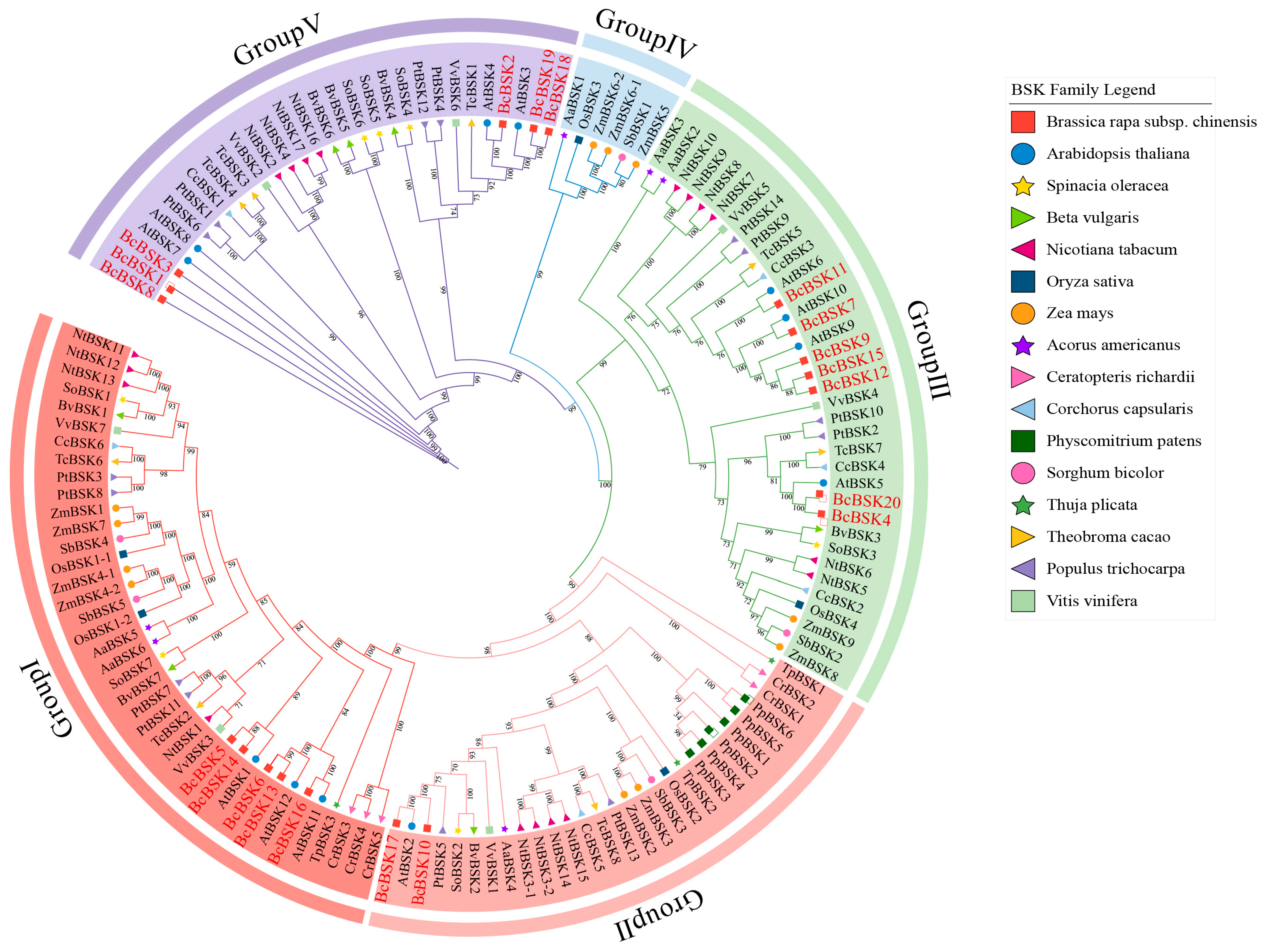
An unrooted phylogenetic tree was constructed based on 20 BSK protein sequences from NHCC and 120 homologous sequences derived from 15 representative species (Figure 1). These species encompassed bryophytes, ferns, gymnosperms, dicotyledons, and monocotyledons.
Phylogenetic analysis grouped the 140 BSK proteins into five subgroups (I–V), with strong support at the major nodes. Distinct differences in species composition were observed among subgroups. Subgroup IV consisted exclusively of monocot species, whereas subgroup V contained only dicot species. In NHCC, the 20 BcBSK proteins were distributed across four subgroups: subgroup I included BcBSK5, BcBSK6, BcBSK13, BcBSK14, and BcBSK16; subgroup II included BcBSK10 and BcBSK17; subgroup III comprised BcBSK4, BcBSK7, BcBSK9, BcBSK11, BcBSK12, BcBSK15, and BcBSK20; and subgroup V contained BcBSK1, BcBSK2, BcBSK3, BcBSK8, BcBSK18, and BcBSK19. Notably, BSK members from the bryophyte Physcomitrium patens were predominantly clustered within subgroup II.
The number of BSK genes varied among species. Except for Thuja plicata, which contained only three members, all other species possessed at least five BSK genes. Specifically, NHCC, Nicotiana tabacum, Populus trichocarpa, and Arabidopsis thaliana contained 20, 18, 14, and 12 members, respectively.

3.3. Chromosomal Localization, Synteny, and Ka/Ks Analysis of the BcBSK Gene Family

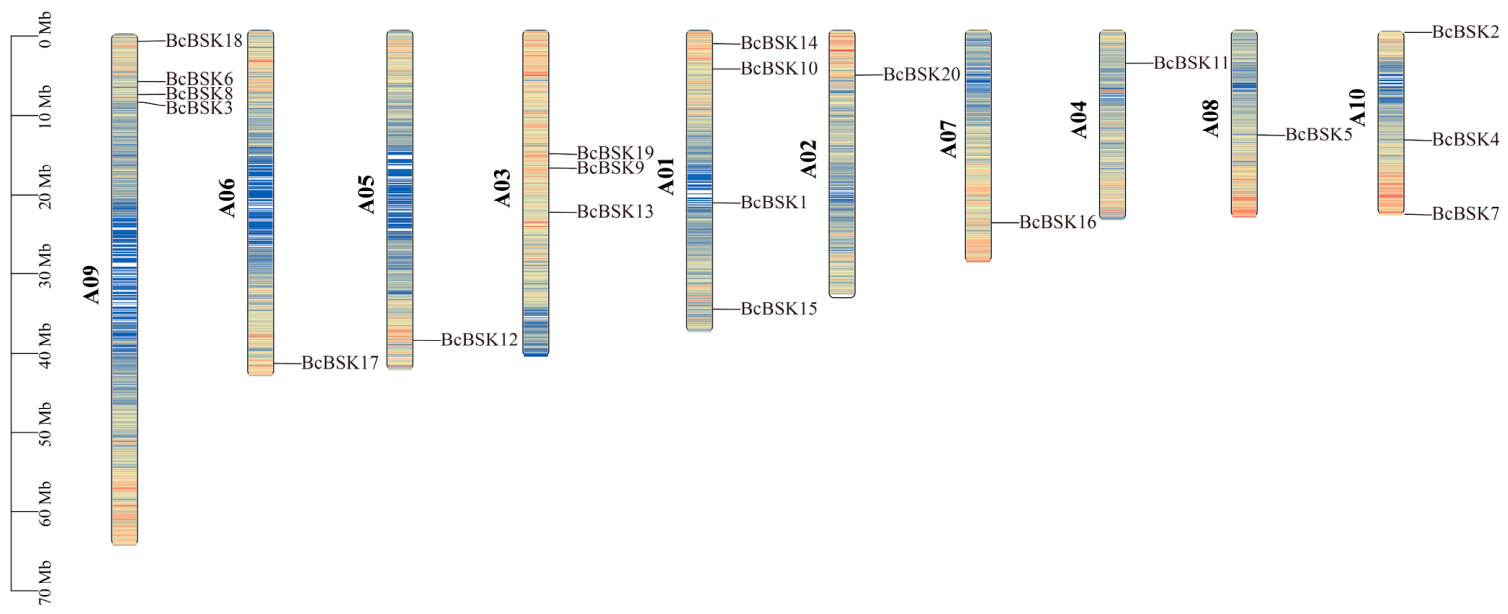
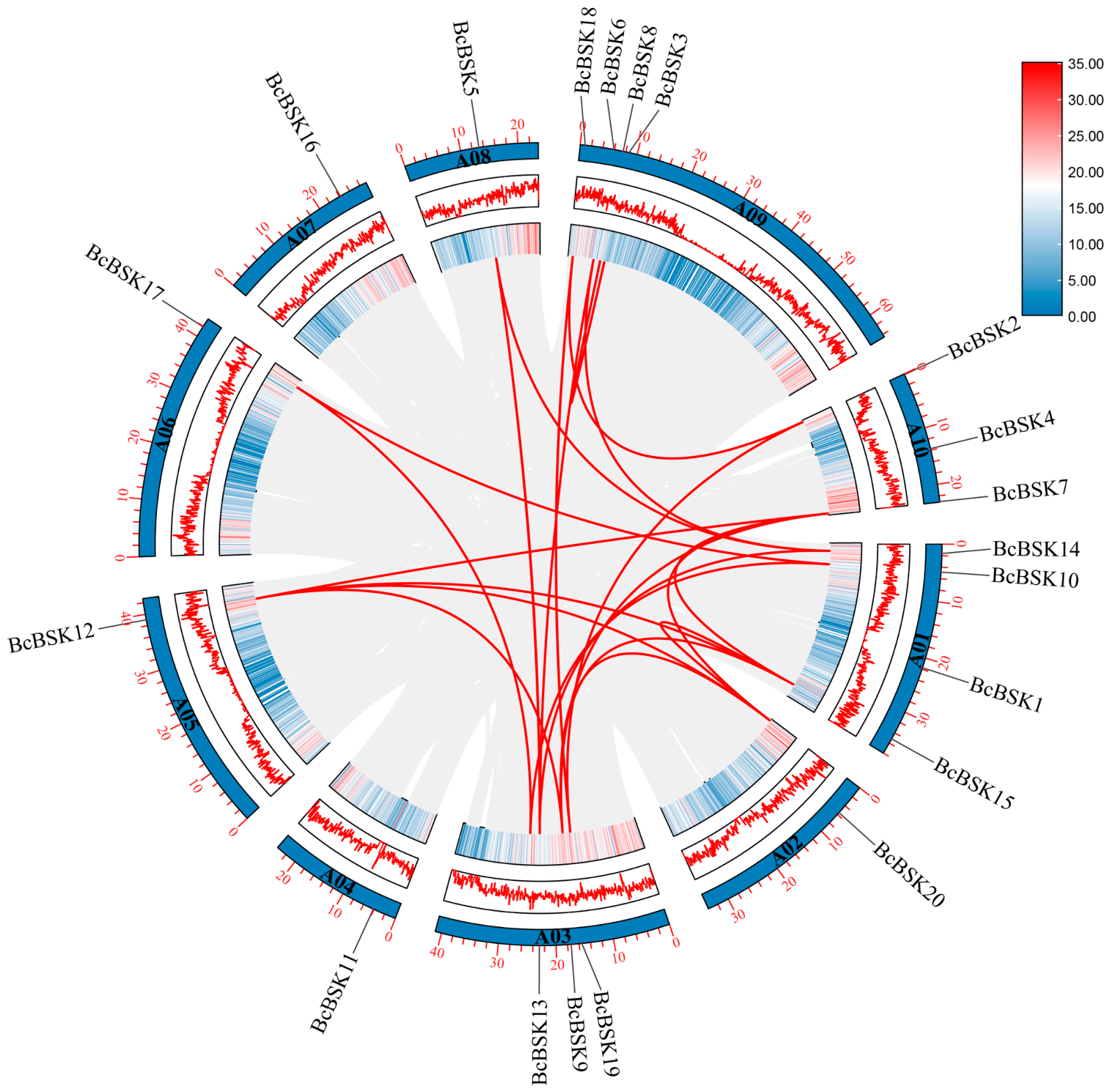
The genomic positioning and syntenic configurations of the BcBSK gene family were illustrated in Figure 2 and Figure 3, respectively. Within the NHCC genome, the 20 identified BcBSK members were distributed asymmetrical across 10 distinct chromosomes. The highest density of these loci was restricted to chromosomes A09 and A01, which accommodated four genes apiece: A09 contains BcBSK3, BcBSK6, BcBSK8, and BcBSK18, while A01 clusters BcBSK1, BcBSK10, BcBSK14, and BcBSK15. Meanwhile, a trio of genes was situated on both chromosomes A03 (BcBSK9, BcBSK13, and BcBSK19) and A10 (BcBSK2, BcBSK4, and BcBSK7). The six remaining family members were singletons scattered across six separate chromosomes.
Intraspecific synteny assessment uncovered 16 duplicate gene pairs linked via collinearity (Figure 3), giving rise to an intricate web of interchromosomal evolutionary links. Evolutionary pressure profiling revealed that every identified collinear pair possessed a Ka/Ks value below 1 (Table 2), establishing that this family had been subject to continuous purifying selection pressures throughout its evolutionary history.

3.4. Gene Structure and Conserved Domain Analysis of the BcBSK Gene Family

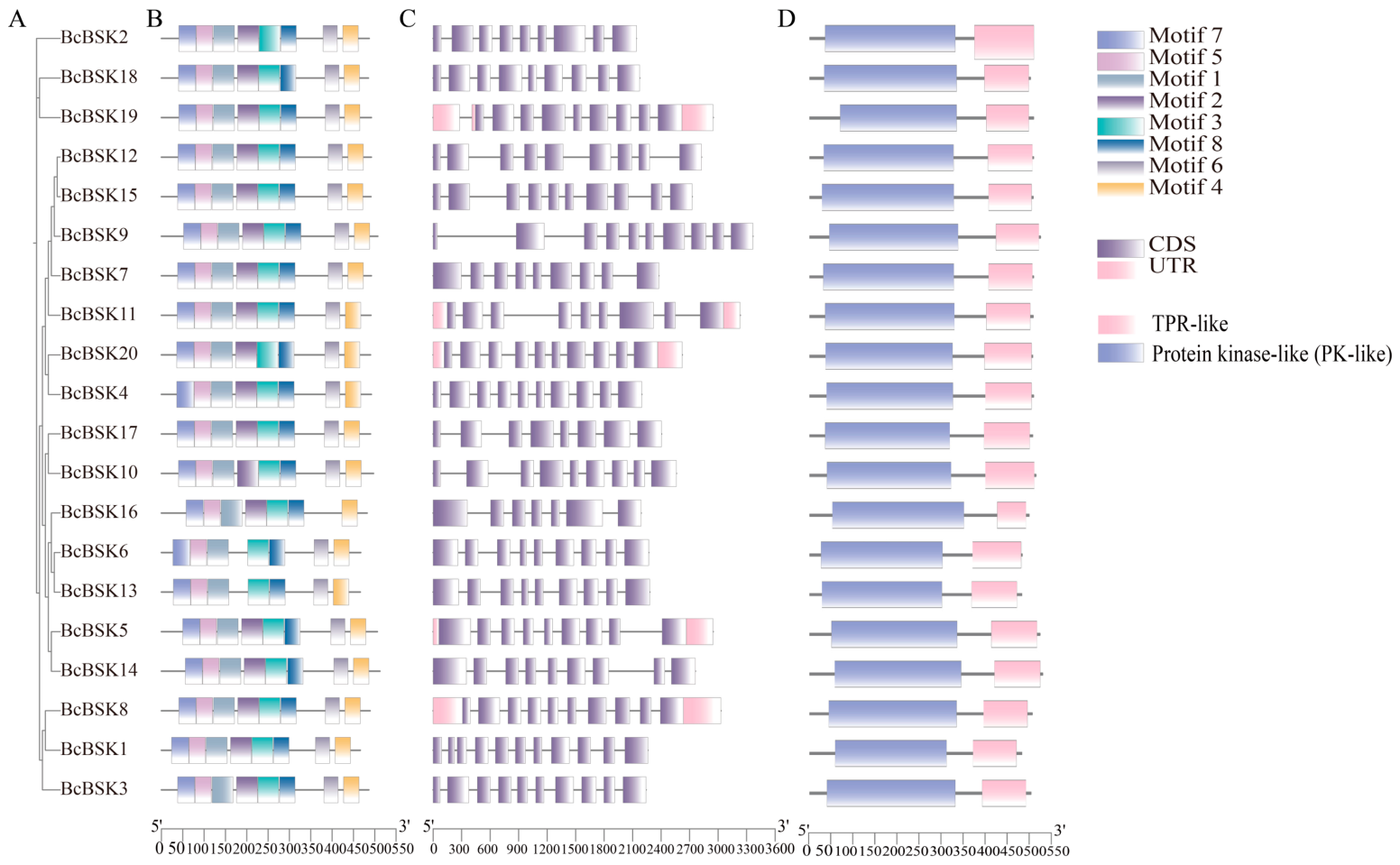
The structural features of the BcBSK gene family were analyzed (Figure 4). Conserved motif analysis (Figure 4B) showed that most proteins contained eight conserved motifs (Motifs 1–8), with a generally consistent distribution pattern. However, some members, including BcBSK6, BcBSK13, and BcBSK16, contained only seven motifs, and BcBSK6 and BcBSK13 exhibited highly similar motif compositions.
Gene structure analysis (Figure 4C) indicated that most BcBSK genes contained nine exons. Specifically, BcBSK3, BcBSK4, BcBSK8, BcBSK9, BcBSK15, and BcBSK20 each contained ten exons, whereas BcBSK1, BcBSK17, and BcBSK16 contained eleven, eight, and seven exons, respectively. Similar exon-intron organization patterns were observed in several gene pairs, such as BcBSK6/BcBSK13, BcBSK4/BcBSK20, BcBSK12/BcBSK15, and BcBSK18/BcBSK19.
Domain analysis (Figure 4D) showed that the entire suite of BcBSK proteins featured an evolutionarily conserved kinase catalytic region localized at the N-terminus, paired with tetratricopeptide repeat (TPR) motifs situated at the C-terminus, indicating a highly conserved domain architecture across the family.

3.5. Cis-Acting Element Analysis of BcBSK Gene Promoters

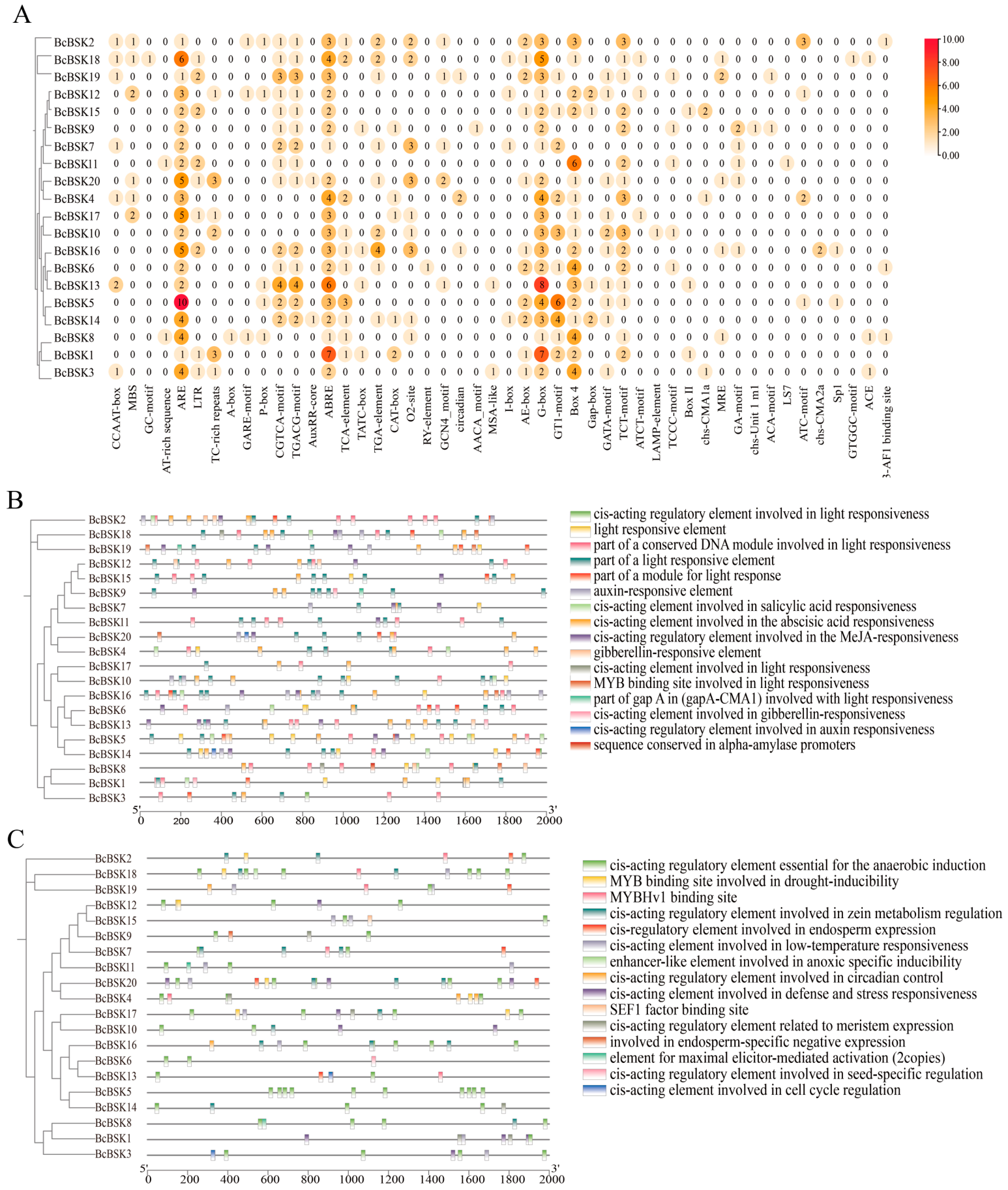
Upstream regulatory profiles within the 2000 bp promoter zones of the BcBSK family were delineated utilizing the PlantCARE repository, with the corresponding results presented in Figure 5. Baseline transcription features, specifically TATA-box and CAAT-box motifs, were uniformly present across all promoter sequences. Beyond these core components, an array of cis-acting elements linked to photoperiodic signaling, environmental stress, phytohormone cascades, and developmental processes were uncovered.
Quantitatively, light-elicited motifs exhibited the highest density across the dataset, with hormone-responsive modules constituting the second largest category. Notably, abscisic acid-responsive elements (ABREs), alongside the jasmonate-responsive CGTCA- motifs and TGACG-motifs, demonstrated extensive integration across numerous promoters. Furthermore, regulatory nodes responsive to auxin, salicylic acid, and gibberellin were intermittently distributed throughout the family.
Stress-adaptive regulatory elements were similarly widespread. Anaerobic induction modules (AREs) were integrated into multiple loci; among these, BcBSK5 accommodated the maximal abundance with 10 copies. The light- and stress-responsive G-box motif displayed localized enrichment, peaking at eight and seven copies within BcBSK13 and BcBSK1, respectively. Additionally, specialized elements governing low-temperature anomalies (LTR), drought initiation (MBS), and defense-stress pathways (TC-rich repeats) were mapped.
Finally, a subset of motifs designated for plant growth and morphogenesis was uncovered, encompassing specific sequences dedicated to meristem programmatic regulation, endosperm-specific transcription, and mitotic cell cycle modulation.

3.6. Protein-Protein Interaction Network Analysis of BcBSK Proteins

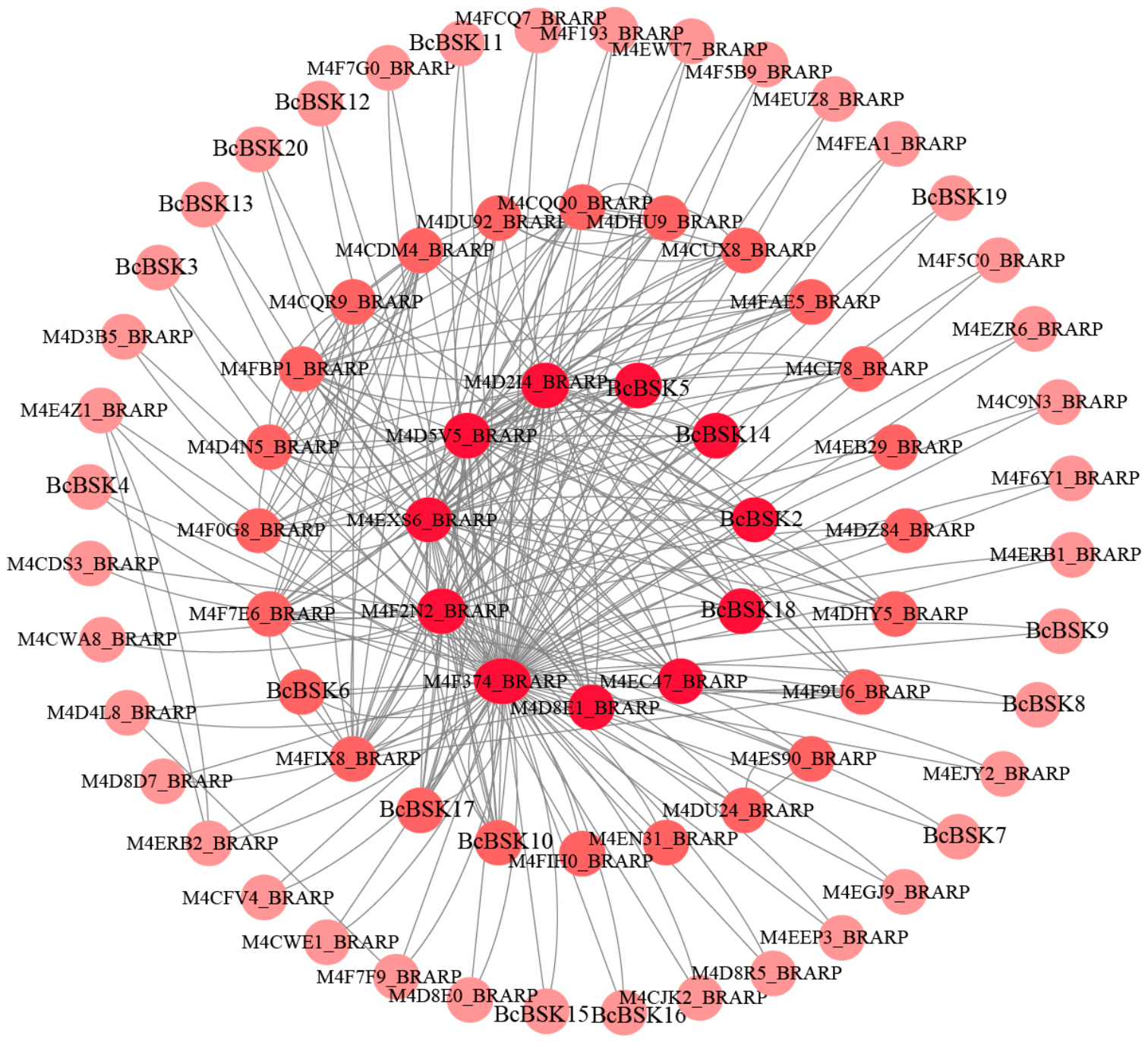
The PPI network of BcBSK proteins is shown in Figure 6. The 20 members exhibited a radial distribution pattern. BcBSK2, BcBSK5, BcBSK14, and BcBSK18 were located in the central region, with darker node colors, whereas the remaining proteins were distributed across two outer layers. From the periphery to the center, node color intensity increased, corresponding to higher interaction density and connectivity.
Further analysis indicated that BcBSK proteins interacted extensively with multiple members of the BRAP family, forming relatively concentrated interaction clusters within the network.

3.7. Expression Profile Analysis of the BcBSK Gene Family Under Heat Stress

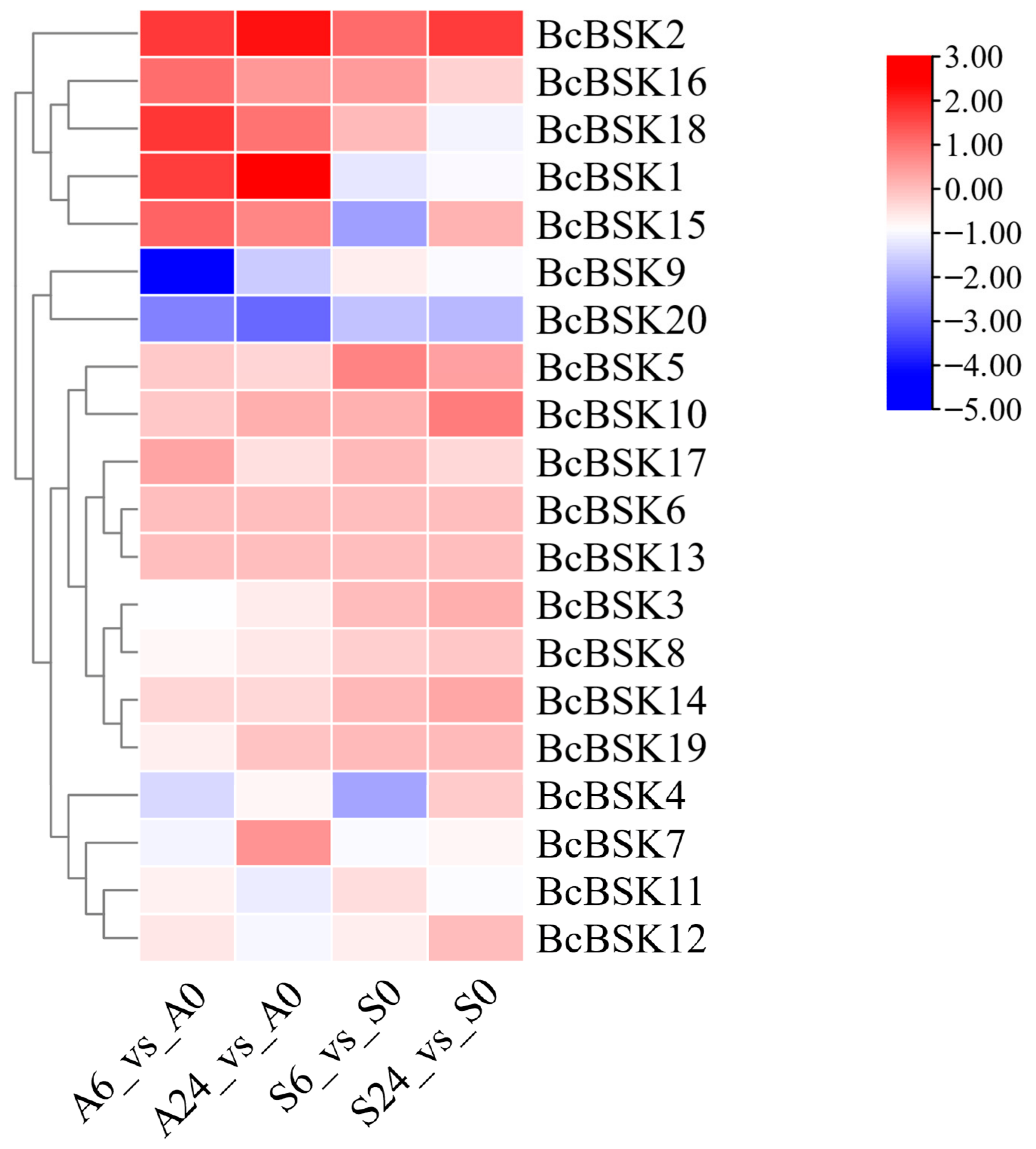
Transcriptional charting via heatmap analysis demonstrated that the BcBSK gene family underwent distinct, genotype-dependent variations coupled with dynamic temporal profiling under high-temperature challenges (Figure 7). Within the heat-sensitive cultivar “Aijiaohuang”, transcriptional accumulation displayed higher amplitude fluctuations and more pronounced kinetic shifts across the timeline. Specifically, BcBSK1 exhibited sustained induction at 6 h (log2FC = 1.71) and 24 h (log2FC = 2.56), with its peak abundance recorded at the 24 h checkpoint. Paralleling this behavior, BcBSK2 presented consistent upregulation at both time intervals (log2FC = 1.76 and 2.25). Transcription of BcBSK18 was sharply elevated at 6 h (log2FC = 1.80) and maintained its upregulated status at 24 h despite a mild contraction (log2FC = 1.01). Conversely, a severe repression was observed for both BcBSK9 and BcBSK20 at both treatment durations; log2FC metrics reached −4.32 and −1.59 for BcBSK9, and −2.57 and −2.91 for BcBSK20 at the 6 and 24 h intervals, respectively.
In contrast, the heat-tolerant cultivar “SHI” manifested comparatively buffered and steady expression kinetics across the majority of the loci. While BcBSK2 experienced significant induction at 6 h (log2FC = 1.12) and 24 h (log2FC = 1.73), the absolute magnitude of this response was less pronounced than that recorded in “Aijiaohuang”. A unique biphasic trend was identified for BcBSK15, which was initially repressed at 6 h (log2FC = −2.19) but transitioned to marginal induction by 24 h (log2FC = 0.17). The remaining family members maintained baseline transcriptional stability with no substantial deviations.

3.8. qRT-PCR Validation of Expression Changes in BcBSK Genes

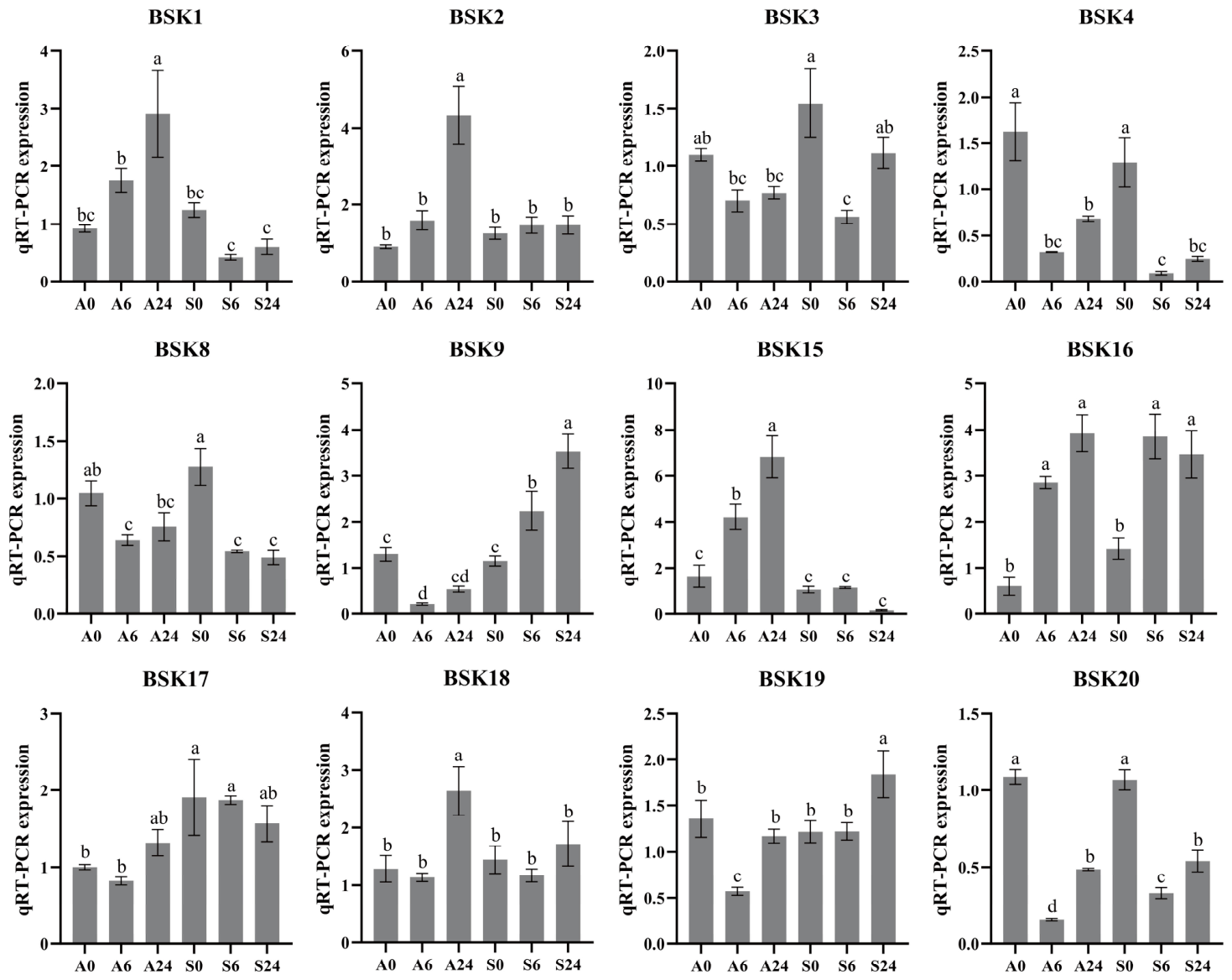
To validate the transcriptomic data, selected BcBSK genes were analyzed by qRT-PCR under heat stress at 0, 6, and 24 h (Figure 8).
Within the heat-sensitive cultivar “Aijiaohuang”, the transcriptional profiles of the chosen BcBSK genes closely mirrored the expression trajectories derived from the RNA-seq data. In the heat-tolerant cultivar “SHI”, gene expression showed only minor fluctuations during the 0–24 h period, consistent with the relatively stable expression patterns observed in the transcriptome analysis.

3.9. Physiological Responses of NHCC Under Heat Stress

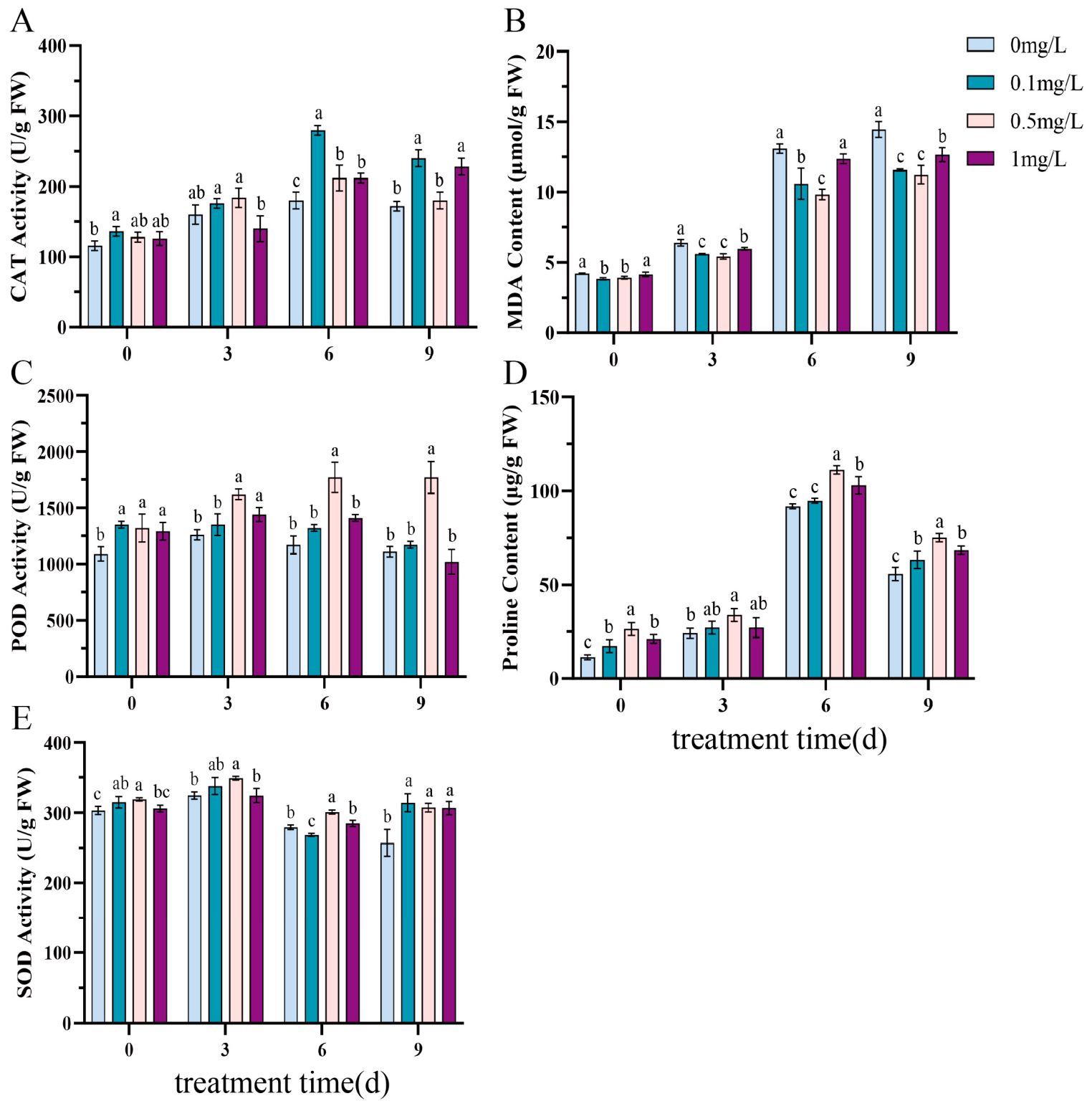
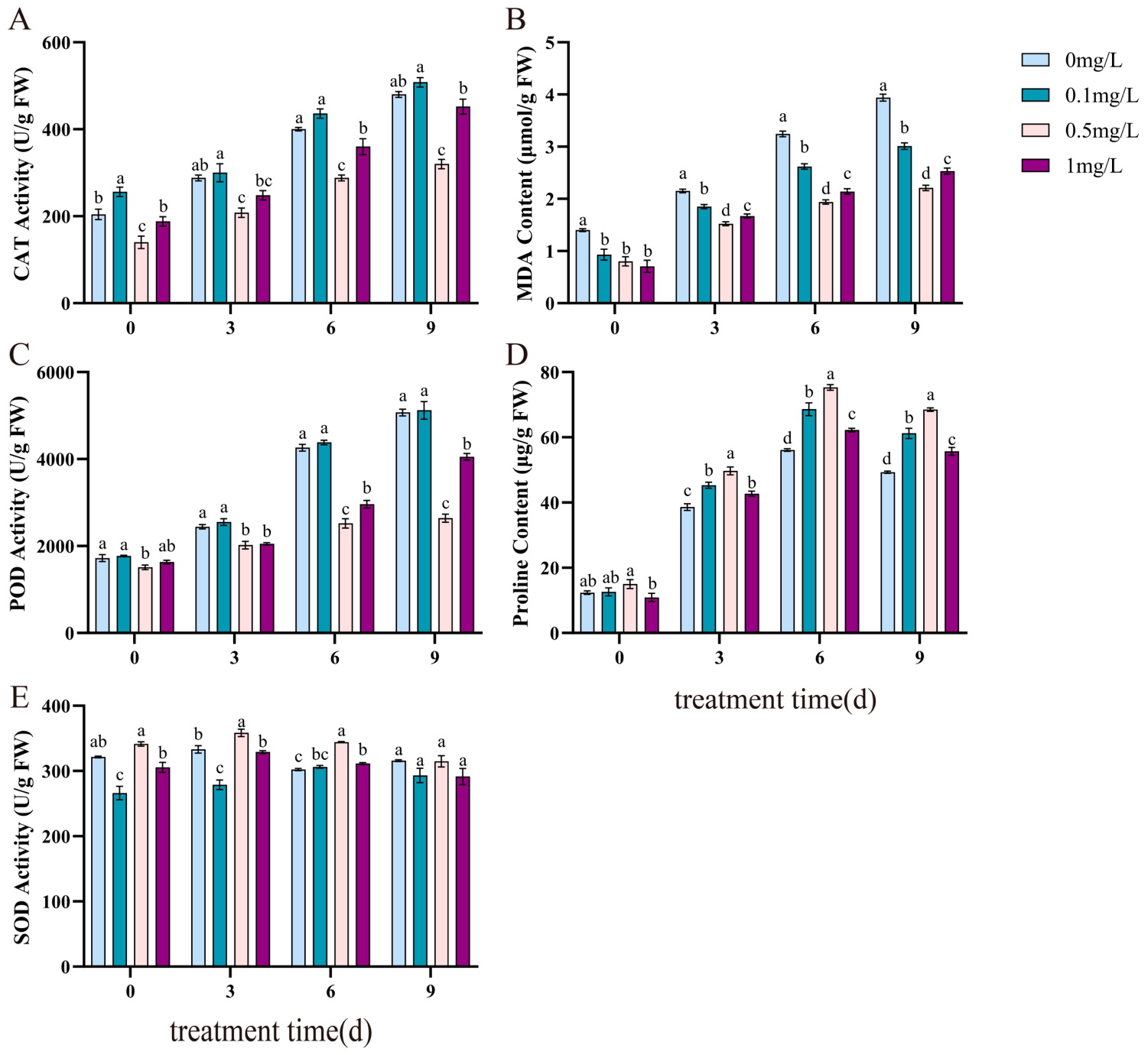
The influence of exogenous EBR administration on the physiological profiles of foliage within two contrasting NHCC cultivars subjected to thermal stress is detailed in Figure 9 (“Aijiaohuang”) and Figure 10 (“SHI”). Collectively, both genotypes manifested distinct, concentration-dependent responses to EBR application, with the 0.5 mg·L−1 EBR dosage eliciting the most prominent physiological modulations. Regarding membrane lipid peroxidation and osmotic homeostasis, the two cultivars exhibited parallel phenotypic trajectories. Compared with the untreated controls, the 0.5 mg·L−1 EBR treatment significantly suppressed MDA accumulation in both cultivars (p < 0.05), with a more pronounced reduction observed in the heat-tolerant cultivar “SHI”. Furthermore, both genotypes sustained elevated proline concentrations under the 0.5 mg·L−1 EBR treatment regime.
Conversely, the enzymatic antioxidant defense frameworks of the two cultivars revealed divergent regulatory patterns in response to EBR application. In the heat-sensitive cultivar “Aijiaohuang”, the 0.5 mg·L−1 EBR treatment significantly amplified POD and SOD catalytic kinetics, exerting a robust inductive effect during the mid-phase of thermal stress, while CAT activity was sustained at a relatively elevated threshold. In stark contrast, within the heat-tolerant cultivar “SHI”, SOD activity remained maximally elevated across all temporal checkpoints under the 0.5 mg·L−1 EBR treatment, whereas CAT and POD activities exhibited comparatively lower baselines.

4. Discussion

4.1. Evolution, Structure, and Functional Divergence of the BcBSK Gene Family in NHCC

The BSK gene family, encoding fundamental components positioned upstream within the brassinosteroid (BR) signaling cascade, exerts a pivotal regulatory influence over vegetative morphogenesis, ontogeny, and adaptive responses to environmental challenges. In this investigation, a total of 20 discrete BcBSK loci are systematically identified within the NHCC genome. Advanced phylogenetic modeling indicates that this multigene family has undergone pronounced lineage-specific diversification and functional specialization throughout its evolutionary trajectory. Specifically, subgroup IV comprises exclusively monocotyledonous species, whereas subgroup V consists entirely of dicotyledonous species; the remaining subgroups include members from both lineages. This distribution pattern is consistent with previous reports [3,11], suggesting that the BSK gene family has undergone evolutionary divergence across plant lineages. The presence of lineage-specific subgroups implies independent gene retention in different evolutionary branches, whereas the mixed composition of other subgroups reflects a relatively high level of conservation among certain members. Whole-genome duplication is widely recognized as a major driver of gene family expansion in plants [35,36,37], and duplicated genes may undergo differential retention and functional divergence, ultimately shaping the observed family structure.
Concomitant with this evolutionary framework, the expansion mechanics of the BcBSK gene family within the NHCC genome appear to be predominantly dictated by whole-genome duplication or large-scale segmental duplication events. Syntenic profiling unveils intricate collinear networks among the constituent family members, while the consistently depressed Ka/Ks ratios (<1) underscore that these duplicated counterparts are subject to stringent purifying selection. Compellingly, in silico subcellular localization modeling projects a uniform plasma membrane compartmentalization for all BcBSK proteins. This homogenous spatial distribution not only underscores a high degree of structural conservation but also reinforces their localized functional engagement in the early steps of BR signaling, wherein membrane anchoring represents an absolute prerequisite for physical interactions with the receptor kinase BRI1 and downstream signaling vectors.
From a structural standpoint, the entire complement of BcBSK proteins possesses highly conserved kinase domains alongside TPR motifs, underscoring a rigid architectural preservation of their core functional modules. This structural topography, a defining hallmark across the broader plant BSK superfamily, emphasizes its indispensable requirement for mediating intracellular signal transduction. Moreover, in silico protein-protein interaction network modeling demonstrates that these proteomic entities are predominantly integrated with cytoplasmic components governing the BR signaling cascade, a pattern implying a high degree of functional convergence. Critically, BcBSK2, BcBSK5, BcBSK14, and BcBSK18 occupy central topological positions within the interactive network, suggesting that these specific nodes exert a dominant regulatory influence and may function as primary molecular hubs.
Based on previously reported functions of different subgroups, the potential roles of BcBSK members can be inferred. Subgroup V shows high sequence similarity to key BR signaling components in Arabidopsis thaliana (e.g., AtBSK3, AtBSK4, AtBSK7, and AtBSK8) and is therefore likely involved primarily in BR signal transduction [3]. In contrast, subgroup I homologs have been implicated in immune responses [17,18,19], drought and salt stress responses [38], and abscisic acid (ABA) signaling [16], suggesting broader roles in stress adaptation. Subgroup III appears more functionally diverse, with homologs associated with heat stress [11], root development [9], seed development [39], and salt stress responses [40], indicating a role in coordinating growth and environmental responses. Subgroup II, by comparison, is more closely associated with fundamental growth regulation; for example, OsBSK2 regulates grain size in rice, suggesting relatively conserved functions within this subgroup [19].
Promoter analysis further reveals regulatory divergence among BcBSK genes. For example, the promoter region of BcBSK5 is enriched in anaerobic-responsive elements, whereas BcBSK13 and BcBSK1 contain a higher abundance of light-responsive elements. Such variation in cis-element composition may contribute to transcriptional diversity, enabling different family members to respond to distinct environmental and endogenous signals, thereby facilitating functional differentiation and coordination within the gene family.

4.2. Alleviating Effects of Exogenous BRs on Heat Stress in NHCC

Under heat stress conditions, exogenous EBR treatment showed a significant alleviating effect in both cultivars of NHCC, while physiological responses exhibited certain differences in regulatory patterns between the two genotypes.
In terms of membrane lipid peroxidation and osmotic regulation, both cultivars displayed generally consistent responses to EBR treatment, characterized by a significant decrease in MDA content and a marked increase in proline accumulation. This indicates that EBR can stably exert cytoprotective effects across different genetic backgrounds by reducing membrane lipid peroxidation and enhancing osmotic adjustment capacity, thereby maintaining cellular homeostasis and alleviating heat-induced damage to the membrane system. Therefore, the maintenance of membrane stability and the enhancement of osmotic regulation can be regarded as fundamental common mechanisms by which BRs participate in plant responses to heat stress [33,41,42]. Similar physiological regulatory effects of exogenous BRs have also been reported in Brassica crops under various abiotic stress conditions, including heat stress, low temperature, and nutrient-related stress [43,44].
Within the enzymatic antioxidant defense framework, pronounced genotypic disparities emerged between the two contrasting cultivars. In the heat-sensitive cultivar “Aijiaohuang”, the catalytic activities of SOD, POD, and CAT exhibited robust, statistically significant elevation following the administration of 0.5 mg·L−1 EBR, with a more pronounced inductive effect manifested during the mid-stress phase. This physiological trajectory implies that its endogenous defense mechanism relies predominantly on BR-mediated synergistic activation of multiple enzymatic components to mitigate oxidative duress via enhanced reactive oxygen species (ROS) scavenging capability. This metabolic behavior closely parallels established paradigms demonstrating that exogenous BR applications significantly amplify SOD, POD, and CAT kinetics, thereby suppressing hazardous intracellular ROS accretion [45]. In contrast, the heat-tolerant cultivar “SHI” maintained relatively high SOD activity across all treatment stages, while CAT and POD activities remained comparatively lower. These differences suggest that genotypes with different heat tolerance levels may adopt distinct ROS scavenging strategies under heat stress, a phenomenon that has also been discussed in previous studies on plant thermotolerance and redox regulation [46,47,48].
Furthermore, the regulatory effect of EBR exhibited a clear concentration dependence, with 0.5 mg·L−1 showing the most effective alleviating effect in both cultivars. A similar concentration dependent response has also been observed in mini Chinese cabbage, in which 0.5 mg·L−1 EBR effectively alleviated oxidative damage and improved heat tolerance under heat stress [31]. This may be attributed to the fact that an appropriate EBR concentration is more conducive to activating BR signal transduction pathways and coordinating ROS metabolic balance, whereas excessively low or high concentrations may reduce regulatory efficiency due to insufficient signal activation or increased metabolic burden. This concentration dependent regulatory pattern has been widely recognized in studies on plant steroid hormone signaling [49].

4.3. Association Between BcBSK Expression Patterns and Physiological Responses to Exogenous EBR

Integrated analysis of BcBSK gene expression and physiological responses induced by exogenous EBR suggests that BR signaling is involved in heat stress responses at both transcriptional and physiological levels. In the heat-sensitive cultivar “Aijiaohuang”, the transcript levels of BcBSK1, BcBSK2, and BcBSK18 exhibited substantial, pronounced upregulation under thermal stress conditions, an induction that closely tracked marked physiological alterations in membrane lipid peroxidation, osmotic homeostasis, and antioxidant enzyme kinetics following exogenous EBR administration. Taken together, these coordinated transcriptomic and physiological modulations underscore the active participation of the BR signaling cascade in mediating responses to environmental hyperthermia. This observed pattern aligns with the established functional paradigm of BSK proteins acting as early, primary molecular mediators within the proximal BR transduction pathway [50].
Regarding functional divergence within the gene family, BcBSK2, BcBSK5, BcBSK14, and BcBSK18, which are located at central nodes in the protein-protein interaction network, showed more pronounced expression changes under stress conditions, suggesting that they may play important roles in BR signal transduction. Accumulating empirical evidence establishes that BSK proteins propagate downstream BR signaling via physical interactions with diverse molecular effectors, thereby manifesting distinct functional compartmentalization across varied physiological processes [51], This documented subfunctionalization strongly corroborates the premise that discrete BcBSK members possess specialized regulatory attributes and non-redundant operational modalities.
At the cultivar level, the heat-tolerant cultivar “SHI” exhibited relatively stable BcBSK expression patterns, whereas the heat-sensitive cultivar showed more pronounced expression fluctuations. Physiological analyses further showed genotype dependent differences in antioxidant responses under exogenous EBR treatment. The heat-tolerant cultivar maintained relatively stable and high SOD activity, whereas the heat-sensitive cultivar exhibited coordinated increases in SOD, POD, and CAT activities. These observations suggest that genotypes with different heat tolerance levels may exhibit distinct ROS regulatory strategies under heat stress.
Overall, the BcBSK gene family may participate in BR-mediated heat stress responses in NHCC, while membrane stability, osmotic adjustment, and antioxidant capacity represent important physiological characteristics associated with heat tolerance. Differences in ROS homeostasis among genotypes may further contribute to variation in thermotolerance.

5. Conclusions

This study provides a systematic characterization of the BcBSK gene family within the NHCC genome, elucidating its putative involvement in mediating physiological adaptations to thermal stress. Comparative transcriptomic profiling revealed that discrete BcBSK members exhibit highly specialized transcriptional responses under heat stress challenges, an observation that strongly implies a functional divergence and non-redundant regulatory roles within this gene family.
Physiological analyses further demonstrated that exogenous EBR alleviated heat-induced damage and was associated with genotype dependent antioxidant response patterns in NHCC. Combined transcriptomic and physiological observations suggest that BcBSK family members may participate in BR-mediated heat stress responses and may be associated with differences in ROS regulatory strategies among genotypes.
While the empirical evidence generated in this study remains predominantly correlational, these findings establish a valuable foundation for the downstream functional characterization of discrete BcBSK loci. Furthermore, this work contributes key mechanistic insights into the broader regulatory networks governing brassinosteroid-mediated thermal acclimation and heat stress responses within the NHCC germplasm.

Supplementary Materials

The following supporting information can be downloaded at: https://www.mdpi.com/article/10.3390/horticulturae12060686/s1, Table S1: Primer sequences used for qRT-PCR; Table S2: List of BSK protein sequences used for phylogenetic analysis; Table S3: Characteristics of the 8 conserved motifs detected in the BcBSK protein family using MEME.

Author Contributions

Conceptualization, X.L. (Xiaofeng Li) and B.Z.; methodology, L.Y. and J.W.; software, P.Y. and X.L. (Xiang Li); validation, L.Y. and J.W.; formal analysis, L.Y.; investigation, L.Y., J.W., P.Y. and X.L. (Xiang Li); resources, X.L. (Xiaofeng Li) and B.Z.; data curation, L.Y.; writing—original draft preparation, L.Y.; writing—review and editing, X.L. (Xiaofeng Li) and B.Z.; visualization, L.Y.; supervision, X.L. (Xiaofeng Li) and B.Z.; project administration, X.L. (Xiaofeng Li) and B.Z.; funding acquisition, X.L. (Xiaofeng Li) and B.Z. All authors have read and agreed to the published version of the manuscript.

Funding

This research was funded by the Shanghai Science and Technology Development Foundation (Grant NO. 23N11900200) and the Horizontal Scientific Research Project of Anhui Normal University (Grant NO. 2025127).

Data Availability Statement

The RNA-seq data used in this study are publicly available in the NCBI BioProject database under accession number PRJNA1030162. Other data supporting the findings of this study are available from the corresponding author upon reasonable request.

Acknowledgments

The authors thank the Horticultural Research Institute of the Shanghai Academy of Agricultural Sciences for providing plant materials.

Conflicts of Interest

The authors declare no conflicts of interest.

Abbreviations

The following abbreviations are used in this manuscript:
NHCCNon-heading Chinese cabbage (Brassica rapa subsp. chinensis)
BRBrassinosteroid
EBR2,4-Epibrassinolide
BSKBR-signaling kinase
SODSuperoxide dismutase
PODPeroxidase
CATCatalase
ROSReactive oxygen species
MDAMalondialdehyde
PPIProtein-protein interaction
HMMsHidden Markov models
CDDConserved Domain Database
MLMaximum likelihood
BICBayesian Information Criterion
iTOLInteractive Tree Of Life
FPKMFragments Per Kilobase of transcript per Million mapped reads
Kanonsynonymous substitution rates
Kssynonymous substitution rates
qRT-PCRQuantitative real-time polymerase chain reaction

References

  1. Tian, J.; Chang, K.Z.; Lei, Y.X.; Li, S.H.; Wang, J.W.; Huang, C.X.; Zhong, F.L. Genome-Wide Identification of Proline Transporter Gene Family in Non-Heading Chinese Cabbage and Functional Analysis of BchProT1 under Heat Stress. Int. J. Mol. Sci. 2024, 25, 99. [Google Scholar] [CrossRef]
  2. Xin, X.; Li, P.; Zhao, X.; Yu, Y.; Wang, W.; Jin, G.; Wang, J.; Sun, L.; Zhang, D.; Zhang, F.; et al. Temperature-dependent jumonji demethylase modulates flowering time by targeting H3K36me2/3 in Brassica rapa. Nat. Commun. 2024, 15, 5470. [Google Scholar] [CrossRef]
  3. Li, Z.Y.; Shen, J.Y.; Liang, J.S. Genome-Wide Identification, Expression Profile, and Alternative Splicing Analysis of the Brassinosteroid-Signaling Kinase (BSK) Family Genes in Arabidopsis. Int. J. Mol. Sci. 2019, 20, 1138. [Google Scholar] [CrossRef]
  4. Nolan, T.M.; Vukasinovic, N.; Liu, D.R.; Russinova, E.; Yin, Y.H. Brassinosteroids: Multidimensional Regulators of Plant Growth, Development, and Stress Responses. Plant Cell 2020, 32, 295–318. [Google Scholar] [CrossRef] [PubMed]
  5. Rao, X.L.; Dixon, R.A. Brassinosteroid Mediated Cell Wall Remodeling in Grasses under Abiotic Stress. Front. Plant Sci. 2017, 8, 806. [Google Scholar] [CrossRef]
  6. Liu, F.; Qu, P.-Y.; Li, J.-P.; Yang, L.-N.; Geng, Y.-J.; Lu, J.-Y.; Zhang, Y.; Li, S. Arabidopsis protein S- acyl transferases positively mediate BR signaling through S-acylation of BSK1. Proc. Natl. Acad. Sci. USA 2024, 121, e2322375121. [Google Scholar] [CrossRef]
  7. Yan, J.; Wang, X.; Liu, J.; Wang, Y.; Yue, J.; Wang, W.; Li, Y.; Sun, Y.; Zhang, B.; Tang, W. BSK family kinases are essential for brassinosteroid signaling and suppression of adventitious rooting by repressing the expression of LBD16. New Phytol. 2026, 250, 283–297. [Google Scholar] [CrossRef] [PubMed]
  8. Galindo-Trigo, S.; Khandare, V.; Roosjen, M.; Adams, J.; Wangler, A.-M.; Bayer, M.; Borst, J.W.; Smakowska-Luzan, E.; Butenko, M.A. A multifaceted kinase axis regulates plant organ abscission through conserved signaling mechanisms. Curr. Biol. 2024, 34, 3020–3030.e7. [Google Scholar] [CrossRef]
  9. Ren, H.; Willige, B.C.; Jaillais, Y.; Geng, S.; Park, M.Y.; Gray, W.M.; Chory, J. BRASSINOSTEROID-SIGNALING KINASE 3, a plasma membrane-associated scaffold protein involved in early brassinosteroid signaling. PLoS Genet. 2019, 15, e1007904. [Google Scholar] [CrossRef] [PubMed]
  10. Zhang, B.; Wang, X.; Zhao, Z.; Wang, R.; Huang, X.; Zhu, Y.; Yuan, L.; Wang, Y.; Xu, X.; Burlingame, A.L.; et al. OsBRI1 Activates BR Signaling by Preventing Binding between the TPR and Kinase Domains of OsBSK3 via Phosphorylation. Plant Physiol. 2015, 170, 1149–1161. [Google Scholar] [CrossRef]
  11. Li, Y.; Zhang, H.; Zhang, Y.; Liu, Y.; Li, Y.; Tian, H.; Guo, S.; Sun, M.; Qin, Z.; Dai, S. Genome-wide identification and expression analysis reveals spinach brassinosteroid-signaling kinase (BSK) gene family functions in temperature stress response. BMC Genom. 2022, 23, 453. [Google Scholar] [CrossRef]
  12. Gao, C.; Zhao, Y.; Wang, W.; Zhang, B.; Huang, X.; Wang, Y.; Tang, D. BRASSINOSTEROID-SIGNALING KINASE 1 modulates OPEN STOMATA 1 phosphorylation and contributes to stomatal closure and plant immunity. Plant J. 2024, 120, 45–59. [Google Scholar] [CrossRef]
  13. Li, Q.; Shao, J.; Luo, M.; Chen, D.; Tang, D.; Shi, H. BRASSINOSTEROID-SIGNALING KINASE1 associates with and is required for cysteine protease RESPONSE TO DEHYDRATION 19-mediated disease resistance in Arabidopsis. Plant Sci. 2024, 342, 112033. [Google Scholar] [CrossRef]
  14. Su, B.; Zhang, X.; Li, L.; Abbas, S.; Yu, M.; Cui, Y.; Baluska, F.; Hwang, I.; Shan, X.; Lin, J. Dynamic spatial reorganization of BSK1 complexes in the plasma membrane underpins signal-specific activation for growth and immunity. Mol. Plant 2021, 14, 588–603. [Google Scholar] [CrossRef]
  15. Chang, W.; Chen, L.; Xie, X.; Liu, M.; Song, D.; Yu, M.; Li, S.; Wei, L.; Qu, C.; Li, J.; et al. Construction of a FOX-hunting library to systematically identify functional genes and the salt-tolerant line isolation in Brassica napus. Plant Physiol. Biochem. 2025, 228, 110255. [Google Scholar] [CrossRef]
  16. Li, Z.-Y.; Xu, Z.-S.; He, G.-Y.; Yang, G.-X.; Chen, M.; Li, L.-C.; Ma, Y.-Z. A mutation in Arabidopsis BSK5 encoding a brassinosteroid-signaling kinase protein affects responses to salinity and abscisic acid. Biochem. Biophys. Res. Commun. 2012, 426, 522–527. [Google Scholar] [CrossRef]
  17. Li, S.; Xiang, X.; Diao, Z.; Xia, N.; Lu, L.; Zhang, J.; Chen, Z.; Tang, D. The OsBSK1-2-MAPK module regulates blast resistance in rice. Crop J. 2024, 12, 110–120. [Google Scholar] [CrossRef]
  18. Wang, J.; Shi, H.; Zhou, L.; Peng, C.; Liu, D.; Zhou, X.; Wu, W.; Yin, J.; Qin, H.; Ma, W.; et al. OsBSK1-2, an Orthologous of AtBSK1, Is Involved in Rice Immunity. Front. Plant Sci. 2017, 8, 908. [Google Scholar] [CrossRef]
  19. Yuan, H.; Xu, Z.; Chen, W.; Deng, C.; Liu, Y.; Yuan, M.; Gao, P.; Shi, H.; Tu, B.; Li, T.; et al. OsBSK2, a putative brassinosteroid-signalling kinase, positively controls grain size in rice. J. Exp. Bot. 2022, 73, 5529–5542. [Google Scholar] [CrossRef]
  20. Daniel Pantoja-Benavides, A.; Garces-Varon, G.; Restrepo-Diaz, H. Foliar cytokinins or brassinosteroids applications influence the rice plant acclimatization to combined heat stress. Front. Plant Sci. 2022, 13, 983276. [Google Scholar] [CrossRef]
  21. Halaji, B.; Haghighi, M.; Kovacs, G.P.; Mirmazloum, I.; Szego, A. The Role of Brassinosteroids and Nano-Encapsulated Brassinosteroids in Capsicum Pepper Growth and Physiological Adaptations to High-Temperature Stress. Horticulturae 2024, 10, 1062. [Google Scholar] [CrossRef]
  22. Lv, J.; Dong, T.; Zhang, Y.; Ku, Y.; Zheng, T.; Jia, H.; Fang, J. Metabolomic profiling of brassinolide and abscisic acid in response to high-temperature stress. Plant Cell Rep. 2022, 41, 935–946. [Google Scholar] [CrossRef]
  23. Sadura, I.; Janeczko, A. Brassinosteroids and the Tolerance of Cereals to Low and High Temperature Stress: Photosynthesis and the Physicochemical Properties of Cell Membranes. Int. J. Mol. Sci. 2022, 23, 342. [Google Scholar] [CrossRef] [PubMed]
  24. Chen, C.; Chen, H.; Zhang, Y.; Thomas, H.R.; Frank, M.H.; He, Y.; Xia, R. TBtools: An Integrative Toolkit Developed for Interactive Analyses of Big Biological Data. Mol. Plant 2020, 13, 1194–1202. [Google Scholar] [CrossRef]
  25. Wan, Z.; Luo, S.; Zhang, Z.; Liu, Z.; Qiao, Y.; Gao, X.; Yu, J.; Zhang, G. Identification and expression profile analysis of the SnRK2 gene family in cucumber. PeerJ 2022, 10, e13994. [Google Scholar] [CrossRef]
  26. Hurst, L.D. The Ka/Ks ratio: Diagnosing the form of sequence evolution. Trends Genet. 2002, 18, 486–487. [Google Scholar] [CrossRef]
  27. Szklarczyk, D.; Kirsch, R.; Koutrouli, M.; Nastou, K.; Mehryary, F.; Hachilif, R.; Gable, A.L.; Fang, T.; Doncheva, N.T.; Pyysalo, S.; et al. The STRING database in 2023: Protein-protein association networks and functional enrichment analyses for any sequenced genome of interest. Nucleic Acids Res. 2023, 51, D638–D646. [Google Scholar] [CrossRef]
  28. Doncheva, N.T.; Jensen, L.J.; Morris, J.H.; Holze, H.; Kirsch, R.; Nastou, K.C.; Cuesta-Astroz, Y.; Rattei, T.; Szklarczyk, D.; Mering, C.v.; et al. Cytoscape stringApp 2.0: Analysis and Visualization of Heterogeneous Biological Networks. J. Proteome Res. 2023, 22, 637–646. [Google Scholar] [CrossRef] [PubMed]
  29. Xiao, D.; Zhang, N.W.; Zhao, J.J.; Bonnema, G.; Hou, X.L. Validation of reference genes for real-time quantitative PCR normalisation in non-heading Chinese cabbage. Funct. Plant Biol. 2012, 39, 342–350. [Google Scholar] [CrossRef]
  30. Liu, W.; Dai, Z.; Jia, J.; Li, X.; Zhu, H.; Kan, X.; Zhu, B. Comparative physiological and transcriptomic analyses identify computationally predicted key genes and regulatory pathways in non-heading Chinese cabbage under heat stress. BMC Plant Biol. 2025, 25, 1042. [Google Scholar] [CrossRef] [PubMed]
  31. Yang, J.; Wang, G.; He, Y.; Chen, W.; Wang, X.; Ma, J.; Gao, X.; Yu, J.; Hu, L. Exogenous EBR enhanced heat tolerance in mini Chinese cabbage by regulating ABA accumulation. Plant Stress 2025, 15, 100784. [Google Scholar] [CrossRef]
  32. Wang, L.; Gao, F.; Zhang, D.; Sun, C.; Guo, H.; Wang, C.; Du, X. Combined transcriptomic and proteomic analyses uncover molecular basis of heat tolerance in pakchoi (Brassica rapa subsp. chinensis). Front. Plant Sci. 2026, 17, 1734608. [Google Scholar] [CrossRef]
  33. Chen, Y.; Wang, Y.; Chen, H.; Xiang, J.; Zhang, Y.; Wang, Z.; Zhu, D.; Zhang, Y. Brassinosteroids Mediate Endogenous Phytohormone Metabolism to Alleviate High Temperature Injury at Panicle Initiation Stage in Rice. Rice Sci. 2023, 30, 70–86. [Google Scholar] [CrossRef]
  34. Li, H.-S. Principles and Techniques of Plant Physiological and Biochemical Experiments; Higher Education Press: Beijing, China, 2000. [Google Scholar]
  35. Jiao, Y.; Wickett, N.J.; Ayyampalayam, S.; Chanderbali, A.S.; Landherr, L.; Ralph, P.E.; Tomsho, L.P.; Hu, Y.; Liang, H.; Soltis, P.S.; et al. Ancestral polyploidy in seed plants and angiosperms. Nature 2011, 473, 97–100. [Google Scholar] [CrossRef]
  36. Rensing, S.A. Gene duplication as a driver of plant morphogenetic evolution. Curr. Opin. Plant Biol. 2014, 17, 43–48. [Google Scholar] [CrossRef]
  37. Van de Peer, Y.; Mizrachi, E.; Marchal, K. The evolutionary significance of polyploidy. Nat. Rev. Genet. 2017, 18, 411–424. [Google Scholar] [CrossRef]
  38. Liu, L.; Xiang, Y.; Yan, J.; Di, P.; Li, J.; Sun, X.; Han, G.; Ni, L.; Jiang, M.; Yuan, J.; et al. BRASSINOSTEROID-SIGNALING KINASE 1 phosphorylating CALCIUM/CALMODULIN-DEPENDENT PROTEIN KINASE functions in drought tolerance in maize. New Phytol. 2021, 231, 695–712. [Google Scholar] [CrossRef]
  39. Neu, A.; Eilbert, E.; Asseck, L.Y.; Slane, D.; Henschen, A.; Wang, K.; Buergel, P.; Hildebrandt, M.; Musielak, T.J.; Kolb, M.; et al. Constitutive signaling activity of a receptor-associated protein links fertilization with embryonic patterning in Arabidopsis thaliana. Proc. Natl. Acad. Sci. USA 2019, 116, 5795–5804. [Google Scholar] [CrossRef]
  40. Shi, B.; Wang, Y.; Wang, L.; Zhu, S. Genome-Wide Identification of the Brassinosteroid Signal Kinase Gene Family and Its Profiling under Salinity Stress. Int. J. Mol. Sci. 2024, 25, 8499. [Google Scholar] [CrossRef]
  41. Lee, H.J.; Lee, J.H.; Lee, S.G.; An, S.; Lee, H.S.; Choi, C.K.; Kim, S.K. Foliar application of biostimulants affects physiological responses and improves heat stress tolerance in Kimchi cabbage. Hortic. Environ. Biotechnol. 2019, 60, 841–851. [Google Scholar] [CrossRef]
  42. Neha; Twinkle; Mohapatra, S.; Sirhindi, G.; Dogra, V. Seed priming with brassinolides improves growth and reinforces antioxidative defenses under normal and heat stress conditions in seedlings of Brassica juncea. Physiol. Plant. 2022, 174, e13814. [Google Scholar] [CrossRef] [PubMed]
  43. Li, Y.; Wu, Y.; Tang, Z.; Xiao, X.; Gao, X.; Qiao, Y.; Ma, J.; Hu, L.; Yu, J. Exogenous brassinosteroid alleviates calcium deficiency induced tip-burn by regulating calcium transport in Brassica rapa L. ssp. pekinensis. Ecotoxicol. Environ. Saf. 2023, 251, 114534. [Google Scholar] [CrossRef]
  44. Zhao, M.; Yuan, L.; Wang, J.; Xie, S.; Zheng, Y.; Nie, L.; Zhu, S.; Hou, J.; Chen, G.; Wang, C. Transcriptome analysis reveals a positive effect of brassinosteroids on the photosynthetic capacity of wucai under low temperature. BMC Genom. 2019, 20, 810. [Google Scholar] [CrossRef]
  45. Bajguz, A.; Hayat, S. Effects of brassinosteroids on the plant responses to environmental stresses. Plant Physiol. Biochem. 2009, 47, 1–8. [Google Scholar] [CrossRef]
  46. de Pinto, M.C.; Locato, V.; Paradiso, A.; De Gara, L. Role of redox homeostasis in thermo-tolerance under a climate change scenario. Ann. Bot. 2015, 116, 487–496. [Google Scholar] [CrossRef]
  47. Hasanuzzaman, M.; Nahar, K.; Alam, M.M.; Roychowdhury, R.; Fujita, M. Physiological, Biochemical, and Molecular Mechanisms of Heat Stress Tolerance in Plants. Int. J. Mol. Sci. 2013, 14, 9643–9684. [Google Scholar] [CrossRef]
  48. Lai, H.; Li, X.; Chen, Y.; Liu, Z. Mitigating heat-induced yield loss in peanut: Insights into 24-epibrassinolide-mediated improvement in antioxidant capacity, photosynthesis, and kernel weight. Field Crops Res. 2024, 316, 109521. [Google Scholar] [CrossRef]
  49. Vriet, C.; Russinova, E.; Reuzeau, C. Boosting Crop Yields with Plant Steroids. Plant Cell 2012, 24, 842–857. [Google Scholar] [CrossRef] [PubMed]
  50. Tang, W.; Kim, T.-W.; Oses-Prieto, J.A.; Sun, Y.; Deng, Z.; Zhu, S.; Wang, R.; Burlingame, A.L.; Wang, Z.-Y. BSKs mediate signal transduction from the receptor kinase BRI1 in Arabidopsis. Science 2008, 321, 557–560. [Google Scholar] [CrossRef]
  51. Sreeramulu, S.; Mostizky, Y.; Sunitha, S.; Shani, E.; Nahum, H.; Salomon, D.; Ben Hayun, L.; Gruetter, C.; Rauh, D.; Ori, N.; et al. BSKs are partially redundant positive regulators of brassinosteroid signaling in Arabidopsis. Plant J. 2013, 74, 905–919. [Google Scholar] [CrossRef] [PubMed]
Figure 1. Evolutionary topology and phylogenetic categorization of the BSK gene family. An unrooted maximum likelihood (ML) tree was reconstructed using 20 NHCC BSK proteins and 120 homologs from 15 representative plant species. The proteins were partitioned into five clades (I–V), differentiated by branch coloration. Source species were distinguished via color codes and symbols in the legend. BcBSK proteins were highlighted in red, and bootstrap support values were displayed at the nodes.
Horticulturae 12 00686 g001
Figure 2. Genomic distribution and chromosomal mapping of the BcBSK gene family. Physical coordinates of the 20 identified BcBSK loci across the NHCC genome were illustrated. Vertical bars represented chromosomes A01–A10, with nucleotide positions calibrated in megabases (Mb). Individual gene identifiers were mapped precisely alongside their respective chromosomal loci. Gene density was calculated based on the number of annotated genes within each chromosomal interval, and density variations were visualized using a color gradient, where warm and cool colors correspond to regions with high and low gene density, respectively.
Horticulturae 12 00686 g002
Figure 3. Intraspecific syntenic configurations and expansion patterns of the BcBSK gene family. Progressing from the outermost boundary to the core layer, the concentric tracks depicted chromosomal architecture, local gene density, and syntenic alignment blocks, respectively. Interchromosomal evolutionary vectors highlighted in red traced the collinear duplicated counterparts within the BcBSK family, illustrating lineage-specific locus expansion and duplication events across the genome.
Horticulturae 12 00686 g003
Figure 4. Architectural layout, structural organization, and domain configuration of the BcBSK gene family. (A) Phylogenetic topologies; (B) compositional mapping of conserved motifs; (C) exon-intron splicing arrangements; (D) proteomic domain architecture. Distinctly colored blocks designated unique motif sequences or specific structural domain classifications.
Horticulturae 12 00686 g004
Figure 5. Cis-regulatory landscape and functional profiling of BcBSK gene promoters. (A) Abundance and classification of cis-acting modules; (B,C) topological distribution of functional elements within the promoter proximal zones. Varied color matrices indicated discrete categories of transcriptional regulatory motifs.
Horticulturae 12 00686 g005
Figure 6. Homology-based protein-protein interaction network of the BcBSK family. Nodes designated proteomic entities; edges represented predicted interactive linkages. Node color scaled with topological connectivity, where increased depth specified elevated interaction density.
Horticulturae 12 00686 g006
Figure 7. Transcriptional dynamics and expression profiling of the BcBSK gene family. Heatmap scale intensities corresponded to relative expression values, where red gradients denoted transcriptional upregulation (log2FC > 0) and blue gradients signified down-regulation (log2FC < 0). The left-hand dendrogram illustrated the hierarchical clustering relationships among the individual loci based on expression similarity.
Horticulturae 12 00686 g007
Figure 8. qRT-PCR validation of BcBSK expression under thermal stress. Relative transcript abundance at 0, 6, and 24 h checkpoints was displayed via histograms, with error bars representing standard error (SE). Computations were derived using the 2−ΔΔCt method. Abbreviations A and S designated the heat-sensitive cultivar “Aijiaohuang” and heat-tolerant cultivar “SHI”, respectively. Distinct letters reflected significant differences at the p < 0.05 threshold.
Horticulturae 12 00686 g008
Figure 9. Influence of exogenous EBR on physiological profiles in foliage of the heat-sensitive cultivar “Aijiaohuang” under thermal stress. (A) CAT activity; (B) MDA accumulation; (C) POD activity; (D) proline content; (E) SOD activity. EBR gradients comprised 0, 0.1, 0.5, and 1.0 mg·L−1. Distinct letters reflected significant differences among treatments within the same temporal checkpoint (p < 0.05). Error bars denoted standard error (SE).
Horticulturae 12 00686 g009
Figure 10. Influence of exogenous EBR on physiological profiles in foliage of the heat-tolerant cultivar “SHI” under thermal stress. (A) CAT activity; (B) MDA accumulation; (C) POD activity; (D) proline content; (E) SOD activity. EBR gradients comprised 0, 0.1, 0.5, and 1.0 mg·L−1. Distinct letters reflected significant differences among treatments within the same temporal checkpoint (p < 0.05). Error bars denoted standard error (SE).
Horticulturae 12 00686 g010
Table 1. Characteristics and physicochemical properties of BcBSK gene family members.
Transcript_ID Gene IDProtein Length
(aa)
Molecular Weight
(kDa)
Theoretical Isoelectric PointInstability IndexAliphatic IndexGrand Average of HydropathicitySubcellular Localization
BraC01g028750BcBSK146552.2876.2549.5478.32−0.389Cell membrane
BraC10g000250BcBSK248655.0195.9742.0182.94−0.325Cell membrane
BraC09g014070BcBSK348554.1996.0546.2176.12−0.429Cell membrane
BraC10g016170BcBSK449155.0085.7137.4578.9−0.350Cell membrane
BraC08g016140BcBSK550556.470 5.5842.0274.63−0.471Cell membrane
BraC09g010080BcBSK646652.7026.5136.6577.68−0.405Cell membrane
BraC10g035500BcBSK749155.8385.4646.7277.52−0.401Cell membrane
BraC09g012510BcBSK848854.7345.9647.3778.83−0.411Cell membrane
BraC03g034580BcBSK950657.9188.7441.9979.25−0.325Cell membrane
BraC01g009520BcBSK1049655.8375.3539.3481.59−0.370 Cell membrane
BraC04g006170BcBSK1149055.0996.2636.4978.08−0.392Cell membrane
BraC05g043990BcBSK1249155.5465.4846.4380.26−0.354Cell membrane
BraC03g044980BcBSK1346552.4165.1742.6178.67−0.334Cell membrane
BraC01g003110BcBSK1451157.0585.6640.1667.42−0.543Cell membrane
BraC01g045810BcBSK1549055.5146.2350.9279.08−0.335Cell membrane
BraC07g032910BcBSK1648154.5485.8634.8778.88−0.435Cell membrane
BraC06g048940BcBSK1748954.9085.6239.5682.23−0.400 Cell membrane
BraC09g001240BcBSK1848454.6525.5842.4380.02−0.411Cell membrane
BraC03g030580BcBSK1949155.1865.7742.40 79.06−0.418Cell membrane
BraC02g011510BcBSK2048954.6725.5237.6180.25−0.316Cell membrane
Physicochemical and subcellular profiling of BcBSK proteins. Structural features including polypeptide length, molecular weight (MW), theoretical isoelectric point (pI), instability index, aliphatic index, and grand average of hydropathicity (GRAVY) were derived via ExPASy ProtParam. Intracellular localization profiles were predicted using DeepLoc 2.1.
Table 2. Ka/Ks analysis of collinear gene pairs in the BcBSK gene family.
Gene 1Gene 2KaKsKa/KsPurifying Selection
BcBSK15BcBSK90.070890.2740250.258699YES
BcBSK14BcBSK130.2444320.3328510.734357YES
BcBSK15BcBSK120.0738530.3252050.227096YES
BcBSK10BcBSK170.0645460.5910240.109211YES
BcBSK14BcBSK50.0578060.2066850.279683YES
BcBSK14BcBSK60.2395430.3192510.750328YES
BcBSK15BcBSK70.1184820.5720550.207116YES
BcBSK9BcBSK120.0880340.3205830.274605YES
BcBSK13BcBSK50.1948410.4762090.40915YES
BcBSK19BcBSK180.0234460.2827120.082934YES
BcBSK13BcBSK60.1184870.2392740.495192YES
BcBSK9BcBSK70.1571360.4154940.378191YES
BcBSK19BcBSK20.1720940.4227670.407066YES
BcBSK12BcBSK70.1294340.6365260.203345YES
BcBSK8BcBSK30.0169250.2431140.069616YES
BcBSK18BcBSK20.1312790.6036950.217459YES
Evolutionary selection pressure metrics for duplicated gene pairs. Structural abbreviations Ka and Ks denoted the nonsynonymous and synonymous substitution frequencies, respectively. The calculated Ka/Ks diagnostic ratio served as an indicator of evolutionary selective dynamics, wherein values falling below 1 (Ka/Ks < 1) signified purifying selection, a value equal to 1 (Ka/Ks = 1) represented neutral evolutionary drift, and values exceeding 1 (Ka/Ks > 1) reflected positive directional selection. Loci labeled under “Purifying selection” designated specific duplicated counterparts undergoing functional stabilization and structural conservation.
Disclaimer/Publisher’s Note: The statements, opinions and data contained in all publications are solely those of the individual author(s) and contributor(s) and not of MDPI and/or the editor(s). MDPI and/or the editor(s) disclaim responsibility for any injury to people or property resulting from any ideas, methods, instructions or products referred to in the content.