Article

Effects of Different Exogenous Nutrient Bag Formulations on the Agronomic Traits, Nutritional Quality, and Soil Ecological Environment of Morchella sextelata

1
College of Agriculture, Anhui Science and Technology University, Chuzhou 233100, China
2
College of Biomedicine and Health, Anhui Science and Technology University, Chuzhou 233100, China
*
Author to whom correspondence should be addressed.
Horticulturae 2026, 12(6), 678; https://doi.org/10.3390/horticulturae12060678 (registering DOI)
Submission received: 23 April 2026 / Revised: 23 May 2026 / Accepted: 28 May 2026 / Published: 30 May 2026
(This article belongs to the Section Medicinals, Herbs, and Specialty Crops)

Abstract

Exogenous nutrient bags are essential for the artificial cultivation of Morchella sextelata, but the effects of different formulations on yield, nutritional quality, and the soil microecological environment remain unclear. In this study, nine exogenous nutrient bag formulations and one conventional treatment (CK) were evaluated during M. sextelata cultivation. Fruiting time, fresh and dry yields, and nutritional quality indicators were measured, and principal component analysis combined with membership function analysis was used for comprehensive evaluation. Soil physicochemical properties were determined for all treatments, and A7, A3, and CK were selected to represent the best-performing, worst-performing, and conventional treatments, respectively, for soil microbial community analysis. Different formulations significantly affected agronomic and nutritional traits (p < 0.01). A6 showed the shortest fruiting time and the highest fresh and dry yields, whereas A7 had the highest polysaccharide content and ranked first in the comprehensive evaluation. The D values of A7, A6, and CK were 0.789, 0.777, and 0.653, respectively. Soil nutrient analysis showed that morel cultivation markedly altered soil nutrient structure, especially available nutrients and phosphorus-related indicators. Microbial analysis showed that A7 had the highest bacterial richness among the three sequenced treatments and stronger colonization by M. sextelata. Its bacterial and fungal communities were also more closely associated with soil organic carbon. Overall, A6 was more suitable for yield-oriented production, whereas A7 showed the best comprehensive performance when yield, nutritional quality, and soil ecological characteristics were considered together.

1. Introduction

Morels (Morchella spp.) belong to the family Morchellaceae and the genus Morchella. They are named for their honeycomb-like pileus surface resembling a sheep’s stomach. Morels are internationally recognized as rare and precious edible fungi with edible, medicinal, and economic value, and are often referred to as the “diamond of fungi” [1]. They possess a tender texture and unique flavor, and are rich in proteins, amino acids, polysaccharides, vitamins, and various mineral elements. They are also reported to have medicinal functions such as promoting digestion, harmonizing the stomach, resolving phlegm, and regulating qi, thus showing broad application prospects in food processing, medicine, and health products [2,3].
Since the first successful artificial cultivation of morels by American scientists in 1982, cultivation techniques have been continuously optimized worldwide. China realized large-scale commercial cultivation of morels in 2012 and has now become the country with the largest cultivation area of artificially cultivated morels in the world, with production regions widely distributed across northwestern, southwestern, and northern China [4,5]. However, morels are highly demanding in terms of environmental conditions and nutrient supply and are considered a typical “delicate” fungus. Their mycelial growth and fruiting body development consume large amounts of carbon, nitrogen, phosphorus, and other nutrients, and they are highly sensitive to soil physicochemical properties and microbial community structure. As a result, current artificial cultivation commonly faces unstable yield, inconsistent nutritional quality, and severe continuous-cropping obstacles, which seriously restrict the sustainable development of the morel industry [6].
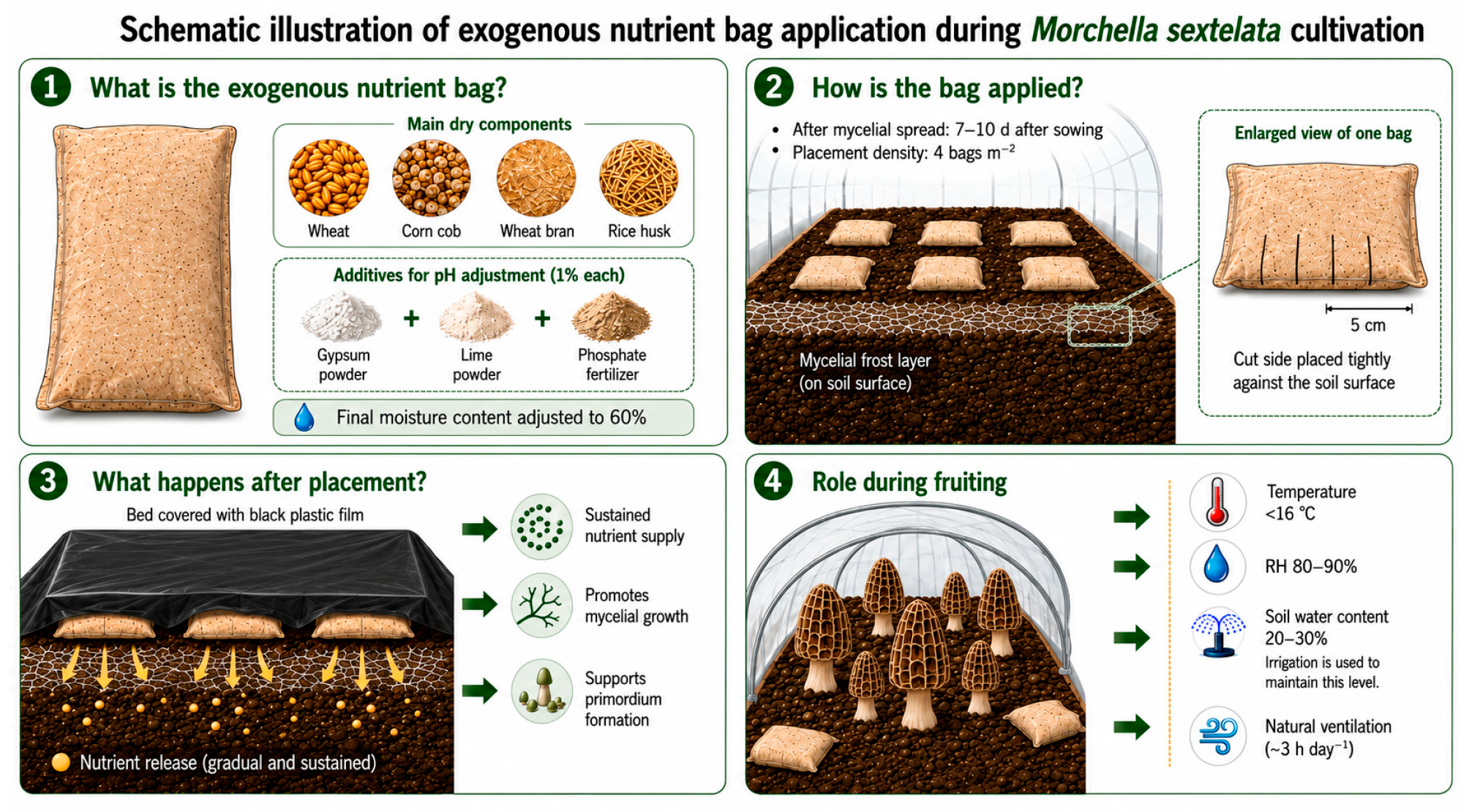
As a core technological breakthrough in artificial morel cultivation, exogenous nutrient bags have been described as a “game changer” in morel production. Their central role is to provide precise and sustained nutrient supply for mycelial growth and fruiting body development, compensate for insufficient soil nutrients, improve the soil microenvironment, and create suitable conditions for morel growth, thereby serving as a key technical measure to improve yield and quality [7,8]. At present, the main raw material of exogenous nutrient bags is wheat, supplemented with agricultural and forestry wastes, organic fertilizers, and other ingredients. However, no unified formulation standard has yet been established. Different raw materials in nutrient bags may have distinct effects because of their differences in nutrient composition, degradability, and carbon-to-nitrogen characteristics. Wheat is rich in readily available carbohydrates and can provide a rapid nutrient supply for mycelial growth, whereas corn cobs and rice husks contain more lignocellulosic components and may decompose more slowly, thereby affecting the timing and sustainability of nutrient release. Wheat bran can provide nitrogen and other nutrients, which may influence both fruiting body development and soil microbial activity. Therefore, changes in the proportions of these components may lead to differences in morel yield, nutritional quality, and soil microecological responses [9]. Significant differences in nutrient composition ratios and release rates among formulations may not only directly affect nutrient absorption and utilization by morels, thereby altering yield and nutritional quality, but may also profoundly influence soil physicochemical properties and microbial community structure through nutrient leakage and microbial decomposition. These changes may even trigger ecological problems such as soil nutrient imbalance and pathogen accumulation, thereby aggravating the risk of continuous-cropping obstacles [10,11,12]. Existing studies have confirmed that optimization of exogenous nutrient bag formulations is an effective approach to improving morel cultivation efficiency [13]. We hypothesized that different exogenous nutrient bag formulations would regulate the yield and nutritional quality of M. sextelata by altering nutrient release patterns and reshaping the soil physicochemical and microbial environment. Specifically, formulations with a more balanced composition of readily available and slowly degradable substrates were expected to improve both fruiting performance and soil microecological conditions. Therefore, using artificial morel cultivation as the research background, this study designed different exogenous nutrient bag formulations to systematically investigate their effects on morel yield and nutritional quality, while also analyzing their regulatory effects on soil physicochemical properties (e.g., pH and N, P, and K contents), microbial community structure, and potential pathogen risks. The aim was to clarify the interaction mechanisms between exogenous nutrient bag formulations, morel growth, and the soil ecological environment, and to screen out an optimal exogenous nutrient bag formulation that is high-yielding, high-quality, and environmentally friendly, thus providing theoretical support and technical guidance for the optimization of green and efficient morel cultivation, protection of the soil ecological environment, and sustainable industrial development. In addition, the formulation structure was further interpreted from the perspective of raw material proportions, especially the combined effects of wheat and corn cob proportions, to clarify why different formulations showed distinct yield- and quality-related responses. To facilitate understanding of the application procedure and functional role of exogenous nutrient bags in morel cultivation, a schematic illustration is provided in Figure 1.

2. Materials and Methods

2.1. Experimental Materials

2.1.1. Test Strain

The test strain of Morchella sextelata was isolated and purified from samples collected at the Edible Fungi Cultivation Base of Anhui Science and Technology University, Chuzhou, Anhui, China, in April 2024.

2.1.2. Test Raw Materials

Wheat, corn cobs, wheat bran, rice husks, gypsum powder, lime powder, and phosphate fertilizer used in this study were provided by the Edible Fungi Base of Anhui Science and Technology University.

2.1.3. Major Instruments

The main instruments used in this study included a YM20Z vertical pressure steam sterilizer and a 250 L horizontal sterilizer (Shanghai Sanshen Medical Instrument Co., Ltd., Shanghai, China) for moist-heat sterilization under pressure; a DHP-9082 electrothermal constant-temperature incubator (Shenzhen Sanli Technology Co., Ltd., Shenzhen, China) for constant-temperature cultivation; an SW-CJ-2FD ultra-clean workbench (Suzhou Antai Air Technology Co., Ltd., Suzhou, China) for aseptic manipulation under HEPA-filtered laminar airflow; a DGG-9140B electrothermal constant-temperature blast drying oven (Shanghai Senxin Experimental Instrument Co., Ltd., Shanghai, China) for forced-air drying; an electronic balance (Shanghai Precision Scientific Instrument Co., Ltd., Shanghai, China) for mass measurement; a DT-100 high-speed disintegrator (Shanghai Machinery Equipment Co., Ltd., Shanghai, China) for sample pulverization; an H3-18K benchtop high-speed centrifuge (Hunan Kecheng Instrument Equipment Co., Ltd., Changsha, China) for high-speed centrifugal separation; and a UV6100 UV–Vis spectrophotometer and Thermo microplate reader (Shanghai Yuanxi Instrument Co., Ltd., Shanghai, China) for absorbance-based quantitative analysis.

2.1.4. Major Reagents

The main reagents used in this study included sulfuric acid (Aladdin Reagent Co., Ltd., Shanghai, China), boric acid, hydrochloric acid, glucose, potassium dihydrogen phosphate, magnesium sulfate, dipotassium hydrogen phosphate, and DNS reagent components, including 3,5-dinitrosalicylic acid, sodium tartrate, phenol, and sodium sulfite (Fuchen Chemical Reagent Co., Ltd., Tianjin, China), as well as agar (Yongda Chemical Reagent Co., Ltd., Tianjin, China). Sulfuric acid, boric acid, and hydrochloric acid were used for crude protein determination by the Kjeldahl method; glucose was used as the standard for sugar determination; phenol and sulfuric acid were used for polysaccharide determination by the phenol–sulfuric acid method; 3,5-dinitrosalicylic acid-based DNS reagent was used for reducing sugar determination; potassium dihydrogen phosphate, magnesium sulfate, dipotassium hydrogen phosphate, and agar were used for culture medium preparation. Unless otherwise stated, all reagents were of analytical grade.

2.2. Experimental Design

A total of nine exogenous nutrient bag formulations and one conventional treatment (CK) were established, with four replicates per treatment. Fruiting time, yield, and nutritional quality indicators of morels under each treatment were first determined, and principal component analysis combined with the membership function method was used for comprehensive evaluation. Soil physicochemical properties were determined for all treatments at the peak fruiting stage, together with the initial soil sample before cultivation (XCK). Based on the comprehensive evaluation results, the treatment with the highest comprehensive score, the treatment with the lowest comprehensive score, and the conventional treatment (CK) were further selected as representative treatments for soil microbial community analysis.

2.3. Preparation of Cultivation Bags and Exogenous Nutrient Bags

The substrate for spawn cultivation consisted of 70% wheat, 27% corn cobs, and 1% each of gypsum powder, lime powder, and phosphate fertilizer, with a moisture content adjusted to 60%. The mixture was packed into polypropylene plastic bags (30 cm × 15 cm), compacted, perforated in the center, and sealed. The exogenous nutrient bags were prepared according to the formulations shown in Table 1, and 750 g of the moistened substrate was packed into each bag. Sterilization was conducted at 121 °C for 90 min.

2.4. Spawn Preparation

The strain was stored on PDA slants at 4 °C. Before the experiment, the preserved strain was transferred to PDA plates (medium composition: potato 200 g/L, glucose 20 g/L, agar 15 g/L, MgSO4 1.5 g/L, KH2PO4 3 g/L) for activation, and incubated in the dark at 18 °C for 5–7 d until the plates were fully colonized by mycelia. The activated culture was then inoculated into cultivation bags and incubated at 16 °C to obtain cultivation bag spawn.

2.5. Sowing and Cultivation Management

2.5.1. Sowing

Sowing was carried out in mid-December 2024 at the plastic greenhouse of the Edible Fungi Research Base of Anhui Science and Technology University. The soil was tilled one week before sowing. During sowing, the spawn was gently broken into small pieces and broadcast at an application rate of 0.225 kg·m−2. The mycelial surface was then covered with 2–4 cm of crushed soil and watered until soil moisture exceeded 80%.

2.5.2. Placement of Exogenous Nutrient Bags

Approximately 7–10 d after sowing, when the mycelia had spread across the soil surface and formed a mycelial frost layer, nutrient bags were placed at a density of four bags per m2. Four longitudinal cuts of approximately 5 cm were made on one side of each bag, with the cut side placed tightly against the soil surface. The plots were then covered with black plastic film. After primordia formation, the black film was removed, small tunnel shelters were set up, and the temperature was maintained below 16 °C. During the fruiting period, the air relative humidity inside the tunnel shelters was maintained at approximately 80–90%, and the soil water content was maintained at approximately 20–30% through micro-sprinkler irrigation according to soil moisture conditions. Natural ventilation was conducted by opening both ends of the shelters for approximately 3 h per day under suitable weather conditions.

2.5.3. Fruiting Time and Yield Determination

The period from primordium formation to marketable fruiting body stage was recorded as fruiting time (FT). Marketable mushrooms were defined as those in which the stipe base became light yellow or initially brown, the pileus color changed from dark gray to light gray or brownish yellow, and the honeycomb-like pits on the pileus surface were fully expanded and clearly visible. Fresh weight (FW) was determined after retaining a 2–4 cm stipe, and dry weight (DW) was measured after drying at 45 °C to constant weight [14].

2.6. Determination of Physicochemical and Nutritional Indicators

Dried fruiting bodies were ground and passed through a 60-mesh sieve. Crude protein content (PC) was determined using the Kjeldahl nitrogen method [15]. Total nitrogen was converted to crude protein using a nitrogen-to-protein conversion factor of 6.25. Because the Kjeldahl method measures total nitrogen, including non-protein nitrogen, the calculated value was interpreted as crude protein content. Total sugar content (TSC) was measured according to the procedure described by Zuo et al. [16]. Polysaccharide content (PS) was determined using the phenol–sulfuric acid method according to Zhang et al. [17]. Reducing sugar content (RSC) was determined using the DNS method [18]. Free amino acid content (FAC) was measured using the ninhydrin colorimetric method [19].

2.7. Soil Chemical Analysis

Before morel cultivation, eight sampling points were arranged in an “S”-shaped pattern within the greenhouse, and soil samples were collected from the 0–15 cm tillage layer. At each point, a soil slice was vertically cut with a shovel. After removing impurities, soils from all points were thoroughly mixed and repeatedly quartered to approximately 1 kg, packed into clean self-sealing bags, labeled, and brought back to the laboratory. The samples were air-dried in a cool, ventilated place, ground, and sieved for determination of baseline soil nutrient contents.
At the peak fruiting stage of morels, 10 normal fruiting bodies were randomly collected from each plot. At the same time, topsoil samples were collected from each plot using the same method described above. Soil samples from each plot were mixed, and three subsamples were taken, air-dried, ground, and sieved for analysis of soil nutrient status at this stage. Soil chemical analyses were performed by Chengdu Baihui Biotechnology Co., Ltd. (Chengdu, China). pH was measured using the electrode method according to NY/T 1377-2007. Soil organic carbon (OC) was determined by the potassium dichromate oxidation-external heating method according to NY/T 1121.6-2006. Total nitrogen (TN) and alkali-hydrolyzable nitrogen (AN) were determined using the Kjeldahl digestion and alkali diffusion methods, respectively, according to LY/T 1228-2015. Total phosphorus (TP) was determined by the molybdenum antimony colorimetric method according to LY/T 1230-2015. Total potassium (TK) was determined by flame photometry according to NY/T 87-1988. Available phosphorus (AP) was determined by sodium bicarbonate extraction-molybdenum antimony colorimetry according to NY/T 1121.7-2014. Available potassium (AK) was determined by ammonium acetate extraction-flame photometry according to NY/T 889-2004.

2.8. Soil Microbial Community Analysis

Based on the comprehensive evaluation results, the treatments with the highest and lowest comprehensive scores, together with CK, were selected as representative treatments for soil microbial community analysis. At the peak fruiting stage of M. sextelata, three biological replicates were established for each treatment. For each replicate, 10 normal fruiting bodies were randomly selected, the surface soil at the base of the fruiting bodies was removed, and soil samples from the 0–15 cm tillage layer were collected. Five-point sampling was adopted within each plot, and the five soil subsamples from the same plot were thoroughly mixed. At least 50 g of the mixed soil sample was collected as one composite sample, labeled, and stored at −80 °C for subsequent microbial analysis.
Soil microbial community sequencing was performed by Shanghai Majorbio Bio-Pharm Technology Co., Ltd. Total microbial genomic DNA was extracted from fresh soil samples using the E.Z.N.A.® Soil DNA Kit (Omega Bio-tek, Norcross, GA, USA) according to the manufacturer’s instructions. The quality of the extracted DNA was checked using 1.0% agarose gel electrophoresis, and DNA concentration and purity were determined using a NanoDrop2000 spectrophotometer (Thermo Fisher Scientific, Wilmington, DE, USA).
For bacterial community analysis, the V3–V4 region of the bacterial 16S rRNA gene was amplified using the primer pair 338F: 5′-ACTCCTACGGGAGGCAG-3′ and 806R: 5′-GGACTACHVGGGTWTCTAAT-3′. For fungal community analysis, the ITS1 region was amplified using the primer pair ITS1F: 5′-CTTGGTCATTTAGAGGAAGTAA-3′ and ITS2R: 5′-GCTGCGTTCTTCATCGATGC-3′.
PCR amplification was performed in a 20 μL reaction mixture containing 4 μL of 5× FastPfu buffer, 2 μL of 2.5 mM dNTPs, 0.8 μL of each primer (5 μM), 0.4 μL of FastPfu DNA polymerase, 10 ng of template DNA, and ddH2O to the final volume. The PCR cycling conditions were as follows: initial denaturation at 95 °C for 3 min; 27 cycles of denaturation at 95 °C for 30 s, annealing at 55 °C for 30 s, and extension at 72 °C for 45 s; followed by a final extension at 72 °C for 10 min. PCR products were checked by 2% agarose gel electrophoresis, purified, quantified, and pooled in equimolar amounts. The purified amplicons were then subjected to paired-end sequencing on the Illumina MiSeq PE300 platform (Illumina Inc., San Diego, CA, USA).
The raw paired-end reads were quality-filtered using fastp v0.23.4 [20] and merged using FLASH v1.2.11 [21]. Low-quality bases with quality scores below 20 were trimmed using a 50 bp sliding window. Reads shorter than 50 bp after quality control and reads containing more than five ambiguous bases were removed. Paired-end reads were merged according to their overlap regions, with a minimum overlap length of 10 bp and a maximum mismatch ratio of 0.2 in the overlap region. Samples were distinguished according to barcode and primer sequences, with zero mismatch allowed in barcodes and a maximum of two mismatches allowed in primers.
The quality-controlled sequences were clustered into operational taxonomic units (OTUs) at 97% sequence similarity using USEARCH v11 [22], and chimeric sequences were removed. For bacterial communities, taxonomic annotation was performed using the RDP Classifier v2.11 [23] against the SILVA 138.2 database [24]. For fungal communities, taxonomic annotation was performed using the RDP Classifier v2.11 [23] against the UNITE 9.0 database [25]. The confidence threshold for taxonomic classification was set at 70%. Chloroplast and mitochondrial sequences were removed before downstream analysis.
To reduce the influence of sequencing depth on subsequent analyses, the abundance data of all nine microbial samples were rarefied to 38,095 sequences per sample. Rarefaction curves based on the Sobs index at the OTU level were generated separately for bacterial and fungal communities to evaluate whether the sequencing depth was sufficient. Alpha diversity indices, including the Chao, Shannon, and Simpson indices, were calculated using Mothur v1.30.2 [26]. The relative abundances of dominant bacterial and fungal taxa were summarized at the phylum and genus levels and displayed as community composition bar plots. Redundancy analysis (RDA) was used to evaluate the relationships between soil microbial communities and soil nutrient factors. All sequencing data analyses were performed on the Majorbio Cloud Platform.

2.9. Data Processing

Excel 2019 was used for data processing and table preparation. SPSS 26 was used for analysis of variance and principal component analysis. Trend plots were generated using GraphPad Prism 10.1.2. Based on the principal component analysis results, the comprehensive evaluation formula of the membership function was adopted according to Chen W et al. [27]. The formula was as follows:
U i j = X i j X j m i n X j m a x X j m i n W j = P j j = 1 n P j D i = j = 1 n U i j W j
In the formula, U i j is the membership function value of the j th principal component score in the i th sample; X i j is the j th principal component score of the i th sample; X j , m i n and X j , m a x are the minimum and maximum values of the j th principal component score, respectively; W j is the importance of the j th principal component among all extracted principal components, i.e., the component weight; P j is the contribution rate of the j th principal component; D i is the composite membership value of the i th sample.
In addition to PCA and membership function analysis, A1–A9 were further analyzed according to the 3 × 3 formulation structure of wheat and corn cob proportions. Wheat proportion included three levels, 50%, 55%, and 60%, and corn cob proportion included three levels, 20%, 30%, and 40%. The combined proportions of wheat bran and rice husk were treated as complementary components of the formulation. Trend plots were used to visualize the responses of agronomic traits and nutritional indicators to changes in wheat and corn cob proportions. CK was not included in this formulation-trend analysis because it served as a conventional reference treatment rather than a treatment within the 3 × 3 formulation design.

3. Results

3.1. Effect on the Agronomic Traits and Nutritional Indicators of Morchella sextelata

As shown in Table 2, different treatments had highly significant effects on the agronomic traits of M. sextelata (p < 0.01). Fruiting time ranged from 14.5 to 23.5 d, with treatment A6 showing the shortest fruiting time (14.5 ± 0.58 d) and treatment A4 the longest (23.5 ± 0.58 d). Treatments A1, A5, A2, and A7 fruited relatively early, whereas A8 also exhibited a pronounced delayed fruiting pattern. Fresh weight and dry weight showed similar trends and differed highly significantly among treatments. Fresh weight ranged from 63.36 to 489.38 g·m−2, and dry weight ranged from 9.40 to 65.35 g·m−2. Both were highest in A6, reaching 489.38 ± 15.69 g·m−2 and 65.35 ± 3.63 g·m−2, respectively. A7 ranked second, with 412.67 ± 7.53 g·m−2 and 56.21 ± 3.50 g·m−2, respectively. CK and A2 were at intermediate levels. A8 showed the lowest fresh and dry weights, at only 63.36 ± 9.09 g·m−2 and 9.40 ± 0.63 g·m−2, respectively. Overall, A6 performed best in promoting early fruiting and increasing yield, followed by A7, whereas A4 and A8 showed relatively poor agronomic performance.
Different exogenous nutrient bag formulations also had highly significant effects on the nutritional indicators of M. sextelata (p < 0.01). Protein content (PC) was highest in A4, reaching 33.06%, which did not differ significantly from A7 or A9 but was significantly higher than that in the other treatments. Total sugar (TSC) and reducing sugar (RSC) contents were both highest in A5, at 13.46% and 2.17%, respectively, and were significantly higher than those in the other treatments. Polysaccharide (PS) content was highest in A7 at 7.45%, significantly exceeding that of all other treatments. Free amino acid content (FAC) was comparatively high in A4 and A8, at 4.52 ± 0.06% and 4.44%, respectively, with no significant difference between them, but both were significantly higher than those of the other treatments. Overall, the nutritional quality advantages varied among formulations: A4 was more favorable for protein and free amino acid accumulation, A5 was more favorable for sugar accumulation, and A7 performed best in polysaccharide accumulation. In summary, optimization of exogenous nutrient bag formulations can effectively improve the nutritional composition of morels while enhancing yield.

3.2. Comprehensive Evaluation of the Cultivation Effects

Principal component analysis (PCA) was performed using fruiting time, yield, and nutritional indicators of morels as variables, and the results are shown in Table 3. The eigenvalues of the first three principal components were all greater than 1.0, and the cumulative contribution rate reached 84.778%, indicating that the vast majority of information contained in the eight original indicators could be adequately represented. Therefore, extraction of the first three principal components as the basis for comprehensive evaluation was considered reasonable and effective.
As shown by the principal component loadings in Table 4, FW (0.901), FT (0.869), and PS (0.783) had relatively high loadings on PC1 and thus a strong association, whereas RSC and DW were negatively correlated with PC1. On PC2, TSC (0.849), PC (0.651), FAC (0.542), and DW (0.519) showed positive loadings, mainly reflecting nutritional quality and dry matter accumulation. PC3 mainly represented FAC in the fruiting body and was negatively correlated with PC.

3.3. Results of Membership Function Analysis

The comprehensive evaluation information for different exogenous nutrient bag formulations is shown in Table 5. The comprehensive scores of the three principal components, XI(1)–XI(3), were converted into membership function values U(1)–U(3) according to the membership function formula. Treatment A7 had the highest D value (0.789), indicating that this exogenous nutrient bag formulation showed the best overall effect in promoting yield and improving quality. Treatment A6 (0.777) was higher than CK (0.653), whereas A3 showed the poorest comprehensive performance (0.231).

3.4. Effects of Raw Material Proportions on Agronomic and Nutritional Traits

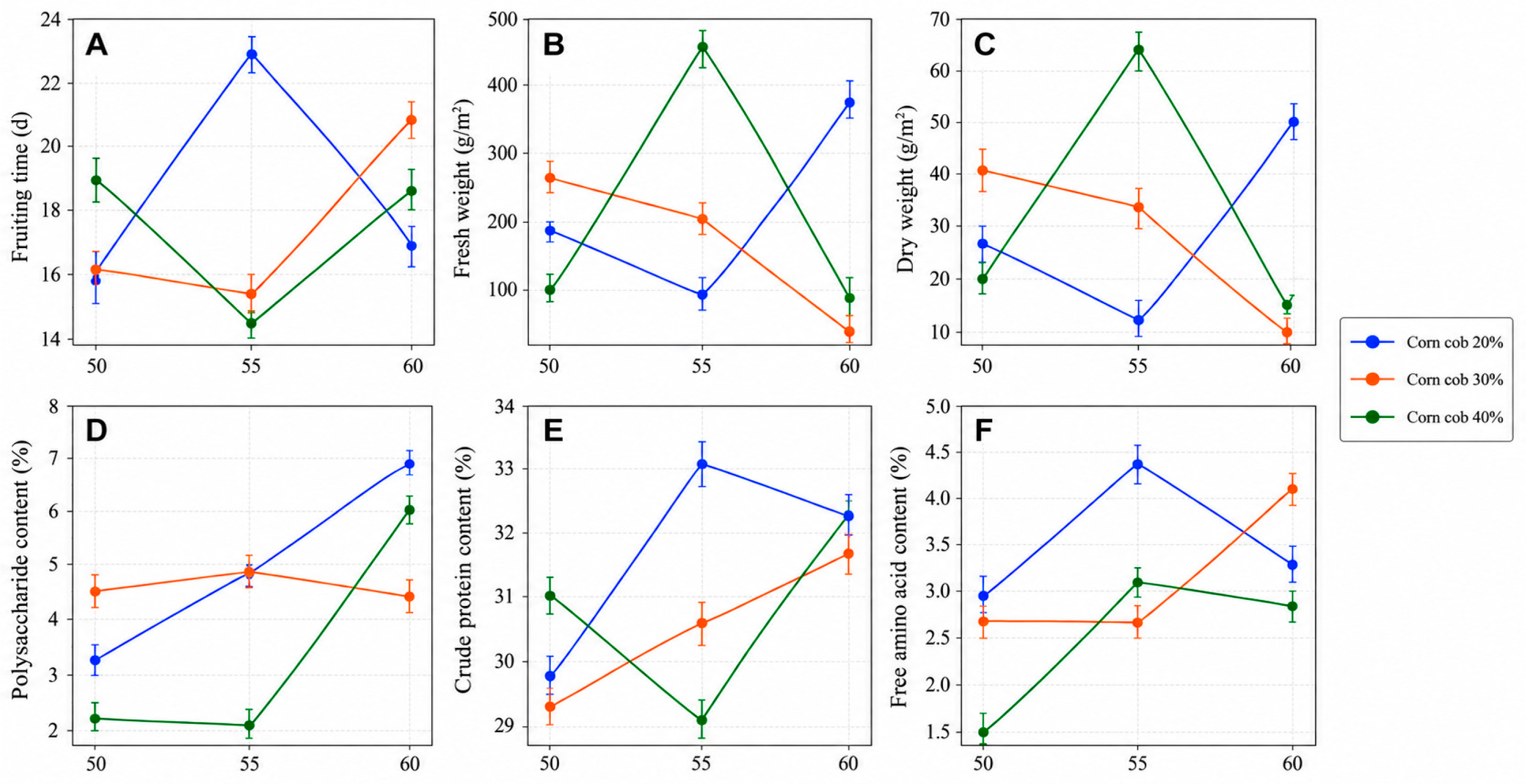
To further clarify the effects of raw material proportions, A1–A9 were analyzed according to the 3 × 3 formulation structure of wheat and corn cob proportions (Figure 2). Fresh and dry yields showed clear differences among formulation combinations. The combination of 55% wheat and 40% corn cob, corresponding to A6, produced the highest fresh and dry weights, indicating that a moderate wheat proportion combined with a relatively high corn cob proportion was more favorable for yield formation. In contrast, polysaccharide content increased markedly under the combination of 60% wheat and 20% corn cob, corresponding to A7. This result explains why A7 ranked first in the comprehensive evaluation despite having slightly lower yield than A6. Protein content and free amino acid content also showed different response patterns across formulation combinations, suggesting that quality-related traits were not completely synchronized with yield-related traits. These results indicate that the optimal exogenous nutrient bag formulation should not be determined by yield alone, but should be evaluated by balancing yield, nutritional quality, and the nutrient-release characteristics of raw materials.

3.5. Principal Component Analysis of Soil Nutrient Characteristics

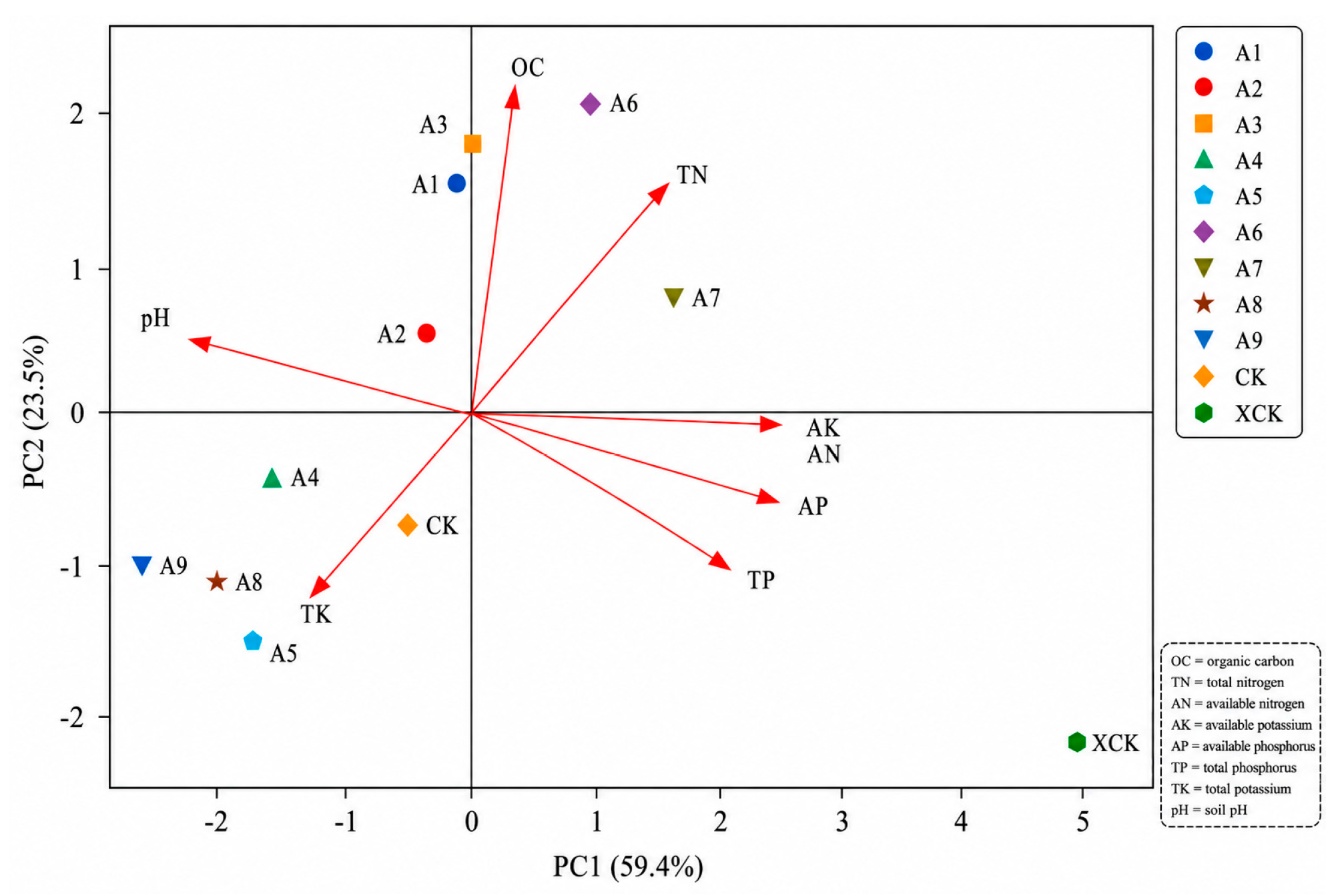
Principal component analysis showed that PC1 and PC2 explained 59.4% and 23.5% of the variation in soil nutrient characteristics, respectively, with a cumulative explanation rate of 82.9%, indicating that they could effectively reflect the overall differences in soil nutrient characteristics among treatments. The original soil physicochemical data for XCK, CK, and A1–A9 used for PCA are provided in Table A1. The soil sample before cultivation (XCK) was clearly separated from the soil samples at the peak fruiting stage and was mainly distributed in the positive direction of PC1, indicating that the soil nutrient structure changed markedly after morel cultivation. Based on the directions of the ordination axes and environmental vectors, XCK was more closely associated with AK, AN, AP, and TP, whereas soil samples at the peak fruiting stage deviated overall from this direction, suggesting that the cultivation process had a pronounced effect on soil available nutrients and phosphorus levels. Certain differences were also observed among exogenous nutrient bag treatments. A1, A6, A7, and A8 were closer to the OC and TN vectors, indicating association with higher soil organic carbon and total nitrogen levels, whereas CK, A3, A5, and A9 were mainly distributed in the lower-left region and were closer to the TK vector, suggesting that their soil nutrient characteristics were more related to the total potassium dimension. Overall, different exogenous nutrient bag formulations were able to significantly regulate soil nutrient structure at the peak fruiting stage and may influence morel growth and development by altering soil carbon, nitrogen, and available nutrient status (Figure 3).

3.6. Soil Microbial Community Structure Analysis

3.6.1. Effects on Soil Microbial Diversity

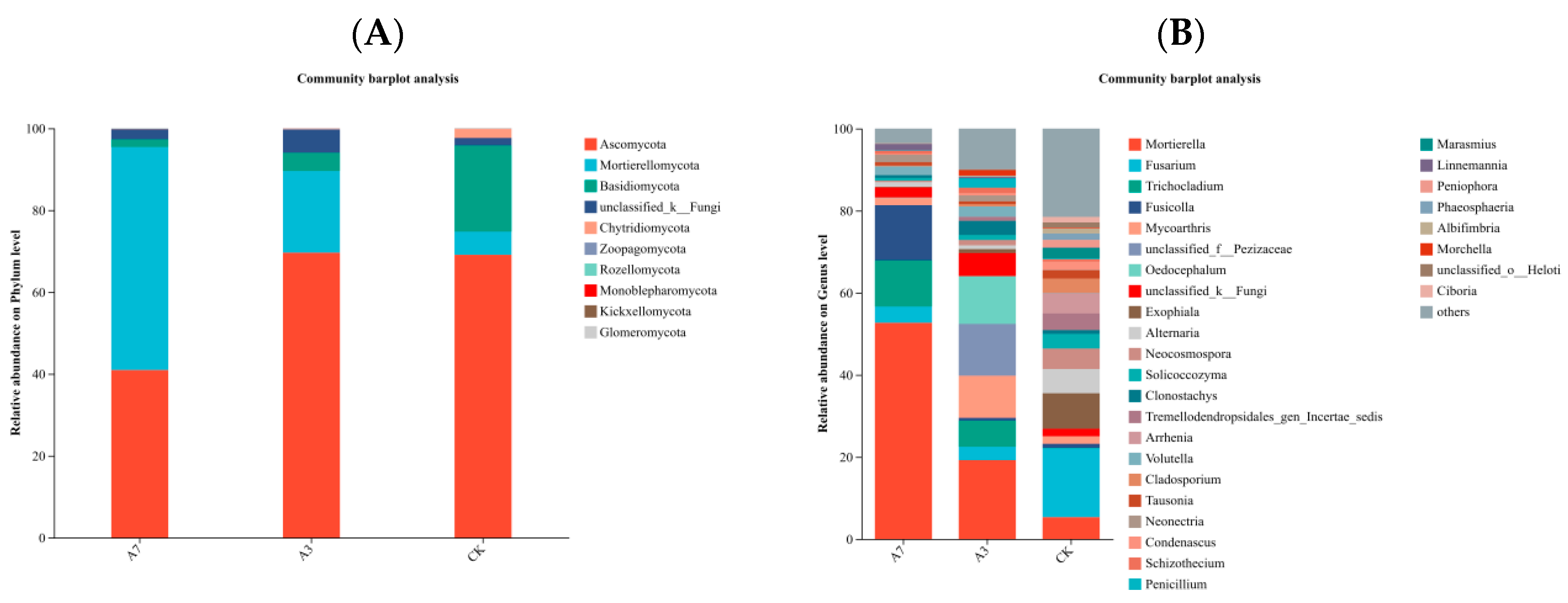
According to the comprehensive evaluation results in Table 5, soil samples from treatment A7 with the highest comprehensive score, treatment A3 with the lowest comprehensive score, and CK were selected for microbial alpha diversity analysis (Table 6). A higher Chao index indicates greater community richness. In bacterial communities, the Chao indices followed the order A7 > CK > A3, which was consistent with the order of comprehensive scores. In fungal communities, the Chao index followed the order CK > A7 > A3, with A7 and A3 being approximately 20.1% and 25.8% lower than CK, respectively, indicating that different treatments affected fungal richness differently, which may be related to the regulatory effects of different exogenous nutrient bag formulations on the soil environment. A higher Shannon index indicates higher diversity and a more even species distribution. Compared with CK, the Shannon index of soil bacteria decreased by approximately 2.5% and 4.3% in A7 and A3, respectively, whereas the fungal Shannon index decreased by approximately 42.0% and 15.9%, respectively, with the largest decrease observed in A7. Statistical analysis further indicated that only the fungal Shannon index showed significant differences among treatments (p < 0.05), suggesting that different exogenous nutrient bag treatments had a more pronounced effect on fungal community diversity. The Simpson index reflects community dominance; a larger value indicates stronger dominance of certain taxa, whereas a smaller value indicates higher evenness. Compared with CK, the Simpson indices of both bacterial and fungal communities increased in A7 and A3, indicating that dominant taxa became more concentrated under these treatments. Overall, different exogenous nutrient bag formulations exerted certain effects on the richness, diversity, and dominance of soil microbial communities at the peak fruiting stage of morels, with more pronounced effects on fungal community diversity. The decrease in fungal Shannon diversity under A7 should not be simply interpreted as a deterioration of soil fungal diversity. In the context of morel cultivation, this pattern may indicate that M. sextelata successfully colonized the soil microenvironment and became a dominant fungal component during the fruiting stage, thereby reducing the relative evenness of the fungal community. This interpretation is consistent with the higher relative abundance of M. sextelata observed in A7 at the genus level.

3.6.2. Effects on Soil Bacterial Community Composition

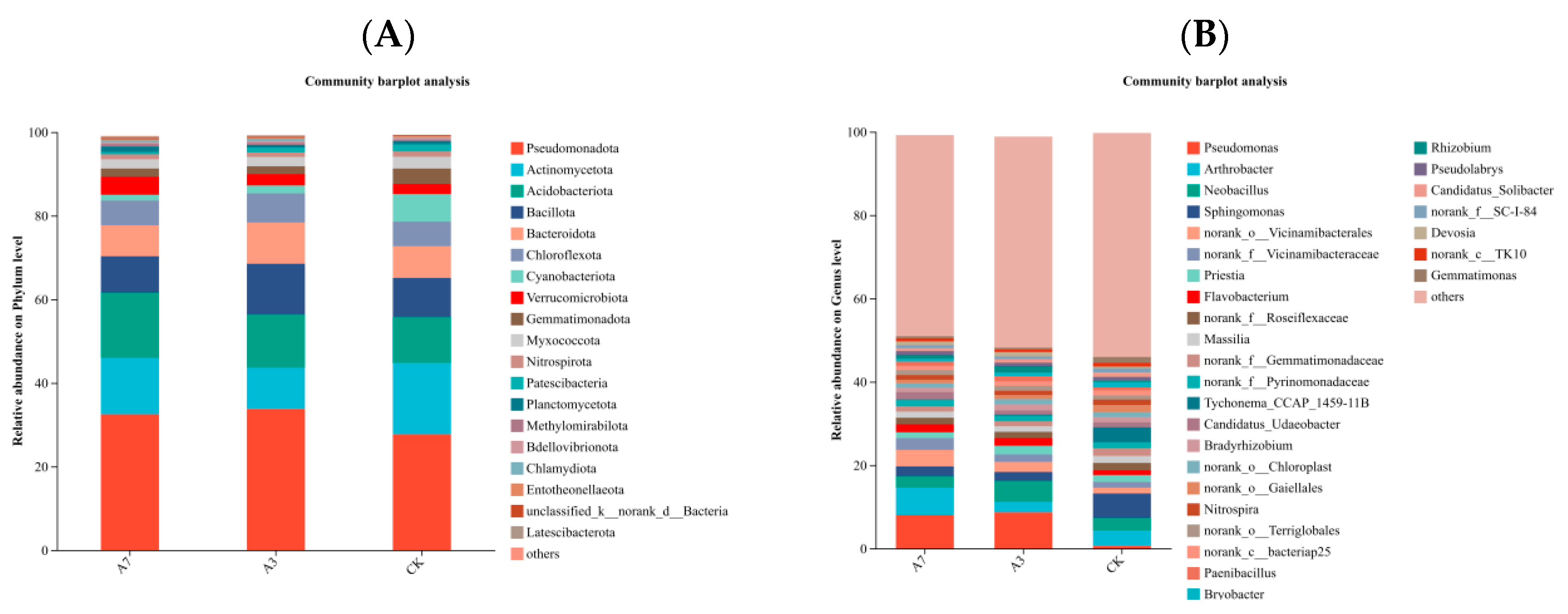
Figure 4A shows the distribution of soil bacterial communities at the phylum level in A7, A3, and CK. Overall, the top six phyla in relative abundance were Pseudomonadota, Actinomycetota, Acidobacteriota, Bacillota, Bacteroidota, and Chloroflexota, accounting for 27.68–33.77%, 9.86–17.12%, 10.94–15.66%, 8.68–12.13%,7.40–9.83%, and 5.91–7.03% of total abundance, respectively. These were the dominant phyla, with a combined abundance of 75.59–85.73%. Relative abundances differed among the three treatments. Pseudomonadota was most abundant in A3 (33.77%), followed by A7 (32.47%), and lowest in CK (27.68%). Secondary dominant phyla also differed among treatments. Actinomycetota was the secondary dominant phylum in CK with a relative abundance of 17.12%; Acidobacteriota was secondary dominant in A7 with 15.66%; and Bacillota, Bacteroidota, and Chloroflexota were secondary dominant in A3, with relative abundances of 12.13%, 9.83%, and 7.03%, respectively.
At the genus level, the bacterial communities showed higher specificity. As shown in Figure 4B, except for CK, in which the dominant genus was Sphingomonas with a relative abundance of 5.86%, the dominant genus in the other two soil samples was Pseudomonas, with relative abundances of 7.94% in A7 and 8.64% in A3. Secondary dominant genera also differed considerably among samples. In A7 and CK, the secondary dominant genus was Arthrobacter, with relative abundances of 6.63% and 3.70%, respectively; in A3, the secondary dominant genus was Neobacillus, with a relative abundance of 5.07%. The relative abundances of secondary dominant genera were generally low and more evenly distributed among samples, indicating the absence of an absolute secondary dominant genus.

3.6.3. Effect on Soil Fungal Community Composition

As shown in Figure 5A, soil fungi in M. sextelata cultivation under different exogenous nutrient bag formulations were mainly composed of Ascomycota, Mortierellomycota, and Basidiomycota at the phylum level. These accounted for 40.93–69.60%, 5.65–54.50%, and 1.89–21.07% of total abundance, respectively, and together accounted for over 90% of total abundance in all samples. Differences in relative abundance among soil samples indicated distinct fungal community structures among treatments. Ascomycota had the highest relative abundance in A3 and CK, accounting for 69.60% and 69.10%, respectively, and was the primary dominant phylum in these two treatments. In A7, Mortierellomycota was most abundant at 54.50% and thus represented the dominant phylum. The secondary dominant phyla differed from the dominant ones: in A7, Ascomycota was the secondary dominant phylum with a relative abundance of 40.93%; in A3, Mortierellomycota was secondary dominant with 19.98%; and in CK, Basidiomycota was secondary dominant with a relative abundance of 21.07%.
At the genus level (Figure 5B), fungal communities showed even higher specificity. Except for CK, in which the dominant genus was Fusarium with a relative abundance of 16.80%, the dominant genus in the other two soil samples was M. sextelata, with relative abundances of 52.68% in A7 and 19.22% in A3. Secondary dominant genera differed more markedly among samples. In A7, the secondary dominant genus was Fusicolla with a relative abundance of 13.46%; in A3, it was unclassified_f__Pezizaceae with 12.63%; and in CK, it was Exophiala with 8.66%. The dominant genera varied greatly among treatments and represented absolute dominant genera, whereas the secondary dominant genera were more variable and no absolute secondary dominant genus was observed.

3.6.4. Correlations Between Soil Microbial Community Characteristics and Soil Nutrients

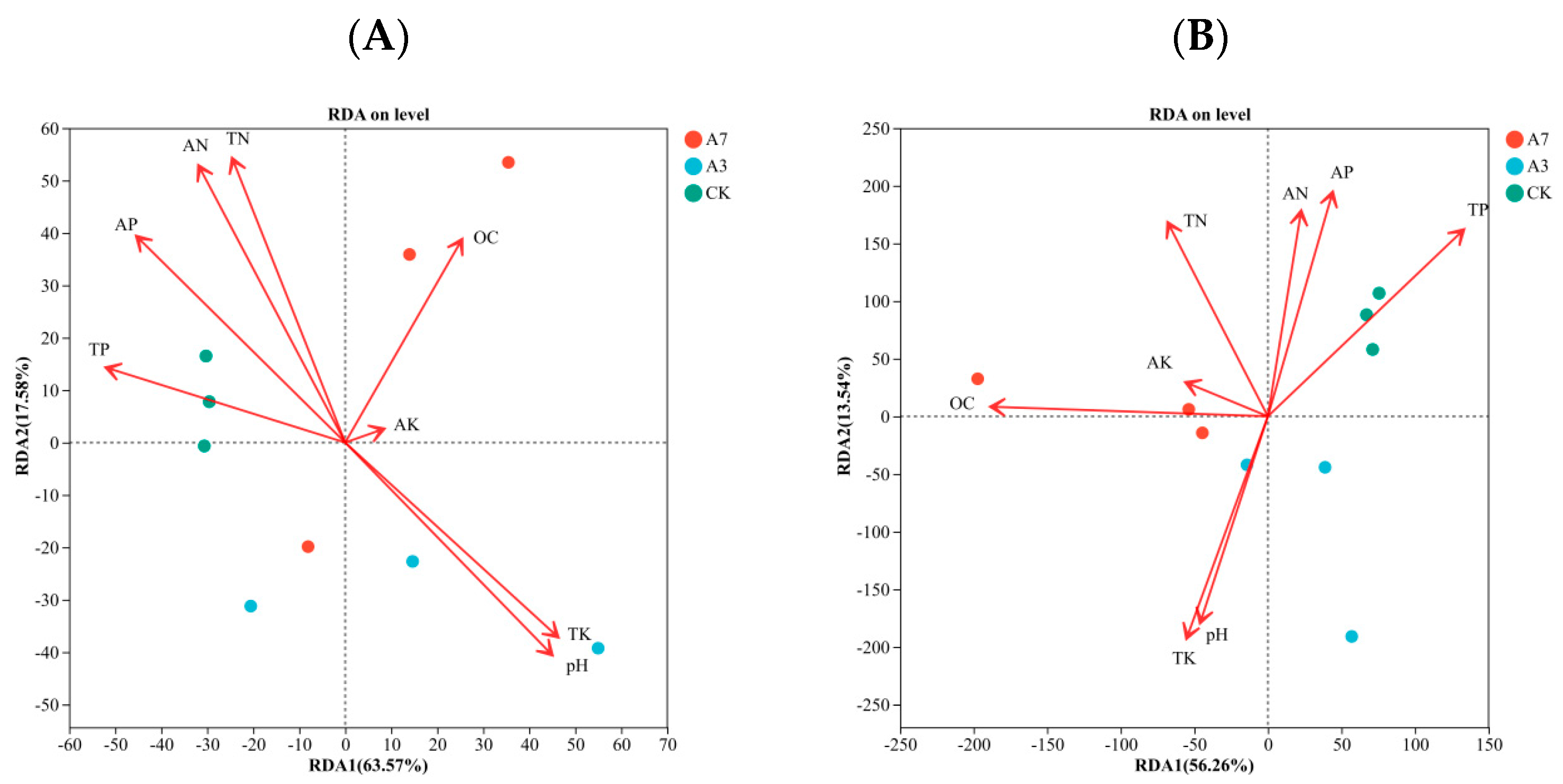
To investigate the effects of environmental factors on soil bacterial community structure under different treatments, redundancy analysis (RDA) was performed between soil physicochemical indicators and sample community distribution, and the results are shown in Figure 6A. The RDA results showed that RDA1 and RDA2 explained 63.57% and 17.58% of the variation in the relationships between soil bacterial communities and environmental factors, respectively, with a cumulative explanation rate of 81.15%, indicating that soil nutrient factors could effectively explain differences in bacterial community structure among treatments. The lengths of environmental factor arrows indicated that OC, pH, TK, TN, and AN had relatively strong effects on bacterial community distribution, whereas AK had a shorter arrow, suggesting a relatively weaker explanatory effect. The angles between arrows showed that pH and TK, AN and TN, and AP and TP were strongly positively correlated, whereas pH and TK pointed in the opposite direction to AN, TN, AP, and TP, indicating a certain negative correlation between them. Sample distribution showed that A7 was mainly located on the right side of the ordination plot and was closer to the OC direction, indicating that the bacterial community under A7 was more closely associated with soil organic carbon. A3 was mainly distributed in the lower-right region and showed a stronger relationship with pH and TK. CK was mainly located on the left side and was closer to the directions of AN, TN, AP, and TP, indicating that its bacterial community was more influenced by nitrogen and phosphorus nutrients. Overall, different treatments altered soil bacterial community structure by regulating soil nutrient status, among which organic carbon, pH, potassium, and nitrogen factors may be the main drivers of bacterial community differences.
Figure 6B shows the effects of environmental factors on soil fungal community structure under different treatments. The RDA results indicated that RDA1 and RDA2 explained 56.26% and 13.54% of the variation in the relationships between soil fungal communities and environmental factors, respectively, with a cumulative explanation rate of 69.80%, indicating that soil nutrient factors could effectively explain differences in fungal community structure among treatments. The lengths of environmental factor arrows indicated that TP, AP, AN, OC, pH, TK, and TN had relatively strong effects on fungal community distribution, whereas AK had a relatively weaker explanatory effect. The directions of the arrows showed that AP, AN, and TP were strongly positively correlated, and pH and TK were also clearly positively correlated. OC pointed in the opposite direction to AP, AN, and TP, indicating a potential negative correlation between organic carbon and nitrogen/phosphorus factors. Sample distribution showed that CK was mainly located in the upper-right region of the ordination plot and was closer to TP, AP, and AN, indicating that its fungal community structure was more closely associated with nitrogen and phosphorus nutrients. A3 was mainly distributed in the lower-right region and showed a stronger relationship with pH and TK. A7 was mainly located on the left side, especially close to the OC direction, indicating that its fungal community may be more strongly influenced by soil organic carbon. Overall, different treatments markedly affected soil fungal community structure through regulation of soil nutrient status, among which nitrogen, phosphorus, organic carbon, pH, and potassium may be important drivers of fungal community variation.

4. Discussion

Optimization of exogenous nutrient bag formulations is a key aspect of efficient morel cultivation. Previous studies have shown that although commercial morel cultivation has developed rapidly, yield fluctuations remain considerable, and the composition and release pattern of exogenous nutrient bags are important technical factors affecting stable production and high quality [28,29,30]. Exogenous nutrient bags not only provide sustained carbon and nitrogen sources required for fruiting body formation, but also alter the supply rhythm of organic carbon and nutrients in surface soil during the decomposition process, thereby influencing mycelial expansion, primordium differentiation, and fruiting body enlargement. In the present study, A6 had the shortest fruiting time and the highest fresh and dry weights, suggesting that this formulation was more favorable for achieving a high-yield phenotype. Although the yield of A7 was slightly lower than that of A6, it performed best in polysaccharide content and comprehensive evaluation, indicating a better balance between “yield” and “quality.” The formulation-trend analysis further indicated that A6 (55% wheat and 40% corn cob) represented a yield-oriented formulation, whereas A7 (60% wheat and 20% corn cob) represented a formulation with better comprehensive performance, especially in polysaccharide accumulation. This suggests that the optimal formulation should be interpreted not only by treatment ranking, but also by the balance between different raw material proportions. This is generally consistent with previous studies on optimization of exogenous nutrient bag formulations for M. sextelata, which suggest that different formulations do not simply determine “which treatment has the highest yield,” but jointly influence the final comprehensive effect through raw material structure, release of available carbon sources, and sustainability of nutrient supply [31,32].
In terms of nutritional quality, A4 in this study showed higher accumulation of protein and free amino acids, A5 showed the highest total sugar and reducing sugar contents, and A7 had the highest polysaccharide content, indicating that exogenous nutrient bag formulations exert a pronounced directional regulatory effect on morel quality formation. High yield and high quality were not completely synchronized in this study. This phenomenon is common in edible mushroom cultivation and is essentially related to the timing of nutrient supply, the efficiency of carbon–nitrogen conversion, and the allocation of metabolites at the fruiting body maturation stage [33,34]. Previous reviews have pointed out that functional components such as proteins, soluble sugars, and polysaccharides in morel fruiting bodies are jointly affected by substrate composition, environmental conditions, and postharvest treatment. Different formulations may alter carbon and nitrogen flux allocation, thereby causing differential responses among quality traits [35,36]. Therefore, the higher yield of A6 did not correspond to the highest protein or polysaccharide contents, whereas A7 outperformed A6 in comprehensive evaluation. This indicates that judging the optimal formulation by a single yield indicator is insufficient, and multi-indicator comprehensive evaluation better reflects the practical value of exogenous nutrient bag formulations.
Soil microorganisms are an important component of the soil ecological environment and play vital roles in nutrient cycling, fertility maintenance, and crop growth and development [37]. On the basis of confirming that different nutrient bag formulations significantly affected morel yield and nutritional quality, this study selected the best treatment A7, the worst treatment A3, and the control CK through comprehensive evaluation. The results showed that the soil nutrient structure changed markedly after morel cultivation: TP, AN, AP, and AK showed an overall decreasing trend, whereas OC, TK, and pH increased, with differences in the degree of change among treatments, indicating close relationships with exogenous nutrient bag composition. RDA further revealed the coupling relationships between soil physicochemical properties and microbial community structure. In bacterial communities, A7 was more closely associated with soil organic carbon, whereas CK was more strongly associated with TN, AN, TP, and AP. pH and TK were important factors associated with the bacterial community under A3, indicating different regulatory directions of different formulations on the soil environment. In fungal communities, A7 was more closely associated with higher organic carbon levels and showed a high relative abundance of Mortierellomycota at the phylum level and M. sextelata at the genus level [38]. This result suggests that A7 may have created a soil microenvironment favorable for organic matter-associated fungal groups and for the colonization of the target morel fungus. Previous studies have shown that M. sextelata cultivation can substantially reshape soil microbial communities and that continuous cultivation may be associated with changes in soil nutrients, microbial composition, and potential pathogen accumulation [39,40]. CK was highly associated with TP, AP, and AN, and its dominant fungal genus was Fusarium (16.80%), suggesting a relatively high proportion of potentially risky fungal taxa in its community. However, further isolation and pathogenicity tests are required to determine whether these Fusarium taxa directly affect morel growth.
Soil microbial communities are important biotic environmental factors in morel cultivation systems, and their structure and diversity directly affect soil nutrient transformation efficiency, microecological balance, and morel growth and development [41,42]. Mineralization and release of soil organic nutrients can not only improve nutrient utilization efficiency, but also suppress the proliferation of harmful microorganisms through enrichment of beneficial microbial groups, thereby providing suitable microecological conditions for mycelial expansion and fruiting body development [43]. In this study, A7 showed the highest bacterial Chao index, whereas its fungal Shannon index was 42.0% lower than that of CK, suggesting increased bacterial richness but more concentrated dominant fungal taxa under this treatment. This decrease in fungal diversity should not be simply interpreted as a negative change. In morel cultivation systems, a lower fungal Shannon index may partly reflect stronger colonization by M. sextelata, which can become a dominant fungal component during the fruiting stage and reduce community evenness. This interpretation is supported by the genus-level result showing that M. sextelata was the dominant fungal genus in A7, with a relative abundance of 52.68%. In terms of bacterial community composition, the dominant bacterial genus in A7 was Pseudomonas (7.94%), whereas CK was dominated by Sphingomonas (5.86%). In A3, Pseudomonas also showed relatively high abundance (8.64%), but this treatment had the lowest comprehensive evaluation score. These results indicate that the presence of a potentially beneficial bacterial genus alone does not necessarily determine yield or quality; rather, its function may depend on the nutrient environment, fungal colonization status, and broader community interactions. Previous studies on morel cultivation have shown that soil microbial communities change dynamically during the cultivation life cycle and that bacterial taxa may participate in nutrient transformation and fungus–bacterium interactions [40,44]. In addition, beneficial bacteria associated with edible mushrooms, including mushroom-helper bacteria, may promote mycelial growth, nutrient acquisition, and disease suppression, but their effects are often host- and environment-dependent [45]. Therefore, the bacterial community analysis in this study was intended to explore whether different nutrient bag formulations shaped bacterial taxa potentially involved in nutrient transformation and fungus–bacterium interactions. The enrichment of Pseudomonas in A7 and A3 suggests that this genus may be responsive to nutrient bag-derived substrates; however, its specific functional role in M. sextelata growth requires further verification through isolation, functional assays, or metagenomic analysis.
Future studies may focus on the following two aspects: (1) Combined analyses of soil nutrient dynamics, enzyme activity changes, and key functional microorganisms should be conducted to further clarify the mechanisms by which the optimal exogenous nutrient bag formulation promotes high yield and superior quality formation in M. sextelata. (2) The optimal formulation should be continuously validated across different ecological conditions and production scenarios, and its practical application value and economic feasibility should be assessed through input–output analysis, so as to provide a basis for the standardization and precision application of exogenous nutrient bag formulations.

5. Conclusions

Different exogenous nutrient bag formulations significantly affected the fruiting time, yield, nutritional quality, soil nutrient structure, and soil microbial communities of M. sextelata. A6 showed the greatest advantage in yield-oriented production, with the shortest fruiting time and the highest fresh and dry yields. In contrast, A7 ranked first in the comprehensive evaluation, indicating that it achieved a better balance between agronomic performance and nutritional quality, particularly because of its high polysaccharide content. From the perspective of raw material proportions, A6, containing 55% wheat and 40% corn cob, was more favorable for yield-oriented production, whereas A7, containing 60% wheat and 20% corn cob, achieved better comprehensive performance by balancing yield and nutritional quality, especially polysaccharide accumulation. Soil physicochemical and microbial analyses further showed that different formulations reshaped the soil nutrient environment and microbial community structure at the peak fruiting stage. A7 was more closely associated with soil organic carbon and showed stronger colonization by M. sextelata, together with changes in specific fungal groups such as Mortierellomycota. These results suggest that optimizing exogenous nutrient bag formulations may help improve morel production stability and regulate the soil microecological environment. However, multi-season field validation, functional verification of key microorganisms, and input–output economic analysis are still needed before large-scale application.

Author Contributions

Conceptualization, Y.M.; methodology, W.W. and Y.M.; validation, W.W., Q.W. and T.H.; formal analysis, W.W.; investigation, W.W., Q.W. and T.H.; resources, W.W. and T.H.; data curation, Q.W.; writing—original draft preparation, W.W.; writing—review and editing, Y.M. and H.H.; visualization, W.W.; supervision, Y.M.; project administration, H.H.; funding acquisition, Y.M. All authors have read and agreed to the published version of the manuscript.

Funding

This research was supported by Anhui Provincial Department of Education Collaborative Innovation Project for Higher Education Institutions (Competitive Category) (GXXT-2023-080).

Data Availability Statement

The raw Illumina sequencing data of bacterial 16S rRNA genes and fungal internal transcribed spacer (ITS) regions generated in this study have been deposited in the National Center for Biotechnology Information (NCBI) under the BioProject accession number PRJNA1465537 and are publicly available at https://www.ncbi.nlm.nih.gov/bioproject/PRJNA1465537. Other data supporting the findings of this study are included in the article.

Conflicts of Interest

The authors declare no conflicts of interest.

Abbreviations

The following abbreviations are used in this manuscript:
FTfruiting time
FWfresh weight
DWdry weight
PCcrude protein content
TSCtotal sugar content
PSpolysaccharide content
RSCreducing sugar content
FACfree amino acid content

Appendix A

Table A1. Soil physicochemical properties before and after Morchella sextelata cultivation under different exogenous nutrient bag treatments.
TreatmentOCTNTPTKpHANAPAK
XCK8.637 ± 0.171.215 ± 0.0171.086 ± 0.03615.317 ± 0.1426.100 ± 0.0280.158 ± 0.003161.714 ± 5.159293.534 ± 7.331
CK8.651 ± 0.111.174 ± 0.0140.607 ± 0.01415.905 ± 0.1636.705 ± 0.0400.113 ± 0.00557.292 ± 0.692240.161 ± 2.260
A110.243 ± 0.191.307 ± 0.0110.710 ± 0.02115.428 ± 0.1556.740 ± 0.0520.112 ± 0.00251.083 ± 1.252217.826 ± 1.941
A210.141 ± 0.141.176 ± 0.0120.602 ± 0.02115.908 ± 0.2046.695 ± 0.0690.117 ± 0.00456.448 ± 2.776241.228 ± 3.580
A38.79 ± 0.101.043 ± 0.0100.625 ± 0.01615.575 ± 0.0606.655 ± 0.0130.087 ± 0.00439.581 ± 0.238208.973 ± 3.866
A49.099 ± 0.081.094 ± 0.0110.643 ± 0.00815.591 ± 0.1216.735 ± 0.0280.094 ± 0.00334.582 ± 0.289218.923 ± 6.434
A58.84 ± 0.101.077 ± 0.0090.687 ± 0.00516.144 ± 0.2026.715 ± 0.0390.103 ± 0.00335.864 ± 1.259228.848 ± 4.417
A611.24 ± 0.131.265 ± 0.0110.699 ± 0.01815.148 ± 0.1316.670 ± 0.0340.126 ± 0.00358.945 ± 2.650251.248 ± 4.709
A710.209 ± 0.091.233 ± 0.0100.631 ± 0.00515.454 ± 0.1076.385 ± 0.0280.123 ± 0.005103.120 ± 1.761252.468 ± 6.151
A810.075 ± 0.081.205 ± 0.0100.565 ± 0.02514.775 ± 0.1106.575 ± 0.0180.104 ± 0.00235.880 ± 0.545245.035 ± 3.197
A99.199 ± 0.091.084 ± 0.0110.649 ± 0.01716.333 ± 0.2146.930 ± 0.0500.103 ± 0.00336.604 ± 0.770202.960 ± 3.591

References

  1. Shao, G.; Zhang, R. Research progress in genetic breeding and cultivation techniques of Morchella spp. Edible Fungi China 2025, 44, 1–11+19. [Google Scholar] [CrossRef]
  2. Liu, N.; Li, L.; Gao, J.; Jiang, B.; Wu, D. Analysis of Nutritional Components of Morchella esculenta under Different Cultivation Conditions. Food Res. Dev. 2025, 46, 138–144. [Google Scholar] [CrossRef]
  3. Yao, Q.; Cui, Y.; Tu, J.; Yin, K.; Yu, Q.; Tan, Y.; Xia, X.; Li, J.; Shi, X.; Wang, Y. Isolation and identification of the pathogens causing bacterial red-stipe symptom in Morchella spp. Edible Fungi China 2025, 44, 96–102. [Google Scholar] [CrossRef]
  4. Du, C.; Wang, F.; Li, W.; Zhao, W.; Zhang, S. Effects of different substrate formulations on the growth and yield of Morchella eximia. China Cucurbits Veg. 2026, 39, 115–122. [Google Scholar] [CrossRef]
  5. Liu, W.; He, P.; Shi, X.; Zhang, Y.; Perez-Moreno, J.; Yu, F. Large-scale field cultivation of Morchella and relevance of basic knowledge for its steady production. J. Fungi 2023, 9, 855. [Google Scholar] [CrossRef]
  6. Ju, Q.; Yang, J.; Feng, S.; Xie, L.; Zhao, X.; Zhang, X.; Wang, T. Screening of substrate formulations for external nutrient bags and benefit analysis for Morchella esculenta cultivation in plastic greenhouses in the cold temperate semi-humid region of Gannan. J. Cold-Arid. Agric. Sci. 2025, 4, 1040–1044. [Google Scholar] [CrossRef]
  7. Mo, X.; Zhu, Y.; Wu, J.; Huang, D. Effect of exogenous nutrition on the growth of Morchella esculenta. Hortic. Seed 2025, 45, 51–53. [Google Scholar] [CrossRef]
  8. Li, S.; Gao, Y.; Niu, W.; Liu, S.; Nie, Y.; Sun, T. Effects of wheat grain content in nutrition bags on the yield and economic benefits of Morchella esculenta. China Fruit. Veg. 2025, 45, 33–37. [Google Scholar] [CrossRef]
  9. Xiang, G.; Ma, Y.H.; Liu, P.; Li, Z.M.; Chai, H.M.; Zhao, Y.C. Relationship between morel yield and nutrient consumption in spawn bottles. Acta Edulis Fungi 2022, 29, 39–47. [Google Scholar] [CrossRef]
  10. Xiao, Q.; Cui, X.; You, P.; Xue, X.; Nie, Z.; Ma, J.; Xu, X. The impact of wheat grain content in nutrition bags on Morchella yield. Edible Fungi China 2024, 43, 35–38. [Google Scholar] [CrossRef]
  11. Liu, X.; Liu, J.Z.; Liu, J.; Zhang, J.; Wang, C.L. Determination of the effects of pear–Morchella intercropping mode on M. sextelata quality, yield, and soil microbial community. J. Fungi 2024, 10, 759. [Google Scholar] [CrossRef] [PubMed]
  12. Peng, B.; Zhou, W.; Zhang, Y.; Li, X. Effects of different Morchella species cultivation in forests on soil nutrients and nematode community characteristics. Chin. J. Appl. Environ. Biol. 2025, 1–17. [Google Scholar] [CrossRef]
  13. Yan, Q.; Wang, P.; Liu, Z.; Yu, Y.; Tan, X.; Huang, X.; Wen, J.; Zhang, W. Analysis of soil microbial community structure and function in Morchella esculenta habitats in Jilin Province. Agronomy 2024, 15, 15. [Google Scholar] [CrossRef]
  14. Liu, T.; Wu, X.; Long, W.; Xu, Y.; Yu, Y.; Wang, H. The effects of different postharvest drying temperatures on the volatile flavor components and non-volatile metabolites of Morchella sextelata. Horticulturae 2024, 10, 812. [Google Scholar] [CrossRef]
  15. Wang, F.; Wang, W.; Chen, J.; Hu, A.C. Determination of protein content in edible fungi by the full automatic azotometer. Spec. Wild Econ. Anim. Plant Res. 2005, 35–37. [Google Scholar] [CrossRef]
  16. Zuo, Q.; Yang, H.; Xing, Z.; Han, Y.; Gu, S. Determination of total sugar in fruit bodies of five edible mushroom species. Acta Edulis Fungi 2008, 15, 57–61. [Google Scholar] [CrossRef]
  17. Zhang, Z.; Liu, J.; Li, S.; Yang, L. Determination of Ganoderma polysaccharide content by the phenol–sulfuric acid method. Sci. Technol. Food Ind. 2006, 193–195. [Google Scholar] [CrossRef]
  18. Zeng, Z.; Zeng, H.; Cheng, Y.; Yang, L.; Shi, X.; Dai, J. Determination of reducing sugar and total sugar content in fermentation liquid of Agaricus bisporus. Edible Fungi China 2018, 37, 40–43,49. [Google Scholar] [CrossRef]
  19. Jiang, L.; Hao, Z.; Abudureheman, B.; Chen, L.; Fang, D.; Zhang, J. Analysis of free amino acid characteristics and quality comprehensive evaluation of Morchella sextelata from different producing area. China Brew. 2025, 44, 251–258. [Google Scholar] [CrossRef]
  20. Chen, S.; Zhou, Y.; Chen, Y.; Gu, J. fastp: An ultra-fast all-in-one FASTQ preprocessor. Bioinformatics 2018, 34, i884–i890. [Google Scholar] [CrossRef]
  21. Magoč, T.; Salzberg, S.L. FLASH: Fast length adjustment of short reads to improve genome assemblies. Bioinformatics 2011, 27, 2957–2963. [Google Scholar] [CrossRef] [PubMed]
  22. Edgar, R.C. UPARSE: Highly accurate OTU sequences from microbial amplicon reads. Nat. Methods 2013, 10, 996–998. [Google Scholar] [CrossRef]
  23. Wang, Q.; Garrity, G.M.; Tiedje, J.M.; Cole, J.R. Naive Bayesian classifier for rapid assignment of rRNA sequences into the new bacterial taxonomy. Appl. Environ. Microbiol. 2007, 73, 5261–5267. [Google Scholar] [CrossRef]
  24. Quast, C.; Pruesse, E.; Yilmaz, P.; Gerken, J.; Schweer, T.; Yarza, P.; Peplies, J.; Glöckner, F.O. The SILVA ribosomal RNA gene database project: Improved data processing and web-based tools. Nucleic Acids Res. 2013, 41, D590–D596. [Google Scholar] [CrossRef]
  25. Abarenkov, K.; Nilsson, R.H.; Larsson, K.H.; Taylor, A.F.S.; May, T.W.; Frøslev, T.G.; Pawlowska, J.; Lindahl, B.; Põldmaa, K.; Truong, C.; et al. The UNITE database for molecular identification and taxonomic communication of fungi and other eukaryotes: Sequences, taxa and classifications reconsidered. Nucleic Acids Res. 2024, 52, D791–D797. [Google Scholar] [CrossRef]
  26. Schloss, P.D.; Westcott, S.L.; Ryabin, T.; Hall, J.R.; Hartmann, M.; Hollister, E.B.; Lesniewski, R.A.; Oakley, B.B.; Parks, D.H.; Robinson, C.J.; et al. Introducing mothur: Open-source, platform-independent, community-supported software for describing and comparing microbial communities. Appl. Environ. Microbiol. 2009, 75, 7537–7541. [Google Scholar] [CrossRef]
  27. Chen, W.; Li, W.; Chen, H.; Zhang, J.; Tang, L.; Wu, D.; Zhang, Z.; Yang, Y. Analysis and comprehensive evaluation of nutritional and amino acid characteristics of Morchella cultivated in Qinghai Plateau. Acta Edulis Fungi 2024, 31, 64–75. [Google Scholar] [CrossRef]
  28. Xu, Y.; Tang, J.; Wang, Y.; He, X.; Tan, H.; Yu, Y.; Chen, Y.; Peng, W. Large-scale commercial cultivation of morels: Current state and perspectives. Appl. Microbiol. Biotechnol. 2022, 106, 4401–4412. [Google Scholar] [CrossRef]
  29. Li, Y.; Chen, H.; Zhang, X. Cultivation, nutritional value, bioactive compounds of morels, and their health benefits: A systematic review. Front. Nutr. 2023, 10, 1159029. [Google Scholar] [CrossRef] [PubMed]
  30. Tan, H.; Kohler, A.; Miao, R.; Liu, T.; Zhang, Q.; Zhang, B.; Jiang, L.; Wang, Y.; Xie, L.; Tang, J.; et al. Multi-omic analyses of exogenous nutrient bag decomposition by the black morel Morchella importuna reveal sustained carbon acquisition and transferring. Environ. Microbiol. 2019, 21, 3909–3926. [Google Scholar] [CrossRef]
  31. Yan, Q.; Zhang, W.; Wang, Q.; Yang, T.; Wang, P.; Yu, Y.; Tan, X.; Kang, X.; Wen, J. Screening of substrates and optimization of formulations for exogenous nutrient bags of Morchella sextelata. Horticulturae 2025, 11, 863. [Google Scholar] [CrossRef]
  32. Zhang, L.; Xie, Y.; Qu, J.; Zhu, Q.; Dong, R. Response of Morchella esculenta growth and development to different external nutrient sources of wood chips. North. Hortic. 2024, 24, 90–97. [Google Scholar] [CrossRef]
  33. Duan, Y.; Liu, L.; Huang, C.; Wang, S.; Qi, Y.; Dai, Y.; Li, C.; Li, Y. Deciphering the yield limitation mechanisms in Pleurotus eryngii cultivation: A comparative study on red vs. white corncob substrates. LWT 2025, 231, 118379. [Google Scholar] [CrossRef]
  34. Siwulski, M.; Rzymski, P.; Budka, A.; Kalač, P.; Budzyńska, S.; Dawidowicz, L.; Hajduk, E.; Kozak, L.; Budzulak, J.; Sobieralski, K.; et al. The effect of different substrates on the growth of six cultivated mushroom species and composition of macro and trace elements in their fruiting bodies. Eur. Food Res. Technol. 2019, 245, 419–431. [Google Scholar] [CrossRef]
  35. Dawadi, E.; Magar, P.B.; Bhandari, S.; Subedi, S.; Shrestha, S.; Shrestha, J. Nutritional and post-harvest quality preservation of mushrooms: A review. Heliyon 2022, 8, e12093. [Google Scholar] [CrossRef]
  36. Elkanah, F.A.; Oke, M.A.; Adebayo, E.A. Substrate composition effect on the nutritional quality of Pleurotus ostreatus (MK751847) fruiting body. Heliyon 2022, 8, e11841. [Google Scholar] [CrossRef] [PubMed]
  37. Chen, L.; Bao, Y.; Zhou, W.; He, X.; Deng, L. Responses of soil nutrients and microbial communities to the application of spent mushroom substrates. Plant Soil 2024, 504, 923–939. [Google Scholar] [CrossRef]
  38. Cai, J.; Liu, J.; Liu, X. Effects of improved exogenous nutrient bags on the quality of Morchella sextelata in the orchard intercropping system. North. Hortic. 2026, 1–11. [Google Scholar] [CrossRef]
  39. Liu, W.Y.; Cai, Y.L.; He, P.X.; He, P.; Li, S.J.; Liu, W.; Yang, H.; Wang, G.; Pan, Y.L.; Li, Y.; et al. Determining why continuous cropping reduces the production of the morel Morchella sextelata. Front. Microbiol. 2022, 13, 903983. [Google Scholar] [CrossRef]
  40. Benucci, G.M.N.; Longley, R.; Zhang, P.; Zhao, Q.; Bonito, G.; Yu, F.Q. Microbial communities associated with the black morel Morchella sextelata cultivated in greenhouses. PeerJ 2019, 7, e7744. [Google Scholar] [CrossRef]
  41. Feng, W.; Wang, J.; Jin, Q.; Guo, Z.; Cai, W. Analysis of soil fungal community characteristics of Morchella sextelata under different rotations and intercropping patterns and influencing factors. Agriculture 2025, 15, 823. [Google Scholar] [CrossRef]
  42. Tang, S.; Fan, T.; Jin, L.; Lei, P.; Shao, C.; Wu, S.; Yang, Y.; He, Y.; Ren, R.; Xu, J. Soil microbial diversity and functional capacity associated with the production of edible mushroom Stropharia rugosoannulata in croplands. PeerJ 2022, 10, e14130. [Google Scholar] [CrossRef]
  43. Ye, Z.; Zhu, X.; Zhi, Y.; Lin, H.; Wu, J. The role of forest mushroom systems in soil fungal community reorganization and carbon fractions. Agric. Ecosyst. Environ. 2026, 397, 110073. [Google Scholar] [CrossRef]
  44. Zhang, C.; Zhang, F.; Li, X.; Ma, Z.; Wang, J.; Zhang, J.; Liu, Y.; Si, J.; Tan, H. Dynamics of soil microbiome throughout the cultivation life cycle of morel (Morchella sextelata). Front. Microbiol. 2023, 14, 979835. [Google Scholar] [CrossRef]
  45. Braat, N.; Koster, M.C.; Wösten, H.A.B. Beneficial interactions between bacteria and edible mushrooms. Fungal Biol. Rev. 2022, 39, 60–72. [Google Scholar] [CrossRef]
Figure 1. Schematic illustration of exogenous nutrient bag application during Morchella sextelata cultivation.
Horticulturae 12 00678 g001
Figure 2. Trends in agronomic traits and nutritional indicators of Morchella sextelata under different wheat and corn cob proportions in exogenous nutrient bag formulations. Panels (AF) represent fruiting time, fresh weight, dry weight, polysaccharide content, crude protein content, and free amino acid content, respectively. The x-axis indicates wheat proportion at 50%, 55%, and 60%, while the colored lines indicate corn cob proportions of 20%, 30%, and 40%. Data are expressed as mean ± SD (n = 4).
Horticulturae 12 00678 g002
Figure 3. Principal component analysis biplot of soil chemical properties before and after Morchella sextelata cultivation. Points represent different treatments and are labeled as A1–A9, CK, and XCK. XCK represents the initial soil sample before cultivation, whereas CK represents the conventional treatment at the peak fruiting stage. Red arrows represent soil chemical variables. OC, organic carbon; TN, total nitrogen; AN, alkali−hydrolyzable nitrogen; AK, available potassium; AP, available phosphorus; TP, total phosphorus; TK, total potassium; pH, soil pH.
Horticulturae 12 00678 g003
Figure 4. Effects of Different Exogenous Nutrient Bag Treatments on Soil Bacterial Community Structure. (A) Relative abundance of bacterial communities at the phylum level. (B) Relative abundance of bacterial communities at the genus level.
Horticulturae 12 00678 g004
Figure 5. Effects of Exogenous Nutrient Bag Treatments with Different Scores on Soil Fungal Community Structure. (A) Relative abundance of fungal communities at the phylum level. (B) Relative abundance of fungal communities at the genus level.
Horticulturae 12 00678 g005
Figure 6. Redundancy analysis of relationships between soil chemical properties and microbial communities under different exogenous nutrient bag treatments. (A) RDA of bacterial communities and soil chemical properties. (B) RDA of fungal communities and soil chemical properties. OC, organic carbon; TN, total nitrogen; AN, alkali−hydrolyzable nitrogen; AK, available potassium; AP, available phosphorus; TP, total phosphorus; TK, total potassium; pH, soil pH.
Horticulturae 12 00678 g006
Table 1. Formulations of Exogenous Nutrient Bags.
TreatmentWheat
(%)
Corn Cob
(%)
Wheat Bran (%)Rice Husk
(%)
Water and pH Adjustment
A150201515Gypsum powder, lime powder, and phosphate fertilizer were each added at 1% of the total mass for pH adjustment; moisture content was adjusted to 60%.
A250301010
A3504055
A4552012.512.5
A555307.57.5
A655402.52.5
A760201010
A8603055
A9604000
CK6030010
Note: The substrate percentages in Table 1 are based on the dry weight of raw materials before water addition. Gypsum powder, lime powder, and phosphate fertilizer were each added at 1% of the dry substrate weight for pH adjustment, and the final moisture content was adjusted to 60%. CK represents the conventional nutrient-bag formulation used for comparison in this experiment.
Table 2. Agronomic Traits and Nutritional Indicators of Morchella sextelata.
TreatmentFT (d)FW (g·m−2)DW (g·m−2)PC (%)TSC (%)PS (%)RSC (%)FAC (%)
A115.5 ± 0.58 ef195.82 ± 9.03 e26.75 ± 2.73 e29.87 ± 0.32 e6.59 ± 0.04 g3.27 ± 0.05 g1.29 ± 0.02 g2.94 ± 0.07 e
A216.0 ± 0.00 de276.40 ± 10.31 d39.53 ± 1.80 c29.38 ± 0.28 ef10.04 ± 0.03 e4.58 ± 0.01 e2.04 ± 0.02 b2.75 ± 0.03 f
A318.5 ± 0.58 c127.79 ± 6.69 f19.12 ± 2.20 fg31.10 ± 0.23 d8.75 ± 0.15 f2.30 ± 0.02 h1.11 ± 0.01 h1.49 ± 0.03 g
A423.5 ± 0.58 a118.06 ± 9.48 f14.52 ± 1.96 gh33.06 ± 0.16 a11.18 ± 0.02 c5.00 ± 0.03 d1.05 ± 0.05 h4.52 ± 0.04 a
A515.5 ± 0.58 ef212.52 ± 13.29 e32.49 ± 2.76 d30.67 ± 0.34 d13.46 ± 0.28 a4.96 ± 0.04 d2.17 ± 0.03 a2.78 ± 0.05 f
A614.5 ± 0.58 f489.38 ± 15.69 a65.35 ± 3.63 a29.21 ± 0.15 f12.16 ± 0.16 b2.34 ± 0.02 h1.63 ± 0.03 d3.10 ± 0.02 d
A716.5 ± 0.58 de412.67 ± 7.53 b56.21 ± 3.50 b32.46 ± 0.07 b10.70 ± 0.15 d7.45 ± 0.01 a1.89 ± 0.05 c3.48 ± 0.05 c
A821.0 ± 0.00 b63.36 ± 9.09 g9.40 ± 0.63 h31.76 ± 0.31 c9.75 ± 0.16 e4.48 ± 0.02 f1.07 ± 0.03 h4.44 ± 0.07 a
A918.5 ± 0.58 c127.39 ± 3.48 f19.07 ± 0.43 fg32.40 ± 0.18 b11.95 ± 0.08 b6.12 ± 0.04 b1.37 ± 0.04 f2.91 ± 0.02 e
CK17.0 ± 0.00 d311.66 ± 5.21 c40.94 ± 1.28 c29.71 ± 0.12 ef8.70 ± 0.05 f5.79 ± 0.07 c1.50 ± 0.03 e4.05 ± 0.07 b
p****************
Note: Values followed by different lowercase letters indicate significant differences at p < 0.05. ** denotes extremely significant differences at p < 0.01.
Table 3. Eigenvalues, Contribution Rates, and Cumulative Contribution Rates of the First Three Principal Components for the Eight Indicators.
Principal ComponentEigenvalueContribution Rate (%)Cumulative Contribution Rate
(%)
13.7747.1147.11
22.0125.1272.23
31.0012.5584.778
Table 4. Loadings of the First Three Principal Components for the Eight Indicators.
IndicatorPrincipal Component Loadings
PC1PC2PC3
FT0.8690.2350.309
FW0.9010.2370.239
DW−0.7240.519−0.196
PC0.1750.651−0.561
TSC−0.1090.8490.107
PS0.7830.399−0.274
RSC−0.9330.1760.056
FAC−0.3910.5420.639
Table 5. Comprehensive Evaluation of Morel Yield and Nutritional Indicators.
TreatmentPrincipal Component Composite ScoreMembership DegreeDRank
XI(1)XI(2)XI(3)U(1)U(2)U(3)
A10.062−1.4890.8410.5290.0610.7800.4286
A20.847−0.207−0.2420.7800.4530.4420.6334
A3−0.445−1.688−1.0720.3670.0000.1840.23110
A4−1.5920.7440.3130.0000.7440.6160.3118
A50.6520.633−1.6610.7180.7100.0000.6095
A61.535−0.2700.3381.0000.4340.6230.7772
A70.6301.5800.4710.7111.0000.6650.7891
A8−1.359−0.0320.5560.0750.5070.6910.2949
A9−0.6490.588−1.0910.3020.6960.1780.4007
CK0.3170.1411.5470.6100.5601.0000.6533
Table 6. Alpha Diversity Indices of Soil Microorganisms Under Different Exogenous Nutrient Bag Treatments.
TreatmentBacteriaFungi
ChaoShannonSimpsonChaoShannonSimpson
A72935.98 ± 23.876.14 ± 0.260.0136 ± 0.0083334.25 ± 58.512.22 ± 0.650.2702 ± 0.2156
A32691.69 ± 185.126.03 ± 0.320.0156 ± 0.0107310.50 ± 68.173.22 ± 0.330.0979 ± 0.0366
CK2798.41 ± 139.436.30 ± 0.170.0081 ± 0.0012418.46 ± 77.243.83 ± 0.250.0562 ± 0.0124
Disclaimer/Publisher’s Note: The statements, opinions and data contained in all publications are solely those of the individual author(s) and contributor(s) and not of MDPI and/or the editor(s). MDPI and/or the editor(s) disclaim responsibility for any injury to people or property resulting from any ideas, methods, instructions or products referred to in the content.