Article

Heterologous Expression in Arabidopsis thaliana Reveals the Role of Iris sanguinea Gibberellin Signaling Genes IsGAI and IsGID1a in Plant Height Regulation


College of Landscape Architecture, Northeast Forestry University, Harbin 150040, China
*
Authors to whom correspondence should be addressed.
These authors contributed equally to this work.
Horticulturae 2026, 12(5), 644; https://doi.org/10.3390/horticulturae12050644
Submission received: 3 April 2026 / Revised: 17 May 2026 / Accepted: 19 May 2026 / Published: 21 May 2026
(This article belongs to the Section Floriculture, Nursery and Landscape, and Turf)

Abstract

Iris sanguinea features upright, stiff leaves, making it an excellent cut-foliage material, with its tall leaf architecture greatly enhancing ornamental value in landscaping. However, during the leaf expansion phase, plants frequently exhibit loose foliage arrangement, excessive spreading, and compromised mechanical strength, culminating in lodging and a concomitant decline in ornamental quality. Plant height in I. sanguinea is strongly regulated by phytohormones. This study showed that exogenous GA at concentrations of 50 mg·L−1, 100 mg·L−1, and 200 mg·L−1 increased seedling height by 5.7%, 8.8%, and 12.7%, respectively, through foliar spraying on I. sanguinea seedlings grown ex vitro in a greenhouse; conversely, PAC treatment at equivalent concentrations suppressed growth by 19.3%, 21.0%, and 22.2%, respectively. Two pivotal GA signaling components, GAI and GID1a, were isolated from I. sanguinea. Subcellular localization confirmed that both IsGAI and IsGID1a proteins localize to the nucleus. Overexpression vectors pCAMBIA1300-IsGAI-GFP and pCAMBIA1300-IsGID1a-GFP were constructed and expressed in Arabidopsis thaliana. Transgenic lines overexpressing IsGAI showed significantly reduced plant height, hypocotyl elongation, and bolting, whereas IsGID1a overexpression promoted these traits. Exogenous GA application partially reversed the dwarf phenotype induced by IsGAI overexpression and further potentiated the height enhancement observed in IsGID1a-overexpressing lines. This study identifies two key genes controlling plant height and provides a theoretical basis and genetic resources for precisely engineering plant architecture in I. sanguinea. This is especially important for developing dwarf varieties with enhanced ornamental and agronomic traits, offering significant potential in the landscaping and cut flower industries.

1. Introduction

Gibberellic acid (GA) is a plant hormone that regulates many important growth and developmental processes, including seed germination [1], stem elongation [2], leaf development, floral transition [3], and fruit development [4]. GA promotes cell division by activating the plant’s intercalary meristem and plays a role in promoting cell elongation. However, in the production of cut flowers and potted plants, excessive plant height can lead to problems such as lodging and unattractive plant shapes. As a result, various GA synthesis inhibitors have been developed, such as A-rest (ancymidol) [5], B-nine (daminozide) [6], Bonzi (paclobutrazol) [7], Cycocel [8], and Sumagic (uniconazole) [9], which are commonly used to control plant height.
In recent years, with the in-depth research on rice [10] and the model plant Arabidopsis thaliana, the basic pathway and molecular mechanisms of GA signal transduction have been clarified, and key components involved in this process have been discovered, including the GA receptor GID1 (gibberellin insensitive dwarf1) [11] and DELLA proteins [12]. GA signal transduction begins with GID1 sensing active GA. The GID1 protein is a type of hormone-sensitive lipase receptor that plays an important role in maintaining GA homeostasis and interactions with other plant hormones [13]. Numerous studies have shown that the GID1 gene regulates plant height. For example, ectopic expression of SvGID1s genes in Salix viminalis increases the plant’s sensitivity to GA, enhances its effects, and leads to taller plants and longer hypocotyls [14]. Conversely, silencing PhGID1A, PhGID1B, and PhGID1C in petunia using VIGS technology results in severe dwarf phenotypes [15].
DELLA proteins belong to a subfamily of the GRAS transcription factor family, which is specific to plants. Their N-terminal DELLA domain is crucial for sensing GA, while the VHYNP domain in the N-terminus plays an important role in the interaction between GID1 and DELLA proteins [16]. The number of DELLA proteins varies among different plants. For example, five DELLA proteins have been identified in A. thaliana: AtGAI, AtRGA, AtRGL1, AtRGL2, and AtRGL3, whereas only one OsSLR1 protein exists in rice [17]. DELLA proteins play roles in various aspects of plant growth and development, acting as key repressors in the GA signaling pathway. For instance, the overexpression of the DELLA protein PpeDGYLA from peach in A. thaliana and poplars resulted in an extremely dwarfed phenotype, and the transgenic plants were insensitive to GA treatment [18]. The cucumber CsIREH1 can interact with DELLA proteins and phosphorylate them, specifically targeting CsGAIP and CsGAI2, leading to growth retardation and significantly dwarfed mutants [19]. The wheat (Triticum aestivum) CRY1 gene can directly interact with the GA receptor GID1 and competitively inhibit the GID1-GAI interaction. Overexpression of TaCRY1a reduces plant height and petiole growth in wheat, suggesting that CRY1 competitively suppresses the GID1-DELLA interaction, thereby enhancing the inhibitory effect of DELLA proteins on plant growth [20].
Iris sanguinea, a perennial herbaceous flower in the Iris genus, is known for its elegant flower shape, upright plant form, and arrow-like leaves, making it popular for use in cut flower arrangements. As a typical monocot, I. sanguinea has an aboveground structure primarily composed of leaves and lacks a distinct main stem. Moreover, after I. sanguinea produces its flowering scape, leaf growth ceases, and the distance from the ground level to the highest point of the plant clump is defined as its plant height. Recent research on I. sanguinea has mainly focused on stress resistance [21], new variety breeding [22], and flower color regulation [23]. However, some Iris species experience excessive plant height after flowering, leading to lodging, which affects their ornamental value and application. Therefore, to meet the requirements for plant height in horticultural applications, it is necessary to regulate the height of Iris plants using genetic engineering techniques.
Although the GA signaling pathway has been well characterized in model dicotyledonous plants such as Arabidopsis, its molecular components and functional features in ornamental monocotyledonous plants, particularly in Iris species, remain largely unexplored. I. sanguinea is a horticulturally important perennial whose plant height, a key trait for landscape use and commercial production, is strongly influenced by GA. However, the core GA signaling genes in I. sanguinea have not been identified or functionally characterized. We report for the first time the isolation of two candidate GA pathway genes, IsGAI andIsGID1a, from I. sanguinea leaves. Due to the lack of an efficient transformation system in Iris, we used heterologous expression in A. thaliana to assess their functions in GA responses. This strategy allows us to evaluate their roles within a conserved signaling framework and provides a foundation for future studies on plant architecture regulation in ornamental monocots.

2. Material and Methods

2.1. Plant Materials

The I. sanguinea seedlings were maintained in the experimental nursery of Northeast Forestry University(45°20′ N, 127°30′ E), planted in pots filled with a growth medium (peat soil: vermiculite = 3:1), and watered every five days.
The stable transformation study utilized wild-type (WT) A. thaliana (Col-0) and transgenic A. thaliana carrying an empty vector (EV). Both types of seeds were also stored at the experimental nursery of Northeast Forestry University.

2.2. Exogenous Hormone Treatment of I. sanguinea Seedlings

I. sanguinea seedlings that had developed four fully expanded true leaves were selected. The leaf surfaces were sprayed with GA and PAC, a gibberellin biosynthesis inhibitor, at concentrations of 50 mg·L−1, 100 mg·L−1, and 200 mg·L−1, respectively, while the control group (CK) was sprayed with an equal amount of water. Spraying was stopped once the entire plant was moistened. Each treatment included 30 seedlings, divided into three independent biological replicates (n = 10 seedlings per replicate). Seedlings within each replicate were arranged in a randomized complete block design in the growth chamber to minimize positional effects. All seedlings were grown under identical environmental conditions: a day/night temperature of 25 ± 1 °C, a 16 h photoperiod, and a relative humidity of 60–70%. The treatment was applied once every 7 days for a total of four applications. Plant height was measured on 0 d, 7 d, 14 d, 21 d, and 28 d after the first application.

2.3. Gene Family Analysis of IsGAI in Arabidopsis thaliana

Download all 33 GRAS family genes of A. thaliana from the TAIR website (https://www.arabidopsis.org/, accessed on 16 November 2025), remove one gene with a relatively short amino acid sequence, and perform gene family analysis together with IsGAI gene screened from the I. sanguinea transcriptome. Construct a phylogenetic tree using MEGA version 7.0.26 software.

2.4. Gene Cloning and Bioinformatics Analysis

The IsGAI and IsGID1a genes were cloned using cDNA synthesized from I. sanguinea leaves and the gene-specific primers listed in Table S1. Bioinformatics analyses were conducted on the two obtained genes to predict their hydrophilicity, transmembrane structure, signal peptides, glycosylation sites, phosphorylation sites, protein secondary structure, protein tertiary structure, and interacting proteins. The analysis websites are listed in Table S2. Subsequently, MEGA (version 7.0.26) was used to construct a phylogenetic tree of IsGAI and IsGID1a proteins using the neighbor-joining method, with the bootstrap value set to 1000.

2.5. Subcellular Localization

Subcellular localization was performed by transient expression of IsGAI-GFP, IsGID1a-GFP in Nicotiana benthamiana leaves according to previously established methods [24]. Gene-specific primers were used (Table S3).

2.6. The Construction of Plant Overexpression Vectors and Transformation of A. thaliana

The plant expression vectors for IsGAI and IsGID1a were constructed via homologous recombination, with the homologous recombination primers listed in Table S3. These constructs were then transferred into Agrobacterium tumefaciens GV3101 using the freeze–thaw method. Subsequently, IsGAI and IsGID1a were genetically transformed into A. thaliana using the floral dip method. T1 transgenic seeds were screened on hygromycin-containing medium. After seedling establishment, genomic DNA was extracted from leaf tissue and used as a template for PCR-based genotyping. Positive individual plants were selected and grown to maturity for single-plant harvest of T2 seeds. The same screening and cultivation procedure was repeated to obtain homozygous T3 lines. For both OE-IsGAI and OE-IsGID1a, at least 10 plants per line were grown under identical conditions, with three independent biological replicates. Three independent transgenic lines were selected for phenotypic measurements and analysis.

2.7. RT-qPCR

Three independent transgenic lines each of OE-IsGAI (IsGAI-OE7, IsGAI-OE8, IsGAI-OE9) and OE-IsGID1a (IsGID1a-OE5, IsGID1a-OE6, IsGID1a-OE11) along with WT and EV controls grown under the same conditions, were selected. Total RNA (1 µg for each sample) was used to synthesize first-strand cDNA with a kit (PrimeScriptTM RT Master Mix, Takara, Shiga, Japan). RT-qPCR was conducted with a ChamQ SYBR qPCR Master Mix kit (Vazyme, Nanjing, China) and a C1000 Touch™Thermal Cycler system (Bio-Rad, Hercules, CA, USA). The primers used were listed in Table S4. Relative transcript levels were calculated according to the 2−ΔΔCt method using ACTIN2 as the internal reference. Three biological replications were performed.

2.8. GA Treatment of Transgenic A. thaliana

After A. thaliana bolted, OE-IsGAI, OE-IsGID1a, and EV plants were sprayed with GA (100 μM·L−1, 34.64 mg·L−1), while the WT plants were sprayed with an equal amount of water. After A. thaliana matured, the plant height of each group was measured separately.

2.9. Data Statistics and Analysis

Initial data summarization and statistical analyses were performed using Excel (2021). One-way ANOVA with a significance threshold of p < 0.05 was executed via SPSS software (version 26.0). Linear fitting of standard samples, as well as the generation of bar charts and pie charts, were accomplished using Origin (2021).

3. Results

3.1. The Effect of Exogenous GA Treatment on the Plant Height of I. sanguinea

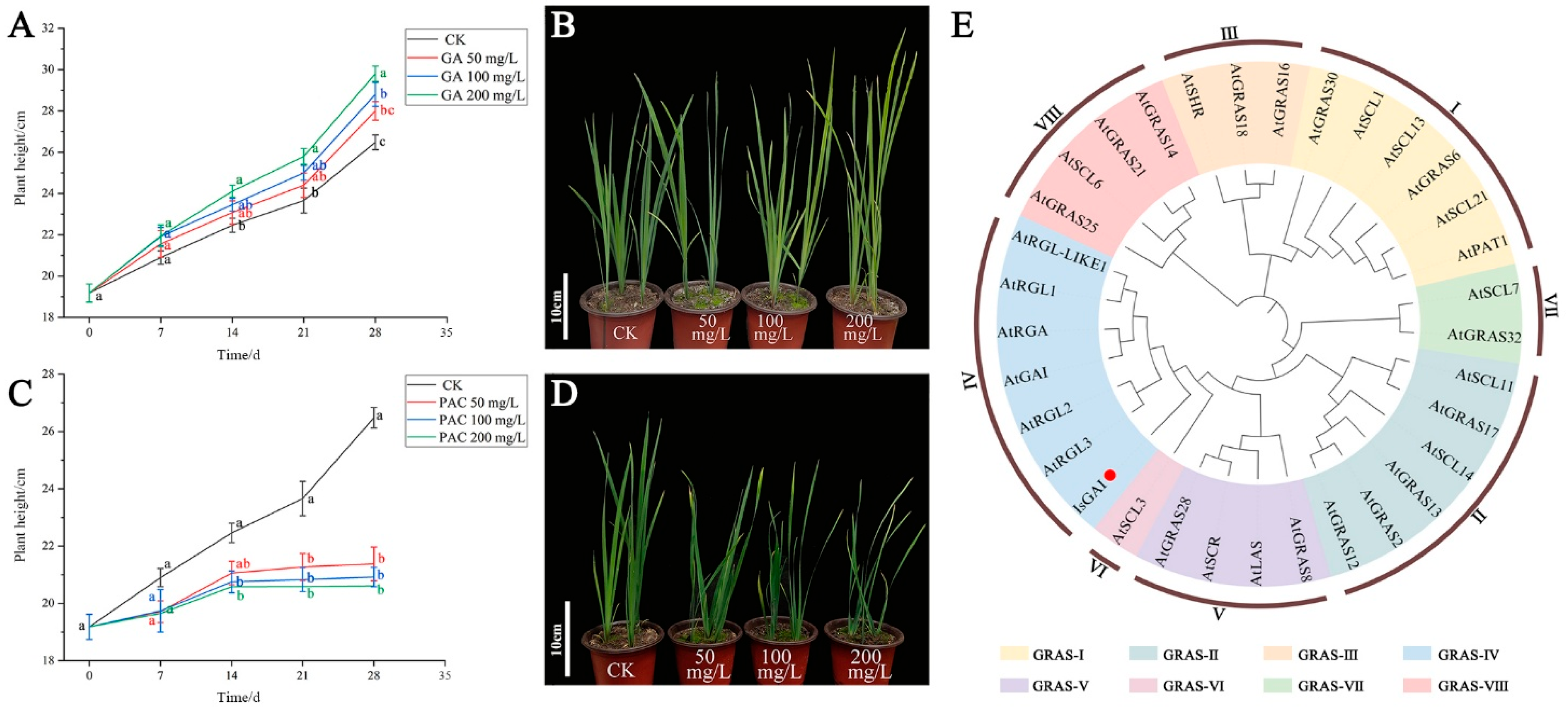
I. sanguinea seedlings were consecutively sprayed with GA four times. The results showed that, compared with CK, all three concentrations of exogenous GA promoted the growth of I. sanguinea, with the promoting effect increasing progressively. Compared to CK, the three treatments increased growth by 5.7%, 8.8%, and 12.7%, respectively (Figure 1A,B).

3.2. The Effect of Exogenous PAC Treatment on the Plant Height of I. sanguinea

I. sanguinea seedlings were consecutively sprayed with PAC four times. The results showed that, compared with CK, all three concentrations of exogenous PAC inhibited the growth of I. sanguinea. Among them, PAC at 200 mg·L−1 had the strongest inhibitory effect on the seedlings. Compared to CK, the three treatments reduced growth by 19.3%, 21%, and 22.2%, respectively (Figure 1C,D).

3.3. Gene Family Analysis of IsGAI

As shown in Figure 1E, the phylogenetic tree is divided into eight subclades, which is consistent with previous research findings. The IsGAI gene is classified into the GRAS-IV subfamily, indicating that it is homologous to the AtGAI gene and also belongs to the GRAS transcription factor family.

3.4. Cloning and Bioinformatics Analysis of IsGAI and IsGID1a

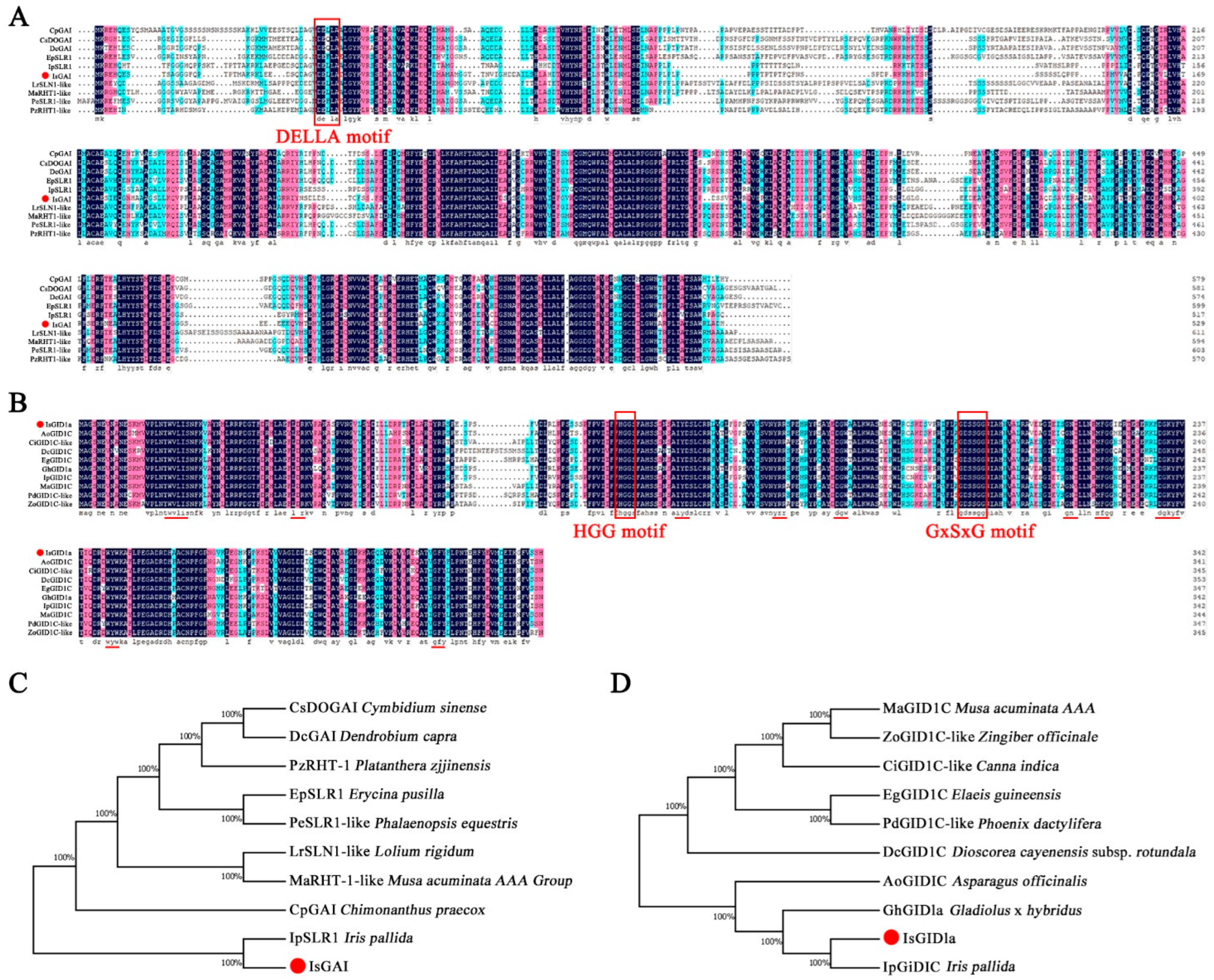
IsGAI (PV396834.1) and IsGID1a (PV396835.1) genes were cloned from the leaves of I. sanguinea. The ORF of IsGAI gene is 1590 bp, encoding a total of 529 amino acids, while the ORF of IsGID1a gene is 1032 bp, encoding 343 amino acids. The bioinformatics analysis results are presented in Table S5 and Figure S1. Homologous protein alignment results indicate that the N-terminal of IsGAI contains the hallmark motif of the DELLA conserved domain, and IsGID1a includes the characteristic HGG and GxSxG conserved domains, along with multiple binding sites for interaction with GA and DELLA proteins (Figure 2A,B). To investigate the functions of IsGAI and IsGID1a in regulating plant height, we constructed phylogenetic trees and found that IsGAI is most closely related to IpSLR1 from I. pallida, and IsGID1a is most closely related to IpGID1C from I. pallida (Figure 2C,D). Protein interaction prediction analysis shows that IsGAI has the highest homology with A. thaliana AtGAI, a key component of the GA signaling pathway, which directly interacts with proteins such as AtSLY1 and AtSPY to mediate GA signal transduction. Similarly, IsGID1a exhibits the highest homology with A. thaliana AtGID1a, the GA receptor in the GA signaling pathway, which directly interacts with proteins such as AtSCL14 and AtSLY1 to mediate GA signal transduction (Figure S1). It is predicted that IsGAI and IsGID1a proteins may be directly involved in GA signal transduction, thereby participating in plant growth and development.

3.5. Subcellular Localization

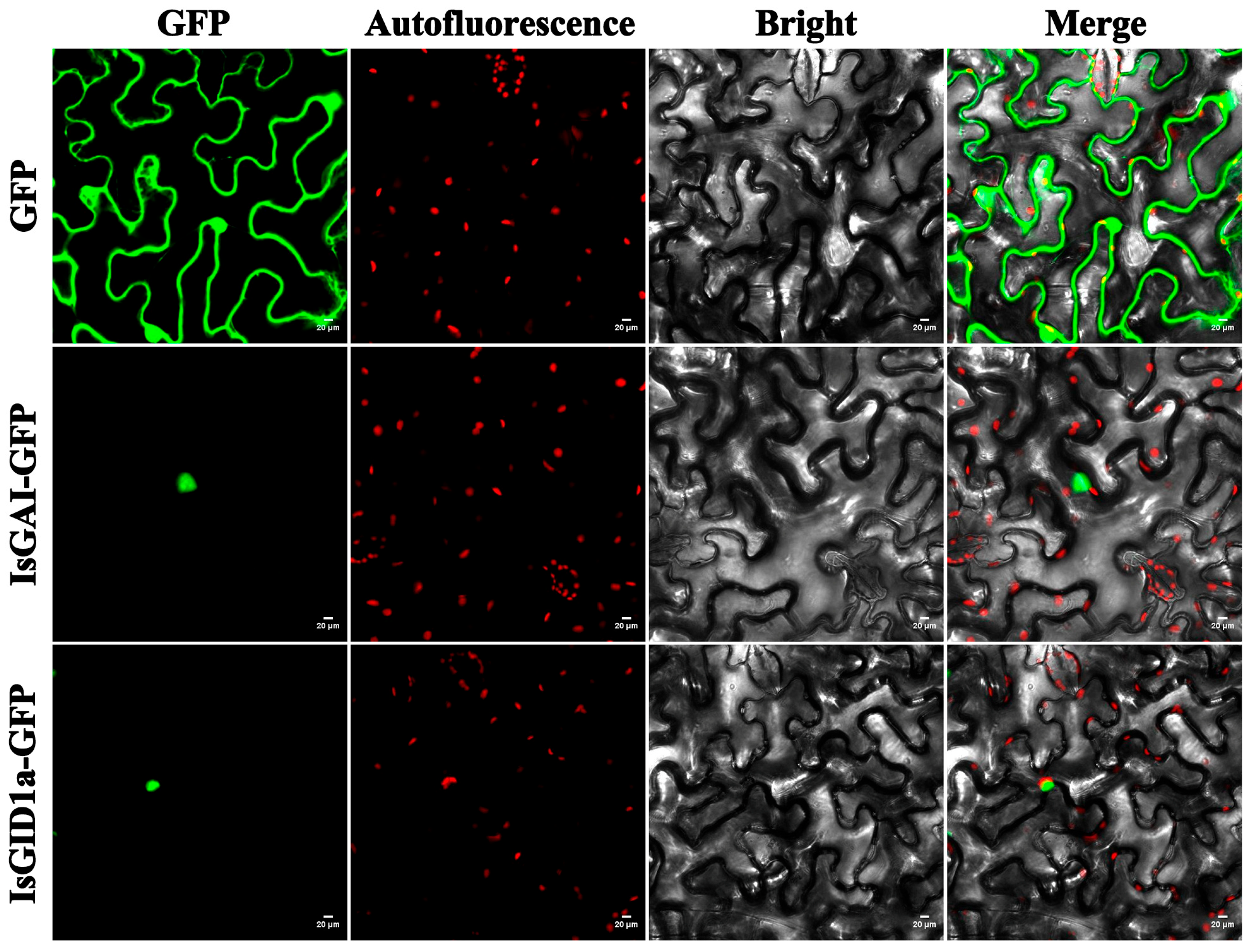
Transient expression of IsGAI and IsGID1a in the leaves of N. benthamiana revealed that both proteins are localized in the nucleus (Figure 3), supporting IsGAI roles as transcription factors (TFs), and the nuclear localization of IsGID1a is consistent with its involvement in the nuclear steps of GA signaling.

3.6. Construction of Plant Expression Vectors and Heterologous Transformation of A. thaliana

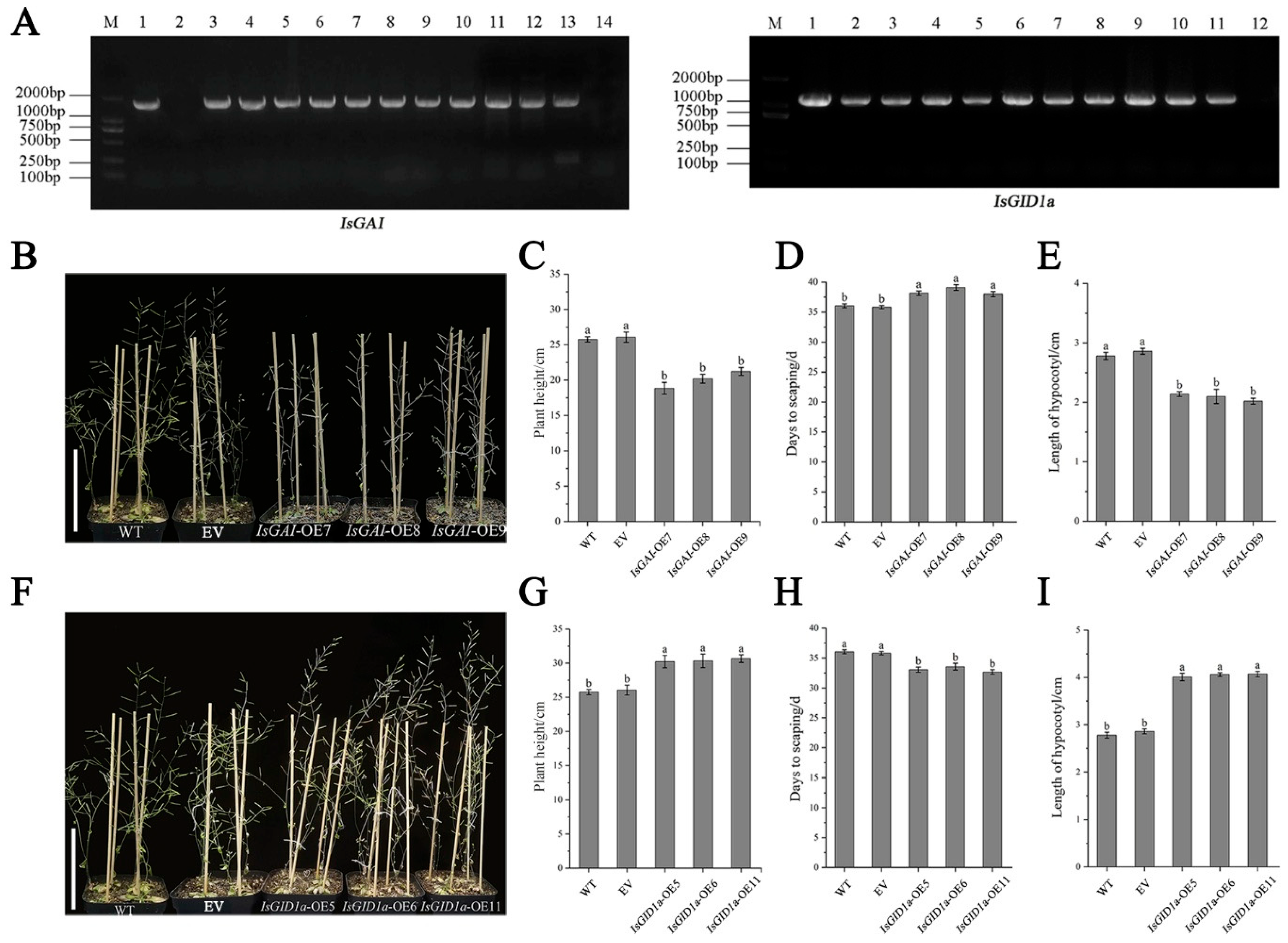
The plant overexpression vectors pCAMBIA1300-IsGAI-GFP and pCAMBIA1300-IsGID1a-GFP were constructed, and IsGAI and IsGID1a were introduced into A. thaliana via the floral dip method [25] (Figure 4A). The results showed that, compared with WT, after 60 days of growth, the height of OE-IsGAI plants was significantly reduced (p < 0.05), indicating that IsGAI suppresses plant height (Figure 4B,C). In contrast, the height of OE-IsGID1a plants was significantly increased (p < 0.05), indicating that IsGID1a promotes plant height (Figure 4F,G). Regarding the bolting time of A. thaliana, compared with WT, the bolting time of OE-IsGAI was significantly delayed (Figure 4D), while that of OE-IsGID1a was significantly advanced (Figure 4H). Additionally, compared with WT, the hypocotyl length of OE-IsGAI was significantly shortened, indicating that IsGAI inhibits hypocotyl elongation (Figure 4E), whereas the hypocotyl length of OE-IsGID1a was significantly increased, suggesting that IsGID1a promotes hypocotyl elongation (Figure 4I).

3.7. Exogenous GA Treatment of Overexpressing A. thaliana

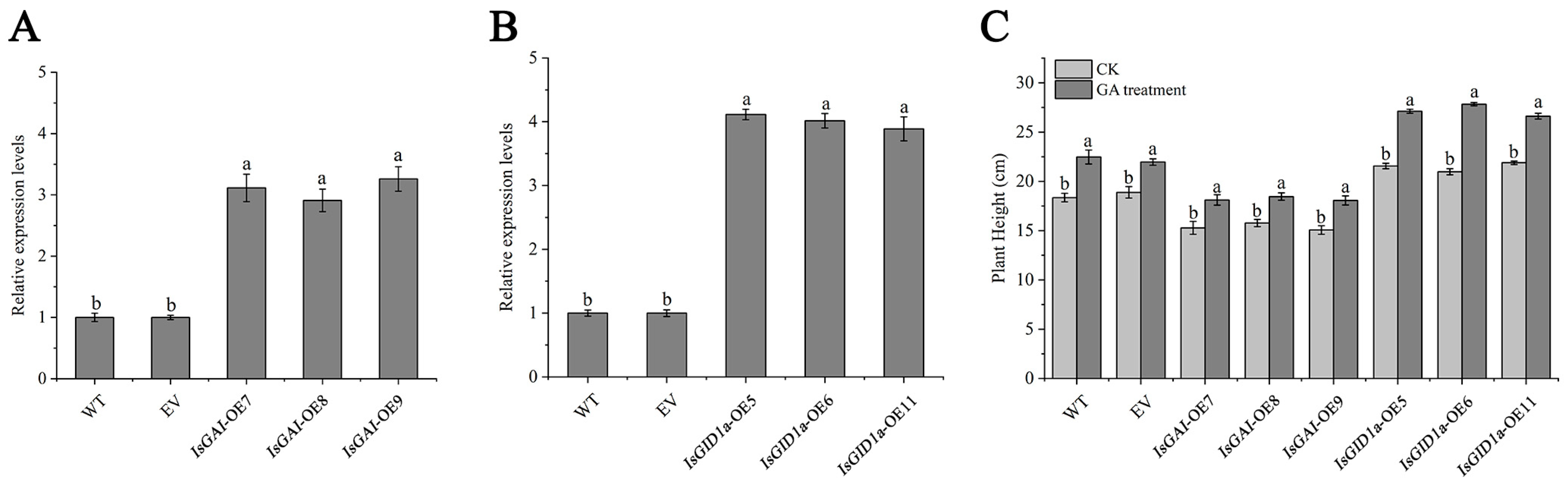
RT-qPCR analysis of A. thaliana overexpressing IsGAI and IsGID1a confirmed significant transgene expression across multiple independent transgenic lines (Figure 5A,B). OE-IsGAI, OE-IsGID1a, WT and EV plants were sprayed with GA. It was found that the dwarf phenotype caused by IsGAI overexpression was alleviated. However, compared with WT and EV, the promoting effect of GA on the height of OE-IsGAI A. thaliana was relatively lower. GA also promoted the growth of OE-IsGID1a A. thaliana plants, and its effect on increasing plant height was greater than that observed in WT and EV (Figure 5C). This indicates that exogenous GA can partially reverse the dwarfing effect of IsGAI gene on A. thaliana, while overexpression of IsGID1a gene enhances the sensitivity of A. thaliana plant height to exogenous GA.

4. Discussions

4.1. Exogenous GA and PAC Treatments Affect the Plant Height of I. sanguinea

GA is a common plant hormone, and exogenous application of GA can regulate plant height in various species [26,27]. In previous studies, Zhang [28] treated transgenic Chrysanthemum plants with exogenous GA3. When the transgenic plants were grown for 25 days, they were treated with 50 mg·L−1 GA3 for 21 days. It was found that the height of the transgenic plants increased by 78% compared to WT, and internode elongation was observed in the GA3-treated transgenic plants. Luo [29] used 100 μM exogenous GA to treat transgenic tomatoes overexpressing the SlZF3 gene and found that the plant height of the transgenic lines was nearly restored to that of the WT, indicating that SlZF3 regulates tomato plant height through the GA biosynthesis pathway rather than the GA signaling pathway. In this study, we found that exogenous application of GA significantly promoted plant height growth, and the three concentrations of exogenous 50 mg·L−1, 100 mg·L−1, and 200 mg·L−1 GA, showed increasing promotion of plant height in I. sanguinea, which is consistent with previous research findings.
PAC, as an inhibitory triazole-type plant growth regulator, can suppress GA biosynthesis and cell elongation. Currently, paclobutrazol, as a growth retardant, has been widely used in the regulation of plant growth and development [30,31]. For example, Ou [32] achieved dwarf cultivation of Chinese flowering cabbage (Brassica campestris L. ssp. chinensis var. utilis Tsen et Lee) by applying PAC, and the treated plants exhibited phenotypes of dwarfism and thickened stems. Zhang [33] treated fragrant rice seeds with three concentrations of paclobutrazol (PAC1: 20 mg·L−1; PAC2: 40 mg·L−1; PAC3: 80 mg·L−1) via seed soaking. The results showed that, compared with CK, paclobutrazol treatment reduced seedling height, increased stem diameter, and enhanced both fresh and dry weights of the fragrant rice seedlings. Consistent with previous studies, in this study, I. sanguinea plants treated with three concentrations of PAC (50 mg·L−1, 100 mg·L−1, and 200 mg·L−1) all showed dwarfing, demonstrating that paclobutrazol, as a GA biosynthesis inhibitor, can effectively suppress the height growth of I. sanguinea.

4.2. IsGAI and IsGID1a Regulate Plant Height

The GAI gene encodes the DELLA protein, which belongs to the plant-specific GRAS family and contains two highly conserved N-terminal domains, DELLA and TVHYNP, as well as a conserved C-terminal GRAS domain [34]. The N-terminal DELLA domain is crucial for GA-induced protein degradation. In the gai-1 mutant, a 17-amino-acid deletion in the DELLA domain prevents protein degradation, leading to plant insensitivity to GA and resulting in dwarfism and a late-flowering phenotype [35].
The IsGAI gene successfully cloned in this study possesses these domains and is confirmed to be homologous to GAI through bioinformatics analysis. In this study, functional analysis was performed by examining sequences highly similar to the GAI protein, combined with functional prediction of the IsGAI gene based on the Arabidopsis protein interaction network, suggesting that the IsGAI gene may influence plant height. To further validate gene function, a plant overexpression vector was constructed and transformed into GV3101, followed by floral dip transformation of A. thaliana. Phenotypic observation of the transgenic A. thaliana revealed that overexpression of IsGAI inhibited plant height growth, shortened hypocotyl length, and delayed flowering time. The dwarf phenotype of the transgenic lines was partially rescued by exogenous application of GA, which is consistent with previous research findings. Plant growth and development are regulated by multiple plant hormones. GA, one of the six major plant hormones, participates in various processes including seed germination, seedling growth, flowering transition, and seed maturation [36]. Numerous studies have demonstrated that GA promotes plant height increase, while DELLA proteins act as negative regulators in the GA signaling pathway [37], suppressing plant growth and development [38]. Previous studies consistently show that the GAI gene exerts inhibitory effects on plant growth. GA regulates cell cycle activity in the root meristem of A. thaliana through a DELLA-dependent mechanism, and expression of the GAI gene solely in the root meristem significantly reduces the number of dividing cells [39]. After transferring the AtGAI gene into rice, it was found that overexpression of the AtGAI gene in rice resulted in a dwarf phenotype [40]. Overexpression of the RcGAI1 gene from Rhus chinensis in A. thaliana resulted in significantly reduced plant height, dry weight, and stem diameter, as well as delayed flowering [41].
In this study, functional analysis was performed by examining sequences highly similar to the GID1a protein, combined with functional prediction of the IsGID1a gene based on the A. thaliana protein interaction network, suggesting that IsGID1a may influence plant height. IsGID1a includes the characteristic HGG and GxSxG conserved domains, along with multiple binding sites for interaction with GA and DELLA proteins. In gai or rga mutants lacking the DELLA motif completely lose their ability to bind GID1a, demonstrating that the N-terminal region of DELLA proteins, particularly the segment encompassing the conserved DELLA and VHYNP motifs, is essential for GID1 interaction [42].
To further validate gene function, a plant overexpression vector was constructed and transformed into A. tumefaciens GV3101, followed by floral dip transformation of A. thaliana. Phenotypic observation of the transgenic A. thaliana revealed that transgenic lines expressing IsGID1a exhibited increased plant height and hypocotyl length, earlier flowering, and enhanced sensitivity to GA, which is consistent with previous research findings.
GID1 is a key receptor in GA signaling pathway [43,44]. When active GA binds to the GID1 receptor, it promotes the degradation of DELLA proteins, thereby relieving their inhibitory effects on plant growth and development [45]. Previous studies have shown that the GID1 gene can promote plant growth [46]. Overexpression of GoGID1 from Galega orientalis resulted in increased plant height and biomass in transgenic A. thaliana, and the GoGID1 gene enhanced GA sensitivity in the transgenic plants [47]. A nonsense mutation in the PpeGID1C gene of peach can lead to developmental dwarfism [48]. OsGID1 is induced by stresses such as Nilaparvata lugens (BPH) feeding, and its overexpression enhances resistance to BPH in rice by promoting lignin accumulation, suppressing the expression of salicylic acid (SA) pathway-related genes, and increasing ethylene production [49].

4.3. GA Application Partially Restores Height in Transgenic Arabidopsis Plants

We observed that exogenous GA treatment only partially rescued the dwarf phenotype caused by IsGAI overexpression. This may be due to the fact that, in the GA signaling pathway, DELLA proteins are typically degraded via the SCFGID2/SLY1-mediated ubiquitin–proteasome pathway [50,51]. If the IsGAI protein is degraded more slowly in A. thaliana, even with exogenous GA application, residual IsGAI protein may persist and continue to repress downstream growth responses. Moreover, certain DELLA proteins can interact with transcription factors such as PIFs [52] and JAZ [53] to regulate growth or stress responses in a GA-independent manner. Therefore, overaccumulation of IsGAI may exert additional inhibitory effects through these non-canonical pathways that cannot be fully reversed by GA. Together, these observations suggest that IsGAI is not merely a negative regulator of GA signaling; its activity may also be finely modulated by post-translational modifications, protein interaction networks, or integration with multiple signaling pathways.
IsGID1a-overexpressing plants exhibited enhanced growth responses under the same GA concentration. GID1 is a soluble GA receptor that, upon binding GA, induces conformational changes in DELLA proteins and promotes their degradation. Overexpression of IsGID1a may increase the number of functional GA-GID1 complexes in cells, thereby accelerating DELLA degradation and amplifying GA signal output [54]. In summary, the function of IsGID1a extends beyond serving as a GA receptor; its expression level itself may represent a critical node in modulating GA signaling strength. This finding offers a novel strategy for future improvement of plant architecture in ornamental species through targeted regulation of GID1 gene expression.
Although our current study has elucidated the functional roles of IsGAI and IsGID1a in GA signaling through heterologous expression in A. thaliana, their transcriptional regulation within the native context of I. sanguinea remains uncharacterized. A critical question is whether IsGAI and IsGID1a exhibit direct transcriptional responses to GA or its biosynthesis inhibitor PAC. Addressing this will be a central focus of our future research. We plan to treat I. sanguinea seedlings with exogenous GA and PAC across a time-course gradient, followed by RT-qPCR or RNA-seq to systematically profile the expression dynamics of these genes. These analyses will determine whether their regulation conforms to the canonical GA signaling paradigm, where GA upregulates GID1 while repressing DELLA-encoding genes such as IsGAI, or whether I. sanguinea employs lineage-specific regulatory mechanisms. Integrating these transcriptional profiles with phenotypic and protein-level data will offer a more comprehensive understanding of the GA–GID1–DELLA module in non-model ornamental monocots and may uncover evolutionary adaptations in hormone signaling pathways unique to this clade. Moreover, the GA signaling pathway plays a conserved yet highly adaptable role in shaping plant architecture across diverse species. In other ornamental monocots, such as Lilium lancifolium [55] and Paphiopedilum callosum [56], the GA signaling pathway has been shown to directly influence key horticultural traits, including stem elongation, bulblet development, and flowering, thereby affecting their growth, development, and practical applications in production. Similarly, in the eudicot ornamental Chrysanthemum [28], adjusting plant height through GA pathway. Our study demonstrates that IsGAI and IsGID1a functionally integrate into the core GA signaling machinery in A. thaliana, indicating a conserved mechanism. Thus, this work not only provides the first functional evidence for these genes in Iris but also contributes to a deeper understanding of how GA pathway engineering can be leveraged to improve plant architecture in a wide range of ornamental species.

5. Conclusions

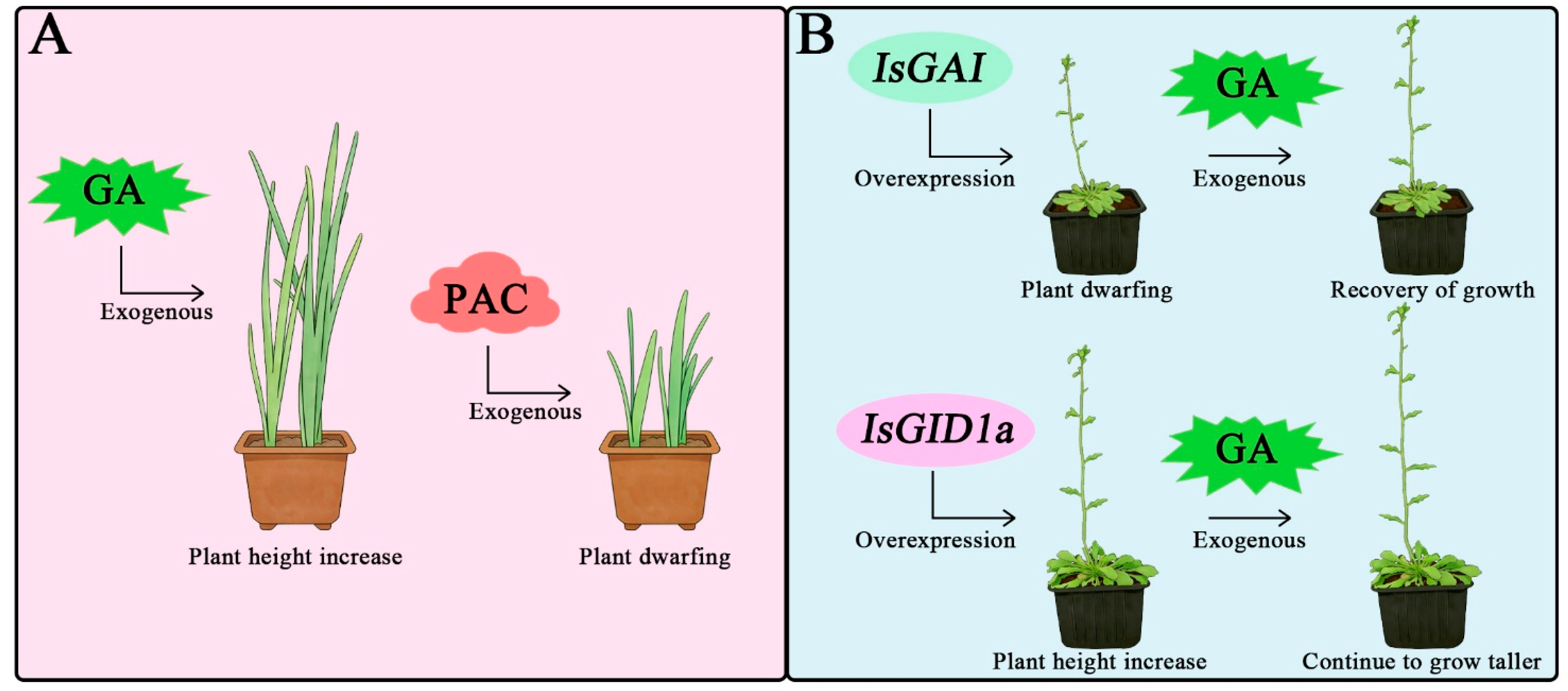
Our study elucidates the roles of GA and its biosynthesis inhibitor PAC in regulating the plant height of I. sanguinea. Exogenous GA promotes the growth of I. sanguinea seedlings, while exogenous PAC inhibits their growth. Therefore, two GA-related genes, IsGAI and IsGID1a, were cloned from I. sanguinea leaves. The plant overexpression vectors pCAMBIA1300-IsGAI-GFP and pCAMBIA1300-IsGID1a-GFP were constructed and transformed into A. thaliana. Heterologous expression of IsGAI suppressed the plant height increase in A. thaliana, shortened the hypocotyl, and delayed bolting. In contrast, heterologous expression of IsGID1a promoted the plant height increase in A. thaliana, elongated the hypocotyl, and advanced bolting. Exogenous GA treatment partially rescued the dwarf phenotype caused by IsGAI overexpression in A. thaliana. Additionally, heterologous expression of IsGID1a enhanced A. thaliana sensitivity to GA, further promoting plant height increase (Figure 6).

Supplementary Materials

The following supporting information can be downloaded at: https://www.mdpi.com/article/10.3390/horticulturae12050644/s1, Figure S1: Partial bioinformatics analysis of IsGAI and IsGID1a proteins. A represents IsGAI, and B represents IsGID1a; a: hydrophilicity analysis, b: transmembrane structure analysis, c: signal peptide analysis, d: glycosylation site analysis, e: phosphorylation site analysis, f: protein interaction prediction. Table S1: Primers for cloning of IsGAI gene and IsGID1a gene. Table S2: Online URLs for bioinformatics analysis of IsGAI gene and IsGID1a gene. Table S3: Homologous recombination primers. The underlined sequences are the homologous arms. Table S4: RT-qPCR primers of transgenic A. thaliana. Table S5: Partial physicochemical properties of IsGAI gene and IsGID1a gene.

Author Contributions

N.X.: Data curation, formal analysis, methodology, software, validation, writing—original draft, and writing—review and editing. G.S.: Formal analysis, software, visualization, and writing—review and editing. Y.D.: Investigation and software. H.F.: Data curation and methodology. L.W.: Conceptualization, funding acquisition, resources, supervision, and writing—review and editing. L.F.: Project administration, supervision, and writing—review and editing. All authors have read and agreed to the published version of the manuscript.

Funding

This research was financially supported by the National Natural Science Foundation of China, funding number: 32573063.

Data Availability Statement

All relevant data are contained within the paper.

Conflicts of Interest

The authors declare no conflicts of interest.

References

  1. Peng, J.; Harberd, N.P. The role of GA-mediated signalling in the control of seed germination. Curr. Opin. Plant Biol. 2002, 5, 376–381. [Google Scholar] [CrossRef]
  2. Dayan, J.; Voronin, N.; Gong, F.; Sun, T.P.; Hedden, P.; Fromm, H.; Aloni, A. Leaf-induced gibberellin signaling is essential for internode elongation, cambial activity, and fiber differentiation in tobacco stems. Plant Cell 2012, 24, 66–79. [Google Scholar] [CrossRef]
  3. Bao, S.; Hua, C.; Shen, L.; Yu, H. New insights into gibberellin signaling in regulating flowering in Arabidopsis. J. Integr. Plant Biol. 2020, 62, 118–131. [Google Scholar] [CrossRef]
  4. McAtee, P.; Karim, S.; Schaffer, R.; David, K. A dynamic interplay between phytohormones is required for fruit development, maturation, and ripening. Front. Plant Sci. 2013, 4, 79. [Google Scholar] [CrossRef]
  5. Shive, J.B.; Sisler, H.D. Effects of ancymidol (a growth retardant) and triarimol (a fungicide) on the growth, sterols, and gibberellins of Phaseolus vulgaris (L.). Plant Physiol. 1976, 57, 640–644. [Google Scholar] [CrossRef]
  6. Karimi, M.; Hashemi, J.; Ahmadi, A.; Abbasi, A.; Pompeiano, A.; Tavarini, S.; Guglielminetti, L.; Angelini, L.G. Opposing effects of external gibberellin and Daminozide on Stevia growth and metabolites. Appl. Biochem. Biotechnol. 2015, 175, 780–791. [Google Scholar] [CrossRef]
  7. Guo, D.; Chen, S.; Zhang, W.; Fan, J. Enantioselective effects of paclobutrazol and its enantiomers on glycolipid metabolism in zebrafish (Danio rerio). Pestic. Biochem. Physiol. 2023, 194, 105499. [Google Scholar] [CrossRef] [PubMed]
  8. Marei, A.H.; Higham, J.W.; Blinn, R.C. Cycocel plant growth regulant. Fate of carbon-14 chlorocholine chloride in sugarcane grown in Hawaii. J. Agric. Food Chem. 1975, 23, 1118–1120. [Google Scholar] [CrossRef] [PubMed]
  9. Qin, L.; Li, C.; Guo, C.; Wei, L.; Tian, D.; Li, B.; Wei, D.; Zhou, W.; Long, S.; He, Z.; et al. Integrated metabolomic and transcriptomic analyses of regulatory mechanisms associated with uniconazole-induced dwarfism in banana. BMC Plant Biol. 2022, 22, 614. [Google Scholar] [CrossRef] [PubMed]
  10. Xie, Z.; Jin, L.; Sun, Y.; Zhan, C.; Tang, S.; Qin, T.; Liu, N.; Huang, J. OsNAC120 balances plant growth and drought tolerance by integrating GA and ABA signaling in rice. Plant Commun. 2024, 5, 100782. [Google Scholar] [CrossRef]
  11. Dahal, P.; Wang, Y.; Hu, J.; Park, J.; Forker, K.; Zhang, Z.L.; Sharma, K.; Borgnia, M.J.; Sun, T.P.; Zhou, P. Structural insights into proteolysis-dependent and -independent suppression of the master regulator DELLA by the gibberellin receptor. Proc. Natl. Acad. Sci. USA 2025, 122, e2511012122. [Google Scholar]
  12. Ito, T.; Okada, K.; Fukazawa, J.; Takahashi, Y. DELLA-dependent and -independent gibberellin signaling. Plant Signal. Behav. 2018, 13, e1445933. [Google Scholar] [CrossRef]
  13. Hartweck, L.M.; Olszewski, N.E. Rice Gibberellin insensitive DWARF1 is a gibberellin receptor that illuminates and raises questions about GA signaling. Plant Cell 2006, 18, 278–282. [Google Scholar] [CrossRef]
  14. Liu, Q.; Wu, Y.; Zhang, X.; Song, M.; Peng, X. Cloning and functional identification of gibberellin receptor SvGID1s gene of Salix viminalis. Mol. Biotechnol. 2023, 65, 715–725. [Google Scholar] [CrossRef]
  15. Liang, Y.C.; Reid, M.S.; Jiang, C.Z. Controlling plant architecture by manipulation of gibberellic acid signalling in petunia. Hortic. Res. 2014, 1, 14061. [Google Scholar] [CrossRef]
  16. Wang, J.D.; Liu, Q.Q.; Li, Q.F. DELLA family proteins function beyond the GA pathway. Trends Plant Sci. 2025, 30, 352–355. [Google Scholar] [CrossRef] [PubMed]
  17. Itoh, H.; Matsuoka, M.; Steber, C.M. A role for the ubiquitin-26S-proteasome pathway in gibberellin signaling. Trends Plant Sci. 2003, 8, 492–497. [Google Scholar] [CrossRef]
  18. Chen, Y.; Zhang, M.; Wang, X.; Shao, Y.; Hu, X.; Cheng, J.; Zheng, X.; Tan, B.; Ye, X.; Wang, W.; et al. Peach DELLA protein PpeDGYLA is not degraded in the presence of active GA and causes dwarfism when overexpressed in poplar and Arabidopsis. Int. J. Mol. Sci. 2023, 24, 6789. [Google Scholar] [CrossRef] [PubMed]
  19. Zhao, H.; Sun, P.; Tong, C.; Li, X.; Yang, T.; Jiang, Y.; Zhao, B.; Dong, J.; Jiang, B.; Shen, J.; et al. CsIREH1 phosphorylation regulates DELLA protein affecting plant height in cucumber (Cucumis sativus). New Phytol. 2025, 245, 1528–1546. [Google Scholar] [CrossRef] [PubMed]
  20. Yan, B.; Yang, Z.; He, G.; Jing, Y.; Dong, H.; Ju, L.; Zhang, Y.; Zhu, Y.; Zhou, Y.; Sun, J. The blue light receptor CRY1 interacts with GID1 and DELLA proteins to repress gibberellin signaling and plant growth. Plant Commun. 2021, 2, 100245. [Google Scholar] [CrossRef]
  21. Shi, G.; Liu, G.; Liu, H.; Wang, L.; Kuwantai, A.; Du, Y.; Wang, L.; Xi, X.; Chai, R. A new glucosyltransferase UGT78 from Iris sanguinea is a putative negative regulator in cadmium stress response. J. For. Res. 2024, 35, 77. [Google Scholar] [CrossRef]
  22. Xu, N.; Wang, L.; Liu, H.; Wu, Y. ‘Yise Ziqun’: A New Iris sanguinea Cultivar. HortScience 2024, 59, 972–973. [Google Scholar] [CrossRef]
  23. Liu, G.; Liu, H.; Shi, G.; Xu, N.; Niu, Z.; Wang, L.; Zhao, R.; Wang, L.; Fan, L. Multi-omics analysis of Iris sanguinea with distinctive flower colors provides insights into petal coloration. Hortic. Plant J. 2025, 11, 1274–1290. [Google Scholar] [CrossRef]
  24. Collings, D.A. Subcellular localization of transiently expressed fluorescent fusion proteins. Methods Mol. Biol. 2013, 1069, 227–258. [Google Scholar]
  25. Clough, S.J.; Bent, A.F. Floral dip: A simplified method for Agrobacterium-mediated transformation of Arabidopsis thaliana. Plant J. 1998, 16, 735–743. [Google Scholar] [CrossRef]
  26. Wang, S.; Wang, Y. Harnessing hormone gibberellin knowledge for plant height regulation. Plant Cell Rep. 2022, 41, 1945–1953. [Google Scholar] [CrossRef] [PubMed]
  27. Xu, H.; Liu, Q.; Yao, T.; Fu, X. Shedding light on integrative GA signaling. Curr. Opin. Plant Biol. 2014, 21, 89–95. [Google Scholar] [CrossRef]
  28. Zhang, X.; Ding, L.; Song, A.; Li, S.; Liu, J.; Zhao, W.; Jia, D.; Guan, Y.; Zhao, K.; Chen, S.; et al. Dwarf and robust plant regulates plant height via modulating gibberellin biosynthesis in chrysanthemum. Plant Physiol. 2022, 190, 2484–2500. [Google Scholar] [CrossRef] [PubMed]
  29. Luo, J.; Tang, Y.; Chu, Z.; Peng, Y.; Chen, J.; Yu, H.; Shi, C.; Jafar, J.; Chen, R.; Tang, Y.; et al. SlZF3 regulates tomato plant height by directly repressing SlGA20ox4 in the gibberellic acid biosynthesis pathway. Hortic. Res. 2023, 10, uhad025. [Google Scholar] [CrossRef]
  30. Bawa, G.; Feng, L.; Chen, G.; Chen, H.; Hu, Y.; Pu, T.; Cheng, Y.; Shi, J.; Xiao, T.; Zhou, W.; et al. Gibberellins and auxin regulate soybean hypocotyl elongation under low light and high-temperature interaction. Physiol. Plant. 2020, 170, 345–356. [Google Scholar] [CrossRef] [PubMed]
  31. Wang, T.; Zhou, Q.; Wu, X.; Wang, D.; Yang, L.; Luo, W.; Wang, J.; Yang, Y.; Liu, Z. Arabidopsis thaliana E3 ligase AIRP4 is involved in GA synthesis. J. Plant Physiol. 2022, 277, 153805. [Google Scholar] [CrossRef]
  32. Ou, X.; Wang, Y.; Zhang, J.; Xie, Z.; He, B.; Jiang, Z.; Wang, Y.; Su, W.; Song, S.; Hao, Y.; et al. Identification of BcARR genes and CTK effects on stalk development of flowering Chinese cabbage. Int. J. Mol. Sci. 2022, 23, 7412. [Google Scholar] [CrossRef]
  33. Zhang, Y.; He, Z.; Xing, P.; Luo, H.; Yan, Z.; Tang, X. Effects of paclobutrazol seed priming on seedling quality, photosynthesis, and physiological characteristics of fragrant rice. BMC Plant Biol. 2024, 24, 53. [Google Scholar] [CrossRef]
  34. Sun, T.P.; Gubler, F. Molecular mechanism of gibberellin signaling in plants. Annu. Rev. Plant Biol. 2004, 55, 197–223. [Google Scholar] [CrossRef]
  35. Willige, B.C.; Ghosh, S.; Nill, C.; Zourelidou, M.; Dohmann, E.M.; Maier, A.; Schwechheimer, C. The DELLA domain of GA INSENSITIVE mediates the interaction with the GA INSENSITIVE DWARF1A gibberellin receptor of Arabidopsis. Plant Cell 2007, 19, 1209–1220. [Google Scholar] [CrossRef]
  36. Richards, D.E.; King, K.E.; Ait-Ali, T.; Harberd, N.P. How gibberellin regulates plant growth and development: A molecular genetic analysis of gibberellin signaling. Annu. Rev. Plant Physiol. Plant Mol. Biol. 2001, 52, 67–88. [Google Scholar] [CrossRef] [PubMed]
  37. Lantzouni, O.; Alkofer, A.; Falter-Braun, P.; Schwechheimer, C. Growth-regulating factors interact with DELLAs and regulate growth in cold stress. Plant Cell 2020, 32, 1018–1034. [Google Scholar] [CrossRef] [PubMed]
  38. Hynes, L.W.; Peng, J.; Richards, D.E.; Harberd, N.P. Transgenic expression of the Arabidopsis DELLA proteins GAI and gai confers altered gibberellin response in tobacco. Transgenic Res. 2003, 12, 707–714. [Google Scholar] [CrossRef]
  39. Ubeda-Tomas, S.; Federici, F.; Casimiro, I.; Beemster, G.T.S.; Bhalerao, R.; Swarup, R.; Doerner, P.; Haseloff, J.; Bennett, M.J. Gibberellin signaling in the endodermis controls Arabidopsis root meristem size. Curr. Biol. 2009, 19, 1194–1199. [Google Scholar] [CrossRef]
  40. Fu, X.; Sudhakar, D.; Peng, J.; Richards, D.E.; Christou, P.; Harberd, N.P. Expression of Arabidopsis GAI in transgenic rice represses multiple gibberellin responses. Plant Cell 2001, 13, 1791–1802. [Google Scholar] [CrossRef] [PubMed]
  41. Wang, H.; Li, J.; Liu, Z.; Wang, D. Dwarf phenotype induced by overexpression of a GAI1-like gene from Rhus chinensis. Plant Cell Tissue Organ Cult. 2022, 151, 617–629. [Google Scholar] [CrossRef]
  42. Griffiths, J.; Murase, K.; Rieu, I.; Zentella, R.; Zhang, Z.L.; Powers, S.J.; Gong, F.; Phillips, A.L.; Hedden, P.; Sun, T.P.; et al. Genetic characterization and functional analysis of the GID1 gibberellin receptors in Arabidopsis. Plant Cell 2006, 18, 3399–3414. [Google Scholar] [CrossRef]
  43. Hirano, K.; Ueguchi-Tanaka, M.; Matsuoka, M. GID1-mediated gibberellin signaling in plants. Trends Plant Sci. 2008, 13, 192–199. [Google Scholar] [CrossRef]
  44. Sun, T.P. The molecular mechanism and evolution of the GA-GID1-DELLA signaling module in plants. Curr. Biol. 2011, 21, R338–R345. [Google Scholar] [CrossRef]
  45. Harberd, N.P.; Belfield, E.; Yasumura, Y. The angiosperm gibberellin-GID1-DELLA growth regulatory mechanism: How an “inhibitor of an inhibitor” enables flexible response to fluctuating environments. Plant Cell 2009, 21, 1328–1339. [Google Scholar] [CrossRef] [PubMed]
  46. Sun, T.P. Gibberellin-GID1-DELLA: A pivotal regulatory module for plant growth and development. Plant Physiol. 2010, 154, 567–570. [Google Scholar] [CrossRef] [PubMed]
  47. Wang, X.; Li, J.; Ban, L.; Wu, Y.; Wu, X.; Wang, Y.; Wen, H.; Chapurin, V.; Dzyubenko, N.; Li, Z.; et al. Functional characterization of a gibberellin receptor and its application in alfalfa biomass improvement. Sci. Rep. 2017, 7, 41296. [Google Scholar] [CrossRef] [PubMed]
  48. Hollender, C.A.; Hadiarto, T.; Srinivasan, C.; Scorza, R.; Dardick, C. A brachytic dwarfism trait (dw) in peach trees is caused by a nonsense mutation within the gibberellic acid receptor PpeGID1c. New Phytol. 2016, 210, 227–239. [Google Scholar] [CrossRef]
  49. Chen, L.; Cao, T.; Zhang, J.; Lou, Y. Overexpression of OsGID1 enhances the resistance of rice to the brown planthopper Nilaparvata lugens. Int. J. Mol. Sci. 2018, 19, 2744. [Google Scholar] [CrossRef]
  50. Islam, S.; Park, K.; Xia, J.; Kwon, E.; Kim, D.Y. Structural insights into gibberellin-mediated DELLA protein degradation. Mol. Plant 2025, 18, 1210–1221. [Google Scholar] [CrossRef]
  51. Jmii, S.; Bouard, W.; Rochas, M.; Dragon, F.; Cappadocia, L. Structure-guided optimization of SLY1 expression and purification in Escherichia coli. Protein Sci. A Publ. Protein Soc. 2026, 35, e70592. [Google Scholar] [CrossRef]
  52. Zheng, Y.; Gao, Z.; Zhu, Z. DELLA-PIF Modules: Old Dogs Learn New Tricks. Trends Plant Sci. 2016, 21, 813–815. [Google Scholar] [CrossRef]
  53. Ye, Z.; Zheng, Z.; Wang, J.; Zhong, Q.; Mu, X.; Yuan, Z.; Huang, Y.; Ghazala, Z.; Zuo, H.; Li, Y.; et al. JA Regulates Caffeine Biosynthesis in Tea Leaf for Resistance Against Fungal Infection and Antagonises With GA to Balance the Defence-Growth Trade-Off via CsDELLA-JAZ-MYC2-MYB184-TCS1 Module. Plant Biotechnol. J. 2025, 23, 5865–5890. [Google Scholar] [CrossRef]
  54. Fukazawa, J.; Ito, T.; Kamiya, Y.; Yamaguchi, S.; Takahashi, Y. Binding of GID1 to DELLAs promotes dissociation of GAF1 from DELLA in GA dependent manner. Plant Signal. Behav. 2015, 10, e1052923. [Google Scholar] [CrossRef] [PubMed]
  55. Du, S.; Wang, M.; Liang, J.; Pan, W.; Sang, Q.; Ma, Y.; Jin, M.; Zhang, M.; Zhang, X.; Du, Y. Histological, Transcriptomic, and Functional Analyses Reveal the Role of Gibberellin in Bulbil Development in Lilium lancifolium. Plants 2024, 13, 2965. [Google Scholar] [CrossRef] [PubMed]
  56. Yin, Y.; Li, J.; Guo, B.; Li, L.; Ma, G.; Wu, K.; Yang, F.; Zhu, G.; Fang, L.; Zeng, S. Exogenous GA3 promotes flowering in Paphiopedilum callosum (Orchidaceae) through bolting and lateral flower development regulation. Hortic. Res. 2022, 9, uhac091. [Google Scholar] [CrossRef] [PubMed]
Figure 1. Plant height phenotype of I. sanguinea treated with different concentrations of exogenous GA and PAC. (A): Phenotypic statistics of plant height of I. sanguinea treated with different concentrations of exogenous GA, data are mean ± standard error, different lowercase letters indicate significant differences (p < 0.05); (B): Plant height phenotype of I. sanguinea treated with different concentrations of exogenous GA at 28 days, Bar = 10 cm; (C): Phenotypic statistics of plant height of I. sanguinea treated with different concentrations of exogenous PAC, data are mean ± standard error, different lowercase letters indicate significant differences (p < 0.05); (D): Plant height phenotype of I. sanguinea treated with different concentrations of exogenous PAC at 28 days, Bar = 10 cm; (E): Gene family analysis of IsGAI in A. thaliana, with the gene marked by the red circle being IsGAI gene.
Horticulturae 12 00644 g001
Figure 2. Homology alignment and phylogenetic tree of IsGAI and IsGID1a proteins. (A): Homology alignment of IsGAI protein; (B): Homology alignment of IsGID1a protein; (C): Phylogenetic tree of IsGAI; (D): Phylogenetic tree of IsGID1a.
Horticulturae 12 00644 g002
Figure 3. The subcellular localization of IsGAI and IsGID1a proteins. GFP: green fluorescent protein; Autofluorescence: chloroplast autofluorescence; Bright: Bright field; Merge: green fluorescence, chloroplast autofluorescence and bright field superposition.
Horticulturae 12 00644 g003
Figure 4. Phenotypic observation of OE-IsGAI and OE-IsGID1a in A. thaliana. (A): Agarose gel electrophoresis image for identification of OE-IsGAI and OE-IsGID1a positive seedlings; (B,C): Plant height and phenotypic images of OE-IsGAI A. thaliana, Bar = 10 cm; (D): Bolting time of OE-IsGAI A. thaliana; (E): Hypocotyl length of OE-IsGAI A. thaliana; (F,G): Plant height and phenotypic images of OE-IsGID1a A. thaliana, Bar = 10 cm; (H): Bolting time of OE-IsGID1a A. thaliana; (I): Hypocotyl length of OE-IsGID1a A. thaliana. Data are mean ± standard error, different lowercase letters indicate significant differences (p < 0.05).
Horticulturae 12 00644 g004
Figure 5. RT-qPCR results of transgenic A. thaliana and the effect of exogenous GA application on the plant height of transgenic A. thaliana. (A): Statistical analysis of IsGAI gene expression levels in IsGAI-transgenic A. thaliana; (B): Statistical analysis of IsGID1a gene expression levels in IsGID1a-transgenic A. thaliana; (C): Statistical analysis of plant height in IsGAI-transgenic A. thaliana and IsGID1a-transgenic A. thaliana under GA application. Histogram Data are mean ± standard error, different lowercase letters indicate significant differences (p < 0.05).
Horticulturae 12 00644 g005
Figure 6. Workflow. (A): A: Exogenous application of GA and PAC to I. sanguinea; (B): Heterologous transformation of A. thaliana with IsGAI and IsGID1a genes, followed by exogenous GA treatment of the transgenic A. thaliana.
Horticulturae 12 00644 g006
Disclaimer/Publisher’s Note: The statements, opinions and data contained in all publications are solely those of the individual author(s) and contributor(s) and not of MDPI and/or the editor(s). MDPI and/or the editor(s) disclaim responsibility for any injury to people or property resulting from any ideas, methods, instructions or products referred to in the content.