1. Introduction
Temperate fruits are predominantly cultivated in mid-latitude regions between 30° and 50° N, and S. Plum cultivation can extend to lower latitudes, down to approximately 15° N and S; however, the short dormancy period and insufficient accumulation of chilling hours in these areas may limit successful production [
1]. At higher latitudes, low winter and spring temperatures restrict plum cultivation, although large bodies of water can moderate the microclimate and create suitable conditions for commercial plum production [
2]. A good example of the latter case would be Norway, where commercial plum and other fruit production is possible in the southwestern fjord district and around lakes in the eastern part of the country, at latitude around 60° N [
3,
4].
Commercial cultivation of plums in the Baltic States, situated along the northeastern coast of the Baltic Sea, remains limited mainly because of low and highly variable temperatures during the winter–spring period [
5,
6]. This is reflected in statistical data: in Lithuania, plum orchards cover about 740 ha, in Latvia—70 ha, and in Estonia—20 ha [
7]. Nevertheless, expanding domestic fruit production is important for local economies, shortening supply chains and ecological sustainability. The global trend toward consuming locally produced food encourages the cultivation of more local fruits.
Cultivars and rootstocks form the foundation on which fruit-growing technologies are developed, and each of these components is subject to different requirements. Plum fruits can be used both for fresh consumption and for processing [
8]. The fresh fruit market is usually much more profitable. Plums grown for fresh consumption must be large, attractive, and tasty [
9]. Fruit intended for processing must meet certain biochemical and technological characteristics necessary for the appropriate processing method and a high-quality final product [
10,
11,
12].
The most cultivated plum cultivars in Europe belong to
Prunus domestica L., followed by
P. cerasifera Ehrh. [
13]. The choice of plum cultivars is quite large [
14], but their biological characteristics and economic significance usually vary depending on environmental conditions [
15,
16,
17,
18]. In some regions, only a limited number of cultivars are grown [
19], which already poses an obstacle to the successful development of the industry. Despite the risks associated with adaptability, the introduction of new cultivars is often successful [
20,
21], underscoring the continued need for cultivar testing in different climatic conditions. In northern climates, plant winter hardiness and tolerance to fluctuating temperatures are particularly important [
22,
23]. In Lithuania, both indigenous and introduced cultivars are cultivated [
24,
25,
26].
By choosing different rootstocks, growers can have different resources regarding tree survival, yield, and fruit quality. Because rootstock effects vary across environments, the interaction between rootstocks and local growing conditions can substantially influence long-term orchard performance [
27].
P. cerasifera seedlings are the most common rootstock for plums in Lithuania. Although the rootstock is characterized by vigorous growth, delayed yielding, low productivity and some other shortcomings [
28,
29], it is still widely used in leading plum-growing countries [
30,
31,
32]. The rootstock is most valued for its adaptability across diverse growing conditions [
33]. Proper rootstocks alleviate orchard maintenance, enhance fruit tree productivity and improve fruit quality. In search of a more dwarf and yield-efficient rootstock in Lithuania, seedlings of
P. tomentosa, clonal St. Julien A (
P. insititia L., selected at East Malling, United Kingdom), St. Julien GF 655-2 (
P. insititia L., selected at INRA, France), and Marianna GF-8 (
P. cerasifera Ehrh. ×
P. munsoniana Wight, selected at INRA, France) have been assessed, but none of them have surpassed standard
P. cerasifera [
34]. Recently, as a rootstock, ‘Wangenheim Prune’ (
P. domestica) seedlings have received good reviews in neighboring countries [
35,
36], where the dwarfing effect, precocity, and high yield efficiency of this rootstock have been emphasized. The aim of the present study was to evaluate the productivity and fruit quality of potentially important plum cultivars on
P. cerasifera and ‘Wangenheim Prune’ seedling rootstocks.
2. Materials and Methods
Planting material, experimental design, orchard management and soil conditions. A field experiment was carried out at the Institute of Horticulture, the Lithuanian Research Centre for Agriculture and Forestry from 2012 to 2020. One-year-old plum trees of the ‘Ave’, ‘Čačanska Najbolja’, ‘Čačanska Rana’, ‘Duke of Edinburgh’, ‘Jubileum’, ‘Kijevas Vēlā’, ‘Kubanskaya Kometa’, ‘Oda’, ‘Opal’, ‘Oullins Gage’, ‘Renklod Rannij Doneckij’, ‘Stanley’, ‘Valor’, ‘Violeta’ and ‘Zarechnaya Rannyaya’ (
Table S1) cultivars were used. The examined cultivars on
P. cerasifera Ehrh. and ‘Wangenheim Prune’ (
P. domestica L.) seedling rootstocks were planted in the experimental orchard in the spring of 2012. The experiment was designed in two adjacent blocks with the same soil type, for each rootstock separately and with cultivars randomly arranged within blocks. For fruit trees on ‘Wangenheim Prune’, a rootstock support system was established. Each scion–rootstock combination was represented with 4 plots including 3 fruit trees. Fruit trees on
P. cerasifera were planted 4.5 m × 2.5 m (889 trees/ha) apart, and for ‘Wangenheim Prune’, 4 m × 1.5 m (1667 trees/ha) apart. Fruit trees were trained as spindles. The orchard floor was maintained using a system that combined frequently mowed sward between the rows with 1.7 m-wide herbicide strips along the tree rows. The soil at the experiment site was Epicalcari–Endohypogleic cambisol, containing 255 mg kg
−1 of P
2O
5, 190 mg kg
−1 of K
2O, 7410 mg/kg of CaO, 1850 mg/kg of MgO, 2.8% of humus, pH
1MKCl—7.2. In the first three years, nitrogen fertilizers were applied every spring depending on the tree age at the rate of 50, 100 and 150 g of ammonium nitrate (33.4% N) per tree. In subsequent years, ammonium nitrate and potassium sulphate (50% K
2O) at the rate of 50 kg/ha N and 80 kg/ha K
2O were applied on herbicide strips.
Meteorological conditions. Meteorological conditions were favorable for most of the experiment. Exceptions were observed in the spring of 2017 and 2019. In 2017, the average air temperature (measured at a height of 2 m) in March exceeded the perennial average by 3.2 °C (
Table 1), and vegetation began earlier than usual. In the middle of April, cold weather settled, and the negative temperatures lasted for several hours per day. The minimum daily temperature reached −4.6 °C. Negative temperatures were recorded in April for 9 days. Negative temperatures were also recorded in May. The flower buds of most cultivars were damaged, and the harvest was very small. A similar situation was observed in 2019, when the temperature in March and April exceeded the standard temperature norm. During flowering, the temperature dropped to −3.2 °C and damaged the blossoms of the fruit trees.
Biometrical measurements. For growth assessment, trunk diameter measurements were performed each autumn at 25 cm above the graft union. In 2015–2020, in the spring, the weight of the pruned branches in each test plot was measured and converted into kg per tree. The number of fruit trees that survived is expressed as a percentage of the initial number of planted trees.
Yield and fruit quality. The yield of sound (marketable) fruits was recorded for the whole experimental plot and recalculated to t/ha. Fruits damaged by brown rot (
Monilinia spp.) were identified based on visual symptoms as described by Ogawa et al. [
37], harvested, and their quantity recalculated to t/ha. Cumulative yield efficiency was calculated as a sum of yield efficiencies in 2014–2020. Total yield, including sound and damaged fruit, was used for yield efficiency calculations. It is expressed as a fruit weight ratio with a trunk cross-section area (kg/cm
2 of TCSA).
Average fruit weight (g) was determined on a representative sample of 100 plums per each experimental plot. Laboratory measurements were conducted on random samples of 10 sound typical fruits from each experimental plot. Fruit flesh firmness (kg/cm2) was measured on two opposite equatorial positions of each fruit using a penetrometer (FT-53205 SP, TR Turoni, Forli, Italy) with an 8 mm diameter probe. After assessing firmness, fruit juice was extracted by homogenizing the fruit pulp in a blender. Soluble solids content (SSC, % Brix) was measured using a digital refractometer (ATAGO 101, Atago Co., Ltd., Tokyo, Japan). Sensory fruit quality was examined at harvest in 2015 and 2016 by a panel of 7–9 trained judges. Fruits from trees on ‘Wangenheim Prune’ rootstock were analyzed. Fruit appearance, stone adherence, taste and overall rating were rated on a scale of 1–5 points where 1 denotes the lowest quality and 5—the highest.
Agrochemical leaf analysis. The composite samples of 50 leaves from each test plot were collected for the analysis of leaf nutrient content in the first decade of August 2019–2020. One to two fully developed leaves were taken from the middle of current-season terminal shoots located on different sides of the tree canopy at a height of approximately 1.5 m. The cultivars ‘Čačanska Najbolja’ and ‘Opal’ were not included in the leaf analysis. Laboratory analyses were performed at the Agrochemical Research Laboratory of the Lithuanian Research Centre for Agriculture and Forestry, which is accredited according to the LST EN ISO/IEC 17025: 2018 standard [
38]. Leaf macronutrient (nitrogen (N), phosphorus (P), potassium (K), calcium (Ca) and magnesium (Mg)) and leaf micronutrient (iron (Fe), copper (Cu), manganese (Mn), zinc (Zn) and boron (B)) contents were measured. Leaf N content was measured via the Kjeldahl method using a DK 20 Tecator Digestion System (VelP Scientifica, Usmate, Italy) and a UDK139 Semi-Automatic Distillation Unit (VelP Scientifica, Usmate, Italy). Leaf P was quantified colorimetrically with the phosphomolybdovanadate method using a spectrophotometer (Metertech VIS SP-850 Plus; Metertech Inc., Taipei, Taiwan). Leaf K content was determined by flame photometry with a Jenway PFP7 (Bibby Scientific Limited, Stone, UK), and the contents of Ca and Mg by atomic absorption spectrophotometry using an AAnalyst 200 (Perkin Elmer, Shelton, CT, USA). Leaf Fe, Cu, Mn, Zn and B after digestion were extracted with aqua regia and determined with an inductively coupled plasma spectrometer ICP Optima 2100 (Perkin Elmer, Shelton, CT, USA). Macronutrient concentration is expressed as dry weight (DW) % and micronutrient concentration as mg kg
−1 DW.
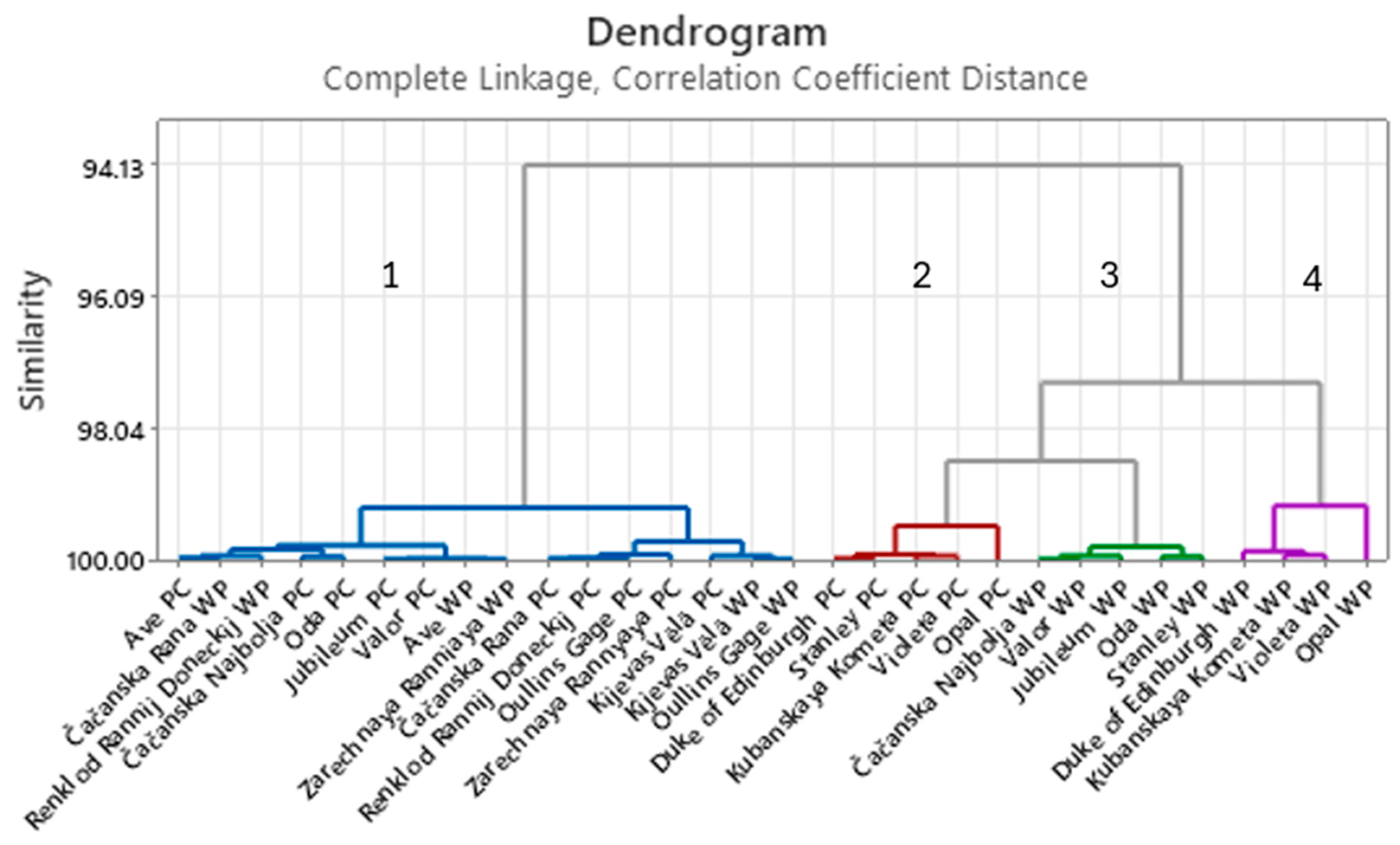
Statistical analysis. Data on biometrical traits, yield, instrumentally measured fruit-quality parameters, and leaf nutrient concentrations were analyzed using two-factor analysis of variance (ANOVA), while sensory fruit-attribute data were evaluated using one-way ANOVA. Statistical analyses, including calculation of the least significant difference (LSD) and Duncan’s multiple range test, were performed with the XLSTAT add-on. Mean comparisons were conducted using the LSD test at p ≤ 0.05 or Duncan’s multiple range test. All main tree and fruit characters were used for the clustering of cultivar–rootstock combinations into similarity groups using the statistical program Minitab® 16 (Minitab Ltd., Coventry, UK).
4. Discussion
Several theories explain how rootstock induces fruit tree dwarfing, including hormonal regulation, carbohydrate partitioning, nutrient and water transport, changes in vascular anatomy and gene expression. The most comprehensive research has been performed on apple rootstock effects on tree growth and productivity [
41]; emerging studies increasingly provide insights into the performance and physiological impacts of other rootstock species [
42].
Dwarf fruit trees are preferred when growing fruit for the fresh fruit market. Dwarf rootstocks facilitate orchard maintenance practices, particularly pruning and harvesting. In the present study, plum trees were trained to occupy their allocated canopy space, with tree height maintained at approximately 3.0 m on
P. cerasifera and 2.5 m on ‘Wangenheim Prune’. The results of the study confirmed the expectations that ‘Wangenheim Prune’ seedlings would reduce the growth of fruit trees, while our previous experiments searching for growth-controlling vegetative rootstocks were unsuccessful [
43]. Similar findings were reported in Norway, where ‘Wangenheim’ seedlings produced the smallest trees compared with several clonal rootstocks [
44]. Trunk cross-sectional area is commonly used to compare the growth of fruit trees because it is little affected by pruning and planting distances [
45]. The dwarfing effect depends on the scion–rootstock combination and can vary. ‘Wangenheim’ rootstocks proved to be dwarfing for the ‘Toptaste’ and ‘Topfive’ cultivars, compared to Myrobalan seedlings and some clonal rootstocks [
45]. In the Czech Republic, vigor reduction due to ‘Wangenheim’ rootstock was in the range 9.2–53.5% [
46]. In the Polish trials, ‘Wangenheim Prune’ seedlings also induced the weakest growth among six tested rootstocks [
47]. In our experiment, the ‘Wangenheim’ rootstock reduced the growth of fruit trees by 17–32%, providing further evidence that ‘Wangenheim Prune’ is an efficient growth-controlling rootstock.
Due to lower growth vigor, the average weight of pruned branches from fruit trees on ‘Wangenheim Prune’ rootstock was about 40% lower than that on
P. cerasifera. However, because planting density was higher on ‘Wangenheim Prune’ rootstock (1667 trees/ha vs. 889 trees/ha on
P. cerasifera), pruned biomass per plot was similar between rootstocks—1.7–1.8 t/ha. Similar data on pruned biomass have been provided even at low planting distances of 280 trees per ha [
48].
Based on trunk diameter, the ‘Opal’, ‘Čačanska Najbolja’, ‘Čačanska Rana’ and ‘Kijevas Vēlā’ cultivars could be classified as the most vigorous in our experiment. In addition, ‘Opal’ and ‘Čačanska Najbolja’ had the highest pruning mass, while fewer branches were pruned from ‘Čačanska Rana’ and ‘Kijevas Vēlā’. Fruit trees of ‘Ave’, ‘Jubileum’ and ‘Stanley’ were the least vigorous. Other studies also indicate that the cultivars ‘Čačanska Najbolja’ and ‘Čačanska Rana’ exhibit vigorous growth, whereas ‘Opal’ demonstrates intermediate vegetative growth, likely attributable to the rootstocks employed [
49]. Findings reported by Milošević and Milošević [
50] confirm our results, indicating that the cultivars ‘Čačanska Najbolja’ and ‘Čačanska Rana’ exhibit greater vegetative vigor compared with ‘Stanley’ or ‘Violeta’.
The longevity of fruit trees is a very important characteristic, as it ensures a good yield per unit area. All trees of the ‘Duke of Edinburgh’, ‘Kijevas Vēlā’, ‘Opal’, ‘Valor’ and ‘Zarechnaya Rannyaya’ cultivars survived on both tested rootstocks, while ‘Oda’ and especially ‘Violeta’ survived better on ‘Wangenheim Prune’ rootstock. The exact causes of tree dieback have not been determined; however, the available evidence suggests that it was most likely induced by environmental factors. Possible incompatibility with some cultivars on
P. cerasifera rootstock may also contribute to the decline [
29]. Some fruit trees of the ‘Kubanskaya Kometa’, ‘Renklod Rannij Doneckij’ and ‘Stanley’ cultivars were lost regardless of rootstocks, suggesting cultivar-dependent factors rather than the rootstock effect.
Trees of the ‘Kubanskaya Kometa’, ‘Violeta’ and ‘Opal’ cultivars produced the highest average yield of marketable fruits—more than 13 t/ha. ‘Ave’, ‘Čačanska Najbolja’, ‘Duke of Edinburgh’, ‘Jubileum’, ‘Stanley’ and ‘Valor’ also gave relatively good yields, while ‘Oullins Gage’, ‘Kijevas Vēlā’ and ‘Čačanska Rana’ were low yielding. These findings align with previous studies. In the conditions of western Serbia, the cultivars ‘Opal’, ‘Valor’, ‘Jubileum’ and ‘Victoria’ were also distinguished by good yields and were recognized as suitable for commercial cultivation [
51], while ‘Valor’ and ‘Jubileum’ were productive in Poland [
52,
53], and ‘Čačanska Najbolja’—in the Czech Republic [
54]. Similar to our results, low yields of ‘Čačanska Rana’ have also been recorded in other locations [
54,
55,
56]. The adaptability of fruit trees to specific soil and climatic conditions varies [
17,
18,
57]. Near Čačak, ‘Čačanska Rana’ was more productive than ‘Opal’ [
49] despite the opposite results in our study. The high yields of the diploid variety ‘Kubanskaya Kometa’ in our study are in the line with results from Latvia, where the cultivar produced about 20 t/ha [
6].
Fruit rot incidence was the highest in the ‘Čačanska Najbolja’, ‘Duke of Edinburgh’, ‘Valor’, ‘Stanley’, ‘Kijevas Vēlā’ and ‘Jubileum’ cultivars. ‘Kijevas Vēlā’, ‘Duke of Edinburgh’ and ‘Opal’ have been characterized as susceptible to fruit rots caused by
Monilinia spp. infections in Latvia, but ‘Jubileum’, on the contrary, was relatively resistant [
58]. Special fruit tree sprays against rots were not applied, so the marketable yield of the mentioned cultivars could likely be increased. The increased incidence of fruit rot in the ‘Opal’ cultivar on ‘Wangenheim Prune’ rootstock can be explained by the vigorous growth of fruit trees: their trunks had the largest diameter, and the fruit trees required the most intensive pruning. The period of leaf wetness is longer in denser canopies, which promotes infection [
59]. On average, of all cultivars, the rootstock effect on rot incidence was not revealed, except for ‘Opal’.
Despite a higher yield per tree on
P. cerasifera the average yield per unit area was nearly 40% higher on ‘Wangenheim Prune’ rootstock. The trial was planted at different distances because the tested rootstocks are known to differ in vigor. Dwarf rootstocks typically result in higher yield per unit area rather than per individual tree. The biggest yield differences were recorded for the ‘Čačanska Rana’, ‘Zarechnaya Rannyaya’ and ‘Renklod Rannij Doneckij’ cultivars, while ‘Čačanska Najbolja’, ‘Kijevas Vēlā, ‘Stanley’ and ‘Valor’ gave similar yields on both rootstocks. Since rootstock affects the growth of trees, fruit trees of weaker growth are planted more densely. In our experiment, fruit yield per tree on
P. cerasifera rootstock was higher, but due to the denser planting of fruit trees on ‘Wangenheim Prune’, the yield per unit area showed the opposite trend. Sitarek et al. [
60] also reported the highest cumulative yield per tree on
P. cerasifera seedlings and the lowest on ‘Wangenheim Prune’ seedlings. However, trees on ‘Wangenheim Prune’ seedlings had a higher productivity index.
Higher fruit tree yield efficiency on ‘Wangenheim Prune’ rootstock is an important advantage reported in other studies [
54,
61], including those conducted in the neighboring countries of Latvia, Estonia, and Belarus [
35]. Differences in yield efficiency among cultivars were also established. ‘Oullins Gage’ and ‘Čačanska Rana’ displayed low efficiency regardless of the tested rootstock, in line with previous studies [
54,
62]. According to Milatović et al. (2018) [
55], ‘Opal’ was almost twice as yield efficient as ‘Čačanska Rana’ when grown on
P. cerasifera rootstock, and this observation is consistent with our data. On the other hand, ‘Čačanska Rana’ and ‘Opal’ had similar yield efficiencies when grown on ‘Belosljiva’ (
P.domestica) rootstock in acidic soil conditions [
63]. Only ‘Valor’ was more efficient on
P. cerasifera rootstock; however, it is difficult to explain the actual reasons for the higher efficiency. A study conducted in Poland showed that ‘Valor’ yield efficiency is higher on ‘Wangenheim Prune’ rootstock [
60]. The same was reported in Czech trials [
46], though during some seasons, ‘Valor’ was more yield efficient on Myrobalan. Our study revealed significant differences in rootstock effect on ‘Valor’ leaf mineral content, pointing out that both rootstocks are not equally efficient in mineral transport; however, the nutrient concentration of both combinations fell within the optimal range and did not affect yield efficiency.
Yield-efficient cultivars in our study showed similar results in other locations: ‘Jubileum’ in western Norway [
44] and Poland [
47], and ‘Violeta’ and ‘Stanley’ in Serbia [
49,
50]. Different experimental conditions and methodologies may lead to somewhat different results, so a wider geography of research allows for a more complete picture.
In addition to tree yield and productivity, fruit quality remains a very important factor for consumer acceptance, with fruit size, appearance, taste, SSC and acidity strongly influencing fruit marketability and consumer decisions [
64,
65]. Large fruits are generally more appreciated for fresh consumption [
66]. In our study, ‘Kijevas Vēlā’ had the largest fruits, but the productivity of this cultivar with both tested rootstocks was very low. The fruit weight of ‘Čačanska Najbolja’, ‘Čačanska Rana’, ‘Oullins Gage’ and ‘Valor’ exceeded 50 g, and all except ‘Oullins Gage’ received high sensory evaluation scores. It should be noted that sensory evaluation in our study was carried out only on ‘Wangenheim Prune’ rootstock. Unfortunately, trees of ‘Čačanska Rana’ had low productivity. ‘Valor’ fruits also had the highest flesh firmness and SSC. Consumers’ acceptable plum flesh firmness is about 1.8–3.6 kg/cm
2 [
67]; for ‘Oullins Gage’, this value is at least 2 kg/cm
2 [
68]. Average fruit flesh firmness in our study fell within this range. In a study investigating consumer acceptance, Vangdal [
69] found that plums containing less than 12.5% soluble solids were not acceptable to most consumers. ‘Kubanskaya Kometa’, the only cultivar in our study that was below this limit, also produced soft fruits with a poor sensory rating. The ‘Opal’ cultivar, despite high productivity, produced small fruits, which makes them unattractive for fresh consumption. The rest of the productive cultivars ‘Duke of Edinburgh’, ‘Stanley’ and ‘Violeta’ produced fruits of similar weight—around 35–40 g—but sensory quality varied. The fruits of ‘Duke of Edinburgh’ and ‘Violeta’ were rated poorly, while ‘Stanley’ performed better, although tree mortality raises concerns for long-term cultivation. Despite moderate productivity, the cultivar ‘Oda’ should be mentioned for its quite good fruit quality.
Rootstocks differ in root system development. Scion cultivar and rootstock interact physiologically, so both rootstock and cultivar can affect leaf nutrient content [
70,
71]. Our experiment revealed a rootstock effect on leaf P, K, Ca, Mg, Cu, Mn and Zn content. A higher content of P, K, Ca and Mn was established in leaves from trees on
P. cerasifera rootstock, whereas Mg, Cu and Zn were higher on ‘Wangenheim Prune’. Rootstock–scion interaction on nutrient content was observed. Six cultivar–rootstock combinations were distinguished by significant differences in N, P and Zn content; 4 combinations—in K content; 2 combinations—in Ca, Mg and Zn content; and 1 combination—in Fe, Mn and B content. The most pronounced deviations from optimal nutrient levels were found for Fe and Mn, both of which were deficient across rootstocks. This may be attributed to the high soil pH, which inhibits Fe and Mn uptake [
72] because of bicarbonate ions present in calcareous, high-pH soil solutions. Font i Forcada et al. [
73] reported restricted uptake of these nutrients by plum and peach rootstocks, resulting in leaf concentrations below optimal levels but without visible deficiency symptoms, which was also observed in our study.
The average Mg and Zn content in the leaves of the
P. cerasifera rootstock was also deficient. Our observations confirm the information that ‘Wangenheim Prune’ rootstock has poorer potassium absorption than
P. cerasifera [
74]. K is the most accumulated nutrient in plum fruit [
75]. Researchers in central Poland have reported that trees grafted onto _
P. cerasifera_ rootstock exhibit a leaf potassium content of about 3.5% [
76], a level regarded as slightly excessive. Fruit K accumulation in heavily fruiting trees is usually accompanied by potassium depletion from leaves and perennial tree parts [
77]. The higher productivity of fruit trees on ‘Wangenheim Prune’ rootstock should be considered, and attention should be paid to a possible correction of K nutrition. While Olszewski et al. [
74] reported lower Mg uptake on ‘Wangenheim’, our study found the opposite pattern. Despite high Mg content in the soil, leaf Mg concentration was at the lower limit of the optimal range on ‘Wangenheim Prune’ and was less than optimum on
P. cerasifera rootstock.
Most deviations from the optimum of leaf macronutrients were observed in ‘Kijevas Vēlā’ and ‘Kubanskaya Kometa’, whereas optimal macronutrient content was found in ‘Čačanska Rana’, ‘Duke of Edinburgh’, ‘Renklod Rannij Doneckij’, ‘Valor’ and ‘Violeta’. Minor deficiencies occurred in ‘Oda’ and ‘Stanley’. The leaves of all cultivars were deficient in iron. ‘Duke of Edinburgh’ and ‘Violeta’ were deficient in Mn, and ‘Oda’ in Zn. The rest of the tested cultivars exhibited two to four micronutrient deficiencies.
Finally, the results from this mature orchard somewhat differ from earlier observations in the young orchard, where average fruit yield per plot and yield efficiency were higher on
P. cerasifera rootstock [
78]. This indicates that fruit trees on ‘Wangenheim Prune’ rootstock were not initially precocious, but yield efficiency and fruit tree productivity per plot area increased over time, surpassing
P. cerasifera rootstock. Overall, ‘Wangenheim Prune’ rootstock significantly reduced fruit tree vigor, enhanced yield efficiency and maintained good fruit quality, making it a more promising rootstock than earlier tested clonal rootstocks St. Julien A, St. Julien GF655/2 and Marianna GF8/1 [
34].