Differences in Characteristics of Biogenic Volatile Organic Compounds and Phytoncides Among Eight Subtropical Landscape Tree Species

Abstract
1. Introduction
- (1)
- Significant interspecific differences exist in the compositional and content characteristics of phytoncide release among eight subtropical landscape tree species.
- (2)
- Leaf functional traits are the key intrinsic factors influencing phytoncide release characteristics.
2. Materials and Methods
2.1. Study Site and Species
2.2. Sample Collection
2.3. Sample Analysis
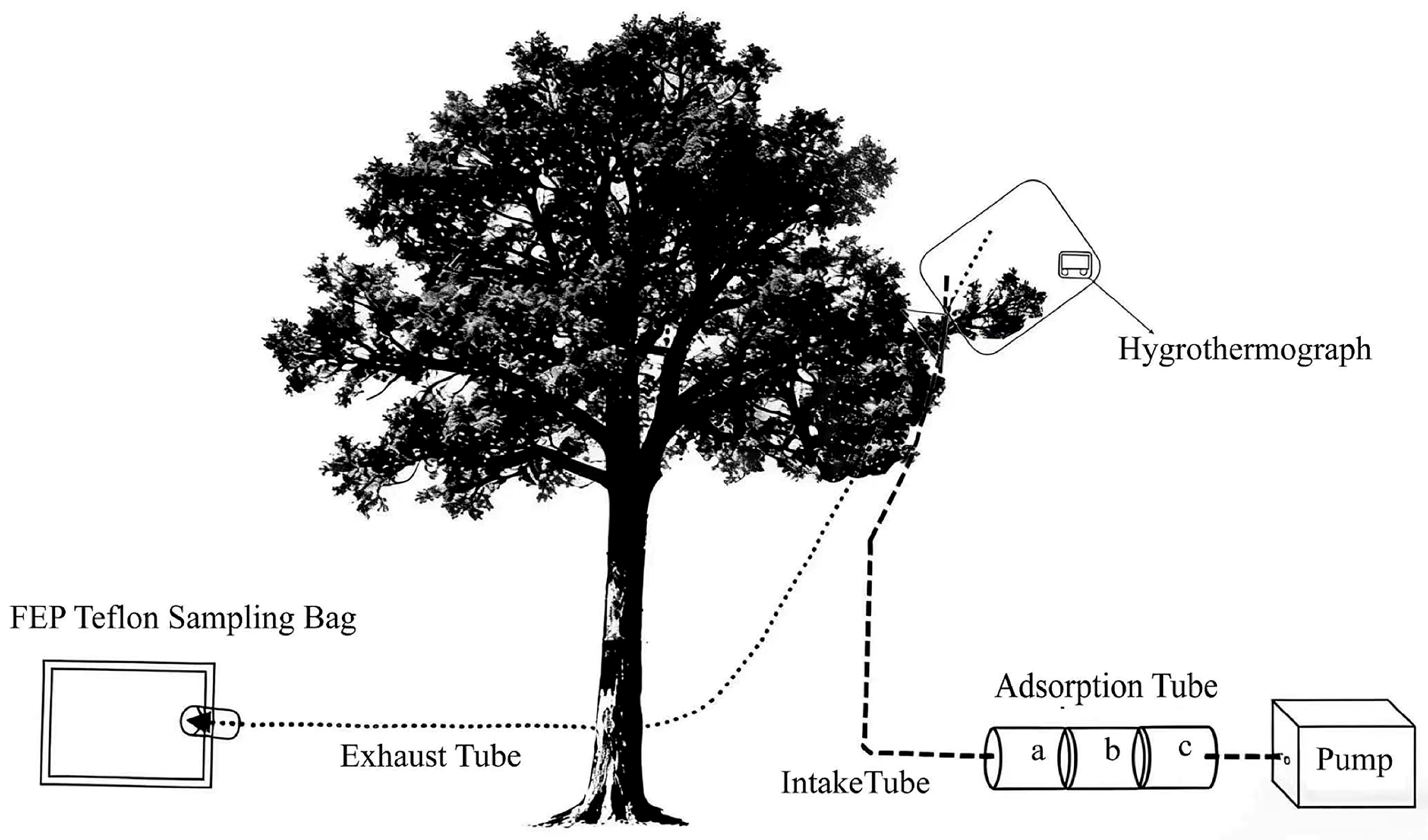
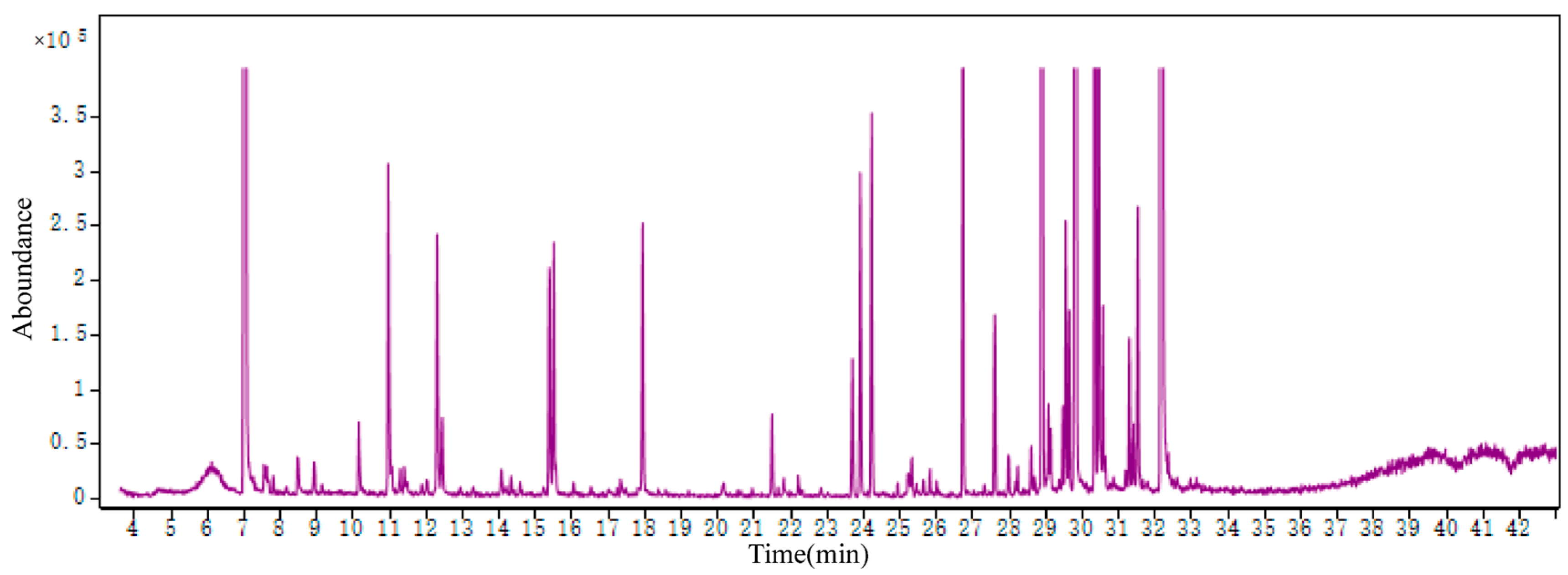
2.3.1. Gas Sample Extraction and Analysis
2.3.2. Leaf Functional Trait Analysis
2.4. Data Analysis
3. Results
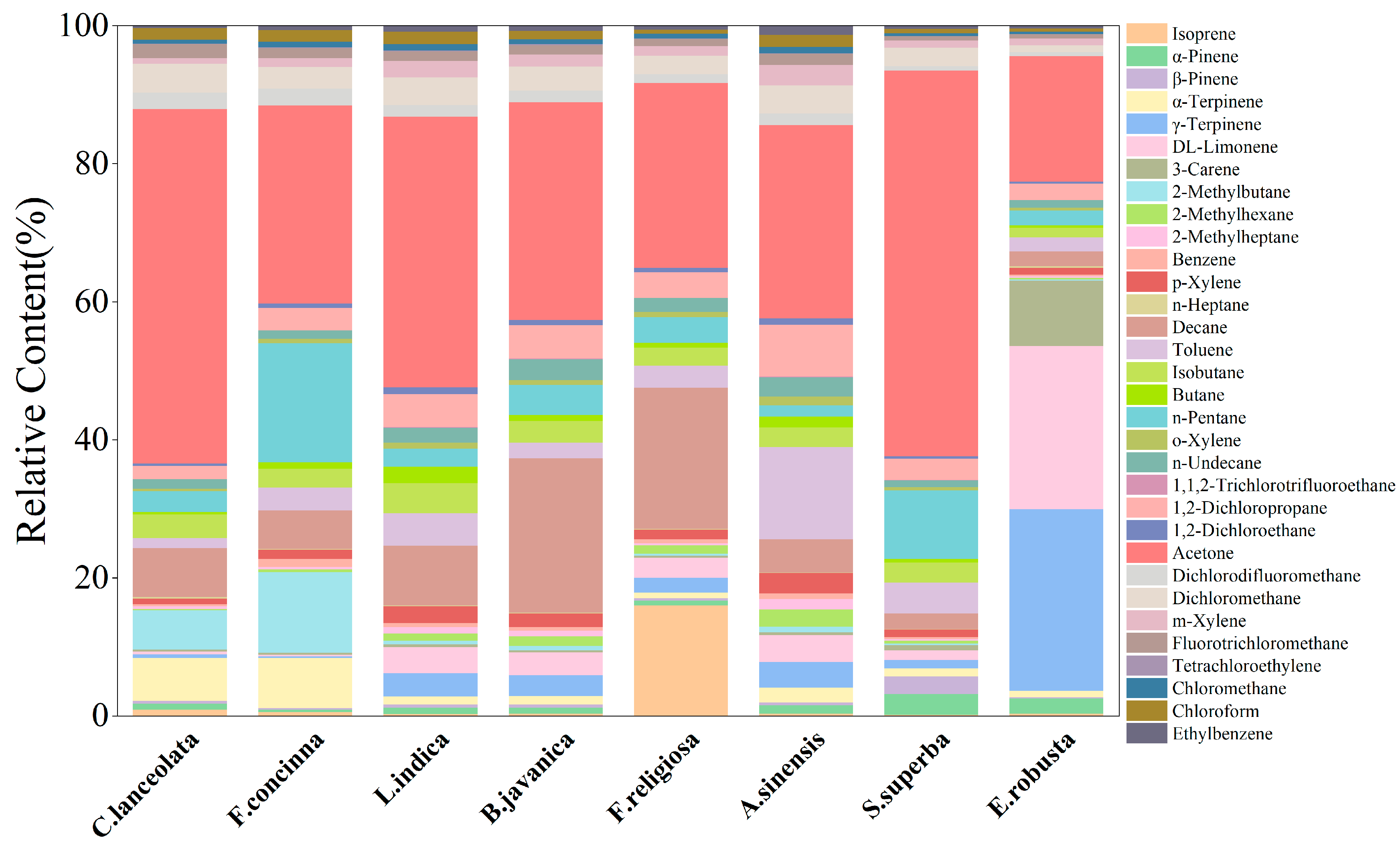
3.1. Differences in the Relative and Absolute Content of BVOCs Among Eight Subtropical Landscape Trees
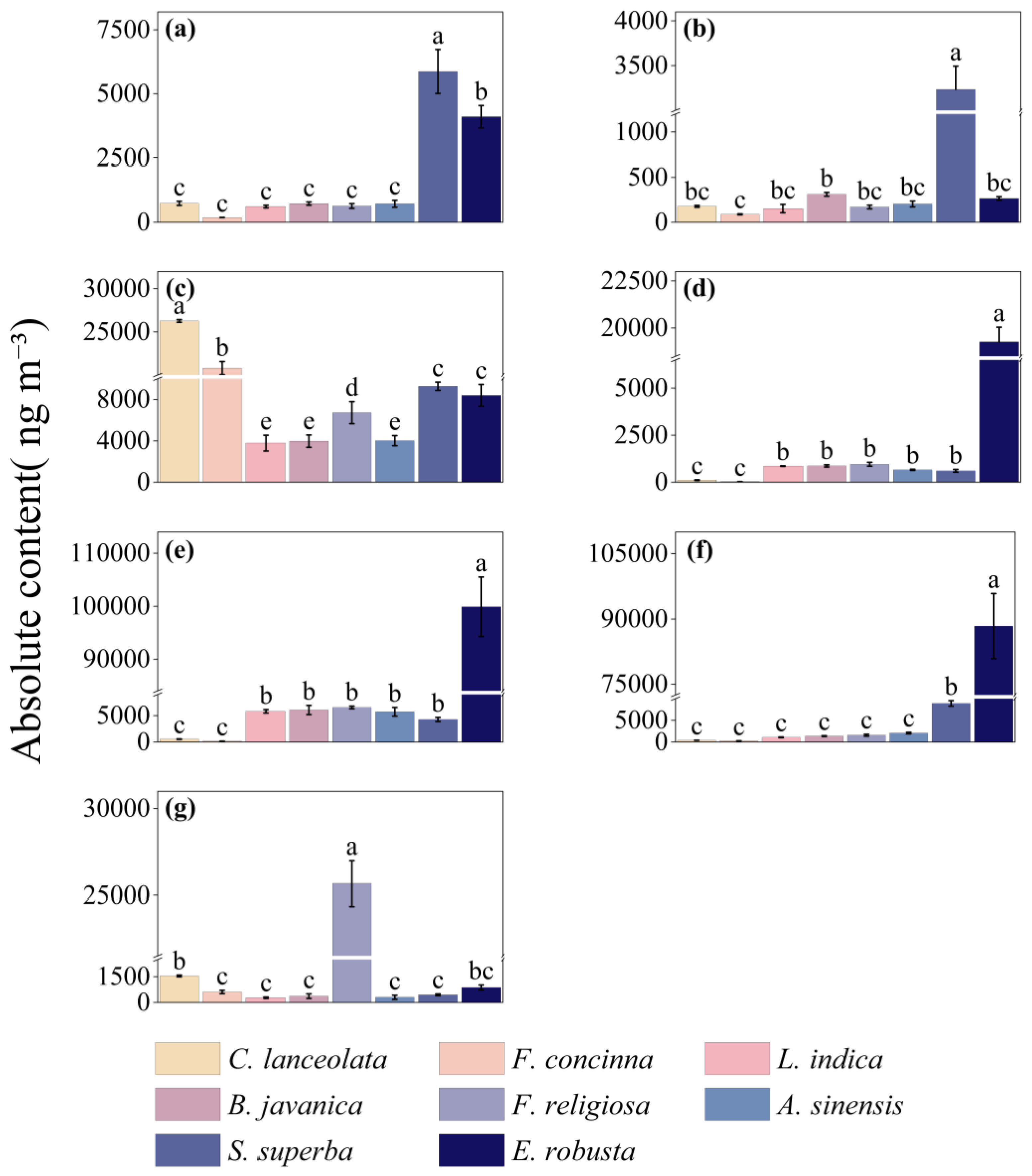
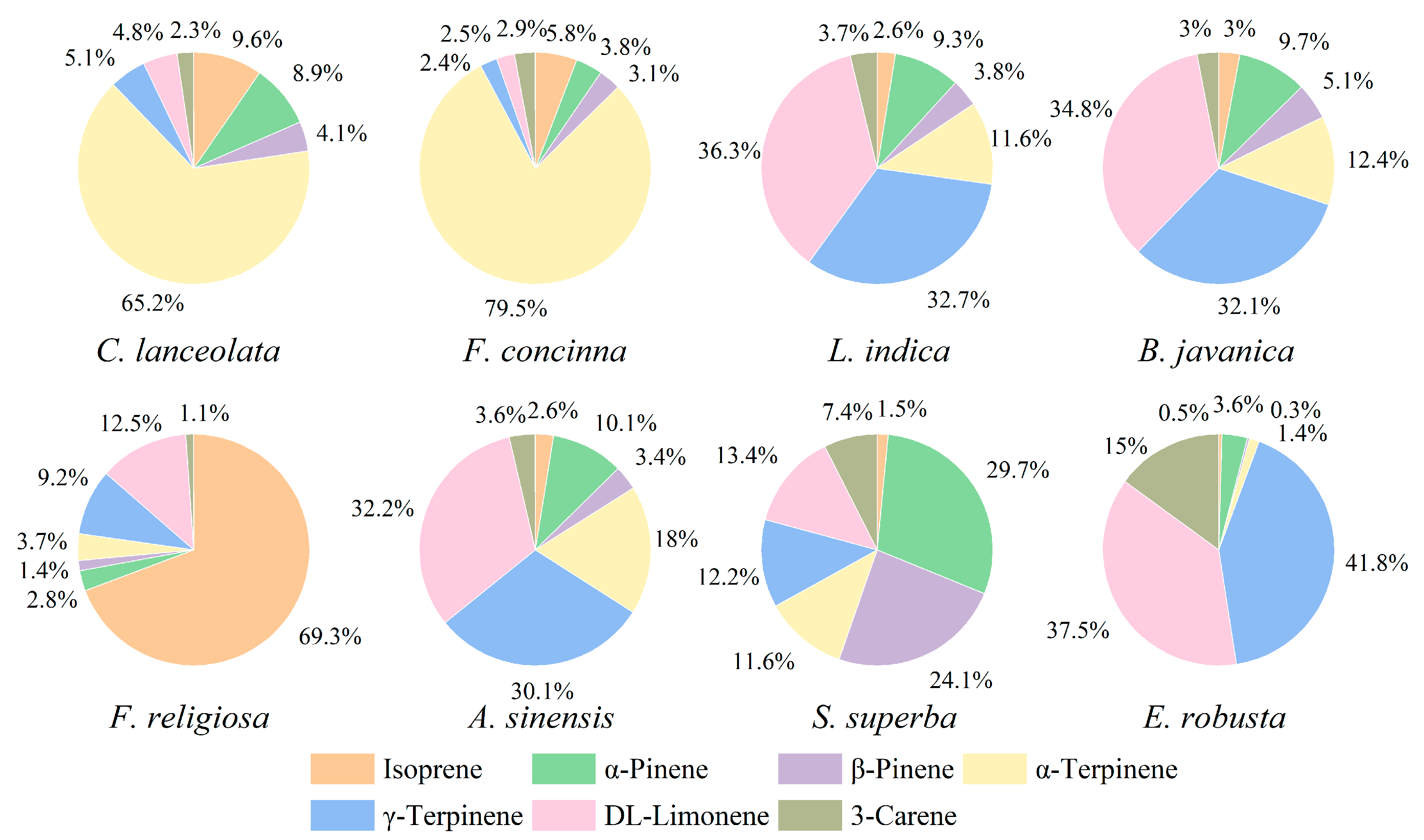
3.2. Differences in the Content of Seven Phytoncides Among Eight Subtropical Landscape Trees
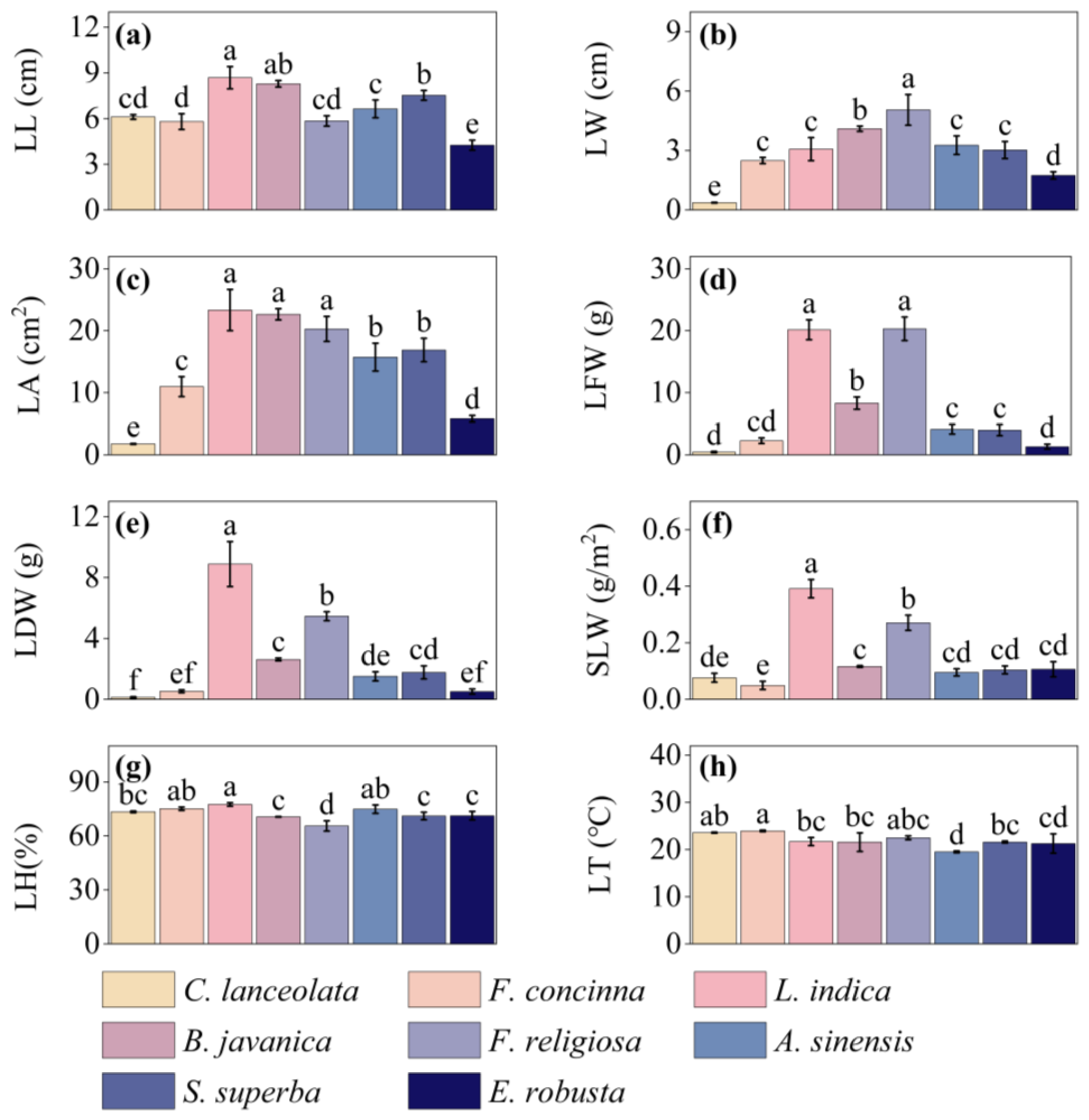
3.3. Differences in Leaf Functional Traits Among Eight Subtropical Landscape Trees
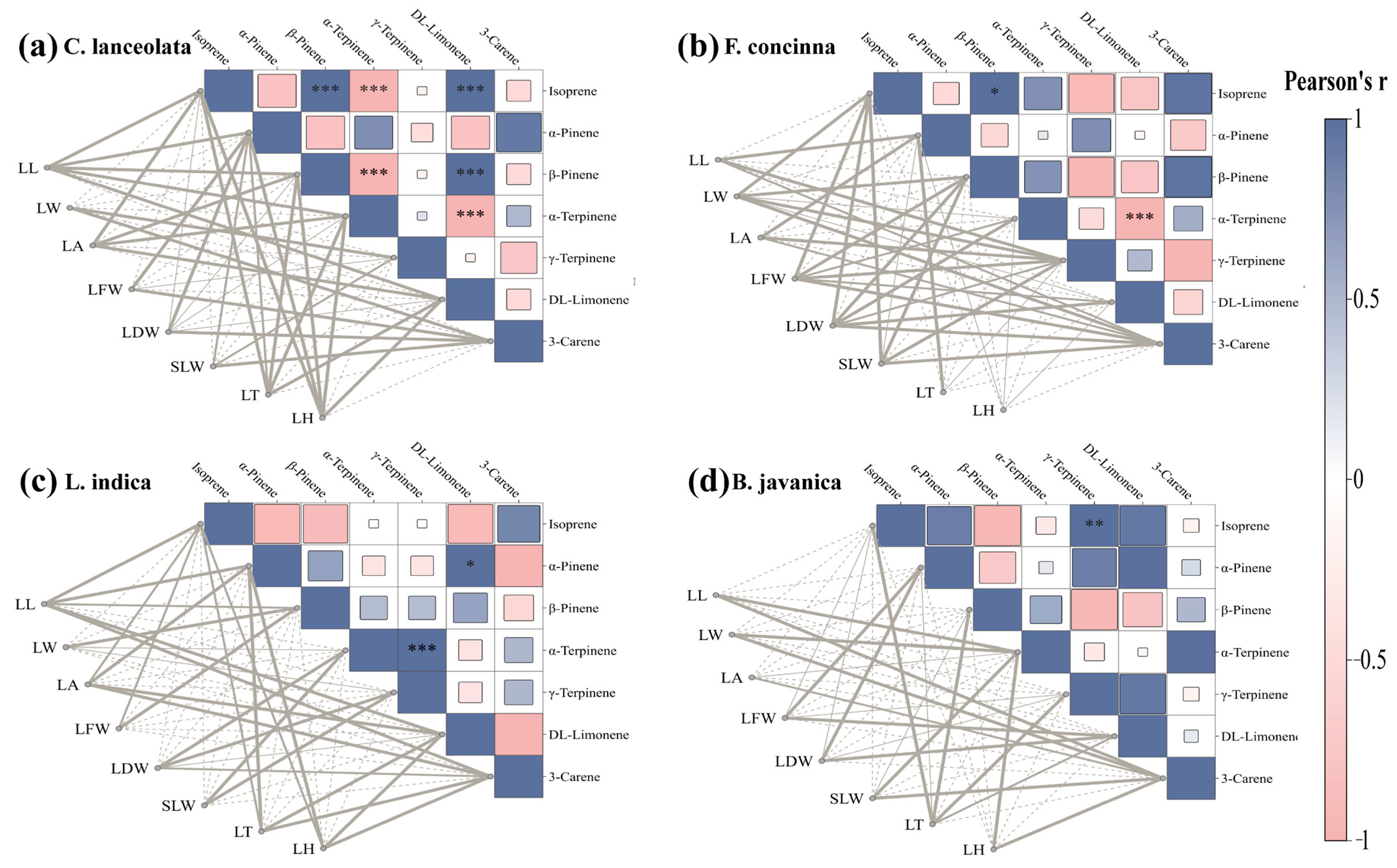
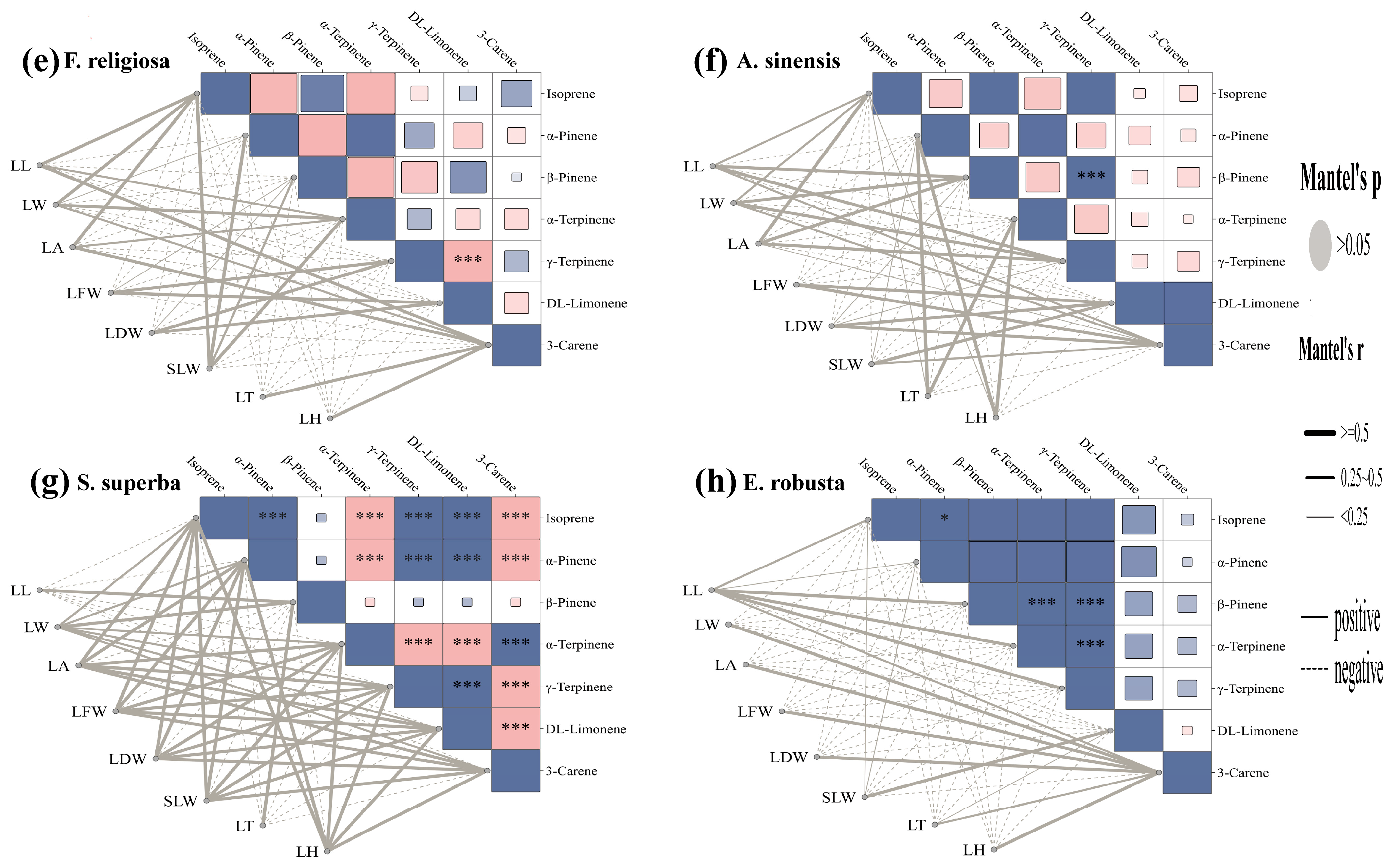
3.4. Correlations Among Phytoncides and Between Phytoncides and Leaf Functional Traits in Eight Subtropical Landscape Trees
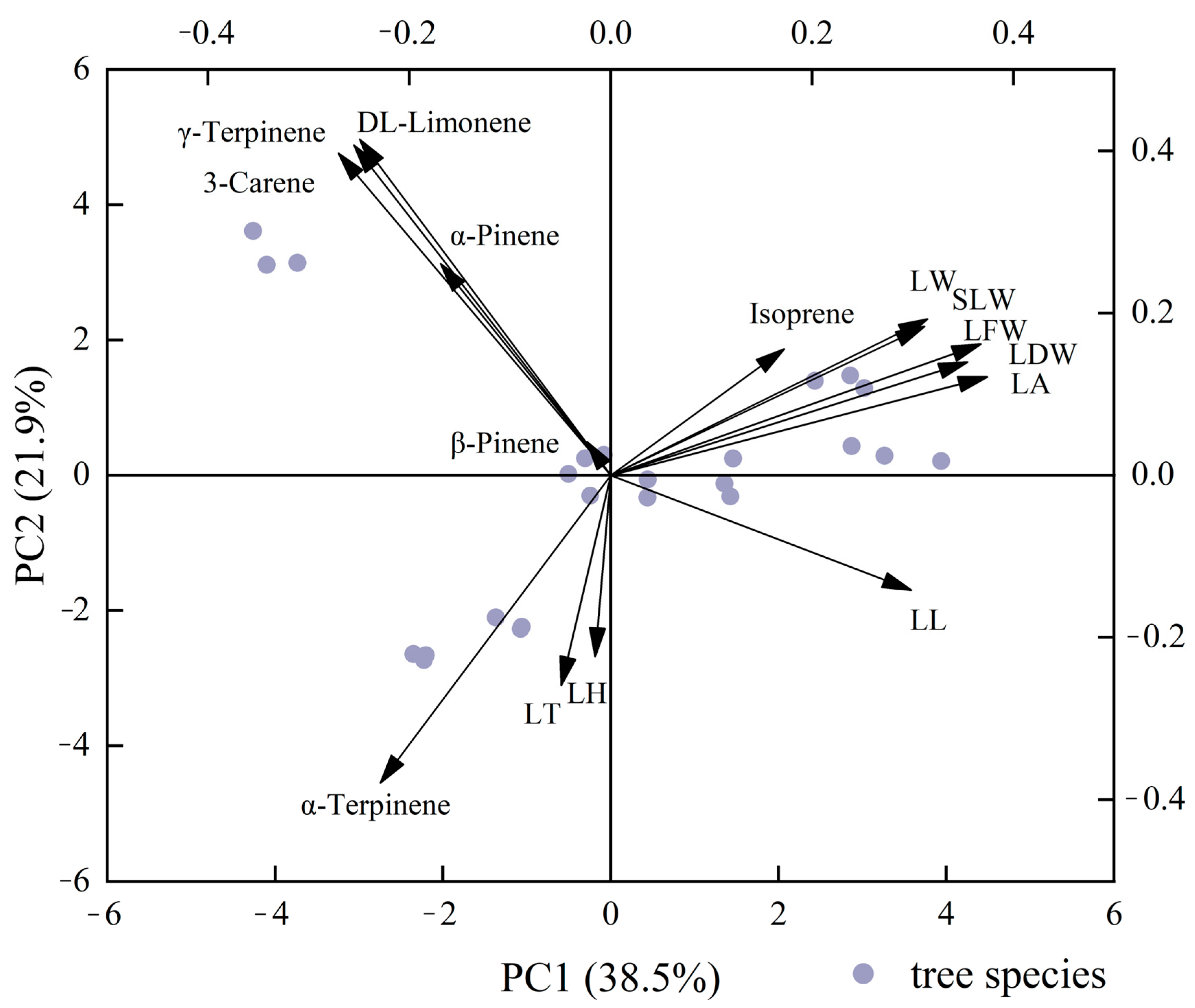
3.5. Multivariate Relationships Between Phytoncides and Leaf Functional Traits
4. Discussion
4.1. Interspecific Variation in BVOCs Release Characteristics Among Eight Subtropical Landscape Trees
4.2. Differences in Phytoncide Content, Therapeutic Potential, and Practical Considerations Among Eight Subtropical Landscape Trees
4.3. Correlative and Multivariate Analyses of Leaf Functional Traits and Phytoncide Content
5. Conclusions
Author Contributions
Funding
Data Availability Statement
Acknowledgments
Conflicts of Interest
References
- Montejano-Ramírez, V.; Ávila-Oviedo, J.L.; Campos-Mendoza, F.J.; Valencia-Cantero, E. Microbial volatile organic compounds: Insights into plant defense. Plants 2024, 13, 2013. [Google Scholar] [CrossRef] [PubMed]
- Mangotra, A.; Singh, S.K. Volatile organic compounds: A threat to the environment and health hazards to living organisms—A review. J. Biotechnol. 2024, 382, 51–69. [Google Scholar] [CrossRef]
- Loreto, F.; Schnitzler, J.-P. Abiotic stresses and induced BVOCs. Trends Plant Sci. 2010, 15, 154–166. [Google Scholar] [CrossRef]
- Kessler, A.; Mueller, M.B.; Kalske, A.; Chautá, A. Volatile-mediated plant-plant communication and higher-level ecological dynamics. Curr. Biol. 2023, 33, R519–R529. [Google Scholar] [CrossRef] [PubMed]
- Hallquist, M.; Wenger, J.C.; Baltensperger, U.; Rudich, Y.; Simpson, D.; Claeys, M.; Dommen, J.; Donahue, N.M.; George, C.; Goldstein, A.H. The formation, properties and impact of secondary organic aerosol: Current and emerging issues. Atmos. Chem. Phys. 2009, 9, 5155–5236. [Google Scholar] [CrossRef]
- Sindelarova, K.; Granier, C.; Bouarar, I.; Guenther, A.; Tilmes, S.; Stavrakou, T.; Müller, J.F.; Kuhn, U.; Stefani, P.; Knorr, W. Global data set of biogenic VOC emissions calculated by the MEGAN model over the last 30 years. Atmos. Chem. Phys. 2014, 14, 9317–9341. [Google Scholar] [CrossRef]
- Guenther, A.B.; Jiang, X.; Heald, C.L.; Sakulyanontvittaya, T.; Duhl, T.; Emmons, L.K.; Wang, X. The Model of Emissions of Gases and Aerosols from Nature version 2.1 (MEGAN2.1): An extended and updated framework for modeling biogenic emissions. Geosci. Model Dev. 2012, 5, 1471–1492. [Google Scholar] [CrossRef]
- Bao, X.; Zhou, W.; Xu, L.; Zheng, Z. A meta-analysis on plant volatile organic compound emissions of different plant species and responses to environmental stress. Environ. Pollut. 2022, 318, 120886. [Google Scholar] [CrossRef]
- Malik, T.G.; Gajbhiye, T.; Pandey, S.K. Plant specific emission pattern of biogenic volatile organic compounds (BVOCs) from common plant species of central India. Environ. Monit. Assess. 2018, 190, 631. [Google Scholar] [CrossRef]
- Choi, Y.; Kim, G.; Kim, S.; Cho, J.H.; Park, S. Real-time phytoncide monitoring in forests: A comparative study of SIFT-MS and conventional GC-MS methods. Forests 2023, 14, 2184. [Google Scholar] [CrossRef]
- Yang, W.; Cao, J.; Wu, Y.; Kong, F.; Li, L. Review on plant terpenoid emissions worldwide and in China. Sci. Total Environ. 2021, 787, 147454. [Google Scholar] [CrossRef]
- Li, Q.; Morimoto, K.; Nakadai, A.; Inagaki, H.; Katsumata, M.; Shimizu, T.; Hirata, Y.; Hirata, K.; Suzuki, H.; Miyazaki, Y.; et al. Forest bathing enhances human natural killer activity and expression of anti-cancer proteins. Int. J. Immunopathol. Pharmacol. 2007, 20, 3–8. [Google Scholar] [CrossRef] [PubMed]
- Wang, H.; Su, Z.; Deng, P.; Chen, L.; Yang, M.; Xu, X. Characterization of volatile organic compounds and aroma of eight bamboo species leaves. Horticulturae 2024, 10, 394. [Google Scholar] [CrossRef]
- Lew, T.; Fleming, K.J. Phytoncides and immunity from forest to facility: A systematic review and meta-analysis. Pharmacol. Res.-Nat. Prod. 2024, 4, 100061. [Google Scholar] [CrossRef]
- Donelli, D.; Meneguzzo, F.; Antonelli, M.; Ardissino, D.; Niccoli, G.; Gronchi, G.; Baraldi, R.; Neri, L.; Zabini, F. Effects of plant-emitted monoterpenes on anxiety symptoms: A propensity-matched observational cohort study. Int. J. Environ. Res. Public Health 2023, 20, 2773. [Google Scholar] [CrossRef]
- Antonelli, M.; Donelli, D.; Barbieri, G.; Valussi, M.; Maggini, V.; Firenzuoli, F. Forest volatile organic compounds and their effects on human health: A state-of-the-art review. Int. J. Environ. Res. Public Health 2020, 17, 6506. [Google Scholar] [CrossRef]
- Woo, J.; Yang, H.; Yoon, M.; Gadhe, C.G.; Pae, A.N.; Cho, S.; Lee, C.J. 3-Carene, a phytoncide from pine tree has a sleep-enhancing effect by targeting the GABAA-benzodiazepine receptors. Exp. Neurobiol. 2019, 28, 593–601. [Google Scholar] [CrossRef] [PubMed]
- Bach Pagès, A.; Peñuelas, J.; Clarà, J.; Llusià, J.; Campillo i López, F.; Maneja, R. How should forests be characterized in regard to human health? Evidence from existing literature. Int. J. Environ. Res. Public Health 2020, 17, 1027. [Google Scholar] [CrossRef]
- Li, Q.; Nakadai, A.; Matsushima, H.; Miyazaki, Y.; Krensky, A.M.; Kawada, T.; Morimoto, K. Phytoncides (wood essential oils) induce human natural killer cell activity. Immunopharmacol. Immunotoxicol. 2006, 28, 319–333. [Google Scholar] [CrossRef]
- Angioy, A.M.; Desogus, A.; Barbarossa, I.T.; Anderson, P.; Hansson, B.S. Extreme sensitivity in an olfactory system. Chem. Senses 2003, 28, 279–284. [Google Scholar] [CrossRef][Green Version]
- Baek, D.-H.; Seo, Y.-B.; Yu, S.-J.; Choi, I.-Y.; Lee, S.-W.; Son, Y.-S.; Dinh, T.-V.; Kim, J.-C. Comparison of biogenic volatile organic compounds emissions from representative urban tree species in South Korea and evaluation of standard emission rate models. Atmos. Environ. 2024, 333, 120654. [Google Scholar] [CrossRef]
- Bai, J.; Guenther, A.; Turnipseed, A.; Duhl, T.; Greenberg, J. Seasonal and interannual variations in whole-ecosystem BVOC emissions from a subtropical plantation in China. Atmos. Environ. 2017, 161, 176–190. [Google Scholar] [CrossRef]
- Kim, E.; Park, S.; Kim, S.; Choi, Y.; Cho, J.; Cho, S.; Chun, H.; Kim, G. Can different forest structures lead to different levels of therapeutic effects? A systematic review and meta-analysis. Healthcare 2021, 9, 1427. [Google Scholar] [CrossRef]
- Choi, Y.; Kim, G.; Park, S.; Lee, S.; Kim, S.; Kim, E. Statistical evidence for managing forest density in consideration of natural volatile organic compounds. Atmosphere 2021, 12, 1113. [Google Scholar] [CrossRef]
- Ciccioli, P.; Brancaleoni, E.; Frattoni, M.; Di Palo, V.; Valentini, R.; Tirone, G.; Seufert, G.; Bertin, N.; Hansen, U.; Csiky, O. Emission of reactive terpene compounds from orange orchards and their removal by within-canopy processes. J. Geophys. Res. Atmos. 1999, 104, 8077–8094. [Google Scholar] [CrossRef]
- Szafranek, B.; Chrapkowska, K.; Pawińska, M.; Szafranek, J. Analysis of leaf surface sesquiterpenes in potato varieties. J. Agric. Food Chem. 2005, 53, 2817–2822. [Google Scholar] [CrossRef]
- Yuan, Y.; Sun, Z.; Kännaste, A.; Guo, M.; Zhou, G.; Niinemets, Ü. Isoprenoid and aromatic compound emissions in relation to leaf structure, plant growth form and species ecology in 45 East-Asian urban subtropical woody species. Urban For. Urban Green. 2020, 53, 126705. [Google Scholar] [CrossRef]
- Jaakkola, E.; Hellén, H.; Olin, S.; Pleijel, H.; Tykkä, T.; Holst, T. Ozone stress response of leaf BVOC emission and photosynthesis in mountain birch (Betula pubescens spp. czerepanovii) depends on leaf age. Plant Environ. Interact. 2024, 5, e10134. [Google Scholar] [CrossRef] [PubMed]
- Cacciatore, S.; Mao, S.; Nunez, M.V.; Massaro, C.; Spadafora, L.; Bernardi, M.; Perone, F.; Sabouret, P.; Biondi-Zoccai, G.; Banach, M. Urban health inequities and healthy longevity: Traditional and emerging risk factors across the cities and policy implications. Aging Clin. Exp. Res. 2025, 37, 143. [Google Scholar] [CrossRef]
- Xu, Y.H.; Peng, W.J.; He, W.J.; Li, X.Y.; Wang, L.; Weng, Y.L.; Yan, X.L. The content and the diurnal dynamic changes of phytoncide in two garden tree species. J. Sichuan For. Sci. Technol. 2024, 45, 37–43. [Google Scholar]
- Ma, F.; Zhang, G.; Zhang, J.; Luo, X.; Liao, L.; Wang, H.; Tang, X.; Yi, Z. Isoprenoid emissions from Schima superba and Cunninghamia lanceolata: Their responses to elevated temperature by two warming facilities. Sci. Total Environ. 2024, 930, 172669. [Google Scholar] [CrossRef]
- Pei, D.; Wang, A.; Shen, L.; Wu, J. Research on the emission of biogenic volatile organic compounds from terrestrial vegetation. Atmosphere 2025, 16, 885. [Google Scholar] [CrossRef]
- Persson, Y.; Schurgers, G.; Ekberg, A.; Holst, T. Effects of intra-genotypic variation, variance with height and time of season on BVOC emissions. Meteorol. Z. 2016, 25, 377–388. [Google Scholar] [CrossRef]
- Zeng, J.; Zhang, Y.; Pang, W.; Ran, H.; Mu, Z.; Guo, H.; Lu, Y.; Song, W.; Wang, X. Decoupling temperature and light effects on terpene emissions from subtropical eucalyptus: Insights from controlled field experiments. J. Geophys. Res. Atmos. 2025, 130, e2024JD042616. [Google Scholar] [CrossRef]
- Yuan, Y.; Mao, Y.; Yuan, H.; Guo, M.; Zhou, G.; Niinemets, Ü.; Sun, Z. Impacts of mechanical injury on volatile emission rate and composition in 45 subtropical woody broad-leaved storage and non-storage emitters. Plants 2025, 14, 821. [Google Scholar] [CrossRef] [PubMed]
- Yuan, X.; Xu, Y.; Calatayud, V.; Li, Z.; Feng, Z.; Loreto, F. Emissions of isoprene and monoterpenes from urban tree species in China and relationships with their driving factors. Atmos. Environ. 2023, 314, 120096. [Google Scholar] [CrossRef]
- Chen, X.; Li, X.; Qin, Y.; Cheng, D.; Hu, D. Light respiration characteristics of six Ficus species in subtropics. Acta Ecol. Sin. 2023, 44, 1613–1622. [Google Scholar]
- Zini, C.A.; Augusto, F.; Christensen, E.; Smith, B.P.; Caramão, E.B.; Pawliszyn, J. Monitoring biogenic volatile compounds emitted by Eucalyptus citriodora using SPME. Anal. Chem. 2001, 73, 4729–4735. [Google Scholar] [CrossRef]
- Fayez, S.; Gamal El-Din, M.I.; Moghannem, S.A.; Azam, F.; El-Shazly, M.; Korinek, M.; Chen, Y.-L.; Hwang, T.-L.; Fahmy, N.M. Eucalyptus-derived essential oils alleviate microbes and modulate inflammation by suppressing superoxide and elastase release. Front. Pharmacol. 2023, 14, 1218315. [Google Scholar] [CrossRef]
- Ma, F.; Zhang, G.; Guo, H.; Liao, L.; Huang, X.; Yi, Z. Transient interaction effects of temperature and light intensity on isoprene and monoterpene emissions from Schima superba and Phoebe bournei. Sci. Total Environ. 2023, 894, 165082. [Google Scholar] [CrossRef]
- Wang, Z.H.; Bai, Y.H.; Liu, Z.R.; Wang, X.S.; Li, Q.J.; Klinger, L.F. Investigation of natural VOC emitted from tropical vegetations in China. J. Environ. Sci. 2005, 17, 8–13. [Google Scholar]
- Tripathi, N.; Krumm, B.E.; Edtbauer, A.; Ringsdorf, A.; Wang, N.; Kohl, M.; Vella, R.; Machado, L.A.T.; Pozzer, A.; Lelieveld, J. Impacts of convection, chemistry, and forest clearing on biogenic volatile organic compounds over the Amazon. Nat. Commun. 2025, 16, 4692. [Google Scholar] [CrossRef]
- Gao, C.; Zhang, X.; Yang, H.; Huang, L.; Zhao, H.; Zhang, S.; Xiu, A. Quantifying the impacts of environmental stress factors on biogenic volatile organic compound emissions in China. Agric. For. Meteorol. 2025, 366, 110480. [Google Scholar] [CrossRef]
- Tholl, D.; Boland, W.; Hansel, A.; Loreto, F.; Röse, U.S.R.; Schnitzler, J.P. Practical approaches to plant volatile analysis. Plant J. 2006, 45, 540–560. [Google Scholar] [CrossRef]
- Yau, K.K.-Y.; Loke, A.Y. Effects of forest bathing on pre-hypertensive and hypertensive adults: A review of the literature. Environ. Health Prev. Med. 2020, 25, 23. [Google Scholar] [CrossRef]
- Cai, H.; Wang, Y.; Huang, X.; Zhang, S.; Liu, Y.; Zhang, J.; Zhao, D.; Zhao, P.; Zhao, X. Seasonal emission patterns of airborne phytoncides in temperate forests from autumn to early spring: A case study of Xishui National Forest Park (Yichun, Northeast China). J. For. Res. 2025, 36, 103. [Google Scholar] [CrossRef]
- Guimarães, A.G.; Serafini, M.R.; Quintans-Júnior, L.J. Terpenes and derivatives as a new perspective for pain treatment: A patent review. Expert Opin. Ther. Pat. 2014, 24, 243–265. [Google Scholar] [CrossRef] [PubMed]
- Yáñez-Serrano, A.M.; Mahlau, L.; Fasbender, L.; Byron, J.; Williams, J.; Kreuzwieser, J.; Werner, C. Heat stress increases the use of cytosolic pyruvate for isoprene biosynthesis. J. Exp. Bot. 2019, 70, 5827–5838. [Google Scholar] [CrossRef]
- Taylor, T.C.; Smith, M.N.; Slot, M.; Feeley, K.J. The capacity to emit isoprene differentiates the photosynthetic temperature responses of tropical plant species. Plant Cell Environ. 2019, 42, 2448–2457. [Google Scholar] [CrossRef]
- Cho, K.S.; Lim, Y.; Lee, K.; Lee, J.; Lee, J.H.; Lee, I.-S. Terpenes from forests and human health. Toxicol. Res. 2017, 33, 97–106. [Google Scholar] [CrossRef][Green Version]
- Chen, X.; Gong, D.; Lin, Y.; Xu, Q.; Wang, Y.; Liu, S.; Li, Q.; Ma, F.; Li, J.; Deng, S.; et al. Emission characteristics of biogenic volatile organic compounds in a subtropical pristine forest of southern China. J. Environ. Sci. 2025, 148, 665–682. [Google Scholar] [CrossRef]
- Son, Y.-S.; Kim, K.-J.; Jung, I.-H.; Lee, S.-J.; Kim, J.-C. Seasonal variations and emission fluxes of monoterpene emitted from coniferous trees in east Asia: Focused on Pinus rigida and Pinus koraiensis. J. Atmos. Chem. 2015, 72, 27–41. [Google Scholar] [CrossRef]
- Li, Q. Effect of forest bathing trips on human immune function. Environ. Health Prev. Med. 2010, 15, 9–17. [Google Scholar] [CrossRef] [PubMed]
- Ge, J.; Liu, Z.; Zhong, Z.; Wang, L.; Zhuo, X.; Li, J.; Jiang, X.; Ye, X.-Y.; Xie, T.; Bai, R. Natural terpenoids with anti-inflammatory activities: Potential leads for anti-inflammatory drug discovery. Bioorg. Chem. 2022, 124, 105817. [Google Scholar] [CrossRef] [PubMed]
- Yu, E.J.; Kim, T.H.; Kim, K.H.; Lee, H.J. Aroma-active compounds of Pinus densiflora (red pine) needles. Flavour Fragr. J. 2004, 19, 532–537. [Google Scholar] [CrossRef]
- Patel, M.; Narke, D.; Kurade, M.; Frey, K.M.; Rajalingam, S.; Siddiquee, A.; Mustafa, S.J.; Ledent, C.; Ponnoth, D.S. Limonene-induced activation of A2A adenosine receptors reduces airway inflammation and reactivity in a mouse model of asthma. Purinergic Signal. 2020, 16, 415–426. [Google Scholar] [CrossRef]
- Moraes, T.M.; Kushima, H.; Moleiro, F.C.; Santos, R.C.; Machado Rocha, L.R.; Marques, M.O.; Vilegas, W.; Hiruma-Lima, C.A. Effects of limonene and essential oil from Citrus aurantium on gastric mucosa: Role of prostaglandins and gastric mucus secretion. Chem.-Biol. Interact. 2009, 180, 499–505. [Google Scholar] [CrossRef]
- Api, A.M.; Belmonte, F.; Belsito, D.; Botelho, D.; Bruze, M.; Burton, G.A.; Buschmann, J.; Dagli, M.L.; Date, M.; Dekant, W.; et al. RIFM fragrance ingredient safety assessment, δ-3-carene, CAS Registry Number 13466-78-9. Food Chem. Toxicol. 2018, 122, S771–S779. [Google Scholar] [CrossRef]
- Woo, J.; Lee, C.J. Sleep-enhancing effects of phytoncide via behavioral, electrophysiological, and molecular modeling approaches. Exp. Neurobiol. 2020, 29, 120–129. [Google Scholar] [CrossRef]
- Wolf, K.L.; Lam, S.T.; McKeen, J.K.; Richardson, G.R.A.; van den Bosch, M.; Bardekjian, A.C. Urban trees and human health: A scoping review. Int. J. Environ. Res. Public Health 2020, 17, 4371. [Google Scholar] [CrossRef]
- Gibbs, J.E.M. Eucalyptus pollen allergy and asthma in children: A cross-sectional study in south-east Queensland, Australia. PLoS ONE 2015, 10, e0126506. [Google Scholar] [CrossRef] [PubMed]
- Kortekangas-Savolainen, O.; Kalimo, K.; Savolainen, J. Allergens of Ficus benjamina (weeping fig): Unique allergens in sap. Allergy 2006, 61, 393–394. [Google Scholar] [CrossRef] [PubMed]
- Vianna-Filho, M.D.; Alves, R.J.V.; Peng, Y.-Q.; Pereira, R.A.S. Naturalization of the bodhi fig tree (Ficus religiosa L.—Moraceae) in Brazil. Biosci. J. 2017, 33, 177–182. [Google Scholar] [CrossRef][Green Version]
- Wang, D.-Z.; Wang, C.-J.; Zhang, F.-X.; Li, H.-L. Risk assessment of alien woody plants in China’s national nature reserves under climate change. Plants 2025, 14, 3006. [Google Scholar] [CrossRef]
- Guo, J.H.; Feng, H.L.; Roberge, G.; Feng, L.; Pan, C.; McNie, P.; Yu, Y.C. The negative effect of Chinese fir (Cunninghamia lanceolata) monoculture plantations on soil physicochemical properties, microbial biomass, fungal communities, and enzymatic activities. For. Ecol. Manag. 2022, 519, 120297. [Google Scholar] [CrossRef]
- Sharkey, T.D.; Monson, R.K. Isoprene research—60 years later, the biology is still enigmatic. Plant Cell Environ. 2017, 40, 1671–1678. [Google Scholar] [CrossRef]
- Wright, I.J.; Reich, P.B.; Westoby, M.; Ackerly, D.D.; Baruch, Z.; Bongers, F.; Cavender-Bares, J.; Chapin, T.; Cornelissen, J.H.C.; Diemer, M. The worldwide leaf economics spectrum. Nature 2004, 428, 821–827. [Google Scholar] [CrossRef]
- Abdala-Roberts, L.; Galmán, A.; Petry, W.K.; Covelo, F.; de la Fuente, M.; Glauser, G.; Moreira, X. Interspecific variation in leaf functional and defensive traits in oak species and its underlying climatic drivers. PLoS ONE 2018, 13, e0202548. [Google Scholar] [CrossRef]
- Huang, R.; Zhang, T.; Ge, X.; Cao, Y.; Li, Z.; Zhou, B. Emission trade-off between isoprene and other BVOC components in Pinus massoniana saplings may be regulated by content of chlorophylls, starch and NSCs under drought stress. Int. J. Mol. Sci. 2023, 24, 8946. [Google Scholar] [CrossRef]
- Zhao, L.; Chang, W.; Xiao, Y.; Liu, H.; Liu, P. Methylerythritol phosphate pathway of isoprenoid biosynthesis. Annu. Rev. Biochem. 2013, 82, 497–530. [Google Scholar] [CrossRef]
- Holisova, P.; Vecerova, K.; Pallozzi, E.; Guidolloti, G.; Esposito, R.; Calfapietra, C.; Urban, O. Comparison of emissions of biogenic volatile organic compounds from leaves of three tree species. In Proceedings of the 4th Annual Global Change—A Complex Challenge, Brno, Czech Republic, 23–24 March 2015. [Google Scholar]
- Xing, Y.; Deng, S.; Bai, Y.; Wu, Z.; Luo, J. Leaf functional traits and their influencing factors in six typical vegetation communities. Plants 2024, 13, 2423. [Google Scholar] [CrossRef]
- Bryant, J.P.; Chapin, F.S.; Klein, D.R. Carbon nutrient balance of boreal plants in relation to vertebrate herbivory. Oikos 1983, 40, 357–368. [Google Scholar] [CrossRef]
- Robin, M.; Gomes Alves, E.; Taylor, T.C.; Pinheiro Oliveira, D.; Duvoisin, S.; Gonçalves, J.F.C.; Schöngart, J.; Wittmann, F.; Piedade, M.T.F.; Trumbore, S. Leaf isoprene and monoterpene emissions vary with fast-slow carbon economics strategies in central Amazon woody species. Front. Plant Sci. 2025, 16, 1561316. [Google Scholar] [CrossRef]
- Pollastri, S.; Tsonev, T.; Loreto, F. Isoprene improves photochemical efficiency and enhances heat dissipation in plants at physiological temperatures. J. Exp. Bot. 2014, 65, 1565–1570. [Google Scholar] [CrossRef] [PubMed]
- Sharkey, T.D.; Singsaas, E.L. Why plants emit isoprene. Nature 1995, 374, 769. [Google Scholar] [CrossRef]
- Komenda, M.; Koppmann, R. Monoterpene emissions from Scots pine (Pinus sylvestris): Field studies of emission rate variabilities. J. Geophys. Res. 2002, 107, 4161. [Google Scholar] [CrossRef]
- Khaiper, M.; Poonia, P.K.; Dhanda, S.K.; Beniwal, R.; Verma, P.; Nasir, M. Seasonal variation in chemical composition and bioactivity of Eucalyptus tereticornis leaf essential oil. Biochem. Syst. Ecol. 2025, 121, 104988. [Google Scholar] [CrossRef]
- Guidolotti, G.; Pallozzi, E.; Gavrichkova, O.; Scartazza, A.; Mattioni, M.; Loreto, F.; Calfapietra, C. Emission of constitutive isoprene, induced monoterpenes, and other volatiles under high temperatures in Eucalyptus camaldulensis: A13C labelling study. Plant Cell Environ. 2019, 42, 1929–1938. [Google Scholar] [CrossRef]
- Yang, L.; Wen, K.-S.; Ruan, X.; Zhao, Y.-X.; Wei, F.; Wang, Q. Response of plant secondary metabolites to environmental factors. Molecules 2018, 23, 762. [Google Scholar] [CrossRef]
- Dudareva, N.; Negre, F.; Nagegowda, D.A.; Orlova, I. Plant volatiles: Recent advances and future perspectives. Crit. Rev. Plant Sci. 2006, 25, 417–440. [Google Scholar] [CrossRef]



| Latin Name | Family | Genus | Tree Height (m) | DBH (cm) |
|---|---|---|---|---|
| Cunninghamia lanceolata | Taxodiaceae | Cunninghamia | 30 | 30 |
| Ficus concinna | Moraceae | Ficus | 15 | 35 |
| Lagerstroemia indica | Lythraceae | Lagerstroemia | 15 | 150 |
| Bischofia javanica | Phyllanthaceae | Bischofia | 16 | 135 |
| Ficus religiosa | Moraceae | Ficus | 23 | 180 |
| Aquilaria sinensis | Thymelaeaceae | Aquilaria | 15 | 125 |
| Schima superba | Theaceae | Schima | 18 | 115 |
| Eucalyptus robusta | Myrtaceae | Eucalyptus | 20 | 160 |
| Compounds | Absolute Content (ng m−3) | |||||||
|---|---|---|---|---|---|---|---|---|
| C. lanceolata | F. concinna | L. indica | B. javanica | F. religiosa | A. sinensis | S. superba | E. robusta | |
| Isoprene | 1545.44 ± 50.22 h | 611.69 ± 98.46 hi | 276.03 ± 42.25 gh | 368.25 ± 134.50 h | 25686.51 ± 1316.51 a | 301.77 ± 121.92 hijk | 446.03 ± 53.63 ef | 870.79 ± 145.49 fg |
| α-Pinene | 739.16 ± 81.66 jk | 184.37 ± 4.24 ij | 615.02 ± 53.59 gh | 729.67 ± 63.70 gh | 636.56 ± 93.36 k | 723.35 ± 134.14 fghijk | 5868.97 ± 859.18 cd | 4098.69 ± 438.32 ef |
| β-Pinene | 177.63 ± 10.29 lmn | 88.31 ± 5.69 ij | 152.89 ± 46.62 gh | 311.48 ± 21.24 h | 228.32 ± 103.21 k | 204.26 ± 32.56 jk | 3233.73 ± 260.40 def | 265.71 ± 19.59 g |
| α-Terpinene | 26270.70 ± 154.61 a | 20805.46 ± 761.04 a | 3785.23 ± 765.23 cd | 3975.66 ± 599.62 ef | 6723.78 ± 1062.81 de | 4019.05 ± 491.46 c | 9268.21 ± 403.34 c | 8385.64 ± 1051.49 d |
| γ-Terpinene | 108.11 ± 18.65 n | 27.41 ± 4.65 j | 856.74 ± 15.76 gh | 867.20 ± 60.48 gh | 953.22 ± 102.69 jk | 659.44 ± 29.92 ghijk | 605.19 ± 73.33 ef | 19264.02 ± 779.85 c |
| DL-Limonene | 546.56 ± 44.09 jklm | 173.76 ± 3.45 ij | 5812.95 ± 332.02 b | 6066.19 ± 871.43 d | 6546.94 ± 256.13 e | 5726.65 ± 819.89 b | 4270.36 ± 383.73 de | 99899.58 ± 5642.37 a |
| 3-Carene | 418.52 ± 14.32 klmn | 287.59 ± 8.95 ij | 1088.40 ± 87.97 fgh | 1371.46 ± 101.01 gh | 1579.97 ± 230.92 ij | 2077.62 ± 184.26 e | 8901.74 ± 640.28 ef | 88379.52 ± 7505.98 b |
| 2-Methylbutane | 10808.84 ± 431.43 b | 14217.48 ± 1186.23 b | 641.34 ± 56.14 gh | 983.60 ± 44.99 gh | 609.96 ± 71.50 k | 1164.78 ± 164.55 fg | 535.33 ± 164.74 ef | 649.98 ± 140.26 g |
| 2-Methylhexane | 134.94 ± 11.46 mn | 165.79 ± 40.81 ij | 520.15 ± 29.43 gh | 773.22 ± 24.26 gh | 873.17 ± 105.59 jk | 1141.27 ± 261.85 fg | 535.55 ± 134.61 ef | 287.28 ± 7.20 g |
| 2-Methylheptane | 348.12 ± 8.00 lmn | 179.03 ± 32.84 ij | 789.01 ± 65.27 gh | 735.19 ± 111.46 gh | 363.61 ± 46.23 k | 991.82 ± 33.76 fghi | 360.74 ± 44.60 ef | 510.34 ± 73.85 g |
| Benzene | 191.30 ± 20.79 lmn | 448.93 ± 60.50 hij | 235.67 ± 25.68 gh | 309.95 ± 65.76 h | 392.91 ± 33.74 k | 353.11 ± 90.40 hijk | 311.07 ± 80.07 ef | 359.18 ± 17.02 g |
| p-Xylene | 249.66 ± 23.47 lmn | 264.88 ± 31.43 ij | 407.44 ± 105.45 gh | 399.11 ± 62.69 h | 352.75 ± 76.52 k | 465.17 ± 65.50 ghijk | 373.58 ± 33.85 ef | 458.05 ± 35.89 g |
| n-Heptane | 561.83 ± 67.10 jkl | 158.72 ± 38.48 ij | 266.45 ± 61.15 gh | 283.78 ± 52.83 h | 169.08 ± 15.11 k | 103.70 ± 21.57 jk | 285.89 ± 33.23 ef | 657.51 ± 53.67 g |
| Decane | 7413.58 ± 212.87 c | 3455.63 ± 465.73 d | 5336.90 ± 624.87 b | 20624.45 ± 2589.60 a | 19242.23 ± 1222.13 b | 2788.01 ± 460.37 d | 2881.53 ± 593.11 def | 4357.06 ± 187.81 e |
| Toluene | 837.13 ± 34.32 ij | 1456.18 ± 121.50 f | 1632.68 ± 257.55 efgh | 1234.78 ± 68.03 gh | 2457.24 ± 529.54 h | 5404.19 ± 1124.98 b | 4030.22 ± 1083.81 def | 2466.78 ± 237.65 efg |
| Isobutane | 2237.88 ± 244.60 g | 1234.64 ± 103.01 fg | 2644.93 ± 119.75 def | 2043.67 ± 31.17 fg | 2081.51 ± 66.47 hi | 1418.03 ± 137.45 f | 3268.11 ± 599.18 def | 2139.34± 215.78 efg |
| Butane | 319.88 ± 31.94 lmn | 597.55 ± 137.69 hi | 1147.64 ± 185.81 fgh | 533.76 ± 162.58 h | 507.18 ± 94.10 k | 534.55 ± 54.76 ghijk | 491.15 ± 75.88 ef | 451.48 ± 47.91 g |
| n-Pentane | 2672.42 ± 112.74 f | 10761.97 ± 325.11 c | 1821.04 ± 352.43 efg | 3704.96 ± 117.13 f | 3921.59 ± 72.00 g | 1031.46 ± 86.20 fgh | 15158.95 ± 2957.08 b | 5134.38 ± 955.96 e |
| o-Xylene | 226.94 ± 19.70 lmn | 263.68 ± 37.37 ij | 267.39 ± 66.53 gh | 269.96 ± 37.47 h | 361.38 ± 10.06 k | 384.84 ± 44.79 hijk | 290.16 ± 16.16 ef | 358.28 ± 36.16 g |
| n-Undecane | 6634.46 ± 984.72 d | 3905.54 ± 319.75 d | 2904.81 ± 20.06 de | 5870.19 ± 838.83 cd | 5078.48 ± 863.14 f | 4286.15 ± 585.32 c | 3581.74 ± 815.18 def | 4685.54 ± 743.19 e |
| 1,1,2-Trichlorotrifluoroethane | 5.73 ± 0.86 n | 2.96 ± 0.67 j | 34.87 ± 11.37 h | 56.02 ± 3.24 h | 11.36 ± 5.03 k | 44.59 ± 2.42 k | 8.93 ± 0.52 f | 18.94 ± 1.00 g |
| 1,2-Dichloropropane | 854.53 ± 64.70 ij | 869.04 ± 31.95 gh | 6328.70 ± 928.79 b | 7855.88 ± 720.44 c | 7518.13 ± 440.95 d | 9207.95 ± 878.96 a | 8441.41 ± 82.90 c | 9024.57 ± 724.17 d |
| 1,2-Dichloroethane | 50.82 ± 1.10 n | 67.86 ± 11.83 ij | 427.10 ± 53.20 gh | 474.57 ± 120.98 h | 447.59 ± 63.05 k | 404.45 ± 67.17 hijk | 351.98 ± 12.32 ef | 417.15 ± 24.69 g |
| Acetone | 6138.02 ± 385.80 e | 2248.71 ± 187.62 e | 13644.93 ± 4280.21 a | 13595.13 ± 1405.89 b | 14175.63 ± 1413.44 c | 9006.84 ± 835.17 a | 41037.89 ± 10970.33 a | 17869.08 ± 3051.70 c |
| Dichlorodifluoromethane | 146.69 ± 24.99 lmn | 94.50 ± 9.41 ij | 384.48 ± 119.21 gh | 481.97 ± 102.68 h | 472.90 ± 96.51 k | 364.37 ± 26.08 hijk | 332.72 ± 32.77 ef | 408.61 ± 22.95 g |
| Dichloromethane | 1139.89 ± 69.23 i | 601.63 ± 151.00 hi | 4858.19 ± 2021.77 bc | 5080.26 ± 2319.19 de | 3381.96 ± 612.49 g | 2846.21 ± 56.32 d | 6374.33 ± 1481.71 cd | 3347.36 ± 190.05 efg |
| m-Xylene | 76.20 ± 7.11 n | 75.40 ± 2.10 ij | 842.33 ± 218.00 gh | 768.61 ± 185.17 gh | 729.26 ± 158.19 jk | 961.68 ± 135.42 fghi | 772.33 ± 69.99 ef | 946.95 ± 74.19 fg |
| Fluorotrichloromethane | 109.68 ± 24.43 n | 49.05 ± 7.27 ij | 330.08 ± 104.87 gh | 321.91 ± 107.31 h | 303.45 ± 18.93 k | 287.10 ± 94.60 ijk | 259.40 ± 56.93 ef | 346.38 ± 131.68 g |
| Tetrachloroethylene | 21.02 ± 6.18 n | 30.05 ± 6.43 j | 56.34 ± 22.01 gh | 122.16 ± 39.43 h | 62.56 ± 23.54 k | 65.93 ± 0.37 jk | 19.78 ± 0.56 ef | 28.17 ± 2.47 g |
| Chloromethane | 169.57 ± 25.86 lmn | 164.22 ± 4.77 ij | 839.02 ± 274.17 gh | 835.46 ± 138.97 gh | 1000.39 ± 148.96 jk | 770.69 ± 171.62 fghijk | 768.93 ± 76.33 ef | 801.21 ± 131.76 fg |
| Chloroform | 152.51 ± 6.66 lmn | 98.04 ± 19.41 ij | 615.05 ± 106.12 gh | 441.05 ± 5.68 h | 231.26 ± 10.75 k | 466.81 ± 3.65 ghijk | 408.42 ± 188.91 ef | 422.22 ± 20.54 g |
| Ethylbenzene | 71.49 ± 4.50 n | 77.88 ± 10.28 ij | 554.52 ± 57.86 gh | 596.45 ± 137.14 h | 610.49 ± 41.11 k | 801.86 ± 158.24 fghi | 597.12 ± 113.44 ef | 762.25 ± 73.73 fg |
Disclaimer/Publisher’s Note: The statements, opinions and data contained in all publications are solely those of the individual author(s) and contributor(s) and not of MDPI and/or the editor(s). MDPI and/or the editor(s) disclaim responsibility for any injury to people or property resulting from any ideas, methods, instructions or products referred to in the content. |
© 2026 by the authors. Licensee MDPI, Basel, Switzerland. This article is an open access article distributed under the terms and conditions of the Creative Commons Attribution (CC BY) license.
Share and Cite
Yan, K.; Wang, L.; Jiang, Y.; Yang, M.; Qu, L.; Yan, X. Differences in Characteristics of Biogenic Volatile Organic Compounds and Phytoncides Among Eight Subtropical Landscape Tree Species. Horticulturae 2026, 12, 632. https://doi.org/10.3390/horticulturae12050632
Yan K, Wang L, Jiang Y, Yang M, Qu L, Yan X. Differences in Characteristics of Biogenic Volatile Organic Compounds and Phytoncides Among Eight Subtropical Landscape Tree Species. Horticulturae. 2026; 12(5):632. https://doi.org/10.3390/horticulturae12050632
Chicago/Turabian StyleYan, Kaishuo, Lin Wang, Yuxiang Jiang, Mengchuan Yang, Luping Qu, and Xiaoli Yan. 2026. "Differences in Characteristics of Biogenic Volatile Organic Compounds and Phytoncides Among Eight Subtropical Landscape Tree Species" Horticulturae 12, no. 5: 632. https://doi.org/10.3390/horticulturae12050632
APA StyleYan, K., Wang, L., Jiang, Y., Yang, M., Qu, L., & Yan, X. (2026). Differences in Characteristics of Biogenic Volatile Organic Compounds and Phytoncides Among Eight Subtropical Landscape Tree Species. Horticulturae, 12(5), 632. https://doi.org/10.3390/horticulturae12050632