Article

Red Light Night-Break at 660 nm Extends Autumn Flowering in Annona squamosa Through Shoot Senescence Delay and Phytohormone Remodeling Under Warm Temperature Dependence

1
Department of Tropical Fruit Trees, Fengshan Tropical Horticultural Experiment Branch, Taiwan Agricultural Research Institute, Kaohsiung 830014, Taiwan
2
Department of Agronomy, College of Bioresources and Agriculture, National Taiwan University, Taipei 10617, Taiwan
*
Author to whom correspondence should be addressed.
Horticulturae 2026, 12(5), 617; https://doi.org/10.3390/horticulturae12050617 (registering DOI)
Submission received: 27 March 2026 / Revised: 30 April 2026 / Accepted: 7 May 2026 / Published: 15 May 2026

Abstract

Extending the fruiting season of Annona squamosa L. requires overcoming autumn and winter flowering declines. This study investigates the efficacy of light-quality regulation technologies and their temperature dependence for floral induction. Field surveys initially identified temperature as the primary climatic factor governing flowering. Under suboptimal autumn temperatures, red light (R-660) night-break (NB) treatments significantly enhanced shoot growth and flowering compared to other light spectra. Transcriptomic analysis revealed 2027 upregulated and 341 downregulated transcripts consistently regulated by R-660, with significant enrichment in the plant hormone signal transduction pathway. Furthermore, R-660 upregulated cold response genes (e.g., CBFs, WRKYs, ERD7), which are associated with the maintenance of vegetative vigor under suboptimal autumn temperatures. However, mid-winter R-660 NB failed to induce flowering without supplemental greenhouse heating. Ultimately, warm ambient temperature is the absolute prerequisite for A. squamosa floral induction, with R-660 serving as a highly effective seasonal supplement to extend autumn flowering.

1. Introduction

The family Annonaceae comprises approximately 107 genera and 2400 species of flowering trees. Annona squamosa L. (sugar apple) [1] is widely cultivated across tropical regions for its high nutritional value and medicinal properties. Major producing regions include India, Brazil, the Philippines, Vietnam, China, and Taiwan [2,3,4,5].
In Taiwan, A. squamosa is cultivated over 2551 hectares [6]. It flowers naturally in March and April. Among the varieties, the primary cultivar ‘Taitung No. 2—Damu’ is particularly favored by growers and consumers for its large fruit size. To extend its flowering period and adjust the harvest time, farmers prune the trees in June and July to induce August flowering [5,7]. September pruning typically results in low flower numbers, requiring night-break treatment to stimulate flowering. Metal halide and white LED lamps have been applied to promote autumn flowering in A. squamosa and Annona × atemoya Mabb [6,8]. However, the specific wavelength of night interruption that facilitates autumn flowering, as well as the underlying pathways promoting flowering, remain unclear.
Light profoundly influences plant growth and development, including bud break, vegetative growth, morphogenesis, reproduction, floral induction, and circadian rhythm regulation [9]. Blue light (380–500 nm) regulates photosynthesis, leaf morphology, stomatal movement, chlorophyll content, and photomorphogenesis. Green light (500–600 nm) penetrates the canopy to promote photosynthesis in lower leaves. Red (610–700 nm) and infrared light (700–800 nm) strongly influence growth and morphogenesis, particularly promoting flowering, stem elongation, and biomass accumulation [10].
Long-day plants can be induced to flower by night-break treatments, which also regulate the expression of key flowering genes. Examples of long-day plants include Arabidopsis thaliana (L.) Heynh [11], carnation (Dianthus caryophyllus) [12], and barley (Hordeum vulgare) [13]. In Arabidopsis, CONSTANS (CO) expression, regulated by day length, activates FLOWERING LOCUS T (FT) to induce floral initiation [14,15].
Short-day plants such as rice (Oryza sativa L.) and soybean (Glycine max (L.) Merr.) initiate flowering more readily under short days. In chrysanthemum (Dendranthema × grandiflorum (Ramat.) Kitam.), flowering occurs only under short days; night-break treatments suppress flowering, with red light being most effective. Blue light also inhibits flowering but requires longer exposure to match red or white light effects. Blue light increases cry1 and FLOWERING LOCUS T-Like (FTL) expression to promote flowering, whereas red light increases ANTI-FLORIGENIC FT (AFT) expression to suppress it [16,17,18,19,20].
These contrasting mechanisms highlight that phytochrome responses to red light are strictly photoperiod-type-dependent: red light typically promotes floral induction in long-day plants but suppresses it in short-day plants. Although the precise photoperiodic classification of A. squamosa remains debated, its positive flowering response to extended photoperiods via autumn night-break lighting suggests characteristics of a quantitative long-day plant. Therefore, evaluating red light as a potential flowering promoter in A. squamosa provides a logical basis to elucidate the mechanisms underlying its night-break response.
In fruit crops, red light night-break increases floral bud formation in red-fleshed pitaya (Selenicereus polyrhizus (F.A.C.Weber) Britton & Rose) [21], stimulates new shoot growth in grapevine (Vitis vinifera L.) [22]. In jujube (Ziziphus mauritiana Lam.), night-time lighting advances flowering, increases flower numbers, enhances early fruit set, and brings harvest forward by 45–50 days [23].
Transcriptome analysis offers insights into the molecular mechanisms underlying growth, development, and flowering. In Chinese cabbage (Brassica rapa L.), intermittent light treatment significantly increases floral bud initiation and flowering rates, with differentially expressed genes (DEGs) involved in circadian regulation, light responses, plant hormone biosynthesis and signaling, and carbohydrate metabolism and transport [24].
In ginger (Zingiber officinale Rosc.), long days under red light promote floral induction by downregulating CDF1, COP1, GHD7, and RAV2-like and upregulating CO, FT, SOC1, LFY, and AP1 [25]. In mango (Mangifera indica L.), cultivars with different flowering tendencies show distinct expression of flowering-related genes. High-flowering cultivars exhibit higher FT and CO expression, low-flowering cultivars have lower GA2ox (GIBBERELLIN 2-OXIDASE2) expression, and more flowering-prone cultivars show higher expression of auxin biosynthesis genes, indicating a regulatory role of phytohormones [26].
This study aimed to elucidate the physiological mechanisms by which night-break extends the flowering period of A. squamosa. We assessed flowering capacity under varying climatic conditions throughout the year in Taiwan, applied night-break treatments with different light wavelengths, and conducted transcriptome sequencing to explore the molecular basis of night break-induced flowering. In winter, plant growth regulators, night-break treatments, and heating were tested to determine the relative importance of environmental factors in promoting flowering. Based on these experimental designs, we hypothesized that (1) red light wavelengths near 660 nm would be the most effective for night-break-induced flowering in autumn, consistent with the phytochrome Pr absorption maximum; and (2) warm ambient temperature is a fundamental prerequisite for floral induction, overriding the effects of photoperiod manipulation and light quality.

2. Materials and Methods

2.1. Experimental Sites and Plant Materials

The experiments were conducted at the Fengshan Tropical Horticultural Research Branch, Taiwan Agricultural Research Institute (TARI) (120.355799, 22.645856), and in Gueiren District, Tainan City, Taiwan (120.17164, 22.56416). The A. squamosa variety ‘Taitung No. 2—Damu’ was used in this experiment.

2.2. Annual Flowering Survey and Regression Analysis of Climatic Data

Beginning on 1 December 2018, 10-year-old A. squamosa trees were selected for monthly flowering assessments. From 2019 to 2022, on the first day of each month, the mean number of flowers per bud was recorded 45 days after pruning. For each flowering assessment, the number of flowers on ten shoots per tree was recorded. The data were then averaged to represent the flowering quantity, resulting in a total of 48 floral sprouts collected for analysis. Climatic data were obtained at Fengshan Experimental station (Station ID: G2P820) from the Central Weather Administration (CWA) Climate Data Observation System. Independent simple linear regression analyses were performed between the monthly mean number of flowers per bud and each corresponding meteorological variable, including monthly mean temperature, mean daily sunshine duration, mean monthly precipitation, and accumulated temperature (growing degree days, GDDs) calculated with a base temperature of 10 °C over the 45 days following pruning. To evaluate the relationship between monthly mean flower counts and meteorological variables over 48 consecutive months, we employed a generalized least-squares (GLS) model. A Durbin–Watson test was first performed to assess potential temporal autocorrelation in the sequential dataset. To account for the detected autocorrelation, an autoregressive order 1 (AR(1)) correlation structure was incorporated into the regression models using the Python (version 3.10.12) statsmodels library (version 0.14.0). This approach ensures that p-values and R2 values are corrected for potential dependencies between successive observations. Statistical significance was defined at a threshold of p < 0.05, and the strength of each association was evaluated using the coefficient of determination (R2).

2.3. Flowering and Growth Assessments Under Night-Break Treatments with Different Light Wavelengths

LED light sources included blue light (B-450), red light (630 nm), red light (R-660), infrared light (IR-740), mixed white light (MixW), and mixed yellow light (MixY) (100 W LED lamps; Innovta Co., Kaohsiung, Taiwan). Metal halide lamps (MHL; Noya Co., Tainan, Taiwan) of 150 W and 350 W were also used. Spectral characteristics were measured at a distance of 1 m from the lamps in a dark room using a spectrometer (LM801S; Lebio Ltd., Tainan, Taiwan).
Night-break experiments were conducted in 2017, 2018, 2019, and 2020. Each treatment consisted of four lamps mounted 4 m above ground, positioned at the corners of a 25 m × 20 m plot to irradiate inward, covering 20 trees spaced 4 m within rows and 5 m between rows. All treatments commenced on 1 August each year, with lamps switched on from 00:00 to 03:00 (3 h daily). In 2017, additional MixW and MixY treatments were applied from 18:00 to 21:00. It should be noted that the timing of these treatments differed from the night-break window used for other spectral treatments. Since the efficacy of night-break lighting is highly sensitive to the circadian rhythm and the duration of the critical dark period, this discrepancy in timing represents a confounding variable between Year 1 and subsequent experiments. To prevent light contamination between treatments, only 12 central trees per plot were evaluated. Trees were pruned annually on 1 October. On 15 November, six lateral branches per tree were randomly selected to count flower buds, resulting in 72 buds assessed per treatment. Flowering surveys were conducted 45 days after pruning. Flowers with a length exceeding 2 cm were recorded as effective flowers for statistical analysis.
Three-year-old A. squamosa seedlings were used for the potted plant experiments conducted in 2022 and 2023. The plants were exposed to B-450, R-660, IR-740 (100 W LED lamps; Innovta, Kaohsiung, Taiwan), or darkness (CT), with four replicates per treatment. Lamps were placed 3 m above the plants and operated from 00:00 to 03:00 starting 1 August 2022 and 2023. On 15 November, green stem length was measured using a PANTONE 436C color reference swatch (Pantone LLC, Carlstadt, NJ, USA) to define the boundary between green and brown tissue. To ensure measurement consistency and eliminate inter-rater variability, all visual classifications were performed by a single observer. Measurements were conducted non-destructively in situ under natural daylight conditions on the same day, as the intact plants were required for subsequent evaluations in the ongoing experiment. Ten green stem segments per pot were measured, totaling 40 segments per treatment.

2.4. Transcriptomic Analysis and Real-Time PCR

In 2018, A. squamosa trees were subjected to night-break treatments using 100 W LED lamps emitting B-450, R-660, or IR-740, with a no-light control (CT). Lighting was applied from 1 August between 00:00 and 03:00 daily. On 11 December, leaf tissue was collected between 02:50 and 03:00 from the seventh leaf below the shoot apex, excised into 2 cm × 2 cm sections, sealed in zipper bags, and immediately frozen in liquid nitrogen. For each treatment, three biological replicates were used for RNA-seq and another three for real-time PCR.
RNA extraction was performed according to a modified protocol [27]. RNA-seq library preparation was conducted by Welgene Biotechnology Co., Ltd. (Taipei, Taiwan). Poly(T) primers were used for reverse transcription targeting mRNA. Libraries (n = 12; 3 replicates × 4 treatments) were sequenced on an Illumina MiSeq platform (Illumina, San Diego, CA, USA) with paired-end 150 bp reads, generating 9 Gb per sample.
Due to the absence of a high-quality reference genome for A. squamosa, transcriptomic analysis was conducted using a de novo assembly approach. Raw reads were processed using CutAdapt (version 4.4) [28] to remove short or unpaired sequences, and de novo transcriptome assembly was performed with Trinity (version 2.15.2) [29].
To establish a unified reference transcriptome for downstream differential expression (DE) analysis, clean reads from all samples were pooled for the assembly process. The completeness of the merged reference assembly was quantitatively evaluated using BUSCO (Benchmarking Universal Single-Copy Orthologs, version 5.8.0) [30] against the eudicotyledons_odb12 lineage database. Prior to DE analysis, a filtering step was applied to remove low-abundance contigs and assembly artifacts; transcripts were retained only if they met a minimum length of 200 bp and possessed an expression level of at least 1 TPM/CPM in at least 3 samples. The top 500 and 2000 most diverse transcripts were analyzed using plotMDS from EdgeR (version 4.8.2) [31] for principal component analysis (PCA) and principal coordinates analysis (PCoA). Differential expression analysis based on transcripts per million (TPM) was performed in Python using pandas, numpy [32], matplotlib.pyplot, and seaborn [33]. Transcripts significantly upregulated under R-660 compared with CT, B-450, and IR-740 were visualized using volcano plots and Venn diagrams. Correlation heatmaps and hierarchical clustering (fastcluster) were generated for log2 fold change (log2FC) data. Functional annotation of translated proteins was conducted using InterProScan v5.59-91.0 [34], and GO terms were classified into Molecular Function, Cellular Component, and Biological Process categories via CateGOrizer (version 3.218), with the top 10 terms per category visualized.
Gene annotation was performed to compare the Arabidopsis thaliana TAIR10 protein database using BLAST+ (version 2.17.0) [35]. KEGG pathway enrichment analysis [36] was conducted using R (version 4.6.0) packages clusterProfiler [37], org.At.tair.db [38], pathview [39], ggplot2 [40], dplyr [41], and readxl [42].
Quantitative reverse transcription PCR (RT-qPCR) was conducted using the SuperScript™ III Platinum™ One-Step qRT-PCR Kit (Thermo Fisher Scientific, Waltham, MA, USA). Primers for flowering-related genes were designed, and amplification was performed on a QuantStudio 5 Real-Time PCR System (Thermo Fisher Scientific). Each gene included three biological replicates. SYBR Green Master Mix (Thermo Fisher Scientific) was used as the fluorescent dye. The PCR program consisted of one cycle at 94 °C for 5 min, followed by 40 cycles of 94 °C for 30 s, 54 °C for 30 s, and 72 °C for 30 s. To ensure the reliability of relative quantification, the expression stability of the internal control gene, ACTIN, was rigorously validated using our whole-transcriptome dataset. Across all 12 biological replicates from different light treatments, the transcript per million (TPM) values of Actin exhibited high stability with a low coefficient of variation (CV = 12.11%). Furthermore, statistical analysis confirmed no significant difference in Actin expression between the control and R-660 treatments (Student’s t-test, p = 0.541). This demonstrates that the internal control was not confounded by treatment-induced physiological changes. The primer sequences, amplicon sizes, and PCR amplification efficiencies for all 20 target genes and the reference gene are provided in Supplementary Table S4. Gene expression levels were normalized against Actin as an internal control, and relative expression was calculated against the CT group.
All raw RNA-seq reads have been deposited in the NCBI Sequence Read Archive (SRA) under BioProject accession number PRJNA1373355.

2.5. Heatmaps of Flowering-Related Gene Expression

Key genes associated with plant hormones, flowering, senescence, and stress were grouped into the auxin pathway [43], abscisic acid (ABA) pathway [44], cytokinin pathway [45,46,47], gibberellic acid (GA) pathway [48,49,50], ethylene pathway [51,52], senescence [53,54], stress [55], and flowering [56,57]. Expression in the R-660 treatment was compared against CT, B-450, and IR-740 using Python (version 3.10.12) (pandas, matplotlib.pyplot, seaborn, numpy).

2.6. Effects of Plant Growth Regulators, Red Light Night-Break, and Elevated Temperature on Flowering

On 1 August 2024, a 100 W R-660 night-break treatment was initiated from 00:00 to 03:00 daily. On 25 October, branches were pruned to two buds, and leaves at bud sites were manually removed. Four plant growth regulators—NAA (naphthaleneacetic acid), IAA (indole-3-acetic acid), 6-BA (6-benzylaminopurine), and GA3 (gibberellic acid; PhytoTech Labs, Lenexa, KS, USA)—were applied at 100 ppm, spraying 1 L per tree on 28 October, 8 November, 18 November, and 28 November. Each treatment had 10 trees in a completely randomized design (CRD). On 8 November, branches were tagged 60 cm from the apex, with eight branches per tree marked. On 25 December, leaf number, chlorophyll content (SPAD value; SPAD-02, Konica Minolta, Osaka, Japan), flowering, and leaf fresh weight were recorded. Flower counts were recorded from five buds per tree (10 trees per treatment). Leaf fresh weight was determined using an analytical balance (BP121S, Sartorius, Germany).
Six-year-old potted A. squamosa plants were assigned to three treatments: open field (control), open field with R-660 lighting (18:00–21:00 from 1 November 2024), and heated greenhouse. The greenhouse (2 m × 4 m × 3 m) was covered with transparent plastic and equipped with a LAPOLO 11-inch rapid-heating carbon heater LA-250 (LAPOLO, Taichung, Taiwan) set to activate below 24 °C and stop above 26 °C. Temperature and humidity loggers (HOBO HOBO Pro U23, Onset, Boston, USA) were placed 2 m above ground, recording data every 10 min. On 1 November, 10 branches per tree were pruned to two buds with leaves removed. Flower counts and new shoot length were measured on 20 December 2024, 27 December 2024, and 3 January 2025.

2.7. Statistical Analysis

Data entry and graphical presentation were performed using Microsoft Excel 2016. Statistical analyses were conducted using SAS Enterprise Guide software (version 7.1; SAS Institute Inc., Cary, NC, USA). Prior to the analysis of variance (ANOVA), the normality of the data was verified using the Shapiro–Wilk test. Data were then subjected to a one-way ANOVA, and when the results indicated significant differences at p < 0.05, mean comparisons were performed using Tukey’s Honestly Significant Difference (HSD) test at a 5% significance level to appropriately control the family-wise type I error rate across multiple comparisons.

3. Results

3.1. Annual Flowering Capacity and Regression Analysis with Climatic Factors

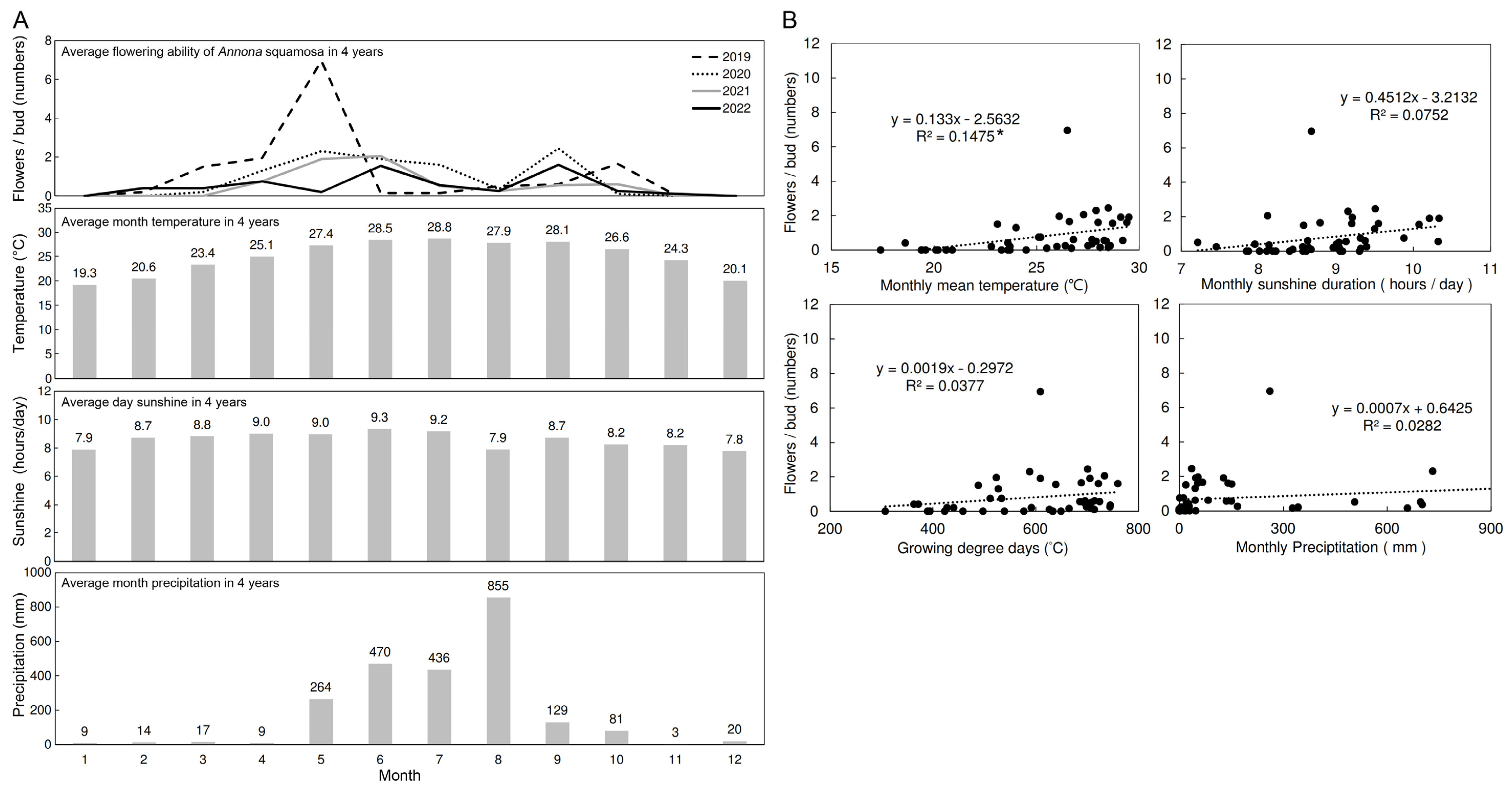
The results of year-round flowering assessment revealed that A. squamosa exhibited higher flowering activity during mid-year, whereas flowering was reduced at the beginning and end of the year (Figure 1A). To elucidate the relationship between flowering and climatic variables, the monthly mean number of flowers per bud over four years was subjected to regression analysis against monthly mean temperature, accumulated temperature, monthly mean sunshine hours, and monthly cumulative rainfall. Flowering was markedly reduced when the mean monthly temperature was below 22 °C, whereas temperatures above 25 °C favored higher flowering capacity.
After correcting for temporal autocorrelation using the GLS AR(1) model, regression analysis revealed that monthly mean temperature was the only meteorological factor significantly correlated with flowering capacity (R2 = 0.1249, p = 0.0160). In contrast, accumulated temperature (R2 = 0.0252), daily sunshine duration (R2 = 0.0513), and monthly precipitation (R2 = 0.0127) showed no significant correlation with the monthly number of flowers per bud (p > 0.05) (Figure 1B). However, as this association explains only a modest proportion of the observed flowering variance (approximately 12.5%), it indicates that additional factors contribute substantially to seasonal flowering patterns.

3.2. Effects of Night-Break Treatments with Different Light Wavelengths on Flowering

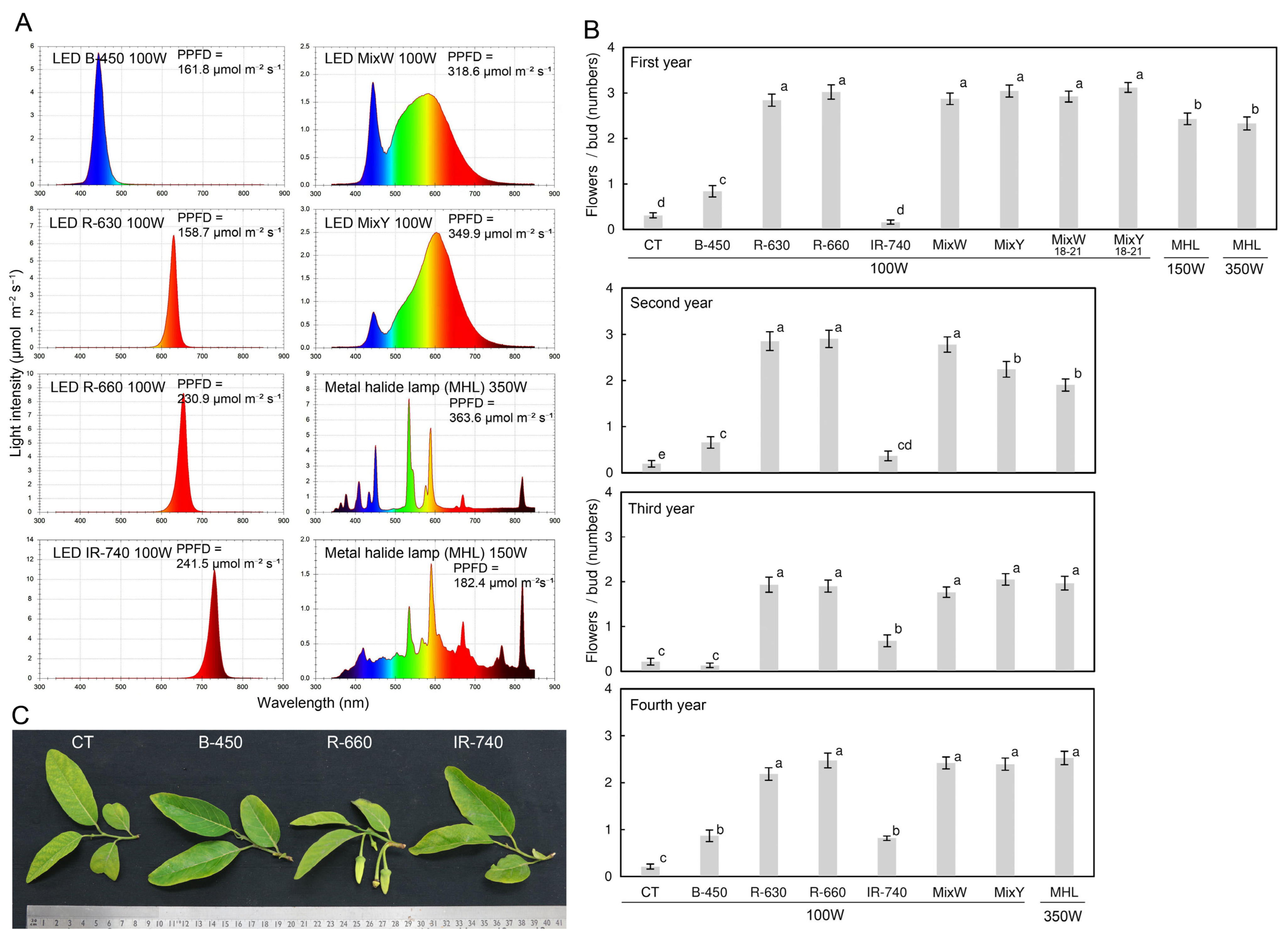
In the first year, night-break treatments with R-630, R-660, MixW, and MixY all significantly promoted flowering compared with CT, whereas B-450 and IR-740 resulted in substantially fewer flowers. For MixW and MixY, no significant difference in flowering was observed between treatments applied from 18:00 to 21:00 and those applied from 00:00 to 03:00. Metal halide lamps also increased flowering compared with CT, but the flowering counts remained significantly lower than those of R-630, R-660, MixW, and MixY.
Over three consecutive years, the treatments producing the most consistent and pronounced flowering promotion were R-630, R-660, MixW, and MixY, all of which yielded significantly more flowers each year than B-450, IR-740, or CT. Although B-450 and IR-740 sometimes resulted in slightly higher flowering than CT, both were consistently less effective than red light treatments. Metal halide lamps demonstrated a generally positive flowering effect, but in one year their performance was lower than that of R-630 and R-660.
Further observation of the irradiance across different treatments revealed that the irradiance of R-630 was lower than both B-450 and IR-740, yet it resulted in a significantly higher flowering quantity. Similarly, while the irradiance of R-660 was lower than that of IR-740, the flowering quantity was also significantly higher. Collectively, these findings confirm that the specific red light wavelengths, rather than light intensity, are critical for inducing Annona squamosa flowering during autumn night-break treatments (Figure 2A,B).
This is consistent with the known absorption characteristics of the Pr form of phytochrome, which exhibits peak absorption near 660 nm [58]. Accordingly, CT, B-450, R-660, and IR-740 treatments were selected for subsequent RNA-seq transcriptomic analysis.

3.3. Effects of Night-Break Treatments with Different Light Wavelengths on Shoot Growth

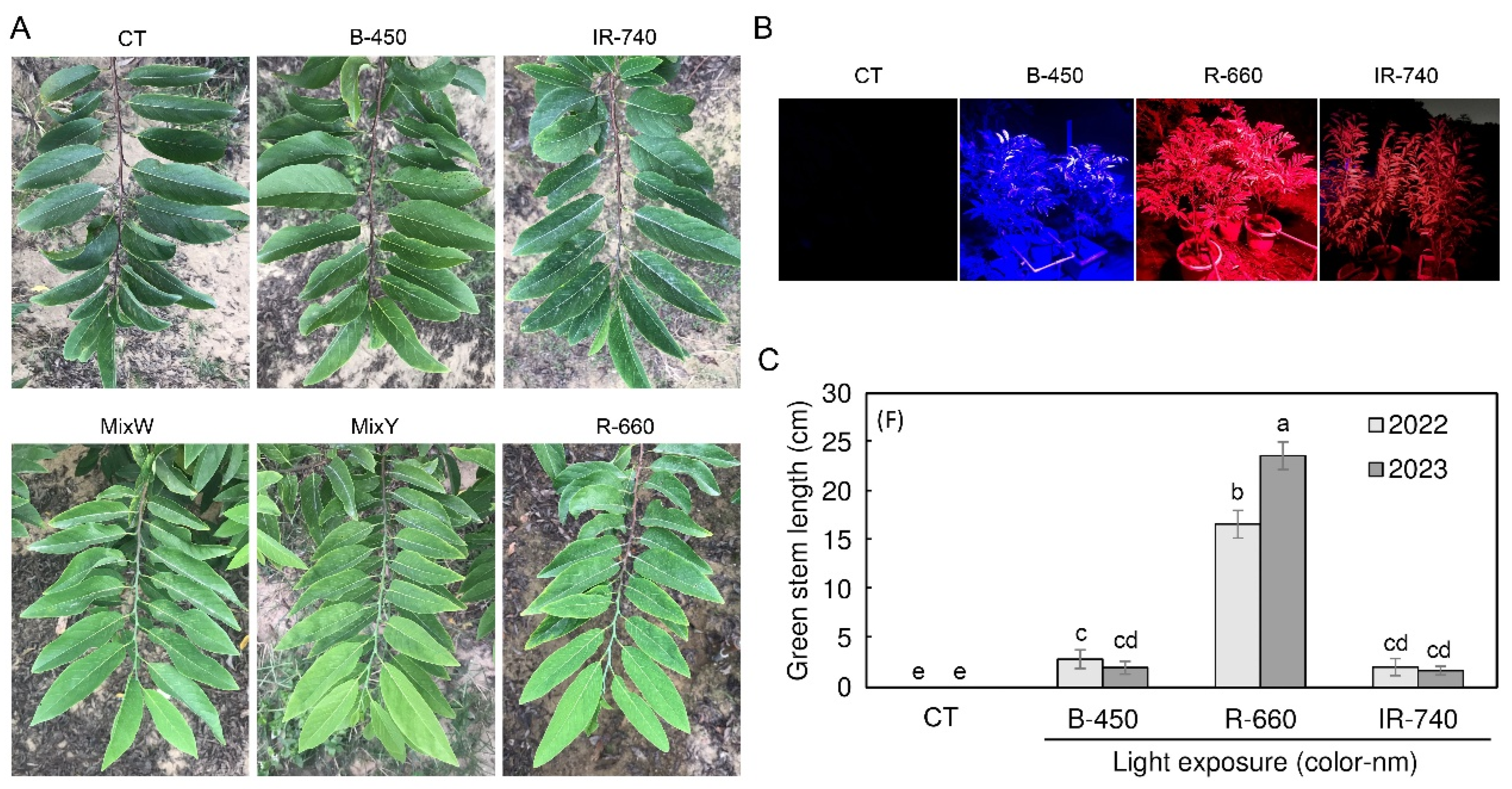
Observations of plant growth under different light treatments revealed that shoots exposed to MixW, MixY, or R-660 maintained active apical growth, with the proximal portions of the shoots exhibiting green coloration and the distal portions displaying brown coloration. In contrast, the apical buds of plants in CT, B-450, and IR-740 treatments had ceased growth, and the shoot surfaces were entirely dark brown (Figure 3A).
Experiments were conducted using different wavelengths to identify those that promote growth. To quantitatively assess the effect of night-break light wavelength on growth, the length of green-colored shoots representing the extent of continued growth was measured. (Figure 3B).
Plants treated with R-660 exhibited mean green shoot lengths of approximately 16.66–23.65 cm, compared with 2.00–2.88 cm for B-450, 1.72–2.08 cm for IR-740, and 0 cm for CT. These results indicate that R-660 promotes active shoot elongation even under the relatively low temperatures in November, whereas growth in CT plants completely ceased. In comparison, B-450 and IR-740 treatments supported only minimal growth, significantly slower than that observed under R-660 (Figure 3C). Physiologically, this robust vegetative response suggests that R-660 specifically overrides the autumn-induced transition to dormancy, maintaining the active meristematic state that is essential for supporting subsequent floral organogenesis in Annona species.

3.4. Leaf Transcriptome Analysis Under Different Wavelengths of Night-Break Treatments

Leaf RNA-seq was performed on libraries, representing four light treatments (CT, B-450, R-660, IR-740) with three biological replicates each. Sequencing generated between 40,999,743 and 98,012,326 paired-end reads per sample (Table S1).
De novo transcriptome assembly produced 138,639–248,217 contigs per sample, with the longest contigs ranging from 14,834 to 20,479 nucleotides. This 1.8-fold variation in per-sample contig numbers likely reflects biological differences in transcriptional complexity across treatments, as well as minor variations in sample-specific sequencing depth (detailed sequencing depth metrics per sample are provided in Table S1).
For subsequent differential expression analysis, a single merged reference assembly was utilized. N50 values ranged from 1921 to 2287 nucleotides, and N90 values from 335 to 487 nucleotides. To comprehensively validate the assembly quality, BUSCO analysis was performed, revealing a high completeness score of 91.8% (Complete and single-copy: 6.3%, Complete and duplicated: 85.6%, Fragmented: 3.4%, Missing: 4.8%). The combination of robust N50 metrics and the high BUSCO completeness score confirms that the conserved gene space was successfully captured, indicating high-quality assemblies (Table S2).
Principal component analysis (PCA) and principal coordinates analysis (PCoA) were performed using the 500 and 2000 most variable transcripts, respectively. Clear clustering by light treatment was observed, with R-660-treated replicates distinctly separated from the other treatments, consistent with the differences in flowering and growth performance (Figure S1).
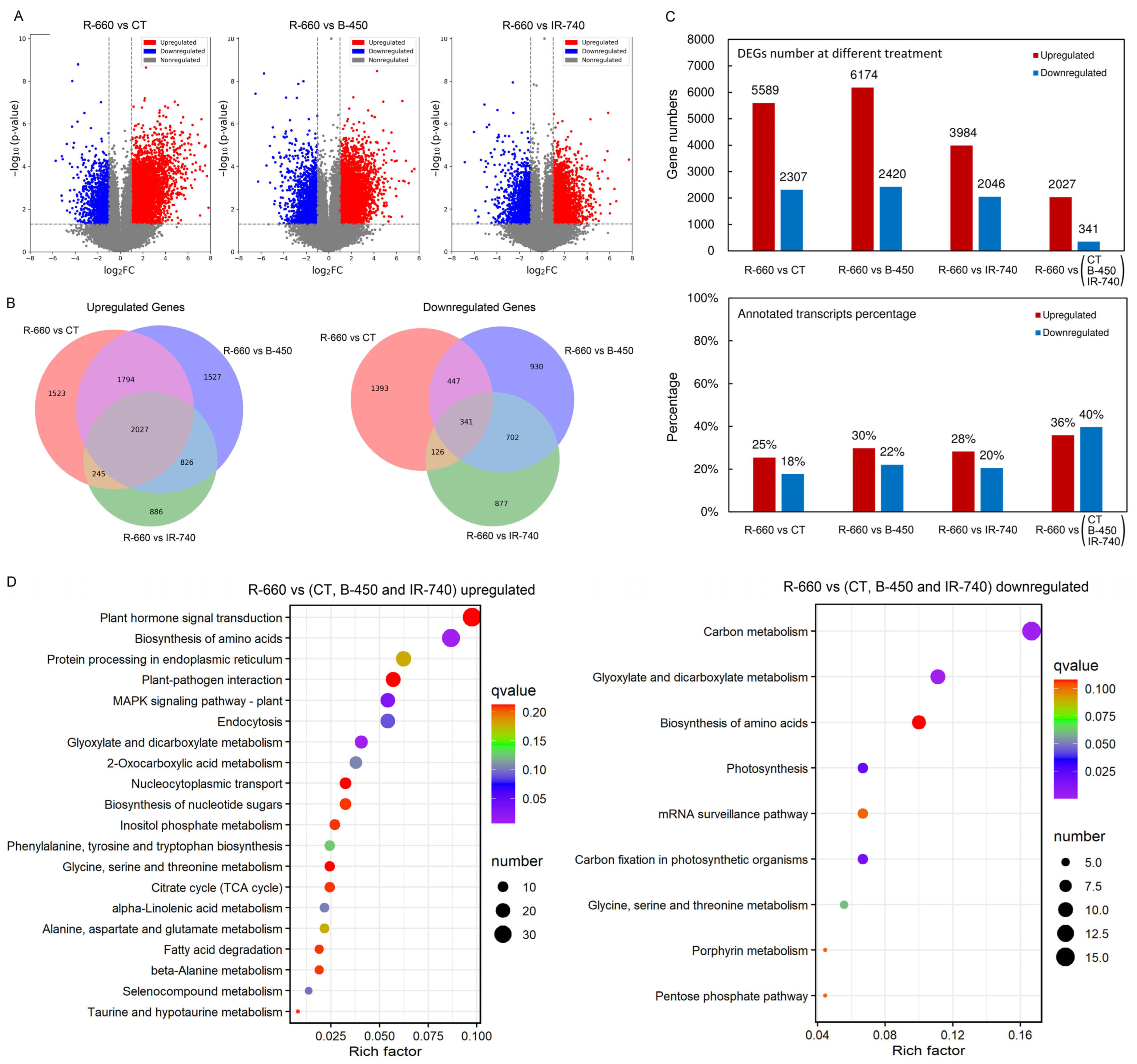
Using R-660-treated samples as the reference, volcano plots revealed that the number of transcripts significantly upregulated by R-660 was greater than those significantly downregulated (Figure 4A). Venn diagrams showed that 2027 transcripts were consistently upregulated and 341 downregulated in R-660 compared to CT, B-450, and IR-740 (Figure 4B).
Annotation analysis showed that 36% of the upregulated and 40% of the downregulated DETs were annotated (Figure 4C), suggesting that R-660 may regulate these genes to enhance autumn flowering in A. squamosa.
However, it must be noted that our pathway-level interpretations are based only on the 36–40% of DETs that could be annotated against known databases. The functional significance of the majority of differentially expressed transcripts remains unknown and may include additional or contrasting regulatory mechanisms.
Gene ontology (GO) functional annotation of the 2368 DETs (2027 upregulated, 341 downregulated) categorized them into three main GO domains: molecular function, cellular component, and biological process.
Among the transcripts consistently upregulated by R-660 relative to the other treatments, the most enriched molecular function terms included metabolic process, cellular process, protein metabolic process, protein modification process, biosynthetic process, and transport; for cellular components, membrane was most enriched; and for biological processes, binding, catalytic activity, transferase activity, nucleotide binding, and kinase activity were most prominent.
Among the consistently downregulated transcripts, enriched molecular function terms included metabolic process and cellular process; enriched cellular component terms included membrane, cell, and intracellular; and enriched biological process terms included catalytic activity and binding (Figure S2A). Comparative GO annotation results for R-660 versus each of the three other treatments are shown in Figure S2B–D.
To further investigate the mechanisms by which R-660 night-break treatment promotes growth and flowering, KEGG pathway enrichment analysis was performed on DETs consistently regulated by R-660 relative to the other three treatments.
Major pathways enriched among the upregulated transcripts included Plant hormone signal transduction, Biosynthesis of amino acids, Protein processing in endoplasmic reticulum, Plant–pathogen interaction, MAPK signaling pathway, and Endocytosis. Downregulated transcripts were most enriched in Carbon metabolism, Glyoxylate and dicarboxylate metabolism, Biosynthesis of cofactors, Photosynthesis, mRNA surveillance pathway, and Carbon fixation in photosynthetic organisms (Figure 4D). KEGG enrichment results for pairwise comparisons of R-660 with each of the three other treatments are presented in Figure S3.

3.5. Transcriptomic Analysis of Hormone, Flowering, and Senescence-Related Pathways

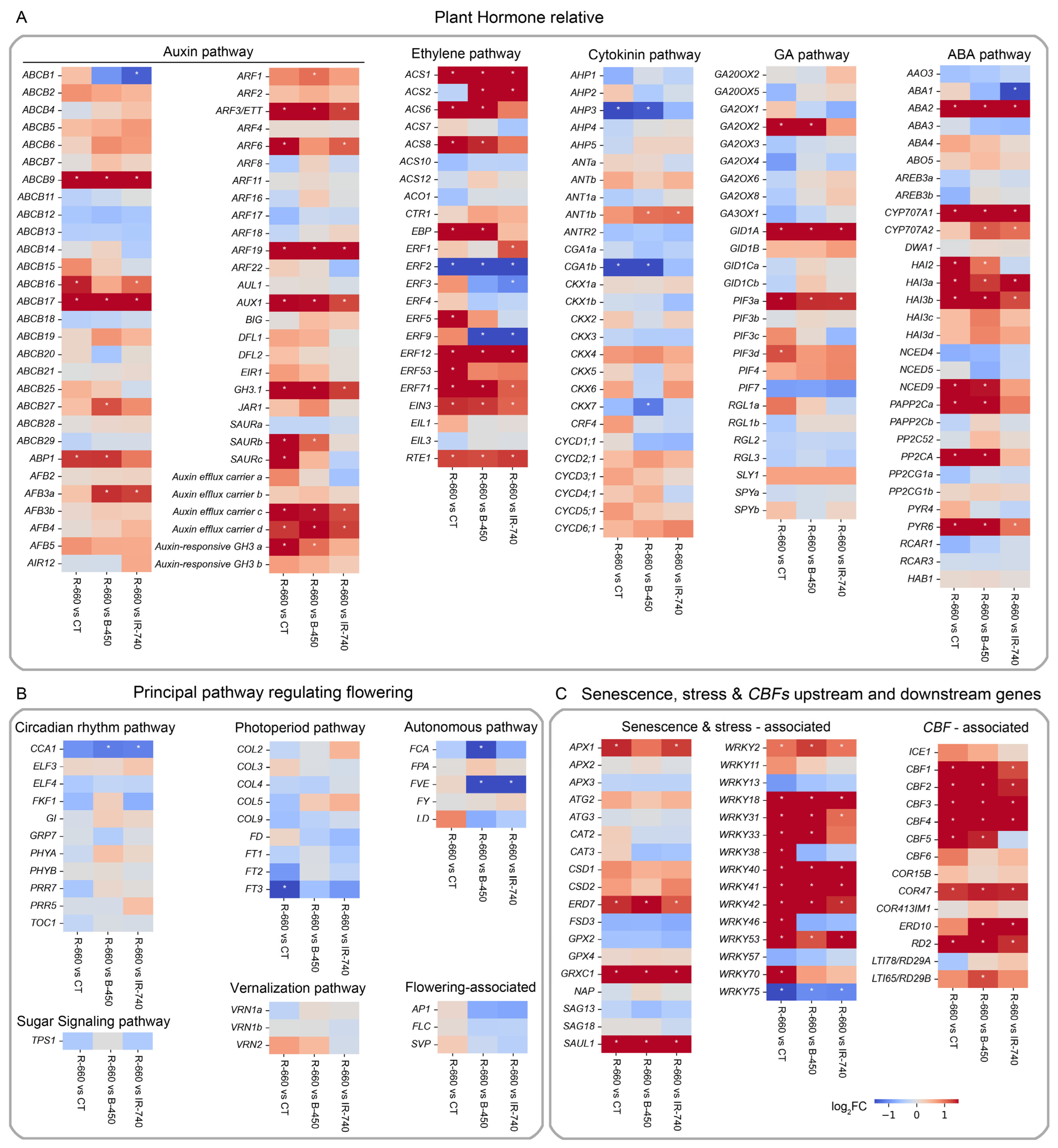
KEGG pathway enrichment analysis revealed that numerous plant hormone related genes were significantly upregulated under R-660 treatment. To further examine the extent to which different hormones are regulated by R-660 night-break, we analyzed genes involved in the biosynthesis, metabolism, and transport of five major plant hormones (Figure 5A).
For auxin-related genes, multiple key components involved in transport and signaling (e.g., ABCB9, ARF3, and AUX1) were significantly upregulated under R-660 compared with the other treatments. Similarly, critical ethylene biosynthesis and signaling regulators, notably ACS1 and EIN3, showed strong upregulation (Table 1). A comprehensive list and expression profiles of all differentially expressed hormone pathway genes are provided in Figure 5A and Supplementary Table S3.
No cytokinin-related genes showed consistent significant changes under R-660 night-break relative to all other treatments. In the gibberellin (GA) pathway, GIBBERELLIN 2-OXIDASE 2 (GA2OX2) was significantly upregulated in R-660 compared with CT and B-450, while GIBBERELLIN-INSENSITIVE DWARF 1A (GID1A) and PHYTOCHROME INTERACTING FACTOR 3 (PIF3) were significantly upregulated in R-660 compared with all three other treatments.
For abscisic acid (ABA)-related responses, central biosynthesis and signaling genes, including ABA2, CYP707A, and NCED9, were significantly upregulated in R-660 relative to other treatments (detailed gene lists are available in Figure 5A and Supplementary Table S3).
Flowering induction pathways showed minimal transcriptional regulation by R-660 (Figure 5B). In the photoperiod pathway, no major expression differences were detected except for FLOWERING LOCUS T (FT), which was significantly downregulated in R-660 compared with CT. In the autonomous flowering pathway, FLOWERING CONTROL LOCUS A (FCA) was significantly downregulated in R-660 compared with B-450, and FLOWERING TIME VE (FVE) was significantly downregulated in R-660 compared with both B-450 and IR-740. No significant changes were observed in vernalization pathway genes, and the sugar signaling gene TREHALOSE-6-PHOSPHATE SYNTHASE 1 (TPS1) was unaffected by R-660.
Among genes related to aging, stress response, and flowering in A. squamosa, several exhibited significantly higher expression under red light (R-660) night-break treatment compared to the other three treatments. These include EARLY RESPONSIVE TO DEHYDRATION 7 (ERD7), GLUTAREDOXIN C1 (GRXC1), and SENESCENCE-ASSOCIATED UBIQUITIN LIGASE (SAUL). Members of the WRKY family, including WRKY2, WRKY18, WRKY21, WRKY40, WRKY41, WRKY42, and WRKY53, also showed significantly increased expression under red light treatment.
Genes upstream and downstream of the CBF pathway, including C-REPEAT BINDING FACTOR 1 (CBF1), CBF2, CBF3, CBF4, COLD-REGULATED 47 (COR47), and RESPONSIVE TO DESICCATION 2 (RD2), displayed significantly higher expression under red light compared to the other treatments. In contrast, WRKY75 expression was significantly lower under red light night-break treatment compared to the other three treatments.

3.6. Quantitative Real-Time PCR (qRT-PCR) Analysis

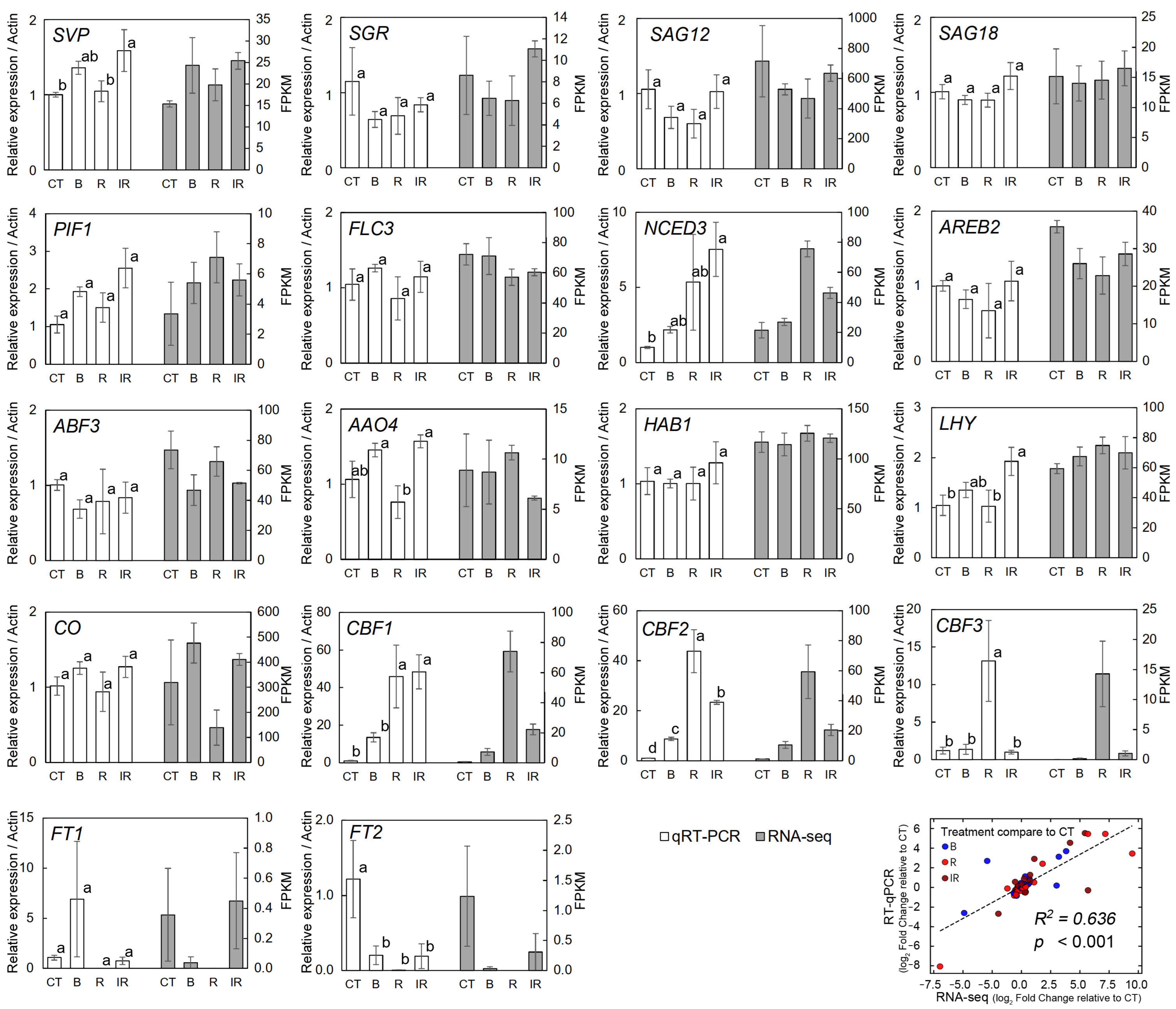
To validate the reliability of the RNA-seq data, RT-qPCR was performed on a selected subset of key genes associated with senescence, cold stress response, ABA biosynthesis/signaling, and flowering regulation.
Quantitative real-time PCR analysis showed no significant differences in the expression of SVP, SGR1, SAG12, SAG18, PIF1, FLC3, ABI1, CO, ABF3, AREB2, LHY, AAO4 and FT1 between the R-660 night-break treatment and CT. Expression of NCED3 was significantly higher in IR-740 compared with CT. FT2 expression was significantly higher in CT than in all three night-break treatments. In contrast, CBF1, CBF2, and CBF3 were strongly expressed under R-660 and their expression was significantly higher than in CT (Figure 6).

3.7. Effects of Plant Growth Regulators Combined with R-660 Night-Break Lighting on Winter Flowering of Annona squamosa

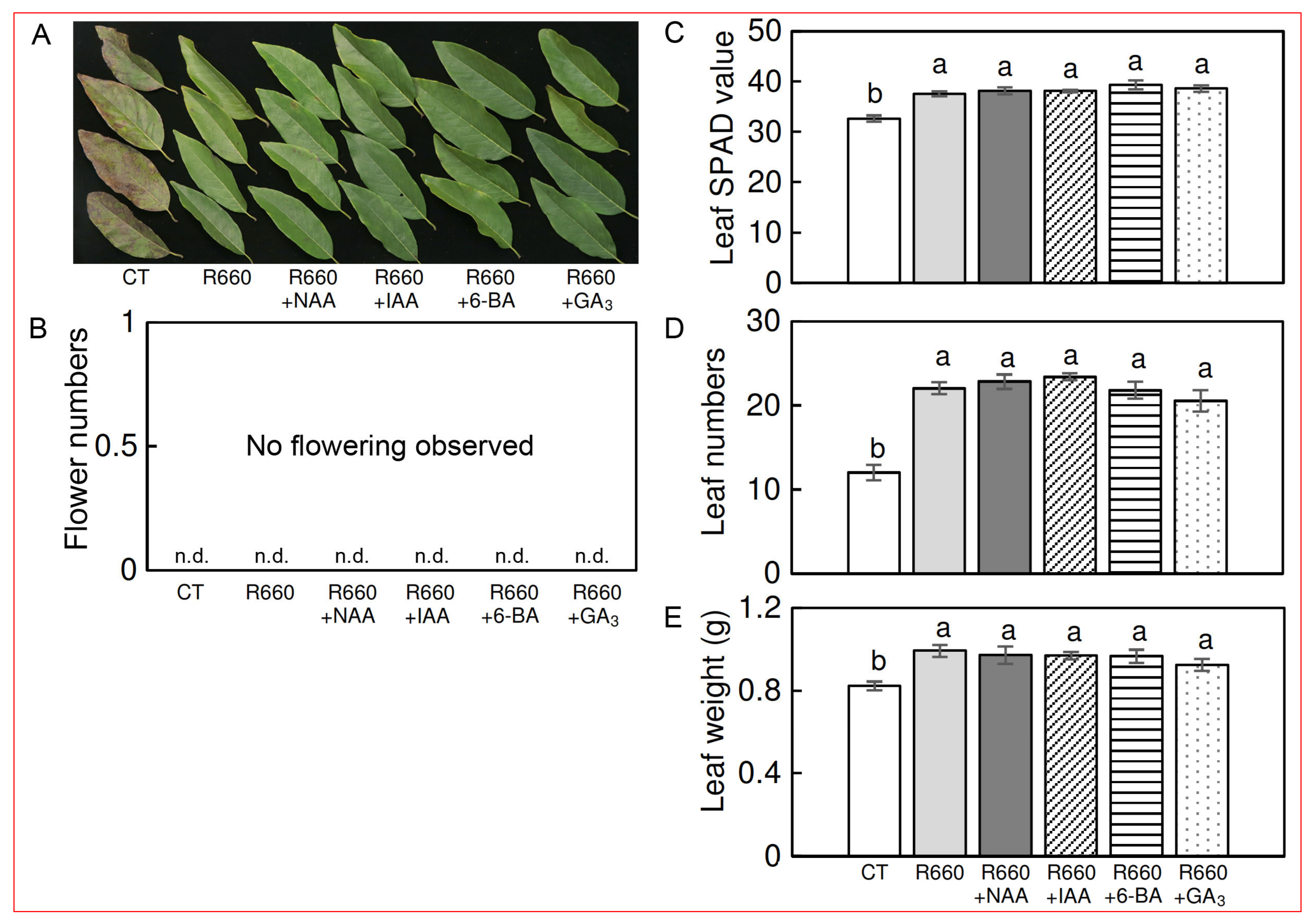
During winter, A. squamosa leaves exhibited clear signs of senescence. No visible leaf senescence was observed in trees exposed to R-660 night-break treatment combined with the application of four plant growth regulators (NAA, IAA, 6-BA, and GA3) (Figure 7A).
All treatments involving R-660 night-break with plant growth regulators did not produce flowers (Figure 7B). SPAD values in the R-660 and plant growth regulator treatments ranged from 37.6 to 45.6, which were significantly higher than the 32.7 for CT (Figure 7C). Leaf numbers in the R-660 night-break treatment averaged 22.1, while those in the four plant growth regulator treatments ranged from 20.6 to 23.4, all significantly greater than the 12.0 leaves observed in CT (Figure 7D). The mean leaf fresh weight in CT was 0.82 g, significantly lower than the 0.93–0.99 g recorded in the R-660 and plant growth regulator treatments (Figure 7E).

3.8. Effects of Elevated Temperature on Winter Flowering

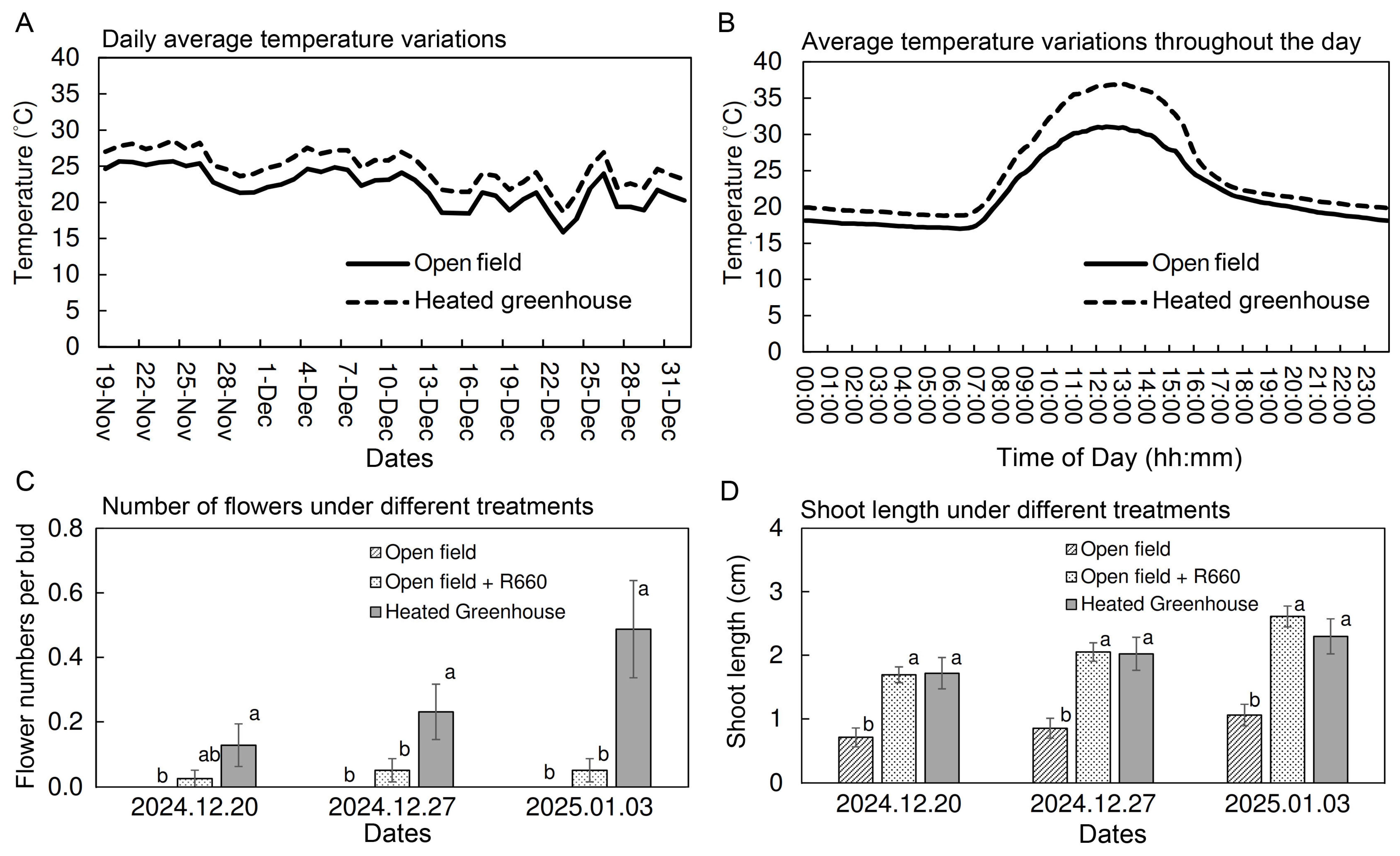
During winter, the average temperature was higher in the heated greenhouse (24.7 °C) than in the open field (22.0 °C). At 12:00, the difference was most pronounced, with the greenhouse averaging 36.7 °C compared to 31.0 °C in the open field (a 5.7 °C difference). At 00:00, the greenhouse averaged 19.9 °C, while the open field averaged 18.1 °C (a 1.8 °C difference).
On 3 January 2025, the average number of flowers per bud was 0, 0.05, and 0.49 for the open-field CT, open field + R-660, and heated greenhouse treatments, respectively. Flower number was significantly greater in the heated greenhouse than in both the open-field CT and open-field R-660 treatments. Mean new shoot lengths were 1.06 cm in the open-field CT, 2.61 cm in the open-field R-660 treatment, and 2.30 cm in the heated greenhouse, with the latter two treatments producing shoots significantly longer than those of the CT (Figure 8).

4. Discussion

4.1. Night-Break Lighting Effects on Flowering Induction and Vegetative Growth

In Taiwan, night-break lighting is widely applied to A. squamosa and Annona × atemoya to extend their flowering and fruiting periods. Typically, trees are pruned in September or October, and night-break lighting is used to extend the flowering period.
However, this practice does not yield consistent results year-round; under low winter temperatures, flowering is still reduced [6,8]. This indicates that creating a long-day environment alone is insufficient to induce flowering. While previous studies only confirmed that night-break lighting in autumn could induce flowering, the present study demonstrates that both 630 nm and R-660 night-break treatments significantly promoted autumn flowering in A. squamosa.
Regarding the experimental design in 2017, the MixW and MixY treatments were applied during the early night (18:00–21:00), whereas other treatments were applied at midnight (00:00–03:00). In many photoperiod-sensitive species, night interruption near the middle of the dark period is significantly more effective. However, our observations in A. squamosa demonstrated that the early-night application (18:00–21:00) of MixW and MixY yielded equivalent flowering induction efficacy to the midnight break (00:00–03:00). Therefore, the differences in flowering performance observed among the treatments in 2017 can be confidently attributed to the variations in spectral quality rather than the timing of the light application.
Notably, although the photosynthetic photon flux density (PPFD) of R-630 was lower than that of blue light, and the PPFD of R-660 was lower than that of infrared light, both red light treatments exhibited significantly higher flowering rates. This provides strong evidence that the specific red light quality (wavelength), rather than light intensity, is the primary driver for effectively promoting floral induction in A. squamosa.
R-660 night-break lighting also sustained vegetative growth in autumn; plants in this state exhibited superior flowering capacity, whereas the shoots and leaves of B-450, IR-740, and CT plants ceased growth. This pattern is similar to that observed in Vitis vinifera L., where night-break lighting with white (MixW) or yellow (MixY) LEDs promoted new shoot growth, increasing average shoot length by 13.5 cm and 15.8 cm compared with the control [22]. In grapes, night-break lighting with energy-saving bulbs, white LEDs, or red LEDs has been reported to increase total leaf number and improve fruit set rate by 10–12% [67]. In the context of A. squamosa, these integrated growth responses indicate that the primary role of red light night-break is not merely to act as a direct floral trigger, but to sustain photosynthetically active source leaves and active shoot sinks, thereby providing the necessary physiological momentum to bypass early winter dormancy and enable autumn flowering.

4.2. Transcriptomic Analysis and Pathways Associated with Flowering Promotion

RNA-seq has been widely used to investigate regulatory mechanisms in various crops. In Brassica rapa L. var. pekinensis (Lour.) Kitam., intermittent light treatments can promote premature bolting, and transcriptome analysis revealed 17,086 differentially expressed genes (DEGs), of which 396 were associated with early bolting. These included genes involved in light responses, plant hormone regulation, development, and carbohydrate metabolism and transport [24]. In Z. officinale, which rarely flowers under natural conditions, red light and long-day photoperiods effectively induced floral bud differentiation. Transcriptome comparison between floral buds under long-day conditions and vegetative buds under natural light revealed that CDF1, COP1, GHD7, and RAV2-like were significantly downregulated, whereas CO, FT, SOC1, AP1_1, AP1_2, and LFY were upregulated, facilitating floral induction [25].
In A. squamosa, KEGG pathway enrichment analysis of DEGs between R-660 and other treatments showed that “Plant hormone signal transduction” was the pathway with the largest number of upregulated transcripts (Figure 4D). This is consistent with findings in Malus domestica cv. ‘Royal Gala’, where seedlings exposed to 460 nm blue light, 660 nm red light, or white light for 30 days showed enrichment of plant hormone signal transduction pathways among upregulated genes, with red light promoting growth, leaf expansion, nitrogen metabolism, and hormone signaling [68].
In the present study, R-660 night-break lighting upregulated several principal genes involved in auxin, ethylene, gibberellin, and abscisic acid (ABA) metabolism and signaling (Table 1), while cytokinin pathway genes were less responsive.
In the auxin pathway, ABCB9, ABCB17, ARF3, ARF19, AUX1, GH3.1, and Auxin efflux carrier were significantly upregulated by R-660 compared to other treatments. ABCB proteins are involved in polar auxin transport [69], ARF transcription factors bind to auxin response elements (AuxREs) to regulate downstream genes [59], AUX1 encodes an auxin influx carrier essential for cell division and differentiation 60], and GH3.1 conjugates auxin with amino acids to inactivate it [70].
In the ethylene pathway, ACS1, ACS6, ACS8, and EBP were significantly upregulated by R-660. EBP binds to ethylene-responsive elements (EREs) in target promoters to regulate ethylene-responsive genes, and EIN3 and RTE1 were also upregulated by R-660. EIN3 is a key transcription factor transmitting ethylene signals from the membrane to the nucleus [61], while RTE1 acts as a negative regulator of ethylene sensitivity [71]. Taken together, the coordinated upregulation of auxin transport and ethylene signaling under R-660 suggests synergistic hormonal remodeling that actively prolongs the juvenile-like vigor of shoots and delays tissue senescence, creating a highly receptive physiological environment for late-season floral bud development.
Gibberellin pathway genes including GA2OX2 (Table 1), GID1A, and PIF3 were significantly upregulated by R-660. However, the upregulation of GA2OX2, a gibberellin deactivation enzyme, under R-660 suggests reduced bioactive GA levels, which contrasts with a simple GA-promotion-of-flowering model and warrants further investigation [62,72,73].
In the ABA pathway, ABA2, CYP707A, HAI3, NCED9, HAI2, PAPP2C, and PYR6 were all upregulated by R-660. These genes play key roles in ABA biosynthesis, degradation, and signaling [74,75,76,77,78].
Flowering pathway genes, including those in circadian clock, photoperiod, autonomous, vernalization, and sugar signaling pathways, showed no consistent induction by R-660, except for a few individual genes that were downregulated.
Notably, FT expression decreased under R-660 compared to CT, and FCA was reduced relative to CT. The downregulation of FT and FCA under R-660 suggests that A. squamosa flowering may rely on alternative pathways, possibly involving plant hormone signaling, rather than the canonical photoperiod pathway.
Photoreceptors in the mature leaves of long-day plants can sense photoperiod changes to induce flowering [79]. In Arabidopsis, a long-day crop, long-day conditions induce the expression of CONSTANS (CO), leading to the production of FLOWERING LOCUS T (FT) protein in leaves, which acts as the primary mobile florigen and is transported to the shoot apex to induce floral differentiation.
Transcriptomic analysis in this study revealed that photoperiod-related genes CO, FLOWERING LOCUS D (FD), and FT were not significantly induced. In fact, FT expression was significantly reduced under red light (R-660) night-break treatment compared to the dark control, and FLOWERING CONTROL LOCUS A (FCA) expression was significantly lower under red light night-break treatment compared to the control.
However, FT does not always promote flowering; in soybean, approximately ten endogenous FT genes have been identified, with six promoting flowering and four suppressing it [80,81,82,83]. RNA-seq results suggest that A. squamosa may have three FT genes, though further studies are needed to confirm whether they promote or suppress flowering. A. squamosa subjected to red light (R-660) night-break treatment exhibited sustained shoot and leaf growth, whereas those under blue light (B-450), infrared light (IR-740), and dark control treatments showed growth stagnation and leaf senescence.
The expression of key genes associated with senescence and stress response was specifically examined and summarized in Table 1. The genes EARLY RESPONSIVE TO DEHYDRATION 7 (ERD7), GLUTAREDOXIN C1 (GRXC1), SENESCENCE-ASSOCIATED UBIQUITIN LIGASE 1 (SAUL1), WRKY2, WRKY18, WRKY31, WRKY40, WRKY41, WRKY42, WRKY53, C-REPEAT BINDING FACTOR 1 (CBF1), C-REPEAT BINDING FACTOR 2 (CBF2), C-REPEAT BINDING FACTOR 3 (CBF3), C-REPEAT BINDING FACTOR 4 (CBF4), COLD-REGULATED 47 (COR47), and RESPONSIVE TO DESICCATION 2 (RD2) exhibited significantly higher expression under red light night-break treatment compared to the other three treatments.
ERD7 delays senescence by restructuring cell membrane composition under low-temperature stress, enhancing abiotic stress resistance [84]. SAUL1 regulates protein degradation to remove damaged or unnecessary proteins, maintaining cellular health [85].
WRKY transcription factors modulate multiple senescence-related genes, regulating redox status and signaling pathways involving abscisic acid (ABA), ethylene, and salicylic acid under low-temperature or drought conditions to control senescence, maintain physiological balance, and enhance antioxidant capacity [66]. High expression of WRKY75 promotes leaf senescence, whereas WRKY75 mutants exhibit delayed senescence [86], consistent with the significantly reduced WRKY75 expression and slower leaf senescence observed under R-660 treatment in this study.
ASCORBATE PEROXIDASE 1 (APX1) showed significantly higher expression under red light treatment compared to the dark control and infrared light treatments. APX1 contributes to reactive oxygen species (ROS) scavenging, reducing oxidative damage [87].
CBF genes play a critical role in enhancing tolerance to abiotic stresses such as low temperature, drought, and high temperature [63]. In Arabidopsis, grape, and litchi, CBF1, CBF2, and CBF3 are induced by low temperature and enhance cold tolerance [64,65,88,89]. Transcriptomic analysis and real-time PCR results confirmed that red light night-break treatment significantly upregulated multiple CBF genes, inducing the expression of downstream genes such as COR47 and RD2, which enhance tolerance to low-temperature environments.
Recent studies have highlighted that light signaling interacts with stress response networks to actively preserve cellular integrity and photosynthetic capacity during cold acclimation [90,91]. Specifically, proteomic and physiological evidence suggests that red light drives a distinct ‘cell function maintaining program’ under low temperatures [92]. Furthermore, it has been demonstrated that the CBF-dependent module induces downstream COR genes to produce cryoprotective proteins and regulate membrane lipid composition [85], while specific WRKY transcription factors act as auxiliary regulators in the cold sensing network [93].
Unlike blue light, which primarily triggers generalized stress responses, red light uniquely induces the expression of chloroplast-related proteins, thereby preventing cold-induced inhibition of photosynthesis and sustaining higher photosynthetic parameters. In A. squamosa, the significant upregulation of CBFs and WRKYs under R-660 night-break effectively coordinates this cellular maintenance program. The activation of the CBF-dependent module induces downstream COR genes (such as COR47) to produce cryoprotective proteins and regulate membrane lipid composition. This mechanism preserves plasma membrane fluidity and prevents cold-induced cellular dehydration and membrane disruption.
Concurrently, specific WRKY transcription factors act as auxiliary regulators in the cold sensing network to mitigate oxidative damage and maintain metabolic homeostasis. Collectively, these light-modulated mechanisms explain how R-660 treatments protect the structural integrity of cells and chloroplasts, allowing the plants to sustain vegetative vigor and active shoot elongation rather than entering dormancy under suboptimal autumn temperatures [94,95]. Ultimately, this distinct metabolic and genetic shift provides a crucial physiological basis for floral extension: by utilizing R-660 to activate a robust cold-acclimation and antioxidant defense network, A. squamosa effectively buffers the chilling stress of late autumn, preventing the stress-induced transition into floral bud dormancy and extending the window of reproductive competence.

4.3. Interactions Among Plant Hormones, Night-Break Lighting, and Temperature in Flowering Regulation

The transcriptomic results indicate that night-break lighting partially modulates hormone-related gene expression. Previous studies showed that auxin levels increase during floral induction in Annona spp. [96], and auxin transport facilitates floral bud formation in Litchi chinensis Sonn [97]. Foliar application of NAA and GA3 during flowering can increase flower numbers in A. squamosa, whereas ethephon has no significant effect [98]. Applications of GA3, NAA, and brassinosteroids prior to and during flowering have been reported to advance flowering and increase flower numbers [99].
As a semi-deciduous species, A. squamosa sheds leaves under low temperatures [100]. In winter, CT trees exhibited pronounced leaf senescence, whereas R-660 delayed leaf senescence and abscission, producing heavier leaves. However, supplementing R-660 with IAA, NAA, 6-BA, or GA3 did not induce flowering by late December.
Although autumn and winter night-break lighting can increase flowering rates [6], this does not confirm that A. squamosa is a strict long-day plant. Its flowering response may align with the concept of quantitative long-day plants, which flower more under long days but are also influenced by environmental factors [101,102].
The induction of flowering in Phalaenopsis is primarily regulated by exposure to low temperatures in combination with an appropriate light intensity. Both the night-break and the extension of the photoperiod have been shown to accelerate floral initiation [103]. In Fragaria × ananassa (everbearing strawberry), flowering depends on the interaction between temperature and photoperiod, with high temperatures enabling flowering under long days, intermediate temperatures allowing for flowering under both long and short days (but faster under long days), and low temperatures inhibiting flowering regardless of photoperiod [104].
Similarly, physiological evidence in Annona suggests a non-strict long-day dependency. In a 2013 field study conducted in central Taiwan, applying short-day conditions (9 h photoperiod, achieved using 100% shading nets) in September to the closely related hybrid atemoya (Annona × atemoya Mabb.) did not inhibit floral bud emergence [105].
However, because this was an open-field experiment lacking strict temperature control, the concurrent seasonal drop in temperature during September could act as a confounding factor or interact synergistically with the shortened photoperiod. This limitation in field observations underscores the importance of our transcriptomic results.
In our study, the absence of significant FLOWERING LOCUS T (FT) homolog induction—a classical central integrator of the long-day flowering pathway—provides robust molecular support. Together, the capacity of Annona species to flower under short-day conditions [105] and the lack of long-day-specific FT signaling in our data strongly suggest that A. squamosa does not possess an obligate long-day requirement for floral transition.
Studies in other fruit crops further illustrate this interaction. In S. polyrhizus, red light night-break lighting increased flower numbers, but floral bud formation in January–February (mean temperatures 17.3–20.1 °C) only occurred when night-break lighting was combined with nighttime heating to 20–25 °C [21]. In grapes, night-break lighting did not affect inflorescence initiation [106], and leaf removal did not alter inflorescence development [107].
In the present study, elevating temperature during short-day winter conditions promoted shoot growth and flowering, whereas R-660 night-break lighting alone promoted vegetative growth but failed to induce flowers. These findings suggest that both longer daylength and higher temperatures benefit flowering in A. squamosa, but temperature plays the more decisive role in actual floral formation.

5. Conclusions

This study demonstrates that the efficacy of red light (R-660) night-break treatment in Annona squamosa is highly dependent on the seasonal temperature context. In autumn, R-660 acts effectively as a flowering promoter. In winter, while R-660 maintains vegetative growth by delaying senescence and promoting shoot elongation, it does not induce floral initiation under natural open-field temperatures, even with the application of plant growth regulators. Transcriptomic and physiological evidence reveals that this vegetative maintenance is achieved through the synergistic reprogramming of plant hormone signaling (particularly auxin and ethylene pathways) and the robust activation of cold acclimation and antioxidant defense modules, which collectively mitigate low-temperature damage and optimize energy balance.
Consequently, these findings collectively indicate that ambient temperature exerts a more decisive influence than daylength on floral regulation. While specific R-660 night-break serves as a potent auxiliary stimulus to maintain shoot vigor and enhance flowering efficiency in autumn, adequate warm temperature remains the absolute physiological prerequisite for floral induction in this tropical species, necessitating supplemental heating for successful winter production.

Supplementary Materials

The following supporting information can be downloaded at: https://www.mdpi.com/article/10.3390/horticulturae12050617/s1, Table S1. Basic statistics of RNAseq sequencing for A. squamosa samples. Table S2. Results of de novo transcriptome assembly for A. squamosa RNAseq sequences. Table S3. Comparison table of gene IDs and gene symbols associated with plant hormone, flowering, senescence, stressand CBFs pathways. Table S4 Primer sequences for real-time quantitative PCR of plant hormone, flowering, and senescence-associate dgenes. Figure S1. PCA and PCoA clustering analysis of transcriptomes from three biological replicate samples of four different light treatments in A. squamosa. Figure S2. (A) Transcriptome functional annotation of differential expression 20in A. squamosaunder night-break red-light (R-660) compared toother treatments (CT, 21B-450, IR-740); (B) Transcriptome functional annotation of differential expression in A. squamosa under night-break red-light (R-660) compared toControl (CT). (C) Transcriptome functional annotation of differential expression in A. squamosa under night-break red-light (R-660) compared toblue-light (B450). (D) Transcriptome functional annotation of differential expression in A. squamosa under night-break red-light (R-660) compared to infrared light (IR-740). Figure S3. KEGG pathway enrichment analysis of differentially expressed transcripts in A. squamosa under red light treatment at night, showing the enrichment of various pathways based on q-value and rich factor.

Author Contributions

Conceptualization, H.-H.F.; Methodology, H.-H.F., C.-W.T., H.-Y.M., W.-L.L., C.-C.H. and Y.-C.T.; Software, H.-H.F.; Validation, Y.-C.T.; Formal analysis, H.-H.F., H.-Y.M. and C.-C.H.; Investigation, H.-H.F., H.-Y.M. and C.-C.H.; Resources, H.-H.F. and C.-C.H.; Data curation, K.-D.C.; Writing—original draft, H.-H.F., H.-Y.M. and Y.-C.T.; Writing—review & editing, H.-H.F., C.-W.T. and Y.-C.T.; Visualization, H.-H.F. and Y.-C.T.; Supervision, C.-W.T., W.-L.L., K.-D.C. and Y.-C.T.; Project administration, W.-L.L. and Y.-C.T. All authors have read and agreed to the published version of the manuscript.

Funding

This study was supported by the Ministry of Agriculture (Taiwan), Grant number 113AS-4.1.3-CI-03.

Data Availability Statement

The data presented in this study are openly available in [NCBI Sequence Read Archive] at [https://www.ncbi.nlm.nih.gov/sra], accessed on 8 December 2025, reference number [PRJNA1373355].

Acknowledgments

Thanks to Hsiu-Yun Liu, Wu-Lang Huang, Feng-Chin Chang, Feng-E Chang, Han-Yen Ting, and Cen-Hong Lin for their assistance in conducting the experimental research.

Conflicts of Interest

The authors declare no conflict of interest.

Abbreviations

LEDlight-emitting diode
MixWmix white light
MixYmix yellow light
UVultraviolet
CTno-light control (dark treatment)
RRed
BBlue
IRInfrared
KEGGKyoto Encyclopedia of Genes and Genomes
ABAAbscisic acid
GA3Gibberellic acid 3

References

  1. Guo, X.; Tang, C.C.; Thomas, D.C.; Couvreur, T.L.; Saunders, R.M. A mega-phylogeny of the Annonaceae: Taxonomic placement of five enigmatic genera and support for a new tribe, Phoenicantheae. Sci. Rep. 2017, 7, 7323. [Google Scholar] [CrossRef]
  2. Tran, K.; Ryan, S.; McDonald, M.; Thomas, A.L.; Maia, J.G.S.; Smith, R.E. Annonacin and squamocin contents of pawpaw (Asimina triloba) and marolo (Annona crassiflora) fruits and atemoya (A. squamosal × A. cherimola) seeds. Biol. Trace Elem. Res. 2021, 199, 2320–2329. [Google Scholar] [CrossRef] [PubMed]
  3. Marler, T.E.; George, A.P.; Missen, R.J.; Andersen, P.C. Miscellaneous tropical fruits. In Handbook of Environmental Physiology of Fruit Crops: II. Subtropical and Tropical Crops; Schaffer, B., Andersen, P.C., Eds.; CRC Press: Boca Raton, FL, USA, 1994; pp. 200–205. [Google Scholar]
  4. Gupta, Y.; Pathak, A.K.; Singh, K.; Intri, S.S.; Singh, S.P.; Tuli, R. De novo assembly and characterization of transcriptomes of early-stage fruit from two genotypes of Annona squamosa L. with contrast in seed number. BMC Genom. 2015, 16, 86. [Google Scholar] [CrossRef] [PubMed]
  5. Liu, K.; Li, H.; Yuan, C.; Huang, Y.; Chen, Y.; Liu, J. Identification of phenological growth stages of sugar apple (Annona squamosa L.) using the extended BBCH-scale. Sci. Hortic. 2015, 181, 76–80. [Google Scholar] [CrossRef]
  6. Lu, B.S.; Chiang, S.W. Effects of night break treatment on winter flowering and fruit quality of Annona squamosa. In Proceedings of the 2011 Annual Research and Extension Symposium of Taitung District Agricultural Research and Extension Station; Taitung District Agricultural Research and Extension Station: Taitung, Taiwan, 2011; pp. 45–50. [Google Scholar]
  7. Olesen, T.; Muldoon, S.J. Effects of defoliation on flower development in atemoya custard apple (Annona cherimola Mill. × A. squamosal L.) and implications for flower-development modelling. Aust. J. Bot. 2012, 60, 160–164. [Google Scholar] [CrossRef]
  8. Lu, B.S.; Chiang, S.W. Effects of night lighting on winter flowering and fruiting of Annona squamosa. Taiwan J. Hortic. 2010, 56, 255. [Google Scholar]
  9. Galvão, V.C.; Fankhauser, C. Sensing the light environment in plants: Photoreceptors and early signaling steps. Curr. Opin. Neurobiol. 2015, 34, 46–53. [Google Scholar] [CrossRef]
  10. Paradiso, R.; Proietti, S. Light-quality manipulation to control plant growth and photomorphogenesis in greenhouse horticulture: The state of the art and the opportunities of modern LED systems. J. Plant Growth Regul. 2022, 41, 742–780. [Google Scholar] [CrossRef]
  11. Song, Y.H.; Kubota, A.; Kwon, M.S.; Covington, M.F.; Lee, N.; Taagen, E.R.; Laboy Cintrón, D.; Hwang, D.Y.; Akiyama, R.; Hodge, S.K.; et al. Molecular basis of flowering under natural long-day conditions in Arabidopsis. Nat. Plants 2018, 4, 824–835. [Google Scholar] [CrossRef]
  12. Harris, G.P. Intermittent illumination and the photoperiodic control of flowering in carnation. Ann. Bot. 1972, 36, 345–352. [Google Scholar] [CrossRef]
  13. Gendron, J.M.; Staiger, D. New horizons in plant photoperiodism. Annu. Rev. Plant Biol. 2023, 74, 481–509. [Google Scholar] [CrossRef]
  14. Putterill, J.; Robson, F.; Lee, K.; Simon, R.; Coupland, G. The CONSTANS gene of Arabidopsis promotes flowering and encodes a protein showing similarities to zinc finger transcription factors. Cell 1995, 80, 847–857. [Google Scholar] [CrossRef] [PubMed]
  15. Suárez-López, P.; Wheatley, K.; Robson, F.; Onouchi, H.; Valverde, F.; Coupland, G. CONSTANS mediates between the circadian clock and the control of flowering in Arabidopsis. Nature 2001, 410, 1116–1120. [Google Scholar] [CrossRef]
  16. Lin, X.; Liu, B.; Weller, J.L.; Abe, J.; Kong, F. Molecular mechanisms for the photoperiodic regulation of flowering in soybean. J. Integr. Plant Biol. 2021, 63, 981–994. [Google Scholar] [CrossRef]
  17. Vince-Prue, D.; Canham, A.E. Horticultural significance of photomorphogenesis. In Photomorphogenesis; Shropshire, W., Mohr, H., Eds.; Springer: Berlin/Heidelberg, Germany, 1983; pp. 518–544. [Google Scholar]
  18. Nissim-Levi, A.; Kitron, M.; Nishri, Y.; Ovadia, R.; Forer, I.; Oren-Shamir, M. Effects of blue and red LED lights on growth and flowering of Chrysanthemum morifolium. Sci. Hortic. 2019, 254, 77–83. [Google Scholar] [CrossRef]
  19. Park, Y.G.; Jeong, B.R. Both the quality and positioning of the night interruption light are important for flowering and plant extension growth. J. Plant Growth Regul. 2020, 39, 583–593. [Google Scholar] [CrossRef]
  20. Park, Y.G.; Muneer, S.; Jeong, B.R. Morphogenesis, flowering, and gene expression of Dendranthema grandiflorum in response to shift in light quality of night interruption. Int. J. Mol. Sci. 2015, 16, 16497–16513. [Google Scholar] [CrossRef]
  21. Jiang, Y.L.; Liao, Y.Y.; Lin, M.T.; Yang, W.J. Bud development in response to night-breaking treatment in the noninductive period in red pitaya (Hylocereus sp.). HortScience 2016, 51, 690–696. [Google Scholar] [CrossRef]
  22. Ye, W.B.; Chang, L.J.; Liu, H.L. Study on the application of LED illumination in greenhouse cultivation of ‘Kyoho’ grape. Taichung Dist. Agric. Res. Exten. Stn. Bull. 2015, 129, 55–65. [Google Scholar]
  23. Chiu, C.Y.; Weng, J.S.; Huang, M.T. Effects of light sources on growth of Indian jujube (Ziziphus mauritiana Lam.). Kaohsiung Dist. Agric. Res. Exten. Stn. Bull. 2004, 15, 49–59. [Google Scholar]
  24. Hu, C.; Sun, D.; Yu, J.; Chen, M.; Xue, Y.; Wang, J.; Su, W.; Chen, R.; Anwar, A.; Song, S. Transcriptome analysis of intermittent light induced early bolting in flowering Chinese cabbage. Plants 2024, 13, 866. [Google Scholar] [CrossRef]
  25. Deng, Q.; Zhang, Y.; Liu, K.; Zheng, G.; Gao, L.; Li, Z.; Huang, M.; Jiang, Y. Transcriptome profiles reveal gene regulation of ginger flowering induced by photoperiod and light quality. Bot. Stud. 2023, 64, 12. [Google Scholar] [CrossRef]
  26. Liang, Q.; Song, K.; Lu, M.; Dai, T.; Yang, J.; Wan, J.; Li, L.; Chen, J.; Zhan, R.; Wang, S. Transcriptome and metabolome analyses reveal the involvement of multiple pathways in flowering intensity in mango. Front. Plant Sci. 2022, 13, 933923. [Google Scholar] [CrossRef]
  27. Gudenschwager, O.; González-Agüero, M.; Defilippi, B.G. A general method for high-quality RNA isolation from metabolite-rich fruits. S. Afr. J. Bot. 2012, 83, 186–192. [Google Scholar] [CrossRef]
  28. Martin, M. Cutadapt removes adapter sequences from high-throughput sequencing reads. EMBnet. J. 2011, 17, 10–12. [Google Scholar] [CrossRef]
  29. Haas, B.J.; Papanicolaou, A.; Yassour, M.; Grabherr, M.; Blood, P.D.; Bowden, J.; Couger, M.B.; Eccles, D.; Li, B.; Lieber, M.; et al. De novo transcript sequence reconstruction from RNA-seq using the Trinity platform for reference generation and analysis. Nat. Protoc. 2013, 8, 1494–1512. [Google Scholar] [CrossRef] [PubMed]
  30. Manni, M.; Berkeley, M.R.; Seppey, M.; Simão, F.A.; Zdobnov, E.M. BUSCO Update: Novel and Streamlined Workflows along with Broader and Deeper Phylogenetic Coverage for Scoring of Eukaryotic, Prokaryotic, and Viral Genomes. Mol. Biol. Evol. 2021, 38, 4647–4654. [Google Scholar] [CrossRef] [PubMed]
  31. Robinson, M.D.; McCarthy, D.J.; Smyth, G.K. edgeR: A Bioconductor package for differential expression analysis of digital gene expression data. Bioinformatics 2010, 26, 139–140. [Google Scholar] [CrossRef]
  32. Harris, C.R.; Millman, K.J.; van der Walt, S.J.; Gommers, R.; Virtanen, P.; Cournapeau, D.; Wieser, E.; Taylor, J.; Berg, S.; Smith, N.J.; et al. Array programming with NumPy. Nature 2020, 585, 357–362. [Google Scholar] [CrossRef]
  33. Waskom, M.L. seaborn: Statistical data visualization. J. Open Source Softw. 2021, 6, 3021. [Google Scholar] [CrossRef]
  34. Jones, P.; Binns, D.; Chang, H.Y.; Fraser, M.; Li, W.; McAnulla, C.; McWilliam, H.; Maslen, J.; Mitchell, A.; Nuka, G.; et al. InterProScan 5: Genome-scale protein function classification. Bioinformatics 2014, 30, 1236–1240. [Google Scholar] [CrossRef] [PubMed]
  35. Camacho, C.; Coulouris, G.; Avagyan, V.; Ma, N.; Papadopoulos, J.; Bealer, K.; Madden, T.L. BLAST+: Architecture and applications. BMC Bioinform. 2009, 10, 421. [Google Scholar] [CrossRef]
  36. Kanehisa, M.; Furumichi, M.; Tanabe, M.; Sato, Y.; Morishima, K. KEGG: New perspectives on genomes, pathways, diseases and drugs. Nucleic Acids Res. 2017, 45, 353–361. [Google Scholar] [CrossRef]
  37. Yu, G.; Wang, L.G.; Han, Y.; He, Q.Y. clusterProfiler: An R package for comparing biological themes among gene clusters. OMICS 2012, 16, 284–287. [Google Scholar] [CrossRef] [PubMed]
  38. Carlson, M. R Package, version 3.16.0. Org.At.tair.db: Genome wide annotation for Arabidopsis. Bioconductor Project: Seattle, WA, USA, 2023.
  39. Luo, W.; Brouwer, C. Pathview: An R/Bioconductor package for pathway-based data integration and visualization. Bioinformatics 2013, 29, 1830–1831. [Google Scholar] [CrossRef]
  40. Wickham, H. ggplot2: Elegant Graphics for Data Analysis; Springer: New York, NY, USA, 2016. [Google Scholar]
  41. Wickham, H.; François, R.; Henry, L.; Müller, K. R Package, version 1.1.1. dplyr: A Grammar of Data Manipulation; R Package Version 1.1.1. R Foundation for Statistical Computing: Vienna, Austria, 2023.
  42. Wickham, H.; Bryan, J. Readxl: Read Excel Files. R Package, version 1.3.1; R Foundation for Statistical Computing: Vienna, Austria, 2019.
  43. Casanova-Sáez, R.; Mateo-Bonmatí, E.; Ljung, K. Auxin metabolism in plants. Cold Spring Harb. Perspect. Biol. 2021, 13, a039867. [Google Scholar] [CrossRef] [PubMed]
  44. Chen, K.; Li, G.J.; Bressan, R.A.; Song, C.P.; Zhu, J.K.; Zhao, Y. Abscisic acid dynamics, signaling, and functions in plants. J. Integr. Plant Biol. 2020, 62, 25–54. [Google Scholar] [CrossRef]
  45. D’Aloia, M.; Bonhomme, D.; Bouché, F.; Tamseddak, K.; Ormenese, S.; Torti, S.; Coupland, G.; Périlleux, C. Cytokinin promotes flowering of Arabidopsis via transcriptional activation of the FT paralogue TSF. Plant J. 2011, 65, 972–979. [Google Scholar] [CrossRef]
  46. Hnatuszko-Konka, K.; Gerszberg, A.; Weremczuk-Jeżyna, I.; Grzegorczyk-Karolak, I. Cytokinin signaling and de novo shoot organogenesis. Genes 2021, 12, 265. [Google Scholar] [CrossRef]
  47. Wang, M.; Le Gourrierec, J.; Jiao, F.; Demotes-Mainard, S.; Perez-Garcia, M.D.; Ogé, L.; Hamama, L.; Crespel, L.; Bertheloot, J.; Chen, J.; et al. Convergence and divergence of sugar and cytokinin signaling in plant development. Int. J. Mol. Sci. 2021, 22, 1282. [Google Scholar] [CrossRef]
  48. Hernández-García, J.; Briones-Moreno, A.; Blázquez, M.A. Origin and evolution of gibberellin signaling and metabolism in plants. Semin. Cell Dev. Biol. 2021, 109, 46–54. [Google Scholar] [CrossRef]
  49. Bajguz, A.; Piotrowska-Niczyporuk, A. Biosynthetic pathways of hormones in plants. Metabolites 2023, 13, 884. [Google Scholar] [CrossRef]
  50. Zhang, S.; Gottschalk, C.; van Nocker, S. Conservation and divergence of expression of GA2-oxidase homeologs in apple (Malus × domestica Borkh.). Front. Plant Sci. 2023, 14, 1117069. [Google Scholar] [CrossRef]
  51. Binder, B.M. Ethylene signaling in plants. J. Biol. Chem. 2020, 295, 7710–7725. [Google Scholar] [CrossRef] [PubMed]
  52. Zhao, H.; Yin, C.C.; Ma, B.; Chen, S.Y.; Zhang, J.S. Ethylene signaling in rice and Arabidopsis: New regulators and mechanisms. J. Integr. Plant Biol. 2021, 63, 102–125. [Google Scholar] [CrossRef] [PubMed]
  53. Miryeganeh, M. Epigenetic mechanisms of senescence in plants. Cells 2022, 11, 251. [Google Scholar] [CrossRef]
  54. Wang, Q.; Li, X.; Guo, C.; Wen, L.; Deng, Z.; Zhang, Z.; Li, W.; Liu, T.; Guo, Y. Senescence-related receptor kinase 1 functions downstream of WRKY53 in regulating leaf senescence in Arabidopsis. J. Exp. Bot. 2023, 74, 5140–5152. [Google Scholar] [CrossRef]
  55. Liu, J.; Sherif, S.M. Hormonal orchestration of bud dormancy cycle in deciduous woody perennials. Front. Plant Sci. 2019, 10, 1136. [Google Scholar] [CrossRef]
  56. Lee, Z.; Kim, S.; Choi, S.J.; Joung, E.; Kwon, M.; Park, H.J.; Shim, J.S. Regulation of flowering time by environmental factors in plants. Plants 2023, 12, 3680. [Google Scholar] [CrossRef]
  57. Lee, N.; Shim, J.S.; Kang, M.K.; Kwon, M. Insight from expression profiles of FT orthologs in plants: Conserved photoperiodic transcriptional regulatory mechanisms. Front. Plant Sci. 2024, 15, 1397714. [Google Scholar] [CrossRef]
  58. Li, J.; Li, G.; Wang, H.; Deng, X.W. Phytochrome signaling mechanisms. Arab. Book 2011, 9, e0148. [Google Scholar] [CrossRef]
  59. Li, Y.; Han, S.; Qi, Y. Advances in structure and function of auxin response factor in plants. J. Integr. Plant Biol. 2023, 65, 617–632. [Google Scholar] [CrossRef] [PubMed]
  60. Wiśniewska, J.; Kęsy, J.; Mucha, N.; Tyburski, J. Auxin resistant 1 gene (AUX1) mediates auxin effect on Arabidopsis thaliana callus growth by regulating its content and distribution pattern. J. Plant Physiol. 2024, 293, 154168. [Google Scholar] [CrossRef] [PubMed]
  61. Jin, J.; Essemine, J.; Xu, Z.; Duan, J.; Shan, C.; Mei, Z.; Zhu, J.; Cai, W. Arabidopsis ETHYLENE INSENSITIVE 3 directly regulates the expression of PG1β-like family genes in response to aluminum stress. J. Exp. Bot. 2022, 73, 4923–4940. [Google Scholar] [CrossRef]
  62. Davière, J.M.; Achard, P. Gibberellin signaling in plants. Development 2013, 140, 1147–1151. [Google Scholar] [CrossRef]
  63. Shi, Y.; Ding, Y.; Yang, S. Molecular regulation of CBF signaling in cold acclimation. Trends Plant Sci. 2018, 23, 623–637. [Google Scholar] [CrossRef] [PubMed]
  64. Karimi, M.; Ebadi, A.; Mousavi, S.A.; Salami, S.A.; Zarei, A. Comparison of CBF1, CBF2, CBF3 and CBF4 expression in some grapevine cultivars and species under cold stress. Sci. Hortic. 2015, 197, 521–526. [Google Scholar] [CrossRef]
  65. Shan, X.; Yang, Y.; Wei, S.; Wang, C.; Shen, W.; Chen, H.B.; Shen, J.Y. Involvement of CBF in the fine-tuning of litchi flowering time and cold and drought stresses. Front. Plant Sci. 2023, 14, 1167458. [Google Scholar] [CrossRef]
  66. Zentgraf, U.; Doll, J. Arabidopsis WRKY53, a node of multi-layer regulation in the network of senescence. Plants 2019, 8, 578. [Google Scholar] [CrossRef]
  67. Yeh, W.B. Effects of Night Lighting and Rootstocks on Growth and Fruit Quality of ‘Kyoho’ Grape. Doctoral Dissertation, National Chung Hsing University, Taichung, Taiwan, 2020. [Google Scholar]
  68. Li, Z.; Chen, Q.; Xin, Y.; Wei, X.; Zhou, W.; Xing, L.; Ji, X.; Yang, M.; Zhao, C. Analyses of the photosynthetic characteristics, chloroplast ultrastructure, and transcriptome of apple (Malus domestica) grown under red and blue lights. BMC Plant Biol. 2021, 21, 483. [Google Scholar] [CrossRef]
  69. Cho, M.; Cho, H. The function of ABCB transporters in auxin transport. Plant Signal. Behav. 2013, 8, 642–654. [Google Scholar] [CrossRef]
  70. Zou, X.; Long, J.; Zhao, K.; Peng, A.; Chen, M.; Long, Q.; He, Y.; Chen, S. Overexpressing GH3.1 and GH3.1L reduces susceptibility to Xanthomonas citri subsp. citri by repressing auxin signaling in citrus (Citrus sinensis Osbeck). PLoS ONE 2019, 14, e0220017. [Google Scholar] [CrossRef] [PubMed]
  71. Resnick, J.S.; Wen, C.K.; Shockey, J.A.; Chang, C. REVERSION-TO-ETHYLENE SENSITIVITY1, a conserved gene that regulates ethylene receptor function in Arabidopsis. Proc. Natl. Acad. Sci. USA 2006, 103, 7917–7922. [Google Scholar] [CrossRef]
  72. Du, R.; Niu, S.; Liu, Y.; Sun, X.; Porth, I.; El-Kassaby, Y.A.; Li, W. The gibberellin GID1-DELLA signalling module exists in evolutionarily ancient conifers. Sci. Rep. 2017, 7, 16637. [Google Scholar] [CrossRef]
  73. Pham, V.N.; Kathare, P.K.; Huq, E. Phytochromes and phytochrome interacting factors. Plant Physiol. 2018, 176, 1025–1038. [Google Scholar] [CrossRef]
  74. Ozfidan, C.; Turkan, I.; Sekmen, A.H.; Seckin, B. Abscisic acid-regulated responses of aba2-1 under osmotic stress: The abscisic acid-inducible antioxidant defence system and reactive oxygen species production. Plant Biol. 2012, 14, 337–346. [Google Scholar] [CrossRef]
  75. Todoroki, Y.; Ueno, K. Development of specific inhibitors of CYP707A, a key enzyme in the catabolism of abscisic acid. Curr. Med. Chem. 2010, 17, 3230–3244. [Google Scholar] [CrossRef]
  76. Chong, G.L.; Foo, M.H.; Lin, W.D.; Wong, M.M.; Verslues, P.E. Highly ABA-Induced 1 (HAI1)-Interacting protein HIN1 and drought acclimation-enhanced splicing efficiency at intron retention sites. Proc. Natl. Acad. Sci. USA 2019, 116, 22376–22385. [Google Scholar] [CrossRef]
  77. Wang, W.M.; Ma, X.F.; Zhang, Y.; Luo, M.C.; Wang, G.L.; Bellizzi, M.; Xiong, X.Y.; Xiao, S.Y. PAPP2C interacts with the atypical disease resistance protein RPW8.2 and negatively regulates salicylic acid-dependent defense responses in Arabidopsis. Mol. Plant 2012, 5, 1125–1137. [Google Scholar] [CrossRef] [PubMed]
  78. Zhao, H.; Nie, K.; Zhou, H.; Yan, X.; Zhan, Q.; Zheng, Y.; Song, C.P. ABI5 modulates seed germination via feedback regulation of the expression of the PYR/PYL/RCAR ABA receptor genes. New Phytol. 2020, 228, 596–608. [Google Scholar] [CrossRef] [PubMed]
  79. Greenup, A.; Peacock, W.J.; Dennis, E.S.; Trevaskis, B. The molecular biology of seasonal flowering-responses in Arabidopsis and the cereals. Ann. Bot. 2009, 103, 1165–1172. [Google Scholar] [CrossRef]
  80. Fan, C.; Hu, R.; Zhang, X.; Wang, X.; Zhang, W.; Zhang, Q.; Ma, J.; Fu, Y.F. Conserved CO-FT regulons contribute to the photoperiod flowering control in soybean. BMC Plant Biol. 2014, 14, 9. [Google Scholar] [CrossRef]
  81. Zhai, H.; Lü, S.; Liang, S.; Wu, H.; Zhang, X.; Liu, B.; Kong, F.; Yuan, X.; Li, J.; Xia, Z. GmFT4, a homolog of FLOWERING LOCUS T, is positively regulated by E1 and functions as a flowering repressor in soybean. PLoS ONE 2014, 9, e89030. [Google Scholar] [CrossRef]
  82. Wang, Z.; Zhou, Z.; Liu, Y.; Liu, T.; Li, Q.; Ji, Y.; Li, C.; Fang, C.; Wang, M.; Wu, M.; et al. Functional evolution of phosphatidylethanolamine binding proteins in soybean and Arabidopsis. Plant Cell 2015, 27, 323–336. [Google Scholar] [CrossRef]
  83. Lu, S.; Zhao, X.; Hu, Y.; Liu, S.; Nan, H.; Li, X.; Fang, C.; Cao, D.; Shi, X.; Kong, L.; et al. Natural variation at the soybean J locus improves adaptation to the tropics and enhances yield. Nat. Genet. 2017, 49, 773–779. [Google Scholar] [CrossRef]
  84. Barajas-Lopez, J.D.; Tiwari, A.; Zarza, X.; Shaw, M.W.; Pascual, J.S.; Punkkinen, M.; Bakowska, J.C.; Munnik, T.; Fujii, H. EARLY RESPONSE TO DEHYDRATION 7 remodels cell membrane lipid composition during cold stress in Arabidopsis. Plant Cell Physiol. 2021, 62, 80–91. [Google Scholar] [CrossRef] [PubMed]
  85. Salt, J.N.; Yoshioka, K.; Moeder, W.; Goring, D.R. Altered germination and subcellular localization patterns for PUB44/SAUL1 in response to stress and phytohormone treatments. PLoS ONE 2011, 6, e21321. [Google Scholar] [CrossRef]
  86. Zhang, H.; Zhang, L.; Wu, S.; Chen, Y.; Yu, D.; Chen, L. AtWRKY75 positively regulates age-triggered leaf senescence through gibberellin pathway. Plant Divers. 2021, 43, 331–340. [Google Scholar] [CrossRef]
  87. Jiang, L.; Wang, W.; Chen, Z.; Gao, Q.; Xu, Q.; Cao, H. A role for APX1 gene in lead tolerance in Arabidopsis thaliana. Plant Sci. 2017, 256, 94–102. [Google Scholar] [CrossRef] [PubMed]
  88. Stockinger, E.J.; Gilmour, S.J.; Thomashow, M.F. Arabidopsis thaliana CBF1 encodes an AP2 domain-containing transcriptional activator that binds to the c repeat/DRE, a cis-acting DNA regulatory element that stimulates transcription in response to low temperature and water deficit. Proc. Natl. Acad. Sci. USA 1997, 94, 1035–1040. [Google Scholar] [CrossRef] [PubMed]
  89. Gilmour, S.J.; Fowler, S.G.; Thomashow, M.F. Arabidopsis transcriptional activators CBF1, CBF2, and CBF3 have matching functional. Plant Mol. Biol. 2004, 54, 767–781. [Google Scholar] [CrossRef]
  90. Wang, F.; Wu, N.; Zhang, L.; Ahammed, G.J.; Chen, X.; Xiang, X.; Zhou, J.; Xia, X.; Shi, K.; Yu, J.; et al. Light Signaling-Dependent Regulation of Photoinhibition and Photoprotection in Tomato. Plant Physiol. 2018, 176, 1311–1326. [Google Scholar] [CrossRef]
  91. Szalai, G.; Majláth, I.; Pál, M.; Gondor, O.K.; Rudnóy, S.; Oláh, C.; Vanková, R.; Kalapos, B.; Janda, T. Janus-Faced Nature of Light in the Cold Acclimation Processes of Maize. Front. Plant Sci. 2018, 9, 850. [Google Scholar] [CrossRef]
  92. Kameniarová, M.; Černý, M.; Novák, J.; Ondrisková, V.; Hrušková, L.; Berka, M.; Vankova, R.; Brzobohatý, B. Light Quality Modulates Plant Cold Response and Freezing Tolerance. Front. Plant Sci. 2022, 13, 887103. [Google Scholar] [CrossRef]
  93. Khoso, M.A.; Hussain, A.; Ritonga, F.N.; Ali, Q.; Channa, M.M.; Alshegaihi, R.M.; Meng, Q.; Ali, M.; Zaman, W.; Brohi, R.D.; et al. WRKY transcription factors (TFs): Molecular switches to regulate drought, temperature, and salinity stresses in plants. Front. Plant Sci. 2022, 13, 1039329. [Google Scholar] [CrossRef] [PubMed]
  94. Ding, Y.; Shi, Y.; Yang, S. Regulatory Networks Underlying Plant Responses and Adaptation to Cold Stress. Annu. Rev. Genet. 2024, 58, 43–65. [Google Scholar] [CrossRef] [PubMed]
  95. Zhu, Y.; Li, J.; Wu, H.; Wang, J.; Wang, H.; Xu, C.; Li, T. CmHY5-CmWRKY23/69-CmGH9B3 module mediates red light promoted graft union healing of melon grafted onto squash. Hortic. Res. 2026, 13, uhaf251. [Google Scholar] [CrossRef]
  96. Liu, K.; Feng, S.; Pan, Y.; Zhong, J.; Chen, Y.; Yuan, C.; Li, H. Transcriptome analysis and identification of genes associated with floral transition and flower development in sugar apple (Annona squamosa L.). Front. Plant Sci. 2016, 7, 1695. [Google Scholar] [CrossRef]
  97. Zhang, H.N.; Wei, Y.Z.; Shen, J.Y.; Lai, B.; Huang, X.M.; Ding, F.; Su, Z.X.; Chen, H.B. Transcriptomic analysis of floral initiation in litchi (Litchi chinensis Sonn.) based on de novo RNA sequencing. Plant Cell Rep. 2014, 33, 1723–1735. [Google Scholar] [CrossRef] [PubMed]
  98. Mahorkar, K.D.; Naglot, U.M.; Navsare, R.I.; Chavhan, P.M. Effect of plant growth regulators on flowering, fruit set and yield of custard apple (Annona squamosa L.). Int. J. Chem. Stud. 2018, 6, 2381–2384. [Google Scholar]
  99. Lokesha, R.; Athani, S.I.; Gollagi, S.G.; Sanjeevraddi, G.R.; Nadaf, A.M.; Prasanna, S.M.; Patil, D.R. Effect of different plant growth regulators on flowering and fruit set of custard apple (Annona squamosa L.) cv. Balanagar under northern dry zone of Karnataka. Pharma Innov. J. 2022, 11, 2135–2139. [Google Scholar]
  100. Crane, J.H.; Chagas, P.C.; Chagas, E.A. ‘LeahReese’: A new sugar apple (Annona squamosa L.) cultivar. HortScience 2021, 56, 1293–1294. [Google Scholar] [CrossRef]
  101. Smith, J.; Lee, K.; Patel, R. Improving quantitative flowering models through a better understanding of the phases of photoperiod sensitivity. J. Exp. Bot. 2001, 52, 655–662. [Google Scholar] [CrossRef]
  102. Wang, X.; Zhou, P.; Huang, R.; Zhang, J.; Ouyang, X. A Daylength Recognition Model of Photoperiodic Flowering. Front. Plant Sci. 2021, 12, 778515. [Google Scholar] [CrossRef]
  103. Wu, J.Y.; Tsai, Y.W.; Dai, T.E. Study on flowering regulation of Rhynchonopsis Tariflor Blue Kid ‘1030-4’ by photoperiodism. J. Taiwan Agric. Res. 2023, 72, 151–160. [Google Scholar] [CrossRef]
  104. Samad, S.; Butare, D.; Marttila, S.; Sønsteby, A.; Khalil, S. Effects of temperature and photoperiod on the flower potential in everbearing strawberry as evaluated by meristem dissection. Horticulturae 2021, 7, 484. [Google Scholar] [CrossRef]
  105. Lin, P.J.; Lin, H.L. Effects of photoperiod and defoliation on flowering of Annona atemoya. Bull. Natl. Chung Hsing Univ. Dept. Hortic. 2015, 40, 11–21. [Google Scholar]
  106. Buttrose, M.S. Fruitfulness in grapevines: Effects of light intensity and temperature. Bot. Gaz. 1969, 130, 166–173. [Google Scholar] [CrossRef] [PubMed]
  107. Vasconcelos, M.C.; Greven, M.; Winefield, C.; Trought, M.; Raw, V. The flowering process of Vitis vinifera: A review. Am. J. Enol. Vitic. 2009, 60, 411–434. [Google Scholar] [CrossRef]
Figure 1. Four-year flowering data of Annona squamosa and meteorological factors. (A) Monthly flowering quantity, monthly average temperature, sunshine duration, and rainfall. (B) Correlation coefficients (R2) between monthly flowering quantity and meteorological data of A. squamosa. The dotted lines represent the linear regression trendlines. * Indicates that R2 value atthe p-value is less than 0.05 after performing the F-test, suggesting that the result is significant at the 5% level of significance (n = 48).
Horticulturae 12 00617 g001
Figure 2. Spectral characteristics of lamps and their effects on flowering. (A) Wavelengths of lamps used in the experiment. (B) Flowering quantity under night-break treatments with various lamps, applied from 00:00 to 03:00. “18–21” denotes night-break treatment from 18:00 to 21:00. (C) New bud growth and flowering under four treatments. Treatments include no light control (CT), blue light (B-450, 450 nm), red light (R-630, 630 nm; R-660, 660 nm), infrared light (IR-740, 740 nm), mixed white light (MixW), mixed yellow light (MixY), and metal halide lamps (MHL, 150 W and 350 W). In the spectral distribution graphs, blue, green, yellow, red, and dark red colors represent the corresponding wavelength regions of visible and far-red light spectra. Data are presented as means ± standard errors (SE). n = 72 biological replicates, where each replicate represents one independent branch. Different lowercase letters above the columns indicate a significant difference at p ≤ 0.05 using Tukey’s HSD test.
Horticulturae 12 00617 g002
Figure 3. Growth responses of A. squamosa under night-break treatments with three different wavelengths in autumn and winter. (A) Stem and leaf growth under different treatments. (B) Night-break treatment conditions. (C) Green stem length under various night-break treatments, including no-light control (CT), blue light (B-450, 450 nm), red light (R-660, 660 nm), infrared light (IR-740, 740 nm), mixed white light (MixW), and mixed yellow light (MixY). Data are presented as means ± standard errors (SE). n = 40 biological replicates, where each replicate represents one independent branch. Different lowercase letters above the columns indicate a significant difference at p ≤ 0.05 using Tukey’s HSD test.
Horticulturae 12 00617 g003
Figure 4. Leaf transcriptomic analysis under four night-break treatments. (A) Volcano plots of transcriptomic analysis comparing R-660 with the other three night-break treatments. (B) Clustering of differentially expressed transcripts between R-660 and the other three night-break treatments. (C) The number of differentially expressed transcripts and the proportion annotated. (D) KEGG pathway enrichment analysis of differentially expressed transcripts. Treatments include no-light control (CT), blue light (B-450, 450 nm), red light (R-660, 660 nm), and infrared light (IR-740, 740 nm). In subfigure (A), red, blue, and gray dots indicate upregulated, downregulated, and nonregulated genes, respectively. Vertical dotted lines represent the log2 fold-change thresholds, and the horizontal dotted line represents the statistical significance threshold. In subfigure (B), pink, purple, and green circles represent the comparisons of R-660 vs CT, R-660 vs B-450, and R-660 vs IR-740, respectively.
Horticulturae 12 00617 g004
Figure 5. Transcriptomic analysis of night-break treatments comparing red light (R-660) with no-light control (CT), blue light (B-450), and infrared light (IR-740). (A). Plant hormone relative genes. (B). Principle pathway regulating flowering genes. (C). Senescence, stress and CBF upstream and downstream genes. Red indicates increased expression; blue indicates decreased expression. Asterisks in the figure denote significant differences in expression levels compared to the red light (R-660) treatment. The letters a, b, c and d after gene names indicate different sequences mapped to the same gene name. Correspondence table of gene ID, gene symbol and description: see Supplementary Table S3.
Horticulturae 12 00617 g005
Figure 6. RT-qPCR analysis and RNA-seq FPKM values of gene expression under night-break treatments with no-light control (CT), blue light (B-450), red light (R-660), and infrared light (IR-740). Data are presented as means ± standard errors (SE). The sample size n = 3 represents independent biological replicates, with each replicate consisting of leaves collected from a distinct individual tree. All error bars reflect biological variation rather than technical replication. Different lowercase letters above the columns indicate a significant difference at p ≤ 0.05 using Tukey’s HSD test. The scatter plot presents the Pearson correlation analysis of gene expression changes (log2 fold changes relative to the CT group) between the RNA-seq and RT-qPCR data for the validated genes. The black dashed line represents the linear regression trend, with the coefficient of determination (R2) and statistical significance (p-value) denoted in the panel.
Horticulturae 12 00617 g006
Figure 7. Plant responses of Annona squamosa to winter night-break treatments and application of plant growth regulators. (A) Leaf appearance. (B) Flower numbers. (C) Leaf SPAD value. (D) Leaf number. (E) Leaf weight. Treatment abbreviations: CT (Control), R-660 (Red light at 660 nm), NAA (R-660 + Naphthaleneacetic Acid), IAA (R-660 + Indole-3-Acetic Acid), 6-BA (R-660 + 6-Benzylaminopurine), GA3 (R-660 + Gibberellic Acid 3). Data are presented as means ± standard errors (SE). To ensure biological representation, samples were randomly collected from 10 independent trees per treatment. The sample sizes (n) denote the total number of biological units evaluated per treatment: flower number (n = 50 branches), leaf number (n = 80 branches), SPAD value (n = 80 leaves), and leaf weight (n = 100 leaves). n.d. indicates not detected (no flowering observed). Different lowercase letters above the columns indicate a significant difference at p ≤ 0.05 using Tukey’s HSD test.
Horticulturae 12 00617 g007
Figure 8. The effects of night-break and heating treatments on Annona squamosa during winter. (A) Daily average temperature variations in open field and heated greenhouse. (B) Diurnal temperature variations in open field and heated greenhouse. (C) Flower number and (D) new shoot length under open field, R-660 night-break in open field, and heated greenhouse conditions. The total sample size was n = 60 branches per treatment, which were equally collected from 4 independent trees (15 branches per tree) to account for biological variance. Different lowercase letters above the columns indicate a significant difference at p ≤ 0.05 using Tukey’s HSD test.
Horticulturae 12 00617 g008
Table 1. Principal differentially expressed genes (DEGs) under R-660 night-break treatment and their proposed physiological roles.
Pathway/CategoryGene SymbolFull NameProposed Role
Auxin SignalingARF3AUXIN RESPONSE FACTOR 3Facilitates auxin-mediated vegetative tissue elongation [59].
Auxin TransportAUX1AUXIN RESISTANT 1Promotes active shoot growth via directed auxin distribution [60].
Ethylene PathwayACS11-aminocyclopropane-1-carboxylate synthase 1Alters ethylene bursts to delay shoot senescence [51,52].
Ethylene PathwayEIN3ETHYLENE INSENSITIVE 3Synergizes with auxin to maintain juvenile-like vigor [61].
Gibberellin PathwayGA2OX2GIBBERELLIN 2-OXIDASE 2Reduces bioactive GA to break floral bud dormancy [62].
Cold AcclimationCBF1-4C-REPEAT BINDING FACTOR 1–4Activates cold response networks to buffer chilling stress [63,64].
Cold AcclimationCOR47COLD-REGULATED 47Protects membrane integrity to prevent stress-induced dormancy [63,65].
Stress ResponseWRKY53WRKY DNA-BINDING PROTEIN 53Modulates redox status and delays low-temperature senescence [66].
Disclaimer/Publisher’s Note: The statements, opinions and data contained in all publications are solely those of the individual author(s) and contributor(s) and not of MDPI and/or the editor(s). MDPI and/or the editor(s) disclaim responsibility for any injury to people or property resulting from any ideas, methods, instructions or products referred to in the content.