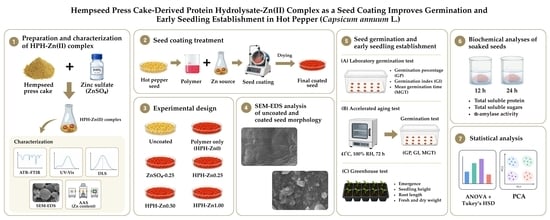
Hempseed Press Cake-Derived Protein Hydrolysate–Zn(II) Complex as a Seed Coating Improves Germination and Early Seedling Establishment in Hot Pepper (Capsicum annuum L.)

 , , , ,
Abstract
1. Introduction
2. Materials and Methods
2.1. Preparation and Characterization of HPH–Zn
2.2. Seed Material and Experimental Design
2.3. Seed Coating Procedure
2.4. SEM–EDS Analysis of Uncoated and Coated Seed Morphology and Zn Distribution
2.5. Seed Germination and Early Seedling Establishment
2.5.1. Evaluation of Laboratory Germination
2.5.2. Evaluation of Seed Vigor After Accelerated Aging
2.5.3. Evaluation of Field Emergence and Seedling Establishment
2.6. Biochemical Analyses of Soaked Seeds
2.6.1. Determination of Total Soluble Protein
2.6.2. Determination of Total Soluble Sugars
2.6.3. Analysis of α-Amylase Activity
2.7. Statistical Analysis
3. Results
3.1. Characterization of HPH–Zn
3.2. Effects of HPH–Zn Seed Coating on Seed Performance and Early Seedling Establishment
3.2.1. Morphology and Zn Distribution of Uncoated and Coated Seeds
3.2.2. Laboratory Germination Test
3.2.3. Accelerated Aging Test
3.2.4. Greenhouse Test
3.3. Biochemical Contents of Uncoated and Coated Hot Pepper Seeds After Soaking for 12 and 24 h
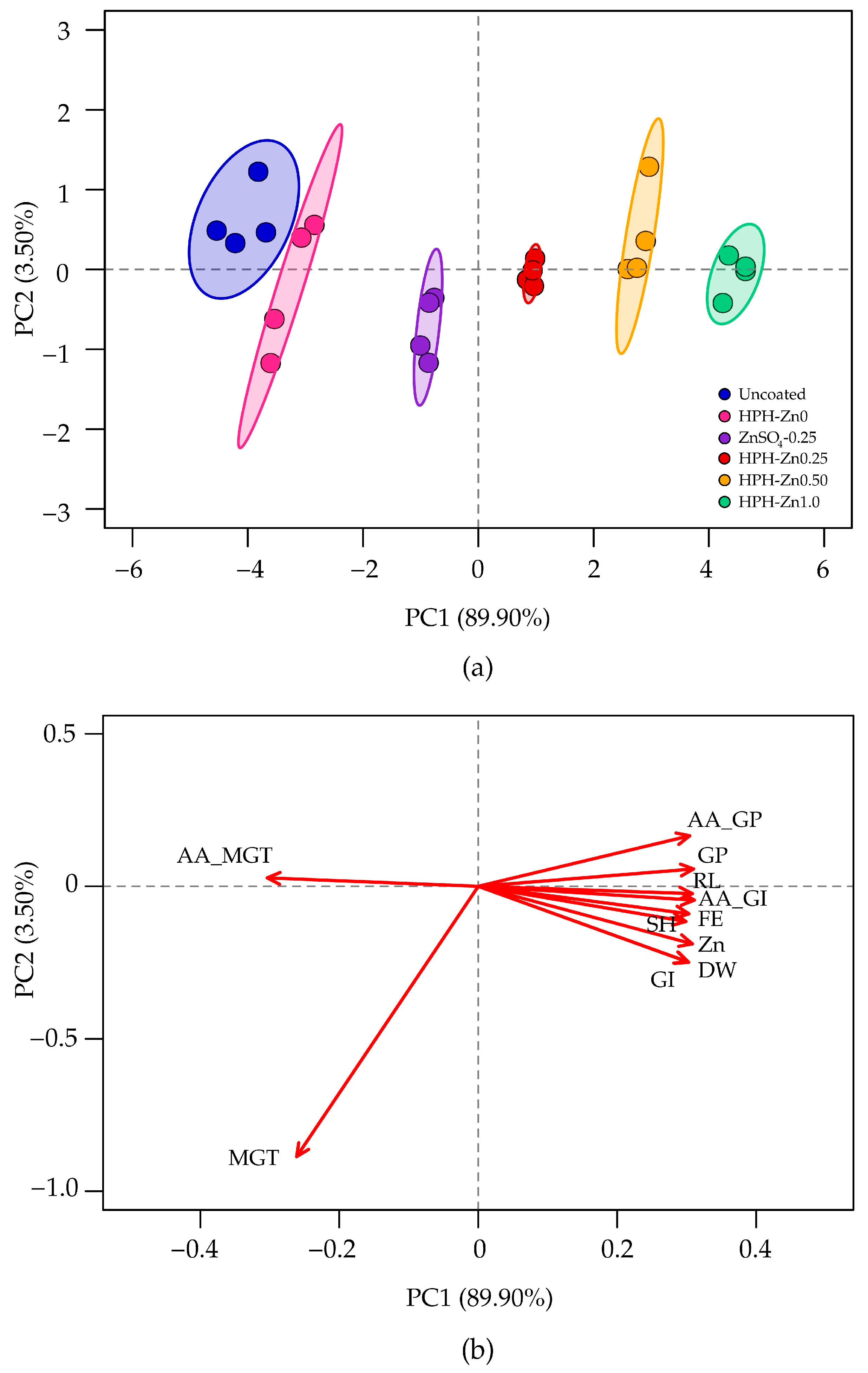
3.4. Principal Component Analysis
4. Discussion
5. Conclusions
Supplementary Materials
Author Contributions
Funding
Data Availability Statement
Acknowledgments
Conflicts of Interest
Abbreviations
| AAS | Atomic absorption spectrometer |
| AA test | Accelerated aging test |
| ANOVA | Analysis of variance |
| CI | Confidence interval |
| CMC | Carboxymethyl cellulose |
| CRD | Completely randomized design |
| DLS | Dynamic light scattering |
| DW | Dry weight |
| ATR–FTIR | Attenuated total reflection–Fourier transform infrared spectroscopy |
| FW | Fresh weight |
| GI | Germination index |
| GP | Germination percentage |
| HPH | Hempseed press cake-derived protein hydrolysate |
| HPH–Zn | Hempseed press cake-derived protein hydrolysate–Zn(II) complex |
| ISTA | International Seed Testing Association |
| MGT | Mean germination time |
| PAR | Photosynthetically active radiation |
| PCA | Principal component analysis |
| PH | Protein hydrolysates |
| ROS | Reactive oxygen species |
| SEM–EDS | Scanning electron microscopy with energy-dispersive X-ray spectroscopy |
| TP | Top of paper |
| Tukey’s HSD | Tukey’s honestly significant difference |
| Zn | Zinc |
| ZnSO4 | Zinc sulfate |
References
- Farooq, M.; Wahid, A.; Siddique, K.H. Micronutrient application through seed treatments: A review. J. Soil Sci. Plant Nutr. 2012, 12, 125–142. [Google Scholar] [CrossRef]
- Halmer, P. Seed technology and seed enhancement. Acta Hortic. 2008, 771, 17–26. [Google Scholar] [CrossRef]
- Geremew, A.; Stovall, L.; Woldesenbet, S.; Ma, X.; Carson, L. Nanopriming with zinc oxide: A novel approach to enhance germination and antioxidant systems in amaranth. Front. Plant Sci. 2025, 16, 1599192. [Google Scholar] [CrossRef] [PubMed]
- Maphalaphathwa, M.; Nciizah, A.D. Optimizing chillies (Capsicum annuum L.) germination rate and early seedling performance through nutrient seed priming with potassium nitrate and zinc oxide. Front. Plant Sci. 2025, 16, 1535305. [Google Scholar] [CrossRef] [PubMed]
- Amirkhani, M.; Netravali, A.N.; Huang, W.; Taylor, A.G. Investigation of soy protein–based biostimulant seed coating for broccoli seedling and plant growth enhancement. HortScience 2016, 51, 1121–1126. [Google Scholar] [CrossRef]
- Bewley, J.D.; Bradford, K.J.; Hilhorst, H.W.M.; Nonogaki, H. Seeds: Physiology of Development, Germination and Dormancy, 3rd ed.; Springer: New York, NY, USA, 2013; 392p. [Google Scholar]
- Ullah, A.; Farooq, M.; Hussain, M.; Ahmed, R.; Wakeel, A. Zinc seed coating improves emergence but shows toxicity at higher concentration. Int. J. Agric. Biol. 2019, 21, 553–559. [Google Scholar] [CrossRef]
- Sharma, A.; Patni, B.; Shankhdhar, D.; Shankhdhar, S.C. Zinc—An indispensable micronutrient. Physiol. Mol. Biol. Plants 2013, 19, 11. [Google Scholar] [CrossRef]
- Dimkpa, C.O.; Zeng, J.; McLean, J.E.; Britt, D.W.; Zhan, J.; Anderson, A.J. Production of indole-3-acetic acid via the indole-3-acetamide pathway in the plant-beneficial bacterium Pseudomonas chlororaphis O6 is inhibited by ZnO nanoparticles but enhanced by CuO nanoparticles. Appl. Environ. Microbiol. 2012, 78, 1404–1410. [Google Scholar] [CrossRef]
- Souri, M.K.; Hatamian, M. Aminochelates in plant nutrition: A review. J. Plant Nutr. 2019, 42, 67–78. [Google Scholar] [CrossRef]
- Montanha, G.S.; Rodrigues, E.S.; Marques, J.P.R.; de Almeida, E.; Colzato, M.; de Carvalho, H.W.P. Zinc nanocoated seeds: An alternative to boost soybean seed germination and seedling development. SN Appl. Sci. 2020, 2, 857. [Google Scholar] [CrossRef]
- Donia, D.T.; Carbone, M. Seed priming with zinc oxide nanoparticles to enhance crop tolerance to environmental stresses. Int. J. Mol. Sci. 2023, 24, 17612. [Google Scholar] [CrossRef]
- Zhao, X.; Chen, Y.; Li, H.; Lu, J. Influence of seed coating with copper, iron and zinc nanoparticles on growth and productivity of tomato. IET Nanobiotechnol. 2021, 15, 674–679. [Google Scholar] [CrossRef]
- Amirkhani, M.; Mayton, H.S.; Netravali, A.N.; Taylor, A.G. A seed coating delivery system for bio-based biostimulants to enhance plant growth. Sustainability 2019, 11, 5304. [Google Scholar] [CrossRef]
- Biswal, B.C.; Mishra, S.; Jaiswal, K.; Mohanty, S.; Dash, D. Seed coating innovations for sustainable horticulture enhancing germination, crop resilience and resource efficiency. Discov. Sustain. 2026, 7, 426. [Google Scholar] [CrossRef]
- Raliya, R.; Tarafdar, J.C. ZnO nanoparticle biosynthesis and its effect on phosphorous-mobilizing enzyme secretion and gum contents in clusterbean (Cyamopsis tetragonoloba L.). Agric. Res. 2013, 2, 48–57. [Google Scholar] [CrossRef]
- Younes, N.A.; Hassan, H.S.; Elkady, M.F.; Hamed, A.M.; Dawood, M.F. Impact of synthesized metal oxide nanomaterials on seedlings production of three Solanaceae crops. Heliyon 2020, 6, e03188. [Google Scholar] [CrossRef] [PubMed]
- Taylor, A.G. Seed Treatments. In Encyclopedia of Applied Plant Sciences, 2nd ed.; Thomas, B., Murphy, D.J., Murray, B.G., Eds.; Elsevier Academic Press: Amsterdam, The Netherlands, 2003; pp. 1291–1298. [Google Scholar]
- Mulas, D.; García-Fraile, P.; Carro, L.; Ramírez-Bahena, M.-H.; Casquero, P.; Velázquez, E.; González-Andrés, F. Distribution and efficiency of Rhizobium leguminosarum strains nodulating Phaseolus vulgaris in Northern Spanish soils: Selection of native strains that replace conventional N fertilization. Soil Biol. Biochem. 2011, 43, 2283–2293. [Google Scholar] [CrossRef]
- Mayo-Prieto, S.; Porteous-Álvarez, A.J.; Carro-Huerga, G.; Zanfaño, L.; Ramírez-Lozano, D.; Rodríguez-González, Á.; Lorenzana de la Varga, A.; Casquero, P.A. Hop waste seed coating (pilling) as circular bioeconomic alternative to improve seed germination and Trichoderma development. Agriculture 2025, 15, 1328. [Google Scholar] [CrossRef]
- Ertani, A.; Pizzeghelio, D.; Altissimo, A.; Nardi, S. Use of meat hydrolyzate derived from tanning residues as plant biostimulant for hydroponically grown maize. J. Soil Sci. Plant Nutr. 2013, 176, 287–296. [Google Scholar] [CrossRef]
- Noman, A.; Ali, Q.; Maqsood, J.; Iqbal, N.; Javed, M.T.; Rasool, N.; Naseem, J. Deciphering physio-biochemical, yield, and nutritional quality attributes of water-stressed radish (Raphanus sativus L.) plants grown from Zn-Lys primed seeds. Chemosphere 2018, 195, 175–189. [Google Scholar] [CrossRef] [PubMed]
- Harakotr, B.; Trisiri, T.; Charoensup, L.; Thepsilvisut, O.; Rithichai, P.; Suwor, P.; Jirakiattikul, Y. Effects of protein hydrolysate derived from hempseed by-products on growth, mineral contents, and quality of greenhouse grown red oak lettuce. Horticulturae 2025, 11, 357. [Google Scholar] [CrossRef]
- Capcanari, T.; Covaliov, E.; Negoița, C.; Siminiuc, R.; Chirsanova, A.; Reșitca, V.; Țurcanu, D. Hemp seed cake flour as a source of proteins, minerals and polyphenols and its impact on the nutritional, sensorial and technological quality of bread. Foods 2023, 12, 4327. [Google Scholar] [CrossRef] [PubMed]
- Lu, D.; Peng, M.; Yu, M.; Jiang, B.; Wu, H.; Chen, J. Effect of enzymatic hydrolysis on the zinc binding capacity and in vitro gastrointestinal stability of peptides derived from pumpkin (Cucurbita pepo L.) seeds. Front. Nutr. 2021, 8, 647782. [Google Scholar] [CrossRef] [PubMed]
- Bahin, E.; Bailly, C.; Sotta, B.; Kranner, I.; Corbineau, F.; Leymarie, J. Crosstalk between reactive oxygen species and hormonal signalling pathways regulates grain dormancy in barley. Plant Cell Environ. 2011, 34, 980–993. [Google Scholar] [CrossRef]
- ISTA. International Rules for Seed Testing; The International Seed Testing Association (ISTA): Bassersdorf, Switzerland, 2012; pp. 5-1–5-78. [Google Scholar]
- ISTA. Handbook of Vigor Test Methods; The International Seed Testing Association (ISTA): Bassersdorf, Switzerland, 1995. [Google Scholar]
- Bradford, M.M. A rapid and sensitive method for the quantitation of microgram quantities of protein utilizing the principle of protein-dye binding. Anal. Biochem. 1976, 72, 248–254. [Google Scholar] [CrossRef] [PubMed]
- DuBois, M.; Gilles, K.A.; Hamilton, J.K.; Rebers, P.A.; Smith, F. Colorimetric method for determination of sugars and related substances. Anal. Chem. 1956, 28, 350–356. [Google Scholar] [CrossRef]
- McCleary, B.V.; McNally, M.; Monaghan, D.; Mugford, D.C. Measurement of alpha-amylase activity in white wheat flour, milled malt, and microbial enzyme preparations, using the Ceralpha assay: Collaborative study. J. AOAC Int. 2002, 85, 1096–1102. [Google Scholar] [CrossRef]
- Wang, Q.; Xiong, Y.L. Zinc-binding behavior of hemp protein hydrolysates: Soluble versus insoluble zinc-peptide complexes. J. Funct. Foods 2018, 49, 105–112. [Google Scholar] [CrossRef]
- Chen, L.; Shen, X.; Xia, G. Effect of molecular weight of tilapia (Oreochromis niloticus) skin collagen peptide fractions on zinc-chelating capacity and bioaccessibility of the zinc-peptide fractions complexes in vitro digestion. Appl. Sci. 2020, 10, 2041. [Google Scholar] [CrossRef]
- Lu, Z.; Huang, Q.; Qin, X.; Chen, F.; Li, E.; Lin, H. Novel insights into ethanol-soluble oyster peptide–zinc-chelating agents. Mar. Drugs. 2024, 22, 465. [Google Scholar] [CrossRef]
- Wang, X.; Zhou, J.; Tong, P.S.; Mao, X.Y. Zinc-binding capacity of yak casein hydrolysate and the zinc-releasing characteristics of casein hydrolysate-zinc complexes. J. Dairy Sci. 2011, 94, 2731–2740. [Google Scholar] [CrossRef] [PubMed]
- Blindauer, C.A.; Harvey, I.; Bunyan, K.E.; Stewart, A.J.; Sleep, D.; Harrison, D.J.; Berezenko, S.; Sadler, P.J. Structure, properties, and engineering of the major zinc binding site on human albumin. J. Biol. Chem. 2009, 284, 23116–23124. [Google Scholar] [CrossRef]
- Zhang, Z.; Zhou, F.; Liu, X.; Zhao, M. Particulate nanocomposite from oyster (Crassostrea rivularis) hydrolysates via zinc chelation improves zinc solubility and peptide activity. Food Chem. 2018, 258, 269–277. [Google Scholar] [CrossRef]
- Zhu, S.; Zheng, Y.; He, S.; Su, D.; Nag, A.; Zeng, Q.; Yuan, Y. Novel Zn-binding peptide isolated from soy protein hydrolysates: Purification, structure, and digestion. J. Agric. Food Chem. 2021, 69, 483–490. [Google Scholar] [CrossRef]
- Barboza, G.E.; García, C.C.; de Bem Bianchetti, L.; Romero, M.V.; Scaldaferro, M. Monograph of wild and cultivated chili peppers (Capsicum L., Solanaceae). PhytoKeys 2022, 200, 1–423. [Google Scholar] [CrossRef]
- Chen, P. Light, Electron Microscopic and Element Analysis Studies of Capsicum annuum Seeds. Master’s Thesis, McMaster University, Hamilton, ON, Canada, May 1991. [Google Scholar]
- Maekawa, S.; Carpenter, W.J. Verbena seed hilum morphology contributes to irregular germination. HortScience 1991, 26, 129–132. [Google Scholar] [CrossRef]
- Souza, F.H.; Marcos-Filho, J. The seed coat as a modulator of seed-environment relationships in Fabaceae. Braz. J. Bot. 2001, 24, 365–375. [Google Scholar] [CrossRef]
- Ruggiero, A.; Landi, S.; Punzo, P.; Possenti, M.A.; Van Oosten, M.J.; Costa, A.; Morelli, G.; Maggio, A.; Grillo, S.; Batelli, G. Salinity and ABA seed responses in pepper: Expression and interaction of ABA core signaling components. Front. Plant Sci. 2019, 10, 304. [Google Scholar] [CrossRef]
- Zhao, Q.; Shi, X.; Yan, L.; Yang, C.; Liu, C.; Feng, Y.Y.; Zhang, M.; Yang, Y.; Liao, H. Characterization of the common genetic basis underlying seed hilum size, yield, and quality traits in soybean. Front. Plant Sci. 2021, 12, 610214. [Google Scholar] [CrossRef] [PubMed]
- Ahmed, N.; Siow, K.S.; Wee, M.M.R.; Patra, A. A study to examine the ageing behaviour of cold plasma-treated agricultural seeds. Sci. Rep. 2023, 13, 1675. [Google Scholar] [CrossRef] [PubMed]
- Kathiravan, M.; Vanitha, C.; Umarani, R.; Marimuthu, S.; Ayyadurai, P.; Sathiya, K.; Yuvaraj, M.; Jaiby, C. Seed priming with biosynthesized zinc oxide nanoparticles for enhancing seed germination and vigour through promoting antioxidant and hydrolytic enzyme activity in green gram (Vigna radiata). Agric. Res. 2024, 13, 697–709. [Google Scholar] [CrossRef]
- Thakare, H.S.; Kumar, V.R.; Singh, C.M. Effect of different hydrolytic enzymes on germination of inter and intra specific cotton hybrids and parents. Bioscan 2014, 9, 943–946. [Google Scholar]
- Zastrow, M.L.; Pecoraro, V.L. Designing hydrolytic zinc metalloenzymes. Biochemistry 2014, 53, 957–978. [Google Scholar] [CrossRef]
- Ghasemi, S.; Khoshgoftarmanesh, A.H.; Afyuni, M.; Hadadzadeh, H. The effectiveness of foliar applications of synthesized zinc-amino acid chelates in comparison with zinc sulfate to increase yield and grain nutritional quality of wheat. Eur. J. Agron. 2013, 45, 68–74. [Google Scholar] [CrossRef]
- Wang, W.; Zhang, C.; Zheng, W.; Lv, H.; Li, J.; Liang, B.; Zhou, W. Seed priming with protein hydrolysate promotes seed germination via reserve mobilization, osmolyte accumulation and antioxidant systems under PEG-induced drought stress. Plant Cell Rep. 2022, 41, 2173–2186. [Google Scholar] [CrossRef]
- Henning, F.A.; Mertz, L.M.; Jacob Junior, E.A.; Machado, R.D.; Fiss, G.; Zimmer, P.D. Chemical composition and reserve mobilization in soybean seeds with high and low vigor. Bragantia 2010, 69, 727–734. [Google Scholar] [CrossRef]
- Zhao, M.; Zhang, H.; Yan, H.; Qiu, L.; Baskin, C.C. Mobilization and role of starch, protein, and fat reserves during seed germination of six wild grassland species. Front. Plant Sci. 2018, 9, 234. [Google Scholar] [CrossRef]
- Elhaj Baddar, Z.; Unrine, J.M. Functionalized-ZnO-nanoparticle seed treatments to enhance growth and Zn content of wheat (Triticum aestivum) seedlings. J. Agric. Food Chem. 2018, 66, 12166–12178. [Google Scholar] [CrossRef] [PubMed]
- Rohr, L.A.; França-Silva, F.; Corrêa, C.G.; Carvalho, H.W.P.D.; Gomes-Junior, F.G. Soybean seeds treated with zinc evaluated by X-ray micro-fluorescence spectroscopy. Sci. Agr. 2023, 80, e20210131. [Google Scholar] [CrossRef]
- Goel, A.; Goel, A.K.; Sheorana, I.S. Changes in oxidative stress enzymes during artificial aging in cotton (Gossypium hirsutum L.) seeds. J. Plant Physiol. 2003, 160, 1093–1100. [Google Scholar] [CrossRef]
- Li, W.; Niu, Y.; Zheng, Y.; Wang, Z. Advances in the understanding of reactive oxygen species-dependent regulation on seed dormancy, germination, and deterioration in crops. Front. Plant Sci. 2022, 13, 826809. [Google Scholar] [CrossRef]
- Evans, P.; Halliwell, B. Micronutrients: Oxidant/antioxidant status. Br. J. Nutr. 2001, 85, 67–74. [Google Scholar] [CrossRef]
- Azarakhsh, M.R.; Asrar, Z.; Mansouri, H. Effects of seed and vegetative stage cysteine treatments on oxidative stress response molecules and enzymes in Ocimum basilicum L. under cobalt stress. J. Soil Sci. Plant Nutr. 2015, 15, 651–662. [Google Scholar] [CrossRef]
- Gomez, K.A.; Gomez, A.A. Statistical Procedures for Agricultural Research, 2nd ed.; John Wiley and Sons: New York, NY, USA, 1984; 680p. [Google Scholar]
- Meyvisch, T.; Willems, E.; Everaert, M. Micronutrient seed coatings of layered double hydroxides overcome seedling toxicity and improve micronutrient uptake in comparison with soluble micronutrient coatings. J. Agric. Food Chem. 2025, 73, 1131–1144. [Google Scholar] [CrossRef]
- Halpern, M.; Bar-Tal, A.; Ofek, M.; Minz, D.; Müller, T.; Yermiyahu, U. The use of biostimulants for enhancing nutrient uptake. Adv. Agron. 2015, 130, 141–174. [Google Scholar] [CrossRef]
- Taylor, A.G.; Harman, G.E. Concepts and technologies of selected seed treatments. Annu. Rev. Phytopathol. 1990, 28, 321–339. [Google Scholar] [CrossRef]



| Treatments 1 | Germination (%) | GI 2 | MGT (Days) |
|---|---|---|---|
| Uncoated | 86.00 ± 0.00 d 3 | 3.74 ± 0.01 d | 10.84 ± 0.10 ab |
| HPH–Zn0 | 85.78 ± 0.16 d | 3.93 ± 0.09 d | 11.01 ± 0.20 a |
| ZnSO4–0.25 | 89.33 ± 0.47 c | 4.13 ± 0.05 c | 10.94 ± 0.08 ab |
| HPH–Zn0.25 | 90.67 ± 0.47 c | 4.30 ± 0.10 bc | 10.43 ± 0.04 bc |
| HPH–Zn0.50 | 94.67 ± 0.47 b | 4.37 ± 0.03 b | 10.19 ± 0.14 c |
| HPH–Zn1.00 | 96.89 ± 0.42 a | 4.57 ± 0.00 a | 10.14 ± 0.06 c |
| Treatments 1 | Germination (%) | GI 2 | MGT (Days) |
|---|---|---|---|
| Uncoated | 76.67 ± 0.47 c 3 | 3.34 ± 0.05 d | 11.00 ± 0.05 a |
| HPH–Zn0 | 74.44 ± 0.31 d | 3.47 ± 0.09 cd | 10.87 ± 0.03 ab |
| ZnSO4–0.25 | 80.17 ± 0.17 b | 3.77 ± 0.04 c | 10.66 ± 0.04 b |
| HPH–Zn0.25 | 81.89 ± 0.34 b | 3.88 ± 0.02 b | 10.32 ± 0.04 c |
| HPH–Zn0.50 | 88.67 ± 0.47 a | 4.23 ± 0.00 ab | 10.24 ± 0.01 cd |
| HPH–Zn1.00 | 88.92 ± 0.50 a | 4.50 ± 0.07 a | 10.00 ± 0.05 d |
| Treatments 1 | Field Emergence (%) | Shoot Height (cm) | Root Length (cm) | Dry Weight (mg Plant−1) | Zn Content (mg kg−1 Seedling DW) |
|---|---|---|---|---|---|
| Uncoated | 73.67 ± 1.25 e 2 | 4.30 ± 0.25 e | 3.51 ± 0.02 e | 7.36 ± 0.33 e | 20.57 ± 0.17 d |
| HPH–Zn0 | 78.67 ± 0.62 d | 4.51 ± 0.20 de | 4.16 ± 0.02 d | 7.85 ± 0.10 d | 20.44 ± 0.59 d |
| ZnSO4–0.25 | 80.50 ± 0.20 cd | 5.10 ± 0.05 cd | 4.37 ± 0.02 c | 9.70 ± 0.06 c | 33.31 ± 0.37 c |
| HPH–Zn0.25 | 82.67 ± 0.47 c | 5.36 ± 0.04 bc | 5.13 ± 0.02 b | 10.42 ± 0.07 b | 37.63 ± 0.12 b |
| HPH–Zn0.50 | 87.50 ± 0.20 b | 5.73 ± 0.02 ab | 5.66 ± 0.04 a | 10.69 ± 0.04 ab | 38.67 ± 0.14 b |
| HPH–Zn1.00 | 94.00 ± 0.82 a | 6.06 ± 0.08 a | 5.74 ± 0.06 a | 10.96 ± 0.01 a | 42.21 ± 0.63 a |
Disclaimer/Publisher’s Note: The statements, opinions and data contained in all publications are solely those of the individual author(s) and contributor(s) and not of MDPI and/or the editor(s). MDPI and/or the editor(s) disclaim responsibility for any injury to people or property resulting from any ideas, methods, instructions or products referred to in the content. |
© 2026 by the authors. Licensee MDPI, Basel, Switzerland. This article is an open access article distributed under the terms and conditions of the Creative Commons Attribution (CC BY) license.
Share and Cite
Srisuwannaphat, N.; Rithichai, P.; Jirakiattikul, Y.; Wannarit, N.; Kangsopa, J.; Harakotr, B. Hempseed Press Cake-Derived Protein Hydrolysate–Zn(II) Complex as a Seed Coating Improves Germination and Early Seedling Establishment in Hot Pepper (Capsicum annuum L.). Horticulturae 2026, 12, 608. https://doi.org/10.3390/horticulturae12050608
Srisuwannaphat N, Rithichai P, Jirakiattikul Y, Wannarit N, Kangsopa J, Harakotr B. Hempseed Press Cake-Derived Protein Hydrolysate–Zn(II) Complex as a Seed Coating Improves Germination and Early Seedling Establishment in Hot Pepper (Capsicum annuum L.). Horticulturae. 2026; 12(5):608. https://doi.org/10.3390/horticulturae12050608
Chicago/Turabian StyleSrisuwannaphat, Napat, Panumart Rithichai, Yaowapha Jirakiattikul, Nanthawat Wannarit, Jakkrapong Kangsopa, and Bhornchai Harakotr. 2026. "Hempseed Press Cake-Derived Protein Hydrolysate–Zn(II) Complex as a Seed Coating Improves Germination and Early Seedling Establishment in Hot Pepper (Capsicum annuum L.)" Horticulturae 12, no. 5: 608. https://doi.org/10.3390/horticulturae12050608
APA StyleSrisuwannaphat, N., Rithichai, P., Jirakiattikul, Y., Wannarit, N., Kangsopa, J., & Harakotr, B. (2026). Hempseed Press Cake-Derived Protein Hydrolysate–Zn(II) Complex as a Seed Coating Improves Germination and Early Seedling Establishment in Hot Pepper (Capsicum annuum L.). Horticulturae, 12(5), 608. https://doi.org/10.3390/horticulturae12050608