


Formulation and Evaluation of an Eco-Friendly Allamanda Microemulsion Biofungicide for the Control of Anthracnose in Papaya

Abstract
1. Introduction
2. Materials and Methods
2.1. Preparation of Formulations Using a Ternary Phase Diagram
2.2. Characterization of Formulations
2.2.1. Stability Test
2.2.2. Surface Tension Analysis
2.2.3. Particle Size Measurement
2.3. Evaluation of the Formulations Regarding Anthracnose Development
Disease Assessment
2.4. Influence of Allamanda Microemulsion on the Physicochemical Characteristics of Papaya Fruits
2.4.1. Weight Loss
2.4.2. Firmness
2.4.3. Peel Color
2.4.4. Soluble Solids Concentration (SSC)
2.4.5. Statistical Analysis
3. Results
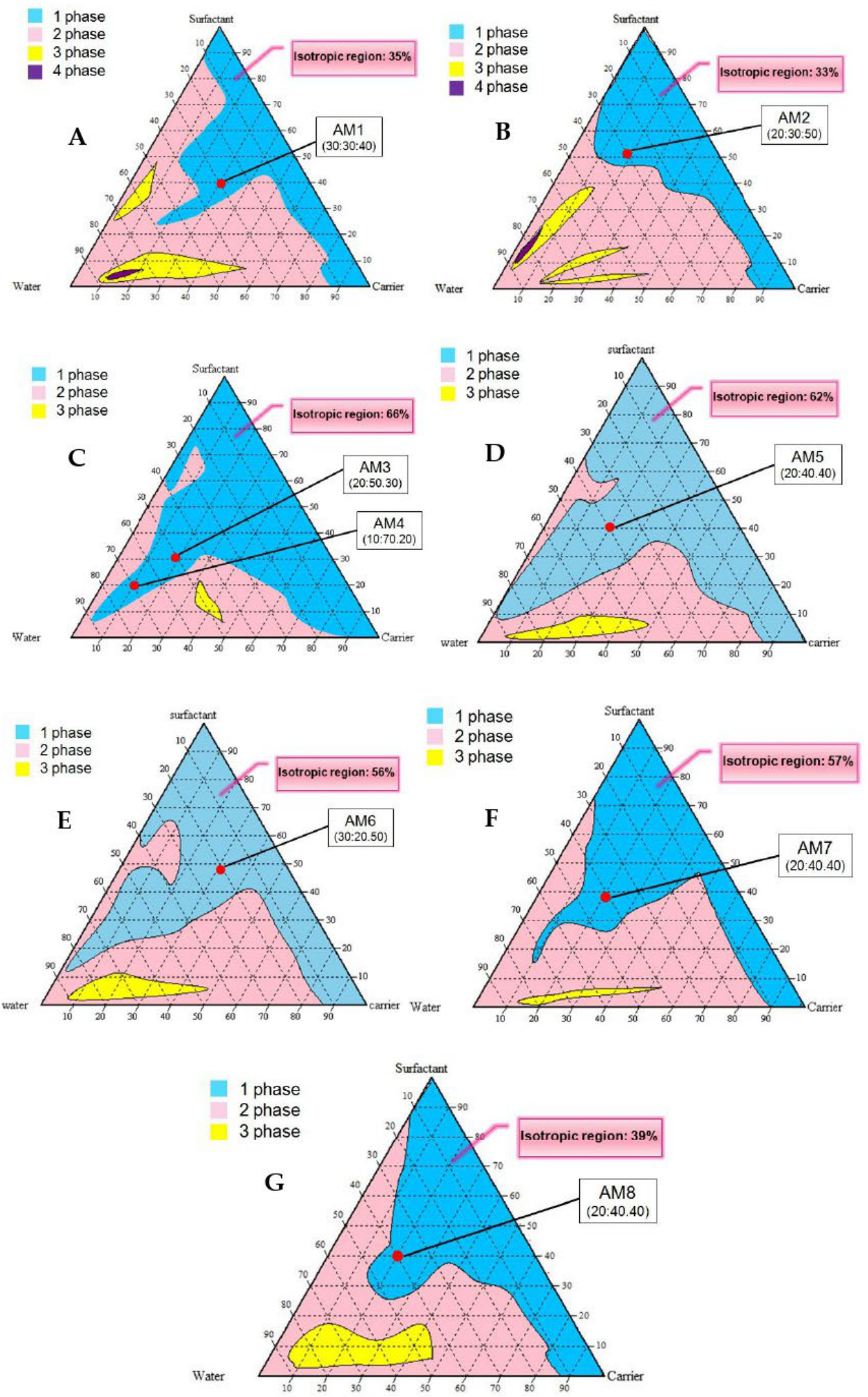
3.1. Ternary Phase Diagrams and Point Selection of Allamanda Formulations
3.2. Stability, Surface Tension, and Particle Size Measurements of Formulations
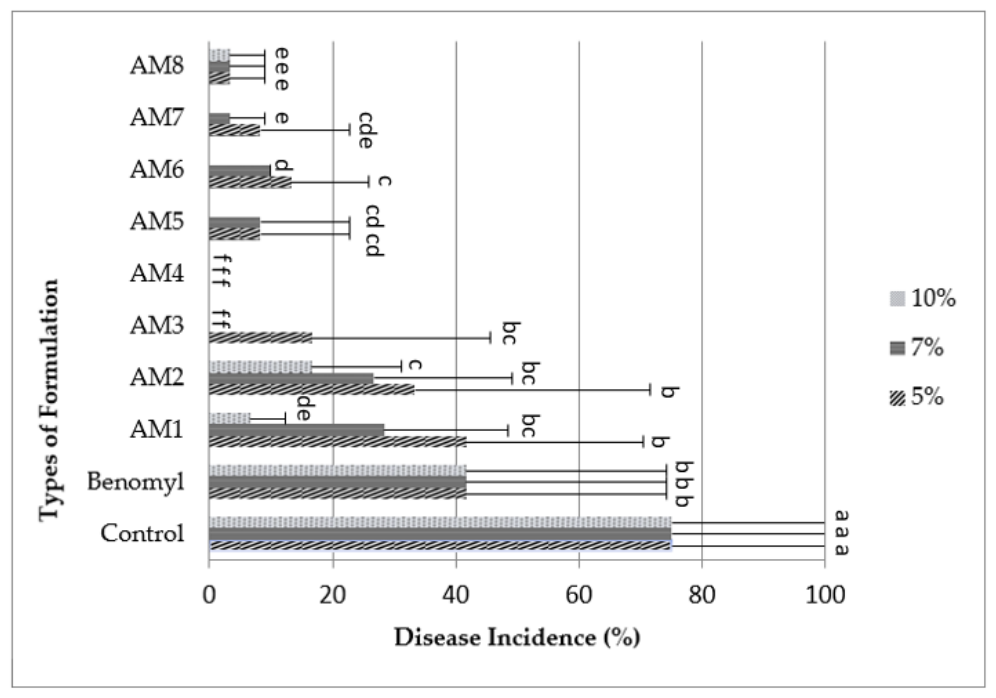
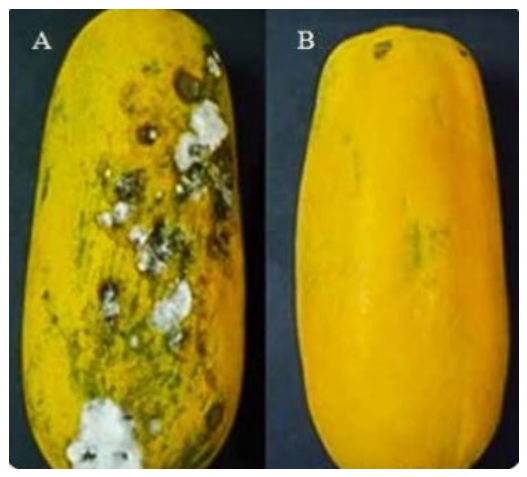
3.3. Effect of Allamanda Formulations on Anthracnose Disease in Papaya
3.4. Effect of Allamanda Formulations on Fruit Quality and Storage Life of Papaya
4. Discussion
4.1. Formulation Development Based on Ternary Phase Diagrams
4.2. Stability, Surface Tension, and Particle Size of Allamanda Formulations
4.3. Effect of Allamanda Formulations on Anthracnose Control in Papaya
4.4. Effect of Allamanda Formulations on Fruit Quality and Shelf Life
4.5. Toxicity and Formulation Stability
5. Conclusions
6. Patents
Author Contributions
Funding
Data Availability Statement
Acknowledgments
Conflicts of Interest
Abbreviations
| ACLCE | Allamanda concentrated liquid crude extract |
| AM | Allamanda microemulsion |
| RH | Relative humidity |
| N | Newton |
| WP | Wettable powder |
| w/w | Weight per weight |
| w/v | Weight per volume |
| v/v | Volume per volume |
| mN/m | Millinewton per meter |
| nm | Nanometer |
| L* | Lightness value |
| C* | Chroma (color saturation) |
| h° | Hue angle |
| SSC | Soluble solids content |
| °Brix | Degree Brix (percentage of soluble solids) |
| ANOVA | Analysis of variance |
References
- Food and Agriculture Organization of the United Nations (FAO). FAOSTAT Statistical Database: Crops and Livestock Products—Papaya Production Statistics, 2023. Available online: https://www.fao.org/faostat/en/#data/QCL (accessed on 12 March 2026).
- Tridge. Papaya Production Trends and Statistics in Malaysia, 2025. Available online: https://www.tridge.com/intelligences/papaya/MY/production (accessed on 12 March 2026).
- Hassan, H.; Mohamed, M.T.M.; Yusoff, S.F.; Hata, E.M.; Tajidin, N.E. Selecting antagonistic yeast for postharvest biocontrol of Colletotrichum gloeosporioides in papaya fruit and possible mechanisms involved. Agronomy 2021, 11, 760. [Google Scholar] [CrossRef]
- Getnet, M.; Alemu, K.; Tsedaley, B. Effect of combined application of carbonate salts and hot water treatment for the management of postharvest anthracnose (Colletotrichum gloeosporioides) of papaya. Food Sci. Nutr. 2023, 11, 3811–3819. [Google Scholar] [CrossRef]
- Fernandes, K.F.D.; Queiroga, T.S.; Lima, M.D.C.; de Oliveira KÁ, R.; de Souza, E.L. Interventions based on alternative and sustainable strategies for postharvest control of anthracnose and maintain quality in tropical fruits. Compr. Rev. Food Sci. Food Saf. 2024, 23, e13427. [Google Scholar] [CrossRef]
- Sivakumar, D.; Tuna Gunes, N.; Romanazzi, G. A comprehensive review on the impact of edible coatings, essential oils, and their nano formulations on postharvest decay anthracnose of avocados, mangoes, and papayas. Front. Microbiol. 2021, 12, 711092. [Google Scholar] [CrossRef] [PubMed]
- López-Zazueta, B.A.; Ayón-Reyna, L.E.; Gutiérrez-Dorado, R.; Rodríguez-Gómez, F.A.; López-López, M.E.; López-Velázquez, J.G.; Diáz-Corona, D.A.; Vega-García, M.O. Effect of chitosan with different molecular weights on the antifungal activity against Colletotrichum gloeosporioides and activation of the non-enzymatic antioxidant system on infected papaya. J. Food Sci. 2023, 88, 1979–1993. [Google Scholar] [CrossRef]
- Balkrishna, A.; Saini, A.; Bhandari, R.; Arya, V.; Sharma, I.P. Phytochemical, Medicinal, and Green Approaches of Allamanda cathartica L.: A Mini Review. Curr. Indian Sci. 2023, 1, e211222212074. [Google Scholar] [CrossRef]
- Tomar, R.; Das, S.S.; Sahu, V.; Kapoor, N.; Chaudhary, D.; Sahoo, J.; Rath, S.K.; Kesari, K.K. Allamanda cathartica (Linn.) leaf extract-encapsulated phytoemulsions: Formulation, characterization and in vitro–in vivo biological evaluations. Sustain. Food Technol. 2024, 2, 1490–1505. [Google Scholar] [CrossRef]
- Manukonda, R.M.; Dhabal, S. Phytochemical Analysis and Evaluation of In Vitro Antimitotic Activity of Allamanda cathartica Methanolic Extract. J. Pharma Insights Res. 2024, 2, 146–154. [Google Scholar] [CrossRef]
- Fartyal, M. Comparative study of antifungal potential of various extracts of leaves of Carissa carandas Linn., Nerium oleander Linn. and Allamanda cathartica Linn. against human fungal pathogen Candida albicans. Vegetos 2024, 37, 1847–1854. [Google Scholar] [CrossRef]
- Saikia, K.; Dutta, P.P.; Saikia, L.; Aziz Barbhuiya, S.A. A Comprehensive Review on Allamanda Genus: An Insight into the Traditional Uses, Phytochemistry, and Pharmacological Activities. Curr. Top. Med. Chem. 2026; Online ahead of print.
- Malik, N.; Loshali, A.; Joshi, B.C.; Sundriyal, A.; Dobhal, Y. Protective Effects of Hydroalcoholic and Aqueous Extracts of Allamanda cathartica Leaves against Acetaminophen-induced Hepatic Damage in Rats. J. Complement. Altern. Med. Res. 2026, 27, 7–17. [Google Scholar] [CrossRef]
- Haron, F.F.; Sijam, K.; Omar, D.; Rahmani, M. Chemical composition and screening for antifungal activity of Allamanda spp. (Apocynaceae) crude extracts against Colletotrichum gloeosporioides, causal agent of anthracnose in papaya. Aust. J. Basic Appl. Sci. 2013, 7, 88–96. [Google Scholar]
- Haron, F.F.; Sijam, K.; Omar, D.; Rahmani, M.R. Bioassay-guided isolation of antifungal plumericin from Allamanda species (Apocynaceae). J. Biol. Sci. 2013, 13, 158–162. [Google Scholar] [CrossRef]
- Marrone, P.G. Pesticidal natural products–status and future potential. Pest Manag. Sci. 2019, 75, 2325–2340. [Google Scholar] [CrossRef]
- McClements, D.J. Advances in edible nanoemulsions: Digestion, bioavailability, and potential toxicity. Prog. Lipid Res. 2021, 81, 101081. [Google Scholar] [CrossRef]
- Tadros, T.F. Emulsion Formation, Stability, and Rheology. In Emulsion Formation and Stability; Wiley: Hoboken, NJ, USA, 2013; pp. 1–75. [Google Scholar]
- Gupta, A.; Eral, H.B.; Hatton, T.A.; Doyle, P.S. Nanoemulsions: Formation, properties and applications. Soft Matter 2016, 12, 2826–2841. [Google Scholar] [CrossRef] [PubMed]
- Pavoni, L.; Perinelli, D.R.; Bonacucina, G.; Cespi, M.; Palmieri, G.F. An overview of micro-and nanoemulsions as vehicles for essential oils: Formulation, preparation and stability. Nanomaterials 2020, 10, 135. [Google Scholar] [CrossRef] [PubMed]
- Elgharbawy, A.A.; Salleh, H.M. Methods of food grade nanoemulsion formulation, fabrication, and characterization. In Bio-Based Nanoemulsions for Agri-Food Applications; Elsevier: Amsterdam, The Netherlands, 2022; pp. 297–310. [Google Scholar]
- Pham, T.T.; Nguyen, L.L.P.; Dam, M.S.; Baranyai, L. Application of edible coating in extension of fruit shelf life. AgriEngineering 2023, 5, 520–536. [Google Scholar] [CrossRef]
- Kocira, A.; Kozłowicz, K.; Panasiewicz, K.; Staniak, M.; Szpunar-Krok, E.; Hortyńska, P. Polysaccharides as edible films and coatings: Characteristics and influence on fruit and vegetable quality—A review. Agronomy 2021, 11, 813. [Google Scholar] [CrossRef]
- Ali, S.; Anjum, M.A.; Khan, A.S.; Nawaz, A.; Ejaz, S.; Khaliq, G.; Iqbal, S.; Ullah, S.; Rehman, R.N.U.; Ali, M.M.; et al. Carboxymethyl cellulose coating delays ripening of harvested mango fruits by regulating softening enzymes activities. Food Chem. 2022, 380, 131804. [Google Scholar] [CrossRef]
- Biju, C.N.; Praveena, R. Evaluation of plant extracts for antifungal activity against Colletotrichum gloeosporioides, the incitant of leaf blight in small cardamom and anthracnose of black pepper. J. Plant Crops 2018, 46, 92–101. [Google Scholar] [CrossRef]
- Kwodaga, J.K.; Sowley, E.N.K.; Badii, B.K. Antifungal activity of plant extracts against Colletotrichum gloeosporioides (Penz.) the causative agent of yam anthracnose disease. Arch. Phytopathol. Plant Prot. 2019, 52, 218–233. [Google Scholar] [CrossRef]
- Zainudin, N.A.I.M.; Azmi, N.H.M.; Rahman, M.B.A.; Asmawi, A.A. Bioefficacy of a microemulsified mangosteen peel extract formulation against fruit rot fungi. Sci. Rep. 2026, 16, 4336. [Google Scholar] [CrossRef]
- Ungureanu, C.; Tihan, G.; Zgârian, R.; Pandelea, G. Bio-Coatings for Preservation of Fresh Fruits and Vegetables. Coatings 2023, 13, 1420. [Google Scholar] [CrossRef]
- Basumatary, I.B.; Mukherjee, A.; Katiyar, V.; Dutta, J.; Kumar, S. Chitosan-based active coating for pineapple preservation: Evaluation of antimicrobial efficacy and shelf-life extension. LWT 2022, 168, 113940. [Google Scholar] [CrossRef]
- Aaqil, M.; Peng, C.; Kamal, A.; Nawaz, T.; Gong, J. Recent Approaches to the Formulation, Uses, and Impact of Edible Coatings on Fresh Peach Fruit. Foods 2024, 13, 267. [Google Scholar] [CrossRef] [PubMed] [PubMed Central]
- Pan, J.; Li, C.; Liu, J.; Jiao, Z.; Zhang, Q.; Lv, Z.; Yang, W.; Chen, D.; Liu, H. Polysaccharide-Based Packaging Coatings and Films with Phenolic Compounds in Preservation of Fruits and Vegetables—A Review. Foods 2024, 13, 3896. [Google Scholar] [CrossRef]
- Nikolaev, B.; Yakovleva, L.; Fedorov, V.; Li, H.; Gao, H.; Shevtsov, M. Nano- and microemulsions in biomedicine: From theory to practice. Pharmaceutics 2023, 15, 1989. [Google Scholar] [CrossRef]
- Sambhakar, S.; Yadav, S.; Sharma, A. Nanoemulsion: An emerging novel technology for improving the solubility and bioavailability of poorly water-soluble drugs. Pharmaceutics 2023, 15, 2285. [Google Scholar] [CrossRef]
- Ranjani, S.; Hemalatha, S. Polyherbal nanoformulation: A potent antifungal agent on fungal pathogens of Coffea arabica. Discov. Nano. 2025, 20, 58. [Google Scholar] [CrossRef]



| Formulation | Surfactant Phase |
|---|---|
| AM1 | Agnique MBL 510H |
| AM2 | Agnique MBL 530H |
| AM3 | 10% Agnique MBL 530H:90% Agnique MBL 510H |
| AM4 | 10% Agnique MBL 530H:90% Agnique MBL 510H |
| AM5 | 20% Agnique MBL 530H:80% Agnique MBL 510H |
| AM6 | 30% Agnique MBL 530H:70% Agnique MBL 510H |
| AM7 | 40% Agnique MBL 530H:60% Agnique MBL 510H |
| AM8 | 50% Agnique MBL 530H:50% Agnique MBL 510H |
| Formulation | Composition (%w/w) | Surface Tension (mN/m) | Particle Size (nm) | Stability (>4 Weeks) | |||||
|---|---|---|---|---|---|---|---|---|---|
| Ag. MBL 510H | Ag. MBL 530H | Ag. AMD 810 | Water | * ACLCE | Total | ||||
| AM1 | 19.5 | - | 19.5 | 26 | 35 | 100 | 30.5 | 88.83 | √ |
| AM2 | - | 13 | 19.5 | 32.5 | 35 | 100 | 29.2 | 59.67 | √ |
| AM3 | 11.7 | 1.3 | 32.5 | 19.5 | 35 | 100 | 30 | 1801.05 | √ |
| AM4 | 5.85 | 0.65 | 45.5 | 13 | 35 | 100 | 29.1 | 124.9 | √ |
| AM5 | 10.4 | 2.6 | 26 | 26 | 35 | 100 | 29.2 | 1151.71 | √ |
| AM6 | 13.65 | 5.85 | 13 | 32.5 | 35 | 100 | 30 | 59.77 | √ |
| AM7 | 7.8 | 5.2 | 26 | 26 | 35 | 100 | 29.5 | 152.94 | √ |
| AM8 | 6.5 | 6.5 | 26 | 26 | 35 | 100 | 29.5 | 51.79 | √ |
| Concentrations (%) | Allamanda Emulsion Formulations | |||||||||
|---|---|---|---|---|---|---|---|---|---|---|
| * C− | * C+ | AM1 | AM2 | AM3 | AM4 | AM5 | AM6 | AM7 | AM8 | |
| 5 | 2 | 1 | 1 | 1 | 0 | 0 | 0 | 0 | 0 | 0 |
| 7 | 2 | 1 | 1 | 1 | 0 | 0 | 0 | 1 | 0 | 0 |
| 10 | 2 | 1 | 0 | 0 | 0 | 0 | 0 | 0 | 0 | 0 |
| Treatment | Disease Index (%) * |
|---|---|
| Negative Control (water) | 75 |
| Positive Control (Benomyl) | 42 |
| Allamanda formulations | 0–17 |
| Effective Concentration (EC) * | Value (mg/mL, w/v) |
|---|---|
| EC50 | 1.839 |
| EC95 | 7.067 |
| Treatments | Weight Loss (%) | Firmness (N) | L* | C* | h° | SSC (°Brix) |
|---|---|---|---|---|---|---|
| Control | 6.0 a | 1.55 a | 44.86 a | 23.27 a | 109.93 b | 3.33 a |
| Benomyl | 5.5 b | 2.43 c | 43.43 b | 20.35 b | 108.52 b | 2.21 a |
| AM1 | 4.2 c | 1.77 ab | 43.22 b | 20.31 b | 107.82 b | 2.07 a |
| AM2 | 5.4 b | 2.69 d | 41.16 c | 18.21 c | 107.81 b | 2.11 a |
| AM8 | 5.4 b | 3.61 e | 40.53 c | 16.51 c | 117.69 a | 2.17 a |
Disclaimer/Publisher’s Note: The statements, opinions and data contained in all publications are solely those of the individual author(s) and contributor(s) and not of MDPI and/or the editor(s). MDPI and/or the editor(s) disclaim responsibility for any injury to people or property resulting from any ideas, methods, instructions or products referred to in the content. |
© 2026 by the authors. Licensee MDPI, Basel, Switzerland. This article is an open access article distributed under the terms and conditions of the Creative Commons Attribution (CC BY) license.
Share and Cite
Haron, F.F.; Omar, D. Formulation and Evaluation of an Eco-Friendly Allamanda Microemulsion Biofungicide for the Control of Anthracnose in Papaya. Horticulturae 2026, 12, 564. https://doi.org/10.3390/horticulturae12050564
Haron FF, Omar D. Formulation and Evaluation of an Eco-Friendly Allamanda Microemulsion Biofungicide for the Control of Anthracnose in Papaya. Horticulturae. 2026; 12(5):564. https://doi.org/10.3390/horticulturae12050564
Chicago/Turabian StyleHaron, Farah Farhanah, and Dzolkhifli Omar. 2026. "Formulation and Evaluation of an Eco-Friendly Allamanda Microemulsion Biofungicide for the Control of Anthracnose in Papaya" Horticulturae 12, no. 5: 564. https://doi.org/10.3390/horticulturae12050564
APA StyleHaron, F. F., & Omar, D. (2026). Formulation and Evaluation of an Eco-Friendly Allamanda Microemulsion Biofungicide for the Control of Anthracnose in Papaya. Horticulturae, 12(5), 564. https://doi.org/10.3390/horticulturae12050564