Article

Genetic Characterization and Core Collection Development of Litchi chinensis var. fulvosus Using Leaf Phenotypic Traits and ISSR Markers


1
Key Laboratory of Crop Gene Resources and Germplasm Enhancement in South China, Ministry of Agriculture and Rural Affairs, Key Laboratory of Tropical Crops Germplasm Resources Genetic Improvement and Innovation of Hainan Province, Tropical Crops Genetic Resources Institute, Chinese Academy of Tropical Agricultural Sciences, Haikou 571101, China
2
National Key Laboratory for Tropical Crop Breeding, Haikou 571101, China
3
Institute of Environment and Plant Protection, Chinese Academy of Tropical Agricultural Sciences, Haikou 571101, China
4
Tropical and Subtropical Cash Crops Research Institute, Yunnan Academy of Agricultural Sciences, Baoshan 678000, China
*
Authors to whom correspondence should be addressed.
These authors contributed equally to this work.
Horticulturae 2026, 12(5), 556; https://doi.org/10.3390/horticulturae12050556
Submission received: 2 April 2026 / Revised: 26 April 2026 / Accepted: 29 April 2026 / Published: 2 May 2026
(This article belongs to the Special Issue Multi-Omics-Driven Breeding for Tropical Horticultural Crops)

Abstract

Litchi chinensis var. fulvosus is an important wild litchi resource in Yunnan, China, valued for favorable agronomic traits such as early flowering, early ripening, multiple flowering cycles, and high fruit-setting ability. However, its genetic diversity and population structure remain poorly understood. In this study, 192 accessions were collected from ten counties in Yunnan Province to evaluate their geographic distribution, leaf phenotypic variation, molecular diversity, population structure, and core collection composition. Eight descriptive leaf traits, nine quantitative leaf traits, and ISSR genotyping data from seven primers were analyzed. The accessions were distributed across an altitudinal range of 169–1470 m, with clear habitat differentiation among trees of different ages. Morphological analysis revealed substantial leaf variation, with mean diversity indices of 1.19 for descriptive traits and 2.76 for quantitative traits. ISSR analysis generated 49 scorable bands, of which 34 were polymorphic, corresponding to a polymorphism rate of 68.45%. The mean Shannon–Wiener diversity index was 0.3101, indicating detectable but relatively limited molecular diversity. Integrated phenotypic and molecular analyses divided the germplasm into two subpopulations. A core collection comprising 30 accessions (about 15% of the initial population) showed the best balance between sampling efficiency and diversity retention. These results provide a practical basis for the conservation, evaluation, and efficient utilization of L. chinensis var. fulvosus genetic resources and will support breeding and genetic improvement of litchi.

1. Introduction

Litchi (Litchi chinensis Sonn.) is an economically important evergreen fruit tree cultivated throughout tropical and subtropical regions. China represents the primary center of litchi diversity and harbors abundant wild germplasm, mainly distributed in the tropical rainforests of Hainan and Yunnan and the hilly regions of southern China [1]. In Yunnan, two wild variants have been recognized, Litchi chinensis Sonn. var. spontaneus Pei and Litchi chinensis var. fulvosus Lee Yeong Quing. Among them, L. chinensis var. fulvosus is of particular interest because it exhibits several favorable agronomic traits, including early flowering, early ripening, multiple flowering cycles per year, and a high fruit-setting rate [2]. These characteristics highlight its value as a genetic resource for breeding early-maturing litchi cultivars. Notably, two major early-season commercial cultivars, ‘Feizixiao’ and ‘Sanyuehong’, are believed to have originated from hybridization between L. chinensis var. fulvosus and cultivated litchi. However, despite its clear breeding potential, the genetic diversity of L. chinensis var. fulvosus remains poorly understood.
Early plant taxonomy relied primarily on morphological traits, including qualitative characteristics such as growth form, woody versus herbaceous habit, and inflorescence type, as well as quantitative traits such as seed size, leaf size, and plant height [3]. With the development of molecular biology, DNA-based markers have become direct and effective tools for plant taxonomy and population genetic analysis. Molecular markers based on DNA polymorphism, including restriction fragment length polymorphisms (RFLPs) [4], random amplified polymorphic DNAs (RAPDs) [5], single nucleotide polymorphisms (SNPs) [6], simple sequence repeats (SSRs) [7], and inter-simple sequence repeats (ISSRs) [8], are not constrained by plant developmental stage and are therefore well suited for population genetic studies. ISSR markers use primers designed from microsatellite repeat motifs to amplify the conserved regions between adjacent simple sequence repeats in genomic DNA. This method offers high polymorphism detection efficiency, low cost, and strong reproducibility, thereby overcoming some limitations of earlier marker systems, such as the relatively high cost of RFLP analysis and the poor reproducibility of RAPD markers. Compared with SNP and SSR markers, ISSR requires only a single primer and is particularly suitable for species lacking a reference genome sequence.
Given limitations in labor, funding, and management capacity, the development of core germplasm collections has become an important strategy for the study and utilization of plant genetic resources. The aim of a core collection is to capture the maximum genetic diversity of the initial population with the smallest possible number of accessions, thereby improving the efficiency of germplasm conservation and use. This approach helps resolve the practical conflict between large collection size and limited capacity for effective evaluation and preservation, while also facilitating the identification and use of elite resources for crop improvement. To date, core collections have been established for many major crops, including rice [9], maize [10], wheat [11], soybean [12], and potato [13]. More importantly, the concept and application of core collections have also provided an effective framework for the conservation of endangered germplasm resources and opened new avenues for the study and utilization of genetic diversity. As an important early-maturing litchi subspecies in Yunnan, L. chinensis var. fulvosus is increasingly threatened by habitat disturbance and is unlikely to adapt well to future climate change [14]. Therefore, establishing a core collection of L. chinensis var. fulvosus and conserving it in field repositories represents a key strategy for preserving its genetic diversity.
In this study, we conducted a comprehensive survey of L. chinensis var. fulvosus resources in Yunnan Province to characterize their geographic distribution, evaluate leaf phenotypic variation, and assess genetic diversity using ISSR markers. Based on both morphological traits and DNA marker data, we further developed a core collection for L. chinensis var. fulvosus. These results provide a foundation for the conservation and utilization of litchi germplasm resources, facilitate the discovery of valuable alleles, and support the innovative use of L. chinensis var. fulvosus in litchi improvement.

2. Materials and Methods

2.1. Resource Survey and Sample Collection

Field surveys were conducted in late February and early April 2023 in ten counties of Yunnan Province, including Pingbian, Xinping, Yuanjiang, Yuanyang, Shiping, Jianshui, Jinping, Hekou, Malipo, and Lvchun, to investigate the habitat characteristics and resource status of L. chinensis var. fulvosus across its distribution range. Tree age was estimated based on field investigation combined with trunk measurements.
Leaf samples were collected using random field sampling. To minimize repeated sampling from the same genetic background, only one individual was sampled from each cluster of adjacent trees, and sampled individuals were separated by at least 50 m. For each individual, 20 mature leaflets were collected from healthy, undamaged, and pest-free leaves located in the middle to upper portions of branches from the east, south, west, and north sides of the canopy. All samples were individually labeled.
Fresh leaves were first evaluated for morphological traits and then pressed and photographed for subsequent measurement of quantitative traits using image analysis software. After phenotypic evaluation and imaging, the leaves from each sample were placed individually into paper envelopes, dried with silica gel, and stored in an electronic dry cabinet until DNA extraction.

2.2. Evaluation of Leaf Traits

Leaf traits of the collected L. chinensis var. fulvosus accessions were evaluated. A total of eight descriptive traits and nine quantitative traits were scored or measured (Table S6). For descriptive traits, the most frequently observed phenotypic state was recorded for each accession.
Quantitative traits, including leaf length, leaf width, leaf shape index, leaf area, leaf circumference, petiole length, petiole width, petiole length/width ratio, and petiole area, were measured using a plant image analysis system. For each accession, 20 leaflets were used as one replicate, with three biological replicates in total, and the mean value was used as the final phenotypic value.

2.3. DNA Extraction and ISSR Genotyping

Total genomic DNA was extracted from the collected L. chinensis var. fulvosus accessions using the DN15 DNA extraction kit (Aidlab Biotechnologies Co., Ltd., Beijing, China). DNA concentration was measured using a NanoDrop 2000 microspectrophotometer (Thermo Fisher Scientific, Shanghai, China), and DNA quality was assessed by electrophoresis on 1.5% agarose gels.
To select suitable ISSR primers for L. chinensis var. fulvosus, we first systematically reviewed published studies on ISSR genotyping in litchi and retained primers that had been successfully applied in at least two independent studies [15,16,17,18]. Based on this survey, 21 primers reported to show relatively high polymorphism were selected from an initial set of 100 ISSR primers for preliminary screening. Eight accessions were then randomly chosen from the 192 L. chinensis var. fulvosus samples as a screening panel. Primer performance was evaluated according to the clarity of amplification bands, the number of scorable PCR bands produced, and the consistency of banding patterns across repeated independent PCR assays. Primers that consistently generated clear, stable, and readily scorable bands were considered suitable. Using these criteria, seven ISSR primers were finally selected for genotyping in the L. chinensis var. fulvosus population and were used for subsequent analysis.
Genomic DNA was diluted to 20 ng/μL before PCR. Each 20 μL PCR reaction contained 10 μL of 2 × Taq Plus Master Mix, 7 μL of double-distilled water, 2 μL of primer, and 1 μL of DNA template. The PCR program was as follows: initial denaturation at 94 °C for 3 min; followed by 35 cycles of denaturation at 94 °C for 30 s, annealing at the optimal temperature for each primer for 30 s, and extension at 72 °C for 1 min; with a final extension at 72 °C for 5 min, followed by holding at 4 °C. PCR products were separated by agarose gel electrophoresis.

2.4. Evaluation of Genetic Parameters

Leaf phenotypic data were organized and analyzed in Excel. For descriptive traits, diversity was estimated using the Shannon–Wiener diversity index [19], calculated as I = −ΣPi lnPi, where Pi is the frequency of the i-th phenotypic class. For quantitative traits, the mean, standard deviation, and coefficient of variation (CV) were calculated, with CV defined as the standard deviation divided by the mean.
Genetic diversity parameters based on ISSR genotypes were calculated using GenAlEx v6.5 [20], including the percentage of polymorphic bands, observed number of alleles, effective number of alleles, expected heterozygosity, and Shannon–Wiener diversity index.

2.5. Clustering Analysis

A total of 17 phenotypic traits and genotyping data from seven ISSR primers were integrated for clustering analysis. Gower’s distance was calculated using the daisy function in the R package cluster v2.1.8.1, and a neighbor-joining (NJ) tree was then constructed based on the resulting distance matrix with R/ape v5.8-1 [21,22]. The neighbor-joining tree was visualized using ggtree v3.16.3 [23]. Principal component analysis was performed in R using FactoMineR v2.12 [24]. Tree comparison and cophylogenetic visualization were conducted using phytools v2.5-2 [25].

2.6. Core Collection Development

Core accessions were selected using custom R scripts. Briefly, Gower’s distance was calculated using the daisy function in the R package cluster, followed by clustering and group assignment using hclust and cutree. Within each group, the sum of pairwise distances was calculated, and the most central accession was identified as the representative germplasm for inclusion in the core collection.

3. Results

3.1. Geographic Distribution of L. chinensis var. fulvosus Germplasm Resources

A field survey across ten counties in three prefecture-level regions of Yunnan Province collected 192 leaf samples of L. chinensis var. fulvosus, including 141 accessions from Honghe Prefecture, 15 from Wenshan Prefecture, and 36 from Yuxi City (Figure S1; Table 1). The sampling sites ranged from 22°40′ N to 24°14′ N in latitude and from 101°40′ E to 104°53′ E in longitude, covering an altitudinal gradient of 169 to 1470 m. Clear habitat differentiation was observed among individuals of different ages. Older trees with large trunk circumferences (≥1 m) were mainly distributed on upper slopes and in mid-montane areas at relatively high elevations, often occurring near maize fields, banana plantations, and banyan (Ficus spp.) trees. By contrast, younger and smaller individuals were more frequently found along rivers, at farmland edges, beside roads, and near residential areas. Across the surveyed elevational range of approximately 100 to 1500 m, L. chinensis var. fulvosus showed a clear association between elevation and tree size. Individuals at higher elevations tended to be older and to have larger trunk circumferences, suggesting that these habitats may support long-term survival and growth. The largest individual was recorded in Liuhu Village, Yuanyang County, with a trunk circumference of 4.92 m at an elevation of 998.53 m. Notably, although this tree was exceptional in size, its fruit matured later than that of individuals growing at lower elevations, suggesting that elevation may also affect reproductive phenology.

3.2. Variation in Leaf Traits of L. chinensis var. fulvosus Germplasm Resources

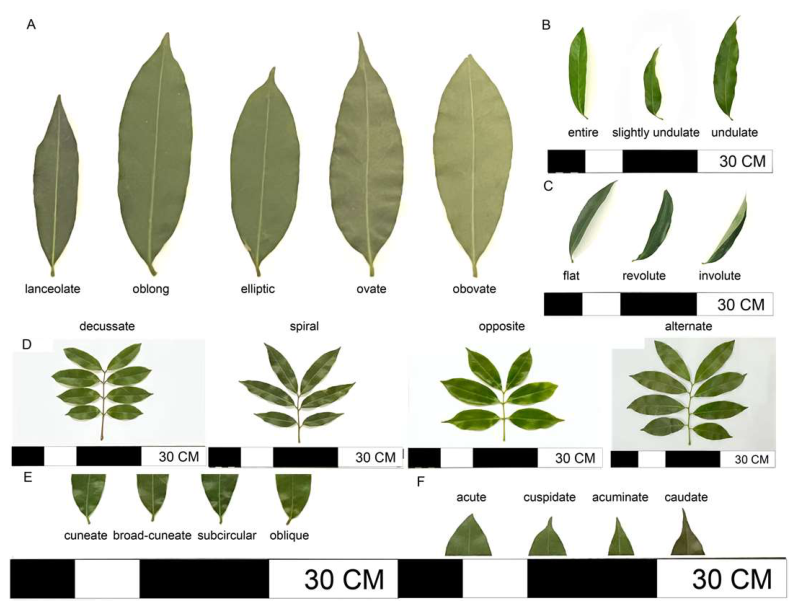
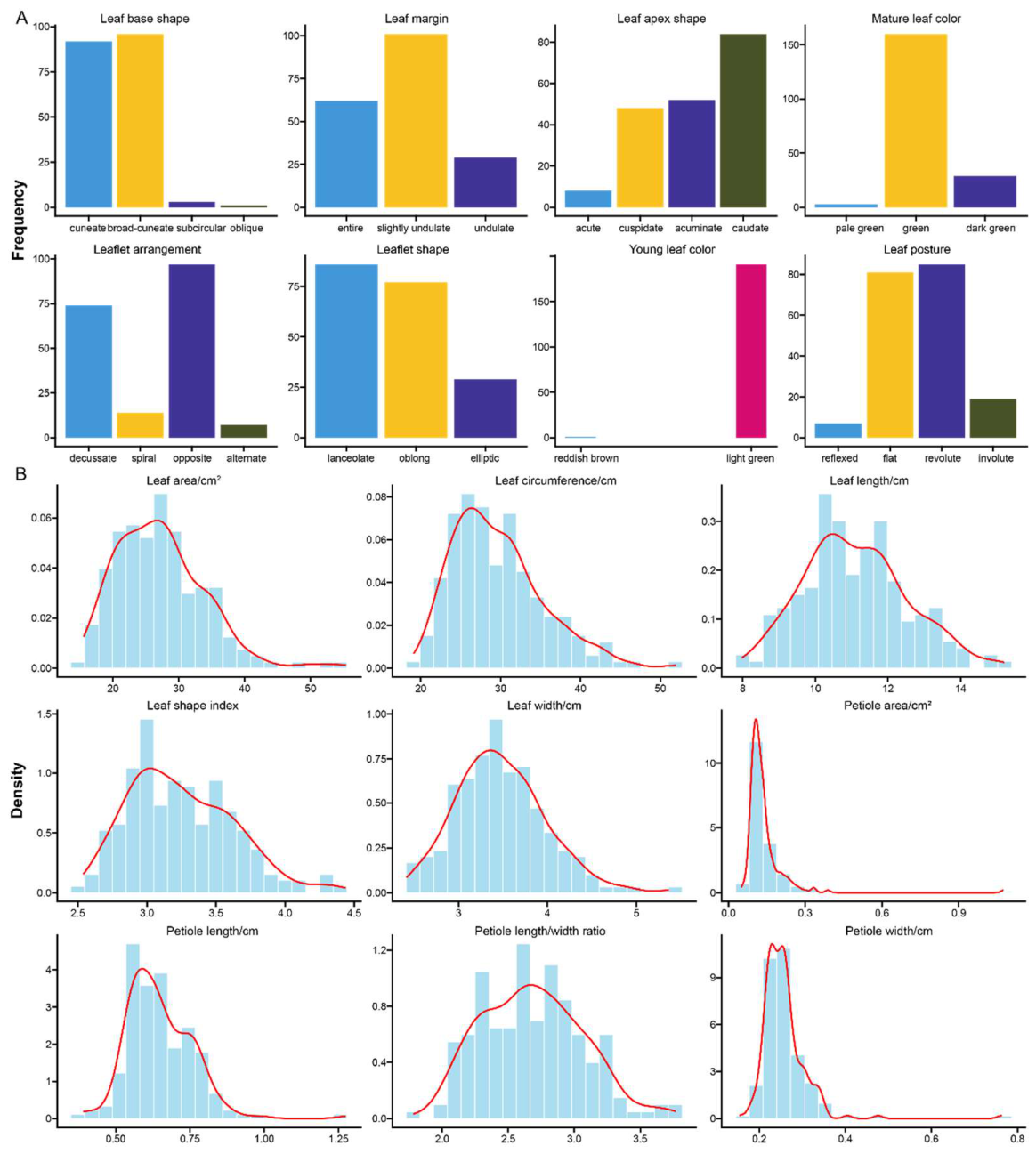
Leaf morphological variation was evaluated in 192 individuals of L. chinensis var. fulvosus using eight descriptive traits. Variation in young leaf color was limited, with only two phenotypic states observed. Leaflet shape, leaf margin, and mature leaf color each showed three states, whereas leaflet arrangement, leaf base shape, leaf apex shape, and leaf posture each exhibited four states (Figure 1 and Figure 2A). The Shannon–Wiener diversity index of descriptive traits ranged from 0.05 to 1.73, with a mean of 1.19. Among these traits, young leaf color showed the lowest diversity, indicating a high degree of uniformity, whereas leaf apex shape displayed the highest diversity (Table S1).
Analysis of nine quantitative leaf traits further revealed substantial phenotypic variation. Leaf length ranged from 7.97 to 15.20 cm, and leaf width ranged from 2.41 to 5.36 cm, resulting in a leaf shape index of 2.54 to 4.44. Leaf area varied from 15.55 to 55.38 cm2, and leaf circumference ranged from 19.10 to 51.95 cm. Petiole length and width ranged from 0.39 to 1.28 cm and from 0.15 to 0.76 cm, respectively, with a petiole length/width ratio of 1.78 to 3.77 and a petiole area of 0.05 to 1.08 cm2 (Figure 2B). The coefficient of variation ranged from 10.12% to 52.59%, with a mean of 23.50% (Table S2). Petiole area showed the greatest variation, whereas leaf shape index was the most stable trait. The Shannon–Wiener diversity index of quantitative traits ranged from 2.09 to 3.01, with a mean of 2.76. Leaf length exhibited the highest diversity, whereas petiole area showed the lowest.

3.3. Molecular Variation in L. chinensis var. fulvosus

Seven ISSR primers with clear and reproducible amplification patterns were selected to evaluate molecular variation in 192 accessions of L. chinensis var. fulvosus (Table S3). These primers generated a total of 49 scorable bands, of which 34 were polymorphic, corresponding to an overall polymorphism rate of 68.45% (Table S4). The number of bands produced by each primer ranged from four to nine, with an average of seven bands per primer. Primer UBC848 generated the highest number of bands, whereas UBC820 produced the fewest. Despite this variation, the proportion of polymorphic bands was similar among primers, ranging from 66.67% to 75.00%. Genetic diversity parameters also varied among primers. The observed number of alleles ranged from 1.50 to 2.00, with a mean of 1.68; the highest value was recorded for UBC859 and the lowest for UBC815. The effective number of alleles ranged from 1.23 to 1.48, with a mean of 1.34. Expected heterozygosity varied from 0.14 to 0.29, averaging 0.20, indicating a moderate level of molecular diversity across the sampled accessions. Shannon-Wiener diversity index showed a similar trend, ranging from 0.22 to 0.44, with a mean of 0.31. Among the seven primers, UBC859 showed the highest level of diversity, whereas UBC857 showed the lowest.

3.4. Clustering Analysis of L. chinensis var. fulvosus

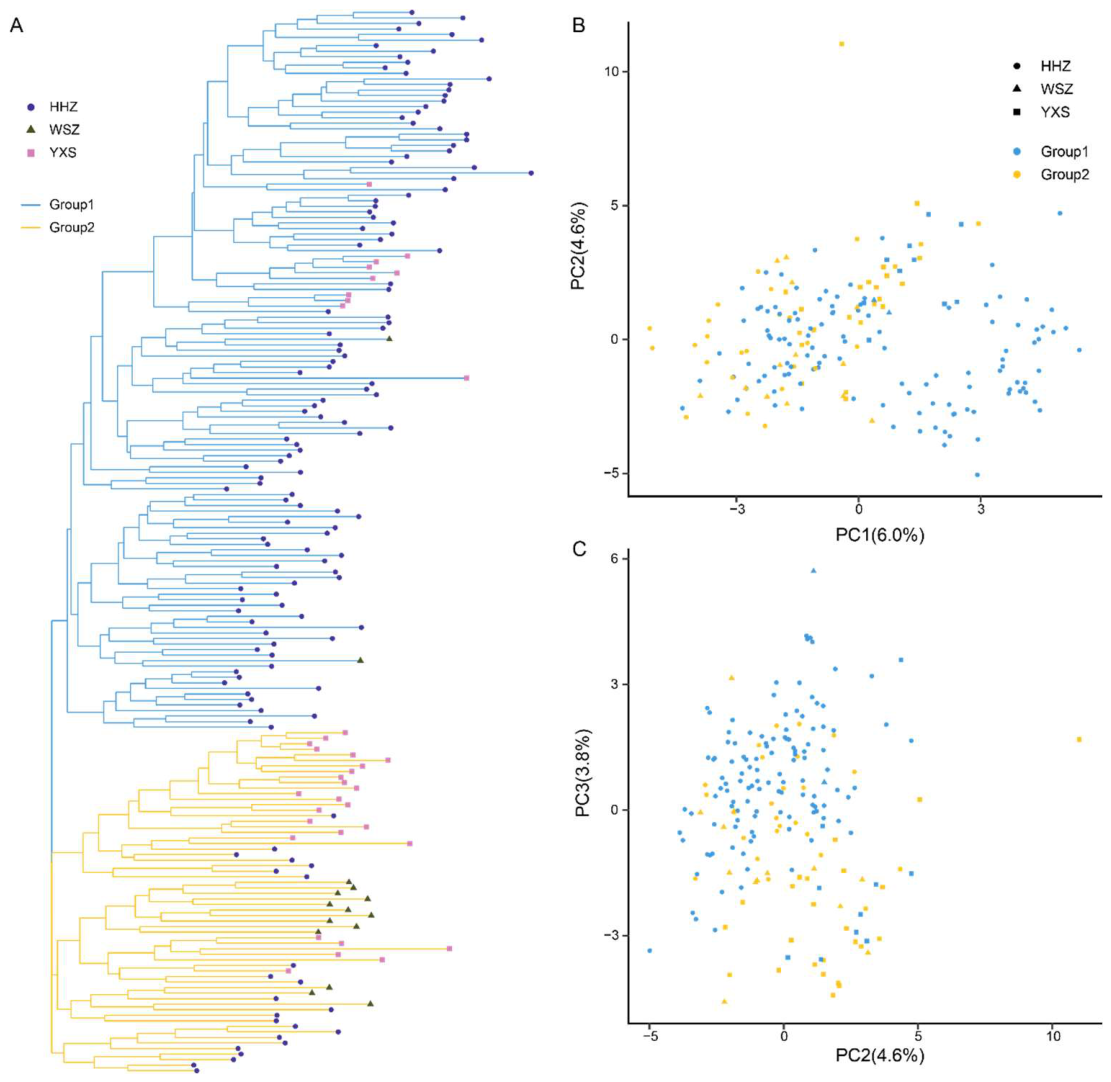
By integrating eight descriptive leaf traits, nine quantitative leaf traits, and ISSR genotyping data from seven primers, we performed clustering analysis and principal component analysis of 192 accessions of L. chinensis var. fulvosus. Both analyses consistently separated the germplasm into two distinct subpopulations (Table S5).
Group 1 consisted of 118 accessions from Honghe Prefecture, 2 from Wenshan Prefecture, and 10 from Yuxi City. This group was mainly characterized by cuneate leaf bases (53.8%), lanceolate leaflets (57.7%), and revolute leaf posture (60.0%) (Figure 3A and Figure S2). In contrast, Group 2 included 23 accessions from Honghe, 13 from Wenshan, and 26 from Yuxi, and was characterized primarily by broad-cuneate leaf bases (62.9%), oblong leaflets (72.6%), and flat leaf posture (77.4%). Comparative analysis of quantitative traits further supported this classification. Group 1 showed significantly greater leaf circumference, leaf length, and leaf shape index than Group 2 (p < 0.05) (Figure S3). In addition, differences in ISSR allele composition at eight loci indicated substantial genetic divergence between the two subpopulations (Figure S4).
Principal component analysis provided further support for this population structure. The first three principal components explained 6.0%, 4.6%, and 3.8% of the total variation, respectively (Figure 3B,C). Although the two groups were not completely separated, accessions in Group 1 showed a clear clustering tendency along these axes and could still be distinguished from Group 2 despite partial overlap.

3.5. Development and Evaluation of the Core Collection

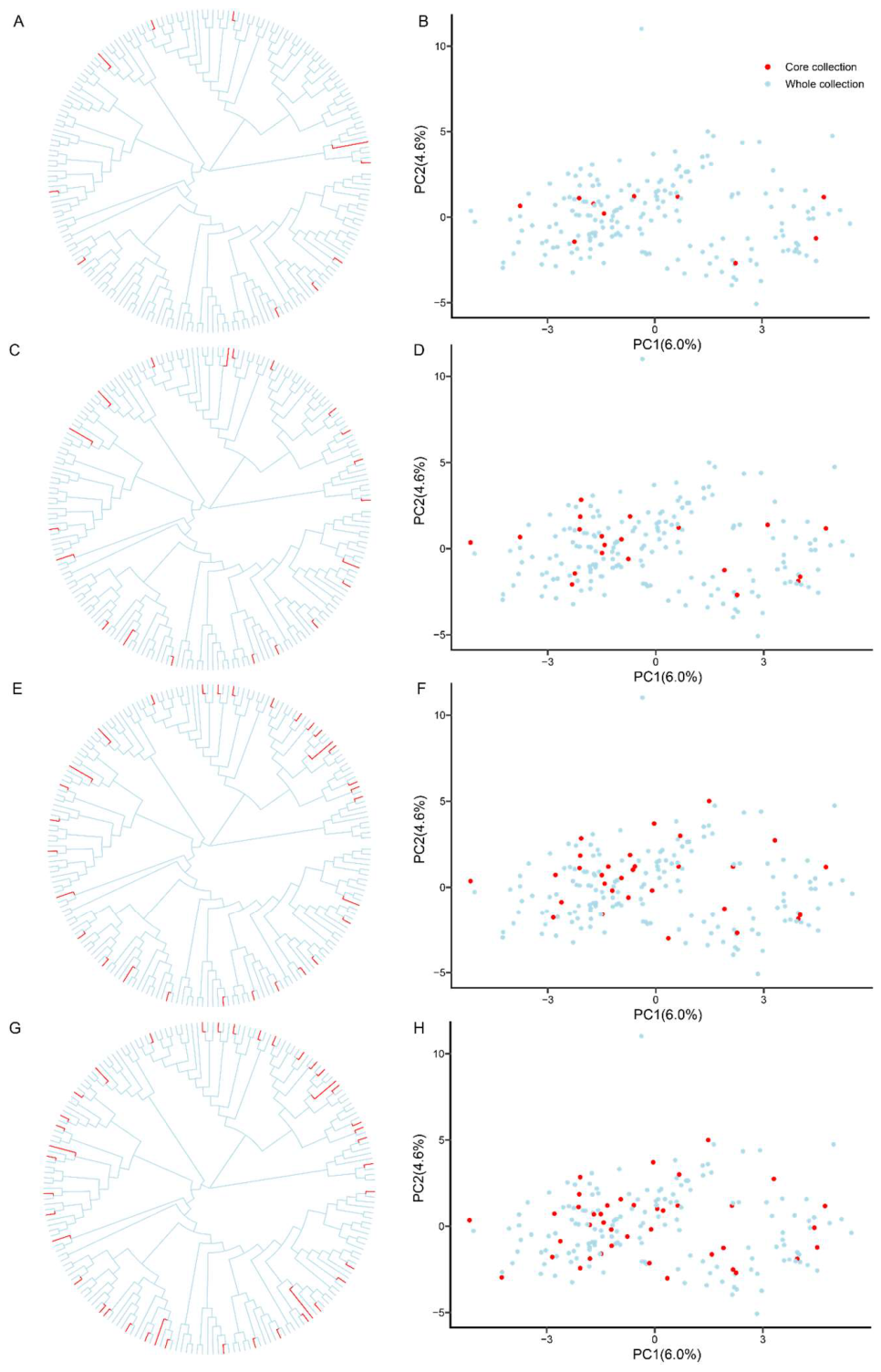
Based on clustering analysis integrating phenotypic traits and ISSR marker data, the L. chinensis var. fulvosus germplasm was grouped to identify representative accessions for core collection development. Four candidate core collections were constructed by sampling about 5%, 10%, 15%, and 20% of the initial population, corresponding to CC1 (10 accessions), CC2 (20 accessions), CC3 (30 accessions), and CC4 (40 accessions), respectively (Figure 4).
For the eight descriptive traits, the initial population showed a mean Shannon-Wiener diversity index of 1.19 (Table 2). CC1 and CC4 retained more than 85% of this diversity, whereas CC2 and CC3 preserved more than 80% and 75%, respectively. For the nine quantitative traits, the initial population had a mean diversity index of 2.76. CC1 and CC2 retained more than 80% of this diversity, whereas CC3 and CC4 each preserved more than 85%. Genetic diversity was further assessed using seven ISSR markers. In the initial population, the mean observed number of alleles (Na), effective number of alleles (Ne), Shannon-Wiener diversity index (I), and expected heterozygosity (He) were 1.71, 1.35, 0.32, and 0.21, respectively. Relative to the initial population, CC1 retained 84.54%, 96.36%, 79.26%, and 82.38% of these parameters, respectively. The corresponding values for CC2 were 86.93%, 97.99%, 84.52%, and 87.62%; for CC3, 90.49%, 99.26%, 92.57%, and 94.76%; and for CC4, 90.49%, 98.22%, 90.23%, and 91.89%.
Among the candidate core collections, CC3 showed the best overall balance between sampling efficiency and diversity retention. Specifically, it retained more than 75% of the diversity of descriptive traits, more than 85% of the diversity of quantitative traits, and more than 90% of all four ISSR-based molecular diversity parameters. These results indicate that CC3 provides the most balanced representation of both phenotypic and molecular variation and therefore represents the most suitable core collection for the conservation and utilization of L. chinensis var. fulvosus germplasm.

4. Discussion

Field investigation showed that L. chinensis var. fulvosus in Yunnan is distributed within a relatively concentrated but environmentally heterogeneous range, spanning 169 to 1470 m in elevation and occurring in habitats from upper slopes and mid-montane areas to riversides, roadsides, farmland edges, and areas near residential sites. Older trees with large trunk circumferences were more frequently found at relatively high elevations, whereas younger and smaller individuals were more common in lower and more disturbed habitats. This pattern suggests that habitat conditions and elevation may influence the long-term persistence and growth of L. chinensis var. fulvosus. However, because the present survey was designed to document distributional patterns rather than demographic recruitment, these observations should be interpreted cautiously and not taken as direct evidence of regeneration limitation at high elevations. A possible explanation for this pattern is that, owing to its economic value, L. chinensis var. fulvosus has often been maintained near villages and other human-inhabited areas. With increasing modernization and more intensive land-use change in low-elevation regions, some lowland germplasm resources may have gradually disappeared, whereas populations at higher elevations may have been retained because these areas have experienced relatively lower levels of disturbance and slower development. However, this interpretation remains hypothetical and warrants further demographic and ecological investigation. Leaf phenotypic analysis further revealed substantial but uneven variation among the 192 accessions. The diversity index of descriptive traits ranged from 0.05 to 1.73, with young leaf color showing high uniformity and leaf apex shape showing the highest variation, whereas the diversity index of quantitative traits ranged from 2.09 to 3.01, with leaf length showing high diversity and leaf shape index being relatively stable. These results indicate that leaf morphology in L. chinensis var. fulvosus contains useful variation for germplasm description and preliminary classification. At the same time, phenotypic traits are influenced not only by genotype but also by environmental conditions and genotype-by-environment interactions [26,27]. Therefore, morphological traits alone may not fully reflect the underlying genetic relationships among accessions and should be interpreted together with molecular evidence.
ISSR markers generally show higher levels of polymorphism than several earlier DNA marker systems and provide better reproducibility than RAPD markers [28]. They require only small amounts of template DNA, involve relatively simple experimental procedures, and can generate informative genome-wide polymorphism data. For these reasons, ISSR markers have been widely used in cultivar identification, gene mapping, genetic diversity analysis, phylogenetic studies, germplasm evaluation, and plant breeding research [29,30,31,32]. In the present study, seven selected ISSR primers generated 49 scorable bands across 192 accessions of L. chinensis var. fulvosus, of which 34 were polymorphic, with an average of seven bands per primer and a mean polymorphism rate of 68.45%. The Shannon–Wiener diversity index ranged from 0.2190 to 0.4390, with the highest value detected for primer UBC859 and the lowest for UBC857, and an overall mean of 0.3101. These results indicate the presence of detectable genetic variation among L. chinensis var. fulvosus accessions, although the overall level of genetic diversity appears to be relatively limited. This pattern may be associated with the relatively concentrated geographic distribution of these resources, frequent gene flow among populations, or the long-term effects of natural selection [2,14]. By integrating 17 leaf phenotypic traits and ISSR data, we further identified two major groups within L. chinensis var. fulvosus, which were also associated with differences in leaf morphology, quantitative traits, and sampling origin. This result supports the existence of internal subpopulation differentiation within L. chinensis var. fulvosus and is broadly consistent with previous studies suggesting that wild litchi in Yunnan contains detectable internal structure [14,33]. However, the classification consistency between our integrated analysis and the genome-wide SNP-based grouping was 53.7% (Figure S5), indicating that a limited number of phenotypic and DNA markers can capture broad patterns of population structure but still provide restricted resolution for subpopulation assignment. This limitation is likely related to the relatively small number of markers used, their limited genome coverage, and the environmental sensitivity of morphological traits. Overall, molecular markers can reveal genetic differences directly at the DNA level, whereas morphological traits better reflect the integrated performance of germplasm under practical conditions. Therefore, combining morphological and molecular markers provides a more comprehensive and objective framework for evaluating genetic diversity in L. chinensis var. fulvosus, and offers a more reliable basis for germplasm conservation, core collection development, and parental selection in litchi breeding.
Conservation of the initial litchi population provides an essential germplasm foundation for genetic improvement and cultivar development. However, because litchi is a perennial woody fruit tree with a large canopy, substantial land requirements, and high maintenance costs, the long-term conservation and efficient utilization of L. chinensis var. fulvosus germplasm remain challenging. Under these constraints, the development of a core collection offers an effective strategy to preserve the maximum amount of genetic variation from the initial population while balancing conservation efficiency and management cost under limited land and resource conditions. The representativeness of a core collection depends largely on the sampling strategy and sampling proportion used for its construction. Previous studies have shown that the sampling proportion of core collections is typically maintained within 5% to 30% of the initial population [34,35,36]. Commonly used sampling approaches include random sampling, stratified sampling, and clustering-based sampling. Among these, random and stratified sampling often do not adequately account for genetic relationships among accessions. Because genetic variation within germplasm resources is usually not evenly distributed, clustering-based sampling grounded in genetic distance is more effective for retaining major patterns of variation within the population. For this reason, it has been widely applied in the development of core collections for crops such as rice, maize, wheat, and soybean. In this study, we used a clustering-based sampling approach to construct four candidate core collections at 5.00%, 10.00%, 15.00%, and 20.00% of the initial population, designated CC1, CC2, CC3, and CC4, respectively. These four collections retained 84.54%, 86.93%, 90.49%, and 90.49% of the observed number of alleles of the initial population, respectively, all exceeding the general requirement that a core collection should preserve at least 70% to 80% of the genetic diversity of the initial population. This indicates that all four candidate collections were broadly representative. Further integrated analysis of phenotypic and genetic parameters showed that CC3 achieved the best balance between representativeness and efficiency. Specifically, CC3 retained more than 75% of the diversity of the descriptive traits, more than 85% of the diversity of the quantitative traits, and more than 90% of all four ISSR-based molecular diversity parameters of the initial population (Table 2). Therefore, the 30 accessions included in CC3, constructed at a sampling proportion of 15.00%, can be considered a suitable set of materials for establishing a core collection of L. chinensis var. fulvosus. This collection provides a practical foundation for the future conservation, evaluation, and efficient utilization of L. chinensis var. fulvosus germplasm resources.

Supplementary Materials

The following supporting information can be downloaded at: https://www.mdpi.com/article/10.3390/horticulturae12050556/s1, Figure S1: The sampling distribution of the 192 accessions in Yunnan Province; Figure S2: The distribution of eight descriptive leaf traits between two groups; Figure S3: The comparison of nine quantitative leaf traits between two groups; Figure S4: The distribution of seven ISSR amplification patterns between two groups; Figure S5: The comparison of the clustering trees between this study and those previously reported; Table S1: Distribution frequency and diversity index of 8 descriptive traits in 192 leaves; Table S2: Statistics of 9 quantitative traits in 192 leaves; Table S3: List of ISSR effective primers; Table S4: Number of bands amplified by ISSR-PCR; Table S5: Two groups identified by eight descriptive leaf traits, nine quantitative leaf traits, and ISSR genotyping data from seven primers. Table S6: Classification description and values of leaf descriptive trait.

Author Contributions

J.W. and L.Z. conceived and designed the research and edited the manuscript. P.W. and X.C. performed the experiments and drafted the manuscript. H.Z. (Hui Zhang), H.L., H.Z. (Huiyun Zhang), S.L., J.H., J.Z., X.L. and Z.Y. collected the resources. All authors have read and agreed to the published version of the manuscript.

Funding

This work was supported by funds of Science and Technology Special Fund of Hainan Province (ZDYF2023XDNY080), the earmarked fund for CARS (CARS-32) and Central Public-interest Scientific Institution Basal Research Fund for Chinese Academy (1630032022003, 1630032024019).

Data Availability Statement

The original contributions presented in this study are included in the article/Supplementary Material. Further inquiries can be directed to the corresponding authors.

Conflicts of Interest

The authors declare no conflicts of interest.

References

  1. Hu, G.; Feng, J.; Xiang, X.; Wang, J.; Salojarvi, J.; Liu, C.; Wu, Z.; Zhang, J.; Liang, X.; Jiang, Z.; et al. Two divergent haplotypes from a highly heterozygous lychee genome suggest independent domestication events for early and late-maturing cultivars. Nat. Genet. 2022, 54, 73–83. [Google Scholar] [CrossRef]
  2. Zhang, H.; Gao, X.; Wang, Y.; Wang, Y.; Song, Y.; Zuo, Y.; Zhang, C.; Li, X.; Rao, X.; Luo, X. Ancient Trees of Litchi chinensis var. fulvosus: Resource Investigation. J. Agric. Sci. 2020, 10, 77. [Google Scholar]
  3. Nadeem, M.A.; Nawaz, M.A.; Shahid, M.Q.; Doğan, Y.; Comertpay, G.; Yıldız, M.; Hatipoğlu, R.; Ahmad, F.; Alsaleh, A.; Labhane, N. DNA molecular markers in plant breeding: Current status and recent advancements in genomic selection and genome editing. Biotechnol. Biotechnol. Equip. 2018, 32, 261–285. [Google Scholar] [CrossRef]
  4. Botstein, D.; White, R.L.; Skolnick, M.; Davis, R.W. Construction of a genetic linkage map in man using restriction fragment length polymorphisms. Am. J. Hum. Genet. 1980, 32, 314. [Google Scholar] [PubMed]
  5. Hadrys, H.; Balick, M.; Schierwater, B. Applications of random amplified polymorphic DNA (RAPD) in molecular ecology. Mol. Ecol. 1992, 1, 55–63. [Google Scholar] [CrossRef]
  6. Rafalski, A. Applications of single nucleotide polymorphisms in crop genetics. Curr. Opin. Plant Biol. 2002, 5, 94–100. [Google Scholar] [CrossRef]
  7. Powell, W.; Machray, G.C.; Provan, J. Polymorphism revealed by simple sequence repeats. Trends Plant Sci. 1996, 1, 215–222. [Google Scholar] [CrossRef]
  8. Pradeep Reddy, M.; Sarla, N.; Siddiq, E. Inter simple sequence repeat (ISSR) polymorphism and its application in plant breeding. Euphytica 2002, 128, 9–17. [Google Scholar] [CrossRef]
  9. Ebana, K.; Kojima, Y.; Fukuoka, S.; Nagamine, T.; Kawase, M. Development of mini core collection of Japanese rice landrace. Breed. Sci. 2008, 58, 281–291. [Google Scholar] [CrossRef]
  10. Li, Y.; Shi, Y.; Cao, Y.; Wang, T. Establishment of a core collection for maize germplasm preserved in Chinese National Genebank using geographic distribution and characterization data. Genet. Resour. Crop Evol. 2005, 51, 845–852. [Google Scholar] [CrossRef]
  11. Balfourier, F.; Roussel, V.; Strelchenko, P.; Exbrayat-Vinson, F.; Sourdille, P.; Boutet, G.; Koenig, J.; Ravel, C.; Mitrofanova, O.; Beckert, M. A worldwide bread wheat core collection arrayed in a 384-well plate. Theor. Appl. Genet. 2007, 114, 1265–1275. [Google Scholar] [CrossRef] [PubMed]
  12. Oliveira, M.F.; Nelson, R.L.; Geraldi, I.O.; Cruz, C.D.; de Toledo, J.F.F. Establishing a soybean germplasm core collection. Field Crops Res. 2010, 119, 277–289. [Google Scholar] [CrossRef]
  13. Chandra, S.; Huaman, Z.; Hari Krishna, S.; Ortiz, R. Optimal sampling strategy and core collection size of Andean tetraploid potato based on isozyme data–a simulation study. Theor. Appl. Genet. 2002, 104, 1325–1334. [Google Scholar] [CrossRef]
  14. Wang, P.; Cao, X.; Zhang, H.; Li, H.; Zhang, H.; Li, S.; Hong, J.; Zheng, J.; Luo, X.; Chen, C. Genomic insights into selective signals and local adaptation of a litchi subspecies. Mol. Hortic. 2026, 6, 23. [Google Scholar] [CrossRef]
  15. Lu, G.; Huang, C.; Liu, Y.; Liao, H.; Ding, F.; Luo, H.; Li, D.; Li, H.; Peng, H.; Zhu, J. Genetic diversity of 24 ancient litchi germplasm resources using ISSR molecular marker. J. South. Agric. 2017, 48, 197. [Google Scholar]
  16. Long, Y.; Cheng, J.; Mei, Z.; Zhao, L.; Wei, C.; Fu, S.; Khan, M.A.; Fu, J. Genetic analysis of litchi (Litchi chinensis Sonn.) in southern China by improved random amplified polymorphic DNA (RAPD) and inter-simple sequence repeat (ISSR). Mol. Biol. Rep. 2015, 42, 159–166. [Google Scholar] [CrossRef]
  17. Shen, Q.; Zhu, J.; Peng, H.; He, X. Genetic diversity of early-maturing seedling litchi resources in southwest Guangxi by ISSR. Guihaia 2013, 33, 225. [Google Scholar]
  18. Degani, C.; Deng, J.; Beiles, A.; El-Batsri, R.; Goren, M.; Gazit, S. Identifying lychee (Litchi chinensis Sonn.) cultivars and their genetic relationships using intersimple sequence repeat (ISSR) markers. J. Am. Soc. Hortic. Sci. 2003, 128, 838–845. [Google Scholar] [CrossRef]
  19. Shannon, C.E. A mathematical theory of communication. Bell Syst. Tech. J. 1948, 27, 379–423. [Google Scholar] [CrossRef]
  20. Smouse, P.E.; Banks, S.C.; Peakall, R. Converting quadratic entropy to diversity: Both animals and alleles are diverse, but some are more diverse than others. PLoS ONE 2017, 12, e0185499. [Google Scholar] [CrossRef] [PubMed]
  21. Paradis, E.; Claude, J.; Strimmer, K. APE: Analyses of phylogenetics and evolution in R language. Bioinformatics 2004, 20, 289–290. [Google Scholar] [CrossRef] [PubMed]
  22. Kaufman, L.; Rousseeuw, P.J. Finding Groups in Data: An Introduction to Cluster Analysis; John Wiley & Sons: Hoboken, NJ, USA, 1990. [Google Scholar]
  23. Yu, G.; Smith, D.K.; Zhu, H.; Guan, Y.; Lam, T.T.-Y. ggtree: An r package for visualization and annotation of phylogenetic trees with their covariates and other associated data. Methods Ecol. Evol. 2017, 8, 28–36. [Google Scholar] [CrossRef]
  24. Lê, S.; Josse, J.; Husson, F. FactoMineR: An R Package for Multivariate Analysis. J. Stat. Softw. 2008, 25, 1–18. [Google Scholar] [CrossRef]
  25. Revell, L.J. phytools: An R package for phylogenetic comparative biology (and other things). Methods Ecol. Evol. 2012, 3, 217–223. [Google Scholar] [CrossRef]
  26. Devi, A.; Iqbal, T.; Wani, I.A.; Sharma, G.; Verma, S.; Noureldeen, A.; Darwish, H. Assessment of variability among morphological and molecular characters in wild populations of mint [Mentha longifolia (L.) L.] germplasm. Saudi J. Biol. Sci. 2022, 29, 3528–3538. [Google Scholar] [CrossRef]
  27. Duminil, J.; Di Michele, M. Plant species delimitation: A comparison of morphological and molecular markers. Plant Biosyst. 2009, 143, 528–542. [Google Scholar] [CrossRef]
  28. Patzak, J. Comparison of RAPD, STS, ISSR and AFLP molecular methods used for assessment of genetic diversity in hop (Humulus lupulus L.). Euphytica 2001, 121, 9–18. [Google Scholar] [CrossRef]
  29. Crespel, L.; Pernet, A.; Le Bris, M.; Gudin, S.; Oyant, L.H.S. Application of ISSRs for cultivar identification and assessment of genetic relationships in rose. Plant Breed. 2009, 128, 501–506. [Google Scholar] [CrossRef]
  30. Venkat, S.K.; Bommisetty, P.; Patil, M.S.; Reddy, L.; Chennareddy, A. The genetic linkage maps of Anthurium species based on RAPD, ISSR and SRAP markers. Sci. Hortic. 2014, 178, 132–137. [Google Scholar] [CrossRef]
  31. Assefa, K.; Merker, A.; Tefera, H. Inter simple sequence repeat (ISSR) analysis of genetic diversity in tef [Eragrostis tef (Zucc.) Trotter]. Hereditas 2003, 139, 174–183. [Google Scholar] [CrossRef] [PubMed]
  32. Li, H.; Ruan, C.-J.; da Silva, J.A.T. Identification and genetic relationship based on ISSR analysis in a germplasm collection of sea buckthorn (Hippophae L.) from China and other countries. Sci. Hortic. 2009, 123, 263–271. [Google Scholar] [CrossRef]
  33. Zhang, L.; Wang, P.; Li, F.; Xu, L.; Zhao, J.; Fu, J.; Wang, J.; Zhang, H.; Li, S.; Hong, J.; et al. Litchi40K v1.0: A cost-effective, flexible and versatile liquid SNP chip for genetic analysis and digitalization of germplasm resources in litchi. Hortic. Res. 2025, 12, uhaf038. [Google Scholar] [CrossRef] [PubMed]
  34. Sun, Q.-M.; Bai, L.; Ke, L.; Xiang, X.; Zhao, J.; Ou, L. Developing a core collection of litchi (Litchi chinensis Sonn.) based on EST-SSR genotype data and agronomic traits. Sci. Hortic. 2012, 146, 29–38. [Google Scholar] [CrossRef]
  35. Wang, J.; Hu, J.; Xu, H.-M.; Zhang, S. A strategy on constructing core collections by least distance stepwise sampling. Theor. Appl. Genet. 2007, 115, 1–8. [Google Scholar] [CrossRef]
  36. Odong, T.L.; Jansen, J.; Van Eeuwijk, F.A.; van Hintum, T.J. Quality of core collections for effective utilisation of genetic resources review, discussion and interpretation. Theor. Appl. Genet. 2012, 126, 289–305. [Google Scholar] [CrossRef] [PubMed]
Figure 1. Representative photographs of six descriptive leaf traits in L. chinensis var. fulvosus. (A). Leaflet shape, including lanceolate, oblong, elliptic, ovate, and obovate. (B). Leaf margin, including entire, slightly undulate, and undulate. (C). Leaf posture, including flat, revolute, and involute. (D). Leaflet arrangement, including decussate, spiral, opposite, and alternate. (E). Leaf base shape, including cuneate, broad-cuneate, subcircular, and oblique. (F). Leaf apex shape, including acute, cuspidate, acuminate, and caudate.
Horticulturae 12 00556 g001
Figure 2. Phenotypic distributions of eight descriptive traits and nine quantitative traits in L. chinensis var. fulvosus. (A). The distributions of eight descriptive traits in Litchi chinensis var. fulvosus. Colors represent the scoring categories of each descriptive trait, as defined in Table S1. (B). The distributions of nine quantitative traits in Litchi chinensis var. fulvosus.
Horticulturae 12 00556 g002
Figure 3. Clustering analysis and principal component analysis of L. chinensis var. fulvosus population. (A). Neighbor-joining tree of L. chinensis var. fulvosus population. HHZ, WSZ, and YXS represent Honghe, Wenshan, and Yuxi, respectively. (B). PCA plot based on PC1 and PC2. (C). PCA plot based on PC2 and PC3. Colors correspond to the two major groups defined in panel A, and shapes indicate the three sampling groups.
Horticulturae 12 00556 g003
Figure 4. Comparison of four candidate core collections based on neighbor-joining tree reconstruction and principal component analysis of L. chinensis var. fulvosus. For each core collection, the neighbor-joining tree shows the position of selected core accessions within the full population, with selected accessions highlighted in red. The PCA plots display the distribution of core accessions (red) relative to the complete germplasm set (blue). From top to bottom, the four rows represent CC1 (A,B), CC2 (C,D), CC3 (E,F), and CC4 (G,H), respectively.
Horticulturae 12 00556 g004
Table 1. Habitat and tree characteristics of L. chinensis var. fulvosus.
No.OriginAccessionLatitude and LongitudeAltitude/mTree Height/mTrunk Girth/mCrown
Diameter/m × m
Tree Age
1~50Pinbian50103°37′~103°45′ E,
23°00′~23°02′ N
337.87~1160.143.50~14.500.86~5.311.80 × 1.50
~16.20 × 15.30
50~500
51~78Xinpin28101°24′~101°47′ E,
23°47′~24°14′ N
475.20~1209.687.30~10.000.87~3.704.50 × 3.90
~19.80 × 20.80
50~400
79~86Yuanjiang8102°03′~102°07′ E,
23°29′~23°39′ N
520.17~1422.1110.50~16.200.77~4.505.40 × 6.20
~16.00 × 14.30
50~500
87~148Yuanyang62102°38′~103°01′ E,
22°59′~23°16′ N
239.90~1214.776.20~16.900.80~4.926.20 × 5.10
~19.83 × 20.23
50~300
149~150Shiping2102°21′ E, 23°51′ N1123.40~1129.465.40~8.001.15~1.556.70 × 7.20
~8.89 × 7.87
100~200
151~163Jianshui13102°38′~102°51′ E,
23°12′~23°20′ N
237.22~1302.147.80~17.201.14~4.366.23 × 7.35
~16.45 × 16.90
100~400
164~170Jinping7103°14′~103°34′ E,
22°50′~23°02′ N
130.86~1129.369.00~22.001.55~4.658.70 × 7.50
~26.20 × 25.70
200~500
171~173Hekou3103°53′~103°54′ E,
22°33′~22°34′ N
102.87~149.5512.00~13.001.28~1.688.25 × 7.76
~10.26 × 15.75
100~200
174~188Malipo15104°40′~104°53′ E,
22°59′~23°12′ N
489.72~908.3812.30~20.201.70~4.927.30 × 14.65
~21.35 × 20.50
100~500
189~192Lvchun4102°11′~102°32′ E,
22°39′~22°50′ N
1055.80~1470.349.70~17.301.09~2.645.50 × 6.12
~12.60 × 14.20
100~300
Table 2. Comparison of genetic diversity parameters of candidate core germplasm based on leaf phenotype and ISSR markers.
TraitInitial PopulationCC1CC2CC3CC4
Sampling ratio (%)1005101520
Number of accessions19210203040
Leaflet arrangement1.481.30 1.221.141.26
Leaflet shape1.461.52 1.561.521.52
Leaf base shape1.141.30 1.371.351.38
Leaf apex shape1.731.971.861.891.89
Leaf posture1.551.571.351.891.84
Leaf margin1.431.371.351.461.48
Young leaf color0.050.690.290.210.17
Mature leaf color0.721.160.880.770.71
Leaf length3.012.452.802.952.87
Leaf width2.962.452.712.742.85
Leaf shape index2.922.652.562.612.55
Leaf area2.902.452.732.692.68
Leaf circumference2.841.692.632.692.61
Petiole length2.742.652.472.812.78
Petiole width2.422.452.522.572.72
Petiole length/width ratio2.912.522.572.712.85
Petiole area0.731.160.880.770.71
Allele number (Na)1.711.451.491.551.55
Number of effective alleles (Ne)1.351.301.321.341.32
Shannon-Wiener diversity index (I)0.320.260.270.300.29
Expected heterozygosity (He)0.210.170.180.200.19
Disclaimer/Publisher’s Note: The statements, opinions and data contained in all publications are solely those of the individual author(s) and contributor(s) and not of MDPI and/or the editor(s). MDPI and/or the editor(s) disclaim responsibility for any injury to people or property resulting from any ideas, methods, instructions or products referred to in the content.