Article

Rootstock-Mediated Agronomic Biofortification of Citrus Fruits: Evidence from Mineral Nutrient Profiling


by
Akshay
1,
Radha Mohan Sharma
1,*,
Narendra Singh
1,†,
Nimisha Sharma
1,
Om Prakash Awasthi
1,
Shruti Sethi
2,
Virendra Singh Rana
3,
Shailendra Kumar Jha
4,
Vinod Kumar Sharma
5,
Mukesh Shivran
1,
Hatkari Vittal
1,
Abeer Ali
1 and
Anil Kumar Dubey
6
1
Division of Fruits and Horticultural Technology, ICAR-Indian Agricultural Research Institute, New Delhi 110012, India
2
Division of Food Science & Post Harvest Technology, ICAR-Indian Agricultural Research Institute, New Delhi 110012, India
3
Division of Agricultural Chemicals, ICAR-Indian Agricultural Research Institute, New Delhi 110012, India
4
Division of Genetics, ICAR-Indian Agricultural Research Institute, New Delhi 110012, India
5
Division of Soil Science and Agricultural Chemistry, ICAR-Indian Agricultural Research Institute, New Delhi 110012, India
6
ICAR-Central Soil Salinity Research Institute, Regional Research Station, Lucknow 226002, India
*
Author to whom correspondence should be addressed.
Present address: ICAR-Indian Agricultural Research Institute-Jharkhand, Hazaribagh 825405, India.
Horticulturae 2026, 12(5), 530; https://doi.org/10.3390/horticulturae12050530
Submission received: 24 March 2026 / Revised: 21 April 2026 / Accepted: 22 April 2026 / Published: 24 April 2026
(This article belongs to the Special Issue Nutrient Dynamics in Horticultural Crops from Absorption to Quality)

Abstract

The influence of rootstocks on mineral nutrient composition in the edible tissue of citrus fruits has not been explored so far. This study assessed leaf and juice mineral nutrients of sweet orange (Citrus sinensis (L.) Osbeck) cultivars (‘Pusa Sharad’ and ‘Pusa Round’) grafted onto different rootstocks (‘RLC-6’, ‘C-35’, ‘X-639’, ‘Yamma Mikan’, ‘Soh Sarkar’, ‘RLC-7’, and ‘Jatti Khatti’). Deviation from optimum percentage (DOP) index was employed as an integrative measure to assess leaf mineral nutrient balance for specific scion–rootstock combinations. The relative abundance of leaf mineral nutrients was ranked as follows: Ca > K > P > S > Mg > Na > Fe > Mn > Zn > Cu. Overall, rootstock ‘X-639’ demonstrated superior mineral nutrient uptake efficiency across grafted plants of both scion cultivars, as indicated by higher leaf mineral nutrient concentrations. Juice mineral nutrient concentrations followed the order K (930.87–1362.17 mg L−1), Ca (346.40–651.33 mg L−1), P (116.23–236.97 mg L−1), Mg (64.60–102.50 mg L−1), S (49.35–74.34 mg L−1), Na (25.61–47.88 mg L−1), Fe (4.76–7.92 mg L−1), Zn (1.79–4.34 mg L−1), Mn (0.73–1.62 mg L−1), and Cu (0.41–0.71 mg L−1), indicating distinct differences in the accumulation pattern of macro- and micro-mineral nutrients in the edible tissues across the studied scion–rootstock combinations. Multivariate analysis revealed that the rootstocks significantly influenced juice mineral nutrient levels, indicating rootstock-mediated agronomic biofortification. Rootstock ‘RLC-6’ enhanced juice K levels, and ‘Soh Sarkar’ improved juice Mg contents, while ‘X-639’ improved juice micronutrient (Zn, Mn, Cu) accumulation in both cultivars. This study constitutes the first comprehensive investigation that explicitly evaluates the influence of rootstocks on the enhancement of mineral nutrient content in the edible tissues of citrus fruits. It further elucidates how rootstock selection can indirectly affect dietary mineral intake, thereby highlighting its potential role for improved nutrition.

1. Introduction

Mineral nutrients are essential components of the human diet, and their inadequate intake leads to malnutrition and various disorders, including weakened immunity and neurological disturbances. Malnutrition has emerged as a serious global problem and is widely recognised by the Food and Agriculture Organization (FAO) and the United Nations under Sustainable Development Goal (SDG) 2 (Zero Hunger) and SDG 3 (Good Health and Well-being) [1]. Mineral-specific disorders, such as anaemia (iron deficiency), osteoporosis (calcium deficiency), and hypokalaemia (potassium deficiency), can lead to severe acute malnutrition [2,3,4]. Moreover, micro-mineral nutrient deficiencies, often referred to as ‘hidden hunger,’ are a widespread yet frequently overlooked global health crisis. India, being the most populous country, also has the largest proportion of under-nourished people (15.2%), while more than 35.7% children (<5 years) are underweight [5].
Enhancing the nutritional quality of food through biofortification, i.e., increasing the accumulation of essential mineral nutrients in edible crop parts, is considered one of the most sustainable strategies to address malnutrition and nutritional insecurity. Among the various biofortification strategies, conventional breeding programmes, modern biotechnological approaches, and agronomic interventions to enhance mineral nutrient content in edible tissues are the most important [6]. To date, major cereal crops such as rice [7], wheat [8], and maize [9] have been extensively explored as primary targets for biofortification programmes to alleviate mineral nutrient deficiencies, as these staple crops form the dietary foundation for a large proportion of the global population.
Fruit crops are an integral component of the human diet, valued not only for their delicious taste and flavour but also for their medicinal and pharmacological properties. Their edible tissues have been widely recognised for bioactive compounds that contribute significantly to human health and well-being. However, despite their inherent richness in phytonutrients, including vitamins, minerals, phenols, flavonoids, and antioxidants, fruit crops remain largely underutilized in biofortification programmes, representing a significant untapped opportunity for improving human nutrition. Through conventional breeding, a biofortified pomegranate variety ‘Solapur Lal’ was developed at ICAR-National Research Centre on Pomegranate, Solapur, India, utilizing multiple parentage (‘Bhagwa’ × (‘Ganesh’ × ‘Nana’) × ‘Daru’), exhibiting higher iron and zinc levels in the edible tissues compared with ‘Bhagwa’ [10].
Among fruit crops, citrus ranks third in global importance and is well known for its antioxidant properties, which aid in lowering oxidative stress, modulating inflammation, and enhancing immune function [11]. In India, sweet oranges (Citrus sinensis (L.) Osbeck) hold the second position after mandarins in the citrus industry, with an annual production of 3.90 million tonnes cultivated over an area of 0.24 million hectares [12]. Previously, Singh et al. [13] reported that citrus juice contains significant amounts of essential mineral nutrients, including potassium (K), phosphorus (P), calcium (Ca), magnesium (Mg), iron (Fe), zinc (Zn), manganese (Mn), and copper (Cu), making it a potential source for supplementing the mineral nutritional requirements of the human body.
Owing to their perennial growth habit, high heterozygosity, and prolonged juvenile phase, different citrus groups such as oranges, mandarins, limes, and lemons are predominantly propagated through vegetative methods, particularly budding or grafting onto suitable rootstocks. In such grafted systems, the resulting plant consists of two genetically distinct but functionally integrated components: the rootstock and the scion. The interaction between the scion and rootstock is inherently bi-directional and must remain physiologically compatible to ensure optimal tree performance and productivity [14,15]. In citrus, rootstocks possess a unique advantage over many other fruit crops due to the frequent occurrence of nucellar polyembryony, which facilitates the production of genetically uniform nucellar seedlings. This ensures true-to-type propagation and contributes to consistent rootstock performance across different ecological conditions. Moreover, it is well established that rootstocks significantly influence tree vigour, physiological processes, flowering behaviour, fruit yield, and fruit quality attributes in different citrus species [16,17]. In addition, they play a crucial role in conferring tolerance and/or resistance to a range of biotic and abiotic stresses. Previous studies have suggested that such rootstock-mediated interactions are largely associated with modifications in water relations, hormonal regulation, and nutrient uptake and translocation processes within the grafted plant system [18,19]. Therefore, in ‘citriculture’, the selection of appropriate rootstocks is of particular importance due to the high economic value and juicy nature of citrus fruits. Rootstock selection is a complex and tedious process compared to scion selection, as it requires long-term evaluation, assessment of multiple stress tolerances, and thorough compatibility testing with a range of scion cultivars.
Several studies in citrus have documented the influence of rootstocks on plant responses to salinity, drought, and mineral toxicity and/or deficiency [20,21,22,23,24,25]. Although rootstocks have considerable potential as a means for agronomic biofortification in different citrus groups, their contribution to enhancing the mineral nutrient levels of edible tissues has not been adequately investigated so far. Therefore, there is a need to identify and evaluate rootstocks that not only confer tolerance to abiotic and biotic stresses but also promote greater accumulation of essential mineral nutrients in edible fruit tissues, paving the way for rootstock-mediated agronomic biofortification in ‘citriculture’. In this context, leaf and fruit juice ionomics offer valuable insights into the efficiency of rootstocks in nutrient uptake, translocation, and distribution through the plant vascular system, as well as their functional interaction with the scion. Leaf mineral composition serves as a reliable indicator of the overall mineral nutrient status of the plant [26] and plays a key role in determining the partitioning of mineral nutrients towards the developing fruits. A thorough understanding of these ionomic patterns can facilitate the screening and selection of superior rootstocks that optimise mineral nutrient allocation to edible tissues, thereby improving the nutritional value of citrus fruits.
Considering the above-mentioned facts, the present study aimed to evaluate the influence of different rootstocks on the mineral nutrient composition in the leaves and fruit juice of sweet oranges. ‘Pusa Sharad’ (Accession No. IC 274656) and ‘Pusa Round’ (Accession No. IC 274693) are semi-vigorous sweet oranges characterised by medium-sized fruits (200–300 g), higher total soluble solids (TSS), and greater juice recovery, and produce yields more than twice those of ‘Valencia’ and ‘Jaffa’ oranges under the subtropical conditions of northern India [27]. Regarding the rootstocks, ‘Jatti Khatti’ (Citrus jambhiri L.) has historically been the rootstock of choice in the region, owing to its wide adaptability, vigorous growth, strong graft compatibility, and drought tolerance. Citrange ‘C-35’ (C. sinensis (L.) Osbeck cv. ‘Ruby’ × Poncirus trifoliata cv. Webber Fawcett), developed in 1951 at the University of California, Riverside (USA), has gained global recognition as a promising rootstock due to its tolerance to citrus nematodes, Phytophthora, and citrus tristeza virus. Another notable rootstock, ‘X-639’ (Citrus reshni Hort. ex Tanaka × P. trifoliata (L.) Raf.), developed in South Africa in the 1950s, has recently attracted attention for its improved tolerance to phytophthora, drought, and salinity. Additionally, ‘RLC-6’ (Accession No. IC 274698) and ‘RLC-7’ (Accession No. IC 255451) are locally selected rough lemon (Citrus jambhiri L.) strains exhibiting tolerance to drought and/or salinity. ‘Yamma Mikan’ (small-fruited mandarin) and ‘Soh Sarkar’ (Citrus karna Raf.) rootstocks are widely acknowledged in alleviating salinity and drought stress-related problems, respectively. We hypothesized that rootstocks provide a biological route for agronomic biofortification by enhancing nutrient acquisition, improving translocation and sustaining mineral nutrition in the edible tissues of citrus fruits.

2. Materials and Methods

2.1. Plant Materials

The present investigation was conducted on 8–9-year-old grafted sweet orange trees during two consecutive fruiting seasons, i.e., 2023 and 2024. Plants of sweet orange cultivars ‘Pusa Sharad’ and ‘Pusa Round’ were grafted onto different nucellar polyembryonic rootstocks, including ‘RLC-6’, ‘C-35’, ‘X-639’, ‘Yamma Mikan’, ‘Soh Sarkar’, ‘RLC-7’, and ‘Jatti Khatti’, in the year 2015 and established at a spacing of 5 m × 5 m in the citrus block (Experimental Orchard of the Division of Fruits and Horticultural Technology, ICAR–Indian Agricultural Research Institute (IARI), New Delhi–110012, India (228 m above mean sea level; 28°38′43″ N and 77°09′08″ E)). The details of the scion and rootstock counterparts of grafted plants evaluated in the present study are provided in Supplementary Table S1. Three uniform and healthy trees were selected for each scion–rootstock combination, and each tree was considered an independent biological replicate. The experimental site is located in a typical subtropical region, characterised by intensely hot summers (average temperature: 41–42 °C; May–June) and relatively cold winters (average temperature: 5–7 °C; December–January). Considering the phenological periods of sweet oranges in the region, flower bud differentiation typically occurred from December to January, followed by flowering during the spring flush (February to March). Fruit set took place from March to April, after which fruit development and enlargement continued from April to September, with peak harvest occurring during October–November. The details pertaining to sunshine duration (hours), effective accumulated temperature (degree Celsius days), annual rainfall (mm), and relative humidity (%) at the experimental site during the evaluation period are presented in Supplementary Table S2.
All scion–rootstock combinations were subjected to uniform management practices, strictly following the recommended guidelines for citrus cultivation in the respective agro-ecological region. The nutrients were applied at a uniform rate of 600:400:400 g tree−1 year−1 basis of N: P: K, along with 30 kg farmyard manure (FYM) tree−1 year−1. For soil nutrient analysis, samples were collected from the experimental orchard at three depth intervals (0–15 cm, 15–30 cm, and 30–45 cm) to assess the vertical distribution of nutrient availability. The analytical results of soil mineral nutrient composition across these layers are presented in Table S3. In addition, the irrigation water quality was analyzed and found to be within normal limits, with a pH of 7.62, electrical conductivity (EC) of 0.8 dS/m, Ca + Mg content of 3.6 meq L−1, CO32− + HCO3 content of 3.2 meq L−1, and sodium adsorption ratio (SAR) of 2.7.

2.2. Leaf Sample Preparation

Leaf samples were collected from selected trees representing different scion–rootstock combinations for mineral nutrient analysis. Three biological replicates (i.e., three grafted plants) were used for leaf nutrient analyses for each scion–rootstock combination, and a total of 30 leaves were collected per grafted plant, as recommended for citrus. In brief, 3–4-month-old healthy leaves at the 4–6th position from the growing tip of non-fruiting shoots were randomly plucked from all directions [13]. The leaf samples were thoroughly washed with double-distilled water, shade-dried for 3–4 days, and then oven-dried at 65–70 °C until a constant weight was achieved. Then, 0.5 g of oven-dried samples for each biological replication was utilized for leaf mineral nutrient analysis. Wet acid digestion was carried out using a 20 mL di-acid mixture of nitric acid (70%) and perchloric acid (70%) in a 9:4 ratio, followed by overnight pre-digestion. The samples were subsequently digested on a hot plate at 100 °C for 3–4 h in a fume hood with a digestion block. The emission and coiling of white fumes inside the conical flask indicated completion of the digestion process. Afterwards, the samples were allowed to cool down and filtered through Whatman No. 42 filter paper. The final volume was made up to 100 mL with double-distilled water, and the solutions were stored in clean polypropylene bottles at room temperature until further analysis.

2.3. Fruit Juice Sample Preparation

For fruit juice mineral nutrient analysis, healthy and mature fruits were randomly harvested from all sides of the canopy to minimize tree position effects. The fruit maturity stage of the studied scion–rootstock combinations was determined based on the TSS/Acid ratio, with the optimum stage defined as a ratio exceeding 12:1, as recommended for oranges [28,29]. Across the different combinations, this stage occurred between 10 and 15 October during both fruiting seasons. Three biological replicates were used for fruit mineral nutrient analysis for each scion–rootstock combination, with each biological replicate consisting of 10 fruits. The selected fruits were thoroughly washed with double-distilled water to remove surface impurities and dust, if any. The fruits were then cut into two halves by slicing horizontally through the equatorial plane. Juice was extracted using a citrus juice extractor (Sujata, New Delhi, India), ensuring that the seeds and fruit peel were not crushed simultaneously. The filtered juice samples were subjected to wet acid digestion [30,31] with slight modifications. Briefly, 25 mL of juice was transferred into a 250 mL Pyrex beaker and mixed with an equal volume of concentrated di-acid mixture of nitric acid (70%) and perchloric acid (70%) in a 9:4 ratio. The mixture was heated on a hot plate at 85 °C for 2–3 h, after which an additional 10 mL of concentrated di-acid mixture was added. Heating was continued until the solution turned light yellow, and the volume was reduced to approximately 15–20 mL. After cooling, 10 mL of 30% hydrogen peroxide (H2O2) was added, and digestion was continued until a clear solution was obtained, leaving about 5–10 mL of digest. The digested samples were then diluted with 10 mL of double-distilled water and filtered through Whatman No. 42 filter paper. Finally, the filtrate was made up to 50 mL and utilized for mineral nutrient analysis.

2.4. Mineral Nutrient Analysis from Digested Samples

The diluted leaf and fruit juice sample extracts were analyzed for mineral nutrient composition following standard established procedures [32]. Phosphorus (P; %) content was estimated by the Vanadomolybdophosphoric acid colorimetric method, based on the principle that PO43− ions react with ammonium molybdate and ammonium vanadate to form a yellow-colored complex. Potassium (K; %) and sodium (Na; %) contents were determined using a flame photometer (Systronics India Ltd., Ahmedabad, India). Calcium (Ca; %) and magnesium (Mg; %) levels were quantified by the titrimetric method using disodium EDTA as a chelating agent, which binds Ca2+ and Mg2+ ions. Sulphur (S; %) content in both fruit juice and leaf tissue extracts was estimated following the method of Singh et al. [32]. The micro-mineral nutrient concentrations, namely iron (Fe; mg L−1), zinc (Zn; mg L−1), manganese (Mn; mg L−1), and copper (Cu; mg L−1), were determined using an atomic absorption spectrophotometer (PerkinElmer Inc., Waltham, MA, USA), as described by Ince and Coskun [33]. All the mineral nutrient standard solutions utilised for the mineral nutrient analysis were obtained from Central Drug House (CDH) (P) Ltd., New Delhi, India, and nitric/perchloric acid were purchased from Thermo Fisher Scientific India Pvt. Ltd. Mumbai, India. Appropriate standard solutions were prepared by serial dilution of stock solutions in 5% (v/v) HCl. Calibration curves were first generated using standard solutions, followed by analysis of the prepared leaf and juice samples.

2.5. Deviation from the Optimum Percentage (DOP) Index

The leaf mineral nutrient diagnosis was assessed using the DOP index as per Montañés et al. [34]. The DOP index was determined using the following equation:
DOP Index = [(C × 100)/(Cref)] − 100
where C = the nutrient concentration in the sample, and Cref = the corresponding optimum concentration. Cref has been proposed as per the recommended optimum levels for sweet oranges, suggested by Srivastava and Singh [35].

2.6. Statistical Analysis

The present study was conducted using a factorial randomized block design (FRBD) with two factors (cultivar and rootstock), and two-way analysis of variance (ANOVA) was performed to test the mean and interaction effects. In cases where significant interactions were observed, post hoc analysis was conducted using Tukey’s HSD test (p ≤ 0.05) to compare the mean performance of individual scion–rootstock combinations. Multivariate analysis, including principal component analysis (PCA), to reduce data dimensionality and identify key contributing variables. Pearson’s correlation analysis was conducted to assess linear relationships among the leaf and juice mineral nutrients. Furthermore, agglomerative hierarchical clustering (AHC) was carried out to classify rootstocks based on measured leaf and juice mineral nutrients levels across cultivars, using Euclidean distance as a measure of dissimilarity and Ward’s D2 method for linkage. The results were visualised using a heatmap for improved interpretation of the clustering patterns. The statistical analysis was performed using RStudio (version 2022.07.1-554, RStudio PBC).

3. Results

3.1. Leaf Macro-and Micro-Mineral Nutrients

Leaf mineral nutrient dynamics varied significantly among the evaluated scion–rootstock combinations, indicating a strong influence of rootstocks on nutrient uptake and partitioning (Table 1). Individually, considering the mean effect of scion cultivars, ‘Pusa Sharad’ exhibited relatively higher accumulation of leaf P, Ca, S, and Zn, whereas ‘Pusa Round’ showed greater accumulation of K, Mg, Fe, and Mn in leaves. Leaf Cu content did not differ significantly among the cultivars.
Moreover, the mean effect of the rootstocks indicated that ‘X-639’ consistently enhanced the accumulation of P, Ca, S, and Zn in leaves while simultaneously restricting Na uptake, indicating its superior nutrient uptake efficiency and ion selectivity. However, it was statistically at par with ‘RLC-6’ and ‘RLC-7’ rootstocks for leaf S. In contrast, rootstock ‘RLC-7’ was particularly effective in improving foliar Fe and Cu concentrations, whereas ‘RLC-6’ favored K accumulation. The lowest leaf K levels were observed for rootstock ‘Jatti Khatti’, and they were non-significant with ‘Soh Sarkar’. On the other hand, ‘Soh Sarkar’ exhibited higher Na, Mg, and Mn levels but recorded lower micronutrient levels (Fe and Zn), statistically at par with ‘Yamma Mikan’ for leaf Mn content. ‘Yamma Mikan’ and ‘C-35’ were comparatively less efficient for certain mineral nutrients in leaves, particularly P, S, Cu, and Ca.
Importantly, the interaction between cultivar and rootstock revealed distinct patterns of nutrient accumulation in leaf tissues. The combination of rootstock ‘X-639’ with both cultivars ‘Pusa Sharad’ and ‘Pusa Round’ proved superior for enhancing leaf P, S, and Zn while restricting Na accumulation, making it one of the most efficient rootstocks overall. Similarly, ‘RLC-7’ emerged as the most effective rootstock for improving leaf Fe and Cu across both cultivars. For cultivar ‘Pusa Sharad’, rootstock ‘RLC-7’ resulted in the highest leaf K levels and was statistically at par with ‘X-639’ for leaf S content. ‘Soh Sarkar’ corresponded with the highest leaf Mg levels. ‘RLC-6’ favoured the accumulation of leaf Ca in ‘Pusa Sharad’ and leaf K in ‘Pusa Round’. ‘Yamma Mikan’ was found to be a good accumulator of leaf Mn in ‘Pusa Sharad’. The rootstock ‘X-639’ restricted Na uptake in both studied cultivars. In contrast, ‘Soh Sarkar’ has recorded the highest leaf Na levels, indicating its relatively lower suitability under conditions where ion toxicity may be a concern. ‘RLC-6’ was found to have poor uptake and partitioning of Mn in leaves.

3.2. DOP Index

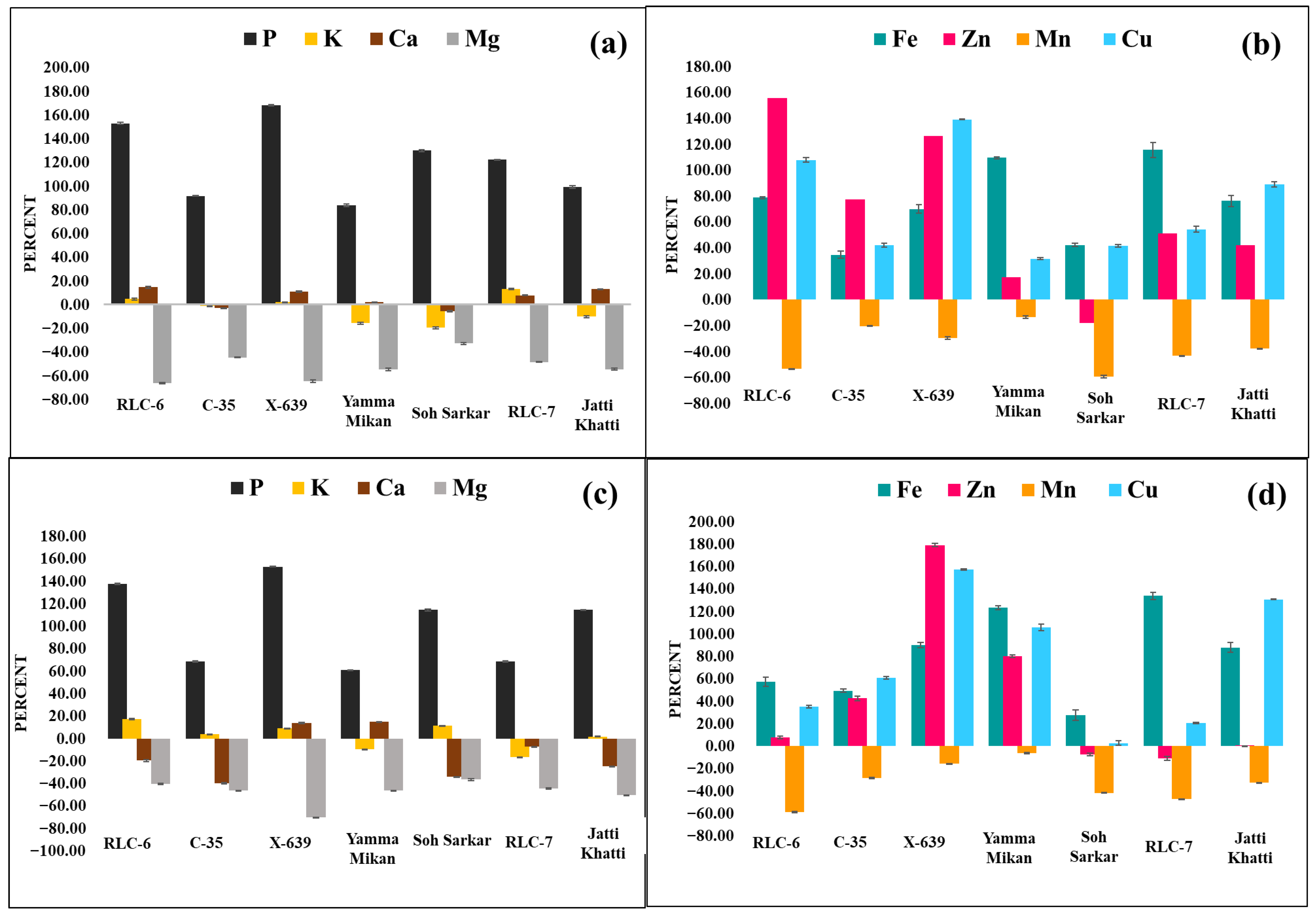
The deviation from the optimum percentage (DOP) index is a diagnostic approach used to determine optimum nutrient status in leaves. It highlights the degree of deviation from the optimum crop-specific mineral nutrient standards. In the present study, the positive DOP index values were predominantly observed for leaf P, Fe, and Cu levels, with the general trend following leaf P > leaf Fe > leaf Cu (Figure 1), indicating their accumulation above optimum levels. Among the scion–rootstock combinations, rootstock ‘X-639’ exhibited comparatively higher positive deviation for leaf P in both cultivars, followed by ‘RLC-6’, suggesting enhanced P uptake under these combinations. Significant variability was observed for leaf micronutrient DOP index values, particularly for leaf Zn and leaf Cu, across different combinations, reflecting differential nutrient acquisition efficiency. In contrast, leaf Mg and leaf Mn consistently exhibited negative DOP index values, indicating sub-optimal concentrations irrespective of the combinations. The DOP index values for leaf K and leaf Ca showed moderate variation, with both positive and negative deviations depending on the scion–rootstock combinations. Notably, rootstock ‘X-639’ maintained relatively balanced DOP index values for leaf K and leaf Ca across both cultivars, suggesting a more stable nutrient status. Overall, the variation in DOP indices among combinations highlights the significant influence of rootstocks on nutrient uptake and partitioning.

3.3. Juice Macro-Mineral Nutrients

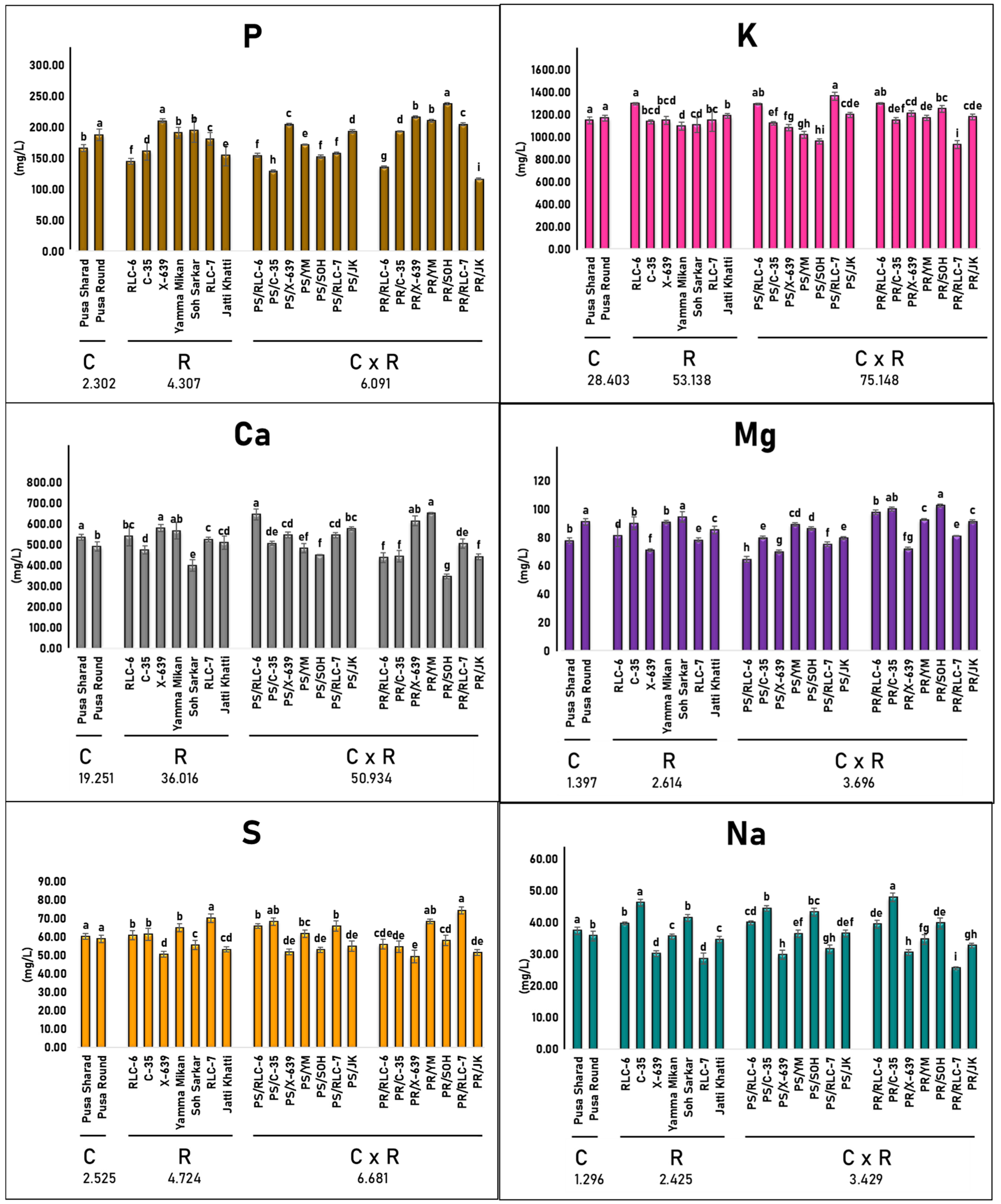
In the present study, juice macro-mineral nutrient levels were significantly influenced by the cultivar, rootstock, and their interaction (C × R) (Figure 2), indicating that nutrient accumulation in fruits was jointly regulated by genetic factors and scion–rootstock compatibility. The significant interaction further suggested that the effect of a given rootstock varied with the scion cultivar, highlighting the importance of specific scion–rootstock combinations in determining juice mineral nutrient composition. Across combinations, both cultivars exhibited substantial variation in macro-mineral nutrient accumulation in fruit juice depending on the rootstock. Considering the mean effect of the scion cultivars, ‘Pusa Sharad’ showed comparatively higher juice Ca accumulation, whereas ‘Pusa Round’ tended to exhibit higher juice P and juice Mg levels, while both cultivars were statistically at par for juice K and juice S content.
Based on the mean effects of rootstocks, significant differences were observed in their ability to modulate juice mineral nutrient composition. Rootstock ‘X-639’ generally promoted a favourable mineral balance, particularly by maintaining higher juice Ca and juice P levels while maintaining comparatively lower Na accumulation, suggesting improved selectivity in ion uptake and translocation. However, it was statistically at par with ‘Yamma Mikan’ for juice Ca levels. Moreover, certain rootstocks such as ‘RLC-6’ and ‘RLC-7’ were more effective in enhancing juice K and juice S accumulation, respectively, indicating differential nutrient mobilization patterns. The lowest juice K content was related to rootstock ‘Yamma Mikan’, whereas ‘Soh Sarkar’ significantly elevated juice Mg content. Rootstocks, ‘Yamma Mikan’, ‘C-35’, and ‘RLC-6’ were statistically similar for juice S levels.
The cultivar × rootstock interaction effects revealed distinct optimal scion–rootstock combinations for specific macro-mineral nutrients. For instance, combinations involving ‘RLC-6’ and ‘RLC-7’ were particularly effective in enhancing juice K levels in ‘Pusa Sharad’. Rootstock ‘RLC-7’ also promoted higher juice Ca and juice S concentrations, statistically at par with ‘C-35’ for juice S. Furthermore, rootstocks ‘Soh Sarkar’, ‘RLC-6’, and ‘RLC-7’ were statistically at par for juice P content. The highest juice Mg content in ‘Pusa Sharad’ was recorded when budded on ‘Yamma Mikan’ rootstock, followed by ‘Soh Sarkar’, which was statistically non-significant. The lowest juice Mg and juice S contents corresponded with ‘RLC-6’ and ‘X-639’ rootstocks, respectively. For cultivar ‘Pusa Round’, elevated juice K levels were found when grafted on ‘RLC-6’ rootstock, followed by ‘Soh Sarkar’ and ‘X-639’, which were statistically significant. The greatest and lowest juice P levels were associated with ‘Soh Sarkar’ and ‘Jatti Khatti’ rootstocks, respectively.
Rootstocks ‘RLC-6’, ‘C-35’, and ‘Jatti Khatti’ were statistically at par for juice Ca and juice S. Similarly to ‘Pusa Sharad’, rootstock ‘Soh Sarkar’ significantly enhanced juice Mg content in ‘Pusa Round’, statistically at par with ‘C-35’ rootstock. Juice Na concentration varied among scion–rootstock combinations, with rootstocks ‘X-639’ and ‘RLC-7’ generally associated with lower juice Na levels, suggesting improved exclusion or restricted translocation of sodium ions to the edible tissues.
From a nutritional perspective, juice from both cultivars contributed meaningfully to dietary mineral intake, with measurable proportions of the recommended dietary allowance (RDA) for key macro-mineral nutrients, thereby reinforcing the nutritional significance of citrus juice. Moreover, the intake of 100 mL of fruit juice of studied cultivars grafted on different rootstocks can supplement up to 2.48–3.63%, 3.46–6.51%, 1.16–2.37%, and 1.90–3.01% of the RDA for macro-mineral nutrients potassium, calcium, phosphorus, and magnesium, respectively (Table 2).
Overall, the results indicate that rootstock choice plays a decisive role in regulating juice macro-mineral nutrient composition. For ‘Pusa Sharad’, nutritionally superior combinations included ‘Pusa Sharad’/‘RLC-6’ for higher juice K, ‘Pusa Sharad’/‘RLC-6’ for enhanced juice Ca, and ‘Pusa Sharad’/‘X-639’ for lower Na accumulation in fruit juice. For ‘Pusa Round’, the superior combinations were ‘Pusa Round’/‘RLC-6’ for higher juice K, and ‘Pusa Round’/‘X-639’ for juice Ca, ‘Pusa Round’/‘Soh Sarkar’ for increased juice Mg, and ‘Pusa Round’/‘X-639’ for reduced Na accumulation in edible tissues. These responses are likely driven by rootstock-mediated differences in nutrient uptake efficiency, ion selectivity, and translocation dynamics within the grafted plant system.

3.4. Juice Micro-Mineral Nutrients

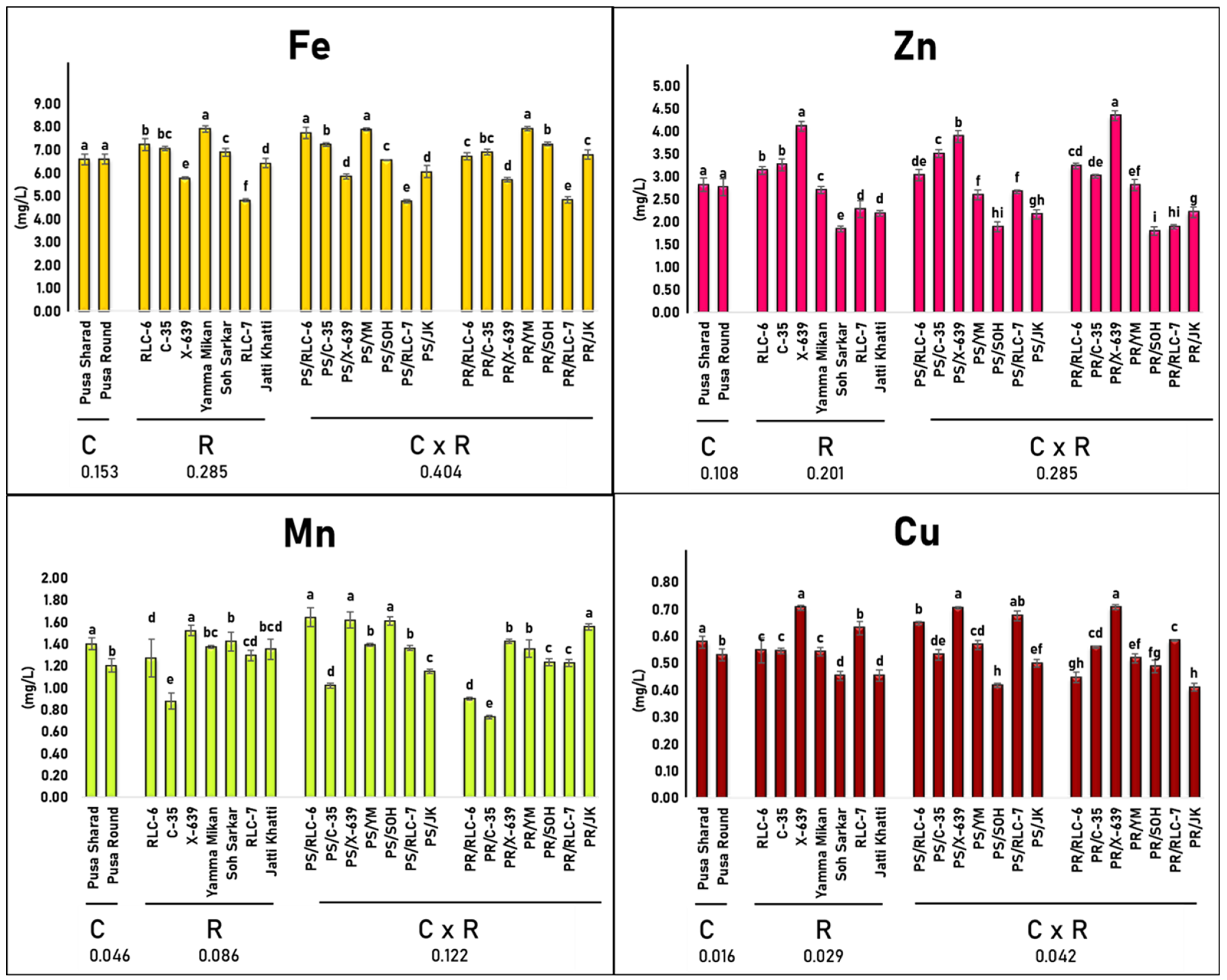
Considerable variation in juice micro-mineral nutrient levels was observed among the cultivars and rootstocks, both independently (mean effect) and in the cultivar × rootstock (C × R) interaction (Figure 3). Considering the mean effect of scion cultivars, ‘Pusa Sharad’ recorded relatively higher juice Mn and Cu levels than ‘Pusa Round’, whereas both cultivars were statistically at par for juice Fe and Zn levels.
Based on the mean effects of rootstocks, rootstock ‘X-639’ was consistently associated with enhanced juice Zn, Mn, and Cu concentrations, indicating its superior efficiency in micronutrient uptake and translocation. Rootstock ‘Yamma Mikan’ was more effective in increasing Fe concentration in fruit juice. Reduced juice Mn levels were generally associated with ‘RLC-6’, ‘RLC-7’, and ‘Jatti Khatti’ rootstocks, and they are statistically non-significant, suggesting comparatively limited efficiency in Mn accumulation in edible tissues. Lastly, rootstocks ‘RLC-6’, ‘C-35’, and ‘Yamma Mikan’ were statistically at par for juice Cu content.
The cultivar × rootstock interaction revealed distinct combinations with superior performance, highlighting the importance of specific scion–rootstock relations. For ‘Pusa Sharad’, rootstock ‘X-639’ was particularly effective in enriching fruit juice with micro-mineral nutrients, namely Zn, Mn, and Cu, and higher juice Fe levels were obtained when grafted on ‘Yamma Mikan’ rootstock. Rootstock ‘X-639’ was statistically at par with ‘RLC-6’ and ‘Soh Sarkar’ for juice Mn concentrations and with ‘RLC-7’ for juice Cu levels. The reduced juice Zn and Cu levels were associated with ‘Soh Sarkar’ rootstock. Among all combinations, ‘Pusa Sharad’ grafted on ‘X-639’ can be considered the most balanced and efficient pairing for improving juice micro-mineral nutrient levels. For cultivar ‘Pusa Round’, the highest juice Zn and Cu levels were obtained when grafted on the ‘X-639’ rootstock, and they were statistically significant. Rootstocks ‘RLC-6’, ‘C-35’, and ‘Jatti Khatti’ were found to be statistically at par for juice Fe levels. However, ‘Jatti Khatti’ was associated with the highest juice Mn contents in ‘Pusa Round’. The lowest juice Fe, Zn, and Mn contents were associated with ‘RLC-7’, ‘Soh Sarkar’, and ‘C-35’ rootstocks, respectively.
Similarly to the macro-mineral nutrients, juice from both cultivars contributed significantly to the recommended dietary allowance (RDA) for the micro-mineral nutrients, accounting for about 3.17–5.28% of the RDA for iron, 1.45–2.98% for zinc, 1.83–4.10% for manganese, and 2.41–4.18% for copper (Table 2), indicating that citrus juice can serve as a supplementary dietary source of essential trace elements.

3.5. Correlation Analysis

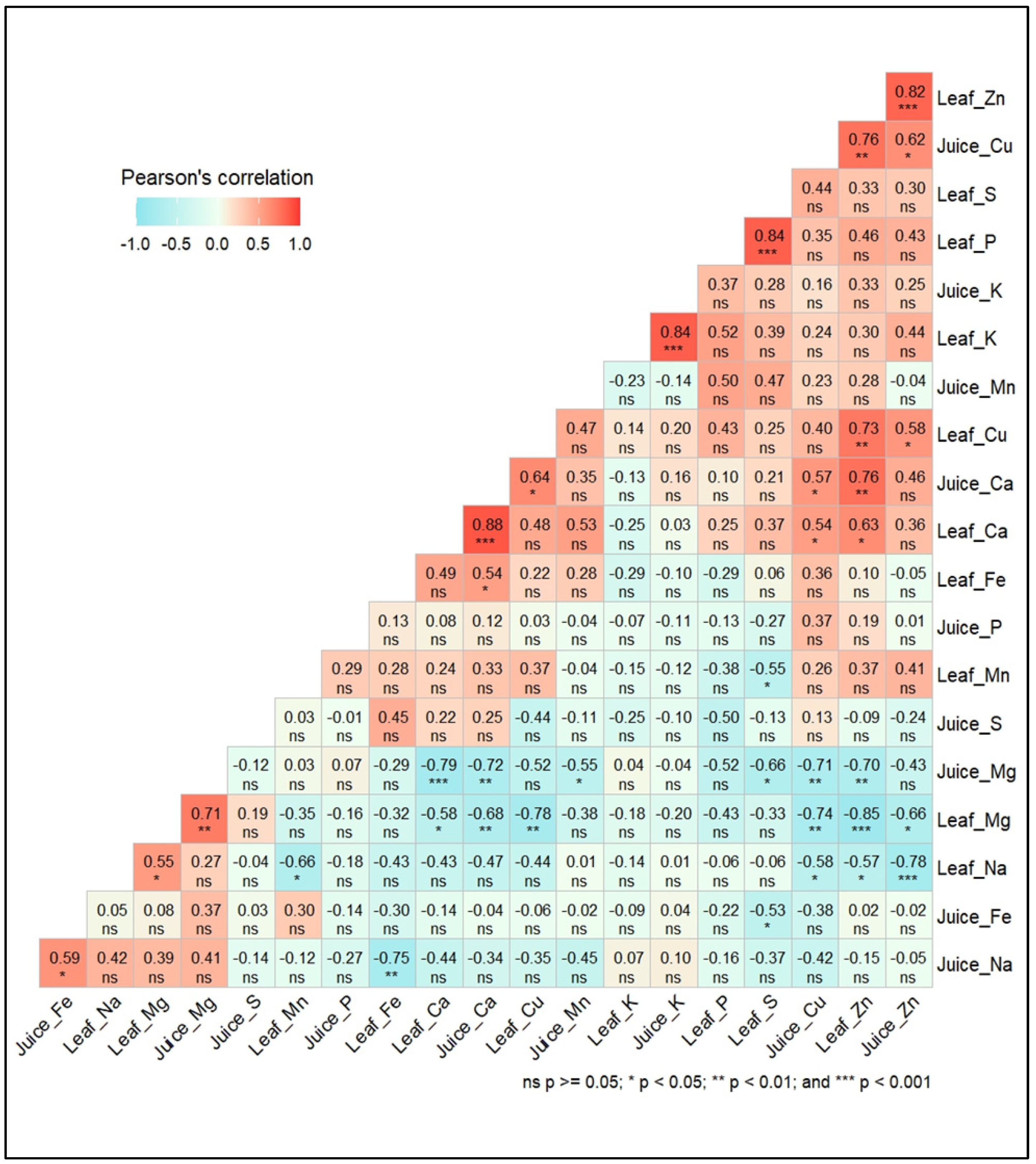
In the present study, Pearson’s correlation analysis was performed to identify linear associations between leaf/juice mineral nutrients (Figure 4). Considering the mineral nutrients quantified in the leaf, a significant positive relationship was noted for leaf Zn-Ca (p < 0.05; 0.63), leaf Zn-Cu (p < 0.01; 0.73), leaf S-P (p < 0.001; 0.84), and leaf Mg-Na (p < 0.05; 0.55). In contrast, leaf Zn-Na (p < 0.05; −0.57), leaf Zn-Mg (p < 0.001; −0.85), leaf S-Mn (p < 0.05; −0.55), leaf Cu-Mg (p < 0.01; −0.78), leaf Ca-Mg (p < 0.05; −0.58), and leaf Mn-Na (p < 0.05; −0.66) were negatively correlated. Among the juice mineral nutrients, a significant positive interaction was observed between juice Na-Fe (p < 0.05; 0.59), juice Ca-Cu (p < 0.05; 0.57), and juice Cu-Zn (p < 0.05; 0.62). However, a significant negative correlation was exhibited between juice Mg and juice Cu/Mn/Ca.
In the interaction, a significant inverse linkage has been observed between juice Mg-leaf Zn/S, juice/leaf Mg-juice/leaf Ca, and juice Na-leaf Fe/S. Moreover, leaf Na/Mg was also negatively correlated with juice micro-mineral nutrients (Zn and Cu). This might be due to restricted leaf Zn or Cu levels due to higher Na or Mg uptake. Furthermore, juice Ca–leaf Cu (p < 0.05; 0.64) or vice versa, leaf Fe–juice Ca (p < 0.05; 0.54), and leaf Cu–juice Zn (p < 0.05; 0.58) or vice versa exhibited significant positive correlation. Interestingly, significant positive correlations were observed for leaf/juice Zn (p < 0.001; 0.82), leaf/juice K (p < 0.001; 0.84), leaf/juice Ca (p < 0.001; 0.88), and leaf/juice Mg (p < 0.01; 0.71) (Figure 4). The correlation analysis demonstrates that nutrient uptake, translocation, and partitioning in citrus fruits are tightly regulated and interdependent processes. It confirms that rootstock–scion interactions influence not only individual nutrient levels but also their internal balance and interrelationships. Such interactions help explain how rootstocks modulate overall fruit nutritional quality and leaf nutrient homeostasis.

3.6. Principal Component Analysis

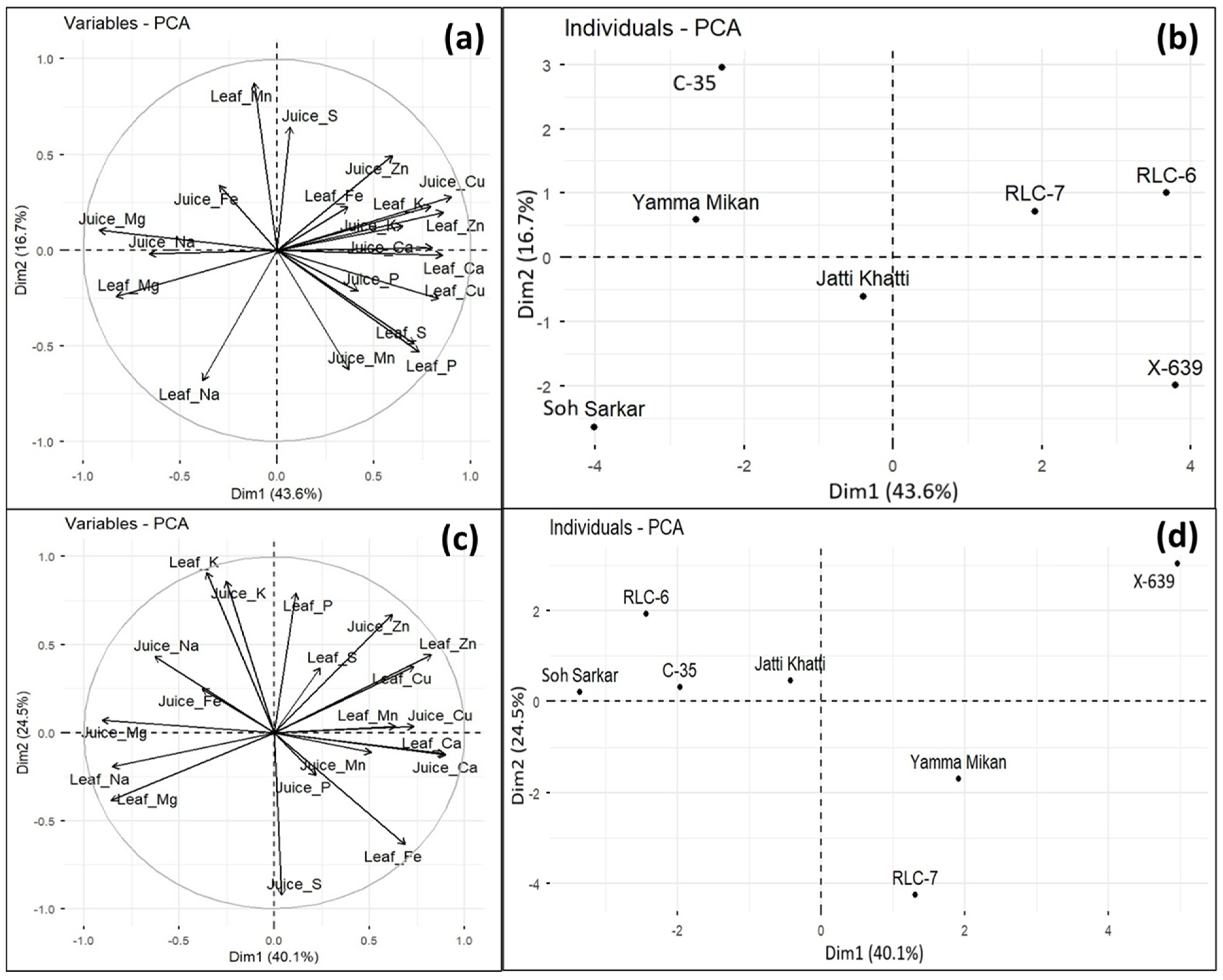
Principal component (PC)-based multivariate analysis provides better insights into the similarities or distinctions among studied scion–rootstock combinations with respect to mineral nutrients. Independent analyses were performed for ten mineral elements (leaf and juice each) for both sweet orange cultivars. For ‘Pusa Sharad’, 61.30% of the variability could be explained by the first two principal components (PC1 and PC2) (Figure 5a,b). The base loading value for significance was kept at 0.5. The coordinates for individual and variable plots are provided in Supplementary Tables S4 and S5. Considering a minimum threshold eigenvalue of one, the first six PCs explained 100.00% of the total variance (PC1: 43.60%; PC2: 16.70%; PC3: 14.51%; PC4: 11.25%, PC5: 8.47%, and PC6: 5.47%) (Supplementary Table S6). The PC1 was positively and significantly correlated with the following: macronutrients (leaf/juice K and Ca) and micronutrients (leaf/juice Cu and leaf Zn); and negative contributions were attributed to leaf/juice Mg (Supplementary Table S7). The variables that contributed significantly to PC2 were leaf Na (−0.965), leaf Mn (0.762), juice Cu (0.589), and juice Zn (0.867), whereas leaf P (0.840), leaf S (0.802), juice Mn (−0.578), and leaf Mn (0.920) were associated with PC3. Marked contributions of juice S (0.929) and juice P (−0.898) were related to PC4. PC5 was linked with leaf K (0.552) and juice Fe (−0.957) significantly in a positive and negative manner, respectively. At last, PC6 was strongly defined by positive interaction with leaf Fe (0.981) and a negative relation with juice Na (−0.601).
For ‘Pusa Round’, 64.60% of the total variance was attributed to the first two principal components (Figure 5c,d). The first five PCs with eigenvalues > 1 explained 95.10% of the cumulative variance (PC1: 40.10%; PC2: 24.50%; PC3: 15.06%; PC4: 9.58% and PC5: 5.86%) (Supplementary Table S6). PC1 exhibited significant positive correlations with the following: leaf/juice Ca, leaf/juice Cu, leaf/juice Zn, and leaf Mn (0.663). In contrast, it was negatively associated with leaf Na (−0.970) and juice/leaf Mg. Significant positive loadings of leaf/juice K and leaf P (0.809) and negative loadings of leaf Fe (−0.783) and juice S (−0.932) were associated with PC2. Variables that contributed mostly to PC3 were leaf Mn (0.549), juice Na (0.575), juice Mg (0.610), juice Fe (0.909), and leaf S (−0.868), while leaf Cu (0.521), juice Mn (0.968), and juice Na (−0.613) were important to PC4. PC5 was positively associated with juice P (0.888) and juice Cu (0.715) (Supplementary Table S7).
Overall, the significant proportion of variability explained by the first two PCs indicates that a major portion of nutrient variation is well-structured and not random, reflecting strong biological regulation of nutrient uptake and partitioning. Strong loadings of leaf Cu, leaf Zn, leaf Ca, leaf Mg, juice Ca, juice Mg, and juice Cu in PC1 (Supplementary Table S7) further suggest that these nutrients are key drivers of nutritional differentiation among the studied scion–rootstock combinations. The consistency between PCA and Pearson’s correlation analysis confirms that the observed pairwise relationships are part of a broader multivariate nutrient interrelationship pattern.

3.7. Cluster Analysis

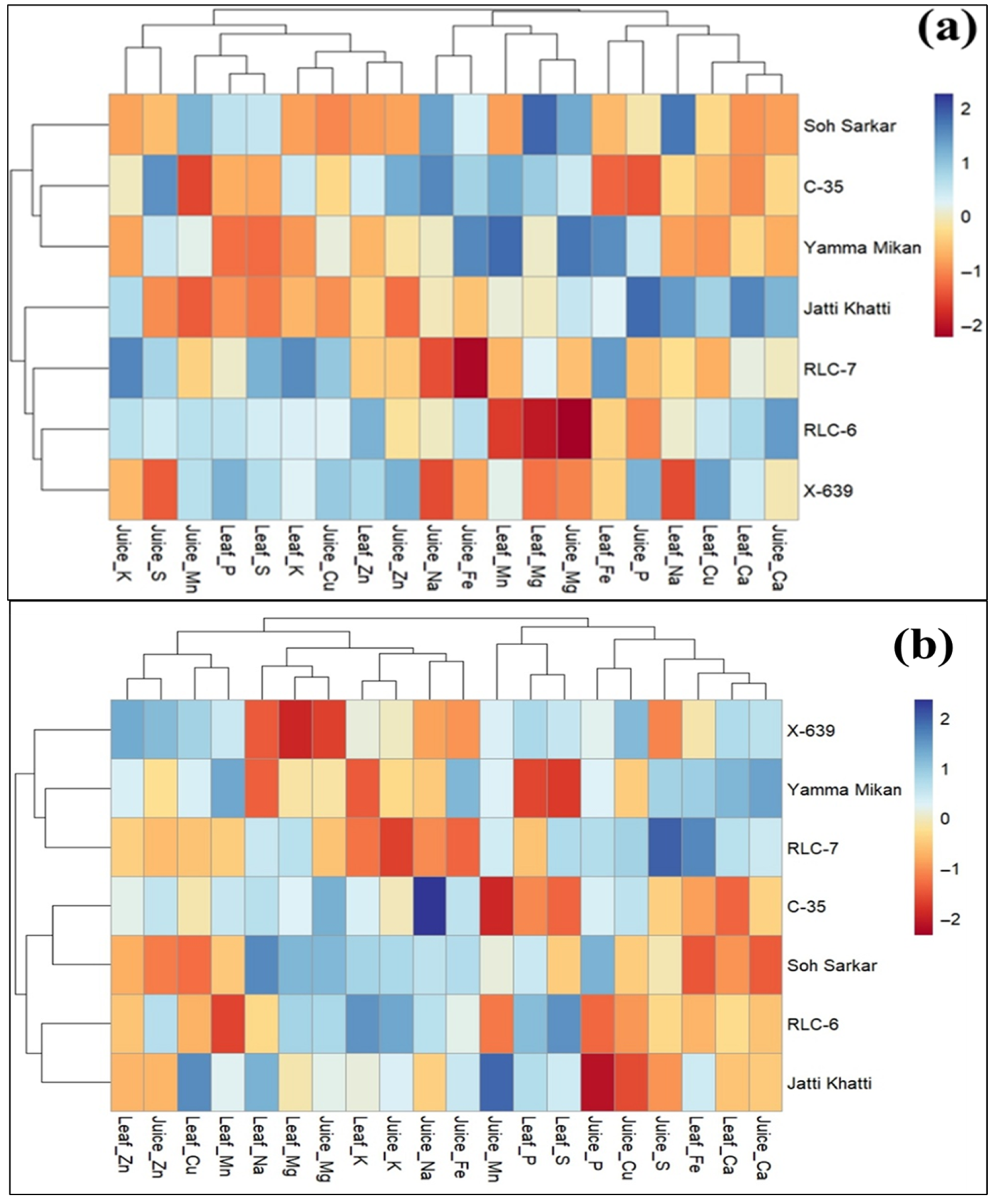
Similarly to principal component analysis, independent agglomerative hierarchical clustering (AHC) analyses were performed for both cultivars ‘Pusa Sharad’ (Figure 6a) and ‘Pusa Round’ (Figure 6b). Clustering was based on leaf and juice mineral nutrients. For the sweet orange cultivar ‘Pusa Sharad’, the dendrogram classified the rootstocks into five clusters: Cluster I (‘Soh Sarkar’), Cluster II (‘C-35’ and ‘Yamma Mikan’), Cluster III (‘Jatti Khatti’), Cluster IV (‘RLC-7’), and Cluster V (‘X-639’ and ‘RLC-6’) (Figure 6a). Based on the variables, the clustering heatmap was further resolved into two broad groups, which were subdivided into different subgroups. Rootstock ‘Soh Sarkar’, positioned in Cluster I, is characterized by medium-to-high content of the following mineral nutrients: leaf/juice Na, leaf/juice Mg, and juice Mn. Cluster II formation was driven by lower content of leaf/juice Ca, leaf Cu, leaf Na, leaf S, leaf P, and juice K. However, rootstock ‘Yamma Mikan’ was characterized with high leaf Mn, leaf/juice Fe, and juice Mg, while rootstock ‘C-35’ had medium-to-high levels of juice S, Zn, Na, and Fe. Cluster III was characterized with medium-to-high juice P, leaf Na, leaf Cu, and leaf/juice Ca, whereas Cluster IV was demarcated with increased leaf/juice K and leaf Fe and decreased juice Na and juice Fe levels. The cluster V consisted of rootstocks ‘RLC-6’ and ‘X-639’, characterized by medium levels for most of the leaf/juice mineral nutrients and minimum levels for juice/leaf Mg. For sweet orange cv. ‘Pusa Round’, the dendrogram organized the rootstocks into four principal clusters: Cluster I (‘C-35’ and ‘Soh Sarkar’), Cluster II (‘RLC-6’ and ‘Jatti Khatti’), Cluster III (‘X-639’), and Cluster IV (‘Yamma Mikan’ and ‘RLC-7’) (Figure 6b). Considering the variables, the clustering heatmap revealed two major groups that were further divided into several subgroups. Cluster I was defined by medium-to-high values of leaf/juice Na and leaf/juice Mg and the lowest levels of juice/leaf Ca and leaf Fe. Cluster II had lower levels of the following mineral nutrients: juice (P, Cu, S, Ca) and leaf (Fe, Ca, Zn). Cluster III, consisting of rootstock ‘X-639’, was associated with medium levels of leaf/juice Zn, leaf/juice Ca, leaf/juice Mn, and leaf/juice Cu. In contrast, it recorded the lowest leaf Na and leaf/juice Mg levels. Cluster IV was based on elevated leaf/juice Ca, leaf Fe, and juice S, diverging from juice Mg, leaf/juice K, and juice Na.
AHC demonstrated that rootstocks could be clearly classified into functionally distinct groups based on their combined leaf and juice mineral composition. The formation of stable clusters (in both cultivars) suggested that mineral behavior is consistent and reproducible within specific rootstock groups. Heatmap-based sub-grouping further reveals that nutrient distribution is multi-dimensional, where no single rootstock is superior for all nutrients; rather, each exhibits a specific mineral fingerprint for the studied cultivars.

4. Discussion

4.1. Leaf Mineral Nutrients

In perennial fruit crops, grafting is a horticultural practice in which a root segment (rootstock) is joined with a shoot segment (scion). It involves the successful interaction between the scion and the rootstock at the graft union interface. Several mechanisms have been proposed to govern the modulatory role of rootstocks in stionic combinations, including physiological and nutritional processes, hormonal signalling, and molecular regulation [14,15,18,19]. Of these, the ability for absorption, transfer, and partitioning of mineral nutrients to the scion counterpart is most critical, as it directly impacts biological functioning, fruit development, quality, and ultimately productivity [37,38,39]. The translocation of mineral nutrients occurs following the formation of the callus bridge and vascular cambium formation at the graft union and the subsequent development of secondary xylem [40,41]. Different mineral nutrients perform distinct functions in tree growth and development. For instance, nitrogen is essential for protein synthesis and chlorophyll formation [42], while phosphorus is involved in energy transfer [43]. Potassium regulates water balance and enzymatic activity [44], whereas calcium ensures the structural stability of plant tissues [45]. In addition, magnesium plays a crucial role in photosynthesis [46], while micro-mineral nutrients such as iron, zinc, and manganese are involved in electron transport, enzyme activity, and hormone regulation [47].
Leaf mineral nutrient assays are widely utilised diagnostic approaches for monitoring plant growth and guiding balanced nutrient management for improved yield and fruit quality [48]. The approach is more effective than soil nutrient assays, as it reflects the actual nutritional status of trees when compared to crop-specific standards. Moreover, it is a well-established and reliable diagnostic approach for detecting nutrient imbalances as well. In our study, the leaf macro- (Ca, K, P, S, and Mg) and micro-mineral (Fe, Zn, Mn, and Cu) nutrient levels were significantly influenced by the rootstocks (Table 1). Rootstocks differ in their root system architecture, including horizontal spread and vertical growth [49], uptake transporter activity, and physiological aspects of the root system, which directly contribute to differential ion absorption, translocation, and redistribution of mineral nutrients. In addition, variations in hydraulic conductivity and root surface area affect water uptake and transport, which in turn influence the translocation of mineral nutrients by altering the flow within xylem vessels. Rootstocks also regulate ion selectivity and exclusion mechanisms, thereby affecting nutrient balance within the plant. The results of the present study are in agreement with earlier reports on the influence of rootstocks in regulating leaf mineral nutrient composition in perennial tree crops. Dubey and Sharma [50] reported that ‘Rough lemon’ and ‘RLC-4’ rootstocks promoted the accumulation of foliar N and K levels in the lemon cultivar ‘Kagzi Kalan’, whereas ‘Sour Orange’ was more capable of accumulating micronutrients (Zn and Cu) in the leaf tissues. Sarkhosh et al. [51] highlighted substantial variations in leaf mineral nutrition of mango cultivars grafted onto different rootstocks and suggested the potential role of stionic selection in varietal improvement. Fallahi et al. [52] observed that apple cultivar ‘BC-2 Fuji’ grafted on ‘B9’ rootstock showed higher leaf Ca and Mn levels but lower leaf K concentrations, whereas rootstock ‘M.7 EMLA’ exhibited higher leaf Mg, K, and Cu levels, and ‘Ottawa 3’ recorded significantly lower Cu levels compared to other rootstocks. In our study, rootstock ‘X-639’ exhibited restricted uptake of Na, as depicted by lower leaf Na levels in both sweet orange cultivars. Previously, Aparicio-Durán et al. [53] reported that rootstock ‘X-639’ exhibited the lowest concentration of Na+ ions in both leaves and roots among different rootstocks subjected to different salinity treatments (0 to 75 mM) under Mediterranean conditions. In contrast, ‘Soh Sarkar’ appeared more sensitive to salinity, as evidenced by the higher accumulation of Na+ in the leaves of both cultivars. Goswami et al. [54] studied the effect of polyamines on different rootstocks under NaCl stress and observed that the highest Na+ levels (2.21%) in leaf tissues were observed in ‘Soh Sarkar’ rootstock.
With the intensification of fruit production, the selection of rootstocks with superior nutrient uptake capacity in orchard systems has become increasingly important, as it regulates resource acquisition and distribution between the soil and scion. In our study, the deviation from optimum percentage (DOP) index values for leaf P, Fe, and Cu was considerably higher than those reported by Srivastava and Singh [35] (Figure 1) in sweet oranges, suggesting that the evaluated nucellar polyembryonic rootstocks exhibited greater efficiency in facilitating the uptake of these mineral nutrients. In addition, notable cultivar differences were evident, as scion cultivars grafted onto the same rootstock displayed distinct nutrient concentrations (Table 1), which might be due to differential source–sink relationships. The negative DOP index values for leaf Mg and leaf Mn could be attributed to inherent soil nutrient limitations, ionic antagonisms, and differential nutrient partitioning within the scion, leading to consistently lower-than-optimum leaf concentrations. Leece and den Ende [55] suggested that a negative DOP index can indicate problems with soil nutrient availability and nutrient uptake. Lower leaf Mg values can be attributed to antagonism with leaf Ca, which is in agreement with Qu et al. [56]. Moreover, it is well-documented that rootstocks may restrict the uptake of both macro- and micronutrients [57] due to differences in selective ion transport across root membranes and transporter specificity. Secondly, the variation among rootstocks in their capacity to absorb specific mineral nutrients has been associated with the characteristics of xylem sap at the graft union. The presence of long/wide vessels can act as selective barriers, thereby influencing the movement of solutes and ultimately altering the nutrient balance available to the scion [58]. In our study, rootstock ‘X-639’ exhibited positive DOP index values for all measured leaf macro- and micronutrients in both cultivars, except Mg and Mn (Figure 1). This might be due to enhanced ion uptake efficiency, better transporter activity, and more effective long-distance transport through the vascular system, as compared to other rootstocks.

4.2. Juice Mineral Nutrients

The consumption of fruits provides numerous health benefits primarily due to the presence of phytonutrients, including vitamins, minerals, flavonoids, phenolics, antioxidants, and organic acids [59]. Among these, mineral nutrients differ fundamentally from other phytonutrients as they are inorganic elements, whereas most phytonutrients, such as flavonoids, carotenoids, and phenolics, are organic bioactive compounds synthesized by plants. Several researchers have reported that citrus fruits are rich in various mineral nutrients. For instance, Lu et al. [60] suggested that citrus fruits represent an important dietary source of potassium, an essential macro-mineral nutrient required for maintaining osmotic and pH regulation and electrolyte balance in the human body [61]. Turra et al. [62] suggested that orange juice can additionally enrich the human body with potassium (K), phosphorus (P), and manganese (Mn) mineral nutrients. Similarly, in our study, there was predominance of K in the fruit juice of the studied sweet orange cultivars (Figure 2). This might be attributed to its natural association with organic acids [63]. Secondly, the calcium (Ca) levels in the fruit juice of the studied scion–rootstock combinations corresponded with the report of Abobatta et al. [64], who reviewed that juice Ca levels in different citrus fruits ranged from 260 mg L−1 to 900 mg L−1. Phosphorus (P) and magnesium (Mg) are essential macro-minerals fundamental to metabolic processes [65] and protein synthesis [66], respectively. Among citrus fruits, orange juice is reported to be the richest source of P, ranging from 151 mg L−1 in red grapefruit to 233 mg L−1 in oranges [67]. The results of the present study are in agreement with Singh et al. [13], wherein P content in orangelo hybrids (sweet orange × pummelo) ranged from 153 to 736 mg L−1. Similarly, the juice Mg levels were consistent with earlier reports by Savić et al. [68] for orange juices, ranging from 0.48 to 33.94 mg L−1. Sulphur (S) is a key element in amino acids (methionine and cysteine) and structural proteins. In addition, it is a component of glutathione, one of the human body’s most powerful antioxidants [69]. The juice S levels (49.35–74.34 mg L−1) were lower than the earlier reports by Wang et al. [70] for Citrus grandis (600–900 mg L−1).
Micro-mineral nutrients, particularly iron, zinc, manganese, and copper, are essential nutrients required by the human body in small amounts but are vital for maintaining normal physiological functions. Iron is essential for oxygen transport in the blood through hemoglobin synthesis [71], while zinc supports immune response and is an integral component of insulin [72]. As per the Food Safety and Standards Authority of India (FSSAI), preventable micronutrient deficiency is an emerging public health priority in India. Venkatesh et al. [73] had summarized the prevalence of micronutrient deficiency in India and reported Iron (Fe) deficiency as the most widespread. Manganese (Mn) is essential for carbohydrate and fat metabolism [74]. Copper (Cu) is important for the regulation of metabolic activities in the human body [75] through involvement in antioxidant defense systems and enzyme functioning. In our study, the juice Na content ranged from 25.61 to 47.88 mg L−1, irrespective of scion–rootstock combinations (Figure 2). Previously, Singh et al. [13] reported similar juice Na levels in ‘Mosambi’ orange juice.
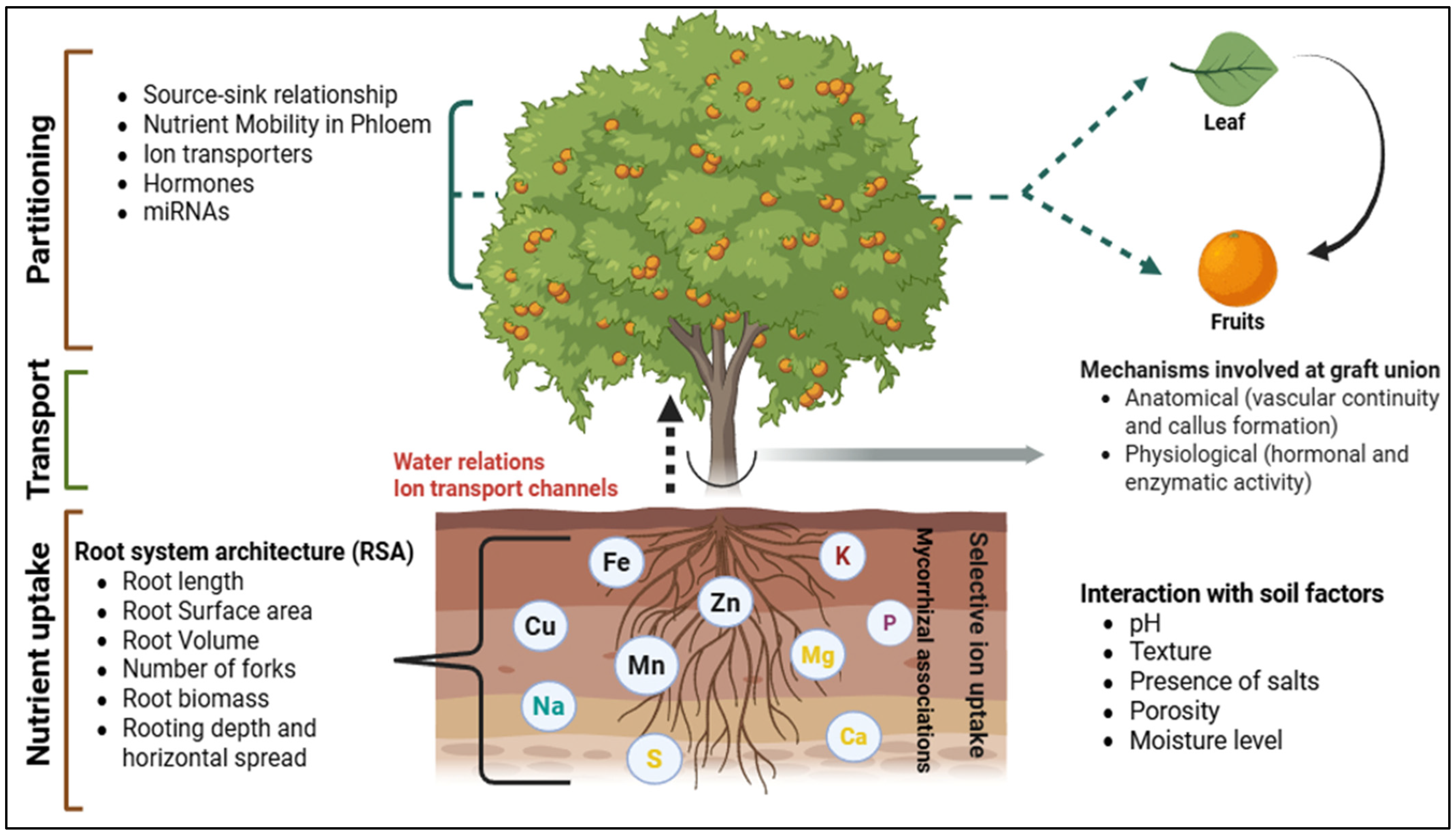
In grafted plant systems, rootstocks play a crucial role in the accumulation and distribution of mineral nutrients in the edible parts because they determine the efficiency of water and nutrient uptake from the soil and their translocation to the scion. However, their final distribution and concentration are also modulated by the scion and overall scion–rootstock interactions. Previously, Reig et al. [76] reported a significant influence of Geneva® rootstocks on the fruit mineral nutrients of grafted ‘Fuji’ trees. Huang et al. [77] observed that watermelon cultivar ‘Zaojia 8424’ exhibited higher mineral nutrient levels in the edible tissues when grafted onto suitable rootstocks, as compared to the non-grafted plants. Marques et al. [78] suggested a potential improvement in the fruit quality of ‘Hass’ avocados through the influence of rootstocks on fruit mineral nutrient profiles. In citrus, the importance of rootstocks is even more pronounced for the determination of mineral nutrient composition, owing to the juicy nature of edible tissues. Therefore, the selection of mineral nutrient-efficient rootstocks can enhance nutrient uptake and facilitate effective partitioning of macro- and micro-mineral nutrients into developing fruits, thereby improving juice quality and nutritional value. In our study, graft combinations involving ‘RLC-6’ and ‘Soh Sarkar’ rootstocks resulted in increased juice K and juice Mg levels in both scion leaf and fruit juice, respectively. Similarly, ‘X-639’ outperformed other rootstocks for the content of P and Ca in leaves and fruit juice (Table 1, Figure 2). Additionally, it further improved the juice micronutrient levels, particularly Mn, Zn, and Cu, in both cultivars. Interestingly, Citrus jambhiri and its accessions (‘Jatti Khatti’, ‘RLC-6’ and ‘RLC-7’) were found to be poor accumulators for juice Mn contents (Figure 3). Variations in juice mineral nutrient levels due to rootstocks can be attributed to several interrelated factors. Given that citrus fruits are primarily juice in nature, their composition is closely regulated by water relations [79], and it is well established that rootstocks influence both water relations and mineral uptake in citrus [80], thereby impacting juice mineral nutrient accumulation. Rootstocks differ in their root system architecture, which influences the extent and efficiency of mineral uptake from the soil [49]. Secondly, differences in ion selectivity and transport capacity [18] significantly affect nutrient acquisition. Ultimately, genetic differences among rootstocks determine their source–sink relationship. It leads to measurable differences in juice mineral nutrient profiles, as illustrated in Figure 7.

4.3. Multivariate Analysis

Multivariate analysis is an efficient approach enabling the simultaneous evaluation of multiple variables. In the present context, it provided a comprehensive understanding of complex relationships among the estimated leaf and fruit juice mineral nutrient composition and the studied scion–rootstock combinations. It further helped in identifying patterns of association among macro- and micronutrients, revealing how rootstocks influenced overall nutrient distribution within the grafted plants. This approach also facilitated the classification of scion–rootstock combinations based on their mineral nutrient profiles and highlighted key combinations associated with superior nutrient accumulation. Correlation analysis revealed significant interrelationships among mineral nutrients, enabling the use of indirect selection for key macro- and micro-minerals (Figure 4). These findings further highlighted the synergistic or antagonistic interactions between the estimated nutrients. Specifically, the negative correlation between leaf Na, leaf Zn, and leaf Mn indicates an antagonistic effect (Figure 4). This aligns with previous reports stating that elevated Na uptake often reduces the absorption of essential micronutrients [81]. Furthermore, the positive and negative relationships observed in this study are consistent with existing literature on leaf mineral nutrients across various crops [82,83,84,85,86]. The inverse association of juice Mg with juice Cu, juice Mn, and juice Ca (Figure 4) may be attributed to antagonistic interactions at ion transport channel sites [87]. A similar negative correlation between juice Ca and juice Mg was also reported by Singh et al. [13]. The interrelationships between juice and leaf mineral nutrients indicate that the cultivar × rootstock interaction significantly influenced the resulting mineral nutrient profiles. Furthermore, the Mg, Ca, K, and Zn content in the juice exhibited a significant positive association with their respective concentrations in the leaves (Figure 4). These favorable interrelationships for leaf/juice Ca and leaf/juice Mg align with the findings suggested by Singh et al. [13]. A positive association was observed between leaf K and juice K levels, which can be attributed to the high xylem mobility of potassium, facilitating its efficient translocation.
Principal component analysis identified the most influential mineral nutrients contributing to variability among scion–rootstock combinations for each cultivar (Figure 5). The findings of the present study suggest that correlations among variables are influenced by the scion, implying that the clustering of relatively homogeneous rootstocks may vary with the sweet orange variety studied. Agglomerative hierarchical clustering (AHC) is a comprehensive and bottom–up clustering method in which each trait starts as its own cluster, and pairs of clusters are gradually merged based on their similarity [88]. While dendrograms depict hierarchical clustering structure, complementary visualizations such as heatmaps in AHC provide better interpretation, integrate multiple variables, and allow quantitative comparison. The approach has been widely used in citrus, especially for fruit quality-related traits [89]. The AHC results were in accordance with the dendrogram-based classification for both sweet orange cultivars, as depicted in Supplementary Figures S1 and S2. In addition, it offers several advantages, allowing identification of relatively homogeneous groups based on variables, and has highlighted the distinctions for each specific combination. Moreover, it revealed cultivar-specific nutrient responses. The visualization can guide the selection of scion–rootstock combinations based on targeted nutrient profiles. It further allows for the utilization of mineral nutrient data to customize scion nutrient requirements to rootstock-induced nutrient profiles.
A direct relationship between leaf and juice mineral nutrient levels highlights the potential for agronomic biofortification in fruit crops [90]. Effective biofortification depends on enhanced uptake of micronutrients from the soil, followed by their efficient translocation within the plant system and subsequent accumulation in edible tissues [91]. In this context, the use of rootstocks is considered more effective than other agronomic approaches, such as foliar application or nutripriming. Although foliar nutrient sprays can temporarily correct deficiencies, their effectiveness in perennial fruit crops is limited due to short-lived responses, restricted internal translocation, and the risk of phytotoxicity when applied at higher concentrations. Secondly, in perennial fruit crops, rootstocks are especially important because they determine long-term orchard performance, making them a key component of modern varietal improvement programs. Agronomic biofortification is particularly relevant in ‘citriculture’ due to its global importance and the direct consumption of juice, where nutrient composition has a significant impact on human nutrition. Rootstocks play a central role in regulating nutrient uptake efficiency, ion transport, and partitioning of mineral nutrients into developing fruits, thereby directly influencing juice quality and nutritional value. Furthermore, the availability of nucellar polyembryonic rootstocks offers a major advantage in citrus cultivation, as they ensure genetic uniformity and stability across generations. Such uniformity helps maintain desirable traits related to nutrient uptake and transport efficiency, making rootstock-based strategies a reliable and sustainable approach for improving mineral nutrition in citrus fruits.

5. Conclusions

The present study systematically evaluated the influence of seven nucellar polyembryonic rootstocks on the mineral nutrient composition of both leaf and fruit juice in two sweet orange cultivars, ‘Pusa Sharad’ and ‘Pusa Round’. A significant interaction was observed between scion and rootstock for all studied macro- and micro-mineral nutrients. The DOP index was used as it provides a composite measure of nutrient equilibrium. Citrus juice was confirmed as a rich source of essential mineral nutrients, with cultivar-specific differences observed in mineral profiles. In our study, no single rootstock was found superior in enhancing all macro- and micro-nutrients. The identification of specific rootstocks that enhance the accumulation of particular mineral nutrients in edible tissues—such as ‘RLC-6’ for juice K, ‘Soh Sarkar’ for juice Mg, and ‘X-639’ for juice micronutrients (Zn, Mn, Cu)—can guide breeders in developing or selecting rootstocks with superior nutrient uptake and translocation efficiency. The results provide valuable insights for rootstock breeding and selection programs aimed at improving the mineral nutritional quality of citrus fruits. Multivariate analysis further revealed a clear separation for the influence of rootstocks, based on distinct patterns of nutrient concentrations, underscoring the potential of rootstock selection as a strategic tool in orchard nutrient management. Importantly, the positive correlations observed between leaf and juice mineral levels underscore the feasibility of employing rootstocks as a sustainable approach for agronomic biofortification in ‘citriculture’.

Supplementary Materials

The following supporting information can be downloaded at https://www.mdpi.com/article/10.3390/horticulturae12050530/s1. Table S1: Description of scion and rootstock counterparts in the studied stionic combinations. Table S2: Monthly weather parameters during the evaluation period of different scion–rootstock combinations. Table S3: Soil properties of the experimental orchard. Table S4. Individuals plot coordinates of principal component analysis (PC 1 and PC 2) of the leaf and juice mineral nutrients composition of sweet orange cultivars grafted on different rootstocks. Table S5. Variables plot coordinates of principal component analysis (PC 1 and PC 2) of the leaf and juice mineral nutrients composition of sweet orange cultivars grafted on different rootstocks. Table S6. Eigenvalue and (Cumulative) Percentage of Variance of principal component analysis of the leaf and juice mineral nutrients composition of sweet orange cultivars grafted on different rootstocks. Table S7. Component loadings of principal component analysis of the leaf and juice mineral nutrients composition of sweet orange cultivars grafted on different rootstocks. Figure S1: Dendrogram clustering of rootstocks based on estimated leaf and fruit juice mineral nutrients for cultivar ‘Pusa Sharad’. Figure S2: Dendrogram clustering of rootstocks based on estimated leaf and fruit juice mineral nutrients for cultivar ‘Pusa Round’.

Author Contributions

A.: Investigation, methodology, writing original draft, and writing review and editing; R.M.S.: conceptualization, supervision, resources, methodology, investigation, writing—original draft, and writing—review and editing; N.S. (Narendra Singh): visualization, formal analysis, and writing—review and editing; N.S. (Nimisha Sharma): conceptualization, supervision, methodology, and writing—review and editing; O.P.A.: methodology and writing review and editing; S.S.: methodology and writing review and editing; V.S.R.: methodology and writing review and editing; S.K.J.: methodology and writing review and editing; V.K.S.: methodology, resources, and writing review and editing; M.S.: writing review and editing; H.V.: investigation; A.A.: writing review and editing; A.K.D.: writing review and editing. All authors have read and agreed to the published version of the manuscript.

Funding

This research did not receive any specific grant from funding agencies in the public, commercial, or not-for-profit sectors.

Data Availability Statement

The original contributions presented in this study are included in the article/Supplementary Materials. Further inquiries can be directed to the corresponding author.

Acknowledgments

The authors sincerely express their gratitude to the Director, ICAR–Indian Agricultural Research Institute (ICAR-IARI), for providing the necessary facilities and support to carry out this research work. Deep appreciation is also extended to the Joint Director (Education), ICAR-IARI, and the Dean, ICAR-IARI. The authors also acknowledge the support received from DARE, MoA&FW, which greatly contributed to the successful completion of this research.

Conflicts of Interest

The authors declare that they have no competing financial interests or personal relationships that could have appeared to influence the work reported in this manuscript.

References

  1. FAO. The State of Food Security and Nutrition in the World; Urbanization, Agrifood Systems Transformation and Healthy Diets Across the Rural–Urban Continuum; Food and Agriculture Organization of the United Nations: Rome, Italy, 2023. [Google Scholar] [CrossRef]
  2. Voulgaridou, G.; Papadopoulou, S.K.; Detopoulou, P.; Tsoumana, D.; Giaginis, C.; Kondyli, F.S.; Lymperaki, E.; Pritsa, A. Vitamin D and calcium in osteoporosis, and the role of bone turnover markers: A narrative review of recent data from RCTs. Diseases 2023, 11, 29. [Google Scholar] [CrossRef]
  3. Alasad, S.M.; Salih, O.A.M.; Hassan, M. Insight into potassium’s role in childhood mortality due to severe acute malnutrition. Sudan. J. Paediatr. 2019, 19, 44–51. [Google Scholar] [CrossRef]
  4. Ergul, A.B.; Turanoglu, C.; Karakukcu, C.; Karaman, S.; Torun, Y.A. Increased iron deficiency and iron deficiency anemia in children with zinc deficiency. Eurasian J. Med. 2018, 50, 34–37. [Google Scholar] [CrossRef] [PubMed]
  5. Yadava, D.K.; Hossain, F.; Mohapatra, T. Nutritional security through crop biofortification in India: Status & future prospects. Indian J. Med. Res. 2018, 148, 621–631. [Google Scholar] [CrossRef] [PubMed]
  6. Virk, P.S.; Andersson, M.S.; Arcos, J.; Govindaraj, M.; Pfeiffer, W.H. Transition from targeted breeding to mainstreaming of biofortification traits in crop improvement programs. Front. Plant Sci. 2021, 12, 703990. [Google Scholar] [CrossRef]
  7. Majumder, S.; Datta, K.; Datta, S.K. Rice biofortification: High iron, zinc and vitamin A to fight against hidden hunger. Agronomy 2019, 9, 803. [Google Scholar] [CrossRef]
  8. Singh, S.K.; Barman, M.; Sil, A.; Prasad, J.P.; Kundu, S.; Bahuguna, R.N. Nutrient biofortification in wheat: Opportunities and challenges. Cereal Res. Commun. 2023, 51, 15–28. [Google Scholar] [CrossRef]
  9. Maqbool, M.A.; Beshir, A. Zinc biofortification of maize (Zea mays L.): Status and challenges. Plant Breed. 2019, 138, 1–28. [Google Scholar] [CrossRef]
  10. Ministry of Agriculture & Farmers Welfare, Government of India. ICAR-National Research Centre on Pomegranate. Available online: https://nrcpomegranate.in/ (accessed on 14 April 2026).
  11. Miles, E.A.; Calder, P.C. Effects of citrus fruit juices and their bioactive components on inflammation and immunity: A narrative review. Front. Immunol. 2021, 12, 712608. [Google Scholar] [CrossRef]
  12. Ministry of Agriculture & Farmers Welfare, Government of India. Available online: https://agriwelfare.gov.in/ (accessed on 14 April 2026).
  13. Singh, N.; Sharma, R.M.; Dubey, A.K.; Awasthi, O.P.; Saha, S.; Bharadwaj, C.; Sharma, V.K.; Sevanthi, A.M.; Kumar, A. Citrus improvement for enhanced mineral nutrients in fruit juice through interspecific hybridization. J. Food Compos. Anal. 2023, 119, 105259. [Google Scholar] [CrossRef]
  14. Mauro, R.P.; Pérez-Alfocea, F.; Cookson, S.J.; Ollat, N.; Vitale, A. Physiological and molecular aspects of plant rootstock–scion interactions. Front. Plant Sci. 2022, 13, 852518. [Google Scholar] [CrossRef]
  15. Shivran, M.; Sharma, N.; Dubey, A.K.; Singh, S.K.; Sharma, N.; Sharma, R.M.; Singh, N.; Singh, R. Scion–rootstock relationship: Molecular mechanism and quality fruit production. Agriculture 2022, 12, 2036. [Google Scholar] [CrossRef]
  16. Morales Alfaro, J.; Bermejo, A.; Navarro, P.; Quinones, A.; Salvador, A. Effect of rootstock on citrus fruit quality: A review. Food Rev. Int. 2023, 39, 2835–2853. [Google Scholar] [CrossRef]
  17. Wang, P.; Liu, F.; Sun, Y.; Liu, X.; Jin, L. Physiological and molecular insights into citrus rootstock–scion interactions: Compatibility, signaling, and impact on growth, fruit quality and stress responses. Horticulturae 2025, 11, 1110. [Google Scholar] [CrossRef]
  18. Martínez-Ballesta, M.C.; Alcaraz-López, C.; Muries, B.; Mota-Cadenas, C.; Carvajal, M. Physiological aspects of rootstock–scion interactions. Sci. Hortic. 2010, 127, 112–118. [Google Scholar] [CrossRef]
  19. Albacete, A.; Martínez-Andújar, C.; Martínez-Pérez, A.; Thompson, A.J.; Dodd, I.C.; Pérez-Alfocea, F. Unravelling rootstock× scion interactions to improve food security. J. Exp. Bot. 2015, 66, 2211–2226. [Google Scholar] [CrossRef]
  20. Toplu, C.; Uygur, V.; Kaplankıran, M.; Demirkeser, T.H.; Yıldız, E. Effect of citrus rootstocks on leaf mineral composition of ‘Okitsu’, ‘Clausellina’, and ‘Silverhill’ mandarin cultivars. J. Plant Nutri. 2012, 35, 1329–1340. [Google Scholar] [CrossRef]
  21. Arjona-López, J.M.; Aparicio-Durán, L.; Gmitter, F.G.; Romero-Rodríguez, E.; Grosser, J.W.; Hervalejo, A.; Arenas-Arenas, F.J. Physiological influence of water stress conditions on novel HLB-tolerant citrus rootstocks. Agronomy 2022, 13, 63. [Google Scholar] [CrossRef]
  22. Othman, Y.A.; Hani, M.B.; Ayad, J.Y.; Hilaire, S.R. Salinity level influenced morpho-physiology and nutrient uptake of young citrus rootstocks. Heliyon 2023, 9, e13336. [Google Scholar] [CrossRef]
  23. Rodríguez-Gamir, J.; Primo-Millo, E.; Forner, J.B.; Forner-Giner, M.A. Citrus rootstock responses to water stress. Sci. Hortic. 2010, 126, 95–102. [Google Scholar] [CrossRef]
  24. Hippler, F.W.; Cipriano, D.O.; Boaretto, R.M.; Quaggio, J.A.; Gaziola, S.A.; Azevedo, R.A.; Mattos, D., Jr. Citrus rootstocks regulate the nutritional status and antioxidant system of trees under copper stress. Environ. Exp. Bot. 2016, 130, 42–52. [Google Scholar] [CrossRef]
  25. Huang, W.T.; Xie, Y.Z.; Chen, X.F.; Zhang, J.; Chen, H.H.; Ye, X.; Guo, J.; Yang, L.T.; Chen, L.S. Growth, mineral nutrients, photosynthesis and related physiological parameters of citrus in response to nitrogen deficiency. Agronomy 2021, 11, 1859. [Google Scholar] [CrossRef]
  26. Smith, P.F. Mineral analysis of plant tissues. Annu. Rev. Plant Physiol. 1962, 13, 81–108. [Google Scholar] [CrossRef]
  27. Ministry of Agriculture & Farmers Welfare, Government of India. ICAR-IARI. Available online: https://www.iari.res.in/iari-varieties/ (accessed on 14 April 2026).
  28. Kumar, R.; Sharma, N.; Dubey, A.K.; Sharma, R.M.; Sethi, S.; Mishra, G.P.; Mathur, S.; Vittal, H.; Shivran, M.; Sharma, N. Fruit quality assessment of novel hybrid pummelo× sweet orange and its molecular characterization using acidity specific markers. Food Technol. Biotechnol. 2024, 62, 35–45. [Google Scholar] [CrossRef] [PubMed]
  29. Singh, N.; Sharma, R.M.; Dubey, A.K.; Awasthi, O.P.; Porat, R.; Saha, S.; Bharadwaj, C.; Sevanthi, A.M.; Kumar, A.; Sharma, N.; et al. Harvesting maturity assessment of newly developed citrus hybrids (Citrus maxima Merr. × Citrus sinensis (L.) Osbeck) for optimum juice quality. Plants 2023, 12, 3978. [Google Scholar] [CrossRef]
  30. Tufuor, J.K.; Bentum, J.K.; Essumang, D.K.; Koranteng-Addo, J.E. Analysis of heavy metals in citrus juice from the Abura-Asebu-Kwamankese district, Ghana. J. Chem. Pharm. Res. 2011, 3, 397–402. [Google Scholar]
  31. Szymczycha-Madeja, A.; Welna, M.; Jedryczko, D.; Pohl, P. Developments and strategies in the spectrochemical elemental analysis of fruit juices. TrAC Trends Anal. Chem. 2014, 55, 68–80. [Google Scholar] [CrossRef]
  32. Singh, D.P.; Chhonkar, P.K.; Dwivedi, D.S. Manual on Soil, Plant and Water Analysis; Westville Publishing House: New Delhi, India, 2005. [Google Scholar]
  33. Ince, H.; Coskun, N. Determination of heavy metals in fruit juices by flame atomic absorption spectrometry. Asian J. Chem. 2008, 20, 3537–3542. [Google Scholar]
  34. Montañés, L.; Heras, L.; Abadía, J.; Sanz, M. Plant analysis interpretation based on a new index: Deviation from optimum percentage (DOP). J. Plant Nutr. 1993, 16, 1289–1308. [Google Scholar] [CrossRef]
  35. Srivastava, A.K.; Singh, S. Citrus nutrition research in India: Current status and future strategies. Indian J. Agric. Sci. 2008, 78, 3–10. [Google Scholar]
  36. Strohm, D.; Bechthold, A.; Ellinger, S.; Leschik-Bonnet, E.; Stehle, P.; Heseker, H. Revised reference values for the intake of sodium and chloride. Ann. Clin. Nutr. Metab. 2018, 72, 12–17. [Google Scholar] [CrossRef] [PubMed]
  37. Brunetto, G.; Melo, G.W.B.D.; Toselli, M.; Quartieri, M.; Tagliavini, M. The role of mineral nutrition on yields and fruit quality in grapevine, pear and apple. Rev. Bras. Frutic. 2015, 37, 1089–1104. [Google Scholar] [CrossRef]
  38. Srivastava, A.K.; Malhotra, S.K. Nutrient use efficiency in perennial fruit crops—A review. J. Plant Nutr. 2017, 40, 1928–1953. [Google Scholar] [CrossRef]
  39. Mészáros, M.; Hnátková, H.; Čonka, P.; Náměstek, J. Linking mineral nutrition and fruit quality to growth intensity and crop load in apple. Agronomy 2021, 11, 506. [Google Scholar] [CrossRef]
  40. Habibi, F.; Liu, T.; Folta, K.; Sarkhosh, A. Physiological, biochemical, and molecular aspects of grafting in fruit trees. Hortic. Res. 2022, 9, uhac032. [Google Scholar] [CrossRef]
  41. Rasool, A.; Mansoor, S.; Bhat, K.M.; Hassan, G.I.; Baba, T.R.; Alyemeni, M.N.; Alsahli, A.A.; El-Serehy, H.A.; Paray, B.A.; Ahmad, P. Mechanisms underlying graft union formation and rootstock scion interaction in horticultural plants. Front. Plant Sci. 2020, 11, 590847. [Google Scholar] [CrossRef]
  42. Evans, J.R.; Clarke, V.C. The nitrogen cost of photosynthesis. J. Exp. Bot. 2019, 70, 7–15. [Google Scholar] [CrossRef]
  43. Nicholls, J.W.; Chin, J.P.; Williams, T.A.; Lenton, T.M.; O’Flaherty, V.; McGrath, J.W. On the potential roles of phosphorus in the early evolution of energy metabolism. Front. Microbiol. 2023, 14, 1239189. [Google Scholar] [CrossRef]
  44. Sardans, J.; Peñuelas, J. Potassium control of plant functions: Ecological and agricultural implications. Plants 2021, 10, 419. [Google Scholar] [CrossRef] [PubMed]
  45. White, P.J.; Broadley, M.R. Calcium in plants. Ann. Bot. 2003, 92, 487–511. [Google Scholar] [CrossRef] [PubMed]
  46. Tränkner, M.; Tavakol, E.; Jákli, B. Functioning of potassium and magnesium in photosynthesis, photosynthate translocation and photoprotection. Physiol. Plant. 2018, 163, 414–431. [Google Scholar] [CrossRef]
  47. Tripathi, D.K.; Singh, S.; Singh, S.; Mishra, S.; Chauhan, D.K.; Dubey, N.K. Micronutrients and their diverse role in agricultural crops: Advances and future prospective. Acta Physiol. Plant. 2015, 37, 139. [Google Scholar] [CrossRef]
  48. de Mello Prado, R.; Rozane, D.E. Leaf analysis as diagnostic tool for balanced fertilization in tropical fruits. In Fruit Crops: Diagnosis and Management of Nutrient Constraints; Srivastava, A.K., Hu, C., Eds.; Elsevier: Amsterdam, The Netherlands, 2020; pp. 131–143. [Google Scholar] [CrossRef]
  49. Kumar, S.; Awasthi, O.P.; Dubey, A.K.; Pandey, R.; Sharma, V.K.; Mishra, A.K.; Sharma, R.M. Root morphology and the effect of rootstocks on leaf nutrient acquisition of kinnow mandarin (Citrus nobilis Loureiro × Citrus reticulata Blanco). J. Hortic. Sci. Biotechnol. 2018, 93, 100–106. [Google Scholar] [CrossRef]
  50. Dubey, A.K.; Sharma, R.M. Effect of rootstocks on tree growth, yield, quality and leaf mineral composition of lemon (Citrus limon (L.) Burm.). Sci. Hortic. 2016, 200, 131–136. [Google Scholar] [CrossRef]
  51. Sarkhosh, A.; Shahkoomahally, S.; Asis, C.; McConchie, C. Influence of rootstocks on scion leaf mineral content in mango tree (Mangifera indica L.). Hortic. Environ. Biotechnol. 2021, 62, 725–735. [Google Scholar] [CrossRef]
  52. Fallahi, E.; Chun, I.J.; Neilsen, G.H.; Colt, W.M. Effects of three rootstocks on photosynthesis, leaf mineral nutrition, and vegetative growth of “BC-2 Fuji” apple trees. J. Plant Nutr. 2001, 24, 827–834. [Google Scholar] [CrossRef]
  53. Aparicio-Durán, L.; Hervalejo, A.; Calero-Velázquez, R.; Arjona-López, J.M.; Arenas-Arenas, F.J. Salinity effect on plant physiological and nutritional parameters of new Huanglongbing disease-tolerant citrus rootstocks. Agronomy 2021, 11, 653. [Google Scholar] [CrossRef]
  54. Goswami, A.K.; Dubey, A.K.; Singh, A.K.; Singh, S.K.; Srivastav, M.; Prakash, J.; Awasthi, O.P.; Singh, K.; Goswami, S. Effect of polyamines on physio-chemical and biochemical parameters of citrus rootstocks under NaCl stress. Indian J. Hortic. 2016, 73, 496–501. [Google Scholar] [CrossRef]
  55. Leece, D.; den Ende, B. Diagnostic leaf analysis for stone fruit. Aust. J. Exp. Agric. 1975, 15, 123–128. [Google Scholar] [CrossRef]
  56. Qu, S.; Li, H.; Zhang, X.; Gao, J.; Ma, R.; Ma, L.; Ma, J. Effects of magnesium imbalance on root growth and nutrient absorption in different genotypes of vegetable crops. Plants 2023, 12, 3518. [Google Scholar] [CrossRef]
  57. Kalcsits, L.; Lotze, E.; Tagliavini, M.; Hannam, K.D.; Mimmo, T.; Neilsen, D.; Atkinson, D.; Biasuz, E.C.; Borruso, L.; Cesco, S.; et al. Recent achievements and new research opportunities for optimizing macronutrient availability, acquisition and distribution for perennial fruit crops. Agronomy 2020, 10, 1738. [Google Scholar] [CrossRef]
  58. Jones, O.P. Effects of rootstocks and interstocks on the xylem sap composition in apple trees: Effects on nitrogen, phosphorus and potassium content. Ann. Bot. 1971, 35, 825–836. [Google Scholar] [CrossRef]
  59. Mazzoni, L.; Ariza Fernández, M.T.; Capocasa, F. Potential health benefits of fruits and vegetables. Appl. Sci. 2021, 11, 8951. [Google Scholar] [CrossRef]
  60. Lu, X.; Zhao, C.; Shi, H.; Liao, Y.; Xu, F.; Du, H.; Xiao, H.; Zheng, J. Nutrients and bioactives in citrus fruits: Different citrus varieties, fruit parts and growth stages. Crit. Rev. Food Sci. Nutr. 2023, 63, 2018–2041. [Google Scholar] [CrossRef]
  61. Stone, M.S.; Martyn, L.; Weaver, C.M. Potassium intake, bioavailability, hypertension and glucose control. Nutrients 2016, 8, 444. [Google Scholar] [CrossRef]
  62. Turra, C.; Fernandes, E.A.D.N.; Bacchi, M.A.; Tagliaferro, F.S.; França, E.J. Differences between elemental composition of orange juices and leaves from organic and conventional production systems. J. Radioanal. Nucl. Chem. 2006, 270, 203–208. [Google Scholar] [CrossRef]
  63. Tormen, L.; Torres, D.P.; Dittert, I.M.; Araújo, R.G.; Frescura, V.L.; Curtius, A.J. Rapid assessment of metal contamination in commercial fruit juices by inductively coupled plasma mass spectrometry after a simple dilution. J. Food Compos. Anal. 2011, 24, 95–102. [Google Scholar] [CrossRef]
  64. Abobatta, W.F. Nutritional benefits of citrus fruits. Am. J. Biomed. Sci. Res. 2019, 3, 303–306. [Google Scholar] [CrossRef]
  65. Pereira, D.D.C.; Lima, R.P.A.; Lima, R.T.; Gonçalves, M.D.C.R.; Morais, L.C.S.L.; Franceschini, S.D.C.C.; Filizola, R.G.; Moraes, R.M.; Asciutti, L.S.R.; Costa, M.J.D.C. Association between obesity and calcium: Phosphorus ratio in habitual diets of adults in Northeastern Brazil. Nutr. J. 2013, 12, 90. [Google Scholar] [CrossRef]
  66. de Baaij, J.H.F.; Hoenderop, J.G.J.; Bindels, R.J.M. Magnesium in man: Implications for health and disease. Physiol. Rev. 2015, 95, 1–46. [Google Scholar] [CrossRef]
  67. Czech, A.; Zarycka, E.; Yanovych, D.; Zasadna, Z.; Grzegorczyk, I.; Kłys, S. Mineral content of the pulp and peel of various citrus fruit cultivars. Biol. Trace Elem. Res. 2020, 193, 555–563. [Google Scholar] [CrossRef]
  68. Savić, S.R.; Petrović, S.M.; Stamenković, J.J.; Petronijević, Ž.B. The presence of minerals in clear orange juices. Adv. Technol. 2015, 4, 71–78. [Google Scholar] [CrossRef]
  69. Battin, E.E.; Brumaghim, J.L. Antioxidant activity of sulfur and selenium: A review of reactive oxygen species scavenging, glutathione peroxidase and metal-binding antioxidant mechanisms. Cell Biochem. Biophys. 2009, 55, 1–23. [Google Scholar] [CrossRef]
  70. Wang, X.Y.; Wang, P.; Qi, Y.P.; Zhou, C.P.; Yang, L.T.; Liao, X.Y.; Wang, L.Q.; Zhu, D.H.; Chen, L.S. Effects of granulation on organic acid metabolism and its relation to mineral elements in Citrus grandis juice sacs. Food Chem. 2014, 145, 984–990. [Google Scholar] [CrossRef]
  71. Jorge, S.E.; Ribeiro, D.M.; Santos, M.N.; de Fátima Sonati, M. Hemoglobin: Structure, synthesis and oxygen transport. In Sickle Cell Anemia: From Basic Science to Clinical Practice; Costa, F.F., Conran, N., Eds.; Springer: Cham, Switzerland, 2016; pp. 1–22. [Google Scholar] [CrossRef]
  72. Chausmer, A.B. Zinc, insulin and diabetes. J. Am. Coll. Nutr. 1998, 17, 109–115. [Google Scholar] [CrossRef]
  73. Venkatesh, U.; Sharma, A.; Ananthan, V.A.; Subbiah, P.; Durga, R. Micronutrient deficiency in India: A systematic review and meta-analysis. J. Nutr. Sci. 2021, 10, e110. [Google Scholar] [CrossRef]
  74. Li, L.; Yang, X. The essential element manganese, oxidative stress and metabolic diseases: Links and interactions. Oxid. Med. Cell. Longev. 2018, 2018, 7580707. [Google Scholar] [CrossRef]
  75. Sun, Z.; Shao, Y.; Yan, K.; Yao, T.; Liu, L.; Sun, F.; Wu, J.; Huang, Y. Trace metal elements and glucose metabolism regulation. Metabolites 2023, 13, 1048. [Google Scholar] [CrossRef]
  76. Reig, G.; Lordan, J.; Fazio, G.; Grusak, M.A.; Hoying, S.; Cheng, L.; Francescatto, P.; Robinson, T. Horticultural performance and elemental nutrient concentrations on ‘Fuji’ grafted on apple rootstocks under New York State climatic conditions. Sci. Hortic. 2018, 227, 22–37. [Google Scholar] [CrossRef]
  77. Huang, Y.; Zhao, L.; Kong, Q.; Cheng, F.; Niu, M.; Xie, J.; Nawaz, M.A.; Bie, Z. Comprehensive mineral nutrition analysis of watermelon grafted onto two different rootstocks. Hortic. Plant J. 2016, 2, 105–113. [Google Scholar] [CrossRef]
  78. Marques, J.R.; Hofman, P.J.; Wearing, A.H. Rootstocks influence ‘Hass’ avocado fruit quality and fruit minerals. J. Hortic. Sci. Biotech. 2003, 78, 673–679. [Google Scholar] [CrossRef]
  79. Sadka, A.; Shlizerman, L.; Kamara, I.; Blumwald, E. Primary metabolism in citrus fruit as affected by its unique structure. Front. Plant Sci. 2019, 10, 1167. [Google Scholar] [CrossRef]
  80. Romero, P.; Navarro, J.M.; Pérez-Pérez, J.G.; García-Sánchez, F.; Gómez-Gómez, A.; Porras, I.; Martinez, P.V.; Botía, P. Deficit irrigation and rootstock effects on water relations, vegetative development, yield and mineral nutrition of Clemenules mandarin. Tree Physiol. 2006, 26, 1537–1548. [Google Scholar] [CrossRef]
  81. Hussain, S.; Khalid, M.F.; Hussain, M.; Ali, M.A.; Nawaz, A.; Zakir, I.; Fatima, Z.; Ahmad, S. Role of micronutrients in salt stress tolerance to plants. In Plant Nutrients and Abiotic Stress Tolerance; Hasanuzzaman, M., Fujita, M., Oku, H., Nahar, K., Hawrylak-Nowak, B., Eds.; Springer: Singapore, 2018; pp. 363–376. [Google Scholar] [CrossRef]
  82. Li, Y.; Han, M.Q.; Lin, F.; Ten, Y.; Lin, J.; Zhu, D.H.; Guo, P.; Weng, Y.B.; Chen, L.S. Soil chemical properties, leaf mineral nutrient status and fruit quality of ‘Guanximiyou’ pummelo in southern Fujian, China. J. Soil Sci. Plant Nutr. 2015, 15, 615–628. [Google Scholar] [CrossRef]
  83. Ahmad, N.; Hussain, S.; Ali, M.A.; Minhas, A.; Waheed, W.; Danish, S.; Fahad, S.; Ghafoor, U.; Baig, K.S.; Sultan, H.; et al. Correlation of soil characteristics and citrus leaf nutrient contents in Layyah district. Horticulturae 2022, 8, 61. [Google Scholar] [CrossRef]
  84. Tolay, I. Impact of different zinc levels on growth and nutrient uptake of basil (Ocimum basilicum L.) under salinity stress. PLoS ONE 2021, 16, e0246493. [Google Scholar] [CrossRef]
  85. Naegele, R.P.; Londo, J.P.; Zou, C.; Cousins, P. SNPs associated with magnesium and sodium uptake in Vitis vinifera. PeerJ 2021, 9, e10773. [Google Scholar] [CrossRef]
  86. Haleema, B.; Shah, S.T.; Basit, A.; Hikal, W.M.; Arif, M.; Khan, W.; Said-Al Ahl, H.A.H.; Fhatuwani, M. Comparative effects of calcium, boron and zinc on physiological disorders and fruit quality of tomato. Biology 2024, 13, 766. [Google Scholar] [CrossRef]
  87. Hedrich, R. Ion channels in plants. Physiol. Rev. 2012, 92, 1777–1811. [Google Scholar] [CrossRef]
  88. Ran, X.; Xi, Y.; Lu, Y.; Wang, X.; Lu, Z. Comprehensive survey on hierarchical clustering algorithms and recent developments. Artif. Intell. Rev. 2023, 56, 8219–8264. [Google Scholar] [CrossRef]
  89. de Carvalho, L.M.; de Carvalho, H.W.; de Barros, I.; Martins, C.R.; Soares Filho, W.D.S.; Girardi, E.A.; Passos, O.S. New scion–rootstock combinations for diversification of sweet orange orchards in tropical hardsetting soils. Sci. Hortic. 2019, 243, 169–176. [Google Scholar] [CrossRef]
  90. Jha, A.; Jayswal, D.K.; Shikha, D.; Kumar, A.; Ahmad, F. Empowering vital fruit crops with enhanced nutritional contents. Front. Plant Sci. 2025, 16, 1519673. [Google Scholar] [CrossRef] [PubMed]
  91. Bhardwaj, A.K.; Chejara, S.; Malik, K.; Kumar, R.; Kumar, A.; Yadav, R.K. Agronomic biofortification of food crops for nutritional security. Front. Plant Sci. 2022, 13, 1055278. [Google Scholar] [CrossRef]
Figure 1. Deviation from optimum percentage (DOP) index for leaf macro- and micro-mineral nutrients in sweet orange cultivars ‘Pusa Sharad’ (a,b) and ‘Pusa Round’ (c,d) grafted on different rootstocks.
Horticulturae 12 00530 g001
Figure 2. Macro-mineral nutrients and Na concentration (mg/L) in fruit juice of studied scion–rootstock combinations. x-axis represents cultivar (C), rootstock (R), and their interaction (C × R), denoting the least significant differences (LSD, p ≤ 0.05), while y-axis represents nutrient concentration (mg/L). PS = ‘Pusa Sharad’; PR = ‘Pusa Round’; YM = ‘Yamma Mikan’; SOH = ‘Soh Sarkar’; JK = ‘Jatti Khatti’. Different letters indicate significant differences at p ≤ 0.05 at C, R, and C × R interactions.
Horticulturae 12 00530 g002
Figure 3. Micro-mineral nutrient concentrations (mg/L) in fruit juice of studied scion–rootstock combinations. x-axis represents cultivar (C), rootstock (R), and their interaction (C × R), denoting the least significant differences (LSD, p ≤ 0.05), while y-axis represents nutrient concentration (mg/L). PS = ‘Pusa Sharad’; PR = ‘Pusa Round’; YM = ‘Yamma Mikan’; SOH = ‘Soh Sarkar’; JK = ‘Jatti Khatti’. Different letters indicate significant differences at p ≤ 0.05 at C, R, and C × R interactions.
Horticulturae 12 00530 g003
Figure 4. Correlation heatmap for studied leaf and fruit juice macro-and micro-mineral nutrients. Ca = calcium; K = potassium; P = phosphorus; S = sulphur; Mg = magnesium; Na = sodium; Fe = iron; Mn = manganese; Zn = zinc; Cu = copper.
Horticulturae 12 00530 g004
Figure 5. Principal component analysis (PCA) of leaf and fruit juice macro-and micro-mineral nutrients for ‘Pusa Sharad’ (a,b) and ‘Pusa Round’ (c,d) grafted on different rootstocks. Ca = calcium; K = potassium; P = phosphorus; S = sulphur; Mg = magnesium; Na = sodium; Fe = iron; Mn = manganese; Zn = zinc; Cu = copper.
Horticulturae 12 00530 g005
Figure 6. Agglomerative hierarchical clustering (AHC) heatmaps for estimated leaf and fruit juice nutrients for (a) ‘Pusa Sharad’ and (b) Pusa Round budded on different rootstocks. Ca = calcium; K = potassium; P = phosphorus; S = sulphur; Mg = magnesium; Na = sodium; Fe = iron; Mn = manganese; Zn = zinc; Cu = copper.
Horticulturae 12 00530 g006
Figure 7. Mechanism for macro- and micro mineral nutrient uptake, transport, and partitioning in a typical grafted citrus tree.
Horticulturae 12 00530 g007
Table 1. Leaf macro- and micro-mineral nutrient status of studied sweet orange cultivars grafted on different rootstocks (mean data of 2023 and 2024 years).
Macro-Mineral NutrientsMicro-Mineral Nutrients
P (%)K (%)Ca (%)Mg (%)S (%)Fe (ppm)Zn (ppm)Mn (ppm)Cu (ppm)Na (%)
Cultivar (C)
Pusa Sharad0.29 a1.47 b2.49 a0.24 b0.25 a181.04 b33.15 a40.82 b19.29 a0.18 a
Pusa Round0.26 b1.56 a2.03 b0.26 a0.22 b187.28 a28.51 b43.29 a19.40 a0.17 b
Rootstock (R)
RLC-60.32 b1.70 a2.29 d0.23 e0.27 a173.57 d32.23 c26.40 f14.13 f0.18 c
C-350.24 f1.55 c1.85 g0.27 b0.19 c146.71 e40.91 b33.84 e16.21 e0.18 d
X-6390.34 a1.61 b2.65 a0.17 f0.27 a185.98 c53.85 a45.87 b22.10 c0.12 f
Yamma Mikan0.22 g1.34 f2.55 b0.25 c0.18 c223.50 b24.41 d55.16 a13.72 g0.14 e
Soh Sarkar0.29 c1.47 e1.89 f0.33 a0.23 b139.35 f19.08 f55.94 a24.55 b0.24 a
RLC-70.26 e1.50 d2.36 c0.27 b0.27 a231.96 a24.57 d35.30 d27.77 a0.18 cd
Jatti Khatti0.27 d1.46 e2.21 e0.24 d0.22 b188.06 c20.78 e41.84 c16.92 d0.21 b
Cultivar × Rootstock
PS/RLC-60.33 b1.60 e2.70 a0.17 j0.28 ab184.59 ef35.73 d26.19 k14.75 i0.20 d
PS/C-350.25 h1.51 h2.29 f0.28 d0.21 ef139.07 ij45.57 c30.03 j17.29 g0.17 g
PS/X-6390.35 a1.56 g2.61 c0.18 i0.29 a175.66 f51.50 b45.48 e21.15 e0.13 j
PS/Yamma Mikan0.24 i1.29 j2.40 e0.23 h0.19 g216.42 c28.67 f55.88 b15.93 h0.15 h
PS/Soh Sarkar0.30 d1.23 l2.22 g0.34 a0.25 c146.84 hi16.48 k51.42 d23.28 d0.24 a
PS/RLC-70.29 d1.73 b2.54 d0.26 f0.30 a222.71 bc30.48 e36.64 h26.77 b0.18 ef
PS/Jatti Khatti0.26 g1.37 i2.66 b0.23 h0.21 ef181.98 f23.65 g40.08 g15.83 h0.21 c
PR/RLC-60.31 c1.79 a1.89 i0.30 c0.27 bc162.56 g28.73 f26.62 k13.52 j0.16 g
PR/C-350.22 j1.58 f1.41 l0.27 f0.17 h154.34 gh36.26 d37.66 h15.13 i0.19 e
PR/X-6390.33 b1.66 d2.68 ab0.15 k0.26 c196.31 d56.20 a46.25 e23.05 d0.12 k
PR/Yamma Mikan0.21 k1.38 i2.70 a0.27 ef0.17 h230.58 b20.15 i54.44 c11.51 k0.14 i
PR/Soh Sarkar0.28 e1.70 c1.55 k0.32 b0.20 fg131.86 j21.69 h60.47 a25.82 c0.23 b
PR/RLC-70.22 j1.27 k2.18 h0.28 de0.23 d241.22 a18.67 j33.97 i28.77 a0.18 f
PR/Jatti Khatti0.28 f1.55 g1.77 j0.25 g0.22 de194.13 de17.91 j43.61 f18.01 f0.20 d
LSD (p ≤ 0.05)
C0.0010.0060.0130.0040.0063.7220.4000.4290.1770.003
R0.0020.0110.0240.0070.0116.9630.7470.8020.3310.005
C × R0.0030.0160.0340.0100.0169.8481.0571.1350.4680.007
PS = ‘Pusa Sharad’; PR = ‘Pusa Round’; different letters indicate significant differences at p ≤ 0.05. C, R, and C × R denote the least significant differences (LSD, p ≤ 0.05) for cultivar, rootstock, and cultivar × rootstock interactions, respectively.
Table 2. Contribution of orange juice (100 mL) from the studied scion–rootstock combinations to the percentage of recommended dietary allowance (RDA) of macro-and micro-mineral nutrients for the human body.
Macro-Mineral NutrientsMicro-Mineral Nutrients
P (%)K (%)Ca (%)Mg (%)Fe (%)Zn (%)Mn (%)Cu (%)Na (%)
Cultivar (C)
Pusa Sharad1.663.065.362.294.382.163.503.410.25
Pusa Round1.873.124.912.684.392.123.003.120.24
Rootstock (R)
RLC-61.453.455.412.394.812.413.183.240.26
C-351.613.024.742.644.712.502.183.240.31
X-6392.103.065.802.093.853.163.804.180.20
Yamma Mikan1.912.915.672.675.272.083.433.180.24
Soh Sarkar1.952.943.982.784.591.423.552.650.28
RLC-71.813.065.242.303.201.753.233.710.19
Jatti Khatti1.553.165.092.514.281.683.382.650.23
Cultivar × Rootstock
PS/RLC-61.543.456.451.905.152.334.103.820.27
PS/C-351.292.995.062.354.812.692.553.120.30
PS/X-6392.042.895.462.063.892.984.054.120.20
PS/Yamma Mikan1.712.714.822.625.251.993.483.350.24
PS/Soh Sarkar1.522.564.492.544.371.454.032.470.29
PS/RLC-71.573.635.452.213.172.053.404.000.21
PS/Jatti Khatti1.933.195.762.344.031.662.882.940.24
PR/RLC-61.353.464.372.874.482.482.252.650.26
PR/C-351.933.064.432.944.592.321.833.290.32
PR/X-6392.163.236.132.123.793.343.554.180.20
PR/Yamma Mikan2.103.126.512.725.282.163.403.060.23
PR/Soh Sarkar2.373.333.463.014.831.383.082.880.26
PR/RLC-72.042.485.042.383.221.453.053.410.17
PR/Jatti Khatti1.163.144.412.684.531.703.882.410.22
Recommended dietary allowance (RDA): phosphorus (P; 1000 mg day−1), potassium (K; 3750 mg day−1), calcium (Ca; 1000 mg day−1), magnesium (Mg; 340 mg day−1), iron (Fe; 15 mg day−1), zinc (Zn; 13 mg day−1), manganese (Mn; 4 mg day−1), and copper (Cu; 1.7 mg day−1). PS = ‘Pusa Sharad’; PR = ‘Pusa Round’. ICMR-NIN (2020). Nutrient Requirements and Recommended Dietary Allowances for Indians. In Report of the Expert Group of the Indian Council of Medical Research. The recommended RDA for sodium (Na; 1500 mg day−1) has been proposed by Strohm et al. [36].
Disclaimer/Publisher’s Note: The statements, opinions and data contained in all publications are solely those of the individual author(s) and contributor(s) and not of MDPI and/or the editor(s). MDPI and/or the editor(s) disclaim responsibility for any injury to people or property resulting from any ideas, methods, instructions or products referred to in the content.