1. Introduction
Longan is a characteristic subtropical fruit tree native to southern China and widely cultivated in China and other tropical or subtropical regions worldwide. It has substantial economic value because of its fruit quality, storage and processing potential, and long cultivation history [
1,
2,
3], and it also exhibits distinctive anatomical and reproductive biological features that have attracted long-term horticultural interest [
4,
5,
6,
7,
8]. In addition to its horticultural importance, longan is valued for its rich secondary metabolites and nutritional attributes, which have stimulated increasing interest in the molecular basis of fruit quality, stress responses, and developmental regulation [
9,
10,
11,
12]. However, several constraints continue to limit longan production and breeding, including unstable flowering, inconsistent fruit set, short shelf life, and a relatively narrow range of commercially dominant fruit types [
7,
8,
13,
14].
Conventional longan improvement has relied mainly on seedling selection, bud sport selection, and hybrid breeding, but these approaches are slow because of its perennial growth habit, long juvenile phase, and complex heterozygous genetic background. By contrast, genome-enabled breeding and biotechnology have already accelerated trait improvement in many crops [
15,
16,
17,
18]. Although such systems remain more difficult to establish in perennial fruit trees than in annual crops, proof-of-concept studies in woody species indicate that biotechnology-based breeding is feasible [
19]. For longan, the development of reference genomes, transcriptomic datasets, and genome-wide gene family analyses has therefore become a necessary foundation for trait dissection and future molecular breeding.
This review focuses on the current state of longan genomic resources and their biological applications. Rather than merely listing published datasets, we critically assess the progression of genome assembly quality, summarize the major transcriptomic resources, and synthesize representative gene family studies related to flowering, somatic embryogenesis, and transporter-mediated stress tolerance. We also discuss the principal limitations of the field and identify key directions for future research.
2. Whole-Genome Sequencing and Database Assembly of Longan
Genome assemblies and transcriptomic datasets now provide the foundational resource framework for functional genomic research in longan. To date, reference genomes have been assembled for hundreds of plant species, ranging from non-vascular plants to angiosperms. Most fruit trees are highly outcrossing perennials that carry complex, mosaic genomes from interspecific hybridization and long domestication histories [
20]. Their obligate outcrossing and vegetative (grafted) propagation preserve very high heterozygosity, which fragments assemblies unless expensive haplotype-resolution methods are used [
21]. In addition, most fruit trees have long juvenile phases, so generating homozygous lines or mapping populations is slow [
19]. Compared with the situation in model plants such as Arabidopsis, rice and some major crops, genome assemblies in fruit tree species remain relatively underdeveloped, representing only a limited subset of cultivated varieties and failing to adequately capture the broader genetic diversity of these species [
20,
21,
22,
23,
24,
25,
26,
27,
28,
29].
Compared with major fruit trees such as apple and orange, longan research remains relatively underdeveloped, with fragmented and dispersed data resources hindering the development of integrated genomic databases. Over the past decade, longan research has moved from an initial draft genome to increasingly contiguous chromosome-scale assemblies, together with population resequencing and tissue- or process-specific transcriptome datasets. However, longan still lacks the breadth of genomic resources needed for comprehensive comparative and translational studies.
2.1. Cultivars and Biological Context of Available Omics Resources
China is the primary center of longan cultivation and currently leads both variety improvement and genomics-related research [
2,
30]. To date, genome assemblies have been published for three varieties (Honghezi, Jidanben, and Shixia), while transcriptome data are available for five varieties (Honghezi, Jidanben, Shixia, Lidongben, and Sijimi). The cultivars that dominate published omics resources are not random: each represents a specific biological or technical advantage. ‘Honghezi’ (HHZ) was historically central to studies of somatic embryogenesis and therefore became the basis for the first longan genome and several embryogenesis-related transcriptome studies [
9,
31,
32]. ‘Jidanben’ (JDB), with relatively lower heterozygosity, was advantageous for constructing a more contiguous chromosome-scale assembly [
10]. Both HHZ and JDB are common longan cultivars in Fujian Province, whereas ‘Shixia’ (SX) is predominantly cultivated in Guangdong Province. Although there are numerous characteristic varieties in Guangdong Province, SX longan remains one of the leading cultivars and has become a representative material for its early-ripening, high-yielding, regular-bearing and high sweetness characteristics [
33]. Furthermore, SX longan plays a key role in both basic and applied research [
13,
34]. Compared with HHZ and JDB genomes, the publication of the SX longan genome also holds particular significance.
Transcriptome data have been generated for five cultivars, including three with assembled genomes. These datasets provide insights into tissue-specific expression, reproductive growth and stress responses. In addition to three cultivars with assembled genomes, both Lidongben (LDB) and Sijimi (SJM) are extremely distinctive varieties. LDB longan is an extremely later-maturing cultivar mainly cultivated in Fujian Province. Notably, it demonstrates exceptional adaptability in the northernmost longan cultivation regions of China, with additional commercial advantages such as extended seasonal availability and enhanced cold tolerance [
35]. SJM longan originates from the border region between Guangxi Province and Vietnam and exhibits a unique perpetual flowering trait. It is capable of bearing fruit year-round without the need for specific environmental induction [
36]. Currently, the integration of genomic and transcriptomic data remains limited, and systematic functional annotation remains lacking.
This cultivar-specific background is important when interpreting the literature. Published longan omics resources are not yet evenly distributed across germplasm, traits, or geographical regions. Instead, they are concentrated in a small number of accessions with experimental convenience or clear horticultural value. This bias has accelerated progress in specific topics, but it also means that current genomic conclusions may not fully represent the broader diversity of longan, including adaptation-related variations such as cold responsiveness and disease resistance [
34,
37].
2.2. Progression of Longan Genome Assemblies
In 2017, Lin published the first draft genome of the longan cultivar HHZ, marking a significant milestone in Sapindaceae genomics [
9]. The assembled genome is 471.88 Mb with 273.44-fold coverage, generated via paired-end Illumina sequencing. Although this assembly provided a crucial starting point for gene discovery, comparative genomics, and transcript annotation, it remained highly fragmented relative to current standards. The subsequent JDB genome sequence size is 455.5 Mb. JDB assembly markedly improved contiguity by integrating Illumina, PacBio SMRT, and Hi-C data, thereby providing a more robust chromosome-level reference for population genomics and genome annotation [
10]. Previously, Zhang’s team submitted the genome database (PRJNA741049) of the main longan cultivar SX in NCBI [
38]. In the literature officially published in 2026 [
39], they assembled a high-quality, 441.5 Mb genome with a contig N50 at 28.1 Mb, 29,325 protein-coding genes, 26 telomeres and 15 centromeres. The SX assembly further increased contig continuity and improved structural completeness, indicating the rapid maturation of longan assembly strategies (
Table 1).
These three assemblies should not be compared only in terms of summary statistics. The reduction in contig number from HHZ to JDB and SX clearly reflects technical progress in long-read sequencing and chromosome scaffolding, but the reduction in annotated gene number in SX relative to HHZ and JDB is also biologically informative. It likely reflects stricter annotation, reduced redundancy, and improved filtering of fragmented or transposon-related models rather than a true contraction in gene content. At the same time, direct numerical comparisons remain affected by accession-specific biology, sequencing depth, repeat composition, and annotation pipeline differences. Therefore, the major value of
Table 1 lies not in identifying a single ‘best’ genome but in documenting the stepwise improvement of longan genomic infrastructure.
Another important lesson from the available assemblies is that longan genomics is moving from ‘reference availability’ to ‘reference usability’. Early assemblies mainly supported gene cataloguing. In contrast, later assemblies enable chromosome-scale synteny analysis, gene family re-evaluation, structural-variant analysis, and more reliable integration with transcriptomic or population-level datasets. This transition is essential for moving the field beyond descriptive genomics.
2.3. Population Genomics and Germplasm Characterization
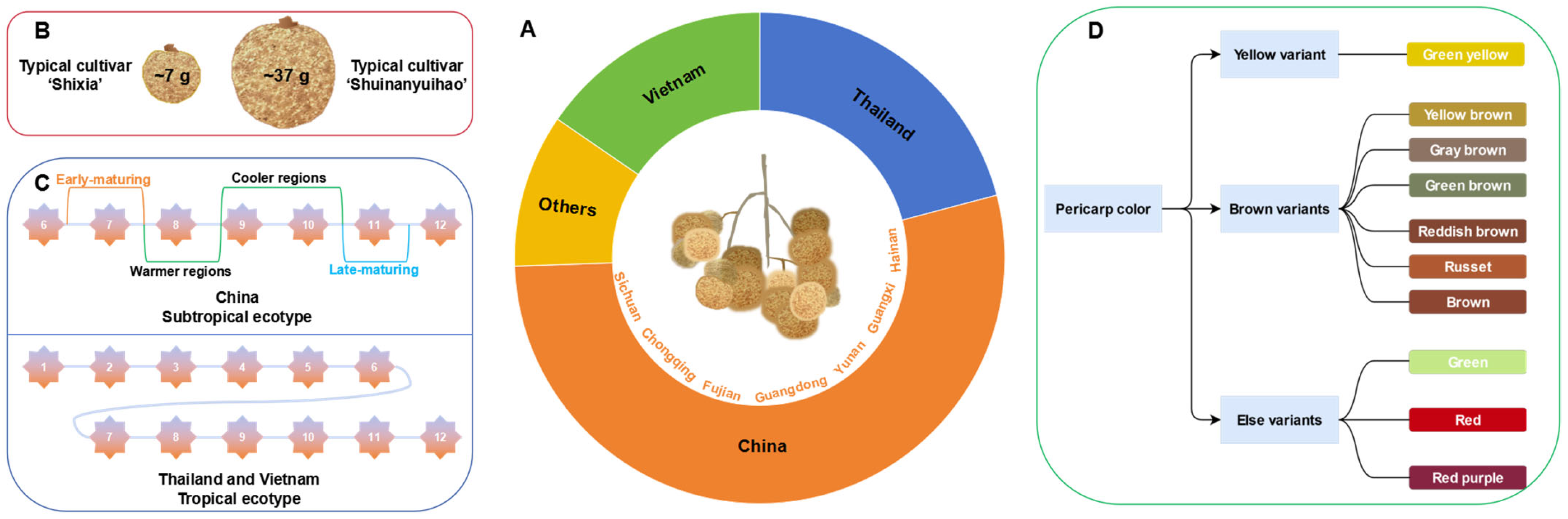
Longan varieties are mainly distributed in Guangdong, Fujian, Guangxi, Hainan, Sichuan and Yunnan Provinces in China, as well as in regions such as Thailand, Vietnam and Myanmar. Studies on the origin and evolution of longan show some variation in perspectives but generally reach a consistent conclusion. Most researchers consider Yunnan Province to be the primary center of origin, with Guangdong, Guangxi and Hainan identified as the secondary centers [
40]. Although previous studies have provided valuable insights, their temporal limitations may reduce their relevance under current research contexts.
Molecular marker technologies have been widely applied to the genetic analysis of longan germplasm resources over the past decades. Techniques such as RFLP, AFLP, and SSR enable investigation at the genomic level, facilitating the identification of genetic variation among longan germplasm [
14,
30]. With the continued development of these technologies, they have also been increasingly used in the molecular identification, hybrid authentication, parentage analysis and genetic diversity studies of longan. These marker-based studies provided an important foundation for later genome-scale analyses of population structure and germplasm characterization.
The availability of reference genomes has directly reshaped longan germplasm analysis. In the HHZ-related work, thirteen distinctive cultivars (‘Honghezi’, ‘Dongbi’, ‘Jiuyuewu’, ‘Lidongben’, ‘Wulongling’, ‘Shuinanyihao’, ‘Youtanben’, ‘Shieryue’, ‘Jiaohe/Baihe’, ‘Fuyan’, ‘Shixia’, ‘Miaoqiao’ and ‘Sijimi’)—primarily from key production regions across China and exhibiting diverse essential traits such as maturation diversity, continuous flowering, seed abortion, and disease resistance—were selected. Resequencing of representative cultivars from major production regions highlighted substantial diversity associated with geography and horticultural traits [
9]. Building on the JDB assembly, population-genomic analysis of 87 accessions from China and other countries provided a clearer view of ancestry composition, introgression, and regional structure in longan [
10]. These studies showed that Fujian cultivars were dominated by fewer ancestral components, whereas accessions from Guangdong, Guangxi, and Sichuan exhibited more complex admixture patterns. Thai and Vietnamese accessions were inferred to share ancestry related to western Guangdong materials [
10]. These results are significant because they replace older morphology-based or marker-based descriptions with genome-scale inference.
From early-stage morphological identification to subsequent molecular marker development, and further to current biogeographical ancestry analysis integrating sequencing data, technological innovations have continuously established new research paradigms for studies on longan population origins and evolution. These works also have important reference value for the study of evolutionary genomics, comparative genomics and phylogenetic genomics of longan and other sapindaceae plants. Nevertheless, the current sampling framework remains limited. Longan still lacks a true pan-genome, standardized diversity panel, and broad international sampling that captures structural variation and rare alleles across its cultivation range. As a result, current population-genomic conclusions are informative but still preliminary from the perspective of global germplasm representation (
Figure 1).
2.4. Transcriptome Database of Longan
In addition to genomic databases, several longan studies have generated transcriptome resources spanning embryogenic callus, reproductive development, and organ-level expression profiling [
9,
10,
32,
36,
41,
42,
43,
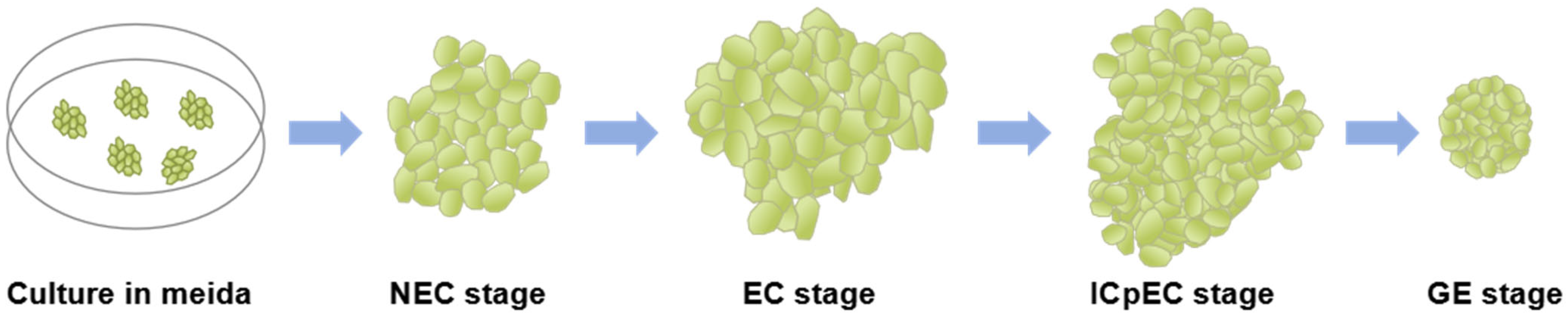
44]. These studies can be grouped into three broad categories. The first focuses on somatic embryogenesis (SE), including embryogenic callus, developmental stage transitions, and responses to environmental or chemical treatments [
32,
41,
42,
43]. Researchers defined four stages of SE, comprising non-embryonic callus (NEC), friable-embryogenic callus (EC), incomplete compact pro-embryogenic culture (ICpEC) and globular embryo (GE). Embryo development plays a critical role in determining seed size, fruit quality, fruit set, and yield. Additionally, longan exhibits a prolonged juvenile phase under natural conditions, which limits studies on mature traits. Embryos provide a relatively simple and rapidly developing system for investigating molecular mechanisms.
The second provides organ- or tissue-level expression resources that support functional annotation and candidate-gene prioritization [
9,
10]. The third addresses dynamic reproductive development, especially floral induction and the contrasting flowering behaviors of SJM, LDB, and SX [
36,
44]. In longan, flowering is typically seasonal, and various approaches have been explored to stabilize flowering performance or enhance floral induction efficacy. Analyzing the dynamic changes in key genes during flowering can improve the understanding of critical regulatory stages and support the optimization of agronomic practices. These distinct phenological patterns [
36,
44] suggest divergent regulatory mechanisms of floral induction in longan. Accordingly, transcriptome analyses provide valuable insights into the molecular basis of floral bud differentiation and offer important resources for understanding flowering regulation and improving breeding strategies.
Together, genome and transcriptome resources have substantially advanced functional genomics in longan. However, current transcriptomic resources also have clear limitations. Datasets were generated from different cultivars, tissues, and experimental designs, which reduces direct comparability. Moreover, many studies remain centered on differential-expression screening rather than deeper regulatory inference. Of particular note, transcriptomic information is still unevenly integrated with chromatin accessibility, metabolomics, or functional genetics. Thus, although longan now has a useful transcriptomic foundation, the field has not yet fully transitioned to systematic multi-omics analysis (
Table 2).
3. Gene Family Studies Associated with Floral Development
Floral regulation is one of the most intensively studied themes in longan genomics because flowering behavior directly affects yield stability and production scheduling. As in other perennial plants, longan floral induction is expected to integrate the photoperiod, ambient temperature, vernalization, gibberellins, autonomous, aging and carbohydrates through multilayered transcriptional networks [
44]. Transcription factors such as FLOWERING LOCUS C (FLC), FLOWERING LOCUS T (FT), SUPPRESSOR OF OVER EXPRESSION OF CONSTANS (SOC1), LEAFY (LFY), MADS (MCM1, AGAMOUS, DEFICIENS, and SRF)-box and Myeloblastosis (MYB) play an important regulatory role in signal transduction involved in these flowering regulation pathways [
45,
46,
47].
Floral induction (FI) represents the initial transition from vegetative to reproductive growth. In fruit trees, flower bud differentiation comprises floral induction, bud initiation and subsequent development. Longan flowering is usually seasonal, and the potassium chlorate-based induction system widely used in cultivation remains effective but physiologically imperfect, often leading to asynchronous flowering and variable fruit set [
13,
48,
49,
50]. Therefore, in addition to conventional agronomic practices, greater emphasis should be placed on genetic approaches to regulate flowering in longan. In this context, the continuous-flowering accession SJM and the availability of longan genomic resources have provided a valuable framework for identifying regulators of floral transition [
36,
44,
51].
Key genes and molecular regulatory mechanisms underlying floral induction and off-season flowering in longan remain unclear. The availability of longan genome database assemblies has enabled the identification of related genes and gene families, facilitating the investigation of the molecular mechanisms of floral induction.
3.1. The Ubiquitin-Conjugating Enzyme-Related Regulators
The ubiquitin-conjugating enzyme (E2) is a key transfer site of ubiquitination, which interacts with ubiquitin-activating enzyme (E1) and ubiquitin ligase (E3), respectively. E2-mediated regulation is closely linked to floral development in plants through protein turnover and chromatin-related control [
52,
53]. In longan, the E2 ubiquitin-conjugating enzyme (UBC) gene family was systematically identified from the HHZ genome [
11]. A total of 40 longan UBC genes (
DlUBCs) were identified based on conserved UBC domains and were further classified into 15 groups through analyses of gene structure, conserved motifs and phylogeny. This study selected two longan cultivars with contrasting seasonal flowering phenotypes (SX and SJM) and performed RNA-seq on apical buds at three key stages: dormant, floral primordium, and floral organ formation. Expression analyses across floral developmental stages suggested that several
DlUBC genes may participate in the unusual flowering behavior of SJM. However, the current evidence remains correlative, and no
DlUBC member has yet been functionally validated as a causal regulator of floral transition in longan.
3.2. WRKY Transcription Factors
WRKY transcription factors are well known as integrators of developmental and stress signals in flowering pathways [
54,
55,
56]. Genome-wide analysis in HHZ longan identified 55
DlWRKY genes and characterized their gene structure, conserved motifs and expression patterns [
12]. Comparative expression profiling across three floral developmental stages in two longan cultivars (SX and SJM) showed that 18
DlWRKY genes displayed cultivar-biased expression, with several showing higher transcript abundance in SJM [
12]. These genes may contribute to continuous flowering by linking environmental cues and meristem identity, but the current literature still treats individual
DlWRKY genes largely as candidates rather than validated regulators.
3.3. ARF-Mediated Auxin Signaling
Auxin response factors (ARFs) represent another major regulatory layer because auxin influences shoot meristem activity and floral bud differentiation [
57,
58]. A total of 17 ARF genes (
DlARF) were identified in the HHZ longan genome. Phylogenetic tree analysis showed that DlARFs were divided into four subclasses, and the longan ARF family was closely related to the apple ARF family [
59]. Transcriptome data from apical buds of SX and SJM at three floral developmental stages [
44], as well as from newly formed apical buds of grafted SJM and LDB longan shoots [
36], were used to characterize
DlARFs’ expression patterns. Several showed increased expression during physiological flower bud differentiation. These findings support the idea that auxin-responsive transcriptional regulation contributes to floral induction in longan. Importantly, ARFs may also provide a mechanistic bridge between endogenous hormone status and cultivar-specific flowering behavior, but this hypothesis still requires experimental testing.
3.4. MYB Transcription Factors
MYB transcription factors have broad roles in flowering process regulation [
60]. Researchers identified 119
DlMYB genes in the SX longan genome. Multiple
DlMYB genes are highly expressed in floral tissues.
Transcriptomic analysis of
DlMYB genes in SX and SJM longan following chlorate treatment revealed dynamic expression patterns, with a subset of genes consistently highly expressed and several showing significant up- or down-regulation. Further weighted gene co-expression network analysis (WGCNA) identified key regulatory modules associated with off-season flowering, highlighting
DlMYB113 and
DlMYB8 as central hub genes in floral induction [
61]. These results are particularly valuable because they move beyond simple family identification toward network-level inference.
3.5. MADS-Box Transcription Factors
The MADS-box transcription factor family is a key regulator of flower and fruit development [
62]. Floral organ identity is primarily explained by the ABCDE model, in which the combinatorial expression of five classes of homeotic genes (A, B, C, D, and E) specifies the formation of floral organs. Most of these regulators belong to the MADS-box family [
63].
A genome-wide survey in longan identified 114 MADS-box genes and proposed a preliminary floral organ identity framework for SX longan [
38]. Expression analysis conducted 35 days after chlorate treatment showed that 11 MADS-box genes were up-regulated, whereas
DlFLC,
DlSOC1 and
DlSVP-LIKE genes were down-regulated. Within the ABCDE model,
DlMADS-box genes exhibit divergent regulatory roles in unseasonal flowering, with some acting as activators and others as repressors. The longan MADS-box study is important because it anchors floral organ development within a conserved evo-devo framework; nevertheless, most inferences still rely on expression dynamics rather than direct genetic evidence.
3.6. Synthesis: From Candidate Families to Regulatory Networks
Taken together, longan flowering studies point to a convergent regulatory architecture in which ubiquitin-mediated control, WRKY-mediated signal integration, auxin-responsive ARFs, MYB-centered transcriptional networks, and MADS-box floral identity genes act at different hierarchical levels. In longan, elucidating the mechanisms of floral development is crucial for developing effective flower-inducing techniques. Such understanding could help mitigate biennial bearing, improve fruit quality, shorten the juvenile phase, and extend market availability. Studies on longan gene families have identified several potential candidate genes, providing an important reference for future in-depth investigations into the regulatory mechanism of floral development.
Consistent with other plant species, recent advances indicate that flowering in longan is regulated by multiple pathways and should be viewed as a complex network trait rather than an isolated single-gene process. At the same time, the field still lacks decisive evidence connecting these families into experimentally validated pathways. Future progress will require perturbation-based approaches, such as transient assays, heterologous validation, protein–DNA interaction studies, and ultimately stable genetic analysis in longan or closely related systems.
4. Gene Family Studies Associated with Somatic Embryogenesis
Under corresponding induction conditions, plant somatic cells regain embryogenesis and then develop into a complete individual, which constitutes the process known as plant somatic embryogenesis (SE). Somatic embryogenesis is similar to zygotic embryo development at molecular, cellular/tissue and morphogenesis levels. It serves both as a model for developmental reprogramming and as a potential platform for regeneration-based biotechnology [
64,
65,
66].
Based on numerous physiological, biochemical and proteomic studies conducted over the past decades, molecular research on longan somatic embryogenesis has been initiated. In the 1990s, Lai induced a friable-embryogenic callus cell line (LC2) from an immature embryo of HHZ longan, which exhibited a high frequency of somatic embryogenesis, stable chromosome numbers and consistent endogenous hormone levels [
67,
68].
Previous studies in plants have shown that a diverse array of genes and pathways regulate somatic embryogenesis. These include hormone signaling genes, stress-responsive genes, transcription factors associated with embryonic development, and epigenetic modifiers involved in DNA methylation, histone methylation, acetylation, and miRNA pathways [
65]. Longan has a long research history in embryogenic callus culture, including long-term subculture systems and analyses of endogenous hormone dynamics, especially in HHZ, which explains why many transcriptomic and gene family studies are concentrated in this system [
31,
32,
67,
68] (
Figure 2). After decades of accumulated research, the integration of whole-genome resources with transcriptome data has enabled the identification of diverse gene families, advancing the understanding of the molecular mechanisms underlying somatic embryogenesis in longan.
4.1. Hormone-Related Gene Families
Plant hormones, mainly auxin and cytokinin, are indispensable for regulating gene expression at embryo induction and morphogenesis [
66]. The small auxin up-regulated RNA (SAUR) family is one of the earliest auxin-responsive gene families in plants [
70]. A total of 68 members of the SAUR family, which function in early auxin-responsive transcription, were systematically identified from the HHZ genome. A total of 24
DlSAUR genes were highly expressed at the globular embryo stage, with most showing open chromatin accessibility during early SE. Subsequent analyses suggest that
DlSAUR32, together with transcription factors such as WRKY, participates in the auxin-related regulatory network involved in early embryogenesis in longan [
71].
Inhibitors of strigolactone synthesis could affect the expression levels of auxin response factors related to embryo formation, thereby regulating somatic embryogenesis [
72]. Zhang identified 23 members from the HHZ genome within the SL-related CAROTENOID CLEAVAGE DIOXYGENASE (CCD), DWARF27 (D27) and SUPPRESSOR OF MAX2-LIKE (SMXL) gene families. SL content significantly increased during SE, and DlCCD, DlD27 and DlSMXL family members displayed developmental stage specificity. Functional analysis of
DlSMXL6 suggested a role in balancing strigolactone, carotenoid and auxin pathways during SE [
73].
Several multi-functional gene families also act as mediators of hormone signaling during longan SE. A total of 15
DlNF-YB genes have been identified, of which five exhibited stage-specific expression patterns and responded to IAA, GA and ABA treatments, supporting their regulatory role in this process [
74]. Furthermore, a larger family of 75
DlB3 genes have been characterized, with expression profiles suggesting their involvement in both somatic and zygotic embryogenesis through the integration of complex phytohormone signal pathways [
75]. These studies further support the view that embryogenic competence in longan depends on the coordinated integration of multiple hormone signals rather than on auxin alone.
Elucidating the roles and regulatory networks of phytohormone-related gene families during SE provides critical insights for optimizing phytohormone supplementation strategies in the longan tissue culture system, with both theoretical and practical significance.
4.2. Stress-Responsive Gene Families
Longan SE is also strongly associated with biotic and abiotic stresses such as heat, osmotic stress, and ultraviolet radiation. A total of 35
DlGLP genes have been identified by whole-genome identification. Germin-like proteins (GLPs) are implicated in stress adaptation and developmental regulation, and many DlGLP genes respond to high temperature or 2,4-D treatment during early embryogenesis [
76].
The xyloglucan endotransglycosylase/hydrolase (XTH) gene family is involved in abiotic stress response of plants and has been implicated in the regulation of embryogenesis adaptation [
77,
78]. A total of 25
DlXTH genes have been identified, most of which are highly expressed in the friable-embryogenic callus and globular embryo. The majority of these genes had open chromatin accessibility during early SE. Subsequent experiments showed that
DlXTH23.5 and
DlXTH25 responded strongly to heat stress, resulting in increased XTH activity, which in turn inhibited longan SE [
79].
Although these two stress-related studies appear loosely connected, a shared functional theme connects them. Existing studies indicate that both GLP and XTH families are involved in dynamic cell wall remodeling [
77,
78,
80,
81]. The regulation of these genes in response to external stress is likely a critical determinant of the embryogenic potential of callus, specifically its capacity to acquire and maintain an embryogenic state. The broader implication of these studies is that embryogenic competence is not just a hormone-induced state; it is also a cell-biological state involving extracellular matrix remodeling, stress acclimation, and the controlled reorganization of growth. This conceptual shift is important because it helps explain why tissue culture performance is often sensitive to both chemical environment and physical culture conditions.
4.3. Alternative Splicing, Epigenetic Reprogramming and Related Cellular Processes
In longan, alternative splicing (AS) occurs at high frequency during early somatic embryogenesis (SE) but declines sharply thereafter, suggesting a role in developmental transitions. Two classes of splicing factors, SR proteins and Sm/Sm-like proteins, have been identified. A total of 21 SR genes were classified into six families, with
Dlo-SRs showing up-regulated expression during somatic embryo differentiation. Protein interaction analysis further suggests that SR proteins might cooperatively regulate SE [
82]. A total of 29
DlSm genes have been identified, with expression levels generally decreasing during embryo differentiation. Their expression is responsive to hormone and light treatments, and AS analysis indicates that these genes might influence SE by altering gene structure and coding sequences [
83].
In parallel, studies involving
DlAGOs-regulated DNA methylation and chromatin accessibility profiling indicate that epigenetic reprogramming is likely involved in the acquisition and maintenance of embryogenic competence [
84]. A recent study indicates that dynamic DNA methylation plays a critical role during early SE, particularly highlighting the importance of DNA demethylation [
85]. In addition, genome-wide analyses of SET domain group (SDG) gene families have been conducted.
DlSDG genes are involved in histone methylation and show stage-specific expression patterns during early SE. One of these members, DlSUVH4, could interact with DNA methyltransferase MET1 [
86]. These findings suggest that coordinated regulation of DNA methylation and histone modifications contributes to epigenetic control during longan SE.
Additional gene family studies have identified NAM, ATAF1/2, and CUC (NAC) transcription factors, DEAD-box (DDX) helicases, and core cell cycle (CCC) regulators with expression patterns consistent with roles in SE progression [
87,
88,
89]. Collectively, these findings argue that longan SE should be viewed as a multi-level reprogramming process involving transcriptional control, RNA processing, chromatin remodeling, and cell cycle coordination.
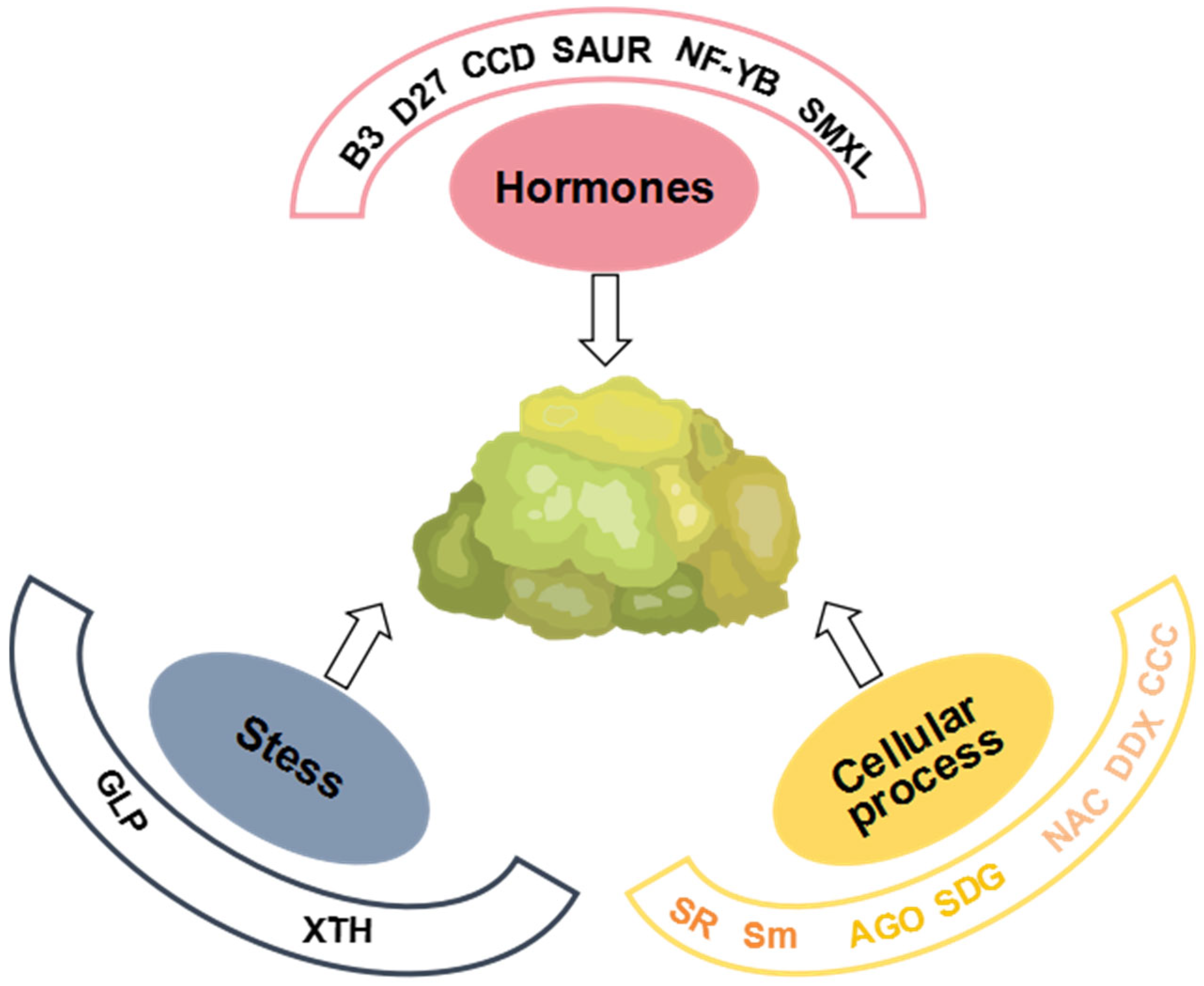
In summary, somatic embryogenesis is not only governed by specific external stimulus cues but also relies on the precise execution of basic cellular programs. These studies lay the foundation for mechanistic analyses of somatic embryogenesis in longan and provide useful references for other woody fruit trees (
Figure 3). Nevertheless, the depth of mechanistic proof remains uneven, and many proposed regulators have not yet been tested by gain- or loss-of-function approaches. Therefore, enhanced functional validation of specific genes and a more comprehensive understanding of their regulatory mechanisms are urgently needed.
4.4. Synthesis and Remaining Gaps
Compared with the flowering literature, SE studies in longan are closer to an integrative developmental model. Hormone signaling, stress response, cell wall dynamics, alternative splicing, epigenetic reprogramming and core cellular processes are no longer treated as isolated themes. Instead, they are increasingly recognized as interacting components of embryogenic transition. Even so, major gaps remain. The field still lacks a unified regulatory framework that quantitatively links chromatin state, transcriptome dynamics, and regeneration outcomes. Establishing such a framework would substantially strengthen the relevance of SE studies for longan transformation and biotechnology.
5. Identification of Transporter Gene Families in Longan
Plant transporters play a vital role in crucial processes such as nutrient uptake, cellular homeostasis, and stress response by facilitating the movement of various substances and signaling molecules across cellular membranes. They are highly relevant to both tree performance and fruit production because mineral nutrition and carbohydrate allocation directly affect growth, reproductive success, and stress resilience [
90]. Research on plant transporters is important for understanding nutrient metabolism, stress resistance, and their applications in crop breeding. Here, the most informative studies concerning magnesium, boron, and sugar transport are provided.
5.1. Mineral Nutrient Transporters
Plants require 17 essential elements for growth, 14 of which are mineral nutrients that must be acquired from the external environment, primarily the soil. In this process, membrane-localized receptors and transporters play critical roles in facilitating nutrient uptake and mediating associated signaling pathways [
91]. Magnesium (Mg) is an essential macronutrient and plays a crucial role in the growth and development of higher plants. Magnesium deficiency would soon lead to leaf chlorosis, and continuing long-term deficiency could seriously affect the growth and development of plants [
92,
93]. In higher plants, the magnesium transporter (MGT) gene family dominates the uptake, transport and redistribution of magnesium [
92]. Magnesium transport is particularly relevant to longan cultivation in southern China, where red soils are often poor in available magnesium because of intense weathering and leaching [
94,
95]. Twelve MGT gene family members have been identified from the SX genome, and it has been suggested that these transporters respond to hormone and environmental cues. Evidence suggests that light-responsive
DlGATA16 regulates chloroplast development through modulation of
DlMGT1 expression, indicating a potential signaling role for the
DlMGT family [
96]. The significance of this work lies in its connection between genome annotation and region-specific agronomic constraints.
Boron (B) is an essential micronutrient in higher plants and functions in cell wall formation, nutrient absorption, carbohydrate metabolism, nitrogen metabolism and hormone response [
97]. Since both the deficiency and excess of boron disrupt plant growth, homeostasis regulators play a vital role in ensuring its stable concentration in vivo. Regulators include boron exporters (BOR) and the nodulin-26-like intrinsic protein (NIP) transporter families [
98]. In longan, spraying foliar boric acid can improve the fruit size, quality and soluble sugar, but the molecular mechanism of boron absorption and transport remains unclear. Five BOR family genes and 33 NIP family genes have been identified from the JDB genome [
99]. Boron plays an important role in pollen performance, reproductive development, and fruit set [
100]. Spatiotemporal expression analysis of
DlBOR and
DlNIP genes under boron spray showed that
DlNIP1 and
DlNIP19 were highly expressed in female flowers. In cultivars ‘Shixia’ (SX) and ‘Yiduo’ (YD), their differential expression under varying boron concentrations mediated the differences in floral jasmonic acid levels, which may contribute to variation in pollen germination rates after pollination. Notably, YD pollinated with DlNIP1-transformed SX pollen exhibited a higher seed set than the conventional YD♀×SX♂ cross, suggesting that DlNIP1-SX pollen can overcome the unilateral cross incompatibility of YD♀×SX♂ and facilitate the cross-breeding of longan [
99]. This is one of the more translationally relevant examples in current longan genomics, because it directly links transporter biology to breeding and orchard performance.
5.2. Sugar Transporters
Sugar transporters in plants are primarily classified into three families: sucrose transporters (SUTs), monosaccharide transporters (MSTs) and Sugars Will Eventually Be Exported Transporters (SWEETs). These transporters play essential roles in sugar loading and unloading, long-distance sugar transport, and sugar-based signaling during stress responses [
101]. Researchers have identified six
DlSUT, 46
DlMST and 20
DlSWEET genes from the HHZ longan genome [
102,
103]. Genome-wide analysis identified multiple transporter genes whose expression patterns correlate with sugar accumulation during fruit development [
102]. In addition,
DlSWEET1 was shown to respond to cold stress, and heterologous overexpression supported a positive role in cold tolerance [
103].
5.3. Integrative Perspective
Transporters play an indispensable role in the absorption and utilization of nutrients and also interact with a variety of metabolic pathways or regulate key genes to enhance plant stress resistance. These studies illustrate an important direction for longan research: transporter families can serve as mechanistic bridges between physiology and agronomic traits. However, most current analyses still emphasize expression profiling and family characterization. More precise work is needed to determine tissue specificity, transport substrate preference, and their direct influence on fruit quality and stress resilience.
Overall, transporter studies in longan are valuable not because they simply expand the list of annotated genes but because they connect genomic resources to nutrient management, reproductive success, fruit composition, and environmental adaptation. This applied relevance makes transporter biology a promising entry point for translating genomics into cultivar improvement.
6. Major Limitations and Future Perspectives
Despite clear progress, longan genomics still faces several major limitations. To begin with, the reference-resource system remains narrow. Three genome assemblies represent a major advance, but they could not capture the full extent of structural and allelic diversity present in longan germplasm. A pan-genome based on representative Chinese, Southeast Asian and other national accessions is now needed to resolve presence–absence variation, structural polymorphism, and accession-specific gene content.
Moreover, multi-omics integration remains incomplete. Longan studies now include genome assemblies, transcriptomes, metabolite analyses, chromatin accessibility information, and selected physiological datasets, but these data types are still rarely integrated within a common experimental design. The field would benefit greatly from coordinated analyses that combine genotype, chromatin state, expression, metabolite accumulation, and phenotype across developmental stages or contrasting cultivars.
Furthermore, functional validation is still the principal bottleneck. Most published studies stop at the stage of family identification, phylogenetic classification, cis-element prediction, and expression analysis. These approaches are useful for hypothesis generation but insufficient for establishing causality. The next phase of longan genomics should prioritize validation strategies, including transient assays, heterologous complementation, protein interaction analysis, promoter binding assays, and improved regeneration- or transformation-based systems.
Lastly, stronger links to breeding are required. The current literature contains promising examples, especially in flowering regulation and boron transporter biology, but the path from gene family analysis to cultivar improvement remains incomplete. Future studies should prioritize traits with direct production relevance, such as stable flowering, fruit set, shelf life, nutrient efficiency, and stress tolerance, while adopting standardized germplasm panels and reproducible phenotyping frameworks.
7. Conclusions
With the rapid development of whole-genome sequencing and database construction, an increasing number of genes associated with important agronomic traits in longan have been identified and characterized, providing a solid foundation for future biotechnological breeding applications. As a characteristic subtropical fruit tree in China, longan exhibits rich cultivar diversity, with pronounced phenotypic variation and strong regional adaptation. While this diversity offers valuable resources for research, it also poses challenges for genomic studies. The literature remains uneven in depth. Genome-scale cataloguing has progressed faster than experimental validation, and integrative or comparative analyses still lag behind those available in better-studied fruit crops.
Longan genomics has advanced rapidly from a field supported by a single draft genome to one with multiple reference assemblies, population-genomic resources, and transcriptome datasets, enabling systematic surveys of gene families associated with flowering, somatic embryogenesis, nutrient transport, and stress adaptation [
9,
10,
39,
74,
100]. However, the depth of functional characterization remains limited. Current research is largely based on bioinformatic analyses and predictions, which are insufficient to support applications in molecular design breeding. Therefore, the central challenge for the next phase of longan research is not simply to generate more datasets but to connect genomic resources with rigorous functional genetics and breeding-oriented biology. Achieving this goal will determine whether longan genomics can fully support molecular design breeding in the future.
Author Contributions
X.L., X.H., T.L. and L.L. conceived and designed the review. X.L. wrote the manuscript, and S.S., X.H., J.Z. and L.L. proposed revisions to the manuscript. All authors have read and agreed to the published version of the manuscript.
Funding
This research was funded by the Natural Science Foundation of Hainan Province (No. 325QN424), the Central Public-interest Scientific Institution Basal Research Fund (No. 1630062026003), the National Natural Science Foundation of China (No. 32272674) and the Guangdong Province Litchi and Longan Industry Technology System Innovation Team Project (No. 2025CXTD19).
Data Availability Statement
No new data were created or analyzed in this study; all datasets discussed are from previously published studies, and the corresponding references are provided.
Conflicts of Interest
The authors declare no conflicts of interest.
References
- Huang, A.P.; Chen, X.M.; Zheng, S.Q.; Hu, W.S.; Jiang, F.; Deng, C.J.; Chen, X.P.; Zhang, S.M. Research and Prospect of Fuzhou Longan Germplasm Resource in the National Field Genebank. J. Agric. Sci. Technol. 2009, 11, 30–34. [Google Scholar]
- Guo, D.L.; Han, D.M.; Huang, S.L.; Wang, J.; Lv, X.M.; Li, J.G. Analysis of Guangdong Longan Production Situation in 2022. Chin. Trop. Agric. 2023, 1, 5–13. [Google Scholar]
- Crane, J.H.; Zee, F.; Bender, G.S.; Faber, B.; Brunner, B.; Chia, C.L. Commercial sapindaceous fruit production in the USA. Acta Hortic. 2005, 665, 93–101. [Google Scholar] [CrossRef]
- Wang, X.Y.; He, H.L.; Xiao, D.X. Studies on the leaf epidermal structure of Litchi chinensis and Dimocarpus longan. Acta Hortic. Sin. 2006, 33, 825–828. [Google Scholar] [CrossRef]
- Ning, X.P.; Wu, H.; Luo, S.; Lai, Y.C. Structural and developmental characteristics of floral nectaries of Dimocarpus longan. Acta Hortic. Sin. 2007, 34, 11–16. [Google Scholar] [CrossRef]
- Xue, X.; Shi, S.Y.; Hou, S.K. Comprehensive evaluation and diversity analysis of fruit quality traits in Longan ‘Shuguan’ × ‘Dawuyuan’ sexual progenies. Acta Hortic. Sin. 2020, 47, 827–836. [Google Scholar] [CrossRef]
- Prasad, K.; Neha, P.; Lal, M. Cultivation and post-harvest handling techniques of longan (Dimocarpus longan Lour). Res. Crops 2017, 18, 384. [Google Scholar] [CrossRef]
- Luo, T.; Lin, X.; Lai, T.; Long, L.; Lai, Z.; Du, X.; Guo, X.; Shuai, L.; Han, D.; Wu, Z. GA3 Treatment Delays the Deterioration of ‘Shixia’ Longan during the On-Tree Preservation and Room-Temperature Storage and Up-Regulates Antioxidants. Foods 2023, 12, 2032. [Google Scholar] [CrossRef] [PubMed]
- Lin, Y.; Min, J.; Lai, R.; Wu, Z.; Chen, Y.; Yu, L.; Cheng, C.; Jin, Y.; Tian, Q.; Liu, Q.; et al. Genome-wide sequencing of longan (Dimocarpus longan Lour.) provides insights into molecular basis of its polyphenol-rich characteristics. Gigascience 2017, 6, gix023. [Google Scholar] [CrossRef]
- Wang, J.; Li, J.; Li, Z.; Liu, B.; Zhang, L.; Guo, D.; Huang, S.; Qian, W.; Guo, L. Genomic insights into longan evolution from a chromosome-level genome assembly and population genomics of longan accessions. Hortic. Res. 2022, 9, uhac021. [Google Scholar] [CrossRef]
- Jue, D.; Sang, X.; Liu, L.; Shu, B.; Wang, Y.; Xie, J.; Liu, C.; Shi, S. The ubiquitin-conjugating enzyme gene family in longan (Dimocarpus longan Lour.): Genome-wide identification and gene expression during flower induction and abiotic stress responses. Molecules 2018, 23, 662. [Google Scholar] [CrossRef]
- Jue, D.; Sang, X.; Liu, L.; Shu, B.; Wang, Y.; Liu, C.; Xie, J.; Shi, S. Identification of WRKY gene family from Dimocarpus longan and its expression analysis during flower induction and abiotic stress responses. Int. J. Mol. Sci. 2018, 19, 2169. [Google Scholar] [CrossRef]
- Huang, X.M.; Lu, J.M.; Wang, H.C.; Zhang, C.L.; Xie, L.; Yang, R.T.; Li, J.G.; Huang, H.B. Nitrate reduces the detrimental effect of potassium chlorate on longan (Dimocarpus longan Lour.) trees. Sci. Hortic. 2006, 108, 151–156. [Google Scholar] [CrossRef]
- Qing, H.W.; Li, M.; Yi, C.X.; Zhang, S.W.; Guo, H.Q.; Peng, H.X.; Ding, F. Research progress of litchi and longan breeding. South China Fruits 2024, 53, 1–6+15. [Google Scholar] [CrossRef]
- Xu, Y.; Lin, Q.; Li, X.; Wang, F.; Chen, Z.; Wang, J.; Li, W.; Fan, F.; Tao, Y.; Jiang, Y.; et al. Fine-tuning the amylose content of rice by precise base editing of the Wx gene. Plant Biotechnol. J. 2021, 19, 11–13. [Google Scholar] [CrossRef] [PubMed]
- Lorenzo, C.D.; Debray, K.; Herwegh, D.; Develtere, W.; Impens, L.; Schaumont, D.; Vandeputte, W.; Aesaert, S.; Coussens, G.; De Boe, Y.; et al. BREEDIT: A multiplex genome editing strategy to improve complex quantitative traits in maize. Plant Cell 2023, 35, 218–238. [Google Scholar] [CrossRef]
- Tian, Z.X.; Liu, B.H.; Yang, Y.P.; Li, M.; Yao, Y.; Xue, Y.B. Update and perspect of soybean molecular module-based designer dreeding in China. Bull. Chin. Acad. Sci. 2018, 33, 915–922. [Google Scholar] [CrossRef]
- Zhu, Q.; Deng, L.; Chen, J.; Rodríguez, G.R.; Sun, C.; Chang, Z.; Yang, T.; Zhai, H.; Jiang, H.; Topcu, Y.; et al. Redesigning the tomato fruit shape for mechanized production. Nat. Plants 2023, 9, 1659–1674. [Google Scholar] [CrossRef]
- Yamagishi, N.; Kishigami, R.; Yoshikawa, N. Reduced generation time of apple seedlings to within a year by means of a plant virus vector: A new plant-breeding technique with no transmission of genetic modification to the next generation. Plant Biotechnol. J. 2014, 12, 60–68. [Google Scholar] [CrossRef]
- Miao, C.; Wu, Y.; Wang, L.; Zhao, S.; Grierson, D.; Xu, C.; Chen, W.; Chen, K. Haplotype-resolved chromosome-level genome assembly of Huyou (Citrus changshanensis). Sci. Data 2024, 11, 605. [Google Scholar] [CrossRef] [PubMed]
- Liu, M.J.; Zhao, J.; Cai, Q.L.; Liu, G.C.; Wang, J.R.; Zhao, Z.H.; Liu, P.; Dai, L.; Yan, G.; Wang, W.J.; et al. The complex jujube genome provides insights into fruit tree biology. Nat. Commun. 2014, 5, 5315. [Google Scholar] [CrossRef]
- Sun, Y.; Shang, L.; Zhu, Q.; Fan, L.; Guo, L. Twenty years of plant genome sequencing: Achievements and challenges. Trends Plant Sci. 2022, 27, 391–401. [Google Scholar] [CrossRef] [PubMed]
- Li, Q.; Qiao, X.; Li, L.; Gu, C.; Yin, H.; Qi, K.; Xie, Z.; Yang, S.; Zhao, Q.; Wang, Z.; et al. Haplotype-resolved T2T genome assemblies and pangenome graph of pear reveal diverse patterns of allele-specific expression and the genomic basis of fruit quality traits. Plant Commun. 2024, 5, 101000. [Google Scholar] [CrossRef]
- Hu, G.; Feng, J.; Xiang, X.; Wang, J.; Salojärvi, J.; Liu, C.; Wu, Z.; Zhang, J.; Liang, X.; Jiang, Z.; et al. Two divergent haplotypes from a highly heterozygous lychee genome suggest independent domestication events for early and late-maturing cultivars. Nat. Genet. 2022, 54, 73–83. [Google Scholar] [CrossRef]
- Velasco, R.; Zharkikh, A.; Affourtit, J.; Dhingra, A.; Cestaro, A.; Kalyanaraman, A.; Fontana, P.; Bhatnagar, S.K.; Troggio, M.; Pruss, D.; et al. The genome of the domesticated apple (Malus × domestica Borkh.). Nat. Genet. 2010, 42, 833–839. [Google Scholar] [CrossRef] [PubMed]
- D’Hont, A.; Denoeud, F.; Aury, J.M.; Baurens, F.C.; Carreel, F.; Garsmeur, O.; Noel, B.; Bocs, S.; Droc, G.; Rouard, M.; et al. The banana (Musa acuminata) genome and the evolution of monocotyledonous plants. Nature 2012, 488, 213–217. [Google Scholar] [CrossRef] [PubMed]
- International Peach Genome Initiative; Verde, I.; Abbott, A.G.; Scalabrin, S.; Jung, S.; Shu, S.; Marroni, F.; Zhebentyayeva, T.; Dettori, M.T.; Grimwood, J.; et al. The high-quality draft genome of peach (Prunus persica) identifies unique patterns of genetic diversity, domestication and genome evolution. Nat. Genet. 2013, 45, 487–494. [Google Scholar] [CrossRef]
- Huang, S.; Ding, J.; Deng, D.; Tang, W.; Sun, H.; Liu, D.; Zhang, L.; Niu, X.; Zhang, X.; Meng, M.; et al. Draft genome of the kiwifruit Actinidia chinensis. Nat. Commun. 2013, 4, 2640. [Google Scholar] [CrossRef]
- Ming, R.; VanBuren, R.; Wai, C.M.; Tang, H.; Schatz, M.C.; Bowers, J.E.; Lyons, E.; Wang, M.L.; Chen, J.; Biggers, E.; et al. The pineapple genome and the evolution of CAM photosynthesis. Nat. Genet. 2015, 47, 1435–1442. [Google Scholar] [CrossRef]
- Zheng, S.Q.; Zeng, L.H.; Zhang, J.S.; Lin, H.T.; Deng, C.J.; Zhuang, Y.M. Fruit scientific research in New China in the past 70 years: Longan. J. Fruit Sci. 2019, 36, 1414–1420. [Google Scholar] [CrossRef]
- Lai, Z.X.; Chen, Z.G. Somatic embryogenesis of high frequency from longan embryogenic calli. J. Fujian Agric. For. Univ. 1997, 26, 271–276. [Google Scholar] [CrossRef]
- Lai, Z.; Lin, Y. Analysis of the global transcriptome of longan (Dimocarpus longan Lour.) embryogenic callus using Illumina paired-end sequencing. BMC Genom. 2013, 14, 561. [Google Scholar] [CrossRef]
- Lai, T.; Shuai, L.; Han, D.; Lai, Z.; Du, X.; Guo, X.; Hu, W.; Wu, Z.; Luo, T. Comparative metabolomics reveals differences in primary and secondary metabolites between “Shixia” and “Chuliang” longan (Dimocarpus longan Lour.) pulp. Food Sci. Nutr. 2021, 9, 5785–5799. [Google Scholar] [CrossRef]
- Yang, X.; Wang, R.; Jing, H.; Chen, Q.; Bao, X.; Zhao, J.; Hu, G.; Liu, C.; Fu, J. Three novel c-repeat binding factor genes of Dimocarpus longan regulate cold stress response in Arabidopsis. Front. Plant Sci. 2020, 11, 1026. [Google Scholar] [CrossRef]
- Ding, X.B.; Li, X.M.; Wang, X.Q.; Li, Y.M.; Li, J.M.; Li, Y.X. Report on the introduction experiment of an extremely late maturing longan variety ‘Lidongben’ in Luzhou. Chin. Trop. Agric. 2020, 05, 49–51+16. [Google Scholar]
- Jia, T.; Wei, D.; Meng, S.; Allan, A.C.; Zeng, L. Identification of regulatory genes implicated in continuous flowering of longan (Dimocarpus longan L.). PLoS ONE 2014, 9, e114568. [Google Scholar] [CrossRef]
- Sang, Y.Y.; Lin, L.J.; Wen, H.Y.; Lin, Y.X.; Lin, M.S.; Chen, Y.H.; Wang, H.; Fan, Z.Q.; Lin, Y.F.; Lin, H.T. Comparative analysis in postharvest storability, quality attributes, antioxidant activity, and disease defense systems in ‘Fuyan’ and ‘Dongbi’ longans during storage. Postharvest Biol. Technol. 2025, 223, 113422. [Google Scholar] [CrossRef]
- Wang, B.; Hu, W.; Fang, Y.; Feng, X.; Fang, J.; Zou, T.; Zheng, S.; Ming, R.; Zhang, J. Comparative Analysis of the MADS-Box Genes Revealed Their Potential Functions for Flower and Fruit Development in Longan (Dimocarpus longan). Front. Plant Sci. 2022, 12, 813798. [Google Scholar] [CrossRef] [PubMed]
- Zhao, G.; Jiang, F.; Hu, W.; Zhang, J.; Wang, W.; Tu, S.; Wang, B.; Zhang, Q.; Mei, J.; Lin, L.; et al. Improved Longan Genome Assembly Reveals Insights Into Flowering Mechanisms. Plant Biotechnol. J. 2026, 24, 1678–1696. [Google Scholar] [CrossRef] [PubMed]
- Ke, G.W.; Wang, C.C.; Tang, Z.F. Palynological Studies on the Origin of Longan Cultivation. Acta Hortic. Sin. 1994, 21, 323–328. [Google Scholar]
- Chen, Y.; Xu, X.; Liu, Z.; Zhang, Z.; Xu, X.; Lin, Y.; Lai, Z. Global scale transcriptome analysis reveals differentially expressed genes involve in early somatic embryogenesis in Dimocarpus longan Lour. BMC Genom. 2020, 21, 4. [Google Scholar] [CrossRef]
- Li, H.; Lyu, Y.; Chen, X.; Wang, C.; Yao, D.; Ni, S.; Lin, Y.; Chen, Y.; Zhang, Z.; Lai, Z. Exploration of the effect of blue light on functional metabolite accumulation in longan embryonic calli via RNA sequencing. Int. J. Mol. Sci. 2019, 20, 441. [Google Scholar] [CrossRef] [PubMed]
- Chen, R.; Chen, X.; Huo, W.; Zheng, S.; Lin, Y.; Lai, Z. Transcriptome analysis of azacitidine (5-AzaC)-treatment affecting the development of early somatic embryogenesis in longan. J. Hortic. Sci. Biotechnol. 2020, 96, 311–323. [Google Scholar] [CrossRef]
- Jue, D.; Sang, X.; Liu, L.; Shu, B.; Wang, Y.; Liu, C.; Xie, J.; Shi, S. Comprehensive analysis of the longan transcriptome reveals distinct regulatory programs during the floral transition. BMC Genom. 2019, 20, 126. [Google Scholar] [CrossRef]
- Rehman, S.; Bahadur, S.; Xia, W. An overview of floral regulatory genes in annual and perennial plants. Gene 2023, 885, 147699. [Google Scholar] [CrossRef]
- Smaczniak, C.; Immink, R.G.; Muiño, J.M.; Blanvillain, R.; Busscher, M.; Busscher-Lange, J.; Dinh, Q.D.; Liu, S.; Westphal, A.H.; Boeren, S.; et al. Characterization of MADS-domain transcription factor complexes in Arabidopsis flower development. Proc. Natl. Acad. Sci. USA 2012, 109, 1560–1565. [Google Scholar] [CrossRef]
- Hong, L.; Niu, F.; Lin, Y.; Wang, S.; Chen, L.; Jiang, L. MYB106 is a negative regulator and a substrate for CRL3BPM E3 ligase in regulating flowering time in Arabidopsis thaliana. J. Integr. Plant Biol. 2021, 63, 1104–1119. [Google Scholar] [CrossRef] [PubMed]
- Manochai, P.; Sruamsiri, P.; Wiriya-alongkorn, W.; Naphrom, D.; Hegele, M.; Bangerth, F. Year around off season flower induction in longan (Dimocarpus longan Lour.) trees by KClO3 applications: Potentials and problems. Sci. Hortic. 2005, 104, 379–390. [Google Scholar] [CrossRef]
- Hegele, M.; Manochai, P.; Naphrom, D.; Sruamsiri, P.; Wünsche, J. Flowering in longan (Dimocarpus longan L.) induced by hormonal changes following KClO3 applications. Eur. J. Hortic. Sci. 2008, 73, 49–54. [Google Scholar] [CrossRef]
- Ongprasert, S.; Wiriya-Alongkorn, W.; Spreer, W. The factors affecting longan flower induction by chlorate. Acta Hortic. 2010, 863, 375–380. [Google Scholar] [CrossRef]
- Peng, J.; Xie, L.J.; Xu, B.Q.; Dang, J.Z.; Li, Y.H.; Lu, Z.H.; Zhang, S.A.; Yu, Z.Y.; Bai, X.; Cai, Z.F.; et al. Study on biological characters of ‘Sijihua’ longan. Acta Hortic. 2010, 863, 249–258. [Google Scholar] [CrossRef]
- Xu, L.; Ménard, R.; Berr, A.; Fuchs, J.; Cognat, V.; Meyer, D.; Shen, W.H. The E2 ubiquitin-conjugating enzymes, AtUBC1 and AtUBC2, play redundant roles and are involved in activation of FLC expression and repression of flowering in Arabidopsis thaliana. Plant J. 2009, 57, 279–288. [Google Scholar] [CrossRef]
- Liu, W.; Tang, X.; Qi, X.; Fu, X.; Ghimire, S.; Ma, R.; Li, S.; Zhang, N.; Si, H. The Ubiquitin Conjugating Enzyme: An Important Ubiquitin Transfer Platform in Ubiquitin-Proteasome System. Int. J. Mol. Sci. 2020, 21, 2894. [Google Scholar] [CrossRef]
- Cai, Y.; Chen, X.; Xie, K.; Xing, Q.; Wu, Y.; Li, J.; Du, C.; Sun, Z.; Guo, Z. Dlf1, a WRKY transcription factor, is involved in the control of flowering time and plant height in rice. PLoS ONE 2014, 9, e102529. [Google Scholar] [CrossRef]
- Yu, Y.; Liu, Z.; Wang, L.; Kim, S.G.; Seo, P.J.; Qiao, M.; Wang, N.; Li, S.; Cao, X.; Park, C.M.; et al. WRKY71 accelerates flowering via the direct activation of FLOWERING LOCUS T and LEAFY in Arabidopsis thaliana. Plant J. 2016, 85, 96–106. [Google Scholar] [CrossRef]
- Zhang, L.; Chen, L.; Yu, D. Transcription Factor WRKY75 Interacts with DELLA Proteins to Affect Flowering. Plant Physiol. 2018, 176, 790–803. [Google Scholar] [CrossRef]
- Li, Y.; Han, S.; Qi, Y. Advances in structure and function of auxin response factor in plants. J. Integr. Plant Biol. 2023, 65, 617–632. [Google Scholar] [CrossRef]
- Song, X.; Xiong, Y.; Kong, X.; Huang, G. Roles of auxin response factors in rice development and stress responses. Plant Cell Environ. 2023, 46, 1075–1086. [Google Scholar] [CrossRef] [PubMed]
- Peng, Y.; Fang, T.; Zhang, Y.; Zhang, M.; Zeng, L. Genome-wide identification and expression analysis of auxin response factor (ARF) gene family in longan (Dimocarpus longan L.). Plants 2020, 9, 221. [Google Scholar] [CrossRef] [PubMed]
- Dubos, C.; Stracke, R.; Grotewold, E.; Weisshaar, B.; Martin, C.; Lepiniec, L. MYB transcription factors in Arabidopsis. Trends Plant Sci. 2010, 15, 573–581. [Google Scholar] [CrossRef] [PubMed]
- Chen, Q.; Zhang, X.; Fang, Y.; Wang, B.; Xu, S.; Zhao, K.; Zhang, J.; Fang, J. Genome-Wide Identification and Expression Analysis of the R2R3-MYB Transcription Factor Family Revealed Their Potential Roles in the Flowering Process in Longan (Dimocarpus longan). Front. Plant Sci. 2022, 13, 820439. [Google Scholar] [CrossRef]
- Zhang, Z.; Zou, W.; Lin, P.; Wang, Z.; Chen, Y.; Yang, X.; Zhao, W.; Zhang, Y.; Wang, D.; Que, Y.; et al. Evolution and Function of MADS-Box Transcription Factors in Plants. Int. J. Mol. Sci. 2024, 25, 13278. [Google Scholar] [CrossRef]
- Theißen, G.; Melzer, R.; Rümpler, F. MADS-domain transcription factors and the floral quartet model of flower development: Linking plant development and evolution. Development 2016, 143, 3259–3271. [Google Scholar] [CrossRef]
- Méndez-Hernández, H.A.; Ledezma-Rodríguez, M.; Avilez-Montalvo, R.N.; Juárez-Gómez, Y.L.; Skeete, A.; Avilez-Montalvo, J.; De-la-Peña, C.; Loyola-Vargas, V.M. Signaling Overview of Plant Somatic Embryogenesis. Front. Plant Sci. 2019, 10, 77. [Google Scholar] [CrossRef]
- Tang, L.P.; Li, X.G.; Zhang, X.S.; Su, Y.H. Somatic embryogenesis: Remodeling of the plant somatic cell fate. Plant Physiol. J. 2020, 56, 1664–1680. [Google Scholar] [CrossRef]
- Gaj, M.D. Factors influencing somatic embryogenesis induction and plant regeneration with particular reference to Arabidopsis thaliana (L.) Heynh. Plant Growth Regul. 2004, 43, 27–47. [Google Scholar] [CrossRef]
- Lai, Z.X.; Chen, C.L.; Huang, S.H.; Sang, Q.L.; Pan, D.M.; Chen, Z.G. Long-term subculture of embryogenic calli and their genetic variation of the chromosome number in longan. J. Fujian Agric. For. Univ. 2001, 30, 29–32. [Google Scholar] [CrossRef]
- Lai, Z.X.; Chen, C.L. Changes of Endogenous Phytohormones in the Process of Somatic Embryogenesis in Longan (Dimocarpus longan Lour.). Chin. J. Trop. Crops 2002, 23, 41–47. [Google Scholar]
- Chen, Y.K. Transcriptome and Proteome Analysis During Early Somatic Embryogenesis and Expression, Functional Analysis of Flowering Time Related Genes in Dimocarpus longan Lour. Ph.D. Thesis, Fujian Agriculture and Forestry University, Fuzhou, China, 2018. [Google Scholar]
- Hagen, G.; Guilfoyle, T. Auxin-responsive gene expression: Genes, promoters and regulatory factors. Plant Mol. Biol. 2002, 49, 373–385. [Google Scholar] [CrossRef] [PubMed]
- Chen, Y.; Ma, X.; Xue, X.; Liu, M.; Zhang, X.; Xiao, X.; Lai, C.; Zhang, Z.; Lai, Z.; Lin, Y. Genome-wide analysis of the SAUR gene family and function exploration of DlSAUR32 during early longan somatic embryogenesis. Plant Physiol. Biochem. 2023, 195, 362–374. [Google Scholar] [CrossRef] [PubMed]
- Elhiti, M.; Mira, M.M.; So, K.K.Y.; Stasolla, C.; Hebelstrup, K.H. Synthetic strigolactone GR24 improves Arabidopsis somatic embryogenesis through changes in auxin responses. Plants 2021, 10, 2720. [Google Scholar] [CrossRef] [PubMed]
- Zhang, X.; Lai, C.; Liu, M.; Xue, X.; Zhang, S.; Chen, Y.; Xiao, X.; Zhang, Z.; Chen, Y.; Lai, Z.; et al. Whole Genome Analysis of SLs Pathway Genes and Functional Characterization of DlSMXL6 in Longan Early Somatic Embryo Development. Int. J. Mol. Sci. 2022, 23, 14047. [Google Scholar] [CrossRef]
- Tang, M.; Gao, X.; Meng, W.; Lin, J.; Zhao, G.; Lai, Z.; Lin, Y.; Chen, Y. Transcription factors NF-YB involved in embryogenesis and hormones responses in Dimocarpus longan Lour. Front. Plant Sci. 2023, 14, 1255436. [Google Scholar] [CrossRef]
- Tang, M.; Zhao, G.; Awais, M.; Gao, X.; Meng, W.; Lin, J.; Zhao, B.; Lai, Z.; Lin, Y.; Chen, Y. Identification and Expression Analysis Reveals the B3 Superfamily Involved in Embryogenesis and Hormone Responses in Dimocarpus longan Lour. Int. J. Mol. Sci. 2023, 25, 127. [Google Scholar] [CrossRef]
- Li, Z.; Fu, Z.; Zhang, S.; Zhang, X.; Xue, X.; Chen, Y.; Zhang, Z.; Lai, Z.; Lin, Y. Genome-wide analysis of the GLP gene family and overexpression of GLP1-5-1 to promote lignin accumulation during early somatic embryo development in Dimocarpus longan. BMC Genom. 2023, 24, 138. [Google Scholar] [CrossRef]
- Tenhaken, R. Cell wall remodeling under abiotic stress. Front. Plant Sci. 2015, 5, 771. [Google Scholar] [CrossRef]
- Malinowski, R.; Stephen, C.; Fry, C.S.; Zuzga, S.; Wiśniewska, A.; Godlewski, M.; Noyszewski, A.; Barczak-Brzyżek, A.; Malepszy, S.; Filipecki, M. Developmental expression of the cucumber Cs-XTH1 and Cs-XTH3 genes, encoding xyloglucan endotransglucosylase/hydrolases, can be influenced by mechanical stimuli. Acta Physiol. Plant. 2018, 40, 130. [Google Scholar] [CrossRef]
- Ma, X.; Chen, Y.; Liu, M.; Xue, X.; Zhang, X.; Xu, L.; Lai, Z.; Lin, Y. Genome-wide analysis of the XTH gene family and functional analysis of DlXTH23.5/25 during early longan somatic embryogenesis. Front. Plant Sci. 2022, 13, 1043464. [Google Scholar] [CrossRef] [PubMed]
- Sun, M.; Ye, Z.; Tan, J.; Chen, S.; Zhang, X.; Tu, L. A cotton germin-like protein GbGLP2 controls fiber length via regulating genes involved in secondary cell wall synthesis. Mol. Breed. 2020, 40, 98. [Google Scholar] [CrossRef]
- Zhang, G.; Zhai, N.; Zhu, M.; Zheng, K.; Sang, Y.; Li, X.; Xu, L. Cell wall remodeling during plant regeneration. J. Integr. Plant Biol. 2025, 67, 1060–1076. [Google Scholar] [CrossRef]
- Chen, X.; Huang, S.; Jiang, M.; Chen, Y.; Xuhan, X.; Zhang, Z.; Lin, Y.; Lai, Z. Genome-wide identification and expression analysis of the SR gene family in longan (Dimocarpus longan Lour.). PLoS ONE 2020, 15, e0238032. [Google Scholar] [CrossRef]
- Li, X.; Chen, Y.; Zhang, S.; Su, L.; Xu, X.; Chen, X.; Lai, Z.; Lin, Y. Genome-wide identification and expression analyses of Sm genes reveal their involvement in early somatic embryogenesis in Dimocarpus longan Lour. PLoS ONE 2020, 15, e0230795. [Google Scholar] [CrossRef]
- Chen, R.Z. Genome-Wide Identification, Expressional and Functional Analysis of AGO Gene Family During Early Somatic Embryogenesis in Dimocarpus longan Lour. Ph.D. Thesis, Fujian Agriculture and Forestry University, Fuzhou, China, 2020. [Google Scholar] [CrossRef]
- Chen, X.; Xu, X.; Shen, X.; Li, H.; Zhu, C.; Chen, R.; Munir, N.; Zhang, Z.; Chen, Y.; Xuhan, X.; et al. Genome-wide investigation of DNA methylation dynamics reveals a critical role of DNA demethylation during the early somatic embryogenesis of Dimocarpus longan Lour. Tree Physiol. 2020, 40, 1807–1826. [Google Scholar] [CrossRef]
- Shen, X.; Chen, X.H.; Xu, X.P.; Huo, W.; Li, X.F.; Jiang, M.Q.; Zhang, J.; Lin, Y.L.; Lai, Z.X. Genome-wide Identification and Expression Analysis of SDG Gene Family During Early Somatic Embryogenesis in Dimocarpus longan Lour. Chin. J. Trop. Crops 2019, 40, 1889–1901. [Google Scholar] [CrossRef]
- Munir, N.; Yukun, C.; Xiaohui, C.; Nawaz, M.A.; Iftikhar, J.; Rizwan, H.M.; Xu, S.; Yuling, L.; Xuhan, X.; Zhongxiong, L. Genome-wide identification and comprehensive analyses of NAC transcription factor gene family and expression patterns during somatic embryogenesis in Dimocarpus longan Lour. Plant Physiol. Biochem. 2020, 157, 169–184. [Google Scholar] [CrossRef] [PubMed]
- Xu, X.; Chen, X.; Shen, X.; Chen, R.; Zhu, C.; Zhang, Z.; Chen, Y.; Lin, W.; Xu, X.; Lin, Y.; et al. Genome-wide identification and characterization of DEAD-box helicase family associated with early somatic embryogenesis in Dimocarpus longan Lour. J. Plant Physiol. 2021, 258–259, 153364. [Google Scholar] [CrossRef]
- Zhao, P.; Zhang, C.; Song, Y.; Xu, X.; Wang, J.; Wang, J.; Zheng, T.; Lin, Y.; Lai, Z. Genome-wide identification, expression and functional analysis of the core cell cycle gene family during the early somatic embryogenesis of Dimocarpus longan Lour. Gene 2022, 821, 146286. [Google Scholar] [CrossRef]
- Li, P.; Luo, T.; Pu, X.; Zhou, Y.; Yu, J.; Liu, L. Plant transporters: Roles in stress responses and effects on growth and development. Plant Growth Regul. 2021, 93, 253–266. [Google Scholar] [CrossRef]
- Nath, M.; Tuteja, N. NPKS uptake, sensing, and signaling and miRNAs in plant nutrient stress. Protoplasma 2016, 253, 767–786. [Google Scholar] [CrossRef]
- Hermans, C.; Conn, S.J.; Chen, J.; Xiao, Q.; Verbruggen, N. An update on magnesium homeostasis mechanisms in plants. Metallomics 2013, 5, 1170–1183. [Google Scholar] [CrossRef]
- Tanoi, K.; Kobayashi, N.I. Leaf senescence by magnesium deficiency. Plants 2015, 4, 756–772. [Google Scholar] [CrossRef]
- Zhao, Q.G.; Huang, G.Q.; Ma, Y.Q. The problems in red soil ecosystem in southern of China and its countermeasures. Acta Ecol. Sin. 2013, 33, 7615–7622. [Google Scholar] [CrossRef]
- Guo, W.; Nazim, H.; Liang, Z.; Yang, D. Magnesium deficiency in plants: An urgent realistic problem. Crop J. 2016, 4, 83–91. [Google Scholar] [CrossRef]
- Lv, X.; Huang, S.; Wang, J.; Han, D.; Li, J.; Guo, D.; Zhu, H. Genome-wide identification of Mg2+ transporters and functional characteristics of DlMGT1 in Dimocarpus longan. Front. Plant Sci. 2023, 14, 1110005. [Google Scholar] [CrossRef] [PubMed]
- Shireen, F.; Nawaz, M.A.; Chen, C.; Zhang, Q.; Zheng, Z.; Sohail, H.; Sun, J.; Cao, H.; Huang, Y.; Bie, Z. Boron: Functions and Approaches to Enhance Its Availability in Plants for Sustainable Agriculture. Int. J. Mol. Sci. 2018, 19, 1856. [Google Scholar] [CrossRef]
- Yoshinari, A.; Takano, J. Insights into the mechanisms underlying boron homeostasis in plants. Front. Plant Sci. 2017, 8, 1951. [Google Scholar] [CrossRef] [PubMed]
- Wang, J.; Wei, J.; Guo, D.; Lv, X.; Wang, B.; Wang, Y.; Li, J. Boron homeostasis affects Longan yield: A study of NIP and BOR boron transporter of two cultivars. BMC Plant Biol. 2024, 24, 9. [Google Scholar] [CrossRef] [PubMed]
- Peñaloza, P.; Toloza, P. Boron increases pollen quality, pollination, and fertility of different genetic lines of pepper. J. Plant Nutr. 2018, 41, 969–979. [Google Scholar] [CrossRef]
- Saddhe, A.A.; Manuka, R.; Penna, S. Plant sugars: Homeostasis and transport under abiotic stress in plants. Physiol. Plant. 2021, 171, 739–755. [Google Scholar] [CrossRef]
- Fang, T.; Peng, Y.; Rao, Y.; Li, S.; Zeng, L. Genome-wide identification and expression analysis of Sugar Transporter (ST) gene family in longan (Dimocarpus longan L.). Plants 2020, 9, 342. [Google Scholar] [CrossRef]
- Fang, T.; Rao, Y.; Wang, M.; Li, Y.; Liu, Y.; Xiong, P.; Zeng, L. Characterization of the SWEET gene family in longan (Dimocarpus longan) and the role of DlSWEET1 in cold tolerance. Int. J. Mol. Sci. 2022, 23, 8914. [Google Scholar] [CrossRef] [PubMed]
| Disclaimer/Publisher’s Note: The statements, opinions and data contained in all publications are solely those of the individual author(s) and contributor(s) and not of MDPI and/or the editor(s). MDPI and/or the editor(s) disclaim responsibility for any injury to people or property resulting from any ideas, methods, instructions or products referred to in the content. |