Article

Large-Scale Phenotypic Assessment of Mediterranean Fig Diversity Reveals Key Traits for Breeding and Cultivar Improvement


by
Marco Castellacci
1,
Andrea Cavallini
1,
Margarita López-Corrales
2,
Ghada Baraket
3,
Arzu Ayar
4,
María Guadalupe Domínguez
2,
Songul Comlekcioglu
5,
Antonio Jesús Galán
2,
Ana María Fernández-León
2,
Manuel J. Serradilla
6,
Fateh Aljane
7,
Sahar Haffar
3,
Amel Salhi Hannachi
3,
Aymen Aounallah
3,
Ayzin Kuden
5,
José Inaki Hormaza
8 and
Tommaso Giordani
1,*
1
Department of Agriculture, Food and Environment (DAFE), University of Pisa, Via del Borghetto 80, 56124 Pisa, Italy
2
Área de Fruticultura Mediterránea, Instituto de Investigación Finca La Orden-Valdesequera (LA ORDEN-CICYTEX), Junta de Extremadura, A.V. Km 372, 06187 Guadajira, Spain
3
Department of Biology, Faculty of Sciences of Tunis, University of Tunis El Manar, University Campus El Manar, Tunis 2092, Tunisia
4
Fig Research Institute, Aydin 09600, Turkey
5
Department of Horticulture, Faculty of Agriculture, Çukurova University, Adana 01330, Turkey
6
Centre for Scientific and Technological Research of Extremadura (CICYTEX), Department of Postharvest, Plant Value Enhancement, and Emerging Technologies, Junta de Extremadura, Avda. Adolfo Suárez s/n, 06007 Badajoz, Spain
7
Laboratory of Aridoculture and Oasis Crops, Arid Regions Institute of Médenine, Médenine 4119, Tunisia
8
Instituto de Hortofruticultura Subtropical y Mediterranea La Mayora, Agencia Estatal Consejo Superior de Investigaciones Cientificas, 29750 Málaga, Spain
*
Author to whom correspondence should be addressed.
Horticulturae 2026, 12(5), 511; https://doi.org/10.3390/horticulturae12050511
Submission received: 13 March 2026 / Revised: 15 April 2026 / Accepted: 18 April 2026 / Published: 22 April 2026

Abstract

The fig tree (Ficus carica L.) is one of the oldest cultivated fruit trees in the Mediterranean region and represents an important genetic resource for both traditional and emerging production systems. Despite its agronomic and economic relevance, modern fig breeding remains limited, and large-scale phenotypic evaluations across Mediterranean germplasms are still scarce. The objective of this study was to assess phenotypic diversity and identify key agronomic traits relevant for fig breeding. A total of 257 female fig genotypes conserved in germplasm banks located in Spain, Turkey, and Tunisia were used. Over two consecutive seasons (2021 and 2022), a total of 27 morphological, phenological, and pomological traits were assessed according to the International Union for the Protection of New Varieties of Plants (UPOV) descriptors for fig (TG265/1), with 23 phenotypic traits retained for statistical analyses. Linear mixed models were used to estimate marginal means and to partition genetic and environmental variance, while multivariate analyses and trait correlations were employed to explore the structure of phenotypic diversity. The germplasm exhibits remarkable variation in productive type, reproductive behaviour, harvesting date, and fruit quality traits. Harvesting date spans nearly three months. Fruit weight ranges from 11.7 to 134.5 g, total soluble solids from 9 to 39 °Brix, and maturation index values reached high levels, indicating pronounced sweetness during fruit ripening. Most genotypes showed high skin scratch resistance, absence of cracking at maturity, and medium or small ostiole size, highlighting the presence of ideotypes specifically suited for fresh market production. Heritability estimates indicate strong genetic control of key traits, such as fruit weight, fruit size, and total soluble solids, highlighting their suitability for selection in breeding programs. Stakeholder prioritisation further confirmed the relevance of fruit size, sweetness, firmness, and ostiole characteristics, helping to identify best genotypes for breeding and agronomic purposes. Overall, this study demonstrates the value of Mediterranean fig germplasm as a reservoir of valuable agronomic and commercial traits and provides a robust phenotypic framework to support future breeding, conservation, and cultivar selection strategies.

1. Introduction

Phenotypes result from the complex interaction between an organism and its environment throughout its life cycle, making phenotypic analysis particularly demanding [1]. Plant phenotyping encompasses assessing a wide range of characteristics, from morphological and anatomical to physiological traits, which collectively reveal how plants grow, develop and respond to environmental conditions [2].
Phenotyping has demonstrated significant value for improving agronomic practices, such as the optimisation of irrigation strategies, effective disease management, and evaluation of fruit quality traits [3].
The genus Ficus, which constitutes nearly 75% of the Moraceae family and includes over 800 species with diverse growth forms, is appreciated for its edible fruits formed as aggregated drupes or achenes and for its latex-producing tissues. Owing to their ecological relevance and valuable economic, nutritional, and pharmacological traits, figs represent an important genetic resource [4,5]. Among Ficus species, Ficus carica L., the common fig, is the most economically significant species. Native to the Middle East and domesticated in the Mediterranean region, it is considered among one of the earliest domesticated crops [6]. Its present distribution, fruit characteristics, and genetic diversity reflect a long history of domestication and global dispersal [5].
Globally, fig cultivation covers over 303,854 hectares, with around 70% concentrated in Mediterranean countries such as Morocco, Turkey, Algeria, Egypt and Tunisia [7]. Over one million tons of figs are harvested annually worldwide, with Turkey as the leading producer accounting for over >375,000 tons per year [7].
Fig trees are gynodioecious, comprising male (caprifigs) and female trees, and exhibit diverse reproductive strategies. While Common-type figs produce parthenocarpic fruit, Smyrna-type figs require pollination by caprifigs, and San Pedro-type figs produce a first crop parthenocarpically and a second crop after pollination [8].
F. carica offers considerable economic and nutritional value. Its fruits are consumed fresh, dried, or processed into jams, jellies, and juices, while leaves and latex have long been used in traditional medicine and are increasingly explored in modern pharmaceutical and cosmetic applications [9,10,11,12,13]. Additionally, figs display remarkable tolerance to environmental stresses such as drought and salinity, enhancing their importance in sustainable agriculture and climate-resilient cropping systems [14].
The extensive history of domestication, vegetative propagation, and worldwide expansion has shaped the genetic and phenotypic diversity of fig genotypes, influencing fruit morphology, distribution, and environmental adaptation [5,15]. In this context, evaluating the phenotypic performance of fig cultivars is essential. In fact, despite its importance, fig breeding has remained limited, and most cultivated varieties originate from ancient farmer selections. As a result, numerous cultivars maintained in traditional orchards and germplasm collections represent a valuable yet underexploited reservoir of genetic diversity. The characterisation and evaluation of these resources offer important opportunities for both conservation and the development of improved cultivars.
However, comprehensive phenotyping studies at the Mediterranean scale remain limited. In this work, we performed, for the first time, a large-scale characterisation of more than 250 fig genotypes from Spain, Turkey, and Tunisia, integrating morphological, phenological, and fruit quality data. The objectives were to assess patterns of phenotypic variation, explore trait relationships, and estimate heritability to support breeding efforts. To ensure the practical relevance of the evaluated traits, a structured stakeholder consultation was also conducted to identify priority attributes for both fresh and dried fig production.

2. Experimental Procedures

2.1. Plant Material

The study considered 257 female F. carica genotypes, characterised in 2021 and 2022 across germplasm collections established in Spain, Turkey and Tunisia. A complete list of genotypes and their origin is reported in Supplementary Table S1.

2.2. Phenotypic Characterization

Phenotypic data collection followed the F. carica descriptors (TG265/1) of the International Union for the Protection of New Varieties of Plants (UPOV). Twenty-seven morphological and pomological traits were evaluated, including fruit weight (WE), fruit size (FS), firmness (FM), total soluble solids (TSS), titratable acidity (TA), as well as categorical descriptors such as pulp and peel colour and fruit shape (Supplementary Tables S2–S4).
For each year (2021–2022), 10 fruits per variety were randomly collected from three trees (clones) of the same age and maintained under identical growing conditions. These fruits were selected for commercial aptitude with no damage. This ripening stage corresponds to the optimum stage for fruit commercialisation (stage 2) [16].
Fruit weight (g) was measured using a Mettler AE-166 analytical balance (Mettler-Toledo, Greifensee, Switzerland). Fruit dimensions were measured using a digital calliper, recording length (LG) (mm), width (WD) (mm), ostiole diameter (FOS) (mm), and stalk length (FSL) (mm). Fruit size (mm2) was calculated as FS = LG × WD. FM was assessed using a TA-XT Texture Analyser (Stable Micro Systems Ltd., Godalming, UK) by applying a force to achieve 6% deformation with a 70 mm aluminium plate, and was calculated as the slope of the linear region of the force–deformation curve, expressed as N/mm.
For TSS and TA analyses, fruits of each cultivar were divided into three replicates (blocks), each consisting of three fruits. Fruits within each block were peeled, pooled, and homogenised using a blender. TSS (°Brix) was measured using an RM40 digital refractometer (Mettler-Toledo, Greifensee, Switzerland). TA, expressed as citric acid (g citric acid (CA)/100 g fresh weight (FW)), was determined with a T50 automatic titrator (Mettler-Toledo, Greifensee, Switzerland). For each cultivar, samples (5 g) of fruit homogenate were diluted in 50 mL of distilled water and titrated with sodium hydroxide until reaching pH 8.1 in order to determine titratable acidity. The pH measurements were obtained with a pH meter added to the automatic titrator. Maturation index (MI) was determined as the ratio of TSS to TA.
Harvest date (HD) and FM were grouped into three classes according to their percentile distributions. Values below the 25th percentile were assigned to the “low” class, those between the 25th and 75th percentiles to the “intermediate” class, and values above the 75th percentile to the “high” class. For statistical analyses, 23 traits were retained, excluding categorical variables.

2.3. Statistical Analysis

Phenotypic traits were analysed on the raw data collected in 2021 and 2022, including all replicates (Supplementary Table S3). Variance components were estimated using linear mixed models fitted with year, location, and genotype nested within location as random effects using the lme4 package in R v4.2.2 [17,18]. For each trait, the model y ( 1 Y e a r ) + ( 1 L o c a t i o n ) + ( 1 L o c a t i o n : G e n o t y p e ) was used to partition phenotypic variance into year, location, genotype-within-location, and residual components. Broad-sense heritability (H2) was calculated as H 2 = V g / V p , where V g is the variance component associated with genotype within location and V p = V g + V y + V l + V e , with V y , V l , and V e representing year, location, and residual variance, respectively.
Estimated marginal means (EMMs) for each genotype were calculated using the emmeans package [19], enabling genotype comparison among germplasm collections maintained under different Mediterranean environments (Supplementary Table S5). Principal component analysis (PCA) was performed using the FactoMineR package [20] in R v.4.2.2 to evaluate the contribution of different traits among fig genotypes. Pairwise correlation coefficients among ordinal and quantitative traits were calculated using the metan package [21] in R v.4.2.2.

2.4. Stakeholder Trait Prioritization

Stakeholder prioritisation of plant and fruit traits was conducted using the Delphi method, a structured, iterative group communication process designed to achieve consensus among experts [22,23]. A panel of stakeholders from Spain, Turkey and Tunisia, including growers, breeders, researchers, and industry representatives, was invited to participate in two consecutive survey rounds. In the first round, participants were asked to rate the relative importance of approximately twenty pre-defined fruit traits using a five-point Likert scale (1 = least important, 5 = most important), with the option to provide qualitative comments supporting their ratings. Median and interquartile range (IQR) values were calculated for each trait, and the aggregated feedback was returned to participants before the second round. During the second round, participants were asked to reconsider their ratings in light of the group response, thereby refining individual evaluations and facilitating convergence toward consensus (Supplementary Table S8). This procedure allowed the identification of stakeholder priorities while minimising individual bias and ensuring comparability across different respondent groups [24].
To select genotypes of agronomic interest based on stakeholders’ preferences, distributions of quantitative traits that received the highest stakeholder preference scores (4.5–5.0) (Supplementary Table S8) were used. Individuals with phenotypic values at or above the 95th percentile were selected, corresponding to the top 5% of the phenotypic distribution. The selection cutoff was calculated as x ¯ + Z α × σ , where x ¯ is the population mean, σ is the standard deviation of the phenotypic trait, and Z α is the value corresponding to a cumulative area of 1 α under the standard normal distribution ( Z 0.05 1.645 for a one-sided threshold).

3. Results

3.1. Overview of Phenotypic Diversity Across Mediterranean Germplasm

A total of 257 fig genotypes were fully characterised using both qualitative and quantitative plant and fruit traits (Supplementary Table S2). The analysis revealed phenotypic variation across the Mediterranean collection. This variation was described using 23 ordinal and quantitative traits (Supplementary Table S3) and 4 categorical traits (Supplementary Table S4), and evaluated over two consecutive years (2021 and 2022) (Supplementary Table S5).
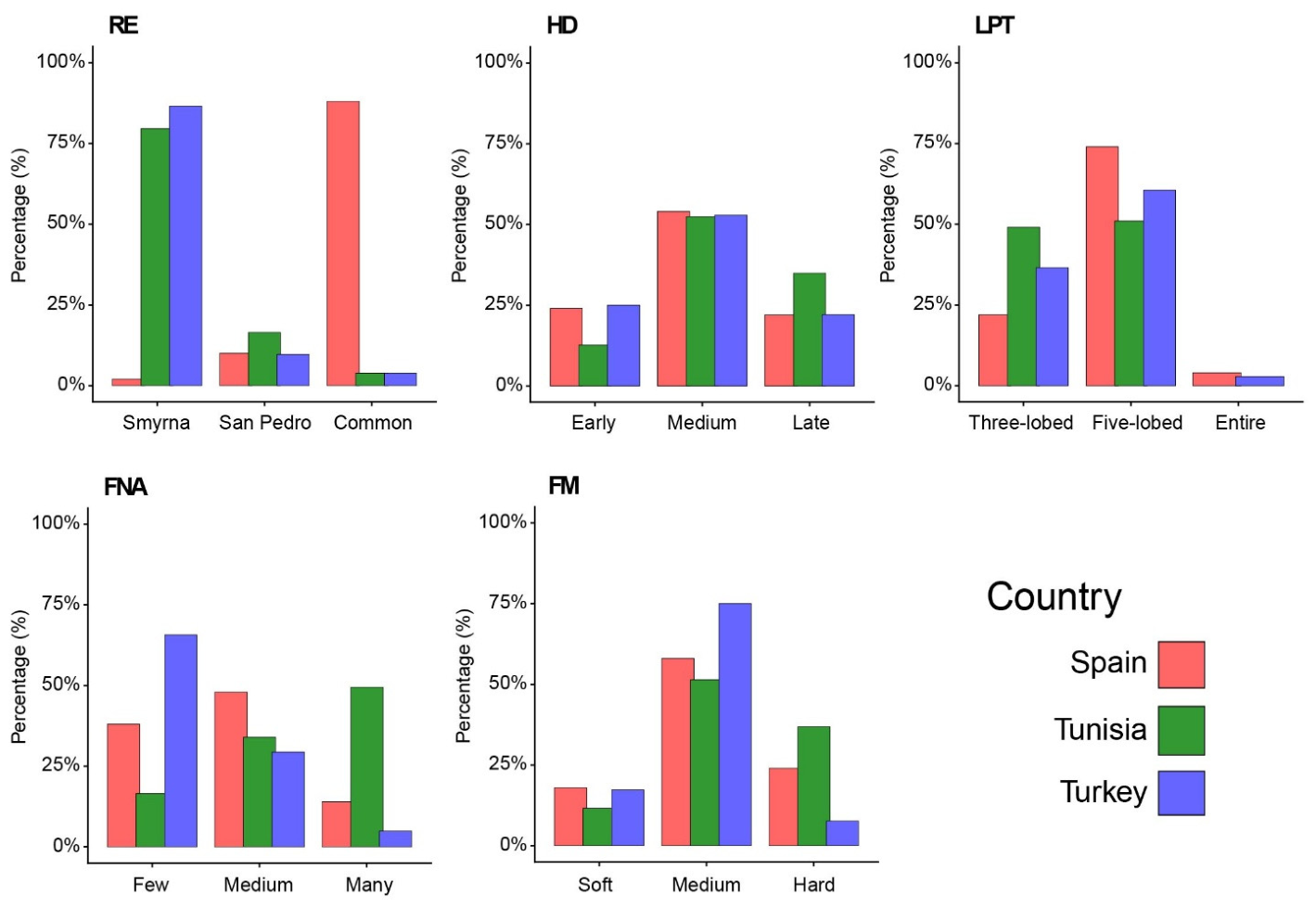
A source of biological differentiation emerged from the analysis of reproduction type (RE). Among the evaluated accessions, 173 genotypes (67%) were classified as Smyrna, 32 (12.4%) as San Pedro and 52 (20.23%) as Common types. Smyrna genotypes predominated in Turkey and Tunisia collections, whereas the Spanish collection was dominated by Common types (Figure 1). As far as production type (PT), 209 accessions were unifera (producing a single main crop per season) and 48 bifera (producing an early breba crop in addition to the main crop), indicating that regular main-crop production predominantly characterises the Mediterranean germplasm, although a noteworthy subset retains the capacity for breba production, as observed in 58% of Spanish genotypes (Supplementary Table S6).
Fig genotypes from different countries showed differences in harvesting date (HD). In all countries, about 50% of genotypes had a medium harvesting date, whereas in Spain and Turkey, about 25% showed early or late harvesting date. Tunisian genotypes exhibited the lowest proportion of early genotypes (13%) and the highest percentage (35%) of late genotypes (Figure 1). Early-ripening accessions, such as “1029-Sarilop”, “227-Yediveren”, “Albacor”, “San Antonio”, “Safouri” and “Garghi”, reached maturity from late June through July. In contrast, several genotypes, including “San Jose”, “Blanca Canaria”, “1001-Göklop”, “1045-Morgüz”, “Chetoui Akhal” and “Jebali1”, were harvested from September onwards, extending the ripening season by almost three months relative to the earliest genotypes.
Morphological descriptors at the plant and leaf level also showed notable diversity. In all three countries, most accessions exhibited semi-upright or spreading growth habits with medium or strong vigour (VG) (Supplementary Table S6). Concerning leaf predominant type (LPT), lobation patterns were dominated by five-lobed leaves (152 genotypes), followed by three-lobed leaves (99 genotypes), while entire leaves were observed in only five accessions from Spain or Turkey (Figure 1).
Fruit traits were assessed using 21 descriptors, both ordinal and quantitative. Fruit attachment of the stalk (FHSS) to the stem varied across the collection, with 83 genotypes exhibiting weak attachment, 100 medium attachment, and 74 strong attachment, mostly from Tunisia and Turkey (Supplementary Table S6).
Fruit cracking of skin (FCS) behaviour distinguished a large subset of genotypes: 159 genotypes showed no cracking at maturity (Supplementary Table S6), including widely cultivated accessions such as “1029-Sarilop” from Turkey, “San Antonio” from Spain, and “Zidi 2” from Tunisia. Genotypes also differed in ease of peeling (FEP): although most were classified as medium or easy to peel, 62 accessions, especially from Tunisia and Turkey, were difficult to peel, which could negatively impact their suitability for fresh consumption (Supplementary Table S6).
The internal cavity of the fruit (FIC) was predominantly absent or very small (158 genotypes), mostly in Spanish and Turkish accessions, whereas 70 genotypes exhibited a medium cavity and 29 a large one (Supplementary Table S6). Fruit scratch resistance of the skin (FSRS) was most frequently classified as medium (121 genotypes), followed by strong (81) and weak (50), with minor differences among genotypes from different countries. Fruit juiciness (FJ) was mainly distributed between medium (111 genotypes) and high (94), while 52 genotypes, mostly from Turkey, were characterised by low juiciness. The number of achenes (FNA) ranged from a few (103 genotypes) to medium (89) and many (63), showing large differences among genotypes from different countries. In Spain, 24 genotypes (48%) had medium numbers of achenes per fruit, whereas 7 genotypes had many achenes per fruit. In Turkey, most genotypes (65.7%) had few achenes, whereas only 4.9% exhibited many achenes, such as “1035-Sari Cicek”, “315-Kis” and others. In Tunisia, most genotypes included many or medium achenes (Figure 1). The distribution of genotypes across different countries was similar for FOS, with most genotypes included in the medium class (139), followed by the small (69) and large (54) classes. Ostiole dimension ranged from small (<3 mm), as observed in “522-Turnaboyu”, to large (>5 mm), as in “1013-Beyaz Orak”. A similar pattern was observed for FSL, with the majority of genotypes (144) in all countries falling within the medium class (Supplementary Table S6).
Finally, a comparable trend from genotypes from different countries also emerged for FM. Most accessions (160) were represented in the medium class; however, in Tunisia, a higher proportion of genotypes occurred in the hard classes than in the soft class (Figure 1).
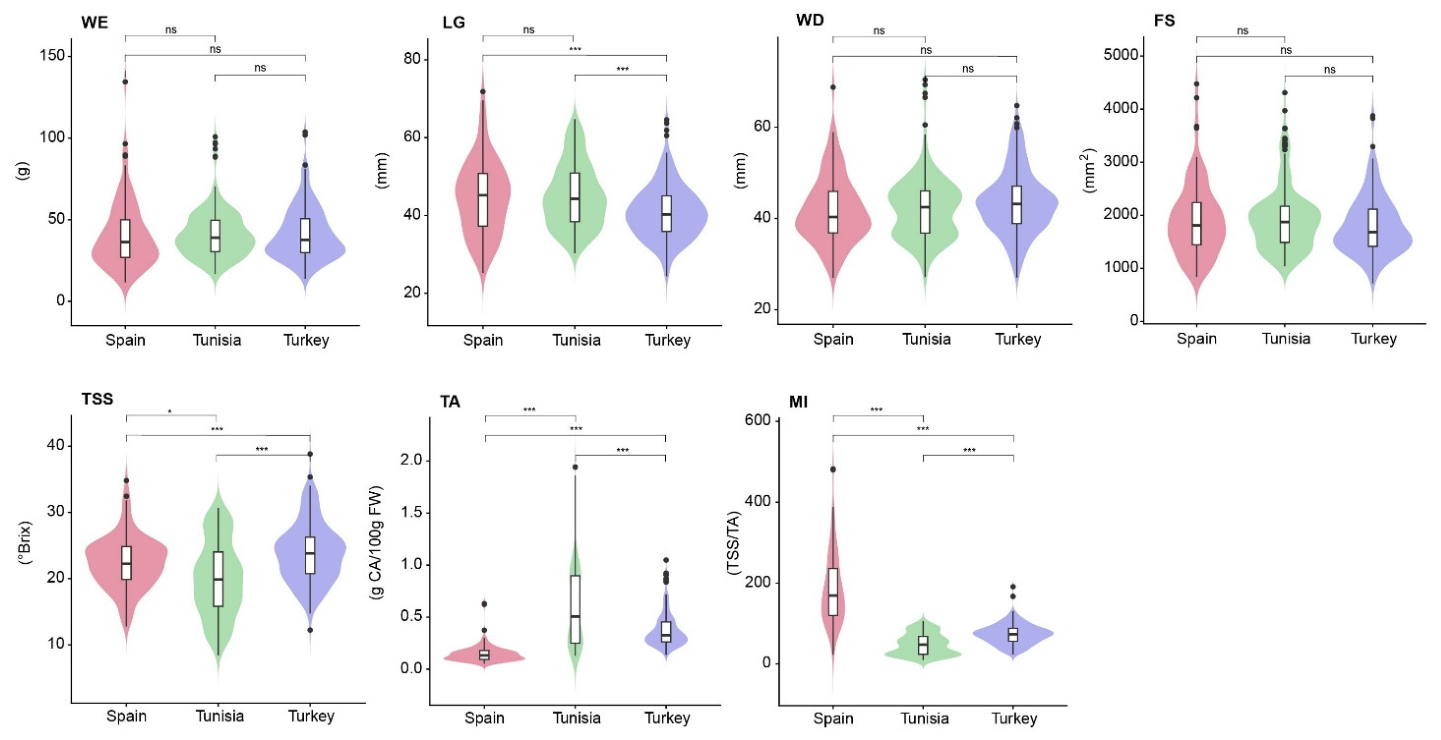
Quantitative traits were assessed to complement the morphological evaluation, and their distributions and descriptive statistics are reported in Figure 2 and Supplementary Table S6. Greatest variability, as indicated by the coefficient of variation (CV), was observed for TA (63%) and MI (56%), especially in Spanish and Tunisian genotypes, while WD and LG showed the least variation.
As traits linked to fruit dimension are concerned, WE and FS showed wide variability within each collection, with similar distribution among germplasm banks, with Spanish genotypes ranging from 11.7 g “Lampaga” to 134.5 g “Negra Cabezuela”, Tunisian genotypes from 16.9 g “Zergui” to 100.8 g “Marsaoui”, and Turkish genotypes from 13.9 g “342-Kizil Yemis” to 103.8 g “237-Bursa Siyahi”. Overall, our data highlight cultivars producing exceptionally small fruits, as well as others exceeding 130 g. Regarding LG and WD, the largest figs were found in “Dalmatie” (Spain) with a length of 71.8 mm, and “Marsaoui” (Tunisia) with a width of 70.4 mm. The smallest figs were recorded in “227-Yediveren” (Turkey) with a length of 24.39 mm. Overall, regarding LG, Turkish genotypes showed lower values than Spanish or Tunisian genotypes (Figure 2). Concerning FS, “Dalmatie” (Spain) had the largest fruits with a value of 4474.66 mm2, while “227-Yediveren” (Turkey) had the smallest fruits, with a value of 715.98 mm2, reflecting the patterns observed for LG and WD.
Concerning internal fruit quality characteristics, TSS ranged from 9 to 39 °Brix, and TA from 0.05 to 1.94 g CA/100 g FW, yielding an MI between 9 “Tayouri Ahmar” and 482.6 “Nazaret”. TSS, TA and MI also showed significant differences across three countries, with Tunisian genotypes displaying the lowest TSS and MI, whereas Spanish accessions showed the highest MI and the lowest TA values, respectively (Figure 2).
Regarding categorical traits (Supplementary Table S4), fruit colour and shape varied extensively across the germplasm. For fruit shape (FSH), spherical and turbinate types were the most frequent in the Turkish collection, accounting for 33.7% and 29.8% of the genotypes, respectively, whereas pyriform (3.9%) and ovoidal (8.7%) were the least represented. In contrast, Spanish accessions were mainly characterised by urceolate and spherical fruits (32% and 24%), while cucurbiform shapes were rare (4%). Tunisian genotypes showed a broader distribution of shapes, with urceolate (25.2%) and pyriform (24.3%) being the most common, whereas ovoidal fruits were scarcely represented (1.9%).
Clear differences were also observed for the fruit ground colour of skin (FGSC). In the Turkish material, yellow and yellow–green fruits were the most frequent (both 26.9%). Spanish accessions were largely represented by yellow-green (46%) and green–yellow (38%) figs. In Tunisia, the predominant colour was green (39.81%), followed by black (17.48%) and purple (15.5%). Yellow and green bands were the least represented colour pattern in all three countries (0–2%).
For fruit overcolour of skin (FOVS), most Turkish (70.2%), Spanish (54%), and Tunisian (36.9%) accessions fell into the “none” category. However, many accessions displayed purple overcolour: 40% of Spanish, 18% of Turkish, and 15% of Tunisian genotypes. Tunisian accessions also showed other overcolours, mainly yellow (22.3%) and green (13.6%). Yellow FOVS were poorly represented in Turkish and Spanish collections, accounting for only 0–4% of the genotypes.
For fruit colour of pulp (FCP), orange-red and purple fruits were the most frequent in the Turkish collection, representing 45.2% and 22.1% of the genotypes, respectively. In Spain and Tunisia, red was the dominant colour, accounting for 30% and 38.8% of the genotypes. Pink fruits were also relatively frequent in the Tunisian and Spanish germplasm, with 24.3% and 20%, respectively. Brown-yellow figs were predominant in Spain (22%). Yellow-white, light brown and dark brown were less represented in all three countries (0–7%).

3.2. Multivariate Analysis of Phenotypic Structure, Trait Correlations and Heritability

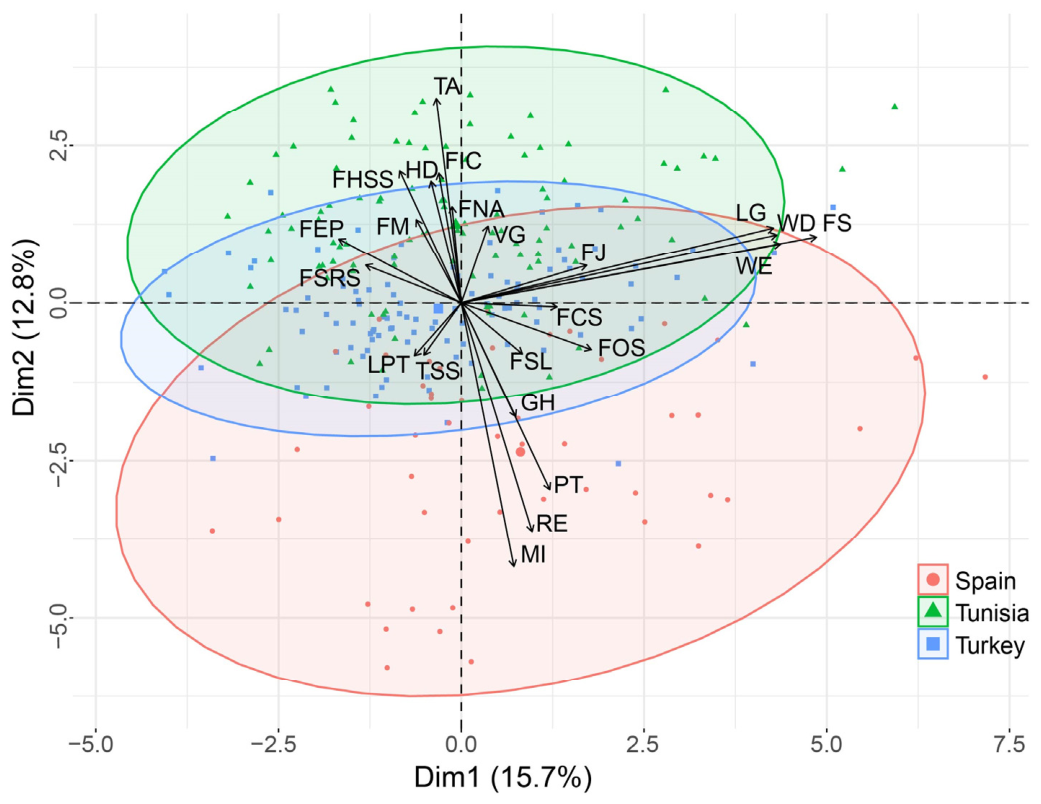
Multivariate analyses provided insights into the overall structure of phenotypic variation, identifying the traits that most contribute to the phenotypic variation among genotypes from different countries. We used estimated marginal means calculated for each trait to perform principal component analysis (PCA) (Figure 3). The first two components explained 15.7% and 12.8% of the total variance, respectively.
No clear clustering of genotypes by country of origin was observed in the PCA biplot (Figure 3), although limited phenotypic differences among genotypes from Spain, Turkey, and Tunisia were observed. Most Tunisian genotypes clustered in the upper part of the PCA biplot due to a high level of TA, larger FIC, strong FHSS, and late HD. Most Spanish genotypes tended to occupy the lower part of the PCA biplot because they were mostly characterised by high MI values, bifera reproductive type and Common type, compared to genotypes from the other countries. Turkish genotypes were distributed more diffusely across the PCA biplot, occupying a central area of the ordination plot and overlapping with both Spanish and Tunisian clusters.
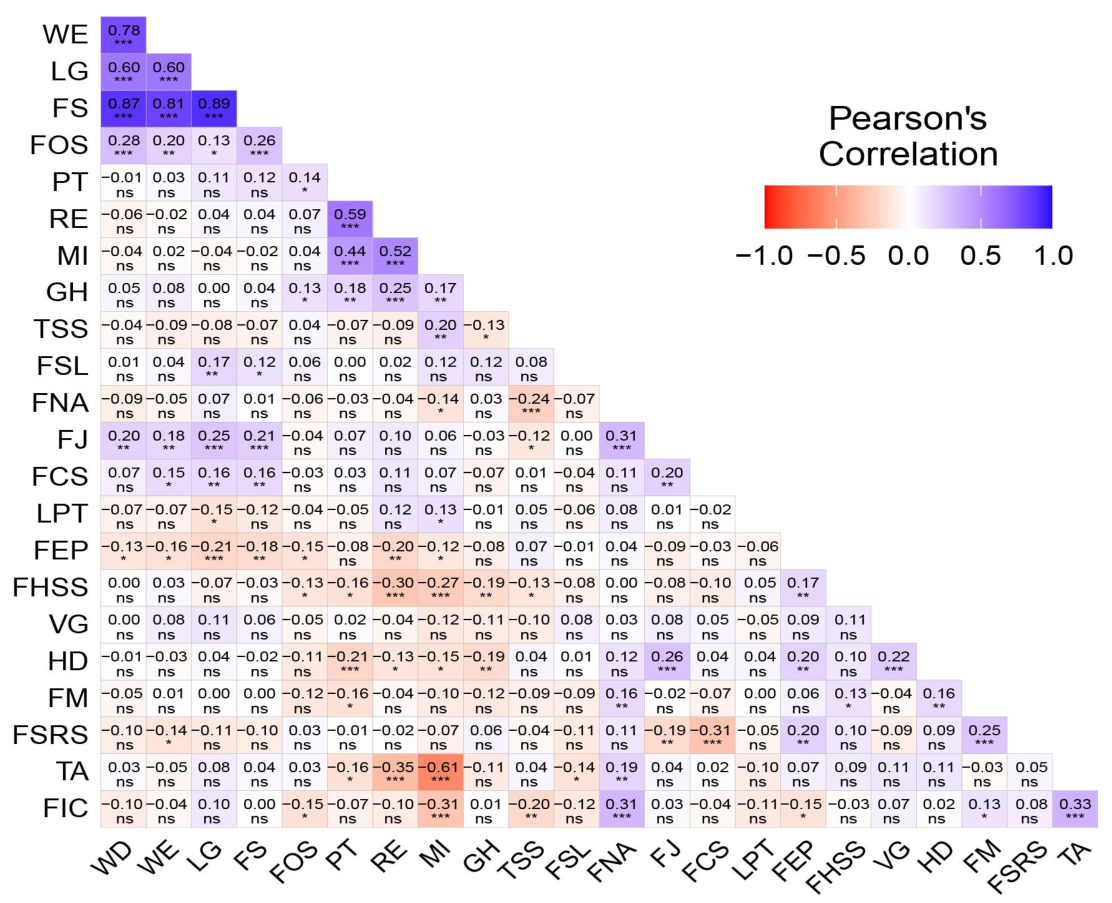
Pearson’s correlation analysis was performed to investigate the relationship between plant and fruit traits (Figure 4). This analysis revealed significant associations across several traits. As expected, fruit weight (WE) showed strong positive correlations with fruit width (WD, r = 0.78, p < 0.001), fruit size (FS, r = 0.81, p < 0.001) and fruit length (LG, r = 0.60, p < 0.001), illustrating coordinated development among fruit size-related traits. Additionally, FS and LG (r = 0.89, p < 0.001) and FS and WD (r = 0.87, p < 0.001) showed strong positive correlations.
A moderate positive correlation was observed between RE and PT (r = 0.59, p < 0.001), highlighting that most bifera genotypes belong to the Common type. Also, moderate positive correlations were observed between MI and RE (r = 0.52, p < 0.001) and between MI and PT (r = 0.44, p < 0.001).
Lower but significant correlations were also noted, such as those between FSRS and FM (r = 0.25, p < 0.001), as well between fruit ostiole size (FOS) and WE, WD and FS (r = 0.20–0.28, p < 0.001); FJ and LG (r = 0.25, p < 0.001); FIC and FNA (r = 0.31, p < 0.001); FIC and TA (r = 0.33, p < 0.001); FSRS and FM (r = 0.25, p < 0.001).
As expected, a strong negative correlation was found between TA and MI (r = −0.61, p < 0.001), as MI is calculated as the ratio of TSS to TA, reflecting the balance between sugar accumulation and acid degradation. Weak negative correlations were also observed, such as between FNA and TSS (r = −0.24, p < 0.001), between FIC and MI (r = −0.31, p < 0.001), between FHSS and MI (r = −0.27, p < 0.001) or RE (r = −0.30, p < 0.001), and, as expected, between FSRS and FCS, r = −0.31, p < 0.001).
For each quantitative phenotypic trait, broad-sense heritability was estimated as H 2 =   V g / V p , where V g is the genetic variance, and V p is the total phenotypic variance, calculated as the sum of genotype, year, location, and residual variance components (Table 1). The corresponding variance components are reported in Supplementary Table S7. Broad-sense heritability provides an overall measure of the genetic contribution to trait variation, encompassing additive, dominance, and epistatic effects, and is particularly relevant for vegetatively propagated species, where favourable genotypes can be preserved and directly exploited in breeding programs.
Traits such as TSS (H2 = 0.72) and WE (H2 = 0.71) showed high broad-sense heritability. LG (H2 = 0.67), WD (H2 = 0.67) and FS (H2 = 0.66) exhibited moderate-to-high heritability, whereas TA (H2 = 0.59) and MI (H2 = 0.45) displayed moderate heritability. The contribution of different variance components to phenotypic variance indicated that TA and MI showed the highest value of environmental (location) variance (Supplementary Table S7).

3.3. Stakeholder Prioritisation

With the aim to receive feedback on the economic and agronomic importance of some traits analysed in this study, a participatory approach was followed, and a panel of stakeholders from Spain, Turkey and Tunisia was invited to participate in surveys (Supplementary Table S8). The Delphi process resulted in a clear set of stakeholder priorities for plant and fruit traits. The results highlighted reproduction (parthenocarpic) as the most important cultivar trait (Supplementary Table S8), with a median score of 5 in Spain and 4 in both Turkey and Tunisia. Harvesting date was also highly rated, particularly in Spain (median = 5) and Turkey (median = 4.5).
Regarding fresh fig consumption (Supplementary Table S8), size and firmness emerged as the most important fruit traits, consistently receiving the maximum median score (5) in Spain, Turkey, and Tunisia. Fruit juiciness and total soluble solid content were also highly rated, with median scores of 5 in Turkey and Tunisia and 4 in Spain. The ease of peeling and fruit scratch resistance of the skin received median scores of 5 in Turkey and 4 in both Spain and Tunisia. Fruit ostiole size was considered highly important in Spain and Turkey (median = 5), but less important in Tunisia (median = 3). Only in Turkey did the number of achenes prove highly important (median = 5).
Regarding dry fig consumption (Supplementary Table S8), size and total soluble solid content emerged as the most important traits, both receiving the maximum median score (5) in Spain, Turkey, and Tunisia. In Spain, ground colour, fruit ostiole size, skin cracking, and maturation index also reached a median score of 5. In Turkey, over colour and ostiole size were highly rated (median = 4.5). In Tunisia, firmness received the maximum median score (5), while ground colour and maturation index were also highly rated (median = 4.5).
We selected the best-performing genotypes based on the quantitative traits preferred by stakeholders, i.e., fruit weight/dimension, TSS, MI. A description of these cultivars according to the qualitative and ordinal traits that received the highest stakeholder preference scores (4.5–5.0) is provided below (Supplementary Tables S8 and S9).
According to these analyses, the best Spanish genotypes were “Negra Cabezuela”, “Roja Almohadin” and “Granito” (Supplementary Table S9). “Negra Cabezuela” produced late parthenocarpic yellow-green fruits. It stood out for high fruit weight, dimensions and firmness, as well as for the absence of skin cracking at maturity. However, it showed a large ostiole and a medium internal cavity. “Roja Almohadin” was characterised by early parthenocarpic green-yellow figs and exhibited the highest TSS value. Fruits were soft at maturity and showed skin cracking, a medium ostiole size and no internal cavity. “Granito” was distinguished by parthenocarpic green-yellow fruits that ripened at a medium harvesting date. Its figs showed the highest MI, with no cracking at maturity, no internal cavity, medium ostiole size and medium firmness.
The best Turkish genotypes were “237-Bursa Siyahi”, “708-Darpak”, “1027-Asil Bardak”, “1001-Goklop”, “339-Kilis”, “1005-Seker”, “537-Kara Incir-3”, “514-Deniz Inciri”, “515-Tabak”, “523-Dilaver”, “1109-Seker inciri 2”, “522-Turnaboyu”, “404-Kis Hayri” and “216-Siyah” (Supplementary Table S9).
“237-Bursa Siyahi”, “708-Darpak”, “1027-Asil Bardak”, “1001-Goklop”, and “339-Kilis” ripened at medium-late date. They showed the highest fruit weight and dimension, together with medium firmness and a medium-large ostiole size. All these cultivars were Smyrna type. Most showed ease of peeling and few achenes, except “339-Kilis”. Weak skin resistance was observed in “1001-Goklop” and “708-Darpak”. These two also exhibited skin cracking at maturity. Juiciness varied among these genotypes, ranging from the lowest value in “1001-Goklop” to the highest in “708-Darpak”.
“1005-Seker”, “537-Kara Incir-3”, “514-Deniz Inciri”, “515-Tabak”, and “523-Dilaver” were Smyrna type genotypes ripening at a medium-late date and showing the highest TSS values. They had low or medium firmness, no cracking at maturity, medium resistance to skin scratching, and a low-medium number of achenes. Among these cultivars, “1005-Seker” had the largest ostiole size, whereas “523-Dilaver” exhibited the smallest one. In addition, “1005-Seker” and “514-Deniz Inciri” showed the lowest FJ. “537-Kara Incir-3” and “523-Dilaver” were characterised by difficulty peeling fruits.
“1109-Seker inciri 2”, “522-Turnaboyu”, “404-Kis Hayri” and “216-Siyah” yielded medium-late Smyrna figs with no cracking at maturity and the highest MI. Among these cultivars, “522-Turnaboyu” was the most difficult to peel and the lowest juiciness. “404-Kis Hayri” had the lowest skin resistance to scratching. “1109-Seker inciri 2” showed the lowest firmness, whereas “522-Turnaboyu” had the highest firmness. All these genotypes had a low to medium ostiole size.
The best Tunisian genotypes resulted “Marsaoui”, “Zidi Kesra”, “Khadhouri”, “Bith Bhim”, “Zidi Degache”, “Lawi (karmous Mbargat)”, “Zidi4”, “Chetoui”, “Temri”, “Dchich Assal Ahmar”, “Marchini”, “Tchichi w Assal”, “Sawoudi Matmata”, “Kerkni”, “Tayouri Asfar”, “Dorghami”, “Swidi Jwayed”, “Tayouri Akhdhar” and “Mazouzi” (Supplementary Table S9).
“Marsaoui”, “Zidi Kesra”, “Khadhouri”, “Bith Bhim”, “Zidi Degache”, “Lawi (karmous Mbargat)”, “Zidi4” were Smyrna type genotypes, whereas “Chetoui” belonged to San Pedro type. These cultivars were characterised by figs with variable skin ground colour ranging from yellow to black, and by the highest fruit dimension and weight. All of them showed medium firmness, except for “Bith Bhim”, which had the highest firmness, and “Lawi (karmous Mbargat)” and “Chetoui”, which were the softest. Most of these genotypes also displayed medium-to-high juiciness, while “Bith Bhim”, “Zidi Degache” and “Zidi4” were the only ones showing no cracking at maturity.
“Temri”, “Dchich Assal Ahmar”, “Marchini” and “Tchichi w Assal” were Smyrna type, “Sawoudi Matmata” was San Pedro type. These genotypes were distinguished by the highest TSS values. All cultivars had medium firmness and showed cracking of fruit skin at maturity, except for “Marchini”, which produced hard fruits without cracking. “Marchini” and “Temri” had figs with low juiciness.
“Kerkni”, “Tayouri Asfar”, “Dorghami”, “Swidi Jwayed”, “Tayouri Akhdhar” and “Mazouzi” belonged to the Smyrna type and were associated with the highest MI. Ground colour ranged from yellow to black, whereas firmness and juiciness were medium to high. “Kerkni”, “Tayouri Akhdhar”, and “Mazouzi” showed no cracking of skin fruit at maturity.

4. Discussion

The present study represents one of the most comprehensive multi-country phenotypic characterisations of Ficus carica conducted to date, encompassing over 250 genotypes conserved in Mediterranean germplasm banks from Spain, Turkey, and Tunisia. The results highlight the extraordinary phenotypic diversity preserved within these collections and confirm the relevance of extensive field-based characterisation as a cornerstone for germplasm conservation, cultivar deployment, and breeding programs. Similar conclusions have been drawn for other perennial fruit species, such as pomegranate, grapevine, and medlar, where detailed phenotyping has proven sufficient to identify elite or highly adapted genotypes [25,26,27].

4.1. Mediterranean Fig Diversity and Productive Types

The distribution of productive types (Smyrna, San Pedro, and Common) across countries reflects distinct cultural histories, agronomic traditions, and market orientations. The prevalence of Smyrna genotypes in the Turkish and Tunisian collections is consistent with reports describing the dominance of Smyrna-type cultivars in traditional North African germplasm and with Turkey’s leading role in dried fig production [28,29]. In contrast, the Spanish collection showed a higher representation of Common and bifera types, consistent with production systems in Spain that are largely oriented toward fresh fig consumption [30].
Similar patterns have also been reported in other fruit crops, where cultural practices and market demands have strongly shaped phenotypic composition within national germplasm collections, particularly for traits related to harvesting time, fruit size, acidity, and skin characteristics [27,31].
Harvesting date is one of the most agronomically relevant traits as emerged by stakeholder prioritisation, with genotypes spanning nearly three months between the earliest and latest ripening accessions.
This wide phenological range provides valuable opportunities for market diversification and labour optimisation. It also provides opportunities for adaptation to climate change, as highlighted in other fruit crops such as pomegranate and grapevine, where early- and late-ripening genotypes have been prioritised to mitigate climate-induced shifts in fruit maturity [25,27]. In figs, extended or staggered harvest periods may become increasingly important under a warmer and more variable climate in the Mediterranean region.
Growth habits and vegetative vigour are key components of plant architecture and directly influence orchard management practices such as pruning, harvesting, fertilisation, and pest/disease control. These traits are particularly relevant when figs are integrated into mixed cropping systems, such as agroforestry, where canopy structure and spatial arrangement are critical. Upright genotypes are generally preferred because they allow greater inter-row space and facilitate mechanised operations. In contrast, most accessions analyses in this study showed semi-upright or spreading growth habits with medium to strong vigour, requiring wider planting distances and more intensive canopy management, which may increase labour demand and reduce management efficiency.

4.2. Fruit Quality Traits and Market Relevance

A total of 21 fruit traits were characterised, revealing a broad range of phenotypic variation among genotypes, particularly for parameters directly linked to consumer acceptance and market value. Key traits included fruit weight and dimensions, ostiole size, total soluble solids, titratable acidity, firmness, shape, skin colour, and resistance to cracking [8,32,33]. Additionally, traits such as ease of peeling and fruit attachment of the stalk to stem were considered relevant, as they influence harvesting efficiency and skin integrity, particularly for fresh consumption [34]. Interestingly, Tunisian and Turkish genotypes had difficult peeling and strong peduncle attachment, characteristics that are more suitable for dry consumption [29,35,36]. In contrast, in Spain, the varieties that show great potential for developing the fresh fig industry (highly productive and with good physical and chemical characteristics) also have easy stalk abscission and are easy to peel [34,37].
Other traits analysed in this work, influencing consumers’ preferences and marketability, such as fruit cracking of the skin, internal cavity, skin scratch resistance, fruit juiciness, number of achenes, ostiole size and firmness, also showed great variability within each collection. Similar variability has been clearly demonstrated in germplasm collections, where differences among accessions or cultivars were observed for morphological and pomological characters, including skin tenderness, firmness, colour and shape [38,39,40]. For example, Khadivi and Mirheidari [38] found high variation in fruit size, skin colour and flesh thickness among wild edible fig accessions, indicating wide morphological diversity in traits important for quality and consumer acceptance. Studies in Tunisian fig accessions have also reported variation in skin peeling and firmness, confirming that these attributes vary widely among genotypes and contribute to germplasm differentiation [41].
In Morocco, a comprehensive evaluation of 75 fig cultivars using 28 pomological descriptors revealed pronounced differences in fruit size, weight, length, width, and flesh thickness, along with significant heterogeneity across most traits, underscoring the broad phenotypic diversity within local fig populations [42]. The diversity assessment conducted by Hssaini et al. [43] on 135 fig cultivars revealed high and significant phenotypic variability across nearly all evaluated morpho-agronomic and biochemical traits, confirming the broad heterogeneity present within Moroccan fig germplasm. The study showed that fruit geometrical attributes, colour, and peel-related characteristics emerged as the most discriminant morphological variables, while biochemical parameters (including total sugars, anthocyanins, and flavonoids) also contributed strongly to genotype differentiation.
Firmness and skin resistance are among the most critical traits for the fresh fig market, influencing harvest timing, transportability, and shelf life [8]. This importance was reflected in stakeholder evaluations, with skin firmness consistently receiving the maximum median score across all three countries, while scratch resistance also obtained high ratings. Firmness ranges in our study are comparable to or exceed those reported in previous studies on fig [30,34,44]. This suggests that the analysed germplasm includes accessions with particularly favourable skin-related traits for fresh-market use. Notably, more than half of the analysed genotypes exhibited complete resistance to skin cracking, a highly desirable trait given the increasing incidence of irregular rainfall events during the ripening period [45].
Ostiole size plays a key role in determining fruit quality, as it is associated with juiciness and other related attributes [30,33]. In line with this, stakeholders in Spain and Turkey assigned the highest importance to this trait, while Tunisian respondents attributed comparatively lower importance (median = 3), suggesting possible differences in market requirements or quality perception among countries. This trait has practical implications for fruit destined for fresh or dried consumption, as ostiole size can influence susceptibility to pests, pathogen penetration and dehydration. Generally, an ostiole diameter greater than 5–6 mm is considered undesirable for the fresh market. In the present study, ostiole diameter varied markedly among genotypes, ranging from 0.5 mm to 13 mm. Previous research has reported narrower ranges in Turkish cultivated figs (3.1–4.9 mm; [46]), while Tunisian germplasm showed values between 4.9 and 12.7 mm [47]. In wild fig populations, ostiole size has been reported to range from 1.06 to 6.93 mm [48]. Compared with these studies, the wider range observed here indicates the coexistence of genotypes with both highly favourable and clearly undesirable ostiole traits, further supporting the breeding value of the analysed germplasm.
Among quantitative traits, fruit weight and dimensions, which strongly influence market price and consumer preference [32], displayed particularly broad ranges. Spanish genotypes showed the greatest variation, exceeding previously reported ranges for Turkish, Tunisian, and Spanish cultivars [30,46,47,49,50,51]. This highlights the presence of both small-fruited and premium large-fruited material within the analysed collection.
Fruit length and width exceeded or were consistent with values reported in cultivated figs from other Mediterranean regions and were markedly larger than those observed in wild fig populations [48], underscoring the effect of long-term domestication and selection.
Taste-related traits, particularly TSS and TA, also showed substantial variability, with TA standing out as the most variable among the analysed fruit quality parameters, with CV values exceeding 58% in both Spanish and Tunisian germplasm. MI values exceed previously reported ranges for Turkish and Spanish collections [30,46] and indicate the presence of genotypes with outstanding sensory potential. High MI values observed in genotypes such as “Nazart”, “Calabacita” and “Granito” suggest excellent suitability for fresh consumption, in agreement with the strong correlation between MI and consumer acceptance reported in figs and other fruit species [33,52,53,54].

4.3. Multivariate Structure and Trait Interrelationships

Multivariate analyses showed that fig phenotypic diversity is structured across multiple dimensions, with the first two principal components capturing only part of the overall variation. In contrast to PCA results obtained from genotypic data [55], phenotyping data did not reveal a clear clustering of genotypes by country of origin, consistent with observations previously reported by Bazakos et al. [56]. Nevertheless, under Mediterranean growing conditions, multi-trait evaluations of fig varieties reveal substantial differences among cultivars in agronomic performance and fruit quality parameters (e.g., TSS, TA, MI). Moreover, multivariate germplasm analyses highlight coordinated variation among fruit dimensions, peel traits (including peel thickness), and internal biochemical attributes [39,57]. This pattern, also observed in pomegranate, pear, and medlar, reflects the semi-independent evolution of multiple traits under diverse selective pressures [26,27,58]. Consequently, comprehensive phenotyping remains essential to capture the full spectrum of variation.
Trait correlations provided valuable insights into co-selection dynamics within fig germplasms. Strong positive correlations among fruit weight, length, and width were expected, as these traits are structurally related and collectively determine overall fruit size as reported in previous studies on fig [59,60,61]. For example, phenotypic data on fig collected across multiple years showed very high correlation coefficients between fruit weight and diameter (r = 0.92) and between fruit weight and length (r = 0.81). In the same context, fruit ostiole size was positively correlated with WE, WD, and FS, in agreement with previous reports [59,62]. These results confirm that heavier fruits tend to exhibit larger dimensions [63]. This point is also relevant from a breeding perspective, since larger fruits may be associated with changes in ostiole traits, which are important for fruit quality and commercial value. Similar relationships have been reported in other fruit species (e.g., peach), where fruit weight and diameter show a strong correlation, suggesting a general morphological coupling across fruit crops [64].
Likewise, the strong negative correlation between TA and MI was expected, as MI is defined as TSS/TA. This relationship corresponds to the physiological maturation process common to many fruit species, in which sugar accumulation coincides with a reduction in acidity [58,65]. Our results are therefore in line with previous studies in fig and other fruit crops, confirming the importance of the sugar/acid balance in fruit ripening and quality evaluation. In figs, similar relationships have also been reported in collections integrating morphological and biochemical traits [43,63]. Interestingly, a moderate correlation was found between FSRS and FM, indicating that epidermal integrity contributes to texture and potentially to shelf life. In figs, correlations among skin-related traits, including skin cracking, skin thickness, and skin texture, have been documented [61,62,63], reflecting the functional interplay of exocarp characteristics that contribute to the fruit’s mechanical protection and postharvest performance.
Other associations among traits were also identified, including those between PT and RE behaviour (given that most bifera genotypes belong to the Common type), between MI and RE or PT, and between FJ and LG. These relationships suggest that long-term farmer selection has indirectly shaped fruit physiological traits alongside agronomic performance, highlighting the importance of both types of descriptors in varietal assessment. Overall, these correlations indicate that several fruit quality traits are interconnected, and the selection for one trait may also influence other important fruit characteristics.

4.4. Heritability and Breeding Implications

Broad-sense heritability was estimated for quantitative fruit traits, providing insight into the relative contribution of genetic factors to phenotypic variation in the evaluated collection. Given that genotypes were evaluated within their respective germplasm collections, these estimates should be interpreted as indicators of genetic control within the study framework. Variance component estimates indicated moderate to high broad-sense heritability across the analysed quantitative traits.
Traits related to fruit dimensions, such as WE, LG, WD, and FS, showed relatively high heritability, indicating a strong genetic component and suggesting that these traits may respond effectively to selection. These data are broadly consistent with previous studies in other fruit tree species, in which fruit weight and dimensional traits generally show substantial genetic control, although the relative magnitude of heritability may vary among traits and species [64,66].
Heritability for biochemical data, such as TSS, was higher than for TA and MI, which showed moderate heritability, suggesting a greater influence of environmental conditions, as indicated by the environmental variance contribution.
Results on TSS differ from data obtained from other tree species, such as sweet cherry [66], which showed a lower heritability value, whereas they agree with the value obtained in peach [64]. Conversely, heritability for TA agrees with results from sweet cherry [66] but differs from that observed in peach [64].
From a breeding perspective, these results suggest that traits such as WE and TSS are more suitable for improvement through direct phenotypic selection, whereas other traits, such as TA and MI, should be assessed across multiple seasons and environments, possibly under controlled conditions.
Based on stakeholders’ preferences and phenotypic data, we identified the best genotypes for breeding and agronomic purposes. For example, “Granito”, “216-Siyah” and “Mazouzi” showed high MI, absence of cracking at maturity, medium to high FM, and high juiciness, suggesting their suitability for fresh consumption, as these traits may reduce susceptibility to bruising and postharvest decay and therefore potentially ensure a longer shelf life. Conversely, “Roja Almohadin” and “Tchichi w Assal” showed high TSS values, together with low to medium firmness and skin cracking during ripening, suggesting their suitability for dry consumption, in which high sugar content is an important quality trait and reduced firmness is generally less limiting. Finally, when large fruit size is considered a desirable trait, “Negra Cabezuela” from Spain, “237-Bursa Siyahi” from Turkey, and “Zidi Degache” from Tunisia emerged as promising genotypes, combining large fruit size with different ripening times. Their different ripening times could help extend the availability period and broaden the market window, thereby offering greater opportunities for market diversification.

5. Conclusions

Overall, the breadth of phenotypic diversity documented in this study highlights the strategic value of Mediterranean fig germplasm banks as reservoirs of traits relevant to both traditional and emerging production systems. The convergence of stakeholder priorities across countries, emphasising fruit size, sweetness, firmness, ostiole characteristics, and resistance to abiotic and biotic stresses, points to shared breeding objectives within the Mediterranean region.
The identification of elite genotypes combining different traits according to stakeholders’ preferences, including fruit weight, TSS, firmness, cracking resistance, and ostiole size, offers immediate opportunities for cultivar deployment and rapid varietal improvement. For some of these traits with high heritability, phenotypic selection can drive significant breeding progress, whereas for others, characterised by lower heritability values, selection should be complemented by approaches that overcome environmental influences. These approaches include extensive progeny performance testing across multiple replicates, controlled or multiple-environment trials, and integration with genomic selection that helps identify molecular markers associated with complex quantitative traits.

Supplementary Materials

The following supporting information can be downloaded at: https://www.mdpi.com/article/10.3390/horticulturae12050511/s1, Supplementary Table S1. Information of 286 fig genotypes. Supplementary Table S2. List of 27 phenotypic traits on adult plants. Supplementary Table S3. Measurements of ordinal and quantitative traits. Supplementary Table S4. List and frequency of categorical traits. Supplementary Table S5. The Estimated Marginal Means (EMMs) of 23 phenotypic traits. Supplementary Table S6. Statistics of ordinal and quantitative traits. Supplementary Table S7. Variance components and broad-sense heritability estimates. Supplementary Table S8. Median and interquartile range (IQR) of importance scores (Likert scale 1–5) assigned to traits for fresh and dry fig consumption in Spain, Turkey, and Tunisia. Supplementary Table S9. Genotypes selected based on stakeholders’ preferred quantitative traits and the qualitative/ordinal traits with the highest preference scores (4.5–5.0).

Author Contributions

M.C.: Writing—original draft, Writing—review and editing, Conceptualization, Investigation, Data curation; A.C.: Writing—original draft, Writing—review and editing, Conceptualization, Supervision; M.L.-C.: Writing—review and editing, Methodology, Investigation, Data curation; G.B.: Writing—review and editing, Investigation, Data Curation, Supervision; A.A. (Arzu Ayar): Investigation, Data Curation; M.G.D.: Writing—review and editing, Investigation, Data curation; S.C.: Writing—review and editing, Investigation, Data curation; A.J.G.: Writing—review and editing, Investigation, Data curation; A.M.F.-L.: Writing—review and editing, Investigation, Data curation; M.J.S.: Writing—review and editing, Investigation, Data curation; F.A.: Investigation, Data Curation; S.H.: Investigation, Data Curation; A.S.H.: Review and editing, Investigation, Data curation; A.A. (Aymen Aounallah): Investigation, Data Curation; A.K.: Writing, Review, Investigation, Supervision; J.I.H.: Writing—review and editing, Investigation; T.G.: Writing—original draft, Writing—review and editing, Conceptualization, Investigation, Supervision. All authors have read and agreed to the published version of the manuscript.

Funding

This study was performed in the frame of the FIGGEN/PRIMA19_00197 project, which is part of the PRIMA Programme supported by the European Union through national grants from MIUR (Italy), Tubitak (Turkey), MESRS (Tunisia) and AGROFIG/PRIMA24_00100 project, which is part of the PRIMA Programme supported by the European Union through national grants from MUR (Italy), Tubitak (Turkey), MESRS (Tunisia), and AEI (Spain).

Data Availability Statement

The original contributions presented in this study are included in the article/Supplementary Material. Further inquiries can be directed to the corresponding author.

Conflicts of Interest

All authors declare no conflicts of interest.

References

  1. Pieruschka, R.; Schurr, U. Plant Phenotyping: Past, Present, and Future. Plant Phenomics 2019, 2019, 7507131. [Google Scholar] [CrossRef] [PubMed]
  2. Walter, A.; Liebisch, F.; Hund, A. Plant Phenotyping: From Bean Weighing to Image Analysis. Plant Methods 2015, 11, 14. [Google Scholar] [CrossRef]
  3. Huang, Y.; Ren, Z.; Li, D.; Liu, X. Phenotypic Techniques and Applications in Fruit Trees: A Review. Plant Methods 2020, 16, 107. [Google Scholar] [CrossRef]
  4. Barolo, M.I.; Ruiz Mostacero, N.; López, S.N. Ficus carica L. (Moraceae): An Ancient Source of Food and Health. Food Chem. 2014, 164, 119–127. [Google Scholar] [CrossRef]
  5. Ayuso, M.; Carpena, M.; Taofiq, O.; Albuquerque, T.G.; Simal-Gandara, J.; Oliveira, M.B.P.P.; Prieto, M.A.; Ferreira, I.C.F.R.; Barros, L. Fig “Ficus carica L.” and Its by-Products: A Decade Evidence of Their Health-Promoting Benefits towards the Development of Novel Food Formulations. Trends Food Sci. Technol. 2022, 127, 1–13. [Google Scholar] [CrossRef]
  6. Kislev, M.E.; Hartmann, A.; Bar-Yosef, O. Early Domesticated Fig in the Jordan Valley. Science 2006, 312, 1372–1374. [Google Scholar] [CrossRef] [PubMed]
  7. FAO. Food and Agriculture Organization of United Nations (FAOSTAT Statistical Database); FAO: Rome, Italy, 2024; Available online: https://www.fao.org/faostat/en/ (accessed on 1 December 2024).
  8. Flaishman, M.A.; Rodov, V.; Stover, E. The Fig: Botany, Horticulture, and Breeding. In Horticultural Reviews; John Wiley & Sons: Hoboken, NJ, USA, 2007; pp. 113–196. [Google Scholar] [CrossRef]
  9. Badgujar, S.B.; Patel, V.V.; Bandivdekar, A.H.; Mahajan, R.T. Traditional Uses, Phytochemistry and Pharmacology of Ficus carica: A Review. Pharm. Biol. 2014, 52, 1487–1503. [Google Scholar] [CrossRef]
  10. Li, Z.; Yang, Y.; Liu, M.; Zhang, C.; Shao, J.; Hou, X.; Tian, J.; Cui, Q. A Comprehensive Review on Phytochemistry, Bioactivities, Toxicity Studies, and Clinical Studies on Ficus carica Linn. Leaves. Biomed. Pharmacother. 2021, 137, 111393. [Google Scholar] [CrossRef]
  11. Morovati, M.R.; Ghanbari-Movahed, M.; Barton, E.M.; Farzaei, M.H.; Bishayee, A. A Systematic Review on Potential Anticancer Activities of Ficus carica L. with Focus on Cellular and Molecular Mechanisms. Phytomedicine 2022, 105, 154333. [Google Scholar] [CrossRef] [PubMed]
  12. Khoshnoudi-Nia, S.; Sharifi, A.; Taghavi, E. The Potential of Fig (Ficus carica) for New Products. In Fig (Ficus carica): Production, Processing, and Properties; Springer International Publishing: Cham, Switzerland, 2023; pp. 765–783. [Google Scholar] [CrossRef]
  13. Alzahrani, M.Y.; Alshaikhi, A.I.; Hazzazi, J.S.; Kurdi, J.R.; Ramadan, M.F. Recent Insight on Nutritional Value, Active Phytochemicals, and Health-enhancing Characteristics of Fig (Ficus carica). Food Saf. Health 2024, 2, 179–195. [Google Scholar] [CrossRef]
  14. Vangelisti, A.; Zambrano, L.S.; Caruso, G.; Macheda, D.; Bernardi, R.; Usai, G.; Mascagni, F.; Giordani, T.; Gucci, R.; Cavallini, A.; et al. How an Ancient, Salt-Tolerant Fruit Crop, Ficus carica L., Copes with Salinity: A Transcriptome Analysis. Sci. Rep. 2019, 9, 2561. [Google Scholar] [CrossRef]
  15. Aradhya, M.K.; Stover, E.; Velasco, D.; Koehmstedt, A. Genetic Structure and Differentiation in Cultivated Fig (Ficus carica L.). Genetica 2010, 138, 681–694. [Google Scholar] [CrossRef]
  16. Pereira, C.; López Corrales, M.; Martín, A.; Villalobos, M.d.C.; Córdoba, M.d.G.; Serradilla, M.J. Physicochemical and Nutritional Characterization of Brebas for Fresh Consumption from Nine Fig Varieties (Ficus carica L.) Grown in Extremadura (Spain). J. Food Qual. 2017, 2017, 1–12. [Google Scholar] [CrossRef]
  17. Bates, D.; Mächler, M.; Bolker, B.; Walker, S. Fitting Linear Mixed-Effects Models Using Lme4. J. Stat. Softw. 2015, 67, 1–48. [Google Scholar] [CrossRef]
  18. R Core Team. R: A Language and Environment for Statistical Computing; R Foundation for Statistical Computing: Vienna, Austria, 2021; Available online: https://www.R-project.org/ (accessed on 1 December 2022).
  19. Lenth, R.V.; Buerkner, P.; Herve, M.; Love, J.; Riebl, H.; Singmann, H. Emmeans: Estimated Marginal Means, Aka Least-Squares Means, R Package Version 1.10.0; 2024. Available online: https://cran.r-project.org/package=emmeans (accessed on 1 March 2024).
  20. Lê, S.; Josse, J.; Husson, F. FactoMineR: An R Package for Multivariate Analysis. J. Stat. Softw. 2008, 25, 1–18. [Google Scholar] [CrossRef]
  21. Olivoto, T.; Lúcio, A.D. Metan: An R Package for Multi-environment Trial Analysis. Methods Ecol. Evol. 2020, 11, 783–789. [Google Scholar] [CrossRef]
  22. Dalkey, N.; Helmer, O. An Experimental Application of the DELPHI Method to the Use of Experts. Manag. Sci. 1963, 9, 458–467. [Google Scholar] [CrossRef]
  23. Linstone, H.A.; Turoff, M. The Delphi Method: Techniques and Applications; Addison-Wesley: Boston, MA, USA, 2002. [Google Scholar]
  24. Mukherjee, N.; Hugé, J.; Sutherland, W.J.; McNeill, J.; Van Opstal, M.; Dahdouh-Guebas, F.; Koedam, N. The Delphi Technique in Ecology and Biological Conservation: Applications and Guidelines. Methods Ecol. Evol. 2015, 6, 1097–1109. [Google Scholar] [CrossRef]
  25. Abiri, K.; Rezaei, M.; Tahanian, H.; Heidari, P.; Khadivi, A. Morphological and Pomological Variability of a Grape (Vitis vinifera L.) Germplasm Collection. Sci. Hortic. 2020, 266, 109285. [Google Scholar] [CrossRef]
  26. Khadivi, A.; Rezaei, M.; Heidari, P.; Safari-Khuzani, A.; Sahebi, M. Morphological and Fruit Characterizations of Common Medlar (Mespilus germanica L.) Germplasm. Sci. Hortic. 2019, 252, 38–47. [Google Scholar] [CrossRef]
  27. Khadivi, A.; Mirheidari, F.; Saeidifar, A.; Moradi, Y.; Tunç, Y. Morphological and Pomological Characterizations of Pomegranate (Punica granatum L.) to Select Superior Genotypes. Sci. Rep. 2025, 15, 7038. [Google Scholar] [CrossRef] [PubMed]
  28. Mars, M.; Chatti, K.; Saddoud, O.; Salhi-Hannachi, A.; Trifi, M.; Marrakchi, M. Fig cultivation and genetic Resources in Tunisia, an overview. Acta Hortic. 2008, 798, 27–32. [Google Scholar] [CrossRef]
  29. Polat, A.A. Fig Production in Türkiye: Varieties, Cultivation, Orchard Management and Processing. Manas J. Agric. Vet. Life Sci. 2025, 15, 271–281. [Google Scholar] [CrossRef]
  30. Pereira, C.; Serradilla, M.J.; Pérez-Gragera, F.; Martín, A.; Villalobos, M.C.; López-Corrales, M. Evaluation of Agronomic and Fruit Quality Traits of Fig Tree Varieties (Ficus carica L.) Grown in Mediterranean Conditions. Span. J. Agric. Res. 2017, 15, e0903. [Google Scholar] [CrossRef]
  31. Khadivi, A.; Ayenehkar, D.; Kazemi, M.; Khaleghi, A. Phenotypic and Pomological Characterization of a Pomegranate (Punica granatum L.) Germplasm Collection and Identification of the Promising Selections. Sci. Hortic. 2018, 238, 234–245. [Google Scholar] [CrossRef]
  32. Aksoy, U.; Seferoglu, G.; Misirli, A.; Kara, S.; Sahin, N.; Bulbul, S.; Duzbastilar, M. Selection of the Table Fig Genotypes Suitable for Egean Region. In Proceedings of the Turkish Horticulture Congress, First National Horticultural Congress, Izmir, Turkey, 9–13 October 1992; pp. 545–548. (In Turkish) [Google Scholar]
  33. Crisosto, C.H.; Bremer, V.; Ferguson, L.; Crisosto, G.M. Evaluating Quality Attributes of Four Fresh Fig (Ficus carica L.) Cultivars Harvested at Two Maturity Stages. HortScience 2010, 45, 707–710. [Google Scholar] [CrossRef]
  34. Pereira, C.; Serradilla, M.J.; Martín, A.; Villalobos, M.d.C.; Pérez-Gragera, F.; López-Corrales, M. Agronomic Behaviour and Quality of Six Fig Cultivars for Fresh Consumption. Sci. Hortic. 2015, 185, 121–128. [Google Scholar] [CrossRef]
  35. Küden, A.B.; Bayazit, S.; Çömlekcioglu, S. Morphological and pomological characteristics of fig genotypes selected from Mediterranean and south east anatolia regions. Acta Hortic. 2008, 798, 95–102. [Google Scholar] [CrossRef]
  36. Ayar, A.; Kargıcak, M.A.; Mutlu, D. The Effect of Year Altitudinal Differences on Fruit Quality of Sarilop Fig Cultivar. J. Bahçe 2025, 54, 145–155. [Google Scholar] [CrossRef]
  37. López-Corrales, M.; Gil, M.; Pérez, F.; Cortés, J.; Serradilla, M.J.; Chome, P.M. Variedades de Higuera, Descripción y Registro de Variedades; Ministerio de Medio Ambiente y Medio Rural y Marino: Madrid, Span, 2011. [Google Scholar]
  38. Khadivi, A.; Mirheidari, F. Selection of the Promising Fig (Ficus carica L.) Accessions Using Fruit-related Characters. Food Sci. Nutr. 2022, 10, 2911–2921. [Google Scholar] [CrossRef] [PubMed]
  39. Nuzzo, V.; Gatto, A.; Montanaro, G. Morphological Characterization of Some Local Varieties of Fig (Ficus carica L.) Cultivated in Southern Italy. Sustainability 2022, 14, 15970. [Google Scholar] [CrossRef]
  40. Aljane, F.; Ferchichi, A. Morphological, chemical and sensory characterization of tunisian fig (Ficus carica L.) cultivars based on dried fruits. Acta Hortic. 2007, 741, 81–85. [Google Scholar] [CrossRef]
  41. Essid, A.; Aljane, F.; Neily, M.H.; Ferchichi, A.; Hormaza, J.I. Assessment of Genetic Diversity of Thirty Tunisian Fig (Ficus carica L.) Accessions Using Pomological Traits and SSR Markers. Mol. Biol. Rep. 2021, 48, 335–346. [Google Scholar] [CrossRef]
  42. Mardoume, I.; Bouda, S.; Bella, Y.A.; Haddioui, A. Evaluation of Phenotypic Variability of Fig (Ficus carica L.) Cultivars in Atlas Mountains and Oases of Morocco. Ecol. Eng. Environ. Technol. 2025, 26, 101–112. [Google Scholar] [CrossRef]
  43. Hssaini, L.; Hanine, H.; Razouk, R.; Ennahli, S.; Mekaoui, A.; Guirrou, I.; Charafi, J. Diversity Screening of Fig (Ficus carica L.) Germplasm through Integration of Morpho-Agronomic and Biochemical Traits. Int. J. Fruit Sci. 2020, 20, 939–958. [Google Scholar] [CrossRef]
  44. Galán, A.J.; Domínguez, M.G.; Pérez-López, M.; Galván, A.I.; Pérez-Gragera, F.; López-Corrales, M. Agronomic Performance and Fruit Quality of Fresh Fig Varieties Trained in Espaliers Under a High Planting Density. Horticulturae 2025, 11, 750. [Google Scholar] [CrossRef]
  45. Mahmoudi, S.; Khali, M.; Benkhaled, A.; Boucetta, I.; Dahmani, Y.; Attallah, Z.; Belbraouet, S. Fresh Figs (Ficus carica L.): Pomological Characteristics, Nutritional Value, and Phytochemical Properties. Eur. J. Hortic. Sci. 2018, 83, 104–113. [Google Scholar] [CrossRef]
  46. Çalişkan, O.; Polat, A.A. Fruit Characteristics of Fig Cultivars and Genotypes Grown in Turkey. Sci. Hortic. 2008, 115, 360–367. [Google Scholar] [CrossRef]
  47. Gaaliche, B.; Saddoud, O.; Mars, M. Morphological and Pomological Diversity of Fig (Ficus carica L.) Cultivars in Northwest of Tunisia. ISRN Agron. 2012, 2012, 1–9. [Google Scholar] [CrossRef]
  48. Mirheidari, F.; Khadivi, A.; Moradi, Y.; Paryan, S. Phenotypic Variability of Naturally Grown Edible Fig (Ficus carica L.) and Caprifig (Ficus carica Var. Caprificus Risso) Accessions. Sci. Hortic. 2020, 267, 109320. [Google Scholar] [CrossRef]
  49. Özeker, E.; Isfendiyaroglu, M. Evaluation of table fig cultivars in çesme peninsula. Acta Hortic. 1998, 480, 55–60. [Google Scholar] [CrossRef]
  50. Polat, A.A.; Özkaya, M. Selection Studies on Fig in the Mediterranean Region of Turkey. Pak. J. Bot. 2005, 37, 567–574. [Google Scholar]
  51. Simsek, E.; Kilic, D.; Caliskan, O. Phenotypic Variation of Fig Genotypes (Ficus carica L.) in the Eastern Mediterranean of Turkey. Genetika 2020, 52, 957–972. [Google Scholar] [CrossRef]
  52. Valero, D.; Serrano, M. Growth and Ripening Stage at Harvest Modulates Postharvest Quality and Bioactive Compounds with Antioxidant Activity. Stewart Postharvest Rev. 2013, 9, 1–8. [Google Scholar] [CrossRef]
  53. Fawole, O.A.; Opara, U.L. Developmental Changes in Maturity Indices of Pomegranate Fruit: A Descriptive Review. Sci. Hortic. 2013, 159, 152–161. [Google Scholar] [CrossRef]
  54. Kaur, H.; Sawhney, B.K.; Jawandha, S.K. Evaluation of Plum Fruit Maturity by Image Processing Techniques. J. Food Sci. Technol. 2018, 55, 3008–3015. [Google Scholar] [CrossRef]
  55. Castellacci, M.; Usai, G.; Vangelisti, A.; Simoni, S.; Natali, L.; Mascagni, F.; Cavallini, A.; Lopez-Corrales, M.; Domínguez, M.G.; Baraket, G.; et al. Exploring the Genetic Diversity of Mediterranean Fig Trees Highlights Genes Associated with Fruit Traits. Front. Plant Sci. 2026, 17, 1750632. [Google Scholar] [CrossRef]
  56. Bazakos, C.; Michailidis, M.; Tourvas, N.; Alexiou, K.G.; Mellidou, I.; Polychroniadou, C.; Boutsika, A.; Xanthopoulou, A.; Moysiadis, T.; Skodra, C.; et al. Genetic Mosaic of the Mediterranean Fig: Comprehensive Genomic Insights from a Gene Bank Collection. Physiol. Plant. 2024, 176, e14482. [Google Scholar] [CrossRef]
  57. Mumtaz, M.S.; Nafees, M.; Ahmad, I.; Maryam; Rezk, A.A.; Huang, J.; Iqbal, R. Morpho-Biochemical and SSR Marker-Based Genetic Diversity Assessment in Fig (Ficus carica) Genotypes. Plant Mol. Biol. Rep. 2025, 43, 2354–2366. [Google Scholar] [CrossRef]
  58. Zhang, Y.; Cao, Y.; Huo, H.; Xu, J.; Tian, L.; Dong, X.; Qi, D.; Liu, C. An Assessment of the Genetic Diversity of Pear (Pyrus L.) Germplasm Resources Based on the Fruit Phenotypic Traits. J. Integr. Agric. 2022, 21, 2275–2290. [Google Scholar] [CrossRef]
  59. Darjazi, B.B. Morphological and Pomological Characteristics of Fig (Ficus carica L.) Cultivars from Varamin, Iran. Afr. J. Biotechnol. 2011, 10, 19096. [Google Scholar] [CrossRef]
  60. Khadivi, A.; Anjam, R.; Anjam, K. Morphological and Pomological Characterization of Edible Fig (Ficus carica L.) to Select the Superior Trees. Sci. Hortic. 2018, 238, 66–74. [Google Scholar] [CrossRef]
  61. Hssaini, L.; Hanine, H.; Razouk, R.; Ennahli, S.; Mekaoui, A.; Ejjilani, A.; Charafi, J. Assessment of Genetic Diversity in Moroccan Fig (Ficus carica L.) Collection by Combining Morphological and Physicochemical Descriptors. Genet. Resour. Crop Evol. 2020, 67, 457–474. [Google Scholar] [CrossRef]
  62. Yadav, V.; Patel, S.B.; Mishra, D.S.; Singh, A.K.; Yadav, L.P.; Apparao, V.V.; Sahil, A.; Ravat, P.; Rane, J.; Kaushik, P.; et al. Morpho-Pomological, Chemical, and Nutritional Characterizations of Fig (Ficus carica L.) Genotypes under Semi-Arid Conditions in Western India. Cogent Food Agric. 2026, 12, 2610022. [Google Scholar] [CrossRef]
  63. Polat, A.A.; Çalışkan, O. Correlations among Important Fruit Quality and Plant Characteristics of Some Fig Genotypes. J. Life Sci. 2017, 11, 141–144. [Google Scholar] [CrossRef][Green Version]
  64. Rawandoozi, Z.; Hartmann, T.; Byrne, D.; Carpenedo, S. Heritability, Correlation, and Genotype by Environment Interaction of Phenological and Fruit Quality Traits in Peach. J. Am. Soc. Hortic. Sci. 2021, 146, 56–67. [Google Scholar] [CrossRef]
  65. Kaska, N.; Küden, A.B.; Küden, A.; Çetiner, S. Studies on the Adaptation of Aegean Figs and Figs Selected from Cukurova Region in Adana. Cukurova Univ. J. Fac. Agric. 1990, 5, 77–86. [Google Scholar]
  66. Piaskowski, J.; Hardner, C.; Cai, L.; Zhao, Y.; Iezzoni, A.; Peace, C. Genomic Heritability Estimates in Sweet Cherry Reveal Non-Additive Genetic Variance Is Relevant for Industry-Prioritized Traits. BMC Genet. 2018, 19, 23. [Google Scholar] [CrossRef] [PubMed]
Figure 1. Percentage distribution of ordinal traits of figs from Spain (red), Tunisia (green), and Turkey (blue). Traits analysed include RE (reproduction), HD (harvesting date), LPT (leaf predominant type), FNA (fruit number of achenes), and FM (firmness).
Horticulturae 12 00511 g001
Figure 2. Comparison of quantitative fruit traits among Spain (red), Tunisia (green), and Turkey (blue). Traits include WE (fruit weight, g), LG (fruit length, mm), WD (fruit width, mm), FS (fruit size, mm2), TSS (total soluble solids, °Brix), TA (titratable acidity, g CA/100 g FW), and MI (maturation index, TSS/TA). Statistical significance is indicated above the violins (*, p < 0.05; ***, p < 0.001; ns, not significant).
Horticulturae 12 00511 g002
Figure 3. Principal Component Analysis (PCA) biplot showing the distribution of fig genotypes from Spain (red), Tunisia (green), and Turkey (blue) based on morphological and agronomic traits. The first two dimensions (Dim1 and Dim2) explain 15.7% and 12.8% of the total variation, respectively. The vectors represent the contributions and directions of different traits along the PCA axes. Phenotypic traits: reproduction (RE), productive type (PT), harvesting date (HD), growth habit (GH), vigour (VG), leaf predominant type (LPT), fruit attachment of stalk to stem (FHSS), fruit size (FS), fruit ostiole size (FOS), fruit stalk length (FSL), fruit cracking of skin (FCS), fruit easy of peeling (FEP), fruit internal cavity (FIC), fruit scratch resistance of skin (FSRS), fruit juiciness (FJ), fruit number of achenes (FNA), fruit weight (WE), fruit length (LG), fruit width (WD), total soluble solid (TSS), titratable acidity (TA), maturation index (MI), firmness (FM).
Horticulturae 12 00511 g003
Figure 4. Correlation matrix of morphological and agronomic traits in fig genotypes, highlighting the relationships between traits and identifying patterns of association within the dataset. The heatmap represents Pearson’s correlation coefficients, ranging from −1 (strong negative correlation, red) to 1 (strong positive correlation, blue). Significant correlations are marked with asterisks: * (p < 0.05), ** (p < 0.01), *** (p < 0.001), while ‘ns’ indicates non-significant correlations (p ≥ 0.05). Phenotypic traits: reproduction (RE), productive type (PT), harvesting date (HD), growth habit (GH), vigour (VG), leaf predominant type (LPT), fruit attachment of stalk to stem (FHSS), fruit size (FS), fruit ostiole size (FOS), fruit stalk length (FSL), fruit cracking of skin (FCS), fruit easy of peeling (FEP), fruit internal cavity (FIC), fruit scratch resistance of skin (FSRS), fruit juiciness (FJ), fruit number of achenes (FNA), fruit weight (WE), fruit length (LG), fruit width (WD), total soluble solid (TSS), titratable acidity (TA), maturation index (MI), firmness (FM).
Horticulturae 12 00511 g004
Table 1. The broad-sense heritability (H2) for quantitative fruit traits.
TraitVgVpH2
WE244.70342.280.71
LG57.6285.640.67
WD45.8368.470.67
FS319,366.11483,092.620.66
TSS21.7030.140.72
TA0.0630.110.59
MI1794.543986.370.45
Disclaimer/Publisher’s Note: The statements, opinions and data contained in all publications are solely those of the individual author(s) and contributor(s) and not of MDPI and/or the editor(s). MDPI and/or the editor(s) disclaim responsibility for any injury to people or property resulting from any ideas, methods, instructions or products referred to in the content.