Article

Spectral Quality and Infrared Radiation from Supplemental Lighting Shape the Physiology and Phytochemical Profile of Swiss Chard (Beta vulgaris L.)

1
Texas A&M AgriLife Research and Extension, Texas A&M University, Dallas, TX 75252, USA
2
Department of Agricultural and Environmental Sciences, Universita degli Studi di Milano, Via Celoria 2, 20133 Milano, Italy
3
MEG Science, Via Aleardo Aleardi 12, 20154 Milano, Italy
4
ALMECO S.p.A., Via della Liberazione 15, San Giuliano Milanese, 20098 Milano, Italy
*
Author to whom correspondence should be addressed.
Horticulturae 2026, 12(4), 457; https://doi.org/10.3390/horticulturae12040457

Submission received: 17 February 2026 / Revised: 2 April 2026 / Accepted: 3 April 2026 / Published: 8 April 2026

Abstract

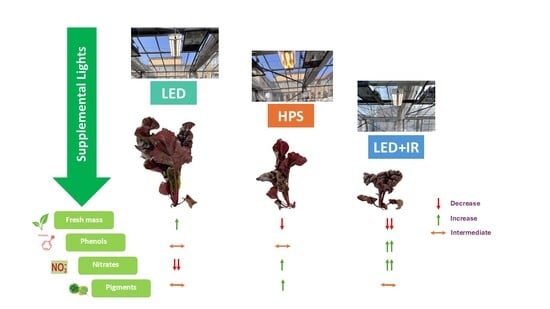
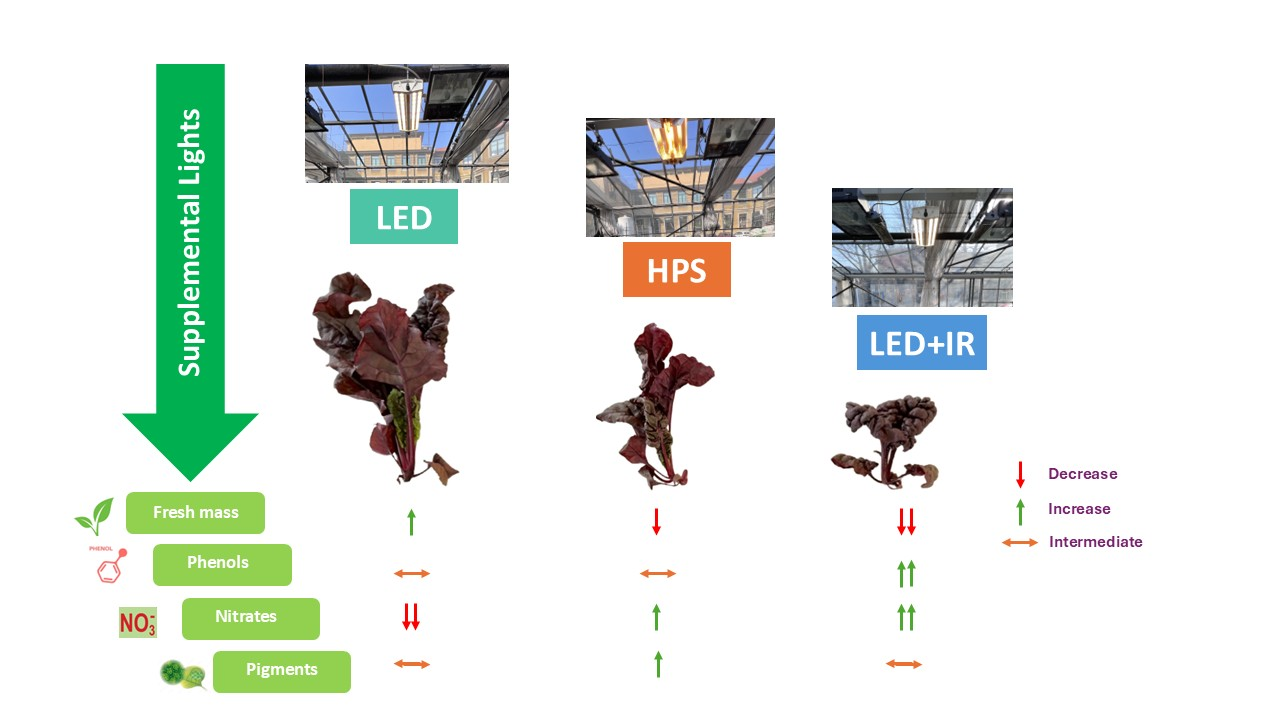
The transition from High-Pressure Sodium (HPS) to energy-efficient Light-Emitting Diode (LED) supplemental lighting alters the plant thermal environment in controlled environment agriculture (CEA). This study evaluated how three practical supplemental lighting regimes, HPS, LED, and LED supplemented with infrared radiation (LED + IR), influence the physiology, growth, and phytochemical profile of Swiss chard (Beta vulgaris L.). We assessed biomass production, photosynthetic performance, oxidative stress markers (TBARS), and the concentration of primary and secondary metabolites. The LED treatment was superior for biomass production, yielding significant fresh mass while maintaining the lowest leaf nitrate content. Conversely, the addition of IR significantly increased leaf temperature, which suppressed growth but acted as a potent “bio-stress” agent, significantly increasing the total phenolic index. This biofortification, however, significantly decreased photosynthetic pigments (chlorophylls and carotenoids), increased lipid peroxidation (TBARS), and led to the highest accumulation of undesirable nitrates. Our findings reveal a clear growth-defense trade-off, demonstrating that while LED lighting is optimal for maximizing yield and food safety, the targeted application of IR radiation is an effective strategy for enhancing the nutraceutical value of leafy greens, requiring careful management to mitigate negative impacts on growth and quality.

Graphical Abstract

1. Introduction

Controlled Environmental Agriculture (CEA) is a solution of increasing importance for global food security, offering a method to enhance food production and quality amid mounting pressures such as climate change, freshwater scarcity, and a growing population [1,2]. Greenhouse horticulture, a primary form of this approach, allows for the precise regulation of developmental factors like light and temperature, leading to higher yields per unit area and more efficient resource use [3]. The global significance of this sector is underscored by a market value exceeding 30 billion US dollars [4,5].
Within these systems, supplemental lighting is critical for sustaining year-round production, especially in regions with limited natural light [6]. For decades, high-pressure sodium (HPS) lamps have been the industry standard, but they possess significant drawbacks, including fixed spectral output, high energy consumption, and substantial heat generation that can cause thermal stress [7]. Light-emitting diodes (LEDs) have emerged as a superior alternative, offering customizable spectra, up to 70% greater energy efficiency, and a longer operational lifespan [8,9]. However, the low heat emission of LEDs, while reducing direct heat injury, creates a cooler plant microclimate compared to HPS and can increase ambient heating requirements [7].
This thermal difference introduces an important variable, as temperature profoundly influences plant metabolism. Infrared (IR) radiation offers a potential solution, functioning as a highly efficient radiant heat source that directly warms plant surfaces, comparable to solar radiation [10]. Unlike convection heating, IR can be precisely targeted, potentially reducing overall energy costs by up to 50% while promoting uniform growth and enhancing product quality [11]. The integration of IR with LED lighting provides a practical approach to adjust the crop thermal microclimate while maintaining a defined LED spectrum, enabling evaluation of lighting regimes that differ in both spectral composition and radiant heat load.
Swiss chard (Beta vulgaris L.) was selected as the model crop for this study due to its agronomic importance and rich nutritional profile [12]. As a valuable functional food, it contains essential minerals and vitamins, as well as a diverse array of bioactive phytochemicals, including phenolics, carotenoids, and antioxidant betalains, which are highly sensitive to environmental conditions like light and temperature [13,14,15,16]. Notably, plants in the order Caryophyllales, including Beta vulgaris, synthesize betalains for red and yellow pigmentation, a pathway that is mutually exclusive to the anthocyanin synthesis found in most other higher plants.
While the effects of HPS and LED lighting are well-documented, the synergistic impact of combining spectrally optimized LEDs with targeted IR radiation remains poorly understood. We hypothesized that supplementing LED lighting with IR would increase leaf temperature and induce a stronger stress-related metabolic response (e.g., higher phenolic accumulation) compared with LED alone and relative to HPS under our greenhouse conditions. We also expected that differences among lighting treatments (including spectral composition and associated thermal conditions) would affect photosynthetic performance and the accumulation of key phytochemicals. Because temperature-matched controls were not included, treatment effects are interpreted as integrated responses to each lighting regime rather than fully separated spectral versus thermal effects. Therefore, the objective of this study was to investigate the effects of HPS, LED, and a combined LED + IR supplemental light regime on Swiss chard. We evaluated key parameters of plant growth, photosynthetic performance, and nutritional quality by quantifying primary and secondary metabolite concentrations and assessing indicators of oxidative stress.

2. Materials and Methods

2.1. Experimental Set-Up

This experiment was carried out in the University of Milan, Italy’s Faculty of Agricultural and Food Science greenhouse from February to April of 2023. One seed of Swiss chard (Beta vulgaris, L., Subsp. Cicla, cv. Jupiter F1, Maraldi Sementi Srl, Cesena FC, Italy) was planted in each pot with peat-based substrate (VIGORPLANT Supernutriente Ortaggi Srl, Fombio LO, Italy). A month later, eighteen plantlets were moved into vases and split into three groups according to the various light treatments: HPS, LED and LED with an infrared (IR) heat source. Figure S1 shows the luminaires’ light distributions. The average temperature in the greenhouse was 24.3 ± 0.03 °C, the average relative humidity was 62.7 ± 0.12%, and the average daily light intensity was 200 µmol m−2 s−1.
Figure S2 reports the lamps’ spectral composition. Light intensity at the canopy level was approximately 55 μmol m−2 s−1 under each condition, with a 16-h photoperiod (8:00–24:00). To reduce variability, the plants were rotated, and their status was monitored every day. In vivo analyses were carried out once a week for a total of five weeks, beginning with the transplantation and ending in April 2023. At harvest (12 April 2023), samples were taken for destructive analysis.
The chosen IR fixture (ALMECO S.p.A., Milan, Italy) was installed to provide uniform radiant heating across the crop area and was positioned approximately 1.0 m above the canopy. The heat output was controlled using a dimmer, and the IR was operated continuously throughout the experiment at a low setting. The resulting thermal distribution of the IR source is shown in Figure S3, and the effective thermal microclimate during cultivation was quantified by periodic measurements of leaf, pot, bench, and soil temperature.

2.2. In Vivo Analyses

2.2.1. In Vivo Chlorophyll, Flavanols, Relative Betacyanin Index, Nitrogen Flavanol Index, and Chlorophyll Fluorescence

Multi-pigment meter (MPM-100; OptiSciences, Inc., Hudson, NH, USA) was used to determine the in vivo levels of chlorophyll, flavanols, and the Nitrogen-Flavanol Index (NFI). As Beta vulgaris produces betalains instead of anthocyanins, the meter’s pre-calibrated ‘anthocyanin index’ was employed. This index measures absorbance in the green spectral region (~530–550 nm), which corresponds to the absorbance peak of red violet betacyanins. While not an absolute quantification, this provided a non-destructive, relative index of betacyanin accumulation for comparing treatments over time.
Additionally, the hand-portable fluorimeter (Handy-PEA, Hansatech Instruments, Petney, UK) was used to record chlorophyll fluorescence. Saturating light (3000 µmol m−2 s−1) for one second using three high-intensity light-emitting diodes was used on leaves after being dark-adapted for thirty to forty minutes using leaf clips (4 mm in diameter). The maximum quantum efficiency of photosystem II (Fv/Fm), the time interval to reach maximum fluorescence (Tfm) in milliseconds (ms), the dissipation of heat per reaction center (DIo/RC), and the total performance index (PI) were evaluated to assess the functional and structural conditions of the photosynthetic machinery.

2.2.2. Thermal Images Acquisition and Thermal Detections

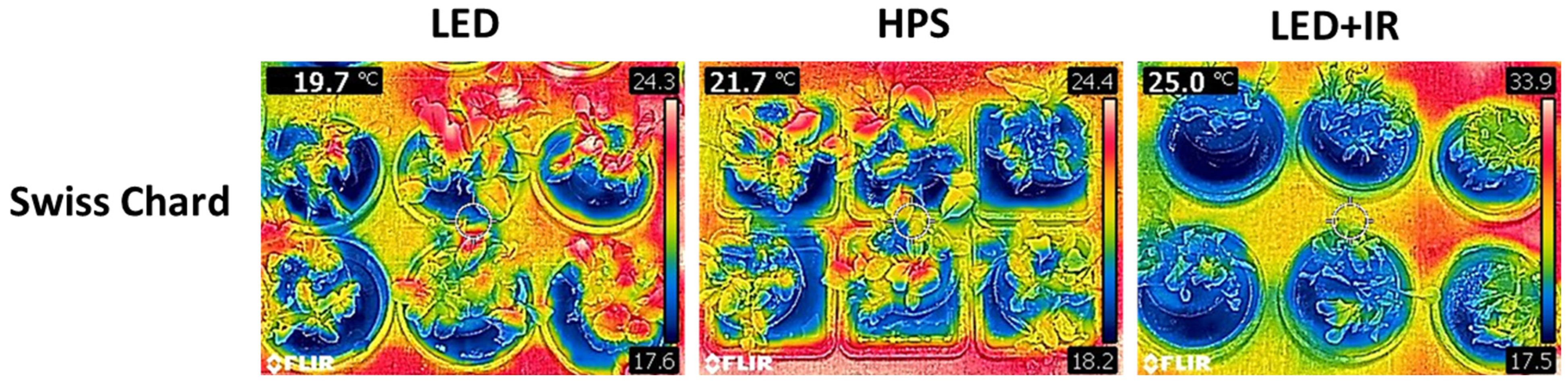
An infrared camera (FLIR C2) was used to take thermal images during the peak hours when stomatal conductance is stable (11 a.m. and 2 p.m.), about 120 cm from the plants. The device was left in the greenhouse for two hours to adjust to the ambient temperature [17]. The temperatures of the leaves, vase, and bench under various light treatments were assessed using ten random points. The FLIR tools software image was used to evaluate the images, as shown in Figure 1. Additionally, an infrared thermometer was used to measure the temperatures of the bench, pots, leaves, and soil under the HPS, LED, and LED + IR treatments at ten randomly selected points.

2.3. Destructive Analyses

2.3.1. Total Chlorophyll and Carotenoids Concentration

Five mm diameter leaf disc samples (30 mg FW) from each treatment were submerged in 5 mL of 99.9% methanol (v/v) (HPLC grade; Sigma-Aldrich, St. Louis, MO, USA) and kept at 4 °C for 24 h in a dark room to extract chlorophylls and carotenoids. Lichtenthaler’s formula was used to determine the pigment levels based on absorbance measurements of total carotenoids at 470 nm and chlorophylls at 665.2 and 652.4 nm. Measurements were performed on three biological replicates, and pigment concentrations are expressed as µg g−1 FW [18].

2.3.2. Phenolic Index and Total Betacyanin Concentration

For each treatment, leaf disc samples (5 mm diameter, 30 mg FW) were used to measure total phenols (expressed as Abs320 nm g−1 FW) and betacyanins (expressed as betains). The leaf samples were stored for 24 h at 4 °C in a tube with 3 mL of methanol that was previously acidified with hydrochloric acid (1% v/v) (37%, ACS Reagent Grade; Sigma-Aldrich, St. Louis, MO, USA). A spectrophotometer was used to detect absorbance at 320 nm for total phenols and 535 nm for betacyanins. The concentration of total betacyanins was determined using the Beer-Lambert equation and expressed as mg Betanin equivalents per 100 g of FW, with a molecular weight (MW) of 550.47 g/mol and a molar extinction coefficient (ε) of 6.5 × 10² L M−1 cm−1 [19,20]. The analysis was carried out in biological triplicate.

2.3.3. Total Sugars Concentration

Distilled water (5 mL) was used to grind about one gram of leaves. The extract was centrifuged at 4000 rpm for 15 min at room temperature using an ALC centrifuge (model PK130R). The supernatant was collected and used for the colorimetric measurement of sugars and nitrate. Following that, the extract’s total sugars were calculated using a slightly modified version of the anthrone method. The extract was combined with the produced anthrone reagent (98% Reagent Grade; Sigma-Aldrich, St. Louis, MO, USA), heated, and then cooled. A standard glucose solution was used for calibration, and measurements were taken at 620 nm. A glucose standard solution was used to create the calibration curve (0–4 mM) [21]. The analysis was carried out in biological triplicate.

2.3.4. Nitrate Concentration

A 20 µL aliquot of the extract was mixed with 80 µL of 5% (w/v) salicylic acid prepared (ACS Reagent Grade; Fisher Chemical, Thermo Fisher Scientific, Waltham, MA, USA) in concentrated H2SO4 (98%, TraceMetal Grade; Fisher Chemical, Thermo Fisher Scientific, Waltham, MA, USA). Subsequently, 3 mL of 1.5 N NaOH was added, and the mixture was allowed to cool to room temperature. Absorbance was then measured at 410 nm, and nitrate concentration was determined using a KNO3 calibration curve (0–10 mM) (ACS Reagent Grade; Sigma-Aldrich, St. Louis, MO, USA). Results were expressed as mg NO3 kg−1 fresh weight (FW) [22]. All analyses were performed in biological triplicate.

2.3.5. Thiobarbituric Acid Reactive Substances (Tbars)

Lipid peroxidation levels were assessed by using thiobarbituric acid reactive substances (TBARS) [23].
After homogenising one gram of leaf tissue with five millilitres of 0.1% (w/v) trichloroacetic acid (TCA) (ACS Reagent Grade; Sigma-Aldrich, St. Louis, MO, USA), it was centrifuged at 4500 rpm for ten minutes at room temperature using an ALC centrifuge model PK130R. 1 mL of the supernatant, 4 mL of 20% (w/v) TCA, and 25 µL of 0.5% thiobarbituric acid (TBA) (Sigma-Aldrich, St. Louis, MO, USA) were mixed together for the TBARS assay, which was then incubated for 30 min at 95 °C in a water bath. The samples were cooled on ice before being centrifuged for 10 min at 4000 rpm to measure the optical density at 532 and 600 nm. Using the Lambert-Beer law and an extinction coefficient of εM = 155 mM−1 cm−1, the concentration of TBARS was determined by subtracting the absorbance at 600 nm from the absorbance at 532 nm.
Analysis was conducted in biological triplicate.
All spectrophotometric measurements were performed using an Evolution 300 UV–Vis spectrophotometer (Thermo Scientific, Waltham, MA, USA).

2.4. Fresh Mass and Water Content

Fresh mass (g) was determined by harvesting and weighing the entire Swiss chard plant from each pot under each lighting treatment. Water content (%) was estimated by oven-drying three plants per treatment at 105 °C for five days (to constant weight) and then recording the dry weight (DW), and the water loss (WL%) was calculated as follows:
Water Content % = ((FW − DW)/FW) × 100

2.5. Statistical Analysis

Data are presented as mean ± standard error (SE). The experimental unit was the individual plant (one plant per pot). For non-destructive variables measured weekly on the same plants (e.g., MPM-100 indices, chlorophyll fluorescence parameters, and temperature measurements), repeated observations were not treated as independent replicates. For each sampling date, multiple readings taken on the same plant (e.g., 10 points for thermal measurements and replicate sensor readings for optical/fluorescence traits) were averaged to obtain one value per plant per week. Weekly values were then averaged across the 5-week experimental period to generate a single plant-level mean for each variable. These plant-level means (n = 6 plants per treatment) were analyzed using one-way ANOVA with lighting treatment (LED, HPS, LED + IR) as the fixed factor, followed by Tukey’s HSD test for mean separation (α = 0.05). Destructive measurements collected at harvest were performed on three biological replicates per treatment (n = 3 plants) and were analyzed similarly using one-way ANOVA followed by Tukey’s HSD (α = 0.05). All analyses were conducted using GraphPad Prism version 8 (GraphPad Software, La Jolla, CA, USA)

3. Results

3.1. In Vivo Analyses

3.1.1. Chlorophyll Content, Flavanols, Relative Betacyanin Index, Nitrogen Flavanol Index, and Chlorophyll A Fluorescence

The supplemental lighting treatments significantly affected the in vivo estimation of certain leaf pigments (Table 1). The chlorophyll index was significantly higher under both the LED and LED + IR regimes compared to HPS. Conversely, the HPS treatment resulted in the highest Betacyanin index. In contrast, the indices for flavanols and nitrogen status (NFI) did not differ significantly among the treatments.
An analysis of chlorophyll fluorescence parameter revealed the apparent health of the core photosynthetic machinery (Table 2). The maximum quantum efficiency of Photosystem II (Fv/Fm) remained high and did not differ significantly among treatments, with all mean values exceeding 0.81. However, the Performance Index (PI), which integrates the efficiency of the entire photosynthetic electron transport chain, was significantly affected. The LED + IR treatment showed the highest PI value, indicating a higher overall photosynthetic performance according to the JIP-test index, while Fv/Fm remained unchanged among treatments. The other measured parameters, including the time to reach maximum fluorescence (Tfm) and the dissipation of energy per reaction center (DIo/RC), did not show significant variation among the treatments.

3.1.2. Temperature Monitoring by Infrared and Thermal Camera

The supplemental lighting treatments created distinct thermal microclimates. The LED + IR treatment resulted in significantly higher temperatures for the leaves, pot, soil, and bench surfaces compared to the other two regimes. This significant warming effect was consistently confirmed by measurements from both a thermal camera and a handheld infrared thermometer. In contrast, the thermal environments under the LED and HPS treatments were not significantly different from each other for any of the measured surfaces as represented in Table 3.

3.2. Destructive Analyses

3.2.1. Total Chlorophyll and Carotenoid Concentrations

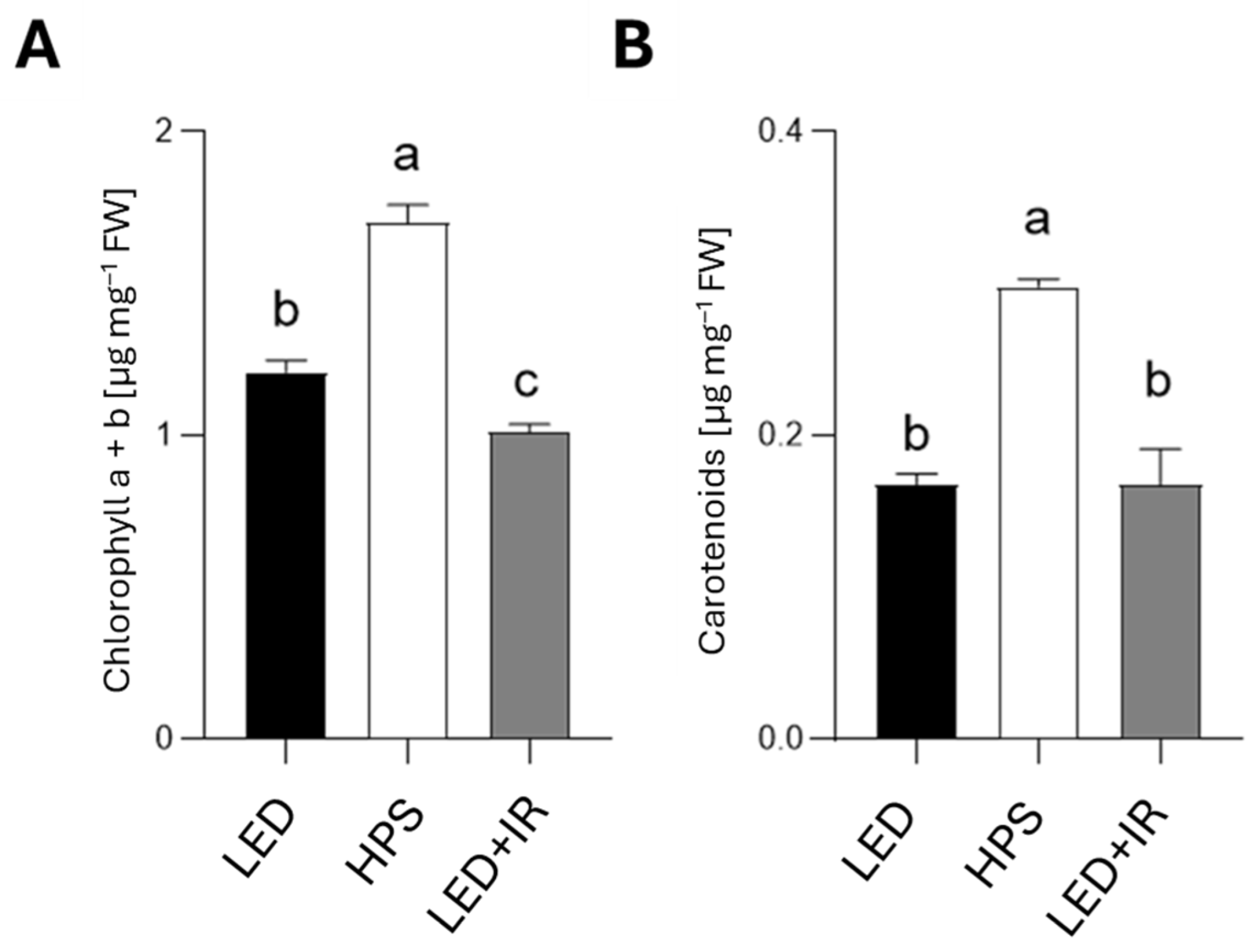
The supplemental lighting treatments had a significant impact on the concentration of photosynthetic pigments. The LED + IR resulted in a marked decrease in the content of total chlorophylls (a + b), whereas the levels of carotenoids did not differ from LED regimes (Figure 2A,B). HPS treatment showed higher concentrations of both chlorophyll and carotenoids.

3.2.2. Phenolic Index and Total Betacyanins Concentrations

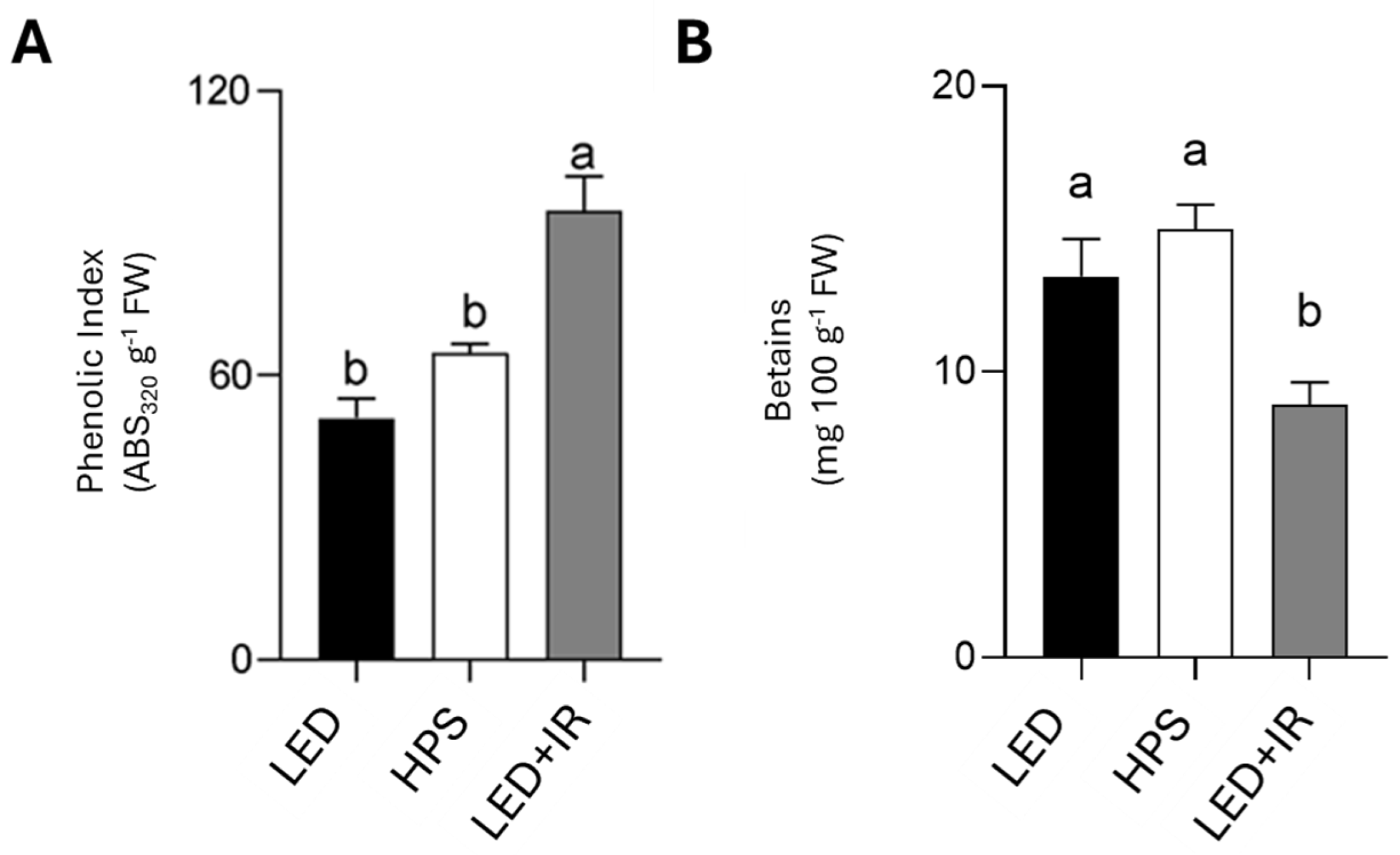
The supplemental lighting treatments had distinct effects on the accumulation of phenolic compounds. The total phenolic index did not differ significantly between the HPS and LED but was significantly increased under the LED + IR treatment (Figure 3A). In contrast, an opposing trend was observed for betacyanin. While their concentration did not differ between the HPS and LED treatments, it was significantly lower in plants exposed to the LED + IR (Figure 3B).

3.2.3. Total Sugars, Nitrates and TBARS

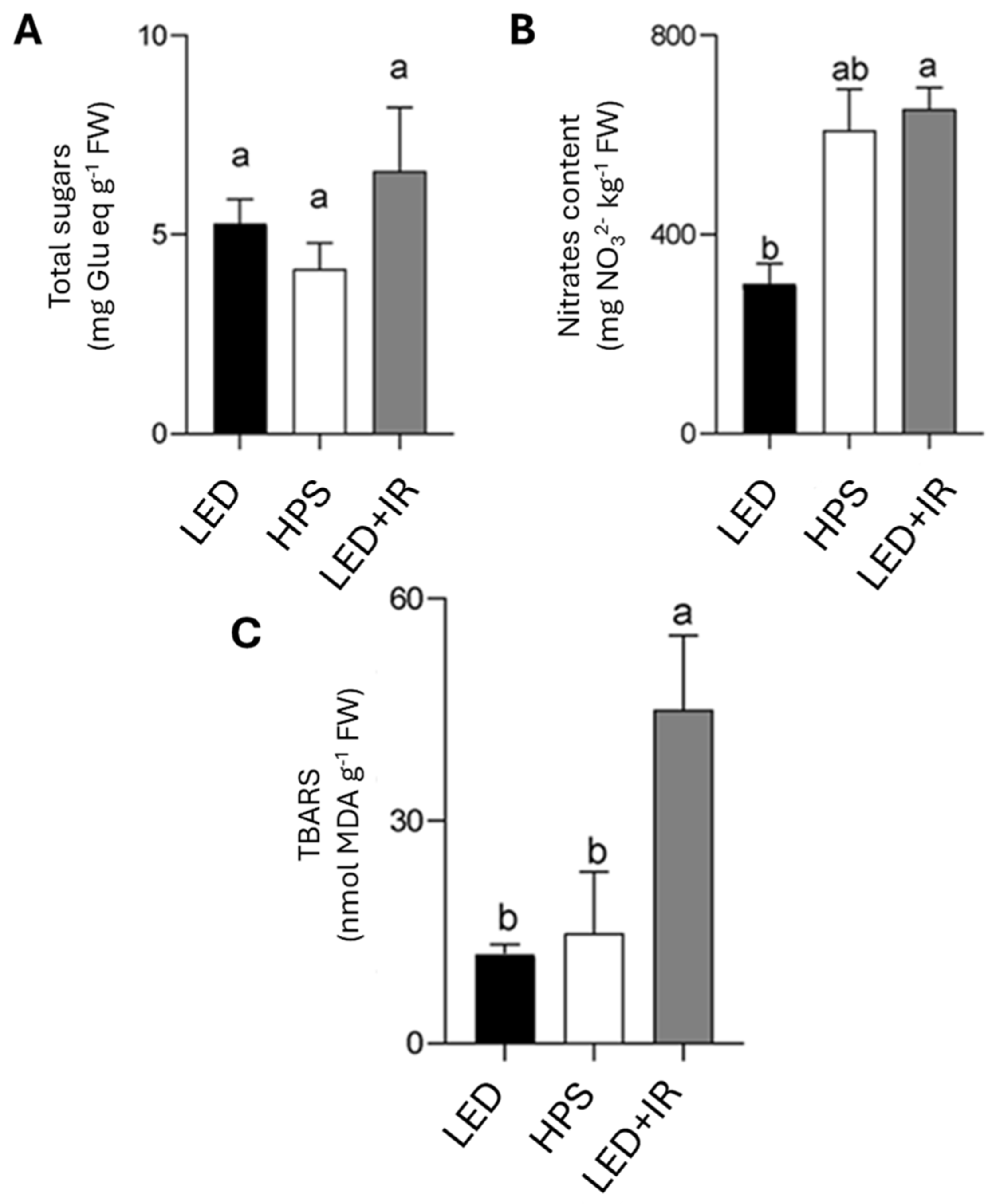
Total sugar content did not significantly differ among the supplemental lighting treatments (Figure 4A). In contrast, leaf nitrate concentration was significantly affected. Both HPS and LED + IR treatments induced higher nitrate levels compared to the LED treatment. The LED + IR resulted in the highest accumulation, following the order: LED + IR > HPS > LED (Figure 4B). Indicators of oxidative stress also varied; while lipid peroxidation (TBARS) levels did not differ between the HPS and LED regimes, they were significantly enhanced under the LED + IR treatment (Figure 4C).

3.2.4. Fresh Mass and Water Content

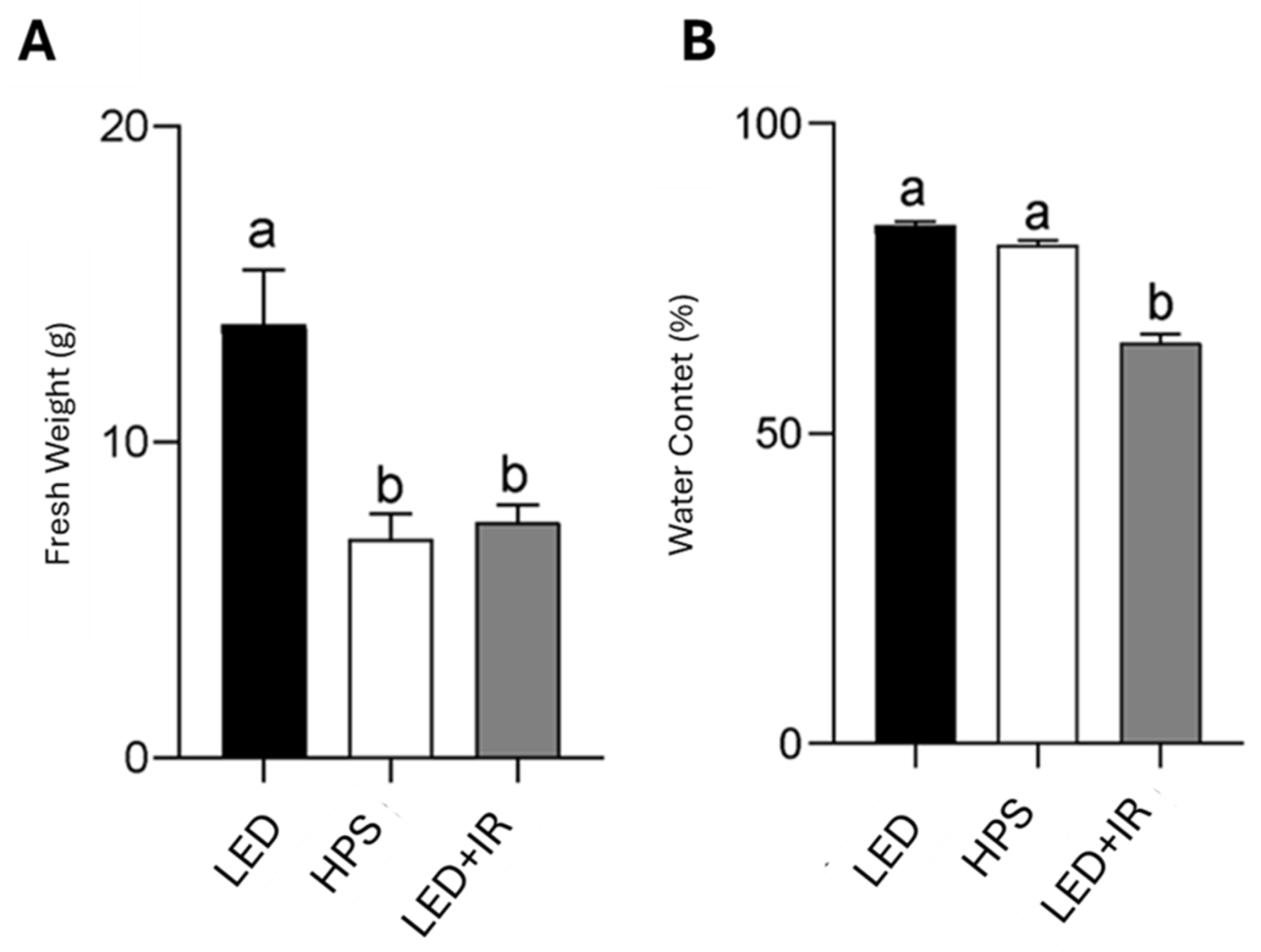
The supplemental lighting treatment significantly influenced total fresh mass production (Figure 5A). Plants grown under the LED produced the highest fresh mass, significantly outperforming those under HPS and LED + IR. Fresh mass did not significantly differ between the HPS and LED + IR treatments. Plant water content was also affected; the LED + IR treatment caused a significant decrease in water content, whereas no difference was observed between the LED and HPS treatments (Figure 5B).

4. Discussion

Swiss chard is a globally important leafy vegetable, valued for its nutritional content and agricultural adaptability. Optimizing its production in controlled environments is crucial for ensuring a consistent, high-quality supply. This study investigated how supplemental lighting regimes, conventional high-pressure sodium (HPS), light-emitting diodes (LED), and a novel LED plus infrared (LED + IR) combination, influence the physiological and phytochemical characteristics of Swiss chard, revealing significant trade-offs between growth, physiology, and nutritional quality. It should be noted that this study compared three practical lighting regimes and did not include temperature-matched controls (e.g., LED plus convective heating) or spectrum-matched heating controls. Therefore, treatment responses are interpreted as integrated effects of each lighting system (spectral composition and associated thermal microclimate), rather than fully independent spectral versus temperature effects.

4.1. Photosynthetic Apparatus Under Thermal and Spectral Variation

The stability of the photosynthetic apparatus is paramount for biomass production. Our results show that at the final harvest, the LED + IR treatment significantly reduced the concentration of chlorophylls. This degradation is a response consistent with increased leaf warming, recorded under the IR lamps. The reduction is particularly notable as it occurred despite the proportion of blue light in the LED spectrum, a wavelength known to strongly promote chlorophyll synthesis [24,25]. This suggests that the negative impact of elevated leaf temperature was potent enough to override the normally beneficial effects of the spectral quality. Supra-optimal temperatures can damage chloroplast thylakoid membranes and trigger degradative enzymes like chlorophyllase, a photo-protective mechanism to reduce light absorption under stress [26,27].
This interplay between the stimulatory effect of the light spectrum and the degradative effect of heat stress also helps explain the apparent contradiction with the in vivo chlorophyll index, which was paradoxically higher under LED + IR. This discrepancy likely arises from the difference between what the two methods measure and the plant’s anatomical response to stress. The destructive analysis quantifies chlorophyll concentration per unit mass, whereas the optical sensor provides an index more closely related to content per unit area (µg cm−2). Plants exposed to elevated leaf temperature may develop more compact leaves (e.g., reduced specific leaf area and/or increased thickness) as a protective response [28,29]. Therefore, while the chlorophyll concentration within the tissue decreased, possible increases in leaf density and thickness could have maintained or even increased the total chlorophyll content per unit area, resulting in a high reading from the optical meter; however, leaf thickness and specific leaf area were not measured in this study. The chlorophyll fluorescence data provided additional insight into treatment effects. The maximum quantum efficiency of PSII (Fv/Fm) remained relatively stable, indicating no chronic photoinhibition, while the PI was higher under LED + IR. In contrast, DIo/RC did not differ significantly among treatments, suggesting that energy dissipation per reaction center was not detectably altered under our conditions. When considered together with the elevated leaf temperature, reduced pigment concentrations at harvest, and higher TBARS, the results indicate that the LED + IR regime imposed a stronger thermal/oxidative stress despite the relatively stable PSII maximum efficiency [30].

4.2. Targeted Induction and Re-Routing of Secondary Metabolites

A central hypothesis of this study was that the additional radiant heat load provided by IR could stimulate secondary metabolism. This was strongly confirmed by the significant increase in the total phenolic index under the LED + IR treatment. This finding is consistent with the well-established role of the phenylpropanoid pathway as a primary defense route activated by abiotic stressors like heat [31]. However, our results revealed a more complex picture than simple induction. While total phenolics increased, total betacyanin content was significantly reduced under LED + IR (Figure 3B). This finding is consistent with the known heat lability of betalain pigments. Unlike the more stable phenolic compounds, betalains are particularly susceptible to degradation by high temperatures through processes like hydrolysis and decarboxylation, which lead to loss of colour and antioxidant capacity [30,32]. The significantly elevated leaf temperatures in the LED + IR treatment (Table 3) likely accelerated this degradation, overwhelming any potential biosynthetic upregulation. Therefore, the low betacyanin level under the LED + IR is the net result of heat-induced degradation exceeding synthesis. In contrast, the HPS treatment resulted in the highest in vivo Relative Betacyanin Index (Table 1) and a high final concentration, suggesting its spectral output may be more favourable for betacyanin accumulation in the absence of extreme thermal stress [33,34].

4.3. Primary Metabolites, Oxidative Stress, and Food Quality

The analysis of primary metabolites and stress indicators revealed critical effects on crop quality. The significant increase in leaf nitrate concentration under both HPS and, most prominently, LED + IR is a key finding with direct implications for food safety. High nitrate accumulation in leafy greens is undesirable and often signals a disruption in nitrogen metabolism [35]. The increased nitrate concentration under LED + IR (and HPS) may reflect reduced nitrate assimilation (e.g., lower nitrate reductase activity) under the treatment-specific thermal and spectral conditions; however, nitrate reductase activity was not measured in this study [36]. The LED treatment, resulting in the lowest nitrate levels, proved superior from a food quality perspective. The lack of change in total sugar content across treatments is expected for a leafy crop, where sugars are rapidly consumed for vegetative growth rather than stored.
Furthermore, the elevated levels of TBARS in the LED + IR treatment provide direct biochemical evidence of oxidative stress. The heat load induced an overproduction of reactive oxygen species that led to lipid peroxidation and cell membrane damage [37]. This cellular damage is a key factor explaining the reduced growth observed in this treatment.

4.4. The Growth-Defense Trade-Off: Biomass vs. Biofortification

The fresh biomass data clearly illustrates the classic “growth-defense trade-off.” The LED treatment produced the highest fresh mass, demonstrating its superiority for maximizing yield in the absence of stressors, a result consistent with findings in other leafy greens like lettuce [38]. Conversely, the LED + IR treatment, which induced the strongest defense response (high phenolics, high TBARS), resulted in significantly lower fresh mass. The significantly lower water content in these plants, coupled with the elevated TBARS, points to severe temperature-induced water stress and impaired physiological function. This link between heat stress, oxidative damage, and reduced growth is a well-established phenomenon observed across numerous research findings [39,40,41]. These results demonstrate a clear reallocation of resources, where plants under LED + IR diverted energy from vegetative growth towards the synthesis of protective compounds and the repair of cellular damage. This outcome is fundamentally different from what is observed in a fruiting crop like tomato, where moderate heat can accelerate development [38]. For a leafy green like Swiss chard, where the leaves are the final product, any stress that impairs leaf health and integrity directly compromises marketable yield [42].
Thus, CEA, including closed-type plant factories and vertical farms, enables year-round cultivation by allowing precise regulation of environmental drivers, particularly light. The increasing adoption of light-emitting diodes has strengthened CEA as a platform for optimizing plant morphology, photosynthetic performance, and nutraceutical quality through tailored spectral “recipes,” as supported by recent studies on artificial lighting strategies in controlled systems [43,44]. Accordingly, integrating rapid, non-destructive diagnostic tools such as chlorophyll fluorescence and remote-sensing vegetation indices provide a robust framework to quantify spectrum-driven physiological responses and to guide lighting-based quality optimization in CEA.

5. Conclusions

This study demonstrates that the choice of supplemental lighting has profound and divergent effects on Swiss chard production, revealing a clear yield–quality trade-off. LED lighting was the most effective strategy to maximize fresh mass while maintaining the lowest nitrate concentration, making it the most suitable option for commercial production systems prioritizing marketable yield and food safety. HPS lighting served as a conventional reference, resulting in intermediate growth but higher nitrate accumulation than LED. The LED + IR treatment functioned as a strong biofortification stimulus by significantly increasing the phenolic index; however, this improvement in nutraceutical-related traits occurred alongside reduced biomass and clear signs of stress, including elevated TBARS and increased nitrate accumulation. Therefore, while LED + IR may be of interest for specialized or premium markets where enhanced phenolic content can justify potential yield penalties and added operating costs, LED alone represents the most practical choice for standard production focused on high yield and low nitrate content. A comprehensive economic assessment (including energy inputs, potential price premiums for biofortified produce, and compliance with nitrate-related quality thresholds) was beyond the scope of this study and warrants future investigation.

Supplementary Materials

The following supporting information can be downloaded at: https://www.mdpi.com/article/10.3390/horticulturae12040457/s1, Figure S1. Lighting distributions of the luminaires (a) LED and (b) HPS; Figure S2. Spectral compositions of the artificial light sources used in experiment (a) LED (b) HPS; Figure S3. The heatmap of infrared at ambient temperature of 20 °C, relative humidity 48% with no airstreams.

Author Contributions

Conceptualization, A.A., and V.C.; methodology, A.A., and V.C.; data curation, A.A., and V.C.; writing—original draft preparation, A.A., and V.C.; Resources, P.S., and J.M.; writing—review and editing, G.C.; project administration, G.C. All authors have read and agreed to the published version of the manuscript.

Funding

The research received no external funding.

Data Availability Statement

The original contributions presented in this study are included in the article. Further inquiries can be directed to the corresponding author.

Acknowledgments

During the preparation of this manuscript, the authors used QuillBot (Free Version; QuillBot Inc., Chicago, IL, USA) and ChatGPT (OpenAI; 5.2, San Francisco, CA, USA) to assist with language refinement and literature exploration during manuscript preparation. The authors have reviewed and edited the output and take full responsibility for the content of this publication.

Conflicts of Interest

The author, Piero Santoro, is employed by the company MEG Science and Jacopo Mori is employed by the company ALMECO. The remaining authors declare no conflicts of interest.

References

  1. Boutiti, K.; Ali, A.; Bellil, I.; Khelifi, D. Morpho-Biochemical Evaluation and Biodiversity Assessment of Multi-Origin Apricot Cultivars in Algeria. Kuwait J. Sci. 2025, 52, 100463. [Google Scholar] [CrossRef]
  2. Benke, K.; Tomkins, B. Future Food-Production Systems: Vertical Farming and Controlled-Environment Agriculture. Sustain. Sci. Pract. Policy 2017, 13, 13–26. [Google Scholar] [CrossRef]
  3. Hemming, S.; de Zwart, F.; Elings, A.; Righini, I.; Petropoulou, A. Remote Control of Greenhouse Vegetable Production with Artificial Intelligence—Greenhouse Climate, Irrigation, and Crop Production. Sensors 2019, 19, 1807. [Google Scholar] [CrossRef] [PubMed]
  4. Koukounaras, A. Advanced Greenhouse Horticulture: New Technologies and Cultivation Practices. Horticulturae 2020, 7, 1. [Google Scholar] [CrossRef]
  5. Nemali, K. History of Controlled Environment Horticulture: Greenhouses. HortScience 2022, 57, 239–246. [Google Scholar] [CrossRef]
  6. Paradiso, R.; Proietti, S. Light-Quality Manipulation to Control Plant Growth and Photomorphogenesis in Greenhouse Horticulture: The State of the Art and the Opportunities of Modern LED Systems. J. Plant Growth Regul. 2022, 41, 742–780. [Google Scholar] [CrossRef]
  7. Kuijpers, W.J.; Katzin, D.; van Mourik, S.; Antunes, D.J.; Hemming, S.; van de Molengraft, M.J. Lighting Systems and Strategies Compared in an Optimally Controlled Greenhouse. Biosyst. Eng. 2021, 202, 195–216. [Google Scholar] [CrossRef]
  8. Lazzarin, M.; Meisenburg, M.; Meijer, D.; van Ieperen, W.; Marcelis, L.F.M.; Kappers, I.F.; Dicke, M. LEDs Make It Resilient: Effects on Plant Growth and Defense. Trends Plant Sci. 2021, 26, 496–508. [Google Scholar] [CrossRef]
  9. Pattison, P.M.; Tsao, J.Y.; Brainard, G.C.; Bugbee, B. LEDs for Photons, Physiology and Food. Nature 2018, 563, 493–500. [Google Scholar] [CrossRef] [PubMed]
  10. Kavga, A.; Konstas, I.; Panidis, T. Assessment of Infrared Heating Benefits in a Production Greenhouse. Appl. Eng. Agric. 2015, 31, 143–151. [Google Scholar]
  11. Nawalany, G.; Sokołowski, P. Impact of Selected Technical Soil Parameters on the Greenhouse Energy Management. J. Ecol. Eng. 2019, 20, 245–252. [Google Scholar] [CrossRef]
  12. Galewski, P.; McGrath, J.M. Genetic Diversity among Cultivated Beets (Beta vulgaris) Assessed via Population-Based Whole Genome Sequences. BMC Genom. 2020, 21, 189. [Google Scholar] [CrossRef]
  13. Ninfali, P.; Angelino, D. Nutritional and functional potential of Beta vulgaris cicla and rubra. Fitoterapia 2013, 89, 188–199. [Google Scholar] [CrossRef]
  14. Fiedor, J.; Burda, K. Potential role of carotenoids as antioxidants in human health and disease. Nutrients 2014, 6, 466–488. [Google Scholar] [CrossRef]
  15. Ivanović, L.; Milašević, I.; Topalović, A.; Ðurović, D.; Mugoša, B.; Knežević, M.; Vrvić, M. Nutritional and phytochemical content of Swiss chard from Montenegro, under different fertilization and irrigation treatments. Br. Food J. 2018, 121, 411–425. [Google Scholar]
  16. Franzoni, G.; Guffanti, D.; Ferrante, A.; Cejudo-Bastante, M.J.; Rodríguez-Pulido, F.J.; Gordillo, B.; Cocetta, G. Evaluation of Swiss Chard (Beta vulgaris L. ssp. cicla) Physiological and Qualitative Responses to Water Deficit and Salicylic Acid Treatment. J. Agric. Food Res. 2024, 18, 101524. [Google Scholar] [CrossRef]
  17. James, R.A.; Sirault, X.R. Infrared Thermography in Plant Phenotyping for Salinity Tolerance. In Plant Salt Tolerance: Methods and Protocols; Shabala, S., Cuin, T.A., Eds.; Humana Press: Totowa, NJ, USA, 2012; pp. 173–189. [Google Scholar]
  18. Lichtenthaler, H.K. Chlorophylls and Carotenoids: Pigments of Photosynthetic Biomembranes. In Methods in Enzymology; Packer, L., Douce, R., Eds.; Academic Press: San Diego, CA, USA; Elsevier: Amsterdam, The Netherlands, 1987; Volume 148, pp. 350–382. [Google Scholar]
  19. Ke, D.; Saltveit, M.E., Jr. Wound-Induced Ethylene Production, Phenolic Metabolism and Susceptibility to Russet Spotting in Iceberg Lettuce. Physiol. Plant. 1989, 76, 412–418. [Google Scholar] [CrossRef]
  20. Glitz, C.; Dyekjær, J.D.; Solimando, G.M.C.; Avila Neto, P.M.; Rago, D.; Babaei, M.; Borodina, I. Recombinant production of amaranthin and other betalain variants with yeast cell factories. Synth. Syst. Biotechnol. 2025, 10, 1127–1139. [Google Scholar] [CrossRef] [PubMed]
  21. Yemm, E.W.; Willis, A.J. The Estimation of Carbohydrates in Plant Extracts by Anthrone. Biochem. J. 1954, 57, 508–514. [Google Scholar] [CrossRef] [PubMed]
  22. Cataldo, D.A.; Maroon, M.; Schrader, L.E.; Youngs, V.L. Rapid Colorimetric Determination of Nitrate in Plant Tissue by Nitration of Salicylic Acid. Commun. Soil Sci. Plant Anal. 1975, 6, 71–80. [Google Scholar] [CrossRef]
  23. Heath, R.L.; Packer, L. Photoperoxidation in Isolated Chloroplasts: I. Kinetics and Stoichiometry of Fatty Acid Peroxidation. Arch. Biochem. Biophys. 1968, 125, 189–198. [Google Scholar] [CrossRef]
  24. Ali, A.; Jeong, S.J.; Zhen, S.; Cocetta, G.; Masabni, J.; Niu, G. Blue Light Modulates the Interactive Effects of Far-Red Light and Day–Night Temperature Difference on the Growth, Morphology and Physiology of Arugula and Lettuce. Front. Plant Sci. 2025, 16, 1721040. [Google Scholar] [CrossRef]
  25. Hogewoning, S.W.; Trouwborst, G.; Maljaars, H.; Poorter, H.; van Ieperen, W.; Harbinson, J. Blue Light Dose–Responses of Leaf Photosynthesis, Morphology, and Chemical Composition of Cucumis sativus Grown under Different Combinations of Red and Blue Light. J. Exp. Bot. 2010, 61, 3107–3117. [Google Scholar] [CrossRef]
  26. Camejo, D.; Rodríguez, P.; Morales, M.A.; Dell’Amico, J.M.; Torrecillas, A.; Alarcón, J.J. High Temperature Effects on Photosynthetic Activity of Two Tomato Cultivars with Different Heat Susceptibility. J. Plant Physiol. 2005, 162, 281–289. [Google Scholar] [CrossRef]
  27. Shin, Y.K.; Bhandari, S.R.; Cho, M.C.; Lee, J.G. Evaluation of Chlorophyll Fluorescence Parameters and Proline Content in Tomato Seedlings Grown under Different Salt Stress Conditions. Hortic. Environ. Biotechnol. 2020, 61, 433–443. [Google Scholar] [CrossRef]
  28. Salem-Fnayou, A.B.; Bouamama, B.; Ghorbel, A.; Mliki, A. Investigations on the Leaf Anatomy and Ultrastructure of Grapevine (Vitis vinifera) under Heat Stress. Microsc. Res. Tech. 2011, 74, 756–762. [Google Scholar] [CrossRef]
  29. Ali, A. Basic and Applied Research Approaches for Optimizing the Use of Artificial Light in Vegetable Crops. Doctoral Dissertation, University of Milan, Milan, Italy, 2024. [Google Scholar]
  30. Muramatsu, D.; Uchiyama, H.; Higashi, H.; Kida, H.; Iwai, A. Effects of Heat Degradation of Betanin in Red Beetroot (Beta vulgaris L.) on Biological Activity and Antioxidant Capacity. PLoS ONE 2023, 18, e0286255. [Google Scholar] [CrossRef]
  31. Baenas, N.; Iniesta, C.; González-Barrio, R.; Nuñez-Gómez, V.; Periago, M.J.; García-Alonso, F.J. Post-Harvest Use of Ultraviolet Light (UV) and Light Emitting Diode (LED) to Enhance Bioactive Compounds in Refrigerated Tomatoes. Molecules 2021, 26, 1847. [Google Scholar] [CrossRef]
  32. Lombardelli, C.; Benucci, I.; Mazzocchi, C.; Esti, M. Betalain Extracts from Beetroot as Food Colorants: Effect of Temperature and UV-Light on Storability. Plant Foods Hum. Nutr. 2021, 76, 347–353. [Google Scholar] [CrossRef] [PubMed]
  33. Kumar, S.; Hui, J.; Zhang, J.; Brooks, M.S.L. Complexation of Pea Protein Isolate and Betanin in Red Beet Extract (Beta vulgaris L.): Effect of pH and Temperature on Stability. Food Chem. Adv. 2026, 10, 101197. [Google Scholar] [CrossRef]
  34. Barba-Espin, G.; Glied-Olsen, S.; Dzhanfezova, T.; Joernsgaard, B.; Lütken, H.; Müller, R. Preharvest Application of Ethephon and Postharvest UV-B Radiation Improve Quality Traits of Beetroot (Beta vulgaris L. ssp. vulgaris) as Source of Colourant. BMC Plant Biol. 2018, 18, 316. [Google Scholar] [CrossRef] [PubMed]
  35. Ali, A.; Santoro, P.; Ferrante, A.; Cocetta, G. Continuous and Pulsed LED Applications on Red and Green Lettuce (Lactuca sativa L. var. capitata) for Pre- and Post-Harvest Quality and Energy Cost Assessments. Sci. Hortic. 2024, 338, 113785. [Google Scholar] [CrossRef]
  36. Santamaria, P.; Elia, A.; Serio, F.; Todaro, E. A Survey of Nitrate and Oxalate Content in Fresh Vegetables. J. Sci. Food Agric. 1999, 79, 1882–1888. [Google Scholar] [CrossRef]
  37. Larkindale, J.; Knight, M.R. Protection against Heat Stress-Induced Oxidative Damage in Arabidopsis Involves Calcium, Abscisic Acid, Ethylene, and Salicylic Acid. Plant Physiol. 2002, 128, 682–695. [Google Scholar] [CrossRef]
  38. Ali, A.; Cavallaro, V.; Santoro, P.; Mori, J.; Ferrante, A.; Cocetta, G. Quality and Physiological Evaluation of Tomato Subjected to Different Supplemental Lighting Systems. Sci. Hortic. 2024, 323, 112469. [Google Scholar] [CrossRef]
  39. He, J. Enhancing Productivity and Improving Nutritional Quality of Subtropical and Temperate Leafy Vegetables in Tropical Greenhouses and Indoor Farming Systems. Horticulturae 2024, 10, 306. [Google Scholar] [CrossRef]
  40. Ibrahim, O.R.; He, F.; Thiele, B.; Kraska, T.; Adebooye, O.C.; Schurr, U.; Kuhn, A.J. Temperature Regimes Modulate Growth and Nutritional Quality of Three African Leaf Vegetables. Agronomy 2025, 15, 2057. [Google Scholar] [CrossRef]
  41. Jones, A.; Naroju, S.P.; Nandwani, D.; Witcher, A.; Chowdhury, S. Sustainable Substrate Strategies for Urban Vertical Farming: A Case Study on Organic Leafy Greens. Urban Agric. Reg. Food Syst. 2025, 10, e70034. [Google Scholar] [CrossRef]
  42. Soufi, H.R.; Ali, A.; Shojaee, M. Improving the Growth and Photosynthesis Characteristics of Lettuce Cultivars in the Aeroponic System: With Emphasis on the Use of Supplementary LED Lights and Replacement Methods of the Nutrient Solution. Greenh. Plant Prod. J. 2024, 1, 28–44. [Google Scholar]
  43. Lee, J.H.; Kim, E.A.; Sunwoo, Y.; Cha, E.B.; Joo, S.; Lee, S.; Lee, J.G.; Nam, S.Y. Light Spectrum Strategies to Optimize Yield and Physiological Performance of Korean Thistle (Cirsium setidens (Dunn) Nakai) in a Closed-Type Plant Production System. J. People Plants Environ. 2025, 28, 799–823. [Google Scholar] [CrossRef]
  44. Romero-Muñoz, M.; Fructuoso-Orenes, G.; Gambín-Sánchez, J.M.; Cos-Terrer, J.E.; Pérez-Jiménez, M. Optimizing Adventitious Shoot Regeneration in Peach Cultivar and Hybrid Rootstock Genotypes by LED Light Spectrum Modulation. Horticulturae 2026, 12, 197. [Google Scholar] [CrossRef]
Figure 1. Software FLIR Tools to measure leaf, pot, and bench temperatures from thermal images using ten random points, under each lighting treatment, including HPS, LED and LED + IR.
Horticulturae 12 00457 g001
Figure 2. (A) Chlorophyll a + b and (B) total carotenoids in Swiss chard grown under supplemental LED, HPS, or LED + IR. Values are means ± S.E. (n = 3). Different letters denote significant differences among treatments (one-way ANOVA with Tukey’s test, p < 0.05).
Horticulturae 12 00457 g002
Figure 3. (A) Phenolic index and (B) total betacyanin content of Swiss chard grown under supplemental LED, HPS, or LED + IR. Values are means ± S.E. (n = 3). Bars with different letters differ significantly (Tukey’s post hoc test, p < 0.05).
Horticulturae 12 00457 g003
Figure 4. (A) Total sugars, (B) nitrate concentration, and (C) TBARS in Swiss chard grown under supplemental LED, HPS, or LED + IR. Values are means ± S.E. (n = 3). Bars with different letters differ significantly (Tukey’s post hoc test, p < 0.05).
Horticulturae 12 00457 g004
Figure 5. (A) Fresh weight and (B) water content (%) of Swiss chard grown under supplemental LED, HPS, or LED + IR. Values are means ± S.E. (n = 3). Bars with different letters differ significantly (Tukey’s post hoc test, p < 0.05).
Horticulturae 12 00457 g005
Table 1. In vivo estimation of chlorophyll, flavonols, relative betacyanin index, and the Nitrogen-Flavonol Index (NFI) using MPM-100 Multipigment Meter. Values are the mean of data recorded during the entire experiment (n = 6 ± S.E.). Means sharing different letters are significantly different according to Tukey’s post hoc test (p < 0.05).
Parameters LEDHPSLED + IR
Chlorophyll0.57 ± 0.04 a0.44 ± 0.03 b0.55 ± 0.03 a
Flavonols 0.75 ± 0.050.69 ± 0.030.64 ± 0.03
Betacyanin Index0.11 ± 0.02 b0.23 ± 0.03 a0.14 ± 0.02 b
NFI0.93 ± 0.090.77 ± 0.070.91 ± 0.07
The Relative Betacyanin Index was measured using the meter’s ‘anthocyanin’ setting, which serves as a proxy for red pigment content in Beta vulgaris.
Table 2. The maximum quantum efficiency of photosystem II (Fv/Fm), the performance index (PI), the time intercourse to reach maximum fluorescence (Tfm) in milliseconds (ms), and the dissipation of energy per reaction center (DIo/RC) measured using fluorimeter. Values are the mean of data recorded during the entire experiment (n = 6 ± S.E.). Means sharing different letters are significantly different according to Tukey’s post hoc test (p < 0.05).
Parameters LEDHPSLED + IR
Fv/Fm0.83 ± 0.010.81 ± 0.010.82 ± 0.044
Tfm (ms)396.9 ± 53.1332.5 ± 39.6450 ± 18.9
PI1.5 ± 0.1 b2.1 ± 0.4 ab2.8 ± 0.2 a
DIo/RC0.4 ± 0.020.5 ± 0.040.5 ± 0.03
Table 3. Mean temperature values recorded during the entire experiment by Thermal camera and Infrared thermometer for Bench, Leaves, Pot and Soil under supplemented LED, HPS, and LED + IR (n = 6 ± S.E.). Different letters indicate significant differences among treatments after one-way ANOVA (p < 0.05).
TemperatureThermal CameraInfrared Thermometer
(°C)
LEDHPSLED + IRLEDHPSLED + IR
Bench24.77 ± 0.4 b24.79 ± 0.5 b35.76 ± 1.3 a25.35 ± 0.5 b26.45 ± 0.4 b32.42 ± 1.1 a
Leaves21.50 ± 0.3 b22.51 ± 0.3 b24.78 ± 0.5 a22.12 ± 0.2 b22.63 ± 0.3 b25.06 ± 0.6 a
Pot21.31 ± 0.1 b21.61 ± 0.4 b23.78 ± 0.6 a21.35 ± 0.2 b20.98 ± 0.2 b23.87 ± 0.5 a
Soil ---21.08 ± 0.2 b21.72 ±0.2 b23.79 ± 0.4 a
Disclaimer/Publisher’s Note: The statements, opinions and data contained in all publications are solely those of the individual author(s) and contributor(s) and not of MDPI and/or the editor(s). MDPI and/or the editor(s) disclaim responsibility for any injury to people or property resulting from any ideas, methods, instructions or products referred to in the content.