Brief Report

Pre- and Postharvest Melatonin Treatment: A Comparative Study of Lemon Cultivars on Melatonin and Flavanone Content During Cold Storage

by
Fernando Garrido-Auñón
1,
María Emma García-Pastor
2,
María Serrano
2,
Daniel Valero
1 and
Vicente Agulló
1,*
1
Department of AgroFood Technology, Escuela Politécnica Superior de Orihuela (EPSO), Instituto de Investigación e Innovación Agroalimentario y Agroambiental (CIAGRO), University Miguel Hernández, Ctra. Beniel km. 3.2, 03312 Orihuela, Alicante, Spain
2
Department of Applied Biology, Escuela Politécnica Superior de Orihuela (EPSO), Instituto de Investigación e Innovación Agroalimentario y Agroambiental (CIAGRO), University Miguel Hernández, Ctra. Beniel km. 3.2, 03312 Orihuela, Alicante, Spain
*
Author to whom correspondence should be addressed.
Horticulturae 2026, 12(4), 441; https://doi.org/10.3390/horticulturae12040441
Submission received: 8 February 2026 / Revised: 27 March 2026 / Accepted: 2 April 2026 / Published: 3 April 2026
(This article belongs to the Section Postharvest Biology, Quality, Safety, and Technology)

Abstract

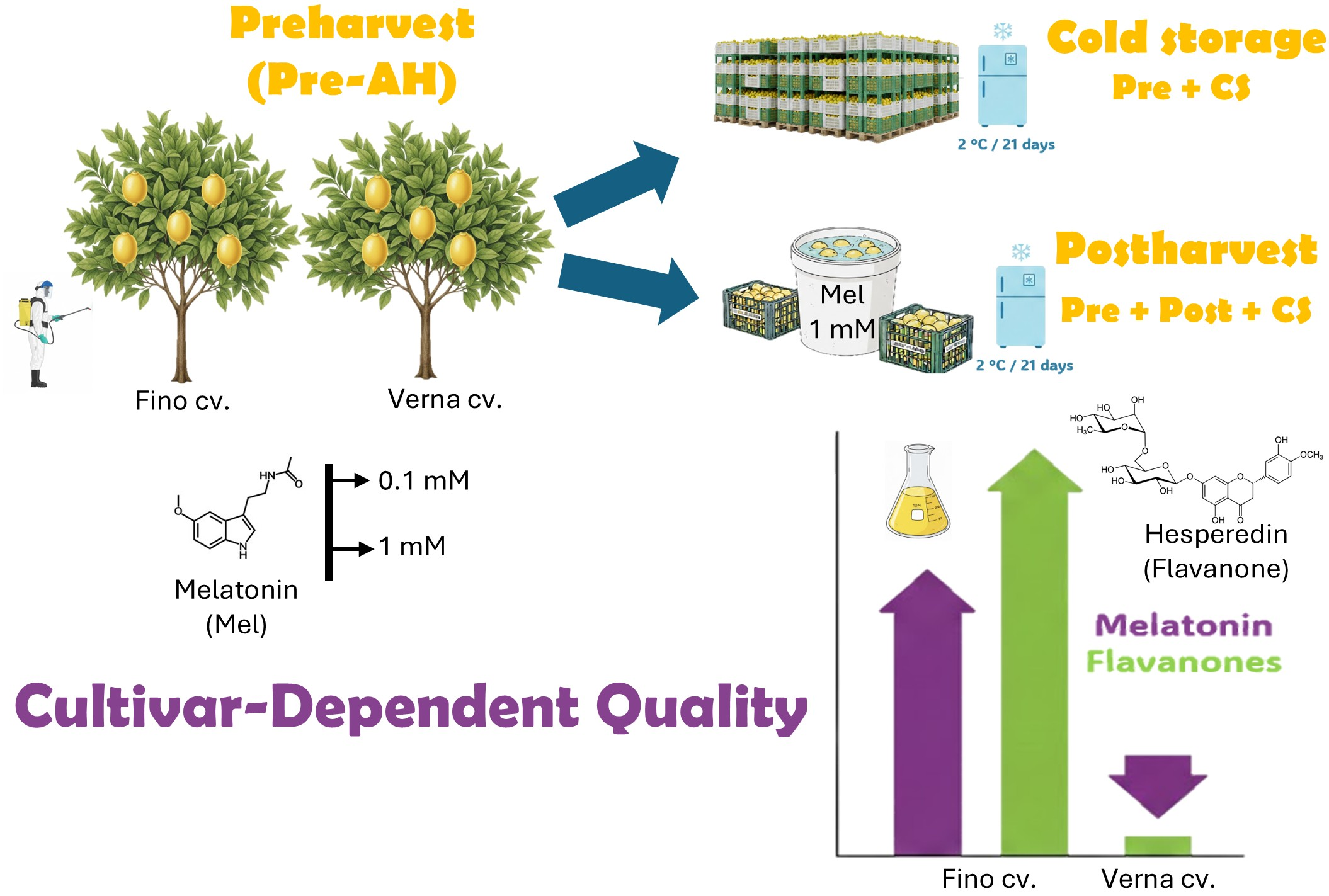
Adverse environmental and postharvest conditions challenge the functional quality of lemons, an economically vital citrus crop. Melatonin (MEL) has emerged as an effective regulator of plant stress responses and secondary metabolism. This study evaluated the effects of pre- and postharvest MEL treatments, combined with cold storage, on the fruit quality of two lemon cultivars (‘Fino’ and ‘Verna’). The research focused specifically on endogenous MEL and flavanone dynamics. Three experimental conditions were assessed: (a) preharvest MEL application at 0.1 and 1 mM; (b) preharvest treatment followed by cold storage; and (c) combined pre- and postharvest MEL treatment followed by cold storage. Preharvest treatments increased endogenous MEL at harvest in a dose- and cultivar-dependent manner. Specifically, 1 mM being optimal for ‘Fino’, while 0.1 mM was more effective for ‘Verna’. During cold storage, ‘Fino’ fruit, characterized by low basal endogenous MEL levels, showed a marked increase in MEL accumulation, suggesting the stimulation of biosynthesis. In contrast, ‘Verna’ fruit, which had initially high endogenous MEL content, exhibited a pronounced decline, indicating MEL consumption to counteract oxidative stress. Flavanone content increased dose-dependently after preharvest treatment and was preserved during storage in ‘Fino’ but declined in ‘Verna’. These findings demonstrate that the fruit cultivar must be considered a critical factor in MEL-based strategies, as identical treatments may yield markedly different outcomes even within the same species.

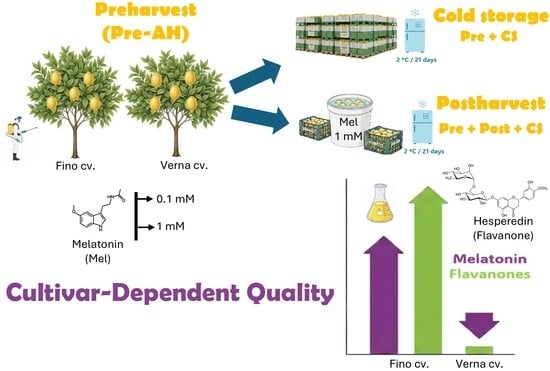
Graphical Abstract

1. Introduction

The lemon (Citrus limon L. Osbeck) belongs to the Rutaceae family, which comprises several economically important fruits within the Citrus genus [1]. Spain is currently the seventh-largest producer of lemons worldwide, with an annual production of 1,148,870 tonnes. National consumption of lemons is projected to rise by around 4.5% during the 2024–2025 season [2,3]. This growing demand highlights the importance of maintaining and enhancing lemon quality.
Lemon quality is defined by parameters such as juiciness, titratable acidity, freshness and bioactive compound content, particularly vitamin C and phenolic compounds. Flavanones are the predominant class of phenolic compounds in lemons and have been widely associated with health-promoting properties due to their antioxidant and anti-inflammatory activities. These compounds have been shown to protect against metabolic disorders, including cardiovascular diseases. For example, hesperidin, the most abundant citrus flavanone, has been reported to have antihypertensive effects [4,5]. Due to these functional attributes, lemons are widely used in the food, beverage, cosmetic and pharmaceutical industries, which further increases their commercial relevance.
However, increasing climatic variability and adverse environmental conditions have been linked to a decline in fruit quality. This is particularly evident regarding the accumulation of bioactive compounds. These challenges have prompted the development of innovative strategies to preserve or enhance the functional quality of lemons, extend their shelf life and improve their marketability. Among these approaches, pre- and postharvest elicitation techniques using compounds such as melatonin (MEL) have gained considerable attention. These treatments stimulate antioxidant defences and secondary metabolism, leading to increased phenolic accumulation [6,7].
In this context, MEL has emerged as a particularly promising elicitor. Beyond its well-known role in regulating circadian rhythms in animals, MEL exhibits multiple health-promoting properties, including immunomodulatory and anti-apoptotic effects. It also acts as a powerful antioxidant, capable of scavenging reactive oxygen species and inducing endogenous antioxidant enzymes [8]. In plants, MEL plays a key role in stress tolerance and metabolic regulation. Its application has been shown to enhance the activity of enzymes such as catalase and ascorbate peroxidase. This reduces oxidative damage in crops like sweet cherries, where MEL elicitation effectively lowered hydrogen peroxide accumulation [9].
More recently, the effectiveness of combined pre- and postharvest MEL treatments with cold storage has been evaluated in citrus fruits. Studies on ‘Fino’ lemons and blood oranges demonstrated improvements in functional quality through the increased accumulation of endogenous MEL and polyphenols, such as flavanones and anthocyanins. This is likely to be mediated by the activation of MEL-related biosynthetic genes [10,11]. These MEL-related genes have also been shown to be involved in flavonoid synthesis in other fruit species, such as limes (Citrus aurantifolia Swingle) and kiwifruit [12,13]. However, the magnitude and direction of these responses depend strongly on factors such as the dose of MEL and the citrus species or cultivar.
Based on these considerations, the present study aimed to evaluate, for the first time, the effects of pre- and postharvest MEL treatments, also combined with cold storage, on lemon fruit quality. It particularly focused on endogenous MEL and flavanone levels in two cultivars (‘Fino’ and ‘Verna’).

2. Materials and Methods

2.1. Plant Material and Experimental Design

The research was carried out in a commercial orchard in Orihuela, Alicante, Spain. The study used twenty-year-old lemon trees grafted onto Citrus macrophylla rootstock. Two cultivars, ‘Fino’ and ‘Verna’, were evaluated. For each cultivar and treatment, three field replicates were established, with each replicate consisting of three trees (nine trees per treatment). The experimental unit was defined as a sample of 30 fruits (lot), harvested from one field replicate (10 fruits per tree), to ensure biological representativeness.
Preharvest treatments of MEL were applied by foliar spraying of newly prepared aqueous solutions of MEL (Sigma-Aldrich, Madrid, Spain) at concentrations of 0.1 and 1 mM, supplemented with 1 mL L−1 of the surfactant Tween 20. Each tree received 1.5 L of solution per application. Control trees were sprayed with distilled water containing 1 mL L−1 Tween 20. The selected MEL concentrations were based on previous studies reporting optimal stimulation of secondary metabolism in citrus fruit within this range [10]. The application of each treatment was conducted monthly, starting after the natural degreening stage and continuing until seven days prior to the harvest date [10]. Fruits were harvested at the yellow commercial ripening stage, selecting only those free of visible defects or physiological disorders. A total of 90 fruits were harvested for each treatment and cultivar (10 fruits per tree), separated from the stalk and a small number of leaves, and immediately transported to the laboratory.
To establish the experimental conditions, three homogeneous lots of 30 fruits (n = 3 biological replicates) were prepared from each field replicate. (a) Fruits analysed immediately at harvest (Pre-AH); (b) fruits subjected to cold storage at 1 °C and 85–90% relative humidity for 21 days (Pre + CS); and (c) fruits subjected to a postharvest MEL treatment consisting of immersion in a 1 mM MEL solution for 15 min, followed by air-drying at room temperature and subsequent cold storage under the same conditions (Pre + Post + CS). Dose of 1 mM for postharvest treatments was selected based on previous studies that demonstrated to be the most effective dose for improving the quality of lemons [6,7,10]. Control fruits for the postharvest treatment were immersed in distilled water. No visual symptoms of chilling injury, such as pitting or browning, were observed in any treatment during the 21 days of cold storage.

2.2. Juice Extraction and Sample Preparation

Samples were freshly squeezed from each lot of 30 lemons and subsequently stored in a freezer at −20 °C until further analysis, to preserve the chemical composition. This storage temperature was sufficient to maintain the stability of melatonin and flavanones for the duration of the analysis (less than 21 days), as previously reported for bioactive compounds and melatonin in aqueous solutions [14,15,16]. Each biological replicate (n = 3) consisted of the pooled juice from its respective lot.

2.3. Quantification of Melatonin and Flavanone Content

The MEL content of the juice was analysed using the protocol described by Agulló et al. [10]. Briefly, processing involved centrifugation at 10,500 rpm for 5 min (Sigma 1–13, B. Braun Biotech International, Osterode, Germany), filtration through a 0.22 µm polyvinylidene fluoride filter (Millex HV13, Millipore, Bedford, MA, USA) and storage at −20 °C prior to analysis. MEL determination and quantification were then performed using a UHPLC-QqQ-MS/MS (UPCL-1290 Series and a 6460 QqQ-MS/MS; Agilent Technologies, Waldbronn, Germany) with an Acquity BEH C18 column (2.1 mm × 150 mm, 1.7 µm; Waters, Milford, MA, USA). Chromatographic separation was achieved using a binary linear gradient of milli-Q water (mobile phase A) and methanol (mobile phase B), both containing 5% formic acid (v/v). The flow rate was 0.30 mL min−1 with the elution programme (time in min; % B): (0.00; 40), (1.50; 40), (1.51; 90), (3.50; 90) and (3.51; 40). The injection volume was 10 µL, with a flow rate of 0.9 mL min−1 during analysis. Nitrogen was used as the collision gas to facilitate compound fragmentation in the triple quadrupole mass spectrometer. The operating parameters of the instrument were configured as follows: drying gas flow: 8 L min−1; sheath gas flow: 12 L min−1; sheath gas temperature: 350 °C; nebuliser pressure: 30 psi; capillary voltage: 4000 V; and nozzle voltage: 1000 V. Results were expressed as µg L−1 of fresh juice.
The flavanones were quantified using HPLC-DAD by applying a previously reported method [17]. Chromatographic analysis was performed using a Luna C18(2) column (250 mm × 4.6 mm, 5 µm, 100 Å), coupled with a Security Guard Cartridge (4 mm × 3.0 mm). The Agilent Technologies 1220 Infinity HPLC system was equipped with an autosampler (G1313B) and a diode array detector (model 1260, Agilent Technologies, Santa Clara, CA, USA). The mobile phase consisted of acidified water (95.0:5.0 v/v, Milli-Q water/formic acid; solvent A) and methanol (solvent B). The elution was conducted at a flow rate of 0.9 mL min−1 with an injection volume of 10 µL, following this linear gradient (time in min; %B): (0, 15%); (20, 30%); (30, 40%); (35, 60%); (40, 90%); (44, 90%); (45, 15%); and (50, 15%). Instrument control and data acquisition were performed using MassHunter software (version B 04.00). ChemStation for LC 3D Systems software Rev. B.01.03-SR2 (2 0 4) (Agilent Technologies Spain S.L., Madrid, Spain) was used for chromatographic processing. Finally, the flavanones were quantified as hesperidin equivalents at 280 nm. The results were expressed as mg 100 mL−1 of fresh juice (FW basis).
To ensure consistency in the analytical process, standard calibration curves for MEL and flavanones were analysed in duplicate at the beginning and end of the chromatographic sequence. Each biological sample was analysed once, since the stability of the system was confirmed by the consistency between the initial and final standard injections.

2.4. Statistical Analysis

Data are presented as the mean ± standard deviation (SD). The statistical unit was the lot (n = 3), which represented the biological replicates from the field design. To ensure maximum sensitivity and prevent the high basal metabolite levels of one cultivar from masking variations in the other, independent statistical models were applied for each factor level. For inter-cultivar comparisons, Student’s t-test was employed to perform pairwise comparisons between ‘Fino’ and ‘Verna’ cultivars under same treatment and condition. For intra-cultivar comparisons, one-way analysis of variance (ANOVA) followed by Tukey’s multiple range test was used to identify statistical differences between treatments and storage conditions within each cultivar separately. This dual approach ensures that the significance markings for treatment, storage, and cultivar are derived from independent statistical assessments. A significance level of p < 0.05 was applied. All statistical analyses were performed using SPSS 25.0 software.

3. Results

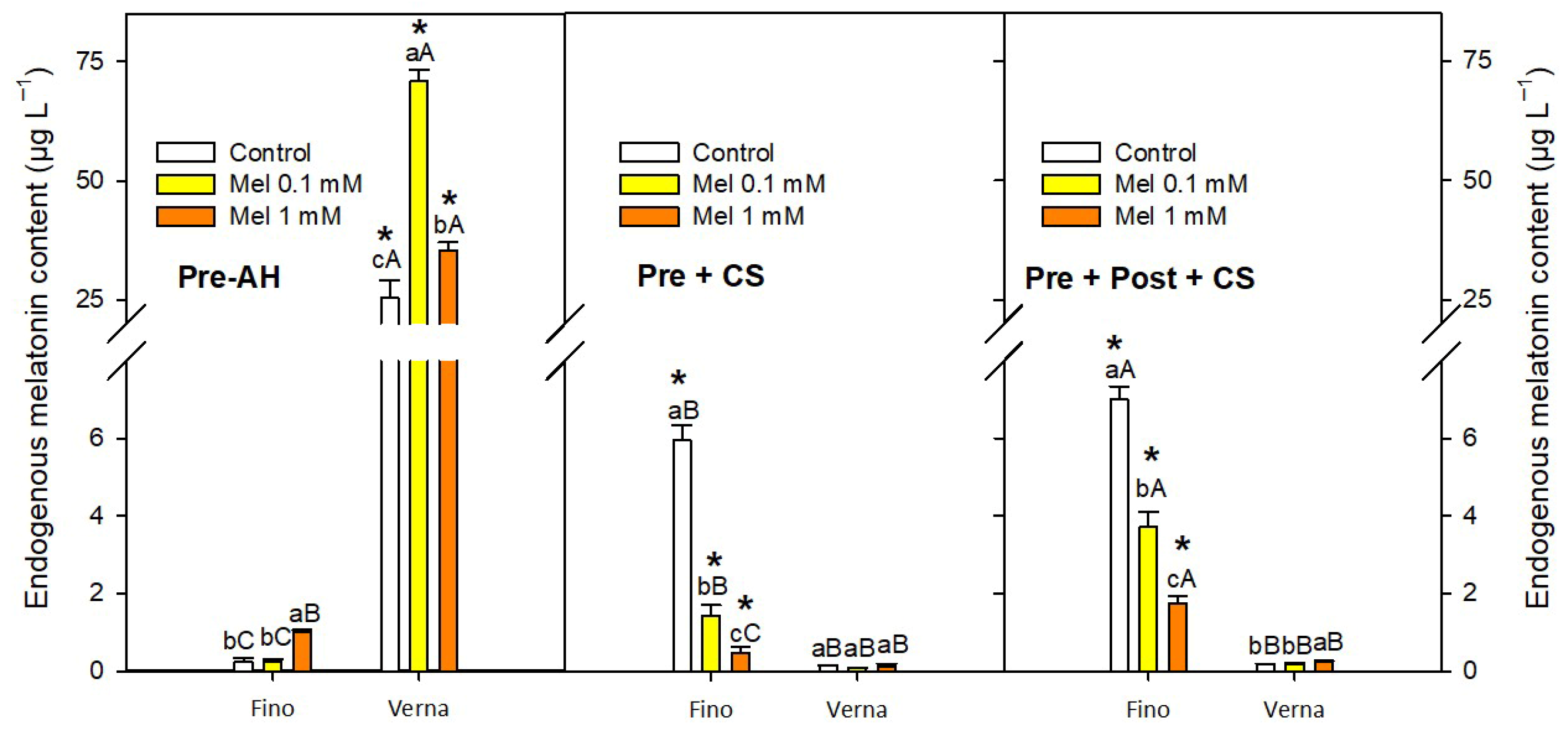
The endogenous MEL content of the ‘Fino’ and ‘Verna’ lemon cultivars has been evaluated across all treatments and conditions (Figure 1). For the ‘Fino’ cultivar, preharvest application of 1 mM MEL significantly increased endogenous MEL content fourfold (1.02 ± 0.06 μg L−1) compared to the control. The respective endogenous MEL content at harvest for the control and 0.1 mM treatments was 0.24 ± 0.10 μg L−1 and 0.26 ± 0.06 μg L−1. Furthermore, after cold storage, the endogenous MEL content of the control fruits (5.93 ± 0.40 μg L−1) and the fruits treated with 0.1 mM (1.43 ± 0.27 μg L−1) significantly increased. However, it was reduced in the fruits treated with 1 mM (0.48 ± 0.15 μg L−1). Finally, postharvest treatment followed by cold storage significantly increased endogenous MEL levels in all treatments, with control fruits showing the highest values (6.99 ± 0.35 μg L−1).
Conversely, the ‘Verna’ cultivar exhibited significantly higher endogenous MEL values than the ‘Fino’ cultivar at harvest: 25.42 ± 3.76 μg L−1 for control fruits. Additionally, preharvest MEL treatments significantly increased its endogenous concentration. The 0.1 mM treatment nearly tripled this level to reach the highest concentration (70.79 ± 2.50 μg L−1), followed by the 1 mM treatment (35.47 ± 1.59 μg L−1). However, after cold storage, the endogenous MEL content decreased by more than 99% regardless of whether the fruit were treated only at harvest (Pre + CS) or received a combination of pre- and postharvest treatments (Pre + Post + CS).
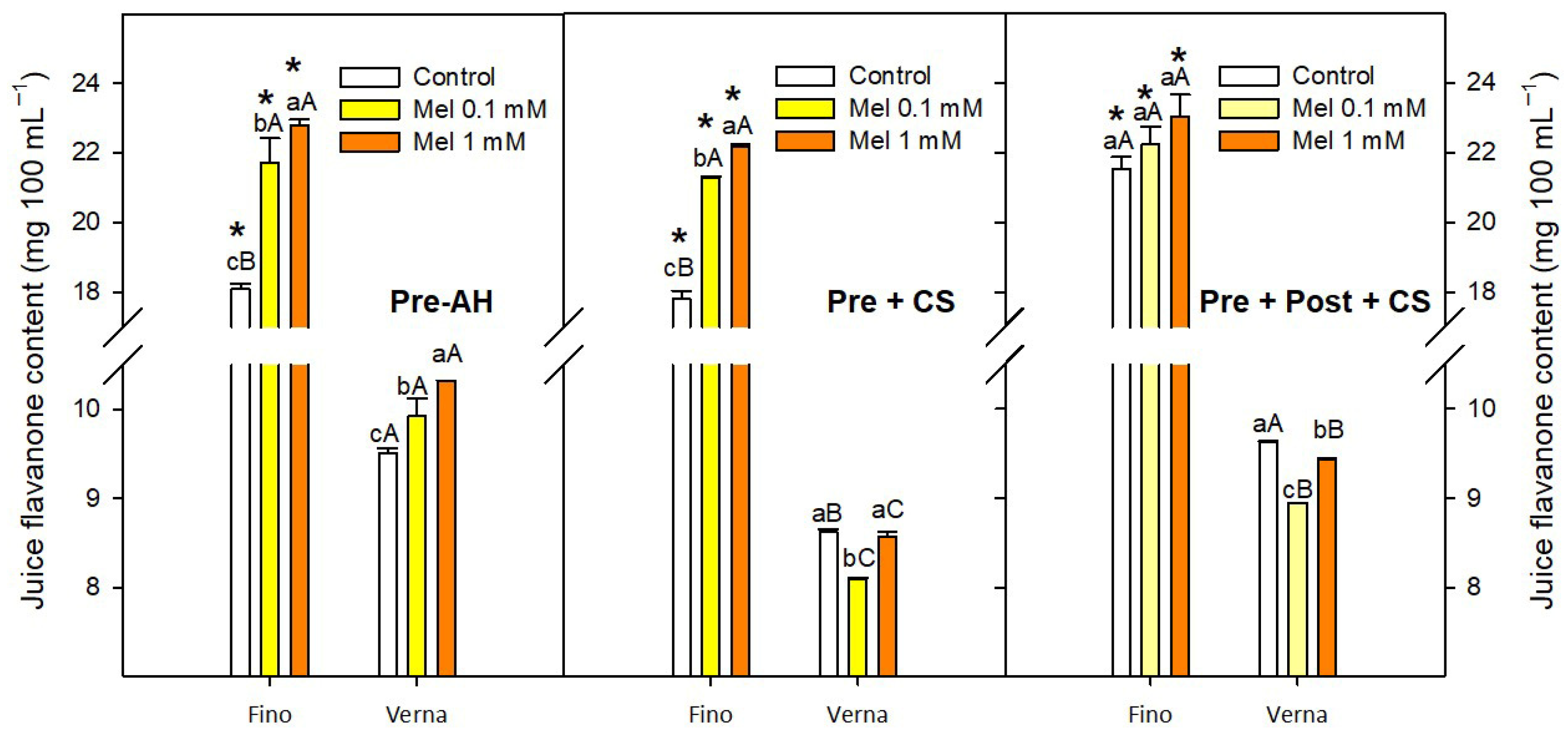
Regarding the flavanone content of lemon juice (Figure 2), its levels were significantly higher for the ‘Fino’ cultivar compared to the ‘Verna’ cultivar. Additionally, pre-harvest treatments with 1 mM of MEL significantly increased flavanone content in a dose-dependent manner in both cultivars. The highest flavanone content was observed at harvest (Pre-AH) for 1 mM MEL treatment.
After cold storage (Pre + CS), the flavanone content of the ‘Fino’ cultivar remained stable, whereas it decreased significantly in the ‘Verna’ cultivar, regardless of the treatment. Ultimately, the highest flavanone values were observed in the ‘Fino’ cultivar after postharvest treatment followed by cold storage (Pre + Post + CS), showing a significant increase compared to harvest values. Although no significant differences were observed between treatments, the MEL 1 mM treatment resulted in the highest flavanone levels. In contrast, postharvest treatment only maintained the flavanone content of control fruits in the ‘Verna’ cultivar. Treated fruits showed a significant decrease similar to that observed after cold storage.

4. Discussion

Melatonin is a naturally occurring molecule in plants that plays a key role in regulating physiological processes. When applied externally, it enhances fruit quality and improves stress tolerance in various citrus fruits, such as lemons and blood oranges [6,11]. While the general role of MEL as a postharvest regulator is documented, our results reveal that this response is far from universal and is governed by complex, cultivar-specific metabolic strategies. This study shows that the response to MEL treatments varies greatly depending on the lemon cultivar, as demonstrated by the contrasting behaviour of the ‘Fino’ and ‘Verna’ cultivars.
The application of exogenous MEL increased endogenous MEL levels in both cultivars, likely through absorption and stimulation of MEL biosynthesis pathways. Indeed, MEL has been reported to upregulate genes involved in its own metabolic pathway. These genes include tryptophan decarboxylase, serotonin N-acetyltransferase and N-acetylserotonin methyltransferase [10,18]. Notably, we identified a dose–response inversion between cultivars. The effective concentration required to maximize endogenous MEL accumulation was cultivar-dependent. Specifically, 1 mM was optimal for ‘Fino’, while a lower dose of 0.1 mM was better for ‘Verna’. This suggests that a high-dose approach may be counterproductive depending on the initial metabolic state of the cultivar.
A key finding of this study is that the initial endogenous MEL content is important in determining the response of fruit to cold storage. We observed an opposite endogenous dynamic between the two varieties. The ‘Fino’ cultivar, which had low levels of MEL at harvest, showed a pronounced increase in MEL during cold storage, particularly in the control and low-dose treatments. This suggests that cold storage might stimulate MEL biosynthesis as a defensive mechanism when levels are initially low. Although no visual chilling injury was observed, cold storage could induce MEL biosynthesis due to its antioxidant activity and pivotal role in abiotic stress conditions [10,11,19]. Cold stress may enhance the expression of genes involved in MEL biosynthesis and the production of antioxidant enzymes, such as catalase and ascorbate peroxidase, in a similar manner to the response to other abiotic stressors [20,21]. Similarly, MEL levels increased after postharvest treatment followed by cold storage. This increase was related to both external MEL absorption and stimulation of the plant’s antioxidant defence system for the ‘Fino’ cultivar, involving endogenous MEL synthesis [18,22].
By contrast, the ‘Verna’ cultivar exhibited high levels of endogenous MEL at harvest, which decreased markedly after cold storage across all treatments. This “Consumption vs. Synthesis” dichotomy represents a novel insight. When basal MEL levels are naturally high, as in ‘Verna’, the fruit appears to prioritize the immediate mobilization and consumption of these reserves to neutralize cold-induced reactive oxygen species, rather than activating new synthesis. Similar behaviour has been reported in other fruit species, such as sweet cherries, where MEL depletion occurs under prolonged cold stress due to its scavenging activity against reactive oxygen species [19]. As previously mentioned, MEL could mitigate the oxidative stress caused by cold storage by acting against free radicals and reducing oxidative stress [8,21,23]. This oxidative stress results in a greater reduction in endogenous MEL content in the ‘Verna’ cultivar when stored under stressful conditions [8,23,24]. Furthermore, postharvest MEL application did not restore endogenous levels in ‘Verna’, likely because MEL continued to be rapidly consumed under stressful conditions [10,11]. These findings suggest that MEL homeostasis during storage is driven by a dynamic balance between biosynthesis and consumption, which is strongly influenced by initial endogenous concentrations and cultivar-specific metabolic responses.
Conversely, citrus fruits are characterised by their high polyphenolic content, particularly flavanones. These compounds have significant pharmaceutical, biological, and biomedical applications [5]. Given the potential role of flavanones and polyphenolic compounds in general in combatting certain diseases, analysing their content is a fundamental quality parameter [25]. The present results confirm that MEL acts as an effective modulator of phenolic metabolism. It significantly enhanced flavanone accumulation in a dose-dependent manner following preharvest application. This effect could be attributed to the enhanced expression of enzymes involved in flavonoid synthesis, such as phenylalanine ammonia-lyase, cinnamate-4-hydroxylase and chalcone synthase [12,13]. In both cultivars, 1 mM MEL induced the highest flavanone levels at harvest, consistent with previous findings in lemons [10].
Regarding cold storage, distinct patterns on flavanone content between cultivars emerged. The ‘Fino’ cultivar showed no significant changes in flavanone content. It could be related to the low activity of phenolic degradative enzymes such as peroxidase and polyphenol oxidase at low temperatures [26]. In ‘Fino’, the biosynthesis of MEL coincided with the stability of its phenolic profile. Conversely, the ‘Verna’ cultivar exhibited reduced flavanone content following storage across all treatments. The simultaneous reduction in both endogenous MEL and flavanones in ‘Verna’ suggests a higher susceptibility to chilling-induced oxidative depletion in this genotype. Prolonged exposure to MEL, particularly when pre- and postharvest applications are combined, could activate phenolic biosynthetic pathways by upregulating key enzymes such as 4-coumarate:CoA ligase and cinnamate-4-hydroxylase [22]. In this context, the flavanone content of the ‘Fino’ cultivar increased further following postharvest treatment combined with cold storage, demonstrating an additive effect. In contrast, a stabilising effect was observed in the ‘Verna’ cultivar, consistent with previous reports on the response of citrus fruits to MEL under cold stress [10,11].
Nevertheless, it should be noted that the present study focused primarily on the metabolic shift in melatonin and flavanones. While no visual symptoms of chilling injury were detected, the lack of traditional physiological markers, such as weight loss, firmness, or enzymatic antioxidant activities, represents a limitation. This should be addressed in future research to provide a more holistic understanding of melatonin-mediated stress tolerance.
Although numerous studies propose the application of MEL as an effective strategy to improve the functional quality of fruit, the present results demonstrate that this approach is not entirely accurate. It depends on the fruit cultivar, treatment dose and storage conditions. Substantial varietal differences in MEL metabolism and response to exogenous application were observed between lemon cultivars depending on their initial endogenous MEL content. This determines whether MEL biosynthesis is stimulated or, conversely, whether endogenous reserves are consumed to mitigate oxidative stress during storage.

5. Conclusions

The two lemon cultivars studied, ‘Verna’ and ‘Fino’, exhibited an increase in endogenous MEL levels following MEL treatments. In this study, pre- and postharvest MEL treatments, applied individually or in combination and followed by cold storage, induced contrasting physiological responses in ‘Fino’ and ‘Verna’ lemons. This highlights the cultivar-specific nature of MEL functionality. Therefore, the fruit cultivar must be considered a critical factor when designing MEL-based pre- and postharvest strategies, since the same treatment can lead to markedly different outcomes, even within the same fruit species. Future research should expand these studies to additional cultivars and fruit species to elucidate the diverse MEL-dependent mechanisms involved. It will enable the development of precise, cultivar-specific postharvest management strategies.

Author Contributions

Conceptualization, D.V., M.S. and V.A.; methodology, M.E.G.-P. and V.A.; validation, all authors; formal analysis, V.A.; investigation, F.G.-A., M.E.G.-P. and V.A.; resources, M.S. and D.V.; data curation, F.G.-A., M.E.G.-P. and V.A.; writing—original draft preparation, F.G.-A., M.E.G.-P. and V.A.; writing—review and editing, all authors; visualization, M.E.G.-P. and V.A.; supervision, V.A.; project administration, M.S., D.V. and V.A.; funding acquisition, M.S. and D.V. All authors have read and agreed to the published version of the manuscript.

Funding

Direcció General de Ciència i Investigació of the Generalitat Valenciana, Spain. Financial support through Prometeo Program (PROMETEO/2021/089). Universitats i Ocupació of Generalitat Valenciana, Spain. Social Fund (grant number CIAPOS/2022/055).

Data Availability Statement

The original contributions presented in the study are included in the article, further inquiries can be directed to the corresponding author.

Acknowledgments

Authors thank Direcció General de Ciència i Investigació of the Generalitat Valenciana and Universitats I Ocupació of Generalitat Valenciana for the financial support. Additionally, we thanks BioRender (Toronto, ON, Canada) to provide pictures used in the Graphical Abstract.

Conflicts of Interest

The authors declare no conflicts of interest.

References

  1. Richa, R.; Kohli, D.; Vishwakarma, D.; Mishra, A.; Kabdal, B.; Kothakota, A.; Richa, S.; Sirohi, R.; Kumar, R.; Naik, B. Citrus fruit: Classification, value addition, nutritional and medicinal values, and relation with pandemic and hidden hunger. J. Agric. Food Res. 2023, 14, 100718. [Google Scholar] [CrossRef] [Scilit]
  2. FAOSTAT. FAOSTAT Database. Available online: https://www.fao.org/faostat/es/#data/QCL (accessed on 19 March 2026).
  3. MAPA. Spanish Citrus Consumption. Available online: https://www.mapa.gob.es/dam/mapa/contenido/agricultura/temas/producciones-agricolas/frutas-y-hortalizas/frutas-y-hortalizas/informecampana2024-25citricossep24-feb25.pdf (accessed on 19 March 2026).
  4. Taher, M.; Shukry, N.A.S.B.; Susanti, D.; Saleh, W.M.N.H.W.; Syukri, Y. Citrus flavonoids in preventing cardiovascular diseases. In Plant-Derived Bioactives: Chemistry and Mode of Action; Springer: Singapore, 2020; pp. 495–508. [Google Scholar] [CrossRef] [Scilit]
  5. Šafranko, S.; Šubarić, D.; Jerković, I.; Jokić, S. Citrus By-Products as a Valuable Source of Biologically Active Compounds with Promising Pharmaceutical, Biological and Biomedical Potential. Pharmaceuticals 2023, 16, 1081. [Google Scholar] [CrossRef] [Scilit] [PubMed]
  6. Badiche-El Hilali, F.; García-Pastor, M.E.; Valverde, J.M.; Castillo, S.; Valero, D.; Serrano, M. Melatonin as an Efficient and Eco-Friendly Tool to Increase Yield and to Maintain Quality Attributes during Lemon Storage. Int. J. Mol. Sci. 2024, 25, 10025. [Google Scholar] [CrossRef] [Scilit] [PubMed]
  7. Badiche-El Hilali, F.; Valverde, J.M.; García-Pastor, M.E.; Serrano, M.; Castillo, S.; Valero, D. Melatonin Postharvest Treatment in Leafy ‘Fino’ Lemon Maintains Quality and Bioactive Compounds. Foods 2023, 12, 2979. [Google Scholar] [CrossRef] [Scilit] [PubMed]
  8. Padilla-González, P.A.; Garrido-Auñón, F.; García-Pastor, M.E.; Guillén, F.; Serrano, M.; Valero, D.; Agulló, V. Melatonin as a Pre- and Postharvest Tool for Enhancing Fruit Quality. Plants 2026, 15, 331. [Google Scholar] [CrossRef] [Scilit]
  9. Sharafi, Y.; Jannatizadeh, A.; Fard, J.R.; Aghdam, M.S. Melatonin treatment delays senescence and improves antioxidant potential of sweet cherry fruits during cold storage. Sci. Hortic. 2021, 288, 110304. [Google Scholar] [CrossRef] [Scilit]
  10. Agulló, V.; García-Pastor, M.E.; Valero, D. Melatonin Elicitation Differentially Enhances Flavanone and Its Endogenous Content in Lemon Tissues Through Preharvest and Postharvest Applications. Agronomy 2025, 15, 1233. [Google Scholar] [CrossRef] [Scilit]
  11. Garrido-Auñón, F.; Padilla-González, P.A.; Serrano, M.; Valero, D.; Agulló, V. Melatonin Boosts the Phytochemical Profile of Blood Oranges, Enhancing (Poly)phenol and Endogenous Melatonin Content, Through Pre- and Postharvest Treatments. J. Pineal Res. 2025, 77, e70078. [Google Scholar] [CrossRef] [Scilit]
  12. Sanie Khatam, A.; Rastegar, S.; Aboutalebi Jahromi, A.; Hassanzadeh Khankahdani, H.; Bagherian, S.A.A. Biochemical and physiological mechanism induced by melatonin in Mexican lime (Citrus aurantifolia Swingle) plants: Cold and freezing stress. Acta Physiol. Plant. 2023, 45, 98. [Google Scholar] [CrossRef] [Scilit]
  13. Liang, D.; Shen, Y.; Ni, Z.; Wang, Q.; Lei, Z.; Xu, N.; Deng, Q.; Lin, L.; Wang, J.; Lv, X.; et al. Exogenous melatonin application delays senescence of kiwifruit leaves by regulating the antioxidant capacity and biosynthesis of flavonoids. Front. Plant Sci. 2018, 9, 360644. [Google Scholar] [CrossRef] [Scilit]
  14. Mazzeo, T.; Paciulli, M.; Chiavaro, E.; Visconti, A.; Fogliano, V.; Ganino, T.; Pellegrini, N. Impact of the industrial freezing process on selected vegetables -Part II. Colour and bioactive compounds. Food Res. Int. 2015, 75, 89–97. [Google Scholar] [CrossRef] [Scilit]
  15. Erland, L.A.E.; Chattopadhyay, A.; Jones, A.M.P.; Saxena, P.K. Melatonin in plants and plant culture systems: Variability, stability and efficient quantification. Front. Plant Sci. 2016, 7, 230966. [Google Scholar] [CrossRef] [Scilit]
  16. Cavallo, A.; Hassan, M. Stability of melatonin in aqueous solution. J. Pineal Res. 1995, 18, 90–92. [Google Scholar] [CrossRef] [Scilit] [PubMed]
  17. Agulló, V.; Domínguez-Perles, R.; Moreno, D.A.; Zafrilla, P.; García-Viguera, C. Alternative sweeteners modify the urinary excretion of flavanones metabolites ingested through a new maqui-berry beverage. Foods 2020, 9, 41. [Google Scholar] [CrossRef] [Scilit] [PubMed]
  18. Yan, R.; Li, S.; Cheng, Y.; Kebbeh, M.; Huan, C.; Zheng, X. Melatonin treatment maintains the quality of cherry tomato by regulating endogenous melatonin and ascorbate-glutathione cycle during room temperature. J. Food Biochem. 2022, 46, e14285. [Google Scholar] [CrossRef] [Scilit] [PubMed]
  19. Garrido-Auñón, F.; García-Pastor, M.E.; Serrano, M.; Valero, D.; Agulló, V.; Garrido-Auñón, F.; García-Pastor, M.E.; Serrano, M.; Valero, D.; Agulló, V. Combined Pre- and Postharvest Melatonin Treatments Improve the Functional Quality of the Sweet Cherry cv. ‘Sunburst’. Foods 2025, 14, 3337. [Google Scholar] [CrossRef] [Scilit]
  20. Qian, Z.; He, L.; Li, F. Understanding cold stress response mechanisms in plants: An overview. Front. Plant Sci. 2024, 15, 1443317. [Google Scholar] [CrossRef] [Scilit]
  21. Abbas, T.; Ahmad, I.; Nawaz, R.; Nazim, M.; Gatasheh, M.K.; Alamri, A.M.; Muneeb, A. Physiological responses and antioxidant properties of Citrus reticulata under different abiotic stresses mitigated by endogenous melatonin. Sci. Hortic. 2023, 322, 112442. [Google Scholar] [CrossRef] [Scilit]
  22. Michailidis, M.; Tanou, G.; Sarrou, E.; Karagiannis, E.; Ganopoulos, I.; Martens, S.; Molassiotis, A. Pre- and Post-harvest Melatonin Application Boosted Phenolic Compounds Accumulation and Altered Respiratory Characters in Sweet Cherry Fruit. Front. Nutr. 2021, 8, 695061. [Google Scholar] [CrossRef] [Scilit]
  23. Arnao, M.B.; Hernández-Ruiz, J. Melatonin: A New Plant Hormone and/or a Plant Master Regulator? Trends Plant Sci. 2019, 24, 38–48. [Google Scholar] [CrossRef] [Scilit]
  24. Arnao, M.B.; Hernández-Ruiz, J. Melatonin Against Environmental Plant Stressors: A Review. Curr. Protein Pept. Sci. 2021, 22, 413–429. [Google Scholar] [CrossRef] [Scilit]
  25. Barreca, D.; Gattuso, G.; Bellocco, E.; Calderaro, A.; Trombetta, D.; Smeriglio, A.; Laganà, G.; Daglia, M.; Meneghini, S.; Nabavi, S.M. Flavanones: Citrus phytochemical with health-promoting properties. BioFactors 2017, 43, 495–506. [Google Scholar] [CrossRef] [Scilit]
  26. Zhang, S. Recent Advances of Polyphenol Oxidases in Plants. Molecules 2023, 28, 2158. [Google Scholar] [CrossRef] [Scilit]
Figure 1. Endogenous melatonin content in control and treated lemons with preharvest melatonin (MEL) treatments at different doses (0.1 and 1 mM) at harvest (Pre-AH), after cold storage (Pre + CS), and after a postharvest application of 1 mM MEL combined with cold storage (Pre + Post + CS) of ‘Fino’ and ‘Verna’ cultivars. Statistical significance (p < 0.05) is indicated by three independent marking systems: (i) Asterisks (*) represent pairwise comparisons between ‘Fino’ and ‘Verna’ cultivars for each specific treatment and condition using Student’s t-test; (ii) Lowercase letters denote differences between treatments within the same cultivar and storage stage; and (iii) Uppercase letters indicate differences between experimental stages for a given treatment and cultivar. Intra-cultivar differences (letters) were determined by separate one-way ANOVA followed by Tukey’s multiple range test for each cultivar.
Horticulturae 12 00441 g001
Figure 2. Juice flavanone content (mg 100 mL−1) in control and treated lemons with preharvest melatonin (MEL) treatments at different doses (0.1 and 1 mM) at harvest (Pre-AH), after cold storage (Pre + CS), and after a postharvest application of 1 mM MEL combined with cold storage (Pre + Post + CS) of ‘Fino’ and ‘Verna’ cultivars. Statistical significance (p < 0.05) is indicated by three independent marking systems: (i) Asterisks (*) represent pairwise comparisons between ‘Fino’ and ‘Verna’ cultivars for each specific treatment and condition using Student’s t-test; (ii) Lowercase letters denote differences between treatments within the same cultivar and storage stage; and (iii) Uppercase letters indicate differences between experimental stages for a given treatment and cultivar. Intra-cultivar differences (letters) were determined by separate one-way ANOVA followed by Tukey’s multiple range test for each cultivar.
Horticulturae 12 00441 g002
Disclaimer/Publisher’s Note: The statements, opinions and data contained in all publications are solely those of the individual author(s) and contributor(s) and not of MDPI and/or the editor(s). MDPI and/or the editor(s) disclaim responsibility for any injury to people or property resulting from any ideas, methods, instructions or products referred to in the content.