
Article

Photoperiod Modulates Morphophysiological Characteristics and Yield of Chia (Salvia hispanica L.) and Arugula (Eruca sativa L.) Microgreens Under Controlled Conditions

by
José A. Sánchez-Villegas
1,
Alberto Sánchez-Estrada
2,*,
Jesús F. Ayala-Zavala
3,
Alma R. Toledo-Guillén
2,
Judith Fortiz-Hernández
4 and
Jorge N. Mercado-Ruiz
1,*
1
Biotecnología y Postcosecha de Productos Hortofrutícolas, Coordinación de Tecnología de Alimentos de Origen Vegetal, Centro de Investigación en Alimentación y Desarrollo, A.C., Carretera Gustavo E. Astiazarán Rosas #46, Colonia La Victoria, Hermosillo 83304, Sonora, Mexico
2
Ecofisiología y Fenómica de Hongos y Plantas, Coordinación de Tecnología de Alimentos de Origen Vegetal, Centro de Investigación en Alimentación y Desarrollo, A.C., Carretera Gustavo E. Astiazarán Rosas #46, Colonia La Victoria, Hermosillo 83304, Sonora, Mexico
3
Fisiología, Bioquímica, Tecnología e Inocuidad de Plantas y sus Subproductos, Coordinación de Tecnología de Alimentos de Origen Vegetal, Centro de Investigación en Alimentación y Desarrollo, A.C., Carretera Gustavo E. Astiazarán Rosas #46, Colonia La Victoria, Hermosillo 83304, Sonora, Mexico
4
Ingeniería y Procesamiento de Alimentos de Origen Vegetal, Coordinación de Tecnología de Alimentos de Origen Vegetal, Centro de Investigación en Alimentación y Desarrollo, A.C., Carretera Gustavo E. Astiazarán Rosas #46, Colonia La Victoria, Hermosillo 83304, Sonora, Mexico
*
Authors to whom correspondence should be addressed.
Horticulturae 2026, 12(4), 439; https://doi.org/10.3390/horticulturae12040439
Submission received: 26 February 2026 / Revised: 28 March 2026 / Accepted: 30 March 2026 / Published: 2 April 2026
(This article belongs to the Special Issue Production and Cultivation of Microgreens)

Abstract

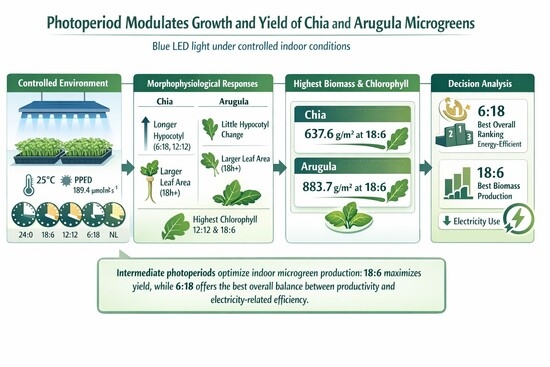
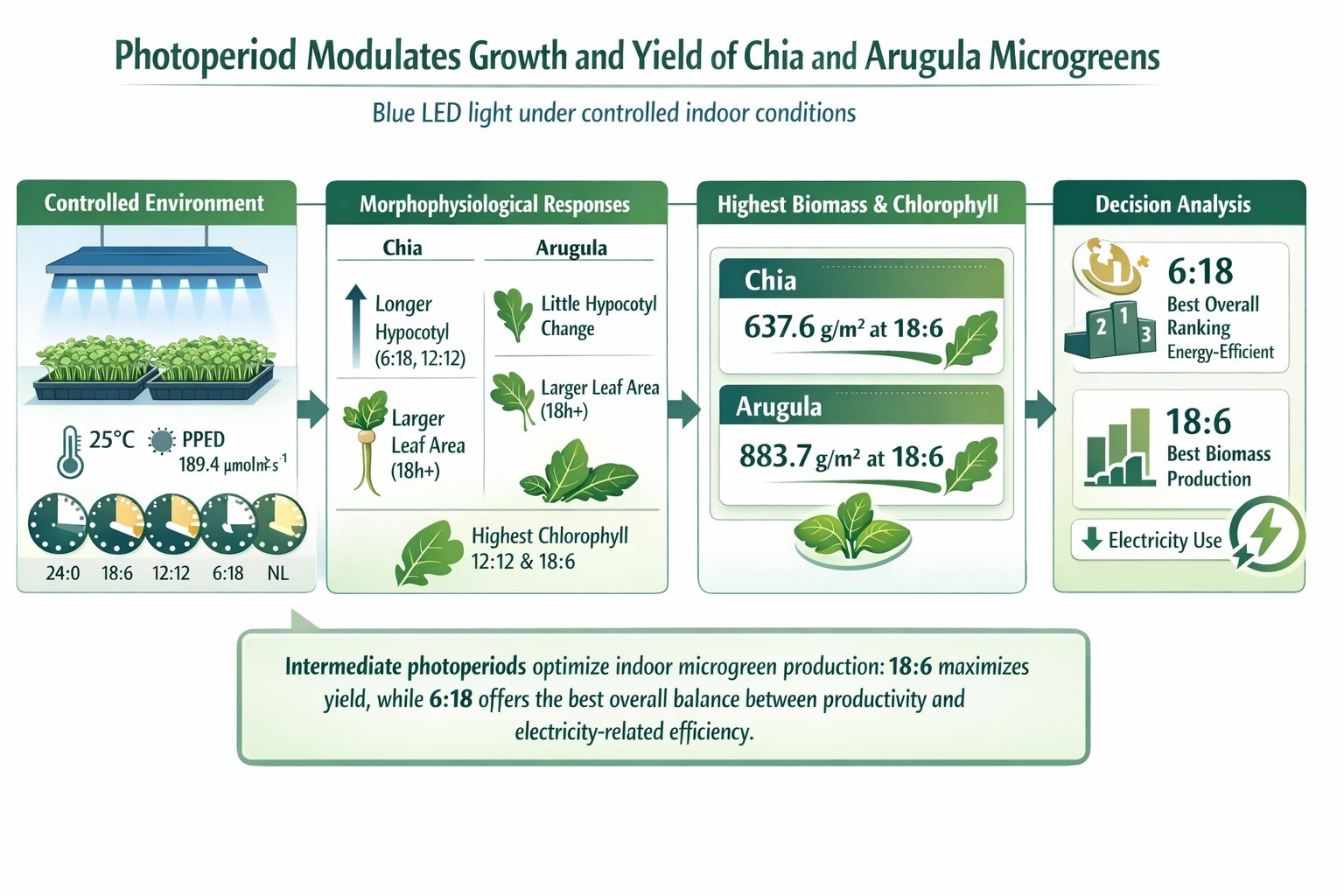
Indoor microgreen production systems are becoming increasingly popular because they can achieve high yields and quality, especially in unfavorable climates and urban settings. Light is a critical environmental factor that influences plant development; however, limited information exists on the effects of photoperiod (PP) on the growth of chia and arugula microgreens and on the associated electricity costs. The objective of this study was to evaluate the impact of different blue LED light (Light-Emitting-Diode) PPs, 24:0, 18:6, 12:12, and 6:18 h of light:dark compared with natural light, on the growth and biomass production of Salvia hispanica (chia) and Eruca sativa (arugula) grown indoors under controlled conditions (25 °C and 189.4 μmol·m−2·s−1). In chia, shoot length increased (p ≤ 0.05) with shorter PP, particularly under the 6:18 and 12:12 h·d−1 photoperiods, while arugula showed no significant response. Root length and total plant length were unaffected by photoperiod in either species. Leaf area was the most responsive growth parameter, with larger leaves produced under PP of 18 h or more per day. Total chlorophyll content was highest at 12:12 and 18:6 h light:dark. Fresh biomass reached its maximum at 18:6, with 637.6 g m−2 in chia and 883.7 g m−2 in arugula. TOPSIS was used as a multi-criteria decision-making tool for comprehensive treatment evaluation, showing that the 6:18 treatment achieved the highest overall ranking, whereas the 18:6 treatment resulted in the greatest biomass production.

Graphical Abstract

1. Introduction

Microgreens are young, tender plants that include stems, well-developed cotyledons, and sometimes tiny leaves from various types of vegetables. They typically grow within 7 to 21 days after sowing [1] and are efficient in their use of water and nutrients during growth [2]. A notable characteristic of microgreens is their high protein content, along with a rich presence of chlorophyll, amino acids, minerals, vitamins, and trace elements [3]. Among them, chia (Salvia hispanica L.) is of particular interest because it is rich in protein, phenolic compounds, minerals, and essential fatty acids [4]. Arugula (Eruca sativa L.), a member of the Brassicaceae family, is recognized for its glucosinolate content, vitamins, and antioxidant compounds with potential health-promoting properties [5]. In addition to their functional and nutritional value, both species have rapid growth cycles and are therefore attractive candidates for microgreen production. Their contrasting phytochemical profiles also make them useful model species for evaluating whether photoperiod effects differ according to species under controlled indoor conditions.
Therefore, they are considered functional foods [6], which has contributed to their growing popularity. Light is a crucial factor in microgreen production, as it significantly influences primary metabolism via photosynthesis and certain secondary metabolism pathways [7]. This includes pathways involved in phenylpropanoid biosynthesis and the stimulation of the enzyme phenylalanine ammonia-lyase [8]. Light has three primary characteristics: quality, quantity, and photoperiod. Quality refers to the type of light, specifically the distribution of wavelengths that reach the plant. Quantity denotes the amount of light energy that reaches the plant over a specific period. Finally, the photoperiod is the duration of light exposure within a 24-h cycle [9]. Each of these characteristics significantly influences plant physiology, with photoperiod being an important factor influencing microgreens production and quality. Blue light (380–500 nm) plays an important role in photosynthesis, photomorphogenesis, and secondary metabolism [10]. It has also been associated with cotyledon expansion and compact seedling development in microgreens [11]. In microgreens (7–21 days old), light intensities of 150–200 µmol m−2 s−1 optimize photosynthetic efficiency and redox balance without causing photoinhibition [11]. When using LED systems, values of 180–200 µmol m−2 s−1 simultaneously maximize biomass, chlorophyll production, and bioactive compound accumulation [2].
By managing the photoperiod and exposing plants to different light and dark cycles, it is possible to increase crop production per area, enhance nutritional quality, and improve efficiency in controlled systems [12,13]. Previous studies indicate that effective photoperiod management can enhance specific growth parameters, including plant morphology and nutritional value in microgreens [14]. Moreover, it plays a crucial role in regulating processes such as phototropism, internal rhythms, root growth, and redox balance [10]. According to Liu et al. [15], photoperiod significantly influences the growth and dry biomass accumulation in kale microgreens. They found that dry biomass increases linearly as the photoperiod extends from 6 to 24 h per day. In the same study, two types of amaranth microgreens showed a greater accumulation of fresh biomass when the photoperiod was increased from 8 to 20 h per day. However, a longer photoperiod negatively affected fresh yield, height, and cotyledon area, although higher dry biomass was observed in beetroot [16]. Previous studies have shown that photoperiod responses in microgreens are influenced by interactions among light quality, light intensity, and species-specific physiological traits [17]. In the present study, blue light was selected because it plays a central role in photomorphogenesis, chlorophyll accumulation, stomatal regulation, and the development of compact seedlings. The light intensity was kept constant at 189.4 µmol m−2 s−1 to reduce interference from simultaneous variation in spectral quality and instantaneous irradiance, thus allowing a more direct comparison of photoperiod treatments under controlled conditions. However, because the photon flux density was fixed, extending or reducing the photoperiod also changed the total daily light received by the plants. Therefore, the observed responses should be interpreted as the combined effect of photoperiod duration under constant blue-light intensity, rather than as an isolated photoperiod effect.
In addition to its role in photosynthesis, blue light is closely associated with morphological regulation in seedlings, including reduced hypocotyl elongation, greater compactness, and modulation of leaf development.
In this context, chlorophyll plays a vital role in the light phase of photosynthesis by capturing light energy. This process enables charge separation in the reaction center and ultimately leads to energy production, CO2 fixation, and biomass building [18]. The photoperiod influences chlorophyll production: generally, shorter light periods result in limited chlorophyll synthesis, while longer light exposures increase chlorophyll content [19]. However, some species only require a short photoperiod to achieve adequate chlorophyll levels [20], and excessive light can lead to bleaching and the production of reactive oxygen species (ROS) [21]. In most species, insufficient light exposure can negatively impact growth, reduce commercial quality, and lower phytochemical levels [17]. A crucial indicator of how a plant responds to specific photoperiods is the ratio of chlorophyll a to chlorophyll b. This ratio reflects how the photoperiod adjusts photosystems I and II, as well as the light-harvesting complex that captures light [22]. Additionally, carotenoids are essential components of the reaction center, enhancing light capture and transferring light energy. These pigments primarily absorb light in the blue spectrum, with some absorption occurring in the green spectrum as well. Carotenoids play an important role as accessory pigments that attach to chlorophyll-protein complexes. They help regulate photosynthesis by enhancing light harvesting through the light-harvesting complex (LHCII) and serve as photoprotectors against excessive light or oxygen (O2) produced during photosynthesis [22]. Carotenoid levels can vary significantly across different photoperiods due to the high diversity of these complexes. In a study by Chu et al. [18], two types of celery exhibited higher levels of chlorophylls (a and b) and carotenoid pigments under a 12/12 photoperiod, whereas longer photoperiods limited their accumulation. In contrast, a longer photoperiod was linked to a consistent increase in pigment concentration in buckwheat microgreens [23]. One important consideration in controlled production systems is the operating costs, as lighting expenses comprise a significant portion of the total costs. To enhance economic benefits in a microgreens factory, it is essential to optimize the use of this resource with precision agriculture tools informed by such research [24]. Previous studies on microgreens have shown that photoperiod effects on yield, biomass production, and morphophysiological traits are inconsistent across species, highlighting the need for species-specific evaluation of chia and arugula under controlled conditions. In this context, evaluating blue LED photoperiods in these species may help to identify production conditions that improve plant performance while supporting more efficient electricity use in indoor systems. Therefore, this study aimed to evaluate the effects of blue LED photoperiods on the growth, biomass production, and pigment accumulation of chia and arugula microgreens grown under controlled indoor conditions. In addition to the morphophysiological assessment, this study incorporated an electricity-cost-based economic analysis and a TOPSIS multi-criteria approach to compare treatments from both biological and operational perspectives. This study addressed the following questions: Do blue LED photoperiods differentially affect morphophysiological traits and pigment accumulation in chia and arugula microgreens? Can a photoperiod be identified that improves biomass production while maintaining favorable electricity-related cost performance? We hypothesized that photoperiod responses would be species-dependent and that intermediate photoperiods would provide a more favorable balance between biomass production and operational efficiency than extreme photoperiods.

2. Materials and Methods

2.1. Plant Material and Treatments

The experiment was conducted at the Center for Research in Food and Development, A.C., in Hermosillo, Sonora, Mexico (Lat: 29.09° N, Lon: −110.96° W). Seeds of chia (Salvia hispanica cv. Negra de Puebla) were obtained from a local market, and arugula (Eruca sativa cv. Sem836RB1) was sourced from Hortaflor, S.A. de C.V. (Mexico City, Mexico). Both types of seeds were sown in peat moss as the substrate, which had a pH of 7.5 and an electrical conductivity of 0.5 dS/m, in 32 cm × 60 cm plastic trays. The seeding density (SD) was 160 gm−2 for arugula [25] and 120 gm−2 for chia seeds [26]. After the seeds were evenly distributed on the moist substrate surface, they were gently sprayed with distilled water. The trays were then covered to prevent moisture loss and kept in darkness for 48 h. Following this period, the trays were placed under the evaluated photoperiods (PP): 24:0 (blue LED light:dark cycles), 18:6, 12:12, 6:18, and the natural light (NL) treatment used as a reference condition representing conventional ambient daylight exposure. The NL treatment provided approximately 13–14 h of light and 10–11 h of darkness in a room maintained at an average temperature of 25 ± 5 °C and relative humidity of 40–55%. Plants under NL were exposed to indirect daylight, with light intensity ranging from 100 to 125 μmol m−2 s−1 during the morning and afternoon and from 250 to 275 μmol m−2 s−1 around noon; these values were monitored three times per day at the same times each day. Blue LED light was supplied by full-spectrum Grow Light lamps (40 cm × 20 cm), with an average photon flux density of 189.4 μmol m−2 s−1 measured at tray level (canopy height) at different points across the trays using an LI-191 quantum sensor (LI-COR, Lincoln, NE, USA). The distance between the lamps and the trays was 70 cm. The photon flux density used in this study (189.4 μmol m−2 s−1) was selected as a moderate light intensity for indoor microgreen production, based on previous reports indicating that values near 150–200 μmol m−2 s−1 are adequate for early vegetative growth under controlled conditions [2]. The culture was maintained at 25 ± 2 °C and 70 ± 10% relative humidity. Harvest was performed 12 days after sowing, corresponding to the typical developmental stage at which microgreens are commercially and experimentally evaluated, when cotyledons are fully expanded, and early true leaf emergence may begin depending on the species [27,28]. Irrigation was applied manually with a sprayer, using approximately 100 mL of water per tray, three times per day. This irrigation regime was adjusted daily to maintain peat moss moisture near its water-holding capacity (approximately 60–80%, v/v), and substrate moisture was monitored using a soil moisture tester (PCE, Shenzhen, China) [29]. This procedure was intended to maintain relatively uniform moisture conditions among treatments throughout the experiment. Harvesting was performed using scissors, cutting the plants 1 cm above the substrate surface.

2.2. Morphometry

2.2.1. Hypocotyl Length, Root Length, Total Length of the Plant, Allometry Coefficient (AC), Leaf Area, Leaf Area Index, Partially Shaded Plants

Every morphometric variable was measured at harvest. Hypocotyl (HL) and root (RL) lengths, and the total plant length (TPL) were measured with a graduated ruler on 20 randomly selected plants per replicate and treatment and reported in centimeters (cm). AC was obtained at the HL/RL ratio. Based on the HL data, the frequency of HL intervals was analyzed in all plants covering a 1 cm2, from the lowest to the longest plant length in each treatment. Leaf area (LA) was determined from digital images of cotyledons using ImageMeter software (version v1.1.0, USA). The leaf area of 20 randomly selected seedlings per replicate was measured. The leaf area index (LAI)was calculated using Equation (1).
LAI = (SD (plants per cm2)) × (LA (cm2 per plant))
SD was adjusted based on seed germination rates (94–96%) and purity percentages (92–94%), considering the weight values of chia seeds [30] and arugula seeds [31]. LAI was estimated using adjusted seeding density (SD) as a proxy for stand density. Because actual surviving plant density was not recorded at harvest, this calculation should be considered an approximation for comparative purposes.
Subsequently, partially shaded plants at harvest (PSP, the number of plants per cm2), were calculated using Equation (2).
PSP = (SD) − [(unit of seeding area (cm2)) × (plant units)]/(LA (cm2)
Because microgreens are grown at high density, leaf expansion can lead to canopy overlap near harvest. To describe this condition, an estimated PSP index was calculated as a structural proxy based on the relationship between total projected leaf area and tray surface area. Total leaf area per tray was estimated from the mean leaf area per plant and adjusted stand density. When the estimated total leaf area exceeded tray area, the excess was expressed as an equivalent number of plants and used as an approximation of potential canopy overlap.

2.2.2. Fresh Weight (FW), Dry Weight (DW), Yield per Plant (Y), and Efficiency (E)

FW was measured from plant material collected from a 100 cm2 area and scaled up to a square meter. The plant biomass was weighed using an Ohaus digital scale Voyager model (OHAUS, Nänikon, Switzerland). The dry matter content was determined using the method outlined in No. 7.003 [32]. For this, the same harvested aerial biomass used to measure FW was dried in a Yamato oven Model DX 600 (Yamato Scientific Co., Ltd., Yokohama, Japan) at 60 °C for 48 h, then weighed again until reaching a constant weight (DW).
Yield (Y) was calculated by incorporating SD, with adjustments for purity and germination, and using the previously determined average number of seeds per gram. The results were ultimately expressed on a per-100-plant basis (Equation (3)).
Y = (DW (g m−2)/Number of plants (m2)) × 100 plants
Efficiency (E) was measured using Equation (4).
E = DW (g m−2)/SD (g m−2)
In this context, “DW” stands for dry weight, while “SD” refers to seeding density.

2.3. Physiological Variables

Content of Total Chlorophyll, Chlorophylls a and b, and Total Carotenoids

After the harvest, the microgreens were stored at −30 °C. To determine the contents of chlorophyll a, chlorophyll b, total chlorophyll, and total carotenoids (including xanthophylls and β-carotene), approximately 0.1 g of microgreen sample was extracted with 10 mL of 95% (v/v) ethanol (Sigma, St. Louis, MI, USA). The mixture was placed in a tissue homogenizer for grinding to reduce particle size. An additional 10 mL of ethanol was added to the mixture, which was then vortexed to ensure complete homogenization. The extracted solution was kept on ice and in the dark until quantification. The extracts were analyzed spectrophotometrically in a microplate reader FLUOstar Omega, BMG LABTECH (Ortenberg, Germany), using 96-well microplates. The extractant solvent served as a blank. Absorbance was measured at wavelengths of 664.1 nm, 648.6 nm, and 470 nm. The absorbance readings at each wavelength were used to calculate concentrations in µg µL−1 and subsequently adjusted to µg g−1 on a dry-weight basis for chlorophyll a (Cla), chlorophyll b (Clb), total chlorophyll (Clt), and total carotenoids (Cart). The calculations were performed using Equations (5)–(8) [33].
Cla = 13.36 A664.1 − 5.19 A648.6
Clb = 27.43 A648.6 − 8.12 A664.1
Clt = Cla + Clb
Cart = (1000 A470 − 2.13 Cla − 97.64 Clb)/209

2.4. Resource-Use Efficiency, Electricity-Cost Analysis, and TOPSIS (Technique for Order Preference by Similarity to Ideal Solution) Evaluation

The use of artificial light in microgreen production can increase costs. To evaluate the profitability of various photoperiod treatments, several theoretical tools are used to account for electricity, space, and time. The kilowatt-hour (kWh) consumption of the lamps for each treatment is calculated using Ohm’s law, where V represents voltage, and A represents amperage (Equation (9)).
kWh = V A 1000−1
The total electrical cost for each treatment is calculated using Equation (10). In this equation, C represents the cost in USD, kWh denotes the electrical consumption in kilowatt-hours per square meter for each treatment, PP denotes the length of the photoperiod, and T denotes the number of days of photoperiod applied (12 days in this experiment).
C = kWh PP T
The final step involves determining income by calculating the difference between the total electrical consumption cost per square meter (C) and the market-value-adjusted fresh-weight cost per square meter [34]. This analysis was intended as a relative comparison among treatments and did not include other production costs such as labor, substrate, water, or equipment depreciation. Efficiency is measured as the ratio of microgreens produced at the end of each cultivation period, expressed in grams of fresh weight per square meter (g FW m2), to electrical consumption per square meter during the evaluated photoperiod, using Equation (11) [27].
EUE = grams fresh weight m−2/kWh of electricity consumption
Productive efficiency per production area (PEP), measured in grams of fresh weight per square meter per day, demonstrates the impact of photoperiod on productivity over time, using Equation (12) [35].
PEP = grams fresh weight m−2/days from sowing to harvest
To find grams of fresh microgreen biomass produced per USD of the electricity cost for both species, the electricity cost is calculated by dividing the energy cost by the harvested biomass weight, using Equation (13) [35]. Costs for all analyses were based on the Mexican market.
CUE = FW g/USD operating costs
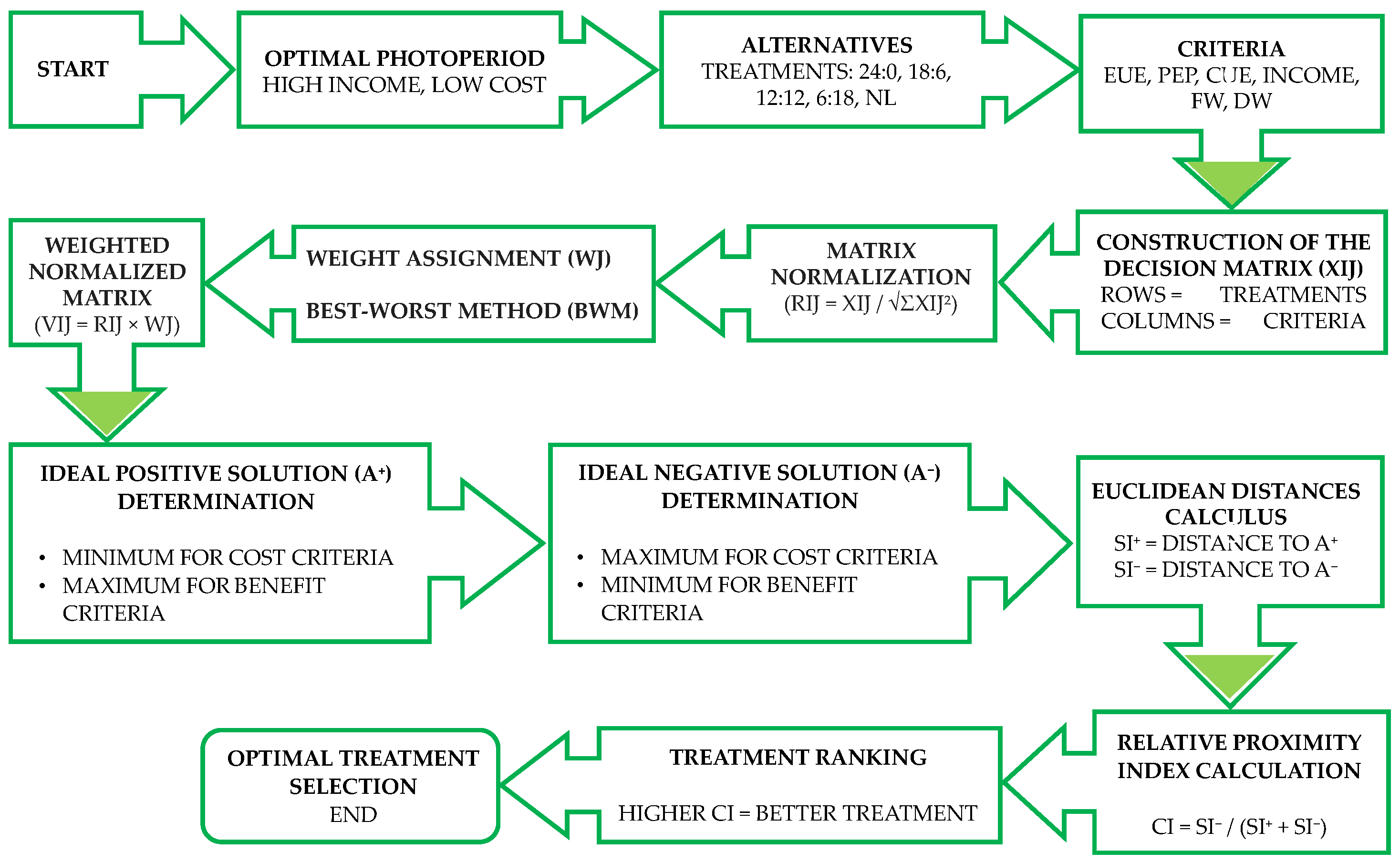
For the TOPSIS analysis, the five lighting treatments (24:0, 18:6, 12:12, 6:18, and NL) were defined as decision alternatives. The evaluation criteria were energy use efficiency (EUE), productive efficiency per production area per day (PEP), cost use efficiency (CUE), gross income, fresh weight (FW), and dry weight (DW). These variables were selected to integrate production, resource-use, and economic performance into a single comparative framework. A decision matrix was constructed X = [Xij], where each element Xij represents the performance of treatment i under criterion j. Weight estimation using (BWM): this approach employs a weighting-based best-worst method (https://bestworstmethod.com/software/, accessed on 2 February 2022) [36]. The decision matrix was normalized using vector normalization R = [rij]. A weighted normalized matrix V = [vij] was then calculated by multiplying each normalized value by its corresponding BWM-derived weight. The positive ideal solution (A+) and negative ideal solution (A) were defined considering the nature of each criterion. EUE, PEP, CUE, Income, FW, and DW were treated as benefit criteria, where higher values indicate better performance. The Euclidean distance of each treatment to the ideal (Di+) and anti-ideal (Di) solutions was computed. Finally, the relative closeness coefficient (Ci) was calculated for each treatment, and treatments were ranked accordingly. Higher Ci values indicate better overall performance (Figure 1).

2.5. Statistical Analysis

The experiment was analyzed using a completely randomized design with five treatments and four replicates per treatment. Each experimental unit was a tray; 20 plants were subsampled per tray. A mean comparison test was conducted using the Tukey test (p < 0.05). The statistical analysis was performed with Infostat 2020, a statistical software from the University of Córdoba (Córdoba, Argentina).

3. Results

3.1. Hypocotyl Length, Root Length, Total Length of the Plant, Allometry Coefficient, Leaf Area, Leaf Area Index, Partially Shaded Plants

Table 1 presents the impact of photoperiod (PP) on the morphometric traits of both species. Notably, chia demonstrated a significant response (p < 0.05) in hypocotyl length, with the longest hypocotyls observed in lower light conditions, achieving maximum measurements of 5.16 cm and 5.00 cm in the 6:18 and 12:12 PP treatments, respectively. In contrast, increased light exposure correlated with reduced aerial length, with values of 4.29 cm and 4.27 cm in the 24:00 and 18:6 PP groups, respectively. In the natural-light (NL) treatment, hypocotyl lengths were consistent across both long and short PP, showing no significant variance. Arugula, however, exhibited no significant variations (p > 0.05) in hypocotyl length in response to PP, with the maximum difference not surpassing 0.35 mm between the 24:0 and 12:12 PP treatments. The highest hypocotyl length for arugula was noted in the NL treatment.
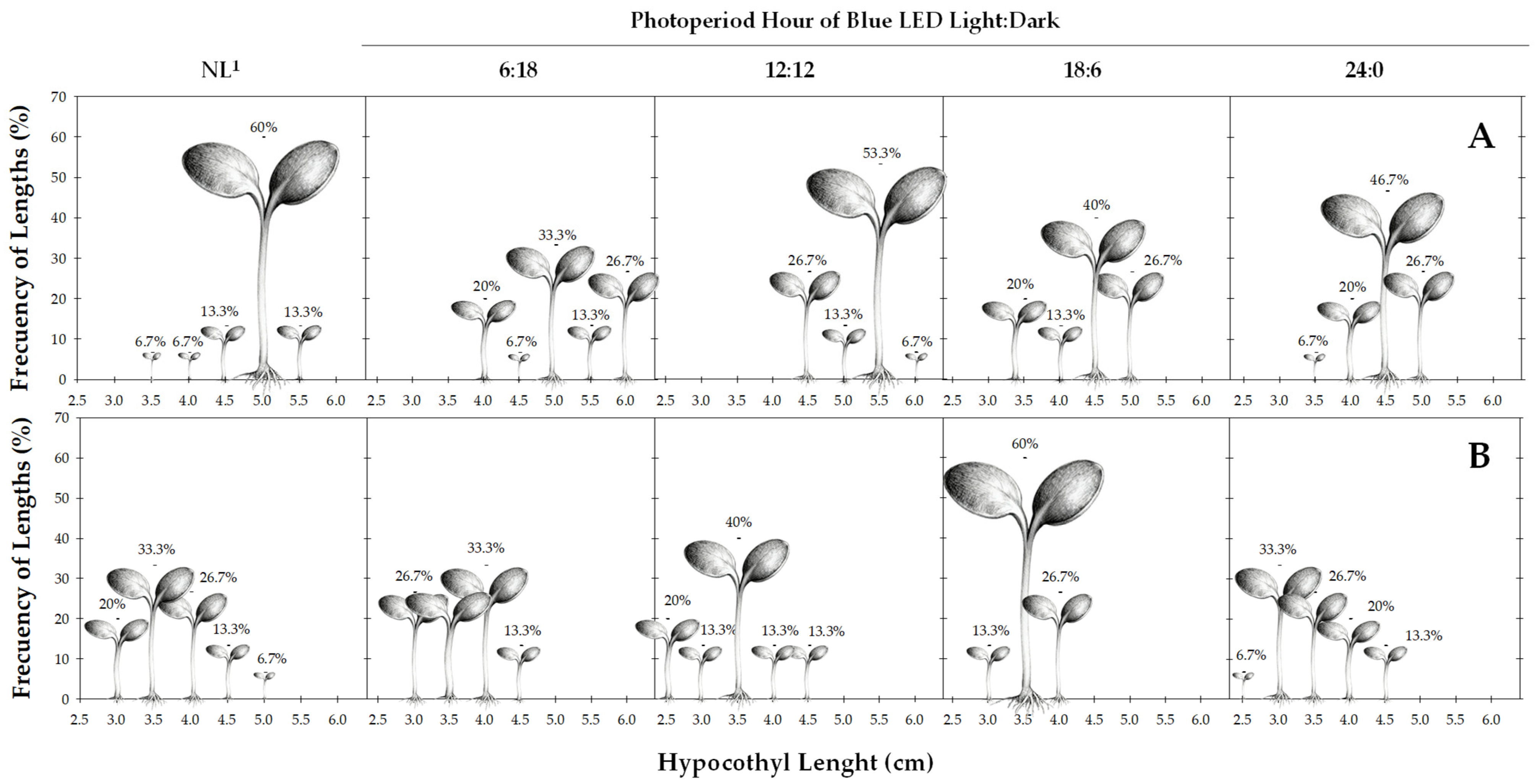
Root length and overall plant height were not significantly affected by PP in both chia and arugula species. The allometry coefficient for chia ranged from 1.72 to 2.23. In arugula, allometric values differed minimally between treatments. The highest light exposure (24:0 PP) yielded the lowest allometric value (0.97), while the 6:18 PP treatment yielded the highest (1.44). Photoperiod significantly influenced leaf area in both chia and arugula (p < 0.05). In chia, treatments with longer photoperiods generally produced larger leaf areas than those with shorter photoperiods. A similar trend was observed in arugula, though the difference in leaf size between treatments was smaller, at approximately 12:12. The variable for partially shaded plants (PSP), measured at harvest, provided consistent data across treatments. However, values in the 6:18 PP and Natural light (NL) treatments were lower than those in treatments with longer photoperiods. Length-frequency analysis showed that under the NL treatment, 73.3% of seedlings were 5 cm or taller. A similar trend was observed with microgreens exposed to 6:18 PP; 60% of the seedlings measured at or above 5 cm, while 40% were slightly below this height. In contrast, only 26.7% of seedlings in the 18:6 and 24:0 PP treatments reached 5 cm, while over 40% were just below that height, ranging from 4.5 to 4.9 cm. The remaining seedlings were 33.3% or 26.7% below 4 cm (Figure 2A). A different pattern emerged in arugula, with the highest percentages of seedlings smaller than the minimum size (3 cm) occurring in the NL treatment and at 6:18 and 12:12 PPs at 20% and 26.6%, respectively. Nevertheless, over 70% of the seedlings met the required harvest size, and over 85% of the seedlings in the 18:6 and 24:00 PP treatments achieved the minimum harvest size (Figure 2B).

3.2. Fresh and Dry Weight, Yield per Plant, and Seed

FW is an important indicator of overall performance and a quality attribute of microgreens. In this study, differences in fresh weight per square meter were observed between the two species evaluated (p < 0.05). Table 2 presents the results, showing that the highest fresh weight was recorded at 18:6 PP, with 637.6 g·m2 for chia and 883.7 g·m2 for arugula. At 12:12 and 6:18 PPs, the fresh weight of chia decreased slightly, but the change was not statistically significant compared with 18:6 PP. In contrast, arugula showed a significant decrease in FW under these same treatments, with values up to 6:18 lower than the maximum recorded weight. For both species, the extreme treatments—24:0 PP and NL—showed the lowest fresh weights, which were 38% less than the highest recorded values. In the analysis of dry weight (DW), an indicator of biomass accumulation, the PP showed a statistically significant effect. The pattern observed was similar to that of FW, but the differences were more pronounced in chia. The 18:6 PP treatment resulted in over 24:0 more dry biomass accumulation compared to the 6:18 and NL PP treatments. In arugula, the dry biomass value of 78 g m−2 under the 18:6 PP was 30% higher per plant than that of arugula microgreens exposed to either the non-zero or 6:18 PP. Similarly, when measuring yield as FW per seed sown, the trend mirrored that of yield per plant. The 18:6 photoperiod treatment produced 500 mg of FW per gram of seed for chia and 474 mg for arugula, both significantly higher than the other treatments, especially when compared to the NL photoperiod. In terms of DW, an indicator of biomass accumulation, the PP demonstrated a statistically significant effect. The pattern observed was like that of fresh weight but showed more pronounced differences in chia. Specifically, the 18:6 PP resulted in an over 24:0 increase in dry biomass accumulation compared to the 6:18 PP and the constant dark (NL) treatments. For arugula, the DW at the 18:6 PP reached 78 g m−2, which is 30% more dry biomass per plant than that of arugula microgreens under either a non-zero or 6:18 PP. Similarly, when looking at yield measured as fresh weight per seed sown, the trend mirrored that of yield per plant. Chia achieved a yield of 500 mg per gram of seed, while arugula reached 474 mg at the 18:6 PP. Both were significantly higher than the yields from the other treatments, particularly when compared to the NL treatment.

3.3. Physiological Variables

Content of Total Chlorophyll, Chlorophylls a and b, and Total Carotenoids

We found significant differences in pigment accumulation per gram of biomass across various PP treatments for both species. Initially, the total chlorophyll (Clt) content was highest in treatments with 12:12 and 18:6 photoperiods for both species, coinciding with peak levels of chlorophyll a (Cla) and chlorophyll b (Clb). In contrast, the extreme treatments—featuring the shortest and longest PP—showed the lowest concentrations of both chlorophyll components, reduced by 40% to 12:12 compared to the other treatments (Table 3). In chia, the ratio of Cla to Clb remained stable at 1 and 1.3 under shorter photoperiods, whereas a maximum ratio of 7 was observed at 24:0 PP. For arugula, treatments with 6:18 and NL, along with the 18:6 PP, revealed Cla to Clb ratios of around 3. Values for the 24:0 and 12:12 PPs ranged from 1.87 to 1.15, respectively. In terms of total carotenoids (Cart), chia showed the highest concentrations at 24:0 (11.09 µg·g−1) and 18:6 (7.19 µg·g−1) PPs, with the lowest at 12:12 PP. Meanwhile, arugula microgreens exhibited the highest Cart content in the 18:6 and NL treatments, yielding values of 12.39 and 8.83 µg·g−1, respectively. The Clt/Cart ratio in chia was low at 4.05 µg·g−1 under a 24:0 PP, decreasing inversely with decreasing photoperiod duration. In contrast, arugula microgreens displayed higher Clt/Cart ratios at the 24:0 and 12:12 PPs, with levels nearly 12:12 lower under the 6:18 PP and NL treatments.

3.4. Profitable Analyses, Energy Use Efficiency, Land Surface Use Efficiency, Cost Use Efficiency, and TOPSIS Evaluation

An economic analysis focusing solely on electricity costs and an average commercial value adjusted for fresh weight harvested per square meter shows that the highest income was achieved with the 18:6 photoperiod treatment in both species (Table 4). In contrast, the 24:0 photoperiod treatment yielded the lowest income and then NL, despite not incurring electricity costs. The photoperiods of 12:12 and 6:18 ranged from $54 to $57 for chia and from $83 to $100 for arugula, respectively.
Table 5 displays the results for EUE, PEP, and CUE for both chia and arugula across different PPs. The data indicate that both EUE and CUE values increased as PP decreased, suggesting an inverse relationship in both species. The lowest values for all analyzed variables were observed at the 24:0 photoperiod treatment for both chia and arugula. Specifically, the EUE values increased approximately 2, 3, and 10-fold as the photoperiod percentage decreased for both chia and arugula. For CUE, there was an increase of 2, 2.5, and 6 times in chia, and an increase of 10, 15, and 20 times in arugula. However, this trend was not consistent for the PEP variable, which showed the lowest levels at the 24:0 photoperiod and NL treatments, whereas intermediate treatments exhibited similar values, ranging from 40 to 45 g FW day−1.
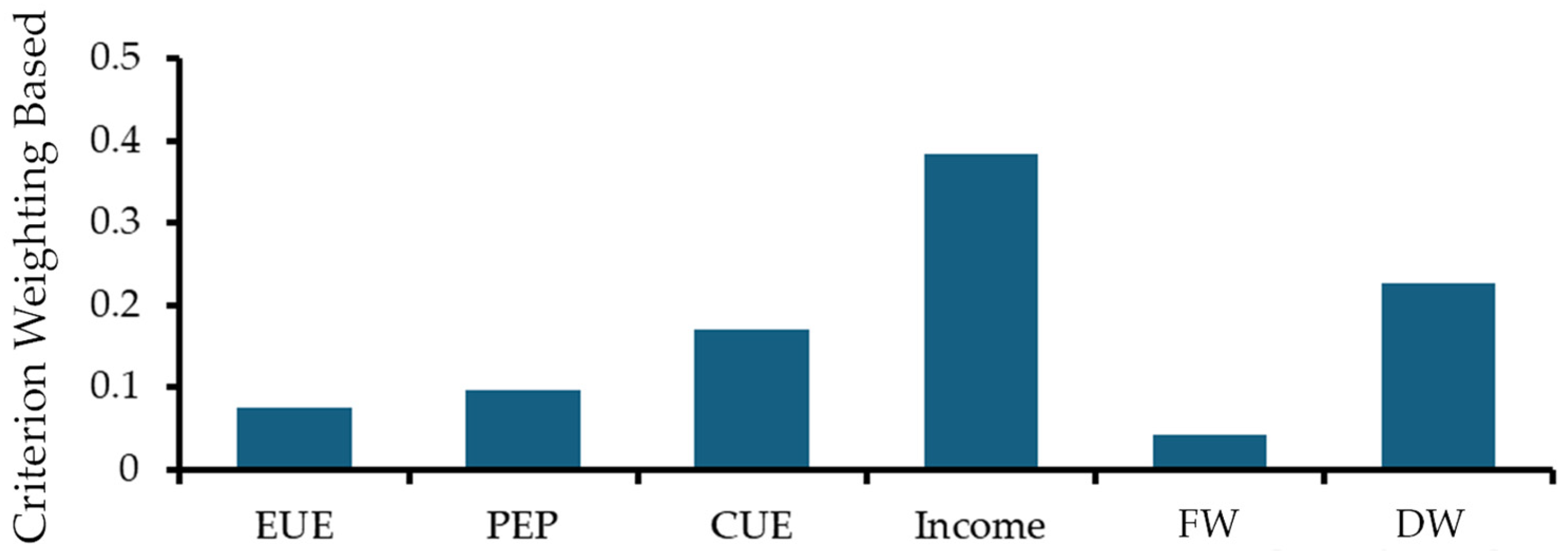
The results of the criterion weighting based on the Best–Worst Method (BWM) for the TOPSIS analysis are presented in Figure 3. This figure details each analyzed variable, including Energy Use Efficiency (EUE), Production Energy Payback (PEP), Crop Use Efficiency (CUE), Fresh Weight (FW), and Dry Weight (DW), along with their corresponding weights. The analysis indicates an optimal inconsistency (ξ*) of 0.299 and an input consistency ratio (CR) of 0.208, both of which are below the threshold of 0.337. This finding reflects an acceptable level of consistency in the pairwise comparisons, reinforcing the reliability of the calculated weights. From the results, the 6:18 PP treatment produced the highest TOPSIS scores for both chia and arugula, at 0.49422 and 0.32921, respectively. The 18:6 PP treatment followed closely, with scores of 0.59712 for chia and 0.27701 for arugula. The 12:12 PP treatment earned scores of 0.49712 for chia and 0.23301 for arugula. The 24:0 and NL treatments ranked fourth and fifth, respectively, as detailed in Table 6.

4. Discussion

4.1. Hypocotyl Length, Root Length, Total Length of the Plant, Allometry Coefficient, Leaf Area, Leaf Area Index, Partially Shaded Plants

Hypocotyl growth is influenced by several factors, including the light source, species, environment, and cultivation method [37]. However, the mechanisms by which light affects hypocotyl elongation remain poorly understood. A significant factor in the photoperiod’s effect on hypocotyl elongation is phytochrome’s adaptive plasticity across varying photoperiods [38]. This has led to somewhat contradictory results regarding the impact of photoperiod on HL. For instance, Zhang et al. [39] documented that long PP inhibits hypocotyl growth, noting that light negatively affects the length of wheat and soybean sprouts and microgreens when compared to those grown in darkness. Conversely, some results indicate that, for cabbage, kale, and arugula, a continuous 24-h PP with a photosynthetic photon flux density (PPFD) of 100 mmol m−2 s−1 promotes hypocotyl elongation [37]. In our study, treatments under short photoperiods resulted in significantly longer hypocotyls in chia species and a slight increase in arugula (see Table 1). Although it has been reported that photoperiod affects morphometric variables in arugula, this effect is associated with arugula’s shorter endogenous circadian rhythm than 24 h, and short photoperiods promote growth [40]. However, this was tested in mixtures with red light, which could have influenced the results, unlike in our study. This led us to identify two physiological changes. The first may involve a mixed effect of etiolation and de-etiolation, characterized by the conversion between chloroplasts and etioplasts, as well as signaling cascades that activate or repress the transcription of genes involved in these processes [41]. The second phenomenon, related to the first, may involve regulation of phytochrome-interacting factors 4 (PIF4) and 5 (PIF5), thereby mitigating the growth-repressive effects of light-activated photoreceptors, as observed in Arabidopsis and other Brassicaceae species. This situation supports the diurnal growth patterns of plants [38].
In the present study, chia showed a clear morphometric adjustment to photoperiod, whereas arugula was comparatively less responsive. In chia, shorter photoperiods promoted hypocotyl elongation, while longer photoperiods favored greater leaf expansion. This contrasting pattern suggests a shift in biomass allocation from elongation growth to cotyledon development under prolonged exposure to blue-light. Such a response is consistent with the general role of blue light in promoting compact seedling architecture and limiting excessive elongation, while supporting leaf development and photosynthetic surface formation. In contrast, arugula did not show significant changes in hypocotyl length across photoperiods, although leaf area tended to increase under longer light exposure. This indicates that photoperiod sensitivity may differ between species and that, in arugula, morphological responses may depend more strongly on other factors such as spectral composition or genotype-specific circadian regulation than on photoperiod alone under monochromatic blue light. These results help explain why previous studies have reported inconsistent photoperiod effects in microgreens and reinforce the importance of species-specific evaluation under controlled lighting conditions.
The findings indicate that longer PP enhances cotyledon growth and development, as seen in chia and arugula microgreens, which exhibited greater leaf area and leaf area index, alongside reduced hypocotyl elongation. This inverse relationship suggests that extended light exposure increases the rate of chlorophyll biosynthesis per unit of leaf area, potentially improving photosynthetic capacity by enhancing chloroplast light-use efficiency, as demonstrated in common buckwheat microgreens [23]. However, the advantages of longer light periods may level off, as excessive light can suppress chloroplast activity. This effect has been observed in various Brassicacea microgreens [15] and in the 24:0 photoperiod treatment (Table 1).
Blue light may help explain several of the responses observed in this study. Under prolonged exposure, blue wavelengths are known to regulate photomorphogenesis through cryptochrome- and phototropin-mediated signaling, which generally promotes more compact seedlings by reducing elongation growth and favoring leaf expansion. This mechanism is consistent with the response observed in chia, where longer photoperiods were associated with reduced hypocotyl elongation but greater leaf area. In addition, the higher chlorophyll content observed under intermediate to long photoperiods may reflect enhanced pigment biosynthesis and improved development of the photosynthetic apparatus under extended blue-light exposure. Blue light has also been associated with stomatal regulation, chloroplast development, and photoprotective adjustment, which may improve light use during early growth stages. However, these mechanisms may differ in intensity among species, genotypes, and spectral environments, which could explain the weaker morphometric response observed in arugula.
The AC describes how the size, weight, or volume of plant parts changes proportionally with the whole plant [42]. The proportions shown in Table 1 were more significantly influenced by hypocotyl size than by root size, as no differences in root size were observed among the treatments. This apparent contradiction—expecting a direct proportional response to PP—can be clarified by the higher PSP values at the time of harvest (Table 1). These higher values indicate a greater cotyledon density resulting from a larger leaf area and leaf index (Table 1). Consequently, both seed yield and seedling weight increased (Table 2), leading to greater fresh and dry weights in microgreens exposed to longer PP, except under 24:0 PP (Table 2). After the first 48 h post-planting, the microgreens received no light treatment, and neither root size nor overall plant size at harvest was affected by light exposure. The uniformity of microgreen sizes contributes significantly to the canopy’s appearance, holding both commercial and aesthetic value. In our findings, the photoperiod did not impact size homogeneity (see Table 1 and Figure 2A,B). The size variation between the smallest and largest seedlings was no greater than 1.5 cm, except for chia, which had a difference of 2.0 cm, and arugula, which also exhibited a 2.0 cm variation. Notably, 60 to 70% of the chia seedlings did not vary more than 0.5 cm within the tallest size category (5.0–5.5 cm in height). However, in the 6:18 PP treatment, some seedlings reached 6.0 cm in height, resulting in a more even distribution across sizes (see Figure 2B). These size variations of 0.5 cm align with the uniformity observed in microgreens such as rapini, kale, and cress when evaluating yield and uniformity at various planting densities [43]. This variation in size distribution is explained as an adaptive response to light restriction, which is mediated by phytochrome plasticity and the regulated effects of etiolation. We also observed similar proportions in arugula, but in a medium-sized category (3.0–3.5 cm in height) (see Figure 2B). The differences observed between species may be attributed to biological factors, as arugula seedlings demonstrated greater accumulation of both fresh and dry weight, along with enhanced cotyledon development, which restricted further hypocotyl elongation (see Table 1 and Table 2). This phenomenon has been described in two microgreen species, Brassica oleracea and radish, under different light and vapor pressure deficit conditions. It was found that larger microgreens tended to have greater intracellular space but lower biosynthesis of organic compounds, suggesting a complex interplay of factors affecting size and biomass accumulation [44].

4.2. Fresh and Dry Weight, Yield per Plant, and Efficiency

The impact of extended PP treatments on FW and DW per square meter and per individual plant is evident. This aligns with previous studies indicating that longer PP can enhance growth in arugula microgreens, although responses may differ across plant species and growing conditions [15]. Research has shown that the dry matter content of beet microgreens increases from 6.71% to 10.55% when the PP is extended from 12 to 16 h per day [14]. Additionally, Liu et al. [15] found that cabbage microgreens exhibited higher dry weights under a 20-h daily photoperiod, although they reported greater dry matter content (4.56 mg per plant) in Chinese cabbage under a 16-h photoperiod. Carotti et al. [45] noted that maximum biomass production typically occurs just before plants start to experience stress from excess light, provided that ambient temperature is optimal (20–25 °C) and that CO2 levels are appropriate for the specific species being grown. The formation of a virtuous cycle indicates a direct relationship between PP and photosynthesis [46]. Consequently, the longer PP enhances the photosynthetic capacity of the cotyledonary leaves, as previously explained. This increase in photosynthesis and larger leaf area can lead to greater production of organic compounds, ultimately contributing to increased biomass formation [23].

4.3. Content of Chlorophylls a and b, Total Chlorophyll, and Total Carotenoids

Results indicated that spinach, amaranth, and even coriander exhibited similar values under various light and cultivation conditions [47]. Additionally, beets showed pigment levels comparable to those observed during natural-light photoperiodic growth [48]. In contrast, Altuner et al. [49] reported lower levels of Cla in wheat and barley microgreens exposed to a 16/8 light/dark PP, with values of only 17 µg·g FW for Cla and between 3 and 7.3 µg·g FW for Clb, along with carotenoid levels ranging from 2.8 to 6.2 µg·g FW. In a similar study, an 18:6 PP resulted in the highest photosynthetic pigment content, as seen in arugula and radish exposed to light for 10, 12, 14, 16, and 18 h per day. The 16-h treatment yielded higher concentrations of chlorophyll and carotenoids [50]. Chlorophyll is the primary pigment responsible for capturing light during photosynthesis. Cla is the most abundant pigment and directly converts light energy into chemical energy, primarily in the reaction centers. Clb assists by channeling light to Cla, thereby enhancing light absorption, and is mainly found in light-harvesting complexes. In addition to chlorophyll, other essential pigments involved in photosynthesis include carotenoids (such as α-carotene, β-carotene, lutein, violaxanthin, and zeaxanthin), which not only participate in photosynthesis but also protect plant tissues from photo-oxidative stress and contribute to coloration [51]. The results align with the physiological principles of pigments: a longer photoperiod resulted in higher concentrations of Cla, Clb, and Clt, enabling chia seedlings to capture more light. However, this concentration began to decline at the 24:0 PP treatment. This decrease is further supported by the high chlorophyll a/b ratio, which indicates increased light exposure [52]. In arugula, the trends were less consistent. Nevertheless, the 18:6 PP treatment showed the highest accumulation of Cla and Clt, although Clb did not follow the same trend. The lowest levels of these compounds were observed in the 6:18 PP group. This could be attributed to light limitation, which may slightly restrict chlorophyll synthesis; however, normal levels were still observed alongside the highest Cla/b ratio in the NL treatment. The NL treatment aims to extend the antenna system of Photosystem II, thereby enabling greater light capture and processing, particularly during the 18:6 photoperiod [33]. Similarly, the carotenoid levels in chia decreased logically as the photoperiod shortened. This trend supports the theory that carotenoids are necessary in treatments with longer photoperiods to dissipate excess light, whereas shorter photoperiods are associated with lower carotenoid levels. The notably high Clt/Cart ratio, which is typical of shaded or highly irradiated leaves [33], corroborates this observation. In contrast, arugula maintained normal levels of total carotenoids; however, the total chlorophyll/total carotenoid ratio was high, particularly in the 18:6 photoperiod treatment, which had the most significant effect. Reporting pigment concentration per cotyledon area in arugula could reveal a stronger response to varying photoperiods [33] than measurements per gram of the sample.

4.4. Profitable Analysis and TOPSIS Model Evaluation

The revenue increase was primarily driven by greater accumulation of fresh biomass in both species, improved product marketing, and increased production, resulting in higher income (see Table 1 and Table 4). However, this increase was not reflected in energy efficiency, as more electricity was required to produce the additional fresh and dried biomass. While longer PP led to increased electricity consumption, the higher daily biomass output offset these costs, resulting in increased gross income. Nevertheless, the 24:0 PP treatment did not follow this trend, indicating physiological limitations and diminishing returns associated with continuous light exposure (refer to Table 5). Based on the significance of the variables and their weighted averages (illustrated in Figure 3), we established a ranking of the best treatments for the evaluated PP and species (see Table 6). The 6:18 PP treatment ranked first because it had the lowest energy consumption. Although it did not produce the highest amount of fresh biomass, it ranked second for chia and third for arugula. The 18:6 PP treatment came in second, despite yielding the highest weighted-average biomass, possibly because of its higher electricity use and the additional investment required to achieve greater biomass. The 12:12 PP treatment ranked third, with values that were very close to those of the 18:6 treatment, as previously explained. At the bottom of the table are the 24:0 and NL treatments. The 24:0 PP treatment ranked fourth due to its high electricity consumption and low productivity, while the NL treatment ranked fifth, with low production of both fresh and dry biomass despite incurring zero electricity costs for biomass production (see Table 4 and Table 5). Although the 6:18 treatment achieved the highest overall TOPSIS ranking, this result should be interpreted in light of the selected criteria and their assigned weights. Its favorable position was mainly associated with lower electricity consumption, combined with acceptable biological performance across variables. By contrast, the 18:6 treatment produced the highest fresh biomass and gross value estimate under the conditions evaluated. Therefore, these results do not necessarily indicate a contradiction, but rather reflect different decision priorities: the 6:18 treatment performed better in the integrated multi-criteria evaluation, whereas the 18:6 treatment was superior when biomass production was the main objective.

5. Conclusions

Photoperiod significantly influenced the performance of chia and arugula microgreens under indoor blue LED lighting, though responses were species- and trait-dependent. In both species, the 18:6 photoperiod produced the highest fresh and dry biomass, whereas the 24:0 photoperiod produced the lowest yields. In chia, shorter photoperiods promoted greater hypocotyl elongation, while longer photoperiods favored leaf expansion and higher pigment accumulation. In arugula, hypocotyl length was not significantly affected by photoperiod, although the 18:6 treatment also showed the highest biomass and pigment concentrations. From an operational perspective, the 18:6 photoperiod produced higher biomass while achieving favorable energy-use efficiency, whereas the 6:18 treatment achieved the highest overall TOPSIS ranking under the selected criteria and weights. Therefore, 6:18 may be considered the best option when prioritizing balanced multicriteria performance, while 18:6 may be preferred when the main objective is to maximize biomass production and gross value estimate.
This study has several limitations. Only blue light was evaluated; light intensity was kept constant, while total daily light input varied across photoperiods. The economic analysis was limited to electricity-related costs and did not include other production costs. The natural light treatment served only as a practical reference rather than as a strictly equivalent control. These factors should be considered when interpreting the results and in future studies aimed at optimizing photoperiod strategies for indoor microgreen production. In addition, future research should compare monochromatic and mixed spectra to determine whether the responses observed here are maintained under other lighting combinations.

Author Contributions

Conceptualization, J.A.S.-V. and A.S.-E.; methodology, J.A.S.-V., A.S.-E., A.R.T.-G. and J.N.M.-R.; software, J.N.M.-R. and A.S.-E.; validation, J.A.S.-V., A.S.-E. and J.F.-H.; formal analysis, A.S.-E., J.F.-H., J.N.M.-R. and J.A.S.-V.; investigation, A.S.-E., J.F.-H., J.N.M.-R., A.R.T.-G. and J.A.S.-V.; resources, A.S.-E., J.F.-H., J.N.M.-R. and J.A.S.-V.; data curation, A.S.-E., J.N.M.-R. and J.A.S.-V.; writing—original draft preparation, J.A.S.-V. and A.S.-E.; writing—review and editing, J.N.M.-R.; visualization J.N.M.-R.; supervision, A.S.-E. and J.F.A.-Z. All authors have read and agreed to the published version of the manuscript.

Funding

This work was funded by Mexican federal government contributions. Project number 10321.

Data Availability Statement

The original contributions presented in this study are included in the article. Further inquiries can be directed to the corresponding author.

Conflicts of Interest

The authors declare no conflicts of interest.

Abbreviations

The following abbreviations are used in this manuscript:
ACAllometry coefficient
BWMBest–worst method
CCost
CartTotal carotenoids
ClaChlorophyll a
ClbChlorophyll b
CUEElectricity cost per gram
DWDry weight
EEfficiency
EUEEnergy Use Efficiency
FWFresh weight
HLHypocotyl length
kWhKilowatt hour
LALeaf area
LAILeaf area index
LEDLight-emitting diode
NLNatural light
PEPProductive efficiency per production area per day
PPPhotoperiod
PSPPartially shaded plant
RLRoot length
SDSeedling density
TNumber of days of photoperiod applied
TOPSISTechnique for Order of Preference by Similarity to Ideal Solution
TPLTotal plant length
YYield

References

  1. Castagnino, A.M.; Marina, J.A.; Benvenuti, S.; Marín Castro, M.A. Microgreens and Sprouts, Two Innovative Functional Foods for a Healthy Diet in Km 0. Hortic. Argent. 2020, 39, 55–95. [Google Scholar]
  2. Pennisi, G.; Pistillo, A.; Orsini, F.; Cellini, A.; Spinelli, F.; Nicola, S.; Fernandez, J.A.; Crepaldi, A.; Gianquinto, G.; Marcelis, L.F. Optimal Light Intensity for Sustainable Water and Energy Use in Indoor Cultivation of Lettuce and Basil Under Red and Blue LEDs. Sci. Hortic. 2020, 272, 109508. [Google Scholar] [CrossRef]
  3. Martín, P. Cinco Razones Para Consumir Brotes. 2020. Available online: https://www.rionegro.com.ar/cinco-razones-para-consumir-brotes-1242883/ (accessed on 12 December 2025).
  4. John, S.; Gunathilake, S.; Aluthge, S.; Farahnaky, A.; Majzoobi, M. Unlocking the potential of chia microgreen: Physicochemical properties, nutritional profile and its application in noodle production. Food Bioprocess Technol. 2025, 18, 5605–5620. [Google Scholar] [CrossRef]
  5. Komeroski, M.R.; Portal, K.A.; Comiotto, J.; Klug, T.V.; Flores, S.H.; Rios, A.D.O. Nutritional quality and bioactive compounds of arugula (Eruca sativa L.) sprouts and microgreens. Int. J. Food Sci. Technol. 2023, 58, 5089–5096. [Google Scholar] [CrossRef]
  6. Treadwell, D.D.; Hochmuth, R.; Landrum, L.; Laughlin, W. Microgreens: A New Specialty Crop: HS1164, rev. 9/2020. EDIS 2020, 2020, 1–3. [Google Scholar] [CrossRef]
  7. Susilo, K.R.; Eu, A.; Besemer, B.; Heuvelink, E.; de Vos, R.C.; Marcelis, L.F. Extended Photoperiod Improves Growth and Nutritional Quality of Pak Choi Under Constant Daily Light Integral. Front. Plant Sci. 2025, 16, 1621513. [Google Scholar] [CrossRef]
  8. Nazir, M.; Ullah, M.A.; Younas, M.; Siddiquah, A.; Shah, M.; Giglioli-Guivarc’h, N.; Hano, C.; Abbasi, B.H. Light-Mediated Biosynthesis of Phenylpropanoid Metabolites and Antioxidant Potential in Callus Cultures of Purple Basil (Ocimum basilicum L. var purpurascens). Plant Cell Tissue Organ Cult. 2020, 142, 107–120. [Google Scholar] [CrossRef]
  9. Lange, O.L.; Nobel, P.S.; Osmond, C.B.; Ziegler, H. Physiological Plant Ecology III: Responses to the Chemical and Biological Environment; Springer: Berlin/Heidelberg, Germany, 1983. [Google Scholar] [CrossRef]
  10. Lobiuc, A.; Vasilache, V.; Pintilie, O.; Stoleru, T.; Burducea, M.; Oroian, M.; Zamfirache, M.M. Blue and Red LED Illumination Improves Growth and Bioactive Compounds Contents in Acyanic and Cyanic Ocimum basilicum L. Microgreens. Molecules 2017, 22, 2111. [Google Scholar] [CrossRef]
  11. Bantis, F. Light Spectrum Differentially Affects the Yield and Phytochemical Content of Microgreen Vegetables in a Plant Factory. Plants 2021, 10, 2182. [Google Scholar] [CrossRef]
  12. Chen, Z.; Shah Jahan, M.; Mao, P.; Wang, M.; Liu, X.; Guo, S. Functional Growth, Photosynthesis and Nutritional Property Analyses of Lettuce Grown Under Different Temperature and Light Intensity. J. Hortic. Sci. Biotechnol. 2021, 96, 53–61. [Google Scholar] [CrossRef]
  13. Chibani, K.; Gherli, H.; Fan, M. The Role of Blue Light in Plant Stress Responses: Modulation Through Photoreceptors and Antioxidant Mechanisms. Front. Plant Sci. 2025, 16, 1554281. [Google Scholar] [CrossRef]
  14. Barańska, D.; Panek, J.; Różalska, S.; Turnau, K.; Frąc, M. Microgreens as the Future of Urban Horticulture and Superfoods, Supported by Post-Harvest Innovations for Shelf-Life Increase: A Review. Sci. Hortic. 2025, 350, 114303. [Google Scholar] [CrossRef]
  15. Liu, K.; Gao, M.; Jiang, H.; Ou, S.; Li, X.; He, R.; Li, Y.; Liu, H. Light Intensity and Photoperiod Affect Growth and Nutritional Quality of Brassica Microgreens. Molecules 2022, 27, 883. [Google Scholar] [CrossRef] [PubMed]
  16. Hernández-Adasme, C.; Palma-Dias, R.; Escalona, V.H. The Effect of Light Intensity and Photoperiod on the Yield and Antioxidant Activity of Beet Microgreens Produced in an Indoor System. Horticulturae 2023, 9, 493. [Google Scholar] [CrossRef]
  17. Chu, Q.; Qin, Y.; Li, C.; Cheng, S.; Su, L.; He, Z.; Zhou, X.; Shao, D.; Guo, X. Effects of Different Photoperiods on the Growth and Nutritional Characteristics of Two Celery Cultivars in Plant Factory. Agronomy 2023, 13, 3039. [Google Scholar] [CrossRef]
  18. Wu, L.; Zhang, L.; Tu, W.; Sun, R.; Li, F.; Lin, Y.; Zhang, Y.; Liu, C.; Yang, C. Photosynthetic Inner Antenna CP47 Plays Important Roles in Ephemeral Plants in Adapting to High Light Stress. J. Plant Physiol. 2020, 251, 153189. [Google Scholar] [CrossRef]
  19. Lichtenthaler, H.K.; Babani, F. Contents of Photosynthetic Pigments and Ratios of Chlorophyll a/b and Chlorophylls to Carotenoids (a+b)/(x+c) in C4 Plants as Compared to C3 Plants. Photosynthetica 2022, 60, 3–9. [Google Scholar] [CrossRef]
  20. Ueda, M.; Tanaka, A.; Sugimoto, K.; Shikanai, T.; Nishimura, Y. chlB Requirement for Chlorophyll Biosynthesis Under Short Photoperiod in Marchantia polymorpha L. Genome Biol. Evol. 2014, 6, 620–628. [Google Scholar] [CrossRef]
  21. Shibaeva, T.G.; Mamaev, A.V.; Sherudilo, E.G.; Titov, A.F. The Role of Photosynthetic Daily Light Integral in Plant Response to Extended Photoperiods. Russ. J. Plant Physiol. 2022, 69, 7. [Google Scholar] [CrossRef]
  22. Sobotka, R. Making Proteins Green; Biosynthesis of Chlorophyll-binding Proteins in Cyanobacteria. Photosynth. Res. 2014, 119, 223–232. [Google Scholar] [CrossRef]
  23. Johnson, M.A.; Kumar, M.; Thakur, S. Effect of Variation in Temperature and Light Duration on Morpho-physiology and Phytochemical Content in Sprouts and Microgreens of Common Buckwheat (Fagopyrum esculentum Moench). Plant Foods Hum. Nutr. 2024, 79, 875–885. [Google Scholar] [CrossRef] [PubMed]
  24. Lanoue, J.; Louis, S.S.; Little, C.; Hao, X. Continuous Lighting Can Improve Yield and Reduce Energy Costs while Increasing or Maintaining Nutritional Contents of Microgreens. Front. Plant Sci. 2022, 13, 983222. [Google Scholar] [CrossRef] [PubMed]
  25. Lerner, B.L.; Strassburger, A.S.; Schäfer, G. Cultivation of arugula microgreens: Seed densities and electrical conductivity of nutrient solution in two growing seasons. Bragantia 2024, 83, e20230183. [Google Scholar] [CrossRef]
  26. Khan, F.A.; Dar, Z.M.; Mushtaq, I.; Hussain, S.; Anwar, A.; Amir, M.; Dey, P.; Waqas, U. Microgreens as a potential food for nutritional security in the rural urban continum. SKUAST J. Res. 2025, 27, 151–164. [Google Scholar] [CrossRef]
  27. Moinuddin, K.A.; Chandra, G.; Shagun, P.S. Future Prospects of Microgreens in Global Food and Nutritional Security. J. Food Chem. Nanotechnol. 2025, 11, 199–210. [Google Scholar] [CrossRef]
  28. Yanes-Molina, A.P.; Jaime-Meuly, R.; Andrade-Bustamante, G.; Lucero-Flores, T.I.; Martínez-Ruíz, F.E. Microgreens-an alternative of horticultural production and market. Expert J. Mark. 2019, 7, 120–136. [Google Scholar]
  29. Da Silva, F.F.; Wallach, R.; Chen, Y. Hydraulic properties of sphagnum peat moss and tuff (scoria) and their potential effects on water availability. Plant Soil 1993, 154, 119–126. [Google Scholar] [CrossRef]
  30. Ixtaina, V.Y.; Nolasco, S.M.; Tomás, M.C. Physical Properties of Chia (Salvia hispanica L.) Seeds. Ind. Crop. Prod. 2008, 28, 286–293. [Google Scholar] [CrossRef]
  31. Silva, P.A.D.; Kinjo, S.; Melo, M.P.B.X.D.; Sala, F.C. Evaluation of Arugula Cultivars and Seed Production in the Organic System. J. Seed Sci. 2019, 41, 423–430. [Google Scholar] [CrossRef]
  32. AOAC. Official Methods of Analysis of Association of Official Analytical Chemists, 14th ed.; AOAC: Arlington, VA, USA, 1984. [Google Scholar]
  33. Lichtenthaler, H.K.; Buschmann, C. Chlorophylls and Carotenoids: Measurement and Characterization by UV–VIS Spectroscopy. In Current Protocols in Food Analytical Chemistry; Wiley: Hoboken, NJ, USA, 2001; Volume 1, pp. F4.3.1–F4.3.8. [Google Scholar] [CrossRef]
  34. Cowden, R.J.; Markussen, B.; Ghaley, B.B.; Henriksen, C.B. The Effects of Light Spectrum and Intensity, Seeding Density, and Fertilization on Biomass, Morphology, and Resource Use Efficiency in Three Species of Brassicaceae Microgreens. Plants 2024, 13, 124. [Google Scholar] [CrossRef]
  35. Filatov, D.; Olonin, I. Optimal Ratio of Spectrum, Light Intensity and Photoperiod to Minimize Costs When Growing Microgreens. E3S Web Conf. 2023, 383, 04074. [Google Scholar] [CrossRef]
  36. Liang, F.; Brunelli, M.; Rezaei, J. Consistency Issues in the Best Worst Method: Measurements and Thresholds. Omega 2020, 96, 102175. [Google Scholar] [CrossRef]
  37. Kong, Y.; Kamath, D.; Zheng, Y. Blue versus Red Light Can Promote Elongation Growth Independent of Photoperiod: A Study in Four Brassica Microgreens Species. HortScience 2019, 54, 1955–1961. [Google Scholar] [CrossRef]
  38. Ronald, J.; Lock, S.C.L.; Claydon, W.; Zhu, Z.; McCarthy, K.; Pendlington, E.; Redmon, E.J.; Vong, G.Y.W.; Stanislas, S.P.; Davis, S.J.; et al. Hypocotyl Development in Arabidopsis and other Brassicaceae Displays Evidence of Photoperiodic Memory. bioRxiv 2024. [Google Scholar] [CrossRef]
  39. Zhang, X.; Bian, Z.; Yuan, X.; Chen, X.; Lu, C. A Review on the Effects of Light-Emitting Diode (LED) Light on the Nutrients of Sprouts and Microgreens. Trends Food Sci. Tech. 2020, 99, 203–216. [Google Scholar] [CrossRef]
  40. Li, T.; Liu, H.; Zhou, F. Effects of light intensity and photoperiod on the fresh locking and quality of hydroponic arugula in the harvesting period. Agronomy 2023, 13, 1667. [Google Scholar] [CrossRef]
  41. Armarego-Marriott, T.; Sandoval-Ibañez, O.; Kowalewska, Ł. Beyond the Darkness: Recent Lessons from Etiolation and De-etiolation Studies. J. Exp. Bot. 2020, 71, 1215–1225. [Google Scholar] [CrossRef]
  42. Westgeest, A.J.; Vasseur, F.; Enquist, B.J.; Milla, R.; Gómez-Fernández, A.; Pot, D.; Vile, D.; Violle, C. An Allometry Perspective on Crops. New Phytol. 2024, 244, 1223–1237. [Google Scholar] [CrossRef]
  43. Signore, A.; Somma, A.; Leoni, B.; Santamaria, P. Optimising Sowing Density for Microgreens Production in Rapini, Kale and Cress. Horticulturae 2024, 10, 274. [Google Scholar] [CrossRef]
  44. Amitrano, C.; Paglialunga, G.; Battistelli, A.; De Micco, V.; Del Bianco, M.; Liuzzi, G.; Moscatello, S.; Paradiso, R.; Proietti, S.; Rouphael, Y.; et al. Defining Growth Requirements of Microgreens in Space Cultivation via Biomass Production, Morpho-Anatomical and Nutritional Traits Analysis. Front. Plant Sci. 2023, 14, 1190945. [Google Scholar] [CrossRef]
  45. Carotti, L.; Graamans, L.; Puksic, F.; Butturini, M.; Meinen, E.; Heuvelink, E.; Stanghellini, C. Plant Factories are Heating Up: Hunting for the Best Combination of Light Intensity, Air Temperature and Root-Zone Temperature in Lettuce Production. Front. Plant Sci. 2021, 11, 592171. [Google Scholar] [CrossRef] [PubMed]
  46. Alrifai, O.; Hao, X.; Marcone, M.F.; Tsao, R. Current Review of the Modulatory Effects of LED Lights on Photosynthesis of Secondary Metabolites and Future Perspectives of Microgreen Vegetables. J. Agric. Food Chem. 2019, 67, 6075–6090. [Google Scholar] [CrossRef]
  47. Bhaswant, M.; Shanmugam, D.K.; Miyazawa, T.; Abe, C.; Miyazawa, T. Microgreens—A Comprehensive Review of Bioactive Molecules and Health Benefits. Molecules 2023, 28, 867. [Google Scholar] [CrossRef]
  48. Acharya, J.; Gautam, S.; Neupane, P.; Niroula, A. Pigments, Ascorbic Acid, and Total Polyphenols Content and Antioxidant Capacities of Beet (Beta vulgaris) Microgreens During Growth. Int. J. Food Prop. 2021, 24, 1175–1186. [Google Scholar] [CrossRef]
  49. Altuner, F.; Tuncturk, R.; Oral, E.; Tuncturk, M. Evaluation of Pigment, Antioxidant Capacity and Bioactive Compounds in Microgreens of Wheat Landraces and Cereals. Chil. J. Agric. Res. 2021, 81, 643–654. [Google Scholar] [CrossRef]
  50. Da Cruz, E.A.; da Costa, J.C.F.; Freire, W.A.; Souza, Ê.G.F.; da Silva Costa, E.; da Silva Costa, K.D.; Almeida, R.M.R.G.; de Magalhães Cabral Albuquerque, E.C. Effect of Different Times of Exposure to LED Treatment on Microgreens of Arugula (Eruca sativa) and Radish (Raphanus sativus). Cad. Pedagógico 2024, 21, e11239. [Google Scholar] [CrossRef]
  51. Croce, R.; van Amerongen, H. Light Harvesting in Oxygenic Photosynthesis: Structural Biology Meets Spectroscopy. Science 2020, 369, eaay2058. [Google Scholar] [CrossRef]
  52. Wojdyło, A.; Nowicka, P.; Tkacz, K.; Turkiewicz, I.P. Sprouts vs. Microgreens as Novel Functional Foods: Variation of Nutritional and Phytochemical Profiles and Their In Vitro Bioactive Properties. Molecules 2020, 25, 4648. [Google Scholar] [CrossRef] [PubMed]
Figure 1. Flowchart of the TOPSIS procedure used to rank photoperiod treatments. The evaluated alternatives were 24:0, 18:6, 12:12, 6:18, and natural light (NL). The criteria included energy use efficiency (EUE), productive efficiency per production area per day (PEP), cost use efficiency (CUE), gross income estimate, fresh weight (FW), and dry weight (DW). Criterion weights were obtained using the Best–Worst Method (BWM) and incorporated into the weighted normalized decision matrix before calculating the positive and negative ideal solutions, Euclidean distances, and the relative closeness coefficient used for treatment ranking.
Horticulturae 12 00439 g001
Figure 2. The length-frequency analysis of chia (A) and arugula (B) microgreens under different photoperiods. 1 NL = natural light, and different treatments with blue LED lights (h).
Horticulturae 12 00439 g002
Figure 3. Criterion weighting based on the Best–Worst Method (BWM) for the TOPSIS analysis. Energy Use Efficiency (EUE), Production Energy Payback (PEP), Crop Use Efficiency (CUE), Income, Fresh Weight (FW), and Dry Weight (DW).
Horticulturae 12 00439 g003
Table 1. Effect of photoperiod on the growth and leaf area of chia and arugula microgreens.
Photoperiod
(Light:Dark)
HL
(cm)
RL
(cm)
TPL
(cm)
ACLA
(cm2 Plant−1)
LAIPSPs *
(Number of Plants, cm−2)
Chia
24:04.29 ± 0.37 b2.62 ± 0.73 a6.91 ± 0.93 a1.750.40 ± 0.10 b4.278.175
18:64.27 ± 0.49 b2.65 ± 0.68 a6.92 ± 0.73 a1.720.47 ± 0.10 a5.028.522
12:125.00 ± 0.48 a2.63 ± 0.93 a7.63 ± 1.19 a2.060.43 ± 0.10 ab4.598.328
6:185.16 ± 1.07 a2.49 ± 0.68 a7.65 ± 1.13 a2.230.24 ± 0.06 c2.566.493
NL4.78 ± 0.54 ab2.33 ± 0.82 a7.28 ± 1.27 a2.180.20 ± 0.06 c2.145.700
Arugula
24:03.30 ± 0.59 a3.47 ± 0.70 a6.77 ± 0.97 a0.970.61 ± 0.18 b4.075.032
18:63.48 ± 0.31 a3.22 ± 1.15 a6.70 ± 1.16 a1.200.71 ± 0.15 a4.735.252
12:123.30 ± 0.62 a3.47 ± 1.09 a6.77 ± 1.38 a1.030.68 ± 0.14 ab4.535.190
6:183.50 ± 0.51 a2.87 ± 1.07 a6.41 ± 1.11 a1.440.43 ± 0.15 c2.874.348
NL3.64 ± 0.51 a3.25 ± 0.69 a6.89 ± 0.82 a1.170.46 ± 0.12 c3.074.499
Note. * At the harvest moment, HL = Hypocotyl length, RL = Root length, TPL = Total plant length, AC = Allometry coefficient, LA = Leaf area, LAI = Leaf are index, PSPs = Partially shaded plants. Values with different letters within each column by species are different according to Tukey’s test (p ≤ 0.05).
Table 2. The impact of photoperiod on the fresh weight, dry weight, and yield of chia and arugula.
Photoperiod
(Light:Dark)
FW
(g·m2)
DW
(g·m2)
Yield
(mg DW·100 Plants−1)
Yield
(mg DW·g Seed−1)
Chia
24:0397.1 ± 10.5 b *42.3 ± 1.9 b39347.03
18:6637.6 ± 73.2 a65.0 ± 5.7 a60534.10
12:12560.1 ± 22.4 a38.1 ± 3.3 bc36320.70
6:18578.2 ± 74.2 a31.1 ± 5.1 c29258.34
NL420.7 ± 27.6 b27.6 ± 2.0 c25222.46
Arugula
24:0530.2 ± 85.0 c52.1 ± 8.6 b76316.54
18:6883.7 ± 107.5 a78.0 ± 6.6 a114474.81
12:12791.1 ± 13.3 ab53.8 ± 3.1 b79329.04
6:18648.9 ± 57.9 bc48.8 ± 4.7 b71295.72
NL517.7 ± 39.8 c51.4 ± 1.5 b75312.37
Note. * Values with different letters within each column by species are statistically different according to Tukey’s test (p ≤ 0.05). FW = fresh weight; DW = dry weight; NL = natural light. Values for AC, LAI, PSP, EUE, CUE, and related derived indices are treatment-level calculated means obtained from measured variables and are presented as comparative indicators; therefore, they were not subjected to mean separation analysis.
Table 3. Photosynthetic pigment content of arugula and chia under different photoperiods.
Photoperiod (Light:Dark)Cla *
(µg·g−1 DW)
Clb
(µg·g−1 DW)
Clt
(µg·g−1 DW)
Cla/Clb
Ratio
Cart
(µg·g−1 DW)
Clt/Cart Ratio
Chia
24:043.15 ± 11.9 b5.57 ± 0.0 c45.01 ± 11.3 c7.7411.09 ± 3.3 a4.050
18:665.01 ± 9.20 a24.75 ± 10.3 bc89.76 ± 17.0 ab2.627.19 ± 3.4 ab12.48
12:1265.53 ± 7.50 a48.70 ± 13.4 a114.23 ± 20.5 a1.345.10 ± 0.0 b22.40
6:1838.55 ± 1.50 b29.74 ± 9.5 ab68.28 ± 10.3 bc1.302.34 ± 1.8 c29.17
NL25.66 ± 2.10 b23.59 ± 0.4 bc49.24 ± 2.40 c1.081.87 ± 0.7 c26.33
Arugula
24:033.70 ± 1.3 b17.93 ± 5.2 b51.63 ± 9.8 b1.875.44 ± 2.2 c9.49
18:662.51 ± 0.3 a19.13 ± 12.8 ab81.65 ± 8.2 a3.2712.39 ± 2.7 a6.58
12:1234.93 ± 5.7 b30.13 ± 2.1 a65.06 ± 6.1 ab1.156.51 ± 2.4 c9.99
6:1826.71 ± 5.2 c6.80 ± 2.0 c33.50 ± 1.8 c3.926.95 ± 0.5 c4.82
NL37.89 ± 4.7 b10.60 ± 3.8 c48.39 ± 3.4 bc3.578.83 ± 0.2 b5.48
Note. * Cla = Chlorophyll a; Clb = Chlorophyll b; Clt = Total chlorophyll; Cart = Total carotenoids; DW = dry weight. Values with different letters within each column by species are statistically different according to Tukey’s test (p ≤ 0.05).
Table 4. Effects of different photoperiods on electrical consumption and income in chia and arugula Microgreens.
Photoperiod (Light:Dark)Consumption Electrical 1Cost 2Commercial Values 3Income 4
ChiaArugulaChiaArugula
24:020.524.5810.1513.0930.7264.78
18:615.393.3910.1513.0961.37112.03
12:1210.262.5710.1513.0954.27100.97
6:185.131.1310.1513.0957.5483.82
NL0.000.0010.1513.0943.0467.81
Note. 1 kWh for days of the PP application (12 days) for square meter; 2 USDkWh−1 (dollar United States) by square meter; 3 Commercial value of 100 g of chia and arugula microgreens; 4 Income in USD based on the market value adjusted for fresh weight in square meter (Table 2).
Table 5. Effects of different photoperiods on energy use efficiency, productive efficiency, and electricity cost in chia and arugula microgreens.
Photoperiod (Light:Dark)EUE 1PEP 2CUE 3
ChiaArugulaChiaArugulaChiaArugula
24:019.3525.8328.3637.8786.7025.83
18:641.4257.4245.5463.12188.08260.67
12:1254.5977.1040.0156.50217.93307.82
6:18112.70126.4941.3046.35511.68574.24
NL--30.0539.98--
Note. 1 Energy Use Efficiency (EUE, g FWm−2 kW−1); 2 Productive efficiency per production area per day (PEP; grams fresh weight m−2 day−1); 3 Electricity cost per gram of fresh microgreen biomass produced in chia and arugula microgreens (CUE g FW m−2 USD−1).
Table 6. Multi-criteria TOPSIS ranking of photoperiod treatments based on productive, energetic, and economic indicators in chia and arugula microgreens.
Rank Place ChiaArugula
PhotoperiodTOPSIS Value
6:180.694219140.32920907
18:60.597113840.27699699
12:120.491780260.23301549
24:00.198538230.12306679
NL0.176915720.02932258
Disclaimer/Publisher’s Note: The statements, opinions and data contained in all publications are solely those of the individual author(s) and contributor(s) and not of MDPI and/or the editor(s). MDPI and/or the editor(s) disclaim responsibility for any injury to people or property resulting from any ideas, methods, instructions or products referred to in the content.