Peptides from Swine Blood Enhance Salinity Stress Tolerance in Sweet Potato (Ipomoea batatas (L.) Lam) Through Osmotic Adjustment and Maintenance of Cellular Redox Homeostasis

Abstract
1. Introduction
2. Materials and Methods
2.1. Plant Materials
2.2. Experimental Design
2.3. Determination of Gas Exchange Parameters, Chlorophyll Fluorescence and SPAD Values
2.4. Measurement of Relative Water Content, Electrolyte Leakage, and Lipid Peroxidation
2.5. Histochemical Staining and Quantitative Assay of H2O2 and O2−
2.6. Content of Total Proteins, Starches, Soluble Sugars, Reducing Sugars, Free Amino Acids and Proline
2.7. Measurement of Root Weight
2.8. Measurement of Na+ and K+
2.9. Activity Analysis of Antioxidant Enzymes
2.10. Library Construction and Transcriptome Sequencing
2.11. Identification and Functional Annotation of Different Expression Genes
2.12. Expression Analysis of Genes Related to High Salinity Response
2.13. Statistical Analysis
3. Results
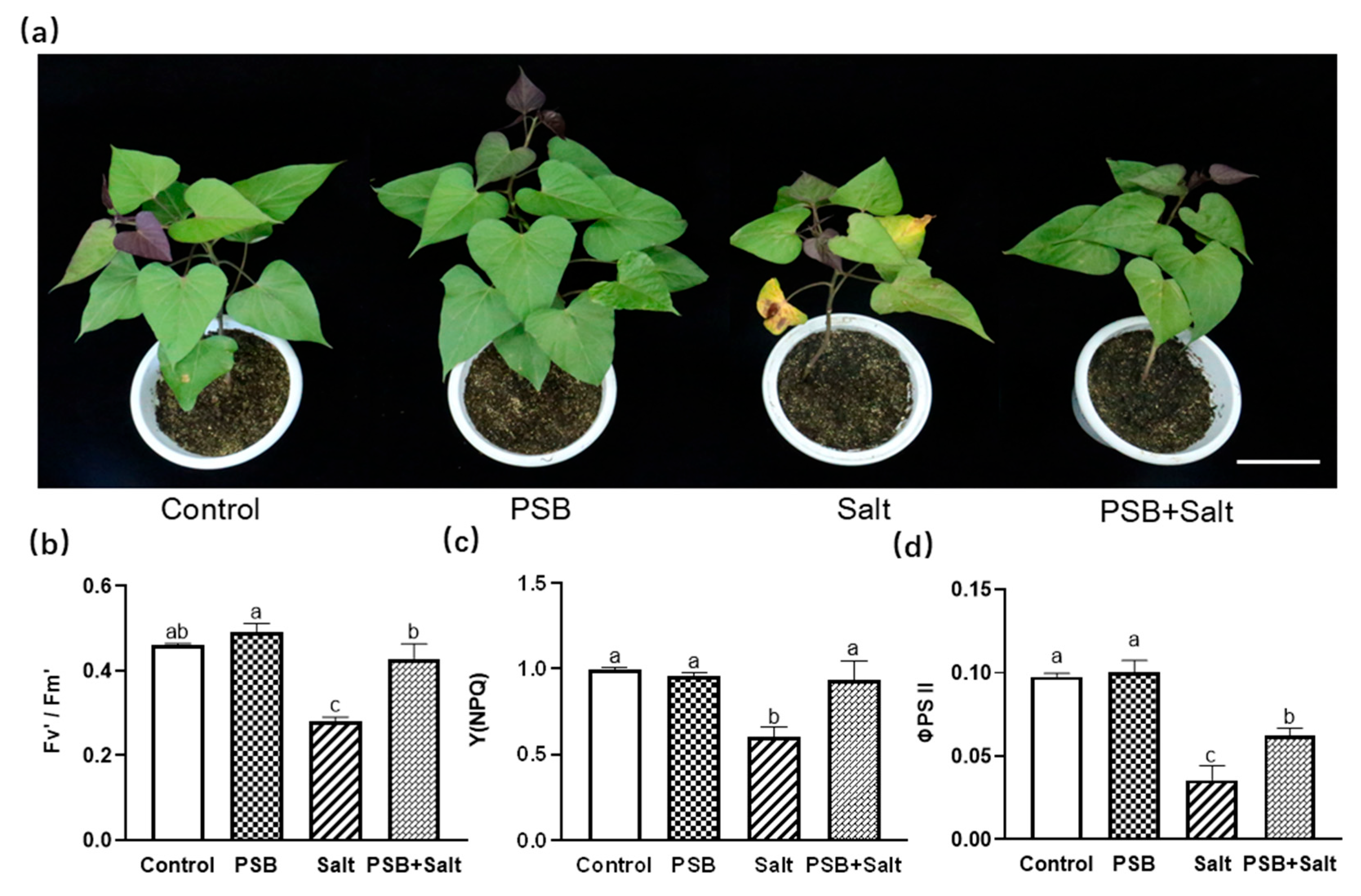
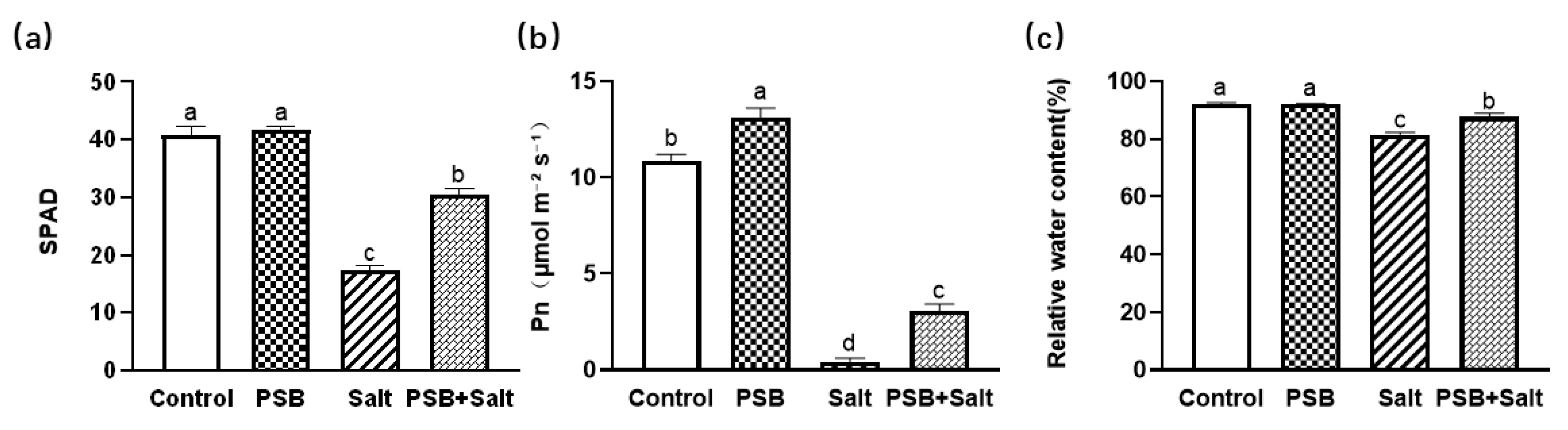
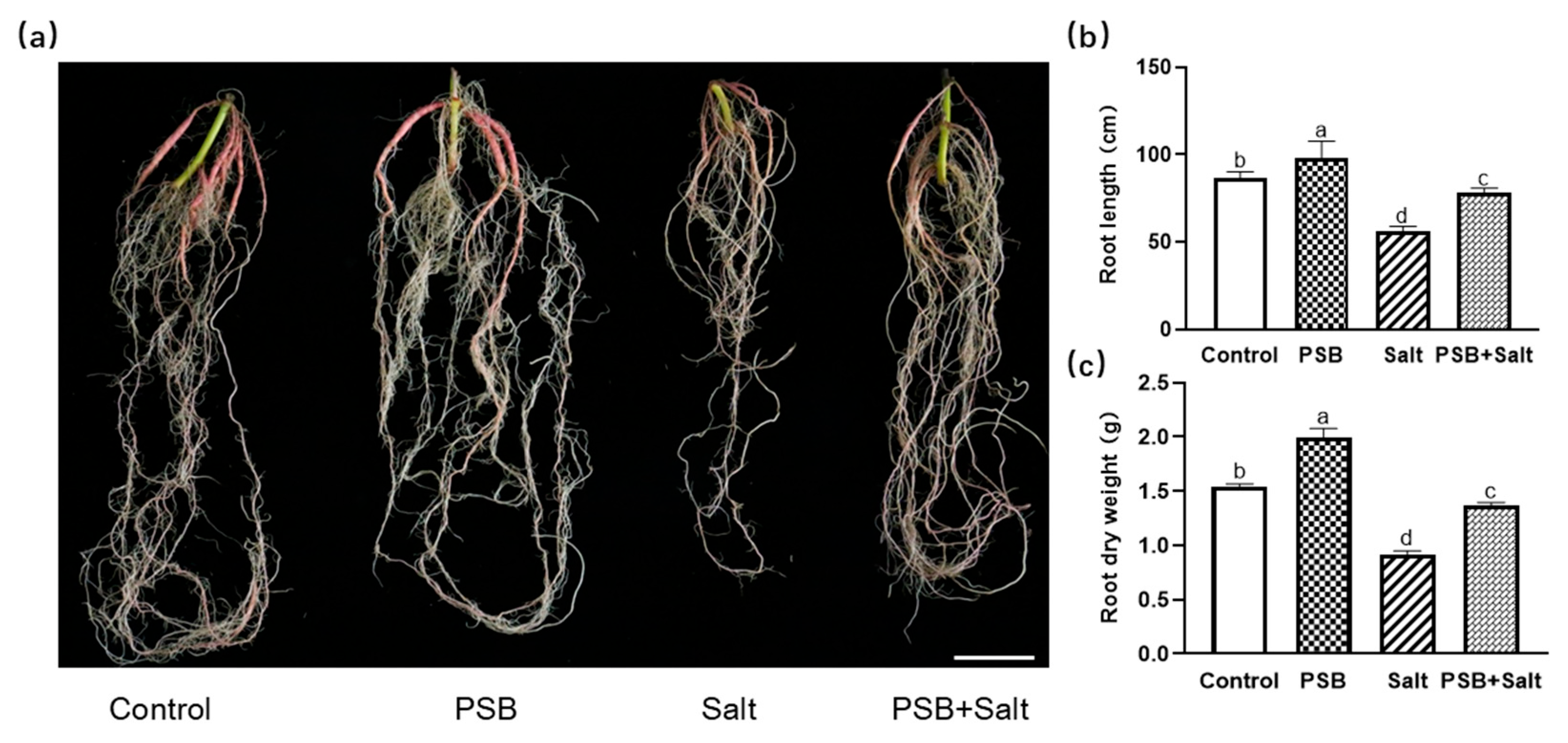
3.1. Effects of Exogenous PSB on Plant Growth Under Normal Conditions and Salinity Stress Treatment in Sweet Potato
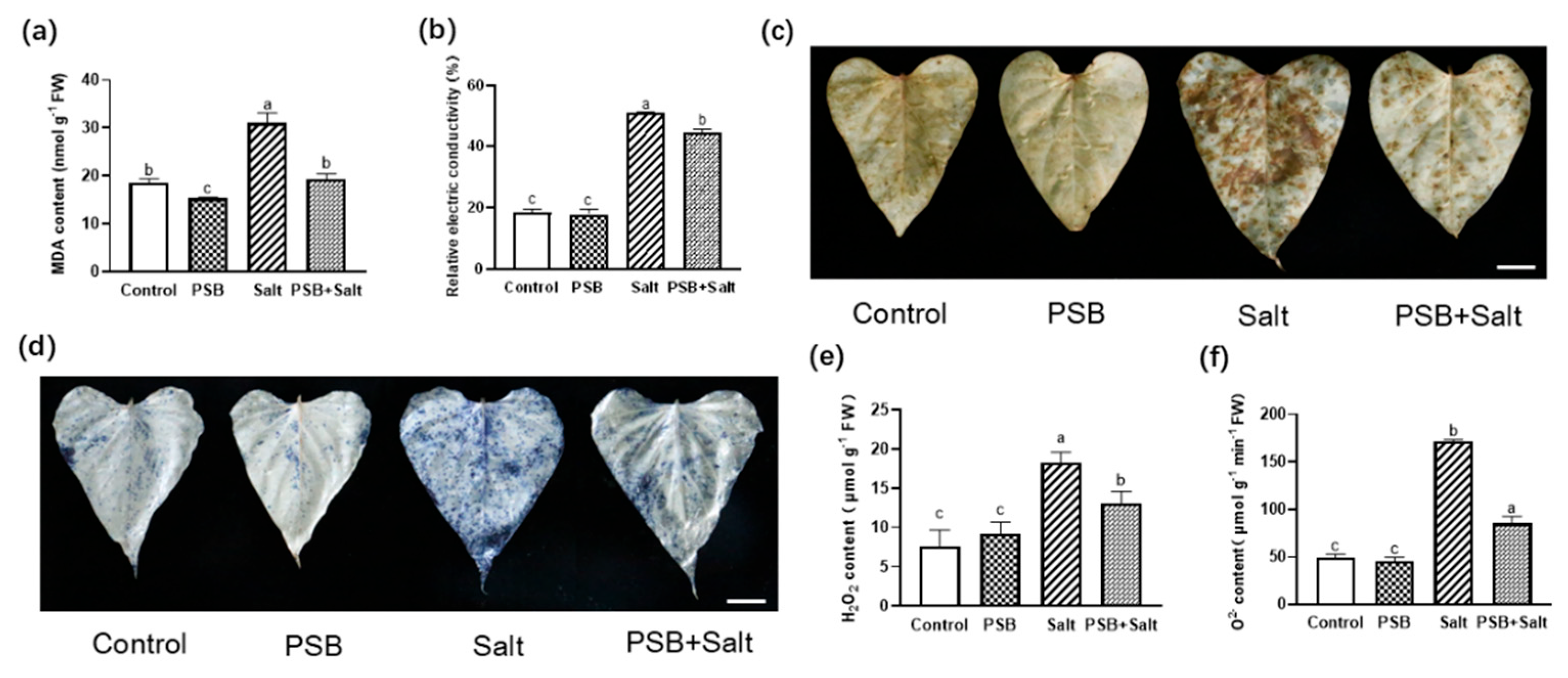
3.2. Effects of Exogenous PSB on Cell Membrane Stability and ROS Accumulation Under Normal and Salinity Stress Conditions in Sweet Potato
3.3. Effects of Exogenous PSB on Organic Compounds and Cation Content Under Normal Conditions and Salinity Stress in Sweet Potato
3.4. Exogenous PSB Enhances Salt Tolerance in Sweet Potato Plants by Promoting the Expression of Genes Associated with Photosynthesis, Antioxidant Response and Stress Responses Under Salt Stress Conditions
4. Discussion
Supplementary Materials
Author Contributions
Funding
Data Availability Statement
Conflicts of Interest
References
- Zhao, S.; Zhang, Q.; Liu, M.; Zhou, H.; Ma, C.; Wang, P. Regulation of plant responses to salt stress. Int. J. Mol. Sci. 2021, 22, 4609. [Google Scholar] [CrossRef] [Scilit] [PubMed]
- Ludwig, M.; Wilmes, P.; Schrader, S. Measuring soil sustainability via soil resilience. Sci. Total Environ. 2018, 626, 1484–1493. [Google Scholar] [CrossRef] [Scilit]
- Savary, S.; Akter, S.; Almekinders, C.; Harris, J.; Korsten, L.; Rötter, R.; Waddington, S.; Watson, D. Mapping disruption and resilience mechanisms in food systems. Food Secur. 2020, 12, 695–717. [Google Scholar] [CrossRef] [Scilit] [PubMed]
- Zhu, H.; Zhou, Y.Y.; Zhai, H.; He, S.Z.; Zhao, N.; Liu, Q.C. A novel sweetpotato WRKY transcription factor, IbWRKY2, positively regulates drought and salt tolerance in transgenic Arabidopsis. Biomolecules 2020, 10, 506. [Google Scholar] [CrossRef] [Scilit]
- Zhu, H.; Yang, X.; Wang, X.; Li, Q.Y.; Guo, J.Y.; Ma, T.; Zhao, C.M.; Tang, Y.Y.; Qiao, L.X.; Wang, J.S.; et al. The sweetpotato β-amylase gene IbBAM1.1 enhances drought and salt stress resistance by regulating ROS homeostasis and osmotic balance. Plant Physiol. Biochem. 2021, 168, 167–176. [Google Scholar] [CrossRef] [Scilit]
- Munns, R.; Tester, M. Mechanisms of salinity tolerance. Annu. Rev. Plant Biol. 2008, 59, 651–681. [Google Scholar] [CrossRef] [Scilit]
- Gong, Z. Plant abiotic stress: New insights into the factors that activate and modulate plant responses. J. Integr. Plant Biol. 2021, 63, 429–430. [Google Scholar] [CrossRef] [Scilit]
- Zhu, J.K. Abiotic stress signaling and responses in plants. Cell 2016, 167, 313–324. [Google Scholar] [CrossRef] [Scilit]
- Van Zelm, E.; Zhang, Y.; Testerink, C. Salt tolerance mechanisms of plants. Annu. Rev. Plant Biol. 2020, 71, 403–433. [Google Scholar] [CrossRef] [Scilit]
- Kumari, A.; Das, P.; Parida, A.K.; Agarwal, P.K. Proteomics, metabolomics, and ionomics perspectives of salinity tolerance in halophytes. Front. Plant Sci. 2015, 6, 537. [Google Scholar] [CrossRef] [Scilit]
- Park, H.J.; Kim, W.Y.; Yun, D.J. A New insight of salt stress signaling in plant. Mol. Cells 2016, 39, 447–459. [Google Scholar] [CrossRef] [Scilit]
- Flowers, T.J.; Colmer, T.D. Salinity tolerance in halophytes. New Phytol. 2008, 179, 945–963. [Google Scholar] [CrossRef] [Scilit]
- Hao, S.H.; Wang, Y.R.; Yan, Y.X.; Liu, Y.H.; Wang, J.Y.; Chen, S. A review on plant responses to salt stress and their mechanisms of salt resistance. Horticulturae 2021, 7, 132. [Google Scholar] [CrossRef] [Scilit]
- Yang, Y.; Guo, Y. Elucidating the molecular mechanisms mediating plant salt-stress responses. New Phytol. 2018, 217, 523–539. [Google Scholar] [CrossRef] [Scilit]
- Baxter, A.; Mittler, R.; Suzuki, N. ROS as key players in plant stress signalling. J. Exp. Bot. 2014, 65, 1229–1240. [Google Scholar] [CrossRef] [Scilit] [PubMed]
- Bose, J.; Rodrigo-Moreno, A.; Shabala, S. ROS homeostasis in halophytes in the context of salinity stress tolerance. J. Exp. Bot. 2014, 65, 1241–1257. [Google Scholar] [CrossRef] [Scilit] [PubMed]
- Batista-Silva, W.; Heinemann, B.; Rugen, N.; Nunes-Nesi, A.; Araújo, W.L.; Braun, H.P.; Hildebrandt, T.M. The role of amino acid metabolism during abiotic stress release. Plant Cell Environ. 2019, 42, 1630–1644. [Google Scholar] [CrossRef] [Scilit]
- Boldizsár, A.; Simon-Sarkadi, L.; Szirtes, K.; Soltész, A.; Szalai, G.; Keyster, M.; Ludidi, N.; Galiba, G.; Kocsy, G. Nitric oxide affects salt-induced changes in free amino acid levels in maize. J. Plant Physiol. 2013, 170, 1020–1027. [Google Scholar] [CrossRef] [Scilit] [PubMed]
- Kusvuran, A.; Kaytez, I.A.; Yilmaz, U.; Kusvuran, S. The effects of exogenous amino acid on growth, ionic homeostasis, biochemical composition and antioxidative activity of guar (Cyamopsis tetragonoloba (L.) Taub.) seedlings. Appl. Ecol. Environ. Res. 2019, 17, 15519–15530. [Google Scholar] [CrossRef] [Scilit]
- Trevisan, S.; Manoli, A.; Quaggiotti, S. A novel biostimulant, belonging to protein hydrolysates, mitigates abiotic stress effects on maize seedlings grown in hydroponics. Agronomy 2019, 9, 28. [Google Scholar] [CrossRef] [Scilit]
- Ertani, A.; Schiavon, M.; Muscolo, A.; Nardi, S. Alfalfa plant-derived biostimulant stimulate short-term growth of salt stressed Zea mays L. plants. Plant Soil. 2013, 364, 145–158. [Google Scholar] [CrossRef] [Scilit]
- Lucini, L.; Rouphael, Y.; Cardarelli, M.; Canaguier, R.; Kumar, P.; Colla, G. The effect of a plant-derived biostimulant on metabolic profiling and crop performance of lettuce grown under saline conditions. Sci. Hortic. 2015, 182, 124–133. [Google Scholar] [CrossRef] [Scilit]
- Zhou, W.W.; Zheng, W.L.; Wang, W.X.; Lv, H.F.; Liang, B.; Li, J.L. Exogenous pig blood-derived protein hydrolysates as a promising method for alleviation of salt stress in tomato (Solanum lycopersicum L.). Sci. Hortic. 2022, 294, 110779. [Google Scholar] [CrossRef] [Scilit]
- Casadesús, A.; Polo, J.; Munné-Bosch, S. Hormonal effects of an enzymatically hydrolyzed animal protein-based biostimulant (Pepton) in water-stressed tomato plants. Front. Plant Sci. 2019, 10, 758. [Google Scholar] [CrossRef] [Scilit] [PubMed]
- Casadesús, A.; Pérez-Llorca, M.; Munné-Bosch, S.; Polo, J. An Enzymatically Hydrolyzed Animal Protein-Based Biostimulant (Pepton) Increases Salicylic Acid and Promotes Growth of Tomato Roots Under Temperature and Nutrient Stress. Front. Plant Sci. 2020, 11, 953. [Google Scholar] [CrossRef] [Scilit] [PubMed]
- Zhang, H.; Gao, X.; Zhi, Y.; Li, X.; Zhang, Q.; Niu, J.; Wang, J.; Zhai, H.; Zhao, N.; Li, J.; et al. A non-tandem CCCH-type zinc-finger protein, IbC3H18, functions as a nuclear transcriptional activator and enhances abiotic stress tolerance in sweet potato. New Phytol. 2019, 223, 1918–1936. [Google Scholar] [CrossRef] [Scilit]
- Kwak, S.S. Biotechnology of the sweetpotato: Ensuring global food and nutrition security in the face of climate change. Plant Cell Rep. 2019, 38, 1361–1363. [Google Scholar] [CrossRef] [Scilit]
- Park, S.U.; Lee, C.J.; Kim, S.E.; Lim, Y.H.; Lee, H.U.; Nam, S.S.; Kim, H.S.; Kwak, S.S. Selection of flooding stress tolerant sweetpotato cultivars based on biochemical and phenotypic characterization. Plant Physiol. Biochem. 2020, 155, 243–251. [Google Scholar] [CrossRef] [Scilit]
- Zhu, H.; Zhai, H.; He, S.Z.; Zhang, H.; Gao, S.P.; Liu, Q.C. A novel sweetpotato GATA transcription factor, IbGATA24, interacting with IbCOP9-5a positively regulates drought and salt tolerance. Environ. Exp. Bot. 2022, 194, 104735. [Google Scholar] [CrossRef] [Scilit]
- Fang, S.M.; Hou, X.; Liang, X. Response mechanisms of plants under saline-alkali stress. Fron. Plant Sci. 2021, 12, 667458. [Google Scholar] [CrossRef] [Scilit]
- Qu, W.Y.; Xiang, P.; Xu, Z.X.; Hao, J.Y.; Fang, X.T.; Zhang, Y.Z.; Ma, L. Functional characterization of soybean MADS-Box gene GmMADS3 in salt tolerance. Plant Cell Tissue Organ Cult. 2026, 164, 23. [Google Scholar] [CrossRef] [Scilit]
- Toscano, S.; Farieri, E.; Ferrante, A.; Romano, D. Physiological and biochemical responses in two ornamental shrubs to drought stress. Front. Plant Sci. 2016, 7, 645. [Google Scholar] [CrossRef] [Scilit]
- Wei, W.; Cui, M.Y.; Hu, Y.; Gao, K.; Xie, Y.G.; Jiang, Y.; Feng, J.Y. Ectopic expression of FvWRKY42, a WRKY transcription factor from the diploid woodland strawberry (Fragaria vesca), enhances resistance to powdery mildew, improves osmotic stress resistance, and increases abscisic acid sensitivity in Arabidopsis. Plant Sci. 2018, 275, 60–74. [Google Scholar] [CrossRef] [Scilit]
- Alvarez, M.E.; Pennell, R.I.; Meijer, P.J.; Ishikawa, A.; Dixon, R.A.; Lamb, C. Reactive oxygen intermediates mediate a systemic signal network in the establishment of plant immunity. Cell 1998, 92, 773–784. [Google Scholar] [CrossRef] [Scilit]
- Zhu, H.; Guo, J.Y.; Ma, T.; Liu, S.Y.; Zhou, Y.Y.; Yang, X.; Li, Q.Y.; Yu, K.Y.; Wang, T.S.; He, S.X.; et al. The sweet potato K+ transporter IbHAK11 regulates K+ deficiency and high salinity stress tolerance by maintaining positive ion homeostasis. Plants 2023, 12, 2422. [Google Scholar] [CrossRef] [Scilit]
- Ali, A.; Petrov, V.; Yun, D.J.; Gechev, T. Revisiting plant salt tolerance: Novel components of the SOS pathway. Trends Plant Sci. 2023, 28, 1060–1069. [Google Scholar] [CrossRef] [Scilit]
- Zhou, W.W.; Zheng, W.L.; Lv, H.F.; Wang, Q.Y.; Liang, B.; Li, J.L. Foliar application of pig blood-derived protein hydrolysates improves antioxidant activities in lettuce by regulating phenolic biosynthesis without compromising yieldproduction. Sci. Hortic. 2022, 291, 110602. [Google Scholar] [CrossRef] [Scilit]
- Colla, G.; Nardi, S.; Cardarelli, M.; Ertani, A.; Lucini, L.; Canaguier, R.; Rouphael, Y. Protein hydrolysates as biostimulants in horticulture. Sci. Hortic. 2015, 196, 28–38. [Google Scholar] [CrossRef] [Scilit]
- Ganie, S.A.; Molla, K.A.; Henry, R.J.; Bhat, K.V.; Mondal, T.K. Advances in understanding salt tolerance in rice. Theor. Appl. Genet. 2019, 132, 851–870. [Google Scholar] [CrossRef] [Scilit]
- Wang, D.D.; Li, C.Y.; Song, W.H.; Tang, W.; Chen, Y.Y.; Kou, M.; Gao, R.; Gao, T.Q.; Li, C.; Yan, H.; et al. The E3 ubiquitin ligase SCFEDL3 mediates salt stress response by degradation of IbPP2CA2 to regulate ABA signaling in sweetpotato. Plant J. 2025, 123, 70307. [Google Scholar] [CrossRef] [Scilit] [PubMed]
- Kim, S.E.; Bian, X.; Lee, C.J.; Park, S.U.; Lim, Y.H.; Kim, B.H.; Park, W.S.; Ahn, M.J.; Ji, C.Y.; Yu, Y.; et al. Overexpression of 4-hydroxyphenylpyruvate dioxygenase (IbHPPD) increases abiotic stress tolerance in transgenic sweetpotato plants. Plant Physiol. Biochem. 2021, 167, 420–429. [Google Scholar] [CrossRef] [Scilit] [PubMed]
- Per, T.S.; Khan, N.A.; Reddy, P.S.; Masood, A.; Hasanuzzaman, M.; Khan, M.I.R.; Anjum, N.A. Approaches in modulating proline metabolism in plants for salt and drought stress tolerance: Phytohormones, mineral nutrients and transgenics. Plant Physiol. Biochem. 2017, 115, 126–140. [Google Scholar] [CrossRef] [Scilit]
- Wani, A.S.; Ahmad, A.; Hayat, S.; Tahir, I. Epibrassinolide and proline alleviate the photosynthetic and yield inhibition under salt stress by acting on antioxidant system in mustard. Plant Physiol. Biochem. 2019, 135, 385–394. [Google Scholar] [CrossRef] [Scilit]
- Shen, W.Q.; Liu, D.; Zhang, H.; Zhu, W.; He, H.Z.; Li, G.H.; Liu, J.W. Overexpression of β-cyanoalanine synthase of Prunus persica increases salt tolerance by modulating ROS metabolism and ion homeostasis. Environ. Exp. Bot. 2021, 186, 104431. [Google Scholar] [CrossRef] [Scilit]
- Mohsin, S.M.; Hasanuzzaman, M.; Parvin, K.; Fujita, M. Pretreatment of wheat (Triticum aestivum L.) seedlings with 2,4-D improves tolerance to salinity-induced oxidative stress and methylglyoxal toxicity by modulating ion homeostasis, antioxidant defenses, and glyoxalase systems. Plant Physiol. Biochem. 2020, 152, 221–231. [Google Scholar] [CrossRef] [Scilit] [PubMed]


Disclaimer/Publisher’s Note: The statements, opinions and data contained in all publications are solely those of the individual author(s) and contributor(s) and not of MDPI and/or the editor(s). MDPI and/or the editor(s) disclaim responsibility for any injury to people or property resulting from any ideas, methods, instructions or products referred to in the content. |
© 2026 by the authors. Licensee MDPI, Basel, Switzerland. This article is an open access article distributed under the terms and conditions of the Creative Commons Attribution (CC BY) license.
Share and Cite
Zhu, H.; Ge, T.; Yan, H.; Zheng, Q.; Wei, Y.; Liu, B.; Guo, Y.; Li, J.; Zhao, C.; Sui, J. Peptides from Swine Blood Enhance Salinity Stress Tolerance in Sweet Potato (Ipomoea batatas (L.) Lam) Through Osmotic Adjustment and Maintenance of Cellular Redox Homeostasis. Horticulturae 2026, 12, 435. https://doi.org/10.3390/horticulturae12040435
Zhu H, Ge T, Yan H, Zheng Q, Wei Y, Liu B, Guo Y, Li J, Zhao C, Sui J. Peptides from Swine Blood Enhance Salinity Stress Tolerance in Sweet Potato (Ipomoea batatas (L.) Lam) Through Osmotic Adjustment and Maintenance of Cellular Redox Homeostasis. Horticulturae. 2026; 12(4):435. https://doi.org/10.3390/horticulturae12040435
Chicago/Turabian StyleZhu, Hong, Tianle Ge, Hengyu Yan, Qianwen Zheng, Yanqiu Wei, Botao Liu, Yibo Guo, Jiaxin Li, Chunmei Zhao, and Jiongming Sui. 2026. "Peptides from Swine Blood Enhance Salinity Stress Tolerance in Sweet Potato (Ipomoea batatas (L.) Lam) Through Osmotic Adjustment and Maintenance of Cellular Redox Homeostasis" Horticulturae 12, no. 4: 435. https://doi.org/10.3390/horticulturae12040435
APA StyleZhu, H., Ge, T., Yan, H., Zheng, Q., Wei, Y., Liu, B., Guo, Y., Li, J., Zhao, C., & Sui, J. (2026). Peptides from Swine Blood Enhance Salinity Stress Tolerance in Sweet Potato (Ipomoea batatas (L.) Lam) Through Osmotic Adjustment and Maintenance of Cellular Redox Homeostasis. Horticulturae, 12(4), 435. https://doi.org/10.3390/horticulturae12040435