Article

Impact of Prohexadione Calcium and Mepiquat Chloride on Vegetative Growth and Fruit Quality in ‘Shine Muscat’ Grapevines

1
Zhengzhou Fruit Research Institute, Chinese Academy of Agricultural Sciences, National Key Laboratory for Germplasm Innovation & Utilization of Horticultural Crops, Zhengzhou 450009, China
2
Zhongyuan Research Center, Chinese Academy of Agricultural Sciences, Xinxiang 453500, China
*
Author to whom correspondence should be addressed.
These authors contributed equally to this work.
Horticulturae 2026, 12(4), 418; https://doi.org/10.3390/horticulturae12040418
Submission received: 27 January 2026 / Revised: 23 March 2026 / Accepted: 25 March 2026 / Published: 28 March 2026

Abstract

The vigorous growth of new shoots can significantly reduce grape yield and compromise fruit quality. In order to explore the effects of prohexadione calcium (Pro-Ca) and mepiquat chloride (MC) on the control effect of new shoot growth and fruit quality of grape, ‘Shine Muscat’ grapevine (Vitis labruscana × V. vinifera) was used as the test material, and different concentrations of Pro-Ca and a combination of Pro-Ca and MC were sprayed four times before flowering of ‘Shine Muscat’ grapevines, and the effects of the different treatments on the new shoot growth and fruit quality of ‘Shine Muscat’ grape were analyzed and evaluated. The results demonstrated that low concentrations of Pro-Ca had limited efficacy in controlling shoot growth. However, the combined treatment of Pro-Ca 300 mg/L + MC 300 mg/L not only effectively inhibited shoot elongation but also significantly enhanced the chlorophyll content of the leaves opposite to the clusters and increased branch density. Additionally, this treatment improved berry size (single berry weight, vertical and horizontal diameter) and elevated the soluble solids content (SSC). These findings suggest that the combined application of Pro-Ca (300 mg/L) and MC (300 mg/L) is the most effective strategy for balancing vegetative growth and enhancing fruit quality in ‘Shine Muscat’ grapevines.

1. Introduction

According to FAO data, China is the world’s largest grape producer, with a total output of 1.68 × 10⁷ t, accounting for 22.16% of the world’s total grape production. The total grape cultivation area is 7.71 × 10⁵ ha, ranking second in the world after Spain [1]. Among this area, the cultivation area for ‘Shine Muscat’ grapes is approximately 1 × 10⁵ ha, representing 12.97% of the total grape area [2]. ‘Shine Muscat’ grape (Vitis labruscana × V. vinifera) was cultivated through crossbreeding of Akitsu-21 (V. labruscana × V. vinifera) and Hakunan (V. vinifera) [3]. It is a diploid European–American hybrid table grape variety with excellent quality [4]. In addition, it is an economically high-valued fruit, which contains a lot of beneficial substances, such as amino acids, polyphenols, flavonoids and other phytochemicals [5]. Its large berry size, distinct muscat aroma, and sweet flavor have made it highly popular among consumers and cultivators, particularly in East Asian markets such as China and Japan [4,6,7]. In recent years, ‘Shine Muscat’ cultivation has expanded rapidly across China, reflecting its growing economic importance in the grape industry.
In actual production, affected by factors such as climate, water and fertilizer, ‘Shine Muscat’ grapevine shoots are prone to vigorous growth and long internodes, resulting in fewer leaves on the same shelf, frequent pinching of new shoots, and even canopy closure of orchards, inducing pests and diseases, which increase the difficulty of grape management and disease control [8]. In addition, vigorous growth of new shoots will consume too much nutrition, which cannot meet the flower bud differentiation, which is prone to causing many problems such as dropping of flowers and fruits, decline in fruit sugar content, uneven coloring, and fruit quality reduction [9,10]. To address these challenges, plant growth regulators (PGRs) offer a targeted approach to modulate vine development. By directing growth in a controlled manner, PGRs can optimize the balance between vegetative and reproductive growth, facilitating mechanized vineyard operations while reducing labor inputs [11]. Thus, the strategic use of PGRs to manage excessive shoot vigor holds significant promise for sustainable ‘Shine Muscat’ grape production.
While several compounds, including paclobutrazol and chlormequat, have been employed to suppress shoot growth, their applications are limited by slow degradation rates and potential health and environmental risks [12]. In contrast, prohexadione calcium (Pro-Ca) represents a safer, eco-friendly alternative as a gibberellin biosynthesis inhibitor. This novel plant growth regulator effectively controls excessive vegetative growth while enhancing fruit set rate, yield, and overall fruit quality [8,13]. Its efficacy has been well-documented in various fruit crops, including pears [9,14], apples [15,16,17], grapes [8], and peaches [18], as well as in cereal crops such as corn [19] and rice [20]. Similarly, mepiquat chloride (MC), another gibberellin inhibitor, regulates plant architecture by curbing excessive shoot elongation, promoting compact growth, preventing lodging, and improving yield potential [21,22,23]. Although MC has been extensively utilized in cotton production worldwide [24,25], with additional applications reported in rice, soybean, and cowpea [26,27,28], its effects on grapevine growth and berry quality remain largely unexplored.
While PGRs offer potential benefits for vineyard management, their application for shoot growth regulation is often met with caution. Growers’ primary concerns include potential unintended effects on cluster architecture, berry dimensions, and key fruit quality attributes such as soluble solids content and flavor profile. To systematically investigate these practical concerns, this study was conducted using ‘Shine Muscat’ grapevines as a model. The experiment evaluated the effects of foliar-applied Pro-Ca at various concentrations, both alone and in combination with MC, during the pre-flowering stage when shoot growth is typically most vigorous.
To achieve this, the study was designed with three primary objectives: (1) to identify optimal PGR treatments that effectively regulate shoot growth without compromising cluster length and berry size; (2) to determine the effects of these treatments on key fruit quality attributes, including soluble solids content and organoleptic properties; and (3) to establish practical guidelines for implementing growth control strategies that can reduce labor inputs while maintaining or enhancing fruit quality. Our findings aim to provide evidence-based recommendations for grape producers seeking to balance vegetative growth control with optimal fruit production, thereby facilitating more sustainable and efficient vineyard management practices.

2. Materials and Methods

2.1. Plant Material

The study was conducted at the experimental base of Zhengzhou Fruit Research Institute, Chinese Academy of Agricultural Sciences (34°43′ N, 113°42′ E), in 2025. It belongs to the northern temperate continental monsoon climate. The climatic characteristics of this region are moderate temperatures, four distinct seasons, and concurrent rain and heat. The annual average temperature is approximately 14.4 °C, and the annual average precipitation is approximately 640.9 mm. The tested soil was sandy loam with the following basic properties: organic matter content (w, the same below) of 0.49%, nitrate nitrogen content of 31.41 mg·kg−1, ammonium nitrogen content of 4.18 mg·kg−1, available phosphorus content of 44.30 mg·kg−1, available potassium content of 93.17 mg·kg−1, exchangeable calcium content of 1822.03 mg·kg−1, exchangeable magnesium content of 207.70 mg·kg−1, and pH 8.16.
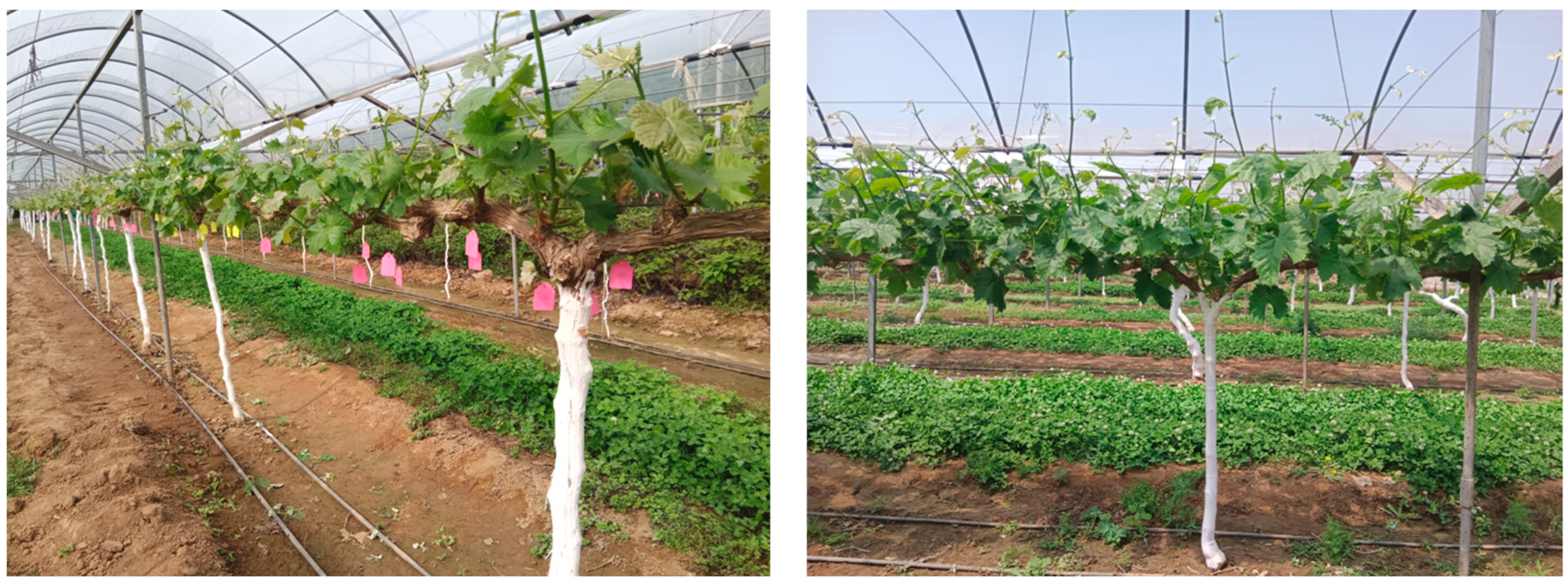
Eleven-year-old ‘Shine Muscat’ grapevines were selected as experimental materials, with a south–north row direction. The plant row spacing was 2 m × 3 m. The trees grew uniformly and were robust with a V-shaped frame (Figure 1). Rain-shelter cultivation outdoors was used. Rain-shelter cultivation is a type of protected grape cultivation. It prevents direct contact between leaves, fruits, and rainwater, reduces canopy humidity, interrupts the spread of pathogens, and effectively reduces the incidence of grape diseases. It is an important cultivation model for efficient and high-quality grape production. However, its success relies heavily on precise management, including timely ventilation, appropriate film selection, and accurate water and fertilizer application, to avoid negative effects such as excessive heat and humidity. In this study, drip irrigation was used for field water management, while other cultivation practices and pest control measures followed conventional methods.

2.2. Experimental Design and Treatments

The experiment comprised five treatments with a randomized complete block design (Table 1): control (CK), A: Pro-Ca 100 mg/L, B: Pro-Ca 300 mg/L, C: Pro-Ca 500 mg/L, and D: Pro-Ca 300 mg/L + MC 300 mg/L. Phenological observations of the grapevines were recorded and determined according to the extended BBCH scale developed by Lorenz et al. [29]. This scale uses two-digit codes to describe the growth and development stages of grapevines, where the first digit (0–9) represents the principal growth stage and the second digit represents the specific steps within that stage. All treatments were uniformly applied as foliar sprays to entire plants at four critical growth stages: 4–5 leaf stage (BBCH 14–15) (April 7), new shoot growth stage (BBCH 31–39) (April 16), flower-cluster separation stage (BBCH 57) (April 25), and flowering initiation (BBCH 61) (May 4), with consistent 9-day intervals between applications. The control plants received equivalent volumes of water following the same application schedule. Each replicate contained one grapevine. Each treatment included three replicates, i.e., three consecutive grapevines. Twenty shoots with consistent growth vigor were selected per grapevine, resulting in a total of 60 new shoots per treatment. A total of 5 treatments were applied, and 300 new shoots were selected as samples in total.

2.3. Determination of Fruit Growth Parameters

The length of new shoots was measured before treatment at three stages: 4–5 leaf stage (BBCH 14–15) (April 7), new shoot growth stage (BBCH 31–39) (April 16) and flower-cluster separation stage (BBCH 57) (April 25) (the data was not measured because of pinching on May 4). Sixty new shoots with consistent growth vigor per treatment were measured. Growth rate 1 (%) = [shoot length (April 16)—shoot length (April 7)]/shoot length (April 7) × 100, growth rate 2 (%) = [shoot length (April 25)—shoot length (April 16)]/shoot length (April 16) × 100.
The cluster length, leaf area opposite the cluster and relative chlorophyll content (SPAD-502 chlorophyll meter, Konica Minolta, Tokyo, Japan) were measured every nine days from the flower-cluster separation stage (BBCH 57) (April 25) 4 times.

2.4. Measurement of Fruit Quality

Commercial maturity was defined as the stage when grape berries met the harvest criteria for market sale or processing. For ‘Shine Muscat’ grapes, commercial maturity was determined at 120 days after full bloom when the average soluble solids content (SSC) reached 16 °Brix and titratable acidity (TA) was less than 0.7%, corresponding to BBCH 89, with fully browned seeds and characteristic yellow–green berry coloration [30,31,32]. Fifteen representative ‘Shine Muscat’ grape clusters from each treatment (five clusters per replicate) were collected for comprehensive quality evaluation. Morphological parameters were determined as follows: single berry weight of 30 randomly selected berries per treatment was measured using a precision electronic balance (LT502E, Changshu Tianliang Instrument Co., Ltd., Suzhou, China; accuracy ± 0.01 g), while berry dimensions (longitudinal and transverse diameters) were obtained from 30 randomly selected berries per treatment using digital vernier calipers (ARZ-1331, Eirezer AG, Qingdao, China; resolution 0.01 cm). For physicochemical analysis, soluble solids content (SSC) and titratable acidity (TA) were quantified using a digital refractometer (ATAGO PAL-1, Tokyo, Japan) and acidimeter (PAL-Easy ACID2, Tokyo, Japan), respectively, with the solid–acid ratio calculated as SSC/TA. Cluster architecture was characterized by measuring branch number and fruit rachis length, with branch density expressed as the ratio of branch number to rachis length. All measurements were performed in three experimental replicates and averaged for statistical analysis.

2.5. Statistical Analysis

All experimental data were processed and analyzed using standard statistical software packages. The raw data were first organized and pre-processed using Microsoft Excel 2016 (Microsoft Corporation, Redmond, WA, USA). Data were tested for normality (Shapiro–Wilk’s test, p > 0.05) and homogeneity of variances (Levene’s test, p > 0.05) using https://www.spsspro.com (accessed on 14 January 2026), confirming that the assumptions for parametric analysis were met. A one-way ANOVA was performed, and upon a significant result (p < 0.05), Duncan’s multiple range test was used for post hoc comparisons due to its high sensitivity in detecting differences among treatment means and its common usage in similar studies. Data mapping was performed using Origin 2018 (OriginLab Corporation, Northampton, MA, USA) to generate high-quality scientific graphs. Principal component analysis (PCA) was also performed using https://www.spsspro.com (accessed on 14 January 2026). The PCA employed Z value for comprehensive evaluation, where higher values indicated superior overall treatment effects. All values are presented as mean ± standard deviation (SD) of three biological replicates.

3. Results

3.1. Growth of Shoots and Leaves

The inhibitory effects of the different treatments on shoot growth were evaluated at three critical time points (Table 2). At the first assessment, all treatments resulted in significantly lower growth rates compared to the control (CK, 251.92%), with the combined Pro-Ca + MC treatment (D) exhibiting the lowest growth rate (203.07%). As the concentration increased, the inhibitory effect of Pro-Ca became more pronounced, although no statistically significant differences were observed among the various Pro-Ca concentrations. A similar trend was recorded for growth rate 2. Absolute growth data further revealed that by April 25, treatment D had restricted shoot elongation by 8.05 cm relative to CK, confirming its superior efficacy in suppressing vegetative growth.
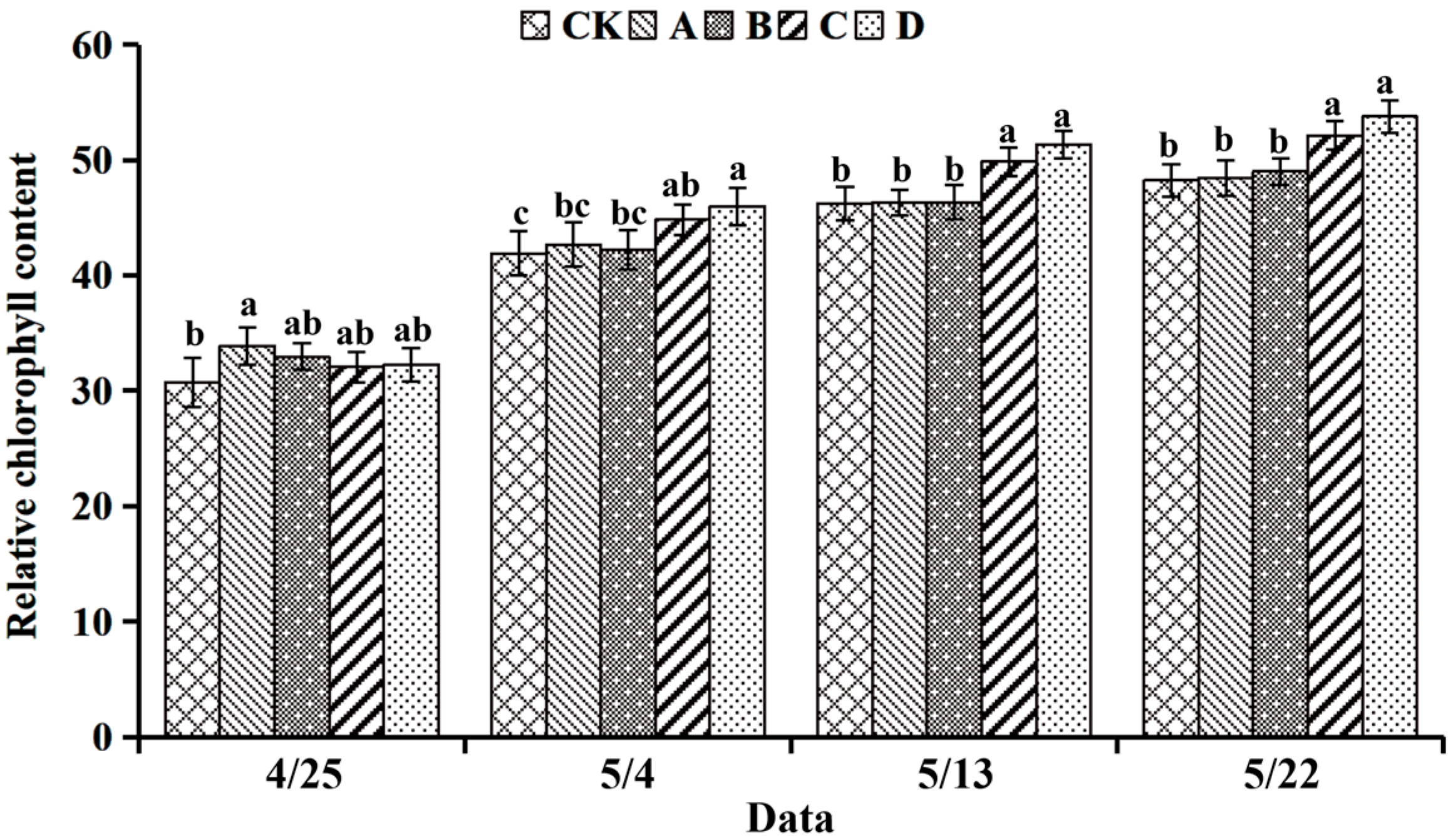
The application of Pro-Ca and its combination with MC differentially influenced the relative chlorophyll content in ‘Shine Muscat’ grape leaves (Figure 2). Treatments A (Pro-Ca 100 mg/L) and B (Pro-Ca 300 mg/L) showed no significant difference in chlorophyll content compared to CK. In contrast, the combined Pro-Ca + MC treatment (D) demonstrated a progressive and substantial enhancement in chlorophyll content, showing increases of 5.02%, 9.70%, 11.07%, and 11.49% relative to CK at successive measurement intervals.
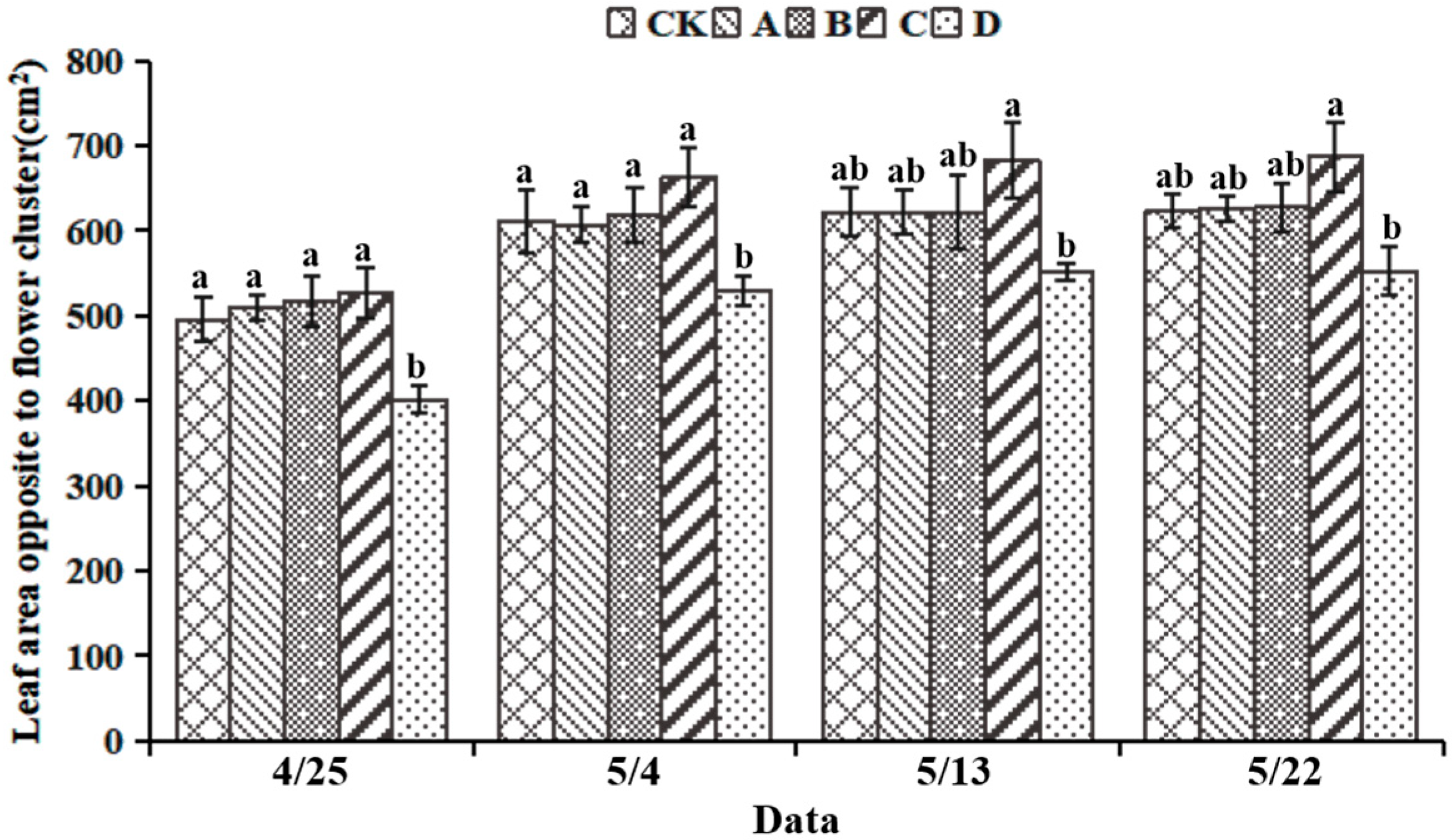
The experimental treatments exhibited distinct impacts on leaf area expansion in ‘Shine Muscat’ grapevines (Figure 3). Treatments A (Pro-Ca 100 mg/L), B (Pro-Ca 300 mg/L), and C (Pro-Ca 500 mg/L) showed no significant differences in leaf area compared to the control (CK), with treatment C (Pro-Ca 500 mg/L) having the biggest leaf area across measurement intervals. Conversely, the combined treatment D (Pro-Ca 300 mg/L + MC 300 mg/L) resulted in significantly reduced leaf area relative to CK.

3.2. Growth of Clusters and Bunches

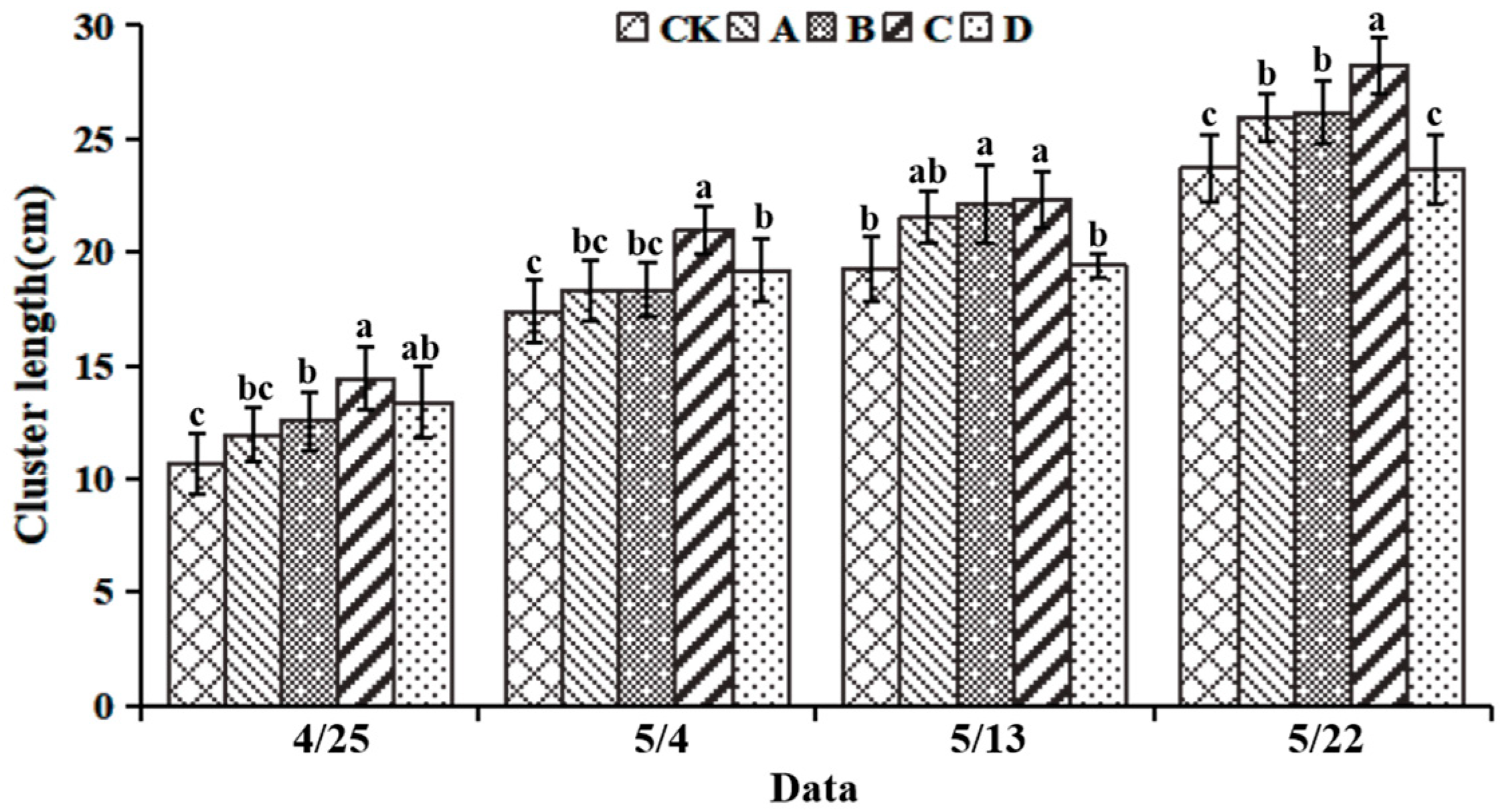
Pro-Ca treatment promoted the cluster length of ‘Shine Muscat’ grapes (Figure 4). Among the treatments, treatment C exhibited the most pronounced enhancing effect, increasing cluster length by 35.09%, 21.04%, 15.98%, and 19.09% across the four measurement time points compared to the control (CK). In comparison, treatment D resulted in increases of 25.19% (2.69 cm), 10.56% (1.83 cm), 0.71% (0.14 cm), and −0.31% (−0.07 cm), respectively. These findings indicate that the combined application of 300 mg/L Pro-Ca and 300 mg/L MC (treatment D) positively influenced cluster elongation during the early growth stage. Although the cluster length in this treatment was, on average, 0.07 cm shorter than the control (CK) at the May 22 measurement, this marginal difference was not statistically significant and is considered negligible.
The fruit rachis length was reduced in treatments C and D, while it increased in treatment B compared to the control (CK); however, no statistically significant differences were observed among the treatments (Table 3). In contrast, treatment D exhibited the highest number of branches (20.17), which was significantly greater than that of all other treatments. Notably, all treatments resulted in higher branch numbers than CK. Regarding branch density, treatments A and B showed no significant difference from CK, whereas treatments C and D led to marked increases of 11.50% and 19.29%, respectively. These findings indicate that the combined application of 300 mg/L Pro-Ca and 300 mg/L MC (treatment D) significantly enhanced branch density in ‘Shine Muscat’ grape.

3.3. Fruit Quality Parameters

The application of growth regulators significantly improved multiple berry quality parameters of ‘Shine Muscat’ grapes (Table 4). Most notably, the combined Pro-Ca + MC treatment (D) demonstrated comprehensive enhancement effects, increasing single berry weight by 23.58%, longitudinal diameter by 9.20%, and transverse diameter by 8.78% compared to CK. Regarding biochemical composition, both the high-concentration Pro-Ca (C) and combined (D) treatments achieved a superior soluble solids content (SSC) of 16.95% and 16.90% respectively, representing significant 17.10% and 16.75% increases over CK (14.48%). Although titratable acidity (TA) showed no significant variation among treatments, the solid–acid ratio, a critical quality index, was markedly improved in treatments C (31.60) and D (31.04), corresponding to 16.21% and 14.17% enhancements over CK (27.19). These results demonstrate that while all growth regulator applications improved berry quality parameters relative to CK, the combined Pro-Ca + MC treatment (D) provided the most balanced enhancement across physical and biochemical quality attributes, particularly in berry size and sugar accumulation.

3.4. Comprehensive Evaluation of Different Treatments

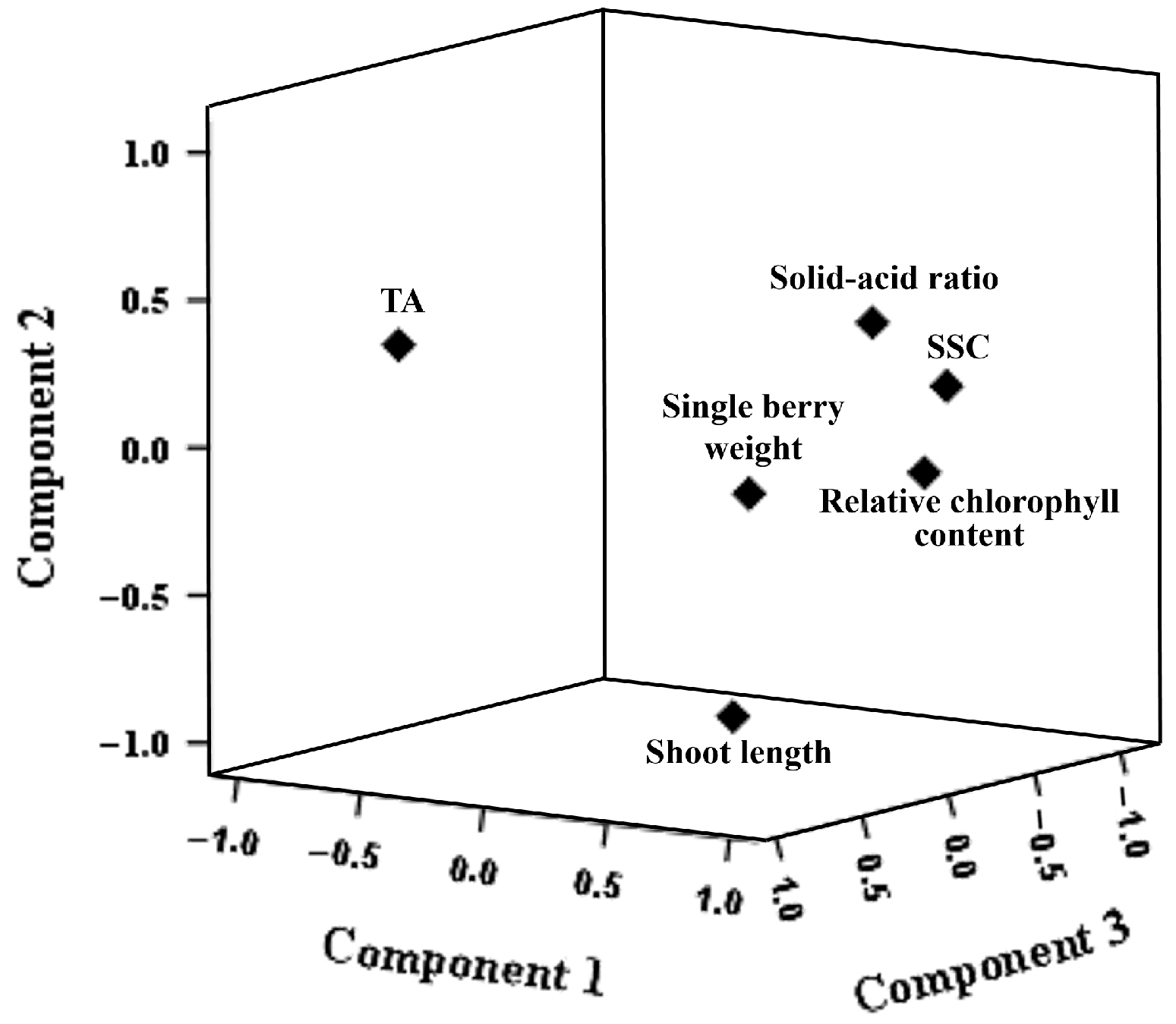
PCA was performed to evaluate the comprehensive effects of the different treatments on growth and fruit quality of ‘Shine Muscat’ grape (Table 5). The analysis extracted three principal components with a cumulative variance contribution rate of 99.936%, effectively capturing the multidimensional treatment effects. The first principal component (PC1) accounting for 63.289% of the total variance, primarily represented four key traits: relative chlorophyll content, single berry weight, SSC and solid–acid ratio. The second principal component (PC2) explained 19.587% of the variance and was predominantly associated with shoot length. The third principal component (PC3) accounted for 17.059% of the variance and mainly represented one trait: TA.
The factor-loading diagram reduces multiple factors into three principal components and presents the spatial distribution of the principal components through a 3D component plot (Figure 5). A strong correlation was observed between the solid–acid ratio, SSC, single berry weight, and relative chlorophyll content.
The ranking of treatments based on Z values was as follows: D > C > B > A > CK (Table 6). The score of the Pro-Ca 300 mg/L + MC 300 mg/L (D) treatment was the highest, indicating that the comprehensive effect of the Pro-Ca 300 mg/L + MC 300 mg/L treatment was the best, followed by the Pro-Ca 500 mg/L (C) treatment. On the whole, the Pro-Ca 300 mg/L + MC 300 mg/L treatment had the best effect on the control effect and comprehensive quality of ‘Shine Muscat’ grape.

4. Discussion

Environmental factors can induce excessive vegetative growth in grapevines, ultimately compromising both fruit yield and quality [33]. Rational use of PGRs can effectively control plant growth and improve the nutritional quality of fruits.
The results of this study showed that sequential application of Pro-Ca effectively suppress excessive shoot growth in ‘Shine Muscat’ grapevines, with the highest concentration (500 mg/L) showing optimal inhibition. This was consistent with previous reports in guava [34] and pear [33]. While prior research indicated that MC concentrations ranging from 500 to 3266 mg/L can effectively control grapevine vigor [35], the results of this study revealed that the combined application of moderate concentrations (Pro-Ca 300 mg/L + MC 300 mg/L) achieved comparable growth suppression while addressing practical concerns. From a production standpoint, this combination treatment offers distinct advantages over high-concentration single-compound applications by (1) minimizing potential pesticide residue risks, (2) reducing input costs, and (3) maintaining effective growth control.
Chlorophyll, as the fundamental pigment for photosynthesis, critically influences dry matter accumulation and light energy utilization efficiency in plants. In this study, the significant increase in leaf chlorophyll content of ‘Shine Muscat’ grapevines treated with Pro-Ca 500 mg/L and the combined Pro-Ca + MC (300 mg/L each) treatment align with previous findings in grape, apple and pear leaves [13,36], as well as MC-mediated improvements in sunflower [37]. These consistent observations across species suggest that both growth regulators may enhance photosynthetic capacity through conserved physiological mechanisms, potentially involving (1) improved chloroplast stability, (2) delayed leaf senescence, and/or (3) optimized light-harvesting complex organization. The superior chlorophyll enhancement by the combination treatment in this study particularly highlights the potential combined effects of Pro-Ca and MC on photosynthetic apparatus maintenance in grapevines.
This study revealed concentration-dependent responses of ‘Shine Muscat’ grapevines to Pro-Ca applications, with low concentrations (100 and 300 mg/L) showing minimal effects on cluster length and leaf area development. In contrast, the high-concentration treatment (500 mg/L) significantly promoted both parameters, consistent with previous observations on apple and pear by Sabatini et al. [36]. Notably, the combined Pro-Ca + MC treatment (300 mg/L each) induced a mild but biologically insignificant reduction in these growth parameters, suggesting that (1) MC may partially counteract Pro-Ca’s growth-promoting effects at equivalent concentrations and (2) that the net impact on final cluster architecture remains negligible from a practical production standpoint. These differential responses highlight the importance of concentration selection and combination ratios when implementing growth regulator strategies in vineyard management.
The combined Pro-Ca + MC treatment (300 mg/L each) induced a 19.29% increase in branch density compared to the control, promoting more compact cluster architecture—a desirable trait for standardized bunch morphology in ‘Shine Muscat’ grape production. More importantly, this study demonstrated significant improvements in berry development metrics, with marked increases in single berry weight and dimensional growth (vertical/horizontal diameters). These findings were consistent with previous findings of Pro-Ca-mediated fruit weight enhancement in apple [38] and MC-induced berry enlargement in grapes [39]. These consistent observations across studies suggest that (1) both compounds independently contribute to fruit development through potentially distinct physiological pathways and (2) that their combination may synergistically optimize yield components by simultaneously improving cluster architecture and berry size. By conferring dual benefits—enhanced fruit quality and increased yield potential—this growth regulator combination holds particular promise for premium table grape production systems.
SSC is a critical determinant of fruit quality. The results of this study showed that Pro-Ca (except 100 mg/L) and the combination of Pro-Ca and MC significantly increased SSC in ‘Shine Muscat’ grape. These findings align with an extensive literature documenting Pro-Ca-induced SSC increases across diverse fruit crops, including apple [38], pear [33,40], grape [41], and guava [34], as well as MC-mediated SSC enhancement in avocado [42]. Notably, this study also demonstrated concurrent improvements in both SSC and solid–acid ratio—key indicators of flavor balance and commercial quality. The consistency of these effects across species suggests that these growth regulators may influence sugar metabolism through conserved physiological mechanisms, potentially involving (1) enhanced photosynthetic efficiency (as evidenced by increased chlorophyll content), (2) optimized source–sink relationships, and/or (3) modified carbohydrate partitioning patterns. These biochemical improvements, combined with the previously observed morphological enhancements, position Pro-Ca and MC as valuable tools for comprehensive quality management in ‘Shine Muscat’ grape production.
Beyond specific PGR combinations, a broader perspective on curbing vegetative vigor and improving fruit quality reveals a paradigm shift from single-factor interventions toward integrated, multi-dimensional strategies. These encompass the refinement of PGR applications through synergistic combinations, systemic regulation via soil health management and biostimulants, precision cultivation enabled by digital technologies, and fundamental genetic improvements through marker-assisted breeding and gene editing. The convergence of these approaches offers a robust pathway for sustainable, high-quality grape production, though their long-term interactions and economic viability under diverse terroir conditions warrant further investigation.
The primary objective of this study was to analyze the growth control effect of Pro-Ca. The rationale for selecting the tested combinations was based on preliminary trials and the published literature [43]. Given that the experimental design of this study was relatively limited, it is recommended that future research involve experiments with more combinations of PGR treatments to more comprehensively analyze the effects of different regulators and conduct larger-scale trials for validation. Future studies could also consider investigating the optimal application frequency, specifically assessing whether comparable effects can be achieved with a reduced number of applications. Furthermore, this study employed rain-shelter cultivation, a system suitable for most grape production in the hot and rainy summer climates of central and southern China. Differences in microclimate (e.g., light, temperature, and humidity) may influence fruit physiology and maturity. Consequently, the results of this study should be applied with caution when extended to open-field cultivation systems due to inherent limitations, and further validation under open-field conditions is needed. This represents an important limitation of the current study and a valuable direction for future research.

5. Conclusions

This study systematically evaluated the effects of Pro-Ca and MC on vegetative growth regulation and fruit quality enhancement in ‘Shine Muscat’ grapevines. Key findings demonstrated that while high-concentration Pro-Ca (500 mg/L) significantly promoted leaf expansion (6.19–10.26% increase) and elevated SSC (16.95%, 17.10% higher than control), the combined application of Pro-Ca 300 mg/L + MC 300 mg/L proved most advantageous for integrated vineyard management. This optimal treatment (1) effectively controlled excessive shoot growth (33.82% inhibition) while maintaining normal cluster development (≤0.31% length difference), (2) enhanced photosynthetic efficiency (up to 11.49% higher leaf chlorophyll content), and (3) significantly improved fruit quality parameters (23.58% greater berry weight and 16.90% SSC). The results of this study demonstrated that four sequential applications of Pro-Ca 300 mg/L + MC 300 mg/L at critical phenological stages (4–5 leaf stage to flowering stage) was a comprehensive strategy to achieve balanced vine growth, superior fruit quality, and reduced labor inputs in commercial ‘Shine Muscat’ production. The findings of this study are preliminary and require validation across multiple seasons and locations.

Author Contributions

Conceptualization, J.C. and D.C.; methodology, J.C., D.C. and S.H.; software, S.H. and X.T.; validation, L.L., S.H. and D.C.; formal analysis, S.H.; investigation, S.H., X.T., H.G. and X.S.; resources, M.L.; data curation, M.L. and X.S.; writing—original draft preparation, D.C. and S.H.; writing—review and editing, J.C., L.L., D.C. and S.H.; supervision, J.C.; project administration, D.C. and J.C.; funding acquisition, J.C. All authors have read and agreed to the published version of the manuscript.

Funding

This work was supported by the Special Fund for Henan Agriculture Research System (HARS-22-09-S) and Henan grape industry science and technology commissioner service group. The funder of the first funding was Henan Provincial Department of Agriculture and Rural Affairs and Henan Provincial Department of Finance. The funder of the second funding was Henan Provincial Department of Science and Technology and Henan Provincial Department of Finance.

Data Availability Statement

The original contributions presented in this study are included in the article. Further inquiries can be directed to the corresponding author.

Conflicts of Interest

The authors declare that they have no conflicts of interest.

References

  1. Food and Agriculture Organization of the United Nations. FAOSTAT Database, Production Module. Available online: http://www.fao.org/faostat/en/#data (accessed on 12 January 2026).
  2. Mu, W.S.; Wang, K.J.; Du, Y.P.; Wang, X.Q.; Leng, Y.; Wang, H.B. Development status, existing problems, and paths and suggestions for high-quality development of ‘Shine Muscat’ grape. China Fruits 2026, 1–4. [Google Scholar] [CrossRef]
  3. Zhang, J.; Xie, L.J.; Wang, H.J.; Zhou, S.H.; Zhu, Z.Q.; Xie, T.L.; Zhou, Y.M.; Li, W.; Pang, L.T.; Sun, J.; et al. Metabolome and transcriptome analyses provide insight into the effect of 1-MCP and SO2 preservatives on the synthesis and regulation of phenols in ‘Shine Muscat’ storage grapes. LWT-Food Sci. Technol. 2024, 203, 116400. [Google Scholar] [CrossRef]
  4. Ren, W.H.; Sun, C.X.; Wang, L.; Zhu, C.X.; Ren, D.D.; Wang, T.; Wang, L.P.; Cai, Y.F.; Wang, Y.W.; Zhu, P.K.; et al. Postharvest disease, latent infection, and preharvest control of ‘Shine-Muscat’ grapes. Postharvest Biol. Technol. 2024, 214, 112989. [Google Scholar] [CrossRef]
  5. Li, L.; Yan, W.J.; Yao, H.D.; Li, H.; Guo, X.Z.; Cheng, D.W.; Sun, J.L.; Chen, J.Y. Influences of two plant growth regulators on the fruit quality of the ‘Crimson Seedless’ grapes. J. Plant Growth Regul. 2022, 42, 771–779. [Google Scholar] [CrossRef]
  6. Shirasawa, K.; Hirakawa, H.; Azuma, A.; Taniguchi, F.; Yamamoto, T.; Sato, A.; Ghelfi, A.; Isobe, S.N. Denovo whole-genome assembly in interspecific hybrid table grape, ‘Shine Muscat’. DNA Res. 2022, 29, dsac040. [Google Scholar] [CrossRef] [PubMed]
  7. Qi, Y.N.; Wang, M.S.; Wan, N.J.; Yin, D.Z.; Wei, M.Y.; Sun, X.Y.; Fang, Y.L.; Ma, T.T. Sensory characteristics of “Shine Muscat” grapes based on consumer reviews and human and intelligent sensory evaluation. LWT 2024, 195, 115810. [Google Scholar] [CrossRef]
  8. Giudice, D.L.; Wolf, T.K.; Marini, R.P. Vegetative Response of Vitis vinifera to Prohexadione-calcium. HortScience 2003, 38, 1435–1438. [Google Scholar] [CrossRef]
  9. Smit, M.; Meintjes, J.J.; Jacobs, G.; Stassen, P.J.C.; Theron, K.I. Shoot growth control of pear trees (Pyrus communis L.) with prohexadione-calcium. Sci. Hortic. 2005, 106, 515–529. [Google Scholar] [CrossRef]
  10. Miller, S.S.; Tworkoski, T. Regulating vegetative growth in deciduous fruit trees. PGRSA Q. 2003, 31, 8–46. [Google Scholar]
  11. Liu, L.; Gao, D.T.; Wei, Z.F.; Shi, C.Y.; Xu, Y.X. Effects of prohexadione calcium on growth and fruit quality of Fuji apple. J. Fruit Sci. 2021, 38, 1084–1091. [Google Scholar] [CrossRef]
  12. Greene, D.W. Endogenous hormones and bioregulator use on apples. In Apples: Botany, Production and Uses; CABI Publishing: Wallingford, UK, 2003; pp. 437–457. [Google Scholar] [CrossRef]
  13. Thomidis, T.; Zioziou, E.; Koundouras, S.; Navrozidis, I.; Nikolaou, N. Effect of prohexadione-Ca on leaf chlorophyll content, gas exchange, berry size and composition, wine quality and disease susceptibility in Vitis vinifera L. cv Xinomavro. Sci. Hortic. 2018, 238, 367–374. [Google Scholar] [CrossRef]
  14. Pasa, S.M.; Einhorn, C.T. Heading cuts and prohexadione-calcium affect the growth and development of ‘d’Anjou’ pear shoots in a high-density orchard. Sci. Hortic. 2014, 168, 267–271. [Google Scholar] [CrossRef]
  15. Stefano, M.; Ryan, S.; Jebu, M.M.; Sara, S. Studies on physiological and productive effects of multi-leader training systems and Prohexadione-Ca applications on apple cultivar ‘WA 38’. Sci. Hortic. 2023, 312, 111850. [Google Scholar] [CrossRef]
  16. Medjdoub, R.; Val, J.; Blanco, A. Prohexadione-Ca inhibits vegetative growth of ‘Smoothee Golden Delicious’ apple trees. Sci. Hortic. 2004, 101, 243–253. [Google Scholar] [CrossRef]
  17. Cline, J.A.; Embree, C.G.; Hebb, J.; Nichols, D.S. Performance of prohexadione-calcium on shoot growth and fruit quality of apple-effect of spray surfactants. Can. J. Plant Sci. 2008, 88, 165–174. [Google Scholar] [CrossRef]
  18. Cetinbas, M.; Sarisu, H.C.; Butar, S. Effects of prohexadione-calcium on ‘Monroe/GF 677’ peach vegetative shoot growth, fruit yield and quality. Hortic. Stud. 2021, 38, 85–93. [Google Scholar] [CrossRef]
  19. Duong, M.V.; Chung, J.W.; Ha, V.G.; Moon, H.; Yu, J.K.; So, Y.S. Prohexadione-Calcium mitigates the overgrowth of corn seedlings. Agronomy 2024, 14, 371. [Google Scholar] [CrossRef]
  20. Huang, X.X.; Zheng, D.; Feng, N.; Huang, A.; Zhang, R.; Meng, F.; Jie, Y.; Mu, B.; Mu, D.; Zhou, H. Effects of prohexadione calcium spraying during the booting stage on panicle traits, yield, and related physiological characteristics of rice under salt stress. PeerJ 2023, 11, e14673. [Google Scholar] [CrossRef]
  21. Zhang, J.; Zhang, Y.S.; Xing, J.P.; Yu, H.Y.; Zhang, R.; Chen, Y.Y.; Zhang, D.L.; Yin, P.; Tian, X.L.; Wang, Q.; et al. Introducing selective agrochemical manipulation of gibberellin metabolism into a cereal crop. Nat. Plants 2020, 6, 67–72. [Google Scholar] [CrossRef] [PubMed]
  22. Meng, L.; Yu, K.K.; Wei, Z.X.; Li, K.X.; Dai, J.L.; Li, F.; Qi, H.K.; Sun, L.; Zhang, L.Z.; Dong, H.Z.; et al. High dosage of mepiquat chloride delays defoliation of harvest aids in cotton. Ind. Crops Prod. 2023, 202, 116998. [Google Scholar] [CrossRef]
  23. Chalise, D.P.; Snider, J.L.; Hand, L.C.; Roberts, P.; Vellidis, G.; Ermanis, A.; Collins, G.D.; Lacerda, L.N.; Cohen, Y.; Pokhrel, A.; et al. Cultivar, irrigation management, and mepiquat chloride strategy: Effects on cotton growth, maturity, yield, and fiber quality. Field Crops Res. 2022, 286, 108633. [Google Scholar] [CrossRef]
  24. Prasad, M.; Prakash, R. Influence of mepiquat chloride on growth, yield and quality of cotton. Pestic. Res. J. 2000, 12, 261–262. [Google Scholar]
  25. Mao, L.L.; Zhang, L.Z.; Evers, J.B.; van der Werf, W.; Liu, S.D.; Zhang, S.P.; Wang, B.M.; Li, Z.H. Yield components and quality of intercropped cotton in response to mepiquat chloride and plant density. Field Crops Res. 2015, 179, 63–71. [Google Scholar] [CrossRef]
  26. Yadav, S.K.; Singh, D.K.; Sharma, K.; Arya, P.; Tripathi, S.; Sharma, Y. Mepiquat chloride: An effective plant growth regulator to improve growth and productivity of rice in north-western Himalayan region of India. Pantnagar J. Res. 2023, 21, 135–140. [Google Scholar]
  27. Jaidka, M.; Deol, J.S.; Ramanjit, K.; Sikka, R. Source-sink optimization and morpho-physiological response of soybean [Glycine max] to detopping and mepiquat chloride application. Legume Res. 2018, 43, 401–407. [Google Scholar] [CrossRef]
  28. Reddy, P.; Ninganur, B.T.; Chetti, M.B.; Jirali, D.I. Effect of growth retardants and nipping on growth parameters and yield in cowpea (Vigna unguiculata L.). Int. J. Agric. Stat. Sci. 2012, 8, 603–609. [Google Scholar]
  29. Lorenz, D.H.; Eichhorn, K.W.; Bleiholder, H.; Klose, R.; Meier, U.; Weber, E. Growth Stages of the Grapevine: Phenological growth stages of the grapevine (Vitis vinifera L. ssp. vinifera)—Codes and descriptions according to the extended BBCH scale. Aust. J. Grape Wine Res. 1995, 1, 100–103. [Google Scholar] [CrossRef]
  30. Kim, J.H.; Jung, M.H.; Park, Y.S.; Lee, B.H.; Park, H.S. Suitable yields and establishment of harvesting standard in ‘Shine Muscat’ grape. Hortic. Sci. Technol. 2019, 37, 178–189. [Google Scholar] [CrossRef]
  31. NY/T 4246-2022; Technical Specification for Quality Control of Grape During Whole Process of Production. Agriculture Press: Beijing, China, 2022.
  32. T/SHMLPT 001-2021; Green Food Productive and Technological Specifications of Grapes in Malu Town. Shanghai Malu Grape Association: Shanghai, China, 2021.
  33. Lal, M.; Mir, M.M.; Iqbal, U.; Kumar, A. Response of prohexadione calcium and paclobutrazol on growth and physio-chemical characteristics of pear cv. Clapp’s Favorite. Indian J. Hortic. 2018, 75, 191–196. [Google Scholar] [CrossRef]
  34. Chang, P.T. Influence of prohexadione-calcium on the growth and quality of summer ‘Jen-Ju Bar’ guava fruit. J. Plant Growth Regul. 2016, 35, 980–986. [Google Scholar] [CrossRef]
  35. Qi, X.T.; Yang, D.J.; Li, T.T. Investigation on application of several plant growth regulators on grape. Sino-Overseas Grapevine Wine 2018, 5, 34–39. [Google Scholar] [CrossRef]
  36. Sabatini, E.; Noferini, M.; Fiori, G.; Grappadelli, L.C.; Costa, G. Prohexadione-Ca positively affects gas exchanges and chlorophyll content of apple and pear trees. Eur. J. Hortic. Sci. 2003, 68, 123–128. Available online: http://www.jstor.org/stable/24126157 (accessed on 15 January 2026). [CrossRef]
  37. Kashid, D.A.; Doddamani, M.B.; Chetti, M.B.; Hiremath, S.M.; Arvindkumar, N. Effect of growth retardants on morpho-physiological traits and yield in sunflower. Karnataka J. Agric. Sci. 2010, 23, 347–349. [Google Scholar]
  38. Uselis, N.; Viškelis, J.; Lanauskas, J.; Liaudanskas, M.; Janulis, V.; Kviklys, D. Effects of growth control on yield and fruit quality of the apple cultivar ‘Rubin’. Agric. Food Sci. 2020, 29, 245–252. [Google Scholar] [CrossRef]
  39. Lim, S.C.; Kim, S.K.; Kim, Y.H.; Youn, C.K.; Yoon, T. Vine growth and fruit quality of ‘Kyoho’ grapes as affected by mepiquat chloride and GA. Acta Hortic. 2004, 653, 145–149. [Google Scholar] [CrossRef]
  40. Maas, F.M. Shoot growth, fruit production and return bloom in ‘conference’ and ‘doyenne du comice’ treated with regalis (prohexadione-calcium). Acta Hortic. 2005, 517–524. [Google Scholar] [CrossRef]
  41. Würz, D.A.; Brighenti, A.F.; Filho, J.L.M.; Allebrandt, R.; de Bem, B.P.; Rufato, L.; Kretzschmar, A.A. Agronomic performance of ‘cabernet sauvignon’ grapevine submitted to different application times and concentrations of Prohexadione calcium. Rev. Cienc. Agrovet. 2020, 19, 8–15. [Google Scholar] [CrossRef]
  42. Parodi, M.G.; Cuadros, L. Study on the effect of girdling and mepiquat chloride application on the yield and quality of avocado (Persea americana Mill.) cv. Fuerte fruits. In Proceedings of the Interamerican Society for Tropical Horticulture; Interamerican Society for Tropical Horticulture: Homestead, FL, USA, 2004; Volume 47, pp. 252–254. [Google Scholar]
  43. Cheng, D.W.; He, S.S.; Ye, T.; Zhang, K.J.; Sun, X.X.; Gu, H.; Tong, X.Y.; Li, M.; Li, L.; Chen, J.Y. Effects of Different Seedless Treatments on Fruit Quality and Coloring of ‘Jumeigui’ Grapes. Plants 2026, 15, 742. [Google Scholar] [CrossRef]
Figure 1. Representative image of the grape trellis system used in the experiment.
Horticulturae 12 00418 g001
Figure 2. Effects of different treatments on the relative chlorophyll content of ‘Shine Muscat’ grape. Different lowercase letters indicate significant difference at p < 0.05. CK: control, A: Pro-Ca 100 mg/L, B: Pro-Ca 300 mg/L, C: Pro-Ca 500 mg/L, D: Pro-Ca 300 mg/L + MC 300 mg/L.
Horticulturae 12 00418 g002
Figure 3. Effects of different treatments on the leaf area of ‘Shine Muscat’ grape. Different lowercase letters indicate significant difference at p < 0.05. CK: control, A: Pro-Ca 100 mg/L, B: Pro-Ca 300 mg/L, C: Pro-Ca 500 mg/L, D: Pro-Ca 300 mg/L + MC 300 mg/L.
Horticulturae 12 00418 g003
Figure 4. Effects of different treatments on the cluster length of ‘Shine Muscat’ grape. Different lowercase letters indicate significant difference at p < 0.05. CK: control, A: Pro-Ca 100 mg/L, B: Pro-Ca 300 mg/L, C: Pro-Ca 500 mg/L, D: Pro-Ca 300 mg/L + MC 300 mg/L.
Horticulturae 12 00418 g004
Figure 5. 3D component plot.
Horticulturae 12 00418 g005
Table 1. The treatments of plant growth regulators for ‘Shine Muscat’ grape.
TreatmentsReagent and Concentration (mg/L)
Control (CK)Water
APro-Ca 100 mg/L
BPro-Ca 300 mg/L
CPro-Ca 500 mg/L
DPro-Ca 300 mg/L + MC 300 mg/L
Table 2. Effects of different treatments on the shoot length of ‘Shine Muscat’ grape.
TreatmentsApril 7April 16April 25
Shoot Length
(cm)
Shoot Length
(cm)
Growth Rate 1
(%)
Shoot Length
(cm)
Growth Rate 2
(%)
CK8.20 ± 1.40 c28.84 ± 5.51 b251.92 ± 13.08 a63.05 ± 8.71 b118.62 ± 6.42 a
A11.92 ± 1.37 a38.00 ± 2.98 a218.86 ± 9.73 b71.50 ± 5.83 a88.16 ± 5.38 b
B11.78 ± 1.84 a37.46 ± 3.99 a218.06 ± 10.44 b70.37 ± 8.17 a87.83 ± 6.17 b
C11.58 ± 2.51 a36.58 ± 4.78 a215.77 ± 11.87 b68.00 ± 5.48 a85.89 ± 4.92 bc
D10.17 ± 2.29 b30.81 ± 3.39 b203.07 ± 8.84 c55.00 ± 2.52 c78.50 ± 4.77 c
Note: The data are mean ± SD (n = 60). Different lowercase letters in the same column indicate significant difference (p < 0.05). CK: control, A: Pro-Ca 100 mg/L, B: Pro-Ca 300 mg/L, C: Pro-Ca 500 mg/L, D: Pro-Ca 300 mg/L + MC 300 mg/L.
Table 3. Effects of different treatments on ‘Shine Muscat’ grape bunch.
TreatmentsFruit Rachis Length (cm)Branch Number (No.)Branch Density (No./cm)
CK14.78 ± 0.45 a17.67 ± 0.82 b1.19 ± 0.03 b
A14.75 ± 1.64 a17.67 ± 2.34 b1.20 ± 0.10 b
B14.83 ± 0.93 a18.17 ± 1.72 b1.23 ± 0.10 b
C14.08 ± 1.46 a18.67 ± 1.21 ab1.33 ± 0.10 a
D14.17 ± 0.88 a20.17 ± 0.98 a1.43 ± 0.05 a
Note: The data are mean ± SD (n = 60). Different lowercase letters in the same column indicate significant difference (p < 0.05). CK: control, A: Pro-Ca 100 mg/L, B: Pro-Ca 300 mg/L, C: Pro-Ca 500 mg/L, D: Pro-Ca 300 mg/L + MC 300 mg/L.
Table 4. Effects of different treatments on fruit quality of ‘Shine Muscat’ grape.
TreatmentsSingle Berry Weight (g)Longitudinal Diameters (cm)Transverse Diameters (cm)SSC (%)TA (%)Solid-Acid Ratio
CK11.43 ± 2.16 b2.99 ± 0.03 b2.47 ± 0.03 c14.48 ± 0.34 c0.54 ± 0.04 a27.19 ± 2.36 b
A13.18 ± 1.09 ab3.16 ± 0.13 a2.73 ± 0.06 a14.48 ± 0.36 c0.50 ± 0.03 a29.14 ± 1.16 ab
B12.00 ± 1.06 b3.12 ± 0.08 ab2.58 ± 0.05 b15.50 ± 0.29 b0.53 ± 0.03 a29.41 ± 0.86 ab
C12.77 ± 2.25 ab3.13 ± 0.03 ab2.56 ± 0.02 b16.95 ± 0.30 a0.54 ± 0.03 a31.60 ± 1.79 a
D14.13 ± 1.18 a3.27 ± 0.08 a2.68 ± 0.05 a16.90 ± 0.54 a0.55 ± 0.03 a31.04 ± 1.23 a
Note: The data are mean ± SD. The replicates for single berry weight, longitudinal diameter, transverse diameter were 30; the replicates for soluble solid content and titratable acid were 3. Different lowercase letters in the same column indicate significant difference (p < 0.05). CK: control, A: Pro-Ca 100 mg/L, B: Pro-Ca 300 mg/L, C: Pro-Ca 500 mg/L, D: Pro-Ca 300 mg/L + MC 300 mg/L.
Table 5. Principal component analysis of ‘Shine Muscat’ grape quality evaluation factors.
Principal ComponentPC1PC2PC3
Eigen value3.7971.1751.024
Variance contribution rate (%)63.28919.58717.059
Cumulative variance contribution rate (%)63.28982.87799.936
Shoot length0.403−0.883 *0.238
Relative chlorophyll content0.998 *−0.035−0.023
Single berry weight0.758 *−0.0330.651
SSC0.948 *0.224−0.223
TA−0.6360.3360.695 *
Solid–acid ratio0.872 *0.4790.100
Note: * means the bigger absolute value of each index in all factors.
Table 6. The comprehensive evaluation of the effect of different treatments.
TreatmentsCKABCD
Z value−1.526−0.546−0.5131.0121.574
Rank54321
Disclaimer/Publisher’s Note: The statements, opinions and data contained in all publications are solely those of the individual author(s) and contributor(s) and not of MDPI and/or the editor(s). MDPI and/or the editor(s) disclaim responsibility for any injury to people or property resulting from any ideas, methods, instructions or products referred to in the content.