Previous Article in Journal
An Integrated AI Framework for Crop Recommendation
Previous Article in Special Issue
Integrated Analysis of Morphological and Physicochemical Traits in “Liuyuehong” Soft-Seed Pomegranate Fruit
 
 
Due to scheduled maintenance work on our servers, there may be short service disruptions on this website between 11:00 and 12:00 CEST on March 28th.
Article

Vertical Distribution of Pyrrolizidine Alkaloids in PA-Producing Weeds and Its Relevance for Chamomile (Matricaria recutita L.) Contamination Under Field Conditions

Institute for Environmental Solutions, 2 Izstādes Street, Priekuļi Parish, LV 4126 Cēsis County, Latvia
*
Author to whom correspondence should be addressed.
Horticulturae 2026, 12(4), 417; https://doi.org/10.3390/horticulturae12040417 (registering DOI)
Submission received: 24 February 2026 / Revised: 24 March 2026 / Accepted: 26 March 2026 / Published: 28 March 2026
(This article belongs to the Special Issue Bioactivity and Nutritional Quality of Horticultural Crops)

Abstract

The expansion of organic farming in Europe increases the co-occurrence of medicinal and aromatic plant crops and pyrrolizidine alkaloid (PA)-producing weeds, raising serious contamination concerns. This study evaluated the risk of PA contamination in organically grown chamomile (Matricaria recutita L.) under field conditions in the North Vidzeme region of Latvia, with particular emphasis on vertical PA distribution in dominant weeds and on whether PA occurrence could be detected in chamomile plants growing adjacent to PA-producing weeds under field conditions. Three commercial fields were surveyed using systematic quadrat sampling to quantify weed density, biomass, and height. PA-producing weeds were segmented into 5 cm fractions, and pyrrolizidine alkaloids were quantified by LC-HRMS. Myosotis arvensis was the dominant species (up to 48,000 plants ha−1), contributing the highest field-level PA load (up to 669.3 mg ha−1), whereas Anchusa arvensis occurred at lower densities (≤2400 plants ha−1) with a total PA load of 104.8 mg ha−1. In both species, PA concentrations increased toward upper plant segments, while contamination hazard at harvest was determined by the amount of PA-bearing biomass in the harvest-relevant zone. No PAs were detected in chamomile samples collected within 10 cm of PA-producing weeds (<LOQ). Under the investigated conditions, contamination hazard was primarily associated with mechanical admixture during harvest rather than soil-mediated transfer.

1. Introduction

The global agricultural commodity market has expanded substantially in the last decade, and food production is projected to increase by 60% by 2050 to meet the needs of a growing population [1]. Against this background, weed pressure remains a persistent constraint in both conventional and organic systems, causing substantial losses in yield quantity and quality. It has been estimated that approximately 1800 weed species are responsible for substantial global yield losses (around 30%), resulting in considerable economic losses annually [2]. Recent assessments continue to confirm that weed infestation can reduce potential crop yields by up to one-third globally, underscoring the sustained magnitude of this constraint in modern agricultural systems [3,4]. Weeds compete with cultivated species for water, nutrients, light, and space, often supported by adaptive traits such as extensive root systems, high reproductive capacity, and tolerance to environmental stress [2,5]. Beyond resource competition, certain weed species synthesize biologically active secondary metabolites that may enter harvested material through mechanical admixture or other contamination pathways. This risk becomes particularly relevant in organic farming systems, where synthetic herbicides are not permitted and weed management relies primarily on mechanical and cultural strategies [2,6,7]. Although integrated weed management approaches aim to maintain weed populations below harmful thresholds [8,9], complete exclusion of toxic weed species from crop stands is rarely achievable. In medicinal and aromatic plant production, the presence of weeds represents not only an agronomic constraint but also a quality and safety concern. Compliance with established pharmacopoeial and regulatory requirements—such as those defined in the European Pharmacopoeia [10], EMA quality standards [11], EFSA risk assessments [12], and WHO Good Agricultural and Collection Practices (GACP) guidelines [13]—necessitates strict control of foreign matter and potential toxic contaminants in herbal raw materials.
Among secondary metabolites of regulatory and toxicological concern in agricultural systems, pyrrolizidine alkaloids (PAs) are particularly significant. Reported cases of PA-related poisoning date back to the early 20th century and include large-scale incidents linked to contaminated staple foods in regions where PA-producing plants co-occurred with crops [14]. PAs are protoxins that require metabolic activation, with toxicological concern primarily associated with 1,2-unsaturated compounds [15]. Following oral exposure, bioactivation occurs mainly in the liver, leading to hepatotoxicity, while additional effects such as genotoxicity, carcinogenicity, nephrotoxicity, pulmonary toxicity, and developmental toxicity have also been reported [16,17,18]. Reactive metabolites formed via cytochrome P450-mediated pathways may bind to DNA and proteins if detoxification is insufficient, contributing to toxicity [18,19,20]. Clinically, acute exposure can cause gastrointestinal symptoms, whereas chronic exposure is associated with hepatic sinusoidal obstruction syndrome and progressive liver injury [21,22,23]. Although acute human poisoning cases in Europe are rare, regulatory authorities remain concerned about long-term low-level exposure due to the genotoxic mode of action and potential DNA adduct formation [24,25]. Severe contamination incidents in herbal products have been documented [23,26], and because no specific antidote exists, risk management relies primarily on preventing contamination and removing affected products from the market [27].
Recent assessments confirm PA contamination affects a broad range of food products, primarily plant-derived commodities and, to a lesser extent, animal-derived foods. Comprehensive surveys by EFSA [28] and BfR [29] identified herbal infusions—particularly chamomile, rooibos, and peppermint—as well as culinary herbs such as oregano among the highest-risk categories. In addition, honey and bee pollen represent important exposure pathways due to nectar collection from PA-producing species such as Echium, Senecio, and Borago [12,30,31]. Trace PAs may also occur in milk, eggs, and meat through carry-over from contaminated fodder [32]. Collectively, these findings highlight the complexity of PA transfer along the food chain and the need for continued monitoring across product categories [12,15,30].
Regulatory pressure has increased accordingly. Internationally, multiple authorities have adopted the ALARA principle (“as low as reasonably achievable”) for PA exposure [23]. In the European Union, binding maximum levels for the sum of 35 PAs in selected foods were introduced via Regulation 2020/2040, later incorporated into Regulation (EU) 2023/915, with limits depending on product category (e.g., dried herbal infusions and selected herbs) [33]. The regulated list includes 35 PAs (sum parameter in µg kg−1) and covers several key compounds and their N-oxides frequently detected in the food chain [33]. In parallel, the European Pharmacopoeia and the European Medicines Agency have promoted analytical approaches and monitoring for PAs in herbal medicinal products, reflecting continuing concern over chronic exposure and the need for routine quality control [34,35].
Pyrrolizidine alkaloids have been identified in more than 6000 plant species, representing approximately 3–5% of all angiosperms worldwide. This broad taxonomic distribution makes PA-producing plants among the most widespread groups of naturally toxic plants globally [15,21,36,37]. Two principal mechanisms are generally proposed to explain the occurrence of pyrrolizidine alkaloids in herbal products. The first and most widely accepted explanation attributes PA contamination to unintentional admixture of PA-producing plant material during harvesting, processing, or post-harvest handling [15,30]. In this scenario, contamination occurs through mechanical co-harvesting of toxic weeds together with the cultivated crop. A second, more debated hypothesis suggests that PA-producing weeds may release alkaloids into the surrounding soil environment, either through root exudation from living plants or through the decomposition of plant residues. These compounds could subsequently be taken up by neighbouring non-PA-producing crops. This concept is frequently discussed within the broader framework of “horizontal natural product transfer” [38,39,40] referring to the uptake of organic xenobiotics by plants from soil via passive diffusion across root membranes [41,42].
PAs are most reported in five plant families: Asteraceae (e.g., Senecio vulgaris, Jacobaea vulgaris), Boraginaceae (e.g., Anchusa officinalis, Myosotis arvensis), Fabaceae (e.g., Crotalaria spp.), Orchidaceae (e.g., Liparis nervosa), and Apocynaceae (e.g., Echites umbellatus) [12]. Less frequently, PA-producing species have also been documented in Ranunculaceae, Scrophulariaceae, Poaceae, and Convolvulaceae [24,37]. Although these plants are widely distributed across Europe, their occurrence varies considerably between geographical regions, agroecosystems, and cropping systems [12,43,44]. In Central and Northern Europe, Senecio vulgaris and Jacobaea vulgaris are frequently reported as dominant PA-producing weeds in arable land and grasslands [12,45]. In Mediterranean regions, species of Echium and other members of the Boraginaceae family are more prevalent [44]. In the Baltic region and parts of Eastern Europe, monitoring data indicate that Myosotis arvensis and Anchusa arvensis are among the most relevant PA-producing species in agricultural systems [12]. Given this ecological and biochemical diversity, PA contamination risk cannot be generalized across regions or species. Each agricultural system represents a distinct combination of weed flora, environmental factors, and crop management practices. Consequently, site-specific assessment of dominant PA-producing weeds and their chemical profiles is essential for accurate risk evaluation and for designing appropriate mitigation strategies.
This study evaluated the risk of pyrrolizidine alkaloid contamination in Matricaria recutita L. under real field conditions in organically managed systems in Latvia. Weed density and total as well as vertically stratified biomass of predominant PA-producing species (Myosotis arvensis and Anchusa arvensis) were quantified, and PA concentrations were determined in successive plant segments to assess contamination risk relative to harvesting height. In addition, chamomile plants growing adjacent to PA-producing weeds were analysed to assess whether PAs could be detected in the crop under field conditions, in contrast to contamination associated with mechanical co-harvesting.

2. Materials and Methods

2.1. Study Sites and Experimental Design

Field investigations were conducted in three organically managed chamomile (Matricaria recutita L.) production fields located in the North Vidzeme region of Latvia. The study sites are hereafter referred to as Field 1 (57.29358° N, 25.39822° E), Field 2 (57.27827° N, 25.38159° E), and Field 3 (57.28243° N, 25.37645° E). All fields were managed according to organic farming practices and were naturally infested with PA-producing weed species. Field 1 covered an area of 20.59 ha and was sampled on 13 June 2025. Field 2 covered 1.71 ha and was sampled on 10 June 2025, while Field 3 covered 10.76 ha and was sampled on 13 June 2025. The study was conducted during the main chamomile flowering period in the 2025 growing season. The regional climate of Northern Vidzeme is classified as a humid continental climate. The dominant soil type in the study fields was sod-podzolic soil, which is characteristic of temperate regions of Northern and Eastern Europe and typically exhibits moderate acidity, relatively low natural fertility, and distinct horizon differentiation.
Chamomile (Matricaria recutita L.) was established using the German cultivar ‘Manzana’. Field 1 was sown on 4 September 2024, while Fields 2 and 3 were sown earlier, on 30 August 2023. Fields 2 and 3 were not re-sown in 2024; instead, weed control operations were carried out, and chamomile plants regenerated naturally from the existing soil seed bank, resulting in re-establishment of the crop stand in these fields. The fields were managed under certified organic farming conditions. No irrigation was applied during the growing season.
General field operations included stone removal and soil cultivation using a 9 m wide cultivator implement prior to crop establishment. No synthetic fertilizers or herbicides were applied, in accordance with organic production standards. Weed infestation developed naturally under organic management conditions, and no additional in-season chemical or mechanical weed control interventions were carried out before sampling in 2025.

2.1.1. Weed Survey and Density Assessment

Weed monitoring was performed using a systematic W-shaped transect approach across each field to ensure representative spatial coverage. Along each transect, a 1 m2 sampling frame was placed at regular intervals of approximately 16 steps. At each sampling point, all PA-producing weed species present within the frame were recorded and harvested.
The total number of sampling frames per field was 25, with weed abundance recorded within 1 m2 quadrats, resulting in 25 replicates per site. Weed density was calculated on an area basis and expressed as individuals m−2 and recalculated per hectare according to standard ecological approaches [46]. Weed infestation reflected natural field conditions and was not experimentally manipulated. Within each sampling frame, PA-producing weeds—primarily Myosotis arvensis and Anchusa arvensis—were identified in situ based on morphological characteristics using standard plant identification keys [47] and subsequently collected for laboratory analysis.

2.1.2. Weed Height, Biomass, and Vertical Fractionation

Immediately after collection, weed plants were transported to the laboratory and processed individually. For biomass and PA analysis, sufficiently developed weed individuals, including taller plants present in the field, were selected for destructive segmentation in order to ensure adequate material for fractionation and subsequent chemical analysis. The height survey described the general field population structure, whereas the segmented plants represented a subset selected for analytical purposes. Plants were segmented vertically starting from the root collar. Myosotis arvensis and Anchusa arvensis individuals were cut into 5 cm segments, reflecting differences in plant morphology and stem length. For each segment, fresh biomass was recorded prior to drying, followed by determination of dry biomass after drying under controlled conditions for 24 h at 55 °C in a laboratory drying oven. After drying, the samples were stored in sealed high-density dark polyethylene containers until analysis. Biomass data were used to evaluate vertical biomass distribution and to support subsequent pyrrolizidine alkaloid concentration analyses.

2.1.3. Chamomile Sampling and Morphological Assessment

In addition to weed assessment, chamomile plants (Matricaria recutita L.) were sampled in all three fields to characterize crop morphology in relation to the vertical distribution of PA-producing weeds. Chamomile sampling was conducted during the same field campaign as PA-weed collection, in June 2025, at the main flowering and commercial harvest stage. For crop height assessment, two chamomile plants were randomly selected within each 1 m2 quadrat, resulting in 50 measured plants per field. Shoot height was measured from the soil surface to the highest point of the aboveground biomass. For PA analysis, chamomile plants were not sampled randomly but were deliberately selected when growing within approximately 10 cm of PA-producing weeds in order to assess the potential occurrence of horizontal transfer under field conditions. Whole chamomile plants were collected and segmented into successive 10 cm fractions from ground level up to 50 cm above the soil surface. In addition, chamomile flower heads were collected separately to represent the plant fraction most relevant to industrial harvesting, where inflorescences are selectively harvested using combine technology. These targeted samples were analyzed for pyrrolizidine alkaloid content to determine whether PAs could be detected in chamomile tissues growing in close association with neighboring PA-producing weeds.

2.1.4. Evaluation of Harvest-Relevant PA Contamination Hazard

To estimate contamination hazard during chamomile harvesting, an additional harvest-relevant PA load indicator was defined. This indicator was based on the assumption that contamination risk is determined by the amount of PA-bearing weed biomass located within the weed fractions most likely to be intercepted during chamomile flower harvesting. A lower threshold of 20 cm above ground level was used to define the harvest-relevant weed zone. Weed fractions below 20 cm were excluded from the harvest-risk calculation, whereas all fractions at or above 20 cm were included. Harvest-relevant PA load (mg ha−1) was calculated as the sum of PA loads across all weed segments ≥ 20 cm. The proportional contribution of the harvest-relevant zone to the total field-level PA burden was also calculated as a percentage of total PA load. This calculation was used to describe contamination hazard at the harvesting interface rather than actual PA occurrence in the final harvested chamomile lot.

2.2. Chemical Analysis of Pyrrolizidine Alkaloids (PA)

2.2.1. Reference Standards and Reagents

Ultra-pure water was produced using a Smart2Pure 6 UV purification system (Waltham, MA, USA). Acetonitrile (CH3CN), methanol (CH3OH), formic acid (HCOOH), and ammonium formate (HCOONH4) were supplied by Fisher Scientific (Waltham, MA, USA). Anhydrous magnesium sulfate (MgSO4, 99.5%) was obtained from Alfa Aesar (Haverhill, MA, USA). Sodium chloride (NaCl, 99.5%) and disodium hydrogen citrate sesquihydrate (Na2C6H6O7) were purchased from Acros Organics (Geel, Belgium), while trisodium citrate dihydrate (C6H5Na3O7·2H2O, ≥99.5%) was sourced from Fisher Scientific. A mass spectrometry reference solution containing purine (m/z 121.0509) and hexakis (m/z 922.0098) was acquired from Agilent Technologies & Supelco (Santa Clara, CA, USA). Analytical reference standards of pyrrolizidine alkaloids, including intermedine (Im, 92.01%), intermedine N-oxide (ImNO, 96.79%), heliosupine sulfate (Hs, 99.10%), and heliosupine N-oxide (HsNO, 96.40%), were purchased from PhytoLab (Vestenbergsgreuth, Germany).

2.2.2. Sample Preparation for PA Analysis

Dried and ground plant material, including both PA-producing weed samples and chamomile samples, was homogenized prior to extraction. An accurately weighed 1.0 g portion of each sample was transferred into a 50 mL polypropylene centrifuge tube. Subsequently, 10 mL of 1% (v/v) formic acid in deionized water was added and the mixture was vortex-mixed for 30 s at 3000 rpm. An additional 10 mL of 1% (v/v) formic acid in acetonitrile was then introduced, followed by vortex mixing for 30 s at 3000 rpm. The tubes were placed in an ultrasonic bath and sonicated for 15 min at room temperature without external heating. After sonication, a QuEChERS salt mixture consisting of magnesium sulfate (2.0 g), sodium chloride (0.5 g), trisodium citrate dihydrate (0.5 g), and disodium hydrogen citrate sesquihydrate (0.25 g) was added. The samples were vortexed again for 30 s at 3000 rpm and subjected to a second 15 min ultrasonic extraction at room temperature. Phase separation was achieved by centrifugation at 4000 rpm for 10 min. The upper acetonitrile layer was collected and filtered through a 0.45 µm membrane filter prior to LC-HRMS analysis.

2.2.3. LC-HRMS Instrumental Conditions

Chromatographic separation was carried out using an Agilent 1290 Infinity II UHPLC system coupled to an Agilent 6530 quadrupole time-of-flight mass spectrometer (Agilent Technologies, Waldbronn, Germany). Analytes were separated on a Zorbax Extend C18 Rapid Resolution HD column (2.1 × 100 mm, 1.8 µm particle size) at a flow rate of 0.3 mL min−1. The column temperature was maintained at 60 °C, and the injection volume was 0.5 µL. A needle wash step (70% methanol, 40 s) was applied between injections to prevent carryover. The mobile phase consisted of (A) 5 mM ammonium formate with 0.2% formic acid in deionized water and (B) 10 mM ammonium formate in methanol. The gradient program started at 95% A and 5% B, held for 0.5 min, followed by a linear transition to 50% A and 50% B at 3.5 min and maintained until 5.5 min. The composition was then changed to 25% A and 75% B at 6.5 min, reaching 100% B at 8.0 min and held until 13.0 min. The system was returned to initial conditions (95% A, 5% B) at 14.0 min and equilibrated until the end of the 19.0 min run. Mass spectrometric detection was performed using electrospray ionization (ESI) in positive ion mode, with data acquired over an m/z range of 50–950. The instrument parameters were set as follows: fragmentor voltage 70 V, drying gas temperature 325 °C with a flow rate of 10 L min−1, nebulizer pressure 25 psi, sheath gas temperature 400 °C, and sheath gas flow 12 L min−1. Continuous mass calibration was achieved using internal reference masses at m/z 121.050873 and 922.009798 (Agilent ESI-TOF Reference Mass Solution Kit). Data acquisition and processing were performed using Agilent MassHunter Qualitative Analysis software (version 10.0).
Quantitative analysis of pyrrolizidine alkaloids was conducted using the external standard method according to [48]. Only pyrrolizidine alkaloids currently regulated under EU Regulation (EU) 2023/915 were included in the analytical scope. Calibration standards were prepared in methanol within a concentration range of 5–100 ng mL−1. Each calibration level was injected in triplicate, and mean peak areas were used for quantification. Linear regression analysis was performed for each analyte to construct calibration curves according to [48] (Supplementary File S1). The limit of quantification (LOQ) was determined based on the lowest calibration level meeting acceptable signal-to-noise and linearity criteria.

2.3. Data Processing and Statistical Analysis

All statistical analyses were conducted using R software (version 4.2.2) [49]. Descriptive statistics were calculated for all measured variables, including mean values and standard deviations (SD), to summarize pyrrolizidine alkaloid concentrations, weed biomass, and chamomile morphological parameters (primarily shoot height) across the three study fields. Pyrrolizidine alkaloid concentrations in PA-producing weeds were evaluated descriptively, because individual vertical fractions were represented by single analytical measurements and, in some cases, pooled samples. Therefore, no formal inferential statistical testing was performed for PA concentration profiles. In addition, harvest-relevant PA contamination hazard was evaluated descriptively by calculating harvest-relevant PA load (mg ha−1) as the sum of PA loads in weed segments located at or above 20 cm from ground level. The proportional contribution of this harvest-relevant zone to the total field-level PA load was also expressed as a percentage. Differences between fields and between biomass fractions (vertical plant segments) were evaluated using analysis of variance (ANOVA). When significant effects were detected, post hoc comparisons were performed using Tukey’s honestly significant difference (HSD) test to identify pairwise differences among groups. Correlation analysis was carried out to assess the relationship between PA concentrations and weed biomass, expressed either as absolute biomass (g m−2) or proportional contribution (% of total biomass), depending on the variable analyzed. These correlations were applied only where quantitative PA data were available and analytically comparable. Pearson’s correlation coefficient was used for normally distributed data; when assumptions of normality were not met, Spearman’s rank correlation coefficient was applied. Samples in which pyrrolizidine alkaloids were not detected (i.e., concentrations below the limit of quantification, LOQ) were reported as non-detects. For statistical purposes, non-detect values were treated as left-censored data and were not included in correlation analyses involving quantitative PA concentrations. In descriptive reporting, these samples were indicated as <LOQ. Statistical significance was established at p < 0.05 for all analyses.

3. Results

3.1. Occurrence of PA-Producing Weeds in Chamomile Fields

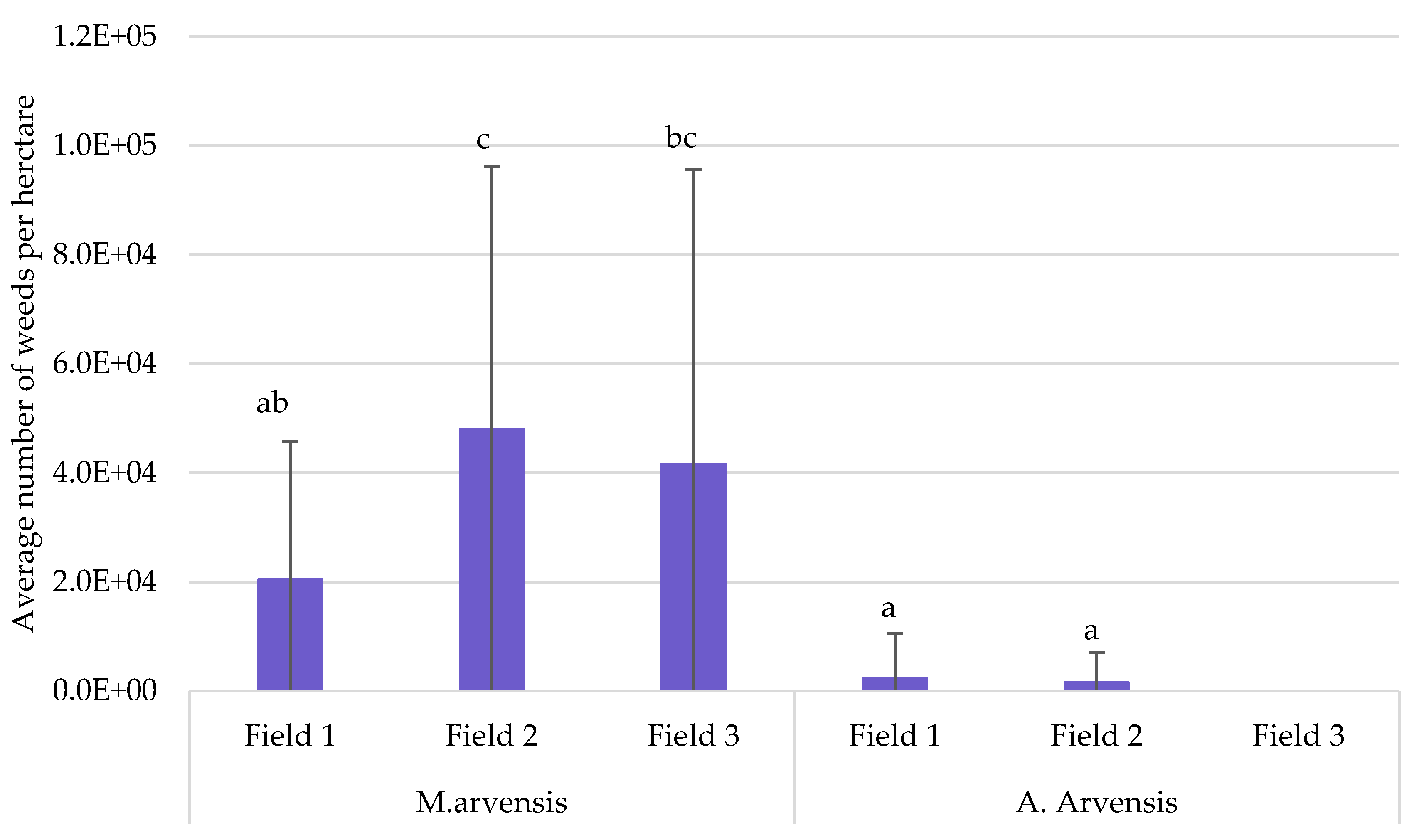
The occurrence and density of PA-producing weeds were assessed across three organically managed chamomile fields using systematic 1 m2 quadrat sampling. The dominant PA-producing species recorded were Myosotis arvensis and Anchusa arvensis. Overall, weed density differed among fields, indicating spatial heterogeneity in infestation levels (Figure 1, Supplementary Files S2 and S3).
Myosotis arvensis (field forget-me-not) was considerably more abundant than Anchusa spp. (bugloss) across all sites. As shown in Figure 1, the highest density of M. arvensis was recorded in Field 2, followed by Field 3 and Field 1. Statistical analysis (ANOVA followed by Tukey’s HSD test) revealed significant differences between fields, as indicated by different letter groupings above the bars. Field 2 (c) differed significantly from Field 1 (ab), while Field 3 (bc) showed intermediate values and did not differ significantly from Field 2 or Field 1 where shared letters occurred. In contrast, Anchusa spp. densities were markedly lower and showed no statistically significant differences among the three fields (p ≥ 0.05), suggesting a consistent but low-level occurrence across sites. Error bars represent the standard deviation (SD) of replicate quadrat measurements and reflect within-field spatial variability. The relatively large SD values observed for M. arvensis, particularly in Field 2 and Field 3, indicate heterogeneous weed distribution across sampling locations. In comparison, the smaller SD values for Anchusa spp. suggest more uniform, but overall low-level, occurrence. Notably, Anchusa officinalis was not recorded in any of the three study fields, indicating that this PA-producing species did not contribute to the observed weed community during the study period.

3.2. Height Distribution of PA-Producing Weeds and Chamomile Across the Fields

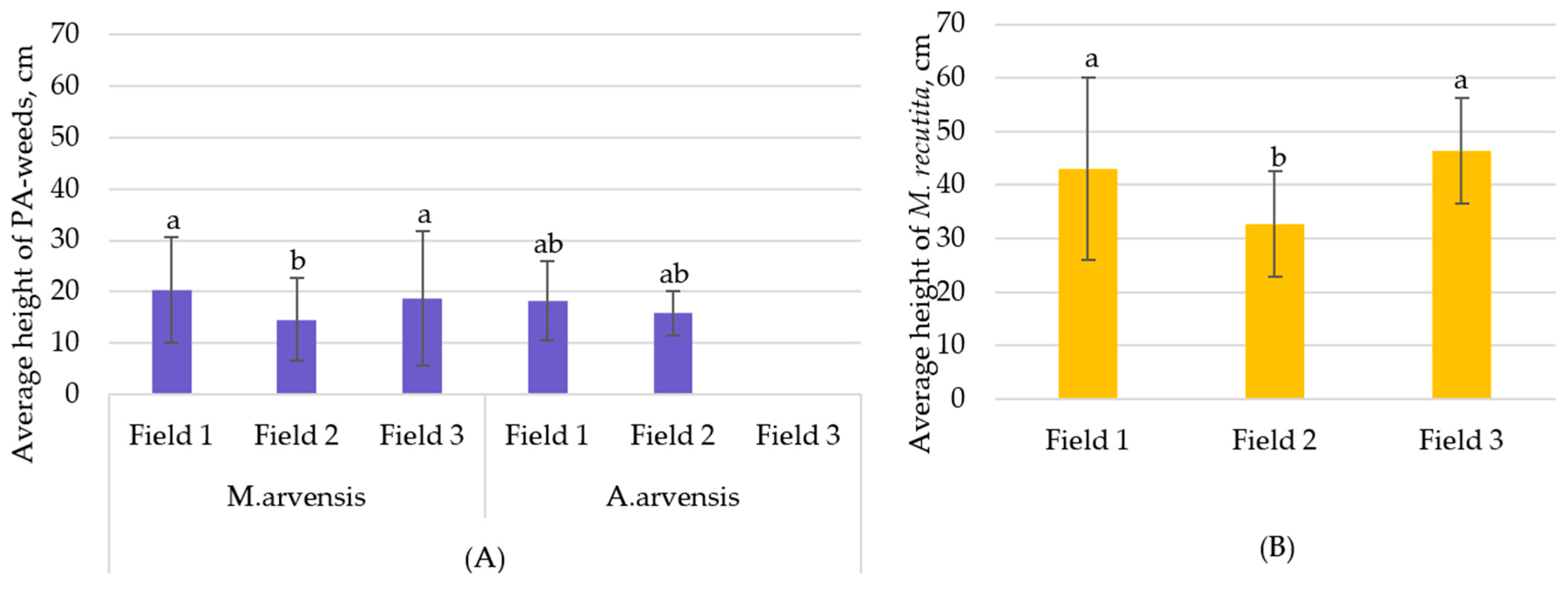
The mean height of PA-producing weeds differed among species and fields (Figure 2, Supplementary Files S4 and S5).
For Myosotis arvensis, the mean plant height ranged from approximately 14–20 cm across the three fields. Plants in Field 1 and Field 3 were significantly taller compared to Field 2 (p < 0.05), whereas no statistically significant difference was observed between Field 1 and Field 3. Although Field 3 exhibited the highest variability, as indicated by larger standard deviation values, the overall height distribution remained comparable to Field 1. In contrast, Anchusa arvensis showed more uniform height distribution between the fields. Mean plant height ranged from approximately 15–18 cm. No statistically significant differences were detected between the fields (p ≥ 0.05), although a tendency toward slightly greater height in Field 1 was observed. Variability was moderate across sites, as reflected by overlapping error bars. These height values describe the general field population structure (mean ± SD) and therefore should not be interpreted as the maximum height of the individual plants later selected for destructive biomass and PA fractionation. Importantly, Anchusa officinalis was not recorded in any of the study fields and therefore was not included in the height comparison.
Chamomile (Matricaria recutita L.) plant height was measured in all three study fields to characterize crop morphology in relation to the vertical distribution of PA-producing weeds. In each field, 50 randomly selected chamomile plants were measured during the same sampling campaign as weed assessment. Mean chamomile height differed significantly among fields (ANOVA, p < 0.05) (Figure 2). The highest mean plant height was recorded in Field 3 (46.4 ± 9.8 cm), followed by Field 1 (43.0 ± 17.1 cm). Field 2 exhibited significantly shorter plants, with a mean height of 32.7 ± 9.9 cm. Post hoc Tukey’s HSD test indicated that chamomile plants in Field 2 were significantly shorter than those in Fields 1 and 3, whereas no statistically significant difference was observed between Fields 1 and 3.

3.3. Vertical Biomass Distribution and Total Biomass of PA-Producing Weeds

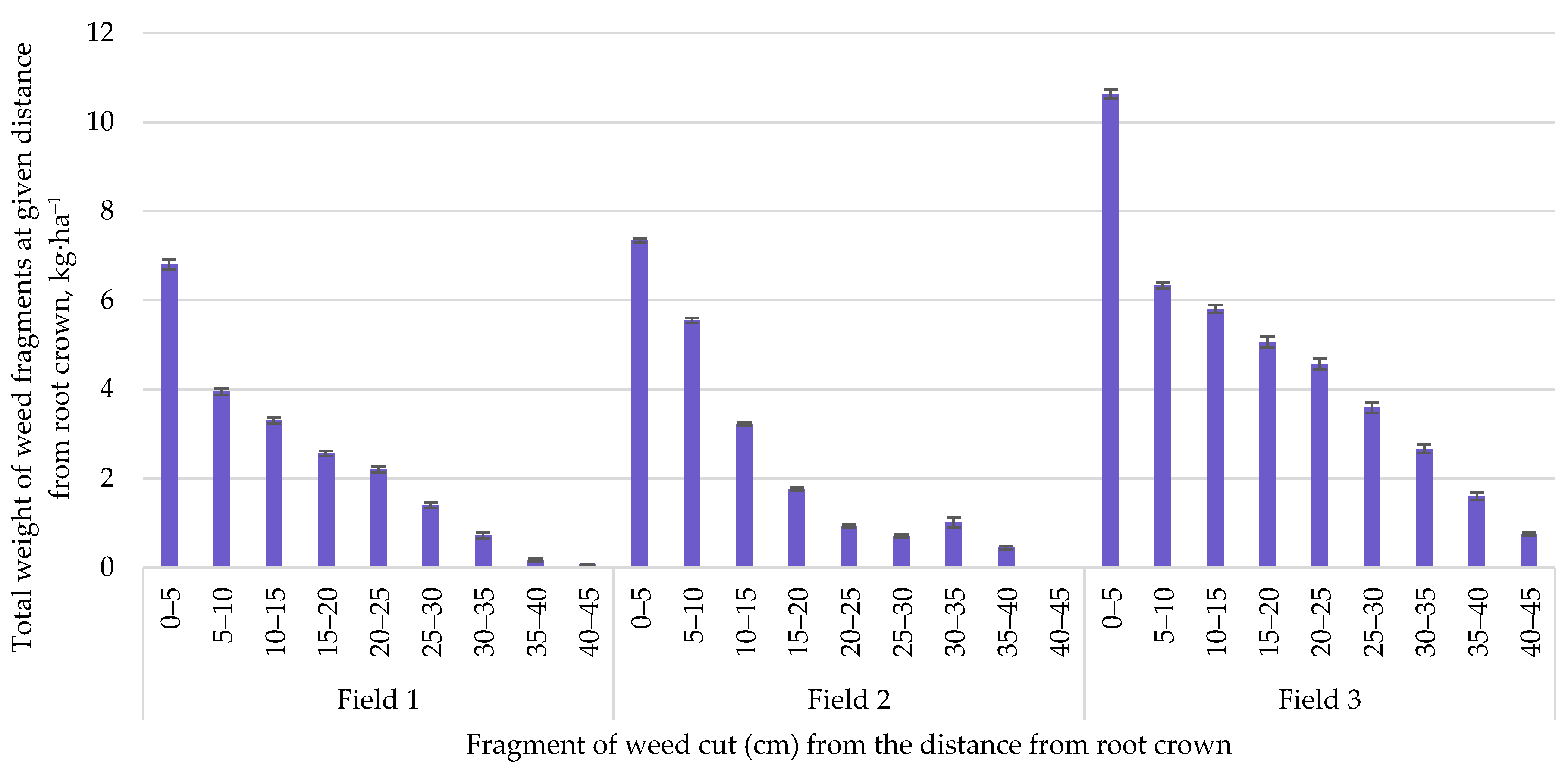
The vertical distribution of biomass in Myosotis arvensis differed among the three study fields (Figure 3, Supplementary File S6). In all fields, the highest biomass fraction was consistently observed in the lowest plant segments (0–5 cm from the root crown), followed by a gradual decrease toward the upper plant sections.
In Field 1, biomass decreased progressively from 6.8 kg ha−1 in the 0–5 cm segment to negligible amounts above 35 cm. A similar declining pattern was observed in Field 2, although with overall higher biomass in the lower segments (7.3 kg ha−1 at 0–5 cm). Field 3 exhibited the highest biomass accumulation in the basal portion, reaching 10.6 kg ha−1 at 0–5 cm, with substantial biomass still present up to 25–30 cm. The uppermost segments (above 35–40 cm) contributed minimally to total biomass across all fields, indicating that the majority of vegetative mass—and therefore potential PA load—was concentrated in the lower half of the plants. This distribution pattern is particularly relevant in the context of mechanical harvesting, as chamomile harvest height may intersect with these biomass-rich segments.
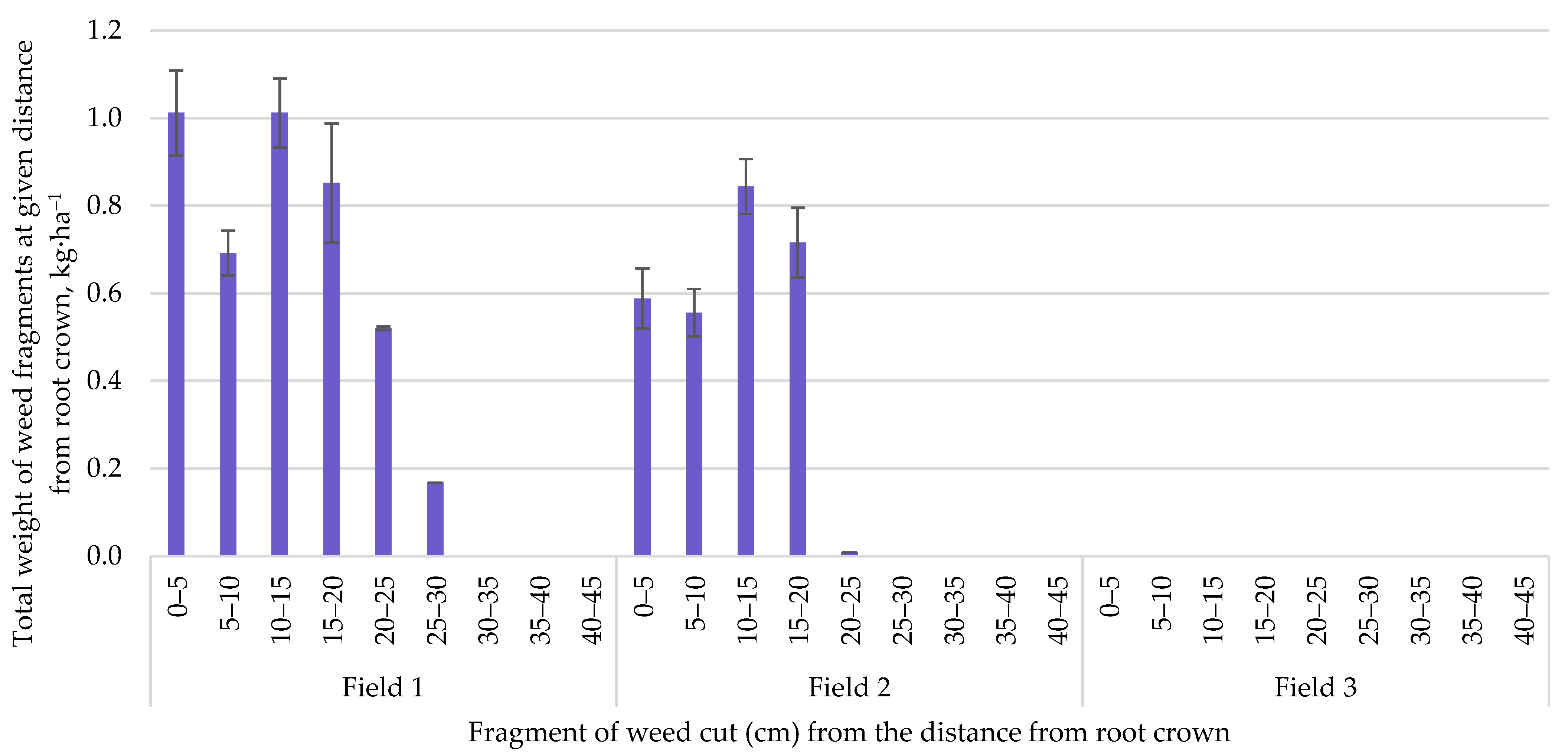
While Anchusa arvensis (Figure 4, Supplementary File S6) showed lower overall biomass and a more restricted vertical distribution. In Field 1, measurable biomass was present up to 30 cm, with the highest fractions located within the 0–15 cm segments. In Field 2, biomass was mainly confined to the lower 20 cm of the plant, while in Field 3 A. arvensis was not detected. Across all fields, biomass above 30 cm was negligible or absent, indicating a comparatively limited vertical reach relative to M. arvensis.
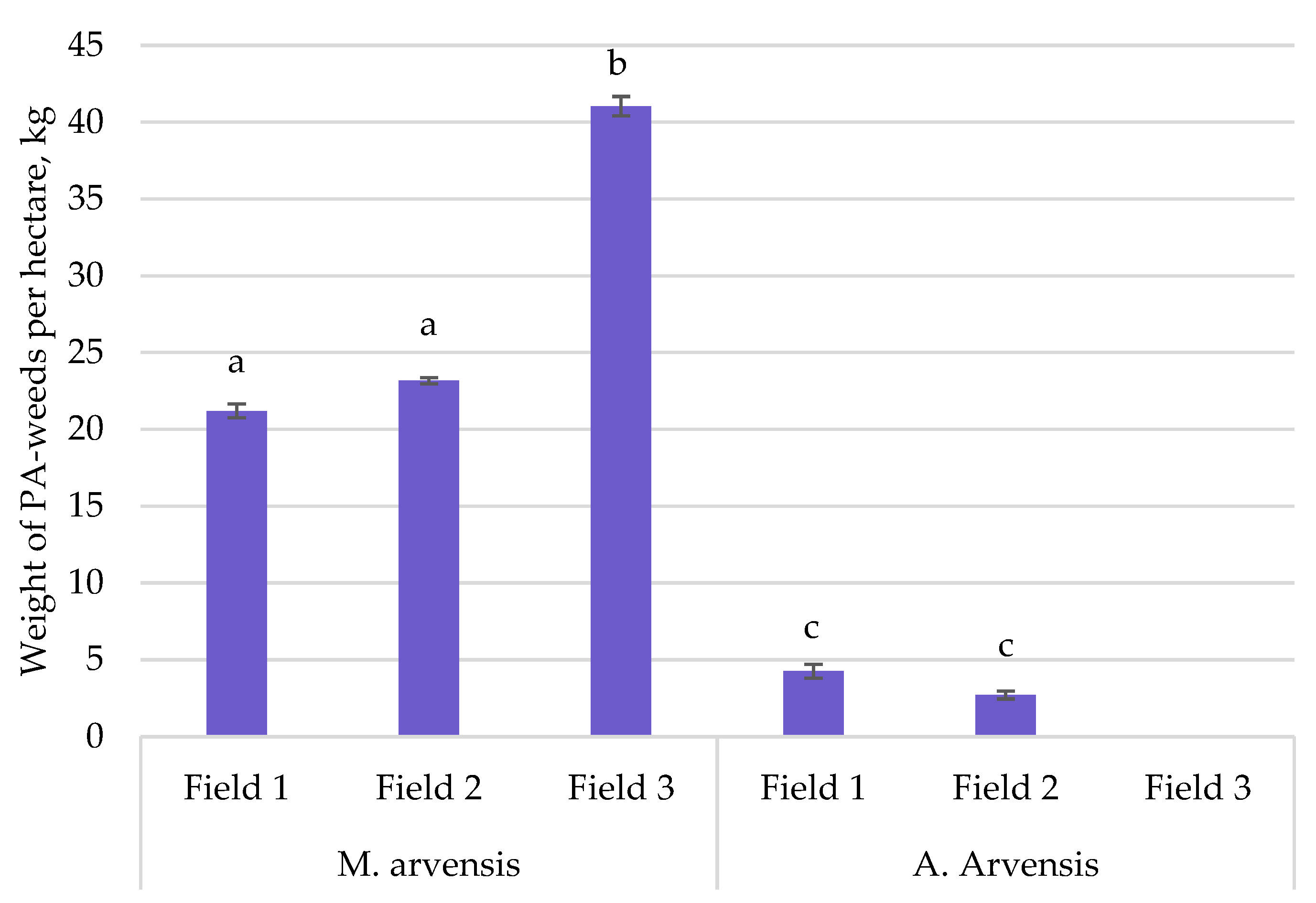
Total weed biomass differed significantly among fields (Figure 5, Supplementary File S7). For Myosotis arvensis, the highest total biomass was recorded in Field 3 (approximately 41 kg ha−1), significantly exceeding values observed in Field 1 and Field 2 (approximately 21 and 23 kg ha−1, respectively). No statistically significant difference was observed between Field 1 and Field 2.
In contrast, total biomass of Anchusa arvensis was substantially lower in all fields. Field 1 and Field 2 contained limited biomass (approximately 4.3 and 2.7 kg ha−1, respectively), while the species was absent in Field 3. The markedly lower biomass of A. arvensis suggests a comparatively minor contribution to overall weed pressure and potential PA contamination in these production systems. Taken together, these results indicate that M. arvensis was the dominant PA-producing weed species in terms of both vertical biomass distribution and total biomass, particularly in Field 3.

3.4. Vertical Distribution of Pyrrolizidine Alkaloids in PA-Producing Weeds and Chamomile Across Study Fields

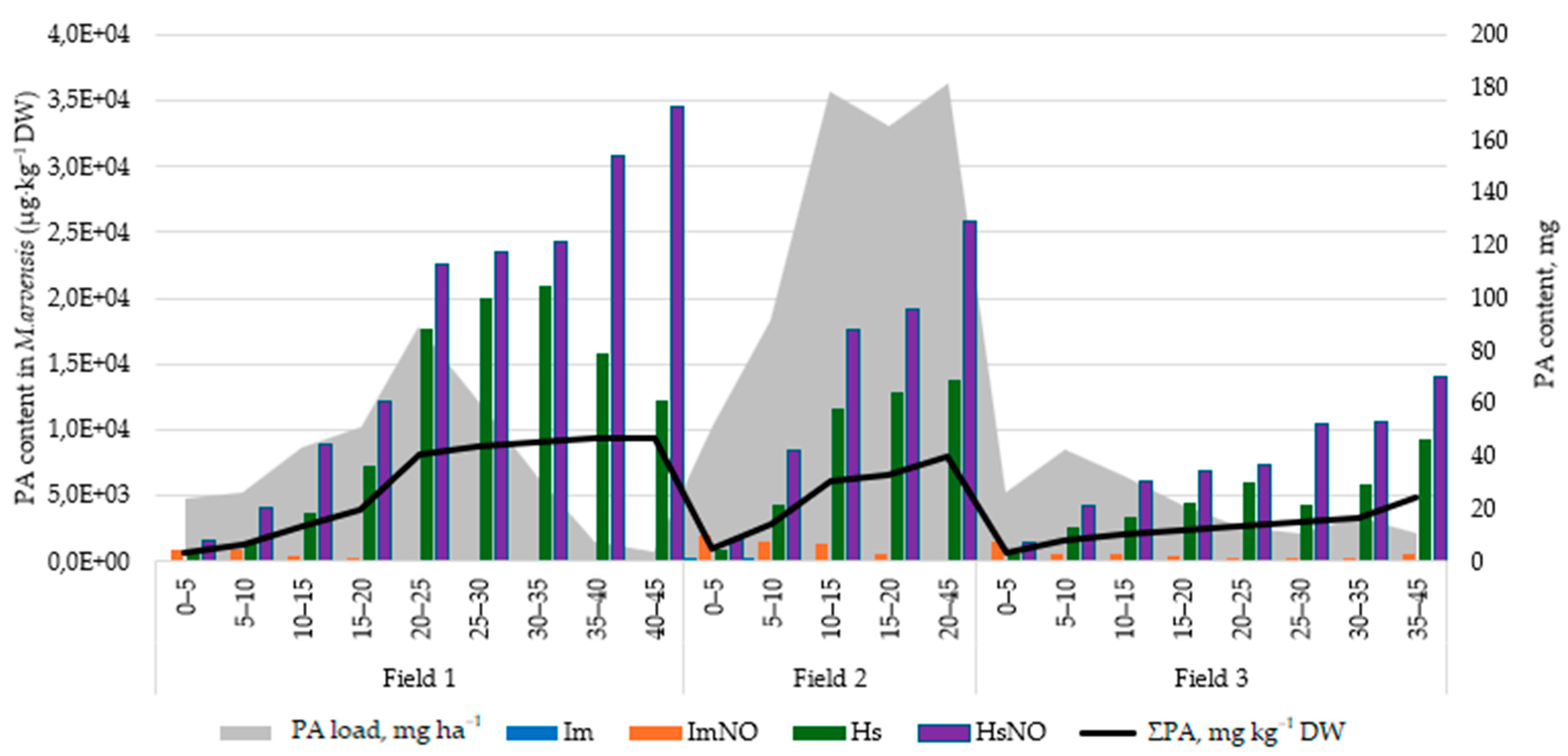
Pyrrolizidine alkaloids detected in Myosotis arvensis across the three study fields included intermedine (Im), intermedine N-oxide (ImNO), heliosupine (Hs), and heliosupine N-oxide (HsNO), all of which are listed among EU-monitored PAs. In all fields, the alkaloid profile was dominated by heliosupine-type compounds, particularly HsNO, which represented the major proportion of total PA content in most vertical segments. A consistent vertical gradient in PA concentration (expressed as mg kg−1 dry weight) was observed across fields, with lower concentrations in basal plant parts and increasing values toward upper segments (Figure 6, Supplementary File S8).
In Field 1, total PA concentrations increased from 3.49 mg kg−1 in the 0–5 cm segment to 46.88 mg kg−1 in the 40–45 cm segment. A similar pattern was observed in Field 2, where concentrations ranged from 4.89 mg kg−1 (0–5 cm) to 39.80 mg kg−1 in the pooled 20–45 cm upper fraction. In Field 3, overall concentrations were lower compared to Fields 1 and 2, increasing from 3.59 mg kg−1 at the base to a maximum of 24.02 mg kg−1 in the pooled 35–45 cm segment. While PA concentrations increased vertically, recalculation of results as PA load per hectare (mg ha−1), incorporating field-level biomass distribution, revealed that mid-level plant segments contributed most substantially to the total PA burden. In Field 1, the highest contribution originated from the 20–25 cm segment (88.9 mg ha−1), whereas in Field 2 the dominant contributions were distributed across 10–25 cm segments (up to 182.0 mg ha−1). In Field 3, the lower and mid-level segments (5–20 cm) contributed most to total PA load (maximum 42.3 mg ha−1), reflecting differences in vertical biomass allocation among fields.
In several upper plant fractions, the dry biomass was insufficient for independent quantitative LC–HRMS analysis. Therefore, adjacent vertical segments were pooled prior to extraction to obtain minimum sample mass required for reliable quantification. Because triplicate analysis would require at least 10 g of dry material, this approach was necessary to retain field-derived samples in the dataset. However, pooling reduced the resolution of comparisons among individual upper plant segments.
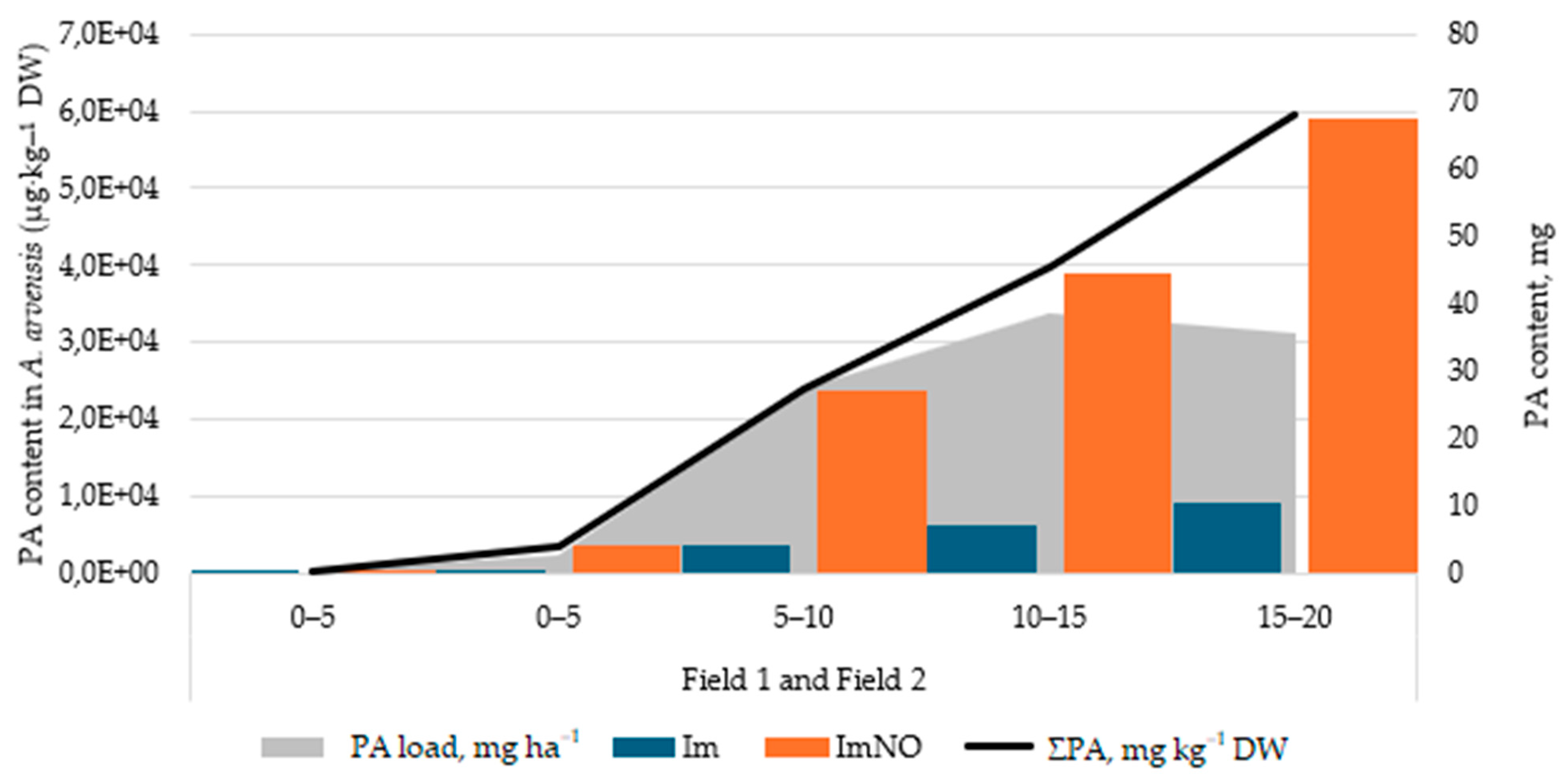
Due to the limited biomass of Anchusa arvensis in individual fields, vertical plant fractions from Field 1 and Field 2 were combined prior to chemical analysis to ensure sufficient sample mass for reliable LC-HRMS quantification. This was necessary because the low density and biomass of A. arvensis in single fields did not provide enough material for independent quantitative analysis of separate vertical fractions. No A. arvensis plants were detected in Field 3. In contrast to Myosotis arvensis, the pyrrolizidine alkaloid profile of A. arvensis was markedly simpler (Figure 7, Supplementary File S8). Only intermedine (Im) and intermedine N-oxide (ImNO) were detected among the EU-monitored pyrrolizidine alkaloids. Pyrrolizidine alkaloid composition was strongly dominated by the N-oxide form (ImNO) across all vertical segments. Because corresponding fractions from Fields 1 and 2 were pooled prior to analysis, the resulting profile represents a combined field-level description of vertical PA distribution rather than a field-specific comparison.
A clear vertical gradient in PA concentration (mg kg−1 dry weight) was observed (Figure 7). Total PA concentration increased progressively from the basal to the upper plant segments. The lowest concentration was detected in the 0–5 cm fraction (0.36 mg kg−1), followed by 4.05 mg kg−1 at 5–10 cm and 27.11 mg kg−1 at 10–15 cm. Concentrations further increased to 45.44 mg kg−1 at 15–20 cm and reached a maximum of 68.22 mg kg−1 in the 20–25 cm segment. A similar trend was observed when PA content was recalculated as load per hectare (mg ha−1). The lowest contribution was recorded in the basal fraction (0.4 mg ha−1), with increasing values in higher segments. The highest PA load was associated with the 15–20 cm fraction (38.7 mg ha−1), followed closely by the 20–25 cm segment (35.5 mg ha−1). Lower contributions were observed in the 10–15 cm (27.4 mg ha−1) and 5–10 cm (2.8 mg ha−1) segments.
No pyrrolizidine alkaloids were detected (<LOQ) in any analysed chamomile segments or flower head samples collected within approximately 10 cm of PA-producing weeds. The corresponding results are presented in Supplementary File S9.

3.5. Harvest-Relevant PA Contamination Hazard in Chamomile Across Study Fields

To characterize contamination hazard during harvesting, harvest-relevant PA load was calculated for all weed fractions located at or above 20 cm from ground level (Table 1, Supplementary File S10). In Myosotis arvensis, harvest-relevant PA load reached 194.2 mg ha−1 in Field 1, 182.0 mg ha−1 in Field 2, and 51.1 mg ha−1 in Field 3, whereas Anchusa arvensis contributed 35.5 mg ha−1 across the combined material from Fields 1 and 2. When expressed at field level, total harvest-relevant PA load amounted to 211.9 mg ha−1 in Field 1, 199.7 mg ha−1 in Field 2, and 51.1 mg ha−1 in Field 3.
Based on literature-derived dry chamomile yield scenarios, these values were further converted into theoretical contamination scenarios for harvested chamomile biomass (Table 1). Under the conservative scenario (up to 500 kg ha−1 dry chamomile material [50]), the estimated theoretical PA contamination reached 388.3 µg kg−1 for M. arvensis in Field 1, 363.9 µg kg−1 in Field 2, and 102.1 µg kg−1 in Field 3, while field-level totals reached 423.8 µg kg−1, 399.4 µg kg−1, and 102.1 µg kg−1, respectively. Under the intermediate scenario (up to 800 kg ha−1 [50]), the corresponding field-level values decreased to 264.9 µg kg−1 in Field 1, 249.6 µg kg−1 in Field 2, and 63.8 µg kg−1 in Field 3. Under the high-yield scenario (more than 1000 kg ha−1 [51]), the respective values were 211.9 µg kg−1, 199.7 µg kg−1, and 51.1 µg kg−1.

4. Discussion

The ongoing expansion of organic farming in Latvia and across the European Union has significantly altered crop-weed interactions in agricultural systems. According to the 2026 edition of The World of Organic Agriculture (reporting 2024 data), the organically managed agricultural area in the European Union reached 18.1 million hectares in 2024 [52]. This structural shift toward organic production systems increases the likelihood of co-occurrence between cultivated medicinal crops and naturally occurring PA-producing weeds, thereby elevating the risk of unintended contamination of harvested plant material. Pyrrolizidine alkaloids represent a substantial challenge for medicinal plant producers, particularly under organic farming systems where synthetic herbicides are not applied and weed management relies primarily on mechanical and cultural practices [5]. In such systems, weed pressure may be higher, and the presence of toxic secondary metabolites in accompanying flora becomes a critical food and feed safety issue.
Pyrrolizidine alkaloid-producing plants are widely distributed across Europe, predominantly within the families Asteraceae and Boraginaceae [12,44]. In the Baltic region and parts of Eastern Europe, Myosotis arvensis, Anchusa arvensis, as well as Anchusa officinalis and S. vulgaris represent the most relevant PA-producing weeds in agricultural systems [12,48].
Under the investigated field conditions, only two PA-producing species, Myosotis arvensis and Anchusa arvensis, were detected, with M. arvensis clearly dominating in terms of density and biomass contribution. This density pattern was also reflected in field-level PA burden. Thus, the higher density of M. arvensis translated into a substantially greater contamination potential at the field scale, particularly when considered together with its higher biomass production. Similar patterns have been documented in large-scale chamomile production systems in Croatia, particularly near Lozan in the northern part of the Virovitica-Podravina County [53]. In that study, Myosotis arvensis was identified as one of the most relevant PA-producing weeds, with 1259 individuals recorded across surveyed sites, including 312 individuals directly within chamomile cultivation areas. Reported population densities ranged from 0 to 62,400 individuals km−2. When converted to a hectare basis (1 km2 = 100 ha), this corresponds to a maximum density of approximately 624 individuals ha−1, which is substantially lower than the densities observed in the present study (20,400–48,000 individuals ha−1). Notably, Croatian hotspots of M. arvensis were primarily located in meadows surrounding cultivation areas rather than within the crop itself, suggesting different infestation dynamics compared to Latvian organic chamomile systems. Comparable observations have been reported in Kosovo [54], where PA-producing species were surveyed during the 2021–2022 vegetation period across 70 cultivated plots and natural habitats of medicinal and aromatic plants (MAPs). Among Boraginaceae species, Myosotis arvensis was the most frequently recorded PA-producing plant in wild MAP habitats, being detected in 15 surveyed sites. These findings further confirm the ecological adaptability and widespread occurrence of M. arvensis across diverse agroecological conditions in Europe.
From an agronomic perspective, the interaction between weed vertical architecture and crop harvest height represents a critical control point in quality assurance [55]. Although both PA-producing weed species were generally shorter than chamomile plants, their upper biomass-bearing fractions still overlapped with the harvest-relevant zone of the crop canopy, thereby increasing the likelihood that PA-containing plant tissues may be intercepted during harvesting.
It is well established that pyrrolizidine alkaloid concentrations in PA-producing plants are not uniformly distributed but vary markedly among different plant organs. In most species, PA biosynthesis occurs primarily in the roots [15], followed by translocation to aerial tissues, although synthesis has also been reported in young leaves in certain cases [56]. However, this does not imply that the highest PA concentrations remain confined to the basal plant parts throughout the entire vegetation period. Tissue-specific studies have demonstrated pronounced variability in alkaloid allocation. For example, in Heliotropium indicum, inflorescences contained more than 70% of total plant alkaloids, while stems, leaves, and roots accounted for 3%, 7%, and 19%, respectively [57]. Similarly, in Anchusa strigosa, the highest total PA concentration was detected in leaves (23.63 mg g−1 dry weight), followed by flowers (19.77 mg g−1), whereas roots contained substantially lower levels (1.80 mg g−1) [58]. Data for Anchusa arvensis further confirm organ-specific variation in alkaloid accumulation [59]. In this species, total PA concentrations differed between plant organs, with measurable amounts detected in flowers (0.01 mg 100 mg−1), leaves (0.003 mg 100 mg−1), stems (0.005 mg 100 mg−1), and roots (0.01 mg 100 mg−1), while whole-plant values were not consistently reported.
In Myosotis arvensis, pyrrolizidine alkaloids were dominated by heliosupine (Hs) and heliosupine N-oxide (HsNO), while intermedine (Im) and intermedine N-oxide (ImNO) were detected at substantially lower levels. This chemotype pattern is consistent with previous reports identifying heliosupine-type alkaloids as characteristic constituents of M. arvensis [48]. Interestingly, intermedine-type alkaloids were relatively more pronounced in the lower plant segments, whereas heliosupine-type compounds dominated in the upper fractions. In some cases (Fields 1 and 3), Im concentrations in the uppermost segments were negligible or not detected. Total PA concentrations (mg kg−1 DW) increased toward the upper plant segments. However, when recalculated as field-level PA loads (mg ha−1), the greatest contribution originated from mid-level segments (approximately 15–25 cm), where elevated concentrations coincided with substantial biomass. This vertical gradient is consistent with root-based PA biosynthesis followed by translocation of alkaloids to aerial tissues during plant development [15,56]. At the field scale, the resulting PA burden reflected the combined effects of weed abundance, biomass distribution, and vertical alkaloid stratification rather than concentration alone.
A comparable vertical trend was observed in Anchusa arvensis, although its PA profile differed markedly. Only intermedine-type alkaloids were detected, with ImNO clearly predominating. The absence of heliosupine-type alkaloids in A. arvensis is consistent with previous reports indicating that Anchusa spp. predominantly accumulate intermedine-related PAs rather than heliosupine-type compounds and have frequently been reported to contain predominantly monoester-type PAs [60,61]. In contrast to M. arvensis, intermedine-type PA concentrations increased progressively from basal toward upper plant segments. Like M. arvensis, total PA concentrations (mg kg−1 DW) reached maximum values in the 20–25 cm fraction. These results indicate that contamination risk cannot be assessed solely on concentration data but must incorporate biomass distribution within the vertical plant structure.
Thus, while M. arvensis contributed a higher overall PA burden at the field scale due to its greater density and biomass, both species exhibited a consistent pattern of increasing PA concentration toward harvest-relevant plant heights. This finding is particularly relevant in the context of mechanical harvesting, where cutter bar height and picking depth determine the proportion of upper plant segments incorporated into the harvested biomass. Previous studies on chamomile harvesting technology have demonstrated that harvesting height, drum rotation speed, and picking depth directly influence the amount and composition of co-harvested plant material [62,63]. Therefore, even relatively low-density infestations of PA-producing weeds may disproportionately contribute to contamination if upper, alkaloid-rich segments are intercepted at the harvesting interface.
Evaluating contamination hazard at harvest using harvest-relevant PA load and theoretical chamomile yield scenarios showed that risk depended on both the amount of PA-bearing weed biomass present in the critical harvest zone and the expected chamomile yield. Because chamomile yield was not directly determined in the present study, theoretical scenarios were used to reflect the wide range of yields reported in the literature. The dry flower head yield of chamomile in Europe shows considerable regional variability, generally ranging from 400 to 800 kg ha−1 [50] and in some cases reaching up to 900 kg ha−1 [51]. These differences are influenced by multiple factors, including cultivar choice and the efficiency of mechanical harvesting, both of which are particularly important for achieving the purity standards required for pharmaceutical-grade raw materials [50,51]. The current maximum level for the sum of pyrrolizidine alkaloids in dried chamomile is 400 µg kg−1 [33], established by the European Commission based on the EFSA CONTAM Panel’s assessment of health risks associated with chronic exposure [12]. In the present study, the combined harvest-relevant PA contribution of M. arvensis and A. arvensis in Field 1 exceeded this threshold under the low-yield scenario (500 kg ha−1), indicating that regulatory non-compliance may occur when substantial PA-rich weed biomass is present in the harvest-relevant zone and chamomile yield is low. Under the intermediate scenario (800 kg ha−1), the estimated PA concentration remained below the regulatory threshold, and under the high-yield scenario (1000 kg ha−1) the relative impact of weed-derived PA contamination decreased further. These calculations therefore indicate that the most relevant factors to consider for avoiding PA contamination in chamomile are the abundance of PA-producing weeds, the vertical distribution of their PA-bearing biomass relative to the harvesting interface, and the expected crop yield. Nevertheless, these values should be interpreted as illustrative scenarios rather than direct predictions of final product contamination, because actual PA occurrence will also depend on harvester efficiency, crop architecture, and the dominant PA-producing weed flora.
One of the most significant findings of the present study relates to the hypothesis of horizontal transfer of PAs from PA-producing weeds to neighboring non-PA-producing crops via soil-mediated uptake [40,64,65]. Chamomile plants growing within approximately 10 cm of PA-producing weeds were deliberately sampled in order to test this hypothesis under real field conditions. Despite documented co-occurrence and close spatial contact between chamomile and PA-producing species, no pyrrolizidine alkaloids were detected in any of the analysed chamomile samples (<LOQ). The present results do not support the occurrence of soil-mediated horizontal transfer under the field conditions studied. Instead, PA contamination in chamomile appears to be primarily associated with mechanical admixture of PA-producing weed material during harvest. Although direct co-harvest simulation was beyond the scope of this study, the overlap between PA-rich weed fractions and the harvest-relevant crop zone indicates a realistic contamination pathway that warrants further investigation under commercial harvesting conditions. Within the investigated production systems, contamination risk was mainly determined by weed density, vertical biomass distribution, and harvesting parameters, while no evidence of systemic PA uptake by chamomile was observed.
Similar field-based studies using the PA-producing plant Lappula squarrosa under realistic agricultural conditions have shown that experimentally observed soil-mediated uptake occurs at very low transfer rates and does not result in toxicologically relevant concentrations in recipient plants [66]. Under practical agricultural conditions, this pathway appears negligible compared with the well-established risk of accidental co-harvesting of PA-producing weeds; therefore, preventive strategies should prioritize effective weed control and the minimization of mechanical admixture during harvest [5].
The present study has several limitations that should be considered when interpreting the results. First, the investigation was conducted in three commercial chamomile fields within one region of Latvia, and the fields differed in establishment history and previous management; therefore, inter-field comparisons should be interpreted as reflecting realistic production-system variability rather than strictly controlled experimental contrasts. Second, in several cases the biomass of individual weed fractions was insufficient for independent quantitative PA analysis, requiring pooling of adjacent vertical segments; in Anchusa arvensis, corresponding fractions from Fields 1 and 2 were additionally combined because of the species’ low density and limited biomass. Consequently, the resulting PA profiles provide field-relevant approximations of vertical alkaloid distribution, but with reduced resolution for fine-scale segment-specific comparisons. Finally, the absence of detectable PAs in chamomile samples should be interpreted within the specific agronomic, climatic, and soil conditions investigated here, and should not be generalized beyond the studied production context without further field-based validation.
From a practical perspective, the present results indicate that organic chamomile growers should pay particular attention to the occurrence of PA-producing weeds before harvest, especially where upper alkaloid-rich plant fractions may overlap with the harvesting zone. In this context, field-specific monitoring, timely reduction in PA-producing weeds, and adjustment of harvesting height may represent the most relevant preventive measures under the production conditions studied. Because weed flora, crop structure, and management history differ among regions and farms, such measures should be adapted to local conditions rather than applied as universal recommendations. Their successful implementation requires a sound understanding of crop-weed ecology, species-specific growth characteristics, and site-dependent factors such as soil and climate, as organic systems demand flexible, context-adapted management approaches [67].

5. Conclusions

Field investigations conducted in three organically managed chamomile production systems under humid continental climate and sod-podzolic soil conditions confirmed that Myosotis arvensis and Anchusa arvensis were the only PA-producing weeds present during the main flowering and harvesting period. Among these, M. arvensis was clearly dominant in terms of density, biomass, and total field-level PA load. Both species exhibited vertically stratified PA distribution, with increasing alkaloid concentrations toward upper plant segments. However, contamination risk at field scale was determined by the interaction between concentration and biomass distribution, with mid-level segments contributing substantially to total PA load. Chamomile plants growing within approximately 10 cm of PA-producing weeds showed no detectable PA levels (<LOQ). Under the field conditions investigated, the results do not support soil-mediated horizontal transfer as a relevant contamination pathway. Instead, PA occurrence in chamomile production appears primarily associated with mechanical admixture during harvest.
The findings indicate that contamination risk in organic chamomile systems is governed by weed density, vertical biomass structure, and harvesting height. When contamination hazard was evaluated using harvest-relevant PA load above the 20 cm harvesting threshold and theoretical chamomile yield scenarios, the results showed that the practical risk of regulatory non-compliance depended on both the amount of PA-rich weed biomass present in the harvest-relevant zone and the harvested chamomile yield. Under the low-yield scenario, the combined harvest-relevant PA contribution of M. arvensis and A. arvensis in Field 1 exceeded the current European Union maximum level of 400 µg kg−1 for dried chamomile, whereas under higher yield scenarios this risk decreased. Therefore, preventive strategies should focus on targeted monitoring of PA-producing weeds, timely control measures, and optimization of harvesting parameters to minimize incorporation of PA-rich weed biomass.

Supplementary Materials

The following supporting information can be downloaded at: https://www.mdpi.com/article/10.3390/horticulturae12040417/s1, S1: LC–HRMS parameters and calibration data for the analysis of EU-monitored pyrrolizidine alkaloids. S2: Number of PA-producing weeds recorded in each 1 m2 sampling quadrat across 25 sampling plots per field. S3: Number of PA-producing weeds recalculated per hectare. S4: Height distribution of PA-containing weeds (cm) across the three study fields. S5: Height distribution of chamomile plants (cm) across the three study fields. S6: Vertical biomass distribution (kg ha−1) of PA-producing weeds across 5 cm plant segments measured from the root crown. S7: Total aboveground biomass (kg ha−1) of PA-producing weeds across the three chamomile production fields. S8: Vertical distribution of EU-monitored pyrrolizidine alkaloids in PA-producing weeds across the three study fields. S9: Vertical distribution of EU-monitored pyrrolizidine alkaloids in different chamomile plant segments growing near PA-producing weeds across the three study fields. S10: Harvest-relevant PA load of PA-producing weeds and theoretical PA contamination scenarios in harvested chamomile across the study fields.

Author Contributions

Conceptualization, I.N. and G.S.; methodology, validation, formal analysis, investigation, resources, data curation, I.N.; writing—original draft preparation I.N.; review, editing and visualization, I.N. and G.S.; supervision, G.S.; project administration, I.N. All authors have read and agreed to the published version of the manuscript.

Funding

This research was funded by the Fundamental and Applied Research Programme of the Latvian Council of Science, project “Transfer of pyrrolizidine alkaloids from weeds to soil and medicinal plants”, project No. lzp-2022/1-0543.

Data Availability Statement

The original contributions presented in this study are included in the article/Supplementary Materials. Further inquiries can be directed at the corresponding author.

Acknowledgments

The authors express their sincere gratitude to SIA Field and Forest, particularly Ivars Paškovskis and Artūrs Miltiņš, for providing access to their commercial chamomile production fields and for supporting the field investigations. The authors also thank biol. Ieva Mežaka for her valuable assistance with sample collection and the identification of pyrrolizidine alkaloid-producing weeds in the chamomile production fields. During the preparation of this manuscript, the authors used a generative artificial intelligence tool for language editing and stylistic revision. The authors have reviewed and edited the output and take full responsibility for the content of this publication.

Conflicts of Interest

The authors declare no conflicts of interest.

Abbreviations

The following abbreviations are used in this manuscript:
ALARAAs low as reasonably achievable
ANOVAAnalysis of variance
BfRBundesinstitut für Risikobewertung
DNADeoxyribonucleic acid
DWDry weight
EFSAEuropean Food Safety Authority
EMAEuropean Medicines Agency
EUEuropean Union
GACPGood Agricultural and Collection Practices
HsHeliosupine
HsNOHeliosupine N-oxide
HSDTukey’s Honestly Significant Difference
ImIntermedine
ImNOIntermedine N-oxide
LC–HRMSLiquid chromatography–high-resolution mass spectrometry
LOQLimit of quantification
MAPsMedicinal and aromatic plants
PAsPyrrolizidine alkaloids
SDStandard deviation
WHOWorld Health Organization

References

  1. IPPC Secretariat. International Year of Plant Health—Final Report; FAO: Rome, Italy, 2021. [Google Scholar] [CrossRef]
  2. Kubiak, A.; Wolna-Maruwka, A.; Niewiadomska, A.; Pilarska, A.A. The Problem of Weed Infestation of Agricultural Plantations vs. the Assumptions of the European Biodiversity Strategy. Agronomy 2022, 12, 1808. [Google Scholar] [CrossRef]
  3. Zingsheim, M.L.; Döring, T.F. Does weed diversity mitigate yield losses? Front. Plant Sci. 2024, 15, 1395393. [Google Scholar] [CrossRef]
  4. Vijayakumar, S.; Shanmugapriya, P.; Saravanane, P.; Ramesh, T.; Murugaiyan, V.; Ilakkiya, S. Precision weed control using unmanned aerial vehicles and robots: Assessing feasibility, bottlenecks, and recommendations for scaling. NDT 2025, 3, 10. [Google Scholar] [CrossRef]
  5. Mwangi, O.; Mucheru-Muna, M.; Kinyua, M.; Bolo, P.; Kihara, J. Organic farming practices increase weed density and diversity over conventional practices: A meta-analysis. Heliyon 2024, 10, e32761. [Google Scholar] [CrossRef]
  6. Van Der Weide, R.; Bleeker, P.O.; Achten, V.T.J.M.; Lotz, L.A.P.; Fogelberg, F.; Melander, B. Innovation in mechanical weed control in crop rows. Weed Res. 2008, 48, 215–224. [Google Scholar] [CrossRef]
  7. Melander, B.; Rasmussen, I.A.; Bàrberi, P. Integration of soil, crop and weed management in low-external-input farming systems. Weed Res. 2000, 40, 27–47. [Google Scholar] [CrossRef]
  8. McErlich, A.F.; Boydston, R.A. Current state of weed management in organic and conventional cropping systems. In Automation: The Future of Weed Control in Cropping Systems; Young, S.L., Pierce, F.J., Eds.; Springer: Dordrecht, The Netherlands, 2014; pp. 11–32. [Google Scholar] [CrossRef]
  9. Barberi, P. Weed management in organic agriculture: Are we addressing the right issues? Weed Res. 2002, 42, 177–193. [Google Scholar] [CrossRef]
  10. European Directorate for the Quality of Medicines & HealthCare (EDQM). European Pharmacopoeia, 11th ed.; Council of Europe: Strasbourg, France, 2023. [Google Scholar]
  11. European Medicines Agency (EMA). Guideline on Good Agricultural and Collection Practice (GACP) for Starting Materials of Herbal Origin—Revision 1; EMA/HMPC/246816/2005 Rev.1; EMA: Amsterdam, The Netherlands, 2018; Available online: https://www.ema.europa.eu/en/documents/scientific-guideline/guideline-good-agricultural-collection-practice-gacp-starting-materials-herbal-origin-revision-1_en.pdf (accessed on 19 February 2026).
  12. EFSA Panel on Contaminants in the Food Chain (CONTAM); Knutsen, H.K.; Alexander, J.; Barregård, L.; Bignami, M.; Brüschweiler, B.; Ceccatelli, S.; Cottrill, B.; Dinovi, M.; Edler, L.; et al. Statement on the risks for human health related to the presence of pyrrolizidine alkaloids in honey, tea, herbal infusions and food supplements. EFSA J. 2017, 15, 4908. [Google Scholar] [CrossRef]
  13. World Health Organization (WHO). WHO Guidelines on Good Agricultural and Collection Practices (GACP) for Medicinal Plants; WHO: Geneva, Switzerland, 2003; Available online: https://apps.who.int (accessed on 19 February 2026).
  14. Ibanez, G. Pyrrolizidine Alkaloids. In Encyclopaedia of Toxicology; Wexler, P., Anderson, B., Peyster, A., Eds.; Academic Press: Cambridge, MA, USA, 2005; pp. 585–587. [Google Scholar]
  15. Tábuas, B.; Cruz Barros, S.; Diogo, C.; Cavaleiro, C.; Sanches Silva, A. Pyrrolizidine Alkaloids in Foods, Herbal Drugs, and Food Supplements: Chemistry, Metabolism, Toxicological Significance, Analytical Methods, Occurrence, and Challenges for Future. Toxins 2024, 16, 79. [Google Scholar] [CrossRef]
  16. Lucker, C.; Hessel, S.; Lenze, D.; Lampen, A. Disturbance of gene expression in primary human hepatocytes by hepatotoxic pyrrolizidine alkaloids: A whole genome transcriptome analysis. Toxicol. In Vitro 2015, 29, 1669–1682. [Google Scholar] [CrossRef]
  17. Field, R.; Stegelmeier, B.; Colegate, S.; Brown, A.; Green, B. An in vitro comparison of the cytotoxic potential of selected dehydropyrrolizidine alkaloids and some N-oxides. Toxicon 2015, 97, 36–45. [Google Scholar] [CrossRef] [PubMed]
  18. Prakash, A.; Pereira, T.; Reilly, P.; Seawright, A. Pyrrolizidine alkaloids in human diet. Mutat. Res. 1999, 443, 53–67. [Google Scholar] [CrossRef]
  19. Chen, T.; Mei, N.; Fu, P. Genotoxicity of pyrrolizidine alkaloids. J. Appl. Toxicol. 2010, 30, 183–196. [Google Scholar] [CrossRef]
  20. Yan, M.; Ruan, J.; Fu, P.; Lin, G. Cytotoxicity of pyrrolizidine alkaloid in human hepatic parenchymal and sinusoidal endothelial cells: Firm evidence for the reactive metabolites mediated pyrrolizidine alkaloid-induced hepatotoxicity. Chem. Biol. Interact. 2016, 243, 119–126. [Google Scholar] [CrossRef]
  21. Moreira, R.; Pereira, D.M.; Valentao, P.; Andrade, P.B. Pyrrolizidine Alkaloids: Chemistry, Pharmacology, Toxicology and Food Safety. Int. J. Mol. Sci. 2018, 19, 1668. [Google Scholar] [CrossRef]
  22. Fernández-Pintor, B.; Zarcero, S.M.; Sierra, I. Tropane and Pyrrolizidine Alkaloids in Edible Flowers and Flower-Derived Foods: A Food Safety Perspective. Foods 2025, 14, 3695. [Google Scholar] [CrossRef]
  23. WHO. Safety Evaluation of Certain Food Additives and Contaminants: Prepared by the Eightieth Meeting of the Joing FAO/WHO Expert Committee on Food Additives (JECFA). Supplement 2: Pyrrolizidine Alkaloids. Available online: https://inchem.org/documents/jecfa/jecmono/v71s2je01.pdf (accessed on 19 February 2026).
  24. Bundesinstitut für Risikobewertung. Updated risk assessment on levels of 1,2-unsaturated pyrrolizidine alkaloids (PAs) in foods. BfR-Stellungnahmen 2020, 2020. [Google Scholar] [CrossRef]
  25. Sachse, B.; Hessel-Pras, S.; Schäfer, B. Genotoxic Carcinogenicity of Pyrrolizidine Alkaloids: Relevance of Potency Factors for the Risk Assessment. Arch. Toxicol. 2025, 100, 95–108. [Google Scholar] [CrossRef]
  26. Rasenack, R.; Müller, C.; Kleinschmidt, M.; Rasenack, J.; Wiedenfeld, H. Veno-occlusive disease in a fetus caused by pyrrolizidine alkaloids of food origin. Fetal Diagn. Ther. 2003, 18, 223–225. [Google Scholar] [CrossRef] [PubMed]
  27. Yee, S.B. Pyrrolizidine Alkaloid-Induced Hepatotoxicity. In Comprehensive Toxicology (Second Edition); Roth, R.A., Ed.; Elsevier: Amsterdam, The Netherlands, 2010; pp. 595–611. [Google Scholar] [CrossRef]
  28. EFSA Panel on Contaminants in the Food Chain (CONTAM). Dietary Exposure Assessment to Pyrrolizidine Alkaloids in the European Population. EFSA J. 2016, 14, 4572. [CrossRef]
  29. Bundesinstitut für Risikobewertung (BfR). Pyrrolizidine Alkaloids in Tea and Herbal Infusions; BfR Opinion No. 018/2013; BfR: Berlin, Germany, 2013. [Google Scholar]
  30. Casado, N.; Morante-Zarcero, S.; Sierra, I. The concerning food safety issue of pyrrolizidine alkaloids: An overview. Trends Food Sci. Technol. 2022, 120, 123–139. [Google Scholar] [CrossRef]
  31. Fuente-Ballesteros, A.; Brabenec, O.; Tsagkaris, A.S.; Ares, A.M.; Hajslova, J.; Bernal, J. Comprehensive Overview of the Analytical Methods for Determining Pyrrolizidine Alkaloids and Their Derived Oxides in Foods. J. Food Compos. Anal. 2024, 125, 105758. [Google Scholar] [CrossRef]
  32. Mulder, P.P.J.; López, P.; Castelari, M.; Bodi, D.; Ronczka, S.; Preiss-Weigert, A.; These, A. Occurrence of Pyrrolizidine Alkaloids in Animal- and Plant-Derived Food: Results of a Survey across Europe. Food Addit. Contam. Part A 2018, 35, 118–133. [Google Scholar] [CrossRef] [PubMed]
  33. European Commission. Commission Regulation (EU) 2023/915 of 25 April 2023 on Maximum Levels for Certain Contaminants in Food and Repealing Regulation (EC) No 1881/2006. Off. J. Eur. Union 2023, L 119, 103–157. [Google Scholar]
  34. European Medicines Agency (EMA). Public Statement on the Use of Herbal Medicinal Products Containing Toxic, Unsaturated Pyrrolizidine Alkaloids (PAs) Including Recommendations Regarding Contamination of Herbal Medicinal Products with PAs; EMA: Amsterdam, The Netherlands, 2021; Available online: https://www.ema.europa.eu/en/documents/public-statement/public-statement-use-herbal-medicinal-products-containing-toxic-unsaturated-pyrrolizidine-alkaloids-pas-including-recommendations-regarding-contamination-herbal-medicinal-products-pyrrolizidine_en.pdf (accessed on 19 February 2026).
  35. European Medicines & Healthcare Products Regulatory Agency (EDQM). Contaminant pyrrolizidine alkaloids. In European Pharmacopoeia, 10th ed.; EDQM: Strasbourg, France, 2022; Volume 6. [Google Scholar]
  36. Keuth, O.; Humpf, H.; Fürst, P. Pyrrolizidine Alkaloids: Analytical Challenges. In Encyclopedia of Food Chemistry; Melton, L., Shahidi, F., Varelis, P., Eds.; Academic Press: Cambridge, MA, USA, 2019; pp. 348–355. [Google Scholar] [CrossRef]
  37. Al-Subaie, S.; Alowaifeer, A.; Mohamed, M. Pyrrolizidine Alkaloid Extraction and Analysis: Recent Updates. Foods 2022, 11, 3873. [Google Scholar] [CrossRef]
  38. Yahyazadeh, M.; Nowak, M.; Kima, H.; Selmar, D. Horizontal natural product transfer: A potential source of alkaloidal contaminants in phytopharmaceuticals. Phytomedicine 2017, 34, 21–25. [Google Scholar] [CrossRef]
  39. Lewerenz, L.; Yahyazadeh, M.; Hijazin, T.; Selmar, D. Horizontal Natural Product Transfer: The Origin of the Widespread Alkaloidal Contaminations of Herbal Products. JEPC 2024, 7, 101. [Google Scholar]
  40. Nowak, M.; Wittke, C.; Lederer, I.; Klier, B.; Kleinwachter, M.; Selmar, D. Interspecific transfer of pyrrolizidine alkaloids: An unconsidered source of contaminations of phytopharmaceuticals and plant derived commodities. Food Chem. 2016, 213, 163–168. [Google Scholar] [CrossRef]
  41. Hijazin, T.; Radwan, A.; Lewerenz, L.; Abouzeid, S.; Selmar, D. The uptake of alkaloids by plants from the soil is determined by rhizosphere pH. Rhizosphere 2020, 15, 100234. [Google Scholar] [CrossRef]
  42. Nowak, M.; Selmar, D. Cellular distribution of alkaloids and their translocation via phloem and xylem: The importance of compartment pH. Plant Biol. 2016, 18, 879–882. [Google Scholar] [CrossRef] [PubMed]
  43. Wiedenfeld, H.; Edgar, J. Toxicity of pyrrolizidine alkaloids to humans and ruminants. Phytochem. Rev. 2011, 10, 137–151. [Google Scholar] [CrossRef]
  44. Boppré, M. The Ecological Context of Pyrrolizidine Alkaloids in Food, Feed and Forage: An Overview. Food Addit. Contam. Part A 2011, 28, 260–281. [Google Scholar] [CrossRef] [PubMed]
  45. Kalač, P.; Kaltner, F. Pyrrolizidine Alkaloids of European Senecio/Jacobaea Species in Forage and Their Carry-Over to Milk: A Review. Anim. Feed Sci. Technol. 2021, 280, 115062. [Google Scholar] [CrossRef]
  46. Odum, E.P. Fundamentals of Ecology, 3rd ed.; Saunders: Philadelphia, PA, USA, 1971. [Google Scholar]
  47. Priedītis, N. Latvijas Augi [Plants in Latvia]; Gandrs: Riga, Latvia, 2014; p. 888. [Google Scholar]
  48. Nakurte, I.; Skudrinš, G.; Mežaka, I. Fate of pyrrolizidine alkaloids in soil: Insights from Myosotis arvensis L. and Senecio vulgaris L. Toxins 2025, 17, 335. [Google Scholar] [CrossRef] [PubMed]
  49. de Mendiburu, F.; Yaseen, M. Statistical Procedures for Agricultural Research, R Package Version 1.4.0. 2020. Available online: https://CRAN.R-project.org/package=agricolae (accessed on 19 August 2025).
  50. Sharifi-Rad, M.; Nazaruk, J.; Polito, L.; Morais-Braga, M.F.B.; Rocha, J.E.; Coutinho, H.D.M.; Salehi, B.; Tabanelli, G.; Montanari, C.; Contreras, M.d.M.; et al. Matricaria Genus as a Source of Antimicrobial Agents: From Farm to Pharmacy and Food Applications. Microbiol. Res. 2018, 215, 76–88. [Google Scholar] [CrossRef]
  51. Beier, K.; Ehlert, D. Methods for Evaluation of Picking Performance of Chamomile (Matricaria recutita L.) Harvesters. Part I: Comparison of Established Methods. J. Appl. Res. Med. Aromat. Plants 2014, 1, e1–e7. [Google Scholar] [CrossRef]
  52. Willer, H.; Trávníček, J.; Meier, C.; Schlatter, B. The World of Organic Agriculture 2026—Statistics and Emerging Trends. FiBL and IFOAM—Organics International. 2026. Available online: https://www.fibl.org (accessed on 17 February 2026).
  53. Varga, F.; Lovković, J.; Mareković, M.; Carović-Stanko, K. Pyrrolizidine alkaloid plant species in the area of large-scale chamomile cultivation in Croatia. Maced. Pharm. Bull. 2022, 68, 25–26. [Google Scholar] [CrossRef]
  54. Millaku, F.; Rysha, A.; Berisha, N. The growth of plants containing pyrrolizidine alkaloids (PAs) in plots cultivated with medicinal aromatic plants (MAPs) and in their natural wild habitats in Kosovo. Acta Agric. Slov. 2024, 120, 1–10. [Google Scholar] [CrossRef]
  55. Savić, A.; Popović, A.; Đurović, S.; Pisinov, B.; Ugrinović, M.; Todorović, M.J. A Framework for Understanding Crop-Weed Competition in Agroecosystems. Agronomy 2025, 15, 2366. [Google Scholar] [CrossRef]
  56. Ehlert, D.; Beier, K. Development of Picking Devices for Chamomile Harvesters. J. Appl. Res. Med. Aromat. Plants 2014, 1, 73–80. [Google Scholar] [CrossRef]
  57. Beier, K.; Ehlert, D. Methods for Evaluation of Picking Performance of Chamomile (Matricaria recutita L.) Harvesters. Part II: Development of New Methods. J. Appl. Res. Med. Aromat. Plants 2014, 1, 35–42. [Google Scholar] [CrossRef]
  58. Kruse, L.H.; Stegemann, T.; Sievert, C.; Ober, D. Identification of a Second Site of Pyrrolizidine Alkaloid Biosynthesis in Comfrey to Boost Plant Defense in Floral Stage. Plant. Physiol. 2017, 174, 47–55. [Google Scholar] [CrossRef]
  59. Frölich, C.; Ober, D.; Hartmann, T. Tissue distribution, core biosynthesis and diversification of pyrrolizidine alkaloids of the lycopsamine type in three Boraginaceae species. Phytochemistry 2007, 68, 1026–1037. [Google Scholar] [CrossRef] [PubMed]
  60. Kopp, T.; Abdel-Tawab, M.; Mizaikoff, B. Extracting and Analyzing Pyrrolizidine Alkaloids in Medicinal Plants: A Review. Toxins 2020, 12, 320. [Google Scholar] [CrossRef] [PubMed]
  61. El-Shazly, A.; El-Domiaty, M.; Witte, L.; Wink, M. Pyrrolizidine alkaloids in members of the Boraginaceae from Sinia (Egypt). Biochem. Syst. Ecol. 1998, 26, 619–639. [Google Scholar] [CrossRef]
  62. Siciliano, T.; Leo, D.; de Bader, A.; de Tommasi, N.; Vrieling, K.; Braca, A.; Morelli, I. Pyrrolizidine Alkaloids from Anchusa strigosa and Their Antifeedant Activity. Phytochemistry 2005, 66, 1593–1600. [Google Scholar] [CrossRef]
  63. El-Shazly, A.; Wink, M. Diversity of Pyrrolizidine Alkaloids in the Boraginaceae Structures, Distribution, and Biological Properties. Diversity 2014, 6, 188–282. [Google Scholar] [CrossRef]
  64. Selmar, D.; Abouzeid, S.; Radwan, A. Horizontal Natural Product Transfer: A Novel Attribution in Allelopathy. In Co-Evolution of Secondary Metabolites; Merillon, J.M., Ramawat, K.G., Eds.; Springer International Publishing: Cham, Switzerland, 2020; pp. 1–11. [Google Scholar] [CrossRef]
  65. Selmar, D.; Wittke, C.; Beck-von Wolffersdorff, I. Transfer of pyrrolizidine alkaloids between living plants: A disregarded source of contaminations. Environ. Pollut. 2019, 248, 456–461. [Google Scholar] [CrossRef]
  66. Chmit, M.S.; Horn, G.; Dübecke, A.; Beuerle, T. Pyrrolizidine alkaloids in the food chain: Is horizontal transfer of natural products of relevance? Foods 2021, 10, 1827. [Google Scholar] [CrossRef]
  67. Merfield, C.N. Integrated Weed Management in Organic Farming. In Organic Farming: Global Perspectives and Methods, 2nd ed.; Woodhead Publishing Series in Food Science, Technology and Nutrition; Woodhead Publishing: Cambridge, UK, 2023; pp. 31–109. [Google Scholar] [CrossRef]
Figure 1. Average number of PA-producing weeds (M. arvensis and A. arvensis) per hectare (mean ± SD) in three M. recutita fields. Error bars represent standard deviation (SD) based on replicate 1 m2 quadrat samples; a, b, and c indicate statistically significant differences among fields within each species group according to Tukey’s HSD test (p < 0.05). Fields sharing at least one letter are not significantly different.
Horticulturae 12 00417 g001
Figure 2. Mean height (cm) of PA-producing weeds (M. arvensis and A. arvensis) (A) and M. recutita (B) across three organically managed chamomile fields in Northern Vidzeme, Latvia. Bars represent mean values ± standard deviation (SD). Letters a and b indicate statistically significant differences between fields within each species according to one-way ANOVA followed by Tukey’s HSD test (p < 0.05).
Horticulturae 12 00417 g002
Figure 3. Vertical biomass distribution (kg ha−1) of Myosotis arvensis across 5 cm plant segments measured from the root crown in Fields 1–3. Bars represent mean values ± SD.
Horticulturae 12 00417 g003
Figure 4. Vertical biomass distribution (kg ha−1) of Anchusa arvensis across 5 cm plant segments measured from the root crown in Fields 1–3. Bars represent mean values ± SD.
Horticulturae 12 00417 g004
Figure 5. Total aboveground biomass (kg ha−1) of PA-producing weeds (M. arvensis and A. arvensis) across the three M.recutita production fields. Bars represent mean values ± SD; a; b; c indicate statistically significant differences between fields (ANOVA followed by Tukey’s HSD, p < 0.05).
Horticulturae 12 00417 g005
Figure 6. Vertical distribution of EU-monitored pyrrolizidine alkaloids intermedine (Im), intermedine N-oxide (ImNO), heliosupine (HS) and heliosupine N-oxide (HsNO) in M. arvensis across Fields 1, 2 and 3. Total PA concentration are expressed as mg kg−1 dry weight (Σ PA), and calculated PA loads per hectare (mg ha−1) incorporate field-level biomass distribution. Where individual segment biomass was insufficient, adjacent fractions were pooled prior to analysis.
Horticulturae 12 00417 g006
Figure 7. Vertical distribution of intermedine (Im) and intermedine-N-oxide (ImNO) in A. arvensis (combined samples from Fields 1 and 2). Total PA concentrations are expressed as mg kg−1 dry weight, and calculated PA loads per hectare (mg ha−1) incorporate field-level biomass distribution.
Horticulturae 12 00417 g007
Table 1. Harvest-relevant PA load of PA-producing weeds and theoretical contamination scenarios in harvested chamomile across the study fields.
SpeciesFieldTotal PA Load (mg ha−1)Harvest-Relevant PA Load ≥ 20 cm (mg ha−1)Theoretical PA Contamination in Harvested Chamomile (μg kg−1)
1 a2 b3 c
M. arvensisField 1338.6194.2388.3242.7194.2
M. arvensisField 2669.3182.0363.9227.4182.0
M. arvensisField 3173.751.1102.163.851.1
A. arvensisFields 1 and 2104.835.571.044.435.5
Field 1 total391.0211.9423.8264.9211.9
Field 2 total721.7199.7399.4249.6199.7
Field 3 total173.751.1102.163.851.1
a Conservative scenario: <500 kg ha−1 of dry chamomile material [50]. b Intermediate scenario: <800 kg ha−1 of dry chamomile material [50]. c High-yield scenario: <1000 kg ha−1 of dry chamomile material [51].
Disclaimer/Publisher’s Note: The statements, opinions and data contained in all publications are solely those of the individual author(s) and contributor(s) and not of MDPI and/or the editor(s). MDPI and/or the editor(s) disclaim responsibility for any injury to people or property resulting from any ideas, methods, instructions or products referred to in the content.