
Article

Genetic Analysis of the Special Peel Color Segregation Ratio Coregulated by Anthocyanin and Chlorophyll Pathway Genes in Eggplant

1
Guangdong Key Laboratory for New Technology Research of Vegetables, Vegetable Research Institute, Guangdong Academy of Agricultural Sciences, Guangzhou 510640, China
2
College of Horticulture, South China Agricultural University, Guangzhou 510642, China
3
Key Laboratory of Horticultural Plant Biology, Ministry of Education, Huazhong Agricultural University, Wuhan 510642, China
*
Author to whom correspondence should be addressed.
These authors contributed equally to this work.
Horticulturae 2026, 12(3), 391; https://doi.org/10.3390/horticulturae12030391
Submission received: 5 January 2026 / Revised: 18 March 2026 / Accepted: 19 March 2026 / Published: 21 March 2026

Abstract

In the study of eggplant (Solanum melongena L.), a cross between the green peel line 19143 and the white peel line 19147 produced E4957 F1 hybrids with a purple–brown peel. Self-fertilization of the F1 hybrids yielded E4957 F2 offspring with a segregation ratio of 27:9:21:7 among individuals with purple–brown, purple–red, green, and white peel colors, respectively, which was consistent with a genetic model controlled by reciprocal recessive epistasis between D and P, and Gv1 likely acting as a modifying factor. The green peel line 19143 exhibited higher chlorophyll but lower anthocyanin levels than the white peel line 19147, which contained low levels of both pigments, while the E4957 F1 hybrids had elevated levels of both pigments. Two epistatic genes, D and P, associated with anthocyanin synthesis, were mapped on chromosomes 10 and 8, respectively. The putative modifying locus Gf, involved in chlorophyll accumulation in the flesh, was mapped on chromosome 8, and the localization interval was close to the previously reported Gv1 locus associated with chlorophyll synthesis in the peel. DNA markers (InDel22522, InDel5531, InDel-APRR2) were developed to genotype 237 F2 individuals and correlate genotypes with phenotypes. Sequence analysis revealed a 6 bp deletion in the SmMYB1 (D) gene and a large deletion in the SmAPRR2-Like (Gv1) gene in the white peel line 19147, as well as a T to A mutation in the SmANS (P) gene in the green line 19143. This study provided evidence for inheritance between loci involved in anthocyanin and chlorophyll pathways contributing to eggplant peel color variation and provides molecular markers that may facilitate the breeding of eggplant varieties with diverse peel colors.

1. Introduction

Eggplant (Solanum melongena L.) is a widely cultivated vegetable crop known for its diverse peel colors, shapes, and sizes. Among these traits, peel color is crucial in marketability and nutritional value. The rich and diverse peel color of eggplant is mainly determined by anthocyanins and chlorophyll. The purple hue of eggplant comes from anthocyanin pigments in the fruit epicarp, while green chlorophyll pigments reside in the sub-epidermal layers [1]. Previous studies have reported several genetic factors responsible for peel color in eggplants; anthocyanin biosynthesis primarily involves three gene loci: D, P, and Y, while the production of chlorophyll is regulated by the Gv [2,3]. You et al. (2023) [4] analyzed the genetic mechanism of a 9:7 segregation ratio between purple and non-purple peel individuals in the F2 population, which is controlled by the epistatic D gene and P gene. Additionally, other research found that there was also an epistatic effect among three genes, D, P, and Y, leading to a 27:37 purple to non-purple peel color segregation ratio in the F2 population [5]. Through genetic mapping and gene expression analysis suggested that the SmANS on chromosome 8 and SmMYB1 on chromosome 10 were the putative candidate genes for P and D, respectively [4]. SmMYB1 acts as a transcription factor, regulating the expression of anthocyanin [6], while SmANS, as a structural protein, directly contributes to anthocyanin production [7]. Lv et al. (2024) [8] found that the inheritance of green peel color in eggplants is controlled by a single dominant gene, Gv1, which has been mapped on chromosome 8 by whole-genome resequencing combined with bulked segregant analysis (BSA), and SmAPRR2-Like was inferred as a candidate gene for the Gv1 locus. The SmAPRR2-Like is involved in the chlorophyll biosynthesis pathway, influencing the green pericarp phenotype [9].
The genetic studies on eggplant peel color mentioned above either only focused on genes involved in the anthocyanin pathway or genes involved in the chlorophyll synthesis pathway. In our field experiment, the E4957 F1 progeny of a cross between a green peel inbred line and a white peel inbred line exhibited a purple–brown peel color. The individual plant in the F2 population generated from this F1 exhibited four types of peel colors, including purple–brown, purple–red, green, and white fruit colors, with a segregation ratio of 27:9:21:7. This genetic segregation of peel color cannot be explained by existing genetic models (e.g., DP interactions, or DPY interactions controlling anthocyanin biosynthesis, or Gv1 regulating chlorophyll biosynthesis), which suggests that gene interactions between anthocyanin and chlorophyll pathways may be involved. However, there remains a gap in research regarding how the genes regulating the biosynthesis of anthocyanin and chlorophyll collaboratively affect the peel color of eggplant. This gap highlights the need for further investigation into the genetic loci involved and their genetic interactions. In the meantime, it is also necessary to develop more molecular markers for eggplant peel color to assist in the breeding of new varieties.
Flesh color is also an important trait in eggplant breeding. However, when the peel is rich in anthocyanin, it is difficult to determine whether the flesh color is green or white. In this case, it is necessary to map the genes (Gf) regulating eggplant flesh color and develop corresponding molecular markers.
Based on the above reasons, the purpose of this study was to analyze the unusual segregation ratio in the F2 population, map the D, P, and Gf loci, identify allelic variation in the candidate genes, and develop molecular markers closely linked to the D, P, and Gf loci to verify the individual genotype of the E4957 F2 population. This study would contribute to dissecting the genetics of eggplant peel color and provide molecular tools to support breeding for diverse peel colors.

2. Materials and Methods

2.1. Plant Materials

Vegetable Research Institute, Guangdong Academy of Agricultural Sciences, provided three inbred eggplant lines: 19141, 19143, and 19147, for constructing the E3316 F2 and E4957 F2 populations to map the peel color-related loci (D and P). Line 19141 produced white peel fruits with no anthocyanin pigmentation in any plant tissue throughout development. Line 19143 produced green peel fruits and likewise lacked anthocyanin pigmentation in any part of the plant throughout its growth period. Lines 19141 and 19143 were sister inbred lines with highly similar genetic backgrounds, which has been used for mapping of Gv1 regulating green peel color [8]. Line 19147 had white fruits, but its hypocotyl, leaf petioles, and mainly leaf veins exhibited purple–red, and flowers exhibited lilac hues. To investigate the inheritance of anthocyanin-related peel color variation, 19141 was crossed with 19147 to generate the F1 hybrids (E3316 F1), which displayed purple–red peel [4]. Crossing 19143 with 19147 resulted in F1 hybrids (E4957 F1) with purple–brown fruits. Self-pollination of the E4957 F1 plants yielded an F2 population (E4957 F2), which segregated into multiple peel color phenotypic classes. This population was primarily used for segregation analysis and the development of molecular markers associated with peel color variation.
To map the Gf locus controlling green flesh color, two additional eggplant lines, 05-1 and 05-4, were also supplied by the same institute to construct the E2730 F2 population. Line 05-1 was purple–black peel with green flesh, line 05-4 was purple–red peel with white flesh. Their E2730 F1 progeny was purple–black peel with green flesh. The E2730 F2 population was used for genetic mapping and marker validation of green flesh-related locus.

2.2. Detection of Anthocyanin and Chlorophyll Content

To characterize the overall pigment background associated with representative peel color phenotypes, anthocyanin and chlorophyll contents were measured in the parental line (19143 and 19147) and the E4957 F1 hybrid. Fruit peels (approximately 0.05 mm thick) were collected at the commercial stage. Three biological replicates were conducted, with each replicate consisting of five individual plants.
Anthocyanins were extracted from peel tissues and quantified using the Plant Anthocyanin Content Detection Kit (Solarbio Science & Technology, Beijing, China) according to the manufacturer’s instructions. Total anthocyanin content was calculated using the formula [10]: TA = [(A530 nm − A620 nm) − 0.1(A650 nm − A620 nm)]/ε × (V/m) × M × 100, where TA represents the total content (mg/100 g FW), ε denotes the molar absorptivity, V is the total volume (mL), m is the sample weight (g), and M is the molecular weight. Chlorophyll content was measured using an ultraviolet spectrophotometer at wavelengths λ665 and λ649 [11]. The concentrations of chlorophyll a, chlorophyll b, and total chlorophyll were calculated using the following formulas: chlorophyll a = 13.95 × ΔA665 − 6.88 × ΔA649 (mg/L); chlorophyll b = 24.96 × ΔA649 − 7.32 × ΔA665 (mg/L); total chlorophyll = (6.63 × ΔA665 + 18.08 × ΔA649) × (V/1000)/W (mg/g). Where ΔA is the absorbance at the corresponding wavelength, V is the volume of the extracting solution (mL), and W is the weight of the fresh peels (g).
These measurements were performed to compare pigment profiles among the parental lines and F1 hybrid, demonstrating the association of the studied genes with anthocyanin and chlorophyll synthesis. Pigment contents were measured only in the parental lines and the F1 hybrid, while quantitative pigment analysis was not conducted for F2 individuals, as phenotypic classification in the F2 population was based on visually distinguishable peel color categories.

2.3. Phenotypic Evaluation of the E4957 F2 Population

Peel color phenotype of individual plants in the E4957 F2 population was judged by three observers with naked eye during the commercial fruit setting under natural field conditions. According to the performance of the fruit color president, the individual fruit colors of E4957 F2 segregating population are defined as four types: purple–brown, purple–red, green, and white. For the purpose of segregation analysis and population grouping, these phenotypic classes were assigned numerical codes (purple–brown = 3, purple–red = 2, green = 1, white = 0). This classification was used for statistical analysis of segregation ratios and for subsequent genetic mapping.

2.4. Genomic DNA Extraction and DNA Pools Construction

Genomic DNA was extracted from single leaves of individual plants from each population using the plant genomic DNA extraction kit (Accurate Biotechnology, Hunan, China). The quality and concentration of extracted DNA were evaluated using the NanoDrop 2000C spectrophotometer and 1% agarose gel electrophoresis. Qualified DNA samples were stored at −20 °C for future use.
For mapping the D and P loci, equal amounts of DNA from 10 seedlings of each parental line (19141 and 19147) were pooled to create parent DNA pools (19141W-bulk and 19147W-bulk). From the E3316 F2 population, 100 purple–red peel plants, 50 white peel plants with purple–red stems and purple flowers, and 50 white peel plants with green stems and white flowers were selected. Equal amounts of DNA from each plant in each group were combined to form a purple–red peel pool (E3316PR-bulk) and three white peel pools (E3316 WP-bulk + E3316WW-bulk, E3316 WP-bulk, and E3316WW-bulk), each at a final concentration of 50 ng/μL.
For mapping the Gf locus, equal amounts of DNA were mixed to create a purple–black peel maternal parent 05-1 DNA pool (05-1PB-bulk) and a purple–red peel paternal parent 05-4 DNA pool (05-4PR-bulk). 20 purple–black peel plants and 20 purple–red peel plants were selected from the E2730 F2 population, and an equal amount of DNA from each plant in each group was mixed to form a purple–black peel pool (E2730PB-bulk) and purple–red peel pool (E2730PR-bulk) at a final concentration of 50 ng/μL. All DNA pools were subsequently used for bulk segregant analysis and high-throughput sequencing.

2.5. Sequencing Library Construction and High-Throughput Sequencing

The D, P, and Gf genes were localized using BSA (Bulked Segregant Analysis) combined with SLAF-seq, conducted by Biomarker Technologies Co., Ltd. (Beijing, China). Genomic DNA from parental lines and F2 populations were fragmented (~350 bp), followed by end repairing, adding A to 3′ end, ligating adapters, purification, and PCR amplification. After quality control, the libraries were sequenced on an Illumina HiSeq XTen/NovaSeq/BGI platform with reads of 150 bp. Clean reads were obtained by removing adapters, reads with >10% ‘N’ bases, and low-quality reads, yielding high-quality clean reads for downstream analyses.
For gene mapping, the D and P genes were aligned to the eggplant genome SME_r2.5.1 [12], while the Gf gene was aligned to the eggplant genome SME_HQ [13]. Sequencing depth and genome coverage were calculated for each sample. Single nucleotide polymorphisms (SNPs) variant calling and filtering were performed using GATK [14], yielding high-quality SNPs, which were subsequently annotated using SnpEff software (v2.0.5) [15]. SNPs with sequencing depth ≤ 5 were filtered out, and SNP sites that were identical or heterozygous in the parental lines were excluded. In addition, SNP loci with excessive missing data in the bulked pools were removed during quality filtering. As for mapping of D, SNP sites that did not conform to the segregation ratio (purple peel E3316PR-bulk A: purple peel E3316PR-bulk a: white peel E3316WP-bulk + E3316 WW-bulk A: white peel E3316WP-bulk + E3316 WW-bulk a was 6:3:2:5) were filtered out. The association analysis was performed using the ED method. Based on the 99th percentile, the correlation threshold of 0.822 was determined.
As for P and Gf mapping, association analysis was conducted using both the SNP-index and ED (Euclidean Distance) analysis [16,17]. Δ(SNP-index) was calculated to evaluate allele frequency differences between bulked pools, with values approaching 1 indicating stronger linkage to the target trait. In parallel, ED values were calculated for each SNP locus, and the ED to the 5th power was used to reduce background noise and identify candidate trait-associated regions [17]. Based on the theoretical segregation ratio of the population used in this study, the calculated linkage threshold was 0.667, under which the target site and its closely linked neighboring sites would be expected to exceed this value.

2.6. Development of InDel Molecular Markers and Genotyping of D, P, and Gf Loci

Based on the mapping intervals of the D and P genes and parental resequencing data, InDels (insertion-deletion) were developed with the associated regions. Specifically, InDel22522 and InDel5531 were designed for genotyping the D and P loci, respectively. Candidate InDel sites were identified by comparing parental resequencing data with the target regions, and primers flanking polymorphic InDel sites were designed using Primer3Plus [18].
Genomic DNA was extracted from fresh leaves of parental lines (19143 and 19147), F1 plants and individuals of the E4957 F2 population. PCR amplification was performed using locus-specific InDel makers in a 20 μL reaction volume containing 2× Taq PCR Master Mix, forward and reverse primers (10 μM), template DNA, and nuclease-free water. The PCR program consisted of an initial denaturation at 95 °C for 5 min, followed by 34 cycles of denaturation at 94 °C for 30 s, annealing at 50–60 °C for 30–60 s, extension at 72 °C for 30 s, and a final extension at 72 °C for 10 min. PCR products amplified with InDel22522 were separated using 8% polyacrylamide gel electrophoresis to resolve small fragment length differences, whereas products amplified with InDel5531 were analyzed using 1% agarose gel electrophoresis due to large size polymorphisms. Gel visualization was performed following standard protocols.
Because the functional molecular marker InDel-APRR2 for the flesh color gene Gf gene was co-localized with the peel color gene Gv1, developed from sequence variation in the SmAPRR2-Like gene [8]. PCR amplification products of InDel-APRR2 were analyzed using 1% agarose gel electrophoresis. All three markers were applied to genotype individuals in the E4957 F2 population, and genotypic data were used for phenotype–genotype association analysis.
The above markers were used to detect the genotypes of different plants in the E4957F2 population.

2.7. Cloning and Analysis of SmMYB1, SmANS, and SmAPRR2-like

Based on previous studies, SmMYB1, SmANS, and SmAPRR2-Like were selected as candidate genes corresponding to D, P [4], and Gv1 [8] loci, respectively. Cloning and sequence analysis of these candidate genes were performed to compare sequence variations between the two parental lines (19143 and 19147).
Genomic DNA and total RNA were extracted from fresh leaves of two parental lines using commercial plant DNA and RNA extraction kit (TransGen Biotech, Beijing, China), following the manufacturer’s instructions. RNA quality was assessed spectrophotometrically, and qualified RNA samples were reverse-transcribed into cDNA using a commercial reverse transcription kit (TransGen Biotech, Beijing, China).
Using previously reported gene-specific primers for SmMYB1 [19], SmANS [20], and SmAPRR2-Like [8], the full-length genomic sequences were amplified from genetic DNA of two parental lines. PCR reactions were carried out in a 30 μL volume under standard conditions. PCR amplification was performed with an initial denaturation at 94 °C for 5 min, followed by 35 cycles of 94 °C for 30 s, annealing at 50–60 °C for 30 s, and extension at 72 °C for 30–60 s. PCR products (50 μL) were separated by 1% agarose gel electrophoresis, and target bands were excised and purified using the SanPrep column-based DNA gel recovery kit (Sangon Biotech, Shanghai, China).
Purified PCR fragments were cloned into the pBM23TopoSmart TA cloning vector (Biomed Gene Technology, Beijing, China) according to the manufacturer’s protocol, and the ligation products were introduced into Escherichia coli DH5α competent cells by heat shock transformation. Positive clones were screened by colony PCR and subsequently sequenced by a commercial sequencing service (Sangon Biotech, Shanghai, China). Sequencing reads were assembled to obtain full-length gene sequences, which were compared between the two parental lines to identify sequence polymorphisms.

3. Results

3.1. Phenotype and Anthocyanin and Chlorophyll Concentrations of Parents and Their Progenies

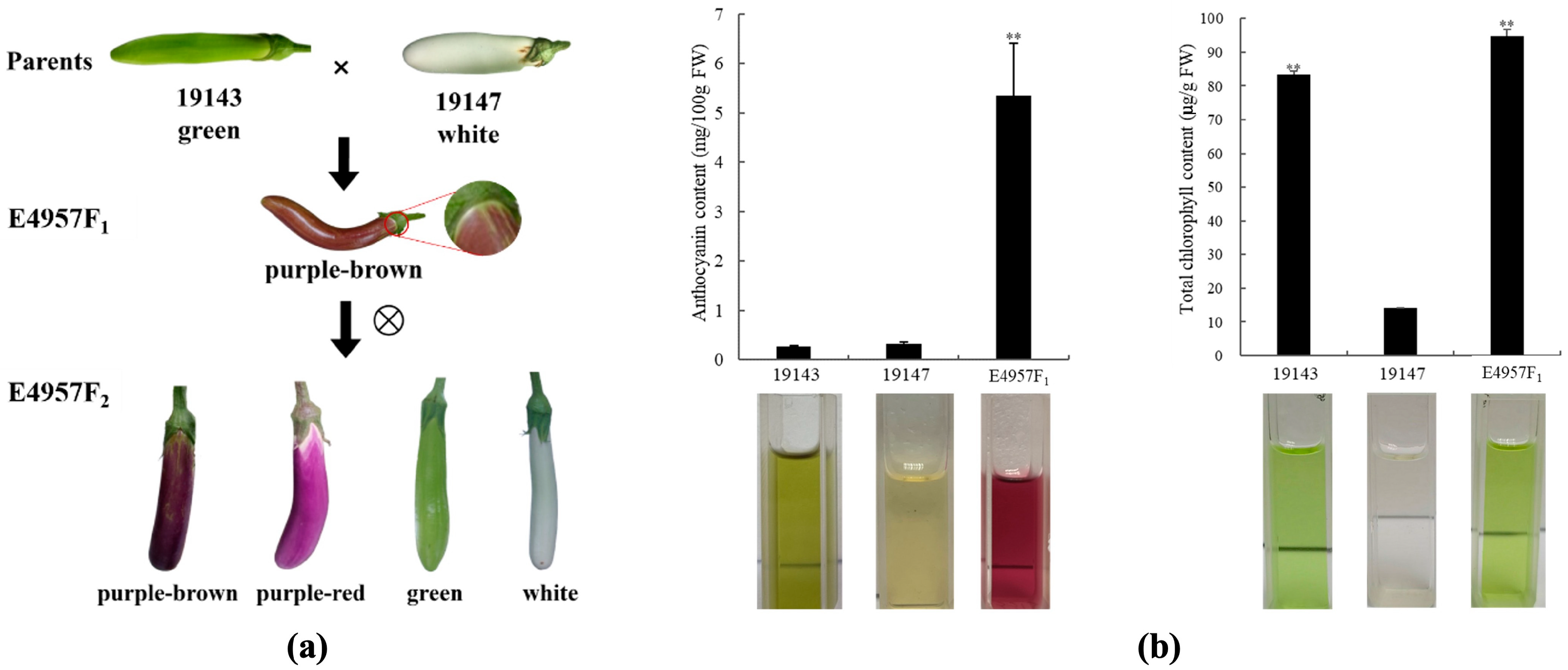
A cross was performed between two eggplant inbred lines lacking visible purple pigment in fruit peel, with green-peel line 19143 used as the female parent and white-peel line 19147 as the male parent. Unexpectedly, all E4957 F1 progeny (19143 × 19147) were purple–brown (Figure 1a). To characterize pigment differences among the parental lines and F1 hybrids, utilizing the visible spectrophotometer, we measured the anthocyanin and chlorophyll contents in eggplant peels of 19143, 19147, and E4957 F1 (Figure 1b).
Both parental lines showed extremely low anthocyanin contents in 19143 (0.36 ± 0.03 mg/100 g FW) and 19147 (0.46 ± 0.04 mg/100 g FW), consistent with the absence of purple pigmentation. In contrast, chlorophyll concentrations differed markedly between the two parents: 19143 exhibited a high chlorophyll content (97.63 ± 1.28 μg/g FW), corresponding to its green peel phenotype, whereas 19147 contained only trace amounts of chlorophyll content (14.16 ± 0.08 μg/g FW), resulting in white peel coloration. In contrast, the E4957 F1 hybrids accumulated substantially higher levels of both anthocyanin (7.29 ± 1.44 mg/100 g FW) and chlorophyll (85.56 ± 1.54 μg/g FW), which together corresponded to the observed purple–brown peel phenotype. Visually, purple pigmentation was predominantly distributed on the peel surface, whereas green pigmentation was mainly visible beneath the sepals.
Self-pollination of the E4957 F1 plants generated an F2 population exhibiting four distinct peel color phenotypes: purple–brown, purple–red, green, and white.

3.2. Unusual Peel Color Segregation Ratios in Eggplant Genetics

Previous studies have demonstrated that the white peel 19147 underwent concurrent natural mutations at both the D and Gv1 loci [4,8]. In contrast, the white-peel 19141 exhibited simultaneous natural mutations at the P and Gv1 loci [4,8]. Among these, the D and P genes were involved in the anthocyanin biosynthesis pathway, affecting purple pigmentation, whereas the Gv1 gene was involved in the chlorophyll biosynthesis pathway, influencing green pigmentation. It was also known that 19143 with green peel was the sister line of 19141 with white peel [8]. Based on this genetic relationship, we inferred that 19143 likely carries a recessive mutation at the P locus similar to 19141, leading to the absence of anthocyanin pigmentation.
Based on the genetic background of the parental lines, we genetically inferred that the genotype of green-peel maternal line 19143 was DDppGv1Gv1, in which the recessive mutation pp is presumed to block anthocyanin synthesis, while the dominant Gv1Gv1 genotype allows chlorophyll accumulation synthesis, resulting in green peel color. In contrast, the white peel paternal line 19147 was inferred to be ddPPgv1gv1, in which recessive mutations at both D and Gv1 loci suppress the accumulation of both anthocyanin and chlorophyll, producing a white peel phenotype.
According to Mendel’s law of inheritance, in a trihybrid cross of the genotype DDppGv1Gv1 × ddPPgv1gv1, where all of the E4957 F1 were DdPpGv1gv1. Because the dominant alleles of D and P can cooperatively promote anthocyanin biosynthesis and the dominant Gv1 allele regulates chlorophyll synthesis, it can be genetically inferred that the E4957 F1 peel is capable of accumulating both pigments, resulting in a purple–brown phenotype.
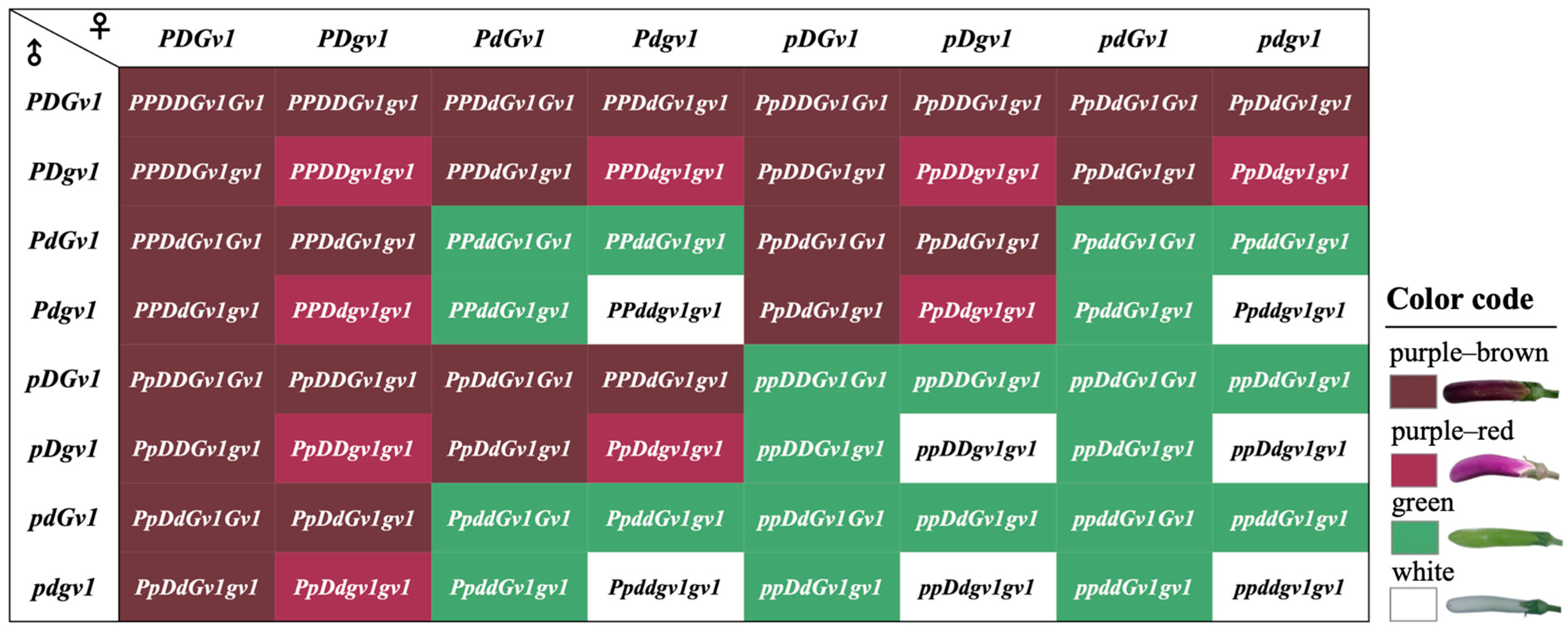
Following self-pollination of the E4957 F1 generation, eight types of gametes theoretically produced, which could combine to generate 64 possible gametophyte combinations, as shown in the Punnett square [21] (Figure 2): (1) 27 genotypes with D_P_Gv1_ that are predicted to accumulate both anthocyanin and chlorophyll, corresponding to purple–brown fruit; (2) 9 genotypes with D_P_gv1gv1 that are predicted to accumulate anthocyanin but lack chlorophyll, corresponding to purple–red fruit; (3) 21 genotypes with ddP_Gv1_ or D_ppGv1_ or ddppGv1_ that are predicted to lack anthocyanin accumulation while retaining chlorophyll synthesis, corresponding to green fruit; (4) 7 genotypes with ddP_gv1gv1 or D_ppgv1gv1 or ddppgv1gv1 that are predicted to lack both anthocyanin and chlorophyll accumulation, corresponding to white fruit.
Based on the genetic analysis of the parental lines and the observed peel color phenotypes, we hypothesized that the D, P, and Gv1 genes, which regulate peel color in eggplant, exhibit recessive epistasis and additive interactions at the genetic level. Specifically, (a) homozygous recessive mutations at the D or P loci (dd or pp) inhibit anthocyanin synthesis, thereby preventing the formation of purple pigmentation. (b) The D and P genes involved in anthocyanin synthesis interact additively with the Gv1 gene responsible for chlorophyll synthesis.
To evaluate whether this genetic model was supported by phenotypic segregation patterns, the E4957F2 population consisted of 237 individual plants, including 95 purple–brown-peel plants, 31 purple–red peel plants, 93 green-peel plants, and 18 white-peel plants. The Chi-square test was used to assess the goodness of fit of the segregation ratio of the four different phenotypes in E4957 F2 populations, where it showed that the ratio aligns with the expected 27:9:21:7 (purple–brown: purple–red: green: white) ratio, p > 0.05 (Table 1). The segregation ratio of anthocyanin pigmentation plants and non-anthocyanin pigmentation plants conformed to 9:7, while the segregation ratio of plants with green flesh (plants with purple–brown peel and green peel) and white flesh (plants with purple–red peel and white peel) conformed to 3:1 (χ2 = 2.36, p > 0.05).

3.3. Genetic Localization of D and P Loci Controlling Purple Peel Color by SLAF-BSA

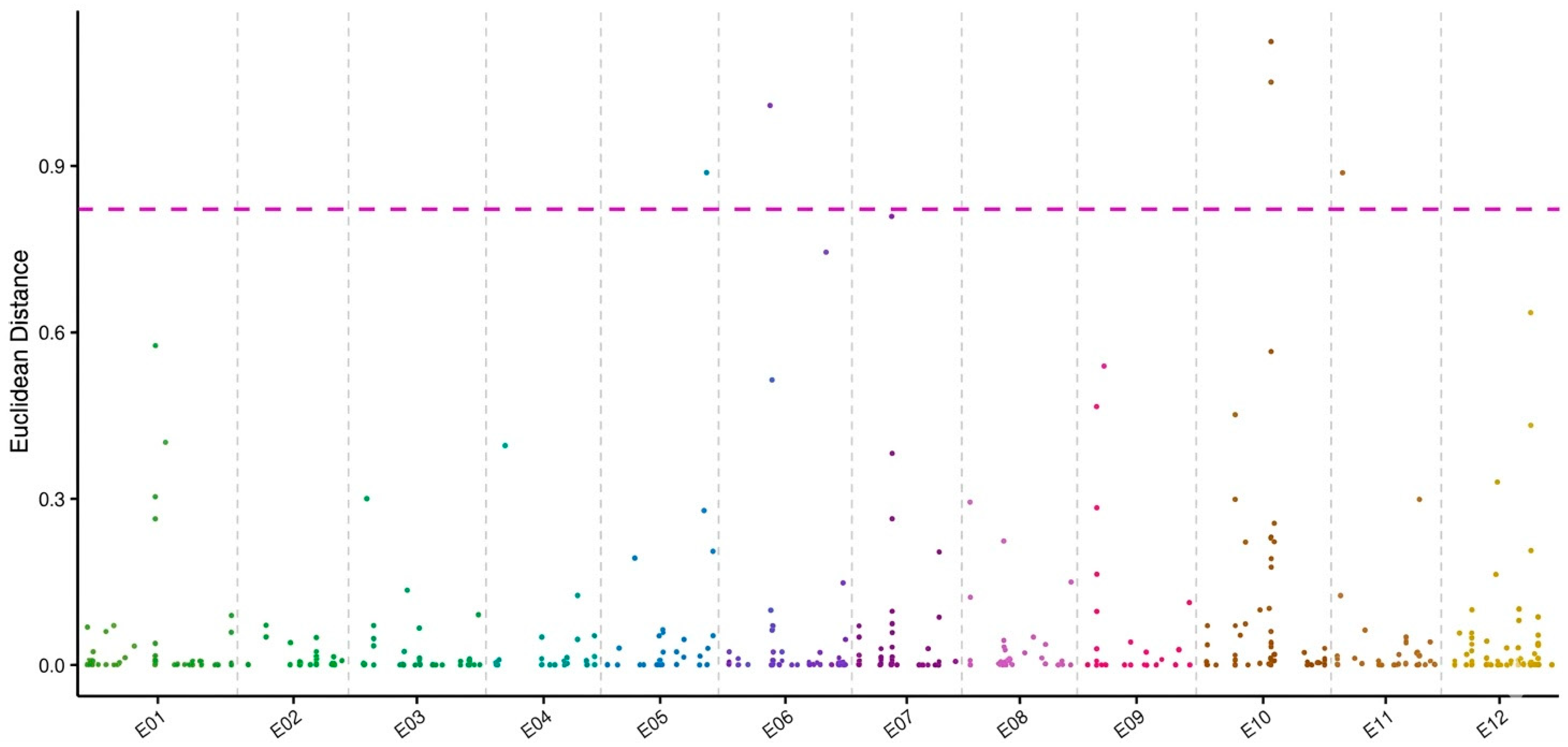
A high-density map was constructed to map the D and P genes to regulate anthocyanin biosynthesis in eggplant peels [4]. Before this, the SLAF-Seq technology, combined with the BSA, was used to map the genes D and P. For the D and P genes, in the beginning, the six samples of DNA mixed pools constructed from two parent lines (19141-bulk and 19147-bulk), and E3316 F2 population: E3316PR-bulk, E3316WP-bulk + E3316 WW-bulk, E3316WP-bulk, and E3316 WW-bulk were resequenced, and the data quality was required to meet the requirements. According to the sequence information of the eggplant genome SME_r2.5. [12], 231, 490 SNPs corresponding to 1117 scaffolds were mapped onto the genome. According to the segregation ratio (purple peel E3316PR-bulk A: purple peel E3316PR-bulk a: white peel E3316WP-bulk + E3316 WW-bulk A: white peel E3316WP-bulk + E3316 WW-bulk a was 6:3:2:5), further filtration was performed and 784 SNP sites were obtained. Finally, the association analysis was performed using the ED method. Based on the 99th percentile, t the distribution of ED values in the linkage graph was examined (Figure 3). The ED5 association values of the three SNPs on Scaffold Sme2.5_00538.1 were the highest, so the D gene was most likely to be located on chromosome 10, with its associated nucleotide sequence identified as Scaffold Sme2.5_00538.1 (Table 2).
E3316WP-bulk and E3316-WW bulk have white peel colors, but their stem colors are purple and green, respectively. Due to the control of stem color being a pair of independent alleles with a segregation ratio of 3:1, the threshold of ΔSNP index of two mixed pool genotypes (E3316WP-bulkP: E3316WP-bulkp: E3316 WW-bulkP: E3316 WW-bulkp) was determined to be 0.667. Filter out low-depth SNP loci, filter out SNP loci with the same or heterozygous parental genotype, and finally filter out SNP loci that do not meet the segregation ratio (p > 0.05), resulting in a total of 15 SNP loci. Among them, 6 SNP loci (bolded texts in Table 3) were found to meet the significant condition of the Chi-square test (p <0.05), and the ΔSNP-index was more significant than the theoretical value of 0.667. There are four relatively continuous scaffolds (physical distance 0.38 Mb) on chromosome 8, each with one significantly associated SNP site, indicating that this region is highly likely to be the associated region for the P gene.

3.4. Genetic Localization of Gf Locus Controlling Green Flesh Color

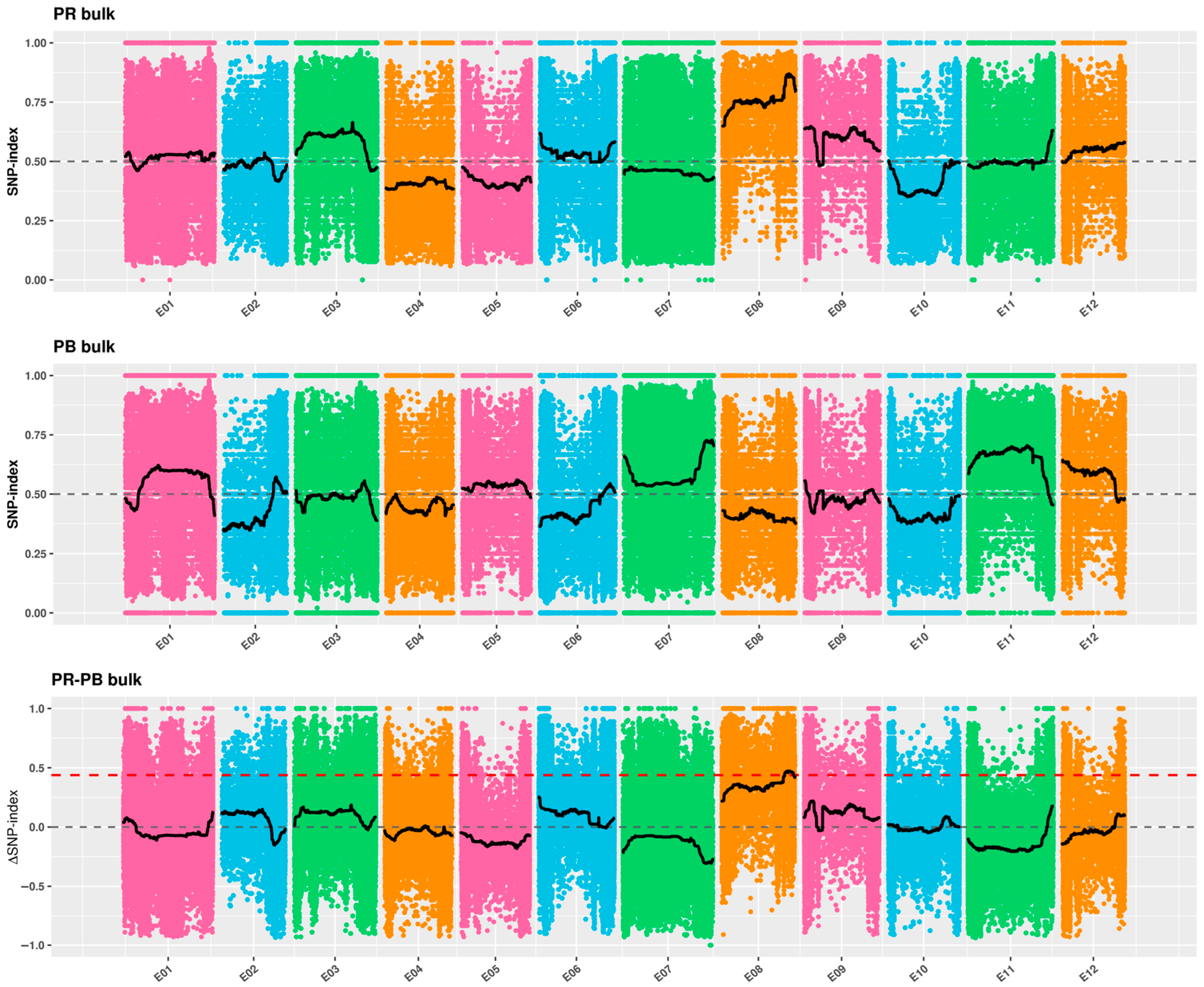
For the Gf locus, resequencing data from the 05-1PB-bulk, 05-4PR-bulk, E2730PB-bulk, and E2730PR-bulk were aligned to the reference genome SME-HQ [13]. Based on the theoretical segregation ratio of the population used in this study, the calculated linkage threshold was 0.667, under which the target site and its closely linked neighboring sites would be expected to exceed this value. However, no genomic regions surpassed this threshold, indicating that the genetic signal for Gf locus was weaker than that observed for D and P loci.
To further explore potential regions, the threshold was relaxed by adopting 99% of the fitted ΔSNP-index value 0.44 (Figure 4). Under this criterion, two genomic regions spanning 74,620,000 to 85,170,000 were identified as putatively associated with the green flesh phenotype (Table 4). Notably, this interval partially overlapped with a previously reported 7.66 Mb region (75,706,368 to 83,368,320) on chromosome 8, which contains the Gv1 gene known to regulate green peel coloration in eggplant [8].
Based on this overlap, we infer that the phenotypic difference between purple–black (05-1) and purple–red (05-4) lines may be associated with variation in chlorophyll-related pigmentation, and that the Gf locus identified here is genetically co-localized with, or closely linked to, Gv1 locus.

3.5. Development of Molecular Markers for Peel Color

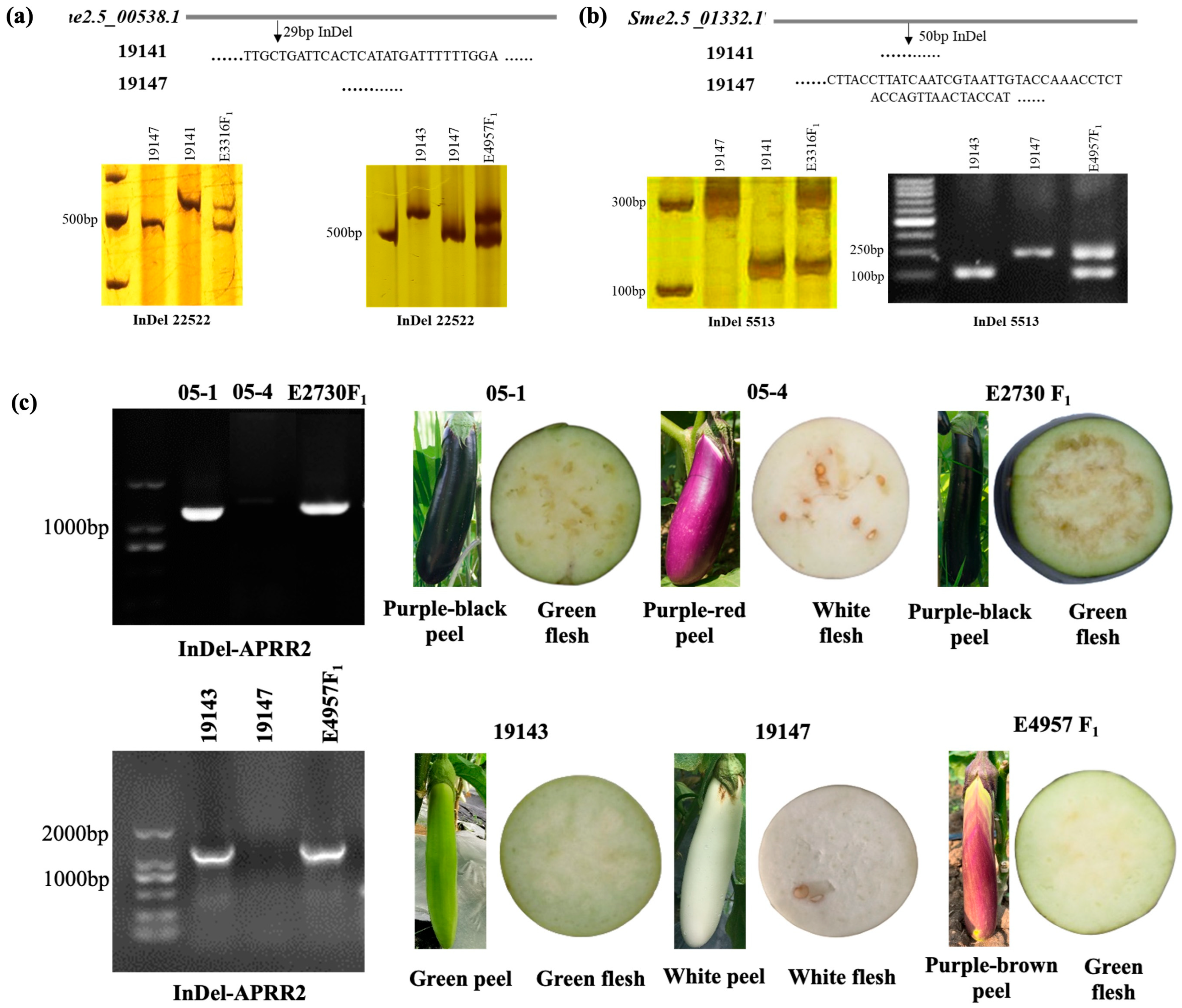
Firstly, for the D gene, in the vicinity of the associated region, we identified an InDel marker at position 22522 of Scaffold Sme2.5_00538.1 (Figure 5a). This InDel marker showed 29 base pairs (bp) insertion in line 19141 compared with 19147. According to this InDel, a pair of primers for the molecular marker InDel22522 of D gene, was designed (Table 5). These primers could amplify a 469 bp fragment in 19141, suggesting that the genotype was DD. Additionally, they could amplify a 440 bp fragment in 19147, suggesting the genotype was dd.
As for the P gene, we searched for InDel markers near the associated region, and the marker InDel5531 was developed based on the sequence of Scaffold Sme2.5_01332.1(Figure 5b). In line 19147, there were 50 bp and 35 bp insertions, compared to line 19141. Utilizing the 50 bp InDel marker, we designed a set of specific primers, InDel5531 (Table 5). The primers for InDel5531 successfully amplified a 207 bp fragment in line 19141, indicating that the genotype was likely pp, and a 292 bp fragment in line 19147, suggesting the genotype was PP.
19143 with green peel was the sister line of 19141 with white peel, both of which had no anthocyanin pigmentation in their peels. Molecular marker InDel22522 for the D gene and marker InDel5531 for the P gene had the same amplification band pattern in 19143 and 19141 (Figure 5a). Based on these maker patterns, the genotypes of these lines were inferred to be DDpp. As for E3316 F1 (19141 × 19147) and E4957 F1 (19143 × 19147) hybrids, the 469 bp and 440 bp fragments of the InDel22522 marker for D, and 292 bp and 207 bp fragments of the InDel5531 marker for P were all amplified, indicating the heterozygous genotype was inferred as DdPp (Figure 5b).
Since the Gf gene, which acts in eggplant flesh, and the Gv1 gene, which acts in the peel, both regulate chlorophyll synthesis, we used the developed dominant molecular marker InDel-APRR2 (Table 5), based on the Gv1 candidate gene SmAPRR2-Like [8], to perform genotypic identification and phenotypic assessment of peel color and flesh in the parental lines (05-1, 05-4) and E2730 F1 generation plants (Figure 5c). The PCR amplification results indicated that specific-sized bands were detected in 05-1 and E2730F1, which have purple–black peel and green flesh, suggesting the presence of the Gv1 allele (genotype inferred as Gv1_), capable of synthesizing chlorophyll in the peel. In contrast, no amplification product was detected in 05-4, which has purple–red peel and white flesh, suggesting the genotype was gv1gv1, unable to synthesize chlorophyll in the peel.
These observations were consistent with the hypothesis that differences between purple–black and purple–red peel color may be associated with the presence or absence of chlorophyll pigmentation. The presence of chlorophyll (green) in the peel may act as a background color that deepens the purple appearance produced by anthocyanin, resulting in the purple–black peel. Conversely, in the absence of chlorophyll synthesis, the peel color appears closer to the lighter purple produced by anthocyanin alone. Further investigation also revealed that eggplants with green flesh typically had detectable chlorophyll in their peel, while those with white flesh usually did not, suggesting an association between the flesh color and peel color in these materials.
Furthermore, using the InDel-APRR2 molecular markers, we performed PCR amplification on the green-fruit maternal line 19143, the white-fruit paternal line 19147, and their purple–brown peel with green flesh E4957 F1 hybrids (Figure 5c). The results indicated that the InDel-APRR2 primer pair amplified a 1303 bp target band in 19143 and E4957 F1 hybrids, but not 19147. Based on the marker results, the genotype of the green peel line 19143 was inferred to be Gv1Gv1, that of the white fruit line 19147 gv1gv1, and the genotype of the purple–brown peel with green flesh E4957 F1 hybrids Gv1_. Moreover, just as the purple–black peel was linked to the green flesh, the purple–brown peel was also linked to the green flesh, and the purple–red peel was linked to the white flesh. Similarly, the purple–brown peel observed in E4957 was also associated with green flesh in this study.

3.6. Validating Genotypes in the E4957 F2 Population

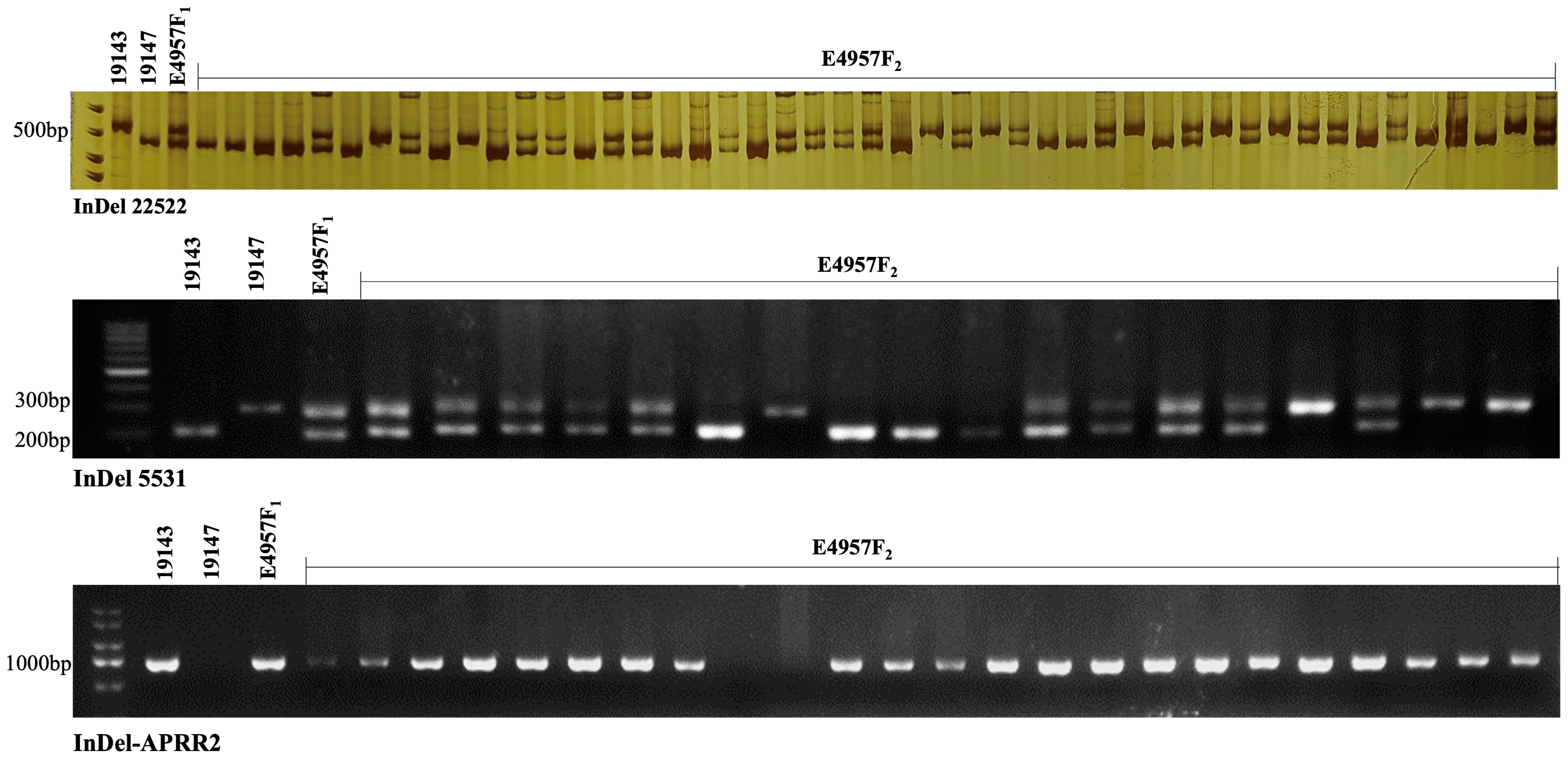
Using the developed DNA molecular markers (InDel22522, InDel5531, and InDel-APRR2), we performed genotyping analysis on 237 individual plants in the E4957 F2 population (Figure 6). In line with the four observed phenotypes in the E4957 F2 generation, we categorized the 64 genotypes that could theoretically be produced by self-crossing of E4957F1 (DdPpGv1gv1 × DdPpGv1gv1) and found the following distribution: 95 plants with purple–brown fruit had the genotype D_P_ Gv1_; 31 plants with purple–red fruit had the genotype D_P_ gv1gv1; 93 plants with green fruit had the genotype ddP_Gv1_ or D_ppGv1_ or ddppGv1_; 18 plants with white fruit had the genotype ddP_gv1gv1, D_ppgv1gv1, or ddppgv1gv1 (Table 6). The genotype and phenotype matching rate is 100%, indicating that the above three molecular markers are closely linked to the target gene.

3.7. Cloning and Sequence Comparative Analysis of Candidate Genes SmMYB1, SmANS, and SmAPRR2-like in Parental Lines

Based on the sequencing and splicing results, sequence variation in the three candidate genes were further examined by comparing the amplicon sequences of SmMYB1, SmANS, and SmAPRR2-Like between the female parent 19143 and the male parent 19147. This analysis was conducted to identify allelic polymorphisms that were consistent with the genetic mapping results.
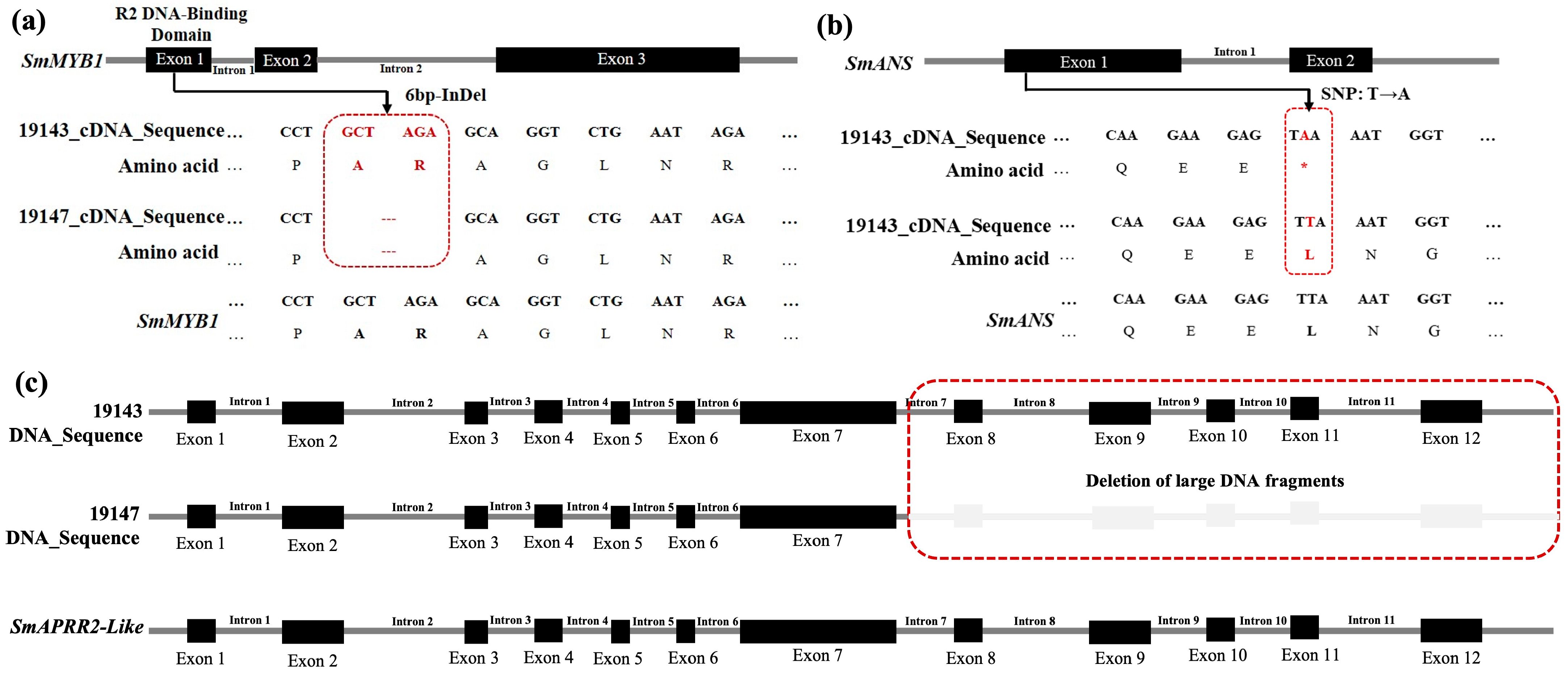
The SmMYB1 gene in 19143 had a total length of 1230 bp, with a cDNA sequence of 771 bp. It comprised three exons (136 bp, 130 bp, and 505 bp) and two introns (88 bp and 371 bp). In contrast, the SmMYB1 gene from 19147 was slightly shorter, spanning 1224 bp, with a cDNA sequence of 765 bp. It also consisted of three exons (130 bp, 130 bp, and 505 bp) and two introns (88 bp and 371 bp). Sequence comparison revealed a notable difference in the coding sequence of the first exon of the SmMYB1 gene, where in sample 19147, six nucleotides (GCTAGA) were absent compared to sample 19143. Further analysis using the Expasy Translate tool [22] indicated that this nucleotide deletion resulted in the loss of amino acids 43 and 44, reducing the total coding sequence from 256 amino acids in 19143 to 254 in 19147. These amino acids are located within the conserved R2 DNA-binding domain of the MYB protein, suggesting that this allelic variation may be associated with functional differences in SmMYB1 and may contribute to the observed phenotypic variation, consistent with genetic results (Figure 7a).
By cloning the SmANS gene from 19143 and 19147, it was found that their genomic DNA sequences were both 3129 bp in length, including an ORF of 1242 bp, comprising two exons and one intron. However, sequence comparison identified a genetic variation at position 101 bp in the coding region of the SmANS gene in sample 19143, resulting in a T to A SNP at the first exon. This SNP introduced a premature termination codon (TAA), truncating the predicted peptide chain from 413 amino acids to 33, which is predicted to severely affect normal protein functions (Figure 7b).
For SmAPRR2-Like, according to the annotation information of the GUIQIE-1 genome [23], a comparison was made between the gDNA sequences of 19143 and 19147. Firstly, when compared to 19143, it was found that the sequences were almost identical to the reference sequence, with only four base differences, all of which were synonymous mutations, and these mutations were unlikely to affect the structure or function of the translated SmAPRR2-Like protein. As for 19147, a significant deletion was found downstream of the seventh exon region of its SmAPRR2-Like (Gv1 gene) gene, resulting in the inability to encode a protein with standard functionality. This sequence variation is consistent with the genetic mapping results and may be associated with the observed chlorophyll-related phenotype (Figure 7c).

4. Discussion

4.1. Recessive Epistasis and Additive Genetic Interactions Among D, P, and Gv1 Genes Regulate Eggplant Peel Color

A hundred years ago, British biologists Bateson and Punnet conducted a hybridization experiment on pea varieties, using two pure white flower varieties for hybridization [24]. The results showed that the F1 generation plants exhibited purple flowers, while the segregation ratio of purple and white flowers in the F2 generation plants was about 9:7. Bateson proposed the concept of “epistasis” in 1909 to explain the influence of gene interactions on trait performance [25]. Eggplant peel color primarily arises from the synthesis of two pigments: anthocyanin and chlorophyll [1]. Previous studies have significantly contributed to our understanding of eggplant peel color, specifically by analyzing the interactions between key genes in the pigment synthesis pathways to investigate different peel colors. Interactions between genes are crucial in controlling complex traits in organisms [26]. Theoretically, in hybrid breeding experiments, the hybridization results can infer whether interactions exist between different alleles, including additivity, epistasis, redundancy, and complementation [27]. In 1939, TABETE was the first to consider the interactions between eggplant peel pigmentation genes, reporting six independently inherited factors. Among these factors, C, P, D, and Puc genes were responsible for the development of anthocyanin, while G and Gv1 genes were required for the formation of chlorophyll [2]. Building upon this, Tigchelaar concluded through experimental analysis in 1968 that the epistatic interactions between the D, P, and Y genes regulated anthocyanin synthesis in eggplant peel [3]. Recent observations have also revealed that due to the epistatic effect between D and P genes or D, P, and Y genes, influencing anthocyanin biosynthesis, resulting in a 9:7 [4] or 27:37 [5] for purple versus non-purple peel color segregation ratio in the F2 population.
In our study, the green-peel female line 19143, the white-peel male line 19147, and their E4957 F1 hybrids were inferred to have the genotypes DDppGv1Gv1, ddPPgv1gv1, and DdPpGv1gv1, respectively. Following self-pollination of the E4957 F1 hybrids, the E4957 F2 population segregation into four peel color phenotypes: purple–brown, purple–red, green, and white, with a ratio of 27:9:21:7 (p >0.05). If the three loci acted independently, eight phenotypic classes with a segregation ratio of 27:9:9:3:9:3:3:1 would be expected. However, only four phenotypic classes were observed, and the segregation pattern deviated from the independent assortment expectation. This observation suggests the presence of genetic interactions among the D, P, and Gv1 loci.
The segregation pattern is consistent with a model in which D and P interact through recessive epistasis to determine the presence or absence of anthocyanin pigmentation in the peel, while Gv1 locus appears to influence the phenotypic expression of peel color by affecting chlorophyll accumulation, thereby modifying the visual outcome of anthocyanin pigmentation. Thus, the role of Gv1 in this study is more consistent with that of a modifying factor with an additive-type effect on a qualitative trait, rather than representing classical additive inheritance.

4.2. Mapping and DNA Marker Development of Key Genes Controlling Eggplant Peel Color

At the molecular genetic level, this study used SLAF-Seq high-throughput sequencing combined with BSA technology to identify genomic regions associated with the key loci D, P, and Gf that regulate eggplant peel and flesh color. Based on extensive SNP screening and association analysis using the ED method, the D gene was mapped to a candidate region on chromosome 10, whereas the P gene was localized to chromosome 8. Using the same population E3316F2, D and P were mapped on chromosome 10 and chromosome 8, respectively, and the candidate genes for P and D genes have been proven to be SmANS and SmMYB1 [4]. These results are consistent with the mapping intervals identified through the BSA method in this study, providing independent support for the localization of these loci.
In contrast, the mapping resolution for the Gf locus was comparatively limited. No distinct association peak was detected under the standard linkage threshold, necessitating the application of a relaxed cutoff and resulting in a relatively large candidate interval. Nevertheless, this region overlapped with the previously reported Gv1 gene [8], supporting the hypothesis that Gf and Gv1 may represent the same or closely linked genetic factor involved in chlorophyll-related pigmentation in eggplant peel and flesh. Similarly, genes regulating fruit color in other crops have been mapped using GBS-based BSA-seq technology. For example, research on the c1 locus regulating fruit color in pepper has shown that mutations in the PRR2 gene can affect fruit pigmentation and nutritional quality [28]. Furthermore, through BSA-seq and genetic linkage mapping, key loci associated with green and mature fruit color have been identified in pepper, revealing that SNP and Indel mutations in the CapGLK2 and CapCCS genes can lead to color variations in fruit, thus providing a foundation for selective breeding in pepper varieties [29].
Based on the mapped regions, this study developed three molecular markers closely linked to the eggplant peel color, thereby improving the efficiency of genotype identification. The InDel22522 marker for the D gene and the InDel5531 marker for the P gene enabled rapid genotyping through PCR amplification, thus facilitating efficient screening of fruit peel color. Similarly, the InDel-APRR2 marker, designed within the candidate interval shared by Gv1/Gf, enables prediction of chlorophyll-related phenotypes in both peel and flesh. Moreover, further validation across diverse eggplant germplasm and breeding populations will be necessary before these markers can be broadly applied in marker-assisted selection programs.
Similar maker-assisted strategies have been reported in other crops, such as IA RAPD marker (OPH-19425) linked to the major gene for peel color, which was developed in Japanese pears, achieving an identification accuracy of 92% for green peel in breeding programs [30]. Additionally, AFLP markers E43M61 and E34M59 closely linked to the albino phenotype were identified in young cucumber fruits, facilitating the mapping and study of the whitening trait and also developing an InDel marker for a deletion mutation upstream of the target gene LsAPRR2, capable of distinguishing between green and white gourds with an accuracy of 93.88% [31]. These examples highlight the potential value of tightly linked molecular markers in assisting the genetic analysis and breeding of fruit color traits.

4.3. Candidate Genes Controlling Fruit Color and Their Genetic Variations

To date, several regulatory genes involved in anthocyanin biosynthesis in eggplant, such as SmMYB1, SmMYB86, and SmbHLH [6,32,33] as well as structural genes such as SmCHS, SmCHI, SmF3H, SmANS, and SmDFR [7,34,35], have been cloned and validated. According to the report, a single base pair deletion (InDel) at position 438 of the FAS (SmANS) sequence resulted in a premature stop codon, thereby causing the loss of anthocyanin biosynthesis in white-flowered eggplant [34].
In the present study, a nucleotide substitution was detected in the SmANS gene of the green peel female parent 19143, in which a T-to-A substitution at the 101 bp of the first exon generated a premature stop codon (TAA). This mutation was predicted to truncate the encoded protein from 413 amino acids to only 33, strongly suggesting a loss of normal enzymatic function. Based on the known role of SmANS in anthocyanin biosynthesis, this sequence variation is consistent with the absence of anthocyanin pigmentation observed in this line. The regulatory gene SmMYB1 has been demonstrated to play a crucial role in anthocyanin biosynthesis in eggplant fruit [6]. In white-fruited eggplant (lacking anthocyanin deposition) materials, a previous study identified a 26 bp deletion and a 52 bp insertion within the second intron of the SmMYB1 gene, leading to exon skipping at the mRNA level and impaired protein synthesis [36]. In our study, sequence comparison revealed that the white-fruited male parent 19147 carries a 6 bp deletion in the first exon of SmMYB1, resulting in the loss of amino acids at positions 43 and 44, which are located within the high conserved R2-DNA-binding domain.
The APRR2-Like gene has been widely reported to regulate chlorophyll accumulation, plastid development, and fruit coloration in multiple crops, including tomato, pepper, and cucumber [37,38,39]. In tomatoes, overexpression of the APRR2-Like gene has been shown to increase chlorophyll content in the fruit, and in pepper, sequencing of the APRR2-Like gene from green and white-fruited parents revealed a G to A substitution in the white-fruited parent, resulting in a premature stop codon and a consequent nonsense mutation [39]. Another study utilized VIGS technology to silence the homologous CaPRR2 gene in immature pepper fruit, which led to a color change from dark green to ivory white or light green and a significant reduction in carotenoid accumulation [37]. In the natural population of white-fruited eggplant, the APRR2-Like gene exhibits four rich mutation forms [8]. In this study, we identified one such mutation form in the white-fruited male parent 19147, characterized by a large deletion downstream of exon 7 in the SmAPRR2-Like gene. This deletion is predicted to disrupt normal transcription and prevent the production of a functional protein.
Although several candidate gene variations were identified and are consistent with the genetic mapping results and observed phenotypes, functional validation experiments were not conducted in this study. Therefore, further studies such as gene editing or transgenic analysis will be necessary to confirm the causal roles of these mutations.

4.4. Genetic Model of D, P, and Gv1 Interacting to Regulate Eggplant Peel Color

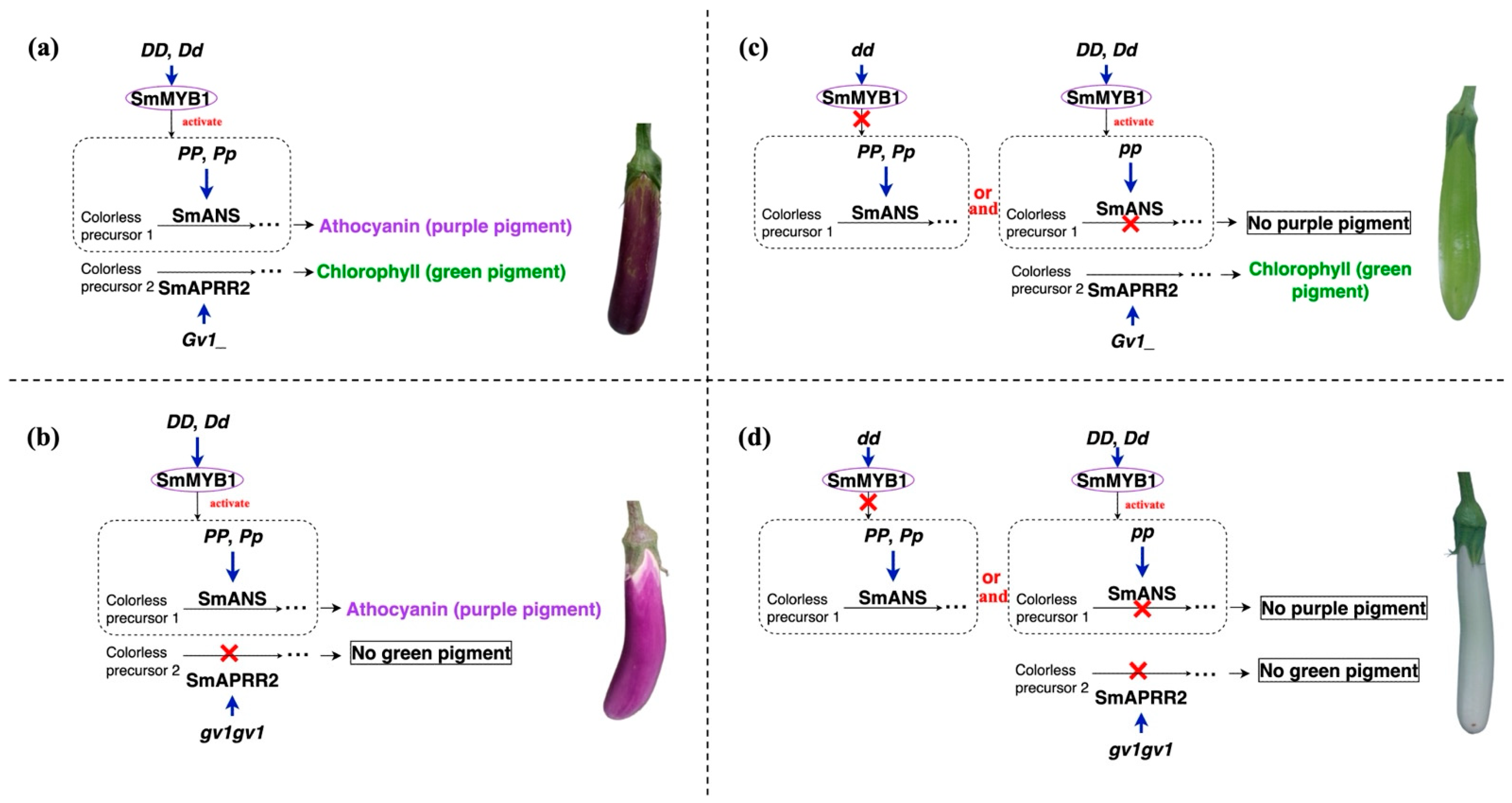
A hypothetical genetic model was proposed to visualize the inferred interactions among the D, P, and Gv1 genes and to facilitate interpretation of the observed segregation patterns in eggplant peel color (Figure 8).
In this model, D and P genes, which are genetically associated with anthocyanin biosynthesis, interact through recessive epistasis, while Gv1, associated with chlorophyll accumulation, functions as an additive modifying factor influencing the visual expression of peel color. The D and P loci correspond to candidate genes SmMYB1 and SmANS, respectively, whereas Gv1 corresponds to SmAPRR2-Like. When all three loci are in their dominant forms (D_ P_ Gv1_), both anthocyanin- and chlorophyll-associated pigmentation are permitted, resulting in a purple–brown peel phenotype (Figure 8a). When D and P are dominant (D_P_) but Gv1 is homozygous recessive (gv1gv1), anthocyanin-associated pigmentation is retained while chlorophyll-associated pigmentation is absent, producing a purple–red peel phenotype (Figure 8b). When either D or P is recessive (such as D_pp or ddP_), or both are recessive (ddpp), and Gv1 gene is dominant (Gv1_), anthocyanin-associated pigmentation is suppressed while chlorophyll-associated pigmentation is maintained, resulting in a green peel phenotype (Figure 8c). When both anthocyanin-related loci (D and/or P) and Gv1 are in recessive states (D_pp or ddP_ or ddpp, gv1gv1), neither pigment-associated pathway is genetically supported, leading to a white-peel phenotype (Figure 8d).

5. Conclusions

Crossing the white-peel parent with the green-peel parent produced an F1 generation exhibiting a purple–brown peel color. Compared with both parents, the F1 peel showed higher levels of pigmentation, and purple–brown phenotype was associated with the concurrent presence of anthocyanin- and chlorophyll-related coloration.
Genetic analysis indicated that the D and P genes regulate anthocyanin accumulation through recessive epistatic interaction, while the Gv1 influences peel variation by affecting chlorophyll-related traits. The segregation ratio of purple–brown/purple–red/green/white peel colors in the F2 population fit a 27:9:21:7 ratio, consistent with a genetic model involving two recessive epistatic loci (D and P) and one locus (Gv1) showing additive effects on peel color expression. In this model, dd or pp genotypes inhibit anthocyanin accumulation, whereas variation at Gv1 locus modifies the visual manifestation of peel color in different anthocyanin backgrounds.
The D gene was mapped on chromosome 10, and the P gene was mapped on chromosome 8, with SmMYB1 and SmANS identified as their respective candidate genes. The chromosomal region controlling flesh chlorophyll content (Gf) overlapped extensively with the reported Gv1 locus controlling peel chlorophyll-related traits, suggesting that they likely correspond to the same gene, SmAPRR2-Like. Molecular maker analysis using the InDel22522, InDel5531, and InDel-APRR2 showed a concordance between genotypes and peel color phenotypes in the 4957F2 population, which can identify genotypes of the D and P involved in anthocyanin synthesis, as well as the genotype of Gf/Gv1 involved in chlorophyll synthesis in fruits. Sequence analysis revealed a T-to-A substitution in the first exon of SmANS in the green-peel parent 19143, generating a premature stop codon (TAA), as well as a 6 bp deletion in the first exon of SmMYB1 and a large downstream deletion in SmAPRR2-Like in the white peel parent 19147. These sequence variations are consistent with the observed differences in anthocyanin and chlorophyll pigmentation between the parental genotypes.
Overall, this study provides a genetic framework for understanding eggplant peel color variation based on segregation and interaction of D, P, and Gf loci, which suggests that interactions among anthocyanin- and chlorophyll-related loci jointly contribute to the observed phenotypic diversity.

Author Contributions

B.S. conceived the experiment and wrote the manuscript; L.F. and M.L. conducted experiments, including sample collection, DNA and RNA extraction, BSA, and gene cloning; Q.Y., T.L. and Y.H. analyzed the data. All authors have read and agreed to the published version of the manuscript.

Funding

The present study was financially supported by key R&D Program Projects (2025B0202070003) of Guangdong Province, key R&D Program Projects (AB25069493) of Guangxi Zhuang Autonomous Region, Seed Industry Revitalization Action Project, grant No. 2025CXTD08 and 2025-NBH-00-001, of the Department of Agriculture and rural areas of Guangdong Province of China.

Data Availability Statement

The original contributions presented in this study are included in the article. Further inquiries can be directed to the corresponding author.

Conflicts of Interest

The authors declare no conflicts of interest.

References

  1. Daunay, M.C.; Aubert, S.; Frary, A.; Doganlar, S.; Lester, R.N.; Barendse, G.; Weerden, G.; Hennart, J.W.; Haanstra, J.; Dauphin, F. Eggplant (Solanum melongena) fruit colour: Pigments, measurements and genetics. In Proceedings of the 12th EUCARPIA Meeting on Genetics and Breeding of Capsicum and Eggplant, Noordwijkerhout, The Netherlands, 6 March 2004; pp. 108–116. [Google Scholar]
  2. Tatebe, T. On inheritance of color in Solanum melongena Linn. Jpn. J. Genet. 1939, 15, 261–271. [Google Scholar] [CrossRef][Green Version]
  3. Tigchelaar, E.; Janick, J.; Erickson, H. The genetics of anthocyanin coloration in eggplant (Solanum melongena L.). Genetics 1968, 60, 475–491. [Google Scholar] [CrossRef]
  4. You, Q.; Li, H.; Wu, J.; Li, T.; Wang, Y.; Sun, G.; Li, Z.; Sun, B. Mapping and validation of the epistatic D and P genes controlling anthocyanin biosynthesis in the peel of eggplant (Solanum melongena L.) fruit. Hortic. Res. 2023, 10, uhac268. [Google Scholar] [CrossRef]
  5. Chen, J.R.; Lü, Z.J.; Fan, L.S.; You, Q.; Li, T.; Gong, C.; Sun, G.W.; Li, Z.L.; Sun, B.J. Analysis of genetic effect of fruit color controlled by epistatic genes in eggplant. Agric. Sci. China 2023, 56, 4729–4741. [Google Scholar] [CrossRef]
  6. Zhang, Y.; Hu, Z.; Chu, G.; Huang, C.; Tian, S.; Zhao, Z.; Chen, G. Anthocyanin accumulation and molecular analysis of anthocyanin biosynthesis-associated genes in eggplant (Solanum melongena L.). J. Agric. Food Chem. 2014, 62, 2906–2912. [Google Scholar] [CrossRef] [PubMed]
  7. Stommel, J.R.; Dumm, J.M. Coordinated regulation of biosynthetic and regulatory genes coincides with anthocyanin accumulation in developing eggplant fruit. J. Am. Soc. Hortic. Sci. 2015, 140, 129–135. [Google Scholar] [CrossRef]
  8. Lv, Z.; Jin, Q.; Li, Z.; Li, T.; Wang, Y.; You, Q.; Gong, C.; Heng, Z.; Sun, B. Fine mapping and candidate gene analysis of the Gv1 locus controlling green-peel color in eggplant (Solanum melongena L.). Horticulturae 2023, 9, 888. [Google Scholar] [CrossRef]
  9. Arrones, A.; Mangino, G.; Alonso, D.; Plazas, M.; Prohens, J.; Portis, E.; Barchi, L.; Giuliano, G.; Vilanova, S.; Gramazio, P. Mutations in the SmAPRR2 transcription factor suppressing chlorophyll pigmentation in the eggplant fruit peel are key drivers of a diversified colour palette. Front. Plant Sci. 2022, 13, 1025951. [Google Scholar] [CrossRef] [PubMed]
  10. Zheng, X.; Tian, S. Effect of oxalic acid on control of postharvest browning of litchi fruit. Food Chem. 2006, 96, 519–523. [Google Scholar] [CrossRef]
  11. Wang, P.; Gu, M.; Shao, S.; Chen, X.; Hou, B.; Ye, N.; Zhang, X. Changes in non-volatile and volatile metabolites associated with heterosis in tea plants (Camellia sinensis). J. Agric. Food Chem. 2022, 70, 3067–3078. [Google Scholar] [CrossRef]
  12. Hirakawa, H.; Shirasawa, K.; Miyatake, K.; Nunome, T.; Negoro, S.; Ohyama, A.; Yamaguchi, H.; Sato, S.; Isobe, S.; Tabata, S. Draft genome sequence of eggplant (Solanum melongena L.): The representative solanum species indigenous to the old world. DNA Res. 2014, 21, 649–660. [Google Scholar] [CrossRef] [PubMed]
  13. Wei, Q.; Wang, J.; Wang, W.; Hu, T.; Hu, H.; Bao, C. A high-quality chromosome-level genome assembly reveals genetics for important traits in eggplant. Hortic. Res. 2020, 7, 153. [Google Scholar] [CrossRef] [PubMed]
  14. McKenna, A.; Hanna, M.; Banks, E.; Sivachenko, A.; Cibulskis, K.; Kernytsky, A.; Garimella, K.; Altshuler, D.; Gabriel, S.; Daly, M.; et al. The Genome Analysis Toolkit: A MapReduce framework for analyzing next-generation DNA sequencing data. Genome Res. 2010, 20, 1297–1303. [Google Scholar] [CrossRef] [PubMed]
  15. Cingolani, P.; Platts, A.; Wang, L.L.; Coon, M.; Nguyen, T.; Wang, L.; Land, S.J.; Lu, X.; Ruden, D.M. A program for annotating and predicting the effects of single nucleotide polymorphisms, SnpEff: SNPs in the genome of Drosophila melanogaster strain w1118; iso-2; iso-3. Fly 2012, 6, 80–92. [Google Scholar] [CrossRef] [PubMed]
  16. Fekih, R.; Takagi, H.; Tamiru, M.; Abe, A.; Natsume, S.; Yaegashi, H.; Sharma, S.; Sharma, S.; Kanzaki, H.; Matsumura, H. MutMap+: Genetic mapping and mutant identification without crossing in rice. PLoS ONE 2013, 8, e68529. [Google Scholar] [CrossRef] [PubMed]
  17. Hill, J.T.; Demarest, B.L.; Bisgrove, B.W.; Gorsi, B.; Su, Y.-C.; Yost, H.J. MMAPPR: Mutation mapping analysis pipeline for pooled RNA-seq. Genome Res. 2013, 23, 687–697. [Google Scholar] [CrossRef] [PubMed]
  18. Untergasser, A.; Cutcutache, I.; Koressaar, T.; Ye, J.; Faircloth, B.C.; Remm, M.; Rozen, S.G. Primer3—New capabilities and interfaces. Nucleic Acids Res. 2012, 40, e115. [Google Scholar] [CrossRef] [PubMed]
  19. Li, H.M. Cloning of Epigenetic D Gene SmMYB1 Controlling Peel Color and Its Function in Anthocyanin Synthesis in Eggplant. Master’s Thesis, South China Agricultural University, Guangzhou, China, 2023. [Google Scholar]
  20. Wu, J. Molecular Marker Development and Candidate Gene Analysis of Epistasis P Gene Controlling Fruit Color in Eggplant (Solanum melongena L.). Master’s Thesis, South China Agricultural University, Guangzhou, China, 2023. [Google Scholar]
  21. Davis, L.C. Origin of the Punnett Square. Am. Biol. Teach. 1993, 55, 209–212. [Google Scholar] [CrossRef]
  22. Duvaud, S.; Gabella, C.; Lisacek, F.; Stockinger, H.; Ioannidis, V.; Durinx, C. Expasy, the Swiss Bioinformatics Resource Portal, as designed by its users. Nucleic Acids Res. 2021, 49, W216–W227. [Google Scholar] [CrossRef] [PubMed]
  23. Guo, X.; Chen, F.; Gao, F.; Li, L.; Liu, K.; You, L.; Hua, C.; Yang, F.; Liu, W.; Peng, C. CNSA: A data repository for archiving omics data. Database 2020, 2020, baaa055. [Google Scholar] [CrossRef] [PubMed]
  24. Brooker, R.J. Extensions Of Mendelian Inheritance. In Genetics: Analysis & Principles; McGraw Hill LLC: New York, NY, USA, 2024; pp. 81–98. [Google Scholar]
  25. Miko, I. Epistasis: Gene interaction and phenotype effects. Nat. Educ. 2008, 1, 197. [Google Scholar]
  26. Wade, M.J. Epistasis, complex traits, and mapping genes. In Microevolution Rate, Pattern, Process; Hendry, A.P., Kinnison, M.T., Eds.; Springer: Dordrecht, The Netherlands, 2001; pp. 59–69. [Google Scholar]
  27. Hartwell, M.G.L.; Fischer, J. Genetics: From Genes to Genomes, 6th ed.; McGraw Hill Education: New York, NY, USA, 2017. [Google Scholar]
  28. Lee, S.B.; Kim, J.E.; Kim, H.T.; Lee, G.-M.; Kim, B.-S.; Lee, J.M. Genetic mapping of the c1 locus by GBS-based BSA-seq revealed Pseudo-Response Regulator 2 as a candidate gene controlling pepper fruit color. Theor. Appl. Genet. 2020, 133, 1897–1910. [Google Scholar] [CrossRef]
  29. Feng, S.; Zhou, L.; Sharif, R.; Diao, W.; Liu, J.; Liu, X.; Chen, K.; Chen, G.; Cao, B.; Zhu, Z.; et al. Mapping and cloning of pepper fruit color-related genes based on BSA-seq technology. Front. Plant Sci. 2024, 15, 1447805. [Google Scholar] [CrossRef] [PubMed]
  30. Inoue, E.; Kasumi, M.; Sakuma, F.; Anzai, H.; Amano, K.; Hara, H. Identification of RAPD marker linked to fruit skin color in Japanese pear (Pyrus pyrifolia Nakai). Sci. Hortic. 2006, 107, 254–258. [Google Scholar] [CrossRef]
  31. Xu, X.; Lu, X.; Tang, Z.; Zhang, X.; Lei, F.; Hou, L.; Li, M. Combined analysis of carotenoid metabolites and the transcriptome to reveal the molecular mechanism underlying fruit colouration in zucchini (Cucurbita pepo L.). Food Chem. Mol. Sci. 2021, 2, 100021. [Google Scholar] [CrossRef]
  32. Li, L.; He, Y.; Ge, H.; Liu, Y.; Chen, H. Functional characterization of SmMYB86, a negative regulator of anthocyanin biosynthesis in eggplant (Solanum melongena L.). Plant Sci. 2021, 302, 110696. [Google Scholar] [CrossRef] [PubMed]
  33. Xi, H.; He, Y.; Chen, H. Functional characterization of SmbHLH13 in anthocyanin biosynthesis and flowering in eggplant. Hortic. Plant J. 2021, 7, 73–80. [Google Scholar] [CrossRef]
  34. Chen, M.; Xu, M.; Xiao, Y.; Cui, D.; Qin, Y.; Wu, J.; Wang, W.; Wang, G. Fine mapping identifies SmFAS encoding an anthocyanidin synthase as a putative candidate gene for flower purple color in Solanum melongena L. Int. J. Mol. Sci. 2018, 19, 789. [Google Scholar] [CrossRef]
  35. Jiang, M.; Liu, Y.; Ren, L.; Lian, H.; Chen, H. Molecular cloning and characterization of anthocyanin biosynthesis genes in eggplant (Solanum melongena L.). Acta Physiol. Plant. 2016, 38, 163. [Google Scholar] [CrossRef]
  36. Babak, O.; Nikitinskaya, T.; Nekrashevich, N.; Yatsevich, K.; Kilchevsky, A. Identification of DNA markers of anthocyanin biosynthesis disorders based on the polymorphism of anthocyanin 1 tomato ortholog genes in pepper and eggplant. Crop Breed. Genet. Genom. 2020, 2, e200011. [Google Scholar] [CrossRef]
  37. Jeong, H.-B.; Jang, S.-J.; Kang, M.-Y.; Kim, S.; Kwon, J.-K.; Kang, B.-C. Candidate gene analysis reveals that the fruit color locus C1 corresponds to PRR2 in pepper (Capsicum frutescens). Front. Plant Sci. 2020, 11, 399. [Google Scholar] [CrossRef] [PubMed]
  38. Liu, H.; Jiao, J.; Liang, X.; Liu, J.; Meng, H.; Chen, S.; Li, Y.; Cheng, Z. Map-based cloning, identification and characterization of the w gene controlling white immature fruit color in cucumber (Cucumis sativus L.). Theor. Appl. Genet. 2016, 129, 1247–1256. [Google Scholar] [CrossRef] [PubMed]
  39. Pan, Y.; Bradley, G.; Pyke, K.; Ball, G.; Lu, C.; Fray, R.; Marshall, A.; Jayasuta, S.; Baxter, C.; van Wijk, R.; et al. Network Inference Analysis Identifies an APRR2-Like Gene Linked to Pigment Accumulation in Tomato and Pepper Fruits. Plant Physiol. 2013, 161, 1476–1485. [Google Scholar] [CrossRef] [PubMed]
Figure 1. (a) A flowchart of the hybridization process of eggplant peel color. The specific process is as follows: the white-fruited male parent 19147 was crossed with the green-fruited female parent 19143. F1 generation (E4957 F1) displayed the purple–brown peel color. Green pigmentation was visible at the sepals of the peel. Subsequently, the E4957 F1 generation was self-crossed to produce the F2 population (E4957 F2), which exhibited four different peel colors: purple–brown, purple–red, green, and white; (b) Anthocyanin and chlorophyll contents in the parent lines 19143, 19147, and E4957F1 (** p < 0.01).
Horticulturae 12 00391 g001
Figure 2. Punnett square of the E4957 F2 population derived from self–pollination of E4957 F1 (DdPpGv1gv1), showing 64 possible gametophyte combinations. Symbols “♂ “and “♀ “denote male and female gametes, respectively. Purple–brown, purple–red, green, and white represent different genotype groups associated with distinct anthocyanin and chlorophyll accumulation patterns.
Horticulturae 12 00391 g002
Figure 3. Distribution of ED association values on genetic linkage groups. The horizontal axis represents the name of the chromosome, the colored dots represent the ED value of each SNP locus, and the red line represents the 99th percentile line. The higher the ED value, the better the association effect of the point.
Horticulturae 12 00391 g003
Figure 4. Distribution graph of the SNP − index (or ∆SNP − index) of the purple–red peel bulk (E2730PR-bulk) and purple–black peel bulk (E2730PB-bulk). X-axis: chromosome ID; Y-axis: SNP-index values; Colored dots: SNP-index values of each SNP site; Red dashed line: the threshold line.
Horticulturae 12 00391 g004
Figure 5. (a) InDel differences at the D gene locus between 19143 and 19147 are based on the Sme2.5_00538.1 genome. PCR amplification results for the InDel22522 marker are seen in 19141, 19147, and E3316 F1, as well as in 19143, 19147, and E4957 F1. (b) InDel differences at the P gene locus were analyzed between 19143 and 19147 using the Sme2.5_01332.1 reference genome. PCR amplification results for the InDel5531 marker were obtained for 19141, 19147, and E3316 F1, as well as for 19143, 19147, and E4957 F1. (c) PCR amplification results for the InDel-APRR2 marker were analyzed for varieties 05-1, 05-4, and E2730F1, along with their peel colors and flesh phenotypes. Similar results were obtained for varieties 19143, 19147, and E4957 F1.
Horticulturae 12 00391 g005
Figure 6. The functional makers (InDel22522, InDel5531, InDel-APRR2) were used to detect the genotype of individual plants in the E4957 F2 population. InDel22522 is used for the detection of the D genotype; InDel5531 is used for the detection of the P genotype; InDel-APRR2 is a dominant molecular marker for detecting the Gv1 genotype.
Horticulturae 12 00391 g006
Figure 7. (a) InDel variations (6 bp) in the SmMYB1 gene between parents; (b) SNP variations (19147: T→19143: A) in the SmANS gene between parents, “*” denotes a premature termination codon (TAA); (c) Large DNA fragment deletions in the SmAPRR2-Like gene between parents.
Horticulturae 12 00391 g007
Figure 8. A genetic model for the interaction between D, P, and Gv1 in the generation of eggplant peel color. Blue arrows indicate genotype–candidate gene correspondence; black arrows indicate pigment biosynthesis; “✖” indicates pathway blockage. (a) D_ P_ Gv1_: accumulation of both anthocyanin and chlorophyll (purple–brown); (b) D_ P_ gv1gv1: anthocyanin present, chlorophyll absent (purple–red); (c) D_pp, ddP_, or ddpp with Gv1_: chlorophyll present, anthocyanin absent (green); (d) D_pp, ddP_, or ddpp with gv1gv1: neither pigment present (white).
Horticulturae 12 00391 g008
Table 1. Segregation ratios of green-fruited plants and white fruit plants in the parents, E4957 F1 and E4957 F2 population.
PopulationTotal PlantsPurple PigmentNon-Purple PigmentExpected Ratioχ2
Purple–BrownPurple–RedGreenWhite
19143
(female parent)
30------30---------
19147
(male parent)
30---------30------
E4957F13030000------
E4957F22379531931827:9:21:75.817
E4957F2-12371261119:70.917
The Chi-square (χ2) test was used to check the goodness of fit of the segregation ratio of the different peel colors in E4957 F2 populations. E4957 F2: df = 3, χ2(5.817) < χ2(7.815), p > 0.05; E4957 F2-1: df = 1, χ2(0.917) < χ2(3.841), p > 0.05.
Table 2. List of significant SNPs associated with the D gene.
Scaffold NamePositionChromosomeMarkerED5 Correlation Value
Sme2.5_02550.139048E05gg14313_7860.888
Sme2.5_00949.1249277E06emk03O041.010
Sme2.5_00949.1249522E06emk03O041.010
Sme2.5_00949.1249550E06emk03O041.010
Sme2.5_00538.118818E10gg3107_17191.120
Sme2.5_00538.118874E10gg3107_17191.052
Sme2.5_00538.118886E10gg3107_17191.052
Sme2.5_12843.12649E11SOL70220.888
The bolded texts in the table show that the three SNPs on Scaffold Sme2.5_00538.1 had the highest ED5 correlation values, indicating the D gene is likely located on chromosome 10 with the sequence Scaffold Sme2.5_00538.1.
Table 3. List of 15 SNP loci associated with the P gene that meet the Chi-square test.
Scaffold NamePositionLinkage GroupMarkerp-ValueΔSNP-Index
Sme2.5_03606.135873E04SOL71760.0210.461
Sme2.5_01056.183904E04gg17743_5360.02640.444
Sme2.5_12204.16633E06gg1207_4270.02310.455
Sme2.5_00827.18799E06SOL60430.0050.545
Sme2.5_00827.1112261E06SOL60430.00010.692
Sme2.5_00145.119900E07gg5595_2880.0050.545
Sme2.5_07047.120045E08est_ped07n190.0320.429
Sme2.5_00836.130857E08SOL88060.00010.636
Sme2.5_00391.1103120E08est_per06a240.0020.750
Sme2.5_00009.1406550E08gg11705_8590.0040.786
Sme2.5_00661.180616E08gg1928_16730.0020.750
Sme2.5_01339.136349E09gg17961_10160.0110.500
Sme2.5_00085.117096E10(115.1)gg4229_20080.0260.444
Sme2.5_00085.117088E10gg4229_20080.0260.444
The bold text in the table shows 6 SNP loci meet the Chi-square test significance (p > 0.05) and have a ΔSNP-index above 0.667.
Table 4. Statistical table of associated region information for Gf gene.
Chromosome IDStartEndSize (Mb)Gene Number
E08746200008517000010.55710
E0885620000858400000.2228
Total---------738
Start: starting position of the linked region; End: ending position of the linked region; Size: length of the linked region in Mb; Gene number: number of genes in linked regions.
Table 5. InDel22522, InDel5531 and InDel-APRR2 DNA sequences and PCR amplification results.
Molecular MarkersPrimer PairPrimer Sequence (5′→3′)The Size of the Amplified Fragments
1914319147E4957F1
DD pp Gv1_dd PP gv1gv1Dd Pp Gv1_
InDel2252222522-F2ACCGAGCCATTAGGACCTCTTGT469 bp440 bp469 bp
22522-R2GGGAGTCCGATGCAAATTCTTGT440 bp
InDel55315531-F1GTGTTACGAGGGTTGAAATGGAC207 bp292 bp207 bp
5531-R1ATTGGTAAAAGGAAGATTTGAGG292 bp
InDel-APRR2P5-FTACCACCAGCAAGTTGTCCGAATG1303 bpNo amplification1303 bp
P5-RGGGACGGTTGAGATCCCTTGTCT
Table 6. Genotypic and phenotypic associations in a population of 237 E4957 F2 plants.
Phenotype
(Peel Color)
Genotype of InDel22522Genotype of InDel5531Genotype of InDel-APRR2GenotypePlant Number
Purple–brownDDPPGv1_DDPPGv1_6
Purple–brownDdPpGv1_DdPpGv1_56
Purple–brownDDPpGv1_DDPpGv1_21
Purple–brownDdPPGv1_DdPPGv1_12
Purple–redDDPPgv1gv1DDPPgv1gv18
Purple–redDdPpgv1gv1DdPpgv1gv18
Purple–redDDPpgv1gv1DDPpgv1gv14
Purple–redDdPPgv1gv1DdPPgv1gv111
GreenDDppGv1_DDppGv1_9
GreenDdppGv1_DdppGv1_23
GreenddPPGv1_ddPPGv1_9
GreenddPpGv1_ddPpGv1_32
GreenddppGv1_ddppGv1_20
WhiteDdppgv1gv1Ddppgv1gv12
WhiteddPPgv1gv1ddPPgv1gv19
WhiteddPpgv1gv1ddPpgv1gv16
Whiteddppgv1gv1ddppgv1gv11
In the E4957 F2 population of 237 plants, the genotypic and phenotypic associations are based on molecular markers InDel22522, InDel5531, and InDel-APRR2, along with their corresponding plant numbers.
Disclaimer/Publisher’s Note: The statements, opinions and data contained in all publications are solely those of the individual author(s) and contributor(s) and not of MDPI and/or the editor(s). MDPI and/or the editor(s) disclaim responsibility for any injury to people or property resulting from any ideas, methods, instructions or products referred to in the content.