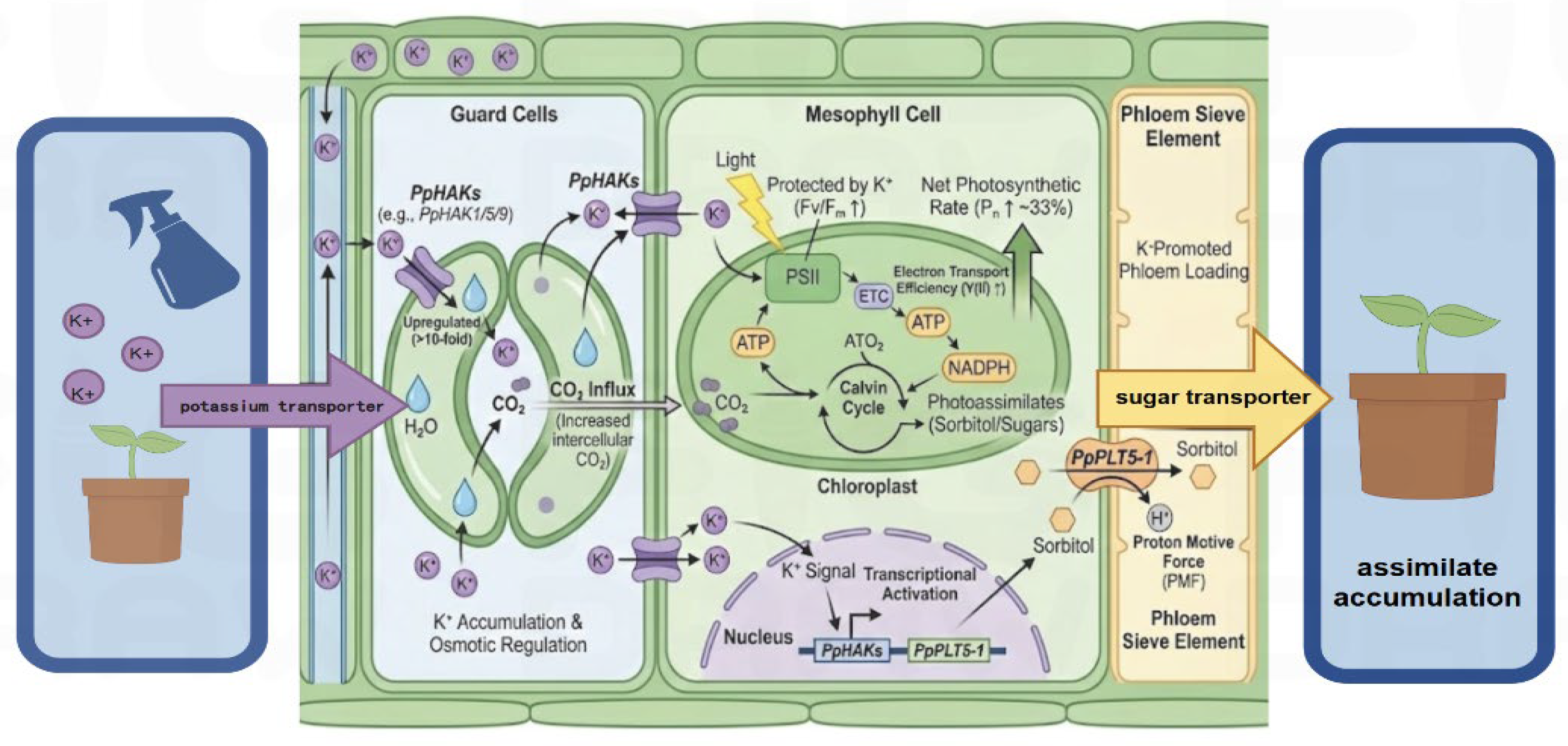
1. Introduction
Potassium (K
+) is an essential macronutrient that plays a critical role in plant growth and development [
1]. It participates in several vital physiological processes, including enzyme activation, osmotic adjustment, stomatal regulation, photosynthesis, and the source-to-sink transport of carbohydrates [
2]. Moreover, potassium enhances plant tolerance to environmental stresses such as cold, drought, and salinity. In agricultural production, the application of potassium fertilizer is an effective strategy to boost crop yield and, to a certain extent, improve fruit quality [
3]. In plants, potassium transporters are classified into four major multigene families: KT/HAK/KUP (K
+ transporter/high-affinity K
+/K
+ uptake), Trk/HKT (K
+ transporter/high-affinity K
+ transporter), KEA (K
+ efflux antiporter), and CHX (cation/hydrogen exchanger) [
4]. Among these, the HAK/KUP/KT family represents the largest group of potassium transporters and is categorized into four phylogenetic groups, designated as Clusters I, II, III, and IV. Plants possess a diverse array of HAK/KUP/KT transporters, which perform multifaceted functions in potassium uptake and translocation, plant growth and development, salt tolerance, and the regulation of osmotic potential [
5].
Potassium transporters play a pivotal role in the uptake and distribution of potassium (K
+) in plants. Studies have shown that the expression and activity of these transporters directly affect K
+ use efficiency and plant tolerance to environmental stresses [
6]. Plant high-affinity HAK1 transporters share high sequence similarity with fungal HAK1 transporters. Functional expression assays in yeast mutants have demonstrated that
HvHAK1,
AtHAK5, and
OsHAK1 mediate high-affinity K
+ uptake [
7,
8,
9]. In barley,
HvHAK1 has been reported to enhance drought tolerance by regulating signal transduction pathways in leaves [
10]. Similarly, in rice, overexpression of
OsHAK1 improves drought tolerance by boosting antioxidant capacity and promoting proline accumulation. Furthermore, overexpression of
OsHAK5 in rice increases the K
+/Na
+ ratio in shoots and facilitates K
+ transport, thereby conferring salt tolerance [
11]. Compared with K-sufficient plants, K deficiency results in increased water potential in old leaves and decreased turgor pressure (pressure potential) in young leaves. Consequently, the cell volume of young leaves under low-K conditions is significantly smaller than that under K-sufficient conditions [
12]. Furthermore, elevated expression of potassium transporters has been shown to enhance the uptake of exogenous auxin in tobacco, thereby promoting root growth [
13]. For instance, in tobacco (
Nicotiana tabacum), overexpression of the potassium transporter
HAK1 significantly enhances resistance to Tobacco Mosaic Virus (TMV), suggesting that improved K
+ nutrition may bolster disease resistance by restricting viral spread. In strawberry (
Fragaria × ananassa), the
FaTPK1 gene is not only involved in fruit ripening but also modulates the contents of soluble sugars, anthocyanins, and abscisic acid (ABA), thereby influencing fruit flavor and nutritional value [
14]. Similarly, during the postharvest ripening of kiwifruit (
Actinidia spp.), the expression of
AcKUP2 mirrors the trend of potassium accumulation and is inducible by ethylene, indicating a potential role in ethylene-mediated ripening and the formation of fruit flavor quality [
15].
In addition to genetic regulation, potassium fertilization is critical for plant growth and fruit development. In pear (
Pyrus spp.), K
+ supply levels significantly alter the expression of genes related to sugar metabolism and sugar accumulation [
16]. Low-K treatment inhibits sucrose and acid metabolism pathways while upregulating genes involved in sorbitol metabolism, promoting fructose accumulation. Conversely, high-K treatment enhances leaf photosynthetic capacity and optimizes the source-to-sink allocation of nutrients and carbohydrates, increasing fruit sugar content. In grape (
Vitis vinifera), K accumulation is closely correlated with sugar accumulation. Increased K fertilization promotes sugar accumulation by modulating the activities of sugar-metabolizing enzymes and their gene transcript levels [
17]. Specifically, K treatment increases total soluble solids (TSS) and sugar content while decreasing titratable acidity during late fruit development. In citrus, adequate K supply stimulates sugar accumulation and improves fruit quality by regulating carbon translocation from source leaves to fruits [
15]. Collectively, these findings suggest that potassium transporters, by facilitating K transport, play a fundamental role in promoting fruit sugar accumulation through the regulation of sugar metabolic pathways and nutrient allocation.
Currently, the HAK/KUP/KT gene family has been extensively reported in various plant species [
18]. Members of this family are widely expressed in diverse tissues such as roots, stems, leaves, and fruits, enabling plants to efficiently uptake potassium under low-K environments, maintain cellular ion homeostasis and osmotic balance, and regulate stress responses and metabolic processes. However, the relationship between the evolutionary trajectory and functional characteristics of the HAK gene family remains largely elusive [
19], and research in stone fruits, particularly peach (
Prunus persica), is notably lacking.
In this study, we performed a comprehensive genome-wide analysis of the HAK gene family in peach and identified 17 PpHAK family members. Furthermore, we investigated their phylogenetic relationships, conserved motifs and domains, gene structures, and interspecific synteny and orthologous relationships among Prunus species (including plum, Japanese apricot, and sweet cherry) to elucidate their potential biological functions.
2. Materials and Methods
2.1. Identification of the PpHAK Gene Family in Peach
The protein sequences of
Arabidopsis thaliana potassium transporters were obtained from the TAIR database (
https://www.arabidopsis.org, accessed on 17 August 2025). Hidden Markov Model (HMM) profiles for characteristic potassium transporter domains, including the potassium transporter domain (PF02705), were downloaded from the Pfam database (
http://pfam.xfam.org/, accessed on 17 August 2025). Identification of potassium transporter gene family members in peach was performed primarily using TBtools II software v2.36. The process involved the following steps: (1) BLASTP search against the
Prunus persica genome (Phytozome database,
https://phytozome.jgi.doe.gov/, accessed on 17 August 2025) using Arabidopsis sequences as query, with an E-value cutoff of 1 × 10
−5; (2) Domain verification was conducted using the built-in HMM search function in TBtools, with a domain E-value threshold set to 1 × 10
−5. Redundant sequences were removed, and conserved domain validation was further performed using the SMART database (
http://smart.embl-heidelberg.de, accessed on 10 September 2025) integrated within TBtools. The resulting non-redundant sequences were identified as putative potassium transporter genes in peach.
Physicochemical properties of the identified proteins were analyzed using the ProtParam tool in TBtools. Transmembrane helix predictions were performed with the embedded TMHMM module, and subcellular localization was predicted using the WoLF PSORT tool. Functional motifs and potential modification sites were analyzed based on the PROSITE database and other integrated prediction utilities within TBtools.
2.2. Gene Structure and Motif Analyses
To analyze exon/intron structures, the genomic and coding sequences of peach potassium transporter genes identified from the ‘HJML’ genome were submitted to the Gene Structure Display Server 2.0 (GSDS 2.0,
http://gsds.cbi.pku.edu.cn/, accessed on 17 August 2025). Conserved motifs were identified using the MEME online tool (
https://meme-suite.org/meme/, accessed on 10 September 2025) with default parameters, retrieving the top 10 motifs.
2.3. Phylogenetic Analysis and Classification, Chromosomal Distribution, and Synteny Analysis
To elucidate the evolutionary relationships of PpHAK genes, a phylogenetic tree was constructed using HAK protein sequences from
Prunus persica,
Prunus salicina,
Prunus mume,
Prunus armeniaca,
Prunus avium, and
Arabidopsis thaliana. Multiple sequence alignment was performed using MEGA12 ClustalW with default parameters. The phylogenetic tree was generated via the maximum likelihood (ML) method using MEGA 11, with the bootstrap value set to 1000 replicates to ensure reliability. The final tree was visualized and refined using iTOL (
https://itol.embl.de, accessed on 10 September 2025).
The chromosomal positions of all PpHAK genes were extracted from the peach genome annotation files (GFF3) and visualized using TBtools. For interspecific synteny analysis, genome sequences and annotation files of four other Prunus species were obtained from the GDR database. Syntenic blocks and orthologous gene pairs between peach and the related species were identified using the MCScanX (Multiple Collinearity Scan) toolkit with default settings. The resulting collinearity maps were visualized using the Dual Synteny Plot functions in TBtools.
2.4. Plant Materials and Experimental Treatments
Two-year-old peach trees (‘kang zhen yi hao’) with uniform growth vigor were selected for the experiments. The plants were grown in a greenhouse under controlled conditions at the Baima teaching and practice base of Nanjing Agricultural University.
The experiment was conducted in a controlled greenhouse. Uniform one-year-old peach (Prunus persica L.) seedlings of similar height and stem diameter were transplanted into plastic pots (10 L capacity). Each pot was filled with a commercial professional peat moss substrate (HAWITA Gruppe GmbH, Vechta, Germany). The basic physicochemical properties of the substrate were as follows: it consisted primarily of Sphagnum peat moss with an organic matter content of >80%, a pH (CaCl2) of 5.5–6.0, and an electrical conductivity (EC) of 1.0–1.5 mS/cm.
During the experimental period, the greenhouse environmental conditions were strictly monitored and maintained. The day/night temperatures were controlled at approximately 25 ± 2 °C and 18 ± 2 °C, respectively, with a relative humidity (RH) ranging from 50% to 60%. The seedlings were grown under natural sunlight, supplemented with artificial LED lighting to maintain a 16 h photoperiod and a photosynthetic photon flux density (PPFD) of approximately 800 μmol·m−2·s−1 at the canopy level. Prior to the foliar potassium treatments, all seedlings were allowed to acclimatize to the greenhouse conditions for two weeks. Throughout the acclimatization and experimental periods, the plants were subjected to uniform standard horticultural management, and measurements were performed to ensure consistent baseline growth across all seedlings.
The experimental layout followed a randomized complete block design with two treatments: (1) a control group (CK) sprayed with distilled water and (2) a potassium-treated group (LEAF) sprayed with a 0.2% (w/v) potassium dihydrogen phosphate (KH2PO4, Cat. No. P5379, Merck KGaA, Darmstadt, Germany) solution; the final applied K+ concentration was 14.7 mM. Foliar applications were performed twice a week. Seven days after the final application, fully expanded leaves from the middle of the current-year shoots were collected for physiological measurements and transcriptomic analysis. All samples were either measured immediately for gas exchange or flash-frozen in liquid nitrogen and stored at −80 °C for total RNA extraction and further analysis. Each treatment was performed with three biological replicates.
2.5. Total RNA Isolation and Quantitative Real-Time PCR (qRT-PCR)
Total RNA was isolated from ‘Kang zhen yi hao’ seedlings using a Polysaccharide and Polyphenol-Rich Plant Total RNA Extraction Kit (DP441, TIANGEN, Beijing, China). First-strand cDNA was synthesized from 1 μg of total RNA using the PrimeScript™ First-Strand cDNA Synthesis Kit (Takara, Dalian, China). Quantitative real-time PCR (qRT-PCR) was carried out on an ABI QuantStudio 5 Real-Time PCR System (Applied Biosystems, Singapore) using gene-specific primers. For each gene, three independent biological replicates and three technical replicates were analyzed. Relative transcript levels were calculated using the 2−ΔΔCt method.
2.6. Measurement of Gas Exchange Parameters
Photosynthetic gas exchange parameters were measured on clear days between 9:00 a.m. and 11:30 a.m. to avoid the “midday depression” of photosynthesis. Fully expanded leaves from the middle of the current-year shoots (the same position used for biochemical analysis) were selected from both the CK and LEAF groups at the Baima teaching and practice base of Nanjing Agricultural University. The net photosynthetic rate (Pn) and transpiration rate (E) were determined using a portable photosynthesis system (CL340, CID Bio-Science, Camas, WA, USA). Each treatment was measured with 6 biological replicates to ensure statistical accuracy.
2.7. Determination of Chlorophyll Fluorescence Parameters
Chlorophyll fluorescence was measured on the same leaves used for gas exchange analysis using a pulse-amplitude-modulated fluorometer (PAM-2500, Heinz Walz GmbH, Effeltrich, Germany). Prior to determining the maximum quantum efficiency of PSII (Fv/Fm), the leaves were dark-adapted for at least 30 min using specialized leaf clips. The minimal fluorescence (Fo) and maximal fluorescence (Fm) in the dark-adapted state were recorded. The effective quantum yield of PSII (Y(II)) was calculated using the formula.
2.8. Determination of Sucrose Content
The sucrose content in the fresh peach leaves was determined using a commercial Sucrose Assay Kit (Catalog No. D799790-0100, Sangon Biotech Co., Ltd., Shanghai, China). Briefly, approximately 0.1 g of fresh leaf tissue was ground at room temperature. After adding 0.5 mL of the extraction buffer and brief homogenization, the mixture was rapidly transferred into a centrifuge tube and incubated in an 80 °C water bath for 10 min with occasional vortexing (3–5 times). After cooling to room temperature, the homogenate was centrifuged at 4000× g for 10 min at 25 °C. The resulting supernatant was collected and mixed with 2 mg of the decolorizing reagent (provided in the kit), followed by an 80 °C water bath incubation for 30 min. Subsequently, an additional 0.5 mL of extraction buffer was added to the mixture, which was then centrifuged again at 4000× g for 10 min at 25 °C. The final clear supernatant was collected, and subsequent colorimetric measurement was carried out at 480 nm using a microplate reader (Bio-Rad Laboratories, Hercules, CA, USA) according to the manufacturer’s instructions.
2.9. Determination of Total Potassium Content
Leaf samples were first inactivated at 105 °C for 30 min and then dried in an oven at 75 °C until reaching a constant weight. The dried leaf material was subsequently ground into a fine powder and passed through a 100-mesh nylon sieve. An appropriate amount of the leaf powder was digested using a microwave digestion system with HNO3. The concentrations of potassium were analyzed by inductively coupled plasma optical emission spectrometry (710 ICP-OES, Agilent Technologies, Santa Clara, CA, USA).
2.10. Statistical Analysis
All experiments were performed with at least three independent biological replicates. Data are presented as the mean ± standard deviation (SD). Statistical significance between the control (CK) and treatment (LEAF) groups was determined using an independent two-sample Student’s t-test and three independent biological replicates. All statistical analyses and data visualizations were conducted using GraphPad Prism version 8.0 (GraphPad Software, San Diego, CA, USA). Differences were considered statistically significant at p < 0.05. In the figures, asterisks denote significant differences: * p < 0.05, ** p < 0.01, *** p < 0.001, and **** p < 0.0001, while “ns” indicates no significant difference.
3. Results
3.1. Genome-Wide Identification and Characterization of PpHAK Family Members
To systematically identify the
PpHAK gene family members within the
Prunus persica (peach) genome, we performed HMMER searches along with verification of the conserved PF02705 domain. A total of 17
PpHAK genes were ultimately identified and subsequently named
PpHAK1 to
PpHAK17 (
Table 1). The physicochemical properties of these 17 PpHAK proteins were comprehensively predicted via bioinformatics analysis. The results (
Table 1) indicated that these family members exhibited significant diversity in protein size. Their amino acid (aa) sequence lengths ranged from 174 aa (
PpHAK16) to 850 aa (
PpHAK15), with corresponding theoretical molecular weights (MW) spanning from 20.39 kDa (
PpHAK16) to 94.70 kDa (
PpHAK15). The theoretical isoelectric points (pI) ranged from 5.29 (
PpHAK15) to 9.04 (
PpHAK5), indicating that the family comprises both acidic and alkaline proteins. Based on the instability index (II) predictions, 12 of the 17 members (e.g., PpHAK3, PpHAK4, and PpHAK11) had II values greater than 40 and were classified as unstable, whereas the remaining five (e.g., PpHAK1, PpHAK6, and PpHAK14) were predicted to be stable. Furthermore, in terms of hydrophobicity, 16 of the PpHAK proteins had positive Grand Average of Hydropathicity (GRAVY) values (ranging from 0.255 to 0.457), indicating a hydrophobic nature. The sole exception was PpHAK16 (GRAVY = −0.766), which was predicted to be hydrophilic. Moreover, most members possessed high aliphatic indices (ranging from 76.72 to 111.67), implying high thermostability. Taken together, the significant variations in physicochemical properties, including sequence length, pI, stability, and hydrophobicity, among the
PpHAK family members suggest extensive functional divergence.
3.2. Phylogenetic Analysis and Subfamily Classification of the PpHAK Gene Family
To elucidate the evolutionary history and conservation of the
PpHAK gene family within the genus
Prunus, we constructed a phylogenetic tree using full-length HAK protein sequences from five stone fruit species (peach,
Prunus persica; plum,
Prunus salicina; mei,
Prunus mume; apricot,
Prunus armeniaca; and sweet cherry,
Prunus avium), as well as the model plant
Arabidopsis thaliana (
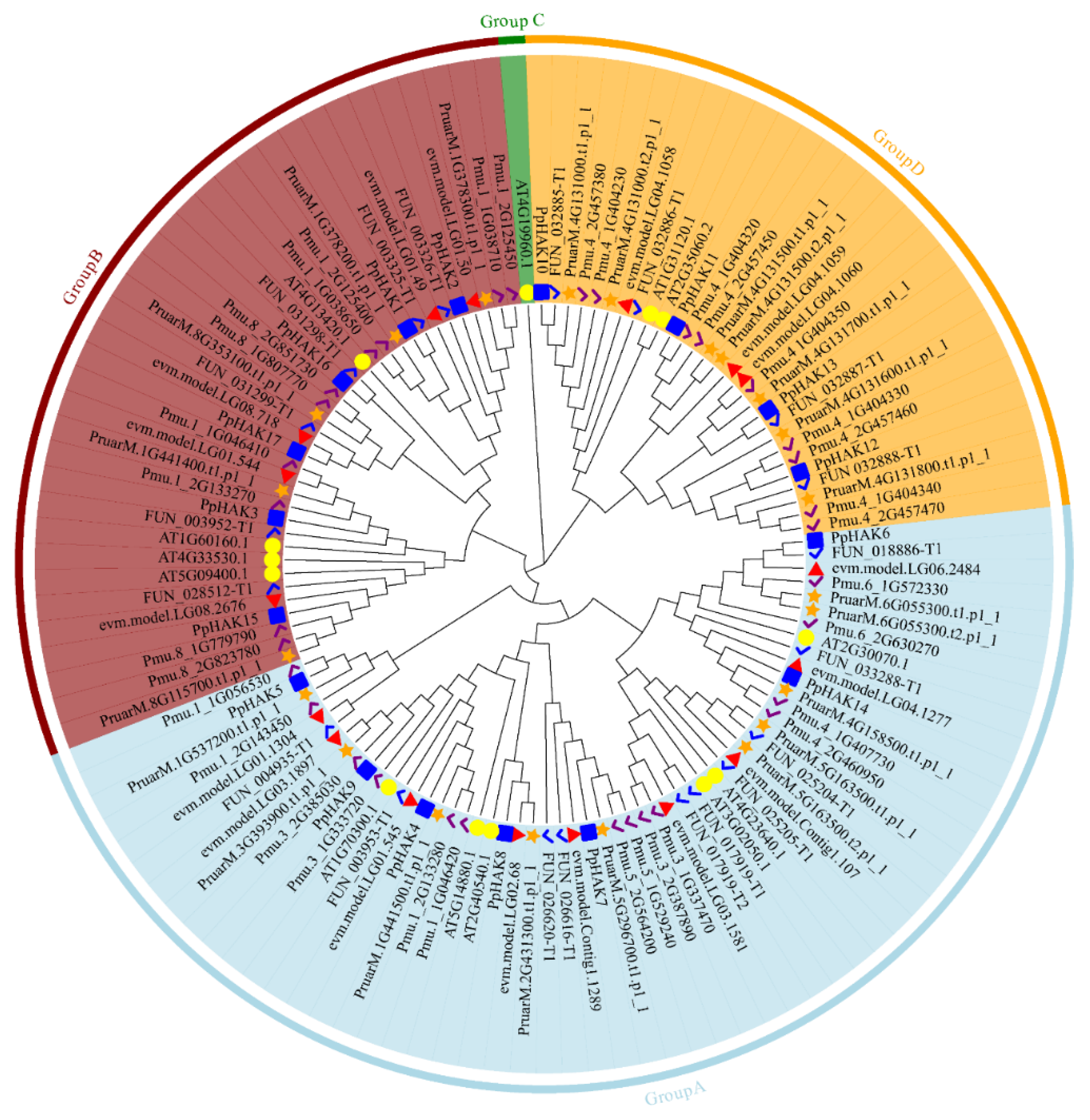
Figure 1).
The phylogenetic topology classified all identified HAK/KUP/KT transporters into four distinct lineages, designated as Groups A, B, C, and D. This clustering pattern was consistent across all examined Prunus species, indicating that the diversification of the HAK family predates the speciation of stone fruits. Based on the phylogenetic topology, the PpHAK family members were classified into distinct clades. Specifically, PpHAK4, PpHAK5, PpHAK7, PpHAK8, PpHAK9, PpHAK14, and PpHAK6 were clustered within Group A. In contrast, Group B comprised PpHAK1, PpHAK2, PpHAK3, PpHAK15, PpHAK16, and PpHAK17. Furthermore, PpHAK10, PpHAK11, PpHAK12, and PpHAK13 were assigned to Group D.
3.3. Phylogenetic Relationships, Conserved Motifs, and Gene Structure Analysis of the PpHAK Gene Family
To elucidate the evolutionary relationships and structural characteristics of the
PpHAK gene family, we performed a comprehensive analysis including phylogenetic tree construction, conserved motif identification, domain prediction, and exon–intron structure organization for the 17 identified
PpHAK genes (
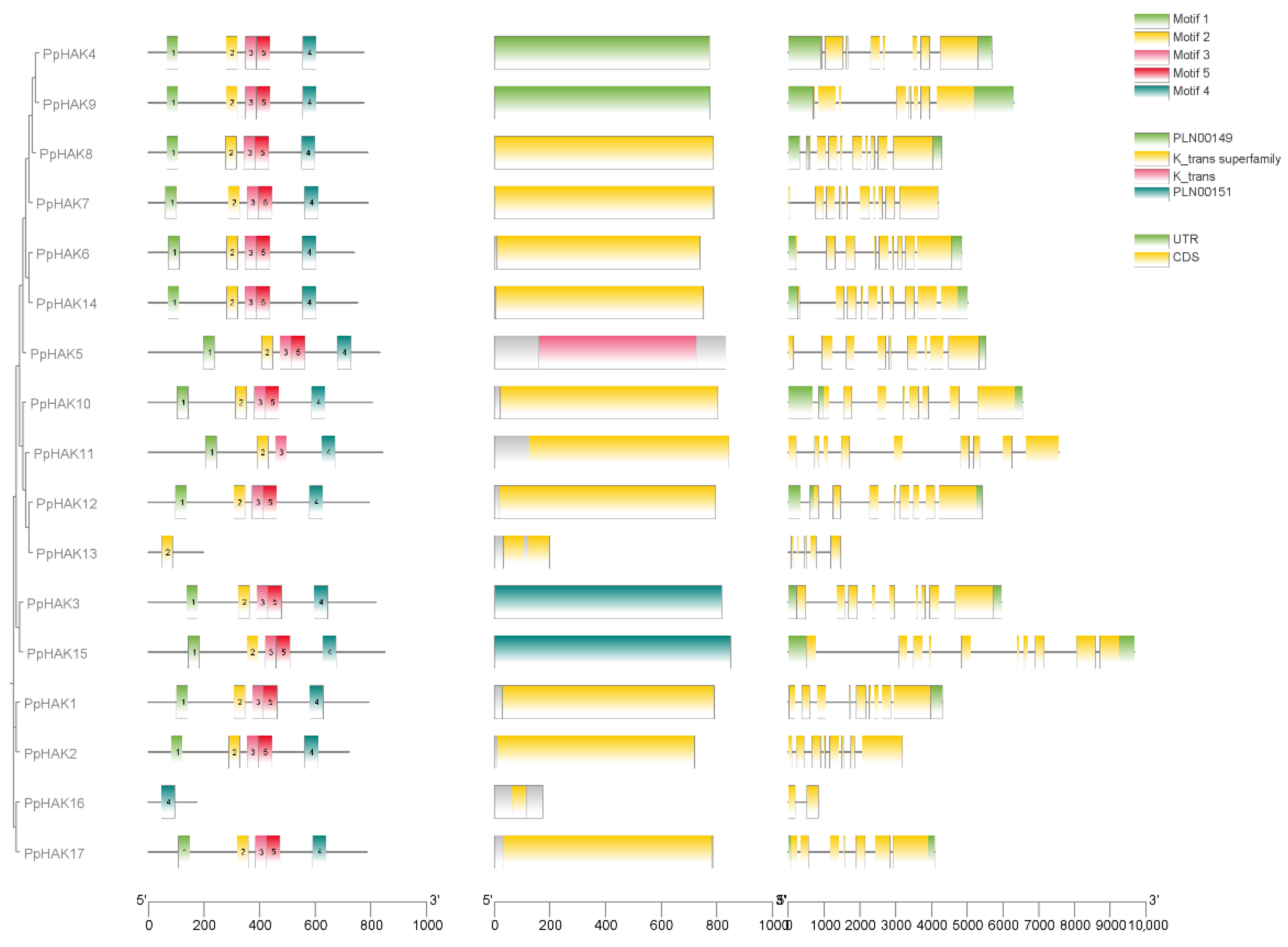
Figure 2). The phylogenetic tree, constructed based on full-length protein sequences (
Figure 2, left panel), revealed that the 17
PpHAK members were clustered into distinct subfamilies. The clustering pattern indicates that members within the same evolutionary clade share closer phylogenetic relationships and generally exhibit similar structural characteristics. A total of five conserved motifs (Motifs 1–5) were identified using the MEME suite. As illustrated in
Figure 2, the motif distribution patterns in most PpHAK proteins were highly conserved, characterized by a typical arrangement order of Motifs 1, 2, 3, 5, and 4. This consistency suggests a high degree of evolutionary conservation within the
PpHAK family. Notably, motif deletions were observed in specific members; for instance, PpHAK13 contained only Motif 2, and PpHAK16 possessed only Motif 4. These structural truncations may imply evolutionary events such as segmental loss or pseudogenization, potentially leading to functional divergence. The analysis of conserved domains (CDD) revealed that the majority of PpHAK proteins possess the canonical K_trans superfamily domain (indicated in yellow), which is the functional core region for potassium transporters. Furthermore, subfamily-specific domain distributions were observed. For example, members such as PpHAK4 and PpHAK9 contained the PLN00149 domain (green), whereas PpHAK3 and PpHAK15 were characterized by the presence of the PLN00151 domain (teal). The gene structure diagram (
Figure 2, right panel) illustrates the arrangement of coding sequences (CDS, yellow boxes), introns (black lines), and untranslated regions (UTRs, green boxes). The analysis demonstrated that members within the same subfamily tended to share similar exon–intron organizations in terms of number and length. For instance, the clade containing PpHAK4, 6, 7, 8, 9, and 14 exhibited highly consistent gene structures. In contrast, PpHAK15 displayed the longest genomic sequence and a complex intron distribution. This structural diversity likely correlates with the functional diversification of the
PpHAK family members.
3.4. Chromosomal Distribution and Evolutionary Conservation of the PpHAK Gene Family
To elucidate the genomic organization and evolutionary mechanisms of the
PpHAK gene family, we mapped the chromosomal locations of its members and performed a comparative synteny analysis across
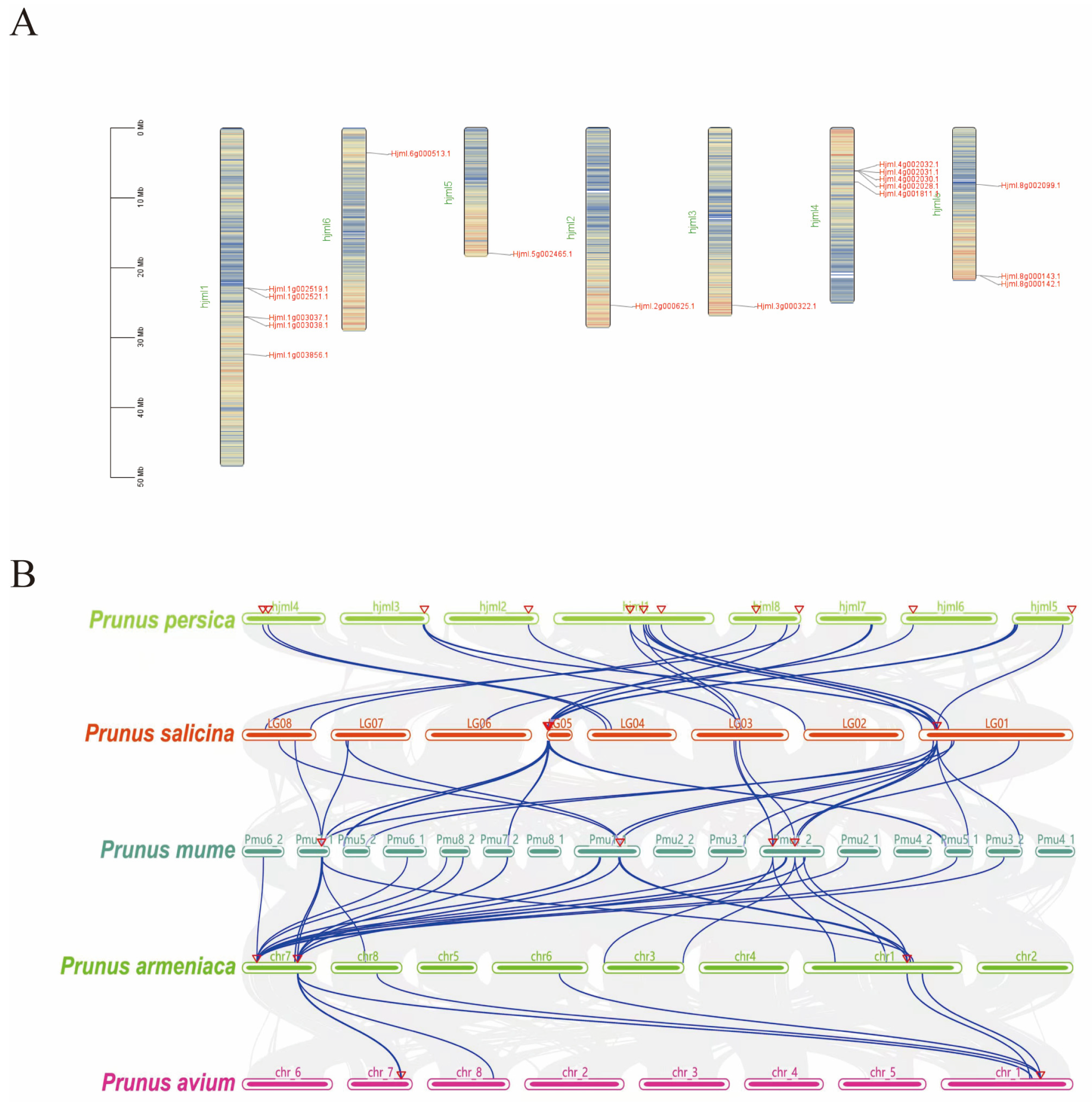
Prunus species (
Figure 3A). Chromosomal mapping revealed that the 17
PpHAK genes are unevenly distributed across seven peach chromosomes (hjml1–6 and hjml8), with no members detected on hjml7. Notably, Chromosome 1 (hjml1) and Chromosome 4 (hjml4) emerged as distribution hotspots. A high-density gene cluster comprising five genes (
Hjml.4g002032.1 to
Hjml.4g001811.1) was identified on hjml4, while paired gene loci were also observed on hjml1 (e.g.,
Hjml.1g002519.1) and hjml8. To further investigate the evolutionary trajectory of this family within stone fruits, a comparative genomic map was constructed between
P. persica and four related species:
P. salicina,
P. mume,
P. armeniaca, and
P. avium (
Figure 3B). The analysis revealed extensive macrosynteny among
Prunus genomes, with peach chromosomes exhibiting a clear linear correspondence with those of the other species. By tracking
HAK loci (indicated by red inverted triangles), we identified highly conserved orthologous gene pairs (blue lines) across all five species. In particular, the gene cluster on hjml4 showed strict syntenic mapping to the homologous chromosomes (LG04/Pmu4/chr4/chr_4) in the other genomes.
3.5. Exogenous Potassium Treatment Significantly Enhances Photosynthetic Capacity and Photosystem Activity in Peach Leaves
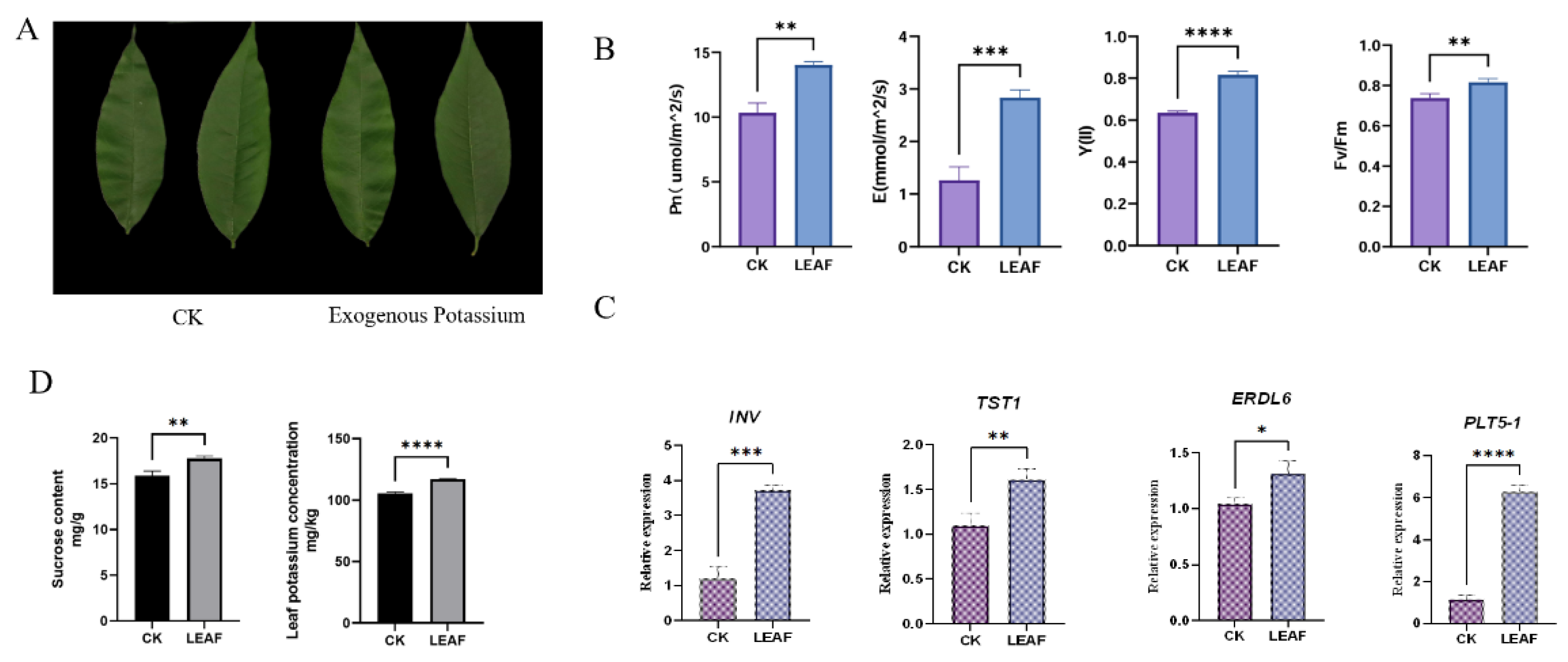
To evaluate the physiological regulation of potassium on the photosynthetic performance of leaves, gas exchange parameters and chlorophyll fluorescence parameters were measured under control (CK) and potassium-treated (LEAF) conditions (
Figure 4A). The results demonstrated that exogenous potassium supply comprehensively improved the photosynthetic efficiency and Photosystem II (PSII) function of peach leaves (
Figure 4B). Potassium treatment significantly increased both the net photosynthetic rate (Pn) and transpiration rate (E). Specifically, the Pn in the LEAF group reached approximately 14 μmol·m
−2·s
−1, representing an approximately 33% increase compared to the control. More notably, E more than doubled following K application, surging from 1.2 mmol·m
−2·s
−1 in the control to approximately 2.8 mmol·m
−2·s
−1, implying a substantial improvement in stomatal conductance. Potassium supply similarly improved the energy conversion efficiency of reaction centers. The effective quantum yield of PSII, Y(II), in the LEAF group significantly rose to over 0.8, markedly outperforming the control. Meanwhile, the maximum quantum efficiency of PSII, Fv/Fm, significantly increased from 0.73 to 0.82, indicating that potassium treatment effectively alleviated potential photoinhibition and maintained the photosynthetic apparatus in an optimal physiological state.
To elucidate the molecular mechanism by which potassium promotes photosynthate export in peach leaves, the transcriptional levels of four key sugar transport and metabolism genes (
PpTST1,
PpINV,
PpERDL6, and
PpPLT5-1) were analyzed using qRT-PCR (
Figure 4C). Expression profiling revealed that exogenous potassium treatment significantly upregulated the expression of all examined genes compared to the water-treated control. surging 1.2 mmol·m
−2·s
−1. The expression of the Tonoplast Sugar Transporter gene
PpTST1 increased by approximately 1.5-fold. The invertase gene
PpINV was significantly upregulated in the K
+-treated group, with expression levels reaching approximately 1.5 times that of the control. The early response to the dehydration-like gene
PpERDL6 also exhibited significant upregulation, approximately 1.3 times. The polyol/sorbitol transporter gene
PpPLT5-1 showed the most dramatic response, with expression levels surging to over 6-fold that of the control group, indicating an extremely significant difference. These results demonstrate that exogenous potassium supply activates the transcriptional machinery of key genes responsible for transmembrane sugar transport (particularly sorbitol transport) and vacuolar sugar pool regulation, thereby enhancing the sugar turnover and export capacity of source leaves.
To assess the physiological efficacy of exogenous K supply, we quantified leaf total K and sucrose levels. Foliar application led to a notable elevation in internal K status, with concentrations increasing by approximately 12.4% over the control group (
Figure 4D). This enrichment in K was accompanied by a significant increase in sucrose content of approximately 10.6%, providing empirical evidence that leaf-applied K not only improves the plant’s nutritional standing but also actively promotes the accumulation of primary photosynthetic assimilates.
3.6. Differential Regulation of PpHAK Family Genes by Exogenous Potassium Treatment in Peach Leaves
To investigate the impact of potassium supply on the transcriptional regulation of the
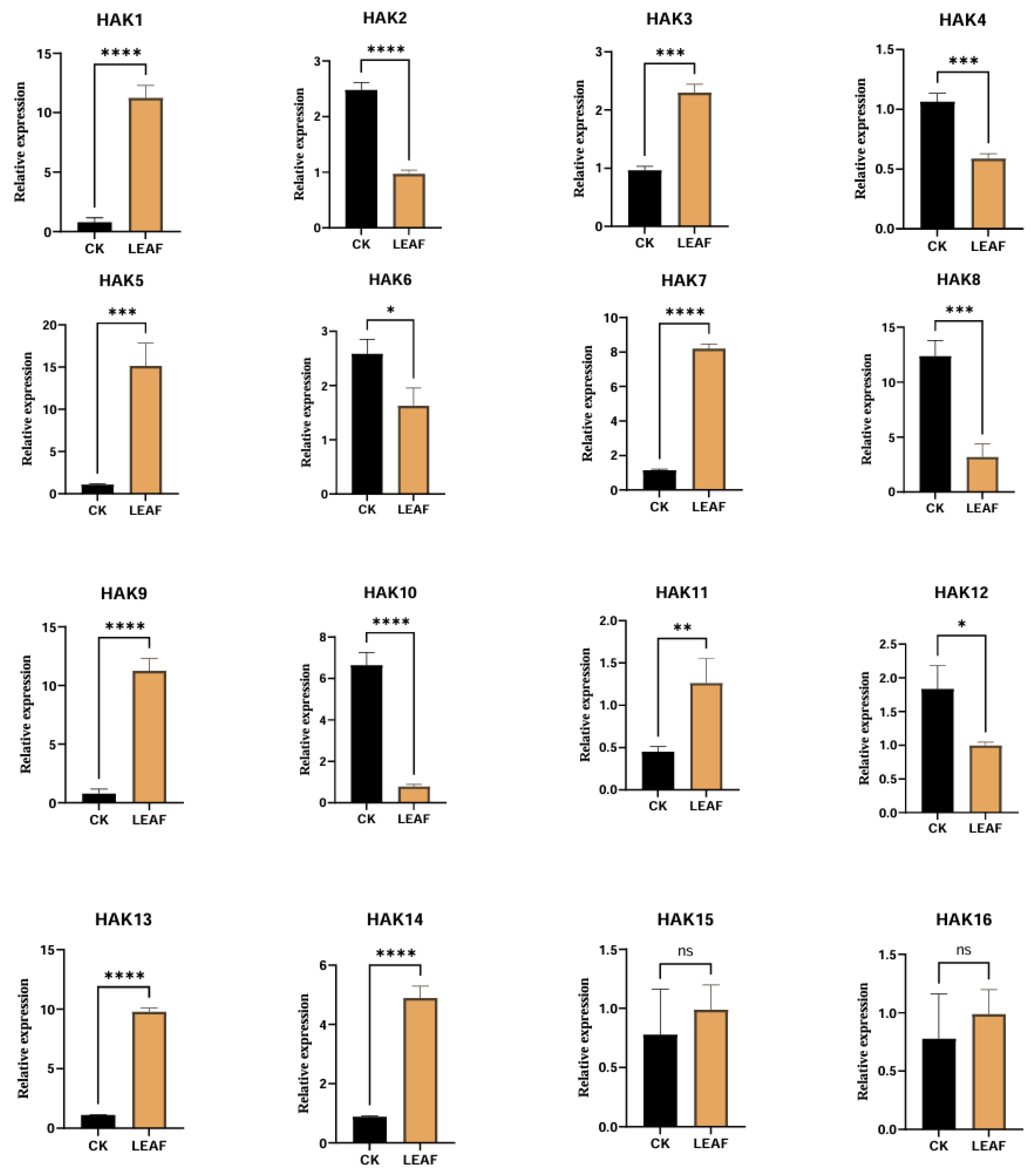
PpHAK gene family, the expression profiles of 16
PpHAK genes were analyzed in peach leaves under water control (CK) and potassium treatment (LEAF) conditions using qRT-PCR (
Figure 5). The results revealed three distinct response patterns among family members.
Exogenous potassium treatment significantly reshaped the transcriptional landscape of the PpHAK gene family in peach leaves, characterized by subfamily-specific reprogramming of gene expression. Quantitative analysis revealed a bidirectional response pattern to potassium signals: approximately half of the family members, including PpHAK1, 3, 5, 7, 9, 11, 13, and 14, were significantly upregulated following K application. Notably, PpHAK1, PpHAK5, PpHAK7, PpHAK9, and PpHAK13 exhibited the most robust transcriptional activation, with relative expression levels increasing more than 10-fold compared to the control, identifying them as primary positive regulators in high-K environments. In sharp contrast, a distinct subset of genes (PpHAK2, 4, 6, 8, 10, and 12) underwent significant repression; specifically, PpHAK8 and PpHAK10 showed a drastic reduction in transcript abundance to less than 20% of basal levels, indicative of a classic negative feedback regulation mechanism under high potassium availability. Meanwhile, the expression of PpHAK15 and PpHAK16 remained statistically unaltered (ns), suggesting that these genes may exhibit constitutive expression or are regulated by factors other than potassium concentration.



 ,
,