Article

Genome-Wide Identification of LBD Transcription Factors Revealed the Essential Role of ClLBD2 in Root Development in Watermelon (Citrullus lanatus)

1
College of Horticulture Science and Engineering, Shandong Agricultural University, Tai’an 271018, China
2
Horticultural Research Institute, Henan Academy of Agricultural Sciences, Zhengzhou 450002, China
3
Faculty of Agriculture and Veterinary Sciences, Superior University, Lahore 54000, Pakistan
*
Author to whom correspondence should be addressed.
These authors contributed equally to this work.
Horticulturae 2026, 12(3), 387; https://doi.org/10.3390/horticulturae12030387
Submission received: 7 February 2026 / Revised: 9 March 2026 / Accepted: 16 March 2026 / Published: 20 March 2026
(This article belongs to the Special Issue Germplasm Resources and Genetics Improvement of Watermelon and Melon)

Abstract

The Lateral Organ Boundaries Domain (LBD) gene family encodes plant-specific transcription factors that play pivotal roles in growth, development, and stress responses. However, a comprehensive genome-wide analysis of the LBD family in watermelon (Citrullus lanatus) has not been conducted until now. In this study, we identified 39 ClLBD genes using the latest watermelon reference genome and systematically analyzed the function of ClLBD2 in root development. These ClLBDs are unevenly distributed across 10 chromosomes except Chr4. Evolutionary analysis grouped the gene family members into six subgroups: Class I (a–e) and Class II. Physicochemical properties and gene structure analysis showed that the ClLBD protein members are tightly conserved. In the promoter regions of ClLBD genes, we identified abundant cis-acting regulatory elements related to abiotic stress and hormone responses. Through RNA-seq analysis from a cucurbit database, we found that several ClLBD genes showed high relative expression in roots, with ClLBD2 being the most highly expressed. Since its subfamily includes AtLBD25, a known root development-related gene, we hypothesized that ClLBD2 might be involved in root development. To validate this, ClLBD2-edited roots were generated using the CRISPR-Cas9 system and Agrobacterium rhizogenes-mediated transformation. Compared to the wild type, the ClLBD2 edited roots exhibited significant reduction in taproot length and lateral root numbers, indicating that ClLBD2 may regulate root development. This study provides the first comprehensive analysis of the LBD gene family in watermelon, offering valuable insights for evolutionary and further functional studies of ClLBD genes.

1. Introduction

Lateral Organ Boundaries Domain (LBD) genes are plant-specific transcription factor genes that arose from charophyte algae [1,2]. They are widely found in plants and are involved in key processes such as plant boundary formation and cell differentiation.
The LBD protein consists of a relatively conserved N-terminal LOB domain and a variable C-terminal domain. The N-terminal region consists of a LOB domain, which consists of three modules: a zinc finger-like motif (CX2CX6CX3C) for DNA binding, a GAS (Gly-Ala-Ser) region in the middle, and a leucine zipper-like coiled-coil motif (LX6LX3LX6L) for protein dimerization [3]. LBD transcription factors are classified into Class I and Class II according to different domains: Class I contains the CX2CX6CX3C, the GAS-block and the LX6LX3LX6L [4]; Class II contains only the zinc finger structure CX2CX6CX3C [5]. Studies have shown that CX2CX6CX3C play a vital role in the binding of LBD proteins to DNA and GAS-block, and LX6LX3LX6L are involved in the interaction of LBD proteins with other proteins [3]. For example, the interaction of LBD with the bHLH protein can reduce the affinity of CX2CX6CX3C for DNA [6]. In recent years, genome-wide identification studies have revealed a diverse range of LBD gene family members across various plant species. These include 43 in Arabidopsis thaliana [7], 45 in maize (Zea mays) [8], 35 in rice (Oryza sativa) [9], 40 in melon (Cucumis melo) [10], 53 in sweet potato (Ipomoea batatas) [11], 56 in tomato (Solanum lycopersicum) [12], 46 in soybean (Glycine max) [13], 76 in Chionanthus retusus [14], and 73 in Panax ginseng [15].
Current studies have shown that LBD genes play important roles in the development of roots, leaves, flowers, and fruits, as well as in callus regeneration [16,17]. Hylocereus undatus HuLBD1 may delay fruit senescence and promote the synthesis of phenylpropanoid compounds such as flavonoids by negatively regulating the expression of four key genes, namely, HuCHS1-2, HuFLS1, HuCYP75B2, and HuCHS5-2 [18]. Arabidopsis AtLBD6 is involved in the regulation of leaf development [6]; AtLBD16 and AtLBD29 are involved in the regulation of lateral root initiation [19]; AtLBD15 is involved in apical meristem differentiation by regulating WUS genes [20]; AtLBD16, AtLBD17, AtLBD18 and AtLBD19 promote callus formation and participate in plant regeneration [16]. Melon CmLBD01 and CmLBD18 were highly expressed in root and leaf tissues, and CmLBD03 and CmLBD14 were highly expressed in female flower and ovary tissues [10]. Tomato SlLOB1 was reported to be involved in the regulation of softening during fruit ripening and interacted with SlMYB1/2 to participate in the regulation of fruit texture and cell wall components [11]. The OsIG1 gene plays a key role in regulating the development of flower organs and female gametophytes in rice [21]. The Arabidopsis homologs LBD16, LBD17, LBD18, and LBD29 in Chinese cabbage are key genes involved in callus formation and in promoting plant regeneration in vitro [22]. Maize ZmLBD12 is specifically expressed in the roots and plays an important role in lateral root development [8]. Most LBD genes were expressed at relatively higher levels across various stages of root, anther, leaf, and shoot development, suggesting pivotal roles in plant growth and development [9,23,24].
The LBD family is associated with plant resistance to abiotic stresses; for example, the expression of VvLBD19 in grapes was significantly up-regulated after PEG treatment [25]. Under drought stress, the expressions of StLBD1-5 and StLBD2-6 were significantly down-regulated, while the expressions of potato StLBD2-6 and StLBD3-5 were significantly up-regulated, suggesting that these genes may help maintain the normal metabolism and enhance the drought resistance of potatoes [26]. Banana LBD5 was involved in jasmonic acid signaling to improve its cold tolerance [27]. The genes PbLBD16/17/20/26 were rapidly induced by salt stress in Phoebe bournei seedlings, with increased expression at 4 h, suggesting a potential role in stress-related gene expression [28]. Under cold stress, the expression of Ta-4A-LBD40 and Ta-4D-LBD62 in bread wheat was enhanced at 4 h, and Ta-4B-LBD49 was expressed at 23 h. The expressions of Ta-2A-LBD13, Ta-2B-LBD15, and Ta-2D-LBD18 were up-regulated under drought stress. TaLBD16 plays a role in drought resistance, and TaLBD16-D may interact with TaTBP1, thereby enhancing wheat drought tolerance [29]. Maize ZmLBD33 negatively regulates drought tolerance by modulating stomatal aperture and H2O2 signal transduction [30]. These results suggest that LBDs may play distinct roles in regulating the stress response.
Watermelon (Citrullus lanatus) is a popular horticultural crop valued for its richness in lycopene, citrulline, vitamins, minerals, and potassium [17]. It develops a root system, consisting of a primary taproot and an extensive network of lateral roots, which provides stability and access to deeper water reserves [31]. This biological foundation is essential for optimal growth and fruit development [32]. Although the LBD gene family has been extensively characterized at the genome-wide level in multiple crops, its identification in watermelon has not yet been reported.
In this study, watermelon ClLBD gene members were identified and their chromosome distribution, molecular structure, evolution, and expression patterns were comprehensively analyzed. Given the critical roles of LBDs in root regeneration, this study further examined the function of ClLBD2 in taproot and lateral root regeneration and development. Moreover, this study provides a basis for an in-depth investigation into the molecular mechanisms of root growth in watermelon.

2. Materials and Methods

2.1. Identification and Physicochemical Characterization of ClLBD Genes

The watermelon (Citrullus lanatus) genome was retrieved from the Cucurbit Genomics Database [CuGenDBv2; http://cucurbitgenomics.org/v2/ (accessed on 13 November 2023)]. To identify LBD family members, the Hidden Markov Model (HMM) profile of the LOB domain (PF03195) was obtained from the Pfam database [http://pfam.xfam.org/ (accessed on 15 November 2023)] and employed for hmmsearch analysis using TBtools software (Version 1.098693) with stringent thresholds. Candidate genes were further validated for domain integrity using the NCBI Conserved Domain Database [NCBI-CDD, https://www.ncbi.nlm.nih.gov/Structure/bwrpsb/bwrpsb.cgi (accessed on 13 November 2023)]. Physicochemical properties of ClLBD proteins, including theoretical isoelectric point (pI), molecular weight (MW), and amino acid composition, were predicted using the ProtParam tool [https://web.expasy.org/protparam/ (accessed on 10 December 2023)].

2.2. Conserved Motif Analysis, Gene Structure, and Chromosomal Localization

Conserved motifs within ClLBD proteins were identified using the MEME Suite [https://meme-suite.org/meme/ (accessed on 10 December 2023)] with default parameters (maximum motif count = 10). Gene structures (exon/intron organization) and motif distributions were visualized using TBtools based on genome annotation (GFF3) files [33]. Chromosomal locations of ClLBD genes were mapped using TBtools and graphically represented to illustrate genomic distribution.

2.3. Cis-Acting Element Prediction

Promoter regions (2000 bp upstream of transcription start sites) of ClLBD genes were extracted from the genome using TBtools. Putative cis-acting elements were predicted using the PlantCARE database [https://bioinformatics.psb.ugent.be/webtools/plantcare/html/ (accessed on 26 December 2023)]. Identified elements were categorized by function (e.g., stress responsiveness, hormone signaling) and visualized using TBtools.

2.4. Phylogenetic Analysis and Collinearity Analysis

Protein sequences of LBD members from Arabidopsis thaliana [retrieved from TAIR9, https://www.arabidopsis.org/ (accessed on 26 December 2023)], tomato [retrieved from NCBI SL3.0, https://www.ncbi.nlm.nih.gov/assembly/GCF_000188115.4/ (accessed on 26 December 2023)] and watermelon were aligned using ClustalW (Version 2.1) with MEGA11 (Version 11.013). A Neighbor-Joining (NJ) phylogenetic tree was constructed and retrieved from 1000 bootstrap replicates. The resulting tree was annotated and visualized using the Interactive Tree of Life [iTOL; https://itol.embl.de/ (accessed on 26 December 2023)]. Intra-species (watermelon) and inter-species (watermelon vs. Arabidopsis) collinearity analyses were performed using the One Step MCScanX function in TBtools. Syntenic blocks were identified using a minimum of 5 collinear gene pairs, and results were visualized as circular plots (circos) or synteny maps.

2.5. Expression Profiling Analysis of ClLBD Genes

Expression profiles of ClLBD genes in various tissues and under abiotic stresses were obtained from the CuGenDBv2 database. The accession number for tissue expression data was PRJNA676179, and those for abiotic stress responses (cold, drought, salt) were PRJNA318793, PRJNA594233, and PRJNA637508, respectively. The tissue samples included roots, stems, leaves, tendrils, fruits, 25-day-old fruit flesh/rind, and 35-day-old fruit flesh/rind, and they were analyzed by calculating Log2 RPKM to quantify differential expression [34]. A heatmap was generated using the TBtools software package with row-wise hierarchical clustering to reveal organ-specific expression trends.
For abiotic stress, watermelon seedlings of four-leaf stages were maintained at 4 °C for 36 h, with seedlings maintained at 25 °C as a control [35]; seedlings cultivated at a volumetric water content (VWC) of 35 ± 5% for 8 days to induce drought stress [36]; uniform seedlings were subjected to 300 mM NaCl for 14d to simulate salt stress [37]. Leaf tissues were harvested after cold, drought and salt stress for RNA_seq. The raw expression data were normalized using the Log2 Treatment/Control ratio of RPKM transformation for comparative analysis. Subsequent hierarchical clustering analysis was performed using the heatmap function in TBtools software.

2.6. Multiple Sequence Alignment

The protein sequences of ClLBD2 and other members of its subfamily, Class Ic, were downloaded, and a phylogenetic tree was constructed using the neighbor-joining method in MEGA software (Version 11.013). A comparative analysis was conducted on the ClLBD2 protein and its orthologs from Arabidopsis and tomato. Multiple sequence alignment was performed using the HuaMei Biology online server to assess conservation. Subsequently, de novo motif discovery and gene structure analysis were performed using the MEME Suite (Version 5.5.5) to identify and characterize the core conserved motifs, the sequences of which are detailed in the results.

2.7. Subcellular Localization of ClLBD2

The coding sequence of ClLBD2 was PCR-amplified, and the product was ligated into the pGreen vector carrying green fluorescent protein (GFP). Subsequently, the recombinant plasmid pGreen-ClLBD2-GFP was transiently transformed into Agrobacterium tumefaciens strain GV3101. The pGreen-ClLBD2-GFP combined with a nuclear marker, pGreen-AtH2B-mCherry [38], was infiltrated into the leaves of Nicotiana benthamiana. After 2~3 days, the fluorescence signals of transformed leaves were directly observed and imaged using a confocal laser scanning microscope (Zeiss LSM880, Carl Zeiss, Oberkochen, Germany). The optimal excitation wavelength for GFP is 488 nm and its emission wavelength is 509 nm; for mCherry, the optimal excitation wavelength is 587 nm and its emission wavelength is 610 nm.

2.8. Genetic Transformation Mediated by Agrobacterium rhizogenes

To obtain the visual edited root, the CRISPR/Cas9 vector pBSE402, which contained a 35S:GFP and Agrobacterium rhizogenes K599, was used in this study. The guide RNAs for ClLBD2 (guide 1 to exon2 and guide 2 to exon2) were designed using CRISPR-P v2.0 [http://crispr.hzau.edu.cn/CRISPR2/ (accessed on 6 August 2024)] and inserted into PBSE402 using T4 ligase. Agrobacterium rhizogenes K599 harboring the recombinant plasmid was used for watermelon transformation by Agrobacterium tumefaciens-mediated transformation. Cotyledons of watermelon were selected as the plant tissue for transformation, and the specific operation steps were as follows: watermelon seeds were sown on seedling plates and cultured until roots emerged after 2–3 days. Subsequently, the cotyledons were cut into 8 segments, yielding 8 explants per seed. The obtained explants were transferred to co-cultivation plates for 2–3 days of culture, and then transferred to differentiation plates for root induction and culture for days. Potentially edited lines were detected by monitoring GFP signal using a fluorescence lamp (LUYOR-3415, Shanghai Luyor Biotech Co., Ltd., Shanghai, China). Genomic DNA fragments containing the target were amplified and sequenced using Tsingke Fast NGS technology. The sequence of the guides and primer are listed in Table S1.

2.9. Phenotypic and Statistical Analysis

The length of taproots and the number of lateral roots were analyzed in WT and ClLBDs-edited lines cultivated for 24 days in the limited growth space of Petri dishes. Particularly, the lateral root growth of roots cultivated for 34 days in larger-volume bottles was also examined.
All data were analyzed with SPSS software (Version 30.0) using Student’s t test, and p < 0.01 and p < 0.05 were considered highly significant (**) and significant (*), respectively. All graphs were constructed using GraphPad Prism software (Version 10.4.0).

3. Results

3.1. Genome-Wide Identification of the ClLBDs

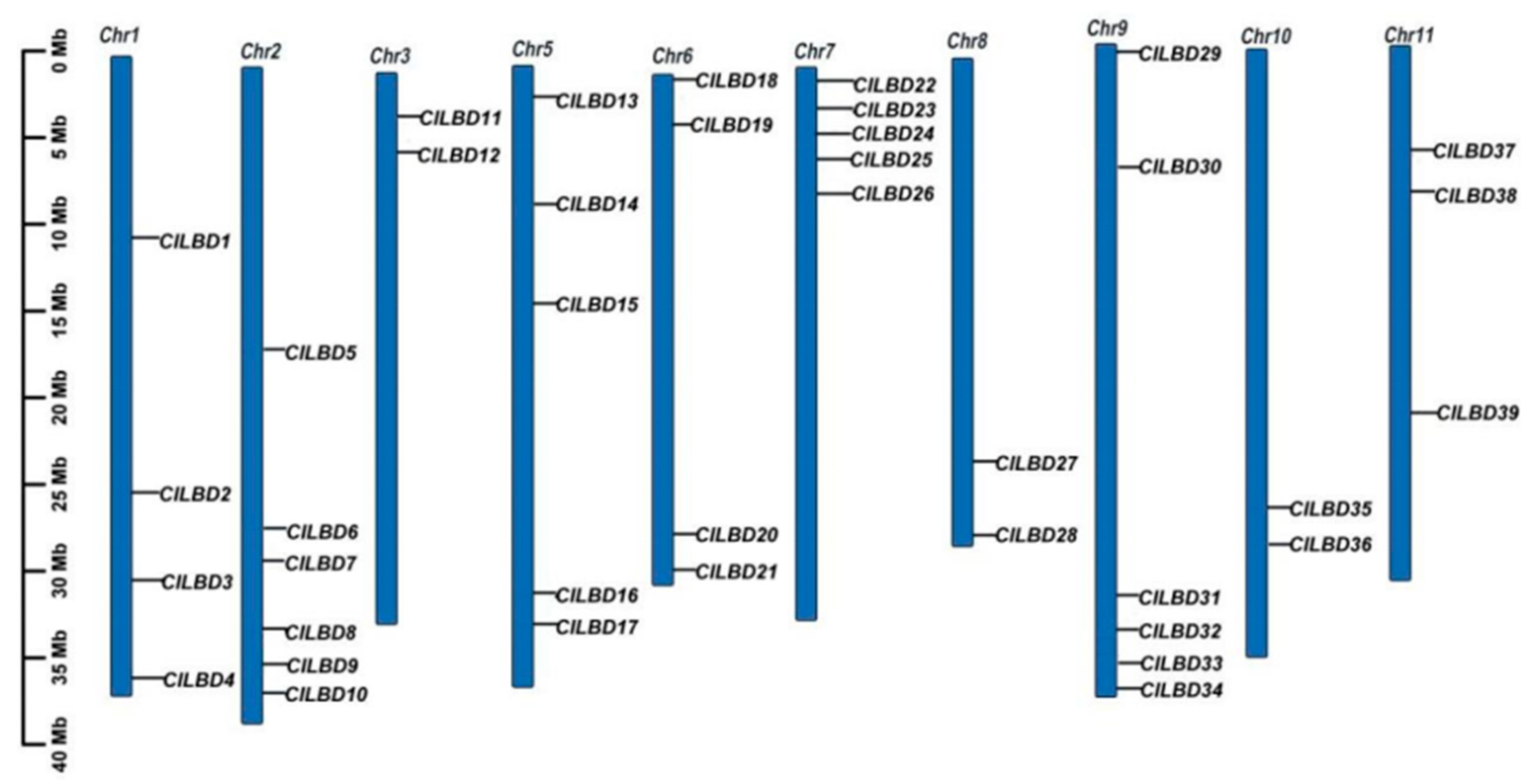
A total of thirty-nine non-redundant LBD gene family members were identified in watermelon based on LBD family domains. They were named ClLBD1-ClLBD39 according to their positions on chromosomes (Table 1, Figure 1). The coding sequence (CDS) lengths of ClLBD genes varied significantly, ranging from 399 bp (ClLBD27) to 2853 bp (ClLBD13), corresponding to proteins of 132~950 amino acids. The molecular weights (MW) of deduced proteins ranged from 14.8 kDa (ClLBD27) to 107.8 kDa (ClLBD13), and their isoelectric points (pI) ranged from 4.58 (ClLBD24) to 9.54 (ClLBD5), indicating diverse physicochemical properties. Most proteins were predicted to localize to the nucleus, consistent with the typical role of LBD transcription factors in regulating gene expression [3]. Gene structure analysis revealed substantial variation in exon–intron organization. For instance, ClLBD4 and ClLBD28 exhibited compact structures (483 bp and 567 bp CDS, respectively), whereas ClLBD5 and ClLBD33 possessed extended sequences (1992 bp and 2235 bp CDS, respectively), possibly reflecting functional diversification. The data provides a foundation for further studies on the roles of ClLBD genes in watermelon growth, development, and stress responses.
Chromosomal localization analysis revealed that the 39 ClLBD genes were unevenly distributed across 10 of the 11 watermelon chromosomes (Figure 1), with chromosome 4 harboring no ClLBD genes. Notably, chromosomes 2 and 9 contained the highest number of genes, each carrying six ClLBD members. This was followed by chromosomes 5 and 7, each with five genes; chromosomes 1 and 6, each with four genes; and chromosome 11, which contained three genes. In contrast, chromosomes 3, 8, and 10 had the lowest representation, each containing only two ClLBD genes. The divergent distribution of ClLBD genes is likely linked to gene duplication, reflecting the concerted outcome of evolution, gene function, and genomic structure.

3.2. Analysis of Gene Structure, Motif Composition, and Cis-Acting Elements

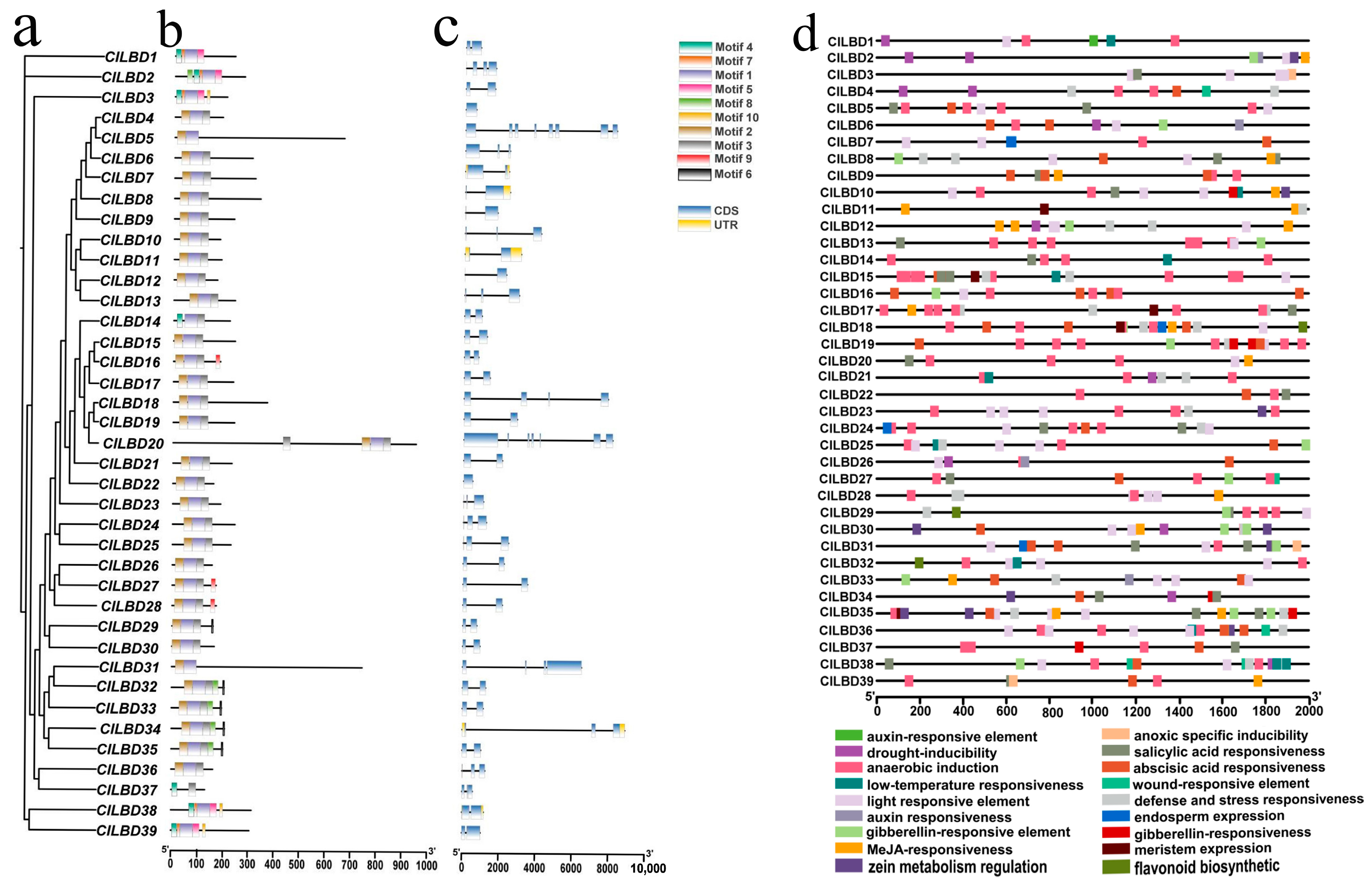
To gain deeper insights into the gene structure of watermelon LBD genes, we constructed a phylogenetic tree (Figure 2a,b) of the ClLBD family. Using MEME software (Version 5.5.5), ten conserved motifs (designated as motifs 1 to 10) within the watermelon LBD family were predicted. The results revealed that the motif composition patterns of LBD genes are closely associated with their sequence homology; higher homology corresponds to greater similarity in motif organization. Specifically, 77% (30/39) of the family members contain motif 3. Among these, 10% of the members also possess motifs 6 and 8. Furthermore, 13% (5/39) of the members contain motifs 1, 4, 5, and 7. Notably, ClLBD5 and ClLBD31 lack motif 3, whereas ClLBD14 lacks motif 2. Additionally, ClLBD14 lacks motifs 1 and 2.
Analysis of the exon–intron structure showed that ClLBD genes contain 0–2 UTRs (untranslated regions). The vast majority of ClLBD genes comprise both exons and introns. Among them, 58% of ClLBD genes contain two exons, and 89% possess one to three introns. ClLBD28 is the only gene without introns, whereas ClLBD5 contains the most introns, totaling seven. Moreover, the variation in intron length among these genes is positively correlated with their genomic length.
To investigate the potential regulatory mechanisms of the ClLBD genes, we performed a systematic analysis of cis-acting elements in the promoters of all members. The 2000 bp upstream sequence from each gene’s start codon was extracted and analyzed using the PlantCARE database. A total of 18 types of cis-acting elements were predicted across all promoter regions (Figure 2d). These elements were primarily categorized into the following classes: light-responsive, hormone-responsive, stress-responsive, and defense-related elements. Notably, 85% (33/39) of the promoters contained elements associated with anaerobic induction, suggesting that the ClLBD gene family may specifically respond to hypoxic signals. Additionally, 28% (11/39) of the genes contained 12 low-temperature stress-responsive elements, and 26% (10/39) possessed 12 drought stress-responsive elements. Only one gene carried an auxin-responsive element, whereas 51% (20/39) of the members contained abscisic acid (ABA)-responsive elements, and 41% (16/39) harbored cis-acting regulatory elements involved in methyl jasmonate (MeJA) responsiveness. These results indicate that the expression of ClLBD genes is likely subject to complex regulation by multiple internal and external signals, particularly by ABA and MeJA, with limited regulation by auxin. Furthermore, approximately 26% of family members may be associated with responses to low-temperature and drought stresses.

3.3. Evolutionary Analysis of the ClLBD Family

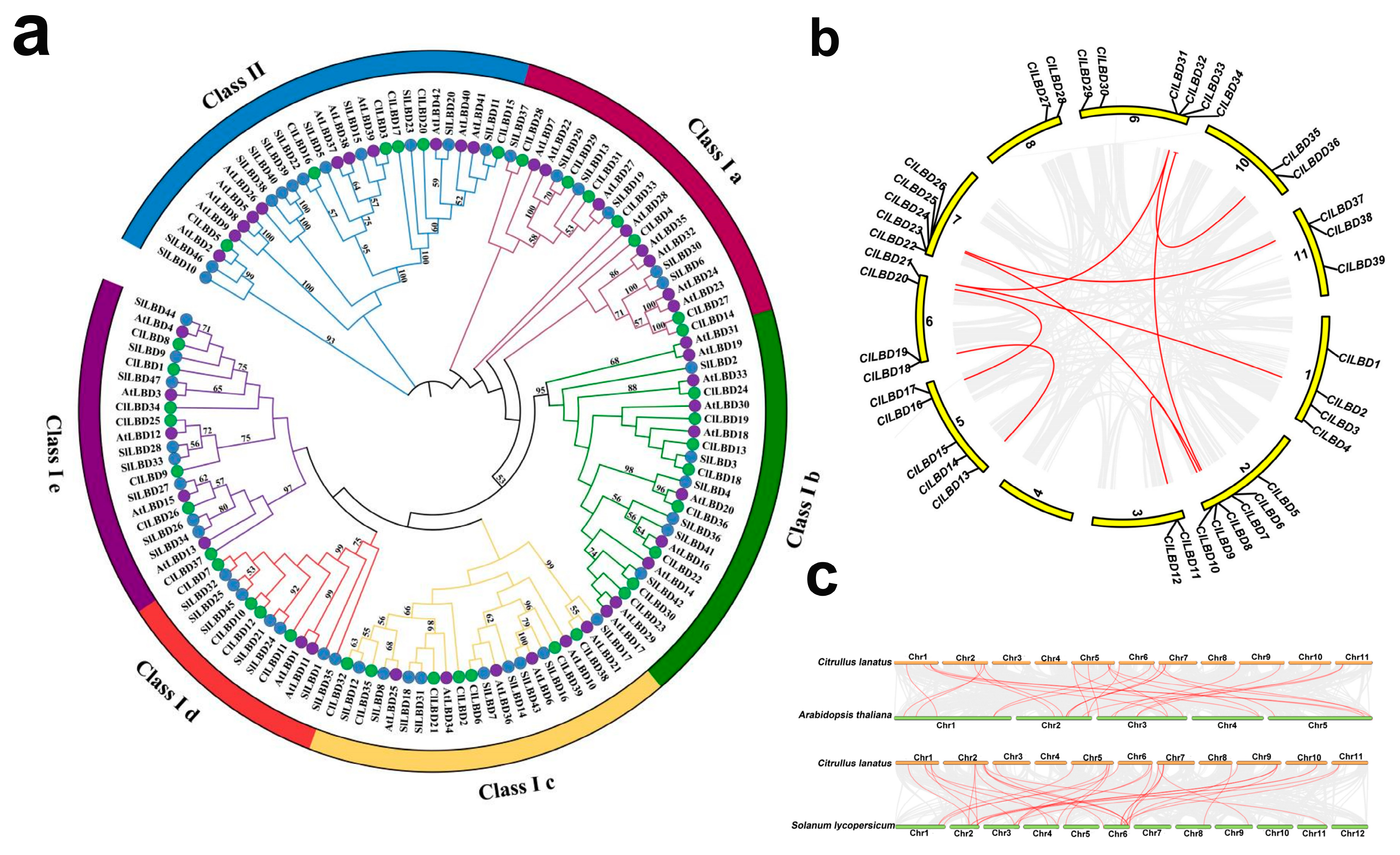
To elucidate the evolutionary relationships of LBD genes, a phylogenetic tree was constructed using protein sequences from three species: 39 from watermelon (ClLBD), 42 from Arabidopsis (AtLBD), and 47 from tomato (SlLBD) (Figure 3a). Based on established LBD family classification criteria, the phylogenetic topology resolved all members into six distinct subfamilies (class Ia~class Ie, class II), revealing conserved evolutionary patterns across species. Class I: All members except ClLBD24 and ClLBD27 retained the canonical motif1, motif2, and motif3 domains, consistent with their roles in auxin signaling and lateral organ development. Class II: Members universally lacked motif2 and motif3 but uniquely acquired motif4 and motif5, suggesting functional specialization. Notably, ClLBD5 diverged from other Class II members by lacking motif 1, suggesting potential neofunctionalization. Comparative phylogenetic analysis demonstrated high conservation of LBD gene family evolution in plants, as evidenced by the clustering of orthologs from watermelon, Arabidopsis, and tomato within the same subfamilies. The preservation of domain architectures across orthologous groups further underscores strong purifying selection acting on core functional motifs during plant evolution. This strong purifying selection correlates with a key period in LBD gene evolution—the Late Ordovician to Early Silurian (approximately 455–430 million years ago), when plants transitioned from aquatic charophytes to terrestrial habitats. Major environmental changes during this interval included global sea-level fall, which expanded aquatic–terrestrial transition zones; formation of the atmospheric ozone layer, which reduced UV radiation damage; and emergence of terrestrial stresses such as seasonal drought and soil nutrient deficiency [4]. These factors imposed strong directional selection on LBD genes, contributing to the observed purifying selection on their core functional motifs. These findings provide critical insights into the evolutionary constraints and functional diversification of LBD genes in shaping plant-specific developmental processes.
To elucidate the evolutionary history of the ClLBD gene family, intraspecific synteny analysis was performed. A total of nine syntenic gene pairs were identified, with the following relationships: ClLBD21 exhibited synteny with ClLBD2 and ClLBD32; ClLBD32 additionally showed synteny with ClLBD18. Syntenic pairs were also observed between ClLBD10 and ClLBD11, ClLBD9 and ClLBD25, ClLBD8 and ClLBD34, ClLBD17 and ClLBD20, ClLBD26 and ClLBD37, and ClLBD13 and ClLBD35. Notably, chromosomes 2, 6, and 9 harbored a higher density of syntenic ClLBD genes, indicating multiple gene duplication events that contributed to the expansion of this gene family. To investigate the conservation and diversification patterns of LBD genes during evolution, whole genome synteny comparisons were conducted among watermelon, Arabidopsis thaliana, and tomato (Solanum lycopersicum) to identify conserved core orthologs and infer genomic regions driving adaptive evolution. In total, 28 syntenic gene pairs were identified between watermelon and Arabidopsis, spanning eight watermelon chromosomes and five Arabidopsis thaliana chromosomes. Further, 37 syntenic gene pairs were identified between watermelon and tomato, distributed across eight watermelon and nine tomato chromosomes. Notably, this prevalence of inter-species duplication events coincides with the Late Ordovician to Early Silurian period—a time marked by global climate cooling, large-scale marine regression, rising atmospheric oxygen levels, and the formation of early soils [4]. These past environmental condition changes likely exerted strong selective pressures, driving the expansion and diversification of LBD genes and shaping their dynamic evolutionary trajectory.

3.4. Expression Profiles of ClLBDs

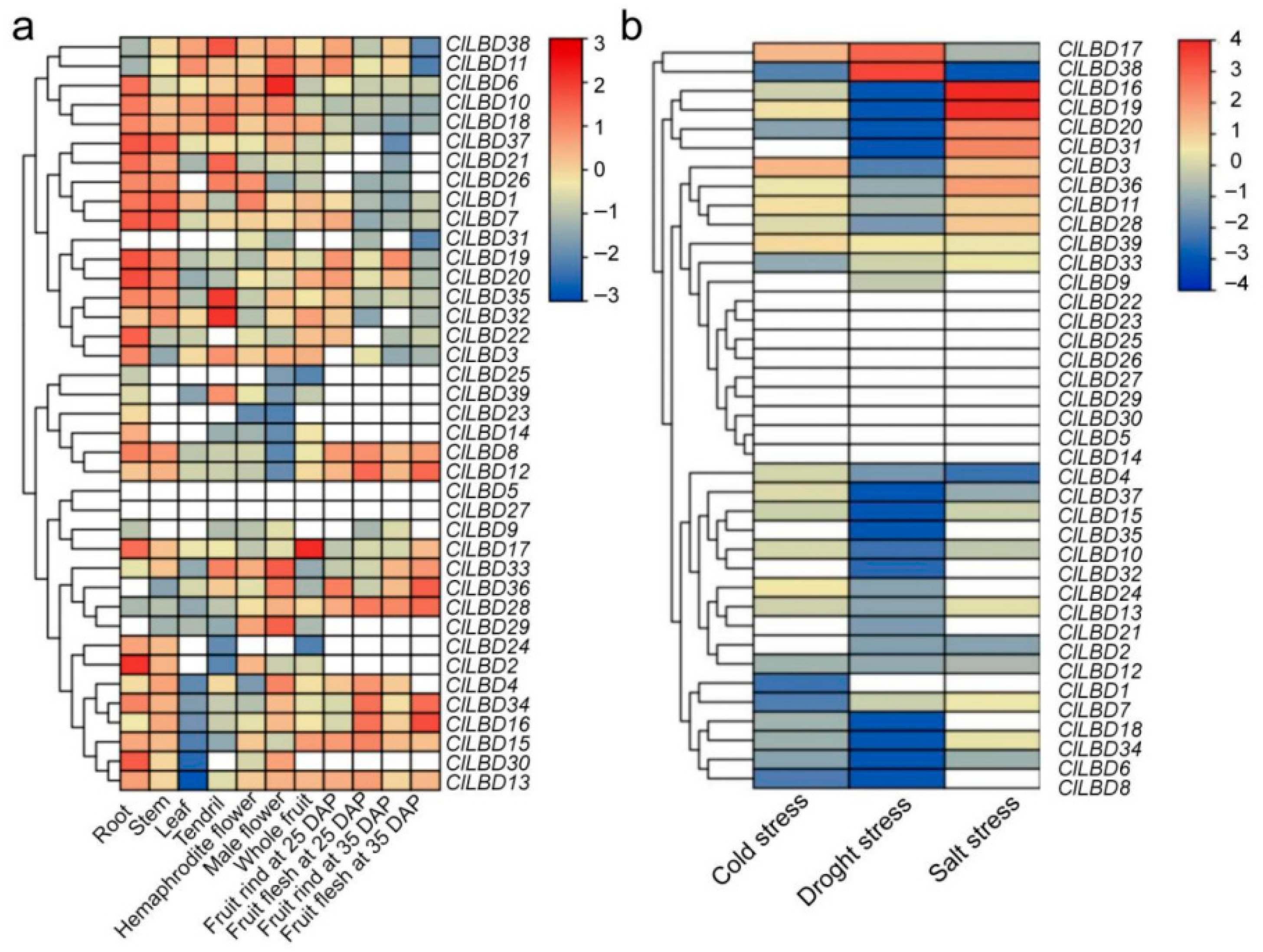
To further elucidate the potential biological roles of ClLBDs, their expression profiles in different tissues and under cold, drought and salt stress were sought in the CuGenDB (Figure 4). Among the 39 ClLBDs, 19 members were expressed in all 11 tested tissues (Figure 4a), indicating their probable function in the development of various organs of watermelon. Furthermore, for some genes, their absence expression levels in certain tissues may be due to sequencing technology or may not be expressed at all. For example, the expression of ClLBD5 and ClLBD27 was not detected in any of the tested tissues, suggesting that these two genes may participate in the development of a specific organ at a specific developmental stage. ClLBD31, ClLBD25, ClLBD23, ClLBD14, ClLBD24, and ClLBD30 showed expression in only 3~5 samples, indicating their potential roles in the corresponding tissues. Most notably, more than half of these 39 ClLBDs showed higher expression in the root, indicating the significance of LBD members in root development. In particular, ClLBD2 exhibited pronounced root-specific expression patterns, with transcript abundance in root tissues significantly higher than that in all other tested organs. The expression profiles of these genes suggest they may play roles in root development.
Transcriptional profiling of watermelon LBD family genes under three abiotic stresses (cold, drought, and salt treatments in leaf tissues) revealed distinct stress-responsive expression patterns (Figure 4b). ClLBD5, ClLBD14, ClLBD22, ClLBD23, ClLBD25, ClLBD26, ClLBD27, ClLBD29, and ClLBD30 were not analyzed due to their non-expression or lower expression in leaves. Most ClLBDs were down-regulated, while ClLBD17 and ClLBD38 were up-regulated under drought stress. However, ClLBD38 exhibited opposing regulatory trends, with significant up-regulation under drought stress and pronounced down-regulation under salt stress. Notably, ClLBD16 and ClLBD19 showed pronounced down-regulation under drought stress, in contrast to their strong up-regulation under salt stress. Similarly, ClLBD20 and ClLBD31 showed marked drought-induced down-regulation coupled with salt-responsive up-regulation. These findings highlight differential environmental responsiveness among specific LBD family members, with some genes demonstrating stress-type-specific regulatory dynamics.

3.5. Structural Characterization Analysis and Subcellular Localization of ClLBD2

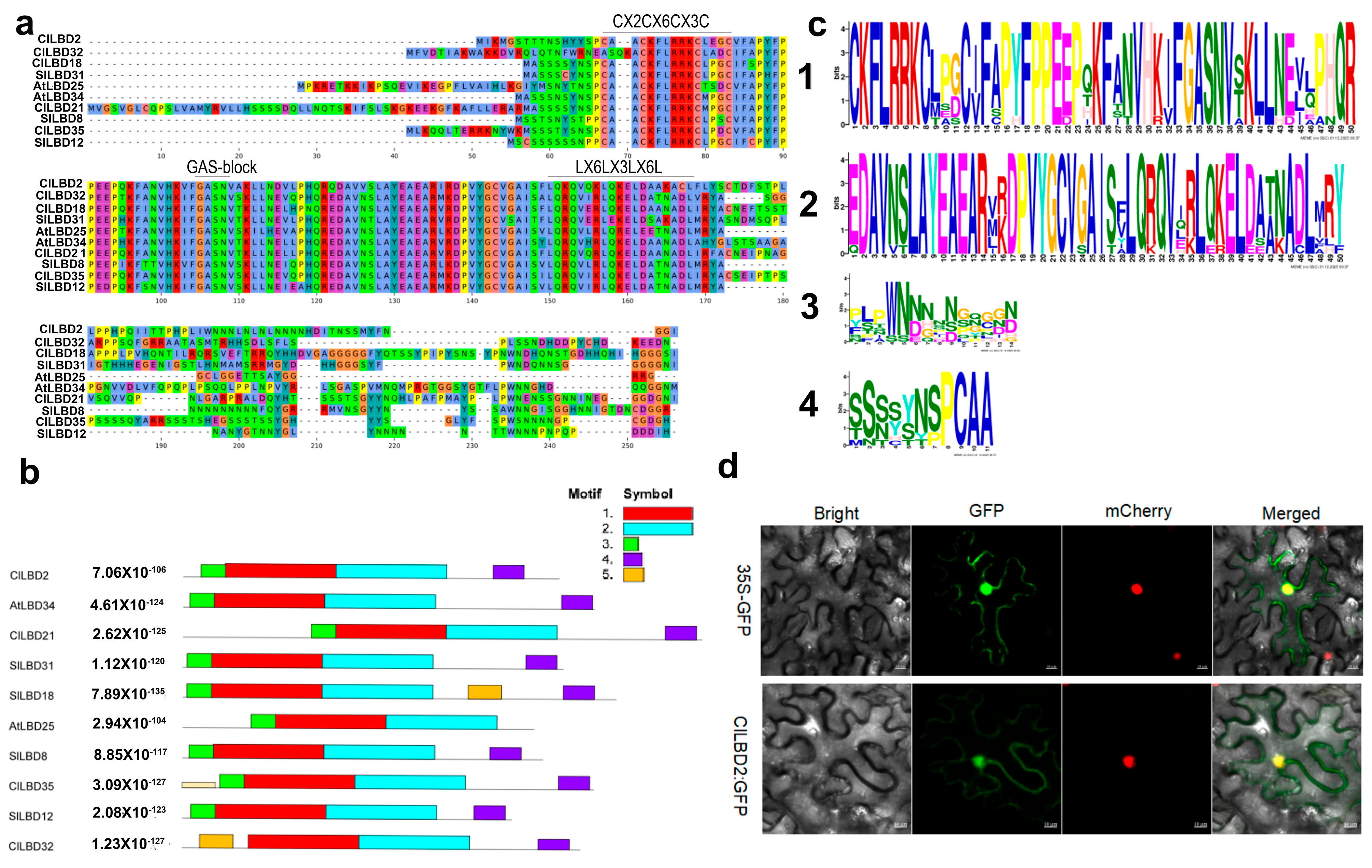
The relative expression level of the ClLBD2 gene in root tissues is significantly higher than in other tissues. Given that its homolog in the same subfamily, AtLBD25, is known to regulate root development [39], we hypothesize that ClLBD2 may also play a role in this process. Therefore, we focused our primary research on ClLBD2. To further investigate the potential character of ClLBD2, we first performed a multiple sequence alignment with its closest Class Ic homologs in watermelon, tomato, and Arabidopsis within the same phylogenetic clade (Figure 3a and Figure 5a). The analyses confirmed that ClLBD2 contains the characteristic conserved GAS-block of the LBD family (Figure 6a), with the consensus sequence CX2CX6CX3C (Figure 5c). Notably, ClLBD2 and its clade members uniquely possess three additional conserved motifs, designated motif 2, motif 3, and motif 4 (Figure 5b,c). These clade-specific motifs may confer distinct functional properties, distinguishing ClLBD2 from other LBD family members.
To determine whether ClLBD2 is also localized in the nucleus, complying with the characteristics of transcription factors, the subcellular localization of ClLBD2 was investigated by Agrobacterium tumefaciens-mediated transformation in Nicotiana benthamiana leaves. As expected, the 35S:GFP control was uniformly distributed throughout the entire cell. Interestingly, in ClLBD2:GFP leaves, GFP signals were observed not only in the cell nucleus but also continuously and smoothly around the cells (Figure 5d), indicating a potential dual localization in both the nucleus and the cytomembrane.

3.6. Phenotypic Analysis of Gene-Edited Roots of ClLBD2

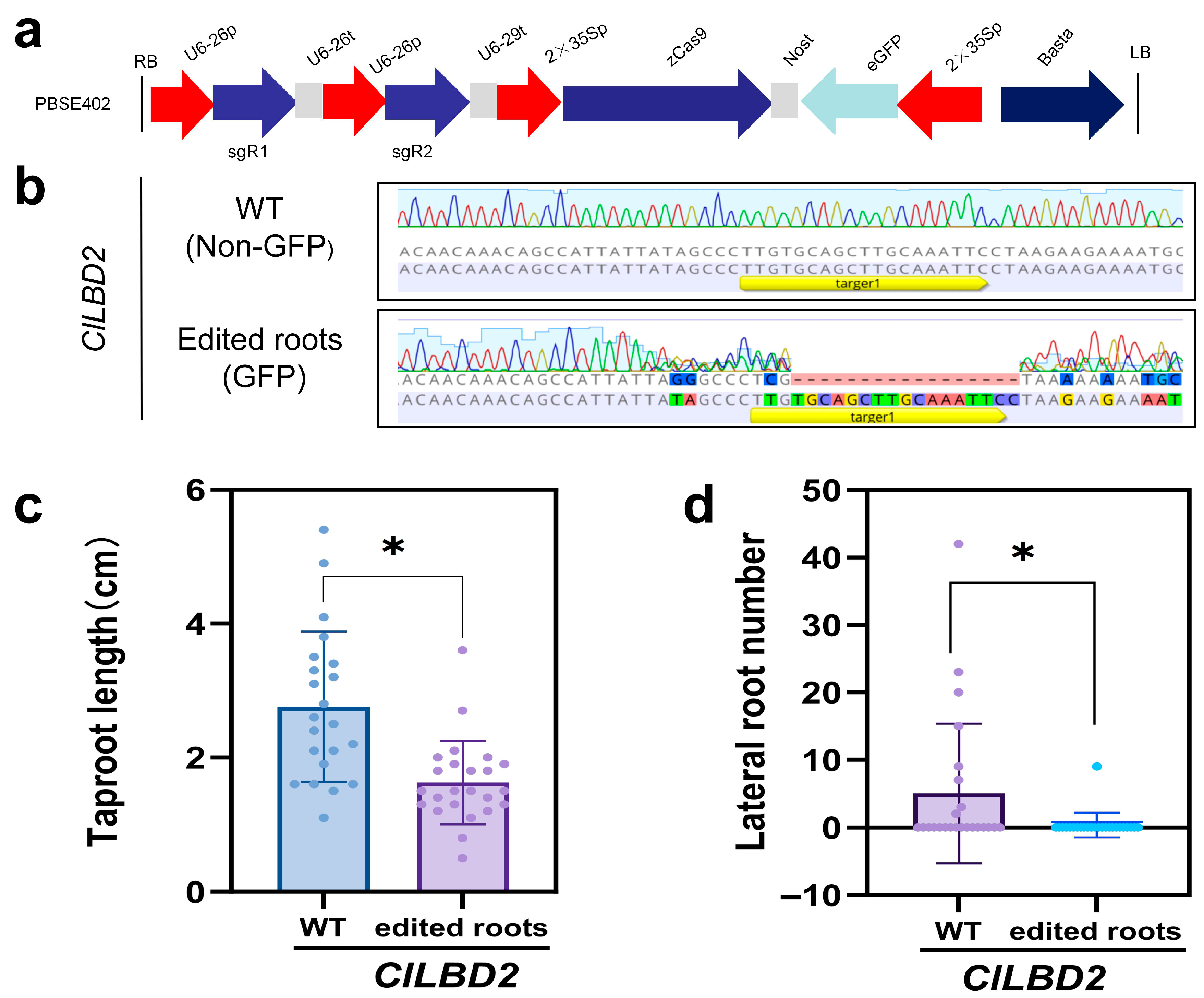
Based on the predominant root expression of ClLBD2 and the root developmental function of its homolog AtLBD25, we reasoned that ClLBD2 was a strong candidate for in-depth functional analysis. CRISPR-Cas9 vectors (PBSE402 containing 35S:GFP; Figure 6a) targeting ClLBD2 were constructed, and genetic transformation was performed using Agrobacterium rhizogenes strain K599. Transformed roots expressing GFP fluorescence were selected to sequence (target 2 did not work because of the SNP in its sequence). Roots with irregular peaks at the target location are regarded as putative edited strains for phenotypic analysis (Figure 6b). Results revealed that partial knockout of ClLBD2 resulted in a statistically significant difference in taproot length and lateral root number between edited lines (GFP-labeled) and WT (non-GFP) roots (Figure 6c,d). Notably, lateral roots were observed only in one sample among all GFP-labeled roots (1/21) for ClLBD2, while they were observed in 7/21 of the corresponding non-GFP roots. Collectively, these results suggest that ClLBD2 may play a key role in regulating root architecture.
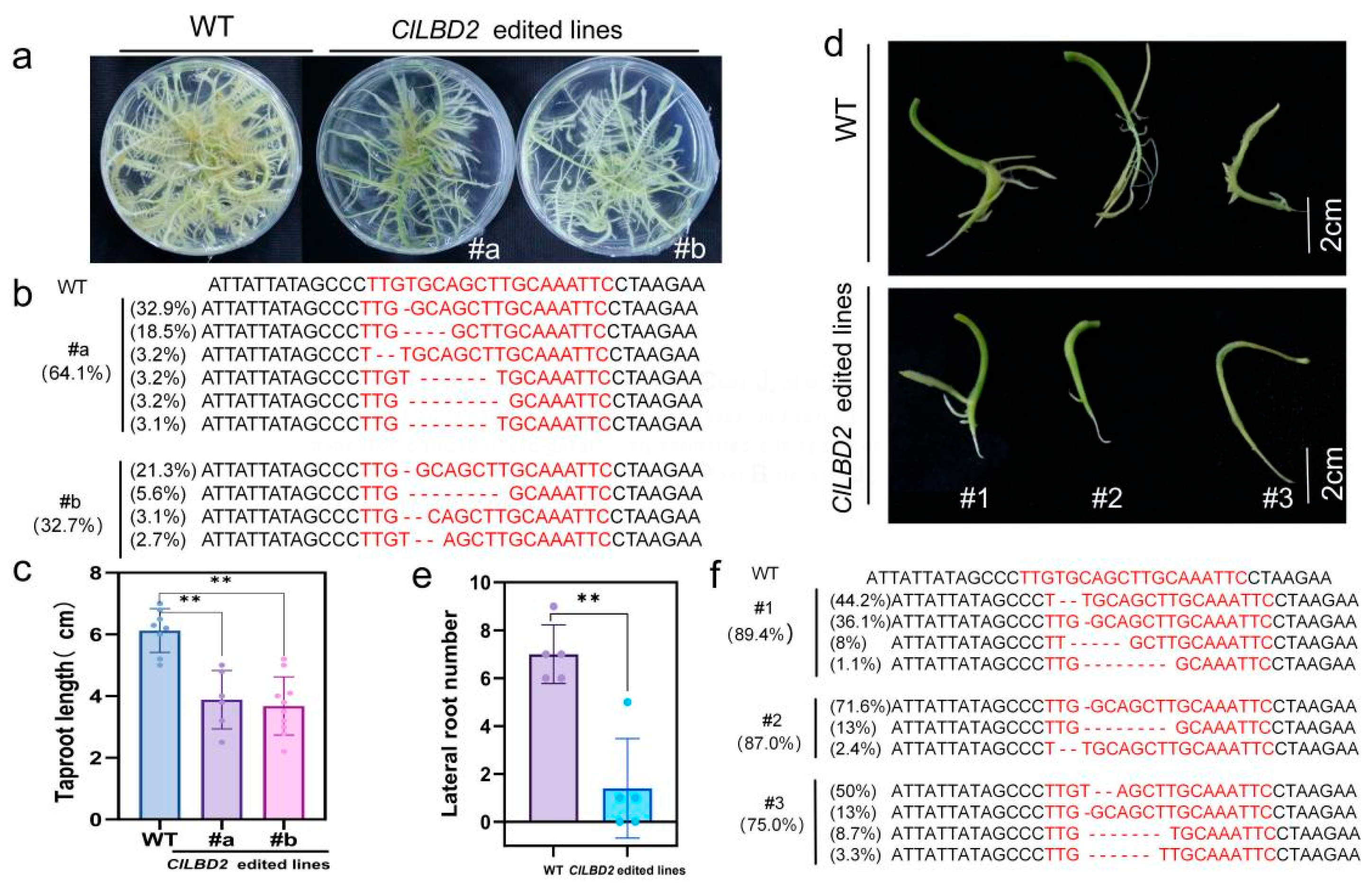
To further investigate the function of ClLBD2 in taproot and lateral root development, we conducted a detailed phenotypic comparison between a culture dish of roots that showed virtually no fluorescence (WT) and those that exhibited widespread fluorescence (considered partial-edited roots after sequencing). Visual observation revealed that the root systems of WT plants occupied a larger area on the culture plates compared to those of the ClLBD2 edited lines (Figure 7a). To confirm the genetic editing form of ClLBD2, DNA extracted from mixed GFP-roots was analyzed using Fast NGS technology (Figure 7b). Line#a was heterozygous with six mutations (64.1%), −1 (32.9%), −4 (18.5%) and others (12.7%). Line#b was heterozygous with four mutations (32.7%), −1 (21.3%), −8 (5.6%), and others (5.8%). Subsequent quantitative analysis showed that the taproot lengths of ClLBD2-edited lines#a and #b were significantly reduced compared to the WT type (Figure 7c). The proportion of taproot with lateral root in #a (3/6) and #b (2/10) was significantly lower than that in WT root (12/14) (Figure 7c).
To further explore whether ClLBD2 played a role in lateral root formation, individual taproots were transferred to culture bottles and cultured for 21 days. The root system is quite strong, and the lateral roots develop relatively late. Data analysis revealed that the number of lateral roots in the edited lines #1, #2, and #3 (0–3) was significantly lower than the WT type (5–8) (Figure 7d,e). Moreover, #1, #2 and #3 taproot displayed 89.4%, 87.0% and 75.0% mutation rates with 3~4 mutation types (Figure 7f). Collectively, these findings support the conclusion that ClLBD2 plays a key role in promoting the formation of lateral roots.

4. Discussion

Lateral Organ Boundaries Domain (LBD) proteins constitute a plant-specific transcription factor family that plays pivotal regulatory roles throughout the plant life cycle [40]. In crops, the function of LBD genes extends far beyond organogenesis; they play key roles in the initiation and development of critical organs including roots, stems, leaves, and flowers [41]. Watermelon is an important economic crop belonging to the Cucurbitaceae family. The production of watermelon is strongly closely related to its root development, especially the length of the taproot and the distribution of its lateral roots. In this study, 39 members of the LBD family were systematically identified and analyzed in watermelon. The key role of ClLBD2 in regulating root architecture was confirmed for the first time, providing insights for the in-depth investigation of LBD genes in plants.
The LBD gene family shows variation in the number of members across different plant genomes. For instance, 43, 56, and 89 LBD members have been identified in Arabidopsis, tomato, and soybean, respectively. In this study, we identified 39 LBDs family members in watermelon. This variation in family size might be typically associated with species-specific whole-genome duplication (WGD) events and subsequent functional divergence [3]. Despite differences in numbers, the protein structures of LBD members are highly conserved. All LBD proteins contain a characteristic LOB domain at the N-terminus, which consists of three modules: a C-block (CX2CX6CX3C) for DNA binding, a GAS-block (Gly-Ala-Ser), and an L-block (LX6LX3LX6L) responsible for protein dimerization [5]. Based on the integrity of the L-block, LBD proteins are constitutively divided into two major classes: Class I and Class II, which form the structural basis for their functional differentiation [41]. Cis-acting element analysis of the promoter regions of most genes provides crucial insights into their regulatory functions in plants [42]. In this study, an analysis of the 2.0 kb upstream promoter sequences of ClLBDs revealed a significant enrichment of elements responsive to light, a variety of plant hormones (such as salicylic acid, methyl jasmonate, abscisic acid, auxin, and gibberellin), as well as both biotic and abiotic stresses. This regulatory profile is notably consistent with the types of cis-acting elements identified in the LBD families of close horticultural plants, such as Glycine max, and other economical plants, such as apple [43,44]. At the molecular level, the presence of these diverse regulatory motifs provides a reference for the capacity of LBD genes to integrate multiple internal and external signals [45]. This integration supposes their participation in a wide array of biological processes, ranging from lateral root formation and leaf development to callus induction, stress response, and disease susceptibility [46].
From an evolutionary perspective, the LBD gene family is considered plant-specific, playing key roles in its functional diversification and adaptation [47]. Regarding the expansion and conservation of the LBD genes, our comparative analysis reveals distinct evolutionary patterns at both intra- and inter-species levels. Within species, the expansion of the watermelon LBD genes is analogous to that observed in its close relative, Cucumis melo, where family growth primarily occurs through local duplication events, such as tandem repeats, rather than WGD events [43]. This mode of expansion facilitates functional diversification among paralogous members. In contrast, among species, extensive syntenic blocks containing orthologous LBD genes were identified between watermelon and model plants such as Arabidopsis thaliana and Solanum lycopersicum. This conserved microsynteny strongly indicates the core genomic organization and biological functions of the LBD family, implying their essential and conserved roles in plant development [48].
As is known, the roles of LBDs have expanded far beyond their initial role in lateral organ development to encompass the regulation of plant regeneration, secondary growth, and responses to environmental stresses, forming a sophisticated molecular regulatory network in plants [49]. Initially, LBD genes are key regulators of lateral organ boundary formation and morphogenesis. Recent studies highlight key LBD members governing distinct processes. In development, LsLBD9 regulates leaf polarity [50], and PheLBD12 controls stature via GA metabolism [51]. In stress adaptation, PtrLBD41 activates flavonoid pathways for salt tolerance [52]. Meanwhile, CsLBD17 is implicated in cellular reprogramming during callus induction [53]. Another study confirmed that LBD16, LBD17, LBD18, and LBD29 transcription factors, through forming a complex with AtbZIP59, constitute a core regulatory module for auxin-induced callus formation [54]. In leaf development, Arabidopsis AtAS2/AtLBD6 promotes symmetrical, flat leaf-layer development, and its overexpression leads to adaxially curled leaves [55]. Studies have demonstrated no significant difference in root water absorption capacity between cutting-derived plantlets and seed-grown seedlings [56]. During the root regeneration process, genes such as AtLBD16, AtLBD18, and AtLBD29 are well-established key downstream regulators of lateral root formation [19]. In Malus domestica, MdLBD16a has been shown to positively regulate adventitious root regeneration and callus growth [57].
Recently, studies have proved that LBD genes also play essential roles in stress responses. For example, the citrus CsLOB1 is associated with susceptibility to citrus canker [58]; the Arabidopsis AtLBD20 participates in susceptibility to Fusarium wilt via the jasmonic acid signaling pathway [46]; and the banana MaLBD5 may interact with the jasmonate signaling repressor MaJAZ1, functioning in methyl jasmonate-induced cold resistance in fruit [27]. Overall, through their conserved domains, the LBD family integrates signals from hormones such as auxin and jasmonic acid, forming a multifunctional regulatory network that precisely coordinates organogenesis, regeneration, repair, and environmental adaptation in plants [54].
To elucidate the important role of the ClLBD2 gene in root architecture formation, this study was conducted. In this study, ClLBD2 exhibited a potential dual localization in both the nucleus and the plasma membrane (Figure 5d). Similar observations have been reported for other plant transcription factors under overexpression conditions, such as GmMYB183 in soybean [59]. It has been suggested that the membrane localization observed in transient overexpression systems may result from protein saturation exceeding the nuclear import capacity, leading to retention in membrane compartments [60]. Agrobacterium rhizogenes-mediated transient transformation showed that a partial knockdown of ClLBD2 significantly decreased taproot length and the number of lateral roots (Figure 5b). Analysis of the ClLBD2 promoter sequence revealed significant enrichment of cis-acting elements responsive to multiple phytohormones (such as auxin, jasmonate, abscisic acid, and salicylic acid) as well as light and various stresses, suggesting that ClLBD2 may function as a signaling integrator, coordinating root developmental programs with adaptive stress responses. Furthermore, ClLBD2 encodes a typical Class Ic LBD protein (Figure 3a and Figure 6a), and its closest Class Ic homologs in watermelon, tomato, and Arabidopsis were analyzed. Among these members, AtLBD25 has been shown to be involved in auxin signaling and photomorphogenesis. Mutants of AtLBD25 exhibit distinct reduced lateral root formation, moderate resistance to exogenous auxin, and impaired hypocotyl elongation under dark conditions [38]. To our knowledge, ClLBD2 is the first gene cloned from watermelon to play key roles in root development. However, the underlying mechanism by which ClLBD2 regulates root development remains to be further investigated.

5. Conclusions

This study conducted a systematic analysis of the LBD gene family in watermelon. A total of 39 ClLBD genes were identified. Phylogenetic analysis divided these genes into two main classes: Class I and Class II. Class I was further divided into five subclasses (Ia, Ib, Ic, Id, and Ie). Members within the same subclass showed conserved gene structures, supporting the classification. Analysis of the promoter regions identified many cis-acting elements associated with auxin, abscisic acid, and drought stress signaling. Expression profiling showed that ClLBD2 was mainly expressed in root tissues. Since its subfamily contains AtLBD25, a gene known to affect root development, we hypothesized that ClLBD2 might also influence root development. Functional tests in roots using Agrobacterium-mediated transformation confirmed that knocking out ClLBD2 significantly reduced the length of the taproot and the number of lateral roots. Therefore, we conclude that ClLBD2 regulates root growth. The specific mechanisms behind this effect require further research. This study improves our understanding of the characterization of the LBD gene family in watermelon and provides useful candidate genes for future molecular breeding programs aimed at improving root structure and stress tolerance in this crop.

Supplementary Materials

The following supporting information can be downloaded at: https://www.mdpi.com/article/10.3390/horticulturae12030387/s1, Table S1: Primers used in this study.

Author Contributions

R.Z. and Q.S. provided research ideas and revised the manuscript; K.W., J.L. and M.Y. performed data analysis, visualization, and manuscript writing; X.W. and W.G. performed the analysis of RNA-seq data. N.G. conducted phenotypic observations; G.Z. and A.A. contributed to partial manuscript writing; D.Z. was responsible for the bioinformatics analysis, genetic transformation, subsequent data processing, and manuscript writing. All authors have read and agreed to the published version of the manuscript.

Funding

This research was funded by the China Postdoctoral Science Foundation (2024M751873), the National Natural Science Foundation of China (32202495), the Natural Science Foundation of Shandong Province (ZR2022QC002), and the Key Research and Development Program of Shandong Province (2024LZGCQY016).

Data Availability Statement

The original contributions presented in this study are included in the article/Supplementary Material. Further inquiries can be directed to the corresponding author.

Conflicts of Interest

The authors declare that they have no known competing financial interest or personal relationships that could have appeared to influence the work reported in this paper.

References

  1. Liang, J.; Hou, Z.; Liao, J.; Qin, Y.; Wang, L.; Wang, X.; Su, W.; Cai, Z.; Fang, Y.; Aslam, M.; et al. Genome-Wide Identification and Expression Analysis of LBD Transcription Factor Genes in Passion Fruit (Passiflora edulis). Int. J. Mol. Sci. 2022, 23, 4700. [Google Scholar] [CrossRef] [PubMed]
  2. Kong, Y.; Xu, P.; Jing, X.; Chen, L.; Li, L.; Li, X. Decipher the ancestry of the plant-specific LBD gene family. BMC Genom. 2017, 18, 951. [Google Scholar] [CrossRef] [PubMed]
  3. Majer, C.; Hochholdinger, F. Defining the boundaries: Structure and function of LOB domain proteins. Trends Plant Sci. 2011, 16, 47–52. [Google Scholar] [CrossRef] [PubMed]
  4. Chanderbali, A.S.; He, F.; Soltis, P.S.; Soltis, D.E. Out of the Water: Origin and Diversification of the LBD Gene Family. Mol. Biol. Evol. 2015, 32, 1996–2000. [Google Scholar] [CrossRef]
  5. Shuai, B.; Reynaga-Peña, C.G.; Springer, P.S. The lateral organ boundaries gene defines a novel, plant-specific gene family. Plant Physiol. 2002, 129, 747–761. [Google Scholar] [CrossRef]
  6. Matsumura, Y.; Iwakawa, H.; Machida, Y.; Machida, C. Characterization of genes in the ASYMMETRIC LEAVES2/LATERAL ORGAN BOUNDARIES (AS2/LOB) family in Arabidopsis thaliana, and functional and molecular comparisons between AS2 and other family members. Plant J. 2009, 58, 525–537. [Google Scholar] [CrossRef]
  7. Yang, Y.; Yu, X.; Wu, P. Comparison and evolution analysis of two rice subspecies LATERAL ORGAN BOUNDARIES domain gene family and their evolutionary characterization from Arabidopsis. Mol. Phylogenet. Evol. 2006, 39, 248–262. [Google Scholar] [CrossRef]
  8. Wang, S.; Wang, Y.; Zhong, J.; Xu, W.; Gong, Q.; Zhai, L.; Li, G.; Huang, J. Genome-Wide Analysis of the Maize LBD Gene Family Reveals a Role for ZmLBD12 in the Development of Lateral Roots. Plants 2025, 14, 2600. [Google Scholar] [CrossRef]
  9. Zhao, D.; Chen, P.; Chen, Z.; Zhang, L.; Wang, Y.; Xu, L. Genome-wide analysis of the LBD family in rice: Gene functions, structure and evolution. Comput. Biol. Med. 2022, 153, 106452. [Google Scholar] [CrossRef]
  10. Derelli Tufekci, E. Genome-wide identification and analysis of Lateral Organ Boundaries Domain (LBD) transcription factor gene family in melon (Cucumis melo L.). PeerJ 2023, 11, e16020. [Google Scholar] [CrossRef]
  11. Shi, L.; Lin, X.; Tang, B.; Zhao, R.; Wang, Y.; Lin, Y.; Wu, L.; Zheng, C.; Zhu, H. Genome-Wide Analysis of the Lateral Organ Boundaries Domain (LBD) Gene Family in Sweet Potato (Ipomoea batatas). Genes 2024, 15, 237. [Google Scholar] [CrossRef]
  12. Dong, L.; Manghwar, H. Genome-wide expression analysis of LBD genes in tomato (Solanum lycopersicum L.) under different light conditions. Plant Signal Behav. 2023, 18, 2290414. [Google Scholar] [CrossRef] [PubMed]
  13. Yang, H.; Shi, G.; Du, H.; Wang, B.; Zhang, Z.; Hu, D.; Wang, J.; Huang, F.; Yu, D. Genome-wide analysis of soybean LATERAL ORGAN BOUNDARIES domain-containing genes: A functional investigation of GmLBD12. Plant Genome 2017, 10, 1–19. [Google Scholar] [CrossRef] [PubMed]
  14. Wang, M.; Guo, L.; Wang, H.; Wu, Y.; Zhao, S.; Song, W.; Li, J.; Wang, J. Genome-Wide Identification and Expression Pattern Analysis of CrLBD Family Reveal Their Involvement in Floral Development in Chionanthus retusus. Horticulturae 2025, 11, 1429. [Google Scholar] [CrossRef]
  15. Wang, Y.; Wang, P.; Di, P.; Wang, Y. Genome-wide analysis of LBD genes in the medicinal plant Panax ginseng reveals the roles and molecular mechanisms of PgLBD18 and PgLBD49 in regulating lateral root development. Ind. Crops Prod. 2025, 232, 121232. Available online: https://europepmc.org/article/AGR/IND609153723 (accessed on 29 August 2025). [CrossRef]
  16. Fan, M.; Xu, C.; Xu, K.; Hu, Y. Lateral organ boundaries domain transcription factors direct callus formation in Arabidopsis regeneration. Cell Res. 2012, 22, 1169–1180. [Google Scholar] [CrossRef]
  17. Zhu, Q.H.; Guo, A.Y.; Gao, G.; Zhong, Y.F.; Xu, M.; Huang, M.R.; Luo, J. DPTF: A database of poplar transcription factors. Bioinformatics 2007, 23, 1307–1308. [Google Scholar] [CrossRef]
  18. Chen, X.; Li, F.; Jia, J.; Tian, Y.; Li, X. HuLBD1 promotes flavonoid biosynthesis involved in senescence of Hylocereus undatus by negatively regulating HuCHS. Phyton-Int. J. Exp. Bot. 2025, 94, 825–842. [Google Scholar] [CrossRef]
  19. Okushima, Y.; Fukaki, H.; Onoda, M.; Theologis, A.; Tasaka, M. ARF7 and ARF19 regulate lateral root formation via direct activation of LBD/ASL genes in Arabidopsis. Plant Cell. 2007, 19, 118–130. [Google Scholar] [CrossRef]
  20. Sun, X.; Feng, Z.; Meng, L.; Zhu, J.; Geitmann, A. Arabidopsis ASL11/LBD15 is involved in shoot apical meristem development and regulates WUS expression. Planta 2013, 237, 1367–1378. [Google Scholar] [CrossRef]
  21. Zhang, J.; Tang, W.; Huang, Y.; Niu, X.; Zhao, Y.; Han, Y.; Liu, Y. Down-regulation of a LBD-like gene, OsIG1, leads to occurrence of unusual double ovules and developmental abnormalities of various floral organs and megagametophyte in rice. J. Exp. Bot. 2015, 66, 99–112. [Google Scholar] [CrossRef] [PubMed]
  22. Li, Q.; Su, T.B.; Yu, S.C.; Zhang, M.F.; Lu, G.; Wang, X.W. Primary study on LBD genes involving in callus formation and plant regeneration of Chinese cabbage. Acta Agric. Boreali Sin. 2015, 30, 83–89. [Google Scholar] [CrossRef]
  23. Li, X.; Yang, P.; Zhang, T.; Ren, Q.; Zhou, W. LBD gene family in Hippophae rhamnoides: Identification and expression pattern during flower bud development. Sheng Wu Gong Cheng Xue Bao 2025, 41, 753–770. [Google Scholar] [CrossRef] [PubMed]
  24. Deng, Y.; Sun, C.; Fu, X.; Guo, Y.; Zhu, Y.; Liu, C.; Xu, R.; Liu, H.; Li, Q.; Tang, N.; et al. Genome-wide identification and functional characterization of the LBD transcription factor gene family in Zanthoxylum armatum DC. reveal its potential role in leaf variation. BMC Plant Biol. 2025, 25, 717. [Google Scholar] [CrossRef]
  25. He, H.H.; Ma, Z.H.; Zhang, Y.X.; Zhang, J.; Lu, S.; Zhang, Z.; Zhao, X.; Wu, Y.; Mao, J. Identification and expression analysis of LBD gene family in grape. Sci. Agric. Sin. 2018, 51, 4102–4118. [Google Scholar] [CrossRef]
  26. Liu, H.; Cao, M.; Chen, X.; Ye, M.; Zhao, P.; Nan, Y.; Li, W.; Zhang, C.; Kong, L.; Kong, N.; et al. Genome-wide analysis of the lateral organ boundaries domain (LBD) gene family in Solanum tuberosum. Int. J. Mol. Sci. 2019, 20, 5360. [Google Scholar] [CrossRef]
  27. Ba, L.J.; Kuang, J.F.; Chen, J.Y.; Lu, W.J. MaJAZ1 Attenuates the MaLBD5-Mediated Transcriptional Activation of Jasmonate Biosynthesis Gene MaAOC2 in Regulating Cold Tolerance of Banana Fruit. J. Agric. Food Chem. 2016, 64, 738–745. [Google Scholar] [CrossRef]
  28. Ma, Y.; Zhong, M.; Li, J.; Jiang, Y.; Zhou, X.; Justice Ijeoma, C.; Tang, X.; Chen, S.; Cao, S. Genome Identification and Evolutionary Analysis of LBD Genes and Response to Environmental Factors in Phoebe bournei. Int. J. Mol. Sci. 2023, 24, 12581. [Google Scholar] [CrossRef]
  29. Wang, H.; Ru, Y.; Zhao, X.; Liu, F.; Yang, B.; Gao, R.; Song, J.; Wu, D.; Wang, M.; Sun, X.; et al. The LBD transcription factor TaLBD16 positively regulates drought tolerance in wheat. Plant Physiol. Biochem. 2025, 229, 110697. [Google Scholar] [CrossRef]
  30. Xiong, J.; Mi, X.; Du, L.; Wang, X. The LBD transcription factor ZmLBD33 Confers Drought Tolerance in Transgenic Arabidopsis. Plants 2025, 14, 1305. [Google Scholar] [CrossRef]
  31. Li, J.; Chen, J.; Hao, Y.; Li, Y.; Wang, Y.; Wang, L.; Lu, C.; Hu, L.; Yu, X. Thymol stimulates lateral root formation via regulating endogenous reactive oxygen species. Agronomy 2025, 15, 784. [Google Scholar] [CrossRef]
  32. Ait Hammou, R.; Harrouni, C.; Ben El Caid, M.; Hallouti, A.; Baroud, S.; Daoud, S. Establishment of argan tree plantlets (Argania spinosa (L.) Skeels) grown from generative and vegetative propagation under different watering regimes at the nursery stage. Biocatal. Agric. Biotechnol. 2022, 44, 102457. [Google Scholar] [CrossRef]
  33. Chen, C.; Chen, H.; Zhang, Y.; Thomas, H.R.; Frank, M.H.; He, Y.; Xia, R. TBtools: An Integrative Toolkit Developed for Interactive Analyses of Big Biological Data. Mol. Plant 2020, 13, 1194–1202. [Google Scholar] [CrossRef] [PubMed]
  34. Renner, S.S.; Wu, S.; Pérez-Escobar, O.A.; Silber, M.V.; Fei, Z.; Chomicki, G. A chromosome-level genome of a Kordofan melon illuminates the origin of domesticated watermelons. Proc. Natl. Acad. Sci. USA 2021, 118, e2101486118. [Google Scholar] [CrossRef]
  35. Li, C.; Zou, X.; Zhang, C.; Shao, Q.; Liu, J.; Liu, B.; Li, H.; Zhao, T. OsLBD3-7 Overexpression Induced Adaxially Rolled Leaves in Rice. PLoS ONE 2016, 11, e0156413. [Google Scholar] [CrossRef]
  36. Song, Q.; Joshi, M.; DiPiazza, J.; Joshi, V. Functional Relevance of Citrulline in the Vegetative Tissues of Watermelon During Abiotic Stresses. Front. Plant Sci. 2020, 11, 512. [Google Scholar] [CrossRef]
  37. Song, Q.; Joshi, M.; Joshi, V. Transcriptomic Analysis of Short-Term Salt Stress Response in Watermelon Seedlings. Int. J. Mol. Sci. 2020, 21, 6036. [Google Scholar] [CrossRef]
  38. Chen, C.; Zhang, K.; Liu, F.; Wang, X.; Yao, Y.; Niu, X.; He, Y.; Hong, J.; Liu, F.; Gao, Q.; et al. Resequencing of global Lotus corniculatus accessions reveals population distribution and genetic loci, associated with cyanogenic glycosides accumulation and growth traits. BMC Biol. 2023, 21, 176. [Google Scholar] [CrossRef]
  39. Mangeon, A.; Bell, E.M.; Lin, W.C.; Jablonska, B.; Springer, P.S. Misregulation of the LOB domain gene DDA1 suggests possible functions in auxin signalling and photomorphogenesis. J. Exp. Bot. 2011, 62, 221–233. [Google Scholar] [CrossRef]
  40. Husbands, A.Y.; Benkovics, A.H.; Nogueira, F.T.; Lodha, M. The ASYMMETRIC LEAVES Complex Employs Multiple Modes of Regulation to Affect Adaxial-Abaxial Patterning and Leaf Complexity. Plant Cell. 2015, 27, 3321–3335. [Google Scholar] [CrossRef]
  41. Xu, C.; Luo, F.; Hochholdinger, F. LOB Domain Proteins: Beyond Lateral Organ Boundaries. Trends Plant Sci. 2016, 21, 159–167. [Google Scholar] [CrossRef]
  42. Lescot, M.; Déhais, P.; Thijs, G.; Marchal, K.; Moreau, Y.; Van de Peer, Y.; Rouzé, P.; Rombauts, S. PlantCARE, a database of plant cis-acting regulatory elements and a portal to tools for in silico analysis of promoter sequences. Nucleic Acids Res. 2002, 30, 325–327. [Google Scholar] [CrossRef] [PubMed]
  43. Zheng, L.; Chao, Y.; Wang, Y.; Xu, Y.; Li, S. Genome-Wide Analysis of the LBD Gene Family in Melon and Expression Analysis in Response to Wilt Disease Infection. Genes 2024, 15, 442. [Google Scholar] [CrossRef] [PubMed]
  44. Li, D.; Chen, X.; Feng, S. The Class II LBD protein MdLBD37 positively regulates the adaptability of apples to drought and salt stress. Biochem. Biophys. Res. Commun. 2025, 754, 151528. [Google Scholar] [CrossRef] [PubMed]
  45. Dong, J.; Wang, Y.; Xu, L.; Li, B.; Zhang, X.; Chen, Y.; Ying, J.; Chen, S.; Cui, F.; Liu, L. RsLBD3 regulates the secondary growth of taproot by integrating auxin and cytokensin signaling in radish (Raphanus sativus L.). J. Integr. Plant Biol. 2025, 67, 1823–1842. [Google Scholar] [CrossRef]
  46. Thatcher, L.F.; Kazan, K.; Manners, J.M. Lateral organ boundaries domain transcription factors: New roles in plant defense. Plant Signal Behav. 2012, 7, 1702–1704. [Google Scholar] [CrossRef]
  47. Gupta, K.; Gupta, S. Molecular and in silico characterization of tomato LBD transcription factors reveals their role in fruit development and stress responses. Plant Gene 2021, 27, 100309. [Google Scholar] [CrossRef]
  48. Song, B.; Tang, Z.; Li, X.; Li, J.; Zhang, M.; Zhao, K.; Liu, H.; Zhang, S.; Wu, J. Mining and evolution analysis of lateral organ boundaries domain (LBD) genes in Chinese white pear (Pyrus bretschneideri). BMC Genom. 2020, 21, 644. [Google Scholar] [CrossRef]
  49. Han, Z.; Yang, T.; Guo, Y.; Cui, W.H.; Yao, L.J.; Li, G.; Wu, A.-M.; Li, J.-H.; Liu, L.-J. The transcription factor PagLBD3 contributes to the regulation of secondary growth in Populus. J. Exp. Bot. 2021, 72, 7092–7106. [Google Scholar] [CrossRef]
  50. Wang, C.; Zhang, B.; Liu, X.; Han, X.; Xu, Z.; Dong, K.; Zhou, J.; Li, D. Identification of the LBD gene family in lettuce (Lactuca sativa) and functional analysis of LsLBD9 in leaf development. J. Plant Growth Regul. 2024, 44, 2836–2848. [Google Scholar] [CrossRef]
  51. Wu, M.; Wang, Y.; Zhang, S.; Xiang, Y. A LBD transcription factor from moso bamboo, PheLBD12, regulates plant height in transgenic rice. Plant Mol. Biol. 2024, 114, 95. [Google Scholar] [CrossRef]
  52. Wang, J.; Liu, Y.; Song, X. Overexpression Analysis of PtrLBD41 Suggests Its Involvement in Salt Tolerance and Flavonoid Pathway in Populus trichocarpa. Int. J. Mol. Sci. 2024, 25, 12349. [Google Scholar] [CrossRef]
  53. Jin, S.; Hu, W.; Song, J.; Liu, D.; Kuang, L.; Xie, J.; Yang, L.; Liu, Y. Genomic identification and expression profiles during callus formation of LBD transcription factor genes in sweet orange (Citrus sinensis) and functional characterization of CsLBD17. Sci. Hortic. 2024, 338, 113677. [Google Scholar] [CrossRef]
  54. Xu, C.; Cao, H.; Xu, E.; Zhang, S.; Hu, Y. Genome-Wide Identification of Arabidopsis LBD29 Target Genes Reveals the Molecular Events behind Auxin-Induced Cell Reprogramming during Callus Formation. Plant Cell Physiol. 2018, 59, 744–755. [Google Scholar] [CrossRef] [PubMed]
  55. Lin, W.C.; Shuai, B.; Springer, P.S. The Arabidopsis LATERAL ORGAN BOUNDARIES-domain gene ASYMMETRIC LEAVES2 functions in the repression of KNOX gene expression and in adaxial-abaxial patterning. Plant Cell. 2003, 15, 2241–2252. [Google Scholar] [CrossRef] [PubMed]
  56. Li, H.; Dong, Y.; Chang, J.; He, J.; Chen, H.; Liu, Q.; Wei, C.; Ma, J.; Zhang, Y.; Yang, J.; et al. High-Throughput MicroRNA and mRNA Sequencing Reveals That MicroRNAs May Be Involved in Melatonin-Mediated Cold Tolerance in Citrullus lanatus L. Front. Plant Sci. 2016, 7, 1231. [Google Scholar] [CrossRef] [PubMed]
  57. Wang, R.; Bai, T.; Gao, H.; Cui, Y.; Zhou, R.; Wang, Z.; Song, S.; Jiao, J.; Wang, M.; Wan, R.; et al. Genome-wide identification of LBD transcription factors in apple and the function of MdLBD16a in adventitious rooting and callus development. Sci. Hortic. 2023, 317, 112048. [Google Scholar] [CrossRef]
  58. Hu, Y.; Zhang, J.; Jia, H.; Sosso, D.; Li, T.; Frommer, W.B.; Yang, B.; White, F.F.; Wang, N.; Jones, J.B. Lateral organ boundaries 1 is a disease susceptibility gene for citrus bacterial canker disease. Proc. Natl. Acad. Sci. USA 2014, 111, E521–E529. [Google Scholar] [CrossRef]
  59. Wei, Y.; Han, R.; Yu, Y. GmMYB183, a R2R3-MYB Transcription Factor in Tamba Black Soybean (Glycine max. cv. Tamba), Conferred Aluminum Tolerance in Arabidopsis and Soybean. Biomolecules 2024, 14, 724. [Google Scholar] [CrossRef]
  60. Lee, K.H.; Wang, S.; Du, Q.; Chhetri, G.T.; Qi, L.; Wang, H. The XVP/NAC003 protein associates with the plasma membrane through KR rich regions and translocates to the nucleus by changing phosphorylation status. Plant Signal Behav. 2021, 16, 1970449. [Google Scholar] [CrossRef]
Figure 1. Chromosomal location of the LBD genes in watermelon. Within the watermelon genome, chromosomes are represented by vertical bars, and numbers on the side of each chromosome represent the number of chromosomes. The scale is measured in millions of bases (Mb) and represents the physical length.
Horticulturae 12 00387 g001
Figure 2. Phylogenetic relationships, conserved protein motifs and gene structure of LBDs genes, and cis-acting elements in their promoters in watermelon. (a) The phylogenetic tree was constructed from full-length ClLBD sequences using MEGA 11. (b) The motif composition of LBD proteins. The 10 motifs are displayed in different colors. (c) Exon–intron structure of ClLBDs. Blue boxes indicate introns and yellow boxes indicate exons. (d) Cis-acting elements in the promoter regions (upstream 2000 bp) of ClLBD genes. One color represents one type of cis-acting element. The scales below represent the lengths of the gene, protein, and promoter sequences.
Horticulturae 12 00387 g002
Figure 3. (a) Phylogenetic analysis of the amino acid sequences of LBD family members in the watermelon (Cl), Arabidopsis (At) and Solanum lycopersicum (Sl). The phylogenetic tree was divided into six distinct subfamilies, with each subfamily represented by a unique color to illustrate its evolutionary path. (b) Synteny analysis of 39 ClLBD genes in watermelon. The gray background and red lines represent synteny blocks within the whole genomes and syntenic ClLBD gene pairs, respectively. (c) Collinearity analysis of ClLBD gene family with Arabidopsis thaliana and Solanum lycopersicum. The gray background and red lines represent synteny blocks across the whole genomes and collinear gene pairs of LBD genes, respectively.
Horticulturae 12 00387 g003
Figure 4. (a) Expression patterns of ClLBD genes in different tissues (root, stem, leaf, tendril, hermaphrodite flower, male flower, whole fruit, fruit rind at 25 and 35 days, fruit flesh at 25 and 35 days). Values were calculated as Log2-transformed RPKM. (b) Expression patterns of ClLBD genes in watermelon leaves under cold, drought, and salt stress. Values were calculated as Log2 Treatment/Control of RPKM.
Horticulturae 12 00387 g004
Figure 5. (a) Multiple sequence alignment of the ClLBD2 and its closest homologs in watermelon, tomato, and Arabidopsis. (b) Depiction of the conserved motifs in these clade members. (c) Distribution of identified motifs in 10 of these clade members. (d) Subcellular localization of ClLBD2 protein by Agrobacterium tumefaciens-mediated transformation in Nicotiana benthamiana leaves. 35S:AtH2B-mCherry was used as a cell nucleus marker. Scale bar, 10 µm.
Horticulturae 12 00387 g005
Figure 6. Taproot length and lateral root number analysis in ClLBD2 edited roots. (a) Schematic diagram of vector PBSE402 with 35S:GFP and two targets. (b) Sequencing peak analysis of the mixed GFP-labeled roots; roots with irregular peaks at the target location are regarded as putative edited strains. (c,d) Taproot length (c) and lateral root number (d) analysis of ClLBD2 putative edited roots. Lateral root number represents the number of lateral roots on a taproot. Values are means ± SD (n = 24). * indicate significant difference at 0.01 < p < 0.05.
Horticulturae 12 00387 g006
Figure 7. Functional analysis of ClLBD2 in regulating root development. (a) Phenotype of WT and ClLBD2-edited roots cultivated in a culture dish. (b) Mutation types and rates in the #a and #b after CRISPR/Cas9-mediated ClLBD2 editing. (c) Measurement of taproot length. (d) Phenotype of WT and ClLBD2-edited individual taproots cultivated in a culture bottle. (e) Measurement of the number of lateral roots in a taproot. Values are means ± SD (n = 5). ** indicate significant difference at p < 0.01. (f) Mutation types and rates of individual taproot #1, #2 and #3. The red color indicates the designed target sites.
Horticulturae 12 00387 g007
Table 1. Physicochemical properties of the ClLBD gene family.
Gene NameGene IDChromosome LocationGenome (bp)CDS (bp)Protein (aa)MW (KDa)PIPrediction Location
ClLBD1Cla97C01G009270Cla97Chr01: 10,637,698 .. 10,641,224 (+)352751917218,645.218.67Nul
ClLBD2Cla97C01G012460Cla97Chr01: 25,220,592 .. 25,222,853 (−)226251317019,030.878.46Nul
ClLBD3Cla97C01G016610Cla97Chr01: 30,307,041 .. 30,307,840 (−)80070823525,946.197.58Nul
ClLBD4Cla97C01G024940Cla97Chr01: 35,947,975 .. 35,948,457 (+)48348316018,228.818.92Nul
ClLBD5Cla97C02G036240Cla97Chr02: 16,430,965 .. 16,439,244 (−)8280199266373,607.769.54Nul
ClLBD6Cla97C02G038990Cla97Chr02: 26,672,769 .. 26,675,206 (+)2438101433738,038.698.96Nul
ClLBD7Cla97C02G039560Cla97Chr02: 27,458,966 .. 27,460,237 (+)127262120622,431.897.50Nul
ClLBD8Cla97C02G044430Cla97Chr02: 32,588,906 .. 32,591,052 (+)214752217319,013.647.61Nul
ClLBD9Cla97C02G045290Cla97Chr02: 33,358,675 .. 33,359,436 (+)76248616117,928.235.07Nul
ClLBD10Cla97C02G046930Cla97Chr02: 34,689,883 .. 34,691,017 (+)113559119621,279.025.77Nul
ClLBD11Cla97C03G053390Cla97Chr03: 2,587,888 .. 2,596,793 (−)890662720823,453.238.43Nul
ClLBD12Cla97C03G053400Cla97Chr03: 2,616,572 .. 2,617,584 (+)101360920222,001.066.06Nul
ClLBD13Cla97C05G082710Cla97Chr05: 2,023,543 .. 2,031,685 (−)81432853950107,803.137.01Nul
ClLBD14Cla97C05G089760Cla97Chr05: 7,983,529 .. 7,984,779 (+)125149216318,306.189.10Nul
ClLBD15Cla97C05G093790Cla97Chr05: 13,772,317 .. 13,773,330 (−)101492130633,073.568.79Nul
ClLBD16Cla97C05G102230Cla97Chr05: 30,549,444 .. 30,551,077 (−)163482227329,982.037.62Nul
ClLBD17Cla97C05G104570Cla97Chr05: 32,370,028 .. 32,371,615 (+)158861520422,257.698.78Nul
ClLBD18Cla97C06G109600Cla97Chr06: 326,767 .. 329,673 (−)290772324024,651.977.07Nul
ClLBD19Cla97C06G109610Cla97Chr06: 344,504 .. 352,390 (+)7887110736841,011.215.42Nul
ClLBD20Cla97C06G124350Cla97Chr06: 26,538,964 .. 26,540,140 (+)117794531435,028.319.42Nul
ClLBD21Cla97C06G126950Cla97Chr06: 28,651,763 .. 28,654,738 (−)297672324026,376.948.65Nul
ClLBD22Cla97C07G129200Cla97Chr07: 918,962 .. 920,362 (+)140170823525,391.567.07Nul
ClLBD23Cla97C07G129210Cla97Chr07: 931,041 .. 932,269 (−)122972624126,757.676.19Nul
ClLBD24Cla97C07G131820Cla97Chr07: 3,494,410 .. 3,495,348 (+)93966322024,257.134.58Nul
ClLBD25Cla97C07G133000Cla97Chr07: 5,316,008 .. 5,316,947 (+)94050116618,163.96.38Nul
ClLBD26Cla97C07G133310Cla97Chr07: 5,937,601 .. 5,938,846 (+)124673524426,913.478.61Nul
ClLBD27Cla97C08G155325Cla97Chr08: 23,339,079 .. 23,339,647 (−)56939913214,834.168.42Nul
ClLBD28Cla97C08G160740Cla97Chr08: 27,487,321 .. 27,487,887 (−)56756718821,113.017.51Nul
ClLBD29Cla97C09G162660Cla97Chr09: 559,017 .. 561,445 (−)242991830534,213.645.76Nul
ClLBD30Cla97C09G170730Cla97Chr09: 7,063,524 .. 7,064,288 (−)76555518420,167.945.92Nul
ClLBD31Cla97C09G179870Cla97Chr09: 33,486,091 .. 33,488,467 (+)237795431735,899.655.58Nul
ClLBD32Cla97C09G180710Cla97Chr09: 34,271,649 .. 34,275,816 (−)472354318020,371.958.26Nul
ClLBD33Cla97C09G181840Cla97Chr09: 35,201,148 .. 35,207,658 (−)6511223574482,6778.26Nul
ClLBD34Cla97C09G184130Cla97Chr09: 37,257,323 .. 37,259,559 (+)223747115616,830.328.19Nul
ClLBD35Cla97C10G196680Cla97Chr10: 26,484,643 .. 26,487,714 (+)307256118620,790.258.8Nul
ClLBD36Cla97C10G198690Cla97Chr10: 28,527,738 .. 28,529,848 (−)211169623124,484.436.43Nul
ClLBD37Cla97C11G212720Cla97Chr11: 6,064,744 .. 6,067,211 (+)246869022925,260.798.87Nul
ClLBD38Cla97C11G212950Cla97Chr11: 6,303,262 .. 6,304,344 (+)108356718820,879.788.82Nul
ClLBD39Cla97C11G217260Cla97Chr11: 21,044,807 .. 21,046,570 (−)176470823526,346.689.08Nul
Disclaimer/Publisher’s Note: The statements, opinions and data contained in all publications are solely those of the individual author(s) and contributor(s) and not of MDPI and/or the editor(s). MDPI and/or the editor(s) disclaim responsibility for any injury to people or property resulting from any ideas, methods, instructions or products referred to in the content.