Article

Unraveling the Contribution of Sucrose Metabolism Enzyme Family to Salt Tolerance in Rosa chinensis: A Genome-Wide Perspective


1
Flower Research Institute, Yunnan Academy of Agricultural Sciences, Kunming 650205, China
2
Institute of Vegetables and Flowers, Inner Mongolia Academy of Agricultural & Animal Husbandry Sciences, Hohhot 010031, China
3
Management Office of Beijing Xiangshan Park, Beijing 100093, China
4
Bejing Green Garden Group Co., Ltd., Beijing 100070, China
5
College of Landscape Architecture and Art, Northwest A&F University, Yangling 712100, China
*
Authors to whom correspondence should be addressed.
Horticulturae 2026, 12(3), 385; https://doi.org/10.3390/horticulturae12030385
Submission received: 5 February 2026 / Revised: 11 March 2026 / Accepted: 17 March 2026 / Published: 20 March 2026
(This article belongs to the Section Biotic and Abiotic Stress)

Abstract

Salt stress severely inhibits plant growth and agricultural production by disrupting the balance of water and ions. To counteract this abiotic challenge, plants have evolved sophisticated mechanisms to modulate carbon allocation, prominently through the transcriptional regulation of sucrose metabolism-related genes (SMGs). This study focuses on the globally important horticultural crop, the rose (Rosa chinensis ‘Old Blush’), and provides the first systematic analysis of the RcSMG gene family. Using bioinformatics, 25 RcSMGs were identified, including 4 sucrose phosphate synthase (SPS), 6 sucrose synthase (SUS) and 15 invertase (INV) members. Phylogenetic analysis classified these SMGs into four distinct clades (SUS, SPS, CWINV, and NINV), with the INV family being the largest and the SPS family showing striking conservation across all four species. Evolutionary and collinearity analyses revealed that the SPS family is highly conserved, whereas the INV subfamily has undergone lineage-specific expansion. Protein analysis showed that all RcSMGs are hydrophilic. SPS proteins were found to be relatively unstable, while SUS and most INV members were stable. Further analysis of a protein–protein interaction (PPI) network showed that SPS proteins interact with enzymes in the metabolic pathway both upstream and downstream, forming a tightly regulated sucrose metabolism network. Transcriptome and promoter analyses revealed that RcSMGs exhibit tissue-specific expression patterns. The enrichment of diverse stress-responsive cis-regulatory elements in their promoter regions strongly implies a broad functional role in abiotic-stress adaptation, a hypothesis corroborated by transcriptome profiling under various stress conditions. Crucially, virus-induced gene silencing (VIGS) assays demonstrated that RcSUS3 and RcSPS1 positively regulate salt tolerance, while RcCWINV1 and RcVINV3 may act as negative regulators. In summary, this work provides the foundational framework for understanding the evolution, structure, and transcriptional regulation of the RcSMG family in roses. These findings highlight the important role of sucrose metabolism in stress resilience and provide a valuable basis for future molecular breeding to enhance stress resistance in horticultural crops.

1. Introduction

Around one-fifth of the world’s irrigated farmland is affected by soil salinisation [1]. Plants produce complex, adaptive responses to salt stress, such as osmotic adjustment and antioxidant defence [2]. Carbohydrate metabolism serves a dual function in these responses: soluble sugars (e.g., sucrose) act as key osmolytes to maintain water balance, and the sucrose metabolic pathway ultimately contributes to cell-wall reinforcement by synthesizing cellulose using uridine diphosphate glucose (UDPG) as a direct precursor [3,4,5]. Consequently, enzymes that metabolize sucrose serve as central regulatory hubs. Their activity and expression patterns govern carbon partitioning, ultimately establishing a close link between carbohydrate metabolism and salt tolerance [6].
The metabolism of sucrose is primarily regulated by three key enzymes acting in coordination: sucrose phosphate synthase (SPS, EC 2.4.1.14), sucrose synthase (SUS, EC 2.4.1.13) and invertase (INV, EC 3.2.1.26). Among these, SPS is the core enzyme in sucrose biosynthesis. It catalyzes the reaction between UDP-glucose and fructose-6-phosphate, producing sucrose-6-phosphate [7]. SPS gene family members from different species can be phylogenetically classified into several families or subgroups [8,9]. Whole-genome studies have revealed interspecies differences in the SPS gene family size; for instance, orange has four members [10], while pear has eight [11]. These members also exhibit functional specialization [12]. The expression of SPS family members exhibits significant tissue and developmental stage specificity in different species [13,14,15,16,17]. Functional studies demonstrate that SPS is involved in stress responses. Stresses such as salt and drought cause significant changes to the expression profile SlSPS1 and SlSPS3 in tomato [18].
The catabolism of sucrose is primarily carried out by two enzymes, INV and SUS, via distinct processes. INV irreversibly hydrolyses sucrose into glucose and fructose, whereas SUS catalyzes its reversible conversion into fructose and UDP-glucose. These two enzymes exert differential functions in directing carbon flow through distinct degradation pathways and products. Research indicates that the SUS gene plays a central role in carbon allocation and stress response, attributed to its ability to dynamically regulate the production of UDP-glucose under stress conditions [13]. This allows them to participate in key processes such as osmotic adjustment and cell-wall remodeling. Functional validation has demonstrated that the expression of the blueberry VdSUS4 gene effectively enhances the salt tolerance of transgenic plants in Arabidopsis [19], and cucumber CsSUS3 is specifically upregulated in lateral roots under hypoxic stress [20]. This highlights the important role of SUS genes in adapting to various stresses. Whole-genome studies have revealed significant species-specific variation in the size of the SUS gene family [21,22,23,24,25,26]. These genes exhibit complex expression profiles and demonstrate spatiotemporal specificity. In cassava, MeSUS1, 2 and 4 are specifically expressed in the phloem and xylem of the storage organ (the tuber), whereas MeSUS5 and 6 are primarily responsible for SUS activity in the source organ (the mature leaf) [27].
INV catalyzes the irreversible hydrolysis of sucrose into monosaccharides, which makes it crucial for regulating carbon allocation [28]. Based on optimal pH and subcellular localization, INV is divided into cell-wall-localized INV (CWINV), vacuolar INV (VINV) and neutral/alkaline invertase (NINV) [29,30]. INV exists as a multigene family in plants, and its family size exhibits species specificity. These members exhibit complex tissue specificity [31,32,33]. Under stress conditions, INV genes exhibit diverse regulatory patterns. In tomato, SlINVAN5 and SlINVAN7 are typically downregulated under stress, which may help conserve energy [18]. In contrast, in the tea plant, CsINV5 and CsINV2 are consistently upregulated under a variety of abiotic stresses [34,35]. Functional studies have shown that CsINV5 enhances cold tolerance through an osmoregulation-dependent pathway [36], while the cold and salt tolerance of genetically modified Arabidopsis thaliana has increased significantly due to the regulation of soluble sugar content in the plants by CsINV2, which is regulated by the transcription factor CsAHL17 [37]. Additionally, members of the NtINV family in tobacco can respond to a wide range of biotic and abiotic signals. In summary, these findings support the idea that the SPS, SUS, and INV family plays a central regulatory role in plant growth and stress adaptation through precise regulation of sugar metabolic homeostasis. However, currently, research on SPS, SUS, and INV regulate salt tolerance has primarily focused on crops such as maize and rice. Systematic studies in ornamental plants, especially in roses, remain scarce.
Roses (Rosa spp.) are among the most valuable ornamental crops in the world, generating substantial annual revenue for the cut-flower industry [38,39]. However, soil salinization poses a serious threat to rose production, resulting in substantial economic losses [40]. Sucrose metabolism plays a central role in plant stress responses, but a systematic analysis of sucrose-metabolizing enzyme gene families in rose has been lacking. Filling this gap is essential for understanding the molecular basis of salt tolerance in roses, as well as for developing marker-assisted breeding strategies to enhance the salt tolerance of this valuable crop. Therefore, we performed genome-wide identification and bioinformatics characterization of these gene families in R. chinensis, analyzed their expression profiles across tissues and abiotic stresses (with emphasis on salt stress), and functionally validated four salt-responsive candidate genes. Here, we demonstrate that SUS and SPS genes are early responders to salt stress, while INV genes exhibit sustained upregulation, suggesting functional diversification among these families. This study provides the first comprehensive characterization of sucrose metabolism-related genes in rose and establishes a foundation for molecular breeding of salt-tolerant cultivars.

2. Materials and Methods

2.1. Identification of RcSMGs in Rose

The genomic data analyzed were derived from the RchiOBHm-V2 reference genome of the Chinese rose (R. chinensis ‘Old Blush’), which was released to the public. Fragaria vesca and Rosa rugosa were downloaded from the Genome Database for Rosaceae website. Concurrently, the sequences of the Arabidopsis SUS, SPS and INV proteins used in this study were downloaded from the TAIR (Arabidopsis Information Resource) database (https://www.arabidopsis.org/, accessed on 1 April 2025). The accession numbers for all these proteins are provided in Supplementary Table S1. To identify SMGs in rose, we retrieved and downloaded the necessary Hidden Markov Model (HMM) pedigree files from the Pfam database, and HMMER 3.4 was used to search the rose proteome for putative SUS (PF00534 and PF00862), SPS (PF00534, PF00862 and PF05116), and INV (PF12899 or PF00251) genes based on their conserved domains [17,24]. Following this, all candidate genes were submitted to the CD-search (https://www.ncbi.nlm.nih.gov/Structure/cdd/wrpsb.cgi?mode=all, accessed on 1 June 2025) and SMART (https://smart.embl.de/, accessed on 1 June 2025) databases to confirm the presence of the corresponding domains [41,42]. The accession numbers of the candidate proteins identified are provided in Supplementary Table S1. Furthermore, chromosomal location maps of these genes were generated using the MG2C (v2.1) (http://mg2c.iask.in/mg2c_v2.1/index_cn.html, accessed on 1 August 2025) online tool [43]. The same methodology was used to identify homologous genes in Rosa rugosa (a species of the genus Rosa) and Fragaria vesca (a species of the genus Fragaria).

2.2. Phylogenetic Analysis, Structure, and Domains of RcSMGs

In our study, a total of 106 SMGs from 4 species were identified and subjected to phylogenetic analysis. We used the MUSCLE (v5.1) tool to perform multiple sequence alignment (MSA) of the protein sequences [44]. The alignment was subsequently refined using trimAI v1.4 [45]. Finally, we used IQ-TREE (version 2.3.2) to create maximum likelihood phylogenetic trees [46].
Furthermore, the MEME online suite was used to analyze the rose SMG protein sequence to identify conserved motifs within it. Based on the genomic annotation data, TBtools software (v2.450) was used to visually analyze and generate graphs of the exon–intron structure of the RcSMGs. Meanwhile, we used PlantCARE (v2002) to analyze the cis-acting elements of all RcSMG gene promoters (https://bioinformatics.psb.ugent.be/webtools/plantcare/html/, accessed on 11 March 2026) [47]. Subsequently, we generated visual heatmaps of cis-acting elements using the pheatmap package in R4.0 [48] and GraphPad Prism v9.5.0 (GraphPad Prism version 9.5.0 for Windows, GraphPad Software, San Diego, CA, USA, www.graphpad.com). A synteny analysis was performed between rose and other species using MCScanX (v2013). The resulting collinear blocks were visualized using Circle software (v2.450) in TBtools [49].

2.3. Physicochemical Properties, Structural Dynamics, and Interaction Network Analysis of the RcSMG Protein

The physicochemical properties and subcellular localization of the protein were analyzed and predicted using the online tools ProtParam (https://web.expasy.org/protparam/, accessed on 11 March 2026) and WoLF PSORT (https://wolfpsort.hgc.jp/, accessed on 11 March 2026), respectively [50,51]. The subcellular localization profiles of RcSMGs were summarized and visualized as a clustered heatmap using pheatmap in R. Then, homology-based modeling of RcSMG protein structures was performed with the Phyre2 web server, and subsequently analyzed in EMBL-EBI PDBsum for secondary-structure elements [52,53]. The stereochemical quality of the modeled structures was assessed using Ramachandran plot statistics generated by the PROCHECK module implemented in PDBsum [54]. Additionally, to infer the potential biological functions and associated regulatory relationships of RcSMG proteins, we use the STRING database (v12.5) to predict protein–protein interaction networks (https://cn.string-db.org/, accessed on 11 March 2026) [55]. Only high-confidence associations were retained using a stringent cutoff (STRING combined score ≥ 0.7).

2.4. Analysis of RcSMG Expression Characteristics

To elucidate the expression patterns of 25 SMG genes in R. chinensis, publicly available RNA-seq datasets for Rosa chinensis were retrieved from the NCBI Sequence Read Archive (SRA), including multiple tissues (PRJNA546486), heat-stress treatment (SRP150297), salt-stress treatment (SRP128235), drought-stress treatment (PRJNA663119), and different phytohormone treatments (PRJNA5226641) [56,57,58,59]. Subsequently, genes with low expression levels (FPKM < 1) were removed (Table S9). Using TBtools, we then generated an intuitive heatmap illustrating the expression patterns based on the filtered gene expression data.

2.5. Plant Materials and Salt-Stress Treatment

The experimental materials were R. chinensis ‘Old Blush’ seedlings from the greenhouse facilities of the Flower Research Institute, propagated by cutting. Approximately 6 cm long cuttings with two or more nodes were taken from the plants. Before planting, the cuttings were treated with 0.15% (v/v) indole-3-butyric acid (IBA) to enhance rooting. They were then placed in pots (8 cm diameter) containing a vermiculite, peat soil mixture (1:1 v/v), and grown in a controlled-environment chamber at 25 °C, 50% relative humidity, under a 16 h light/8 h dark cycle [60]. After three months of cultivation, the well-rooted plants were used for salt-stress treatment. Uniform plants were selected and subjected to salt treatment. The plants were transferred to a hydroponic system containing 200 mM NaCl solution and treated for 7 days [61]. The leaves were sampled at 0, 2, 4 and 7 days after treatment for further analysis. For each time point, leaves from three independent plants were pooled as one biological replicate. Each treatment group was set up with more than three biological replicates.

2.6. Total RNA Extraction and qRT-PCR

The total RNA used in the experiment was extracted from leaves using the RNAprep Kit produced by Tiangen in Beijing, China. Complementary DNA (cDNA) synthesis was carried out using the Evo M-MLV RT Mix Kit (Accurate Biology, Beijing, China). We conducted quantitative reverse transcription PCR (RT-qPCR) experiments using the SYBR Green Premix Pro Taq HS qPCR kit supplied by Accurate Biology (Beijing, China). The relative expression levels of four key sucrose metabolism-related genes (RcSPS1, RcSUS3, RcVINV3, and RcCWINV1) were analyzed by qRT-PCR. Relative expression levels were calculated using the 2−ΔΔCt method. To ensure data reliability, the experiment was conducted with three biological and three technical replicates. The primers used are listed in Supplementary Table S8.

2.7. Virus-Induced Gene Silencing (VIGS)

The virus-induced gene silencing (VIGS) system was established according to previously reported protocols [62]. Specific fragments (200–350 bp) of the RcSPS1, RcSUS3, RcVINV3, and RcCWINV1 genes were amplified by PCR, cloned into the pTRV2 expression vector, and transformed into Agrobacterium tumefaciens strain GV3101. The transformed strains were inoculated into LB liquid medium containing kanamycin (100 mg/L) and rifampicin (100 mg/L), and cultured with shaking at 28 °C and 200 rpm for 18 h. Bacterial cells were collected by centrifugation and resuspended in lysis buffer (10 mM MgCl2, 10 mM MES, 200 µM acetosyringone (AS), pH 5.6), and the OD600 of the bacterial suspension was adjusted to approximately 1.0. The Agrobacterium suspension containing the pTRV1 plasmid was mixed with an equal volume of suspension containing the recombinant pTRV2 vector (or empty vector control). The mixture was incubated in the dark at room temperature for 3 h. Subsequently, vacuum infiltration was performed on the plants: infiltration was conducted under 0.7 Mpa negative pressure for 10 min and repeated twice. After treatment, the plant surfaces were rinsed with deionized water, transferred to a dark environment at 8 °C for 3 days to facilitate infection, and then moved back to standard growth conditions for recovery.
Salt-stress treatment (200 mM NaCl) was applied for 7 days after the recovery period. Based on preliminary observations, phenotypic differences between control and silenced plants were most pronounced at 4 days after treatment. Therefore, leaf samples were collected at 0 and 4 days after treatment for physiological measurements and RNA extraction. The leaves from three independent plants were pooled as one biological replicate at 0 and 4 days after treatment. Each treatment group was set up with more than three biological replicates. First, a one-way analysis of variance (ANOVA) was conducted to test the significance of the data. Then, Duncan’s multiple range test was used to make pairwise comparisons of significant differences between groups (p < 0.05).

2.8. Measurement of Physiological Parameters

Leaf samples were collected from silenced plants at 0 and 4 days after salt treatment to measure the physiological parameters. Chlorophyll content was measured using an SPAD-502 chlorophyll meter, avoiding leaf veins during measurement, with three replicates per leaf. Hydrogen peroxide (H2O2) content was determined using a corresponding detection kit (Suzhou, China) according to the manufacturer’s instructions, followed by histochemical localization via 3,3′-diaminobenzidine (DAB) staining. Ion leakage was determined according to the previously described method [61]. All measurements were performed in triplicate biological replicates. Data are presented as mean ± standard deviation and analyzed using Student’s t-test.

3. Results

3.1. Phylogenetic Analysis of the RcSMGs

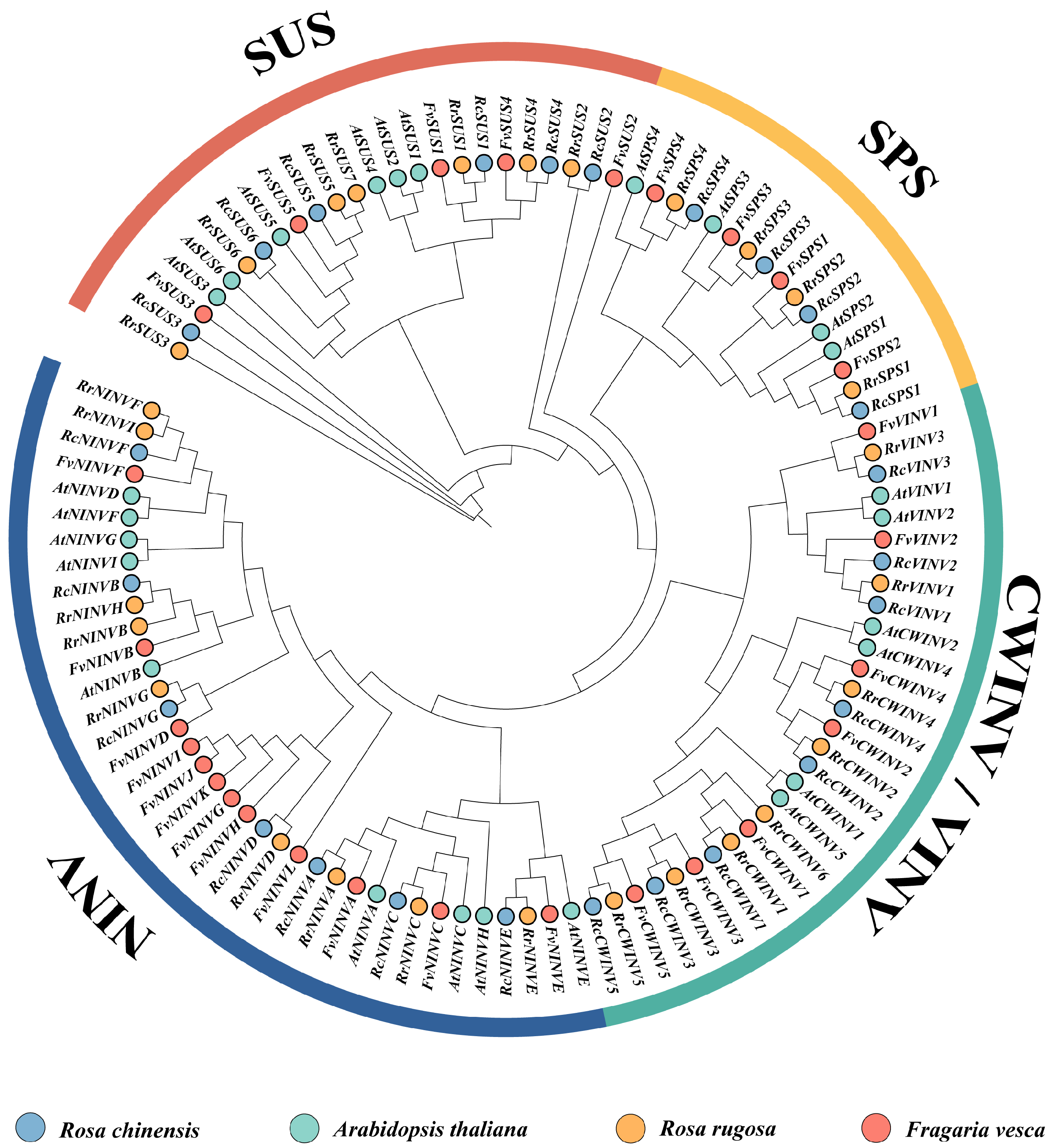
In this study, we identified a total of 106 sucrose metabolism-related genes (SMGs) across four species. Among them, 25 SMGs were found in R. chinensis ‘Old Blush’, while the remaining 81 SMGs were distributed in Arabidopsis thaliana (25), Fragaria vesca (28), and Rosa rugosa (28). The detailed information on these genes is provided in Supplementary Table S1. Rosa chinensis contained 4 SPS, 6 SUS, and 15 INV members, whereas Rosa rugosa, Fragaria vesca, and Arabidopsis thaliana contained 4/7/17, 4/5/19, and 4/6/15 members, respectively. Subsequently, to facilitate systematic classification and cross-species comparisons, all genes were systematically named based on their evolutionary relationships with homologous genes in Arabidopsis thaliana. The evolutionary relationships of SMG were analyzed by constructing a phylogenetic tree (Figure 1). Phylogenetic analysis clearly separated all SMGs into four distinct clades, corresponding to SUS, SPS, CWINV, and NINV, respectively. Among these, INV formed the largest subfamily with 66 members. Notably, the SPS subfamily was highly conserved across the four species, with exactly four members in each, suggesting that the SPS gene is likely constrained by strong functional requirements and purifying selection. Furthermore, the sizes of the SMGs were broadly similar across these species, suggesting that the key enzymatic components underlying sucrose metabolism have been relatively conserved during lineage divergence. However, Fragaria vesca showed an increased number of NINV genes, suggesting a lineage-specific expansion that may support cytosolic sucrose turnover and sugar signaling during development. To determine the chromosomal position of the RcSMGs, the chromosomal position of the SMGs in rose was analyzed (Supplementary Figure S1). A total of 25 SMGs were identified in rose and were unevenly distributed across seven chromosomes. These genes were relatively enriched on chromosomes 2 and 6, whereas only one gene was enriched on chromosome 5. Notably, the CWINV subfamily showed a biased chromosomal distribution, being exclusively located on chromosomes 2 and 3.

3.2. Orthologs of the RcSMGs

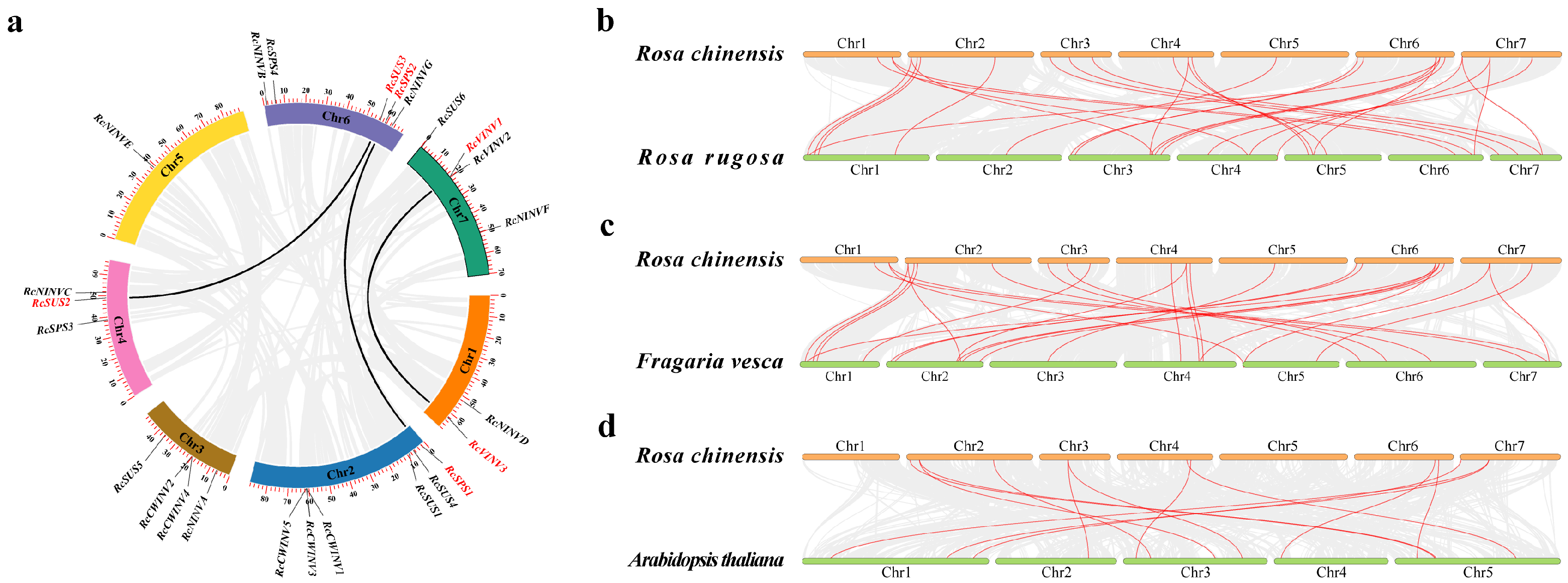
We conducted further in-depth research into the evolutionary trajectory and conservation of the RcSMG family. We performed a synteny analysis between rose and the other species using MCScanX. The results revealed extensive syntenic relationships of SMGs across species. Specifically, 13 collinear pairs were identified between R. chinensis and A. thaliana, 25 between R. chinensis and F. vesca, and 27 between R. chinensis and R. rugosa (Figure 2b). A total of 20 SMGs exhibited syntenic counterparts in at least one of the compared species. Notably, all SPS and SUS genes exhibited synteny. The SPS gene has been widely regarded as a core regulatory gene in sucrose biosynthesis, whereas the SUS gene plays important roles in plant sugar metabolism and carbon partitioning, indicating that the genomic loci of these genes are more likely to be conserved under strong evolutionary constraints. Meanwhile, five species-specific SMGs were identified in rose, namely RcNINVA, RcCWINV2, RcCWINV3, RcCWINV5, and RcVCINV2 (Table S2). This result suggests that the INV gene may have undergone a species-specific evolutionary process in R. chinensis. Moreover, to investigate duplication events of RcSMGs in Rosa chinensis, we conducted an intraspecies collinearity analysis using MCScanX and identified three pairs of collinear duplicated gene pairs (Figure 2a).

3.3. Gene Structure, Conserved Domain, and Cis-Acting Element Analyses of RcSMGs

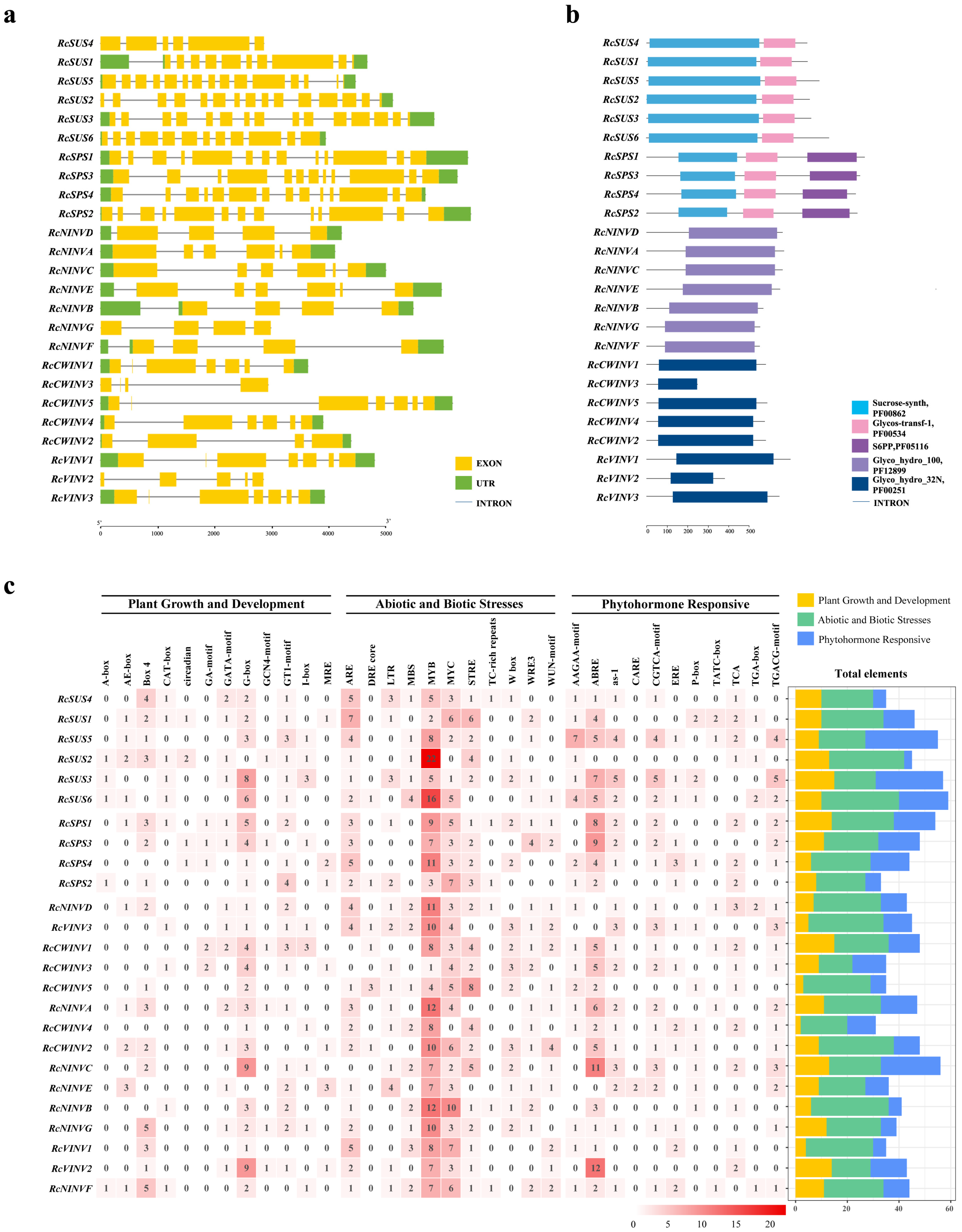
In order to elucidate the potential functions of RcSMGs, we conducted a comprehensive investigation involving the analysis of their gene structures, conserved domains and cis-acting elements in promoter regions. Gene structure analysis showed that all SMGs contain multiple exons and introns (Figure 3a). Consistent with the phylogenetic topology, SMGs with similar exon–intron organization tended to cluster together, indicating a close evolutionary relationship. Among the three subfamilies, SUS and SPS genes exhibited the most complex structures, with an average of 12 exons, whereas INV genes contained fewer exons (average of five). Notably, RcSUS2, RcSUS3, and RcSUS5 harbored the highest exon number (15) (Table S3).
In parallel, conserved domain analysis revealed that both SUS and SPS proteins contained the sucrose synthase domain (PF00862) and the glycosyl-transferase family 1 domain (PF00534), whereas SPS proteins additionally possessed the S6PP domain (PF05116) (Figure 3b). The INV family is primarily divided into two categories based on structural domain differences. One category (NINVs) contains the Glyco_hydro_100 domain (PF12899), and the other category (CWINVs and VCINVs) contains the Glyco_hydro_32N domain (PF00251).
We systematically investigated the transcriptional regulatory patterns and associated functions of 25 RcSMG gene promoters through cis-acting element analysis (Figure 3c). Analysis revealed that cis-acting elements associated with stress responses were the most abundant. Following the functional classification of the 1102 elements identified, 561 were categorized as stress response-related, 305 as hormone-response-related and 236 as growth and development-related. In addition, MYB-binding sites were the most frequent motif type. Moreover, BOX 4 and G-box (light-responsive), ARE (anaerobic induction), MYC, ABRE, as-1, and CGTCA motifs (hormone-responsive) were widely present across all RcSMG promoters, suggesting that RcSMG expression may be coordinately regulated by light, abiotic stress, and multiple hormonal signals. Notably, the SPS and SUS subfamilies showed a higher density of cis-elements than the INV subfamily, suggesting a more complex promoter regulatory landscape.

3.4. Physicochemical, Subcellular Localization and Interaction Network Analysis of RcSMG Proteins

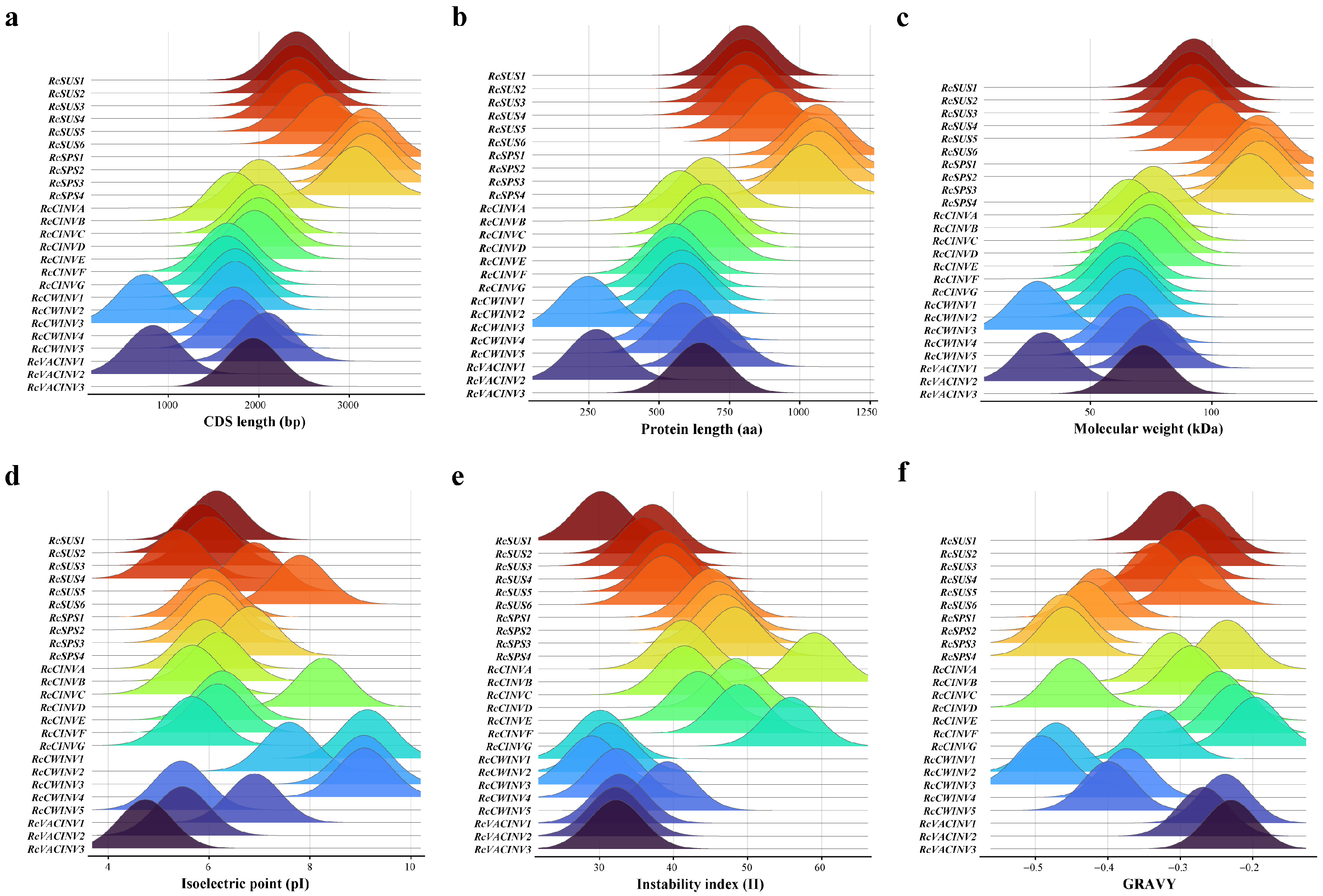
To obtain a general overview of the RcSMG family, we predicted the physicochemical properties and subcellular localization of all RcSMGs (Table S4). Physicochemical profiling showed that proteins within each subfamily exhibited similar biochemical profiles. Among all 25 RcSMG proteins, the SPS subfamily encoded the longest protein, whereas NIV proteins were generally shorter (Figure 4). The predicted lengths of all the proteins range from 247 to 1067 aa, where RcCWINV3 is the shortest and RcSPS3 is the longest, corresponding to molecular weights of 28.245–119.854 kDa. Most RcSMG proteins had theoretical pI values below 7, indicating an overall acidic tendency. Notably, CWINV proteins exhibited predominantly higher pI values (>7, except RcCWINV5), which may be associated with their apoplastic/cell-wall-related roles (Supplementary Figure S2). The instability index ranged from 28.97 (RcCWINV3) to 59.04 (RcNINVB), and all proteins exhibited negative GRAVY scores (−0.461 in RcSPS3 to −0.197 in RcNINVG), suggesting an overall hydrophilic nature (Figure 4). Collectively, INV proteins showed greater variability in physicochemical traits, with CWINV proteins tending toward higher pI and more negative GRAVY values, whereas NINV proteins appeared comparatively more stable. Subcellular localization prediction further suggested that SUS and SPS proteins were mainly cytosolic. In contrast, NINV members were preferentially predicted to localize to organelles such as chloroplasts and mitochondria, CWINV proteins were enriched for secretory-pathway/ER-associated signals, and VCINV proteins showed a predicted tendency toward cytosolic and plasma-membrane localization (Supplementary Figure S2).
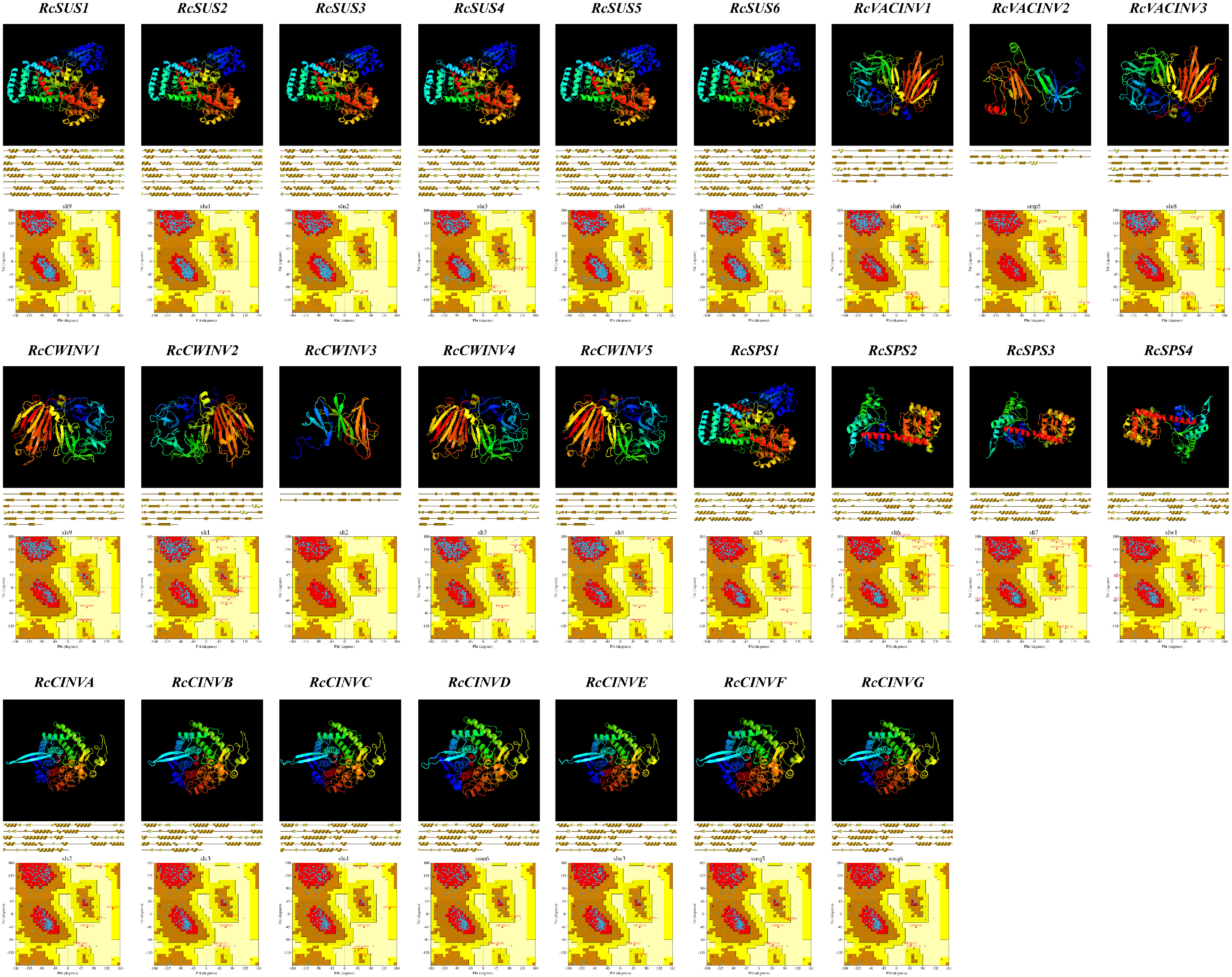
We used homology modeling to predict the three-dimensional structures of all the RcSMG proteins, and the model’s stereochemical quality was assessed using PROCHECK (v3.5.4) (Figure 5). Ramachandran plot statistics showed that residues in all models were overwhelmingly distributed within energetically favored/allowed regions, with less than 1% in disallowed regions, supporting the overall reliability of the predicted backbone geometry. Moreover, the modeled structures revealed pronounced family-specific differences in global folding and secondary-structure composition. Specifically, CWINV and VCINV displayed the canonical GH32 architecture, featuring an N-terminal β-propeller coupled to a C-terminal β-sandwich/β-rich domain that together constitute the conserved structural framework [63]. In contrast, NINV was dominated by α-helical elements and was consistent with the GH100 framework, which is characterized by an (α/α)_6 barrel core and a propensity for oligomeric assembly [29]. Likewise, RcSUS proteins adopted a multi-domain α/β fold with a pronounced inter-domain cleft, resembling the solved AtSUS1 structure [64]. The SPS proteins exhibited a typical GT-B fold composed of two Rossmann-like subdomains that create a distinct interfacial binding groove, in agreement with reported SPS structures [65].
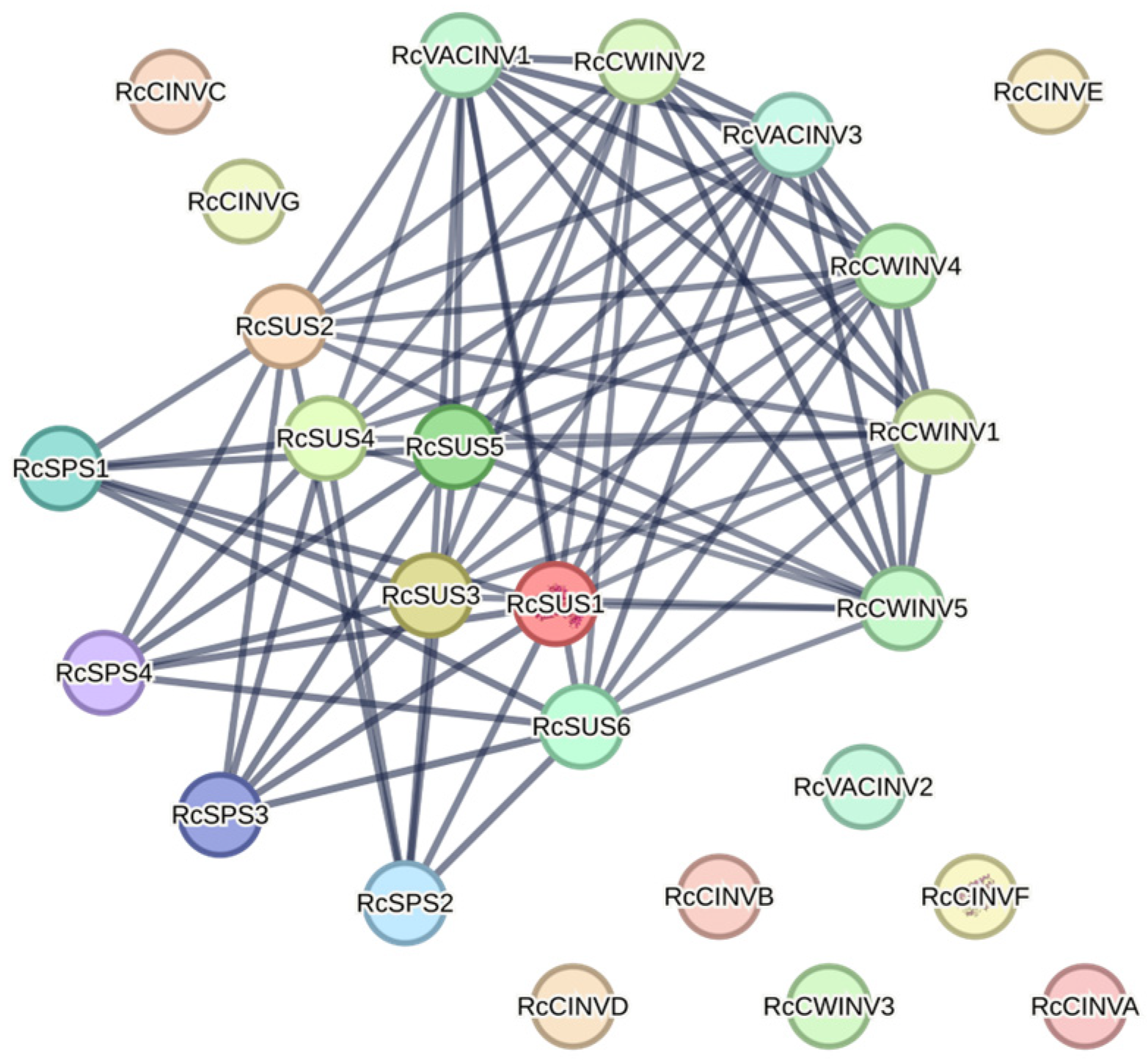
To elucidate the biological functions of rose SMG proteins and their regulatory network architecture, we inferred a protein–protein interaction (PPI) network. The intra-family PPI network of the RcSMG gene family suggested that all SPS and SUS proteins, together with most CWINV and VCINV members, participate in potential interactions, whereas NINV proteins displayed few or no predicted connections (Figure 6). Furthermore, SUS and SPS preferentially engaged in cross-subfamily interactions, whereas CWINV and VCINV displayed both cross-subfamily links and substantial within-subfamily connectivity. Interestingly, no direct interaction edge was detected between SPS and INV proteins, implying that SUS may constitute a key bridging component connecting SPS with INV. In addition, using STRING and the Rosa proteome as a reference, we inferred proteins potentially interacting with SMG proteins, which were subsequently classified into four distinct clusters (Supplementary Figure S3 and Table S6). A SUS/SPS-centered core module was apparent, showing extensive connectivity with carbohydrate metabolism-associated enzymes. By contrast, INV proteins exhibited a more stratified network topology and formed relatively discrete modules. Most NINV members were sparsely connected or appeared as isolated nodes, implying a more autonomous functional role in rose. Importantly, the network also contained multiple phosphotransferase/kinase-related proteins, including fructokinases of the PfkB family as well as other phosphotransferases and phosphomutases. These predicted interactions further suggest that RcSMG proteins may also affect downstream metabolic fluxes and the dynamic changes in stress-related sugar metabolism through phosphorylation-mediated regulation.

3.5. Expression Profile Analysis of RcSMGs

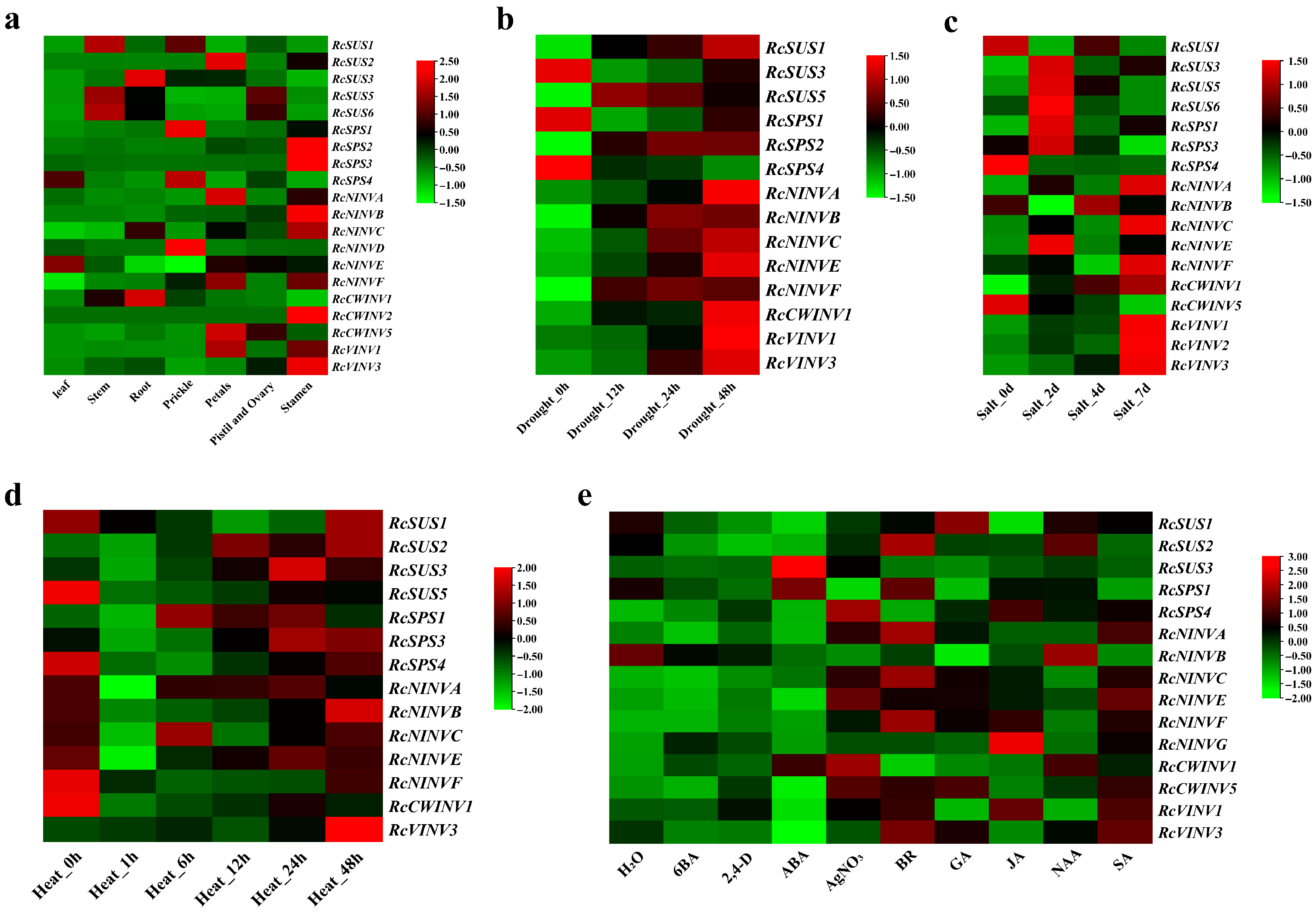
Previous studies have confirmed that the core enzymes involved in sucrose metabolism play a pivotal role in the growth and development of plants, as well as in their response to abiotic stress [66]. To systematically investigate the expression profiles of 25 RcSMG members during different tissues and diverse treatment conditions, we performed a systematic analysis of these genes’ expression profiles. The tissue-expression heatmap showed that RcSMGs exhibited pronounced differential expression among tissues, and most genes displayed relatively high expression only in a specific tissue (Figure 7). Notably, analysis indicates that roots and stems are the primary sites of expression for most SUS genes, consistent with the role of sucrose synthase in cleaving sucrose to produce UDP-glucose, thereby providing activated sugar donors for cell-wall polysaccharide biosynthesis. In contrast, SPS and INV genes showed higher expression in reproductive organs than in vegetative tissues, which may be associated with the elevated energy demand during reproductive development.
In addition, expression-pattern analysis of RcSMGs under abiotic stresses indicated that most SMG members were positively responsive to stress treatments. The INV gene exhibits essentially the same expression patterns in response to both drought and salt stress, and the expression levels of most members were increased with prolonged stress duration. By contrast, a rise-then-decline pattern was detected for SUS and SPS genes under salt stress, which may be associated with the early-stage requirement for rapid osmotic adjustment in plants [67]. In addition, most genes showed a decrease at the early stage followed by a subsequent increase under heat stress, which may be related to early growth inhibition and the subsequent heat acclimation and re-establishment of homeostasis. Under drought stress, opposite expression patterns were observed among SUS and SPS members, suggesting functional divergence within these subfamilies. Notably, RcSUS3, RcSPS1, RcCWINV1, and RcVIVN3 were strongly induced by both salt and drought stress (salt: 7.5-, 0.28-, 7.8-, and 13-fold; drought: 9.4-, 10.7-, 2.8-, and 26.4-fold, respectively), supporting their potential roles in abiotic-stress tolerance in rose.
Moreover, hormone-response analysis revealed that RcSMGs exhibited distinct expression patterns under different phytohormone conditions. Nearly all genes showed little or no transcriptional response to 6BA or 2,4-D, and only a few members responded to ABA treatments, including RcSUS3, RcSPS1, and RcVINV3. By contrast, AgNO3, BR, GA, JA, and NAA treatments markedly induced the expression of most RcSMGs. In addition, members of the INV genes generally responded to SA treatment. These findings suggest that RcSMGs may influence processes such as rose growth, development and stress response by extensively regulating related signaling networks.

3.6. Expression Patterns of Key Genes Under Salt Stress

We selected representative genes from each expression cluster for RT-qPCR validation. Key genes, including RcSUS3, RcSPS1, RcCWINV1, and RcVINV3, which harbor multiple stress-related cis-elements in their promoters, were strongly induced in the salt-stress transcriptome. The qPCR results showed strong concordance with the transcriptome data, confirming the accuracy of the observed expression dynamics (Supplementary Figure S4). The expression dynamics of these genes revealed a precise temporal pattern: SUS and SPS genes (e.g., RcSUS3) peaked early during salt stress (e.g., at 2 days) and then declined. This is consistent with reports on CsSUS3 in the tea plant [23]. In contrast, the expression of most INV genes increased continuously with stress duration, reaching its highest level around 7 days. These results suggest functional diversification among sucrose metabolism-related gene families in response to salt stress.

3.7. Silencing of RcSPS1, RcSUS3, RcVINV3, and RcCWINV1 Under Salt Tolerance

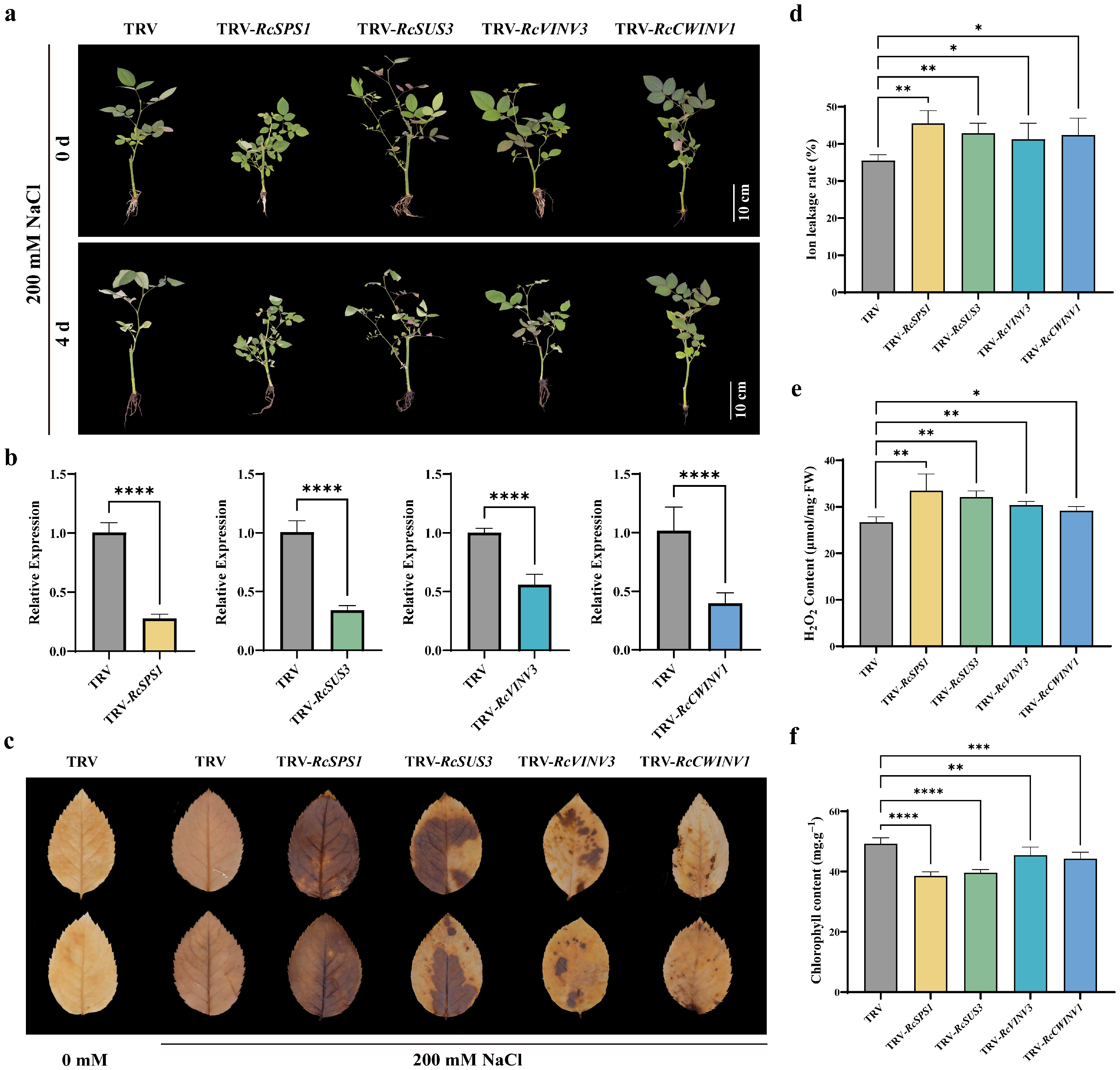
To elucidate the roles of SUS, SPS, and INV family genes in salt tolerance of rose, we performed functional analyses on RcSPS1, RcSUS3, RcVINV3, and RcCWINV1 using VIGS. qRT-PCR analysis confirmed the effectiveness of gene silencing, showing that the transcript levels of target genes in silenced-plant leaves were significantly downregulated compared to the TRV empty vector control (Figure 8b).
Under 200 mM NaCl stress, distinct phenotypic differences were observed among different genes. After 4 days of treatment, leaves of TRV-RcSPS1 and TRV-RcSUS3 exhibited obvious wilting and chlorosis, whereas leaves of TRV-RcVINV3 and TRV-RcCWINV1 maintained a relatively expanded state similar to the control group (TRV) (Figure 8a). This suggests that silencing of RcSPS1 and RcSUS3 rendered the plants more sensitive to salt stress, while silencing of RcVINV3 and RcCWINV1 did not exacerbate stress damage and might even confer a certain protective effect.
To evaluate the physiological responses under salt stress, we performed DAB staining to visualize H2O2 accumulation. Consistent with the phenotypic severity, TRV-RcSPS1 and TRV-RcSUS3 leaves exhibited significantly deeper and broader staining compared to the control, indicating substantial hydrogen peroxide (H2O2) accumulation and severe oxidative damage to the cell membrane system. Conversely, TRV-RcVINV3 and TRV-RcCWINV1 leaves showed reduced H2O2 accumulation and weaker staining (Figure 8c), suggesting lower levels of oxidative stress. To quantitatively validate these observations, we measured relative electrolyte leakage, chlorophyll content, and H2O2 levels in leaves of control (TRV) and all gene-silenced plants (TRV-RcSPS1, TRV-RcSUS3, TRV-RcVINV3, and TRV-RcCWINV1). The results of these physiological assays further corroborated the differential responses observed in phenotype and staining (Figure 8d–f).
In summary, silencing of RcSPS1 and RcSUS3 significantly compromised salt tolerance in rose plants, indicating that these two genes play positive regulatory roles in the response to salt stress. Conversely, the absence of aggravated phenotypes in RcVINV3- and RcCWINV1-silenced lines suggests that these genes may act as negative regulators in salt-stress response.

4. Discussion

Sucrose metabolism plays a key role in both plant stress responses and carbon allocation. The functions of sucrose metabolism-related genes (SMGs) have gradually become clearer across different plant species, and their roles in sucrose synthesis, carbon metabolism regulation, and stress responses are attracting increasing attention. Through genome-wide analysis, we identified 25 SMGs in R. chinensis ‘Old Blush’, including 4 SPS genes, 6 SUS genes and 15 INV genes. The SPS subfamily was the most conserved among these, maintaining a consistent complement of four members across diploid species within the Rosaceae family. This degree of numerical conservation suggests that these core biosynthetic enzymes are under intense purifying selection. By contrast, the allohexaploid kiwifruit (Actinidia deliciosa) possesses 31 AdSPS genes, likely due to its complex genomic structure and multiple rounds of genome duplication events [68]. The SUS family comprised six members across five chromosomes, similar to cassava [27]. INV family diversification, evidenced by CWINV clustering on chromosomes 2 and 3, indicates that local duplication events drive metabolic diversity and rose evolution. The SMG repertoire balances conserved core genes with lineage-specific regulatory expansion.
The results of the analyses of gene structure, conserved motifs and phylogeny corroborate each other, collectively revealing the evolutionary characteristics of rose sucrose metabolism-related genes (RcSMGs). SUS and SPS genes have the most complex structures, with an average of 12 exons (RcSUS2, RcSUS3 and RcSUS5 have up to 15), whereas INV genes have simpler structures with an average of 5 exons. This marked structural divergence likely corresponds to distinct functional specialization and evolutionary trajectories. Phylogenetic analysis further supports this (Figure 1): the SUS and SPS families are closely related; in contrast, the CWINV and VINV subfamilies within the INV family exhibit evolutionary independence and cluster separately. This pattern is widely observed in species such as apples, sugarcane and longans [24,69,70]. In terms of evolutionary mechanisms, gene families usually expand via tandem and segmental duplications [71]. Our analysis indicates that the expansion of the CWINV subfamily primarily relies on tandem duplications, while the three pairs of duplicated genes identified via intraspecies collinearity analysis clearly originated from segmental duplication events. Notably, cross-species collinearity analysis revealed that all SPS and SUS genes exhibit collinearity. This high degree of conservation highlights their pivotal role in sucrose metabolism and suggests that these genes undergo intense purifying selection during evolution to maintain their function in critical physiological processes [66]. Notably, we identified five species-specific genes in roses: RcNINVA, RcCWINV2, RcCWINV3, RcCWINV5 and RcVCINV2. The emergence of this set of genes strongly suggests that the INV gene subfamily has undergone unique, lineage-specific adaptive evolution in roses.
Physicochemical and structural analyses provide insights into the functional differentiation of sucrose-metabolizing enzymes. Specifically, SPS proteins are mostly acidic, hydrophilic, and predicted to be unstable, consistent with reports in various crops [72]. Stability analysis further revealed differences among subfamilies: most members of the SUS and CWINV families will exhibit stable physicochemical properties (instability index < 40), whereas the majority of NINV members are predicted to be unstable proteins. Tertiary structure analysis supports this trend; compared to the structurally diverse SPS and INV proteins, SUS proteins display relatively conserved conformational structures. This pattern has also been corroborated in species such as pineapple and pomegranate [73,74]. Subcellular localization analysis shows that SUS and SPS proteins are predominantly found in the chloroplasts and cytoplasm, aligning with findings in sweet potato and other studies. In contrast, INV proteins show a broader distribution, with predicted localizations in chloroplasts, cytoplasm, vacuoles, and the nucleus. This distributional variation corresponds to their protein structural diversity: CWINV and VINV possess the typical GH32 family structure, while NINV belongs to the GH100 family. Based on these features, the interaction network we constructed reveals a dynamic metabolic landscape centered around sucrose turnover. SPS forms a tight sucrose synthesis module with its upstream and downstream enzymes. In comparison, the two main pathways for sucrose cleavage—SUS and INV—exhibit distinct interaction preferences. Notably, SUS and SPS competitively utilize UDP-glucose, forming a key node that regulates carbon flux direction [75]. Furthermore, the frequent appearance of trehalose-phosphate synthase in the interaction network, which competes with SPS for the same substrate, suggests a profound functional interconnection between sucrose metabolism and the trehalose-mediated stress signaling pathway.
Under hypoxic storage conditions, plants tend to metabolize sucrose via the SUS pathway. This pathway exhibits low oxygen consumption and facilitates the maintenance of energy supply and carbon skeleton balance under oxygen-limited conditions. Examples of such storage organs include potato tubers and seeds [76]. This study found that most members of the SUS gene family are highly expressed in both roots and stems. This finding has also been confirmed in other species [77,78]. By contrast, INV family members are highly expressed in reproductive organs such as petals and stamens, suggesting their involvement in reproductive development. In the tea plant, CsINV5 exhibits the highest transcript level in flowers, and GUS activity driven by its promoter is strongest in mature Arabidopsis pollen [35,36]. This aligns with our observations in roses. The expression of some genes, including RcSUS4, RcNINVG, RcCWINV3 and RcCWINV4, was not observed in various tissues. RcCWINV3 and RcCWINV4 were not expressed in response to any of the tested stress or hormone treatments. This suggests functional redundancy and differentiation among members of multigene families [23].
In terms of hormonal regulation, response elements for jasmonic acid (JA), salicylic acid (SA) and gibberellin (GA) were the most abundant, emphasizing the significance of these hormonal signals in stress responses. Expression data showed that INV family genes generally responded strongly to SA in our study. Most RcSMGs were not induced by abscisic acid (ABA), with only RcSUS3 showing high expression under ABA treatment. The promoter of this gene contains multiple ABREs and the light-responsive G-box element, suggesting that its expression may be precisely co-regulated by ABA and light signals. Based on our results, light-responsive elements were the most abundant in the growth and development category, confirming light signaling as a key regulatory factor. Studies found that low light intensity downregulates the expression of NtSPS and upregulates the expression of NtCWINV, resulting in reduced leaf sucrose content [79,80]. This further confirms that light intensity affects carbon partitioning by regulating the balance between synthetic and hydrolytic enzymes.
Notably, stress-responsive elements were the most abundant in RcSMG promoters, and transcriptomic analysis confirmed their highly specific expression under various abiotic stresses. Under heat stress, most genes initially decreased in expression before increasing. Under drought stress, gene expression generally increased progressively over time. Under salt stress, most members of the SUS and SPS families exhibited peak expression (an initial increase followed by a decline), whereas members of the INV family showed sustained upregulation. This divergence suggests that these three enzyme families may constitute a sequential ‘molecular switch’, cooperatively linking early signal perception, osmotic adjustment and long-term adaptive growth under salt stress. This pattern can be explained by the classical biphasic model of the salt-stress response [81,82]. In the first phase, known as the osmotic phase, a rapid drop in cellular water potential induces a stress response similar to that experienced during drought. Plants then rapidly accumulate compatible solutes, such as sucrose, to adjust their osmosis. Our findings and previous work suggest that this phase involves the rapid activation of SPS and the reversible SUS pathway, alongside the temporary suppression of INV, to encourage sucrose accumulation and maintain cell turgor [83]. In the second phase (the ionic phase), sustained ion toxicity requires cells to initiate defense and repair mechanisms. At this stage, INV activity increases. Its irreversible catalysis of sucrose hydrolysis provides carbon skeletons and energy for defense responses, and generates hexoses that can locally reduce osmotic potential. This drives water flow to growing tissues, thereby supporting reproductive growth and final yield. The SPS, SUS and INV gene families play a central role in the salt-stress responses of plants, a conclusion that has been validated across multiple species, including maize, rice and Arabidopsis [19,30,37,84,85]. In this study, after 4 days of salt-stress treatment, RcSPS1- and RcSUS3-silenced rose plants exhibited pronounced leaf wilting, reduced chlorophyll content, elevated electrolyte leakage, and marked H2O2 accumulation. In contrast, RcVINV3- and RcCWINV1-silenced plants exhibited only minor damage (Figure 8). These results indicate that RcSPS1 and RcSUS3 act as essential positive regulatory roles in salt tolerance, whereas RcVINV3 and RcCWINV1 may not contribute critically to the early-stage salt-stress response—possibly due to delayed activation. This hypothesis warrants further validation through prolonged stress treatment and genetic complementation experiments. These findings highlight the diverse and complex functions of the SUS/SPS/INV protein family in the adaptation of plants to stress.
In summary, this study systematically reveals the core functions of the RcSMG (SUS/SPS/INV) gene family in roses. These genes constitute a key regulatory module that is extensively involved in multiple vital biological processes, such as growth and development, hormone signal transduction and stress adaptation. The precise molecular mechanisms underlying this regulation, however, remain elusive and thus merit further investigation.

5. Conclusions

This study systematically identified 25 sucrose metabolism-related genes (RcSMGs) from the rose genome. These gene sequences were then subjected to a comparative analysis of their phylogenetic relationships, structural characterization and identification of conserved protein motifs. Cis-element and expression profiling revealed an abundance of stress-associated regulatory motifs, emphasizing their evolutionary conservation and potential role in stress resilience. Transcriptomic analysis revealed that the expression levels of most SUS and SPS family members peaked at 2 days post-salt-stress initiation and subsequently declined, whereas INV family members exhibited sustained upregulation. Consistently, virus-induced gene silencing (VIGS) assays demonstrated that by 4 days of salt treatment, RcSPS1- and RcSUS3-silenced rose plants displayed significantly compromised salt tolerance, while RcVINV3- and RcCWINV1-silenced plants exhibited only minor phenotypic alterations. Taken together, these findings deepen our understanding of the roles of SMGs and provide valuable genetic candidates for enhancing stress tolerance in roses. It should be noted that the current analysis was confined to salt-stress conditions. Examining other abiotic stresses and hormonal contexts in future work, coupled with experimental validation such as yeast interaction assays, overexpression or knockdown, will be crucial to unraveling the precise mechanistic roles of these genes.

Supplementary Materials

The following supporting information can be downloaded at https://www.mdpi.com/article/10.3390/horticulturae12030385/s1, Table S1. SMG gene IDs and their corresponding gene names in four species. Table S2. Intraspecies and interspecies collinearity relationships of rose SMG genes. Table S3. Exon–intron structure statistics of rose SMG genes. Table S4. Statistical analysis of physicochemical properties of rose RcSMG proteins. Table S5. Predicted subcellular localization scores of rose RcSMG proteins. Table S6. Functional annotation and domain information of SMG-associated proteins in the predicted PPI network. Table S7. Statistical analysis of cis-acting elements in the promoter regions of rose SMG genes. Table S8. List of primers used in this study. Table S9. Expression profiles of rose SMG genes across different tissues and under various treatment conditions. Figure S1. Chromosomal distribution of SMG gene family in rose. Figure S2. In-silico prediction of subcellular localization of RcSMG proteins. Figure S3. Predicted protein-protein interaction (PPI) network of rose RcSMG proteins and their putative interacting partners. Figure S4. Salt stress-induced expression profiling.

Author Contributions

Conceptualization, Q.W. and S.L.; methodology, J.W., M.J., Y.Z., X.C., J.X., W.J. and F.G.; software, J.X. and J.W.; validation, M.J., J.X. and Y.Z.; resources, F.G. and X.C.; data curation, M.J. and J.X.; writing—original draft preparation, J.W. and F.G.; writing—review and editing, J.W., J.X. and W.J.; visualization, J.W.; supervision, Q.W. and S.L.; project administration, W.J.; funding acquisition, Q.W. and S.L. All authors have read and agreed to the published version of the manuscript.

Funding

This research was funded by the National Key Research and Development Program of China (Grant No. 2024YFD1600900-2024YFD1600905), Yunnan Province Agricultural Joint Key Project (Grant No. 202401BD070001-016), Xingdian Talent Support Program (XDYC-QNRC-2023-0457), and Yunnan Technology Innovation Center of Flower Technique.

Data Availability Statement

The data presented in this study are available in NCBI database at [https://doi.org/10.1038/s41588-018-0110-3], reference number [86]. These data were derived from the following resources available in the public domain: PRJNA546486, SRS3406637, SRP128235, PRJNA663119, and PRJNA522664.

Conflicts of Interest

Author Xiaomin Chen is employed by the Beijing Green Garden Group Co., Ltd. The remaining authors declare that the research was conducted in the absence of any commercial or financial relationships that could be construed as a potential conflict of interest.

References

  1. Hopmans, J.W.; Qureshi, A.S.; Kisekka, I.; Munns, R.; Grattan, S.R.; Rengasamy, P.; Ben-Gal, A.; Assouline, S.; Javaux, M.; Minhas, P.S. Critical knowledge gaps and research priorities in global soil salinity. Adv. Agron. 2021, 169, 1–191. [Google Scholar]
  2. Gupta, B.; Huang, B. Mechanism of Salinity Tolerance in Plants: Physiological, Biochemical, and Molecular Characterization. Int. J. Genom. 2014, 2014, 701596. [Google Scholar] [CrossRef] [PubMed]
  3. Chen, L.Q.; Qu, X.Q.; Hou, B.H.; Sosso, D.; Osorio, S.; Fernie, A.R.; Frommer, W.B. Sucrose Efflux Mediated by SWEET Proteins as a Key Step for Phloem Transport. Science 2012, 335, 207–211. [Google Scholar] [CrossRef]
  4. Cui, G.; Zhang, Y.; Zhang, W.; Lang, D.; Zhang, X.; Li, Z.; Zhang, X. Response of Carbon and Nitrogen Metabolism and Secondary Metabolites to Drought Stress and Salt Stress in Plants. J. Plant Biol. 2019, 62, 387–399. [Google Scholar] [CrossRef]
  5. Desrut, A.; Moumen, B.; Thibault, F.; Le Hir, R.; Coutos-Thévenot, P.; Vriet, C. Beneficial rhizobacteria Pseudomonas simiae WCS417 induce major transcriptional changes in plant sugar transport. J. Exp. Bot. 2020, 71, 7301–7315. [Google Scholar] [CrossRef]
  6. Stein, O.; Granot, D. An Overview of Sucrose Synthases in Plants. Front. Plant Sci. 2019, 10, 95. [Google Scholar] [CrossRef]
  7. Leloir, L.F.; Cardini, C.E. The Biosynthesis of Sucrose Phosphate. J. Biol. Chem. 1955, 214, 157–165. [Google Scholar] [CrossRef]
  8. Castleden, C.K.; Aoki, N.; Gillespie, V.J.; MacRae, E.A.; Quick, W.P.; Buchner, P.; Foyer, C.H.; Furbank, R.T.; Lunn, J.E. Evolution and Function of the Sucrose-Phosphate Synthase Gene Families in Wheat and Other Grasses. Plant Physiol. 2004, 135, 1753–1764. [Google Scholar] [CrossRef]
  9. Li, A.M.; Liao, F.; Qin, C.X.; Wang, M.; Chen, Z.L.; Zhang, B.Q.; Gao, Y.J.; Pan, Y.Q.; Huang, D.L. Sucrose Phosphate Synthase Genes in Plants: Its Role and Practice for Crop Improvement. J. Agric. Food Chem. 2024, 72, 18335–18346. [Google Scholar] [CrossRef]
  10. Wei, Q.J.; Ma, Z.Z.; Le, S.; Lei, C.Y.; Ma, Q.L.; Gu, Q.Q. Identification and expression analysis of sucrose-phosphate synthase (SPS) genes in citrus. Acta Hortic. Sin. 2020, 47, 334–344. [Google Scholar]
  11. Lv, J.H.; Li, W.Y.; Chen, R.; Wang, G.M.; Zhang, S.L.; Wu, J.; Zhang, H.P. Genomewide identification and expression analysis of sucrose synthase (SUS) and sucrose phosphate synthase (SPS) gene families in pear. Acta Hortic Sin. 2018, 42, 421–435. [Google Scholar]
  12. Okamura, M.; Aoki, N.; Hirose, T.; Yonekura, M.; Ohto, C.; Ohsugi, R. Tissue specificity and diurnal change in gene expression of the sucrose phosphate synthase gene family in rice. Plant Sci. 2011, 181, 159–166. [Google Scholar] [CrossRef]
  13. Winter, H.; Huber, S.C. Regulation of sucrose metabolism in higher plants: Localization and regulation of activity of key enzymes. Crit. Rev. Biochem. Mol. Biol. 2000, 35, 253–289. [Google Scholar] [CrossRef]
  14. Lutfiyya, L.L.; Xu, N.; D’oRdine, R.L.; Morrell, J.A.; Miller, P.W.; Duff, S.M.G. Phylogenetic and expression analysis of sucrose phosphate synthase isozymes in plants. J. Plant Physiol. 2007, 164, 923–933. [Google Scholar] [CrossRef]
  15. Shah, I.H.; Manzoor, M.A.; Azam, M.; Wu, J.; Li, X.; Rehman, A.; Li, P.; Zhang, Y.; Niu, Q.; Chang, L. Comprehensive characterization and expression profiling of sucrose phosphate synthase (SPS) and sucrose synthase (SUS) family in Cucumis melo under the application of nitrogen and potassium. BMC Plant Biol. 2025, 25, 285. [Google Scholar] [CrossRef] [PubMed]
  16. Ma, P.; Zhang, X.; Chen, L.; Zhao, Q.; Zhang, Q.; Hua, X.; Wang, Z.; Tang, H.; Yu, Q.; Zhang, M.; et al. Comparative analysis of sucrose phosphate synthase (SPS) gene family between Saccharum officinarum and Saccharum spontaneum. BMC Plant Biol. 2020, 20, 422. [Google Scholar] [CrossRef]
  17. Liao, G.; Li, Y.; Wang, H.; Liu, Q.; Zhong, M.; Jia, D.; Huang, C.; Xu, X. Genome-wide identification and expression profiling analysis of sucrose synthase (SUS) and sucrose phosphate synthase (SPS) genes family in Actinidia chinensis and A. eriantha. BMC Plant Biol. 2022, 22, 215. [Google Scholar] [CrossRef] [PubMed]
  18. Duan, Y.; Yang, L.; Zhu, H.; Zhou, J.; Sun, H.; Gong, H. Structure and Expression Analysis of Sucrose Phosphate Synthase, Sucrose Synthase and Invertase Gene Families in Solanum lycopersicum. Int. J. Mol. Sci. 2021, 22, 4698. [Google Scholar] [CrossRef]
  19. Wang, Y.; Yang, L.; Geng, W.; Zhang, H.; Zhou, H. The sucrose synthase gene family in blueberry (Vaccinium darrowii): Functional insights into the role of VdSUS4 in salt stress tolerance. Front. Plant Sci. 2025, 16, 1581182. [Google Scholar] [CrossRef] [PubMed]
  20. Wang, H.; Sui, X.; Guo, J.; Wang, Z.; Cheng, J.; Ma, S.; Li, X.; Zhang, Z. Antisense suppression of cucumber (Cucumis sativus L.) sucrose synthase 3 (CsSUS3) reduces hypoxic stress tolerance. Plant Cell Environ. 2014, 37, 795–810. [Google Scholar] [CrossRef]
  21. Xu, X.; Yang, Y.; Liu, C.; Sun, Y.; Zhang, T.; Hou, M.; Huang, S.; Yuan, H. The evolutionary history of the sucrose synthase gene family in higher plants. BMC Plant Biol. 2019, 19, 566. [Google Scholar] [CrossRef]
  22. Zhu, X.; Wang, M.; Li, X.; Jiu, S.; Wang, C.; Fang, J. Genome-Wide Analysis of the Sucrose Synthase Gene Family in Grape (Vitis vinifera): Structure, Evolution, and Expression Profiles. Genes 2017, 8, 111. [Google Scholar] [CrossRef]
  23. Huang, D.; Liu, Y.; Huang, D.; Yin, Z.; Li, H.; Xiong, Z.; Jiang, Y.; Lu, L.; Li, T. Genome-wide identification of sucrose synthase gene family from Camellia sinensis and regulatory role of CsSUS3 in sucrose metabolism in post-harvest tea leaves. BMC Plant Biol. 2025, 25, 1665. [Google Scholar] [CrossRef]
  24. He, M.; Shuai, L.; Zhou, Y.; Song, M.; Yin, F.; Liu, Y. Identification of Sucrose Phosphate Synthase, Sucrose Synthase, and Invertase Gene Families of Longan in Relation to On-Tree Preservation. Horticulturae 2025, 11, 1270. [Google Scholar] [CrossRef]
  25. Abdullah, M.; Cao, Y.; Cheng, X.; Meng, D.; Chen, Y.; Shakoor, A.; Gao, J.; Cai, Y. The Sucrose Synthase Gene Family in Chinese Pear (Pyrus bretschneideri Rehd.): Structure, Expression, and Evolution. Molecules 2018, 23, 1144. [Google Scholar] [CrossRef]
  26. Harada, T.; Satoh, S.; Yoshioka, T.; Ishizawa, K. Expression of sucrose synthase genes involved in enhanced elongation of pondweed (Potamogeton distinctus) turions under anoxia. Ann. Bot. 2005, 96, 683–692. [Google Scholar] [CrossRef] [PubMed][Green Version]
  27. Huang, T.; Luo, X.; Fan, Z.; Yang, Y.; Wan, W. Genome-wide identification and analysis of the sucrose synthase gene family in cassava (Manihot esculenta Crantz). Gene 2021, 769, 145191. [Google Scholar] [CrossRef]
  28. Rende, U.; Wang, W.; Gandla, M.L.; Jönsson, L.J.; Niittylä, T. Cytosolic invertase contributes to the supply of substrate for cellulose biosynthesis in developing wood. New Phytol. 2017, 214, 796–807. [Google Scholar] [CrossRef] [PubMed]
  29. Xie, J.; Cai, K.; Hu, H.X.; Jiang, Y.L.; Yang, F.; Hu, P.F.; Cao, D.D.; Li, W.F.; Chen, Y.; Zhou, C.Z. Structural Analysis of the Catalytic Mechanism and Substrate Specificity of Anabaena Alkaline Invertase InvA Reveals a Novel Glucosidase. J. Biol. Chem. 2016, 291, 25667–25677. [Google Scholar] [CrossRef] [PubMed]
  30. Wang, X.M.; Zhao, X.X.; Chen, J.Y.; Gong, M.J.; Yang, S.; Xie, P.; Mo, J.J.; Huang, Y.X.; Ye, C.H.; Zhou, H.K. The response and correlations between carbohydrate accumulation and activities of SPS, SS at booting stage of rice under salt stress. Jiangsu J. Agric. Sci. 2018, 34, 481–486. [Google Scholar]
  31. Cheng, L.; Jin, J.; He, X.; Luo, Z.; Wang, Z.; Yang, J.; Xu, X. Genome-wide identification and analysis of the invertase gene family in tobacco (Nicotiana tabacum) reveals NtNINV10 participating the sugar metabolism. Front. Plant Sci. 2023, 14, 1164296. [Google Scholar] [CrossRef]
  32. Ji, X.; Van den Ende, W.; Van Laere, A.; Cheng, S.; Bennett, J. Structure, evolution, and expression of the two invertase gene families of rice. J. Mol. Evol. 2005, 60, 615–634. [Google Scholar] [CrossRef]
  33. Sherson, S.M.; Alford, H.L.; Forbes, S.M.; Wallace, G.; Smith, S.M. Roles of cell-wall invertases and monosaccharide transporters in the growth and development of Arabidopsis. J. Exp. Bot. 2003, 54, 525–531. [Google Scholar] [CrossRef]
  34. Qian, W.; Yue, C.; Wang, Y.; Cao, H.; Li, N.; Wang, L.; Hao, X.; Wang, X.; Xiao, B.; Yang, Y. Identification of the invertase gene family (INVs) in tea plant and their expression analysis under abiotic stress. Plant Cell Rep. 2016, 35, 2269–2283. [Google Scholar] [CrossRef]
  35. He, S.; Li, B.; Wang, H.; Liang, S.; Ding, Z.; Wang, Y.; Fan, K.; Hu, J.; Wang, X.; Qian, W. Characterization of invertase inhibitors (InvInhs) in tea plant, and their potential roles in participating in growth, development and cold response. Sci. Hortic. 2023, 308, 111580. [Google Scholar] [CrossRef]
  36. Qian, W.; Xiao, B.; Wang, L.; Hao, X.; Yue, C.; Cao, H.; Wang, Y.; Li, N.; Yu, Y.; Zeng, J.; et al. CsINV5, a tea vacuolar invertase gene enhances cold tolerance in transgenic Arabidopsis. BMC Plant Biol. 2018, 18, 228. [Google Scholar] [CrossRef] [PubMed]
  37. Li, B.; Wang, H.; Zhang, S.; Yamashita, H.; He, S.; Liang, S.; Wang, Y.; Ding, Z.; Fan, K.; Ikka, T.; et al. Alkaline Invertase 2 positively modulates cold adaptive of Camellia sinensis and enhances freezing and salt tolerance in transgenic Arabidopsis thaliana. Ind. Crops Prod. 2024, 209, 118042. [Google Scholar] [CrossRef]
  38. Darras, A.I. Implementation of Sustainable Practices to Ornamental Plant Cultivation Worldwide: A Critical Review. Agronomy 2020, 10, 1570. [Google Scholar] [CrossRef]
  39. Katsoulas, N.; Kittas, C.; Dimokas, G.; Lykas, C. Effect of Irrigation Frequency on Rose Flower Production and Quality. Biosyst. Eng. 2006, 93, 237–244. [Google Scholar] [CrossRef]
  40. Li, X.; Wan, S.; Kang, Y.; Chen, X.; Chu, L. Chinese rose (Rosa chinensis) growth and ion accumulation under irrigation with waters of different salt contents. Agric. Water Manag. 2016, 163, 180–189. [Google Scholar] [CrossRef]
  41. Letunic, I.; Khedkar, S.; Bork, P. SMART: Recent updates, new developments and status in 2020. Nucleic Acids Res. 2021, 49, D458–D460. [Google Scholar] [CrossRef]
  42. Finn, R.D.; Mistry, J.; Schuster-Böckler, B.; Griffiths-Jones, S.; Hollich, V.; Lassmann, T.; Moxon, S.; Marshall, M.; Khanna, A.; Durbin, R.; et al. Pfam: Clans, web tools and services. Nucleic Acids Res. 2006, 34, D247–D251. [Google Scholar] [CrossRef]
  43. Chao, J.; Li, Z.; Sun, Y.; Aluko, O.O.; Wu, X.; Wang, Q.; Liu, G. MG2C: A user-friendly online tool for drawing genetic maps. Mol. Hortic. 2021, 1, 16. [Google Scholar] [CrossRef] [PubMed]
  44. Edgar, R.C. MUSCLE: Multiple sequence alignment with high accuracy and high throughput. Nucleic Acids Res. 2004, 32, 1792–1797. [Google Scholar] [CrossRef]
  45. Capella-Gutiérrez, S.; Silla-Martínez, J.M.; Gabaldón, T. trimAl: A tool for automated alignment trimming in large-scale phylogenetic analyses. Bioinformatics 2009, 25, 1972–1973. [Google Scholar] [CrossRef]
  46. Nguyen, L.T.; Schmidt, H.A.; Von Haeseler, A.; Bui, Q.M. IQ-TREE: A fast and effective stochastic algorithm for estimating maximum-likelihood phylogenies. Mol. Biol. Evol. 2015, 32, 268–274. [Google Scholar] [CrossRef]
  47. Lescot, M.; Déhais, P.; Thijs, G.; Marchal, K.; Moreau, Y.; Van de Peer, Y.; Rouzé, P.; Rombauts, S. PlantCARE, a database of plant cis-acting regulatory elements and a portal to tools for in silico analysis of promoter sequences. Nucleic Acids Res. 2002, 30, 325–327. [Google Scholar] [CrossRef] [PubMed]
  48. Kolde, R. pheatmap: Pretty Heatmaps, R package version 1.0.13; Comprehensive R Archive Network: Vienna, Austria, 2025.
  49. Chen, C.; Wu, Y.; Li, J.; Zeng, Z.; Xu, J.; Liu, Y.; Feng, J.; Chen, H.; He, Y.; Xia, R. TBtools-II: A “one for all, all for one” bioinformatics platform for biological big-data mining. Mol. Plant 2023, 16, 1733–1742. [Google Scholar] [CrossRef] [PubMed]
  50. Gasteiger, E.; Hoogland, C.; Gattiker, A.; Duvaud, S.; Wilkins, M.R.; Appel, R.D.; Bairoch, A. Protein Identification and Analysis Tools on the ExPASy Server. In The Proteomics Protocols Handbook; Walker, J.M., Ed.; Humana Press: Totowa, NJ, USA, 2005; pp. 571–607. [Google Scholar]
  51. Horton, P.; Park, K.J.; Obayashi, T.; Fujita, N.; Harada, H.; Adams-Collier, C.J.; Nakai, K. WoLF PSORT: Protein localization predictor. Nucleic Acids Res. 2007, 35, W585–W587. [Google Scholar] [CrossRef]
  52. Laskowski, R.A.; Jabłońska, J.; Pravda, L.; Svobodová Vařeková, R.; Thornton, J.M. PDBsum: Structural summaries of PDB entries. Protein Sci. 2018, 27, 129–134. [Google Scholar] [CrossRef]
  53. Kelley, L.A.; Mezulis, S.; Yates, C.M.; Wass, M.N.; Sternberg, M.J. The Phyre2 web portal for protein modeling, prediction and analysis. Nat. Protoc. 2015, 10, 845–858. [Google Scholar] [CrossRef] [PubMed]
  54. Laskowski, R.A. PDBsum: Summaries and analyses of PDB structures. Nucleic Acids Res. 2001, 29, 221–222. [Google Scholar] [CrossRef]
  55. Szklarczyk, D.; Kirsch, R.; Koutrouli, M.; Nastou, K.; Mehryary, F.; Hachilif, R.; Gable, A.L.; Fang, T.; Doncheva, N.T.; Pyysalo, S. The STRING database in 2023: Protein-protein association networks and functional enrichment analyses for any sequenced genome of interest. Nucleic Acids Res. 2023, 51, D638–D646. [Google Scholar] [CrossRef]
  56. Han, Y.; Yu, J.; Zhao, T.; Cheng, T.; Wang, J.; Yang, W.; Pan, H.; Zhang, Q. Dissecting the Genome-Wide Evolution and Function of R2R3-MYB Transcription Factor Family in Rosa chinensis. Genes 2019, 10, 823. [Google Scholar] [CrossRef]
  57. Tian, X.; Wang, Z.; Zhang, Q.; Ci, H.; Wang, P.; Yu, L.; Jia, G. Genome-wide transcriptome analysis of the salt stress tolerance mechanism in Rosa chinensis. PLoS ONE 2018, 13, e0200938. [Google Scholar] [CrossRef]
  58. Geng, L.; Su, L.; Fu, L.; Lin, S.; Zhang, J.; Liu, Q.; Jiang, X. Genome-wide analysis of the rose (Rosa chinensis) NAC family and characterization of RcNAC091. Plant Mol. Biol. 2022, 108, 605–619. [Google Scholar] [CrossRef]
  59. Liu, X.; Wu, J.; Ji, F.; Cao, X.; Zhao, Q.; Cheng, C.; Ma, N.; Zhou, X.; Zhang, Z. Transcriptomic profiling of rose flower under treatment of various phytohormones and plant growth regulators. Sci. Data 2022, 9, 669. [Google Scholar] [CrossRef]
  60. Ren, H.; Yang, W.; Jing, W.; Shahid, M.O.; Liu, Y.; Qiu, X.; Choisy, P.; Xu, T.; Ma, N.; Gao, J.; et al. Multi-omics analysis reveals key regulatory defense pathways and genes involved in salt tolerance of rose plants. Hortic. Res. 2024, 11, uhae068. [Google Scholar] [CrossRef] [PubMed]
  61. Shi, Y.; Tang, G.; Li, J.; Liu, B.; Li, X.; Zhang, X.; Wan, X.; Zhang, J.; Jiang, X. Multi-omics analysis identifies Rch-miR156 as a regulator of salt tolerance in heterografted Rosa plants. Plant Stress 2025, 18, 101065. [Google Scholar] [CrossRef]
  62. Geng, L.; Yu, S.; Zhang, Y.; Su, L.; Lu, W.; Zhu, H.; Jiang, X. Transcription factor RcNAC091 enhances rose drought tolerance through the abscisic acid-dependent pathway. Plant Physiol. 2023, 193, 1695–1712. [Google Scholar] [CrossRef]
  63. Hothorn, M.; Van den Ende, W.; Lammens, W.; Scheffzek, K. Structural insights into the pH-controlled targeting of plant cell-wall invertase by a specific inhibitor protein. Proc. Natl. Acad. Sci. USA 2010, 107, 17427–17432. [Google Scholar] [CrossRef] [PubMed]
  64. Zheng, Y.; Anderson, S.; Zhang, Y.; Garavito, R. The structure of sucrose synthase-1 from Arabidopsis thaliana and its functional implications. J. Biol. Chem. 2011, 286, 36108–36118. [Google Scholar] [CrossRef]
  65. Chua, T.K.; Bujnicki, J.M.; Tan, T.C.; Huynh, F.; Patel, B.K.; Sivaraman, J. The structure of sucrose phosphate synthase from Halothermothrix orenii reveals its mechanism of action and binding mode. Plant Cell 2008, 20, 1059–1072. [Google Scholar] [CrossRef]
  66. Ruan, Y.L. Sucrose metabolism: Gateway to diverse carbon use and sugar signaling. Annu. Rev. Plant Biol. 2014, 65, 33–67. [Google Scholar] [CrossRef]
  67. Toroser, D.; Huber, S.C. Protein phosphorylation as a mechanism for osmotic-stress activation of sucrose-phosphate synthase in spinach leaves. Plant Physiol. 1997, 114, 947–955. [Google Scholar] [CrossRef]
  68. Liu, Y.; Zhou, Y.; Cheng, F.; Zhou, R.; Yang, Y.; Wang, Y.; Zhang, X.; Soltis, D.E.; Xiao, N.; Quan, Z.; et al. Chromosome-level genome of putative autohexaploid Actinidia deliciosa provides insights into polyploidisation and evolution. Plant J. 2024, 118, 73–89. [Google Scholar] [CrossRef]
  69. Shi, Y.; Xu, H.; Shen, Q.; Lin, J.; Wang, Y.; Hua, X.; Yao, W.; Yu, Q.; Ming, R.; Zhang, J. Comparative Analysis of SUS Gene Family between Saccharum officinarum and Saccharum spontaneum. Trop. Plant Biol. 2019, 12, 174–185. [Google Scholar] [CrossRef]
  70. Peng, Y.; Zhu, L.; Tian, R.; Wang, L.; Su, J.; Yuan, Y.; Ma, F.; Li, M.; Ma, B. Genome-wide identification, characterization and evolutionary dynamic of invertase gene family in apple, and revealing its roles in cold tolerance. Int. J. Biol. Macromol. 2023, 229, 766–777. [Google Scholar] [CrossRef]
  71. Periappuram, C.; Steinhauer, L.; Barton, D.L.; Taylor, D.C.; Chatson, B.; Zou, J. The plastidic phosphoglucomutase from Arabidopsis. A reversible enzyme reaction with an important role in metabolic control. Plant Physiol. 2000, 122, 1193–1200. [Google Scholar] [CrossRef] [PubMed]
  72. Zhang, Y.; Li, M.; Li, M.; Wang, P.; Cheng, D.; Sun, X.; Gu, H.; Li, L.; Chen, J. Genome-Wide Identification of the AdSPS Gene Family and Light Quality Response in Kiwifruit (Actinidia deliciosa). Horticulturae 2026, 12, 83. [Google Scholar] [CrossRef]
  73. Liu, L.; Zheng, J. Identification and expression analysis of the sucrose synthase gene family in pomegranate (Punica granatum L.). PeerJ 2022, 10, e12814. [Google Scholar] [CrossRef]
  74. Wu, J.; Chen, M.; Yao, Y.; Fu, Q.; Zhu, Z.; Zhang, X. Identification, characterisation, and expression profile analysis of the sucrose phosphate synthase gene family in pineapple (Ananas comosus). J. Hortic. Sci. Biotechnol. 2021, 97, 201–221. [Google Scholar] [CrossRef]
  75. Ruan, Y.L.; Llewellyn, D.J.; Liu, Q.; Xu, S.; Wu, L.; Wang, L.; Furbank, R. Expression of sucrose synthase in the developing endosperm is essential for early seed development in cotton. Funct. Plant Biol. 2008, 35, 382–393. [Google Scholar] [CrossRef]
  76. Geigenberger, P.; Stitt, M. Diurnal changes in sucrose, nucleotides, starch synthesis and AGPS transcript in growing potato tubers that are suppressed by decreased expression of sucrose phosphate synthase. Plant J. 2000, 23, 795–806. [Google Scholar] [CrossRef]
  77. Jiang, Z.; Zhang, H.; Gao, S.; Zhai, H.; He, S.; Zhao, N.; Liu, Q. Genome-Wide Identification and Expression Analysis of the Sucrose Synthase Gene Family in Sweet Potato and Its Two Diploid Relatives. Int. J. Mol. Sci. 2023, 24, 12493. [Google Scholar] [CrossRef]
  78. Wei, Z.; Qu, Z.; Zhang, L.; Zhao, S.; Bi, Z.; Ji, X.; Wang, X.; Wei, H. Overexpression of poplar xylem sucrose synthase in tobacco leads to a thickened cell wall and increased height. PLoS ONE 2015, 10, e0120669. [Google Scholar] [CrossRef]
  79. Zhang, J.; Loka, D.A.; Wang, J.; Ran, Y.; Shao, C.; Tuersun, G.; Li, Y.; Wang, S.; Zhou, Z.; Hu, W. Co-occurring elevated temperature and drought stress inhibit cotton pollen fertility by disturbing anther carbohydrate and energy metabolism. Ind. Crops Prod. 2024, 208, 15. [Google Scholar] [CrossRef]
  80. Xu, W.; Li, P.; Pu, T.; Liu, Q.; Han, H.; Li, Y.; Wu, Z. Melatonin application alleviates adverse effects of low light on tobacco seedlings via enhancing antioxidant and carbohydrate metabolism. Front. Plant Sci. 2025, 16, 1666102. [Google Scholar] [CrossRef] [PubMed]
  81. Munns, R. Physiological processes limiting plant growth in saline soils: Some dogmas and hypotheses. Plant Cell Environ. 1993, 16, 15–24. [Google Scholar] [CrossRef]
  82. Munns, R.; Tester, M. Mechanisms of Salinity Tolerance. Annu. Rev. Plant Biol. 2008, 59, 651–681. [Google Scholar] [CrossRef]
  83. Kirsch, F.; Luo, Q.; Lu, X.; Hagemann, M. Inactivation of invertase enhances sucrose production in the cyanobacterium Synechocystis sp. PCC 6803. Microbiology 2018, 164, 1220–1228. [Google Scholar] [CrossRef] [PubMed]
  84. Abdel-Latif, A. Response of Maize Leaf Sucrose Phosphate Synthase to Salinity. Res. J. Agric. Biol. Sci. 2007, 3, 930–933. [Google Scholar]
  85. Joshi, H.; Harter, K.; Rohr, L.; Mishra, S.K.; Chauhan, P.S. Elucidation of PGPR-responsive OsNAM2 regulates salt tolerance in Arabidopsis by AFP2 and SUS protein interaction. Microbiol. Res. 2024, 289, 127890. [Google Scholar] [CrossRef] [PubMed]
  86. Raymond, O.; Gouzy, J.; Just, J.; Badouin, H.; Verdenaud, M.; Lemainque, A.; Vergne, P.; Moja, S.; Choisne, N.; Pont, C.; et al. The Rosa genome provides new insights into the domestication of modern roses. Nat. Genet. 2018, 50, 772–777. [Google Scholar] [CrossRef]
Figure 1. Phylogenetic tree of SMGs across four species. Colored circles preceding each gene name indicate species identity, with species names shown below. The outer ring colors denote different gene families.
Horticulturae 12 00385 g001
Figure 2. Intraspecies and interspecies collinearity analysis of SMGs. (a) Homology analysis of the 25 SMGs in rose. Genes highlighted in red indicate homologous SMG genes. (bd) Synteny analysis between R. chinensis-R. rugosa (b), R. chinensis-F. vesca (c), and R. chinensis-A. thaliana (d). All highlighted lines represent collinear SMG gene pairs.
Horticulturae 12 00385 g002
Figure 3. Gene structures, conserved motifs, and promoter cis-acting elements of the rose RcSMGs. (a) Gene structure organization of RcSMGs, where yellow and gray indicate the exon and intron regions, respectively. (b) Conserved protein motif composition of RcSMG proteins; each motif is represented by a box in a distinct color. (c) Prediction of cis-acting elements in promoters of RcSMGs. The abundance of each cis-acting element is visualized by a color gradient, reflecting its relative frequency. All identified elements were grouped into three functional classes: stress-related (abiotic/biotic), phytohormone-responsive, and growth/development-related. The bar chart on the right summarizes the number of elements in each class.
Horticulturae 12 00385 g003
Figure 4. Physicochemical property analysis of rose RcSMG proteins. (a) Gene CDS length (bp). (b) Protein length (aa). (c) Molecular weight (kDa). (d) Isoelectric point (pI). (e) Instability index (II). (f) Grand average of hydropathicity (GRAVY).
Horticulturae 12 00385 g004
Figure 5. Predicted structural features of the rose RcSMG protein family. Top panel-3D structures of RcSMG proteins retrieved from the Phyre2 server. Middle panel-secondary-structure diagrams of RcSMG proteins generated using the PDBSum database. Bottom panel-Ramachandran plots of the predicted RcSMG protein models. Protein names are shown above the corresponding panels.
Horticulturae 12 00385 g005
Figure 6. Protein–protein interaction (PPI) network of RcSMG proteins. Different circles represent different proteins, with protein names labeled on the circles. Lines indicate interactions between the connected protein pairs.
Horticulturae 12 00385 g006
Figure 7. Analysis of the expression patterns of RcSMGs. Heatmap shows the expression patterns of RcSMGs in different tissues (a) and in leaves under drought (b), salt (c), and heat stress (d), as well as under different phytohormone treatments (e). In the time-course labels, d denotes days and h denotes hours. Hormone treatments included 6-BA (6-benzyladenine), 2,4-D (2,4-dichlorophenoxyacetic acid), ABA (abscisic acid), AgNO3 (silver nitrate), BR (brassinosteroid), GA (gibberellin), JA (jasmonic acid), NAA (naphthaleneacetic acid), and SA (salicylic acid). Expression values were calculated based on FPKM from RNA-seq data. For visualization, raw FPKM values were log2(FPKM + 1)-transformed and then row-wise z-score normalized to represent relative expression levels across samples. Color intensity reflects relative expression level: green (low), black (medium), and red (high). Each value represents the mean expression level derived from three independent biological replicates.
Horticulturae 12 00385 g007
Figure 8. Functional analysis of RcSPS1, RcSUS3, RcVINV3, and RcCWINV1 in rose under salt stress via VIGS. (a) Phenotypic performance of TRV and TRV-RcSPS1, TRV-RcSUS3, TRV-RcVINV3, and TRV-RcCWINV1 in rose plants under salt stress. The plants were under 200 mM NaCl treatment for 0 and 4 days (white scale bar = 10 cm). (b) Relative expression levels of target genes in leaves determined by qRT-PCR, normalized to RcACTIN and relative to the TRV control. Data represent means ± SD (n = 3). (c) DAB staining of leaf samples from different transgenic lines under 0 mM and 200 mM NaCl treatments, showing H2O2 accumulation (brown deposits). (d) Relative ion leakage rate (%), (e) H2O2 content and (f) chlorophyll content in leaves under 200 mM NaCl treatment. Data represent mean values ± standard error (SE) of three biological replicates (n = 3). The significance of differences between lines within treatments was determined using an independent-samples t-test (p < 0.05); * p < 0.05, ** p < 0.01, *** p < 0.001, and **** p < 0.0001, compared to the TRV control (one-way ANOVA with Tukey’s post hoc test).
Horticulturae 12 00385 g008
Disclaimer/Publisher’s Note: The statements, opinions and data contained in all publications are solely those of the individual author(s) and contributor(s) and not of MDPI and/or the editor(s). MDPI and/or the editor(s) disclaim responsibility for any injury to people or property resulting from any ideas, methods, instructions or products referred to in the content.