Article

Exploring the Optimal Encapsulation Matrix for Artificial Seed Production to Enhance the Ornamental Exploitation of Stachys byzantina K. Koch


by
Stefanos Kostas
1,†,
Chrysanthi Evangelia Katsanou
1,†,
Konstantinos Bertsouklis
2 and
Stefanos Hatzilazarou
1,*
1
Laboratory of Floriculture, School of Agriculture, Aristotle University, 54124 Thessaloniki, Greece
2
Laboratory of Floriculture and Landscape Architecture, School of Plant Sciences, Agricultural University of Athens, 11855 Athens, Greece
*
Author to whom correspondence should be addressed.
These authors contributed equally to this work.
Horticulturae 2026, 12(3), 378; https://doi.org/10.3390/horticulturae12030378
Submission received: 13 February 2026 / Revised: 13 March 2026 / Accepted: 16 March 2026 / Published: 19 March 2026

Abstract

The present study aimed to determine the optional alginate and CaCl2 concentrations in the encapsulation formulation to produce alginate beads of Stachys byzantina, thereby offering a potential alternative method for its propagation. Stem explants were derived from in vitro cultures grown on Murashige and Skoog (MS) medium supplemented with 10 μM benzyladenine (BA) and were evaluated for their germination and regeneration potential after a short-term storage period (1, 2, and 3 months). Three different sodium alginate concentrations (2%, 2.5% and 3%) were used for the preparation of alginate beads. For the hardening of the alginate beads, calcium chloride dihydrate (CaCl2·2H2O) at four concentrations (50, 100, 200 and 400 mM) was employed for 35 min. The combination of 100 mM calcium chloride with sodium alginate at concentrations of 2.0%, 2.5%, or 3.0% resulted in high germination rates, ranging from 73.33% to 76.60%. However, germination rates declined with increased storage duration. Among the formulations, 2.5% sodium alginate consistently supported higher germination over time, with rates of 53.33% and 36.66% observed after 2 and 3 months of storage, respectively. The decline in germination rate was followed by an increase in bead hardness over time. The optimal encapsulation matrix composition was identified as 2.5% sodium alginate with 100 mM CaCl2, which yielded the highest regeneration rate of explants after 1, 2 and 3 months of cold storage at 4 °C.

1. Introduction

The plant species of the genus Stachys (fam. Lamiaceae) are widely distributed across tropical and temperate regions [1]. A great number of species within the genus have been used in traditional medicine, exhibiting various medicinal activities such as antioxidant and anti-nephritic properties [2]. Additionally, many members of the genus are characterized by attractive, ornamental, morphological characteristics, suitable for use in floriculture and landscape architecture.
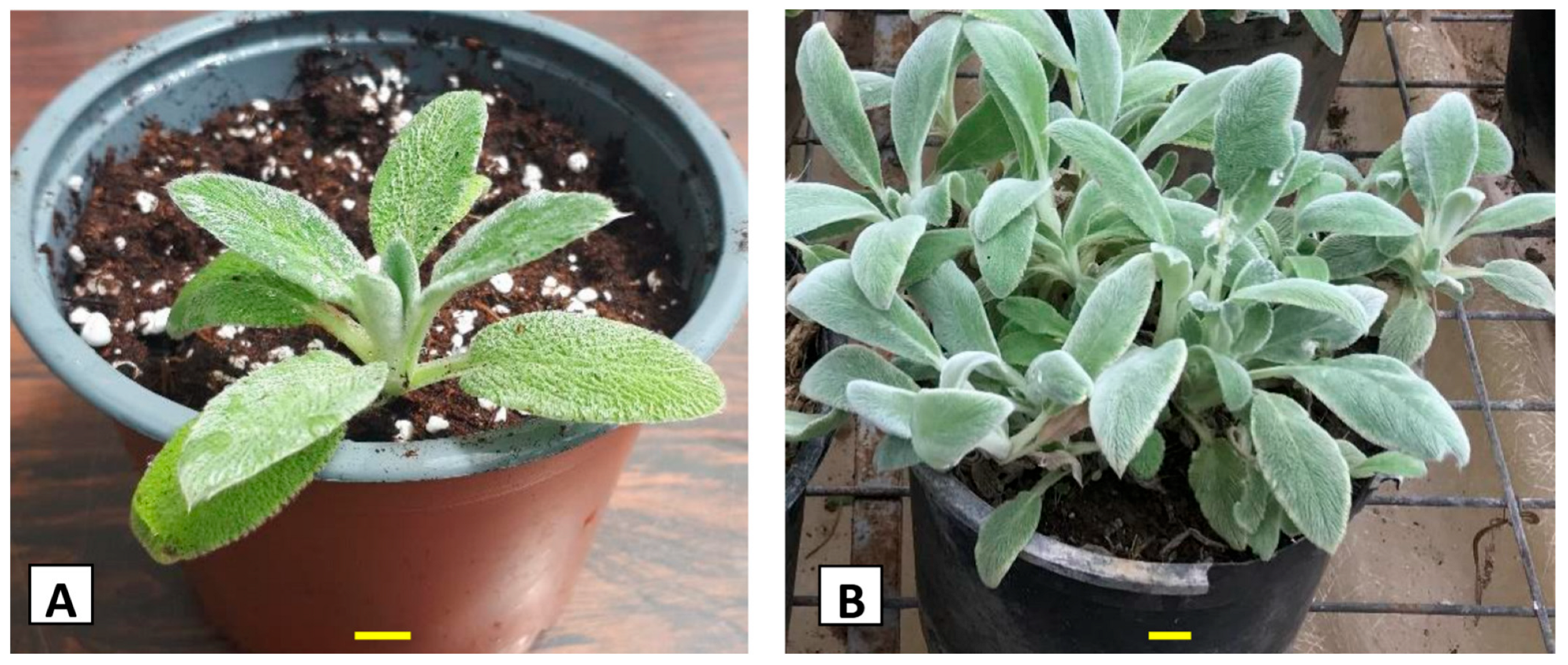
Stachys byzantina K. Kοch (syn. S. lanata), commonly known as ‘lamb’s ear’ or ‘lamb’s tongue’, is one of the most notable species of the genus. It has been studied in the past due to the particular morphology of its fluffy, green–gray leaves (Figure 1), fuzzy appearance and attractive purple–pink/lavender flowers [3,4,5,6,7].
Certain species of the Stachys genus can only be propagated asexually, whereas others, like S. byzantina species, may be propagated both asexually and by seed. Biotechnological tools such as plant tissue culture play a crucial role in the propagation, conservation, and genetic improvement of important medicinal and ornamental plant genotypes [8]. Furthermore, the demand for uniform plant material for mass cloning can be achieved through tissue culture strategies [9,10]. In a previous work, we successfully established an in vitro culture of S. byzantina and proposed the assessment of genetic stability by ISSR markers [6].
Encapsulation methods have been widely used in the in vitro propagation of various ornamental plant species, enhancing micropropagation efficiency and conservation strategies [11,12,13,14,15,16,17]. Encapsulation of plant tissues involves enclosing them within a gel matrix made of sodium alginate or other suitable materials, resulting in the formation of alginate beads, also referred to as ‘artificial seeds’ or ‘synthetic seeds’. This matrix supports the growth of the embedded explants. Various plant tissues such as embryos, nodal segments and shoot tips can be used to produce artificial seeds. In addition, the encapsulating gel acts as a protectant, allowing for cold storage while maintaining the viability and regenerative capacity of the plant material [18]. Notably, Micheli and Standardi [19] reported that the matrix can play a role as a nutrient reservoir for subsequent growth acceleration. This matrix protects the explants during handling, and propagation allows low-temperature storage and facilitates plant regeneration after the desired storage period. Artificial seeds can be transported across borders with fewer phytosanitary restrictions than plants, due to their production under sterile conditions from plant material derived from aseptically cultured sources that ensure they are pathogen- and disease-free [15,20]. Additionally, the encapsulation method is especially useful for storing and propagating rare hybrids, elite genotypes, and endangered species for which propagating material is unavailable or difficult to obtain [21,22].
In vitro encapsulation technology has been successfully applied to several Lamiaceae species for clonal propagation and germplasm conservation. For example, encapsulated shoot apices of Plectranthus amboinicus showed high survival and regrowth when cultured on Murashige and Skoog medium, demonstrating the potential of alginate-based synthetic seeds for micropropagation and short-term storage [23]. Similarly, alginate encapsulation has been reported in other Lamiaceae species such as Mentha spicata and Teucrium polium, where encapsulated nodal segments or meristems successfully converted into plantlets, confirming the usefulness of encapsulation systems for propagation and conservation of aromatic medicinal plants in this family [11,24].
An artificial seed is typically created using sodium alginate and calcium chloride (CaCl2·2H2O) as a hardening agent. Sodium alginate is used as a gelling agent because it has moderate viscosity, low toxicity to the explants, rapid gelation and is relatively inexpensive. The seed’s hardness is primarily determined by the amount of sodium ions exchanged with calcium ions [25,26].
In the present study, the in vitro propagation of S. byzantina was further explored, building upon the findings of our earlier research [6]. Specifically, the storage capability and propagation potential of S. byzantina through artificial seeds were investigated. This study aimed mainly to identify the optimal explant type (shoot tips, first node, and second node) for encapsulation and assess the effect of different factors, (a) sodium alginate concentration, (b) short-term storage duration, and (c) calcium chloride concentration, on seed viability. Additionally, the hardness of the artificial seeds was recorded to explore potential interactions with seed germination. The ultimate goal of this research is to enhance the introduction of S. byzantina into the floriculture industry by improving our understanding of the optimal gel encapsulation matrix.

2. Materials and Methods

2.1. Plant Material and Nutrient Medium Preparation

To produce artificial seeds, shoot tips and node explants (0.5 cm in length) were cut from in vitro grown plantlets. The plant material used came from the in vitro propagated S. byzantina collection maintained at the Floriculture Laboratory of the Aristotle University of Thessaloniki, Greece. The initial culture medium contained MS medium (Murashige and Skoog medium) [27], supplemented with 20 g L−1 sucrose (Sigma-Aldrich, St. Louis, MI, USA) and 10 μM 6-benzylaminopurine (BAP; Sigma-Aldrich, St. Louis, MI, USA). The pH was adjusted to 5.8, and the medium was solidified with 7 g L−1 agar (Technobiochem, Athens, Greece) before being autoclaved at 121 °C and 122 kPa for 20 min.

2.2. Selection of Suitable Explants for Encapsulation

To determine the most suitable explant for encapsulation, shoot tips (0.5 cm in length) and node explants from the first and second node below the shoot tip were cultured in glass test tubes (10 × 3 cm) containing MS medium (10 mL) supplemented with 10 μΜ BA. After one month, the response (percentage of explants producing shoots), the shoot number, and shoot length were recorded. Based on these results, it was determined that the shoot tips and the first node below the shoot tip were the most suitable explants for encapsulation. Hence, shoot tips and first-node segments were selected for use in artificial seed production, as they showed the highest response to shoot induction explants.

2.3. Encapsulation, Cold Storage, and Artificial Seed Germination

Initially, shoot tips and first node explants were immersed in sterile sodium alginate solutions at concentrations of 2%, 2.5% and 3% (w/v) [molecular weight 195.16 (theoretical) or 219 (actual average); AppliChem, Darmstadt, Germany]. For encapsulation, the explants were dropped into sterile calcium chloride (CaCl2·2H2O, Sigma-Aldrich, St. Louis, MI, USA) solutions at concentrations of 50, 100, 200 and 400 mM. They remained in the solution for 35 min to allow gel stabilization and the formation of the alginate beads (artificial seeds). The beads were ovoid in shape with the largest diameter ranging from 0.6 to 0.9 cm and the smallest from 0.4 to 0.6 cm. Afterward, the beads were placed in Petri dishes (100 × 20 mm), the bottom and the lid of which were lined with filter paper. The dishes were sealed with Parafilm and stored in a refrigerator, at 4 °C, for the necessary storage period (1, 2, or 3 months). Germination of the artificial seeds was carried out in tubes (10 × 3 cm) containing MS medium (10 mL) supplemented with 10 μM BA. The regeneration response (%) (expressed as germination) was assessed after four weeks of culture. Non-encapsulated explants were also stored in the refrigerator as a control, but they did not last longer than 1 month.
In addition to assessing the germination potential and storage stability of the artificial seeds, the hardness of the gel produced by each different combination of sodium alginate and (CaCl2·2H2O) solutions was evaluated. The mechanical hardness of the alginate beads was evaluated using a Texture Analyzer TA.XT2i (Stable Microsystems, Godalming, Surrey, UK). Each bead was placed on a crisp fracture support ring, and a flat aluminum plate (Ø, 75 mm) was attached to the analyzer. The force required to deform each bead capsule by 0.2 mm was recorded, with the compression plunger operating at a speed of 1 mm s−1. A total of 5 beads were tested for each calcium chloride concentration.

2.4. In Vitro Culture Conditions

All the in vitro cultures of S. byzantina were maintained in a growth chamber (CRW-500SD; Chrisagis, Athens, Greece) under controlled conditions: a temperature of 22 °C ± 0.1 °C, relative humidity (RH) of 65 ± 1% and a 16 h photoperiod with a photosynthetic photon flux density (PPFD) of 52 μmol m−2 s−1 provided by cool white, fluorescent lamps.

2.5. Statistical Analysis

A completely randomized factorial design (CRD) was used for the statistical analysis of the experiments. A three-way ANOVA factorial experiment was carried out for the analysis of artificial seeds germination and bead hardness. The three factors were alginate concentration (2.0%, 2.5%, and 3.0%); CaCl2 concentration (50, 100, 200, and 400 μM); and storage period (1, 2, and 3 months). The hardness of the alginate beads was also measured at 0 months, immediately after their production and the encapsulation of the explants. Percentage data were arcsine square root transformed prior to statistical analysis to stabilize variances and improve the approximation to normality, as commonly recommended for proportional data. Firmness data were log-transformed prior to statistical analysis to improve normality.
The relationship between hardness and seed germination was evaluated using Spearman’s rank correlation coefficient using the software SPSS 29.0 (IBM Corp., Armonk, NY, USA). Germination was expressed as the mean percentage of germinated seeds from three replicates (30 seeds each), and statistical significance was assessed at p < 0.05.
For the study on the effect of explant type on shoot formation response (%), shoot number, and shoot length, a total of 30 explants per explant type were used (n = 30). The effect of different sodium alginate concentrations (2.0%, 2.5%, and 3.0%) combined with calcium chloride concentrations (50, 100, 200, and 400 mM) on artificial seed germination was evaluated using 90 synthetic seeds distributed in three replicates (30 seeds per replicate; n = 3). Bead hardness was estimated using five randomly selected synthetic seeds per treatment (n = 5). Zero germination values were excluded from figures for visualization purposes, but all data were included in the statistical analyses to avoid bias in proportional measurements.
Due to the significance of interactions of the factors and for better visualization of the relative importance of effects, we assessed model effect significance by Logworth values [Logworth = −log10(p-value)], providing a scale for ranking variable importance. Logworth values > 2 (corresponding to p < 0.01) were considered statistically significant. For Logworth, three- and one-way ANOVA analyses were performed using the software JMP® Student Edition 18.2 (SAS Institute Inc., Cary, NC, USA). Mean comparisons were conducted using Tukey’s Honestly Significant Difference (HSD) test at a significance level of p < 0.05.

3. Results

3.1. Suitable Explants for Encapsulation

In this study, shoot formation was higher in shoot tip and first-node explants (100 and 96.66%, respectively; Table 1). Significantly lower shoot formation was recorded in the explants of the second-node explants (73.33%) than in shoot tip and first-node explants. The higher shoot number (8.2) was produced by shoot tip explants, whereas the shoot length was higher both for shoot tip and first-node explants (1.3 and 0.9, respectively; Table 1).

3.2. Germination of Artificial Seeds

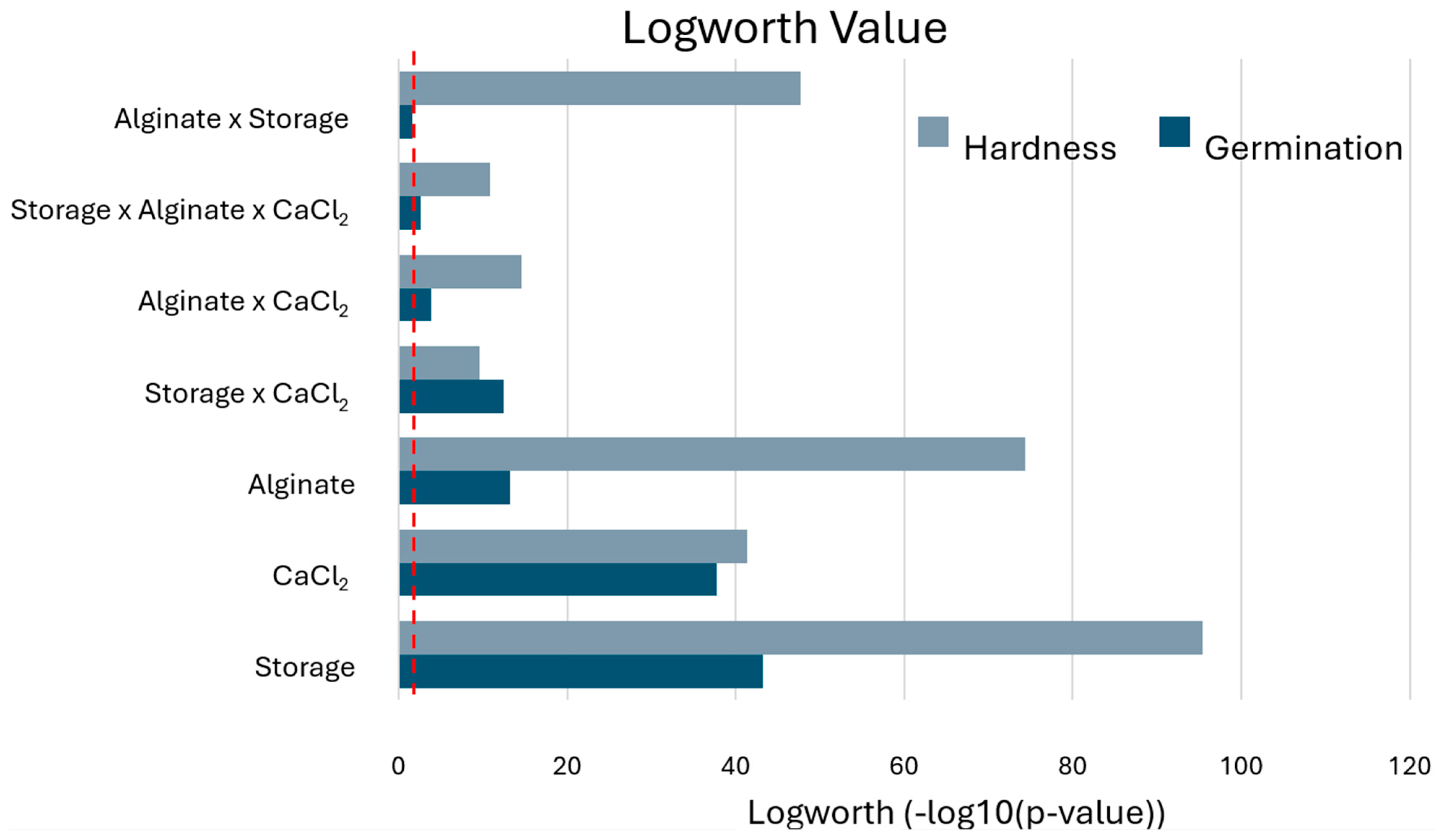
The three-way analysis revealed that all three main factors (storage, CaCl2, alginate) had a strong and statistically significant effect on the germination and hardness of artificial seeds followed by several interactions which significantly affected the response (%) of artificial seeds. Due to the significant interactions observed in the three-way ANOVA, the use of Logworth analysis was selected to assess the significance of factors and their interactions for both germination and hardness of artificial seeds and to visualize the significance of effects (Figure 2). Regarding the germination of artificial seeds, the most important factor was storage [Logworth (L) = 43.20], followed by CaCl2 (L = 37.72). On the other hand, the alginate × storage interaction had weaker evidence (L = 1.65), corresponding to a minor effect (Figure 1). Like the previous analysis, for the hardness of seeds the most important factor on explant response was the storage period (L = 95.44), followed by alginate (L = 74.39), alginate × storage (L = 47.73) and CaCl2 (41.33) (Figure 2).
The control plants were stored in the refrigerator at 4 °C but they did not survive past the first month, and no regeneration was observed when the non-encapsulated explants were transferred to the nutrient substrate after the second and third months of storage. The control explants showed a germination rate of 43.3% at day 0.
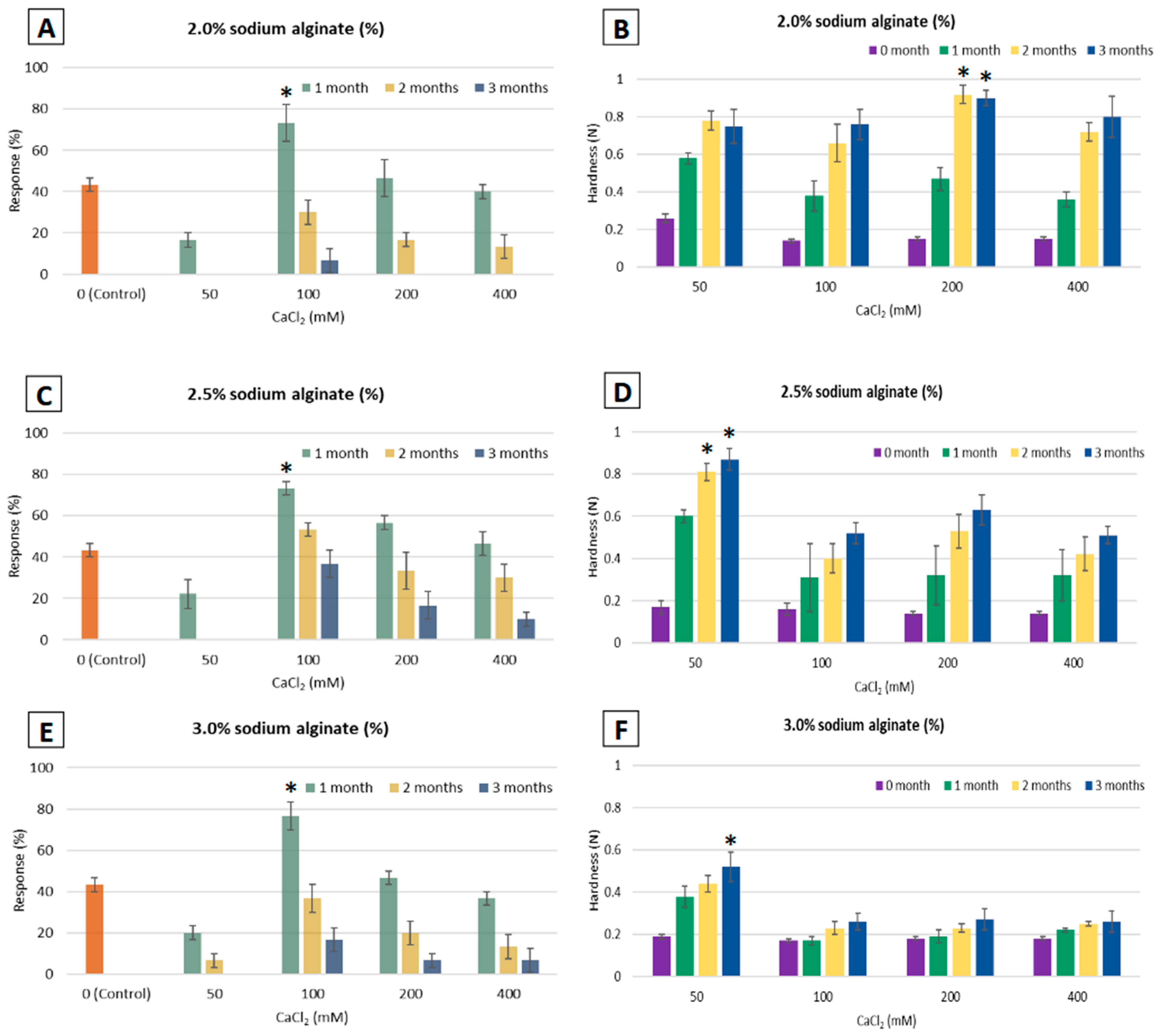
The use of alginate at a 2% concentration resulted in 73.33% germination when combined with 100 mM CaCl2 combined after a storage period of 1 month. The hardness for this combination was 0.38 N (Figure 3A,B). The treatments with 200 and 400 mM CaCl2 showed about 40–47% response, while the treatment with 50 mM CaCl2 had the lowest response (16.6%). The explants in the artificial seeds with 50 mM CaCl2 did not survive beyond 1 month. The 2% sodium alginate × 100 mM CaCl2 treatment was the only one that showed a response following in vitro establishment of the seeds on nutrient medium after 3 months in the refrigerator (4 °C). The treatments with 200 and 400 mM CaCl2 did not preserve the vitality of the encapsulated explants for more than two months (Figure 3A).
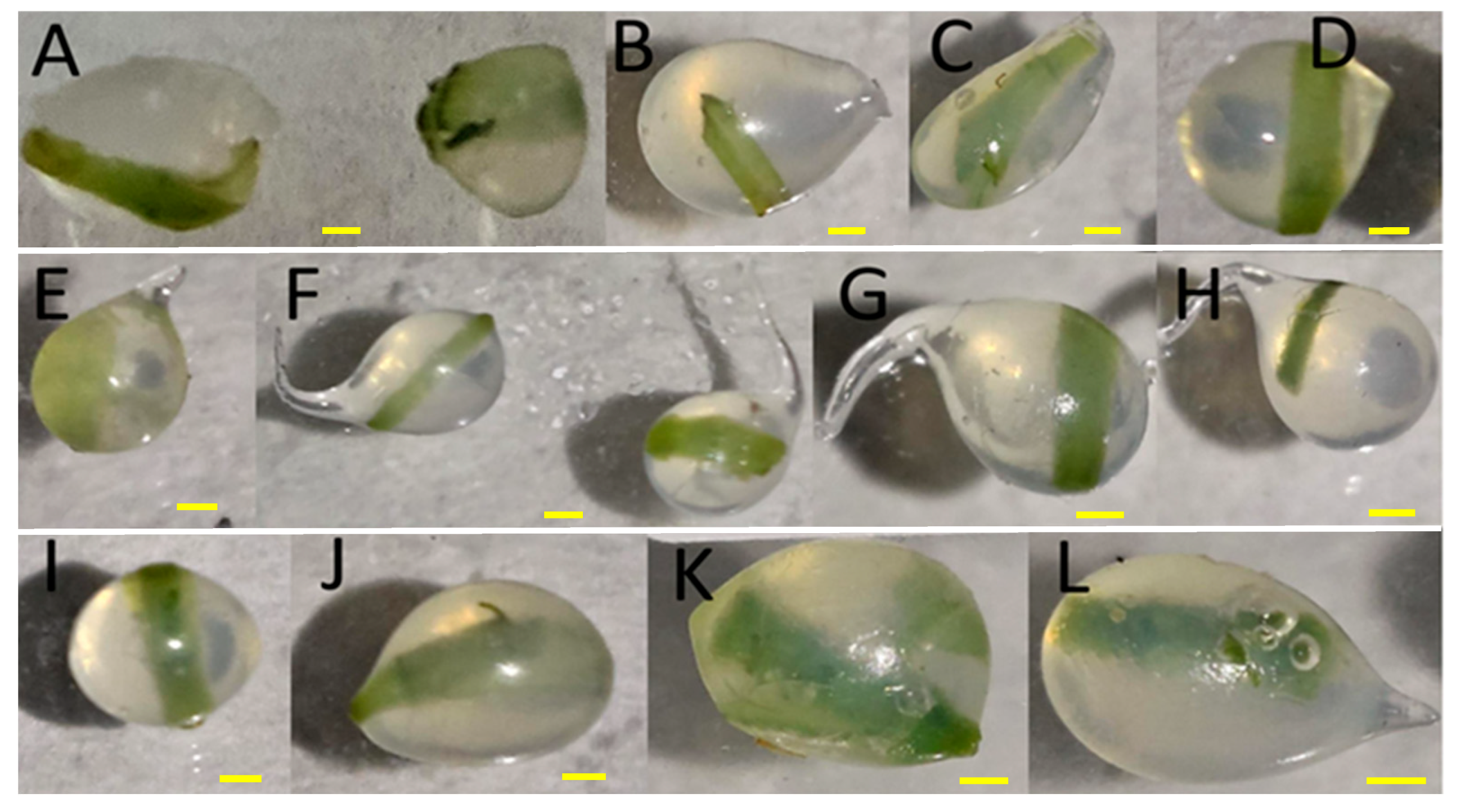
The higher germination percentage (73.33%) for 2.5% alginate was observed under the combination of 100 mM CaCl2 concentration and 1 month storage time. This was achieved by beads of 0.31 N hardness, a value close to that of the previous data (0.38 N for 2.0% sodium alginate; Figure 3C,D). At a higher concentration of alginate (3%), a higher germination percentage (76.66%) was observed for beads of a softer matrix: a hardness of 0.17 N was recorded for beads which remained for 1 month at 4 °C (Figure 3E,F and Figure 4). The combination of 3% sodium alginate and 100 mM CaCl2 resulted in similar explant response percentages after one month of storage compared to all other treatments evaluated. After two months, the response rate (36.6%) was close to that of 2% sodium alginate (30.0%). However, after three months, the half response percentage of the 2.5% alginate treatment (16.6% vs. 36.6%) was recorded, approaching the response (6.6%) of 2% alginate.
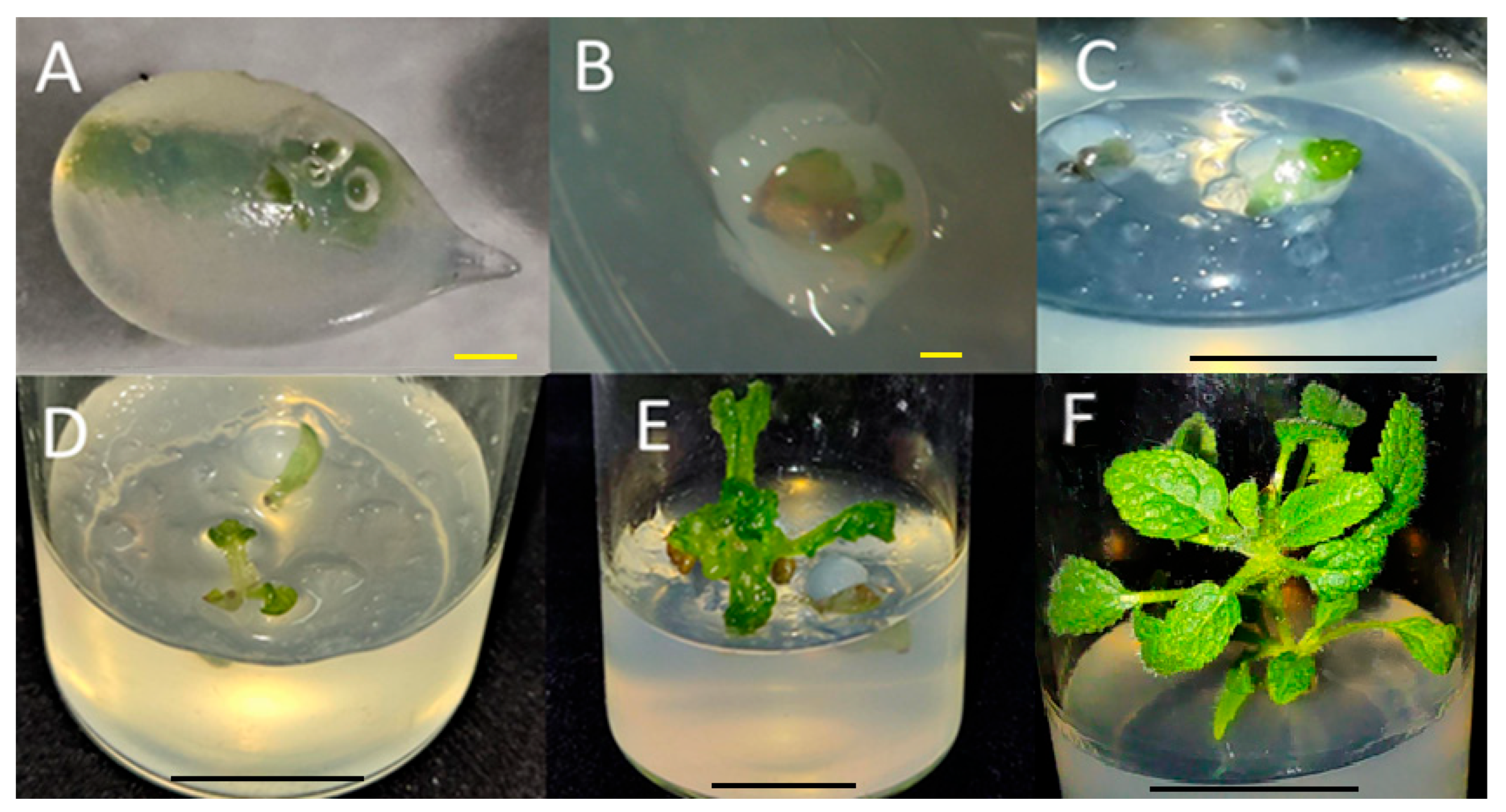
The 2.5% sodium alginate solution shows better results compared to the 2% concentration in both the final regenerative ability of the explants and the ability of the artificial seeds to maintain their viability over a longer period. The artificial seeds produced by the above treatments appeared to have a gel of appropriate hardness and gave better results when stored in the refrigerator at 4 °C (Figure 3 and Figure 4). For all concentrations of alginate, the use of a low concentration (50 mM) of CaCl2 proved inefficient to produce suitable beads, and the germination of seeds was lower than 25% (Figure 3 and Figure 4). The corresponding bead hardness of this CaCl2 concentration was relatively higher than other concentrations of CaCl2, showing the significant interaction between CaCl2 × Storage (Figure 3). The S. byzantina artificial seed regeneration process was applied over a period of 28 days (Figure 5).
The storage period led to a significant decline in explant yield over the subsequent months and resulted in increasing bead hardness across all alginate treatments, as illustrated in Figure 3. The relationship between bead hardness and seed germination is presented in Table S1. The average hardness measurement was compared to the average germination percentage, with the values derived from the time of measurement of the beads (0, 1, 2, 3 months). Spearman’s rank correlation coefficient (ρ) was used to assess the association between hardness and mean germination percentage. Table S1 shows a negative correlation, indicating that the higher bead hardness tended to have lower germination. The corresponding p-value demonstrates whether this association is statistically significant at the α = 0.05 level, providing evidence that increased bead hardness is associated with reduced seed germination.
Regarding bead hardness, 2.0% alginate and 200 mM CaCl2 at 2- or 3-month storage and 2.5% alginate combined with 50 mM CaCl2 and 3 months storage led to maximal hardness (>0.8 N). In general, the hardness of beads was higher at 2.0% and 2.5% alginate concentration. By increasing the storage period, the hardness of beads increased in 2.0% and 2.5% of alginate treatments (Figure 3 and Figure 4). When the concentration of alginate reached 3.0%, the increase in bead hardness over time was noticeably reduced.

4. Discussion

Encapsulation technology is a promising tool to produce propagative material in ornamental plants. However, the success of this technique largely depends on the selection of appropriate explant types, particularly for short- and medium-term storage applications in nurseries [28,29]. It is crucial to utilize explants that exhibit optimal growth and strong shoot induction responses to ensure the effectiveness of artificial seed production. Additionally, for commercial laboratories, optimizing both the cost and time of large-scale propagation is critical, making the selection of the most appropriate explant type even more important [12]. The present study indicates that shoot tips and the first node below the shoot tip are the most suitable explants for encapsulation. This aligns with previous findings in various woody species, which emphasize the importance of explant choice for the success of short- and medium-term storage and subsequent regrowth of artificial seeds [28,30,31]. Similar results have been reported in other studies investigating suitable explant types for in vitro regeneration such as Gardenia jasminoides ellis [16], Camellia japonica L. and Camellia reticulata Lindley [32].
The higher shoot response for shoot tip and first-node explants could be explained by the hypothesis that their higher tissue juvenility can result in greater proliferation ability during artificial seed germination. In accordance with the findings of our study, the use of shoot tips and/or nodal segments for encapsulation has also been reported for other woody plant species, such as Nerium oleander [33], Simmondsia chinensis [34], Cassia angustifolia [35], and Viburnum dentatum [15].
Successful germination of artificial seeds requires the formation of capsules with an optimal balance between hardness and flexibility, allowing the explant to effectively emerge from the capsule [36]. Achieving this balance between structural integrity and softness requires adjusting the concentrations of sodium alginate and calcium chloride, as well as the exposure time during complexation [37,38,39]. The high Logworth values of the three individual factors indicated that each had a significant effect on the response and the hardening of the artificial seeds. Consistent with this, the simple effect analysis of germination data revealed that the storage period had a notable impact: for each level of sodium alginate, increasing the storage period from 1 to 3 months resulted in lower germination percentages of the artificial seeds (Figure 3). This decline in germination may be related to a gradual loss of physiological viability of the encapsulated propagules during storage, possibly due to metabolic deterioration, depletion of endogenous reserves, and oxidative stress. In addition, structural changes and gradual hardening of the alginate matrix during storage may restrict water uptake and gas exchange, thereby limiting germination [40].
The treatment with 2.5% sodium alginate, combined with 100 mM CaCl2, yielded the best results across all storage durations. This treatment resulted in a distinctly higher explant response compared to the others. Unlike the 2.0% and 3.0% alginate formulations, explants encapsulated with higher CaCl2 concentrations (200 and 400 mM) survived after 2 months but exhibited low regeneration rates (Figure 2). Overall, the 2.5% alginate treatment outperformed the 2.0% concentration followed by the 3.0% concentration, in terms of the explants’ regenerative capacity and the ability of the artificial seeds to retain viability during extended storage periods. Notably, the hardness of seeds in this 2.5% alginate treatment was lower than that of seeds formed with 2% sodium alginate, and the gel matrix exhibited optimal consistency (Figure 4). This contributed to enhanced performance during storage at 4 °C, with most encapsulated explants maintaining vigor.
The present study demonstrated the complexity of the encapsulation process. The interaction of all the factors was strong both for the hardness of the seeds and the subsequent regeneration of the explants (Figure 2 and Figure 3). Sharma et al. [41] suggested that the viability of artificial seeds may be affected either by inhibited tissue respiration, resulting from restricted oxygen diffusion through the alginate matrix, or by moisture loss caused by partial desiccation during storage.
In general, a 2–3% sodium alginate gel combined with 100 mM calcium chloride and a 30 min complexation period has been reported as effective for producing beads with satisfactory germination responses [13,15,16,42,43]. This study revealed that combining 2.5% sodium alginate with 100 mM calcium chloride and allowing a 35 min complexation time resulted in the formation of high-quality, easy-to-handle beads (hardness: 0.31 ± 0.03 N), which also supported good germination. As mentioned in the study of Devi et al. [21], concentrations of 3.0% and 4.0% alginate resulted in the production of beads with an isodiametric shape and a matrix that was too hard, obstructing the explant from exiting the artificial seed. However, there are also studies, like those of Sharma & Shahzad [41], Gholami & Alavi [44], Ahmad & Anis [45], and Mahdavi et al. [46], reporting that a concentration of 3 or 4% sodium alginate and 100 mM CaCl2 is ideal for the formation of artificial seeds and subsequent seedling germination. These discrepancies may be attributed to differences among studies in plant species, the type and size of the encapsulated explant, and variations in encapsulation conditions, including alginate viscosity, calcium chloride concentration, and complexation time. Such factors can influence the hardness and permeability of the alginate matrix, thereby affecting both bead structure and the ability of the encapsulated propagules to emerge and germinate. In addition, species-specific responses to encapsulation conditions may further contribute to the variability reported in the literature.
Regarding storage time, germination percentages declined as storage time increased. Among all treatments, the use of 100 mM CaCl2 consistently resulted in the highest regeneration percentages across all storage durations. A 2.5% alginate concentration proved to be the most suitable for maintaining high germination rates; it was the only concentration that supported moderate germination even after 2 and 3 months of storage (53.33% and 36.7%, respectively). This may be explained by the fact that 2.5% sodium alginate provides an optimal balance between mechanical stability and matrix permeability, allowing sufficient protection while still permitting water uptake and the emergence of the propagule during germination [40].
The initial hardness of the beads (at 0 months) ranged between 0.14 and 0.26 N, which is comparable to the values reported by Hatzilazarou et al. [16], who found a range of 0.20–0.27 N for alginate beads derived from Gardenia jasminoides using 2.5% sodium alginate and 50–100 mM calcium chloride. The slight difference in hardness may be attributed to differences in plant tissue type and hardening time (35 min in the present study).
At 0 months, bead hardness remained consistent across varying calcium chloride concentrations for each alginate level (Figure 3B,D,F). However, 50 mM CaCl2 led to an increase in bead hardness over time for all alginate levels, indicating its inadequacy for producing stable beads from S. byzantine, in line with findings by Gantait et al. [38].
A clear increase in hardness was observed in all formulations from the first to the third month of storage (Figure 3B,D,F), with the most pronounced softening seen in beads containing 2.0% and 2.5% sodium alginate. Logworth analysis supported this trend, identifying storage time as the most significant factor influencing hardness (L = 95.44). Interestingly, beads made with 3.0% sodium alginate showed a less pronounced decline in their structure, suggesting a more stable gel matrix over time at this concentration. The increase in hardness during storage may be attributed to continued Ca2+-mediated cross-linking of alginate chains and partial dehydration of the gel matrix, both of which can increase matrix rigidity over time [47].
Formulations with 2% and 2.5% alginate have a less dense initial network, which may allow for more noticeable changes over time due to greater potential for network reorganization. In contrast, at 3%, the initial gel network is denser and more stable, with limited potential for further hardening [48]. These results highlight the need to optimize alginate concentration not only for initial gel strength but also for maintaining mechanical integrity throughout storage. Also, the reduction in germination observed when CaCl2 concentration increased from 100 to 400 mM may be related to changes in the structural characteristics of the alginate gel matrix. At moderate calcium concentrations, such as 100 mM, the resulting gel structure can provide adequate mechanical stability while still allowing sufficient diffusion of water and gases required for embryo growth and germination. However, higher CaCl2 concentrations may lead to a more densely cross-linked and rigid matrix, which can reduce porosity and restrict embryo expansion, thereby lowering germination rates. In this study, the formulation containing 2.5% alginate and 100 mM CaCl2 appeared to offer a suitable balance between bead hardness and germination capacity, indicating that this combination provided sufficient structural support while maintaining conditions favorable for seed viability. Similar effects of calcium-induced cross-linking on the physical properties of alginate gels have been reported previously [49].
In artificial seed technology, the alginate bead matrix can also serve as a carrier for nutrients, growth regulators, or other additives that may enhance germination and seedling development. Several studies have reported the incorporation of plant growth regulators or mineral nutrients into the encapsulation matrix to improve conversion rates and early growth of the encapsulated propagules [38]. However, in the present study, the encapsulation matrix consisted only of sodium alginate and CaCl2, as the primary objective was to evaluate the effect of different concentrations on bead formation and germination performance.
Despite the promising results, this study has certain limitations. The evaluation of synthetic seed performance was conducted under controlled in vitro conditions and focused on a limited range of alginate and calcium chloride concentrations. Further research is required to investigate additional factors that may influence synthetic seed formation and storage stability, including different encapsulation formulations, nutrients or PGRs in the bead matrix, storage conditions, and longer storage periods.

5. Conclusions

Artificial seed systems offer comparable propagation efficiency to conventional methods, with added advantages in storage and handling. The use of artificial seeds enables the propagation of genetically identical plants following their regeneration, while also facilitating the storage and transportation of propagules. The present study confirmed the feasibility of producing artificial seeds using sodium alginate at concentrations of 2.0%, 2.5%, or 3.0%, in combination with 100 mM calcium chloride. The encapsulated explants demonstrated successful in vitro regeneration on MS medium derived from S. byzantina stems. For extended storage, the optimal encapsulation matrix composition was 2.5% sodium alginate with 100 mM calcium chloride; however, after 2 months of cold storage, germination rates decreased to moderate levels (53%), a rate that is relatively satisfactory, considering artificial seed systems typically require germination rates above ~60% for practical large-scale applications. The parameters tested here provide a foundation for scale-up, but further studies are needed to assess industrial feasibility. Additionally, further research is needed to improve long-term preservation of artificial seeds at 4 °C and to ensure their successful regeneration after prolonged storage. Future studies should also evaluate the inclusion of plant growth regulators in the bead matrix, as their presence may influence physiological responses and conversion efficiency of artificial seeds.

Supplementary Materials

The following supporting information can be downloaded at: https://www.mdpi.com/article/10.3390/horticulturae12030378/s1, Table S1. Spearman’s rank correlation coefficient (ρ) indicates the association between bead hardness and mean germination percentage over time in each treatment. Table S2. Effect of explant type on shoot formation response (%), number, and length of shoots of S. byzantina cultured on Murashige and Skoog medium supplemented with 10 µM of BA, after 4 weeks of culture. Table S3. Effect of sodium alginate concentration (2.0%, 2.5%, and 3.0%), calcium chloride concentration (50, 100, 200, 400 mM), and storage period (1, 2, and 3 months) on the germination of artificial seeds of S. byzantina. Data were collected after 4 weeks of culture on MS medium supplemented with 10 µM BA. Table S4. Effect of sodium alginate concentration (2.0%, 2.5%, and 3.0%), calcium chloride concentration (50, 100, 200, 400 mM), and storage period (1, 2, and 3 months) on the hardness of artificial seeds of S. byzantina. Data were collected after 4 weeks of culture on MS medium supplemented with 10 µM BA.

Author Contributions

Conceptualization, S.H.; methodology, S.H. and K.B.; software, S.K. and C.E.K.; validation, S.H. and C.E.K.; formal analysis, S.K. and C.E.K.; investigation, S.H., C.E.K. and K.B.; resources, S.K. and C.E.K. data curation, C.E.K. and S.K.; writing—original draft preparation, S.H., S.K., K.B. and C.E.K.; writing—review and editing, S.H., S.K., K.B. and C.E.K.; visualization, S.K. and C.E.K.; supervision, S.H. and S.K.; project administration, S.H.; funding acquisition, S.H. and S.K. All authors have read and agreed to the published version of the manuscript.

Funding

This research received no external funding.

Data Availability Statement

The original contributions presented in this study are included in the article/Supplementary Material. Further inquiries can be directed to the corresponding author.

Acknowledgments

We thank the technical staff of the Floriculture Laboratory of Aristotle University for its contribution to this publication.

Conflicts of Interest

The authors declare no conflicts of interest.

References

  1. Salmaki, Y.; Zarre, S.; Govaerts, R.; Bräuchler, C. A taxonomic revision of the genus Stachys (Lamiaceae: Lamioideae) in Iran. Bot. J. Linn. Soc. 2012, 170, 573–617. [Google Scholar] [CrossRef]
  2. Tundis, R.; Peruzzi, L.; Menichini, F. Phytochemical and biological studies of Stachys species in relation to chemotaxonomy: A review. Phytochemistry 2014, 102, 7–39. [Google Scholar] [CrossRef]
  3. Asnaashari, S.; Delazar, A.; Alipour, S.S.; Nahar, L.; Williams, A.S.; Pasdaran, A.; Mojarab, M.; Azad, F.F.; Sarker, S. Chemical composition, free-radical-scavenging and insecticidal activities of the aerial parts of Stachys byzantina. Arch. Biol. Sci. 2010, 62, 653–662. [Google Scholar] [CrossRef]
  4. North Carolina Plant Toolbox. Stachys byzantina—Plant Information. Available online: https://plants.ces.ncsu.edu/plants/stachys-byzantina/ (accessed on 5 April 2025).
  5. Devecchi, M. The use of Labiatae of ornamental interest in the design of parks and gardens. Acta Hortic. 2006, 723, 51–58. [Google Scholar] [CrossRef]
  6. Hatzilazarou, S.; Kantere, C.; Kotoula, A.-A.; Economou, A.; Bertsouklis, K.; Darras, A.; Kostas, S. In Vitro Propagation and Genetic Stability Assessment Using the ISSR Markers of Stachys byzantina K. Koch, a Promising Ornamental Species. Horticulturae 2025, 11, 530. [Google Scholar] [CrossRef]
  7. Vojík, M.; Kadlecová, M.; Kutlvašr, J.; Pergl, J.; Bímová, K.B. Two shades of grey: Effect of temperature on seed germination of the escaping ornamental species Lychnis coronaria and Stachys byzantina. Plant Ecol. 2022, 223, 1121–1135. [Google Scholar] [CrossRef]
  8. Ochatt, S.J.; Beruto, M.I.; Chan, M.T.; Prestwich, B.M.D.; Eimert, K.; Lambardi, M.; Winkelmann, T. Biotechnology of ornamental plants: When beauty joins science—Preface from the editors. Plant Cell Tissue Organ. Cult. 2022, 149, 497–502. [Google Scholar] [CrossRef]
  9. Debnath, M.; Malik, C.P.; Bisen, P.S. Micropropagation: A tool for the production of high quality plant-based medicines. Curr. Pharm. Biotechnol. 2006, 7, 33–49. [Google Scholar] [CrossRef] [PubMed]
  10. Chaturvedi, H.C.; Jain, M.; Kidwai, N.R. Cloning of medicinal plants through tissue culture—A review. Indian J. Exp. Biol. 2007, 45, 937–948. [Google Scholar] [PubMed]
  11. Micheli, M.; Regni, L.; da Silva, D.F. Encapsulation in Calcium Alginate of Nodes from Stolons of Mentha spicata L. Horticulturae 2022, 8, 456. [Google Scholar] [CrossRef]
  12. Benelli, C.; Micheli, M.; De Carlo, A. An improved encapsulation protocol for regrowth and conservation of four ornamental species. Acta Soc. Bot. Pol. 2017, 86, 3559. [Google Scholar] [CrossRef]
  13. Bertsouklis, K.; Tsopela, S. In vitro propagation of three populations of the endangered, Greek endemic Cerastium candidissimum and short-term storability of alginate-encapsulated shoot explants for exploitation and conservation. Horticulturae 2023, 9, 273. [Google Scholar] [CrossRef]
  14. Kulus, D.; Zalewska, M. In vitro plant recovery from alginate encapsulated Chrysanthemum × grandiflorum (Ramat.) Kitam. shoot tips. Prop. Ornam. Plants 2014, 14, 3–12. [Google Scholar]
  15. Hatzilazarou, S.; Kostas, S.; Joachim, M.; Economou, A. Regeneration of Viburnum dentatum L. from Alginate-Encapsulated Shoot Explants After Short-Term Cold Storage and Assessment of Genetic Stability Using ISSR Analysis. Agronomy 2020, 10, 1660. [Google Scholar] [CrossRef]
  16. Hatzilazarou, S.; Kostas, S.; Nendou, T.; Economou, A. Conservation, Regeneration and Genetic Stability of Regenerants from Alginate-Encapsulated Shoot Explants of Gardenia jasminoides Ellis. Polymers 2021, 13, 1666. [Google Scholar] [CrossRef]
  17. Sharma, S.; Shahzad, A.; Teixeira da Silva, J.A. Synseed technology—A complete synthesis. Biotechnol. Adv. 2013, 31, 186–207. [Google Scholar] [CrossRef]
  18. Mehbub, H.; Akter, A.; Akter, M.A.; Mandal, M.S.H.; Hoque, M.A.; Tuleja, M.; Mehraj, H. Tissue Culture in Ornamentals: Cultivation Factors, Propagation Techniques, and Its Application. Plants 2022, 11, 3208. [Google Scholar] [CrossRef]
  19. Micheli, M.; Standardi, A. From Somatic Embryo to Synthetic Seed in Citrus spp. Through the Encapsulation Technology. In In Vitro Embryogenesis in Higher Plants Methods in Molecular; Humana Press: Totowa, NJ, USA, 2016; pp. 515–522. [Google Scholar] [CrossRef]
  20. Rihan, H.Z.; Kareem, F.; El-Mahrouk, M.E.; Fuller, M.P. Artificial Seeds (Principle, Aspects and Applications). Agronomy 2017, 7, 71. [Google Scholar] [CrossRef]
  21. Devi, S.D.; Kharsahnoh, B.; Kumaria, S.; Das, M.C. Artificial seed for short-term storage: Using nodal buds in Aquilaria malaccensis Lam. Curr. Sci. 2018, 115, 2103–2109. [Google Scholar] [CrossRef]
  22. Rai, M.K.; Rathour, R.; Behera, S.; Kaushik, S.; Naik, S.K. Encapsulation Technology: An Assessment of Its Role in In Vitro Conservation of Medicinal and Threatened Plant Species. In Agricultural Biotechnology: Latest Research and Trends; Kumar Srivastava, D., Kumar Thakur, A., Kumar, P., Eds.; Springer: Singapore, 2021. [Google Scholar] [CrossRef]
  23. Arumugam, G.; Sinniah, U.R.; Swamy, M.K.; Lynch, P.T. Encapsulation of in vitro Plectranthus amboinicus (Lour.) Spreng. shoot apices for propagation and conservation. 3 Biotech 2019, 9, 298. [Google Scholar] [CrossRef]
  24. Saadat, S.; Majd, A.; Naseri, L.; Iranbakhsh, A.; Jafari, M. Optimization of somatic embryogenesis, synthetic seed production, and evaluation of genetic fidelity in Teucrium polium L. Vitr. Cell. Dev. Biol.–Plant 2023, 59, 483–496. [Google Scholar] [CrossRef]
  25. Saiprasad, G.V.S. Artificial seeds and their applications. Resonance 2001, 6, 39–47. [Google Scholar] [CrossRef]
  26. Rai, M.K.; Asthana, P.; Jaiswal, V.S.; Jaiswal, U. Biotechnological advances in guava (Psidium guajava L.): Recent developments and prospects for further research. Trees 2010, 24, 1–12. [Google Scholar] [CrossRef]
  27. Murashige, T.; Skoog, F. A revised medium for rapid growth and bioassays with tobacco tissue cultures. Physiol. Plant. 1962, 15, 473–497. [Google Scholar] [CrossRef]
  28. Ozden-Tokatli, Y.; De Carlo, A.; Gumusel, F.; Pignattelli, S.; Lambardi, M. Development of encapsulation techniques for the production and conservation of synthetic seeds in ornamental plants. Propag. Ornam. Plants 2008, 8, 17–22. [Google Scholar]
  29. West, T.P.; Ravindra, M.B.; Preece, J.E. Encapsulation, cold storage, and growth of Hibiscus moscheutos nodal segments. Plant Cell Tissue Organ Cult. 2006, 87, 223–231. [Google Scholar] [CrossRef]
  30. Lambardi, M.; Benelli, C.; Ozudogru, E.A.; Ozden-Tokatli, Y. Synthetic seed technology in ornamental plants. In Floriculture, Ornamental and Plant Biotechnology; Teixeira da Silva, J.A., Ed.; Global Science Books: Isleworth, UK, 2006; Volume 2, pp. 347–354. [Google Scholar]
  31. Qahtan, A.A.; Abdel-Salam, E.M.; Alatar, A.A.; Wang, Q.-C.; Faisal, M. An introduction to synthetic seeds: Production, techniques, and applications. In Synthetic Seeds: Germplasm Regeneration, Preservation and Prospects; Faisal, M., Alatar, A.A., Eds.; Springer Nature: Cham, Switzerland, 2019; pp. 1–20. [Google Scholar]
  32. Ballester, A.; Janeiro, L.V.; Vieitez, A.M. Cold storage of shoot cultures and alginate encapsulation of shoot tips of Camellia japonica L. and Camellia reticulata Lindley. Sci. Hortic. 1997, 71, 67–78. [Google Scholar] [CrossRef]
  33. Hatzilazarou, S.; Kostas, S.; Economou, A.S. Plant regeneration of Nerium oleander L. from alginate-encapsulated shoot explants after short-term cold storage. J. Hortic. Sci. Biotechnol. 2018, 94, 441–447. [Google Scholar] [CrossRef]
  34. Kumar, S.; Rai, M.K.; Singh, N.; Mangal, M. Alginate-encapsulation of shoot tips of jojoba [Simmondsia chinensis (Link) Schneider] for germplasm exchange and distribution. Physiol. Mol. Biol. Plants 2010, 16, 379–382. [Google Scholar] [CrossRef][Green Version]
  35. Parveen, S.; Shahzad, A. Encapsulation of nodal segments of Cassia angustifolia Vahl. for short-term storage and germplasm exchange. Acta Physiol. Plant. 2014, 36, 635–640. [Google Scholar] [CrossRef]
  36. Rai, M.K.; Asthana, P.; Singh, S.K.; Jaiswal, V.S.; Jaiswal, U. The encapsulation technology in fruit plants—A review. Biotechnol. Adv. 2009, 27, 671–679. [Google Scholar] [CrossRef]
  37. Benelli, C. Encapsulation of shoot tips and nodal segments for in vitro storage of “Kober 5BB” grapevine rootstock. Horticulturae 2016, 2, 10. [Google Scholar] [CrossRef]
  38. Gantait, S.; Kundu, S.; Ali, N.; Sahu, N.C. Synthetic seed production of medicinal plants: A review on influence of explants, encapsulation agent and matrix. Acta Physiol. Plant. 2015, 37, 98. [Google Scholar] [CrossRef]
  39. Kesoju, S.R.; Boydston, R.A.; Greene, S.L. Effect of synthetic auxin herbicides on seed development and viability in genetically engineered glyphosate-resistant alfalfa. Weed Technol. 2016, 30, 860–868. [Google Scholar] [CrossRef]
  40. Redenbaugh, K.; Fujii, J.; Slade, D.; Viss, P.; Kossler, M. Artificial seeds—Encapsulated somatic embryos. In High-Tech and Micropropagation I.; Springer: Berlin/Heidelberg, Germany, 1991; pp. 395–416. [Google Scholar]
  41. Sharma, S.; Shahzad, A. Encapsulation technology for short-term storage and conservation of a woody climber, Decalepis hamiltonii Wight and Arn. Plant Cell Tissue Organ Cult. 2012, 111, 191–198. [Google Scholar] [CrossRef]
  42. Ara, H.; Jaiswal, U.; Jaiswal, V.S. Synthetic seed: Prospects and limitations. Curr. Sci. 2000, 78, 1438–1444. [Google Scholar]
  43. Prakash, A.V.; Nair, D.S.; Alex, S.; Soni, K.B.; Viji, M.M.; Reghunath, B.R. Calcium alginate encapsulated synthetic seed production in Plumbago rosea L. for germplasm exchange and distribution. Physiol. Mol. Biol. Plants 2018, 24, 963–971. [Google Scholar] [CrossRef]
  44. Gholami, A.A.; Alavi, S.V. Plant regeneration of Citrus sinensis var. Thomson navel using sodium alginate-encapsulated shoot tips. Iran. J. Plant Physiol. 2016, 6, 1737–1743. [Google Scholar]
  45. Ahmad, N.; Anis, M. Direct plant regeneration from encapsulated nodal segments of Vitex negundo. Biol. Plant. 2010, 54, 748–752. [Google Scholar] [CrossRef]
  46. Mahdavi, Z.; Daylami, S.D.; Fadavi, A.; Vahdati, K. Artificial seed production of Phalaenopsis orchid: Effect of encapsulation materials, temperature, light spectra, and storage period. Plant Cell Tissue Organ Cult. 2023, 155, 797–808. [Google Scholar] [CrossRef]
  47. Wang, Y.; Shen, Z.; Wang, H.; Song, Z.; Yu, D.; Li, G.; Liu, X.; Liu, W. Progress in Research on Metal Ion Crosslinking Alginate-Based Gels. Gels 2025, 11, 16. [Google Scholar] [CrossRef] [PubMed]
  48. Malabadi, R.B.; van Staden, J. Storability and germination of sodium alginate encapsulated somatic embryos derived from the vegetative shoot apices of mature Pinus patula trees. Plant Cell Tissue Organ Cult. 2005, 82, 259–265. [Google Scholar] [CrossRef]
  49. Lee, K.Y.; Mooney, D.J. Alginate: Properties and biomedical applications. Prog. Polym. Sci. 2012, 37, 106–126. [Google Scholar] [CrossRef] [PubMed]
Figure 1. Stachys byzantina K. Kοch plants in pots growing in a greenhouse (A) one month after transplantation, and (B) one year after transplantation. The yellow lines in the pictures indicate the size of 1 cm.
Horticulturae 12 00378 g001
Figure 2. Logworth values for germination and hardness of artificial seeds of Stachys byzantina. Values to the right of the red line (Logworth > 2) are statistically significant (p < 0.01). Values > 40 have the strongest effects.
Horticulturae 12 00378 g002
Figure 3. Effect of varying concentrations of sodium alginate [2.0% (A,B), 2.5% (C,D), or 3.0% (E,F)] in combination with different calcium chloride levels (0, 50, 100, 200, or 400 mM) on the germination (A,C,E) and on hardness (B,D,F) of artificial seeds of Stachys byzantina. Data were collected after 4 weeks of culture on MS medium supplemented with 10 µM BA, following cold storage at 4 °C for 1, 2, and 3 months. Zero values were excluded from the statistical analysis. The asterisks (*) indicate treatments with significantly higher mean values compared to the other treatments according to Tukey’s test at p ≤ 0.05. Tukey’s test mean separation letters were omitted from the columns for clarity.
Horticulturae 12 00378 g003
Figure 4. Artificial seeds of Stachys byzantina after their preparation with (A) 2% sodium alginate × 50 mM CaCl2; (B) 2% sodium alginate × 100 mM CaCl2; (C) 2% sodium alginate × 200 mM CaCl2; (D) 2% sodium alginate × 400 mM CaCl2; (E) 2 × 5% sodium alginate × 50 mM CaCl2; (F) 2.5% sodium alginate × 100 mM CaCl2; (G) 2.5% sodium alginate × 200 mM CaCl2; (H) 2.5% sodium alginate × 400 mM CaCl2; (I) 3% sodium alginate × 50 mM CaCl2; (J) 3% sodium alginate × 100 mM CaCl2; (K) 3% sodium alginate × 200 mM CaCl2; (L) 3% sodium alginate × 400 mM CaCl2. The yellow lines in the images indicate a size of 0.1 cm.
Horticulturae 12 00378 g004
Figure 5. Stages of regeneration from an artificial seed of Stachys byzantina after establishment in a nutrient substrate: (A) artificial seed before establishment in a nutrient substrate, (B) explant initiating regeneration inside the artificial seed after establishment in a nutrient substrate, (C) explant exiting the artificial seed 7 days after establishment, and (DF) plantlet development after 14, 21, and 28 days, respectively, after establishment of the artificial seed. The yellow lines in the images indicate a size of 0.1 cm and the black lines indicate a size of 1 cm.
Horticulturae 12 00378 g005
Table 1. Effect of explant type on shoot formation response (%), number, and length of shoots of Stachys byzantina cultured on Murashige and Skoog medium supplemented with 10 µM of BA, after 4 weeks of culture.
Explant TypeResponse (%) ± SD Number of ShootsLength of Shoots (cm)
Shoot tip100 a8.20 ± 0.20 a1.30 ± 0.26 a
1st node96.66 ± 3.35 a5.80 ± 0.30 b0.90 ± 0.10 a
2nd node73.33 ± 6.65 b3.76 ± 0.30 c0.46 ± 0.20 b
One-way analysis***
p = 0.001
***
p = 0.000
**
p = 0.007
(SD): standard deviation; ***: significant at p ≤ 0.001; **: significant at p ≤ 0.01; mean (±SD) separation in columns by Tukey’s test at p ≤ 0.05. Mean values followed by the same letter are not significantly different at p ≤ 0.05.
Disclaimer/Publisher’s Note: The statements, opinions and data contained in all publications are solely those of the individual author(s) and contributor(s) and not of MDPI and/or the editor(s). MDPI and/or the editor(s) disclaim responsibility for any injury to people or property resulting from any ideas, methods, instructions or products referred to in the content.