Article

Growth and Fruit Quality of Watermelon Affected by Different Supplemental Light Sources in a Greenhouse

1
Chungcheongbukdo Agricultural Research and Extension Service, Cheongju 28130, Republic of Korea
2
Division of Animal, Horticultural, and Food Sciences, Chungbuk National University, Cheongju 28644, Republic of Korea
3
Department of GreenBio Science, Gyeongsang National University, Jinju 52828, Republic of Korea
4
Division of Horticultural Science, Gyeongsang National University, Jinju 52828, Republic of Korea
*
Authors to whom correspondence should be addressed.
Horticulturae 2026, 12(3), 358; https://doi.org/10.3390/horticulturae12030358
Submission received: 1 December 2025 / Revised: 3 March 2026 / Accepted: 5 March 2026 / Published: 14 March 2026

Abstract

This study evaluated the effects of various LED spectra—white (W), red and blue (RB), W plus far-red (FR), and RB plus FR—on the growth, fruit quality, and phytochemical accumulation of greenhouse-grown hydroponic watermelon. Watermelons were cultivated with controlled temperature and humidity and subjected to four LED treatments at an equivalent PPFD of 200 ± 3 µmol·m−2·s−1 and a 15 h light period for 43 days, with sunlight as a control. The photosynthetic rate and stomatal conductance were significantly higher in the RB LEDs than in all other treatments. Fv/Fm and PIABS exhibited time-dependent differences among treatments after 13:00, with all LED treatments showing higher values than the control, except for the Fv/Fm of RB LEDs. SPAD, chlorophyll, and carotenoid contents were the highest in the RB LEDs, and 40%, 30%, and 19% higher than those in the control group, respectively. Growth characteristics, such as plant height and node and leaf number, were highest in the control group and were significantly higher than the RB LEDs. Petiole length tended to increase in LEDs treated with FR. Sweetness was the highest in W LEDs. Therefore, supplemental LED lighting can potentially improve the production and fruit quality of greenhouse watermelons.

1. Introduction

Changes in agricultural structure, such as climate change, aging, and recent consumption trends, have resulted in the diversification of watermelon (Citrullus lanatus) in terms of cultivars and cultivation methods [1,2]. Modern breeding focuses on high-sweetness, functional, and compact varieties, with branchless and short-node types being adopted for labor efficiency [3,4]. The cultivation method in soil, requiring a crouching posture, (horizontal cultivation) has lasted approximately 4000 years, with a high incidence of resulting musculoskeletal disorders. However, vertical cultivation has been attempted, significantly reducing labor intensity by vertically attracting stems [5,6]. Beyond vertical cultivation, vertical-hydroponic-cultivation research has been implemented to address the replantation problems in the soil and has became a core greenhouse technology for automation, labor saving, and scale-up. Watermelon research has also expanded the possibility of greenhouse distribution to crops such as tomatoes, strawberries, and paprika [7,8]. However, research on hydroponic and supplemental light management for watermelon in greenhouse conditions remains limited.
Optimizing year-round greenhouse production requires precise control of environmental factors, particularly light, which is both a critical energy source for photosynthesis and a key signal in plant development [9,10]. Among the various environmental factors, light is a major energy source for photosynthesis and, simultaneously, a signal transduction factor, which is essential for improving crop yield and quality [11]. Watermelon, with its high light saturation point (PPFD 1520 µmol·m−2·s−1), is especially sensitive to light conditions. Suboptimal light—whether excess in summer or deficit in winter—can reduce fruit set and quality, highlighting the importance of light management for consistent production [12]. Under low solar conditions in winter, the fruit set is poor even if the minimum growth temperature is maintained through greenhouse heating. Because of the decrease in transpiration, a non-commodity fruit occurs even in winter, and the inside of the fruit freezes, making it impossible to produce high-quality fruit. Therefore, light-related research is essential for year-round production because of the nature of crops.
Although some studies have addressed postharvest quality under visible light [13], there is a paucity of research on red and blue light-emitting diodes (LEDs) for the production of high-quality grafted seedlings [14,15]. A further study is required to examine red-, blue- and far-red (FR)-LED irradiation [16], chlorophyll and photosystem II (PSII) activity in grafted seedlings under red-, blue-, and white-LED irradiation [17,18], and fruit quality maintenance based on outdoor cultivation of grafted seedlings with LED irradiation [19]. All these studies implemented short-term LED irradiation for less than 10 days after harvest or during the vegetative growth period to produce high-quality grafted seedlings. However, studies on the reproductive growth of fruits under LED irradiation in a greenhouse are lacking.
In the visible light range, red (R) and blue (B) wavelengths are mainly absorbed by chlorophylls a and b, respectively, and are effectively utilized for photosynthesis in plants [20]. Red light (R) effectively promotes crop growth by promoting the development of photosynthetic organs and accumulation of starch [21,22] and is also involved in seed germination, flower bud differentiation, and pigment expression [23,24]. Blue light (B) induces leaf mesophyll organization and chlorophyll formation to increase leaf thickness [25,26] and is involved in phototropism, stomatal opening and closing, and stress defense mechanisms. Several studies have reported that mixed red and blue LED light (RB) is more effective in promoting growth than single-color red (R) LED [27,28]. White light (W) is a light source that contains red (R), blue (B), and green (G) lights and is cheaper than monochromatic LEDs [29]. Green light (G), included in white light (W), has high transmittance and penetrates the mesophyll tissue to increase the photosynthetic efficiency of the entire leaf and helps to improve the fresh weight and quality of crops [30,31,32]. Far-red light (FR) (≥700 nm) is unutilized as a direct energy source for photosynthesis, but it is involved in plant growth and morphogenetic reactions [33,34]. Recently, it has been shown to regulate the flowering period of plants [35,36], enhance plant biomass, and regulate biosynthetic pathways involved in the production of phenolic compounds [37,38]. Most studies on light quality have concentrated on leafy vegetables, with limited data for fruit vegetables like watermelon.
Therefore, this study aims to evaluate the effects of supplemental red, blue, white, and far-red LED lighting on watermelon growth and fruit quality during winter, supporting the development of stable, high-quality, year-round greenhouse watermelon production.

2. Materials and Methods

2.1. Plant Materials and Growth Conditions

Three types of cropping were conducted from February to November 2022 at the Agricultural Research and Extension Services of Watermelon Research Institute (37° N, 127° E) for year-round production on watermelon greenhouses. Spring watermelon (1st cropping) was harvested with a growing period of 86 days [February 21 (transplanting) → March 24 (flowering) → May 18 (harvest)]; summer watermelon (2nd cropping) with a growing period of 55 days [June 9 (transplanting) → June 30 (flowering) → August 3 (harvest)]; and autumn watermelon (3rd cropping) with a growing period of 73 days [August 29 (transplanting) → September 26 (flowering) → November 10 (harvest)].
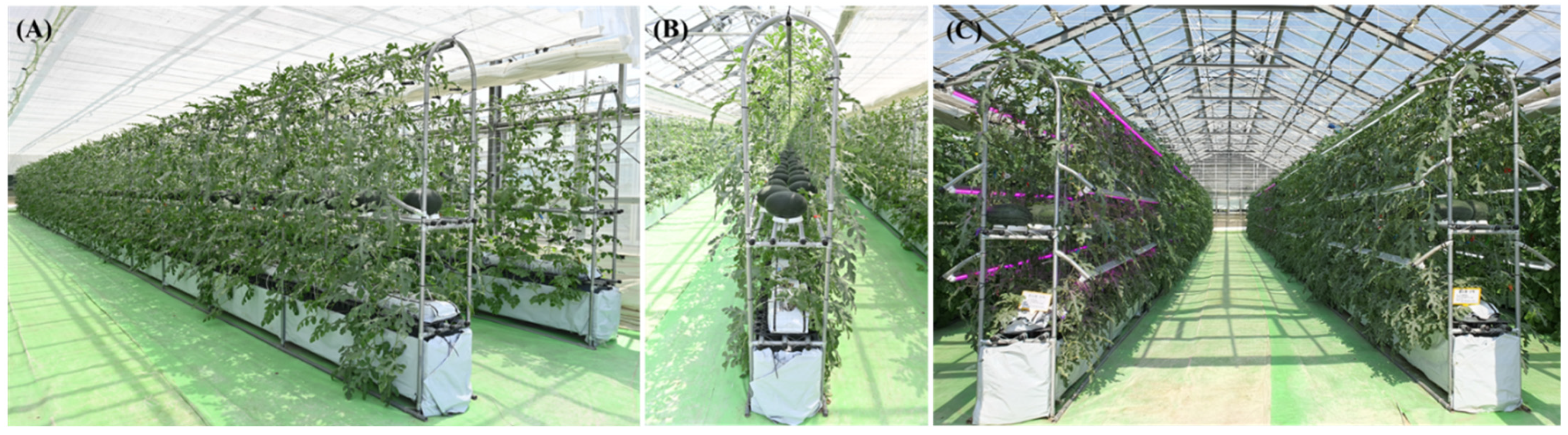
In a single-acting glasshouse (32 × 9 × 4 m, L × W × H), four vertical hydroponics devices [Arched vertical supports (height 2 m and width 0.4 m) were installed at 1.5 m intervals, a hydroponics bed was installed at the lower part of the vertical support, a fruit stand was made by connecting pipes horizontally at a height of 1 m inside, and a stem bait net was installed on the outside] developed by the Watermelon Research Institute and registered as a patent (No. 10-2359307) exclusively for watermelon, were installed (Figure 1A,B). Two lines at the center of the house were used for the study, and 24 perlite growbags (100 × 20 × 12 cm, L × W × H; Kyungdong-One Co., Ltd., Seoul, Republic of Korea) were placed with drainage plates on the hydroponic beds per line. Watermelon (Citrullus lanatus (Thunb.) Matsum. & Nakai) cv. ‘Royal-Black’ (Jinandosinongbu Co., Ltd., Jinan, Republic of Korea; black rind and yellow flesh) grafted onto bottle gourd (Lagenaria siceraria) rootstock cv. ‘Sibjangsaeng’ (Syngenta Co., Basel, Switzerland) was used. Grafted seedlings were transplanted at 25 cm spacing, with four plants per perlite growbag (100 × 20 × 12 cm; Kyungdong-One Co., Ltd., Seoul, Republic of Korea). A total of 192 plants were planted by arranging four plants per growth bag. Five days after transplanting, the first vein stems were pinched with five normal leaves, and seven days after pinching, two of the second vein stems were grown vertically on bait nets. Bumblebees were used for pollination when the third flowers (5n ± 2 nodes, n = flowers) bloomed, and when the fruit grew to the size of an egg, only one fruit per plant was left, and the superfluous fruits were thinned out.
A greenhouse environment control system (MAGMAPLUS-1000, Green Control System Co., Ltd., Damyang, Republic of Korea) was used to control the greenhouse environment, and the cultivation environment data were recorded at 1 min intervals. The opening and closing of the lighting windows were adjusted to the temperature of 30–38 °C for each growth stage, and the opening and closing of the vertical and horizontal thermal-insulation curtains were controlled in combination according to temperature and solar radiation. The lowest temperature inside the greenhouse was 15 °C (closed), and the highest inside temperature was 18 °C (open). The outside temperature of the greenhouse was adjusted to 20 °C or higher (open), external solar radiation of 100 W·m−2 (open), and external solar radiation of 2000 W·m−2 (close). The shading curtain had the same set temperature for the inside and outside of the greenhouse as the warming curtain, and the set value for solar radiation when the curtain was opened. However, the closing setting condition was adjusted to reach 40% or more of the watermelon light saturation point inside the greenhouse (internal solar radiation 525 W·m−2 and external solar radiation 800 W·m−2 or more). The heater was turned on when the night temperature inside the greenhouses decreased below 15 °C.
A previously developed exclusive nutrient solution [39] was used for the watermelon hydroponic nutrient solution. A nutrient solution machine (NMC-PRO PERTIKIT3G; Netafim, Negev, Israel) was used for the nutrient solution and irrigation control systems. The nutrient solution concentration (EC) for each growth stage was adjusted to 1.0 (Juvenile phase) → 2.0 (Adult phase) → 1.5 (Senescence phase) dS·m−1, and the supplied pH was set to 6.0. From 2 h after sunrise to 2 h before sunset, feedback irrigation was controlled using a substrate moisture content sensor (NetaSence, Netafim, Negev, Israel) to monitor the growth stage. The substrate moisture content was adjusted to 13–30%. The drainage rate was set at 80–40% (Juvenile phase) → 30% (Adult phase) → 10% or less (Senescence phase) utilizing a weight-moisture-based root zone moisture measuring device (RM Farm, IReis Co., Ltd., Gangneung, Republic of Korea). The feeding volume was feedback controlled, and drainage EC and pH were recorded at 1 min intervals.

2.2. Light Environment and Supplemental LED Treatments in Greenhouses

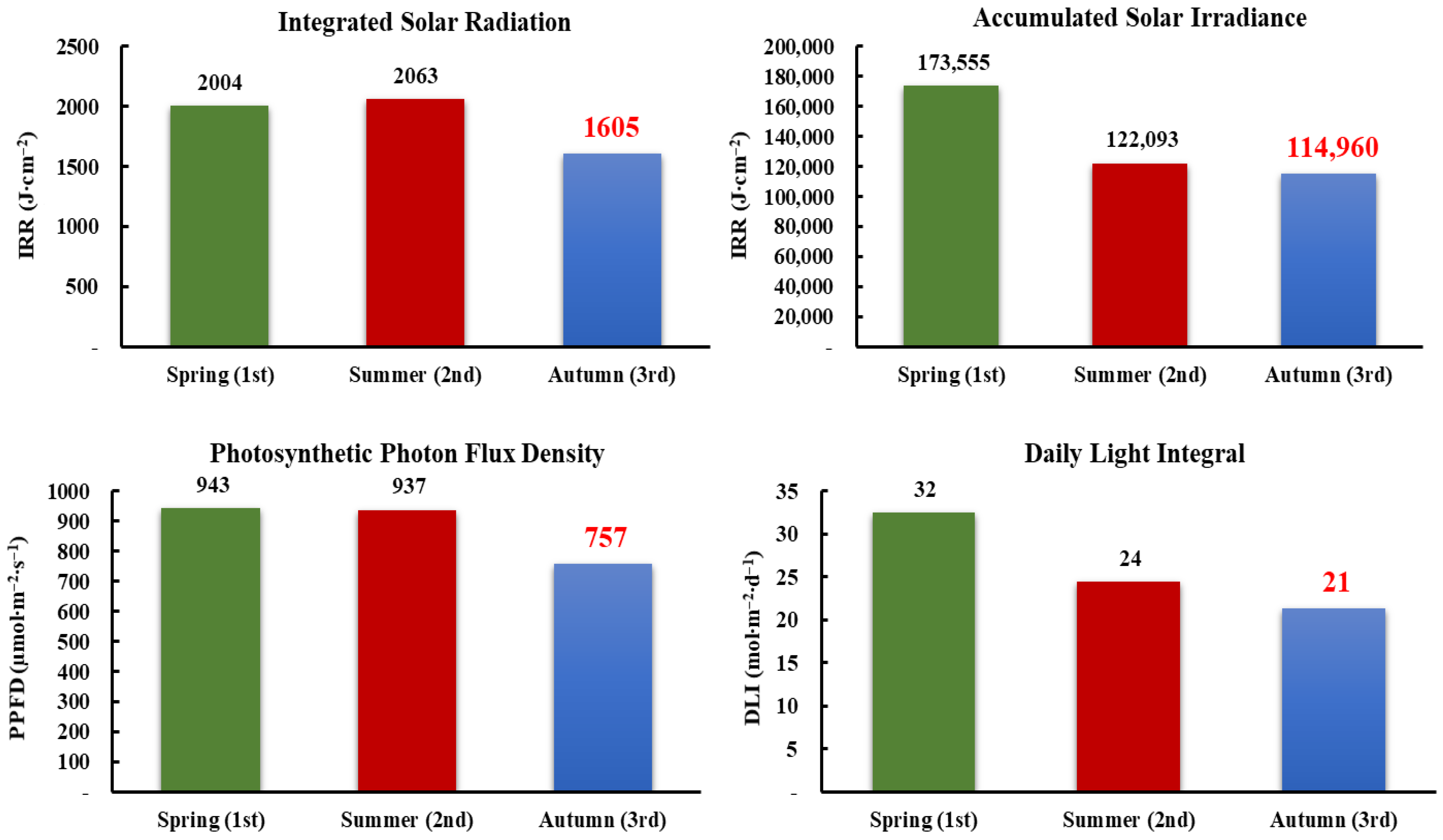
To investigate the optimal daily light integral (DLI) suitable for improving watermelon fruit quality, annual light environment information was collected by a weather station installed 2 m above the greenhouse floor (PPFD: 943 (1st), 937 (2nd), 757 (3rd) µmol·m−2·s−1; DLI: 32 (1st), 24 (2nd), 21 (3rd) mol·m−2·d−1). Thirty days after transplanting, light treatment was carried out in the autumn watermelon [3rd cropping, 29 August (transplanting) → 26 September (flowering) → 10 November (harvest)], which was the lowest insolation condition among the three types of crops. This initiation time point (30 days after transplanting) was selected because it consistently coincided with the onset of the reproductive phase under autumn conditions, when the 3rd female flower (fruit-setting node; 5n ± 2 nodes, where n = flower number) typically appears (approximately 28–32 days after transplanting) following completion of vegetative training (pinching and vertical training). Starting supplemental lighting at this stage targets the critical window for fruit set and early fruit development, when photosynthate demand rapidly increases while natural solar radiation begins to decline during autumn cultivation. Following the flowering period of the third female flower, which was the fruit-bearing flower, four types of LED treatments—red + blue (RB), white (W), red + blue + far-red (RB + FR), and white + far-red (W + FR)—were applied for 43 days to evaluate the effects of light quality (Table 1). Three tiers of approximately 20 cm pipes were installed at an angle of 60° on both sides of the arched pipe of a vertical hydroponics device exclusively for watermelons (1st level: approximately 80 cm above the ground; 2nd level: 50 cm above the 1st level; and 3rd level: 50 cm above the 2nd level). After attaching the stainless-steel plate (5 × 300 cm, L × W), 60 LED bars (60 × 3 × 3.7 cm, L × W × H; D&W Co., Ltd., Seoul, Republic of Korea) were installed in single light qualities by repeating two hydroponic device lines with 10 bar-shaped LEDs on each side of one stage (Figure 1C). To prevent mixing of each light quality, a distance of 1.5–3 m or more was placed between the treated light qualities.
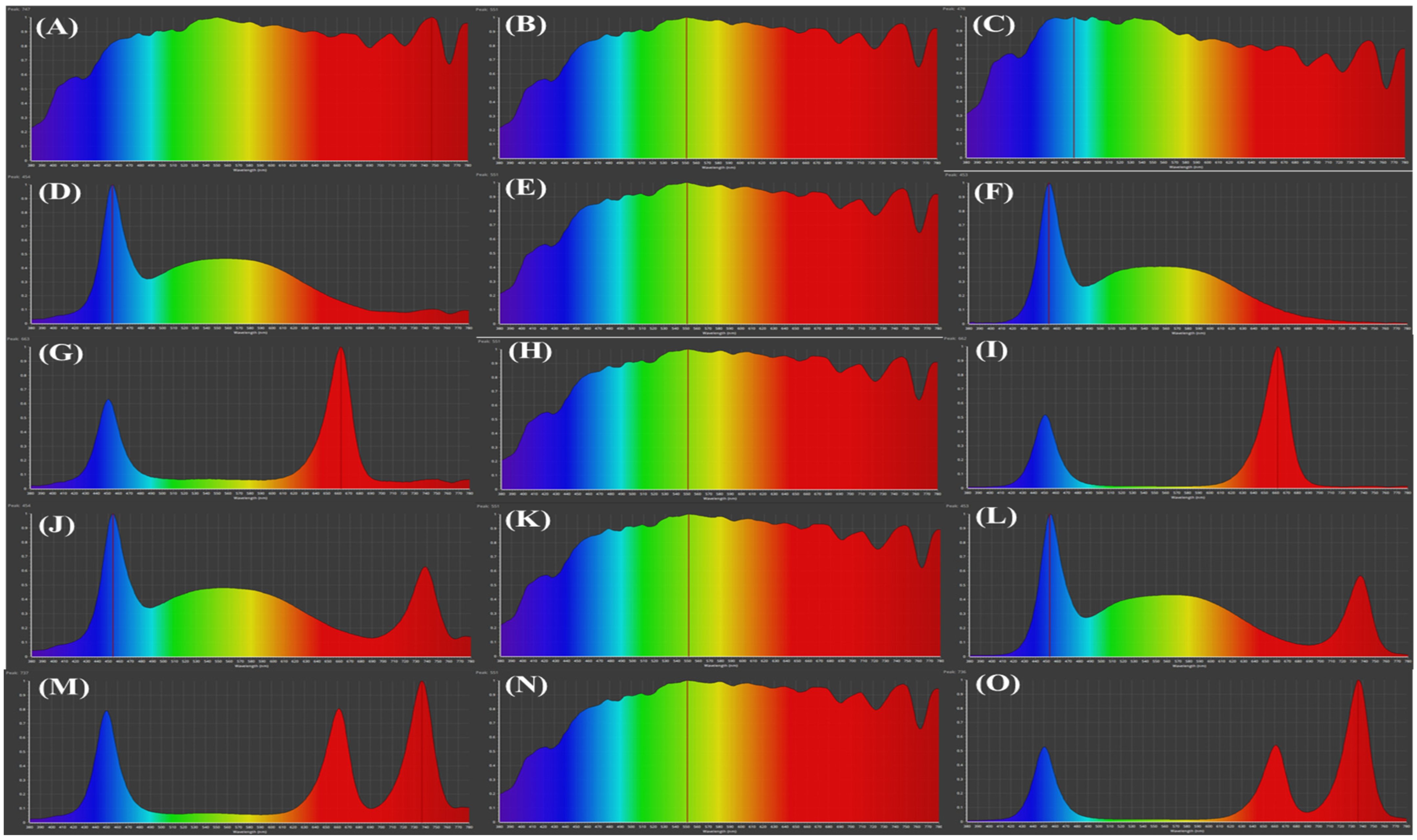
In fall watermelon (3rd cropping) under low solar conditions, to compensate for DLI 11 mol·m−2·d−1, which is insufficient compared to 1st cropping, 15 h (6:00 am–9:00 pm) of LED irradiation was implemented with a PPFD 200 µmol·m−2·s−1 based on the DLI Chart (LEDTonic, 2019). The 15 h lighting window (06:00–21:00) was set to provide ~11 mol m−2 d−1 of supplemental DLI (PPFD 200 µmol m−2 s−1 × 15 h × 3600/106 ≈ 10.8 mol m−2 d−1). An internal solar-radiation sensor was installed 30 cm above the top of the arched pipe of a vertical hydroponic device exclusively for watermelons. During the 15 h of daylight exposure time, when sunlight reached the watermelon light saturation point (322 W·m−2) or higher in the greenhouse, the LED was automatically adjusted to turn off to save energy (on a sunny day, approximately 11:00 a.m.–3:00 p.m., LED off). Sunlight inside the glasshouse was used as a control for comparison with the four LEDs. The light spectrum and intensity of each LED light source were measured at the upper, middle, and lower watermelon leaf positions (15 cm from the light source) using a spectrometer (LI-180, Li-Cor, Lincoln, NE, USA). The light spectrum was measured in the range of 380–780 nm, expressed as a fraction (%), and the peaks were marked (Figure 2). The amount of light was adjusted to PPFD 200 ± 3 µmol·m−2·s−1 by averaging 36 points per treatment. To match the amount of light between the visible-light treatment area (RB and W) and the invisible-far-red-light treatment area (RB + FR and W + FR), it was adjusted to PFD 200 ± 3 µmol·m−2·s−1.

LED Spectral Characterization

Spectral quality and photon flux density of each LED treatment were characterized using a calibrated spectroradiometer (LI-180 Spectrometer, Li-Cor Biosciences, Lincoln, NE, USA) with a spectral resolution of 1 nm across the 380–780 nm range. Measurements were conducted at 15 cm distance from LED sources, corresponding to typical leaf positions within the canopy architecture. To ensure representative characterization, 36 measurement locations per treatment were sampled, comprising 12 positions each on the upper, middle, and lower tiers of the vertical hydroponic cultivation system. This sampling strategy accounted for potential spatial variation in light distribution across the three-dimensional canopy structure. Spectral photon distribution was calculated as the percentage contribution of each waveband (blue: 400–500 nm; green: 500–600 nm; red: 600–700 nm; far-red: 700–800 nm) to total photon flux (400–800 nm). Peak wavelengths were identified as local maxima in the spectral distribution curves with peak prominence > 10% of maximum intensity. PPFD (photosynthetic photon flux density, 400–700 nm) was maintained at 200 ± 3 µmol·m−2·s−1 (mean ± SD of 36 measurements) for all treatments through individual LED-bar-dimming adjustments. For far-red treatments (W + FR and RB + FR), total photon flux density (PFD, 380–780 nm) was verified to match the PPFD of visible-light-only treatments, ensuring comparable total photon delivery across all spectral compositions. The spectroradiometer was calibrated against a NIST-traceable standard light source before measurements. All measurements were conducted under dark conditions (nighttime) to eliminate interference from natural sunlight. The detailed spectral characteristics of each LED treatment are presented in Table 1.

2.3. Plant Growth Characteristics

The growth characteristics of the watermelons were investigated three times: 3 weeks (before light treatment), 6 weeks (12 days after light treatment), and 9 weeks (33 days after light treatment) after transplanting. Eight parameters—plant height, number of nodes, number of leaves, leaf length, leaf width, petiole length, node length, and stem thickness—were investigated by attracting two of the second vein stems with uniform growth after pinching the first vein stem. The number of nodes was measured up to the node of a leaf whose leaf length was >5 cm below the growing point, and the number of leaves was measured up to the number of leaves whose leaf length was >3 cm below the growing point. Leaf-related characteristics such as leaf length, leaf width, and petiole length were investigated with the leaf attached to the flower set (3rd female flower) of the watermelon, and node length and stem diameter were investigated with the node immediately below the flower set (3rd female flower).

2.4. Photosynthetic Rate, Stomatal Conductance, and Carbon Dioxide Concentration in Cells

Photosynthesis, stomatal conductance, and intracellular carbon dioxide concentration were measured during the daytime and nighttime on a cloudy day (accumulated external solar radiation per day 1269 J·cm−2) with low solar insolation into the greenhouse at 8 weeks (24 days after mineral treatment) after watermelon transplanting. A watermelon leaf attached to the flower set (3rd female flower) was used to investigate the photochemical reaction using a photosynthetic analyzer (LI-6800, Li-Cor, Lincoln, NE, USA). An open-type transparent chamber (1 × 3 cm) was used to measure the photosynthetic rate under each light source. The daytime photosynthetic rate was measured from 9:30 a.m. to 12:30 p.m., 3 h after the light was turned on. The night photosynthetic rate was measured from 6:30 p.m. to 9:30 p.m. after sunset, 3 h before the LED light was turned off. Measurement conditions were set similarly to watermelon growth conditions in a glass greenhouse (Flow 700 µmol·s−1, H2O 70%, CO2 400 µmol·mol−1, Tair 25 °C, and Qin 500 ± 15 µmol·m−2·s−1).

2.5. Chlorophyll Fluorescence

Measurement of the OJIP fluorescence response of watermelon was performed when the watermelon leaf was attached to the 3rd female flower, 10 weeks (after 34 days of light quality treatment) after transplanting, using a hand-held chlorophyll fluorometer (FluorPen FP 110, Photon System Instruments Ltd., Drasov, Czech Republic). For each light source treatment, measurements were taken four times daily from 10:00 am to 7:00 pm after sunset at 3 h intervals. Before measurement, a detachable leaf clip was bitten onto a watermelon leaf attached to the 3rd female flower and stabilized in the dark for 30 min, and the measured data were JIP tested using the method of [40].

2.6. Chlorophyll and Carotenoid Contents

The chlorophyll content of watermelon leaves attached to the 3rd female flowers 10 weeks after transplanting (34 days of light-quality treatment) was measured using a portable chlorophyll meter (SPAD-502, Minolta Co., Ltd., Osaka, Japan). On the watermelon fruit harvest day, 11 weeks after transplanting (41 days of light quality treatment), watermelon leaves of whole shoots, excluding petioles and stems, were sampled to analyze total chlorophyll and carotenoid content. The leaves of the shoot were freeze-dried for 7 days in a freeze dryer (LP10, 1ShinBioBase Co., Ltd., Dongducheon, Republic of Korea) at −40 °C and a vacuum of 55 mmHg. After drying, liquid nitrogen was added, utilizing a mortar and pestle to finely pulverize the leaves, and they were stored in a freezer at −20 °C until analysis. The total chlorophyll and carotenoid contents were determined according to the method described by [41] with minor modifications. Leaf samples (30 mg) were sonicated in 3 mL of 80% acetone for 20 min. They were centrifuged (FC5515R, Ohaus Co., Ltd., Newark, NJ, USA) for 5 min at 13,000 RCF at 4 °C, and the supernatant was diluted 4-fold with 80% acetone. The absorbance of the supernatant was measured at 663, 645, and 470 nm using a spectrophotometer (Cary UV-Vis, Agilent Co., Santa Clara, CA, USA). The total chlorophyll and carotenoid concentrations (µg g−1 DW) were calculated using the following formulas:
Chl a = 12.72 × A663 − 2.59 × A645
Chl b = 22.88 × A645 − 4.67 × A663
Chl (a + b) = 20.3 × A645 + 7.22 × A663
Carotenoids = (1000 × A470 − 3.27 × Chl a − 104 × Chl b)/229

2.7. Fruit Characteristics

The fruit characteristics of watermelons following light treatment of female flowers were investigated by harvesting watermelon fruits 11 weeks after transplanting (43 days after light quality treatment). The survey included eight items: fruit weight, fruit circumference, fruit length, fruit width, pericarp width, sweetness, and hardness (fruit flesh and pericarp). Sweetness was measured by squeezing the flesh with a digital saccharometer (PAL-1; ATAGO Co., Ltd., Tokyo, Japan). For hardness, the watermelon was cut lengthwise into the fruit stem and peduncle, and the central cross-section of the fruit flesh was cut to a size of 5 × 5 × 5 cm (width × length × height cm). The pericarp was cut into 5 × 5 × pericarp width cm (width × length × height cm) and measured by penetrating a 5 mm probe from the center to a depth of 5 mm at a rate of 2 mm·s−1 utilizing a durometer (TA-XT2, Stable Micro Systems Co., Ltd., Godalming, UK).

2.8. Total Phenolic Content and Antioxidant Capacity

On the day of watermelon fruit harvest at week 11 after transplanting (43 days after light quality treatment), the entire shoot and root zones of the watermelons were sampled to analyze total phenol and antioxidant content. Watermelon plants were divided into five parts: leaves, stems, roots, flesh, and pericarp, and were freeze-dried for 7 days in a freeze-dryer (LP10, 1 ShinBioBase Co., Ltd., Dongducheon, Republic of Korea) at −40 °C or lower and in a vacuum of 55 mmHg. After drying, liquid nitrogen was added and the leaves were finely pulverized using a mortar and pestle and stored in a −20 °C freezer until immediately before analysis. Total phenol content and antioxidant levels were measured using the Folin–Ciocalteu colorimetric method [42] and 2,2-Azino-bis (3-ethylbenz-thiazoline-6-sulphonic acid) (ABTS) [43,44], respectively. After adding 40 mg and 4 mL of 80% (v/v) acetone to the pulverized leaf and stem samples, respectively, in a 5 mL microtube, ultrasonic extraction was performed in an ultrasonic sonicator (8510E-DTH, Branson Ultrasonics Co., Ltd., Danbury, CT, USA) for 15 min. Each extract (1.5 mL) was transferred to a 2 mL microtube and stored for over 12 h in the dark at 4 °C and −20 °C, respectively, to measure the total phenol content and antioxidant level. Centrifugation (FC5515R, Ohaus Co., Ltd., Newark, NJ, USA) was performed at 3000 RCF for 2 min, and the supernatant was used for analysis. The total phenol content and absorbance of the antioxidant were measured at 765 and 730 nm, respectively, using a spectrophotometer (Cary UV-Vis, Agilent Co., Santa Clara, CA, USA). The unit of total phenol concentration was expressed as gallic acid (Acros Organics, Geel, Belgium) (GAE) (mg) per dry weight (g) of pericarp and fruit flesh, and the antioxidant capacity was expressed as 6-hydroxy-2,5,7,8-tetramethylchromane-2-carboxyl acid (Trolox; Sigma-Aldrich Co., LLC, St. Louis, MO, USA) (TEAC) (mM) per dry weight (g) of pericarp and fruit flesh.

2.9. Statistical Analysis

The experimental plots were arranged in a completely randomized design (CRD), with 24 plants allocated to each light source treatment. For the analysis of growth characteristics, 10 plants per treatment were evaluated. Physiological parameters, including net photosynthetic rate, stomatal conductance, and intercellular CO2 concentration, were measured using three plants per treatment. Chlorophyll fluorescence was recorded for six plants per treatment, while SPAD values were obtained in quadruplicate for each of these six plants. For biochemical analysis, total chlorophyll and carotenoid concentrations were measured three times for each of the five plants per treatment. Regarding reproductive traits, fruit weight was recorded for all harvested fruits, while seven additional fruit quality parameters were analyzed using five plants per treatment, with soluble solids content (sweetness) measured in triplicate. Total phenolic content and antioxidant capacity were analyzed across five plants per treatment, specifically partitioned into leaves, stems, roots, pericarp, and flesh. Statistical analysis was performed by one-way ANOVA using the SAS statistical program (Statistical Analysis System, 9.2 Version, SAS Institute, Cary, NC, USA), and statistical significance was confirmed by comparing the average values of the treatment groups using Duncan’s multiple range test. Figures were created using SigmaPlot (version 14.5, Systat Software Inc., San Jose, CA, USA).

3. Results

3.1. (Study I) Growth Environment and Fruit Characteristics in Year-Round Production

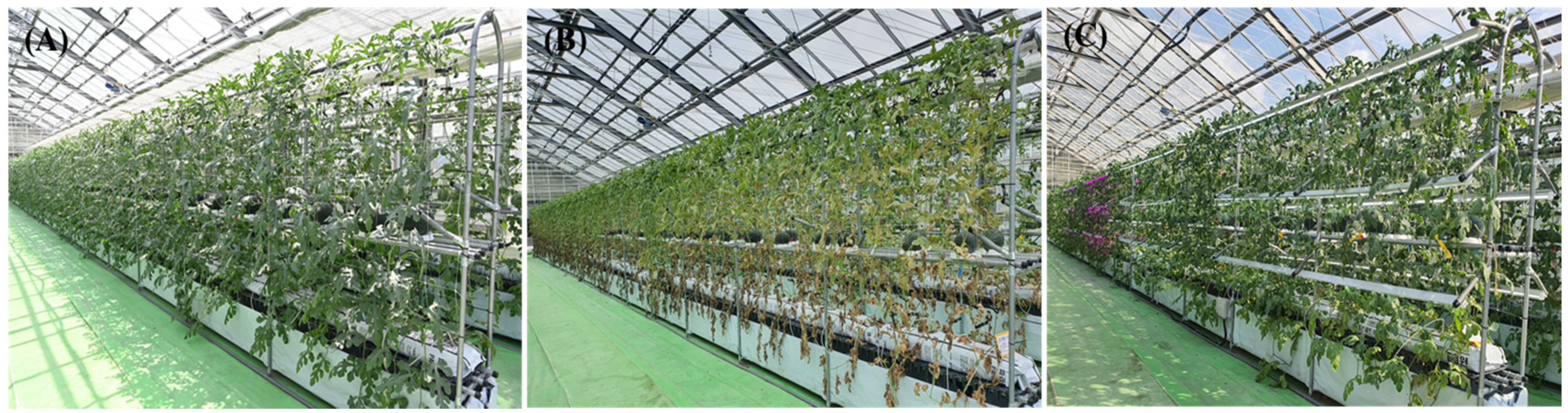
As a result of collecting environmental data by growth stage, in the first cropping (February to May) of watermelon, the average outside temperature was 10.5 °C, and the average inside temperature was 22.5 °C. In the second cropping (June to August), the average outside temperature was 26.2 °C, and the average inside temperature was 28.1 °C. In the third cropping (August to November), the average outside temperature was 16.1 °C, and the average inside temperature was 23.5 °C (Table 2). For the difference in growth environment based on the cultivation period, the average temperature inside the glasshouse was 5.6 °C higher in the second cropping than in the first cropping, and the average temperature inside the greenhouse was 1.0 °C higher in the third cropping than in the first cropping. The minimum accumulated temperature of small- and medium-sized watermelons required for harvesting was 1650 °C after transplanting and 1000 °C after flowering. Figure 3 shows the cultivation conditions 10 days before watermelon fruit harvest based on each cultivation period (spring, summer, and fall). The growth conditions of the first cropping (spring watermelon) were favorable. In the second cropping (summer watermelon), the average temperature was 5 °C higher than that for the first cropping; the lower leaves were yellow, and the crop had the lowest growth rate.
The LEDs were supplementally irradiated in the third cropping (autumn watermelon). Daily accumulated solar irradiance was 2004 J·cm−2 in the first cropping, 2063 J·cm−2 in the second cropping, and 1605 J·cm−2 in the third cropping. The second cropping had the highest insolation, which was 59 J·cm−2 higher than in the first cropping. The third cropping had the lowest insolation, 399 J·cm−2 lower than in the first cropping (Figure 4). Regardless of the cultivation period, the minimum cumulative insolation required for harvesting was considered to be 115,000 J·cm−2, as it was harvested at more than 115,000 J·cm−2. The PPFD at 400–700 nm, which is the plant photosynthetic effective light intensity, also showed the lowest value in the third cropping. This was 185.9 µmol·m−2·s−1 lower than that of the first cropping, and the DLI was also 11.2 mol·m−2·d−1 lower than that of the first cropping. The fruit characteristics according to the cultivation period are shown in Table 3. In the first cropping (22 °C, 2004 J·cm−2), the number of days to flowering was shortened by 9 days compared with the second cropping period under conditions of high temperature and solar radiation (28 °C, 2063 J·cm−2). It took 34 days from flowering to harvest, which was 22 days shorter than in the first cropping. In contrast to the first cropping, fruit weight and sweetness decreased significantly by 59% and 21%, respectively, and the marketability of watermelon fruits during the second cropping significantly decreased during all cultivation seasons. Pericarp hardness, which is related to the transportation of small- and medium-sized watermelons, also decreased by 31% compared to the first cropping.
All other fruit characteristics showed significantly lower values between all cultivation seasons (except for flesh hardness). In contrast to the first cropping, the number of flowering days was reduced by 2 days in the third cropping under conditions of low solar radiation (1605 J·cm−2), and it took 45 days from flowering to harvest, which was 11 days less than the first cropping. In contrast to the first cropping, fruit weight and sweetness decreased significantly by 45% and 11%, respectively, and other significant decreases were observed in all fruit characteristics except flesh and pericarp hardness.

3.2. (Study II) Supplemental Lighting

3.2.1. Watermelon as Affected by Irradiation of Light-Emitting Diodes During the Third Cropping

Growth Characteristics
Light treatment was applied to autumn watermelon [third cropping, August 29 (transplanting) → September 26 (flowering) → November 10 (harvest)], which is the lowest irradiation condition among the three types of crops of the year. To minimize the effect of light quality on growth and maximize the effect on fruit, 30 days after transplanting, the fruit set of the third female flowers was investigated in relation to flowering time. Four types of LEDs were used: red + blue + far-red (RB + FR) and white + far-red (W + FR), in which far-red light (FR) was added to red + blue (RB) and white light (W), respectively, for 43 days. The effect of light quality treatments was evaluated relative to a control group grown under natural sunlight. The growth characteristics of the watermelons were investigated three times at 3 weeks (before light quality treatment), 6 weeks (12 days after light quality treatment), and 9 weeks (33 days after light quality treatment) after transplantation. At 9 weeks of light treatment (33 days after light quality treatment), a significant difference was observed in light quality changes in plant height, number of nodes, number of leaves, and petioles (Table 4). Plant height, number of nodes, and number of leaves were higher in the control than in the other light-quality treatments, owing to the effect of overgrowth. This was significantly higher by 9% (plant height) and 7% (number of nodes and number of leaves) than that of the RB-LED treatment, which had the lowest value. The petiole was lengthened in the light source, which was then exposed to far-red light. In particular, the RB + FR-LED treatment showed the highest value and was significantly different from the control, W-, and RB-LED treatments, which were 13% higher than the RB-LED treatment, which had the lowest value. No other growth characteristics showed significant differences between the control and the light quality treatments.
Photosynthetic Rate, Stomatal Conductance, and Carbon Dioxide Concentration in Cells
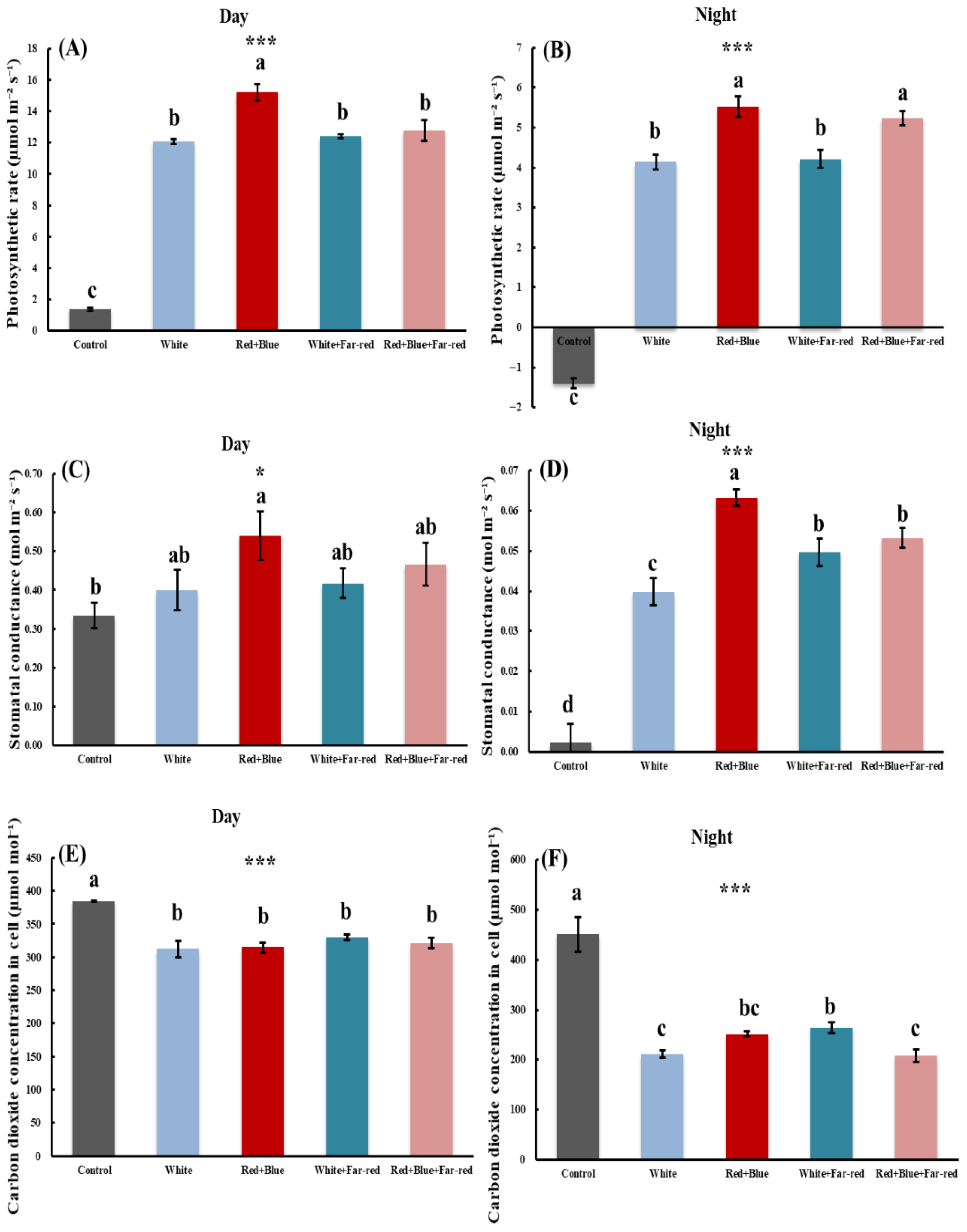
Photosynthetic, stomatal conductance, and carbon dioxide concentration in cells were measured (accumulated external solar radiation per day 1269 J·cm−2) during the daytime and at night on a cloudy day with low solar insolation entering the greenhouse at 8 weeks (24 days after light quality treatment) after watermelon transplantation (Figure 5). The photosynthetic rate was significantly higher in all light quality treatment groups than in the control group, regardless of whether it was day or night. The daytime photosynthetic rate was highest in the RB-LED treatment group, which was significantly higher, 11.2 times, than that in the control group. Although the photosynthetic rate at night was lower than the daytime photosynthetic rate, photosynthesis was achieved in all light quality treatments compared to the control group. Regardless of the FR LEDs, the treatment group irradiated with the RB LEDs showed a significantly higher photosynthetic rate than the treatment group irradiated with the W LEDs. Stomatal conductance was also higher in all light quality treatment groups than in the control group, regardless of the time of day. In particular, the RB-LED treatment group showed significantly higher stomatal conductance than the control group by 1.6 times (daytime) and 31.5 times (nighttime). Compared to photosynthetic rate and stomatal conductance, carbon dioxide concentration in cells was significantly higher in the control group than in the light quality treatment group, regardless of whether it was day or night. This was a significantly higher value, 1.2 times (daytime) and 2.1 times (nighttime) that of the W LED, which indicated the lowest concentration.
Chlorophyll Fluorescence
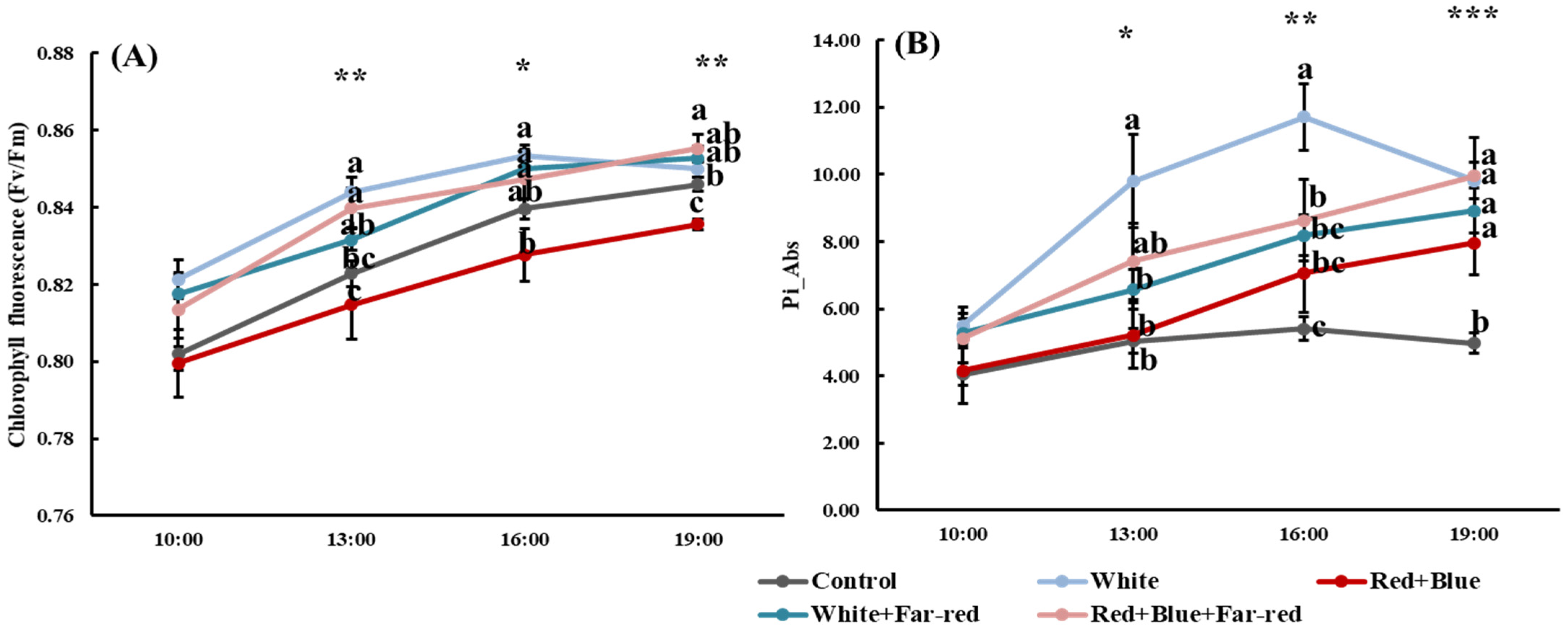
Figure 6 shows the results of the OJIP chlorophyll fluorescence measurements on watermelon leaves throughout the day. The light quality treatment affected the maximum quantum yield (Fv/Fm) of Photo System II (PS II). In addition, the fluctuation in the Fv/Fm value and the degree of decrease indicated different trends in each wavelength band. Except for RB LEDs, all light quality treatments indicated higher Fv/Fm values than the control group, regardless of the time; specifically, W and RB + FR LEDs showed significantly higher values than the control group (13:00). RB LEDs had the highest photosynthetic rate 8 weeks (24 days after light quality treatment) after transplanting, indicating significantly lower Fv/Fm values than all light quality treatments, regardless of time, 10 weeks (34 days after light quality treatment) after transplanting when watermelon leaf aging progressed. This indicated a significantly lower value than the control group at 19:00.
PSII indicates the number of photons absorbed and the degree of electron acceptor reduction in the photosynthetic system. In addition, PIABS, an indicator of the final electron acceptor reduction degree of the first photosystem (PSI), showed higher values than in the control group in all light quality treatments, regardless of the time period. In particular, the W LEDs, which had the highest value, were 94% higher than the control at 13:00, and at 16:00, the W and RB + FR LEDs were 117% and 60% higher, respectively, than the control group. At 19:00, all light quality treatment groups exhibited significantly higher values than the control group.
Chlorophyll and Carotenoid Contents
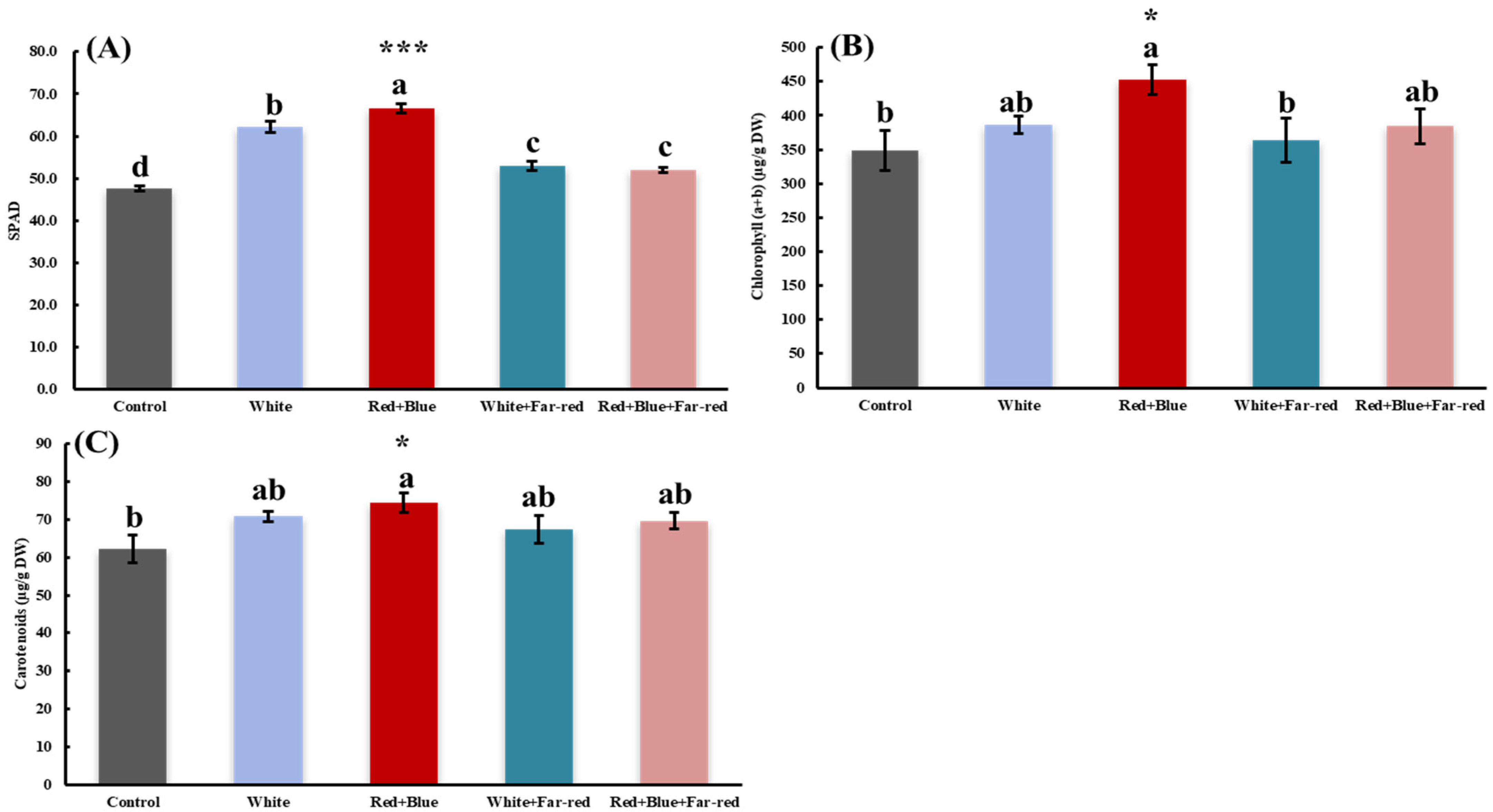
The chlorophyll content, SPAD value, and chlorophyll and carotenoid concentrations were higher in the light-treated group than in the control group (Figure 7). The SPAD value of the watermelon leaves attached to the third female flowers 10 weeks (34 days after light quality treatment) after transplanting was significantly higher under RB LEDs than under other light source treatments. In addition, RB LEDs followed by W LEDs and FR LEDs (W + FR and RB + FR) showed significant differences compared to the control group. On the harvest day of watermelon fruits at 11 weeks after transplanting (43 days after light quality treatment), the total chlorophyll of all leaves of watermelon shoots was the highest in RB LEDs among all light sources, which is consistent with the results of the SPAD value. This value was significantly higher (30%) than that of the control group. The carotenoid concentration also showed the highest concentration in the RB LEDs and was significantly higher (19%) than that in the control group, which had the lowest value.
Fruit Characteristics
Based on the light quality investigation for 43 days after the flowering of the third female flowers, the harvest days of watermelon fruit were not carried forward, but fruit quality indicated a significant improvement (Table 5). Regardless of light quality, the light treatment resulted in significantly higher fruit weight, fruit length, and sweetness compared to the control group. Fruit weight was significantly higher in W and RB LEDs than in other light quality treatments; W LEDs had the highest weight and a significant weight improvement effect of 42% compared to the control group, which had the lowest weight. Fruit circumference and width were closely correlated with fruit weight and were significantly higher with the W and RB LEDs than with the other light quality treatments and control groups. Sweetness was most improved with the W LEDs, with which it was significantly higher by 15% than that in the control group with the lowest sweetness. Pericarp hardness plays an important role in quality changes during the transportation of small- and medium-sized watermelons with thin pericarps, and it was also higher in the light-treated group than in the control group. RB LEDs, with the highest value, indicated a 20% significant improvement in pericarp hardness compared with the control group.
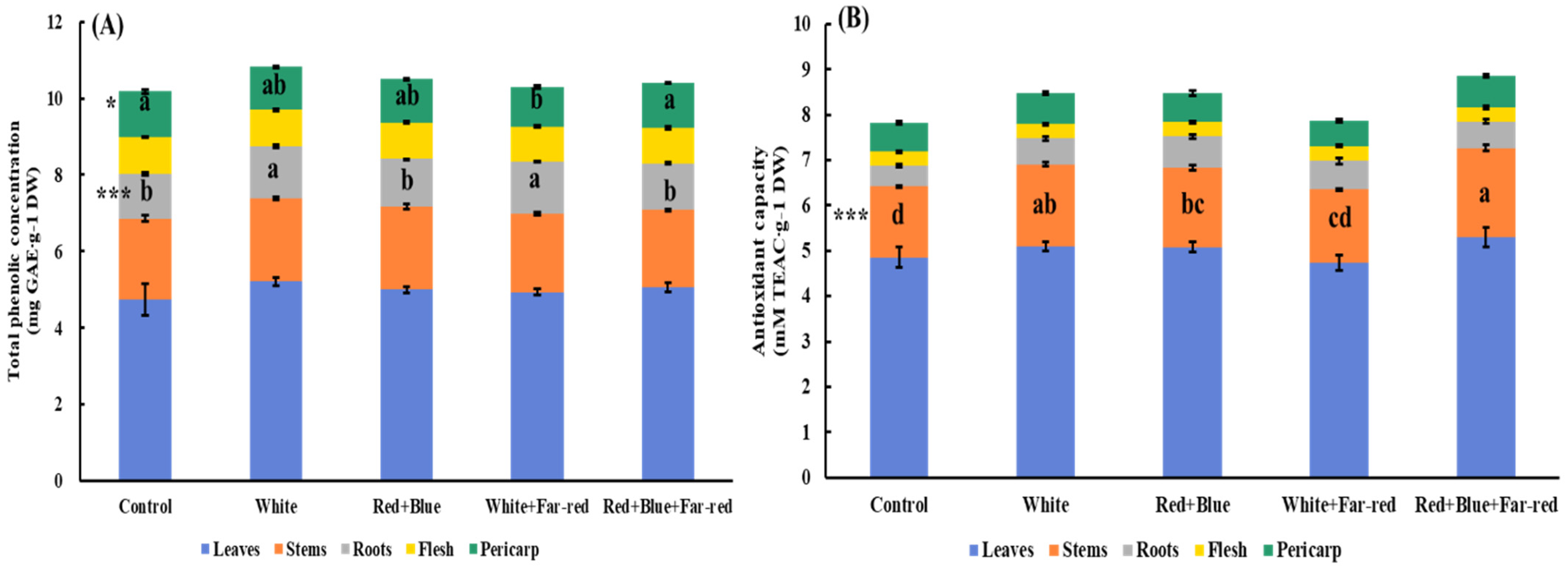
Total Phenolic Content and Antioxidant Capacity
For light quality, the total phenolic content and antioxidant capacity were measured to improve the functional components of watermelon and to confirm the degree of distribution of functional components in different parts of the watermelon plant (Figure 8). Total phenolic content and antioxidant activity by plant part were the highest in leaves, followed by stems, roots, pericarps, and fruit flesh. The total phenolic concentration in the roots indicated a significant difference based on the light quality treatment, which was higher in the W and W + FR LEDs irradiated with W LEDs. This indicated significantly higher values of 16% and 17%, respectively, compared with the control group, which had the lowest value. Antioxidant capacity differed significantly between light quality treatments in the stems. In addition, the antioxidant activity of the stem was the highest in the RB + FR-LED treatment with FR irradiation, which was significantly higher (26%) than that in the control group, which had the lowest value. Although no significant difference was observed in the antioxidant activity of the flesh, it was numerically increased by 9% and 4%, respectively, compared to the control group, with the W + FR and RB + FR LEDs and FR irradiation.

4. Discussion

4.1. (Study I) Cropping Type (3 Times)

This study aimed to establish an optimal watermelon greenhouse complex environmental-control technology by comparatively analyzing environmental data and fruit characteristics according to the growth stage of three types of crops to examine the possibility of year-round production through watermelon hydroponics. The production and quality of crops depend considerably on the environment inside the greenhouse (light, temperature, relative humidity, and CO2 concentration), and the environmental-management technology for each crop type is an important factor [45,46]. Watermelons account for 7% of the world’s fruit vegetable production [47] and rank first in domestic fruit vegetable production (28% fruit vegetable production, 489,029 tons (KOSIS, 2021). Although watermelon is a larger industrial crop than greenhouse crops such as paprika and tomato, studies on the effect of the environment on crop growth during the growing season are limited [48].
In general, the quantity and quality of fruit vegetables are considerably influenced by meteorological factors, such as the amount of sunlight, rainfall, and temperature during the maturity stage after the fruit set, as well as the root zone environment of the cultivation area [49,50,51]. Light and temperature are the most influential factors directly related to the geographical distribution and survival of plants and production [52,53,54,55,56]. Therefore, a significant reduction was observed in weight (59%) and sweetness (21%) in the second cropping under high temperature (28 °C, 2063 J·cm−2) conditions compared to in the first cropping (22 °C, 2004 J·cm−2), requiring cooling. Under low solar radiation (1605 J·cm−2), a significant reduction was observed in weight (45%) and sweetness (11%) in the third cropping compared to in the first cropping, requiring supplemental lighting.
The optimum temperature for watermelon growth is a daytime temperature of 25–32 °C, a nighttime temperature of 16–20 °C, and a ground temperature of 23–30 °C. Plant growth slows down or stops at the highest temperature of 40 °C or the lowest temperature of 12 °C, and fruit enlargement slows down, or growth stops when the night temperature is below 15 °C [10,12]. The temperature environment difference based on the cultivation period of the three types of crops year-round was 5.6 °C higher in the second cropping (summer watermelon, June–August) than the average temperature inside the glass greenhouse of 22.5 °C (max. 32.7 °C, min. 14.8 °C) in the first cropping (spring watermelon, February–May). The growth period was shortened by 31 days as the inside of the watermelon fruit matured quickly due to the high temperature. The temperature in the third cropping (autumn watermelon, August–November) was 1.0 °C higher than in the first cropping (22.5 °C), and the growth period was shortened by 13 days. When the leaf temperature of crops increases due to high temperatures, stomatal conductance decreases, and the water content and water absorption of crops are inhibited due to the effect of reduced transpiration [57,58]. Growth was lowest in the second cropping, with the highest average temperature among the three types of crops in a year. Chlorosis of the lower leaves was the most severe owing to an imbalance in nutrient and water absorption, and most of the leaves under the nodes of the fruit set browned during harvest (Figure 3). In fruit vegetables, the high temperatures experienced during flowering and fruiting cause hormonal imbalances, such as fertilization defects, deformities, and development, and the rate of falling flowers or fruits increases [58,59]. The drop rate is affected more by nighttime temperature than by daytime temperature [55,60]. In the second cropping, the night temperature was 3–7 °C higher than the optimum temperature for growth (Table 2). The occurrence of gourd-shaped deformities increased; most of them were set on one fruit per plant, and there was a limit to the reduction of gourd-shaped fruits and the enlargement of uniformly shaped fruits. It was concluded that the damage from high temperatures at night during the second cropping was greater for small watermelons with many fruits per plant.
The effective accumulated temperature of large watermelons throughout the growing season is 2500 to 3000 °C, above 10 °C [12], and, based on an average temperature of 25 °C, it takes 100 to 120 days of growth from transplanting to harvest. The effective accumulated temperature of small- and medium-sized watermelons has not been revealed; however, using the three types of crops from this study, the effective accumulated temperature of small- and medium-sized watermelons was estimated to be 1653–1933 °C throughout the growing period from transplanting to harvest, and 1008–1205 °C from flowering to harvest. In addition, the accumulated temperature was lower than that of large watermelons, and the growing days were shortened by 34 to 43 days compared to large fruits based on the average temperature of 25 °C, which experienced growing days of 57 to 86 days. The third cropping growth days in the present study were also similar, ranging from 55 to 86 days (Table 2). Unlike crops such as strawberries and tomatoes, the introduction of watermelon is conspicuously complicated in determining the degree of fruit ripeness in a smart greenhouse. These values can be utilized to predict the flowering time and maturity of small- and medium-sized watermelons or to adjust the flowering and shipping time using the temperature control group.
Low sunlight in winter limits the photosynthetic assimilation products [61,62], which increases flower and fruit drop rates and decreases yield [46,63,64]. Numerous studies have been conducted on plant responses to low-light conditions in fruit and vegetable crops, such as tomatoes [65], paprika [66], strawberries [67], and oriental melons [68]. Although watermelons are light-loving crops with high light saturation points, studies on the light environment of watermelons are lacking. Daily accumulated solar irradiance showed 2004 J·cm−2 in the first cropping, 2063 J·cm−2 in the second cropping, and 1605 J·cm−2 in the third cropping. The second cropping had the highest insolation, which was 59 J·cm−2 higher than in the first cropping. The third cropping had the lowest insolation, which was 399 J·cm−2 lower than in the first cropping. The PPFD at 400–700 nm, which is the plant photosynthetic effective light intensity, also showed the lowest value in the third cropping. This was 185.9 µmol·m−2·s−1 lower than that of the first cropping, and the DLI was also 11.2 mol·m−2·d−1 lower than that of the first cropping.
The optimal DLI differs for each plant, and sufficient light is required to satisfy the DLI for smooth growth. The optimal DLI for leafy vegetables is approximately 10; for fruit vegetables, such as cucumbers, peppers, and eggplants, it is 20–30; and for tomatoes, which have a light saturation point similar to watermelons, a DLI value of 22–30 is required [69]. Watermelon does not have an optimal DLI value that has been identified from flowering to fruit harvest; however, considering the results of this study, harvesting watermelon at 21 to 32 mol·m−2·d−1, and producing up to the third cropping of the November harvest is possible (Figure 4). Supplemental artificial light is actively utilized to improve the harsh light environment in winter and improve plant growth, fruit yield, and quality [70,71,72,73,74]. Ref. [12] revealed that magnetization formation in watermelon is suppressed at a photoperiod of 16 h or longer. DLI 11 mol·m−2·d−1 was insufficient in the third cropping and was supplemented with PPFD 200 µmol·m−2·s−1 for 15 h, and the effect on magnetization was minimized, which assisted in improving productivity by increasing the photosynthetic rate and fruit weight.

4.2. (Study II) Supplemental Lighting

Supplemental lighting by providing an artificial light source was implemented during autumn watermelon production [3rd cropping, 29 August (transplanting) → 26 September (flowering) → 10 November (harvest)], which had the lowest insolation condition between the three types of crops in a year. To minimize the effect of light quality on growth and maximize the effect on fruit, LED irradiation was implemented during the flowering period of the third female flowers of the fruiting family; however, the light quality treatment affected the growth characteristics of watermelon (Table 4). The control group had the longest plant height due to overgrowth; the RB LEDs produced a significantly shorter plant length, and the petiole length was longer with a light source, including the far-red LED. According to results by [75], the plant growth of sprouts was longer under dark conditions, which explains why brassinosteroid hormones affect plant height as a dark morphogenetic response and not photomorphogenesis. The results of this study suggested that the response was similar to that of the control group, which had the longest plant growth. Cryptochrome, a blue-light photoreceptor, suppresses gibberellin, auxin, and brassinosteroid hormones, which promote stem elongation [76,77]. As the ratio of blue light increased and the ratio of red light decreased, the effect of blue light was greater for the short height of the RB LED-treated plants in this study, which is similar to the results of previous studies [78,79,80] in which plant length decreased. White LEDs also include blue light, but white LEDs are light sources that include both the green and blue wavelength bands. Green light affects leaf growth, stomatal conductance, and early stem elongation [81,82]. In addition, ref. [83] reported that green light, recognized by cryptochrome, a photoreceptor, like blue light, acts oppositely to blue light and that green light suppresses hypocotyl growth inhibition by blue light. Therefore, unlike the RB LED, the white LED in this study did not have a noticeable suppression of plant height due to the influence of the green light. Phytochrome, a photoreceptor for red and far-red light, induces plant shade avoidance responses such as stem elongation, leaf area increase, and leaf angle increase [84]. In this study, petiole length increased under far-red LED, which is considered a shade avoidance response due to the decreased light reception rate of lower leaves during vertically attracted watermelon cultivation.
The photosynthetic rate was significantly higher in all light quality treatment groups than in the control group, regardless of daytime or nighttime (Figure 5). In particular, RB LED had the highest photosynthetic rate because red and blue light are the wavelengths mainly absorbed by chlorophyll a and b, and are effectively utilized for photosynthesis in plants [20]. Ref. [85] demonstrated that mixing red light with blue light, rather than monochromatic red light, can effectively promote growth by promoting photosynthesis through the synergistic effect of phytochrome and cryptochrome. As the photosynthetic rate increased, stomatal conductance increased in all light quality treatment groups, and accordingly, the intracellular carbon dioxide concentration was significantly lower in the light quality treatment group than in the control group.
The effect on a plant’s photosynthetic machinery can be predicted by the change in the maximum quantum yield (Fv/Fm), which indicates the photochemical efficiency of Photo System II [86]. Fv/Fm is utilized as a stress indicator for a plant’s external environment [87] and generally has a value of 0.80 to 0.84 in a plant in a normal environment. In this study, Fv/Fm was above 0.80, regardless of the time period for both the control group and the light quality treatment, indicating that they were not exposed to a stressful environment. In addition, Fv/Fm was affected by the light quality treatment, and the highest Fv/Fm value was observed in the white-LED treatment (Figure 6A).
White LEDs contained red and blue light; however, the proportion of blue light was higher than that of the RB light source (Figure 2). Blue light plays an essential role in activating the second photosystem (PS II). According to [88], blue light at 470 nm preferentially activates PS II. In contrast, 620–640 nm stimulated PS I and II equally to induce the electron transport of P680, resulting in a low maximum quantum yield (Fv/Fm) in PS II. The RB LEDs, which resulted in the highest photosynthetic rate in this study, had Fv/Fm values in the normal range. However, it indicated significantly lower Fv/Fm values than all light quality treatments and significantly lower values than the control group at 19:00. This is because the Fv/Fm value increases as the mixing ratio of blue light increases in dropwort plants. Despite the exceptional photosynthetic rate and growth from the red light source, the Fv/Fm value was lower than that of other LED treatments during the entire period of light quality irradiation, which is consistent with the results of [89].
PIABS is an index [90] that comprehensively expresses the degree of photosynthetic activity of the three photosynthetic activities of PS II: light energy absorption capacity, electron transfer efficiency, and electron fixation efficiency, and represents the overall vitality of the photosynthetic machinery [91,92]. Additionally, it is a more sensitive environmental stress index [93,94,95] than the maximum quantum yield of PS II (ΦPO = Fv/Fm), and PIABS decreases following stress [96]. The control group had the lowest PIABS value compared to all light source treatments, regardless of the measurement time, and the PIABS and Fv/Fm values were also the highest in the white-LED treatment among the light source treatments (Figure 6B). This was a significantly higher value of 36% (10:00), 94% (13:00), 117% (16:00), and 97% (19:00) than that in the control group, which had the lowest value. The PIABS value of the RB LED, which showed the lowest Fv/Fm value, continuously increased over time, significantly increasing by 60% compared with the control at 19:00. The effect of far-red light on photosynthesis showed different tendencies for each light source. In addition, the RB + FR treatment with far-red light added to the RB LED resulted in an improved PIABS value compared to the RB LED, and the W + FR treatment with far-red light added to the white LED resulted in a reduced PIABS value compared to the white LED. Increased and decreased photosynthetic rates by far-red light have been reported, depending on the plant species and cultivation environment [33,97,98], but the effect of far-red light on the photosynthetic rate remains ambiguous [99]. Ref. [100] compared the photosynthesis rate with a high-pressure sodium lamp (HPS) + FR and HPS, where photosynthesis was reduced by the added far-red light, which is consistent with the trend of white LEDs in this study.
SPAD was highest with the RB light source and significantly lower with the source containing far-red light, among the light quality treatments. This was consistent with the results of [29], who found that far-red-light-supplemental lighting reduced the chlorophyll content. Chlorophyll and carotenoid contents were also the highest under the RB light source.
However, studies on light quality to improve the functional components of watermelon flesh are limited. In the present study, no significant difference was observed in the antioxidant activity of the pericarp. However, it increased by 9% and 4%, respectively, compared with the control group in the W + FR and RB + FR LEDs irradiated with FR (Figure 8B). Ref. [101] reported higher antioxidant activity in radishes, Chinese cabbage, and broccoli treated with FR supplemental lighting than in those treated with RB = 8:2. Among them, R/FR 0.6 treatment significantly had the highest antioxidant activity, and R/FR 1.3 and 2.0 showed no significant difference. The R/FR ratio of the FR LED used for supplemental lighting in this study was set to 1.2, which is the same as that of sunlight [102]. Accordingly, no significant difference was observed due to the lack of light intensity, and a follow-up study on FR light is needed to improve watermelon functional materials.
Light quality treatment after fruiting did not improve the harvest days of watermelon fruits but significantly improved fruit quality. Fruit weight was significantly higher under W and RB LEDs, indicating a high photosynthetic rate and PS II activity. W LEDs showed a significant improvement in fruit weight by 42% compared to the control group, and white LEDs were considered the most effective light source for watermelon supplemental lighting, as sweetness improved by 15% compared to the control group. For RB LEDs, the pericarp hardness was high and was a suitable light source for small- and medium-sized watermelons with thin pericarp widths, considering heat generation and transportability problems during the growing period. In addition, the synergistic effect of each light source should be reviewed in an additional study related to RWB that reflects the effects of white LEDs.
In this study, the effect of the quality of light after the fruiting period was investigated to maximize the effect of reducing heating costs by shortening the growth period in smart greenhouses and to increase productivity and economic feasibility by avoiding seasonality through control of the shipping period; the effect of light quality treatment from the beginning of growth to harvest was investigated on watermelon plants. The manipulation of the light spectrum using supplemental LEDs is effective for the growth and quality of greenhouse watermelons. In particular, RB and W LEDs were more effective for growth properties and fruit qualities, indicating that the light spectrum plays a key role in watermelon fruit. In addition, a follow-up study related to economic feasibility should be conducted.

Author Contributions

Y.J.: Conceptualization, Project administration, Investigation, Funding acquisition, Methodology, Supervision. C.Y.: Methodology, Data curation, Formal analysis. E.-J.K.: Formal analysis, Data curation. K.-H.L.: Data curation, Visualization. M.-M.O. and K.-H.S.: Conceptualization, Data curation, Writing—original draft, Writing—review and editing. All authors have read and agreed to the published version of the manuscript.

Funding

This research was supported by “Bigdata collection and modeling to improve the productivity of strawberry and watermelon in the greenhouse” of the Rural Development Administration (Project No. RS-2020-RD009470).

Data Availability Statement

The data presented in this study are available on request from the corresponding author. (The data supporting the findings of this study cannot be made publicly available due to ongoing related research projects in our lab that require data exclusivity to protect future grant applications and publications. Raw and processed data are, however, available from the corresponding author upon reasonable request.)

Conflicts of Interest

The authors declare no conflicts of interest.

References

  1. Huh, Y.S.; Kim, E.J.; Noh, S.J.; Jeon, Y.M.; Park, S.W.; Yun, G.S.; Kim, T.I.; Kim, Y.H. Characteristics of growth, yield, and physiological responses of small-sized watermelons to different soil moisture contents affected by irrigation starting point in a plastic greenhouse. J. Bio-Environ. Control 2020, 29, 388–398. [Google Scholar] [CrossRef]
  2. Park, Y.H.; Cho, S.K. Watermelon production and breeding in South Korea. Isr. J. Plant Sci. 2012, 60, 415–423. [Google Scholar] [CrossRef]
  3. Dong, W.; Wu, D.; Li, G.; Wu, D.; Wang, Z. Next-generation sequencing from bulked segregant analysis identifies a dwarfism gene in watermelon. Sci. Rep. 2018, 8, 2908. [Google Scholar] [CrossRef]
  4. Wei, C.; Zhu, C.; Yang, L.; Zhao, W.; Ma, R.; Li, H.; Zhang, Y.; Ma, J.; Yang, J.; Zhang, X. A point mutation resulting in a 13 bp deletion in the coding sequence of Cldf leads to a GA-deficient dwarf phenotype in watermelon. Hortic. Res. 2019, 6, 132. [Google Scholar] [CrossRef]
  5. Kim, E.J.; Noh, S.J.; Kim, Y.S.; Jeon, Y.M.; Park, S.W.; Kim, T.I.; Huh, Y.S.; Jeong, T.G. Vertical pillar type and fruit setting method for vertical cultivation of small-sized watermelon. Hortic. Sci. Technol. 2020, 38, 177–186. [Google Scholar] [CrossRef]
  6. Watanabe, S.; Nakano, Y.; Okano, K. Comparison of light interception and field photosynthesis between vertically and horizontally trained watermelon [Citrullus lanatus (Thunb.) Matsum. et Nakai] plants. J. Jpn. Soc. Hortic. Sci. 2001, 70, 669–674. [Google Scholar] [CrossRef]
  7. Marques, G.; Peil, R.; Perin, L.; Carini, F.; Rombaldi, C. Growth, yield and phytochemical characterization of small watermelon varieties in hydroponics. J. Exp. Agric. Int. 2018, 23, 1–10. [Google Scholar] [CrossRef]
  8. Tomiyama, S.; Yakushiji, H.; Osawa, M.; Yanagida, K.; Sato, N.; Matsumoto, Y.; Ikeda, T. Active sugar accumulation and water status of watermelon fruit grown under different nutrient concentrations in hydroponic culture. HortScience 2023, 58, 488–494. [Google Scholar] [CrossRef]
  9. Cho, Y.Y.; Choi, K.Y.; Lee, Y.B.; Son, J.E. Growth characteristics of sowthistle (Ixeris dentata nakai) under different levels of light intensity, electrical conductivity of nutrient solution, and planting density in a plant factory. Hortic. Environ. Biotechnol. 2012, 53, 368–372. [Google Scholar] [CrossRef]
  10. Kim, E.J.; Jeon, Y.M.; Kim, T.I.; Yun, G.S.; Noh, S.J.; Park, S.W.; Lee, H.D.; Lee, S.Y. Comprehensive Management Technology for Cultivation of Small and Medium-Sized Watermelons; Watermelon Strawberry Research Institutet, Chungcheongbukdo Agricultural Research and Extension Service: Eumseong, Republic of Korea, 2021. [Google Scholar]
  11. Son, K.H.; Park, J.H.; Kim, D.; Oh, M.M. Leaf shape index, growth, and phytochemicals in two leaf lettuce cultivars grown under monochromatic light-emitting diodes. Hortic. Sci. Technol. 2012, 30, 664–672. [Google Scholar] [CrossRef]
  12. Kim, T.I.; Kim, E.J.; Yun, G.S.; Jeon, Y.M.; Noh, S.J.; Park, S.W.; Han, B.N.R. The Book of Watermelon; Watermelon Research Institute, Chungcheongbukdo Agricultural Research and Extension Service: Eumseong, Republic of Korea, 2020. [Google Scholar]
  13. Shi, Y.; Wang, Y.; Ma, Y.; Xu, Y.; Zhao, X.; Zhang, C. Red light exposure delays appearance and aroma deterioration of fresh-cut watermelon during retail display. J. Food Qual. 2020, 1840648. [Google Scholar] [CrossRef]
  14. Bantis, F.; Dangitsis, C.; Koukounaras, A. Influence of light spectra from LEDs and scion × rootstock genotype combinations on the quality of grafted watermelon seedlings. Plants 2021, 10, 353. [Google Scholar] [CrossRef]
  15. Bantis, F.; Koukounaras, A.; Siomos, A.S.; Fotelli, M.N.; Kintzonidis, D. Bichromatic red and blue LEDs during healing enhance the vegetative growth and quality of grafted watermelon seedlings. Sci. Hortic. 2020, 261, 109000. [Google Scholar] [CrossRef]
  16. Bantis, F.; Koukounaras, A.; Siomos, A.S.; Radoglou, K.; Dangitsis, C. Optimal LED wavelength composition for the production of high-quality watermelon and interspecific squash seedlings used for grafting. Agronomy 2019, 9, 870. [Google Scholar] [CrossRef]
  17. Bantis, F.; Panteris, E.; Dangitsis, C.; Carrera, E.; Koukounaras, A. Blue light promotes vascular reconnection, while red light boosts the physiological response and quality of grafted watermelon seedlings. Sci. Rep. 2021, 11, 21754. [Google Scholar] [CrossRef]
  18. Moosavi-Nezhad, M.; Salehi, R.; Aliniaeifard, S.; Tsaniklidis, G.; Woltering, E.J.; Fanourakis, D.; Żuk-Gołaszewska, K.; Kalaji, H.M. Blue light improves photosynthetic performance during healing and acclimatization of grafted watermelon seedlings. Int. J. Mol. Sci. 2021, 22, 8043. [Google Scholar] [CrossRef]
  19. Bantis, F.; Gkotzamani, A.; Dangitsis, C.; Koukounaras, A. A light recipe including far-red wavelength during healing of grafted watermelon seedlings enhances the floral development and yield earliness. Agriculture 2022, 12, 982. [Google Scholar] [CrossRef]
  20. Carvalho, R.F.; Takaki, M.; Azevedo, R.A. Plant pigments: The many faces of light perception. Acta Physiol. Plant. 2011, 33, 241–248. [Google Scholar] [CrossRef]
  21. Folta, K.M.; Childers, K.S. Light as a growth regulator: Controlling plant biology with narrow-bandwidth solid-state lighting systems. HortScience 2008, 43, 1957–1964. [Google Scholar] [CrossRef]
  22. Sæbø, A.; Krekling, T.; Appelgren, M. Light quality affects photosynthesis and leaf anatomy of birch plantlets in vitro. Plant Cell Tissue Organ Cult. 1995, 41, 177–185. [Google Scholar] [CrossRef]
  23. Mitchell, C.A.; Sheibani, F. LED advancements for plant-factory artificial lighting. In Plant Factory; Academic Press: Cambridge, MA, USA, 2020; pp. 167–184. [Google Scholar] [CrossRef]
  24. Shimizu, H. Effect of light quality on secondary metabolite production in leafy greens and seedlings. In LED Lighting for Urban Agriculture; Kozai, T., Fujiwara, K., Runkle, E., Eds.; Springer: Singapore, 2016; pp. 239–260. [Google Scholar] [CrossRef]
  25. Banaś, A.K.; Aggarwal, C.; Łabuz, J.; Sztatelman, O.; Gabryś, H. Blue light signalling in chloroplast movements. J. Exp. Bot. 2012, 63, 1559–1574. [Google Scholar] [CrossRef]
  26. XiaoYing, L.; ShiRong, G.; ZhiGang, X.; XueLei, J.; Tezuka, T. Regulation of chloroplast ultrastructure, cross-section anatomy of leaves, and morphology of stomata of cherry tomato by different light irradiations of light-emitting diodes. HortScience 2011, 46, 217–221. [Google Scholar] [CrossRef]
  27. Stutte, G.W.; Edney, S.; Skerritt, T. Photoregulation of bioprotectant content of red leaf lettuce with light-emitting diodes. HortScience 2009, 44, 79–82. [Google Scholar] [CrossRef]
  28. Yorio, N.C.; Goins, G.D.; Kagie, H.R.; Wheeler, R.M.; Sager, J.C. Improving spinach, radish, and lettuce growth under red light-emitting diodes (LEDs) with blue light supplementation. HortScience 2001, 36, 380–383. [Google Scholar] [CrossRef]
  29. Park, S.Y.; Oh, M.M. Enhancement of Crepidiastrum denticulatum production using supplemental far-red radiation under various white LED lights. J. Bio-Environ. Control 2021, 30, 149–156. [Google Scholar] [CrossRef]
  30. Park, S.Y.; Bae, J.H.; Oh, M.M. Manipulating light quality to promote shoot growth and bioactive compound biosynthesis of Crepidiastrum denticulatum (Houtt.) Pak and Kawano cultivated in plant factories. J. Appl. Res. Med. Aromat. Plants 2020, 16, 100237. [Google Scholar] [CrossRef]
  31. Son, K.H.; Oh, M.M. Growth, photosynthetic and antioxidant parameters of two lettuce cultivars as affected by red, green, and blue light-emitting diodes. Hortic. Environ. Biotechnol. 2015, 56, 639–653. [Google Scholar] [CrossRef]
  32. Terashima, I.; Fujita, T.; Inoue, T.; Chow, W.S.; Oguchi, R. Green light drives leaf photosynthesis more efficiently than red light in strong white light: Revisiting the enigmatic question of why leaves are green. Plant Cell Physiol. 2009, 50, 684–697. [Google Scholar] [CrossRef]
  33. Heraut-Bron, V.; Robin, C.; Varlet-Grancher, C.; Afif, D.; Guckert, A. Light quality (red: Far-red ratio): Does it affect photosynthetic activity, net CO2 assimilation, and morphology of young white clover leaves? Can. J. Bot. 2000, 77, 1425–1431. [Google Scholar] [CrossRef]
  34. Pausch, R.C.; Britz, S.J.; Mulchi, C.L. Growth and photosynthesis of soybean (Glycine max (L.) Merr.) in simulated vegetation shade: Influence of the ratio of red to far-red radiation. Plant Cell Environ. 1991, 14, 647–656. [Google Scholar] [CrossRef]
  35. Kohyama, F.; Whitman, C.; Runkle, E.S. Comparing flowering responses of long-day plants under incandescent and two commercial light-emitting diode lamps. HortTechnology 2014, 24, 490–495. [Google Scholar] [CrossRef]
  36. Park, I.S.; Cho, K.J.; Kim, J.; Cho, J.Y.; Lim, T.J.; Oh, W. Growth and flowering responses of petunia to various artificial light sources with different light qualities. Hortic. Sci. Technol. 2016, 34, 55–66. [Google Scholar] [CrossRef]
  37. Kubota, C.; Chia, P.; Yang, Z.; Li, Q. Applications of far-red light emitting diodes in plant production under controlled environments. Acta Hortic. 2012, 952, 59–66. [Google Scholar] [CrossRef]
  38. Yanovsky, M.J.; Alconada-Magliano, T.M.; Mazzella, M.A.; Gatz, C.; Thomas, B.; Casal, J.J. Phytochrome A affects stem growth, anthocyanin synthesis, sucrose-phosphate-synthase activity and neighbour detection in sunlight-grown potato. Planta 1998, 205, 235–241. [Google Scholar] [CrossRef]
  39. Kim, Y.C.; Kim, K.Y. New Nutrient Solution for Perlite Medium Culture of Watermelon. Kor. Res. Soc. Protected Hort. 1999, 12, 55–58. [Google Scholar]
  40. Stirbet, A.; Govindjee. On the relation between the Kautsky effect (chlorophyll a fluorescence induction) and Photosystem II: Basics and applications of the OJIP fluorescence transient. J. Photochem. Photobiol. B Biol. 2011, 104, 236–257. [Google Scholar] [CrossRef]
  41. Chen, X.L.; Wang, L.C.; Li, T.; Yang, Q.C.; Guo, W.Z. Sugar accumulation and growth of lettuce exposed to different lighting modes of red and blue LED light. Sci. Rep. 2019, 9, 6926. [Google Scholar] [CrossRef] [PubMed]
  42. Ainsworth, E.A.; Gillespie, K.M. Estimation of total phenolic content and other oxidation substrates in plant tissues using Folin–Ciocalteu reagent. Nat. Protoc. 2007, 2, 875–877. [Google Scholar] [CrossRef] [PubMed]
  43. Awika, J.M.; Rooney, L.W.; Wu, X.; Prior, R.L.; Cisneros-Zevallos, L. Screening methods to measure antioxidant activity of sorghum (Sorghum bicolor) and sorghum products. J. Agric. Food Chem. 2003, 51, 6657–6662. [Google Scholar] [CrossRef] [PubMed]
  44. Miller, N.J.; Rice-Evans, C.A. Spectrophotometric determination of antioxidant activity. Redox Rep. 1996, 2, 161–171. [Google Scholar] [CrossRef]
  45. Dorais, M. The use of supplemental lighting for vegetable crop production: Light intensity, crop response, nutrition, crop management, cultural practices. In Canadian Greenhouse Conference; Agriculture and Agri-Food Canada: Quebec, QC, Canada, 2003. [Google Scholar]
  46. Marcelis, L.F.M.; Heuvelink, E.; Baan Hofman-Eijer, L.R.; Den Bakker, J.; Xue, L.B. Flower and fruit abortion in sweet pepper in relation to source and sink strength. J. Exp. Bot. 2004, 55, 2261–2268. [Google Scholar] [CrossRef]
  47. Guo, S.; Zhao, S.; Sun, H.; Wang, X.; Wu, S.; Lin, T.; Ren, Y.; Gao, L.; Deng, Y.; Zhang, J.; et al. Resequencing of 414 cultivated and wild watermelon accessions identifies selection for fruit quality traits. Nat. Genet. 2019, 51, 1616–1623. [Google Scholar] [CrossRef]
  48. Woo, S.M.; Kim, G.Y.; Lim, J.H.; Jeong, J.H.; Cho, S.H.; Ahn, B.K.; Lee, E.Y.; Bae, J.H.; Kim, H.C. Growth environmental factors and fruit enlargement of seedless watermelon according to directions of single-span greenhouse. Hortic. Sci. Technol. 2022, 40, 525–538. [Google Scholar] [CrossRef]
  49. Ahmed, A.F.; Yu, H.; Yang, X.; Jiang, W. Deficit irrigation affects growth, yield, vitamin C content, and irrigation water use efficiency of hot pepper grown in soilless culture. HortScience 2014, 49, 722–728. [Google Scholar] [CrossRef]
  50. Hwang, J.M.; Lee, B.Y. Studies on same horticultural characters influencing quality and yield in the pepper (Capsicum annuum L.): Ⅱ. Correlations and selection. J. Korean Soc. Hortic. Sci. 1978, 19, 48–55. [Google Scholar]
  51. Jang, K.S.; Choi, D.; Pae, D.; Yoon, J.; Lee, S. Effects of altitudes on growth and fruit quality in red pepper (Capsicum Annuum L.). J. Korean Soc. Hortic. Sci. 2000, 41, 485–489. [Google Scholar]
  52. Myung, D.J. Analysis of Growing Condition and Greenhouse Environment to Improve Paprika Production in Korea. Doctoral Dissertation, Chonnam National University, Gwangju, Republic of Korea, 2016. [Google Scholar]
  53. Myung, D.J.; Bae, J.H.; Kang, J.G.; Lee, J.H. Relationship between radiation and yield of sweet pepper cultivars. J. Bio-Environ. Control 2012, 21, 243–246. [Google Scholar]
  54. Oh, S.J.; Moon, K.H.; Son, I.C.; Song, E.Y.; Moon, Y.E.; Koh, S.C. Growth, photosynthesis and chlorophyll fluorescence of Chinese cabbage in response to high temperature. Hortic. Sci. Technol. 2014, 32, 318–329. [Google Scholar]
  55. Rylski, I.; Spigelman, M. Effects of different diurnal temperature combinations on fruit set of sweet pepper. Sci. Hortic. 1982, 17, 101–106. [Google Scholar] [CrossRef]
  56. Woo, Y.H.; Cho, I.H.; Lee, K.H.; Hong, K.H.; Oh, D.K.; Kang, I.C. Effect of cucumber (Cucumis sativus) growth on mobile shading according to solar radiation in greenhouse during summer. Pract. Agric. Fish. Res. 2014, 16, 67–75. [Google Scholar]
  57. Al-Faraj, A.; Meyer, G.E.; Horst, G.L. A crop water stress index for tall fescue (Festuca arundinacea Schreb.) irrigation decision-making—A traditional method. Comput. Electron. Agric. 2001, 31, 107–124. [Google Scholar] [CrossRef]
  58. Choi, K.Y.; Jang, E.J.; Rhee, H.C.; Yeo, K.H.; Choi, E.Y.; Kim, I.S.; Lee, Y.B. Effect of root zone cooling using the air duct on temperatures and growth of paprika during hot temperature period. J. Bio-Environ. Control 2015, 24, 243–251. [Google Scholar] [CrossRef]
  59. Ofir, M.; Gross, Y.; Bangerth, F.; Kigel, J. High temperature effects on pod and seed production as related to hormone levels and abscission of reproductive structures in common bean (Phaseolus vulgaris L.). Sci. Hortic. 1993, 55, 201–211. [Google Scholar] [CrossRef]
  60. Bakker, J.C. The effects of temperature on flowering, fruit set and fruit development of glasshouse sweet pepper (Capsicum annuum L.). J. Hortic. Sci. 1989, 64, 313–320. [Google Scholar] [CrossRef]
  61. Heuvelink, E.; Körner, O. Parthenocarpic fruit growth reduces yield fluctuation and blossom-end rot in sweet pepper. Ann. Bot. 2001, 88, 69–74. [Google Scholar] [CrossRef]
  62. Kim, Y.B.; Bae, J.H.; Park, M.H. Effects of supplemental lighting on growth and yield of sweet pepper (Capsicum annuum L.) in hydroponic culture under low levels of natural light in winter. Korean J. Hortic. Sci. Technol. 2011, 29, 317–325. [Google Scholar]
  63. Jeong, K.E.; Lee, S.H.; Lee, J.H. Effects of the high pressure sodium lamp lighting on the dynamics of growth and dry mass partitioning in sweet pepper plant. Korean J. Hortic. Sci. Technol. 2013, 31, 565–572. [Google Scholar] [CrossRef]
  64. Jeong, W.J.; Myoung, D.J.; Lee, J.H. Comparison of climatic conditions of sweet pepper’s greenhouse between Korea and the Netherlands. J. Bio-Environ. Control 2009, 18, 244–252. [Google Scholar]
  65. Masuda, M.; Shimada, Y. Diurnal changes in mineral concentrations of xylem exudate in tomato plants and their concentrations as affected by sunlight intensity and plant ages. J. Jpn. Soc. Hortic. Sci. 1993, 61, 839–845. [Google Scholar] [CrossRef]
  66. Zhong, L.; Kato, T. Comparative studies on physiological and ecological characteristics of solanaceous fruit vegetables (6) effects of nitrogen form on growth, fruit development and chemical constituents. Environ. Control. Biol. 1988, 26, 9–19. [Google Scholar] [CrossRef][Green Version]
  67. Lee, H.I.; Park, S.W.; Pham, M.D.; Hwang, H.; Chun, C. Effect of the light spectrum of white LEDs on the productivity of strawberry transplants in a plant factory with artificial lighting. Hortic. Environ. Biotechnol. 2020, 61, 971–979. [Google Scholar] [CrossRef]
  68. Lee, S.G. Effect of low light intensity on growth and development in oriental-melon (Cucumis melo L.). J. Bio-Environ. Control 2002, 15, 55–61. [Google Scholar]
  69. Faust, J.E.; Logan, J. Daily light integral: A research review and high-resolution maps of the United States. HortScience 2018, 53, 1250–1257. [Google Scholar] [CrossRef]
  70. Kwon, J.K.; Yu, I.H.; Park, K.S.; Lee, J.H.; Kim, J.H.; Lee, J.S.; Lee, D.S. Supplemental lighting by HPS and PLS lamps affects growth and yield of cucumber during low radiation period. J. Bio-Environ. Control 2018, 27, 400–406. [Google Scholar] [CrossRef]
  71. Lee, J.W.; Kim, H.C.; Jeong, P.H.; Ku, Y.G.; Bae, J.H. Effects of supplemental lighting of high pressure sodium and lighting emitting plasma on growth and productivity of paprika during low radiation period of winter season. Korean J. Hortic. Sci. Technol. 2014, 32, 346–352. [Google Scholar] [CrossRef]
  72. Park, K.S.; Kim, S.K.; Lee, S.G.; Lee, H.J.; Kwon, J.K. Application of plasma lighting for growth and flowering of tomato plants. Hortic. Environ. Biotechnol. 2018, 59, 827–833. [Google Scholar] [CrossRef]
  73. Park, K.S.; Kwon, D.Y.; Lee, J.W.; Son, J.E. Comparing photosynthesis, growth, and yield of paprika (Capsicum annuum L. ‘Cupra’) under supplemental sulfur plasma and high-pressure sodium lamps in growth chambers and greenhouses. J. Bio-Environ. Control 2018, 27, 332–340. [Google Scholar] [CrossRef]
  74. Runkle, E.S.; Padhye, S.R.; Oh, W.; Getter, K. Replacing incandescent lamps with compact fluorescent lamps may delay flowering. Sci. Hortic. 2012, 143, 56–61. [Google Scholar] [CrossRef]
  75. Lee, J.H.; Oh, M.M. Growth and bioactive compound contents of various sprouts cultivated under dark and light conditions. J. Bio-Environ. Control 2021, 30, 218–229. [Google Scholar] [CrossRef]
  76. Keuskamp, D.H.; Sasidharan, R.; Vos, I.; Peeters, A.J.; Voesenek, L.A.; Pierik, R. Blue-light-mediated shade avoidance requires combined auxin and brassinosteroid action in Arabidopsis seedlings. Plant J. 2011, 67, 208–217. [Google Scholar] [CrossRef]
  77. Song, J.; Cao, K.; Hao, Y.; Song, S.; Su, W.; Liu, H. Hypocotyl elongation is regulated by supplemental blue and red light in cucumber seedling. Gene 2019, 707, 117–125. [Google Scholar] [CrossRef] [PubMed]
  78. Cope, K.R.; Bugbee, B. Spectral effects of three types of white light-emitting diodes on plant growth and development: Absolute versus relative amounts of blue light. HortScience 2013, 48, 504–509. [Google Scholar] [CrossRef]
  79. Kim, Y.J.; Nguyen, T.K.L.; Oh, M.M. Growth and ginsenosides content of ginseng sprouts according to LED-based light quality changes. Agronomy 2020, 10, 1979. [Google Scholar] [CrossRef]
  80. Nguyen, T.K.L.; Oh, M.M. Physiological and biochemical responses of green and red perilla to LED-based light. J. Sci. Food Agric. 2021, 101, 240–252. [Google Scholar] [CrossRef] [PubMed]
  81. Folta, K.M. Green light stimulates early stem elongation, antagonizing light-mediated growth inhibition. Plant Physiol. 2004, 135, 1407–1416. [Google Scholar] [CrossRef]
  82. Kim, H.H.; Goins, G.D.; Wheeler, R.M.; Sager, J.C. Green-light supplementation for enhanced lettuce growth under red-and blue-light-emitting diodes. HortScience 2004, 39, 1617–1622. [Google Scholar] [CrossRef]
  83. Bouly, J.P.; Schleicher, E.; Dionisio-Sese, M.; Vandenbussche, F.; Van Der Straeten, D.; Bakrim, N.; Meier, S.; Batschauer, A.; Galland, P.; Bittl, R.; et al. Cryptochrome blue light photoreceptors are activated through interconversion of flavin redox states. J. Biol. Chem. 2007, 282, 9383–9391. [Google Scholar] [CrossRef]
  84. Lucas, M.D.; Daviere, J.M.; Rodríguez-Falcón, M.; Pontin, M.; Iglesias-Pedraz, J.M.; Lorrain, S.; Fankhauser, C.; Blázquez, M.A.; Titarenko, E.; Prat, S. A molecular framework for light and gibberellin control of cell elongation. Nature 2008, 451, 480–484. [Google Scholar] [CrossRef]
  85. Son, K.H.; Song, M.J.; Oh, M.M. Comparison of combined light-emitting diodes and fluorescent lamps for growth and light use efficiency of red leaf lettuce. J. Bio-Environ. Control 2016, 25, 139–145. [Google Scholar] [CrossRef]
  86. Oh, S.J. Studies on the Changes in Antioxidative Enzyme Activities and Chlorophyll Fluorescence Parameters in a Subtropical Plant, Crinumasiaticum var. Japonicum Under Low Temperature Stress. Ph.D. Dissertation, Jeju National University, Jeju City, Republic of Korea, 2002. [Google Scholar]
  87. Baker, N.R.; Rosenqvist, E. Applications of chlorophyll fluorescence can improve crop production strategies: An examination of future possibilities. J. Exp. Bot. 2004, 55, 1607–1621. [Google Scholar] [CrossRef]
  88. Lysenko, V.S.; Varduny, T.V.; Simonovich, E.I.; Chugueva, O.I.; Chokheli, V.A.; Sereda, M.M.; Gorbov, S.N.; Tarasov, E.K.; Sherstneva, I.Y.; Kozlova, M.Y.; et al. Far-Red spectrum of second Emerson effect: A study using dual-wavelength pulse amplitude modulation fluorometry. Am. J. Biochem. Biotechnol. 2014, 10, 234–240. [Google Scholar] [CrossRef]
  89. Jeon, Y.M.; Son, K.H.; Kim, S.M.; Oh, M.M. Growth and bioactive compounds as affected by irradiation with various spectrum of light-emitting diode lights in dropwort. Hortic. Environ. Biotechnol. 2017, 58, 467–478. [Google Scholar] [CrossRef]
  90. Thach, L.B.; Shapcott, A.; Schmidt, S.; Critchley, C. The OJIP fast fluorescence rise characterizes Graptophyllum species and their stress responses. Photosynth. Res. 2007, 94, 423–436. [Google Scholar] [CrossRef]
  91. Strasser, R.J.; Srivastava, A.; Tsimilli-Michael, M. The fluorescence transient as a tool to characterize and screen photosynthetic samples. Probing Photosynth. Mech. Regul. Adapt. 2000, 25, 445–483. [Google Scholar]
  92. Živčák, M.; Brestič, M.; Olšovská, K.; Slamka, P. Performance index as a sensitive indicator of water stress in Triticum aestivum L. Plant Soil Environ. 2008, 54, 133–139. [Google Scholar] [CrossRef]
  93. Boureima, S.; Oukarroum, A.; Diouf, M.; Cisse, N.; Van Damme, P. Screening for drought tolerance in mutant germplasm of sesame (Sesamum indicum) probing by chlorophyll a fluorescence. Environ. Exp. Bot. 2012, 81, 37–43. [Google Scholar] [CrossRef]
  94. Wang, Z.X.; Chen, L.; Ai, J.; Qin, H.Y.; Liu, Y.X.; Xu, P.L.; Jiao, Z.Q.; Zhao, Y.; Zhang, Q.T. Photosynthesis and activity of photosystem II in response to drought stress in Amur Grape (Vitis amurensis Rupr.). Photosynthetica 2012, 50, 189–196. [Google Scholar] [CrossRef]
  95. Zushi, K.; Kajiwara, S.; Matsuzoe, N. Chlorophyll a fluorescence OJIP transient as a tool to characterize and evaluate response to heat and chilling stress in tomato leaf and fruit. Sci. Hortic. 2012, 148, 39–46. [Google Scholar] [CrossRef]
  96. Rathod, D.; Brestic, M.; Shao, H.B. Chlorophyll a fluorescence determines the drought resistance capabilities in two varieties of mycorrhized and non-mycorrhized Glycine max Linn. Afr. J. Microbiol. Res. 2011, 5, 4197–4206. [Google Scholar] [CrossRef]
  97. Bae, J.H.; Park, S.Y.; Oh, M.M. Supplemental irradiation with far-red light-emitting diodes improves growth and phenolic contents in Crepidiastrum denticulatum in a plant factory with artificial lighting. Hortic. Environ. Biotechnol. 2017, 58, 357–366. [Google Scholar] [CrossRef]
  98. Barreiro, R.; Guiamét, J.J.; Beltrano, J.; Montaldi, E.R. Regulation of the photosynthetic capacity of primary bean leaves by the red: Far-red ratio and photosynthetic photon flux density of incident light. Physiol. Plant. 1992, 85, 97–101. [Google Scholar] [CrossRef]
  99. Demotes-Mainard, S.; Péron, T.; Corot, A.; Bertheloot, J.; Le Gourrierec, J.; Pelleschi-Travier, S.; Crespel, L.; Morel, P.; Huché-Thélier, L.; Boumaza, R.; et al. Plant responses to red and far-red lights, applications in horticulture. Environ. Exp. Bot. 2016, 121, 4–21. [Google Scholar] [CrossRef]
  100. Kang, W.H.; Kim, J.W.; Son, J.E. Growth and photomorphogenesis of cucumber plants under artificial solar and high pressure sodium lamp with additional far-red light. J. Bio-Environ. Control 2019, 28, 86–93. [Google Scholar] [CrossRef]
  101. Jo, J.S.; Lee, J.G. Evaluation of individual glucosinolates, phytochemical contents, and antioxidant activities under various red to far-red light ratios in three Brassica sprouts. J. Bio-Environ. Control 2018, 27, 415–423. [Google Scholar] [CrossRef]
  102. Holmes, M.G.; Smith, H. The function of phytochrome in the natural environment—I. Characterization of daylight for studies in photomorphogenesis and photoperiodism. Photochem. Photobiol. 1977, 25, 533–538. [Google Scholar] [CrossRef]
Figure 1. (A,B) Vertical hydroponic device suitable for fruit vegetables only, such as watermelons, cultivated by attracting stems horizontally. (C) An LED system for vertical hydroponic devices (LEDs were installed on the three levels in the upper, middle, and lower leaves of watermelon).
Horticulturae 12 00358 g001
Figure 2. Relative spectral distribution of sunlight [(A): 10:00, peak 747 nm; (B): 13:00, peak 551 nm; (C): 17:00, peak 478 nm)], W LEDs [(D): 10:00, peak 454 nm; (E): 13:00, peak 551 nm; (F): 17:00, peak 453 nm)], RB LEDs [(G): 10:00, peak 663 nm; (H): 13:00, peak 551 nm; (I): 17:00, peak 662 nm)], W + FR LEDs [(J): 10:00, peak 454 nm; (K): 13:00, peak 551 nm; (L): 17:00, peak 453 nm)], RB + FR LEDs [(M): 10:00, peak 737 nm; (N): 13:00, peak 551 nm; (O): 17:00, peak 736 nm)]. The average photon flux density (PFD) of all light sources was 200 ± 3 µmol·m−2·s−1.
Horticulturae 12 00358 g002
Figure 3. Growth and development of watermelon for year-round production: (A) Spring, (B) summer, and (C) autumn.
Horticulturae 12 00358 g003
Figure 4. Light conditions of the growth environment for year-round production.
Horticulturae 12 00358 g004
Figure 5. Single-leaf photosynthetic rate in day (A) and night (B), stomatal conductance in day (C) and night (D), and carbon dioxide concentration in cells in day (E) and night (F) of watermelon plants grown under LED treatments such as white (W), red and blue (RB), W with far-red (FR) and RB with FR 8 weeks after transplanting. Mean separation within columns using Duncan’s multiple range test at p < 0.05. *, *** significant at p < 0.05 or 0.001, respectively. Different letters above bars indicate significant differences.
Horticulturae 12 00358 g005
Figure 6. Chlorophyll fluorescence transient (OJIP) (A) and PIABS (B) of watermelon plants grown under LED treatments PIABS, such as white (W), red and blue (RB), W with far-red (FR), and RB with FR 10 weeks after transplanting. Mean separation within columns using Duncan’s multiple range test at p < 0.05. *, **, *** significant at p < 0.05, 0.01, or 0.001, respectively. Different letters indicate significant differences.
Horticulturae 12 00358 g006
Figure 7. SPAD value (A) and chlorophyll (B) and carotenoid concentration (C) of watermelon plants grown under LED treatments, such as white (W), red and blue (RB), W with far-red (FR), and RB with FR 10 weeks (SPAD) and 11 weeks after transplanting. Mean separation within columns using Duncan’s multiple range test at p < 0.05. *, *** significant at p < 0.05 or 0.001, respectively. Different letters above bars indicate significant differences.
Horticulturae 12 00358 g007
Figure 8. Total phenolic concentration (A) and antioxidant capacity (B) of leaves, stems, roots, flesh, and pericarp of watermelon plants grown under LED treatments such as white (W), red and blue (RB), W with far-red (FR), and RB with FR 11 weeks after transplanting. Mean separation within columns using Duncan’s multiple range test at p < 0.05. *, *** nonsignificant or significant at p < 0.05 or 0.001, respectively. Different letters above bars indicate significant differences.
Horticulturae 12 00358 g008
Table 1. Spectral characteristics of supplemental LED treatments used in watermelon cultivation.
Parameter
(µmol·m−2·s−1)
Treatment
ControlWhiteRed + BlueWhite + Far-RedRed + Blue + Far-Red
PFD (380~780 nm)98.2507.9510.2508.3511.0
PPFD (400~700 nm)74.7497.5495.8404.2242.1
PFD-UV1.60.71.10.60.9
PFD-B20.9166.3121.7127.386.1
PFD-G27.1222.413.7179.111.1
PFD-R26.7108.8360.497.8144.9
PFD-FR21.99.813.3103.5268.0
PFD-B:G ratio0.80.78.90.77.8
PFD-R:FR ratio1.211.227.10.90.5
Table 2. Temperature and humidity conditions of the growth environment for year-round production.
Cultivation Period zOutside
Temperature (°C)
Inside
Temperature (°C)
Relative
Humidity (%)
Accumulated
Temperature (°C)
MeanMaxMinMeanMaxMinMeanNightDayTransplantingFlowering
1st (Spring)10.517.93.322.532.714.866.972.062.519331205
2nd (Summer)26.231.322.428.135.723.078.690.270.016531103
3rd (Autumn)16.123.210.423.534.616.971.178.363.816851008
z First (86 d): 21 February (Transplanting) to 24 March (Flowering) to 18 May (Harvest). Second (55 d): 9 June (Transplanting) to 30 June (Flowering) to 3 August (Harvest). Third (73 d): 29 August (Transplanting) to 26 September (Flowering), to 10 November (Harvest).
Table 3. Fruit characteristics for year-round production (n = 10).
Cultivation PeriodFlowering
(Day)
Harvest (Day)Fruit Weight
(kg/Plant)
Fruit Circumference
Length
(cm)
Fruit
Length
(cm)
Fruit
Width
(cm)
Sweetness
(°Bx)
Hardness x (g·Force)Commodity Fruit Yield
(t/10a)
TransplantingFloweringFleshPericarp
1st (Spring)3086562.9 a z49.5 a24.4 a15.4 a11.7 a292.2 b10,184 a7.0 a
2nd (Summer)2155341.2 c36.4 c18.3 b11.6 c9.3 c349.9 a7025 b2.9 c
3rd (Autumn)2873451.5 b40.3 b18.8 b12.4 b10.4 b345.4 ab8376 ab3.7 b
Significance y********************
z Mean separation within Duncan’s multiple range test. y Different letters indicate significant differences at * p < 0.05, *** p < 0.001 (n = 5). x Measurement by penetrating a 5 mm probe into the center at a speed of 2 mm·s−1 to a depth of 5 mm.
Table 4. Growth characteristics of watermelon plants grown under LED treatments, such as white (W), red and blue (RB), W with far-red (FR), and RB with FR, 9 weeks after transplanting.
Light TreatmentPlant
Height
(cm)
Node
Number
(No./Plant)
Leaf
Number
(No./Plant)
Leaf
Length
(cm)
Leaf
Width
(cm)
Petiole
Length
(cm)
Node Length
(cm)
Stem Diameter (mm)
Control356.9 a z31.80 a31.80 a22.92 a20.13 a9.79 b10.17 a5.60 a
White344.6 ab31.60 a31.60 a23.18 a20.36 a9.93 b10.19 a5.54 a
Red + Blue326.4 b29.70 b29.70 b23.14 a20.19 a9.65 b9.37 a5.47 a
White + Far-red328.2 b30.90 ab30.90 ab23.61 a20.12 a10.44 ab10.48 a5.40 a
Red + Blue + Far-red339.3 ab30.30 ab30.30 ab23.28 a19.80 a10.94 a9.77 a5.42 a
Significance y***NSNS*NSNS
z Mean separation within columns using Duncan’s multiple range test at p < 0.05. y NS, * indicate not significant or significant at p < 0.05. Different letters indicate significant differences.
Table 5. Fruit characteristics of watermelon plants grown under LED treatments such as white (W), red and blue (RB), W with far-red (FR), and RB with FR 11 weeks after transplanting.
TreatmentsFruit Weight
(kg/Plant)
Fruit Circumference
Length
(cm)
Fruit Length
(cm)
Fruit Width
(cm)
Pericarp Width
(cm)
Sweetness
(°Bx)
Hardness x (g·Force)
FleshPericarp
Control1.5 c z40.3 b18.8 c12.4 c0.610.4 c345.48376.2 b
White2.2 a42.5 a22.7 a13.5 a0.712.0 a312.59366.0 ab
Red + Blue2.1 a42.9 a21.7 a13.5 a0.711.7 ab379.410,080.7 a
White + Far-red1.9 b40.9 b22.0 a13.1 ab0.711.0 bc306.78498.3 b
Red + Blue + Far-red1.7 b40.5 b20.4 b12.8 bc0.711.3 b365.29105.5 ab
Significance y***********NS***NS**
z Mean separation within columns utilizing Duncan’s multiple range test at p < 0.05. y NS, **, *** indicate not significant or significant at p < 0.01 or 0.001, respectively. x Measurement by penetrating a 5 mm probe into the center at a speed of 2 mm·s−1 to a depth of 5 mm. Different letters indicate significant differences.
Disclaimer/Publisher’s Note: The statements, opinions and data contained in all publications are solely those of the individual author(s) and contributor(s) and not of MDPI and/or the editor(s). MDPI and/or the editor(s) disclaim responsibility for any injury to people or property resulting from any ideas, methods, instructions or products referred to in the content.