Article

Characterization of the Dof Family Members in Citrus clementina (Hort. ex Tan.) and Functional Analysis of CcDof4 and CcDof6 in Phytophthora parasitica Resistance

1
College of Horticulture and Landscape Architecture, Southwest University, Chongqing 400716, China
2
Institute of Fruit Tree Research, Guangdong Academy of Agricultural Sciences, Guangzhou 510640, China
3
Key Laboratory of South Subtropical Fruit Biology and Genetic Resource Utilization (Ministry of Agriculture and Rural Affairs), Guangzhou 510640, China
4
Guangdong Provincial Key Laboratory of Guangdong Provincial Key Laboratory of Fruit Tree Science and Technology, Guangzhou 510640, China
5
School of Biological Sciences, The University of Edinburgh, King’s Buildings, Edinburgh EH9 3JF, UK
*
Authors to whom correspondence should be addressed.
Horticulturae 2026, 12(3), 348; https://doi.org/10.3390/horticulturae12030348
Submission received: 15 December 2025 / Revised: 1 March 2026 / Accepted: 10 March 2026 / Published: 12 March 2026
(This article belongs to the Section Biotic and Abiotic Stress)

Abstract

The Dof transcription factor family plays crucial roles in plant growth and stress responses. In this study, we identified 24 Dof genes (CcDof1CcDof24) from the genome of Citrus clementina (Hort. ex Tan.). Phylogenetic analysis classified these proteins into six distinct clades, revealing evolutionary conservation with Dof members from Arabidopsis and tomato. Analysis of gene structure and conserved motifs showed that most CcDof genes are intronless or contain only a few introns, and their motif compositions are largely consistent with their phylogenetic relationships. Promoter analysis revealed a variety of cis-regulatory elements associated with light responsiveness, hormone signaling, and abiotic/biotic stress responses. Expression profiling demonstrated that CcDof genes exhibit tissue-specific expression patterns and are differentially regulated by various phytohormones (including ABA, SA, GA, and MeJA), low temperature stress, and infection by Phytophthora parasitica. Notably, transient overexpression of CcDof4 and CcDof6 in citrus leaves significantly enhanced resistance to P. parasitica, accompanied by upregulation of SA pathway markers NPR1 and PR1. Our findings provide a systematic characterization of the CcDof family and highlight the important roles of CcDof4 and CcDof6 in mediating citrus disease resistance, likely through modulation of the SA signaling pathway.

1. Introduction

In natural environments, plants face diverse survival challenges, including biotic stresses (e.g., plant pathogens, insect pests) and abiotic stresses (e.g., cold, salinity-alkalinity). These stressors adversely affect plant growth and development, ultimately compromising crop yield and quality in agriculture [1,2]. To withstand such conditions, plants have evolved complex gene regulatory networks that fine-tune gene expression in response to environmental cues.
Transcription factors (TFs) regulate target gene transcription by binding to specific promoter or enhancer regions, either activating or repressing their expression [3,4]. Several key TF families, including MYB (Myeloblastosis), WRKY, NAC (NAM, ATAF and CUC), AP2/ERF (APETALA2/Ethylene-responsive factor), and Dof (DNA binding with one finger), play essential roles in plant stress responses by coordinately regulating downstream defense-regulated genes to facilitate adaptation to drought, salinity, low temperature, and pathogen infection [5,6,7,8].
The Dof family is a plant-specific group of transcription factors that play critical roles in regulating growth, development, and stress responses [9]. First identified in maize (Zea mays), Dof proteins generally consist of 200–400 amino acids (aa) and feature a conserved N-terminal Dof domain (∼50–52 aa). This domain contains a C2C2-type zinc finger motif that specially recognizes and binds the cis-regulatory element 5′-(T/A)AAAG-3′ in the promoters of target genes [10,11]. To date, Dof family members have been identified across a broad spectrum of plant species, including Arabidopsis thaliana [12], tomato [13], rice [14], wheat [15], watermelon [16], and several fruit trees [17,18,19,20,21]. Functional characterization in model plants and major crops has shown diverse roles for Dof genes in modulating seed dormancy, photomorphogenesis, organ development, and various abiotic and biotic stresses. In Arabidopsis thaliana, for example, DAG1 fine-tunes the balance between gibberellin (GA) and abscisic acid (ABA) to regulate seed dormancy [22]; AtCDF2 and AtPIF4 form a complex that promotes hypocotyl elongation via Yucca8 [23]; AtCOG1 enhances biomass by boosting photosynthesis and starch storage [24]; and AtDof3.6/OBP3 contributes to iron homeostasis [25]. In tomato, SlDOF10 shapes vascular tissue during reproduction [26], and TDDF1 confers enhanced tolerance to drought, salinity, hormone stress, and late blight [27]. In rice, GLW9/OsDOF25 influences grain shape and tiller angle [28], whereas OsDes1 improves blast and bacterial blight resistance while increasing grain yield [29]. In maize, ZmDof22 improves drought tolerance through ABA-mediated stomatal closure and antioxidant activation [30].
Functional analyses in fruit trees further underscore the versatile roles of Dof genes. For instance, apple MdCDOF3 and MdDOF3.6 induce leaf senescence by activating MdCKX7 in response to sorbitol accumulation [31], while MdDof54 bolsters drought resistance by improving root development, stomatal conductance, photosynthetic efficiency, and hydraulic conductivity [32]. In litchi, LcDOF5.6 modulates ROS levels via LcRbohD to regulate fruitlet abscission [33]. Similarly, kiwifruit AcDOF22 activates AcDREB2A to enhance drought tolerance [21]. In plum, PmDof10/11/20 raises cold tolerance by regulating MDA, POD, SOD, and proline levels [20], while grapevine VaDof17d is linked to cold response and raffinose metabolism [18].
Citrus spp. is a globally important fruit crop grown across tropical, subtropical, and temperate zones, yet its production increasingly suffers from biotic and abiotic stresses. A comprehensive analysis of the Dof family is therefore crucial for deciphering its evolutionary dynamics and functional adaptations under stress. In a previous study of the interaction between P. parasitica and the resistant mandarin ‘Guanggan’ (Citrus reticulata), we found that multiple Dof family genes were responsive to Phytophthora infection [34]. Although the Dof family in sweet orange (Citrus sinensis (L.) Osbeck) has recently been reported, with CsDof10 preliminarily linked to drought resistance [35], the roles of citrus Dof genes in hormone signaling and their broader contributions to biotic and abiotic stress responses remain largely unexplored. This study therefore aimed to systematically identify and analyze the Dof family in Citrus clementina, providing new insights into their functions, particularly in response to pathogen challenge.

2. Materials and Methods

2.1. Plant Materials and Treatments

For gene expression analysis, roots, stems, and leaves were collected from healthy one-year-old Clementine (C. clementina) seedlings grown in 8 L containers. Flowers and fruits were harvested from eight-year-old Clementine trees grafted onto trifoliate orange rootstock. Both seedlings and bearing trees were maintained in an insect-proof greenhouse at the orchard of the Institute of Fruit Tree Research, Guangdong Academy of Agricultural Sciences.
One-year-old healthy Clementine seedlings grown in 8 L containers were used for hormone treatments, low-temperature stress, and Phytophthora parasitica inoculation. Plants were cultivated in an artificial climate chamber (28 ± 2 °C, 80% RH, 16 h photoperiod). For hormone treatments, seedlings were foliar-sprayed with one of the following solutions: 100 μM gibberellic acid 3 (GA3, Sigma-Aldrich, St. Louis, MO, USA), 250 μM salicylic acid (SA, Sigma-Aldrich, St. Louis, MO, USA), 200 μM abscisic acid (ABA, Sigma-Aldrich, St. Louis, MO, USA), or 100 μM methyl jasmonate (MeJA, Sigma-Aldrich, St. Louis, MO, USA) [36,37,38]. For low-temperature treatment, seedlings were transferred to a pre-cooled chamber (Kesheng, Ningbo, China) set at 4 °C. Leaf samples were collected at 0, 3, 6, 12, 24, and 48 h after each treatment.
Each biological replicate consisted of pooled tissue from five individual seedlings or trees, with a minimum of three biological replicates per experiment. All samples were immediately flash-frozen in liquid nitrogen and stored at –80 °C for subsequent analyses.

2.2. Identification and Physicochemical Property Analysis of Citrus Dof Proteins

Genomic and gene annotation files of C. clementina were obtained from the Citrus Pan-genome to Breeding Database (http://citrus.hzau.edu.cn, accessed on 11 April 2025). Arabidopsis Dof protein sequences were retrieved from TAIR (https://www.arabidopsis.org, accessed on 13 April 2025), and tomato Dof protein sequences were downloaded from the National Center for Biotechnology Information (https://www.ncbi.nlm.nih.gov, accessed on 15 April 2025). Candidate Dof family genes in the C. clementina genome were identified through sequence extraction and alignment using TBtools-II, followed by screening and removal of redundant sequences [39]. The presence of conserved Dof domains in candidate proteins was verified using BLASTp analysis in TBtools-II and domain searches in the Pfam database (http://pfam.xfam.org/search, accessed on 16 April 2025), ultimately confirming the Dof family members in the C. clementina genome.
Physicochemical properties of the C. clementina Dof proteins, including protein length (number of amino acids), isoelectric point (pI), grand average of hydropathicity (GRAVY) and instability index, were analyzed using the ExPASy online platform (https://www.expasy.org, accessed on 18 April 2025). Subcellular localization predictions were performed with Plant-mPLoc (http://www.csbio.sjtu.edu.cn, accessed on 16 April 2025).

2.3. Phylogenetic Analysis of Dof Family Members

Phylogenetic analysis was performed using MEGA 11.0 [40]. Multiple sequence alignment of Dof protein family members from Arabidopsis thaliana (36 AtDofs), Solanum lycopersicum (34 SlDofs), and Citrus clementina was conducted using the Clustal W algorithm. A phylogenetic tree was constructed by the Neighbor-Joining (NJ) method, with 1000 bootstrap replicates to assess branch reliability. The resulting tree was visually annotated and edited using the online iTOL platform (https://itol.embl.de, accessed on 21 April 2025).

2.4. Analysis of Gene Exon–Intron Structure and Conserved Motifs of CcDof Proteins

Exon–intron structures of C. clementina Dof genes were analyzed by aligning their coding sequences (CDS) with corresponding genomic sequences using TBtools-II [39]. Conserved domains within CcDof protein sequences were identified via the Conserved Domain Database (CDD) search tool on the NCBI website. In addition, conserved motifs were predicted using the MEME Suite online tool (https://meme-suite.org/meme/, accessed on 23 April 2025), with the maximum number of motifs set to 12.

2.5. Chromosomal Location and Collinearity Analysis of CcDof Genes

The chromosomal locations of CcDof genes were mapped with TBtools, accompanied by gene density analysis of the C. clementina genome to visualize the distribution of Dof family members across chromosomes. Collinearity analysis was also performed with TBtools to graphically illustrate the syntenic relationships among these genes [39].

2.6. Analysis of Cis-Regulatory Elements in CcDofs Promoters

A 2000 bp upstream sequence from the start codon of each CcDof gene was extracted from the C. clementina genome. cis-regulatory elements within these promoter regions were analyzed using PlantCARE (https://bioinformatics.psb.ugent.be/webtools/plantcare/html/, accessed on 24 April 2025), and the type, location, and number of elements were recorded. Visualization of the cis-regulatory elements was performed using the Simple Biosequence Viewer tool in TBtools [39].

2.7. P. parasitica Pathogen Inoculation

P. parasitica inoculation on C. clementina bark: The pathogen, isolated from symptomatic citrus bark, was cultured on potato dextrose agar (PDA) at 25 °C in the dark. A 1 mm × 1 mm incision was made 10 cm above the soil to expose xylem, into which a mycelial plug was inserted. The wound was covered with sterile cotton and sealed with Parafilm® [41]. Phloem tissues within a 1 cm radius of the inoculation site were collected at 0, 24, and 48 h post-inoculation (hpi), pooled from five seedlings per biological replicate (n = 3), flash-frozen in liquid N2, and stored at −80 °C.

2.8. Construction of Overexpression Vector for CcDof Genes

The CDSs of CcDof4, CcDof6, and CcDof14 were cloned from C. clementina. Gene-specific primers were designed to amplify the CDS, with the forward primer containing a 5’ restriction enzyme site and a protective base, and the reverse primer engineered to omit the stop codon (the primer sequences were listed in Supplementary Table S1). PCR amplification was performed using PrimeSTAR® Max DNA Polymerase (Takara, Dalian, China) on a 2720 Thermal Cycler (Applied Biosystems, Waltham, MA, USA). The PCR products were purified and subsequently inserted into the pCAMBIA-super1300 vector using a DNA Ligation Kit (Ver. 2.1, Takara, Dalian, China). Positive clones were initially identified by PCR and then confirmed by Sanger sequencing with gene-specific primers. The verified recombinant plasmid was isolated and introduced into Agrobacterium tumefaciens strain EHA105 via the freeze–thaw method [42]. Successful transformants were selected by PCR using the same gene-specific primers.

2.9. Agrobacterium-Mediated Transient Overexpression of CcDof Genes in Citrus Leaves

A single colony of A. tumefaciens harboring either the target gene or the empty vector (pS1300-E, CK) was cultured on LB agar plates with appropriate antibiotics (100 mg/L kanamycin and 50 mg/L rifampicin) at 28 °C for 48 h. Bacteria were collected and inoculated into 100 mL liquid LB supplemented with 50 mg/L kanamycin and rifampicin, then incubated at 28 °C with shaking (200 rpm) for 24 h. Cultures were centrifuged (3000× g, 10 min), washed twice with infiltration buffer (10 mM MgCl2, 0.05 mM MES, and 100 µM acetosyringone), and resuspended in the same buffer to a final OD600 = 0.5 [43]. The bacterial suspension was infiltrated into leaves of one-year-old citrus plants using a needleless syringe. After 24 h, infiltrated leaves were excised and kept in a high-humidity growth chamber (28 °C). A 5 mm plug of P. parasitica mycelium, cut from the leading edge of a 3-day culture on PDA, was placed onto the abaxial leaf surface [41]. Lesion development was recorded at 24, 48, and 72 hpi; leaves were photographed; and lesion area was measured with ImageJ2 software [44]. Each experiment included three biological replicates, with ten detached leaves per replicate.

2.10. Real-Time Quantitative PCR (RT-qPCR)

Total RNA was extracted from the various tissues of C. clementina using the Mini BEST Plant RNA Extraction Kit (Takara, Dalian, China) according to the manufacturer’s instructions. RNA integrity was assessed by 1.0% agarose gel electrophoresis, and RNA concentration was quantified using a NanoDrop 2000c spectrophotometer (Thermo Fisher Scientific, Wilmington, DE, USA). First-strand cDNA was synthesized from the extracted RNA with the PrimeScript™ RT Reagent Kit with gDNA Eraser (Takara, Dalian, China).
Gene-specific primers for CcDof genes were designed with Beacon Designer software (version 8.14) and were listed in Supplementary Table S1. All primers were synthesized by Sangon Biotech (Guangzhou, China). Quantitative PCR was performed on an ABI 7500 Fast Real-Time PCR System (Applied Biosystems). Each 20 μL reaction mixture consisted of 10 μL iTaq Universal SYBR® Green Supermix (Bio-Rad, Hercules, CA, USA), 1 μL of each forward and reverse primer (10 μM), 1 μL of cDNA template, and nuclease-free water to bring the final volume. Thermal cycling conditions were 50 °C for 2 min, 95 °C for 1 min, followed by 40 cycles of 95 °C for 15 s and 60 °C for 1 min. CcActin (Ciclev10025866m.g; GenBank accession no. XM_006427792) was employed as the internal reference gene [36]. Relative expression levels of CcDof genes were calculated using the 2−ΔΔCt method, where ΔCt = CtCcDof − CtCcActin [45].

2.11. Statistical Analyses

All experimental data, including transcriptome gene expression levels, RT-qPCR results, and brown rot lesion areas, were performed using SigmaPlot (v11.0; Systat Software Inc., San Jose, CA, USA). Statistical significance (p < 0.05) between two groups was assessed by Student’s t-test, while differences among multiple groups were evaluated using Duncan’s multiple range test. The results are presented as mean ± SEM (n = 3), with error bars in figures representing the standard error of the mean [46]. Graphs were generated using GraphPad Prism (Version 8.0; GraphPad Software Inc., San Diego, CA, USA).

3. Results

3.1. Identification of CcDof Gene Family Members

Using the protein sequences of Dof family members from A. thaliana as a reference, potential Dof proteins in Citrus clementina were identified by performing a reciprocal BLASTp search. Subsequent screening based on conserved domains analysis facilitated the identification of 24 Dof genes in the C. clementina genome, which were designated as CcDof1 to CcDof24. To further characterize these genes, their protein sequence features and physicochemical properties were analyzed using TBtools-II software and Plant-mPLoc (http://www.csbio.sjtu.edu.cn/bioinf/Cell-PLoc-2, accessed on 16 April 2025). The parameters analyzed included amino acid (aa) numbers, molecular weights (MW), isoelectric points (pI), instability index, aliphatic index, grand average of hydropathicity (GRAVY), and predicted subcellular localization, as summarized in Table 1.
The CcDof proteins displayed considerable variation in length, ranging from 172 aa (CcDof24) to 495 aa (CcDof23), with an average length of 336 aa. Their theoretical isoelectric points also varied widely, from 4.92 (CcDof5) to 9.44 (CcDof12). Instability indices ranged from 30.76 (CcDof16) to 67.5 (CcDof12); only CcDof16 exhibited a value below 40, suggesting that the majority of this family are predicted to be unstable. Aliphatic indices ranged from 41.59 (CcDof12) to 66.23 (CcDof16), implying moderate thermal stability. All proteins exhibited negative GRAVY values, ranging from –1.072 (CcDof12) to –0.225 (CcDof16), which reflects their hydrophilic characteristics. Subcellular localization predictions suggested that all 24 CcDof proteins are targeted to the nucleus (Table 1).

3.2. Phylogenetic Analysis of the Dof Gene Family

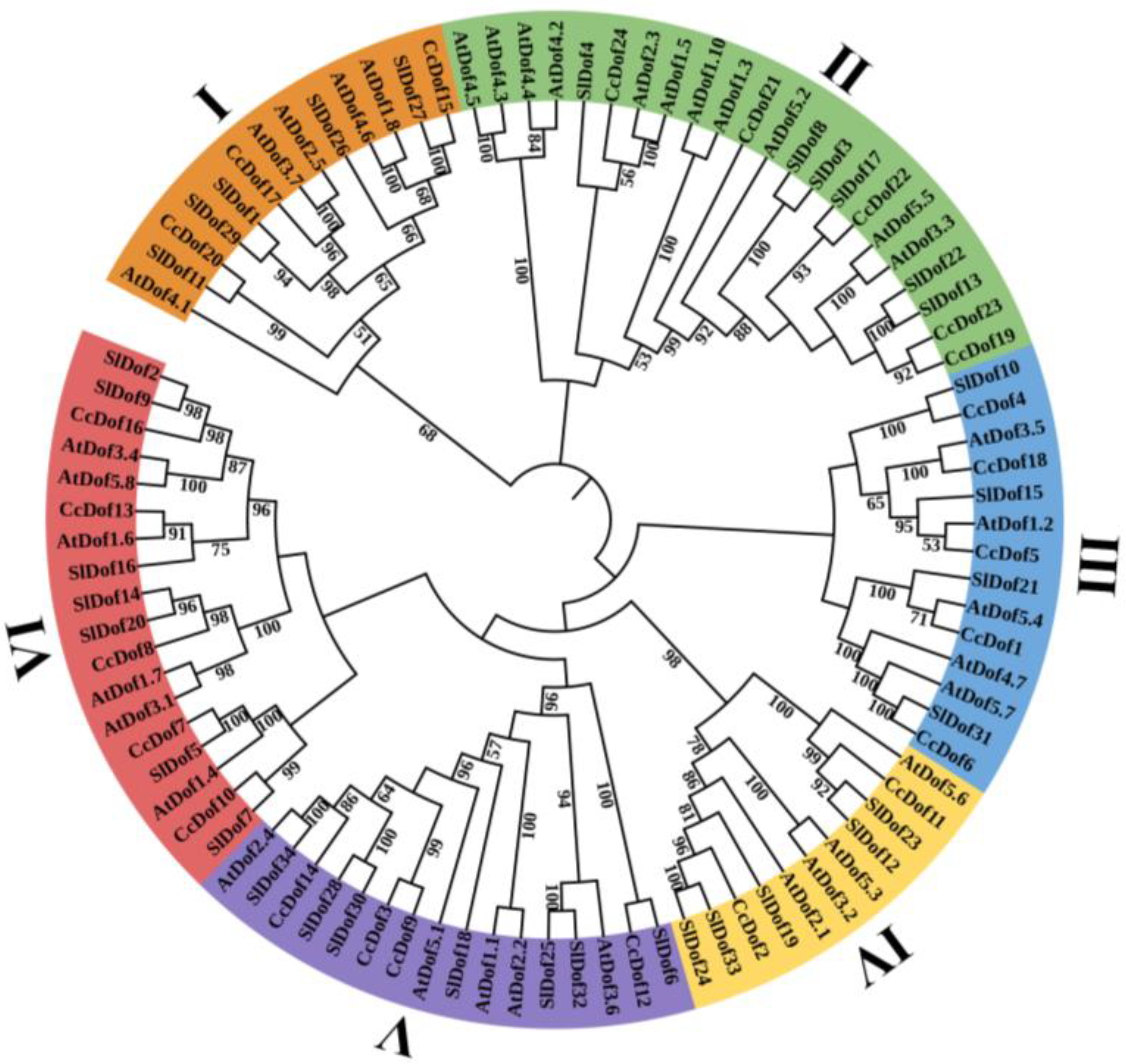
To investigate evolutionary relationships within the Dof gene family across citrus and model plant species, a phylogenetic tree was constructed using the neighbor-joining method in MEGA 11, based on the amino acid sequences from C. clementina, S. lycopersicum, and A. thaliana. The Dof proteins from these species were grouped into six distinct clades, designated Dof I to Dof VI (Figure 1). Clade Dof I comprised 5 Arabidopsis Dof proteins, 5 tomato Dof proteins, and 3 C. clementina Dof proteins. Dof II was the largest clade, encompassing 11 A. thaliana proteins, 6 from S. lycopersicum, and 5 from C. clementina. Clade III contained 5 A. thaliana, 4 S. lycopersicum, and 5 C. clementina Dof proteins. Dof IV was the smallest clade, with a total of 11 proteins: 4 from A. thaliana, 5 from S. lycopersicum, and 2 from C. clementina. The Dof V clade consisted of 5 A. thaliana, 7 S. lycopersicum, and 4 C. clementina Dof proteins, whereas Dof VI included 6 A. thaliana, 7 S. lycopersicum, and 5 C. clementina members. Each clade contained representatives from all three species, reflecting strong evolutionary conservation among the Dof gene families. These results provide insights into both the functional and structural conservation of Dof proteins across phylogenetically divergent plant lineages.

3.3. Gene Structure, Conserved Motifs, and Domain Analysis of the CcDof Family

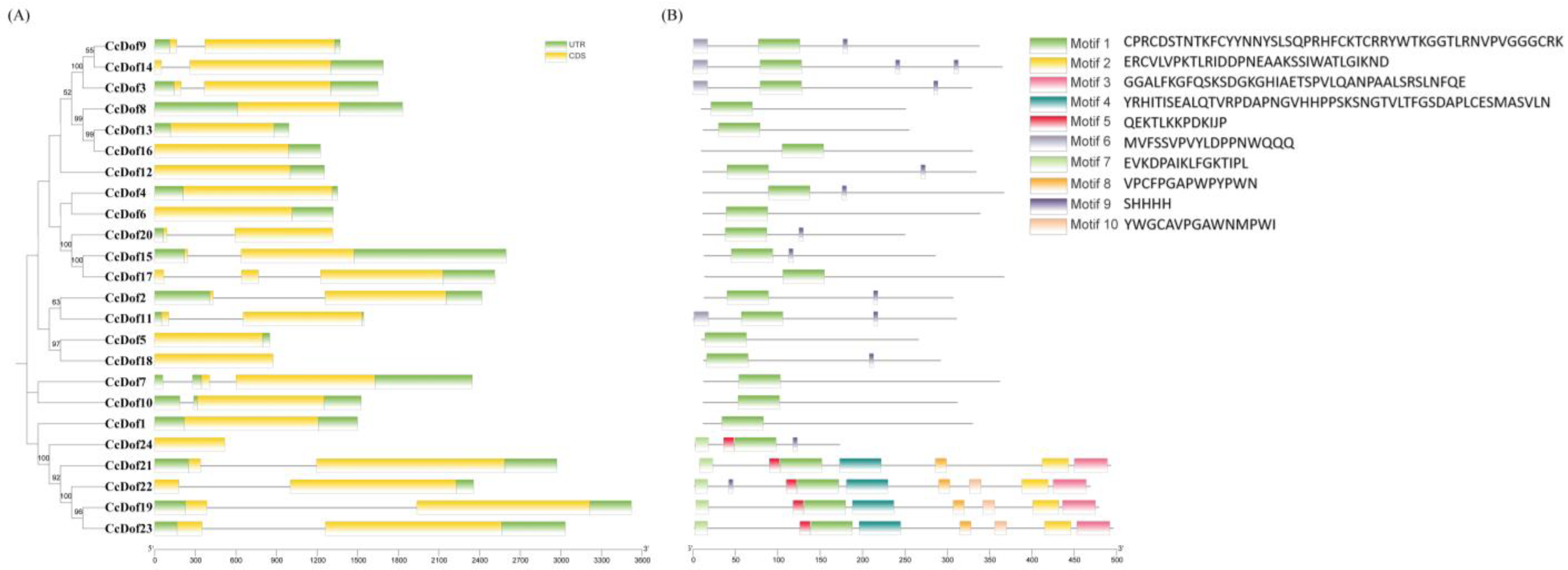
To assess structural diversity among CcDof genes, exon–intron arrangements and untranslated regions (UTRs) were analyzed (Figure 2A). Sequence alignment with corresponding genomic data revealed that CcDof genes possess one to three exons. Ten members—CcDof1, CcDof4, CcDof5, CcDof6, CcDof8, CcDof12, CcDof13, CcDof16, CcDof18, and CcDof24—lack introns entirely; twelve genes (CcDof2, CcDof3, CcDof9, CcDof10, CcDof11, CcDof14, CcDof15, CcDof19, CcDof20, CcDof21, CcDof22, and CcDof23) contained a single intron; and only two genes (CcDof7 and CcDof17) harbor two introns. These results indicate that the citrus CcDof gene family is predominantly composed of intronless or intron-poor genes.
Conserved motif analysis identified 10 distinct motifs within the CcDof protein family (Figure 2B). Motif 1 was present in all CcDof proteins, suggesting its role as a core conserved module. Motifs 2, 3, 4, and 8 were restricted to individual members: CcDof19, CcDof21, CcDof22, and CcDof23. Motif 5 was found in CcDof15, CcDof19, CcDof21, CcDof22, CcDof23, and CcDof24. Motif 6 was present in CcDof3, CcDof9, CcDof10, CcDof11, CcDof12, and CcDof14. Motif 7 occurred in CcDof19, CcDof21, CcDof22, CcDof23, and CcDof24. Motif 9 was detected in CcDof2, CcDof3, CcDof4, CcDof9, CcDof11, CcDof12, CcDof14, CcDof15, CcDof18, CcDof20, CcDof22, and CcDof24. Motif 10 was shared by CcDof19, CcDof22, and CcDof23. Domain analysis confirmed that all CcDof proteins contain the characteristic Zf-Dof domain, with the exception of CcDof24, which additionally harbors a PHA03247 superfamily domain.
Notably, members belonging to the same evolutionary clade display highly similar motif compositions. Integrating phylogenetic relationships and motif patterns reveals a close correspondence between motif organization and evolutionary history, suggesting that members within the same clade are likely to share similar or related biological functions.

3.4. Chromosomal Localization and Synteny Analysis of Dof Gene Family Members

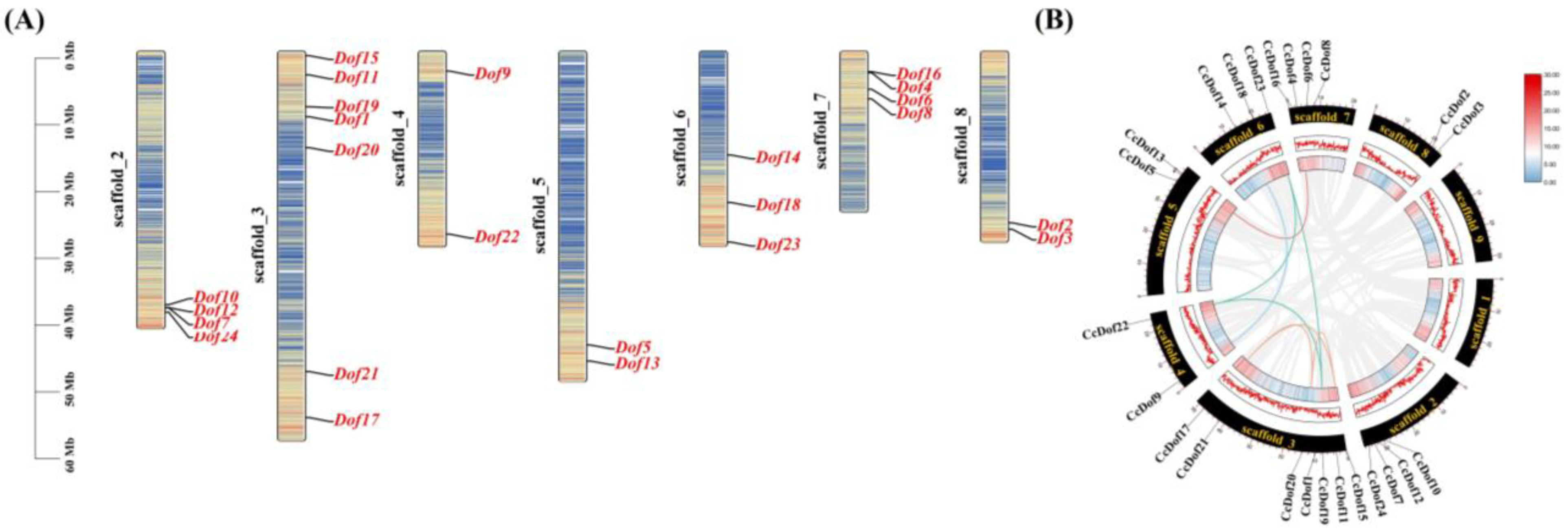
Chromosomal mapping of the CcDof genes revealed an uneven distribution across seven Citrus clementina chromosomes (chromosomes 2 to 8), with no CcDof loci detected on chromosomes 1 or 9 (Figure 3A). Chromosome 2 possesses four CcDof genes (CcDof7, CcDof10, CcDof12, and CcDof24). Chromosome 3 harbors the highest number of members, containing seven CcDof genes (CcDof1, CcDof11, CcDof15, CcDof17, CcDof19, CcDof20, and CcDof21). Chromosomes 4, 5, and 8 each carried at least two CcDof genes: chromosome 4 contains CcDof9 and CcDof22; chromosome 5 contains CcDof13 and CcDof15; and chromosome 8 contains CcDof2 and CcDof3. Chromosome 6 contains three (CcDof14, CcDof18, and CcDof23), and chromosome 7 also harbors four genes (CcDof4, CcDof6, CcDof8, and CcDof16). This distribution pattern suggests that chromosomal positioning is not strictly correlated with chromosome length but may instead reflect evolutionary influences such as gene duplication, recombination, and functional constraints.
Intraspecific synteny analysis identified multiple collinear gene pairs among the CcDof loci, including CcDof15 with CcDof17 and CcDof20; CcDof19 with CcDof22 and CcDof23; CcDof9 with CcDof14; and CcDof13 with CcDof16 (Figure 3B). These results show that the chromosomal segments encompassing these Dof genes underwent segmental duplications during the evolutionary history of citrus.

3.5. Analysis of Cis-Regulatory Elements in the Promoter Regions of the CcDof Genes

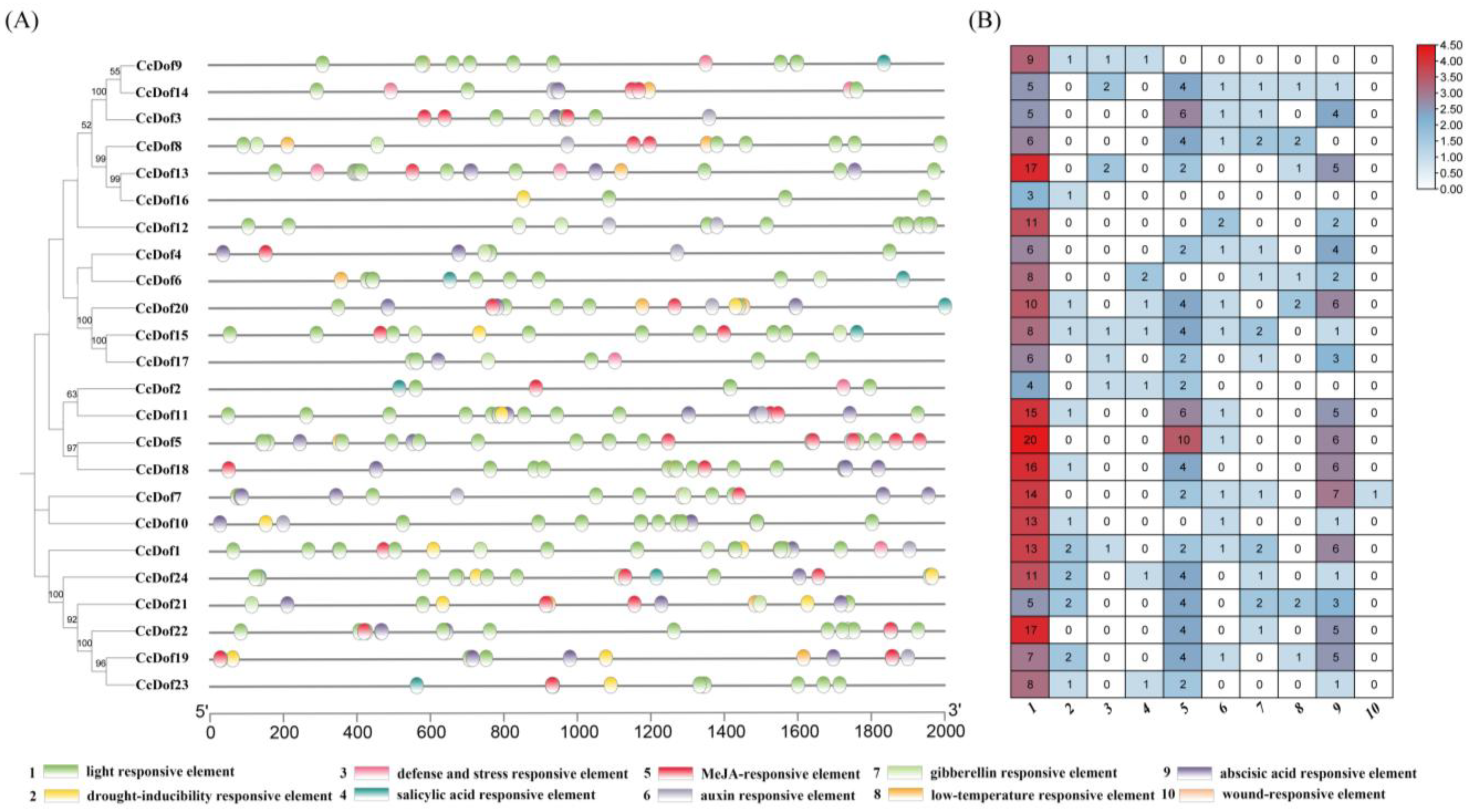
To evaluate the regulatory potential of CcDof genes, cis-regulatory elements (CREs) located within the 2 000 bp upstream promoter regions were analyzed using PlantCARE. A total of ten CRE categories were identified, including elements responsive to light, drought, defense, general stress, salicylic acid (SA), methyl jasmonate (MeJA), auxin, gibberellin (GA), low temperature, abscisic acid (ABA), and wounding (Figure 4).
Distribution analysis revealed that light-responsive elements are present in the promoter regions of all CcDof genes and occur at substantially higher frequencies than other element types. This finding indicates that the CcDof gene family may play pivotal roles in seedling photomorphogenesis, seed germination and photoperiod responses. In addition, approximately 80% of the CcDof promoters harbor MeJA- and ABA-responsive elements, indicating potential involvement in biotic and abiotic stress responses in citrus. Furthermore, half of the CcDof genes possess auxin- and GA-responsive elements in their promoters, implying possible participation in regulation of growth and developmental processes.

3.6. Expression Analysis of the CcDof Genes in Citrus Tissues

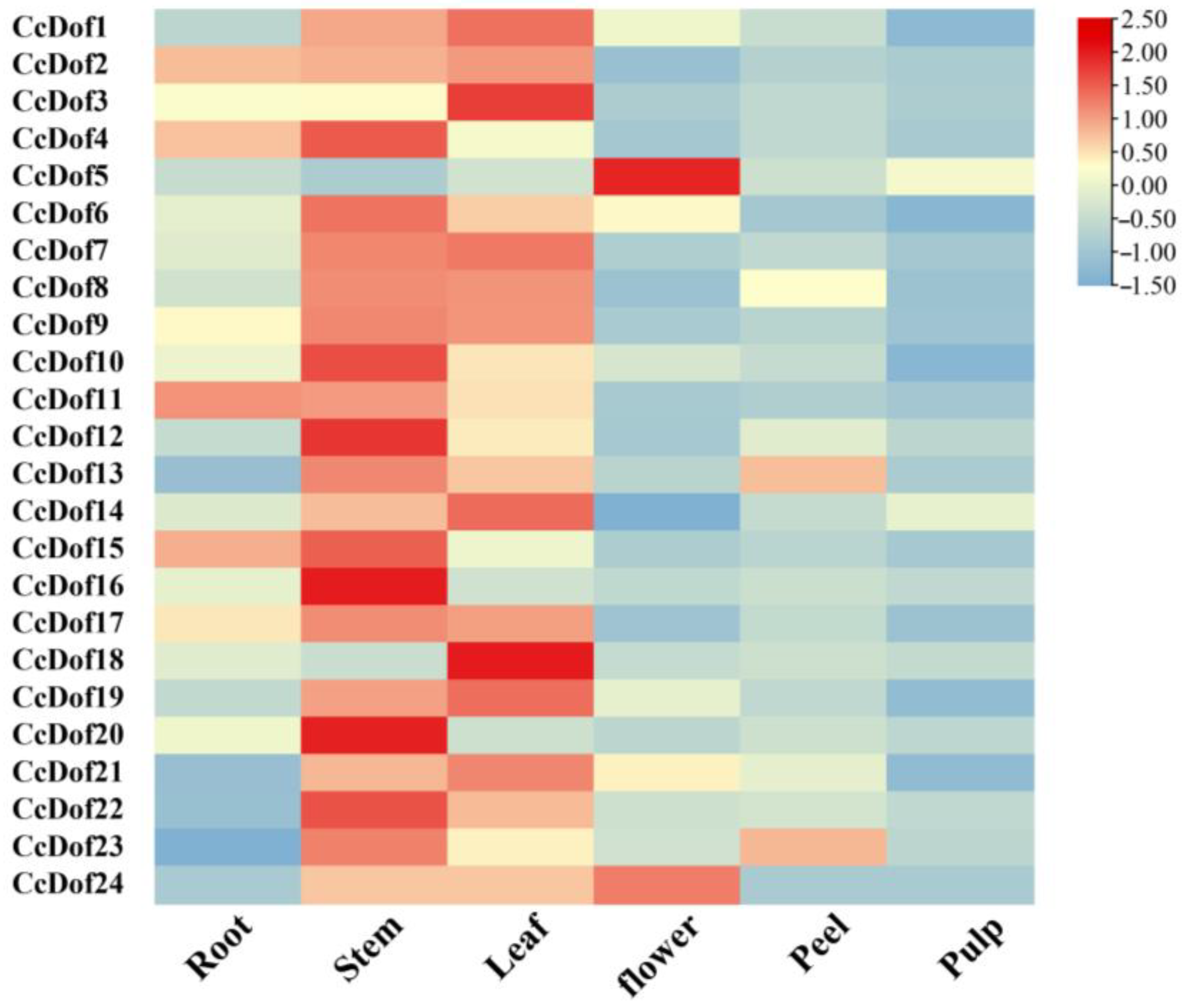
Expression profiles of CcDof genes in roots, stems, leaves, flowers, and fruit peels and pulps at 180 days after flowering (DAF) were analyzed by RT-qPCR (Figure 5). All CcDof genes exhibited tissue-specific expression patterns. Eight genes—CcDof1, CcDof2, CcDof3, CcDof7, CcDof14, CcDof18, CcDof19, and CcDof21—displayed high expression in leaves. Thirteen genes (CcDof4, CcDof6, CcDof8, CcDof9, CcDof10, CcDof12, CcDof13, CcDof15, CcDof16, CcDof17, CcDof20, CcDof22, and CcDof23) showed the highest expression in stems. CcDof5 and CcDof24 were most abundant in flowers, whereas CcDof11 was predominantly expressed in roots. These results indicate that the majority of CcDof genes are highly expressed in vegetative organs (roots, stems, and leaves), whereas only CcDof5, CcDof13, CcDof23, and CcDof24 exhibit relatively high expression levels in reproductive organs, including flowers and fruit peels. Collectively, these findings further support a role for the CcDof gene family in the regulation of growth and development processes in citrus.

3.7. Expression of CcDof Genes in Response to Plant Hormone Treatments

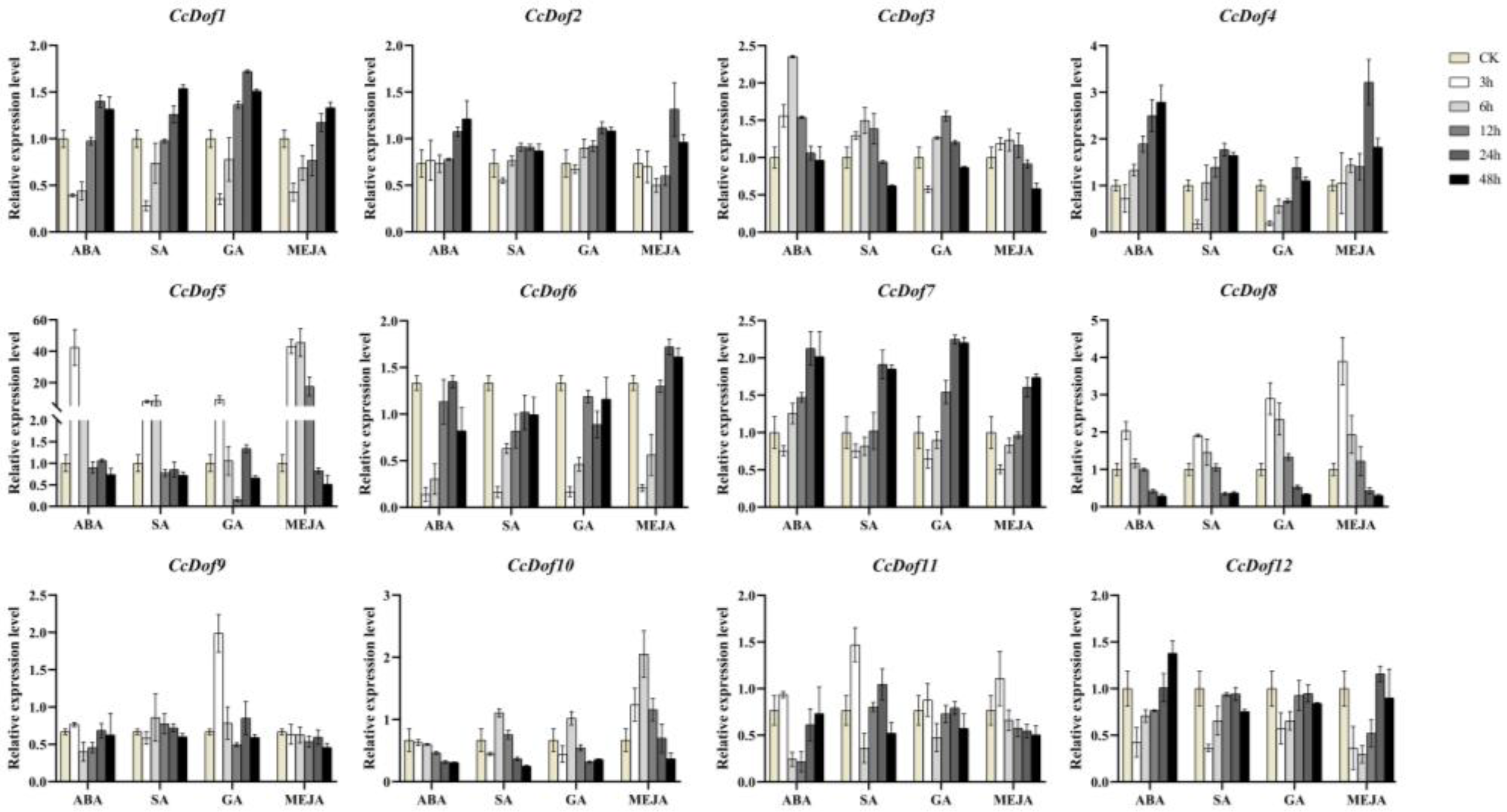
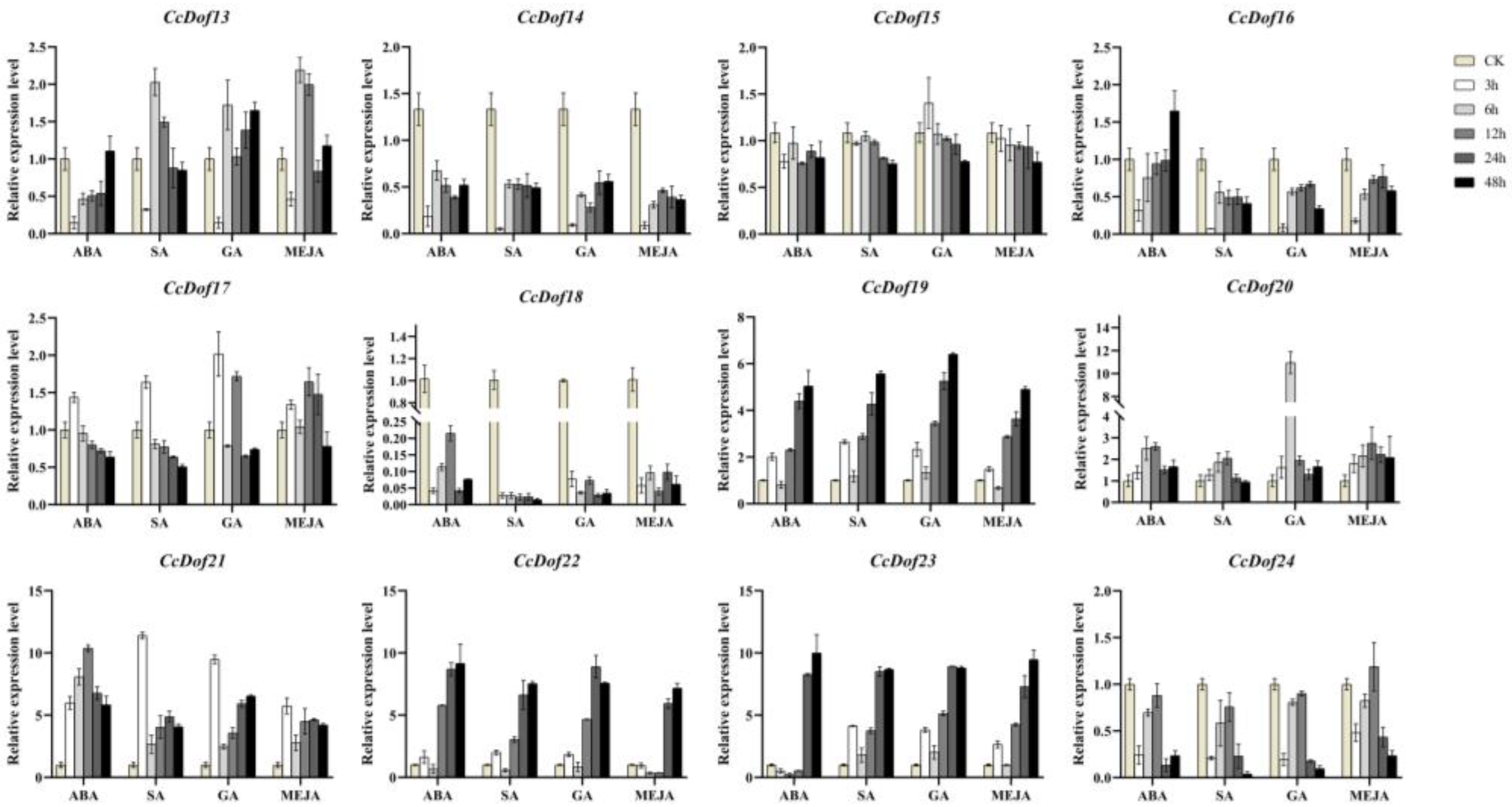
Based on the presence of hormone-responsive CREs in their promoters, we examined the expression patterns of CcDof genes under exogenous treatments with ABA, SA, GA, and MeJA (Figure 6 and Figure 7).
ABA treatment significantly induced the expression of CcDof3, CcDof4, CcDof5, CcDof7, CcDof8, CcDof19, CcDof20, CcDof21, CcDof22, and CcDof23, although the timing of their expression peaks varied. Specifically, CcDof3, CcDof4, CcDof7, CcDof8, and CcDof20 showed a 1–2-fold increase relative to CK, peaking at 6, 48, 24, 3, and 12 h post-treatment, respectively. Notably, CcDof8 was rapidly downregulated to low levels between 6 and 48 h. CcDof5 expression was sharply induced by ABA, reaching a ∼40-fold increase, but returned to baseline within 12 h. CcDof19 expression increased approximately 5-fold and peaked at 48 h. Similarly, CcDof21, CcDof22, and CcDof23 were upregulated ∼10-fold, with peak expression at 12, 48, and 48 h, respectively. In contrast, CcDof1, CcDof6, CcDof11, CcDof12, CcDof13, and CcDof16 exhibited an initial downregulation followed by upregulation before returning to CK levels. Meanwhile, CcDof10, CcDof18, and CcDof24 remained suppressed throughout the ABA treatment period (Figure 6 and Figure 7).
SA treatment induced a V-shaped expression pattern in CcDof1, CcDof4, CcDof6, CcDof7, CcDof12, CcDof13, and CcDof24, characterized by an initial downregulation at 3 h followed by subsequent upregulation. However, CcDof24 expression declined to an extremely low level after 48 h of treatment. By contrast, CcDof5, CcDof7, CcDof19, CcDof21, CcDof22, and CcDof23 were strongly induced by SA. CcDof5 and CcDof21 peaked at 3 h, whereas CcDof19, CcDof22, and CcDof23 reached their maxima at 48 h. CcDof8, CcDof10, CcDof17, and CcDof20 exhibited an initial upregulation followed by downregulation; CcDof8 and CcDof10 dropped significantly below CK after 48 h. Additionally, CcDof14, CcDof16, and CcDof18 remained suppressed throughout SA treatment (Figure 6 and Figure 7).
GA treatment induced an initial downregulation at 3 h in CcDof1, CcDof4, CcDof6, CcDof7, and CcDof13, followed by upregulation. Conversely, CcDof5, CcDof8, CcDof9, CcDof10, CcDof17, and CcDof20 displayed an inverted V-shaped pattern, peaking at 3 or 6 h before declining to low levels. CcDof14, CcDof16, CcDof18, and CcDof24 were suppressed throughout GA treatment. In contrast, CcDof19, CcDof21, CcDof22, and CcDof23 were strongly induced, although their peak times varied considerably (Figure 6 and Figure 7).
MeJA treatment elicited a V-shaped expression pattern (initial downregulation followed by upregulation) in CcDof1, CcDof6, CcDof7, CcDof12, CcDof13, CcDof22, and CcDof24. These genes were significantly suppressed at 3 h, then increased to levels above CK. Notably, CcDof22 was upregulated 5–6-fold at 24 and 48 h, whereas CcDof24 was downregulated to a lower level. Conversely, CcDof5, CcDof8, and CcDof10 showed an inverted V-shaped pattern (initial upregulation followed by downregulation), with expression falling below CK by 48 h. CcDof5 increased more than 40-fold at 3–6 h, while CcDof8 and CcDof10 increased only 2–3-fold during the same period. Furthermore, CcDof4, CcDof19, CcDof20, CcDof21, and CcDof23 were significantly induced throughout MeJA treatment, whereas CcDof14, CcDof16, and CcDof18 were markedly suppressed (Figure 6 and Figure 7).

3.8. Expression of CcDof Genes Under Low-Temperature Stress

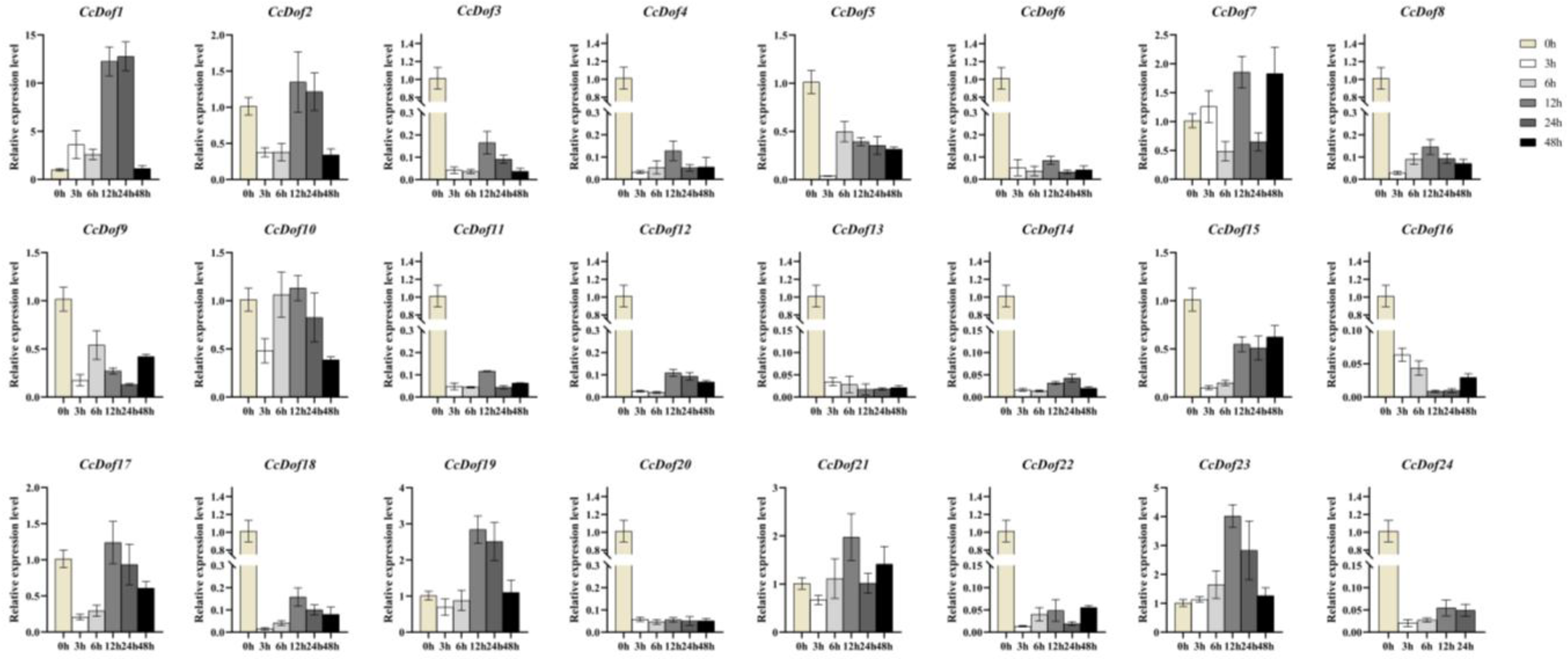
Under low-temperature (LT) stress, CcDof genes exhibited diverse time-dependent expression patterns (Figure 8). The majority of CcDof genes—CcDof2, CcDof3, CcDof4, CcDof5, CcDof6, CcDof8, CcDof9, CcDof10, CcDof11, CcDof12, CcDof13, CcDof14, CcDof15, CcDof16, CcDof17, CcDof18, CcDof20, CcDof22, and CcDof24—were rapidly downregulated within 3 h of treatment. Subsequently, the expression of CcDof2, CcDof5, CcDof9, CcDof10, CcDof15, and CcDof17 recovered, reaching levels equal to or at least 50% of those in CK (0 h) at later time points (6 h or 12 h). In contrast, CcDof4, CcDof6, CcDof8, CcDof11, CcDof12, CcDof13, CcDof14, CcDof16, CcDof18, CcDof20, CcDof22, and CcDof24 remained at very low levels throughout the LT treatment period.
Conversely, CcDof1, CcDof7, CcDof19, CcDof21, and CcDof23 were markedly upregulated under LT stress (Figure 8). Their expression peaked at 12 or 24 h, followed by a decline. Among them, CcDof1 showed the strongest induction, with transcript levels exceeding 11-fold relative to WT. Interestingly, CcDof7 exhibited an irregular expression pattern that did not conform to a consistent trend under the imposed stress conditions.

3.9. Expression of CcDof Genes in Response to Phytophthora Parasitica Infection

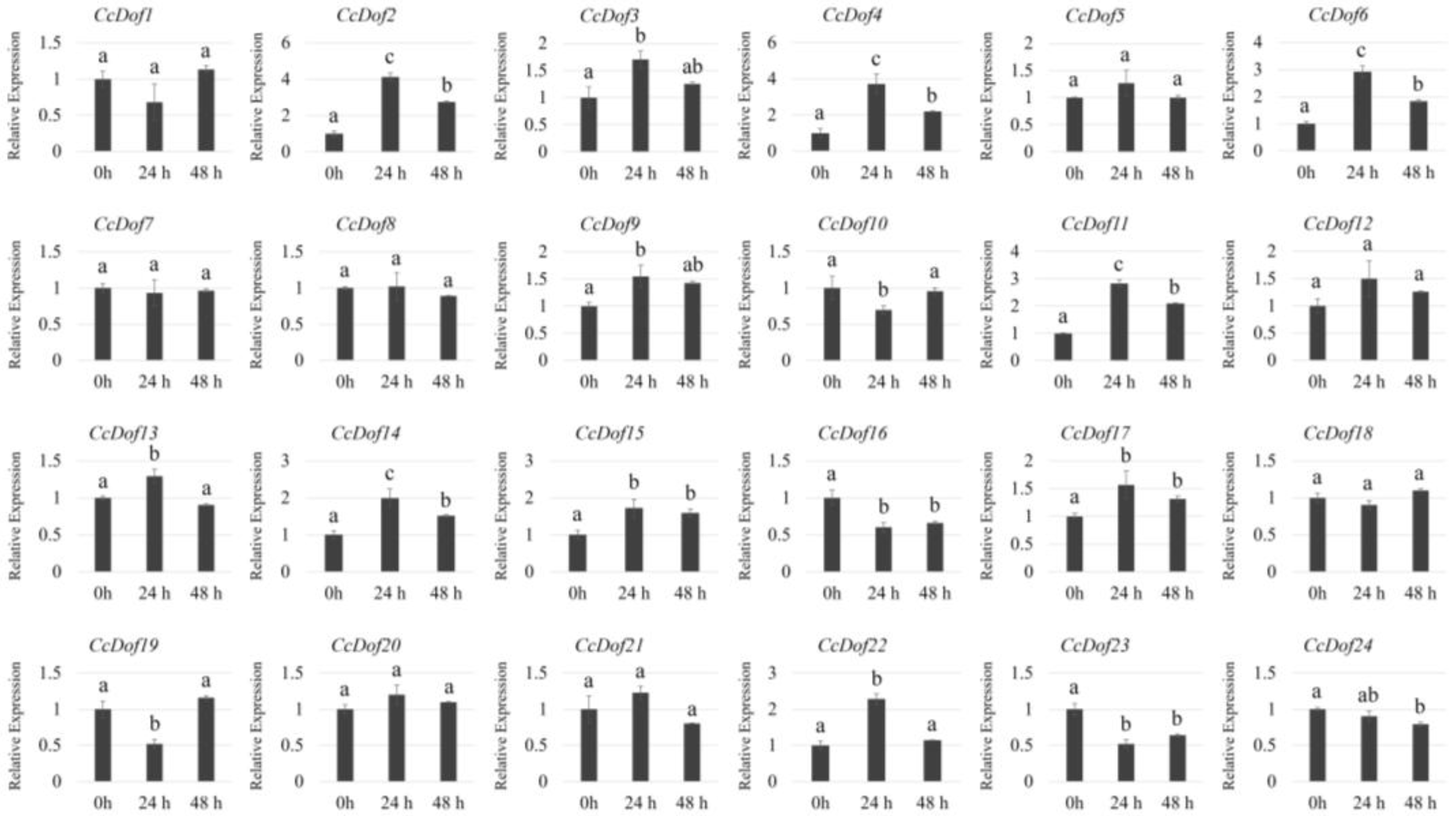
Transcript levels of CcDof genes in the bark of Citrus clementina seedlings exhibited marked changes following artificial inoculation with P. parasitica (Figure 9). The expression of CcDof2, CcDof3, CcDof4, CcDof6, CcDof9, CcDof11, CcDof13, CcDof14, CcDof15, CcDof17, and CcDof22 was significantly upregulated upon pathogen challenge. Notably, CcDof2, CcDof4, CcDof6, CcDof11, CcDof14, and CcDof22 showed a rapid increase of more than 1-fold at 24 hpi, whereas the remaining seven genes displayed only slight induction (less than 1-fold). In contrast, the expression of CcDof10, CcDof16, CcDof19, CcDof23, and CcDof24 was suppressed relative to the WT at 24 or 48 hpi. Among them, CcDof23 and CcDof24 exhibited continuous downregulation throughout the 48 h period following inoculation (Figure 9). These results suggest that certain CcDof genes may play a role in the plant’s defense response against the Phytophthora pathogen in citrus.

3.10. Overexpression of CcDof4 and CcDof6 Enhances P. parasitica Resistance in Citrus

Based on their tissue-specific expression (Figure 5), responses to phytohormone and Phytophthora stress (Figure 6, Figure 7 and Figure 9), and FPKM expression profiles in the C. sunki var. Ziyang’xiangcheng genotype following P. parasitica infection (Supplementary Table S2, adapted from [34]), CcDof2, CcDof4, CcDof6 and CcDof14 were prioritized as candidate genes for functional analysis of citrus defense against P. parasitica. Subsequently, CcDof4, CcDof6, and CcDof14 were successfully cloned; however, cloning of CcDof2 was unsuccessful.
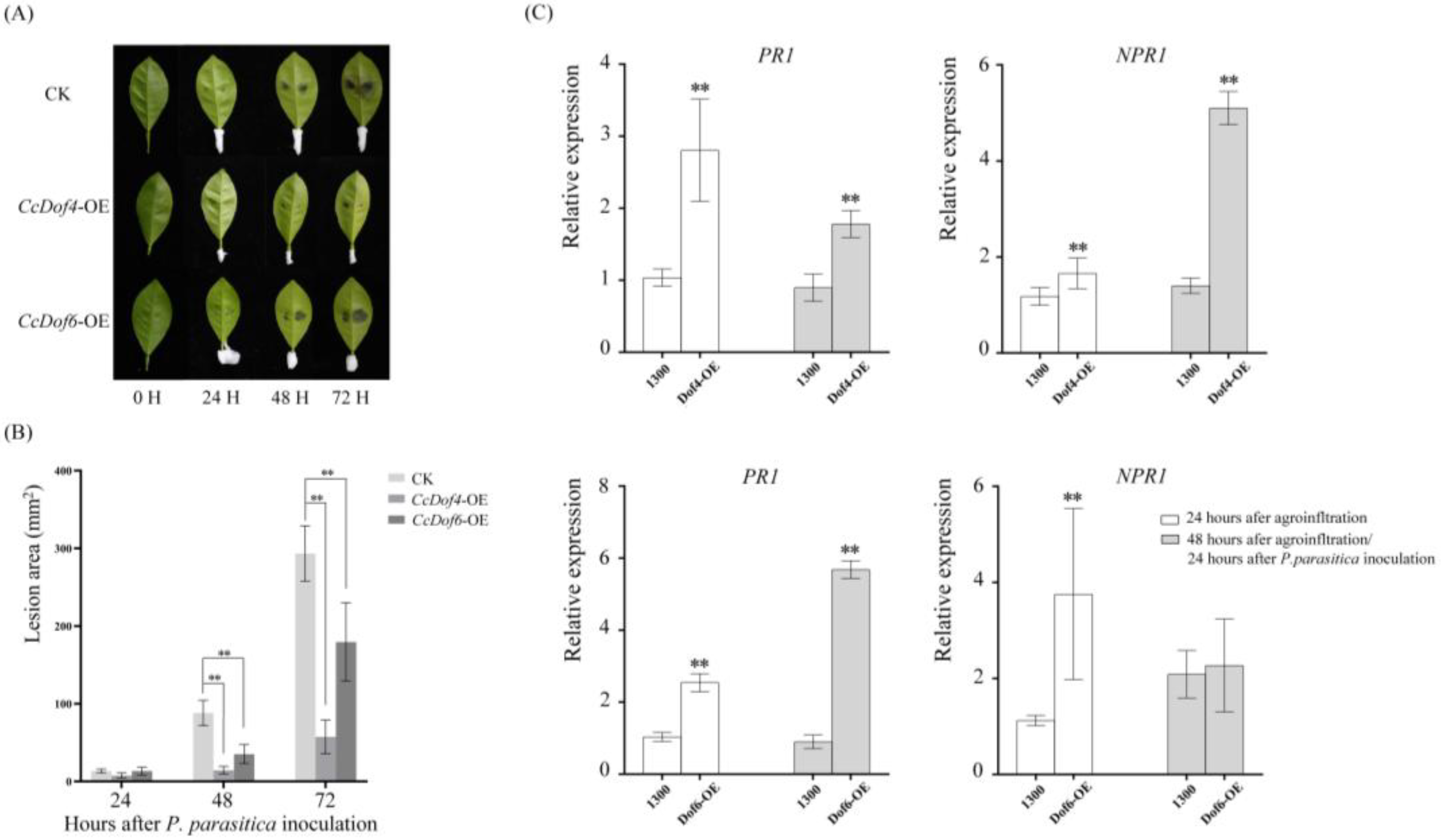
Agrobacterium-mediated transient overexpression of these three genes resulted in a significant increase in their transcript levels in citrus leaves at 24 and 48 h after infiltration (Supplementary Figure S1). After 24 h post-infiltration, leaves were inoculated with P. parasitica, and disease progression was monitored at 24, 48, and 72 hpi. At 48 and 72 hpi, leaves overexpressing CcDof4 and CcDof6 exhibited reduced disease symptom severity compared to the control (CK; leaves infiltrated with A. tumefaciens EHA105 harboring the empty pS1300 vector) (Figure 10A). Notably, CcDof4-overexpressing leaves showed the strongest suppression of lesion expansion. In contrast, overexpression of CcDof14 did not alter resistance to P. parasitica (Supplementary Figure S2). Consistent with phenotypic observations, lesion areas on leaves overexpressing CcDof4 or CcDof6 were significantly smaller than those of the CK (Figure 10B). At 48 h after P. parasitica infection, mean lesion area was reduced by 83.7% in CcDof4-overexpressing leaves and by 60.0% in CcDof6-overexpressing leaves relative to CK; at 72 hpi, reductions were 80.4% and 33.8%, respectively.
In a previous study, the SA signaling pathway was shown to be particularly important for Citrus reticulata var. Guangggan resistance to P. parasitica [34,41]. To further elucidate the potential molecular mechanism by which CcDof4 and CcDof6 enhance resistance, we measured the expression of SA-responsive genes PR1 (pathogenesis-related protein 1) and NPR1 (nonexpressor of pathogenesis-related (PR) genes 1) in overexpression leaves following P. parasitica infection. Both CcDof4 and CcDof6 overexpression activated PR1 and NPR1 expression (Figure 10C). Notably, NPR1 was more strongly induced in CcDof4-overexpressing leaves after infection, whereas PR1 was more prominently upregulated in CcDof6-overexpressing leaves. In contrast, NPR1 expression in CcDof6-overexpressing leaves did not differ significantly from that in the control (Figure 10C). Collectively, these results demonstrate that the transcription factors CcDof4 and CcDof6 may play crucial roles in enhancing citrus resistance to P. parasitica.

4. Discussion

Dof proteins, plant-specific transcription factors belonging to the zinc finger protein superfamily, have been widely studied in various plant species [12,13,14,17,21]. In the present study, a total of 24 Dof genes were identified from the C. clementina genome (Table 1). This number is identical to that reported for sweet orange [35], but less than the 28 genes identified in the closely related kumquat [19]. Notably, the Dof gene complement in citrus and kumquat appears to be smaller than that in many other plant species, such as A. thaliana (36 Dof genes, [12]), tomato (34 Dof genes, [13]), rice (30 Dof genes, [47]), and apple (60 MdDof genes [17]). These interspecific differences in Dof family size may reflect distinct patterns of gene duplication during evolution or may be influenced by overall genome size [48,49].
The presence of introns in protein-coding genes is a defining feature of eukaryotic genomes, giving rise to complex and diverse exon–intron architectures [50]. The widespread occurrence of introns across eukaryotic lineages, together with accumulating experimental evidence for their functional significance, strongly implies that they confer substantial biological benefits [51]. In this study, we found that the majority of CcDof genes (22 out of 24) contain zero to one intron, a pattern consistent with reports in other plant species such as eggplant [52], watermelon [16], and pear [53]. A low intron number has been correlated with stress responsiveness, as intron-poor genes can be more rapidly regulated under stress conditions. For example, in Arabidopsis and rice, intronless or intron-poor members of the AP2, EF-hand_7, bZIP, FAD_binding_4, STE_STE11, CAMK_CAMKL-CHK1 and C2 gene families have been shown to be more frequently involved in drought and salt stress responses than their intron-rich counterparts within the same families [54]. Thus, we speculate that certain citrus Dof genes with zero or one intron may play important roles in regulating plant stress responses.
Promoter CREs are non-coding DNA sequences that play a crucial role in governing the spatiotemporal control of gene expression in plants by serving as binding sites for RNA polymerase or by interacting with transcription factors [55,56]. These elements influence various aspects of plant development and physiological processes. For example, genetic variants within CREs have been linked to phenotypic transitions from wild to cultivated forms during plant domestication [2]. In the present study, a wide array of CREs—including those responsive to light, hormone, low temperature, wound, defense and stress—were identified in the promoter regions of CcDof genes. These findings suggest that Dof genes in citrus are likely to play important roles in the regulation of growth and stress responses. Notably, light-responsive elements were the most abundant among all CcDof promoters, with the exception of CcDof3. Light is one of the most critical environmental cues for plants, and numerous transcription factors involved in light-regulated transcriptional networks have been identified through classical genetic and molecular approaches [57,58]. Accumulating evidence indicates that several Dof genes participate not only in light responses but also in plant development and seed germination [24,59,60,61,62,63,64]. Therefore, further investigation is warranted to elucidate the roles of CcDof genes in regulating seedling photomorphogenesis, phototropism, shade avoidance, and circadian rhythms.
Plant Dof genes exhibit tissue-specific expression profiles [13,27,59,65], and functional diversification is widely observed among family members [9,66]. For example, Arabidopsis VDOF1 and VDOF2 [67] and tomato SlDof10 [26] regulate vascular cell differentiation and vascular tissue formation. Arabidopsis Dof/CDF3 [68], tomato SlDOF9 [69], and pear PbDof9.2 [52] are involved in flowering time and flower development. Maize ZmDof3 controls starch accumulation and aleurone development in the endosperm [70], whereas rice OsDOF15 contributes to ethylene-mediated inhibition of primary root elongation under salt stress [71]. In addition, overexpression of CmDOF6 reduced plant height by repressing CmTCP8, a transcription factor that binds to the promoter of the GA biosynthesis gene CmGA20ox1, thereby suppressing its expression and decreasing the level of bioactive GAs [72]. Our results show that most citrus Dof genes are expressed at higher levels in leaves and stems than in other trusses, with particularly low expression in fruit flesh. This pattern suggests that certain Dof genes may play important roles in the growth and development of vegetative organs. Further analyses are needed to determine the specific functions of individual Dof proteins in citrus.
Plant hormones are crucial regulators of plant growth and play key roles in mediating stress responses [73,74]. In the present study, numerous hormone-responsive CREs were identified in the promoter regions of CcDof genes, including those associated with ABA, SA, auxin, GA, and MeJA. Exogenous application of SA, GA, MeJA, and ABA significantly altered the expression of CcDofs genes, although the magnitude of responsiveness varied markedly among individual family members. These findings suggest that CcDof genes are involved in hormone-mediated regulation of growth and stress responses in citrus. Interactions between Dof genes and phytohormones have been reported in a variety of plant species. For example, in Arabidopsis thaliana, grafting or wounding activates the expression of multiple Dof genes at the graft junction, promoting wound healing and tissue regeneration [74]. This process requires auxin, although hormone treatment alone is insufficient to induce such expression [75]. AtDof2.1 acts as a JA-responsive gene and participates in a regulatory feedback loop with MYC2 to promote leaf senescence [76]. In Petunia, overexpression of PhDof28 significantly enlarges petal size by stimulating endogenous indole-3-acetic acid biosynthesis [77]. Given that citrus seedlings are commonly propagated by grafting, and graft healing is regulated by phytohormones, transcription factors, and others [78], analysis and characterization of CcDof genes involved in post-grafting wound healing may have considerable biological significance for breeding rootstock varieties with improved graft affinity and stress resistance.
Freezing temperatures cause substantial economic losses in citrus-producing regions worldwide. Cold-responsive Dof genes have also been reported in other plant species. For example, in rice, both OsDof1 and OsDof19 have been identified as cold-inducible genes, with OsDof1 showing a specific response to chilling stress [14]. Similarly, overexpression of LhDof6 in Liriodendron enhances cold tolerance and improves survival rates under extreme cold conditions as low as −20 °C [79]. In the present study, low-temperature response CREs were identified in the promoter regions of seven CcDof genes, and exposure to low temperatures was shown to induce the expression of multiple CcDof genes. These findings suggest that Dof genes in citrus may also play important roles in low-temperature adaptation and chilling stress response.
Dof genes are also implicated in plant disease resistance. For instance, transient overexpression of the BBF1-related Dof genes BBF2 and BBF3 significantly upregulates the expression of genes that are involved in virus resistance and pathogen defense in tobacco (N. tabacum L. cv. Samsun NN) [80]. In cucumber, CsDof genes contribute to resistance against biotic stresses such as watermelon mosaic virus and downy mildew [81]. In rice, tissue-specific activation of Dof11 improves sheath blight resistance and yield by activating SWEET14 [82]. Additionally, an atypical Dof transcription factor, OsDes1, binds to the promoter regions of defense-related genes (e.g., OsPR1b) and the Rieske Fe/S protein gene OsPetC, thereby activating their expression and enhancing both grain yield and disease resistance [29]. In grapevine, VvDOF3 is involved in powdery mildew resistance through the SA signaling pathway [83].
Phytophthora species are highly destructive soil- and water-borne pathogens that cause diseases such as root rot, foot rot, stem gummosis, and fruit brown rot in citrus. Infection by P. parasitica triggered significant transcriptional changes in the CcDof family, with 11 members upregulated and 4 downregulated. Notably, transient overexpression of CcDof4 and CcDof6 conferred substantial resistance to this pathogen, suggesting a key role for these genes in citrus defense. Mechanistically, this enhanced resistance was correlated with an upregulation of NPR1 and PR1—hallmark genes of the SA signaling pathway. SA is a central hormone in plant immunity [84,85], and its signaling cascade depends on the NPR1 gene. Since PR1 expression is directly regulated by SA, it serves as a widely used marker for monitoring SA-triggered immune responses and systemic acquired resistance (SAR) [85,86]. Intriguingly, Dof4 expression itself is also induced by SA treatment (after a 3 h window post-inoculation). Together, these data indicate that CcDof4-mediated resistance to Phytophthora is likely linked to SA signaling. However, we recognize that transient overexpression may result in supraphysiological protein levels, potentially eliciting artificial responses that do not accurately reflect the gene’s native function. To definitively confirm this regulatory mechanism, future work will involve generating stable transgenic citrus lines to validate the role of CcDof4 in P. parasitica resistance.

5. Conclusions

This study conducted a comprehensive genome-wide analysis of the Dof transcription factor family in Citrus clementina, identifying 24 non-redundant CcDof genes. Phylogenetic analysis assigned these genes to six distinct clades, a classification supported by consistent patterns in gene structure and conserved protein motifs. Promoter analysis further revealed a diverse array of cis-regulatory elements, indicating that CcDof genes are primed to regulate processes such as light response, phytohormone signaling, and adaptation to abiotic/biotic stress. Expression profiling demonstrated pronounced tissue-specific patterns and showed differential regulation of CcDof genes in response to hormonal treatments, cold stress, and infection by P. parasitica. Notably, transient overexpression of CcDof4 and CcDof6 enhanced plant resistance to this pathogen. This defense response was accompanied by upregulation of hallmark SA-responsive markers (NPR1 and PR1), linking these transcription factors to the SA-mediated defense pathway. Collectively, our findings delineate the functional repertoire of CcDof genes and identify CcDof4 as a promising candidate for genetic engineering strategies aimed at improving Phytophthora disease resistance in citrus.

Supplementary Materials

The following supporting information can be downloaded at: https://www.mdpi.com/article/10.3390/horticulturae12030348/s1. Figure S1. The relative expression levels of CcDof4, CcDof6, and CcDof14 in citrus leaves at 0, 24, and 48 h after agroinfiltration. Figure S2. The disease symptoms (A) and Lesion size measurements (B) in control and CcDof14- overexpressing citrus leaves after inoculation with P. parasitica. Table S1. Primer for construction of transient transformation vector and RT-qPCR. Table S2. The expression of CcDof genes in C. sunki var. Ziyang’xiangcheng (XC) in response to P. parasitica infection.

Author Contributions

Conceptualization, H.Y. and J.Y.; data curation, L.H. and Y.L.; formal analysis, L.H.; funding acquisition, H.Y.; supervision, H.Y. and J.Y.; writing—original draft, L.H. and H.Y.; writing—review and editing, H.Y., J.Y. and Y.X. All authors have read and agreed to the published version of the manuscript.

Funding

This study was supported by the Natural Science Foundation of Guangdong Province, China (2024A1515010921, 2019A1515011709); the National Natural Science Foundation of China (31601722).

Data Availability Statement

The original contributions presented in this study are included in the article/Supplementary Material. Further inquiries can be directed to the corresponding author.

Conflicts of Interest

The authors declare no conflicts of interest.

References

  1. Suzuki, N.; Rivero, R.M.; Shulaev, V.; Blumwald, E.; Mittler, R. Abiotic and biotic stress combinations. New Phytol. 2014, 203, 32–43. [Google Scholar] [CrossRef]
  2. Li, X.; Schmitz, R.J. Cis-regulatory dynamics in plant domestication. Trends Genet. 2025, 41, 984–994. [Google Scholar] [CrossRef]
  3. Romani, F.; Moreno, J.E. Molecular mechanisms involved in functional macroevolution of plant transcription factors. New Phytol. 2021, 230, 1345–1353. [Google Scholar] [CrossRef]
  4. Strader, L.; Weijers, D.; Wagner, D. Plant transcription factors—Being in the right place with the right company. Curr. Opin. Plant Biol. 2022, 65, 102136. [Google Scholar] [CrossRef]
  5. Wu, Y.; Wen, J.; Xia, Y.; Zhang, L.; Du, H. Evolution and functional diversification of R2R3-MYB transcription factors in plants. Hortic. Res. 2022, 9, uhac058. [Google Scholar] [CrossRef]
  6. JJaved, T.; Gao, S.J. WRKY transcription factors in plant defense. Trends Genet. 2023, 39, 787–801. [Google Scholar] [CrossRef]
  7. Waschburger, E.L.; Filgueiras, J.P.C.; Turchetto-Zolet, A.C. DOF gene family expansion and diversification. Genet. Mol. Biol. 2024, 46, e20230109. [Google Scholar] [CrossRef]
  8. Xiong, H.; He, H.; Chang, Y.; Miao, B.; Liu, Z.; Wang, Q.; Dong, F.; Xiong, L. Multiple roles of NAC transcription factors in plant development and stress responses. J. Integr. Plant Biol. 2025, 67, 510–538. [Google Scholar] [CrossRef]
  9. Yanagisawa, S. The Dof family of plant transcription factors. Trends Plant Sci. 2002, 7, 555–560. [Google Scholar] [CrossRef]
  10. Yanagisawa, S.; Izui, K. Molecular cloning of two DNA-binding proteins of maize that are structurally different but interact with the same sequence motif. J. Biol. Chem. 1993, 268, 16028–16036. [Google Scholar] [CrossRef]
  11. Yanagisawa, S.; Schmidt, R.J. Diversity and similarity among recognition sequences of Dof transcription factors. Plant J. 1999, 17, 209–214. [Google Scholar] [CrossRef]
  12. Lijavetzky, D.; Carbonero, P.; Vicente-Carbajosa, J. Genome-wide comparative phylogenetic analysis of the rice and Arabidopsis Dof gene families. BMC Evol. Biol. 2003, 3, 17. [Google Scholar] [CrossRef]
  13. Cai, X.; Zhang, Y.; Zhang, C.; Zhang, T.; Hu, T.; Ye, J.; Zhang, J.; Wang, T.; Li, H.; Ye, Z. Genome-wide analysis of plant-specific Dof transcription factor family in tomato. J. Integr. Plant Biol. 2013, 55, 552–566. [Google Scholar] [CrossRef] [PubMed]
  14. Liu, J.; Meng, Q.; Xiang, H.; Shi, F.; Ma, L.; Li, Y.; Liu, C.; Liu, Y.; Su, B. Genome-wide analysis of Dof transcription factors and their response to cold stress in rice (Oryza sativa L.). BMC Genomics 2021, 22, 800. [Google Scholar] [CrossRef] [PubMed]
  15. Wang, Y.; Jin, H.; Du, S.; Fang, B.; Yue, J.; Yang, C.; Wang, H.; Zhang, D.; Wang, J.; Song, H.; et al. Multi-Omics Association Analysis of DOF Transcription Factors Involved in the Drought Resistance of Wheat Induced by Strigolactone. Int. J. Mol. Sci. 2025, 26, 2396. [Google Scholar] [CrossRef] [PubMed]
  16. Zhou, Y.; Cheng, Y.; Wan, C.; Li, J.; Yang, Y.; Chen, J. Genome-wide characterization and expression analysis of the Dof gene family related to abiotic stress in watermelon. Peer J. 2020, 8, e8358. [Google Scholar] [CrossRef]
  17. Zhang, Z.; Yuan, L.; Liu, X.; Chen, X.; Wang, X. Evolution analysis of Dof transcription factor family and their expression in response to multiple abiotic stresses in Malus domestica. Gene 2018, 639, 137–148. [Google Scholar] [CrossRef]
  18. Wang, Z.; Wang, Y.; Tong, Q.; Xu, G.; Xu, M.; Li, H.; Fan, P.; Li, S.; Liang, Z. Transcriptomic analysis of grapevine Dof transcription factor gene family in response to cold stress and functional analyses of the VaDof17d gene. Planta 2021, 253, 55. [Google Scholar] [CrossRef]
  19. Yang, Y.; He, Z.; Bing, Q.; Duan, X.; Chen, S.; Zeng, M.; Liu, X. Two Dof transcription factors promote flavonoid synthesis in kumquat fruit by activating C-glucosyltransferase. Plant Sci. 2022, 318, 111234. [Google Scholar] [CrossRef]
  20. Li, M.; Fan, D.; Wen, Z.; Meng, J.; Li, P.; Cheng, T.; Zhang, Q.; Sun, L. Genome-wide identification of the Dof gene family: How it plays a part in mediating cold stress response in Prunus mume. Plant Physiol. Biochem. 2024, 217, 109215. [Google Scholar] [CrossRef]
  21. Zhao, C.; Bai, H.; Li, C.; Pang, Z.; Xuan, L.; Lv, D.; Niu, S. Genome-Wide Identification of the DOF Gene Family in Kiwifruit (Actinidia chinensis) and Functional Validation of AcDOF22 in Response to Drought Stress. Int. J. Mol. Sci. 2024, 25, 9103. [Google Scholar] [CrossRef] [PubMed]
  22. Lorrai, R.; Gandolfi, F.; Boccaccini, A.; Ruta, V.; Possenti, M.; Tramontano, A.; Costantino, P.; Lepore, R.; Vittorioso, P. Genome-wide RNA-seq analysis indicates that the DAG1 transcription factor promotes hypocotyl elongation acting on ABA, ethylene and auxin signaling. Sci. Rep. 2018, 8, 15895. [Google Scholar] [CrossRef]
  23. Gao, H.; Song, W.; Severing, E.; Vayssières, A.; Huettel, B.; Franzen, R.; Richter, R.; Chai, J.; Coupland, G. PIF4 enhances DNA binding of CDF2 to co-regulate target gene expression and promote Arabidopsis hypocotyl cell elongation. Nat. Plants 2022, 8, 1082–1093. [Google Scholar] [CrossRef]
  24. Wei, Z.; Zhang, H.; Fang, M.; Lin, S.; Zhu, M.; Li, Y.; Jiang, L.; Cui, T.; Cui, Y.; Kui, H.; et al. The Dof transcription factor COG1 acts as a key regulator of plant biomass by promoting photosynthesis and starch accumulation. Mol. Plant 2023, 16, 1759–1772. [Google Scholar] [CrossRef]
  25. Xu, P.; Yang, Y.; Zhao, Z.; Hu, J.; Xie, J.; Wang, L.; Zheng, H.; Cai, W. The transcription factor Dof3.6/OBP3 regulates iron homeostasis in Arabidopsis. EMBO J. 2025, 44, 251–268. [Google Scholar] [CrossRef] [PubMed]
  26. Rojas-Gracia, P.; Roque, E.; Medina, M.; López-Martín, M.J.; Cañas, L.A.; Beltrán, J.P.; Gómez-Mena, C. The DOF Transcription Factor SlDOF10 Regulates Vascular Tissue Formation During Ovary Development in Tomato. Front. Plant Sci. 2019, 10, 216. [Google Scholar] [CrossRef]
  27. Ewas, M.; Khames, E.; Ziaf, K.; Shahzad, R.; Nishawy, E.; Ali, F.; Subthain, H.; Amar, M.H.; Ayaad, M.; Ghaly, O. The Tomato DOF Daily Fluctuations 1, TDDF1 acts as flowering accelerator and protector against various stresses. Sci. Rep. 2017, 7, 10299. [Google Scholar] [CrossRef]
  28. Shi, H.; Li, P.; Yun, P.; Zhu, Y.; Zhou, H.; Wang, L.; Wu, B.; Wang, Y.; Lou, G.; Huang, Q.; et al. A DOF transcription factor GLW9/OsDOF25 regulates grain shape and tiller angle in rice. Plant Biotechnol. J. 2025, 23, 2367–2382. [Google Scholar] [CrossRef]
  29. Qiu, T.; Wei, S.; Fang, K.; Zhang, M.; Li, Y.; Feng, Y.; Cheng, Y.; Zhang, S.; Tian, J.; Gao, A.; et al. The atypical Dof transcriptional factor OsDes1 contributes to stay-green, grain yield, and disease resistance in rice. Sci. Adv. 2024, 10, eadp0345. [Google Scholar] [CrossRef] [PubMed]
  30. Cao, L.; Ye, F.; Fahim, A.M.; Ma, C.; Pang, Y.; Zhang, X.; Zhang, Q.; Lu, X. Transcription factor ZmDof22 enhances drought tolerance by regulating stomatal movement and antioxidant enzymes activities in maize (Zea mays L.). Theor. Appl. Genet. 2024, 137, 132. [Google Scholar] [CrossRef]
  31. Zhang, W.; Ma, C.; Du, L.; Xiang, Y.; Xiao, F.; Liu, Y.; Wang, C.; Li, W.; Zhao, T.; Hu, D. Two DNA-binding One Zinc Finger transcription factors, MdCDOF3 and MdDOF3.6, accelerate leaf senescence by activating cytokinin oxidase MdCKX7 in response to sorbitol signaling in apple. Hortic. Res. 2025, 12, uhaf120. [Google Scholar] [CrossRef]
  32. Chen, P.; Yan, M.; Li, L.; He, J.; Zhou, S.; Li, Z.; Niu, C.; Bao, C.; Zhi, F.; Ma, F.; et al. The apple DNA-binding one zinc-finger protein MdDof54 promotes drought resistance. Hortic. Res. 2020, 7, 195. [Google Scholar] [CrossRef] [PubMed]
  33. Ma, X.; Xie, X.; He, Z.; Wang, F.; Fan, R.; Chen, Q.; Zhang, H.; Huang, Z.; Wu, H.; Zhao, M.; et al. A LcDOF5.6-LcRbohD regulatory module controls the reactive oxygen species-mediated fruitlet abscission in litchi. Plant J. 2023, 113, 954–968. [Google Scholar] [CrossRef] [PubMed]
  34. Lv, Y.; Jiang, B.; Ma, Y.; Li, X.; Hu, L.; Yu, J.; Yan, H. Comprehensive transcriptomics analysis reveals the molecular resistance mechanisms of Guanggan (Citrus reticulata) against Phytophthora parasitica infection. Sci. Hortic. 2025, 350, 114378. [Google Scholar] [CrossRef]
  35. Hu, S.F.; Zhong, Z.Q.; Qi, Y.; Sun, Y.H.; Zeng, R.F. Identification of DNA-binding with one finger (DOF) transcription factor family and functional study of CsDOF10 in sweet orange (Citrus sinensis). Fruit Res. 2025, 5, e019. [Google Scholar] [CrossRef]
  36. Wu, T.; Zhong, Y.; Chen, M.; Wu, B.; Wang, T.; Jiang, B.; Zhong, G. Analysis of CcGASA family members in Citrus clementina (Hort. ex Tan.) by a genome-wide approach. BMC Plant Biol. 2021, 21, 565. [Google Scholar] [CrossRef]
  37. Ma, C.; Tao, Z.; Yang, X.; Xiao, R.; Jia, K. Transcriptome and Physiological Characterization Reveal the Effects of Exogenous MeJA on Turnips Under Salt Stress. Horticulturae 2025, 11, 197. [Google Scholar] [CrossRef]
  38. Wang, Y.; Liu, J.H. Exogenous treatment with salicylic acid attenuates occurrence of citrus canker in susceptible navel orange (Citrus sinensis Osbeck). J. Plant Physiol. 2012, 169, 1143–1149. [Google Scholar] [CrossRef]
  39. Chen, C.; Wu, Y.; Li, J.; Wang, X.; Zeng, Z.; Xu, J.; Liu, Y.; Feng, J.; Chen, H.; He, Y.; et al. TBtools-II: A “one for all, all for one” bioinformatics platform for biological big-data mining. Mol. Plant 2023, 16, 1733–1742. [Google Scholar] [CrossRef]
  40. Tamura, K.; Stecher, G.; Kumar, S. MEGA11: Molecular Evolutionary Genetics Analysis Version 11. Mol. Biol. Evol. 2021, 38, 3022–3027. [Google Scholar] [CrossRef]
  41. Yan, H.; Zhong, Y.; Jiang, B.; Zhou, B.; Wu, B.; Zhong, G. Guanggan (Citrus reticulata) shows strong resistance to Phytophthora nicotianae. Sci. Hortic. 2017, 225, 141–149. [Google Scholar] [CrossRef]
  42. Weigel, D.; Glazebrook, J. Transformation of agrobacterium using the freeze-thaw method. CSH Protoc. 2006, 2006, pdb-prot4666. [Google Scholar] [CrossRef]
  43. Lv, Y.; Liu, S.; Ma, Y.; Hu, L.; Yan, H. Analysis of CNGC Family Members in Citrus clementina (Hort. ex Tan.) by a Genome-Wide Approach. Int. J. Mol. Sci. 2025, 26, 960. [Google Scholar] [CrossRef]
  44. Rueden, C.T.; Schindelin, J.; Hiner, M.C.; DeZonia, B.E.; Walter, A.E.; Arena, E.T.; Eliceiri, K.W. ImageJ2: ImageJ for the next generation of scientific image data. BMC Bioinform. 2017, 18, 529. [Google Scholar] [CrossRef]
  45. Livak, K.J.; Schmittgen, T.D. Analysis of relative gene expression data using real-time quantitative PCR and the 2(-Delta Delta C(T)) Method. Methods 2001, 25, 402–408. [Google Scholar] [CrossRef] [PubMed]
  46. Lv, Y.; Ren, S.; Wu, B.; Jiang, C.; Jiang, B.; Zhou, B.; Zhong, G.; Zhong, Y.; Yan, H. Transcriptomic and physiological comparison of Shatangju (Citrus reticulata) and its late-maturing mutant provides insights into auxin regulation of citrus fruit maturation. Tree Physiol. 2023, 43, 1841–1854. [Google Scholar] [CrossRef] [PubMed]
  47. Khan, I.; Khan, S.; Zhang, Y.; Zhou, J. Genome-wide analysis and functional characterization of the Dof transcription factor family in rice (Oryza sativa L.). Planta 2021, 253, 101. [Google Scholar] [CrossRef] [PubMed]
  48. Panchy, N.; Lehti-Shiu, M.; Shiu, S.H. Evolution of Gene Duplication in Plants. Plant Physiol. 2016, 171, 2294–2316. [Google Scholar] [CrossRef]
  49. Waqas, M.; Shahid, L.; Shoukat, K.; Aslam, U.; Azeem, F.; Atif, R.M. Chapter 1-Role of DNA-binding with one finger (Dof) transcription factors for abiotic stress tolerance in plants. In Transcription Factors for Abiotic Stress Tolerance in Plants; Academic Press: Cambridge, MA, USA, 2020; pp. 1–14. [Google Scholar]
  50. Glick, L.; Castiglione, S.; Loewenthal, G.; Raia, P.; Pupko, T.; Mayrose, I. Phylogenetic Analysis of 590 Species Reveals Distinct Evolutionary Patterns of Intron-Exon Gene Structures Across Eukaryotic Lineages. Mol. Biol. Evol. 2024, 41, msae248. [Google Scholar] [CrossRef]
  51. Chorev, M.; Carmel, L. The function of introns. Front. Genet. 2012, 3, 55. [Google Scholar] [CrossRef]
  52. Wei, Q.; Wang, W.; Hu, T.; Hu, H.; Mao, W.; Zhu, Q.; Bao, C. Genome-wide identification and characterization of Dof transcription factors in eggplant (Solanum melongena L.). Peer J. 2018, 6, e4481. [Google Scholar] [CrossRef]
  53. Liu, X.; Liu, Z.; Hao, Z.; Chen, G.; Qi, K.; Zhang, H.; Jiao, H.; Wu, X.; Zhang, S.; Wu, J.; et al. Characterization of Dof family in Pyrus bretschneideri and role of PbDof9.2 in flowering time regulation. Genomics 2020, 112, 712–720. [Google Scholar] [CrossRef] [PubMed]
  54. Liu, H.; Lyu, H.M.; Zhu, K.; Van de Peer, Y.; Max Cheng, Z.M. The emergence and evolution of intron-poor and intronless genes in intron-rich plant gene families. Plant J. 2021, 105, 1072–1082. [Google Scholar] [CrossRef]
  55. Wittkopp, P.J.; Kalay, G. Cis-regulatory elements: Molecular mechanisms and evolutionary processes underlying divergence. Nat. Rev. Genet. 2011, 13, 59–69. [Google Scholar] [CrossRef]
  56. Marand, A.P.; Eveland, A.L.; Kaufmann, K.; Springer, N.M. cis-Regulatory Elements in Plant Development, Adaptation, and Evolution. Annu. Rev. Plant Biol. 2023, 74, 111–137. [Google Scholar] [CrossRef] [PubMed]
  57. Jiao, Y.; Lau, O.S.; Deng, X.W. Light-regulated transcriptional networks in higher plants. Nat. Rev. Genet. 2007, 8, 217–230. [Google Scholar] [CrossRef] [PubMed]
  58. Huq, E.; Lin, C.; Quail, P.H. Light signaling in plants-a selective history. Plant Physiol. 2024, 195, 213–231. [Google Scholar] [CrossRef]
  59. Yanagisawa, S.; Sheen, J. Involvement of maize Dof zinc finger proteins in tissue-specific and light-regulated gene expression. Plant Cell. 1998, 10, 75–89. [Google Scholar] [CrossRef]
  60. Park, D.H.; Lim, P.O.; Kim, J.S.; Cho, D.S.; Hong, S.H.; Nam, H.G. The Arabidopsis COG1 gene encodes a Dof domain transcription factor and negatively regulates phytochrome signaling. Plant J. 2003, 34, 161–171. [Google Scholar] [CrossRef]
  61. Ward, J.M.; Cufr, C.A.; Denzel, M.A.; Neff, M.M. The Dof transcription factor OBP3 modulates phytochrome and cryptochrome signaling in Arabidopsis. Plant Cell 2005, 17, 475–485. [Google Scholar] [CrossRef]
  62. Yang, J.; Yang, M.F.; Wang, D.; Chen, F.; Shen, S.H. JcDof1, a Dof transcription factor gene, is associated with the light-mediated circadian clock in Jatropha curcas. Physiol. Plant. 2010, 139, 324–334. [Google Scholar] [PubMed]
  63. Santopolo, S.; Boccaccini, A.; Lorrai, R.; Ruta, V.; Capauto, D.; Minutello, E.; Serino, G.; Costantino, P.; Vittorioso, P. DOF AFFECTING GERMINATION 2 is a positive regulator of light-mediated seed germination and is repressed by DOF AFFECTING GERMINATION 1. BMC Plant Biol. 2015, 15, 72. [Google Scholar] [CrossRef]
  64. Huang, Q.; Yan, Y.; Zhang, X.; Cao, X.; Ludlow, R.; Lu, M.; An, H. Cycling Dof Factor 3 mediates light-dependent ascorbate biosynthesis by activating GDP-l-galactose phosphorylase in Rosa roxburghii fruit. Plant Physiol. 2024, 197, kiaf014. [Google Scholar] [CrossRef] [PubMed]
  65. Jiang, X.; Cui, H.; Zhang, L.; Wang, Z.; Wang, X.; Li, M.; Zhang, T.; Long, R.; Yang, Q.; Kang, J. Pleiotropic effects of overexpressing a legume-specific Cycling DOF Factor MsCDFc1 on flowering and forage quality in alfalfa. J. Integr. Agric. 2025; in press. [Google Scholar] [CrossRef]
  66. Zou, X.; Sun, H. DOF transcription factors: Specific regulators of plant biological processes. Front. Plant Sci. 2023, 14, 1044918. [Google Scholar] [CrossRef]
  67. Ramachandran, V.; Tobimatsu, Y.; Masaomi, Y.; Sano, R.; Umezawa, T.; Demura, T.; Ohtani, M. Plant-specific Dof transcription factors VASCULAR-RELATED DOF1 and VASCULAR-RELATED DOF2 regulate vascular cell differentiation and lignin biosynthesis in Arabidopsis. Plant Mol. Biol. 2020, 104, 263–281. [Google Scholar] [CrossRef]
  68. Corrales, A.R.; Carrillo, L.; Lasierra, P.; Nebauer, S.G.; Dominguez-Figueroa, J.; Renau-Morata, B.; Pollmann, S.; Granell, A.; Molina, R.V.; Vicente-Carbajosa, J.; et al. Multifaceted role of cycling DOF factor 3 (CDF3) in the regulation of flowering time and abiotic stress responses in Arabidopsis. Plant Cell Environ. 2017, 40, 748–764. [Google Scholar] [CrossRef]
  69. Hu, G.; Wang, K.; Huang, B.; Mila, I.; Frasse, P.; Maza, E.; Djari, A.; Hernould, M.; Zouine, M.; Li, Z.; et al. The auxin-responsive transcription factor SlDOF9 regulates inflorescence and flower development in tomato. Nat. Plants 2022, 8, 419–433. [Google Scholar] [CrossRef]
  70. Qi, X.; Li, S.; Zhu, Y.; Zhao, Q.; Zhu, D.; Yu, J. ZmDof3, a maize endosperm-specific Dof protein gene, regulates starch accumulation and aleurone development in maize endosperm. Plant Mol. Biol. 2017, 93, 7–20. [Google Scholar] [CrossRef]
  71. Qin, H.; Wang, J.; Chen, X.; Wang, F.; Peng, P.; Zhou, Y.; Miao, Y.; Zhang, Y.; Gao, Y.; Qi, Y.; et al. Rice OsDOF15 contributes to ethylene-inhibited primary root elongation under salt stress. New Phytol. 2019, 223, 798–813. [Google Scholar] [CrossRef]
  72. Tang, J.; Liu, P.; Yu, Q.; Wang, H.; Zhang, X.; Peng, J.; Ye, J.; Zhou, L.; Chen, S.; Chen, F.; et al. The CmDOF6 transcription factor controls chrysanthemum plant height by repressing CmGA20ox1 via CmTCP8. Plant Physiol. 2025, 199, kiaf509. [Google Scholar] [CrossRef]
  73. Santner, A.; Calderon-Villalobos, L.I.; Estelle, M. Plant hormones are versatile chemical regulators of plant growth. Nat. Chem. Biol. 2009, 5, 301–307. [Google Scholar] [CrossRef] [PubMed]
  74. Tian, H.; Xu, L.; Li, X.; Zhang, Y. Salicylic acid: The roles in plant immunity and crosstalk with other hormones. J. Integr. Plant Biol. 2025, 67, 773–785. [Google Scholar] [CrossRef] [PubMed]
  75. Zhang, A.; Matsuoka, K.; Kareem, A.; Robert, M.; Roszak, P.; Blob, B.; Bisht, A.; De Veylder, L.; Voiniciuc, C.; Asahina, M.; et al. Cell-wall damage activates DOF transcription factors to promote wound healing and tissue regeneration in Arabidopsis thaliana. Curr. Biol. 2022, 32, 1883–1894.e7. [Google Scholar] [CrossRef] [PubMed]
  76. Zhuo, M.; Sakuraba, Y.; Yanagisawa, S. A Jasmonate-Activated MYC2-Dof2.1-MYC2 Transcriptional Loop Promotes Leaf Senescence in Arabidopsis. Plant Cell 2020, 32, 242–262. [Google Scholar] [CrossRef]
  77. Yue, Y.; Zhu, W.; Shen, H.; Wang, H.; Du, J.; Wang, L.; Hu, H. DNA-Binding One Finger Transcription Factor PhDof28 Regulates Petal Size in Petunia. Int. J. Mol. Sci. 2023, 24, 11999. [Google Scholar] [CrossRef]
  78. Wang, L.; Liao, Y.; Liu, J.; Zhao, T.; Jia, L.; Chen, Z. Advances in understanding the graft healing mechanism: A review of factors and regulatory pathways. Hortic. Res. 2024, 11, uhae175. [Google Scholar] [CrossRef]
  79. Liao, B.; Liang, P.; Tong, L.; Lu, L.; Lu, Y.; Zheng, R.; Zheng, X.; Chen, J.; Hao, Z. The Role of Liriodendron Dof Gene Family in Abiotic Stress Response. Plants 2024, 13, 2009. [Google Scholar] [CrossRef]
  80. Sasaki, N.; Matsumaru, M.; Odaira, S.; Nakata, A.; Nakata, K.; Nakayama, I.; Yamaguchi, K.; Nyunoya, H. Transient expression of tobacco BBF1-related Dof proteins, BBF2 and BBF3, upregulates genes involved in virus resistance and pathogen defense. Physiol. Mol. Plant P. 2015, 89, 70–77. [Google Scholar] [CrossRef]
  81. Wen, C.L.; Cheng, Q.; Zhao, L.; Mao, A.; Yang, J.; Yu, S.; Weng, Y.; Xu, Y. Identification and characterisation of Dof transcription factors in the cucumber genome. Sci. Rep. 2016, 6, 23072. [Google Scholar] [CrossRef]
  82. Kim, P.; Xue, C.Y.; Song, H.D.; Gao, Y.; Feng, L.; Li, Y.; Xuan, Y.H. Tissue-specific activation of DOF11 promotes rice resistance to sheath blight disease and increases grain weight via activation of SWEET14. Plant Biotechnol. J. 2021, 19, 409–411. [Google Scholar] [CrossRef]
  83. Yu, Y.H.; Bian, L.; Wan, Y.T.; Jiao, Z.L.; Yu, K.K.; Zhang, G.H.; Guo, D.L. Grape (Vitis vinifera) VvDOF3 functions as a transcription activator and enhances powdery mildew resistance. Plant Physiol. Biochem. 2019, 143, 183–189. [Google Scholar] [CrossRef]
  84. Delaney, T.P.; Uknes, S.; Vernooij, B.; Friedrich, L.; Weymann, K.; Negrotto, D.; Gaffney, T.; Gut-Rella, M.; Kessmann, H.; Ward, E.; et al. A central role of salicylic Acid in plant disease resistance. Science 1994, 266, 1247–1250. [Google Scholar] [CrossRef]
  85. Vlot, A.C.; Dempsey, D.A.; Klessig, D.F. Salicylic Acid, a multifaceted hormone to combat disease. Annu. Rev. Phytopathol. 2009, 47, 177–206. [Google Scholar] [CrossRef]
  86. Javed, T.; Wang, W.; Yang, B.; Shen, L.; Sun, T.; Gao, S.J.; Zhang, S. Pathogenesis related-1 proteins in plant defense: Regulation and functional diversity. Crit. Rev. Biotechnol. 2025, 45, 305–313. [Google Scholar] [CrossRef]
Figure 1. Phylogenetic analysis of Dof family members in Citrus clementina (Cc), Solanum lycopersicum (Sl) and Arabidopsis thaliana (At). The evolutionary tree was constructed using the neighbor-joining method and is categorized into six clades (I-VI), highlighted with different colors.
Horticulturae 12 00348 g001
Figure 2. Structural characteristics of genes and proteins of the Citrus clementina Dof family. (A) Intron and exon structure. Yellow boxes represent exons, black lines indicate introns, and green boxes represent untranslated regions (UTRs). (B) Distribution of conserved protein motifs. Each numbered color block represents a distinct motif identified.
Horticulturae 12 00348 g002
Figure 3. Genomic distribution of CcDof genes in Citrus clementina. (A) Chromosomal localization of CcDof family members. (B) Synteny relationships among CcDof genes on different chromosomes.
Horticulturae 12 00348 g003
Figure 4. Cis-regulatory element (CRE) analysis of the CcDof gene promoters. (A) Schematic diagram of CRE distributions in the promoters of each CcDof member. Different element types are marked with colored circles. (B) The number shows the count of each CRE present in the promoters of each CcDof member.
Horticulturae 12 00348 g004
Figure 5. Tissue expression profiles of CcDof genes in Citrus clementina. Heatmap showing the relative expression levels of CcDof genes in various tissues, as determined by RT-qPCR. Color intensity reflects expression levels.
Horticulturae 12 00348 g005
Figure 6. The expression patterns of the CcDof1-12 gene under phytohormone treatments. Leaves were treated with ABA, GA, MeJA, or SA, and expression levels were analyzed by RT-qPCR.
Horticulturae 12 00348 g006
Figure 7. The expression patterns of the CcDof13-24 gene under phytohormone treatments. Leaves were treated with ABA, GA, MeJA, or SA, and expression levels were analyzed by RT-qPCR.
Horticulturae 12 00348 g007
Figure 8. Expression patterns of CcDof genes under low temperature. Expression levels were analyzed by qRT-PCR at indicated time points post-treatment.
Horticulturae 12 00348 g008
Figure 9. Expression profiles of CcDof genes in Citrus clementina barks under P. parasitica infection. Relative expression levels were analyzed by qRT-PCR at indicated time points post-treatment. Different lowercase letters (a, b, c) indicate significant differences, where groups sharing the same letter are not significantly different from each other, whereas groups marked with different letters exhibit significant differences, p < 0.05.
Horticulturae 12 00348 g009
Figure 10. Transient overexpression of CcDof4 and CcDof6 enhances the resistance to Phytophthora parasitica in citrus. (A) The disease symptoms on control, CcDof4-overexpressing, and CcDof6-overexpressing citrus leaves after inoculation with P. parasitica. (B) Lesion size measurements in control, CcDof4-overexpressing, and CcDof6-overexpressing citrus leaves at 24, 48, and 72 hpi. (C) Relative expression levels of the PR1 and NPR1 genes in CcDof4- and CcDof6-overexpressing citrus leaves at 0 and 24 h after inoculation with P. parasitica. Data are represented as means ± SE (n ≥ 3). Asterisks (**) indicate a significant difference between the compared groups (p < 0.05). All experiments were independently repeated at least three times with consistent results.
Horticulturae 12 00348 g010
Table 1. The physical and chemical properties analysis of CcDof proteins in Citrus clementina.
Protein NameGene IDNumber of
Amino Acid
Molecule Weight (kDa)pIInstability IndexAliphatic IndexGRAVYLocalization Predicted
CcDof1Ciclev10021100m.g32935,969.946.3344.4454.29−0.902Nucl
CcDof2Ciclev10028912m.g30634,047.627.6850.8851.05−0.787Nucl
CcDof3Ciclev10028829m.g32835,209.079.053.8159.48−0.581Nucl, Chlo, Cyto
CcDof4Ciclev10025912m.g36639,163.359.1344.9761.28−0.528Nucl
CcDof5Ciclev10002179m.g26529,824.834.9248.8354.83−0.781Nucl, Cyto, Extr
CcDof6Ciclev10026011m.g33836,374.259.0446.855.21−0.607Nucl, Chlo
CcDof7Ciclev10015710m.g36139,443.778.5352.9959.45−0.647Nucl, Chlo
CcDof8Ciclev10026336m.g25027,101.818.7446.0544.52−0.882Nucl, Chlo
CcDof9Ciclev10032039m.g33736,600.769.0458.657.92−0.633Nucl, Chlo, Cyto
CcDof10Ciclev10016017m.g31133,970.89.1855.0864.92−0.631Nucl, Chlo, Cyto, Extr
CcDof11Ciclev10021278m.g31034,148.246.5847.7358.48−0.61Nucl, Extr, Chlo
CcDof12Ciclev10015879m.g33336,756.289.4467.541.59−1.072Nucl
CcDof13Ciclev10002237m.g25426,693.627.5342.1754.53−0.457Nucl, Chlo
CcDof14Ciclev10012024m.g36438,330.339.1456.653.16−0.555Nucl
CcDof15Ciclev10021521m.g28531,483.068.4849.2355.79−0.753Nucl, Chlo
CcDof16Ciclev10026061m.g32934,360.529.1830.7666.23−0.225Nucl
CcDof17Ciclev10020725m.g36640,390.079.1147.5761.58−0.579Nucl, Mito
CcDof18Ciclev10013814m.g29132,478.15.5154.1460.62−0.644Nucl, Chlo
CcDof19Ciclev10019949m.g47852,162.426.2459.3557.01−0.732Nucl, Chlo
CcDof20Ciclev10021862m.g24927,664.468.8351.7645.9−0.836Nucl
CcDof21Ciclev10019872m.g49253,208.55.9843.9257.48−0.631Nucl, Chlo
CcDof22Ciclev10031433m.g46851,648.258.4350.7352.74−0.864Nucl
CcDof23Ciclev10011556m.g49554,157.136.8458.3951.25−0.872Nucl, Chlo, Cyto
CcDof24Ciclev10018094m.g17219,290.719.0142.9956.69−0.866Nucl, Chlo, Cyto, Mito
Disclaimer/Publisher’s Note: The statements, opinions and data contained in all publications are solely those of the individual author(s) and contributor(s) and not of MDPI and/or the editor(s). MDPI and/or the editor(s) disclaim responsibility for any injury to people or property resulting from any ideas, methods, instructions or products referred to in the content.