Mealworm Frass as a Sustainable Organic Fertilizer for Greenhouse Tomato Cultivation
 ,
,  ,
,  , , and
Abstract
1. Introduction
2. Materials and Methods
2.1. Pot Experiment
2.2. Plant Material
2.3. Mealworm Frass and Organic Compost
2.4. Experimental Soil
2.5. Measured Parameters
2.6. Statistical Analysis
3. Results and Discussion
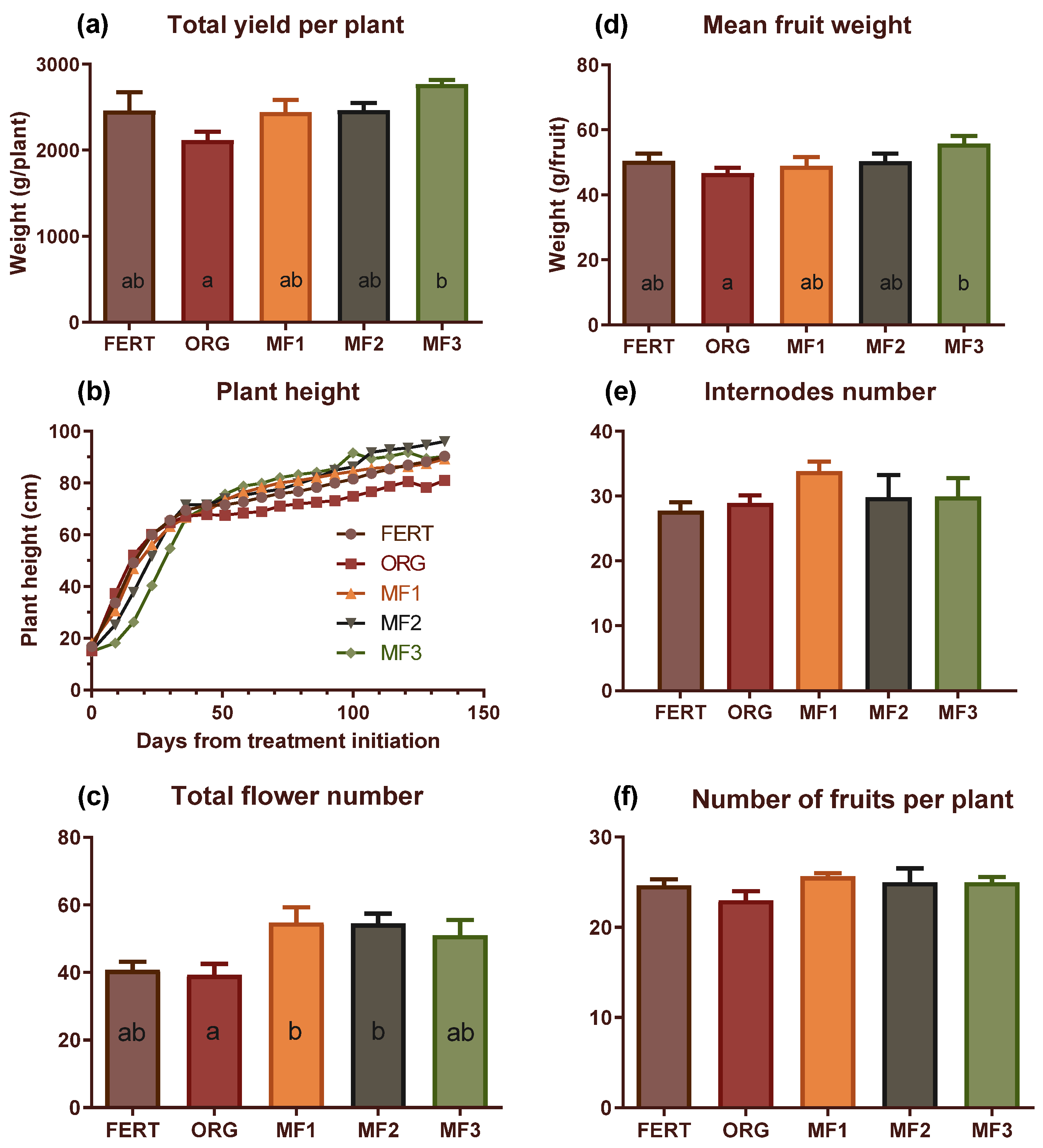
3.1. Production, Plant Growth, and Development
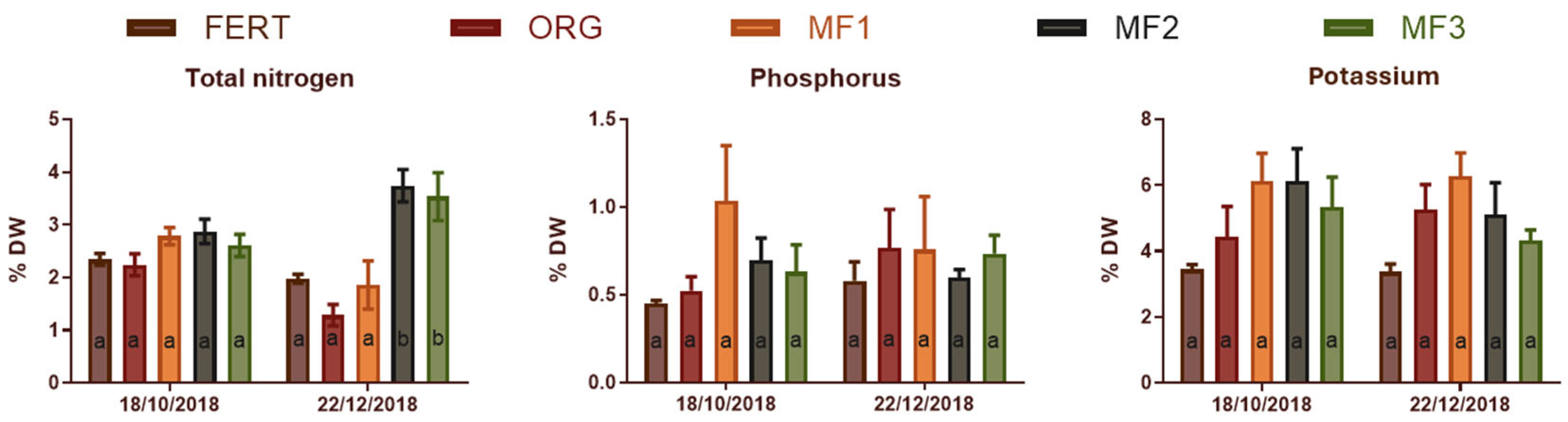
3.2. Macronutrient Concentrations in Tomato Leaves
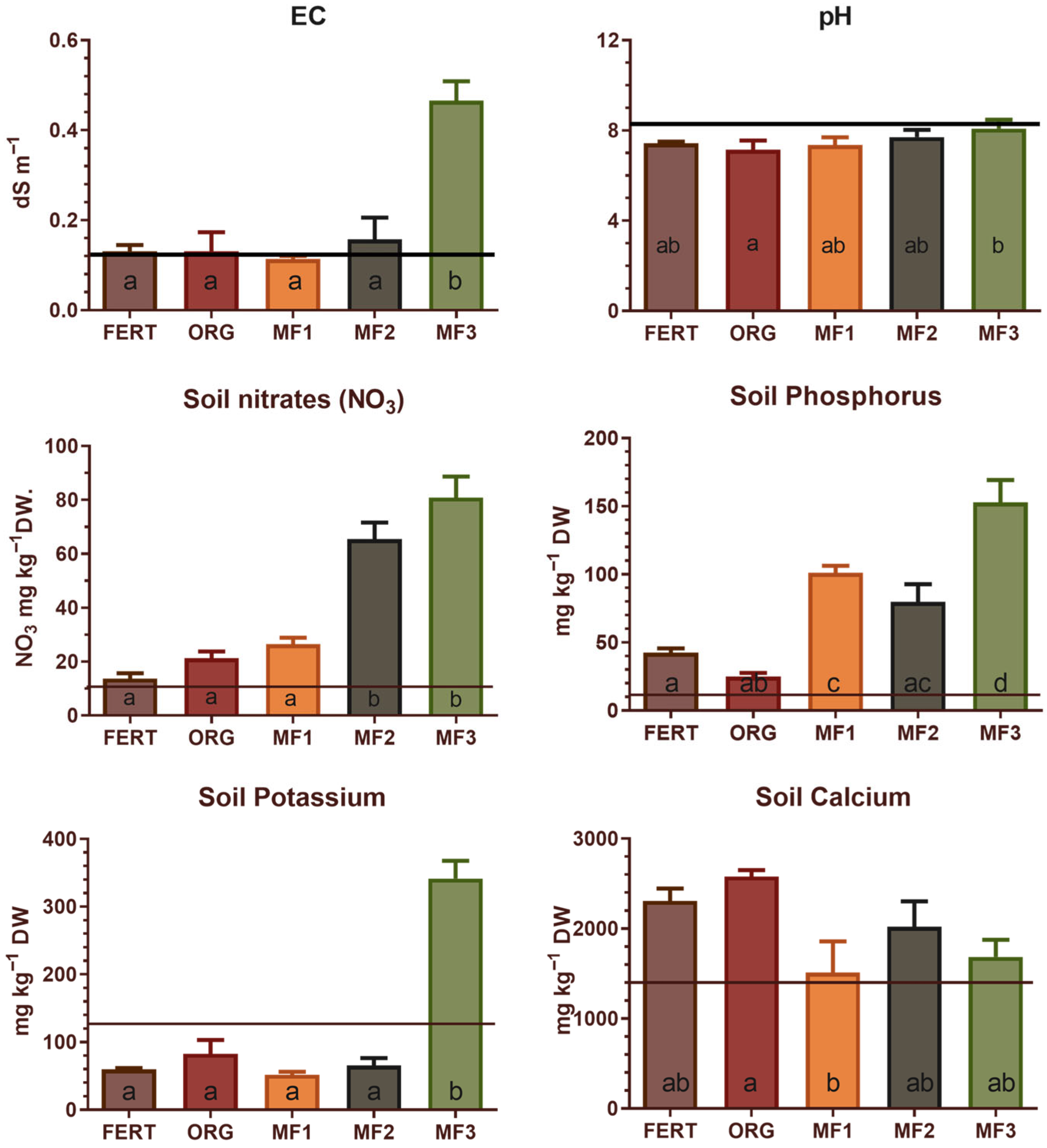
3.3. Impact of Fertilization on the Potting Soil
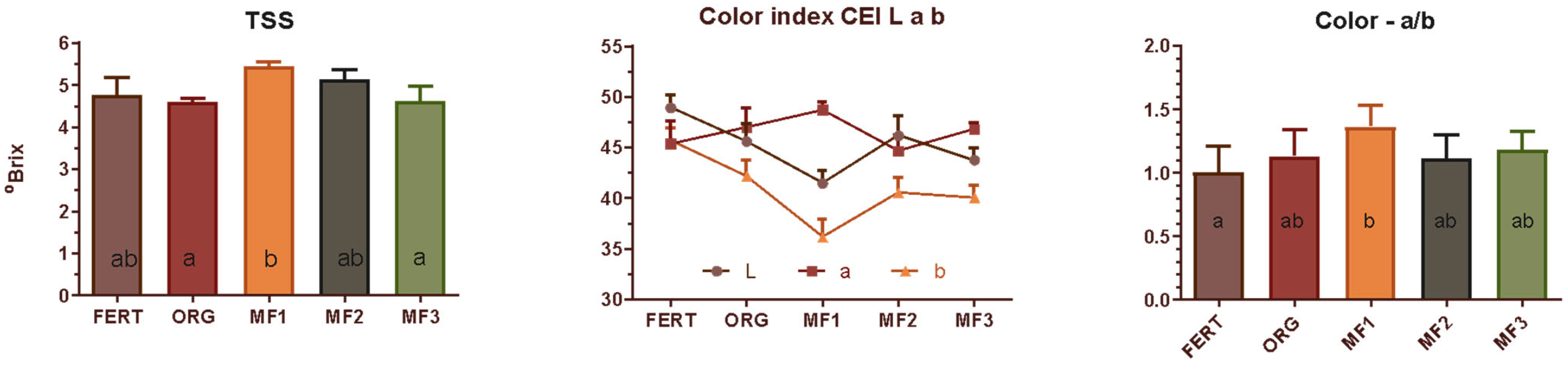
3.4. Fruit Quality
3.5. Cost and Economic Perspectives of Mealworm Frass
4. Conclusions
Author Contributions
Funding
Data Availability Statement
Acknowledgments
Conflicts of Interest
References
- Blakstad, J.I. The Utilization of Frass from the Yellow Mealworm (Tenebrio molitor) as a Plant Fertilizer and Immune Stimulant. Master’s Thesis, Norwegian University of Science and Technology (NTNU), Trondheim, Norway, 2021. [Google Scholar]
- Crist, E.; Mora, C.; Engelman, R. The interaction of human population, food production, and biodiversity protection. Science 2017, 356, 260–264. [Google Scholar] [CrossRef]
- Poveda, J. Insect frass in the development of sustainable agriculture—A review. Agron. Sustain. Dev. 2021, 41, 5. [Google Scholar] [CrossRef]
- Carvalho, F.P. Pesticides, environment, and food safety. Food Energy Secur. 2017, 6, 48–60. [Google Scholar] [CrossRef]
- García-Fraile, P.; Menéndez, E.; Rivas, R. Role of bacterial biofertilizers in agriculture and forestry. Aims Bioeng. 2015, 2, 183–205. [Google Scholar] [CrossRef]
- Menendez, E.; Garcia-Fraile, P. Plant probiotic bacteria: Solutions to feed the world. AIMS Microbiol. 2017, 3, 502–524. [Google Scholar] [CrossRef] [PubMed]
- Shaji, H.; Chandran, V.; Mathew, L. Organic Fertilizers as a Route to Controlled Release of Nutrients. In Controlled Release Fertilizers for Sustainable Agriculture; Lewu, F.B., Volova, T., Thomas, S., Rakhimol, K.R., Eds.; Academic Press: London, UK, 2021; pp. 231–245. [Google Scholar] [CrossRef]
- Van Huis, A.; Van Itterbeeck, J.; Klunder, H.; Mertens, E.; Halloran, A.; Muir, G. Edible insects: Future prospects for food and feed security. In FAO Forestry Paper; Food and Agriculture Organization of the United Nations: Rome, Italy, 2013; Volume 171, Available online: http://www.fao.org/docrep/018/i3253e/i3253e.pdf (accessed on 20 November 2025).
- Halloran, A.; Hansen, H.H.; Jensen, L.S.; Bruun, S. Comparing Environmental Impacts from Insects for Feed and Food as an Alternative to Animal Production. In Edible Insects in Sustainable Food Systems; Halloran, A., Flore, R., Vantomme, P., Roos, N., Eds.; Springer International Publishing: Cham, Switzerland, 2018; pp. 163–181. [Google Scholar] [CrossRef]
- Houben, D.; Daoulas, G.; Faucon, M.P.; Dulaurent, A.M. Potential use of mealworm frass as a fertilizer: Impact on crop growth and soil properties. Sci. Rep. 2020, 10, 4659. [Google Scholar] [CrossRef] [PubMed]
- Chavez, M.; Uchanski, M. Insect left-over substrate as plant fertilizer. J. Insects Food Feed 2021, 7, 683–694. [Google Scholar] [CrossRef]
- Athanassiou, C.G.; Rumbos, C.I. Frass and furious: Unfolding the potential of insect frass as soil fertilizer. Agrochemicals 2025, 4, 1. [Google Scholar] [CrossRef]
- Koufakis, I.E.; Kalaitzaki, A.P.; Broufas, G.D.; Tsagkarakis, A.E.; Pappas, M.L. Mealworm Frass as a Novel Insect Food-Based Attractant: The Case of Bactrocera oleae (Diptera: Tephritidae). Insects 2025, 16, 466. [Google Scholar] [CrossRef] [PubMed]
- Gondim, J.P.E.; Pontes, N.D.C.; Saldanha, M.F.C.; Andrade, C.A.; Bettiol, W. Yellow mealworm frass (Tenebrio molitor) as a biofertilizer for tomato plants. Sci. Agric. 2025, 82, e20240198. [Google Scholar] [CrossRef]
- Dulaurent, A.M.; Daoulas, G.; Faucon, M.P.; Houben, D. Earthworms (Lumbricus terrestris L.) Mediate the Fertilizing Effect of Frass. Agronomy 2020, 10, 783. [Google Scholar] [CrossRef]
- Beesigamukama, D.; Mochoge, B.; Korir, N.K.; Fiaboe, K.K.; Nakimbugwe, D.; Khamis, F.M.; Subramanian, S.; Dubois, T.; Musyoka, M.W.; Ekesi, S.; et al. Exploring black soldier fly frass as novel fertilizer for improved growth, yield, and nitrogen use efficiency of maize under field conditions. Front. Plant Sci. 2020, 11, 574592. [Google Scholar] [CrossRef]
- Wang, X.; Jia, J.; Lu, C.; Chen, H.; Chen, X.; Peng, X.; Chi, G.; Song, Q.; Hu, Y.; Ma, J. Optimizing nitrogen for sustainable yield and efficiency: Insights from shouguang facility-grown tomatoes. Agronomy 2025, 15, 420. [Google Scholar] [CrossRef]
- Kaur, H.; Bedi, S.; Sethi, V.P.; Dhatt, A.S. Effects of substrate hydroponic systems and different N and K ratios on yield and quality of tomato fruit. J. Plant Nutr. 2018, 41, 1547–1554. [Google Scholar] [CrossRef]
- Bouyoucos, G.J. Hydrometer method improved for making particle size analyses of soils. Agron. J. 1962, 54, 464–465. [Google Scholar] [CrossRef]
- Nelson, D.W.; Sommers, L.E. Total carbon, organic carbon, and organic matter. In Methods of Soil Analysis: Part 2 Chemical and Microbiological Properties, 2nd ed.; Page, A.L., Ed.; American Society of Agronomy; Soil Science Society of America: Madison, WI, USA, 1982; pp. 539–579. [Google Scholar] [CrossRef]
- Olsen, S.R.; Cole, C.V.; Watanabe, F.S. Estimation of Available Phosphorus in Soils by Extraction with Sodium Bicarbonate; USDA Circular No. 939; U.S. Government Printing Office: Washington, DC, USA, 1954.
- Horton, J.H.; Newsom, D.W. A rapid gas evolution method for calcium carbonate equivalent in liming materials. Soil Sci. Soc. Am. Proc. 1953, 17, 414–415. [Google Scholar] [CrossRef]
- Keeney, D.R.; Nelson, D.W. Nitrogen—Inorganic forms. In Methods of Soil Analysis: Part 2 Chemical and Microbiological Properties, 2nd ed.; Page, A.L., Ed.; American Society of Agronomy; Soil Science Society of America: Madison, WI, USA, 1982; pp. 643–698. [Google Scholar] [CrossRef]
- Chapman, H.D.; Pratt, P.F. Methods of Analysis for Soils, Plants and Waters. Soil Sci. 1962, 93, 68. [Google Scholar] [CrossRef]
- Evenhuis, B. Digestion with sulphuric acid-hydrogen peroxide. In Simplified Methods for Foliar Analysis; Department of Agricultural Research of the Royal Tropical Institute: Amsterdam, The Netherlands, 1978; pp. 117–119. [Google Scholar]
- Evenhuis, B. Determination of nitrogen (colorimetric). In Simplified Methods for Foliar Analysis; Department of Agricultural Research of the Royal Tropical Institute: Amsterdam, The Netherlands, 1978; pp. 126–129. [Google Scholar]
- AOAC (Association of Official Analytical Chemists). Official Methods of Analysis, 17th ed.; AOAC: Washington, DC, USA, 2000. [Google Scholar]
- Bilalis, D.; Krokida, M.; Roussis, I.; Papastylianou, P.; Travlos, I.; Cheimona, N.; Dede, A. Effects of organic and inorganic fertilization on yield and quality of processing tomato (Lycopersicon esculentum Mill.). Folia Hortic. 2018, 30, 321–332. [Google Scholar] [CrossRef]
- Amorim, H.C.; Ashworth, A.J.; Arsi, K.; Rojas, M.G.; Morales-Ramos, J.A.; Donoghue, A.; Robinson, K. Insect frass composition and potential use as an organic fertilizer in circular economies. J. Econ. Entomol. 2024, 117, 1261–1268. [Google Scholar] [CrossRef] [PubMed]
- Verardi, A.; Sangiorgio, P.; Della Mura, B.; Moliterni, S.; Spagnoletta, A.; Dimatteo, S.; Bassi, D.; Cortimiglia, C.; Rebuzzi, R.; Palazzo, S.; et al. Tenebrio molitor Frass: A Cutting-Edge Biofertilizer for Sustainable Agriculture and Advanced Adsorbent Precursor for Environmental Remediation. Agronomy 2025, 15, 758. [Google Scholar] [CrossRef]
- Zim, J.; Aitikkou, A.; EL Omari, M.H.; EL Malahi, S.; Azim, K.; Hirich, A.; Nilahyane, A.; Oumouloud, A. A new organic amendment based on insect frass for zucchini (Cucurbita pepo L.) cultivation. Environ. Sci. Proc. 2022, 16, 28. [Google Scholar] [CrossRef]
- Gao, F.; Li, H.; Mu, X.; Gao, H.; Zhang, Y.; Li, R.; Cao, K.; Ye, L. Effects of organic fertilizer application on tomato yield and quality: A meta-analysis. Appl. Sci. 2023, 13, 2184. [Google Scholar] [CrossRef]
- Hénault-Ethier, L.; Reid, B.; Hotte, N.; Paris, N.; Quinche, M.; Lachance, C.; Fortin, A.; Normandin, E.; Laderriere, V.; Vandenberg, G. Growth trials on vegetables, herbs, and flowers using mealworm frass, chicken manure, and municipal compost. ACS Agric. Sci. Technol. 2023, 3, 249–259. [Google Scholar] [CrossRef]
- Foscari, A.; Dalla Costa, L.; Tulli, F.; Uboni, C.; Fellet, G. Frass from Tenebrio molitor as alternative to NPK-mineral fertilization: Results from a germination test and pot experiment on sunflower. Ital. J. Agron. 2024, 19, 100010. [Google Scholar] [CrossRef]
- Sarhan, T.Z.; Mohammed, G.H.; Teli, J.A. Effect of bio and organic fertilizers on growth yield and fruit quality of summer squash. Sarhad. J. Agric. 2011, 27, 377–383. [Google Scholar]
- Youssef, M.A.; Eissa, M.A. Comparison between organic and inorganic nutrition for tomato. J. Plant Nutr. 2017, 40, 1900–1907. [Google Scholar] [CrossRef]
- Adediran, J.A.; Taiwo, L.B.; Akande, M.O.; Sobulo, R.A.; Idowu, O.J. Application of organic and inorganic fertilizer for sustainable maize and cowpea yields in Nigeria. J. Plant Nutr. 2005, 27, 1163–1181. [Google Scholar] [CrossRef]
- Nogalska, A.; Przemieniecki, S.W.; Krzebietke, S.J.; Załuski, D.; Kosewska, A.; Skwierawska, M.; Sienkiewicz, S. The Effect of Mealworm Frass on the Chemical and Microbiological Properties of Horticultural Peat in an Incubation Experiment. Int. J. Environ. Res. Public Health 2023, 20, 21. [Google Scholar] [CrossRef] [PubMed]
- Antoniadis, V.; Molla, A.; Grammenou, A.; Apostolidis, V.; Athanassiou, C.G.; Rumbos, C.I.; Levizou, E. Insect frass as a novel organic soil fertilizer for the cultivation of spinach (Spinacia oleracea): Effects on soil properties, plant physiological parameters, and nutrient status. J. Soil Sci. Plant Nutr. 2023, 23, 5935–5944. [Google Scholar] [CrossRef]
- Bonarota, M.S.; Kosma, D.K.; Barrios-Masias, F.H. Salt tolerance mechanisms in the Lycopersicon clade and their trade-offs. AoB Plants 2022, 14, plab072. [Google Scholar] [CrossRef]
- Karaca, C.; Aslan, G.E.; Buyuktas, D.; Kurunc, A.; Bastug, R.; Navarro, A. Effects of salinity stress on drip-irrigated tomatoes grown under mediterranean-type greenhouse conditions. Agronomy 2022, 13, 36. [Google Scholar] [CrossRef]
- Praeg, N.; Klammsteiner, T. Frass fertilizers from mass-reared insects: Species variation, heat treatment effects, and implications for soil application. bioRxiv 2023. [Google Scholar] [CrossRef]
- Khan, M.T.; Aleinikovienė, J.; Butkevičienė, L.M. Innovative organic fertilizers and cover crops: Perspectives for sustainable agriculture in the era of climate change and organic agriculture. Agronomy 2024, 14, 2871. [Google Scholar] [CrossRef]
- Watson, C.; Schlösser, C.; Vögerl, J.; Wichern, F. Excellent excrement? Frass impacts on a soil’s microbial community, processes and metal bioavailability. Appl. Soil Ecol. 2021, 168, 104110. [Google Scholar] [CrossRef]
- Ashworth, A.J.; Amorim, H.C.S.; Drescher, G.L.; Moore, P.A., Jr.; Rojas, M.G.; Morales-Ramos, J.; Donoghue, A.M. Insect frass fertilizer as soil amendment for improved forage and soil health in circular systems. Sci. Rep. 2025, 15, 3024. [Google Scholar] [CrossRef] [PubMed]
- Karkanis, A.; Ntatsi, G.; Vasilakakou, E.; Karavidas, I.; Ntanasi, T.; Rumbos, C.I.; Athanassiou, C.G. Combining Tenebrio molitor frass with inorganic nitrogen fertilizer to improve soil properties, growth parameters, and nutrient content of Sonchus oleraceus crop. Bioresour. Technol. 2025, 418, 131901. [Google Scholar] [CrossRef] [PubMed]
- López Camelo, A.F.; Gómez, P.A. Comparison of color indexes for tomato ripening. Hortic. Bras. 2004, 22, 534–537. [Google Scholar] [CrossRef]
- Murmu, K.; Ghosh, B.C.; Swain, D.K. Yield and quality of tomato grown under organic and conventional nutrient management. Arch. Agron. Soil Sci. 2013, 59, 1311–1321. [Google Scholar] [CrossRef]
- Giovanelli, G.; Lavelli, V.; Peri, C.; Nobili, S. Variation in antioxidant components of tomato during vine and post-harvest ripening. J. Sci. Food Agric. 1999, 79, 1583–1588. [Google Scholar] [CrossRef]
- Saad, A.M.; Ibrahim, A.; El-Bialee, N. Internal quality assessment of tomato fruits using image color analysis. Agric. Eng. Int. CIGR J. 2016, 18, 339–352. [Google Scholar]
- Kakabouki, I.; Roussis, I.; Krokida, M.; Mavroeidis, A.; Stavropoulos, P.; Karydogianni, S.; Beslemes, D.; Tigka, E. Comparative study effect of different urea fertilizers and tomato pomace composts on the performance and quality traits of processing tomato (Lycopersicon esculentum Mill.). Plants 2024, 13, 1852. [Google Scholar] [CrossRef] [PubMed]
- Foolen-Torgerson, K.L.; Meijering, J.V.; van Voorn, G.A. Estimating farmers’ net change in profit when using insect frass as an input for Brassica crops. J. Insects Food Feed. 2024, 11, 373–399. [Google Scholar] [CrossRef]
- Adamaki-Sotiraki, C.; Rumbos, C.I.; Athanassiou, C.G. From a stored-product pest to a promising protein source: A U-turn of human perspective for the yellow mealworm Tenebrio molitor. J. Pest Sci. 2025, 98, 113–129. [Google Scholar] [CrossRef]
- Reganold, J.P.; Glover, J.D.; Andrews, P.K.; Hinman, H.R. Sustainability of three apple production systems. Nature 2001, 410, 926–930. [Google Scholar] [CrossRef] [PubMed]



| Treatments | Contents |
|---|---|
| MF1 | 20 g mealworm frass L−1 soil |
| MF2 | 40 g mealworm frass L−1 soil |
| MF3 | 80 g mealworm frass L−1 soil |
| ORG | 15 g compost L−1 soil |
| FERT | 6.25 g of N:P:K L−1 soil as inorganic fertilizer |
| Amendment | EC | pH | C/N | C | N | P | K | Ca | Mg | Fe | Zn | Mn | Cu | B |
|---|---|---|---|---|---|---|---|---|---|---|---|---|---|---|
| (dS m−1) | (%) | (mg 100 g−1) | ||||||||||||
| MF | 5.3 | 5.8 | 10 | 29.8 | 2.98 | 1.84 | 2.37 | 0.42 | 0.96 | 266.0 | 150.3 | 272.0 | 21.9 | 10.2 |
| ORG | 2.0 | 6.5–7.5 | 15 | 60.0 | 4.0 | 0.45 | 0.90 | 1.20 | 0.21 | 65 | 26 | – | – | – |
| Soil Properties | Unit | Value |
|---|---|---|
| Clay | % | 11.4 |
| Silt | % | 23.0 |
| Sand | % | 65.6 |
| Texture | Sandy loam | |
| CaCO3 | % | 4.93 |
| CEC | cmolc kg−1 | 12.5 |
| pH | 7.29 | |
| EC | dSm−1 | 0.159 |
| Organic carbon | % | 1.54 |
| Total nitrogen | % | 0.18 |
| Available –P | mg/kg | 72 |
| Available –K | mg/kg | 292 |
| Available –Ca | mg/kg | 3869 |
| Available –Mg | mg/kg | 101 |
Disclaimer/Publisher’s Note: The statements, opinions and data contained in all publications are solely those of the individual author(s) and contributor(s) and not of MDPI and/or the editor(s). MDPI and/or the editor(s) disclaim responsibility for any injury to people or property resulting from any ideas, methods, instructions or products referred to in the content. |
© 2026 by the authors. Licensee MDPI, Basel, Switzerland. This article is an open access article distributed under the terms and conditions of the Creative Commons Attribution (CC BY) license.
Share and Cite
Digalaki, N.; Koufakis, I.; Triantafyllidis, V.; Kalaitzaki, A.; Tzobanoglou, D.; Psarras, G.; Patakas, A.; Tzerakis, K. Mealworm Frass as a Sustainable Organic Fertilizer for Greenhouse Tomato Cultivation. Horticulturae 2026, 12, 301. https://doi.org/10.3390/horticulturae12030301
Digalaki N, Koufakis I, Triantafyllidis V, Kalaitzaki A, Tzobanoglou D, Psarras G, Patakas A, Tzerakis K. Mealworm Frass as a Sustainable Organic Fertilizer for Greenhouse Tomato Cultivation. Horticulturae. 2026; 12(3):301. https://doi.org/10.3390/horticulturae12030301
Chicago/Turabian StyleDigalaki, Nektaria, Ioannis Koufakis, Vassilios Triantafyllidis, Argyro Kalaitzaki, Despina Tzobanoglou, Georgios Psarras, Angelos Patakas, and Konstantinos Tzerakis. 2026. "Mealworm Frass as a Sustainable Organic Fertilizer for Greenhouse Tomato Cultivation" Horticulturae 12, no. 3: 301. https://doi.org/10.3390/horticulturae12030301
APA StyleDigalaki, N., Koufakis, I., Triantafyllidis, V., Kalaitzaki, A., Tzobanoglou, D., Psarras, G., Patakas, A., & Tzerakis, K. (2026). Mealworm Frass as a Sustainable Organic Fertilizer for Greenhouse Tomato Cultivation. Horticulturae, 12(3), 301. https://doi.org/10.3390/horticulturae12030301