Article

Hot-Water Dipping and Storage Temperature Interact to Reduce Dehydration and Modulate Peel Oxidative Markers in ‘Owari’ Satsuma Mandarin (Citrus unshiu Marc.)


1
Department of Pomology, Division of Horticulture and Landscape Architecture, University of Zagreb Faculty of Agriculture, Svetošimunska 25, HR-10000 Zagreb, Croatia
2
Department of Biology, University of Osijek, Ulica cara Hadrijana 8/A, HR-31000 Osijek, Croatia
3
Department of Sustainable Technologies and Renewable Energy Sources, Division of Agricultural Engineering, University of Zagreb Faculty of Agriculture, Svetošimunska 25, HR-10000 Zagreb, Croatia
4
Faculty of Food Technology and Biotechnology, University of Zagreb, Pierottijeva 6, HR-10000 Zagreb, Croatia
5
State Inspectorate, Republic of Croatia, Trg Vladimira Nazora 1, HR-10310 Ivanić-Grad, Croatia
6
The Faculty of Humanities and Social Sciences, University of J. J. Strossmayer in Osijek, Lorenza Jägera 9, HR-31000 Osijek, Croatia
*
Author to whom correspondence should be addressed.
Horticulturae 2026, 12(3), 300; https://doi.org/10.3390/horticulturae12030300
Submission received: 4 February 2026 / Revised: 25 February 2026 / Accepted: 28 February 2026 / Published: 4 March 2026

Abstract

Satsuma mandarin is a non-climacteric fruit with limited storage potential, as dehydration and physiological stress can accelerate postharvest quality loss. This study evaluated the combined effects of hot-water dips (HWD; 48 °C or 52 °C for 3 min) and cold storage temperatures (1 °C or 3 °C for 8 weeks, followed by 7 days at 18–20 °C) on ‘Owari’ (Citrus unshiu Marc.) fruit quality and peel oxidative status. HWD reduced weight loss compared with untreated fruit at both temperatures, and total weight loss at 1 °C was 17.85% (HWD 48) and 18.27% (HWD 52), compared with 22.26% in the control. Storage at 1 °C reduced fruit weight loss compared with 3 °C, while fruit stored at 3 °C retained higher juiciness. Peel hydrogen peroxide level was lower at 1 °C, with the lowest value in HWD 48 fruit (5.56 nmol g−1 FW). Lipid peroxidation increased after storage across treatments but was lowest in HWD 48 at 1 °C (thiobarbituric acid reactive substances 11.82 nmol g−1 FW). HWD 48 at 1 °C also maintained the highest α-tocopherol level (411.18 µg g−1 FW) and showed the highest catalase activity. Overall, HWD 48, combined with storage at 1 °C, provided the most favourable peel oxidative stability. However, the risk of chilling injury at low temperatures must be assessed using a defined scoring protocol before commercial recommendation.

1. Introduction

Over the past decade, consumption and global marketing of fresh, easy-to-peel mandarins have risen continuously, in contrast to steady consumption of difficult-to-peel citrus fruits [1]. Satsuma mandarin (Citrus unshiu Marc.)—also widely referred to as Unshiu mandarin, reflecting its origin in the Japanese “Unshiu” (Satsuma) cultivar group—is the major citrus crop in Croatia [2]. According to FAOSTAT [3], in Croatia, tangerines, mandarins, and clementines were cultivated on 1040 ha of land in 2024, with a production of 30,540 t. The major production area is the Neretva River valley [4]. At present, this is Croatia’s principal fruit export commodity and therefore has considerable economic importance. The key gains of Croatian mandarins are early maturation and high fruit quality [4].
Since mandarins are non-climacteric and perishable, they cannot be stored for extended periods during transportation and storage [5]. Hence, maintaining refrigerated conditions during transport and storage is required to prolong postharvest life, especially during shipping to international markets [6]. Average optimum cold storage of mandarins is up to 2–4 weeks [7], and shelf life up to 14 days [8]. Optimum conditions for mandarin cold storage are a temperature from 4 °C to 7 °C with a relative humidity from 90 to 95% [9]. However, citrus fruits are susceptible to chilling injury (CI) when exposed to temperatures below 2–5 °C [10]. Low temperature is crucial for maintaining good quality because of the decrease in metabolic respiration rate, which is comparable to deterioration rates [11] according to [12].
Common CI symptoms in citrus fruits are the formation of brown pit-like depressions in the flavedo, the outer colored part of the peel, as those occurring in ‘Fortune’ mandarin or grapefruits, but CI may also be manifested as bronzed non-depressed extended areas or superficial scald in the flavedo of some oranges, as ‘Navelate’ fruit [13]. When CI symptoms are severe, they lead to notable production deterioration and, consequently, to economic losses [14]. The mechanism involved in CI occurrence is rather complex. Mandarin peel is rich in many bioactive compounds [15], and many changes occur during cold storage [16]. These changes have manifested as alterations in antioxidative enzyme activities (e.g., peroxidase), antioxidant content, and total phenol content [17]. Certain studies on enzyme activities in mandarin peel indicated that oxidative stress might be involved in the chilling injury, which manifests as brown, pit-like depressions on the peel [18]. Plant cells are protected against the effects of activated oxygen species by a complex antioxidant system. This involves α-tocopherol (TOC) and β-carotene, ascorbate and glutathione, and enzymes such as superoxide dismutase, catalase (CAT), ascorbate peroxidase (APX), and glutathione reductase (GR) [19].
Therefore, most mandarin post-harvest fruit loss in Croatia relates to deterioration issues (caused by pathogens or poor storage conditions) and chilling injuries [20,21]. According to assessments by Croatian experts, producers, and retailers in 2023, about 6000 t of mandarins were classified as industrial waste during calibration processes in retail centers [20]. Jemrić and Pavičić [22] also highlight postharvest acid decrease in fruit, which has been a major problem in Croatia because it results in fruit with a bland taste reaching the market. These losses occur mainly due to inadequate implementation of mandarin post-harvest technology, such as incorrect harvest timing, inadequate storage conditions, and lack of cold chain consistency. However, postharvest heat treatments, including hot water dipping and hot air, can help mitigate or delay chilling injuries and reduce deterioration issues in fruit [14,23,24,25,26,27,28]. These are applied as pre-storage treatments [14] and serve as alternatives to chemical prevention [27]. Plants have evolved signaling pathways to detect changes in ambient temperature and adapt their metabolism and cell functions to prevent heat-related damage [10]. The interaction between HWD of mandarins and lower storage temperatures affects several levels, including stress protein responses, membrane stability, and oxidative status and metabolism of peel cells. Heat pretreatment induces the production of heat shock proteins, stabilises cell membranes through lipid reorganization, enhances antioxidant responses, and thus diminishes oxidative damage during storage at lower temperatures. After exposure to high temperatures, cells rapidly produce a specific group of proteins called “heat shock proteins” (HSPs) [29], which are short-term thermotolerance products created by microorganisms, plants, and animals following heat exposure [30]. Their primary function is protective—molecular protection, stabilisation of ATPases and stimulation of their activity, protein stabilisation, and prevention of protein denaturation—aimed at maintaining cell integrity under heat stress [31]. The aforementioned study also describes another type of protein synthesised under temperature stress, but the trigger for their production is low temperatures [31]. It is noted that the plant response to low temperatures is much more complex than to high temperatures. During heat shock, synthesis of most vital proteins for cell function halts, with only HSPs actively synthesised, whereas during cold shock, most protein synthesis continues. In a review by Lurie and Pedreschi [10], they state that during short-term heat treatments, molecular changes may occur after the treatment ends, including the accumulation of stress and defence proteins such as HSPs, PRs, dehydrins, antioxidant enzymes and compounds (polyphenols), sugars, and compounds like putrescine and proline, which are involved in low-temperature adaptation. These mechanisms explain how fruit heat treatments help reduce chilling injury in treated fruit.
Hence, the present study aimed to investigate the combined effects of two HWD treatments (48 and 52 °C) and two storage temperatures (1 and 3 °C) on fruit quality and peel oxidative status, including the enzyme activities of ascorbate peroxidase, guaiacol peroxidases (GPOD), and catalase, as well as polyphenols and α-tocopherol content. Special emphasis was placed on hydrogen peroxide (H2O2) content and lipid peroxidation intensity as main indicators of oxidative stress.

2. Materials and Methods

2.1. Fruit Sampling, Hot Water Dipping and Storage

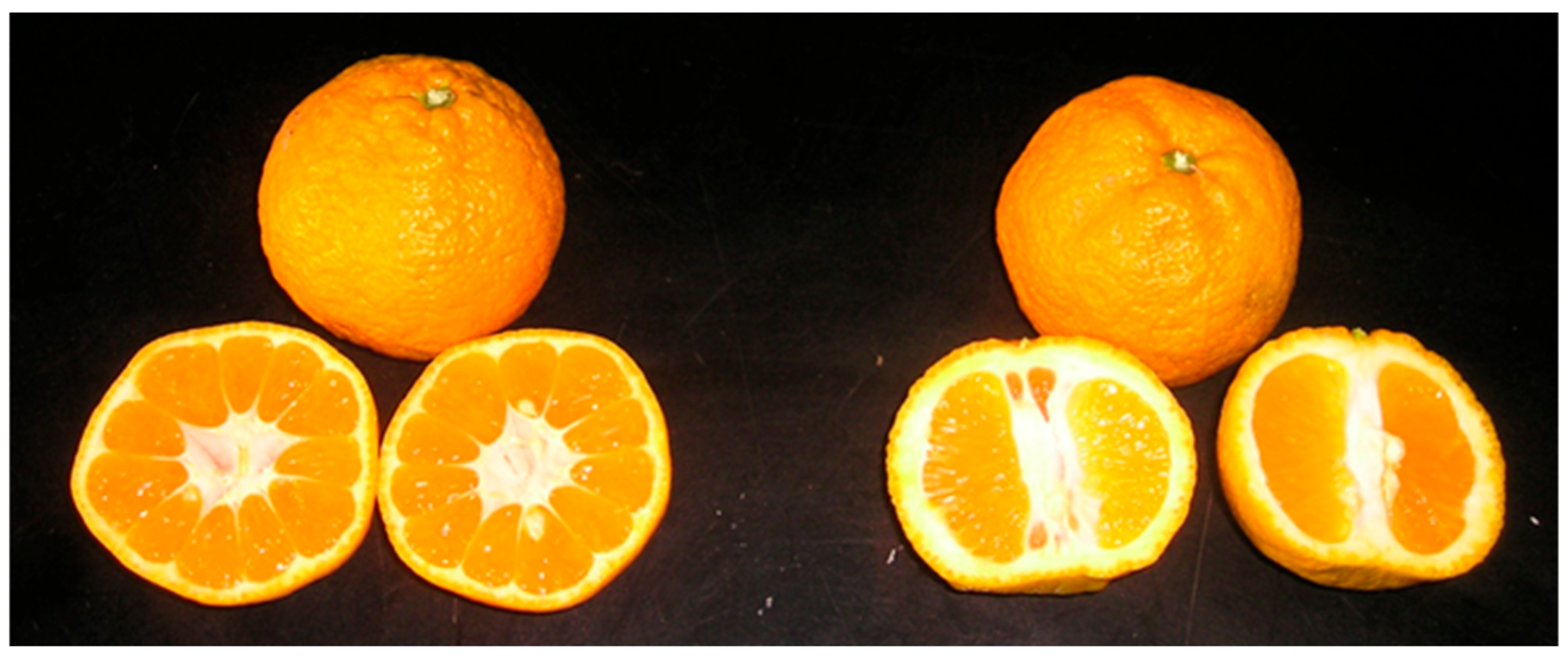
Satsuma mandarin (Citrus unshiu Marc.) ‘Owari’ (Figure 1) was harvested from a commercial orchard near Opuzen Town (43°01′ N; 14°34′ E), Croatia. Trees are grown on trifoliate orange (Poncirus trifoliata L.) rootstock. ‘Owari’ is the variety that was planted in 1951 in the first Croatian commercial mandarin orchard, near Opuzen [2].
The mandarin fruit was harvested when, in the test sample, they had a soluble solid content to titratable acidity ratio (SSC_TA) higher than 6.5:1, which is reported as mandarin maturity trait [32]. This coincided with the fruits having 2/3 of the fruit surface colour changed from green to orange. In the literature, mandarins should have at least 1/3 of the fruit surface covered in additional colouration [32]. Following harvest, fruit was sorted regarding size uniformity, colour, and defect freedom.
After the fruit arrived (24 h after harvest) at the laboratory of the Department of Pomology, University of Zagreb Faculty of Agriculture, HWD treatments were applied. HWD treatments included dipping mandarin fruit in hot water for 3 min at 48 °C (HWD 48) and 52 °C (HWD 52). These temperatures were chosen as they showed potential in our previous studies, as well as those conducted by other authors [23,26,33]. The untreated HWD fruits were used as the control. Each treatment comprised 10 crates, with 25 mandarins per crate. Thus, each HWD treatment comprised 250 mandarins in total. Following the HWD treatments, mandarins were stored for eight weeks under normal atmosphere at two different temperatures, 1 and 3 °C. Relative humidity (RH) was not actively controlled in the storage chamber, and it was determined by the refrigeration system and air circulation. RH was continuously monitored and averaged ~80%. Although higher RH (typically ~85–95%) is commonly recommended to minimise dehydration in perishable produce, our RH level reflects practical cold-room conditions without humidification, and all treatments were stored under identical RH, enabling valid comparisons among treatments.
For each temperature treatment, five crates (125 mandarins) of each HWD treatment were stored. To simulate retail display conditions (shelf life), fruits following cold storage were transferred to room temperature (18–20 °C) for 7 days. All analyses were conducted after harvest (initial values) and after shelf life, except for weight loss, which was also conducted after cold storage.

2.2. Laboratory Analysis

2.2.1. Fruit Quality Analyses

Fruit quality analysis was conducted in the Laboratory for physical and chemical analyses of fruit at the Department of Pomology, University of Zagreb, Faculty of Agriculture, after harvest and after 8 weeks of storage, followed by 7 days of the fruit’s shelf life.
Except for fruit weight loss, all fruit quality analyses were conducted on five fruits per crate/repetition (in total, five crates/repetition per treatment). Overall, 25 fruits per treatment were analysed (HWD 48 1 °C, HWD 48 3 °C, HWD 52 1 °C, HWD 52 3 °C, control 1 °C, control 3 °C, and freshly harvested fruit as the initial value). Fruit weight loss was determined on the remaining fruits.
The following methods were conducted:
(a)
Soluble solids content (°Brix, SSC)—determined by refractometer [34];
(b)
Total acid content (% as citric acid, TA)—measured by potentiometric titration [34];
(c)
SSC_TA—obtained from the ratio of soluble solids content to titratable acidity, as determined by the procedures described above;
(d)
Juiciness (%)—juice percentage in relation to whole fruit mass, with the utilization of an electric strainer;
(e)
Fruit weight loss—calculated (after storage, shelf life, and total) by weighing on an analytical balance (PM 2000, Mettler Toledo, Schwerzenbach, Switzerland).

2.2.2. Modulate Peel Oxidative Markers

Analyses were conducted in the laboratory at the Department of Biology, University of Osijek. The peel tissue of five fruits per replication (overall 25 fruits per treatment) was cut into small pieces and powdered in liquid nitrogen. Each treatment was replicated five times.
Determination of H2O2 Level
The H2O2 level was measured by the method of Mukherjee and Choudhuri [35]. In total, 0.1 g of peel tissue was ground in 5 mL of cold acetone and centrifuged at 1000× g at 4 °C for 3 min. The supernatant was used to assay H2O2. A cold acetone (1 mL) served as a blank. Concentrated ammonia (500 μL) and titanium (IV) sulphate (Ti(SO4)2, 400 μL) were added to the supernatant (1 mL), and the reaction mixture was centrifuged for 10 min at 1500× g. The supernatant was removed, and the pellet was dissolved in 1 mL of 2 M H2SO4, then centrifuged for 10 min at 1500× g. The absorption was measured at 415 nm using a spectrophotometer (Specord 40, Analytik Jena, Jena, Germany), and the H2O2 level was calculated using an extinction coefficient of 1.878 nM−1 cm−1 and expressed as nmol g−1 fresh weight (FW).
Determination of Lipid Peroxidation (LP) Intensity
LP intensity was determined by estimating the amount of thiobarbituric acid reactive substances (TBARS) using the method described by Verma and Dubey [36]. Pell tissue of mandarin fruits was powdered in liquid nitrogen and extracted in 0.5% thiobarbituric acid (TBA) in 20% trichloroacetic acid (TCA). The mixture was heated at 95 °C for 30 min, then rapidly cooled in an ice bath and centrifuged at 18,000× g at 4 °C for 15 min. The absorbance of the supernatant was measured at 532 nm and 600 nm using a spectrophotometer (Specord 40, Analytik Jena, Jena, Germany). A 0.5% TBA in 20% TCA solution served as the blank. The LP intensity was quantified as total TBARS, expressed as nmol g−1 FW, using an extinction coefficient of 155 mM−1 cm−1 TBARS.
TOC Determination
TOC was extracted with n-hexane and separated with thin-layer chromatography following the method of Randerath [37]. Extracts were applied to silica gel plates as the stationary phase, and chloroform was used as the mobile phase. TOC detection was performed using a 25% phosphomolybdic acid solution in absolute ethanol and ammonia vapour. The TOC level was determined by measuring the blemish–blotted area of tocopherol using ImageJ2 software, with pure alpha-tocopherol used as a standard. The level of α-tocopherol was expressed as μg TOC g−1 FW.
Polyphenol Analysis
Polyphenol levels were determined using the methods reported by Randhir and Shetty, Liang et al., and Turkmen et al. [38,39,40]. In total, 50 mg of grounded peel tissue was extracted with 2.5 mL of 95% ethanol at −20 °C for 72 h. The extract was centrifuged for 10 min at 10,000× g at 4 °C, and the supernatant was stored at −20 °C until analysis. A standard curve was constructed using a series of tannic acid dilutions. An aliquot of 100 μL was added to 500 μL of Fe-tartarate, 400 mL of distilled water, and 1.5 mL of buffer (0.067 M Na2HPO4 in 0.067 M KH2PO4). The mixture was measured at 540 nm using a spectrophotometer (Specord 40, Analytik Jena, Jena, Germany) and the results expressed as mg phenols g−1 FW.
Extraction and Estimation of Enzyme Activities
The peel tissue of five fruits per replication (overall 25 fruits per treatment) was cut into small pieces and powdered in liquid nitrogen. Each treatment was replicated five times. The extraction was performed in ice-cold 0.1 M Tris-HCl buffer (pH 8.0) containing polyvinylpyrrolidone (PVP). The homogenate was centrifuged at 20,000× g at 4 °C for 20 min. The obtained supernatant was used for GPOD activity determination.
GPOD activity was determined spectrophotometrically (Specord 40, Analytik Jena, Jena, Germany) by measuring the absorbance increase at 470 nm. The reaction mixture contained 5 mM guaiacol and 5 mM H2O2 in 0.2 M phosphate buffer, pH = 5.8, as described by Siegel and Galston [41]. The reaction was started by adding 200 μL of protein extract to 800 μL of the reaction mixture. Enzyme activity was expressed as UGPOD per g−1 FW.
APX activity was determined according to Nakano and Asada [42]. The extraction was performed in ice-cold 0.1 M potassium phosphate buffer (pH 7.0) containing 5 mM sodium ascorbate, 1 mM EDTA, and PVP. The homogenate was centrifuged at 20,000× g at 4 °C for 20 min. The reaction mixture contained 50 mM potassium phosphate buffer (pH 7.0), 0.1 mM EDTA, 50 mM ascorbic acid, 12 mM H2O2, and the enzyme extract. The reaction was started by adding 180 μL of protein extract to 820 μL of the reaction mixture. The decrease in ascorbate level was monitored by measuring the decrease in absorbance at 290 nm using a spectrophotometer (Specord 40, Analytik Jena, Jena, Germany). Enzyme activity was expressed as UAPX per g−1 FW.
The CAT activity was assayed according to Aebi [43]. The extraction was performed in ice-cold 0.1 M potassium phosphate buffer (pH 7.0) containing PVP. The homogenate was centrifuged at 20,000× g at 4 °C for 20 min. The supernatant was used to determine CAT activity. The reaction mixture contained 50 mM potassium phosphate buffer (pH 7.0), 10 mM H2O2 and the enzyme extract. Activity was determined spectrophotometrically by following the decomposition of H2O2 at 240 nm (Specord 40, Analytik Jena, Jena Germany). The reaction was started by adding 100 μL of extract to 1900 μL of the reaction mixture. Enzyme activity was expressed as UCAT per g−1 FW.
Protein Analysis
The protein content (PROT) of the extracts was determined according to Bradford [44], which is based on the binding of Coomassie Brilliant Blue G-250 (CBBG) dye to positively charged regions of polypeptide chains. The protein content in each sample was determined from a calibration curve generated by measuring the absorbance of a dilution series of bovine serum albumin (BSA) at known levels. For protein determination in prepared peel tissue samples, 780 μL of distilled water, 20 μL of protein extract, and 200 μL of CBBG were added to the cuvette and mixed thoroughly, then left to react for approximately 10 min. The absorbance at 595 nm was then measured spectrophotometrically in triplicate for each sample, and the mean value was calculated. The level was determined using the standard calibration curve and expressed as mg g−1 FW

2.3. Statistical Analysis

Data were analyzed using R statistical software (version 4.3.2). For responses measured after cold storage and shelf life, a two-way ANOVA was fitted with pre-storage treatment (control, HWD 48, HWD 52), storage temperature (1 °C, 3 °C), and their interaction as fixed effects (response ~ treatment × temperature). When ANOVA indicated significant effects, means were separated using Tukey’s HSD (p ≤ 0.05).

3. Results

ANOVA indicated that treatment had a significant effect on TA, SSC_TA, and juiciness, whereas temperature had a significant effect on SSC, TA, SSC_TA, and juiciness. The interaction between treatment and temperature was significant for SSC and TA (Table 1). After 8 weeks of storage at 1 °C, no significant differences in fruit quality parameters were observed among treatments; however, the highest average SSC value was recorded in HWD 52 fruit (10.34 °Brix). Compared with freshly harvested fruits, SSC was 2.2–8.0% higher after storage and shelf life. There was no difference in TA content or SSC_TA between the control and HWD at 1 °C storage temperature.
HWD 52 fruits stored at 3 °C had a significantly lower SSC (9.06 °Brix), which was on average 5.3% less than that of freshly harvested fruits. A decrease in total acids of more than 40% compared to freshly harvested fruits was observed in the control (0.79%) and HWD 52 (0.74%) fruits, with no significant difference between them. Significantly higher TA content was observed in HWD 48 fruits (1.04%), which showed the smallest decrease in acids (22.1%) compared to freshly harvested fruits. The same treatment also resulted in the significantly lowest SSC_TA (9.83). In general, HWD 52 fruit stored at 1 °C had significantly higher SSC and TA levels than those stored at 3 °C, and control fruit at 1 °C had higher TA levels than control fruit at 3 °C. During storage at higher temperatures, there was a greater decrease in total acids.
A significantly higher juiciness level was recorded in control fruit than in treated fruit during storage at 3 °C, and the same trend was observed at 1 °C.
Regarding cold storage temperature, generally, fruits stored at higher temperatures retained juiciness better, so HWD 48 and control fruit stored at 1 °C had significantly lower juiciness than those stored at 3 °C (Table 1). When stored at 1 °C, the juiciness of the control fruits was 71.98%, which is 3.5% higher than that of freshly harvested fruits. In contrast, the juiciness of HWD 48 (68.74%) and HWD 52 (68.75%) fruits was lower by 1.1% and 1.2%, respectively, compared to freshly harvested fruits. After storage at 3 °C, the juiciness of the control fruits was significantly higher (76.18%), representing a 9.5% increase compared to freshly harvested fruits. However, the heat-treated fruits had significantly lower juiciness, HWD 48 (72.69%) and HWD 52 (70.52%), with an increase of only 1.4% relative to freshly harvested fruits.
ANOVA indicated that treatment and temperature had significant effects on weight loss after cold storage, shelf life, and total weight loss, whereas the interaction between treatment and temperature was significant for weight loss after cold storage and after shelf life (Table 2). After storage at 1 °C, HWD 48 mandarins exhibited significantly less weight loss than the control. During 3 °C storage, the greatest weight loss was observed in control mandarins, followed by HWD 48 mandarins, with the lowest in HWD 52 mandarins. At both temperatures, the control had significantly higher weight loss after shelf life and total weight loss than both HWD treatments.
For all treatments, weight loss was measured after cold storage, and total weight loss was significantly higher when fruits were stored at 3 °C (Table 2). However, the opposite pattern was observed when weight loss was measured after the shelf life (i.e., during 7 days of shelf life).
ANOVA indicated that treatment had a significant effect on H2O2, LP, TOC, and PHE; temperature had a significant effect on H2O2 and PHE; and the interaction of treatment and temperature significantly affected TOC and PP levels (Table 3).
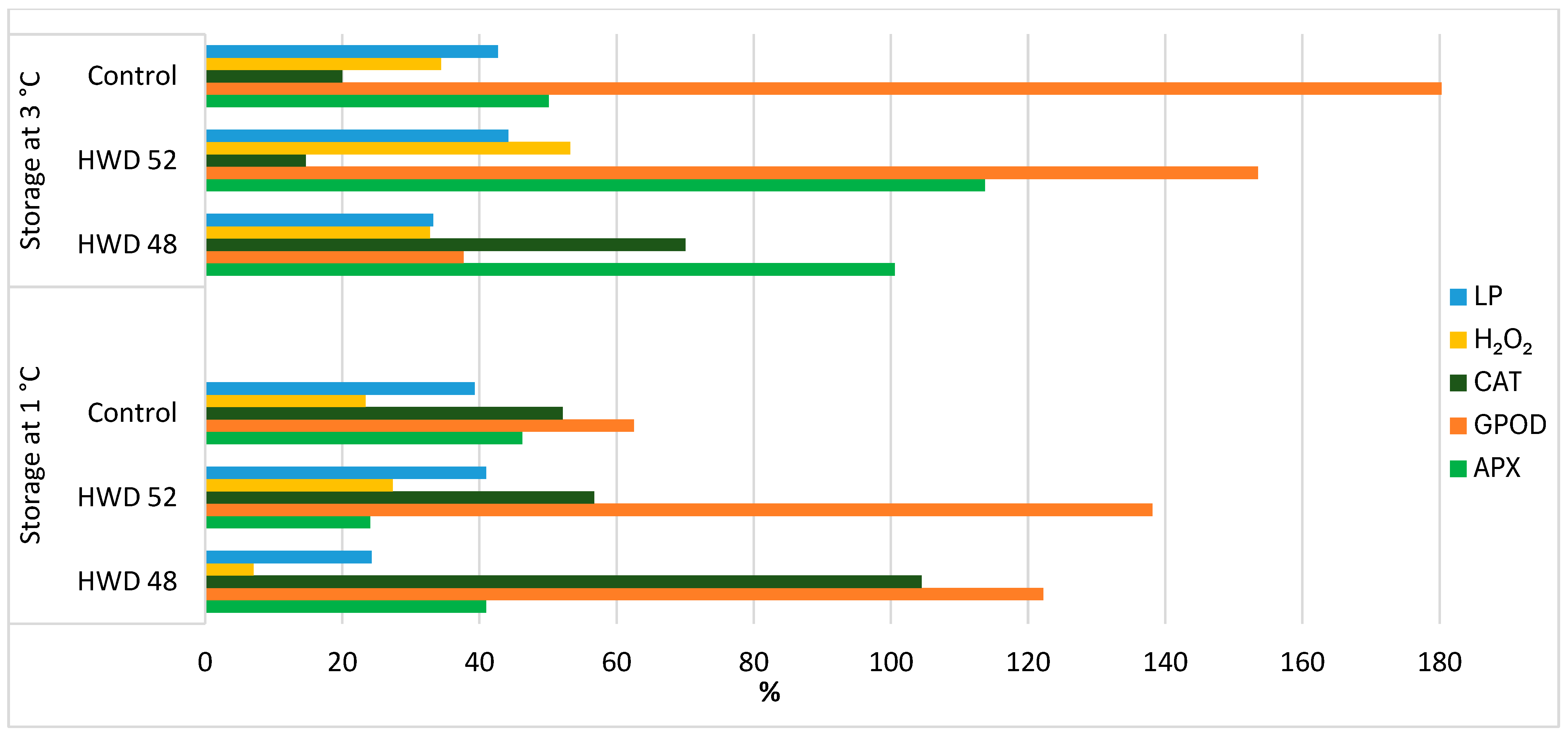
Generally, the amount of H2O2 and LP was lower in the peel of mandarin fruits stored at 1 °C, in contrast to 3 °C, while the difference was significant only in fruit HWD 48. No significant difference was recorded between treatments for H2O2. Relative to freshly harvested fruits, fruits stored at 1 °C had from 7% (HWD 48) to 27% (HWD 52) in H2O2 value, while fruits stored at 3 °C had from 33% (HWD 48) to 53% (HWD 52).
During storage at 1 °C, the average level of LP products was significantly lower in HWD 48 (11.82 nmol g−1 FW) fruits than in HWD 52 (13.41 nmol g−1 FW), while to control difference was not significant (13.25 nmol g−1 FW). Compared to freshly harvested fruit this presents an increase of 24, 41 and 39 % in HWD 48, 52 and control fruits, respectively (Figure 2). In fruits stored at a higher temperature, no significant difference was observed between treatment and control in LP levels; however, values increased relative to the initial conditions from 33% (HWD 48) to 44% (HWD 52). Across both storage temperatures, the average trend indicated that HWD 48 fruit had the lowest LP product levels. Regarding cold storage temperature, H2O2 and LP levels were significantly higher in HWD 48 fruits stored at 3 °C than at 1 °C, whereas for other treatments the same trend is evident (Table 3).
Regarding α-tocopherol, a significant difference in TOC was observed between heat-treated fruits and control fruits stored at 1 °C (Table 3). The lowest significant TOC level was found in HWD 52 (276.4 µg g−1 FW), representing an average 30% decrease relative to the initial value (396.0 µg g−1 FW). In HWD 48, the highest TOC content (411.2 µg g−1 FW) was observed, a 4% increase relative to freshly harvested fruits. In contrast, in the control fruits, the level was 313.7 µg g−1 FW, a 21% decrease relative to the initial value. During storage at 3 °C, the significantly lowest TOC level (313.4 µg g−1 FW) was found in control fruits, on average 21% lower than in freshly harvested fruits. In HWD 52 (366.1 µg g−1 FW), it was significantly higher than in freshly harvested fruits, with an average 8% difference. Regarding cold storage temperature, TOC levels were significantly higher in HWD 48 mandarins stored at 1 °C than at 3 °C, while the opposite was observed for HWD 52 mandarins.
In fruits stored at 1 °C, HWD 52 (0.44 mg g−1 FW) fruits had significantly smaller levels of polyphenols than HWD 48 (0.59 mg g−1 FW), representing a 42% and 22% decrease compared to the initial value level of polyphenols (0.75 mg g−1 FW). The situation was different for fruits stored at a higher temperature (Table 3). In this case, the control fruit had the highest polyphenol content (0.95 mg g−1 FW), an increase of 26% over freshly harvested fruits (Figure 2). No significant difference in polyphenol content was found between HWD treatments at this temperature storage. In general, PP levels were significantly higher in HWD 52 and control mandarins stored at 3 °C than at 1 °C (Table 3). The PP levels were higher in control mandarins at 3 °C than in mandarins from HWD treatments. Regarding cold storage temperature, PP in HWD 52 and control were significantly smaller when stored at 1 °C than at 3 °C.
ANOVA indicated that treatment had a significant effect on APX, GPOD, and CAT, and temperature affected APX and CAT, whereas the interaction between treatment and temperature influenced APX and GPOD (Table 4).
After 8 weeks of storage at 1 °C, no significant difference in APX activity was found between treatments. Total GPOD activity was significantly lowest in the control (1.63 ΔA470 min−1 g−1 FW), and CAT levels were highest in HWD 48 (1.75 ΔA240 min−1 g−1 FW) fruit, as shown in Table 4.
Comparing the changes in enzyme activity after 8 weeks of storage at 1 °C with that freshly harvested fruits, APX activity increased from 24% (HWD 52) to 46% (control), while it was found that the activity of GPOD increased from 63% in control fruit to 138% in HWD 52 fruit and CAT activity from 52% (control) to 104% HWD 48 fruit (Figure 2). During storage at 3 °C, the lowest APX activity was observed in the peel of control fruits (0.35 ΔA290 min−1 g−1 FW), a 50% increase relative to the initial APX values, whereas no significant difference in APX activity was observed among treatments. GPOD activity was significantly lowest in HWD 48 mandarins (1.38Δ A470 min−1 g−1 FW), which is 38% higher than in freshly harvested fruits. Significantly higher activity was observed in HWD 52 (2.54 ΔA470 min−1 g−1 FW) and control fruit (2.83 ΔA470 min−1 g−1 FW), which is 153% and 182% higher than in freshly harvested fruits. The main effect of temperature on GPOD was not significant (p = 0.064). In contrast, GPOD depended on treatment and the treatment and temperature interaction (Table 4), and treatments at each storage temperature resulted in different peroxidase activities (Figure 2).
Significantly higher CAT activity was observed in HWD 48 (1.46 ΔA240 min−1 g−1 FW), which is an increase of 70% compared to freshly harvested fruits.
At both storage temperatures, there were no significant differences in the CAT activity between the HWD 52 treatment and the control, compared to HWD 48. The increase in CAT activity was greater in fruits stored at 1 °C, which could be due to greater fruit stress caused by the lower storage temperature.
Regarding cold storage temperature, APX levels were significantly higher in HWD 48 and HWD 52 mandarins stored at 3 °C. GPOD levels were significantly higher in HWD 48 mandarins stored at 1 °C, while the opposite was observed for control mandarins. The CAT levels in all treatments were significantly higher in mandarins stored at 1 °C (Table 4).
Analysis revealed no significant differences in protein content after storage.
It should also be noted that no evidence of chilling injury symptoms was reported.

4. Discussion

The results of the research on the quality of Unshiu mandarin fruit indicate that, for the juiciness trait, heat treatments reduced its levels relative to the control. When mandarins are stored at 1 °C, this difference is based on the average level. For SSC, TA, and SSC_TA, there is no evident consistent trend. Wu et al. [45] reported a significant effect of heat treatment (52 °C for 3 min) on SCC and TA levels during room temperature storage of mandarins. Queb et al. [46] reported a lack of significant effect of heat treatment (50 °C for 2.5 min) on SSC_TA and citric acid content of mandarins kept at room temperature on the 1st and 8th sampling dates. Jemrić et al. [33] reported a lack of significant effect of various heat treatments on mandarin juiciness level after 6, 8, and 10 weeks of cold storage at 3 °C, except for the last sampling date, whereas mandarins treated with 48 °C for 3 min had significantly smaller juiciness level than control ones. For the SSC, TA, and SSC_TA variables, the authors reported a significant effect of heat treatments, primarily on the last two sampling dates. In that light, these findings contribute to the overall understanding of this topic. A possible explanation for the lack of a clear trend in fruit quality parameters may be variation in fruit maturity at harvest. Satsuma mandarins do not ripen simultaneously. Therefore, harvest is usually conducted in multiple stages. Since its colour cannot be used as an indicator of maturity level due to potential discrepancies in internal quality [47], variations in maturity level may exist.
HWD treatments reduced weight loss across all intervals, with no clear pattern indicating which HWD is superior. However, regarding storage temperature, there are some interesting observations. Cold storage at a lower temperature (at 1 °C) reduced weight loss in contrast to higher temperatures, whereas during shelf life, it was the opposite. However, when total weight loss is considered, storage at 1 °C still yields a better outcome than at 3 °C. Jemrić et al. [33] reported that some variations in heat treatments reduced weight loss only after 6 weeks of cold storage, whereas after 8 and 10 weeks, no significant differences were recorded. In the same study, weight loss after transfer to room temperature at 8 and 10 weeks of cold storage was higher in the control group. Similarly, Erkan et al. [48] reported that in almost all cases, hot water treatments reduced the weight loss of clementines after 20, 40, and 60 days of storage at 1 °C, plus one week at 20 °C. Results in this study are generally in accordance with the results of Erkan et al. [48].
According to the results, higher storage temperature increased H2O2 content and LP intensity, with a significant increase for HWD 48, and for HWD 52 and the control, the same trend is evident based on average values. Therefore, lower storage temperature is associated with reduced oxidative stress. It is already known that hydrogen peroxide level rises under stress conditions (cold, dryness) [49,50] and is known as a stress signal molecule [51]. By comparing oxidative stress indicators, especially H2O2 as a stress-related signalling molecule [52] in fruit peel, at harvest and after different treatments and storage regimes, the lowest level of oxidative stress was detected at HWD 48 for fruits stored at 1 °C. Therefore, it can be concluded that this regime produced the lowest stress intensity in fruit peel during the 8-week storage period. LP intensity depends on the duration of cold stress and is believed to cause cell damage in sensitive plants [53]. Exposure of sensitive plant tissues to low temperatures, more than zero, increases LP [53,54], which causes damage to the cell membrane and disturbs the physiological function [55]. However, this increase in LP intensity at low temperatures was not observed in this study. Similarly, Rivera et al. [56] reported that the LP intensities at low temperatures (4 and 8 °C) were similar to those at elevated temperatures (13 °C).
TOC and PP content were measured as non-enzymatic components of the antioxidative system. Because treatment effects on PP differ across the two storage temperatures, no conclusion can be drawn regarding the effects of treatments. Karuppiah [57] reports that the PP content does not change under heat treatment. Lattanzio et al. [58] reported that browning of fruit peel resulted in PP oxidation by polyphenol oxidase and peroxidase, depending on their activities. In contrast, the total PP level changed regarding heat treatment.
However, TOC levels showed, except for HWD 48 stored at 1 °C, an average decrease relative to the initial values. This may be due to its role in scavenging stress-induced free radicals, which in this study may be generated by high temperature treatment or low storage temperature. TOC is highly sensitive to abiotic stress factors [59], and as an antioxidant, it prevents the formation of free radical reactions [60,61,62]. Its antioxidant role is based on the high stability of the α-tocopherols radical, as the oxygen atom contains unpaired electrons [63].
It is evident that, at both storage temperatures, control levels of measured antioxidants were lower than those of HWD 48, whereas for HWD 52, the pattern varied across storage temperatures. These results indicate that the best regime was HWD 48 stored at 1 °C, in which levels of non-enzymatic components of the antioxidative system were either the highest or proximal to those of freshly harvested fruits.
The PP and TOC results are inversely related to H2O2 level and LP intensity. LP intensity and H2O2 levels were, on average, the lowest in the fruit peel of fruits treated with HWD 48 and stored at 1 °C, where, within the aforementioned temperature, PP and TOC were the highest. It implies that after applying HWD 48 and then storage of 1 °C H2O2 as a stress signal evokes a non-enzymatic component response supporting the finding of Asada [64], Noctor and Foyer [65]. Also, due to its radical antioxidant properties, TOC partially inhibits LP in vitro and in vivo [66], which may be associated with changes in the level of LP. Munné-Bosch [67] indicated that TOC, in conjunction with other antioxidative compounds, affect a reduction in LP, which coincides with the results obtained in this research.
Enzymes APX, GPOD, and CAT were measured as components of the antioxidative system. Generally, APX levels were higher with higher storage temperature, whereas CAT levels were lower. For GPOD and PROT, no clear trend was evident. Fruits stored under low relative humidity conditions showed significantly higher CAT and APX activities than fruits stored under high relative humidity conditions [68]. This demonstrates how storage conditions, such as temperature and relative humidity in the chambers, impact enzyme activities.
Peroxidase activity changes during the ripening process of fruits, and increases during fruit ageing [69,70]. This is consistent with the results of these studies, which showed a significant increase in APX and GPOD activity after 8 weeks of storage relative to the initial values (Figure 2).
According to the results of the study by El-hilali et al. [71], when fruits were stored at 4 °C, peroxidase activity increased continuously with storage time, while in fruits stored at 8 °C, activity increased during the first two weeks of storage and then decreased. These results also indicate a strong relationship between the amount of peroxide in the peel tissue and its activity during storage.
The activity of the enzyme GPOD increases with higher treatment temperatures, according to Ghasemnezhad et al. [72], which is consistent with the results of this study. HWD 52 fruits showed higher GPOD activity at both storage temperatures, and, under the same treatment, higher H2O2 and LP levels were also observed, consistent with the findings of Ghasemnezhad et al. [72].
El Hilali et al. [73] determined that lower temperatures have a stressful effect on the fruit and thus stimulate peroxidase enzyme activity throughout the storage period. The stress caused by low temperatures and the increased activity of peroxidases indicate that storage temperature influences both fruit quality and peroxidase enzyme activity in the peel. Significant differences in GPOD activity across the study periods may result from climatic conditions during fruit growth and development in certain years, which could have exerted stressful effects on the fruits. The consequences of this stress are reflected in the varying activities of individual enzymes. Because the enzyme’s primary activity is induced by various forms of stress [74], the results of this study may be related to this phenomenon. Stress leads to the formation of various simple radicals, such as the peroxyl radical, which initiates lipid oxidation and membrane damage. This results in the release of ions and other substances, especially electron donors such as phenols and ascorbic acid. Peroxidases (POD) bind to membranes and attack electron donors, thereby detoxifying peroxides. More accurate results regarding the relationship between storage temperature and peroxidase activity might be obtained by investigating peroxidase isoenzyme forms rather than total enzyme activity alone. Other authors have reported that total peroxidase activity differs between heat-treated and untreated fruits. Lepeduš et al. [17] found that HWD treatment did not affect total peroxidase activity values. Differences between control samples stored at 1 and 3 °C were significant, while differences between heat-treated fruits and control fruits were not significant. The highest GPOD activity was observed in control fruits stored at 1 °C, which is inconsistent with the results of these studies.
CAT results are in accordance with the findings of Ghasemnezhad et al. [72] and Sala and Lafuente [18]. Regarding CAT levels, the effect of HWD treatments is evident at both storage temperatures, with HWD 48 mandarins showing the highest levels. CAT exhibited the highest enzymatic activity after the HWD 48 treatment and at a storage temperature of 1 °C. The H2O2 level was the lowest in the mandarins. This finding supports the thesis that the CAT enzyme influences oxidative stress reduction, which is confirmed in a study by Sala and Lafuente [18]. In this case, it can be assumed that the enzyme catalase (CAT) contributes to the reduction of oxidative stress, as H2O2 is a signalling molecule for stress in plants. CAT can directly decompose H2O2, thereby alleviating thermal stress [52]. According to Sala and Lafuente [18], CAT activity in the flavedo of ‘Fortuna’ mandarin increased shortly after HWD treatment at 53 °C, but this increase was lower than in fruits heated with hot air for 3 days at 37 °C. The same authors suggest that CAT acts as a defence mechanism against low temperature stress in mandarin fruits, and that the differing efficiencies of heat treatments in promoting tolerance of ‘Fortuna’ mandarin fruits to low temperatures may be related to the stimulation of CAT activity during heat treatment and its reduction during storage at lower temperatures.
HWD treatments and storage temperatures did not significantly affect the PROT content in the peel of Satsuma mandarin, which is consistent with the findings of Karuppiah [57], who reported that HWD treatments did not have a significant impact on PROT content in the peel.
However, changes in PROT content relative to the initial values indicate an increase in its levels, consistent with earlier research by Lepeduš et al. [17]. This suggests that thermal stress influenced protein synthesis, resulting in increased PROT. This increase may be significant in practice if mandarins are used in industrial processing or other applications. Adaptation of plant cells to stress caused by high or low temperatures is achieved through the biosynthesis of specific sets of proteins [75,76]. Fink [77] found that plants acclimatised to lower temperatures accumulate such proteins in the epidermis and cell walls surrounding intercellular spaces. In contrast, heat shock proteins induced by high temperatures accumulate in the nucleus, chloroplasts, mitochondria, and plasma membranes. During fruit storage, the activity of proteolytic enzymes that cause protein proteolysis increases, which is accompanied by a rise in amino acid content [78].

5. Conclusions

HWD treatments and different storage temperatures significantly affect fruit condition during eight weeks of storage in ‘Owari’ mandarins. For most fruit quality parameters, no clear trend was observed in the effects of HWD treatment or storage temperature. Both HWD treatments and lower storage temperature significantly reduced weight loss, what indicate lower transpiration, which may alleviate epicuticular wax melting and improve the visual appearance of Satsuma mandarin fruits.
Analyses of certain non-enzymatic and enzymatic components of the antioxidant system revealed changes in the antioxidant response after storage, depending on storage temperature and HWD treatment. A significant decrease in tocopherol and polyphenol levels is likely a consequence of stress imposed by low storage temperature. Tocopherol can be considered a significant indicator of stress. HWD-treated fruits exhibited increased activity of the studied enzymes, a consequence of the temperature-induced stress.
Overall, HWD 48, combined with storage at 1 °C, provided the most favourable oxidative peel stability. Although no symptoms of chilling injury were observed in this study, the risk of chilling injury at low temperatures must be assessed using a standardised scoring protocol before commercial recommendations are made.

Author Contributions

Conceptualization, M.S.B. and H.L.; methodology, M.S.B., I.Š.Č., T.J. and H.L.; validation, H.L., V.C. and T.J.; formal analysis, M.S.B. and M.V.; investigation, M.S.B., I.Š.Č., A.B. and J.Š.Ž.; resources, V.C. and H.L.; writing—original draft preparation, M.S.B., H.L., A.B. and M.V.; writing—review and editing M.S.B., T.J., H.L., V.C., B.L. and J.Š.Ž.; visualization, M.S.B. and M.V.; supervision, H.L., V.C. and T.J.; project administration, M.S.B. and H.L.; funding acquisition, V.C. and H.L. All authors have read and agreed to the published version of the manuscript.

Funding

This research received no external funding.

Data Availability Statement

The original contributions presented in this study are included in the article. Further inquiries can be directed to the corresponding author.

Conflicts of Interest

The authors declare no conflicts of interest.

Abbreviations

The following abbreviations are used in this manuscript:
APXascorbate peroxidase
CATcatalase
CIchilling injury
FWfresh weight
GPODguaiacol peroxidases
GRglutathione reductase
H2O2hydrogen peroxide
HWDhot water
PHEpolyphenols
PROTprotein content
SSCsoluble solids content
TAtitratable acidity
TOCα-tocopherol
SSC_TAsoluble solids content to titratable acidity ratio

References

  1. Goldenberg, L.; Yaniv, Y.; Porat, R.; Carmi, N. Mandarin Fruit Quality: A Review. J. Sci. Food Agric. 2018, 98, 18–26. [Google Scholar] [CrossRef]
  2. Miljković, I. Suvremeno Voćarstvo; Nakladni zavod Znanje: Zagreb, Croatia, 1991. [Google Scholar]
  3. FAOSTAT Statistical Database. Food and Agriculture Organization of the United Nations. 2024. Available online: https://www.fao.org/faostat/en/ (accessed on 25 February 2026).
  4. Jemrić, T.; Romić, M.; Romić, D.; Ondrašek, G.; Fruk, G.; Zovko, M. Fruit Quality of Satsuma Mandarin in Croatia—Problems and Perspectives. Contemp. Agric. 2012, 61, 230–236. [Google Scholar]
  5. Rokaya, P.R.; Baral, D.R.; Gautam, D.M.; Shrestha, A.K.; Paudyal, K.P. Effect of Postharvest Treatments on Quality and Shelf Life of Mandarin (Citrus reticulata Blanco). Am. J. Plant Sci. 2016, 7, 1098–1105. [Google Scholar] [CrossRef]
  6. Morales, J.; Bermejo, A.; Besada, C.; Navarro, P.; Gil, R.; Hernando, I.; Salvador, A. Physicochemical Changes and Chilling Injury Disorders in ‘Tango’ Mandarins Stored at Low Temperatures. J. Sci. Food Agric. 2020, 100, 2750–2760. [Google Scholar] [CrossRef]
  7. Cantwell, M.I. Summary Table of Optimal Handling Conditions for Fresh Produce. In Postharvest Technology of Fruit Crops; Kader, A.A., Ed.; University of California: Oakland, CA, USA, 2002; pp. 511–518. [Google Scholar]
  8. Yazici, K.; Goksu Karaoglu, B.; Aydin, M.Z. Determination of Shelf-Life of New Satsuma (Rize) Mandarin (Citrus unshiu Marc.) Cultivar Candidates Obtained by Clonal Selection. Hortic. Stud. 2023, 40, 28–35. [Google Scholar] [CrossRef]
  9. Barman, K.; Ahmad, M.S.; Siddiqui, M.W. Factors Affecting the Quality of Fruits and Vegetables: Recent Understandings. In Postharvest Biology and Technology of Horticultural Crops—Principles and Practices for Quality Maintenance; CRC Press Apple Academic Press, Inc.: Boca Raton, FL, USA; Taylor & Francis Group: Abingdon, UK; Apple Academic Press, Inc.: Oakville, ON, Canada, 2015; ISBN 9781498709248. [Google Scholar]
  10. Lurie, S.; Pedreschi, R. Fundamental Aspects of Postharvest Heat Treatments. Hortic. Res. 2014, 1, 14030. [Google Scholar] [CrossRef]
  11. Velderrain Rodriguez, G.R.; Salmeron-Ruiz, M.L.; Gonzalez Aguilar, G.A.; Wasim Siddiqui, M.D.; Ayala Zavala, J.F. Advances in Storage of Fruits and Vegetables for Quality Maitance. In Postharvest Biology and Technology of Horticultural Crops—Principles and Practices for Quality Maintenance; Wasim Siddiqui, M., Ed.; Apple Academic Press, Inc.: Boca Raton, FL, USA, 2015. [Google Scholar]
  12. Watada, A.E.; Qi, L. Quality of Fresh-Cut Produce. Postharvest Biol. Technol. 1999, 15, 201–205. [Google Scholar] [CrossRef]
  13. Lafuente, M.T.; Zacarías, L.; Sala, J.M.; Sánchez-Ballesta, M.T.; Gosalbes, M.J.; Marcos, J.F.; González-Candelas, L.; Lluch, Y.; Granell, A. Understanding the Basis of Chilling Injury in Citrus Fruit. Acta Hortic. 2005, 682, 831–842. [Google Scholar] [CrossRef]
  14. Aghdam, M.S.; Bodbodak, S. Postharvest Heat Treatment for Mitigation of Chilling Injury in Fruits and Vegetables. Food Bioprocess Technol. 2014, 7, 37–53. [Google Scholar] [CrossRef]
  15. Maslov Bandić, L.; Vlahoviček-Kahlina, K.; Sigurnjak Bureš, M.; Sopko Stracenski, K.; Jalšenjak, N.; Fruk, G.; Antolković, A.M.; Jurić, S. Fruit Quality of Satsuma Mandarins from Neretva Valley and Their Flavonoid and Carotenoid Content. Horticulturae 2023, 9, 383. [Google Scholar] [CrossRef]
  16. Kashyap, K.; Kashyap, D.; Nitin, M.; Ramchiary, N.; Banu, S. Characterizing the Nutrient Composition, Physiological Maturity, and Effect of Cold Storage in Khasi Mandarin (Citrus reticulata Blanco). Int. J. Fruit Sci. 2020, 20, 521–540. [Google Scholar] [CrossRef]
  17. Lepeduš, H.; Jozić, M.; Štolfa, I.; Pavičić, N.; Hackenberger, B.K.; Cesar, V. Changes in Peroxidase Activity in the Peel of Unshiu Mandarin (Citrus unshiu Marc.) Fruit with Differentstorage Treatments. Food Technol. Biotechnol. 2005, 43, 71–77. [Google Scholar]
  18. Sala, J.M.; Lafuente, M.T. Catalase Enzyme Activity Is Related to Tolerance of Mandarin Fruits to Chilling. Postharvest Biol. Technol. 2000, 20, 81–89. [Google Scholar] [CrossRef]
  19. Zhang, Y.H.; Zou, Q.; Mao, C.Y. Ratio of α-farnesene to conjugated trienes in ‘Ralls’ apples during storage and prediction of scald development. In Proceedings of the International Symposium on Postharvest Science and Technology of Horticultural Crops, Beijing, China, 27 June–1 July 1995; pp. 249–253. [Google Scholar]
  20. Mustapić, L.; Šimunac, K.; Ivić, D.; Novak, A.; Popović, L. Analiza Zdravstvenog Stanja Mandarina u Dolini Neretve i Mogućnosti Zaštite. Glas. Zaštite Bilja 2024, 3, 373–384. [Google Scholar]
  21. Jemrić, T.; Ilić, Z. Present State of Cold Chain and Postharvest Loss of Fruits and Vegetables in Croatia and Serbia. Agric. Conspec. Sci. 2012, 77, 1–4. [Google Scholar]
  22. Jemrić, T.; Pavičić, N. Postharvest Treatments of Satsuma Mandarin (Citrus unshiu Marc.) for the Improvement of Storage Life and Quality. In Production Practices and Quality Assessment of Food Crops; Postharvest Treatment and Technology; Dris, R., Jain, S.M., Eds.; Springer: Dordrecht, The Netherlands, 2004; Volume 1, pp. 213–227. [Google Scholar]
  23. Schirra, M.; Mulas, M. “Fortune” Mandarin Quality Following Prestorage Water Dips and Intermittent Warming during Cold Storage. Hortscience 1995, 30, 560–561. [Google Scholar] [CrossRef]
  24. Ben-Yehoshua, S.; Barak, E.; Shapiro, B. Postharvest Curing at High Temperatures Reduces Decay of Individually Sealed Lemons, Pomelos, and Other Citrus Fruit. J. Am. Soc. Hortic. Sci. 1987, 112, 658–663. [Google Scholar] [CrossRef]
  25. Porat, R.; Pavoncello, D.; Peretz, J.; Ben-Yehoshua, S.; Lurie, S. Effects of Various Heat Treatments on the Induction of Cold Tolerance and on the Postharvest Qualities of «Star Ruby» Grapefruit. Postharvest Biol. Technol. 2000, 18, 159–165. [Google Scholar] [CrossRef]
  26. Gonzalez-Aguilar, G.A.; Zacarias, L.; Mulas, M.; Lafuente, M.T. Temperature and Duration of Water Dips Influence Chilling Injury, Decay and Polyamine Content in ‘Fortune’ Mandarins. Postharvest Biol. Technol. 1997, 12, 61–69. [Google Scholar] [CrossRef]
  27. Lurie, S. Postharvest Heat Treatments. Postharvest Biol. Technol. 1998, 14, 257–269. [Google Scholar] [CrossRef]
  28. Wild, B.L. Research on Chilling Injury. Citrograph 1990, 75, 239–241. [Google Scholar]
  29. Lindquist, S.; Craig, E.A. The Heat Shock Proteins. Annu. Rev. Genet. 1988, 22, 631–677. [Google Scholar] [CrossRef]
  30. Schirra, M.; Ben-Yehoshua, S. Heat Treatments: A Possible New Technology in Citrus Handling. Challenges and Prospects. In Advances in Postharvest Diseases and Disorders; Schirra, M., Ed.; Research Signpost: Trivandrum, India, 1999; pp. 133–147. [Google Scholar]
  31. Lerner, H.R. The Influence of Temperature Extremes on Gene Expression, Genomic Structure an the Evolution of Induced Tolerance in Plants. In Plant Responses to Environmental Stress: From Phytohormones to Genome Reorganization; Marcel Dekker, Inc.: New York, NY, USA, 1999; pp. 497–548. [Google Scholar]
  32. UNECE Inf. 2. United Nations Economic Commission for Europe Standard FFV-14 the Marketing and Commercial Quality Control of Citrus Fruit; United Nations: New York, NY, USA; Geneva, Switzerland, 2009.
  33. Jemric, T.; Pavicic, N.; Blaskovic, D. The Effect of Heat Treatments on Quality and Chilling Injury of “Satsuma” Mandarin After Long-Term Storage at Lower Temperature. Acta Hortic. 2003, 628, 563–568. [Google Scholar] [CrossRef]
  34. AOAC. Official Methods of Analysis of AOAC International, 16th ed.; 5th Rev.; Association of Official Analytical Chemists: Gaithersburg, MD, USA, 1999. [Google Scholar]
  35. Mukherjee, S.P.; Choudhuri, M.A. Implications of Water Stress-Induced Changes in the Levels of Endogenous Ascorbic Acid and Hydrogen Peroxide in Vigna Seedlings. Physiol. Plant. 1983, 58, 166–170. [Google Scholar] [CrossRef]
  36. Verma, S.; Dubey, R.S. Leads Toxicity Induces Lipid Peroxidation and Alters the Activities of Antioxidant Enzymes in Growing Rice Plants. Plant Sci. 2003, 164, 645–655. [Google Scholar] [CrossRef]
  37. Randerath, K. Thin–Layer Chromatography; Academic Press: New York, NY, USA; London, UK, 1963. [Google Scholar]
  38. Randhir, R.; Shetty, K. Developmental Stimulation of Total Phenolics and Related Antioxidant Activity in Light- and Dark-Germinated Corn by Natural Elicitors. Process Biochem. 2005, 40, 1721–1732. [Google Scholar] [CrossRef]
  39. Liang, Y.; Lu, J.; Zhang, L.; Wu, S.; Wu, Y. Estimation of Black Tea Quality by Analysis of Chemical Composition and Colour Difference of Tea Infusions. Food Chem. 2003, 80, 283–290. [Google Scholar] [CrossRef]
  40. Turkmen, N.; Sari, F.; Valioglu, S. Effects of Extraction Solvents on Concentration and Antioxidant Activity of Black and Black Mate Tea Polyphenols Determined by Ferrous Tartarate and Folin-Ciocalteu Methods. Food Chem. 2006, 99, 835–841. [Google Scholar] [CrossRef]
  41. Siegel, B.Z.; Galston, W. The Peroxidase of Pisum Sativum. Physiol. Plant 1967, 42, 212–226. [Google Scholar] [CrossRef]
  42. Nakano, Y.; Asada, K. Hydrogen Peroxide Is Scavenged by Ascorbate-Specific Peroxidase in Spinach Chloroplasts. Plant Cell Physiol. 1981, 22, 867–880. [Google Scholar] [CrossRef]
  43. Aebi, H. Catalase in Vitro. Methods Enzymol. 1984, 105, 121–126. [Google Scholar]
  44. Bradford, M.M. A Rapid and Sensitive Method for the Quantification of Microgram Quantities of Protein Utilizing the Principle of Protein Dye Binding. Anal. Biochem. 1976, 72, 248–254. [Google Scholar] [CrossRef]
  45. Wu, S.; Li, X.; Jiang, J.; Huang, H.; Cheng, X.; Li, G.; Shan, Y.; Zhu, X. Reveal the Relationship between the Quality and the Cuticle Composition of Satsuma Mandarin (Citrus unshiu) by Postharvest Heat Treatment. J. Food Sci. 2023, 88, 4879–4891. [Google Scholar] [CrossRef]
  46. Queb-González, D.B.; Lopez-Malo, A.; Sosa-Morales, M.E.; Villa-Rojas, R. Postharvest Heat Treatments to Inhibit Penicillium Digitatum Growth and Maintain Quality of Mandarin (Citrus reticulata Blanco). Heliyon 2020, 6, e03166. [Google Scholar] [CrossRef]
  47. Lado, J.; Rodrigo, M.J.; Zacarías, L. Maturity Indicators and Citrus Fruit Quality. Stewart Postharvest Rev. 2014, 2, 1–6. [Google Scholar]
  48. Erkan, M.; Pekmezci, M.; Karaşahin, I.; Uslu, H. Reducing Chilling Injury and Decay in Stored ‘Clementine’ Manda- Rins with Hot Water and Curing Treatments. Eur. J. Hortic. Sci. 2005, 70, 183–188. [Google Scholar] [CrossRef]
  49. Dat, J.; Vandenabeele, S.; Vranová, E.; Van Montagu, M.; Inzé*, D.; Van Breusegem, F. Dual Action of the Active Oxygen Species during Plant Stress Responses. Cell. Mol. Life Sci. 2000, 57, 779–795. [Google Scholar] [CrossRef]
  50. Bartozs, G. Oxidative Stress in Plants. Acta Physiol. Plantarium 1997, 19, 47–64. [Google Scholar] [CrossRef]
  51. Desikan, R.; Cheung, M.-K.; Clarke, A.; Golding, S.; Sagi, M.; Fluhr, R.; Rock, C.; Hancock, J.; Neill, S. Hydrogen Peroxide Is a Common Signal for Darkness- and ABA-Induced Stomatal Closure in Pisum Sativum. Funct. Plant Biol. 2004, 31, 913–920. [Google Scholar] [CrossRef]
  52. Hung, S.H.; Yu, C.V.; Lin, C.H. Hydrogen Peroxide Functions as a Stress Signal in Plants. Bot. Bull. Acad. Sin. 2005, 46, 1–10. [Google Scholar]
  53. Lukatkin, A.S. Contribution of Oxidative Stress to the Development of Cold-Induced Damage to Leaves of Chilling-Sensitive Plants: 2. The Activity of Antioxidant Enzymes during Plant Chilling. Russ. J. Plant Physiol. 2002, 49, 782–788. [Google Scholar] [CrossRef]
  54. Lukatkin, A.S.; Sharkaeva, E.S.; Zauralov, O.A. Lipid Peroxidation in the Leaves of Heat-Loving Plants as Dependent on the Duration of Cold Stress. Russ. J. Plant Physiol. 1995, 42, 607–611. [Google Scholar]
  55. Prasad, T.K.; Anderson, M.D.; Martin, B.A.; Stewart, C.R. Evidence for Chilling-Induced Oxidative Stress in Maize Seedlings and a Regulatory Role for Hydrogen Peroxide. Plant Cell 1994, 6, 65. [Google Scholar]
  56. Rivera, F.; Sotelo, Z.G.; de León, F.D.; Bosquez, E.; Dominguez, J.; Chavez, S.; Cajustes, J.; Perez-flores, J.L. Lipoperoxidation and Antioxidant Enzymes of Refrigerated Persian Limes (Cztrus latzfolza Tanaka) as Influenced by a Prestorage Hot Treatment. J. Food Biochem. 2004, 28, 305–317. [Google Scholar] [CrossRef]
  57. Karuppiah, K.J.J. Heat Treatments for Controlling Postharvest Diseases and Chilling Injury in Florida Citrus. Doctoral Dissertation, University of Florida, Gainesville, FL, USA, 2004. [Google Scholar]
  58. Lattanzio, V.; Cardinali, A.; Palmieri, S. The Role of Phenolics in the Postharvest Physiology of Fruits and Vegetables: Browning Reactions and Fungal Diseases. Ital. J. Food Sci. 1994, 1, 3–22. [Google Scholar]
  59. Zigoneanu, I.G. Alpha-Tocopherol: Extraction from Rice Bran by Microwave-Assisted Method, and Entrapment and Release from Polymeric Nanoparticles. Master’s Thesis, Louisiana State University and Agricultural and Mechanical College, Baton Rouge, LA, USA, 2006. [Google Scholar]
  60. Huang, D.; Ou, B.; Hampsch-Woodill, M.; Flanagan, J.A.; Deemer, E.K. Development and Validation of Oxygen Radical Absorbance Capacity Assay for Lipophilic Antioxidants Using Randomly Methylated β-Cyclodextrin as the Solubility Enhancer. J. Agric. Food Chem. 2002, 50, 1815–1821. [Google Scholar] [CrossRef]
  61. Becker, E.M.; Nissen, L.R.; Skibsted, L.H. Antioxidant Evaluation Protocols: Food Quality or Health Effects. Eur. Food Res. Technol. 2004, 219, 561–571. [Google Scholar] [CrossRef]
  62. Brigelius-Flohé, R.; Traber, M.G. Vitamin E: Function and Metabolism. FASEB J. 1999, 13, 1145–1155. [Google Scholar] [CrossRef]
  63. Bramley, P.M.; Elmadfa, I.; Kafatos, A.; Kelly, F.J.; Manios, Y.; Roxborough, H.E.; Schuch, W.; Sheehy, P.J.A.; Wagner, K.-H. Vitamin E. J. Sci. Food Agric. 2000, 80, 913–938. [Google Scholar] [CrossRef]
  64. Asada, K. The Water-Water Cycle in Chloroplasts: Scavenging of Active Oxygen and Dissipation of Excess Photons. Annu. Rev. Plant Physiol. Plant Mol. Biol. 1999, 50, 601–639. [Google Scholar] [CrossRef]
  65. Noctor, G.; Foyer, C.H. Ascorbate and Glutathione: Keeping Active Oxygen Under Control. Annu. Rev. Plant Physiol. Plant Mol. Biol. 1998, 49, 249–279. [Google Scholar] [CrossRef]
  66. Niki, E.; Noguchi, N. Dynamics of Antioxidant Action of Vitamin E. Acc. Chem. Res. 2004, 37, 45–51. [Google Scholar] [CrossRef]
  67. Munné-Bosch, S. The Role of α-Tocopherol in Plant Stress Tolerance. J. Plant Physiol. 2005, 162, 743–748. [Google Scholar] [CrossRef]
  68. Sala, J.M.; Lafuente, M.T. Antioxidant Enzymes Activities and Rindstaining in ‘Navelina’ Oranges as Affected by Storage Relative Humidity and Ethylene Conditioning. Postharvest Biol. Technol. 2004, 31, 277–285. [Google Scholar] [CrossRef]
  69. Aydin, N.I.; Kadioglu, A. Changes in the Chemical Composition, Polyphenol Oxidase and Peroxidase Activities during Development and Ripening of Medlar Fruits (Mespilus germanica L.). Bulg. J. Plant Physiol. 2001, 27, 85–92. [Google Scholar]
  70. Tian, S.-P.; Jiang, A.-L.; Xu, Y.; Wang, Y.-S. Responses of Physiology and Quality of Sweet Cherry Fruit to Different Atmospheres in Storage. Food Chem. 2004, 87, 43–49. [Google Scholar] [CrossRef]
  71. El-hilali, F.; Ait-Oubahou, A.; Remah, A.; Akhayat, O. Chilling Injury and Peroxidase Activity Changes in “Fortune” Mandarin Fruit during Low Temperature Storage. Bulg. J. Plant Physiol. 2003, 29, 44–54. [Google Scholar]
  72. Ghasemnezhad, M.; Marsh, K.; Shilton, R.; Babalar, M.; Woolf, A. Effect of Hot Water Treatments on Chilling Injury and Heat Damage in ‘Satsuma’ Mandarins: Antioxidant Enzymes and Vacuolar ATPase, and Pyrophosphatase. Postharvest Biol. Technol. 2008, 48, 364–371. [Google Scholar] [CrossRef]
  73. El-hilali, F.; Ait-Oubahou, A.; Remah, A.; Akhayat, O. Effect of Rootstock on Fruit Quality and Peel Peroxidase Activity of ‘Afourer’ Mandarin Fruit at Low Temperature Storage. Food Agric. Environ. 2003, 1, 234–237. [Google Scholar]
  74. Gaspar, T.; Penel, C.; Hagege, D.; Greppin, H. Peroxidases in Plant Growth, Differentiation and Development Processes. In Biochemical, Molecular and Physiological Aspects of Plant Peroxidases; Lobarzewski, J., Greppin, H., Penel, C., Gaspar, T., Eds.; Maria Curie-Sklodowska University: Lublin, Poland, 1991; pp. 249–280. [Google Scholar]
  75. Palva, E.T. Gene Expression Under Low Temperature Stress. In Stress-Induced Gene Expression in Plants; Basra, S., Ed.; Harwood Academic Publishers GmbH: Chur, Switzerland, 1993; pp. 103–130. [Google Scholar]
  76. O’Connel, M.A. Heat Shock Proteins and Thermotolerance. In Stress-Induced Gene Expression in Plants; Basra, S., Ed.; Harwood Academic Publishers GmbH: Chur, Switzerland, 1993; pp. 163–183. [Google Scholar]
  77. Fink, S. Pathological and Regenerative Plant Anatomy; Gebrüder Borntraeger: Berlin, Germany, 1999. [Google Scholar]
  78. Bakarić, P. Uzgoj Mandarine Unšiu; Stanica za južne kulture: Dubrovnik, Croatia, 1983. [Google Scholar]
Figure 1. Satsuma mandarin ‘Owari’ fruit with cross-section.
Horticulturae 12 00300 g001
Figure 2. Relative changes in the activity of the enzymes APC, GPOD, and CAT, as well as the levels of lipid peroxidation and H2O2 level in Satsuma mandarin peel after 8 weeks of storage, depending on temperature and treatment, compared to the initial values in freshly harvested fruits. Abbreviations: HWD 48—hot water deep at 48 °C, HWD 52—hot water deep at 52 °C, H2O2—hydrogen peroxide, LP—lipid peroxidation intensity, GPOD—guaiacol peroxidase, APX—ascorbate peroxidase, CAT—catalase. Harvest values were used only as a reference for calculating relative change, and inferential statistics were performed on absolute values after CS (Table 1, Table 2, Table 3 and Table 4).
Horticulturae 12 00300 g002
Table 1. Influence of pre-treatment and storage temperature on fruit quality analysis of Satsuma mandarin juice.
VariableSSC (%)TA (% as Citric)SSC_TAJuiciness (%)
Freshly harvested fruits9.57 ± 0.371.34 ± 0.037.40 ± 0.4669.54 ± 1.61
Treatment/temperature1 °C
HWD 489.78 ± 0.311.00 ± 0.0610.14 ± 0.7868.74 ± 1.72 A
HWD 5210.34 ± 0.41 A0.95 ± 0.09 A11.29 ± 1.0668.75 ± 2.66
Control9.94 ± 0.321.03 ± 0.10 A10.27 ± 1.6271.98 ± 0.97 A
Treatment/temperature3 °C
HWD 489.79 ± 0.21 a1.04 ± 0.10 a9.83 ± 0.99 a72.69 ± 1.53 bB
HWD 529.06 ± 0.20 bB0.74 ± 0.07 bB12.74 ± 1.06 b70.52 ± 1.76 b
Control9.90 ± 0.18 a0.79 ± 0.13 bB13.02 ± 2.18 b76.18 ± 2.47 aB
ANOVA
Treatment (TR)0.23310.00150.00700.0001
Temperature (TE)0.00030.00100.01660.0001
TR × TE<0.00010.00630.06330.3308
Results in the first part of the table are expressed as mean ± SD, while in the ANOVA part of the table as p values.; different lowercase letters within the same temperature indicate statistical significant difference between treatments, while different uppercase letters indicate a significant difference between the same treatments but different temperatures (Tukey’s HSD test; p ≤ 0.05).; abbreviations: HWD 48—hot water deep at 48 °C, HWD 52—hot water deep at 52 °C, SSC—soluble solid content, TA—titratable acidity, SSC_TA—ratio between soluble solid content and titratable acidity.
Table 2. Influence of pre-treatment and storage temperature on weight loss during cold storage and shell life of Satsuma mandarin.
VariableWeight Loss–CS (%)Weight Loss–SL (%)Weight Loss–Total (%)
Treatment/temperature1 °C
HWD 488.01 ± 0.71 bA9.64 ± 0.15 aA17.85 ± 0.83 aA
HWD 529.02 ± 0.87 abA9.06 ± 0.41 aA18.27 ± 0.85 aA
Control9.49 ± 0.24 aA11.97 ± 0.72 bA22.26 ± 1.60 bA
3 °C
HWD 4813.47 ± 0.32 cB8.07 ± 0.29 bB21.54 ± 0.30 bB
HWD 5212.38 ± 0.06 bB8.08 ± 0.49 bB20.86 ± 0.95 bB
Control14.68 ± 0.97 aB9.33 ± 0.50 aB24.21 ± 0.95 aB
ANOVA
Treatment (TR)<0.0001<0.0001<0.0001
Temperature (TE)<0.0001<0.0001<0.0001
TR × TE0.00210.00190.1660
Results in the first part of the table are expressed as mean ± SD, while in the ANOVA part of the table as p values; different lowercase letters within the same temperature indicate statistical significant difference between treatments, while different uppercase letters indicate a significant difference between the same treatments but different temperatures (Tukey’s HSD test; p ≤ 0.05).; abbreviations: HWD 48—hot water deep at 48 °C, HWD 52—hot water deep at 52 °C, weight loss–CS—weight loss at the end of cold storage, weight loss–SL—weight loss at the end of shelf life.
Table 3. Influence of pre-treatment and storage temperature on hydrogen peroxide (H2O2) level, lipid peroxidation (LP) intensity, α-tocopherol (TOC), and polyphenol (PP) levels in Satsuma mandarin peel.
VariableH2O2 (nmol g−1 FW)LP (nmol g−1 FW)TOC (µg g−1 FW)PP (mg g−1 FW)
Freshly harvested fruits 5.20 ± 0.419.51 ± 1.08396.00 ± 11.430.75± 0.08
Treatment/temperature1 °C
HWD 485.56 ± 0.59 A11.82 ± 0.81 aA411.18 ± 16.39 aA0.59 ± 0.10 a
HWD 526.62 ± 1.1513.41 ± 0.88 b276.40 ± 14.09 cA0.44 ± 0.05 bA
Control6.41 ± 0.4113.25 ± 1.00 ab313.70 ± 17.63 b0.53 ± 0.08 abA
Treatment/temperature3 °C
HWD 486.90 ± 0.87 B12.68 ± 0.83 B347.26 ± 5.75 aB0.46 ± 0.06 b
HWD 527.97 ± 0.7513.72 ± 0.42366.10 ± 13.22 bB0.56 ±0.07 bB
Control6.98 ± 0.7513.58 ± 1.50313.43 ± 11.24 c0.95 ± 0.10 aB
ANOVA
Treatment (TR)0.02370.0112<0.0001<0.0001
Temperature (TE)0.00110.17840.1060<0.0001
TR × TE0.47460.7768<0.0001<0.0001
Results in the first part of the table are expressed as mean ± SD, while in the ANOVA part of the table as p values; different lowercase letters within the same temperature indicate statistically significant difference between treatments, while different uppercase letters indicate significant difference between the same treatments but different temperature (Tukey’s HSD test; p ≤ 0.05).; abbreviations: HWD 48—hot water deep at 48 °C, HWD 52—hot water deep at 52 °C, H2O2—hydrogen peroxide, LP—level of lipid peroxidation (expressed as amount of thiobarbituric acid reactive substances), TOC—α-tocopherols, PP—polyphenols.
Table 4. Influence of pre-treatments and storage temperatures on ascorbate peroxidase (APX), guaiacol peroxidase (GPOD), catalase (CAT) enzyme activities, and protein level (PROT) in Satsuma mandarin peel.
VariableAPX
(ΔA290 min−1 g−1 FW)
GPOD
(ΔA470 min−1 g−1 FW)
CAT
(ΔA240 min−1 g−1 FW)
PROT (mg g−1 FW)
Freshly harvested fruits0.23 ± 0.011.00 ± 0.120.86 ± 0.100.38 ± 0.03
Treatment/temperature1 °C
HWD 480.33 ± 0.02 A2.23 ± 0.18 aA1.75 ± 0.04 aA1.95 ± 0.13
HWD 520.29 ± 0.04 A2.39 ± 0.27 a1.34 ± 0.11 bA1.94 ± 0.03
Control0.34 ± 0.041.63 ± 0.21 bA1.30 ± 0.08 bA1.93 ± 0.12
Treatment/temperature3 °C
HWD 480.46 ± 0.04 aB1.38 ± 0.17 bB1.46 ± 0.09 aB1.89 ± 0.03
HWD 520.49 ± 0.04 aB2.54 ± 0.21 a0.98 ± 0.12 bB2.02 ± 0.15
Control0.35 ± 0.04 b2.83 ± 0.33 aB1.03 ± 0.02 bB2.03 ± 0.12
ANOVA
Treatment (TR)0.0105<0.0001<0.00010.3510
Temperature (TE)<0.00010.0640<0.00010.3360
TR × TE<0.0001<0.00010.51900.2260
Results in the first part of the table are expressed as mean ± SD, while in the ANOVA part of the table as p values.; different lowercase letters within the same temperature indicate statistically significant difference between treatments, while different uppercase letters indicate significant difference between the same treatments but different temperature (Tukey’s HSD test; p ≤ 0.05).; abbreviations: HWD 48—hot water deep at 48 °C, HWD 52—hot water deep at 52 °C, GPOD—guaiacol peroxidase, APX—ascorbate peroxidase, CAT—catalase, PROT—protein content.
Disclaimer/Publisher’s Note: The statements, opinions and data contained in all publications are solely those of the individual author(s) and contributor(s) and not of MDPI and/or the editor(s). MDPI and/or the editor(s) disclaim responsibility for any injury to people or property resulting from any ideas, methods, instructions or products referred to in the content.