
Article

Soil Moisture Estimation in Kiwifruit Root Zones Using ATT-LSTM Based on UAV and Meteorological Data

1
College of Mechanical and Electronic Engineering, Northwest A&F University, Yangling 712100, China
2
National Center of Pratacultural Technology Innovation (Under Preparation), Hohhot 010000, China
3
Laboratory of Pomology, Agricultural University of Athens, 11855 Athens, Greece
*
Authors to whom correspondence should be addressed.
Horticulturae 2026, 12(3), 291; https://doi.org/10.3390/horticulturae12030291

Submission received: 9 January 2026 / Revised: 24 February 2026 / Accepted: 24 February 2026 / Published: 28 February 2026

Abstract

Accurate and real-time monitoring of root soil water content (RSWC) is key in optimizing field irrigation decisions and enhancing crop water productivity. However, relying only on the vegetation index as the input to the inversion model may result in lower inversion accuracy due to the canopy spectral saturation effect. To break through the limitation of a single data source, this study constructed an integrated network model (ATT-LSTM) incorporating the attention mechanism based on the long and short-term memory network (LSTM) to enhance the inversion performance by integrating heterogeneous data from multiple sources. The experiment used canopy spectral data based on UAV remote sensing and weather station monitoring data as input features. A control group was set up for cross-validation to realize the accurate inversion of RSWC in kiwifruit plants. The results show that the coefficient of determination (R2) of the ATT-LSTM model on the test set reaches 0.868. This study confirms that the multi-source data fusion framework effectively overcomes vegetation index saturation, improves rhizosphere moisture monitoring accuracy, supports precision irrigation decisions in kiwifruit orchards, and provides a reference for smart agriculture water management optimization.

1. Introduction

As a globally important cash crop rich in vitamin C and dietary fiber, kiwifruit plays a pivotal role in promoting regional economic development and increasing farmers’ income in major producing areas such as northwest China, northeast New Zealand, and Italy [1]; in Shaanxi Province, China, leveraging its advantageous ecological conditions of suitable latitude, sufficient sunlight, and moderate temperature differences, the kiwifruit industry has evolved into a pillar of local agriculture, forming a standardized industrial chain covering planting [2], processing, and marketing, and has risen to the second place in the province’s fruit industry hierarchy [3].
Root zone soil water content (RSWC) refers to the amount of water contained in the soil within the distribution range of plant root systems, usually expressed as a percentage (%) or volumetric water content (cm3/cm3); as a core indicator for evaluating kiwifruit growth status, it directly affects root elongation, vitality maintenance, and the absorption of water and mineral nutrients such as nitrogen, phosphorus, and potassium, while also serving as the fundamental basis for formulating scientific field irrigation schedules and accurately predicting fruit yield [3,4]. Therefore, the timely and accurate estimation of RSWC at the individual plant scale is essential for real-time monitoring of kiwifruit canopy water status and growth vigor, optimizing irrigation strategies to avoid over- or under-irrigation, and ensuring high-quality and high-yield production [5,6].
Traditional soil moisture content determination relies on destructive sampling and laboratory drying methods, which have inherent defects such as low spatial and temporal resolution and high labor costs [7]. In recent years, the breakthrough progress of UAV hyperspectral remote sensing technology has provided a new technical path for farmland moisture monitoring [8,9,10,11], especially the RSWC inversion method based on spectral features, which has shown significant advantages [12,13]. Mainstream empirical statistical models realize the estimation through the regression relationship between vegetation indices and RSWC [14,15]. These are calculated by combining canopy reflectance bands acquired by multispectral sensors through specific algorithms [16].
However, despite the important role of vegetation indices in agricultural monitoring, their application still faces certain limitations. First, when the crop canopy is too dense, the vegetation index is prone to saturation, decreasing its sensitivity to changes in crop growth, which affects the inversion accuracy of relative soil water content (RSWC) [17,18]. Secondly, most existing models rely only on remote sensing data and ignore meteorological data related to crop water stress. In this case, the combination of vegetation index and meteorological data can significantly improve the inversion accuracy of RSWC [19,20,21].
Soil moisture, as a typical time-series data, exhibits continuous and dynamic changes that are closely regulated by multiple factors such as meteorological conditions, irrigation events, and soil physical properties [22,23,24]. Long Short-Term Memory (LSTM) networks, with their unique gate structure (input gate, forget gate, and output gate), can effectively capture long-term temporal dependencies in time-series data and well handle the inherent nonlinear and dynamic characteristics of soil moisture—overcoming the gradient vanishing problem of traditional recurrent neural networks and thus revealing the complex variation patterns of soil moisture [25,26].
However, LSTM still has obvious limitations when dealing with time-series data derived from complex physical processes of soil moisture: the intricate coupling of environmental and soil factors leads to redundant and noisy features in the data, resulting in a heavy workload for preprocessing and manual feature extraction, and more importantly, the accuracy of LSTM decreases significantly as the prediction time series extends, making it difficult to meet the demand for long-term and high-precision soil moisture inversion [27,28]. For this reason, researchers have introduced an attention mechanism into the LSTM framework [29,30], which can adaptively assign higher weights to key time steps and sensitive features related to soil moisture changes while suppressing irrelevant information [31], thereby reducing the risk of model overfitting caused by redundant data and effectively enhancing the model’s generalization ability in different environmental scenarios [32,33,34].
In this study, to address the insufficient accuracy of existing soil moisture monitoring methods in kiwifruit orchards, which largely stems from vegetation index saturation in dense canopies and over-reliance on single-source data, we innovatively constructed a multi-source information inversion model by integrating UAV-based multispectral remote sensing data and real-time meteorological data such as air temperature, relative humidity and solar radiation. Taking kiwifruit at the fruit expansion stage in Meixian County, Shaanxi Province, a core kiwifruit-producing area in China, as the research object, we further optimized the LSTM neural network by introducing an attention mechanism, thus forming the ATT-LSTM model to enhance the focus on key time-series features related to soil moisture changes, ultimately achieving high-precision inversion of root zone soil water content RSWC and providing a practical technical reference for precision irrigation management in kiwifruit orchards.

2. Data and Methodology

2.1. Data Collection

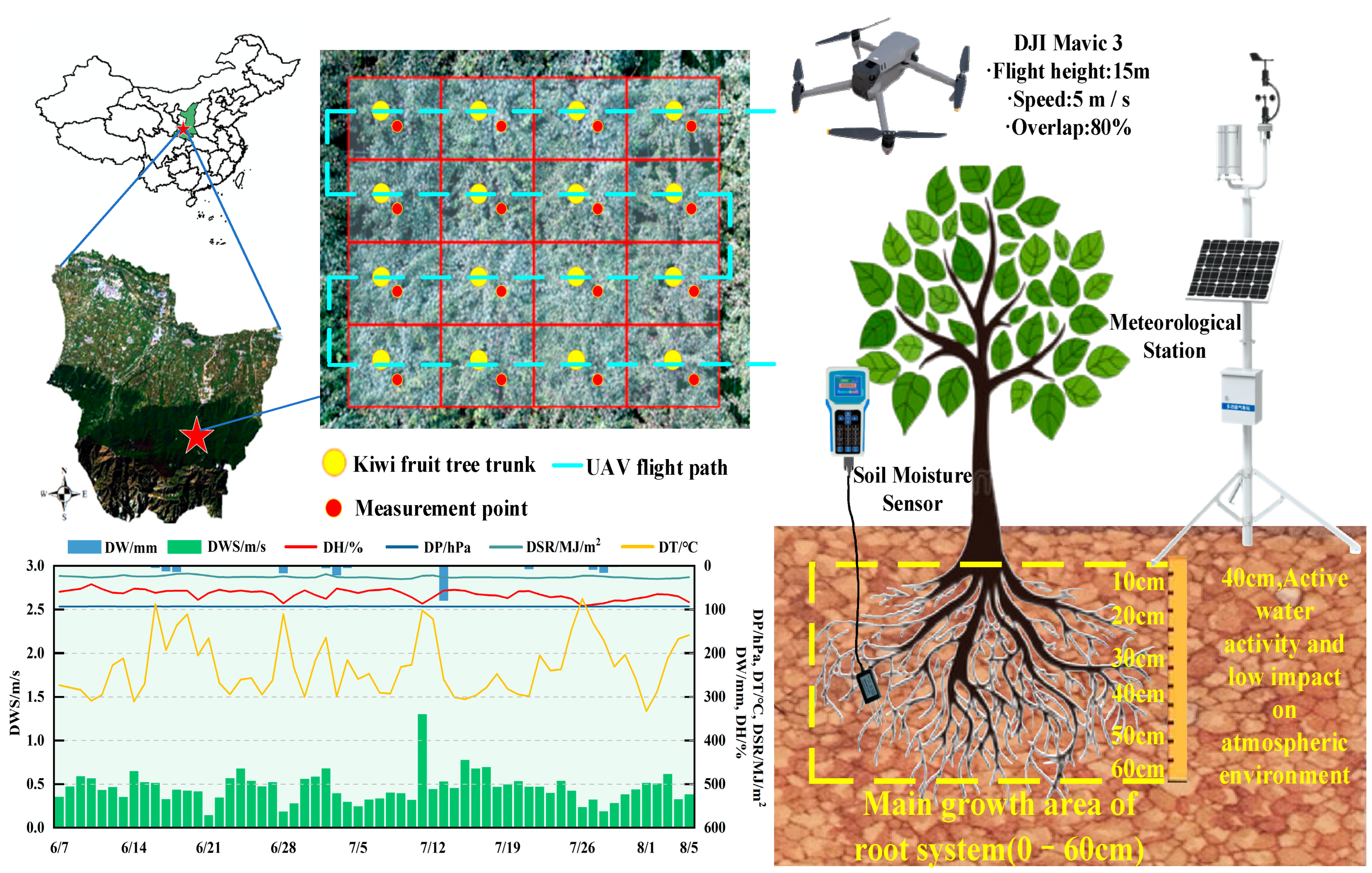
The experimental site was a kiwifruit plantation in Meixian County, Shaanxi Province, China. The study period was from 7 June to 5 August 2023, and 1440 sets of multi-source essential datasets were acquired, and the specific acquisition process is shown in Figure 1. The data acquisition system consisted of three parts:
(1) Canopy reflectance data acquisition: In this study, spectral data were acquired using a DJI Mavic 3 Unmanned Aerial Vehicle (UAV) platform (DJI Technology Co., Ltd., Shenzhen, China) integrated with a PR-3001-TRREC-N01 multispectral sensor (Prudential Technology Co., Ltd., Xi’an, China). The PR-3001-TRREC-N01 multispectral sensor is a lightweight, UAV-integrated multispectral imaging system. Key specifications include: 5–6 spectral bands (typically covering 450–900 nm, e.g., blue, green, red, red edge, near-infrared), spatial resolution of 1.2–2.5 cm/pixel at 100 m flight altitude, focal length of 8–12 mm, image size of 1280 × 960 to 2048 × 1536 pixels, frame rate of 1–5 Hz, and weight < 200 g for compatibility with DJI Mavic 3. These parameters are consistent with commercial UAV multispectral sensors for agricultural remote sensing. The UAV flights were conducted from 7 June to 5 August 2023, between 10:00 and 14:00 local time (UTC+8) on each sampling day, ensuring consistent illumination conditions for spectral data collection. This sensor was selected for its capability to capture reflectance across four spectral bands critical for vegetation analysis: green (550 ± 16 nm), red (660 ± 14 nm), red-edge (735 ± 12 nm), and near-infrared (840 ± 26 nm).
(2) Root soil water content (RSWC, %) was determined by using a PR-3001-TRREC-N01 soil moisture detector (Prudential Technology Co., Ltd., Xi’an, China).
(3) Meteorological parameters were monitored in real-time at the daily scale relying on a weather station (Huayun Meteorological Technology Co., Ltd., Beijing, China), including relative air humidity (%), atmospheric pressure (hPa), solar radiation intensity (W/m2), air temperature (°C), daily irrigation volume (mm) and wind speed (m/s).
All observation data were synchronously collected and stored via the LoRa wireless transmission module, and the sampling interval was set to 30 min.
To ensure the temporal consistency of multi-source data, minimize noise interference, and enhance the reliability of subsequent modeling, a rigorous data synchronization procedure was implemented. All acquisition devices were synchronized to GPS time, achieving a high-precision time reference with an error margin of ≤1 s. A timestamp matching algorithm was employed to map data streams from spectral, meteorological, and soil moisture sensors onto standardized temporal nodes. To address minor temporal misalignments inherent in field sampling, linear interpolation was applied to correct deviations within a ±2-min window around each 30-min sampling interval, ensuring that all variables within a single sample correspond to the same physical observation moment. Following synchronization, outlier samples exhibiting time deviations exceeding 5 min were identified and excluded, accounting for less than 0.5% of the initial dataset. Consequently, the final curated dataset retained for analysis comprised 1440 sample groups, all with a controlled temporal deviation of ≤3 min, thereby significantly improving temporal alignment and overall data integrity [35,36,37].

2.2. Vegetation Index Extraction

In this study, spectral data were acquired using a DJI Mavic 3 Unmanned Aerial Vehicle (UAV) platform integrated with a PR-3001-TRREC-N01 multispectral sensor (Prudential Technology Co., Ltd., Xi’an, China), whose detailed technical specifications are provided in Section 2.1. This sensor was selected for its capability to capture reflectance across four spectral bands critical for vegetation analysis: green (550 ± 16 nm), red (660 ± 14 nm), red-edge (735 ± 12 nm), and near-infrared (840 ± 26 nm). Following data collection, the captured imagery was processed using Pix4DMapper photogrammetry software (Version 4.6.3, Pix4D SA, Lausanne, Switzerland) to perform image stitching, geometric correction based on onboard RTK direct correction technology, and generation of ortho-mosaic images. The final ortho-mosaics, produced with a high spatial resolution of 0.05 m and georeferenced to the WGS84 coordinate system, enabled precise spatial analysis. Fruit tree canopy boundaries were then accurately delineated through segmentation procedures in ENVI 5.2 software. To obtain representative spectral reflectance values, a standardized 10 × 10 pixel sampling window was systematically applied within each segmented canopy vector boundary, calculating the mean reflectance for each band. Furthermore, a targeted bibliometric analysis was conducted to identify vegetation indices strongly associated with soil water content, resulting in the selection of twenty candidate indices for subsequent evaluation; their corresponding mathematical formulae are comprehensively listed in Table 1.

2.3. Model Building

The proposed attention-enhanced LSTM (ATT-LSTM) model predicts RSWC by integrating temporal dynamics and key time-step information from multi-source data [46]. The attention mechanism consists of three blocks: the self-attention encoder, self–attention decoder, and encoder–decoder attention, which take Q (Query), K (Key), and V (Value) as inputs. In the first two blocks, the target parameters of their respective layers are fed into Q, K, and V [47]. In the encoder–decoder attention, however, the final encoder output is fed into V and K, while the output of the self-attention decoder is fed into Q [48]. The attention scores are given by Equation (1).
A t t e n t i o n ( Q , K , V ) = s o f t m a x ( Q K d k ) V
where d k denotes the matrix dimension of Q and K, which is used to prevent the dot product of Q and K from becoming excessively large.
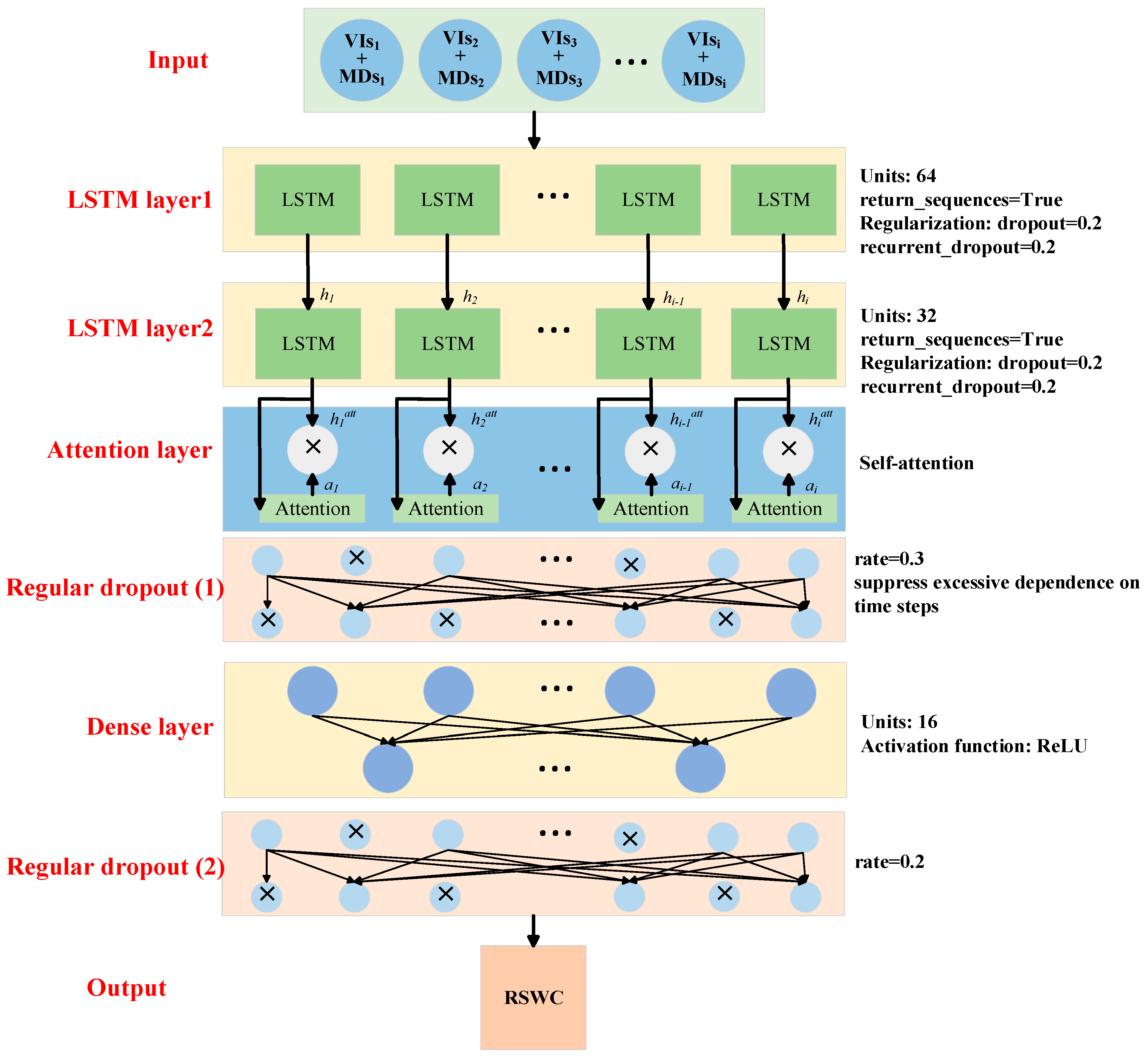
The architecture of the proposed ATT-LSTM model, designed for time-series prediction of RSWC, is structured as a sequential data processing pipeline that hierarchically extracts, weights, and synthesizes temporal features, as illustrated in Figure 2. The model begins with an input layer configured to accept the multivariate time-series data of the selected vegetation indices. This data is first processed by a Long Short-Term Memory (LSTM) layer containing 64 units, with return_sequences = Trueset to preserve the temporal output sequence for the subsequent layer. To mitigate overfitting, this layer incorporates both a 20% dropout rate for its inputs and a 20% recurrent dropout for its recurrent connections. Its output is then passed to a second LSTM layer with 32 units, which continues the temporal feature abstraction and also employs identical dropout regularization settings.
A pivotal component of the model is the incorporated self-attention mechanism. This layer automatically computes adaptive weights for different time steps, effectively highlighting the most critical temporal instances for the final RSWC prediction and thereby enhancing the model’s interpretability and focus. To prevent the model from over-relying on the specific patterns emphasized by the attention weights, a standard dropout layer with a rate of 0.3 is applied immediately afterward. Following this, a fully connected dense layer with 16 units and ReLU activation performs a non-linear transformation, integrating the weighted temporal features into a higher-level representation. An additional dropout layer (rate = 0.2) further regularizes this dense layer to promote generalization. The architecture culminates in a single-unit output layer that generates the continuous RSWC value.
In summary, this ATT-LSTM architecture synergistically combines the sequential modeling strength of stacked LSTMs with the adaptive focus of the attention mechanism. The strategic placement of multiple dropout layers throughout the network ensures robust generalization, making the model well-suited for capturing the complex, non-linear dynamics inherent in soil moisture prediction.

2.4. Training Platform and Accuracy Evaluation

This study used Anaconda 3.0 to build the TensorFlow framework and Python version 3.8.13 environment for network construction and training. Remote sensing data and meteorological data of kiwifruit orchards collected between June and August 2023 were used as inputs to the ATT-LSTM network for the inversion of RSWC. In order to evaluate the prediction accuracy of the model, the coefficient of determination (R2) and root mean square error (RMSE) were used as evaluation metrics, which were calculated as follows:
R 2 = ( y p r e y ¯ ) 2 ( y t r u e y ¯ ) 2
RMSE = ( y p r e y t r u e ) 2 N
where ytrue represents the true value, ypre represents the estimated value, and y ¯ represents the mean of all true values.

3. Results and Analysis

3.1. Correlation Analysis Between Different VIs and RSWC

To comprehensively and robustly quantify the association between vegetation indices (VIs) and root zone soil water content (RSWC), both Pearson and Spearman correlation analyses were employed in this study. Pearson correlation quantifies the linear correlation between normally distributed continuous variables, with the advantage of high sensitivity to linear trends but the limitation of being invalid for non-linear data and easily affected by outliers and data saturation. In contrast, Spearman correlation is a non–parametric method that assesses monotonic relationships regardless of data distribution, which is more robust to non-linearity, outliers and the saturation effect of vegetation indices–an inherent characteristic of dense kiwifruit canopies. Considering the potential non-linearity and spectral saturation of VIs in this study, Spearman correlation was more appropriate for capturing the intrinsic monotonic association between VIs and RSWC, while Pearson correlation supplemented the linear trend analysis. Only VIs with significant correlations (p < 0.05) in both analyses were selected as input features, to ensure the stability and reliability of the correlation results against the assumptions of data distribution and linearity. Table 2 presents the results of the correlation analysis between a suite of VIs and the RSWC based on the above dual correlation approaches. The analysis reveals a spectrum of correlation strengths and directions among the investigated VIs. Notably, several indices, including the Soil-Adjusted Vegetation Index (SAVI, Pearson r = 0.35), the Simple Ratio (SR, r = 0.38), and the Normalized Difference Vegetation Index (NDVI, r = 0.33), demonstrated significant positive linear correlations. In contrast, indices such as the Plant Senescence Reflectance Index (PSRI, r = −0.22) and the Normalized Difference Water Index (NDWI, r = −0.21) exhibited significant negative correlations, which may reflect the physiological changes in vegetation or the direct spectral response to water under varying soil moisture conditions. For the subsequent machine learning modeling, a critical selection criterion was applied: only VIs that showed statistically significant correlations (p * < 0.05) in both the Pearson and Spearman analyses were chosen to ensure robustness against assumptions of data distribution and linearity. Consequently, nine VIs—SR, NDVI, GI, OSAVI, MSAVI, SAVI, PSRI, EVI2, and MTCI—met this dual-significance criterion and were therefore selected as the optimal input feature set for training the predictive model. This selection aims to leverage the most stable and informative spectral predictors of RSWC for the modeling process.

3.2. Inversion Results

To evaluate the performance of the kiwifruit soil moisture estimation model after introducing meteorological data, the LSTM and ATT-LSTM models were used to construct the estimation model of RSWC in this study, respectively, and the coefficient of determination (R2) and root mean square error (RMSE) were used as the evaluation indexes. The study’s results are shown in Table 3.
When vegetation indices (VIs) and meteorological data (MDs) were used as input variables for the LSTM model, the R2 value for the training set reached 0.874 with an RMSE of 1.78%, and for the test set, the R2 was 0.855, accompanied by an RMSE of 1.94%. By contrast, when only VIs served as inputs for LSTM, the training set exhibited an R2 of 0.745 and an RMSE of 2.05%, while the test set showed an R2 of 0.723 and an RMSE of 2.26%. Therefore, integrating meteorological data enhanced the model’s performance on both the training and test sets, suggesting that meteorological data made a substantial contribution to the model’s predictive capability.
When vegetation indices and meteorological data were employed as input variables for the ATT-LSTM model, the R2 for the training set was 0.939 with an RMSE of 0.96%, whereas the R2 for the test set was 0.868 with an RMSE of 1.44%. This outcome constitutes the best performance across all models, demonstrating that incorporating the attention mechanism can remarkably boost the model’s performance.
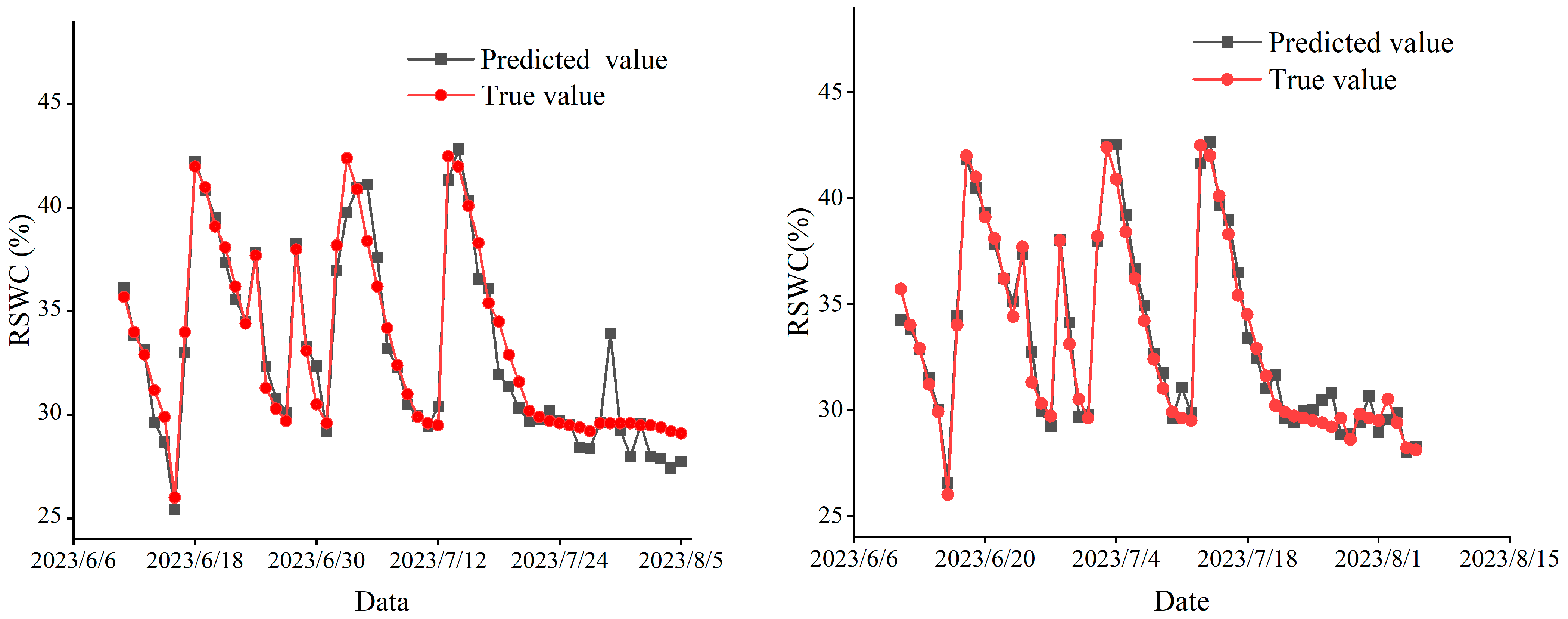
We selected a kiwifruit plant as a study sample and analyzed its RSWC between 7 June and 5 August 2023, for 60 days of inversion. By comparing the actual RSWC data, we evaluated the performance of the two network models, and the results are shown in Figure 3.
The left panel shows a high degree of agreement between the LSTM model and the true values in the early stages of the predictions, especially in the middle of June, when the predicted values closely follow the true values. However, the accuracy of the predictions decreases as time passes to the end of June. Moreover, the emergence of this trend suggests that although LSTM is effective in capturing short-term change patterns, it may be biased when faced with long-term trends. From the right panel, it can be found that ATT-LSTM performs better than the LSTM model in compensating for the short-term prediction accuracy and the persistence of the long-term trend. These results support the application of ATT-LSTM in soil moisture prediction as it better integrates time-series data and adapts to changes in time nodes.
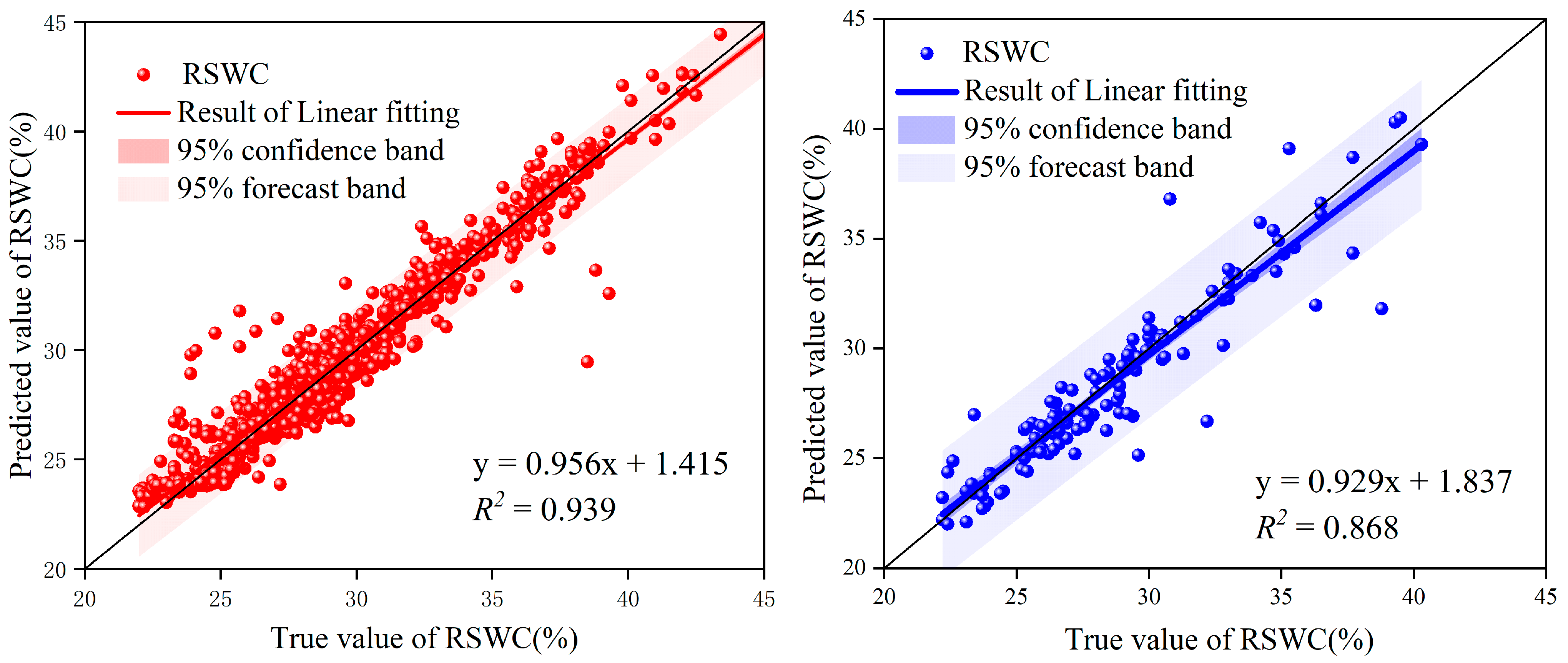
Figure 4 presents scatter plots of the training and test sets for RSWC estimation using the ATT-LSTM model. The ATT-LSTM network exhibits superior inversion performance with minimal errors on the training set: the slope of the linear regression equation (y = 0.956x + 1.415) is close to 1, data points are tightly clustered around the diagonal, and the R2 reaches a high value of 0.939. This indicates that the algorithm effectively captures the inherent patterns within the training data. Additionally, the 95% prediction and confidence intervals are relatively narrow, further confirming the model’s robustness during the training phase.
For the test set, RSWC inversion accuracy decreases slightly compared to the training set, as indicated by the linear regression equation (y = 0.929x + 1.837) with R2 = 0.868. The slope also deviates slightly from 1, suggesting that predicted RSWC values tend to underestimate actual values as true RSWC increases. Relative to the training set, the 95% prediction and confidence intervals are broader, reflecting increased uncertainty in the testing phase and a degree of generalization error when extrapolating from training to test data. Nonetheless, most data points remain tightly distributed around the fitted line, and the inversion results retain a reasonable level of accuracy.

3.3. Visualization of Agrometeorological Data

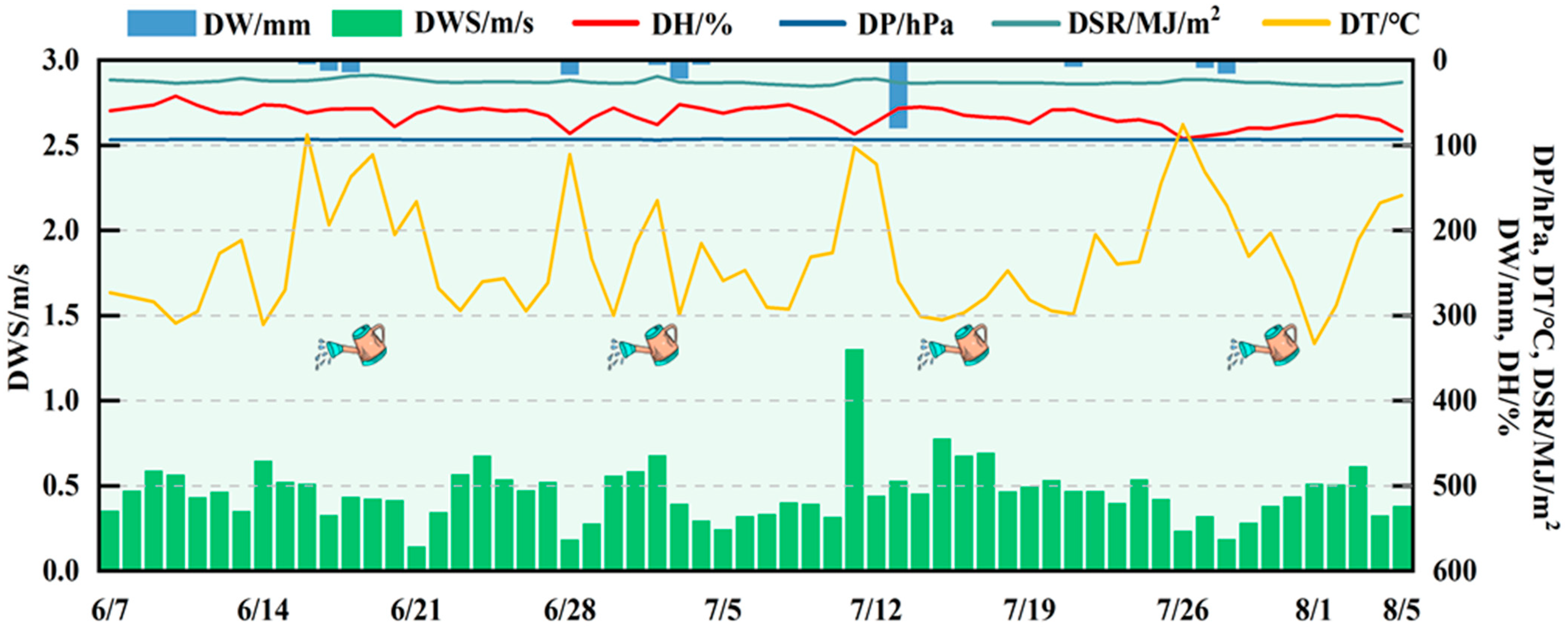
The raw agrometeorological data input into the model, including air temperature (DT, °C), relative air humidity (DH, %), downward shortwave radiation (DSR, MJ/m2), wind speed (DWS, m/s), precipitation (DW, mm), and atmospheric pressure (DP, hPa), were visualized to characterize their temporal dynamics during the experimental period (Figure 5). The irrigation events (marked with watering can icons in the figure) and major meteorological fluctuations (e.g., the sharp rise in air temperature in late June and the significant drop of relative humidity in early July) were highlighted to intuitively reflect the coupling relationship between meteorological factors, irrigation events and RSWC. The presentation of Figure 5 alongside Figure 3 facilitates readers in associating the variation trend of RSWC with meteorological driving factors and irrigation events, thereby enabling a clearer interpretation of the model’s response mechanisms to key environmental events.

4. Discussion

4.1. SubsectionScientific Rationale for Multi-Source Data Fusion

The core finding of the present study, as shown in Table 3 and Figure 3, namely the significant improvement in the inversion accuracy of kiwifruit root zone soil water content RSWC achieved by fusing unmanned aerial vehicle-derived vegetation indices VIs with meteorological data MDs, aligns with and extends prior research on agricultural remote sensing inversion. Early studies, for example, the work by Zhan et al. [27] in 2024, have demonstrated that integrating vegetation indices with meteorological variables can mitigate the limitations of single-source data in crop yield estimation, as meteorological factors directly regulate crop water stress and canopy spectral responses. In this study, the saturation effect of VIs—a well-documented challenge in dense canopies as reported previously [22]—was effectively alleviated through the incorporation of MDs, including air temperature, solar radiation intensity, and relative humidity. These meteorological parameters reflect the dynamic balance between soil water supply and crop water demand: for instance, high solar radiation and temperature increase crop transpiration, which indirectly modulates canopy reflectance even when VIs are saturated. Similar to the findings of Xu et al. (2025) [12], who used UAV multispectral data combined with meteorological factors for grape soil moisture estimation, the fusion of heterogeneous data effectively breaks through the limitation of single spectral data in characterizing soil moisture status in dense canopy orchards. By fusing these heterogeneous data types, the model captured both the “surface spectral signal” from VIs and the “environmental driving mechanism” from MDs, thereby enhancing the physical interpretability of the inversion process and validating the key hypothesis that breaking through the limitation of a single data source improves inversion performance.
Compared with LSTM models utilizing only VIs, where the coefficient of determination R2 of the test set was 0.723 and the root mean square error RMSE was 2.26%, the VIs + MDs combination increased R2 by 18.3% and decreased RMSE by 14.2% (Table 3). This confirms that meteorological data provides complementary information that VIs alone cannot capture (Table 3): for instance, daily irrigation volume—a key MD variable—directly influences RSWC but is not reflected in canopy spectra over the short term, while relative air humidity correlates with soil water evaporation and helps the model distinguish between spectral changes induced by water stress and those arising from other factors such as nutrient deficiency. Such results are not restricted to kiwifruit; they also support the broader applicability of multi-source data fusion in soil moisture inversion for crops with dense canopies such as apples and grapes, where VI saturation represents a common constraint. Zhang et al. (2023) [11] also verified that the integration of UAV remote sensing and meteorological data can improve the inversion accuracy of soil moisture in apple orchards by more than 15%, which is consistent with the 18.3% R2 improvement in this study.

4.2. Attention-Based Model Optimization Mechanism

The superior performance of the attention-enhanced LSTM (ATT-LSTM) model over the standard LSTM model, as quantified in Table 3 and visualized in Figure 3 and Figure 4, highlights the value of integrating attention mechanisms into time-series modeling for soil moisture inversion. Previous studies have noted that LSTM struggles with long-term time-series data from complex physical processes, as it assigns equal weight to all time steps and features, leading to reduced accuracy when extrapolating beyond short-term patterns. The attention mechanism in ATT-LSTM addresses this by adaptively weighting critical time steps and features: for example, during periods of extreme weather or post-irrigation, the model prioritizes spectral-meteorological data combinations that are more sensitive to RSWC changes, thereby reducing noise interference and improving the stability of long-term predictions (Figure 3). This is consistent with Yu et al. (2024) [49], who demonstrated that ATT-LSTM outperforms LSTM in capturing key temporal features in complex systems, and further extends the application of ATT-LSTM from traffic trajectory prediction to agricultural soil moisture time-series inversion. Notably, the marginal numerical improvement in R2 (from 0.855 to 0.868) translates to substantial practical benefits. The 25.8% reduction in RMSE (from 1.94% to 1.44%) means the model can more accurately distinguish between “adequate moisture” and “water stress” for kiwifruit, which is critical for avoiding over-irrigation or under-irrigation. To our knowledge, this is the first application of ATT-LSTM in kiwifruit RSWC inversion, expanding the toolkit of deep learning models for horticultural crop moisture monitoring—where precise temporal dynamics demand higher model sensitivity to key environmental triggers. Gulay et al. (2023) [46] also pointed out that attention mechanisms can effectively improve the prediction accuracy of the LSTM model in soil quality parameter estimation, which provides a methodological basis for the application of ATT-LSTM in agricultural soil moisture research.

5. Conclusions

This study constructed a root zone soil water content (RSWC) inversion model for kiwifruit orchards by integrating UAV-based multispectral vegetation indices and agrometeorological data into the long short-term memory (LSTM) network and attention mechanism-enhanced LSTM (ATT-LSTM) network, with vegetation indices screened via dual correlation analysis methods.
The multidimensional feature fusion strategy of combining vegetation indices and meteorological data effectively improves the accuracy of kiwifruit RSWC inversion, which fully verifies the complementary effect of agrometeorological data on spectral remote sensing data in characterizing soil moisture status of dense canopy orchards. The ATT-LSTM model shows superior performance in RSWC time-series prediction due to its adaptive attention weighting mechanism, which can capture the key temporal features of RSWC changes and thus improve the stability of long-term prediction.
In conclusion, the ATT-LSTM model based on multi-source data fusion has important application potential for kiwifruit orchard precision irrigation management. Future research will focus on integrating crop growth models and meteorological prediction data to further explore the interaction mechanism of multi-source data, and improve the monitoring accuracy and practical application value of the RSWC inversion model.

Author Contributions

Conceptualization, J.H. and L.Z.; methodology, F.Y. and Z.N.; software, J.H. and W.L.; validation, Y.L. and P.A.R.; formal analysis, J.H. and L.Z.; investigation, W.L. and S.P.; resources, Z.W., Y.L. and F.Y.; data curation, W.L. and S.P.; writing—original draft preparation, S.P., Z.N. and D.Z.; writing—review and editing, F.Y. and P.A.R.; visualization, Z.W. and Q.L.; supervision, Y.L., Q.L., D.Z. and P.A.R.; project administration, Z.W., Q.L., F.Y. and Z.N.; funding acquisition, Y.L. and D.Z. All authors have read and agreed to the published version of the manuscript.

Funding

This research was funded by the Special Fund for Innovation Platform Construction of the National Center of Pratacultural Technology Innovation (under preparation), grant number CCPTZX2024N01; the Key Programs of the Joint Fund of the National Natural Science Foundation of China, grant number U2243235; and the Key Research and Development Projects of Shaanxi Province, grant number 2024NC-ZDCYL-05-03. The APC was funded by the Special Fund for Innovation Platform Construction of the National Center of Pratacultural Technology Innovation (under preparation).

Data Availability Statement

The raw data supporting the conclusions of this article will be made available by the corresponding authors upon reasonable request from qualified researchers.

Acknowledgments

We would like to express our sincere thanks to Yang Yongjun, Meixian Kiwifruit Experiment Station, Northwest A&F University, and his colleagues for their assistance with this experiment.

Conflicts of Interest

The authors declare no conflicts of interest.

References

  1. Wang, C.; Liu, J.; Qi, Y.; Luo, J. Evaluation on the Quality Competitiveness of Kiwifruit Industry Based on Supply Chain. In Proceedings of the 5th International Conference on Industrial Engineering and Information Systems (IEIS), Toronto, ON, Canada, 3–6 August 2018; pp. 1–6. [Google Scholar] [CrossRef]
  2. Ma, Y.; Guga, S.; Xu, J.; Zhang, J.; Tong, Z.; Liu, X. Comprehensive Risk Assessment of High Temperature Disaster to Kiwifruit in Shaanxi Province, China. Int. J. Environ. Res. Public Health 2021, 18, 10437. [Google Scholar] [CrossRef]
  3. Wang, Z.; Feng, Y.; Yang, N.; Jiang, T.; Xu, H.; Lei, H. Fermentation of Kiwifruit Juice from Two Cultivars by Probiotic Bacteria: Bioactive Phenolics, Antioxidant Activities and Flavor Volatiles. Food Chem. 2022, 373, 131455. [Google Scholar] [CrossRef]
  4. Vahidi, M.; Shafian, S.; Frame, W.H. Precision Soil Moisture Monitoring Through Drone-Based Hyperspectral Imaging and PCA-Driven Machine Learning. Sensors 2025, 25, 782. [Google Scholar] [CrossRef]
  5. Maan, D.C.; Veldhuis, M.-C.T.; van de Wiel, B.J.H. Root-Soil Interactions & Adaptation Strategies of Plants in Response to Soil Water Availability. In Proceedings of the IEEE International Workshop on Metrology for Agriculture and Forestry (MetroAgriFor), Portici, Italy, 24–26 October 2019; pp. 110–115. [Google Scholar] [CrossRef]
  6. Wu, H.; Kang, S.; Li, X.; Guo, P.; Hu, S. Optimization-Based Water-Salt Dynamic Threshold Analysis of Cotton Root Zone in Arid Areas. Water 2020, 12, 2449. [Google Scholar] [CrossRef]
  7. van Emmerik, T.; Steele-Dunne, S.C.; Judge, J.; van de Giesen, N. Impact of Diurnal Variation in Vegetation Water Content on Radar Backscatter from Maize During Water Stress. IEEE Trans. Geosci. Remote Sens. 2015, 53, 3855–3869. [Google Scholar] [CrossRef]
  8. Liang, X.; Li, X.; Lei, T. A New NIR Technique for Rapid Determination of Soil Moisture Content. In Proceedings of the International Conference on Systems and Informatics (ICSAI 2012), Yantai, China, 19–21 May 2012; pp. 16–20. [Google Scholar] [CrossRef]
  9. Nevalainen, O.; Honkavaara, E.; Tuominen, S.; Viljanen, N.; Hakala, T.; Yu, X.; Hyyppä, J.; Saari, H.; Pölönen, I.; Imai, N.N.; et al. Individual Tree Detection and Classification with UAV-Based Photogrammetric Point Clouds and Hyperspectral Imaging. Remote Sens. 2017, 9, 185. [Google Scholar] [CrossRef]
  10. Wei, L.; Yu, M.; Liang, Y.; Yuan, Z.; Huang, C.; Li, R.; Yu, Y. Precise Crop Classification Using Spectral-Spatial-Location Fusion Based on Conditional Random Fields for UAV-Borne Hyperspectral Remote Sensing Imagery. Remote Sens. 2019, 11, 2011. [Google Scholar] [CrossRef]
  11. Zhang, C.; Zhu, X.; Li, M.; Xue, Y.; Qin, A.; Gao, G.; Wang, M.; Jiang, Y. Utilization of the Fusion of Ground-Space Remote Sensing Data for Canopy Nitrogen Content Inversion in Apple Orchards. Horticulturae 2023, 9, 1085. [Google Scholar] [CrossRef]
  12. Xu, C.; Hu, X.; Tian, J.; Guo, X.; Lei, J. Estimating the Grape Basal Crop Coefficient in the Subhumid Region of Northwest China Based on Multispectral Remote Sensing by Unmanned Aerial Vehicle. Horticulturae 2025, 11, 217. [Google Scholar] [CrossRef]
  13. Alvino, A.; Marino, S. Remote Sensing for Irrigation of Horticultural Crops. Horticulturae 2017, 3, 40. [Google Scholar] [CrossRef]
  14. Chen, X.; Xia, M.; Zeng, D.; Fan, X. Citrus Specialization or Crop Diversification: The Role of Smallholder’s Subjective Risk Aversion and Case Evidence from Guangxi, China. Horticulturae 2023, 9, 627. [Google Scholar] [CrossRef]
  15. Kim, S.G.; Lee, S.-D.; Lee, W.-M.; Jeong, H.-B.; Yu, N.; Lee, O.-J.; Lee, H.-E. Effective Tomato Spotted Wilt Virus Resistance Assessment Using Non-Destructive Imaging and Machine Learning. Horticulturae 2025, 11, 132. [Google Scholar] [CrossRef]
  16. Mohd Nazri, N.W.; Hashim, K.A.; Zaki, N.A.M.; Samad, A.M.; Latif, Z.A.; Dahlan, Z.A.; Hashim, N.; Udin, W.S. Advancing Sustainable Paddy Farming: Utilizing Multispectral Unmanned Aerial Vehicle (UAV) Technology for Efficient Water Stress Detection and Management. In Proceedings of the 21st IEEE International Colloquium on Signal Processing & Its Applications (CSPA), Pulau Pinang, Malaysia, 7–8 February 2025; pp. 210–215. [Google Scholar] [CrossRef]
  17. Hong, C.; Li, D.; Han, L.; Du, X.; Chen, S.; Qi, J.; Wang, C.; Zhou, X.; Qin, B.; Jiang, H.; et al. Simulation and Analysis of Bidirectional Reflection Factors of Southern Evergreen Fruit Trees Based on 3D Radiative Transfer Model. Horticulturae 2024, 10, 790. [Google Scholar] [CrossRef]
  18. Grilo, F.; Sedaghat, S.; Di Stefano, V.; Sacchi, R.; Caruso, T.; Lo Bianco, R. Tree Planting Density and Canopy Position Affect ‘Cerasuola’ and ‘Koroneiki’ Olive Oil Quality. Horticulturae 2021, 7, 11. [Google Scholar] [CrossRef]
  19. Bhogapurapu, N.; Mandal, D.; Rao, Y.S.; Bhattacharya, A. Soil Moisture Retrieval Using SAR Derived Vegetation Descriptors in Water Cloud Model. In Proceedings of the IGARSS 2020—2020 IEEE International Geoscience and Remote Sensing Symposium, Waikoloa, HI, USA, 19–24 July 2020; pp. 4696–4699. [Google Scholar] [CrossRef]
  20. Vinci, A.; Di Lena, B.; Portarena, S.; Farinelli, D. Trend Analysis of Different Climate Parameters and Watering Requirements for Hazelnut in Central Italy Related to Climate Change. Horticulturae 2023, 9, 593. [Google Scholar] [CrossRef]
  21. Gordanić, S.V.; Kostić, A.Ž.; Moravčević, Đ.; Vuković, S.; Kilibarda, S.; Dragumilo, A.; Prijić, Ž.; Lukić, M.; Marković, T. Influence of Habitat Factors on the Yield, Morphological Characteristics, and Total Phenolic/Flavonoid Content of Wild Garlic (Allium ursinum L.) in the Republic of Serbia. Horticulturae 2025, 11, 118. [Google Scholar] [CrossRef]
  22. Wang, X.B.; Fan, W.Y. Analysis and Verification of Leaf Area Index and Vegetation Index Saturation Point. J. Northeast For. Univ. 2023, 51, 83–94, 111. (In Chinese) [Google Scholar] [CrossRef]
  23. Li, R.; Wang, S.; Wu, H.; Dong, H.; Kong, D.; Li, H.; Zhang, D.S.; Chen, H. Non-Linear Models for Assessing Soil Moisture Estimation. Horticulturae 2025, 11, 492. [Google Scholar] [CrossRef]
  24. Wang, Q.; Zhang, C.; Li, J.; Wu, X.; Long, Y.; Su, Y. Intercropping Vicia sativa L. Improves the Moisture, Microbial Community, Enzyme Activity and Nutrient in Rhizosphere Soils of Young Kiwifruit Plants and Enhances Plant Growth. Horticulturae 2021, 7, 335. [Google Scholar] [CrossRef]
  25. Chang, L.; Li, D.; Hameed, M.K.; Yin, Y.; Huang, D.; Niu, Q. Using a Hybrid Neural Network Model DCNN–LSTM for Image-Based Nitrogen Nutrition Diagnosis in Muskmelon. Horticulturae 2021, 7, 489. [Google Scholar] [CrossRef]
  26. Lin, Y.-S.; Fang, S.-L.; Kang, L.; Chen, C.-C.; Yao, M.-H.; Kuo, B.-J. Combining Recurrent Neural Network and Sigmoid Growth Models for Short-Term Temperature Forecasting and Tomato Growth Prediction in a Plastic Greenhouse. Horticulturae 2024, 10, 230. [Google Scholar] [CrossRef]
  27. Zhan, Q. A Study on Oilseed Rape Yield Estimation Based on Enhanced Vegetation Index at the Flowering Stage and Meteorological Data. In Proceedings of the IGARSS 2024—2024 IEEE International Geoscience and Remote Sensing Symposium, Athens, Greece, 7–12 July 2024; pp. 5024–5027. [Google Scholar] [CrossRef]
  28. Shi, Y.; Liang, Y.; Ren, C.; Lai, J.; Ding, Q.; Hu, X. Investigating the Effects of Meteorological Data Rainfall and Temperature on GNSS-R Soil Moisture Inversion. In Proceedings of the 2021 IEEE Specialist Meeting on Reflectometry Using GNSS and Other Signals of Opportunity (GNSS + R), Beijing, China, 14–17 September 2021; pp. 97–100. [Google Scholar] [CrossRef]
  29. Sang, S.; Li, L. A Novel Variant of LSTM Stock Prediction Method Incorporating Attention Mechanism. Mathematics 2024, 12, 945. [Google Scholar] [CrossRef]
  30. Jin, Y.; Wu, D.; Guo, W. Attention-Based LSTM with Filter Mechanism for Entity Relation Classification. Symmetry 2020, 12, 1729. [Google Scholar] [CrossRef]
  31. Wu, Z.; Hu, P.; Liu, S.; Pang, T. Attention Mechanism and LSTM Network for Fingerprint-Based Indoor Location System. Sensors 2024, 24, 1398. [Google Scholar] [CrossRef]
  32. Yin, H.; Jin, D.; Gu, Y.H.; Park, C.J.; Han, S.K.; Yoo, S.J. STL-ATTLSTM: Vegetable Price Forecasting Using STL and Attention Mechanism-Based LSTM. Agriculture 2020, 10, 612. [Google Scholar] [CrossRef]
  33. Gupta, D.; Dhanda, N.; Gupta, K.K. A Comparative Study of Various LSTM Models for Stock Market Time Series Classification. In Proceedings of the 8th International Conference on Computing Methodologies and Communication (ICCMC), Erode, India, 23–25 July 2025; pp. 1–6. [Google Scholar] [CrossRef]
  34. Chen, H.; Yang, J.; Fu, X.; Zheng, Q.; Song, X.; Fu, Z.; Wang, J.; Liang, Y.; Yin, H.; Liu, Z.; et al. Water Quality Prediction Based on LSTM and Attention Mechanism: A Case Study of the Burnett River, Australia. Sustainability 2022, 14, 13231. [Google Scholar] [CrossRef]
  35. Zhao, L.; Zhu, X.; Cai, J. Task Offloading Algorithm for Multiple Unmanned Aerial Vehicles Based on Temporal Graph. Sensors 2025, 25, 6759. [Google Scholar] [CrossRef] [PubMed]
  36. Li, F.; Wang, Z.-X. A Zero-Watermarking Algorithm Based on Scale-Invariant Feature Reconstruction Transform. Appl. Sci. 2024, 14, 4756. [Google Scholar] [CrossRef]
  37. Li, X.; Tu, G.; Kong, Q.; Chen, L.; Zhang, X.; Wang, R. The Design and Application of a Digital Portable Acoustic Teaching System. Buildings 2025, 15, 3736. [Google Scholar] [CrossRef]
  38. Yu, G.X.; Wang, W.X.; Xie, J.X.; Lu, H.; Lin, J.; Mo, H. Information Acquisition and Intelligent Irrigation Expert Decision System of Litchi Orchard Based on Internet of Things. Trans. Chin. Soc. Agric. Eng. 2016, 32, 144–152. [Google Scholar]
  39. Viso-Vázquez, M.; Acuña-Alonso, C.; Rodríguez, J.L.; Álvarez, X. Remote Detection of Cyanobacterial Blooms and Chlorophyll-a Analysis in a Eutrophic Reservoir Using Sentinel-2. Sustainability 2021, 13, 8570. [Google Scholar] [CrossRef]
  40. Zhang, Y.; Han, W.; Niu, X.; Li, G. Maize Crop Coefficient Estimated from UAV-Measured Multispectral Vegetation Indices. Sensors 2019, 19, 5250. [Google Scholar] [CrossRef]
  41. Frank, T.; Smith, A.; Houston, B.; Lindsay, E.; Guo, X. Differentiation of Six Grassland/Forage Types in Three Canadian Ecoregions Based on Spectral Characteristics. Remote Sens. 2022, 14, 2121. [Google Scholar] [CrossRef]
  42. Upakankaew, K.; Ninsawat, S.; Virdis, S.G.P.; Sasaki, N. Discrimination of Mangrove Stages Using Multitemporal Sentinel-1 C-Band Backscatter and Sentinel-2 Data—A Case Study in Samut Songkhram Province, Thailand. Forests 2022, 13, 1433. [Google Scholar] [CrossRef]
  43. Chavana-Bryant, C.; Malhi, Y.; Wu, J.; Asner, G.P.; Anastasiou, A.; Enquist, B.J.; Caravasi, E.G.C.; Doughty, C.E.; Saleska, S.R.; Martin, R.E.; et al. Leaf Aging of Amazonian Canopy Trees as Revealed by Spectral and Physiochemical Measurements. New Phytol. 2017, 214, 1049–1063. [Google Scholar] [CrossRef]
  44. Arshad, S.; Kazmi, J.H.; Prodhan, F.A.; Mohammed, S. Exploring Dynamic Response of Agrometeorological Droughts Towards Winter Wheat Yield Loss Risk Using Machine Learning Approach at a Regional Scale in Pakistan. Field Crops Res. 2023, 302, 109057. [Google Scholar] [CrossRef]
  45. Zhu, S.; Cui, N.; Jin, H.; Jin, X.; Guo, L.; Jiang, S.; Wu, Z.; Lv, M.; Chen, F.; Liu, Q.; et al. Optimization of Multidimensional Indices for Kiwifruit Orchard Soil Moisture Content Estimation Using UAV and Ground Multi-Sensors. Agric. Water Manag. 2024, 294, 108705. [Google Scholar] [CrossRef]
  46. Gulay, C.F.; Fajardo, A.C. Performance Enhancement of Long Short-Term Memory Through Unlearning-Relearning Soil Quality Parameters Data. In Proceedings of the 2023 IEEE Asia-Pacific Conference on Geoscience, Electronics and Remote Sensing Technology (AGERS), Surabaya, Indonesia, 19–20 December 2023; pp. 7–11. [Google Scholar] [CrossRef]
  47. Ju, J.; Liu, F.-A. Multivariate Time Series Data Prediction Based on ATT-LSTM Network. Appl. Sci. 2021, 11, 9373. [Google Scholar] [CrossRef]
  48. Liu, F.; Huang, X.; Huang, W.; Duan, S.X. Performance Evaluation of Keyword Extraction Methods and Visualization for Student Online Comments. Symmetry 2020, 12, 1923. [Google Scholar] [CrossRef]
  49. Yu, D.; Yang, Y.; Peng, W.; Wu, X. A Traffic Conflict Prediction Method in Expressway Weaving Areas Based on ATT-LSTM Trajectory Prediction. In Proceedings of the 5th International Conference on Artificial Intelligence and Electromechanical Automation (AIEA), Shenzhen, China, 14–16 June 2024; pp. 857–861. [Google Scholar] [CrossRef]
Figure 1. A schematic diagram illustrating the UAV and RSWC data collection process.
Horticulturae 12 00291 g001
Figure 2. Structural diagram of the ATT-LSTM network. Note: VIsi = Vegetation Index on day i; MDsi = Meteorological Data on day i; ATT-LSTM = Attention mechanism-enhanced Long Short-Term Memory network. LSTM = Long Short-Term Memory network; Dense = fully connected layer; Dropout = regularization layer for overfitting mitigation.
Horticulturae 12 00291 g002
Figure 3. Inversion performance of two network models for RSWC estimation. Note: RSWC = Root Zone Soil Water Content. The red line represents the predicted value, and the blue line represents the true value of RSWC.
Horticulturae 12 00291 g003
Figure 4. Scatter plots of ATT-LSTM’s RSWC estimation performance. Note: RSWC = Root Zone Soil Water Content; ATT-LSTM = Attention mechanism-enhanced Long Short-Term Memory network; The left panel corresponds to the training set, and the right panel displays the test set results.
Horticulturae 12 00291 g004
Figure 5. Temporal dynamics of agrometeorological variables during the experimental period. Note: DT = air temperature (°C); DH = relative air humidity (%); DSR = downward shortwave radiation (MJ/m2); DWS = wind speed (m/s); DW = precipitation (mm); DP = atmospheric pressure (hPa). The watering can icons indicate irrigation events; major meteorological fluctuations (e.g., temperature surge, humidity drop) are clearly visible in the time series. This figure is presented alongside Figure 3 to show the coupling relationship between agrometeorological factors, irrigation events and RSWC inversion results.
Horticulturae 12 00291 g005
Table 1. Vegetation index formula.
Vegetation IndexAbbreviationFormulaReferences
Green indexGI ρ G R E / ρ R E D  1,2[38]
Modified soil-adjusted vegetation indexMSAVI 0.5 × 2 × ρ N I R + 1 ( 2 × ρ N I R + 1 ) 2 8 ( ρ N I R ρ R E D )  3[38]
Green normalized difference vegetation indexgNDVI ρ N I R ρ G R E / ρ N I R + ρ G R E [39]
Normalized difference vegetation indexNDVI ρ N I R ρ R E D / ρ N I R + ρ R E D [39]
Optimized soil-adjusted vegetation indexOSAVI ρ N I R ρ R E D / ρ N I R + ρ R E D + 0.5 [39]
Renormalized difference vegetation indexRDVI ρ N I R ρ G R E / ρ N I R + ρ G R E [39]
Soil-adjusted vegetation indexSAVI ρ N I R ρ R E D / ρ N I R + ρ R E D + L × ( 1 + L )  4[40]
Simple ratio indexSR ρ N I R / ρ R E D [40]
Green chlorophyll vegetation indexGCVI ρ N I R / ρ G R E 1 [41]
Plant senescence reflection indexPSRI ( ρ R E D ρ G R E ) / ρ R E G [41]
Normalized Difference Red-Edge Vegetation IndexNDVIre ( ρ N I R ρ R E G ) / ( ρ N I R + ρ R E G ) [42]
Modified Simple Ratio Red-EdgeMSRre ( ρ N I R / ρ R E G 1 ) / ( ρ N I R / ρ R E G + 1 ) [42]
Chlorophyll Index Red-EdgeCIre ρ N I R / ρ R E G 1 [42]
Simple Ratio Red-EdgeSRre ρ N I R / ρ R E G [42]
Two-Band Enhanced Vegetation IndexEVI2 2.5 × ρ N I R ρ R E D / ρ N I R + 2.4 ρ R E D + 1 [43]
MERIS Terrestrial Chlorophyll IndexMTCI ρ N I R ρ R E G / ρ R E G + ρ R E D [43]
Global Environmental Monitoring IndexGEMI e a t × ( 1 0.25 × e a t ) ( ρ R E D 0.125 ) / ( 1 ρ R E D )  5[44]
Normalized Difference Water IndexNDWI ρ G R E ρ N I R / ρ G R E + ρ N I R [44]
Red-Edge Transformed Vegetation Index CoreRTVICore 100 × ( ρ N I R ρ R E G ) 10 × ( ρ N I R ρ G R E ) [45]
Modified Triangular Vegetation Index 2MTVI2 1.5 × ( 1.2 × ( ρ N I R ρ G R E ) 2.5 × ( ρ R E D ρ G R E ) ) ×   ( 2 × ρ N I R + 1 ) 2 ( 6 × ρ N I R 5 ρ R E D ) 0.5 [45]
1  ρ G R E is the average reflectance of green band, 2 ρ R E D is the average reflectance of the red band, ρ R E G is the average reflectance of the red-edged band, 3 ρ N I R is the average reflectance of near infrared band, 4 L is the correction factor for soil brightness, L = 0.90 is taken here according to the coverage amount, 5 e ta = ( 2 × ( ρ N I R 2 ρ R E D 2 ) + 1.5 × ρ N I R + 0.5 ρ R E D ) / ( ρ N I R + ρ R E D + 0.5 ) .
Table 2. Correlation Analysis between VIs and RSWC.
VIPearsonSpearmanVIPearsonSpearman
GI0.28 *0.17 *NDVIre0.100.13
MSAVI0.27 *0.21 *MSRre0.110.12
gNDVI0.22 *0.11CIre0.090.11
NDVI0.33 *0.23 *SRre0.080.10
OSAVI0.31 *0.22 *EVI20.32 *0.23 *
RDVI0.23 *0.14MTCI0.23 *0.21 *
SAVI0.35 *0.23 *GEMI−0.21 *−0.10
SR0.38 *0.19 *NDWI−0.21 *−0.13
GCVI0.110.23 *RTVICore0.080.11
PSRI−0.22 *−0.21 *MTVI20.21 *0.12
* p < 0.05.
Table 3. Inversion accuracy of the network under different input data.
Modeling MethodInput DataR2RMSE (%)
Training SetTesting SetTraining SetTesting Set
LSTMVIs0.7450.7232.052.26
LSTMVIs + MDs0.8740.8551.781.94
ATT-LSTMVIs + MDs0.9390.8680.961.44
Note: VIs = Vegetation Indices; MDs = Meteorological Data; R2 = Coefficient of Determination; RMSE = Root Mean Square Error. The unit of RMSE is percentage (%).
Disclaimer/Publisher’s Note: The statements, opinions and data contained in all publications are solely those of the individual author(s) and contributor(s) and not of MDPI and/or the editor(s). MDPI and/or the editor(s) disclaim responsibility for any injury to people or property resulting from any ideas, methods, instructions or products referred to in the content.