Article

Biofilm of B. subtilis as a Growth Promoter of Lettuce (Lactuca sativa L.) in the Presence of Heavy Metals


by
Mirta Esther Galelli
1,
Antonio Paz González
2,*,
Ana Rosa García
3,
Josefina Ana Eva Cristóbal-Miguez
3,
Gonzalo Miguel Arnedillo
3,
Eliana Cárdenas-Aguiar
2 and
Gabriela Cristina Sarti
2,3
1
Agrofood Area, Department of Applied Biology and Food, Faculty of Agronomy, University of Buenos Aires, Av. San Martín 4453, Buenos Aires C1417DSE, Argentina
2
AQUATERRA Reseach Group, Interdisciplinary Center for Chemistry and Biology (CICA), As Carballeiras, s/n Campus de Elviña, University of A Coruna, 15008 Coruna, Spain
3
Inorganic and Analytic Chemistry Cathedra, Department of Natural Resources and Environment, Faculty of Agronomy, University of Buenos Aires, Av. San Martín 4453, Buenos Aires C1417DSE, Argentina
*
Author to whom correspondence should be addressed.
Horticulturae 2026, 12(2), 255; https://doi.org/10.3390/horticulturae12020255

Submission received: 15 January 2026 / Revised: 13 February 2026 / Accepted: 20 February 2026 / Published: 23 February 2026

Abstract

The negative effects of soil heavy metal contamination on food production could be mitigated using nature-based solutions, i.e., plant-growth-promoting rhizobacteria (PGPR). Yield of Lactuca sativa L. has been shown to increase by seed inoculation with biofilm of Bacillus subtilis subsp. spizizenii. The aim of this work was to assess whether this promoting effect occurs even in the presence of toxic concentrations of copper (Cu) and zinc (Zn). First, germination rates of lettuce seeds with increasing Cu and Zn concentrations were assessed. Then, lettuce plants growing from inoculated and non-inoculated seeds were cropped on substrates with excess Cu and Zn. Above- and below-ground lettuce variables were measured, and leaf macro- and microelements were determined. Germination was more severely affected by Cu overload than by Zn overload, while this trend was reversal for plant growth. Seed inoculation enhanced germination and increased plant growth assessed by root and shoot biomass, plant height and leaf area. For example, seed inoculation increased lettuce root and aerial biomass of lettuce growing on a metal- free substrate by 68% and 62%, respectively. This practice also promoted lettuce growth in metal-overloaded substrates, increasing aerial and root biomass by 32% and 29%, respectively, in connection with Cu, and by 260% and 183% when it came to Zn. Both Cu or Zn accumulated in the edible parts of lettuce growing on contaminated substrates, but seed inoculation did not mitigate metal uptake in any case. Except for Cu and Zn, macronutrients, micronutrients and heavy metal levels in lettuce leaves were affected neither by excess metal nor by seed inoculation. Altogether, B. subtilis biofilm has been proven to be an effective seed inoculant promoting seed germination and plant growth even in the presence of heavy metals. Adverse health effects due to metal accumulation in the lettuce edible parts are not expected to increase following seed inoculation.

1. Introduction

Contamination of agricultural soils with heavy metals is becoming increasingly common, threatening the ability to produce sufficient, safe food for a growing world population. Particularly, this is the case around most populous urban centers, where rapid development has created increased demand and pressure on nearby farmlands for food. Subsequently, in peri-urban areas, agricultural production is often intensified, and traditional crops are shifting to higher-value alternatives for enhancing farmer income and resilience. These agricultural adaptation practices frequently result in “green belts” where food is grown, even on marginal or less-than-optimal soil [1,2]. Green belt areas are more exposed to soil anthropogenic pollution, including heavy metal accumulation from natural and anthropogenic sources. Anthropogenic sources of heavy metals include fertilizers, for example, phosphate-based fertilizers, pesticides, herbicides, livestock manure, wastewater used for irrigation, and sewage-sludge-based amendments. Successive additions of pollutants increase soil contamination. In addition, air particles are deposited on the ground around urban centers, contributing to soil pollution. These particles arise from sources like vehicles or industries [3,4,5,6].
Heavy metals can be divided into two large groups: non-essential ones, such as mercury, cadmium, and lead; and essential ones, such as copper and zinc. The latter are involved in various physiological functions as micronutrients, but can be toxic at high concentrations. Copper, a redox-active metal, acts as a vital cofactor for numerous essential proteins. It is involved in mitochondrial respiration, cell wall metabolism, electron transport in photosynthesis, protein synthesis, oxidative stress responses, hormone signaling, and ethylene sensing [7]. Zinc is required for the structure and function of numerous enzymatic systems, including antioxidant enzymes. Also, it is implicated in enzyme regulation, protein synthesis, phosphate and carbohydrate metabolism, and ribosomal and membrane structure [8].
For humans, plants, and microorganisms, excessive levels of Cu or Zn could have deleterious effects. Therefore, in humans, Cu may cause liver damage and other related gastric problems, while Zn may affect the immune system [3]. Toxic effects of Cu and Zn in plants cause reduced growth and biomass production and may arise from different mechanisms. For example, excess Cu and Zn affects photosynthesis rate, leading to the production of chlorosis. Also, oxygen free radicals are generated, which cause oxidation of lipids and proteins with damage to cell membranes. Other harmful effects are specific to each metal, such as Zn causing genetic disorders, or Cu affecting the respiratory chain [4,8,9,10]. In microorganisms, these two heavy metals affect cellular functions, either chemically by generating free radicals, or physically by acting on bacterial structures, causing inhibition of bacterial growth or cell death [11,12].
Due to their antimicrobial properties, both metals are common in materials used in human activities [13,14]. Hence, they affect soil physical and chemical properties. Also, they can inhibit the soil microbiological activity responsible for organic matter degradation. In addition, Cu can affect important pollinators and predators, while Zn can compete and inhibit the uptake of essential nutrients such as Mg, Ca, Fe and Mn by plants [4].
The use of biological inoculants, a nature-based solution, is a possible way to reduce the detrimental, or even toxic, effect of heavy metals on food production [15]. Plant-growth-promoting bacteria (PGPB) act symbiotically, promoting plant growth through various direct or indirect mechanisms. Directly, they may act through the production of plant growth hormones (e.g., auxin, cytokinin, gibberellin, abscisic acid and ethylene), and by increasing the bioavailability of nutrients such as phosphates, potassium, iron (through the production of siderophores) or nitrogen. Indirectly, they may induce systemic resistance, produce antibiotic substances and compete with plant pathogenic species for space and nutrients [16]. This notwithstanding, not all plant-growth-promoting bacteria suit every plant, highlighting the importance of plant-specific microbiomes [17].
One of the most researched PGPR genera is Bacillus, a widespread endophytic microorganism, which represents more than 95% of the Gram-positive bacteria. These bacteria survive in extreme environments by producing highly resistant spores, which remain viable for years until favorable conditions return. An important characteristic of this genus is its ability to form biofilms, which offer several benefits to the bacteria, such as increasing resistance to adverse environmental conditions and facilitating positive interactions between bacteria and plants, among others. Biofilm is a three-dimensional structure in which different states of bacterial cells coexist, including the planktonic or free vegetative form and spores, which are protected from the environment by a matrix of exopolysaccharides, with smaller amounts of proteins, DNA and RNA. Most of the biofilm is exopolysaccharides, with only 10% of the weight being bacterial cells [18]. The use of PGPRs in contaminated soils requires that the bacteria develop mechanisms to survive in this environment by preventing toxic metal buildup or mitigating it. Bacteria of the genus Bacillus are known to promote plant growth in soils with heavy metal excess [16,19]. In particular, the PGPR Bacillus subtilis subsp. spizizenii has been shown to promote the growth of the horticultural species Lactuca sativa and Solanum lycopersicum, as well as the legume Glycine max [20,21,22,23]. This bacterium possesses several of the characteristics of PGPB, such as the production of phytohormones and antifungal substances, the solubilization of phosphates, and the production of exopolysaccharides. It is capable of producing biofilm, which is a better growth promoter of L. sativa than the planktonic form [16,19,21]. Furthermore, a previous study established that inoculation of Solanum lycopersicum seeds with Bacillus subtilis subsp. spizizenii biofilm promoted plant growth in soils contaminated with Cu [24] or Zn [25].
Lactuca sativa L. is one of the most widely consumed leafy vegetables. It is an annual, self-pollinating herbaceous plant cultivated in the Mediterranean basin since approximately 4500 BC. Global lettuce production in 2022 was 27,149,446.41 tons, with China being the main producer, followed by the United States, India, Italy, and Spain [26]. Another important reason for selecting this plant species was their sensitivity to stress, as it reacts quickly to pollutants, showing symptoms before other species.
Based on the above rationale, the main objective of this study is to determine whether the presence of Cu and Zn in the substrates used for lettuce growth affects the potential capacity of the B. subtilis biofilm for (a) enhancing germination rate, (b) promoting plant growth and (c) alleviating excess heavy metal accumulation in the leaves. In addition, this study aims to determine if the lettuce cropped in the used substrates is safe for human consumption. The organization of this manuscript is as follows. First, the effect of metal concentration on germination is addressed. Second, the impact of inoculating L. sativa seeds with B. subtilis biofilm on lettuce plants growing in contaminated substrates is evaluated. Third, macro- and micronutrient concentrations in the edible part of the plant are determined for the different treatments investigated. Finally, potential risks of Cu and Zn accumulation in lettuce to consumer heath are evaluated.

2. Materials and Methods

2.1. Inoculant Preparation

Inoculant preparation first includes bacteria activation and then preparation of biofilm. The strain of Bacillus subtilis subsp. spizizenii used to produce biofilm was originally purchased from the American Type Culture Collection (ATCC), cited as ATCC 6633, which was stored in the AGRAL collection from the Faculty of Agronomy, Buenos Aires University (FAUBA). The bacterium was reactivated from the stock culture in nutritive agar media at 30 °C for 24 h.
To obtain biofilm, B. subtilis was incubated in liquid minimal salt medium (MSM) with 1% glycerol and 35 mM L-glutamic acid as a carbon source under static (non-shacking) conditions. The cultivation was performed at 30 °C for 96 h [23,24] These growth conditions promote robust biofilm formation, at the air–liquid interface. The composition of MSM was as follows: 1 g/L K2HPO4; 0.3 g/L KH2PO4; 0.5 g/L NH4Cl; 0.1 g/L NH4NO3; 0.1 g/L Na2SO4; 0.01 g/L MgSO4 7H2O; 1 mg/L MnSO4 4H2O; 1 mg/L FeSO47H2O; 0.5 g/L CaCl2; and 0.01 g/L EDTA in deionized water at pH = 7 [25]. Erlenmeyer flasks (500 mL) were used with 150 mL of culture medium. The biofilm was produced at the air–liquid interface and extracted with a glass rod.

2.2. Laboratory and Greenhouse Experiments

The experimental work included seed germination assays carried out in laboratory conditions and plant growth tests in pot experiments conducted under greenhouse conditions. These sites were located at the Faculty of Agronomy, University of Buenos Aires (FAUBA), 34°45′ S latitude and 60°31′ W longitude. Seeds of Lactuca sativa variety “Grand Rapid” were used for the experiments.

2.2.1. Seed Germination Assays in Laboratory

The seeds of Lactuca sativa variety “Grand Rapid” were disinfected by washing with 70% alcohol and then three times with sterile distilled water. A layer of sterilized cotton covered with sterile filter paper with the pore size equivalent to Whatman Grade 3 was placed in sterile Petri dishes. The filter paper was moistened with different solutions according to the test: control (5 mL of sterile distilled water), copper (5 mL of sterile copper solutions with 0, 100, 150 or 200 ppm Cu) or zinc (5 mL of sterile zinc solutions with 50, 100, 200, or 400 ppm Zn).
The effects of inoculation versus non-inoculation were studied on 30 seeds per treatment. The seeds were inoculated by mixing them with the bacterial biofilm. A completely randomized design with three replicates per treatment was used. Seeds were maintained under dark conditions at 22 °C for 10 days. A visible radicle length of at least 2 mm was the criterion for germination [27,28].
The relative germination percentage (RG, %) was calculated according to the following:
R G ( % ) = n u m b e r   o f   g e r m i n a t e d   s e e d s   i n   a   t r e a t m e n t n u m b e r   o f   g e r m i n a t e d   s e e d   i n   c o n t r o l   t r e a t m e n t   ×   100
Next, the seedlings continued to grow under daylight conditions for 5 days. At 15 days after the beginning of the experiment, the seedling radicles were measured. The relative root elongation (RRE) and relative percentage germination index (GI) were calculated as follows:
R R E ( % ) = r a d i c l e   l e n g t h   i n   a   t r e a t m e n t r a d i c l e   l e n g t h   i n   c o n t r o l   t r e a t m e n t × 100
G I ( % ) = R G × R R E 100
The observed responses were compared using a standardized toxicity scale [28,29], grouping toxicity levels into three tiers, i.e., high, moderate and no toxicity (Table 1). These toxicity levels were estimated from germination index (GI) ranks, which are associated with the three successive phases of germination: imbibition, emergence and radicle elongation.

2.2.2. Plant Growth Trials in Greenhouse

Pot experiments were conducted under greenhouse conditions to analyze the effects of seed inoculation with biofilm on the growth of lettuce plants grown in substrates with excess Cu or Zn. The cultivation was carried out on a mixture of commercial substrate and compost at a 3:1 ratio. The commercial substrate had a pH of 5.8 and 50% moisture, contained 55% organic matter and 45% ash on a dry basis, and had a C/N ratio of 30%. The assay was carried out at an average temperature of 20 °C.
The metal concentrations of metal added to the substrate were 150 ppm Cu and 400 ppm Zn. These were chosen based on the following criteria: (1) results obtained in the seed germination test, (2) the limits established for agricultural soils in the Argentinian legislation, settled at 150 ppm for Cu and 600 ppm for Zn [2], and (3) only with respect to Zn, we relied on a previous work showing that 400 ppm of Zn was adequate to evaluate the biofilm growth promoting effect in tomato [25].
Prior to experiments, the amount of metal that should be added to the substrate to achieve the targeted bioavailable concentrations was determined. This is needed because metals may react with soil components over time, becoming non-bioavailable. Various metal concentrations of Cu, as CuCl2, or Zn, as ZnCl2, were added to the substrate and left to stabilize for one month. After DTPA extraction, the metal bioavailability was measured by atomic absorption spectrophotometry [32]. It was shown that the addition of 300 ppm of Cu was needed to achieve a concentration of 150 ppm in the substrate. However, no retention of metal in the substrate was observed for Zn; therefore, to obtain 400 ppm bioavailable Zn, just this concentration should be added to the substrate.
L. sativa seeds of the “Grand Rapid” variety, both inoculated or non-inoculated with biofilm, were sown in seedling trays with cells of 5 cm diameter and 10 cm depth. The treatments studied were substrate without metal addition and no inoculated (control) or inoculated (I) substrate with 150 ppm of bioavailable Cu, no inoculated (Cu) or inoculated (I + Cu), substrate with 400 ppm of bioavailable Zn no inoculated (Zn) or inoculated (I + Zn). Twenty-five seeds per treatment were sown. The seedlings were transplanted into 2 L pots 20 days after seed planting, so that one seedling was placed per pot and the plot was filled with the corresponding substrate according to the treatment.
At harvest, the dry weights of the roots and shoots were determined after drying at 70 °C to a constant weight. In addition, plant height and leaf area were measured. To evaluate leaf area, fresh leaves were placed over a white background and fully expanded by covering it with 3 mm wide glass; then, it was photographed. The area of each leaf was estimated via IMAGEJ software 1.8.0 for scientific image analysis [33].

2.3. Macro- and Microelement Determination

For each treatment, macroelements (C, N, H, P, K, Ca, Mg, S) and microelements (Fe, Mn, Cu, Zn, Pb, Cd) were determined in the lettuce leaves. The plants were first air-dried and then oven-dried at 70 °C, removing all residual moisture, until constant mass. Then, they were ground to a fine powder using a pestle and mortar.
Elemental analysis of total C, N, and H was carried out by dry combustion in a FlashEA1112 elemental analyzer equipped with an MAS200 sampler (Thermo-Finnigan, Somerset, NJ, USA). The rest of the elements were determined after mineralization using acid digestion. Total macronutrients (P, K, Ca, Mg, S), micronutrients (Zn, Cu, Fe, Mn), and heavy metals (Pb, Cd) were quantified using inductively coupled plasma mass spectrometry (ICP-MS) in an ELEMT XR (Thermo-Finnigan, USA).
Mineralization was implemented in a microwave digestion oven (CEM model MDS-2000, CEM Corporation, Matthews, NC, USA). The standard digestion protocol US-EPA SW 846-3051 was used (U.S. EPA. 2007). Ground lettuce samples (500 mg) were accurately weighed and placed into a Teflon PFA digestion vessel, and 10 mL of concentrated nitric acid was added. The vessels were capped and deposited inside the microwave digestion system. At the end of the digestion, the solutions were filtered through cellulose nitrate membrane filter paper with a pore size of 0.45 µm (Milipore, Milan, Italy).

2.4. Health Risk Assessment Indices

Health risk indices are quantitative tools used to evaluate potential adverse health effects from environmental contaminants like heavy metals in food. The following three indices were used in this study.

2.4.1. Bioconcentration Factor

The bioconcentration factor allows the estimation of transfer of hazardous substances from the soil to the plant, in our case, from the substrate to the lettuce leaves, as follows:
B C F = C l e a v e s C s u b s t r a t e
where BCF is the bioconcentration factor, Cleaves is the concentration of the metal in lettuce leaves and Csubstrate is the concentration of the metal in the substrate [34].

2.4.2. Daily Intake of Metals

The daily intake of metals (DIM) estimates the total quantity of heavy metals ingested per day through food consumption, according to the following:
D I M = C m e t a l   ×   C f a c t o r   ×   D f o o d B a v e r a g e
where Cmetal is the concentration of the heavy metal in the plant (mg.kg−1); Cfactor is a conversion factor to transform fresh weight to dry weight; Dfood is the daily intake of food (kg/person/day) and Baverage is the average body weight of the consumer (kg) [34].
Previous laboratory results indicate that the value of factor to convert fresh weight to dry weight for lettuce equals 0.051 DIM expressed as/kg/day. DIM has been calculated for adults and children. The average daily intake of vegetables for adults and children is considered to be 0.345 and 0.232 g/person/day, respectively [34]. Also, it was assumed that lettuce is the only vegetable consumed, which would be the most demanding situation. The average weight of an adult and a 10-year-old child (in both case mean values for male and female) was deemed to be 73 and 32.7 kg, respectively. These figures are commonly used in Argentina, but they vary significantly by region.

2.4.3. Target Hazard Quotation

This index stands for the health risk of consuming vegetables that contain a specific toxic, in this case, Cu or Zn.
T H Q = D I M R f D
where THQ is the target hazard quotation and RfD is the reference dose, which is the toxicity threshold value of a substance.
THQ characterizes the risk to human health from the consumption of vegetables contaminated with non-carcinogenic hazards, in this case, heavy metals. According to the literature, this value is 0.3 and 0.5 mg/kg/body weight day for copper and zinc, respectively. A THQ value < 1 is considered safe [34].

2.5. Statistical Analysis

The impact of inoculation versus non-inoculation and excess metal concentration versus no metal addition were independently assessed using one-way analysis of variance (ANOVA). In this way, the differences of means for each of the treatments studied in the laboratory and greenhouse experiments were obtained. Statistical significances of differences between means were measured using the Tukey test (p < 0.05).

3. Results

3.1. Effect of Inoculation and Zinc or Copper Addition on Seed Germination

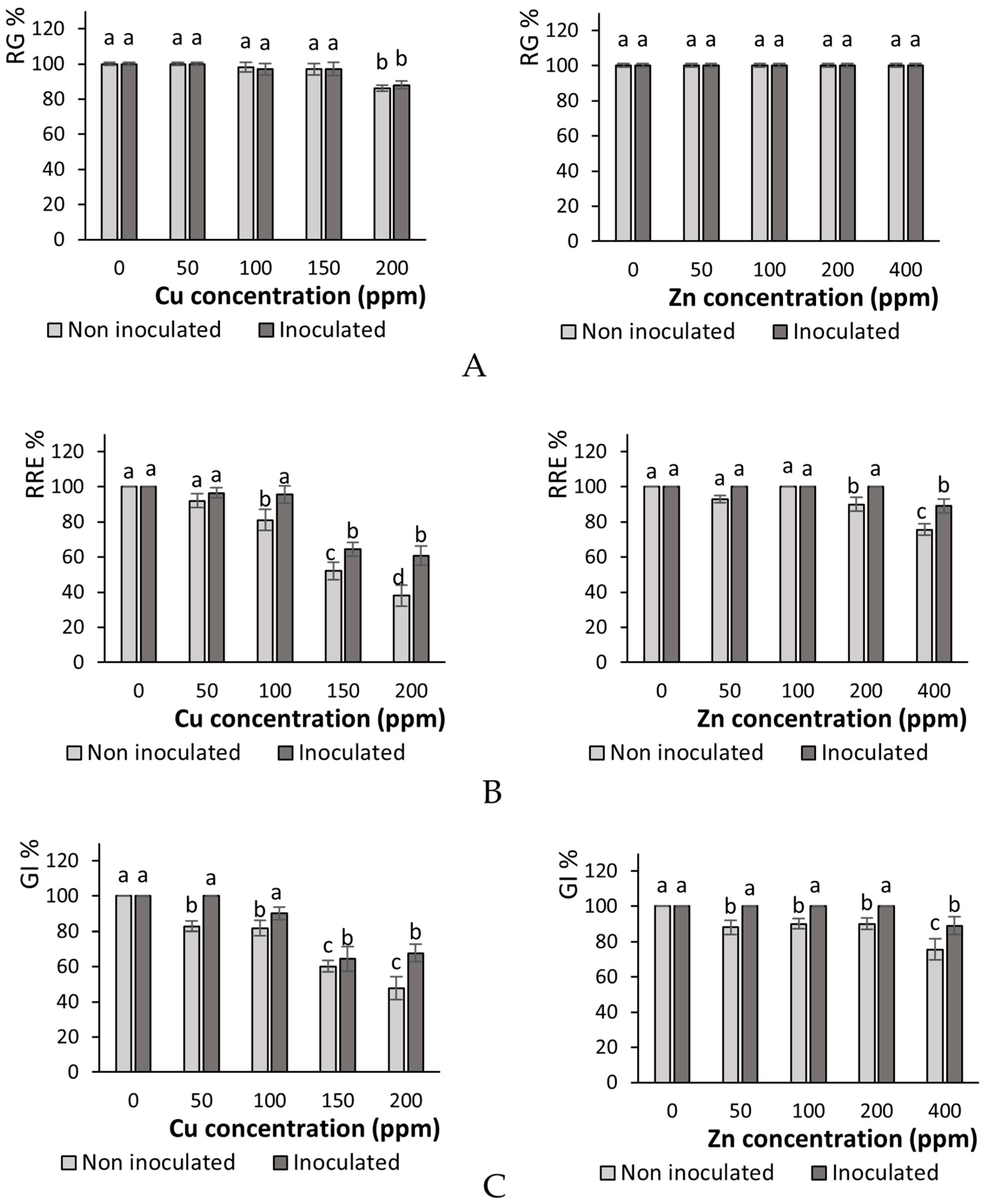
Cupper had a significantly negative effect on germination percentage (RG %) at 200 ppm in the culture solution (Figure 1), the maximum concentration evaluated, reducing germination by 14%. However, increasing Zn concentrations, from 0 to 400 ppm, had no impact on this parameter. No significant differences were found between no seed inoculation versus seed inoculation for all the tested concentration of the two metals studied.
The relative radicle elongation percentage (RRE) was reduced for Cu concentrations as low as 100 ppm, while for Zn, the reduction in this parameter was first observed for solutions with 200 ppm (Figure 1B). Thus, RRE decreased by 19%, 48% and 2% with 100, 150 and 200 ppm Cu, respectively, in the germination solution. In the case of Zn, decreases of 10% and 24% were observed for 200 and 400 ppm of Zn in the solution, respectively.
Inoculation showed a positive effect on both metals, reducing their harmful effects. For the lowest concentrations of both metals, inoculation prevented the toxic effect, while for the higher concentrations, the positive effect was partial, being 24% and 60% for 150 and 200 ppm of Cu, respectively, and 18% for 400 ppm of Zn.
The germination index (IG %, Figure 1C) reflected the toxic effect of the metals on lettuce, as significant decreases were observed from 50 ppm of metal, although the effect remained in the non-toxicity zone according to Emino’s criteria for copper up to 100 ppm and for Zn up to 200 ppm. However, for copper, 150 ppm had moderate toxicity, while 200 ppm corresponded to high toxicity. In the case of Zn, for 400 ppm, the toxicity was moderate. Inoculation mitigates the negative effects of the highest concentrations of the two metals tested. Thus, Cu toxicity decreased from high to moderate for 200 ppm Cu and from moderate to non-toxic for 400 ppm Zn.

3.2. Effects of Inoculation and Substrate Copper or Zinc Excess on Plant Growth

3.2.1. Above- and Below-Ground Plant Biomass

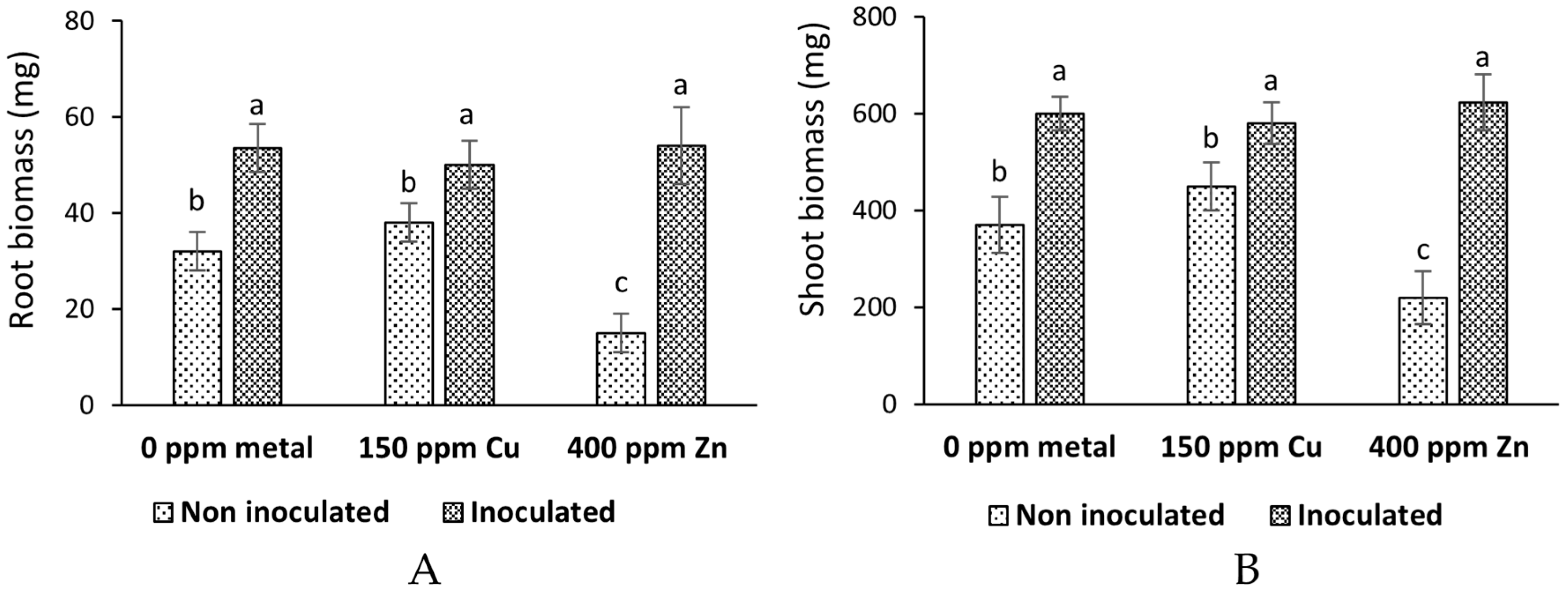
The presence of Cu in the substrate had no effect on root and shoot biomass. However, Zn caused a significant decrease in both parameters, with a 54% reduction in root biomass and a 40% reduction in shoot biomass (Figure 2A,B).
Inoculation had a positive effect on lettuce growth in a metal-free substrate, causing a 68% increase in aerial plant biomass and a 62% increase in shoot biomass. Inoculation was also positive for lettuce grown in metal-contaminated soil, causing a 32% increase in root biomass and a 29% increase in shoot biomass in the case of copper, while for zinc the effects were greater, with increases of 260% and 183%, respectively.
For both metals, inoculated plants grown on overloaded substrates achieved a similar above- and below-ground biomass to plants grown in the control substrate without metal contamination.

3.2.2. Plant Height and Leaf Area

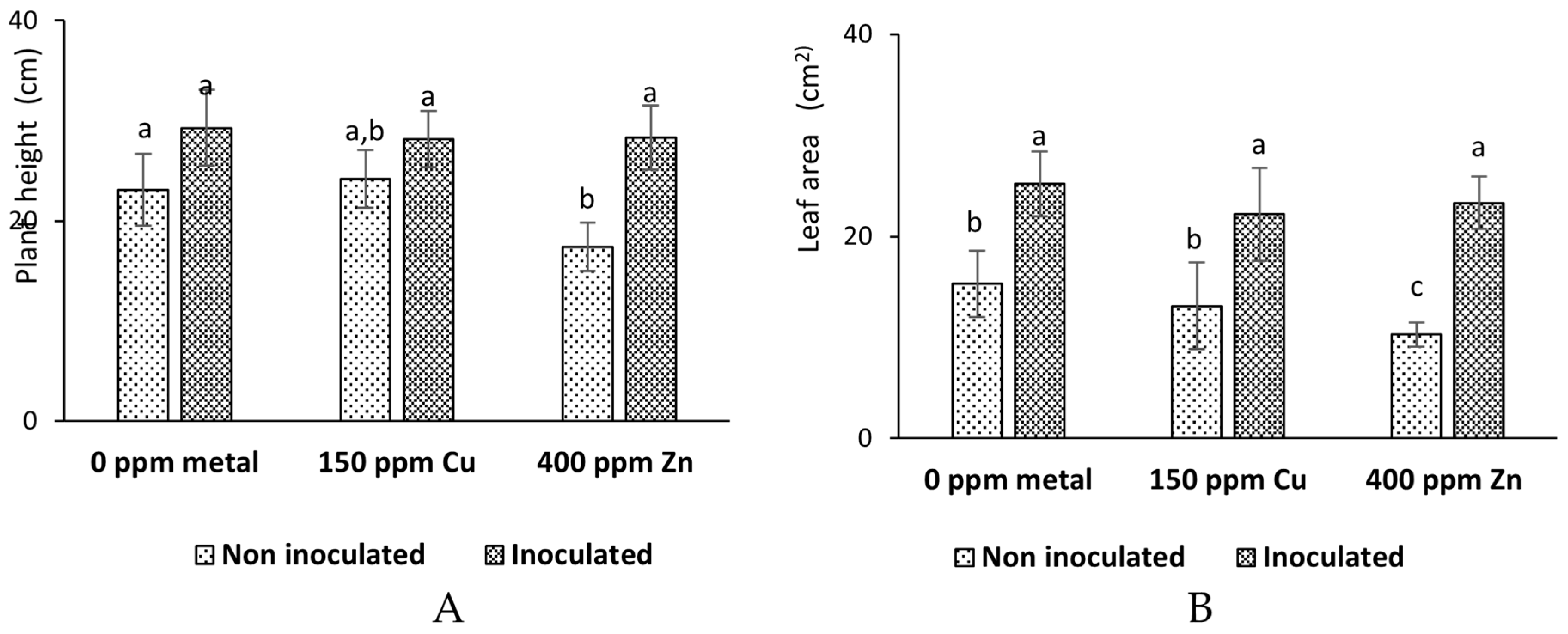
Leaf height and area were affected similarly to root and shoot biomass. Thus, Cu had no effect, while Zn caused a 25% decrease in height and a 33% decrease in leaf area (Figure 3A,B). Seed inoculation of plants growing in uncontaminated soils had a significant (p < 0.05) positive effect on leaf surface, but not on plant height.
However, inoculation had a positive effect on both parameters when inoculated seeds were grown in metal-contaminated soil. In the case of plant height, inoculation caused a 17% increase in growth in copper-contaminated substrate and a 63% increase in zinc-contaminated substrate, while in leaf area, the increases were 69% and 126%, respectively.

3.3. Elemental Composition in Response to Inoculation and Copper or Zinc Excess

3.3.1. Copper or Zinc Accumulation in Leaves

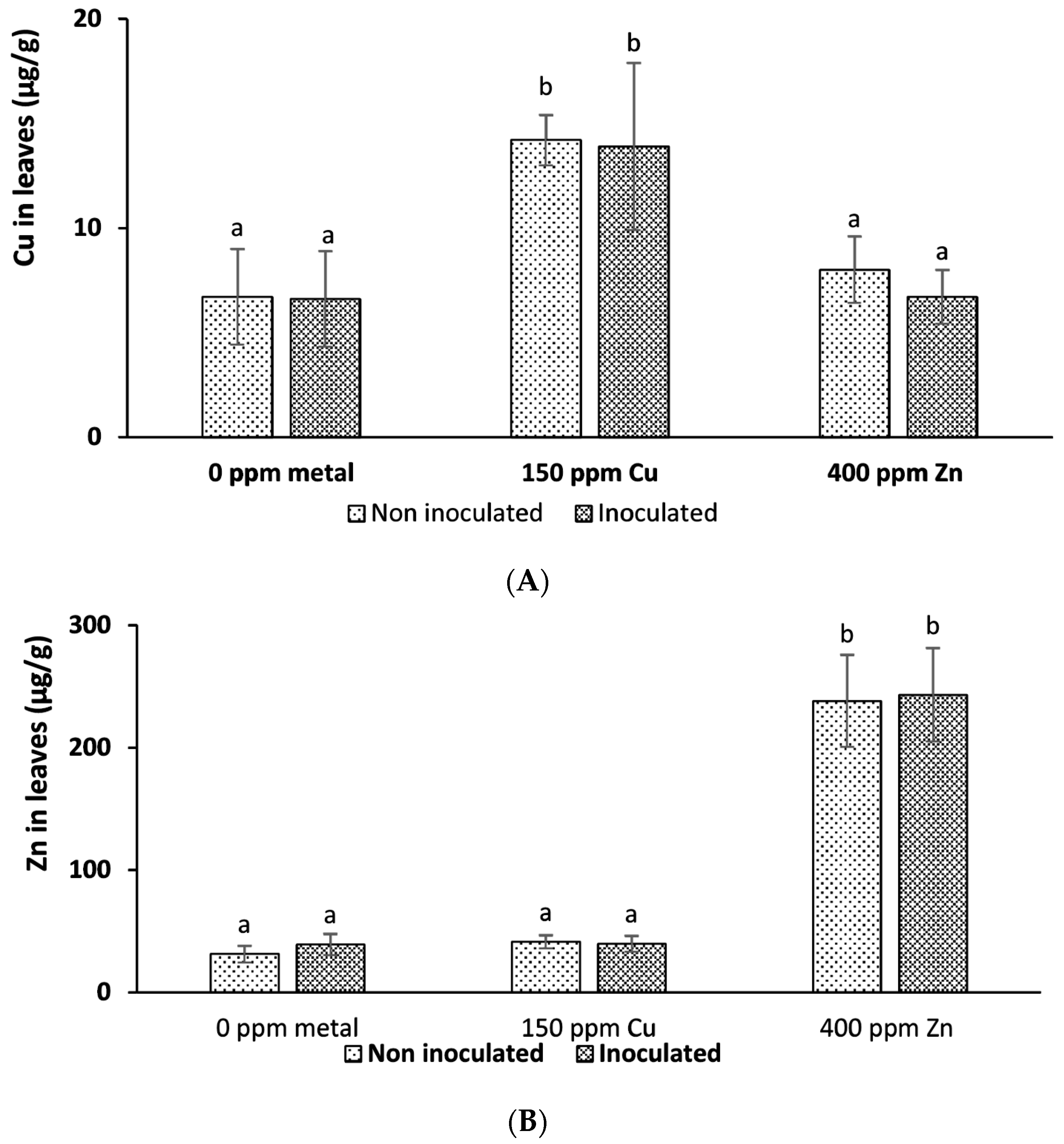
Metal accumulation was observed in lettuce leaves when seeds were grown in substrates with Cu or Zn overload. In the case of Cu-contaminated substrate (Figure 4A), lettuce plants showed a 112% higher metal concentration than the plants on the control treatment, while Zn uptake was not altered, remaining similar to that of the plants on the control. In the case of lettuce growing in Zn-contaminated substrate (Figure 4B), the concentration of this metal increased by 666%, while Cu uptake was not altered, being similar to that of the plants on the control. Seed inoculation with biofilm did not affect metal uptake in any case.

3.3.2. Macro- and Microelement Concentrations in Lettuce Leaves

The concentrations of macroelements (C, N, H, S, P, Ca, K and Mg) and microelements or heavy metals different to Cu and Zn (Fe, Mn, Pb, Cd) in lettuce leaves are shown in Table 2 and Table 3, respectively. No significant differences were found between the six treatments studied for any of these elements. Therefore, their concentration was affected neither by excess Cu or Zn in the substrate nor by seed inoculation.

3.4. Bioconcentration Factor, Daily Intake of Metal and Target Hazard Quotation for Copper and Zinc

Bioconcentration factors, daily intakes of metal and target hazard quotations for Cu and Zn are shown in Table 4. DIM and THQ were estimated using two different methods. The bioaccumulation of Zn in the edible parts of lettuce was more than three times higher than that of Cu. Therefore, the daily amount of Zn ingested was much higher than that of Cu.
DIM (daily intake of metal) and THQ (target hazard quotation) were estimated for adults and for children as described before, considering lettuce to be the only vegetable consumed. THQ is commonly used as an indicator of the health risk of consuming foods containing a specific toxic element. DIM and THQ were higher for plants growing in Zn-contaminated substrates compared to the Cu counterpart. THQ values less than one indicate that the lettuce consumption poses no risks. All the target hazard quotation values obtained were below one, suggesting that the consumption of lettuce grown in Cu- or Zn-contaminated soils would not be a health risk.
Table 3 and Table 4 show that seed inoculation with biofilm had no significant effects (p < 0.05) on the accumulation of heavy metals in lettuce leaves. Similarly, seed inoculation did not impact DIM and THQ.

4. Discussion

4.1. Perspectives in Alleviating Substrate Metal Overload for Sustainable Crop Production

The increasing contamination of agricultural soils by heavy metals can reduce food production or pose a danger to human health. One way to reduce these harmful effects relies on applying a natural-based solution, through the use of plant-growth-promoting bacteria, which can exert their promoting activity even in the presence of heavy metals. In this work, inoculation of Lactuca sativa seeds with biofilm of B. subtilis subsp. spizizenii improved germination and plant growth in the presence of toxic concentrations of the heavy metals copper or zinc.
Copper and zinc are essential heavy metals, critical to the physiological and biochemical functions of plants. However, both can reach toxic concentrations due to direct contamination or poor soil management. The use of land near large cities as agricultural areas, with soils often unsuitable for cultivation, entails the repeated application of agrochemicals and amendments to increase crop productivity. These heavy metals, being non-biodegradable, can accumulate in the soil, deteriorating it and reaching levels that are potentially toxic to crops. Furthermore, atmospheric deposition of pollutants arising from roads and industries can increase metal contamination of these areas [6,35]. Therefore, crops grown near cities may have higher concentrations than those produced in open fields [35,36]. Even vegetables grown in greenhouses can be contaminated with heavy metals [3,37]. For example, in the green belt of Buenos Aires, Argentina, horticultural production is very intense, and a wide variety of species are cultivated. Most of the cultivation areas are open-air, but many producers also have greenhouse cultivation systems, risking contamination [38,39]. Given the current situation, it is important to use nature-based solutions as a strategy to improve germination and plant production on contaminated soils/substrates. On the one hand, this can complement or replace, at least partially, the use of potentially contaminating agrochemicals or amendments. On the other hand, vegetables are allowed to be grown in formerly contaminated soils without loss of crop yield.
One of the most widespread crops globally is lettuce. The average consumption of lettuce per inhabitant in Argentina is about 19 kg per year, making it the most consumed vegetable after potatoes and tomatoes [36]. In addition, as indicated previously, it is a toxicity indicator vegetable, used in tests to evaluate the toxicity of soil and sediments [27,39]. Therefore, it is a suitable vegetable to study whether inoculation with B. subtilis subsp. spizizenii could serve to reduce the toxicity of heavy metals.
Bacteria used as PGPB in contaminated soils should be resistant to excessive metal levels. Resistance to a particular metal depends on the type of microorganism and the metal itself [22,40,41]. The genus Bacillus is known to promote plant growth in soils contaminated with heavy metals [19]. Our previous studies demonstrated that B. subtilis is able to grow in the presence of toxic concentrations of copper [24] or zinc [25].
Various mechanisms can enhance the resistance of living organisms to metal excess. Most commonly, cells are ready to use two mechanisms: inhibition of enzymatic activities or generation of reactive oxygen species (ROS). Copper generates ROS directly by redox reactions, while zinc generates them indirectly by stimulating ROS-producing enzymes such as NADPH oxidases. To maintain bacteria homeostasis in the presence of excess metals, sequestration systems in storage proteins and efflux pumps can be activated [19,42,43]. Other mechanisms used by bacteria to enhance resistance to heavy metals include sequestration before entering the cells (by binding to molecules secreted by the bacteria) or by producing exopolysaccharides (EPSs). The latter are fundamental components of biofilms, which gives mechanical stability, mediates communication between cells and induces the formation of a synergistic microconsortium in which cell life is distinct from planktonic one [18]. Thus, EPSs are produced as a self-defense against environmental stress. Due to their high capacity to bind heavy metals and reduce their bioavailability to plants, EPSs represent a possible mechanism for promoting plant growth by PGPRs in the presence of toxic metals [11,16,19,44,45]. B. subtilis has been found to produce biofilm whose main component was EPSs [22,23].

4.2. Effects of Substrate Metal Overload on Seed Germination

Inoculation of seeds with a B. subtilis biofilm can have several advantages. On the one hand, the EPSs of the biofilm can facilitate the attachment of the bacteria to the seed surface and protect it from heavy metals during germination. On the other hand, the biofilm can serve as a source of bacteria for both the colonization of the developing seedling and the associated rhizosphere. Finally, the presence of bacterial spores in the biofilm can act as a continuous bacterial reservoir.
Seed germination is a very complex process. Seeds in a dormant state initiate a very active metabolism, in that enzymes and hormones are activated, mobilizing carbon and nitrogen reserves. Seeds have their own protection mechanisms that allow them to germinate in environments contaminated with heavy metals. This includes reduction in metal uptake, chelation of metals within the cells by metallothioneins and phytochelatins and the induction of antioxidant defenses [4,46,47]. In this study, seed germination showed different sensitivity to heavy metals, as Cu had a higher inhibitory effect than Zn. This could be due to the protective effect of seed coat, which has one or more layers of thick-walled cells that can absorb heavy metals, preventing the metal from reaching the inside of the seed [46]. Also, inhibitory effects on water uptake during the first stage of germination, the imbibition, have been found for Cu, but not for Zn [47]. However, both metals affected the relative percentage of root elongation, and, again, the effect of Cu was higher. After radicle emergence appears a plumule, the protective effect of the seed coat vanishes, and the embryo is exposed to the toxicity of the metal. Many of the toxic effects of heavy metals are related to the generation of oxygen free radicals, which oxidize proteins, lipids and even DNA [46,47,48]. It is known that Cu inhibits enzymes such as acid phosphatases, proteases and α-amylases that mobilize nutrients in the endosperm [48]. The toxic effects of the studied metals are most evident in view of the germination index, which involves the entire germination process, and takes into account three categories of toxicity [30]. According to this index, 200 ppm of Cu corresponded to high toxicity, while the toxicity of 400 ppm of Zn was moderate. Moreira [46] observed that Zn did not affect the germination percentage of lettuce seeds, but it did affect the development of the seedling and that the toxic effect of copper was greater than that of zinc. Kranner [47] has suggested that Zn would act after the seed has started germination, unlike Cu, which would act since imbibition.
Seed inoculation with B. subtilis biofilm alleviated the negative effects of Cu and Zn on both the germination percentage and the elongation of the radicles. These beneficial effects could be due to several factors, for example, the exopolysaccharides produced by B. subtilis could bind metals, reducing their bioavailability; also, the production of hormones could stimulate the development of seedlings. B. subtilis produces, among other growth hormones, indole acetic acid (IAA), which stimulates radicle elongation [23]. A positive correlation was observed between the production of IAA by phosphate-solubilizing bacteria of the genus Bacillus and its effect on root development [49]. The presence of metals could affect the production of IAA by the bacteria. An increase in IAA production has been determined by the bacterial strains Serratia K120, Enterobacter K131, Enterobacter N9, and Escherichia N16 [50], while Bradyrhizobium japonicum does not decrease its IAA production under Cu stress [51].

4.3. Effects of Substrate Metal Overload on Plant Growth

The effect of metals on lettuce growth depends also on the heavy metal investigated. Copper and Zn displayed contrasting impacts on germination and plant growth. While Cu behaved as a more severe inhibitor of germination, Zn exhibited more pronounced harmful effects on growth parameters. Zinc is an essential element during plant development; it is considered the most yield-limiting micronutrient in crop global production, even though it is not necessary in the early stages of germination [52]. Thus, the significant decrease in root and shoot biomass, as well as in height and leaf area, caused by Zn could be due to a relatively high mobility of this metal from the soil to the plant, leading to toxic concentrations of the metal [53]. The relatively low Cu toxic effects found in this study is consistent with previous evidence [54]. In contrast, others have reported severe reduction in shoot biomass and leaf area using similar Cu concentrations to those in our work [55]. Toxicity is a multi-faceted problem, and various factors have been shown to increase Cu toxicity, for example, phosphate deficiency [56] or soil cation exchange capacity [57]. Most mechanisms involved on plant heavy metal toxicity are similar to those aforementioned for germination and seedling growth, e.g., disruption of photosynthesis and generation of oxygen free radicals [7,48]. In the particular case of Zn, a decrease in the relative water content in the tissues also has been observed, leading to strong dehydration. This is probably due to the metal accumulation in the above-ground part of the plant [58].
Seed inoculation with B. subtilis subsp. spizizenii biofilm had a growth-promoting effect on lettuce, as this practice increased root and shoot biomass, plant height and leaf area. Thus, the effect of seed biofilm inoculation was to prevent the harmful effects of Cu and Zn on plant growth, allowing the biomass of plants grown in contaminated soils to match controls. Plant-growth-promoting action of B. subtilis could be due to either its capacity to produce phytohormones such as IAA, cytokinin, or to the increase in phosphorus bioavailability [21,24]. The increase in root biomass suggests that the plant can increase its contact area with the soil, which means enhancing the acquisition of nutrients and therefore increasing plant growth. As the interaction between plant and soil occurs through the roots, and this is the area of greatest contact with heavy metals, the presence of the bacteria could decrease the toxic effect of the metal, for example, by decreasing its bioavailability. The bacterium strain used in the current study also had been inoculated on tomato seeds and was recovered from inside the root of tomato plants [24], suggesting that it could act as an endophytic bacterium. This type of bacterium also can alter the metal accumulation capacity in plants by excreting metal immobilizing extracellular polymeric substances, as well as metal mobilizing organic acids and biosurfactants [59].
In summary, seed inoculation essentially turns a stressed, low-biomass plant into a healthy one by managing the contaminant in the soil and promoting better plant metabolism. In addition to defense mechanisms at the root level (exudation, EPS production, immobilization, etc.) and at the biochemical and physiological scale (antioxidants, nutrient solubilization, phytohormones such as IAA, etc.), translocation and leaf sequestration also play a role in minimizing growth reduction under metal stress. Therefore, vegetables, including lettuce, are able to transport absorbed metals to the shoot, but effectively sequester them within the vacuoles of leaf cells. Chelating agents that bind heavy metals, reducing their free activity in the cytoplasm, are also produced. Thus, the combination of root retention, vacuole storage, and antioxidant defense helps maintain chlorophyll content and minimize, although not completely eliminate, growth reduction under substrate metal overload [23,40,47].

4.4. Metal Accumulation in the Plant Following Substrate Overload

The transfer of metal from soil to lettuce leaves was several times higher for Zn than for Cu. This result is in line with reports from others [3,6,60]. Soil–plant transfer factors of heavy metals are thought to be a way of considering the problems that the presence of toxic metals in agricultural soils can cause for human health [3]. Nonetheless, it is important to note that two different frameworks may be used to evaluate the risk of hazardous substances on living systems. Therefore, general toxicology focuses on the adverse effects of chemical agents on human or animal health, while phytotoxicity specifically measures the inhibition or disruption of plant growth, development and/or physiology. Although related, these approaches are not equivalent. In this work, we rely on phytotoxic assays, which are often consider as insufficient to predict impacts on human health.
In this work, the potential risk posed to human health by the consumption of lettuce cultivated in substrates contaminated with Cu or Zn was roughly assessed for adults and children by estimating that all vegetables ingested were lettuce. For both populations, the value of the target hazard quotation, THQ, was much less than one, suggesting that, based on phytotoxic results, the consumption of lettuce grown in Zn- or Cu-contaminated soils has no risk for humans. Moreover, the transfer factors were not affected by biofilm seed inoculation. This is a key aspect, because if biofilm inoculation did not increase the metal concentration in lettuce leaves, then the risk of toxicity caused by the heavy metal presence would not be increased by using this cultivation technique.
The inoculation protective effect of inoculation was probably triggered by the stimulation of PGPB mechanisms (production of phytohormones, increased availability of nutrients, etc.) responsible for the increased plant growth, rather than by a reduction in the bioavailability of toxic metals. Accumulation rates of heavy metals are plant specific. Depending on the strategies they use to cope with heavy metals in soil, plants have been classified as accumulators, excluders and indicators. Leafy vegetables, including lettuce, belong to the group of accumulator plants [61]. Among plants cultivated for human consumption, leafy vegetables accumulate more heavy metals than other crops such as tubers or fruits [3,6,62].
Enhanced Cu and Zn accumulation in plants was largely a function of their substrate overload. In addition, biofilm inoculation increased the phytoextraction capacity of plants, allowing them to accumulate heavy metals in their shoots and roots without necessarily harming plant growth. Therefore, first, substate heavy metal overload promotes high solubilization and bioavailability, then, PGPRs improve metal mobilization and uptake through various mechanisms, including organic acid production and siderophore secretion. Moreover, tolerance mechanisms mitigate the effects on plant growth of metals that have entered the root and translocate to the leaves [24,59].
No seed inoculation or substrate contamination impacts on the concentrations of heavy metals, other than Cu and Zn (Table 3) and also on those of macroelements (Table 2), were detected. On the one hand, the other heavy metals listed in Table 3 are required in low amounts (e.g., Fe, Mn) or are toxic at low levels (e.g., Pb, Cd). Therefore, plants have evolved strong exclusion mechanisms of toxic elements, as part of an avoidance strategy, preventing uptake from the soil or promoting accumulation at the root level [25,41,42]. On the other hand, the impact of biofilm inoculation on macroelement nutrient levels listed in Table 2 (C, N, P, K, etc.) can be peculiar; therefore, they are independently regulated and frequently remain unchanged [25].

5. Conclusions

The toxic effects of heavy metal substrate overload on lettuce were dissimilar for Cu and Zn. Copper acted primarily during germination, while the role of zinc was more important during plant growth.
Above- and below-ground biomasses of lettuce plants growing from inoculated seeds on contaminated substrates were not significantly different from those of plants growing on non-contaminated substrates. Therefore, seed biofilm inoculation prevented the harmful effects of Cu and Zn on plants, allowing biomass of plants growing in contaminated soils to match controls.
Lettuce leaves of plants growing in substrates with Cu or Zn overload showed accumulation of these heavy metals. The potential risk for human health associated with Cu or Zn ingestion did not increase with seed inoculation, as the heavy metal content in the leaves was not affected by this practice.
Overall, inoculation with B. subtilis subsp. spizizenii is a nature-based, environmentally friendly methodology that can increase the yield of crops growing in soils contaminated with heavy metals. Seed inoculation with biofilm also promotes sustainable crop growth with reduced application of fertilizers and pesticides.

Author Contributions

Conceptualization, G.C.S., M.E.G. and A.P.G.; methodology, G.C.S., J.A.E.C.-M., G.M.A., E.C.-A. and A.P.G.; formal analysis, G.C.S., M.E.G., J.A.E.C.-M., A.R.G., G.M.A. and A.P.G.; investigation, G.C.S., M.E.G., G.M.A. and J.A.E.C.-M.; resources, G.C.S., A.R.G., E.C.-A. and A.P.G.; writing—original draft preparation, G.C.S., M.E.G. and A.P.G.; writing—review and editing, G.C.S., M.E.G., E.C.-A. and A.P.G.; supervision, G.C.S., M.E.G., E.C.-A., A.R.G. and A.P.G.; project administration, G.C.S.; funding acquisition, G.C.S. All authors have read and agreed to the published version of the manuscript.

Funding

This work was funded by Universidad de Buenos Aires, Ciencia y Técnica projects (UBAC y T), grant number 20020220400161BA.

Data Availability Statement

The original contributions presented in this study are included in the article. Further inquiries can be directed to the corresponding author.

Acknowledgments

The Faculty of Agronomy, University of Buenos Aires, is acknowledged for enabling the use of the laboratory and greenhouse facilities. The Interdisciplinary Center for Chemistry and Biology, CICA, is acknowledged for enabling the use of the laboratory.

Conflicts of Interest

The authors declare no conflicts of interest.

References

  1. Blanco, A.; Salazar, M.J.; Vergara Cid, C.; Pignata, M.L.; Rodriguez, J.H. Accumulation of lead and associated metals (Cu and Zn) at different growth stages of soybean crops in lead-contaminated soils: Food security and crop quality implications. Environ. Earth Sci. 2017, 76, 182. [Google Scholar] [CrossRef]
  2. Giuffré, L.; Ratto, S.; Marbán, L.; Schonwald, J.; Romaniuk, R. Heavy Metal Risks in Urban Agriculture. Cienc. Suelo Argent. 2005, 23, 101–106. (In Spanish) [Google Scholar]
  3. Rai, P.K.; Leeb, S.S.; Zhang, M.; Tsang, Y.F.; Kime, K. Heavy metals in food crops: Health risks, fate, mechanisms, and management. Environ. Int. 2019, 125, 365–385. [Google Scholar] [CrossRef]
  4. Li, C.; Zhou, K.; Qin, W.; Tian, C.; Qi, M.; Yan, X.; Han, W. A review on heavy metals contamination in soil: Effects, sources, and remediation techniques. Soil Sediment Contam. Int. J. 2019, 28, 380–394. [Google Scholar] [CrossRef]
  5. Jordão, C.P.; de Andrade, R.P.; Cotta, A.J.; Cecon, P.R.; Neves, J.C.; Fontes, M.P.; Fernandes, R.B. Copper, nickel and zinc accumulations in lettuce grown in soil amended with contaminated cattle manure vermicompost after sequential cultivations. Environ. Technol. 2013, 34, 765–777. [Google Scholar] [CrossRef] [PubMed]
  6. Zhou, J.; Duc, B.; Liua, H.; Cuid, H.; Zhanga, W.; Fan, X.; Cui, J.; Zhou, J. The bioavailability and contribution of the newly deposited heavy metals (copper and lead) from atmosphere to rice (Oryza sativa L.). J. Hazard. Mater. 2020, 384, 121285. [Google Scholar] [CrossRef]
  7. Shabbir, Z.; Sardar, A.; Shabbir, A.; Abbas, G.; Shamshad, S.; Khalid, S.; Natasha; Murtaza, G.; Dumat, C.; Shahid, M. Copper uptake, essentiality, toxicity, detoxification and risk assessment in soil-plant environment. Chemosphere 2020, 259, 127436. [Google Scholar] [CrossRef]
  8. Natasha, N.; Shahid, M.; Bibi, I.; Iqbal, J.; Khalid, S.; Murtaza, B.; Bakhat, H.F.; Farooq, A.B.U.; Amjad, M.; Hammad, H.M.; et al. Zinc in soil-plant-human system: A data-analysis review. Sci. Total Environ. 2022, 808, 152024. [Google Scholar] [CrossRef]
  9. Mir, A.R.; Pichtel, J.; Hayat, S. Copper: Uptake, toxicity and tolerance in plants and management of Cu-contaminated soil. Biometals 2021, 34, 737–759. [Google Scholar] [CrossRef]
  10. Wang, R.X.; Wang, Z.H.; Sun, Y.D.; Wang, L.L.; Li, M.; Liu, Y.T.; Zhang, H.M.; Jing, P.W.; Shi, Q.F.; Yu, Y.H. Molecular mechanism of plant response to copper stress: A review. Environ. Exp. Bot. 2024, 218, 105590. [Google Scholar] [CrossRef]
  11. Pal, A.; Bhattacharjee, S.; Saha, J.; Sarkar, M.; Mandal, P. Bacterial Survival Strategies and Responses under Heavy Metal Stress: A Comprehensive Overview. Crit. Rev. Microbiol. 2022, 48, 327–355. [Google Scholar] [CrossRef]
  12. Hussain, S.; Khan, M.; Sheikh, T.M.M.; Mumtaz, M.Z.; Chohan, T.A.; Shamim, S.; Liu, Y. Zinc Essentiality, Toxicity, and Its Bacterial Bioremediation: A Comprehensive Insight. Front. Microbiol. 2022, 13, 900740. [Google Scholar] [CrossRef]
  13. Yu, J.; Huang, X.; Ren, F.; Cao, H.; Yuan, M.; Ye, T.; Xu, F. Application of antimicrobial properties of copper. Appl. Organomet. Chem. 2024, 38, e7506. [Google Scholar] [CrossRef]
  14. Kumar, R.; Umarb, A.; Kumara, G.; Nalwad, H.S. Antimicrobial properties of ZnO nanomaterials: A review. Ceram. Int. 2017, 43, 3940–3961. [Google Scholar] [CrossRef]
  15. Vimal, S.R.; Singh, J.S.; Prasad, S.M. Plant–Microbe Dynamics as a Nature-Based Solution for Sustainable Agriculture. Anthr. Sci. 2022, 1, 428–443. [Google Scholar] [CrossRef]
  16. Wang, Y.; Narayanan, M.; Shi, X.; Chen, X.; Li, Z.; Natarajan, D.; Ma, Y. Plant growth promoting bacteria in metal-contaminated soil: Current perspectives on remediation mechanisms. Front. Microbiol. 2022, 13, 966226. [Google Scholar] [CrossRef]
  17. Miljaković, D.; Marinković, J.; Balešević-Tubić, S. The Significance of Bacillus spp. in Disease Suppression and Growth Promotion of Field and Vegetable Crops. Microorganisms 2020, 8, 1037. [Google Scholar] [CrossRef] [PubMed]
  18. Ajijah, N.; Fiodor, A.; Pandey, A.K.; Rana, A.; Pranaw, K. Plant Growth-Promoting Bacteria (PGPB) with Biofilm-Forming Ability: A Multifaceted Agent for Sustainable Agriculture. Diversity 2023, 15, 112. [Google Scholar] [CrossRef]
  19. Alotaibi, B.S.; Khan, M.; Shamim, S. Unraveling the Underlying Heavy Metal Detoxification Mechanisms of Bacillus Species. Microorganisms 2021, 9, 1628. [Google Scholar] [CrossRef] [PubMed]
  20. Sarti, G.C.; Miyazaki, S.S. Actividad antifúngica de extractos crudos de Bacillus subtilis contra fitopatógenos de soja (Glycine Max) y efecto de su coinoculación con Bradyrhizobium japonicum. Agrociencia 2013, 47, 373–383. [Google Scholar]
  21. Galelli, M.E.; Sarti, G.C.; Miyazaki, S.S. Lactuca sativa Biofertilization Using Biofilm from Bacillus with PGPR Activity. J. Appl. Hortic. 2015, 17, 186–191. [Google Scholar] [CrossRef]
  22. Sarti, G.C.; Galelli, M.E.; Arreghini, S.; Cristóbal-Miguez, J.A.E.; Curá, J.A.; Paz-González, A. Inoculation with Biofilm of Bacillus subtilis Promotes the Growth of Lactuca sativa. Sustainability 2023, 15, 15406. [Google Scholar] [CrossRef]
  23. Sarti, G.C.; Galelli, M.E.; Cristóbal-Miguez, J.A.E.; Cárdenas-Aguiar, E.; Chudil, H.D.; García, A.R.; Paz-González, A. Inoculation with Biofilm of Bacillus subtilis Is a Safe and Sustainable Alternative to Promote Tomato (Solanum lycopersicum) Growth. Environments 2024, 11, 54. [Google Scholar] [CrossRef]
  24. Sarti, G.C.; Paz-González, A.; Cristóbal-Míguez, J.A.E.; Arnedillo, G.; García, A.R.; Galelli, M.E. Tomato Seed Inoculation with Bacillus subtilis Biofilm Mitigates Toxic Effects of Excessive Copper in the Substrate. Processes 2025, 13, 2509. [Google Scholar] [CrossRef]
  25. Galelli, M.E.; Cristóbal-Miguez, J.A.E.; Cárdenas-Aguiar, E.; García, A.R.; Paz-González, A.; Sarti, G.C. The Effects of Seed Inoculation with Bacterial Biofilm on the Growth and Elemental Composition of Tomato (Solanum lycopersicum L.) Cultivated on a Zinc-Contaminated Substrate. Microorganisms 2024, 12, 2237. [Google Scholar] [CrossRef]
  26. FAOSTAT. Crops and Livestock Products. Lettuce and Chicory Production. 2022. Available online: https://www.fao.org/faostat/en/#data/QCL/visualize (accessed on 18 December 2024).
  27. OECD. Test No. 208: Terrestrial plant test: Seedling emergence and seedling growth test. In OECD Guidelines for the Testing of Chemicals; Section 2; OECD Publishing: Vienna, Austria, 2006. [Google Scholar] [CrossRef]
  28. Gerhardt, P.; Murray, R.; Wood, W.; Krieg, N. Methods of General and Molecular Bacteriology; Gerhardt, P., Ed.; American Society for Microbiology: Washington, DC, USA, 1994. [Google Scholar]
  29. Martí, L.A. Efecto de la salinidad y de la temperatura en la germinación de semillas de Limonium mansanetianum. Bachelor’s Thesis, Universidad Politécnica de Valencia, Valencia, Spain, 2010. [Google Scholar]
  30. Emino, E.R.; Warman, P.R. Biological Assay for Compost Quality. Compost. Sci. Util. 2004, 12, 342–348. [Google Scholar] [CrossRef]
  31. Luo, Y.; Liang, J.; Zeng, G.; Chen, M.; Mo, D.; Li, G.; Zhang, D. Seed Germination Test for Toxicity Evaluation of Compost: Its Roles, Problems and Prospects. Waste Manag. 2018, 71, 109–114. [Google Scholar] [CrossRef]
  32. Page, A.L. Methods of Soil Analysis. In Chemical and Microbiological Properties, 2nd ed.; John Wiley & Sons, Inc.: Hoboken, NJ, USA, 1982; pp. 1–1184. [Google Scholar]
  33. Schneider, C.A.; Rasband, W.S.; Eliceiri, K.W. NIH Image to ImageJ: 25 Years of Image Analysis. Nat. Methods 2012, 9, 671–675. [Google Scholar] [CrossRef]
  34. Mishra, A.K.; Singh, J.; Mishra, P.P. Toxic Metals in Crops: A Burgeoning Problem. In Sustainable Solutions for Elemental Deficiency and Excess in Crop Plants; Mishra, A.K., Singh, J., Mishra, P.P., Eds.; Springer Nature Singapore Pte Ltd.: Singapore, 2020. [Google Scholar] [CrossRef]
  35. Hu, Y.; Wang, C.; Song, Z.; Chen, M.; Ding, L.; Liang, X.; Bi, X.; Li, Z.; Li, P.; Zheng, W. Heavy Metal in Rice and Vegetable and Human Exposure near a Large Pb/Zn Smelter in Central China. Int. J. Environ. Res. Public Health 2021, 18, 12631. [Google Scholar] [CrossRef]
  36. Secretaría de Ganadería y Pesca. Ministerio de Economía, Argentina. Producción de lechuga en la Argentina. Evolución del cultivo hasta la temporada 2022. Available online: https://www.argentina.gob.ar/sites/default/files/2021/09/informe_lechuga_2023.pdf (accessed on 23 November 2024).
  37. Naccarato, A.; Tassone, A.; Cavaliere, F.; Elliani, R.; Pirrone, N.; Sprovieri, F.; Tagarelli, A.; Giglio, A. Agrochemical treatments as a source of heavy metals and rare earth elements in agricultural soils and bioaccumulation in ground beetles. Sci. Total Environ. 2020, 749, 141438. [Google Scholar] [CrossRef] [PubMed]
  38. Paladino, I.; Sokolowski, A.; Prack Mc Cormick, B.; Wolski, E.; Rodríguez, H.; Navas, M. Chapter 8—Soil Quality Problems Associated with Horticulture in the Southern Urban and Peri-Urban Area of Buenos Aires, Argentina. In Urban Horticulture—Necessity of the Future; Solankey, S., Akhtar, S., Maldonado, A., Rodriguez-Fuentes, H., Vidales Contreras, J., Márquez, R., Eds.; IntechOpen: London, UK, 2020. [Google Scholar]
  39. do Carmo, L.I.; Bursztyn Fuentes, A.L.; de los Ríos, A.; Fabrizio de Iorio, A.; Rendina, A.E. Effects of Green Waste Compost Addition to Dredged Sediments of the Matanza-Riachuelo River (Argentina) on Heavy Metal Extractability and Bioaccumulation in Lettuce (Lactuca sativa). Water Air Soil Pollut 2021, 232, 200. [Google Scholar] [CrossRef]
  40. Guo, J.; Muhammad, H.; Lv, X.; Wei, T.; Ren, X.; Jia, H.; Atif, S.; Hua, L. Prospects and applications of plant growth promoting rhizobacteria to mitigate soil metal contamination: A review. Chemosphere 2020, 246, 125823. [Google Scholar] [CrossRef]
  41. Gladkov, E.A.; Tereshonok, D.V.; Stepanova, A.Y.; Gladkova, O.V. Plant–Microbe Interactions under the Action of Heavy Metals and under the Conditions of Flooding. Diversity 2023, 15, 175. [Google Scholar] [CrossRef]
  42. Chandrangsu, P.; Rensing, C.; Helmann, J.D. Metal Homeostasis and Resistance in Bacteria. Nat. Rev. Microbiol. 2017, 15, 338–350. [Google Scholar] [CrossRef]
  43. Jalmi, S.K.; Bhagat, P.K.; Verma, D.; Noryang, S.; Tayyeba, S.; Singh, K.; Sharma, D.; Sinha, A.K. Traversing the Links between Heavy Metal Stress and Plant Signaling. Front. Plant Sci. 2018, 9, 12. [Google Scholar] [CrossRef]
  44. Redmile-Gordon, M.; Chen, L. Zinc toxicity stimulates microbial production of extracellular polymers in a copiotrophic acid soil. Int. Biodeterior. Biodegrad. 2017, 119, 413–418. [Google Scholar] [CrossRef] [PubMed]
  45. Ma, Y.; Oliveira, R.S.; Freitas, H.; Zhang, C. Biochemical and Molecular Mechanisms of Plant-Microbe-Metal Interactions: Relevance for Phytoremediation. Front. Plant Sci. 2016, 7, 918. [Google Scholar] [CrossRef]
  46. Neto Moreira, I.; Louro Martins, L.; Mourato, M.P. Effect of Cd, Cr, Cu, Mn, Ni, Pb and Zn on seed germination and seedling growth of two lettuce cultivars (Lactuca sativa L.). Plant Physiol. Rep. 2020, 25, 347–358. [Google Scholar] [CrossRef]
  47. Kranner, I.; Colville, L. Metals and seeds: Biochemical and molecular implications and their significance for seed germination. Environ. Exp. Bot. 2011, 72, 93–105. [Google Scholar] [CrossRef]
  48. Seneviratne, M.; Rajakaruna, N.; Rizwan, M.; Madawala, H.M.S.P.; Ok, Y.S.; Vithanage, M. Heavy metal-induced oxidative stress on seed germination and seedling development: A critical review. Environ. Geochem. Health 2019, 41, 1813–1831. [Google Scholar] [CrossRef] [PubMed]
  49. Sözer Bahadir, P.; Liaqat, F.; Eltem, R. Plant Growth Promoting Properties of Phosphate Solubilizing Bacillus Species Isolated from the Aegean Region of Turkey. Turk. J. Bot. 2018, 42, 183–196. [Google Scholar] [CrossRef]
  50. Nazli, F.; Mustafa, A.; Ahmad, M.; Hussain, A.; Jamil, M.; Wang, X.; Shakeel, Q.; Imtiaz, M.; El-Esawi, M.A. A Review on Practical Application and Potentials of Phytohormone-Producing Plant Growth-Promoting Rhizobacteria for Inducing Heavy Metal Tolerance in Crops. Sustainability 2020, 12, 9056. [Google Scholar] [CrossRef]
  51. Seneviratne, M.; Gunaratne, S.; Bandara, T.; Weerasundara, L.; Rajakaruna, N.; Seneviratne, G.; Vithanage, M. Plant growth promotion by Bradyrhizobium japonicum under heavy metal stress. S. Afr. J. Bot. 2016, 105, 19–24. [Google Scholar] [CrossRef]
  52. Liu, R.; Zhang, H.; Lal, R. Effects of Stabilized Nanoparticles of Copper, Zinc, Manganese, and Iron Oxides in Low Concentrations on Lettuce (Lactuca sativa) Seed Germination: Nanotoxicants or Nanonutrients? Water Air Soil Pollut. 2016, 227, 42. [Google Scholar] [CrossRef]
  53. Kaur, H.; Srivastava, S.; Goyal, N.; Walia, S. Behavior of zinc in soils and recent advances on strategies for ameliorating zinc phyto-toxicity. Environ. Exp. Bot. 2024, 220, 105676. [Google Scholar] [CrossRef]
  54. Gharbi, F.; Rejeb, S.; Ghorbal, M.H.; Morel, J.L. Plant Response to Copper Toxicity as Affected by Plant Species and Soil Type. J. Plant Nutr. 2005, 28, 379–392. [Google Scholar] [CrossRef]
  55. Wolf, M.; Baretta, D.; Becegato, V.A.; Almeida, V.C.; Paulino, A.T. Copper/Zinc Bioaccumulation and the Effect of Phytotoxicity on the Growth of Lettuce (Lactuca sativa L.) in Non-contaminated, Metal-Contaminated and Swine Manure-Enriched Soils. Water Air Soil Pollut. 2017, 228, 152. [Google Scholar] [CrossRef]
  56. Verdejo, J.; Ginocchio, R.; Sauvé, S.; Mondaca, P.; Neaman, A. Thresholds of copper toxicity to lettuce in field-collected agricultural soils exposed to copper mining activities in Chile. J. Soil Sci. Plant Nutr. 2016, 16, 154–158. [Google Scholar] [CrossRef]
  57. Yen Le, T.T.; Peijnenburg, W.J.G.M.; Hendriks, A.J.; Vijver, M.G. Predicting effects of cations on copper toxicity to lettuce (Lactuca sativa) by the biotic ligand model. Environ. Toxicol. Chem. 2012, 31, 355–359. [Google Scholar]
  58. Kaur, H.; Garg, N. Zinc toxicity in plants: A review. Planta 2021, 253, 129. [Google Scholar] [CrossRef]
  59. Ma, Y.; Rajkumar, M.; Zhang, C.; Freitas, H. Beneficial role of bacterial endophytes in heavy metal phytoremediation. J. Environ. Manag. 2016, 174, 14–25. [Google Scholar] [CrossRef] [PubMed]
  60. Eissa, M.A.; Negim, O.E. Heavy metals uptake and translocation by lettuce and spinach grown on a metal-contaminated soil. J. Soil Sci. Plant Nutr. 2018, 18, 1097–1107. [Google Scholar] [CrossRef]
  61. Sacristán, D.; Recatalá, L.; Viscarra Rossel, R.A. Toxicity and bioaccumulation of Cu in an accumulator crop (Lactuca sativa L.) in different Australian agricultural soils. Sci. Hortic. 2015, 193, 346–352. [Google Scholar] [CrossRef]
  62. Najmi, A.; Albratty, M.; Al-Rajab, A.J.; Alhazmi, H.A.; Javed, S.A.; Ahsan, W.; Rehman, Z.u.; Hassani, R.; Alqahtani, S.S. Heavy Metal Contamination in Leafy Vegetables Grown in Jazan Region of Saudi Arabia: Assessment of Possible Human Health Hazards. Int. J. Environ. Res. Public Health 2023, 20, 2984. [Google Scholar] [CrossRef] [PubMed]
Figure 1. Impact of inoculation of lettuce seeds with B. subtilis biofilm when germinated in the presence of increasing levels of copper or zinc. (A) Relative germination percentage (RG %). (B) Relative root elongation percentage (RRE %). (C) Germination index percentage (GC %). Values are means ± SD (n = 60). Different letters indicate significant differences between treatments at a probability level of p < 0.05.
Horticulturae 12 00255 g001
Figure 2. Lettuce root (A) and shoot (B) biomass harvest (60 days) from seeds inoculated with B. subtilis subsp. spizizenii biofilm grown in substrates with 150 ppm Cu or 400 ppm Zn. Different letters correspond to significant differences between treatments (p < 0.05).
Horticulturae 12 00255 g002
Figure 3. Lettuce plant height (A) and leaf area (B) biomass harvest (60 days) from seeds inoculated with B. subtilis subsp. spizizenii biofilm grown in substrates with 150 ppm Cu or 400 ppm Zn. Different letters correspond to significant differences between treatments (p < 0.05).
Horticulturae 12 00255 g003
Figure 4. Concentrations of Cu (A) and Zn (B) in leaves of L. sativa grown in three different substrates, i.e., control, 150 ppm Cu overload and 400 ppm Zn overload. Different letters indicate differences between treatments at the 0.05 probability level.
Horticulturae 12 00255 g004
Table 1. Phytotoxicity criteria established according to [30,31].
Germination Index (GI%)Toxicity Level
<50%High
50–80%Moderate
>80%No toxicity
Table 2. Macronutrient concentrations in lettuce leaves from seeds that received the following treatments: Control: uninoculated, grown in substrate without added metal; I: inoculated, grown in substrate without added metal; Cu: uninoculated, grown in substrate with 150 ppm copper; I + Cu: inoculated, grown in substrate with 150 ppm copper; Zn: uninoculated, grown in substrate with 400 ppm zinc; I + Zn: inoculated, grown in substrate with 400 ppm zinc. Super index letters do not change for the different treatments of every single element, indicating that no significant differences between treatments at the 0.05 probability level were found.
Carbon
(Percentage)
Nitrogen
(Percentage)
Hydrogen
(Percentage)
Sulfur
(mg/g)
Phosphorus
(mg/g)
Calcium
(mg/g)
Potassium
(mg/g)
Magnesium
(mg/g)
Control35.6 ± 0.9 a3.4 ± 1.1 a4.7 ± 0.1 a5.8 ± 0.2 a3.6 ± 0.4 a10.9 ± 2.8 a70.4 ± 5.22 a2.4 ± 0.3 a
I34.6 ± 0.9 a2.1 ± 0.7 a4.5 ± 0.1 a5.9 ± 0.2 a2.9 ± 0.3 a11.0 ± 2.8 a80.6 ± 6.0 a2.8 ± 0.3 a
Cu35.3 ± 1.3 a4.0 ± 0.2 a4.5 ± 0.1 a4.0 ± 0.4 a4.0 ± 0.7 a10.2 ± 0.8 a79.3 ± 4.2 a2.8 ± 0.3 a
I + Cu32.5 ± 2.1 a3.6 ± 0.8 a4.1 ± 0.2 a4.9 ± 0.6 a4.8 ± 1.1 a12.4 ± 2.5 a99.8 ± 6.9 a2.7 ± 0.2 a
Zn32.5 ± 3.1 a3.0 ± 0.2 a4.3 ± 0.6 a4.9 ± 0.2 a5.8 ± 0.3 a10.1 ± 1.0 a90.4 ± 2.0 a2.7 ± 0.3 a
I + Zn31.9 ± 3.1 a3.7 ± 0.3 a4.2 ± 0.5 a6.5 ± 0.3 a4.3 ± 0.3 a11.6 ± 1.0 a82.9 ± 1.9 a2.9 ± 0.3 a
Table 4. Bioconcentration factor, daily intake of metal and target hazard quotation for copper and zinc. BCF: bioconcentration factor; DIM: daily intake of metal (mg.kg−1 body weight. day−1); THQ: target hazard quotation. Treatments: 150 Cu: no inoculated grown in substrate with 150 ppm copper; 150 Cu + I: inoculated, grown in substrate with 150 ppm copper; 400 Zn: uninoculated, grown in substrate with 400 ppm zinc; 400 Zn + I: inoculated, grown in substrate with 400 ppm zinc.
BCFDIMadultsDIMchildrenTHQadultsTHQchildren
150 Cu21190.00990.01480.03290.0495
150 Cu + I21060.00950.01430.03170.0476
400 Zn76560.05740.08620.11480.1723
400 Zn + I62470.05860.08790.11710.1759
Table 3. Microelement concentration in lettuce leaves from seeds that received the following treatments: Control: uninoculated, grown in substrate without added metal; I: inoculated, grown in substrate without added metal; Cu: uninoculated, grown in substrate with 150 ppm copper; I + Cu: inoculated, grown in substrate with 150 ppm copper; Zn: uninoculated, grown in substrate with 400 ppm zinc; I + Zn: inoculated, grown in substrate with 400 ppm zinc. Super index letters do not change for the different treatments of every single element, indicating that no significant differences between treatments at the 0.05 probability level were found.
Iron
(µg/g)
Manganese
(µg/g)
Lead
(µg/g)
Cadmium
(µg/g)
Control326 ± 171 a62.9 ± 7.6 a3.0 ± 1.8 a0.33 ± 0.01 a
I346 ± 181 a58.7 ± 7.1 a4.4 ± 2.6 a0.44 ± 0.01 a
Cu294 ± 50 a74.4 ± 1.9 a2.4 ± 1.1 a0.45 ± 0.02 a
I + Cu347 ± 82 a54.4 ± 4.0 a3.9 ± 1.4 a0.52 ± 0.08 a
Zn392 ± 150 a51.0 ± 8.4 a4.1 ± 2.5 a0.37 ± 0.04 a
I + Zn380 ± 146 a55.1 ± 9.2 a3.7 ± 2.2 a0.38 ± 0.04 a
Disclaimer/Publisher’s Note: The statements, opinions and data contained in all publications are solely those of the individual author(s) and contributor(s) and not of MDPI and/or the editor(s). MDPI and/or the editor(s) disclaim responsibility for any injury to people or property resulting from any ideas, methods, instructions or products referred to in the content.