Article

Application of Peat or Biochar on Raphanus sativus L. ‘Cherry Belle’ Under Brackish Water Irrigation: Its Effect on Growth and Salt Tolerance


1
Shandong Facility Horticulture Bioengineering Research Center, Weifang University of Science and Technology, Shouguang 262700, China
2
Weifang Science and Technology Innovation Promotion Center, Weifang 262700, China
*
Authors to whom correspondence should be addressed.
These authors contributed equally to this work.
Horticulturae 2026, 12(2), 248; https://doi.org/10.3390/horticulturae12020248

Submission received: 19 January 2026 / Revised: 11 February 2026 / Accepted: 13 February 2026 / Published: 19 February 2026
(This article belongs to the Section Biotic and Abiotic Stress)

Abstract

The global shortage of freshwater, especially in agriculture, has become a serious threat to food security and safety; therefore, using brackish water with soil amendments in facility-grown vegetable production has drawn more attention recently. In this study, the effects of the combined use of peat or biochar at different rates (1%, 3%, and 5%) on soil properties, plant growth, and physiological responses were investigated in cherry belle radish (Raphanus sativus L.) irrigated with brackish water (5 g/L). The results revealed that peat significantly cut soil electrical conductivity (EC) by 42.61% and the pH value by 0.29, while biochar reduced soil EC by 32.44% but increased the pH value slightly. Both peat and biochar significantly increased the chlorophyll content and photosynthetic characteristics in cherry belle radish leaves and effectively promoted the accumulation of plant biomass. The net photosynthetic rate (Pn) of cherry belle radish in the soil amended with 5% peat or with 3% biochar increased by 89.06% and 85.94%, respectively, compared with CK, while the fresh weight of fleshy roots rose by 74.40% and 50.27%, respectively. This study further found that peat and biochar had effectively inhibited lipid peroxidation and proline accumulation in plants. The plasma membrane permeability was reduced by 41.18% and 39.90%, and the malondialdehyde (MDA) content decreased by 49.66% and 41.90%, respectively. In addition, peat and biochar significantly improved ion homeostasis in plants by increasing the ratios of K+/Na+ and Ca2+/Na+ in leaves, with the increment amplitudes reaching 90.21%/81.45% and 60.47%/79.15%, respectively. Nevertheless, biochar exhibited a superior effect compared to peat on balancing plant ions. In conclusion, a proper application of peat or biochar under brackish water irrigation has a significant potential to ameliorate soil properties and alleviate salt stress in plants, providing a safe approach for using brackish water with soil amendments in facility vegetable production in arid and semi-arid regions.

1. Introduction

With the intensification of global freshwater shortages and soil salinization, the sustainable development of agriculture is facing serious challenges, which has also drawn considerable attention to the efficient utilization of non-conventional water resources [1]. Agricultural water consumption accounts for 60–75% of the total water consumption in China each year. To reduce the massive consumption of freshwater resources in agricultural production, brackish water, as a type of non-conventional water resource, has become a promising approach in arid regions where scarce inland freshwater resources are available across the world and in China [2,3]. Wang et al. [4] found that irrigation with brackish water could increase the soil moisture content in the topsoil layer, and irrigation with brackish water of a low mineralization degree could reduce soil salt content. Although brackish water irrigation (BWI) increases soil moisture and alleviates water deficits in crops, it easily induces salt accumulation on the soil surface and further triggers ionic toxicity, osmotic stress, and photosynthetic inhibition in crops [5,6]. Chen et al. [7] indicated that long-term irrigation with brackish water exacerbates the risk of secondary soil salinization, which is unsuitable for crop growth. Therefore, exploring scientific methods to amend soil irrigated with brackish water is of great practical significance.
The negative effects of brackish water irrigation, such as aggravated soil salinization and physiological stresses, have severely restricted its agricultural use. The application of soil amendments is considered as one of the key approaches to safely use brackish water [8,9,10]. Peat is rich in humic acids, acidic with a high cation exchange capacity. It inhibits salt migration by reducing soil pH and binding Na+ [11], reducing evapotranspiration and salt accumulation on surface, and improving water efficiency in soil [12]. Chen et al. [13] confirmed that peat enhances the water holding capacity in aeolian sandy soil, decreases soil pH, increases soil nutrients, and facilitates the accumulation of dry matter in Chinese cabbage. Biochar is alkaline, porous and absorbs not only harmful ions such as Cl and Na+ in soil, but also promotes the formation of soil aggregates [14]. Gharred et al. [15] demonstrated that biochar improves the efficiency of water use, nutrient absorption, carbon assimilation capacity and antioxidant activity. Wu et al. [16] showed that biochar could promote chlorophyll synthesis, increase leaf stomatal conductance, maintain cell membrane stability and inhibit the excessive production of reactive oxygen species in plants under drought and saline–alkali stress. Nevertheless, there is no definitive assessment on the systematic effects of using peat or biochar at different application rates on soil properties and crop physiological metabolisms under BWI conditions. Yang et al. [17] reported that an appropriate application of biochar can promote tobacco plant growth, regulate enzyme activity and increase biomass accumulation, but an excessive application can result in an adverse effect. Singh et al. [18] suggested that low-dose biochar can retain and slowly release ions such as Ca2+ and K+ in soil through its adsorptive features, while high-dose biochar may immobilize these ions, making them difficult to be absorbed and utilized by crops.
Most studies on BWI have focused mainly on various crops, but on vegetables that are fast-growing, short in life span, and sensitive to salt stress. Research on soil amendments to enhance salt tolerance in facility-grown vegetables remains relatively unexplored. With a short growth cycle and high sensitivity to soil salinity, cherry belle radish (Raphanus sativus L.) is regarded as an ideal experimental material to evaluate crop physiological responses to BWI. Therefore, it is hypothesized that the growth, physiological activities and salt tolerance of cherry belle radish irrigated by brackish water can be enhanced by adding peat or biochar to amend soils. The results derived from such a study can also provide a theoretical basis and technical guidance for the safe agricultural utilization of brackish water for producing high-quality facility vegetables in arid and semi-arid regions.

2. Materials and Methods

2.1. Experimental Materials

Peat and biochar were used as soil amendments. Biochar (Pingdingshan Lvzhiyuan Activated Carbon Co., Ltd., Pingdingshan, China) was prepared through the pyrolysis of a mixture of crop straw, wood chips, and fruit shells at 600 °C and crushing the remnants into powder with a mesh size of 50–100. Peat was imported directly from Latvia by Shouguang Qinghe Runyang Agriculture Co., Ltd., Shouguang, China.
The brackish water was prepared by adding 5 g of crude sea salt into 1 L of water, and potted soil was collected from topsoil at the experimental site located near the campus of Weifang University of Science and Technology (WUST). The basic chemical properties and nutrient contents of potted soil, peat, and biochar are listed in Table 1.
Cherry belle radish (Raphanus sativus L.) used in the experiment is a fast-growing vegetable, highly sensitive to soil salinity, and ideal as an experimental plant to evaluate its physiological responses to brackish water, growth rate and yield. The seedlings were germinated from seeds, transplanted into pots, and tested under greenhouse conditions.

2.2. Experimental Methods

The experiment was carried out in a greenhouse at the experimental station of WUST, Shouguang City, Weifang City, Shandong Province, from April to May 2024. Plastic flowerpots (21 × 26 cm) filled with 7 kg of soil were used for three seedlings. Peat or biochar was mixed with topsoil at a 1%, 3% or 5% rate, respectively [19]. A total of seven treatments were established in this experiment, including CK (topsoil without any soil amendment), 1% PT (soil mixed with 1% peat), 3% PT (soil mixed with 3% peat), 5% PT (soil mixed with 5% peat), 1% BC (soil mixed with 1% biochar), 3% BC (soil mixed with 3% biochar), and 5% BC (soil mixed with 5% biochar). Three uniform and healthy seedlings at 2-leaf-1-bud stage were transplanted into a pot, with three pots per treatment as replicates. All potted plants were randomly arranged in a greenhouse and irrigated with 300 mL salted water (5 g/L) per pot once every 2 days throughout the whole season [20].

2.3. Measurements and Methods

2.3.1. Soil Salinity and pH Indicators

Soil samples in each pot were collected by a five-point sampling scheme, four at the edge and one in the center, before sowing and after harvest. A total of 100 g of soil collected 0–20 cm beneath the surface from each sampling point was composited, bagged, sealed, and air-dried at room temperature in a laboratory. The sample soils were ground and passed through a 1 mm standard sieve. Soil extract was prepared at a soil-to-water ratio of 5:1 with sufficient stirring and homogenization. EC and pH values for sample topsoil were measured using a conductivity meter (Leici DDS-307A, Shanghai INESA Scientific Instrument Co., Ltd., Shanghai, China) and a pH meter (Leici pHS-2F, Shanghai INESA Scientific Instrument Co., Ltd., Shanghai, China), respectively.

2.3.2. Fresh and Dry Weight of Plants

After harvest, leaves and fleshy roots of three uniform radish plants were separated, and the fresh weight of each tissue was immediately measured separately using an electronic analytical balance with a precision of 0.001 g. All samples were then placed in separate paper bags and dried in an electric constant temperature drying oven at 75 °C to a constant weight for their dry weight measurement.

2.3.3. Chlorophyll Content and Photosynthetic Parameters

The photosynthetic parameters were measured under a laboratory environment using a portable photosynthesis system (TARGAS-1, PP Systems, Inc. Amesbury, USA) from 9:00 a.m. to 11:00 a.m. on sunny days with a built-in light source. The effective light intensity for photosynthesis was 300 μmol m−2 s−1, with a CO2 concentration at 450 ± 20 μmol mol−1 and room temperature at 24 ± 1 °C. Three plants from each treatment and three leaves per plant were randomly selected for the measurement.
Mature leaf blades were picked, rinsed, and cut into pieces. A total of 20 mL of 95% ethanol was added to a 50 mL centrifuge tube containing approximately 0.2 g of leaf samples to extract chlorophylls. The absorbance values of each extract were determined using a spectrophotometer at 649 nm, 665 nm and 470 nm to calculate the content of chlorophyll a, chlorophyll b and carotenoids, respectively, using the following formulas [21]. The total chlorophyll content was the sum of chlorophyll a and chlorophyll b.
Concentration of chlorophyll a: Ca = (13.95 × A665 − 6.88 × A649);
Concentration of chlorophyll b: Cb = (24.96 × A649 − 7.32 × A665);
Concentration of carotenoids: Cx.c = (1000 × A470 − 2.05 × Ca − 114.8 × Cb)/245;
Tissue pigment content (mg/g) = C × V/(W × 1000).
Note: C: pigment concentration (mg/L); V: volume of the extract (mL); W: fresh weight of the sample (g).

2.3.4. Membrane Stability and Antioxidant Enzyme Activities

Plasma membrane permeability was determined through the relative conductivity method. In this step, 0.2 g mature leaf samples in 20 mL of deionized water were measured for initial EC (L1) 12 h after preparing the samples, and the final EC (L2) was measured after boiling samples. The relative conductivity was calculated using the formula Relative conductivity = L1/L2 × 100%, which was used to characterize the level of plasma membrane permeability [22]. To extract crude enzymes, 1 g leaf samples were ground thoroughly in 5 mL of 100 mM phosphate-buffered solution, homogenized, and centrifuged at 15,000× g for 10 min. The supernatant was collected to determine enzyme activities and the MDA content. The content of superoxide dismutase (SOD), catalase (CAT) and MDA were all determined using commercial assay kits (SOD: A001-1-1; CAT: A007-1-1; MDA: A003-1-1); Nanjing Jiancheng Bioengineering Institute, Nanjing, China).

2.3.5. Mineral Ion Contents in Leaves

Dried leaf samples were weighed before being placed in a muffle furnace at 550 °C for 8 h. The ash remnant was dissolved in water to prepare a test solution for subsequent detection. The amount of potassium (K+), sodium (Na+) and calcium (Ca2+) ions in the samples were determined using a Sherwood M410 flame photometer (Sherwood Scientific Ltd., Cambridge, UK).

2.3.6. Osmolytes Attributes

Fresh leaf samples (0.5 g) were ground in 5 mL of 100 mM phosphate-buffered solution (pH 7.2). The homogenate was centrifuged at 12,000× g for 5 min. The supernatant was collected to measure the content of proline [23] and soluble proteins [24].

2.4. Statistical Analysis

The data were analyzed using IBM SPSS Statistics 26 software (IBM, Armonk, NY, USA). A one-way variance (ANOVA) combined with Duncan’s multiple test was employed to examine the differences between various treatments. Significant differences between means were tested at a probability level at p < 0.05.

3. Results

3.1. Soil EC and pH Value

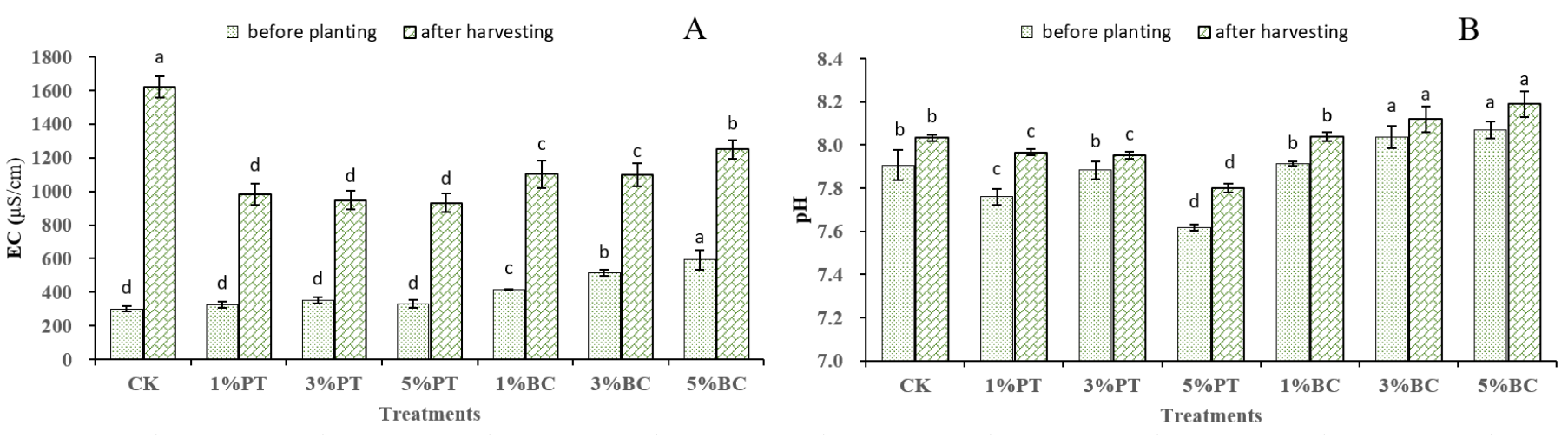
Soil EC is a key indicator of soil salinity status. Brackish water irrigation (BWI) caused soil salt to accumulate, while the application of peat and biochar significantly (p < 0.05) improved soil EC values (Figure 1A).
Prior to BWI, peat-treated soil had the lowest EC value compared with CK, indicating the same soil salinity, while biochar-treated soil exhibited significantly higher EC values than CK soil. The EC values in biochar-treated soil increased significantly by 38.39%, 70.91%, and 96.57% for the soils amended with 1% BC, 3% BC, and 5% BC, respectively, due to the high content of soluble salts in biochar.
Soils of CK had the highest EC values post-BWI, indicating an extensive salt accumulation in soils through BWI. The EC values were significantly lower than those of CK by 39.55%, 41.62%, and 42.61% in peat-treated soil amended with 1% PT, 3% PT, or 5% PT, respectively, with no significant differences between the treatments. The EC values of biochar-treated soils were also significantly lower than CK. The EC values in 1% BC, 3% BC, and 5% BC-amended soil decreased by 32.07%, 32.44%, and 23.04%, respectively, suggesting that more biochar content, up to 3% biochar in soil, reduces salt accumulation more effectively, but excessive biochar (5%) added to soil undercuts such an effect.
The application of different amounts of peat or biochar significantly (p < 0.05) improved soil pH post-BWI (Figure 1B). Prior to BWI, the soil pH in CK was 7.91 and the soil pH in peat-treated soils was significantly low, decreasing with the increment of peat content in soil. The soil amended with 5% PT had the lowest pH by 0.29 pH units compared with that of CK due to the acidic nature of peat. In contrast, the pH values of biochar-treated soils increased with more biochar added to the soil. The pH values in soil amended with 3% BC or 5% BC were significantly higher than that of CK, since alkaline biochar tends to increase soil pH. The pH values in soil amended with peat or biaochar at different amounts increased slightly but not significant after the soil was irrigated with brackish water.

3.2. Growth Characteristics of Cherry Belle Radish

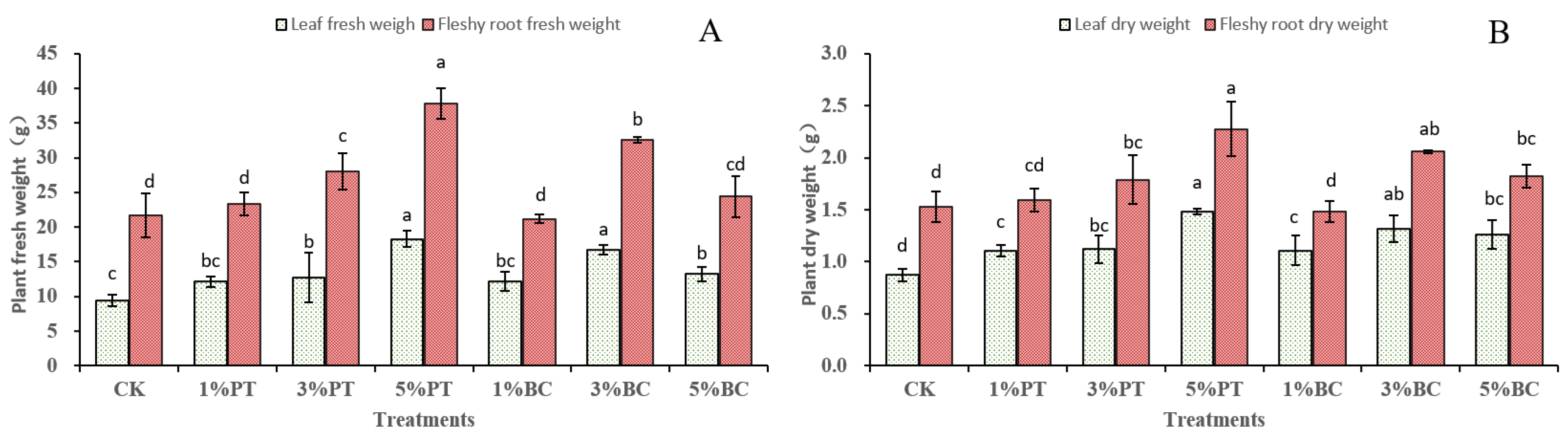
In brackish water-irrigated soils, the biomass of cherry belle radish was significantly (p < 0.05) increased in soil amended with 3% or 5% peat and 3% biochar (Figure 2A,B). Compared with CK, the fresh weights of leaves/fleshy roots with the 3% PT and 5% PT treatments increased by 35.10%/29.32% and 93.62%/74.40%, respectively, while their dry weights of leaves/fleshy roots increased by 28.74%/16.99% and 70.55%/48.66%, respectively. With the 3% BC treatment, the fresh/dry weight of leaves and the fresh/dry weight of fleshy roots increased by 76.97%/50.27% and 51.72%/34.75%, respectively.
In terms of the biomass increment of cherry belle radish in soils irrigated with brackish water, the 5% PT treatment showed a better effect that the 3% BC treatment on fresh root weight by 16.08% (p < 0.05) and dry root weight by 10.19% (p > 0.05). The result indicated that peat might have retained the water content, reduced the salt amount, and provided sufficient nitrogen in soils to promote fresh root growth, while biochar might have facilitated the accumulation of dry materials in roots.

3.3. Photosynthetic Parameters

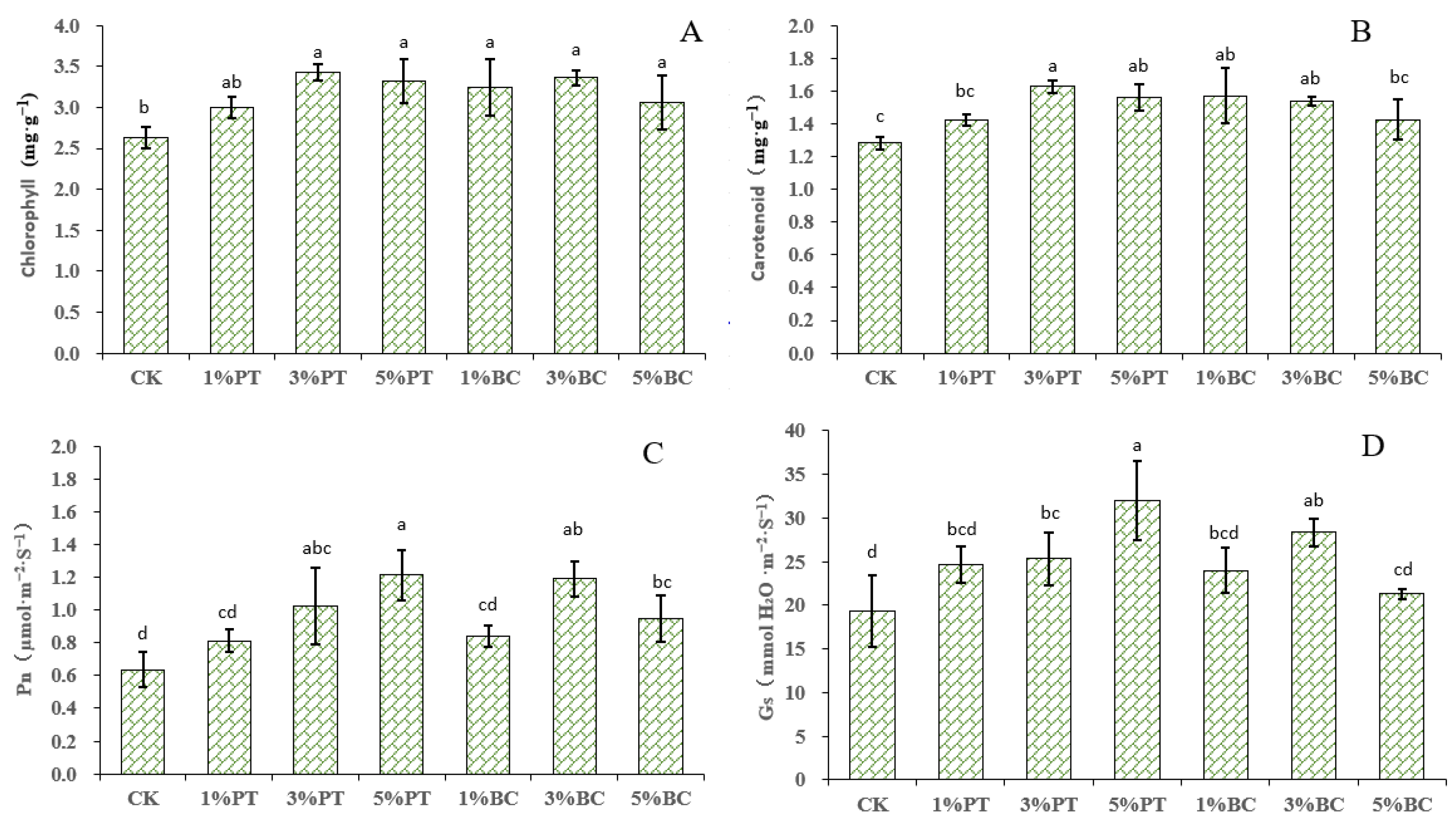
In brackish irrigated soils, the chlorophyll content in the radish leaves significantly (p < 0.05) increased with the application of peat or biochar in general (Figure 3A), indicating an alleviating effect of both soil amendments on damaged chlorophylls caused by salt stress. The 3% PT or 3% BC amended soil exhibited the best effect, a 30.22% or 27.76% increase in photosynthetic pigments, respectively. There were no significant differences between treatments for the peat or biochar applications.
The carotenoid content in the leaves of cherry belle radish significantly increased (Figure 3B) in the peat (3% and 5%) or biochar (1% and 3%)-amended soil under BWI by 27.08% and 21.77 or 22.66% and 20.31%, respectively. These results demonstrated that the appropriate application of peat or biochar could significantly increase the contents of chlorophyll and carotenoids in the leaves of cherry belle radish under BWI, enhance the light energy capture and conversion capacity of photosynthetic pigments, and consequently improve photosynthetic efficiency.
Under BWI, the Pn values in the radish leaves with all treatments increased to various degrees in the peat or biochar amended soil (Figure 3C). With the peat treatments, the Pn level presented a gradually increasing trend with more peat added to soil. The 5% PT treatment achieved the highest Pn value, an 89.06% significant increase over that of CK. In biochar-treated soil, the Pn values showed no difference between the 1% BC and CK, while they reached an 85.94% and 48.44% increase, respectively, with the 3% BC and 5% BC treatments. Therefore, the application of peat at a 5% rate or biochar at a 3% rate under BWI should be optimal to alleviate the inhibitory effect of salt stress on Pn, since both applications showed no different effect on Pn values.
Similar to Pn changes in leaves under BWI, the stomatal conductance (Gs) values in leaves with CK were significantly lower than those with other treatments, indicating that BWI restricted the CO2 exchange between leaves and the external environment by reducing Gs, thereby inhibiting the photosynthetic process. After an application of peat or biochar, the leaf Gs was significantly elevated, with the highest value in leaves with the 5% PT treatment or the 3% BC treatment (Figure 3D). Therefore, 5% PT- or 3% BC-treated soil could have effectively improved the stomatal openings on leaves under BWI, facilitated gas diffusion into mesophyll cells, and further provided sufficient substrates for photosynthetic carbon assimilation.

3.4. Lipid Peroxidation and Enzymatic Antioxidants Attributes

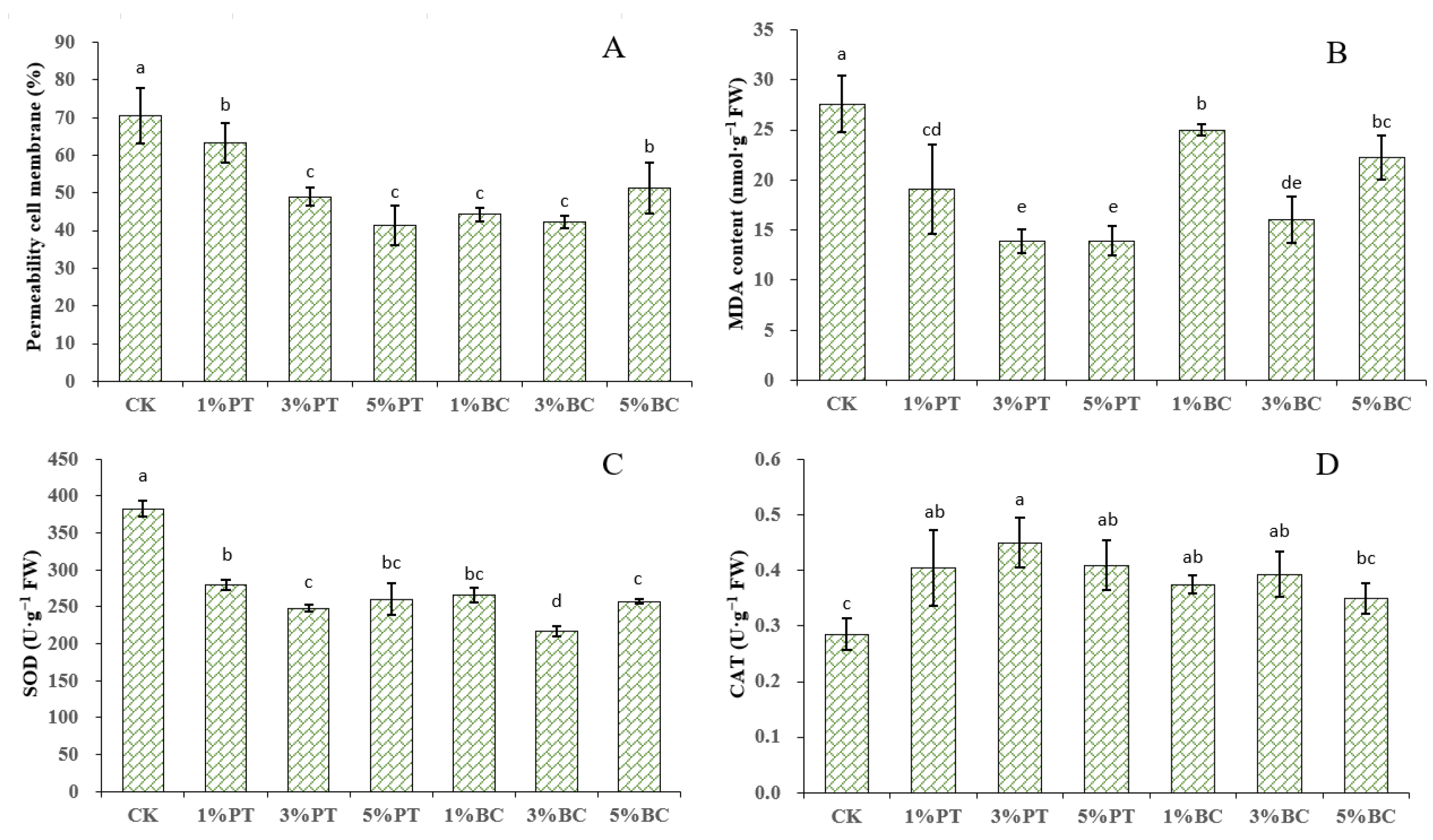
Under BWI, the plasma membrane permeability MDA content and SOD activity were the highest in the radish leaves with the CK treatment, indicating that salt stress caused by constant BWI induced damages to plasma membranes in leaves and promoted an accumulation of reactive oxygen species (ROS) and MDA. After the application of peat or biochar, both the plasma membrane permeability (Figure 4A) and the MDA content (Figure 4B) in the radish leaves were significantly decreased by first reducing the accumulation of superoxide anion radicals (O2·) and then lowering the SOD activity in cells (Figure 4C). Among all treatments, the 3–5% PT treatments maximized the reduction in the plasma membrane permeability, MDA content, and SOD activity by 41.18%, 49.66%, and 35.19%, respectively, while the 3% BC treatment reduced those parameters by 39.90%, 41.90%, and 43.48%, respectively. However, with a different effective pattern, peat (3% PT) or biochar (3%) significantly enhanced the CAT activity in the radish leaves (Figure 4D), suggesting that an appropriate amount of PT or BC activates and intensifies the activity of antioxidant enzymes in plants.

3.5. Mineral Ions and Osmolytes in Leaves

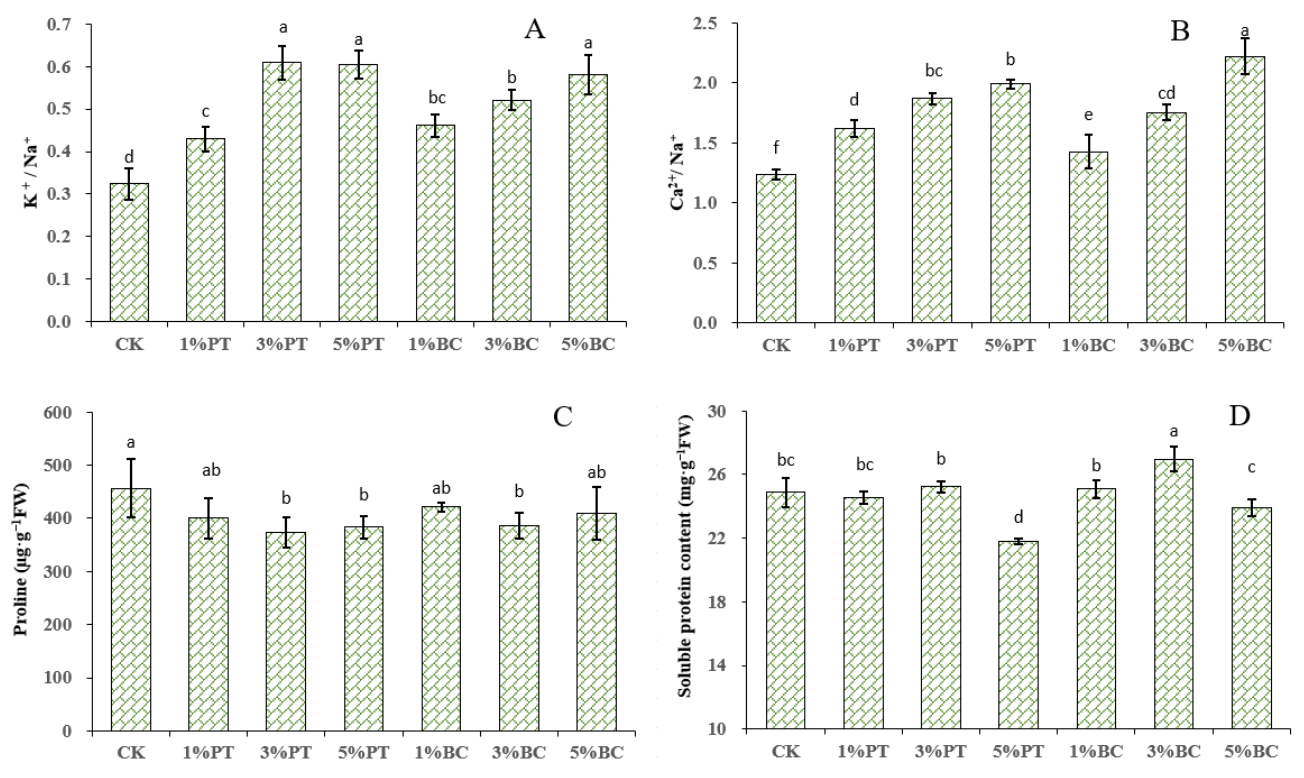
Both peat and biochar significantly increased the ratios of K+/Na+ (Figure 5A) and Ca2+/Na+ (Figure 5B) in the leaves of cherry radish, which effectively alleviated the adverse effects of salt stress on ion absorption and markedly reduced the intracellular accumulation of proline (Figure 5C). Compared with the control group without peat and biochar application, the 3–5% PT treatments and 5% BC treatment exhibited the optimal efficacy. Specifically, the 3–5% PT treatments maximally increased the leaf K+/Na+ and Ca2+/Na+ ratios by 90.21% and 60.47%, respectively, whereas the 5% BC treatment enhanced the above two ratios by 81.45% and 79.15%, respectively. Regarding the soluble protein content, only the 3% BC treatment resulted in an 8.40% increase compared with the control check (CK), while the 5% PT treatment caused a significant decrease relative to CK (Figure 5D). These findings indicated that the application of an appropriate amount of biochar could enhance the osmotic adjustment function of soluble proteins in plant cells.

4. Discussion

The global shortage of freshwater has driven the agricultural utilization of brackish water more, even if the practice causes salt accumulation on the soil surface and crop salt stress due to its repeated and long-term applications [25,26,27]. The results derived from our study confirm that peat used in soil irrigated with brackish water is significantly more effective in reducing soil EC than biochar, and its salt-suppressing effectiveness increases steadily with more peat added to brackish water-irrigated soil. This experimental outcome is reportedly associated with its richness in active functional groups such as carboxyl (-COOH) and phenolic hydroxyl (-OH), which possess an extremely high cation exchange capacity (CEC) [28]. In brackish-irrigated soil, peat efficiently adsorbs and immobilizes Na+ through ion exchange, and thereby significantly mitigates the risk of ion toxicity [29,30]. Instead, biochar physically adsorbs harmful ions such as Cl and Na+ via its porous structure and promotes soil aggregation to reduce soil EC [31,32,33]. However, biochar tends to retain soluble salts during pyrolysis, but an excessive amount of biochar significantly weakens its salt alleviating efficacy, as shown in our study. The result is consistent with the report [34] on an abnormal soil salinization and crop undergrowth due to excessive biochar usage, suggesting the dosage-dependent nature of plants in their physiological and ecological responses to biochar [35]. Moreover, since soils in northern China are slightly alkaline (pH 7.5~8.5), BWI may further exacerbate the risk of soil alkalization [36]. The natural acidic property of peat can significantly reduce soil pH and simultaneously inhibit the alkalization induced by Na+ hydrolysis. Instead, although biochar is generally alkaline, its excessive application over the threshold (3% BC) raises soil pH, and repeated applications over a long period time with brackish water may significantly increase soil pH and aggravate pH imbalance in saline–alkali soils [37,38,39]. Therefore, peat has a greater advantage than biochar in amending soils irrigated with brackish water in northern China. However, as an irreplaceable and non-renewable resource of wetlands, the use of peat in agriculture is limited to a small scale. In response to this practical challenge, researchers have shifted their focus to the development of acid-modified biochar [40,41] or peat–biochar composite amendments for synergistic effects [42].
Stress affects crop photosynthesis by disrupting chlorophylls, reducing stomatal openness and inactivating photosynthetic enzymes [43,44,45]. Excessive Na+ due to salt stress damages the structure of photosynthetic membranes, while deficiencies in K+ and Ca2+ inhibit the activity of photosynthetic enzymes [46,47,48]. Meanwhile, salt stress induces ion homeostasis imbalance in stomatal guard cells, leading to abnormal stomatal closure, reduced intercellular CO2 concentration, and thus restricted photosynthetic carbon reactions [49,50,51]. On the one hand, peat with a high cation exchange capacity (CEC) adsorbs free Na+ in soils, greatly blocking the Na+ translocation from roots to leaves and alleviating the direct damage to photosynthetic organelles [52]. On the other hand, humic acid contained in peat can enhance the release of K+ and Ca2+ in soil through chelation, promote mineral uptake, mitigate salt toxicity to stomatal guard cells, and reduce abnormal stomatal closure [53]. In this study, the Gs value increases continuously with more peat added to soils, and the CO2 flux into mesophyll cells was significantly elevated to increase the Pn value steadily, which is consistent with the findings reported by Zhang et al. [54]. Moreover, this study has indicated that the hydrolysable nitrogen content in peat was significantly higher than that in non-amended soil, so peat might have an enhanced soil fertility to some extent. The increased chlorophyll content and enhanced photosynthesis revealed in this study might have resulted from the synergistic effect of mitigated salt stress and enriched nitrogen in soils. Biochar provides many adsorption sites to hold harmful ions such as Na+ and Cl in soil, greatly due to its abundant porous structure and large specific surface. Meanwhile, it reduces the competition between Na+ and K+, promotes K+ uptake, and maintains intracellular ion homeostasis [55,56]. With all biochar treatments in this study, chlorophyll degradations caused by salt stress were effectively inhibited, and a relatively high chlorophyll content was maintained, which ensures a stable absorption of light energy and conversion during photosynthesis. Among these treatments, the 3% BC treatment not only maintains a high chlorophyll content but also keeps Gs and Pn at an optimal and maximal level, respectively, in accordance with previous studies [57,58].
In brackish irrigated soils, the enrichment of salt ions such as Na+ is prone to induce a dual stress. On the one hand, a high-salt environment disrupts the osmotic balance in root cells, leading to hindered water absorption. On the other hand, the ion imbalance causes the expression of NADPH oxidase genes (e.g., respiratory burst oxidase homolog (ROBH) RbohD and RbohF) on plasma membranes to promote an excessive production of ROS and thus to trigger a cascade reaction of “osmotic stress–oxidative damages” [59,60]. In response to those, plants maintain cellular osmotic stability by accumulating osmotic adjustment substances such as proline and soluble proteins and activating antioxidant enzymes such as SOD and CAT to scavenge excessive ROS to alleviate salt stress synergistically. In our study, the physiological analyses indicate that peat or biochar significantly increases the K+/Na+ value and reduces the SOD activity, suggesting that the use of pear or biochar may have improved the ion balance, thus indirectly mitigating ROS accumulation by inhibiting the expression of NADPH oxidase genes for less demand of activated SOD. Farhangi-abriz et al. [61] also found that biochar effectively alleviates salt damage in common bean seedlings, significantly reduces the ROS content, and maintains antioxidant enzymes and osmotic adjustment substances at relatively low levels. Ahanger et al. demonstrate that sufficient K+ inhibits the Rboh activity of plasma membranes, reduces the O2· production, and further decreases the demand for SOD. In this study, applications of peat or biochar at various levels also significantly increased the K+/Na+ ratio in plant leaves, which may be one of the important mechanisms underlying the stress-alleviating effects of these soil amendments [62]. Asfaw et al. confirm that a moderate accumulation of H2O2 can serve as a signal to specifically activate the CAT1 gene and induce the expression of ion transporter genes such as SOS1 and NHX1 to enhance the Na+ efflux from roots, which is consistent with the result derived from this study [63]. Moreover, an increased CAT activity and a decreased SOD activity were noticed in the soils amended with both peat and biochar at an adequate amount. The soil amendments may have maintained the ion balance in cells, disrupted cellular redox homeostasis, and thereby trigged the H2O2-mediated upregulation of CAT activities. However, the hypothesized regulatory pathways of related genes require further confirmation through molecular experimentations.

5. Conclusions

Peat or biochar proves to be effective in promoting growth and alleviating salt stress in cherry belle radish (Raphanus sativus L.) plants grown in soils irrigated with brackish water. Peat significantly reduces EC, optimizes pH, and mitigates the risk of salt accumulation and alkalization in soils, suitable for mildly alkaline or alkaline–salinized soils in northern China. Although adequate biochar helps drop the soil EC value, its alkaline nature increases the pH; its applicable amount in mildly alkaline soil requires an accurate calculation. Both 5% peat and 3% biochar significantly improve photosynthetic efficiency, promote the fresh and dry weight of fleshy roots, reduce oxidative damage to cell membranes, and maintain ion balance. Therefore, soils irrigated with brackish water should be amended by 3–5% peat or 3% biochar to effectively improve soil properties, mitigate salt stress, and promote the growth of cherry belle radishes or other vegetables as a practical and sustainable solution in areas where fresh water is unavailable.

Author Contributions

The research presented here was carried out in collaboration between all authors. G.L. and H.Z. analyzed the data and prepared the first draft of the manuscript; Y.Z. and Y.Q. executed the experiment; H.X. and Y.J. conceived the idea and designed this study; X.S. and B.Z. edited, finalized and revised the manuscript. All authors have read and agreed to the published version of the manuscript.

Funding

This study was supported by the Natural Science Foundation of Shandong Province (No. ZR2021ME154), Research and Development of Intelligent Irrigation System for Crops in Key Research Program of Weifang University of Science and Technology (KJRC2024001).

Data Availability Statement

The original contributions presented in this study are included in the article. Further inquiries can be directed to the corresponding authors.

Conflicts of Interest

The authors declare no conflicts of interest.

References

  1. Li, F.; Lu, H.; Feng, F. The research on saline water resource utilization and salt-tolerant crop development based on artificial intelligence and big data technologies: Current status, challenges, and future perspectives. Adv. Resour. Res. 2025, 5, 1804–1825. [Google Scholar] [CrossRef]
  2. Sun, Y.; Mao, X.M.; Yang, X.Y.; Tong, L.; Tang, M.H. Variation of groundwater salinity and its influence on crops in irrigation area of Northwest China. Trans. Chin. Soc. Agric. Eng. 2010, 26, 103–108. [Google Scholar] [CrossRef]
  3. Meng, R.F.; Yang, H.F.; Bao, X.L.; Xu, B.Y.; Li, L. Prospect analysis of unconventional water resources utilization and eco-environmental effects in Beijing-Tianjin-Hebei Plain. Geol. China 2024, 51, 221–233. [Google Scholar]
  4. Wang, Y.Q. Experimental Study on the Influence of Different Leaching Irrigation Modes of Brackish Water on Water and Salt Transport Characteristics of Saline-Alkali Soil. Master’s Thesis, Tarim University, Xinjiang, China, 2023. [Google Scholar]
  5. Li, B.; Wang, H.D.; Ding, J.H. Desalination Efficiency of Saline-Alkali Soil and Rice Growth Effect under Different Brackish Water Irrigation Modes. China Rural Water Hydropower 2025, 3, 187–193. [Google Scholar]
  6. Yu, X.; Xu, Z.-H.; Pang, G.-B.; Wang, T.-Y. Effects of Brackish Water Irrigation on Photosynthesis and Yield of Winter Wheat. IOP Conf. Ser. Earth Environ. Sci. 2019, 237, 052013. [Google Scholar] [CrossRef]
  7. Chen, L.J.; Feng, Q.; Wang, Y. Water and salt movement under saline water irrigation in soil with clay interlayer. Trans. Chin. Soc. Agric. Eng. 2012, 28, 44–51. [Google Scholar]
  8. Li, Y.; Feng, H.; Liang, J.P.; Cheng, K.; Chen, J.Q.; Liang, Z.J. Research Advances of Responses and Feedback of Soil Properties and Crop Growth to Biochar Application. J. Soil Water Conserv. 2022, 36, 9–16. [Google Scholar] [CrossRef]
  9. Wu, W. Effect of Biochar Addition on Saline Alkali Soil Improvement Under Brackish Water Irrigation. Master’s Thesis, Shandong University of Technology, Zibo, China, 2024. [Google Scholar] [CrossRef]
  10. Zaman, Q.U.; Rehman, M.; Feng, Y.; Liu, Z.; Murtaza, G.; Sultan, K.; Ashraf, K.; Elshikh, M.S.; Farraj, D.A.A.; Rizwan, M.; et al. Combined Application of Biochar and Peatmoss for Mitigation of Drought Stress in Tobacco. BMC Plant Biol. 2024, 24, 862. [Google Scholar] [CrossRef]
  11. Kim, H.-L.; Kim, H.-D.; Kim, J.-G.; Kwack, Y.-B.; Choi, Y.-H. Effect of Organic Substrates Mixture Ratio on 2-Year-Old Highbush Blueberry Growth and Soil Chemical Properties. Korean J. Soil Sci. Fertil. 2010, 43, 858–863. [Google Scholar]
  12. Yamani, A.; Achmad, B. Peat Soil as an Alternative Soil Substrate and Its Effect on Balangeran (Shorea Belangeran) Seedling Growth. Int. J. Biosci. 2019, 14, 188–196. [Google Scholar] [CrossRef]
  13. Chen, F.S.; Wang, G.R.; Zhang, C.X. Effects of adding peat on amelioration of aeolian sandy soil and vegetable growth. Chin. J. Ecol. 2003, 04, 16–19. [Google Scholar]
  14. Shi, Z.Y. Mechanisms of Biochar to Ameliorate Saline-Alkaline Soil and Promote Alfalfa Growth. Master’s Thesis, Lanzhou University, Lanzhou, China, 2023. [Google Scholar]
  15. Gharred, J.; Derbali, W.; Derbali, I.; Badri, M.; Abdelly, C.; Slama, I.; Koyro, H.-W. Impact of biochar application at water shortage on biochemical and physiological processes in medicago ciliaris. Plants 2022, 11, 2411. [Google Scholar] [CrossRef]
  16. Wu, Y.; Wang, X.; Zhang, L.; Zheng, Y.; Liu, X.; Zhang, Y. The critical role of biochar to mitigate the adverse impacts of drought and salinity stress in plants. Front. Plant Sci. 2023, 14, 1163451. [Google Scholar] [CrossRef] [PubMed]
  17. Yang, Y.; Ahmed, W.; Wang, G.; Ye, C.; Li, S.; Zhao, M.; Zhang, J.; Wang, J.; Salmen, S.H.; Wu, L.; et al. Transcriptome Profiling Reveals the Impact of Various Levels of Biochar Application on the Growth of Flue-Cured Tobacco Plants. BMC Plant Biol. 2024, 24, 655. [Google Scholar] [CrossRef]
  18. Singh, B.; Singh, B.P.; Cowie, A.L. Characterisation and Evaluation of Biochars for Their Application as a Soil Amendment. Soil Res. 2010, 48, 516–525. [Google Scholar] [CrossRef]
  19. Wang, J.; Yuan, G.; Lu, J.; Jun, W.; Jing, W. Effects of biochar and peat on salt-affected soil extract solution and wheat seedling germination in the Yellow River Delta. Arid. Land Res. Manag. 2020, 34, 287–305. [Google Scholar] [CrossRef]
  20. Guo, J.; Wang, F.H.; Zhao, J.J. Effects of Gibberellin on Seed Germination and Growth of Cherry Radish under Salt Stress. Vegetables 2024, 03, 29–35. [Google Scholar] [CrossRef]
  21. Wintermans, J.F.G.M.; Mots, A.D. Spectrophotometric characteristics of chlorophylls a and b and their pheophytins in ethanol. Biochim. Biophys. Acta BBA—Plant Biochem. Physiol. 1965, 109, 448–453. [Google Scholar] [CrossRef]
  22. Xu, X.J.; Li, Y.C. Comparison of two methods for determining the relative electrical conductivity of plants. Jiangsu Agric. Sci. 2014, 42, 311–312. [Google Scholar] [CrossRef]
  23. Chance, B.; Maehly, A.C. Assay of catalases and peroxidases. Methods Enzymol. 1955, 2, 764–775. [Google Scholar] [CrossRef]
  24. Bradford, M.M. A rapid and sensitive method for the quantitation of microgram quantities of protein utilizing the principle of protein-dye binding. Anal. Biochem. 1976, 72, 248–254. [Google Scholar] [CrossRef]
  25. Panpan, Z.; Jianglong, S. Effect of Brackish Water Irrigation on the Movement of Water and Salt in Salinized Soil. Open Geosci. 2022, 14, 404–413. [Google Scholar] [CrossRef]
  26. Chuncheng, L.; Bingjian, C.; Tilahun, Z.K.; Chao, H.; Haiqing, W.; Erping, C.; Pengfei, H.; Feng, G. Risk of Secondary Soil Salinization under Mixed Irrigation Using Brackish Water and Reclaimed Water. Agronomy 2021, 11, 2039. [Google Scholar] [CrossRef]
  27. Lu, P.; Zhang, Z.; Sheng, Z.; Huang, M.; Zhang, Z. Effect of Surface Straw Incorporation Rate on Water–Salt Balance and Maize Yield in Soil Subject to Secondary Salinization with Brackish Water Irrigation. Agronomy 2019, 9, 341. [Google Scholar] [CrossRef]
  28. Asapo, E.S.; Coles, C.A. Characterization and Comparison of Saprist and Fibrist Newfoundland Sphagnum Peat Soils. J. Miner. Mater. Charact. Eng. 2012, 11, 709–718. [Google Scholar] [CrossRef]
  29. Wang, C.C. Peat and Organic Fertilizer Research on Improving Coastal Saline-Alkali Soil. Master’s Thesis, Hebei Agricultural University, Baoding, China, 2021. [Google Scholar] [CrossRef]
  30. Yang, M.; Yang, R.; Li, Y.; Pan, Y.; Sun, J.; Zhang, Z. Effects of Different Peat Application Methods on Water and Salt Migration in a Coastal Saline Soil. J. Soil Sci. Plant Nutr. 2021, 22, 1–10. [Google Scholar] [CrossRef]
  31. Huichen, F. Effect and Mechanism of Biochar Amendment on Saline-Alkali Soils. Land Sci. 2025, 6, 19. [Google Scholar] [CrossRef]
  32. Yu, C.; Chen, H.; Tang, B.; Liu, H.; Liu, X.; Zhang, H.; Wang, G. Biochar Integrate Dicyandiamide Modified Soil Aggregates and Optimized Nitrogen Supplying to Boosting the Soybean-Wheat Yield in Saline-Alkali Soil. Soil Tillage Res. 2026, 257, 106922. [Google Scholar] [CrossRef]
  33. Zhang, L.; Bate, B.; Cui, J.; Feng, Y.; Yu, J.; Cui, Z.; Wang, H.; Li, Q. Biochar Input to Saline-Alkali Farmland Can Improve Soil Health and Crop Yield: A Meta-Analysis. Agriculture 2025, 15, 561. [Google Scholar] [CrossRef]
  34. Cui, J.Y.; Li, X.F.; Wu, S.Q.; Shao, G.C.; Liu, S.H. Effects of Biochar Addition on Maize Growth and Yield Under Brackish Water Irrigation. Water Sav. Irrig. 2022, 6, 1–9. [Google Scholar]
  35. Gale, N.V.; Thomas, S.C. Dose-Dependence of Growth and Ecophysiological Responses of Plants to Biochar. Sci. Total Environ. 2018, 658, 1344–1354. [Google Scholar] [CrossRef]
  36. Ni, G.; He, C.; Zeng, Y.; Zhang, J.L.; Wang, G.Z. Safe and Efficient Utilization of Saline and Brackish Water in Saline-alkali Farmland: Progress and Perspective. J. Irrig. Drain. 2023, 42, 149–156. [Google Scholar] [CrossRef]
  37. Wei, Y.; Jiao, L.; Zhang, P.; Liu, F.-D.; Xiao, H.; Dong, Y.-C.; Sun, H.-W. Research and Application Progress of Biochar in Amelioration of Saline-Alkali Soil. Environ. Sci. 2024, 45, 940–951. [Google Scholar] [CrossRef]
  38. Zhang, J.; Huang, Y.; Lin, J.; Chen, X.; Li, C.; Zhang, J. Biochar Applied to Consolidated Land Increased the Quality of an Acid Surface Soil and Tobacco Crop in Southern China. J. Soils Sediments 2019, 20, 3091–3102. [Google Scholar] [CrossRef]
  39. Abbasi, M.K.; Anwar, A.A. Ameliorating Effects of Biochar Derived from Poultry Manure and White Clover Residues on Soil Nutrient Status and Plant Growth Promotion--Greenhouse Experiments. PLoS ONE 2017, 10, e0131592. [Google Scholar] [CrossRef] [PubMed]
  40. Guang, G.; Lei, Y.; Kaiqing, T. The potential and prospects of modified biochar for comprehensive management of salt-affected soils and plants: A critical review. Sci. Total Environ. 2023, 912, 169618. [Google Scholar] [CrossRef]
  41. Martínez, M.M.; Maldonado, J.A.; Mendoza, B.A. Citric acid–modified coconut shell biochar mitigates saline–alkaline stress in Solanum lycopersicum L. by modulating enzyme activity in the plant and soil. Open Agric. 2025, 10, 20250474. [Google Scholar] [CrossRef]
  42. Rijk, I.; Ekblad, A.; Dahlin, A.S.; Enell, A.; Larsson, M.; Leroy, P.; Kleja, D.B.; Tiberg, C.; Hallin, S.; Jones, C. Biochar and peat amendments affect nitrogen retention, microbial capacity and nitrogen cycling microbial communities in a metal and polycyclic aromatic hydrocarbon contaminated urban soil. Sci. Total Environ. 2024, 936, 173454. [Google Scholar] [CrossRef]
  43. Xin, J.; Zhao, X.; Tan, Q.; Sun, X.; Zhao, Y.; Hu, C. Effects of cadmium exposure on the growth, photosynthesis, and antioxidant defense system in two radish (Raphanus sativus L.) cultivars. Photosynthetica 2019, 57, 967–973. [Google Scholar] [CrossRef]
  44. Zhang, X.; Lin, T.; Xu, H. Photosynthetic and Physiological Characteristics of Three Common Halophytes and Their Relationship with Biomass Under Salt Stress Conditions in Northwest China. Appl. Sci. 2024, 14, 11890. [Google Scholar] [CrossRef]
  45. Xiaoshan, W.; Jing, W.; Juncheng, Y. Comparison of the physiological factors in ion accumulation and photosynthetic electron transport between legumes Medicago truncatula and Medicago sativa under salt stress. Plant Soil 2022, 484, 473–486. [Google Scholar] [CrossRef]
  46. Yang, J.; Yang, M.X.; Dong, B.D. Research progress in soil water/salt dynamics and crop growth under saline water irrigation. Chin. J. Eco-Agric. 2011, 19, 976–981. [Google Scholar] [CrossRef]
  47. Zhou, D. Effects of Salt Stress on Photosynthesis and Water in Plants. Bot. Res. 2021, 10, 8. [Google Scholar] [CrossRef]
  48. Shu, S.; Guo, S.R.; Sun, J. Research Progress on Photosynthesis under Salt Stress. China Veg. 2012, 18, 53–61. [Google Scholar] [CrossRef]
  49. Zouhaier, B.; Wahbi, D.; Wided, C.; Chedly, A.; Abderrazak, S. Salt Impact on Photosynthesis and Leaf Ultrastructure of Aeluropus Littoralis. J. Plant Res. 2007, 120, 529–537. [Google Scholar] [CrossRef] [PubMed]
  50. Meng, S.Y.; Wang, Q.; Wei, Y.; Ling, C.H.; Zhang, Y.; Wang, H.T. Effects of salt stress on the growth and photosynthetic production of Euonymus hamiltonianus. J. Shandong Univ. Nat. Sci. 2019, 54, 26–34. [Google Scholar]
  51. Wu, F.Z. Impacts of NaCl Stress on the Growth and Photosynthetic Physiological Characteristics of Highbush Blueberry Seedling. Acta Bot. Boreali-Occident. Sin. 2015, 35, 2258–2265. [Google Scholar]
  52. Kyziol, J. Effect of Physical Properties and Cation Exchange Capacity on Sorption of Heavy Metals onto Peats. Pol. J. Environ. Stud. 2002, 11, 713. [Google Scholar]
  53. Ma, Y.Y. Effects of K+ and Ca2+ supplement on plant growth, physiology and yield of salt-stressed and drought-stressed cotton. Doctoral Dissertation, Northwest A&F University, Xianyang, China, 2022. [Google Scholar] [CrossRef]
  54. Zhang, L.J.; Qu, J.S.; Zhu, Q.N.; Yan, X.J. Effects of Peat Added on Domestication Culturing of Allium victorialis L. J. Ningxia Agric. For. Sci. Technol. 2019, 60, 11–13+18. [Google Scholar]
  55. Kamal, M.Z.U.; Sarker, U.; Roy, S.K.; Alam, M.S.; Azam, M.G.; Miah, M.Y.; Hossain, N.; Ercisli, S.; Alamri, S. Manure-Biochar Compost Mitigates the Soil Salinity Stress in Tomato Plants by Modulating the Osmoregulatory Mechanism, Photosynthetic Pigments, and Ionic Homeostasis. Sci. Rep. 2024, 14, 21929. [Google Scholar] [CrossRef]
  56. Mahmood, S.; Al-Solaimani, S.G.; Shams, S.; Naveed, S.; Haider, B.; Naveed, M.; Ali, R.; Waqas, M. Silicon and Biochar Synergistically Stimulate Nutrients Uptake, Photosynthetic Pigments, Gaseous Exchange and Oxidative Defense to Improve Maize Growth Under Salinity. Water Air Soil Pollut. 2024, 235, 413. [Google Scholar]
  57. Chen, J.H. Effects of Biochar Addition on the Growth of Perilla Frutescens and Soil Physicochemical Properties Under Salt Stress. Master’s Thesis, Zhejiang A&F University, Hangzhou, China, 2024. [Google Scholar] [CrossRef]
  58. Helaoui, S.; Boughattas, I.; Mkhinini, M.; Ghazouani, H.; Jabnouni, H.; El Kribi-Boukhris, S.; Marai, B.; Slimani, D.; Arfaoui, Z.; Banni, M. Biochar Application Mitigates Salt Stress on Maize Plant: Study of the Agronomic Parameters, Photosynthetic Activities and Biochemical Attributes. Plant Stress 2023, 9, 100182. [Google Scholar] [CrossRef]
  59. Chang, C.Y.; Yan, H.; Lu, Y.X.; Qin, T.; Bai, Y.N. Research Progress of Salt Stress on Plant. Chin. Agric. Sci. Bull. 2025, 41, 82–88. [Google Scholar]
  60. Huang, Y.; Cao, H.; Yang, L.; Chen, C.; Shabala, L.; Xiong, M.; Niu, M.; Liu, J.; Zheng, Z.; Zhou, L.; et al. Tissue-specific respiratory burst oxidase homolog-dependent H2O2 signaling to the plasma membrane H+-ATPase confers potassium uptake and salinity tolerance in Cucurbitaceae. J. Exp. Bot. 2019, 70, 5879–5893. [Google Scholar] [CrossRef] [PubMed]
  61. Farhangi-Abriz, S.; Torabian, S. Antioxidant Enzyme and Osmotic Adjustment Changes in Bean Seedlings as Affected by Biochar under Salt Stress. Ecotoxicol. Environ. Saf. 2017, 137, 64–70. [Google Scholar] [CrossRef]
  62. Ahanger, M.A.; Tomar, N.S.; Tittal, M.; Argal, S.; Agarwal, R.M. Plant Growth under Water/Salt Stress: ROS Production; Antioxidants and Significance of Added Potassium under Such Conditions. Physiol. Mol. Biol. Plants 2017, 23, 731–744. [Google Scholar] [CrossRef]
  63. Asfaw, K.G.; Liu, Q.; Xu, X.; Manz, C.; Purper, S.; Eghbalian, R.; Münch, S.W.; Wehl, I.; Bräse, S.; Eiche, E.; et al. A Mitochondria-Targeted Coenzyme Q Peptoid Induces Superoxide Dismutase and Alleviates Salinity Stress in Plant Cells. Sci. Rep. 2020, 10, 11563. [Google Scholar] [CrossRef] [PubMed]
Figure 1. Soil EC (A) and pH (B) values with different treatments under brackish water irrigation. Different lowercase letters indicate significant differences between treatments (p < 0.05, n = 3).
Horticulturae 12 00248 g001
Figure 2. Fresh weight (A) and dry weight (B) of cherry belle radish (Raphanus sativus L.) with different treatments under brackish water irrigation. Different lowercase letters indicate significant differences between treatments (p < 0.05, n = 3).
Horticulturae 12 00248 g002
Figure 3. The content of chlorophyll (A) and carotenoid (B), and Pn (C) and Gs (D) values in cherry belle radish (Raphanus sativus L.) leaves with different treatments under brackish water irrigation. Different lowercase letters indicate significant differences between treatments (p < 0.05, n = 3).
Horticulturae 12 00248 g003
Figure 4. The plasma membrane permeability (A), MDA content (B), SOD activity (C) and CAT activity (D) in the cherry belle radish (Raphanus sativus L.) leaves with different treatments under BWI. Different lowercase letters indicate significant differences between treatments at (p < 0.05, n = 3).
Horticulturae 12 00248 g004
Figure 5. The ratio of K+/Na+ (A) and Ca2+/Na+ (B), and the content of proline (C) and soluble protein (D) in cherry belle radish (Raphanus sativus L.) leaves with different treatments under brackish water irrigation. Different lowercase letters indicate significant differences between treatments (p < 0.05, n = 3).
Horticulturae 12 00248 g005
Table 1. Chemical properties and nutrient compositions of topsoil and soil amendments.
Total
Nitrogen (g/kg)
Hydrolyzable
Nitrogen (mg/kg)
Available
Phosphorus (mg/kg)
Available
Potassium (mg/kg)
Organic
Matter (g/kg)
Total Salt Content (%)Electrical
Conductivity EC (μS/cm)
pH
Soil0.7951.3613.60123.6012.200.041301.337.91
Peat9.86120.6020.2375.6095.000.037364.676.03
Biochar1.1220.32653.20635.7078.620.3602510.008.11
Disclaimer/Publisher’s Note: The statements, opinions and data contained in all publications are solely those of the individual author(s) and contributor(s) and not of MDPI and/or the editor(s). MDPI and/or the editor(s) disclaim responsibility for any injury to people or property resulting from any ideas, methods, instructions or products referred to in the content.