Article

Genome-Wide Analysis of the Heat Shock Transcription Factor Gene Family in Flammulina filiformis and Its Response to CO2-Mediated Fruit Body Development

1
Institute of Urban Agriculture, Chinese Academy of Agricultural Sciences, Chengdu 610213, China
2
Chengdu Agricultural Science and Technology Center, Chengdu 610095, China
3
Institute of Edible Fungi, Shanghai Academy of Agricultural Sciences, Shanghai 201403, China
*
Authors to whom correspondence should be addressed.
Horticulturae 2026, 12(2), 132; https://doi.org/10.3390/horticulturae12020132
Submission received: 16 October 2025 / Revised: 6 January 2026 / Accepted: 19 January 2026 / Published: 24 January 2026
(This article belongs to the Special Issue Edible Mushrooms: Genetics, Genomics, and Breeding)

Abstract

Flammulina filiformis is the key industrial edible fungus that requires elevated CO2 to promote the growth of long stipe and small pileus fruiting bodies. Heat shock transcription factors (HSFs) play vital roles in stress response and development regulation; yet the HSF gene family and its expression dynamics during fruiting body development in F. filiformis remain uncharacterized. This study aims to identify and characterize the HSF gene family in F. filiformis and to investigate their expression patterns during fruiting body development and in response to CO2 treatments. In this study, 7 FfHSFs were identified, and their structures, sequence features, and phylogenetics were further analyzed. Expression patterns under CO2 regulation were examined via qRT-PCR. The FfHSFs exhibited CDS lengths of 618–2298 bp, encoding 301–765 hydrophilic amino acids, with molecular weights ranging from 23.4 to 83.8 kDa and theoretical pI values between 4.75 and 9.15. All were predicted to be nuclear-localized. Cis-element analysis revealed motifs associated with growth regulation and stress responses such as low temperature, drought, and hypoxia. Phylogenetically, fungal HSFs were grouped into five clusters, with FfHSFs distributed across four. In this study, we examined the expression levels at four time points (0 h, 2 h, 12 h, and 36 h), under three different carbon dioxide concentrations (0.1%, 5%, and 20%) and in two types of tissues (pileus and stipe) for each six biological replicates. CO2 treatments showed that 5% CO2 significantly suppressed pileus expansion but not stipe elongation, while 20% CO2 inhibited both. Under 20% CO2 treatment, the pileus diameter decreased by approximately 40%, and simultaneously, the expression level of FfHSF1 decreased by about 70%. qRT-PCR indicated that FfHSF1 decreased with pileus expansion, whereas FfHSF4 increased. All FfHSFs were highly expressed in the stipe elongation zone. Elevated CO2 down-regulated FfHSF1 in pileus and FfHSF6 in stipes. Based on these findings, it could be proposed that FfHSF1 and FfHSF6 might be candidate regulators in CO2-mediated morphogenesis, providing insights into hormonal and environmental control of fruiting body development in F. filiformis.

1. Introduction

The pileus and stipe of edible fungi are crucial for fruiting body quality and yield [1]. Carbon dioxide (CO2) is an important environmental factor regulating the development of edible fungal fruiting bodies and a major element affecting pileus expansion and stipe elongation. Studies have shown that within a certain range, the CO2 concentration in the cultivation environment is negatively correlated with the ability of pileus expansion in some edible fungi [2], such as Flammulina filiformis [3], Pleurotus eryngii [4], Pleurotus ostreatus [5], and Lentinula edodes [6,7]. Furthermore, Dai et al. [8] reported that appropriately elevated CO2 concentrations promoted primordia formation in Auricularia species. Research indicated that CO2, upon its conversion to HCO3, triggered intracellular acidification and activates the cAMP-PKA signaling pathway in the fruiting body, thereby modulating various life processes, including growth, metabolism, and morphogenesis [9]. However, the specific regulatory mechanisms remain unclear, and CO2 concentration control in edible fungus cultivation still relies largely on practical experience. This gap hinders the optimization of CO2 management in the industrial cultivation of F. filiformis.
F. filiformis is one of the earliest edible fungi to achieve industrialized cultivation. According to the Chinese National Survey and Analysis of Edible Fungi Statistics [10], its production reached 1.8738 million tons in 2023, making it the fifth most cultivated edible fungus in China. Owing to its well-defined genetic background, small genome, mature cultivation techniques, and distinct differentiation between pileus and stipe, F. filiformis is often used as a model organism for studying the morphological development mechanisms of mushroom fruiting bodies [11]. Comparative transcriptomic analysis of different segments of the F. filiformis stipe revealed significant upregulation of pathways related to ribosomes, steroid biosynthesis, and DNA replication in the upper elongation zone, while pathways involved in secondary metabolite and amino acid biosynthesis, as well as glycolysis, were downregulated [12]. Chitinases, glycosyl hydrolases, and transcription factors exhibited substantial fold changes [13]. Previous studies have shown that the serine/threonine protein kinase genes FfStpk2 and FfStpk4 negatively regulate stipe elongation through the cAMP/PKA signaling pathway and glutathione metabolism, respectively [14]. Yan et al. [15] demonstrated that NADPH oxidases and MnSODs mediate the gradient distribution of reactive oxygen species (ROS) across stipe segments, thereby regulating stipe elongation. Zhang et al. [16] found that FfMYB13 activates cell wall synthesis-related genes and is negatively correlated with stipe tissue toughness.
Carbon dioxide (CO2) is a critical environmental factor regulating fruiting body development in F. filiformis. In industrial cultivation, elevated CO2 is associated with a long-stiped, small-pileus morphology, while wild F. filiformis typically develops a large pileus and a short stipe under low ambient CO2 levels (0.05–0.1%) [17]. The carbonic anhydrase (CA) family in F. filiformis was identified, among which CA-1, CA-2, and CA-5 show a correlation with pileus development under CO2 stress [18]. Yan et al. [3] suggested that there might be an association between CO2 and the suppression of pileus expansion through possible effects on cell division. Xu [7] conducted transcriptome sequencing of L. edodes treated with low oxygen and high CO2, revealing downregulation of genes involved in ribosomal pathways, endoplasmic reticulum processing, the ubiquitin-proteasome system, and DNA replication in both pileus and stipes, while the Fab G gene was upregulated. Integrated metabolomic and transcriptomic analyses identified differential genes related to stipe elongation, such as Fab G, and differential metabolites including palmitoleic acid. Amino acid metabolism-related differential genes (e.g., gdhA, gadA, metY, OPLAH, ggt) and metabolites (e.g., glutamate, cysteine, methionine) were also associated with fruiting body development [7]. Kang [19] found that high CO2 is correlated with alterations in the morphology of Auricularia fruiting bodies, which may be related to the downregulation of genes in starch, sucrose metabolism, and the tricarboxylic acid (TCA) cycle.
Heat shock transcription factors (HSFs) are core regulators in the heat shock response triggered by environmental stress in organisms. They modulate gene expression by binding to heat shock elements (HSEs) in the promoters of downstream genes and play important roles in stress response and the regulation of growth and development. HSFs are widely distributed among eukaryotes [20]. Typical HSF family proteins possess conserved functional domains, including a DNA-binding domain, an oligomerization domain (HR-A/B), a nuclear localization signal (NLS), a nuclear export signal (NES), and an activator motif (AHA motif) [21]. In mammals, the HSF family is classified into six groups: HSF1, HSF2, HSF3, HSF4, HSFX, and HSFY [22]. Plants usually contain a larger number of HSF family members, which are categorized into classes A, B, and C based on the characteristics of their HR-A/B regions [23]. A standardized classification system for the fungal HSF family has not yet been established. Previous research indicated that Saccharomyces cerevisiae encoded HSF1 along with three HSF-like proteins containing a conserved DNA-binding domain: Skn7, Mga1, and Sfl1 [23,24]. Similarly, Zhou et al. [25] annotated three HSF family proteins—HSF1, SFL1, and SKN7—in Beauveria bassiana. Morano et al. [26] demonstrated that defects in HSF lead to cell cycle arrest in S. cerevisiae under heat stress. Isermann et al. [27] found that activation of p53 suppresses the HSF1-mediated heat shock response via the p21–CDK4/6–MAPK–HSF1 pathway, thereby inhibiting cancer cell growth. Furthermore, HSF1 can also enhance p53-mediated transcription, and silencing HSF1 significantly reduces the expression of p53 target genes such as p21 and PUMA, affecting cell cycle progression [28,29]. Gao et al. [30] reported that HSF3 localizes to both the nucleus and mitochondria and suppresses genes involved in the tricarboxylic acid (TCA) cycle in Cryptococcus neoformans. In Pleurotus ostreatus, the expression analysis of HSFs revealed that HSF1 is significantly downregulated during the primordium and fruiting body stages, as well as under heat stress [31]. Xiao [32] found that in Sclerotinia sclerotiorum, SNF5–HSF1 mediates ROS detoxification under stress; knockout of SNF5 or HSF1 increased sensitivity to multiple stressors and led to excessive ROS accumulation. Wang [33] demonstrated that overexpression of tomato hsfc1 results in dwarfism by interfering with gibberellin (GA) signaling. Furthermore, HSF1 plays a role in cell cycle progression and affects the key cell-survival and regulatory pathways, including p53, RAS/MAPK, cAMP/PKA, mTOR and insulin signaling in cancer cells [34]. However, the HSF family in F. filiformis has not yet been identified, and the role of HSFs in the CO2-regulated development of fruiting bodies remains unclear.
Elevated CO2 activates the cAMP-PKA signaling pathway in the fruiting body. [9] Given that HSF1 plays a role in cell cycle progression and affects the cAMP/PKA pathway [34], we hypothesize that FfHSFs interface with this pathway to regulate morphogenesis. To identify the HSF families in F. filiformis and investigate their potential roles in the growth and development of F. filiformis as well as in response to CO2, based on genome data of F. filiformis, we identified 7 FfHSF families in this study. Sequence characteristics, conserved structural domains, cis-acting elements, and phylogenetic relationships were systematically analyzed. Furthermore, through expression examination of different CO2 concentration treatments and different regions of the stipe, major effector genes regulating pileus expansion and stipe elongation were further investigated. These findings offer a reference for further research on the role of FfHSFs in the growth and development of F. filiformis.

2. Materials and Methods

2.1. Strains and Genome Sequence

The tested strain F19 (commercial yellow dikaryotic strain mated by 2 monokaryotic strains, L11 and L22) was obtained from the Fujian Edible Fungi Germplasm Resource Collection Center of China. The genome sequence of F. filiformis strain L11 was obtained from the BioProject: PRJNA191865 at the National Center for Biotechnology Information (NCBI) [35].

2.2. Identification of HSFs in F. filiformis

Amino acid sequences of HSF from S. cerevisiae and B. bassiana were retrieved from the Uniprot database (https://www.uniprot.org/, accessed on 10 May 2025). Homologous sequences in the F. filiformis genome were identified using the BLAST function in TBtools-II v2.376 [36]. The Hidden Markov Model (HMM) profile for the HSF domain (PF00447) was obtained from the Pfam database (http://pfam.xfam.org/, accessed on 10 May 2025) and the screened sequences were further examined with HMMER 3.0 software [37]. The conserved domains of the identified FfHSFs were verified using the CD-search tool on NCBI (https://www.ncbi.nlm.nih.gov/cdd, accessed on 11 May 2025). Physicochemical properties of the FfHSF proteins were analyzed using the ExPASy ProtParam online tool (https://web.expasy.org/protparam/, accessed on 12 May 2025), and subcellular localization was predicted using CELLO v.2.5 (http://cello.life.nctu.edu.tw/, accessed on 13 May 2025) [38].

2.3. Gene Structure and Conserved Motif Analysis of FfHSFs

Gene structure analysis and visualization of conserved domains, performed with TBtools-II v2.376 [36], were based on gene information extracted from the F. filiformis genome. Genomic locations of the genes were obtained from the genome annotation data of F. filiformis. Conserved protein domains were predicted using the MEME suite (http://meme-suite.org/index.html, accessed on 26 May 2025). DNAMAN v9.0 software was used to perform multiple sequence comparisons on the conserved domains of FfHSFs protein sequences.

2.4. Cis-Element Analysis of FfHSFs

The 2 kb promoter sequences upstream of the FfHSFs were extracted using TBtools-II [37]. Putative cis-acting elements within these promoter regions of FfHSFs were predicted using the online tool PlantCARE (https://bioinformatics.psb.ugent.be/webtools/plantcare/html/, accessed on 8 June 2025). The prediction results were subsequently visualized with TBtools-II v2.376 [37].
TF motifs in all FfHSFs were identified with fimo from the MEME suite toolset using position weight matrices (PWM) from the redundant core fungi motif database in JASPAR 2026 [39,40]. And further visualize it using BioPathen.

2.5. Phylogenetic Analysis of HSFs in F. filiformis

The amino acid sequences of HSF1 (NP_011442.3), SFL1 (NP_014783.4), and SKN7 (NP_012076.3) from S. cerevisiae [41,42]; HSF1 (XP_008597916.1), SFL1 (XP_008597535.1), and SKN7 (XP_008594607.1) from B. bassiana [25]; HSF1 (XP_723461.2), SFL1 (XP_715888.2), and SKN7 (XP_716809.1) from Candida albicans [43]; as well as HSF1 (XP_963162.2) and HSF2 (XP_963149.3) from Neurospora crassa [44] were retrieved from the NCBI database. Genomic data for Boletus edulis, Agaricus bisporus, and L. edodes were also downloaded from NCBI, and their HSF protein sequences were identified through homology-based searches. Multiple sequence alignment was performed using Clustal W, and a phylogenetic tree was constructed with MEGA 7.0 using the maximum likelihood method, with bootstrap replication set to 1000 and other parameters set to default [37].

2.6. Cultivation of Fruiting Bodies and Carbon Dioxide Treatment

Fruiting bodies of F. filiformis strain F19 were cultivated on a substrate medium at 12 °C, as previously described [35]. Stipe samples were collected according to the method of Yan et al. [12], with segments of 6–15 mm, 15–24 mm, and 50–60 mm defined as the elongation region (ER), transition region (TR), and stable region (SR), respectively. Pileus samples with diameters of 6 mm, 9 mm, 21 mm, and 33 mm were collected following the method of Zhang et al. [45]. For the CO2 treatment experiment, fruiting bodies approximately 50 mm in height were exposed to 0.1% (low concentration, LC), 5% (medium concentration, MC), or 20% (high concentration, HC) CO2, based on a modified protocol from Yan et al. [3]. The cultivation was carried out at 13–14 °C, with relative humidity maintained at 98–100% and O2 maintained at 21% (21% O2 represents the ambient atmospheric level). The flow rate remained consistent across all chambers. Three chambers were used to conduct three different carbon dioxide treatments. For each treatment, there were three bottles, which were placed in the same position within each chamber. Stipe and pileus tissues were then sampled at 0 h, 2 h, 12 h, and 36 h post-treatment. For all sampling procedures, each biological replicate consisted of tissues pooled from six individual fruiting bodies, with three replicates per sample, which were immediately frozen in liquid nitrogen, and the time window between collection and fixation was within 5 min.

2.7. Gene Expression Analysis

Gene-specific primers for qRT-PCR were designed using the Primer-BLAST tool on the NCBI (https://www.ncbi.nlm.nih.gov/tools/primer-blast/, accessed on 12 October 2025) (Table 1). According to Tong [46], glyceraldehyde-3-phosphate dehydrogenase (GAPDH) and Ras-related small GTPase (Ras) were selected as reference genes; their primer sequences are also shown in Table 1. Total RNA was extracted from the collected stipe and pileus samples using the MagPure Plant RNA Kit B (Magen Biotechnology, Guangzhou, China), following the manufacturer’s instructions. Subsequently, cDNA was synthesized from the RNA samples using the TransScript All-in-One First-Strand cDNA Synthesis SuperMix (TransGen Biotech, Beijing, China) for qPCR. The resulting cDNA was diluted five-fold and stored at −20 °C to serve as the template for qRT-PCR. Quantitative real-time PCR was performed using the TransGen Biotech PerfectStart Green qPCR SuperMix (AQ601, TransGen Biotech, Beijing, China) in a 20 µL reaction volume with QuantStudio 1 Real-Time PCR System (Thermo Fisher Scientific, Waltham, MA, USA), prepared according to the manufacturer’s recommendations. The thermal cycling conditions were as follows: initial denaturation at 95 °C for 10 min; followed by 40 cycles of 95 °C for 15 s and 60 °C for 1 min. The relative expression levels were calculated using the 2−∆∆Ct method, and the results were visualized as column graphs using GraphPad Prism 9.0 software (GraphPad Software, San Diego, CA, USA).

2.8. Statistical Analysis

The statistical analysis was performed by GraphPad Prism 9.0 (GraphPad Software, San Diego, CA, USA). The values in the figures are the means ± standard error of mean (SEM) of three or six independent biological replicates. The significance of multiple comparisons was analyzed by the one-way ANOVA method, and Student’s t test was used to analyze the significance between two samples.

3. Results

3.1. Identification of HSFs Family in F. filiformis and Chromosomal Distribution

Using BLAST and HMMER analyses, 7 HSFs were identified in F. filiformis. Based on phylogenetic results, gene EVM0G039890 clustered with HSF1 and was designated FfHSF1. The remaining members were sequentially numbered from FfHSF2 to FfHSF7 according to their chromosomal order, with their basic characteristics summarized in Table 2. The coding sequence (CDS) lengths of the FfHSFs range from 618 base–pairs (bp) (FfHSF7) to 2298 bp (FfHSF5), encoding proteins of 205 to 765 amino acids. The predicted molecular weights vary between 23.3 kilodaltons (kDa) (FfHSF7) and 83.8 kDa (FfHSF5). The theoretical isoelectric points (pI) range from 4.75 (FfHSF2) to 9.15 (FfHSF6). Except for FfHSF1, FfHSF5, and FfHSF6, which have pI values greater than 7 and are considered basic proteins, the remaining members have pI values below 7. The grand average of hydropathy (GRAVY) scores range from −0.928 (FfHSF1) to −0.552 (FfHSF7), indicating that FfHSFs are likely hydrophilic proteins. The instability indices, also calculated by the ProtParam tool, of all FfHSFs are above 40, suggesting relatively poor predicted protein stability. Subcellular localization predictions indicate that all FfHSFs are potentially localized to the nucleus. The genome of F. filiformis comprises 12 chromosomes, and the FfHSFs are unevenly distributed across five of them (Chr1, 2, 4, 6, and 9). Specifically, FfHSF2, FfHSF3, and FfHSF4 are located on chromosome 1, while FfHSF1, FfHSF5, FfHSF6, and FfHSF7 are located on chromosomes 4, 2, 6, and 9, respectively.
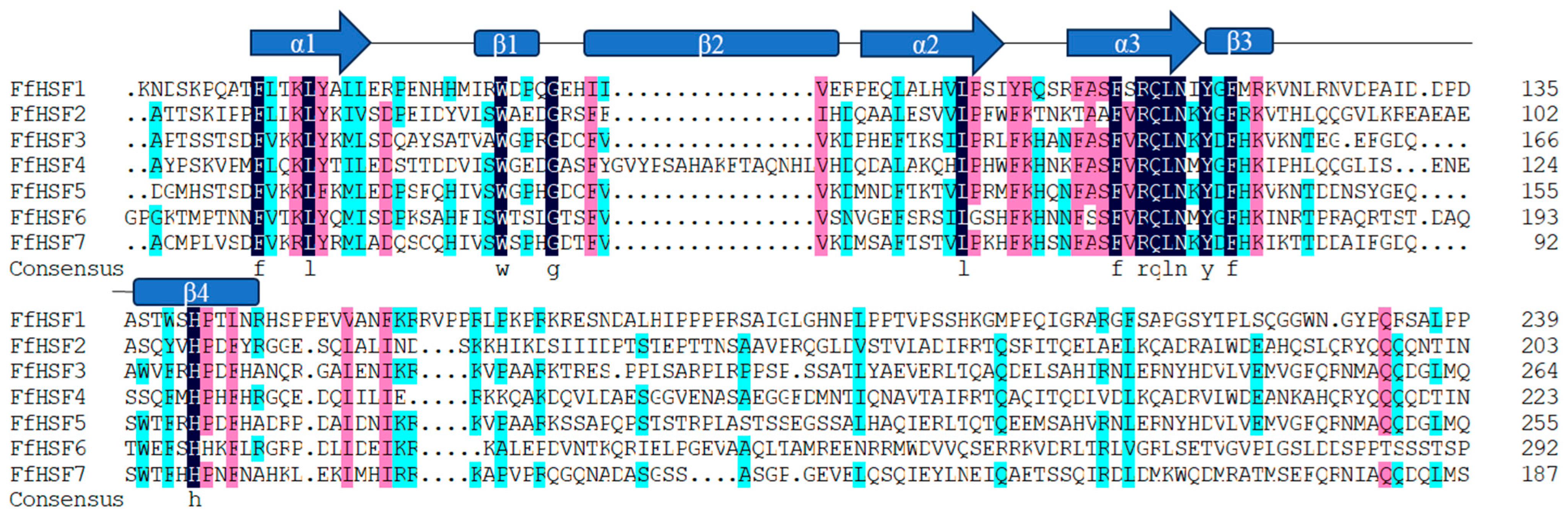
A partial multiple sequence alignment of the FfHSFs is shown in Figure 1. All FfHSFs were found to contain the conserved HSF-like DNA-binding domain, which consists of three α-helices and four β-strands.

3.2. Gene Structure and Conserved Motifs of FfHSFs

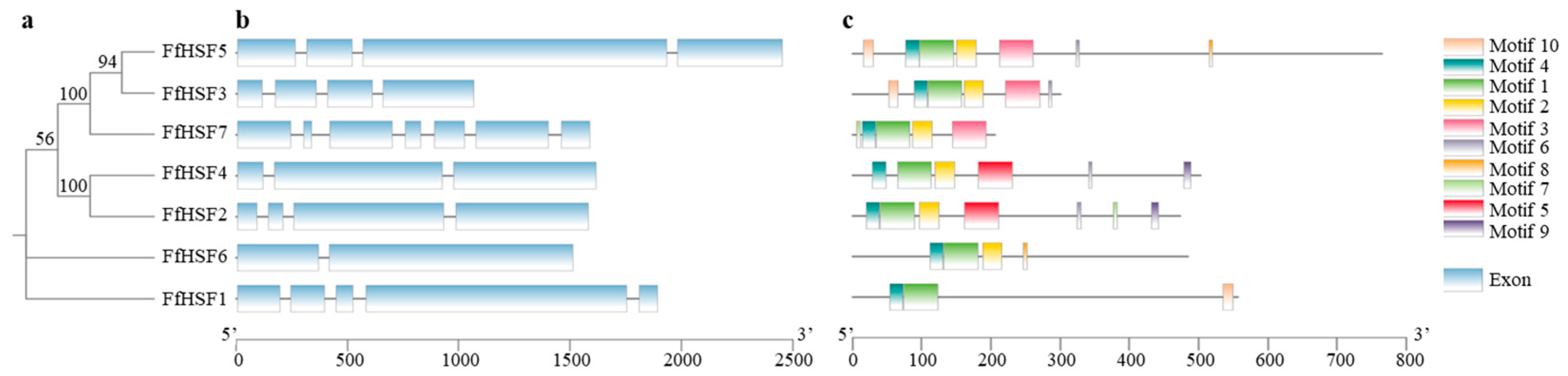
Based on conserved domains and gene structure characteristics, the FfHSFs can be classified into four categories: FfHSF3, FfHSF5, and FfHSF7 belong to Group I, containing motif 3; FfHSF2 and FfHSF4 form Group II, both possessing motif 5 and motif 9; while FfHSF6 and FfHSF1 are categorized as Group III and Group IV, respectively (Figure 2a,c). Gene structure analysis revealed considerable variation in exon numbers among the FfHSFs: FfHSF2, FfHSF3, and FfHSF5 contain four exons; FfHSF1 and FfHSF7 contain five exons; whereas FfHSF4 contains three exons, and FfHSF6 contains only two exons (Figure 2b). Analysis using the online tool MEME identified a total of 10 motifs. All FfHSF proteins contained motif 1 and motif 4. With the exception of FfHSF1, all other members contained motif 2. Motif 6 was present in FfHSF2, FfHSF3, FfHSF4, and FfHSF5. Motif 7 was found in FfHSF2 and FfHSF7. Motif 8 was specific to FfHSF5 and FfHSF6, while motif 10 was detected in FfHSF1, FfHSF3, and FfHSF5 (Figure 2c).

3.3. Cis-Acting Elements and Transcription Factors Analysis in the Promoters of FfHSFs Genes

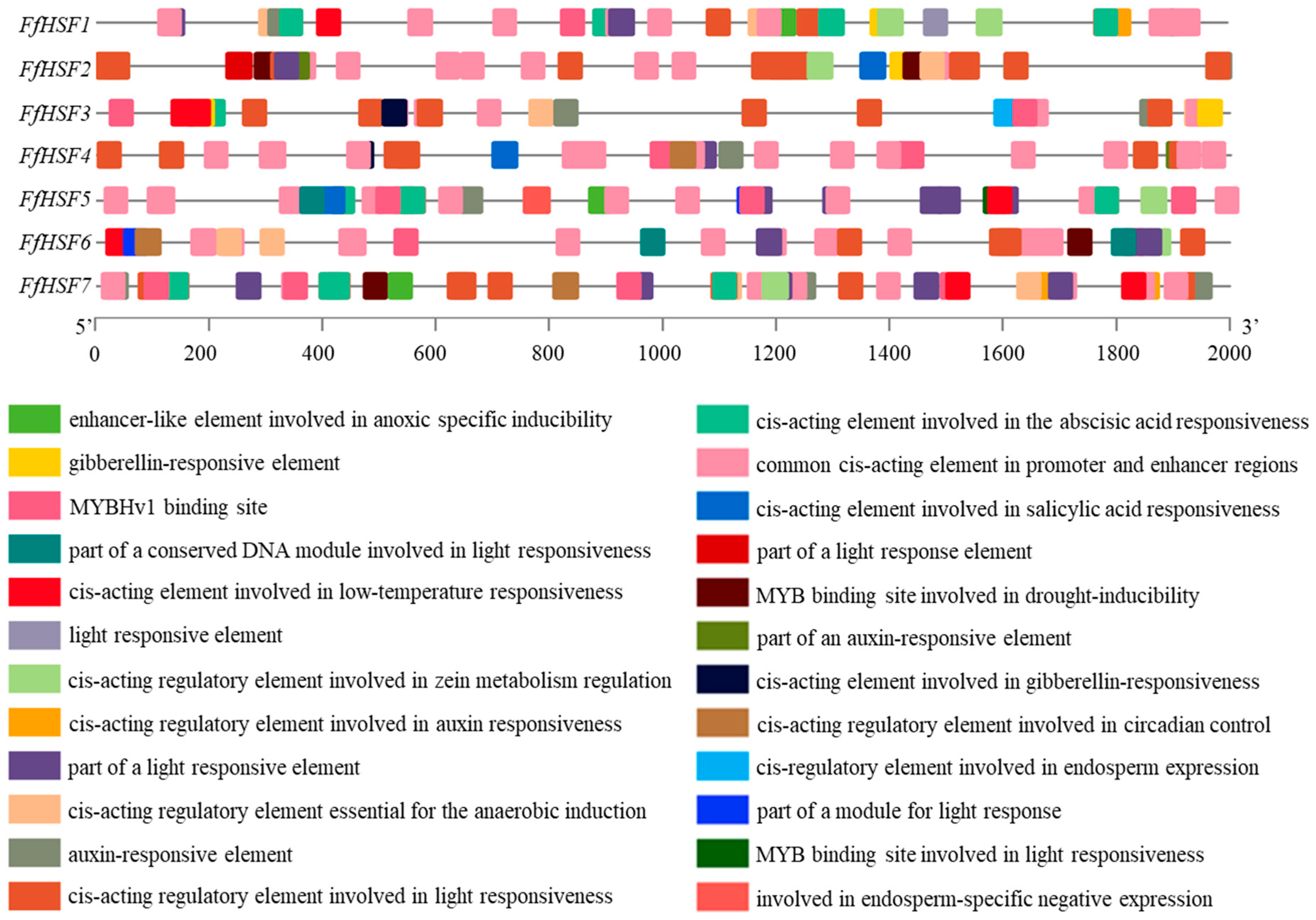
Analysis of the 2 kb upstream promoter sequences of the FfHSFs was performed using the online software PlantCARE. In addition to core promoter elements such as the TATA-box, the analysis identified a range of putative cis-acting regulatory elements. These included response elements for auxin, salicylic acid, gibberellin, abscisic acid, low temperature, drought, hypoxia, and light, as well as elements involved in zein metabolism regulation and circadian rhythm control. This suggests that the FfHSFs may be involved in various biological processes, including growth regulation, responses to temperature and humidity, gas sensing, light signaling, and metabolic control. Notably, light-responsive elements were found in the promoters of almost all FfHSFs. With the exception of FfHSF4, all other genes contained hypoxia-responsive elements. All members except FfHSF2 and FfHSF4 possessed low-temperature-responsive elements. Furthermore, elements associated with circadian rhythm control were identified in FfHSF4, FfHSF6, and FfHSF7, while drought-responsive elements were present in FfHSF2, FfHSF6, and FfHSF7 (Figure 3).
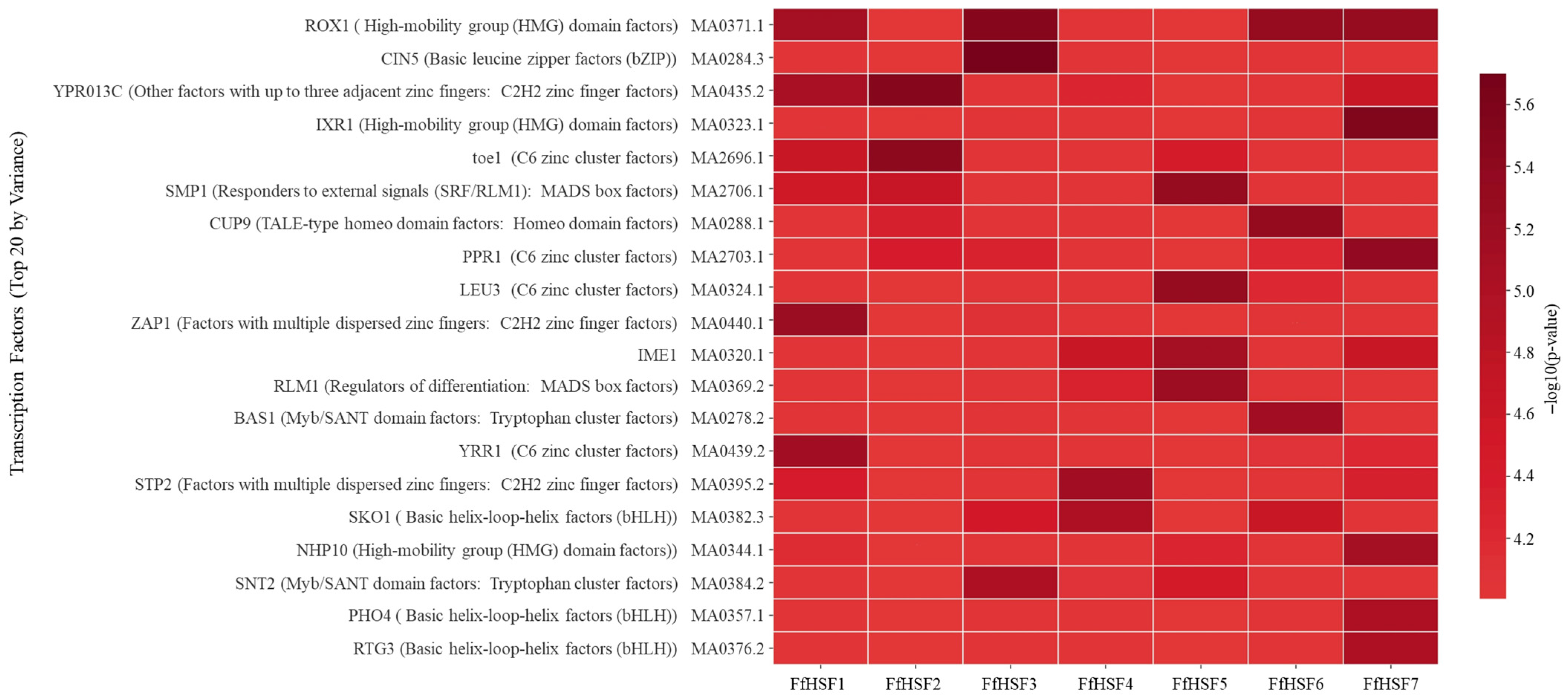
The promoter region of FfHSF was predicted with fimo using PWM from the redundant core fungi motif database in JASPAR, and approximately 125 prediction results were obtained in total. A heatmap was drawn for the top 20 results, as shown in Figure 4. Among the predictions, transcription factors with structures such as Basic leucine zipper factors (bZIP), C2H2 zinc finger structure, C6 zinc cluster, Homeodomain factors, Basic helix-loop-helix factors (bHLH), Tryptophan cluster, and High-mobility group (HMG) domain were identified. In fungi, the functions of these transcription factors include responses to hypoxia stress, reactive oxygen species, oxidative stress, osmotic stress, maintenance of cell wall integrity, regulation of growth and development, pheromone response, hyphal growth, and metabolite synthesis. All members are involved in the relevant pathways to varying degrees.

3.4. Phylogenetic Analysis of FfHSFs

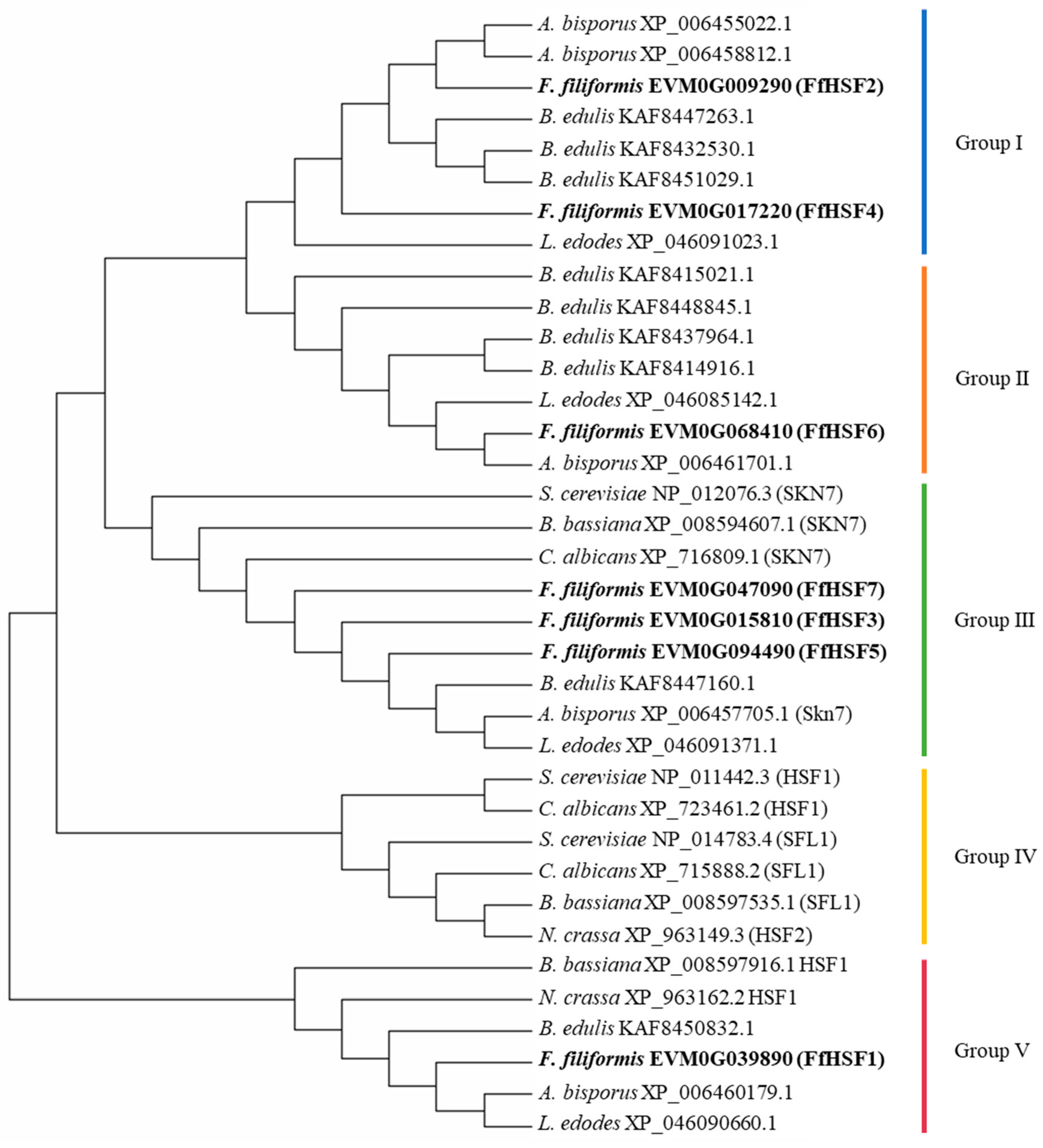
Selected HSF family members from four ascomycete species—B. bassiana, C. albicans, N. crassa, and S. cerevisiae—and three basidiomycete species—B. edulis, A. bisporus, and L. edodes—were used for phylogenetic analysis. A total of 9 BeHSFs, 5 AbHSFs, and 4 LeHSFs were annotated from the respective basidiomycete genomes. A phylogenetic tree was constructed with these sequences and the FfHSFs (Figure 5). The 37 HSFs were classified into five distinct clades. In Group I, FfHSF2 and FfHSF4 grouped with several basidiomycete HSFs; no ascomycete sequences were present in this clade. Group II contained FfHSF6, which clustered with HSFs from L. edodes and A. bisporus, and these further grouped with four BeHSFs, again with no ascomycete representatives. In Group III, FfHSF3, FfHSF5, and FfHSF7 clustered with a basidiomycete HSF and SKN7 homologs. Group IV, which contained no FfHSF, comprised HSF1 proteins from S. cerevisiae and C. albicans clustering with SFL1 and NcHSF2. Group V showed FfHSF1 clustering first with other basidiomycete HSF1 homologs, and then with HSF1 from B. bassiana and N. crassa. The presence of highly conserved DNA-binding domains and oligomerization domains in FfHSF1 and its putative orthologs provides additional evidence for their orthologous relationship, as these domains are crucial for the function of HSF proteins.

3.5. Expression of FfHSFs Genes in Different Sections of Stipe and Pileus of Different Sizes

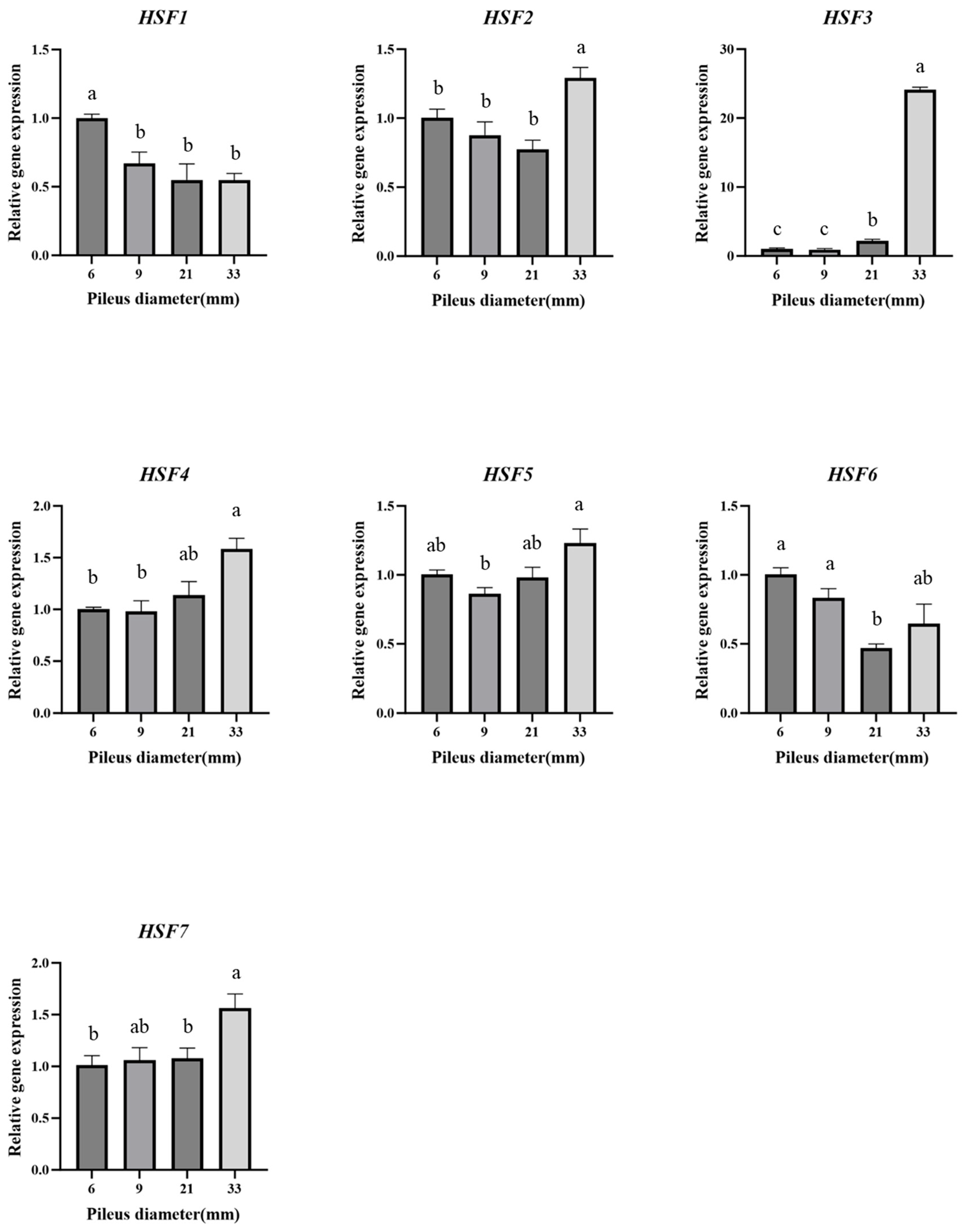
To investigate the roles of FfHSFs in pileus during fruiting body development, RT-PCR analysis of FfHSFs expression at different pileus sizes is shown in Figure 6. The expression levels of FfHSF2, FfHSF3, FfHSF4, FfHSF5 and FfHSF7 generally increased during pileus expansion, with FfHSF3 showing a highly significant up-regulation at the 3.3 mm pileus stage. In contrast, FfHSF1 expression was highest in 0.6 mm pileus and subsequently decreased gradually. FfHSF6 expression exhibited an overall declining trend as the pileus developed. These results suggest that FfHSF1 and FfHSF6 may be implicated in early pileus development stages, while FfHSF2, FfHSF3, FfHSF4, FfHSF5, and FfHSF7 may be involved in late maturation phases of the pileus.
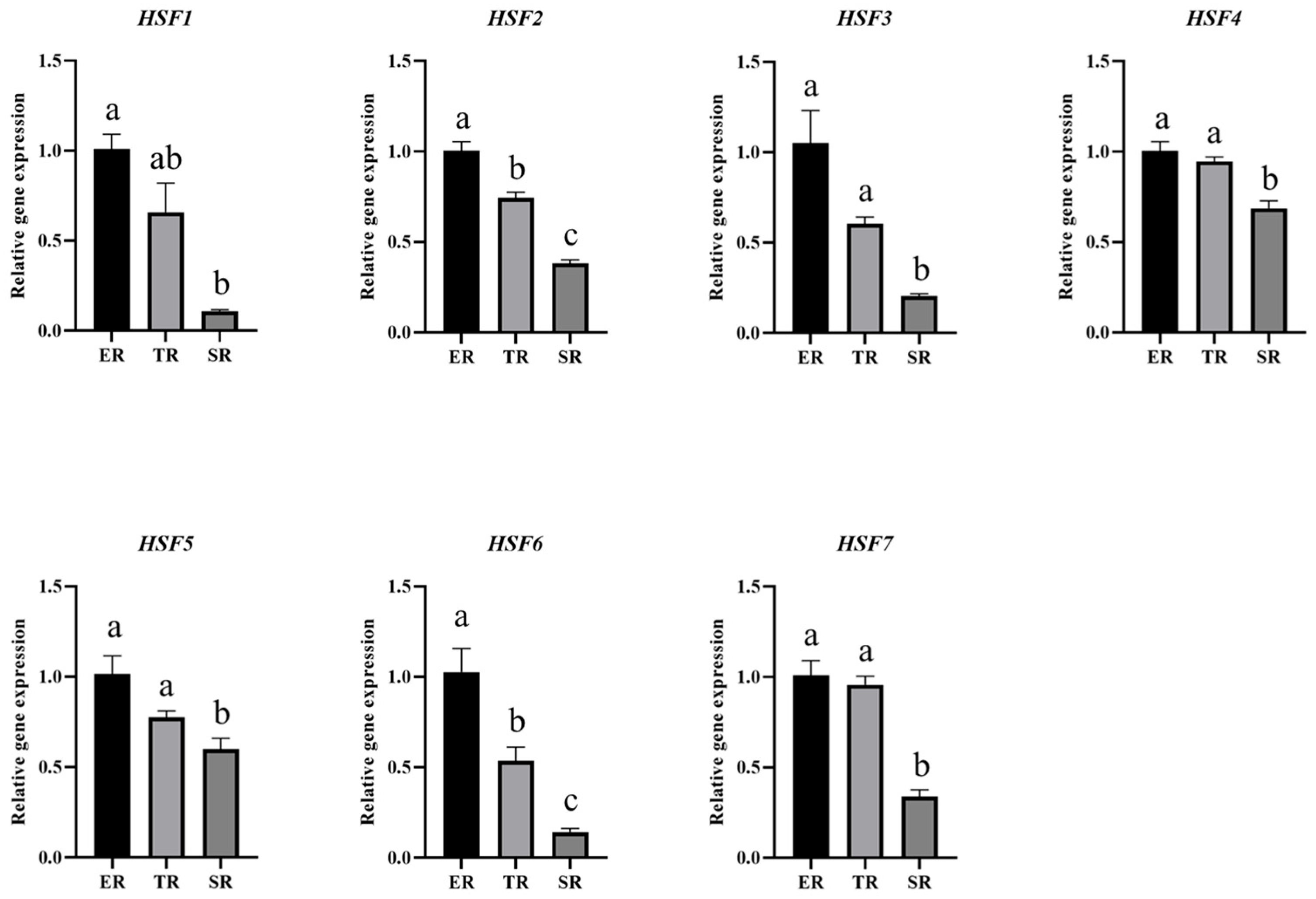
To investigate the roles of FfHSFs in stipe during fruiting body development, analysis of FfHSF expression in different stipe regions—defined as the elongation zone (ER), transition zone (TR), and stable zone (SR) based on growth rates—was conducted. The results revealed a conserved expression pattern across the family (Figure 7). All FfHSFs showed the highest expression in the ER, lower expression in the TR, and the lowest expression in the SR. This pattern suggests that FfHSFs may be associated with stipe elongation in F. filiformis.

3.6. Response of FfHSFs to Carbon Dioxide Treatment in Fruiting Body

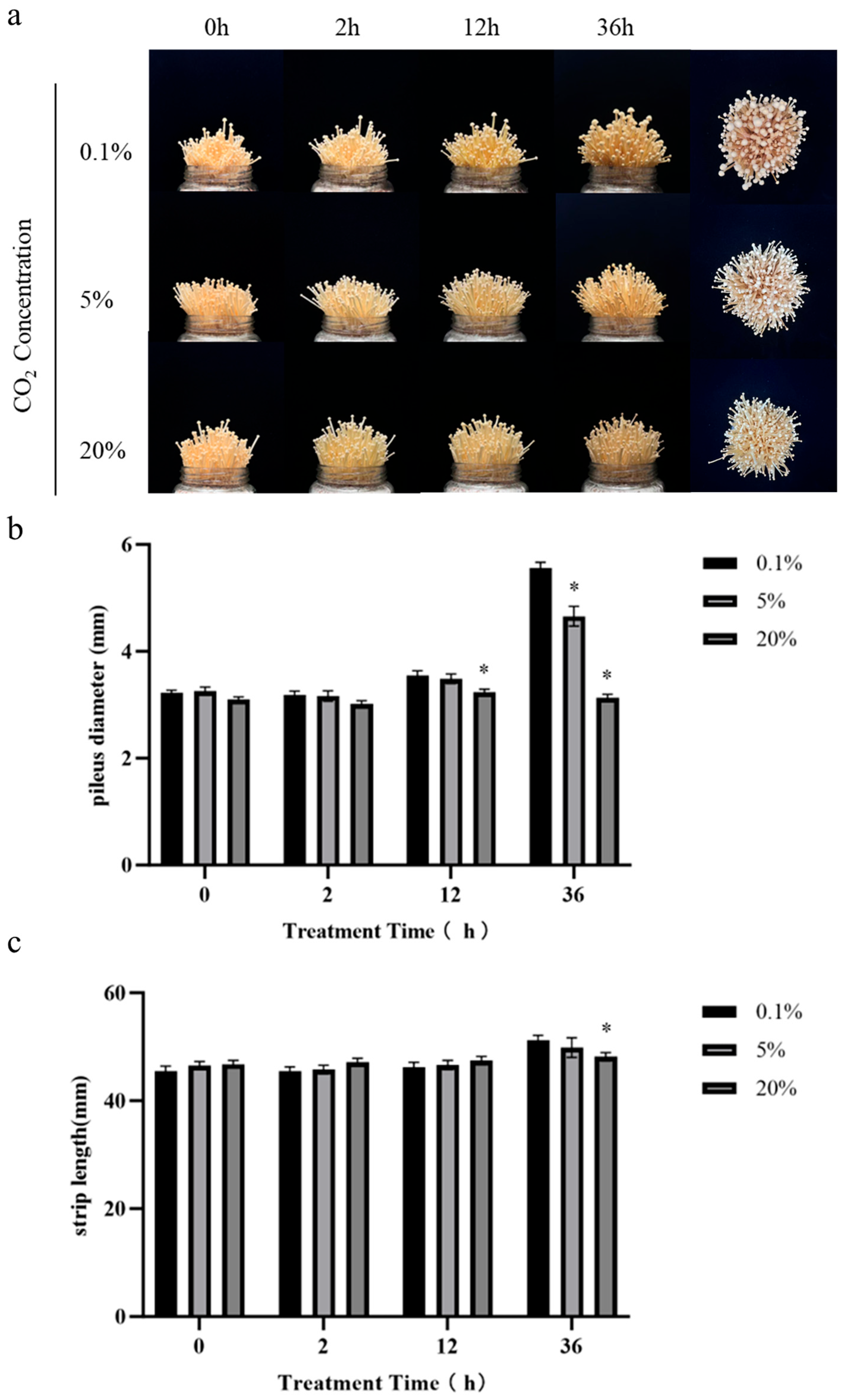
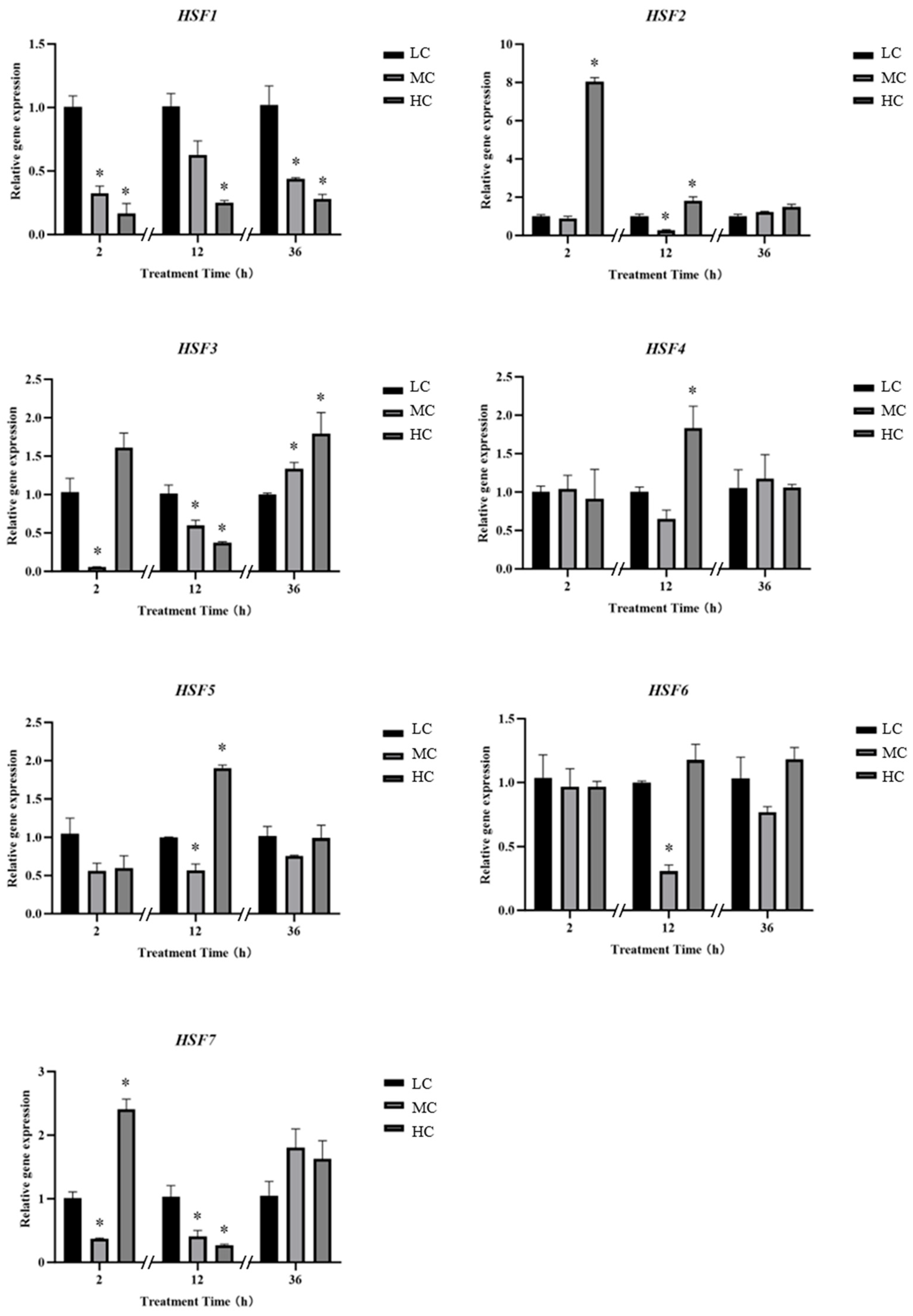
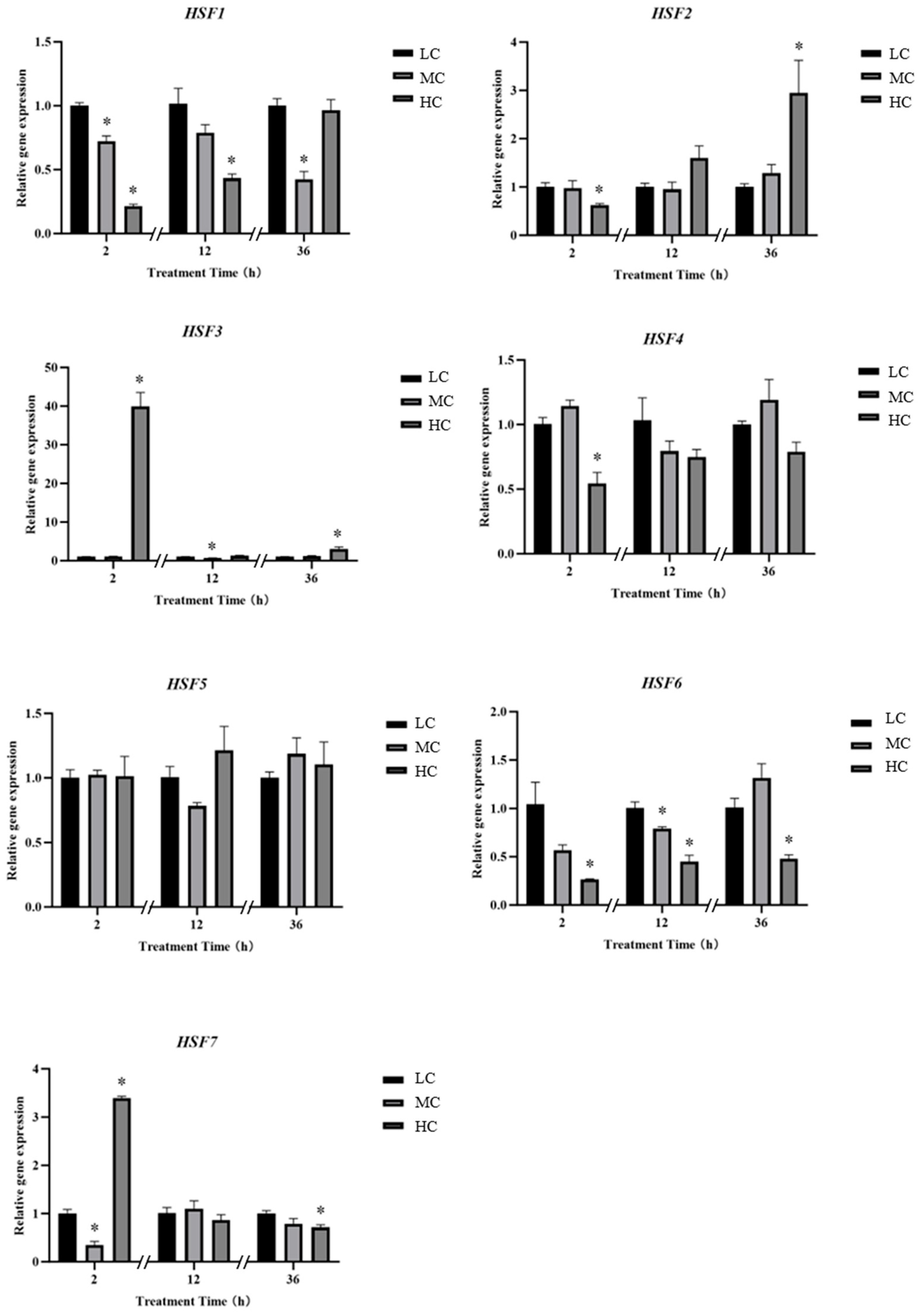
Fruiting bodies of F. filiformis, approximately 50–60 mm in height, were exposed to different CO2 concentrations. As shown in Figure 8a, compared with low CO2 concentration (LC, 0.1%), medium CO2 concentration (MC, 5%) suppressed pileus expansion, while high CO2 concentration (HC, 20%) inhibited both pileus expansion and stipe elongation. Samples of pileus and stipes were collected after 2 h, 12 h, and 36 h of carbon dioxide treatment. Each biological replicate was composed of tissues pooled from six individual fruiting bodies. In total, for each time-point, tissues from 18 individual fruiting bodies were collected and divided into three biological replicates (i.e., each replicate contained a mixture of tissues from six fruiting bodies). Any fruiting body with visible signs of damage, contamination, or abnormal morphological development was excluded. RNA was extracted from these samples to analyze FfHSFs expression levels by qRT-PCR. Meanwhile, at each time point (0 h, 2 h, 12 h, and 36 h), we separately measured and recorded the pileus diameter and stipe length of 20 individual samples of F. filiformis under different carbon dioxide concentrations (Figure 8). At 12 h, compared with 0.1% carbon dioxide concentration, the expansion of the pileus was significantly inhibited under the 20% carbon dioxide treatment (p < 0.05). At 36 h, the inhibition rate of the pileus of F. filiformis reached 16% under 5% carbon dioxide treatment, while it reached 43% under 20% carbon dioxide treatment (Figure 8b). At 36 h, the elongation of the stipe was significantly inhibited under 20% carbon dioxide treatment (p < 0.05) (Figure 8c). The results revealed differential expression of FfHSFs in both pileus (Figure 9) and stipe (Figure 10) tissues in response to CO2. FfHSF1 expression was significantly downregulated in both tissues with increasing CO2 concentration, suggesting a potential association, but further studies are required to clarify the exact role of FfHSF1. FfHSF2 expression remained largely unchanged at low-to-medium CO2 levels but decreased in pileus and increased in stipes under high CO2. FfHSF4 and FfHSF6 showed similar expression patterns, both being downregulated in stipes under high CO2; no significant differences were observed at 2 h and 36 h, while at 12 h, expression was downregulated at medium concentration and upregulated at high concentration. FfHSF3 and FfHSF7 exhibited comparable patterns, with both genes showing high expression in stipes after 2 h of high CO2 treatment and consistent trends in pileus. For FfHSF5, expression in stipes showed almost no difference at 2 h, followed by non-significant variations; however, a significant difference was observed in pileus at 12 h.

4. Discussion

In this study, we identified 7 HSFs in the F. filiformis genome through genome-wide analysis. This number is higher than that found in ascomycetes such as Saccharomyces spp. but is considerably lower than that in plants. Current research on heat shock transcription factors (HSFs) is more extensive in plants, which possess larger HSF gene families—for instance, Arabidopsis thaliana has 21 HSF-encoding genes, soybean contains 52, and tomato has 27 [24]. In contrast, fungal HSF families are generally smaller, and studies on HSFs in fungi, particularly edible mushrooms, remain limited. HSF families in plants are classified into three classes—A, B, and C—while in animals, they are grouped into six classes: HSF1, HSF2, HSF3, HSF4, HSFX, and HSFY [22]. However, no unified classification standard currently exists for fungi. Ascomycetes such as B. bassiana [25] and C. albicans [47] typically contain three HSF members: HSF1, SKN7, and SFL1. Based on phylogenetic analysis (Figure 5), we classified the F. filiformis HSFs into five distinct clades, with each clade exhibiting similar domain compositions and gene structures (Figure 2). The phylogenetic analysis revealed that HSFs of the same type show subphylum-specific clustering between basidiomycetes and ascomycetes. Notably, HSF1 from unicellular fungi (ScHSF1 and CaHSF1) did not cluster with HSF1 from multicellular fungi (BbHSF1 and NcHSF1) but instead grouped with SFL1 proteins. This may suggest that the divergence between the unicellular fungi S. cerevisiae and C. albicans occurred earlier than the divergence between HSF1 and SFL1. It is also noteworthy that no basidiomycete HSFs were found in the clade containing SFL1.
HSF-1 governs developmental plasticity and cold stress resilience in C. elegans by modulating neural circuits (tyraminergic/NMU signaling) and coordinating prolongevity factors (XBP-1, DAF-16, SKN-1, HLH-30) to regulate cold-inducible diapause entry and lifespan extension [48]. Cis-acting element analysis suggests that F. filiformis HSFs may be involved in responses to light, hypoxia, drought, and low-temperature stresses (Figure 3). The results of Transcription Factors Analysis indicate that FfHSFs may be involved in processes such as hypoxia stress, reactive oxygen species response, oxidative stress, osmotic stress, maintenance of cell wall integrity, regulation of growth and development, pheromone response, hyphal growth, and metabolite synthesis (Figure 4). Structure determines function: HSF family proteins with different domains exhibit significant differences in regulation and biological roles [49]. Moreover, HSFs play crucial roles in organismal regulation of growth and development. The structural variation and distinct domains among FfHSFs likely underlie their functional diversification. Their differential expression across pileus sizes and stipe regions supports a role in fruiting body development, particularly in stipe elongation. However, the specific mechanisms by which HSFs regulate growth in F. filiformis require further investigation. Previous studies have shown that HSFs are involved in growth, development, and aging in various organisms [46]. Previous research has demonstrated that HSFs play a crucial and indispensable role in the processes of gametogenesis, embryonic development, organogenesis, and organismal growth in animals [50]. Meanwhile, studies reveal tissue-specific expression patterns of HSFs in rye (Secale cereale), implicating their potential roles in stem elongation, root morphogenesis, and floral development [51]. The pileus and stipe are important components of the fruiting body of F. filiformis, with the pileus functioning as the reproductive organ for sporogenesis. The distinct expression patterns of FfHSFs between the pileus and stipe suggest their involvement in both fruiting body development and sporogenesis.
HSFs play crucial roles in stress resistance [52]. For instance, HSFs in Brassica napus can respond to heat, drought and high CO2 stress [52]. In maize, HSFs play a crucial role in regulating responses to cold and heat stresses [53,54]. Previous studies have revealed that the HSF transcription factors in C. albicans are responsive to multiple environmental cues, including temperature shifts, carbon dioxide concentrations, and oxidative stress conditions [55]. However, there have been few reports on HSFs in edible fungi participating in the response to CO2 stress during the development of their fruiting body. Edible fungi are reported to display a differential sensitivity to CO2 that is developmentally regulated, with the fruiting body stage being the most sensitive, followed by primordium formation, while mycelial growth is the least affected [56]. In the industrial cultivation of species such as F. filiformis, the environmental CO2 level is typically raised to approximately 3–5% during fruiting body development to suppress pileus expansion. In contrast, a concentration of 20% CO2 represents an extreme condition that completely inhibits fruiting body growth. When F. filiformis fruiting bodies were treated with different CO2 concentrations, most FfHSFs showed differential expression. Notably, the expression of FfHSF1 in the pileus decreased consistently with increasing CO2 levels, suggesting that FfHSF1 may be a candidate negative regulator in the CO2 response, but further studies are required to clarify the exact role of FfHSF1. We further hypothesize that the upregulation of FfHSF4 and FfHSF6 at 12 h under high CO2 conditions might be part of a compensatory mechanism in the cellular stress response. Our results are consistent with previous findings that elevated CO2 concentrations inhibit pileus expansion in F. velutipes by downregulating PHO80-like cyclin genes, leading to cell cycle arrest [57]. Likewise, C. albicans has been shown to undergo morphological and virulence changes under CO2 stress. It was demonstrated that activation of HSF1 is essential for the full virulence of this fungal pathogen, indicating that HSF1 likely participates in the morphological adaptations of C. albicans under CO2 stress [58]. Meanwhile, SFL1 in C. albicans is involved in biofilm formation under acidic conditions [59] and suppresses hyphal formation, a key virulence determinant [60]. However, the current findings remain preliminary inferences based on correlative expression data, and the specific functional roles of FfHSFs require empirical validation through targeted experiments. We hypothesize that if FfHSF1 is an upstream regulator in the CO2 signaling pathway, it would directly sense elevated CO2 levels and initiate a signaling cascade that leads to the down-regulation of cyclin genes. Conversely, if FfHSF1 is a downstream effector, it would be activated by an upstream signal in the CO2 pathway, such as the cAMP-PKA pathway, and then act on cyclin genes to cause cell cycle arrest. The specific mechanisms by which HSF is involved in this process remain unclear, and the molecular mechanism by which fungi respond to CO2 needs further exploration. Our study has several limitations. First, we only examined a limited number of CO2 levels (0.04%, 0.1%, 5%, 20%). A more comprehensive range of CO2 concentrations could provide a more detailed understanding of the dose–response relationship between CO2 and FfHSF gene expression and fruiting body development. Second, we used a single genetic background of F. filiformis. The genetic diversity within the species may lead to different responses to CO2, and thus, our findings may not be fully generalizable. Third, our results are mainly based on gene expression data, and we lack direct protein-level validation. Without protein-level evidence, the functional roles of FfHSFs inferred from gene expression may not accurately reflect their actual biological functions.

Author Contributions

Conceptualization, J.Y. and B.G.; methodology, X.D.; software, X.H.; validation, X.D., R.Z. and X.H.; formal analysis, X.D. and Y.G.; investigation, J.C.; resources, J.L.; data curation, R.M.; writing—original draft preparation, X.D.; writing—review and editing, J.Y.; visualization, X.D.; supervision, Z.T.; project administration, R.F.; funding acquisition, B.G. All authors have read and agreed to the published version of the manuscript.

Funding

This research was funded by Sichuan Science and Technology Program (2024ZYD0195), the National Natural Science Foundation of China (32102458), the Agricultural Science and Technology Innovation Program (No. 34-IUA-06, No. S2024006), the Joint Breeding Research Program of Sichuan Province (No. 2023YZ001).

Data Availability Statement

The original contributions presented in the study are included in the article; further inquiries can be directed to the corresponding authors.

Acknowledgments

We would like to acknowledge all the researchers in our laboratory for their help.

Conflicts of Interest

The authors declare no conflicts of interest.

References

  1. Bao, D.P.; Tan, Q. The major scientific and technical issues in the development of Chinese edible mushroom industry. Edible Med. Mushrooms 2024, 32, 217–225. [Google Scholar]
  2. Virágh, M.; Merényi, Z.; Csernetics, Á.; Földi, C.; Sahu, N.; Liu, X.; Hibbett, D.S.; Nagy, L.G. Evolutionary Morphogenesis of Sexual Fruiting Bodies in Basidiomycota: Toward a New Evo-Devo Synthesis. Microbiol. Mol. Biol. Rev. 2022, 86, e00019-21. [Google Scholar] [CrossRef]
  3. Yan, J.J.; Tong, Z.J.; Liu, Y.Y.; Li, Y.N.; Zhao, C.; Mukhtar, I.; Tao, Y.X.; Chen, B.Z.; Deng, Y.J.; Xie, B.G. Comparative transcriptomics of Flammulina filiformis suggests a high CO2 concentration inhibits early pileus expansion by decreasing cell division control pathways. Int. J. Mol. Sci. 2019, 20, 5923. [Google Scholar] [CrossRef]
  4. Zhao, C.C.; Xie, C.F.; Zhu, X.J. Research on CO2 concentration reality influence model of fruiting body growth period of Pleurotus eryngii. J. Chin. Agric. Mech. 2015, 36, 83–87+99. [Google Scholar] [CrossRef]
  5. Lin, R.; Zhang, L.; Yang, X.; Li, Q.; Zhang, C.; Guo, L.; Yu, H.; Yu, H. Responses of the Mushroom Pleurotus ostreatus under Different CO2 Concentration by Comparative Proteomic Analyses. J. Fungi 2022, 8, 652. [Google Scholar] [CrossRef]
  6. Dong, H.; Li, Y.; Jiang, N.; Li, Z.; Liu, S.; Zhou, F. Effects of CO2 concentration on yield and quality of Lentinus edodes during brown mycelium-film formation under factory conditions. Edible Fungi 2022, 44, 9–11+21. [Google Scholar]
  7. Xu, R. Effects of Low O2-High CO2 on the Morphogenesis and Quality of Fruiting Bodies of Lentinus edodes. Master’s Thesis, Shenyang Agricultural University, Shenyang, China, 2024. [Google Scholar]
  8. Dai, X.; Han, Z.; Ma, Y.; Zhang, P.; Chen, H.; Zhang, J. Effect of O2 and CO2 concentrations on mycelium growth and ear production of Auricularia heimuer. Edible Fungi 2022, 42, 10–13. [Google Scholar]
  9. Chadwick, B.J.; Lin, X. Effects of CO2 in fungi. Curr. Opin. Microbiol. 2024, 79, 102488. [Google Scholar] [CrossRef] [PubMed]
  10. China Edible Fungus Association. Analysis of the 2023 National Statistical Survey on Edible Fungi in China. Edible Fungi China 2025, 120–129. [Google Scholar]
  11. Li, W.; Shang, J.; Bao, D.; Wan, J.; Zhou, C.; Feng, Z.; Li, H.; Shao, Y.; Wu, Y. Whole-genome sequence analysis of Flammulina filiformis and functional validation of gad, a key gene for γ-aminobutyric acid synthesis. J. Fungi 2024, 10, 862. [Google Scholar] [CrossRef]
  12. Yan, J.J.; Tong, Z.J.; Han, X.; Gan, Y.; Liu, Y.Y.; Chen, J.; Duan, X.L.; Lin, J.B.; Gan, B.C.; Xie, B.G. Transcriptome Profiling Reveals Candidate Genes Related to Stipe Gradient Elongation of Flammulina filiformis. J. Fungi 2022, 9, 64. [Google Scholar] [CrossRef]
  13. Cui, Y.Q.; Liu, X.; He, X.L.; Wang, B.; Wan, Y.; Peng, W.H. Comparative transcriptomics analysis of pathways and genes related to stipe elongation regulation of Flammulina filiformis. Mycosystema 2024, 43, 65–78. [Google Scholar]
  14. Chen, Y.Z. Functional Analysis of Serine/Threonine Protein Kinase Gene FfStpk2 and FfStpk4 in Regulating Growth and Development of Yellow Flammulina filiformis. Master’s Thesis, Fujian Agriculture and Forestry University, Fuzhou, China, 2023. [Google Scholar]
  15. Yan, J.; Chekanova, J.; Liu, Y.; Gan, B.; Long, Y.; Han, X.; Tong, Z.; Miao, J.; Lian, L.; Xie, B.; et al. Reactive Oxygen Species Distribution Involved in Stipe Gradient Elongation in the Mushroom Flammulina filiformis. Cells 2022, 11, 1896. [Google Scholar] [CrossRef]
  16. Zhang, B.; Wei, X.; Xi, L.; Qiao, Y.; Chang, M.; Deng, B.; Liu, J. Genome-wide identification of the MYB gene family and FfMYB13 regulation analysis in cell wall synthesis underlying tissue toughening process of yellow Flammulina filiformis stipes. Int. J. Biol. Macromol. 2025, 288, 138660. [Google Scholar] [CrossRef]
  17. Hong, J.L.; Huang, T.G.; Huang, L.S.; Jin, L.Q. Key points of industrial bottle culture technique of yellow Flammulina velutipes. Edible Med. Mushrooms 2021, 29, 255–257. [Google Scholar]
  18. Liu, Y.Y.; Tong, Z.J.; Li, Y.N.; Yan, J.J.; Zhao, C.; Yao, S.; Li, B.Y.; Xie, B.G. CA gene superfamily and its expressions in response to CO2 in Flammulina filiformis. Mycosystema 2019, 38, 2249–2257. [Google Scholar]
  19. Kang, H.X. Effects of CO2 Concentration on Growth and Physiology of Auricularia heimuer. Master’s Thesis, Northeast Forestry Univercity, Harbin, China, 2023. [Google Scholar]
  20. Barna, J.; Csermely, P.; Vellai, T. Roles of heat shock factor 1 beyond the heat shock response. Cell. Mol. Life Sci. 2018, 75, 2897–2916. [Google Scholar] [CrossRef]
  21. Liu, A.Y.; Minetti, C.A.; Remeta, D.P.; Breslauer, K.J.; Chen, K.Y. HSF1, Aging, and Neurodegeneration. Adv. Exp. Med. Biol. 2023, 1409, 23–49. [Google Scholar] [PubMed]
  22. Gomez-Pastor, R.; Burchfiel, E.T.; Thiele, D.J. Regulation of heat shock transcription factors and their roles in physiology and disease. Nat. Rev. Mol. Cell Biol. 2018, 19, 4–19. [Google Scholar] [CrossRef] [PubMed]
  23. Nover, L.; Scharf, K.D.; Gagliardi, D.; Vergne, P.; Czarnecka-Verner, E.; Gurley, W.B. The Hsf world: Classification and properties of plant heat stress transcription factors. Cell Stress Chaperones 1996, 1, 215–223. [Google Scholar] [CrossRef] [PubMed]
  24. Scharf, K.D.; Berberich, T.; Ebersberger, I.; Nover, L. The plant heat stress transcription factor (Hsf) family: Structure, function and evolution. Biochim. Biophys. Acta 2012, 1819, 104–119. [Google Scholar] [CrossRef]
  25. Zhou, G.; Ying, S.H.; Hu, Y.; Fang, X.; Feng, M.G.; Wang, J. Roles of Three HSF Domain-Containing Proteins in Mediating Heat-Shock Protein Genes and Sustaining Asexual Cycle, Stress Tolerance, and Virulence in Beauveria bassiana. Front. Microbiol. 2018, 9, 1677. [Google Scholar] [CrossRef]
  26. Morano, K.A.; Santoro, N.; Koch, K.A.; Thiele, D.J. A trans-activation domain in yeast heat shock transcription factor is essential for cell cycle progression during stress. Mol. Cell. Biol. 1999, 19, 402–411. [Google Scholar] [CrossRef]
  27. Isermann, T.; Schneider, K.L.; Wegwitz, F.; De Oliveira, T.; Conradi, L.C.; Volk, V.; Feuerhake, F.; Papke, B.; Stintzing, S.; Mundt, B.; et al. Enhancement of colorectal cancer therapy through interruption of the HSF1-HSP90 axis by p53 activation or cell cycle inhibition. Cell Death Differ. 2025, 32, 1734–1749. [Google Scholar] [CrossRef] [PubMed]
  28. Logan, I.R.; McNeill, H.V.; Cook, S.; Lu, X.; Meek, D.W.; Fuller-Pace, F.V.; Lunec, J.; Robson, C.N. Heat shock factor-1 modulates p53 activity in the transcriptional response to DNA damage. Nucleic Acids Res. 2009, 37, 2962–2973. [Google Scholar] [CrossRef]
  29. Li, Q.; Martinez, J.D. Loss of HSF1 results in defective Radiation-Induced G(2) arrest and DNA repair. Radiat. Res. 2011, 176, 17–24. [Google Scholar] [CrossRef] [PubMed]
  30. Gao, X.; Fu, Y.; Sun, S.; Gu, T.; Li, Y.; Sun, T.; Li, H.; Du, W.; Suo, C.; Li, C.; et al. Cryptococcal Hsf3 controls intramitochondrial ROS homeostasis by regulating the respiratory process. Nat. Commun. 2022, 13, 5407. [Google Scholar] [CrossRef] [PubMed]
  31. Wang, F.Q.; Yu, Z.; Mai, F.F.; Liu, Y.D.; Hu, Y.R.; Wen, Q.; Shen, J.W.; Qi, Y.C. Identification of heat shock transcription factor and expression pattern of its genes in Pleurotus ostreatus. J. Fungal Res. 2025, 1–13. [Google Scholar]
  32. Xiao, K.Q. The Mechanism of SsSnf5-SsHsf1 Transcription Module Regulates Stress Responses and Pathogenicity in Sclerotinia sclerotiorum. Ph.D. Thesis, Jilin University, Jilin, China, 2024. [Google Scholar]
  33. Wang, H.R. Studies on the Mechanism of the Transgenic Plants Dwarfing Caused by Overexpression of Heat Shock Transcription Factor SlHsfC1 in Tomato. Master’s Thesis, Southwest University, Chongqing, China, 2021. [Google Scholar]
  34. Vydra, N.; Toma, A.; Widlak, W. Pleiotropic role of HSF1 in neoplastic transformation. Curr. Cancer Drug Targets 2014, 14, 144–155. [Google Scholar] [CrossRef]
  35. Li, J.; Shao, Y.; Yang, Y.; Xu, C.; Jing, Z.; Li, H.; Xie, B.; Tao, Y. The Chromatin Modifier Protein FfJMHY Plays an Important Role in Regulating the Rate of Mycelial Growth and Stipe Elongation in Flammulina filiformis. J. Fungi 2022, 8, 477. [Google Scholar] [CrossRef]
  36. Chen, C.; Wu, Y.; Li, J.; Wang, X.; Zeng, Z.; Xu, J.; Liu, Y.; Feng, J.; Chen, H.; He, Y.; et al. TBtools-II: A “one for all, all for one” bioinformatics platform for biological big-data mining. Mol. Plant 2023, 16, 1733–1742. [Google Scholar] [CrossRef] [PubMed]
  37. Fan, K.; Mao, Z.; Ye, F.; Pan, X.; Li, Z.; Lin, W.; Zhang, Y.; Huang, J.; Lin, W. Genome-wide identification and molecular evolution analysis of the heat shock transcription factor (HSF) gene family in four diploid and two allopolyploid Gossypium species. Genomics 2021, 113, 3112–3127. [Google Scholar] [CrossRef]
  38. Ju, L.X.; Lei, X.; Zhao, C.Z.; Shu, H.Y.; Wang, Z.W.; Cheng, S.H. Identification of MYB Family Genes and Its Relationship with Pungency of Pepper. Acta Hortic. Sin. 2020, 47, 875–892. [Google Scholar]
  39. Rauluseviciute, I.; Riudavets-Puig, R.; Blanc-Mathieu, R.; Castro-Mon Dragon, J.A.; Ferenc, K.; Kumar, V.; Lemma, R.B.; Lucas, J.; Che‘neby, J.; Baranasic, D.; et al. JASPAR 2024: 20th anniversary of the open-access database of transcription factor binding profiles. Nucleic Acids Res. 2024, 52, D174–D182. [Google Scholar] [CrossRef]
  40. Grant, C.E.; Bailey, T.L.; Noble, W.S. FIMO: Scanning for oc currences of a given motif. Bioinformatics 2011, 27, 1017–1018. [Google Scholar] [CrossRef]
  41. Tettelin, H.; Agostoni Carbone, M.L.; Albermann, K.; Albers, M.; Arroyo, J.; Backes, U.; Barreiros, T.; Bertani, I.; Bjourson, A.J.; Brückner, M.; et al. The nucleotide sequence of Saccharomyces cerevisiae chromosome VII. Nature 1997, 387, 81–84. [Google Scholar] [CrossRef]
  42. Engel, S.R.; Wong, E.D.; Nash, R.S.; Aleksander, S.; Alexander, M.; Douglass, E.; Karra, K.; Miyasato, S.R.; Simison, M.; Skrzypek, M.S.; et al. New data and collaborations at the Saccharomyces Genome Database: Updated reference genome, alleles, and the Alliance of Genome Resources. Genetics 2022, 220, iyab224. [Google Scholar] [CrossRef]
  43. Muzzey, D.; Schwartz, K.; Weissman, J.S.; Sherlock, G. Assembly of a phased diploid Candida albicans genome facilitates allele-specific measurements and provides a simple model for repeat and indel structure. Genome Biol. 2013, 14, R97. [Google Scholar] [CrossRef]
  44. Galagan, J.E.; Calvo, S.E.; Borkovich, K.A.; Selker, E.U.; Read, N.D.; Jaffe, D.; FitzHugh, W.; Ma, L.J.; Smirnov, S.; Purcell, S.; et al. The genome sequence of the filamentous fungus Neurospora crassa. Nature 2003, 422, 859–868. [Google Scholar] [CrossRef]
  45. Zhang, T.; Nie, M.H.; Liu, Y.Y.; Duan, X.L.; Han, X.; Xie, B.G.; Yan, J.J. Expression Analysis of the Catalase Genes FfCAT1 and FfCAT2 in Flammulina filiformis. Acta Hortic. Sin. 2025, 52, 1769–1779. [Google Scholar]
  46. Tong, Z.; Han, X.; Duan, X.; Lin, J.; Chen, J.; Xiao, J.; Gan, Y.; Gan, B.; Yan, J. Genome-Wide Identification and Expression Analysis of the Cys2His2 Zinc Finger Protein Gene Family in Flammulina filiformis. J. Fungi 2024, 10, 644. [Google Scholar] [CrossRef]
  47. Spiering, M.J.; Moran, G.P.; Chauvel, M.; Maccallum, D.M.; Higgins, J.; Hokamp, K.; Yeomans, T.; D’Enfert, C.; Coleman, D.C.; Sullivan, D.J. Comparative transcript profiling of Candida albicans and Candida dubliniensis identifies SFL2, a C. albicans gene required for virulence in a reconstituted epithelial infection model. Eukaryot. Cell 2010, 9, 251–265. [Google Scholar] [CrossRef] [PubMed]
  48. Horikawa, M.; Fukuyama, M.; Antebi, A.; Mizunuma, M. Regulatory mechanism of cold-inducible diapause in Caenorhabditis elegans. Nat. Commun. 2024, 15, 5793. [Google Scholar] [CrossRef] [PubMed]
  49. Kovács, D.; Kovács, M.; Ahmed, S.; Barna, J. Functional diversification of heat shock factors. Biol. Futur. 2022, 73, 427–439. [Google Scholar] [CrossRef] [PubMed]
  50. Duchateau, A.; de Thonel, A.; El Fatimy, R.; Dubreuil, V.; Mezger, V. The “HSF connection”: Pleiotropic regulation and activities of Heat Shock Factors shape pathophysiological brain development. Neurosci. Lett. 2020, 725, 134895. [Google Scholar] [CrossRef]
  51. Ren, Y.; Ma, R.; Xie, M.; Fan, Y.; Feng, L.; Chen, L.; Yang, H.; Wei, X.; Wang, X.; Liu, K.; et al. Genome-wide identification, phylogenetic and expression pattern analysis of HSF family genes in the Rye (Secale cereale L.). BMC Plant Biol. 2023, 2, 441. [Google Scholar] [CrossRef]
  52. Zhu, X.; Huang, C.; Zhang, L.; Liu, H.; Yu, J.; Hu, Z.; Hua, W. Systematic Analysis of Hsf Family Genes in the Brassica napus Genome Reveals Novel Responses to Heat, Drought and High CO2 Stresses. Front. Plant Sci. 2017, 8, 1174. [Google Scholar] [CrossRef]
  53. Li, Z.; Li, Z.; Ji, Y.; Wang, C.; Wang, S.; Shi, Y.; Le, J.; Zhang, M. The heat shock factor 20-HSF4-cellulose synthase A2 module regulates heat stress tolerance in maize. Plant Cell 2024, 36, 2652–2667. [Google Scholar] [CrossRef] [PubMed]
  54. Gao, L.; Pan, L.; Shi, Y.; Zeng, R.; Li, M.; Li, Z.; Zhang, X.; Zhao, X.; Gong, X.; Huang, W.; et al. Genetic variation in a heat shock transcription factor modulates cold tolerance in maize. Mol. Plant 2024, 17, 1423–1438. [Google Scholar] [CrossRef]
  55. Znaidi, S. When HSFs bring the heat-mapping the transcriptional circuitries of HSF-type regulators in Candida albicans. mSphere 2025, 10, e0064423. [Google Scholar] [CrossRef]
  56. Guo, J.X.; Zhong, Y.H.; Zhang, S.X. Effects of carbon dioxide concentration on the growth and development of mushroom. Chin. J. Eco-Agric. 2000, 8, 49–52. [Google Scholar]
  57. Lee, K.W.; Park, C.H.; Lee, S.C.; Shin, J.H.; Park, Y.J. High Carbon Dioxide Concentration Inhibits Pileus Growth of Flammulina velutipes by Downregulating Cyclin Gene Expression. J. Fungi 2025, 11, 551. [Google Scholar] [CrossRef]
  58. Nicholls, S.; MacCallum, D.M.; Kaffarnik, F.A.; Selway, L.; Peck, S.C.; Brown, A.J. Activation of the heat shock transcription factor Hsf1 is essential for the full virulence of the fungal pathogen Candida albicans. Fungal Genet. Biol. 2011, 48, 297–305. [Google Scholar] [CrossRef] [PubMed]
  59. Gonçalves, B.; Barbosa, A.; Soares, A.R.; Henriques, M.; Silva, S. Sfl1 is required for Candida albicans biofilm formation under acidic conditions. Biochimie 2023, 209, 37–43. [Google Scholar] [CrossRef] [PubMed]
  60. Unoje, O.; Yang, M.; Lu, Y.; Su, C.; Liu, H. Linking Sfl1 Regulation of Hyphal Development to Stress Response Kinases in Candida albicans. mSphere 2020, 5, e00672-19. [Google Scholar] [CrossRef]
Figure 1. Multiple sequence alignments of FfHSFs. HSF-like DNA-binding domain (α1-β1-β2-α2-α3-β3-β4) is marked. Blue arrows denote α-helices, and blue boxes represent β-strands.
Horticulturae 12 00132 g001
Figure 2. Phylogenetic classification of FfHSFs (a), gene structure analyses of FfHSFs (b) and conserved motif of FfHSFs (c).
Horticulturae 12 00132 g002
Figure 3. Cis-elements Analysis of FfHSFs promoters.
Horticulturae 12 00132 g003
Figure 4. Top 20 Transcription Factors Analysis of FfHSFs promoters.
Horticulturae 12 00132 g004
Figure 5. Phylogenetic analysis of HSFs in fungi. The phylogenetic tree was constructed using the maximum likelihood method with 1000 bootstrap value. The numbers in the clades represent bootstrap values. Scale bar: 0.1 substitutions/site, corresponding to ~1 Mya (million years ago). Different groups were distinguished by different colors. Bold font represents the HSF family of F. filiformis.
Horticulturae 12 00132 g005
Figure 6. Relative expression levels of FfHSFs in different pileus sizes: 0.6 mm, 0.9 mm, 2.1 mm, 3.3 mm. Error bars represent the standard error of mean (SEM) calculated from three biological replicates. Different letters indicate significant differences in gene expression after treatment (p < 0.05; one-way ANOVA).
Horticulturae 12 00132 g006
Figure 7. Relative expression levels of FfHSFs in different stipe regions: elongation region (ER), transition zone (TR), and stable zone (SR). Error bars represent the standard error of mean (SEM) calculated from three biological replicates. Different letters indicate significant differences in gene expression after treatment (p < 0.05; one-way ANOVA).
Horticulturae 12 00132 g007
Figure 8. Phenotypic responses of F. filiformis fruiting bodies to different CO2 treatments. (a) Phenotype of F. filiformis under 0.1%, 5% and 20% concentrations of CO2. (b) Pileus diameter under 0.1%, 5% and 20% CO2 concentrations treatment. Control: Samples were treated with 0.1% CO2. Error bars represent the standard error of mean (SEM) calculated from six biological replicates. Asterisks indicate significant differences in gene expression following treatment (* p < 0.05; t-test). (c) Stipe length under 0.1%, 5% and 20% CO2 concentrations treatment. Control: Samples were treated with 0.1% CO2. Error bars represent the standard error of mean (SEM) calculated from 20 biological replicates. Asterisks indicate significant differences in gene expression following treatment (* p < 0.05; t-test).
Horticulturae 12 00132 g008
Figure 9. Relative expression levels of FfHSFs in pileus under 2 h, 12 h and 36 h CO2 treatments. 0.1%: LC, 5%: MC, 20%: HC. Control: Samples were treated with 0.1% CO2. Error bars represent the standard error of mean (SEM) calculated from three biological replicates. Asterisks indicate significant differences in gene expression following treatment (* p < 0.05; t-test).
Horticulturae 12 00132 g009
Figure 10. Relative expression levels of FfHSFs in stipe under 2 h, 12 h and 36 h CO2 treatments. 0.1%: LC, 5%: MC, 20%: HC. Control: Samples were treated with 0.1% CO2. Error bars represent the standard error of mean (SEM) calculated from three biological replicates. Asterisks indicate significant differences in gene expression following treatment (* p < 0.05; t-test).
Horticulturae 12 00132 g010
Table 1. The qRT-PCR primers for FfHSF gene family.
GeneForward Primer (5′–3′)Reverse Primer (5′–3′)
FfHSF1GACGTCCGCTCCCAAAAATGACCGTAGATGTTCAGCTGGC
FfHSF2CAGCACCGTTCTAGCAGACACAGGGACCGGAGAGTGTTTC
FfHSF3AAGACCCCCACGAATTCACCCGCAGAAAGTGGAGGGGATT
FfHSF4AAGATACCCCACATCCCCCATTGGGGCGAGAGTTAGAGG
FfHSF5ATGACGACGACGACGAGATGTCGGTAAAAGGTGACCGACG
FfHSF6CCTTTGTTCGCCAGCTCAACTCATCGAGAAGGTCGGGTCT
FfHSF7TAATGCACATTCGGCGCAAGTGATCCTGCTGTGCGATGTT
GAPDHCCTCTGCTCACTTGAAGGGTGCGTTGGAGATGACTTTGAA
RasTCAATGCGACGAGTAAAGAGAGGCATAGGTCCCACATCTACATTTCG
Table 2. Basic information of HSFs in F. filiformis.
GeneGene IDCDS/bpaa
Length
pIUnstable
Index
Molecular
Weight
Gravy ScoresSubcellular LocalizationChromosomal Location
FfHSF1EVM0G03989016715569.1172.860,711.35−0.928Nucleus4
FfHSF2EVM0G00929014224734.7556.9152,336.33−0.585Nucleus1
FfHSF3EVM0G0158109063018.4850.7334,022.17−0.718Nucleus1
FfHSF4EVM0G01722015125036.1260.3855,304.74−0.584Nucleus1
FfHSF5EVM0G09449022987655.556.0883,832.46−0.647Nucleus2
FfHSF6EVM0G06841014584859.1556.8951,909.45−0.716Nucleus6
FfHSF7EVM0G0470906182056.4972.6123,375.42−0.552Nucleus9
Disclaimer/Publisher’s Note: The statements, opinions and data contained in all publications are solely those of the individual author(s) and contributor(s) and not of MDPI and/or the editor(s). MDPI and/or the editor(s) disclaim responsibility for any injury to people or property resulting from any ideas, methods, instructions or products referred to in the content.