Article

Phytochemical Composition and Bioactivity of Different Fruit Parts of Opuntia robusta and Opuntia ficus-indica: Conventional Versus NADES-Based Extraction


by
Ouafaa Hamdoun
1,
Sandra Gonçalves
2,*,
Inês Mansinhos
2,
Raquel Rodríguez-Solana
2,3,
Gema Pereira-Caro
4,5,
José Manuel Moreno-Rojas
4,5,
Brahim El Bouzdoudi
1,
Mohammed L’bachir El Kbiach
1 and
Anabela Romano
2,*
1
Plant Biotechnology Team, Biology Department, Faculty of Sciences, Abdelmalek Essaadi University, Tetouan 93000, Morocco
2
MED—Mediterranean Institute for Agriculture, Environment and Development & CHANGE—Global Change and Sustainability Institute, Faculdade de Ciências e Tecnologia, Universidade do Algarve, Campus de Gambelas, 8005-139 Faro, Portugal
3
Department of Agroindustry and Food Quality, Andalusian Institute of Agricultural and Fisheries Research and Training (IFAPA), Rancho de la Merced Center, Carretera Cañada de la Loba (CA-3102) Km 3.1., SN, 11471 Jerez de la Frontera, Spain
4
Department of Agroindustry and Food Quality, Andalusian Institute of Agricultural and Fisheries Research and Training (IFAPA), Alameda del Obispo Center, Avenida Menendez-Pidal, SN, 14004 Córdoba, Spain
5
Foods for Health Group, Instituto Maimónides de Investigación Biomédica de Córdoba (IMIBIC), 14004 Córdoba, Spain
*
Authors to whom correspondence should be addressed.
Horticulturae 2026, 12(1), 98; https://doi.org/10.3390/horticulturae12010098
Submission received: 9 December 2025 / Revised: 13 January 2026 / Accepted: 14 January 2026 / Published: 17 January 2026

Abstract

This study evaluated the extraction efficiency of two Natural Deep Eutectic Solvents (NADESs), glycerol–urea (1:1) and citric acid–sorbitol (1:2), for recovering phenolic compounds from the different parts of the fruit (pulp, seed-containing pulp, seeds, and peel) of Opuntia robusta and Opuntia ficus-indica in comparison with 50% methanol. Phytochemical profiling was performed using ultra-high-performance liquid chromatography–high-resolution mass spectrometry, alongside antioxidant and enzyme inhibition assessments (acetylcholinesterase, butyrylcholinesterase, tyrosinase, α-glucosidase, and α-amylase). Glycerol–urea performed similarly to methanol in extracting phenolic compounds with notable antioxidant properties. Peel extracts contained the highest levels of bioactive compounds, particularly phenolic acids (525.49 in O. robusta and 362.96 µg/gDW in O. ficus indica). Enzyme inhibition varied across species and fruit parts, with extracts from both species inhibiting all targeted enzymes. Notably, this study provides the first evidence of tyrosinase inhibitory activity in O. robusta, which exhibited the strongest inhibition. Overall, these results emphasize the potential of cactus fruit extracts, particularly from O. robusta, for valorization, and support the use of NADESs as a sustainable and medium for extracting antioxidant compounds. Furthermore, the potential of fruit peel as waste with nutraceutical applications was demonstrated.

1. Introduction

The Opuntia genus (Cactaceae) is widely distributed across arid and semi-arid regions worldwide [1]. Mexico is considered its center of origin and hosts more than 126 species [2], the most common of which is Opuntia ficus-indica (L.) Mill. This species is ecologically and economically important due to its remarkable drought tolerance and ability to thrive in nutrient-poor soils. Today, O. ficus-indica is cultivated on a large scale in countries such as Mexico, Brazil, Italy, Spain, Tunisia, and Morocco [3]. Another species, Opuntia robusta J.C. Wendl. ex Pfeiff., also exhibits strong adaptability [4] and is widely distributed throughout Mexico. It has also been successfully introduced to South and East Africa, as well as to Mediterranean countries [5].
Interest in the nutritional and functional properties of foods has substantially grown among researchers, health authorities, and consumers due to the increasing incidence of non-communicable diseases, such as cardiovascular disorders, diabetes, obesity, and neurodegenerative conditions [6,7]. Several studies have highlighted the nutritional quality and health-promoting potential of Opuntia species, reporting variations in phytochemical profiles across different plant organs (e.g., fruits, roots, cladodes, flowers, seeds, and stems), as well as between wild and cultivated forms [8,9]. The various parts of Opuntia species contain high levels of water, carbohydrates, proteins, soluble fiber, fatty acids, and minerals [10], as well as bioactive compounds such as pigments and phenolic compounds, particularly as flavonoids [11]. Bioactive extracts from Opuntia spp. exhibit a wide range of pharmacological activities. Their antioxidant properties help to neutralize free radicals and mitigate oxidative stress [12], while their anti-inflammatory properties alleviate chronic inflammatory conditions [8]. Furthermore, the extracts have demonstrated hypoglycemic, hypolipidemic, anti-obesity, and hepatoprotective effects, supporting their use in nutraceutical, cosmeceutical, and pharmaceutical formulations [13,14,15]. In Morocco, many species of Opuntia have been domesticated and incorporated into agricultural systems, initially as an alternative crop for marginal land [16]. Currently, national strategies are encouraging the expansion of cactus cultivation and their incorporation into everyday diets [17]. O. ficus-indica remains the most economically important species, particularly in Mexico, where it covers an estimated 50,000–70,000 hectares and produces 300,000–500,000 tons of fruit annually. This ranks it as the country’s fifth most important fruit crop [18]. This species is valued for its nutritional composition and its many applications in food, medicine, cosmetics, and preventive healthcare [19]. O. robusta also makes a significant contribution to local economies, particularly through its edible cladodes and fruits [20], which have been reported to have beneficial effects on glucose and lipid metabolism [21]. In Morocco, O. ficus-indica is the most widespread species, whereas O. robusta is mainly cultivated in the northwest. Both species show potential in the production of bioactive metabolites [22], with O. ficus-indica being particularly rich in dietary fiber, vitamins, minerals, and phytochemicals, such as flavonoids, phenolic acids, betalains, antioxidants, and taurine. These contribute to its anti-inflammatory, hypoglycemic, antimicrobial, and antioxidant properties [19,23].
Plant matrices are important, yet often underutilized, sources of bioactive compounds with considerable potential for use in the food, pharmaceutical, and nutraceutical industries. The efficient extraction of these compounds largely depends on the choice of solvent [24]. Although conventional organic solvents are highly effective, concerns have been raised about their environmental impact in terms of toxicity, pollution, and bioaccumulation [25]. Consequently, there is an increasing demand for more environmentally friendly alternatives [26]. In this context, Natural Deep Eutectic Solvents (NADESs) have emerged as promising environmentally friendly candidates thanks to their biodegradability, low toxicity, adjustable polarity, and ability to extract phenolic compounds and other bioactive constituents [27]. Our previous work with Opuntia leucotricha demonstrated the potential of NADESs to enhance the extraction of bioactive compounds from fruit matrices [28]. Despite the extensive literature on O. ficus-indica, most studies still rely on conventional organic solvents [29]. To date, only one study has evaluated the use of NADESs to extract phenolic compounds from O. ficus-indica peel [30], and no studies have been conducted on O. robusta, making this study particularly novel. Valorizing fruit fractions, including those commonly regarded as by-products, aligns with circular economy principles by promoting resource efficiency, reducing waste, and developing value-added products from agricultural residues. This study compares the phytochemical composition and biological activities [including antioxidant and enzyme inhibitory properties such as acetylcholinesterase (AChE), butyrylcholinesterase (BChE), tyrosinase (Tyr), α-glucosidase, and α-amylase] of extracts obtained from different parts of the fruits (peel, seeds, seedless pulp, and seed-containing pulp) of O. robusta and O. ficus-indica. As peels and seeds are often discarded as by-products, utilizing them aligns with sustainable resource management and waste reduction strategies. Two NADES mixtures, glycerol–urea (1:1) and citric acid–sorbitol (1:2), were compared with a conventional solvent (50% methanol) to gain new insights into environmentally friendly extraction methods and the potential utilization of underused cactus fruit components.

2. Materials and Methods

2.1. Chemicals and Reagents

The following products were acquired from Sigma–Aldrich (Steinheim, Germany): Glycerol, rutin (quercetin-3-O-rutinoside, hyperoside (quercetin-3-O-galactoside), isorhamnetin-3-O-glucoside, narcissin (isorhamnetin-3-O-rutinoside), nicotiflorin (kaempferol-3-O-rutinoside), eriodictyol (5,7,3″,4″-tetrahydroxyflavanone), isoquercitrin (quercetin-3-O-glucoside), protocatechuic acid (3,4- dihydroxybenzoic acid), 4-hydroxybenzoic acid, syringic acid (3,5-dimethoxy-4-hydroxy-benzoic acid), 2,2-diphenyl-1-picrylhydrazyl (DPPH), trichloroacetic acid (TCA), potassium persulfate, 2,2′-azino-bis (3-ethylbenzothiazoline-6-sulfonic acid) di-ammonium salt tablets (ABTS), dibasic sodium phosphate anhydrous, Tyr, kojic acid, 3,4-dihydroxy-L-phenylalanine (L-DOPA), 5,5-dithiobis(2-nitrobenzoic acid) (DTNB), acetylthiocholine iodide (ATCI), butyrylthiocholine chloride (BTCI), electric-eel AChE, horse-serum BChE, galanthamine hydrobromide, p-nitrophenyl α-D-glucopyranoside, α-glucosidase, α-amylase from porcine pancreas, and 3,5-dinitrosalicylic acid (DNS). p-Coumaric acid (4’-hydroxycinnamic acid), sinapic acid (3,5-dimethoxy-4-hydroxycinnamic acid), and taxifolin (2,3-dihydroquercetin) were obtained from AASC Ltd. (Southampton, UK). Dihydroferulic acid (3-(4-Hydroxy-3-methoxyphenyl)propanoic acid) was acquired from Alfa Aesar (Lancashire, UK). Citric acid, sorbitol, ethanol, aluminum chloride, and naringenin (5,7,4′-trihydroxyflavanone) were purchased from Fluka (Buchs, Switzerland). Dibasic potassium phosphate, sodium acetate, fluorescein, monobasic sodium phosphate, and potato starch were obtained from Panreac (Barcelona, Spain). Potassium hexacyanoferrate (III), (±)-6-hydroxy-2,5,7,8-tetramethylchromane-2-carboxylic acid (Trolox), 2,2′-azobis(2-methylpropionamidine) dihydrochloride (AAPH), and choline chloride were purchased from Acros Organics (Geel, Belgium). Folin–Ciocalteu (FC) reagent, sodium carbonate, gallic acid, and iron (III) chloride were obtained from VWR (Leuven, Belgium). Urea and methanol were acquired from Fisher Scientific (Leicestershire, UK), while monobasic potassium phosphate and ascorbic acid were purchased from Merck (Darmstadt, Germany).

2.2. Plant Material

In August and September 2021, fruits of O. ficus-indica and O. robusta were collected from the Tangier–Tetouan–Al Hoceïma region in northern Morocco. O. ficus-indica spontaneously growing in the rural commune of Al Hamra, Province of Tetouan, is characterized by its orange peel, orange edible part, and moderate sweetness. Meanwhile, O. robusta sourced from Al Hoceïma is well known for its light green peel and edible part, as well as its sweet taste and texture similar to watermelon, hence the local name Dellahia in Morocco. Different parts of the fruits (peel, seed, pulp, and seed-containing pulp) underwent various analyses after their preparation into a homogeneous powder of 0.2 mm in diameter, as described by Hamdoun et al. [28]. Shortly, plant material from each part was dried using a ventilated oven at 40 °C until its weight stabilized and then was crushed, sieved through a stainless-steel sieve (Fisher Scientific LABOSI, Illkirch Cedex, France), and then stored in the dark using flasks hermetically sealed until analysis.

2.3. Natural Deep Eutectic Solvent (NADES) Preparation

Heating and stirring were used to prepare two NADES mixtures according to Mansinhos et al. [31]. NADES 1 was composed of equal ratios of glycerol and urea (Gly:U 1:1) and NADES 2 contained citric acid and sorbitol (CA:S 1:2). The NADESs were prepared by combining their respective components in the appropriate mole ratios with water to a final concentration of 30% (w/w), the ideal percentage to enhance the extraction yield of bioactive compounds. The components and water were heated together at 50–80 °C with continuous stirring for 30–90 min in a flask equipped with a magnetic stirring bar, until a homogeneous, clear, and colorless liquid was obtained. The synthesis time was adjusted to generate a homogenous transparent liquid.

2.4. Ultrasound-Assisted Extraction (UAE)

In flasks with a volume capacity of 100 mL, 0.25 g of powder from each fruit part was mixed with 10 mL of the extraction solvent: 50% methanol, NADES 1 (glycerol–urea) or NADES 2 (citric acid–sorbitol). The plant material used for each extraction consisted of pooled material collected from multiple fruits to ensure representativeness and reduce biological variability. The extraction procedure was performed according to Hamdoun et al. [28] in an ultrasound bath (Elmasonic S 100 (H, Elma Hans Schmidbauer GmbH & Co. KG, Singen, Germany) for 60 min at 50 °C and using a frequency of 37 kHz. During the extraction period, the temperature of the water was controlled using an external thermometer and, if necessary, maintained by adding cold water. After extraction, a Whatman n°. 1 filter paper (Whatman Int. Ltd., Maidstone, UK) was used to filter the extracts before their storage at −20 °C until the subsequent analysis [31].

2.5. Total Phenolic Content (TPC)

The TPCs were spectrophotometrically determined using Folin–Ciocalteu (F-C) reagent according to Ainsworth et al. [32]. In short, 100 µL of each extract diluted in 75 mM phosphate buffer (pH 7.0) was mixed with 200 µL of F-C reagent 10% (v/v) and 800 µL of 700 mM sodium carbonate before incubation for 2 h at room temperature in the dark. The absorbance of the reaction mixture was measured at 765 nm using a microplate reader (SynergyTM HTX MultiMode Microplate Reader, BioTek Instruments, Inc., Winooski, VT, USA). A calibration curve was used to calculate the TPC, and the results were expressed as milligrams of gallic acid equivalents per gram of dry weight (mgGAE/gDW).

2.6. Total Flavonoid Content (TFC)

The TFCs were determined by the aluminum chloride method [33]. In a microplate, 50 µL of sample dilution was mixed with 150 µL of 80% ethanol, 10 µL of 1% aluminum chloride in 80% ethanol, and 10 µL 1 M sodium acetate in distilled water, before their incubation for 30 min at room temperature. Then, the absorbance of the reaction mixture was measured at 415 nm using a microplate reader. The calibration curve was prepared using quercetin as a standard. Results were expressed as milligrams of quercetin equivalents per gram of dry weight (mgQE/gDW).

2.7. Total Tannin Content (TTC)

Vanillin/HCl method of Palacios et al. [34] was used to determine the TTCs. The reagent was prepared by mixing equal portions of methanol solutions of 8% HCl and 1% vanillin just before the reaction. Then, 100 µL of the extracts was mixed with 200 µL of the reagent in a microplate well. The plate was incubated at 30 °C for 20 min, and absorbances were read at 500 nm. Catechin was employed as a calibration curve; the results were expressed as milligrams of catechin equivalents per gram of dry weight (mgCE/gDW).

2.8. Antioxidant Capacity

2.8.1. ABTS Free Radical Scavenging Assay

ABTS Free Radical Scavenging Assay was performed based on the Re et al. [35] method. First, the ABTS radical cation was prepared by incubating a mixture of 10 mg ABTS tablet and 2.6 mL potassium persulfate in distilled water (final concentration of 7 mM) in the dark at room temperature for 12–16 h, before their dilution, until the absorption value 0.7 ± 0.02 was reached at 734 nm. To calculate the percentage inhibition of ABTS radicals, 10 µL of each extract was added to 190 µL of the test reagent in a clear 96-well microplate; then, the absorbance was measured immediately at 734 nm. Trolox was used as a standard, and the results were expressed as milligrams of Trolox equivalents per gram of dry weight (mgTE/gDW).

2.8.2. DPPH Free Radical Scavenging Assay

The method of Soler-Rivas et al. [36] was used to perform a DPPH assay with slight modifications. Briefly, 10 µL of the plant extracts and 100 µL of 90 µM DPPH freshly prepared in methanol were added to 190 µL of 80%methanol before incubation for 30 min at room temperature in the dark. The absorbanc e of the mixture was read at 515 nm and the results were expressed as milligrams of Trolox equivalents per gram of dry weight (mgTE/gDW).

2.8.3. Ferric-Reducing Antioxidant Power (FRAP)

The capacity to reduce ferric to ferrous ion was measured using the Yen and Chen [37] procedure. A mixture of 100 µL of the extract, 250 µL of potassium hexacyanoferrate (III) solution (1%), and 250 µL potassium phosphate buffer (200 mM, pH 6.6) was incubated for 20 min at 50 °C and centrifuged for 10 min after the addition of 250 µL 10% TCA. The absorbance of a mixture of 100 µL of the supernatant, 100 µL of water, and 20 µL of 0.1% iron (III) chloride was read at 700 nm. The results were expressed as milligrams of ascorbic acid equivalents per gram of dry weight (mgAAE/gDW).

2.8.4. Oxygen Radical Absorbance Capacity (ORAC) Assay

The capability to quench free radicals by hydrogen donation using ORAC assay was performed based on the procedure of Gillespie et al. [38]. First, a mixture of 150 µL 0.08 µM fluorescein and 25 µL of the extracts was preheated in a black microplate for 10 min at 37 °C, then the kinetic reading began immediately after adding 25 µL of AAPH solution using a fluorescence kinetic read with an excitation wavelength of 485 nm and an emission wavelength of 530 nm. The reading was taken every 5 min, up until the fluorescence value became zero, at 37 °C for 90 min. The results were calculated using the differences in areas under the fluorescein decay curve (AUC) between the blank and the sample. The final ORAC values were calculated using the regression equation between Trolox equivalents and the net AUC. The results were expressed as milligrams of Trolox equivalents per gram of dry weight (mgTE/gDW).

2.9. Enzyme Inhibitory Activities

For the evaluation of the extract’s enzyme inhibitory activities, only the 50% methanol extracts were utilized, as NADESs exhibited intrinsic inhibitory effects.

2.9.1. AChE and BChE Inhibition

The inhibition of AChE and BChE was evaluated by using the method described by Ellman et al. [39]. In short, a mixture of 25 µL of the extracts (12.5 mg/mL) was mixed with 125 µL of 3 mM DTNB, 50 µL of 100 mM phosphate buffer (pH 8.0), and 25 µL of 15 mM substrate (ATCI iodide or BTCI) and was prepared before adding 25 µL of the enzyme AChE or BChE. The absorbance was read at 405 nm and after 5 min. Galanthamine (25 µg/mL) was used as a positive control and the results were expressed in percentage inhibition (%).

2.9.2. Tyr Inhibition

For the evaluation of Tyr inhibition activity, 40 µL of extract (5 mg/mL), 40 µL of Tyr solution and 80 µL of phosphate buffer were incubated for 10 min before adding 40 µL of L-DOPA [40]. The mixture was incubated again for 10 min at room temperature and the absorbance measured at 475 nm. The results were expressed in percentage inhibition (%) using kojic acid (200 µg/mL) as a positive control.

2.9.3. Inhibition of α-Glucosidase and α-Amylase

The α-glucosidase and the α-amylase inhibition activities were evaluated according to Kwon et al. [41] with some modifications. For α-glucosidase, 50 µL of extract (12.5 mg/mL) and 100 µL of α-glucosidase solution (1.0 U/mL) were incubated at room temperature for 10 min in a 96-well microplate, and the absorbance was read at 405 nm. After adding 50 µL of 5 mM p-nitrophenyl-α-D-glucopyranoside solution and incubating the reaction mixture at room temperature for 5 min, the absorbance was read again. For α-amylase, 40 µL of extract with 160 µL of buffer and 200 µL of enzyme solution were incubated for 5 min at room temperature. The mixture was incubated again for 3 min after the addition of 400 µL of starch solution. Then, 400 µL DNS reagent was added and incubated for 15 min in a water bath at 85 °C. The absorbance of 50 µL of the cooled mixture diluted with 150 µL of distilled water was read at 540 nm. The results were expressed in percentage inhibition (%) using acarbose (1 mg/mL) as a positive control.

2.10. Analysis by Ultra-High-Performance Liquid Chromatography–High-Resolution Mass Spectrometry (UHPLC-HRMS)

The analysis of phenolic components by UHPLC-HRMS was performed using an Ultimate 3000 RS UHPLC system (Dionex, San José, CA, USA) as described by Cáceres-Jiménez et al. [42]. Based on the spectrophotometric assays, only the methanol extracts of the peel, seed, pulp, and seed-containing pulp from O. ficus-indica and O. robusta were analyzed. The settings and UHPLC-HRMS equipment were the same as in our previous study [28].
Phenolic compounds were identified by comparison of the exact mass and the retention time (RT) to commercial standards or tentatively attained by comparing the theoretical exact mass of the molecular ion with its accurately measured mass. Then, they were assigned to various libraries and open access databases containing precise mass spectral information (all accessed on 13 January 2026), namely Phytohub (http://phytohub.eu/), Human Metabolome Database (https://hmdb.ca/), phenol Explorer (http://phenol-explorer.eu/), and Metlin (https://metlin.scripps.edu/landing_page.php?pgcontent=mainPage). Moreover, the identification of compounds was carried out following the MSIMS levels previously established by Sumner et al. [43]. Quantification was performed using external calibration curves, and the analytical performance parameters (LOD, LOQ, and calibration range) are provided in Tables S1 and S2 of the Supplementary Materials.
The quantification of compounds was performed using external standard curves (0.01 to 100 ng/µL) by referencing the theoretical exact mass of the molecular ion in comparison with commercially available standards or, when unavailable, with closely related parent compounds. The limits of detection (LOD) were from 0.01 to 0.2 ng, and the limits of quantification (LOQ) were from 0.05 to 0.8 ng. All the analyses were performed in duplicate.

2.11. Statistical Analysis

Each test was conducted in triplicate, and the data provide the mean ± standard error for the total number of experimental results. Data were analyzed by one-way analysis of variance (ANOVA) and Duncan’s new multiple range test (p < 0.05) using IBM SPSS Statistics for Windows Version 29.0.0.0 (241). Pearson’s test (p ≤ 0.05) and principal component analysis (PCA) were used to calculate correlations using OriginPro graphing analysis, version 10.2.0.196 (OriginLab Corporation, Northampton, MA, USA).

3. Results and Discussion

3.1. Effect of Extraction Solvents and Plant Part on Total Phenolic, Flavonoid, and Tannin Contents

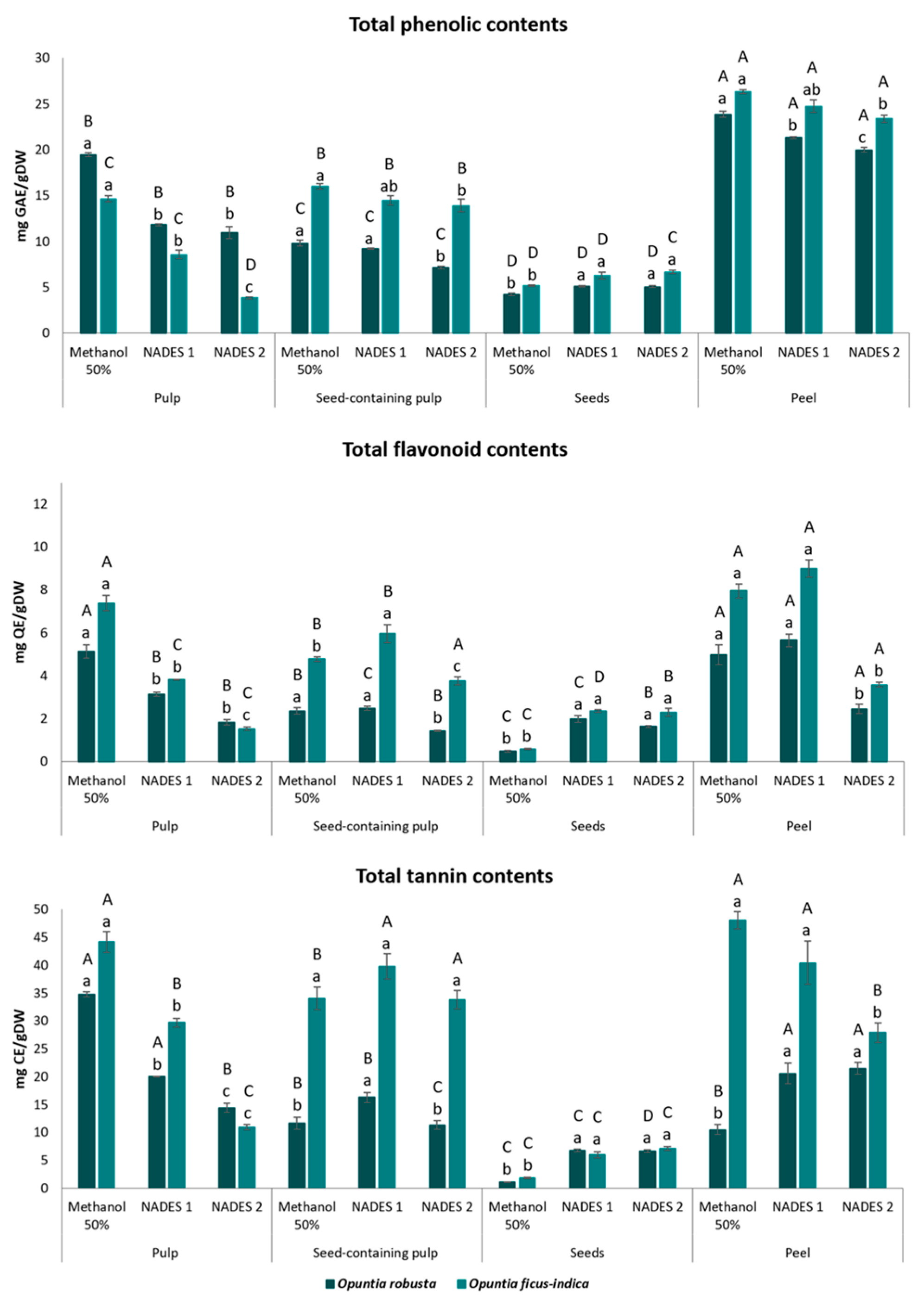
A comparative analysis of TPC in O. robusta and O. ficus-indica extracts, regardless of the extraction solvent used, revealed a similar trend across the different fruit parts. Values ranged from 4 to 23 mgGAE/gDW in O. robusta and from 3 to 26 mgGAE/gDW in O. ficus-indica (Figure 1). Peel extracts exhibited the highest TPC in both species, with slightly higher values observed in O. ficus-indica than in O. robusta. These results are consistent with those reported by Yeddes et al. [44], who observed similar trends in Tunisian Opuntia fruits, including spiny and thornless varieties of O. ficus-indica and O. stricta. Similar findings were also reported by Moussa-Ayoub et al. [45] for O. ficus-indica from Egypt. In O. robusta, TPC decreased progressively from the peel to the pulp containing seeds, and finally, to the seeds themselves. By contrast, in O. ficus-indica, the pulp containing the seeds exhibited a higher TPC than the pulp alone. When comparing the TPC values between species, O. ficus-indica generally exhibited higher values than O. robusta across all fruit components, except for the pulp, where O. robusta displayed higher TPC. However, opposite trends were reported by Marhri et al. [46], who observed higher TPC in the peel extracts of O. robusta than in those of O. ficus-indica and O. dellenii. These discrepancies highlight the variability in phenolic content driven by factors such as differences in geographic origin, extraction protocol, and the type and maturity of the plant material used.
The influence of the solvent on the TPC was similar in both species, although the magnitude of the response depended on the fruit part (Figure 1). NADES 1 generally exhibited a greater capacity to extract phenolic compounds than NADES 2, sometimes performing comparably to 50% methanol (notably in the pulp containing seeds of both species and the peel of O. ficus-indica). Interestingly, both NADESs exhibited a greater affinity for phenolic compounds in the seeds of both species than methanol did.
The TFC varied significantly between fruit parts, extraction solvents, and plant species, highlighting differences in flavonoid composition and extractability. O. ficus-indica exhibited consistently higher TFC values across all solvents except in the pulp–NADES 2 combination. As with TPC, the highest TFC values in both species were observed in peel extracts, while the lowest levels were exhibited by seeds (Figure 1). Similarly, El Mannoubi [47] reported that the peel had the highest TFC when extracted with 80% methanol, ethanol, or acetone in Tunisian red and yellow–orange O. ficus-indica fruits. However, in the present study, pulp extracted with 50% methanol produced the highest TFC value in both species, significantly exceeding that obtained using NADES 1 and NADES 2, while NADES 1 yielded the highest TFC in the pulp, seeds, and peels of both species. As with TPC, the TFC of the NADES 1 and 2 extracts from the seeds of both species was significantly higher than that of methanol, which reinforces the effectiveness of these green solvents for extracting this class of compounds.
The TTC was different from the patterns observed for TPC and TFC. Regardless of the solvent used, there was no clear predominance of tannins in the peel. In O. ficus-indica, high TTC values were recorded in almost all parts of the fruit, except for the seeds, which had the lowest concentrations. TTC values for methanolic extracts of pulp and peels were statistically similar. This contrasts with the findings of Ndhlala et al. [48], who reported higher tannin levels in the peel than in the pulp. In O. robusta, the highest TTC was found in the pulp when extracted with 50% methanol. As with TPC and TFC, both NADESs were more efficient than methanol at extracting tannins from the seeds of both species (Figure 1). NADESs also showed promising results for tannin extraction from the pulp containing seeds of both species and from the peel of O. robusta.
In summary, the TPC, TFC, and TTC of the extracts of the four fruit parts of O. robusta and O. ficus-indica varied depending on the tissue type and the extraction solvent used. Overall, the peel contained the highest concentrations of bioactive compounds overall, and NADESs, particularly NADES 1 (glycerol–urea), emerged as a promising alternative to 50% methanol for extracting these compounds. These results emphasize the potential of peels, a common agro-industrial by-product that is often discarded, as a rich yet under-exploited source of phenolic compounds, flavonoids, and tannins. Notably, NADESs were consistently the most effective solvents for seeds, suggesting their advantages extend beyond the peel to other fruit tissues with distinct biochemical profiles. The strong performance of NADESs across different fruit parts highlights their potential as efficient, selective, and sustainable extraction systems for nutraceutical and pharmaceutical applications. This supports the feasibility of green extraction methodologies for the valorization of Opuntia agro-industrial residues.

3.2. Effect of Extraction Solvents and Plant Part on Antioxidant Activity

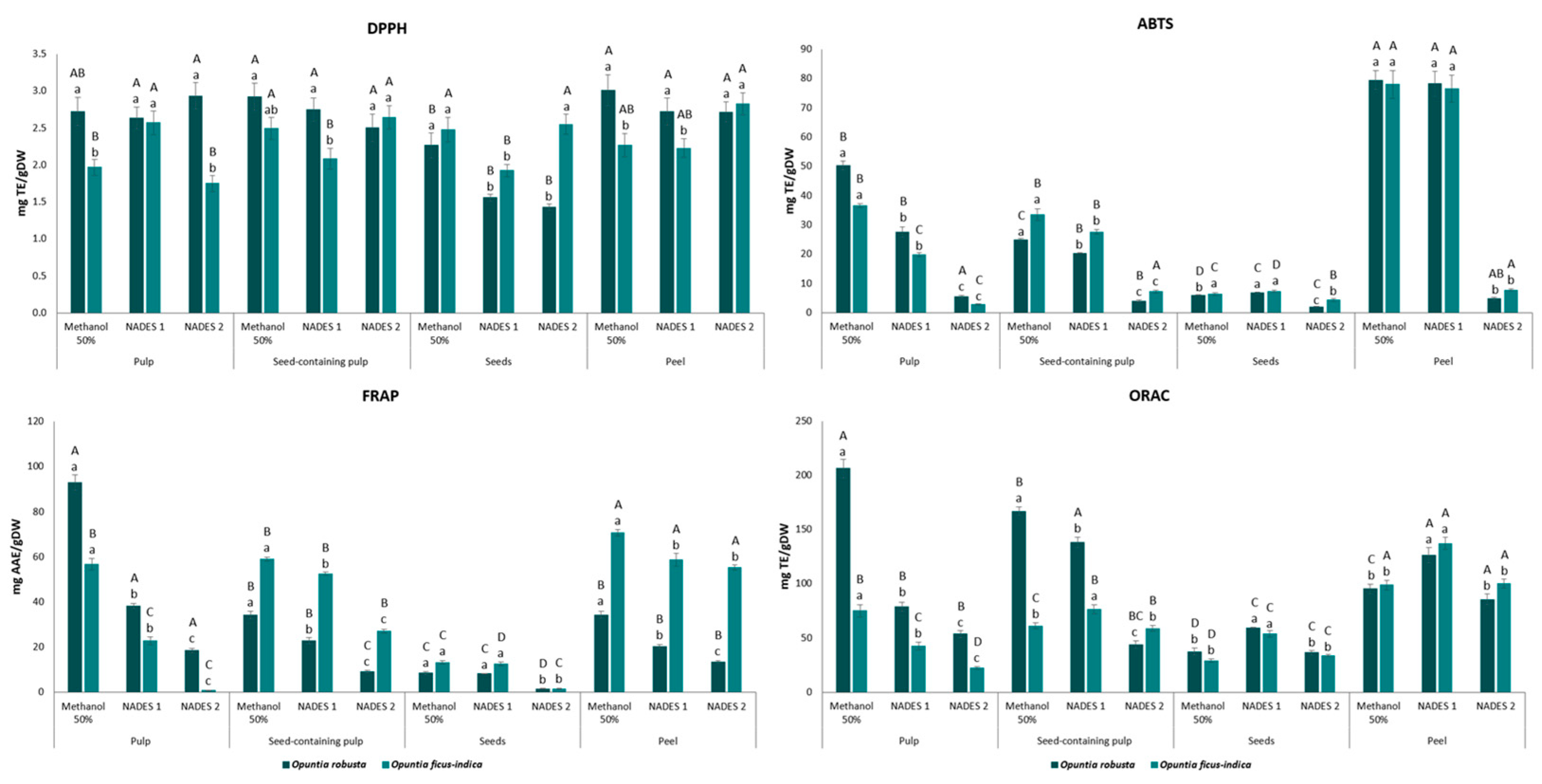
Investigating the antioxidant activity of plant extracts is of particular interest given the capacity of antioxidants to modulate oxidative stress associated with diseases such as cancer, neurodegenerative disorders, and cardiovascular diseases. This bioactivity is strongly linked to the content and structural diversity of secondary metabolites, particularly phenolic compounds, which are renowned for their radical scavenging and reducing properties [49,50]. However, due to the complexity and heterogeneity of plant extracts, relying on a single assay is insufficient for accurately evaluating their antioxidant capacity [51]. To achieve a comprehensive assessment, four complementary assays based on different mechanisms were employed: FRAP (single electron transfer), ORAC (hydrogen atom transfer), and DPPH and ABTS (combined mechanisms) [52,53]. A comparative analysis of the antioxidant activity of O. robusta and O. ficus-indica revealed consistent trends within each assay, as well as the clear effects of the extraction solvent and which part of the fruit was used. In O. robusta, the DPPH radical scavenging activity of methanol and NADES extracts was similar across all fruit parts, except in the seeds, for which the activity of methanol extracts was higher (1.43 to 3.01 mgTE/gDW, Figure 2). In O. ficus-indica, however, NADES extracts from all fruit parts displayed higher DPPH scavenging activity than methanol extracts. These findings are consistent with recent data from Ioannou et al. [30], who reported that a choline chloride–citric acid NADES exhibited greater DPPH activity than conventional solvents in prickly pear peel extracts.
The ABTS assay revealed that the efficacy of solvents varies depending on the type of fruit and the species. Peel extracts exhibited the highest ABTS scavenging activity in both Opuntia species, with NADES 1 performing similarly to methanol (Figure 2). Although seed extracts exhibited the lowest ABTS activities, NADES 1 still performed reasonably well in this tissue. In contrast, methanol produced the best ABTS results for pulp and seed-containing pulp. Consistent with our findings, Andreu et al. [49] reported stronger DPPH and ABTS radical scavenging activity in the peel and pulp of O. ficus-indica fruit than in its cladodes, with the peel generally being the most active fraction.
Regarding the FRAP assay, methanol extracts from all parts of the fruit of both Opuntia species exhibited significantly higher reducing power than the NADES extracts (Figure 2). The only exception was observed in the seeds, where the FRAP values of the methanol and NADES 1 extracts were comparable. Peel extracts of O. ficus-indica consistently displayed the highest FRAP values, irrespective of the extraction solvent. This contrasts with El Mannoubi’s results [47] for yellow–orange fruits of the same species from Tunisia, where the pulp extracts exhibited higher FRAP values than peel extracts. In O. robusta, the pulp methanol extract exhibited the highest FRAP activity (Figure 2).
The ORAC showed that the NADES 1 extract had the highest antioxidant activity in O. robusta seeds and peel (Figure 2). By contrast, methanol was more effective at extracting ORAC-active compounds from the pulp and pulp containing seeds, achieving the highest ORAC values for this species in these tissues. In O. ficus-indica, NADES 1 extracts from all parts of the fruit, except the pulp, exhibited the greatest ORAC activity; the peel extract displayed the highest activity, once again proving that the peel is the most active component. These findings are consistent with those of Smeriglio et al. [54] in Sicilian O. ficus-indica fruits, where the peel was also the most active fraction.
Overall, the results of the antioxidant activity tests showed that the effectiveness of the extraction solvent depends on the type of fruit part and the assay. Nevertheless, NADES, particularly NADES 1, emerged as a promising alternative to 50% methanol for extracting antioxidant compounds, particularly from the peel and seeds. Glycerol–urea is an efficient solvent for extracting phenolic compounds with high antioxidant activity due to its combination of strong hydrogen-bonding capacity, chaotropic effect, near-neutral pH, and broad polarity range. All assays consistently identify the peel as the richest source of antioxidant compounds. These findings reinforce the potential of underutilized cactus peel as a valuable source of natural antioxidants, supporting the use of NADESs as a sustainable extraction medium for developing functional ingredients. However, the antioxidant activity results should be interpreted with caution, since different solvent systems may be influenced by factors such as extract viscosity and matrix effects. High viscosity, particularly in some NADES extracts, can hinder the diffusion of antioxidants, which can lead to an underestimation of activity. Similarly, the complex composition of the extracts may interact with assay reagents, further affecting the measured response. Therefore, while these results provide valuable insights into the relative antioxidant potential of the extracts, the methodological factors mentioned above should be considered when drawing conclusions or comparing results across different solvent systems.

3.3. Enzyme Inhibitory Capacity

Plant-derived enzyme inhibitors are increasingly recognized as valuable tools in managing metabolic and degenerative disorders [55]. Cholinesterase inhibition is a key strategy in the treatment of Alzheimer’s and Parkinson’s diseases, which are characterized by a cholinergic deficit and reduced levels of acetylcholine [56]. AChE hydrolyzes acetylcholine, while BChE hydrolyzes both acetylcholine and butyrylcholine [57]. Tyr is a rate-limiting enzyme in melanogenesis and enzymatic browning. It catalyzes the conversion of L-tyrosine into dopaquinone, which is then oxidized [58]. Inhibiting this enzyme can reduce melanin production, contributing to skin lightening and the preventing hyperpigmentation disorders [59]. Conversely, the inhibition of α-glucosidase, which delays glucose absorption, and α-amylase, which reduces starch hydrolysis, is an established therapeutic approach for managing type 2 diabetes [60]. In the present study, the inhibitory activities of methanolic extracts from the pulp, pulp containing seeds, seeds, and peel of O. robusta and O. ficus-indica were evaluated against Tyr, AChE, BChE, α-glucosidase, and α-amylase (Table 1).
The inhibitory profiles varied significantly between species and between different parts of the fruit (Table 1). Tyr inhibition was the most notable outcome of all the assays, particularly given that the extracts were tested at a lower concentration (5 mg/mL) than the other enzymes (12.5 mg/mL). Kojic acid, used as a positive control, exhibited 85% inhibition. Pulp extracts showed the highest Tyr inhibition in both species, achieving 48.76% in O. robusta and 39.19% in O. ficus-indica. Other fruit parts exhibited moderate to low Tyr inhibition (18–32%). To the best of our knowledge, this is the first report on the Tyr inhibitory capacity of O. robusta fruit extracts. In contrast to our findings, another study [61] found that peel extracts of O. ficus-indica were more active than pulp extracts, and that seeds of O. leucotricha were the most effective part [28]. For AChE, O. robusta exhibited the greatest inhibitory activity, particularly in the pulp, pulp containing seeds, and peel (21–25%), whereas the seeds were significantly less active. However, Hamdoun et al. [28] reported that O. leucotricha seeds displayed the greatest AChE inhibition. O. ficus-indica extracts generally exhibited lower AChE inhibitory activity (<14%). Within this species, the inhibition of AChE was comparable in the seeds, peel, and seed-containing pulp (11.29–13.38%), while the pulp extracts were the least active (8.48%). For comparison, galanthamine (the positive control) showed a 78% inhibition. Amrane-Abider et al. [62] evaluated the AChE inhibition by teas prepared from O. ficus-indica by-products in Algeria, observing higher inhibition in flower teas than in peel teas. Regarding BChE, the highest inhibitory activities were obtained for seed extracts, with 27.74% and 27.08% inhibition for O. robusta and O. ficus-indica, respectively, compared to 40% for galanthamine. In line with the findings of Hamdoun et al. [28] for O. leucotricha, peel extracts exhibited the lowest BChE inhibition.
In the case of α-glucosidase, the strongest inhibitory activities were displayed by the pulp containing seeds (42.94%) and pulp (41.49%) extracts of O. robusta, whereas the most active O. ficus-indica extracts were from the peel (40.15%) and the pulp containing seeds (38.41%). Seeds were the least active in both species. By contrast, α-amylase inhibition in O. robusta was relatively modest (≤27%) across all fruit parts, with no significant differences among tissues. Conversely, O. ficus-indica exhibited higher α-amylase inhibition, particularly in the pulp containing seeds (40.83%) and the pulp (37.24%), which were significantly more active than the seeds and peel (22–23%). Acarbose, used as a positive control, exhibited inhibition percentages of 54% for the α-glucosidase and 86% for the α-amylase. Previous studies have reported that methanolic extracts of the pulp and peel of O. leucotricha are the most effective at inhibiting both enzymes [28], whereas aqueous peel extracts of Opuntia dillenii (Ker Gawl.) Haw exhibits stronger inhibitory capacity against intestinal α-glucosidase than pulp extracts, with both peel and pulp extracts markedly inhibiting α-amylase [63]. Taken together, these findings indicate that the inhibitory potential of enzymes in Opuntia fruit extracts is clearly species- and tissue-dependent, emphasizing the need to select specific fruit parts for targeted applications. In particular, the high Tyr inhibition observed in the pulp of both species suggests that this tissue could serve as a natural source of Tyr inhibitors for cosmetic and dermatological formulations aimed at controlling hyperpigmentation. Additionally, the selective inhibition of AChE, BChE, α-glucosidase, and α-amylase by different fruit parts highlights the potential of Opuntia extracts as functional ingredients in nutraceuticals or dietary supplements designed to support cognitive health and glucose metabolism. Overall, these results provide a foundation for the valorization of specific fruit tissues, including pulp and pulp containing seeds, contributing to the development of value-added products from Opuntia agro-industrial residues.

3.4. Chemical Profile of Opuntia Extracts

The phytochemical profile of methanolic extracts of O. robusta and O. ficus-indica pulp, pulp containing seeds, seeds, and peels was characterized using UHPLC-HRMS. Due to experimental and analytical constraints related to the large number of samples and solvent systems evaluated during the experiments and analysis, we prioritized UHPLC-HRMS characterization of the methanolic extracts. These extracts provided more reliable and consistent chromatographic performance under the selected conditions, enabling a reliable comparative analysis across fruit fractions and species. This approach enabled the consistent identification and quantification of hydroxycinnamic and hydroxybenzoic acids, flavonoids, lignans, and other minor phenolic compounds (Table S3), thus facilitating reliable comparisons of phytochemical patterns between different various parts of the fruit and different species. A total of 10 phenolic acids (hydroxycinnamic acids and hydroxybenzoic acids), 12 flavonoids (flavanonols, flavanones, and flavonols), 4 lignans, and 2 other phenolic compounds were found in the extracts (Table 2). Four fatty acids and gluconic acid (a sugar acid derived from glucose oxidation) were also detected. Comparative analysis revealed significant differences in the distribution and concentration of phenolic acids, flavonoids, lignans, and fatty acids between species (Table 2).
Phenolic acids were the predominant class of phenolic compounds in all fruit extracts of both species (Table 2), which is consistent with previous studies on O. ficus-indica fruit parts [64,65,66] and O. leucotricha [28]. In contrast, flavonoids were reported as the main class of phenolics in other Opuntia genotypes, such as O. ficus-indica (var. gialla and var. sanguigna) and O. engelmannii [66,67,68]. Differences in fruit composition have been attributed to multiple factors, including cultivar, variety, ripening stage, environmental conditions, geographical origin, harvest time, and analytical methodology [69,70].
This study found that the peel extracts of both species were the main source of phenolic compounds, particularly phenolic acids. O. robusta exhibited significantly higher levels (525.49 µg/gDW) than O. ficus-indica (362.96 µg/g). The most abundant group of hydroxybenzoic acids was found in all fruit parts of both species, especially in the peel (512.33 µg/g and 359.21 µg/g in the peel extracts of O. robusta and O. ficus-indica, respectively). The main hydroxybenzoic acids in the peel extracts of both species were piscidic acid (243.57 µg/g and 160.42 µg/g, respectively), followed by dihydroferulic acid glucuronide isomer II (123.51 µg/g and 126.13 µg/g, respectively), and eucomic acid (120.88 µg/g and 53.62 µg/g, respectively). Piscidic acid has also been reported as the predominant phenolic compound in the fruits of O. ficus-indica [64,65] and O. leucotricha [28], and is recognized for its anti-inflammatory properties in cases of intestinal inflammation [71]. Although present in lower amounts than hydroxybenzoic acids, the levels of hydroxycinnamic acids (mainly contributed by sinapic acid) followed the same trend. The highest levels were detected in the peel (13.16 µg/g and 3.75 µg/g, in O. robusta and O. ficus-indica, respectively). Other fruit parts, particularly the pulp and pulp containing seeds, had much lower concentrations of phenolic acids (Table 2).
The distribution pattern of flavonoids was similar, with a clear predominance in the peel extracts (44.24 µg/g in O. robusta and 13.95 µg/g in O. ficus-indica). Particularly abundant in peel extracts were the flavanone naringenin (18.43 µg/g and 5.84 µg/g in O. robusta and O. ficus-indica, respectively), and the flavonol isorhamnetin rutinoside-rhamnoside (12.44 µg/g and 2.54 µg/g in O. robusta and O. ficus-indica, respectively) and narcissin (9.69 µg/g and 3.68 µg/g in O. robusta and O. ficus-indica, respectively). In both species, the other fruit parts, especially the pulp and the pulp containing seeds, had almost no flavonoids, with only trace amounts detected in the seeds (0.17–0.62 µg/g).
Although syringaresinol hexoside isomers were the dominant compounds, the distribution patterns of lignans, which are associated with anticancer and cardioprotective effects, differed between the two species. In O. robusta, the highest lignan content was found in the pulp containing seeds (15.81 µg/g), followed by the pulp itself (11.33 µg/g), the peel (10.26 µg/g) and the seeds (5.05 µg/g). In O. ficus-indica, the highest lignan content was found in the pulp containing seeds (9.81 µg/g), followed by the seeds (7.58 µg/g), the peel (5.48 µg/g), and the pulp (1.59 µg/g). These patterns suggest that O. robusta, particularly in its seed-containing pulp, may be a more promising source of lignans, especially syringaresinol hexoside isomers. Gluconic acid was also present in high concentrations in both species, consistent with previous findings in O. leucotricha [28]. O. ficus-indica exhibited the highest levels of gluconic acid (43.49–53.75 µg/g), with no significant differences observed between the different parts of the fruit. In O. robusta, the highest levels were recorded in the pulp and the pulp containing seeds.
Fatty acids were predominantly found in the seeds of both species, with higher concentrations observed in O. robusta (45.90 µg/g) than in O. ficus-indica (31.32 µg/g). The predominant fatty acids in both species were trihydroxyoctadecenoic acid (pinelic acid) and octadecanedioic acid. Peel extracts of both species contained appreciable amounts of these compounds (10.02–10.51 µg/g), as did the pulp containing seeds of O. ficus-indica.
Overall, the peel contained the highest concentrations of phenolic compounds, particularly phenolic acids, of all the different fruit parts. O. robusta exhibited levels that were ~45% higher than those of O. ficus-indica, highlighting its potential as a superior source of bioactive compounds. Conversely, the seeds of both species contained the highest levels of fatty acids.

3.5. Pearson’s Correlation and Principal Component Analysis (PCA)

Pearson correlation analyses were conducted on the methanolic extracts of both O. robusta and O. ficus-indica to explore the linear relationships between phytochemical composition, antioxidant capacity, and enzyme inhibitory activities. The variables included the following major individual phenolic compounds, which were identified by UHPLC-HRMS: piscidic acid, eucomic acid, dihydroferulic acid glucuronide isomers I and II, sinapic acid, isorhamnetin rutinoside-rhamnoside, narcissin, naringenin, syringaresinol hexoside isomer I, and syringaresinol hexoside. These were together with spectrophotometric parameters, TPC, TFC, and TTC, as well as antioxidant capacities (DPPH, FRAP, ABTS, and ORAC), and enzyme inhibitory activities (AChE, BChE, Tyr, α-glucosidase, and α-amylase).
In addition, PCA was employed to reduce the dimensionality and identify the key patterns and associations among the variables. Separate PCAs were performed for each species, including methanolic extracts of all fruit parts (pulp, pulp containing seeds, seeds, and peels), to determine the most suitable chromatographic and spectrophotometric variables for characterizing and differentiating the tissues within each Opuntia species most strongly.
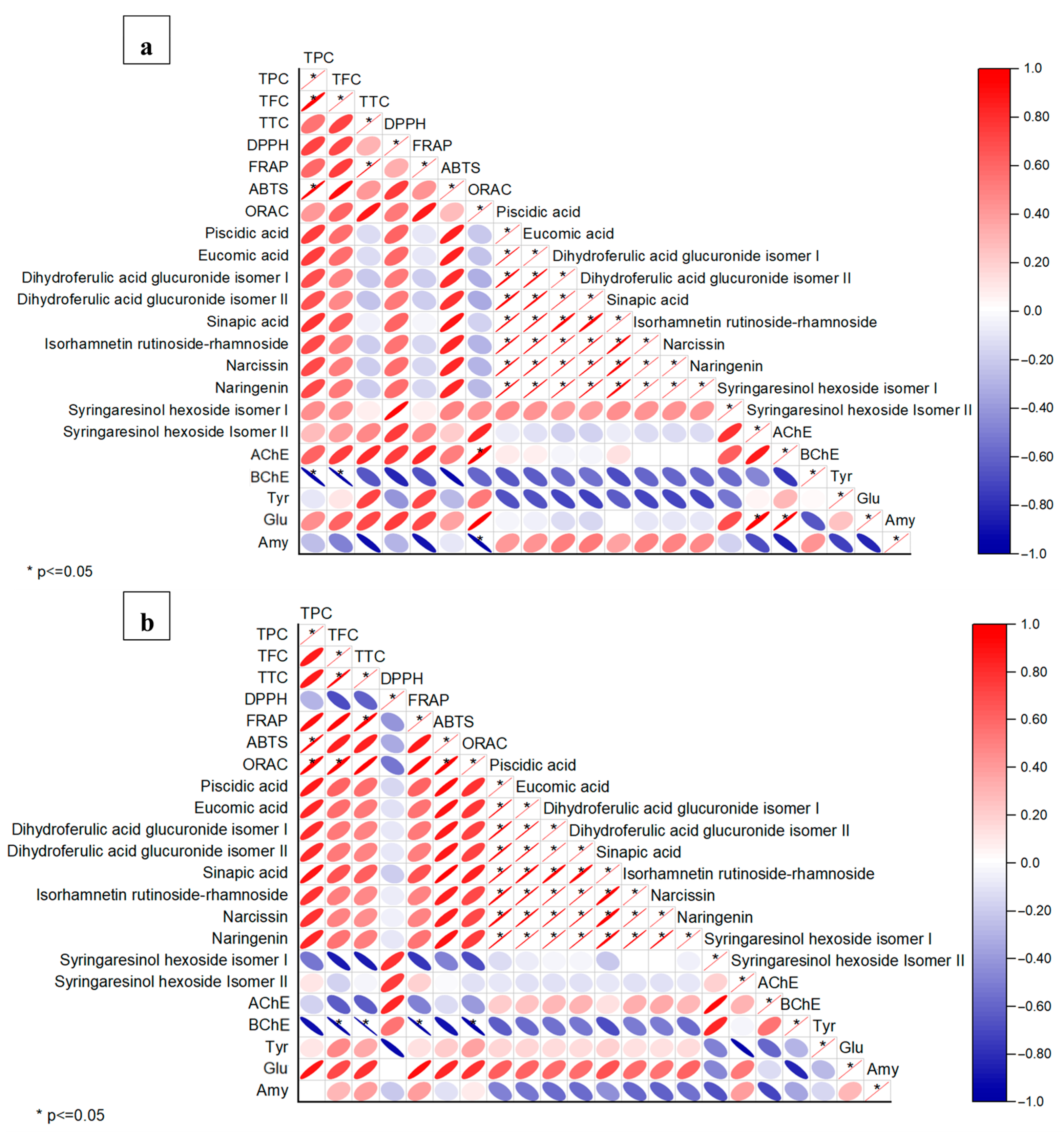
In O. robusta, the correlation patterns strongly indicated that phenolic compounds play a key role in antioxidant activity. This is demonstrated by the strong correlations between TPC, TFC, and TTC, as well as all antioxidant assays (Figure 3a). Similar relationships were reported by Valero-Galván et al. [72] in wild and commercial Opuntia fruits and by Osorio-Esquivel [73] in Opuntia joconostle. In O. robusta, TPC, TFC, and TTC were positively correlated with DPPH and ABTS, but not with FRAP or ORAC. This suggests that the radical scavenging capacities captured by DPPH and ABTS are more closely associated with the phenolic content than the reducing or hydrogen atom transfer capacities measured by FRAP and ORAC, respectively. Interestingly, AChE inhibition showed a strong and significant correlation with ORAC, while α-glucosidase inhibition was strongly correlated with syringaresinol hexoside isomer II. This suggests that these effects may be driven by specific minor metabolites and/or synergistic interactions. Furthermore, the majority of individual phenolic compounds (excluding lignans) exhibited moderate correlations with α-amylase inhibition, highlighting the importance of phenolic acids and flavonoids in this process. This effect is commonly attributed to their ability to form hydrogen bonds and hydrophobic interactions with the active site of the enzyme, thereby decreasing its catalytic efficiency [74,75]. The strength of these interactions depends on the type, number, and position of hydroxyl and methoxy substituents on the aromatic rings, as these modulate binding affinity and inhibitory potency [74,75].
In O. ficus-indica, TPC, TFC, and TTC were also correlated with the antioxidant assays; however, this correlation did not extend to DPPH assay (Figure 3b). Of the individual phenolic compounds analyzed (excluding lignans), the strongest correlations were again found with the ORAC and ABTS assays, consistent with the pattern observed in O. robusta. Enzyme inhibition activities in O. ficus-indica exhibited more variable associations with phenolic compounds, particularly with regard to α-glucosidase inhibition. Evidence of this can be seen in the correlations between α-glucosidase inhibition and antioxidant assays, as well as the moderate correlations between individual phenolic acids and flavonoids. This suggests that these compounds contribute to α-glucosidase inhibition via specific interactions at the enzyme’s active site [75]. Syringaresinol hexoside isomer II, a lignan, also showed a moderate correlation with α-glucosidase inhibition in O. ficus-indica, whereas in O. robusta, the correlation was very strong.
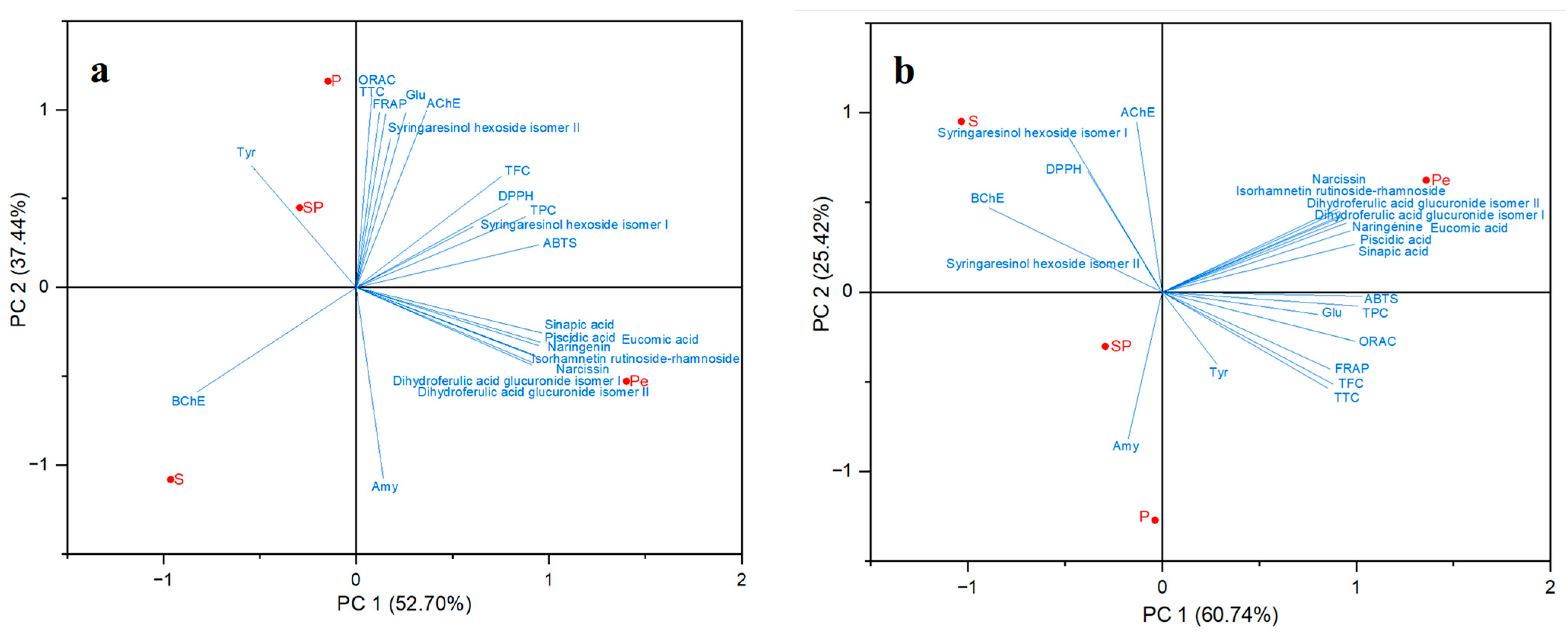
PCA results for O. robusta (Figure 4a) and O. ficus-indica (Figure 4b) showed clear distinctions between the different parts of the fruit, as well as clear links with phytochemical and bioactivity variables. For O. robusta, PC1 and PC2 together explained 90.14% of the total variance, whereas for O. ficus-indica they explained 86.16%. In both species, the seed-containing pulp was positioned in the same quadrant as the pulp, but closer to the seeds, reflecting its mixed composition and the fact that it shares phytochemical and biological traits with both tissues.
In both species, the peel exhibited a strong association with antioxidant activity as well as with TPC and TFC. This is consistent with its high concentration of individual phenolic acids and flavonoids, as identified by HPLC. This confirms the peel as the main contributor to radical scavenging activity in both species of Opuntia. Seed fractions, which are located further from these antioxidant markers, likely contain lower amounts of, or different classes of, bioactives, which emphasize the species’ tissue-specific phytochemical profiles. Nevertheless, the seed fractions of both species tended to cluster closer to BChE inhibition vectors, suggesting a stronger contribution to BChE inhibition. A more pronounced association with AChE inhibition was evident in O. ficus-indica, indicating a broader spectrum of cholinesterase inhibition than in O. robusta. In both species, syringaresinol hexoside isomers appeared to be important contributors to cholinesterase inhibition.
Tyr inhibition was positioned between pulp and seed-containing pulp in both species, indicating that these fractions share similar Tyr inhibitory patterns and comparable levels of Tyr-modulating compounds. In contrast, the α-amylase and α-glucosidase inhibition profiles differ markedly between the two species. In O. robusta, pulp was more closely associated with α-glucosidase inhibition, whereas the peel played a more dominant role in this process in O. ficus-indica. For α-amylase, seeds appeared to contribute more strongly to inhibition in O. robusta, whereas the peel played the dominant role in O. ficus-indica.
A second PCA was performed to examine the relationships between antioxidant activities, TPC, TFC, and TTC across various fruit components and solvents (methanol 50%, NADES 1 and NADES 2) in both species (Figure S1). In O. robusta, seed-containing pulp clustered closest to methanol, with comparable TTC and antioxidant capacities measured by FRAP and ORAC. For peels, NADES 1 also showed a strong association with methanolic extracts and displayed higher correlations with TPC, TFC, and ABTS, followed by DPPH.
Peel extracts obtained from O. ficus-indica with 50% methanol and NADES 1 exhibited the highest TPC, TTC, TFC, and greater antioxidant capacities (FRAP, ORAC, and ABTS). These were closely followed by the seed-containing pulp extracts obtained with the same solvents and by pulp extracted with 50% methanol.
In both species, the extraction performance of NADES 1 was comparable to that of 50% methanol for peel and seed-containing pulp. However, in the pulp, NADES 1 was less efficient than methanol, although it was still markedly superior to NADES 2, which was the least efficient solvent for phenolic extraction and antioxidant activity in both species. NADES 2 consistently clustered on the negative side of PC1. Notably, in O. ficus-indica, NADES 2 exhibited strong DPPH activity in both the peel and the seed-containing pulp. Seeds from both species consistently yielded the lowest phenolic content and antioxidant capacity, regardless of the solvent used.

4. Conclusions

This study demonstrates the significant chemical and biological variations between the different parts of Opuntia robusta and Opuntia ficus-indica fruit from northern Morocco, including pulp, pulp containing seeds, seeds, and peels. The peel was found to be the richest source of phenolic compounds in both species. O. robusta exhibited higher levels of phenolic acids, flavonoids, and lignans, as well as stronger antioxidant and enzyme inhibitory activities. The different fruit parts of the fruit display selective inhibitory effects against enzymes relevant to neurodegenerative diseases (AChE, BChE, and tyrosinase) and type 2 diabetes (α-glucosidase and α-amylase), suggesting that specific fractions could be developed for particular health-related applications. Overall, these findings highlight the superior functional potential of O. robusta, reinforcing its potential for valorization alongside O. ficus-indica as a valuable source of bioactive compounds for use in the food, cosmetic, and pharmaceutical industries. The findings also highlight opportunities for the targeted use of by-products that might otherwise be discarded, contributing to more sustainable post-harvest processing strategies. The results provide a foundation for future experimental directions, including scaling up studies and incorporating these extracts into real food or cosmetic systems, which would enhance the practical relevance and comprehensiveness of the results obtained here. From an extraction standpoint, glycerol–urea NADES (NADES 1) was identified as a promising green alternative to 50% methanol for recovering phenolic compounds and antioxidants, particularly from the peel, the pulp containing seeds, and the seeds. While these results provide an initial indication of the effectiveness of NADES as a transitional strategy towards more sustainable and efficient green extraction methods for the valorization of Opuntia agro-industrial residues, further research is needed to explore additional NADES formulations with different physicochemical properties and to conduct more detailed HPLC analyses of the resulting extracts. Furthermore, applying quantitative greenness metrics such as SPMS and AGREE would be a significant advancement for future studies, as it would enable robust evaluation of the environmental performance of NADES-based extraction processes compared to conventional solvent systems.

Supplementary Materials

The following supporting information can be downloaded at https://www.mdpi.com/article/10.3390/horticulturae12010098/s1, Table S1: Summary of HPLC-HRMS criterion for quantification of phenolics in Opuntia robusta and Opuntia ficus-indica methanol extracts.; Table S2: Summary of identified phenolic compounds; Table S3: HPLC-HRMS characteristics of identified compounds in methanolic extracts of different parts (pulp, seed-containing pulp, peel, and seeds) from Opuntia robusta and Opuntia ficus-indica; Figure S1: Biplot principal component analysis (PCA) of extracts from Opuntia robusta (a) and Opuntia ficus-indica (b) fruit parts using 50% methanol, NADES 1, and NADES 2. PM: methanolic extract of the pulp, PN1: NADES 1 extract of the pulp, PN2: NADES 2 extract of the pulp, SPM: methanolic extract of the seed-containing pulp, SPN1: NADES 1 extract of the seed-containing pulp, SPN2: NADES 2 extract of the seed-containing pulp, SM: methanolic extract of the seeds, SN1: NADES 1 extract of the seeds, SN2: NADES 2 extract of the seeds, PeM: methanolic extract of the peel, PeN1: NADES 1 extract of the peel, PeN2: NADES 2 extract of the peel.

Author Contributions

Conceptualization, O.H., S.G., and A.R.; methodology, O.H., S.G., and R.R.-S.; software, O.H., I.M., and R.R.-S.; validation, O.H., S.G., I.M., R.R.-S., G.P.-C., and A.R.; formal analysis, O.H., I.M., S.G., and R.R.-S., investigation, O.H., S.G., I.M., R.R.-S., and A.R.; resources, S.G., J.M.M.-R., and A.R.; data curation, O.H., S.G., R.R.-S., and A.R.; writing—original draft preparation, O.H., I.M., and S.G.; writing—review and editing, O.H., S.G., I.M., R.R.-S., G.P.-C., J.M.M.-R., M.L.E.K., B.E.B., and A.R.; project administration, S.G., and A.R.; funding acquisition, S.G., J.M.M.-R., and A.R.; supervision, S.G., M.L.E.K., B.E.B., and A.R. All authors have read and agreed to the published version of the manuscript.

Funding

This research was financed by National Funds through FCT-Foundation for Science and Technology under the Projects MED under the project MED (https://doi.org/10.54499/UID/05183/2025) and CHANGE (https://doi.org/10.54499/LA/P/0121/2020). Sandra Gonçalves (CEECINST/00052/2021) acknowledges the financial support from FCT. Raquel Rodríguez Solana was supported by the grant RYC2022-036888-I, funded by MCIN/AEI/10.13039/501100011033 and by the FSE+.

Data Availability Statement

The original contributions presented in this study are included in the article, and further inquiries can be directed to the corresponding authors.

Conflicts of Interest

The authors declare no conflicts of interest. The funders had no role in the design of this study; in the collection, analyses, or interpretation of data; in the writing of the manuscript; or in the decision to publish the results.

References

  1. Habtemariam, S. The Chemical and Pharmacological Basis of Prickly Pear Cactus (Opuntia Species) as Potential Therapy for Type 2 Diabetes and Obesity. In Medicinal Foods as Potential Therapies for Type-2 Diabetes and Associated Diseases; Elsevier: Amsterdam, The Netherlands, 2019; pp. 435–472. ISBN 978-0-08-102922-0. [Google Scholar]
  2. Reyes-Agüero, J.A.; Aguirre Rivera, J.R. Agrobiodiversity of Cactus Pear (Opuntia, Cactaceae) in the Meridional Highlands Plateau of Mexico. J. Nat. Resour. Dev. 2011, 1, 1–9. [Google Scholar] [CrossRef][Green Version]
  3. Kumar, K.; Singh, D.; Singh, R.S. Cactus Pear: Cultivation and Uses. Tech. Bull. 2018, 73, 1–38. [Google Scholar]
  4. Chaouch, M.A.; Hafsa, J.; Rihouey, C.; Le Cerf, D.; Majdoub, H. Effect of Extraction Conditions on the Antioxidant and Antiglycation Capacity of Carbohydrates from Opuntia Robusta Cladodes. Int. J. Food Sci. Technol. 2016, 51, 929–937. [Google Scholar] [CrossRef]
  5. Villa-Jaimes, G.S.; Moshage, H.; Avelar-González, F.J.; González-Ponce, H.A.; Buist-Homan, M.; Guevara-Lara, F.; Sánchez-Alemán, E.; Martínez-Hernández, S.L.; Ventura-Juárez, J.; Muñoz-Ortega, M.H.; et al. Molecular and Antioxidant Characterization of Opuntia Robusta Fruit Extract and Its Protective Effect against Diclofenac-Induced Acute Liver Injury in an In Vivo Rat Model. Antioxidants 2023, 12, 113. [Google Scholar] [CrossRef] [PubMed]
  6. Costa, H.S.; Vasilopoulou, E.; Trichopoulou, A.; Finglas, P. New Nutritional Data on Traditional Foods for European Food Composition Databases. Eur. J. Clin. Nutr. 2010, 64, S73–S81. [Google Scholar] [CrossRef] [PubMed]
  7. Albuquerque, T.G.; Pereira, P.; Silva, M.A.; Vicente, F.; Ramalho, R.; Costa, H.S. Prickly Pear. In Nutritional Composition and Antioxidant Properties of Fruits and Vegetables; Elsevier: Amsterdam, The Netherlands, 2020; pp. 709–728. ISBN 978-0-12-812780-3. [Google Scholar]
  8. Madrigal-Santillán, E.; Portillo-Reyes, J.; Madrigal-Bujaidar, E.; Sánchez-Gutiérrez, M.; Mercado-Gonzalez, P.E.; Izquierdo-Vega, J.A.; Vargas-Mendoza, N.; Álvarez-González, I.; Fregoso-Aguilar, T.; Delgado-Olivares, L.; et al. Opuntia genus in Human Health: A Comprehensive Summary on Its Pharmacological, Therapeutic and Preventive Properties. Part 1. Horticulturae 2022, 8, 88. [Google Scholar] [CrossRef]
  9. Del Socorro Santos Díaz, M.; Barba De La Rosa, A.-P.; Héliès-Toussaint, C.; Guéraud, F.; Nègre-Salvayre, A. Opuntia Spp.: Characterization and Benefits in Chronic Diseases. Oxidative Med. Cell. Longev. 2017, 2017, 8634249. [Google Scholar] [CrossRef]
  10. Patil, K.V.; Dagadkhair, A.C. Physicochemical Characteristics and Antioxidant Potential of Opuntia Fruit: A Review. Pharma Innov. J. 2019, 6, 376–380. [Google Scholar]
  11. Albano, C.; Negro, C.; Tommasi, N.; Gerardi, C.; Mita, G.; Miceli, A.; De Bellis, L.; Blando, F. Betalains, Phenols and Antioxidant Capacity in Cactus Pear [Opuntia ficus-indica (L.) Mill.] Fruits from Apulia (South Italy) Genotypes. Antioxidants 2015, 4, 269–280. [Google Scholar] [CrossRef]
  12. Abdel-Hameed, E.-S.S.; Nagaty, M.A.; Salman, M.S.; Bazaid, S.A. Phytochemicals, Nutritionals and Antioxidant Properties of Two Prickly Pear Cactus Cultivars (Opuntia ficus indica Mill.) Growing in Taif, KSA. Food Chem. 2014, 160, 31–38. [Google Scholar] [CrossRef] [PubMed]
  13. Kashif, R.R.; D’Cunha, N.M.; Mellor, D.D.; Alexopoulos, N.I.; Sergi, D.; Naumovski, N. Prickly Pear Cacti (Opuntia spp.) Cladodes as a Functional Ingredient for Hyperglycemia Management: A Brief Narrative Review. Medicina 2022, 58, 300. [Google Scholar] [CrossRef]
  14. Harrat, N.E.I.; Louala, S.; Bensalah, F.; Affane, F.; Chekkal, H.; Lamri-Senhadji, M. Anti-Hypertensive, Anti-Diabetic, Hypocholesterolemic and Antioxidant Properties of Prickly Pear Nopalitos in Type 2 Diabetic Rats Fed a High-Fat Diet. Nutr. Food Sci. 2019, 49, 476–490. [Google Scholar] [CrossRef]
  15. Alshaikhi, A.I.; Alzahrani, M.Y.; Hazzazi, J.S.; Kurdi, J.R.; Ramadan, M.F. Nutritional Aspects, Bioactive Phytochemicals and Biomedical Traits of Opuntia spp.: Current Trends and Applications. J. Umm Al-Qura Univ. Appl. Sci. 2024, 10, 367–378. [Google Scholar] [CrossRef]
  16. El Hajji, L. Contribution à la Valorisation des Résidus du Figuier de Barbarie, Opuntia ficus-indica, dans L’alimentation Animale; Universite Sultan Moulay Slimane Faculté des Sciences et Techniques: Béni-Mellal, Morocco, 2022. [Google Scholar]
  17. Loukili, E.H.; Merzouki, M.; Taibi, M.; Elbouzidi, A.; Hammouti, B.; Kumar Yadav, K.; Khalid, M.; Addi, M.; Ramdani, M.; Kumar, P.; et al. Phytochemical, Biological, and Nutritional Properties of the Prickly Pear, Opuntia Dillenii: A Review. Saudi Pharm. J. 2024, 32, 102167. [Google Scholar] [CrossRef] [PubMed]
  18. Naorem, A.; Patel, A.; Hassan, S.; Louhaichi, M.; Jayaraman, S. Global Research Landscape of Cactus Pear (Opuntia ficus-indica) in Agricultural Science. Front. Sustain. Food Syst. 2024, 8, 1354395. [Google Scholar] [CrossRef]
  19. Shoukat, R.; Cappai, M.; Pia, G.; Pilia, L. An Updated Review: Opuntia ficus indica (OFI) Chemistry and Its Diverse Applications. Appl. Sci. 2023, 13, 7724. [Google Scholar] [CrossRef]
  20. Arba, M.; Falisse, A.; Choukr-Allah, R.; Sindic, M. Biology, Flowering and Fruiting of the Cactus Opuntia spp.: A Review and Some Observations on Three Varieties in Morocco. Braz. Arch. Biol. Technol. 2017, 60, e17160568. [Google Scholar] [CrossRef]
  21. Astello-García, M.G.; Robles-Martínez, M.; Barba-de la Rosa, A.P.; Santos-Díaz, M.d.S. Establishment of Callus from Opuntia robusta Wendl., a Wild and Medicinal Cactus, for Phenolic Compounds Production. Afr. J. Biotechnol. 2013, 12, 3204–3207. [Google Scholar]
  22. Arba, M. Le Cactus Opuntia, Une Espèce Fruitière et Fourragère Pour Une Agriculture Durable Au Maroc. In Proceedings of the Symposium International AGDUMED 2009 (Agriculture Durable en Région Méditerranéenne), Rabat, Morocco, 14–16 May 2009. [Google Scholar]
  23. Guedes, B.N.; Fathi, F.; Silva, A.M.; Santini, A.; Oliveira, M.B.P.P.; Souto, E.B. Biopharmaceutical Applications of Opuntia ficus-indica: Bibliometric Map, Bioactivities and Extraction Techniques. Eur. Food Res. Technol. 2023, 249, 2457–2469. [Google Scholar] [CrossRef]
  24. Hashemi, B.; Shiri, F.; Švec, F.; Nováková, L. Green Solvents and Approaches Recently Applied for Extraction of Natural Bioactive Compounds. TrAC Trends Anal. Chem. 2022, 157, 116732. [Google Scholar] [CrossRef]
  25. Zainal-Abidin, M.H.; Hayyan, M.; Hayyan, A.; Jayakumar, N.S. New Horizons in the Extraction of Bioactive Compounds Using Deep Eutectic Solvents: A Review. Anal. Chim. Acta 2017, 979, 1–23. [Google Scholar] [CrossRef]
  26. Anastas, P.T. Green Chemistry and the Role of Analytical Methodology Development. Crit. Rev. Anal. Chem. 1999, 29, 167–175. [Google Scholar] [CrossRef]
  27. Pacheco-Fernández, I.; Pino, V. Green Solvents in Analytical Chemistry. Curr. Opin. Green Sustain. Chem. 2019, 18, 42–50. [Google Scholar] [CrossRef]
  28. Hamdoun, O.; Gonçalves, S.; Mansinhos, I.; Rodríguez-Solana, R.; Pereira-Caro, G.; Moreno-Rojas, J.M.; L’bachir El Kbiach, M.; El Bouzdoudi, B.; Romano, A. Phytochemical Characterization and Bioactivity of Extracts from Different Fruit Parts of Opuntia Leucotricha DC.: A Comparison between a Conventional Organic Solvent and Green Natural Deep Eutectic Solvents. Horticulturae 2024, 10, 824. [Google Scholar] [CrossRef]
  29. De Santiago, E.; Juániz, I.; Cid, C.; De Peña, M.-P. Extraction of (Poly)Phenolic Compounds of Cactus (Opuntia ficus-indica (L.) Mill.) Cladodes. Food Anal. Methods 2021, 14, 1167–1175. [Google Scholar] [CrossRef]
  30. Ioannou, G.D.; Christodoulou, O.; Sofroniou, A.; Ioannou, K.A.; Christou, A.; Stavrou, I.J.; Kapnissi-Christodoulou, C.P. Phenolic Extraction from Prickly Pear Peels Using Deep Eutectic Solvents with Macrocyclic Enhancers. Food Chem. 2025, 492, 145275. [Google Scholar] [CrossRef]
  31. Mansinhos, I.; Gonçalves, S.; Rodríguez-Solana, R.; Ordóñez-Díaz, J.L.; Moreno-Rojas, J.M.; Romano, A. Ultrasonic-Assisted Extraction and Natural Deep Eutectic Solvents Combination: A Green Strategy to Improve the Recovery of Phenolic Compounds from Lavandula pedunculata Subsp. Lusitanica (Chaytor) Franco. Antioxidants 2021, 10, 582. [Google Scholar] [CrossRef]
  32. Ainsworth, E.A.; Gillespie, K.M. Estimation of Total Phenolic Content and Other Oxidation Substrates in Plant Tissues Using Folin–Ciocalteu Reagent. Nat. Protoc. 2007, 2, 875–877. [Google Scholar] [CrossRef]
  33. Chang, C.-C.; Yang, M.-H.; Wen, H.-M.; Chern, J.-C. Estimation of Total Flavonoid Content in Propolis by Two Complementary Colorimetric Methods. J. Food Drug Anal. 2002, 10, 3. [Google Scholar]
  34. Palacios, C.E. Contents of Tannins of Cultivars of Sorghum Cultivated in Brazil, as Determined by Four Quantification Methods. Food Chem. 2021, 337, 127970. [Google Scholar] [CrossRef]
  35. Re, R.; Pellegrini, N.; Proteggente, A.; Pannala, A.; Yang, M.; Rice-Evans, C. Antioxidant Activity Applying an Improved ABTS Radical Cation Decolorization Assay. Free. Radic. Biol. Med. 1999, 26, 1231–1237. [Google Scholar] [CrossRef]
  36. Soler-Rivas, C.; Espín, J.C.; Wichers, H.J. An Easy and Fast Test to Compare Total Free Radical Scavenger Capacity of Foodstuffs. Phytochem. Anal. 2000, 11, 330–338. [Google Scholar] [CrossRef]
  37. Yen, G.-C.; Chen, H.-Y. Antioxidant Activity of Various Tea Extracts in Relation to Their Antimutagenicity. J. Agric. Food Chem. 1995, 43, 27–32. [Google Scholar] [CrossRef]
  38. Gillespie, K.M.; Chae, J.M.; Ainsworth, E.A. Rapid Measurement of Total Antioxidant Capacity in Plants. Nat. Protoc. 2007, 2, 867–870. [Google Scholar] [CrossRef]
  39. Ellman, G.L.; Courtney, K.D.; Andres, V.; Featherstone, R.M. A New and Rapid Colorimetric Determination of Acetylcholinesterase Activity. Biochem. Pharmacol. 1961, 7, 88–95. [Google Scholar] [CrossRef]
  40. Masuda, T.; Yamashita, D.; Takeda, Y.; Yonemori, S. Screening for Tyrosinase Inhibitors among Extracts of Seashore Plants and Identification of Potent Inhibitors from Garcinia subelliptica. Biosci. Biotechnol. Biochem. 2005, 69, 197–201. [Google Scholar] [CrossRef]
  41. Kwon, Y.-I.; Apostolidis, E.; Shetty, K. In Vitro Studies of Eggplant (Solanum melongena) Phenolics as Inhibitors of Key Enzymes Relevant for Type 2 Diabetes and Hypertension. Bioresour. Technol. 2008, 99, 2981–2988. [Google Scholar] [CrossRef]
  42. Cáceres-Jiménez, S.; Rodríguez-Solana, R.; Dobani, S.; Pourshahidi, K.; Gill, C.; Moreno-Rojas, J.M.; Almutairi, T.M.; Crozier, A.; Pereira-Caro, G. UHPLC-HRMS Spectrometric Analysis: Method Validation and Plasma and Urinary Metabolite Identification after Mango Pulp Intake. J. Agric. Food Chem. 2023, 71, 11520–11533. [Google Scholar] [CrossRef] [PubMed]
  43. Sumner, L.W.; Amberg, A.; Barrett, D.; Beale, M.H.; Beger, R.; Daykin, C.A.; Fan, T.W.-M.; Fiehn, O.; Goodacre, R.; Griffin, J.L.; et al. Proposed Minimum Reporting Standards for Chemical Analysis: Chemical Analysis Working Group (CAWG) Metabolomics Standards Initiative (MSI). Metabolomics 2007, 3, 211–221. [Google Scholar] [CrossRef]
  44. Yeddes, N.; Chérif, J.; Guyot, S.; Sotin, H.; Ayadi, M. Comparative Study of Antioxidant Power, Polyphenols, Flavonoids and Betacyanins of the Peel and Pulp of Three Tunisian Opuntia Forms. Antioxidants 2013, 2, 37–51. [Google Scholar] [CrossRef] [PubMed]
  45. Moussa-Ayoub, T.E.; El-Samahy, S.K.; Rohn, S.; Kroh, L.W. Flavonols, Betacyanins Content and Antioxidant Activity of Cactus Opuntia macrorhiza Fruits. Food Res. Int. 2011, 44, 2169–2174. [Google Scholar] [CrossRef]
  46. Marhri, A.; Rbah, Y.; Allay, A.; Boumediene, M.; Tikent, A.; Benmoumen, A.; Melhaoui, R.; Elamrani, A.; Abid, M.; Addi, M. Comparative Analysis of Antioxidant Potency and Phenolic Compounds in Fruit Peel of Opuntia robusta, Opuntia dillenii, and Opuntia ficus-indica Using HPLC-DAD Profiling. J. Food Qual. 2024, 2024, 2742606. [Google Scholar] [CrossRef]
  47. El Mannoubi, I. Effect of Extraction Solvent on Phenolic Composition, Antioxidant and Antibacterial Activities of Skin and Pulp of Tunisian Red and Yellow–Orange Opuntia Ficus Indica Fruits. Food Meas. 2021, 15, 643–651. [Google Scholar] [CrossRef]
  48. Ndhlala, A.R.; Kasiyamhuru, A.; Mupure, C.; Chitindingu, K.; Benhura, M.A.; Muchuweti, M. Phenolic Composition of Flacourtia indica, Opuntia megacantha and Sclerocarya birrea. Food Chem. 2007, 103, 82–87. [Google Scholar] [CrossRef]
  49. Andreu, L.; Nuncio-Jáuregui, N.; Carbonell-Barrachina, Á.A.; Legua, P.; Hernández, F. Antioxidant Properties and Chemical Characterization of Spanish Opuntia ficus-indica Mill. Cladodes and Fruits. J. Sci. Food Agric. 2018, 98, 1566–1573. [Google Scholar] [CrossRef]
  50. Tupec, M.; Hýsková, V.; Bělonožníková, K.; Hraníček, J.; Červený, V.; Ryšlavá, H. Characterization of Some Potential Medicinal Plants from Central Europe by Their Antioxidant Capacity and the Presence of Metal Elements. Food Biosci. 2017, 20, 43–50. [Google Scholar] [CrossRef]
  51. El Jemli, M.; Kamal, R.; Marmouzi, I.; Zerrouki, A.; Cherrah, Y.; Alaoui, K. Radical-Scavenging Activity and Ferric Reducing Ability of Juniperus thurifera (L.), J. oxycedrus (L.), J. phoenicea (L.) and Tetraclinis articulata (L.). Adv. Pharmacol. Sci. 2016, 2016, 6392656. [Google Scholar] [CrossRef]
  52. Ko, M.-J.; Nam, H.-H.; Chung, M.-S. Subcritical Water Extraction of Bioactive Compounds from Orostachys japonicus A. Berger (Crassulaceae). Sci. Rep. 2020, 10, 10890. [Google Scholar] [CrossRef] [PubMed]
  53. Gonçalves, S.; Mansinhos, I.; Rodríguez-Solana, R.; Pérez-Santín, E.; Coelho, N.; Romano, A. Elicitation Improves Rosmarinic Acid Content and Antioxidant Activity in Thymus lotocephalus Shoot Cultures. Ind. Crops Prod. 2019, 137, 214–220. [Google Scholar] [CrossRef]
  54. Smeriglio, A.; Bonasera, S.; Germanò, M.P.; D’Angelo, V.; Barreca, D.; Denaro, M.; Monforte, M.T.; Galati, E.M.; Trombetta, D. Opuntia ficus-indica (L.) Mill. Fruit as Source of Betalains with Antioxidant, Cytoprotective, and Anti-angiogenic Properties. Phytother. Res. 2019, 33, 1526–1537. [Google Scholar] [CrossRef] [PubMed]
  55. Rauf, A.; Jehan, N. Natural Products as a Potential Enzyme Inhibitors from Medicinal Plants. In Enzyme Inhibitors and Activators; Senturk, M., Ed.; InTech: London, UK, 2017; ISBN 978-953-51-3057-4. [Google Scholar]
  56. Orhan, I.; Şener, B.; Choudhary, M.I.; Khalid, A. Acetylcholinesterase and Butyrylcholinesterase Inhibitory Activity of Some Turkish Medicinal Plants. J. Ethnopharmacol. 2004, 91, 57–60. [Google Scholar] [CrossRef] [PubMed]
  57. Kluge, W.H.; Kluge, H.H.; Bauer, H.I.; Pietsch, S.; Anders, J.; Venbrocks, R.A. Acetylcholinesterase Assay for Cerebrospinal Fluid Using Bupivacaine to Inhibit Butyrylcholinesterase. BMC Biochem. 2001, 2, 17. [Google Scholar] [CrossRef] [PubMed]
  58. Teng, H.; Fan, X.; Lv, Q.; Zhang, Q.; Xiao, J.; Qian, Y.; Zheng, B.; Gao, H.; Gao, S.; Chen, L. Folium nelumbinis (Lotus Leaf) Volatile-Rich Fraction and Its Mechanisms of Action against Melanogenesis in B16 Cells. Food Chem. 2020, 330, 127030. [Google Scholar] [CrossRef]
  59. Du, X.; Chen, X.; Chen, L.; Yang, Y.; Ni, H.; Li, Q.; Li, Z.; Jiang, Z. Tyrosinase Inhibition Mechanism of Polyphenols from Porphyra haitanensis Extracted by Cyclic Subzero Temperature. Algal Res. 2025, 86, 103943. [Google Scholar] [CrossRef]
  60. Mofidipour, M.; Fadaei, V.; Salehifar, M. Inhibition of Acrylamide and α-Amylase and α-Glucosidase Activities in Echium Amoenum Powder Fortified Biscuits. Food Res. Int. 2025, 200, 115462. [Google Scholar] [CrossRef] [PubMed]
  61. Atiya, A.; Majrashi, T.A.; Begum, M.Y.; Abdul Qadir, S.F.; Alqahtani, A.S.; Ali Alosman, A.S.; Alahmari, A.A.; Mesfer Al Aldabsh, A.N.; Alshahrani, A.T.; Alshahrani, R.R.M. Influence of Solvent Selection and Extraction Methods on the Determination of Polyphenols, Antioxidant, Lipoxygenase and Tyrosinase Inhibition Activities of Opuntia ficus-indica Fruits Peel and Pulp Collected from the Kingdom of Saudi Arabia (KSA). Nat. Prod. Res. 2023, 37, 514–521. [Google Scholar] [CrossRef]
  62. Amrane-Abider, M.; Nerín, C.; Tamendjari, A.; Serralheiro, M.L.M. Phenolic Composition, Antioxidant and Antiacetylcholinesterase Activities of Opuntia ficus-indica Peel and Flower Teas after in Vitro Gastrointestinal Digestion. J. Sci. Food Agric. 2022, 102, 4401–4409. [Google Scholar] [CrossRef]
  63. Loukili, E.H.; Elrherabi, A.; Hbika, A.; Elbouzidi, A.; Taibi, M.; Merzouki, M.; Bouhrim, M.; Shahat, A.A.; Noman, O.M.; Azougay, A.; et al. Chemical Analysis, Antihyperglycemic Properties and Enzyme Inhibition of Opuntia dillenii (Ker Gawl.) Haw: A Detailed Analysis of Pulp and Peel Extracts. J. Pharm. Anal. 2025, 15, 101320. [Google Scholar] [CrossRef]
  64. Gómez-Maqueo, A.; Antunes-Ricardo, M.; Welti-Chanes, J.; Cano, M.P. Digestive Stability and Bioaccessibility of Antioxidants in Prickly Pear Fruits from the Canary Islands: Healthy Foods and Ingredients. Antioxidants 2020, 9, 164. [Google Scholar] [CrossRef]
  65. Hernández, F.; Andreu-Coll, L.; Bento-Silva, A.; Serra, A.T.; Mena, P.; Legua, P.; Bronze, M.R. Phytochemical Profile of Opuntia ficus-indica (L.) Mill Fruits (Cv. ‘Orito’) Stored at Different Conditions. Foods 2022, 11, 160. [Google Scholar] [CrossRef]
  66. Mena, P.; Tassotti, M.; Andreu, L.; Nuncio-Jáuregui, N.; Legua, P.; Del Rio, D.; Hernández, F. Phytochemical Characterization of Different Prickly Pear (Opuntia ficus-indica (L.) Mill.) Cultivars and Botanical Parts: UHPLC-ESI-MSn Metabolomics Profiles and Their Chemometric Analysis. Food Res. Int. 2018, 108, 301–308. [Google Scholar] [CrossRef] [PubMed]
  67. Farag, M.A.; Sallam, I.E.; Fekry, M.I.; Zaghloul, S.S.; El-Dine, R.S. Metabolite Profiling of Three Opuntia ficus-indica Fruit Cultivars Using UPLC-QTOF-MS in Relation to Their Antioxidant Potential. Food Biosci. 2020, 36, 100673. [Google Scholar] [CrossRef]
  68. Melgar, B.; Dias, M.I.; Ciric, A.; Sokovic, M.; Garcia-Castello, E.M.; Rodriguez-Lopez, A.D.; Barros, L.; Ferreira, I. By-Product Recovery of Opuntia spp. Peels: Betalainic and Phenolic Profiles and Bioactive Properties. Ind. Crops Prod. 2017, 107, 353–359. [Google Scholar] [CrossRef]
  69. Contino, M.; Leonardi, C.; Genovese, C.; Scalisi, E.M.; Pecoraro, R.; Ignoto, S.; Failla, C.; Ferruggia, G.; Salvaggio, A.; Asero, P.; et al. Antioxidant Activity of Two Opuntia Mill. Species Fruit Extracts on Human Sperm Quality after a Freeze-Thaw Cycle. Nat. Prod. Res. 2023, 37, 2725–2731. [Google Scholar] [CrossRef]
  70. Issami, W.; Mahmoudi, M.; Zougari, B.; Hajlaoui, M.R.; Nagez, K.; Laamouri, A.; Ammari, Y. Phytochemical Characterization and Bioactivities of Different Fruit Parts of Tunisian Barbary Fig (Opuntia ficus-indica). Sci. Hortic. 2024, 323, 112516. [Google Scholar] [CrossRef]
  71. Matias, A.; Nunes, S.L.; Poejo, J.; Mecha, E.; Serra, A.T.; Madeira, P.; Bronze, M.R.; Duarte, C.M.M. Antioxidant and Anti-Inflammatory Activity of a Flavonoid-Rich Concentrate Recovered from Opuntia Ficus-Indica Juice. Food Funct. 2014, 5, 3269–3280. [Google Scholar] [CrossRef] [PubMed]
  72. Valero-Galván, J.; González-Fernández, R.; Sigala-Hernández, A.; Núñez-Gastélum, J.A.; Ruiz-May, E.; Rodrigo-García, J.; Larqué-Saavedra, A.; Martínez-Ruiz, N.D.R. Sensory Attributes, Physicochemical and Antioxidant Characteristics, and Protein Profile of Wild Prickly Pear Fruits (O. macrocentra Engelm., O. phaeacantha Engelm., and O. engelmannii Salm-Dyck Ex Engelmann.) and Commercial Prickly Pear Fruits (O. ficus-indica (L.) Mill.). Food Res. Int. 2021, 140, 109909. [Google Scholar] [CrossRef]
  73. Osorio-Esquivel, O.; Alicia-Ortiz-Moreno; Álvarez, V.B.; Dorantes-Álvarez, L.; Giusti, M.M. Phenolics, Betacyanins and Antioxidant Activity in Opuntia joconostle Fruits. Food Res. Int. 2011, 44, 2160–2168. [Google Scholar] [CrossRef]
  74. Guan, L.; Long, H.; Ren, F.; Li, Y.; Zhang, H. A Structure—Activity Relationship Study of the Inhibition of α-Amylase by Benzoic Acid and Its Derivatives. Nutrients 2022, 14, 1931. [Google Scholar] [CrossRef]
  75. Aleixandre, A.; Gil, J.V.; Sineiro, J.; Rosell, C.M. Understanding Phenolic Acids Inhibition of α-Amylase and α-Glucosidase and Influence of Reaction Conditions. Food Chem. 2022, 372, 131231. [Google Scholar] [CrossRef]
Figure 1. Effect of extraction solvent—50% methanol, NADES 1 (glycerol–urea) and NADES 2 (citric acid–sorbitol) on the total phenolic, flavonoid and tannin contents in extracts from the pulp, seed-containing pulp, seeds, and peels of Opuntia robusta and Opuntia ficus-indica. Values are expressed as mean ± SE (n = 3). For each plant species, different letters in each series indicate significant differences (p < 0.05) (Duncan’s new multiple range test). Uppercase letters indicate significant differences (p < 0.05) between the four parts of the fruits, while lowercase letters denote significant differences (p < 0.05) between solvents. NADES: Natural Deep Eutectic Solvents.
Horticulturae 12 00098 g001
Figure 2. Antioxidant capacity, determined by 2.2-diphenyl-1-picrylhydrazyl (DPPH), 2.2′-azino bis(3-ethylbenzothiazoline-6-sulfonic acid) (ABTS), ferric-reducing antioxidant power (FRAP), and oxygen radical absorbance capacity (ORAC) assays, of extracts from different fruit parts (pulp, seed-containing pulp, seeds, and peel) of Opuntia robusta and Opuntia ficus-indica obtained with different extraction solvents (50% methanol, NADES 1, and NADES 2). Values are expressed as mean ± SE. Different letters in each series indicate significant differences (p < 0.05) (Duncan’s new multiple range test). Uppercase letters indicate significant differences (p < 0.05) between the four parts of the fruits, while a lowercase letter denotes significant differences (p < 0.05) between solvents. NADES: Natural Deep Eutectic Solvents.
Horticulturae 12 00098 g002
Figure 3. Heatmap corresponding to Pearson’s correlation coefficients between the most relevant phenolic compounds identified by UHPLC-HRMS, total phenolic, flavonoid, and tannin contents, and antioxidant (DPPH: 2.2-diphenyl-1-picrylhydrazyl, ABTS: 2.2′-azino bis(3-ethylbenzothiazoline-6-sulfonic acid), FRAP: ferric-reducing antioxidant power, ORAC: oxygen radical absorbance) and enzyme inhibitory activities (AChE: acetylcholinesterase; BChE: butyrylcholinesterase; Tyr: tyrosinase; Glu: α-glucosidase; Amy: α-amylase) of 50% methanol extracts from the pulp, seed-containing pulp, seeds, and peel of Opuntia robusta (a) and Opuntia ficus-indica (b). * Correlation is significant (p ≤ 0.05). A more elliptical shape indicates a greater correlation.
Horticulturae 12 00098 g003
Figure 4. Biplot principal component analysis (PCA) of extracts from Opuntia robusta (a) and Opuntia ficus-indica (b) fruit parts using 50% methanol. P: pulp, SP: seed-containing pulp, S: seeds, Pe: peel, DPPH: 2.2-diphenyl-1-picrylhydrazyl, ABTS: 2.2′-azino bis(3-ethylbenzothiazoline-6-sulfonic acid), FRAP: ferric-reducing antioxidant power, ORAC: oxygen radical absorbance capacity, AChE: Acetylcholinesterase, BChE: Butyrylcholinesterase, Tyr: Tyrosinase, Glu: α-Glucosidase, Amy: α-Amylase.
Horticulturae 12 00098 g004
Table 1. Enzyme inhibitory capacity (%) of 50% methanol extracts from the pulp, seed-containing pulp, seeds, and peel extracts of Opuntia robusta and Opuntia ficus-indica.
Opuntia robustaOpuntia ficus-indica
Fruit PartsPulpSeed-
Containing Pulp
SeedsPeelPulpSeed-
Containing Pulp
SeedsPeel
Acetylcholinesterase24.94 ± 1.32 a23.36 ± 2.05 a14.32 ± 0.71 b20.99 ± 1.84 a8.48 ± 0.62 b11.29 ± 0.08 a13.38 ± 0.90 a12.22 ± 1.01 a
Butyrylcholinesterase11.12 ± 0.31 c18.35 ± 0.89 b27.74 ± 0.71 a9.10 ± 0.27 d11.26 ± 0.40 bc13.84 ± 0.94 b27.08 ± 2.07 a7.90 ± 0.39 c
Tyrosinase48.76 ± 1.94 a27.08 ± 0.08 b32.27 ± 2.37 b17.74 ± 1.12 c39.19 ± 0.42 a20.42 ± 0.84 c28.15 ± 1.72 b31.46 ± 1.49 b
α-Glucosidase41.49 ± 0.73 a42.94 ± 1.18 a13.79 ± 0.96 c30.21 ± 0.55 b29.22 ± 1.08 b38.41 ± 1.08 a21.48 ± 0.34 c40.15 ± 0.70 a
α-Amylase15.18 ± 1.39 a19.55 ± 1.72 a26.30 ± 0.17 a25.30 ± 1.70 a37.24 ± 2.51 a40.83 ± 0.51 a22.06 ± 1.95 b22.90 ± 2.03 b
Percentage inhibitions (%) are expressed as mean ± SE (n = 3). For each enzyme and plant species, different letters indicate significant differences (p < 0.05) (Duncan’s new multiple range test) between the four fruit parts.
Table 2. Qualitative and quantitative (µg/gDW) analysis by ultra-high-performance liquid chromatography–high-resolution mass spectrometry (UHPLC-HRMS) of the chemical profile of 50% methanol extracts from pulp, seed-containing pulp, seeds, and peels of Opuntia robusta and Opuntia ficus-indica fruits.
Opuntia robustaOpuntia ficus-indica
Fruit PartsPulpSeed-Containing PulpSeedsPeelPulpSeed-Containing PulpSeedsPeel
Phenolic acids
Hydroxycinnamic acids
Coumaric acid hexosiden.d.n.d.n.d.1.09 ± 0.06n.d.0.04 ± 0.01n.d.0.44 ± 0.06
Sinapic acid hexosiden.d.n.d.n.d.0.13 ± 0.02n.d.n.d.n.d.0.04 ± 0
Sinapic acid1.91 ± 0.12 b0.82 ± 0.08 bc0.17 ± 0.03 c11.93 ± 0.82 a0.67 ± 0.04 b0.52 ± 0.02 b0.15 ± 0.01 b3.26 ± 0.34 a
Total hydroxycinnamic acids1.91 b0.82 bc0.17 c13.16 a0.67 b0.56 b0.16 b3.75 a
Hydroxybenzoic acids
3,4-Dihydroxybenzoic acidn.d.0.04 ± 0.010.84 ± 0.050.04 ± 0.010.02 ± 0.01 d0.04 ± 0.01 c0.62 ± 0.01 a0.06 ± 0.005 b
Piscidic acid24.54 ± 0.91 b21.12 ± 0.64 bc5.46 ± 0.35 c243.56 ± 9.26 a24.93 ± 0.88 b20.70 ± 0.54 b12.90 ± 0.58 b160.42 ± 11.67 a
4-Hydroxybenzoic acid0.03 ± 0 b0.1 ± 0.01 b2.36 ± 0.10 a0.13 ± 0.05 b0.05 ± 0 b0.05 ± 0.03 b1.72 ± 0.21 a0.12 ± 0.01 b
Eucomic acid9.63 ± 0.18 b5.01 ± 0.10 b1.63 ± 0.26 b120.88 ± 4.09 a5.11 ± 0.16 b3.82 ± 0.01 b3.69 ± 0.05 b53.62 ± 4.51 a
Dihydroferulic acid glucuronide isomer I2.16 ± 0.02 b2.19 ± 0.04 b3.08 ± 0.13 b23.32 ± 1.00 a2.56 ± 0.1 b2.29 ± 0.02 b2.89 ± 0.08 b18.55 ± 1.89 a
Dihydroferulic acid glucuronide isomer II11.29 ± 0.19 b12.82 ± 0.18 b18 ± 0.78 b123.51 ± 10.76 a15.11 ± 0.67 bc13.78 ± 0.34 c18.63 ± 0.53 b126.13 ± 1.87 a
Hydroxybenzoic acid derivative0.15 ± 0.02 c0.25 ± 0.02 b0.17 ± 0 bc0.89 ± 0.02 a0.16 ± 0.01 b0.21 ± 0.02 ab0.23 ± 0.02 ab0.29 ± 0.03 a
Total hydroxybenzoic acids47.81 b41.49 c31.55 d512.34 a47.95 b40.92 b40.72 b359.22 a
Total phenolic acids49.72 b42.31 c31.72 d525.5 a48.62 b41.48 b40.87 b362.96 a
Flavonoids
Flavanonols
Taxifolinen.d.n.d.n.d.0.09 ± 0.01n.d.n.d.n.d.0.05 ± 0.01
Flavanones
Eriodictyoln.d.n.d.n.d.0.24 ± 0.01n.d.n.d.n.d.0.09 ± 0
Naringeninn.d.n.d.<LOD18.43 ± 0.95n.d.n.d.<LOD5.84 ± 0.17
Total flavanonsn.d.n.d.n.d.18.68n.d.n.d.n.d.5.94
Flavonols
Isorhamnetin rutinoside-hexosiden.d.n.d.n.d.0.20 ± 0.01n.d.n.d.n.d.0.12 ± 0.02
Kaempferol rhamnosyl-rhamnosyl-hexosiden.d.n.d.0.01 ± 00.34 ± 0.05n.d.n.d.0.00 ± 0.000.05 ± 0.00
Isorhamnetin rutinoside-rhamnosiden.d.n.d.0.06 ± 012.44 ± 0.74n.d.n.d.0.15 ± 0.012.54 ± 0.38
Rutinn.d.n.d.n.d.1.90 ± 0.03n.d.n.d.0.1 ± 0.011.05 ± 0.15
Hyperosiden.d.n.d.n.d.0.12 ± 0n.d.n.d.n.d.0.08 ± 0
Isoquercitrinn.d.n.d.0.04 ± 0.010.21 ± 0.02n.d.n.d.0.04 ± 0.010.11 ± 0.02
Nicotiflorinn.d.n.d.0.02 ± 0.010.55 ± 0.02n.d.n.d.0.02 ± 00.35 ± 0.04
Narcissinn.d.0.03 ± 00.05 ± 09.69 ± 0.13n.d.0.02 ± 0.0050.29 ± 0.023.68 ± 0.45
Isorhamnetin-3-O-glucosiden.d.n.d.n.d.0.11 ± 0.02n.d.n.d.n.d.0.02 ± 0.01
Total flavonolsn.d.0.030.1725.57n.d.0.030.628.02
Total flavonoidsn.d.0.03 c0.17 b44.25 an.d.0.03 c0.62 b13.95 a
Lignans
Syringaresinol hexoside isomer I2.86 ± 0.22 bc4.31 ± 0.53 a2.01 ± 0.24 c3.96 ± 0.01 ab0.3 ± 0 c1.86 ± 0.39 b4.10 ± 0.59 a1.93 ± 0.32 b
Secoisolariciresinol hexoside isomer I0.51 ± 0.01 b0.59 ± 0.02 a0.32 ± 0.03 c0.13 ± 0.01 d0.01 ± 0 d0.25 ± 0.01 b0.31 ± 0.01 a0.06 ± 0 c
Secoisolariciresinol hexoside isomer II0.2 ± 0 b0.33 ± 0.01 a0.08 ± 0.02 c0.06 ± 0.01 c0.07 ± 0.01 c0.18 ± 0.01 a0.14 ± 0.01 b0.05 ± 0 d
Syringaresinol hexoside isomer II7.75 ± 0.08 b10.57 ± 0.04 a2.64 ± 0.17 d6.1 ± 0 c1.20 ± 0.06 c7.51 ± 0.23 a3.01 ± 0.18 b3.44 ± 0.09 b
Total lignans11.33 b15.81 a5.05 c10.26 b1.59 d9.81 a7.58 b5.48 c
Other phenolic compounds
4-Hydroxy-3-methoxybenzaldehyden.d.0.16 ± 0.021.12 ± 0.050.1 ± 00.08 ± 0.03 b0.1 ± 0.03 b0.83 ± 0.14 a0.12 ± 0 b
Phloridzinn.d.n.d.0.05 ± 0n.d.0.02 ± 0n.d.0.05 ± 0n.d.
Total phenolic compounds61.05 b58.31 b38.11 c580.1 a50.31 b51.41 b49.95 b382.51 a
Non-phenolic compounds
Gluconic acid32.90 ± 3.44 a34.88 ± 4.35 a17.01 ± 2.05 b5.15 ± 0.45 c53.75 ± 3.84 a43.49 ± 6.71 a42.05 ± 5.79 a49.27 ± 8.46 a
Fatty acids
Trihydroxyoctadecadienoic acid1.01 ± 0.01 b0.90 ± 0.01 b1.38 ± 0.03 b3.93 ± 0.25 a1.25 ± 0.04 b1.60 ± 0.03 b1.57 ± 0.02 b3.48 ± 0.28 a
Trihydroxyoctadecenoic acid (pinelic acid)1.9 ± 0.02 c1.83 ± 0.02 c27.81 ± 0.15 a4.65 ± 0.26 b3.81 ± 0.04 c5.09 ± 0.26 b19.12 ± 0.38 a5.85 ± 0.3 b
Octadecanedioic acid0.11 ± 0.01 c1.28 ± 0.05 b15.56 ± 0.33 a0.11 ± 0.01 c0.17 ± 0.01 c2.89 ± 0.17 b10.3 ± 0.2 a0.19 ± 0.005 c
Hydroxylated octadecadienoic acid0.17 ± 0.01 c0.49 ± 0.01 b1.15 ± 0.01 a1.31 ± 0.11 a0.04 ± 0 c1.34 ± 0.12 a0.31 ± 0.01 c0.98 ± 0.09 b
Total fatty acids3.2 c4.51 c45.9 a10.02 b5.28 c10.94 b31.32 a10.51 b
n.d.—not detected; LOQ—limit of quantification; All analyses were conducted in duplicate, and data are represented by the mean ± standard error. The results were analyzed using one-way analysis of variance (ANOVA) followed by Duncan’s new multiple range test. For each plant species, different letters within each compound indicate significant differences (p < 0.05) among the different fruit part extracts.
Disclaimer/Publisher’s Note: The statements, opinions and data contained in all publications are solely those of the individual author(s) and contributor(s) and not of MDPI and/or the editor(s). MDPI and/or the editor(s) disclaim responsibility for any injury to people or property resulting from any ideas, methods, instructions or products referred to in the content.