Article

Decoupling Additive and Non-Additive Genetic Effects to Optimize Breeding Strategies for Apple Phenology and Fruit Quality

Department of Agriculture, Food, Environmental and Animal Science, University of Udine, Via Delle Scienze 206, 33100 Udine, Italy
*
Author to whom correspondence should be addressed.
Horticulturae 2026, 12(1), 93; https://doi.org/10.3390/horticulturae12010093
Submission received: 13 November 2025 / Revised: 12 January 2026 / Accepted: 14 January 2026 / Published: 16 January 2026
(This article belongs to the Section Genetics, Genomics, Breeding, and Biotechnology (G2B2))

Abstract

Apple breeding programs focus on enhancing yield, quality, and disease resistance, with a strong emphasis on evaluating phenological traits like flowering time and pomological traits such as fruit size and flavour, which are crucial for commercial success and consumer preference. Twenty-four families were obtained by crossing six apple varieties selected as pollen receptors and four apple genotypes resistant to scab selected as pollen donors. Data related to bud burst date, flowering date, harvest date, lengths of the periods between bud burst and flowering and from flowering to harvest (developmental period), fruit equatorial and polar diameter, fruit polar/diameter ratio, soluble solid content (SSC) and flesh firmness were analysed as a genetic partial diallel design. The study’s ANOVA on 24 fruit families across two years revealed significant genotype–environment interactions affecting flowering date, harvest date, and developmental periods, with some variables like fruit weight and soluble solids showing consistent variation. During each year, temperature influenced phenological phases, with earlier budbreak and flowering in warmer, less variable conditions in 2019. Analysis of genetic effects indicated high heritability for phenological traits and moderate heritability for fruit morphology and quality, with parental genetic contributions varying over years. Principal component and Procrustes analyses identified key variable groupings and parent profiles, highlighting genotypes such as ‘Granny Smith’, ‘McIntosh’, and ‘HM100’ with consistent additive effects, and certain families with notable heterotic performance. Overall, genetic and environmental interactions significantly shape phenological and fruit quality traits, guiding breeding strategies.

1. Introduction

The evaluation of phenological and pomological traits is integral to apple breeding programs aimed at enhancing yield, quality, and disease resistance. Apples (Malus × domestica) hold a prominent position in global fruit production, ranking as one of the most extensively cultivated and consumed fruits worldwide, with an estimated production exceeding 95.8 million tons in recent years [1]. This significant production is driven by the fruit’s versatility, nutritional benefits, and strong consumer demand. Consequently, apple breeding has undergone a considerable transformation in the past few decades, with a concentration on the incorporation of advanced genomic tools to expedite the development of new cultivars in addition to traditional phenotypic selection (PS) [2,3].
Phenological traits—such as flowering and ripening dates—are pivotal for climate adaptation and cross-pollination synchrony, thereby shaping productivity across environments [4]. Pomological attributes, including fruit size, texture, and flavour, determine commercial value and consumer acceptance [5,6].
Apple breeding has undergone significant advancements over the past few decades, driven by the need to enhance fruit quality, disease resistance, and environmental adaptability [7,8]. Traditional breeding methods have been complemented by molecular techniques, allowing for more precise selection and faster development of new cultivars. Recent studies have highlighted the integration of genomic resources, such as SNP markers and high-throughput sequencing, which facilitate the identification of traits linked to disease resistance, particularly against pathogens like Venturia inaequalis [9]. Apple scab, caused by V. inaequalis, remains a major global constraint, with warm, wet conditions intensifying epidemics and reducing yield and quality; integrated pest management—combining resistant cultivars, targeted fungicide use, and cultural practices—is essential, underscoring the need for continued research in host resistance and management strategies [10,11]. Additionally, the focus on traits such as fruit size, colour, and flavour profile has become more pronounced, catering to consumers’ evolving preferences for both quality and sustainability [12].
As a result, modern breeding programs are yielding apple varieties that not only meet market demands but also contribute to sustainable agricultural practices. The ongoing research in apple genetics promises to further accelerate this progress, ensuring the development of resilient and high-quality apple cultivars for future generations [3]. From a genetic point of view, the success of selection for a trait depends on the genetic and non-genetic factors responsible for the phenotypic differences between individuals in a population [13,14,15,16,17].
Assessing the familial attributes of a population requires an analysis of the transmission of breeding values. Because parents contribute individual genes to their progeny rather than fixed genotypes, genotypic values alone are insufficient for tracking these hereditary patterns [18]. The extent and type of genetic variability within the population regarding the traits of interest are significant, as variables with high heritability values facilitate specific selection methods [14,18].
Two hybrid performance theories exist. It is presumed that a favourable combination of substantial genes in the parents yields superior progeny [16,19,20,21,22,23,24,25]. Another concept employs heterosis, when unrelated progenitors are selectively bred. Due to the genetic blending from several progenitors, heterosis may be analysed, revealing advantageous outcomes. Analysing the variance components helps assess phenotypic variability and estimate genetic trait variability within a population. Consequently, trait expression dictates the breeding strategy, notwithstanding the potential unpredictability of phenotypes [19,26,27,28,29,30].
Crossbreeding systems assess the combining ability of parental genotypes. The increasing number of parents and prospective crosses complicates the study significantly [16,19,20,21,22,23,24,25]. Additive genetic effect estimators exhibit significant variability, and heterotic effect estimations pose challenges when evaluating a restricted number of parental lines, complicating the identification of optimal hybrid combinations.
Dialelic designs evaluate a mating scheme and estimate genetic parameters to facilitate the selection of hybrids and parents, as well as to comprehend the genetic elements influencing phenotypes [16,17]. Sprague and Tatum [31] introduced the concepts of general combining ability (GCA) and specific combining ability (SCA) to distinguish between the mean performance of parents and the deviation of individual crosses from the mean. Crosses involving two parental groups are employed for partial diallel analysis. The genetic covariance of mating families is a linear function of the variance between each orthogonal pair, attributable to the parents’ combining ability [19]. It effectively classifies parents based on their general and specific combining abilities and their magnitudes, even in the presence of non-additive genetic effects [16]. A multitude of research has investigated partial diallelic crossover [17,20,23,32,33,34,35]. This data regarding the genetic factors of variation across crossings, shown by the relative size and sign of combining abilities, may be utilized to identify optimal plants for new crosses and to leverage allelic complementarity between progenitors [36,37,38,39,40].
Through the assessment of diverse apple progenies, this study aims to highlight promising candidates for breeding programs, facilitating the development of superior apple cultivars that meet both market demands and consumer preferences while maintaining resistance to prevalent diseases such as apple scab. The focus on evaluating these critical traits not only contributes to the sustainability of apple production systems but also addresses the challenges posed by climate change and evolving consumer tastes in the global market. We analysed the behaviour of apple progenies concerning phenological, morphometric, and quality characteristics of the fruits evaluated during two production years, to estimate the components of variance, to establish the types of gene action in the reference population, to calculate their heritability, and to determine the relative merit of the different parents and their hybrids.

2. Materials and Methods

2.1. Plant Material

A set of 24 families was obtained from crosses between six varieties selected as pollen-receptor parents (‘Golden Delicious’, ‘Red Chief’, ‘Red Delicious’, ‘Stark Splendor’, ‘McIntosh’, and ‘Granny Smith’) and four genotypes as pollen-donors (‘Ariwa’, ‘HM100’, ‘GM37’, and ‘GK13’), which possess resistance against scab and/or powdery mildew (Table 1). The evaluation orchard consists of progenies derived from crossings of cultivated apple materials according to a partial diallel design [20]. Parental selection was based solely on PS of traits [41].
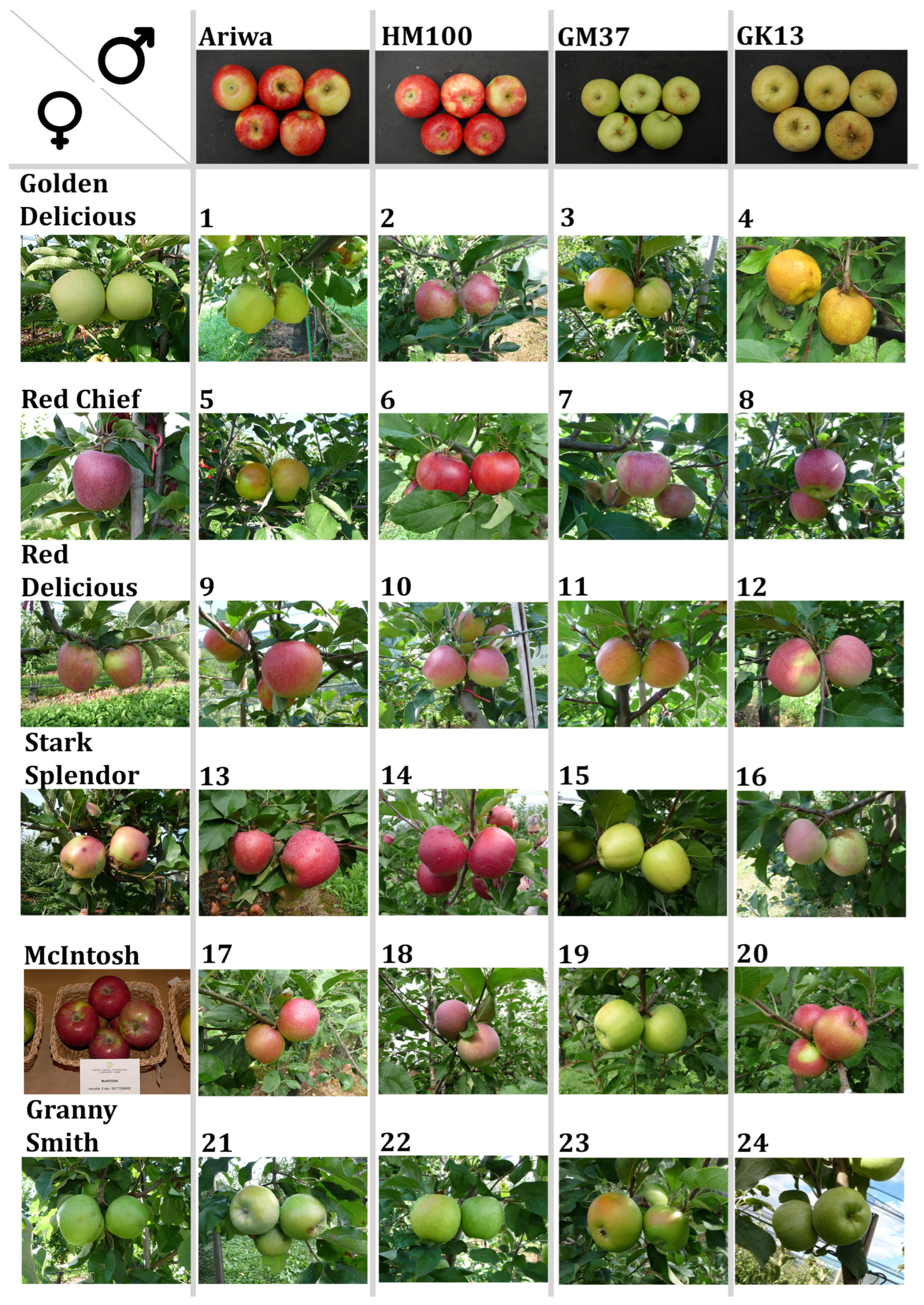
The six pollen receptor parents (female in this context) are dessert apples selected for good storage life, attractive colour, and firm texture. Table 2 and Table 3 summarize the distinctive traits of the female apple cultivars and pollen donor parents (male apple lines) selected for crossing. A representative set of images illustrating the plant materials of the ten parental cultivars and the 24 hybrid combinations is provided in Figure 1.

2.2. Location and Orchard Management

The experiment was conducted during 2018 and 2019 at the “Antonio Servadei” Experimental Farm, managed by the University of Udine (Italy). The affected lands are situated in the southern part of Udine, specifically at coordinates 46°02′12.0″ N, 13°13′12.0″ E, at an altitude of 111 m above sea level. The climate corresponds to that of the Friuli Plain, characterized by winter temperatures averaging between 4 and 6 °C, with few foggy days and a prevailing northeast breeze throughout the year that helps prevent extreme temperature fluctuations. Frequent thunderstorms often mark summers. The soil, representative of the Friulian low plain, is sandy alluvial in origin and rich in microelements, with a mildly alkaline pH of 8.0 and a C/N ratio of 8.52, indicating modest organic matter decomposition.
The orchard was managed using conventional techniques combined with integrated pest management practices to meet production requirements. Phytosanitary treatments included both antifungal and insecticidal agents, primarily targeting infestations caused by the Brown Marmorated Stink Bug. The plants were trained as spindles and received dry winter pruning, followed by manual green pruning to remove excessive or overly vigorous branches and suckers that shade the fruits. When the fruits reached approximately 2 cm in diameter, chemical thinning was performed, complemented by manual finishing. Throughout the season, seven irrigation events were carried out, each lasting about six hours, using a system of pipes beneath the canopy equipped with dynamic micro-sprinklers capable of delivering 60 litres per hour. Fertilizer applications were made in early April.

2.3. Data Collection

Phenological stages were tracked by counting days from 1 March of each year: budbreak was identified as the first activation of the buds, flowering as anthesis, and harvest as the fruit collection date. The durations between these stages—budbreak to flowering and flowering to harvest—were also analysed. Once the fruits reached maturity, harvesting was performed by randomly selecting five fruits from each plant. These samples were weighed with an electronic scale to determine their mass (g), and their polar and equatorial diameters (mm) were measured with a caliper. SSC (°Brix) was assessed using a digital refractometer (Atago®, Tokyo), while flesh firmness (Kg/cm2) was measured on the fruits’ equatorial surface with a penetrometer (Effegi, Italy) equipped with an 11.3 mm needle. Climatic conditions during the two growing seasons were documented by recording average daily temperatures, rainfall, and wind data obtained from aRPaFVG (https://www.osmer.fvg.it, accessed on 15 September 2025).

2.4. Statistical Analysis

Statistical analyses, including analysis of variance, were performed following a completely randomized design for all variables evaluated across the cross families over both years combined, using a factorial linear model. Separate analyses were also conducted for each year utilizing a simple linear model. Additionally, phenotypic and genotypic correlations between the evaluated variables within each season were examined. For traits showing significant differences among crosses, diallelic analysis was conducted to assess the relative influence of GCA and SCA on progeny performance within each parental group, following Baker’s [13] methodology. Principal components analysis (PCA) and generalized procrustes analysis (GPA) were then performed based on the GCA and SCA values estimated for parents and their hybrids, respectively [42].
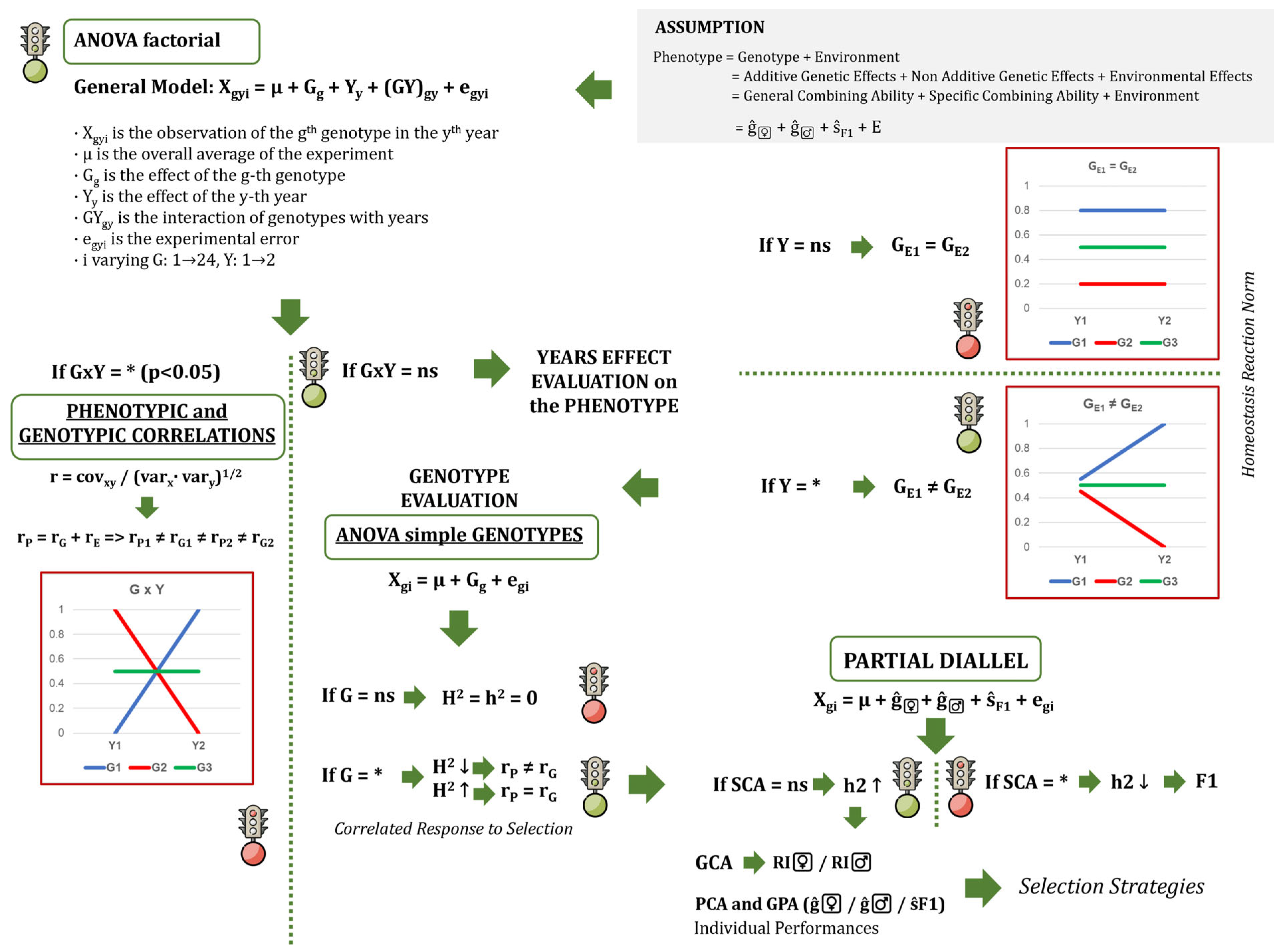
The different steps and models used for data analysis are illustrated in Figure 2, and a more detailed explanation of each step is provided in Supplementary File S1.
The analyses of variance, phenotypic and genotypic correlations, and the diallelic design analysis were performed with GENES software (VS 2009.7.0) [17]. Multivariate analyses of principal component (PCA) and generalized procrustes were performed with the INFOSTAT program (2020 Version) [43].

3. Results

3.1. Genome × Environment Interactions

Significant genotype-by-environment (G×E) interactions were revealed for 11 phenological, productive, and quality variables (Table S1). These results were based on an ANOVA of 24 cross-families (six pollen receptors × four pollen donors) assessed over the 2018 and 2019 seasons. Specifically, notable interactions were observed for flowering date, harvest date, and the durations between budbreak and flowering, as well as between flowering and harvest (Table 4). In contrast, variables such as days to budbreak, equatorial diameter, and polar diameter of fruit showed no significant G×E interactions, although differences were observed among hybrids and across assessment years. Conversely, fruit weight, the polar-to-equatorial diameter ratio, SSC, and flesh firmness exhibited substantial variability among the progeny in both production years.
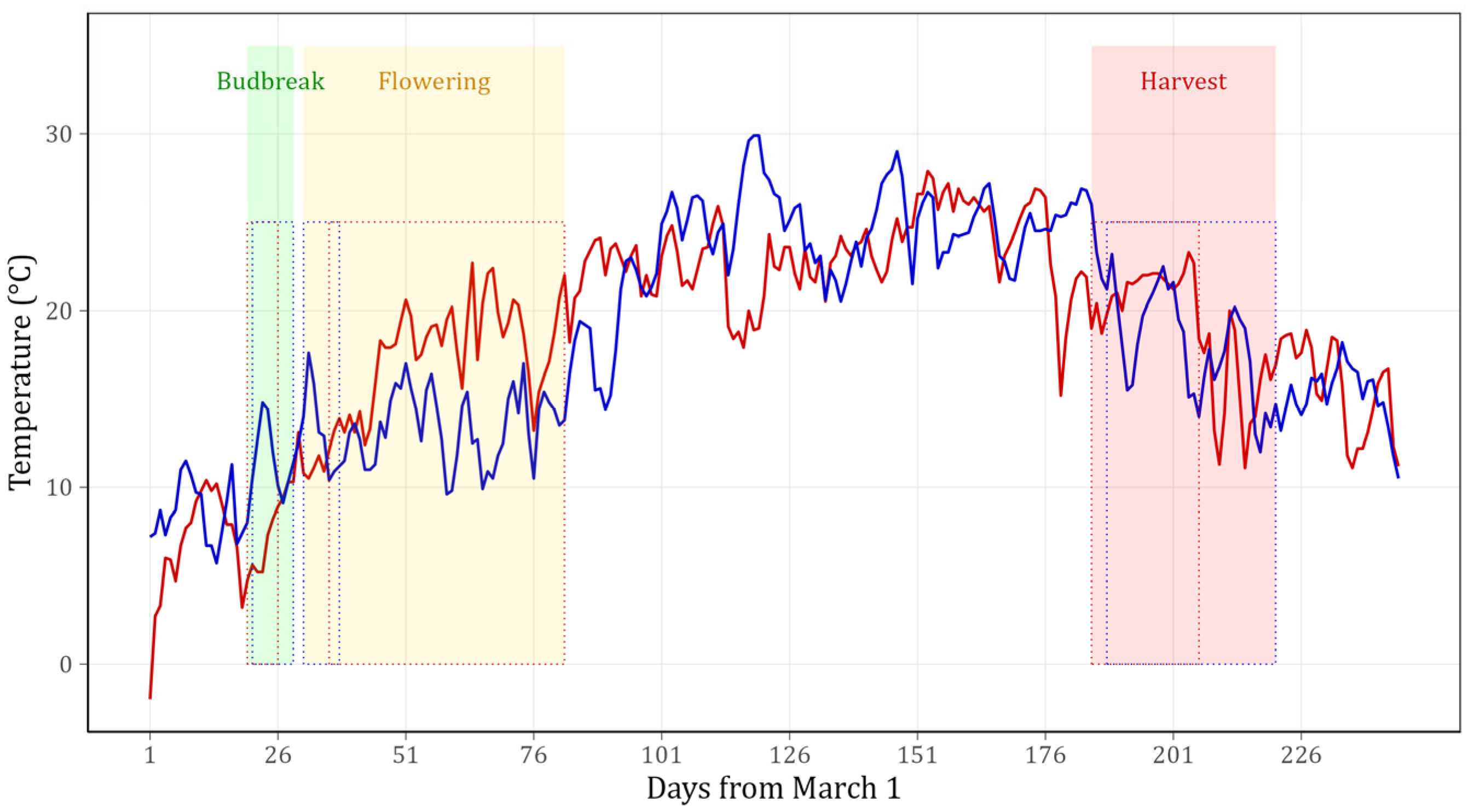
The effect of ambient temperature on the behaviour of phenological variables during each cultivation year was analysed (Figure 3). In 2018, budbreak occurred slightly more than one day earlier than in 2019, lasted two days shorter, and was associated with lower average daily temperatures. In 2019, flowering began five days earlier and persisted for a week, under cooler and more stable temperature conditions compared to 2018. Conversely, in 2018, flowering was prolonged by over 45 days, accompanied by higher and more irregular average temperatures than in 2019. The 2018 harvest started three days earlier and lasted 12 days fewer than in 2019, characterized by lower average daily temperatures and more erratic temperature patterns during the second phase.
Summarizing, both significant and non-significant G×E interactions were found in the 11 phenological and pomological traits analysed. The pomological traits showed substantial variability among progeny in both years.

3.2. Evaluation of GCA, SCA, and Heritability of 11 Phenological and Pomological Apple Traits

Considering that G×E interaction was demonstrated in the previous step, diallelic analysis of variance was performed on all the traits and separately for each year. The ANOVA of the progeny (Table 5) indicated no significant differences among the crosses for fruit diameter in both years or for flesh firmness in 2018. For those variables showing significant differences between families, both additive and non-additive variance components were estimated. The GCA of the pollen receptor genotypes exhibited significant differences across all variables in both years. In contrast, the additive variance component of the pollen donor genotypes was non-significant for flowering date and the period between budbreak and flowering in the first year, as well as for SSC in the second year. Meanwhile, the effects of specific combining ability (SCA) showed significant differences for the dates of budbreak, flowering, and harvest, as well as for the periods from budbreak to flowering and flowering to harvest, and for SSC in 2018. In 2019, however, significant non-additive effects were observed only for the budbreak date, the duration from budbreak to flowering period, and SSC.
Broad sense heritability values were, in general, higher for phenological variables (0.64 < H2 < 0.91) than for fruit morphometrics (0.47 < H2 < 0.60), while SSC showed high values in both seasons. On the other hand, narrow-sense heritability values showed a more uniform behaviour across the variables in both production years (0.16 < h2 < 0.31).
The estimated values of the relative importance indices (RI) showed that in the first year of evaluation the pollen receptor genotypes had a greater impact on the additive component for the harvest date, the flowering to harvest period, the polar diameter of the fruit and the soluble solid content (0.53 < RIr < 0.75), while the pollen-donor genotypes were more determinant for the budbreak date and the flesh firmness (0.64 < RId < 0.69). For fruit weight, the contribution of both types of parents was equivalent and high, while for the ratio of polar/equatorial fruit diameter, it was low. Towards the second year of evaluation, RI values were higher for pollen receptor genotypes for flowering and harvest dates, budbreak-to-flowering and flowering-to-harvest periods, and the fruit polar/equatorial diameter ratio (0.55 < RIr < 0.64). The relative contribution of pollen donor genotypes was higher for budbreak date and fruit weight (0.57 < RId < 0.63), while for fruit polar diameter the contribution was equivalent for both groups of parents (Table 3).
Summarizing, the study performed in this step suggests that while many traits (especially timing-related ones) are strongly influenced by genetics, the pollen receptor genotypes generally exert a more consistent influence across all traits compared to the pollen donors. The low narrow-sense heritability suggests that environmental factors or complex genetic interactions play a significant role in how these traits are expressed.

3.3. Relationship Between Traits and Environment

The analysis of phenotypic and genotypic correlations revealed relationships between trait variables and environmental factors over evaluation years (Tables S2 and S3). Phenotypic correlation coefficients were generally less intense than genotypic ones, with exceptions noted in specific traits across the years. Significant changes in sign and intensity of correlations were observed, with some associations switching from negative to positive and vice versa. For both phenotypic and genotypic correlations, complex trends were observed. Morphometric variables showed strong intercorrelations, while phenological and quality variables exhibited variability in correlation tendencies and intensities, including sign changes.
The analysis indicates that because so many correlations flipped signs, multi-year testing is non-negotiable. The analysis reveals that while physical fruit measurements (size and weight) are reliably linked, most other traits, especially those related to timing and fruit quality, are heavily influenced by the environment. The fact that genotypic correlations are stronger than phenotypic ones indicates that breeders may find higher success selecting for these traits by looking at genetic data rather than physical appearance alone.

3.4. Selecting Apple Parents for Their GCA and SCA

The GCA values exhibited an erratic pattern in the expression of additive effects (Table S4), consistent with the diversity observed in both pollen receptors and donor parents, as well as the influence of environmental factors on their phenotypes (Table 4 and Table 5). Overall, GCA values exhibited variability in both magnitude and direction; however, certain parents, such as ‘HM100’ and ‘Red Chief’, had more consistent behaviour. Several variables exhibited significant alterations in the manifestations of additive effects contingent upon the assessment year, including the fruit height/diameter ratio and the budbreak date.
PCA based on the GCA effects observed in each evaluation year helped reveal the underlying associations and intensities among the variables. The first principal component accounted for 41% of the total variance, the second for 27%, and the third for 16%. The combination of the first two principal components enabled the identification of groups of variables exhibiting similar patterns of behaviour (Table 6).
Physical dimensions (morphometrics) are the most influential factors in distinguishing between these fruit populations (highest eigenvalues). While ‘Golden Delicious’ is a consistent performer, ‘HM100’ and ‘Red Chief’ are more sensitive to yearly environmental changes, affecting their fruit size and phenological timing, respectively. Because fruit firmness was inconsistent across evaluation years, it may be less reliable for long-term parental selection compared to size or sugar content.
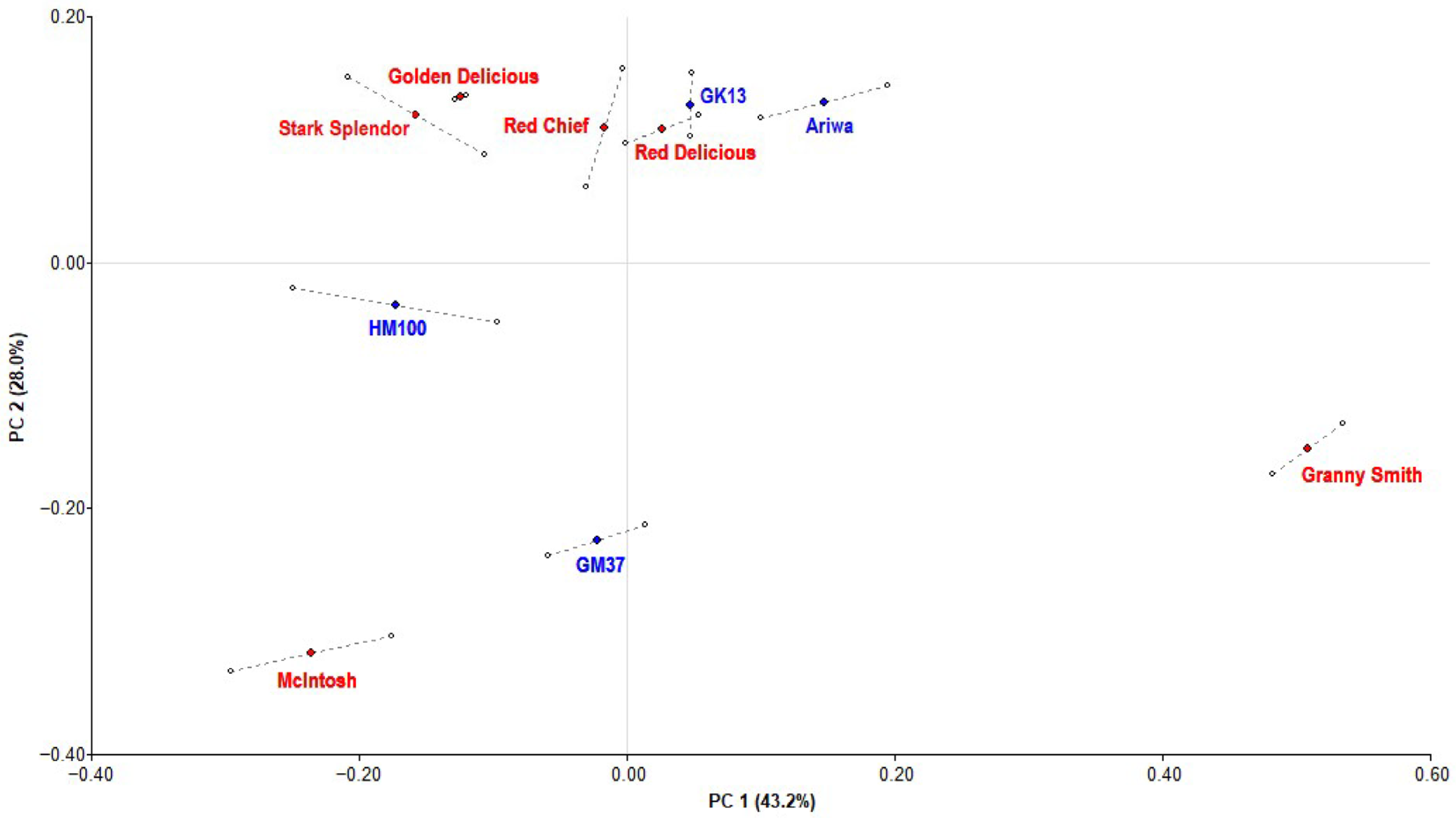
The Procrustes analysis, conducted using the GCA effects of the parents for all variables in each evaluated year, revealed a clear ordering of the parents based on both shared and contrasting characteristics (Figure 4). The first two consensus configurations accounted for 71.2% of the observed variability. The analysis illustrates the dispersion of each parent according to year and average performance. Notably, the parent ‘Golden Delicious’ exhibited highly uniform behaviour across the first two consensus dimensions, while ‘HM100’ showed greater dispersion along the first consensus dimension and ‘Red Chief’ along the second.
Based on their GCA profiles, genotypes with favourable additive genetic effects can be selected to meet specific breeding objectives. The pollen receptor cultivar ‘Granny Smith’ consistently distinguished itself by passing on traits such as early budbreak, late harvest timing, larger and more elongated fruits, as well as low SSC and reduced flesh firmness to its offspring. The parents ‘McIntosh’, ‘GM37’, and ‘HM100’ exhibited additive effects that tended to accelerate budbreak and flowering, while also reducing fruit size. However, these parents primarily differed in their influence on harvest time and SSC. Meanwhile, ‘Red Delicious’, ‘GK13’, and ‘Ariwa’ showed positive GCA effects for fruit weight, polar diameter, and the polar-to-equatorial diameter ratio, but each displayed distinct trends for certain pomological traits, SSC, and flesh firmness. The genotypes ‘Red Chief’, ‘Golden Delicious’, and ‘Stark Splendor’ exhibited negative GCA trends for harvest date and positive trends for SSC, with their main differences arising from additive effects on budbreak date, SSC, and flesh firmness.
While environmental factors make GCA effects somewhat unpredictable, the study successfully clustered parents into functional groups. By using ‘Golden Delicious’ for stability or ‘Granny Smith’ for size and timing, breeders can make more informed decisions to meet specific market demands (e.g., sweeter fruit vs. larger fruit).
The SCA values exhibited an irregular pattern regarding the expression of non-additive effects (Tables S5 and S6), reflecting the variability among families and the influence of environmental factors on their phenotypes (Table 4 and Table 5).
The PCA based on SCA effects observed each year clarified the underlying associations and intensities among the variables. The first principal component accounted for 33% of the variance, the second explained 18%, and the third 16%, together representing 67% of the total variability in SCA values among the parents. The first two components effectively grouped variables with similar behaviors, allowing breeders to identify which traits will likely “move together” when selecting for specific hybrid combinations (Table 7). The most significant differences in particular crosses (SCA) were driven by fruit sizes (weight and diameter). If a specific cross results in larger fruit, it is likely the most significant change captured in the data. A consistent inverse relationship between fruit size/phenology and flesh firmness in the first component emerged from the analysis. SSC was relatively independent of the size-driven first component, showing its strongest influence in the second component. This indicates that breeding for sugar content may be managed somewhat separately from breeding for size.
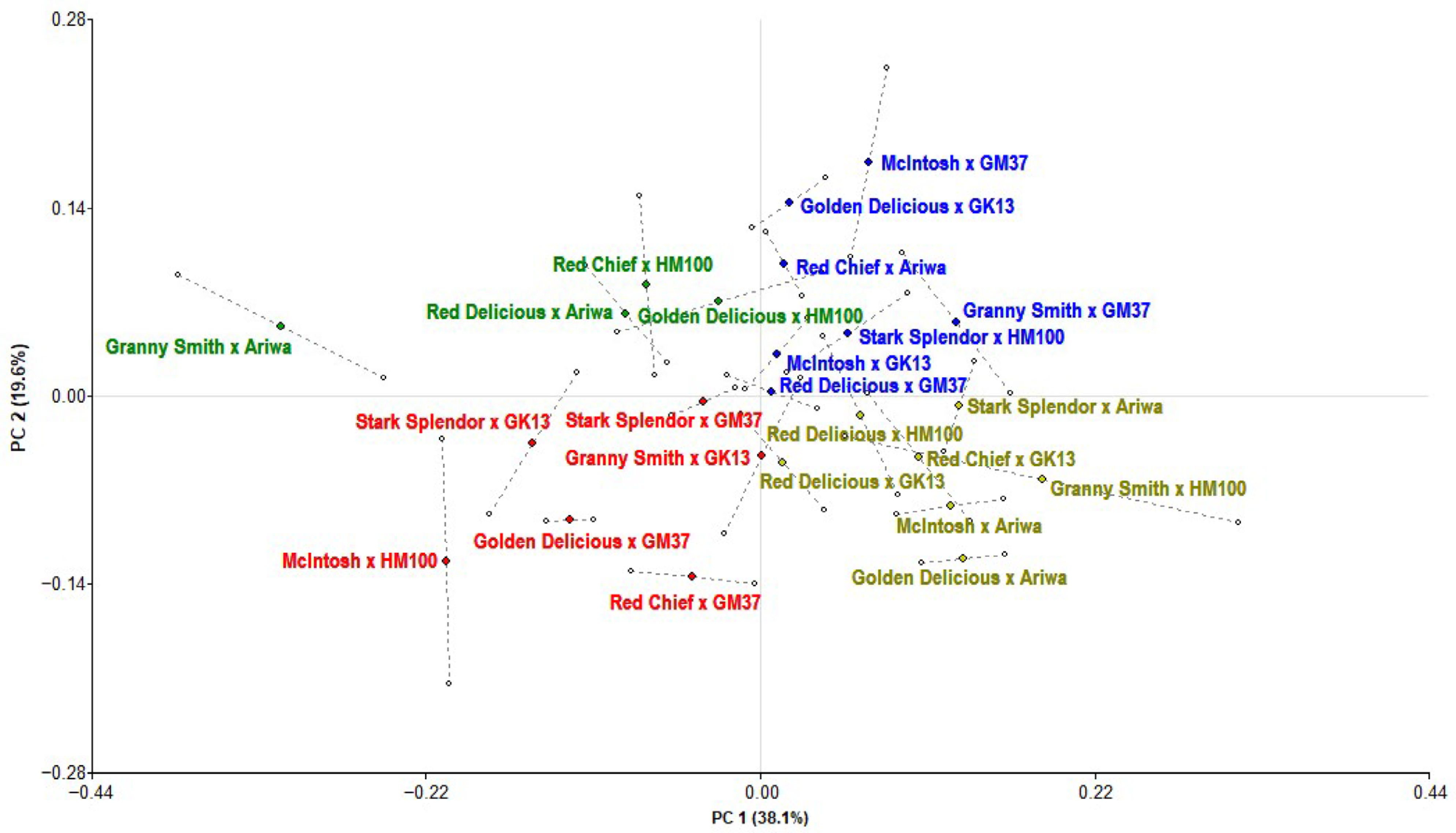
The Procrustes analysis of the families, based on the estimated SCA values for all variables in each year of evaluation, revealed a specific ordering of the families (Figure 5), with the first two consensus configurations accounting for 57.7% of the variability.
Based on estimates of non-additive genetic effects, certain family profiles allow for the occasional selection of genotypes with favourable heterotic combinations tailored to specific breeding objectives. For example, the ‘Granny Smith’ × ‘Ariwa’ family showed significant negative SCA values for budbreak and harvest dates, fruit weight, and both equatorial and polar diameters, while exhibiting positive heterotic effects for flesh firmness. Conversely, the ‘Red Delicious’ × ‘Ariwa’ family demonstrated notable positive heterotic effects for SSC and flesh firmness, along with moderate effects on harvest date and flowering during harvest, though it displayed low SCA values for fruit weight and diameters. The families ‘Granny Smith’ × ‘GK13’, ‘Golden Delicious’ × ‘GM37’, ‘Stark Splendor’ × ‘GK13’, and ‘McIntosh’ × ‘HM100’ exhibited negative SCA values across all fruit morphometric variables, as well as for budbreak date and SSC, but showed positive effects for flesh firmness. Additionally, the families ‘Stark Splendor’ × ‘HM100’, ‘Stark Splendor’ × ‘Ariwa’, ‘Granny Smith’ × ‘GM37’, ‘Red Delicious’ × ‘HM100’, ‘McIntosh’ × ‘Ariwa’, ‘Granny Smith’ × ‘HM100’, ‘Golden Delicious’ × ‘Ariwa’, and ‘Red Chief’ × ‘GK13’ stood out for their high SCA values related to fruit weight, equatorial and polar diameters, and negative SCA values for SSC and flesh firmness. Some crosses, such as ‘Red Chief’ × ‘HM100’, ‘Golden Delicious’ × ‘HM100’, ‘McIntosh’ × ‘GK13’, ‘Red Delicious’ × ‘GM37’, ‘Red Delicious’ × ‘GK13’, ‘Stark Splendor’ × ‘GM37’, and ‘Red Chief’ × ‘GM37’, exhibited substantial positive heterotic effects for the fruit’s polar-to-equatorial diameter ratio. Furthermore, the families ‘McIntosh’ × ‘GM37’, ‘Red Chief’ × ‘Ariwa’, and ‘Golden Delicious’ × ‘GK13’ showed positive non-additive effects on flowering and harvest dates, budbreak to flowering period, SSC, flesh firmness, and slightly positive effects on all fruit morphometric variables.
The SCA data show that while general parental traits are important, the specific combination of parents can result in “occasional” genotypes with favorable traits. For example, crossing ‘Granny Smith’ × ‘Ariwa’ results in a firmer fruit than expected, even though ‘Granny Smith’ itself usually passes on reduced firmness. These “favorable heterotic combinations” are the keys to selecting elite individual seedlings that outperform their siblings.

4. Discussion

The crosses conducted in our experimental design were primarily aimed at developing valuable parent lines for future breeding efforts, rather than directly creating commercial varieties.
In the context of modern apple pre-breeding, the genetic parameters estimated in this study contribute to a better understanding of how genome-informed approaches can be effectively implemented. The identification of parents with stable and high GCA across environments highlights genotypes that consistently contribute additive genetic effects to their progenies, making them especially suitable as reference parents in genome-based breeding schemes. Such genotypes represent valuable candidates for inclusion in training populations for genomic selection (GS), where the predictability of additive effects is critical for improving model accuracy. In this context, the observed stability of GCA for key phenological and fruit-related traits across the two evaluation years supports the use of these parents to anchor genomic predictions under variable environmental conditions.
Moreover, the estimated heritability values offer practical guidance for tailoring genome-informed strategies to specific trait categories. Traits exhibiting high heritability and predominantly additive genetic control, such as phenological traits, are well suited for early-generation GS, enabling more efficient selection before extensive field evaluation. In contrast, traits related to fruit quality and morphology, which showed moderate heritability and a stronger environmental influence, are likely to benefit from integrated approaches combining genomic information with multi-environment phenotyping. The presence of significant GXE for several traits further emphasizes the importance of incorporating environmental stratification or multi-environment models in genome-informed breeding pipelines.
Finally, the identification of specific cross combinations with favourable non-additive effects provides a rational basis for the development of advanced pre-breeding materials. These families represent promising resources for subsequent QTL mapping, marker-assisted selection, or GS approaches, as they capture complementary allelic combinations associated with both adaptation-related traits and fruit quality. Overall, the diallel-based dissection of genetic variance presented here bridges quantitative genetic analysis and genome-informed breeding by defining how parental choice, trait architecture, and environmental stability can be jointly exploited to optimize apple pre-breeding and breeding strategies.
Although the parental lines used as pollen donors do not possess pomological traits comparable to modern apple cultivars, they were selected because they possessed different levels of resistance to apple scab, the most important fungal disease of apple (Table 3 in this text and [41]. These lines served as pollen donors in crosses with mostly successful commercial apple varieties that have dominated the global market in recent decades. The goal was to establish pre-breeding selections with enhanced resistance traits and a more diverse genetic base.
The genetic phenomena observed in this study are inextricably linked to the allogamous nature of Malus × domestica. The species’ gametophytic incompatibility system serves as an evolutionary mechanism that effectively prevents self-fertilization, thereby maintaining high levels of heterozygosity within the population [44]. As noted by the varying performances of the 24 families, the combination of divergent alleles from non-homozygous parents generates complex metabolic and structural interactions, consistent with the dominance and epistasis models of hybrid vigour [18,45].
A central objective was to decouple the average behaviour of the progeny into components of GCA and SCA. Our findings suggest a dual-mode of inheritance depending on the trait analysed. For traits where GCA predominated, such as certain fruit morphometrics, the performance of the offspring can be effectively predicted based on parental additive values. This allows for a streamlined breeding strategy focused on crossing parents with superior GCA profiles. Conversely, the significant intervention of SCA in quality-related variables (e.g., SSC and firmness) underscores the importance of dominance and epistatic interactions. When SCA is a determinant factor, elite hybrid performance is not merely a function of parental averages but is dependent on unique, complementary gene structures within specific crosses. The results underscore a significant disproportion in parental contribution, with pollen receptor genotypes (maternal side) exhibiting a more consistent and dominant influence on progeny performance across nearly all evaluated traits. The significant GCA for pollen receptors suggests that selecting superior maternal parents is a viable strategy for improving both phenological and fruit morphometric traits.
In contrast, the more erratic performance of pollen donor genotypes and the presence of significant SCA effects, particularly for phenological dates and SSC, indicate that non-additive genetic effects (such as dominance or epistasis) play a substantial role.
The H2 values across the two years demonstrate that the observed variability is of preponderantly genetic origin. However, it must be noted that because the parental genotypes were not homozygous, the estimates of heritability include additional variance components derived from genotypic differences within each hybrid family. While the diallel mating design partially accounts for these effects, the high H2 values, particularly for phenological traits, confirm that a substantial portion of the phenotypic diversity is anchored in the underlying genetic architecture rather than environmental noise.
Despite the strong genetic foundation of these traits, our results highlight the significant role of environmental modulation. The analysis of variance and the shifting patterns in phenotypic and genotypic correlations between 2018 and 2019 point to a substantial G×E interaction. These interactions frequently masked genetic manifestations, rendering certain traits statistically non-significant in specific seasons [46]. Such environmental “noise” suggests that the underlying associations between phenological and quality variables are not static; rather, they are modulated by environmental conditions, such as the temperature irregularities observed during the flowering and harvest windows. Consequently, robust selection for these traits requires multi-year evaluation to separate stable genetic effects from transient environmental influences [47,48].
The most significant finding in this study is the high degree of G×E interaction, evidenced by the “sign flips” in phenotypic and genotypic correlations across evaluation years. While morphometric traits (fruit weight and diameter) maintained stable positive correlations, quality traits like SSC and phenological dates exhibited erratic behaviour. This study captures the “erratic pattern” of genetic correlations, particularly how the relationship between phenology and fruit quality changes across years. The achievement here is the observation that genotypic correlations were generally more intense than phenotypic ones. This suggests that environmental noise often masks the true underlying genetic relationships, and only through this type of diallel analysis can the actual genetic linkage between traits like harvest date and SSC be revealed.
This suggests that the genetic networks governing fruit quality are highly plastic and responsive to annual climatic fluctuations. For breeders, this instability necessitates a multi-environment or multi-year testing protocol; selecting for SSC or harvest timing based on a single season’s data would likely result in low genetic gain or false positive elite selections.
The disparity between high H2 (0.64 < H2 < 0.91 for phenology) and low h2 (0.16 < h < 0.31 across all traits) points to a complex genetic architecture. The high H2 confirms that the traits are under strong genetic control. The low h2 indicates that a significant portion of this control is non-additive (dominance or epistasis). In a breeding context, this suggests that mass selection (selecting the best individuals) will be less effective than family selection. The low additive variance component implies that the progeny’s performance cannot be reliably predicted by the average of the parents alone, placing a higher premium on identifying specific crosses that exhibit SCA.
The analysis revealed a marked dominance of pollen receptor (maternal) genotypes in contributing to additive variance. This maternal effect suggests that the cytoplasmic background or specific maternal tissue interactions may play a role in fruit development and phenological timing. The identification of stable parents like ‘Golden Delicious’ provides a foundation for defensive breeding, creating cultivars with predictable performance across varying seasons. Conversely, the high SCA values found in crosses like ‘Red Delicious’ × ‘Ariwa’ for SSC and firmness demonstrate the potential for heterosis. These specific transgressive segregants (offspring that outperform both parents) are the primary targets for commercial cultivar release, even if their traits are not easily passed to the next generation.
The PCA of GCA and SCA [49,50,51] effects successfully clustered trait complexes, revealing that while fruit size parameters are tightly linked, quality traits (SSC and firmness) often act independently or in opposition to size. This negative linkage or independent assortment means that breaking the correlation, to achieve both very large and very sweet fruit, requires large population sizes to capture rare recombinant individuals.
One of the most robust achievements is the use of Procrustes analysis [52] to harmonize the GCA and SCA data. The analysis accounted for 71.2% of variability, successfully categorizing parents like ‘Granny Smith’ (early budbreak/large fruit) versus ‘McIntosh’ and ‘HM100’ (early phenology/smaller fruit). The SCA configurations explained 57.7% of the variability, allowing for the identification of heterotic groups. This is a sophisticated way of predicting which specific crosses will outperform their parents for niche objectives, such as the ‘Red Delicious’ × ‘Ariwa’ cross for superior fruit firmness and SSC.
Future breeding efforts in this population should shift from a purely additive selection model to one that exploits non-additive effects through targeted hybridization. Given the low h2, GS might be a more robust approach than PS, as it could potentially capture the complex epistatic interactions that phenotypic observations miss during environmentally volatile years.
The authors acknowledge that, in some families, the limited number of individuals suggests that caution should be exercised when interpreting specific quantitative estimates. Nevertheless, the results provide valuable insights into the genetic structure of the evaluated traits and open new avenues for implementing multiple breeding strategies, considering trait heritability to optimize both family- and individual-based selection approaches, while also enabling a predictive understanding of the response to selection in the breeding process. Importantly, future studies could address the limitations related to sample size and the resulting constraints in statistical power by expanding the number of individuals per cross and by incorporating a broader set of parental genotypes. Increasing population size would enhance the detection of genetic effects with a smaller magnitude and allow a more precise estimation of combining abilities and variance components. In addition, the integration of multi-year and multi-environment trials would improve the robustness of genetic parameter estimates by better accounting for GXE interactions. Complementary approaches, such as the combination of diallel analyses with genome-wide marker information or the comparison of results across independent breeding populations, could further strengthen inference and reduce the risk of false negatives. In this perspective, the present study represents a foundational framework upon which larger-scale and more powerful experimental designs can be built.


5. Conclusions

The genetic diversity of the parents and the emergent effects generated through their crosses played a major role in determining the genetic components. The permanent and continuous influence of the environment could have resulted in differential effects, with the hybrids exhibiting interaction effects for the variables observed as a function of the year of evaluation. The importance of the components of genetic variance, both additive and non-additive, was reflected in the broad and narrow sense heritability values. The incidence of maternal additive genetic effects was, in general, noticeably higher than that of the paternal ones in the offspring. Considering that all the phenological, morphometric, and fruit quality characteristics evaluated involved additive and non-additive gene actions, parents whose combinations of alleles generate new segregating populations with favourable genotypic values could be selected, as well as crosses that express desirable specific effects. The combination of the quantitative information obtained in this work regarding the genetic basis of the agronomic performance of the analysed populations with that acquired through molecular techniques for specific genes of interest, such as disease resistance, results in a promising scenario for the genetic improvement of apple crops. The analysis of a partial diallel cross in apple (Malus × domestica) provides a sophisticated map of the genetic architecture underlying 11 key traits. The study successfully decouples additive and non-additive genetic components while quantifying the significant impact of environmental fluctuations on fruit phenology and quality. The study concludes that breeding strategies must be customized to the specific population. Because the specific effects of each hybrid combination are unique and unpredictable until observed, this mating design provides a first-of-its-kind blueprint for apple selection that balances additive stability (size/shape) with non-additive potential (quality). This research successfully moves beyond simple performance trials to provide a functional genetic atlas for apple breeding. By identifying that pollen receptors (females) often dominate harvest and SSC traits while pollen donors (males) influence budbreak and firmness, the study provides insights for parent selection in future hybridization programs.

Supplementary Materials

The following supporting information can be downloaded at: https://www.mdpi.com/article/10.3390/horticulturae12010093/s1, Supplementary File S1: Explanation of the Analytical Model; Table S1: Mean values of the 11 variables analysed on the 24 families of crosses evaluated in the 2018 and 2019 seasons; Table S2: Phenotypic correlation coefficients between the 11 variables evaluated in the offspring in two production seasons. Table S3: Genotypic correlation coefficients between the 11 variables evaluated in the offspring in two production seasons (2018 above the diagonal, 2019 below the diagonal). Table S4: GCA values of phenological, morphometric, and quality variables estimated for the recipient and pollen donor genotypes evaluated in the two production years. Table S5: Values of SCA of the phenological, morphometric, and quality variables estimated for the families evaluated in the 2018. Table S6: Values of SCA of the phenological, morphometric, and quality variables estimated for the families evaluated in the 2019.

Author Contributions

Conceptualization, G.C.; methodology, G.C. and P.A.; validation, G.D.M. and G.C.; formal analysis, P.A.; writing—original draft preparation, P.A., G.C. and G.D.M.; writing—review and editing, G.D.M. and G.C. All authors have read and agreed to the published version of the manuscript.

Funding

This research received no external funding.

Data Availability Statement

The original contributions presented in this study are included in the article/Supplementary Materials. Further inquiries can be directed to the corresponding author.

Acknowledgments

The authors thank Giorgio Comuzzo and Renato Frezza for the technical work done at the experimental agricultural farm of the University of Udine. Furthermore, they thank the then-students Francesco Omenetto and Marco Rambaldi for their help in collecting pomological data.

Conflicts of Interest

The authors declare no conflicts of interest.

Abbreviations

The following abbreviations are used in this manuscript:
MASMarker-Assisted Selection
SSCSoluble Solid Content
GCAGeneral Combining Ability
SCASpecific Combining Ability
PCAPrincipal components analysis
GPAGeneralized Procrustes Analysis
GxEGenotype-by-Environment
GSGenomic Selection
PSPhenotypic Selection

References

  1. FAO. FAOSTAT: Production Indices. Available online: https://www.fao.org/faostat/en/#search/apples (accessed on 7 November 2025).
  2. Jung, M.; Hodel, M.; Knauf, A.; Kupper, D.; Neuditschko, M.; Bühlmann-Schütz, S.; Studer, B.; Patocchi, A.; Broggini, G.A.L. Evaluation of Genomic and Phenomic Prediction for Application in Apple Breeding. BMC Plant Biol. 2025, 25, 103. [Google Scholar] [CrossRef]
  3. Kumar, S.; Volz, R.K.; Chagné, D.; Gardiner, S. Breeding for Apple (Malus × Domestica Borkh.) Fruit Quality Traits in the Genomics Era. Genom. Plant Genet. Resour. 2014, 2, 387–416. [Google Scholar] [CrossRef]
  4. Urrestarazu, J.; Muranty, H.; Denancé, C.; Leforestier, D.; Ravon, E.; Guyader, A.; Guisnel, R.; Feugey, L.; Aubourg, S.; Celton, J.M.; et al. Genome-Wide Association Mapping of Flowering and Ripening Periods in Apple. Front. Plant Sci. 2017, 8, 298363. [Google Scholar] [CrossRef]
  5. Endrizzi, I.; Torri, L.; Corollaro, M.L.; Demattè, M.L.; Aprea, E.; Charles, M.; Biasioli, F.; Gasperi, F. A Conjoint Study on Apple Acceptability: Sensory Characteristics and Nutritional Information. Food Qual. Prefer. 2015, 40, 39–48. [Google Scholar] [CrossRef]
  6. Harker, F.R.; Johnston, J.W. Importance of Texture in Fruit and Its Interaction with Flavour. In Fruit and Vegetable Flavour: Recent Advances and Future Prospects; Woodhead Publishing: Cambridge, UK, 2008; pp. 132–149. [Google Scholar] [CrossRef]
  7. Bus, V.G.M.; Ranatunga, C.; Alspach, P.A.; Oraguzie, N.C.; Whitworth, C. A Partial Diallel Study of Powdery Mildew Resistance in Six Apple Cultivars under Three Growing Conditions with Different Disease Pressures. Euphytica 2006, 148, 235–242. [Google Scholar] [CrossRef]
  8. Gelvonauskienë, D.; Sasnauskas, A.; Gelvonauskis, B. The Breeding Of Apple Tree Resistant To European Canker (Nectria Galligena Bres.). Sodininkystė Ir Daržininkystė 2007, 26, 174–178. [Google Scholar]
  9. Klocko, A.L. Mini Review: Apple Improvement, Traditional Approaches, Biotechnology Options, and Regulatory Considerations. Front. Bioeng. Biotechnol. 2025, 13, 1617110. [Google Scholar] [CrossRef] [PubMed]
  10. Bowen, J.K.; Mesarich, C.H.; Bus, V.G.M.; Beresford, R.M.; Plummer, K.M.; Templeton, M.D. Venturia Inaequalis: The Causal Agent of Apple Scab. Mol. Plant Pathol. 2011, 12, 105–122. [Google Scholar] [CrossRef]
  11. Beckerman, J. Managing Scab-Resistant. Available online: https://www.extension.purdue.edu/extmedia/BP/BP-76-W.pdf (accessed on 7 November 2025).
  12. Normann, A.; Röding, M.; Wendin, K. Sustainable Fruit Consumption: The Influence of Color, Shape and Damage on Consumer Sensory Perception and Liking of Different Apples. Sustainability 2019, 11, 4626. [Google Scholar] [CrossRef]
  13. Baker, R.J. Issues in Diallel Analysis. Crop Sci. 1978, 18, 533–536. [Google Scholar] [CrossRef]
  14. Carena, M.J.; Hallauer, A.R.; Miranda Filho, J.B. Quantitative Genetics in Maize Breeding; Springer: New York, NY, USA, 2010; Volume 6. [Google Scholar] [CrossRef]
  15. Da Silva, D.J.H.; Da Costa, C.P.; Dias Casali, V.W.; Dos Santos Dias, L.A.; Cruz, C.D. Análise da capacidade combinatória em berinjela. Bragantia 1999, 58, 7–14. [Google Scholar] [CrossRef]
  16. Veiga, R.D.; Ferreira, D.F.; Ramalho, M.A.P. Eficiência Dos Dialelos Circulantes Na Escolha de Genitores. Pesqui. Agropecu. Bras. 2000, 35, 1395–1406. [Google Scholar] [CrossRef][Green Version]
  17. Cruz, C.D. Programa Genes: Biometria; Editora UFV: Viçosa, Brazil, 2006. [Google Scholar]
  18. Falconer, D.S.; Mackay, T.F.C. Introduction to Quantitative Genetic, 4th ed.; Longman Group Ltd.: Harlow, UK, 1996. [Google Scholar]
  19. Miranda Filho, J.B.; Vencovsky, R. The Partial Circulant Diallel Cross at the Interpopulation Level. Genet. Mol. Biol. 1999, 22, 249–255. [Google Scholar] [CrossRef]
  20. Kempthorne, O.; Curnow, R.N. The Partial Diallel Cross. Biometrics 1961, 17, 229. [Google Scholar] [CrossRef]
  21. Russell, W.A.; Eberhart, S.A. Hybrid Performance of Selected Maize Lines from Reciprocal Recurrent and Testcross Selection Programs1. Crop Sci. 1975, 15, 1–4. [Google Scholar] [CrossRef]
  22. Singh, R.K.; Chaudhary, B.D. Biometrical Methods in Quantitative Genetic Analysis; Kalayani Publishers: New Delhi, India, 1979. [Google Scholar]
  23. Ceranka, B.; Dobek, A.; Kiełozewska, H. The Analysis of Partial Diallel Crosses. Biom. J. 1987, 29, 455–460. [Google Scholar] [CrossRef]
  24. Dantas, A.C.V.L. Cruzamento Dialélico Parcial Circulante Para Avaliação de Linhagens de Milho (Zea mays L.) e Predição de Híbridos. Ph.D. Thesis, Escola Superior de Agricultura Luiz de Queiroz, Piracicaba, Brazil, 1989. [Google Scholar] [CrossRef]
  25. Cruz, C.D.; Regazzi, A.J. Modelos Biométricos Aplicados Ao Melhoramento Genético; UFV—Imprensa Universitária: Viçosa, Brazil, 1994. [Google Scholar]
  26. Ellison, J.H. Asparagus Breeding; Basset, M.J., Ed.; Breeding vegetable crops; AVI Publishing Company Inc., Westport: New York, NY, USA, 1986. [Google Scholar]
  27. Ragot, M.; Sisco, P.H.; Hoisington, D.A.; Stuber, C.W. Molecular-Marker-Mediated Characterization of Favorable Exotic Alleles at Quantitative Trait Loci in Maize. Crop Sci. 1995, 35, 1306–1315. [Google Scholar] [CrossRef]
  28. Eshed, Y.; Zamir, D. Less-Than-Additive Epistatic Interactions of Quantitative Trait Loci in Tomato. Genetics 1996, 143, 1807–1817. [Google Scholar] [CrossRef] [PubMed]
  29. Tanksley, S.D.; Grandillo, S.; Fulton, T.M.; Zamir, D.; Eshed, Y.; Petiard, V.; Lopez, J.; Beck-Bunn, T. Advanced Backcross QTL Analysis in a Cross between an Elite Processing Line of Tomato and Its Wild relative L. Pimpinellifolium. Theor. Appl. Genet. 1996, 92, 213–224. [Google Scholar] [CrossRef]
  30. Xiao, J.; Grandlillo, S.; Ahn, S.N.; McCouch, S.R.; Tanksley, S.D.; Li, J.; Yuan, L. Genes from Wild Rice Improve Yield. Nature 1996, 384, 223–224. [Google Scholar] [CrossRef]
  31. Sprague, G.F.; Tatum, L.A. General vs. Specific Combining Ability in Single Crosses of Corn1. Agron. J. 1942, 34, 923–932. [Google Scholar] [CrossRef]
  32. Curnow, R.N. Sampling the Diallel Cross. Biometrics 1963, 19, 287. [Google Scholar] [CrossRef]
  33. Fyfe, J.L.; Gilbert, N. Partial Diallel Crosses. Biometrics 1963, 19, 278. [Google Scholar] [CrossRef]
  34. Narain, P. The Use of Partial Diallel Cross in Plant Improvement; Golden Jubiles of ICAR: New Delhi, India, 1979; Volume Souvenir Vol. [Google Scholar]
  35. Narain, P.; Arya, A.S. Truncated Triangular Association Scheme and Related Partial Diallel Crosses. Sankhyā Indian J. Stat. 1960, 43, 93–103. [Google Scholar]
  36. Jinks, J.L.; Hayman, B.I. The Analysis of Diallel Crosses. Maize Genet. Coop. Newsl. 1953, 27, 48–54. [Google Scholar]
  37. Hayman, B.I. The theory and analysis of diallel crosses. Genetics 1954, 39, 789–809. [Google Scholar] [CrossRef]
  38. Griffing, B. Concept of General and Specific Combining Ability in Relation to Diallel Crossing Systems. Aust. J. Biol. Sci. 1956, 9, 463–493. [Google Scholar] [CrossRef]
  39. Kempthorne, O. The theory of the diallel cross. Genetics 1956, 41, 451–459. [Google Scholar] [CrossRef]
  40. De Souza, M.A.; Ramalho, M.A.P. Controle Genético e Tolerância Ao Estresse de Calor Em Populações Híbridas e Em Cultivares de Trigo. Pesqui. Agropecu. Bras. 2001, 36, 1245–1253. [Google Scholar] [CrossRef][Green Version]
  41. Testolin, R.; Falginella, L.; de Carli, A.; de Mori, G.; Cipriani, G. Pyramiding Resistance Genes and Widening the Genetic Base of the Apple (Malus × Domestica Borkh.) Crop. Italus Hortus 2021, 28, 32–43. [Google Scholar] [CrossRef]
  42. Gower, J.C. Maximal Predictive Classification. Biometrics 1974, 30, 643. [Google Scholar] [CrossRef]
  43. Di Rienzo, J.A.; Casanoves, F.; Balzarini, M.G.; Gonzalez, L.; Tablada, M.; Robledo, C.W. Infostat—Statistical Software. Available online: https://www.infostat.com.ar/index.php?mod=noticias (accessed on 3 November 2025).
  44. Hiorth, G.E. Genética Cuantitativa; T. I, Fundamentos biológicos; Universidad Nacional de Córdoba, Facultad de Ciencias Agropecuarias: Córdoba, Argentina, 1985. [Google Scholar]
  45. Heranca Quantitativa. In Melhoramento e Producao do Milho No Brasil; Fundacao Cargill: Campinas, Brazil, 1987.
  46. Mariotti, J.A. Fundamentos de Genetica Biometrica: Aplicaciones al Mejoramiento Genetico Vegetal; Secretaría General de los Estados Americanos: Tucumán, Argentina, 1986. [Google Scholar]
  47. Zinn, K.E.; Tunc-Ozdemir, M.; Harper, J.F. Temperature Stress and Plant Sexual Reproduction: Uncovering the Weakest Links. J. Exp. Bot. 2010, 61, 1959–1968. [Google Scholar] [CrossRef]
  48. Wang, F.; Han, T.; Jeffrey Chen, Z. Circadian and Photoperiodic Regulation of the Vegetative to Reproductive Transition in Plants. Commun. Biol. 2024, 7, 579. [Google Scholar] [CrossRef]
  49. Edwards, A.W.F.; Cavalli-Sforza, L.L. A Method for Cluster Analysis. Biometrics 1965, 21, 362. [Google Scholar] [CrossRef] [PubMed]
  50. Bennett, S.; Bowers, D. An Introduction to Multivariate Techniques for Social and Behavioural Sciences. In An Introduction to Multivariate Techniques for Social and Behavioural Sciences; Dover Publications: Garden City, NY, USA, 1976. [Google Scholar] [CrossRef]
  51. Dunn, G.; Everitt, B. A Introduction to Mathematical Taxonomy; Dover Publications, Inc.: Mineola, NY, USA, 2004; ISBN 0486435873. [Google Scholar]
  52. Hurley, J.R.; Cattell, R.B. The Procrustes Program: Producing Direct Rotation to Test a Hypothesized Factor Structure. Behav. Sci. 1962, 7, 258–262. [Google Scholar] [CrossRef]
Figure 1. Representative images of the plant materials used in this study. The top row shows the four male parents (‘Ariwa’, ‘HM100’, ‘GM37’, and ‘GK13’), while the leftmost column reports the six female parents (‘Golden Delicious’, ‘Red Chief’, ‘Red Delicious’, ‘Stark Splendor’, ‘McIntosh’, and Granny Smith). The numbered panels (1–24) display a representative sample of the corresponding hybrid combinations derived from each female × male cross.
Horticulturae 12 00093 g001
Figure 2. Conceptual framework and analytical workflow used in this study. This figure is an illustrative schematic based on fictitious data, provided solely for explanatory purposes. G = Genotype; Y = Year; The y-axis of the graphs shows the phenotype value. The diagram summarizes the statistical models and conceptual assumptions underlying the analyses. It illustrates how phenotypic variation results from the interplay between genetic and environmental components, and how these effects were partitioned and interpreted through factorial and simple ANOVA, correlation analyses, and partial diallel models to define appropriate selection strategies. A more detailed explanation is provided in Supplementary File S1.
Horticulturae 12 00093 g002
Figure 3. Average daily temperatures in the two production seasons (red: 2018, blue: 2019) and duration of the phenological development periods (budbreak, flowering, and harvest) of the crossbreeding families. The dashed boxes represent the duration of the phenological periods for the year 2018 (in red) and 2019 (in blue).
Horticulturae 12 00093 g003
Figure 4. The distribution of parents along the first two consensus axes, derived from Procrustes analysis based on the effects of GCA estimated for each production year, is illustrated as follows: Red indicates pollen receptors, and Blue represents pollen donors. The dotted lines indicate the connection between the consensus of the two years of evaluation for each genotype.
Horticulturae 12 00093 g004
Figure 5. Distribution of the families according to the first two consensus axes from the Procrustes analysis based on the SCA effects estimated in each production year. Family names are coloured according to their position in the PCA plot: red—both components negative; blue—both components positive; green—PC1 negative and PC2 positive; yellow—PC1 positive and PC2 negative. The dotted lines indicate the connection between the consensus of the two years of evaluation for each genotype.
Horticulturae 12 00093 g005
Table 1. Number of individuals evaluated from each family of crosses between six pollen-receptors and four pollen-donors genotypes following a partial diallel mating design.
Pollen-Donors
AriwaHM100GM37GK13
Pollen-receptorsGolden Delicious41083
Red Chief4889
Red Delicious8774
Stark Splendor510105
McIntosh6385
Granny Smith410107
Table 2. Comparison of four pomological traits in the six apple cultivars selected as female parents.
Cultivar Color Flavor Profile Texture Best Use
Golden Delicious Yellow Sweet, Mild Tender, Juicy Fresh Eating, Salads, Sauce
Red Chief Deep Red Mildly Sweet Crisp to Soft Fresh Eating, Decorative
Red Delicious Bright Red Sweet, Bland Variable Fresh Eating
Stark Splendor Purple-Red Sweet-Tart Very Crisp, Juicy Fresh Eating, Baking
McIntosh Red/Green Tart, Aromatic Tender, Juicy Sauce, Cider, Fresh Eating
Granny Smith Bright Green Very Tart Hard, Crisp Baking, Fresh Eating (for tart lovers)
Table 3. Parents carrying resistance genes/QTLs used in the mating design. These resistant parents were used as pollen donors.
SelectionPedigreeGenes/QTLs of Resistance to Scab Further Resistance Genes
AriwaGolden Delicious × A 849-5Rvi1, Rvi6Pl1, FB
GK13Goldrush × RealkaRvi1, Rvi2, Rvi4, Rvi6
GM37Goldrush × MurrayRvi1, Rvi5, Rvi6
HM100Harmony × MurrayRvi5, Rvi6
Pl1 = gene of resistance to powdery mildew; FB = resistant to fire blight.
Table 4. F values and significance level (*: p < 0.05) obtained from the factorial analysis of variance of the 11 variables analysed to detect the interactions between the families of crosses and the years of evaluation.
Variables CrossesYearsCrosses × Years
Budbreak5.1 *64.8 *1.1
Flowering date9.2 *192.2 *10.0 *
Harvest date12.8 *131.8 *2.1 *
Budbreak-flowering period9.4 *274.7 *10.6 *
Flowing-harvest period3.3 *280.6 *6.7 *
Fruit weight3.4 *2.10.7
Fruit equatorial diameter2.4 *8.9 *0.1
Fruit polar diameter3.5 *8.6 *0.6
Polar/diameter ratio3.5 *0.30.3
SSC6.1 *1.11.1
Flesh firmness2.7 *3.40.7
Table 5. F values (*: p < 0.05, significant values) obtained from the ANOVA of the progeny in each year of evaluation (Fc), their decomposition into the components of general combining ability of the pollen receptor (Fr) and donor (Fd) parents, and the SCA component of their crosses (Fsca), estimated values of the broad sense heritability (H2) and narrow sense heritability (h2), and for the relative importance of the additive effects of the pollen receptor (RIr) and donor (RId) parents.
VariablesFcFrFdFscaH2h2RIrRId
2018Budbreak2.8 *4.3 *9.4 *2.1 *0.640.270.550.64
Flowering date10.5 *40.4 *2.44.1 *0.90.290.64---
Harvest date8.8 *23.1 *5.9 *2.6 *0.890.220.530.16
Budbreak-flowering period10.8 *42.1 *1.14.4 *0.910.280.64---
Flowing-harvest period3.9 *10.3 *4.9 *3.7 *0.740.250.60.33
Fruit weight1.9 *4.1 *5.5 *1.30.470.290.780.76
Fruit equatorial diameter1.5---------------------
Fruit polar diameter2.2 *5.8 *4.1 *1.60.540.280.750.58
Polar/diameter ratio1.9 *3.5 *5.4 *1.20.470.270.320.32
SSC3.7 *9.5 *3.2 *2.8 *0.730.230.60.25
Flesh firmness2.0 *2.7 *6.1 *0.80.50.240.590.69
2019Budbreak4.0 *4.1 *14.3 *1.9 *0.750.240.360.57
Flowering date2.8 *5.1 *5.7 *1.50.640.230.550.48
Harvest date6.9 *21.2 *11.4 *1.20.850.30.610.36
Budbreak-flowering period2.7 *5.6 *2.9 *1.8 *0.640.20.570.31
Flowing-harvest period6.1 *19.8 *9.8 *0.70.830.310.640.37
Fruit weight2.5 *3.7 *7.4 *1.10.590.250.550.63
Fruit equatorial diameter1.6---------------------
Fruit polar diameter2.4 *4.3 *6.0 *1.10.590.240.590.58
Polar/diameter ratio2.6 *5.0 *5.0 *1.30.60.240.610.51
SSC3.7 *7.6 *1.12.9 *0.730.160.51---
Flesh firmness1.4---------------------
Table 6. Eigenvalues of the phenological, morphometric, and quality variables evaluated in two productive years obtained from the analysis of principal components from the effects of the general combining ability of the parents.
20182019
VariablesPC1PC2PC3PC1PC2PC3
Budbreak00.250.3700.170.43
Flowering date0.31−0.070.03−0.010.390.13
Harvest date0.23−0.20.080.28−0.160.15
Budbreak-flowering period0.3−0.1−0.01−0.010.27−0.27
Flowing-harvest period−0.3−0.030.010.26−0.210.12
Fruit weight0.180.3−0.090.30.030.14
Fruit equatorial diameter0.160.26−0.140.3−0.080.16
Fruit polar diameter0.180.32−0.130.310.140.04
Polar/diameter ratio0.160.3−0.070.190.28−0.12
SSC−0.240.20.1−0.20.140.3
Flesh firmness0.02−0.10.39−0.070.150.43
Table 7. Eigenvalues of the phenological, morphometric, and quality variables evaluated in two production seasons obtained from the PCA from the effects of SCA values of the families.
20182019
VariablesPC1PC2PC3PC1PC2PC3
Budbreak0.150.240.140.160.13−0.35
Flowering date−0.20.28−0.210.170.230.12
Harvest date0.140.02−0.040.10.430.02
Budbreak-flowering period−0.220.23−0.230.030.110.41
Flowing-harvest period0.23−0.230.170.040.4−0.03
Fruit weight0.36−0.03−0.020.310.04−0.09
Fruit equatorial diameter0.34−0.03−0.150.30.01−0.23
Fruit polar diameter0.340.010.060.310.120.1
Polar/diameter ratio0.10.140.370.080.170.37
SSC−0.040.270.12−0.040.410.14
Flesh firmness−0.240.170.06−0.18−0.040.37
Disclaimer/Publisher’s Note: The statements, opinions and data contained in all publications are solely those of the individual author(s) and contributor(s) and not of MDPI and/or the editor(s). MDPI and/or the editor(s) disclaim responsibility for any injury to people or property resulting from any ideas, methods, instructions or products referred to in the content.