Article

Physiological, Biochemical, and Transcriptome Analyses Reveal the Potential Role of ABA in Dufulin-Induced Tomato Resistance to Tomato Brown Rugose Fruit Virus (ToBRFV)

1
College of Plant Protection, Yunnan Agricultural University, Kunming 650201, China
2
College of Food, Drug and Health, Yunnan Vocational College of Agriculture, Kunming 650212, China
3
College of Agronomy and Life Sciences, Yunnan Key Laboratory of Konjac Biology, Yunnan Urban Agricultural Engineering and Technological Research Center, Kunming University, Kunming 650214, China
4
College of Tobacco Science, Yunnan Agricultural University, Kunming 650201, China
*
Authors to whom correspondence should be addressed.
Horticulturae 2026, 12(1), 60; https://doi.org/10.3390/horticulturae12010060
Submission received: 15 November 2025 / Revised: 26 December 2025 / Accepted: 30 December 2025 / Published: 4 January 2026
(This article belongs to the Special Issue Sustainable Management of Pathogens in Horticultural Crops)

Abstract

As an important plant immune inducer, Dufulin has long been thought to enhance plant resistance to multiple plant viruses through activating the salicylic acid (SA) pathway. However, whether this immune inducer responds to tomato brown rugose fruit virus (ToBRFV) infection in the same way remains uncertain. In this study, we systematically analyzed the multiple effects of Dufulin treatment on the physiological, biochemical and gene expression patterns in tomato under ToBRFV infection. The results showed that the application of Dufulin could significantly increase the chlorophyll content; elevate the activities of superoxide dismutase (SOD), peroxidase (POD), and catalase (CAT); reduce the ToBRFV viral load; and enhance plant growth. Moreover, we found that Dufulin treatment could increase both SA and abscisic acid (ABA) contents. However, SA-related genes were not strongly activated as the genes involved in ABA biosynthesis and signal transduction pathways. This suggested that ABA likely plays an unrecognized role in the formation of this induced resistance. Through weighted gene co-expression network analysis (WGCNA) and cis-element analysis of the target gene promoters, we identified that SlABI5-like and SlWRKY4 might be the key potential transcription factor genes for Dufulin-induced tomato resistance to ToBRFV, and constructed their molecular regulatory network. We also conducted qRT-PCR assay to verify the gene expression patterns involved in this study. These findings potentially provide new insights into the mechanism of Dufulin-induced antiviral resistance, and enlarge important molecular targets for ToBRFV prevention and control.

1. Introduction

Tomato is one of the most widely cultivated and important vegetable crops in the world [1,2]. According to FAO statistics, the worldwide tomato production reached 192 million tons in 2023, with China producing 70.21 million tons, accounting for 36.6% of the global output [3], making China the largest tomato producer in the world. However, viral diseases are one of the major biological stressors affecting tomato production globally and posing great concern to farmers and growers worldwide [4].
ToBRFV belongs to the genus Tobamovirus in the family Virgaviridae [5,6,7]. Since its first report in Israel in 2014 [8], ToBRFV has spread to over 50 countries and regions across Asia, Europe, the Americas, and Africa, posing a serious threat to global tomato production [4]. ToBRFV primarily causes symptoms such as uneven fruit coloring, yellow or brown patches, and wrinkling on tomato fruits, significantly reducing their market value. ToBRFV is primarily transmitted through mechanical contact [9,10,11]. Due to its multiple transmission routes, it spreads easily and is challenging to control [12,13,14,15]. To date, only few reports exist on chemical agents for ToBRFV management. Recent studies indicates that ToBRFV-specific dsRNA application could reduce both viral symptoms and RNA levels of ToBRFV in tomato plants [16]. Another work reveals that Chelerythrine likely achieves a protective efficacy for ToBRFV through coordinately activation of reactive oxygen species (ROS) signaling, mitogen-activated protein kinase (MAPK) cascades, and SA/jasmonic acid (JA)-mediated defense pathways [17]. However, the broader application of chemical agents is constrained by the lack of long-term effectiveness and cost assessment. Therefore, understanding the pathogenic mechanism of ToBRFV or finding more resistance inducers for this virus is crucial to the tomato industry.
Plant immunity agents are active compounds that can trigger innate immunity in plants by inducing the production of resistance-related substances [18]. They function in conferring immunity against pests and diseases through regulating resistance genes and have been demonstrated playing an important role in coping with plant viral diseases [19]. Dufulin, an α-aminophosphonate ester class, exhibits low toxicity and residue levels and is environmentally friendly [20]; moreover, it has been registered as a pesticide and can be used to induce systemic acquired resistance (SAR) to control southern rice black-streaked dwarf virus (RBSDV) [21,22], potato virus Y (PVY), cucumber mosaic virus (CMV), tobacco mosaic virus (TMV) [23], and tomato yellow leaf curl virus (TYLCV) [24]. According to previous studies, this compound could improve plant resistance to viral diseases through increasing SA levels [23]. However, it is still unclear whether it can induce resistance to ToBRFV in tomato or activate other hormone pathways.
This study explores the protective effect of Dufulin on ToBRFV and elucidates the physiological and biochemical basis for enhanced resistance in tomato seedlings Dufulin treatment. Furthermore, by integrating analysis of hormone profiling and transcriptome data, we explored key hormonal signaling pathways to dissect the mechanism underlying Dufulin-induced virus resistance in tomato. Our findings provide new insights into sustainable and eco-friendly strategies and important molecular targets for ToBRFV prevention and control.

2. Materials and Methods

2.1. Plant Materials and Growth Conditions

Tomato (Solanum lycopersicum cv. Chunwang) was purchased from Huaye Seedling Technology Co., Ltd. (Guangzhou City, Guangdong Province, China). Plants were cultivated in a growth chamber maintained at 25 °C under a 16 h light/8 h dark photoperiod cycle.

2.2. Virus Inoculation and Dufulin Application

For virus preservation, Agrobacterium tumefaciens strain GV3101 harboring the full-length ToBRFV cDNA sequence was infiltrated into tomato leaves. After 14 days post-infiltration, leaves exhibited typical mosaic and blistering symptoms, and the infected leaves were then used as the viral source for subsequent experiments. Approximately 1.0 g of systemically infected tomato leaf tissue was homogenized in 10 mL of inoculation buffer (0.01 M phosphate buffer, pH 7.2, containing 0.1% Na2SO3) to prepare the inoculum.
Tomato seedlings (the four-true-leaf stage) were sprayed with 2 mL of Dufulin solution (500 µg/mL) or ddH2O per plant over the whole seedling as a negative control. After 24 h, the first pair of true leaves was dusted with carborundum and gently rubbed with the prepared inoculum. The fourth true leaf of inoculated plants was collected at 1-, 3-, and 7-days post-inoculation (dpi), immediately flash-frozen in liquid nitrogen, and stored at −80 °C for subsequent physiological and biochemical analyses. Samples collected at 7 dpi were used for RT-PCR, qRT-PCR, and transcriptome sequencing. Three biological replicates were performed for all assays.

2.3. Protective Activity of Dufulin on ToBRFV

Based on Jaiswal’s symptom classification system for ToBRFV infection in tomato [25], we incorporated two additional key parameters (plant height and lesion area) to calculate a disease severity index (DSI), where 0 represents no symptoms; 1 represents chlorosis or mild mosaic on apical leaves; 3 represents mosaic on 1/3 of the leaves; 5 represents severe mosaic, mottling, blistering, and mild deformation on 1/2 of the leaves; 7 represents severe mosaic, deformation, and wrinkling on 3/4 of the leaves, or significant stunting of the plant; and 9 represents severe mosaic, severe deformation, and stringiness in 3/4 of the leaves, or significant stunting and death of the plant.
DSI (%) = [sum (class frequency × score of rating class)]/[(total number of plants) × (maximal disease index)] × 100
Protective activity (%) = [(Disease index of the control group − Disease index of the treatment group)/Disease index of the control group] × 100%

2.4. RNA Extraction, cDNA Synthesis, and PCR Detection

For the samples collected at 7 dpi, total RNA was extracted according a Trizol extraction method (TIANGEN Biotech (Beijing) Co., Ltd., Beijing, China). RNA concentration was measured by using a NanoDrop2000 spectrophotometer (Waltham, MA, USA), and RNA integrity was assessed with an Agilent2100 Bioanalyzer (Santa Clara, CA, USA). All RNA samples exhibited a concentration ≥ 100 ng/μL, A260/A280 ratio between 1.8–2.1, A260/A230 ratio > 2, and RNA integrity number (RIN) ≥ 7.5, confirming high purity and integrity. Subsequently, 1 µg of total RNA was used for first-strand cDNA synthesis with the HiScript II 1st Strand cDNA Synthesis Kit (Nanjing Vazyme Medical Technology Co., Ltd., Nanjing, China). The RT-PCR reaction system consisted of cDNA, 10 µm/L upstream and downstream primers (Table S1), Master Mix (Nanjing Vazyme Medical Technology Co., Ltd., Nanjing, China), and ddH2O. qRT-PCR was performed to detect viral load using an ABI 7500 real-time fluorescent quantitative PCR instrument: 20 µL of qRT-PCR reaction system consisted of 1 µL of the cDNA (10-fold diluted), 0.4 µL each of 10 µm/L primer pairs (Table S1), 10 µL of 2 × SYBR qPCR Mix (Nanjing Vazyme Medical Technology Co., Ltd., Nanjing, China), and 8.2 µL of ddH2O.

2.5. Membrane Lipid Peroxidation Assays

The malondialdehyde (MDA) content was measured with an ELISA kit (Jiangsu Jingmei Biotechnology Co., Ltd., Yancheng, China). In brief, 0.5 g of leaf tissue was homogenized, centrifuged at 1200 rpm for 20 min, and the supernatant was incubated with reagents before reading the absorbance at 450 nm. Hydrogen peroxide (H2O2) was extracted from tomato leaf tissue using acetone. The H2O2 in the supernatant was reacted with 20% TiCl4 in HCl (10%, v/v) and ammonia to form a yellow peroxide-Ti complex, which was subsequently dissolved in concentrated sulfuric acid. Absorbance was then measured at 415 nm.

2.6. Determination of Defense Enzyme Activity

The activities of SOD, POD, CAT, and phenylalanine ammonia-lyase (PAL) were measured using ELISA kits (Jiangsu Jingmei Biotechnology Co., Ltd., Yancheng, China). Briefly, tomato leaf extract, standards, and horseradish peroxidase (HRP)-labeled detection antibody were sequentially added to the wells. After incubation and thorough washing, color was developed with the substrate 3,3′,5,5′-Tetramethylbenzidine (TMB). Absorbance was read at 450 nm, and enzyme activities were calculated according to the manufacturer’s protocol.

2.7. Measurement of Photosynthetic Pigment Content

Photosynthetic pigments in tomato leaf tissue collected at 7 dpi were analyzed according to the method of Ni et al. [26]. 0.5 g of fresh tissue was grounded in liquid nitrogen, mixed with 5 mL of 80% acetone, and extracted in the dark for 30 min. Following centrifugation, supernatant absorbance was measured at 663, 645, and 470 nm. The contents of carotenoids, chlorophyll a, and chlorophyll b were calculated using the equations provided in the manufacturer’s instructions (Jiangsu Jingmei Biotechnology Co., Ltd., Yancheng, China). Each experiment was performed in triplicate.

2.8. Quantification of Phytohormones

The levels of phytohormones were quantified using UPLC-MS/MS (LCMS-8040, Shimadzu, Kyoto, Japan). Approximately 150 mg of tissue grounded in liquid nitrogen was extracted with ice-cold ethyl acetate containing deuterated internal standards (D6-JA, D5-JAIle, D6-ABA, D5-IAA, and D4-SA). After vortexing (10 min) and centrifugation (13,000× g, 15 min, 4 °C), the supernatant was vacuum-dried. The residue was redissolved in 50% methanol, centrifuged, and the supernatant was injected onto a Shim-pack XR-ODS III column (1.6 μm, 75 × 2.0 mm). Separation was performed using a gradient of 0.05% formic acid with 5 mM ammonium formate in water (A) and methanol (B) at a flow rate of 0.3 mL/min. Detection employed negative electrospray ionization with multiple reaction monitoring (MRM) for 12-oxophytodienoic acid (OPDA), jasmonic acid, Jasmonoyl-L-isoleucine (JA-Ile), SA, ABA, and indole-3-acetic acid (IAA). OPDA was quantified using the internal standard for JA. Quantification of all analytes was performed using internal standard calibration curves based on peak-area ratios [27]. All analyses included three biological replicates.

2.9. Transcriptomic Analysis

Each treatment group consisted of three biological replicates, with three seedlings per replicate. RNA was extracted as described in Section 2.4. High-quality total RNA (2 μg per sample) was used for library construction. Poly(A)+ mRNA was selected using oligo(dT) magnetic beads. First- and second-strand cDNA were synthesized from the enriched mRNA, followed by end repair, A-tailing, and adapter ligation to generate sequencing libraries. Transcriptome sequencing was performed on an Illumina NovaSeq 6000 platform (Illumina, San Diego, CA, USA) in paired-end 150 bp (PE150) mode. Differentially expressed genes (DEGs) were identified using a screening threshold of |log2 Fold change| ≥ 1 with FDR < 0.05. Gene Ontology enrichment analysis and KEGG pathway enrichment analysis were performed using the BMKCloud (https://www.biocloud.net) [28].
WGCNA was performed using Metware Cloud, a free online platform for data analysis (https://cloud.metware.cn, accessed on 15 September 2025). The analysis parameters were set as follows: gene filter threshold = 0.3, minModuleSize = 30, and mergeCutHeight = 0.35. Module eigengenes were computed and assessed for trait correlations. We visualized the network using Cytoscape (version 3.10.2).

2.10. Statistical Analysis

SPSS software (version 27.0, IBM Corp., Armonk, NY, USA) was used for statistical analysis and GraphPad Prism 8 for graph construction. Multi-time-point data were analyzed by analysis of variance (ANOVA) by Duncan’s test (p < 0.05). Single-time-point comparisons used Student’s t-test (* p < 0.05; ** p < 0.01; *** p < 0.001) for planned pairs.

3. Results

3.1. Effects of Dufulin Treatment on the Growth of Tomato Seedlings

In order to clarify the effect of Dufulin on tomato resistance to ToBRFV based on previous research experience [23,29], we sprayed the Dufulin solution on tomato seedlings and observed significantly better seedlings growth than the control group after 7 dpi (Figure 1a). In newly emerged leaves, we amplified a ToBRFV band of about 354 bp through semi-quantitative methods, and the band in the control group was brighter than that in the treatment group (Figure 1b). Further qRT-PCR analysis showed that the viral accumulation in control was 1.94-fold higher than that in the Dufulin-treated plants (Figure 1c), demonstrating that Dufulin could significantly reduce ToBRFV viral load in leaves. In addition, we found that the contents of chlorophyll a, chlorophyll b, total chlorophyll (Figure 1d–f), and carotenoids (Figure S1) increased sharply, which were 1.82-, 1.96-, 1.80-, and 2.23-fold higher than that of the control, respectively. This result indicates that Dufulin might increase the content of photosynthetic pigments in tomato leaves, promote photosynthesis, and consequently mitigate the impacts of ToBRFV infection. Through continuous observation, we also found that Dufulin treatment could reduce the ToBRFV disease index and incidence and improve the plant height, stem circumference, and fruit number (Figures S2 and S3). Collectively, the above results suggested that Dufulin application might provide substantial protection against ToBRFV infection and enhance plant growth to some extent.

3.2. Physiological Changes in Tomato

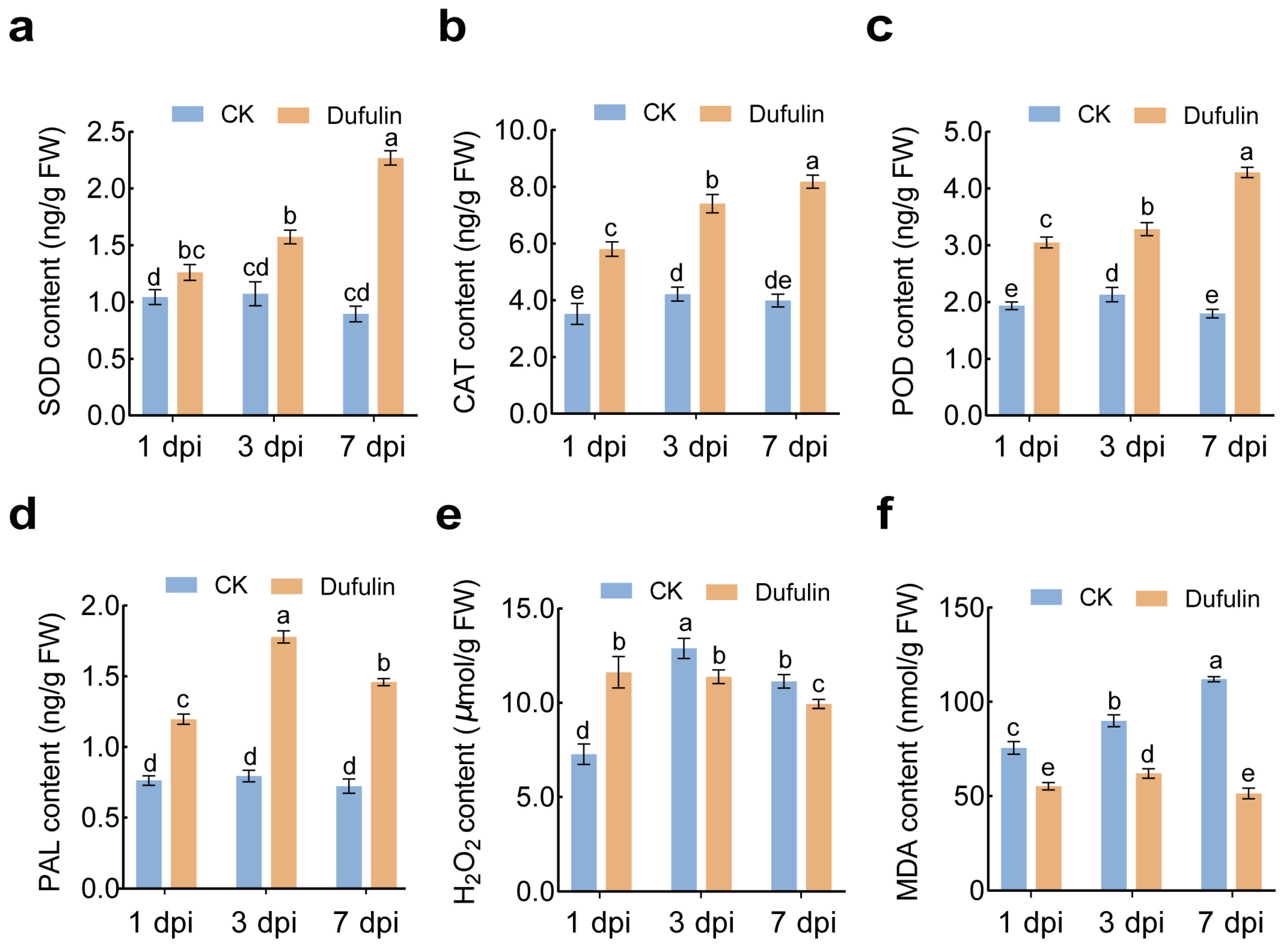
To elucidate the antioxidant response to ToBRFV after Dufulin application, we determined the activities of SOD, CAT, POD, and PAL, as well as the contents of H2O2 and MDA (Figure 2). Over time, the SOD, CAT, and POD activities all showed a gradual increasing trend from the first to seventh day, and the corresponding values for the Dufulin-treated group were always significantly higher than those of the control group, reaching levels that were 2.54-, 2.05-, and 2.39-fold higher than those of the control (Figure 2a–c), respectively on the seventh day. The change in PAL activity was similar, reaching a maximum on the third day and decreasing slightly on the seventh day, but it was still about 2.24 times that of the control (Figure 2d). In contrast, Dufulin treatment could significantly reduce the H2O2 and MDA content, except on the first day (Figure 2e,f). In summary, Dufulin treatment might enhance tomato plants’ resistance to ToBRFV by elevating antioxidant enzymes activity and reducing reactive oxygen species-induced damage.

3.3. Changes in Phytohormones in Tomato Leaves

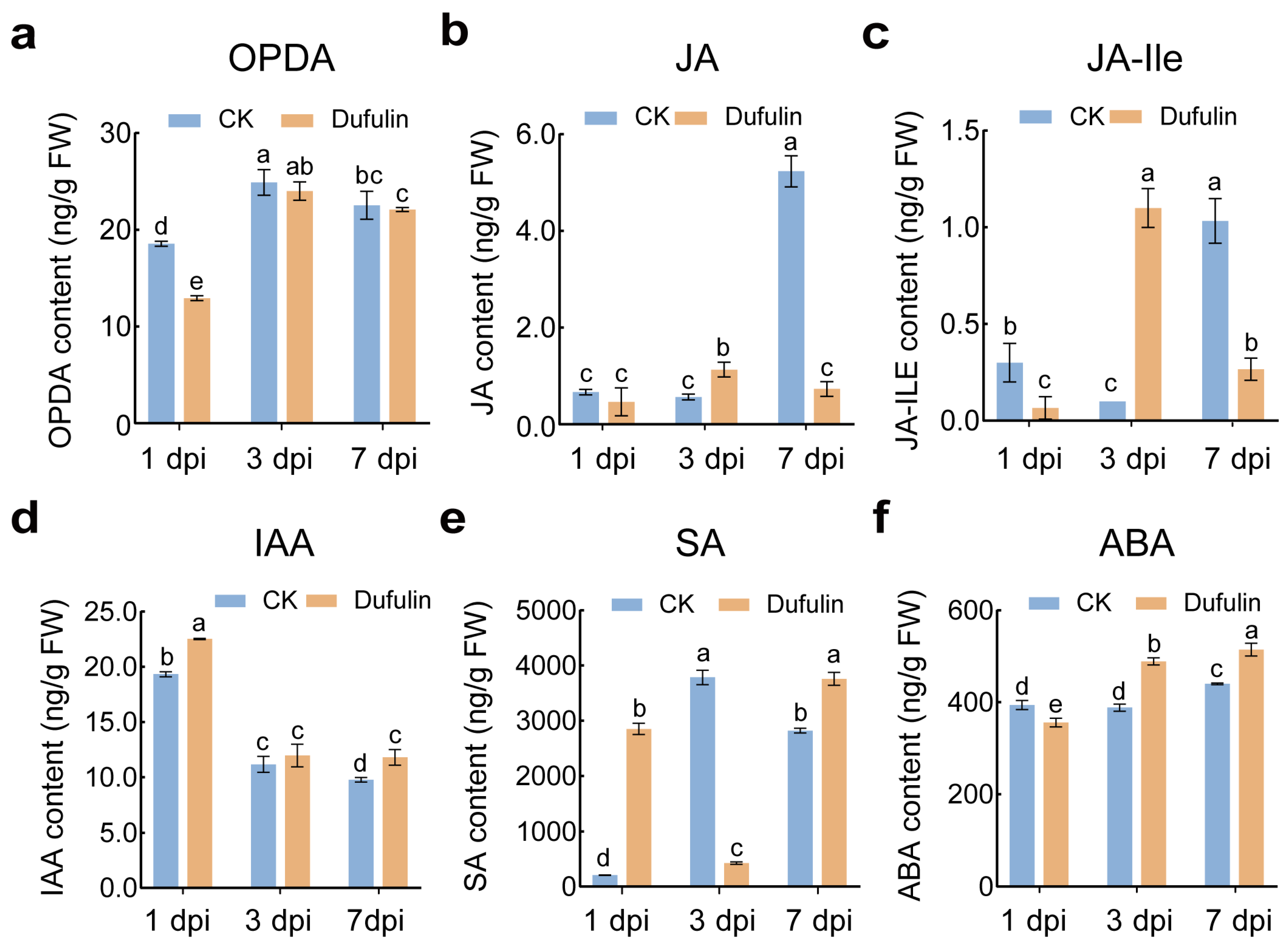
Given the critical role of defense hormones in plant responses to viral infection, qualitative and quantitative analyses of OPDA, JA, JA-Ile, SA, ABA, and IAA were conducted in tomato seedlings from Dufulin-treated group and control group (Figure 3).
OPDA, a precursor in JA biosynthesis, showed an overall upward trend, but compared with the control, no significant difference was found between the groups on the third and seventh days, except for the significantly lower values compared with the control on the first day (Figure 3a). JA and JA-Ile levels showed a similar change pattern, with their contents in the Dufulin-treated group significantly increased on the third day but decreasing sharply on the seventh day, and the values in the Dufulin-treated group was significantly lower than that of the control at this point (Figure 3b,c). The IAA dynamic change exhibited a downward trend in both the treatment and control groups, but the value of Dufulin-treated group was always slightly higher than that of control group (Figure 3d). SA was significantly induced on the first day by Dufulin treatment, reaching 2852 ng/g, which was 13.7 times higher than that of the control group, and then showed a “decrease–increase” pattern, reaching a peak of 3784.8 ng/g on the seventh day (Figure 3e). It is worth noting that ABA content was continually induced by Dufulin treatment and reached a peak of 514.7 ng/g on the seventh day, which was 1.2 times higher than that of control group (Figure 3f). The above results suggested that Dufulin pretreatment might stimulate hormone synthesis and signal transduction of SA and ABA pathways to enhance the ToBRFV resistance of tomato seedlings.

3.4. Transcript Diversity Analysis

To investigate the molecular mechanisms of Dufulin-induced resistance against ToBRFV, mRNA sequencing was performed on new tomato leaves inoculated with ToBRFV for 7 days. The clean data of all samples reached 5.75 Gb, with Q30 values exceeding 96.55%. The GC content of the samples ranged from 42.21% to 43.24%. After screening out low-quality reads, 95.49–97.02% clean reads were mapped to the S. lycopersicum SL3.0 reference genome (https://www.ncbi.nlm.nih.gov/datasets/genome/GCA_000188115.3/, accessed on 6 January 2025), indicating high-quality data suitable for further analysis (Table S2).
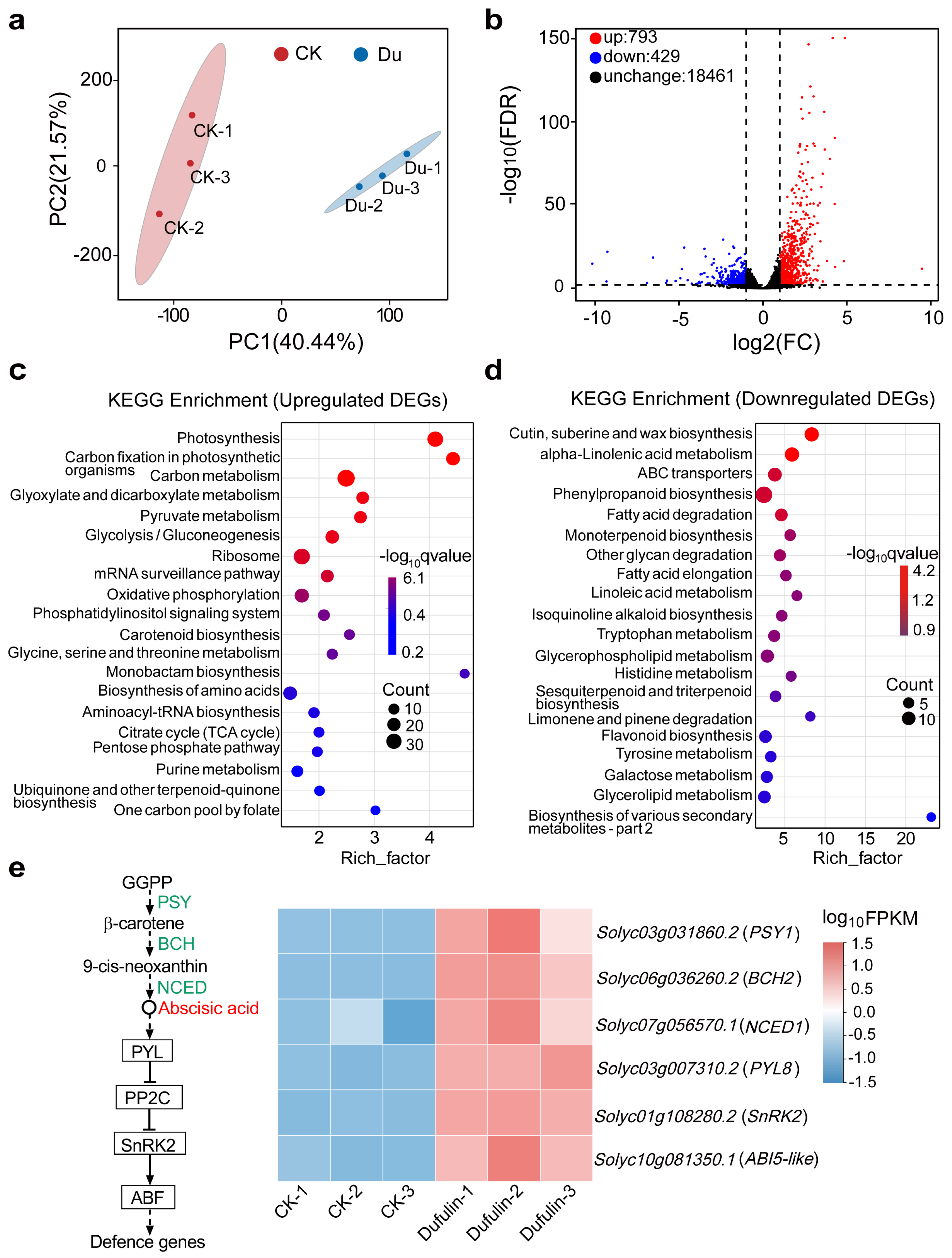
Principal component analysis (PCA) was performed on the sequenced samples to further elucidate the differences among treatments. The results showed that the treatment and control groups were clustered into two clusters with obvious boundaries, indicating that the data can be used for subsequent analysis (Figure 4a). DEGs were identified using thresholds of p ≤ 0.05 and |log2 fold change| ≥ 1. And 1222 DEGs were identified between Dufulin-treated and control groups, including 793 upregulated and 429 downregulated genes (Figure 4b).
Gene Ontology enrichment analysis showed that the 1222 DEGs were associated with cellular and metabolic processes in the biological process category; intracellular components, protein-containing complex, and cellular anatomical entity in the cellular component category; and binding and catalytic activity in the molecular function category, among others (Figure S4). KEGG enrichment analysis of the biological processes associated with DEGs showed that the 793 upregulated genes in the Dufulin-treated group were predominantly linked to pathways such as photosynthesis (ko00195), carbon fixation in photosynthetic organisms (ko00710), carbon metabolism (ko01200), glyoxylate and dicarboxylate metabolism (ko00630), and pyruvate metabolism (ko00620) (Figure 4c). Conversely, the 429 downregulated genes were mainly involved in cutin, suberine, and wax biosynthesis (ko00073); alpha-linolenic acid metabolism (ko00592); ABC transporters (ko02010); phenylpropanoid biosynthesis (ko00940); and fatty acid degradation (ko00071) (Figure 4d).
In order to reveal the molecular mechanism of physiological and biochemical changes induced by Dufulin treatment, we investigated the gene expression patterns of the related pathways. The results indicated that the key components of the photosynthetic apparatus have been dramatically induced: PS I subunits SlPsaA (Solyc06g009940.1) and SlPsaB (Solyc12g033060.1) both increased approximately 3-fold; PS II subunit SlPsbA (Solyc02g021290.1) and SlPsbD (Solyc05g021190.1) were upregulated 2- and 4-fold; the cytochrome b6f complex subunit SlPetA (Solyc01g007380.1) increased 3-fold; ATP synthase subunit SlATPase-B (Solyc01g007320.2) was induced 3-fold; and the photosynthetic electron transport component SlFd (Solyc10g044520.1) exhibited a 5-fold upregulation (Figure S5). In the Calvin cycle, SlGAPDH (Solyc12g094640.1) showed the most substantial increase (7-fold) (Figure S6). Furthermore, the expression of antioxidant-related genes was also enhanced. In addition to SlSOD (Solyc01g067740.2 and Solyc11g066390.1, 2-fold upregulation), SlPOD (Solyc02g077300.1, 6-fold), and SlCAT (Solyc04g082460.2, 4-fold) were overall upregulated after Dufulin treatment (Figure S7). These transcriptional changes correlated well with the corresponding increases in enzyme activities, indicating that Dufulin treatment coordinately activates both photosynthetic and antioxidant systems in response to Dufulin.
Notably, phytohormone results revealed that a significant increase in SA content in Dufulin-treated tomato seedlings at 1 and 7 dpi under ToBRFV condition, indicating that SA might play an important role in tomato defense against ToBRFV infection. However, we screened no DEGs involving SA synthesis and signal transduction pathways from transcriptome data, suggesting that the increased SA content might not originate from de novo synthesis. Similarly, JA and its active form JA-Ile levels exhibited a transient increase at 3 dpi, followed by a decline at 7 dpi. Transcriptomic analysis identified only two DEGs in the JA biosynthesis pathway, SlACX1 (Solyc08g078400.2) and SlJAR1 (Solyc05g050280.2), which were upregulated approximately 4-fold and 3-fold, respectively (Figure S8). The transient accumulation pattern suggests that JA and JA-Ile might play a primarily role during a specific early response phase, rather than sustaining long-term defense signaling. Consequently, our focus shifted to the role of ABA, which was also induced by Dufulin treatment. Through comprehensive transcriptome analysis, key genes in the ABA biosynthesis and signaling pathways were found to be significantly upregulated by Dufulin treatment. In the biosynthesis pathway, SlPSY (Solyc03g031860.2) and the rate-limiting enzyme SlNCED1 (Solyc07g056570.1) were upregulated approximately 3-fold, while SlBCH (Solyc06g036260.2) showed a pronounced increase of about 11.5-fold. In the signaling pathway, SlSnRK2 (Solyc01g108280.2) was upregulated about 2-fold, whereas SlPYL (Solyc03g007310.2) and SlABI5-like (Solyc10g081350.1) each increased approximately 3-fold (Figure 4e). These results together indicated that ABA might play a critical role in Dufulin-induced resistance to ToBRFV.

3.5. WGCNA Identified Candidate Genes Regulating Dufulin-Induced Resistance to ToBRFV

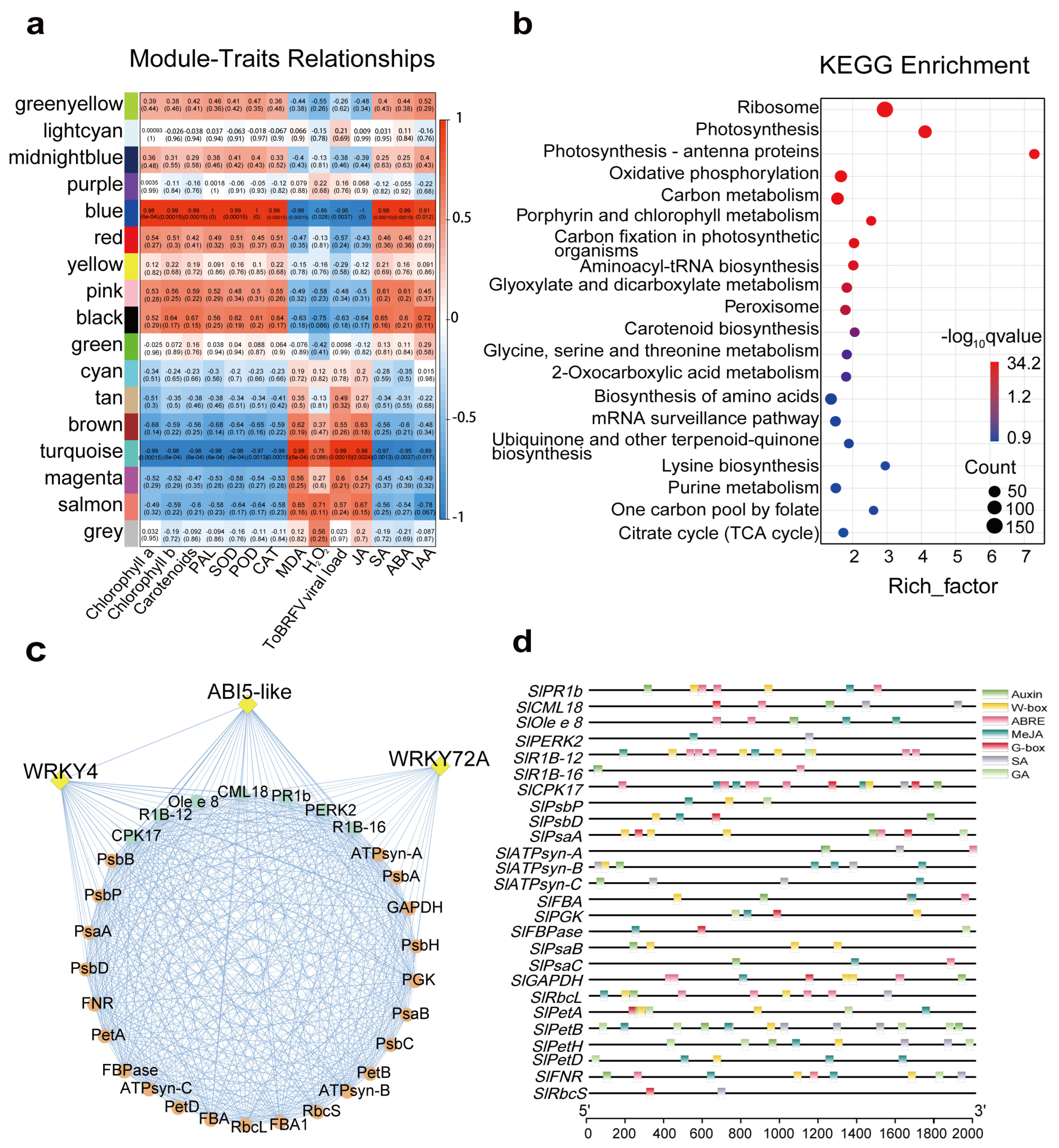
To elucidate the molecular mechanism of Dufulin-induced resistance against ToBRFV in tomato, candidate genes regulating this process were identified. After filtering out genes exhibiting minimal expression changes (the bottom 30%), a WGCNA was constructed using the remaining 18,764 genes. Pairwise correlation analysis of the gene expression data identified 17 distinct co-expression modules (Figure 5a). The blue module exhibited significant positive correlations with photosynthetic pigments, antioxidant enzymes, and SA and ABA contents, while showed significant negative correlations with viral load, MDA, and H2O2. The blue module was indicated to possibly be the key gene set induced by Dufulin in responding to ToBRFV infection. KEGG enrichment analysis of the 2757 genes within the blue module revealed significant associations with several pathways, most notably ribosome, photosynthesis, photosynthetic antenna proteins, oxidative phosphorylation, carbon metabolism, and carotenoid biosynthesis (Figure 5b and Table S3).
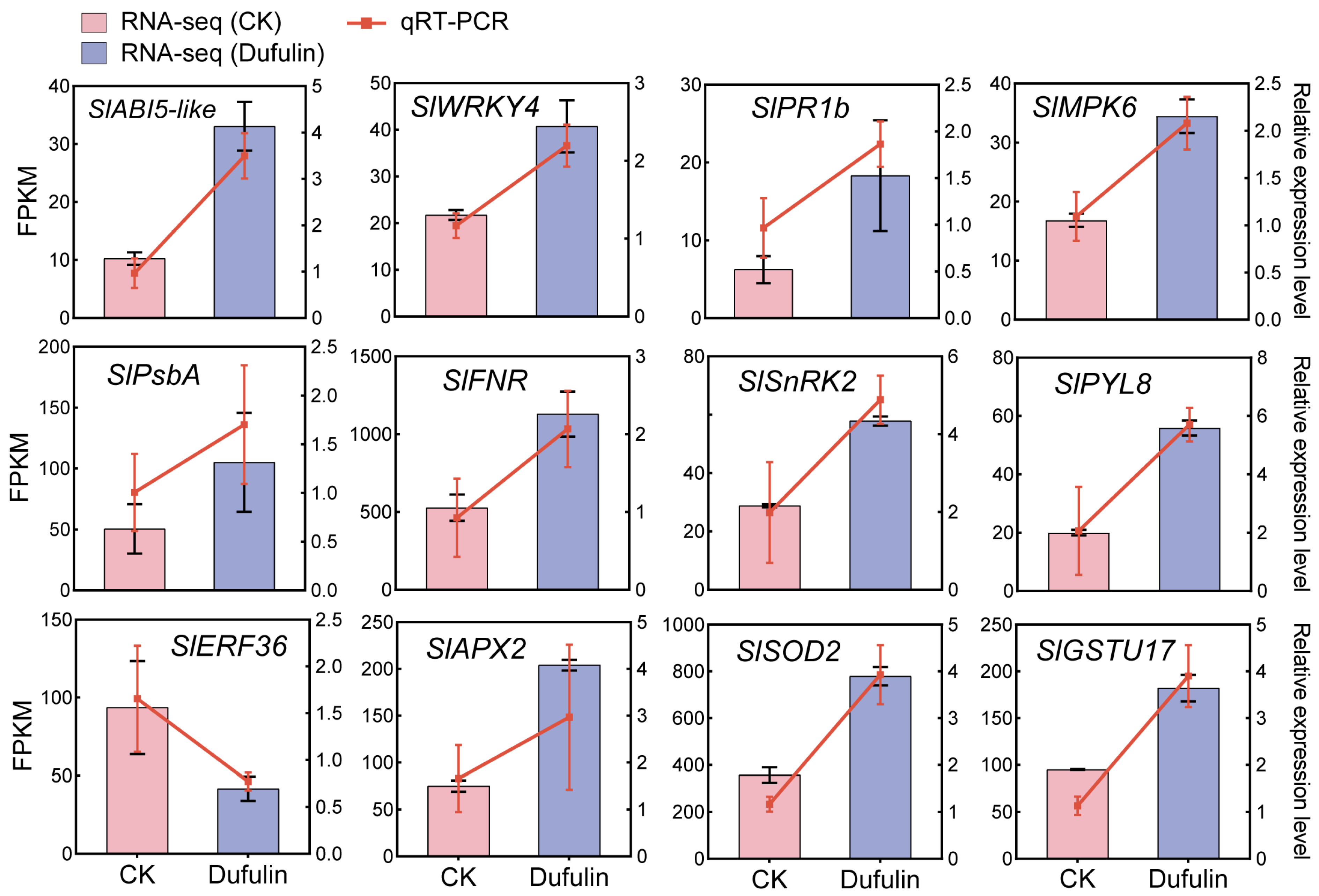
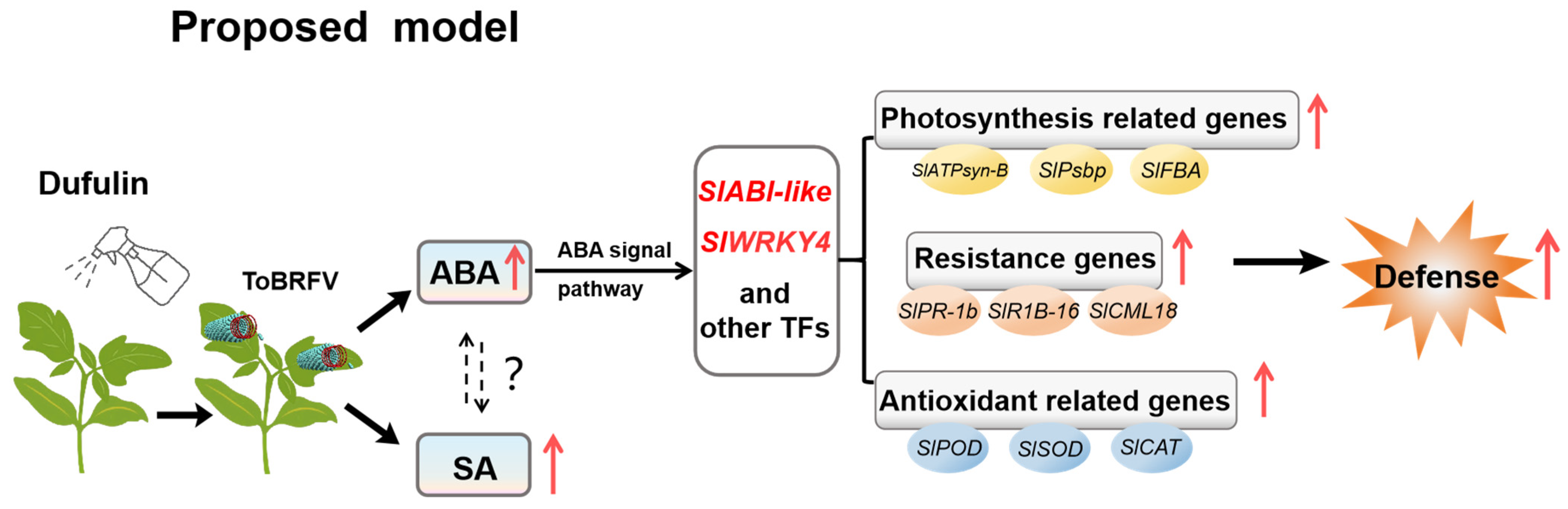
A total of 19 transcription factors that potentially regulating tomato resistance to ToBRFV were identified in the blue module (Table S4). Notably, this included Abscisic Acid-Insensitive 5-like (SlABI5-like, Solyc10g081350.1), a pivotal bZIP-type transcription factor belonging to the ABA signaling pathway, which was markedly upregulated by 3-fold. Furthermore, we identified two WRKY transcription factor family members, SlWRKY4 (Solyc03g104810.2) and SlWRKY72A (Solyc05g007110.2), which are widely involved in plant anti-virus response, were upregulated by approximately 2-fold. However, the absolute expression levels of SlABI5-like and SlWRKY4 were higher than those of SlWRKY72A. Moreover, co-expression network analysis showed that SlABI5-like and SlWRKY4 have a certain connectivity (Figure 5c), indicating that these two TFs might co-activate multiple resistance-related genes such as pathogenesis-related protein 1b (SlPR1b, Solyc10g048020.1), resistance protein R1B-16 (SlR1B-16, Solyc05g013280.2), resistance protein R1B-12 (SlR1B-12, Solyc01g090430.2), and Calcium-binding protein CML18 (SlCML18, Solyc02g063350.1) (Figure 5c). In addition, photosynthesis-related genes, including Psbp-like protein 1 (SlPsbp, Solyc03g114930.2), ATP synthase subunit beta (SlATPsyn-B, Solyc01g007320.2), and Fructose-bisphosphate aldolase 5 (SlFBA, Solyc07g065900.2) might be important targets of these two transcription factors (Figure 5c) (Tables S5 and S6). In order to verify this hypothesis, we further analyzed the promoter structure of the above target genes and found that these target genes either contain ABRE (T/G/C ACGTG T/G) and G-box (CACGTG) cis-elements (Figure 5d), to which bZIP-type transcription factors tend to bind, or have W-box (TTGACC), to which the WRKY transcription factor family preferentially binds [30,31,32]. The above results suggested that SlABI5-like and SlWRKY4 might be the important potential molecular targets induced by Dufulin. Equally, we randomly selected twelve genes from the DEGs for qRT-PCR validation. They were in agreement with the transcriptome data (Figure 6), and the results exhibited consistent expression patterns with the transcriptomic data, demonstrating the reliability of the RNA-seq analysis. The primers used in this test can be found in Table S1. Finally, we hypothesized that a functional pathway of SlABI5-like/SlWRKY4 in regulating tomato against to ToBRFV exists through the direct activation of resistance-associated genes such as SlPR1b, SlR1B-12, SlR1B-16, and SlCML18 (Figure 7). However, further experiments are needed to reveal the precise regulatory networks.

4. Discussion

Plant viruses were one of the most important plant pathogens and often significantly reduce the yield and quality of agricultural products [33]. As described above, Dufulin has been shown to have excellent immune induction against plant viral diseases. In this study, the results indicated that Dufulin treatment could enhance tomato resistance to ToBRFV infection. Additionally, compared with the tomato plants in control under ToBRFV infection condition, tomato systematic leaves of Dufulin treatment contain higher levels of Chlorophyll (Figure 1d–f) and IAA (Figure 3d); moreover, the Dufulin treatment group showed higher plant height, stem diameter, and fruit yield per plant (Figure S3a–c), suggesting that Dufulin treatment might improve tomato growth. In fact, previous study has revealed that spraying Dufulin (500 mM) on rice could increase length of root, stem and leaf, and this treatment could also improve rice salt resistance [29], which indicated that Dufulin could simultaneously promote plant growth and improve stress resistance. Of course, it is better to add a Dufulin-only control group (no ToBRFV infection) to get more accurate confirmation in our next works.
Numerous studies have shown that chloroplasts serve as primary targets for viruses and undergo extensive structural and functional damage during viral infection [34,35,36]. Its primary function might be the biosynthesis of defensive hormones such as SA, JA, and ABA [35,36,37]. Moreover, the enhanced antioxidant capacity mitigates oxidative damage by modulating the chloroplast redox state, which in turn promotes thylakoid membrane stability. This improvement further promotes chlorophyll biosynthesis, representing a key mechanism for enhancing photosynthetic capacity in tomato plants [38]. Notably, in contrast to susceptible plants, partial resistance in plants is associated with upregulated expression of photosynthesis-related genes. For instance, infection of susceptible lemon plants with citrus yellow vein clearing virus (CYVCV) leads to downregulation of nearly all photosynthesis-associated DEGs, resulting in severe suppression of photosynthetic activity [37]. Conversely, in soybean cultivar L29 carrying the resistance gene Rsv3, infection by the avirulent G5H strain induces enhanced expression of photosynthesis-related genes [39]. From our data, KEGG analysis of the upregulated DEGs revealed significant enrichment of genes associated with photosynthesis and carbon fixation. Compared with the control, the expression of photosynthesis-related genes was dramatically upregulated (Figures S5 and S6). This enhanced transcriptional activity was consistent with the observed phenotypes and increased photosynthetic pigment levels (Figure 1). Although we did not directly use photosynthesis instruments to measure the actual photosynthetic efficiency of tomato leaves, based on the above results, we speculated that Dufulin might enhance tomato resistance to ToBRFV by augmenting photosynthetic capacity.
In terms of oxidative stress homeostasis, we found that Dufulin effectively reduced hydrogen peroxide and MDA levels, while the upregulation of antioxidant enzymes (SOD, POD, CAT, and PAL) enhanced the antioxidant defense system (Figure 2 and Figure S7). A similar phenomenon was also found when Dufulin was used to treat Nicotiana tabacum K-326 and N. glutinosa [23]. In addition, other immune inducers were reported that can also activate the ROS response process. For example, foliar application of vanisulfane on pepper plants activates the induction of antioxidant enzymes (SOD, POD, CAT, and PAL), thus eliminating harmful free radicals, enhancing antioxidant capacity, and conferring resistance against PMMoV infection [40]. Coincidentally, foliar application of combined biotic and abiotic elicitors—bacterial polysaccharides (Pseudomonas fluorescens 1442 and Burkholderia gladioli G15) [41], berberine [42] and 1-indanone derivatives containing oxime and oxime ether moieties [43]—significantly enhanced the activities of PAL, SOD, POD and CAT, thereby mitigating the damage caused by plant viruses. Based on the above analysis, we assumed that Dufulin might enhance the expression of these antioxidant-related genes, leading to increased antioxidant enzyme activities, a reduction in oxidative stress damage, and enhanced resistance to ToBRFV. Perhaps, inducing ROS-enhanced effects might be the common process of many immune inducers.
It has been recognized that phytohormones play a pivotal role in plant defense against viral infections. Although an increase in SA content was observed in this study, we did not identify DEGs in SA synthesis and signal transduction pathways in transcriptome data, suggesting that the increase in SA content might not originate from de novo synthesis, which shift our focus to the other phytohormones. Interestingly, we observed that ABA profiling continued to be induced after Dufulin treatment and reached a peak on the seventh day (Figure 3f). This hormonal shift was accompanied by the upregulation of key biosynthetic genes (SlPSY1, SlBCH2, and SlNCED1) and altered expression of core signaling components (SlPYL, SlSnRK2, and SlABI5-like) (Figure 4e). These findings collectively indicate the involvement of the ABA signaling pathway in resistance to ToBRFV. Existing evidence supports the role of ABA in antiviral defense. For instance, Chen et al. demonstrated through proteomic analysis that novel dithioacetal derivatives containing a strobilurin moiety activate the ABA signaling pathway in tobacco, thereby enhancing resistance against PVY, CMV, and TMV [44]. Notably, consistent with the well-established defensive role of pathogenesis-related proteins, the canonical PR1 was strongly induced in a resistant pepper variety against chilli veinal mottle virus (ChiVMV), and CaPR1 overexpression significantly enhanced viral resistance [45]. In parallel, our study demonstrated that Dufulin induced a 2.9-fold upregulation of SlPR1b, which contributed substantially to ToBRFV defense. Beyond SlPR1 genes, we observed a 1.9-fold induction of SlR1B16—a gene known to confer late blight resistance in potato [46]—suggesting its potential role in broad-spectrum defense. Furthermore, the upregulation of specific CML proteins (up to 2.2-fold) was implicated in Dufulin-induced ToBRFV resistance, aligning with prior evidence such as the critical function of NbCML3 in TMV resistance in tobacco [47] and the strong association of GmCML23, GmCML47, and GmCAML4 with soybean mosaic virus (SMV) resistance in soybean [48]. The current findings indicated that the methods and results of our present analysis are stable and reliable.
In order to further analyze the molecular regulatory network of Dufulin-induced ABA resistance to ToBRFV, we identified two potential positive regulators, SlABI5-like and SlWRKY4, through WGCNA (Figure 5), which has well connectivity with SlPR1b and other resistance genes (Figure 5c). These target gene promoters also contain objective binding sites (Figure 5d). Studies have demonstrated that CsABI5-5 overexpression enhances resistance against Huanglongbing (HLB) and citrus canker in citrus [49]. Furthermore, NbABI5 and AtABI5 could confer resistance to beet severe curly top virus (BSCTV) by suppressing viral promoter activity [50]. Therefore, we initially constructed a hypothesized regulatory network and working model for Dufulin to induce ABA and enhance resistance to ToBRFV (Figure 5c and Figure 7). These findings provide new insights into uncovering the mechanism of Dufulin-induced antiviral resistance and provide important molecular targets for ToBRFV prevention and control. However, several issues remain unclear, for instance, whether SlABI5-like and SlWRKY4 could really affect tomato resistance to ToBRFV, as well as the underlying mechanism. More experiments are thus needed to verify the above conclusions.

5. Conclusions

In this study, physiological, biochemical, and transcriptome analysis were used to explore the Dufulin-induced systemic acquired resistance to ToBRFV on tomato. The results showed that Dufulin treatment could significantly reduce ToBRFV accumulation in systemic leaves of tomato seedlings, increase the content of chlorophyll (including chlorophyll a, b and total chlorophyll), and might improve plant growth condition. The activities of SOD, POD and CAT were enhanced, and the expression of their related genes were also induced. Interestingly, although Dufulin treatment could increase both SA and ABA contents, the expression of genes involved in the biosynthesis and signal transduction pathway of SA was not as strongly activated as ABA. Therefore, we hypothesized that ABA might play a more important role in the formation of this systemic acquired resistance. Combined with WGCNA and cis-element analysis, we supposed that SlABI5-like and SlWRKY4 might be the potential positive regulators involved in Dufulin-induced tomato resistance to ToBRFV, and constructed a putative molecular regulatory network.
In conclusion, this research elucidates a novel mechanism whereby Dufulin potentiates antiviral immunity through ABA signaling pathway within this systemic acquired resistance process. This study not only provides new insights into Dufulin-induced antiviral immunity, but also pinpoints SlABI5-like and SlWRKY4 as the promising candidates for future molecular breeding strategies aimed at controlling ToBRFV.

Supplementary Materials

The following supporting information can be downloaded at: https://www.mdpi.com/article/10.3390/horticulturae12010060/s1, Figure S1: Comparison of carotenoids content of tomato leaves from control and Dufulin-sprayed groups after ToBRFV infection; Figure S2: Effect of Dufulin spray treatment on disease development in tomato plants under ToBRFV infection condition; Figure S3: Effect of Dufulin spray treatment on tomato plant growth and yield under ToBRFV infection condition; Figure S4: Gene Ontology (GO) enrichment analysis of all DEGs between control and Dufulin groups under ToBRFV infection condition; Figure S5: Changes in DEGs involved in the photosynthetic pathway in ToBRFV-infected tomato plants under Dufulin treatment. Each color patch represents the log10(FPKM) value; Figure S6: Changes in DEGs involved in the photosynthetic carbon fixation in ToBRFV-infected tomato plants under Dufulin treatment. Each color patch represents the log10(FPKM) value. The upregulated genes are marked as red; Figure S7: Antioxidant enzyme-related genes are substantially activated in Dufulin sprayed tomato plants after 7 days with ToBRFV infection. The gene names and their corresponding gene IDs are as follows: SlSOD1 (Solyc11g066390.1), SlSOD2 (Solyc01g067740.2), SlPOD7 (Solyc06g050440.2), SlPOD19 (Solyc02g077300.1), SlPOD66 (Solyc03g006810.2), and SlCAT3 (Solyc04g082460.2); Figure S8: The expression pattern of genes involved in JA biosynthesis pathway. (a) Expression pattern of SlACX1 (Solyc08g078400.2), (b) Expression pattern of SlJAR1 (Solyc05g050280.2); Table S1. Primer sequences used in this paper; Table S2. Transcriptome data quality assessment; Table S3. Data from WGCNA; Table S4. Transcription factors identified in blue module; Table S5. Target genes potentially regulated by the identified transcription factors; Table S6. Pearson correlation coefficient values used to construct regulatory network.

Author Contributions

Methodology, P.Z.; Software, S.X. and T.L.; Validation, J.-W.G. and Y.X.; Formal analysis, Y.X.; Investigation, P.Z.; Resources, J.-W.G.; Data curation, J.W. and T.L.; Writing—original draft, J.W. and S.W.; Writing—review & editing, Y.L. and S.W.; Visualization, J.W.; Supervision, S.W.; Project administration, Y.L.; Funding acquisition, Y.L. All authors have read and agreed to the published version of the manuscript.

Funding

This work was funded by the National Key R&D Program of China (Project No. 2021YFD1400200), the National Natural Science Foundation of China (Project No. 32260681 and No. 32360738), the Yunnan Fundamental Research Projects (Project No. 202401CF070070) and the Research Foundation Project of Yunnan Agricultural University (Project No. A2032023020).

Data Availability Statement

The original data presented in the study are openly available in NCBI database at https://www.ncbi.nlm.nih.gov/sra/?term=PRJNA1358380 (accessed on 17 December 2025) or accession number PRJNA1358380.

Acknowledgments

We thank Zihao Xia from Shenyang Agricultural University for providing the infectious clone of ToBRFV.

Conflicts of Interest

The authors declare no conflicts of interest.

References

  1. Caruso, A.G.; Bertacca, S.; Parrella, G.; Rizzo, R.; Davino, S.; Panno, S. Tomato brown rugose fruit virus: A pathogen that is changing the tomato production worldwide. Ann. Appl. Biol. 2022, 181, 258–274. [Google Scholar] [CrossRef]
  2. Zisi, Z.; Ghijselings, L.; Vogel, E.; Vos, C.; Matthijnssens, J. Single amino acid change in tomato brown rugose fruit virus breaks virus-specific resistance in new resistant tomato cultivar. Front. Plant Sci. 2024, 15, 1382862. [Google Scholar] [CrossRef] [PubMed]
  3. FAOSTAT. Food and Agriculture Organization of the United Nations Statistical Database. 2025. Available online: http://www.fao.org/faostat/en/#data (accessed on 10 July 2025).
  4. Topcu, Y.; Yildiz, K.; Kayikci, H.C.; Aydin, S.; Feng, Q.; Sapkota, M. Deciphering resistance to tomato brown rugose fruit virus (ToBRFV) using genome-wide association studies. Sci. Hortic. 2025, 341, 113968. [Google Scholar] [CrossRef]
  5. Fougere, G.; Xu, D.; Gaiero, J.; McCreary, C.; Marchand, G.; Despres, C.; Wang, A.; Fall, M.L.; Griffiths, J. Genomic diversity of tomato brown rugose fruit virus in Canadian greenhouse production systems. Viruses 2025, 17, 696. [Google Scholar] [CrossRef]
  6. Salem, N.M.; Abumuslem, M.; Turina, M.; Samarah, N.; Sulaiman, A.; Abu-Irmaileh, B.; Ata, Y. New weed hosts for tomato brown rugose fruit virus in wild mediterranean vegetation. Plants 2022, 11, 2287. [Google Scholar] [CrossRef]
  7. Esmaeilzadeh, F.; Santosa, A.I.; Çelik, A.; Koolivand, D. Revealing an Iranian isolate of tomato brown rugose fruit virus: Complete genome analysis and mechanical transmission. Microorganisms 2023, 11, 2434. [Google Scholar] [CrossRef]
  8. Luria, N.; Smith, E.; Reingold, V.; Bekelman, I.; Lapidot, M.; Levin, I.; Elad, N.; Tam, Y.; Sela, N.; Abu-Ras, A.; et al. A new Israeli Tobamovirus isolate infects tomato plants harboring Tm-22 resistance genes. PLoS ONE 2017, 12, e0170429. [Google Scholar] [CrossRef]
  9. Davino, S.; Caruso, A.G.; Bertacca, S.; Barone, S.; Panno, S. Tomato brown rugose fruit virus: Seed transmission rate and efficacy of different seed disinfection treatments. Plants 2020, 9, 1615. [Google Scholar] [CrossRef]
  10. Panno, S.; Giovanni Caruso, A.; Barone, S.; Lo Bosco, G.; Rangel, E.A.; Davino, S. Spread of tomato brown rugose fruit virus in Sicily and evaluation of the spatiotemporal dispersion in experimental conditions. Agronomy 2020, 10, 834. [Google Scholar] [CrossRef]
  11. Ehlers, J.; Nourinejhad Zarghani, S.; Liedtke, S.; Kroschewski, B.; Büttner, C.; Bandte, M. Analysis of the spatial dispersion of tomato brown rugose fruit virus on surfaces in a commercial tomato production site. Horticulturae 2023, 9, 611. [Google Scholar] [CrossRef]
  12. Mehle, N.; Bačnik, K.; Bajde, I.; Brodarič, J.; Fox, A.; Gutiérrez-Aguirre, I.; Kitek, M.; Kutnjak, D.; Loh, Y.L.; Maksimović Carvalho Ferreira, O.; et al. Tomato brown rugose fruit virus in aqueous environments-survival and significance of water-mediated transmission. Front. Plant Sci. 2023, 14, 1187920. [Google Scholar] [CrossRef] [PubMed]
  13. Oladokun, J.O.; Halabi, M.H.; Barua, P.; Nath, P.D. Tomato brown rugose fruit disease: Current distribution, knowledge and future prospects. Plant Pathol. 2019, 68, 1579–1586. [Google Scholar] [CrossRef]
  14. Pares, R.D.; Gunn, L.V.; Keskula, E.N. The role of infective plant debris, and its concentration in soil, in the ecology of tomato mosaic tobamovirus—A non-vectored plant virus. J. Phytopathol. 1996, 144, 147–150. [Google Scholar] [CrossRef]
  15. Levitzky, N.; Smith, E.; Lachman, O.; Luria, N.; Mizrahi, Y.; Bakelman, H.; Sela, N.; Laskar, O.; Milrot, E.; Dombrovsky, A. The bumblebee Bombus terrestris carries a primary inoculum of tomato brown rugose fruit virus contributing to dsease spread in tomatoes. PLoS ONE 2019, 14, e0210871. [Google Scholar] [CrossRef]
  16. Weiss, D.; Sede, A.R.; Levanova, A.A.; Leibman-Markus, M.; Gupta, R.; Mishra, R.; Hak, H.; Bar, M.; Poranen, M.M.; Heinlein, M.; et al. Control of tomato brown rugose fruit virus (ToBRFV) in tomato plants using in vivo synthesized dsRNA. J. Exp. Bot. 2025, 28, eraf293. [Google Scholar] [CrossRef]
  17. Bai, J.; Yang, X.; Jia, Y.; Wang, X.; Shi, J.; Guo, W. Natural product chelerythrine induces plant resistance through activating defensive reactions. Pest Manag. Sci. 2025, 81, 7896–7906. [Google Scholar] [CrossRef]
  18. Ding, L.; Li, Y.; Wu, Y.; Li, T.; Geng, R.; Cao, J.; Zhang, W.; Tan, X. Plant disease resistance-related signaling pathways: Recent progress and future prospects. Int. J. Mol. Sci. 2022, 23, 16200. [Google Scholar] [CrossRef]
  19. Qiu, D.; Dong, Y.; Zhang, Y.; Li, S.; Shi, F. Plant immunity inducer development and application. Mol. Plant-Microbe Interact. 2017, 30, 355–360. [Google Scholar] [CrossRef]
  20. Zhang, W.; Zhou, X.; Ye, Q.; Cheng, X.; Zhang, S.; Yu, Z.; Wang, W. Nonenantioselective environmental behavior of a chiral antiviral pesticide dufulin in aerobic soils. Sci. Total Environ. 2023, 880, 163312. [Google Scholar] [CrossRef]
  21. Li, X.; Liu, J.; Yang, X.; Ding, Y.; Wu, J.; Hu, D.; Song, B. Studies of binding interactions between Dufulin and southern rice black-streaked dwarf virus P9-1. Bioorg. Med. Chem. 2015, 23, 3629–3637. [Google Scholar] [CrossRef]
  22. Wang, D.; Xie, X.; Gao, D.; Chen, K.; Chen, Z.; Jin, L.; Li, X.; Song, B. Dufulin intervenes the viroplasmic proteins as the mechanism of action against southern rice black-streaked dwarf virus. J. Agric. Food Chem. 2019, 67, 11380–11387. [Google Scholar] [CrossRef] [PubMed]
  23. Chen, Z.; Zeng, M.; Song, B.; Hou, C.; Hu, D.; Li, X.; Wang, Z.; Fan, H.; Bi, L.; Liu, J.; et al. Dufulin activates HrBP1 to produce antiviral responses in tobacco. PLoS ONE 2012, 7, e37944. [Google Scholar] [CrossRef]
  24. Huang, L.; Tang, Y.; Wang, S.; Chen, J.; Du, J.; Yan, S.; Zhang, D.; Shi, X.; Liu, Y.; Li, F. Dufulin impacts plant defense against tomato yellow leaf curl virus infecting tomato. Viruses 2024, 17, 53. [Google Scholar] [CrossRef] [PubMed]
  25. Jaiswal, N.; Chanda, B.; Gilliard, A.; Shi, A.; Ling, K.-S. Evaluation of tomato germplasm against tomato brown rugose fruit virus and identification of resistance in Solanum pimpinellifolium. Plants 2024, 13, 581. [Google Scholar] [CrossRef]
  26. Ni, Z.; Kim, E.-D.; Chen, Z.J. Chlorophyll and starch assays. Protoc. Exch. 2009, 488, 1–3. [Google Scholar] [CrossRef]
  27. Song, J.; Bian, J.; Xue, N.; Xu, Y.; Wu, J. Inter-species mRNA transfer among green peach aphids, dodder parasites, and cucumber host plants. Plant Divers. 2021, 44, 1–10. [Google Scholar] [CrossRef]
  28. Li, C.; Yan, L.; Liu, Q.; Tian, R.; Wang, S.; Umer, M.F.; Jalil, M.J.; Lohani, M.N.; Liu, Y.; Tang, H.; et al. Integration of Transcriptomics, metabolomics, and hormone analysis revealed the formation of lesion spots inhibited by GA and CTK was related to cell death and disease resistance in bread wheat (Triticum aestivum L.). BMC Plant Biol. 2024, 24, 558. [Google Scholar] [CrossRef]
  29. Ma, G.; Zhang, Y.; Li, X. Dufulin enhances salt resistance of rice. Pestic. Biochem. Physiol. 2022, 188, 105252. [Google Scholar] [CrossRef]
  30. Chen, X.; Li, C.; Wang, H.; Guo, Z. WRKY transcription factors: Evolution, binding, and action. Phytopathol. Res. 2019, 1, 13. [Google Scholar] [CrossRef]
  31. Yoshida, T.; Fujita, Y.; Sayama, H.; Kidokoro, S.; Maruyama, K.; Mizoi, J.; Shinozaki, K.; Yamaguchi-Shinozaki, K. AREB1, AREB2, and ABF3 are master transcription factors that cooperatively regulate ABRE-dependent ABA signaling involved in drought stress tolerance and require ABA for full activation. Plant J. 2010, 61, 672–685. [Google Scholar] [CrossRef]
  32. Qian, D.; Zhang, Z.; He, J.; Zhang, P.; Ou, X.; Li, T.; Niu, L.; Nan, Q.; Niu, Y.; He, W.; et al. Arabidopsis ADF5 promotes stomatal closure by regulating actin cytoskeleton remodeling in response to ABA and drought stress. J. Exp. Bot. 2018, 70, 435–446. [Google Scholar] [CrossRef]
  33. Martínez-Gómez, P. Special Issue: Advances in plant virus diseases and virus-induced resistance. Int. J. Mol. Sci. 2025, 26, 7748. [Google Scholar] [CrossRef]
  34. Caruso, A.G.; Panno, S.; Ragona, A.; Peiró, R.; Vetrano, F.; Moncada, A.; Miceli, A.; La Marra, C.M.; Galipienso, L.; Rubio, L.; et al. Screening local Sicilian tomato ecotypes to evaluate the rsponse of tomato brown rugose fruit virus infection. Agronomy 2024, 14, 412. [Google Scholar] [CrossRef]
  35. Bhattacharyya, D.; Chakraborty, S. Chloroplast: The Trojan horse in plant-virus Interaction. Mol. Plant Pathol. 2017, 19, 504–518. [Google Scholar] [CrossRef] [PubMed]
  36. Zhao, J.; Zhang, X.; Hong, Y.; Liu, Y. Chloroplast in plant-virus interaction. Front. Microbiol. 2016, 7, 1565. [Google Scholar] [CrossRef] [PubMed]
  37. Bin, Y.; Zhang, Q.; Su, Y.; Wang, C.; Jiang, Q.; Song, Z.; Zhou, C. Transcriptome analysis of Citrus limon infected with citrus yellow vein clearing virus. BMC Genom. 2023, 24, 65. [Google Scholar] [CrossRef]
  38. Chen, X.; Zhou, Y.; Cong, Y.; Zhu, P.; Xing, J.; Cui, J.; Xu, W.; Shi, Q.; Diao, M.; Liu, H. Ascorbic acid-induced photosynthetic adaptability of processing tomatoes to salt stress probed by fast OJIP fluorescence rise. Front. Plant Sci. 2021, 12, 594400. [Google Scholar] [CrossRef]
  39. Bwalya, J.; Alazem, M.; Kim, K. Photosynthesis-related genes induce resistance against soybean mosaic virus: Evidence for involvement of the RNA silencing pathway. Mol. Plant Pathol. 2021, 23, 543–560. [Google Scholar] [CrossRef]
  40. Shi, J.; He, H.; Hu, D.; Song, B. Defense mechanism of Capsicum annuum L. Infected with pepper mild mottle virus induced by vanisulfane. J. Agric. Food Chem. 2022, 70, 3618–3632. [Google Scholar] [CrossRef]
  41. Zohoursoleimani, R.; Aeini, M.; Parizipour, M.H.G. Effects of abiotic and biotic elicitors on tomato resistance to tomato brown rugose fruit virus. Sci. Rep. 2025, 15, 27216. [Google Scholar] [CrossRef]
  42. Guo, W.; Yan, H.; Ren, X.; Tang, R.; Sun, Y.; Wang, Y.; Feng, J. Berberine induces resistance against tobacco mosaic virus in tobacco. Pest Manag. Sci. 2019, 76, 1804–1813. [Google Scholar] [CrossRef] [PubMed]
  43. Lan, S.; Zhang, W.; Gan, X. Novel 1-Indanone derivatives containing oxime and oxime ether moieties as immune activator to resist plant virus. Pest Manag. Sci. 2023, 79, 2686–2695. [Google Scholar] [CrossRef] [PubMed]
  44. Chen, J.; Shi, J.; Yu, L.; Liu, D.; Gan, X.; Song, B.; Hu, D. Design, synthesis, antiviral bioactivity, and defense mechanisms of novel dithioacetal derivatives bearing a strobilurin moiety. J. Agric. Food Chem. 2018, 66, 5335–5345. [Google Scholar] [CrossRef] [PubMed]
  45. Huang, C.; Zhao, Z.; Wu, X.; Zhao, H.; Wang, M.; He, Z.; Li, Z.; Wang, L.; Tang, Y.; Wang, R.; et al. Functional analysis of the pathogenesis-related protein 1 (CaPR1) gene in the pepper response to chilli veinal mottle virus (ChiVMV) infection. Viruses 2025, 17, 1456. [Google Scholar] [CrossRef]
  46. Tiwari, J.K.; Rawat, S.; Luthra, S.K.; Zinta, R.; Sahu, S.; Varshney, S.; Kumar, V.; Dalamu, D.; Mandadi, N.; Kumar, M.; et al. Genome sequence analysis provides insights on genomic variation and late blight resistance genes in potato somatic hybrid (parents and progeny). Mol. Biol. Rep. 2021, 48, 623–635. [Google Scholar] [CrossRef]
  47. Xiang, S.; Wang, J.; Wang, X.; Ma, X.; Peng, H.; Zhu, X.; Huang, J.; Ran, M.; Ma, L.; Sun, X. A chitosan-coated lentinan-loaded calcium alginate hydrogel induces broad-spectrum resistance to plant viruses by activating Nicotiana benthamiana calmodulin-like (CML) protein 3. Plant Cell Environ. 2023, 46, 3592–3610. [Google Scholar] [CrossRef]
  48. Zhang, C.; Wang, Y.; Zhang, R.; Yuan, R.; Zhao, K.; Liu, X.; Wang, X.; Zhang, F.; Lamlom, S.F.; Zhang, B.; et al. Comprehensively characterize the soybean CAM/CML gene family, as it provides resistance against both the soybean mosaic virus and Cercospora sojina pathogens. Front. Plant Sci. 2025, 16, 1633325. [Google Scholar] [CrossRef]
  49. Guo, X.; Su, J.; Xue, H.; Sun, Y.; Lian, M.; Ma, J.; Lei, T.; He, Y.; Li, Q.; Chen, S.; et al. Genome-wide identification and expression analyses of ABSCISIC ACID-INSENSITIVE 5 (ABI5) genes in Citrus sinensis reveal CsABI5-5 confers dual resistance to Huanglongbing and citrus canker. Int. J. Biol. Macromol. 2025, 306, 141611. [Google Scholar] [CrossRef]
  50. Huang, W.; Zhao, Y.; Liu, X.; Ling, L.; Han, D.; Huang, L.; Gao, C.; Yang, C.; Lai, J. ABA INSENSITIVE 5 confers geminivirus resistance via suppression of the viral promoter activity in plants. J. Plant Physiol. 2022, 275, 153742. [Google Scholar] [CrossRef]
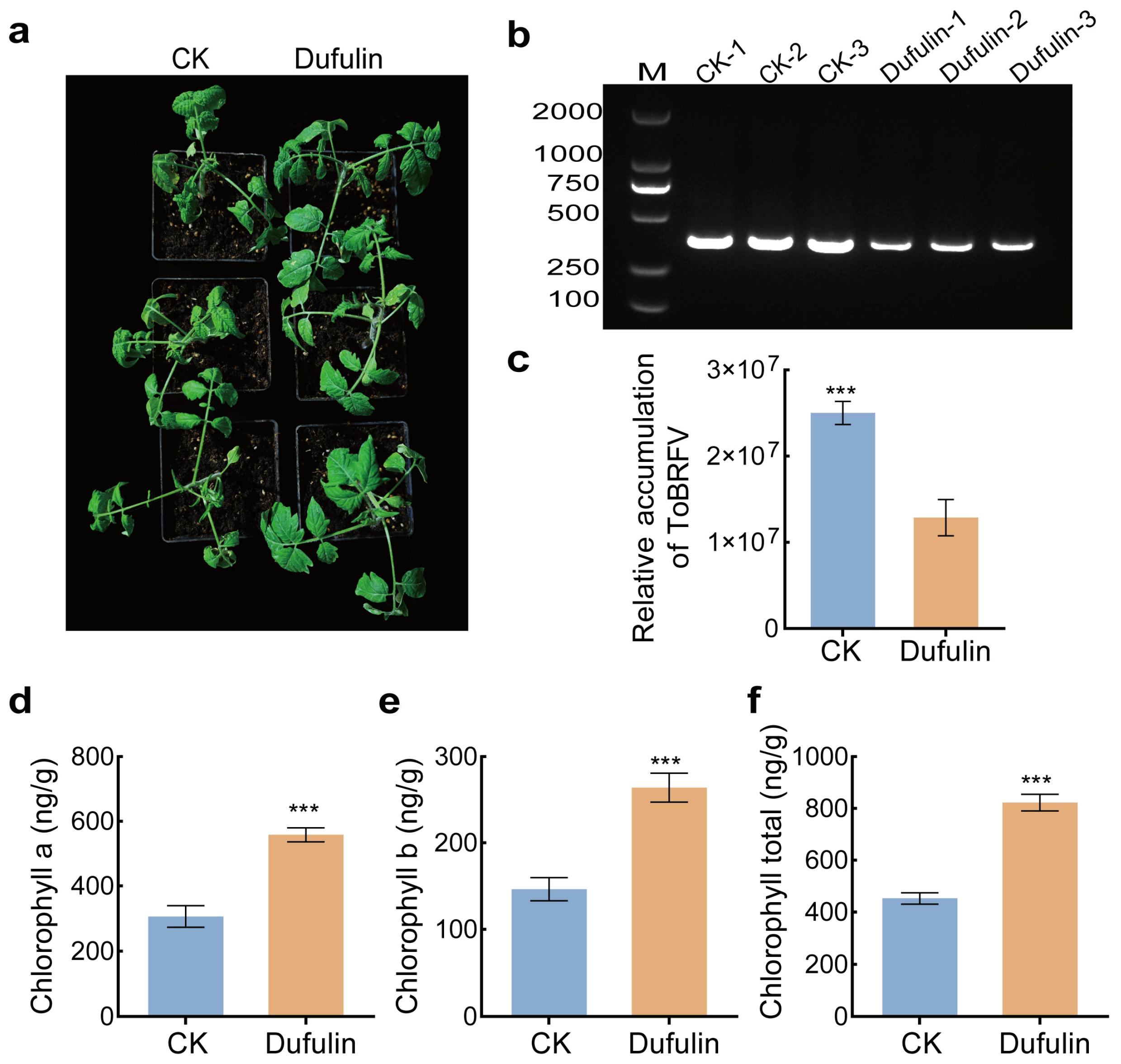
Figure 1. Effects of Dufulin treatment on tomato growth and ToBRFV accumulation. (a) Phenotype of tomato plants at 7 days after inoculation with ToBRFV. (b) RT-PCR detection of ToBRFV in new leaves at 7 days after inoculation with ToBRFV. The primers used are listed in Table S1. (c) qRT-PCR analysis of ToBRFV accumulation in systemic leaves at 7 days after inoculated with ToBRFV. The primers are listed in Table S1. (d) Chlorophyll a content. (e) Chlorophyll b content. (f) Total chlorophyll content. Significant differences compared with the control were determined using Student’s t-test: *** p < 0.001.
Horticulturae 12 00060 g001
Figure 2. Effects of Dufulin on physiological indices of tomato leaves infected with ToBRFV. (a) Superoxide dismutase (SOD), (b) catalase (CAT), (c) peroxidase (POD), (d) phenylalanine ammonia-lyase (PAL), (e) H2O2, and (f) malondialdehyde (MDA) contents. Different lowercase letters above the bars indicate statistically significant differences among treatments as determined by Duncan’s multiple range test at p < 0.05. Values are shown as mean ± SE (n = 3).
Horticulturae 12 00060 g002
Figure 3. Effects of Dufulin on main phytohormone content of tomato leaves infected with ToBRFV. Levels of (a) 12-oxophytodienoic acid (OPDA), (b) jasmonic acid (JA), (c) Jasmonoyl-L-isoleucine (JA-Ile), (d) indole-3-acetic acid (IAA), (e) salicylic acid (SA), and (f) abscisic acid (ABA). Significant differences (p < 0.05) among treatments according to Duncan’s multiple range test are indicated by different letters. Values are shown as mean ± standard error (n = 3).
Horticulturae 12 00060 g003
Figure 4. Transcriptomic analysis of DEGs in tomato leaves. (a) PCA of transcriptomic data. (b) Volcano plot of up and downregulated DEGs. (c) Kyoto Encyclopedia of Genes and Genomes (KEGG) enrichment analysis of upregulated DEGs. (d) KEGG enrichment analysis of downregulated DEGs. (e) DEGs involved in ABA biosynthesis and signaling pathway.
Horticulturae 12 00060 g004
Figure 5. Dufulin-induced key resistance genes against ToBRFV and the regulatory network. (a) Heatmap of the correlation between modules and physiological indexes. (b) KEGG enrichment analysis of blue module genes. (c) Regulatory network of the blue module, constructed using gene pairs with weighted Pearson correlation coefficient values greater than 0.3. (d) Promoter element analysis of the DEGs involved in defense and photosynthesis belonging to the blue module. Color coding of cis-elements: pink for ABA-responsive elements (ABREs), red for G-box, yellow for W-box, light green for gibberellin (GA), green for auxin (AUX), dark green for methyl jasmonate (MeJA), and gray for salicylic acid (SA).
Horticulturae 12 00060 g005
Figure 6. Validation of RNA-seq identified DEGs by qRT-PCR. The histogram displays the transcript abundance changes from RNA-Seq (FPKM, left y-axis), and the broken line shows the relative expression levels from qRT-PCR (right y-axis). The sequences of all qRT-PCR primers are provided in Table S1. Each experiment was performed in triplicate. The gene names and corresponding IDs are as follows: SlPR1b (Solyc10g048020.1), SlABI5-like (Solyc10g081350.1), SlPYL8 (Solyc03g007310.2), SlMPK6 (Solyc05g049970.2), SlERF36 (Solyc10g006130.1), SlPsbA (Solyc12g039030.1), SlGSTU17 (Solyc05g006740.2), SlWRKY4 (Solyc03g104810.2), SlFNR (Solyc02g083810.2), SlSnRK2 (Solyc01g108280.2), SlAPX2 (Solyc06g005150.2), and SlSOD2 (Solyc01g067740.2).
Horticulturae 12 00060 g006
Figure 7. A proposed model of Dufulin-induced tomato resistance to ToBRFV. Before inoculating ToBRFV, tomato seedlings were first treated with Dufulin, and the content of phytohormones such as SA and ABA increased significantly(but it is unclear whether there is a crosstalk between SA and ABA), which could induce the specific expression of transcription factors such as SlABI5-like, further target and activate the high expression of disease resistance and other necessary genes, and then enhance tomato resistance to ToBRFV. The solid black line indicates the workflow, the dotted black line indicates uncertain relationships, and the solid red line indicates increased hormone levels or upregulated gene expression.
Horticulturae 12 00060 g007
Disclaimer/Publisher’s Note: The statements, opinions and data contained in all publications are solely those of the individual author(s) and contributor(s) and not of MDPI and/or the editor(s). MDPI and/or the editor(s) disclaim responsibility for any injury to people or property resulting from any ideas, methods, instructions or products referred to in the content.