
Next Article in Journal
The CsBT1 Gene from Cucumber (Cucumis sativus L.) Negatively Regulates Salt and Drought Tolerance in Transgenic Arabidopsis Plants
Previous Article in Journal
Physiological, Biochemical, and Transcriptome Analyses Reveal the Potential Role of ABA in Dufulin-Induced Tomato Resistance to Tomato Brown Rugose Fruit Virus (ToBRFV)
error_outline You can access the new MDPI.com website here. Explore and share your feedback with us.
 
 
Article

Nutrient Use Efficiency in Yacon Potato Under Varying NPK Fertilization Rates

by
Fábio Luiz de Oliveira
1,*,
Tiago Pacheco Mendes
1,
Felipe Valadares Ribeiro Avelar
1,
Marcelo Antonio Tomaz
1,
José Francisco Teixeira do Amaral
1 and
Arnaldo Henrique de Oliveira Carvalho
2
1
Departamento de Agronomia, Centro de Ciências Agrárias e Engenharias (CCAE), Universidade Federal do Espírito Santo (UFES), Alto Universitário, CP 16-Centro, Alegre 29500-000, ES, Brazil
2
Instituto Federal de Educação, Ciência e Tecnologia do Espírito Santo, Campus de Ibatiba, Av. 7 de Novembro, 40-Centro, Ibatiba 29395-000, ES, Brazil
*
Author to whom correspondence should be addressed.
Horticulturae 2026, 12(1), 61; https://doi.org/10.3390/horticulturae12010061
Submission received: 27 November 2025 / Revised: 22 December 2025 / Accepted: 23 December 2025 / Published: 4 January 2026

Abstract

This study aimed to determine the nutrient use efficiency of the yacon potato under NPK fertilization at different rates. The experiment followed a randomized block design with four replications and a split-plot arrangement. The main plots consisted of three fertilization levels (60%, 100%, and 140% of the reference dose—50:80:60 kg ha−1 of NPK), with subplots to data collection intervals, performed every 30 days, for a total of 7 collections, generating 21 treatments. The dry biomass of whole plants and tuberous roots was determined. Samples were taken to determine the content of N, P, K, Ca, Mg, Cu, Fe, Mn, and Zn. The biological utilization coefficient (BUC) was calculated by dividing the mean values of dry biomass in kilograms of plant parts by the kilogram of nutrient found in that biomass. The application of 100% of the reference dose led to the highest use efficiency of P, K, Ca, and Mg, and intermediate efficiency for N in yacon tuberous roots and total biomass production throughout the cycle, provides a significant contribution to fertilization planning for this crop. The amount applied which was 100% of the reference dose was 17, 80, and 20 kg ha−1 of N, P2O5, and K2O, respectively, at planting, supplemented with 33 and 40 kg ha−1 of N and K2O as topdressing.

1. Introduction

The yacon potato (Smallanthus sonchifolius) is considered a nutraceutical food due to its functional components, such as soluble dietary fibers and prebiotics, which, due to their low digestibility by human gastrointestinal enzymes, selectively promote the growth and metabolic activity of health-promoting intestinal bacteria [1]. With the identification of these numerous benefits for the general population, expectations have arisen regarding its cultivation as a new product to be explored and applied in social, agricultural, technological, and scientific fields [2].
The success of yacon potato cultivation is tied to the development of technologies. Among them is the generation of knowledge on the plant’s behavior in response to fertilizer application. Nutrient uptake varies with species, cultivar, climatic conditions, management practices, and soil nutrient availability [3]. For optimal crop development, it is essential to improve nutrient availability to meet the plant’s nutritional requirements.
The scarcity of information on fertilization recommendations and the efficiency of fertilizer use by the yacon potato justifies the need for studies addressing this crop. In the Andean region, the recommended application is 140:120:100 kg ha−1 of NPK, with nitrogen applied in split doses: 50% at planting and the remaining 50% 40 days after transplanting, along with hilling [4]. However, these results differ from those found in Brazil. In a region with much lower altitude than the Andes (approximately 800 m), Vilhena et al. [5] observed that low nitrogen doses (20 kg ha−1) increased yacon root weight (32%), especially when the dose was split into three applications. Amaya and Câmara [6] found that 160 kg ha−1 of N and 100 kg ha−1 of K promoted higher tuberous root production. Kruger [7] reported better plant development with mineral fertilization of 50:80:60 kg ha−1 of NPK, with N and K applied in split doses. These findings demonstrate that yacon nutrient response is site-specific, varying with local edaphoclimatic conditions.
In addition to understanding fertilization recommendations, it is also important to know nutrient use efficiency, which will contribute to optimizing fertilization management, enabling increased production and reduced costs through more rational and efficient use of fertilizers and soil [8].
Nutrient use efficiency has been defined as the ratio between the amount of biomass produced and the total amount of nutrient present in that biomass [9]. This ratio can be assessed using the biological utilization coefficient (BUC), an index that can assist in the selection of genetic materials suited to different edaphic and climatic conditions, and in the recommendation of fertilizers [10].
The BUC has an important conceptual advantage: it simultaneously integrates absorption, translocation, internal allocation, and physiological conversion of nutrients into marketable biomass. This distinguishes it from more widely used metrics, such as agronomic efficiency (AE) or recovery efficiency (RE), which capture only part of the process. While RE focuses on the plant’s ability to extract the applied nutrient and AE assesses the productive response to nutrient addition, the BUC elucidates what occurs within the plant, allowing for the evaluation of the crop’s physiological competence in utilizing the absorbed nutrient [11].
The literature shows that yacon is responsive to fertilization, but limited data exist on nutrient use efficiency, an important piece of information to be generated in order to improve fertilization management. This would enable more efficient fertilizer use, reducing input costs while enhancing crop productivity.
Therefore, the objective of this study was to determine the nutrient use efficiency of yacon potato through NPK fertilization at different rates.

2. Materials and Methods

The experiment was conducted at Garganta’s farm, in the district of Celina, located in the municipality of Alegre, state of Espírito Santo, Brazil, at a latitude of 20°47′1″ south and longitude of 41°36′56″ west, with an altitude of 680 m. The local climate classification, according to Köppen, is humid tropical with an average annual temperature of 24 °C. An Irriplus® E5000 (Irriplus Equipamentos Científicos Ltda, Viçosa, Minas Gerais, Brazil) weather station was installed at the experiment site, and during the experiment, the following meteorological data were recorded: 406.93 mm of cumulative precipitation and an average air temperature of 20.10 °C.
The soil was classified as Red-Yellow Latosol, medium texture [12]. Soil samples (0–20 cm depth) were collected and analyzed, presenting the following characteristics: pH (H2O) 4.56; Mehlich 1 phosphorus (P): 27.42 mg dm−3; potassium (K): 103 mg dm−3; aluminum (Al): 0.70 cmolc dm−3; calcium (Ca): 1.25 cmolc dm−3; magnesium (Mg): 0.27 cmolc dm−3; base saturation (SB): 1.82 cmolc dm−3; V% 20.56; cation exchange capacity (CTC7,0): 2.52. The soil was prepared by plowing to a depth of 40 cm, followed by harrowing. Liming with dolomitic limestone was performed to increase the base saturation index to 70%, and a 60-day equilibration period before planting was observed.
Seedlings were propagated from rhizophore fragments (approximately 20 g) collected from mature plants [13]. Plastic bags with dimensions of 10 × 18 × 21 cm were used, filled with a substrate composed of soil and cattle manure. The manure analysis revealed concentrations of 5.53 g kg−1 of P; 4.44 g kg−1of K; 7.1 g kg−1 of N; 20.15 mg kg−1 of Cu; 22,835.6 mg kg−1 of Fe; 395.6 mg kg−1 of Mn; 56.02 mg kg−1 of Zn; 13.81 g kg−1 of Ca; and 2.91 g kg−1 of Mg. The bags were kept under shade netting (50% light restriction), and seedlings were irrigated twice daily with 13 L of water evenly distributed with a watering can.
Seedlings were transplanted at 40 days of age at spacing 1.0 × 0.5 m into ridges approximately 30 cm high [14]. Throughout the growing season, weed control and drip irrigation were implemented, with irrigation intervals fixed at two days.
The experimental design was a randomized block design with four replications in a split-plot arrangement. Main plots consisted of three fertilization levels (60%, 100%, and 140% of the reference NPK dose), with subplots corresponding to seven data collection times at 30-day intervals.
The fertilizer doses (60%, 100%, and 140%) were adjusted based on the fertilization rate recommended by Kruger [7], who observed greater tuberous root production and better yacon development with a mineral fertilization rate of 50:80:60 kg ha−1 of NPK, with N and K applied in split doses. The mineral fertilization rates evaluated in the experiment were: (a) 60% of the reference dose: 10, 48, and 12 kg ha−1 of N, P2O5, and K2O, respectively, at planting, with a topdressing application of 20 and 24 kg ha−1 of N and K2O, respectively; (b) 100%: 17, 80, and 20 kg ha−1 of N, P2O5, and K2O, respectively, at planting, with a topdressing application of 33 and 40 kg ha−1 of N and K2O, respectively; (c) 140%: 23, 112, and 28 kg ha−1 of N, P2O5, and K2O, respectively, at planting, with a topdressing application of 47 and 56 kg ha−1 of N and K2O, respectively.
Topdressing applications were made at 60 days after transplanting (DAT). Urea (45% N), single superphosphate (18% P2O5, 16% Ca, and 8% S), and potassium chloride (60% K2O) were used as nutrient sources for nitrogen, phosphorus, and potassium, respectively.
Evaluations were carried out between 30 and 210 DAT. Monthly, four plants from each fertilization dose were removed for analysis. It is important to note that each useful plant was surrounded by four plants serving as a border. The green biomass of whole plants and tuberous roots was dried in a forced-air oven at 70 ± 5 °C until reaching a constant mass, after which the dry biomass was obtained by weighing. Senescent leaves were excluded from the analysis.
Samples of the dry biomass from whole plants and tuberous roots were collected for determining the contents of P, K, Ca, Mg, Cu, Fe, Mn, and Zn after nitric-perchloric digestion. Nitrogen was determined after sulfuric digestion. The biological utilization coefficient (BUC) was calculated by dividing the kilograms (kg) of dry biomass of the plant parts by the kilogram (kg) of nutrient found in that biomass [15].
Cochran’s test was used to evaluate homogeneity of variance, and the Shapiro–Wilk test confirmed normality of the data. The data were analyzed by regression, with significant equations fitted at a 5% probability level using the F-test and the highest coefficients of determination (R2). Yield data were subjected to analysis of variance using the F-test, and the means were compared using Tukey’s test (p ≤ 0.05). Analyses were performed using the R software version 4.3.0 [16].

3. Results

3.1. Biomass Total Production

3.1.1. Biological Utilization Coefficients of Macronutrients

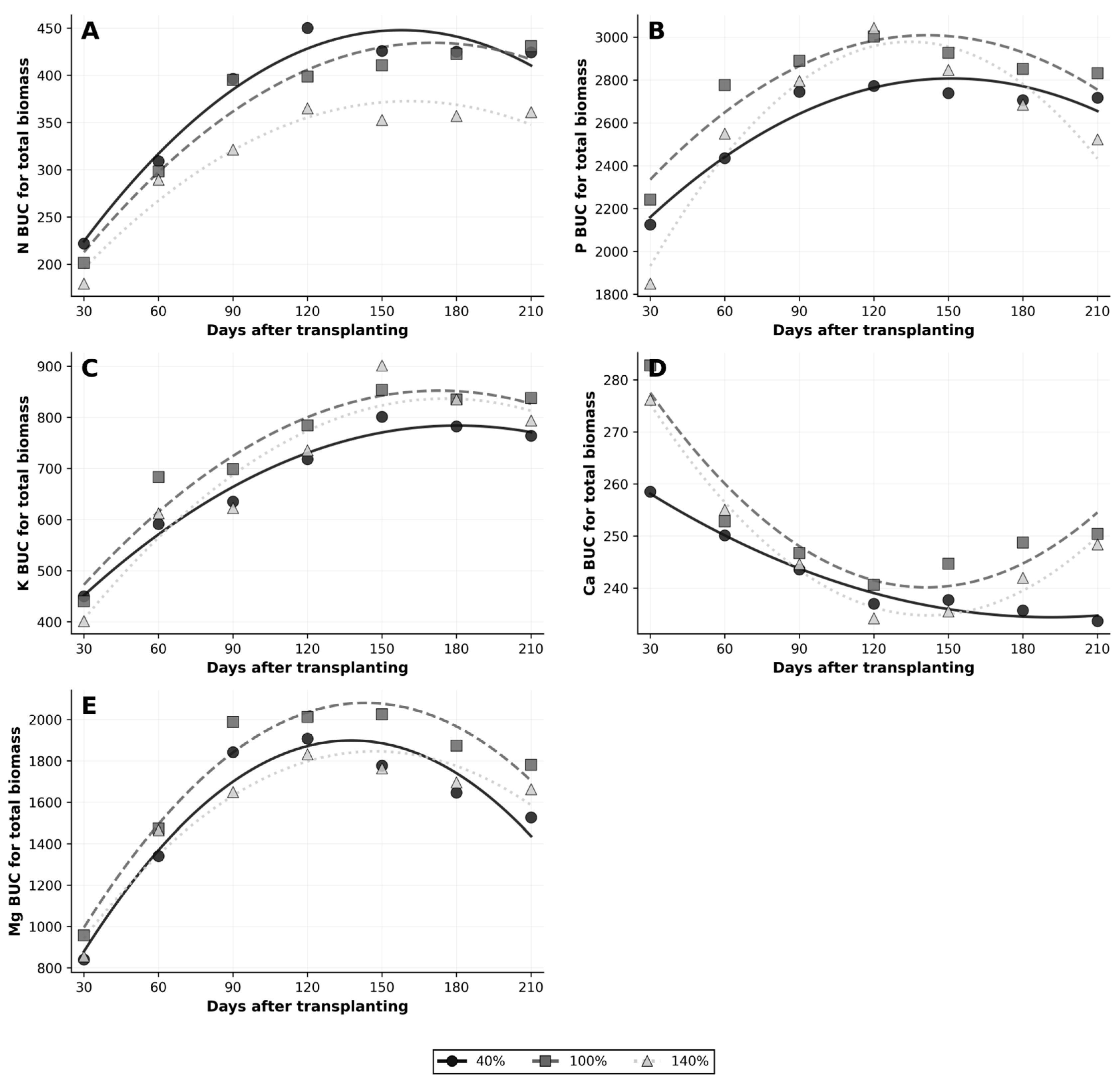
The NPK fertilization rates significantly influenced the biological utilization coefficients (BUC) of all macronutrients for total biomass production in yacon plants. The BUC values for nitrogen (N) best fit the quadratic model, showing an increase in the initial phase of the cycle, with the maximum efficiency peak occurring around 150 days after transplanting (DAT) (Figure 1A). This result points to the optimal stage of development for nitrogen top-dressing fertilization.
The highest nitrogen utilization efficiency throughout the yacon cycle was observed with the application of 60% of the reference dose, though it was very close to the efficiency observed with the application of 100% (Figure 1A). This demonstrates that yacon plants produced more total biomass for each unit (kg) of N applied with these fertilization doses.
The phosphorus (P) BUC values also best fit the quadratic model, showing an increase in the early cycle phase and reaching the peak of maximum efficiency around 120 DA (Figure 1B). This result is particularly interesting when discussing the best strategy for P supply to yacon plants. Given the low mobility of P in the soil and its limited agricultural utilization due to various processes, it becomes evident that P supply should be performed prior to the phase of maximum efficiency. However, since the efficiency peak occurs around the middle of the cycle (120 DAT), a slow-release P fertilization strategy during the initial growth phase may be ideal, matching nutrient availability with the period of highest nutrient use efficiency.
The highest phosphorus utilization efficiency throughout the yacon cycle was achieved with the application of 100% of the reference dose (Figure 1B). This result shows that yacon plants produced the largest volume of total biomass for each unit (kg) of P applied, with 100% being the most efficient dose.
For potassium (K), the BUC values also fit the quadratic model, with an increase in the early cycle phase and a later peak of maximum efficiency occurring around 170 DAT (Figure 1C). This result indicates the optimal stage for potassium top-dressing fertilization, suggesting the possibility of split applications, with later doses throughout the yacon cycle.
For magnesium (Mg), the BUC values again fit the quadratic model, with an increase in the early cycle phase and a peak around 150 DAT (Figure 1E). This result highlights the importance of Mg efficiency in the early growth stages and emphasizes the role of liming as a pre-planting Mg supply strategy. The peak in Mg BUC mid-cycle suggests the need for further studies on Mg supplementation prior to this stage, considering the nutrient’s dynamics within the plant and its role in plant metabolism.
The highest magnesium utilization efficiency occurred with the application of 100% of the reference dose (Figure 1E), demonstrating that yacon plants produced the largest total biomass volume per unit (kg) of Mg applied with this fertilization dose.
For calcium (Ca), the behavior was the opposite of other macronutrients, with efficiency decreasing in the early phase and tending to increase in the later phase (Figure 1D). This result indicates a greater demand for Ca at the beginning of the cycle, highlighting the importance of liming as a pre-planting strategy for nutrient supply.
The highest Ca utilization efficiency was observed with the application of 100% of the reference dose, especially in the early phase (up to 60 days) and the late phase (after 180 days) (Figure 1D). Thus, the results show that yacon plants produced more total biomass per unit (kg) of Ca applied with this fertilization dose.
Figure 1. Biological Utilization Coefficient (BUC) of nitrogen (A), phosphorus (B), potassium (C), calcium (D) and magnesium (E) for total biomass production in yacon plants during the cycle, as a function of NPK fertilizer doses. The equations of the adjusted models are presented in Table 1.
Horticulturae 12 00061 g001
Table 1. Equations models adjusted for Biological Utilization Coefficient (BUC) of nitrogen, phosphorus, potassium, calcium and magnesium for total biomass production in yacon plants during the cycle, as a function of NPK fertilizer doses.
NutrientFertilization DoseEquationR2
Macronutrients
N1 60* y = −0.013703x2 + 4.3226x + 106.860.96
1 100* y = −0.011235x2 + 3.8301x + 107.950.95
1 140* y = −0.010329x2 + 3.3250x + 104.980.94
P1 60* y = −0.044047x2 + 13.3219x + 1799.830.92
1 100* y = −0.054178x2 + 15.3321x + 1924.190.88
1 140* y = −0.095763x2 + 25.7694x + 1244.900.93
K1 60* y = −0.0147x2 + 5.3018x + 305.830.97
1 100* y = −0.018587x2 + 6.4280x + 296.480.94
1 140* y = −0.020338x2 + 7.1455x + 209.050.91
Ca1 60* y = 0.00091168x2 + −0.3488x + 267.780.97
1 100* y = 0.0030295x2 + −0.8548x + 300.450.88
1 140* y = 0.0032498x2 + −0.9212x + 300.050.98
Mg1 60* y = −0.088077x2 + 24.2381x + 231.300.93
1 100* y = −0.084619x2 + 24.2483x + 343.590.95
1 140* y = −0.065738x2 + 19.3454x + 422.710.93
Note: For all models, “x” represents “Days after transplanting” (30–210 days) and “y” represents nutrient use efficiency (BUC). 1 Fitted to the quadratic model (ŷ = β2X2 + β1X1 + β0); (*) Significant at the 5% level by the F-test.

3.1.2. Biological Utilization Coefficients of Micronutrients

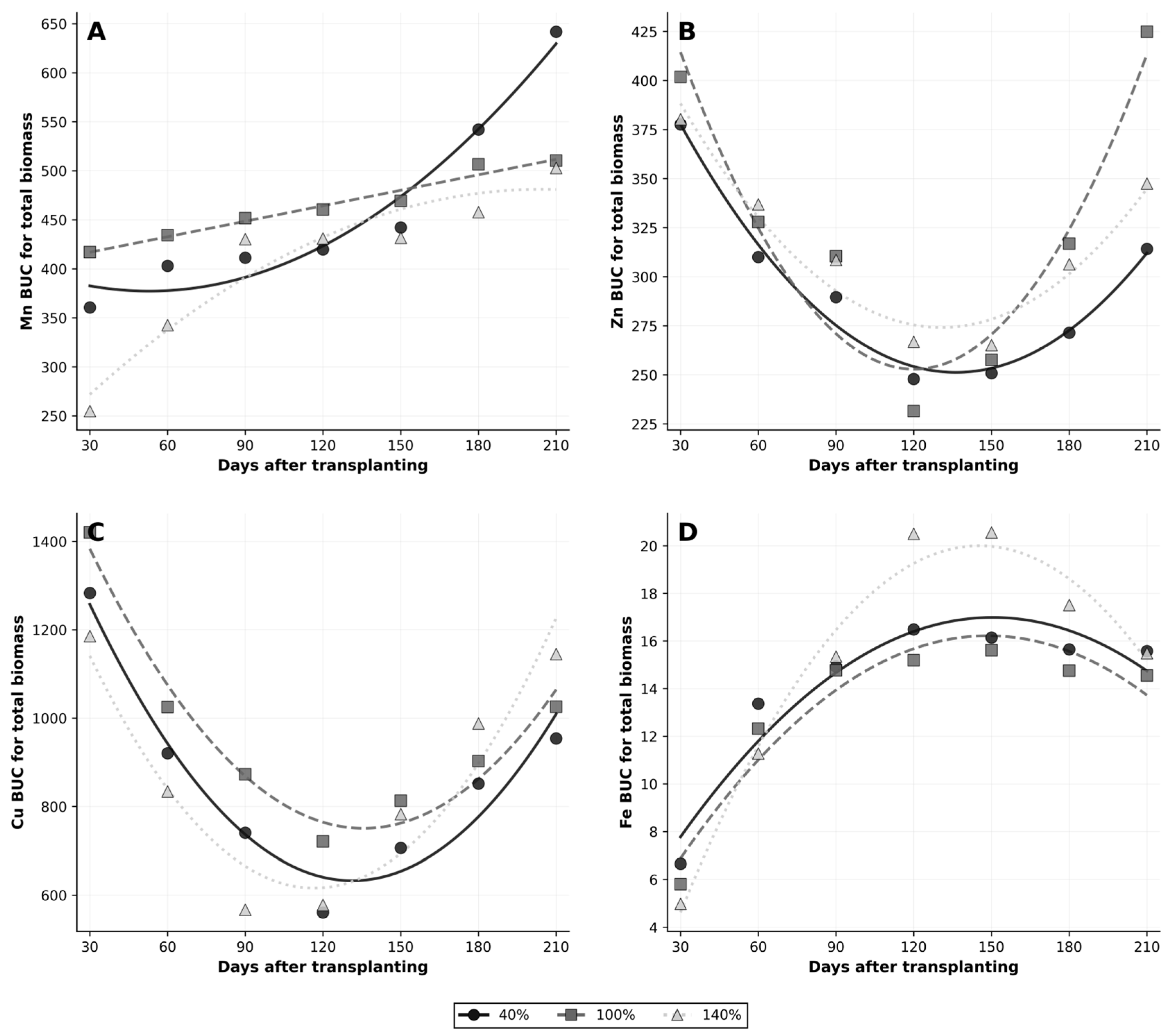
Regarding micronutrients, it was observed that the BUC values mostly fit the quadratic model, depending on the NPK doses, with the exception of manganese (Mn). For Mn, the response varied significantly according to the applied dose: with 60% of the reference dose, there was a period of stability in the initial phase, followed by an increase in BUC values from mid-cycle to the end. With 100% of the reference dose, there was a linear increase throughout the cycle. In contrast, with 140% of the dose, there was an increase in the early cycle phase, followed by stabilization towards the end. The highest Mn utilization efficiency occurred with the application of 100% of the reference dose until 150 days of the cycle, after which the 60% dose showed greater efficiency (Figure 2A). This indicates that yacon plants respond differently throughout the cycle depending on the fertilization applied.
Figure 2. Biological Utilization Coefficient (BUC) of manganese (A), zinc (B), copper (C) and iron (D) for total biomass production in yacon plants during the cycle, as a function of NPK fertilizer doses. The equations of the adjusted models are presented in Table 2.
Horticulturae 12 00061 g002
Table 2. Equations models adjusted for Biological Utilization Coefficient (BUC) of manganese, zinc, copper and ironfor total biomass production in yacon plants during the cycle, as a function of NPK fertilizer doses.
NutrientFertilization DoseEquationR2
Micronutrients
Mn1 60* y = 0.010224x2 + −1.0817x + 405.880.95
2 100* y = 0.5264x + 401.120.96
1 140* y = −0.0068749x2 + 2.8116x + 193.670.91
Zn1 60* y = 0.011192x2 + −3.0505x + 459.150.97
1 100* y = 0.019877x2 + −4.7769x + 539.910.91
1 140* y = 0.011248x2 + −2.9409x + 466.410.94
Cu1 60* y = 0.060844x2 + −15.9831x + 1682.340.94
1 100* y = 0.056726x2 + −15.3866x + 1793.890.96
1 140* y = 0.069986x2 + −16.3194x + 1567.220.90
Fe1 60* y = −0.00063469x2 + 0.1911x + 2.610.92
1 100* y = −0.00066363x2 + 0.1973x + 1.550.92
1 140* y = −0.0011567x2 + 0.3362x + −4.430.97
Note: For all models, “x” represents “Days after transplanting” (30–210 days) and “y” represents nutrient use efficiency (BUC). 1 Fitted to the quadratic model (ŷ = β2X2 + β1X1 + β0); 2 Fitted to the linear model (ŷ = β0 + β1X1); (*) Significant at the 5% level by the F-test.
For zinc (Zn) and copper (Cu), there was a decrease in BUC values during the early cycle and an increase in the later phase. For Zn, the difference in utilization efficiency became more evident at the end of the cycle, when the application of 100% of the reference dose resulted in higher BUC values than the other doses (Figure 2B), showing that yacon plants produced more total biomass per unit (kg) of Zn applied at this stage of the cycle.
For Cu, the highest utilization efficiency occurred with the application of 100% of the reference dose until around 150 days of the cycle, but after 180 days, the application of 140% promoted higher BUC values (Figure 2C).
With iron (Fe), there was an increase in BUC values during the early cycle phase and a decrease towards the end. The highest Fe utilization efficiency occurred with the application of 140% of the reference dose from 60 days onwards, with a tendency to equalize with the other doses from 180 days onwards (Figure 2D).

3.2. For Biomass Tuberous Roots Production

Since the tuberous roots are the primary organ of commercial interest in yacon, the biological utilization coefficients for macro and micronutrient production in this organ were analyzed over the cycle.

3.2.1. Biological Utilization Coefficients of Macronutrients

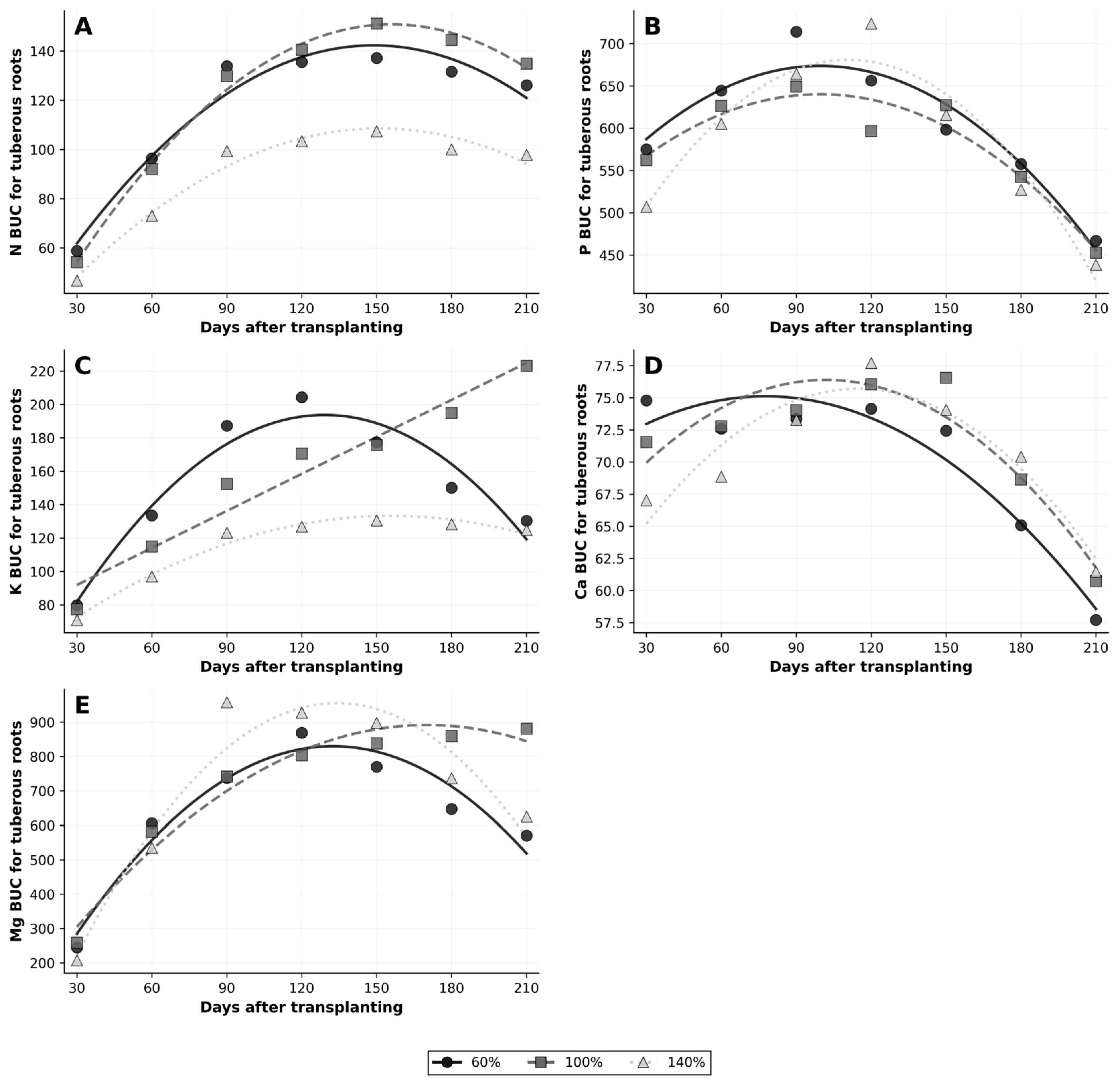
Regarding macronutrients, the BUC values best fit the quadratic model, with similar patterns, showing an increase in values during the early cycle and a decrease towards the end, except for potassium. With the application of 100% of the reference dose, K BUC values increased linearly throughout the cycle (Figure 3).
Given that tuberous roots are the harvested organ, particular attention was given to the results at the end of the cycle (210 DAT). It was observed that with the application of 100% of the reference dose, the highest efficiencies for all macronutrients evaluated (N, P, K, Ca, and Mg) were obtained. It is worth noting that for P and Ca, the efficiency with the application of 140% of the reference dose did not differ from that of the 100% dose (Figure 3). These results suggest that yacon plants produced more tuberous root biomass at the end of the cycle for each unit (kg) of these nutrients applied, with the application of 100.
Figure 3. Biological Utilization Coefficient (BUC) of nitrogen (A), phosphorus (B), potassium (C), calcium (D) and magnesium (E) for tuberous root biomass production in yacon during the cycle, as a function of the NPK fertilizer doses applied. The equations of the adjusted models are presented in Table 3.
Horticulturae 12 00061 g003
Table 3. Equations models adjusted for Biological Utilization Coefficient (BUC) of nitrogen, phosphorus, potassium, calcium and magnesium for tuberous root biomass production in yacon plants during the cycle, as a function of NPK fertilizer doses.
NutrientFertilization DoseEquationR2
Macronutrients
N1 60* y = −0.0056993x2 + 1.6962x + 16.080.95
1 100* y = −0.006078x2 + 1.8969x + 2.800.99
1 140* y = −0.0041161x2 + 1.2443x + 14.480.97
P1 60* y = −0.017888x2 + 3.5622x + 496.360.92
1 100* y = −0.015083x2 + 3.0027x + 490.750.91
1 140* y = −0.026541x2 + 5.8816x + 355.090.93
K1 60* y = −0.01138x2 + 2.9391x + 3.940.92
2 100* y = 0.7387x + 69.770.95
1 140* y = −0.0038317x2 + 1.1951x + 40.100.97
Ca1 60* y = −0.00094552x2 + 0.1469x + 69.410.92
1 100* y = −0.0012494x2 + 0.2544x + 63.440.88
1 140* y = −0.0014602x2 + 0.3353x + 56.460.89
Mg1 60* y = −0.051857x2 + 13.7450x + −81.020.93
1 100* y = −0.029846x2 + 10.1603x + 26.860.96
1 140* y = −0.067658x2 + 18.1382x + −260.280.92
Note: For all models, “x” represents “Days after transplanting” (30–210 days) and “y” represents nutrient use efficiency (BUC). 1 Fitted to the quadratic model (ŷ = β2X2 + β1X1 + β0); 2 Fitted to the linear model (ŷ = β1X1 + β0); (*) Significant at the 5% level by the F-test.
Thus, for the production of tuberous root biomass in yacon at the end of the cycle, it can be considered that the application of 100% of the reference dose provides the highest utilization efficiency for macronutrients N, P, K, Ca, and Mg.
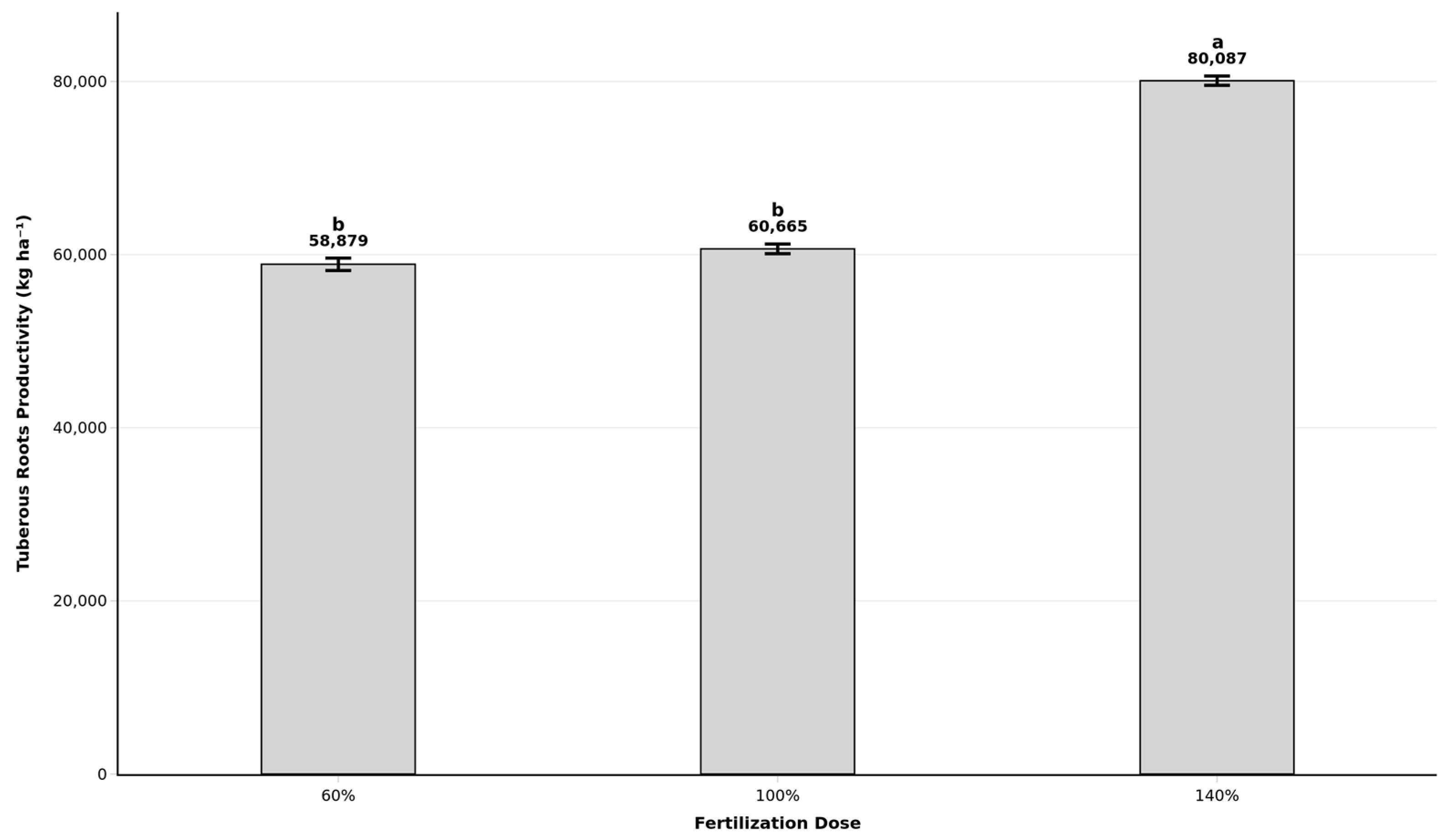
The highest yield of fresh tuberous roots was obtained with the application of 140% of the reference dose (80,087 kg ha−1), compared to the application of 100% (60,665 kg ha−1) and 60% (58,879 kg ha−1) (Figure 4). This means that applying 100% of the reference dose results in maximum productive efficiency per unit of nutrient applied, absorbed, or utilized by the plant for tuberous root production, though not necessarily the largest volume produced.
Figure 4. Total tuberous root yield of yacon from NPK fertilization. The dashes above the bars indicate the standard error of the sample. Different letters represent statistically significant differences by the Tukey test (p < 0.05).
Horticulturae 12 00061 g004

3.2.2. Biological Utilization Coefficients of Micronutrients

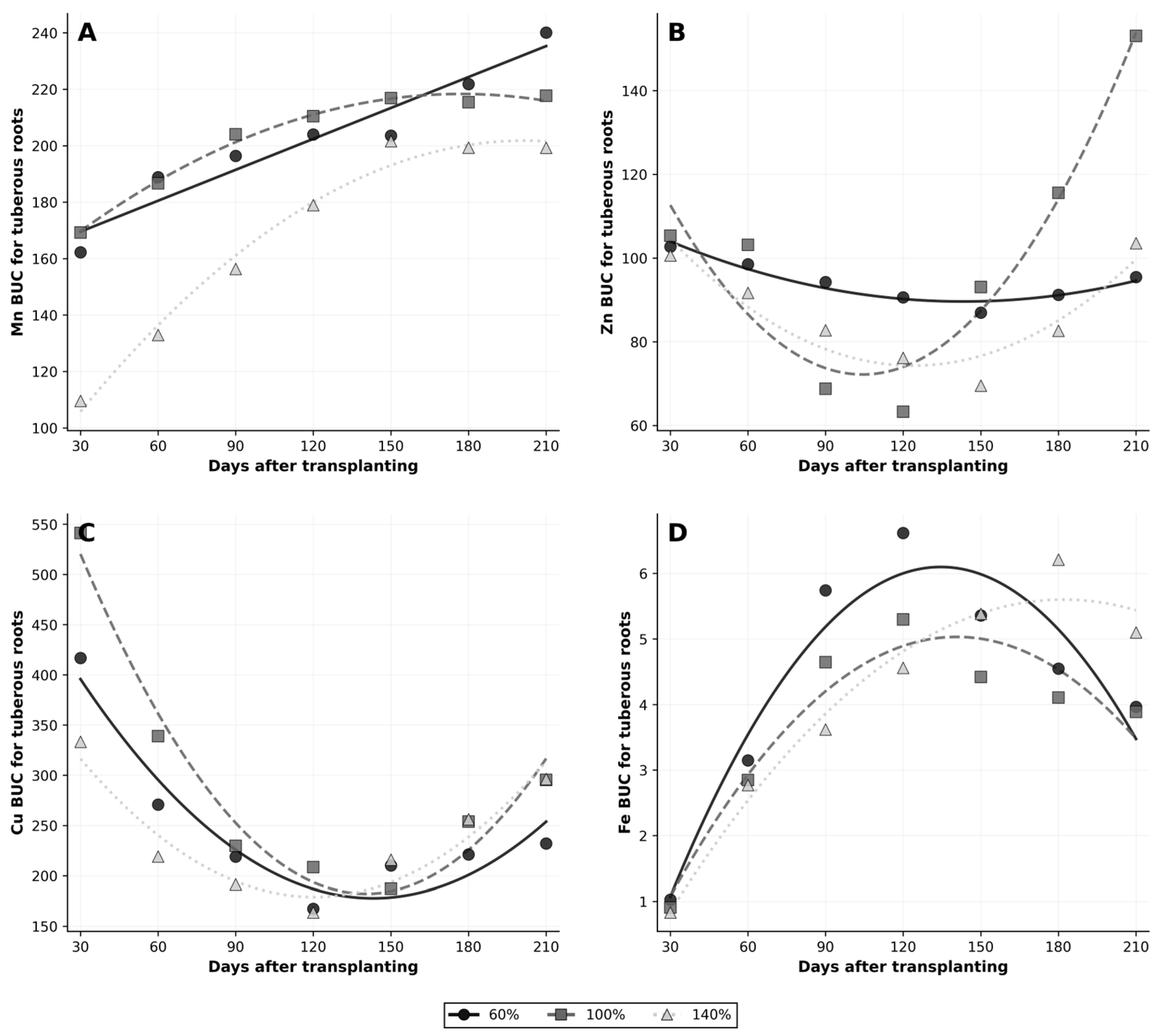
In general, the BUC values for all micronutrients, in relation to NPK doses, best fit the quadratic model, with the exception of manganese (Mn). For Mn, with the application of 60% of the dose, the values increased linearly, while with 100% and 140% doses, there was an increase in the early cycle followed by stabilization towards the end. For zinc (Zn) and copper (Cu), there was a decrease in BUC values during the early cycle and an increase in the later phase. For iron (Fe), the opposite occurred (Figure 5).
Thus, as with total biomass production, variations in micronutrient utilization efficiency for biomass production in tuberous roots were observed throughout the cycle. For example, the highest Zn efficiency was observed with the application of 100% of the reference dose, while the highest Mn efficiency was observed with the 60% dose. For Cu, it was observed with both 100% and 140% doses, while for Fe, it was with the 140% dose (Figure 5).
Figure 5. Biological Utilization Coefficient (BUC) of manganese (A), zinc (B), copper (C) and iron (D) for tuberous root biomass production in yacon during the cycle, as a function of the NPK fertilizer doses applied. The equations of the adjusted models are presented in Table 4.
Horticulturae 12 00061 g005
Table 4. Equations models adjusted for Biological Utilization Coefficient (BUC) of manganese, zinc, copper and iron for tuberous root biomass production in yacon plants during the cycle, as a function of NPK fertilizer doses.
NutrientFertilization DoseEquationR2
Micronutrients
Mn2 60* y = 0.3653x + 158.580.9243
1 100* y = −0.002248x2 + 0.7963x + 147.820.99
1 140* y = −0.003249x2 + 1.3120x + 69.330.9837
Zn1 60* y = 0.0011188x2 + −0.3207x + 112.590.9209
1 100* y = 0.0073203x2 + −1.5278x + 151.900.9083
1 140* y = 0.0034308x2 + −0.8503x + 126.980.8708
Cu1 60* y = 0.017029x2 + −4.8757x + 526.710.913
1 100* y = 0.02776x2 + −7.7941x + 729.190.9664
1 140* y = 0.016812x2 + −4.0497x + 422.820.902
Fe1 60* y = −0.0004604x2 + 0.1239x + −2.230.9115
1 100* y = −0.00032301x2 + 0.0909x + −1.360.9147
1 140* y = −0.00020614x2 + 0.0750x + −1.220.9669
Note: For all models, “x” represents “Days after transplanting” (30–210 days) and “y” represents nutrient use efficiency (BUC). 1 Fitted to the quadratic model (ŷ = β2X2 + β1X1 + β0); 2 Fitted to the linear model (ŷ = β1X1 + β0); (*) Significant at the 5% level by the F-test.

4. Discussion

The results demonstrate that yacon plants exhibit variation in micronutrient utilization efficiency for total biomass production and biomass production in tuberous roots throughout the cycle, depending on the fertilization applied. For example, for Zn, the highest efficiency was observed with the application of 100% of the reference dose. For Mn, it was with a dose of 60%. For Cu, it was with doses of 100% and 140%. And Fe with a dose of 140%.
This behavior results from the complex process of micronutrient absorption, translocation, and allocation, which is influenced by various factors, including interactions between macronutrients and micronutrients, leading to highly variable responses. Fageria et al. [17] observed this variation in micronutrient use efficiency in cover legumes (Crotalaria spp., Mucuna spp., and Cajanus cajan). Overall, the use efficiency of Cu and Mn decreased with increasing P levels, stabilizing from the intermediate dose onward. In contrast, Fe use efficiency increased with higher P rates, while P application did not significantly alter Zn use efficiency.
Regarding macronutrients, a similar pattern is observed, with higher use efficiency in the early stage of the cycle, with the only exception being Ca, in relation to total biomass production. Several physiological and anatomical factors may explain this behavior of Ca. First, the architecture of the young plant itself and the particularities of the initial development stage, during which the plant prioritizes the allocation of Ca for the stabilization of newly formed cell walls, requiring larger amounts of Ca and rapidly immobilizing the nutrient, while biomass accumulation is still slow [18]. This alters the values of the biological utilization coefficient (BUC), since this index is calculated from the values of kilograms (kg) of dry biomass of plant parts per kilogram (kg) of nutrient found in that biomass.
As the plant progresses toward the adult stage, and therefore accumulates more biomass as a consequence of the accumulation of other cellular contents (such as cytoplasm and organelles), the Ca BUC values increase. This is a phase in which the absorbed Ca acts at its functional level, mainly as a second messenger in signaling pathways related to the perception of biotic and abiotic stresses, hormonal perception, pollen germination, stomatal regulation, and cytoskeleton organization [19]. Therefore, its uptake rate decreases [20], which increases its physiological efficiency.
It is widely recognized that the greatest investments in crop fertilization are directed toward macronutrients, generating significant interest in understanding their use efficiency, as this can be determinant for the agronomic and economic efficiency of a crop. Therefore, the result demonstrating that the application of 100% of the reference dose (17, 80, and 20 kg ha−1 of N, P2O5, and K2O, respectively, at planting, plus topdressing with 33 and 40 kg ha−1 of N and K2O, respectively) yielded the highest utilization efficiency of P, K, Ca, and Mg, and intermediate efficiency in N utilization for the production of yacon tuberous root biomass, as well as for total biomass throughout the cycle. This result contributes substantially to fertilization planning in yacon crops, as nutrient use efficiency has become increasingly critical for crop success, particularly as agricultural systems intensify and face mounting economic and environmental constraints [21].
The result indicates that increasing the reference dose by 40% may not justify the additional investment, given the corresponding decline in nutrient use efficiency. This demonstrates that fertilization management should not focus solely on yield maximization, but must equally prioritize agronomic and economic efficiency. A similar trend was observed in potato cultivation, where the maximum tuber yield was obtained with 191 kg N ha−1, while the highest nitrogen use efficiency, associated with lower environmental losses, was achieved with an application of 182 kg N ha−1 [22].
The observed yield increase coupled with efficiency loss at the 140% dose represents a classic “luxury consumption” response, which is defined as the plant’s capacity to absorb nutrients beyond the levels required for maximum performance. Although extensively studied over recent decades, luxury consumption remains a critical consideration in modern nutrient management strategies [23].
Luxury consumption has been interpreted as an “inefficient” physiological behavior, given that the additional biomass produced from excessive nutrient uptake is minimal or nonexistent [11]. From an agronomic perspective, contemporary discussion focuses on the challenge of distinguishing between “beneficial” and “unnecessary” luxury consumption. Consequently, many researchers have emphasized the importance of focusing on achieving productivity gains with maximum efficiency [24,25].
Understanding nutrient use efficiency in agricultural systems also gains relevance in an environmental context due to the impact of nutrient losses on ecosystems. Excessively applied nutrients contribute to eutrophication, soil acidification, and N2O emissions, the latter having a high global warming potential [26]. In a context of natural resource scarcity and continuously rising production costs, the more efficient crops are in utilizing resources such as nutrients, the more sustainable the production system becomes.

5. Conclusions

The 100% reference fertilization dose (17, 80, and 20 kg ha−1 of N, P2O5, and K2O, respectively, at planting, plus 33 and 40 kg ha−1 of N and K2O topdressing) achieved optimal nutrient use efficiency for P, K, Ca, and Mg, with intermediate N efficiency. This fertilization rate maximized both tuberous root and total plant biomass production and provides practical guidance for yacon fertilization management.

Author Contributions

F.L.d.O., J.F.T.d.A. and M.A.T. (Supervisors)—conception of the study, experimental design, and manuscript review. T.P.M. (Graduate student)—execution of the study, data collection, and manuscript writing. F.V.R.A. (Graduate student)—assistance with data analysis and interpretation, preparation of graphs and tables, and manuscript review. A.H.d.O.C. (Researcher)—assistance with data analysis and interpretation, preparation of graphs and tables, and manuscript review. All authors have read and agreed to the published version of the manuscript.

Funding

This work was supported by the CNPq (Conselho Nacional de Desenvolvimento Científico e Tecnológico), process 305026/2021-6, and FAPES (Fundação de Amparo à Pesquisa do Espírito Santo), process 2020-94GW0. Additionally, we acknowledge CNPq, FAPES, and CAPES (Coordenação de Aperfeiçoamento de Pessoal de Nível Superior) for the scholarships granted to the authors for undergraduate research, graduate studies, and research productivity.

Data Availability Statement

The original contributions presented in this study are included in the article. Further inquiries can be directed to the corresponding author.

Conflicts of Interest

The authors declare no conflicts of interest.

References

  1. Grancieri, M.; Viana, M.L.; de Oliveira, D.F.; Vaz Tostes, M.d.G.; Costa Ignacchiti, M.D.; Costa, A.G.V.; Brunoro Costa, N.M. Yacón (Smallanthus sonchifolius) Flour Reduces Inflammation and Had No Effects on Oxidative Stress and Endotoxemia in Wistar Rats with Induced Colorectal Carcinogenesis. Nutrients 2023, 15, 3281. [Google Scholar] [CrossRef] [PubMed]
  2. Yan, M.R.; Welch, R.; Rush, E.C.; Xiang, X.; Wang, X. A sustainable wholesome foodstuff: Health effects and potential dietotherapy applications of yacon. Nutrients 2019, 11, 2632. [Google Scholar] [CrossRef] [PubMed]
  3. Teixeira, G.C.M.; Gonzalez-Porras, C.V.; Messias Ferreira, P.; Prado, R.D.M.; Silva Oliveira, K.; Carvalho, L.T.d.S.; Palaretti, L.F. Increased absorption and use of nutrients induced by Si is an indicator for tolerance to water deficit in a common bean cultivar cultivated in the field with and without application of K. Front. Plant Sci. 2024, 15, 1421615. [Google Scholar] [CrossRef]
  4. Montiel, V.N. El Cultivo de Yacon; Boletín Técnico n. 35; Instituto Nacional de Investigación Agraria: Lima, Peru, 1996; 19p. [Google Scholar]
  5. Vilhena, S.M.C.; Câmara, F.L.A.; Kakihara, S.T. O cultivo de yacon no Brasil. Hortic. Bras. 2000, 18, 5–8. [Google Scholar] [CrossRef]
  6. Amaya, J.E.; Câmara, F. Efectos de dosis crecientes de nitrógeno y potasio en la calidad y productividad de yacon (Polymnia sonchifolia Poep. & Endl). In Simposio Latinoamericano de Raices y Tuberculos, II; Universidad Nacional Agraria La Molina, Anais; Centro Internacional de la Papa (CIP): Lima, Peru, 2001. [Google Scholar]
  7. Kruger, F.G.Q. Adubação Mineral, Orgânica e Biodinâmica de Yacon (Polymnia sonchifolia POEP & ENDL): Rendimento, Qualidade e Armazenamento. Tese Doutorado, Universidade Estadual Paulista “Júlio de Mesquita Filho”, Botucatu, SP, Brazil, 2003. [Google Scholar]
  8. Govindasamy, P.; Muthusamy, S.K.; Bagavathiannan, M.; Mowrer, J.; Jagannadham, P.T.K.; Maity, A.; Halli, H.M.; GK, S.; Vadivel, R.; TK, D.; et al. Nitrogen use efficiency—A key to enhance crop productivity under a changing climate. Front. Plant Sci. 2023, 14, 1121073. [Google Scholar] [CrossRef] [PubMed]
  9. Chen, G.; Gui, J.; Qing, C.-X.; Huang, D.-L.; Liao, F.; Yang, L. Evaluating the impact of biochar on biomass and nitrogen use efficiency of sugarcane using 15N tracer method. Front. Agron. 2022, 4, 989993. [Google Scholar] [CrossRef]
  10. Simoes, P.H.O.; de Paula, M.T.; de Araujo, D.G.; de Souza, L.C.; Lima, C.C.; Palheta, L.F.; de Oliveira Neto, C.F.; de Carvalho, O.P. Biological use coefficient of biomass of Tachigali vulgaris under phosphorus and potassium fertilization: Management technologies for sustainable production of bioenergy in tropical countries. Aust. J. Crop Sci. 2022, 16, 637–648. [Google Scholar] [CrossRef]
  11. Marschner, P. (Ed.) Marschner’s Mineral Nutrition of Higher Plants, 3rd ed.; Academic Press: London, UK, 2012. [Google Scholar]
  12. Dos Santos, H.G.; Jacomine, P.K.T.; Dos Anjos, L.H.C.; De Oliveira, V.A.; Lumbreras, J.F.; Coelho, M.R.; De Almeida, J.A.; De Araujo Filho, J.C.; Lima, H.N.; Marques, F.A.; et al. Sistema Brasileiro de Classificação de Solos, 6th ed; EMBRAPA Solos: Rio de Janeiro, Brasil, 2025; 393p. [Google Scholar]
  13. Pedrosa, J.L.F.; Oliveira, F.L.; Zucoluto, M.; Teixeira, A.G.; Parajara, M.C.; Tomaz, M.A. Yacon (Smallanthus sonchifolius), propagation from rhizophores with diferente numbers of buds. Rev. Fac. Cienc. Agrar. Univ. Nac. Cuyo 2020, 53, 52–63. Available online: https://revistas.uncu.edu.ar/ojs3/index.php/RFCA/article/view/4131 (accessed on 1 November 2025).
  14. Quaresma, M.A.O.; Oliveira, F.L.; Rocha, L.F.; Teixeira, A.G.; Silva, D.M.N.; Dalvi, L.P.; Tomaz, M.A. Planting recommendations for yacon (Smallanthus sonchifolius) in lowland conditions. Aust. J. Crop Sci. 2021, 15, 564. [Google Scholar] [CrossRef]
  15. Baligar, V.C.; Fageria, N.K.; He, Z.L. Nutrient use efficiency in plants. Commun. Soil Sci. Plant Anal. 2001, 32, 921–950. [Google Scholar] [CrossRef]
  16. R Core Team. R: A Language and Environment for Statistical Computing; R Foundation for Statistical Computing: Vienna, Austria, 2022. Available online: https://www.R-project.org (accessed on 20 February 2025).
  17. Fageria, N.K.; Ferreira, E.P.D.B.; Knupp, A.M. Micronutrients use efficiency in tropical cover crops as influenced by phosphorus fertilization. Rev. Caatinga 2015, 28, 130–137. Available online: https://periodicos.ufersa.edu.br/index.php/caatinga/article/view/3390 (accessed on 11 April 2025).
  18. Wang, C.; Tang, R.-J.; Kou, S.; Xu, X.; Lu, Y.; Rauscher, K.; Voelker, A.; Luan, S. Mechanisms of calcium homeostasis orchestrate plant growth and immunity. Nature 2024, 627, 382–388. [Google Scholar] [CrossRef] [PubMed]
  19. Wdowiak, A.; Podgórska, A.; Szal, B. Calcium in plants: An important element of cell physiology and structure, signaling, and stress responses. Acta Physiol. Plant 2024, 46, 108. [Google Scholar] [CrossRef]
  20. Mendes, T.P.; Avelar, F.V.R.; da Silva, J.A.; Tomaz, M.A.; Dalvi, L.P.; do Amaral, J.F.T.; de Oliveira, F.L. Distribution dynamics of nutrient and biomass in yacon organs. Sci. Agropecu. 2026, 17, 103–110. [Google Scholar] [CrossRef]
  21. Tilman, D.; Cassman, K.; Matson, P.; Naylor, R.; Polasky, S. Agricultural sustainability and intensive production practices. Nature 2002, 418, 671–677. [Google Scholar] [CrossRef] [PubMed]
  22. Jiang, L.; Qiu, S.; Ding, W.; Xu, X.; He, P. Synergizing potato productivity and environmental performance with Nutrient Expert recommendation approach in northern China. J. Clean. Prod. 2023, 382, 135258. [Google Scholar] [CrossRef]
  23. Van Wijk, M.T.; Williams, M.; Gough, L.; Hobbie, S.E.; Shaver, G.R. Luxury consumption of soil nutrients: A possible competitive strategy in above ground and below ground biomass allocation and root morphology for slow growing arctic vegetation? J. Ecol. 2003, 91, 664–676. [Google Scholar] [CrossRef]
  24. Amaral, J.F.T.; Martinez, H.E.P.; Laviola, B.G.; Fernandes Filho, E.I.; Cruz, C.D. Eficiência de utilização de nutrientes por cultivares de cafeeiro. Ciência Rural 2011, 41, 621–629. [Google Scholar] [CrossRef]
  25. Reddy, M.B.; Sravani, P.; Kumar, S.; Rajawat, M.V.S.; Jaiswal, D.K.; Dhar, S.; Azman, E.A.; Garg, K.; Kumar, S. Nitrogen use efficiency reimagined: Advancements in agronomic, ecophysiological, and molecular strategies. J. Plant Nutr. 2025, 48, 1577–1603. [Google Scholar] [CrossRef]
  26. You, L.; Ros, G.H.; Chen, Y.; Shao, Q.; Young, M.D.; Zhang, F.; de Vries, W. Global mean nitrogen recovery efficiency in croplands can be enhanced by optimal nutrient, crop and soil management practices. Nat. Commun. 2023, 14, 5747. [Google Scholar] [CrossRef] [PubMed]
Disclaimer/Publisher’s Note: The statements, opinions and data contained in all publications are solely those of the individual author(s) and contributor(s) and not of MDPI and/or the editor(s). MDPI and/or the editor(s) disclaim responsibility for any injury to people or property resulting from any ideas, methods, instructions or products referred to in the content.