Characterization of Colletotrichum siamense Causing Leaf Anthracnose on Cornus officinalis and Its In Vitro Sensitivity to Fungicides in China
Abstract
1. Introduction
2. Materials and Methods
2.1. Sample Collection
2.2. Isolation and Microscopy
2.3. Genomic DNA Extraction, PCR Amplifications and Sequencing
2.4. Phylogenetic Analyses
2.5. Pathogenicity Tests
2.6. In Vitro Sensitivity of C. siamense to Fungicides
3. Results
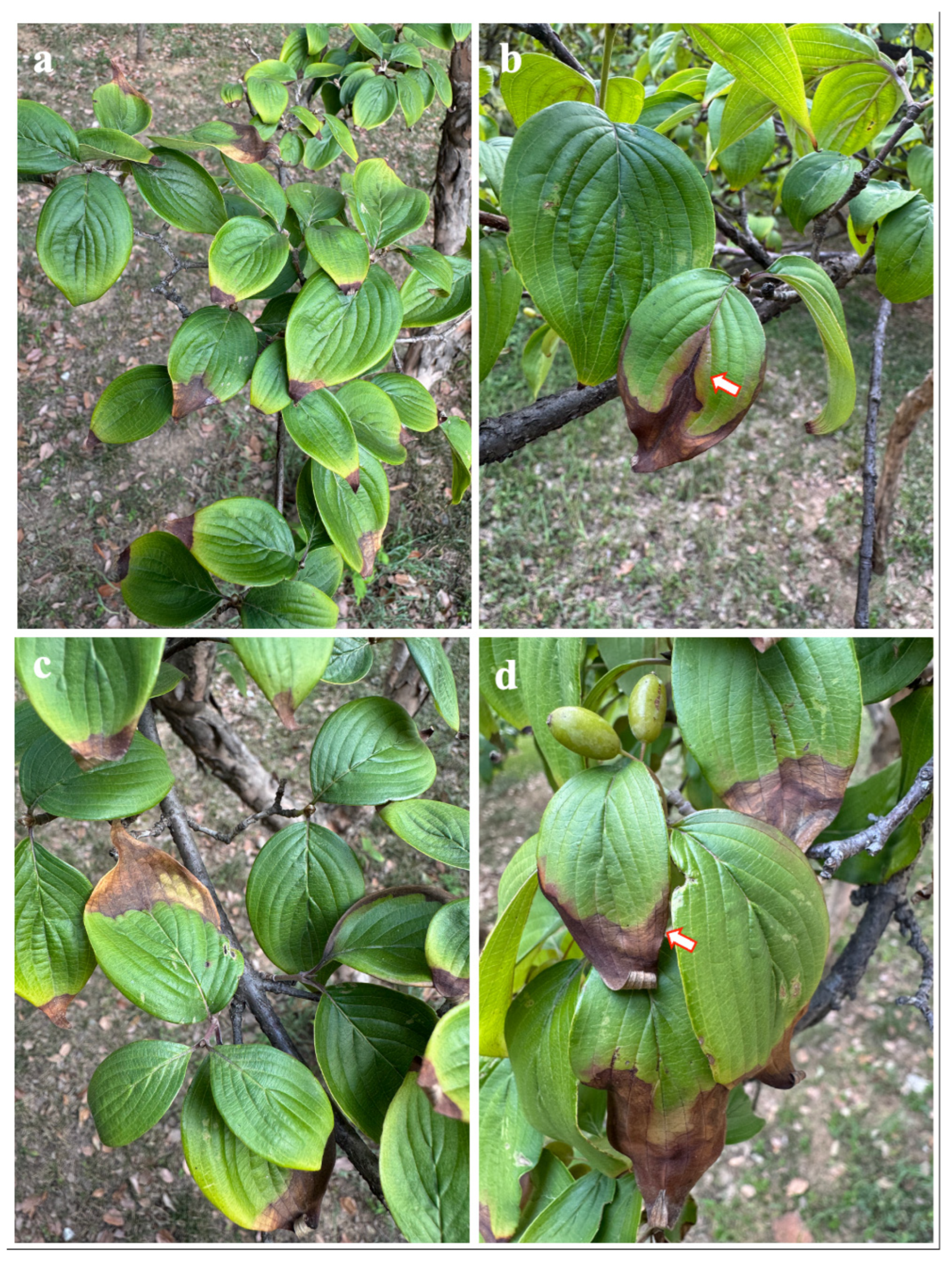
3.1. Disease Survey and Symptom Description
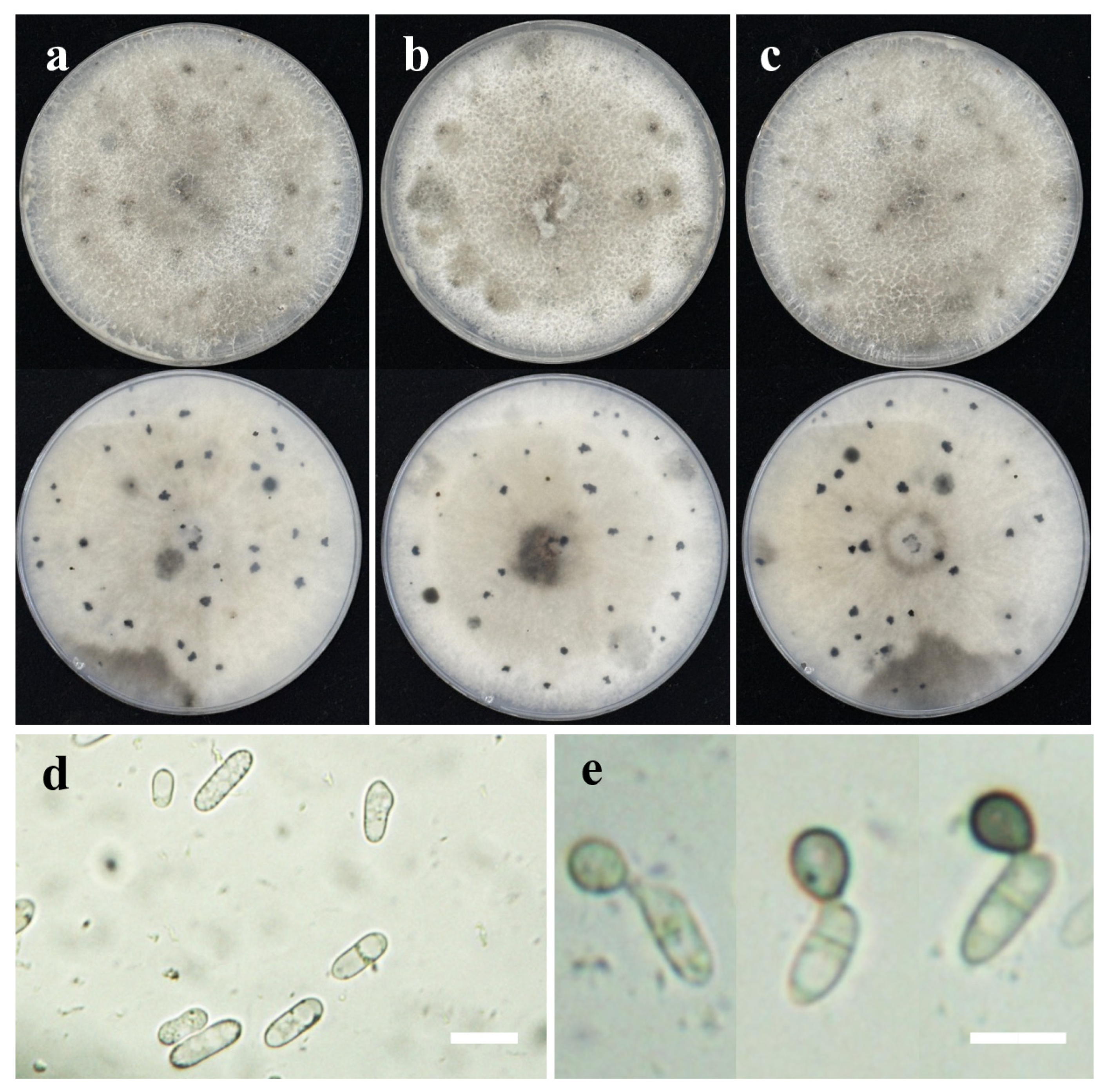
3.2. Morphological Identification of Colletotrichum Isolates
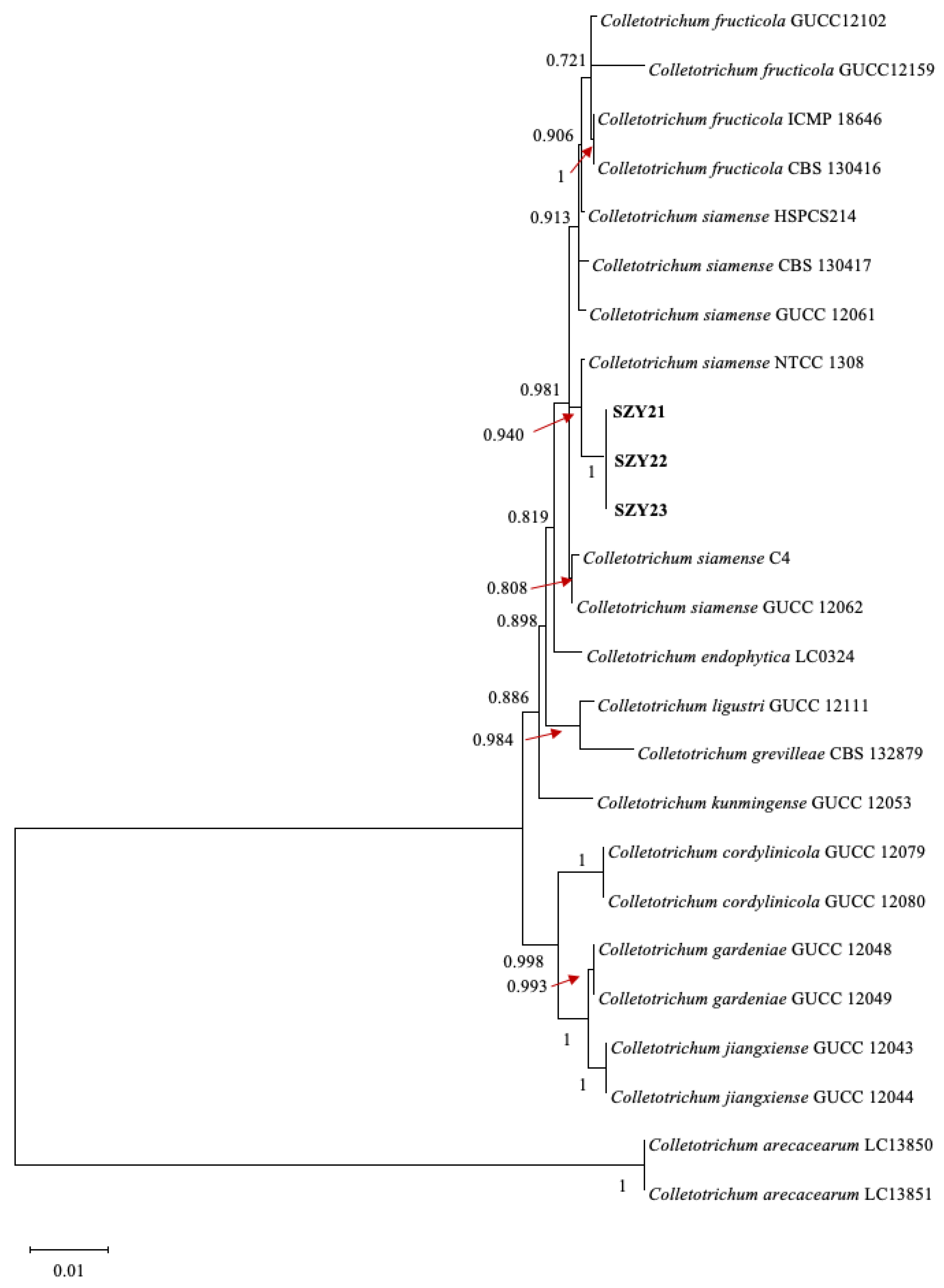
3.3. Phylogenetic Analysis
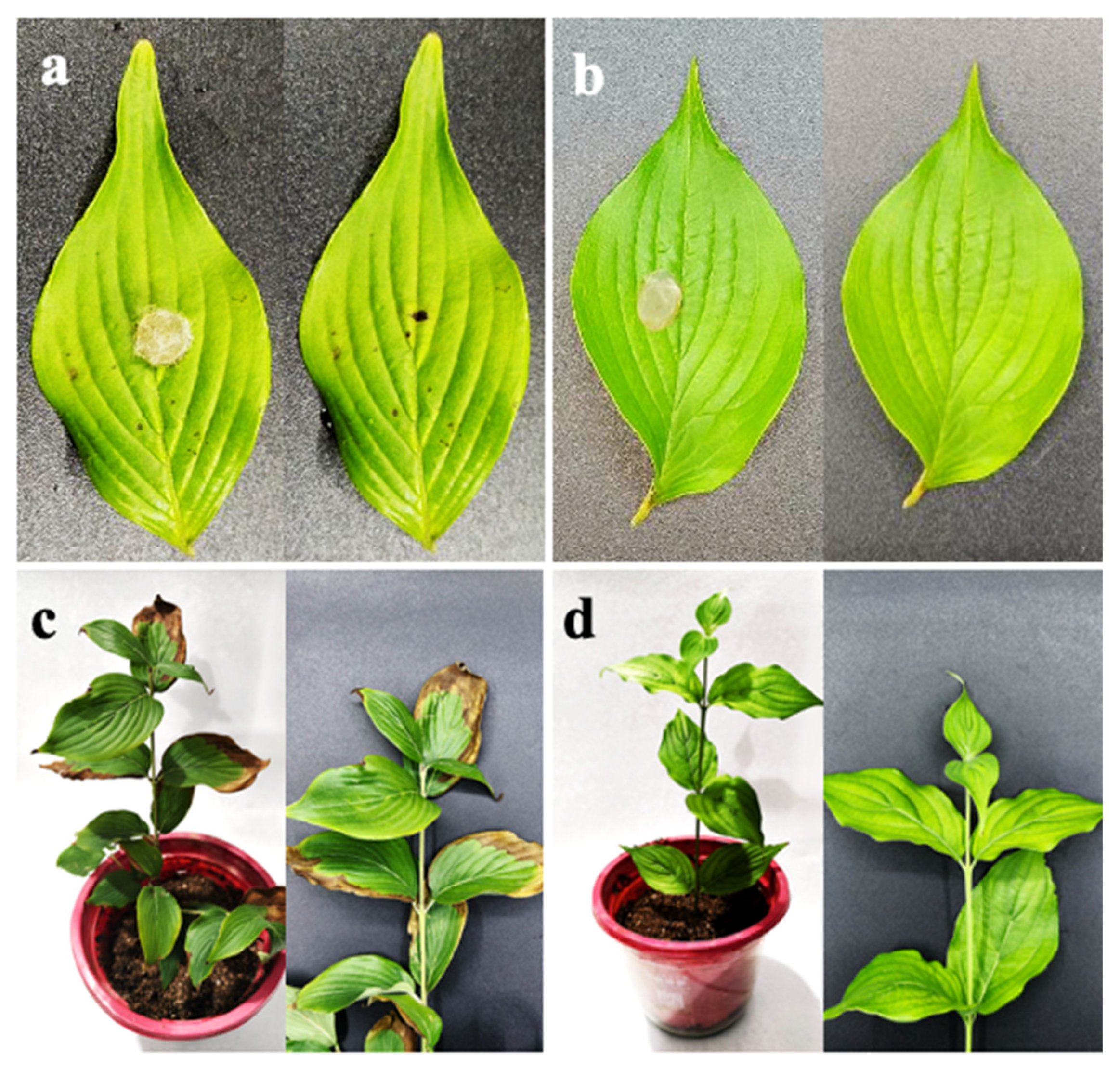
3.4. Pathogenicity Test
3.5. Fungicide Sensitivity Assays
4. Discussion
5. Conclusions
Author Contributions
Funding
Institutional Review Board Statement
Informed Consent Statement
Data Availability Statement
Conflicts of Interest
References
- Han, X.; Ding, C.; Ning, Y.; Shan, Q.; Niu, M.; Cai, H.; Xu, P.; Cao, G. Optimizing Processing Technology of Cornus officinalis: Based on Anti-Fibrotic Activity. Front. Nutr. 2022, 9, 807071. [Google Scholar] [CrossRef] [PubMed]
- Cui, C.; Liu, W.; Feng, L.; Zou, J.; Shi, Y.; Sun, J.; Zhang, X.; Huo, E.; Luan, F.; Zhang, M. Cornus officinalis Sieb.: An updated review on the ethnopharmacology, phytochemistry, pharmacology, toxicology, and pharmacokinetics. J. Ethnopharmacol. 2025, 353, 120365. [Google Scholar] [CrossRef]
- Peng, Z.-C.; He, J.; Pan, X.-G.; Zhang, J.; Wang, Y.-M.; Ye, X.-S.; Xia, C.-Y.; Lian, W.-W.; Yan, Y.; He, X.-L.; et al. Secoiridoid dimers and their biogenetic precursors from the fruits of Cornus officinalis with potential therapeutic effects on type 2 diabetes. Bioorganic Chem. 2021, 117, 105399. [Google Scholar] [CrossRef]
- Huang, J.; Zhang, Y.; Dong, L.; Gao, Q.; Yin, L.; Quan, H.; Chen, R.; Fu, X.; Lin, D. Ethnopharmacology, phytochemistry, and pharmacology of Cornus officinalis Sieb. et Zucc. J. Ethnopharmacol. 2018, 213, 280–301. [Google Scholar] [CrossRef]
- Cao, G.; Cai, H.; Cai, B.; Tu, S. Effect of 5-hydroxymethylfurfural derived from processed Cornus officinalis on the prevention of high glucose-induced oxidative stress in human umbilical vein endothelial cells and its mechanism. Food Chem. 2013, 140, 273–279. [Google Scholar] [CrossRef]
- Hao, Z.-Y.; Wang, X.-L.; Yang, M.; Cao, B.; Zeng, M.-N.; Zhou, S.-Q.; Li, M.; Cao, Y.-G.; Xie, S.-S.; Zheng, X.-K.; et al. Minor iridoid glycosides from the fruits of Cornus officinalis Sieb. et Zucc. and their anti-diabetic bioactivities. Phytochemistry 2023, 205, 113505. [Google Scholar] [CrossRef]
- Aurori, M.; Niculae, M.; Hanganu, D.; Pall, E.; Cenariu, M.; Vodnar, D.C.; Bunea, A.; Fiţ, N.; Andrei, S. Phytochemical Profile, Antioxidant, Antimicrobial and Cytoprotective Effects of Cornelian Cherry (Cornus mas L.) Fruit Extracts. Pharmaceuticals 2023, 16, 420. [Google Scholar] [CrossRef]
- Crouch, J.A.; Clarke, B.B.; White, J.F.; Hillman, B.I. Systematic analysis of the falcate-spored graminicolous Colletotrichum and a description of six new species from warm-season grasses. Mycologia 2009, 101, 717–732. [Google Scholar] [CrossRef] [PubMed]
- de Silva, D.D.; Ades, P.K.; Crous, P.W.; Taylor, P.W.J. Colletotrichum species associated with chili anthracnose in Australia. Plant Pathol. 2017, 66, 254–267. [Google Scholar] [CrossRef]
- Sharma, G.; Maymon, M.; Freeman, S. Epidemiology, pathology and identification of Colletotrichum including a novel species associated with avocado (Persea americana) anthracnose in Israel. Sci. Rep. 2017, 7, 15839. [Google Scholar] [CrossRef]
- Talhinhas, P.; Loureiro, A.; Oliveira, H. Olive anthracnose: A yield- and oil quality-degrading disease caused by several species of Colletotrichum that differ in virulence, host preference and geographical distribution. Mol. Plant Pathol. 2018, 19, 1797–1807. [Google Scholar] [CrossRef]
- Tovar-Pedraza, J.M.; Mora-Aguilera, J.A.; Nava-Díaz, C.; Lima, N.B.; Michereff, S.J.; Sandoval-Islas, J.S.; Câmara, M.P.S.; Téliz-Ortiz, D.; Leyva-Mir, S.G. Distribution and Pathogenicity of Colletotrichum Species Associated with Mango Anthracnose in Mexico. Plant Dis. 2020, 104, 137–146. [Google Scholar] [CrossRef]
- Riolo, M.; Aloi, F.; Pane, A.; Cara, M.; Cacciola, S.O. Twig and Shoot Dieback of Citrus, a New Disease Caused by Colletotrichum Species. Cells 2021, 10, 449. [Google Scholar] [CrossRef] [PubMed]
- Liu, X.; Zheng, X.; Khaskheli, M.I.; Sun, X.; Chang, X.; Gong, G. Identification of Colletotrichum Species Associated with Blueberry Anthracnose in Sichuan, China. Pathogens 2020, 9, 718. [Google Scholar] [CrossRef]
- Talhinhas, P.; Baroncelli, R. Colletotrichum species and complexes: Geographic distribution, host range and conservation status. Fungal Divers. 2021, 110, 109–198. [Google Scholar] [CrossRef]
- Liu, F.; Ma, Z.Y.; Hou, L.W.; Diao, Y.Z.; Wu, W.P.; Damm, U.; Song, S.; Cai, L. Updating species diversity of Colletotrichum, with a phylogenomic overview. Stud. Mycol. 2022, 101, 1–56. [Google Scholar] [CrossRef]
- Liu, F.; Tang, G.; Zheng, X.; Li, Y.; Sun, X.; Qi, X.; Zhou, Y.; Xu, J.; Chen, H.; Chang, X.; et al. Molecular and phenotypic characterization of Colletotrichum species associated with anthracnose disease in peppers from Sichuan Province, China. Sci. Rep. 2016, 6, 32761. [Google Scholar] [CrossRef]
- Xue, L.; Zhang, L.; Yang, X.X.; Huang, X.; Wu, W.; Zhou, X.; White, J.F.; Liu, Y.; Li, C. Characterization, Phylogenetic Analyses, and Pathogenicity of Colletotrichum Species on Morus alba in Sichuan Province, China. Plant Dis. 2019, 103, 2624–2633. [Google Scholar] [CrossRef] [PubMed]
- Huang, S.L.; Wang, L.; Wang, T.; Jiao, Z.J.; Pang, F.H.; Tao, A.L.; Niu, X.R.; Lu, W.H. First Report of Didymella Leaf blight on Cornus officinalis caused by Didymella glomerata in China. Plant Dis. 2018, 102, 1031. [Google Scholar] [CrossRef]
- Zhang, Q.-Q.; Kong, W.-L.; Ni, H.; Wu, X.-Q. First Report of Botryosphaeria dothidea Causing Leaf Blight on Cornus officinalis in Jiangsu Province, China. Plant Dis. 2023, 107, 948. [Google Scholar] [CrossRef]
- Lee, S.B.; Taylor, J.W. Isolation of DNA from fungal mycelia and single spores. In PCR Protocols: A Guide to Methods and Applications; Innis, M.A., Gelfand, D.H., Sninsky, J.J., Eds.; Academic Press: New York, NY, USA, 1990; pp. 282–287. [Google Scholar]
- White, T.J.; Bruns, T.; Lee, S.; Taylor, J. Amplification and sequencing of fungal ribosomal RNA genes for phylogenetics. In PCR Protocols: A Guide to Methods and Applications; Innis, M.A., Gelfand, D.H., Sninsky, J.J., White, T.J., Eds.; Academic Press: New York, NY, USA, 1990; pp. 315–322. [Google Scholar]
- Templeton, M.D.; Rikkerink, E.H.; Solon, S.L.; Crowhurst, R.N. Cloning and molecular characterization of the glyceraldehyde-3-phosphate dehydrogenase-encoding gene and cDNA from the plant pathogenic fungus Glomerella cingulata. Gene 1992, 122, 225–230. [Google Scholar] [CrossRef]
- Carbone, I.; Kohn, L.M. A method for designing primer sets for speciation studies in filamentous ascomycetes. Mycologia 1999, 91, 553–556. [Google Scholar] [CrossRef]
- Glass, N.L.; Donaldson, G.C. Development of primer sets designed for use with the PCR to amplify conserved genes from filamentous ascomycetes. Appl. Environ. Microbiol. 1995, 61, 1323–1330. [Google Scholar] [CrossRef]
- O’Donnell, K.; Cigelnik, E. Two divergent intragenomic rDNA ITS2 types within a monophyletic lineage of the fungus Fusarium are nonorthologous. Mol. Phylogenetics Evol. 1997, 7, 103–116. [Google Scholar] [CrossRef]
- Katoh, K.; Rozewicki, J.; Yamada, K.D. MAFFT online service: Multiple sequence alignment, interactive sequence choice and visualization. Brief. Bioinform. 2019, 20, 1160–1166. [Google Scholar] [CrossRef]
- Capella-Gutiérrez, S.; Silla-Martínez, J.M.; Gabaldón, T. trimAl: A tool for automated alignment trimming in large-scale phylogenetic analyses. Bioinformatics 2009, 25, 1972–1973. [Google Scholar] [CrossRef] [PubMed]
- Ronquist, F.; Teslenko, M.; van der Mark, P.; Ayres, D.L.; Darling, A.; Höhna, S.; Larget, B.; Liu, L.; Suchard, M.A.; Huelsenbeck, J.P. MrBayes 3.2: Efficient Bayesian phylogenetic inference and model choice across a large model space. Syst. Biol. 2012, 61, 539–542. [Google Scholar] [CrossRef]
- Kalyaanamoorthy, S.; Minh, B.Q.; Wong, T.K.F.; von Haeseler, A.; Jermiin, L.S. ModelFinder: Fast model selection for accurate phylogenetic estimates. Nat. Methods 2017, 14, 587–589. [Google Scholar] [CrossRef] [PubMed]
- Xiang, C.-Y.; Gao, F.; Jakovlić, I.; Lei, H.-P.; Hu, Y.; Zhang, H.; Zou, H.; Wang, G.-T.; Zhang, D. Using PhyloSuite for molecular phylogeny and tree-based analyses. Imeta 2023, 2, e87. [Google Scholar] [CrossRef] [PubMed]
- Weir, B.S.; Johnston, P.R.; Damm, U. The Colletotrichum gloeosporioides species complex. Stud. Mycol. 2012, 73, 115–180. [Google Scholar] [CrossRef]
- Choi, I.Y.; Abasova, L.; Choi, J.H.; Park, J.H.; Shin, H.D. Erysiphe cornicola, a Powdery Mildew Occurring on Cornus controversa in Korea. Korean J. Mycol. 2023, 51, 57–62. [Google Scholar] [CrossRef]
- Leandro, L.F.S.; Gleason, M.L.; Nutter, F.W.; Wegulo, S.N.; Dixon, P.M. Influence of Temperature and Wetness Duration on Conidia and Appressoria of Colletotrichum acutatum on Symptomless Strawberry Leaves. Phytopathology 2003, 93, 513–520. [Google Scholar] [CrossRef]
- Salotti, I.; Ji, T.; Rossi, V. Temperature requirements of Colletotrichum spp. belonging to different clades. Front. Plant Sci. 2022, 13, 953760. [Google Scholar] [CrossRef] [PubMed]
- Bernal, V.V.; Boeckman, N.J.; Aćimović, S.G.; Khodadadi, F. The dark side of avocados: A review of anthracnose and stem-end rot in postharvest fruit. Front. Microbiol. 2025, 16, 1644061. [Google Scholar] [CrossRef] [PubMed]
- Gomes, S.; Bacelar, E.; Martins-Lopes, P.; Carvalho, T.; Guedes-Pinto, H. Infection Process of Olive Fruits by Colletotrichum acutatum and the Protective Role of the Cuticle and Epidermis. J. Agric. Sci. 2012, 4, 101. [Google Scholar] [CrossRef]
- Cui, J.; Sun, J.; Li, M.; Chen, G.; Yang, J.; Wang, Y.; Huang, T.; Gong, D.; Hu, M. First report of Colletotrichum siamense and C. tropicale causing anthracnose of Syngonium podophyllum in China. Crop Prot. 2025, 187, 106978. [Google Scholar] [CrossRef]
- Liao, W.; Luo, J.; Zou, D.; Zhong, Y.; Wu, Y.; Yan, K.; Huang, N. First Report of Anthracnose Caused by Colletotrichum siamense on Illicium verum in China. Plant Dis. 2023, 107, 2232. [Google Scholar] [CrossRef]
- Jiang, G.H.; Jiang, A.M.; Fan, C.L.; Wei, J.G.; Ren, L.Y.; Luo, J.T. First Report of Anthracnose on Kadsura coccinea Caused by Colletotrichum siamense in China. Plant Dis. 2022, 106, 328. [Google Scholar] [CrossRef]
- Liu, C.Y.; Liu, Y.L.; Xie, Z.H. First Report of Colletotrichum siamense Causing Anthracnose in Osmanthus fragrans in China. Plant Dis. 2022, 106, 2749. [Google Scholar] [CrossRef]
- Sharma, G.; Pinnaka, A.K.; Shenoy, B.D. Resolving the Colletotrichum siamense species complex using ApMat marker. Fungal Divers. 2015, 71, 247–264. [Google Scholar] [CrossRef]
- Zhang, Q.; Nizamani, M.M.; Feng, Y.; Yang, Y.Q.; Jayawardena, R.S.; Hyde, K.D.; Wang, Y.; Li, C. Genome-scale and multi-gene phylogenetic analyses of Colletotrichum spp. host preference and associated with medicinal plants. Mycosphere 2023, 14, 1–106. [Google Scholar] [CrossRef]



| Locus | Primer | Sequences | References |
|---|---|---|---|
| ITS1-5.8S-ITS2 | ITS1 | TCCGTAGGTGAACCTGCGG | [22] |
| ITS4 | TCCTCCGCTTATTGATATGC | ||
| gapdh | GDF1 | GCCGTCAACGACCCCTTCATTGA | [23] |
| GDR1 | GGGTGGAGTCGTACTTGAGCATGT | ||
| chs-1 | CHS-79F | TGGGGCAAGGATGCTTGGAAGAAG | [24] |
| CHS-354R | TGGAAGAACCATCTGTGAGAGTTG | ||
| act | ACT-512F | ATGTGCAAGGCCGGTTTCGC | [24] |
| ACT-783R | TACGAGTCCTTCTGGCCCAT | ||
| tub2 | T1 | AACATGCGTGAGATTGTAAGT | [25,26] |
| Bt2b | ACCCTCAGTGTAGTGACCCTTGGC |
| Species and Strains | Host and Country | ITS1-5.8S-ITS2 | gapdh | chs-1 | act | tub2 |
|---|---|---|---|---|---|---|
| C. arecacearum LC13850 LC13851 | ||||||
| Arecaceae sp. China | MZ595867 | MZ664049 | MZ799262 | MZ664165 | MZ673986 | |
| Arecaceae sp. China | MZ595868 | MZ664050 | MZ799263 | MZ664166 | MZ673987 | |
| C. cordylinicola GUCC 12080 GUCC 12079 | ||||||
| Cordyline fruticose China | OP722973 | OP784100 | OP730653 | OP740195 | OP761966 | |
| Cordyline fruticose China | OP722972 | OP784099 | OP730652 | OP740194 | OP761965 | |
| C. jiangxiense GUCC 12044 GUCC 12043 | ||||||
| Illicium simonsii China | OP722970 | OP784038 | OP730595 | OP740135 | OP761906 | |
| Illicium simonsii China | OP722998 | OP784037 | OP730594 | OP740134 | OP761905 | |
| C. gardeniae GUCC 12049 GUCC 12048 | ||||||
| Gardenia jasminoides China | OP722959 | OP737963 | OP715766 | OP715801 | OP720858 | |
| Gardenia jasminoides China | OP722989 | OP737962 | OP715765 | OP715800 | OP720857 | |
| C. kunmingense GUCC 12053 | ||||||
| Ophiopogon japonicus China | OP722975 | OP737965 | OP715769 | OP715804 | OP720861 | |
| C. grevilleae CBS 132879 | ||||||
| Grevillea sp. Italy | KC297078 | KC297010 | KC296987 | KC296941 | KC297102 | |
| C. ligustri GUCC 12111 | ||||||
| Ilex chinensis China | OP722988 | OP737968 | OP715773 | OP740216 | OP720864 | |
| C. endophytica LC0324 | ||||||
| Pennisetum purpureum Thailand | KC633854 | KC832854 | MZ799261 | KF306258 | MZ673954 | |
| C. fructicola CBS 130416 GUCC12102 GUCC 12059 ICMP 18646 | ||||||
| Coffea arabica Thailand | JX010165 | JX010033 | JX009866 | FJ907426 | JX010405 | |
| Curcuma phaeocaulis China | OP723019 | OP784115 | OP730667 | OP740203 | OP761981 | |
| Ligustrum lucidum China | OP723017 | OP784075 | OP730628 | OP740172 | OP761941 | |
| Tetragastris panamensis Panama | JX010173 | JX010032 | JX009874 | JX009581 | JX010409 | |
| C. siamense GUCC 12062 GUCC 12061 CBS 130417 NTCC 1308 HSPCS214 C4 SZY21 SZY22 SZY23 | ||||||
| Alocasia macrorrhiza China | OP722957 | OP784086 | OP730639 | OP740181 | OP761952 | |
| Hymenocallis littoralis China | OP722977 | OP784083 | OP730636 | OP740178 | OP761949 | |
| Coffea arabica Thailand | JX010171 | JX009924 | JX009865 | FJ907423 | JX010404 | |
| Afrocarpus gracilior India | PX250322 | PX257861 | PX257860 | PX257856 | PX257859 | |
| Clausena lansium China | PX096396 | PX120585 | PX120717 | PX120655 | PX120781 | |
| Artocarpus heterophyllus Thailand | PP960241 | PP982581 | PP982566 | PP975273 | PP982550 | |
| Cornus officinalis China | PV529834 | PV540228 | PV540225 | PV544191 | PV540231 | |
| Cornus officinalis China | PV529835 | PV540229 | PV540226 | PV544192 | PV540232 | |
| Cornus officinalis China | PV529836 | PV540230 | PV540227 | PV544193 | PV540233 |
| Isolate | Year/Month | Location | Host Tissue |
|---|---|---|---|
| SZY21 | 2023.08 | Taiping Town | Leaf lesion |
| SZY22 | 2023.08 | Taiping Town | Leaf lesion |
| SZY23 | 2024.09 | Miping Town | Leaf lesion |
| Fungicide | Tested Concentration Range (mg a.i. L−1) | Inhibition (%) | EC50 (mg a.i. L−1) |
|---|---|---|---|
| Carbendazim | 0.01–0.16 | 43.22–58.26 | 0.035 |
| Tebuconazole | 0.05–0.80 | 42.91–72.40 | 0.211 |
| Prochloraz | 0.10–1.60 | 58.70–80.15 | 0.386 |
| Difenoconazole | 0.04–0.64 | 34.85–75.60 | 0.391 |
Disclaimer/Publisher’s Note: The statements, opinions and data contained in all publications are solely those of the individual author(s) and contributor(s) and not of MDPI and/or the editor(s). MDPI and/or the editor(s) disclaim responsibility for any injury to people or property resulting from any ideas, methods, instructions or products referred to in the content. |
© 2025 by the authors. Licensee MDPI, Basel, Switzerland. This article is an open access article distributed under the terms and conditions of the Creative Commons Attribution (CC BY) license.
Share and Cite
Wang, T.; Zhou, E.; Zuo, W.; Wang, L.; Zhu, S. Characterization of Colletotrichum siamense Causing Leaf Anthracnose on Cornus officinalis and Its In Vitro Sensitivity to Fungicides in China. Horticulturae 2026, 12, 54. https://doi.org/10.3390/horticulturae12010054
Wang T, Zhou E, Zuo W, Wang L, Zhu S. Characterization of Colletotrichum siamense Causing Leaf Anthracnose on Cornus officinalis and Its In Vitro Sensitivity to Fungicides in China. Horticulturae. 2026; 12(1):54. https://doi.org/10.3390/horticulturae12010054
Chicago/Turabian StyleWang, Tan, Enping Zhou, Weifang Zuo, Liang Wang, and Sengen Zhu. 2026. "Characterization of Colletotrichum siamense Causing Leaf Anthracnose on Cornus officinalis and Its In Vitro Sensitivity to Fungicides in China" Horticulturae 12, no. 1: 54. https://doi.org/10.3390/horticulturae12010054
APA StyleWang, T., Zhou, E., Zuo, W., Wang, L., & Zhu, S. (2026). Characterization of Colletotrichum siamense Causing Leaf Anthracnose on Cornus officinalis and Its In Vitro Sensitivity to Fungicides in China. Horticulturae, 12(1), 54. https://doi.org/10.3390/horticulturae12010054