Article

Variability and Permanency: Variation in the Density of Leaf Glandular Trichomes and Terpene Composition in Mentha spicata var. crispa (Benth.) Danert and M. × piperita var. citrata (Ehrh.) Briq.

by
Anna Vladimirovna Shirokova
1,*,
Maria Sergeevna Plykina
2,
Alexander Olegovich Ruzhitskiy
1,
Ludmila Alekseevna Limantceva
2,
Sergey Leonidovich Belopukhov
3,
Valeria Lvovna Dmitrieva
3,
Raisa Musaevna Khatsaeva
2,
Sofya Arsenovna Dzhatdoeva
1,
Andrey Nikolaevich Tsitsilin
4 and
Natalia Nikolaevna Butorina
2,*
1
Federal Research Centre “Fundamentals of Biotechnology” of the Russian Academy of Sciences, Leninsky Prospect, 33, Build. 2, Moscow 119071, Russia
2
A.N. Severtsov Institute of Ecology and Evolution of the Russian Academy of Sciences, Leninsky Prospect, 33, Moscow 119071, Russia
3
Department of Chemistry, Russian State Agrarian University, Moscow Agricultural Academy Named After K.A. Timiryazev (RSAU-MTAA), Timiryazevskaya 49, Moscow 127434, Russia
4
Botanical Garden of All-Russian Research Institute of Medicinal and Aromatic Plants, Grin Str. 7/1, Moscow 117216, Russia
*
Authors to whom correspondence should be addressed.
Horticulturae 2026, 12(1), 58; https://doi.org/10.3390/horticulturae12010058
Submission received: 9 November 2025 / Revised: 26 December 2025 / Accepted: 30 December 2025 / Published: 1 January 2026
(This article belongs to the Special Issue Tolerance of Horticultural Plants to Abiotic Stresses)

Abstract

Essential oils (EOs) of Mentha spicata var. crispa (Benth.) Danert and M. × piperita var. citrata (Ehrh.) Briq. and EO components are widely used in medicine, pharmaceuticals, cosmetics, hygiene products, the food industry, and other fields, and have a high commercial value. The variety Mentha spicata var. crispa is also used as an ornamental plant due to its distinctive curled leaves. Studying the influence of growing conditions and harvest timing on EO yield and the major compound concentrations is one of the key research directions for Mentha species, aimed at the ascertainment of the ways of increasing EO production and quality. Gas chromatography analysis of the component composition of EOs from leaves of Mentha spicata var. crispaKurchavaya” (MscK) showed that it remained stable both in July and September, with carvone predominating (81% and 85%, respectively). In contrast, the EO composition from M. × piperita var. citrataApelsinovaya” (MpcA) leaves changed in the course of the vegetation period. In July, menthofuran dominated (30%), while in September, linalool and its acetate were predominant (34% and 47%, respectively), which was typical for this chemotype. At the same time, the content of EOs and the density of glandular trichomes (GTs) (the OE storage sites) in MscK were higher in July and decreased by September, whereas in MpcA, both EO content and the number of GTs increased from July to September. These changes may have been caused by temperature fluctuations. Thus, MscK proved to be more resistant to environmental factors than MpcA.

1. Introduction

Essential oils (EOs) are volatile liquids obtained from various parts of plants. Bioactive compounds contained in EOs, especially terpenes, have a wide range of biological activities, including anti-cancer, anti-inflammatory, antioxidant, antidiabetic, hepatoprotective, and antiallergic, and their antimicrobial properties find an application not only in medicine, but also in the food industry as preservatives and flavors [1,2,3,4,5].
EOs have gained widespread use and are of great commercial value not only for pharmaceuticals, but also in agriculture, cosmetics, the production of hygiene products, and perfumes [6,7,8].
Mint oil obtained from the aboveground parts of various species of the genus Mentha is one of the most in-demand in production. Its most significant sources are spearmint (Mentha spicata L.) and peppermint (M. × piperita L.) [9,10,11]. The predominant component of M. spicata EO, L-carvone, produces diverse pharmacological effects, such as antimicrobial, antioxidant, and anti-inflammatory [12,13,14,15,16]. In addition, L-carvone has also been shown to have anti-cancer, antidiabetic, neuroprotective, antispasmodic, anticonvulsant, and antidepressant properties [17,18,19,20,21,22,23,24].
The aboveground parts of Mentha spicata contain from 0.6 to 2.5% of EO, out of which 40–78% is represented by carvone and up to 9–22% by D-limonene [25,26,27,28]. In Mentha spicata var. crispa (Benth.) in Danert varieties, the EO yield is lower, but carvone is also the predominant component [29]. In addition, there are other chemotypes of spearmint, for example, with a predominance of pulegone, pipperitone, and isomenthone [30,31,32]. Wild-growing ecotypes of M. spicata in Greece were found to cluster into three distinct chemotypes, characterized by predomination of either linalool (65.2–75.3%) or carvone (35.2–68.4%), or distinguished by a considerable production of piperitone oxide or piperitenone oxide (0.2–89.5% and 0.1–70.3%, respectively) [33].
M. × piperita is an alloploid species, one of the parent species of which is Mentha spicata. The other parent species, M. aquatica L., is characterized by linalool and its ester predominance in the EO composition [34,35]. The hybrid origin of the variety determines a wider range of its volatile compounds. The most valuable among its chemotypes is the menthol one, the EO of which has a strong coolness effect and contains up to 70% of menthol [36,37,38,39]. Other chemotypes of this species with characteristic “menthol” fragrances contain menthofuran, pulegone, menthone, and isomenthone, pipperitone as the main EO components [40,41,42,43,44]. Besides that, there is a variety, M. × piperita var. citrata (Ehrh.) Briq., which corresponds in EO composition to M. aquatic. It contains up to 0.16% EO with 23% of linalool and 26% of linalyl acetate [45]. Previously, the species M. citrata was classified as a variety sometimes under M. aquatica L., sometimes under M. × piperita L., or considered to be a true species. Later, Hefendehl and Murray suggested that hybrids with a lavender scent and resembling M. × piperita “would apparently be appropriate to name M. × piperita var. citrata (Ehrh.) Briq. or Benth” [46].
The EO components of plants of the genus Mentha belong to the class of terpenes, the accumulation and composition of which depend on the growing conditions and the time of harvest [47,48,49,50,51,52,53,54].
The biosynthesis and the accumulation of EO occur in specialized epidermal structures—glandular trichomes (GTs), which, depending on their structural features, are divided into several types. GT types on various plant organs are species-specific and serve as a systematic feature. As a rule, GTs consist of a basal cell, which is attached to the surface, a unicellular or multicellular stalk, and a unicellular, multicellular, or multi-rowed head [55,56,57,58].
Mint leaves are characterized by two types of capitate GTs: sessile, with a large eight-celled head, without stalk (they are sometimes mistakenly called peltate), and small, with unicellular stalk and unicellular head [59,60,61]. Large GTs contain EOs in the form of free droplets. The heads of small GTs contain EO components: along with terpene compounds, there are present peptides, lipids, polysaccharides, and second metabolites of a phenolic nature, including flavonoids [62,63,64].
According to data from various authors, the EO yield is related to the density of GTs, rather than to their size, and depends on the lighting conditions, temperature, water availability, and the age of plants and the location of leaves on the shoots. In mint, the formation of new GTs shoots when leaves stop growing in width [65,66].
The purpose of the present study was to evaluate the effect of conditions in the first and second half of summer on the content of EOs and their component composition in three-year-old plants of Mentha spicata var. crispa and M. × piperita var. citrata, and the formation of GTs on the leaves of the upper and lower levels.

2. Materials and Methods

The present study was carried out at the facilities of Severtsov Institute of Ecology and Evolution RAS (IEE RAS).

2.1. Plants Material

Plants of Mentha spicata var. crispaKurchavaya” (MscK) and M. × piperita var. citrataApelsynovaya” (MpcA) were grown for three years at the “Chernogolovka” scientific-experimental base (north-east of the Moscow region) of the IEE RAS according to the generally accepted methodology.
The work was carried out on three-year-old plants grown from cuttings taken from five to seven plants from the collection of RSAU-MTAA. A total of 20 rooted cuttings of MscK and 12 rooted cuttings of MpcA were obtained in 2023.
Description of Cultivars.
Mentha spicata var. crispaKurchavaya”: shoots erect, leaves strongly corrugated, green, with a strong odor reminiscent of dill.
M. × piperita var. citrataApelsynovaya”: creeping shoots, dark green leaves with anthocyanin tint, strong orange scent.
For microscopy and hydrodistillation, the shoots from flowering plants were cut off in the first decade of July (I-harvest) and in the second decade of September (II-harvest) from the same plants of each sample. Each period from regrowth to cutting lasted 65 days. The average daily temperatures were measured throughout the growing season of Mentha.
Temperature was recorded at an automatic weather station located 80 m from the cultivation site at the “Chernogolovka” experimental base (north-east of the Moscow region) (Figure S1).

2.2. Microscopy

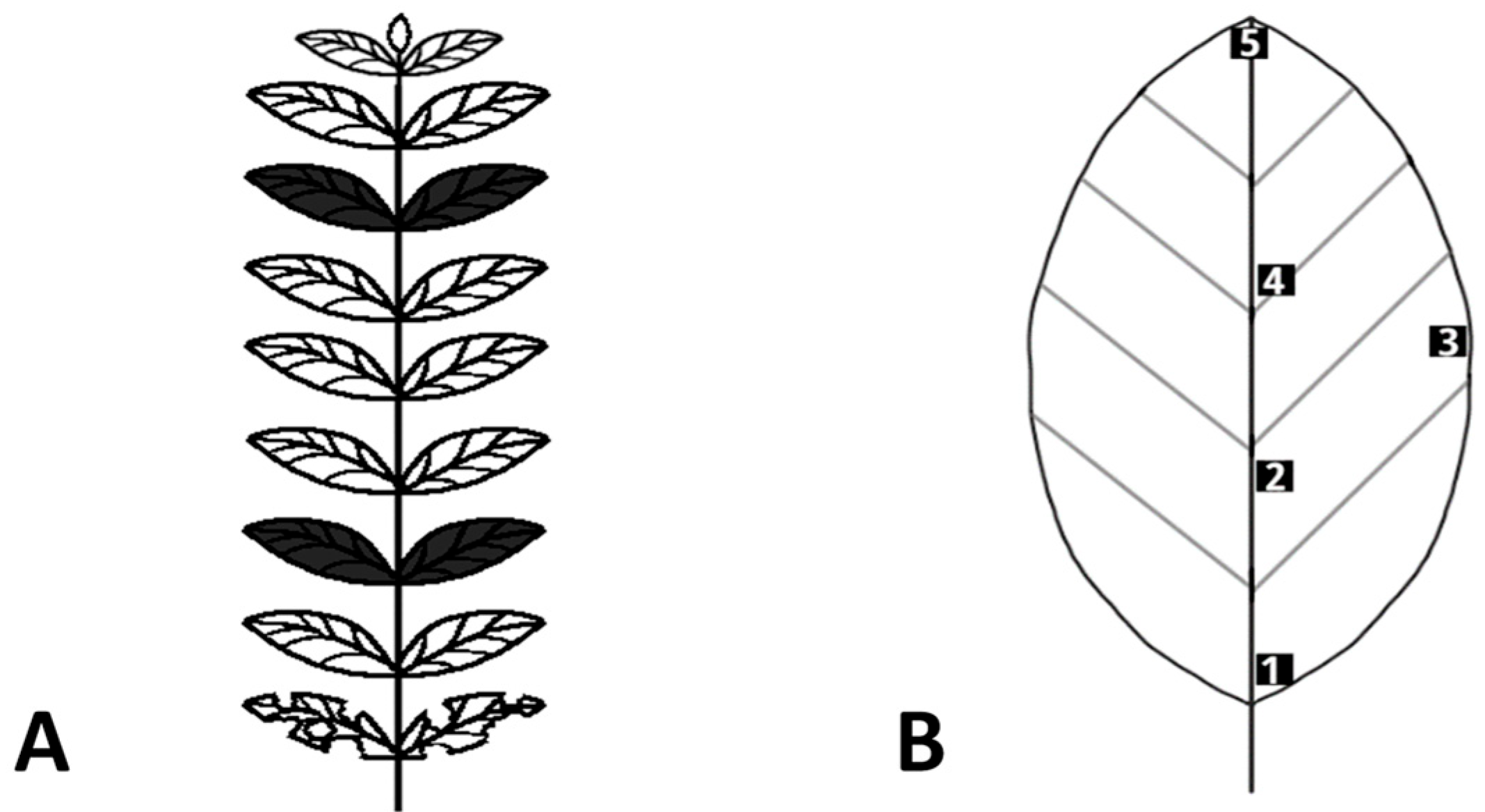
Light Microscopy. Fresh, fully formed leaves from shoots having 9–11 pairs of leaves were used for the study of GTs using light microscopy. The upper leaves were selected from the third nodes from the top of the shoot (upper level), and the lower leaves were selected from the third nodes from the base of the shoots (down level) (Figure 1A). In total, 4 pairs of leaves from 8 plants, cut off 65-day shoots, were used.
Each leaf was examined under a Zeiss Stemi 2000-C (Carl Zeiss Microscopy GmbH, Göttingen, Germany) stereomicroscope at ×40 magnification and photographed using a RisingCam U3CMOS05100KPA (TaupTek Photonics, Hangzhou, China) camera. Both adaxial and abaxial sides of the leaves were studied at five accounting areas (Figure 1B): at the base of the leaf (1), in its median part (2), at the outer edge of the leaf (3), at the tip of the leaf (4), and at two areas by the main vein (5). To assess the density, the number of GTs over accounting areas, 7 mm2 each, was calculated. Only sessile capitate glands, the receptacles of essential oil, were counted.
Scanning Electron Microscopy (SEM). For scanning electron microscopy, fresh leaves about 2 cm long were cut in pieces and immersed in 2.5% (v/v) glutaraldehyde (Acros Organics, Geel, Belgium) in phosphate-buffered saline (PBS) (Sigma–Aldrich, St. Louis, MO, USA) at pH 7.2, for 5–7 days at +4 °C, then washed twice in PBS, passed through a series of alcohols 30–50–70% (v/v), and stored in a 70% alcohol for three days. To completely remove moisture, processed leaf samples were immersed in 96% alcohol for 20 min, then in acetone plus 96% alcohol for 20 min (1:1), and then in pure acetone for 20 min and subjected to critical point drying.
Leaf material, processed as described above, cut into pieces about 3–5 mm long × 3–5 mm wide, was glued onto aluminum stubs with double-sided adhesive carbon strips 8 × 20 mm (Double-Sided Carbon Tape, Nisshin EM Co., Ltd., Tokyo, Japan) and sputter coated with gold (Au coating thickness—10 nm) using a S150A Sputter Coater (Edwards High Vacuum International, Crawley, UK). Preparations were examined employing TESCAN MIRA 3 LMH (TESCAN Brno s.r.o., Brno, Czech Republic), equipped with the AZtecOne X-act energy dispersion analysis system (Oxford Instruments Plc, Abingdon, UK) with a Schottky cathode. Preparations were examined and photographed at ×200 to ×5000 magnification. At least 30 fragments from both adaxial and abaxial leaf sides.
Measurements of glands were performed employing the AmScope program (v.4.11.18573.20210303). Descriptions of the GT images were made according to the classification of M.G. Simpson [59].

2.3. Hydrodistillation and Composition of Essential Oil Components

During the flowering phase, the shoots were cut and dried on laboratory tables at a temperature of 23–25 °C until the leaves became brittle.
Extraction of EOs was performed employing the Ginsberg hydrodistillation method. Weighed portions of dried leaves were placed in a 1000 mL round-bottomed flask, distilled water in a 1:2 proportion was added, and the mixture was boiled for 70 min.
The extracted oil was transferred to vials and weighed, recalculated by 1 kg of dry weight (DW).
The composition of EO components was determined by gas chromatography (GC), employing a Shimadzu GC 2010 Plus chromatograph (Shimadzu Corporation, Kyoto, Japan). Chromatographic separations were performed on a 30 m × 0.25 mm, dr 0.25 µm MDN-5 capillary column (Supelco Inc, Bellefonte, PA, USA). Helium was used as a carrier gas at a flow rate of 1 mL/min (36.5 sm/s), split 1:10. Injector temperature was 180 °C, interface temperature was 205 °C, detector temperature was 200 °C. The following GC oven temperature parameters were applied: 60 °C for 2 min, 5 °C/min to 120 °C, 10 °C/min to 150 °C, 30 °C/min to 300 °C, and 300 °C for 2 min. The mass recording range was from 29 to 400 m/z. The identification of peaks was performed using the NIST 11 Mass Spectrum Library (version 2.0g). The biochemical analysis was carried out at the FRC FB RAS laboratory.

2.4. Statistical Analysis

The results are presented as the mean of three replicates ± standard error (SE). Differences between treatments for the different measured variables were tested by one-way analysis of variance (ANOVA), followed by Duncan’s test, with significant differences found (p < 0.05) using XLSTAT software (version 2014.5.03).

3. Results

3.1. Scanning and Light Microscopy

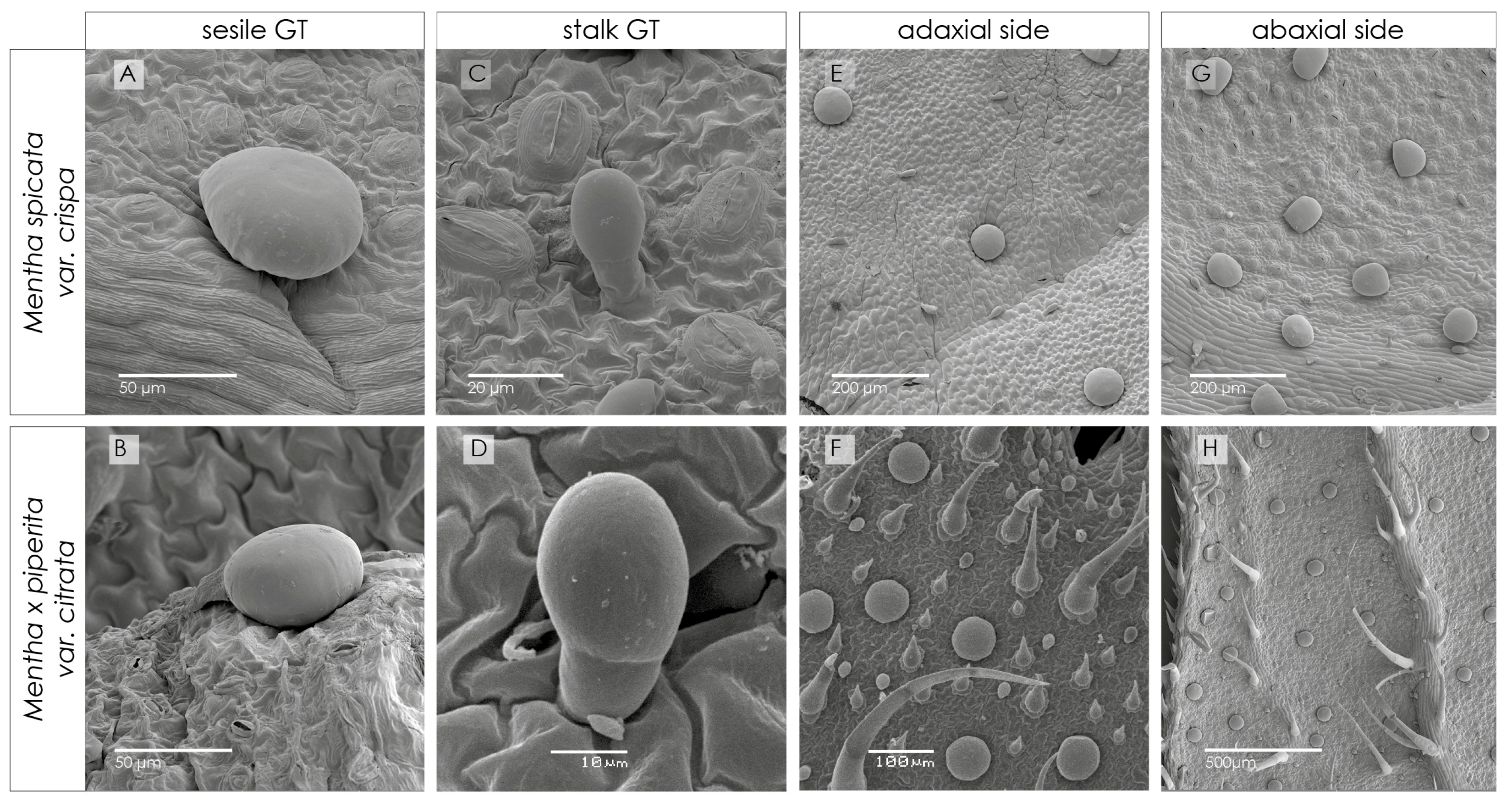
Using scanning microscopy, images of capitate GTs of two types were obtained for the studied Mentha species (Figure 2).
GTs of the first type were large, nearly spherical sessile glandular trichomes (SGTs) with a large eight-celled secretory head without a stalk (Figure 2A,B), with a diameter of about 52–60 μm (Table 1). The second type was represented by small GTs with a unicellular stalk (StGTs) and a unicellular ellipsoid head (Figure 2C,D). The major axis of the latter was nearly twice, and the minor axis three times smaller than the diameter of SGTs.
It was found that SGTs are scattered on both adaxial and abaxial leaf sides, whereas StGTs were located on the adaxial side across the entire surface, and on the abaxial side, mainly on the veins (Figure 2E–H). It turned out that GTs of both types were larger in MscK, and the stalks of small StGTs “drooped” under the weight of the head, which distinguished them from such glands in MpcA. Additionally, the calculated volume of the SGTs in MscK was greater than in MpcA.
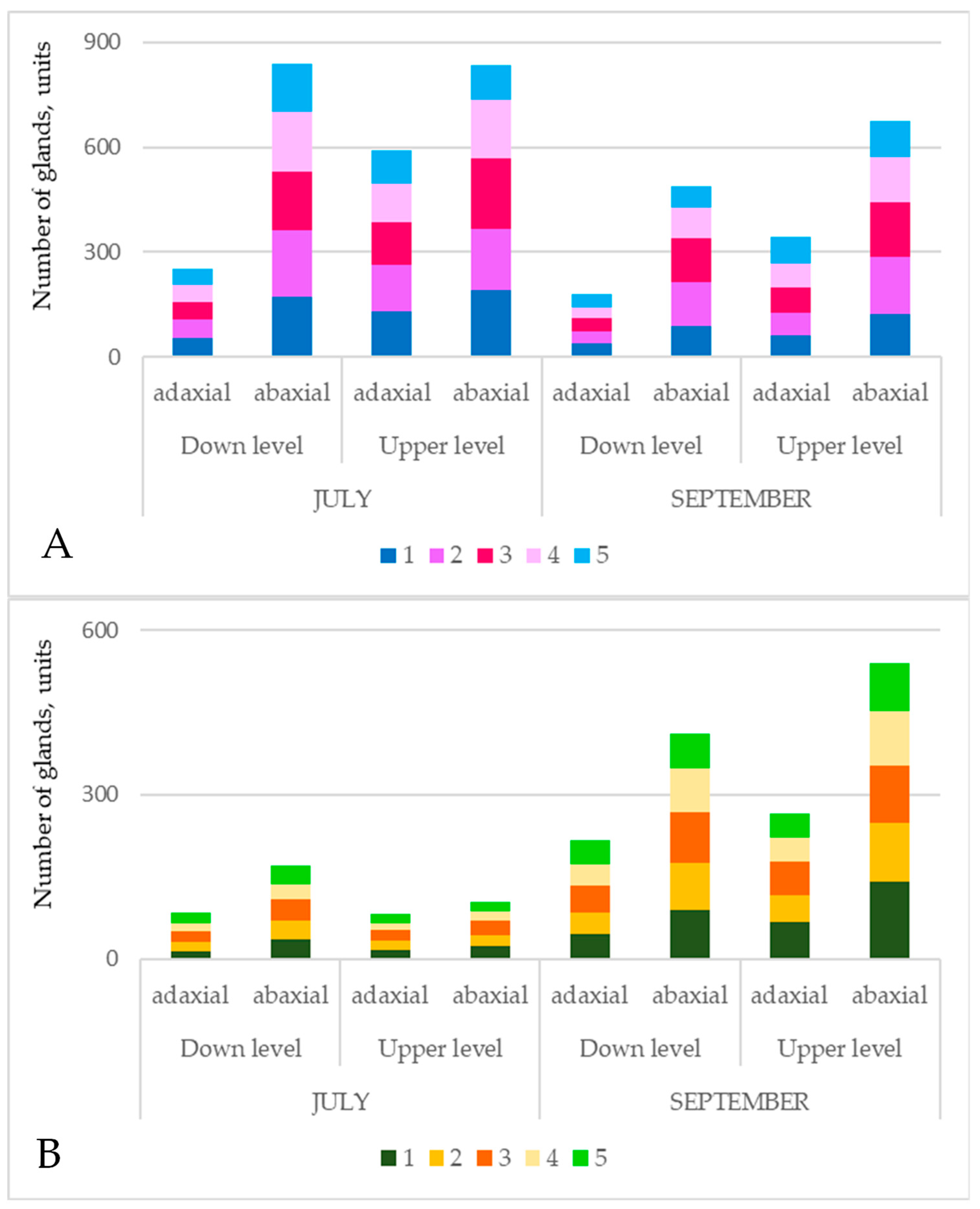
As a result of studying the surface of mint leaves, it was found that the density of GTs was noticeably higher in MscK compared with MpcA (Figure 3). In MscK the maximum formation of SGTs was observed during the first regrowth and flowering in May–July, and in MpcA, on the contrary, in July–September during the second regrowth.
In July, for MscK, on all accounting areas of the down-level leaves, the SGT number was 3–3.5 times higher on the abaxial side compared to the adaxial, and on the leaves of the upper level, the difference was only about 30%. The number of SGTs on the abaxial side of the leaves was also almost the same in both the upper and lower leaf levels. The most SGT-saturated fragment was located close to the main vein in the lower third of the leaf (Figure 1B, location 2), and the smallest SGT number was noted at the leaf tip (Figure 1B, location 5).
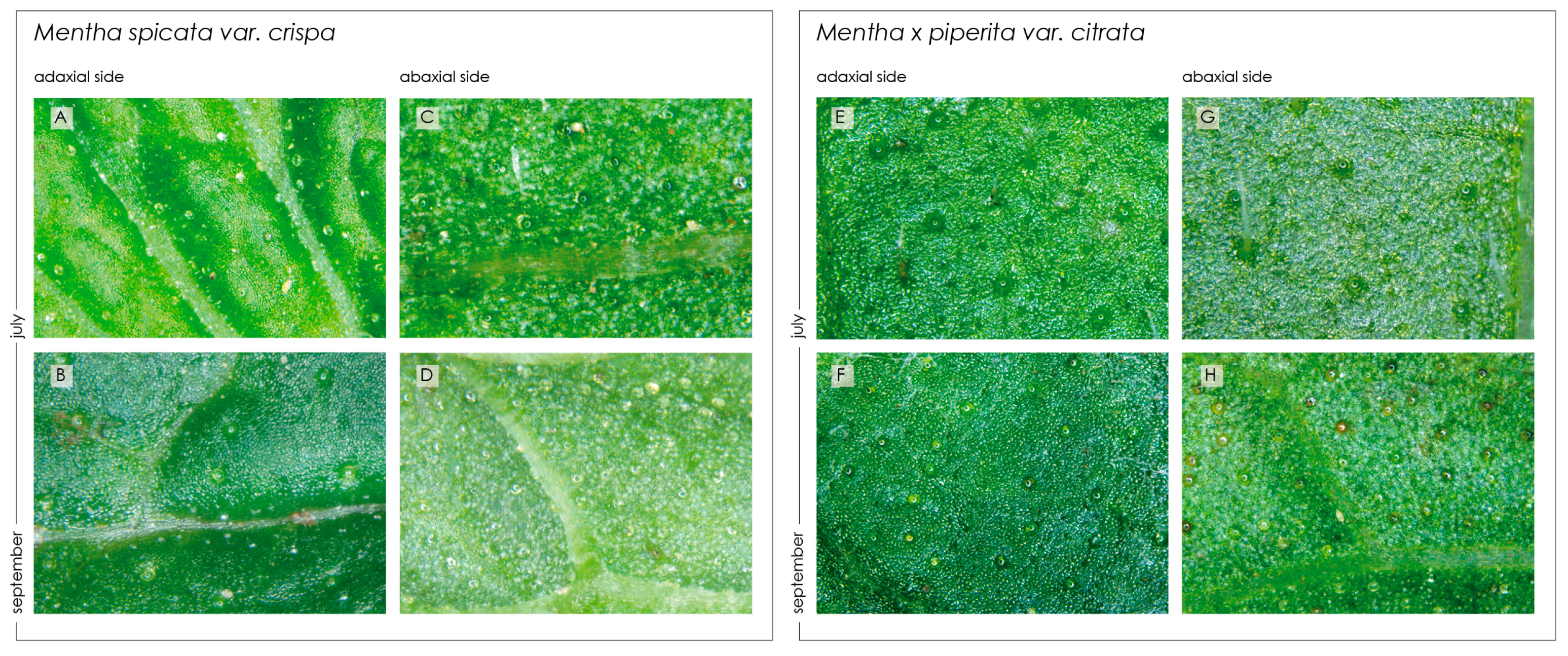
At the same time, in the May–July period, more SGTs formed on the leaves of the down level compared with the upper one. During the second regrowth period from mid-July to mid-September, the number of SGTs was about 28–30% less compared with the first period. Also, the difference in density of glands between adaxial and abaxial leaf sides increased both in their down and upper levels (Figure 4).
In MpcA, on the contrary, the number of SGTs during the first period (May–early July) was very low, compared with the second period, and the differences between the adaxial and abaxial sides were not so sharp, especially in the leaves of the upper level, within 15–20%. During the July to mid-September period, SGTs formed mostly on the leaves of the upper level. Accounting areas in the lower third of leaves (basal part) were the most SGT-saturated, while at the leaf tip, the number of SGTs was less by about 20%.

3.2. Yields and Content of EO Compounds

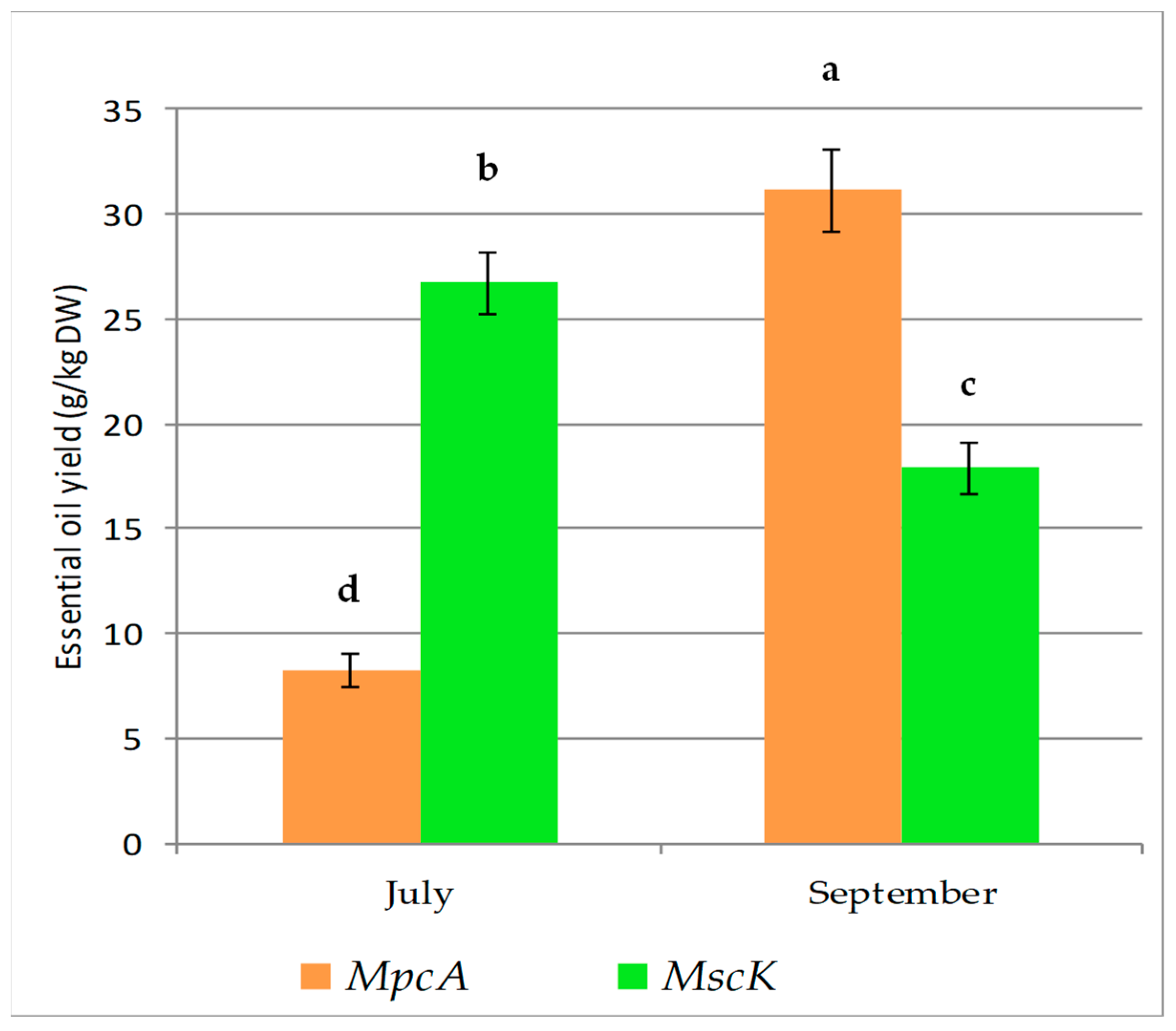
The EO yields varied considerably both between the studied varieties and in the course of the growing season (Figure 5).
In July, the EO yield in MpcA was the lowest for the growing season, and about four times as low as in MscK, in which the maximum EO yield was observed. In September, the situation reversed: the EO yield in MpcA increased by a factor of about four and reached its maximum. At the same time, a 30% decrease in EO yield was observed in MscK, which was the minimum, about 1.5 times as low as MpcA at the same period of time (Figure 5).
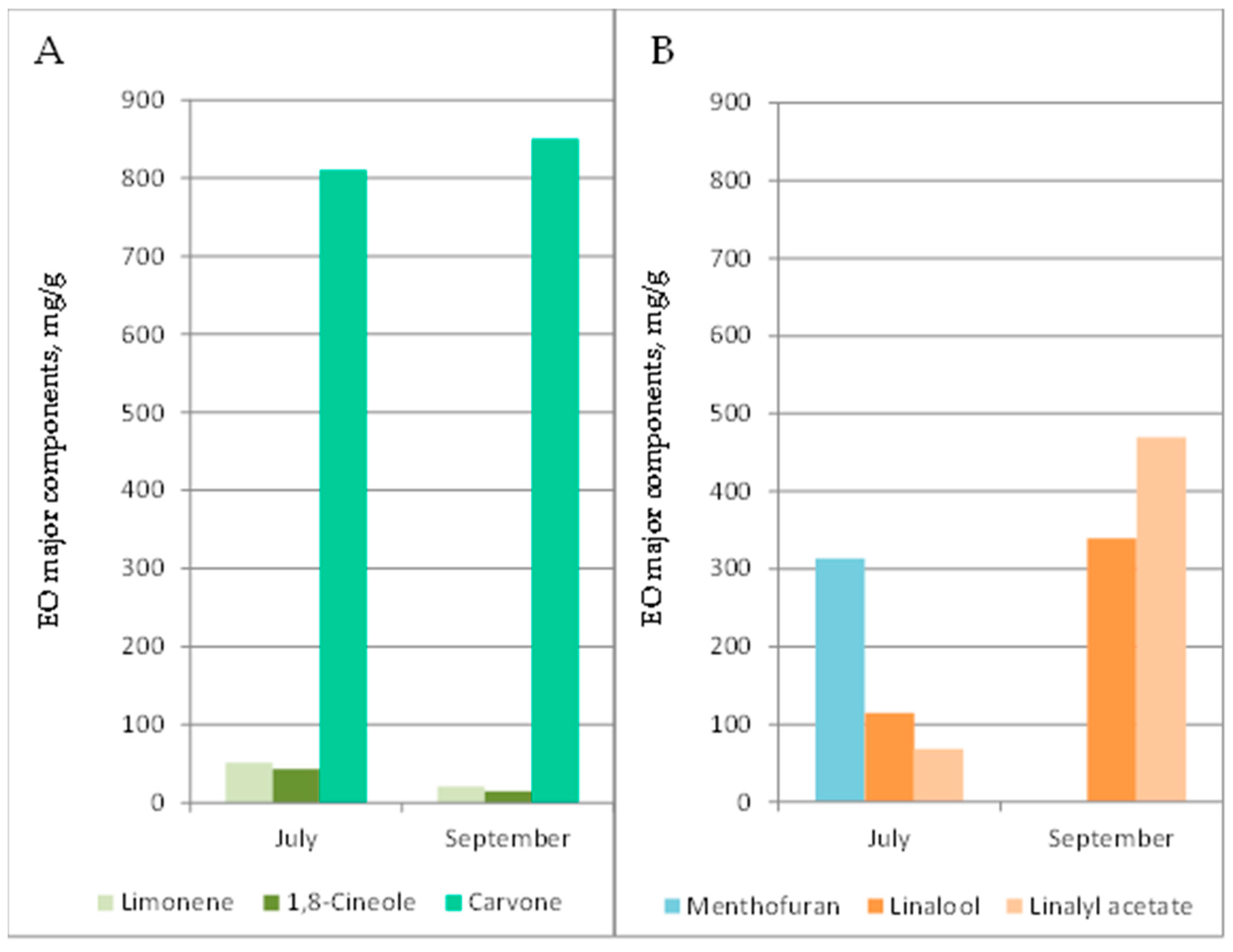
Biochemical analysis showed that MscK had about 81% content of the major component of carvone in July leaves and 85% in September leaves (Table 2A). The amount of limonene decreased by the factor of almost 2.5, p-cymene, which was about 4.23% in July, is not detected in September leaves, but dihydrocarvone and dihydrocarvyl acetate have appeared. On the contrary, changes in the composition of the major components in MpcA were significant: mentofuran prevailed in July plants (more than 30%), linalool accounted for slightly more than 11%, and linalyl acetate content was less than 1% (Table 2B). In autumn leaves, linalool and linalyl acetate accounted for almost 80%, and alpha-terpineol and neryl acetate accounted for 7.1% and 3.1%, respectively.

4. Discussion

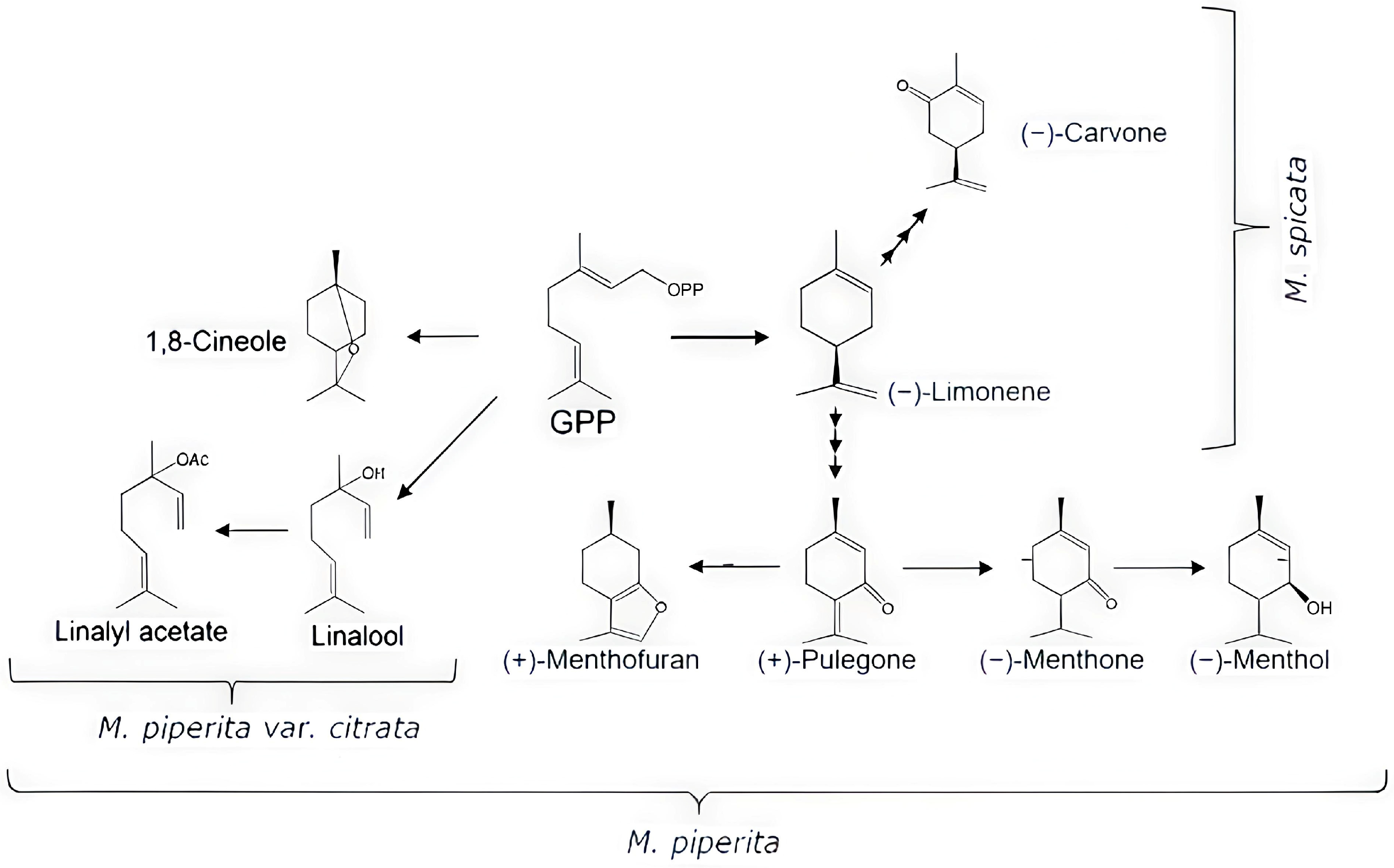
The substances of EO, numerous volatile compounds that impart (give) mint its scent and taste, belong to the class of terpenes. Among them, the most well-known components that determine chemotypes of various species and varieties are limonene, carvone, menthol, pulegone, mentofuran, isopiperitone, and mentone [67]. Limonene is the first derivative of geranyl diphosphate in this pathway of biosynthesis. It also serves as a precursor for carvone, the main EO compound of Mentha spicata var. crispa (Table S1A,B), and for numerous compounds of the menthol biosynthetic pathway, including mentofuran, characteristic of M. × piperita (Figure 6) [68,69,70]. The major essential components of M. × piperita var. citrata are linalool and linalyl acetate, which are formed via a different pathway; their precursor, geranyl diphosphate, is present in small quantities or absent from the leaves of plants of this variety [71,72,73].
The results of the present study indicated that, in MscK harvested in the first decade of July and in the second decade of September, the composition of volatile compounds corresponded to the carvone chemotype (Figure 7A), and a decrease in limonene content corresponded to a slight increase in the content of carvone (from 81 to 85%).
The change in the composition of the main components of MpcA turned out to be completely unexpected. In the EOs of leaves harvested in July, the predominant component was menthofuran (about 31%). In September, there was a “return” to the typical composition with a predominance of linalool and its acetate, the total amount of which was about 80%, while menthofuran was not detected (Figure 7B). Thus, in MpcA, it proved possible to switch from one biosynthetic pathway to another within the same growing season.
It has been shown that environmental factors such as photoperiod duration, light intensity, temperature, and humidity influence monoterpene metabolism and the composition of EOs in M. × piperita. For example, in phytotron conditions, menthofuran accumulation during a short photoperiod (8 h) occurred in all plant leaves, but the content of menthol and menthone was negligible [75,76]. In contrast, under long photoperiods, high light intensity, and large differences between day and night temperatures (“cool nights”), the accumulation of menthofuran and pulegone was suppressed [77]. In addition, in menthol cultivars, menthofuran accumulation was caused by drought combined with low light intensity [69].
No data were found on the accumulation of compounds from another biochemical pathway in the leaves of M. × piperita var. citrata under natural conditions or on the influence of experimental growing conditions on changes in EO composition in M. × piperita var. citrata. A chemotype is determined under environmental conditions optimal for its expression. Since the main cultivation centers of M. × piperita var. citrata and its distribution area are located in mild climate conditions, where, during the growth period and EO accumulation, the air temperature does not drop below 15 °C [3], such data cannot be obtained. Furthermore, M. × piperita var. citrata does not have the same commercial value as species or cultivars with menthol, carvone, or menthofuran, and there is very little information about this variety of M. × piperita. It was only reported that menthofuran (about 10%) and linalool (0.80%) were simultaneously present in M. × piperita f. citrataChocolate”, but the amounts of these components were too small [78].
On the other hand, it is known that EO composition is determined by genetic features. A recent study by K.J. Vining et al. (2019) [79] on a collection of various Mentha aquatica samples revealed differences in ploidy between samples with different chemotypes. Thus, samples with a menthofuran chemotype (on average 32.7–71.5%) were octoploids (genotype 2n = 8x), while Mentha aquatica var. citrata samples with a linalool chemotype (on average 47.8–55.0%) were nonaploids (2n = 9x). However, no similar information was found for M. × piperita var. citrata.
It is known that temperatures above 25 °C and the absence of rain for 10–15 days are required for the accumulation of linalool in lavender inflorescences [80]. Obviously, similar conditions are required for the accumulation of linalool in the leaves of M. × piperita var. citrata.
The observed changes in EO composition could have been caused by unusual conditions for the growth and development of M. × piperita var. citrataApelsinovaya” plants (Figure S1). In April, the temperature was above +15 °C, but at the end of the month, it was replaced by prolonged cooling with nighttime frosts down to −3 °C. After this cooling, there was a long period with daily alternation of temperatures above +10 °C and “biological zero” (+5 °C). The average daily temperature did not exceed +10 °C. Then, there was a sharp increase in temperature, which caused the rapid growth of M. × piperita var. citrataApelsinovaya” plants.
In this regard, changes in the component composition of the EO could have occurred due to cold stress followed by sharp warming. At temperatures of 15–25 °C, linalool biosynthesis occurs, which protects plants from excessive heat and bright light. Obviously, under cold stress conditions, the plant will protect itself by synthesizing other compounds. In addition, rapid shoot or leaf growth could also contribute to menthofuran accumulation, as previously shown [77]. In our study, menthofuran accumulation could have been caused by drought stress due to temperatures below +5 °C.
It is known that abscisic acid (ABA) can be formed under cold stress, and ABA plays a special regulatory role in promoting menthofuran biosynthesis. It has been established that exogenous ABA treatment is effective in enhancing the accumulation of transcripts of the MFS gene, which encodes the key enzyme responsible for menthofuran biosynthesis [81].
It is possible that the “p-menthane” pathway could have been blocked by an epigenetic mechanism, for example, methylation of the limonene synthase promoter. Under cold stress conditions, the stress-induced hormone ABA began to be produced, which activated demethyltransferase and caused the unblocking of enzymes of another synthesis pathway, primarily limonene synthase. This was a response to cold stress and led to the accumulation of compounds such as pulegone and menthofuran, as well as minimal amounts (less than 1%) of other compounds of the “menthol” pathway: isomenthone (0.029%) and menthol (0.69%) (Table S1C,D). High temperature combined with bright light and drought contributed to the blocking of this pathway, so the EO composition “recovered”.
Another important indicator is the yield of EO, which is contained in GTs. The M. × piperita leaf blade has GTs on both surfaces. According to the data presented in the literature, large sessile GTs have a shortened stalk [82,83,84]. Usually, the abaxial side of the leaves contains more GTs than the adaxial side [85]. Studying the adaxial and abaxial surfaces of the leaves of the down and upper leaf levels revealed that during the observation period, the density of the SGTs varied in both species studied.
During the period (May–the first decade of July) characterized by low EO accumulation, the amount of SGTs on both sides of MpcA leaves (Figure 3B, July), especially in the upper level, differed to a lesser extent than later on during the season. And the most gland-saturated area was located in the median part along the edge of the leaf on both sides. On the contrary, during the period of enhanced biosynthesis and accumulation of EOs (second decade of July–second decade of September), the density of SGTs was higher on the leaves of the upper level, on both their sides, and was approximately the same on all leaf parts except for the tip. The number of SGTs on the adaxial and the abaxial sides of the leaf differed by a factor of two.
As it was previously shown, the density of GTs on leaves increases with shoot age, so there may be significantly fewer of them at the lower level than at the upper level. These results explain the lower number of glands compared with younger leaves [60,86]. Our data show that in M. × piperita var. citrata, the number of glands on the leaves formed on new shoots after pruning in the second half of summer was also higher than on the upper leaves in the first half of summer. That is, the number of glands was higher on the leaves of shoots formed later, regardless of their age (in both the first and second crops, the age of the shoots was the same—about 65 days). Clusters of glands and areas of their formation are unevenly distributed over the surface of the leaf, and the abaxial basal and abaxial middle zones are the most dense.
At the same time, in M. spicata var. crispa, characterized by a stable during the season carvone content, the number of glands also changed in the course of the season, and decreased during the second half of summer. In addition, the differences in SGT density between the adaxial and abaxial sides were greater in the leaves of the lower level. In the upper level, the density was high on both leaf sides. During the period of maximum EO accumulation (May–the first decade of July), the number of SGTs on the abaxial side was the same for the leaves of both levels. The SGT number on the adaxial side of the upper level leaves was higher by the factor of about two compared with the leaves of the lower level. Herewith, SGT distribution was uniform on the adaxial side in almost all areas of the upper-level leaves, except for their tips, as in MpcA leaves (Figure 3A, July). In MscK, the SGT number on the abaxial side of the leaves was significantly higher than on the adaxial side during the entire leaf growth, while in M. × piperita var. citrata, the differences are more pronounced during the period of active EO accumulation.

5. Conclusions

Spicy aromatic plants have been cultivated for many centuries, and the existence of various chemotypes is well-known. It is assumed that the zoning of varieties and the choice of conditions contribute to the stable composition of mint EO. On the other hand, obtaining EOs with different component compositions during the same season may be beneficial, since it does not require extra expenses for the cultivation of different varieties. Changes in the EO component composition of MpcA during the growing season of 2025 indicated that EO component composition may vary depending on growing conditions. This indicates the genetically fixed possibility of switching between mentofuran and linalool biosynthetic pathways.
In addition, the influence of temperature and humidity on perennial plants in the open ground, as well as on young rooted cuttings in a phytochamber, can have a different effect on the biosynthesis of volatile compounds. In accordance with our findings, it turned out that the yield of EO and the maximum density of GTs in different species change simultaneously. In the second half of summer, they decrease in M. spicata var. crispa and increase in M. × piperita var. citrata.

Supplementary Materials

The following supporting information can be downloaded at: https://www.mdpi.com/article/10.3390/horticulturae12010058/s1, Figure S1: diurnal temperature variation (A) and daily mean temperature and temperature difference (B); Table S1: components of EO of M. × spicata var. crispaKurchavaya” (A—July; B—September) and M. × piperita var. citrataApelsinovaya” (C—July; D—September).

Author Contributions

Conceptualization, A.V.S. and N.N.B.; methodology, A.V.S., A.O.R., V.L.D., and R.M.K.; software, S.A.D.; validation, A.V.S., S.A.D., A.O.R., and N.N.B.; formal analysis, A.V.S., M.S.P., and N.N.B.; investigation, A.V.S., M.S.P., A.O.R., V.L.D., L.A.L., A.N.T., and N.N.B.; resources, A.V.S., S.A.D., S.L.B., V.L.D., A.N.T., and N.N.B.; data curation, A.V.S., A.O.R., V.L.D., S.A.D., and N.N.B.; writing—original draft preparation, A.V.S. and N.N.B.; writing—review and editing, A.V.S. and N.N.B.; visualization, A.V.S., M.S.P., L.A.L., and N.N.B.; supervision, A.V.S. and N.N.B.; project administration, A.V.S. and N.N.B.; funding acquisition, S.L.B. and N.N.B. All authors have read and agreed to the published version of the manuscript.

Funding

This work was carried out under FGUU-2025-0001 (A.N.T.) and through base funding from the Ministry of Science and Higher Education of the Russian Federation (A.V.S. and S.A.D.).

Data Availability Statement

The original contributions presented in this study are included in the article/Supplementary Material. Further inquiries can be directed to the corresponding authors.

Acknowledgments

The measurements were carried out on the equipment of the Core Shared Research Facility “Industrial Biotechnologies” of Federal Research Center “Fundamentals of Biotechnology”, Russian Academy of Sciences. The study was conducted using the Joint Usage Center “Instrumental Methods in Ecology” at the IEE RAS.

Conflicts of Interest

The authors declare no conflicts of interest.

References

  1. Marrelli, M.; Amodeo, V.; Perri, M.R.; Conforti, F.; Statti, G. Essential Oils and Bioactive Components against Arthritis: A Novel Perspective on Their Therapeutic Potential. Plants 2020, 9, 1252. [Google Scholar] [CrossRef]
  2. Tekeoglu, I.; Dogan, A.; Ediz, L.; Budancamanak, M.; Demirel, A. Effects of Thymoquinone (Volatile Oil of Black Cumin) on Rheumatoid Arthritis in Rat Models. Phytother. Res. 2007, 21, 895–897. [Google Scholar] [CrossRef]
  3. Valduga, A.T.; Gonçalves, I.L.; Magri, E.; Delalibera Finzer, J.R. Chemistry, Pharmacology and New Trends in Traditional Functional and Medicinal Beverages. Food Res. Int. 2019, 120, 478–503. [Google Scholar] [CrossRef]
  4. Zhang, J.; Li, M.; Zhang, H.; Pang, X. Comparative Investigation on Aroma Profiles of Five Different Mint (Mentha) Species Using a Combined Sensory, Spectroscopic and Chemometric Study. Food Chem. 2022, 371, 131104. [Google Scholar] [CrossRef] [PubMed]
  5. Sfaxi, A.; Tavaszi-Sárosi, S.; Flórián, K.; Patonay, K.; Radácsi, P.; Juhász, Á. Comparative Evaluation of Different Mint Species Based on Their In Vitro Antioxidant and Antibacterial Effect. Plants 2025, 14, 105. [Google Scholar] [CrossRef] [PubMed]
  6. Masyita, A.; Mustika Sari, R.; Dwi Astuti, A.; Yasir, B.; Rahma Rumata, N.; Emran, T.B.; Nainu, F.; Simal-Gandara, J. Terpenes and Terpenoids as Main Bioactive Compounds of Essential Oils, Their Roles in Human Health and Potential Application as Natural Food Preservatives. Food Chem. X 2022, 13, 100217. [Google Scholar] [CrossRef]
  7. Buckle, J. Chapter 3—Basic Plant Taxonomy, Basic Essential Oil Chemistry, Extraction, Biosynthesis, and Analysis. In Clinical Aromatherapy, 3rd ed.; Buckle, J., Ed.; Churchill Livingstone: Edinburgh, UK, 2015; pp. 37–72. ISBN 978-0-7020-5440-2. [Google Scholar] [CrossRef]
  8. Gupta, S.; Kumar, A.; Gupta, A.K.; Jnanesha, A.C.; Talha, M.; Srivastava, A.; Lal, R.K. Industrial Mint Crop Revolution, New Opportunities, and Novel Cultivation Ambitions: A Review. Ecol. Genet. Genom. 2023, 27, 100174. [Google Scholar] [CrossRef]
  9. Buleandra, M.; Oprea, E.; Popa, D.E.; David, I.G.; Moldovan, Z.; Mihai, I.; Badea, I.A. Comparative Chemical Analysis of Mentha piperita and M. spicata and a Fast Assessment of Commercial Peppermint Teas. Nat. Prod. Commun. 2016, 11, 551–555. [Google Scholar] [CrossRef]
  10. Salehi, B.; Stojanović-Radić, Z.; Matejić, J.; Sharopov, F.; Antolak, H.; Kręgiel, D.; Sen, S.; Sharifi-Rad, M.; Acharya, K.; Sharifi-Rad, R.; et al. Plants of Genus Mentha: From Farm to Food Factory. Plants 2018, 7, 70. [Google Scholar] [CrossRef]
  11. Kizil, S.; Haşimi, N.; Tolan, V.; Kilinc, E.; Yuksel, U. Mineral Content, Essential Oil Components and Biological Activity of Two Mentha Species (M. piperita L., M. spicata L.). Turk. J. Field Crops 2010, 15, 148–153. [Google Scholar]
  12. Anjum, R.; Raza, C. Carvone: A Bioactive Monoterpene with Diverse Pharmacological Applications. Curr. Pharmacol. Rep. 2025, 11, 22. [Google Scholar] [CrossRef]
  13. Bouyahya, A.; Mechchate, H.; Benali, T.; Ghchime, R.; Charfi, S.; Balahbib, A.; Burkov, P.; Shariati, M.A.; Lorenzo, J.M.; Omari, N.E. Health Benefits and Pharmacological Properties of Carvone. Biomolecules 2021, 11, 1803. [Google Scholar] [CrossRef] [PubMed]
  14. Mansoori, S.; Bahmanyar, H.; Jafari Ozumchelouei, E.; Najafipour, I. Investigation and Optimisation of the Extraction of Carvone and Limonene from the Iranian Mentha spicata through the Ultrasound-Assisted Extraction Method. Indian Chem. Eng. 2022, 64, 141–150. [Google Scholar] [CrossRef]
  15. Chakraborty, K. Bioactive Components of Peppermint (Mentha piperita L.), Their Pharmacological and Ameliorative Potential and Ethnomedicinal Benefits: A Review. J. Pharmacogn. Phytochem. 2022, 11, 109–114. [Google Scholar] [CrossRef]
  16. Nilo, M.C.S.; Riachi, L.G.; Simas, D.L.R.; Coleho, G.C.; da Silva, A.J.R.; Costa, D.C.M.; Alviano, D.S.; Alviano, C.S.; de Maria, C.A.B. Chemical Composition and Antioxidant and Antifungal Properties of Mentha × piperita L. (Peppermint) and Mentha arvensis L. (Cornmint) Samples. Food Res. 2017, 1, 147–156. [Google Scholar] [CrossRef]
  17. Lima, L.T.F.D.; Ganzella, F.A.D.O.; Cardoso, G.C.; Pires, V.D.S.; Chequin, A.; Santos, G.L.; Braun-Prado, K.; Galindo, C.M.; Braz Junior, O.; Molento, M.B.; et al. L-Carvone Decreases Breast Cancer Cells Adhesion, Migration, and Invasion by Suppressing FAK Activation. Chem. Biol. Interact. 2023, 378, 110480. [Google Scholar] [CrossRef]
  18. de Alvarenga, J.F.R.; Genaro, B.; Costa, B.L.; Purgatto, E.; Manach, C.; Fiamoncini, J. Monoterpenes: Current Knowledge on Food Source, Metabolism, and Health Effects. Crit. Rev. Food Sci. Nutr. 2023, 63, 1352–1389. [Google Scholar] [CrossRef] [PubMed]
  19. Pina, L.T.S.; Serafini, M.R.; Oliveira, M.A.; Sampaio, L.A.; Guimarães, J.O.; Guimarães, A.G. Carvone and Its Pharmacological Activities: A Systematic Review. Phytochemistry 2022, 196, 113080. [Google Scholar] [CrossRef]
  20. Muruganathan, U.; Srinivasan, S.; Indumathi, D. Antihyperglycemic Effect of Carvone: Effect on the Levels of Glycoprotein Components in Streptozotocin-Induced Diabetic Rats. J. Acute Dis. 2013, 2, 310–315. [Google Scholar] [CrossRef]
  21. Anjum, R.; Raza, C.; Faheem, M.; Ullah, A.; Chaudhry, M. Neuroprotective Potential of Mentha piperita Extract Prevents Motor Dysfunctions in Mouse Model of Parkinson’s Disease through Anti-Oxidant Capacities. PLoS ONE 2024, 19, e0302102. [Google Scholar] [CrossRef]
  22. Elisabetsky, E.; Nunes, D.S. Chapter 11—Central Nervous System Effects of Essential Oil Compounds. In Handbook of Essential Oils: Science, Technology, and Applications, 3rd ed.; Baser, K.H.K., Ed.; CRC Press: Boca Raton, FL, USA, 2020; pp. 303–344. ISBN 9781351246460. [Google Scholar] [CrossRef]
  23. Zhao, H.; Ren, S.; Yang, H.; Tang, S.; Guo, C.; Liu, M.; Tao, Q.; Ming, T.; Xu, H. Peppermint Essential Oil: Its Phytochemistry, Biological Activity, Pharmacological Effect and Application. Biomed. Pharmacother. 2022, 154, 113559. [Google Scholar] [CrossRef]
  24. Vahedi, M.; Abbasi-Maleki, S.; Abdolghaffari, A.H. The Antidepressant Potential of (R)-(-)-Carvone Involves Antioxidant and Monoaminergic Mechanisms in Mouse Models. Phytomed. Plus 2024, 4, 100593. [Google Scholar] [CrossRef]
  25. Moradi-Sadr, J.; Ebadi, M.-T.; Ayyari, M. Steps to Achieve Carvone-Rich Spearmint (Mentha spicata L.) Essential Oil: A Case Study on the Use of Different Distillation Methods. Front. Plant Sci. 2023, 14, 1292224. [Google Scholar] [CrossRef]
  26. Kumar, D.; Tiwari, A.K.; Suryavanshi, P.; Verma, P.P.S.; Padalia, R.C. Variation in Yield and Essential Oil Composition of Mentha spicata Cultivars. Indian J. Agric. Sci. 2022, 92, 245–248. [Google Scholar] [CrossRef]
  27. Snoussi, M.; Noumi, E.; Trabelsi, N.; Flamini, G.; Papetti, A.; De Feo, V. Mentha spicata Essential Oil: Chemical Composition, Antioxidant and Antibacterial Activities against Planktonic and Biofilm Cultures of Vibrio spp. Strains. Molecules 2015, 20, 14402–14424. [Google Scholar] [CrossRef]
  28. Grebennikova, O.A.; Palii, A.E.; Khristova, Y.P. Biologicheski aktivnye veshchestva Mentha spicata L. Khim. Rastit. Syr’ya 2018, 146, 203–208. (In Russian) [Google Scholar] [CrossRef]
  29. Ďúranová, H.; Šimora, V.; Galovičová, L.; Vukovic, N.; Vukić, M.; Kacaniova, M. Antifungal Activities of Essential Oil Obtained from Mentha spicata var. crispa against Selected Penicillium Species. Bilge Int. J. Sci. Technol. Res. 2023, 7, 1–8. [Google Scholar] [CrossRef]
  30. Mahboubi, M. Mentha spicata L. Essential Oil, Phytochemistry and Its Effectiveness in Flatulence. J. Tradit. Complement. Med. 2018, 11, 75–81. [Google Scholar] [CrossRef]
  31. Kokkini, S.; Vokou, D. Mentha spicata (Lamiaceae) Chemotypes Growing Wild in Greece. Econ. Bot. 1989, 43, 192–202. [Google Scholar] [CrossRef]
  32. Telci, İ.; Özek, T.; Özek, G.; Devrim, S.; Eryiğit, S. Assessing Chemical Diversity in Essential Oil Compositions of Mint (Mentha spp.) Cultivars and Clones Using Multivariate Analysis. Biochem. Syst. Ecol. 2025, 120, 104972. [Google Scholar] [CrossRef]
  33. Kokkini, S. Chemical Races Within the Genus Mentha L. In Essential Oils and Waxes; Modern Methods of Plant Analysis; Linskens, H.F., Jackson, J.F., Eds.; Springer: Berlin/Heidelberg, Germany, 1991; Volume 12, pp. 63–78. ISBN 9783540519157. [Google Scholar] [CrossRef]
  34. Murray, M.J.; Lincoln, D.E.; Marble, P.M. Oil Composition of Mentha aquatica × M. spicata F1 Hybrids in Relation to the Origin of x M. piperita. Can. J. Genet. Cytol. 1972, 14, 13–29. [Google Scholar] [CrossRef]
  35. Adaszyńska-Skwirzyńska, M. Comparison of Phytochemical and Mineral Composition of Two Peppermint (Mentha piperita L.) Varieties. Herba Pol. 2025, 71, 1–10. [Google Scholar]
  36. Rita, P.; Animesh, D. An Updated Overview on Peppermint (Mentha piperita L.). Int. Res. J. Pharm. 2011, 2, 1–10. [Google Scholar]
  37. Beigi, M.; Torki-Harchegani, M.; Ghasemi Pirbalouti, A. Quantity and Chemical Composition of Essential Oil of Peppermint (Mentha × piperita L.) Leaves under Different Drying Methods. Int. J. Food Prop. 2018, 21, 267–276. [Google Scholar] [CrossRef]
  38. Taherpour, A.A.; Khaef, S.; Yari, A.; Nikeafshar, S.; Fathi, M.; Ghambari, S. Chemical Composition Analysis of the Essential Oil of Mentha piperita L. from Kermanshah, Iran by Hydrodistillation and HS/SPME Methods. J. Anal. Sci. Technol. 2017, 8, 11. [Google Scholar] [CrossRef]
  39. Orav, A.; Raal, A.; Arak, E. Comparative Chemical Composition of the Essential Oil of Mentha piperita L. from Various Geographical Sources. Proc. Est. Acad. Sci. Chem. 2004, 53, 174–181. [Google Scholar] [CrossRef]
  40. Khlypenko, L.A.; Fes’kov, S.A. Khemotipicheskoe raznoobrazie vidov roda Mentha L. v kollektsii aromaticheskikh i lekarstvennykh rastenii Nikitskogo botanicheskogo sada. Biol. Rast. Sadovod. Teor. Innov. 2018, 146, 121–127. (In Russian) [Google Scholar] [CrossRef]
  41. Fuchs, L.K.; Holland, A.H.; Ludlow, R.A.; Coates, R.J.; Armstrong, H.; Pickett, J.A.; Harwood, J.L.; Scofield, S. Genetic Manipulation of Biosynthetic Pathways in Mint. Front. Plant Sci. 2022, 13, 928178. [Google Scholar] [CrossRef]
  42. Schmidt, E.; Bail, S.; Buchbauer, G.; Stoilova, I.; Atanasova, T.; Stoyanova, A.; Krastanov, A.; Jirovetz, L. Chemical Composition, Olfactory Evaluation and Antioxidant Effects of Essential Oil from Mentha × piperita. Nat. Prod. Commun. 2009, 4, 1107–1112. [Google Scholar] [CrossRef]
  43. Ludwiczuk, A.; Kieltyka-Dadasiewiczb, A.; Sawicki, R.; Golusd, J.; Ginalskad, G. Essential Oils of Some Mentha Species and Cultivars, Their Chemistry and Bacteriostatic Activity. Nat. Prod. Commun. 2016, 11, 1015–1018. [Google Scholar] [CrossRef]
  44. Khanuja, S.; Patra, N.; Shasany, A.; Kumar, B.; Gupta, S.; Gupta, M.; Upadhyay, R.K.; Priya, T.P.; Singh, A.K.; Darokar, M.P.; et al. High Menthofuran Chemotype, “CIM-Indus”, of Mentha × piperita. J. Med. Aromat. Plant Sci. 2005, 27, 721–726. [Google Scholar]
  45. Hendawy, S.F.; Hussein, M.S.; El-Gohary, A.E.; Ibrahim, M.E. Effect of Foliar Organic Fertilization on the Growth, Yield and Oil Content of Mentha piperita var. citrata. Asian J. Agric. Res. 2015, 9, 237–248. [Google Scholar] [CrossRef]
  46. Hefendehl, F.W.; Murray, M.J. Monoterpene Composition of a Chemotype of Mentha piperita Having High Limonene. Planta Med. 1973, 23, 101–109. [Google Scholar] [CrossRef] [PubMed]
  47. Santos, V.M.C.S.; Pinto, M.A.S.; Bizzo, H.; Deschamps, C. Seasonal Variation of Vegetative Growth, Essential Oil Yield and Composition of Menthol Mint Genotypes at Southern Brazil. Biosci. J. 2012, 28, 790–798. [Google Scholar]
  48. Sierra, K.; Naranjo, L.; Carrillo-Hormaza, L.; Franco, G.; Osorio, E. Spearmint (Mentha spicata L.) Phytochemical Profile: Impact of Pre/Post-Harvest Processing and Extractive Recovery. Molecules 2022, 27, 2243. [Google Scholar] [CrossRef] [PubMed]
  49. Kofidis, G.; Bosabalidis, A.; Kokkini, S. Seasonal Variation of Essential Oils in a Linalool-Rich Chemotype of Mentha spicata Grown Wild in Greece. J. Essent. Oil Res. 2004, 16, 469–472. [Google Scholar] [CrossRef]
  50. Cornara, L.; Sgrò, F.; Raimondo, F.M.; Ingegneri, M.; Mastracci, L.; D’Angelo, V.; Germanò, M.P.; Trombetta, D.; Smeriglio, A. Pedoclimatic Conditions Influence the Morphological, Phytochemical and Biological Features of Mentha pulegium L. Plants 2022, 12, 24. [Google Scholar] [CrossRef]
  51. Hosnaroodi, V.G.; Ghavam, M. Evaluation of the Effect of Soil and Irrigation Water Characteristics on the Chemical Composition and Antimicrobial Activity of Mentha spicata L. Essential Oil: A Plant Used in Traditional Medicine of Kashan People. Agric. Water Manag. 2025, 309, 109331. [Google Scholar] [CrossRef]
  52. Stefanakis, M.K.; Giannakoula, A.E.; Ouzounidou, G.; Papaioannou, C.; Lianopoulou, V.; Philotheou-Panou, E. The Effect of Salinity and Drought on the Essential Oil Yield and Quality of Various Plant Species of the Lamiaceae Family (Mentha spicata L., Origanum dictamnus L., Origanum onites L.). Horticulturae 2024, 10, 265. [Google Scholar] [CrossRef]
  53. Zheljazkov, V.D.; Cantrell, C.L.; Astatkie, T.; Hristov, A. Yield, Content, and Composition of Peppermint and Spearmints as a Function of Harvesting Time and Drying. J. Agric. Food. Chem. 2010, 58, 11400–11407. [Google Scholar] [CrossRef]
  54. Hussain, A.I.; Anwar, F.; Nigam, P.S.; Ashraf, M.; Gilani, A.H. Seasonal Variation in Content, Chemical Composition and Antimicrobial and Cytotoxic Activities of Essential Oils from Four Mentha Species. J. Sci. Food Agric. 2010, 90, 1827–1836. [Google Scholar] [CrossRef] [PubMed]
  55. Ascensão, L.; Marques, N.; Pais, M.S. Glandular Trichomes on Vegetative and Reproductive Organs of Leonotis leonurus (Lamiaceæ). Ann. Bot. 1995, 75, 619–626. [Google Scholar] [CrossRef]
  56. Dmitruk, M.; Sulborska, A.; Żuraw, B.; Stawiarz, E.; Weryszko-Chmielewska, E. Sites of Secretion of Bioactive Compounds in Leaves of Dracocephalum moldavica L.: Anatomical, Histochemical, and Essential Oil Study. Braz. J. Bot. 2019, 42, 701–715. [Google Scholar] [CrossRef]
  57. Maurya, S.; Chandra, M.; Yadav, R.K.; Narnoliya, L.K.; Sangwan, R.S.; Bansal, S.; Sandhu, P.; Singh, U.; Kumar, D.; Sangwan, N.S. Interspecies Comparative Features of Trichomes in Ocimum Reveal Insights for Biosynthesis of Specialized Essential Oil Metabolites. Protoplasma 2019, 256, 893–907. [Google Scholar] [CrossRef] [PubMed]
  58. Argyropoulou, C.; Akoumianaki-Ioannidou, A.; Christodoulakis, N.S.; Fasseas, C. Leaf Anatomy and Histochemistry of Lippia citriodora (Verbenaceae). Aust. J. Bot. 2010, 58, 398–409. [Google Scholar] [CrossRef]
  59. Simpson, M.G. Chapter 9—Plant Morphology. In Plant Systematics, 2nd ed.; Simpson, M.G., Ed.; Academic Press: Cambridge, MA, USA, 2010; pp. 451–513. ISBN 9780080922089. [Google Scholar]
  60. Turner, G.W.; Gershenzon, J.; Croteau, R.B. Distribution of Peltate Glandular Trichomes on Developing Leaves of Peppermint. Plant Physiol. 2000, 124, 655–664. [Google Scholar] [CrossRef]
  61. Qamar, N.; Pandey, M.; Vasudevan, M.; Kumar, A.; Shasany, A.K. Glandular Trichome Specificity of Menthol Biosynthesis Pathway Gene Promoters from Mentha × piperita. Planta 2022, 256, 110. [Google Scholar] [CrossRef]
  62. Tozin, L.R.D.S.; Rodrigues, T.M. Morphology and Histochemistry of Glandular Trichomes in Hyptis villosa Pohl Ex Benth. (Lamiaceae) and Differential Labeling of Cytoskeletal Elements. Acta Bot. Bras. 2016, 31, 330–343. [Google Scholar] [CrossRef]
  63. Combrinck, S.; Du Plooy, G.W.; McCrindle, R.I.; Botha, B.M. Morphology and Histochemistry of the Glandular Trichomes of Lippia scaberrima (Verbenaceae). Ann. Bot. 2007, 99, 1111–1119. [Google Scholar] [CrossRef]
  64. Gostin, I.N. Glandular and Non-Glandular Trichomes from Phlomis herba-venti subsp. pungens Leaves: Light, Confocal, and Scanning Electron Microscopy and Histochemistry of the Secretory Products. Plants 2023, 12, 2423. [Google Scholar] [CrossRef]
  65. Gershenzon, J.; Croteau, R. Regulation of Monoterpene Biosynthesis in Higher Plants. In Biochemistry of the Mevalonic Acid Pathway to Terpenoids; Towers, G.H.N., Stafford, H.A., Eds.; Springer US: Boston, MA, 1990; pp. 99–160. ISBN 978-1-4684-8789-3. [Google Scholar]
  66. Telci, I.; Sahbaz, N.; Yilmaz, G.; Tugay, M.E. Agronomical and Chemical Characterization of Spearmint (Mentha spicata L.) Originating in Turkey. Econ. Bot. 2004, 58, 721–728. [Google Scholar] [CrossRef]
  67. Strelyaeva, A.V.; Kartashova, N.V.; Karamova, K.E.; Vaskova, L.B.; Fedorova, L.V.; Bobkova, N.V.; Bondar, A.A.; Davosyr, D.P.; Lazareva, Y.B.; Kuznetsov, R.M. Comparative Study of The Chemical Composition and Pharmacological Activity of Three Chemotypes of Peppermint. Res. J. Pharm. Technol. 2024, 17, 625–630. [Google Scholar] [CrossRef]
  68. Sústriková, A.; Šalamon, I. Essential Oil of Peppermint (Mentha × piperita L.) from Fields in Eastern Slovakia. Hort. Sci. 2004, 31, 31–36. [Google Scholar] [CrossRef]
  69. Mahmoud, S.S.; Croteau, R.B. Metabolic Engineering of Essential Oil Yield and Composition in Mint by Altering Expression of Deoxyxylulose Phosphate Reductoisomerase and Menthofuran Synthase. Proc. Natl. Acad. Sci. USA 2001, 98, 8915–8920. [Google Scholar] [CrossRef]
  70. Davis, E.M.; Ringer, K.L.; McConkey, M.E.; Croteau, R. Monoterpene Metabolism. Cloning, Expression, and Characterization of Menthone Reductases from Peppermint. Plant Physiol. 2005, 137, 873–881. [Google Scholar] [CrossRef]
  71. Gholamipourfard, K.; Salehi, M.; Banchio, E. Mentha piperita Phytochemicals in Agriculture, Food Industry and Medicine: Features and Applications. S. Afr. J. Bot. 2021, 141, 183–195. [Google Scholar] [CrossRef]
  72. Malizia, R.A.; Molli, J.S.; Cardell, D.A.; Retamar, J.A. Essential Oil of Mentha citrata Grown in Argentina. Variation in the Composition and Yield at Full- and Post-Flowering. J. Essent. Oil Res. 1996, 8, 347–349. [Google Scholar] [CrossRef]
  73. Gracindo, L.; Grisi, M.; Silva, D.; Alves, R.; Bizzo, H.; Vieira, R. Chemical Characterization of Mint (Mentha spp.) Germplasm at Federal District, Brazil. Rev. Bras. Plantas Med. 2006, 8, 5–9. [Google Scholar]
  74. Mahmoud, S.S.; Maddock, S.; Adal, A.M. Isoprenoid Metabolism and Engineering in Glandular Trichomes of Lamiaceae. Front. Plant Sci. 2021, 12, 699157. [Google Scholar] [CrossRef]
  75. Voirin, B.; Brun, N.; Bayet, C. Effects of Daylength on the Monoterpene Composition of Leaves of Mentha × piperita. Phytochem. 1990, 29, 749–755. [Google Scholar] [CrossRef]
  76. White, J.G.H.; Iskandar, S.H.; Barnes, M.F. Peppermint: Effect of Time of Harvest on Yield and Quality of Oil. N. Z. J. Exp. Agric. 1987, 15, 73–79. [Google Scholar] [CrossRef]
  77. Burbott, A.J.; Loomis, W.D. Effects of Light and Temperature on the Monoterpenes of Peppermint. Plant Physiol. 1967, 42, 20–28. [Google Scholar] [CrossRef]
  78. Vârban, R.; Benedec, D.; Socaci, S.; Hanganu, D.; Vârban, D.; Pop, C.; Mărginean, M.; Oniga, I. The chemical composition and the antibacterial activity of essential oils obtained from three varieties of Mentha × piperita f. citrata. Farmacia 2022, 70, 440–446. [Google Scholar] [CrossRef]
  79. Vining, K.J.; Pandelova, I.; Hummer, K.; Bassil, N.; Contreras, R.; Neill, K.; Chen, H.; Parrish, A.N.; Lange, B.M. Genetic Diversity Survey of Mentha aquatica L. and Mentha suaveolens Ehrh., Mint Crop Ancestors. Genet. Resour. Crop Evol. 2019, 66, 825–845. [Google Scholar] [CrossRef]
  80. Sasaki, K.; Takase, H.; Matsuyama, S.; Kobayashi, H.; Matsuo, H.; Ikoma, G.; Takata, R. Effect of Light Exposure on Linalool Biosynthesis and Accumulation in Grape Berries. Biosci. Biotechnol. Biochem. 2016, 80, 2376–2382. [Google Scholar] [CrossRef]
  81. Khaldari, I.; Afshoon, E.; Nik, S.H. Phytohormonal Elicitation Triggers Oxidative Stress and Enhances Menthol Biosynthesis through Modulation of Key Pathway Genes in Mentha piperita L. Sci. Rep. 2025, 15, 30495. [Google Scholar] [CrossRef]
  82. Yu, X.; Liang, C.; Fang, H.; Qi, X.; Li, W.; Shang, Q. Variation of Trichome Morphology and Essential Oil Composition of Seven Mentha Species. Biochem. Syst. Ecol. 2018, 79, 30–36. [Google Scholar] [CrossRef]
  83. Gershenzon, J.; Maffei, M.; Croteau, R. Biochemical and Histochemical Localization of Monoterpene Biosynthesis in the Glandular Trichomes of Spearmint (Mentha spicata). Plant Physiol. 1989, 89, 1351–1357. [Google Scholar] [CrossRef]
  84. Turner, G.W.; Gershenzon, J.; Croteau, R.B. Development of Peltate Glandular Trichomes of Peppermint. Plant Physiol. 2000, 124, 665–680. [Google Scholar] [CrossRef] [PubMed]
  85. Pushpangadan, P.; Tewari, S.K. Peppermint. In Handbook of Herbs and Spices; Peter, K.V., Ed.; Woodhead Publishing Series in Food Science, Technology and Nutrition; Woodhead Publishing: Sawston, UK, 2006; pp. 460–481. ISBN 0081016263. [Google Scholar]
  86. Gershenzon, J.; McConkey, M.E.; Croteau, R.B. Regulation of Monoterpene Accumulation in Leaves of Peppermint. Plant Physiol. 2000, 122, 205–214. [Google Scholar] [CrossRef]
Figure 1. Scheme of leaf collection from mint shoots (b/w, schematic shoot) (A); scheme of accounting areas location (1–5) on a leaf (B). The fragment area is 7 mm2.
Horticulturae 12 00058 g001
Figure 2. Types of capitate glandular trichomes of MscK and MpcA, bar: (A,B) 50 μm, (C) 20 μm, (D) 10 μm, (E,G) 200 μm, (F) 100 μm, (H) 500 μm.
Horticulturae 12 00058 g002
Figure 3. Density of SGTs on adaxial and abaxial leaf sides from down and upper levels (nodes) of Mentha spicata var. crispaKurchavaya” (A) and M. × piperita var. citrataApelsinovaya” (B) in I-harvest (July) and II-harvest (September). Accounting areas: at the base of the leaf (1), two areas by the main vein (2, 4), the median part of the outer edge of the leaf (3), and the tip of the leaf (5).
Horticulturae 12 00058 g003
Figure 4. Density of SGTs on adaxial and abaxial sides of leaves from different shoot nodes of M. spicata var. crispaKurchavaya” and M. × piperita var. citrataApelsinovaya” in July and September, MscK (AD); MpcA (EH). The fragment area is 7 mm2.
Horticulturae 12 00058 g004
Figure 5. Essential oil yield (g/kg DW) in summer and autumn leaves of MscK and MpcA. Designation: different letters denote the significant variations measured by Duncan’s multiple range test at p < 0.05.
Horticulturae 12 00058 g005
Figure 6. Biosynthesis pathway of the major OE components in Mentha spicata and M. × piperita leaves [74], with changes.
Horticulturae 12 00058 g006
Figure 7. Changes in summer and autumn leaves EO major components of Mentha spicata var. crispa (A) and M. × piperita var. citrata (B).
Horticulturae 12 00058 g007
Table 1. Mean size of leaf capitate GTs of MscK and MpcA.
SpeciesSGT HeadStGT HeadStGT Stalk
Diameter, μmMinor Axis, μmMajor Axis, μmLength, μm
MscK58.5 ± 1.615.2 ± 0.624.4 ± 1.59.2 ± 1.2
MpcA54.0 ± 2.117.4 ± 0.820.6 ± 1.35.5 ± 0.8
Table 2. Concentration (%) of EO components in I-harvest (July) and II-harvest (September) of leaves of MscK (A) and MpcA (B).
EO ComponentsConcentration, %
1/VII2/IX
(A)
1,8-Cineole4.331.51
Limonene5.152.09
Menthofuran0.22nd
Dihydrocarvone0.432.61
Carvone81.0685.09
Dihydrocarvyl acetatend1.47
(B)
β-Pinene5.310.14
p-Cymene4.23nd
Limonene6.150.16
1,8-Cineole8.001.65
Linalool11.4733.93
Menthofuran31.36nd
α-Terpineol1.077.13
Pulegone1.07nd
Linalyl acetate6.8546.99
Neryl acetate0.253.09
Color designations: compounds from “menton–mentol” pathway—green, “carvone” pathway—yellow, “linalool” pathway—light orange, limonene (yellowish green) is precursor for “carvone” and “mentol” biochemical pathways. Designations: nd — not detected, 1/VII — 1st decade of July, 2/IX — 2nd of September.
Disclaimer/Publisher’s Note: The statements, opinions and data contained in all publications are solely those of the individual author(s) and contributor(s) and not of MDPI and/or the editor(s). MDPI and/or the editor(s) disclaim responsibility for any injury to people or property resulting from any ideas, methods, instructions or products referred to in the content.