Article

Physiological and Biochemical Responses of Juvenile Achachairu Trees (Garcinia humilis (Vahl) C.D. Adams) to Elevated Soil Salinity Induced by Saline Irrigation


by
Federico W. Sanchez
1,
Jonathan H. Crane
1,
Haimanote K. Bayabil
1,
Ali Sarkhosh
2,
Muhammad A. Shahid
3 and
Bruce Schaffer
1,*
1
Tropical Research and Education Center, Institute of Food and Agricultural Sciences (IFAS), University of Florida, Homestead, FL 33031, USA
2
Department of Horticultural Sciences, IFAS, University of Florida, Gainesville, FL 32611, USA
3
North Florida Research and Education Center, IFAS, University of Florida, Quincy, FL 32351, USA
*
Author to whom correspondence should be addressed.
Horticulturae 2026, 12(1), 20; https://doi.org/10.3390/horticulturae12010020 (registering DOI)
Submission received: 21 October 2025 / Revised: 20 December 2025 / Accepted: 23 December 2025 / Published: 25 December 2025
(This article belongs to the Collection Biosaline Agriculture)

Abstract

Soil salinity affects large areas of the world and results in horticultural and biodiversity losses in tropical regions. Garcinia humilis (Vahl) C.D. Adams, fam. Clusiaceae, commonly known as achachairu, is a neotropical evergreen fruit tree native to the Amazonian forests in Bolivia. Its tolerance and responses to soil salinity exclusive of other stressors and within a range of salinity levels have not been reported. This study assessed the physiological, biochemical, and morphological responses of G. humilis to different levels of elevated soil salinity induced by saline irrigation. Physiological variables measured included net CO2 assimilation (An), stomatal conductance of H2O (gs), intercellular CO2 concentration, leaf chlorophyll index (LCI), and the ratio of variable to maximum chlorophyll fluorescence (Fv/Fm). Leaf and root nutrient analyses were performed to assess nutrient imbalances and the accumulation of toxic ions. Antioxidant responses, including superoxide dismutase, catalase, peroxidase, guaiacol peroxidase, ascorbate peroxidase, ascorbic acid, monodehydroascorbate reductase, dehydroascorbate reductase, glutathione, and glutathione reductase; reactive oxygen species (ROS) such as hydrogen peroxide and superoxide radical; and lipid peroxidation as indicated by malonaldehyde were also measured. The results indicate that G. humilis tolerates elevated soil salinity induced by saline irrigation with an electrical conductivity of at least 6 dS m−1, which results in stress responses without fatal consequences. Soil salinity induced by saline irrigation of 6 dS m−1 reduced An and gs by approximately 50% during a 30-day period, but there was no evidence of physiological damage based on the LCI or Fv/Fm. The levels of Na+ and Cl did not reach toxic levels, and the plants were able to prevent damaging imbalances of plant nutrients, indicating an ion-avoidance strategy. Increased antioxidant response to soil salinity induced by saline irrigation possibly prevented ROS and lipid peroxidation damage. G. humilis appears to be moderately tolerant of soil salinity induced by saline irrigation of at least 30 days at 6 dS m−1.

1. Introduction

Soil salinity is a major form of land degradation affecting horticultural crops and tropical trees and is projected to intensify under climate change [1]. Soils are generally considered saline when the concentration of salts reaches an electrical conductivity (EC) above 2.0 dS m−1 (measured in the soil solution at 25 °C) [2,3]. The Intergovernmental Panel on Climate Change (IPCC) reports that sea-level rise, increased drought frequency, and shifts in precipitation and evapotranspiration will intensify salinization of coastal aquifers, deltas, and low-lying agricultural soils. Rising sea levels further elevate saline wedges in coastal aquifers, drive landward migration of the freshwater–saltwater interface, and exacerbate saline intrusion into agricultural soils, a critical concern given that approximately 40% of the world’s population resides within 100 km of the coast [1,4]. Globally, an estimated 10% of soils are salinized, including roughly 20% of cultivated land and 33% of irrigated land, and projections indicate that more than 50% of arable land may be affected by salinity by 2050 [5,6,7]. Collectively, these trends underscore an urgent need to expand the cultivation of salt-tolerant crops and to enhance the resilience of tropical fruit-tree horticulture to mitigate productivity losses and biodiversity decline in coastal and tropical regions [2,8,9].
Most plants exhibit negative symptoms at soil salinity levels between 2 dS m−1 and 6 dS m−1, and few plants can tolerate salinity levels of 8 dS m−1 [2,8,10]. Many tropical fruit crops, such as papaya (Carica papaya), mango (Mangifera indica), sapodilla (Manilkara zapota) and Annona, are sensitive to saline conditions and exhibit diminished photosynthesis and growth above 3 dS m−1 [11,12,13,14], making evaluation of the salinity tolerance of emerging tropical fruit species such as G. humilis highly relevant to horticulture in tropical coastal regions.
Salt exposure initially induces the osmotic phase, in which reduced soil water potential rapidly triggers hydraulic limitation, abscisic acid accumulation, Na+ sensing, and stomatal closure within minutes to hours [2,3,10,15,16]. Continued exposure leads to the ionic phase, during which steep Na+ and Cl gradients drive ion influx, membrane depolarization, and disruption of K+ and Ca2+ retention [17,18]. Accumulation of Na+ and Cl in older leaves further antagonizes NO3 uptake and impairs metabolic processes, contributing to nutrient imbalance and growth reduction under sustained salt stress [7,11,14,19,20,21,22]. Under salinity, rapid accumulation of reactive oxygen species (ROS) such as hydrogen peroxide (H2O2) and superoxide radical (O2) reflects both oxidative pressure and regulated redox signaling [18,23,24]. These ROS act as toxic oxidants when uncontrolled but also serve as signaling intermediates that activate antioxidant defenses and coordinate stress acclimation responses [25,26,27]. Plants mitigate this oxidative pressure through an integrated antioxidant system in which superoxide dismutase (SOD), catalase (CAT), peroxidase (POD), and guaiacol peroxidase (GPX) catalyze the conversion of O2 to H2O2 and subsequently detoxify H2O2, followed by the ascorbate–glutathione cycle involving ascorbate peroxidase (APX), ascorbic acid (ASA), monodehydroascorbate reductase (MDAR), dehydroascorbate reductase (DHAR), glutathione (GSH), and glutathione reductase (GTR), which regenerates antioxidant pools [28,29,30]. This antioxidant network constitutes the primary ROS-detoxification system used to assess oxidative responses to salinity and strongly influences tolerance in woody species [23,26]. Accordingly, measurements of antioxidant enzymes and ROS indicators provide key insight into early osmotic–redox adjustment under salinity, particularly when ion exclusion and osmotic regulation permit enhanced antioxidant capacity without immediate photochemical impairment [23,28,31].
Toxicity from Na+ accumulation is well documented, whereas Cl toxicity under soil salinity is less frequently reported. Although Cl is an essential nutrient, it occurs in plant tissues across three functional ranges: deficiency, beneficial levels contributing to osmotic adjustment, and supra-optimal concentrations that induce toxicity. In woody species, reported toxicity thresholds range from approximately 4000–7000 mg kg−1 dry weight (DW) in Cl-sensitive plants to 15,000–50,000 mg kg−1 DW in more tolerant species [32,33,34,35,36]. At toxic concentrations, Cl competitively inhibits NO3 uptake, resulting in reduced tissue nitrogen concentrations and growth suppression in salt-sensitive species [19,22]. Conversely, greater salinity tolerance has been associated with higher tissue N concentrations, reflecting increased synthesis of nitrogen-containing compounds (NCC) such as stress proteins and compatible solutes that mitigate salinity stress [22,37].
While salt tolerance varies greatly across plant species, salinity tolerance in plants is commonly explained by four interrelated physiological mechanisms: (i) ion exclusion, (ii) ion compartmentalization, (iii) resistance to osmotic stress, and (iv) ROS scavenging [20,24]. Ion exclusion limits the entry and long-distance transport of Na+ and Cl, primarily through root-level restriction and selective transport [38]. Ion compartmentalization involves the sequestration of Na+ and Cl into vacuoles, particularly in roots or older tissues [39]. Resistance to osmotic stress reflects the capacity to maintain cellular water status under reduced soil water potential through stomatal regulation, osmolyte accumulation, and metabolic adjustment [18,39,40,41]. Finally, salinity-induced oxidative pressure is mitigated by ROS-scavenging systems, which help prevent lipid membrane peroxidation and the accumulation of malonaldehyde (MDA) [39].
Tropical fruit trees employ physiological strategies that shape salinity responses, including reductions in stomatal conductance and photosynthesis that act as protective adjustments to limit transpiration-driven ion transport and enhance intrinsic water-use efficiency in evergreen species [15,42]. These responses often coincide with osmotic adjustment, maintenance of favorable K+/Na+ ratios, and activation of antioxidant pathways that mitigate ROS accumulation [43]. Therefore, integrating antioxidant analyses alongside gas exchange and nutrient profiling is useful for evaluating salinity tolerance in Garcinia humilis [44,45].
G. humilis is a tropical fruit tree endemic to the Amazonian forests around the Santa Cruz province in southern Bolivia. In its natural habitat it grows best in areas of high rainfall distributed throughout the year and thus in low soil salinity [46]. It is a medium-sized understory tree with a pyramidal growth habit that can reach 10 m in height. It bears a fruit with a deep-orange, hard exocarp, enclosing a white edible endocarp characterized by a balanced sweet-tangy taste and fresh aromatic flavors. It is a slow-growing tree, producing only three to four growth flushes per year and taking a minimum of seven years to start bearing fruit [46]. Recent efforts have seen the widespread cultivation of G. humilis in various countries, including the United States (South Florida), Mexico, Australia, and Brazil, underscoring its horticultural and economic potential [46]. G. humilis has demonstrated strong flooding tolerance for up to 30 days (d), maintaining photosynthetic performance and antioxidant activity under prolonged soil saturation. This resilience indicates broader potential for cultivation in stress-prone tropical environments, a conclusion supported by extension-based assessments reporting reliable performance in South Florida, including consistent growth and high-quality fruit production under marginal water quality [47]. As cultivation expands across tropical regions, G. humilis is increasingly likely to encounter saline irrigation water, coastal salinization, and combined abiotic stressors, underscoring the need to define its physiological tolerance thresholds for production planning, germplasm selection, and site suitability. Despite the growing salinity pressures affecting tropical agroecosystems, no studies have previously quantified G. humilis responses to graded soil salinization induced by saline irrigation as an isolated stress factor. The objective of this study was to assess the physiological, biochemical, and morphological responses of G. humilis to elevated soil salinity levels induced by saline irrigation of up to 6 dS m−1 over a 30 d exposure period. It was hypothesized that exposure of juvenile G. humilis to increasing soil salinity induced by saline irrigation along a graded irrigation-water salinity gradient (0, 2, 4, and 6 dS m−1) would elicit a coordinated short-term response characterized by (i) reductions in net CO2 assimilation (An) driven primarily by osmotic constraints on stomatal conductance of H2O (gs), (ii) limited Na+ and Cl translocation to leaves due to effective ion-exclusion mechanisms, and (iii) activation of antioxidant pathways to preserve photochemical integrity during the 30 d salinity exposure.

2. Materials and Methods

2.1. Plant Materials and Growing Conditions

Two-year-old, seed-propagated G. humilis seedlings (approx. 80 cm tall), uniform in vigor and free of visible pests or diseases, were obtained from Pine Island Nursery (Miami, FL, USA) and grown in 19 L plastic containers filled with a standard nursery substrate (60% pine bark, 25% Florida peat, 10% coarse sand, and 5% perlite, v/v). Soil characteristics of the nursery substrate were quantified using three independent subsamples; electrical conductivity averaged 0.26 ± 0.002 dS m−1, pH averaged 7.17 ± 0.03, and organic matter content averaged 15.57 ± 0.94%. The plants were fertilized two months before the experiments with a granular fertilizer 27-11-11 (N-P-K) (Diamond R Fertilizer, Inc., Ft. Pierce, FL, USA), and fertilization was not repeated during the experiment. All seedlings had undergone a four-month acclimation period under full-sun greenhouse conditions. Before treatment imposition, and to ensure uniformity of plant height among all treatments, all plants were pruned to an apical height of 75 cm.
This study was conducted between October and November 2022 in an enclosed fan- and pad-cooled greenhouse at the University of Florida, Tropical Research and Education Center (UF-TREC) in Homestead, FL, USA (latitude: 25.5126° N, longitude: −80.5031° W, elevation 2.4 m). Air temperature and relative humidity inside the greenhouse were recorded daily using HOBO dataloggers (Onset Computers, Bourne, MA, USA) positioned 20 cm above the canopy. Mean air temperature during the experiment was 27.2 °C (range 22.3–34.7 °C), and mean relative humidity was 76.8% (range 34.8–97.9%). Mean photosynthetic photon flux density at canopy height was approximately 210 µmol m−2 s−1 (200–230 µmol m−2 s−1), estimated from Florida Automated Weather Network data at UF/IFAS Tropical Research and Education Center and greenhouse light transmission. Photoperiod followed natural daylength (10.8–11.7 h).

2.2. Experimental Design and Salinity Treatments

The experiment was set up as a completely randomized design with four treatments consisting of three levels of saline irrigation water, plus a non-saline irrigation control treatment. The irrigation water used for the experiment was untreated water from a deep well with an approximate EC of 0.6 dS m−1. For the salinity treatments, Instant Ocean® synthetic sea salt (IOSS) (Spectrum Brands, Blacksburg, VA, USA) was used as a seawater surrogate [48]. The treatments were defined by the target EC of the irrigation water, which was measured with a YSI Pro 30 EC meter (Xylem Inc., Yellow Springs, OH, USA). Before setting the treatments, a short preliminary experiment was conducted, in which several levels of salinity [no salt added, 2 dS m−1, 4 dS m−1, 6 dS m−1, 8 dS m−1, 10 dS m−1] were tested and visible symptoms of plant stress, such as wilting and loss of turgor, were observed to determine the most appropriate salinity levels to use for the present study. A 30-day exposure period was chosen because preliminary trials showed that G. humilis exhibited clear physiological responses 10–14 days after treatment (DAT) and survived beyond 35–40 days even at higher electrical conductivity. Thus, the salinity treatments in this study were as follows: a no-added-salt control (0.6 dS m−1; S0), 2 dS m−1 (S2), 4 dS m−1 (S4), and 6 dS m−1 (S6). The concentration of IOSS added to each treatment was as follows: 0 g L−1, 1.01 g L−1, 2.27 g L−1, and 3.51 g L−1 for S0, S2, S4, and S6, respectively. Based on its published elemental composition, the irrigation solutions contained approximately 360, 810, and 1260 mg L−1 Na+ and 630, 1420, and 2190 mg L−1 Cl at 2, 4, and 6 dS m−1, respectively. Salinity was applied at full target EC from the first day of the experiment, and preliminary trials confirmed that plants tolerated immediate exposure to these levels. To confirm that saline irrigation produced the intended soil salinity conditions, leachate electrical conductivity (EC) was measured at 32 DAT. Containers were irrigated to field capacity, and freely draining leachate was collected for 10 min and analyzed immediately using a YSI Pro30 EC meter (Xylem Inc., Yellow Springs, OH, USA). Mean leachate EC values were 0.612 (±0.008), 2.272 (±0.044), 4.375 (±0.076), and 6.515 (±0.103) dS m−1 for treatments S0, S2, S4, and S6, respectively, remaining within 2–10% of the corresponding irrigation EC levels. Each treatment consisted of six single-plant replications (n = 24 total plants), with the individual plant serving as the experimental unit for all response variables. Fully expanded leaves of comparable developmental stage were sampled, with the number of leaves per plant determined by the requirements of each measurement (physiological, biochemical, or nutrient analyses). When multiple leaves were collected from a plant, values were averaged at the plant level prior to statistical analysis. Salinity treatments were applied at their target electrical conductivity levels from the first day of the experiment (0 DAT) following completion of all pre-treatment measurements, and they were maintained daily until harvest at 32 DAT, when destructive sampling was conducted. Throughout the experiment, plants were irrigated daily to field capacity (2 L per plant) using the assigned salinity solution for each treatment.

2.3. Physiological Measurements

2.3.1. Gas Exchange

An, gs, and intercellular CO2 concentration (Ci) were measured every 4 d between 1100 h and 1300 h for two fully developed leaves on each single-plant replication (n = 6). A CIRAS-3 portable gas analyzer equipped with a PLC3 broad-leaf cuvette (PP Systems, Amesbury, MA, USA) was used with the reference CO2 concentration at 415 μmol mol−1, the PPFD set at 1000 μmol m−2 s−1, and an air flowrate of 200 mL min−1 into the leaf cuvette. Ci was calculated automatically by the infrared gas analyzer. Intrinsic water-use efficiency (iWUE) was calculated as An/gs.

2.3.2. Chlorophyll Fluorescence

The maximum potential quantum efficiency of photosystem II [the ratio of variable to maximum chlorophyll fluorescence (Fv/Fm)] was measured every 4 d between 1100 h and 1300 h on the adaxial surface of two fully developed leaves from each single-plant replication (n = 6) after using leaf clips to acclimate the leaves in the dark for 30 min. Measurements were made with a handheld fluorometer (model OS30P+, OptiScience Inc., Hudson, NH, USA).

2.3.3. Leaf Chlorophyll Index

The leaf chlorophyll index (LCI) was measured every 4 d on the adaxial surface of fifteen fully developed leaves, which were averaged for each single-plant replication (n = 6) with a SPAD-502 meter (Minolta Instruments, Osaka, Japan).

2.3.4. Leaf and Root Nutrient Analyses

At the end of the experiment, tissue samples were collected from ten fully developed leaves and from the actively growing absorptive fine roots of each plant, which provide the most accurate representation of root and leaf elemental status. Tissue samples were oven-dried at 65 °C for 5 d to a constant weight. The ten dried leaves and approximately 10 g of dried root tissue were ground to a fine powder in liquid nitrogen with a mortar and pestle. Ground samples were then sent to the University of Florida, Analytical Research Laboratory in Gainesville, FL, USA, for N, P, K, S, Ca, Mg, Cl, Fe, Mn, Na, Cu, and Zn determination. Leaf and root samples were digested in concentrated HNO3 and analyzed by ICP-OES using certified multi-element standards, following McGee et al. [49]. Ion concentrations are expressed on a DW basis.

2.3.5. Antioxidants, Reactive Oxygen Species, and Lipid Peroxidation

The levels of the following antioxidants and ROS were measured: SOD, CAT, POD, GPX, APX, ASA, MDAR, DHAR, GSH, GTR, H2O2, and O2. Lipid peroxidation was assessed based on the levels of MDA. For these analyses, five fully developed leaves from each single-plant replication were collected, immediately frozen in liquid nitrogen, and kept frozen at −80 °C until they were sent packed in dry ice overnight to the University of Florida, North Florida Research and Education Center, where ROS and antioxidants were extracted and quantified. H2O2, O2, and MDA were measured using standard spectrophotometric assays (H2O2: 390 nm; O2: nitroblue tetrazolium at 530 nm; MDA: thiobarbituric acid at 532/600 nm), and SOD, CAT, APX, and GPX activities were quantified using standard spectrophotometric assays and normalized to soluble protein (Bradford method), all following the detailed protocols of McGee et al. [49].

2.4. Morphological Assessment

G. humilis is a slow-growing species that produces only two to three episodic growth flushes per year; accordingly, no measurable changes in height, leaf area, biomass, or leaf number were observed during the 30 d experiment. A single flushing event initiated near the end of this study (approximately 24 DAT) and the ratio of flushing to total branch terminals, was therefore used as the sole quantitative growth indicator. Leaf and root morphology were evaluated qualitatively at harvest to assess salinity injury, including leaf turgor, chlorosis, necrosis, and tip burn, as well as root discoloration and structural damage.

2.5. Statistical Analyses

Variables measured repeatedly over time (An, gs, Ci, Fv/Fm, LCI) were analyzed by repeated-measures ANOVA with plant identity as the subject and sampling date as the within-subject factor. All data were tested with a Shapiro–Wilk test for normality and Levene’s test for homogeneity variances. Differences between treatment means were determined by a one-way analysis of variance (ANOVA; p ≤ 0.05), and a repeated-measures ANOVA was used for variables collected repeatedly over time. Means were compared with Tukey’s Honestly Significant Difference (HSD) test. Dose–response relationships between treatment EC and all physiological and biochemical variables were evaluated using simple linear regression. For repeated gas-exchange variables (An, gs, Ci, iWUE), separate regressions were fitted for each sampling date using treatment mean EC as the predictor. For biochemical variables measured at harvest (SOD, POD, CAT, APX, GPX, DHAR, MDAR, ASA, GSH, GTR, O2, H2O2, MDA), regressions were fitted using treatment means at 32 DAT. All models followed the form Y = β0 + β1·EC, and slopes (β1), intercepts (β0), and coefficients of determination (R2) were extracted to assess the strength and direction of EC effects. This gradient-analysis approach follows established frameworks for salinity evaluation [40,50,51]. All statistical analyses were performed with the R programming language (R Core Team, 2025; R v4.5.2).

3. Results

3.1. Leaf Gas Exchange

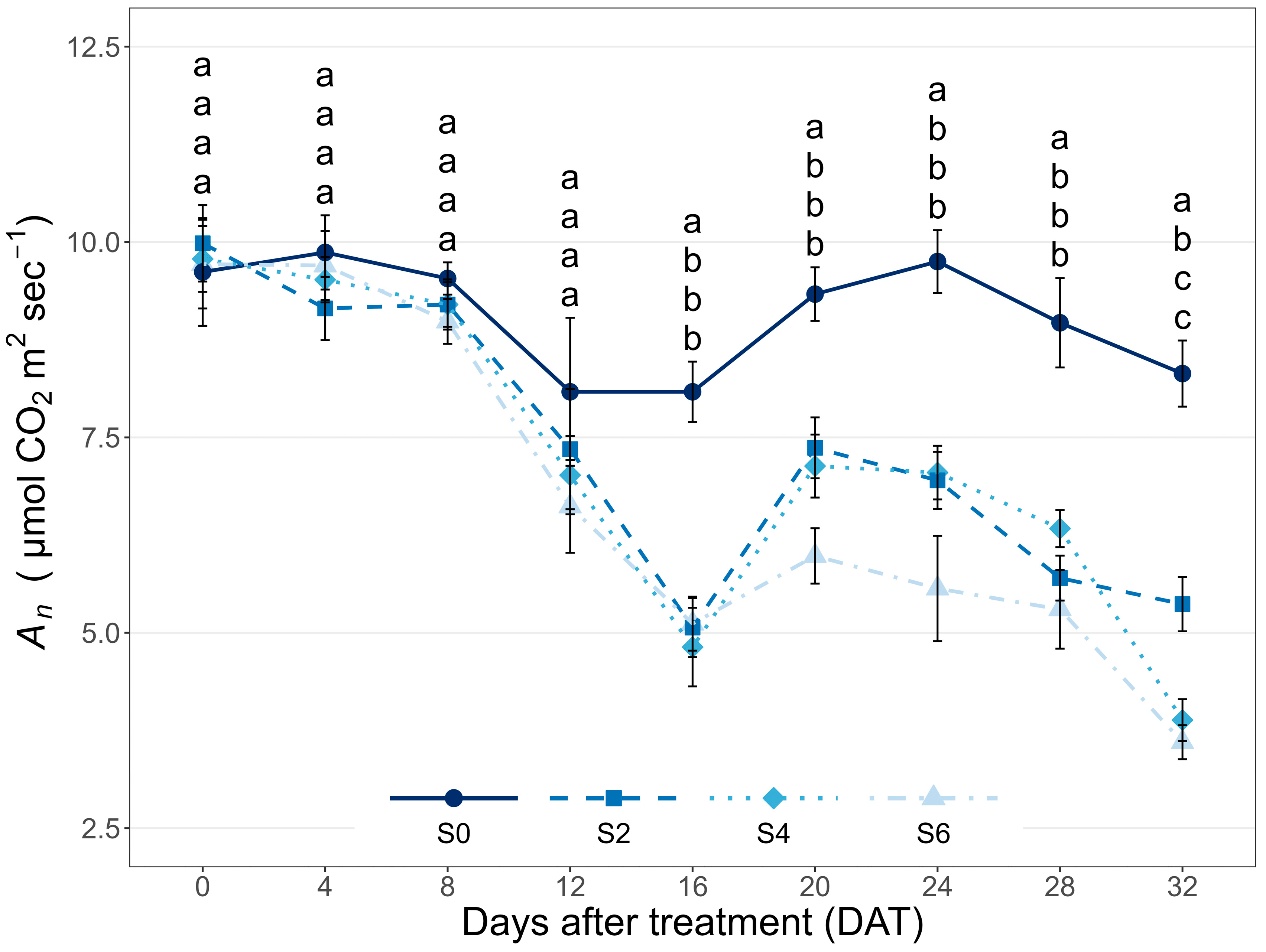
At the beginning of the experiment, before the imposition of the salinity treatments (0 DAT), plants in all the treatments had a similar An of approximately 9.7 μmol CO2 m−2 s−1 (Figure 1). No differences in An were detected until 16 DAT, when An of plants in S2, S4, and S6 treatments decreased to approximately 38% lower than in the control plants (S0). Between 28 and 32 DAT, An of plants in S2, S4, and S6 treatments decreased further, reaching approximately 41% lower than that in the S0 treatment (Figure 1). By 32 DAT at the end of the experiment, An of plants in the S2 treatment remained at minimal levels of approximately 5.4 μmol CO2 m−2 s−1, or approximately 38% lower than in the S0 treatment, and An of plants in the highest salinity treatments (S4, S6) reached an even lower minimum of approximately 3.7 μmol CO2 m−2 s−1, or approximately 55% lower than that of plants in the S0 treatment (Figure 1).
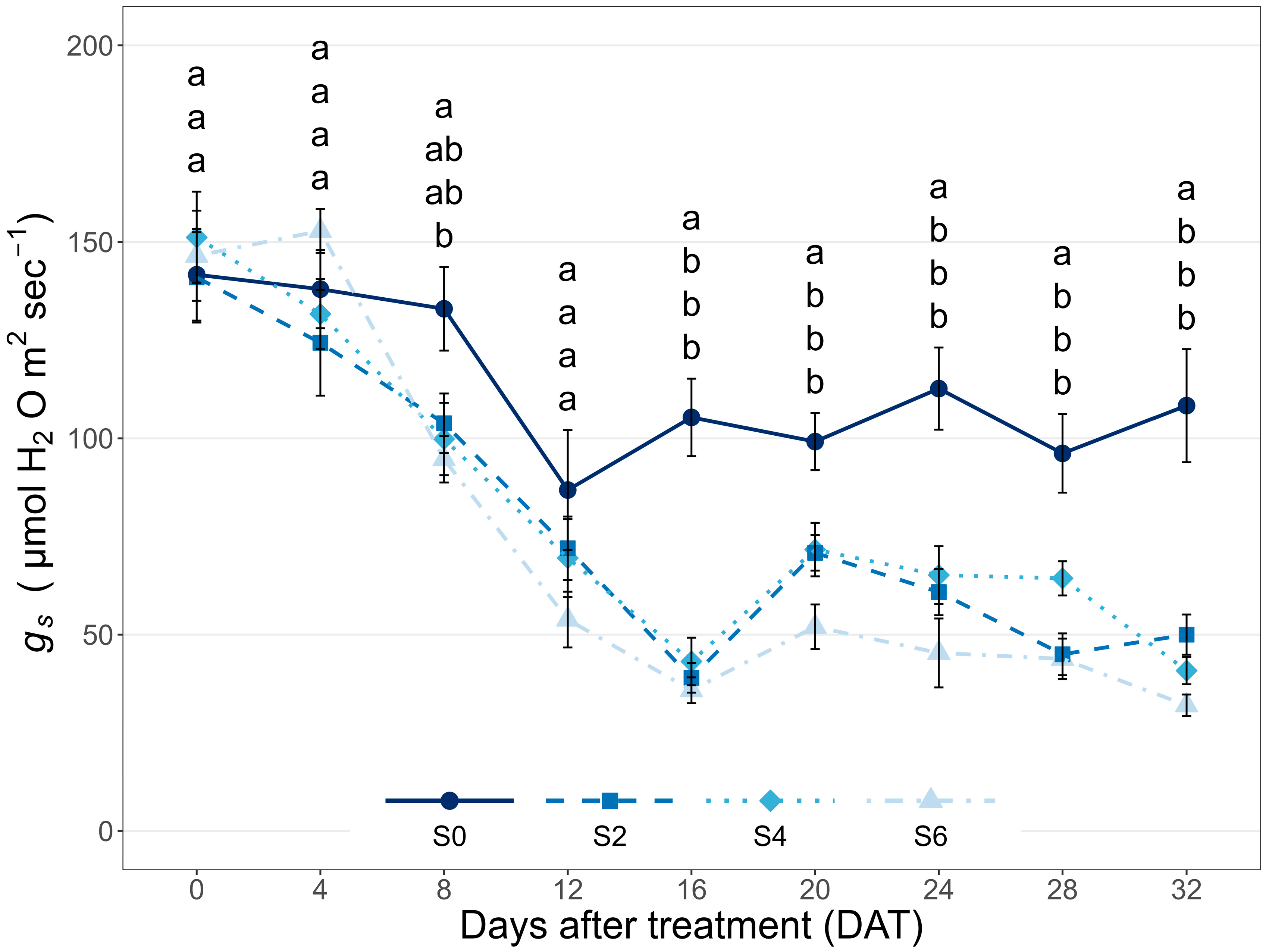
Stomatal conductance (gs) was similar across all treatments between 0 and 8 DAT, averaging approximately 145 µmol H2O m−2 s−1 (Figure 2). Between 10 and 12 DAT, gs in the S2, S4, and S6 treatments began to decline, but values did not differ significantly from S0 until 16 DAT. At that time, gs in the saline treatments was approximately 62% lower than in S0 (Figure 2). From 16 DAT onward, gs in the S2, S4, and S6 treatments continued to decrease gradually, reaching a minimum of approximately 41 µmol H2O m−2 s−1 by 32 DAT, which remained about 62% lower than the S0 treatment (Figure 2).
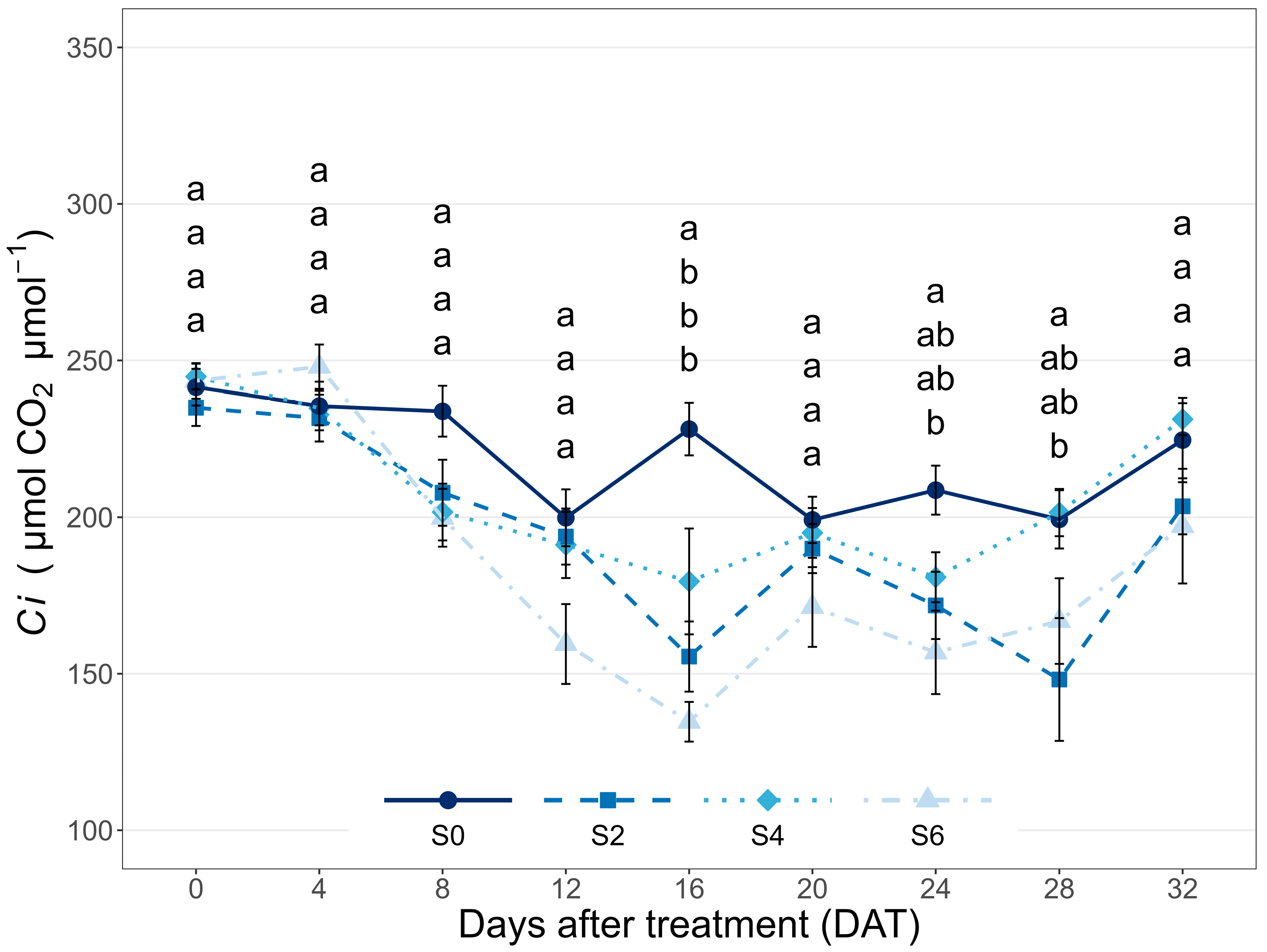
For most of the experiment, Ci was similar among the treatments, although on some days starting between 16 and 28 DAT, plants in the treatments with salt added (S2, S4, S6) showed sporadic decreases in Ci of up to 20% when compared to the control plants (S0); however, most of the differences were not statistically significant (Figure 3).
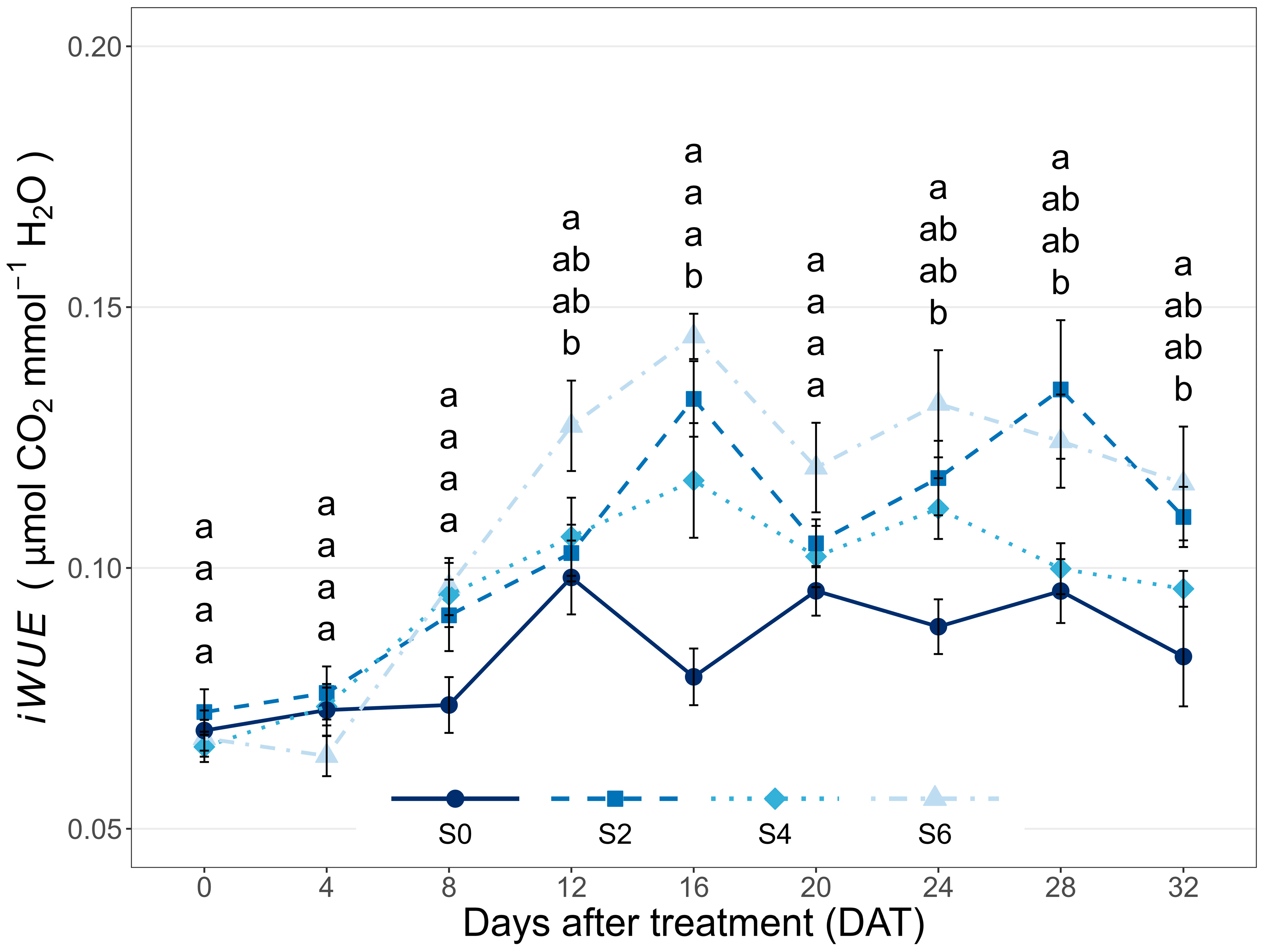
iWUE remained similar among treatments during the early phase of the experiment (0–8 DAT; approximately 0.06 µmol CO2 mmol−1 H2O) but increased in the saline irrigation treatments from 12 DAT onward as gs declined proportionally more than An (Figure 4). During this period, plants in the S2, S4, and S6 treatments frequently exhibited higher iWUE values (approximately 0.10–0.16 µmol CO2 mmol−1 H2O) than control plants (approximately 0.08–0.11 µmol CO2 mmol−1 H2O), with statistically significant differences observed at several sampling dates, particularly in S6 (Figure 4). These increases reflect enhanced stomatal regulation of transpirational water loss rather than improvements in photosynthetic capacity. Linear regressions reinforced these patterns: EC–response slopes for An and gs were near zero early (0–8 DAT) but became linear by 12–16 DAT, with clear dose-dependent declines in both variables at 32 DAT (An R2 = 0.71; gs R2 = 0.54) (Supplementary Figures S3–S6).

3.2. Chlorophyll Fluorescence and Chlorophyll Index

The Fv/Fm ranged from 0.76 to 0.81 in all the treatments for the duration of the experiment, with no significant differences among treatments (Supplementary Figure S1).
The LCI ranged from 60.6 to 65.8 with an average of 62.8 in all treatments for the duration of the experiment, and there were no significant differences among treatments (Supplementary Figure S2).

3.3. Leaf and Root Nutrient Analyses

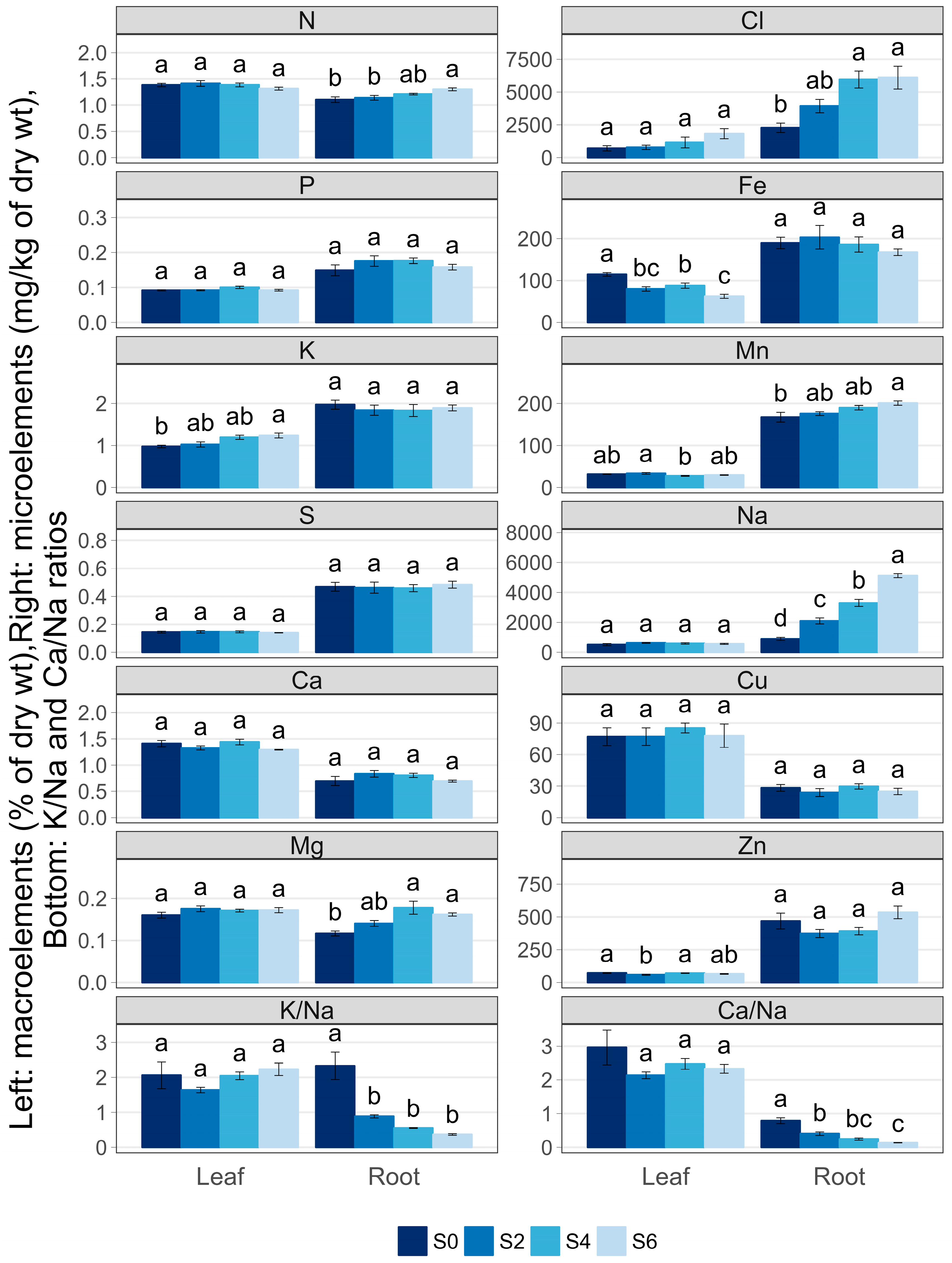
The root N concentration was approximately equal to the concentration in leaves. The concentration of N in roots was highest in the two treatments with the highest salinity, S4 and S6, respectively, which was 10% and 18% higher than in the S0 treatment (Figure 5). There were no differences in the root N concentration between plants in the S2 and the S0 treatments. There were no differences in the leaf N concentrations among treatments (Figure 5).
The concentration of P in roots ranged from 63% to 91% higher than the concentration in leaves. There were no differences in the root or leaf P concentrations among treatments (Figure 5).
The root K concentration ranged from 53% to 102% higher than the leaf K concentration. There were no differences in the root K concentration among treatments and minimal differences in leaf K concentration among treatments (Figure 5).
The root S concentration ranged from 212% to 244% higher than leaf S concentration. There were no differences in the root or leaf S concentrations among treatments (Figure 5).
The root Ca concentration ranged from 37% to 51% lower than the leaf Ca concentration, and there were no differences in the concentrations of Ca in the roots or leaves among treatments (Figure 5).
The root Mg concentration was approximately equal to the leaf Mg concentration. The root Mg concentration for the two treatments with the highest salinity levels S4 and S6, respectively, were 50% and 33% higher than in the S0 treatment. There were no differences in the root Mg concentration between S2 and the S0 treatments. There were no differences in leaf Mg concentration among treatments (Figure 5).
The root Cl concentrations ranged from 225% to 417% higher than leaf Cl concentration. The root Cl concentration was highest in the S2, S4, and S6 treatments, respectively, which was 73%, 162%, and 168% higher than in the S0 treatment, reaching a maximum of approximately 6000 mg kg−1. There were no differences in the leaf Cl concentration among treatments (Figure 5).
The root Fe concentration ranged from 65% to 169% higher than the leaf Fe concentration. There were no differences in the root Fe concentration among treatments. The leaf Fe concentration was lowest in the highest salinity treatment (S6), 12% lower than in the S0 treatment (Figure 5).
The Mn concentrations ranged from 430% to 595% higher in the roots than in the leaves. There were minimal differences in the root or leaf Mn among treatments (Figure 5).
The root Na+ concentration ranged from 76% to 812% higher than the leaf Na+ concentration. The root Na+ concentration was highest for the treatment with the highest salinity (S6), reaching a maximum of approximately 5000 mg kg−1, followed in decreasing order by the S4 and S2 treatments, respectively, which were 468%, 266%, and 133% higher than in the S0 treatment. There were no differences in the leaf Na+ concentration among treatments (Figure 5).
The root K+/Na+ ratio was 60%, 75%, and 83% lower in the S2, S4, and S6 treatments, respectively, compared to the S0 treatment, while the leaf K+/Na+ ratio did not differ significantly among treatments (Figure 5). Similarly, the root Ca2+/Na+ ratio was 49%, 68%, and 82% lower in the S2, S4, and S6 treatments, respectively, than in the S0 treatment, with no significant differences observed in the leaf Ca2+/Na+ ratio across treatments (Figure 5).
The root Cu concentration ranged from 63% to 69% lower than the leaf Cu concentration. There were no differences in the root or leaf Cu concentrations among treatments (Figure 5).
The root Zn concentrations ranged from 457% to 723% higher than the leaf Zn concentrations. There were no differences in the root Zn concentration among treatments and minimal differences in leaf Zn concentration among treatments (Figure 5).

3.4. Antioxidants, Reactive Oxygen Species, and Lipid Peroxidation

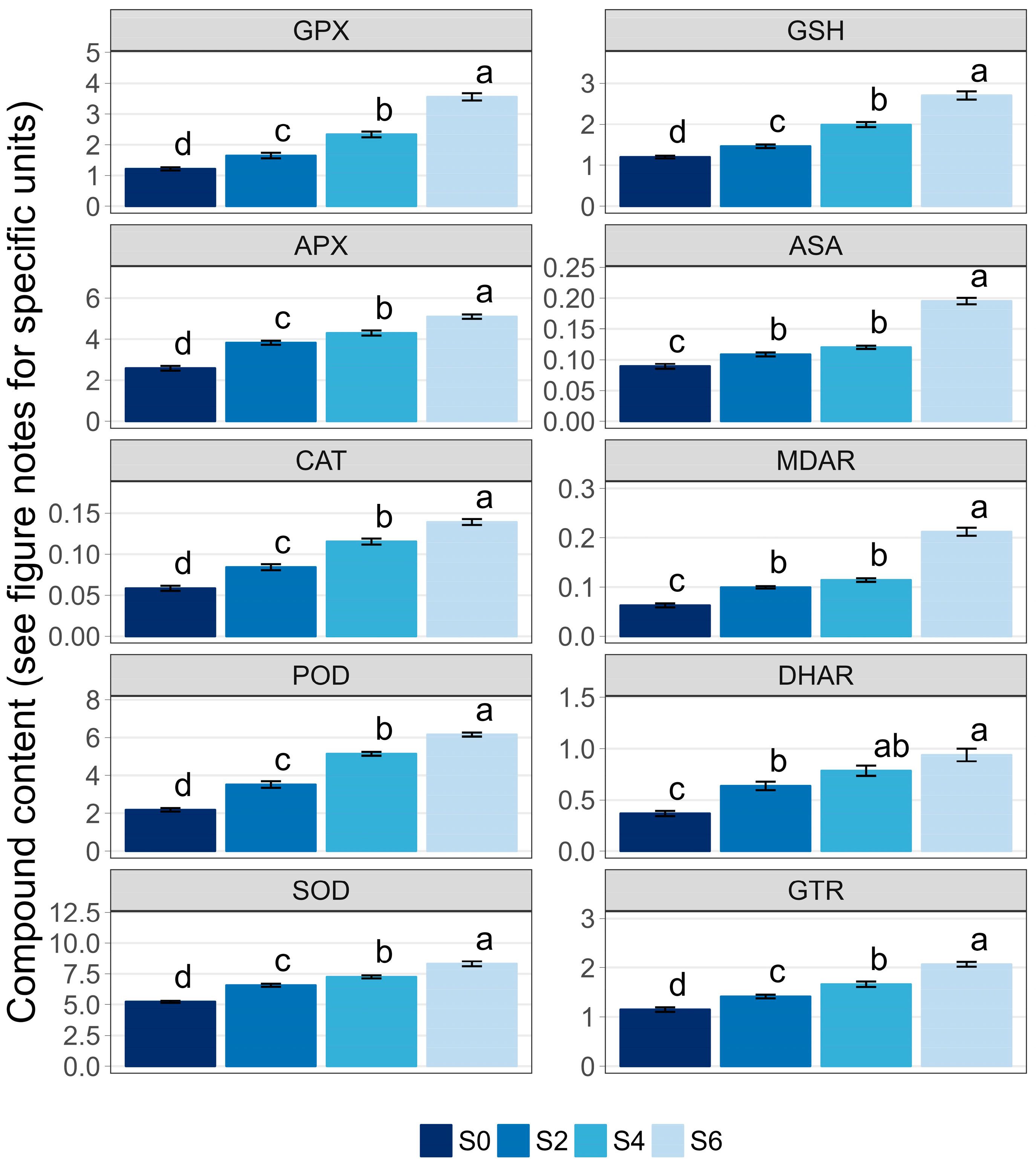
The levels of all antioxidants (SOD, POD, CAT, APX, GPX, GTR, DHAR, MDAR, GSH, and ASA) were higher in all salt-added treatments (S2, S4, S6) compared to the no-salt-added control treatment S0, ranging from 21% to 74% in the S2 treatment, from 35% to 136% in the S4 treatment, and from 59% to 237% in the S6 treatment, indicating a positive correlation between salinity level and antioxidant responses (Figure 6).
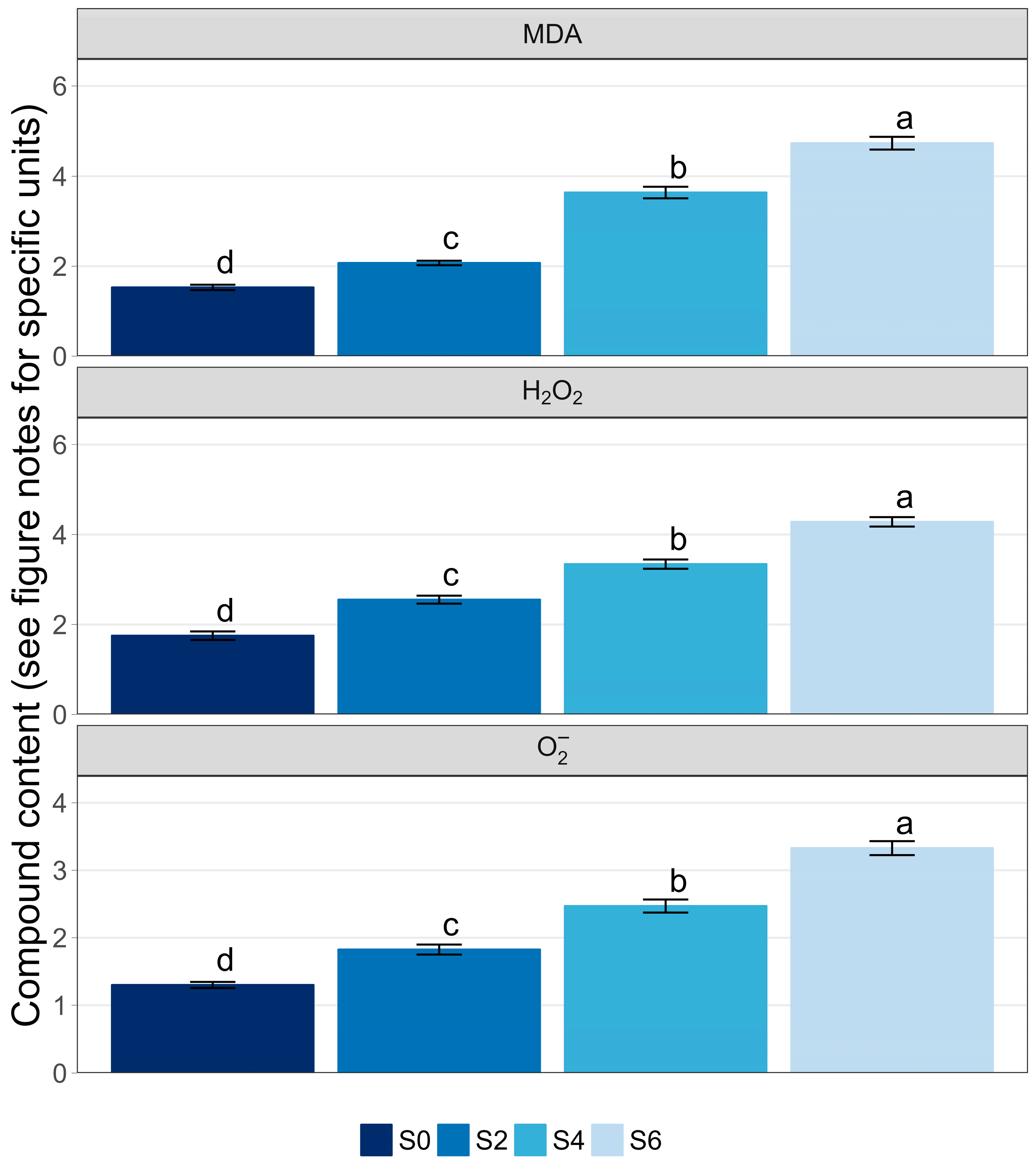
The levels of O2 increased linearly with the salt concentration levels, reaching 41%, 90%, and 156% higher in the S2, S4, and S6 treatments, respectively, compared to the S0 treatment and indicating a positive correlation between salinity level and O2 concentration (Figure 7). The levels of H2O2 increased linearly with the salt concentration, reaching 46%, 91%, and 145% higher in the S2, S4, and S6 treatments, respectively compared to the S0 treatment, indicating a positive correlation between salinity level and H2O2 concentration (Figure 7). The levels of MDA increased linearly with the salt concentration, reaching 35%, 138%, and 210% higher in the S2, S4, and S6 treatments, respectively, compared to the S0 treatment, indicating a positive correlation between salinity level and MDA concentration (Figure 7). Biochemical variables at harvest showed uniformly strong linear increases with EC (antioxidant enzymes R2 = 0.76–0.95; non-enzymatic antioxidants R2 = 0.83–0.92; oxidative markers R2 = 0.94–0.96).

3.5. Morphological Changes

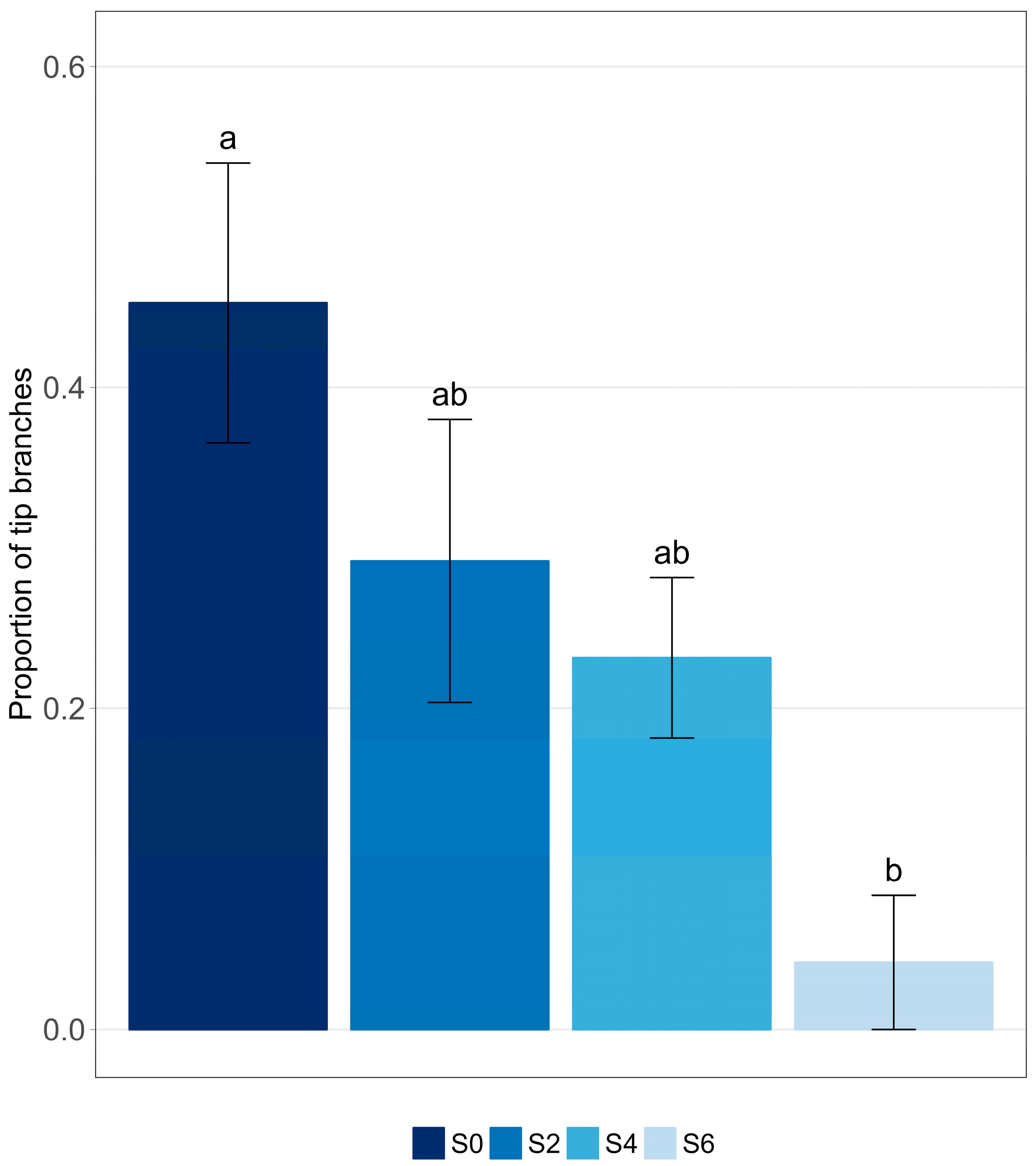
The flushing of branch terminals in G. humilis tends to occur simultaneously on groups of plants and only sporadically during the year. On a flushing cycle that started around 24 DAT, the ratio of flushing branch terminals to non-flushing terminals was 0.44, 0.29, 0.23, and 0.04, respectively, for the S0, S2, S4, and S6 treatments; indicating an inverse relationship between the salinity level and the new growth of branch terminals; however, the differences were only statistically significant between the S0 treatment and the S6 treatment (Figure 8).
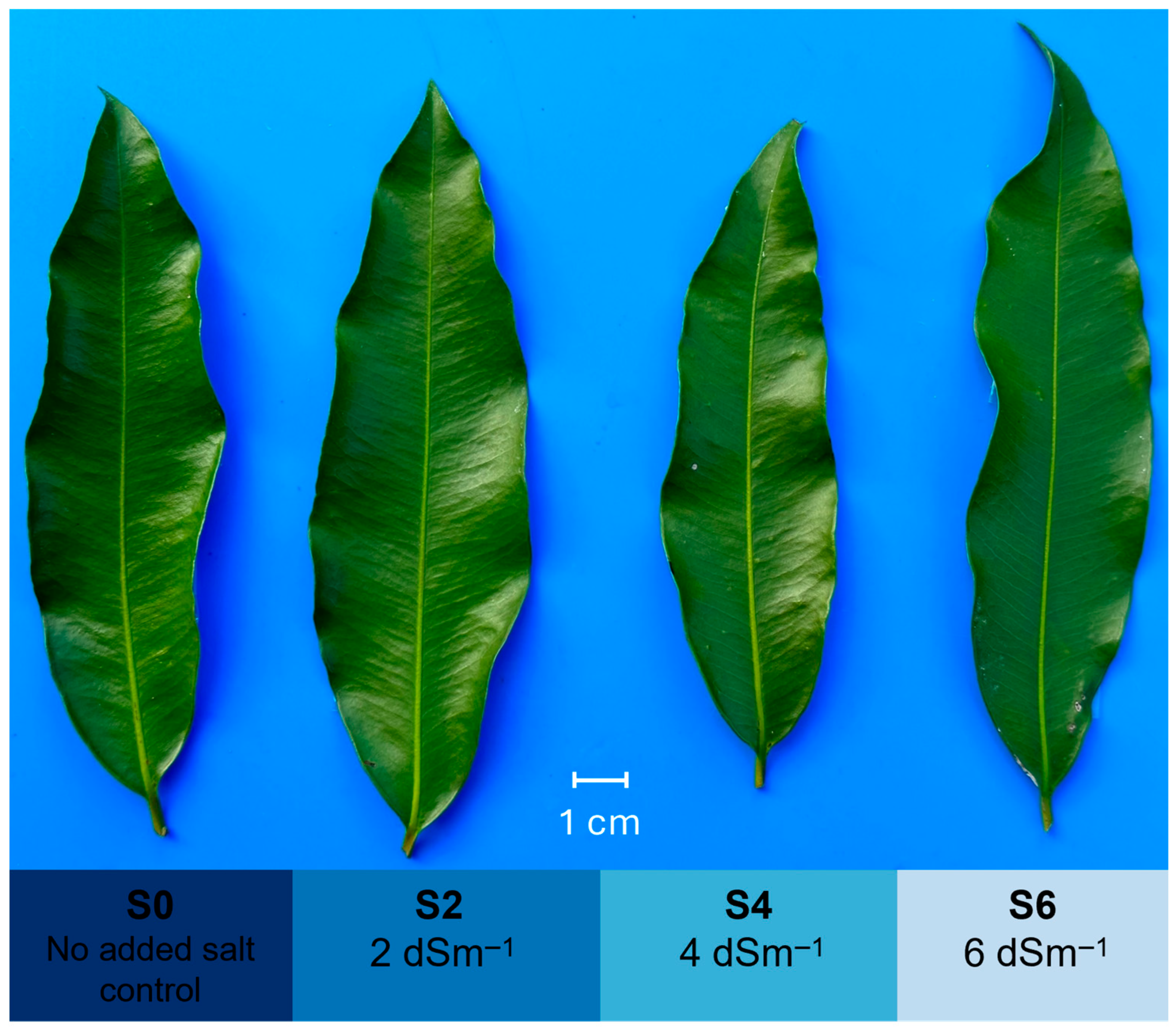
Leaf area was not measured quantitatively in this experiment; therefore, morphological differences were assessed qualitatively. Plants exhibited no leaf dehydration, scorched or necrotic leaf tips, or loss of turgor (Figure 9), which are symptoms commonly seen in salt-sensitive species, suggesting that the response mechanisms in G. humilis were sufficient to prevent externally visible stress responses on leaves even under elevated soil salinity induced by saline irrigation.
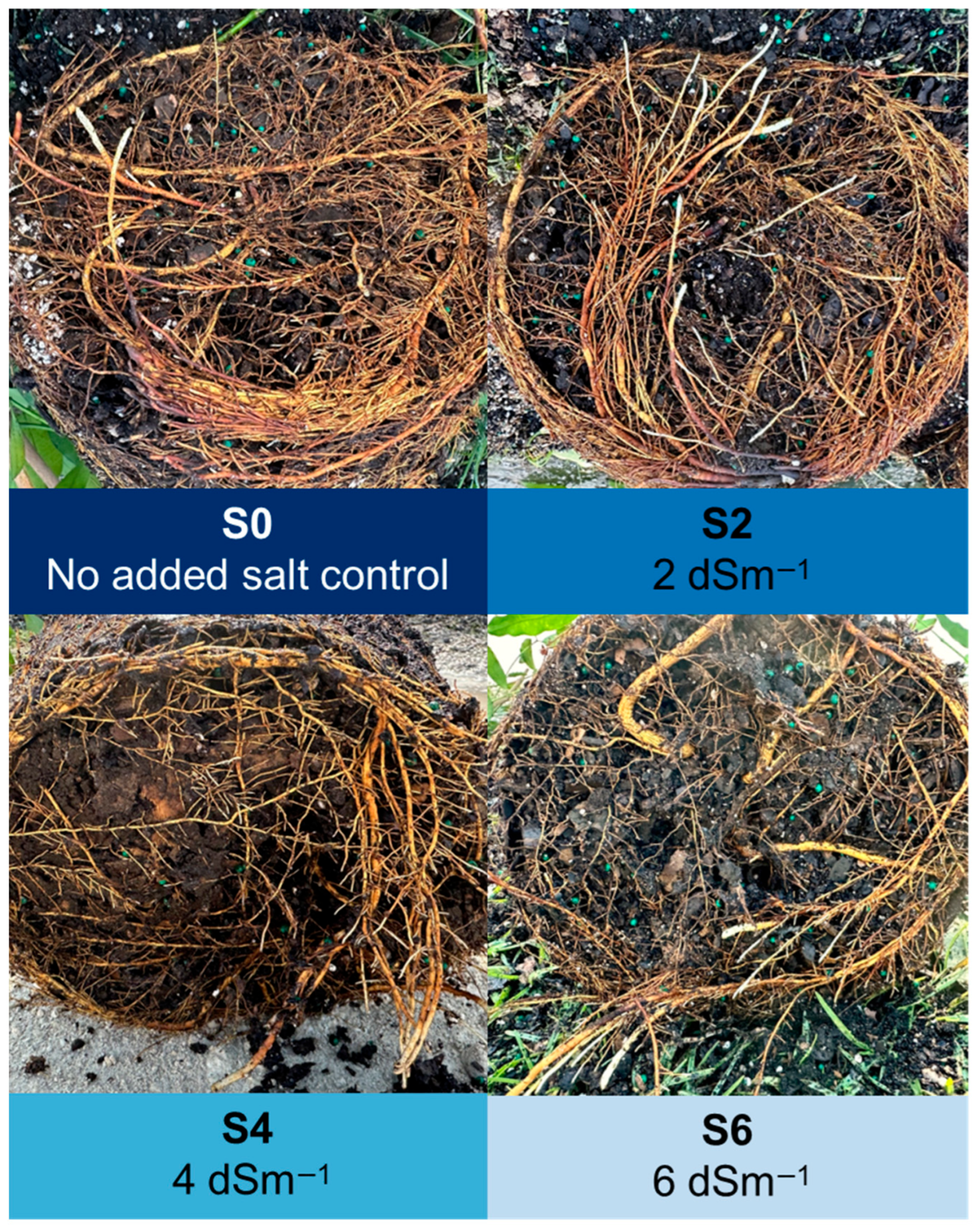
There was no evidence of morphological damage to the root systems at the termination of the experiment across any of the four treatments of soil salinity induced by saline irrigation. Roots appeared structurally intact and visually healthy (Figure 10), with no signs of necrosis, discoloration, or decay typically associated with salt-induced injury. Notably, qualitative visual inspection suggested active root growth in all treatments, as indicated by the presence of white, elongating root tips characteristic of metabolically active feeding roots (Figure 10).

4. Discussion

Most plant species are sensitive to increasing salinity, and tolerance reflects coordinated regulation of ion exclusion, osmotic adjustment, and inducible antioxidant capacity rather than a single discrete trait [10,21]. Accordingly, salinity tolerance is best interpreted as a continuum rather than a binary classification. The present study indicates that soil salinity induced by saline irrigation altered multiple physiological and biochemical variables in G. humilis, but plants maintained functional integrity over 30 d. Increases in salinity have been associated with decreases in photosynthetic activity [21,41,52]. Declines in An and gs became evident by 10 DAT and intensified through 32 DAT, reaching approximately 55% lower An and 62% lower gs in S6 relative to S0 (Figure 1 and Figure 2). The temporal progression of EC–response relationships supported this interpretation. Slopes for An and gs were near zero early (0–8 DAT) but became linear by 12–16 DAT, culminating in clear dose-dependent patterns at 32 DAT (AnR2 = 0.71; gs R2 = 0.54) (Supplementary Figures S3–S6). Biochemical variables measured at harvest displayed uniformly strong linear increases with EC (antioxidant enzymes R2 = 0.76–0.95; non-enzymatic antioxidants R2 = 0.83–0.92; oxidative markers R2 = 0.94–0.96) (Supplementary Figures S7–S19), indicating a transition from early osmotic signaling to sustained ionic–oxidative adjustment [50,51].
Reductions in photosynthesis under salinity may arise from stomatal or non-stomatal limitations. In the present study, the parallel declines in An and gs, together with largely stable Ci, unchanged Fv/Fm, and constant leaf chlorophyll index, indicate that photosynthetic limitation in G. humilis was predominantly stomatal rather than photochemical or biochemical in origin [18,41,52,53,54]. This response pattern is consistent with predominantly stomatal limitation under moderate salinity. Similar responses have been reported in evergreen fruit trees and woody perennials [11,12], and comparable patterns occur in salt-stressed Sorghum, where tight stomatal regulation preserves photochemical capacity [40]. In contrast, declines in Fv/Fm at comparable salinity levels have been reported in salt-sensitive species such as Annona squamosa [14], reinforcing that preserved photochemistry in G. humilis at 6 dS m−1 reflects tolerance rather than early photosystem II (PSII) impairment. The magnitude of the An decline at 6 dS m−1 falls within reported ranges for tropical trees under moderate salinity [55], consistent with predominantly stomatal limitation under short-term exposure [56]. Early salinity responses involving signaling, osmolyte biosynthesis, and antioxidant activation, precede photochemical impairment under salinity, consistent with patterns observed in Reaumuria soongorica [57] and recent syntheses describing coordinated redox and phytohormone signaling under salinity [27].
Together, these findings align with conceptual models describing salinity tolerance as an integrated interplay of osmotic adjustment, ion homeostasis, and inducible antioxidant defenses [22,29]. In G. humilis, the coordinated induction of antioxidant enzymes (SOD, CAT, APX, GPX, and components of the ascorbate–glutathione cycle) occurred in parallel with stable photochemical performance and low leaf Na+ and Cl concentrations, indicating regulated osmotic–redox acclimation rather than ion-induced oxidative injury. Comparable coupling between antioxidant activation, Na+/K+ homeostasis, and preservation of PSII integrity has been reported in salt-tolerant woody species such as olive (Olea europaea), Malus, and avocado (Persea gratissima) [31,37,45,56,58], indicating that moderate increases in MDA reflect controlled redox signaling rather than progressive lipid peroxidation [27,59,60].
In salt-tolerant glycophytes, antioxidant induction is frequently coordinated with the accumulation of compatible osmolytes, including proline, glycine betaine, and soluble sugars, which support osmotic adjustment and membrane stability under salinity [49,61,62]. Although these osmolytes were not quantified here, the combination of restricted Na+ and Cl translocation to leaves, stable leaf K+/Na+ ratios, and strong antioxidant responses in G. humilis is consistent with this integrated tolerance framework. Collectively, these results support a model in which salinity tolerance depends less on minimizing total NaCl acquisition at the whole-plant level than on coordinated regulation of ion partitioning, osmotic adjustment, and inducible ROS-scavenging pathways [22,29,37,56,61].
One of the most noticeable impacts of salinity sensitivity in plants is a reduction in growth, which eventually leads to lower biomass accumulation and stunting [13,62]; specifically, the development of lateral buds is slowed, or these are forced to remain quiescent, resulting in a reduced rate of lateral flushes [15]. Because G. humilis is inherently slow growing, no measurable changes in height, biomass, or leaf number were detected over 30 d. However, a late flushing event initiated near the end of the experiment, and the proportion of flushing branch terminals declined with elevated soil salinity induced by saline irrigation (0.45, 0.29, 0.23, and 0.04 in S0, S2, S4, and S6, respectively; Figure 8), indicating reduced initiation of new vegetative growth under higher EC.
Increased salinity commonly leads to decreases in uptake and tissue concentration of macronutrients such as N, P, K, Ca, and Mg in non-tolerant species [3]. In the present study, the concentration of these nutrients in leaf and root tissues was either not different in S2 and S4 or slightly higher in S6 than in the S0 treatment (Figure 5), indicating maintenance of nutrient homeostasis under levels of soil salinity induced by saline irrigation up to 6 dS m−1. An increase in N concentration in tissues is often associated with the accumulation of NCC, such as compatible osmolytes, amino acids, heat-shock proteins, and other NCC that may play roles in salinity tolerance [22,37,59,60]. In the present study, root N concentrations were higher in the S4 and S6 treatments (Figure 5), consistent with enhanced NCC under salinity. In salt-sensitive species, decreases in tissue N are frequently attributed to competitive inhibition of NO3 uptake by Cl at supra-optimal chloride concentrations [19,22,37,59,60]. However, recent work indicates that when Cl remains within its beneficial macronutrient range, it can contribute to osmotic adjustment and improved N-use efficiency rather than consistently antagonizing nitrate uptake [20]. In the present study, G. humilis leaf Cl concentrations remained low and non-toxic, while root N increased under elevated soil salinity induced by saline irrigation, suggesting that NO3 uptake was not impaired and that nitrogen-rich osmolyte pools likely contributed to osmotic adjustment and stress tolerance. Comparable shifts in carbon–nitrogen metabolism have been reported in Prunus rootstocks exposed to flooding and salinity [49], consistent with integrated osmotic and metabolic acclimation in woody crops [63,64,65].
The ability to sequester Na+ and Cl in root cell vacuoles and to restrict their transport to aboveground tissues is a well-established salinity-tolerance mechanism in glycophytic species [15,34,35,50]. In the present study, Na+ and Cl concentrations increased proportionally in roots while remaining low and unchanged in leaves (Figure 5), indicating exclusion of toxic ions from photosynthetically active tissues. This pattern reflects a classical ion-avoidance strategy that limits upward ion transport [15,66].
Root Na+ and Cl accumulation increased with elevated soil salinity induced by saline irrigation, although the specific subcellular compartments involved cannot be resolved from the present data. Within this context, the concurrent increases in ROS markers and antioxidant activities (Figure 5 and Figure 6) are best interpreted as protective osmotic and redox adjustments rather than evidence of ion-induced oxidative injury [23,25,26]. Accordingly, antioxidant activation in G. humilis reflects regulated stress signaling rather than biochemical damage.
Quantitatively, leaf Cl concentrations in all treatments were approximately 2000 mg kg−1 DW, placing them at the lower end of the beneficial range reported for glycophytic species, whereas root Cl concentrations of approximately 6000 mg kg−1 DW remained below or near published toxicity thresholds for woody crops [34,36]. These values are well below documented toxicity thresholds of 4000–7000 mg kg−1 of DW for chloride-sensitive fruit trees [34,36]. Root Na+ concentrations increased sharply with elevated soil salinity induced by saline irrigation, while leaf Na+ remained low and statistically unchanged, consistent with strong shoot exclusion of Na+, which is a pattern observed in salt-tolerant Populus euphratica and Na+-excluding Arabidopsis lines [38,56]. Together, these patterns indicate that G. humilis retains Na+ and Cl primarily in roots, maintains non-toxic leaf ion levels, and protects the photosynthetic apparatus from ion-specific damage. Similar root-restricted ion accumulation patterns have been documented in salinity-tolerant woody species, including Populus alba, where split-root experiments revealed strong root–shoot partitioning and selective nutrient retention under heterogeneous NaCl exposure [67]. Because leaf Na+ and Cl remained in the beneficial but non-toxic range while the present study documented increased root N at higher soil salinity induced by saline irrigation, we propose as a working hypothesis that osmotic adjustment in G. humilis may be supported in part by organic, nitrogen-containing compatible solutes (for example, proline, glycine betaine, and soluble sugars) rather than by large NaCl accumulation in leaf tissues, as reported for salt-tolerant cereals, legumes, and woody perennials that accumulate nitrogen-rich osmolytes under salinity [22,37,58,61,68]. However, this mechanism remains to be tested explicitly in G. humilis.
Under saline conditions, increased Na+ uptake commonly leads to reduced K+ availability because Na+ competes for enzyme binding sites and transport pathways [69]. In the present study, root K+ concentrations did not differ among treatments, and leaf K+ concentrations were slightly but significantly higher in the treatments with higher soil salinity induced by saline irrigation S4 and S6 (Figure 5), indicating effective maintenance of K+ homeostasis despite increased Na+ availability.
The K+/Na+ ratio is a well-established indicator of salinity tolerance, reflecting a plant’s capacity to maintain ionic homeostasis under saline conditions. In the present study, the root K+/Na+ ratio was substantially lower in the treatments with elevated soil salinity induced by saline irrigation (S2, S4, S6) than in the S0 treatment, while the leaf K+/Na+ ratio remained consistent across treatments including the S0 treatment (Figure 5). This provides strong evidence that G. humilis effectively compartmentalized Na+ within root tissues, thereby limiting its translocation to the shoot, which is a key mechanism associated with salt tolerance in diverse plant species [50]. Notably, the leaf K+/Na+ ratio remained above 1.5 among all treatments, exceeding the critical threshold of 1.0 commonly associated with the maintenance of metabolic activity and the avoidance of Na+ toxicity [66].
Maintaining membrane integrity, cell wall stability, and ion selectivity under saline conditions depends heavily on adequate Ca availability. A low Ca2+/Na+ ratio is widely recognized as a contributor to membrane destabilization, impaired ion transport, and inhibited growth under salt stress, with ratios below 0.2 often associated with increased membrane permeability and ion leakage [50]. In the present study, the Ca2+/Na+ ratio in root tissues was lower in the elevated soil salinity induced by saline irrigation treatments (S2, S4, S6) than S0 treatment, consistent with enhanced Na+ accumulation and sequestration in the roots—a pattern frequently observed in salt-tolerant species. Importantly, absolute Ca2+ concentrations did not differ among treatments; therefore, the lower Ca2+/Na+ ratios in roots under soil salinity induced by saline irrigation reflect increased Na+ rather than Ca2+ depletion. However, leaf Ca2+/Na+ ratios remained above 2.0 in all treatments, well above the critical threshold, indicating effective exclusion of Na+ from shoots and maintenance of membrane function under elevated soil salinity induced by saline irrigation.
Salinity is known to disrupt Ca2+ uptake and transport due to ionic competition with Na+, often leading to Ca deficiency, impaired membrane stability, and weakened stress signaling [50]. In contrast, plants that maintain adequate Ca concentrations under saline conditions are typically better equipped to preserve membrane integrity, mitigate oxidative stress, and activate Ca-dependent signaling pathways that are essential for salt tolerance [12,70]. In the present study, G. humilis maintained stable Ca levels in both root and leaf tissues across all treatments with elevated soil salinity induced by saline irrigation (S2, S4, S6), suggesting the presence of effective ion exclusion, compartmentalization, or selective transport mechanisms. This capacity to preserve Ca homeostasis, particularly in roots where Na+ interference is greatest, is a hallmark of salt-tolerant species and supports the interpretation that G. humilis tolerates elevated soil salinity induced by saline irrigation levels up to 6 dS m−1 for at least 30 d under the conditions tested.
The accumulation of toxic ions in leaf tissue severely impacts photosynthetic activity; Na+ accumulation in leaves is associated with large decreases in gs, and Cl accumulation in leaves degrades chlorophyll [71]. In the present study, G. humilis exhibited tolerance to elevated soil salinity induced by saline irrigation up to 6 dS m−1, consistent with the findings from studies of tropical inland trees. A study of neotropical trees indicated that inland species had low tolerance to salinity above 6 dS m−1 compared with coastal species, and that tolerance is associated with the ability to maintain adequate K levels and prevent increases in foliar Na+ and Cl [72]. Similarly, seedlings of Acca sellowiana, another neotropical inland fruit tree, demonstrated moderate salinity tolerance up to 6 dS m−1 [73].
The ability of G. humilis to restrict Na+ and Cl accumulation to roots rather than leaves likely contributed to the maintenance of photosynthetic activity under elevated levels of soil salinity induced by saline irrigation as high as 6 dS m−1. In addition, the capacity of G. humilis to maintain relatively stable cytosolic K+ levels despite elevated Na+ is a recognized trait of salt tolerance and is associated with selective K+ transport, Na+ sequestration, and genetic control of K+ homeostasis [12]. In the present study, G. humilis demonstrated clear tolerance to soil salinity induced by saline irrigation levels up to 4 dS m−1 and moderate tolerance at 6 dS m−1, suggesting that the latter may approach the upper threshold of its salinity tolerance through saline irrigation. Consistent with this interpretation, no visible signs of foliar injury were observed in any treatment with elevated soil salinity induced by saline irrigation relative to the control (Figure 9).
While this study provides physiological and biochemical evidence of tolerance to elevated soil salinity through irrigation in G. humilis, future work should address the underlying molecular and cellular mechanisms. Salinity-responsive gene-expression profiling could identify regulatory networks involved in ion homeostasis and stress signaling [74,75]. Functional assays of ion transporters involved in Na+ and K+ regulation (e.g., HKT, SOS, NHX families) would further clarify exclusion and sequestration mechanisms [17,66]. Quantification of chlorophyll a and b would refine assessment of photosynthetic stability [2,76]. In addition, chemical priming with brassinosteroids merits investigation, as 24-epibrassinolide mitigates physiological impairment under salinity and combined salinity–flooding stress [77].
The qualitative morphological responses observed in this experiment reinforce the physiological interpretation that G. humilis experienced mild osmotic limitation without progressing to structural or photochemical injury. Leaves retained full turgor, green coloration, and intact margins, with no symptoms of necrosis or chlorosis typical of salt-sensitive woody species [15,44]. Stable LCI and Fv/Fm values indicate preservation of chlorophyll pools and PSII function [78,79]. Root systems exhibited white, elongating apices across all treatments, consistent with salt-excluding strategies that restrict ion accumulation to older root tissues [80]. Together, these morphological observations corroborate physiological and biochemical evidence that G. humilis undergoes short-term osmotic acclimation without structural damage or severe ionic toxicity at elevated levels of soil salinity induced by saline irrigation up to 6 dS m−1.

5. Conclusions

The present study indicates that young G. humilis trees can withstand 30 d of elevated soil salinity induced by saline irrigation up to 6 dS m−1 under greenhouse conditions without visible shoot or root injury or loss of photochemical efficiency despite marked reductions in An and gs. Although An and gs declined by 50–60% relative to controls, plants preserved basal photosynthetic capacity, as indicated by stable Fv/Fm and leaf chlorophyll index across treatments. iWUE increased at several mid-experiment dates because gs decreased proportionally more than An, consistent with a stomatal-regulated water-conservation response rather than photochemical impairment. Vegetative flushing was reduced under elevated soil salinity induced by saline irrigation, indicating a measurable but moderate growth penalty during the 30 d exposure.
The whole-plant ion profile indicates a predominantly ion-avoidance strategy. Elevated soil salinity induced by saline irrigation did not cause major nutrient depletion in leaves or roots; instead, Na+ and Cl accumulated primarily in roots, while leaf concentrations remained low and within non-toxic ranges. This pattern allowed G. humilis to maintain favorable leaf K+/Na+ and Ca2+/Na+ ratios, consistent with salt-tolerant glycophyte behavior [15]. Increases in ROS and MDA were proportionally counterbalanced by enhanced antioxidant activity, helping maintain pigment integrity, protect PSII, and limit membrane lipid peroxidation [23,43]. Together, these coordinated responses indicate moderate short-term salinity tolerance under the conditions tested.
From a horticultural perspective, the ability of G. humilis to sustain functional photosynthesis, stable photochemistry, and intact shoot and root systems under moderate soil salinity induced by saline irrigation suggests potential for expanding fruit production in marginal, salinizing environments. In coastal and near-coastal regions increasingly affected by seawater intrusion, brackish irrigation water, and storm-surge events, G. humilis may represent a resilient fruit-crop option. The responses to elevated soil salinity induced by saline irrigation documented here, combined with previously reported tolerance to prolonged flooding and to combined flooding–salinity stress [81], strengthen the case for its horticultural development. Because the present findings apply specifically to two-year-old container-grown plants under a 30 d exposure, long-term field studies remain necessary to evaluate impacts on growth, yield, and fruit quality under commercial production conditions.

Supplementary Materials

The following supporting information can be downloaded at: https://www.mdpi.com/article/10.3390/horticulturae12010020/s1. Supplementary Figure S1. Maximum photochemical efficiency of photosystem II (Fv/Fm) in G. humilis in response to four salinity levels (S0 = 0 dS m−1, S2 = 2 dS m−1, S4 = 4 dS m−1, S6 = 6 dS m−1). Symbols represent treatment means (n = 6 single-plant biological replicates), and error bars indicate ± SEM. Different letters indicate significant differences among treatments (Tukey’s HSD, p <= 0.05). Supplementary Figure S2. Leaf chlorophyll index (LCI; SPAD units) in G. humilis in response to four salinity levels (S0 = 0 dS m−1, S2 = 2 dS m−1, S4 = 4 dS m−1, S6 = 6 dS m−1). Symbols represent treatment means (n = 6 single-plant biological replicates), and error bars indicate ± SEM. Different letters indicate significant differences among treatments (Tukey’s HSD, p <= 0.05). Supplementary Figure S3. Linear relationships between net CO2 assimilation rate (An) and salinity level in G. humilis in response to four salinity levels (S0 = 0 dS m−1, S2 = 2 dS m−1, S4 = 4 dS m−1, S6 = 6 dS m−1). Symbols represent treatment means (n = 6). Regression lines, equations, and R2 values are shown. Supplementary Figure S4. Linear regressions describing stomatal conductance (gs) in G. humilis in response to four salinity levels (S0 = 0 dS m−1, S2 = 2 dS m−1, S4 = 4 dS m−1, S6 = 6 dS m−1). Points represent treatment means (n = 6). Regression lines, equations, and R2 values are displayed. Supplementary Figure S5. Linear regressions describing internal CO2 concentration (Ci) in G. humilis in response to four salinity levels (S0 = 0 dS m−1, S2 = 2 dS m−1, S4 = 4 dS m−1, S6 = 6 dS m−1). Symbols represent treatment means (n = 6). Regression lines include equations and R2 values. Supplementary Figure S6. Linear regressions of intrinsic water-use efficiency (iWUE = An/gs) in G. humilis in response to four salinity levels (S0 = 0 dS m−1, S2 = 2 dS m−1, S4 = 4 dS m−1, S6 = 6 dS m−1). Points represent treatment means (n = 6). Regression lines, equations, and R2 values are presented. Supplementary Figure S7. Linear relationship between malondialdehyde (MDA) concentration and salinity level in G. humilis in response to four salinity levels (S0 = 0 dS m−1, S2 = 2 dS m−1, S4 = 4 dS m−1, S6 = 6 dS m−1). Points represent treatment means (n = 6). Regression line, equation, and R2 value are shown. Supplementary Figure S8. Linear regression between hydrogen peroxide (H2O2) concentration and salinity level in G. humilis in response to four salinity levels (S0 = 0 dS m−1, S2 = 2 dS m−1, S4 = 4 dS m−1, S6 = 6 dS m−1). Points represent treatment means (n = 6). Regression line, equation, and R2 value are presented. Supplementary Figure S9. Linear regression describing superoxide radical (O2-) production in G. humilis in response to four salinity levels (S0 = 0 dS m−1, S2 = 2 dS m−1, S4 = 4 dS m−1, S6 = 6 dS m−1). Symbols represent treatment means (n = 6). Regression line, equation, and R2 value are shown. Supplementary Figure S10. Linear regression between ascorbate peroxidase (APX) activity and salinity level in G. humilis in response to four salinity levels (S0 = 0 dS m−1, S2 = 2 dS m−1, S4 = 4 dS m−1, S6 = 6 dS m−1). Points represent treatment means (n = 6). Regression line, equation, and R2 value are displayed. Supplementary Figure S11. Linear regression between reduced ascorbate (ASA) concentration and salinity level in G. humilis in response to four salinity levels (S0 = 0 dS m−1, S2 = 2 dS m−1, S4 = 4 dS m−1, S6 = 6 dS m−1). Symbols represent treatment means (n = 6). Regression line, equation, and R2 value are shown. Supplementary Figure S12. Linear regression between catalase (CAT) activity and salinity level in G. humilis in response to four salinity levels (S0 = 0 dS m−1, S2 = 2 dS m−1, S4 = 4 dS m−1, S6 = 6 dS m−1). Points represent treatment means (n = 6). Regression line, equation, and R2 are displayed. Supplementary Figure S13. Linear regression between dehydroascorbate reductase (DHAR) activity and salinity level in G. humilis in response to four salinity levels (S0 = 0 dS m−1, S2 = 2 dS m−1, S4 = 4 dS m−1, S6 = 6 dS m−1). Points represent treatment means (n = 6). Regression line, equation, and R2 value are provided. Supplementary Figure S14. Linear regression between guaiacol peroxidase (GPX) activity and salinity level in G. humilis in response to four salinity levels (S0 = 0 dS m−1, S2 = 2 dS m−1, S4 = 4 dS m−1, S6 = 6 dS m−1). Points represent treatment means (n = 6). Regression line, equation, and R2 value are shown. Supplementary Figure S15. Linear regression between reduced glutathione (GSH) concentration and salinity level in G. humilis in response to four salinity levels (S0 = 0 dS m−1, S2 = 2 dS m−1, S4 = 4 dS m−1, S6 = 6 dS m−1). Symbols represent treatment means (n = 6). Regression line, equation, and R2 value are provided. Supplementary Figure S16. Linear regression between glutathione reductase (GTR) activity and salinity level in G. humilis in response to four salinity levels (S0 = 0 dS m−1, S2 = 2 dS m−1, S4 = 4 dS m−1, S6 = 6 dS m−1). Points represent treatment means (n = 6). Regression line, equation, and R2 value are shown. Supplementary Figure S17. Linear regression between monodehydroascorbate reductase (MDAR) activity and salinity level in G. humilis in response to four salinity levels (S0 = 0 dS m−1, S2 = 2 dS m−1, S4 = 4 dS m−1, S6 = 6 dS m−1). Points represent treatment means (n = 6). Regression line, equation, and R2 value are presented. Supplementary Figure S18. Linear regression between peroxidase (POD) activity and salinity level in G. humilis in response to four salinity levels (S0 = 0 dS m−1, S2 = 2 dS m−1, S4 = 4 dS m−1, S6 = 6 dS m−1). Symbols represent treatment means (n = 6). Regression line, equation, and R2 value are displayed. Supplementary Figure S19. Linear regression between superoxide dismutase (SOD) activity and salinity level in G. humilis in response to four salinity levels (S0 = 0 dS m−1, S2 = 2 dS m−1, S4 = 4 dS m−1, S6 = 6 dS m−1). Points represent treatment means (n = 6). Regression line, equation, and R2 value are shown.

Author Contributions

Conceptualization, F.W.S., B.S., J.H.C., A.S., M.A.S. and H.K.B.; methodology, F.W.S., A.S. and B.S.; investigation, F.W.S., B.S. and M.A.S.; formal analysis, F.W.S. and B.S.; writing—original draft preparation, F.W.S. and B.S.; writing—review and editing, F.W.S., B.S., J.H.C., A.S., M.A.S. and H.K.B. All authors have read and agreed to the published version of the manuscript.

Funding

This research received no external funding.

Data Availability Statement

The data will be made available upon request. The data are not publicly available because they form part of ongoing research and will support additional planned publications.

Conflicts of Interest

The authors declare no conflicts of interest.

Abbreviations

The following abbreviations are used in this manuscript:
Annet CO2 assimilation
APXascorbate peroxidase
ASAascorbic acid
Cacalcium
CATcatalase
Ciinternal CO2 concentration
Clchloride
Cucopper
Dday
DHARdehydroascorbate reductase
ECelectrical conductivity
Feiron
Fv/Fmratio of variable to maximum chlorophyll fluorescence
FWfresh weight
GPXguaiacol peroxidase
gsstomatal conductance of water vapor
GSHglutathione
GTRglutathione reductase
H2O2hydrogen peroxide
iWUEintrinsic water-use efficiency (An/gs)
KPotassium
LCIleaf chlorophyll index
MDAmalondialdehyde
MDARmonodehydroascorbate reductase
Mgmagnesium
Mnmanganese
Nnitrogen
Nasodium
NCCnitrogen-containing compounds
O2superoxide radical
Pphosphorous
PARphotosynthetically active radiation
PSIIphotosystem II
PODperoxidase
PPFDphotosynthetic photon flux density
ROSreactive oxygen species
Ssulfur
SODsuperoxide dismutase
Znzinc

References

  1. Bayabil, H.K.; Li, Y.; Crane, J.; Schaffer, B.; Smyth, A.; Zhang, S.; Evans, E.A.; Blare, T. Saltwater Intrusion and Flooding: Risks to South Florida’s Agriculture and Potential Management Practices: AE572/AE572, 5/2022. EDIS 2022, 2022. [Google Scholar] [CrossRef]
  2. Parida, A.K.; Das, A.B. Salt Tolerance and Salinity Effects on Plants: A Review. Ecotoxicol. Environ. Saf. 2005, 60, 324–349. [Google Scholar] [CrossRef] [PubMed]
  3. Parihar, P.; Singh, S.; Singh, R.; Singh, V.P.; Prasad, S.M. Effect of Salinity Stress on Plants and Its Tolerance Strategies: A Review. Environ. Sci. Pollut. Res. 2015, 22, 4056–4075. [Google Scholar] [CrossRef] [PubMed]
  4. Barlow, P.M.; Reichard, E.G. Saltwater Intrusion in Coastal Regions of North America. Hydrogeol. J. 2010, 18, 247–260. [Google Scholar] [CrossRef]
  5. Wang, F.; Shi, Z.; Biswas, A.; Yang, S.; Ding, J. Multi-Algorithm Comparison for Predicting Soil Salinity. Geoderma 2020, 365, 114211. [Google Scholar] [CrossRef]
  6. Shrivastava, P.; Kumar, R. Soil Salinity: A Serious Environmental Issue and Plant Growth Promoting Bacteria as One of the Tools for Its Alleviation. Saudi J. Biol. Sci. 2015, 22, 123–131. [Google Scholar] [CrossRef]
  7. Rhoades, J.D.; Kandiah, A.; Mashali, A.M.; Rhoades, J.D. The Use of Saline Waters for Crop Production; FAO irrigation and drainage paper; Food and Agriculture Organization of the United Nations: Rome, Italy, 1992; ISBN 978-92-5-103237-4. [Google Scholar]
  8. Hassani, A.; Azapagic, A.; Shokri, N. Global Predictions of Primary Soil Salinization under Changing Climate in the 21st Century. Nat. Commun. 2021, 12, 6663. [Google Scholar] [CrossRef]
  9. Raza, A.; Khare, T.; Zhang, X.; Rahman, M.M.; Hussain, M.; Gill, S.S.; Chen, Z.-H.; Zhou, M.; Hu, Z.; Varshney, R.K. Novel Strategies for Designing Climate-Smart Crops to Ensure Sustainable Agriculture and Future Food Security. J. Sustain. Agric. Environ. 2025, 4, e70048. [Google Scholar] [CrossRef]
  10. Zhu, J.-K. Plant Salt Tolerance. Trends Plant Sci. 2001, 6, 66–71. [Google Scholar] [CrossRef]
  11. Marler, T.E. Ionomic Responses of Papaya and Sapodilla Plants to Two Forms of Root-Zone Salinity. In Proceedings of the 2018 ASHS Annual Conference. ASHS. 2018. Available online: https://journals.ashs.org/view/journals/hortsci/53/9S/article-pS1.xml (accessed on 22 December 2025).
  12. Shabala, S.; Cuin, T.A. Potassium Transport and Plant Salt Tolerance. Physiol. Plant. 2008, 133, 651–669. [Google Scholar] [CrossRef]
  13. Blum, A. Plant Water Relations, Plant Stress and Plant Production. In Plant Breeding for Water-Limited Environments; Blum, A., Ed.; Springer: New York, NY, USA, 2011; pp. 11–52. ISBN 978-1-4419-7491-4. [Google Scholar]
  14. Marler, T.E.; Zozor, Y. Salinity Influences Photosynthetic Characteristics, Water Relations, and Foliar Mineral Composition of Annona squamosa L. J. Am. Soc. Hortic. Sci. 1996, 121, 243–248. [Google Scholar] [CrossRef]
  15. Munns, R.; Tester, M. Mechanisms of Salinity Tolerance. Annu. Rev. Plant Biol. 2008, 59, 651–681. [Google Scholar] [CrossRef] [PubMed]
  16. Fricke, W.; Akhiyarova, G.; Veselov, D.; Kudoyarova, G. Rapid and Tissue-specific Changes in ABA and in Growth Rate in Response to Salinity in Barley Leaves. J. Exp. Bot. 2004, 55, 1115–1123. [Google Scholar] [CrossRef]
  17. Deinlein, U.; Stephan, A.B.; Horie, T.; Luo, W.; Xu, G.; Schroeder, J.I. Plant Salt-Tolerance Mechanisms. Trends Plant Sci. 2014, 19, 371–379. [Google Scholar] [CrossRef]
  18. van Zelm, E.; Zhang, Y.; Testerink, C. Salt Tolerance Mechanisms of Plants. Annu. Rev. Plant Biol. 2020, 71, 403–433. [Google Scholar] [CrossRef]
  19. Abdelgadir, E.M.; Oka, M.; Fujiyama, H. Characteristics of Nitrate Uptake by Plants under Salinity. J. Plant Nutr. 2005, 28, 33–46. [Google Scholar] [CrossRef]
  20. Rosales, M.A.; Franco-Navarro, J.D.; Peinado-Torrubia, P.; Díaz-Rueda, P.; Álvarez, R.; Colmenero-Flores, J.M. Chloride Improves Nitrate Utilization and NUE in Plants. Front. Plant Sci. 2020, 11, 442. [Google Scholar] [CrossRef] [PubMed]
  21. Maggio, A.; Raimondi, G.; Martino, A.; De Pascale, S. Salt Stress Response in Tomato beyond the Salinity Tolerance Threshold. Environ. Exp. Bot. 2007, 59, 276–282. [Google Scholar] [CrossRef]
  22. Mansour, M.M.F. Nitrogen Containing Compounds and Adaptation of Plants to Salinity Stress. Biol. Plant. 2000, 43, 491–500. [Google Scholar] [CrossRef]
  23. Mittler, R.; Zandalinas, S.I.; Fichman, Y.; Van Breusegem, F. Reactive Oxygen Species Signalling in Plant Stress Responses. Nat. Rev. Mol. Cell Biol. 2022, 23, 663–679. [Google Scholar] [CrossRef] [PubMed]
  24. Choudhury, F.K.; Rivero, R.M.; Blumwald, E.; Mittler, R. Reactive Oxygen Species, Abiotic Stress and Stress Combination. Plant J. 2017, 90, 856–867. [Google Scholar] [CrossRef]
  25. Czarnocka, W.; Karpiński, S. Friend or Foe? Reactive Oxygen Species Production, Scavenging and Signaling in Plant Response to Environmental Stresses. Free Radic. Biol. Med. 2018, 122, 4–20. [Google Scholar] [CrossRef]
  26. Hasanuzzaman, M.; Bhuyan, M.H.M.B.; Zulfiqar, F.; Raza, A.; Mohsin, S.M.; Mahmud, J.A.; Fujita, M.; Fotopoulos, V. Reactive Oxygen Species and Antioxidant Defense in Plants under Abiotic Stress: Revisiting the Crucial Role of a Universal Defense Regulator. Antioxidants 2020, 9, 681. [Google Scholar] [CrossRef]
  27. Jiang, L.; Xiao, M.; Huang, R.; Wang, J. The Regulation of ROS and Phytohormones in Balancing Crop Yield and Salt Tolerance. Antioxidants 2025, 14, 63. [Google Scholar] [CrossRef] [PubMed]
  28. Gill, S.S.; Tuteja, N. Reactive Oxygen Species and Antioxidant Machinery in Abiotic Stress Tolerance in Crop Plants. Plant Physiol. Biochem. 2010, 48, 909–930. [Google Scholar] [CrossRef]
  29. Foyer, C.H.; Noctor, G. Stress-Triggered Redox Signalling: What’s in pROSpect? Plant Cell Environ. 2016, 39, 951–964. [Google Scholar] [CrossRef]
  30. Liang, W.; Ma, X.; Wan, P.; Liu, L. Plant Salt-Tolerance Mechanism: A Review. Biochem. Biophys. Res. Commun. 2018, 495, 286–291. [Google Scholar] [CrossRef]
  31. El Yamani, M.; Cordovilla, M.d.P. Tolerance Mechanisms of Olive Tree (Olea europaea) under Saline Conditions. Plants 2024, 13, 2094. [Google Scholar] [CrossRef] [PubMed]
  32. Joshi, S.; Nath, J.; Singh, A.K.; Pareek, A.; Joshi, R. Ion Transporters and Their Regulatory Signal Transduction Mechanisms for Salinity Tolerance in Plants. Physiol. Plant. 2022, 174, e13702. [Google Scholar] [CrossRef] [PubMed]
  33. Subba, A.; Tomar, S.; Pareek, A.; Singla-Pareek, S.L. The Chloride Channels: Silently Serving the Plants. Physiol. Plant. 2021, 171, 688–702. [Google Scholar] [CrossRef]
  34. Teakle, N.L.; Tyerman, S.D. Mechanisms of Cl Transport Contributing to Salt Tolerance. Plant Cell Environ. 2010, 33, 566–589. [Google Scholar] [CrossRef]
  35. Wu, H.; Li, Z. The Importance of Cl Exclusion and Vacuolar Cl Sequestration: Revisiting the Role of Cl Transport in Plant Salt Tolerance. Front. Plant Sci. 2019, 10, 1418. [Google Scholar] [CrossRef]
  36. Raveh, E. Methods to Assess Potential Chloride Stress in Citrus: Analysis of Leaves, Fruit, Stem-Xylem Sap, and Roots. HortTechnology 2005, 15, 104–108. [Google Scholar] [CrossRef]
  37. Ashraf, M.; Harris, P.J.C. Potential Biochemical Indicators of Salinity Tolerance in Plants. Plant Sci. 2004, 166, 3–16. [Google Scholar] [CrossRef]
  38. Møller, I.S.; Gilliham, M.; Jha, D.; Mayo, G.M.; Roy, S.J.; Coates, J.C.; Haseloff, J.; Tester, M. Shoot Na+ Exclusion and Increased Salinity Tolerance Engineered by Cell Type–Specific Alteration of Na+ Transport in Arabidopsis. Plant Cell 2009, 21, 2163–2178. [Google Scholar] [CrossRef] [PubMed]
  39. Shahid, M.A.; Sarkhosh, A.; Khan, N.; Balal, R.M.; Ali, S.; Rossi, L.; Gómez, C.; Mattson, N.; Nasim, W.; Garcia-Sanchez, F. Insights into the Physiological and Biochemical Impacts of Salt Stress on Plant Growth and Development. Agronomy 2020, 10, 938. [Google Scholar] [CrossRef]
  40. Dourado, P.R.M.; de Souza, E.R.; dos Santos, M.A.; Lins, C.M.T.; Monteiro, D.R.; Paulino, M.K.S.S.; Schaffer, B. Stomatal Regulation and Osmotic Adjustment in Sorghum in Response to Salinity. Agriculture 2022, 12, 658. [Google Scholar] [CrossRef]
  41. Wungrampha, S.; Joshi, R.; Singla-Pareek, S.L.; Pareek, A. Photosynthesis and Salinity: Are These Mutually Exclusive? Photosynthetica 2018, 56, 366–381. [Google Scholar] [CrossRef]
  42. Syvertsen, J.P.; Garcia-Sanchez, F. Multiple Abiotic Stresses Occurring with Salinity Stress in Citrus. Environ. Exp. Bot. 2014, 103, 128–137. [Google Scholar] [CrossRef]
  43. Liu, C.; Jiang, X.; Yuan, Z. Plant Responses and Adaptations to Salt Stress: A Review. Horticulturae 2024, 10, 1221. [Google Scholar] [CrossRef]
  44. Acosta-Motos, J.R.; Ortuño, M.F.; Bernal-Vicente, A.; Diaz-Vivancos, P.; Sanchez-Blanco, M.J.; Hernandez, J.A. Plant Responses to Salt Stress: Adaptive Mechanisms. Agronomy 2017, 7, 18. [Google Scholar] [CrossRef]
  45. Bonomelli, C.; Celis, V.; Lombardi, G.; Mártiz, J. Salt Stress Effects on Avocado (Persea Americana Mill.) Plants with and without Seaweed Extract (Ascophyllum nodosum) Application. Agronomy 2018, 8, 64. [Google Scholar] [CrossRef]
  46. Sanchez, F.W.; Crane, J.H.; Bayabil, H.; Sarkhosh, A.; Shahid, M.A.; Schaffer, B. Physiological and Biochemical Responses of the Achachairu Tree (Garcinia humilis) to Prolonged Flooding. Sci. Hortic. 2024, 337, 113573. [Google Scholar] [CrossRef]
  47. Sanchez, F.W.; Crane, J.H.; Bayabil, H.K.; Sarkhosh, A.; Shahid, M.A.; Schaffer, B. Achachairu (Garcinia humilis) Fruit Trees: Botany and Commercial Cultivation in South Florida. EDIS 2024, 2024. Available online: https://edis.ifas.ufl.edu/publication/HS1480 (accessed on 20 November 2025). [CrossRef]
  48. Atkinson, M.J.; Bingman, C. Elemental Composition of Commercial Seasalts. J. Aquaric. Aquat. Sci. 1997, 8, 39–43. [Google Scholar]
  49. McGee, T.; Schaffer, B.; Shahid, M.A.; Chaparro, J.X.; Sarkhosh, A. Carbon and Nitrogen Metabolism in Peach Trees on Different Prunus Rootstocks in Response to Flooding. Plant Soil 2022, 475, 427–441. [Google Scholar] [CrossRef]
  50. Negrão, S.; Schmöckel, S.M.; Tester, M. Evaluating Physiological Responses of Plants to Salinity Stress. Ann. Bot. 2017, 119, 1–11. [Google Scholar] [CrossRef] [PubMed]
  51. Gao, H.-J.; Yang, H.-Y.; Bai, J.-P.; Liang, X.-Y.; Lou, Y.; Zhang, J.-L.; Wang, D.; ZHANG, J.-L.; Niu, S.-Q.; Chen, Y. Ultrastructural and Physiological Responses of Potato (Solanum tuberosum L.) Plantlets to Gradient Saline Stress. Front. Plant Sci. 2015, 5, 787. [Google Scholar] [CrossRef] [PubMed]
  52. Gupta, B.; Huang, B. Mechanism of Salinity Tolerance in Plants: Physiological, Biochemical, and Molecular Characterization. Int. J. Genom. 2014, 2014, e701596. [Google Scholar] [CrossRef] [PubMed]
  53. Seemann, J.R.; Critchley, C. Effects of Salt Stress on the Growth, Ion Content, Stomatal Behaviour and Photosynthetic Capacity of a Salt-Sensitive Species, Phaseolus vulgaris L. Planta 1985, 164, 151–162. [Google Scholar] [CrossRef]
  54. Ziska, L.H.; Seemann, J.R.; DeJong, T.M. Salinity iInduced Limitations on Photosynthesis in Prunus salicina, a Deciduous Tree Species. Plant Physiol. 1990, 93, 864–870. [Google Scholar] [CrossRef]
  55. Zafar, Z.; Rasheed, F.; Delagrange, S.; Abdullah, M.; Ruffner, C. Acclimatization of Terminalia arjuna Saplings to Salt Stress: Characterization of Growth, Biomass and Photosynthetic Parameters. J. Sustain. For. 2020, 39, 76–91. [Google Scholar] [CrossRef]
  56. Wang, R.; Chen, S.; Deng, L.; Fritz, E.; Hüttermann, A.; Polle, A. Leaf Photosynthesis, Fluorescence Response to Salinity and the Relevance to Chloroplast Salt Compartmentation and Anti-Oxidative Stress in Two Poplars. Trees 2007, 21, 581–591. [Google Scholar] [CrossRef]
  57. Yan, S.; Chong, P.; Zhao, M. Effect of Salt Stress on the Photosynthetic Characteristics and Endogenous Hormones, and: A Comprehensive Evaluation of Salt Tolerance in Reaumuria soongorica Seedlings. Plant Signal. Behav. 2022, 17, 2031782. [Google Scholar] [CrossRef]
  58. Patwa, N.; Pandey, V.; Gupta, O.P.; Yadav, A.; Meena, M.R.; Ram, S.; Singh, G. Unravelling Wheat Genotypic Responses: Insights into Salinity Stress Tolerance in Relation to Oxidative Stress, Antioxidant Mechanisms, Osmolyte Accumulation and Grain Quality Parameters. BMC Plant Biol. 2024, 24, 875. [Google Scholar] [CrossRef]
  59. Hurkman, W.J.; Fornari, C.S.; Tanaka, C.K. A Comparison of the Effect of Salt on Polypeptides and Translatable mRNAs in Roots of a Salt-Tolerant and a Salt-Sensitive Cultivar of Barley. Plant Physiol. 1989, 90, 1444–1456. [Google Scholar] [CrossRef]
  60. Rare, E. Stress Physiology: The Functional Significance of the Accumulation of Nitrogen-Containing Compounds. J. Hortic. Sci. 1990, 65, 231–243. [Google Scholar] [CrossRef]
  61. Hussain, N.; Sohail, Y.; Shakeel, N.; Javed, M.; Bano, H.; Gul, H.S.; Zafar, Z.U.; Frahat Zaky Hassan, I.; Ghaffar, A.; Athar, H.-R.; et al. Role of Mineral Nutrients, Antioxidants, Osmotic Adjustment and PSII Stability in Salt Tolerance of Contrasting Wheat Genotypes. Sci. Rep. 2022, 12, 12677. [Google Scholar] [CrossRef] [PubMed]
  62. De Sedas, A.; Turner, B.L.; Winter, K.; Lopez, O.R. Salinity Responses of Inland and Coastal Neotropical Trees Species. Plant Ecol. 2020, 221, 695–708. [Google Scholar] [CrossRef]
  63. Lucas, M.; Diaz-Espejo, A.; Romero-Jimenez, D.; Peinado-Torrubia, P.; Delgado-Vaquero, A.; Álvarez, R.; Colmenero-Flores, J.M.; Rosales, M.A. Chloride Reduces Plant Nitrate Requirement and Alleviates Low Nitrogen Stress Symptoms. Plant Physiol. Biochem. 2024, 212, 108717. [Google Scholar] [CrossRef] [PubMed]
  64. Vergine, M.; Palm, E.R.; Salzano, A.M.; Negro, C.; Nissim, W.G.; Sabbatini, L.; Balestrini, R.; de Pinto, M.C.; Dipierro, N.; Gohari, G.; et al. Water and Nutrient Availability Modulate the Salinity Stress Response in Olea europaea Cv. Arbequina. Plant Stress 2024, 14, 100648. [Google Scholar] [CrossRef]
  65. Kapazoglou, A.; Tani, E.; Papasotiropoulos, V.; Letsiou, S.; Gerakari, M.; Abraham, E.; Bebeli, P.J. Enhancing Abiotic Stress Resilience in Mediterranean Woody Perennial Fruit Crops: Genetic, Epigenetic, and Microbial Molecular Perspectives in the Face of Climate Change. Int. J. Mol. Sci. 2025, 26, 3160. [Google Scholar] [CrossRef]
  66. Assaha, D.V.M.; Ueda, A.; Saneoka, H.; Al-Yahyai, R.; Yaish, M.W. The Role of Na+ and K+ Transporters in Salt Stress Adaptation in Glycophytes. Front. Physiol. 2017, 8, 509. [Google Scholar] [CrossRef] [PubMed]
  67. Della Maggiora, L.; Francini, A.; Giovannelli, A.; Sebastiani, L. Assessment of the Salinity Tolerance, Response Mechanisms and Nutritional Imbalance to Heterogeneous Salt Supply in Populus Alba L. Clone ‘Marte’ Using a Split-Root System. Plant Growth Regul. 2023, 101, 251–265. [Google Scholar] [CrossRef]
  68. Ghosh, U.K.; Islam, M.N.; Siddiqui, M.N.; Khan, M.A.R. Understanding the Roles of Osmolytes for Acclimatizing Plants to Changing Environment: A Review of Potential Mechanism. Plant Signal. Behav. 2021, 16, 1913306. [Google Scholar] [CrossRef]
  69. Saqib, M.; Akhtar, J.; Qureshi, R.H. Na+ Exclusion and Salt Resistance of Wheat (Triticum aestivum) in Saline-Waterlogged Conditions Are Improved by the Development of Adventitious Nodal Roots and Cortical Root Aerenchyma. Plant Sci. 2005, 169, 125–130. [Google Scholar] [CrossRef]
  70. Rengel, Z. The Role of Calcium in Salt Toxicity. Plant Cell Environ. 1992, 15, 625–632. [Google Scholar] [CrossRef]
  71. Cabañero, F.J.; Martínez-Ballesta, M.C.; Teruel, J.A.; Carvajal, M. New Evidence About the Relationship Between Water Channel Activity and Calcium in Salinity-Stressed Pepper Plants. Plant Cell Physiol. 2006, 47, 224–233. [Google Scholar] [CrossRef] [PubMed]
  72. Lazare, S.; Cohen, Y.; Goldshtein, E.; Yermiyahu, U.; Ben-Gal, A.; Dag, A. Rootstock-Dependent Response of Hass Avocado to Salt Stress. Plants 2021, 10, 1672. [Google Scholar] [CrossRef]
  73. Casierra-Posada, F.E.; Rodríguez, S.Y. Tolerancia de Plantas de Feijoa (Acca sellowiana [Berg] Burret) a La Salinidad Por NaCl. Agron. Colomb. 2006, 24, 258–265. [Google Scholar]
  74. Munns, R.; James, R.A.; Xu, B.; Athman, A.; Conn, S.J.; Jordans, C.; Byrt, C.S.; Hare, R.A.; Tyerman, S.D.; Tester, M.; et al. Wheat Grain Yield on Saline Soils Is Improved by an Ancestral Na+ Transporter Gene. Nat. Biotechnol. 2012, 30, 360–364. [Google Scholar] [CrossRef]
  75. Zhang, H.; Han, B.; Wang, T.; Chen, S.; Li, H.; Zhang, Y.; Dai, S. Mechanisms of Plant Salt Response: Insights from Proteomics. J. Proteome Res. 2012, 11, 49–67. [Google Scholar] [CrossRef] [PubMed]
  76. Sudhir, P.; Murthy, S.D.S. Effects of Salt Stress on Basic Processes of Photosynthesis. Photosynthetica 2004, 42, 481–486. [Google Scholar] [CrossRef]
  77. Sanchez, F.W.; Crane, J.H.; Bayabil, H.K.; Sarkhosh, A.; Shahid, M.A.; Schaffer, B. Brassinosteroid Priming Mitigates Negative Physiological Responses of Garcina Humilis to Flooding and Salinity. Plant Stress 2025, 16, 100892. [Google Scholar] [CrossRef]
  78. Maxwell, K.; Johnson, G.N. Chlorophyll Fluorescence—A Practical Guide. J. Exp. Bot. 2000, 51, 659–668. [Google Scholar] [CrossRef]
  79. Flexas, J.; Medrano, H. Drought-inhibition of Photosynthesis in C3 Plants: Stomatal and Non-stomatal Limitations Revisited. Ann. Bot. 2002, 89, 183–189. [Google Scholar] [CrossRef]
  80. Shabala, S.; Wu, H.; Bose, J. Salt Stress Sensing and Early Signalling Events in Plant Roots: Current Knowledge and Hypothesis. Plant Sci. 2015, 241, 109–119. [Google Scholar] [CrossRef] [PubMed]
  81. Sanchez, F.W.; Crane, J.H.; Bayabil, H.K.; Sarkhosh, A.; Shahid, M.A.; Schaffer, B. Physiological and Biochemical Responses of the Achachairu Tree (Garcinia humilis) to the Combined Effects of Salinity and Flooding. Plant Soil 2025, 512, 777–795. [Google Scholar] [CrossRef]
Figure 1. Net CO2 assimilation (An) of G. humilis in response to four levels of soil salinity induced by saline irrigation (S0: no salt added, S2: 2 dS m−1, S4: 4 dS m−1, S6: 6 dS m−1). Symbols represent treatment means (n = 6 single-plant replications per treatment) and error bars indicate ± SE. Different letters indicate significant differences among treatments (Tukey’s HSD, p ≤ 0.05).
Horticulturae 12 00020 g001
Figure 2. Stomatal conductance (gs) of G. humilis in response to four levels of soil salinity induced by saline irrigation (S0: no salt added, S2: 2 dS m−1, S4: 4 dS m−1, S6: 6 dS m−1). Symbols represent treatment means (n = 6 single-plant replications per treatment) and error bars indicate ± SE. Different letters indicate significant differences among treatments (Tukey’s HSD, p ≤ 0.05).
Horticulturae 12 00020 g002
Figure 3. Intercellular CO2 concentration (Ci) of G. humilis in response to four levels of soil salinity induced by saline irrigation (S0: no salt added, S2: 2 dS m−1, S4: 4 dS m−1, S6: 6 dS m−1). Symbols represent treatment means (n = 6 single-plant replications per treatment) and error bars indicate ± SE. Different letters indicate significant differences among treatments (Tukey’s HSD, p ≤ 0.05).
Horticulturae 12 00020 g003
Figure 4. Intrinsic water-use efficiency (iWUE = An/gs) of G. humilis in response to four levels of soil salinity induced by saline irrigation (S0: no salt added, S2: 2 dS m−1, S4: 4 dS m−1, S6: 6 dS m−1). Symbols represent treatment means (n = 6 single-plant replications per treatment) and error bars indicate ± SE. Different letters indicate significant differences among treatments (Tukey’s HSD, p ≤ 0.05).
Horticulturae 12 00020 g004
Figure 5. Element concentrations and K+/Na+ and Ca2+/Na+ ratios in leaf and root tissues of G. humilis at the termination of the experiment in response to four levels of soil salinity induced by saline irrigation (S0: no salt added, S2: 2 dS m−1, S4: 4 dS m−1, S6: 6 dS m−1). Bars represent treatment means (n = 6 single-plant replications per treatment) and error bars indicate ± SE. Different letters indicate significant differences among treatments within each tissue (Tukey’s HSD, p ≤ 0.05).
Horticulturae 12 00020 g005
Figure 6. Antioxidant responses in leaves of G. humilis at the termination of the experiment in response to four levels of soil salinity induced by saline irrigation (S0: no salt added, S2: 2 dS m−1, S4: 4 dS m−1, S6: 6 dS m−1). Superoxide dismutase (SOD), catalase (CAT), and peroxidase (POD) activities are expressed as enzyme units per gram soluble protein (SOD, CAT, POD: units g−1 protein). Dehydroascorbate reductase (DHAR) and monodehydroascorbate reductase (MDAR) activities are expressed as micromoles of product formed per minute per gram soluble protein (DHAR, MDAR: µmol min−1 g−1 protein). Ascorbate peroxidase (APX) and guaiacol peroxidase (GPX) activities are expressed as micromoles H2O2 reduced per gram fresh weight (APX, GPX: µmol H2O2 g−1 FW). Glutathione reductase (GTR) activity is expressed as enzyme units per gram fresh weight (GTR: g−1 FW). Ascorbic acid (ASA) and reduced glutathione (GSH) concentrations are expressed as micromoles per gram fresh weight (ASA, GSH: µmol g−1 FW). Bars represent treatment means (n = 6 single-plant replications per treatment) and error bars indicate ± SE. Different letters indicate significant differences among treatments (Tukey’s HSD, p ≤ 0.05).
Horticulturae 12 00020 g006
Figure 7. Lipid peroxidation and reactive oxygen species in leaves of G. humilis at the termination of the experiment in response to four levels of soil salinity induced by saline irrigation (S0: no salt added, S2: 2 dS m−1, S4: 4 dS m−1, S6: 6 dS m−1). Malondialdehyde (MDA), as an indicator of lipid peroxidation, is expressed as micromoles MDA per gram dry weight (MDA: µmol MDA g−1 DW). Hydrogen peroxide (H2O2) and superoxide (O2) production rates are expressed as nanomoles per minute per gram dry weight (H2O2, O2: nmol min−1 g−1 DW). Bars represent treatment means (n = 6 single-plant replications per treatment) and error bars indicate ± SE. Different letters indicate significant differences among treatments (Tukey’s HSD, p ≤ 0.05).
Horticulturae 12 00020 g007
Figure 8. Ratio of branch terminals with growth flushes to total branch terminals per plant in G. humilis in response to four levels of soil salinity induced by saline irrigation (S0: no salt added, S2: 2 dS m−1, S4: 4 dS m−1, S6: 6 dS m−1). Bars represent treatment means (n = 6 single-plant replications per treatment) and error bars indicate ± SE. Different letters indicate significant differences among treatments (Tukey’s HSD, p ≤ 0.05).
Horticulturae 12 00020 g008
Figure 9. Illustrative qualitative sample of leaf morphology of G. humilis seedlings at the termination of the experiment in response to four levels of soil salinity induced by saline irrigation: S0 (0 dS m−1, control), S2 (2 dS m−1), S4 (4 dS m−1), and S6 (6 dS m−1). Images were taken from representative plants within each treatment group.
Horticulturae 12 00020 g009
Figure 10. Illustrative qualitative sample of root system morphology of G. humilis seedlings at the termination of the experiment in response to four levels of soil salinity induced by saline irrigation: S0 (0 dS m−1, control), S2 (2 dS m−1), S4 (4 dS m−1), and S6 (6 dS m−1). Images were taken from representative plants within each treatment group.
Horticulturae 12 00020 g010
Disclaimer/Publisher’s Note: The statements, opinions and data contained in all publications are solely those of the individual author(s) and contributor(s) and not of MDPI and/or the editor(s). MDPI and/or the editor(s) disclaim responsibility for any injury to people or property resulting from any ideas, methods, instructions or products referred to in the content.