Article

QTL mfh2.1 Integrates Phytohormone Dynamics to Mediate Carpel Separation and Cavity Formation in Cucumber Fruit (Cucumis sativus)


1
Sanya Institute of Breeding and Multiplication & Key Laboratory of Quality Regulation of Tropical Horticultural Crop in Hainan Province, School of Tropical Agriculture and Forestry, Hainan University, Haikou 570228, China
2
School of Life and Health Sciences, Hainan University, Haikou 570228, China
3
State Key Laboratory of Crop Genetics and Germplasm Enhancement, College of Horticulture, Nanjing Agricultural University, Nanjing 210095, China
*
Authors to whom correspondence should be addressed.
Horticulturae 2026, 12(1), 124; https://doi.org/10.3390/horticulturae12010124
Submission received: 20 December 2025 / Revised: 16 January 2026 / Accepted: 20 January 2026 / Published: 22 January 2026
(This article belongs to the Section Genetics, Genomics, Breeding, and Biotechnology (G2B2))

Abstract

Hollowness of the cucumber fruit, caused by carpel separation during growth, severely impacts fruit quality. Several Sikkim cucumber accessions originating from the India–Pakistan region exhibit pronounced internal cavities. We previously identified the QTL mfh2.1 as a key contributor to this phenotype. In this study, we investigated the genetic and physiological basis of fruit hollowness in the Sikkim cucumber line WI7120 through an integrative analysis combining histological staining, HPLC for hormonal profiling, and fine mapping using a large F2 segregation population. Comparative analysis between the hollow-fruited WI7120 and the non-hollow line 9930 revealed distinct growth dynamics: WI7120 displayed accelerated radial expansion and aberrant cell patterning at carpel junctions. Histological examination using paraffin sectioning uncovered disorganized endocarp cell arrangements in WI7120 occurring as early as pre-anthesis (0 days post-pollination), with enlarged suture cells that likely facilitate tissue separation during fruit enlargement. Hormonal assays indicated elevated levels of gibberellin (GA) and zeatin (ZT), along with reduced indole-butyric acid (IBA) in WI7120, suggesting that a hormonal imbalance and mechanical stress contribute to compromised cell adhesion. By screening ~2000 F2 individuals with SSR and InDel markers, we refined the mfh2.1 locus to a 50.92 kb interval on chromosome 2, pinpointing CsRPT4Bb—encoding a 26S proteasome subunit—as the candidate gene. A non-synonymous SNP (I135V) in CsRPT4Bb was associated with tissue-specific expression patterns during cavity formation, implicating proteasome-mediated cellular remodeling in carpel cohesion. Spatial-temporal expression analysis further revealed upregulation of CsRPT4Bb in the WI7120 exocarp during fruit expansion, potentially influencing cell wall dynamics. This study demonstrates a coordinated interplay among genetic, hormonal, and mechanical factors underlying cucumber fruit hollowness, offering new avenues for breeding cultivars with improved fruit integrity and postharvest quality.

1. Introduction

Cucumber (Cucumis sativus L.) is a widely cultivated vegetable crop of substantial economic importance, consumed globally in both fresh and processed forms. Botanically classified as a pepo fruit, the cucumber develops from a tri-carpellate inferior ovary with a fleshy pericarp and parietal placentation—a structural feature it shares with other cucurbits such as watermelon (Citrullus lanatus) and squash (Cucurbita pepo). Unlike pome fruits, pepos lack a lignified endocarp but exhibit distinct locule occlusions formed by inward growth of the carpels, a hallmark trait of the Cucurbitaceae family [1]. While these anatomical characteristics define the unique morphology of cucumber fruit, they also introduce structural vulnerabilities such as carpel separation—an internal hollowness disorder—which severely compromises marketability by altering texture and visual appeal [2].
Cucumber fruits develop from a single ovary partitioned into three or five carpels [3,4]. The formation of carpels in cucumbers involves a dynamic genetic network. Key players include CsCLV3, a suppressor, and CsWUS, an activator, which antagonistically regulate variations in carpel number. CsWUS directly activates CsCLV3 transcription, while CsCLV3 indirectly suppresses CsWUS activity. Additionally, CsFUL1A enhances carpel number by promoting CsWUS expression, and auxin signaling—mediated through the interaction of CsARF14 and CsWUS —further modulates this process [5]. In addition, carpel expansion dictates seed cavity size, which grows exponentially during early fruit development (0–12 days after anthesis) before plateauing at maturity [6]. Recent work highlights the role of CsSPT and CsALC, two basic Helix–Loop–Helix transcription factors, in carpel integrity. These genes regulate female fertility and carpel fusion: Csspt mutants exhibit partial seed production and inward-facing stigmas, while Csspt Csalc double mutants display complete sterility, outward-facing stigmas, and severe hollowness due to carpel separation [7].
Moreover, carpel development can be disrupted by environmental and mechanical stressors. Environmental stressors like temperature fluctuations, irregular irrigation, and delayed postharvest handling are key contributors to carpel separation [2]. Furthermore, mechanical stress distribution within cucumber fruit tissues may exacerbate this disorder: the central seed cavity experiences low stress, the surrounding flesh exhibits moderate stress, and the outer epidermis bears the highest stress, potentially influencing structural integrity during growth [8]. Phytohormones also play pivotal roles in carpel cohesion. Comparative analyses of hollow and non-hollow cultivars have shown that lower levels of gibberellin acid (GA) and zeatin (ZT) are associated with reduced carpel integrity, while abscisic acid (ABA) appears to have no consistent correlation with the disorder [9]. Furthermore, spatial variation in hormone distribution within the fruit plays a critical role: lower concentrations of indole-3-acetic acid (IAA) in carpel tissues compared to adjacent flesh have been linked to weakened structural cohesion, whereas elevated levels of GA and ZT are associated with increased hollowness, potentially by disrupting the balance between tissue expansion and differentiation [10]. In addition, the GA receptor homolog CsGID1a (GA-INSENSITIVE DWARF1) was found to be critical for locule formation, as its silencing causes abnormal carpel development and hollow cavities, underscoring GA’s indispensable role in fruit architecture [11].
Genetic studies have further elucidated the complexity of this trait. Initial investigations suggested an oligogenic basis, with two to three loci contributing to hollowness in mature fruits [12]. Recent fine-mapping efforts in segregating populations have identified aluminum-activated malate transporter CsALMT2 on chromosome 1 as a candidate gene for fruit hollowness, with a non-synonymous SNP (which resulted in threonine-to-alanine amino acid substitution) differentiating between hollow and non-hollow genotypes [13]. CsALMT2 is proposed to regulate the distribution of organic acids in vacuoles in pulp tissue during fruit development, similar to the watermelon homolog [14]. It is worth noting that carpel separation/hollowness does not inherently impair fertility—as evident in Sikkim cucumbers (C. sativus var. sikkimensis), like WI7120 and PI 197088, which produce viable seeds despite pronounced hollows [15]. QTL analysis in these varieties revealed three QTLs for mature and immature fruit hollowness (mfh1.1/fh1.1, mfh2.1/fh2.1, mfh3.1/fh3.1), where mfh1.1/fh1.1 and mfh3.1/fh3.1 are loci that overlap with fruit length and fruit diameter QTLs, suggesting their pleiotropic effects. Particularly, mfh2.1/fh2.1 emerges as a key regulator of carpel separation, though its causal gene remains unknown [15].
In this study, we investigated the phenotypic differences in non-hollow cultivar “9930” and hollow accession “WI7120” at the cell structure level, examined hormonal changes during fruit development, and conducted gene fine mapping of QTL mfh2.1 to identify the candidate gene for fruit hollowness. By integrating these results, we aim to unravel the mechanisms driving carpel separation/fruit hollowness in Sikkim cucumber WI7120, which may facilitate cucumber breeding and improved fruit quality with non-hollow fruits and reduced postharvest losses.

2. Materials and Methods

2.1. Plant Materials and Phenotypic Data Collection

The cucumber lines 9930 and WI7120 were originally obtained from the University of Wisconsin–Madison and cultivated in a plastic greenhouse at the Hainan University Haidian Campus Agricultural Sciences Practical Teaching Base. The inbred line 9930 belongs to a typical Northern China fresh market class, characterized by slender and spiny fruits. WI7120 was an advanced self-pollinated inbred line derived from PI 330628, originally collected in Pakistan, which exhibits spherical fruit with a large hollow size [16]. The well-developed fruits of both lines were measured for fruit length (FL), fruit diameter (FD), flesh thickness (FTH), and fruit hollowness (FH) at three-day intervals spanning 3 days prior to flowering to 30 days post-pollination (dpp). The fruit shape index (FSI) was calculated using FL/FD. The hollowness was measured with a 0–5 rating scale (Figure S1) in two criteria (MFH1 and MFH2), following Wang et al. [15]. Data were collected from three fruits for each line at each timepoint. The differential growth rates in fruit diameter, flesh thickness, and fruit hollow size between 9930 and WI7120 during 6–30 dpp were compared and examined with two-sample t-tests.

2.2. Paraffin Sectioning and Histological Analysis

The fruits were sampled along the latitudinal direction at 0, 3, 6, 9, 10, 11, and 12 dpp and immediately fixed in FAA solution (5% glacial acetic acid, 5% formalin, and 90% of 50% ethanol) for 24 h at room temperature (26–30 °C). After dehydration, embedding, and slicing, fruit sections were dyed using Safranin O-Fast Green and examined under a Pannoramic DESK, P-MIDI, P250 scanner to generate digitized slices. The dimensions (length, width, and size) of fruit cells were measured based on the obtained images using the ImageJ program (Version 1.54p) [17]. At least 50 complete cells were measured. The cell numbers were averaged from 10 fixed-area fields of microscopy.

2.3. Phytohormones Measurements

The contents of GA, ABA, ZT, and indole-3-butyric acid (IBA) in endocarp tissues were collected from three representative fruits at 0, 15, and 30 dpp and measured using high-performance liquid chromatography (HPLC). The collected samples were ground in liquid nitrogen, with 200 mg of finely ground samples placed in a 2 mL centrifuge tube. Then 1 mL of 80% methanol solution was added and left to stand for 16 h in a 4 °C refrigerator. A total of 800 μL of the supernatant was taken and centrifuged before being passed through a 0.45 μm organic filter membrane for phytohormone quantification with HPLC. The Waters reverse-phase C18 column was employed, with the following parameters: mobile phase of 50% methanol/0.2% phosphoric acid (1:1, v/v), 30 min retention time, wavelength at 250 nm, and a flow rate of 0.8 mL/min. The chromatograms of standard samples for four hormones are supplemented in Figure S2. Specifically, the column temperature was set at 35 °C to meet the room temperature of Hainan Province in the fall season, which accelerated the separation of the samples and advanced the peak time. Meanwhile, the maceration time of the test material was set to 16 h, which increased the extraction efficiency of the phytohormones. The difference in content of phytohormones between parental lines was examined using Student’s t-test to determine the significance level.

2.4. QTL Mapping for mfh2.1

The fruit hollowness QTL mfh2.1 was previously mapped to the 18.19–20.24 Mb region in Chr2 according to 9930 v3.0 draft genome assembly [15]. To narrow down the candidate region, two SSR flanking markers, SSR02634 (17,448,565 bp) and UW084625 (22,288,380 bp), were applied on Chr2 to screen approximately 2000 F2 seeds derived from the cross between 9930 and WI7120. An additional 20 SSR and InDel markers were applied to genotype the identified recombinants (Table S1). The polymorphism of SSR markers was screened by Yang et al. [18,19,20]. The InDel markers were identified based on variant calling from parental lines (see below). R functions “est.map” and “scanone” in the R/qtl package (v1.74) were applied for genetic map estimation and QTL identification. The threshold was set at 1000 for the permutation test at the 1% significant level. The resulting recombinants were planted in Hainan University Haidian Campus Agricultural Sciences Practical Teaching Base. Two to three fruits from each individual were phenotyped for hollow size using a 0–5 scale at the mature fruit stage (30–35 dpp). The rating scale was manually judged according to the percentage of hollowness by the fruit transverse diameter, with 0 for no carpel separation and 5 for complete carpel separation (Figure S1).

2.5. Candidate Gene Prediction and Identification of Non-Synonymous Variants

The clean reads for paired-end sequencing of WI7120 (BioSample: SAMN19898211) were aligned to cucumber 9930 v3.0 draft genome from CuGenDBv2 (http://cucurbitgenomics.org/v2/, accessed on 22 January 2026) [21] using the default parameters of Burrows–Wheeler Aligner (BWA)-Maximal Exact Match (MEM). The single-nucleotide polymorphisms (SNPs) and small InDels were obtained using the GATK (v4.1.9) [22] pipeline, and their functional effect on annotated genes was examined using SnpEfftool (v4.3) [23]. The annotated genes in the 50.92 kb (Chr2:18969351-19017345bp) region that resulted from fine-mapping were obtained according to the annotation of 9930 v3.0 reference genome [24]. We then designed gene primers to obtain full-length coding DNA sequences (CDS) (Table S1). Their conserved domains were annotated by NCBI Conserved Domain Search (https://www.ncbi.nlm.nih.gov/Structure/cdd/wrpsb.cgi, accessed on 16 January 2026).

2.6. Multiple Sequence Alignment

We retrieved the protein sequences of CsRPT4Ba/CsaV3_2G029040 and CsRPT4Bb/CsaV3_2G029050 from the cucurbit genome database (CuGenDBv2, http://cucurbitgenomics.org/v2, accessed on 16 January 2026) and used them as templates to search for homologous protein sequences in other species, including melon (CmRPT4Ba/MELO3C010970 and CmRPT4Bb/MELO3C030118 according to Melon DHL92 v4.0 draft genome), Arabidopsis thaliana (AtRPT4B/At1G45000), tomato (SlRPT4B/LOC101268039), rice (OsRPT4B/LOC4341487), and maize (ZmRPT4B/LOC100383510). Multiple sequence alignment was performed in the MEGA12 software. The alignment results were visualized using DNAMAN software v8.0 to evaluate the conservation and divergence of protein sequences among different species.

2.7. RNA Extraction and qPCR Analysis

We examined level 9 expression candidate genes in relation to fruit and development of hollowness. The fruit tissues of exocarp, mesocarp, and endocarp from two parental lines (9930 and WI7120) were harvested at 0, 7, 15, and 30 dpp for RNA extraction, first-strand cDNA synthesis, and qRT-PCR. Total RNA was extracted using Trizol reagent (Thermo Fisher Scientific, Shanghai, China). The cDNA synthesis was performed using a Prime ScriptTM RT Reagent Kit (TaKaRa, Japan). qRT-PCR was performed using accurate Biotechnology SYBR Green Premix Pro TaqHS qPCR Kit (ROX Plus) (Accurate Biology, China) in Bio-Rad CFX96 (Bio-Rad, CA, USA) with a volume of 20 uL for each well. The cucumber CsActin (CsaV3_6G041900) was adopted as a reference to normalize the expression data (primer info is listed in Table S1). The relative mRNA expression level was analyzed using the 2−ΔΔCᴛ method. Three independent biological and three technical replicates for each timepoint were included for each gene. Differences in expression between the parental lines at the same timepoint and same tissue types were examined using Student’s t-test to determine the significance level.
Further Spearman rank correlation analyses were performed in R/Hmisc to evaluate the association between endogenous hormone contents detected by HPLC and annotated gene expression levels across developmental stages at 0, 15, and 30 dpp. Each biological replicate was treated as an independent data point for correlation analysis. The R/pheatmap package (v1.0.13) is employed for heatmap generation.

2.8. Statistical Analysis

The normality of the data distribution was assessed using the Shapiro–Wilk test, and the homogeneity of variance was verified using Levene’s test. Student’s t-test was employed for the following comparisons between WI7120 and 9930: fruit phenotypic data, hormone levels quantified by HPLC, and relative expression obtained from qPCR. All statistical analyses were performed in R or Excel 2021. Figures were generated in GraphPad Prism (v9.5.0).

3. Results

3.1. The Fruit Development Dynamics of 9930 and WI7120

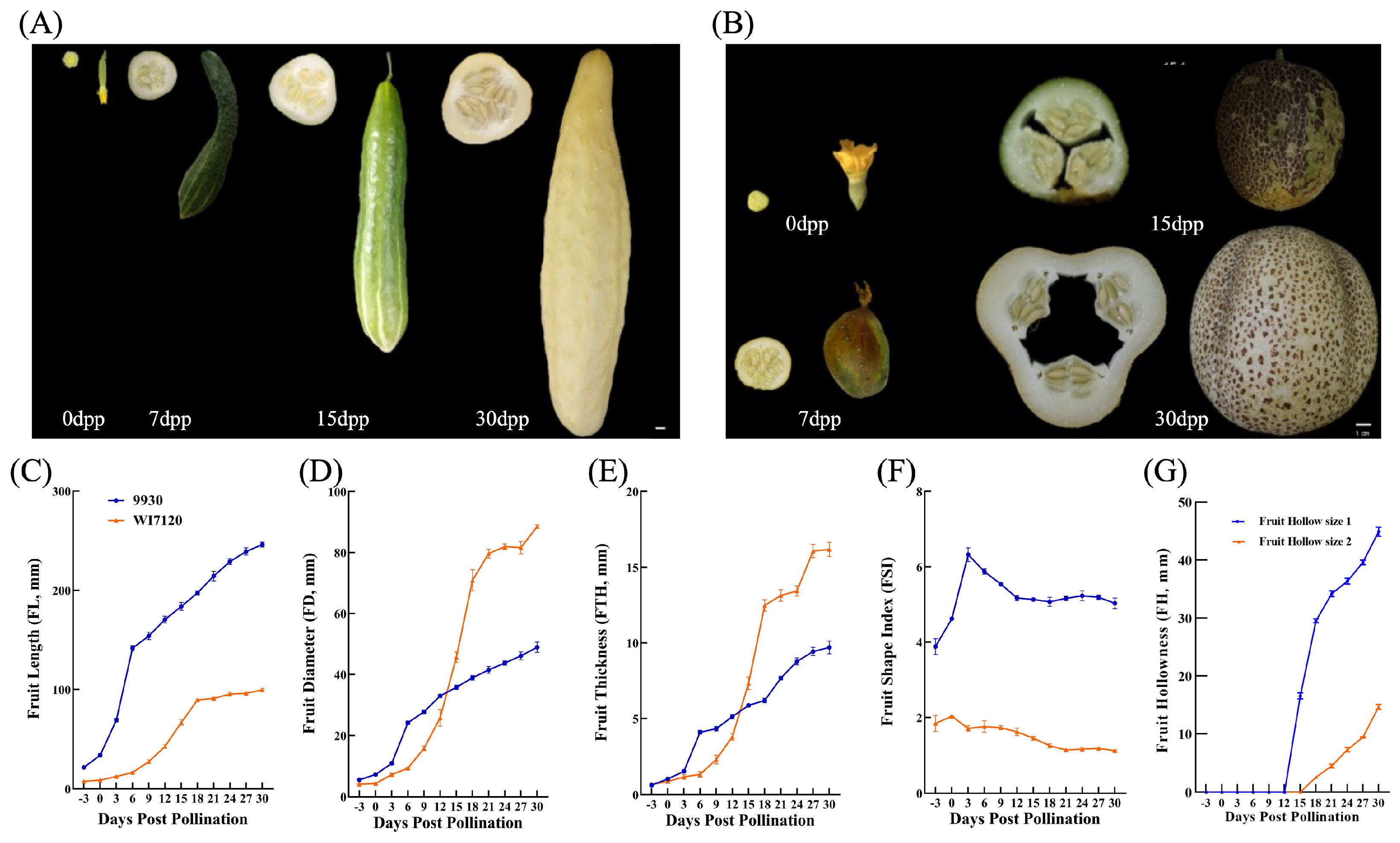
The fruit growth and development dynamics of 9930 (solid-fleshed) and WI7120 (cavitated) were systematically characterized from pre-anthesis ovary development to maturity (Figure 1). The fruit elongation and radial growth of both lines exhibited an “S-curve” model of growth, yet exhibited contrasting timing and magnitude in key developmental phases (Figure 1A–G). Firstly, the dynamic changes in the fruit shape index (FSI) from 15 to 30 days post-pollination (dpp) revealed distinct developmental patterns between the two genotypes. While 9930 maintained a relatively stable morphological integration (FSI = 5.17 ± 0.13), WI7120 showed a significant progressive reduction in FSI following initiation of hollowness (from FSI = 1.45 fsi at 15 dpp to 1.12 fsi at 30 dpp; ΔFSI = −0.027 day−1), exhibiting a negative correlation with fruit radial growth and hollow expansion dynamics (Figure 1F,G).
Furthermore, phase-specific disparities were found between the two genotypes during the rapid fruit expansion stage (6–15 dpp). Compared with the non-hollow 9930, WI7120 exhibited significantly higher fruit radial growth rate (3.97 ± 0.90 vs. 1.34 ± 0.14 mm/d, p < 0.001) and flesh thickness growth rate (0.65 ± 0.07 vs. 0.20 ± 0.03 mm/d, p < 0.001; Table 1). Importantly, these growth advantages progressively attenuated with maturity (18–30 dpp, p > 0.2), suggesting that the formation of hollowness has a phase-specific effect on the development of fruit diameter morphology. Particularly, the temporal coupling of rapid hollow expansion (starting from 15 dpp) with decelerated flesh thickening in WI 7120 (0.65 ± 0.07 from 6 to 15 dpp vs. 0.34 ± 0.04 mm/d from 18 to 30 dpp) contrasted with 9930’s stable thickening patterns (0.20 ± 0.03 vs. 0.29 ± 0.05 mm/d; Table 1). These findings imply a developmental stage-dependent spatial compensation strategy, which may maintain fruit structural integrity by releasing stress–strain from internal growth.

3.2. The Histological Staining and Microscopic Analysis of Fruit Tissue

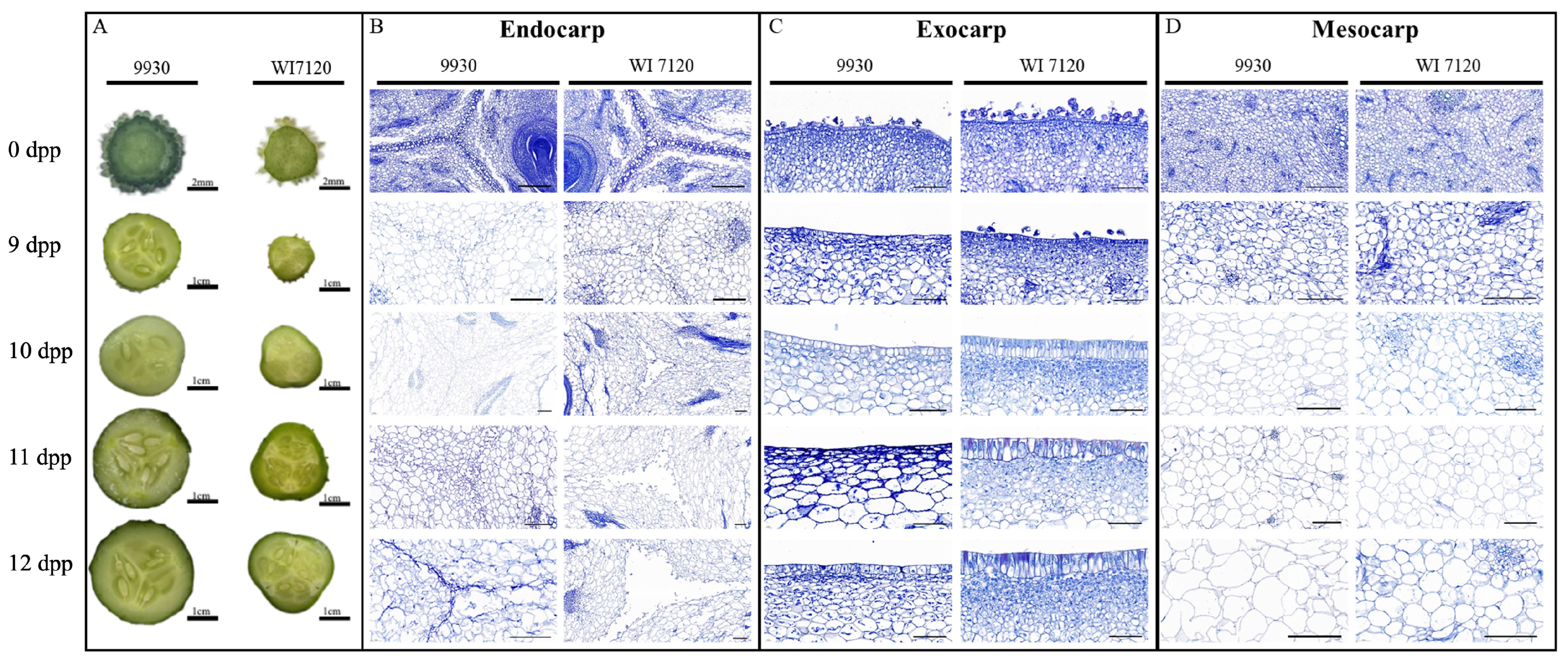
The endocarp, mesocarp, and exocarp of the fruits from 9930 and WI 7120 at 0 dpp and 9–12 dpp were observed under a microscope (Figure 2). Histological analysis of carpel junction tissues revealed constitutive differences in endocarp cell patterning between 9930 and WI7120 from 0 dpp. At 0 dpp, the suture cells at the carpel fusion zone of 9930 formed one tightly arranged isodiametric cell layer, with more uniform cell sizes (average area of 198.8 ± 55.7 μm2). In contrast, WI7120 exhibited irregular central suture cell arrangement (average area 378.6 ± 66.6 μm2) (Figure 2B and Figure S3A). From 9 dpp onward, both 9930 and WI7120 displayed suture cell atrophy. However, 9930 maintained cell adhesion, whereas WI7120’s atrophy caused local dehiscence. The accelerated transverse expansion in WI7120 fruits may suggest that tensile stresses imposed by growth mechanics exceed the intrinsic resilience of suture cell walls, thereby establishing biomechanical conditions conducive to progressive cavity formation between 12 and 15 dpp (Figure 1D,G and Figure 2A,B). Furthermore, no significant differences in area were observed between the mesocarp cells from 9930 and WI7120 during development since 10 dpp, indicating that cavity specificity originates from structural defects in endocarp/suture cells (Figure 2C and Figure S3B). However, during the fruit fast expansion time (9–12 dpp), the hypodermal cells of 9930 showed synchronous expansion, while WI7120 maintained a similar cell size as that in 0 dpp (Figure 2D and Figure S3C).

3.3. The Phytohormones in Regulating the Fruit and Hollow Development

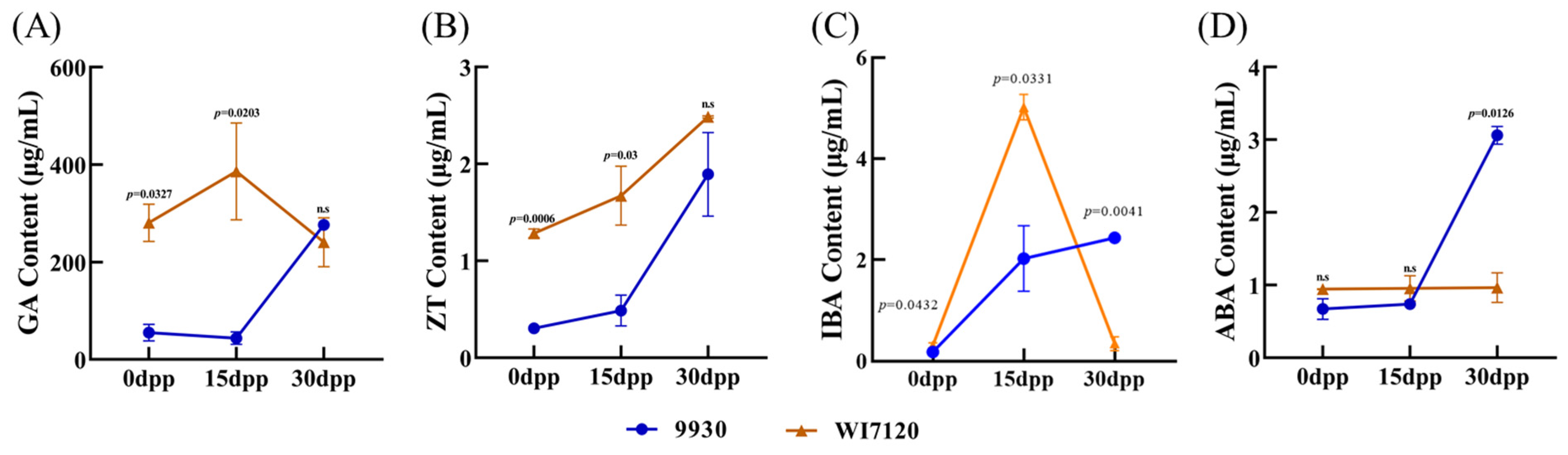
We also measured content of four endogenous hormones for endocarp tissue during critical cucumber fruit development stages (0, 15, and 30 dpp), including GA, ZT, ABA, and IBA. We found significant differences in hormone regulatory networks between the hollow-type cultivar WI7120 and the non-hollow cultivar 9930, with changes strongly correlated to the key cavity formation window (15 dpp) (Figure 3). At the pre-cavitation stage (0 dpp), WI7120 exhibited pronounced hormonal priming with 5.1-fold elevated GA concentrations (280.65 ± 38.22 vs. 55.20 ± 17.06 μg/mL, p = 0.033) (Figure 3A) and 4.2-fold increased ZT levels (1.28 ± 0.05 vs. 0.30 ± 0.04 μg/mL, p < 0.001) (Figure 3B) compared to 9930. This precocious GA-ZT synergy may suggest coordinated induction of rapid pericarp cell expansion, potentially generating mechanical stress gradients at the mesocarp–endocarp boundary through differential turgor pressure development. The transition to active visible cavitation (15 dpp) resulted in extreme GA accumulation in WI7120 (386.12 ± 99.34 μg/mL, 8.8-fold higher than 9930, p = 0.020), concurrent with significant IBA induction (~2-fold higher than 9930, p = 0.0331) (Figure 3C). This GA/IBA antagonism may compromise middle lamella stability, triggering separation of fused parenchyma cells. Additionally, contents of both ABA and IBA were maintained at a significantly lower level in WI7120 in all three stages (Figure 3C,D). The deficiency of ABA and IBA may imply there exists a bidirectional regulatory imbalance: diminished ABA signaling fails to activate genes related to cell wall reinforcement (e.g., lignin biosynthesis via POD/PAL), while depleted IBA disrupts structural maintenance cues essential for pectin-mediated cell adhesion (e.g., PMEI-dependent methyl esterification).

3.4. Fine Mapping for QTL mfh2.1

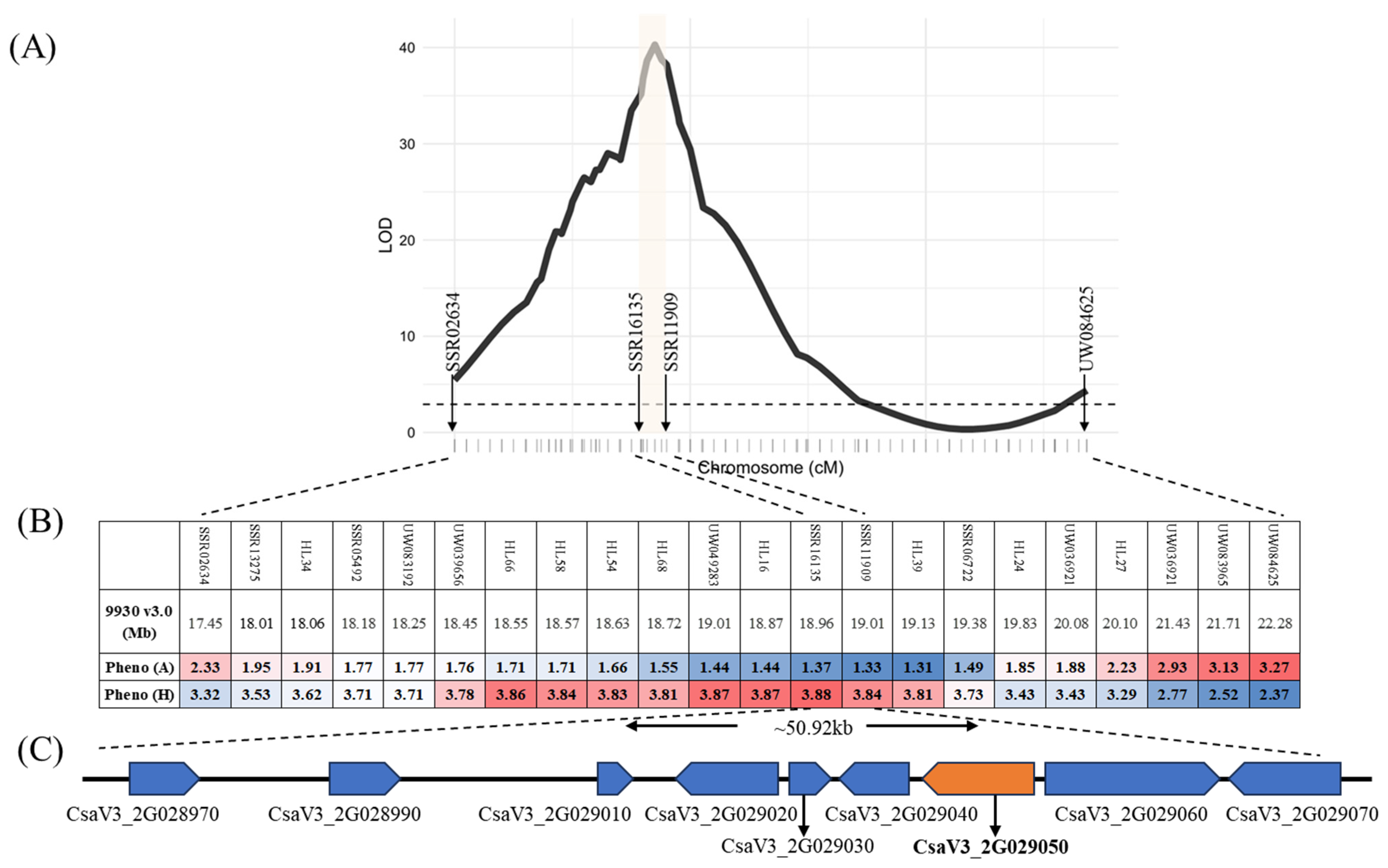
We previously mapped mfh2.1 onto the 18.19–20.24 Mb region on chromosome 2 (Chr2) according to 9930 v3.0 draft genome assembly [15]. To refine the mapping, we used two flanking SSR markers (SSR02634 and UW084625) to screen approximately 2000 F2 plants. Since the hollowness in fruit is dominant compared to non-hollow fruit, we selected only those recombinants with heterozygous (H) and 9930 alleles (A). As a result, a total of 207 recombinant individuals were identified and grown in the field for phenotyping, with 1–3 mature fruits per plant. We further designed 20 polymorphic SSR and InDel markers evenly distributed across this interval to genotype the recombinant plants. QTL mapping results identified a peak between markers 9G03 and 148S04 within a 2.0 LOD support interval, spanning 18,966,421 to 19,017,345 bp (Figure 4A,B).
Within this 50.92 kb region, nine predicted genes were annotated (as listed in Table 2). Sequence alignment between the parental lines revealed no missense variants, except for a single SNP in CsaV3_2G029050. We further sequenced the CDS of CsaV3_2G029040 and CsaV3_2G029050, both of which encode a subunit for assembly of the 26S proteasome and confirmed the SNP variant. The two genes CsaV3_2G029040 and CsaV3_2G029050 were then designated as CsRPT4Ba and CsRPT4Bb, respectively. This single, non-synonymous nucleotide mutation (A403G) in the fourth exon resulted in an amino acid substitution of Isoleucine to Valine (I135V). The cDNA sequences from 9930 and WI7120 alleles were deposited at NCBI (GenBank accession PV793746 and PV793747), which had the expected length of 1197 bp encoding a polypeptide with 399 amino acid residues and an estimated molecular mass of 28.5 kDa.
Furthermore, sequence alignment of the amino acid residues of RPT4B homologues in various species (Arabidopsis, tomato, rice, maize, and melon) was performed using ClustalW in the MEGA12 software (Version 12.0). These homologues showed high similarity with the conserved domain of the 26S proteasome regulatory subunit (Figure S4). The amino acid variant between 9930 and WI7120 (I135V) was located in a conserved position with Arabidopsis AtRPT4B and tomato SlRPT4B with Isolucine amino acid, while melon CmRPT4Ba/CmRPT4Bb, rice OsRPT4B, and maize ZmRPT4B were conserved with Valine amino acid. How the difference in amino acid altered its function requires further analysis.

3.5. Candidate Gene Prediction

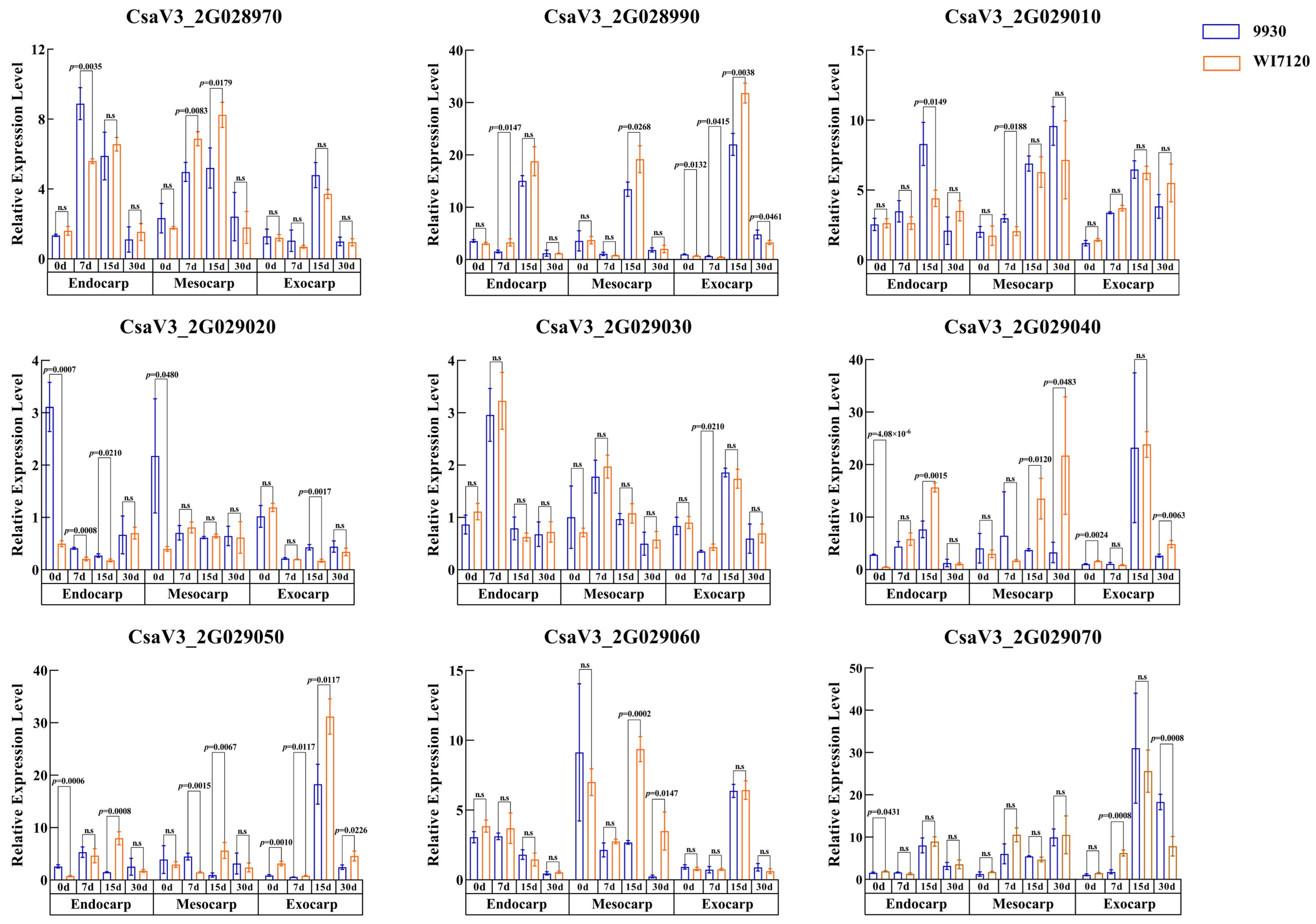
We further investigated the expression patterns of the nine genes in 9930 and WI7120 fruit tissues (endocarp, mesocarp, and exocarp) from 0 to 30 dpp, and the results are shown in Figure 5. Among them, five genes (CsaV3_2G028970/CsHHT1, CsaV3_2G029010/CsbZIP, CsaV3_2G029030/CsTLC, CsaV3_2G029060/CsRSM, and CsaV3_2G029070/CsCKX) exhibited largely non-significant differences in expression levels across tissues and developmental stages between 9930 and WI7120. Moreover, CsaV3_2G028990/CsMAPK, which encodes a mitogen-activated protein kinase, showed significant expression differences mainly in the exocarp tissue throughout fruit development between parental lines, but no obvious patterns were found. Another gene, CsaV3_2G029040/CsRPT4Ba, did not show a distinct expression pattern between the two lines but did show increased expression in the mesocarp at later developmental stages (15 and 30 dpp) in WI7120. Gene CsaV3_2G029020/CsYeeZ, which encodes a putative YeeZ protein homolog from the NAD(P)-binding domain superfamily, exhibited higher expression levels in endocarp tissue of 9930 compared to WI7120.
In particular, among the nine annotated genes in the candidate region, only the gene CsaV3_2G029050/CsRPT4Bb displayed consistently higher expression in the exocarp of WI7120 than in 9930 throughout fruit development. Moreover, only CsRPT4Ba and CsRPT4Bb displayed higher expression levels at 15 dpp in the endocarp and mesocarp tissue, where carpels are fully separated in WI7120 compared with 9930. Based on its predicted function, CsRPT4Bb may contribute to exocarp elasticity by mediating proteasome-dependent degradation of cuticle components, reducing cell wall tensile stress, facilitating rapid fruit expansion, and regulating lignin deposition to maintain locule morphology. Additionally, both CsRPT4Ba and CsRPT4Bb exhibited lower expression in the endocarp of WI7120 at 0 dpp but showed increased expression at 15 dpp, coinciding with the emergence of the hollow cavity. These findings suggest the presence of a tissue-specific spatiotemporal regulatory network, in which cellular remodeling processes in different pericarp layers are spatially coordinated, and the initiation and expansion phases of locule development are temporally linked.
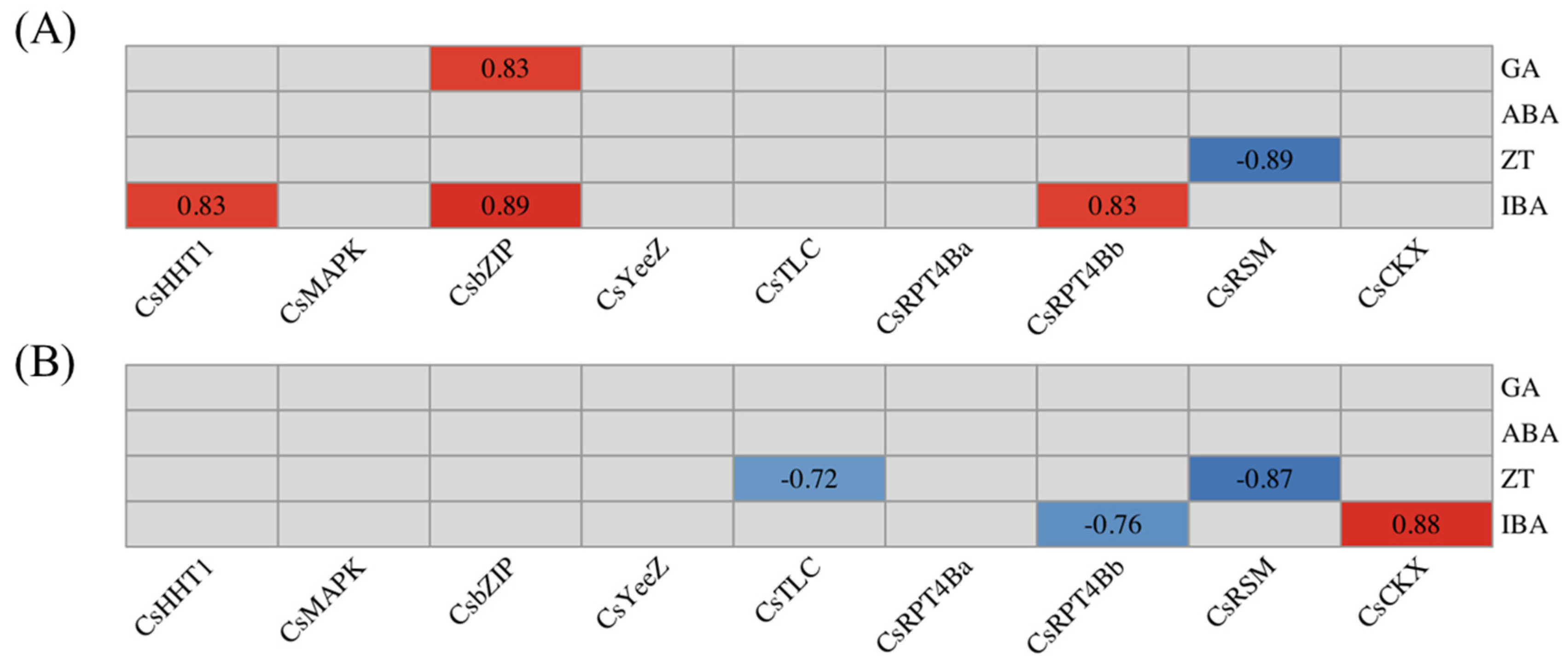
We further conducted the Spearman rank correlation of endogenous hormone contents quantified using HPLC (Figure 3) and the expression level of nine annotated genes determined by qPCR (Figure 5) in WI7120 and 9930 across developmental stages. As shown in Figure 6, the expression of most genes exhibited weak or non-significant correlations with hormone contents, indicating that hormone–gene associations are largely selective rather than global. In particular, the expression levels of CsHHT1, CsbZIP, and CsRPT4Bb displayed significant positive correlations with the IBA accumulation in endocarp of WI7120. Among these genes, CsRPT4Bb exhibited a negative correlation with an IBA content of 9930. This cultivar-dependent divergence suggests that CsRPT4Bb may participate in IBA-associated regulatory pathways that are specifically altered in hollow-type fruit development. Given that CsRPT4Bb was identified as the best candidate gene through fine-mapping, its distinct hormone–expression correlation pattern further supports its potential role in mediating hormone-responsive processes underlying carpel separation and hollowness formation.

4. Discussion

The shape and internal structure of cucumber fruit are critical determinants of marketability in commercial production, and, from a breeding perspective, they also represent key traits related to fruit quality and yield [6]. The internal defect—fruit hollowness—is caused by the separation of three carpels during cucumber fruit growth. In this study, we explored the mechanisms underlying fruit hollowness in cucumber, focusing on the role of internal growth patterns, phytohormonal changes, and genetic factors. Our fine mapping of the fruit hollowness quantitative trait locus (QTL) mfh2.1 led to the identification of CsRPT4Bb (CsaV3_2G029050) as a candidate gene. This gene encodes a subunit of the 26S proteasome, which is involved in protein degradation and cell-cycle regulation, providing insight into the molecular basis of carpel separation.
Fruit hollowness in cucumber arises from a complex interplay of anatomical, hormonal, and genetic factors. The initiation of hollowness in the Sikkim cucumber line WI7120 is linked to defects in carpel fusion during early ovary development. At 0 days post-pollination (dpp), WI7120 already displayed irregular cell arrangements at the central suture, with larger cell areas (378.6 μm2) compared to the non-hollow line 9930 (198.8 μm2), which predisposed the fruit to carpel separation during subsequent rapid growth phases (Figure S3A). This observation contrasts with findings in the cucumber line H6, where carpel separation begins at the suture between the endocarp and mesocarp, and central suture cells remain regular [13]. This suggests that the mechanisms regulating carpel separation differ between WI7120 and H6, with carpel separation in WI7120 potentially being constitutively activated.
Asymmetric growth of the pericarp tissues is another key factor contributing to hollowness. We observed that mesocarp cells expanded similarly between WI7120 and 9930 during the early stages of hollowness initiation. However, the hypodermal cells of WI7120 retained smaller dimensions during the critical 9–12 dpp period (Figure S3B,C). Although mesocarp cells in WI7120 enlarged similarly to those in 9930 during maturation, the endocarp cells underwent significant atrophy. This decoupling of tissue growth rates destabilizes the internal architecture, potentially creating a mechanical mismatch that exacerbates hollowness as the mesocarp expands and generates shear forces at the interfaces with the static exocarp (Figure 1). This hypothesis aligns with previous studies measuring mechanical strain in cucumber, where the seed cavity (endocarp) forms a lower stress region, the surrounding mesocarp exhibits medium-range stress, and the exocarp experiences the highest stress [8]. Similar mechanical strain has also been observed in the hollow stems of broccoli [25], where rapid expansion during inflorescence development leads to similar internal stress patterns.
Phytohormones likely regulate this asymmetric growth. Our data show that rapid radial expansion in WI7120 (3.97 mm/d) coincides with elevated levels of GA and ZT at 15 dpp (Figure 3). Both hormones are involved in promoting cell expansion and mitotic activity, respectively, and their accumulation creates mechanical stresses that may exceed the adhesion capacity of the suture cells [26,27].
Moreover, WI7120 exhibited a significant increase in GA and ZT expression levels (5.1-fold and 4.2-fold higher than 9930, respectively) before the onset of hollowness. By contrast, the IBA levels increased at 15-dpp in WI7120 when carpels were fully separated, compared with 9930. IBA acts as an auxin reserve within the plant [28], which may weaken pectin-mediated cell wall stability, further promoting carpel separation [29]. Concurrently, suppressed ABA signaling in WI7120 likely compromises cell wall reinforcement mechanisms, such as lignin biosynthesis, making tissues more prone to dehiscence [30]. However, differences in varieties and hollowness formation mechanisms may explain some discrepancies with earlier studies, such as those by Qin et al. [9], which did not observe a consistent relationship between GA, ZT, and ABA in hollow fruits. A recent study on a specific part of cucumber fruit showed that the content of indole-3-acetic acid (IAA) was lower in the endocarp compared with mesocarp tissue [10]. While our data provide valuable insights, the absence of hormone quantification at earlier developmental stages—prior to the appearance of hollowness—and the lack of tissue-specific data (e.g., mesocarp and exocarp) limit our ability to fully resolve the functional role of each phytohormone in this process.
In previous preliminary mapping of hollowness QTL in WI7120, three QTLs—mfh1.1, mfh2.1, and mfh3.1—were identified. Among them, mfh1.1 and mfh3.1 co-localized with fruit diameter QTL mfd1.1 and mfd3.1, suggesting that they may contribute to the expansion of hollowness in conjunction with fruit enlargement. In particular, mfh2.1 corresponds to the initiation of hollowness [15]. In this study, we then fine-mapped mfh2.1 and identified the best candidate gene, CsRPT4Bb, that encodes a 26S proteasome subunit, which is a key enzyme complex involved in protein degradation and cell cycle regulation (Figure 4). The 26S proteasome plays a critical role in cell proliferation and apoptosis, balancing cell survival and death in response to developmental and environmental cues [31,32,33]. The identified I135V mutation in CsRPT4Bb may alter proteasome function, affecting the regulation of cell-cycle proteins or enzymes involved in cell wall remodeling. In WI7120, the low expression of endocarp at 0 dpp could delay the specialization of central suture cells, allowing for their abnormal enlargement. On the other hand, the upregulation of CsRPT4Bb at 15 dpp (Figure 5) coincides with accelerated tissue degradation during cavity formation, suggesting a dual role in development and senescence. Furthermore, the Spearman correlation revealed an inverse relationship between the gene expression of CsRPT4Bb and IBA levels in WI7120 and 9930 (Figure 6). This result may indicate that CsRPT4Bb potentially participates in the hormone-responsive processes underlying carpel separation in cucumber.
The identification of CsRPT4Bb as a candidate gene for carpel separation is supported by its significant differential expression at key developmental stages and its strong correlation with endogenous hormone levels, particularly IBA. However, it is important to consider that the observed expression patterns may represent a response to physiological changes occurring during fruit development rather than being the primary driver of hollowness. Furthermore, other genes within the identified locus or interacting partners in the 26S proteasome pathway might also contribute to this phenotype. While our bioinformatic and expression analyses provide a compelling case, a significant limitation of this study is the current lack of direct functional validation. Future research utilizing CRISPR/Cas9-mediated knockout or overexpression in cucumbers will be essential to definitively confirm the role of CsRPT4Bb in regulating hormone-responsive processes and fruit cavity formation.

5. Conclusions

In this study, we revealed the disordered cell patterning of carpel suture cells at 0 dpp in the hollowed line WI 7120 compared with the non-hollow line “9930”. This finding suggested that constitutive genetic differences may initiate carpel separation. Further observation on pericarp tissues (endocarp, mesocarp, and exocarp) demonstrates their asymmetric growth, which implies a developmental stage-dependent spatial compensation strategy—maintain fruit structural integrity by releasing internal stress–strain through growth. By fine mapping the mfh2.1 QTL, which is specifically associated with the initiation of hollowness, we refined the candidate region into a 50.92 kb genomic interval. We further propose that CsRPT4Bb (CsaV3_2G029050) is the best candidate gene, and encodes a subunit of the 26S proteasome involved in protein degradation and cell-cycle regulation. The expression of CsRPT4Bb displayed high correlation with the contents of endogenous hormone IBA in WI7120 during fruit growth. These results may suggest the potential role of CsRPT4Bb in mediating hormone-responsive processes underlying carpel separation and formation of hollowness in cucumber.

Supplementary Materials

The following supporting information can be downloaded at https://www.mdpi.com/article/10.3390/horticulturae12010124/s1. Table S1: Information of primers used in this study. Figure S1: The rating scale (0 to 5) for hollowness phenotyping. Figure S2: Chromatograms of standard samples for four hormones. (1) for GA, 2.162 min; (2) for ZT, 2.593 min; (3) for ABA, 7.479 min; (4) for IBA, 9.401 min. Figure S3: The cell area of 9930 and WI7120 during fruit development at 0 and 9–12 days post pollination (dpp). A. The suture cell in endocarp tissue at 0dpp. B. The hypodermal cell area of exocarp tissue. C. The mesocarp cell area. The cell area data are displayed as box plot with at least 30 cells. Statistical significance was determined by Wilcoxon rank sum test. Figure S4: The multiple sequence alignment of RPT4B with cucumber and other crops. The same sequence was shown in black shadow. The Red rectangle shows the mutated variant between WI7120 and 9930 for CsRPT4Bb. The Green line shows the conserved domain of 26S Proteasome Regulatory Subunit.

Author Contributions

S.S. and Y.W. drafted the manuscript; L.Q., X.Z., C.F. and F.C. conducted the experiments and analyzed the data; L.Q., X.Z. and C.F. helped collect the data; L.T. and Y.W. conceived and designed the study. All authors have read and agreed to the published version of the manuscript.

Funding

This study was supported by the National Natural Science Foundation of China (No. 32360767); the Natural Science Foundation of Hainan Province (No. 322MS030); the Open Project of the Hainan Provincial Key Laboratory for Vegetable Biology (No. HAAS2023PT0208); the Major Science and Technology Projects of Hainan Province (No. ZDKJ2021010); and the Special Grant for Germplasm Innovation under the Hainan Vegetable Agro-technology Research System (HVARS-05-G01). Additionally, FC was supported by the Hainan University Startup Fund (No. XJ2400005243) and the National Natural Science Foundation of China (NSFC) Youth Science Fund Project (No. 32402567). YW was supported by the Fundamental Research Funds for the Central Universities (KJYQ2024026, KJYQ2025022).

Data Availability Statement

Re-sequencing data from WI7120 were retrieved from NCBI with the following BioSample ID: SAMN19898211. The cDNA sequences of CsRPT4Bb from 9930 and WI7120 alleles were deposited at NCBI (GenBank accession #PV793746 and PV793747, respectively). All datasets generated or analyzed during this study are available from the corresponding author on reasonable request.

Acknowledgments

We thank the high-performance computing platforms at the Bioinformatics Center of Nanjing Agricultural University for supporting this project. We sincerely thank the Innovation and Utilization Team for Tropical Melon Crop Genetic Germplasms at Hainan University for their invaluable support in cultivating the F2 and F2:3 populations in the greenhouses.

Conflicts of Interest

The authors declare no conflicts of interest.

Abbreviations

The following abbreviations are used in this manuscript:
GAgibberellic acid
ABAabscisic acid
ZTzeatin
IBAindole-3-butyric acid
FLfruit length
FDfruit diameter
FTHflesh thickness
FHfruit hollowness
FSIfruit shape index
dppdays post-pollination
QTLquantitative trait locus/loci

References

  1. Crang, R.; Lyons-Sobaski, S.; Wise, R. Plant Anatomy: A Concept-Based Approach to the Structure of Seed Plants; Springer International Publishing: Berlin/Heidelberg, Germany, 2018. [Google Scholar]
  2. Li, J.; Jia, J.; Qin, Z.; Liu, X.; Xin, M. Advances on the formation and detection of hollow heart in vegetable crops. Veg. Res. 2025, 5, e005. [Google Scholar] [CrossRef]
  3. Li, S.; Pan, Y.; Wen, C.; Li, Y.; Liu, X.; Zhang, X.; Behera, T.K.; Xing, G.; Weng, Y. Integrated analysis in bi-parental and natural populations reveals CsCLAVATA3 (CsCLV3) underlying carpel number variations in cucumber. Theor. Appl. Genet. 2016, 129, 1007–1022. [Google Scholar] [CrossRef] [PubMed]
  4. Pan, Y.; Wen, C.; Han, Y.; Wang, Y.; Li, Y.; Li, S.; Cheng, X.; Weng, Y. QTL for horticulturally important traits associated with pleiotropic andromonoecy and carpel number loci, and a paracentric inversion in cucumber. Theor. Appl. Genet. 2020, 133, 2271–2290. [Google Scholar] [CrossRef] [PubMed]
  5. Che, G.; Gu, R.; Zhao, J.; Liu, X.; Song, X.; Zi, H.; Cheng, Z.; Shen, J.; Wang, Z.; Liu, R.; et al. Gene regulatory network controlling carpel number variation in cucumber. Development 2020, 147, dev184788. [Google Scholar] [CrossRef]
  6. Pan, Y.; Wang, Y.; McGregor, C.; Liu, S.; Luan, F.; Gao, M.; Weng, Y. Genetic architecture of fruit size and shape variation in cucurbits: A comparative perspective. Theor. Appl. Genet. 2020, 133, 1–21. [Google Scholar] [CrossRef]
  7. Cheng, Z.; Song, X.; Liu, X.; Yan, S.; Song, W.; Wang, Z.; Han, L.; Zhao, J.; Yan, L.; Zhou, Z.; et al. SPATULA and ALCATRAZ confer female sterility and fruit cavity via mediating pistil development in cucumber. Plant Physiol. 2022, 189, 1553–1569. [Google Scholar] [CrossRef]
  8. Dan, H.; Okuhara, K.; Kohyama, K. Visualization of planar stress distributions in cucumber cultivars using a multiple-point sheet sensor. J. Sci. Food Agric. 2004, 84, 1091–1096. [Google Scholar] [CrossRef]
  9. Qin, Z.; Gu, C.; Yuan, Y.; Li, X.; Xin, M. Evaluation of hollow trait in cucumber germplasm resources. J. Northeast Agric. Univ. 2022, 53, 19–28. [Google Scholar] [CrossRef]
  10. Li, J.; Gu, C.; Yuan, Y.; Gao, Z.; Qin, Z.; Xin, M. Comparative transcriptome analysis revealed that auxin and cell wall biosynthesis play important roles in the formation of hollow hearts in cucumber. BMC Genom. 2024, 25, 36. [Google Scholar] [CrossRef]
  11. Liu, B.; Liu, X.; Yang, S.; Chen, C.; Xue, S.; Cai, Y.; Wang, D.; Yin, S.; Gai, X.; Ren, H. Silencing of the gibberellin receptor homolog, CsGID1a, affects locule formation in cucumber (Cucumis sativus) fruit. New Phytol. 2016, 210, 551–563. [Google Scholar] [CrossRef]
  12. Wilson, J.E.; Baker, L.R. Inheritance of carpel separation in mature fruits of pickling cucumbers. J. Am. Soc. Hortic. Sci. 1976, 101, 66–69. [Google Scholar] [CrossRef]
  13. Zhou, G.; Chen, C.; Liu, X.; Yang, K.; Wang, C.; Lu, X.; Tian, Y.; Chen, H. The Formation of Hollow Trait in Cucumber (Cucumis sativus L.) Fruit Is Controlled by CsALMT2. Int. J. Mol. Sci. 2022, 23, 6173. [Google Scholar] [CrossRef]
  14. Jawad, U.M.; Gao, L.; Gebremeskel, H.; Bin Safdar, L.; Yuan, P.; Zhao, S.; Lu, X.; He, N.; Zhu, H.; Liu, W. Expression pattern of sugars and organic acids regulatory genes during watermelon fruit development. Sci. Hortic. 2020, 265, 109102. [Google Scholar] [CrossRef]
  15. Wang, Y.; Jiang, B.; Dymerski, R.; Xu, X.; Weng, Y. Quantitative trait loci for horticulturally important traits defining the Sikkim cucumber, Cucumis sativus var. sikkimensis. Theor. Appl. Genet. 2020, 134, 229–247. [Google Scholar] [CrossRef] [PubMed]
  16. Wang, Y.; VandenLangenberg, K.; Wehner, T.C.; Kraan, P.A.G.; Suelmann, J.; Zheng, X.; Owens, K.; Weng, Y. QTL mapping for downy mildew resistance in cucumber inbred line WI7120 (PI 330628). Theor. Appl. Genet. 2016, 129, 1493–1505. [Google Scholar] [CrossRef] [PubMed]
  17. Schindelin, J.; Arganda-Carreras, I.; Frise, E.; Kaynig, V.; Longair, M.; Pietzsch, T.; Preibisch, S.; Rueden, C.; Saalfeld, S.; Schmid, B.; et al. Fiji: An open-source platform for biological-image analysis. Nat. Methods 2012, 9, 676–682. [Google Scholar] [CrossRef]
  18. Yang, L.; Koo, D.; Li, Y.; Zhang, X.; Luan, F.; Havey, M.J.; Jiang, J.; Weng, Y. Chromosome rearrangements during domestication of cucumber as revealed by high-density genetic mapping and draft genome assembly. Plant J. 2012, 71, 895–906. [Google Scholar] [CrossRef]
  19. Yang, L.; Li, D.; Li, Y.; Gu, X.; Huang, S.; Garcia-Mas, J.; Weng, Y. A 1,681-locus consensus genetic map of cultivated cucumber including 67 NB-LRR resistance gene homolog and ten gene loci. BMC Plant Biol. 2013, 13, 53. [Google Scholar] [CrossRef]
  20. Yang, L.; Koo, D.; Li, D.; Zhang, T.; Jiang, J.; Luan, F.; Renner, S.S.; Hénaff, E.; Sanseverino, W.; Garcia-Mas, J.; et al. Next-generation sequencing, FISH mapping and synteny-based modeling reveal mechanisms of decreasing dysploidy in Cucumis. Plant J. 2014, 77, 16–30. [Google Scholar] [CrossRef]
  21. Yu, J.; Wu, S.; Sun, H.; Wang, X.; Tang, X.; Guo, S.; Zhang, Z.; Huang, S.; Xu, Y.; Weng, Y.; et al. CuGenDBv2: An updated database for cucurbit genomics. Nucleic Acids Res. 2022, 51, D1457–D1464. [Google Scholar] [CrossRef]
  22. Alganmi, N.; Abusamra, H. Evaluation of an optimized germline exomes pipeline using BWA-MEM2 and Dragen-GATK tools. PLoS ONE 2023, 18, e0288371. [Google Scholar] [CrossRef]
  23. Cingolani, P.; Platts, A.; Wang, L.L.; Coon, M.; Nguyen, T.; Wang, L.; Land, S.J.; Liu, X.; Rude, D.M. A program for annotating and predicting the effects of single nucleotide polymorphisms, SnpEff: SNPs in the genome of Drosophila melanogaster strain w1118;iso-2; iso-3. Fly 2012, 6, 80–92. [Google Scholar] [CrossRef]
  24. Li, Q.; Li, H.; Huang, W.; Xu, Y.; Zhou, Q.; Wang, S.; Ruan, J.; Huang, S.; Zhang, Z. A chromosome-scale genome assembly of cucumber (Cucumis sativus L.). GigaScience 2019, 8, giz072. [Google Scholar] [CrossRef]
  25. Boersma, M.; Gracie, A.J.; Brown, P.H. Evidence of mechanical tissue strain in the development of hollow stem in broccoli. Sci. Hortic. 2013, 164, 353–358. [Google Scholar] [CrossRef]
  26. Jameson, P.E. Zeatin: The 60th anniversary of its identification. Plant Physiol. 2023, 192, 34–55. [Google Scholar] [CrossRef]
  27. Ueguchi-Tanaka, M. Gibberellin metabolism and signaling. Biosci. Biotechnol. Biochem. 2023, 87, 1093–1101. [Google Scholar] [CrossRef] [PubMed]
  28. Frick, E.M.; Strader, L.C. Roles for IBA-derived auxin in plant development. J. Exp. Bot. 2018, 69, 169–177. [Google Scholar] [CrossRef] [PubMed]
  29. Majda, M.; Robert, S. The role of auxin in cell wall expansion. Int. J. Mol. Sci. 2018, 19, 951. [Google Scholar] [CrossRef]
  30. Hamann, T. The plant cell wall integrity maintenance mechanism—Concepts for organization and mode of action. Plant Cell Physiol. 2015, 56, 215–223. [Google Scholar] [CrossRef]
  31. Bard, J.A.M.; Goodall, E.A.; Greene, E.R.; Jonsson, E.; Dong, K.C.; Martin, A. Structure and Function of the 26S Proteasome. Annu. Rev. Biochem. 2018, 87, 697–724. [Google Scholar] [CrossRef]
  32. Gemperline, D.C.; Marshall, R.S.; Lee, K.-H.; Zhao, Q.; Hu, W.; McLoughlin, F.; Scalf, M.; Smith, L.M.; Vierstra, R.D. Proteomic analysis of affinity-purified 26S proteasomes identifies a suite of assembly chaperones in Arabidopsis. J. Biol. Chem. 2019, 294, 17570–17592. [Google Scholar] [CrossRef]
  33. Naujokat, C.; Hoffmann, S. Role and function of the 26S proteasome in proliferation and apoptosis. Lab. Investig. 2002, 82, 965–980. [Google Scholar] [CrossRef]
Figure 1. The fruit development of 9930 and WI 7120. (A,B) The representative fruit images of 9930 (A) and WI 7120 (B) at 0, 7, 15, and 30 days post-pollination (dpp). (CF) The elongation in fruit length (C), radial growth in fruit diameter (D), fruit thickness (E), and fruit shape index (FSI = FL/FD) (F) between 9930 and WI7120 during fruit development from 3 days prior to flower blossom to 30 dpp. (G) The hollowness of WI7120 was measured using two criteria (fruit hollow size 1 and 2). The fruit data are provided for three fruits with mean ± standard error.
Horticulturae 12 00124 g001
Figure 2. The internal development of 9930 and WI 7120 fruits. (A) The cross-sectional fruits of 9930 and WI7120 at 0, 9, 10, 11, and 12 days post-pollination (dpp). (BD) show the cell structure of endocarp (B), exocarp (C), and mesocarp (D) for 9930 and WI7120. Bar in (BD) = 200 µm.
Horticulturae 12 00124 g002
Figure 3. The four phytohormone content in 9930 and WI 7120 fruits at 0, 15, and 30 days post-pollination (dpp). (A) GA, gibberellin; (B) ZT, zeatin; (C) IBA, indole butyric acid; (D) ABA, abscisic acid. The values are provided from three fruits with mean ± standard error. Statistical significance was determined by a two-sided Student’s t-test. n.s: non-significant with p > 0.05.
Horticulturae 12 00124 g003
Figure 4. The QTL mapping results for the mfh2.1 locus. (A) QTL mapping performed by scanone in R/qtl, with the shading area showing the 2.0 LOD support interval. Dash lines show the threshold determined by 1000 permutations with p < 0.01. (B) The average phenotypes for each marker under certain genotypes of each marker (A: 9930 allele; H: heterozygous allele) were presented. (C) Candidate genes within the 50.9 kb candidate regions. Gene ID are annotated according to the 9930 v3.0 reference genome. Arrow indicated the gene direction. The candidate gene CsaV3_2G029050 is marked in orange arrow.
Horticulturae 12 00124 g004
Figure 5. The qPCR analysis of nine genes within 50.92 kb candidate regions. The relative expression levels for each gene were compared in tissue from endocarp, mesocarp, and exocarp collected from 9930 and WI 7120 on 0, 7, 15, and 30 days post-pollination (dpp). Values are presented as mean ± standard error of three biological and three technical replicates. Statistical significance was determined using Student’s t-test. n.s: non-significant with p > 0.05.
Horticulturae 12 00124 g005
Figure 6. The Spearman correlation heatmap between endogenous hormone contents and candidate gene expression in WI7120 (A) and 9930 (B) endocarp tissues. Correlation coefficients (ρ) were calculated using biological replicate-level data across developmental stages at 0, 15, and 30 days post-pollination (dpp). Only statistically significant correlations (p < 0.05) are shown. Red cells and blue cells indicate significant positive and negative correlations, respectively. Grey cells indicate non-significant correlations. GA, gibberellin; ZT, zeatin; IBA, indole butyric acid; ABA, abscisic acid.
Horticulturae 12 00124 g006
Table 1. Comparative analysis of differential growth rates in fruit diameter, flesh thickness, and fruit hollow size between 9930 and WI7120 during 6–30 dpp.
Trait9930 (mm/d) aWI7120 (mm/d)p-Value b
Fruit Diameter
6–15 dpp1.34 ± 0.143.97 ± 0.908.89 × 10−7
18–30 dpp0.82 ± 0.281.24 ± 0.890.2729
Flesh Thickness
6–15 dpp0.20 ± 0.030.65 ± 0.070.0006
18–30 dpp0.29 ± 0.050.34 ± 0.040.6197
Fruit Hollow Size 1 (15–30 dpp)n.a. c1.20 ± 0.14n.a.
Fruit Hollow Size 2 (15–30 dpp)n.a.0.97 ± 0.15n.a.
a values are provided as mean ± sd. b p-value is calculated from a two-sample t-test. c n.a. represents not applicable.
Table 2. The candidate genes underlying fruit hollowness QTL mfh2.1.
NrGene IDGene NameChromosome: Position aAnnotationPolymorphism
1CsaV3_2G028970CsHHT1chr2:18969245-18970416 (+)Omega-hydroxypalmitate O-feruloyl transferasenone
2CsaV3_2G028990CsMAPKchr2:18980007-18980432 (+)Mitogen-activated protein kinasenone
3CsaV3_2G029010CsbZIPchr2:18990957-18991507 (+)Basic-leucine zipper transcription factornone
4CsaV3_2G029020CsYeeZchr2:18994609-18998089 (−)Protein YeeZ isoform X2none
5CsaV3_2G029030CsTLCchr2:18998305-19000569 (+)TLC domain-containing proteinnone
6CsaV3_2G029040CsRPT4Bachr2:19004239-19004466 (−)26S proteasome regulatory subunit S10B homolog Bnone
7CsaV3_2G029050CsRPT4Bbchr2:19005170-19009407 (−)26S proteasome regulatory subunit S10B homolog BA403G; I135V
8CsaV3_2G029060CsRSMchr2:19009566-19017150 (+)Ribosomal RNA small subunit methyltransferase Inone
9CsaV3_2G029070CsCKXchr2:19015092-19020819 (−)Cytokinin dehydrogenasenone
a gene direction is annotated as +/−.
Disclaimer/Publisher’s Note: The statements, opinions and data contained in all publications are solely those of the individual author(s) and contributor(s) and not of MDPI and/or the editor(s). MDPI and/or the editor(s) disclaim responsibility for any injury to people or property resulting from any ideas, methods, instructions or products referred to in the content.