Article

Asp 52 and Asp 60 in Paracidovorax citrulli HrpG Are Essential for Transcriptional Activation and Hypersensitive Response Induction

1
College of Agriculture and Biotechnology, Lishui University, Lishui 323000, China
2
State Key Laboratory for Biology of Plant Diseases and Insect Pests, Institute of Plant Protection, Chinese Academy of Agricultural Sciences, Beijing 100193, China
3
Department of Plant Pathology, College of Plant Protection, China Agricultural University, Beijing 100193, China
4
National Nanfan Research Institute (Sanya), Chinese Academy of Agricultural Sciences, Sanya 572024, China
*
Authors to whom correspondence should be addressed.
These authors contributed equally to this work.
Horticulturae 2026, 12(1), 107; https://doi.org/10.3390/horticulturae12010107
Submission received: 28 November 2025 / Revised: 10 January 2026 / Accepted: 14 January 2026 / Published: 19 January 2026
(This article belongs to the Section Plant Pathology and Disease Management (PPDM))

Abstract

Pathogenic bacteria utilize a type III secretion system (T3SS) to inject type III effectors (T3Es) into plant cells, suppressing plant immunity and facilitating colonization. Paracidovorax citrulli, the causal agent of bacterial fruit blotch (BFB) of Cucurbitaceae crops, harbors a functional T3SS like many other plant pathogens. The expression of its T3SS and T3Es is regulated by the two-component system response regulators HrpG and HrpX. Here, we demonstrate that the aspartic acid (Asp) residues at positions 52 and 60 in P. citrulli HrpG are essential for its complete function. Plasmid-mediated complementation of the ΔhrpG mutant with hrpG carrying Asp52→alanine (Ala) or Asp60→Ala mutations failed to restore the ability of P. citrulli to induce a hypersensitive response (HR) in tobacco, whereas the Asp46→Ala mutation fully rescued this phenotype. Furthermore, genomic hrpG point mutations generating strains Aac5 (D52A) and Aac5 (D60A) abolish the activation of hrpX transcription, resulting in decreased HrpX accumulation. Collectively, Asp 52 and Asp 60 in P. citrulli HrpG are essential for transcriptional activation activity of hrpX and HR induction, serving as a potential phosphorylation site (Asp 52) for upstream histidine kinases and a Mg2+ coordination site (Asp 60). Given that conserved Asp residues often function as phosphorylation sites in two-component system response regulators, this study provides a foundation for identifying upstream histidine kinases that modulate HrpG activity in P. citrulli.

1. Introduction

During the prolonged coevolutionary arms race with pathogens, plants have evolved a sophisticated immune system, whereas pathogenic bacteria have reciprocally developed intricate infection strategies. This dynamic interplay has driven reciprocal adaptations and constraints [1]. Plant innate immunity comprises two interconnected branches. The first, PAMP-triggered immunity, is initiated by cell-surface pattern recognition receptors (PRRs) detecting pathogen-associated molecular patterns, and triggers a defense cascade [2,3,4]. The second branch, effector-triggered immunity, relies on intracellular nucleotide-binding leucine-rich repeat proteins to recognize pathogen-secreted effectors and initiate defense responses [5,6]. To circumvent plant defenses and establish infection, plant pathogenic bacteria employ the type III secretion system (T3SS) to secrete type III effectors (T3Es) directly into plant cells, thereby suppressing plant immune responses [7,8].
T3Es are critical virulence factors for plant pathogens, yet their expression is tightly orchestrated to optimize infection [9,10,11,12]. Most T3Es are highly induced during pathogens’ colonization of the plant apoplast or when cultured in plant-mimicking media, a process regulated by transcription factors activated by plant-derived signals [13,14,15,16,17]. Plant pathogen T3SSs are classified into two groups based on gene structure, sequence homology, and regulatory networks [18,19]. Group I T3SS pathogens (e.g., Pseudomonas syringae and Erwinia amylovora) utilize the σ factor HrpL to directly regulate T3E expression. HrpL activation is mediated by the two-component regulatory system (TCS) HrpR/HrpS [18,20]. On the other hand, group II T3SS pathogens (e.g., Ralstonia solanacearum and Xanthomonas campestris) rely on AraC-type transcription factors such as HrpB or HrpX for T3SS regulation [18,19,21]. These AraC-type proteins typically require activation by the OmpR family response regulator HrpG. A conserved aspartate (Asp60) residue in HrpG must be phosphorylated to initiate downstream gene expression, a process triggered by external stimuli [14,22,23,24]. For example, X. campestris pv. campestris (Xcc) exhibits increased phosphorylated HrpG levels when cultured in plant-mimicking versus nutrient-rich media [23]. In Xcc, HrpG phosphorylation is mediated by the histidine kinase HpaS [14]. Notably, due to HrpG being considered an orphan response factor and the lack of conservation of HpaS in other species, identifying the histidine kinase that pairs with HrpG to regulate T3SS in group II plant pathogens remains unresolved, highlighting a critical knowledge gap in understanding T3E regulatory networks.
Bacterial fruit blotch (BFB) is an important disease affecting Cucurbitaceae crops such as watermelon and melon. Since its initial report in 1965, BFB has been observed in major watermelon and melon production regions globally, causing detrimental yield losses and economic damage [25,26,27,28,29,30]. The causal pathogen, Paracidovorax citrulli (formerly Acidovorax citrulli) [31,32], is genetically divided into two main groups. Group I strains are typically isolated from diseased hosts other than watermelon and exhibit moderate to high virulence toward multiple Cucurbitaceae crops. On the other hand, group II strains are mainly isolated from the diseased watermelon plants, showing greater virulence toward watermelon but weaker virulence on other cucurbit crops [33]. P. citrulli employs a T3SS to deliver effector proteins that suppress plant immune responses. The hrp (hypersensitive response and pathogenicity) gene cluster of P. citrulli belongs to group II [34]. The transcription regulator HrpG activates downstream expression of the hrpX gene, and mutations in either hrpG or hrpX render P. citrulli avirulent to its host and abolish its ability to induce a hypersensitive response (HR) in non-host tobacco [17]. Furthermore, HrpX activates the transcription of other hrp genes and T3Es [9,10,17,35,36]. For example, transcription of the characterized effector proteins AopP and AopN in P. citrulli is dependent on HrpG and HrpX [9,10].
T3Es have been well-established to primarily function in suppressing immune responses in host plants [11,12]. The identification of T3Es and the characterization of their interaction targets represent critical research frontiers, as these effectors are central to pathogen virulence mechanisms and the development of disease-resistant crops. However, our understanding of the transcription regulatory factor HrpG remains limited, particularly in P. citrulli. In this study, we introduced site-directed mutations to key amino acid residues in P. citrulli HrpG and analyzed the resulting changes in its transcriptional activity. Our results highlight the indispensable role of two putative phosphorylation sites in driving HrpG-mediated transcriptional activation. These findings provide a basis for future investigations into the upstream histidine kinase(s) that modulate HrpG function.

2. Materials and Methods

2.1. Amino Acid Sequence Alignment

Given that both P. citrulli and Xanthomonas spp. are classified within the T3SS group II, and considering the well-characterized role of HrpG in Xanthomonas spp. T3SS regulation, we conducted a comparative analysis by aligning the HrpG amino acid sequences from four functionally annotated Xanthomonas pathogens (X. campestris pv. vesicatoria 85-10, X. euvesicatoria LMG930, X. citri pv. citri 306, and X. campestris pv. campestris 8004) with that of the P. citrulli group II strain. The HrpG amino acid sequences (P. citrulli AAC00-1 Aave_0445; X. campestris pv. vesicatoria 85-10 XCV1314; X. euvesicatoria LMG930 BJD11_16110; X. citri pv. citri 306 XAC1265; X. campestris pv. campestris 8004 XC_3077) were retrieved from NCBI (https://www.ncbi.nlm.nih.gov/protein/; accessed on 7 March 2023). Multiple sequence alignment was subsequently performed using Clustal Omega Web Server v1.2.4 (https://www.ebi.ac.uk/jdispatcher/msa/clustalo; accessed on 8 March 2023) with default parameters (including low-quality aligned regions), and the alignment visualization was performed using ESPript 3.0 (https://espript.ibcp.fr/ESPript/cgi-bin/ESPript.cgi; accessed on 8 March 2023).

2.2. Bacterial Strains, Plasmids, Growth Conditions, and Primer Design

The bacterial strains and plasmids used in this study are listed in Table 1. Paracidovorax citrulli group II strain, Aac5, was grown in King’s B (KB) broth [37] or KB agar (KBA; KB medium supplemented with 15 g/L agar) at 28 °C. Escherichia coli strains were grown in Luria Bertani medium (10 g tryptone, 5 g yeast extract, and 10 g NaCl, 1000 mL deionized water) at 37 °C. When required, media were supplemented with ampicillin (Ap) at 100 μg/mL, kanamycin (Km) at 50 μg/mL, and chloramphenicol (Cm) at 25 μg/mL. All primers in this study were designed using Primer 3.0 based on the genomic sequence of P. citrulli AAC00-1 (GenBank accession number CP000512.1) and listed in Table S1.

2.3. Genetic Manipulation

2.3.1. The hrpG Point Mutation in the Plasmid

Paracidovorax citrulli wild-type strain Aac5 was inoculated in 5 mL KB broth supplemented with Ap and cultured at 28 °C with shaking at 220 rpm in the dark for 24 h. Genomic DNA was extracted from the Aac5 strain using the AxyPrepTM Multisource Genomic DNA Miniprep Kit (Axygen, Suzhou, China). The concentration and quality of extracted genomic DNA were measured using a NanoVueTM Plus spectrophotometer (GE Healthcare, Chicago, IL, USA). Then, the hrpG sequence (excluding the stop codon) including its promoter region (from position −538) was amplified from wild-type Aac5 genomic DNA using KOD-Plus-Neo DNA polymerase (TOYOBO, Osaka, Japan), and the primer pair F-hrpG-S/F-hrpG-A. The PCR cycling conditions were as follows: 94 °C pre-denaturation for 2 min; 98 °C denaturation for 10 s, 60 °C annealing for 30 s, 72 °C extension for 90 s, 40 cycles; final 72 °C extension for 7 min. The amplified fragment was ligated into the BamHI/EcoRI -digested pBBRNolac-4FLAG vector using the ClonExpress II One Step Cloning Kit (Vazyme, Nanjing, China), followed by transformation into E. coli DH5α competent cells (TianGen, Beijing, China). After sequencing (Beijing Liuhe BGI Co., Ltd., Beijing, China; the same applies below) confirmation, the recombinant vector pBBR-4FLAG-hrpG was extracted using AxyPrepTM Plasmid Miniprep Kit (Axygen, Suzhou, China). Site-directed mutagenesis was performed using the Q5® Site-Directed Mutagenesis Kit (NEB, Ipswich, MA, USA), and specific primers (D46A-S/D46A-A, D52A-S/D52A-A and D60A-S/D60A-A) to replace Asp residues at positions at 46, 52, and 60 (Asp46, Asp52, and Asp60) in the HrpG with alanine (Ala). The reaction system was 12.5 μL of Q5 Hot Start High-Fidelity 2× Master Mix, 1.25 μL of 10 mM forward and reverse primers each, 25 ng of vector pBBR-4FLAG-hrpG, and Nuclease-free water to 25 μL. The PCR reaction condition was 98 °C pre-denaturation for 30 s; 98 °C denaturation for 10 s, 65 °C annealing for 30 s, 72 °C extension for 3 min, 25 cycles; and a final 72 °C extension for 2 min. Then, following the instructions, complete the KLD reaction by inducing at room temperature for 5 min (the reaction system contains 1 μL of PCR product, 5 μL of 2× KLD Reaction Buffer, 1 μL of 10× KLD Enzyme Mix, and 3 μL of Nuclease-free water). The mutated constructs were individually transformed into E. coli DH5α. Subsequently, using pRK600 as a helper plasmid, the pBBR-4FLAG-D46A, pBBR-4FLAG-D52A, and pBBR-4FLAG-D60A, were transferred from E. coli DH5α into P. citrulli hrpG deletion mutation strain ΔhrpG through tri-parental mating, generating the point mutant strains ΔhrpG-D46A, ΔhrpG-D52A, and ΔhrpG-D60A. Briefly, E. coli DH5α carrying the pRK600 plasmid, E. coli DH5α carrying the recombinant vector (pBBR-4FLAG-D46A/pBBR-4FLAG-D52A/pBBR-4FLAG-D60A), and P. citrulli wild-type strain Aac5 were cultured to the logarithmic phase (OD600 = 0.6~1.0) in Luria Bertani medium supplemented with Cm, Luria Bertani medium supplemented with Km, and KB medium, respectively. The bacterial cells were collected by centrifugation at 10,500 rcf for 1 min, washed with sterile water to remove residual medium, and then mixed in a 1:1:1 volume ratio. The mixture was spread onto KBA plates supplemented with Ap and Km and incubated at 28 °C in the dark for 72 h. The colonies carrying the point mutation plasmid were verified by PCR, using primers WFB1/WFB2 to confirm that the obtained colonies were P. citrulli, and primers Kmr-F/Kmr-R to confirm successful tri-parental mating. The PCR cycling conditions were as follows: 95 °C pre-denaturation for 3 min; 95 °C denaturation for 30 s, 58 °C annealing for 30 s, 72 °C extension for 30 s, 40 cycles; final 72 °C extension for 5 min (except for the specific strains used, this method applies to all tri-parental matings mentioned below). As a control, pBBR-4FLAG-hrpG was also introduced into the ΔhrpG strain using the same method described above, designated as ΔhrpG-hrpG.

2.3.2. The hrpG Point Mutation in the Chromosome

To generate site-directed mutations in hrpG of P. citrulli strain Aac5, primers dHrpG-S/dHrpG-A were used to amplify the point-mutated hrpG sequences from the recombinant vectors pBBR-4FLAG-D52A and pBBR-4FLAG-D60A. The amplified PCR products were subsequently ligated into the EcoRI/HindIII double-digested pK18mobsacb vector using the ClonExpress II One Step Cloning Kit and the ligation products were transformed into E. coli DH5α competent cells. After sequencing confirmation, the resulting recombinant plasmids pK18-D52A and pK18-D60A, along with the helper plasmids pRK600, were introduced into P. citrulli Aac5 strain via tri-parental mating to generate point mutant strains Aac5 (D52A) and Aac5 (D60A). Transconjugants were selected on KBA plates supplemented with Ap and 10% sucrose. Specifically, the strains obtained via tri-parental mating were plated onto KBA plates supplemented with ampicillin and 10% sucrose and incubated at 28 °C in the dark for 72 h. The colonies were verified by PCR, using primers WFB1/WFB2 to confirm that the obtained colonies were P. citrulli, and primers Kmr-F/Kmr-R to confirm whether the double-crossover event was successful (the absence of a correctly sized amplified band indicated successful double-crossover recombination). The hrpG sequences of the mutant strains were further confirmed by DNA sequencing and analyzed using DNAMAN v6.0 software (Lynnon Biosoft, San Rafael, CA, USA).

2.4. Evaluation of HR Induction Ability in Non-Host Tobacco Leaves

The ability of tested P. citrulli strains to induce HR in non-host plants was evaluated via leaf infiltration [35]. Briefly, the tested P. citrulli strains were inoculated in KB broth supplemented with Ap and cultured at 28 °C with 220 rpm shaking in the dark until reaching the logarithmic phase (OD600 = 0.6~1.0). Then, the bacterial suspensions were centrifuged at 7000 rcf for 3 min. Pelleted cells were collected and resuspended in sterile water, with optical density adjusted to OD600 = 0.3 (approximately 3 × 10⁸ colony-forming units/mL) using an ultraviolet spectrophotometer (Biochrom, Holliston, MA, USA). The suspensions of the tested P. citrulli strains were infiltrated into the abaxial side of one-month-old tobacco leaves using disposable needle-free syringes until the interveinal areas were fully saturated. For each tested P. citrulli strain, three independent tobacco leaves were infiltrated in the interveinal regions as technical replicates, while sterile water infiltration served as a negative control. The inoculated plants were maintained under a 28 °C/16 h light (320 μmol/m2/s)–22 °C/8 h dark cycle with 65% relative humidity for 24 h. Inoculated leaf tissues were visually observed and phenotypic changes were recorded. This experiment was conducted three times.
To further analyze the differences in HR induction between P. citrulli hrpG point mutant strains Aac5 (D52A), Aac5 (D60A), and hrpG deletion mutant ΔhrpG, bacterial suspensions (OD600 = 0.3) of each strain were infiltrated into the abaxial side of one-month-old tobacco leaves using disposable needle-free syringes until the interveinal areas were fully saturated. For each tested strain, three independent tobacco leaves were infiltrated at distinct interveinal regions as technical replicates. P. citrulli wild-type strain Aac5 served as a positive control, while sterile water infiltration was used as a negative control. The inoculated plants were cultivated under a 28 °C/16 h light (320 μmol/m2/s)–22 °C/8 h dark cycle with 65% relative humidity. Subsequently, at 12 h and 24 h post-inoculation (hpi), leaf discs (0.7 cm diameter; two discs per infiltration site) were excised from inoculated leaves using a sterile perforator. The two discs obtained from the same infiltration site were submerged in 10 mL deionized water in glass beakers and gently agitated for 30 min. Electrolyte leakage was quantified by measuring solution conductivity using a DDSJ-318 conductivity meter (INESA Scientific Instrument Co., Ltd., Shanghai, China). The experiment was conducted three times.

2.5. Assay of Protein Expression

2.5.1. Assay of HrpG Protein Expression

Due to the instability of plasmid expression, we took ΔhrpG-hrpG and ΔhrpG-D52A as examples to assess HrpG protein expression. Briefly, ΔhrpG-pB, ΔhrpG-hrpG, and ΔhrpG-D52A strains were inoculated into KB broth supplemented with Ap and Km and cultured at 28 °C with shaking at 220 rpm in the dark until reaching the logarithmic growth phase (OD600 = 0.6~1.0). Then, the bacterial suspension was adjusted to OD600 = 0.6 using fresh KB liquid medium, followed by centrifugation at 10,500 rcf for 1 min to pellet the cells. The pellet was resuspended in 5 mL plant-mimicking liquid medium XVM2 [42] and further cultured at 28 °C with shaking at 220 rpm until an OD600 of approximately 0.6 was reached. Total protein was extracted using the protocol described by Zhang et al. (2018) [17]. The protein expression was analyzed as described by Qiao et al. (2022) [40]. The experiment was conducted three times.

2.5.2. Assay of HrpX Protein Expression

To investigate the impact of point mutations in hrpG on the expression of HrpX protein, we constructed four strains: WT-hrpX, ΔhrpG-hrpX, Aac5 (D52A)-hrpX, and Aac5 (D60A)-hrpX (Table 1). The pBBR-4FLAG-hrpX was transferred from E. coli DH5α to P. citrulli Aac5, ΔhrpG, Aac5 (D52A), and Aac5 (D60A) using pRK600 as a helper plasmid through tri-parental mating. Then, WT-hrpX, ΔhrpG-hrpX, Aac5 (D52A)-hrpX, and Aac5 (D60A)-hrpX strains were cultured in KB broth supplemented with Ap and Km following the procedures described above. The absorbance of the bacterial suspension was adjusted to OD600 = 0.6, after which total protein was extracted. The protein expression of HrpX in the tested strains cultured in XVM2 medium was then analyzed. The experiment was conducted three times.

2.6. Analysis of Transcriptional Activation Activity

2.6.1. β-Glucuronidase (GUS) Activity Assay

To investigate the impact of hrpG point mutations on hrpX promoter (position −486 to −1) activity, we constructed four reporter strains: WT-hrpXp-GUS, ΔhrpG-hrpXp-GUS, Aac5 (D52A)-hrpXp-GUS, and Aac5 (D60A)-hrpXp-GUS. Briefly, using the helper plasmid pRK600, the recombinant plasmid pBBR-GUS-hrpXp was introduced into P. citrulli Aac5, ΔhrpG, Aac5 (D52A), and Aac5 (D60A) via tri-parental mating. As a negative control, the WT-GUS strain was generated by transferring pBBRNolacGUS into the wild-type strain Aac5 using the same method. All constructs were verified by DNA sequencing. Promoter activity assays were tested following previously described methods [43]. This experiment was conducted three times.

2.6.2. Quantification of hrpX Transcription Levels

Total RNA was isolated from P. citrulli strains Aac5, ΔhrpG, Aac5 (D52A), and Aac5 (D60A) using the method described in Wang et al. (2016) [44]. Briefly, the tested strains were cultured in KB broth at 28 °C overnight until reaching an OD600 of 0.6. Total RNA was extracted using the bacterial RNA kit (TransGen, Beijing, China), and the cDNA was synthesized using a FastQuant RT kit (TianGen, Beijing, China). Quantitative reverse transcription polymerase chain reaction (RT-qPCR) was carried out using SYBR Green PCR Master Mix (TianGen, Beijing, China) on a real-time PCR system (M × 3000P, Agilent, Santa Clara, CA, USA). The thermal cycling conditions were as follows: 95 °C for 15 min (1 cycle); 95 °C for 10 s, 55 °C for 20 s, 72 °C for 32 s (40 cycles); followed by a melting curve analysis from 55 °C to 95 °C to verify reaction specificity. Relative gene expression levels were determined as previously described [44]. Each sample was tested in triplicate in three independent experiments.

2.7. Statistical Analysis

Quantitative data were analyzed using the commercial software package SPSS 20.0 (IBM, Armonk, NY, USA). Student’s t-test (p < 0.05) was used to assess statistical significance between two treatments. Bar charts were generated using GraphPad Prism v7.0 (GraphPad Software, San Diego, CA, USA).

3. Results

3.1. The N-Terminus of Paracidovorax citrulli HrpG Contains Two Conserved Aspartic Acid Residues, Asp 52 and Asp 60

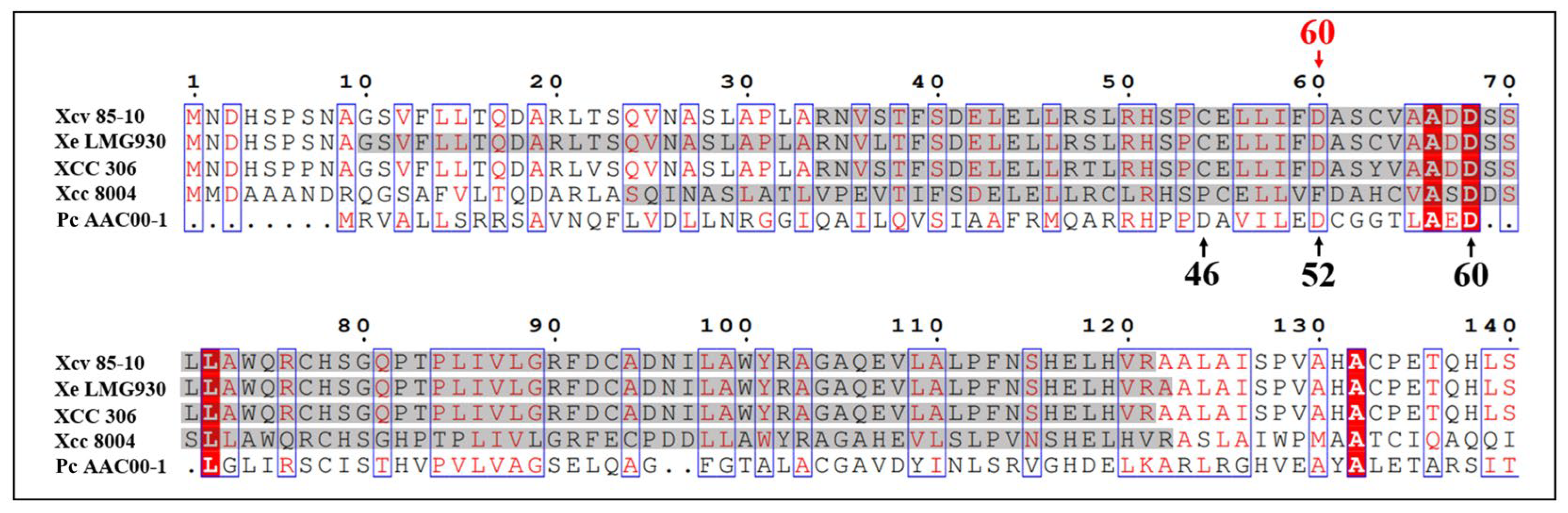
Amino acid sequence alignment of P. citrulli HrpG with HrpG homologs from Xanthomonas spp. revealed that Asp 52 and Asp 60 are conserved in P. citrulli HrpG (Figure 1). Among them, Asp 52 in P. citrulli HrpG corresponds to Asp 60 in Xanthomonas spp. HrpG (Asp 61 in Xcc 8004). In Xanthomonas spp., the N-terminal Asp 60 residue of HrpG is an important amino acid involved in phosphorylation [14,23].

3.2. Restoration of HR-Inducing Ability in Tobacco by ΔhrpG Was Not Achieved via Plasmid-Mediated Point Mutation of HrpG (D52A/D60A)

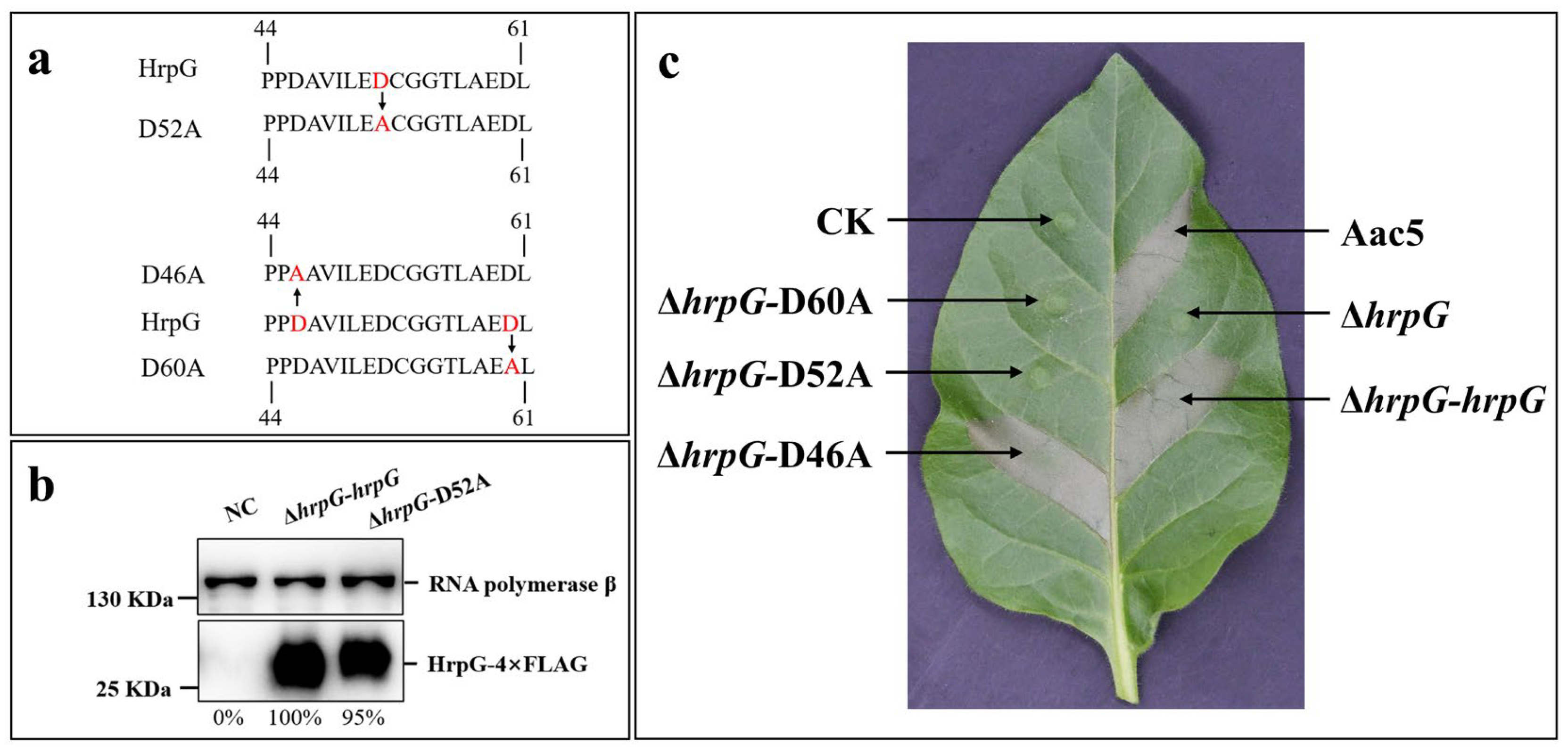
To investigate the importance of conserved Asp 52 and Asp 60 of HrpG in P. citrulli Aac5 strain, this study substituted these residues with Ala to ablate potential phosphorylation sites in plasmid-expressed HrpG. As a control to exclude the possibility that single-amino-acid mutations might nonspecifically disrupt HrpG protein function, Asp 46 was also replaced by Ala (Figure 2a). The mutated hrpG genes were then expressed in the hrpG deletion mutant strain ΔhrpG. Western blot analysis revealed no significant difference in HrpG expression levels between the ΔhrpG-D52A mutant and the wild-type hrpG-complemented strain ΔhrpG-hrpG (Figure 2b), indicating that single-amino-acid substitutions had minimal impact on HrpG expression.
To assess whether HrpG point mutations affected its biological activity, tobacco plants were inoculated with the tested strains and HR was monitored. The results showed that ΔhrpG-D52A and ΔhrpG-D60A, similar to ΔhrpG, failed to induce HR in tobacco leaves after 24 hpi, while wild-type strain Aac5 and the control mutant ΔhrpG-D46A successfully elicited HR in tobacco leaves (Figure 2c).

3.3. HrpG Was Point Mutated (D52A and D60A) in P. citrulli Chromosome

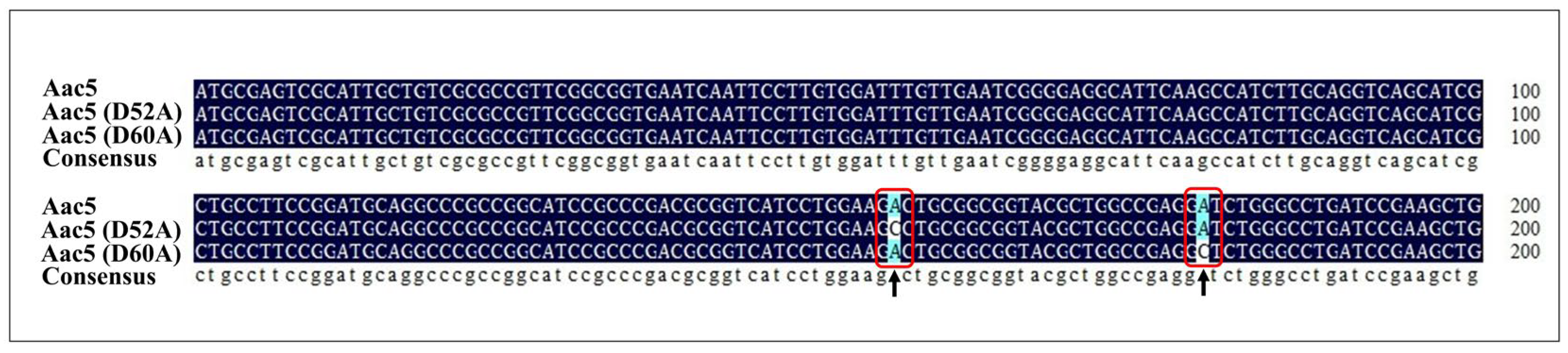
To address the potential instability of gene expression in plasmids and more accurately assess the importance of Asp 52 and Asp 60 in HrpG, point mutations (D52A and D60A) were introduced in P. citrulli Aac5 chromosome via tri-parental mating in this study. Sequencing analysis showed that only adenine at position 155 of hrpG gene was mutated to cytosine in Aac5 (D52A), resulting in the conversion of Asp (coded by GAC) 52 in HrpG to Ala (coded by GCC) (Figure 3). Similarly, in the Aac5 (D60A) strain, only adenine at position 179 of the hrpG gene was mutated to cytosine, leading to the substitution of Asp (coded by GAT) 60 in HrpG with Ala (coded by GCT) (Figure 3).

3.4. Point Mutations (D52A/D60A) in HrpG of P. citrulli Aac5 Chromosome Abolish Its Ability to Induce HR

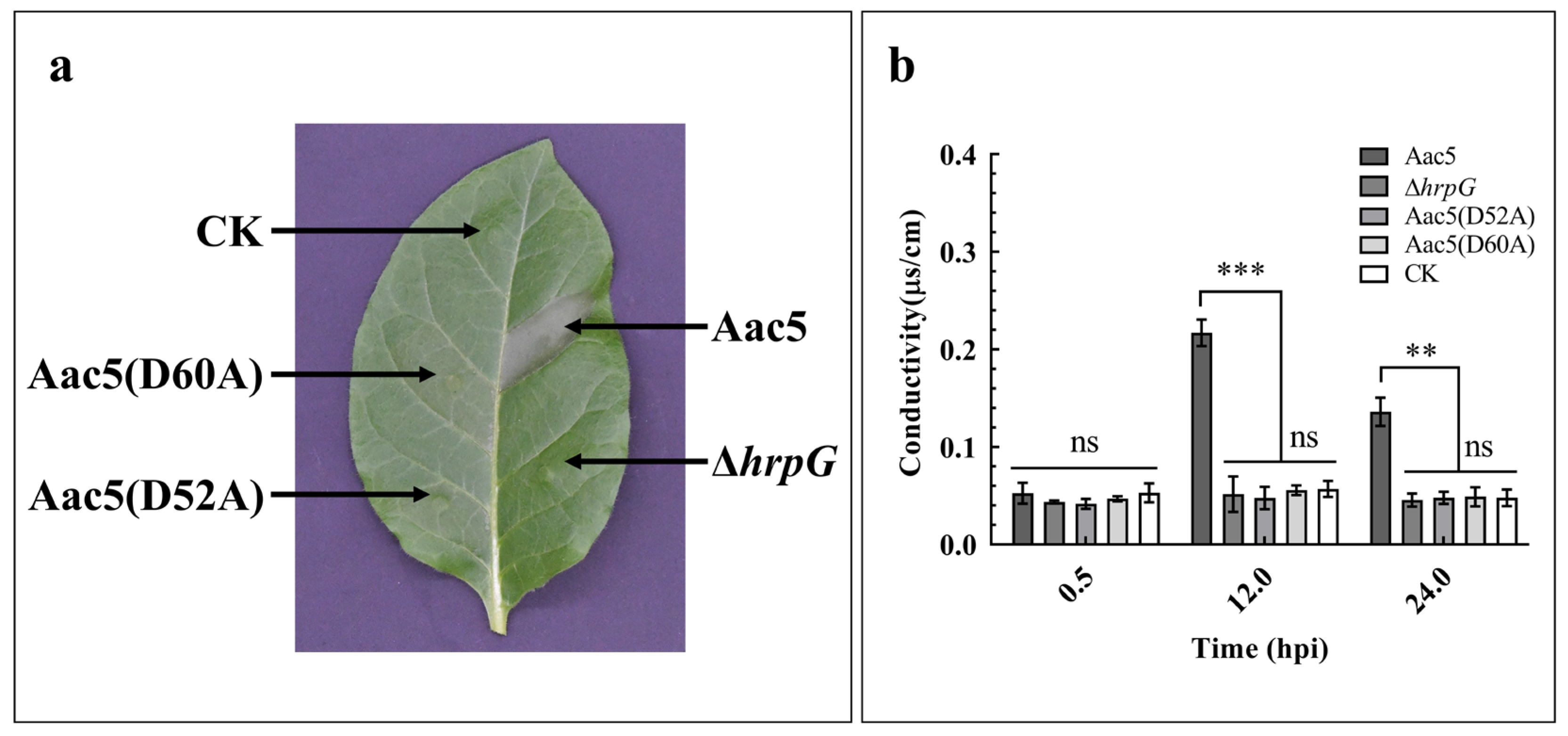
Similar to strains harboring hrpG point mutations on plasmids, infiltration of the HrpG Asp 52 mutant strain Aac5 (D52A) and the HrpG Asp 60 mutant strain Aac5 (D60A) into tobacco leaves failed to induce HR at 24 hpi, while the wild-type strain Aac5 successfully triggered HR (Figure 4a).
Electrolyte leakage measurements at inoculation sites further validated these phenotypes. At 0.5 hpi, no significant differences in electrolyte leakage were observed across treatments, confirming consistent initial leaf conditions. By contrast, at 12 and 24 hpi, tobacco leaves inoculated with wild-type strain Aac5 exhibited significantly higher electrolyte leakage compared to all other groups. Notably, electrolyte leakage in Aac5 (D52A), Aac5 (D60A), and hrpG deletion mutant ΔhrpG did not differ significantly from the negative control (CK), whereas Aac5-inoculated leaves showed a 3.81-fold increase (12 hpi, p < 0.001) and a 2.83-fold increase (24 hpi, p < 0.01) (Figure 4b). These findings collectively demonstrate that the HrpG point mutant strains Aac5 (D52A) and Aac5 (D60A) are functionally equivalent to the hrpG deletion strain ΔhrpG.

3.5. Point Mutantions in HrpG (D52A/D60A) Abolish Its Ability to Activate hrpX Transcription

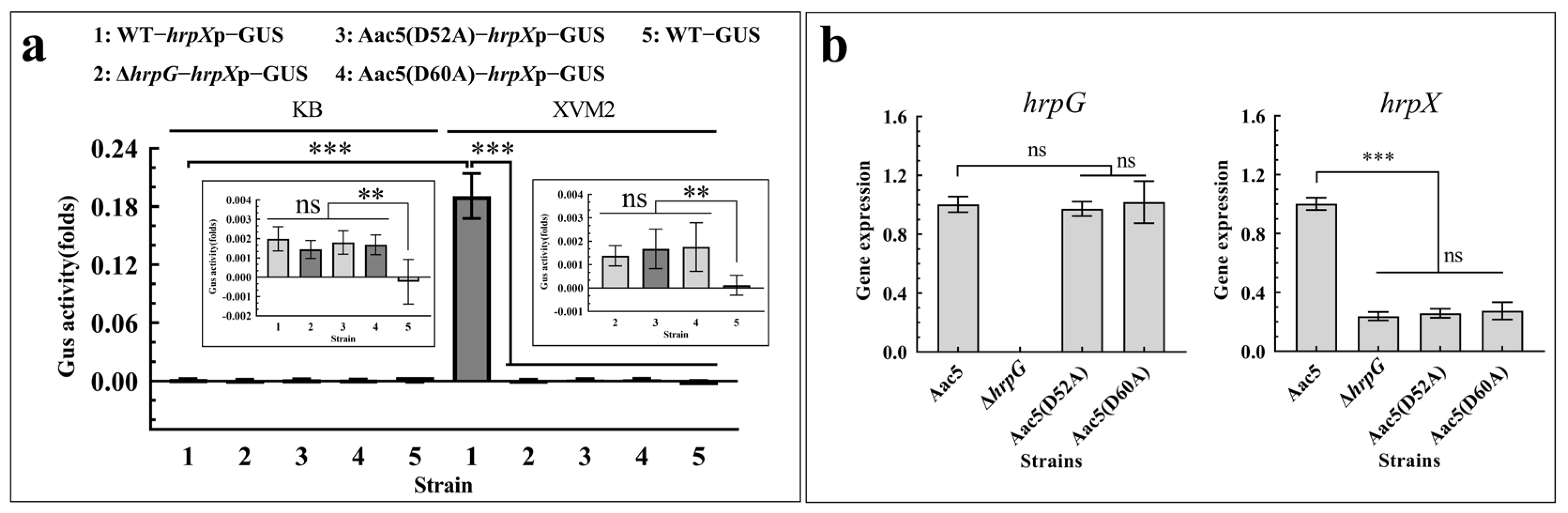
To determine whether the functional defects of HrpG following point mutation were associated with impaired transcriptional activation activity, the promoter activity of hrpX in the tested strains was analyzed using a GUS reporter system. The results showed in KB medium, hrpX promoter activity did not differ significantly among strains. However, upon induction with XVM2 medium, hrpX promoter activity in the wild-type strain WT-hrpXp-GUS was significantly enhanced. In contrast, hrpX promoter activity in the HrpG point mutants Aac5 (D52A)-hrpXp-GUS and Aac5 (D60A)-hrpXp-GUS, as well as the deletion mutant strain ΔhrpG-hrpXp-GUS, was significantly lower than that in the wild-type strain. Notably, only the wild-type strain exhibited XVM2-induced hrpX promoter activation, while no induction was observed in the mutant strains (Figure 5a).
Furthermore, the hrpX transcription levels of the tested strains were measured. The results showed that, when cultured in XVM2 medium, the hrpG expression levels of Aac5 (D52A) and Aac5 (D60A) strains showed no significant difference compared to the wild-type strain Aac5. However, the hrpX expression levels of Aac5 (D52A) and Aac5 (D60A) strains were similar to those of the hrpG deletion mutant strain ΔhrpG, both of which were significantly lower than those of the wild-type strain Aac5 (Figure 5b). In other words, the point mutation strains Aac5 (D52A) and Aac5 (D60A) lost the ability to activate hrpX transcription, similar to the hrpG deletion mutant strain ΔhrpG.

3.6. The Expression of HrpX Was Down-Regulated in the HrpG Point Mutation Strains Aac5 (D52A) and Aac5 (D60A)

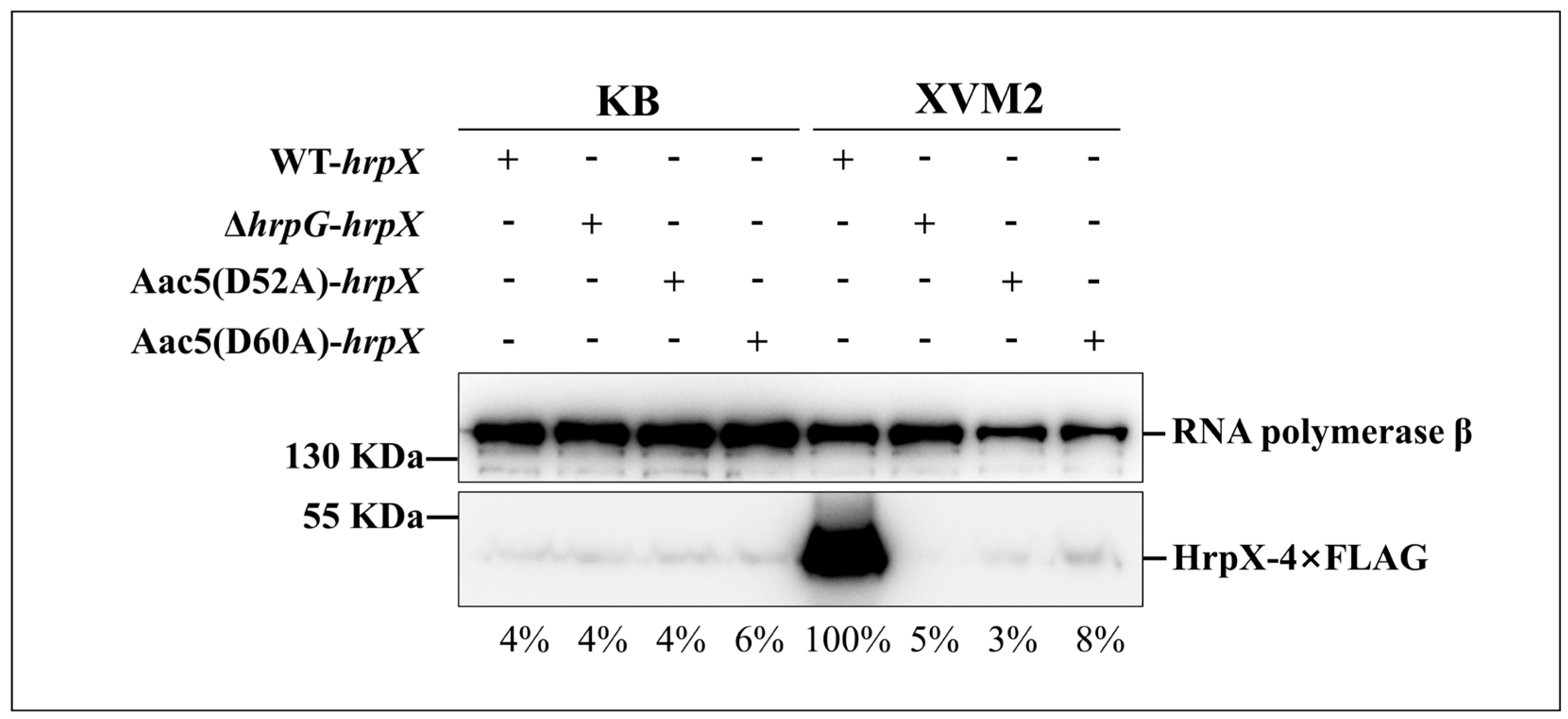
To investigate the effect of substituting conserved phosphorylation sites in HrpG on its transcriptional activation activity, the expression level of HrpX was analyzed. In KB medium, all tested strains exhibited low basal expression of HrpX. Following induction in XVM2 medium, HrpX expression was strongly upregulated in the wild-type strain WT-hrpX, while the HrpG point mutation strains Aac5 (D52A)-hrpX and Aac5 (D60A)-hrpX displayed HrpX expression levels comparable to those of the mutant strain ΔhrpG-hrpX, remaining consistently low (Figure 6). This suggests that Asp 52 and Asp 60 in HrpG are indispensable for activating robust hrpX expression in P. citrulli.

4. Discussion

For many plant pathogens, T3SS enables direct translocation of T3Es into plant cells, thus interfering with plant immune responses, promoting bacterial host colonization, and causing disease [11,18,45]. P. citrulli, the causal agent of BFB, possesses a functional T3SS. HrpG, an OmpR family transcription regulator in P. citrulli, is essential for the expression of the hrp gene cluster of T3SS. Previous research demonstrated that an hrpG deletion mutant strain of P. citrulli cannot induce tobacco HR [17]. In this study, we introduced a plasmid carrying an hrpG gene with a single-base substitution into P. citrulli hrpG deletion mutant strain. Substitution of either Asp 52 or Asp 60 in the HrpG N-terminus with Ala resulted in the loss of the ability to induce HR in non-host tobacco plants, while substitution of Asp 46 had no effect. We infer that Asp 52 and Asp 60 are important functional sites of the transcription regulatory factor HrpG in P. citrulli. Further evidence was obtained by generating single base mutation in the chromosomal hrpG gene of P. citrulli, which similarly failed to induce HR in tobacco. Additionally, both Aac5 (D52A) and Aac5 (D60A) mutants lost the ability to activate the transcription of T3SS regulator hrpX after Asp 52 or Asp 60 substitution in HrpG. This mirrored the phenotype of the hrpG deletion mutant strain ΔhrpG. Since Asp52 and Asp60 are located in the receiver domain rather than the DNA-binding domain of P. citrulli HrpG, we speculate that the substitution at either Asp 52 or Asp 60 would not impair DNA-binding activity but would disrupt transcription activation function. Amino acid sequence alignment revealed that Asp 52 of P. citrulli HrpG corresponds to Asp 60 of HrpG in Xcc, indicating conserved functional roles of this residue in both species. This was confirmed by the findings of the current study. Notably, the N-terminus of P. citrulli HrpG also contains a conserved Asp 60, which aligns with Asp 68 in Xanthomonas spp. Surprisingly, the Aac5 (D60A) mutant lost both hrpX activation capacity and HR-inducing ability in tobacco. However, not all Asp substitutions resulted in HrpG inactivation. For instance, substitution of the non-conserved Asp of HrpG in P. citrulli HrpG (strain Aac5 (D46A)) did not affect HR induction in tobacco. These results suggest that Asp 60 in P. citrulli HrpG may also be an important functional site.
The transcription regulator HrpG acts as a response regulator in TCS [12,14,46]. The histidine kinase HpaS has been shown to sense environmental signals and phosphorylate the T3SS top-level regulator HrpG in Xcc and X. axonopodis pv. citri, leading to the activation of downstream T3SS and T3E genes, thus exerting virulence [14,46]. Phosphorylation of HrpG is critical for its full transcriptional activation activity, with Asp 60 identified as a phosphorylation site in Xanthomonas spp. [23]. Similarly, we hypothesize that Asp 52 in P. citrulli HrpG may also serve as a potential phosphorylation site, although necessary phosphorylation experiments are still required for verification. Interestingly, the functional loss caused by the substitution of Asp 60 in P. citrulli HrpG is similar to that resulting from the substitution of Asp 52. The receiver domain of response regulator proteins typically contains a highly conserved catalytic pocket composed of three acidic residues (usually Asp) [47]. This pocket is responsible for binding a divalent magnesium ion (Mg2+), which is crucial for stabilizing the high-energy transition state formed during phosphorylation and facilitating the transfer of the phosphate group [48]. For example, in the classical response regulator CheY, Mg2+ directly coordinates with Asp 12, Asp 13, and the phosphoacceptor Asp 57 [49]. Therefore, we speculate that Asp 60 in P. citrulli HrpG functions by binding and stabilizing Mg2+ around the phosphate group rather than acting as the phosphoacceptor. However, it is noteworthy that whether the point mutations (D52A or D60A) in P. citrulli HrpG affect protein dimerization, DNA binding, or protein stability still requires further experimental validation.
T3SS expression in pathogenic bacteria is typically repressed in nutrient-rich media, but induced in plant environments or plant-mimicking conditions [12]. Our previous findings showed that in P. citrulli, although HrpG was highly expressed in nutrient-rich KB medium, hrpX expression remained suppressed [40]. This restriction in hrpX expression may be due to lower HrpG phosphorylation levels. In this study, when the potential phosphorylation site (Asp 52) or the potential Mg2+ coordination site (Asp 60) of HrpG were substituted with Ala in the wild-type strain Aac5 chromosome, the expression of HrpX was at a low level when Aac5 (D52A) and Aac5 (D60A) were cultured in the plant-mimicking medium XVM2, resembling the expression pattern of wild-type strain Aac5 in KB medium. These results support the hypothesis that P. citrulli HrpG requires phosphorylation in plant or plant-simulated environments to activate hrpX transcription.
In conclusion, our work provides evidence that Asp 52 and Asp 60 of the HrpG in P. citrulli are essential for its transcriptional activation activity and hypersensitive response induction. However, the functional contributions of Asp 52 and Asp 60 to host virulence, the mechanistic basis of their gene regulatory roles, and the environmental signaling that triggers HrpG phosphorylation remain unresolved questions that warrant systematic investigation. Nonetheless, based on the characteristic that Asp 52 and Asp 60 are likely involved in HrpG phosphorylation, this finding offers guidance for future investigations targeting the identification of the upstream histidine kinase and the specific environmental cues that activate the HrpG signaling pathway in P. citrulli.

Supplementary Materials

The following supporting information can be downloaded at: https://www.mdpi.com/article/10.3390/horticulturae12010107/s1, Table S1: Primers used in this study.

Author Contributions

T.Z., Y.Y., P.Q. and M.Z. designed the experiments. P.Q., M.Z., B.L. and C.W. performed the experiments. L.C., W.G. and W.Z. analyzed the data. P.Q. wrote the manuscript. All authors have read and agreed to the published version of the manuscript.

Funding

This study was supported by the National Key Research and Development Program of China (2023YFD1401200), Major Science and Technology Special Project of Xinjiang Uygur Autonomous Region (2023A02009, 2024A02007), the Hainan Province Science and Technology Special Fund (ZDYF2023XDNY084), the Xinjiang Production and Construction Corps’ Scientific and Technological Research Plan Project in Agriculture (2022AB015), the China Earmarked Fund for Modern Agroindustry Technology Research System (CARS-25), and the Agricultural Science and Technology Innovation Program of the Chinese Academy of Agricultural Sciences (CAAS-ASTIP).

Data Availability Statement

The original contributions presented in this study are included in the article/Supplementary Material. Further inquiries can be directed to the corresponding authors.

Acknowledgments

We are grateful to Beijing Liuhe BGI Co., Ltd. for providing the sequencing and primer synthesis services required for this research.

Conflicts of Interest

The authors declare no conflicts of interest.

References

  1. DeYoung, B.J.; Innes, R.W. Plant NBS-LRR proteins in pathogen sensing and host defense. Nat. Immunol. 2006, 7, 1243–1249. [Google Scholar] [CrossRef]
  2. Jones, J.D.G.; Dangl, J.L. The plant immune system. Nature 2006, 444, 323. [Google Scholar] [CrossRef] [PubMed]
  3. Boller, T.; He, S.Y. Innate immunity in plants: An arms race between pattern recognition receptors in plants and effectors in microbial pathogens. Science 2009, 324, 742–744. [Google Scholar] [CrossRef]
  4. Cai, M.R.; Yu, H.Q.; Sun, E.; Zuo, C.W. Receptor-like proteins: Decision-makers of plant immunity. Phytopathol. Res. 2024, 6, 58. [Google Scholar] [CrossRef]
  5. Takken, F.L.W.; Tameling, W.I.L. To nibble at plant resistance proteins. Science 2009, 324, 744–746. [Google Scholar] [CrossRef]
  6. Dodds, P.N.; Rathien, J.P. Plant immunity: Towards an integrated view of plant-pathogen interactions. Nat. Rev. Genet. 2010, 11, 539–548. [Google Scholar] [CrossRef]
  7. Casper-Lindley, C.; Dahlbeck, D.; Clark, E.T.; Staskawicz, B.J. Direct biochemical evidence for type III secretion-dependent translocation of the AvrBs2 effector protein into plant cells. Proc. Natl. Acad. Sci. USA 2002, 99, 8336–8341. [Google Scholar] [CrossRef]
  8. Alfano, J.R.; Collmer, A. Type III secretion system effector proteins: Double agents in bacterial disease and plant defense. Annu. Rev. Phytopathol. 2004, 42, 385–414. [Google Scholar] [CrossRef] [PubMed]
  9. Zhang, X.; Yang, Y.; Zhao, M.; Yang, L.; Jiang, J.; Walcott, R.; Yang, S.; Zhao, T. Acidovorax citrulli type III effector AopP suppresses plant immunity by targeting the watermelon transcription factor WRKY6. Front. Plant Sci. 2020, 11, 579218. [Google Scholar] [CrossRef] [PubMed]
  10. Zhang, X.; Zhao, M.; Jiang, J.; Yang, L.; Yang, Y.; Walcott, R.; Qiu, D.; Zhao, T. Identification and functional analysis of AopN, an Acidovorax citrulli effector that induces programmed cell death in plants. Int. J. Mol. Sci. 2020, 21, 6050. [Google Scholar] [CrossRef]
  11. Deb, S.; Madhavan, V.N.; Gokulan, C.G.; Patel, H.K.; Sonti, R.V. Arms and ammunitions: Effectors at the interface of rice and it’s pathogens and pests. Rice 2021, 14, 94. [Google Scholar] [CrossRef]
  12. Teper, D.; Pandey, S.S.; Wang, N. The HrpG/HrpX regulon of Xanthomonads—An insight to the complexity of regulation of virulence traits in phytopathogenic bacteria. Microorganisms 2021, 9, 187. [Google Scholar] [CrossRef] [PubMed]
  13. Zhang, Y.; Callaway, E.; Jones, J.B.; Wilson, M. Visualisation of hrp gene expression in Xanthomonas euvesicatoria in the tomato phyllosphere. Eur. J. Plant Pathol. 2009, 124, 379–390. [Google Scholar] [CrossRef]
  14. Li, R.; Lu, G.; Li, L.; Su, H.; Feng, G.; Chen, Y.; He, Y.; Jiang, B.; Tang, D.; Tang, J. Identification of a putative cognate sensor kinase for the two-component response regulator HrpG, a key regulator controlling the expression of the hrp genes in Xanthomonas campestris pv. campestris. Environ. Microbiol. 2014, 16, 2053–2071. [Google Scholar] [CrossRef]
  15. Chatnaparat, T.; Prathuangwong, S.; Lindow, S.E. Global pattern of gene expression of Xanthomonas axonopodis pv. glycines within soybean leaves. Mol. Plant Microbe Interact. 2016, 29, 508–522. [Google Scholar] [CrossRef]
  16. Zhou, X.; Yan, Q.; Wang, N. Deciphering the regulon of a GntR family regulator via transcriptome and ChIP-exo analyses and its contribution to virulence in Xanthomonas citri. Mol. Plant Pathol. 2017, 18, 249–262. [Google Scholar] [CrossRef]
  17. Zhang, X.; Zhao, M.; Yan, J.; Yang, L.; Yang, Y.; Guan, W.; Walcott, R.; Zhao, T. Involvement of hrpX and hrpG in the virulence of Acidovorax citrulli strain Aac5, causal agent of bacterial fruit blotch in cucurbits. Front. Microbiol. 2018, 9, 507. [Google Scholar] [CrossRef] [PubMed]
  18. Alfano, J.R.; Collmer, A. The type III (Hrp) secretion pathway of plant pathogenic bacteria: Trafficking harpins, Avr proteins, and death. J. Bacteriol. 1997, 179, 5655. [Google Scholar] [CrossRef]
  19. Tampakaki, A.P.; Skandalis, N.; Gazi, A.D.; Bastaki, M.N.; Sarris, P.F.; Charova, S.N.; Kokkinidis, M.; Panopoulos, N.J. Playing the “Harp”: Evolution of our understanding of hrp/hrc genes. Annu. Rev. Phytopathol. 2010, 48, 347–370. [Google Scholar] [CrossRef]
  20. O’Malley, M.R.; Anderson, J.C. Regulation of the Pseudomonas syringae type III secretion system by host environment signals. Microorganisms 2021, 9, 1227. [Google Scholar] [CrossRef]
  21. Peng, J.L.; Shi, J.F.; Ma, Z.F.; Zhou, X.L.; Ye, W.X.; Su, Q.; Zhu, G.N.; Tang, J.L.; Li, R.F.; Lu, G.T. XrvB regulates the type III secretion system by directly repressing hrpG transcription in Xanthomonas oryzae pv. oryzicola. Phytopathol. Res. 2023, 5, 43. [Google Scholar] [CrossRef]
  22. Wengelnik, K.; Rossier, O.; Bonas, U. Mutations in the regulatory gene hrpG of Xanthomonas campestris pv. vesicatoria result in constitutive expression of all hrp genes. J. Bacteriol. 1999, 181, 6828–6831. [Google Scholar] [CrossRef]
  23. Andrade, M.O.; Farah, C.S.; Wang, N. The post-transcriptional regulator rsmA/csrA activates T3SS by stabilizing the 5′UTR of hrpG, the master regulator of hrp/hrc genes, in Xanthomonas. PLoS Pathog. 2014, 10, e1003945. [Google Scholar] [CrossRef]
  24. Li, R.; Peng, J.; Liu, Q.; Chang, Z.; Huang, Y.; Tang, J.; Lu, G. Xanthomonas campestris VemR enhances the transcription of the T3SS key regulator HrpX via physical interaction with HrpG. Mol. Plant Pathol. 2023, 24, 232–247. [Google Scholar] [CrossRef]
  25. Webb, R.E.; Goth, R.W. A seedborne bacterium isolated from watermelon. Plant Dis. Rep. 1965, 49, 818–821. [Google Scholar]
  26. Latin, R.X. Bacterial fruit blotch of watermelon in Indiana. Plant Dis. 1990, 74, 331. [Google Scholar] [CrossRef]
  27. Ren, Y.Z.; Li, H.; Li, G.Y.; Wang, Q.Y.; Li, J.Q. First report of Acidovorax avenae subsp. citrulli infecting edible seed watermelon (Citrullus lanatus var. lanatus) in China. Plant Dis. 2006, 90, 1112. [Google Scholar] [CrossRef]
  28. Cai, F.; Guan, W.; Qiao, P.; Yan, J.; Yang, Y.; Zhao, T. Research advances of bacterial fruit blotch of cucurbits. Chin. Cucurbits Veg. 2017, 30, 1–5. (In Chinese) [Google Scholar]
  29. Fei, N.; Chen, H.; Yang, Y.; Guan, W.; Liu, B.; Zhao, T. Advances of cucurbit bacterial fruit blotch abroad. Chin. Cucurbits Veg. 2022, 35, 1–5. (In Chinese) [Google Scholar]
  30. Ji, W.; Ye, Y.; Zhang, A.; Yang, Y.; Guan, W.; Zhao, T. Advances of bacterial fruit blotch in China. Chin. Cucurbits Veg. 2022, 35, 1–8. (In Chinese) [Google Scholar]
  31. Schaad, N.W.; Postnikova, E.; Sechler, A.; Claflin, L.E.; Vidaver, A.M.; Jones, J.B.; Agarkova, I.; Ignatov, A.; Dickstein, E.; Ramundo, B.A. Reclassification of subspecies of Acidovorax avenae as A. Avenae (Manns 1905) emend., A. cattleyae (Pavarino, 1911) comb. nov., A. citrulli Schaad et al. 1978) comb. nov., and proposal of A. oryzae sp. nov. Syst. Appl. Microbiol. 2008, 31, 434–446. [Google Scholar] [CrossRef]
  32. Du, J.; Liu, Y.; Zhu, H. Genome-based analyses of the genus Acidovorax: Proposal of the two novel genera Paracidovorax gen. nov., Paenacidovorax gen. nov. and the reclassification of Acidovorax antarcticus as Comamonas antarctica comb. nov. and emended description of the genus Acidovorax. Arch. Microbiol. 2023, 205, 42. [Google Scholar] [CrossRef]
  33. Zhao, M.; Dutta, B.; Luo, X.L.; Burdman, S.; Walcott, R. Genetically distinct Acidovorax citrulli strains display cucurbit fruit preference under field conditions. Phytopathology 2020, 110, 973–980. [Google Scholar] [CrossRef]
  34. Burdman, S.; Walcott, R. Acidovorax citrulli: Generating basic and applied knowledge to tackle a global threat to the cucurbit industry. Mol. Plant Pathol. 2012, 13, 805–815. [Google Scholar] [CrossRef]
  35. Ji, W.; Zhao, M.; Fei, N.; Yang, L.; Qiao, P.; Walcott, R.; Yang, Y.; Zhao, T. Essential Acidovorax citrulli virulence gene hrpE activates host immune response against pathogen. Int. J. Mol. Sci. 2022, 23, 9144. [Google Scholar] [CrossRef]
  36. Liu, J.; Zhao, L.; Guan, W.; Yang, Y.; Bai, Q.; Zhao, T. Functional study of effector protein AopK of Acidovorax citrulli. Acta Phytopathol. Sin. 2022, 53, 436–446. (In Chinese) [Google Scholar]
  37. King, E.O.; Ward, M.K.; Raney, D.E. Two simple media for the demonstration of pyocyanin and fluorescin. J. Lab. Clin. Med. 1954, 44, 301–307. [Google Scholar] [PubMed]
  38. Hanahan, D. Studies on transformation of Escherichia coli with plasmids. J. Mol. Biol. 1983, 166, 557–580. [Google Scholar] [CrossRef]
  39. Yan, S.S.; Yang, Y.W.; Wang, T.L.; Zhao, T.C.; Schaad, N.W. Genetic diversity analysis of Acidovorax citrulli in China. Eur. J. Plant Pathol. 2013, 136, 171–181. [Google Scholar] [CrossRef]
  40. Qiao, P.; Zhao, M.; Guan, W.; Walcott, R.; Ye, Y.; Yang, Y.; Zhao, T. A putative multi-sensor hybrid histidine kinase, BarAAc, inhibits the expression of the type III secretion system regulator HrpG in Acidovorax citrulli. Front. Microbiol. 2022, 13, 1064577. [Google Scholar] [CrossRef]
  41. Schäfer, A.; Tauch, A.; Jäger, W.; Kalinowski, J.; Thierbach, G.; Pühler, A. Small mobilizable multi-purpose cloning vectors derived from the Escherichia coli plasmids pK18 and pK19: Selection of defined deletions in the chromosome of Corynebacterium glutamicum. Gene 1994, 145, 69–73. [Google Scholar] [CrossRef]
  42. Wengelnik, K.; Marie, C.; Russel, M.; Bonas, U. Expression and localization of HrpAl, a protein of Xanthomonas campestris pv. vesicatoria essential for pathogenicity and induction of the hypersensitive reaction. J. Bacteriol. 1996, 178, 1061–1069. [Google Scholar] [CrossRef]
  43. Zhang, Y.; Wei, C.; Jiang, W.; Wang, L.; Li, C.; Wang, Y.; Dow, J.M.; Sun, W. The HD-GYP domain protein RpfG of Xanthomonas oryzae pv. oryzicola regulates synthesis of extracellular polysaccharides that contribute to biofilm formation and virulence on rice. PLoS ONE 2013, 8, e59428. [Google Scholar] [CrossRef]
  44. Wang, T.; Guan, W.; Huang, Q.; Yang, Y.; Yan, W.; Sun, B.; Zhao, T. Quorum-sensing contributes to virulence, twitching motility, seed attachment and biofilm formation in the wild type strain Aac-5 of Acidovorax citrulli. Microb. Pathog. 2016, 100, 133–140. [Google Scholar] [CrossRef]
  45. Mole, B.M.; Baltrus, D.A.; Dangl, J.L.; Grant, S.R. Global virulence regulation networks in phytopathogenic bacteria. Trends Microbiol. 2007, 15, 363–371. [Google Scholar] [CrossRef]
  46. Alegria, M.C.; Docena, C.; Khater, L.; Ramos, C.H.; da Silva, A.C.; Farah, C.S. New protein-protein interactions identified for the regulatory and structural components and substrates of the type III secretion system of the phytopathogen Xanthomonas axonopodis pathovar citri. J. Bacteriol. 2004, 186, 6186–6197. [Google Scholar] [CrossRef]
  47. Bourret, R.B. Receiver domain structure and function in response regulator proteins. Curr. Opin. Microbiol. 2010, 13, 142–149. [Google Scholar] [CrossRef]
  48. Stock, A.M.; Robinson, V.L.; Goudreau, P.N. Two-component signal transduction. Annu. Rev. Biochem. 2000, 69, 183–215. [Google Scholar] [CrossRef]
  49. Lee, S.Y.; Cho, H.S.; Pelton, J.G.; Yan, D.; Berry, E.A.; Wemmer, D.E. Crystal structure of activated CheY: Comparison with other activated receiver domains. J. Biol. Chem. 2001, 276, 16425–16431. [Google Scholar] [CrossRef]
Figure 1. The amino acid sequence alignment of HrpG from Paracidovorax citrulli and Xanthomonas spp. Xcv 85-10 represents Xanthomonas campestris pv. vesicatoria 85-10 strain, Xe LMG930 represents X. euvesicatoria LMG930 strain, XCC 306 represents X. citri pv. citri 306 strain, Xcc 8004 represents X. campestris pv. campestris 8004 strain, and Pc AAC00-1 represents Paracidovorax citrulli AAC00-1 strain. The red arrow indicates the Asp residue position in XCC 306 and the black arrow indicates the Asp residue position in Pc AAC00-1. The red and gray background shadings represent conserved amino acids and predicted receiver domain, respectively.
Horticulturae 12 00107 g001
Figure 2. Impact of Asp 52 and Asp 60 mutations in Paracidovorax citrulli HrpG on hypersensitive response (HR) induction in tobacco. (a) The diagram shows the amino acid substitutions in P. citrulli HrpG, with numbers indicating the amino acids positions and arrows pointing to the amino acid substitutions. (b) Western blot analysis of HrpG expression in hrpG deletion mutant strains carrying pBBR-hrpG-4Flag (ΔhrpG-hrpG) and pBBR-D52A-4Flag (ΔhrpG-D52A) in XVM2 medium. The negative control (NC) was the hrpG deletion mutant strain ΔhrpG carrying pBBRNolac-4Flag. RNA polymerase β was used as a control for protein loading. Protein expression levels (grayscale ratios) were quantified using Image J v1.54 (National Institutes of Health, Bethesda, MD, USA), with percentages shown relative to the control. (c) Leaf phenotype of HR induced by test strains in Nicotiana tabacum leaves, with the arrow indicating the inoculation site. The photo was taken at 24 h post-inoculation. Sterile water (CK) was used as the negative control.
Horticulturae 12 00107 g002
Figure 3. Sequencing results of point mutant strains. Aac5 represents the wild-type strain, Aac5 (D52A) represents the substitution of Asp 52 of HrpG with Ala, and Aac5 (D60A) represents the substitution of Asp 60 of HrpG with Ala. The black arrow points to the mutation site.
Horticulturae 12 00107 g003
Figure 4. Mutation of Asp 52 or Asp 60 in HrpG of Paracidovorax citrulli chromosome impairs its ability to induce tobacco hypersensitive response (HR). (a) The leaf photo shows the HR induced by test strains on Nicotiana tabacum leaves. The photo was taken at 24 h post-inoculation. CK represented sterile water inoculation as the negative control. (b) The bar chart represents the electrolyte leakage caused by the test strains in N. tabacum leaf tissue, and sterile water treatment was used as a negative control (CK). The error bar represents the standard deviation, with ns and the line below denoting no significant differences between any two strains, and * indicating a significant difference (**—p < 0.01, ***—p < 0.001; two-tailed).
Horticulturae 12 00107 g004
Figure 5. Mutation of Asp 52 or Asp 60 in HrpG of Paracidovorax citrulli chromosome impairs its ability to activate hrpX transcription. (a) Determination of hrpX promoter activity in the tested strain. WT-hrpXp-GUS, ΔhrpG-hrpXp-GUS, Aac5 (D52A)-hrpXp-GUS, and Aac5 (D60A)-hrpXp-GUS denote the wild-type strain Aac5, the hrpG deletion mutant strain ΔhrpG, the Asp 52-substituted strain Aac5 (D52A), and the Asp 60 -substituted strain Aac5 (D60A) carrying pBBR-GUS-hrpXp, respectively. The activity of β-Glucuronidase (GUS) was determined in King’s B (KB) medium and XVM2 medium that simulates the plant environment. The wild-type strain WT-GUS carrying pBBRNolacGUS was used as a negative control. (b) Expression levels of hrpG and hrpX in XVM2 medium. The error bars in (a,b) indicate standard deviations, ns, and the line below indicates no significant difference between any two strains, and * indicates a significant difference (**—p < 0.01, ***—p < 0.001; two-tailed).
Horticulturae 12 00107 g005
Figure 6. Mutation of Asp 52 or Asp 60 in HrpG of Paracidovorax citrulli chromosome reduces HrpX expression in XVM2 medium. Western blot analysis was performed to detect HrpX expression in the wild-type strain WT-hrpX, the hrpG deletion mutant strain ΔhrpG-hrpX, HrpG amino acid substitution strains Aac5 (D52A) and Aac5 (D60A) carrying pBBR-hrpX-4Flag in King’s B (KB) medium and XVM2 medium. RNA polymerase β was used as a control for protein loading. The percentages show the quantitative protein expression levels (grayscale ratios) calculated using ImageJ v1.54.
Horticulturae 12 00107 g006
Table 1. Strains and plasmids used in this study.
Strain or PlasmidDescription *Reference or Source
Strains
Escherichia coli
DH5αsupE44 ΔlacU169 (Φ80lacZ ΔM15) hsdR17 recA1 endA1 gyrA96 thi1 relA1[38]
Paracidovorax citrulli
Aac5Wild-type watermelon strain; Apr[39]
ΔhrpGhrpG mutant; Apr[17]
ΔhrpG-pBΔhrpG containing pBBRNolac-4FLAG; Apr, KmrThis study
ΔhrpG-hrpGΔhrpG containing pBBR-4FLAG-hrpG; Apr, KmrThis study
ΔhrpG-D46AΔhrpG containing pBBR-4FLAG-D46A; Apr, KmrThis study
ΔhrpG-D52AΔhrpG containing pBBR-4FLAG-D52A; Apr, KmrThis study
ΔhrpG-D60AΔhrpG containing pBBR-4FLAG-D60A; Apr, KmrThis study
Aac5 (D52A)The aspartic acid 52 of HrpG was replaced by alanine in Aac5; AprThis study
Aac5 (D60A)The aspartic acid 60 of HrpG was replaced by alanine in Aac5; AprThis study
WT-GUSAac5 containing pBBRNolacGUS; Apr, KmrThis study
WT-hrpXp-GUSAac5 containing pBBR-GUS-hrpXp; Apr, KmrThis study
ΔhrpG-hrpXp-GUSΔhrpG containing pBBR-GUS-hrpXp; Apr, KmrThis study
Aac5 (D52A)-hrpXp-GUSAac5 (D52A) containing pBBR-GUS-hrpXp; Apr, KmrThis study
Aac5 (D60A)-hrpXp-GUSAac5 (D60A) containing pBBR-GUS-hrpXp; Apr, KmrThis study
WT-hrpXAac5 containing pBBR-4FLAG-hrpX; Apr, KmrThis study
ΔhrpG-hrpXΔhrpG containing pBBR-4FLAG-hrpX; Apr, KmrThis study
Aac5 (D52A)-hrpXAac5 (D52A) containing pBBR-4FLAG-hrpX; Apr, KmrThis study
Aac5 (D60A)-hrpXAac5 (D52A) containing pBBR-4FLAG-hrpX; Apr, KmrThis study
Plasmids
pBBRNolac-4FLAGlac promoter was deleted from pBBR1MCS-2 and C-terminal 4×FLAG tag was inserted; need the native promoter to drive expression; Kmr[17]
pBBR-4FLAG-hrpGpBBRNolac-4FLAG carrying 1336-bp hrpG sequence of P. citrulli; KmrThis study
pBBR-4FLAG-D46ApBBRNolac-4FLAG carrying 1336-bp D46A (adenine 137 to cytosine in hrpG) sequence of P. citrulli; KmrThis study
pBBR-4FLAG-D52ApBBRNolac-4FLAG carrying 1336-bp D52A (adenine 155 to cytosine in hrpG) sequence of P. citrulli; KmrThis study
pBBR-4FLAG-D60ApBBRNolac-4FLAG carrying 1336-bp D60A (adenine 179 to cytosine in hrpG) sequence of P. citrulli; KmrThis study
pBBR-4FLAG-hrpXpBBRNolac-4FLAG carrying 1991-bp hrpX sequence (including its promoter and excluding the stop codon) of P. citrulli; Kmr[40]
pK18mobsacBCloning and suicide vector with sacB for mutagenesis; Kmr[41]
pK18-D52ApK18mobsacB carrying D52A (adenine 155 to cytosine in hrpG); KmrThis study
pK18-D60ApK18mobsacB carrying D60A (adenine 179 to cytosine in hrpG); KmrThis study
pBBRNolacGUSlac promoter was deleted from pBBR1MCS-2 and GUS reporter gene was inserted; Kmr[17]
pBBR-GUS-hrpXppBBRNolacGUS carrying 486-bp promoter sequence of hrpX; Kmr[40]
pRK600Helper plasmid used in tri-parental mating; CmrLab collection
* Apr, Kmr, Cmr indicate resistance to ampicillin, kanamycin, and chloramphenicol, respectively.
Disclaimer/Publisher’s Note: The statements, opinions and data contained in all publications are solely those of the individual author(s) and contributor(s) and not of MDPI and/or the editor(s). MDPI and/or the editor(s) disclaim responsibility for any injury to people or property resulting from any ideas, methods, instructions or products referred to in the content.