Article

The Influence of Solar Radiation Modulation Using Double-Roof Light Conversion Films on the Pre- and Post-Harvest Fruit Quality of Strawberry (Fragaria × ananassa cv. Marimbella)


1
Department of Agriculture, Food and Environment, University of Pisa, 56124 Pisa, Italy
2
Nutrafood Interdepartmental Research Centre “Nutraceuticals and Food for Health”, University of Pisa, 56124 Pisa, Italy
3
Department of Agriculture, Food, Environment and Forestry, University of Florence, 50144 Florence, Italy
*
Authors to whom correspondence should be addressed.
These authors contributed equally to this work.
Horticulturae 2025, 11(9), 1121; https://doi.org/10.3390/horticulturae11091121

Submission received: 6 August 2025 / Revised: 10 September 2025 / Accepted: 12 September 2025 / Published: 15 September 2025

Abstract

Light conversion (LC®) films represent a novel approach to modulating the light spectra in protected horticulture. The present study evaluated the effects of two LC® polyethylene films on the growth and fruit quality of Fragaria × ananassa ‘Marimbella’ strawberries, cultivated using a soilless system in a double-roof greenhouse from March to June. The following films were used: blue (B), which converts UV to blue light, and pink (P), which converts UV and green light to blue and red wavelengths. These treatments were compared with a transparent film (T) and an uncovered sample (Control). The B film enhanced net photosynthesis (+9%) and stomatal conductance (+11%) compared to the Control, with no effect on intercellular CO2 concentration or PSII efficiency. Under the B film, fruit yield increased by 34 and 44% compared to the Control and T, respectively, although single fruit weight, fruit width, and fruit height decreased. The P film did not significantly influence the yield but improved fruit quality, increasing soluble solids (+30%) and ascorbic acid (+29%) content compared to the Control and T, respectively. At harvest time, both LC® films promoted the accumulation of total phenolic content (+17% vs. T). At the same time, the highest antioxidant activity was observed in Control fruits. Notably, the B film reduced post-harvest Botrytis cinerea development (−37% vs. T) at 72 h after inoculation. These findings highlight the potential of LC®—particularly the B film—to be used as a sustainable tool to improve yield, quality, and post-harvest disease resistance in greenhouse strawberry production systems.

1. Introduction

Agricultural crops are increasingly impacted by climate change, which significantly affects both the production and quality of food productions [1,2]. The plant growing environment is shaped by a range of abiotic factors, including light, temperature, relative humidity, water availability, and nutrient supply [3,4]. Among these factors, light plays a central role in regulating plant growth and fruit development as well as quality [5,6]. It is well known that light intensity and quality widely affect plant physiological processes, leading to the loss of plant productivity [7]. Indeed, light features directly affect the photosynthetic apparatus and the plant’s carbon gain [8,9,10]. Particularly, light modulation can induce changes in chloroplast structure, activate photosystems, hinder the activation of ribulose-1,5-bisphosphate carboxylase/oxygenase (Rubisco), and enhance net CO2 assimilation rates. These physiological changes collectively improve the photosynthetic ability and metabolic efficiency of crops, contributing to improve crop yield and quality in controlled conditions [6,11,12].
In recent years, the cultivation of horticultural crops in protected environments has gained increasing importance due to (i) the growing impact of climate change on agricultural systems and (ii) the all-year-round need for off-season fruit and vegetable production [13]. Greenhouse cultivation, a key component of protected agriculture, is not only tasked with protecting crops from adverse external conditions but also with meeting the rising demands for yield and quality enhancement [3]. However, in such systems, the use of artificial lighting often accounts for a substantial portion of energy consumption, making light quality optimization an economical challenge for plant growers [14]. In this scenario, Light Conversion (LC®) films represent a promising, energy-free alternative to lighting systems. By passively modulating the spectral composition of sunlight, these films enable optimized light conditions for plant growth without relying on external power sources [15,16,17]. This approach aligns with the goals of sustainable intensification, offering a cost-effective and environmentally friendly solution to improving crop performance in greenhouse systems.
Modulation of the solar spectrum using light conversion films enables an increased availability of more photosynthetically efficient wavelengths, which can activate a range of physiological and biochemical plant responses related to both productivity and quality increase [6,15,18,19]. For instance, specific changes in the solar spectrum can influence the levels and composition of secondary metabolites, such as phenolics and carotenoids, thereby enhancing the nutraceutical value of plant edible organs (i.e., fruit and/or leaves) [18]. Several studies have shown that secondary metabolism is closely linked to plant defense mechanisms, as many of these compounds exhibit antimicrobial properties and play a role in disrupting host–pathogen interaction [5,8,10]. Indeed, spectral manipulation through LC® films can stimulate the production of these protective compounds, leading to improved plant resilience to pathogens, extended shelf life, and better preservation of sensory qualities such as flavor, aroma, and texture [16].
In addition, the modification of the sunlight spectrum by LC® films—resulting in enhanced red and blue wavebands belonging to photosynthetically active radiation (PAR)—has been shown to positively influence crop productivity with no side effects on fruit quality. This is primarily attributable to the induction of physiological and biochemical modifications that support both the plant’s growth and its metabolic efficiency [20,21,22,23].
In this context, since LC® films represent an emerging technology, the available literature about the effects of monochromatic light can be explored and compared with the use of LC® films. Blue light-dependent responses, primarily mediated by cryptochromes and phototropins, play a pivotal role in regulating chloroplast development and chlorophyll biosynthesis key processes in the absorption, transfer, and conversion of light energy during photosynthesis. Blue light also influences stomatal opening, directly enhancing photosynthetic efficiency by facilitating gas exchange [21,22]. Moreover, an increased proportion of blue light has been associated with reduced stem elongation and a greater accumulation of epidermal flavonols. Those compounds may improve plant tolerance to abiotic stress and offer enhanced protection against UV radiation and pathogens [9,24]. Previous research has shown that LC® blue films promote increases in leaf area and leaf thickness in strawberry plants, along with elevated levels of total phenolic and flavonoid contents in the fruit, thereby contributing to improved nutritional quality and stress resilience [6].
Red-light responses in plants are primarily connected to the action of phytochromes, which regulate a broad spectrum of physiological processes in response to red and far-red light [22,23]. Red light effectively stimulates the production of chlorophyll and carotenoids [5,11,19]. It is also efficiently absorbed by photosynthetic pigments, making it particularly important for carbon fixation. In fact, red light demonstrates the highest quantum yield for CO2 assimilation under low-to-moderate light intensities [3,25]. Moreover, red light influences plant morphology by promoting cell division and growth, ultimately contributing to increased biomass accumulation [5,11,19]. In blackberry plants grown under an LC® red film, the conversion of green to red light led to a notable increase in net photosynthetic rate, stomatal conductance, and fruit production [18]. Moreover, in strawberry plants grown under the blue LC® film, the highest photosynthetic rate and stomatal conductance during all the growing stages was observed (from vegetative to fruiting stages), showing species-specific physiological mechanisms [6].
To improve blue and red wavebands, the use of LC® films—specifically in double-roof greenhouse systems—is an emerging innovation in modern horticulture [18]. The novelty of the double-roof system relies on its new type of design, aiming at enhancing energy efficiency and optimizing climate regulation within greenhouse environments. The system comprises two layers of roofing material, most commonly plastic, separated by an intervening air space. This configuration forms an insulating “air chamber” that reduces thermal losses and is therefore also referred to as the “double-roof” technique [13,18,19]. These films not only improve the spectral quality of incoming light but also improve light distribution, temperature regulation, and water-use efficiency, all of which are essential for sustainable horticultural practices [16,19]. Specifically, LC® films contribute to improved cooling efficiency and ventilation by minimizing vertical air movement within the crop zone, thereby promoting a more uniform microclimate in terms of temperature and humidity [13]. These improvements support increased crop yields, reduced energy costs, and more sustainable greenhouse operations across various climatic conditions [18,24].
To the best of our knowledge, no previous studies have investigated the effects of a double-roof system utilizing LC® films within greenhouses on plant growth and fruit quality. Therefore, the present study aimed to evaluate the impact of double-roof LC® films (i.e., a blue and a pink film) on the morpho-physiological traits of strawberry plants, as well as on the organoleptic and nutraceutical quality of fruits. Besides assessing plant performance and fruit quality, this study examined the feasibility of using LC® film technology in farming systems. Particular attention was given to its potential to enhance strawberry fruit productivity, and support environmentally sustainable farming practices. Furthermore, the antifungal activity of the LC® films was investigated against the necrotrophic fungus Botrytis cinerea Pers. that infects the plants during the cultivation and spreads in post-harvest storage. B. cinerea has been selected as the target organism for disease assessment in the present study, since it is one of the most deleterious pathogen for strawberry production and often recognized as an important model organism [20].

2. Materials and Methods

2.1. Plant Material and Growing Conditions

The experiment was conducted on Fragaria × ananassa Duch. cv. Marimbella® plants, in their second year of cultivation, within a commercial greenhouse located on a strawberry-specialized farm in the suburban area of Pisa, Italy (43°39′54.5″ N 10°25′38.9″ E). The “Marimbella®” is short-day cultivar that was planted under LC® films, installed in a double-roof system on 4 February 2024, which was designated as day 0 of acclimatation. The trial lasted for a period of 125 days. Plants were grown in a soilless system using a commercial substrate (X-BAG P30 21 V, Vigorplant Italia Srl, Fombio, Italy), composed of white peat, brown peat, and perlite, providing a well-draining medium. The substrate had a pH of 5.5–6.5, an electrical conductivity of 0.15–0.25 dS m−1, and total porosity of 94%. Irrigation was provided via a nutrient solution with the following composition: 11.0 mM NO3, 0.5 mM NH4+, 1.6 mM H2PO4, 5.7 mM K+, 5.0 mM Ca2+, 1.7 mM Mg2+, 2.5 mM Na+, 2.9 mM SO42−, 2.8 mM Cl, 18.0 mM Fe2+, 19.0 mM B, 0.8 mM Cu2+, 8.0 mM Zn2+, 15.0 mM Mn2+, and 0.5 mM MoO42−.
A total amount of 200 plants was divided into three experimental groups (50 plants per treatment) grown under LC® films (6 m × 4 m) supplied by CASCADE SAS (Clamart, France): a pink film (P), which converts UV and green radiation into blue and red light; a blue film (B), which converts UV radiation into blue light. Then, 50 plants were cultivated under a standard transparent polyethylene film (T) and served as a reference treatment. To evaluate the effect of the double-roof system itself, another set of 50 plants was grown without any double-roof system and considered as the control treatment (Control).

2.2. Greenhouse Parameters, Treatment Identification, and Fruit Biometric Measurements

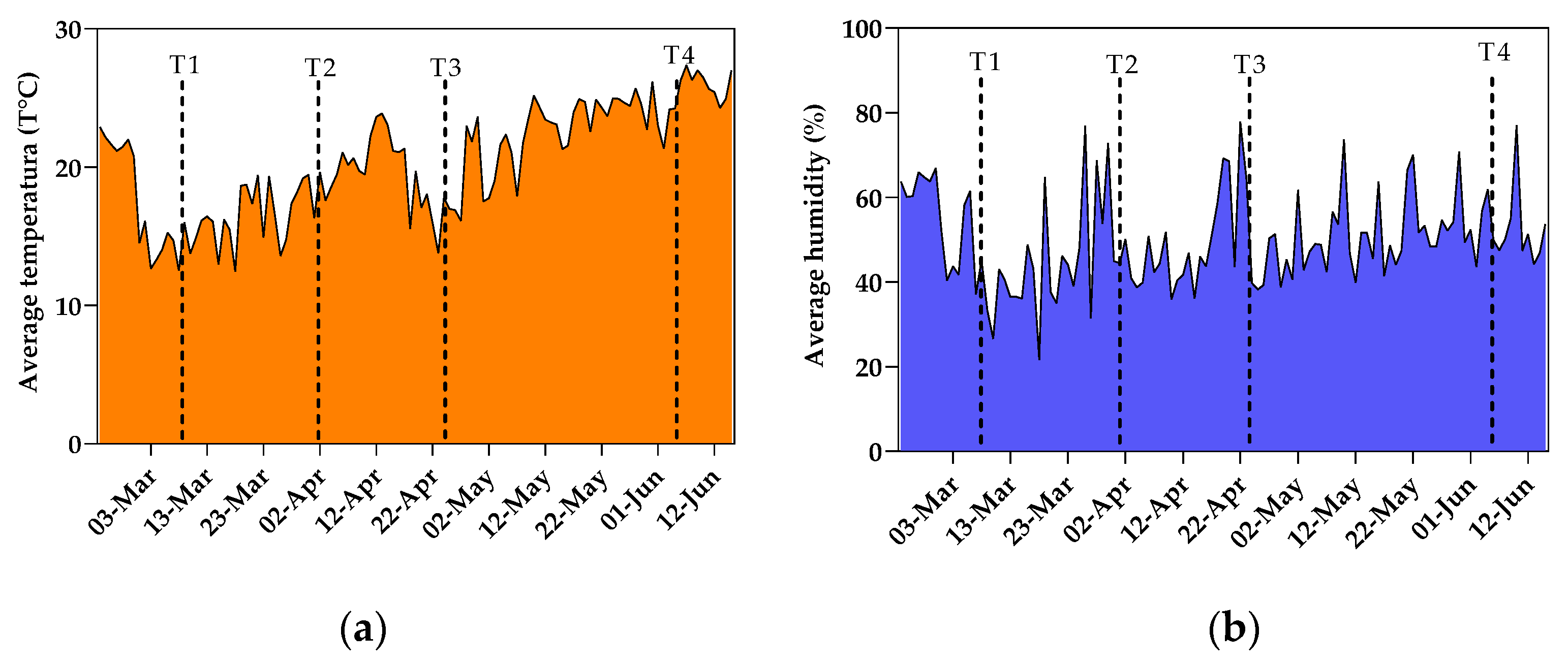
A FLAME-T-XR1-ES spectroradiometer (Ocean Insight, Orlando, FL, USA) was used to measure the spectral distribution of solar radiation inside the greenhouse as modulated by each LC® film. Spectral measurements were carried out over the entire period of the experimental test (four months), and then average values were subsequently calculated. Temperature and relative humidity (Figure 1) were continuously monitored using a datalogger (Tinytag Ultra 2—TGU-4500, Gemini Data Loggers, Chichester, UK).
To assess the plants’ physiological status, non-destructive measurements were carried out to assess gas exchange and chlorophyll a (chl a) fluorescence parameters. These measurements took place monthly, beginning 30 days after the initial acclimatization under LC® films. Data collection corresponded to distinct phenological stages of the plant development with reference to Days Of Acclimatation (DOA): the vegetative stage (30 DOA; T1), fructification stage (54 DOA; T2), ripening stage (103 DOA; T3), and fruit production stage (121 DOA; T4).
Fruits were harvested at the commercial maturity stage based on farm-specific guidelines. Fruit yield was monitored weekly from March to June by collecting and weighing 10 fruits per treatment. For biochemical analyses, fruit samples were collected at the end of the experiment on June 4th. Height and width (n = 3) were registered. These were immediately flash-frozen in liquid nitrogen, stored at −80 °C, and later cryogenically ground to ensure sample homogeneity for downstream analysis.

2.3. Plant Physiological Parameters

Gas exchange measurements were performed using a LICOR 6400XT infrared gas analyzer (LI-COR Environmental, Lincoln, NE, USA) between 10:00 a.m. and 1:00 p.m. Assessments were carried out on homogeneous, randomly selected fully expanded leaves at each phenological stage (T1, T2, T3 and T4; n = 7). The light intensity was set at 700 μmol photons m−2 s−1. CO2 concentration in the leaf chamber was maintained at 400 μmol mol−1 and the flow rate was set to 500 μmol s−1 using a CO2 mixer. The following parameters were recorded: photosynthetic rate (Pn), intercellular CO2 concentration (Ci), and stomatal conductance (gs).
Chlorophyll a fluorescence measurements (n = 10) were performed on dark-adapted leaves (20 min) followed by a 1 s saturating pulse of light emitting diodes (LED) red light (650 nm) at an intensity of 2700 μmol m−2 s−1 using a portable fluorometer (Handy-PEA, Hansatech Ltd., Norfolk, UK). The photosynthetic efficiency of photosystem II (PSII) was evaluated by determining the PSII maximum quantum yield (Fv/Fm). This parameter (Fv/Fm) is an indicator of photosynthetic performance of plants. Values around 0.8 indicate healthy plants whereas values under 0.7 might indicate the presence of stress that affects the photosynthetic machinery [4]. In this ratio, Fv corresponds to the variable fluorescence, calculated as the difference between the maximum fluorescence (Fm) recorded after the saturating pulse and the basal fluorescence of dark-adapted leaves (F0).

2.4. Plant Biometric Parameters

At the end of the experiment, five plants per treatment were selected to study the effect of LC® films on fresh stems, leaves, and roots biomass—and their sum (i.e., total biomass) was calculated. Moreover, leaf dry matter, thickness, and area were measured. Leaf dry matter (n = 3) content was determined by collecting 8 mm diameter leaf disks, recording their fresh weight, and then drying them in an oven (Memmert GmbH Co., KG Universal Oven UN30, Schwabach, Germany) at 105 °C until a constant weight was achieved. Leaf thickness (n = 3) was measured using a high Precision Digital Thickness Gauge; meanwhile, the leaf area (n = 3) was measured after scanning mature leaves and calculating area using software ImageJ (version 1.52t).

2.5. Fruit Color, Soluble Solid Content and Titratable Acidity

Color measurements (n = 5) of strawberry fruits were performed using a Konica Minolta CM-700d spectrophotometer (Minolta, Osaka, Japan) in CIE mode with the analysis of L*, a*, b* values. The L* (lightness) is the coordinate of brightness (z axis), ranging from 0 (black) to +100 (white); a* is the hue coordinate (x axis), ranging from −128 (green) to 127 (red); b* is the hue coordinate (y axis), ranging from −128 (blue) to 127 (yellow). The spectrophotometer was calibrated using a standard white reference.
Soluble solids content (SSC; n = 3) was measured by placing a few drops of the homogenized fruit pulp onto a digital refractometer (PAL-1, Atago Co., Ltd., Tokyo, Japan), and results were expressed as percentage (% Brix). Titratable acidity (TA; n = 5) was determined by homogenizing 1 g of fruit pulp with 30 mL of distilled water, followed by titration with 0.1 M NaOH to a pH of 8 using a digital pH meter (HI 22221, Hanna Instruments, Woonsocket, RI, USA). Results were expressed as a percentage of citric acid (% citric acid).

2.6. Extraction for Spectrophotometric Assays: Total Phenolic Content and Antioxidant Activity

An aliquot (0.1 g) of homogenized strawberry fruit, previously stored at −80 °C, was mixed with 80% methanol (v/v) solution and sonicated at 4 °C using an ultrasonic cleaner (Digital ultrasonic Cleaner, DU-45). The homogenate was then centrifuged at 14,000× g for 10 min using a laboratory centrifuge (MPW-352R, Med. Instruments, Warsaw, Poland). The supernatant was collected and used as the extract for subsequent biochemical analyses.

2.6.1. Total Phenolic Content

Total phenolic content was determined according to the method described by Dewanto et al. [26], with minor modifications. Briefly, 62.5 µL of Folin–Ciocalteu reagent and 250 µL of distilled water were added to 62.5 µL of fruit extract. The mixture was incubated at room temperature for 6 min. Then, 625 µL of a 7% (w/v) Na2CO3 aqueous solution and 500 µL of distilled water were added, and the solution was incubated for 90 min at room temperature in the dark. Absorbance was measured at 760 nm using a spectrophotometer (Ultrospec 2100 Pro, GE Healthcare Ltd., Chalfont, UK). The final absorbance of the sample was measured by subtracting the blank absorbance value (without the fruit extract, replaced with 80% (v/v) methanol). All obtained results (n = 3) were compared against a standard curve prepared with gallic acid (y = 0.002x + 0.0008; R2 = 0.9934), and results were expressed as mg of gallic acid equivalents per g fresh weight (mg GAE g−1 FW).

2.6.2. Antioxidant Activity Assays

Antioxidant activity was determined using two complementary assays: the 2,2-diphenyl-1-picrylhydrazyl (DPPH) assay and the 2,2′-azinobis-3-ethylbenzothiazoline-6-sulfonic acid (ABTS).
For the DPPH assay [27], a methanolic solution of DPPH was prepared at a concentration of 3.12 × 10⁻⁵ M (w/v). A volume of 10 µL of fruit extract was added to 990 µL of the DPPH methanolic solution. The mixture was incubated in the dark at room temperature for 30 min. Absorbance was then measured at 515 nm with the same spectrophotometer described above, subtracting the blank value (a solution free of extract).
For the ABTS assay [17], a buffer solution (5 mM w/v) was prepared using Na2PO4 and Na2H2PO4 to achieve a final pH of 7.4. Then, 0.0192 g of ABTS (7 mM w/v) and 0.0034 g of K2S2O8 (2.5 mM w/v) were solubilized in 5 mL of buffer solution. For the assay, 50 µL of extract was mixed with 950 µL of ABTS solution, and the reaction kinetics were followed at 734 nm for 90 s using the same spectrophotometer described above.
The results (n = 3) from both antioxidant activity assays were expressed as mg of Trolox equivalents per g FW (mg TE g−1 FW).

2.7. Total Ascorbic Acid Content

For the extraction phase of ascorbic acid (ASA), 0.1 g of fresh fruit material was homogenized with 1 mL of 6% (w/v) trichloroacetic acid (TCA) and then centrifuged at 14,000× g for 10 min at 4 °C.
Total ascorbic acid content was determined following the method described by Kampfenkel et al. [28]. Briefly, 50 µL of the extract was mixed with 50 µL of 10 mM dithiothreitol, and 100 µL of 0.2 M phosphate buffer (pH 7.4). After vortex agitation (Vortexclone, Euroclone, Milan, Italy), the mixtures were incubated for 10 min at room temperature. Subsequently, 50 µL of 0,5% (w/v) N-ethylmaleimide were added, and the samples were vortexed again. Then, 250 µL of 10% (w/v) TCA, 200 µL of 42% (w/v) orthophosphoric acid, 200 µL of 4% (w/v) 2,2-dipyridyl (dissolved in 70% ethanol), 100 µL of 3% (w/v) FeCl3, 100 µL of distilled water were added to the sample mixture. Finally, the mixture was incubated for 40 min at 42 °C and the absorbance was measured at 525 nm using the spectrophotometer described above. In the blank solution, TCA 6% (w/v) was used instead of the extract. Results were expressed in mg of ascorbic acid per g FW (mg ASA g−1 FW), using the standard curve of ascorbic acid (y = 0.0147x − 0.0042; R2 = 0.9954).

2.8. Total Anthocyanin Content

For the extraction, 0.1 g of fruit material was homogenized with 1 mL of 1% HCl-acidified methanol and centrifuged at 15,000× g for 10 min.
For the determination of total anthocyanins, the Giusti & Wrolstad method [29] was followed. An aliquot (100 µL) of the extract was diluted with 900 µL of 0.025 M potassium chloride buffer (pH 1.0) and 0.4 M sodium acetate buffer (pH 4.5), differentiated into two separate cuvettes. The solutions were allowed to stabilize for 15 min at room temperature. The absorbance of the diluted sample was calculated as follows:
Afinal = (A530 − A700)pH1.0 − (A530 − A700)pH4.5
T o t a l   A n t h o c y a n i n   C o n t e n t = A f × M W   P g 3 g l u × D f ε × 1 × V e x t × W s a m p l e
where MW is the molecular weight of cyanidin-3-O-glucoside, Df is the dilution factor, 1 is the path length in the cuvette (cm), ε is the molar extinction coefficient (L mol−1 cm−1), Vext is the volume extract, and Wsample is the sample weight (g).
The results (n = 3) were expressed in mg of cyanidin-3-O-glucoside in g FW (mg Cyd-3glu. eq. g−1 FW).

2.9. Botrytis cinerea Inoculum Preparation and Fruit Inoculation

The Botrytis cinerea strain used in this study (i.e., isolate 8335) [30] was cultured in Petri dishes (Ø 9 cm) on potato dextrose agar (39 g L−1,), amended with streptomycin sulfate (0.10 g L−1), and stored in the Department of Agriculture, Food, and Environment’s culture collection at 23 ± 2 °C under a 12 h light/12 h dark photoperiod.
The inoculum was prepared scratching conidia of a 7-day-old culture of B. cinerea in Erlenmeyer flaks (0.50 L), containing a sterile aqueous solution of sucrose and yeast extract (2 and 0.05% w/v, respectively). The suspension was incubated for 24 h at 23 °C on an orbital homogenizer (711 CT, Asal, Milan, Italy) set at 150× g. Conidial concentration was then adjusted to 1 × 10⁶ conidia mL−1 using a Bürker hemacytometer chamber (Henneberg-Sander, Giessen-Lützellinden, Germany).
Fruit inoculation followed the protocol described by Lauria et al. [8], wherein 10 µL of the conidial suspension was applied to an artificial opening previously made just below the calyx of each fruit. For mock-inoculated fruits, the same procedure was used but with the sterile sucrose–yeast extract solution instead of B. cinerea. Additionally, control fruits were wounded but left untreated to verify the absence of symptoms in non-inoculated conditions (Figure S1).
Following inoculation, fruits were placed in sterile wet chambers (six fruits per chamber) and incubated at 25 °C under a 12 h photoperiod. Inoculated, mock-inoculated, and control fruits were kept in separate chambers. Humidity was maintained by placing sterile wet paper beneath the fruits (without direct contact). A total of 18 fruits were used per treatment condition, resulting in 72 fruits in total.

2.10. Post-Harvest Botrytis cinerea Development

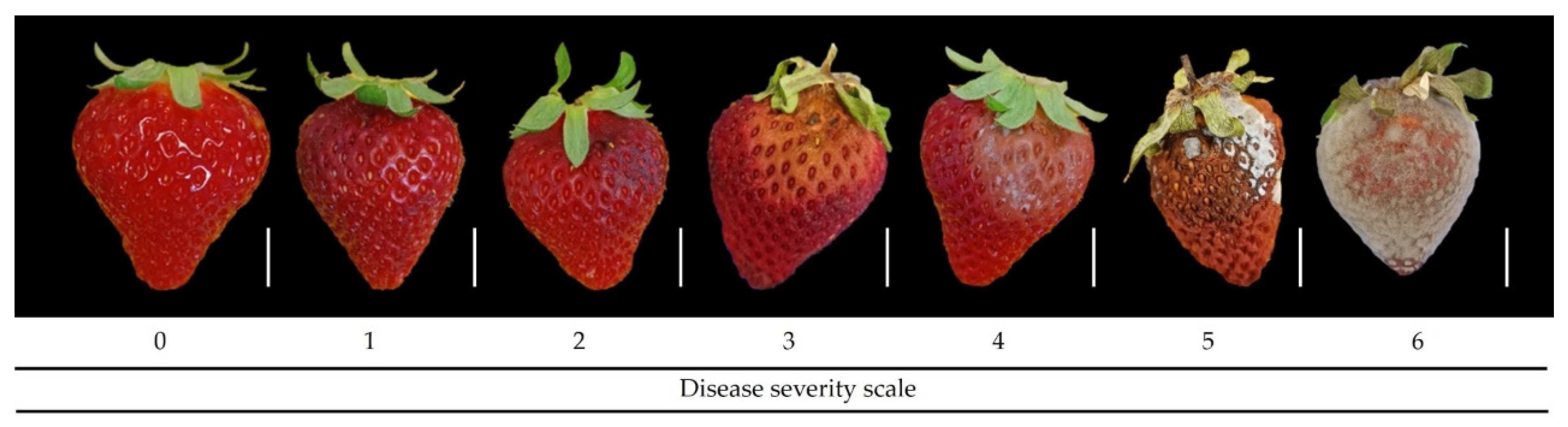
Disease severity was monitored every 24 h for 5 consecutive days (i.e., from 0 to 96 h post inoculation, hpi) using an ordinal 0–6 pathometric scale: 0 = no visible symptoms; 1 = symptom onset; 2 = necrotic lesions without mycelium; 3 = <11% of fruit surface covered by mycelium; 4 = 11–22% of fruit surface covered by mycelium; 5 = 22–33% of fruit surface covered by mycelium and 6 = >33% of fruit surface covered by mycelium (Figure 2).
The Area Under the Disease Progress Curve (AUDPC) was determined using the formula reported by Simko and Piepho [31]:
A U D P C = i = 1 n 1 y i + y i + 1 2   × ( t i + 1 t i )
where y i   is the rate of disease severity determined as described above at the observation ( i ), t i   is time (in h) at the same i observation, and n is the total number of observations.

2.11. Statistical Analysis

All the data related to plant and fruit biometric traits, as well as organoleptic and nutraceutical properties of fruits, were analyzed using a one-way analysis of variance (ANOVA), with the type of film as the factor of variability. The normal distribution of data (±standard error) was confirmed by the Shapiro–Wilk test. The effect of ‘time’, ‘treatment’, and their interaction “time × treatment” on physiological parameters (i.e., gas exchange and PSII photochemical efficiency) and AUDPC were analyzed by two-way ANOVA. All the means were separated by Fisher’s least significant difference post hoc test (p  <  0.05). The statistical analyses were conducted using GraphPad (GraphPad, La Jolla, CA, USA).

3. Results

3.1. Light-Converting Properties of Polyethene Films

The average light spectra based on four measurements taken from March to June (T1–T4) were reported in Table 1, comparing the modulated light transmitted by both B and P films with the light spectra received in the Control environment or transmitted by T film. Both LC® films effectively absorbed UV radiation in the 300–380 nm waveband available in the greenhouse light environment. Compared to the T film, the B film resulted in a 17% increase in blue light (450–495 nm range), while only a 6% of blue light was absorbed by the T film with respect to the Control. Furthermore, the P film showed a higher absorption in the green waveband (510–575 nm) than the B film. The increase in red light in the 620–700 nm waveband was observed in both B and P films when compared to the T film (Table 1).

3.2. Plant Morphological Parameters

According to the data collected at the end of the experiment, no significant differences were observed in leaf area between treatments; similar findings were found in the stem biomass and the total plant biomass, although the highest root biomass was observed in plants grown under the B film (Table 2). However, plants grown under the P and B films showed a lower leaf thickness (−20%) than those grown under the T film and in Control environment. At the same time, plants grown under B film had a higher leaf number per plant (+85.2%) in comparison with Control plants (Table 2). The highest leaf dry matter was measured in plants grown under the B and Control, while P and T films resulted in lower dry matter of leaves (Table 2).

3.3. Plant Physiological Characteristics

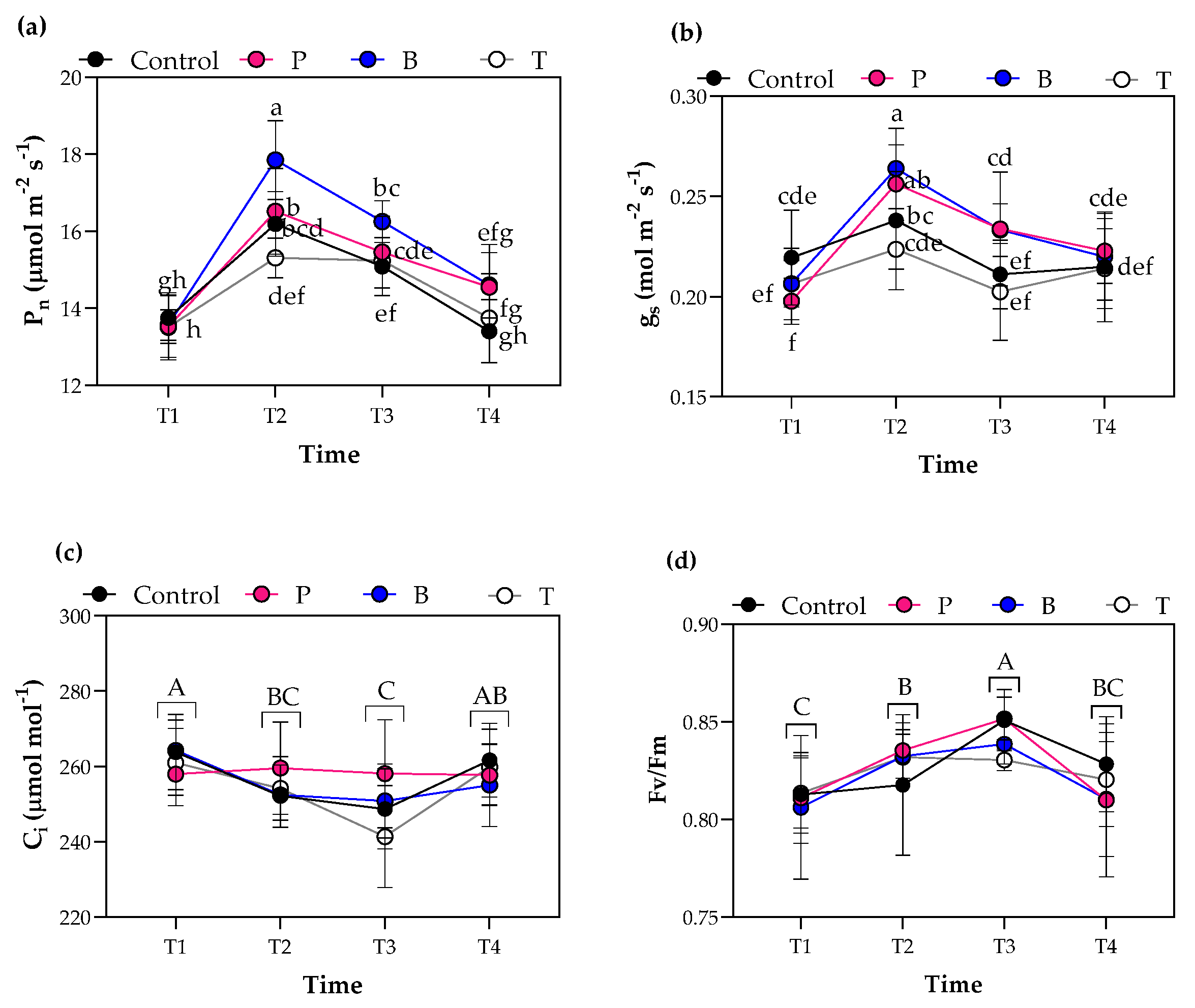
Analysis of gas exchange parameters during the different phenological phases indicates that plants grown under the B film showed a higher level of Pn when compared to the Control at T2 and T3 (Figure 3a). At T1, no statistically significant differences among treatments were found; at T2, the B film induced higher Pn value than the Control and T films (+10 and +17%, respectively), while the plants cultivated under the P film (+8%) had values higher than those under the T film. At T3, only leaves of plants grown under the B film had higher Pn values than Control plants and those grown under the T film. Finally, at T4, B and P films induced an increase (+9 and +8%, respectively) of Pn compared to the Control.
B film induced higher gs values at T2 and T3 compared to the other treatments whereas P film induced higher gs values only at T2 (Figure 3b). At T1, the leaves of plants grown under the P film had values of gs lower (−10%) than values recorded in Control leaves, while no significant differences were found between the other treatments. At T2, the B film produced an increase of gs compared to the Control and the T film (+11 and +18%, respectively), whereas the P film induced higher values (+15%) of gs than the T film. At T3, the leaves of plants grown under both B and P films had higher gs values than the Control (+10 and +11%, respectively) and T film (+15 and +16%, respectively). Finally, at T4, no significant differences were observed among treatments.
During the whole experimental period, no statistically significant differences in Ci values were observed among LC® films, the T film, and the Control environment, even though a decrease in Ci values was registered at T3 equivalent to fruit ripening stage (Figure 3c). The measurements of chl a fluorescence parameters showed that there were no statistically significant differences among treatments and that the PSII photochemical efficiency was optimal in any case (Figure 3d).

3.4. Fruit Yield and Fruit Biometric Parameters

Values reported in Table 3 shows that plants grown under the B film reported a reduction in single fruit weight compared to the other treatments. Similarly, the plants grown under B film even the fruit width and height were reduced compared to the Control plants and those grown under the T film. Instead, the plants grown under the P film produced fruits similar to the Control plants, and with similar width and height to those under the T film. Results of the fruit yield of plants subjected to different treatments indicate an increase in the plant’s yield with the use of B film when compared with Control plants and plants grown under the T film (+34 and +44%, respectively), despite the lowest fruit weight, width, and height. Differently, the P film did not induce significant differences in fruit yield compared to the other treatments (Table 3).

3.5. Fruit Organoleptic and Nutritional Quality

As regards the fruit’s external color, strawberries developed under the P film showed values of brightness (L*, black–white) statistically equal to the other treatments and values of redness (a*, green–red) and yellowness (b*, blue–yellow) higher than the Control and comparable to T film (Table 4). In contrast, strawberries grown under the B film showed lower brightness values than T film and similar to the other treatments. Finally, the redness values were lower in fruit grown under the B film compared with the T film, whereas yellowness values did not differ significantly from the rest of treatments (Table 4).
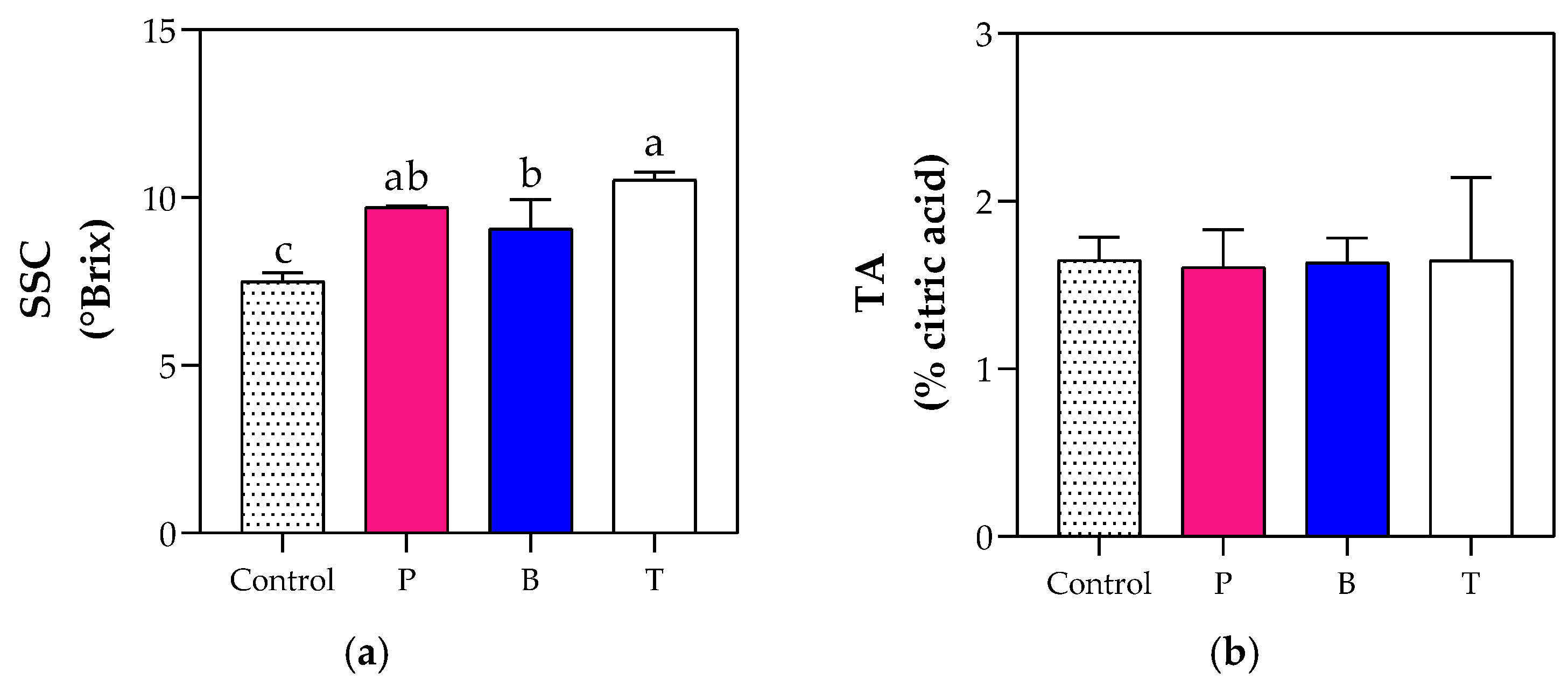
Figure 4a shows that strawberries grown under the B film had a higher SSC than the Control fruit (+21%) and lower than fruit under the T film (−14%), while those grown under the P film had values higher than the Control fruit (+30%), comparable to fruit under the T film. Figure 4b, on the other hand, indicates that no statistically significant differences in the values of TA have been observed among treatments.
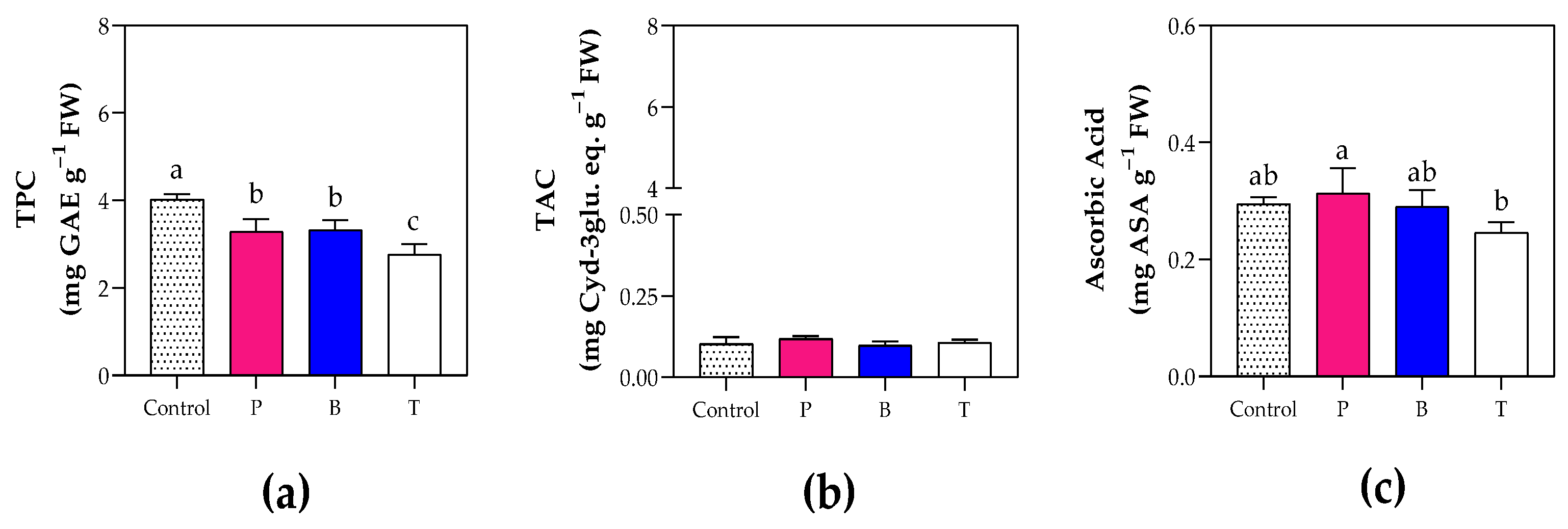
Moreover, fruits from plants grown with both P and B LC® films had a total phenolic content (Figure 5a) higher than the fruit developed with the T film (in average +17%). Conversely, TPC in fruit from plants grown under B and P films were lower than the Control fruits (−17%).
Figure 5b shows that there were no statistically significant differences among treatments regarding anthocyanin concentration. Finally, the P film induced an increase in ascorbic acid content in fruit (Figure 5c) than the concentration in fruit under the T film (+29%), while no other significant differences were found among treatments.
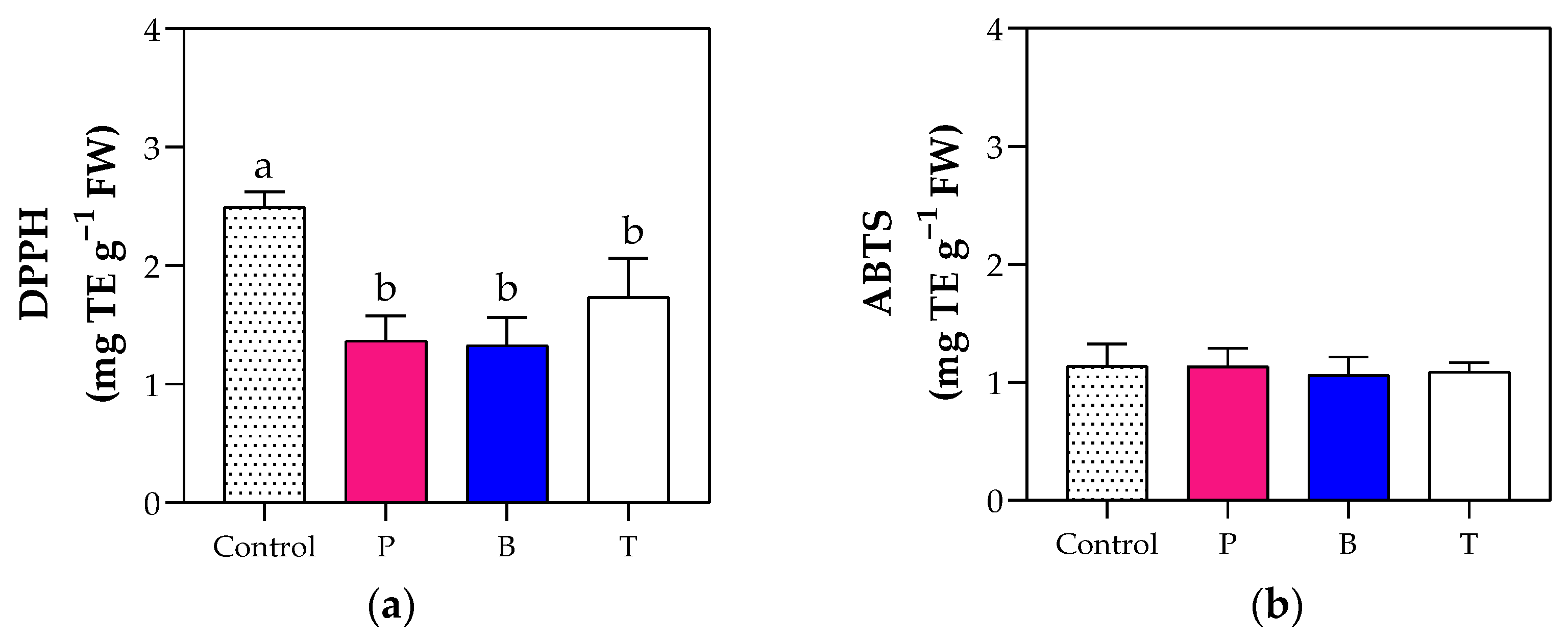
The antioxidant activity measured by DPPH assay of strawberry fruit grown under B, P, and T films was lower than that of the Control fruit (Figure 6a). In contrast, no statistically significant differences were observed between treatments regarding the antioxidant activity determined by the ABTS assay (Figure 6b).

3.6. Botrytis cinerea Development

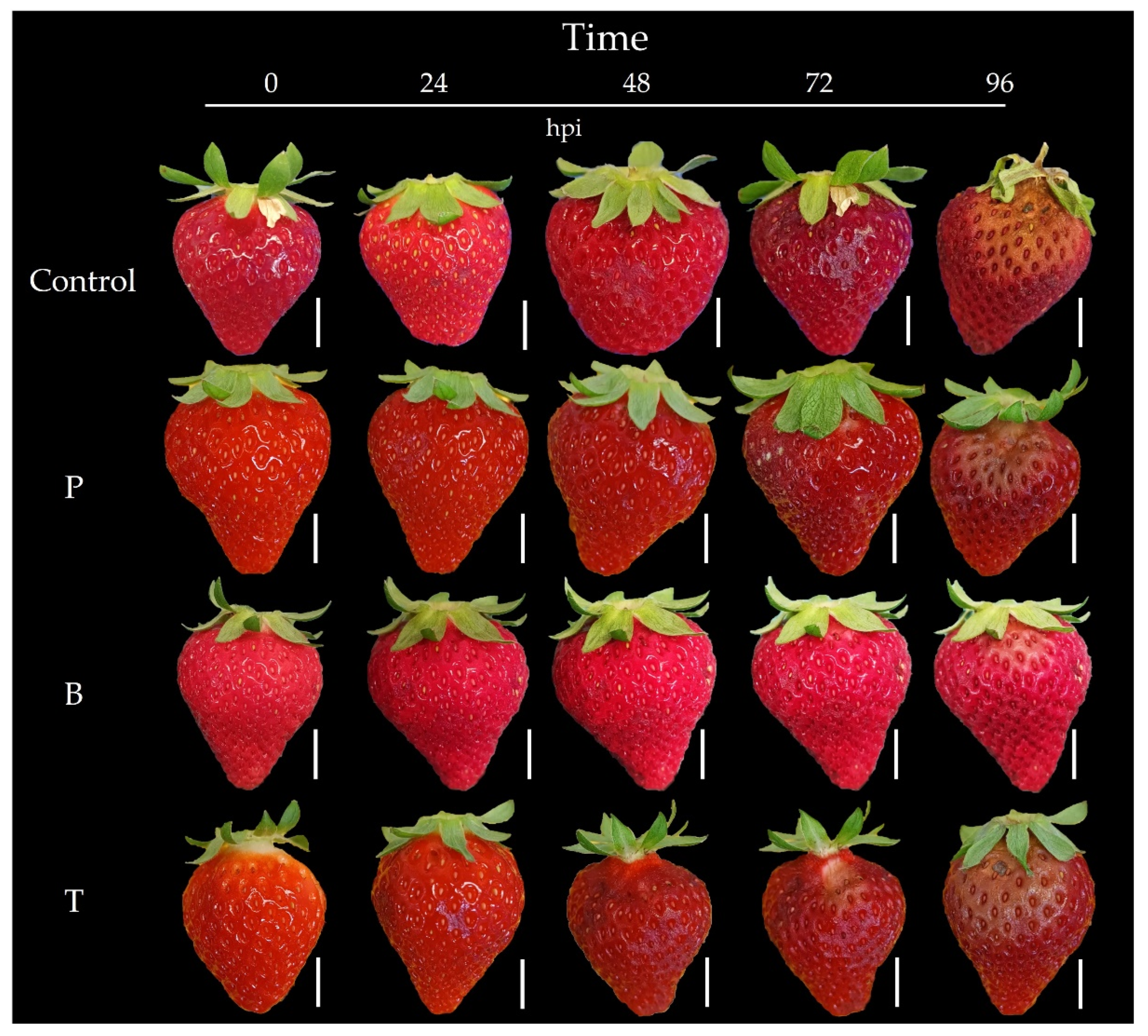
In Figure 7, the development of B. cinerea in inoculated strawberries was reported in all experimental conditions.
The two-way ANOVA showed that the interaction between time and treatment on AUDPC was significant. A reduction in Area Under Disease Progress Curve (AUDPC) was observed at 72 and 96 hpi on ‘B’ film in comparison to ‘T’ (−37 and −28%, respectively; Table 5).

4. Discussion

4.1. Light-Conversion Technology Applied in Double-Roof System: Effect on Light Spectra

Within the greenhouse system, parts of UV light are still available for a crop-surrounding light environment [16]. The light spectrum measurements of the present experiment indicated that the conversion effect of UV and green lights into blue and red lights, respectively, is guaranteed by the application of P and B LC® films. Although light intensity is reduced inside the greenhouse, the double-roof system using LC® films was able to enhance available light quality in comparison to the Control. These results confirm the findings reported by El Horri et al. in strawberry [6] and blackberry trials [18] where blue light conversion film was able to convert UV light waveband into blue light waveband and the pink film was able to convert UV and green light wavebands into blue and red light wavebands, respectively. To find the best usage of LC® technology as double-roof system, the effects of B and P films were examined on strawberry plant performance in terms of morphological, physiological, and biochemical aspects in comparison with T film and the control in greenhouse without the double-roof system.

4.2. Blue Film Improved Leaf Gas Exchange, Leaf Number but Decreased Leaf Thickness, Similarly to the Pink Film

LC® films are considered as a new technology, especially when utilized in a double-roof system. For this reason, the data of the present experiment are compared with the effects of monochromatic light supplementation on plants since the goal of both light modulations (monochromatic light and LC® films) is the same, i.e., the enhancement of plant physiology and productivity through the modification of perceived light spectrum by plants. The effects of the B film on strawberry cultivar “Marimbella”, reported in the present experiment, are in agreement with the findings obtained by Ma et al. [32] who found an increase in leaf number per plant and an increase in the root biomass in lettuce plants grown with blue monochromatic light. According to several authors [7,33,34], one of the most common morphological changes induced by UV radiation is the increase in leaf thickness. The conversion of UV radiation in blue light under the B and P films, utilized in the present experiment, might explain the reduction in leaf thickness in plants grown under these treatments, compared to those cultivated under the Control environment and T film. Indeed, plants of Vitis vinifera exposed to high level of UV-B showed higher leaf thickness when compared to plants subjected to low levels of UV-B radiation [22,34]. The effect of UV radiation was explained by the negative effect on a number of physiological and biochemical processes such as xyloglucan endotransglycosylase protein synthesis and the auxin hormone synthesis that interact with cell expansion leading to reduced leaf thickness [34]. More particularly, the reduction in leaf thickness is a result of a reorganization of the mesophyll at leaf level [34]. Therefore, the reduction in UV radiation in favor of blue light maintained the constant leaf cell expansion, but inducing other morphological modifications such as the increase in root biomass and in leaf number. Leaf gas exchange parameters were investigated as a reliable indicator of plant photosynthesis under modulated solar light [35]. Our dataset shows that the B film, followed by the P film, induced a higher net photosynthesis than plants grown under T film and the Control plants. This was also confirmed by the higher values of stomatal conductance during the same analysis time. Other trials validated these results; for example, both strawberry [6] and blackberry [18] plants grown under blue LC® film showed higher CO2 uptake rates due to increased stomatal conductance [13,32]. As studied by Landi et al. [22], this phenomenon could be related to the blue light-driven stomata opening connected to the stimulation of zeaxanthin synthesis. In addition, studies on the effects of monochromatic lighting are supportive for this stimulatory effect of blue light. In fact, Su et al. [36] observed an increase in the biosynthesis of Rubisco in cucumber plants grown under blue monochromatic light combined with an improvement in the photosynthetic process and higher stomatal conductance compared to other monochromatic lights. Lauria et al. [37] also reported higher values of gs in basil plants grown with blue light supplementation, justified by an increase in the number of stomata and stomatal density induced by the supplementation of solar light with blue light. In the present study, we noticed that the B film led to a higher leaf number in strawberry plants that can directly affect the light harvest. In the literature, other strategies for light harvesting stimulated by blue light supplementation were studied, such as the pigment profile at leaf level. As Guiamba et al. [35] observed, strawberry plants exposed to blue LED light obtained the highest content of chlorophyll a, total chlorophylls, and carotenoids, resulting in higher net photosynthesis than other LED light applications. In our study, the application of LC® technology was ineffective in terms of PSII photochemical quantum yield efficiency as demonstrated by unchanged Fv/Fm values. Similarly, in the case of the eggplant, grown under UV-to-Red spectral shifting film, there were no significant differences in PSII photochemical quantum yield (i.e., unchanged Fv/Fm levels) [1]. This was explained by the application of Spectral shifting film that did not cause dramatic effects on the photosynthetic metabolism in the plants, but rather affected gas exchange and the CO2 flux to stomata and chloroplasts [1]. The authors of this study justified the results by the lack of environmental stress conditions in terms of photochemical photosynthesis induced by UV-to-Red spectral shifting technology [1].

4.3. The Blue Film Enhanced Fruit Production and Fruit Organoleptic Quality

The final production of horticultural crops can be directly affected by modulated light environment [1,5,34]. According to our results, it can be deduced that, although strawberry plants grown under the B film produced small size fruit than the other treatments, the final yield was significantly higher than that of plants grown under the T film and in the Control environment. This result was confirmed by Nadalini et al. [38], who found an increase in yield in strawberry plants grown under monochromatic LED blue light. According to Guiamba et al. [35], leaf photosynthetic acceleration induced by blue LED light during fruit production stage enhances fruit set per plant, resulting in higher strawberry yields either in terms of fruit number or total fruit yield. Similarly to our results, a blueberry experiment by Cho et al. [39] showed that plants grown under monochromatic LED blue light produced fruit of lower weight and size than those from red light environment, mixed blue/red and white light treatments. As far as it concerns the P film, the increase in total yield was not significantly different from that of the Control plants or under the T film. Similarly, blackberry fruit grown under the pink LC® film (without a double-roof system) yielded similar results in terms of fruit weight and size than those grown under transparent polyethylene film [18]. These contradictory results could be attributed to species-specific film effects [22,40,41]. According to Cho et al. [39], in response to spectral light increase, the fruit relative growth rate shaped by modifications in root activity is what affects the fruit size and weight.
As far as fruit organoleptic quality is concerned, SSC were affected by the covering material but not the case for TA. Studies on tomatoes report that a combination of blue and red lights, as in the case of P film treatment, can influence carbohydrate metabolism by stimulating the activity of sucrose synthase and sucrose phosphate synthase, improving the organoleptic quality of the fruit [41,42]. However, other authors believe that the SSC is not particularly affected by the type of light, although they found that sucrose is the only sugar found in lower quantities in strawberry fruit grown under blue light [38]. Further research could be carried out on sugar metabolism to investigate the contrasting results found in the literature. The health benefits of strawberry fruit are an attractive factor for consumers, together with flavor, taste, and color [8]. In fact, fruit exposed to monochromatic red LED light had higher values of a* and b* than the Control exposed to white light [38]. Strawberry plants grown in a red light monochromatic environment were proven to increase redness at fruit level [38]. Therefore, the increase in a* and b* coordinates of strawberry fruit was linked to the increase in red light portion by the pink LC® film [15,25]. Even though no significant differences were found in the anthocyanin content of the whole strawberry fruit, this phenomenon on the strawberry surface induced higher b* values. This effect could be related to the synthesis of the major anthocyanin molecules such as pelargonidine-3-O-glucoside, cyanidin-3-O-glucoside, and pelargonidine-3-methylmalonylglucoside, promoted by red light, as evidenced by other authors [25]. The abundant presence of phenolic groups and other antioxidants in strawberry fruit triggers interest in the effect of LC® films also on bioactive compounds present in the edible fruit [1,35]. From both the analyses of DPPH assay and TPC on fruit, higher values were found in plants grown in the Control environment and lower values were observed in the other treatments. This is in line with findings by Choi et al. [43] who reported that antioxidant activity of strawberry fruit of plants grown under blue + red LED light and under 100% blue light in a growth chamber was lower than the control. This decline could be related to the alteration of UV radiation absorbed by both LC® films [14,15]. In fact, light spectrum modulation has a significant impact on the phenylpropanoid pathway in plants, influencing both gene expression and the accumulation of phenylpropanoid compounds [9]. In particular, the stimulation of biosynthesis of these antioxidant compounds is due to the stimulation of UV light to Reactive Oxygen Species over production, inducing the responses of plant defense mechanisms. The synthesis of secondary metabolites, including phenolic compounds (in particular quercetin-3-glucuronide, cyanidin-3-glucoside, and kaempferol-3-glucoside) and antioxidant molecules, increase in response to UV-A and UV-B radiation, as demonstrated by Warner et al. [33]. For this reason, the conversion of UV to blue light in LC® blue film lead to a decrease in antioxidant compounds such as phenolic compounds [14,15]. However, the increase in fruit yield induced by the use of blue film can be a fair economic compromise to develop and to enhance the use of LC® films in a double-roof system. Indeed, the investigation of future studies into this system in other edible plant species with different crop cycles may confirm the increase in yield found in the present work also with the enhancement of nutraceutical properties.

4.4. Effect of LC® Films on Botrytis cinerea Development

Our findings indicate that light supplementation exerts an indirect effect on the control of B. cinerea, as also demonstrated by Lauria et al. [8]. Notably, strawberry fruit grown under the B film showed consistently lower disease progression when compared to the T film. These results suggest that the alteration of spectral composition, particularly the increase in blue light and reduction in UV radiation promoted by the B film, may contribute to a delay in B. cinerea infection dynamics. Although no significant differences were observed among the Control, P, and T treatments across all time points, the distinct performance of the B film aligns with previous literature indicating a role of light quality in plant–pathogen interactions [8]. Blue light, in particular, has been shown to influence fungal sporulation and germination rates, as well as to enhance host defense responses in some species [44,45,46]. Moreover, Blue light supplementation can inhibit fungal growth by disrupting signaling pathways involved in cell fusion, hyphal development, and virulence. It deactivates enzymes like catalase, increasing oxidative stress and suppressing hyphal formation by inhibiting lipid metabolism, which is essential for fungal invasion [8,9,30]. In the present case, the slower disease progression under the B film could be attributed to indirect effects of blue light on fruit surface characteristics, such as cuticle composition, which can influence fungal entry and colonization. The T film, which mainly transmits full-spectrum visible light without spectral shifting, led to the highest AUDPC values at the final time point, suggesting that unfiltered solar radiation, including UV components, might not suppress fungal development in post-harvest conditions. Conversely, the reduced progression observed under the B film highlights the potential of LC® films not only for crop production enhancement but also for post-harvest disease management.
Further research is required to elucidate the specific physiological or biochemical mechanisms underlying this suppression. In particular, exploring the role of blue light in modulating fruit surface defenses (e.g., phenolic compounds, wax layer properties) or microbial community dynamics on fruit epiphytic surface could offer insights into integrated light-based strategies for disease mitigation. These findings also open up new perspectives in the development of passive, non-chemical approaches for post-harvest disease control, aligning with sustainable agricultural practices.
In addition, more generally, given the novelty of the double-roof system utilizing light conversion films, in-depth investigation of the effects of this technology on different strawberry varieties and different greenhouse conditions and plant growth season may be the object of future research.

5. Conclusions

This study demonstrates that the application of light conversion films in a double-roof greenhouse system can effectively modulate the solar spectrum, leading to significant improvements in strawberry (Fragaria × ananassa cv. Marimbella) performance at both physiological and horticultural levels. The blue film enhanced leaf gas exchange, increased leaf number and root biomass, and ultimately improved fruit yield despite a reduction in single fruit size. Conversely, the pink film exerted a stronger influence on fruit quality traits, particularly increasing soluble solids and ascorbic acid content, while maintaining comparable yield to conventional coverings. Both films stimulated phenolic accumulation relative to transparent polyethylene, although total antioxidant activity remained highest in control fruits. Notably, the blue film also conferred post-harvest advantages, delaying Botrytis cinerea development and thereby contributing to improved fruit storability.
Overall, these findings highlight the potential of the technology under investigation, especially the blue film, as a sustainable and energy-free strategy for optimizing strawberry productivity, nutritional quality, and post-harvest resilience in controlled environments.

Supplementary Materials

The following supporting information can be downloaded at: https://www.mdpi.com/article/10.3390/horticulturae11091121/s1, Figure S1: Effects of colored plastic films on non-inoculated fruits of Fragaria × ananassa cv. Marimbella at 0, 24, 48, 72, and 96 h post inoculation (hpi). Bar: 1 cm. Abbreviation: Control = no film, P = pink film, B = blue film, and T = transparent film.

Author Contributions

Conceptualization, C.N., M.L., and L.G.; methodology, H.E.H., C.C., and E.L.P.; software, M.F.; formal analysis, H.E.H., G.B., M.F., A.M., and E.L.P.; data curation, H.E.H., G.B., M.F., C.C., and E.L.P.; writing—original draft preparation, H.E.H., G.B., M.F., A.M., C.C., and S.R.; writing—review and editing, E.L.P., C.N., M.L., and L.G.; funding acquisition, L.G. All authors have read and agreed to the published version of the manuscript.

Funding

This research was funded by PSR 2014–2020—Misura 16.2—Annualità 2022—Sostegno a progetti pilota e allo sviluppo di nuovi prodotti, pratiche, processi e tecnologie, in the framework of the ‘Luminescent’ project.

Data Availability Statement

Data are available on request.

Conflicts of Interest

The authors declare no conflicts of interest.

References

  1. Conti, S.; Di Mola, I.; Barták, M.; Cozzolino, E.; Melchionna, G.; Mormile, P.; Ottaiano, L.; Paradiso, R.; Rippa, M.; Testa, A.; et al. Crop Performance and Photochemical Processes Under a UV-to-Red Spectral Shifting Greenhouse: A Study on Aubergine and Strawberry. Agriculture 2025, 15, 569. [Google Scholar] [CrossRef]
  2. Shah, I.H.; Manzoor, M.A.; Wu, J.; Li, X.; Hameed, M.K.; Rehaman, A.; Li, P.; Zhang, Y.; Niu, Q.; Chang, L. Comprehensive Review: Effects of Climate Change and Greenhouse Gases Emission Relevance to Environmental Stress on Horticultural Crops and Management. J. Environ. Manag. 2024, 351, 119978. [Google Scholar] [CrossRef] [PubMed]
  3. Trivellini, A.; Toscano, S.; Romano, D.; Ferrante, A. The Role of Blue and Red Light in the Orchestration of Secondary Metabolites, Nutrient Transport and Plant Quality. Plants 2023, 12, 2026. [Google Scholar] [CrossRef]
  4. Somkuwar, R.G.; Dhole, A.M. Understanding the Photosynthesis in Relation to Climate Change in Grapevines. Theory Biosci. 2025, 144, 107–120. [Google Scholar] [CrossRef]
  5. Hamdani, S.; Khan, N.; Perveen, S.; Qu, M.; Jiang, J.; Govindjee; Zhu, X. Changes in the Photosynthesis Properties and Photoprotection Capacity in Rice (Oryza sativa) Grown under Red, Blue, or White Light. Photosynth. Res. 2019, 139, 107–121. [Google Scholar] [CrossRef]
  6. El Horri, H.; Vitiello, M.; Ceccanti, C.; Lo Piccolo, E.; Lauria, G.; De Leo, M.; Braca, A.; Incrocci, L.; Guidi, L.; Massai, R.; et al. Ultraviolet-to-Blue Light Conversion Film Affects Both Leaf Photosynthetic Traits and Fruit Bioactive Compound Accumulation in Fragaria × ananassa. Agronomy 2024, 14, 1491. [Google Scholar] [CrossRef]
  7. Huché-Thélier, L.; Crespel, L.; Gourrierec, J.L.; Morel, P.; Sakr, S.; Leduc, N. Light Signaling and Plant Responses to Blue and UV Radiations—Perspectives for Applications in Horticulture. Environ. Exp. Bot. 2016, 121, 22–38. [Google Scholar] [CrossRef]
  8. Lauria, G.; Lo Piccolo, E.; Ceccanti, C.; Guidi, L.; Bernardi, R.; Araniti, F.; Cotrozzi, L.; Pellegrini, E.; Moriconi, M.; Giordani, T.; et al. Supplemental Red LED Light Promotes Plant Productivity, “Photomodulates” Fruit Quality and Increases Botrytis cinerea Tolerance in Strawberry. Postharvest Biol. Technol. 2023, 198, 112253. [Google Scholar] [CrossRef]
  9. Kim, K.; Kook, H.-S.; Jang, Y.-J.; Lee, W.-H.; Kamala-Kannan, S.; Chae, J.-C.; Lee, K.-J. The Effect of Blue-Light-Emitting Diodes on Antioxidant Properties and Resistance to Botrytis cinerea in Tomato. J. Plant Pathol. Microbiol. 2013, 4, 203. [Google Scholar] [CrossRef]
  10. Sun, Y.; Li, Y.; Xu, Y.; Sang, Y.; Mei, S.; Xu, C.; Yu, X.; Pan, T.; Cheng, C.; Zhang, J.; et al. The Effects of Storage Temperature, Light Illumination, and Low-Temperature Plasma on Fruit Rot and Change in Quality of Postharvest Gannan Navel Oranges. Foods 2022, 11, 3707. [Google Scholar] [CrossRef]
  11. Liu, J.; Van Iersel, M.W. Photosynthetic Physiology of Blue, Green, and Red Light: Light Intensity Effects and Underlying Mechanisms. Front. Plant Sci. 2021, 12, 619987. [Google Scholar] [CrossRef]
  12. Lee, M.; Rivard, C.; Wang, W.; Pliakoni, E.; Gude, K.; Rajashekar, C.B. Spectral Blocking of Solar Radiation in High Tunnels by Poly Covers: Its Impact on Nutritional Quality Regarding Essential Nutrients and Health-Promoting Phytochemicals in Lettuce and Tomato. Horticulturae 2021, 7, 524. [Google Scholar] [CrossRef]
  13. Ávalos-Sánchez, E.; López-Martínez, A.A.; Molina-Aiz, F.D.; Lemarié, S.; Proost, K.; Peilleron, F.; Moreno-Teruel, M.A.; Valera, D.L. Effect of Photoconversion Films Used as Greenhouse Double Roof on the Development of Cucumber Fungal Diseases in Spain. In Proceedings of the Eurpean Conference on Agricultural Engineering AgEng2021, Évora, Portugal, 4–8 July 2021; Barbosa, J.C., Silva, L.L., Lourenço, P., Sousa, A., Silva, J.R., Cruz, V.F., Baptista, F., Eds.; Universidade de Évora: Évora, Portugal, 2021; pp. 831–838. [Google Scholar]
  14. Proietti, S.; Moscatello, S.; Riccio, F.; Downey, P.; Battistelli, A. Continuous Lighting Promotes Plant Growth, Light Conversion Efficiency, and Nutritional Quality of Eruca vesicaria (L.) cav. in Controlled Environment with Minor Effects Due to Light Quality. Front. Plant Sci. 2021, 12, 730119. [Google Scholar] [CrossRef] [PubMed]
  15. Wang, J.; Qiao, X.; Li, B.; Liu, B.; Zhang, J.; Yan, Z.; Hao, P.; Wang, X.; Liu, Y.; Shen, L.; et al. The Research Progress of Rare Earth Agricultural Light Conversion Film. Heliyon 2024, 10, 36967. [Google Scholar] [CrossRef]
  16. Lemarié, S.; Guérin, V.; Jouault, A.; Proost, K.; Cordier, S.; Guignard, G.; Demotes-Mainard, S.; Bertheloot, J.; Sakr, S.; Peilleron, F. Melon and Potato Crops Productivity under a New Generation of Optically Active Greenhouse Films. Acta Hortic. 2020, 1296, 517–526. [Google Scholar] [CrossRef]
  17. Re, R.; Pellegrini, N.; Proteggente, A.; Pannala, A.; Yang, M.; Rice-Evans, C. Antioxidant Activity Applying an Improved ABTS Radical Cation Decolorization Assay. Free Radic. Biol. Med. 1999, 26, 1231–1237. [Google Scholar] [CrossRef] [PubMed]
  18. El Horri, H.; Vitiello, M.; Braca, A.; De Leo, M.; Guidi, L.; Landi, M.; Lauria, G.; Lo Piccolo, E.; Massai, R.; Remorini, D.; et al. Blue and Red Light Downconversion Film Application Enhances Plant Photosynthetic Performance and Fruit Productivity of Rubus fruticosus L. var. Loch Ness. Horticulturae 2024, 10, 1046. [Google Scholar] [CrossRef]
  19. Zheng, L.; Van Labeke, M.-C. Long-Term Effects of Red- and Blue-Light Emitting Diodes on Leaf Anatomy and Photosynthetic Efficiency of Three Ornamental Pot Plants. Front. Plant Sci. 2017, 8, 917. [Google Scholar] [CrossRef]
  20. Upadhyay, R.; Saini, R.; Shukla, P.K.; Tiwari, K.N. Role of Secondary Metabolites in Plant Defense Mechanisms: A Molecular and Biotechnological Insights. Phytochem. Rev. 2025, 24, 953–983. [Google Scholar] [CrossRef]
  21. Kadomura-Ishikawa, Y.; Miyawaki, K.; Noji, S.; Takahashi, A. Phototropin 2 Is Involved in Blue Light-Induced Anthocyanin Accumulation in Fragaria × ananassa Fruits. J. Plant Res. 2013, 126, 847–857. [Google Scholar] [CrossRef]
  22. Landi, M.; Zivcak, M.; Sytar, O.; Brestic, M.; Allakhverdiev, S.I. Plasticity of Photosynthetic Processes and the Accumulation of Secondary Metabolites in Plants in Response to Monochromatic Light Environments: A Review. Biochim. Biophys. Acta BBA-Bioenerg. 2020, 1861, 148131. [Google Scholar] [CrossRef] [PubMed]
  23. Jung, J.-H.; Domijan, M.; Klose, C.; Biswas, S.; Ezer, D.; Gao, M.; Khattak, A.K.; Box, M.S.; Charoensawan, V.; Cortijo, S.; et al. Phytochromes Function as Thermosensors in Arabidopsis. Science 2016, 354, 886–889. [Google Scholar] [CrossRef]
  24. Dong, W.; Lu, Y.; Yang, T.; Trouth, F.; Lewers, K.S.; Daughtry, C.S.T.; Cheng, Z.-M. Effect of Genotype and Plastic Film Type on Strawberry Fruit Quality and Post-Harvest Shelf Life. Int. J. Fruit Sci. 2020, 20, 750–767. [Google Scholar] [CrossRef]
  25. Wang, L.; Luo, Z.; Yang, M.; Liang, Z.; Qi, M.; Dong, Y.; Xu, Y.; Lin, X.; Li, L. The Action of RED Light: Specific Elevation of Pelargonidin-Based Anthocyanin through ABA-Related Pathway in Strawberry. Postharvest Biol. Technol. 2022, 186, 111835. [Google Scholar] [CrossRef]
  26. Dewanto, V.; Wu, X.; Adom, K.K.; Liu, R.H. Thermal Processing Enhances the Nutritional Value of Tomatoes by Increasing Total Antioxidant Activity. J. Agric. Food Chem. 2002, 50, 3010–3014. [Google Scholar] [CrossRef]
  27. Brand-Williams, W.; Cuvelier, M.E.; Berset, C. Use of a Free Radical Method to Evaluate Antioxidant Activity. LWT—Food Sci. Technol. 1995, 28, 25–30. [Google Scholar] [CrossRef]
  28. Kampfenkel, K.; Vanmontagu, M.; Inze, D. Extraction and Determination of Ascorbate and Dehydroascorbate from Plant Tissue. Anal. Biochem. 1995, 225, 165–167. [Google Scholar] [CrossRef]
  29. Giusti, M.M.; Wrolstad, R.E. Characterization and Measurement of Anthocyanins by UV-Visible Spectroscopy. In Current Protocols in Food Analytical Chemistry; John Wiley & Sons, Inc.: Hoboken, NJ, USA, 2001; pp. F1.2.1–F1.2.13. [Google Scholar] [CrossRef]
  30. Modesti, M.; Marchica, A.; Pisuttu, C.; Risoli, S.; Pellegrini, E.; Bellincontro, A.; Mencarelli, F.; Tonutti, P.; Nali, C. Ozone-Induced Biochemical and Molecular Changes in Vitis vinifera Leaves and Responses to Botrytis cinerea Infections. Antioxidants 2023, 12, 343. [Google Scholar] [CrossRef]
  31. Simko, I.; Piepho, H.-P. The Area under the Disease Progress Stairs: Calculation, Advantage, and Application. Phytopathology 2012, 102, 381–389. [Google Scholar] [CrossRef] [PubMed]
  32. Ma, Y.; Xu, A.; Cheng, Z.-M. (Max) Effects of Light Emitting Diode Lights on Plant Growth, Development and Traits a Meta-Analysis. Hortic. Plant J. 2021, 7, 552–564. [Google Scholar] [CrossRef]
  33. Warner, R.; Wu, B.-S.; MacPherson, S.; Lefsrud, M. A Review of Strawberry Photobiology and Fruit Flavonoids in Controlled Environments. Front. Plant Sci. 2021, 12, 611893. [Google Scholar] [CrossRef]
  34. Doupis, G.; Bosabalidis, A.M.; Patakas, A. Comparative Effects of Water Deficit and Enhanced UV-B Radiation on Photosynthetic Capacity and Leaf Anatomy Traits of Two Grapevine (Vitis vinifera L.) Cultivars. Theor. Exp. Plant Physiol. 2016, 28, 131–141. [Google Scholar] [CrossRef]
  35. Guiamba, H.D.S.S.; Zhang, X.; Sierka, E.; Lin, K.; Ali, M.M.; Ali, W.M.; Lamlom, S.F.; Kalaji, H.M.; Telesiński, A.; Yousef, A.F.; et al. Enhancement of Photosynthesis Efficiency and Yield of Strawberry (Fragaria ananassa Duch.) Plants via LED Systems. Front. Plant Sci. 2022, 13, 918038. [Google Scholar] [CrossRef]
  36. Su, N.; Wu, Q.; Shen, Z.; Xia, K.; Cui, J. Effects of Light Quality on the Chloroplastic Ultrastructure and Photosynthetic Characteristics of Cucumber Seedlings. Plant Growth Regul. 2014, 73, 227–235. [Google Scholar] [CrossRef]
  37. Lauria, G.; Piccolo, E.L.; Davini, A.; Castiglione, M.R.; Pieracci, Y.; Flamini, G.; Martens, S.; Angeli, A.; Ceccanti, C.; Guidi, L.; et al. Modulation of VOC Fingerprint and Alteration of Physiological Responses after Supplemental LED Light in Green- and Red-Leafed Sweet Basil (Ocimum basilicum L.). Sci. Hortic. 2023, 315, 111970. [Google Scholar] [CrossRef]
  38. Nadalini, S.; Zucchi, P.; Andreotti, C. Effects of Blue and Red LED Lights on Soilless Cultivated Strawberry Growth Performances and Fruit Quality. Eur. J. Hortic. Sci. 2017, 82, 12–20. [Google Scholar] [CrossRef]
  39. Cho, H.Y.; Kadowaki, M.; Che, J.; Horiuchi, N.; Ogiwara, I. Plant Morphological Characteristics for Year-Round Production and Its Fruit Quality in Response to Different Light Wavelengths in Blueberry. Acta Hortic. 2018, 1206, 201–210. [Google Scholar] [CrossRef]
  40. Peng, X.; Wang, B.; Wang, X.; Ni, B.; Zuo, Z. Effects of Different Colored Light-Quality Selective Plastic Films on Growth, Photosynthetic Abilities, and Fruit Qualities of Strawberry. Hortic. Sci. Technol. 2020, 38, 462–473. [Google Scholar] [CrossRef]
  41. Fanwoua, J.; Vercambre, G.; Buck-Sorlin, G.; Dieleman, J.A.; De Visser, P.; Génard, M. Supplemental LED Lighting Affects the Dynamics of Tomato Fruit Growth and Composition. Sci. Hortic. 2019, 256, 108571. [Google Scholar] [CrossRef]
  42. Li, Y.; Xin, G.; Wei, M.; Shi, Q.; Yang, F.; Wang, X. Carbohydrate Accumulation and Sucrose Metabolism Responses in Tomato Seedling Leaves When Subjected to Different Light Qualities. Sci. Hortic. 2017, 225, 490–497. [Google Scholar] [CrossRef]
  43. Choi, H.G.; Moon, B.Y.; Kang, N.J. Effects of LED Light on the Production of Strawberry during Cultivation in a Plastic Greenhouse and in a Growth Chamber. Sci. Hortic. 2015, 189, 22–31. [Google Scholar] [CrossRef]
  44. Meng, L.; Mestdagh, H.; Ameye, M.; Audenaert, K.; Höfte, M.; Van Labeke, M.-C. Phenotypic Variation of Botrytis cinerea Isolates Is Influenced by Spectral Light Quality. Front. Plant Sci. 2020, 11, 1233. [Google Scholar] [CrossRef] [PubMed]
  45. Hao, Y.; Zeng, Z.; Yuan, M.; Li, H.; Guo, S.; Yang, Y.; Jiang, S.; Hawara, E.; Li, J.; Zhang, P.; et al. The Blue-Light Receptor CRY1 Serves as a Switch to Balance Photosynthesis and Plant Defense. Cell Host Microbe 2025, 33, 137–150. [Google Scholar] [CrossRef] [PubMed]
  46. Cerón-Bustamante, M.; Balducci, E.; Beccari, G.; Nicholson, P.; Covarelli, L.; Benincasa, P. Effect of Light Spectra on Cereal Fungal Pathogens, a Review. Fungal Biol. Rev. 2023, 43, 100291. [Google Scholar] [CrossRef]
Figure 1. Greenhouse climatic conditions during the experimental period: air temperature (a) and relative humidity (b). Vertical markers indicate dates of non-destructive physiological measurements carried out at the vegetative stage (T1), fructification stage (T2), ripening stage (T3), and fruit production stage (T4).
Horticulturae 11 01121 g001
Figure 2. Disease severity scale rated according to the percentage of damage to affected fruits: 0 = no visible symptoms; 1 = symptom onset; 2 = necrotic lesions without mycelium; 3 = <11% of fruit surface covered by mycelium; 4 = 11–22% of fruit surface covered by mycelium; 5 = 22–33% of fruit surface covered by mycelium and 6 = >33% of fruit surface covered by mycelium. Bar: 1 cm.
Horticulturae 11 01121 g002
Figure 3. Net photosynthesis (Pn; (a)), stomatal conductance (gs; (b)), intercellular CO2 concentration (Ci; (c)), and photosystem II (PSII) maximum quantum yield (Fv/Fm; (d)) of Fragaria × ananassa plants grown under the Control (greenhouse cover; Control), pink film (P), blue film (B), and transparent film (T film) measured at T1 (vegetative stage), T2 (fructification stage), T3 (ripening stage), T4 (fruit production stage). Means were subjected to two-way ANOVA with the type of film and time of non-destructive analysis as sources of variation. Means with different letters are significantly different at p ≤ 0.05 with Fisher’s least significant difference post hoc test. When the F ratio of the interaction between the variability factors was not significant, capital letters indicate statistically significant differences between means over time.
Horticulturae 11 01121 g003
Figure 4. Soluble Solid Content (SSC; (a)) and Titratable Acidity (TA; (b)) of Fragaria × ananassa fruit grown under the Control (greenhouse cover; Control), pink film (P), blue film (B), and transparent film (T). Means were sujected to one-way ANOVA with type of film as the source of variation. Means with different letters are significantly different at p ≤ 0.05 with Fisher’s least significant difference post hoc test. The absence of letters indicates no significance for the F ratio following ANOVA analysis.
Horticulturae 11 01121 g004
Figure 5. Total phenolic content (TPC; (a)), total anthocyanin content (TAC; (b)), and ascorbic acid content (c) of Fragaria × ananassa fruit grown under the control (greenhouse cover; Control), pink film (P), blue film (B), and transparent film (T). Each value is the mean ± SD of 3 replicates. Means were sujected to one-way ANOVA with type of film as the source of variation. Means with different letters are significantly different at p ≤ 0.05 with Fisher’s least significant difference post hoc test. The absence of letters indicates no significance for the F ratio following ANOVA analysis.
Horticulturae 11 01121 g005
Figure 6. Antioxidant activity detected with DPPH (a) and ABTS (b) assay of Fragaria × ananassa fruit grown under the control (greenhouse cover; Control), pink film (P), blue film (B), and transparent film (T). Each value is the mean ± SD of 3 replicates. Means were sujected to one-way ANOVA with type of film as the source of variation. Means with different letters are significantly different at p ≤ 0.05 with Fisher’s least significant difference post hoc test. The absence of letters indicates no significance for the F ratio following ANOVA analysis.
Horticulturae 11 01121 g006
Figure 7. Effects of colored plastic films on the disease progress assessed on Fragaria × ananassa cv. Marimbella at 0, 24, 48, 72, and 96 h post inoculation (hpi) of Botrytis cinerea. Bar: 1 cm. Abbreviation: Control = no film, P = pink film, B = blue film, and T = transparent film.
Horticulturae 11 01121 g007
Table 1. Effect of light conversion of blue (B) and pink (P) films on the average percentage (%) of transmitted solar light compared to the control (Control) and transparent film (T) over the experiment period.
λTreatmentAverage Percentage of Transmitted Light Spectrum
ControlT
UV
(300–380 nm)
B−48.0%−30.8%
P−59.6%−44.7%
BLUE
(450–495 nm)
B−6.1%+17.2%
P−19.8%+1.1%
GREEN
(510–575 nm)
B−8.5%+20.0%
P−24.0%−6.9%
RED
(620–700 nm)
B−8.6%+13.9%
P−12.8%+8.3%
Table 2. Leaf area, leaf thickness, leaf number, leaf dry matter, total plant biomass, stem biomass, and root biomass of Fragaria × ananassa plants grown under the control (greenhouse cover; Control), pink film (P), blue film (B), and transparent film (T). Each value is the mean ± standard deviation of 3 replicates for single plant or leaf.
VariableControlPBT
Leaf Area (cm2)73.8 ± 3.0173.1 ± 7.9564.8 ± 2.7772.8 ± 4.60
Leaf thickness (mm)0.5 ± 0.01 a0.4 ± 0.03 b0.4 ± 0.01 b0.5 ± 0.02 a
Leaf number (n° plant−1)24.3 ± 8.50 b33.3 ± 2.00 ab45.0 ± 8.70 a31.6 ± 9.40 ab
Leaf dry matter (%)28.2 ± 0.60 ab26.7 ± 0.70 c28.9 ± 0.64 a27.2 ± 0.60 bc
Total plant biomass (g plant−1)152.0 ± 59.60169.0 ± 48.10194.0 ± 78.70153.0 ± 58.00
Stem biomass (g plant−1)103.0 ± 34.30125.0 ± 42.20113.0 ± 35.80118.0 ± 43.50
Root biomass (g plant−1)49.0 ± 29.00 b44.0 ± 13.80 b81.0 ± 44.50 a35.0 ± 15.80 b
Note: In each row, means were subjected to one-way ANOVA with type of film as the source of variation. Means labeled with different letters are significantly different for p ≤ 0.05 as a result of Fisher’s least significant difference post hoc test. Values without letters are not significantly different for p > 0.05, according to ANOVA analysis.
Table 3. Fruit total yield, single fruit weight, fruit width, and height of Fragaria × ananassa grown under the control (greenhouse cover; Control), pink film (P), blue film (B), and transparent film (T). Each value is the mean ± standard deviation of 3 replicates for single fruit weight, fruit width, fruit height; 10 replicates for fruit yield.
ControlPBT
Single fruit weight (g)28.0 ± 0.81 a27.5 ± 0.50 a20.2 ± 0.82 c23.4 ± 0.63 b
Fruit width (mm)37.1 ± 0.71 a34.5 ± 1.20 b32.4 ± 0.85 c34.8 ± 1.11 b
Fruit height (mm)47.6 ± 0.56 a43.4 ± 0.10 bc42.5 ± 0.42 c44.3 ± 1.05 b
Fruit yield (g plant−1)202.1 ± 59.38 b232.9 ± 73.41 ab270.3 ± 59.67 a188.3 ± 55.79 b
Note: Means were sujected to one-way ANOVA with type of film as the source of variation. Means with different letters are significantly different at p ≤ 0.05 with Fisher’s least significant difference post hoc test.
Table 4. Fruit external color coordinates of Fragaria × ananassa fruits grown under the control (greenhouse cover; Control), pink film (P), blue film (B), and transparent film (T). The color was expressed by the CIELAB* space parameters, lightness represented by L*, green–red color component by a* and blue–yellow color component by b*. Each value is the mean ± standard deviation of 5 replicates.
ControlPBT
L*33.67 ± 1.30 ab34.88 ± 2.64 ab32.21 ± 3.78 b35.64 ± 1.43°
a*34.51 ± 1.53 b38.41 ± 1.66 a34.54 ± 1.70 b38.44 ± 1.94°
b*19.78 ± 3.13 b24.03 ± 2.71 a20.99 ± 3.69 ab23.45 ± 1.17 ab
Note: Means were subjected to one-way ANOVA with type of film as the source of variation. Means with different letters are significantly different at p ≤ 0.05 with Fisher’s least significant difference post hoc test.
Table 5. Data obtained by the Area Under Disease Progress Curve (AUDPC) of the effects of colored plastic films on the disease progress assessed on Fragaria × ananassa cv. Marimbella fruits at 0, 24, 48, 72, and 96 h post inoculation (hpi) of Botrytis cinerea. Abbreviations: Control = no film, P = pink film, B = blue film, and T = transparent film at 0, 24, 48, 72, and 96 h post inoculation (hpi). Data are shown as mean  ±  standard error (n  =  3). According to two-way ANOVA and Fisher’s least significant difference post hoc test, different letters indicate significant differences among means (p < 0.05).
Post Inoculation Time (h)24487296
Control16 ± 4 ghi32 ± 5.29 efg45 ± 1.73 b–e54 ± 6 abc
P14 ± 4 hi24 ± 0 fgh38 ± 2 c–f58 ± 2 ab
B14 ± 5.29 hi24 ± 3.46 fgh34 ± 4 def50 ± 5.29 bcd
T12 ± 0 hi32 ± 2 efg54 ± 3.46 abc70 ± 2 a
Disclaimer/Publisher’s Note: The statements, opinions and data contained in all publications are solely those of the individual author(s) and contributor(s) and not of MDPI and/or the editor(s). MDPI and/or the editor(s) disclaim responsibility for any injury to people or property resulting from any ideas, methods, instructions or products referred to in the content.