


Abstract
Strawberry (Fragaria × ananassa (Weston) Rozier) is a high-value crop whose market success depends on fruit quality traits such as sweetness, firmness, and pigmentation. In sustainable agriculture, wood distillates are gaining interest as natural biostimulants. This study evaluated the effects of foliar application of two commercial wood distillates (WD1 and WD2) and one produced in a pilot plant at the Institute for Bioeconomy of the National Research Council of Italy (IBE-CNR) on strawberry physiology, fruit yield, and fruit quality under greenhouse conditions. Non-destructive ecophysiological measurements were integrated using optical sensors for proximal phenotyping, enabling continuous monitoring of plant physiology and fruit ripening. Leaf gas exchange and chlorophyll fluorescence were measured with a portable photosynthesis system, while vegetation indices and pigment-related parameters were obtained using spectroradiometric sensors and fluorescence devices. To assess the functional relevance of vegetation indices, a linear regression analysis was performed between net photosynthetic rate (A) and the Photochemical Reflectance Index (PRI), confirming a significant positive correlation and supporting PRI as a proxy for photosynthetic efficiency. All treatments improved photosynthetic efficiency during fruiting, with significant increases in net photosynthetic rate, quantum yield of photosystem II, and electron transport rate compared to control plants. IBE-CNR and WD2 enhanced fruit yield, while all treatments increased fruit soluble solids content. Non-invasive monitoring enabled real-time assessment of physiological responses and pigment accumulation, confirming the potential of wood distillates as biostimulants and the value of advanced sensing technologies for sustainable, data-driven crop management.
1. Introduction
The increasing demand for sustainable agricultural practices has stimulated research into natural and renewable inputs that can improve crop productivity and quality while minimizing environmental impacts. Among these inputs, wood distillates, also referred to as pyroligneous acid or wood distillates, have emerged as multifunctional biostimulants because of their ability to influence plant physiology, metabolic pathways, and interactions within the rhizosphere [1]. Derived from the condensation of smoke generated during the pyrolysis or gasification of lignocellulosic biomass, wood distillates contain a complex mixture of bioactive compounds, including acetic acid, phenols, aldehydes, ketones, esters, and alcohols. The relative abundance of these constituents depends on both the biomass source and the parameters of thermal decomposition [2,3,4]. Wood distillates are gaining increasing interest in organic agriculture because of their wide range of potential benefits, such as pest and disease control, soil quality improvement, plant growth regulation, and herbicidal activity, making them a promising tool for sustainable farming systems [5]. Wood biomass from chestnut trees, pines, litchi or pruned apple branches has been the subject of specific studies, yielding distillates enriched in guaiacol, syringol, tannins, and low-molecular-weight organic acids. The chemical profiles of these products have been characterized using high-performance liquid chromatography (HPLC) and gas chromatography coupled with mass spectrometry (GC-MS) analysis [6,7,8,9,10].
This chemical diversity of wood distillates underpins their reported biological activity across multiple crops, including cereals, legumes, leafy vegetables, and horticultural species [11,12]. Several studies have shown that foliar or soil applications of wood distillates can improve photosynthetic efficiency, chlorophyll content, nutrient uptake, and antioxidant responses. These effects suggest a complex, multi-targeted mode of action, involving both direct effects on plant cells and indirect modulation of the interactions between plant, soil, and microbes [13,14].
Recent research has further supported the case for the use of wood distillates in agriculture by providing evidence of their effectiveness in enhancing plant productivity, nutrient utilization and tolerance to abiotic stress. For instance, Carril et al. (2023) demonstrated that foliar applications of wood distillates significantly enhanced biomass production, pod number, and seed mineral content in three legume crops, suggesting a role in optimizing nutrient partitioning and reproductive development [15]. In lettuce, the application of chestnut-derived wood distillates under drought conditions significantly enhanced lettuce growth and improved stress tolerance, as shown by increases in biomass, total soluble protein content, and anti-radical activity, together with reductions in oxidative damage. Although a decrease in total phenolic and flavonoid content was observed, these findings highlight the potential of wood distillates as nature-based biostimulants capable of improving crop performance under water-limited conditions [16].
The application of wood distillates to rice led to higher chlorophyll content, increased photosynthetic rates, and a significant accumulation of soluble sugars in grains, leading to increased yield and improved grain quality traits [17]. In line with these findings, study [18] reported that wood distillates alter the root proteomic profiles in wheat, promoting root elongation and enhancing nutrient uptake efficiency. These changes increased the plant’s tolerance to water stress, indicating that the response is mediated by root-associated mechanisms.
Additional studies support the growth-promoting role of wood distillates in different crop species. In rapeseed, applications enhanced biomass accumulation, synchronized flowering, and increased seed oil content [19]. In tomato plant, treatments resulted in increased height, higher fruit set, and increased total yield [20]. Furthermore, the foliar treatment of apple trees modified the nutritional profile of fruits, leading to increased levels of sugars, phenols and essential minerals, which suggests quality-enhancing effects relevant to consumer health and marketability [21]. Moreover, wood distillates derived from eucalyptus and aromatic herbs have been shown to improve plant health by enhancing phytosanitary conditions and reducing pathogen pressure, due to their antimicrobial activity against strains of Gram-negative and Gram-positive bacteria as well as Candida glabrata [22]. Collectively, these findings indicate that wood distillates can act as natural growth stimulant with potential applications in horticultural and arboriculture systems.
In parallel with the growing interest in natural biostimulants, non-destructive monitoring techniques based on proximal or ground sensors are gaining relevance for evaluating the effects of fertigation treatment on plants [23,24]. These approaches, which rely on optical sensors and portable instruments, enable continuous data collection without compromising sample integrity. Their integration into experimental protocols enables a more accurate and repeatable assessment of plant responses and fruit ripening. A wide range of proximal sensors is available, capable of collecting diverse data primarily related to plant water status, nutritional condition, and overall health condition [25]. In addition, portable fluorescence sensors can be employed to monitor fruit ripening in situ, providing indices of changes in chlorophyll, anthocyanins and flavonoids [26,27].
Given the growing interest in sustainable biostimulants capable of improving crop physiology through naturally sourced compounds, this study evaluated the effects of foliar application of two commercial wood distillates (WD1, WD2) and one produced in a pyrogasification pilot plant at the Institute for Bioeconomy of National Research Council (IBE-CNR) on the physiology, productivity and fruit quality of Fragaria × ananassa cultivar ‘Clery’. Research on this cultivar is particularly relevant because it is highly valued in European markets yet sensitive to environmental and management conditions. Understanding its physiological responses and fruit quality traits in response to biostimulant treatments is essential to support sustainable cultivation practices aimed at improving yield and meeting consumer demand for high-quality fruit. Special attention was given to the potential of wood distillates as natural alternatives to conventional fertilizers within a circular economy framework. To ensure continuous and low-impact assessment of plant responses, growth and fruit ripening were assessed using proximal sensing equipment and non-invasive techniques, ensuring reliable data collection throughout the crop cycle.
2. Materials and Methods
2.1. Phenols in Wood Distillates and Normalization of Experimental Dilutions
Wood distillates (WD) utilized in the experiment were: a commercial chestnut sap distillate (WD1), a commercial distillate derived from chestnut wood during biochar production (WD2), and a distillate produced at IBE-CNR. WD1 was produced from the distillate of chestnut biomass rich in sap (Castanea sativa Mill.) and had a pH of 4.5. WD2 was obtained through aqueous extraction of chestnut wood during the biochar (activated carbon) production process and had a pH of 4.33. The IBE-CNR distillate was generated through steam distillation of woody residues during biochar production and had a pH of 6.0. The three wood distillates were analyzed using high-performance liquid chromatography coupled with diode array detector (HPLC-DAD) to quantify the total phenolic content and determine the appropriate dilution for their use in the experiment (Figure S1). In detail, 1 mL of each product was dried under vacuum, resuspended in 500 µL of methanol/water (50/50) and 1 µL injected in HPLC-DAD (Agilent 1260 Series, Agilent, Santa Clara, CA, USA). The chromatographic separation was carried out on a column Poroshell 120 EC-C18 column (100 × 2.1 mm, 2.7 mm; Agilent, Santa Clara, CA, USA), preceded by a C18 guard column (4.00 × 2.00 mm; Agilent, Santa Clara, CA, USA) utilizing the following gradient: 0–2 min (97% A), 1–35 min (97–60% A), 35–72 min (60–3% A), over a 72 min run and a flow of 0.3 mL min−1. The column was thermostatically maintained at 40 °C and the UV-vis spectra were recorded between 200 and 600 nm. The quantification of the phenols, identified as soluble tannins based on their UV spectrum and literature data, was performed at 280 nm utilizing the calibration curves of gallic acid. The analyses indicated that the content of phenols in the three wood distillates was: 0.27 ± 0.02 mg/mL in WD1, 0.13 ± 0.01 mg/mL in WD2 and 0.03 ± 0.004 mg/mL in IBE wood distillate. Considering the different content of phenols in the three wood distillates, the applied volumes were adjusted proportionally to ensure an equivalent supply in phenols in each treatment. The calculation was based on the manufacturer’s recommendations for WD1 (200 mL in 100 L), which was used as the reference criterion. To ensure comparability among treatments, a normalization criterion based on phenolic content was adopted. The applied dilutions were as follows: 2 mL L−1 for WD1, 4 mL L−1 for WD2, and 18 mL L−1 for IBE-CNR, with working solutions showing a pH of approximately 7. This approach ensured comparability among treatments by standardizing the amount of phenols administered to the plants. However, wood distillates also contain other bioactive constituents beyond phenols, such as organic acids, aldehydes, and ketones, which may contribute to the observed effects. Therefore, this criterion represents a preliminary step toward standardization, useful for ensuring comparability. Each treatment corresponded to 0.54 mg of phenols and was applied to six strawberry plants, for a total of 24 plants. The diluted solution was uniformly applied to cover the entire leaf surface of each plant.
2.2. Experimental Setup
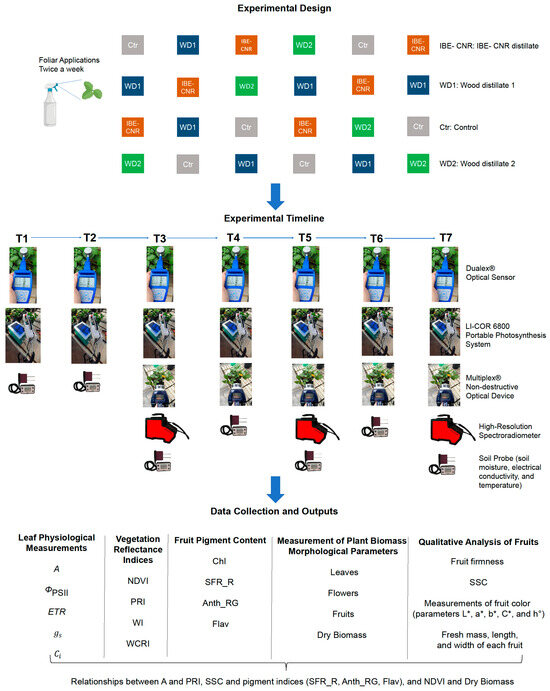
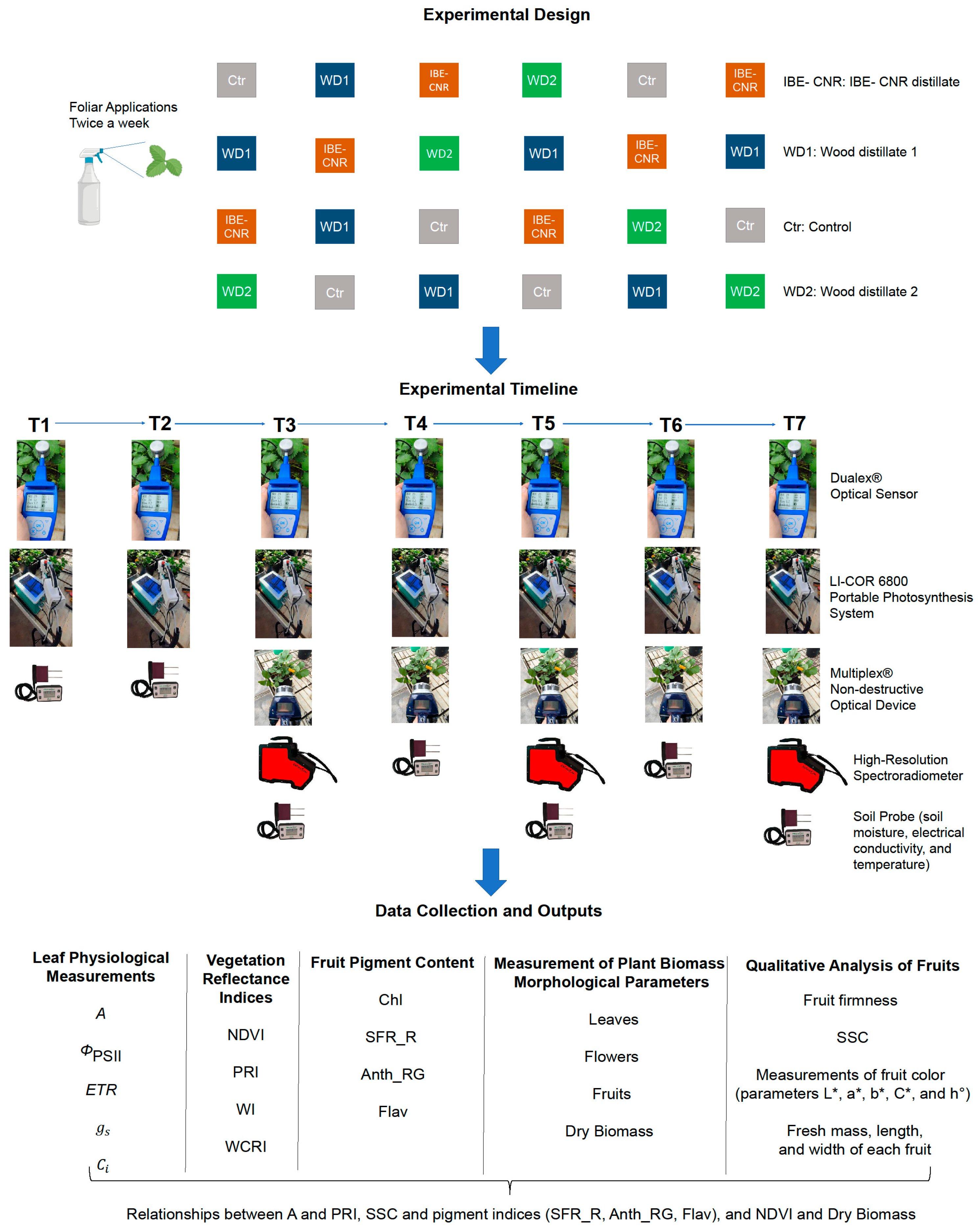
The experiment was performed in the greenhouse at the Department of Agriculture, Food, Environment and Forestry of the University of Florence in Sesto Fiorentino (43°49′00.2″ N 11°11′59.5″ E), Tuscany (Italy), using a total of 24 strawberry plants (Fragaria × ananassa cv. ‘Clery’) purchased from a local Nursery. Clery is an early-fruiting, June-bearing strawberry cultivar that is well-suited for cultivation in temperate regions such ours. It is characterized by medium to high vigor and high productivity. The refrigerator-stored plants were individually planted in black plastic pots measuring 18 × 18 cm, each with a capacity of 6.5 dm3. Each pot was filled with a soil mixture composed of 60% agricultural silt loam soil, 20% acid peat, 5% horse manure to provide initial and uniform fertilization for all plants, and 15% perlite to improve soil aeration. A layer of volcanic lapilli was placed at the bottom of each pot to ensure efficient water drainage. Plants were irrigated using an automated control system providing 100 mL per plant per day, and subjected to an acclimatization period lasting 15 days, from 24 February 2025 to 10 March 2025. Soil parameters, including soil moisture (%), electrical conductivity (mS cm−1), and soil temperature (°C) were monitored weekly throughout the experiment using a probe (Fieldscout TDR 150, Soil Moisture Meter item 6445, Aurora, IL, USA), to ensure uniform and optimal growing conditions across all plants. Following the acclimatization period, foliar applications of the three different wood distillates were applied, starting on 11 March (vegetative phase) and continuing until the end of the experiment on 25 April (end of the ripening phase). The experimental design included the application of four treatments on the 24 plants via foliar spray, ensuring the full coverage of the leaf surface: control (Ctr, water only, n = 6), application of the commercial WD1 (n = 6), application of WD2 (n = 6), and application of IBE-CNR distillate (n = 6). Treatments were applied twice a week at the specified doses, for a total of 14 applications throughout the experiment. A completely randomized design was used, with pots arranged randomly and six replicates per treatment (Figure 1).
Figure 1.
The experimental design with treatments applied to strawberry plants, the timeline of foliar applications and physiological measurements, and the main output parameters assessed, including leaf gas exchange, vegetation reflectance indices, fruit pigment content, morphological traits, and fruit quality attributes. Note: the asterisk (*) is part of the nomenclature of the colorimeter index and does not indicate statistical significance.
2.3. Leaf Physiological Measurements
During the acclimatization period, stomatal conductance (gs) was monitored using a porometer (LI-COR 600, LI-COR Biosciences, Lincoln, NE, USA). Measurements were taken on two fully expanded leaves per plant, analyzing the 6 plants per treatment, with each plant considered as an experimental unit. Subsequently, starting from the beginning of the experimental treatments on 11 March, gs was measured using the LI-COR 6800 portable photosynthesis system. This instrument allows for more accurate and integrated measurements and was used in parallel with gas exchange and chlorophyll fluorescence analyses.
Leaf gas exchange and chlorophyll fluorescence parameters were measured using a portable photosynthesis system (LI-COR 6800 quipped with the 6800-01A leaf chamber, LI-COR Biosciences, Lincoln, NE, USA). Measurements were performed on two fully expanded leaves per each of the six plants (n = 6), under controlled environmental conditions inside the instrument’s measurement chamber. The parameters were set as follows: Photosynthetic Photon Flux Density (PPFD) of 700 µmol m−2 s−1, CO2 concentration of 425 ppm, leaf temperature of 25 °C, and relative humidity ranging between 45% and 50%. These standardized conditions ensured comparability of data across sampling dates and treatments. Specifically, the LI-COR 6800 system was used to measure net photosynthetic rate (A), quantum yield of photosystem II (ΦPSII), electron transport rate (ETR), and intercellular CO2 concentration (Ci).
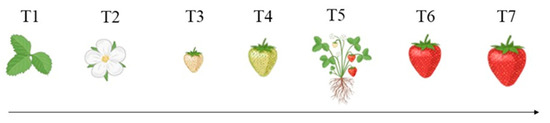
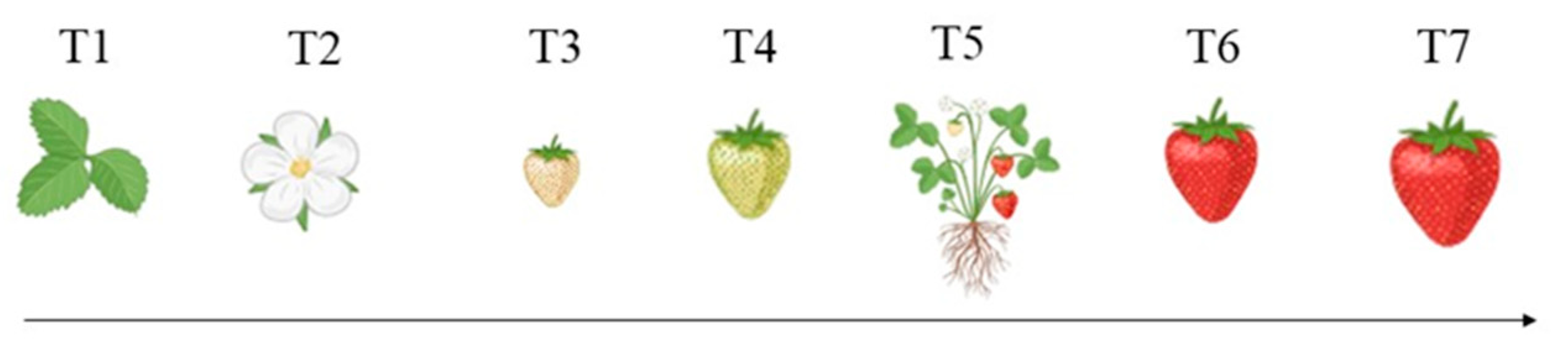
Starting from the beginning of the experimental treatments on 11 March, physiological parameters were monitored weekly (Figure 2, T1–T7), with each time point corresponding to a single measurement session conducted once per week (Figure 2).
Figure 2.
Time points at which measurements were taken: T1 = Beginning of measurement (13 March), only leaves present; T2 = Appearance of the first flowers (20 March); T3 = Onset of fruit ripening (27 March); T4 = Fruit enlargement (3 April); T5 = Appearance of the first ripe fruits (10 April); T6 = Ongoing ripening phase (17 April); T7 = Final ripe fruits (24 April).
2.4. Leaf Chlorophyll Index and Vegetation Indices
These measurements were performed to provide non-destructive indicators of plant physiological status. The Dualex® sensor was used to estimate leaf chlorophyll content (ChI), which is a reliable proxy for photosynthetic capacity (Pessl Instruments GmbH, Weiz, Austria). In addition, vegetation indices (NDVI, PRI, WI, WCRI) derived from leaf reflectance were calculated to assess vigor, photosynthetic efficiency, and water status, supporting the interpretation of biostimulant effects on strawberry physiology.
Two randomly selected, fully expanded apical leaves per plant, from six plants per treatment, were measured using a Dualex® optical sensor to determine the Chlorophyll index (ChI) (n = 6). The two leaves from the same plant were combined to constitute a single biological replicate. In addition, leaf spectral reflectance was measured on three time points (T3, T5 and T7) using a high-resolution spectroradiometer (Spectral Evolution NaturaSpec™, Spectral Evolution Inc., Haverhill, MA, USA; spectral range 350–2500 nm) equipped with a Contact Probe. Measurements were taken under the light provided by the Contact Probe (PPFD ≃ 700 µmol m−2 s−1) to standardize the measurement conditions, and multiple leaves of the same plant were combined to make an individual biological replicate (n = 6). From the reflectance spectra, several vegetation indices were calculated, each providing specific insights into plant physiological status: Normalized Difference Vegetation Index (NDVI = (R800 − R680)/(R800 + R680), related to chlorophyll content and vegetative vigor [28]; Photochemical Reflec-tance Index (PRI = (R531 − R570)/(R531 + R570), indicative of photosynthetic efficiency [29]; and Water Index (WI = R900/R970) [30] and Water Content Reflectance Index (WCRI = R1455/(1272 − R1455) [31], both associated with plant water status. To further explore the functional relevance of vegetation indices, a linear regression analysis was performed between net photosynthetic rate (A) and PRI, in order to evaluate the potential of PRI as a proxy for photosynthetic efficiency.
2.5. Measurement of Plant Biomass and Morphological Parameters
The effects of the treatments on vegetative growth were evaluated by measuring dry biomass at the end of the production cycle, distinguishing between above-ground and root components. These measurements were conducted on 3 plants per treatment, for a total of 12 plants (n = 3). Throughout the experiment, weekly morphological observations were carried out, including counts of leaves, flowers, and fruits, to monitor growth dynamics and reproductive performance over time. Specifically, morphological monitoring of flowers and leaves was extended up to T5, corresponding to the appearance of the first ripe fruits. From T6 onwards, no further increase in the number leaf or flower was observed, indicating that the plants had reached their maximum vegetative development.
2.6. Non-Destructive Assessment of Fruit Ripening
Strawberry ripening was monitored using the portable, non-destructive optical device Multiplex® (FORCE-A, Orsay, France). The Multiplex® fluorescence sensor was selected because its pigment-related indices (SFR_R, Anth_RG, Flav) are widely recognized proxies for chlorophyll degradation, anthocyanin accumulation, and flavonol content, which are key markers of strawberry maturation and quality. These measurements allowed continuous monitoring of pigment changes without damaging the fruit, supporting a more sustainable and accurate evaluation of ripening under biostimulant treatments. This multi-parametric fluorescence sensor [32] employs LED excitation and filtered photodiode detection for measuring the chlorophyll fluorescence (ChlF). Chlorophyll content was estimated using the ratio between the far-red ChlF and the red ChlF (SFR_R index), while anthocyanin and flavonol contents were evaluated by the far-red ChlF Red excitation/far red ChlF_Green excitation (Anth_RG = log), and far-red ChlF Red excitation/far red ChlF_UV excitation (Flav = log), respectively [33].
Fruit measurements were performed on two fruits per plant, selected at the same developmental stage and monitored throughout the ripening process (sampling points T4–T7), resulting in a total of 48 fruits across all 24 plants included in the experiment. The relationships between pigment-related indices (SFR_R, Anth_RG, Flav) and soluble solids content (SSC) were assessed by linear regression using measurements from late ripening stages (T6–T7) on the same fruits (Figure S7). The distribution of fruits per ripening stage and sampling time (T5–T7) used for Multiplex® tracking and harvest timing is summarized in Table S4. Fruits were selected based on similar size and shape, and the absence of visible defects or disease symptoms. The two measurements per plant were averaged and considered as a single biological replicate. Fruits were harvested at commercial maturity, defined as the stage at which they exhibited full red coloration [34]. Each fruit was labeled according to the applied treatment and assigned a unique identifier to ensure traceability. Fruits from IBE-CNR, WD1, and control treatments were harvested at T6, along with some fruits from the WD2 treatment. The remaining WD2 fruits reached full maturity later and were harvested at T7.
2.7. Qualitative Analysis of Fruits
Fruit color was assessed using a colorimeter (Nr200, Shenzhen 3nh Technology Co., Ltd., Shenzhen, China), recording the parameters L*, a*, b*, C*, and h°. The L* value (lightness) ranges from 0 (black) to 100 (white), indicating the brightness of the fruit surface. The a* parameter reflects the red–green axis, with positive values indicating red and negative values indicating green. Similarly, the b* parameter corresponds to the yellow–blue axis, where positive values denote yellow and negative values denote blue. Chroma (C*) represents the saturation or intensity of the color, with higher values associated with more vivid coloration. The hue angle (h°) provides an objective classification of the perceived color tone (e.g., red, orange, yellow), making it particularly suitable for comparing treatments [35,36]. The a* and b* values were subsequently used to calculate the color index, defined as the ratio between a* and b* [37]. Fruit firmness was measured as penetration force (g) using a penetrometer equipped with a 3 mm diameter probe (T 327 Fruit Pressure Tester, Facchini srl, Alfonsine, RA, Italy). Soluble solids content (SSC) was measured using a refractometer (HHTEC 0–90%; Shenzhen City Hong Han Instruments Co., Ltd., Shenzhen, China) on juice extracted from mature fruits. Measurements of fruit color (parameters L*, a*, b*, C*, and h°), fruit firmness, and soluble solids content (SSC) were performed on half of the plants, i.e., on three plants per treatment, for a total of 12 plants.
Fresh mass (g), length (cm), and width (cm) of each fruit were recorded. Fruits were also individually weighed, and based on these data, fruit yield per treatment was calculated on a total of 24 plants (six plants per treatment) as the ratio between the total production per treatment and the number of plants per treatment. Total production per plant was calculated as the sum of the weights of the individual fruits harvested from each plant. Each plant was considered as an experimental unit (replicate) for statistical analysis.
2.8. Statistical Analyses
Statistical analyses were performed using R software (R Core Team, version 4.3.1), with the support of the ggplot2, dplyr, car, multcomp, and multcompView packages as well as broom and patchwork. Data related to physiological parameters (A, ΦPSII, ETR, gs, and Ci), as well as spectral indices associated with fruit pigment content (ChlF, Anth_RG, Flav) and vegetation indices (NDVI, PRI, WCRI, and WI), were normally distributed and analyzed using two-way analysis of variance (Two-way ANOVA), followed by Tukey’s HSD post hoc test, to evaluate the effects of treatment and time, as well as their interaction. Additionally, one-way ANOVA followed by Tukey’s HSD post hoc test was applied to assess differences among treatments within each individual sampling time. To explore the relationship between net photosynthetic rate (A) and PRI, a linear regression analysis was conducted. Data points were assigned colors according to treatment, and a single regression line was fitted across all observations. The regression line was plotted with a 95% confidence interval using the geom_smooth (method = “lm”) function in ggplot2 package. Furthermore, linear regression models were applied to investigate the relationships between fruit soluble solids content (SSC) and three pigment-related indices (SFR_R, Anth_RG, and Flav), as well as between the mean NDVI and total dry biomass. For each relationship, a single regression line was fitted across all observations, while data points were colored according to treatment. Regression plots included the coefficient of determination (R2) and p-value, and were combined using the patchwork package and exported in high resolution. All data are presented as mean ± standard error (SE). Statistical significance was interpreted according to the following convention: p < 0.05 (*), p < 0.01 (**), p < 0.001 (***), p < 0.0001 (****). Data fruit quality parameters, fruit yield, biomass and morphological data were normally distributed, as verified by the Shapiro–Wilk test (p > 0.05). Consequently, a one-way analysis of variance (ANOVA) was performed considering only the effect of treatment within each time point. When significant differences were detected, Tukey’s HSD post hoc test was applied for pairwise comparisons.
3. Results
3.1. Leaf Physiological Measurements
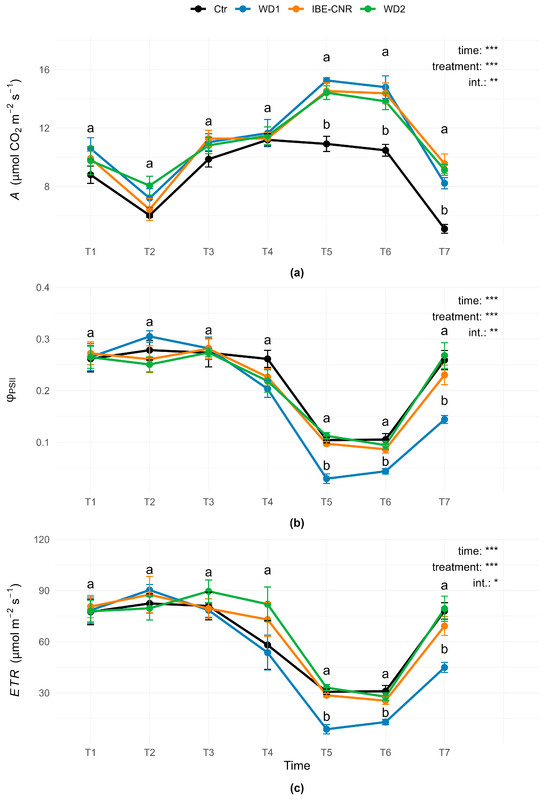
During the experimental period, A showed a variable trend, with a marked decline across all the treatments at week seven (T7) (Figure 3a). The effective quantum yield of photosystem II (ΦPSII) showed a stable trend from T1 to T4, followed by a marked decrease at T5 (Figure 3b). ETR followed a trend similar to ΦPSII (Figure 3c), showing significantly higher values (p < 0.05) compared to the control starting from T5, T6 and T7.
Figure 3.
(a) Net photosynthetic rate (A), (b) effective quantum yield of photosystem II (ΦPSII), and (c) electron transport rate (ETR) in control strawberry plants (Ctr, black) and plants treated with different wood distillates (WD1, blue; IBE-CNR, orange; and WD2, green) from T1 to T7. Data (mean ± SE, n = 6) were analyzed using two-way ANOVA, considering treatment, time, and their interaction (int.) as fixed factors. Different letters indicate significant differences among treatments within each sampling time based on One-Way ANOVA (Tukey’s test). When treatments shared the same significance group, a single letter was displayed for clarity. p < 0.05 (*), p < 0.01 (**), p < 0.001 (***).
Specifically, at T7, WD1 resulted in increases of +61.2% in A, +79.8% in ΦPSII, and +73.9% in ETR compared to the control. At the same time, IBE-CNR showed even greater increases (+87.4% in A, +86.0% in ΦPSII, and +76.8% in ETR), while WD2 recorded increases of +79.2%, +59.9%, and +54.2%, respectively. These increments corresponded to mean values (±SE) of 8.22 ± 0.38, 0.259 ± 0.019, and 78.04 ± 4.82 for WD1; 9.56 ± 0.67, 0.268 ± 0.025, and 79.33 ± 7.37 for IBE-CNR; and 9.14 ± 0.37, 0.230 ± 0.019, and 69.20 ± 5.55 for WD2, compared to the control (5.10 ± 0.30, 0.144 ± 0.008, and 44.88 ± 2.91). All differences were statistically significant (p < 0.05). Regarding gs, the most significant differences among treatments were observed at T6, with WD1 showing higher values than the control (Figure S3a). Stomatal conductance significantly varied according to time and treatment, with no significant interaction between the factors (p < 0.001 for time, treatment and interaction), while Ci showed less pronounced differences among treatments, although control plants generally had higher values, particularly at the beginning (T1, T2) and at the end (T6) of the experiment (Figure S3b).
During the acclimatization period, the stomatal conductance (gs) of strawberry plants progressively stabilized, with average values remaining consistent and indicative of a steady physiological state (0.170 ± 0.02 mol m−2 s−1). Measurements revealed low variability among replicates, indicating good adaptation of the plants to the greenhouse environmental conditions. The recorded values of soil parameters confirmed homogeneity among treatments, with soil moisture ranging from 14.0 to 19.0%, electrical conductivity between 0.14 and 0.15 dS/m, and temperature maintained between 13.3 and 13.5 °C.
3.2. Vegetation Reflectance Indices and Leaf Chlorophyll Estimation
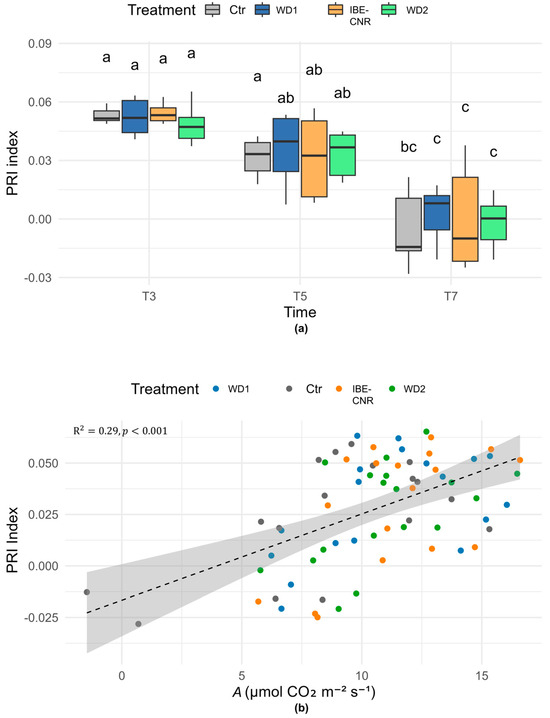
PRI values remained similar across treatments but progressively decreased from T3 to T7 (Figure 4a). In contrast, NDVI values remained consistently high (NDVI > 0.85) across all treatments and time points (Figure S4) and similar trends were observed for WI and WCRI (Figure S4b,c). A low positive correlation between A and PRI was identified through linear regression analysis (R2 = 0.29, Figure 4b). The regression was statistically significant (p < 0.001). This relationship indicates that PRI can serve as a reliable proxy for photosynthetic efficiency under the tested conditions, supporting its use for real-time, non-destructive monitoring of plant physiological responses to biostimulant treatments. The positive correlation, although moderate, confirms the functional relevance of vegetation indices and highlights the potential of optical sensing technologies for data-driven crop management.
Figure 4.
(a) Trend of the Photochemical Reflectance Index (PRI) index at T3, T5, and T7 for the four treatments (Ctr, WD1, IBE-CNR, WD2). Different letters represent statistically significant differences among time points and treatments (p < 0.05), based on a two-way ANOVA followed by Tukey’s HSD post hoc test. (b) Correlation between net photosynthetic rate (A) and PRI. The graph shows data collected under four treatments: control (Ctr, black), WD1 (blue), IBE-CNR (orange), and WD2 (green). The dashed line represents the linear regression between A and PRI, with the shaded area indicating the 95% confidence interval.
3.3. Plant Morphological Parameters and Biomass
Statistical analysis revealed no significant differences among treatments at any of the time points for plant morphological parameters and biomass (Table S1). However, both leaf and flower numbers increased over time, reflecting the normal physiological growth of the plants. Similarly, the analysis of total dry biomass and the shoot/root dry weight ratio revealed no significant differences among treatments (Table S2). The relationship between mean NDVI (averaged across late sampling times T5–T7) and dry biomass was extremely weak and not significant (R2 = 0.001, p = 0.932), indicating that mean NDVI during late ripening stages does not reliably predict biomass under the tested conditions (Figure S6).
3.4. Strawberry Ripening Monitoring
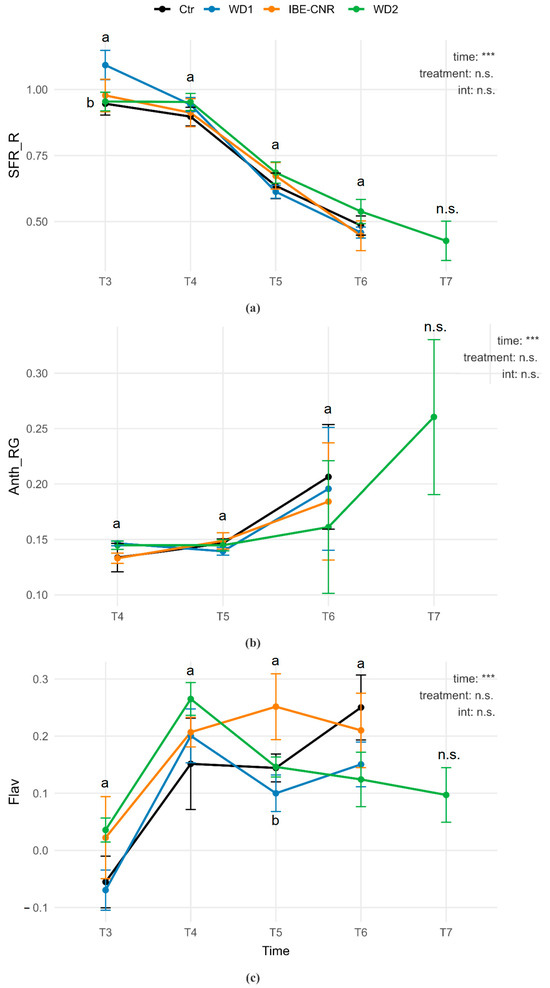
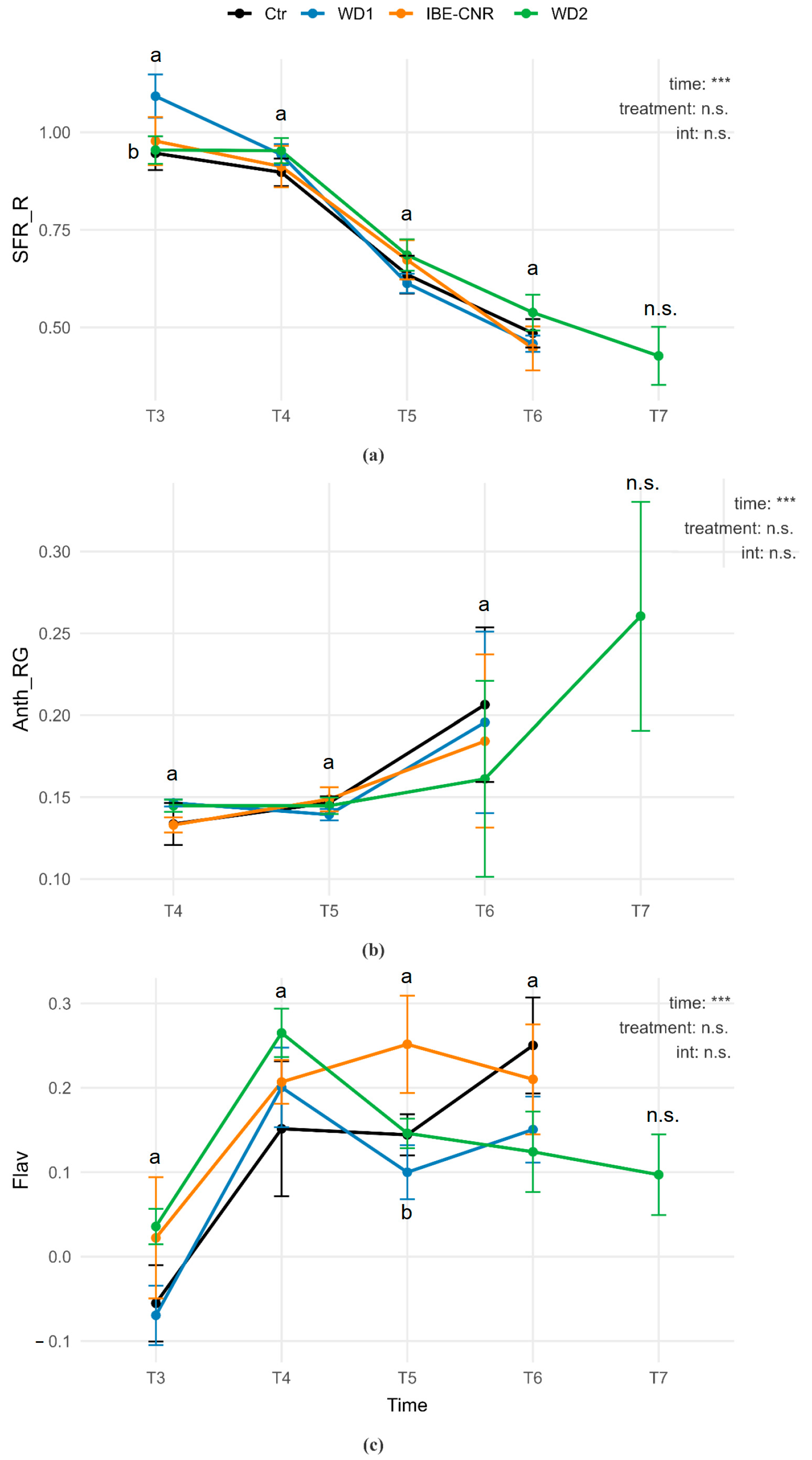
At the initial stage (T3), fruits from the WD1 treatment showed a higher chlorophyll content compared to the other treatments, suggesting a greater presence of this pigment (Figure 5a). At T3, the chlorophyll content in the WD1 treatment was significantly higher than that observed in the other treatments (p < 0.05). Some fruits from plants treated with WD2 reached full maturity only at the final stage (T7), whereas fruits from the WD1, IBE-CNR, and Ctr treatments were already mature at T6, indicating a later ripening for part of the WD2 fruits (Figure 5a, Table S4). During the ripening process, anthocyanin content progressively increased from T4 to T6 in all treatments, and this variation over time was statistically significant (p < 0.0001). In the graph, T3 was not included since anthocyanins were not yet present in the fruits at this stage.
Figure 5.
Temporal dynamics of spectral indices related to pigment content during fruit ripening in strawberry plants subjected to different treatments: control (Ctr, black), WD1 (blue), IBE-CNR (orange), and WD2 (green): (a) chlorophyll content index (SFR_R), (b) anthocyanin content index (Anth_RG), and (c) flavonol content index (Flav). Statistical analysis (two-way ANOVA) revealed a significant effect of time (p < 0.0001) for all indices, with no significant differences among treatments or in the treatment–time interaction. However, different letters indicate statistically significant differences among treatments within each sampling time based on One-Way ANOVA (Tukey’s test). When treatments shared the same significance group, a single letter was displayed for clarity. Data are presented as mean ± standard errors (SE, n = 6). p < 0.001 (***). n.s.—differences are not significant.
The flavonoid content in fruits from all treatments showed a progressive increase up to T4 (Figure 5c), and this variation over time was statistically significant (p < 0.0001), with no significant differences among treatments or their interaction. In fruits treated with WD2, flavonoid content decreased from T4 to T7. In the Ctr and WD1 treatments, flavonoid levels decreased after T4, then increased again at the time of fruit ripening (T6). In contrast, the flavonoid index showed a continuous increase over time in fruits treated with IBE-CNR, resulting in significantly higher values compared to the other treatments at T5 (Figure 5c). Statistical analysis confirmed a significant effect of time (p < 0.0001) for all three indices (Figure 5a–c), while no significant differences were found among treatments or in their interaction.
These non-destructive fluorescence measurements provided dynamic information on pigment accumulation (chlorophyll, anthocyanins, flavonols), which are key markers of fruit ripening and quality. The ability to track these changes in real time without damaging the fruit confirms the relevance of proximal sensing for sustainable crop monitoring and supports its integration into biostimulant evaluation protocols.
3.5. Yield and Fruit Quality
Fruit ripening occurred between T3 and T7, with a production peak recorded within this interval. Average yield was significantly higher in plants treated with the commercial wood distillates WD2 (196.1 g) and IBE-CNR (183.8 g) compared to the control (Table 1). Fruit size, measured as width and diameter (mm), did not differ significantly among treatments. Similarly, no significant differences were observed in average fruit weight. However, the average number of fruits harvested per plant was significantly higher in the WD2 treatment (19.0) compared to the control (13.3) (Table 1).
Table 1.
Fruit quality parameters, including average fruit yield per treatment (calculated as the ratio between the total production per treatment and the number of plants per treatment), average fruit weight per plant (g), average fruit length (mm), average fruit diameter (mm), and the number of mature strawberries harvested per plant per treatment. Statistical differences for average fruit yield, fruit weight, fruit length, and fruit diameter among treatments were assessed using one-way ANOVA followed by Tukey’s HSD post hoc test. a–c: different lowercase letters indicate statistically significant differences among treatments (p < 0.05).
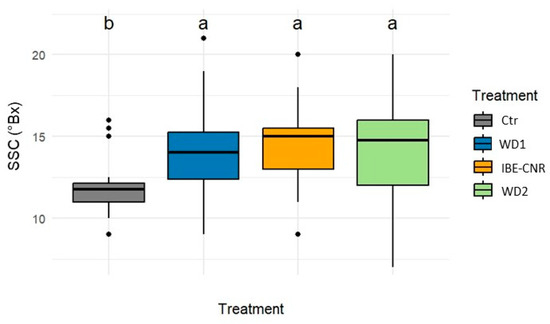
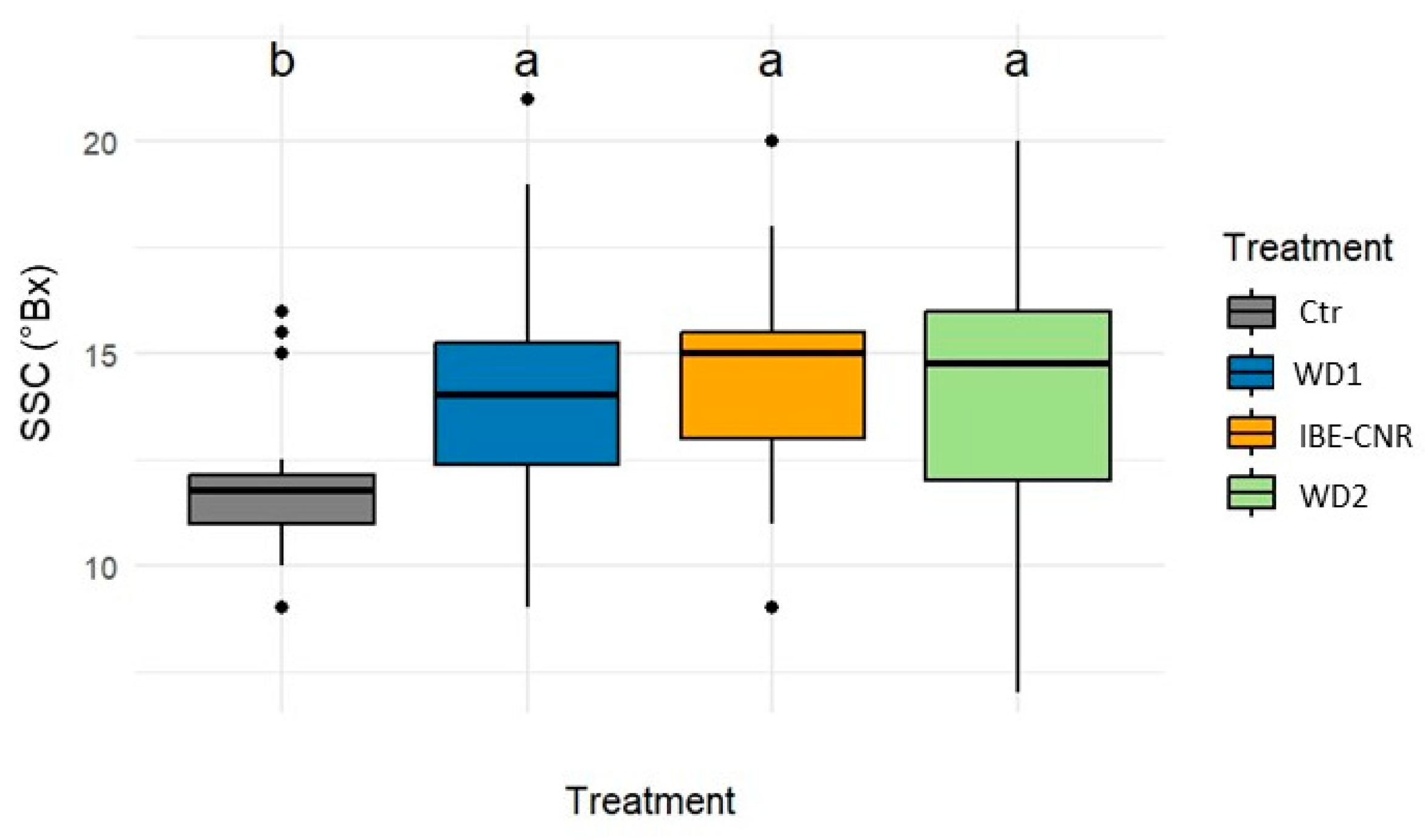
Reg Regarding fruit quality, the results revealed a statistically significant difference (p = 0.043) in fruit soluble solids content (SSC) between the wood distillate treatments (IBE-CNR, WD1, and WD2) and the control (Figure 6). In contrast, no statistically significant differences were observed among treatments in terms of fruit firmness, color parameters (*a, *b), or brightness (*L) (Tables S2 and S3). Pigment-related indices measured at late ripening (T6–T7) did not show significant correlations with SSC (Figure S7), indicating that pigment accumulation and sugar content follow partially independent dynamics.
Figure 6.
Soluble solids content (SSC values) in fruits harvested under four treatments: control (Ctr, n = 29, black), WD1 (n = 36, blue), IBE-CNR (n = 32, orange), and WD2 (n = 42, green). Box plots show data distribution, with the horizontal line indicating the median value. Black dots represent outliers. Statistical differences among treatments were assessed using one-way ANOVA followed by Tukey’s HSD post hoc test (p < 0.05). Different letters above each box indicate homogeneous groups according to the post hoc comparison.
4. Discussion
Foliar biostimulants are attracting increasing interest in agronomic research due to their potential to promote plant growth, enhance tolerance to environmental stresses, and improve fruit quality in a sustainable manner [38,39]. Wood distillates are complex mixtures mainly composed of organic acids (e.g., acetic acid) and phenolic compounds (such as catechol and guaiacol), along with minor amounts of aldehydes and alcohols [1,2]. These constituents can modulate plant physiology by affecting growth, nutrient uptake, and hormonal balance [3]. For example, it has been suggested that catechol may induce an increment in Indole-3-acetic acid (IAA), Gibberellic acid (GA3), and Cytokinin’s (CTK) while reducing Abscisic acid (ABA), a mechanisms that may explain the delayed ripening observed with WD2 [3]. A recent meta-analysis also reported yield and biomass improvements (+21–31%) linked to phenolic and organic acid concentrations [2]. An innovative aspect of current research on foliar biostimulant application is the integration of non-destructive monitoring techniques to evaluate their effects on both vegetative and reproductive crop traits. The ability to measure key parameters without altering the sample allows for accurate and repeatable data collection, improving analytical reliability and reducing the waste of biological material. These technologies, which include optical sensors, portable spectroradiometer, and advanced imaging systems, offer new opportunities for optimizing agronomic management and fostering more sustainable production practices aimed at enhancing fruit quality [40].
This study highlighted the potential of wood distillates as natural biostimulants capable of improving the photosynthetic activity of strawberry plants, as confirmed by the application of non-destructive monitoring techniques. In line with these results, it has been demonstrated that biostimulant application can increase photosynthetic activity and improve photosystem II efficiency (ΦPSII), thereby contributing to greater plant tolerance to abiotic stress and higher metabolic efficiency [41]. In our experiment, the application of wood distillates was associated with an increase in net photosynthesis (A) and an improvement in ΦPSII in treated plants compared to the control, together with higher electron transport rate (ETR), suggesting the maintenance of high photosynthetic activity during phases of increased metabolic demand associated with fruit development, while no significant effects on chlorophyll content were detected (Figure S5). These responses may be related to the bioactive compounds present in wood distillates. Although specific studies on WD and chlorophyll fluorescence are limited, evidence indicates that organic acids (e.g., acetic acid) can enhance stomatal conductance and CO2 assimilation, supporting photosynthetic performance under stress [11,12]. Phenolic compounds such as catechol and guaiacol act as antioxidants and signaling molecules, reducing oxidative damage and maintaining photosystem II efficiency [13,14]. These mechanisms are consistent with the observed increases in A, ΦPSII, and ETR and align with the multi-targeted action of biostimulants, which often promote assimilate partitioning toward fruits rather than vegetative growth [42].
Recent systematic evidence indicates that strawberry is among the horticultural crops showing the most consistent positive responses to biostimulant treatments, particularly in protected systems, where over 60% of studies report yield and quality enhancement [43]. This aligns with our results, confirming that the controlled greenhouse environment can potentiate the effectiveness of Taomplex biostimulants such as wood distillates. Treatments with wood distillates may have stimulated primary metabolic pathways related to nitrogen assimilation and energy production, promoting balanced growth and a better distribution of assimilates toward the fruits. Moreover, they likely activated secondary metabolism, particularly the biosynthetic pathways of phenylpropanoids and flavonoids, as indicated by the accumulation of anthocyanins and soluble solids in ripe fruits. although they were not directly assessed in this experiment, and suggest a dual role in supporting both growth and defense metabolism, with benefits for fruit quality and antioxidant potential [43]. As shown in Figure 3a, the net photosynthetic rate increased significantly from time T4 to T6, with higher values recorded in treated plants compared to the control. Subsequently, a decrease was observed between T6 and T7, corresponding to the final stage of fruit ripening and the end of the plants’ productive cycle. In contrast, ΦPSII (Figure 3b) showed a decline between T4 and T5, more pronounced in the control group, which maintained significantly lower values than the treated plants. This suggests that the treatments helped sustain photosynthetic activity during fruit maturation.
The decrease in ΦPSII observed alongside the increase in net photosynthesis may be explained by a redistribution of electron flow between PSII and PSI during fruit ripening. In this phase, plants may reduce PSII efficiency to support other metabolic processes related to fruit growth and filling. As a result, ΦPSII tends to decline even when the net photosynthetic rate remains high [41,44]. In contrast, Ci showed less pronounced differences among treatments. Higher values were recorded in control plants, probably because photosynthesis was more active in treated plants, leading to faster CO2 consumption, whereas in control plants CO2 tended to accumulate (Figure S3b) [45].
It is important to highlight that the photoprotective reflectance index (PRI) proved to be a reliable proxy for estimating photosynthetic activity (Figure 4b), owing to its sensitivity to the redox state of pigments involved in non-photochemical quenching. The mean NDVI did not show a significant correlation with dry biomass (Figure S6), suggesting that NDVI values were already approaching saturation during the evaluated period, thereby limiting their ability to capture variations in biomass. Under high PPFD conditions, plants activate photoprotective mechanisms to dissipate excess energy as heat through changes in pigment composition (e.g., conversion of violaxanthin to zeaxanthin), which in turn modifies leaf reflectance, particularly around 531 nm. The PRI, calculated as the ratio between reflectance at 531 nm and 570 nm, captures these variations and, in our study, was correlated to physiological parameters [29]. The use of PRI as a non-destructive indicator therefore represents a valuable indicator therefore for real-time monitoring of plant physiological status, contributing to more sustainable and data-driven agronomic management [46].
Regarding fruit quality, the treatments resulted in a significant increase in soluble solids content (SSC) compared with the control, a parameter closely associated with flavor perception and the organoleptic quality of the fruit [47]. This observation is consistent with the systematic evidence showing that most strawberry studies report significant improvements in marketable yield, SSC, and antioxidant profile following biostimulant application, even under reduced fertilization [42]. Consistently, pigment-related indices did not significantly correlate with SSC (Figure S7), suggesting that anthocyanin and flavonol accumulation are not tightly coupled with sugar content at late ripening. The resulting increase in sugar content, reflected by higher SSC, enhances the organoleptic and commercial quality of fruits, which directly contributes to higher consumer preference and market value [48]. Notably, despite the rise in SSC in treated fruits, no significant differences were observed among treatments for physical attributes such as firmness, color, and brightness. However, the metabolic modulation induced by biostimulant application appeared to enhance both the nutritional and functional properties of the fruits, with an increase in antioxidants and phenolic compounds reflecting the activation of biosynthetic pathways also observed in protein hydrolysate and bacterial filtrate treatments [43]. This suggests that wood distillates may act through similar regulatory networks involving hormone-like signaling molecules that coordinate carbon allocation, sugar accumulation, and phenolic metabolism. This indicates that the treatments primarily affected the internal biochemical composition of the fruit, particularly the sugar profile, rather than influencing external morphological traits. Such selective modulation may represent an advantage for improving taste and nutritional value while preserving visual quality, which remains critical for maintaining consumer expectations [49]. Monitoring ripening dynamics using optical sensors proved essential for optimizing harvest timing. Monitoring ripening dynamics using optical sensors proved essential for optimizing harvest timing. The Multiplex® sensor was not only used as a measurement tool but also as a key technology for sustainable and non-destructive monitoring of fruit ripening. Its ability to provide pigment-related indices in real time reduces waste, preserves sample integrity, and enables repeated measurements throughout the production cycle. Integrating proximal sensing into experimental protocols represents a step toward more precise, data-driven agronomic management. These tools allow dynamic evaluation of biostimulant effects on physiological and quality traits, supporting informed and sustainable decision-making. Continuous monitoring of chlorophyll, anthocyanins, and flavonols has a direct practical impact, enabling optimization of harvest timing and ensuring maximum fruit quality. This capability to link optical indices with physiological status and final product quality confirms the value of proximal sensing techniques for precision horticulture [50]. The increase in the anthocyanin content during ripening (Figure 5b) is correlated with the accumulation of anthocyanins in the strawberry receptacle of anthocyanins, mainly pelargonidin-3-glucoside, together with lesser amounts of pelargonidin-3-rutinoside, cyanidin-3-glucoside, pelargonidin-3-malonylglucoside, pelargonidin-3-acetylglucoside and other acylated anthocyanins, which have been detected in strawberry fruit tissue [51,52,53]. The ability to monitor ripening in real time without damaging the fruit highlights the relevance of proximal sensing for sustainable crop management. These tools enable dynamic assessment of key pigments and support the integration of non-destructive technologies into biostimulant evaluation protocols, improving decision-making for harvest timing and quality optimization. Therefore, optical sensors can be effectively employed to optimize harvest timing and achieve maximal red coloration of fruits [54]. In particular, the non-invasive determination of the anthocyanin content enabled precise identification of the anthocyanin accumulation peak for each treatment, allowing a more targeted harvest and potentially improving final product quality. Ripening progressed until T7 in the WD2 treatment, suggesting that this treatment induced a delayed ripening process (Figure 5a,b) [55]. Consistently, the harvest dynamics (Table S4) indicate that a portion of WD2 fruits reached commercial maturity only at T7, confirming the delayed ripening pattern. The decline in flavonol levels observed from T4 to T7 in WD2 plants was inferred from the reduction in fluorescence associated with these compounds (flavonol content). This pattern may reflect differences in the accumulation kinetics of flavonols and anthocyanins, which share the same biosynthetic pathway (Figure 5c). Recent studies in red apple have shown that these two classes of compounds are regulated by distinct transcription factors, with opposing patterns of gene expression and chromatin accessibility during fruit ripening [56].
The application of wood distillate promotes an early and stable accumulation of anthocyanins in the skin of red ripe fruits, contributing to an overall improvement in fruit quality and to the preservation of pigment content [57]. In fruits treated with WD2, the distillate appeared to prolong the ripening phase, as the last ripe fruits were observed at time T7. Furthermore, this extended ripening period was associated with an increase in total fruit yield compared to both WD1 and the control.
These results indicate that the effects of the treatments extended beyond improving fruit quality, positively influencing overall crop productivity [20]. Previous studies have shown that foliar application of wood distillate can enhance nutritional traits without affecting vegetative growth, supporting the selective action of these biostimulants on the edible portion of the plant [58,59]. In agreement with this evidence, our measurements of total biomass and the shoot-to-root dry weight ratio revealed no significant differences between treated and control plants (Table S2), indicating that WD did not alter the allocation of resources among vegetative organs. The number of plants per treatment reflects standard practice in greenhouse experiments. Nevertheless, this sample size provides sufficient statistical power to identify moderate to large differences, whereas minor changes in biomass could have escaped detection.
Despite the enhanced photosynthetic activity observed in treated plants, vegetative biomass remained unchanged. This suggests a preferential reallocation of assimilates toward reproductive sinks, in line with assimilate partitioning theory [60]. The concurrent increase in yield and soluble solids content (SSC) supports the hypothesis that WD improved the efficiency of carbon and nutrient use, promoting fruit development rather than vegetative expansion. Similar patterns have been reported for auxin-like and protein-based biostimulants, known to modulate internal resource distribution without markedly affecting plant morphology [43].
Overall, these findings indicate that WD application enhanced internal resource partitioning, redirecting assimilates toward reproductive structures. Under favorable greenhouse conditions, the increase in photosynthetic activity likely amplified this effect, resulting in higher fruit yield driven by optimized assimilate allocation rather than by increased vegetative growth [60].
5. Conclusions
This study evaluated the effects of three wood distillates on strawberry physiology, yield, and fruit quality under greenhouse conditions. Non-destructive proximal sensing techniques were employed to monitor physiological responses and fruit ripening throughout the crop cycle in a sustainable and accurate manner. Foliar application of wood distillates improved photosynthetic performance, fruit yield, and soluble solids content (SSC); notably, WD2 also influenced ripening by prolonging anthocyanin accumulation without reducing productivity.
The integration of proximal sensing technologies demonstrated their practical value for dynamic and non-invasive monitoring of physiological and ripening processes, enabling data-driven decisions to optimize harvest timing and fruit quality. Incorporating these tools into biostimulant evaluation protocols represents a step toward precision horticulture and resource-efficient crop management.
By improving photosynthetic efficiency and enhancing fruit yield and SSC, wood distillates demonstrated their potential to support high-quality fruit production under greenhouse conditions. Their use supports a more targeted and conscious approach to biostimulant application, adaptable to different growing conditions and cultivars.
Supplementary Materials
The following supporting information can be downloaded at: https://www.mdpi.com/article/10.3390/horticulturae12010017/s1, Figure S1: HPLC-DAD chromatograms of the three wood distillates; Figure S2: Relationship between photosynthetically active radiation and average air temperature recorded in the greenhouse; Figure S3: Trends of stomatal conductance (gₛ) and intercellular CO2 concentration (Ci); Figure S4: Variation in the NDVI, WCRI, and WI; Figure S5: Variation in chlorophyll content (ChI); Figure S6: Relationship between mean NDVI and dry biomass; Figure S7: Relationships between pigment-related indices and SSC; Table S1: Mean number of leaves and flowers per strawberry plant; Table S2: Total dry biomass and shoot/root ratio of strawberry plants; Table S3: Colorimetric parameters (L*, a* and b*), color index, and fruit firmness; Table S4: Number of fruits per treatment and sampling time.
Author Contributions
Conceptualization, C.B. and A.G.; methodology C.B., A.G. and E.L.P.; software, V.P., G.M. and G.A.; validation, V.P., S.B. and M.G.; formal analysis, V.P.; investigation, V.P., S.B. and F.A.; resources, F.F., M.C. and V.M.; data curation, C.B. and A.G.; writing—original draft preparation, V.P. and M.G.; writing—review and editing, C.B., A.G., F.A., M.C., E.L.P. and V.M.; visualization, V.P., F.A. and G.A.; supervision, C.B., A.G., F.F. and M.C.; project administration, C.B.; funding acquisition, F.F. All authors have read and agreed to the published version of the manuscript.
Funding
This study was carried out within the Agritech National Research Center and received funding from the European Union Next-GenerationEU (Piano Nazionale di Ripresa e Resilienza (Pnrr)-Missione 4 Componente 2, Investimento 1.4-D.D. 1032 17/06/2022, CN00000022): Spoke 8 Circular economy in agriculture through waste valorisation and recycle and Spoke 4 Multifunctional and resilient agriculture and forestry systems for the mitigation of climate change risks. This manuscript reflects only the authors’ views and opinions, neither the European Union nor the European Commission can be considered responsible for them.
Data Availability Statement
The original contributions presented in this study are included in the article/Supplementary Materials. Further inquiries can be directed to the corresponding author.
Acknowledgments
The authors gratefully acknowledge the Consorzio Italiano Vivaisti (C.I.V.) for providing the strawberry plants of the Clery cultivar, which were essential for the development of this study.
Conflicts of Interest
The authors declare no conflicts of interest.
Abbreviations
| HPLC-DAD | High-performance liquid chromatography coupled with diode array detector |
| GC-MS | Gas chromatography coupled with mass spectrometry |
| CRD | Completely randomized design |
| gs | Stomatal conductance |
| A | Net photosynthetic rate |
| Ci | Intercellular CO2 concentration |
| ΦPSII | Effective quantum yield of photosystem II |
| ETR | Electron transport rate |
| PPFD | Photosynthetic Photon Flux Density |
| ChI | Chlorophyll index |
| NDVI | Normalized Difference Vegetation Index |
| PRI | Photochemical Reflectance Index |
| WI | Water Index |
| WCRI | Water Content Reflectance Index |
| ChlF | Chlorophyll fluorescence |
| SFR_R | Ratio between the far-red ChlF and the red ChlF |
| Anth_RG | Anthocyanin index |
| Flav | Flavanol index |
| SSC | Soluble solids content |
| O.R. | Onset of ripening |
| A.R. | Advanced ripening stage |
| C.M. | Commercial maturity |
| IAA | Indole-3-acetic acid |
| GA3 | Gibberellic acid |
| CTK | Cytokinin’s |
| ABA | Abscisic acid |
References
- Zhou, H.; Shen, Y.; Zhang, N.; Liu, Z.; Bao, L.; Xia, Y. Wood fiber biomass pyrolysis solution as a potential tool for plant disease management: A review. Heliyon 2024, 10, e25509. [Google Scholar] [CrossRef] [Scilit]
- Bridgwater, A.V. Renewable fuels and chemicals by thermal processing of biomass. Chem. Eng. J. 2003, 91, 87–102. [Google Scholar] [CrossRef] [Scilit]
- Grewal, A.; Abbey, L.; Gunupuru, L.R. Production, prospects and potential application of pyroligneous acid in agriculture. J. Anal. Appl. Pyrolysis 2018, 135, 152–159. [Google Scholar] [CrossRef] [Scilit]
- Santos, M.B.; Sillero, L.; Gatto, D.A.; Labidi, J. Bioactive molecules in wood extractives: Methods of extraction and separation—A review. Ind. Crops Prod. 2022, 186, 115231. [Google Scholar] [CrossRef] [Scilit]
- Shetty, G.P.; Meghana, A.; Shetty, M.G.; Balakrishna, S.M.; Niranjan, H.G. Wood vinegar: A promising agricultural input. A review. Int. J. Agric. Ext. Soc. Dev. 2025, 8, 576–582. [Google Scholar] [CrossRef] [Scilit]
- Liu, X.; Wang, J.; Feng, X.; Yu, J. Wood vinegar resulting from the pyrolysis of apple tree branches for annual bluegrass control. Ind. Crops Prod. 2021, 174, 114193. [Google Scholar] [CrossRef] [Scilit]
- Liu, M.; Yao, J.; Zhang, C.; Hao, R.; Zhang, Z.; Cao, W. Quantitative analysis of multi-components by single-marker: An effective method for the chemical characterization of wood vinegar. Ind. Crops Prod. 2022, 182, 114862. [Google Scholar] [CrossRef] [Scilit]
- Yang, J.-F.; Yang, C.-H.; Liang, M.-T.; Gao, Z.-J.; Wu, Y.-W.; Chuang, L.-Y. Chemical composition, antioxidant and antibacterial activity of wood vinegar from Litchi chinensis. Molecules 2016, 21, 1150. [Google Scholar] [CrossRef] [Scilit]
- Mun, S.P.; Ku, C.S. Pyrolysis GC-MS analysis of tars formed during the aging of wood and bamboo crude vinegars. J. Wood Sci. 2010, 56, 47–52. [Google Scholar] [CrossRef] [Scilit]
- Jusic, J.; Giannoni, T.; Zikeli, F.; Tamantini, S.; Pierpaoli, V.; Barbanera, M.; Grilc, M.; Tofani, G.; Romagnoli, M. Chemical and thermogravimetric characterization of chestnut tree biomass waste: Towards sustainable resource utilization in the tannin industry. Eur. J. Wood Prod. 2025, 83, 113. [Google Scholar] [CrossRef] [Scilit]
- Kumar, S.P.S.; Kashyap, A.S.; Tripathi, R.; Gupta, S.; Dutta, P.; Harish; Singh, R.; Swapnil, P. Unravelling the multifarious role of wood vinegar made from waste biomass in plant growth promotion, biotic stress tolerance, and sustainable agriculture. J. Anal. Appl. Pyrolysis 2025, 185, 106851. [Google Scholar] [CrossRef] [Scilit]
- He, L.; Geng, K.; Li, B.; Li, S.; Gustave, W.; Wang, J.; Jeyakumar, P.; Zhang, X.; Wang, H. Enhancement of nutrient use efficiency with biochar and wood vinegar: A promising strategy for improving soil productivity. J. Sci. Food Agric. 2025, 105, 465–472. [Google Scholar] [CrossRef] [Scilit]
- Agosti, A.; Nazeer, S.; Del Vecchio, L.; Leto, L.; Di Fazio, A.; Hadj-Saadoun, J.; Levante, A.; Rinaldi, M.; Dhenge, R.; Lazzi, C.; et al. Effect of biochar and wood distillate on vegeto-productive performances of tomato (Solanum lycopersicum L.) plants, var. Solarino, grown in soilless conditions. Agronomy 2024, 14, 2725. [Google Scholar] [CrossRef] [Scilit]
- Zhu, K.; Liu, J.; Luo, T.; Zhang, K.; Khan, Z.; Zhou, Y.; Cheng, T.; Yuan, B.; Peng, X.; Hu, L. Wood Vinegar Impact on the Growth and Low-Temperature Tolerance of Rapeseed Seedlings. Agronomy 2022, 12, 2453. [Google Scholar] [CrossRef] [Scilit]
- Carril, P.; Bianchi, E.; Cicchi, C.; Coppi, A.; Dainelli, M.; Gonnelli, C.; Loppi, S.; Pazzagli, L.; Colzi, I. Effects of wood distillate (pyroligneous acid) on the yield parameters and mineral composition of three leguminous crops. Environments 2023, 10, 126. [Google Scholar] [CrossRef] [Scilit]
- Ghorbani, M.; Azarnejad, N.; Carril, P.; Celletti, S.; Loppi, S. Boosting the resilience to drought of crop plants using wood distillate: A pilot study with lettuce (Lactuca sativa L.). Plant Stress 2024, 12, 100450. [Google Scholar] [CrossRef] [Scilit]
- Hur, G.; Ashraf, M.; Nadeem, M.Y.; Rehman, R.S.; Thwin, H.M.; Shakoor, K.; Seleiman, M.F.; Alotaibi, M.; Yuan, B.Z. Exogenous application of wood vinegar improves rice yield and quality by elevating photosynthetic efficiency and enhancing the accumulation of total soluble sugars. Plant Physiol. Biochem. 2025, 218, 109306. [Google Scholar] [CrossRef] [Scilit] [PubMed]
- Wang, Y.; Qiu, L.; Song, Q.; Wang, S.; Wang, Y.; Ge, Y. Root proteomics reveals the effects of wood vinegar on wheat growth and subsequent tolerance to drought stress. Int. J. Mol. Sci. 2019, 20, 943. [Google Scholar] [CrossRef] [Scilit] [PubMed]
- Zhu, K.; Gu, S.; Liu, J.; Luo, T.; Khan, Z.; Zhang, K.; Hu, L. Wood vinegar as a complex growth regulator promotes the growth, yield, and quality of rapeseed. Agronomy 2021, 11, 510. [Google Scholar] [CrossRef] [Scilit]
- Mungkunkamchao, T.; Kesmala, T.; Pimratch, S.; Toomsan, B.; Jothityangkoon, D. Wood vinegar and fermented bioextracts: Natural products to enhance growth and yield of tomato (Solanum lycopersicum L.). Sci. Hortic. 2013, 154, 66–72. [Google Scholar] [CrossRef] [Scilit]
- Fedeli, R.; Dichiara, M.; Carullo, G.; Tudino, V.; Gemma, S.; Butini, S.; Campiani, G.; Loppi, S. Unlocking the potential of biostimulants in sustainable agriculture: Effect of wood distillate on the nutritional profiling of apples. Heliyon 2024, 10, e37599. [Google Scholar] [CrossRef] [Scilit]
- Gama, G.S.P.; Pimenta, A.S.; Feijó, F.M.C.; Aires, C.A.M.; de Melo, R.R.; dos Santos, C.S.; de Medeiros, L.C.D.; da Costa Monteiro, T.V.; Fasciotti, M.; de Medeiros, P.L.; et al. Antimicrobial impact of wood vinegar produced through co-pyrolysis of eucalyptus wood and aromatic herbs. Antibiotics 2024, 13, 1056. [Google Scholar] [CrossRef] [Scilit] [PubMed]
- Rossel, R.V.; Behrens, T. Using data mining to model and interpret soil diffuse reflectance spectra. Geoderma 2010, 158, 46–54. [Google Scholar] [CrossRef] [Scilit]
- Pallottino, F.; Antonucci, F.; Costa, C.; Bisaglia, C.; Figorilli, S.; Menesatti, P. Optoelectronic proximal sensing vehicle-mounted technologies in precision agriculture: A review. Comput. Electron. Agric. 2019, 162, 859–873. [Google Scholar] [CrossRef] [Scilit]
- Shafi, U.; Mumtaz, R.; García-Nieto, J.; Hassan, S.A.; Zaidi, S.A.R.; Iqbal, N. Precision agriculture techniques and practices: From considerations to applications. Sensors 2019, 19, 3796. [Google Scholar] [CrossRef] [Scilit] [PubMed]
- Pinelli, P.; Romani, A.; Fierini, E.; Remorini, D.; Agati, G. Characterisation of the Polyphenol Content in the Kiwifruit (Actinidia deliciosa) Exocarp for the Calibration of a Fruit-Sorting Optical Sensor. Phytochem. Anal. 2013, 24, 460–466. [Google Scholar] [CrossRef] [Scilit]
- Betemps, D.L.; Fachinello, J.C.; Galarça, S.P.; Portela, N.M.; Remorini, D.; Massai, R.; Agati, G. Non-Destructive Evaluation of Ripening and Quality Traits in Apples Using a Multiparametric Fluorescence Sensor. J. Sci. Food Agric. 2012, 92, 1855–1864. [Google Scholar] [CrossRef] [Scilit]
- Rouse, J.W.; Haas, R.; Schell, J.A.; Deering, D.W. Monitoring Vegetation Systems in the Great Plains with ERTS; Third ERTS Symposium; NASA: Washington, DC, USA, 1974. [Google Scholar]
- Gamon, J.; Serrano, L.; Surfus, J.S. The photochemical reflectance index: An optical indicator of photosynthetic radiation use efficiency across species, functional types, and nutrient levels. Oecologia 1997, 112, 492–501. [Google Scholar] [CrossRef] [Scilit]
- Penuelas, J.; Pinol, J.; Ogaya, R.; Filella, I. Estimation of plant water concentration by the reflectance water index WI (R900/R970). Int. J. Remote Sens. 1997, 18, 2869–2875. [Google Scholar] [CrossRef] [Scilit]
- Sun, P.; Grignetti, A.; Liu, S.; Casacchia, R.; Salvatori, R.; Pietrini, F.; Centritto, M. Associated changes in physiological parameters and spectral reflectance indices in olive (Olea europaea L.) leaves in response to different levels of water stress. Int. J. Remote Sens. 2008, 29, 1725–1743. [Google Scholar] [CrossRef] [Scilit]
- Ben Ghozlen, N.; Cerovic, Z.G.; Germain, C.; Toutain, S.; Latouche, G. Non-destructive optical monitoring of grape maturation by proximal sensing. Sensors 2010, 10, 10040–10068. [Google Scholar] [CrossRef] [Scilit]
- Gitelson, A.A.; Viña, A.; Ciganda, V.; Rundquist, D.C.; Arkebauer, T.J. Remote Estimation of Canopy Chlorophyll Content in Crops. Geophys. Res. Lett. 2005, 32, L08403. [Google Scholar] [CrossRef] [Scilit]
- Savi, S.; Poni, S.; Moncalvo, A.; Frioni, T.; Rodschinka, I.; Arata, L.; Gatti, M. Destructive and optical non-destructive grape ripening assessment: Agronomic comparison and cost-benefit analysis. PLoS ONE 2019, 14, e0216421. [Google Scholar] [CrossRef] [Scilit] [PubMed]
- McGuire, R.G. Reporting of objective color measurements. HortScience 1992, 27, 1254–1255. [Google Scholar] [CrossRef] [Scilit]
- Serra, S.; Leisso, R.; Giordani, L.; Kalcsits, L.; Musacchi, S. Crop load influences fruit quality, nutritional balance, and return bloom in ‘Honeycrisp’ apple. HortScience 2016, 51, 236–244. [Google Scholar] [CrossRef] [Scilit]
- Petruccelli, R.; Bonetti, A.; Ciaccheri, L.; Ieri, F.; Ganino, T.; Faraloni, C. Evaluation of the fruit quality and phytochemical compounds in peach and nectarine cultivars. Plants 2023, 12, 1618. [Google Scholar] [CrossRef] [Scilit]
- Soppelsa, S.; Kelderer, M.; Casera, C.; Bassi, M.; Robatscher, P.; Matteazzi, A.; Andreotti, C. Foliar applications of bi-ostimulants promote growth, yield and fruit quality of strawberry plants grown under nutrient limitation. Agronomy 2019, 9, 483. [Google Scholar] [CrossRef] [Scilit]
- Soltaniband, V.; Brégard, A.; Gaudreau, L.; Dorais, M. Biostimulants Promote Plant Development, Crop Productivity, and Fruit Quality of Protected Strawberries. Agronomy 2022, 12, 1684. [Google Scholar] [CrossRef] [Scilit]
- Roussos, P.A.; Denaxa, N.-K.; Damvakaris, T. Strawberry fruit quality attributes after application of plant growth stimulating compounds. Sci. Hortic. 2009, 119, 138–146. [Google Scholar] [CrossRef] [Scilit]
- Garrido, A.; Conde, A.; Serôdio, J.; De Vos, R.C.H.; Cunha, A. Fruit Photosynthesis: More to Know about Where, How and Why. Plants 2023, 12, 2393. [Google Scholar] [CrossRef] [Scilit]
- Costa, D.; Walsh, É.; Dieli, C.; O’HAlloran, O.; Awan, Z.A.; Gargan, A.; Landeta-Manzano, B.; Priyadarshini, A.; Foley, L.; Gaffney, M.T.; et al. Impact of biostimulant use in agricultural crops (strawberries, leafy greens and mushrooms) under different horticultural cropping systems: A systematic review. Ann. Appl. Biol. 2025, 187, 304–317. [Google Scholar] [CrossRef] [Scilit]
- Cardarelli, M.; El Chami, A.; Rouphael, Y.; Ciriello, M.; Bonini, P.; Erice, G.; Cirino, V.; Basile, B.; Corrado, G.; Choi, S.; et al. Plant biostimulants as natural alternatives to synthetic auxins in strawberry production: Physiological and metabolic insights. Front. Plant Sci. 2024, 14, 1337926. [Google Scholar] [CrossRef] [Scilit]
- Hetherington, S.E.; Smillie, R.M.; Davies, W.J. Photosynthetic activities of vegetative and fruiting tissues of tomato. J. Exp. Bot. 1998, 49, 1173–1181. [Google Scholar] [CrossRef] [Scilit]
- Lysenko, V.; Kirichenko, E.; Logvinov, A.; Azarov, A.; Rajput, V.D.; Chokheli, V.; Chalenko, E.; Yadronova, O.; Varduny, T.; Krasnov, V.; et al. Ultrastructure, CO2 Assimilation and Chlorophyll Fluorescence Kinetics in Photosynthesizing Glycine max Callus and Leaf Mesophyll Tissues. Horticulturae 2023, 9, 1211. [Google Scholar] [CrossRef] [Scilit]
- Garbulsky, M.F.; Peñuelas, J.; Gamon, J.A.; Inoue, Y.; Filella, I. The photochemical reflectance index (PRI) and the remote sensing of leaf, canopy and ecosystem radiation use efficiencies: A review and meta-analysis. Remote Sens. Environ. 2011, 115, 281–297. [Google Scholar] [CrossRef] [Scilit]
- Kallio, H.; Hakala, M.; Pelkkikangas, A.M.; Lapveteläinen, A. Sugars and acids of strawberry varieties. Eur. Food Res. Technol. 2000, 212, 81–85. [Google Scholar] [CrossRef] [Scilit]
- Fan, Z.; Plotto, A.; Bai, J.; Whitaker, V. Volatiles influencing sensory attributes and Bayesian modeling of the soluble solids-sweetness relationship in strawberry. Front. Plant Sci. 2021, 12, 640704. [Google Scholar] [CrossRef] [Scilit]
- Kunter, B.; Unal, O.B.; Keskin, S.; Hatterman-Valenti, H.; Kaya, O. Comparison of the sugar and organic acid components of seventeen table grape varieties produced in Ankara (Türkiye): A study over two consecutive seasons. Front. Plant Sci. 2024, 15, 1321210. [Google Scholar] [CrossRef] [Scilit] [PubMed]
- Tomada, S.; Agati, G.; Serni, E.; Michelini, S.; Lazazzara, V.; Pedri, U.; Sanoll, C.; Matteazzi, A.; Robatscher, P.; Haas, F. Non-destructive Fluorescence Sensing for Assessing Microclimate, Site and Defoliation Effects on Flavonol Dynamics and Sugar Prediction in Pinot blanc Grapes. PLoS ONE 2022, 17, e0273166. [Google Scholar] [CrossRef] [Scilit]
- Lopes-da-Silva, F.; de Pascual-Teresa, S.; Rivas-Gonzalo, J.C.; Santos-Buelga, C. Identification of anthocyanin pigments in strawberry (cv. Camarosa) by LC–DAD–ESI/MS. Eur. Food Res. Technol. 2002, 214, 248–253. [Google Scholar] [CrossRef] [Scilit]
- Griesser, M.; Hoffmann, T.; Bellido, M.L.; Rosati, C.; Fink, B.; Kurtzer, R.; Aharoni, A.; Munoz-Blanco, J.; Schwab, W. Redirection of Flavonoid Biosynthesis through the Down-Regulation of Anthocyanidin Reductase in Ripening Strawberry Fruit. Plant Physiol. 2008, 146, 1528–1539. [Google Scholar] [CrossRef] [Scilit]
- Tamura, H.; Takada, M.; Yoshida, Y. Pelargonidin 3-O-(6-O-Malonyl-β-D-glucoside) in Fragaria × ananassa Duch. cv. Nyoho. Biosci. Biotechnol. Biochem. 1995, 59, 1157–1158. [Google Scholar] [CrossRef] [Scilit]
- Agati, G.; D’Onofrio, C.; Ducci, E.; Cuzzola, A.; Remorini, D.; Tuccio, L.; Lazzini, F.; Mattii, G. Potential of a multiparametric optical sensor for determining in situ the maturity components of red and white Vitis vinifera wine grapes. J. Agric. Food Chem. 2013, 61, 12211–12218. [Google Scholar] [CrossRef] [Scilit] [PubMed]
- Thomas, H.; Ougham, H. The stay-green trait. J. Exp. Bot. 2014, 65, 3889–3900. [Google Scholar] [CrossRef] [Scilit] [PubMed]
- Cheng, C.; Guo, Z.; Li, H.; Mu, X.; Wang, P.; Zhang, S.; Yang, T.; Cai, H.; Wang, Q.; Lü, P.; et al. Integrated Metabolic, Transcriptomic and Chromatin Accessibility Analyses Provide Novel Insights into the Competition for Anthocyanins and Flavonols Biosynthesis During Fruit Ripening in Red Apple. Front. Plant Sci. 2022, 13, 975356. [Google Scholar] [CrossRef] [Scilit]
- Wang, Y.; Liu, Y.; Zhang, L.; Tang, L.; Xu, S.; Wang, Z.; Zhang, Y.; Lin, Y.; Wang, Y.; Li, M.; et al. A Novel R2R3–MYB Transcription Factor FaMYB10-like Promotes Light-Induced Anthocyanin Accumulation in Cultivated Strawberry. Int. J. Mol. Sci. 2023, 24, 16561. [Google Scholar] [CrossRef] [Scilit] [PubMed]
- Mangena, P.; Molatudi, N. Biostimulants: Emerging Role in Sustainable Agriculture for Crop Adaptation and Mitigation Against Abiotic Stress and Food Security. In Sustainable Agriculture and Food Security; Springer Nature: Cham, Switzerland, 2025; pp. 1–18. [Google Scholar] [CrossRef] [Scilit]
- Fedeli, R.; Vannini, A.; Celletti, S.; Maresca, V.; Munzi, S.; Cruz, C.; Loppi, S. Foliar application of wood distillate boosts plant yield and nutritional parameters of chickpea. Ann. Appl. Biol. 2023, 182, 57–64. [Google Scholar] [CrossRef] [Scilit]
- Rouphael, Y.; Giordano, M.; Cardarelli, M.; Cozzolino, E.; Mori, M.; Kyriacou, M.C.; Bonini, P.; Colla, G. Plant- and seaweed-based extracts increase yield but differentially modulate nutritional quality of greenhouse spinach through biostimulant action. Agronomy 2018, 8, 126. [Google Scholar] [CrossRef] [Scilit]

Disclaimer/Publisher’s Note: The statements, opinions and data contained in all publications are solely those of the individual author(s) and contributor(s) and not of MDPI and/or the editor(s). MDPI and/or the editor(s) disclaim responsibility for any injury to people or property resulting from any ideas, methods, instructions or products referred to in the content. |
© 2025 by the authors. Licensee MDPI, Basel, Switzerland. This article is an open access article distributed under the terms and conditions of the Creative Commons Attribution (CC BY) license.