Differential Growth in Purslane Species Grown in Two Different Seasons

 , , , and
Abstract
1. Introduction
2. Materials and Methods
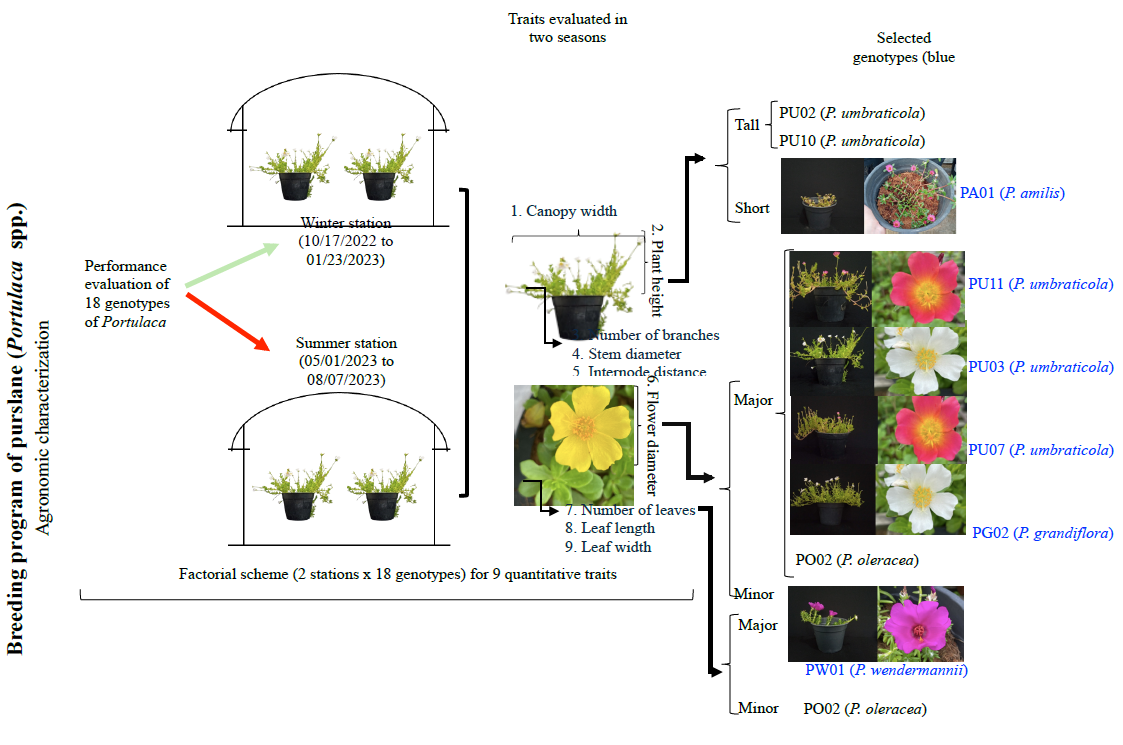
2.1. Plant Material, Cultivation and Experimental Location
2.2. Morpho-Agronomic Characterization and Statistical Analysis
3. Results
3.1. Analysis of Variance
3.2. Unfolding Seasons × Accessions Interaction
3.3. Effect of Accession Factor
3.4. Effect of Seasons
4. Discussion
5. Conclusions
Supplementary Materials
Author Contributions
Funding
Data Availability Statement
Acknowledgments
Conflicts of Interest
References
- Tilman, D.; Balzer, C.; Hill, J.; Befort, B.L. Global food demand and the sustainable intensification of agriculture. Proc. Natl. Acad. Sci. USA. 2015, 108, 20260–20264. [Google Scholar] [CrossRef]
- Kinupp, V.F.; Lorenzi, H. Plantas Alimentícias Não Convencionais (PANC) no Brasil: Guia de Identificação, Aspectos Nutricionais e Receitas Ilustradas, 2nd ed.; InstitutoPlantarun de Estudos de Flora: Nova Odessa, Brazil, 2021. [Google Scholar]
- Carrascosa, A.; Pascual, J.A.; Ros, M.; Petropoulos, A.S.; Alguacil, M.D.M. Agronomical practices and management for commercial cultivation of Portulaca oleracea as a crop: A review. Plants 2023, 12, 1246. [Google Scholar] [CrossRef] [PubMed]
- Kumar, A.; Sreedharan, S.; Singh, P.; Achigan-Dako, E.G.; Ramchiary, N. Improvement of a traditional orphan food crop, Portulaca oleracea L. (Purslane) using genomics for sustainable food security and climate-resilient agriculture. Front. Sustain. Food Syst. 2021, 5, 711820. [Google Scholar] [CrossRef]
- da Silva Souza, J.; do Rêgo, E.R.; Freitas, N.D.S.S.; dos Santos Pessoa, A.M.; Silva, P.D.; do Rêgo, M.M. Phenotypical characterization of Portulaca umbraticola: A non-conventional edible ornamental crop. Acta Sci. Agron. 2024, 46, e62326. [Google Scholar] [CrossRef]
- Kumar, A.; Sreedharan, S.; Kashyap, A.K.; Singh, P.; Ramchiary, N. A review on bioactive phytochemicals and ethnopharmacological potential of purslane (Portulaca oleracea L.). Heliyon 2022, 8, e08669. [Google Scholar] [CrossRef] [PubMed]
- Ferreira, T.M.M.; Salgado, F.F.; Souza, O.C.A.; Silva, R.V.; Silva, V.N.B.; Oliveira Molinari, P.A.; Junior, M.T.S. Genetic engineering of purslane (Portulaca oleracea L.). In Medicinal Plants-Chemical, Biochemical, and Pharmacological Approaches; IntechOpen: London, UK, 2023. [Google Scholar]
- Varzakas, T.; Smaoui, S. Global food security and sustainability issues: The road to 2030 from nutrition and sustainable healthy diets to food systems change. Foods 2024, 13, 306. [Google Scholar] [CrossRef]
- Srivastava, R.; Srivastava, V.; Singh, A. Multipurpose benefits of an underexplored species purslane (Portulaca oleracea L.): A critical review. Environ. Manag. 2023, 72, 309–320. [Google Scholar] [CrossRef] [PubMed]
- Sultana, A.; Rahman, K. Portulaca oleracea Linn. A global Panacea with ethno-medicinal and pharmacological potential. Int. J. Pharm. Pharm. Sci. 2013, 5, 33–39. [Google Scholar]
- Alam, M.A.; Juraimi, A.S.; Rafii, M.Y.; Hamid, A.A.; Aslani, F.; Mohsin, G.M.A. Comparison of Yield Potential and Cultivar Performance of 20 Collected Purslane (Portulaca oleracea L.) Accessions Employing Seeds vs. Stem Cuttings. J. Agr. Sci. Technol. 2014, 16, 1633–1648. [Google Scholar]
- Uddin, K.; Juraimi, A.S.; Hossain, S.; Nahar, M.A.U.; Ali, E.; Rahman, M.M. Purslane weed (Portulaca oleracea): A prospective plant source of nutrition, omega-3 fatty acid, and antioxidant attributes. Sci. World J. 2014, 2014, 951019. [Google Scholar] [CrossRef]
- Albuquerque, I.M.C.; Coelho, A.A.O.P.; Melo, J.I.M. Flora da Paraíba, Brasil: Portulacaceae Juss. e Talinaceae Doweld. Hoehnea 2022, 49, e702021. [Google Scholar] [CrossRef]
- Barroso, T.L.C.T.; de Barros Alexandre, J.; da Cruz, E.P.; Dias, A.R.G.; Forster-Carneiro, T.; Bastos, C.P. An updated on applications and future perspectives for the valorization of purslane (Portulaca oleracea): A comprehensive review and bibliometric analysis. Eur. Food Res. Technol. 2024, 250, 1285–1306. [Google Scholar] [CrossRef]
- Kedarnath; Imamsahe, S.J.; Hanchinamani, C.N. Genetic Plasticity Studies in Portulaca (Portulaca oleracea L.). Biol. Forum-Int. J. 2021, 13, 122–127. [Google Scholar]
- Talei, D.; Naji, A.M.; Labbaf, N. Genetic diversity of purslane populations of Iran based on some morphological and biochemical traits. J. Med. Plants By-Prod. 2020, 2, 227–234. [Google Scholar]
- Poehlman, J.M. Breeding Field Crops; Springer Science & Business Media: Berlin/Heidelberg, Germany, 2013. [Google Scholar]
- Elmi, A.A.; Mebrahtu, T.; Omara-Alwala, T.R.; Ezekwe, M. Environmental Effects on Yield and Agronomic Traits. Va. J. Sci. 1997, 48, 3. [Google Scholar]
- INMET—Instituto Nacional de Meteorologia. Banco de Dados Meteorológicos Para Ensino e Pesquisa; Instituto Nacional de Meteorologia—INMET: Brasília, Brazil, 2024.
- Zar, J.H. Biostatistical Analysis; Pearson Education India: Bengaluru, India, 1999. [Google Scholar]
- Cruz, C.D. Programa Genes (Versão Windows): Aplicativo Computacional em Genética e Estatística; UFV: Viçosa, Brazil, 2018. [Google Scholar]
- Alam, A.; Juraimi, A.S.; Yusop, M.R.; Hamid, A.A.; Hakim, A. Morpho-physiological and mineral nutrient characterization of 45 collected Purslane (Portulaca oleracea L.) accessions. Bragantia 2014, 73, 426–437. [Google Scholar] [CrossRef]
- Petropoulos, S.A.; Karkanis, A.; Fernandes, Â.; Barros, L.; Ferreira, I.C.; Ntatsi, G.; Khah, E. Chemical composition and yield of six genotypes of common purslane (Portulaca oleracea L.): An alternative source of Omega-3 fatty acids. Plant Foods Hum. Nutr. 2015, 70, 420–426. [Google Scholar] [CrossRef]
- Jia, S.; Yan, Z.; Wang, Y.; Wei, Y.; Xie, Z.; Zhang, F. Genetic diversity and relatedness among ornamental purslane (Portulaca L.) accessions unraveled by SRAP markers. 3 Biotech 2017, 7, 241. [Google Scholar] [CrossRef]
- Egea-Gilabert, C.; Ruiz-Hernández, M.V.; Parra, M.Á.; Fernández, J.A. Characterization of purslane (Portulaca oleracea L.) accessions: Suitability as ready-to-eat product. Sci. Hortic. 2014, 172, 73–81. [Google Scholar] [CrossRef]
- Mulry, K.R.; Hanson, B.A.; Dudle, D.A. Alternative strategies in response to saline stress in two varieties of Portulaca oleracea (purslane). PLoS ONE 2015, 10, e0138723. [Google Scholar] [CrossRef]
- Karkanis, A.C.; Petropoulos, S.A. Physiological and growth responses of several genotypes of common purslane (Portulaca oleracea L.) under Mediterranean semi-arid conditions. Not. Bot. Horti Agrobot. 2017, 45, 569–575. [Google Scholar] [CrossRef]
- Alu’Datt, M.H.; Rababah, T.; Alhamad, M.N.; Al-Tawaha, A.; Al-Taw/aha, A.R.; Gammoh, S.; Kubow, S. Herbal yield, nutritive composition, phenolic contents and antioxidant activity of purslane (Portulaca oleracea L.) grown in different soilless media in a closed system. Ind. Crops Prod. 2019, 141, 111746. [Google Scholar] [CrossRef]
- Sdouga, D.; Branca, F.; Kabtni, S.; Bella, M.C.; Trifi-Farah, N.; Marghali, S. Morphological Traits and Phenolic Compounds in Tunisian Wild Populations and Cultivated Varieties of Portulaca oleracea L. Agronomy 2020, 10, 948. [Google Scholar] [CrossRef]
- Pasha, M.F.K.; Ali, S.; Ahmed, A. Impact of agro-climatic conditions of Faisalabad on growth performance of Portulaca genotypes. Pure Appl. Biol. 2021, 10, 770–780. [Google Scholar] [CrossRef]
- Mohebodini, M.; Khalili-Baseri, I.; Farmanpour-Kalalagh, K.; Sabaghnia, N. Morphological characterization of some collected native purslane (Portulaca oleracea L.) genotypes. Contrib. Bot. 2024, 59, 7–20. [Google Scholar] [CrossRef]
- Mahr, S. Common Purslane, Portulaca oleraceae. Wisconsing Horticulture. Available online: https://hort.extension.wisc.edu/articles/common-purslane-portulaca-oleracea/ (accessed on 29 August 2025).
- Datta, S.K. Breeding of ornamentals: Success and technological status. Nucleus 2021, 65, 107–128. [Google Scholar] [CrossRef]

| Accession Name | Species |
|---|---|
| PH01 | Portulaca halimoides |
| PG08 | Portulaca grandiflora |
| PU01 | Portulaca umbraticola |
| PU04 | Portulaca umbraticola |
| PU05 | Portulaca umbraticola |
| PU02 | Portulaca umbraticola |
| PU03 | Portulaca umbraticola |
| PU06 | Portulaca umbraticola |
| PU07 | Portulaca umbraticola |
| PU08 | Portulaca umbraticola |
| PU09 | Portulaca umbraticola |
| PU10 | Portulaca umbraticola |
| PG01 | Portulaca grandiflora |
| PU39 | Portulaca umbraticola |
| PW 1 | Portulaca werdermannii |
| PO01 | Portulaca oleracea |
| PA01 | Portulaca amilis |
| PO02 | Portulaca oleracea |
| Summer | Winter | ||||||||
|---|---|---|---|---|---|---|---|---|---|
| Oct. | Nov. | Dec. | Jan. | May | Jun. | Jul. | Aug. | ||
| Temperature (°C) | Max | 23.2 | 23.7 | 24.1 | 23.6 | 23.3 | 21.7 | 21.6 | 21.6 |
| Min | 22.0 | 22.5 | 22.9 | 22.5 | 22.4 | 21.0 | 20.7 | 20.7 | |
| Average | 22.6 | 23.0 | 23.5 | 23.0 | 22.8 | 21.0 | 21.0 | 21.0 | |
| SD | 2.66 | 2.93 | 2.97 | 2.68 | 2.10 | 1.89 | 2.07 | 2.51 | |
| SE | 0.008 | 0.004 | 0.004 | 0.01 | 0.002 | 0.002 | 0.002 | 0.014 | |
| Moisture (%) | Max | 83.0 | 83.6 | 81.9 | 85.9 | 89.0 | 92.7 | 89.5 | 88.2 |
| Min | 78.0 | 78.7 | 76.5 | 81.0 | 86.0 | 90.0 | 85.6 | 84.3 | |
| Average | 80.0 | 81.2 | 79.2 | 83.0 | 88.0 | 91.4 | 87.5 | 86.3 | |
| SD | 15.15 | 16.242 | 16.91 | 14.60 | 10.65 | 8.886 | 10.83 | 12.28 | |
| SE | 0.048 | 0.022 | 0.023 | 0.07 | 0.014 | 0.012 | 0.015 | 0.073 | |
| Precipitation (mm) | Average | 0.0059 | 0.06 | 0.034 | 0.204 | 0.163 | 0.411 | 0.158 | 0.135 |
| SD | 0.061 | 0.355 | 0.277 | 1.110 | 0.899 | 1.125 | 0.877 | 0.450 | |
| SE | 0.0002 | 0.0005 | 0.0003 | 0.005 | 0.0012 | 0.00015 | 0.0012 | 0.0026 | |
| Mean Square | ||||||
|---|---|---|---|---|---|---|
| S.V | DF | CW | PH | SD | ID | LW |
| Seasons (S) | 1 | 1634.889 ** | 316.555 ** | 0.243 ** | 0.5508 ns | 0.09907 ns |
| Accessions (A) | 17 | 1228.059 ** | 322.702 ** | 0.792 ** | 0.45424 ** | 1.31819 ** |
| S × A | 17 | 186.886 ns | 44.863 ns | 0.1423 ns | 0.12455 ns | 0.05214 ns |
| Residue | 108.47 | 28.48 | 0.01 | 0.10 | 0.02 | |
| CV (%) | 23.28 | 17.89 | 19.08 | 27.25 | 16.19 | |
| Heritability | 84.78 | 86.09 | 82.03 | 72.58 | 96.04 | |
| S.V | LL | FD | NL | NB | - | |
| Seasons (S) | 1 | 1.224 ** | 0.263 ns | 301,255.703 ** | 1533.787 ** | - |
| Accessions (A) | 17 | 2.689 ** | 8.1964 ** | 539,482.22 ns | 717.397 ** | - |
| S × A | 17 | 0.153 ns | 0.160 ns | 159,184.76 ** | 151.100 ns | - |
| Residue | 72 | 0.08 | 0.09 | 61,340.63 | 120.77 | |
| CV (%) | 12.87 | 13.86 | 35.75 | 33.55 | ||
| Heritability | 94.28 | 98.04 | 70.49 | 78.93 | ||
| Accessions | Number of Leaves | |
|---|---|---|
| Summer | Winter | |
| PH01 | 2059.333 ± 404.911 Aa | 830.333 ± 368.065 Ba |
| PG08 | 625.333 ± 115.386 Ab | 698.666 ± 342.770 Aa |
| PU01 | 851.000 ± 75.447 Ab | 645.333 ± 19.427 Aa |
| PU04 | 816.333 ± 99.943 Ab | 1078.666 ± 88.743 Aa |
| PU05 | 657.333 ± 25.873 Ab | 664.000 ± 142.903 Aa |
| PU02 | 631.666 ± 112.609 Ab | 889.000 ± 119.358 Aa |
| PU03 | 975.666 ± 74.319 Ab | 851.666 ± 293.478 Aa |
| PU06 | 796.333 ± 40.522 Ab | 854.000 ± 95.001 Aa |
| PU07 | 871.333 ± 86.167 Ab | 884.333 ± 108.213 Aa |
| PU08 | 836.000 ± 63.213 Ab | 762.333 ± 145.791 Aa |
| PU09 | 740.666 ± 105.794 Ab | 638.000 ± 174.003 Aa |
| PU10 | 719.666 ± 33.947 Ab | 655.666 ± 56.581 Aa |
| PG 01 | 325.666 ± 116.382 Ac | 386.000 ± 55.967 Ab |
| PU39 | 1031.000 ± 46.508 Ab | 710.333 ± 80.837 Aa |
| PW 1 | 424.333 ± 48.258 Ac | 247.666 ± 25.705 Ab |
| PO01 | 285.666 ± 86.313 Ac | 84.333 ± 32.255 Ab |
| PA01 | 574.666 ± 4.666 Ab | 300.666 ± 40.068 Ab |
| PO02 | 197.333 ± 33.577 Ac | 337.000 ± 42.027 Ab |
| Accessions | CW (cm) | PH (cm) | SD (cm) | ID (cm) |
|---|---|---|---|---|
| PH 1 | 32.816 ± 7.180 b | 22.65 ± 3.811 c | 0.314 ± 0.025 b | 1.014 ± 0.134 b |
| PG08 | 48.00 ± 5.885 a | 27.833 ± 2.764 c | 0.455 ± 0.025 b | 1.039 ± 0.189 b |
| PU01 | 57.583 ± 3.023 a | 34.466 ± 2.689 b | 0.719 ± 0.048 a | 1.411 ± 0.105 a |
| PU04 | 56.233 ± 4.882 a | 33.633 ± 0.996 b | 0.611 ± 0.026 a | 1.376 ± 0.122 a |
| PU05 | 55.450 ± 6.795 a | 34.466 ± 3.531 b | 0.634 ± 0.036 a | 1.343 ± 0.061 a |
| PU02 | 66.40 ± 2.147 a | 45.216 ± 1.506 a | 0.643 ± 0.025 a | 1.390 ± 0.105 a |
| PU03 | 52.15 ± 6.233 a | 32.783 ± 2.513 b | 0.652 ± 0.048 a | 1.229 ± 0.139 a |
| PU06 | 45.133 ± 2.501 a | 25.516 ± 1.561 c | 0.607 ± 0.023 a | 1.178 ± 0.049 a |
| PU07 | 53.566 ± 4.607 a | 34.066 ± 1.987 b | 0.678 ± 0.044 a | 1.311 ± 0.114 a |
| PU08 | 48.233 ± 2.208 a | 29.55 ± 1.139 b | 0.675 ± 0.047 a | 1.551 ± 0.107 a |
| PU09 | 52.633 ± 4.712 a | 31.516 ± 1.692 b | 0.638 ± 0.075 a | 1.375 ± 0.114 a |
| PU10 | 59.083 ± 5.371 a | 41.166 ± 2.634 a | 0.776 ± 0.036 a | 1.278 ± 0.068 a |
| PG 01 | 24.366 ± 5.78 b | 23.333 ± 1.986 c | 0.425 ± 0.106 b | 0.701 ± 0.111 b |
| PU39 | 52.75 ± 6.018 a | 33.55 ± 2.245 b | 0.672 ± 0.058 a | 1.136 ± 0.150 a |
| PW 1 | 27.566 ± 3.407 b | 24.966 ± 2.751 c | 0.591 ± 0.034 a | 0.866 ± 0.096 b |
| PO01 | 22.15 ± 5.059 b | 24.383 ± 3.446 c | 0.535 ± 0.047 b | 0.639 ± 0.234 b |
| PA01 | 23.083 ± 3.514 b | 14.416 ± 2.469 d | 0.453 ± 0.089 b | 0.919 ± 0.091 b |
| PO02 | 28.033 ± 3.035 b | 23.433 ± 0.934 c | 0.569 ± 0.024 a | 1.608 ± 0.243 a |
| Accessions | LW (cm) | LL (cm) | FD (cm) | NB |
| PH 1 | 0.224 ± 0.013 d | 1.045 ± 0.086 d | 0.599 ± 0.062e | 44.166 ± 8.979 a |
| PG08 | 0.316 ± 0.010 d | 2.217 ± 0.126 b | 2.884 ± 0.197 b | 24.333 ± 5.289 b |
| PU01 | 1.588 ± 0.043 a | 2.967 ± 0.137 a | 2.624 ± 0.223 b | 35.500 ± 3.731 a |
| PU04 | 1.421 ± 0.041 a | 2.715 ± 0.098 a | 2.458 ± 0.187 b | 43.00 ± 5.040 a |
| PU05 | 1.361 ± 0.074 a | 2.451 ± 0.105 b | 1.966 ± 0.0.086 c | 30.333 ± 4.477 a |
| PU02 | 1.191 ± 0.095 b | 2.442 ± 0.101 b | 2.376 ± 0.061 b | 35.333 ± 3.879 a |
| PU03 | 1.152 ± 0.086 b | 2.175 ± 0.106 b | 2.595 ± 0.113 b | 47.00 ± 5.927 a |
| PU06 | 1.303 ± 0.057 a | 2.885 ± 0.109 a | 2.479 ± 0.049 b | 34.833 ± 3.478 a |
| PU07 | 1.443 ± 0.035 a | 2.677 ± 0.117 a | 2.314 ± 0.106 b | 36.833 ± 2.750 a |
| PU08 | 1.455 ± 0.041 a | 2.643 ± 0.135 a | 2.557 ± 0.055 b | 39.666 ± 3.712 a |
| PU09 | 1.462 ± 0.080 a | 2.842 ± 0.155 a | 2.736 ± 0.199 b | 35.666 ± 5.371 a |
| PU10 | 1.364 ± 0.112 a | 3.039 ± 0.129 a | 2.616 ± 0.108 b | 35.833 ± 2.613 a |
| PG 01 | 0.253 ± 0.015 d | 1.203 ± 0.087 d | 1.822 ± 0.166 c | 14.333 ± 2.044 b |
| PU39 | 1.001 ± 0.057 b | 2.010 ± 0.101 b | 2.442 ± 0.147 b | 47.00 ± 6.933 a |
| PW 1 | 0.549 ± 0.027 c | 2.422 ± 0.107 b | 5.791 ± 0.222 a | 7.833 ± 1.514 b |
| PO01 | 0.608 ± 0.181 c | 1.079 ± 0.327 d | 0.693 ± 0.063e | 17.333 ± 6.058 b |
| PA01 | 0.588 ± 0.031 c | 1.514 ± 0.046 c | 1.149 ± 0.102 d | 31.500 ± 6.313 a |
| PO02 | 0.945 ± 0.095 b | 1.497 ± 0.128 c | 0.582 ± 0.057e | 29.000 ± 2.828 a |
| Means Values | ||||
|---|---|---|---|---|
| Seasons | CW (cm) | PH (cm) | SD (cm) | ID (cm) |
| Summer | 48.625 ± 14.499 a | 31.542 ± 1.107 a | 0.638 ± 0.022 a | 1.209 ± 0.052 a |
| Winter | 40.844 ± 2.691 b | 28.118 ± 1.293 b | 0.543 ± 0.019 b | 1.164 ± 0.057 a |
| Seasons | LW (cm) | LL (cm) | FD (cm) | NB |
| Summer | 0.984 ± 0.066 a | 2.106 ± 0.095 b | 2.211 ± 0.166 a | 36.518 ± 1.984 a |
| Winter | 1.044 ± 0.066 a | 2.319 ± 0.098 a | 2.039 ± 0.156 a | 28.981 ± 2.062 b |
Disclaimer/Publisher’s Note: The statements, opinions and data contained in all publications are solely those of the individual author(s) and contributor(s) and not of MDPI and/or the editor(s). MDPI and/or the editor(s) disclaim responsibility for any injury to people or property resulting from any ideas, methods, instructions or products referred to in the content. |
© 2025 by the authors. Licensee MDPI, Basel, Switzerland. This article is an open access article distributed under the terms and conditions of the Creative Commons Attribution (CC BY) license (https://creativecommons.org/licenses/by/4.0/).
Share and Cite
Rêgo, E.R.d.; Pontes, N.d.S.; da Silva, M.G.; da Silva, N.B.F.; Dantas, A.C.; Pessoa, A.M.d.S.; Rêgo, M.M.d. Differential Growth in Purslane Species Grown in Two Different Seasons. Horticulturae 2025, 11, 1107. https://doi.org/10.3390/horticulturae11091107
Rêgo ERd, Pontes NdS, da Silva MG, da Silva NBF, Dantas AC, Pessoa AMdS, Rêgo MMd. Differential Growth in Purslane Species Grown in Two Different Seasons. Horticulturae. 2025; 11(9):1107. https://doi.org/10.3390/horticulturae11091107
Chicago/Turabian StyleRêgo, Elizanilda Ramalho do, Nataline da Silva Pontes, Marcos Gomes da Silva, Nicollas Bernardo Ferreira da Silva, Aline Cavalcanti Dantas, Angela Maria dos Santos Pessoa, and Mailson Monteiro do Rêgo. 2025. "Differential Growth in Purslane Species Grown in Two Different Seasons" Horticulturae 11, no. 9: 1107. https://doi.org/10.3390/horticulturae11091107
APA StyleRêgo, E. R. d., Pontes, N. d. S., da Silva, M. G., da Silva, N. B. F., Dantas, A. C., Pessoa, A. M. d. S., & Rêgo, M. M. d. (2025). Differential Growth in Purslane Species Grown in Two Different Seasons. Horticulturae, 11(9), 1107. https://doi.org/10.3390/horticulturae11091107